EP1020534B2 - Procede de synthese d'acide nucleique - Google Patents
Procede de synthese d'acide nucleique Download PDFInfo
- Publication number
- EP1020534B2 EP1020534B2 EP99954435A EP99954435A EP1020534B2 EP 1020534 B2 EP1020534 B2 EP 1020534B2 EP 99954435 A EP99954435 A EP 99954435A EP 99954435 A EP99954435 A EP 99954435A EP 1020534 B2 EP1020534 B2 EP 1020534B2
- Authority
- EP
- European Patent Office
- Prior art keywords
- nucleic acid
- complementary
- region
- chain
- reaction
- Prior art date
- Legal status (The legal status is an assumption and is not a legal conclusion. Google has not performed a legal analysis and makes no representation as to the accuracy of the status listed.)
- Expired - Lifetime
Links
Images




Classifications
-
- C—CHEMISTRY; METALLURGY
- C12—BIOCHEMISTRY; BEER; SPIRITS; WINE; VINEGAR; MICROBIOLOGY; ENZYMOLOGY; MUTATION OR GENETIC ENGINEERING
- C12Q—MEASURING OR TESTING PROCESSES INVOLVING ENZYMES, NUCLEIC ACIDS OR MICROORGANISMS; COMPOSITIONS OR TEST PAPERS THEREFOR; PROCESSES OF PREPARING SUCH COMPOSITIONS; CONDITION-RESPONSIVE CONTROL IN MICROBIOLOGICAL OR ENZYMOLOGICAL PROCESSES
- C12Q1/00—Measuring or testing processes involving enzymes, nucleic acids or microorganisms; Compositions therefor; Processes of preparing such compositions
- C12Q1/68—Measuring or testing processes involving enzymes, nucleic acids or microorganisms; Compositions therefor; Processes of preparing such compositions involving nucleic acids
- C12Q1/6844—Nucleic acid amplification reactions
- C12Q1/6853—Nucleic acid amplification reactions using modified primers or templates
-
- C—CHEMISTRY; METALLURGY
- C12—BIOCHEMISTRY; BEER; SPIRITS; WINE; VINEGAR; MICROBIOLOGY; ENZYMOLOGY; MUTATION OR GENETIC ENGINEERING
- C12N—MICROORGANISMS OR ENZYMES; COMPOSITIONS THEREOF; PROPAGATING, PRESERVING, OR MAINTAINING MICROORGANISMS; MUTATION OR GENETIC ENGINEERING; CULTURE MEDIA
- C12N15/00—Mutation or genetic engineering; DNA or RNA concerning genetic engineering, vectors, e.g. plasmids, or their isolation, preparation or purification; Use of hosts therefor
- C12N15/09—Recombinant DNA-technology
- C12N15/10—Processes for the isolation, preparation or purification of DNA or RNA
-
- C—CHEMISTRY; METALLURGY
- C12—BIOCHEMISTRY; BEER; SPIRITS; WINE; VINEGAR; MICROBIOLOGY; ENZYMOLOGY; MUTATION OR GENETIC ENGINEERING
- C12Q—MEASURING OR TESTING PROCESSES INVOLVING ENZYMES, NUCLEIC ACIDS OR MICROORGANISMS; COMPOSITIONS OR TEST PAPERS THEREFOR; PROCESSES OF PREPARING SUCH COMPOSITIONS; CONDITION-RESPONSIVE CONTROL IN MICROBIOLOGICAL OR ENZYMOLOGICAL PROCESSES
- C12Q1/00—Measuring or testing processes involving enzymes, nucleic acids or microorganisms; Compositions therefor; Processes of preparing such compositions
- C12Q1/68—Measuring or testing processes involving enzymes, nucleic acids or microorganisms; Compositions therefor; Processes of preparing such compositions involving nucleic acids
- C12Q1/6844—Nucleic acid amplification reactions
-
- C—CHEMISTRY; METALLURGY
- C12—BIOCHEMISTRY; BEER; SPIRITS; WINE; VINEGAR; MICROBIOLOGY; ENZYMOLOGY; MUTATION OR GENETIC ENGINEERING
- C12Q—MEASURING OR TESTING PROCESSES INVOLVING ENZYMES, NUCLEIC ACIDS OR MICROORGANISMS; COMPOSITIONS OR TEST PAPERS THEREFOR; PROCESSES OF PREPARING SUCH COMPOSITIONS; CONDITION-RESPONSIVE CONTROL IN MICROBIOLOGICAL OR ENZYMOLOGICAL PROCESSES
- C12Q2525/00—Reactions involving modified oligonucleotides, nucleic acids, or nucleotides
- C12Q2525/10—Modifications characterised by
- C12Q2525/161—Modifications characterised by incorporating target specific and non-target specific sites
-
- C—CHEMISTRY; METALLURGY
- C12—BIOCHEMISTRY; BEER; SPIRITS; WINE; VINEGAR; MICROBIOLOGY; ENZYMOLOGY; MUTATION OR GENETIC ENGINEERING
- C12Q—MEASURING OR TESTING PROCESSES INVOLVING ENZYMES, NUCLEIC ACIDS OR MICROORGANISMS; COMPOSITIONS OR TEST PAPERS THEREFOR; PROCESSES OF PREPARING SUCH COMPOSITIONS; CONDITION-RESPONSIVE CONTROL IN MICROBIOLOGICAL OR ENZYMOLOGICAL PROCESSES
- C12Q2527/00—Reactions demanding special reaction conditions
- C12Q2527/101—Temperature
-
- C—CHEMISTRY; METALLURGY
- C12—BIOCHEMISTRY; BEER; SPIRITS; WINE; VINEGAR; MICROBIOLOGY; ENZYMOLOGY; MUTATION OR GENETIC ENGINEERING
- C12Q—MEASURING OR TESTING PROCESSES INVOLVING ENZYMES, NUCLEIC ACIDS OR MICROORGANISMS; COMPOSITIONS OR TEST PAPERS THEREFOR; PROCESSES OF PREPARING SUCH COMPOSITIONS; CONDITION-RESPONSIVE CONTROL IN MICROBIOLOGICAL OR ENZYMOLOGICAL PROCESSES
- C12Q2527/00—Reactions demanding special reaction conditions
- C12Q2527/125—Specific component of sample, medium or buffer
-
- C—CHEMISTRY; METALLURGY
- C12—BIOCHEMISTRY; BEER; SPIRITS; WINE; VINEGAR; MICROBIOLOGY; ENZYMOLOGY; MUTATION OR GENETIC ENGINEERING
- C12Q—MEASURING OR TESTING PROCESSES INVOLVING ENZYMES, NUCLEIC ACIDS OR MICROORGANISMS; COMPOSITIONS OR TEST PAPERS THEREFOR; PROCESSES OF PREPARING SUCH COMPOSITIONS; CONDITION-RESPONSIVE CONTROL IN MICROBIOLOGICAL OR ENZYMOLOGICAL PROCESSES
- C12Q2531/00—Reactions of nucleic acids characterised by
- C12Q2531/10—Reactions of nucleic acids characterised by the purpose being amplify/increase the copy number of target nucleic acid
- C12Q2531/119—Strand displacement amplification [SDA]
Definitions
- the present invention relates to a method of synthesizing nucleic acid composed of a specific nucleotide sequence, which is useful as a method of amplifying nucleic acid.
- An analysis method based on complementarity of a nucleic acid nucleotide sequence can analyze genetic traits directly. Accordingly, this analysis is a very powerful means for identification of genetic diseases, canceration, microorganisms etc. Further, a gene itself is the object of detection, and thus time-consuming and cumbersome procedures such as in culture can be omitted in some cases.
- the detection of a target gene present in a very small amount in a sample is not easy in general so that amplification of a target gene itself or its detection signal is necessary.
- the PCR (polymerase chain reaction) method is known ( Science, 230, 1350-1354, 1985 ).
- the PCRmethod is the most popular method as a technique of amplifying nucleic acid in vitro . This method was established firmly as an excellent detection method by virtue of high sensitivity based on the effect of exponential amplification. Further, since the amplification product can be recovered as DNA, this method is applied widely as an important tool supporting genetic engineering techniques such as gene cloning and structural determination.
- SNPs single nucleotide polymorphism
- Detection of SNPs by means of PCR is feasible by designing a primer such that its nucleotide sequence contains SNPs. That is, whether a nucleotide sequence complementary to the primer is present or not can be inferred by determining whether a reaction product is present or not.
- this product functions as a template in subsequent reaction, thus causing an erroneous result.
- strict control of PCR is difficult with the difference of only one base given at the terminal of the primer. Accordingly, it is necessary to improve specificity in order to apply PCR to detection of SNPs.
- the LCR method (ligase chain reaction, Laffler TG; Garrino JJ; Marshall RL; Ann. Biol. Clin. (Paris), 51 :9, 821-6, 1993) is based on the reaction in which two adjacent probes are hybridized with a target sequence and ligated to each other by a ligase. The two probes could not be ligated in the absence of the target nucleotide sequence, and thus the presence of the ligated product is indicative of the target nucleotide sequence.
- the LCR method also requires control of temperature for separation of a complementary chain from a template, there arises the same problem as in the PCR method.
- LCR there is also a report on a method of improving specificity by adding the step of providing a gap between adjacent probes and filling the gap by a DNA polymerase.
- control of temperature is required.
- use of the additional enzyme leads to an increase in cost.
- a method called the SDA method (strand displacement amplification) [ Proc. Natl. Acad. Sci. USA, 89, 392-396, 1992 ] [Nucleic Acid. Res., 20, 1691-1696, 1992 ] is also known as a method of amplifying DNA having a sequence complementary to a target sequence as a template.
- SDA method strand displacement amplification
- a special DNA polymerase is used to synthesize a complementary chain starting from a primer complementary to the 3'-side of a certain nucleotide sequence while displacing a double-stranded chain if any at the 5'-side of the sequence.
- the simple expression "5'-side” or "3'-side” refers to that of a chain serving as a template.
- the temperature-changing step essential in the PCR method can be eliminated in the SDA method by previously inserting a restriction enzyme recognition sequence into an annealed sequence as a primer. That is, a nick generated by a restriction enzyme gives a 3'-OH group acting as the origin of synthesis of complementary chain, and the previously synthesized complementary chain is released as a single-stranded chain by strand displacement synthesis and then utilized again as a template for subsequent synthesis of complementary chain. In this manner, the complicated control of temperature essential in the PCR method is not required in the SDA method.
- the restriction enzyme generating a nick should be used in addition to the strand displacement-type DNA polymerase. This requirement for the additional enzyme is a major cause for higher cost. Further, because the restriction enzyme is to be used not for cleavage of both double-stranded chains but for introduction of a nick (that is, cleavage of only one of the chains), a dNTP derivative such as ⁇ -thio dNTP should be used as a substrate for synthesis to render the other chain resistant to digestion with the enzyme. Accordingly, the amplification product by SDA has a different structure from that of natural nucleic acid, and there is a limit to cleavage with restriction enzymes or application of the amplification product to gene cloning.
- NASBA nucleic acid sequence-based amplification, also called the TMA/transcription mediated amplification method
- TMA/transcription mediated amplification method is known as a method of amplifying nucleic acid wherein the complicated control of temperature is not necessary.
- NASBA is a reaction system wherein DNA is synthesized by DNA polymerase in the presence of target RNA as a template with a probe having a T7 promoter added thereto, and the product is formed with a second probe into a double-stranded chain, followed by transcription by T7 RNA polymerase with the formed double-stranded chain as a template to amplify a large amount of RNA ( Nature, 350, 91-92, 1991 ).
- NASBA requires some heat denaturation steps until double-stranded DNA is completed, but the subsequent transcriptional reaction by T7 RNA polymerase proceeds under isothermal conditions.
- a combination of plural enzymes such as reverse transcriptase, RNase H, DNA polymerase and T7 RNA polymerase is essential, and this is unfavorable for cost similarly to SDA.
- this method is hardly widespread as a general analytical method. In the known reactions of amplification of nucleic acid, there remain problems such as complicated control of temperature and the necessity for plural enzymes as described above
- this step proceeds depending on a subtle equilibrium state at the terminal of mutually complementary nucleotide sequences involving base pairing. That is, an equilibrium state maintained between base pairing with a complementary chain and base pairing in the same chain is utilized and the only chain annealing to the nucleotide sequence in the same chain serves as the origin of synthesis of a complementary chain. Accordingly, it is considered that strict reaction conditions should be set to achieve high reaction efficiency.
- the primer itself forms a loop structure. Accordingly, once a primer dimer is formed, amplification reaction is automatically initiated regardless of whether a target nucleotide sequence is present or not, and an unspecific synthetic product is thus formed. This can be a serious problem. Further, formation of the primer dimer and subsequent consumption of the primer by unspecific synthetic reaction lead to a reduction in the amplification efficiency of the desired reaction.
- an oligonucleotide having a hairpin structure at the terminal thereof is often utilized to supply a double-stranded promoter region ( JP-A 5-211873 ).
- these techniques are not those permitting successive supply of 3'-OH for synthesis of a complementary chain.
- a hairpin loop structure having a 3'-terminal annealed in the same chain is utilized for the purpose of obtaining a DNA template transcribed by RNA polymerase is utilized in JP-A 10-510161 ( WO96/17079 ).
- the template is amplified by using transcription into RNA and reverse transcription from RNA to DNA.
- the reaction system cannot be constituted without a combination of a plurality of enzymes.
- WO 97/04131 describes a method for exponentially amplifying a polynucleotide hairpin using a single primer capable of hybridizing to a site on the 3' portion of the hairpin polynucleotide suitable for primer extension into the stem or duplex portion of the hairpin.
- the base paining of the hairpin polynucleotide is disrupted and subjected to hybridization with the primer and then primer extended, thereby producing the extension product.”
- the object of the present invention is to provide a method of synthesizing nucleic acid based on a novel principle.
- a more specific object is to provide a method capable of realizing the synthesis of nucleic acid depending on sequence efficiently at low costs. That is, an object of the present invention is to provide a method capable of achieving the synthesis and amplification of nucleic acid by a single enzyme even under isothermal reaction conditions.
- Another object of the present invention is to provide a method of synthesizing nucleic acid which can realize high specificity difficult to achieve in the known reaction principle of nucleic acid synthesis, as well as a method of amplifying nucleic acid by applying said synthetic method.
- the present inventors focused their attention on the fact that the utilization of a polymerase catalyzing strand displacement-type synthesis of complementary chain is useful for nucleic acid synthesis not depending on complicated control of temperature.
- a DNA polymerase is an enzyme utilized in SDA and RCA.
- SDA SDA
- RCA RCA
- another enzyme reaction is always required for supplying 3'-OH as the origin of synthesis in the known means based on primers, such as SDA.
- the present inventors examined supply of 3'-OH from a completely different viewpoint from the known approach. As a result, the present inventors found that by utilizing an oligonucleotide having a special structure, 3'-OH can be supplied without any additional enzyme reaction, thereby completing the present invention. That is, the present invention is limited to:
- the nucleic acid having complementary nucleotide sequences linked alternately in a single-stranded chain as the object of synthesis in the present invention means nucleic acid having mutually complementary nucleotide sequences linked side by side in a single-stranded chain. Further, in the present invention, it should contain a nucleotide sequence for forming a loop between the complementary chains. In the present invention, this sequence is called the loop-forming sequence.
- the nucleic acid synthesized by the present invention is composed substantially of mutually complementary chains linked via the loop-forming sequence. In general, a strand not separated into 2 or more molecules upon dissociation of base pairing is called a single-stranded chain regardless of whether it partially involves base pairing or not.
- the complementary nucleotide sequence can form base pairing in the same chain.
- An intramolecular base-paired product which can be obtained by permitting the nucleic acid having complementary nucleotide sequences linked alternately in a single-stranded chain according to the present invention to be base-paired in the same chain, gives a region constituting an apparently double-stranded chain and a loop not involving base pairing.
- the nucleic acid having complementary nucleotide sequences linked alternately in a single-stranded chain according to the present invention contains complementary nucleotide sequences capable of annealing in the same chain, and its annealed product can be defined as single-stranded nucleic acid constituting a loop not involving base pairing at a bent hinged portion.
- a nucleotide having a nucleotide sequence complementary thereto can anneal to the loop not involving base pairing.
- the loop-forming sequence can be an arbitrary nucleotide sequence.
- the loop-forming sequence is capable of base pairing so as to initiate the synthesis of a complementary chain for displacement, and is provided preferably with a sequence distinguishable from a nucleotide sequence located in the other region in order to achieve specific annealing.
- the loop-forming sequence contains substantially the same nucleotide sequence as a region F2c (or R2c) located at the 3'-side of a region (i.e. F1c or R1c) derived from nucleic acid as a template and annealed in the same chain.
- substantially the same nucleotide sequence is defined as follows. That is, when a complementary chain synthesized with a certain sequence as a template anneals to a target nucleotide sequence to give the origin of synthesizing a complementary chain, this certain sequence is substantially the same as the target nucleotide sequence.
- substantially the same sequence as F2 includes not only absolutely the same nucleotide sequence as F2 but also a nucleotide sequence capable of functioning as a template giving a nucleotide sequence capable of annealing to F2 and acting as the origin of synthesizing complementary chain.
- anneal in the present invention means formation of a double-stranded structure of nucleic acid through base pairing based on the law of Watson-Crick. Accordingly, even if a nucleic acid chain constituting base pairing is a single-stranded chain, annealing occurs if intramolecular complementary nucleotide sequences are base-paired. In the present invention, annealing and hybridization have the same meaning in that the nucleic acid constitutes a double-stranded structure through base pairing.
- the number of pairs of complementary nucleotide sequences constituting the nucleic acid according to the present invention is at least 1. According to a desired mode of the present invention, it may be 2 or more. In this case, there is theoretically no upper limit to the number of pairs of complementary nucleotide sequences constituting the nucleic acid.
- the nucleic acid as the synthetic product of the present invention is constituted of plural sets of complementary nucleotide sequences, this nucleic acid is composed of repeated identical nucleotide sequences.
- the nucleic acid having complementary nucleotide sequences linked alternately in a single-stranded chain synthesized by the present invention may not have the same structure as naturally occurring nucleic acid. It is known that if a nucleotide derivative is used as a substrate when nucleic acid is synthesized by the action of a DNA polymerase, a nucleic acid derivative can be synthesized.
- the nucleotide derivative used includes nucleotides labeled with a radioisotope or nucleotide derivatives labeled with a binding ligand such as biotin or digoxin. These nucleotide derivatives can be used to label nucleic acid derivatives as the product.
- the nucleic acid as the product can be a fluorescent derivative.
- this product may be either DNA or RNA. Which one is formed is determined by a combination of the structure of a primer, the type of a substrate for polymerization and polymerization reagents for carrying out polymerization of nucleic acid.
- Synthesis of the nucleic acid having the structure described above can be initiated by use of a DNA polymerase having the strand displacement activity and nucleic acid which is provided at the 3'-terminal thereof with a region F1 capable of annealing to a part F1c in the same chain and which upon annealing of the region F1 to F1c, is capable of forming a loop containing a region F2c capable of base pairing.
- a DNA polymerase having the strand displacement activity and nucleic acid which is provided at the 3'-terminal thereof with a region F1 capable of annealing to a part F1c in the same chain and which upon annealing of the region F1 to F1c, is capable of forming a loop containing a region F2c capable of base pairing.
- a complementary chain previously synthesized with a sample sequence itself as a template is displaced.
- a region R1c (arbitrary region) located at the 3'-terminal of the displaced chain is in a state ready for base-pairing.
- a region having a complementary sequence to this R1c is annealed thereto, resulting in formation of the nucleic acid (2 molecules) having a nucleotide sequence extending from F1 to R1c and its complementary chain linked alternately via the loop-forming sequence.
- the arbitrary region such as R1c above can be selected arbitrarily provided that it can be annealed to a polynucleotide having a nucleotide sequence complementary to that region, and that a complementary chain synthesized with the polynucleotide as the origin of synthesis has necessary functions for the present invention.
- nucleic acid in the present invention generally includes both DNA and RNA. However, nucleic acid whose nucleotide is replaced by an artificial derivative or modified nucleic acid from natural DNA or RNA is also included in the nucleic acid of the present invention insofar as it functions as a template for synthesis of complementary chain.
- the nucleic acid of the present invention is generally contained in a biological sample.
- the biological sample includes animal, plant or microbial tissues, cells, cultures and excretions, or extracts therefrom.
- the biological sample of the present invention includes intracellular parasitic genomic DNA or RNA such as virus or mycoplasma.
- the nucleic acid of the present invention may be derived from nucleic acid contained in said biological sample. For example, cDNA synthesized from mRNA, or nucleic acid amplified on the basis of nucleic acid derived from the biological sample, is a typical example of the nucleic acid of the present invention.
- the nucleic acid characteristic of the present invention which is provided at the 3'-terminal thereof with a region F1 capable of annealing to a part F1c in the same chain and which upon annealing of the region F1 to F1c, is capable of forming a loop containing a region F2c capable of base pairing can be obtained in various methods.
- the reaction of synthesizing complementary chain utilizing an oligonucleotide having the following structure can be used to give the structure.
- the useful oligonucleotide in the present invention consists of at least two regions X2 and X1c below wherein X1c is ligated to the 5'-side of X2.
- the nucleic acid having a specific nucleotide sequence by which the structure of the oligonucleotide of the invention is determined refers to nucleic acid serving as a template when the oligonucleotide of the present invention is used as a primer.
- the nucleic acid having a specific nucleotide sequence is a detection target or nucleic acid derived from the detection target.
- the nucleic acid having a specific nucleotide sequence refers to nucleic acid wherein at least a part of the nucleotide sequence is revealed or predictable.
- the part of the nucleotide sequence revealed is the region X2c and the region X1c located at the 5'-side thereof. It can be supposed that these 2 regions are contiguous or located apart from each other.
- the distance between the two is preferably not very apart from each other in order that nucleic acid as the product is subjected to self-annealing preferentially over intermolecular annealing. Accordingly, the positional relationship of the two is preferably that they are contiguous via a distance of usually 0 to 100 bases.
- the distance between the region X2c and the region X1c located at the 5'-side of X2c is designed to be 0 to 100 bases, more desirably 10 to 70 bases.
- This numerical value shows a length excluding X1c and X2. The number of bases constituting the part of a loop is that of this length plus a region corresponding to X2.
- both the terms “same” and “complementary” used for characterization of the nucleotide sequence constituting the oligonucleotide based on the present invention do not mean being absolutely the same or absolutely complementary. That is, the same sequence as a certain sequence includes sequences complementary to nucleotide sequences capable of annealing to a certain sequence.
- the complementary sequence means a sequence capable of annealing under stringent conditions to provide a 3'-terminal serving as the origin of synthesis of complementary chain.
- the regions X2 and X1c constituting the oligonucleotide of the present invention for the nucleic acid having a specific nucleotide sequence are located contiguously without being overlapped. If there is a common part in both the nucleotide sequences, the two can be partially overlaid. Because X2 should function as a primer, it should always be a 3'-terminal. On the other hand, X1c should give the function of a primer as described blow to the 3'-terminal of a complementary chain synthesized with the nucleic acid as a template, and thus it shall be arranged at the 5'-terminal.
- the complementary chain obtained with this, oligonucleotide as the origin of synthesis serves as a template for synthesis of complementary chain in the reverse direction in the next step, and finally the part of the oligonucleotide of the present invention is copied as a template into a complementary chain.
- the 3'-terminal generated by copying has the nucleotide sequence X1, which anneals to X1c in the same chain to form a loop.
- the oligonucleotide means the one that satisfies the 2 requirements, that is, it must be able to form complementary base pairing and give an -OH group serving as the origin of synthesis of complementary chain at the 3'-terminal.
- its backbone is not necessarily limited to the one via phosphodiester linkages.
- it may be composed of a phosphothioate derivative having S in place of O as a backbone or a peptide nucleic acid based on peptide linkages.
- the bases may be those capable of complementary base pairing. In the nature, there are 5 bases, that is, A, C, T, G and U, but the base can be an analogue such as bromodeoxyuridine.
- the oligonucleotide used in the present invention functions preferably not only as the origin of synthesis but also as a template for synthesis of complementary chain.
- the term polynucleotide in the present invention includes oligonucleotides.
- the term "polynucleotide” is used in the case where the chain length is not limited, while the term “oligonucleotide” is used to refer to a nucleotide polymer having a relatively short chain length.
- the oligonucleotide according to the present invention has such a chain length as to be capable of base pairing with a complementary chain and to maintain necessary specificity under the given environment in the various reactions of synthesizing nucleic acid described below. Specifically, it is composed of 5 to 200 base pairs, more preferably 10 to 50 base pairs.
- the chain length of a primer recognizing the known polymerase catalyzing the sequence-dependent nucleic acid synthetic reaction is at least about 5 bases, so the chain length of the annealing part should be longer than that.
- a length of 10 bases or more is desired statistically in order to expect specificity as the nucleotide sequence.
- the chain length exemplified here refers to the chain length of a part annealing to a complementary chain.
- the oligonucleotide according to the present invention can anneal finally to at least 2 regions individually. Accordingly, it should be understood that the chain length exemplified here is the chain length of each region constituting the oligonucleotide.
- the oligonucleotide according to the present invention can be labeled with a known labeling substance.
- the labeling substance includes binding ligands such as digoxin and biotin, enzymes, fluorescent substances and luminescent substances, and radioisotopes.
- the techniques of replacing a base constituting an oligonucleotide by a fluorescent analogue are also known ( WO95/05391 , Proc. Natl. Acad. Sci. USA, 91, 6644-6648, 1994 ).
- oligonucleotides according to the present invention can also have been bound to a solid phase.
- an arbitrary part of the oligonucleotide may be labeled with a binding ligand such as biotin, and it can be immobilized indirectly via a binding partner such as immobilized avidin.
- a binding ligand such as biotin
- immobilized avidin When the immobilized oligonucleotide is used as the origin of synthesis, nucleic acid as the synthetic reaction product is captured by the solid phase, thus facilitating its separation.
- the separated product can be detected by a nucleic acid-specific indicator or by hybridization with a labeling probe.
- the target nucleic acid fragments can also be recovered by digesting the product with arbitrary restriction enzymes.
- template used in the present invention means nucleic acid serving as a template for synthesizing a complementary chain.
- a complementary chain having a nucleotide sequence complementary to the template has a meaning as a chain corresponding to the template, but the relationship between the two is merely relative. That is, a chain synthesized as the complementary chain can function again as a template. That is, the complementary chain can become a template.
- the oligonucleotide useful in the present invention is not limited to the 2 regions described above and can contain an additional region. While X2 and X1c are arranged at the 3'- and 5'-terminals respectively, an arbitrary sequence can be interposed therebetween. For example, it can be a restriction enzyme recognition site, a promoter recognized by RNA polymerase, or DNA coding for ribozyme. By using it as a restriction enzyme recognition sequence, the nucleic acid having a complementary sequence alternately linked in a single-stranded chain as the synthetic product of the present invention can be cleaved into double-stranded nucleic acids of the same length.
- the synthetic product of the present invention serves as the template to permit further transcription into RNA.
- DNA coding for ribozyme By further arranging DNA coding for ribozyme, a system where the transcriptional product is self-cleaved is realized.
- These additional nucleotide sequences are those functioning after formed into a double-stranded chain. Accordingly, when the single-stranded nucleic acid according to the present invention has formed a loop, these sequences do not function. They do not function until the nucleic acid is elongated and annealed in the absence of a loop to a chain having a complementary nucleotide sequence.
- the reaction product based on the present invention When a promoter is combined with the oligonucleotide based on the present invention in such a direction as to permit transcription of the synthesized region, the reaction product based on the present invention where the same nucleotide sequence is repeated realizes a highly efficient transcriptional system.
- this system By combining this system with a suitable expression system, translation into a protein is also feasible. That is, the system can be utilized for transcription and translation into protein in bacteria or animal cells or in vitro.
- oligonucleotide of the present invention having the structure described above can be chemically synthesized.
- natural nucleic acid may be cleaved with e.g. restriction enzymes and modified so as to be composed of, or ligated into, the nucleotide sequence described above.
- oligonucleotide FA in Fig. 5 anneals at X2 (corresponding to F2) to nucleic acid as a template, to provide the origin of synthesis of complementary chain.
- X2 corresponding to F2
- a complementary chain synthesized from FA as the origin of synthesis is displaced by synthesis of complementary chain (described below) from an outer primer (first outer primer F3), to form a single-stranded chain ( Fig.
- the 3'-terminal of nucleic acid synthesized as complementary chain in Fig. 5-A has a nucleotide sequence complementary to the first oligonucleotide of the present invention. That is, because the 5'-terminal of the first oligonucleotide of the present invention has the same sequence as a region X1c (corresponding to F1c), the 3'-terminal of the nucleic acid thus synthesized has a complementary sequence X1 (F1).
- Fig. 5 shows that the complementary chain synthesized from second oligonucleotide R1 as the origin of synthesis is displaced by synthesis of complementary chain by second outer primer R3 as the origin of synthesis.
- X1 (F1) at the 3'-terminal anneals to X1c (F1c) in the same chain, and elongation reaction with itself as a template proceeds ( Fig. 5-B ).
- X2c (F2c) located at the 3'-terminal thereof is left as a loop not involving base pairing.
- X2 (F2) in the first oligonucleotide according to the present invention anneals to this loop, and a complementary chain is synthesized with said first oligonucleotide as the origin of synthesis ( Fig. 5-B ).
- a product of complementary chain synthetic reaction with the previously synthesized product as a template is displaced by the strand displacement reaction so that it is made ready for base pairing.
- a plurality of nucleic acid synthetic products as shown in Fig. 6 can be obtained.
- (D) is the desired nucleic acid product of the invention having complementary nucleotide sequence alternately linked in a single-stranded chain.
- the other product (E) serves again as a template for forming (D).
- the initially synthesized complementary chain should, in at least the portion to which the reverse primer anneals, should be ready for base pairing.
- This step can be achieved by an arbitrary method. That is, a first outer primer (F3), which anneals to the first template at a region F3c at the 3'-side of the region F2c to which the first oligonucleotide of the present invention anneals, is separately prepared.
- this first outer primer is used as the origin synthesis to synthesize a complementary chain by a polymerase catalyzing the strand displacement-type synthesis of complementary chain
- the complementary chain synthesized from the F2c as the origin of synthesis in the invention is displaced, and as a result the region R1c to be annealed by R1 is made ready for base pairing ( Fig. 5 ).
- the reaction up to now can proceed under isothermal conditions.
- the concentration of the inner primer is made higher than the concentration of the outer primer.
- the primers are used at usually 2- to 50-fold, preferably 4- to 10-fold different concentrations, whereby the reaction can proceed as expected.
- the melting temperature (Tm) of the outer primer is set to be lower than the Tm of the X1 (corresponding to F1 and R1) in the inner primer whereby the timing of synthesis can be controlled.
- the reason for (F2c/F2) ⁇ (F1c/F1) is for annealing between F1c/F1 prior to annealing of F2 to the loop.
- the annealing between F1c/F1 is an intramolecular reaction and may thus proceed preferentially at high probability.
- Tm it is meaningful to consider Tm in order to give more desired reaction conditions. As a matter of course, similar conditions should be considered even in the design of a reverse primer.
- melting temperature Tm
- Contiguous stacking is a phenomenon in which an oligonucleotide not capable of annealing independently is made capable of annealing upon being contiguous to the part of a double-stranded chain ( Chiara Borghesi-Nicoletti et al., Bio Techniques, 12, 474-477 (1992) ). That is, the outer primer is designed so as to be contiguous to F2c (X2c) and not to be able to anneal independently.
- the Examples show setting of the nucleotide sequence of an oligonucleotide necessary as a primer for a series of reactions. This step can also be achieved by denaturation under heating or with a DNA helicase.
- the state of Fig. 5-(A) can also be realized by a different method.
- R1 is made ready for base pairing. That is, F2 is annealed to F2c in RNA and a complementary chain is synthesized as DNA by a reverse transcriptase.
- the RNA serving as a template is decomposed by alkali denaturation or by enzymatic treatment with a ribonuclease acting on RNA in a double-stranded chain of DNA/RNA whereby the DNA synthesized from F2 is formed into a single-stranded chain.
- the ribonuclease activity of RNase H or some reverse transcriptases can be utilized.
- the reverse primer can be annealed to R1c made capable of base pairing. Accordingly, the outer primer for rendering R1c ready for base pairing becomes unnecessary.
- the strand displacement activity of reverse transcriptase can be utilized for the strand displacement by an outer primer as described above.
- a reaction system can be constituted by a reverse transcriptase only. That is, using RNA as a template, it is made possible by a reverse transcriptase to synthesize a complementary chain from F2 annealing to F2c in the template and to synthesize a complementary chain from the outer primer F3 as the origin of synthesis annealing to F3c located at the 3'-side of F2c and to simultaneously displace the previously synthesized complementary chain.
- the mode of obtaining a first single-stranded nucleic acid with RNA as a template as described above constitutes a preferable mode of the present invention.
- a DNA polymerase such as Bca DNA polymerase having both strand displacement activity and reverse transcriptase activity is used, not only synthesis of a first single-stranded nucleic acid from RNA but also subsequent reaction with DNA as a template can proceed similarly by the same enzyme.
- the reaction system described above brings about various variations inherent in the present invention by utilization of the reverse primer having a specific structure.
- the most effective variation is described below. That is, the oligonucleotide constituted as described in [5] is used as the reverse primer in the most advantageous mode of the present invention.
- the oligonucleotide in [5] is an oligonucleotide wherein arbitrary regions R2c and R1c in a complementary chain synthesized with F2 as a primer are X2c and X1c respectively.
- FA and RA 2 kinds of oligonucleotides based on the present invention are prepared.
- these are designated FA and RA.
- the regions constituting FA and RA are as follows: X2 X1c FA F2 F1c RA R2 R1c
- F2 is a complementary nucleotide sequence to a region F2c in nucleic acid as the template.
- R2 is a nucleotide sequence complementary to an arbitrary region R2c contained in a complementary chain synthesized with F2 as a primer.
- F1c and R1c are arbitrary nucleotide sequences located downward from F2c and R2c respectively.
- the distance between F2 and R2 may be arbitrary. Even if its length is about 1 kbp, sufficient synthesis is feasible under suitable conditions, though depending on the synthetic ability of DNA polymerase to perform the synthesis of a complementary chain.
- the desired product is certainly synthesized if the distance between F2 and R2c is 800 bp, preferably 500 bp or less.
- the reduction in the enzyme activity by the stress of temperature change is considered to reduce the efficiency of synthesis of a long nucleotide sequence.
- the temperature cycle in the step of amplifying nucleic acid is not required, and thus the synthesis and amplification of an even long nucleotide sequence can be certainly achieved.
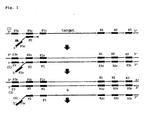
- F2 in FA is annealed to nucleic acid as a template and used as the origin of synthesis of a complementary chain.
- the subsequent reaction steps until Fig. 1(4) are the same as in the previously described basic mode ( Fig. 5 ) in the present invention.
- the sequence annealed as F3 in Fig. 1(2) is the first outer primer described above.
- a DNA polymerase for conducting the strand displacement-type synthesis of a complementary chain with this primer as the origin of synthesis is used so that the complementary chain synthesized from FA is displaced and made ready for base pairing.
- second oligonucleotide RA as a reverse primer anneals thereto in the combination of R2c/R2.
- Synthesis of a complementary chain with this site as the origin of synthesis proceeds until the chain reaches F1c at the 5'-terminal of FA.
- the second outer primer R3 for displacement anneals thereto to synthesize a complementary chain during which strand displacement also proceeds so that the complementary chain synthesized from RA as the origin of synthesis is displaced.
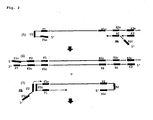
- RA is located at the 5'-side thereof and a sequence complementary to FA is located at the 3'-terminal thereof.
- Synthesis of a complementary chain from the loop proceeds while the reaction product in the previously initiated complementary chain synthesis from F1 is displaced.
- the complementary chain synthesized with itself as the template is made ready for base pairing again at the 3'-terminal.
- This 3'-terminal is provided with a region R1 capable of annealing to R1c in the same chain, and the two are annealed preferentially due to the rapid intramolecular reaction.
- the same reaction as the above-described reaction starting from the 3'-terminal synthesized with FA as a template proceeds in this region as well.
- the nucleic acid having complementary nucleotide sequences linked alternately in the same single- " stranded chain according to the present invention is continued to be extended from R1 as the starting point at the 3'-terminal by successive synthesis of a complementary chain and subsequent displacement thereof.
- R2c is always contained in the loop formed by intramolecular annealing of the 3'-terminal R1
- the second oligonucleotide (RA) provided with R2 anneals to the loop at the 3'-terminal in the subsequent reaction.
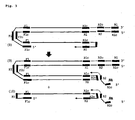
- nucleic acid synthesized as complementary chain from the oligonucleotide annealing to the loop in the single-stranded nucleic acid elongated with itself as the template synthesis of the nucleic acid having complementary nucleotide sequences linked alternately in the same single-stranded chain according to the present invention also proceeds here. That is, synthesis of a complementary chain from the loop is completed when it reached RA in e.g. Fig. 2-(7 ). Then, when the nucleic acid displaced by this nucleic acid synthesis initiates synthesis of complementary chain ( Fig. 3-(8 )), the reaction reaches the loop which was once the origin of synthesis, and displacement is initiated again.
- the nucleic acid initiated to be synthesized from the loop is also displaced, and as a result, the 3'-terminal R1 capable of annealing in the same chain is obtained ( Fig. 3-(10 )).
- This 3'-terminal R1 anneals to R1c in the same chain to initiate synthesis of complementary chain.
- This reaction is the same as in Fig. 2-(7 ) except that F is used in place of R. Accordingly, the structure shown in Fig. 3-(10 ) can function as a new nucleic acid which continues self-elongation and new nucleic acid formation.
- the reaction of synthesizing nucleic acid causes elongation from the 3'-terminal F1 as the origin of synthesis, as opposed to the reaction described above. That is, in the present invention, as one nucleic acid is elongated, the reaction of continuing to supply a new nucleic acid initiating elongation separately proceeds. Further, as the chain is elongated, a plurality of loop-forming sequences are brought about not only at the terminal but also in the same chain. When these loop-forming sequences are made ready for base pairing by the strand displacement synthetic reaction, an oligonucleotide anneals thereto to serve as a base for the reaction of forming a new nucleic acid.
- the second oligonucleotide RA based on the present invention is combined as the reverse primer as described above whereby elongation and subsequent formation of a new nucleic acid occur. Further, in the present invention, this newly formed nucleic acid itself is elongated and brings about subsequent formation of a new nucleic acid. A series of these reactions continue theoretically permanently to achieve very efficient amplification of nucleic acid.
- the reaction in the present invention can be conducted under isothermal conditions.
- the reaction products thus accumulated possess a structure having a nucleotide sequence between F1 and R1 and its complementary sequence linked alternately therein.
- both the terminals of the repeating unit have a region consisting of the successive nucleotide sequences F2-F1 (F2c-F1c) and R2-R1 (R2c-R1c).
- F2-F1 F2c-F1c
- R2-R1 R2c-R1c
- the amplification reaction based on the present invention proceeds on the principle that the reaction is initiated from F2 (or R2) with an oligonucleotide as the origin of synthesis and then a complementary chain is elongated by the synthetic reaction from F1 (or R1) with the 3'-terminal as the origin of synthesis.
- oligonucleotides FA and RA according to the present invention were used as oligonucleotides annealing to the part of a loop.
- the amplification reaction according to the present invention can be carried out by use of an oligonucleotide capable of initiating the synthesis of a complementary chain from the loop. That is, the elongating 3'-terminal, once displaced by a complementary chain synthesized from the loop, gives the part of a loop again.
- nucleic acid having complementary nucleotide sequences linked alternately in a single-stranded chain is always used as a template in the complementary chain synthesis starting from the loop, it is evident that the nucleic acid desired in the present invention can be synthesized.
- the nucleic acid thus synthesized performs synthesis of a complementary chain by forming a loop after displacement, but there is no 3'-terminal available for subsequent formation of a loop, and thus it cannot function as a new template.
- the product in this case unlike nucleic acid initiated to be synthesized by FA or RA, cannot be expected to be exponentially amplified. From this reason, an oligonucleotide having the structure of FA or RA is useful for highly efficient synthesis of nucleic acid based on the present invention.
- a series of these reactions proceed by adding the following components to single-stranded nucleic acid as a template and then incubating the mixture at such a temperature that the nucleotide sequence constituting FA and RA can form stable base pairing with its complementary nucleotide sequence while the enzyme activity can be maintained.
- the stable base pairing referred to herein means a state in which at least a part of an oligonucleotide present in the reaction system can give the origin of synthesis of complementary chain.
- the desired condition for bringing about stable base pairing is to set lower than melting temperature (Tm).
- melting temperature (Tm) is regarded as the temperature at which 50 % of nucleic acids having mutually complementary nucleotide sequences are base-paired. Setting at melting temperature (Tm) or less is not an essential condition in the present invention, but is one of the reaction conditions to be considered for attaining high efficiency of synthesis.
- nucleic acid to be used as a template is a double-stranded chain
- the nucleic acid should, in at least a region to which the oligonucleotide anneals, be made ready for base pairing.
- heat denaturation is generally conducted, and this may be conducted only once as pretreatment before the reaction is initiated.
- This reaction is conducted in the presence of a buffer giving suitable pH to the enzyme reaction, salts necessary for annealing or for maintaining the catalytic activity of the enzyme, a protective agent for the enzyme, and as necessary a regulator for melting temperature (Tm).
- a buffer giving suitable pH to the enzyme reaction, salts necessary for annealing or for maintaining the catalytic activity of the enzyme, a protective agent for the enzyme, and as necessary a regulator for melting temperature (Tm).
- the buffer e.g. Tris-HCl having a buffering action in a neutral to weakly alkaline range is used.
- the pH is adjusted depending on the DNA polymerase used.
- As the salts KCl, NaCl, (NH 4 ) 2 SO 4 etc. are suitably added to maintain the activity of the enzyme and to regulate the melting temperature (Tm) of nucleic acid.
- the protective agent for the enzyme makes use of bovine serum albumin or sugars.
- dimethyl sulfoxide (DMSO) or formamide is generally used as the regulator for melting temperature (Tm).
- Tm melting temperature
- betaine N,N,N-trimethylglycine
- a tetraalkyl ammonium salt is also effective for improving the efficiency of strand displacement by virtue of its isostabilization.
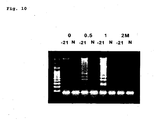
- betaine in an amount of 0.2 to 3.0 M, preferably 0.5 to 1.5 M to the reaction solution, its promoting action on the nucleic acid amplification of the present invention can be expected. Because these regulators for melting temperature act for lowering melting temperature, those conditions giving suitable stringency and reactivity are empirically determined in consideration of the concentration of salts, reaction temperature etc.
- An important feature in the present invention is that a series of reactions do not proceed unless the positional relationship of a plurality of regions is maintained.
- unspecific synthetic reaction accompanied by unspecific synthesis of complementary chain is effectively prevented. That is, even if a certain unspecific reaction occurs, the possibility for the product to serve as a starting material in the subsequent amplification step is minimized.
- the regulation of the progress of reactions by many regions brings about the possibility that a detection system capable of strict identification of the desired product in analogous nucleotide sequences can be arbitrarily constituted.
- This feature can be utilized for detection of mutations in a gene.
- 4 primers that is, 2 outer primers and 2 primers consisting of the oligonucleotides of the present invention. That is, unless the 6 regions contained in the 4 oligonucleotides work as designed, the synthetic reaction of the present invention do not proceed.
- sequences of the 3'-terminal of each oligonucleotide as the origin of synthesis of complementary chain and of the 5'- terminal of the X1c region where the complementary chain serves as the origin of synthesis are important.
- these important sequences is designed so as to correspond to a mutation to be detected, and the synthetic reaction product of the present invention is observed whereby the presence or absence of a mutation such as base deletion or insertion, or genetic polymorphism such as SNPs can be comprehensively analyzed.
- bases estimated to have a mutation or polymorphism are designed so as to correspond to the vicinity of the 3'-terminal of an oligonucleotide as the origin of synthesis of complementary chain, or of 5'-terminal thereof when a complementary chain is the origin of synthesis. If a mismatch is present at the 3'-terminal as the origin of synthesis of complementary chain or in its vicinity, the reaction of synthesizing a complementary chain to nucleic acid is significantly inhibited.
- a high degree of amplification reaction is not achieved unless the structure of the terminals of a product in the initial reaction brings about repeated reactions. Accordingly, even if erroneous synthesis occurs, complementary chain synthesis constituting amplification reaction is always interrupted in some of the steps, and thus a high degree of amplification reaction does not occur in the presence of a mismatch. As a result, the mismatch effectively inhibits amplification reaction, and an accurate result is finally brought about. That is, it can be said that the amplification reaction of nucleic acid based on the present invention has a highly completed mechanism for checking the nucleotide sequence.
- the region X1c characterizing the oligonucleotide used in the present invention can serve as the origin of synthesis after a complementary sequence is synthesized, and this complementary sequence anneals to the sequence X1 in the same newly synthesized chain whereby synthetic reaction with itself as a template proceeds. Therefore, even if the so-called primer dimer which is often problematic in the prior art is formed, this oligonucleotide does not form a loop. Accordingly, unspecific amplification attributable to the primer dimer cannot occur theoretically, and thus the present oligonucleotide contributes to an improvement in the specificity of the reaction.
- the outer primers shown as F3 ( Fig. 1-(2 )) or R3 ( Fig. 2-(5 )) are combined whereby a series of the reactions described above can be conducted under isothermal conditions. That is, the present invention provides a method of amplifying nucleic acid having complementary sequences linked alternately in a single-stranded chain, which comprises the steps shown in item 9 above.
- temperature conditions where stable annealing occurs between F2c/F2, between R2c/R2, between F1c/F1, and between R1c/R1 are selected, and preferably F3c/F3 and R3c/R3 are set up to be annealed by the phenomenon of contiguous stacking facilitated by annealing of F2c/F2 and R2c/R2, respectively.
- synthesis and "amplification” of nucleic acid are used.
- the synthesis of nucleic acid in the present invention means the elongation of nucleic acid from an oligonucleotide serving as the origin of synthesis. If not only this synthesis but also the formation of other nucleic acid and the elongation reaction of this formed nucleic acid occur continuously, a series of these reactions is comprehensively called amplification.
- the single-stranded nucleic acid which is provided at the 3'-terminal thereof with a region F1 capable of annealing to a part F1c in the same chain and which upon annealing of the region F1 to F1c in the same chain, is capable of forming a loop containing a region F2c capable of base pairing is an important element of the present invention.
- Such a single-stranded nucleic acid can also be supplied on the following principle. That is, the synthesis of a complementary chain is allowed to proceed on the basis of a primer having the following structure. 5'-[region X1 annealing to region X1c located in primer]-[loop forming sequence ready for base pairing]-[region X1c]-[region having a sequence complementary to a template]-3'
- nucleotide sequence constituting nucleic acid to be synthesized contains a nucleotide sequence extending from the region F1 to the region R1c and a nucleotide sequence extending from the region R1 having a nucleotide sequence complementary to this nucleotide sequence to the region F1c.
- X1c and X1 capable of annealing in the inside of the primer can be arbitrary sequences. However, in a region between primers FA and RF, the sequence of the region X1c/X1 is made preferably different.
- the synthesis of a complementary chain by the primer FA from the region F1 in template nucleic acid is conducted.
- the region R1c in the synthesized complementary chain is made ready for base pairing, to which the other primer is annealed to form the origin of synthesis of complementary chain.
- the 3'-terminal of the complementary chain synthesized in this step has a nucleotide sequence complementary to the primer FA constituting the 5'-terminal of the initially synthesized chain, so it has been provided at the 3'-terminal thereof with the region X1 which anneals to the region X1c in the same chain to form a loop.
- the characteristic 3'-terminal structure according to the present invention is thus provided, and the subsequent reaction constitutes the reaction system shown previously as the most preferable mode.
- the oligonucleotide annealing to the portion of the loop is provided at the 3'-terminal thereof with the region X2 complementary to the region X2c located in the loop and at the 5'-terminal thereof with the region X1.
- primers FA and RA were used to synthesize a chain complementary to template nucleic acid thereby giving a loop structure to the 3 '-terminal of the nucleic acid.
- the terminal structure characteristic of the present invention is provided by the short primers.
- the whole of a nucleotide sequence constituting a loop is provided as a primer, and synthesis of this longer primer is necessary.
- a nucleotide sequence containing restriction enzyme recognition regions is used as a reverse primer
- a different mode according to the present invention can be constituted.
- the reaction with a reverse primer containing a restriction enzyme recognition sequence is specifically described by reference to Fig. 6 .
- Fig. 6-(D) When Fig. 6-(D) is completed, a nick is generated by a restriction enzyme corresponding to a restriction enzyme recognition site in the reverse primer.
- the strand displacement-type reaction of synthesizing complementary chain is initiated from this nick as the origin of synthesis. Because the reverse primers are located at both the terminals of a double-stranded nucleic acid constituting (D), the reaction of synthesizing complementary chain is also initiated from both the terminals.
- the nucleotide sequence serving as a template has a structure having complementary nucleotide sequences alternately linked according to the present invention so that the nucleic acid synthetic system unique to the present invention is constituted.
- a part serving as a complementary chain of the reverse primer to be nicked should be designed to incorporate a dNTP derivative such that it is rendered nuclease resistance to prevent cleavage of the double-stranded chain by the restriction enzyme.
- RNA polymerase recognizing this promoter in this case too similar to the previous mode where the SDA method was applied.
- the nucleic acid synthesized in the present invention is a single-stranded chain but is composed of partial complementary sequences, and thus the majority of these sequences are base-paired. By use of this feature, the synthesized product can be detected.
- a fluorescent pigment as a double-stranded chain-specific intercalater such as ethidium bromide, SYBR Green I or Pico Green, the increased density of fluorescence is observed as the product is increased. By monitoring it, it is possible to trace the real-time synthetic reaction in a closed system.
- the method of synthesizing nucleic acid according to the present invention is supported by the DNA polymerase catalyzing the strand displacement-type reaction for synthesis of complementary chain.
- a reaction step not necessarily requiring the strand displacement-type polymerase is also contained.
- the following enzymes are known.
- various mutants of these enzymes can be utilized in the present invention insofar as they have both the sequence-dependent activity for synthesis of complementary chain and the strand displacement activity.
- the mutants referred to herein include those having only a structure bringing about the catalytic activity required of the enzyme or those with modifications to catalytic activity, stability or thermostability by e.g. mutations in amino acids.
- Bst DNA polymerase and Bca (exo-) DNA polymerase are particularly desired enzymes because they have a certain degree of thermostability and high catalytic activity.
- the reaction of this invention can be carried isothermally in a preferred embodiment, but because of the adjustment of melting temperature (Tm) etc., it is not always possible to utilize temperature conditions desired for the stability of the enzyme. Accordingly, it is one of the desired conditions that the enzyme is thermostable.
- Tm melting temperature
- heat denaturation may be conducted to provide nucleic acid as a first template, and in this respect too, utilization of a thermostable enzyme broadens selection of assay protocol.
- Vent (exo-)DNA polymerase is an enzyme having both strand displacement activity and a high degree of thermostability. It is known that the complementary chain synthetic reaction involving strand displacement by DNA polymerase is promoted by adding a single strand binding protein ( Paul M. Lizardi et al., Nature Genetics, 19, 225-232, July, 1998 ). This action is applied to the present invention, and by adding the single strand binding protein, the effect of promoting the synthesis of complementary chain can be expected. For example, T4 gene 32 is effective as a single strand binding protein for Vent (exo-) DNA polymerase.
- the 3' ⁇ 5' exonuclease activity can be utilized for digesting the protrusion to make it blunt-ended.
- this enzyme since natural Vent DNA polymerase has this activity, this enzyme may be used as a mixture with Vent (exo-) DNA polymerase in order to solve this problem.
- kits comprising various kinds of oligonucleotides necessary as primers for synthesis of complementary chain and as outer primers for displacement, dNTP as a substrate for synthesis of complementary chain, a DNA polymerase for carrying out the strand displacement-type synthesis of complementary chain, a buffer giving suitable conditions to the enzyme reaction, and as necessary regents necessary for detection of synthetic reaction products.
- the addition of reagents is necessary during the reaction in a preferable mode of the present invention, and thus the reagents necessary for one reaction are supplied after pipetted into reaction vessel, whereby the reaction can be initiated by adding only a sample.
- the reaction product can be detected in situ in a reaction vessel by utilizing a luminescent signal or a fluorescent signal, it is not necessary to open and shut the vessel after reaction. This is very desirable for prevention of contamination.
- the nucleic acid having complementary nucleotide sequences alternately linked in a single-stranded chain, synthesized according to the present invention has e.g. the following usefulness.
- the first feature is use of an advantage resulting from the special structure having complementary sequences in one molecule. This feature can be expected to facilitate detection. That is, there is a known system for detecting nucleic acid wherein its signal is varied depending on base pairing with a complementary nucleotide sequence. For example, by combination with the method of utilizing a double-stranded chain-specific intercalater as a detector as described above, a detection system making full use of the characteristics of the synthetic product of the present invention can be realized.
- the synthetic reaction product of the present invention is once heat-denatured in said detection system and returned to the original temperature, intramolecular annealing occurs preferentially thus permitting complementary sequences to be rapidly base-paired. If there are unspecific reaction products, they have not complementary sequences in the molecule so that after separated by heat denaturation into 2 or more molecules, they cannot immediately be returned to the original double-stranded chain. By providing the step of heat denaturation before detection, noises accompanying the unspecific reaction can be reduced. If the DNA polymerase not resistant to heat is used, the step of heat denaturation has the meaning of termination of the reaction and is thus advantageous for the control of reaction temperature.
- the second feature is to always form a loop capable of base pairing.
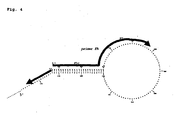
- the structure of a loop capable of base pairing is shown in Fig. 4 .
- the loop is composed of the nucleotide sequence F2c (X2c) which can be annealed by the primer and a nucleotide sequence intervening between F2c-F1c (X1c).
- the sequence between F2c-F1c (or between X2c-X1c in a more universal form) is a nucleotide derived sequence derived from the template. Accordingly, if a probe having a complementary nucleotide sequence is hybridized with this region, template-specific detection is feasible.
- the nucleotide sequence constituting a loop in the amplification reaction product in the present invention may have an arbitrary length. Accordingly, if hybridization with a probe is desired, a region to be annealed by the primer and a region to be hybridized by the probe are arranged separately to prevent their competition, whereby ideal reaction conditions can be constituted.
- a large number of loops capable of base pairing are given in a single strand of nucleic acid.
- a large number of probes can be hybridized with one molecule of nucleic acid to permit highly sensitive detection. It is thus possible to realize not only the improvement of sensitivity but also a method of detecting nucleic acid based on a special reaction principle such as aggregation.
- a probe immobilized onto fine particles such as polystyrene latex is added to the reaction product of the present invention, the aggregation of latex particles is observed as the hybridization of the product with the probe proceeds.
- Highly sensitive and quantitative observation is feasible by optically measuring the strength of the aggregation. Because the aggregation can also be observed with the naked eyes, a reaction system not using an optical measuring device can also be constituted.
- reaction product of the present invention permitting many labels to be bound thereto per nucleic acid molecule enables chromatographic detection.
- an analytical method immunochromatography
- a chromatographic medium utilizing a visually detectable label is used practically. This method is based on the principle that an analyte is sandwiched between an antibody immobilized on a chromatographic medium and a labeled antibody, and the unreacted labeled component is washed away.
- the reaction product of the present invention makes this principle applicable to analysis of nucleic acid.
- a labeled probe toward the part of a loop is prepared and immobilized onto a chromatographic medium to prepare a capturing probe for trapping thereby permitting analysis in the chromatographic medium.
- a sequence complementary to the part of the loop can be utilized. Since the reaction product of the present invention has a large number of loops, the product binds to a large number of labeled probes to give a visually recognizable signal.
- the reaction product according to the present invention always giving a region as a loop capable of base pairing enables a wide variety of other detection systems. For example, a detection system utilizing surface plasmon resonance using an immobilized probe for this loop portion is feasible. Further, if a probe for the loop portion is labeled with a double-stranded chain-specific intercalater, more sensitive fluorescent analysis can be conducted. Alternatively, it is also possible to positively utilize the ability of the nucleic acid synthesized by the present invention to form a loop capable of base pairing at both the 3'- and 5'-sides. For example, one loop is designed to have a common nucleotide sequence between a normal type and an abnormal type, while the other loop is designed to generate a difference therebetween.
- a large number of loops themselves given by the reaction product according to the present invention can be used as probes.
- probes should be accumulated at high density in a limited area.
- the number of oligonucleotides which can be immobilized in a certain area is limited.
- the reaction product of the present invention a large number of probes capable of annealing can be immobilized at high density. That is, the reaction product according to the present invention may be immobilized as probes on a DNA chip.
- the reaction product may be immobilized by any techniques known in the art, or the immobilized oligonucleotide is utilized as the oligonucleotide in the amplification reaction of the present invention, resulting in generating the immobilized reaction product.
- the probe thus immobilized, a large number of sample DNAs can be hybridized in a limited area, and as a result, high signals can be expected.
- the method of synthesizing the nucleic acid having complementary chains alternately linked in a single-stranded chain according to the present invention was attempted using M13mp18 as a template.
- Four kinds of primers that is, M13FA, M13RA, M13F3, and M13R3, were used in the experiment.
- M13F3 and M13R3 were first and second outer primer for displacing the first and the second nucleic acid obtained respectively with first oligonucleotide M13FA and second oligonucleotide M13RA as the origin of synthesis.
- the outer primers are primers serving as the origin of synthesis of complementary chain after synthesis with M13FA (or M13RA), these were designed to anneal to a region contiguous to M13FA (or M13RA) by use of the phenomenon of contiguous stacking. Further, the concentrations of these primers were set high such that annealing of M13FA (or M13RA) occurred preferentially.
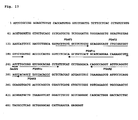
- each primer The nucleotide sequence constituting each primer is as shown in the Sequence Listing. The structural characteristics of the primers are summarized below. Further, the positional relationship of each region toward the target nucleotide sequence (target) is shown in Fig. 7 .
- nucleic acid wherein a region extending from F1c to R1c in M13mp18, and its complementary nucleotide sequence, are alternately linked via a loop-forming sequence containing F2c in a single-stranded chain, is synthesized.
- the composition of a reaction solution for the method of synthesizing nucleic acid by these primers according to the present invention is shown below.
- reaction solution was heated at 95 °C for 5 minutes, and the target was denatured into a single-stranded chain.
- the reaction solution was transferred to ice-cold water, and 4 U of Bst DNA polymerase (NEW ENGLAND Biolabs) was added thereto and the mixture was reacted at 65 °C for 1 hour. After reaction, the reaction was terminated at 80 °C for 10 minutes and transferred again to ice-cold water.
- Bst DNA polymerase NW ENGLAND Biolabs
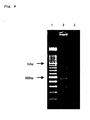
- Example 1 For the purpose of clarifying the structure of the nucleic acid having complementary nucleotide sequences linked alternately in a single-stranded chain obtained in Example 1 according to the present invention, the digestion of the products with restriction enzymes was conducted. If fragments are theoretically generated by digestion thereof with restriction enzymes and simultaneously the smear pattern at high size and the band not electrophoresed as observed in Example 1 disappear, then it can be estimated that any of these products are the nucleic acid having complementary sequences linked alternately in a single-stranded chain synthesized according to the present invention.
- the reaction solution (200 ⁇ l) from 8 tubes in Example 1 was pooled and purified by treatment with phenol and precipitation with ethanol. The resulting precipitates were recovered and dissolved again in 200 ⁇ l TE buffer, and 10 ⁇ l aliquot was digested at 37 °C for 2 hours with restriction enzymes BamHI, PvuII, and HindIII respectively.
- the digest was electrophoresed for 1 hour at 80 mV on 2 % agarose gel (0.5 %TBE).
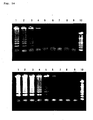
- As a molecular marker Super Ladder-Low (100 bp ladder) (Gensura Laboratories, Inc.) was used. The gel after electrophoresis was stained with SYBR Green I (Molecular Probes, Inc.) to confirm the nucleic acid. The results are shown in Fig. 9 .
- the respective lanes correspond to the following samples.
- nucleotide sequences constituting relatively short amplification products are those of SEQ ID NOS:13, 14, 15 and 16. From these nucleotide sequences, the estimated size of each fragment digested with the restriction enzymes is as shown in Table 1. "L" in the table indicates that its position in electrophoresis is not established because L is a fragment containing a loop (single-stranded chain). Table 1.
- Restriction enzyme-digested fragments of the amplification products according to the present invention SEQ ID NO BamHI PvuII HindIII 13 177 +L 56 +L 147 +L 14 15+101 +L - 142 +L 15 171+101 +L 56 +L 147+161 +L 16 11+101+230+L 237 +L 142+170 +L Summary 101,177,230 56,237 142,147,161,170 (11,15; not confirmed)
- the method of synthesizing nucleic acid according to the present invention was attempted wherein M13mp18 dsDNA having a partial sequence of HBV gene integrated therein was used as a template.
- Four kinds of primers HB65FA (SEQ ID NO:6), HB65RA (SEQ ID NO:7), HBF3 (SEQ ID NO:8) and HBR3 (SEQ ID NO:9), were used in the experiment.
- HBF3 and HBR3 were outer primers for displacement of the first nucleic acid obtained respectively with HB65FA and HB65RA as the origin of synthesis.
- the outer primers are primers serving as the origin of synthesis of complementary chain after synthesis with HB65FA (or HB65RA), these were designed to anneal to a region contiguous to HB65FA (or HB65RA) by use of the phenomenon of contiguous stacking. Further, the concentrations of these primers were set high such that annealing of HB65FA (or HB65RA) occurred preferentially.
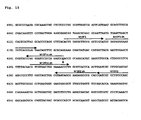
- the target sequence (430 bp) in this example, derived from HBV integrated in M13mp18, is shown in SEQ ID NO:10.
- each primer The nucleotide sequence constituting each primer is shown in the Sequence Listing.
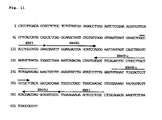
- the structural feature of each primer is summarized below. Further, the positional relationship of each region toward the target nucleotide sequence (target) is shown in Fig. 11 .
- nucleic acid wherein a region extending from F1c to R1c in M13mp18 (HBV-M13mp18) having a partial sequence of HBV gene integrated therein, and its complementary nucleotide sequence, are alternately linked via a loop-forming sequence containing F2c in a single-stranded chain, is synthesized.
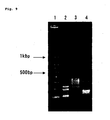
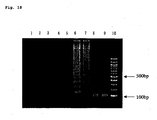
- the reaction was conducted under the same conditions as in Example 1 except that the primers described above were used, and the reaction solution was analyzed by agarose electrophoresis. The results are shown in Fig. 12 .
- the respective lanes correspond to the following samples.
- Example 2 Similar to Example 1, the products were confirmed only in the presence of the target as a low size band ladder, as smeared staining at high size and as a band hardly electrophoresed in the gel (lane 2). Among the low-size bands, bands in the vicinity of 310 bp and 480 bp agree with the products estimated in the synthetic reaction of this invention, that is, double-stranded chains of SEQ ID NOS:17 and 18, and it was thus confirmed that the reaction proceeds as expected. As described in the results in Example 1, it was estimated that the smeared pattern at high size and the band not electrophoresed were caused by the structure of the synthetic product characteristic of the present invention. From this experiment, it was confirmed that the present invention can be practiced even if a different sequence (target) is used for amplification.
- a different sequence target
- Example 6 When the reaction product was electrophoresed under alkali-denaturing conditions, its size in a single-stranded state could be confirmed. It was confirmed that the sizes of the major products in both Example 1 (lane 2) and Example 4 (lane 3) were within 2 kbase. Further, it was revealed that the product according to the present invention had been extended to have a size of at least 6 kbase or more within the range capable of confirmation by this analysis. In addition, it was confirmed again that bands not electrophoresed under non-denaturing conditions in Examples 1 and 4 were separated in a denatured state into individual single-stranded chains of smaller size. Example 6. Confirmation of amplification depending on the concentration of a target in the amplification of a region in M-13mp13
- the influence of a varying concentration of a target on the method of synthesizing nucleic acid according to the present invention was observed.
- the method of synthesizing nucleic acid according to the present invention was carried out under the same conditions as in Example 1 except that the amount of M13mp18 dsDNA as the target was 0 to 1 fmol and the reaction time was 1 hour or 3 hours.
- the sample was electrophoresed in 2 % agarose gel (0.5 % TBE) and stained with SYBR Green I (Molecular Probes, Inc.) to confirm the nucleic acid.
- SYBR Green I Molecular Probes, Inc.
- XIV 100 bp ladder, Boehringer Mannheim
- a common band among the respective lanes appears in a lower part in the electrophoretic profile and shows the unreacted stained primers. Regardless of the reaction time, no amplification product is observed in the absence of the target. A staining pattern, depending on the concentration of the target, of the amplification product was obtained only in the presence of the target. Further, the amplification product could be confirmed at lower concentration as the reaction time was increased.
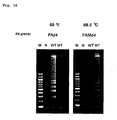
- the target DNA used was M13mp18 (wild-type) and M13mp18FM (mutant).
- M13mp18FM mutant M13mp18FM
- LA PCR TM in vitro Mutagenesis Kit (Takara Shuzo Co., Ltd.) was used to replace one nucleotide for mutation. Thereafter, the sequence was confirmed by sequencing.
- the sequence of the F1 region is shown below:
- the FA primers used for the wild-type and the mutant were provided at the 5'-terminal of the F1c region thereof with different nucleotide sequences, respectively.
- the location of the mutation and the positional relationship of each region toward the target nucleotide sequence (target) are shown in Fig. 15 .
- the nucleotide sequence of each primer is as follows:
- the composition of the reaction solution is as follows: Final concentration D2W 3.75 ⁇ L 10X Thermo pol buffer(NEB) 2.5 ⁇ L 20mM Tris-HCl pH 8.8 10 mM KCl 10 mM (NH 4 ) 2 SO 4 6 mM MgSO 4 0.1 % TritonX-100 2.5 mM dNTP 4 ⁇ L 400 ⁇ M 100 mM MgSO 4 0.5 ⁇ L 4 M Betaine 6.25 ⁇ L 1 M M13FAd4 primer (10 pmol/ ⁇ L) or M13FAMd4 primer (10 pmol/ ⁇ L) 2 ⁇ L 800 nM M13RAd4 primer (10 pmol/ ⁇ L) 2 ⁇ L 800 nM M13F3 primer (10 pmol/ ⁇ L) 0.5 ⁇ L 200 nM M13R3 primer (10pmol/ ⁇ L) 0.5 ⁇ L 200 nM M13R3 primer (10pmol/ ⁇ L) 0.5 ⁇ L 200 nM Total amount 22 ⁇
- Example 8 Amplification reaction of mRNA as a target
- the method of synthesizing nucleic acid according to the present invention was attempted using mRNA as the target nucleic acid.
- prostate cancer cell line LNCaP cells ATCC No. CRL-1740
- PSA prostate specific antigen
- K562 cells ATCC No. CCL-243
- RNeasy Mini kit from Qiagen (Germany).
- primers that is, PSAFA, PSARA, PSAF3 and PSAR3, were used in the experiment.
- PSAF3 and PSAR3 are outer primers for displacing the first nucleic acid obtained respectively with PSAFA and PSARA as the origin of synthesis. Further, the concentrations of these primers were set high such that annealing of PSAFA (or PSARA) occurred preferentially.
- the nucleotide sequences constituting the respective primers are as follows.
- composition of a reaction solution for the method of synthesizing nucleic acid according to the present invention is as follows:
- mRNA single-stranded chain
- the reaction was conducted at 65 °C for 45 minutes, and the reaction was terminated at 85 °C for 5 minutes. After reaction, 5 ⁇ l of the reaction solution was electrophoresed in 2 % agarose and detected by SYBR Green I.
- a method of synthesizing nucleic acid having complementary nucleotide sequences linked alternately in a single-stranded chain without requiring any complicated control of temperature.
- a complementary chain synthesized with the oligonucleotide as a primer based on the present invention serves as the origin of synthesizing a new complementary chain with the 3'-terminal of said synthesized chain as a template.
- nucleic acid synthesized with itself as a template is combined with e.g. a known nucleic acid synthesizing method such as SDA, to contribute the improvement of efficiency of nucleic acid synthesis.
- a novel method of synthesizing nucleic acid which achieves the improvement of efficiency of the known method of synthesizing nucleic acid, does not require complicated control of temperature, can be expected to attain high efficiency of amplification and can achieve high specificity. That is, the oligonucleotides of the kit based on the present invention is applied to a template chain and its complementary chain whereby nucleic acid having complementary sequences linked alternately in a single-stranded chain can be successively synthesized. This reaction continues theoretically until the starting materials necessary for synthesis are exhausted, during which new nucleic acid initiated to be synthesized from the loop continues to be formed.
- the elongation from the oligonucleotide having annealed to the loop performs strand displacement for supplying 3'-OH for elongation of long single-stranded nucleic acid (that is, nucleic acid having plural pairs of complementary chains linked therein).
- the 3'-OH of the long single-stranded chain performs the reaction of synthesizing complementary chain with itself as a template whereby its elongation is achieved, during which a new complementary chain whose synthesis is initiated from the loop is displaced.
- Such an amplification reaction step proceeds under isothermal conditions while maintaining high specificity.
- the oligonucleotides in kit of the present invention can, when two contiguous regions are arranged as designed, function as primers for the reaction of synthesizing nucleic acid according to the present invention. This contributes significantly to the preservation of specificity. By comparison with e.g. PCR where unspecific amplification reaction is initiated by unspecific missannealing regardless of the intended positional relationship of 2 primers, it can be easily explained that high specificity can be expected in the present invention. This feature can be utilized to detect SNPs highly sensitively and accurately.
- the characterizing feature of the present invention lies in that such reaction can be easily achieved by a very simple constitution of reagents.
- the oligonucleotides of the kit according to the present invention have a special structure, but this is a matter of selection of nucleotide sequence, and it is a simple oligonucleotide as substance.
- the reaction can proceed by only a DNA polymerase catalyzing the strand displacement-type reaction of synthesizing complementary chain.
- a DNA polymerase such as Bca DNA polymerase having both reverse transcriptase activity and strand displacement-type DNA polymerase activity is used so that all enzyme reactions can be conducted by the single enzyme.
- the reaction principle of realizing a high degree of nucleic acid amplification reaction by such simple enzyme reaction is not known. Even for the application of the present invention to a known nucleic acid synthesizing reaction such as SDA, no additional enzyme is necessary for their combination, and such a simple combination with the oligonucleotide based on the present invention can be applied to various reaction systems. Accordingly, it can be said that the method of synthesizing nucleic acid according to the present invention is also advantageous in respect of cost.
- the method of synthesizing nucleic acid according to the present invention and the oligonucleotide therefor provide a new principle of simultaneously solving a plurality of difficult problems such as operativeness (temperature control is not necessary), improvement of efficiency of synthesis, economization, and high specificity.
Landscapes
- Chemical & Material Sciences (AREA)
- Life Sciences & Earth Sciences (AREA)
- Organic Chemistry (AREA)
- Health & Medical Sciences (AREA)
- Engineering & Computer Science (AREA)
- Zoology (AREA)
- Wood Science & Technology (AREA)
- Genetics & Genomics (AREA)
- Proteomics, Peptides & Aminoacids (AREA)
- General Engineering & Computer Science (AREA)
- Biotechnology (AREA)
- Bioinformatics & Cheminformatics (AREA)
- Physics & Mathematics (AREA)
- General Health & Medical Sciences (AREA)
- Biophysics (AREA)
- Molecular Biology (AREA)
- Biochemistry (AREA)
- Microbiology (AREA)
- Immunology (AREA)
- Analytical Chemistry (AREA)
- Chemical Kinetics & Catalysis (AREA)
- Biomedical Technology (AREA)
- Crystallography & Structural Chemistry (AREA)
- Plant Pathology (AREA)
- Measuring Or Testing Involving Enzymes Or Micro-Organisms (AREA)
- Saccharide Compounds (AREA)
- Preparation Of Compounds By Using Micro-Organisms (AREA)
Claims (8)
- Kit pour la synthèse d'un acide nucléique ayant des chaînes complémentaires liées en alternance dans une chaîne simple-brin, comprenant les éléments suivants:i) un premier oligonucléotide comprenant au moins deux régions, F2 et F1c, dans lequel F1c est lié au côté 5' de F2, et dans lequel
F2 est une région ayant une séquence nucléotidique complémentaire d'une région arbitraire F2c dans une matrice d'acide nucléique ayant une sequence nucléotidique spécifique, et
F1c est une région ayant essentiellement la même séquence nucléotidique qu'une région F1c se trouvant du côté 5' de la région F2c dans la matrice d'acide nucléique ayant une séquence nucléotidique spécifique ;ii) un second oligonucléotide comprenant au moins deux régions, R2 et R1c, dans lequel R1c est lié au côté 5' de R2, et dans lequel
R2 est une région ayant une séquence nucléotidique complémentaire d'une région arbitraire R2c dans une chaîne complémentaire synthétisée avec le premier oligonucléotide en tant qu'origine de synthèse ayant une séquence nucléotidique spécifique, et
R1c est une région ayant essentiellement la même séquence nucléotidique qu'une région R1c se trouvant du côté 5' de la région R2c dans ladite chaîne complémentaire ayant une séquence nucléotidique spécifique ;iii) une première amorce externe ayant une séquence nucléotidique complémentaire d'une région F3c se trouvant du côté 3' de la région F2c dans l'acide nucléique servant de matrice ;iv) une ADN polymérase catalysant la réaction, de type déplacement de brin, de synthèse de la chaîne complémentaire ;v) un nucléotide servant de substrat pour l'élément iv), etvi) une seconde amorce externe ayant une sequence nucléotidique complémentaire d'une région R3c se trouvant du côté 3' du R2c arbitraire dans la chaîne complémentaire synthétisée avec le premier oligonucléotide en tant qu'origine de synthèse. - Kit selon la revendication 1, comprenant un détecteur pour détecter le produit de la réaction de synthèse d'acide nucléique.
- Procédé de synthèse d'une molécule d'acide nucléique, comprenant :a. l'addition des éléments i) à vi) du kit selon la revendication 1 à un acide nucléique simple-brin ou double-brin servant de matrice ; etb. l'incubation du mélange de l'étape a) à une température telle que la séquence nucléotidique constituant le premier oligonucléotide et le second oligonucléotide puisse former un appariement de bases stable avec sa séquence nucléotidique complémentaire tout en pouvant maintenir l'activité enzymatique.
- Procédé selon la revendication 3, dans lequel le mélange comprend en outre un régulateur pour la température de fusion.
- Procédé selon la revendication 4, dans lequel le régulateur pour la température de fusion est la bétaïne.
- Procédé selon la revendication 5, dans lequel 0,2 à 3,0 M de bétaïne est présente.
- Procédé selon la revendication 3, dans lequel le mélange comprend en outre un détecteur pour détecter le produit de la synthèse d'acide nucléique, qui est préparé par le procédé selon la revendication 3.
- Procédé selon la revendication 3, dans lequel la matrice d'acide nucléique est un ARN, et l'ADN polymérase a une activité de transcriptase inverse.
Priority Applications (3)
| Application Number | Priority Date | Filing Date | Title |
|---|---|---|---|
| EP07014809A EP1873260B1 (fr) | 1998-11-09 | 1999-11-08 | Procédé pour la synthèse d'acides nucléiques |
| EP09000525A EP2045337B1 (fr) | 1998-11-09 | 1999-11-08 | Procédé pour la synthèse d'acides nucléiques |
| EP10011291A EP2287338B1 (fr) | 1998-11-09 | 1999-11-08 | Procédé pour la synthèse d' acides nucléiques. |
Applications Claiming Priority (3)
| Application Number | Priority Date | Filing Date | Title |
|---|---|---|---|
| JP31747698 | 1998-11-09 | ||
| JP31747698 | 1998-11-09 | ||
| PCT/JP1999/006213 WO2000028082A1 (fr) | 1998-11-09 | 1999-11-08 | Procede de synthese d'acide nucleique |
Related Child Applications (5)
| Application Number | Title | Priority Date | Filing Date |
|---|---|---|---|
| EP07014809A Division EP1873260B1 (fr) | 1998-11-09 | 1999-11-08 | Procédé pour la synthèse d'acides nucléiques |
| EP10011291A Division EP2287338B1 (fr) | 1998-11-09 | 1999-11-08 | Procédé pour la synthèse d' acides nucléiques. |
| EP07014809.3 Division-Into | 2007-07-27 | ||
| EP09000525.7 Division-Into | 2009-01-15 | ||
| EP10011291.1 Division-Into | 2010-09-28 |
Publications (4)
| Publication Number | Publication Date |
|---|---|
| EP1020534A1 EP1020534A1 (fr) | 2000-07-19 |
| EP1020534A4 EP1020534A4 (fr) | 2004-12-08 |
| EP1020534B1 EP1020534B1 (fr) | 2007-10-03 |
| EP1020534B2 true EP1020534B2 (fr) | 2011-01-05 |
Family
ID=18088663
Family Applications (4)
| Application Number | Title | Priority Date | Filing Date |
|---|---|---|---|
| EP09000525A Expired - Lifetime EP2045337B1 (fr) | 1998-11-09 | 1999-11-08 | Procédé pour la synthèse d'acides nucléiques |
| EP99954435A Expired - Lifetime EP1020534B2 (fr) | 1998-11-09 | 1999-11-08 | Procede de synthese d'acide nucleique |
| EP07014809A Expired - Lifetime EP1873260B1 (fr) | 1998-11-09 | 1999-11-08 | Procédé pour la synthèse d'acides nucléiques |
| EP10011291A Expired - Lifetime EP2287338B1 (fr) | 1998-11-09 | 1999-11-08 | Procédé pour la synthèse d' acides nucléiques. |
Family Applications Before (1)
| Application Number | Title | Priority Date | Filing Date |
|---|---|---|---|
| EP09000525A Expired - Lifetime EP2045337B1 (fr) | 1998-11-09 | 1999-11-08 | Procédé pour la synthèse d'acides nucléiques |
Family Applications After (2)
| Application Number | Title | Priority Date | Filing Date |
|---|---|---|---|
| EP07014809A Expired - Lifetime EP1873260B1 (fr) | 1998-11-09 | 1999-11-08 | Procédé pour la synthèse d'acides nucléiques |
| EP10011291A Expired - Lifetime EP2287338B1 (fr) | 1998-11-09 | 1999-11-08 | Procédé pour la synthèse d' acides nucléiques. |
Country Status (8)
| Country | Link |
|---|---|
| US (5) | US6410278B1 (fr) |
| EP (4) | EP2045337B1 (fr) |
| JP (2) | JP3313358B2 (fr) |
| AT (3) | ATE374833T1 (fr) |
| DE (3) | DE69937223T3 (fr) |
| ES (4) | ES2294862T5 (fr) |
| MY (3) | MY137889A (fr) |
| WO (1) | WO2000028082A1 (fr) |
Cited By (2)
| Publication number | Priority date | Publication date | Assignee | Title |
|---|---|---|---|---|
| US9404149B2 (en) | 2009-07-10 | 2016-08-02 | Biotrin International Limited | Composition, kits and methods for the detection of point mutations and SNPs |
| WO2022101259A1 (fr) | 2020-11-10 | 2022-05-19 | MultiplexDX, s.r.o. | Amplification isotherme d'acide nucléique à médiation par les boucles (lamp) utilisant des amorces modifiées par lna et procédé colorimétrique à base de métal pour détecter un produit d'amplification |
Families Citing this family (411)
| Publication number | Priority date | Publication date | Assignee | Title |
|---|---|---|---|---|
| US6261808B1 (en) | 1992-08-04 | 2001-07-17 | Replicon, Inc. | Amplification of nucleic acid molecules via circular replicons |
| WO1994003624A1 (fr) * | 1992-08-04 | 1994-02-17 | Auerbach Jeffrey I | Procedes d'amplification isothermique de molecules d'acide nucleique |
| US7256020B2 (en) * | 1996-11-29 | 2007-08-14 | Third Wave Technologies, Inc. | Methods and compositions for detecting target sequences |
| US6743605B1 (en) * | 1998-06-24 | 2004-06-01 | Enzo Life Sciences, Inc. | Linear amplification of specific nucleic acid sequences |
| US8445664B2 (en) * | 1998-06-24 | 2013-05-21 | Enzo Diagnostics, Inc. | Kits for amplifying and detecting nucleic acid sequences |
| US6410278B1 (en) * | 1998-11-09 | 2002-06-25 | Eiken Kagaku Kabushiki Kaisha | Process for synthesizing nucleic acid |
| CA2384838C (fr) | 1999-09-13 | 2006-07-18 | Nugen Technologies, Inc. | Procedes et compositions utiles pour l'amplification isothermique lineaire de sequences de polynucleotides |
| US6692918B2 (en) | 1999-09-13 | 2004-02-17 | Nugen Technologies, Inc. | Methods and compositions for linear isothermal amplification of polynucleotide sequences |
| WO2001034838A1 (fr) * | 1999-11-08 | 2001-05-17 | Eiken Kagaku Kabushiki Kaisha | Methode de detection d'une variation ou d'un polymorphisme |
| JP4721603B2 (ja) * | 1999-11-08 | 2011-07-13 | 栄研化学株式会社 | 変異および/または多型の検出方法 |
| EP2253717B1 (fr) * | 2000-04-07 | 2014-04-30 | Eiken Kagaku Kabushiki Kaisha | Méthode d'amplification d'acides nucléiques en utilisant comme matrice des acides nucléiques double-brin |
| US7846733B2 (en) * | 2000-06-26 | 2010-12-07 | Nugen Technologies, Inc. | Methods and compositions for transcription-based nucleic acid amplification |
| ATE455186T1 (de) | 2000-06-26 | 2010-01-15 | Nugen Technologies Inc | Methoden und zusammensetzungen zur auf transkription basierenden vervielfältigung von nukleinsäuren |
| ES2327712T3 (es) | 2000-09-19 | 2009-11-03 | Eiken Kagaku Kabushiki Kaisha | Procedimiento para sintetizar polinucleotidos. |
| WO2002034907A1 (fr) * | 2000-10-27 | 2002-05-02 | Eiken Kagaku Kabushiki Kaisha | Methode de synthese d'acide nucleique simple brin |
| JP2002171997A (ja) * | 2000-12-08 | 2002-06-18 | Olympus Optical Co Ltd | 核酸増幅反応測定方法及び装置 |
| JP2002171998A (ja) * | 2000-12-08 | 2002-06-18 | Olympus Optical Co Ltd | 核酸増幅反応測定方法及び装置 |
| JP2002171999A (ja) * | 2000-12-08 | 2002-06-18 | Olympus Optical Co Ltd | 核酸増幅反応測定方法及び装置 |
| WO2002048402A2 (fr) | 2000-12-13 | 2002-06-20 | Nugen Technologies, Inc. | Methodes et compositions de generation de copies multiples de sequences d'acides nucleiques et methodes de detection correspondantes |
| JP2002186481A (ja) * | 2000-12-18 | 2002-07-02 | Eiken Chem Co Ltd | 光学的特性の測定による核酸増幅産物の検出方法 |
| JPWO2002062993A1 (ja) * | 2001-02-06 | 2004-06-10 | タカラバイオ株式会社 | 増幅核酸及びその固定化物 |
| CA2439074A1 (fr) | 2001-03-09 | 2002-09-19 | Nugen Technologies, Inc. | Methodes et compositions pour amplification de sequences d'arn |
| KR20030082535A (ko) * | 2001-03-09 | 2003-10-22 | 뉴젠 테크놀로지스 인코포레이티드 | Rna 서열의 증폭을 위한 방법 및 조성물 |
| JP2002272475A (ja) * | 2001-03-22 | 2002-09-24 | Eiken Chem Co Ltd | 蛍光偏光法による核酸増幅産物の検出方法 |
| JPWO2002090538A1 (ja) * | 2001-05-08 | 2004-08-26 | 栄研化学株式会社 | 核酸を合成する方法 |
| US8137911B2 (en) | 2001-05-22 | 2012-03-20 | Cellscript, Inc. | Preparation and use of single-stranded transcription substrates for synthesis of transcription products corresponding to target sequences |
| WO2004059289A2 (fr) | 2001-05-22 | 2004-07-15 | Epicentre Technologies | Transcription fonction d'une cible utilisant des mutants de deletion d'arn polymerase n4 |
| JP2002345499A (ja) * | 2001-05-29 | 2002-12-03 | Eiken Chem Co Ltd | 核酸配列を検出する方法及びその方法に使用するキット |
| EA006679B1 (ru) * | 2001-06-12 | 2006-02-24 | Такара Био Инк. | Способ стабилизации реагента для амплификации или детекции нуклеиновой кислоты и способ хранения |
| JP2005052002A (ja) * | 2001-07-06 | 2005-03-03 | Wakunaga Pharmaceut Co Ltd | 非環状核酸断片の増幅方法 |
| JPWO2003016569A1 (ja) * | 2001-08-20 | 2004-12-02 | タカラバイオ株式会社 | 核酸の増幅方法 |
| US20110151438A9 (en) | 2001-11-19 | 2011-06-23 | Affymetrix, Inc. | Methods of Analysis of Methylation |
| WO2003044177A2 (fr) | 2001-11-19 | 2003-05-30 | Parallele Bioscience, Inc. | Pcr multiplex |
| AU2003211947A1 (en) | 2002-02-20 | 2003-09-09 | Sysmex Corporation | PRIMERS FOR NUCLEIC ACID AMPLIFICATION IN DETECTING HOUSEKEEPING GENE mRNA AND TEST METHOD USING THESE PRIMERS |
| EP1510587B1 (fr) | 2002-05-21 | 2011-07-13 | Sysmex Corporation | Amorces d'amplification d'acide nucleique destinees a detecter des cytokeratines et technique d'examen utilisant ces amorces |
| GB0218215D0 (en) * | 2002-08-06 | 2002-09-11 | Tepnel Medical Ltd | Amplification of nucleic acids |
| US20050118616A1 (en) * | 2002-08-16 | 2005-06-02 | Kawashima Tadashi R. | Amplification of target nucleotide sequence without polymerase chain reaction |
| AU2003258242A1 (en) * | 2002-08-16 | 2004-03-03 | Geneohm Sciences | Amplification of target nucleotide sequence without polymerase chain reaction |
| JP4560285B2 (ja) * | 2002-10-02 | 2010-10-13 | 栄研化学株式会社 | 核酸沈澱剤を利用した核酸増幅産物のハイブリダイゼーションアッセイ |
| AU2003280603A1 (en) * | 2002-10-29 | 2004-05-25 | Kabushiki Kaisha Dnaform | Method of amplifying nucleic acid |
| JP2004154088A (ja) * | 2002-11-08 | 2004-06-03 | Sysmex Corp | Cea検出のための核酸増幅用プライマーおよび該プライマーを用いた検査方法 |
| US7413857B2 (en) * | 2002-11-21 | 2008-08-19 | Epicentre Technologies | Methods for using riboprimers for strand displacement replication of target sequences |
| US8206904B2 (en) | 2002-12-18 | 2012-06-26 | Third Wave Technologies, Inc. | Detection of nucleic acids |
| US7851150B2 (en) * | 2002-12-18 | 2010-12-14 | Third Wave Technologies, Inc. | Detection of small nucleic acids |
| JP4280519B2 (ja) * | 2003-03-07 | 2009-06-17 | アークレイ株式会社 | Dna増幅法およびそのためのキット |
| JP2006523465A (ja) * | 2003-04-14 | 2006-10-19 | ニューゲン テクノロジーズ, インコーポレイテッド | ランダムにプライミングされる複合プライマーを用いる大規模増幅 |
| ATE542917T1 (de) | 2003-05-19 | 2012-02-15 | Gen Probe Inc | Zusammensetzungen, verfahren und kits zur bestimmung des vorhandenseins von trichomonas vaginalis in einer testprobe |
| EP1642978A4 (fr) | 2003-06-27 | 2007-03-21 | Eiken Chemical | Procede de detection du coronavirus sars |
| ATE355529T1 (de) * | 2003-08-20 | 2006-03-15 | Sysmex Corp | Probenanalysegerät und eine vorrichtung zur detektion von nukleinsäuren |
| US20050042145A1 (en) | 2003-08-22 | 2005-02-24 | Sysmex Corporation | Container for analyzer, detection container, reaction container and packing container for storing detection container |
| CN1890368A (zh) | 2003-12-10 | 2007-01-03 | 宝生物工程株式会社 | 扩增核酸的方法 |
| TW200525026A (en) | 2003-12-25 | 2005-08-01 | Riken | Method of amplifying nucleic acid and method of detecting mutated nucleic acid using the same |
| JP4542345B2 (ja) * | 2004-01-15 | 2010-09-15 | シスメックス株式会社 | 分析装置 |
| JP4505230B2 (ja) * | 2004-01-20 | 2010-07-21 | シスメックス株式会社 | 分析装置 |
| JP4632670B2 (ja) * | 2004-01-21 | 2011-02-16 | シスメックス株式会社 | 濁度検出用光学装置及びそれを用いた濁度検出装置 |
| JP4320266B2 (ja) * | 2004-01-22 | 2009-08-26 | シスメックス株式会社 | 分注装置およびそれを備えた分析装置 |
| US20050164375A1 (en) * | 2004-01-23 | 2005-07-28 | Sysmex Corporation | Nucleic acid detection apparatus |
| CA2558266C (fr) | 2004-03-05 | 2017-10-17 | Gen-Probe Incorporated | Reactifs, procedes et kits utilise dans la desactivation d'acides nucleiques |
| WO2005093059A1 (fr) * | 2004-03-25 | 2005-10-06 | Sapporo Breweries Limited | Initiateur et ensemble d’initiateurs pour détection et discrimination de levure, bacterie d’acide lactique et anaerobe obligatoire et procede de detection/discrimination utilisant lesdits |
| CA2565450C (fr) | 2004-05-07 | 2018-03-06 | Gyorgy Petrovics | Methodes de diagnostic ou de traitement du cancer de la prostate au moyen du gene erg, seul ou combine a d'autres genes surexprimes ou sous-exprimes dans le cancer de la prostate |
| CN101048515B (zh) | 2004-08-31 | 2013-06-12 | 荣研化学株式会社 | 核酸分析方法 |
| JP2008000002A (ja) * | 2004-09-30 | 2008-01-10 | Sysmex Corp | リブロース2リン酸カルボキシラーゼスモールチェーン1A(RBCS−1A)遺伝子及び/又は該遺伝子のmRNAを検出するための核酸増幅用プライマ、及び内部標準として該遺伝子及び/又は該遺伝子のmRNAを用いた検査方法。 |
| JP5019431B2 (ja) * | 2004-10-19 | 2012-09-05 | 学校法人日本大学 | インフルエンザ菌の検出方法、インフルエンザ菌検出用プライマーセット及びインフルエンザ菌検出用キット |
| WO2006049061A1 (fr) | 2004-11-01 | 2006-05-11 | Eiken Kagaku Kabushiki Kaisha | Méthode de détection du virus de la grippe aviaire h5 ou h7 |
| JP5160725B2 (ja) * | 2004-11-02 | 2013-03-13 | シスメックス株式会社 | チップラックおよびチップ組立品 |
| WO2006063355A2 (fr) * | 2004-12-11 | 2006-06-15 | Cytogenix , Inc. | Biosynthese acellulaire d'acide nucleique de haute qualite et utilisations correspondantes |
| CA2842402C (fr) | 2005-03-10 | 2016-02-23 | Gen-Probe Incorporated | Systemes et procedes permettant d'effectuer des dosages afin de detecter ou de quantifier des analytes dans des echantillons |
| EP1909108B1 (fr) | 2005-03-10 | 2019-05-29 | Gen-Probe Incorporated | Systèmes et procédés pour effectuer des analyses afin de détecter ou quantifier des analytes |
| FR2885140B1 (fr) | 2005-04-29 | 2010-12-31 | Millipore Corp | Procede de detection et de caracterisation de microorgarnismes sur une membrane. |
| KR101381331B1 (ko) | 2005-05-09 | 2014-04-04 | 테라노스, 인코포레이티드 | 현장진료 유체 시스템 및 그 용도 |
| WO2006123423A1 (fr) * | 2005-05-20 | 2006-11-23 | Sapporo Breweries Limited | Amorce permettant de detecter les champignons du genre fusarium |
| JP4733456B2 (ja) * | 2005-07-26 | 2011-07-27 | シスメックス株式会社 | 前処理の外部精度管理方法、核酸検出処理の外部精度管理方法、検量線作成処理の外部精度管理方法、前処理の外部精度管理コンピュータ、核酸検出処理の外部精度管理コンピュータ、検量線作成処理の外部精度管理コンピュータ、前処理装置、及び核酸検出装置 |
| EP1914318A4 (fr) | 2005-08-10 | 2008-11-26 | Hamamatsu Found Sci & Tech Pro | Procédé de détection de marqueur de cancer de gros intestin |
| JP2007043997A (ja) * | 2005-08-11 | 2007-02-22 | Tosoh Corp | 新規な標的核酸の増幅キット |
| CA2619736C (fr) | 2005-08-18 | 2012-05-22 | Eisai R & D Management Co., Ltd. | Marqueur msx1/2 de cellule souche en croissance de neurone dopaminergique |
| EP1929045B9 (fr) * | 2005-09-06 | 2012-06-20 | Gen-Probe Incorporated | Procedes, compositions et necessaires pour l'amplification isotherme d'acides nucleiques |
| US7939258B2 (en) | 2005-09-07 | 2011-05-10 | Nugen Technologies, Inc. | Nucleic acid amplification procedure using RNA and DNA composite primers |
| US8831887B2 (en) * | 2005-10-12 | 2014-09-09 | The Research Foundation For The State University Of New York | Absolute PCR quantification |
| US7910719B2 (en) * | 2005-12-08 | 2011-03-22 | Kabushiki Kaisha Toshiba | Method of detecting human papilloma virus by using nucleic acid amplification method and nucleic acid chain-immobilized carrier |
| JP4516032B2 (ja) * | 2006-01-20 | 2010-08-04 | 株式会社東芝 | ハイブリダイゼーションによる核酸の検出方法およびアッセイキット |
| JP4580875B2 (ja) | 2006-01-20 | 2010-11-17 | 株式会社東芝 | 核酸検出法のためのプライマーの設計方法 |
| WO2007083766A1 (fr) | 2006-01-20 | 2007-07-26 | Olympus Corporation | Procédé de détection d'une séquence d'acide nucléique en utilisant une sonde intramoléculaire |
| JP4881623B2 (ja) | 2006-01-27 | 2012-02-22 | シスメックス株式会社 | Cea核酸増幅用プライマー、プライマーセット、及びがんの診断支援方法 |
| US7488581B2 (en) * | 2006-03-20 | 2009-02-10 | Kabushiki Kaisha Toshiba | Method for detecting a target nucleic acid sequence |
| US8741230B2 (en) | 2006-03-24 | 2014-06-03 | Theranos, Inc. | Systems and methods of sample processing and fluid control in a fluidic system |
| US11287421B2 (en) | 2006-03-24 | 2022-03-29 | Labrador Diagnostics Llc | Systems and methods of sample processing and fluid control in a fluidic system |
| US8198081B2 (en) | 2006-04-11 | 2012-06-12 | Eisai R&D Management Co., Ltd. | Dopaminergic neuron progenitor cell marker 187A5 |
| US20090286239A1 (en) * | 2006-04-19 | 2009-11-19 | Nihon University | Method of Detecting Individual Encapsulated Influenza Viruses, Primer Set for the Detection and Kit for the Detection |
| CA2650820C (fr) | 2006-04-28 | 2014-09-16 | Igor Kutyavin | Utilisation de desoxynucleoside triphosphates a base modifiee pour la detection d'acides nucleiques |
| WO2007127999A2 (fr) * | 2006-04-28 | 2007-11-08 | Igor Kutyavin | Utilisation de produits d'amplification pcr portant des éléments de structure secondaire pour améliorer la détection d'acides nucléiques par pcr |
| AU2007251096A1 (en) | 2006-05-16 | 2007-11-22 | Kirin Beer Kabushiki Kaisha | Primer set for detection of Dekkera yeast or Brettanomyces yeast |
| US11001881B2 (en) | 2006-08-24 | 2021-05-11 | California Institute Of Technology | Methods for detecting analytes |
| WO2007146154A1 (fr) | 2006-06-06 | 2007-12-21 | Gen-Probe Incorporated | Oligonucléotides marqués et leur utilisation pour des procédés d'amplification d'acides nucléiques |
| JP4918409B2 (ja) | 2006-07-26 | 2012-04-18 | 西川ゴム工業株式会社 | 核酸配列の増幅方法 |
| US11525156B2 (en) | 2006-07-28 | 2022-12-13 | California Institute Of Technology | Multiplex Q-PCR arrays |
| US8048626B2 (en) | 2006-07-28 | 2011-11-01 | California Institute Of Technology | Multiplex Q-PCR arrays |
| US9045522B2 (en) | 2006-07-31 | 2015-06-02 | Wanli Bi | Nucleic acid amplification using a reversibly modified oligonucleotide |
| CN101495657B (zh) * | 2006-07-31 | 2016-08-10 | 毕万里 | 使用可逆修饰寡核苷酸扩增核酸 |
| JP5244103B2 (ja) | 2006-08-09 | 2013-07-24 | ホームステッド クリニカル コーポレイション | 器官特異的蛋白質およびその使用方法 |
| US11560588B2 (en) | 2006-08-24 | 2023-01-24 | California Institute Of Technology | Multiplex Q-PCR arrays |
| WO2008026719A1 (fr) * | 2006-08-31 | 2008-03-06 | Toyo Seikan Kaisha, Ltd. | Procédé d'amplification d'acide nucléique |
| AU2007307171B2 (en) * | 2006-10-04 | 2012-01-19 | Third Wave Technologies, Inc. | Snap-back primers and detectable hairpin structures |
| DE112007002345T5 (de) | 2006-10-05 | 2010-12-16 | Kirin Beer Kabushiki Kaisha | Primersatz zur Verwendung in der Detektion eines Hefepilzes der Gattung Saccharomyces |
| US8338109B2 (en) | 2006-11-02 | 2012-12-25 | Mayo Foundation For Medical Education And Research | Predicting cancer outcome |
| JP2008136386A (ja) * | 2006-11-30 | 2008-06-19 | Sapporo Breweries Ltd | ホップ潜在ウイルスの検出方法、検出用プライマーセット及び検出用キット |
| JP2008136389A (ja) * | 2006-11-30 | 2008-06-19 | Sapporo Breweries Ltd | アップルモザイクウイルスの検出方法、検出用プライマーセット及び検出用キット |
| JP2008194028A (ja) | 2007-01-15 | 2008-08-28 | Sysmex Corp | 胃がんのリンパ節転移判定方法 |
| CA2673772A1 (fr) | 2007-01-17 | 2008-07-24 | Meridian Bioscience, Inc. | Reactifs stables et necessaires intervenant dans l'amplification isotherme induite par la boucle (lamp) |
| JP4331216B2 (ja) | 2007-02-09 | 2009-09-16 | 株式会社東芝 | 遺伝子変異の検出方法 |
| JP2008212009A (ja) | 2007-02-28 | 2008-09-18 | Sysmex Corp | Dnaメチル化検出用試料の調製方法 |
| WO2008111466A1 (fr) | 2007-03-05 | 2008-09-18 | Eisai R & D Management Co., Ltd. | Procédé d'examen de l'activité d'un agent anti-cancéreux employant la réduction du taux d'expression du gène en tant que mesure |
| JPWO2008111464A1 (ja) | 2007-03-05 | 2010-06-24 | エーザイ・アール・アンド・ディー・マネジメント株式会社 | スプライシング異常を指標とする抗ガン剤の作用検定方法 |
| CA2622649C (fr) | 2007-03-09 | 2018-04-24 | Riken | Methode d'amplification d'acide nucleique au moyen d'un amorceur presentant un effet d'exciton |
| US8153064B2 (en) | 2007-03-22 | 2012-04-10 | Doebler Ii Robert W | Systems and devices for isothermal biochemical reactions and/or analysis |
| JP4410268B2 (ja) * | 2007-03-28 | 2010-02-03 | 株式会社東芝 | メチレンテトラヒドロ葉酸還元酵素(mthfr)の遺伝子型を検出するための核酸プライマーセット及び核酸プローブ |
| JP4410269B2 (ja) * | 2007-03-28 | 2010-02-03 | 株式会社東芝 | N−アセチルトランスフェラーゼ2(nat2)の遺伝子型を検出するための核酸プライマーセット、キット、及び該プライマーセットを用いた検出方法 |
| JP4490988B2 (ja) | 2007-04-26 | 2010-06-30 | 株式会社東芝 | 血清アミロイドa1(saa1)の遺伝子型を検出するための核酸プライマーセット、キット、及び該プライマーセットを用いた検出方法 |
| WO2008146938A1 (fr) | 2007-05-28 | 2008-12-04 | Ehime University | Amorces pour détecter le plasmodium |
| JP2009000044A (ja) * | 2007-06-21 | 2009-01-08 | Hitachi High-Technologies Corp | 核酸増幅法 |
| JP5282088B2 (ja) | 2007-06-21 | 2013-09-04 | ジェン−プロウブ インコーポレイテッド | 処理実行に使用する機器および容器 |
| JP4551917B2 (ja) * | 2007-07-18 | 2010-09-29 | 株式会社東芝 | ヒトチトクロームp450(cyp)2d6遺伝子変異の検出方法 |
| US8143006B2 (en) * | 2007-08-03 | 2012-03-27 | Igor Kutyavin | Accelerated cascade amplification (ACA) of nucleic acids comprising strand and sequence specific DNA nicking |
| US8088593B2 (en) | 2007-10-02 | 2012-01-03 | Theranos, Inc. | Modular point-of-care devices, systems, and uses thereof |
| JP4450867B2 (ja) | 2007-10-25 | 2010-04-14 | 独立行政法人理化学研究所 | 等温増幅方法およびそれに用いる等温増幅用キット |
| US20090162856A1 (en) * | 2007-11-06 | 2009-06-25 | Hayato Miyoshi | Rna detection method |
| EP2232259B1 (fr) | 2008-01-09 | 2016-10-12 | Keck Graduate Institute | Système, appareil et procédé pour la préparation et/ou la manipulation de matériau |
| US8034568B2 (en) | 2008-02-12 | 2011-10-11 | Nugen Technologies, Inc. | Isothermal nucleic acid amplification methods and compositions |
| US20090215050A1 (en) * | 2008-02-22 | 2009-08-27 | Robert Delmar Jenison | Systems and methods for point-of-care amplification and detection of polynucleotides |
| GB2470672B (en) | 2008-03-21 | 2012-09-12 | Nugen Technologies Inc | Methods of RNA amplification in the presence of DNA |
| WO2009119331A1 (fr) | 2008-03-28 | 2009-10-01 | シスメックス株式会社 | Réactif comprenant une amorce pour la détection d'arnm pour la cytokératine-7 |
| WO2009140374A2 (fr) | 2008-05-13 | 2009-11-19 | Gen-Probe Incorporated | Oligomères de capture de cible inactivables pour hybridation et capture sélectives de séquences d'acides nucléiques cibles |
| CN102105584B (zh) | 2008-05-28 | 2014-05-14 | 花王株式会社 | 耐热菌类的检测方法 |
| CA2725978A1 (fr) | 2008-05-28 | 2009-12-03 | Genomedx Biosciences, Inc. | Systemes et procedes de discrimination basee sur l'expression d'etats pathologiques cliniques distincts dans le cancer de la prostate |
| WO2009145303A1 (fr) | 2008-05-29 | 2009-12-03 | シスメックス株式会社 | AMORCE POUR LA DÉTECTION DE L'ARNm DE TYROSINASE |
| EP2325309B1 (fr) | 2008-05-29 | 2014-10-22 | Kao Corporation | Procédé de détection de paecilomyces variotii |
| US10407731B2 (en) | 2008-05-30 | 2019-09-10 | Mayo Foundation For Medical Education And Research | Biomarker panels for predicting prostate cancer outcomes |
| JP5383105B2 (ja) * | 2008-06-30 | 2014-01-08 | キユーピー株式会社 | オリゴヌクレオチド及びこれをプライマーとして用いたバチルス・コアグランスの検出法 |
| US20110171649A1 (en) * | 2008-09-10 | 2011-07-14 | Igor Kutyavin | Detection of nucleic acids by oligonucleotide probes cleaved in presence of endonuclease v |
| US9080211B2 (en) | 2008-10-24 | 2015-07-14 | Epicentre Technologies Corporation | Transposon end compositions and methods for modifying nucleic acids |
| ES2743029T3 (es) | 2008-10-24 | 2020-02-18 | Epicentre Tech Corporation | Composiciones de extremo del transposón y métodos para modificar ácidos nucleicos |
| US9495515B1 (en) | 2009-12-09 | 2016-11-15 | Veracyte, Inc. | Algorithms for disease diagnostics |
| US10236078B2 (en) | 2008-11-17 | 2019-03-19 | Veracyte, Inc. | Methods for processing or analyzing a sample of thyroid tissue |
| EP2371951A4 (fr) | 2008-11-27 | 2012-07-18 | Riken | Nouvelle protéine muts et procédé d'utilisation de celle-ci pour déterminer des mutations |
| JPWO2010074265A1 (ja) | 2008-12-25 | 2012-06-21 | ユニバーサル・バイオ・リサーチ株式会社 | 検体の前処理方法、および生体関連物質の測定方法 |
| EP2391733A1 (fr) * | 2009-01-27 | 2011-12-07 | QIAGEN Gaithersburg, Inc. | Technologie d'amplification hélicase-dépendante thermophile avec détection de fluorescence homogène de point de virage |
| CA2750900C (fr) | 2009-01-30 | 2017-03-28 | Gen-Probe Incorporated | Systemes et procedes de detection d'un signal et d'application d'energie thermique a un element de transmission de signal |
| US8409805B2 (en) * | 2009-02-13 | 2013-04-02 | Asuragen, Inc. | Method of amplification of GC-rich DNA templates |
| US9074258B2 (en) | 2009-03-04 | 2015-07-07 | Genomedx Biosciences Inc. | Compositions and methods for classifying thyroid nodule disease |
| BRPI1013410B1 (pt) * | 2009-03-24 | 2020-10-06 | Asuragen, Inc. | Método de analisar se uma sequência de interrupção está presente em pelo menos uma região rica em cgg compreendida por pelo menos um molde em uma amostra |
| US8669057B2 (en) | 2009-05-07 | 2014-03-11 | Veracyte, Inc. | Methods and compositions for diagnosis of thyroid conditions |
| JP5711227B2 (ja) | 2009-06-26 | 2015-04-30 | クレアモント バイオソリューソンズ エルエルシー | 試料破壊用ビーズを利用した生物検体の捕捉および溶出 |
| EP2272980A1 (fr) * | 2009-07-09 | 2011-01-12 | Bioesplora SRL | Sondes moléculaires pour la détection et la quantification d'acides nucléiques cibles |
| CN102549154A (zh) | 2009-07-17 | 2012-07-04 | 东洋制罐株式会社 | 核酸扩增方法 |
| EP2287335A1 (fr) | 2009-08-05 | 2011-02-23 | DiaSorin S.p.A. | Procédé isothermique rapide et hautement sensible pour la détection de motifs de méthylation |
| SG178408A1 (en) * | 2009-08-18 | 2012-03-29 | Baxter Int | Aptamers to tissue factor pathway inhibitor and their use as bleeding disorder therapeutics |
| US8598327B2 (en) | 2009-08-18 | 2013-12-03 | Baxter International Inc. | Aptamers to tissue factor pathway inhibitor and their use as bleeding disorder therapeutics |
| WO2011026139A1 (fr) | 2009-08-31 | 2011-03-03 | Gen-Probe Incorporated | Essai du virus de la dengue |
| EP2483425B1 (fr) | 2009-09-28 | 2016-08-24 | Igor Kutyavin | Procédés et compositions pour la détection d'acides nucléiques en se basant sur des complexes de sondes à oligonucléotides stabilisés |
| US10446272B2 (en) | 2009-12-09 | 2019-10-15 | Veracyte, Inc. | Methods and compositions for classification of samples |
| EP2531515B1 (fr) | 2010-01-22 | 2015-10-21 | Gen-Probe Incorporated | Sondes pour détecter la présence de trichomonas vaginalis dans un échantillon |
| JP2012000031A (ja) | 2010-06-15 | 2012-01-05 | Sysmex Corp | 肺がんのリンパ節転移の検査方法、肺がんのリンパ節転移判定装置およびコンピュータプログラム |
| EP2588629B1 (fr) | 2010-06-30 | 2017-05-17 | Gen-Probe Incorporated | Methode et appareil pour l'identification d'echantillons contenant un analyte utilisant une determination de l'analyte en lecture simple et des signaux de controle du procede. |
| US20130236893A1 (en) | 2010-09-02 | 2013-09-12 | Tokushukai | Method of detecting type ii diabetes |
| US8563298B2 (en) | 2010-10-22 | 2013-10-22 | T2 Biosystems, Inc. | NMR systems and methods for the rapid detection of analytes |
| CA2815085C (fr) | 2010-10-22 | 2022-06-21 | T2 Biosystems, Inc. | Systemes de rmn et procedes de detection rapide d'analytes |
| WO2012061283A1 (fr) | 2010-11-04 | 2012-05-10 | The United States Of America, As Represented By The Secretary, Department Of Health And Human Services | Dosages moléculaires rapides pour la détection et la quantification spécifiques de la microfilarémie à loa loa |
| US20130267443A1 (en) | 2010-11-19 | 2013-10-10 | The Regents Of The University Of Michigan | ncRNA AND USES THEREOF |
| TWI435935B (zh) * | 2010-12-06 | 2014-05-01 | Univ Nat Cheng Kung | 快速檢測標靶核酸片段之套組及方法 |
| WO2012077819A1 (fr) | 2010-12-10 | 2012-06-14 | 国立大学法人 東京工業大学 | Procédé et trousse pour la détection d'un acide nucléique cible |
| CN106323875B (zh) | 2011-01-21 | 2019-07-09 | 西拉诺斯知识产权有限责任公司 | 样品使用最大化的系统和方法 |
| EP2697657B8 (fr) | 2011-04-15 | 2017-08-16 | Becton, Dickinson and Company | Thermocycleur microfluidique en temps réel à balayage et procédés synchronisés de thermocyclage et de détection optique à balayage |
| WO2013002354A1 (fr) | 2011-06-29 | 2013-01-03 | 株式会社ダナフォーム | Procédé de prétraitement d'un échantillon biologique, procédé de détection d'arn et kit de prétraitement |
| GB201112140D0 (en) | 2011-07-14 | 2011-08-31 | Dna Electronics | Nucleic acid amplification |
| EP2746395B1 (fr) * | 2011-09-08 | 2017-11-29 | Kabushiki Kaisha DNAFORM | Ensemble d'amorces, procédé d'amplification d'une séquence d'acide nucléique cible à l'aide de celui-ci, et procédé de détection d'un acide nucléique muté à l'aide de celui-ci |
| US20140170735A1 (en) | 2011-09-25 | 2014-06-19 | Elizabeth A. Holmes | Systems and methods for multi-analysis |
| US8475739B2 (en) | 2011-09-25 | 2013-07-02 | Theranos, Inc. | Systems and methods for fluid handling |
| US8840838B2 (en) | 2011-09-25 | 2014-09-23 | Theranos, Inc. | Centrifuge configurations |
| US9632102B2 (en) | 2011-09-25 | 2017-04-25 | Theranos, Inc. | Systems and methods for multi-purpose analysis |
| US9664702B2 (en) | 2011-09-25 | 2017-05-30 | Theranos, Inc. | Fluid handling apparatus and configurations |
| US9268915B2 (en) | 2011-09-25 | 2016-02-23 | Theranos, Inc. | Systems and methods for diagnosis or treatment |
| US9619627B2 (en) | 2011-09-25 | 2017-04-11 | Theranos, Inc. | Systems and methods for collecting and transmitting assay results |
| US8435738B2 (en) | 2011-09-25 | 2013-05-07 | Theranos, Inc. | Systems and methods for multi-analysis |
| US8380541B1 (en) | 2011-09-25 | 2013-02-19 | Theranos, Inc. | Systems and methods for collecting and transmitting assay results |
| WO2013044097A1 (fr) | 2011-09-21 | 2013-03-28 | Gen-Probe Incorporated | Procédés d'amplification d'acide nucléique à l'aide d'un déplacement à médiation par étiquette |
| US10012664B2 (en) | 2011-09-25 | 2018-07-03 | Theranos Ip Company, Llc | Systems and methods for fluid and component handling |
| US9250229B2 (en) | 2011-09-25 | 2016-02-02 | Theranos, Inc. | Systems and methods for multi-analysis |
| MX344792B (es) | 2011-09-25 | 2017-01-06 | Theranos Inc | Sistemas y métodos para múltiples análisis. |
| US9810704B2 (en) | 2013-02-18 | 2017-11-07 | Theranos, Inc. | Systems and methods for multi-analysis |
| JP6085564B2 (ja) | 2011-10-31 | 2017-02-22 | 栄研化学株式会社 | 標的核酸の検出法 |
| EP2773775A4 (fr) * | 2011-11-04 | 2015-05-27 | Diagnostics For All Inc | Dispositifs jetables et bon marché pour le diagnostic moléculaire |
| US10513737B2 (en) | 2011-12-13 | 2019-12-24 | Decipher Biosciences, Inc. | Cancer diagnostics using non-coding transcripts |
| JP6346557B2 (ja) | 2012-02-29 | 2018-06-20 | 国立研究開発法人理化学研究所 | Hla−a*31:01アレルの検出方法 |
| ES2948896T3 (es) | 2012-03-29 | 2023-09-21 | Becton Dickinson Co | Acidos nucleicos para la amplificación de ácidos nucleicos |
| EP2836846B1 (fr) | 2012-04-13 | 2024-04-24 | Becton, Dickinson and Company | Test réflexe d'échantillons utilisant des matières résiduelles d'un test antérieur |
| WO2014007402A1 (fr) | 2012-07-06 | 2014-01-09 | 京都府公立大学法人 | Marqueur de différenciation et régulation de différenciation de cellules oculaires |
| US20140038182A1 (en) | 2012-07-17 | 2014-02-06 | Dna Logix, Inc. | Cooperative primers, probes, and applications thereof |
| EP2888688B1 (fr) | 2012-07-20 | 2019-09-04 | Asuragen, INC. | Genotypage complet du fmr1 |
| AU2013202793B2 (en) | 2012-07-31 | 2014-09-18 | Gen-Probe Incorporated | System, method and apparatus for automated incubation |
| ES3015226T3 (en) | 2012-08-16 | 2025-04-30 | Veracyte Sd Inc | Prostate cancer prognosis using biomarkers |
| AU2013315800A1 (en) | 2012-09-11 | 2015-03-12 | Theranos Ip Company, Llc | Information management systems and methods using a biological signature |
| CA2892818A1 (fr) | 2012-11-28 | 2014-06-05 | Abwiz Bio, Inc. | Preparation de matrices specifiques de genes a utiliser dans une amplification d'amorce unique |
| JP6200281B2 (ja) | 2012-11-29 | 2017-09-20 | シスメックス株式会社 | 甲状腺腫瘍の性状の判別を補助する方法およびその方法に用いるマーカーセット |
| SG11201506421PA (en) | 2013-02-18 | 2015-09-29 | Theranos Inc | Systems and methods for collecting and transmitting assay results |
| US10545161B2 (en) | 2013-03-11 | 2020-01-28 | Cue Health Inc. | Systems and methods for detection and quantification of analytes |
| IL290168B2 (en) | 2013-03-11 | 2023-03-01 | Cue Health Inc | Systems and methods for the detection and measurement of analytes |
| US9623409B2 (en) | 2013-03-11 | 2017-04-18 | Cue Inc. | Cartridges, kits, and methods for enhanced mixing for detection and quantification of analytes |
| AU2013202788B2 (en) | 2013-03-14 | 2015-10-01 | Gen-Probe Incorporated | Indexing signal detection module |
| AU2013202778A1 (en) | 2013-03-14 | 2014-10-02 | Gen-Probe Incorporated | Systems, methods, and apparatuses for performing automated reagent-based assays |
| WO2014151177A1 (fr) | 2013-03-15 | 2014-09-25 | 3M Innovative Properties Company | Concentrateur d'échantillon et méthode d'utilisation |
| CA2903874C (fr) | 2013-03-15 | 2024-02-20 | Theranos, Inc. | Amplification d'acides nucleiques |
| CA2906484A1 (fr) | 2013-03-15 | 2014-09-25 | Theranos, Inc. | Dispositifs, systemes et procedes de preparation d'echantillon |
| PL2970922T3 (pl) | 2013-03-15 | 2018-06-29 | Theranos, Inc. | Termostabilna ligaza łącząca tępe końce i sposoby jej wykorzystania |
| US10450595B2 (en) | 2013-03-15 | 2019-10-22 | Theranos Ip Company, Llc | Nucleic acid amplification |
| JP2016521120A (ja) | 2013-03-15 | 2016-07-21 | セラノス, インコーポレイテッド | 核酸増幅 |
| EP2971083B1 (fr) | 2013-03-15 | 2018-05-02 | Becton, Dickinson and Company | Détection de neisseria gonorrhoeae |
| US11976329B2 (en) | 2013-03-15 | 2024-05-07 | Veracyte, Inc. | Methods and systems for detecting usual interstitial pneumonia |
| AU2014233145A1 (en) | 2013-03-15 | 2015-09-17 | Theranos Ip Company, Llc | Nucleic acid amplification |
| EP3012326A4 (fr) | 2013-03-26 | 2016-12-21 | Nippon Gene Co Ltd | Ensemble d'amorces et de sondes utilisé dans l'identification du polymorphisme génique, et son utilisation |
| JP5951545B2 (ja) | 2013-03-29 | 2016-07-13 | シスメックス株式会社 | 検体分析装置、検体分析方法、及びコンピュータプログラム |
| EP3004433B1 (fr) | 2013-05-30 | 2018-09-05 | The Regents of The University of California | Amplification pratiquement non biaisée de génomes |
| CN103276083B (zh) * | 2013-05-30 | 2014-11-19 | 首都医科大学附属北京友谊医院 | 肺炎支原体检测试剂盒 |
| US10392670B2 (en) | 2013-07-25 | 2019-08-27 | Dch Molecular Diagnostics, Inc. | Methods and compositions for detecting bacterial contamination |
| WO2015016371A1 (fr) | 2013-07-30 | 2015-02-05 | 京都府公立大学法人 | Marqueur de cellules endothéliales cornéennes |
| US10155977B2 (en) | 2013-08-09 | 2018-12-18 | Genebio Systems, Inc. | DNA amplification via scissor-like structures (DASL) |
| EP3715470B1 (fr) | 2013-08-09 | 2023-10-11 | Luminex Corporation | Sondes pour une discrimination basée sur la temperature de fusion et un multiplexage améliorés dans des tests de dosage d'acide nucléiques |
| WO2015035260A1 (fr) | 2013-09-06 | 2015-03-12 | Theranos, Inc. | Systèmes et procédés pour détection de maladies infectieuses |
| JP6118223B2 (ja) | 2013-09-27 | 2017-04-19 | シスメックス株式会社 | 液体吸引装置、検体分析装置、およびチップ収容容器 |
| JP6339787B2 (ja) * | 2013-10-09 | 2018-06-06 | 株式会社日立ハイテクノロジーズ | 核酸の分析方法 |
| EP3058100A4 (fr) | 2013-10-18 | 2017-04-19 | California Institute of Technology | Identification et détection d'acide nucléique améliorées |
| US10351918B2 (en) | 2013-10-30 | 2019-07-16 | Green Life Biotech, Llc | Pathogenesis quantification systems and treatment methods for citrus greening blight |
| JP2015087329A (ja) | 2013-10-31 | 2015-05-07 | シスメックス株式会社 | 吸引部の位置調整方法及び検体処理装置 |
| EP3077543B1 (fr) | 2013-12-05 | 2019-09-25 | Centrillion Technology Holdings Corporation | Fabrication de réseaux structurés |
| CN105940024B (zh) | 2013-12-05 | 2019-03-15 | 生捷科技控股公司 | 修饰的表面 |
| WO2015085274A1 (fr) | 2013-12-05 | 2015-06-11 | Centrillion Technology Holdings Corporation | Procédés de séquençage d'acides nucléiques |
| KR20240025725A (ko) | 2013-12-11 | 2024-02-27 | 아큐라젠 홀딩스 리미티드 | 희귀 서열 변이를 검출하기 위한 조성물 및 방법 |
| US11286519B2 (en) | 2013-12-11 | 2022-03-29 | Accuragen Holdings Limited | Methods and compositions for enrichment of amplification products |
| US11859246B2 (en) | 2013-12-11 | 2024-01-02 | Accuragen Holdings Limited | Methods and compositions for enrichment of amplification products |
| JP6739339B2 (ja) | 2014-01-15 | 2020-08-12 | アボット・ラボラトリーズAbbott Laboratories | カバーされた配列変換dnaおよび検出方法 |
| CN103789436B (zh) * | 2014-01-30 | 2015-09-30 | 思博奥科生物信息科技(北京)有限公司 | 一种基于人工修饰引物的定量突变检测系统 |
| US11060139B2 (en) | 2014-03-28 | 2021-07-13 | Centrillion Technology Holdings Corporation | Methods for sequencing nucleic acids |
| AU2015239394B2 (en) | 2014-03-31 | 2017-11-02 | Kabushiki Kaisha Dnaform | Fluorescent labeled single-stranded nucleic acid and use thereof |
| USD745423S1 (en) | 2014-05-12 | 2015-12-15 | Cue Inc. | Automated analyzer test cartridge and sample collection device for analyte detection |
| WO2015183837A1 (fr) | 2014-05-27 | 2015-12-03 | Brian Haynes | Compositions, procedes, et utilisations associees a des fusions ntrk2-tert |
| WO2015183836A1 (fr) | 2014-05-27 | 2015-12-03 | Brian Haynes | Compositions, procédés et utilisations relatifs à des fusions ntrk2-tert |
| WO2015187849A2 (fr) | 2014-06-04 | 2015-12-10 | Lucigen Corporation | Prélèvement d'échantillons et dispositifs d'analyse |
| US10017759B2 (en) | 2014-06-26 | 2018-07-10 | Illumina, Inc. | Library preparation of tagged nucleic acid |
| US12297505B2 (en) | 2014-07-14 | 2025-05-13 | Veracyte, Inc. | Algorithms for disease diagnostics |
| WO2016011280A1 (fr) | 2014-07-16 | 2016-01-21 | Tangen Biosciences, Inc. | Procédés isothermes pour l'amplification d'échantillons d'acide nucléique |
| EP4613872A3 (fr) | 2014-08-11 | 2025-11-12 | Luminex Corporation | Sondes pour discrimination et multiplexage améliorés de fusion dans des dosages d'acides nucléiques |
| JP6773651B2 (ja) | 2014-10-14 | 2020-10-21 | アボット・ラボラトリーズAbbott Laboratories | ポリdnaスペーサー配列を有する配列変換およびシグナル増幅dnaならびにそれらを用いた検出方法 |
| JP6491458B2 (ja) | 2014-10-31 | 2019-03-27 | シスメックス株式会社 | 核酸増幅方法 |
| US11559801B2 (en) | 2014-11-03 | 2023-01-24 | Tangen Biosciences, Inc. | Apparatus and method for cell, spore, or virus capture and disruption |
| CN114606309A (zh) | 2014-11-05 | 2022-06-10 | 威拉赛特公司 | 使用机器学习和高维转录数据的诊断系统和方法 |
| CN107109495B (zh) | 2014-11-11 | 2021-12-24 | 伊鲁米那股份有限公司 | 使用crispr-cas系统的多核苷酸扩增 |
| US10604790B2 (en) | 2014-12-24 | 2020-03-31 | Abbott Laboratories | Sequence conversion and signal amplifier DNA cascade reactions and detection methods using same |
| WO2016118766A2 (fr) | 2015-01-21 | 2016-07-28 | T2 Biosystems, Inc. | Procédés et systèmes de rmn pour la détection rapide de pathogènes transmis par les tiques |
| US10724091B1 (en) | 2015-02-10 | 2020-07-28 | National Technology & Engineering Solutions Of Sandia, Llc | Endpoint detection of amplified nucleic acids |
| US9708647B2 (en) | 2015-03-23 | 2017-07-18 | Insilixa, Inc. | Multiplexed analysis of nucleic acid hybridization thermodynamics using integrated arrays |
| JP6518110B2 (ja) * | 2015-03-31 | 2019-05-22 | 株式会社カネカ | クレブシエラ・ニューモニエ(Klebsiellapneumoniae)を検出するためのプライマー及び方法 |
| EP3283512A4 (fr) | 2015-04-17 | 2018-10-03 | Distributed Bio Inc | Procédé pour l'humanisation de masse d'anticorps non humains |
| ES2961374T3 (es) | 2015-04-24 | 2024-03-11 | Atila Biosystems Incorporated | Amplificación con cebadores de composición de nucleótidos limitada |
| KR102786859B1 (ko) | 2015-04-24 | 2025-03-26 | 벡톤 디킨슨 앤드 컴퍼니 | 외음질 칸디다증, 질편모충증 및 세균성 질염의 복합 검출 방법 |
| JP6822974B2 (ja) | 2015-05-29 | 2021-01-27 | エフ.ホフマン−ラ ロシュ アーゲーF. Hoffmann−La Roche Aktiengesellschaft | シトラコン酸無水物によって微生物を不活性化する方法 |
| US10260090B2 (en) | 2015-07-16 | 2019-04-16 | Arizona Board Of Regents On Behalf Of Arizona State University | Accelerated isothermal amplification of DNA |
| BR112018000851B1 (pt) | 2015-07-17 | 2022-10-18 | Cue Health Inc | Cartucho de análise de amostras, placas de circuito para o mesmo e método de amplificação |
| WO2017015543A1 (fr) | 2015-07-23 | 2017-01-26 | Asuragen, Inc. | Procédés, compositions, trousses, et utilisations pour l'analyse d'acides nucléiques comprenant des segments de répétition riches en a/t |
| US9499861B1 (en) | 2015-09-10 | 2016-11-22 | Insilixa, Inc. | Methods and systems for multiplex quantitative nucleic acid amplification |
| MX2018004284A (es) | 2015-10-09 | 2018-05-16 | Accuragen Holdings Ltd | Metodos y composiciones para el enriquecimiento de productos de amplificacion. |
| EP3383994A4 (fr) | 2015-12-03 | 2019-08-28 | Accuragen Holdings Limited | Méthodes et compositions pour former des produits de ligature |
| US20190032104A1 (en) | 2016-01-21 | 2019-01-31 | T2 Biosystems, Inc. | Rapid antimicrobial susceptibility testing using high-sensitivity direct detection methods |
| JP7008337B2 (ja) | 2016-02-15 | 2022-02-10 | 京都府公立大学法人 | ヒト機能性角膜内皮細胞およびその応用 |
| WO2017155858A1 (fr) | 2016-03-07 | 2017-09-14 | Insilixa, Inc. | Identification de séquence d'acide nucléique à l'aide d'une extension de base unique cyclique en phase solide |
| US10859579B2 (en) | 2016-03-31 | 2020-12-08 | William Beaumont Hospital | Methods for detecting, diagnosing and treating ulcerative interstitial cystitis |
| WO2017180745A1 (fr) | 2016-04-14 | 2017-10-19 | T2 Biosystems, Inc. | Procédés et systèmes d'amplification dans des échantillons complexes |
| EP3455372B1 (fr) | 2016-05-11 | 2019-10-30 | Illumina, Inc. | Enrichissement et amplification de polynucléotides à l'aide de systèmes d'argonaute |
| CN109511265B (zh) | 2016-05-16 | 2023-07-14 | 安可济控股有限公司 | 通过链鉴定改进测序的方法 |
| JPWO2017212904A1 (ja) * | 2016-06-06 | 2019-04-11 | 国立大学法人 宮崎大学 | 複数のプライマーセットを組み合わせたlamp法を用いたアフリカ豚コレラウイルスの迅速検出法 |
| WO2018035170A1 (fr) | 2016-08-15 | 2018-02-22 | Accuragen Holdings Limited | Compositions et procédés permettant de détecter des variants de séquences rares |
| US11414708B2 (en) | 2016-08-24 | 2022-08-16 | Decipher Biosciences, Inc. | Use of genomic signatures to predict responsiveness of patients with prostate cancer to post-operative radiation therapy |
| EP4417691A3 (fr) | 2016-09-15 | 2024-11-13 | Abbott Laboratories | Dispositifs et procédés d'analyse d'échantillon |
| US10724089B2 (en) | 2016-10-06 | 2020-07-28 | The Board Of Trustees Of The University Of Illinois | Spatial molecular analysis of tissue |
| EP3565907B1 (fr) | 2017-01-06 | 2022-05-04 | Editas Medicine, Inc. | Procédés d'évaluation de la coupure par les nucléases |
| AU2018210695B2 (en) | 2017-01-20 | 2024-07-18 | The University Of British Columbia | Molecular subtyping, prognosis, and treatment of bladder cancer |
| WO2018140540A1 (fr) | 2017-01-25 | 2018-08-02 | Cue Health Inc. | Systèmes et procédés pour la détection améliorée et la quantification de substances à analyser |
| WO2018165600A1 (fr) | 2017-03-09 | 2018-09-13 | Genomedx Biosciences, Inc. | Sous-typage du cancer de la prostate pour prédire la réponse à une thérapie hormonale |
| JP6924600B2 (ja) | 2017-04-10 | 2021-08-25 | シスメックス株式会社 | 測定方法、測定装置、プログラム、演算式の取得方法および定性判定結果の表示方法 |
| US11366116B1 (en) | 2017-04-12 | 2022-06-21 | National Technology & Engineering Solutions Of Sandia, Llc | Real time autonomous surveillance of pathogens |
| WO2018200872A1 (fr) | 2017-04-26 | 2018-11-01 | Berkeley Lights, Inc. | Systèmes et procédés de traitement biologique utilisant un appareil microfluidique ayant une surface d'électromouillage optimisée |
| EP3619533B1 (fr) | 2017-05-05 | 2022-09-28 | bioMérieux | Procédé de détection d'une réponse cellulaire immune |
| US11078542B2 (en) | 2017-05-12 | 2021-08-03 | Decipher Biosciences, Inc. | Genetic signatures to predict prostate cancer metastasis and identify tumor aggressiveness |
| US10914729B2 (en) | 2017-05-22 | 2021-02-09 | The Trustees Of Princeton University | Methods for detecting protein binding sequences and tagging nucleic acids |
| CN111742056B (zh) | 2017-06-23 | 2023-09-01 | 荣研化学株式会社 | 核酸检测方法、核酸检测用引物以及核酸检测用试剂盒 |
| US11217329B1 (en) | 2017-06-23 | 2022-01-04 | Veracyte, Inc. | Methods and systems for determining biological sample integrity |
| AU2018310987A1 (en) | 2017-08-04 | 2020-02-27 | Decipher Biosciences, Inc. | Use of immune cell-specific gene expression for prognosis of prostate cancer and prediction of responsiveness to radiation therapy |
| WO2019073049A1 (fr) | 2017-10-12 | 2019-04-18 | Danmarks Tekniske Universitet | Amplification isothermique en phase solide |
| JP2021500883A (ja) | 2017-10-27 | 2021-01-14 | ジュノ ダイアグノスティックス,インク. | 超微量リキッドバイオプシーのためのデバイス、システム、および方法 |
| US10724083B1 (en) | 2017-12-06 | 2020-07-28 | Cepheid | Inhibition of nucleic acid polymerases by endonuclease V-cleavable oligonucleotide ligands |
| US10724017B1 (en) | 2017-12-06 | 2020-07-28 | Cepheid | Inhibition of DNA polymerases by uracil-DNA glycosylase-cleavable oligonucleotide ligands |
| US10689629B1 (en) | 2017-12-06 | 2020-06-23 | Cepheid | Inhibition of nucleic acid polymerases by endonuclease V-cleavable circular oligonucleotide ligands |
| US11035010B2 (en) | 2017-12-14 | 2021-06-15 | Medicinal Genomics Corporation | Methods and kits for classifying cannabinoid production in cannabis plants |
| CA3295450A1 (en) | 2018-02-05 | 2026-03-02 | Syngenta Crop Protection Ag | Methods for detecting fungi in turf grass with a lamp assay having primer sets |
| JP7176682B2 (ja) | 2018-02-22 | 2022-11-22 | 佐藤製薬株式会社 | 白癬菌の遺伝子をlamp法により検出するためのプライマーセット及びそれを含むキット並びにそれらを用いて白癬菌を検出する方法 |
| US11203782B2 (en) | 2018-03-29 | 2021-12-21 | Accuragen Holdings Limited | Compositions and methods comprising asymmetric barcoding |
| CA3095030A1 (fr) | 2018-03-30 | 2019-10-03 | Juno Diagnostics, Inc. | Procedes, dispositifs et systemes bases sur l'apprentissage profond pour le depistage antenatal |
| WO2019191900A1 (fr) | 2018-04-03 | 2019-10-10 | Burning Rock Biotech | Compositions et procédés de préparation de bibliothèques d'acides nucléiques |
| FR3080185A1 (fr) | 2018-04-16 | 2019-10-18 | Biomerieux | Evaluation du risque de complication chez un patient suspecte d'avoir une infection ayant un score sofa inferieur a deux |
| SG11202009878VA (en) | 2018-04-20 | 2020-11-27 | Epigeneron Inc | Method for detecting variation of reference sequence in target nucleic acid region |
| WO2019241290A1 (fr) | 2018-06-12 | 2019-12-19 | Accuragen Holdings Limited | Méthodes et compositions pour former des produits de ligature |
| CN112714797A (zh) | 2018-06-29 | 2021-04-27 | 生物梅里埃公司 | 用于体外或离体确定个体免疫状态的方法 |
| FR3085689A1 (fr) | 2018-09-12 | 2020-03-13 | Biomerieux | Procede pour determiner in vitro ou ex vivo le statut immunitaire d'un individu |
| AU2019319203B8 (en) | 2018-08-08 | 2025-10-09 | Gen-Probe Incorporated | Compositions, methods and kits for detecting Mycoplasma genitalium |
| WO2020068983A1 (fr) | 2018-09-25 | 2020-04-02 | Co-Diagnostics, Inc. | Conception spécifique d'allèles d'amorces coopératives pour génotypage de variants d'acide nucléique amélioré |
| CN113166798B (zh) | 2018-11-28 | 2025-05-02 | 主基因有限公司 | 通过核酸内切酶保护的靶向富集 |
| WO2020118255A1 (fr) | 2018-12-07 | 2020-06-11 | Element Biosciences, Inc. | Dispositif de cellule d'écoulement et son utilisation |
| US12325883B2 (en) | 2019-01-15 | 2025-06-10 | Neogen Food Safety Us Holdco Corporation | Loop-mediated isothermal amplification primers for Shiga toxin-producing E. coli (STEC) detection |
| WO2020169830A1 (fr) | 2019-02-21 | 2020-08-27 | Keygene N.V. | Génotypage de polyploïdes |
| JP7687957B2 (ja) | 2019-03-14 | 2025-06-03 | インシリクサ, インコーポレイテッド | 時間ゲート蛍光ベースの検出のための方法およびシステム |
| EP3708678A1 (fr) | 2019-03-15 | 2020-09-16 | Adisseo France S.A.S. | Procédé d'identification d'un état de stress chez un sujet |
| AU2020245532A1 (en) | 2019-03-27 | 2021-11-11 | Juno Diagnostics, Inc. | Optimized ultra-low volume liquid biopsy methods, systems, and devices |
| JP7413362B2 (ja) | 2019-03-29 | 2024-01-15 | シスメックス株式会社 | 新規人工核酸、その製造方法及び用途 |
| EP3973074A4 (fr) | 2019-05-22 | 2023-09-06 | Mission Bio, Inc. | Méthode et appareil de séquençage ciblé simultané d'adn, d'arn et de protéine |
| AR120629A1 (es) | 2019-07-23 | 2022-03-02 | Laboratorio Pablo Cassara S R L | Kit de diagnóstico de fundamento molecular para la detección de secuencias nucleotídicas, y métodos para detectar agentes infecciosos usando dicho kit |
| JP2021019581A (ja) * | 2019-07-25 | 2021-02-18 | 株式会社リコー | 標準核酸試料調製用鋳型核酸分子 |
| EP4010472B1 (fr) | 2019-08-05 | 2025-01-01 | Mission Bio, Inc. | Procédé et appareil d'analyse de cellules uniques pour la détermination d'une trajectoire cellulaire |
| AU2020335996A1 (en) | 2019-08-23 | 2022-03-31 | Gen-Probe Incorporated | Compositions, methods and kits for detecting Treponema pallidum |
| FR3101358A1 (fr) | 2019-09-27 | 2021-04-02 | Bioaster | Procédé pour déterminer le risque de survenue d’une infection associée aux soins chez un patient |
| FR3101423A1 (fr) | 2019-10-01 | 2021-04-02 | bioMérieux | Procédé pour déterminer la capacité d’un individu à répondre à un stimulus |
| WO2021064327A1 (fr) | 2019-10-01 | 2021-04-08 | bioMérieux | Procédé pour déterminer la capacité d'un individu à répondre à un stimulus |
| SG10201910254YA (en) | 2019-11-04 | 2021-06-29 | Denka Company Ltd | Nucleic Acid Detection Method Using Lamp And Probe Detection |
| WO2021095798A1 (fr) * | 2019-11-15 | 2021-05-20 | 公立大学法人横浜市立大学 | Procédé de détection sensible pour des gènes marqueurs indifférenciés |
| EP4073245A1 (fr) | 2019-12-12 | 2022-10-19 | Keygene N.V. | Manipulation d'acide nucléique semi-solide |
| EP4077661A1 (fr) | 2019-12-20 | 2022-10-26 | Keygene N.V. | Préparation de bibliothèque de ngs à l'aide d'extrémités de molécules d'acide nucléique fermées de manière covalente |
| FR3107282B1 (fr) | 2020-02-14 | 2025-01-03 | Enalees | Trousses et procédés pour l’extraction d’acides nucléiques à partir d’échantillons complexes |
| WO2021165828A1 (fr) | 2020-02-17 | 2021-08-26 | 3M Innovative Properties Company | Amorces d'amplification isothermique à médiation par boucle pour la détection de vibrio parahaemolyticus et leurs utilisations |
| JP7048819B2 (ja) | 2020-02-27 | 2022-04-05 | 栄研化学株式会社 | 一本鎖rnaウイルスを検出する方法 |
| CN115176036A (zh) * | 2020-03-05 | 2022-10-11 | 荣研化学株式会社 | 冠状病毒(SARS-CoV-2)的检测方法 |
| EP3878971B1 (fr) | 2020-03-10 | 2024-12-04 | Commissariat à l'Energie Atomique et aux Energies Alternatives | Procédé pour détecter et éventuellement quantifier un analyte avec un oligonucléotide à double structure tige-boucle |
| FR3108124B1 (fr) | 2020-03-10 | 2025-02-28 | Commissariat Energie Atomique | Procédé pour détecter et éventuellement quantifier un analyte avec un oligonucléotide à double structure tige-boucle et ledit oligonucléotide |
| US11345970B2 (en) | 2020-03-12 | 2022-05-31 | New England Biolabs, Inc. | Rapid diagnostic test for LAMP |
| US11732315B2 (en) | 2020-03-12 | 2023-08-22 | New England Biolabs, Inc. | Rapid diagnostic test for lamp |
| US10968493B1 (en) | 2020-03-12 | 2021-04-06 | New England Biolabs, Inc. | Rapid diagnostic test using colorimetric LAMP |
| EP4118233A1 (fr) | 2020-03-12 | 2023-01-18 | New England Biolabs, Inc. | Test de diagnostic rapide pour technique lampe |
| AU2021236383A1 (en) | 2020-03-13 | 2022-09-22 | Uh-Oh Labs Inc. | Looped primer and loop-de-loop method for detecting target nucleic acid |
| CN115768884A (zh) | 2020-03-20 | 2023-03-07 | 使命生物公司 | 用于全基因组扩增的单细胞工作流程 |
| US11149320B1 (en) | 2020-03-31 | 2021-10-19 | Diasorin S.P.A. | Assays for the detection of SARS-CoV-2 |
| BR112022021086A2 (pt) | 2020-04-30 | 2022-12-13 | Stab Vida Investig E Servicos Em Ciencias Biologicas Lda | Sistema integrado para a detecção e identificação de sequências específicas de ácidos nucleicos e método de utilização do sistema integrado |
| WO2021224355A1 (fr) | 2020-05-05 | 2021-11-11 | Genomtec Sa | Amorces de diagnostic, kits et procédés de détection virale |
| EP4165218A1 (fr) | 2020-06-12 | 2023-04-19 | Sherlock Biosciences, Inc. | Détection du sars-cov-2 basée sur crispr |
| FR3112209A1 (fr) | 2020-07-06 | 2022-01-07 | bioMérieux | Procédé pour déterminer le risque de complication chez un patient |
| FR3112207A1 (fr) | 2020-07-06 | 2022-01-07 | bioMérieux | Procédé pour déterminer le risque de survenue d’une infection associée aux soins chez un patient |
| FR3112211A1 (fr) | 2020-07-06 | 2022-01-07 | bioMérieux | Procédé pour déterminer le risque de survenue d’une infection associée aux soins chez un patient |
| FR3112208A1 (fr) | 2020-07-06 | 2022-01-07 | bioMérieux | Procédé pour déterminer le risque de survenue d’une infection associée aux soins chez un patient |
| FR3112210A1 (fr) | 2020-07-06 | 2022-01-07 | bioMérieux | Procédé pour déterminer le risque de survenue d’une infection associée aux soins chez un patient |
| US12428674B2 (en) | 2020-07-30 | 2025-09-30 | Wainamics, Inc. | System and self-metering cartridges for point of care bioassays |
| US11898197B2 (en) | 2020-07-30 | 2024-02-13 | Wainamics, Inc. | System and self-metering cartridges for point of care bioassays |
| US11904314B2 (en) | 2020-07-30 | 2024-02-20 | Wainamics, Inc. | System and self-metering cartridges for point of care bioassays |
| EP4110945A2 (fr) | 2020-08-21 | 2023-01-04 | New England Biolabs, Inc. | Test de diagnostic rapide de lamp |
| US12110542B2 (en) | 2020-09-10 | 2024-10-08 | University Of Connecticut | Isothermal amplification |
| CN116322706B (zh) | 2020-09-25 | 2025-12-05 | 株式会社理真思 | 新人工核酸、其制造方法和用途 |
| US20230407366A1 (en) | 2020-10-06 | 2023-12-21 | Keygene N.V. | Targeted sequence addition |
| EP4227395A4 (fr) | 2020-10-08 | 2025-03-26 | National Center for Global Health and Medicine | Une ou plusieurs amorces du gène hla |
| EP3992300A1 (fr) | 2020-10-30 | 2022-05-04 | Nederlandse Organisatie voor toegepast- natuurwetenschappelijk Onderzoek TNO | Prétraitement d'échantillon pour amplification isotherme |
| CA3193878A1 (fr) | 2020-11-05 | 2022-05-12 | Qiufeng ZHANG | Detection multiplex et typage de vibrio cholerae |
| US20230407412A1 (en) | 2020-11-05 | 2023-12-21 | Becton, Dickinson And Company | Multiplex detection of bacterial respiratory pathogens |
| CN116964226A (zh) | 2020-11-05 | 2023-10-27 | 贝克顿迪金森公司 | 副溶血弧菌的快速鉴定和分型 |
| WO2022106795A1 (fr) | 2020-11-20 | 2022-05-27 | bioMérieux | Procédé de classification d'un individu |
| EP4251761A1 (fr) | 2020-11-24 | 2023-10-04 | Keygene N.V. | Enrichissement ciblé à l'aide d'un séquençage sélectif par nanopores |
| WO2022112394A1 (fr) | 2020-11-25 | 2022-06-02 | Koninklijke Nederlandse Akademie Van Wetenschappen | Profilage ribosomique dans des cellules individuelles |
| JP6972291B1 (ja) | 2020-12-24 | 2021-11-24 | 栄研化学株式会社 | 核酸増幅方法、核酸増幅方法用プライマーセット、プローブ、及びキット |
| KR20230169935A (ko) | 2021-01-12 | 2023-12-18 | 데피니티브 바이오테크놀로지스 엘엘씨 | 생물학적 시료들에서 핵산을 검출하기 위한 디바이스및 방법 |
| WO2022159874A1 (fr) | 2021-01-25 | 2022-07-28 | Life Technologies Corporation | Compositions, kits et méthodes de détection de séquences de variants viraux |
| US11788129B2 (en) | 2021-02-23 | 2023-10-17 | Industrial Technology Research Institute | Nucleic acid detection kit and nucleic acid detection method |
| KR20230154078A (ko) | 2021-03-09 | 2023-11-07 | 일루미나, 인코포레이티드 | CAS-gRNA 리보핵단백질을 사용한 게놈 라이브러리 제작 및 표적화된 후성적 검정 |
| BR112023018157A2 (pt) | 2021-03-09 | 2023-10-31 | Illumina Inc | Análise de expressão de variantes codificantes de proteína em células |
| PL437280A1 (pl) | 2021-03-12 | 2022-09-19 | Genomtec Spółka Akcyjna | Zestaw starterów do powielania, sposób wykrywania infekcji bakteryjnej przenoszonej drogą płciową oraz zestaw do wykrywania infekcji |
| US20250333806A1 (en) | 2021-03-23 | 2025-10-30 | Life Technologies Corporation | Compositions, kits, and methods for variant-resistant detection of target viral sequences |
| PL437660A1 (pl) | 2021-04-22 | 2022-10-24 | Genomtec Spółka Akcyjna | Zestaw starterów, skład reagentów oraz metoda wykrywania bakterii Staphylococcus aureus opornej na metycylinę (MRSA) |
| WO2022226870A1 (fr) * | 2021-04-29 | 2022-11-03 | 中国科学院大学宁波生命与健康产业研究院 | Procédé de synthèse d'acide nucléique dans des conditions de température constante, kit et application |
| FR3125065A1 (fr) | 2021-07-08 | 2023-01-13 | bioMérieux | Procédé et kit de détection d’un virus respiratoire réplicatif |
| GB2629259B (en) | 2021-07-21 | 2025-05-28 | Element Biosciences Inc | Optical systems for nucleic acid sequencing and methods thereof |
| WO2023014729A1 (fr) | 2021-08-02 | 2023-02-09 | Life Technologies Corporation | Compositions, kits et procédés de détection de charges de séquences d'acides nucléiques |
| WO2023014222A1 (fr) | 2021-08-03 | 2023-02-09 | Wageningen Universiteit | Système de détection d'acide nucléique à base d'argonaute |
| ES3035187T3 (en) | 2021-08-11 | 2025-08-29 | Illumina Inc | Detection of analytes using targeted epigenetic assays, proximity-induced tagmentation, strand invasion, restriction, or ligation |
| FR3126983A1 (fr) | 2021-09-15 | 2023-03-17 | Commissariat A L'energie Atomique Et Aux Energies Alternatives | Oligonucléotide à double structure tige-boucle et utilisation dans la détection d’analytes d’intérêt |
| EP4419712A1 (fr) | 2021-10-20 | 2024-08-28 | Life Technologies Corporation | Compositions, kits et procédés pour la quantification de séquences d'acides nucléiques à l'aide d'une norme quantitative interne |
| US20250019752A1 (en) | 2021-11-02 | 2025-01-16 | Life Technologies Corporation | Compositions and methods for reducing master mix contamination |
| KR20230078548A (ko) | 2021-11-24 | 2023-06-02 | 주식회사 위즈바이오솔루션 | 루프-매개 등온 증폭 방법에서 다중 검출을 위한 형광 표지 물질 프라이머 셋트 및 이를 이용한 분자 진단 방법 |
| JP2025500496A (ja) | 2021-12-24 | 2025-01-09 | エフ. ホフマン-ラ ロシュ アーゲー | Lamp増幅産物の改良された検出 |
| EP4458836A4 (fr) | 2021-12-27 | 2025-05-21 | Riken Genesis Co., Ltd. | Nouvel acide nucléique artificiel, son procédé de production et son utilisation |
| FR3131315B1 (fr) | 2021-12-27 | 2025-08-29 | Commissariat Energie Atomique | Oligonucléotide linéaire et utilisation dans la détection d’analytes d’intérêt |
| WO2024005458A1 (fr) | 2022-06-27 | 2024-01-04 | 주식회사 씨젠 | Procédé d'amplification d'acide nucléique cible à l'aide d'acide bêta-hydroxy |
| EP4547862A1 (fr) | 2022-06-29 | 2025-05-07 | Actome GmbH | Détection de biomolécules dans des cellules uniques |
| WO2024054925A1 (fr) | 2022-09-09 | 2024-03-14 | Life Technologies Corporation | Compositions, kits et méthodes de détection de séquences de variants viraux |
| FR3139579A1 (fr) | 2022-09-09 | 2024-03-15 | bioMérieux | Procédé de détection in vitro ou ex vivo d’un statut immunodéprimé chez un sujet |
| CN120265628A (zh) | 2022-11-22 | 2025-07-04 | 生物梅里埃公司 | 新的结合核酸的化合物和用途 |
| WO2024121354A1 (fr) | 2022-12-08 | 2024-06-13 | Keygene N.V. | Séquençage duplex avec extrémités d'adn fermées de manière covalente |
| JP2026501259A (ja) | 2022-12-22 | 2026-01-14 | キージーン ナムローゼ フェンノートシャップ | ヌクレオチド配列決定データの圧縮 |
| FR3144165A1 (fr) | 2022-12-27 | 2024-06-28 | Commissariat A L'energie Atomique Et Aux Energies Alternatives | Méthode pour contrôler la qualité d’une amplification lamp et kit utilisé a cet effet |
| WO2024148013A1 (fr) | 2023-01-02 | 2024-07-11 | Life Technologies Corporation | Compositions, kits et méthodes pour la détection de séquences virales |
| US20240254568A1 (en) | 2023-01-27 | 2024-08-01 | Life Technologies Corporation | Compositions, kits, and methods for detecting sti pathogen sequences |
| KR20250153765A (ko) | 2023-02-17 | 2025-10-27 | 나오스 인스티튜트 오브 라이프 사이언스 | 피부 내성 역치를 증가시킬 수 있는 생태생물학적 화합물의 선택 방법 |
| EP4689157A1 (fr) | 2023-04-04 | 2026-02-11 | Keygene N.V. | Lieurs pour séquençage duplex |
| EP4698553A1 (fr) | 2023-04-18 | 2026-02-25 | uniQure biopharma B.V. | Génération de bibliothèques capsidiques de virus adéno-associé pour cellules d'insectes |
| WO2025009968A1 (fr) | 2023-07-03 | 2025-01-09 | Erasmus University Medical Center Rotterdam | Procédés pour la quantification spécifique du réservoir inductible du vih |
| EP4488391A1 (fr) | 2023-07-04 | 2025-01-08 | Nederlandse Organisatie voor toegepast-natuurwetenschappelijk Onderzoek TNO | Procédés et moyens de détection de legionella |
| WO2025018304A1 (fr) | 2023-07-14 | 2025-01-23 | 国立研究開発法人国立国際医療研究センター | Une ou plusieurs amorces pour les gènes hla-dp |
| JP2025023671A (ja) | 2023-08-04 | 2025-02-17 | シスメックス株式会社 | Bst DNAポリメラーゼ、試薬組成物及び核酸増幅方法 |
| WO2025111147A1 (fr) | 2023-11-21 | 2025-05-30 | Abbott Laboratories | Réseau bidimensionnel de gouttelettes matricielles |
| WO2025141105A1 (fr) | 2023-12-27 | 2025-07-03 | bioMérieux | Sondes spécifiques pour la détection d'acides nucléiques, procédés et utilisations |
| WO2025172242A1 (fr) | 2024-02-13 | 2025-08-21 | bioMérieux | Procédé d'évaluation du risque de mort d'un patient |
| WO2026006318A1 (fr) | 2024-06-24 | 2026-01-02 | Amplifidx, Inc. | Systèmes de test biologique délocalisé et leurs méthodes de fabrication et d'utilisation |
Family Cites Families (41)
| Publication number | Priority date | Publication date | Assignee | Title |
|---|---|---|---|---|
| US4683202A (en) | 1985-03-28 | 1987-07-28 | Cetus Corporation | Process for amplifying nucleic acid sequences |
| US4683195A (en) | 1986-01-30 | 1987-07-28 | Cetus Corporation | Process for amplifying, detecting, and/or-cloning nucleic acid sequences |
| US6197563B1 (en) | 1985-03-28 | 2001-03-06 | Roche Molecular Systems, Inc. | Kits for amplifying and detecting nucleic acid sequences |
| US5104791A (en) | 1988-02-09 | 1992-04-14 | E. I. Du Pont De Nemours And Company | Particle counting nucleic acid hybridization assays |
| JP2650159B2 (ja) | 1988-02-24 | 1997-09-03 | アクゾ・ノベル・エヌ・ベー | 核酸増幅方法 |
| DE4010465A1 (de) | 1990-03-31 | 1991-10-02 | Boehringer Mannheim Gmbh | Verfahren zur spezifischen vervielfaeltigung von nukleinsaeuretemplates und zur bestimmung von nukleinsaeuren |
| US5595891A (en) | 1990-07-19 | 1997-01-21 | Behringwerke Ag | Method for producing a polynucleotide for use in single primer amplification |
| US5455166A (en) * | 1991-01-31 | 1995-10-03 | Becton, Dickinson And Company | Strand displacement amplification |
| US5525462A (en) | 1991-05-02 | 1996-06-11 | Toyo Boseki Kabushiki Kaisha | Nucleic acid sequence amplification method, detection method, and reagent kit therefor |
| US5714323A (en) * | 1991-08-30 | 1998-02-03 | The University Of Medecine And Dentistry Of New Jersey | Over expression of single-stranded molecules |
| US5474796A (en) * | 1991-09-04 | 1995-12-12 | Protogene Laboratories, Inc. | Method and apparatus for conducting an array of chemical reactions on a support surface |
| US5612199A (en) | 1991-10-11 | 1997-03-18 | Behringwerke Ag | Method for producing a polynucleotide for use in single primer amplification |
| EP0549107B1 (fr) * | 1991-10-11 | 1997-12-29 | BEHRINGWERKE Aktiengesellschaft | Méthode pour produire un polynucléotide qui peut être utilisé pour des amplifications à amorce unique et utilisation d'oligonucléotides contenant le phosphorotioate comme amorces pour l'amplification d'acides nucléiques |
| US5270184A (en) | 1991-11-19 | 1993-12-14 | Becton, Dickinson And Company | Nucleic acid target generation |
| CA2134337A1 (fr) | 1992-04-27 | 1993-11-11 | Vito G. Delvecchio | Oligonucleotides et acides nucleiques servant a la detection d'ureaplasma urealyticum |
| AU689789B2 (en) | 1993-07-23 | 1998-04-09 | Gen-Probe Incorporated | Methods for enhancing nucleic acid amplification |
| FR2708288B1 (fr) * | 1993-07-26 | 1995-09-01 | Bio Merieux | Procédé d'amplification d'acides nucléiques par transcription utilisant le déplacement, réactifs et nécessaire pour la mise en Óoeuvre de ce procédé. |
| EP0669928A1 (fr) | 1993-08-18 | 1995-09-06 | Chromagen, Inc. | Applications de n-nucleosides fluorescents et d'analogues structurels fluorescent de n-nucleosides |
| US5648211A (en) | 1994-04-18 | 1997-07-15 | Becton, Dickinson And Company | Strand displacement amplification using thermophilic enzymes |
| US5547861A (en) | 1994-04-18 | 1996-08-20 | Becton, Dickinson And Company | Detection of nucleic acid amplification |
| US5686271A (en) * | 1994-06-09 | 1997-11-11 | Gamera Bioscience Corporation | Apparatus for performing magnetic cycle reaction |
| FR2721945B1 (fr) * | 1994-07-04 | 1996-10-18 | David Fabrice | Accroissement genique, un procede d'amplicication genique isotherme et ses applications |
| FR2726277B1 (fr) | 1994-10-28 | 1996-12-27 | Bio Merieux | Oligonucleotide utilisable comme amorce dans une methode d'amplification basee sur une replication avec deplacement de brin |
| US5665545A (en) | 1994-11-28 | 1997-09-09 | Akzo Nobel N.V. | Terminal repeat amplification method |
| US6270962B1 (en) | 1995-01-30 | 2001-08-07 | The Regents Of The University Of California | Methods for the elimination of DNA sequencing artifacts |
| US5674683A (en) | 1995-03-21 | 1997-10-07 | Research Corporation Technologies, Inc. | Stem-loop and circular oligonucleotides and method of using |
| GB9507238D0 (en) * | 1995-04-07 | 1995-05-31 | Isis Innovation | Detecting dna sequence variations |
| AT402203B (de) | 1995-06-13 | 1997-03-25 | Himmler Gottfried Dipl Ing Dr | Verfahren zur transkriptionsfreien amplifizierung von nucleinsäuren |
| WO1997004131A1 (fr) * | 1995-07-21 | 1997-02-06 | Forsyth Dental Infirmary For Children | Amplification d'epingles a cheveux de polynucleotide avec une seule amorce |
| US5888731A (en) * | 1995-08-30 | 1999-03-30 | Visible Genetics Inc. | Method for identification of mutations using ligation of multiple oligonucleotide probes |
| US5866331A (en) | 1995-10-20 | 1999-02-02 | University Of Massachusetts | Single molecule detection by in situ hybridization |
| JPH09168400A (ja) * | 1995-12-20 | 1997-06-30 | Sekisui Chem Co Ltd | 核酸の定量方法 |
| CA2268368A1 (fr) * | 1997-08-28 | 1999-03-11 | The Perkin-Elmer Corporation | Detection amelioree de mutations dans des acides nucleiques, par clivage chimique |
| US7067117B1 (en) | 1997-09-11 | 2006-06-27 | Cambridge University Technical Services, Ltd. | Compounds and methods to inhibit or augment an inflammatory response |
| US6794133B1 (en) | 1997-12-11 | 2004-09-21 | The General Hospital Corporation | Broad range PCR amplification techniques |
| JP3115270B2 (ja) * | 1997-12-19 | 2000-12-04 | コナミ株式会社 | ゲームシステムおよびゲーム用プログラムが記録されたコンピュータ読み取り可能な記録媒体 |
| GB9812768D0 (en) | 1998-06-13 | 1998-08-12 | Zeneca Ltd | Methods |
| US6743605B1 (en) * | 1998-06-24 | 2004-06-01 | Enzo Life Sciences, Inc. | Linear amplification of specific nucleic acid sequences |
| US6410278B1 (en) * | 1998-11-09 | 2002-06-25 | Eiken Kagaku Kabushiki Kaisha | Process for synthesizing nucleic acid |
| EP2253717B1 (fr) | 2000-04-07 | 2014-04-30 | Eiken Kagaku Kabushiki Kaisha | Méthode d'amplification d'acides nucléiques en utilisant comme matrice des acides nucléiques double-brin |
| AU2003280603A1 (en) | 2002-10-29 | 2004-05-25 | Kabushiki Kaisha Dnaform | Method of amplifying nucleic acid |
-
1999
- 1999-11-08 US US09/530,061 patent/US6410278B1/en not_active Expired - Lifetime
- 1999-11-08 EP EP09000525A patent/EP2045337B1/fr not_active Expired - Lifetime
- 1999-11-08 DE DE69937223T patent/DE69937223T3/de not_active Expired - Lifetime
- 1999-11-08 ES ES99954435T patent/ES2294862T5/es not_active Expired - Lifetime
- 1999-11-08 ES ES10011291T patent/ES2393056T3/es not_active Expired - Lifetime
- 1999-11-08 WO PCT/JP1999/006213 patent/WO2000028082A1/fr not_active Ceased
- 1999-11-08 EP EP99954435A patent/EP1020534B2/fr not_active Expired - Lifetime
- 1999-11-08 EP EP07014809A patent/EP1873260B1/fr not_active Expired - Lifetime
- 1999-11-08 ES ES09000525T patent/ES2369818T3/es not_active Expired - Lifetime
- 1999-11-08 DE DE1020534T patent/DE1020534T1/de active Pending
- 1999-11-08 EP EP10011291A patent/EP2287338B1/fr not_active Expired - Lifetime
- 1999-11-08 DE DE69940623T patent/DE69940623D1/de not_active Expired - Lifetime
- 1999-11-08 JP JP2000581248A patent/JP3313358B2/ja not_active Expired - Lifetime
- 1999-11-08 AT AT99954435T patent/ATE374833T1/de not_active IP Right Cessation
- 1999-11-08 ES ES07014809T patent/ES2320814T3/es not_active Expired - Lifetime
- 1999-11-08 AT AT09000525T patent/ATE521718T1/de not_active IP Right Cessation
- 1999-11-08 AT AT07014809T patent/ATE426045T1/de not_active IP Right Cessation
-
2000
- 2000-04-14 MY MYPI20032673A patent/MY137889A/en unknown
- 2000-04-14 MY MYPI20082928A patent/MY157626A/en unknown
- 2000-04-14 MY MYPI20001598A patent/MY117621A/en unknown
-
2002
- 2002-04-24 US US10/132,561 patent/US6974670B2/en not_active Expired - Lifetime
-
2004
- 2004-02-19 US US10/782,040 patent/US7494790B2/en not_active Expired - Lifetime
-
2007
- 2007-04-23 JP JP2007113523A patent/JP4139424B2/ja not_active Expired - Lifetime
-
2008
- 2008-12-09 US US12/331,196 patent/US9909168B2/en not_active Expired - Fee Related
-
2016
- 2016-12-28 US US15/392,758 patent/US20170107568A1/en not_active Abandoned
Cited By (2)
| Publication number | Priority date | Publication date | Assignee | Title |
|---|---|---|---|---|
| US9404149B2 (en) | 2009-07-10 | 2016-08-02 | Biotrin International Limited | Composition, kits and methods for the detection of point mutations and SNPs |
| WO2022101259A1 (fr) | 2020-11-10 | 2022-05-19 | MultiplexDX, s.r.o. | Amplification isotherme d'acide nucléique à médiation par les boucles (lamp) utilisant des amorces modifiées par lna et procédé colorimétrique à base de métal pour détecter un produit d'amplification |
Also Published As
Similar Documents
| Publication | Publication Date | Title |
|---|---|---|
| EP1020534B1 (fr) | Procede de synthese d'acide nucleique | |
| RU2252964C2 (ru) | Способ и набор для синтеза нуклеиновой кислоты, имеющей нуклеотидную последовательность, где в одной цепи попеременно связаны комплементарные нуклеотидные последовательности | |
| EP4365305B1 (fr) | Procédé de détection d'un analyte | |
| JPWO2000028082A1 (ja) | 核酸の合成方法 | |
| EP2253717B1 (fr) | Méthode d'amplification d'acides nucléiques en utilisant comme matrice des acides nucléiques double-brin | |
| JPWO2001034838A1 (ja) | 変異および/または多型の検出方法 | |
| CN107446919A (zh) | 一种恒温条件下合成核酸的方法及试剂盒 | |
| JP3974441B2 (ja) | 核酸の合成方法 | |
| JPWO2002090538A1 (ja) | 核酸を合成する方法 | |
| CA2390309C (fr) | Procede de synthese d'un acide nucleique | |
| HK1029378B (en) | Process for synthesizing nucleic acid | |
| HK1110902B (en) | Process for synthesizing nucleic acid | |
| HK1154635B (en) | Process for synthesizing nucleic acid | |
| AU3330800A (en) | Method of synthesizing nucleic acids |
Legal Events
| Date | Code | Title | Description |
|---|---|---|---|
| PUAI | Public reference made under article 153(3) epc to a published international application that has entered the european phase |
Free format text: ORIGINAL CODE: 0009012 |
|
| 17P | Request for examination filed |
Effective date: 20000512 |
|
| AK | Designated contracting states |
Kind code of ref document: A1 Designated state(s): AT BE CH CY DE DK ES FI FR GB GR IE IT LI LU MC NL PT SE |
|
| EL | Fr: translation of claims filed | ||
| TCAT | At: translation of patent claims filed | ||
| DET | De: translation of patent claims | ||
| A4 | Supplementary search report drawn up and despatched |
Effective date: 20041025 |
|
| TPAC | Observations filed by third parties |
Free format text: ORIGINAL CODE: EPIDOSNTIPA |
|
| 17Q | First examination report despatched |
Effective date: 20060327 |
|
| GRAP | Despatch of communication of intention to grant a patent |
Free format text: ORIGINAL CODE: EPIDOSNIGR1 |
|
| TPAC | Observations filed by third parties |
Free format text: ORIGINAL CODE: EPIDOSNTIPA |
|
| GRAS | Grant fee paid |
Free format text: ORIGINAL CODE: EPIDOSNIGR3 |
|
| GRAA | (expected) grant |
Free format text: ORIGINAL CODE: 0009210 |
|
| AK | Designated contracting states |
Kind code of ref document: B1 Designated state(s): AT BE CH CY DE DK ES FI FR GB GR IE IT LI LU MC NL PT SE |
|
| REG | Reference to a national code |
Ref country code: GB Ref legal event code: FG4D |
|
| RAP2 | Party data changed (patent owner data changed or rights of a patent transferred) |
Owner name: EIKEN KAGAKU KABUSHIKI KAISHA |
|
| REG | Reference to a national code |
Ref country code: CH Ref legal event code: NV Representative=s name: BOVARD AG PATENTANWAELTE Ref country code: CH Ref legal event code: EP |
|
| REG | Reference to a national code |
Ref country code: IE Ref legal event code: FG4D |
|
| REF | Corresponds to: |
Ref document number: 69937223 Country of ref document: DE Date of ref document: 20071115 Kind code of ref document: P |
|
| NLT2 | Nl: modifications (of names), taken from the european patent patent bulletin |
Owner name: EIKEN KAGAKU KABUSHIKI KAISHA Effective date: 20071017 |
|
| REG | Reference to a national code |
Ref country code: SE Ref legal event code: TRGR |
|
| REG | Reference to a national code |
Ref country code: HK Ref legal event code: GR Ref document number: 1029378 Country of ref document: HK |
|
| REG | Reference to a national code |
Ref country code: ES Ref legal event code: FG2A Ref document number: 2294862 Country of ref document: ES Kind code of ref document: T3 |
|
| PG25 | Lapsed in a contracting state [announced via postgrant information from national office to epo] |
Ref country code: PT Free format text: LAPSE BECAUSE OF FAILURE TO SUBMIT A TRANSLATION OF THE DESCRIPTION OR TO PAY THE FEE WITHIN THE PRESCRIBED TIME-LIMIT Effective date: 20080303 |
|
| PG25 | Lapsed in a contracting state [announced via postgrant information from national office to epo] |
Ref country code: AT Free format text: LAPSE BECAUSE OF FAILURE TO SUBMIT A TRANSLATION OF THE DESCRIPTION OR TO PAY THE FEE WITHIN THE PRESCRIBED TIME-LIMIT Effective date: 20071003 Ref country code: MC Free format text: LAPSE BECAUSE OF NON-PAYMENT OF DUE FEES Effective date: 20071130 |
|
| ET | Fr: translation filed | ||
| PLBI | Opposition filed |
Free format text: ORIGINAL CODE: 0009260 |
|
| PG25 | Lapsed in a contracting state [announced via postgrant information from national office to epo] |
Ref country code: DK Free format text: LAPSE BECAUSE OF FAILURE TO SUBMIT A TRANSLATION OF THE DESCRIPTION OR TO PAY THE FEE WITHIN THE PRESCRIBED TIME-LIMIT Effective date: 20071003 |
|
| PLAX | Notice of opposition and request to file observation + time limit sent |
Free format text: ORIGINAL CODE: EPIDOSNOBS2 |
|
| 26 | Opposition filed |
Opponent name: ENZO LIFE SCIENCES, INC. Effective date: 20080703 |
|
| PG25 | Lapsed in a contracting state [announced via postgrant information from national office to epo] |
Ref country code: BE Free format text: LAPSE BECAUSE OF FAILURE TO SUBMIT A TRANSLATION OF THE DESCRIPTION OR TO PAY THE FEE WITHIN THE PRESCRIBED TIME-LIMIT Effective date: 20071003 |
|
| NLR1 | Nl: opposition has been filed with the epo |
Opponent name: ENZO LIFE SCIENCES, INC. |
|
| PG25 | Lapsed in a contracting state [announced via postgrant information from national office to epo] |
Ref country code: IE Free format text: LAPSE BECAUSE OF NON-PAYMENT OF DUE FEES Effective date: 20071108 |
|
| PLAF | Information modified related to communication of a notice of opposition and request to file observations + time limit |
Free format text: ORIGINAL CODE: EPIDOSCOBS2 |
|
| PG25 | Lapsed in a contracting state [announced via postgrant information from national office to epo] |
Ref country code: GR Free format text: LAPSE BECAUSE OF FAILURE TO SUBMIT A TRANSLATION OF THE DESCRIPTION OR TO PAY THE FEE WITHIN THE PRESCRIBED TIME-LIMIT Effective date: 20080104 |
|
| REG | Reference to a national code |
Ref country code: CH Ref legal event code: PFA Owner name: EIKEN KAGAKU KABUSHIKI KAISHA Free format text: EIKEN KAGAKU KABUSHIKI KAISHA#33-8, HONGO 1-CHOME#BUNKYO-KU, TOKYO 113-8408 (JP) -TRANSFER TO- EIKEN KAGAKU KABUSHIKI KAISHA#4-19-9, TAITO, TAITO-KU#TOKYO 110-8408 (JP) |
|
| RAP2 | Party data changed (patent owner data changed or rights of a patent transferred) |
Owner name: EIKEN KAGAKU KABUSHIKI KAISHA |
|
| PLAF | Information modified related to communication of a notice of opposition and request to file observations + time limit |
Free format text: ORIGINAL CODE: EPIDOSCOBS2 |
|
| PG25 | Lapsed in a contracting state [announced via postgrant information from national office to epo] |
Ref country code: FI Free format text: LAPSE BECAUSE OF FAILURE TO SUBMIT A TRANSLATION OF THE DESCRIPTION OR TO PAY THE FEE WITHIN THE PRESCRIBED TIME-LIMIT Effective date: 20071003 |
|
| PLBB | Reply of patent proprietor to notice(s) of opposition received |
Free format text: ORIGINAL CODE: EPIDOSNOBS3 |
|
| NLT2 | Nl: modifications (of names), taken from the european patent patent bulletin |
Owner name: EIKEN KAGAKU KABUSHIKI KAISHA Effective date: 20090218 |
|
| PLAB | Opposition data, opponent's data or that of the opponent's representative modified |
Free format text: ORIGINAL CODE: 0009299OPPO |
|
| R26 | Opposition filed (corrected) |
Opponent name: ENZO LIFE SCIENCES, INC. Effective date: 20080703 |
|
| PG25 | Lapsed in a contracting state [announced via postgrant information from national office to epo] |
Ref country code: CY Free format text: LAPSE BECAUSE OF FAILURE TO SUBMIT A TRANSLATION OF THE DESCRIPTION OR TO PAY THE FEE WITHIN THE PRESCRIBED TIME-LIMIT Effective date: 20071003 |
|
| REG | Reference to a national code |
Ref country code: FR Ref legal event code: CA |
|
| NLR1 | Nl: opposition has been filed with the epo |
Opponent name: ENZO LIFE SCIENCES, INC. |
|
| APBM | Appeal reference recorded |
Free format text: ORIGINAL CODE: EPIDOSNREFNO |
|
| APBP | Date of receipt of notice of appeal recorded |
Free format text: ORIGINAL CODE: EPIDOSNNOA2O |
|
| APAH | Appeal reference modified |
Free format text: ORIGINAL CODE: EPIDOSCREFNO |
|
| APBU | Appeal procedure closed |
Free format text: ORIGINAL CODE: EPIDOSNNOA9O |
|
| PUAH | Patent maintained in amended form |
Free format text: ORIGINAL CODE: 0009272 |
|
| STAA | Information on the status of an ep patent application or granted ep patent |
Free format text: STATUS: PATENT MAINTAINED AS AMENDED |
|
| 27A | Patent maintained in amended form |
Effective date: 20110105 |
|
| AK | Designated contracting states |
Kind code of ref document: B2 Designated state(s): AT BE CH CY DE DK ES FI FR GB GR IE IT LI LU MC NL PT SE |
|
| REG | Reference to a national code |
Ref country code: CH Ref legal event code: AEN Free format text: AUFRECHTERHALTUNG DES PATENTES IN GEAENDERTER FORM |
|
| REG | Reference to a national code |
Ref country code: CH Ref legal event code: PFA Owner name: EIKEN KAGAKU KABUSHIKI KAISHA Free format text: EIKEN KAGAKU KABUSHIKI KAISHA#4-19-9, TAITO, TAITO-KU#TOKYO 110-8408 (JP) -TRANSFER TO- EIKEN KAGAKU KABUSHIKI KAISHA#4-19-9, TAITO, TAITO-KU#TOKYO 110-8408 (JP) |
|
| PG25 | Lapsed in a contracting state [announced via postgrant information from national office to epo] |
Ref country code: LU Free format text: LAPSE BECAUSE OF NON-PAYMENT OF DUE FEES Effective date: 20071108 |
|
| REG | Reference to a national code |
Ref country code: ES Ref legal event code: DC2A Ref document number: 2294862 Country of ref document: ES Kind code of ref document: T5 Effective date: 20110412 |
|
| REG | Reference to a national code |
Ref country code: SE Ref legal event code: RPEO |
|
| REG | Reference to a national code |
Ref country code: NL Ref legal event code: T3 |
|
| REG | Reference to a national code |
Ref country code: FR Ref legal event code: PLFP Year of fee payment: 17 |
|
| REG | Reference to a national code |
Ref country code: FR Ref legal event code: PLFP Year of fee payment: 18 |
|
| REG | Reference to a national code |
Ref country code: FR Ref legal event code: PLFP Year of fee payment: 19 |
|
| PGFP | Annual fee paid to national office [announced via postgrant information from national office to epo] |
Ref country code: NL Payment date: 20181120 Year of fee payment: 20 |
|
| PGFP | Annual fee paid to national office [announced via postgrant information from national office to epo] |
Ref country code: SE Payment date: 20181120 Year of fee payment: 20 Ref country code: DE Payment date: 20181120 Year of fee payment: 20 |
|
| PGFP | Annual fee paid to national office [announced via postgrant information from national office to epo] |
Ref country code: CH Payment date: 20181120 Year of fee payment: 20 Ref country code: FR Payment date: 20181123 Year of fee payment: 20 Ref country code: GB Payment date: 20181120 Year of fee payment: 20 Ref country code: IT Payment date: 20181126 Year of fee payment: 20 Ref country code: ES Payment date: 20181218 Year of fee payment: 20 |
|
| REG | Reference to a national code |
Ref country code: DE Ref legal event code: R071 Ref document number: 69937223 Country of ref document: DE |
|
| REG | Reference to a national code |
Ref country code: NL Ref legal event code: MK Effective date: 20191107 |
|
| REG | Reference to a national code |
Ref country code: CH Ref legal event code: PL |
|
| REG | Reference to a national code |
Ref country code: GB Ref legal event code: PE20 Expiry date: 20191107 |
|
| PG25 | Lapsed in a contracting state [announced via postgrant information from national office to epo] |
Ref country code: GB Free format text: LAPSE BECAUSE OF EXPIRATION OF PROTECTION Effective date: 20191107 |
|
| REG | Reference to a national code |
Ref country code: SE Ref legal event code: EUG |
|
| REG | Reference to a national code |
Ref country code: ES Ref legal event code: FD2A Effective date: 20200904 |
|
| PG25 | Lapsed in a contracting state [announced via postgrant information from national office to epo] |
Ref country code: ES Free format text: LAPSE BECAUSE OF EXPIRATION OF PROTECTION Effective date: 20191109 |