EP1073648B1 - Derives d'epothilone modifies en positions 12,13 - Google Patents
Derives d'epothilone modifies en positions 12,13 Download PDFInfo
- Publication number
- EP1073648B1 EP1073648B1 EP99916383A EP99916383A EP1073648B1 EP 1073648 B1 EP1073648 B1 EP 1073648B1 EP 99916383 A EP99916383 A EP 99916383A EP 99916383 A EP99916383 A EP 99916383A EP 1073648 B1 EP1073648 B1 EP 1073648B1
- Authority
- EP
- European Patent Office
- Prior art keywords
- compound
- formula
- alkyl
- substituted
- group
- Prior art date
- Legal status (The legal status is an assumption and is not a legal conclusion. Google has not performed a legal analysis and makes no representation as to the accuracy of the status listed.)
- Expired - Lifetime
Links
- 0 *C(CCC*CC(CC(C=CC1(*)*)=*)N)C(*)C(*)C1=* Chemical compound *C(CCC*CC(CC(C=CC1(*)*)=*)N)C(*)C(*)C1=* 0.000 description 4
Classifications
-
- C—CHEMISTRY; METALLURGY
- C07—ORGANIC CHEMISTRY
- C07D—HETEROCYCLIC COMPOUNDS
- C07D491/00—Heterocyclic compounds containing in the condensed ring system both one or more rings having oxygen atoms as the only ring hetero atoms and one or more rings having nitrogen atoms as the only ring hetero atoms, not provided for by groups C07D451/00 - C07D459/00, C07D463/00, C07D477/00 or C07D489/00
- C07D491/02—Heterocyclic compounds containing in the condensed ring system both one or more rings having oxygen atoms as the only ring hetero atoms and one or more rings having nitrogen atoms as the only ring hetero atoms, not provided for by groups C07D451/00 - C07D459/00, C07D463/00, C07D477/00 or C07D489/00 in which the condensed system contains two hetero rings
- C07D491/04—Ortho-condensed systems
-
- A—HUMAN NECESSITIES
- A61—MEDICAL OR VETERINARY SCIENCE; HYGIENE
- A61P—SPECIFIC THERAPEUTIC ACTIVITY OF CHEMICAL COMPOUNDS OR MEDICINAL PREPARATIONS
- A61P35/00—Antineoplastic agents
-
- A—HUMAN NECESSITIES
- A61—MEDICAL OR VETERINARY SCIENCE; HYGIENE
- A61P—SPECIFIC THERAPEUTIC ACTIVITY OF CHEMICAL COMPOUNDS OR MEDICINAL PREPARATIONS
- A61P43/00—Drugs for specific purposes, not provided for in groups A61P1/00-A61P41/00
Definitions
- the present invention relates to compounds of the formula Q is G is selected from the group consisting of alkyl, substituted alkyl, aryl, substituted aryl, heterocyclo, W is O or NR 16 ;
- X is O, S, CHR 17 or H, R 18 ;
- Y is selected from the group consisting of O; H, H; H, OR 22 ; OR 23 , OR 23 ; NOR 24 ; H, NOR 25 ; H, NR 26 R 27 ; NHNR 28 R 29 ; H, NHNR 30 R 31 ; or CHR 32 ;
- OR 23 , OR 23 can be a cyclic ketal;
- B 1 and B 2 are selected from the group consisting of H, OR 33 , OCOR 34 , OCONR 35 R 36 , NR 37 R 38 and NR 39 CONR 40 R 41 ;
- D is selected from the group consisting of NR 42 R 43 and heterocyclo;
- M is selected from the group consisting of S,
- These compounds can be employed in pharmaceutical compositions, especially those for treating cancer.
- Epothilones are macrolide compounds which find utility in the pharmaceutical field.
- Epothilones A and B having the structures: have been found to exert microtubule-stabilizing effects similar to TAXOL and hence cytotoxic activity against rapidly proliferating cells, such as, tumor cells or other hyperproliferative cellular disease, see Angew. Chem. Int. Ed. EngL, 1996, 35, No. 13/14.
- alkyl refers to straight or branched chain unsubstituted hydrocarbon groups of 1 to 20 carbon atoms, preferably 1 to 7 carbon atoms.
- lower alkyl refers to unsubstituted alkyl groups of 1 to 4 carbon atoms.
- substituted alkyl refers to an alkyl group substituted by, for example, one to four substituents, such as, halo, phenyl, substituted phenyl, heterocyclo, trifluoromethyl, trifluoromethoxy, hydroxy, alkoxy, cycloalkyoxy, heterocylooxy, oxo, alkanoyl, aryloxy, alkanoyloxy, amino, alkylamino, arylamino, aralkylamino, cycloalkylamino, heterocycloamino, disubstituted amines in which the 2 amino substituents are selected from alkyl, aryl or aralkyl, alkanoylamino, aroylamino, aralkanoylamino, substituted alkanoylamino, substituted arylamino, substituted aralkanoylamino, thiol, alkylthio, aryl
- halogen refers to fluorine, chlorine, bromine and iodine.
- aryl refers to monocyclic or bicyclic aromatic hydrocarbon groups having 6 to 12 carbon atoms in the ring portion, such as phenyl, naphthyl, biphenyl and diphenyl groups, each of which may be substituted.
- aralkyl refers to an aryl group bonded directly through an alkyl group, such as benzyl.
- substituted aryl refers to an aryl group substituted by, for example, one to four substituents such as alkyl; substituted alkyl, halo, trifluoromethoxy, trifluoromethyl, hydroxy, alkoxy, cycloalkyloxy, heterocyclooxy, alkanoyl, alkanoyloxy, amino, alkylamino, aralkylamino, cycloalkylamino, heterocycloamino, dialkylamino, alkanoylamino, thiol, alkylthio, cycloalkylthio, heterocyclothio, ureido, nitro, cyano, carboxy, carboxyalkyl, carbamyl, alkoxycarbonyl, alkylthiono, arylthiono, alkysulfonyl, sulfonamido, aryloxy and the like.
- the substituent may be further substituted by halo,
- cycloalkyl refers to optionally substituted, saturated cyclic hydrocarbon ring systems, preferably containing 1 to 3 rings and 3 to 7 carbons per ring which may be further fused with an unsaturated C 3 -C 7 carbocyclic ring.
- exemplary groups include cyclopropyl, cyclobutyl, cyclopentyl, cyclohexyl, cycloheptyl, cyclooctyl, cyclodecyl, cyclododecyl, and adamantyl.
- substituents include one or more alkyl groups as described above, or one or more groups described above as alkyl substituents.
- heterocycle refers to an optionally substituted, fully saturated or unsaturated, aromatic or nonaromatic cyclic group, for example, which is a 4 to 7 membered monocyclic, 7 to 11 membered bicyclic, or 10 to 15 membered tricyclic ring system, which has at least one heteroatom in at least one carbon atom-containing ring.
- Each ring of the heterocyclic group containing a heteroatom may have 1, 2 or 3 heteroatoms selected from nitrogen atoms, oxygen atoms and sulfur atoms, where the nitrogen and sulfur heteroatoms may also optionally be oxidized and the nitrogen heteroatoms may also optionally be quaternized.
- the heterocyclic group may be attached at any heteroatom or carbon atom.
- Exemplary monocyclic heterocyclic groups include pyrrolidinyl, pyrrolyl, indolyl, pyrazolyl, oxetanyl, pyrazolinyl, imidazolyl, imidazolinyl, imidazolidinyl, oxazolyl, oxazolidinyl, isoxazolinyl, isoxazolyl, thiazolyl, thiadiazolyl, thiazolidinyl, isothiazolyl, isothiazolidinyl, furyl, tetrahydrofuryl, thienyl, oxadiazolyl, piperidinyl, piperazinyl, 2-oxopiperazinyl, 2-oxopiperidinyl, 2-oxopyrrolidinyl, 2-oxazepinyl, azepinyl, 4-piperidonyl, pyridyl, N-oxo-pyridyl,
- bicyclic heterocyclic groups include benzothiazolyl, benzoxazolyl, benzothienyl, quinuclidinyl, quinolinyl, quinolinyl-N-oxide, tetrahydroisoquinolinyl, isoquinolinyl, benzimidazolyl, benzopyranyl, indolizinyl, benzofuryl, chromonyl, coumarinyl, cinnolinyl, quinoxalinyl, indazolyl, pyrrolopyridyl, furopyridinyl (such as furo[2, 3-c]pyridinyl, furo[3,1-b]pyridinyl] or furo[2,3-b]pyridinyl), dihydroisoindolyl, dihydroquinazolinyl (such as 3,4-dihydro-4-oxo-quinazolinyl), benzisothiazolyl, benz
- substituents include one or more alkyl groups as described above or one or more groups described above as alkyl substituents. Also included are smaller heterocyclos, such as, epoxides and aziridines.
- heteroatoms shall include oxygen, sulfur and nitrogen.
- the compounds of formulae I and II may form salts with alkali metals such as sodium, potassium and lithium, with alkaline earth metals such as calcium and magnesium, with organic bases such as dicyclohexylamine, tributylamine, pyridine and amino acids such as arginine, lysine and the like.
- alkali metals such as sodium, potassium and lithium
- alkaline earth metals such as calcium and magnesium
- organic bases such as dicyclohexylamine, tributylamine, pyridine and amino acids such as arginine, lysine and the like.
- Such salts can be obtained, for example, by exchanging the carboxylic acid protons, if they contain a carboxylic acid, in compounds of formulae I and II with the desired ion in a medium in which the salt precipitates or in an aqueous medium followed by evaporation.
- Other salts can be formed as known to those skilled in the art.
- the compounds for formulae I and II form salts with a variety of organic and inorganic acids.
- Such salts include those formed with hydrogen chloride, hydrogen bromide, methanesulfonic acid, hydroxyethanesulfonic acid, sulfuric acid, acetic acid, trifluoroacetic acid, maleic acid, benzenesulfonic acid, toluenesulfonic acid and various others (e.g., nitrates, phosphates, borates, tartrates, citrates, succinates, benzoates, ascorbates, salicylates and the like).
- Such salts are formed by reacting a compound of formulae I and II in an equivalent amount of the acid in a medium in which the salt precipitates or in an aqueous medium followed by evaporation.
- Compounds of the formulae I and II may also have prodrug forms. Any compound that will be converted in vivo to provide the bioactive agent (i.e., the compound for formulae I and II) is a prodrug within the scope and spirit of the invention.
- compounds of the formulae I and II may form a carboxylate ester moiety.
- the carboxylate esters are conveniently formed by esterifying any of the carboxylic acid functionalities found on the disclosed ring structure(s).
- prodrug derivatives are well known in the art.
- prodrug derivatives see:
- solvates e.g., hydrates
- Methods of solvation are generally known in the art.
- the compounds of formulae I and II are microtubule-stabilizing agents. They are thus useful in the treatment of a variety of cancers, including (but not limited to) the following:
- Compounds of formulae I and II may also inhibit tumor angiogenesis, thereby affecting the growth of tumors.
- Such anti-angiogenesis properties of the compounds of formulae I and II may also be useful in the treatment of certain forms of blindness related to retinal vascularization, arthritis, especially inflammatory arthritis, multiple sclerosis, restinosis and psoriasis.
- Compounds of formulae I and II may induce or inhibit apoptosis, a physiological cell death process critical for normal development and homeostasis. Alterations of apoptotic pathways contribute to the pathogenesis of a variety of human diseases.
- Compounds of formulae I and II, as modulators of apoptosis, will be useful in the treatment of a variety of human diseases with aberrations in apoptosis including cancer (particularly, but not limited to follicular lymphomas, carcinomas with p53 mutations, hormone dependent tumors of the breast, prostrate and ovary, and precancerous lesions such as familial adenomatous polyposis), viral infections (including but not limited to herpesvirus, poxvirus, Epstein-Barr virus, Sindbis virus and adenovirus), autoimmune diseases (including but not limited to systemic lupus erythematosus, immune mediated glomerulonephritis, rheumatoid arthritis, psoriasis
- the compounds of this invention are also useful in combination with known anti-cancer and cytotoxic agents and treatments, including radiation. If formulated as a fixed dose, such combination products employ the compounds of this invention within the dosage range described below and the other pharmaceutically active agent within its approved dosage range.
- Compounds of formulae I and II can be used sequentially with known anticancer or cytotoxic agents and treatment, including radiation when a combination formulation is inappropriate.
- cytotoxic drug combinations wherein the second drug chosen acts in a different phase of the cell cycle, e.g. S phase, than the present compounds of formulae I and II which exert their effects at the G 2 -M phase.
- the present compounds may exist as multiple optical, geometric, and stereoisomers. Included within the present invention are all such isomers and mixtures thereof in the racemic form.
- the compounds of this invention can be formulated with a pharmaceutical vehicle or diluent for oral, intravenous or subcutaneous administration.
- the pharmaceutical composition can be formulated in a classical manner using solid or liquid vehicles, diluents and additives appropriate to the desired mode of administration.
- the compounds can be administered in the form of tablets, capsules, granules, powders and the like.
- the compounds are administered in a dosage range of about 0.05 to 200 mg/kg/day, preferably less than 100 mg/kg/day, in a single dose or in 2 to 4 divided doses.
- Compounds of formula I where X is O, W is O, and Q is an aziridine group (I.e., M is NR 44 ) can be prepared as oulined in Scheme 1.
- Compounds of formula 1A can be obtained from a fermentation process (see Angew. Chem. Int. Ed. Engl., 1996, 35, No. 13/14).
- a compound of formula 1B, where P 1 is an oxygen protecting group such as triethylsilyl can be prepared from a compound of formula 1A by known methods (See for example: Corey, E. J.; Venkateswarlu, A., J. Am. Chem. Soc., (1972) 94, 6190).
- Compounds of formula 1C and 1D are prepared by treatment with an azide, such as sodium azide, in polar solvents such as DMF.
- a compound of formula 1E can be prepared from compounds of formulas 1C and 1D by the Staudinger reaction (See for example: Ittah, Y., et al., J. Org. Chem., (1978) 43, 4271).
- a compound of formula 1F where R 44 is not H can be prepared from a compound of formula 1E using methods known in the art.
- Deprotection of a compound of formula 1F using, for example when P 1 is a triethylsilyl group, hydrogen fluoride in acetonitrile or tetra-n-butylammonium fluoride in THF provides a compound of formula I (1G) where X is O, W is O, Q is an aziridine group (M is NR 44 ), and R 1 , R 2 , R 3 , R 4 and R 5 are defined as described above.
- a compound of formula 1E can be prepared as shown in Scheme 2.
- a compound of formula 2A, where P 1 is an oxygen protecting group such as triethylsilyl can be prepared from a compound of formula 1B by reaction of tungsten (VI) chloride and n-butyllithium (See for example: Sharpless. K. B., et al., J. Am. Chem. Soc., (1972) 94, 6538) in THF.
- a compound of formula 2B can be prepared from a compound of formula 2A by addition of a N-toluenesulfonamido group according to the method of Evans (i.e.. Evans, D. A., et al., J. Org.
- a compound of formula 4A can be prepared from a compound of formula 1B using potassium thiocyanate in alcoholic solution (See for example: Culvenor, C. C. J., et al., J. Chem. Soc., (1946) 1050).
- Deprotection of a compound of formula 4A using, for example when P 1 is a triethylsilyl group, hydrogen fluoride in acetonitrile or tetra-n-butylammonium fluoride in THF provides a compound of formula I (4B) where X is O, W is O, Q is a thiirane group (i.e. M is S), and R 1 , R 2 , R 3 , R 4 and R 5 are defined as described above.
- a compound of formula 5A can be prepared from a compound of formula 1B, where R 5 is a methyl group, by using lithium 2,2,6,6-tetramethylpiperidide and diethylaluminum chloride in benzene (See for example: Paquette, L. A., et al., J. Org. Chem., (1990) 55, 1589).
- a compound of formula 5B can be prepared from a compound of formula 5A by hydroboration and oxidation (See for example: Uzarewicz, A., et al., Rocz. Chem., (1977) 51, 723).
- a compound of formula 5C can be prepared from a compound of formula 5B by treatment with p-toluenesulfonylchloride (TsCl) in pyridine.
- a compound of formula 5D can be prepared from a compound of formula 5C by an intramolecular Williamson reaction according to the method of Moulines (i.e., Moulines, B. J., Leclercq, D., Picard, P., Synthesis, (1981) 550).
- Deprotection of a compound of formula 5D using, for example when P 1 is a triethylsilyl group, hydrogen fluoride in acetonitrile or tetra-n-butylammonium fluoride in THF provides a compound of formula I (5E) where X is O, W is O, Q is an oxetane group, and R 1 , R 2 , R 3 , R 4 and R 5 are defined as described above.
- compounds of formula I where Q is an oxetane can be prepared as outlined in Scheme 5.
- Compounds of formula 6B and 6C can be prepared from a compound of formula 2A by Paterno-Buchi reaction of a carbonyl compound of formula 6A (See for example: Arnold, D. R., et al., Org. Photochem. Synth. (1971) 1, 51).
- Compounds of formula I where X is O, W is O, and Q is a 5-membered ring heterocycle can be prepared as outlined in Scheme 7.
- Compounds of formula 8A and 8B can be prepared from a compound of formula 1B, where R 5 is a hydrogen, by reaction of magnesium bromide diethyl etherate in dichloromethane.
- Compounds of formula 8C and 8D can be prepared from compounds of formula 8A and 8B by pyridinium chlorochromate oxidation in dichloromethane (See for example: White, J. D., et al., J. Org. Chem., (1995) 12, 3600).
- Compounds of formula 8F and 8G can be prepared from compounds of formula 8C and 8D by addition of a substituted thioamide of formula 8E (See for example: Cauvin, P. Compt. Rend., (1973) 276C, 1453).
- Deprotection of compounds of formula 8F and 8G using, for example when P 1 is a triethylsilyl group, hydrogen fluoride in acetonitrile or tetra-n-butylammonium fluoride in THF provides a compound of formula I (8H and 8I) where X is O, W is O, Q is a 5-membered heterocycle, and R 1 , R 2 , R 3 , R 4 and R 5 are defined as described above.
- Compounds of formula I where X is O, W is O, and Q is a 6-membered ring heterocycle can be prepared as outlined in Scheme 8.
- Compounds of formula 9B and 9C can be prepared from compounds of formula 8C and 8D by reaction of diethyl zinc in THF with a Michael acceptor of formula 9A according to the method of Hansen (i.e., Hansen, M. M., et al., Organometallics, (1987) 6, 2069).
- Compounds of formula 9D and 9E can be prepared from compounds of formula 9B and 9C by addition of hydroxyl amine in ethanol (See for example: Chemistry of Heterocyclic Compounds, Wiley: New York, 1974; Vol. 14, Parts 1-5).
- a compound of formula 10G that is used for the preparation of compounds of formula I where X is 0, W is O, and G is as defined above can be prepared as outlined in Scheme 9.
- Deprotection of a compound of formula 2A using, for example when P 1 is a triethylsilyl group, hydrogen fluoride in acetonitrile or tetra-n-butylammonium fluoride in THF provides a compound of formula 10A.
- a compound of formula 10B can be prepared from a compound of formula 10A by pig-liver esterase mediated hydrolysis (See for example: Ohno, M., et al., Tetrahedron, (1984) 40, 145).
- a compound of formula 10C can be prepared from a compound of formula 10B by reaction of (trimethylsilyl)diazomethane in methanol and toluene (See for example: Hashimoto, N., et al., Chem. Pharm. Bull., (1981) 1397).
- a compound of formula 10D can be prepared from a compound of formula 10C by addition of t-butyldimethylsilyltriflate and 2,6-lutidine in dichloromethane (See for example: Askin, D., et al., J. Org. Chem., (1987) 52, 622).
- a compound of formula 10E can be prepared from a compound of formula 10D by reaction of AD-mix- ⁇ according to the method of Sharpless (i.e., Sharpless, K. B., et al-, J. Org. Chem., (1992) 57, 2768).
- Compounds of formula 10F and 10G can be prepared from a compound of formula 10E by oxidative cleavage using lead tetraacetate in ethyl acetate (See for example: C. A. Bunton in K. B. Wiberg, ed., Oxidation in Organic Chemistry. Part A, Academic Press, New York, 1965, p. 367).
- a compound of formula 10G can be prepared from a compound of formula 10D by ozonolysis.
- a compound of formula 11C can be prepared from compound of formula 11A and 11B using standard Wittig olefination known in the art (See for example: Meng, D., et al., J. Org. Chem., (1996) 61, 7999).
- a compound of formula 11D can be prepared from a compound of formula 11C by addition of an allyl metal reagent such as allylmagnesium bromide (Hoffmann, R. W. Angew. Chem. Int. Ed., Engl., (1982) 21, 555).
- a compound of formula 11E where P 2 is a triethylsilyl group, can be prepared from a compound of formula 11D by reaction of triethylsilyl chloride in DMF according to the method of Corey (See for example: Corey, E. J.; Venkateswarlu, A., J. Am. Chem. Soc., (1972) 94, 6190).
- a compound of formula 11F can be prepared from a compound of formula 11E by reaction of AD-mix- ⁇ according to the method of Sharpless (i.e., Sharpless, K. B., et al., J. Org. Chem., (1992) 57, 2768).
- a compound of formula 11G can be prepared from a compound of formula 11F by oxidative cleavage using lead tetraacetate in ethyl acetate (See for example: C. A. Bunton in K. B. Wiberg, ed., Oxidation in Organic Chemistry, Part A, Academic Press, New York, 1965, p. 367).
- a compound of formula 11H can be prepared from a compound of formula III by using a reducing agent such as sodium borohydride in methanol.
- a compound of formula 11I can be prepared from a compound with a formula 11H by reaction of iodine, imidazole and triphenylphosphine in toluene.
- a compound of formula 11J can be prepared from compound of formula 11I by reaction of triphenylphosphine in refluxing acetonitrile.
- a compound of formula 11K can be prepared from compounds of formula 11J and 10G using standard Wittig olefination (See for example: Bestmann, K. H., et al., Chem. Ber. (1979) 112, 1923).
- a compound of formula 11L can be prepared from a compound of formula 11K by selective deprotection using AcOH in THF.
- a compound of formula 11M can be prepared from a compound of formula 11L by reaction of LiOH in t-butanol and water.
- a compound of formula 11P can be prepared from a compound of formula 11M using typical macrolactonization coupling reagents such as 2,4,6-trichlorobenzoyl chloride, triethylamine, and 4-dimethylaminopyridine (See for example: Inanaga, J., et al., Bull. Chem. Soc. Jpn., (1979) 52, 1989).
- a compound of formula 11Q can be prepared from a compound of formula 11P by reaction of 1,1,1-trifluoroacetone according to the method of Yang (Yang, D., et al., J. Org. Chem., (1995) 60, 3887).
- a compound of formula I (11R) where X is O, W is O, G is a 1,2-disubstituted olefin, and R 1 , R 2 , R 3 , R 4 and R 5 are defined as described above can be prepared from compounds of formula 11P and 11Q as described in Schemes 1-9.
- a compound of formula 12A can be prepared from a compound of formula 11R by addition of oxygen protecting groups (P 1 ), such as a t-butyldimethylsilyl, with methods known in the art, followed by ozonolysis in dichloromethane. Reductive amination of compound of formula 12A with a compound of formula 12B using standard reagents such as sodium triacetoxyborohydride in acetic acid/dichloromethane provides a compound of formula 12C.
- oxygen protecting groups P 1
- P 1 oxygen protecting groups
- Reductive amination of compound of formula 12A with a compound of formula 12B using standard reagents such as sodium triacetoxyborohydride in acetic acid/dichloromethane provides a compound of formula 12C.
- Deprotection of a compound of formula 12C using, for example when P 1 is a t-butyldimethylsilyl group, hydrogen fluoride in acetonitrile or tetra-n-butylammonium fluoride in THF provides a compound of formula I (12D) where X is O, W is O, G is N-N-disubstituted amine (i.e., D is NR 42 R 43 ), and R 1 , R 2 , R 3 , R 4 and R 5 are defined as described above.
- a compound of formula 13A can be prepared from a compound of formula I where G is 1-methyl-2-(2-methyl-4-thiazolyl)ethenyl by protection with triethylsilyl chloride (P 1 is triethylsilyl) in DMF using methods known in the art followed by ozonolysis in dichloromethane.
- a compound of formula 13B can be prepared from a compound of formula 13C by reaction of sodium bis(trimethlysilyl)amide in THF followed by addition of chlorotrimethylsilane to quench the intermediate lithium enolate (See for example: House, H. O., et al., J. Org. Chem., (1971) 36, 2361).
- a compound of formula 13C can be prepared from a compound of formula 13B by ozonolysis.
- a compound of formula 13E can be prepared from compounds of formula 13C and 13D by standard amide bond coupling agents (i.e., DCC, BOP, EDC/HOBT, PyBrOP).
- Deprotection of a compound of formula 13E using, for example when P 1 is a triethylsilyl group, hydrogen fluoride in acetonitrile or tetra-n-butylammonium fluoride in THF provides a compound of formula I (13F) where X is O, W is O, G is N,N-disubstituted amide, and R 1 , R 2 , R 3 , R 4 and R 5 are defined as described above.
- compounds of formula I where W is NR 16 can be prepared from compounds of formula I where W is O.
- a compound of formula 14A can be prepared from a compound of formula 11R by reaction of sodium azide and tetrakis(triphenylphosphine)palladium in THF/water. Reduction of a compound of formula 14A using Adam's catalyst (PtO 2 ) or a trialkylphosphine in ethanol provides a compound of formula 14B.
- Intramolecular cyclization of compound of formula 14B using diphenylphosphoryl azide and sodium bicarbonate or 1-hydroxybenzotriazole and 1-(3-dimethylaminopropyl)-3-ethylcarbodiimide in DMF provides a compound of formula I (14C), where W is NR 16 (R 16 is H).
- Compounds of formula II can be prepared from a compound of formula I, where B1 and B2 are hydroxyl groups, as shown in Scheme 14.
- a compound of formula 15A can be prepared from compounds of formula I by addition of formyl groups using standard conditions such as formic acid, triethylamine acetic anhydride in dichloromethane. Elimination of a compound of formula 15A using 1,8-diazabicyclo[5,4,0]undec-7-ene in dichloromethane provides a compound of formula 15B. Deprotection of a compound of formula 15B using ammonia in methanol provides a compound of formula II (15C).
- compounds of formula I where X is S or dihydrogen can be prepared from compounds of formula I where X is O.
- a compound of formula 16A, where X is S can be prepared from a compound of formula I where X is O by reaction of triethylsilyl chloride(P 1 ) with methods known in the art, followed by the reaction of Lawesson's reagent in toluene (See for example: Nicolaou, K. C., et al., J. Amer. Chem. Soc., (1990) 112. 6263).
- R 18 can be prepared from compounds of formula I where X is O.
- a compound of formula 17A can be prepared from a compound of formula I by reaction of triethylsilyl chloride in DMF using standard methods known in the art.
- a compound of formula 17B can be prepared from a compound of formula 17A by reaction of diisobutylaluminum hydride followed by acetic anhydride according to the method of Dahanukar (i.e., Dahanukar, V. H., et al., J. Org. Chem. (1996) 61, 8317).
- Reaction of a compound of formula 17B with dialkylzinc, (R 18 ) 2 Zn, in dichloromethane according to the method of Rychnovsky (Rychnovsky, S. D., et. al., J. Org. Chem. (1997) 62, 6460) provides a compound of formula 17C.
- Deprotection of a compound of formula 17C using, for example when P 1 is a triethylsilyl group, hydrogen fluoride in acetonitrile or tetra-n-butylammonium fluoride in THF provides a compound of formula I (17D) where X is H, R 18 and R 1 , R 2 , R 3 , R 4 and R 5 are defined as described above.
- hydroxyl groups of a compound of formula I can be optionally protected as, for example, triethylsilyl ethers using methods known in the art.
- a compound of formula 18B where X is halogen can be prepared from a compound for formula 18A by treatment with certain metal halide salts such as magnesium bromide.
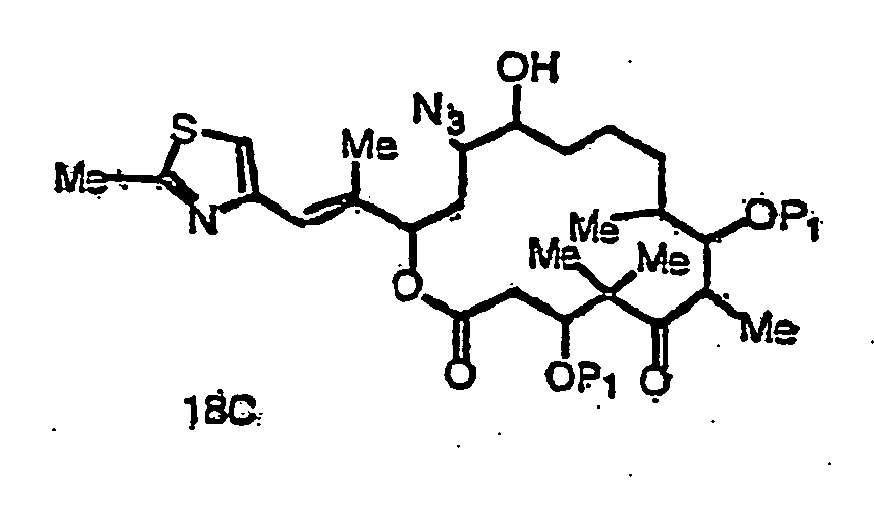
- a compound of formula 18C can be prepared from a compound of formula 18B by treatment with a metal azide salt such as lithium azide.
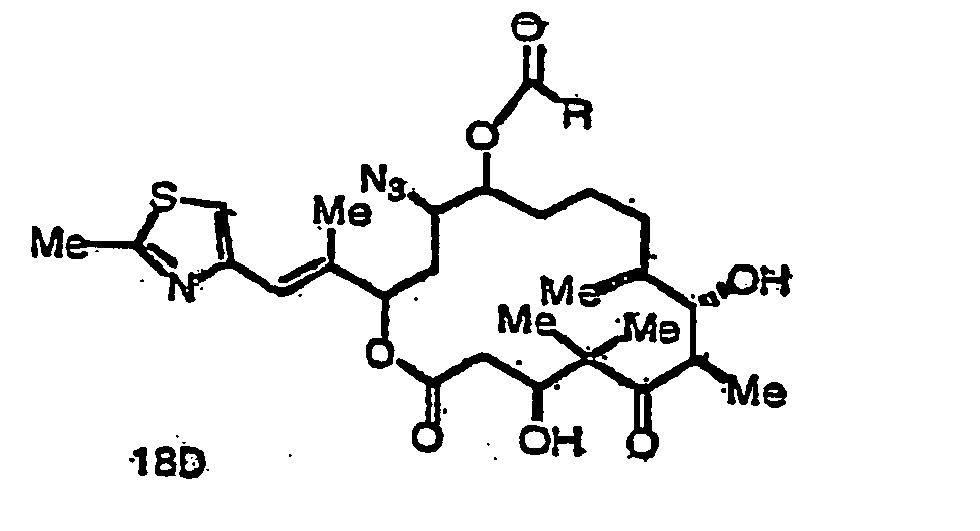
- a compound of formula 18D can be prepared from a compound of formula 18C by Mitsunobu reaction using, for example, triphenylphosphine and a carboxylic acid such as 4-nitrobenzoic acid.
- a compound of formula 18E can be prepared from a compound of formula 18D by hydrolysis or ammoniolysis of the ester group using, for example, a solution of ammonia in methanol.
- P1 is an oxygen protecting group such as triethylsilyl
- trifluoroacetic acid in dichloromethane or other methods known in the art.
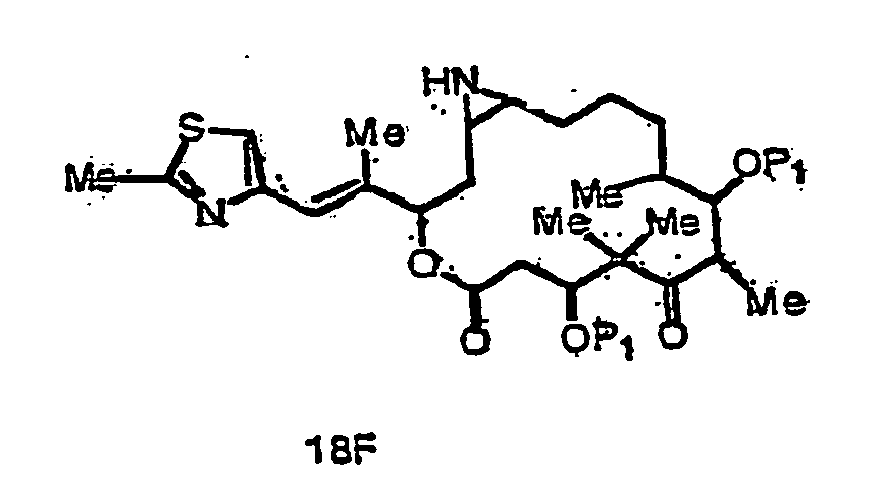
- Reduction of the azido group and subsequent cyclization of a compound of formula 18E with a reducing agent such as a triaryl- or trialkylphosphine provides a compound of formula I, such as 18F (where R 1-4 are methyl and R 6 is 2-methyl-4-thiazolyl).
- a compound of formula 18E where P1 is an oxygen protecting group can be converted to a alkyl or aryl sulfonyl chloride.
- Reduction of the azido group and subsequent cyclization of a compound of formula 19A using a reducing agent such as a triaryl- or trialkylphosphine or with hydrogen and Lindlar's catalyst (Pd, CaCo3/Pb) provides a compound of formula I such as 18F (where R 1-4 are methyl and R 6 is 2-methyl-4-thiazolyl).
- a compound of formula 18C where P1 is an oxygen protecting group can be converted to a compound of formula 20A where X is a halogen by treatment with, for example, triphenylphosphine and a carbon tetrahalide.
- a reducing agent such as a triaryl- or trialkylphosphine or with hydrogen and Lindlar's catalyst (Pd, CaCO3/Pb)
- a compound of formula I such as 18F (where R 1-4 are methyl and R 6 is 2-methyl-4-thiazolyl).
- Twice cycled (2X) calf brain tubulin was prepared following the procedure of Williams and Lee (see Williams, R.C., Jr., and Lee, J. C. Preparation of tubulin from brain. Methods in Enzymology 85, Pt. D: 376-385, 1982) and stored in liquid nitrogen before use. Quantification of tubulin polymerization potency is accomplished following a modified procedure of Swindell, et al., (see Swindell, C.S., Krauss, N.E., Horwitz, S.B., and Ringel, I. Biologically active taxol analogues with deleted A-ring side chain substituents and variable C-2' configurations. J. Med. Chem. 34: 1176-1184, 1991).
- tubulin polymerization potency results in the expression of tubulin polymerization potency as an effective concentration for any given compound.
- different concentrations of compound in polymerization buffer 0.1M MES, 1mM EGTA, 0.5 mM MgCl 2 , pH 6.6
- a final microtubule protein concentration of 1.0 mg/ml and compound concentration of generally 2.5, 5.0, and 10 ⁇ M are used.
- Initial slopes of OD change measured every 10 seconds were calculated by the program accompanying the instrument after initial and final times of the linear region encompassing at least 3 time points were manually defined.
- EC 0.01 values are expressed as the mean with standard deviation obtained from 3 different concentrations. EC 0.01 values for the compounds in this invention fall in the range 0.01-1000 ⁇ M.
- Cytoxicity was assessed in HCT-116 human colon carcinoma cells by MTS (3-(4,5-dimethylthiazol-2-yl)-5-(3-carboxymethoxyphenyl)-2-(4-sulphenyl)-2H-tetrazolium, inner salt) assay as reported in T.L. Riss, et. al., "Comparison of MTT, XTT, and a novel tetrazolium compound MTS for in vitro proliferation and chemosensitivity assays.”, Mol. Biol. Cell 3 (Suppl.):184a, 1992. Cells were plated at 4,000 cell/well in 96 well microtiter plates and 24 hours later drugs were added and serial diluted.
- the cells were incubated at 37°C form 72 hours at which time the tetrazolium dye, MTS at 333 ⁇ g/ml (final concentration), in combination with the electron coupling agent phenazine methosulfate at 25 ⁇ M (final concentration) was added.
- a dehydrogenase enzyme in live cells reduces the MTS to a form that absorbs light at 492nM which can be quantitated spectrophorometrically. The greater the absorbance the greater the number of live cells.
- the results are expressed as an IC 50 , which is the drug concentration required to inhibit cell proliferation (i.e. absorbance at 450nM) to 50% of that of untreated control cells.
- the IC 50 values for compounds of this invention fall in the range 0.01 - 1000 nM.
- FABHRMS m/z 578.3287 C 30 H 47 N 3 O 6 S, requires 577.3186).
- HCO 2 H (22.7 mmol, 0.85 mL) was added to a solution of epothilone B (4.5 mmol, 2.3g), NEt 3 (45.3 mmol, 6.3 mL) and N,N -dimethylaminopyridine (10 mmol, 1.2g) in CH 2 Cl 2 (100 mL) at room temperature.
- the reaction mixture was cooled to -15°C, and (CH 3 CO) 2 O (22.7 mmol, 2.1 mL) was added dropwise.
- the reaction was maintained at -15°C for 15 minutes then at room temperature for 30 minutes.
- the reaction was quenched with pH 7 buffer (100 mL) and extracted with CH 2 Cl 2 (3X100 mL).
- p -Toluenesulfonylchloride (0.1 mmol, 19 mg) was added to Compound C (31 mg, 2:1 (trans:cis), 0.05 mmol) and pyridine (0.25 mmol, 0.02 mL) in CH 2 Cl 2 (1.0 mL) at room temperature. The reaction mixture was heated at 35°C for 16 hours, then additional p -toluenesulfonylchloride (0.1 mmol, 19 mg) and pyridine (0.25 mmol, 0.02 mL) were added.
- Trifluoroacetic acid (1 mL of 20% solution in CH 2 Cl 2 ) was added to Compound E (0.011 mmol, 6.5 mg) in CH 2 Cl 2 (1 mL) at -20°C. After 20 minutes, the reaction mixture was quenched with saturated NaHCO 3 (1mL), extracted with CH 2 Cl 2 (3X10 mL), dried over Na 2 SO 4 , concentrated and purified by flash chromatography (20% to 60% EtOAc/hexanes with 1% triethylamine) to afford the title compound, as a white solid (4.3 mg). (M+H) + 490.
- Et 3 SiCl (4.15 mmol, 0.7 mL) was added to epothilone A (4.2 mmol, 205 mg), N,N -diisopropylethylamine (6.2 mmol, 1.1 mL), and imidazole (2.1 mmol, 141 mg) in DMF (5 mL) at room temperature. The reaction mixture was then heated at 40°C for 15.5 hours. Additional N,N -diisopropylethylamine (4.2 mmol, 0.720 mL) and Et 3 SiCl (2.1 mmol, 0.35 mL) were added and the reaction was heated to 60°C. After 48 hours, the reaction mixture was concentrated and purified by flash chromatography (5 to 10% EtOAc/hexanes) to afford Compound A as a clear oil (264mg). (M+H) + 722.
- Et 3 SiCl 25 ml, 149 mmol was added to epothilone A (10.39 g, 21 mmol), N,N -diisopropylethylamine (55 ml, 315 mmol), and imidazole (7.15 g, 105 mmol,) in DMF (75 mL) at 25°C.
- the reaction mixture was then heated at 55°C for 6.5 h and concentrated in vacuo.
- the residue was then diluted with CH 2 Cl 2 (100 mL) and the organic extracts were washed with NaCHO 3 (30 mL), dried over Na 2 SO 4 and concentrated in vacuo.
- the amino acid-containing mixture was then diluted with MeCN-DMF (12:1, 1.9 mL), cooled to 0 °C and treated with 1-hydroxybenzotriazole hydrate (7.0 mg, 51 mmol) followed by 1-(3-dimethylaminopropyl)-3-ethylcarbodimide hydrochloride (25 mg, 0.13 mmol).
- the reaction mixture was gradually warmed to 25 °C, stirred for 3 hr, diluted with H 2 O (5 mL) and extracted with EtOAc (3 x 5 mL). The organic extracts were washed with H 2 O (8 mL), saturated aqueous NaHCO 3 (2 x 8 mL), and saturated aqueous NaCl (8 mL).
- a suspension of epothilone B (5.06 g, 9.97 mmol) and sodium azide (0.777 g, 12.0 mmol) in a THF-H 2 O mixture (5:1, 96 mL) was degassed for 15-20 min with nitrogen and then treated with a catalytic amount (1.2 g, 0.997 mmol) of tetrakis(triphenylphosphine) palladium (0) under Ar.
- the reaction mixture was warmed to 45 °C for 20 min and cooled to 25 °C.
- the resulting bright yellow homogeneous solution was directly treated with a 1.0 M solution of trimethylphosphine in THF (24.9 mL. 24.9 mmol) at 25 °C and the reaction mixture was stirred for 1-2 hr at ambient temperature.
- the amino acid-containing mixture was then diluted with MeCN-DMF (20:1, 450 mL), cooled to 0 °C and treated with 1-hydroxybenzotriazole hydrate (1.35 g, 9.97 mmol) followed by 1-(3-dimethylaminopropyl)-3-ethylcarbodimide hydrochloride (4.78 g, 24.9 mmol).
- the reaction mixture was warmed to 25 °C, stirred for 12 hr and extracted with EtOAc (4 x 200 mL). The organic extracts were washed with H 2 O (400 mL), saturated aqueous NaHCO 3 (400 mL), and saturated aqueous NaCl (400 mL).
- Tungsten chloride (1.98 g, 5.00 mmol) was added in one portion to pre-cooled THF (50 ml) at -78 °C, and the resulting mixture was stirred for 5 min.
- n-BuLi 1.6 M in hexanes, 6.25 ml, 10.0 mmol
- the reaction mixture was added to compound A (0.351 g, 0.690 mmol) via syringe.
Landscapes
- Organic Chemistry (AREA)
- Chemical & Material Sciences (AREA)
- Health & Medical Sciences (AREA)
- General Health & Medical Sciences (AREA)
- Veterinary Medicine (AREA)
- Nuclear Medicine, Radiotherapy & Molecular Imaging (AREA)
- General Chemical & Material Sciences (AREA)
- Pharmacology & Pharmacy (AREA)
- Life Sciences & Earth Sciences (AREA)
- Animal Behavior & Ethology (AREA)
- Chemical Kinetics & Catalysis (AREA)
- Public Health (AREA)
- Medicinal Chemistry (AREA)
- Engineering & Computer Science (AREA)
- Bioinformatics & Cheminformatics (AREA)
- Pharmaceuticals Containing Other Organic And Inorganic Compounds (AREA)
- Heterocyclic Carbon Compounds Containing A Hetero Ring Having Oxygen Or Sulfur (AREA)
- Plural Heterocyclic Compounds (AREA)
- Nitrogen Condensed Heterocyclic Rings (AREA)
- Nitrogen And Oxygen Or Sulfur-Condensed Heterocyclic Ring Systems (AREA)
Abstract
Claims (10)
- Composé des formules


X est O, S, CHR17 ou H, R18;
Y est sélectionné dans le groupe consistant en O;H,H;H,OR22; OR23, OR23 ; NOR24 ; H, NOR25; H, NR26R27, NHNR28R29; H, NHNR30R31; et CHR32; où OR23, OR23 peut être un cétal cyclique ;
B1 et B2 sont sélectionnés dans le groupe consistant en H, OR33, OCOR34, OCONR35R36, NR37R38 et NR39CONR40R41;
D est sélectionné dans le groupe consistant NR42R43 et hétérocyclo;
M est sélectionné dans le groupe consistant en S, C=O, S=O, SO2 et NR44;
R1, R2, R3 et R4 sont sélectionnés parmi H et alkyle inférieur ;
R5, R8, R9, R10 et R11 sont sélectionnés dans le groupe consistant en H, alkyle, alkyle substitué, aryle, aryle substitué, cycloalkyle, hétérocyclo et hétérocyclo substitué.
R17, R18, R22 et R23 sont sélectionnés dans le groupe consistant en H, alkyle et alkyle substitué ;
R24, R25, R26, R28, R30, R32, R33, R34, R35, R36, R37, R39, R40, R41, R42, R51, R52 et R53 sont sélectionnés dans le groupe de H, alkyle, alkyle substitué, aryle et aryle substitué ;
R12, R16, R27, R29, R31, R38, R43 et R44 sont sélectionnés dans le groupe consistant en H, alkyle, alkyle substitué, aryle substitué, cycloalkyle, hétérocyclo, R51C=O, R52OC=O, R53SO2, hydroxy, O-alkyle et alkyle O substitué ; quand X est O alors R16 n'est pas R51C=O, R52OC=O ni R53SO2 ;
et tous les sels, solvates ou hydrates de ceux-ci ;
où le terme "alkyle" se rapporte à des groupes hydrocarbures non substitués à chaîne droite ou ramifiée de 1 à 20 atomes de carbone ;
le terme "alkyle inférieur" se rapporte à des groupes alkyles non substitués de 1 à 4 atomes de carbone ;
le terme "alkyle substitué" se rapporte à un groupe alkyle substitué par un à quatre substituants, sélectionnés parmi halo, phényle, phényle substitué, hétérocyclo, trifluorométhyle, trifluorométhoxy, hydroxy, alcoxy, cycloalcoxy, hétérocylooxy, oxo, alcanoyle, aryloxy, alcanoyloxy, amino, alkylamino, arylamino, aralkylamino, cycloalkylamino, hétérocycloamino, amines di-substituées dans lesquelles les 2 substituants amino sont sélectionnés parmi alkyle, aryle ou aralkyle, alcanoylamino, aroylamino, aralcanoylamino, alcanoylamino substitué, arylamino substitué, aralcanoylamino substitué, thiol, alkylthio, arylthio, aralkylthio, cycloalkylthio, hétérocyclothio, alkylthiono, arylthiono, aralkylthiono, alkylsulfonyle, arylsulfonyle, aralkylsulfonyle, sulfonamido, sulfonamido substitué, nitro, cyano, carboxy, carbamyle, carbamyle substitué, alcoxycarbonyle, aryle, aryle substitué, guanidino et hétérocyclos, (où noté ci-dessus ou le substituant est de plus substitué ce sera avec halogène, alkyle, alcoxy, aryle ou aralkyle);
le terme "aryle" se rapporte à des groupes hydrocarbures aromatiques monocycliques ou bicycliques ayant de 6 à 12 atomes de carbone dans la portion de cyclique, qui peuvent être substitués ;
le terme "aralkyle" se rapporte à un groupe aryle lié directement par un groupe alkyle ;
le terme "aryle substitué" se rapporte à un groupe aryle substitué par un à quatre substituants sélectionnés parmi alkyle; alkyle substitué, halo, trifluorométhoxy, trifluorométhyle, hydroxy, alcoxy, cycloalkyloxy, hétérocyclooxy, alcanoyle, alcanoyloxy, amino, alkylamino, aralkylamino, cycloalkylamino, hétérocycloamino, dialkylamino, alcanoylamino, thiol, alkylthio, cycloalkylthio, hétérocyclothio, uréido, nitro, cyano, carboxy, carboxyalkyle, carbamyle, alcoxycarbonyle, alkylthiono, arylthiono, alkysulfonyle, sulfonamido et aryloxy (le substituant peut de plus être substitué par halo, hydroxy, alkyle, alcoxy, aryle, alkyle ou aralkyle substitué) ;
le terme "cycloalkyle" se rapporte à des systèmes de cycle d'hydrocarbures cycliques saturés facultativement substitués contenant 1 à 3 cycles et 3 à 7 carbones par cycle qui peuvent être encore fusionnés avec un cycle carboxylique C3-C7 insaturé (des substituants comprennent un ou plusieurs groupes alkyles tels que décrits ci-dessus, ou bien un ou plusieurs groupes décrits ci-dessus comme substituants alkyles) ;
les termes "hétérocycle", "hétérocyclique" et hétérocyclo" se rapportent à un groupe cyclique aromatique ou non aromatique totalement saturé ou insaturé, facultativement substitué, qui est un système d'un cycle monocyclique à 4 à 7 membres, bicyclique à 7 à 11 membres ou tricyclique à 10 à 15 membres, qui a au moins un hétéroatome dans un cycle contenant au moins un atome de carbone, chaque cycle du groupe hétérocyclique contenant un hétéroatome peut avoir 1, 2 ou 3 hétéroatomes sélectionnés parmi des atomes d'azote, des atomes d'oxygène et des atomes de soufre, où les hétéroatomes d'azote et de soufre peuvent également facultativement être oxydés et les hétéroatomes d'azote peuvent également facultativement être quaternisés, le groupe hétérocyclique peut être attaché à tout hétéroatome ou atome de carbone et où le substituant est un ou plusieurs groupes alkyles comme décrits ci-dessus ou un ou plusieurs groupes décrits ci-dessus comme substituants alkyles ou époxydes ou aziridines. - Composé de la revendication 1, où
G est
et Y est O. - Composé de la revendication 1, sélectionné dans le groupe consistant en :[1S-[1R*,3R*(E),7R*,10S*,11R*,12R*,16S*]]-7,11-Dihydroxy-8,8,10,12-tétraméthyl-3-[1-méthyl-2-(2-méthyl-4-thiazolyl)éthényl]-4-oxa-17-azabicyclo[14,1,0]heptadécane-5,9-dione;[1S-[1R*,3R*(E),7R*,10S*,11R*,12R*,16S*]]-17-Formyl-7,11-Dihydroxy-8,8,10,12-tétraméthyl-3-[1-méthyl-2-(2-méthyl-4-thiazolyl)éthényl]-4-oxa-17-azabicyclo[14,1,0]heptadécane-5,9-dione;[1S-[1R*,3R*(E),7R*,10S*,11R*,12R*,16S*]]-7,11-dihydroxy-8,8,10,12-tétraméthyl-3-[1-méthyl-2-(2-méthyl-4-thiazolyl)éthényl]-4-oxa-17-thiabicyclo[14,1,0]heptadécane-5,9-dione.
- Composition pharmaceutique comprenant un composé selon l'une quelconque des revendications 1 à 3.
- Utilisation d'un composé tel que défini en une quelconque des revendications 1 à 3 pour la préparation d'une composition pharmaceutique pour le traitement du cancer.
- Procédé de préparation d'un composé 18F
 (a) produire un composé de formule 18A
 (b) remplacer facultativement l'hydrogène en tant que P1 par un groupe protecteur d'oxygène ;(c) fait réagir le composé de formule 18A avec un sel d'un halogénure de métal pour former un composé de formule 18B, où X est halogène
 (d) fait réagir le composé de formule 18B avec un sel d'azide de métal pour former un composé de formule 18C
 (e) entreprendre une réaction de Mitsunobu avec le composé de formule 18C pour un composé de formule 18D où R est 4-nitrophényle ou phényle
 (f) hydrolyse ou ammoniolyse du groupe ester du composé de formule 18D pour former un composé de formule 18E
 (g) si P1 est un groupe protecteur d'oxygène, supprimer facultativement la protection du composé de formule 18E ; et(h) réduire et subséquemment cycliser le composé de formule 18E avec un agent réducteur pour former le composé de formule 18A.
- Procédé de la revendication 6, où la protection du produit de l'étape (f) est supprimée avant plus ample réaction.
- Procédé de préparation d'un composé de formule 18F
 (a) convertir un composé de formule 18E

 (b) réduire et subséquemment cycliser le composé de formule 19A avec un agent réducteur pour former le composé de formule 18F ; et(c) supprimer facultativement la protection du composé de formule 18F afin de remplacer le groupe protecteur d'oxygène en tant que P1 par de l'hydrogène.
- Procédé de préparation d'un composé de formule 18F
 (a) traiter un composé de formule 18C
 (b) réduire et subséquemment cycliser le composé de formule 20A avec un agent réducteur pour former le composé de formule 18F ; et(c) supprimer facultativement la protection du composé de formule 18F afin de remplacer le groupe protecteur d'oxygène en tant que P1 par de l'hydrogène.
- Composé sélectionné dans le groupe consistant en


 P1 est hydrogène ou un groupe protecteur d'oxygène ;R est 4-nitrophényle ou phényle ;R' est alkyle ou aryle tel que défini à la revendication 1 ; etX est halogène.
Priority Applications (2)
| Application Number | Priority Date | Filing Date | Title |
|---|---|---|---|
| EP05015236A EP1589017B1 (fr) | 1998-04-21 | 1999-04-05 | Dérivés d'épothilone modifiés en position 12,13 |
| DK05015236.2T DK1589017T3 (da) | 1998-04-21 | 1999-04-05 | 12,13-modificerede epothilon-derivater |
Applications Claiming Priority (3)
| Application Number | Priority Date | Filing Date | Title |
|---|---|---|---|
| US8256498P | 1998-04-21 | 1998-04-21 | |
| US82564P | 1998-04-21 | ||
| PCT/US1999/007475 WO1999054319A1 (fr) | 1998-04-21 | 1999-04-05 | Derives d'epothilone modifies en position 12,13 |
Related Child Applications (1)
| Application Number | Title | Priority Date | Filing Date |
|---|---|---|---|
| EP05015236A Division EP1589017B1 (fr) | 1998-04-21 | 1999-04-05 | Dérivés d'épothilone modifiés en position 12,13 |
Publications (3)
| Publication Number | Publication Date |
|---|---|
| EP1073648A1 EP1073648A1 (fr) | 2001-02-07 |
| EP1073648A4 EP1073648A4 (fr) | 2003-01-02 |
| EP1073648B1 true EP1073648B1 (fr) | 2006-09-20 |
Family
ID=22171978
Family Applications (3)
| Application Number | Title | Priority Date | Filing Date |
|---|---|---|---|
| EP99915273A Expired - Lifetime EP1073647B1 (fr) | 1998-04-21 | 1999-04-05 | Derives d'epothilone 12,13-cyclopropane |
| EP05015236A Expired - Lifetime EP1589017B1 (fr) | 1998-04-21 | 1999-04-05 | Dérivés d'épothilone modifiés en position 12,13 |
| EP99916383A Expired - Lifetime EP1073648B1 (fr) | 1998-04-21 | 1999-04-05 | Derives d'epothilone modifies en positions 12,13 |
Family Applications Before (2)
| Application Number | Title | Priority Date | Filing Date |
|---|---|---|---|
| EP99915273A Expired - Lifetime EP1073647B1 (fr) | 1998-04-21 | 1999-04-05 | Derives d'epothilone 12,13-cyclopropane |
| EP05015236A Expired - Lifetime EP1589017B1 (fr) | 1998-04-21 | 1999-04-05 | Dérivés d'épothilone modifiés en position 12,13 |
Country Status (17)
| Country | Link |
|---|---|
| US (2) | US6399638B1 (fr) |
| EP (3) | EP1073647B1 (fr) |
| JP (2) | JP4476483B2 (fr) |
| CN (1) | CN1142923C (fr) |
| AR (2) | AR015007A1 (fr) |
| AT (2) | ATE435861T1 (fr) |
| AU (2) | AU757733B2 (fr) |
| BR (1) | BR9909795A (fr) |
| CA (2) | CA2329181C (fr) |
| CY (2) | CY1105836T1 (fr) |
| DE (2) | DE69941083D1 (fr) |
| DK (3) | DK1073647T3 (fr) |
| ES (3) | ES2273484T3 (fr) |
| PE (1) | PE20000460A1 (fr) |
| PT (3) | PT1073648E (fr) |
| TR (1) | TR200003036T2 (fr) |
| WO (2) | WO1999054318A1 (fr) |
Families Citing this family (85)
| Publication number | Priority date | Publication date | Assignee | Title |
|---|---|---|---|---|
| US20050043376A1 (en) * | 1996-12-03 | 2005-02-24 | Danishefsky Samuel J. | Synthesis of epothilones, intermediates thereto, analogues and uses thereof |
| EP1386922B1 (fr) | 1996-12-03 | 2012-04-11 | Sloan-Kettering Institute For Cancer Research | Synthèse d'épitholones, intermédiaires, analogues et leur utilisation |
| US6204388B1 (en) | 1996-12-03 | 2001-03-20 | Sloan-Kettering Institute For Cancer Research | Synthesis of epothilones, intermediates thereto and analogues thereof |
| GB9810659D0 (en) | 1998-05-18 | 1998-07-15 | Ciba Geigy Ag | Organic compounds |
| DE19826988A1 (de) * | 1998-06-18 | 1999-12-23 | Biotechnolog Forschung Gmbh | Epothilon-Nebenkomponenten |
| CN100381566C (zh) | 1998-11-20 | 2008-04-16 | 科森生物科学公司 | 产生环氧噻酮及其衍生物的重组方法和材料 |
| US6410301B1 (en) | 1998-11-20 | 2002-06-25 | Kosan Biosciences, Inc. | Myxococcus host cells for the production of epothilones |
| WO2000032175A2 (fr) * | 1998-12-02 | 2000-06-08 | Pfizer Products Inc. | PROCEDES ET COMPOSITIONS POUR RETABLIR LA STABILITE DE CONFORMATION D'UNE PROTEINE DE LA FAMILLE p53 |
| US6780620B1 (en) * | 1998-12-23 | 2004-08-24 | Bristol-Myers Squibb Company | Microbial transformation method for the preparation of an epothilone |
| US20020058286A1 (en) * | 1999-02-24 | 2002-05-16 | Danishefsky Samuel J. | Synthesis of epothilones, intermediates thereto and analogues thereof |
| WO2000057874A1 (fr) * | 1999-03-29 | 2000-10-05 | Bristol-Myers Squibb Co. | Procede de preparation d'epothilones d'aziridinyle a partir d'epothilone d'oxiranyle |
| US7125875B2 (en) | 1999-04-15 | 2006-10-24 | Bristol-Myers Squibb Company | Cyclic protein tyrosine kinase inhibitors |
| CA2366932C (fr) | 1999-04-15 | 2009-08-25 | Bristol-Myers Squibb Company | Inhibiteurs cycliques de proteine tyrosine kinase |
| US6593115B2 (en) * | 2000-03-24 | 2003-07-15 | Bristol-Myers Squibb Co. | Preparation of epothilone intermediates |
| US6989450B2 (en) | 2000-10-13 | 2006-01-24 | The University Of Mississippi | Synthesis of epothilones and related analogs |
| CA2434526C (fr) * | 2001-01-25 | 2011-11-01 | Bristol Myers Squibb Company | Procedes relatifs a l'administration d'analogues de l'epothilone pour le traitement du cancer |
| NZ526871A (en) * | 2001-01-25 | 2006-01-27 | Bristol Myers Squibb Co | Pharmaceutical dosage forms of epothilones for oral administration |
| DE60225666T2 (de) * | 2001-01-25 | 2009-04-16 | Bristol-Myers Squibb Co. | Verfahren zur herstellung von pharmazeutischen zusammensetzungen enthaltend epothilon-analoga zur krebsbehandlung |
| SK8552003A3 (en) * | 2001-01-25 | 2004-06-08 | Bristol Myers Squibb Co | Parenteral formulation containing epothilone analogs |
| IL156988A0 (en) | 2001-02-20 | 2004-02-08 | Bristol Myers Squibb Co | Pharmaceutical compositions containing epothilone derivatives |
| EE200300397A (et) | 2001-02-20 | 2003-12-15 | Bristol-Myers Squibb Company | Epotilooni derivaadid refraktaarsete kasvajate raviks |
| ATE554756T1 (de) * | 2001-03-14 | 2012-05-15 | Bristol Myers Squibb Co | Kombination aus epothilon-analog und chemotherapeutika zur behandlung von proliferativen erkrankungen |
| EP1389209B1 (fr) * | 2001-04-24 | 2009-04-08 | Purdue Research Foundation | Mimetiques de folate et ses conjugues se liant au recepteur de folate |
| US6800653B2 (en) | 2001-06-01 | 2004-10-05 | Bristol-Myers Squibb Compnay | Epothilone derivatives |
| ES2315399T3 (es) * | 2001-08-23 | 2009-04-01 | Novartis Ag | Analogos de epotilona ciclobutilo y ciclopropilo. |
| WO2003026744A1 (fr) * | 2001-09-25 | 2003-04-03 | Alcon, Inc. | Utilisation d'epothilones et analogues en chirurgie ophtalmique |
| TW200303202A (en) * | 2002-02-15 | 2003-09-01 | Bristol Myers Squibb Co | Method of preparation of 21-amino epothilone derivatives |
| AU2003218110A1 (en) | 2002-03-12 | 2003-09-29 | Bristol-Myers Squibb Company | C3-cyano epothilone derivatives |
| US7211593B2 (en) * | 2002-03-12 | 2007-05-01 | Bristol-Myers Squibb Co. | C12-cyano epothilone derivatives |
| TW200403994A (en) | 2002-04-04 | 2004-03-16 | Bristol Myers Squibb Co | Oral administration of EPOTHILONES |
| KR20040106547A (ko) * | 2002-05-15 | 2004-12-17 | 엔도사이트, 인코포레이티드 | 비타민-마이토마이신 공액체 |
| TW200400191A (en) | 2002-05-15 | 2004-01-01 | Bristol Myers Squibb Co | Pharmaceutical compositions and methods of using C-21 modified epothilone derivatives |
| US7405234B2 (en) | 2002-05-17 | 2008-07-29 | Bristol-Myers Squibb Company | Bicyclic modulators of androgen receptor function |
| WO2003105828A1 (fr) * | 2002-06-14 | 2003-12-24 | Bristol-Myers Squibb Company | Combinaison d'analogues d'epothilone et agents chimiotherapeutiques utiles dans le traitement des maladies proliferatives |
| RU2338741C2 (ru) * | 2002-07-31 | 2008-11-20 | Мершан Корпорейшн | Новые физиологически активные вещества |
| ES2297189T3 (es) * | 2002-08-02 | 2008-05-01 | Novartis Ag | Derivados de epotilona. |
| US7649006B2 (en) * | 2002-08-23 | 2010-01-19 | Sloan-Kettering Institute For Cancer Research | Synthesis of epothilones, intermediates thereto and analogues thereof |
| ATE350383T1 (de) | 2002-08-23 | 2007-01-15 | Sloan Kettering Inst Cancer | Synthese von epothilonen, zwischenprodukte dafür, analoga und deren verwendungen |
| US6921769B2 (en) | 2002-08-23 | 2005-07-26 | Sloan-Kettering Institute For Cancer Research | Synthesis of epothilones, intermediates thereto and analogues thereof |
| HRP20050278A2 (en) | 2002-09-23 | 2005-10-31 | Bristol-Myers Squibb Company | Methods for the preparation, isolation and purification of epothilone b, and x-ray crystal structures of epothilone b |
| JP2006504743A (ja) * | 2002-10-09 | 2006-02-09 | コーザン バイオサイエンシス インコーポレイテッド | 治療製剤 |
| AU2003264822A1 (en) * | 2002-10-11 | 2004-05-04 | Dana-Farber Cancer Institute Inc | Epothilone derivatives for the treatment of multiple myeloma |
| EP1567487A4 (fr) | 2002-11-15 | 2005-11-16 | Bristol Myers Squibb Co | Modulateurs lies a prolyl uree a chaine ouverte de la fonction du recepteur d'androgene |
| US7601332B2 (en) | 2003-01-27 | 2009-10-13 | Endocyte, Inc. | Vitamin receptor binding drug delivery conjugates |
| CN1867343A (zh) * | 2003-10-09 | 2006-11-22 | 高山生物科学股份有限公司 | 治疗制剂 |
| KR20060122819A (ko) * | 2003-10-09 | 2006-11-30 | 코산 바이오사이언시즈, 인코포레이티드 | 치료학적 제형 |
| US20050171167A1 (en) * | 2003-11-04 | 2005-08-04 | Haby Thomas A. | Process and formulation containing epothilones and analogs thereof |
| US7820702B2 (en) | 2004-02-04 | 2010-10-26 | Bristol-Myers Squibb Company | Sulfonylpyrrolidine modulators of androgen receptor function and method |
| US7378426B2 (en) | 2004-03-01 | 2008-05-27 | Bristol-Myers Squibb Company | Fused heterotricyclic compounds as inhibitors of 17β-hydroxysteroid dehydrogenase 3 |
| US7696241B2 (en) | 2004-03-04 | 2010-04-13 | Bristol-Myers Squibb Company | Bicyclic compounds as modulators of androgen receptor function and method |
| US7625923B2 (en) | 2004-03-04 | 2009-12-01 | Bristol-Myers Squibb Company | Bicyclic modulators of androgen receptor function |
| CN101098854B (zh) | 2004-07-23 | 2012-12-05 | 恩多塞特公司 | 二价连接体及其轭合物 |
| US8232244B2 (en) | 2007-02-08 | 2012-07-31 | The Board Of Trustees Of The University Of Illinois | Compositions and methods to prevent cancer with cupredoxins |
| US10675326B2 (en) | 2004-10-07 | 2020-06-09 | The Board Of Trustees Of The University Of Illinois | Compositions comprising cupredoxins for treating cancer |
| SI1817013T1 (sl) * | 2004-11-18 | 2008-12-31 | Bristol Myers Squibb Co | Peleta z gastrorezistentno oblogo, ki vsebuje iksabepilon |
| WO2006055742A1 (fr) * | 2004-11-18 | 2006-05-26 | Bristol-Myers Squibb Company | Bille enrobee de keratine comprenant de l'epothilone ou un analogue d'epothilone, ainsi que preparation et administration de cette bille |
| EP2634252B1 (fr) | 2005-02-11 | 2018-12-19 | University of Southern California | Procédé d'expression de protéines avec des ponts disulfures |
| CN101175757B (zh) | 2005-03-16 | 2012-11-14 | 恩多塞特公司 | 蝶酸及其缀合物的合成和纯化 |
| WO2006122408A1 (fr) | 2005-05-18 | 2006-11-23 | Aegera Therapeutics Inc. | Composes liants de domaine bir |
| RU2470668C2 (ru) * | 2005-08-19 | 2012-12-27 | Эндосайт, Инк. | Конъюгаты лиганда с несколькими лекарственными средствами |
| JP2009504783A (ja) * | 2005-08-19 | 2009-02-05 | エンドサイト,インコーポレイテッド | ビンカアルカロイド、類似体および誘導体のリガンド結合体 |
| US8008256B2 (en) * | 2006-05-01 | 2011-08-30 | University Of Southern California | Combination therapy for treatment of cancer |
| BRPI0711591A2 (pt) | 2006-05-16 | 2011-11-16 | Aegera Therapeutics, Inc. | composto de ligação de domìnio bir da iap |
| AR062448A1 (es) * | 2006-05-25 | 2008-11-12 | Endocyte Inc | Conjugados de analogos de aziridinil-epotilona y composiciones farmaceuticas que comprenden los mismos |
| PE20080316A1 (es) * | 2006-05-25 | 2008-04-10 | Bristol Myers Squibb Co | Compuestos de aziridinil-epotilona |
| AU2007329375A1 (en) | 2006-12-04 | 2008-06-12 | The Board Of Trustees Of The University Of Illinois | Compositions and methods to treat cancer with cupredoxins and CpG rich DNA |
| US20100104626A1 (en) * | 2007-02-16 | 2010-04-29 | Endocyte, Inc. | Methods and compositions for treating and diagnosing kidney disease |
| CN104127878A (zh) * | 2007-03-14 | 2014-11-05 | 恩多塞特公司 | 结合配体连接的微管溶素递药缀合物 |
| CN101754969A (zh) * | 2007-05-25 | 2010-06-23 | 百时美施贵宝公司 | 制备埃坡霉素化合物和类似物的方法 |
| US9877965B2 (en) | 2007-06-25 | 2018-01-30 | Endocyte, Inc. | Vitamin receptor drug delivery conjugates for treating inflammation |
| BRPI0812970A2 (pt) * | 2007-06-25 | 2019-09-24 | Endocyte Inc | conjugados contendo espaçadores hidrofílicos |
| EP2209374B1 (fr) | 2007-10-25 | 2014-12-03 | Endocyte, Inc. | Tubulysines et leurs procédés de préparation |
| WO2009146152A2 (fr) * | 2008-04-04 | 2009-12-03 | Emory University | Composés non myélosuppresseurs, leurs compositions pharmaceutiques, et procédés de traitement |
| CN102076339A (zh) * | 2008-04-24 | 2011-05-25 | 百时美施贵宝公司 | 埃坡霉素D在治疗包括阿尔茨海默病的τ相关疾病中的用途 |
| US8802394B2 (en) | 2008-11-13 | 2014-08-12 | Radu O. Minea | Method of expressing proteins with disulfide bridges with enhanced yields and activity |
| NZ602368A (en) | 2010-02-12 | 2014-10-31 | Pharmascience Inc | Iap bir domain binding compounds |
| CA2927832C (fr) | 2010-05-18 | 2021-03-23 | Cerulean Pharma Inc. | Conjugues d'agent therapeutique polymere renfermant de la cyclodextrine et leur utilisation |
| CA2824521C (fr) | 2011-01-20 | 2016-06-28 | Board Of Regents, The University Of Texas System | Marqueurs d'imagerie par resonnance magnetique, systemes d'administration et d'extraction et procedes connexes |
| CN102863474A (zh) | 2011-07-09 | 2013-01-09 | 陈小平 | 一类治疗细胞增殖性疾病的铂化合物、其制备方法和应用 |
| CN102993239A (zh) | 2011-09-19 | 2013-03-27 | 陈小平 | 离去基团含氨基或烷胺基的丁二酸衍生物的铂类化合物 |
| WO2013126797A1 (fr) | 2012-02-24 | 2013-08-29 | Purdue Research Foundation | Ciblage du récepteur de la cholécystokinine de type b pour imagerie et thérapie |
| US20140080175A1 (en) | 2012-03-29 | 2014-03-20 | Endocyte, Inc. | Processes for preparing tubulysin derivatives and conjugates thereof |
| EA201590622A1 (ru) | 2012-10-16 | 2015-10-30 | Эндосайт, Инк. | Конъюгаты для доставки лекарственного средства, содержащие не встречающиеся в природе аминокислоты, и способы применения |
| EP2924044B1 (fr) | 2012-11-17 | 2018-10-31 | Beijing Shuobai Pharmaceutical Co., LTD | Composé du platine et de dérivé de l'acide malonique ayant un groupe partant contenant un groupe amino ou alkylamino |
| US10874646B2 (en) | 2015-10-16 | 2020-12-29 | William Marsh Rice University | Epothilone analogs, methods of synthesis, methods of treatment, and drug conjugates thereof |
Family Cites Families (33)
| Publication number | Priority date | Publication date | Assignee | Title |
|---|---|---|---|---|
| DE4138042C2 (de) | 1991-11-19 | 1993-10-14 | Biotechnolog Forschung Gmbh | Epothilone, deren Herstellungsverfahren sowie diese Verbindungen enthaltende Mittel |
| DE19639456A1 (de) | 1996-09-25 | 1998-03-26 | Biotechnolog Forschung Gmbh | Epothilon-Derivate, Herstellung und Mittel |
| DE59609305D1 (de) | 1995-11-17 | 2002-07-11 | Biotechnolog Forschung Gmbh | Epothilon-Derivate und deren Herstellung |
| DE19542986A1 (de) | 1995-11-17 | 1997-05-22 | Biotechnolog Forschung Gmbh | Epothilon-Derivate und deren Verwendung |
| DE19645361A1 (de) | 1996-08-30 | 1998-04-30 | Ciba Geigy Ag | Zwischenprodukte innerhalb der Totalsynthese von Epothilon A und B, Teil II |
| DE19645362A1 (de) | 1996-10-28 | 1998-04-30 | Ciba Geigy Ag | Verfahren zur Herstellung von Epothilon A und B und Derivaten |
| AU716610B2 (en) | 1996-08-30 | 2000-03-02 | Novartis Ag | Method for producing epothilones, and intermediate products obtained during the production process |
| ATE267197T1 (de) | 1996-11-18 | 2004-06-15 | Biotechnolog Forschung Gmbh | Epothilon d, dessen herstellung und dessen verwendung als cytostatisches mittel bzw. als pflanzenschutzmittel |
| US6515016B2 (en) | 1996-12-02 | 2003-02-04 | Angiotech Pharmaceuticals, Inc. | Composition and methods of paclitaxel for treating psoriasis |
| US6204388B1 (en) | 1996-12-03 | 2001-03-20 | Sloan-Kettering Institute For Cancer Research | Synthesis of epothilones, intermediates thereto and analogues thereof |
| EP1386922B1 (fr) | 1996-12-03 | 2012-04-11 | Sloan-Kettering Institute For Cancer Research | Synthèse d'épitholones, intermédiaires, analogues et leur utilisation |
| US6380394B1 (en) | 1996-12-13 | 2002-04-30 | The Scripps Research Institute | Epothilone analogs |
| US6441186B1 (en) | 1996-12-13 | 2002-08-27 | The Scripps Research Institute | Epothilone analogs |
| DE19701758A1 (de) | 1997-01-20 | 1998-07-23 | Wessjohann Ludgar A Dr | Epothilone-Synthesebausteine |
| EP0975638B1 (fr) | 1997-02-25 | 2002-08-07 | Gesellschaft für biotechnologische Forschung mbH (GBF) | Epothilones a chaine laterale modifiee |
| DE19713970B4 (de) | 1997-04-04 | 2006-08-31 | R&D-Biopharmaceuticals Gmbh | Epothilone-Synthesebausteine II - Prenylderivate |
| JP4065573B2 (ja) | 1997-04-18 | 2008-03-26 | ベーリンガー・インゲルハイム・インテルナツィオナール・ゲゼルシャフト・ミット・ベシュレンクテル・ハフツング | 反応媒体として圧縮二酸化炭素中における二官能性または多官能性基質の選択的オレフィンメタセシス |
| DE19720312A1 (de) | 1997-05-15 | 1998-11-19 | Hoechst Ag | Zubereitung mit erhöhter in vivo Verträglichkeit |
| DE19821954A1 (de) | 1997-05-15 | 1998-11-19 | Biotechnolog Forschung Gmbh | Verfahren zur Herstellung eines Epothilon-Derivats |
| DE19726627A1 (de) | 1997-06-17 | 1998-12-24 | Schering Ag | Zwischenprodukte, Verfahren zu ihrer Herstellung und ihre Verwendung zur Herstellung von Epothilon |
| US6605599B1 (en) * | 1997-07-08 | 2003-08-12 | Bristol-Myers Squibb Company | Epothilone derivatives |
| DK1001951T3 (da) | 1997-07-16 | 2002-12-23 | Schering Ag | Thiazolderivater, fremgangsmåde til fremstilling deraf og anvendelse af disse |
| ES2290993T3 (es) | 1997-08-09 | 2008-02-16 | Bayer Schering Pharma Aktiengesellschaft | Nuevos derivados de epotilona, proceso para su produccion y su utilizacion farmaceutica. |
| KR20080016756A (ko) | 1998-02-05 | 2008-02-21 | 노파르티스 아게 | 유기화합물 함유 조성물 |
| US6194181B1 (en) | 1998-02-19 | 2001-02-27 | Novartis Ag | Fermentative preparation process for and crystal forms of cytostatics |
| FR2775187B1 (fr) | 1998-02-25 | 2003-02-21 | Novartis Ag | Utilisation de l'epothilone b pour la fabrication d'une preparation pharmaceutique antiproliferative et d'une composition comprenant l'epothilone b comme agent antiproliferatif in vivo |
| CA2322157C (fr) | 1998-02-25 | 2012-05-29 | Sloan-Kettering Institute For Cancer Research | Synthese d'epothilones, de leurs intermediaires et de leurs analogues |
| AU5036999A (en) | 1998-06-30 | 2000-01-17 | Schering Aktiengesellschaft | Epothilon derivatives, their preparation process, intermediate products and their pharmaceutical use |
| CN100381566C (zh) | 1998-11-20 | 2008-04-16 | 科森生物科学公司 | 产生环氧噻酮及其衍生物的重组方法和材料 |
| BR9916833A (pt) | 1998-12-22 | 2001-09-25 | Novartis Ag | Derivados de epotilona e seu uso como agentes antitumor |
| EE200100431A (et) | 1999-02-18 | 2002-12-16 | Schering Aktiengesellschaft | 16-halogenoepotilooni derivaadid, nende valmistamismeetod ja farmatseutiline kasutamine |
| US6211412B1 (en) | 1999-03-29 | 2001-04-03 | The University Of Kansas | Synthesis of epothilones |
| AR023792A1 (es) | 1999-04-30 | 2002-09-04 | Bayer Schering Pharma Ag | Derivados 6-alquenilo- y 6-alquinilo-epotilona, los procedimientos para prepararlos y su empleo en productos farmaceuticos |
-
1999
- 1999-03-29 US US09/280,191 patent/US6399638B1/en not_active Expired - Lifetime
- 1999-03-29 US US09/280,192 patent/US6380395B1/en not_active Expired - Lifetime
- 1999-04-05 DK DK99915273T patent/DK1073647T3/da active
- 1999-04-05 AT AT99915273T patent/ATE435861T1/de active
- 1999-04-05 EP EP99915273A patent/EP1073647B1/fr not_active Expired - Lifetime
- 1999-04-05 CN CNB998052663A patent/CN1142923C/zh not_active Expired - Fee Related
- 1999-04-05 ES ES99916383T patent/ES2273484T3/es not_active Expired - Lifetime
- 1999-04-05 PT PT99916383T patent/PT1073648E/pt unknown
- 1999-04-05 AT AT99916383T patent/ATE340177T1/de active
- 1999-04-05 JP JP2000544658A patent/JP4476483B2/ja not_active Expired - Fee Related
- 1999-04-05 DK DK99916383T patent/DK1073648T3/da active
- 1999-04-05 DE DE69941083T patent/DE69941083D1/de not_active Expired - Lifetime
- 1999-04-05 AU AU33827/99A patent/AU757733B2/en not_active Ceased
- 1999-04-05 ES ES99915273T patent/ES2327803T3/es not_active Expired - Lifetime
- 1999-04-05 CA CA2329181A patent/CA2329181C/fr not_active Expired - Fee Related
- 1999-04-05 EP EP05015236A patent/EP1589017B1/fr not_active Expired - Lifetime
- 1999-04-05 WO PCT/US1999/007448 patent/WO1999054318A1/fr not_active Ceased
- 1999-04-05 ES ES05015236T patent/ES2400049T3/es not_active Expired - Lifetime
- 1999-04-05 BR BR9909795-8A patent/BR9909795A/pt not_active IP Right Cessation
- 1999-04-05 AU AU34716/99A patent/AU748526B2/en not_active Ceased
- 1999-04-05 JP JP2000544657A patent/JP2002512238A/ja active Pending
- 1999-04-05 TR TR2000/03036T patent/TR200003036T2/xx unknown
- 1999-04-05 DK DK05015236.2T patent/DK1589017T3/da active
- 1999-04-05 PT PT50152362T patent/PT1589017E/pt unknown
- 1999-04-05 PT PT99915273T patent/PT1073647E/pt unknown
- 1999-04-05 CA CA002323609A patent/CA2323609A1/fr not_active Abandoned
- 1999-04-05 DE DE69933287T patent/DE69933287T2/de not_active Expired - Lifetime
- 1999-04-05 EP EP99916383A patent/EP1073648B1/fr not_active Expired - Lifetime
- 1999-04-05 WO PCT/US1999/007475 patent/WO1999054319A1/fr not_active Ceased
- 1999-04-20 PE PE1999000331A patent/PE20000460A1/es not_active Application Discontinuation
- 1999-04-21 AR ARP990101833A patent/AR015007A1/es unknown
- 1999-04-21 AR ARP990101834A patent/AR015774A1/es unknown
-
2006
- 2006-12-08 CY CY20061101766T patent/CY1105836T1/el unknown
-
2009
- 2009-09-01 CY CY20091100911T patent/CY1109593T1/el unknown
Also Published As
Similar Documents
| Publication | Publication Date | Title |
|---|---|---|
| EP1589017B1 (fr) | Dérivés d'épothilone modifiés en position 12,13 | |
| US6800653B2 (en) | Epothilone derivatives | |
| EP1493738B1 (fr) | Dérivés d'epothilone | |
| EP1073654B1 (fr) | Derives d'epothilone 2,3-olefinique | |
| AU2002309843A1 (en) | Epothilone derivatives | |
| HK1026905B (en) | Epothilone derivatives |
Legal Events
| Date | Code | Title | Description |
|---|---|---|---|
| PUAI | Public reference made under article 153(3) epc to a published international application that has entered the european phase |
Free format text: ORIGINAL CODE: 0009012 |
|
| 17P | Request for examination filed |
Effective date: 20001121 |
|
| AK | Designated contracting states |
Kind code of ref document: A1 Designated state(s): AT BE CH CY DE DK ES FI FR GB GR IE IT LI LU MC NL PT SE |
|
| A4 | Supplementary search report drawn up and despatched |
Effective date: 20021115 |
|
| AK | Designated contracting states |
Kind code of ref document: A4 Designated state(s): AT BE CH CY DE DK ES FI FR GB GR IE IT LI LU MC NL PT SE |
|
| RIC1 | Information provided on ipc code assigned before grant |
Free format text: 7C 07D 491/04 A, 7C 07D 495/04 B, 7C 07D 513/04 B, 7C 07D 417/06 B, 7A 61K 31/335 B, 7A 61K 31/395 B, 7A 61K 31/425 B, 7C 07D 491/04 J, 7C 07D 313:00 J, 7C 07D 203:00 J, 7C 07D 491/04 K, 7C 07D 313:00 K, 7C 07D 305:00 K, 7C 07D 495/04 L, 7C 07D 313:00 L, 7C 07D 331:00 L, 7C 07D 513/04 M, 7C 07D 313:00 M, 7C 07D 277:00 M |
|
| 17Q | First examination report despatched |
Effective date: 20031006 |
|
| GRAP | Despatch of communication of intention to grant a patent |
Free format text: ORIGINAL CODE: EPIDOSNIGR1 |
|
| RIC1 | Information provided on ipc code assigned before grant |
Ipc: A61K 31/425 20060101ALI20060220BHEP Ipc: A61K 31/395 20060101ALI20060220BHEP Ipc: A61K 31/335 20060101ALI20060220BHEP Ipc: C07D 471/06 20060101ALI20060220BHEP Ipc: C07D 513/04 20060101ALI20060220BHEP Ipc: C07D 495/04 20060101ALI20060220BHEP Ipc: C07D 491/04 20060101AFI20060220BHEP |
|
| RTI1 | Title (correction) |
Free format text: 12,13-MODIFIED EPOTHILONE DERIVATIVES |
|
| RTI1 | Title (correction) |
Free format text: 12,13-MODIFIED EPOTHILONE DERIVATIVES |
|
| GRAS | Grant fee paid |
Free format text: ORIGINAL CODE: EPIDOSNIGR3 |
|
| GRAA | (expected) grant |
Free format text: ORIGINAL CODE: 0009210 |
|
| AK | Designated contracting states |
Kind code of ref document: B1 Designated state(s): AT BE CH CY DE DK ES FI FR GB GR IE IT LI LU MC NL PT SE |
|
| PG25 | Lapsed in a contracting state [announced via postgrant information from national office to epo] |
Ref country code: IT Free format text: LAPSE BECAUSE OF FAILURE TO SUBMIT A TRANSLATION OF THE DESCRIPTION OR TO PAY THE FEE WITHIN THE PRESCRIBED TIME-LIMIT;WARNING: LAPSES OF ITALIAN PATENTS WITH EFFECTIVE DATE BEFORE 2007 MAY HAVE OCCURRED AT ANY TIME BEFORE 2007. THE CORRECT EFFECTIVE DATE MAY BE DIFFERENT FROM THE ONE RECORDED. Effective date: 20060920 |
|
| REG | Reference to a national code |
Ref country code: GB Ref legal event code: FG4D |
|
| REG | Reference to a national code |
Ref country code: CH Ref legal event code: EP |
|
| REG | Reference to a national code |
Ref country code: IE Ref legal event code: FG4D |
|
| REF | Corresponds to: |
Ref document number: 69933287 Country of ref document: DE Date of ref document: 20061102 Kind code of ref document: P |
|
| REG | Reference to a national code |
Ref country code: SE Ref legal event code: TRGR |
|
| REG | Reference to a national code |
Ref country code: PT Ref legal event code: SC4A Free format text: AVAILABILITY OF NATIONAL TRANSLATION Effective date: 20061018 |
|
| REG | Reference to a national code |
Ref country code: DK Ref legal event code: T3 |
|
| REG | Reference to a national code |
Ref country code: CH Ref legal event code: NV Representative=s name: KIRKER & CIE SA |
|
| REG | Reference to a national code |
Ref country code: GR Ref legal event code: EP Ref document number: 20060404397 Country of ref document: GR |
|
| ET | Fr: translation filed | ||
| REG | Reference to a national code |
Ref country code: ES Ref legal event code: FG2A Ref document number: 2273484 Country of ref document: ES Kind code of ref document: T3 |
|
| PLBE | No opposition filed within time limit |
Free format text: ORIGINAL CODE: 0009261 |
|
| STAA | Information on the status of an ep patent application or granted ep patent |
Free format text: STATUS: NO OPPOSITION FILED WITHIN TIME LIMIT |
|
| 26N | No opposition filed |
Effective date: 20070621 |
|
| REG | Reference to a national code |
Ref country code: FR Ref legal event code: PLFP Year of fee payment: 18 |
|
| PGFP | Annual fee paid to national office [announced via postgrant information from national office to epo] |
Ref country code: ES Payment date: 20160311 Year of fee payment: 18 Ref country code: MC Payment date: 20160309 Year of fee payment: 18 Ref country code: LU Payment date: 20160331 Year of fee payment: 18 |
|
| PGFP | Annual fee paid to national office [announced via postgrant information from national office to epo] |
Ref country code: FR Payment date: 20160309 Year of fee payment: 18 Ref country code: BE Payment date: 20160314 Year of fee payment: 18 Ref country code: GR Payment date: 20160315 Year of fee payment: 18 Ref country code: GB Payment date: 20160330 Year of fee payment: 18 |
|
| PGFP | Annual fee paid to national office [announced via postgrant information from national office to epo] |
Ref country code: NL Payment date: 20160411 Year of fee payment: 18 |
|
| PGFP | Annual fee paid to national office [announced via postgrant information from national office to epo] |
Ref country code: IE Payment date: 20160411 Year of fee payment: 18 Ref country code: CH Payment date: 20160411 Year of fee payment: 18 Ref country code: FI Payment date: 20160411 Year of fee payment: 18 Ref country code: DE Payment date: 20160330 Year of fee payment: 18 Ref country code: CY Payment date: 20160318 Year of fee payment: 18 |
|
| PGFP | Annual fee paid to national office [announced via postgrant information from national office to epo] |
Ref country code: PT Payment date: 20160405 Year of fee payment: 18 Ref country code: IT Payment date: 20160418 Year of fee payment: 18 Ref country code: SE Payment date: 20160412 Year of fee payment: 18 Ref country code: DK Payment date: 20160412 Year of fee payment: 18 Ref country code: AT Payment date: 20160330 Year of fee payment: 18 |
|
| REG | Reference to a national code |
Ref country code: DE Ref legal event code: R119 Ref document number: 69933287 Country of ref document: DE |
|
| REG | Reference to a national code |
Ref country code: DK Ref legal event code: EBP Effective date: 20170430 |
|
| REG | Reference to a national code |
Ref country code: CH Ref legal event code: PL |
|
| REG | Reference to a national code |
Ref country code: NL Ref legal event code: MM Effective date: 20170501 |
|
| REG | Reference to a national code |
Ref country code: AT Ref legal event code: MM01 Ref document number: 340177 Country of ref document: AT Kind code of ref document: T Effective date: 20170405 |
|
| GBPC | Gb: european patent ceased through non-payment of renewal fee |
Effective date: 20170405 |
|
| REG | Reference to a national code |
Ref country code: FR Ref legal event code: ST Effective date: 20171229 |
|
| PG25 | Lapsed in a contracting state [announced via postgrant information from national office to epo] |
Ref country code: FR Free format text: LAPSE BECAUSE OF NON-PAYMENT OF DUE FEES Effective date: 20170502 Ref country code: NL Free format text: LAPSE BECAUSE OF NON-PAYMENT OF DUE FEES Effective date: 20170501 Ref country code: AT Free format text: LAPSE BECAUSE OF NON-PAYMENT OF DUE FEES Effective date: 20170405 Ref country code: DE Free format text: LAPSE BECAUSE OF NON-PAYMENT OF DUE FEES Effective date: 20171103 Ref country code: FI Free format text: LAPSE BECAUSE OF NON-PAYMENT OF DUE FEES Effective date: 20170405 Ref country code: MC Free format text: LAPSE BECAUSE OF NON-PAYMENT OF DUE FEES Effective date: 20170502 |
|
| PG25 | Lapsed in a contracting state [announced via postgrant information from national office to epo] |
Ref country code: CY Free format text: LAPSE BECAUSE OF NON-PAYMENT OF DUE FEES Effective date: 20170405 Ref country code: LI Free format text: LAPSE BECAUSE OF NON-PAYMENT OF DUE FEES Effective date: 20170430 Ref country code: LU Free format text: LAPSE BECAUSE OF NON-PAYMENT OF DUE FEES Effective date: 20170405 Ref country code: SE Free format text: LAPSE BECAUSE OF NON-PAYMENT OF DUE FEES Effective date: 20170406 Ref country code: CH Free format text: LAPSE BECAUSE OF NON-PAYMENT OF DUE FEES Effective date: 20170430 Ref country code: GB Free format text: LAPSE BECAUSE OF NON-PAYMENT OF DUE FEES Effective date: 20170405 Ref country code: GR Free format text: LAPSE BECAUSE OF NON-PAYMENT OF DUE FEES Effective date: 20171103 Ref country code: PT Free format text: LAPSE BECAUSE OF NON-PAYMENT OF DUE FEES Effective date: 20171006 |
|
| REG | Reference to a national code |
Ref country code: BE Ref legal event code: MM Effective date: 20170430 |
|
| PG25 | Lapsed in a contracting state [announced via postgrant information from national office to epo] |
Ref country code: IE Free format text: LAPSE BECAUSE OF NON-PAYMENT OF DUE FEES Effective date: 20170405 Ref country code: DK Free format text: LAPSE BECAUSE OF NON-PAYMENT OF DUE FEES Effective date: 20170430 |
|
| PG25 | Lapsed in a contracting state [announced via postgrant information from national office to epo] |
Ref country code: BE Free format text: LAPSE BECAUSE OF NON-PAYMENT OF DUE FEES Effective date: 20170430 Ref country code: IT Free format text: LAPSE BECAUSE OF NON-PAYMENT OF DUE FEES Effective date: 20170405 |
|
| REG | Reference to a national code |
Ref country code: ES Ref legal event code: FD2A Effective date: 20180629 |
|
| PG25 | Lapsed in a contracting state [announced via postgrant information from national office to epo] |
Ref country code: ES Free format text: LAPSE BECAUSE OF NON-PAYMENT OF DUE FEES Effective date: 20170406 |