EP1126052B1 - Hochfeste polyethylenfasern und deren verwendung - Google Patents
Hochfeste polyethylenfasern und deren verwendung Download PDFInfo
- Publication number
- EP1126052B1 EP1126052B1 EP00911305A EP00911305A EP1126052B1 EP 1126052 B1 EP1126052 B1 EP 1126052B1 EP 00911305 A EP00911305 A EP 00911305A EP 00911305 A EP00911305 A EP 00911305A EP 1126052 B1 EP1126052 B1 EP 1126052B1
- Authority
- EP
- European Patent Office
- Prior art keywords
- fiber
- high strength
- fibers
- strength polyethylene
- temperature side
- Prior art date
- Legal status (The legal status is an assumption and is not a legal conclusion. Google has not performed a legal analysis and makes no representation as to the accuracy of the status listed.)
- Expired - Lifetime
Links
Images



Classifications
-
- C—CHEMISTRY; METALLURGY
- C04—CEMENTS; CONCRETE; ARTIFICIAL STONE; CERAMICS; REFRACTORIES
- C04B—LIME, MAGNESIA; SLAG; CEMENTS; COMPOSITIONS THEREOF, e.g. MORTARS, CONCRETE OR LIKE BUILDING MATERIALS; ARTIFICIAL STONE; CERAMICS; REFRACTORIES; TREATMENT OF NATURAL STONE
- C04B16/00—Use of organic materials as fillers, e.g. pigments, for mortars, concrete or artificial stone; Treatment of organic materials specially adapted to enhance their filling properties in mortars, concrete or artificial stone
- C04B16/04—Macromolecular compounds
- C04B16/06—Macromolecular compounds fibrous
- C04B16/0616—Macromolecular compounds fibrous from polymers obtained by reactions only involving carbon-to-carbon unsaturated bonds
- C04B16/0625—Polyalkenes, e.g. polyethylene
-
- D—TEXTILES; PAPER
- D01—NATURAL OR MAN-MADE THREADS OR FIBRES; SPINNING
- D01F—CHEMICAL FEATURES IN THE MANUFACTURE OF ARTIFICIAL FILAMENTS, THREADS, FIBRES, BRISTLES OR RIBBONS; APPARATUS SPECIALLY ADAPTED FOR THE MANUFACTURE OF CARBON FILAMENTS
- D01F6/00—Monocomponent artificial filaments or the like of synthetic polymers; Manufacture thereof
- D01F6/02—Monocomponent artificial filaments or the like of synthetic polymers; Manufacture thereof from homopolymers obtained by reactions only involving carbon-to-carbon unsaturated bonds
- D01F6/04—Monocomponent artificial filaments or the like of synthetic polymers; Manufacture thereof from homopolymers obtained by reactions only involving carbon-to-carbon unsaturated bonds from polyolefins
-
- D—TEXTILES; PAPER
- D07—ROPES; CABLES OTHER THAN ELECTRIC
- D07B—ROPES OR CABLES IN GENERAL
- D07B1/00—Constructional features of ropes or cables
- D07B1/02—Ropes built-up from fibrous or filamentary material, e.g. of vegetable origin, of animal origin, regenerated cellulose, plastics
- D07B1/025—Ropes built-up from fibrous or filamentary material, e.g. of vegetable origin, of animal origin, regenerated cellulose, plastics comprising high modulus, or high tenacity, polymer filaments or fibres, e.g. liquid-crystal polymers
-
- D—TEXTILES; PAPER
- D07—ROPES; CABLES OTHER THAN ELECTRIC
- D07B—ROPES OR CABLES IN GENERAL
- D07B2201/00—Ropes or cables
- D07B2201/20—Rope or cable components
- D07B2201/2001—Wires or filaments
- D07B2201/2009—Wires or filaments characterised by the materials used
-
- D—TEXTILES; PAPER
- D07—ROPES; CABLES OTHER THAN ELECTRIC
- D07B—ROPES OR CABLES IN GENERAL
- D07B2205/00—Rope or cable materials
- D07B2205/20—Organic high polymers
- D07B2205/201—Polyolefins
- D07B2205/2014—High performance polyolefins, e.g. Dyneema or Spectra
-
- Y—GENERAL TAGGING OF NEW TECHNOLOGICAL DEVELOPMENTS; GENERAL TAGGING OF CROSS-SECTIONAL TECHNOLOGIES SPANNING OVER SEVERAL SECTIONS OF THE IPC; TECHNICAL SUBJECTS COVERED BY FORMER USPC CROSS-REFERENCE ART COLLECTIONS [XRACs] AND DIGESTS
- Y10—TECHNICAL SUBJECTS COVERED BY FORMER USPC
- Y10S—TECHNICAL SUBJECTS COVERED BY FORMER USPC CROSS-REFERENCE ART COLLECTIONS [XRACs] AND DIGESTS
- Y10S428/00—Stock material or miscellaneous articles
- Y10S428/911—Penetration resistant layer
-
- Y—GENERAL TAGGING OF NEW TECHNOLOGICAL DEVELOPMENTS; GENERAL TAGGING OF CROSS-SECTIONAL TECHNOLOGIES SPANNING OVER SEVERAL SECTIONS OF THE IPC; TECHNICAL SUBJECTS COVERED BY FORMER USPC CROSS-REFERENCE ART COLLECTIONS [XRACs] AND DIGESTS
- Y10—TECHNICAL SUBJECTS COVERED BY FORMER USPC
- Y10T—TECHNICAL SUBJECTS COVERED BY FORMER US CLASSIFICATION
- Y10T428/00—Stock material or miscellaneous articles
- Y10T428/24—Structurally defined web or sheet [e.g., overall dimension, etc.]
- Y10T428/24058—Structurally defined web or sheet [e.g., overall dimension, etc.] including grain, strips, or filamentary elements in respective layers or components in angular relation
- Y10T428/24124—Fibers
-
- Y—GENERAL TAGGING OF NEW TECHNOLOGICAL DEVELOPMENTS; GENERAL TAGGING OF CROSS-SECTIONAL TECHNOLOGIES SPANNING OVER SEVERAL SECTIONS OF THE IPC; TECHNICAL SUBJECTS COVERED BY FORMER USPC CROSS-REFERENCE ART COLLECTIONS [XRACs] AND DIGESTS
- Y10—TECHNICAL SUBJECTS COVERED BY FORMER USPC
- Y10T—TECHNICAL SUBJECTS COVERED BY FORMER US CLASSIFICATION
- Y10T428/00—Stock material or miscellaneous articles
- Y10T428/249921—Web or sheet containing structurally defined element or component
- Y10T428/249924—Noninterengaged fiber-containing paper-free web or sheet which is not of specified porosity
- Y10T428/249932—Fiber embedded in a layer derived from a water-settable material [e.g., cement, gypsum, etc.]
-
- Y—GENERAL TAGGING OF NEW TECHNOLOGICAL DEVELOPMENTS; GENERAL TAGGING OF CROSS-SECTIONAL TECHNOLOGIES SPANNING OVER SEVERAL SECTIONS OF THE IPC; TECHNICAL SUBJECTS COVERED BY FORMER USPC CROSS-REFERENCE ART COLLECTIONS [XRACs] AND DIGESTS
- Y10—TECHNICAL SUBJECTS COVERED BY FORMER USPC
- Y10T—TECHNICAL SUBJECTS COVERED BY FORMER US CLASSIFICATION
- Y10T428/00—Stock material or miscellaneous articles
- Y10T428/249921—Web or sheet containing structurally defined element or component
- Y10T428/249924—Noninterengaged fiber-containing paper-free web or sheet which is not of specified porosity
- Y10T428/24994—Fiber embedded in or on the surface of a polymeric matrix
-
- Y—GENERAL TAGGING OF NEW TECHNOLOGICAL DEVELOPMENTS; GENERAL TAGGING OF CROSS-SECTIONAL TECHNOLOGIES SPANNING OVER SEVERAL SECTIONS OF THE IPC; TECHNICAL SUBJECTS COVERED BY FORMER USPC CROSS-REFERENCE ART COLLECTIONS [XRACs] AND DIGESTS
- Y10—TECHNICAL SUBJECTS COVERED BY FORMER USPC
- Y10T—TECHNICAL SUBJECTS COVERED BY FORMER US CLASSIFICATION
- Y10T428/00—Stock material or miscellaneous articles
- Y10T428/29—Coated or structually defined flake, particle, cell, strand, strand portion, rod, filament, macroscopic fiber or mass thereof
-
- Y—GENERAL TAGGING OF NEW TECHNOLOGICAL DEVELOPMENTS; GENERAL TAGGING OF CROSS-SECTIONAL TECHNOLOGIES SPANNING OVER SEVERAL SECTIONS OF THE IPC; TECHNICAL SUBJECTS COVERED BY FORMER USPC CROSS-REFERENCE ART COLLECTIONS [XRACs] AND DIGESTS
- Y10—TECHNICAL SUBJECTS COVERED BY FORMER USPC
- Y10T—TECHNICAL SUBJECTS COVERED BY FORMER US CLASSIFICATION
- Y10T428/00—Stock material or miscellaneous articles
- Y10T428/29—Coated or structually defined flake, particle, cell, strand, strand portion, rod, filament, macroscopic fiber or mass thereof
- Y10T428/2913—Rod, strand, filament or fiber
-
- Y—GENERAL TAGGING OF NEW TECHNOLOGICAL DEVELOPMENTS; GENERAL TAGGING OF CROSS-SECTIONAL TECHNOLOGIES SPANNING OVER SEVERAL SECTIONS OF THE IPC; TECHNICAL SUBJECTS COVERED BY FORMER USPC CROSS-REFERENCE ART COLLECTIONS [XRACs] AND DIGESTS
- Y10—TECHNICAL SUBJECTS COVERED BY FORMER USPC
- Y10T—TECHNICAL SUBJECTS COVERED BY FORMER US CLASSIFICATION
- Y10T428/00—Stock material or miscellaneous articles
- Y10T428/29—Coated or structually defined flake, particle, cell, strand, strand portion, rod, filament, macroscopic fiber or mass thereof
- Y10T428/2913—Rod, strand, filament or fiber
- Y10T428/2933—Coated or with bond, impregnation or core
- Y10T428/2936—Wound or wrapped core or coating [i.e., spiral or helical]
-
- Y—GENERAL TAGGING OF NEW TECHNOLOGICAL DEVELOPMENTS; GENERAL TAGGING OF CROSS-SECTIONAL TECHNOLOGIES SPANNING OVER SEVERAL SECTIONS OF THE IPC; TECHNICAL SUBJECTS COVERED BY FORMER USPC CROSS-REFERENCE ART COLLECTIONS [XRACs] AND DIGESTS
- Y10—TECHNICAL SUBJECTS COVERED BY FORMER USPC
- Y10T—TECHNICAL SUBJECTS COVERED BY FORMER US CLASSIFICATION
- Y10T428/00—Stock material or miscellaneous articles
- Y10T428/29—Coated or structually defined flake, particle, cell, strand, strand portion, rod, filament, macroscopic fiber or mass thereof
- Y10T428/2913—Rod, strand, filament or fiber
- Y10T428/2933—Coated or with bond, impregnation or core
- Y10T428/2964—Artificial fiber or filament
-
- Y—GENERAL TAGGING OF NEW TECHNOLOGICAL DEVELOPMENTS; GENERAL TAGGING OF CROSS-SECTIONAL TECHNOLOGIES SPANNING OVER SEVERAL SECTIONS OF THE IPC; TECHNICAL SUBJECTS COVERED BY FORMER USPC CROSS-REFERENCE ART COLLECTIONS [XRACs] AND DIGESTS
- Y10—TECHNICAL SUBJECTS COVERED BY FORMER USPC
- Y10T—TECHNICAL SUBJECTS COVERED BY FORMER US CLASSIFICATION
- Y10T428/00—Stock material or miscellaneous articles
- Y10T428/29—Coated or structually defined flake, particle, cell, strand, strand portion, rod, filament, macroscopic fiber or mass thereof
- Y10T428/2913—Rod, strand, filament or fiber
- Y10T428/2933—Coated or with bond, impregnation or core
- Y10T428/2964—Artificial fiber or filament
- Y10T428/2967—Synthetic resin or polymer
-
- Y—GENERAL TAGGING OF NEW TECHNOLOGICAL DEVELOPMENTS; GENERAL TAGGING OF CROSS-SECTIONAL TECHNOLOGIES SPANNING OVER SEVERAL SECTIONS OF THE IPC; TECHNICAL SUBJECTS COVERED BY FORMER USPC CROSS-REFERENCE ART COLLECTIONS [XRACs] AND DIGESTS
- Y10—TECHNICAL SUBJECTS COVERED BY FORMER USPC
- Y10T—TECHNICAL SUBJECTS COVERED BY FORMER US CLASSIFICATION
- Y10T428/00—Stock material or miscellaneous articles
- Y10T428/29—Coated or structually defined flake, particle, cell, strand, strand portion, rod, filament, macroscopic fiber or mass thereof
- Y10T428/2913—Rod, strand, filament or fiber
- Y10T428/2933—Coated or with bond, impregnation or core
- Y10T428/2964—Artificial fiber or filament
- Y10T428/2967—Synthetic resin or polymer
- Y10T428/2969—Polyamide, polyimide or polyester
Definitions
- the present invention relates to novel high strength polyethylene fibers and their applications. More particularly, it relates to high strength polyethylene fibers which can be widely used in various fields for industry, for example, as chopped fibers or fiber staples to produce non-woven fabrics or spun yarns; or as the reinforcing fibers for composite materials such as fiber reinforced concrete products or helmets.
- high strength polyethylene fibers there have been disclosed, for example, in JP-B 60-47922, high strength, high modulus fibers produced by the "gel spinning method" using ultrahigh molecular weight polyethylene as the base material.
- These high strength polyethylene fibers have already been widely used in various fields for industry, for example, as the ropes or nets for industrial or private use; as high performance textiles such as ballistic materials or items, or protective gloves; or as the geo-textiles or working nets in the filed of civil engineering and architecture.
- the high strength polyethylene fibers have excellent tensile strength and excellent Young's modulus indeed, but on the other hand, the structure of their highly-oriented molecular chains is responsible for the drawback that they have poor durability, particularly poor flexural fatigue resistance and poor abrasion resistance, for example, as compared with polyesters or nylons for ordinary garments. Such drawback has become some obstacle to the wide application of high strength polyethylene fibers in various fields for industry.
- polyethylene fibers have no strong interaction between the molecular chains and easily cause fibrillation by repeated fatigue, which makes it very difficult to improve the durability of these fibers.
- an objective of the present invention is to provide high strength polyethylene fibers and their applications, which fibers have about the same or higher strength and Young's modulus than those of the conventional high strength polyethylene fibers, and further have excellent flexural fatigue resistance and excellent abrasion resistance, and hardly cause fibrillation, and still further have high surface hardness.
- the present invention relates to high strength polyethylene fibers characterized in that: the fiber comprises a high molecular weight polyethylene consisting essentially of a repeating unit of ethylene; it has an intrinsic viscosity number of 5 or larger and an average strength of 22 cN/dtex or higher; and the measurement of the fiber by differential scanning calorimetry (DSC) exhibits a temperature-increasing DCS curve having at least one endothermic peak over a temperature region of 140°C to 148°C (on the low temperature side) and at least one endothermic peak over a temperature region of 148°C or higher (on the high temperature side).
- DSC differential scanning calorimetry
- the present invention further relates to high strength polyethylene fibers characterized in that: the fiber comprises a high molecular weight polyethylene consisting essentially of a repeating unit of ethylene; it has an intrinsic viscosity number of 5 or larger and an average strength of 22 cN/dtex or higher; and the number of frictions until the fiber is broken in an abrasion test according to method B for measuring abrasion resistance in the Testing Methods for Spun Yarn (JIS L 1095) is 100,000 or larger.
- the present invention still further relates to chopped fibers, fiber reinforced concrete products, helmets, and other products obtained from the above high strength polyethylene fibers.
- the high strength polyethylene fibers of the present invention are composed of a high molecular weight polyethylene consisting essentially of a repeating unit of ethylene.
- the expression "high molecular weight polyethylene consisting essentially of a repeating unit of ethylene” refers to a polyethylene, which may be regarded essentially as an ethylene homopolymer containing a repeating unit of ethylene at a ratio of 99.5 mol% or higher, preferably 99.8 mol% or higher, and which has an intrinsic viscosity number of 5 or larger, preferably 8 or larger, and more preferably 10 or larger.
- the introduction of branches into the polyethylene by the addition of copolymerizable monomers such as ⁇ -olefins in very small amounts is recommended; however, higher amounts of copolymerizable monomers are not preferred for improving the durability of fibers because it is, for example, presumed that copolymerization with ⁇ -olefins prevents mutual sliding between the molecular chains in the crystals, which makes it impossible to achieve the relaxation of stress for continuously repeated deformation. If the base polymer has an intrinsic viscosity number of smaller than 5, it is difficult to exhibit the mechanical characteristics of fibers, particularly tensile strength.
- the intrinsic viscosity number there is no upper limit to the intrinsic viscosity number; however, taking into consideration the stability and productivity in the yarn making process, the durability of fibers, and other factors, it is preferred that the intrinsic viscosity number is 30 or smaller. Intrinsic viscosity numbers larger than 30 may cause, for example, the lowering of durability in some cases depending upon drawing conditions for spun yarns.
- the high strength polyethylene fibers of the present invention composed of a high molecular weight polyethylene consisting essentially of a repeating unit of ethylene come to have an intrinsic viscosity number of 5 or larger.
- the intrinsic viscosity number of fibers refers to a corresponding value obtained by viscosity measurement in decalin at 135°C and extrapolation of ⁇ sp / c (where ⁇ sp is specific viscosity and c is concentration) toward zero concentration.
- viscosity measurement is carried out for some concentrations, and a straight line is drawn on the plot of specific viscosity ⁇ sp against concentration c by the method of least squares and extrapolated toward zero concentration to determine an intrinsic viscosity number.
- the high molecular weight polyethylene as the base polymer is not particularly limited, so long as finally obtained fibers meet the above intrinsic viscosity number.
- the use of a base polymer having more narrow molecular weight distribution is preferred.
- the high strength polyethylene fibers of the present invention have an average strength of 22 cN/dtex or higher.
- the average strength refers to an average value of strength (cN/dtex) obtained by drawing of a strain-stress curve using a tensile tester under the conditions: length of specimen, 200 mm (gap distance between chucks); elongation rate, 100%/min.; atmospheric temperature, 20°C; and relative humidity, 65%; and calculation from the stress at the breaking point on the curve obtained (number of measurements, 10).
- DSC differential scanning calorimetry
- the temperature-increasing DSC curve is obtained by using a specimen of fibers, which have been cut in 5 mm or shorter length, keeping the specimen in a completely free state under an atmosphere of an inert gas, and heating the specimen from room temperature up to 200°C at a heating rate of 10°C/min.
- the base line refers to the part of a DSC curve in the temperature region where no transition nor reaction occurs in the test specimen as defined in the Testing Methods for Transition Temperatures of Plastics (JIS K 7121).
- the peak height refers to the distance measured vertically to the axis of abscissa between an interposed base line and the peak crest.
- the peak is defined as the part of a DSC curve where the curve leaves the base line and then returns to the same base line.
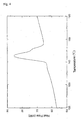
- the value of derivative when the temperature-increasing DSC curve obtained is differentiated ( i . e ., the first derivative curve is drawn) and the value of derivative ( i . e ., the distance measured vertically to the axis of abscissa between the first derivative curve and the axis of abscissa; the value of derivative has a plus or minus sign, if the curve is above or below the axis of abscissa, respectively) changes its sign from plus to minus, such part of the curve is defined as a peak, and the part of the curve where the value of derivative changes from the monotonous increase to the monotonous decrease while keeping its plus or minus sign is defined as a shoulder. From this definition, for example, it follows that the DSC curve shown in Figure 2 has two peaks and the DSC curve shown in Figure 4 has one peak and one shoulder.
- JP-A 63-275708 discloses high strength polyethylene fibers obtained by a special technique using copolymerization with ⁇ -olefins, and describes that when these fibers are wound around an aluminum pan to stand in a constrained condition under tension and then subjected to measurement by differential scanning calorimetry (DSC), two or more peaks arising from copolymerization, in addition to the main peak, are observed on the high temperature side.
- DSC differential scanning calorimetry
- the high strength polyethylene fibers of the present invention are composed of a polyethylene which can be regarded essentially as an ethylene homopolymer, and the measurement by differential scanning calorimetry (DSC) in the present invention is carried out by using a specimen of fibers, which have been cut in 5 mm or shorter length, and keeping the specimen in a completely free state.
- DSC differential scanning calorimetry
- HMC high-temperature melting-type crystal structure
- EC ordinary polyethylene crystal
- JP-A 61-289111 discloses semi-stretched yarns obtained by the spinning method using two kinds of special solvents and describes that their DSC curves drawn by measurement in a "free state" has two or more endothermic peaks. Although there is no other way but to guess what is this "free state", it is well known that two or more endothermic peaks may often be observed even when fibers, which have not been cut short, are inserted in an aluminum pan for measurement because although it can be said that these fibers are in a freer state than that in the ordinary measurement with fibers wound around a small piece of aluminum, the fibers in the pan are, in fact, partly fixed between the bottom and the cover of the pan or there occurs-uneven distribution of stress over the specimen.
- the temperature-increasing DSC curve thereof has at least one endothermic peak over a temperature region of 140°C to 148°C.
- such peak is preferably the main peak corresponding to the largest value of heat flow among two or more endothermic peaks found in the temperature-increasing DSC curve.
- the main peak reflects the ordinary structure (EC) occupying the major part of fibers, and if the peak temperature thereof is lower than 140°C, the fibers have insufficient heat resistance.
- the peak temperature thereof is higher than 148°C, the ordinary fiber structure becomes highly restricted, for example, an aggregate of completely-extended chains, lowering the durability of fibers.
- the present inventors have found that the durability of fibers, particularly flexural fatigue resistance in this case, becomes optimum when the main peak appears over a temperature region of 140°C to 148°C.
- the temperature-increasing DSC curve thereof further has at least one endothermic peak over a temperature region of 148°C or higher (on the high temperature side). It is presumed that this endothermic peak on the high temperature side corresponds to the HMC structure having great influence on durability, particularly abrasion resistance, of which formation mechanism will be described below; and fibers exhibiting no endothermic peak on the high temperature side have extremely deteriorated abrasion resistance.
- the maximum endothermic peak on the high temperature side among two or more endothermic peaks found in the temperature-increasing DSC curves of the high strength polyethylene fibers of the present invention is derived from the HMC structure. Adjusting the height of this maximum endothermic peak on the high temperature side makes it possible to obtain high strength polyethylene fibers having optimum durability.
- the fatigue of molecular-oriented fibers is mainly caused by the fibrillation of the fibers from the surface layer.
- the high strength polyethylene fibers of the present invention have the surface layer of HMC with more entangled molecular chains, which results in a structure hardly causing fibrillation; therefore, the closer surface structure renders the fibers excellent flexural fatigue resistant and abrasion resistant, preventing the fibers from getting stuck together by pressure when they are cut.
- the high strength polyethylene fibers of the present invention should have a particular ratio of HMC occupying the whole crystal structure.
- the maximum endothermic peak on the high temperature side is derived from the fusion of EC and the maximum endothermic peak on the low temperature side is derived from the fusion of HMC.
- the height ratio of these maximum endothermic peaks over the respective temperature regions is usually in the range of 1.4 : 1.0 to 3.0 : 1.0, preferably 1.5 : 1.0 to 2.9 : 1.0, and more preferably 1.6 : 1.0 to 2.8 : 1.0. If the ratio is lower than 1.4 : 1.0, i .
- the ratio of HMC forming the surface layer of fibers is higher, which lowers the durability of fibers. This is probably because an excessive increase in the surface hardness promotes deterioration such as buckling fatigue.
- the ratio is higher than 3.0 : 1.0, i . e ., if the maximum endothermic peak on the high temperature side is relatively lower, the ratio of HMC is lower, which makes no trouble for strength or Young's modulus but also makes no improvement in durability, so that fibers cannot be prevented from getting stuck together by pressure when they are cut, making is impossible to obtain chopped fibers having good dispersibility.
- the surface HMC structure according to the present invention is very effective for the improvement of impact resistance.
- fibers are required to have high strength and high degree of elongation in the deformation at high strain rate, what is called, toughness.
- the surface HMC structure according to the present invention has a function to improve both of these characteristics.
- polymer materials may be considered a combination of elastic components and viscous components as explained by, what is called, the Takayanagi model.
- the surface HMC structure according to the present invention exhibits response on high strain deformation in the viscosity characteristics, making it possible to improve impact resistance. Therefore, the high strength polyethylene fibers of the present invention having such improved impact resistance are suitable for ballistic materials or items, or as the reinforcing fibers of helmets.
- the high strength polyethylene fibers of the present invention have remarkably improved durability, particularly abrasion resistance, as compared with the conventional high strength polyethylene fibers. More specifically, the number of frictions until the fiber is broken in an abrasion test according to method B for measuring abrasion resistance in the Testing Methods for Spun Yarn (JIS L 1095) is 100,000 or larger.
- the high strength polyethylene fibers of the present invention should be produced with deliberation by a novel method of production, for example, the method described below, which is recommended, but it is, of course, not limited thereto.
- a high molecular weight polyethylene as described above is uniformly dissolved in a solvent to give a spinning solution.
- the spinning solution has a concentration of usually 50% or lower, preferably 30% or lower.
- the solvent may include volatile solvents such as decalin or tetralin and non-volatile solvents such as paraffin oil or paraffin wax. The use of volatile solvents is preferred.
- the present inventors have found that the formation of a structural difference between the fiber surface and the inside at the step of spinning, more specifically the formation of HMC by instant and positive removal of solvents in the fiber surface to thereby concentrate the tension of spinning on the surface layer, makes it possible to obtain fibers keeping high strength and high Young's modulus and further having excellent flexural fatigue resistance and excellent abrasion resistance.
- the high strength polyethylene fibers of the present invention there is recommended a technique of blowing a high-temperature inert gas onto the discharged filaments just below the spinneret for the positive removal of solvents on the surface of the filaments.
- the temperature of the inert gas is usually 60°C or higher, preferably 80°C or higher, and more preferably 100°C or higher but below 150°C.
- the use of a nitrogen gas is preferred from an economical point of view, but it is not limited thereto.
- the unstretched filaments thus obtained are heated again to remove the remaining solvents, during which they are drawn at a ratio of several times.
- multi-step drawing may be employed.
- the HMC structure of the surface layer formed in the spinning can never be eliminated in the later drawing steps, making it possible to obtain high strength polyethylene fibers having extremely excellent characteristics as described above.
- the high strength polyethylene fibers obtained, even if cut, hardly get stuck together by pressure when they are cut because of their having a close structure in the surface, although such sticking phenomenon is observed in the conventional fibers; therefore, chopped fibers or staples having good dispersibility can be obtained.
- the high strength polyethylene fibers of the present invention have excellent flexural fatigue resistance and excellent abrasion resistance, while having about the same or higher strength and Young's modulus than those of the conventional high strength polyethylene fibers; therefore, the high strength polyethylene fibers of the present invention are suitable for various ropes or cables for industrial or private use, particularly running cables used for a long period, such as mooring ropes and hawsers; blind cables; printer cables; and they are also useful as the materials for various sports gears and sportswears, such as fishing lines, tents, sports socks and uniforms, and various garments.
- the high strength polyethylene fibers of the present invention are also extremely useful for high performance textiles such as ballistic materials or items, or protective gloves because of their excellent cut resistance and excellent blade resistance arising from the above excellent characteristics.
- the high strength polyethylene fibers of the present invention are further useful in the chemical processes because of their having close surface and therefore having remarkably improved resistance to chemicals, light and weather, as compared with the conventional ultrahigh molecular weight polyethylene fibers, for example, as the chopped fibers to produce non-woven fabrics such as chemical filters or battery cell separators, which are required to have chemical resistance.
- the high strength polyethylene fibers of the present invention are still further useful as the reinforcing fibers in the composite materials for sports gears such as helmets and skis and for speaker cones, as the reinforcing materials for concrete or mortar, particularly spray-coated concrete or normal plane concrete in tunnels, or as the fibers for reinforcing sheets and strands to provide earthquake resistance.
- the high strength polyethylene chopped fibers of the present invention can be obtained from the above novel high strength polyethylene fibers, and the amount of poorly dispersed fibers (fiber bundles of 40 ⁇ m or larger in maximum diameter formed by getting stuck together by pressure or fusion) found in case of paper making is preferably 5% by weight or smaller. If the amount of fiber bundles of 40 ⁇ m or larger in maximum diameter is greater than 5% by weight, uneven suction may occur to form spots when water is sucked under reduced pressure in the wet process of producing non-woven fabrics. The formation of spots is responsible for the deterioration of strength, stab resistance, and other characteristics of non-woven fabrics.
- the mono-filament linear density of chopped fibers is not particularly limited, but usually in the range of 0.1 to 20 dpf.
- the length of chopped fibers i . e ., the cut length of fibers, is preferably 70 mm or shorter, more preferably 50 mm or shorter. This is because if the cut length is too long, fibers easily cause entanglement to make their uniform dispersion difficult.
- the method of cutting fibers may include, but is not particularly limited to, those of the guillotine type or the rotary cut type.
- the high strength polyethylene chopped fibers of the present invention are useful as the chopped fibers to produce non-woven fabrics such as chemical filters, battery cell separators, and water-shield sheets for chemicals; as the reinforcing fibers for concrete or cement; and as the staples to produce feather blankets or spun yarns, because of their excellent resistance to chemicals, light and weather.
- the fiber reinforced concrete products of the present invention can be produced using the above novel high strength polyethylene fibers as the reinforcing fibers.
- the reinforcing fibers have excellent cut resistance, probably because of their close surface, and when dispersed in a cement matrix, they hardly cause the flexure of fibers and exhibit good dispersion properties in the cement matrix.
- the reinforcing fibers have further improved resistance to chemicals, light and weather, because of their close surface, as compared with the conventional high strength polyethylene fibers, and they are the most suitable as the reinforcing fibers, particularly for concrete or cement, which is required to have chemical resistance against the alkaline properties of cement. Therefore, the fiber reinforced concrete products of the present invention exhibit good workability in their production, and have improved performance such as compressive strength, flexural strength and toughness, and further have excellent impact resistance and excellent durability.
- the high strength polyethylene fibers of the present invention are exemplified by Examples 1 to 3 and Comparative Example 1 to 2.
- the polyethylene fibers prepared by these Examples and Comparative Examples were measured for their physical properties by the following measuring and testing methods, and evaluated for their performance.
- a strain-stress curve was drawn under the conditions: length of specimen, 200 mm (gap distance between chucks); elongation rate, 100%/min.; atmospheric temperature, 20°C; and relative humidity, 65%; and strength (cN/dtex) was calculated from the stress at the breaking point on the curve obtained, and Young's modulus (cN/dtex) was calculated from the tangent line providing the maximum gradient on the curve in the vicinity of the origin. The number of measurements was set at 10, and the strength and Young's modulus were expressed by the respective averaged values.
- DSC7 available from Perkin-Elmer Corp. (the maximum sensitivity, 8 ⁇ W/cm)
- DSC was carried out as follows. A specimen was cut in 5 mm or shorter, and about 5 mg of the specimen was charged and sealed in an aluminum pan. The same, but vacant, aluminum pan was used as a reference. A temperature-increasing DSC curve was drawn by heating the specimen from room temperature up to 200°C at a heating rate of 10°C/min., under an atmosphere of an inert gas.
- the temperature-increasing DSC curve obtained was corrected for the base line, followed by reading the number of peaks, peak temperatures, and peak heights over a temperature region of 140°C to 148°C (on the low temperature side) and over a temperature region of 148°C or higher (on the high temperature side), and calculating the height ratio of the maximum endothermic peak on the low temperature side and the maximum endothermic peak on the high temperature side. If the endothermic peaks are difficult to read because of their shoulder-like shapes, the values of heat flow at 145.5°C and at 150°C were regarded as the endothermic peaks on the low temperature side and on the high temperature side, respectively, to calculate the ratio of peak heights.
- a specimen was prepared by multiplying or adjustment to have a linear density of about 1500 dtex and evaluated for abrasion resistance by an abrasion test according to method B for measuring abrasion resistance in the Testing Methods for Spun Yarns (JIS L 1095).
- abrasion test according to method B for measuring abrasion resistance in the Testing Methods for Spun Yarns (JIS L 1095).
- load 0.5 g/d
- rate of friction 115 times/min.
- distance of reciprocating motion 2.5 cm
- angle of friction 110°.
- the abrasion resistance was determined as the number of frictions until a specimen was broken.
- the number of runs was set at 2, and the results were expressed by their average values. The values were rounded off to the third digit.
- a slurry mixture of 10 wt% ultrahigh molecular weight polyethylene having an intrinsic viscosity number of 21.0 and a molecular weight distribution index (Mw/Mn) of 3.7 and 90 wt% decalin was fed to a screw-type kneader at 230°C, and their dissolution was achieved to give a spinning solution, followed by spinning at a rate of discharge through each nozzle of 1.4 g/min. using a spinneret (the diameter of each nozzle, 0.7 mm; the number of nozzles, 400) at 170°C.
- the discharged filaments were blown with a nitrogen gas at 100°C as uniformly as possible at an average flow rate of 1.2 m/sec.
- the filaments were substantially cooled with an air flow at 30°C, and wound at a rate of 75 m/min. by Nelson-type rollers disposed downstream the spinneret. At that time, the solvent contained in the filaments had already reduced its weight by half from the original weight. Subsequently, the filaments obtained were drawn at a ratio of 4 in a heating oven at 100°C and further drawn at a ratio of 4 in a heating oven at 149°C, thereby obtaining a polyethylene fiber.
- Table 1 The temperature-increasing DSC curve before base line correction, which was obtained by differential scanning calorimetry (DSC), is shown in Figure 1.
- a polyethylene fiber was prepared in the same manner as described in Example 1, except that the discharged filaments were blown with a nitrogen gas at 120°C at an average flow rate of 1.4 m/sec.
- the physical properties and performance evaluation of the fiber are shown in Table 1.
- a polyethylene fiber was prepared in the same manner as described in Example 1, except that a high molecular weight polyethylene having an intrinsic viscosity number of 12.1 and a molecular weight distribution index (Mw/Mn) of 5.4 was used; the concentration of a spinning solution was set at 30 wt%; and drawing was carried out at a ratio of 3 for the first stage and 2.2 for the second stage.
- the physical properties and performance evaluation of the fiber are shown in Table 1.
- the temperature-increasing DSC curve before base line correction, which was obtained by differential scanning calorimetry (DSC), is shown in Figure 3.
- a polyethylene fiber was prepared in the same manner as described in Example 1, except that the discharged filaments were not blown just below the spinneret with a high temperature nitrogen gas, but were immediately cooled with a nitrogen gas at 30°C; and drawing was carried out at a ratio of 4.0 for the first stage and 3.5 for the second stage.
- the physical properties and performance evaluation of the fiber are shown in Table 1.
- the polyethylene fibers of Examples 1 to 3 had extremely excellent abrasion resistance because of their 3.5 times larger numbers of frictions until the fibers were broken in the abrasion test, while exhibiting about the same or higher strength and Young's modulus, as compared with the polyethylene fibers of Comparative Examples 1 to 2.
- the temperature-increasing DSC curves had one or two endothermic peaks on the high temperature side and one endothermic peak on the low temperature side.
- the temperature-increasing DSC curve had no endothermic peak on the low temperature side, whereas no distinct peak but a shoulder was found as the endothermic peak on the high temperature side.
- the temperature-increasing DSC curve had one complete peak on the high temperature side, whereas no endothermic peak but a small shoulder around 133°C was observed on the low temperature side.
- the polyethylene fibers of Comparative Examples 1 and 2 it is presumed that their maximum endothermic peaks on the high temperature side come from EC and not from HMC, because of their extremely deteriorated abrasion resistance.
- the high strength polyethylene chopped fibers of the present invention are exemplified by Examples 4 to 8 and Comparative Examples 3 to 5.
- the chopped fibers prepared in these Examples and Comparative Examples were evaluated for their performance by the following testing method.
- the high strength polyethylene fibers prepared in Example 1 (intrinsic viscosity number, 18.5; linear density, 455 dtex; strength, 38.1 cN/dtec; Young's modulus, 1521 cN/dtex) were cut in 10 mm by the guillotine method to give chopped fibers. Their performance evaluation is shown in Table 2.
- the high strength polyethylene fibers prepared in Example 2 (intrinsic viscosity number, 18.4; linear density, 448 dtex; strength, 35.2 cN/dtec; Young's modulus, 1612 cN/dtex) were cut in 10 mm by the guillotine method to give chopped fibers. Their performance evaluation is shown in Table 2.
- the high strength polyethylene fibers prepared in Example 3 (intrinsic viscosity number, 9.4; linear density, 1150 dtex; strength, 28.5 cN/dtec; Young's modulus, 1055 cN/dtex) were cut in 10 mm by the guillotine method to give chopped fibers. Their performance evaluation is shown in Table 2.
- a polyethylene fiber was prepared in the same manner as described in Example 1, except that a spinneret (the diameter of each nozzle, 0.2 mm; the number of nozzles, 200) was used and the rate of discharge through each nozzle was set at 0.08 g/min.
- the intrinsic viscosity number was 18.5
- the linear density was 240 dtex
- the monofilament linear density was 0.12 dtex
- the strength was 33.6 cN/dtex
- the Young's modulus was 1342 cN/dtex
- the number of frictions until the fiber was broken in the abrasion test was 103,000
- the temperature-increasing DSC curve obtained by differential scanning calorimetry (DSC) had one endothermic peak on the low temperature side and two endothermic peaks on the high temperature side, with the temperature of the maximum endothermic peak being 144.7°C on the low temperature side and 159.2°C on the high temperature side, and the height ratio of the maximum endothermic peaks being 2.4 : 1.
- This fiber was cut in 50 mm by the guillotine method to give chipped fibers. Their performance evaluation is shown in Table 2.
- a polyethylene fiber was prepared in the same manner as described in Example 1, except that a high molecular weight polyethylene having an intrinsic viscosity number of 10 and a molecular weight distribution index (Mw/Mn) of 5.4 was used; the concentration of a spinning solution was set at 30 wt%; a spinneret (the diameter of each nozzle, 0.2 mm; the number of nozzles, 200) was used; and the rate of discharge through each nozzle was set at 0.08 g/min.
- Mw/Mn molecular weight distribution index
- the intrinsic viscosity number was 9.4
- the linear density was 1265 dtex
- the monofilament linear density was 0.63 dtex
- the strength was 25.2 cN/dtex
- the Young's modulus was 931 cN/dtex
- the number of frictions until the fiber was broken in the abrasion test was 161,000
- the temperature-increasing DSC curve obtained by differential scanning calorimetry (DSC) had one endothermic peak on the low temperature side and two endothermic peaks on the high temperature side, with the temperature of the maximum endothermic peak being 143.9°C on the low temperature side and 154.9°C on the high temperature side, and the height ratio of the maximum endothermic peaks being 2.2 : 1.
- This fiber was cut in 10 mm by the guillotine method to give chopped fibers. Their performance evaluation is shown in Table 2.
- the high strength polyethylene fibers prepared in Comparative Example 1 (intrinsic viscosity number, 18.4; linear density, 541 dtex; strength, 34.2 cN/dtec; Young's modulus, 1516 cN/dtex) were cut in 10 mm by the guillotine method to give chopped fibers. Their performance evaluation is shown in Table 2.
- the high strength polyethylene fibers prepared in Comparative Example 2 (intrinsic viscosity number, 18.3; linear density, 471 dtex; strength, 35.7 cN/dtec; Young's modulus, 1623 cN/dtex) were cut in 10 mm by the guillotine method to give chopped fibers. Their performance evaluation is shown in Table 2.
- a polyethylene fiber was prepared in the same manner as described in Example 1, except that paraffin oil was used as a solvent; and the filament was drawn at a ratio of 4 in a heating oven at 100°C and then at a ratio of 4 in a heating oven at 149°C.
- the intrinsic viscosity number was 18.5
- the linear density was 455 dtex
- the monofilament linear density was 1.2 dtex
- the strength was 38.1 cN/dtex
- the Young's modulus was 1521 cN/dtex
- the number of frictions until the fiber was broken in the abrasion test was 421,000
- the temperature-increasing DSC curve obtained by differential scanning calorimetry (DSC) had one endothermic peak on the low temperature side and two endothermic peaks on the high temperature side, with the temperature of the maximum endothermic peak being 144.3°C on the low temperature side and 152.1°C on the high temperature side, and the height ratio of the maximum endothermic peaks being 2.4 : 1.
- the fiber reinforced concrete products using the high strength polyethylene fibers of the present invention are exemplified by Examples 9 to 11 and Comparative Examples 6 to 8.
- the concrete test pieces prepared in these Examples and Comparative Examples were evaluated for their performance by the following test for strength.
- the maximum load was measured to determine the compressive strength.
- the maximum load was measured to determine the flexural strength according to the method for measuring flexural strength in the Physical Testing Methods for Cement (JIS R 5201).
- JIS R 5201 Physical Testing Methods for Cement
- For toughness the relationship between the load and the cross-head displacement in the testing machine was recorded onto an X-Y recorder (available from Yokogawa Electric Corporation), and the area under the flexural stress-deflection curve until the displacement falling down to 50% of the value at the maximum load was determined, and the toughness was regarded as an area ratio with the area in case of no fiber incorporation being taken as 1.
- the high strength polyethylene fiber prepared in Example 1 was cut in 30 mm length and used as the reinforcing fibers.
- high-early-strength portland cement specifically gravity, 3.13
- Toyoura-keisa-sand old standard sand; specific gravity, 2.7
- silica fume specifically gravity, 2.2
- Water and air entraining and high-range water reducing agent (without incorporation of auxiliary air entraining agents) were then put into the mixer, followed by mixing for 4 minutes to give fiber reinforced concrete.
- the water-to-binder ratio was set at 33%; the mixing ratio of silica fume relative to the weight of cement, 10%; the sand-to-binder ratio, 60%; the mixing ratio of air entraining and high-range water reducing agent relative to the weight of binder, 2.0%; and the mixing ratio of fiber by volume, 2.0%.
- the measured flow values are shown in Table 5.
- a fiber reinforced concrete test piece was prepared in the same manner as described in Example 9, except that the high polyethylene fiber prepared in Example 2 (intrinsic viscosity number, 18.4; linear density, 448 dtex; strength, 35.2 cN/dtec; Young's modulus, 1612 cN/dtex) was used; and then subjected to the test for strength.
- the results are shown in Table 3.
- a fiber reinforced concrete test piece was prepared in the same manner as described in Example 9, except that the high polyethylene fiber prepared in Example 3 (intrinsic viscosity number, 9.4; linear density, 1150 dtex; strength, 28.5 cN/dtec; Young's modulus, 1055 cN/dtex) was used; and then subjected to the test for strength. The results are shown in Table 2.
- a fiber reinforced concrete test piece was prepared in the same manner as described in Example 9, except that the high polyethylene fiber prepared in Comparative Example 1 (intrinsic viscosity number, 18.4; linear density, 541 dtex; strength, 34.2 cN/dtec; Young's modulus, 1516 cN/dtex) was used; and then subjected to the test for strength.
- the results are shown in Table 3.
- a fiber reinforced concrete test piece was prepared in the same manner as described in Example 9, except that the high polyethylene fiber prepared in Comparative Example 2 (intrinsic viscosity number, 18.3; linear density, 471 dtex; strength, 35.7 cN/dtec; Young's modulus, 1623 cN/dtex) was used; and then subjected to the test for strength.
- the results are shown in Table 3.
- a fiber reinforced concrete test piece was prepared in the same manner as described in Example 9, except that no reinforcing fiber was used; and then subjected to the test for strength. The results are shown in Table 3.
- Mixing fiber by volume (%) Flow value (mm) Compressive strength (MPa) Flexural strength (MPa) Toughness Cracking Max.
- Example 15 2 179 83.2 12.7 21.6 80.5
- Comp. Ex. 10 2 150 74.5 11.8 14.2 24.8
- Comp. Ex. 11 2 143 75.5 12.4 13.4 14.3
- test pieces of Examples 9 to 11 exhibited higher compressive strength, higher flexural strength, and higher toughness; therefore, they had excellent impact resistance and excellent durability, as compared with the test pieces of Comparative Examples 6 to 8.
- high strength polyethylene fibers can be obtained, which have about the same or higher strength and Young's modulus than those of the conventional high strength polyethylene fibers, and at the same time, have excellent durability, particularly flexural fatigue resistance and excellent abrasion resistance.
- Such high strength polyethylene fibers can be widely applied in various fields for industry, for example, as the chopped fibers or staples to produce non-woven fabrics or spun yarns; or as the reinforcing fibers for composite materials such as fiber reinforced concrete products and helmets.
Landscapes
- Chemical & Material Sciences (AREA)
- Engineering & Computer Science (AREA)
- Chemical Kinetics & Catalysis (AREA)
- Ceramic Engineering (AREA)
- General Chemical & Material Sciences (AREA)
- Textile Engineering (AREA)
- Structural Engineering (AREA)
- Materials Engineering (AREA)
- Crystallography & Structural Chemistry (AREA)
- Organic Chemistry (AREA)
- Artificial Filaments (AREA)
- Aiming, Guidance, Guns With A Light Source, Armor, Camouflage, And Targets (AREA)
- Gloves (AREA)
- Professional, Industrial, Or Sporting Protective Garments (AREA)
- Ropes Or Cables (AREA)
- Braiding, Manufacturing Of Bobbin-Net Or Lace, And Manufacturing Of Nets By Knotting (AREA)
- Knitting Of Fabric (AREA)
- Reinforced Plastic Materials (AREA)
Claims (9)
- Hochfeste Polyethylenfaser, dadurch gekennzeichnet, daß die Faser ein hochmolekulares Polyethylen umfaßt, das im wesentlichen aus einer Ethylen-Struktureinheit besteht; sie eine Grenzviskositätszahl von 5 oder mehr und eine durchschnittliche Festigkeit von 22 cN/dtex oder mehr aufweist; und die Messung der Faser durch Differentialscanningkalorimetrie (DSK) eine Temperaturanstiegs-DSK-Kurve mit mindestens einem endothermen Peak innerhalb eines Temperaturbereichs von 140°C bis 148°C (auf der Tieftemperatur-Seite) und mindestens einem endothermen Peak innerhalb eines Temperaturbereichs von 148°C oder mehr (auf der Hochtemperatur-Seite) zeigt.
- Hochfeste Polyethylenfaser nach Anspruch 1, wobei das Höhenverhältnis des maximalen endothermen Peaks auf der Tieftemperatur-Seite und des maximalen endothermen Peaks auf der Hochtemperatur-Seite 1,4:1,0 bis 3,0:1,0 beträgt.
- Hochfeste Polyethylenfaser nach Anspruch 2, wobei das Höhenverhältnis des maximalen endothermen Peaks auf der Tieftemperatur-Seite und des maximalen endothermen Peaks auf der Hochtemperatur-Seite 1,5:1,0 bis 2,9:1,0 beträgt.
- Hochfeste Polyethylenfaser, dadurch gekennzeichnet, daß die Faser ein hochmolekulares Polyethylen umfaßt, das im wesentlichen aus einer Ethylen-Struktureinheit besteht; sie eine Grenzviskositätszahl von 5 oder mehr und eine durchschnittliche Festigkeit von 22 cN/dtex oder mehr aufweist; und die Anzahl der Reibungen bis zum Bruch der Faser in einer Abriebprüfung gemäß Verfahren B zur Messung der Abriebfestigkeit in Prüfverfahren für gesponnenes Garn (JIS L 1095) 100.000 oder mehr beträgt.
- Hochfeste zerhackte Polyethylenfaser, erhalten aus der hochfesten Polyethylenfaser nach Anspruch 1 oder 4.
- Hochfeste zerhackte Polyethylenfaser nach Anspruch 5, wobei die Menge bei der Papierherstellung vorgefundener schlecht dispergierter Fasern (Faserbündel mit einem maximalen Durchmesser von 40 µm oder mehr, die sich dadurch bilden, daß sie durch Druck oder Verschmelzen zusammenkleben) 5 Gew.-% oder weniger beträgt.
- Hochfeste zerhackte Polyethylenfaser nach Anspruch 5, wobei die Faser eine Schnittlänge von 70 mm oder kürzer aufweist.
- Faserverstärktes Betonprodukt umfassend die hochfeste Polyethylenfaser nach Anspruch 1 oder 4.
- Helm umfassend die hochfeste Polyethylenfaser nach Anspruch 1 oder 4.
Priority Applications (6)
| Application Number | Priority Date | Filing Date | Title |
|---|---|---|---|
| EP20030006186 EP1335047B1 (de) | 1999-08-11 | 2000-03-23 | Netz enthaltend hochfeste Polyethylenfasern |
| DK03006186T DK1335047T3 (da) | 1999-08-11 | 2000-03-23 | Net, som omfatter höjstyrke-polyethylenfibre |
| DK03006187T DK1335048T3 (da) | 1999-08-11 | 2000-03-23 | Ballistisk materiale, som omfatter höjstyrke-polyethylenfibre |
| EP20030006185 EP1335046B1 (de) | 1999-08-11 | 2000-03-23 | Seil enthaltend hochfeste Polyethylenfasern |
| EP20030006187 EP1335048B1 (de) | 1999-08-11 | 2000-03-23 | Ballistisches Material enthaltend hochfeste Polyethylenfasern |
| EP20030006188 EP1335049B1 (de) | 1999-08-11 | 2000-03-23 | Schutzhandschuh enthaltend hochfeste Polyethylenfasern |
Applications Claiming Priority (11)
| Application Number | Priority Date | Filing Date | Title |
|---|---|---|---|
| JP22766299 | 1999-08-11 | ||
| JP22766299 | 1999-08-11 | ||
| JP24906599 | 1999-09-02 | ||
| JP24906599 | 1999-09-02 | ||
| JP25458199 | 1999-09-08 | ||
| JP25458199 | 1999-09-08 | ||
| JP28452999 | 1999-10-05 | ||
| JP28452899 | 1999-10-05 | ||
| JP28452999 | 1999-10-05 | ||
| JP28452899 | 1999-10-05 | ||
| PCT/JP2000/001774 WO2001012885A1 (en) | 1999-08-11 | 2000-03-23 | High strength polyethylene fiber and its use |
Related Child Applications (4)
| Application Number | Title | Priority Date | Filing Date |
|---|---|---|---|
| EP20030006186 Division EP1335047B1 (de) | 1999-08-11 | 2000-03-23 | Netz enthaltend hochfeste Polyethylenfasern |
| EP20030006185 Division EP1335046B1 (de) | 1999-08-11 | 2000-03-23 | Seil enthaltend hochfeste Polyethylenfasern |
| EP20030006187 Division EP1335048B1 (de) | 1999-08-11 | 2000-03-23 | Ballistisches Material enthaltend hochfeste Polyethylenfasern |
| EP20030006188 Division EP1335049B1 (de) | 1999-08-11 | 2000-03-23 | Schutzhandschuh enthaltend hochfeste Polyethylenfasern |
Publications (3)
| Publication Number | Publication Date |
|---|---|
| EP1126052A1 EP1126052A1 (de) | 2001-08-22 |
| EP1126052A4 EP1126052A4 (de) | 2002-09-11 |
| EP1126052B1 true EP1126052B1 (de) | 2003-09-03 |
Family
ID=27529818
Family Applications (5)
| Application Number | Title | Priority Date | Filing Date |
|---|---|---|---|
| EP20030006186 Expired - Lifetime EP1335047B1 (de) | 1999-08-11 | 2000-03-23 | Netz enthaltend hochfeste Polyethylenfasern |
| EP20030006188 Expired - Lifetime EP1335049B1 (de) | 1999-08-11 | 2000-03-23 | Schutzhandschuh enthaltend hochfeste Polyethylenfasern |
| EP20030006185 Expired - Lifetime EP1335046B1 (de) | 1999-08-11 | 2000-03-23 | Seil enthaltend hochfeste Polyethylenfasern |
| EP20030006187 Expired - Lifetime EP1335048B1 (de) | 1999-08-11 | 2000-03-23 | Ballistisches Material enthaltend hochfeste Polyethylenfasern |
| EP00911305A Expired - Lifetime EP1126052B1 (de) | 1999-08-11 | 2000-03-23 | Hochfeste polyethylenfasern und deren verwendung |
Family Applications Before (4)
| Application Number | Title | Priority Date | Filing Date |
|---|---|---|---|
| EP20030006186 Expired - Lifetime EP1335047B1 (de) | 1999-08-11 | 2000-03-23 | Netz enthaltend hochfeste Polyethylenfasern |
| EP20030006188 Expired - Lifetime EP1335049B1 (de) | 1999-08-11 | 2000-03-23 | Schutzhandschuh enthaltend hochfeste Polyethylenfasern |
| EP20030006185 Expired - Lifetime EP1335046B1 (de) | 1999-08-11 | 2000-03-23 | Seil enthaltend hochfeste Polyethylenfasern |
| EP20030006187 Expired - Lifetime EP1335048B1 (de) | 1999-08-11 | 2000-03-23 | Ballistisches Material enthaltend hochfeste Polyethylenfasern |
Country Status (10)
| Country | Link |
|---|---|
| US (5) | US6605348B1 (de) |
| EP (5) | EP1335047B1 (de) |
| JP (5) | JP4141686B2 (de) |
| KR (1) | KR100459575B1 (de) |
| CN (1) | CN1126831C (de) |
| AT (5) | ATE268395T1 (de) |
| DE (5) | DE60011311T2 (de) |
| DK (4) | DK1126052T3 (de) |
| ES (3) | ES2204536T3 (de) |
| WO (1) | WO2001012885A1 (de) |
Families Citing this family (58)
| Publication number | Priority date | Publication date | Assignee | Title |
|---|---|---|---|---|
| CN1107127C (zh) * | 1998-06-04 | 2003-04-30 | Dsm有限公司 | 高强度聚乙烯纤维 |
| US7402539B2 (en) * | 2000-08-10 | 2008-07-22 | Japan Vilene Co., Ltd. | Battery separator |
| EP1350868B1 (de) * | 2000-12-11 | 2007-06-27 | Toyo Boseki Kabushiki Kaisha | Hochfeste polyethylenfaser |
| FR2819152B1 (fr) * | 2001-01-08 | 2003-03-14 | Hutchinson | Gant de protection a resistance mecanique renforcee et son procede de fabrication |
| JP4389142B2 (ja) * | 2001-08-08 | 2009-12-24 | 東洋紡績株式会社 | 高強度ポリエチレン繊維の製造方法 |
| US7081298B2 (en) * | 2001-10-29 | 2006-07-25 | Yoz-Ami Corporation | Specific gravity-adjustable yarns with low elongation rate and excellent abrasion resistance |
| EP1493851B1 (de) * | 2002-04-09 | 2012-01-04 | Toyo Boseki Kabushiki Kaisha | Polyethylenfaser und deren herstellungsverfahren |
| US20060049056A1 (en) * | 2002-04-12 | 2006-03-09 | Acm Research, Inc. | Electropolishing and electroplating methods |
| ZA200603460B (en) * | 2003-11-03 | 2009-02-25 | Bekaert Sa Nv | Stab resistant insert with steel cords and non-woven textile |
| JP4565325B2 (ja) * | 2003-12-12 | 2010-10-20 | 東洋紡績株式会社 | 高強度ポリエチレンマルチフィラメント |
| US7811673B2 (en) | 2003-12-12 | 2010-10-12 | Toyo Boseki Kabushiki Kaisha | High strength polyethylene fiber |
| GB2409837B (en) * | 2004-01-10 | 2006-09-06 | Hexcel Composites Ltd | Fibre reinforced resin assembly |
| JP4524644B2 (ja) * | 2004-07-08 | 2010-08-18 | 東洋紡績株式会社 | 高強度ポリエチレン繊維の製造方法 |
| US6925965B1 (en) * | 2004-07-28 | 2005-08-09 | Nite Glow Industries, Inc. | Omnidirectional reflective pet leash |
| JP4565324B2 (ja) * | 2004-08-23 | 2010-10-20 | 東洋紡績株式会社 | 高強度ポリエチレンマルチフィラメント |
| US7074483B2 (en) * | 2004-11-05 | 2006-07-11 | Innegrity, Llc | Melt-spun multifilament polyolefin yarn formation processes and yarns formed therefrom |
| US7147807B2 (en) * | 2005-01-03 | 2006-12-12 | Honeywell International Inc. | Solution spinning of UHMW poly (alpha-olefin) with recovery and recycling of volatile spinning solvent |
| JP2006214015A (ja) * | 2005-02-01 | 2006-08-17 | Toyobo Co Ltd | 防護カバー |
| JP2006342442A (ja) * | 2005-06-07 | 2006-12-21 | Toyobo Co Ltd | 高強度ポリエチレン繊維からなるロープ |
| JP2006342463A (ja) * | 2005-06-09 | 2006-12-21 | Toyobo Co Ltd | 高強度ポリエチレン繊維からなる防護手袋 |
| US20070202329A1 (en) * | 2006-02-24 | 2007-08-30 | Davis Gregory A | Ropes having improved cyclic bend over sheave performance |
| US8444898B2 (en) * | 2006-03-30 | 2013-05-21 | Honeywell International Inc | High molecular weight poly(alpha-olefin) solutions and articles made therefrom |
| JP2007277763A (ja) * | 2006-04-07 | 2007-10-25 | Toyobo Co Ltd | 高強度ポリエチレン繊維 |
| RU2494871C2 (ru) * | 2008-04-28 | 2013-10-10 | Тейджин Арамид Б.В. | Изделия для баллистической защиты, включающие ленты |
| WO2010021366A1 (ja) * | 2008-08-20 | 2010-02-25 | 東洋紡績株式会社 | 高機能ポリエチレン繊維、及びそれを用いた織編物並びにその手袋 |
| JP5597922B2 (ja) * | 2008-12-26 | 2014-10-01 | 東洋紡株式会社 | 組紐 |
| JP5313747B2 (ja) * | 2009-04-09 | 2013-10-09 | 帝人株式会社 | ポリオレフィン成形体の製造方法 |
| KR101044491B1 (ko) | 2009-10-16 | 2011-06-29 | 강현서 | 초고분자량 폴리에틸렌 사 염색 장갑의 제조방법 |
| US7964518B1 (en) * | 2010-04-19 | 2011-06-21 | Honeywell International Inc. | Enhanced ballistic performance of polymer fibers |
| DE102010029633A1 (de) * | 2010-06-02 | 2011-12-08 | Hd Kunststoffe & Kunststofferzeugnisse Gmbh | Zerkleinerung von ultrahochmolekularen Polyethylenfasern |
| CN102370254A (zh) * | 2010-08-26 | 2012-03-14 | 马佳囡 | 海藻纤维服装 |
| CN102797100A (zh) * | 2012-09-14 | 2012-11-28 | 山东爱地高分子材料有限公司 | 超高分子量聚乙烯纤维耐磨织带 |
| JP6210209B2 (ja) * | 2013-10-28 | 2017-10-11 | 東洋紡株式会社 | モノフィラメント様高強度ポリエチレン繊維 |
| US20150156997A1 (en) * | 2013-12-11 | 2015-06-11 | Guy LeBlanc | Trawling net with improved Cod-end for catching shrimps |
| CN103734939B (zh) * | 2014-01-27 | 2014-12-31 | 山东爱地高分子材料有限公司 | 一种高导热、耐用的口罩 |
| CN106164347A (zh) * | 2014-03-28 | 2016-11-23 | 东洋纺株式会社 | 复丝及编带 |
| WO2015146624A1 (ja) * | 2014-03-28 | 2015-10-01 | 東洋紡株式会社 | マルチフィラメント及び組紐 |
| JP5696808B1 (ja) * | 2014-03-28 | 2015-04-08 | 東洋紡株式会社 | マルチフィラメント |
| JP5696809B1 (ja) * | 2014-03-28 | 2015-04-08 | 東洋紡株式会社 | マルチフィラメント |
| WO2015146623A1 (ja) * | 2014-03-28 | 2015-10-01 | 東洋紡株式会社 | マルチフィラメント及び組紐 |
| EP3124656B1 (de) | 2014-03-28 | 2021-06-02 | Toyobo Co., Ltd. | Multifilament und litze |
| KR101707306B1 (ko) | 2014-04-18 | 2017-02-15 | 아사히 가세이 케미칼즈 가부시키가이샤 | 섬유용 폴리에틸렌 파우더, 섬유 및 성형체 |
| JP6760062B2 (ja) * | 2014-07-03 | 2020-09-23 | 東洋紡株式会社 | 高機能マルチフィラメント |
| US9834872B2 (en) | 2014-10-29 | 2017-12-05 | Honeywell International Inc. | High strength small diameter fishing line |
| US9816211B2 (en) | 2014-10-29 | 2017-11-14 | Honeywell International Inc. | Optimized braid construction |
| WO2016133102A1 (ja) | 2015-02-20 | 2016-08-25 | 東洋紡株式会社 | マルチフィラメント及びそれを用いた組紐 |
| CN108864523B (zh) * | 2017-05-12 | 2021-04-06 | 旭化成株式会社 | 聚乙烯粉末、以及其成型体、纤维 |
| TWI746584B (zh) * | 2017-06-23 | 2021-11-21 | 曾凱熙 | 用於防護用品的增強纖維 |
| CN107942658B (zh) * | 2017-11-10 | 2020-06-26 | 华侨大学 | 一种采用自适应滤波器的大圆机旋转周期预测方法及系统 |
| JP6539329B2 (ja) * | 2017-11-15 | 2019-07-03 | 旭化成株式会社 | 超高分子量ポリエチレン繊維 |
| JP6998751B2 (ja) * | 2017-12-14 | 2022-01-18 | 旭化成株式会社 | 超高分子量ポリエチレンパウダー及び超高分子量ポリエチレン繊維 |
| JP7353066B2 (ja) * | 2018-07-13 | 2023-09-29 | 旭化成株式会社 | ポリエチレン繊維 |
| US11306432B2 (en) | 2018-11-05 | 2022-04-19 | Honeywell International Inc. | HMPE fiber with improved bending fatigue performance |
| KR20200103481A (ko) | 2019-02-25 | 2020-09-02 | 효성화학 주식회사 | 모노필라멘트의 내마모 시험 장치 및 내마모 시험 방법 |
| KR102264017B1 (ko) * | 2019-09-17 | 2021-06-11 | 주식회사 휴비스 | 내절단성이 향상된 고강도 방적사 |
| CN112853624B (zh) * | 2020-12-30 | 2022-12-06 | 天鼎丰聚丙烯材料技术有限公司 | 隧道专用聚丙烯长丝针刺排水土工布、制备方法及制备系统 |
| CN115976737B (zh) * | 2021-03-18 | 2026-01-30 | 江苏青昀新材料有限公司 | 一种聚乙烯闪蒸无纺布 |
| KR102576827B1 (ko) * | 2022-03-29 | 2023-09-08 | 박영식 | 스크린 골프 연습장용 스크린 |
Family Cites Families (33)
| Publication number | Priority date | Publication date | Assignee | Title |
|---|---|---|---|---|
| NL177759B (nl) * | 1979-06-27 | 1985-06-17 | Stamicarbon | Werkwijze ter vervaardiging van een polyetheendraad, en de aldus verkregen polyetheendraad. |
| US4413110A (en) * | 1981-04-30 | 1983-11-01 | Allied Corporation | High tenacity, high modulus polyethylene and polypropylene fibers and intermediates therefore |
| US4403012A (en) * | 1982-03-19 | 1983-09-06 | Allied Corporation | Ballistic-resistant article |
| US4737401A (en) * | 1985-03-11 | 1988-04-12 | Allied Corporation | Ballistic-resistant fine weave fabric article |
| JPS61231211A (ja) * | 1985-04-02 | 1986-10-15 | Asahi Chem Ind Co Ltd | 高強度ポリエチレン繊維の製造方法 |
| JPH06102846B2 (ja) * | 1985-05-01 | 1994-12-14 | 三井石油化学工業株式会社 | 超高分子量ポリエチレン延伸物の製造方法 |
| DE3675079D1 (de) * | 1985-06-17 | 1990-11-29 | Allied Signal Inc | Polyolefinfaser mit hoher festigkeit, niedrigem schrumpfen, ultrahohem modul, sehr niedrigem kriechen und mit guter festigkeitserhaltung bei hoher temperatur sowie verfahren zu deren herstellung. |
| US4870136A (en) * | 1985-11-30 | 1989-09-26 | Mitsui Pertrochemical Industries, Ltd. | Molecular oriented, silane-crosslinked ultra-high-molecular-weight polyethylene molded article and process for preparation thereof |
| JPH0717416B2 (ja) * | 1986-02-10 | 1995-03-01 | 三井石油化学工業株式会社 | 水硬性物質組成物 |
| EP0290141B1 (de) * | 1987-05-06 | 1994-08-03 | Mitsui Petrochemical Industries, Ltd. | Molekular orientiertes geformtes Gebilde aus Ethylen-alpha-olefin-copolymer mit ultrahohem Molekulargewicht |
| JPH086205B2 (ja) * | 1987-05-06 | 1996-01-24 | 三井石油化学工業株式会社 | 超高分子量エチレン・プロピレン共重合体の分子配向成形体 |
| JPS6468512A (en) * | 1987-09-05 | 1989-03-14 | Mitsui Petrochemical Ind | Molecular oriented formed article of ethylene-polyene copolymer having ultra-high molecular weight |
| JPH089804B2 (ja) * | 1987-12-03 | 1996-01-31 | 三井石油化学工業株式会社 | 初期伸びの改善されたポリオレフィン系繊維及びその製法 |
| DE3923139A1 (de) | 1989-07-13 | 1991-01-17 | Akzo Gmbh | Verfahren zur herstellung von polyaethylenfaeden durch schnellspinnen von ultra-hochmolekularem polyaethylen |
| JP2831711B2 (ja) * | 1989-08-05 | 1998-12-02 | 東洋紡績株式会社 | ヘルメット |
| US4989266A (en) | 1989-10-13 | 1991-02-05 | Point Blank Body Armor, Inc. | Body armor insert |
| US5343796A (en) * | 1990-03-08 | 1994-09-06 | Allied-Signal Inc. | Armor systems |
| JPH04333603A (ja) * | 1990-11-26 | 1992-11-20 | Mitsui Petrochem Ind Ltd | 護身用衣料 |
| JP2586213B2 (ja) * | 1990-11-30 | 1997-02-26 | 東洋紡績株式会社 | 耐クリープ性を有する高強度ポリエチレン繊維 |
| JP3268656B2 (ja) * | 1992-08-21 | 2002-03-25 | 三井化学株式会社 | 耐切創性にすぐれた防護具 |
| JPH06126877A (ja) * | 1992-10-16 | 1994-05-10 | Mitsui Petrochem Ind Ltd | 耐切創性にすぐれた防護具 |
| GB9316172D0 (en) * | 1993-08-04 | 1993-09-22 | Sacks Michael | Protective shield |
| US5552208A (en) | 1993-10-29 | 1996-09-03 | Alliedsignal Inc. | High strength composite |
| JP2699319B2 (ja) * | 1993-12-16 | 1998-01-19 | 東洋紡績株式会社 | 高強度ポリエチレン繊維 |
| JPH07238416A (ja) * | 1994-02-23 | 1995-09-12 | Toyobo Co Ltd | 高強度ポリエチレン繊維の製造方法 |
| JP3418692B2 (ja) * | 1995-03-20 | 2003-06-23 | 株式会社高分子加工研究所 | 超高分子量ポリオレフィンフィラメントの製法 |
| JPH09291415A (ja) * | 1996-04-25 | 1997-11-11 | Tosoh Corp | ポリエチレン系超高弾性率高強度繊維 |
| US6289781B1 (en) * | 1996-08-26 | 2001-09-18 | Michael Cohen | Composite armor plates and panel |
| US6103646A (en) * | 1997-08-08 | 2000-08-15 | E. I. Du Pont De Nemours And Company | Penetration-resistant ballistic article |
| US6145117A (en) * | 1998-01-30 | 2000-11-07 | Tera Systems Incorporated | Creating optimized physical implementations from high-level descriptions of electronic design using placement based information |
| US6162746A (en) * | 1998-09-29 | 2000-12-19 | E. I. Du Pont De Nemours And Company | Hybrid protective composite |
| US6723267B2 (en) * | 1998-10-28 | 2004-04-20 | Dsm N.V. | Process of making highly oriented polyolefin fiber |
| JP3666635B2 (ja) * | 1999-08-30 | 2005-06-29 | 東洋紡績株式会社 | 均一性に優れた高強度ポリエチレン繊維 |
-
2000
- 2000-03-23 DK DK00911305T patent/DK1126052T3/da active
- 2000-03-23 ES ES00911305T patent/ES2204536T3/es not_active Expired - Lifetime
- 2000-03-23 EP EP20030006186 patent/EP1335047B1/de not_active Expired - Lifetime
- 2000-03-23 AT AT03006185T patent/ATE268395T1/de not_active IP Right Cessation
- 2000-03-23 DE DE2000611311 patent/DE60011311T2/de not_active Expired - Lifetime
- 2000-03-23 EP EP20030006188 patent/EP1335049B1/de not_active Expired - Lifetime
- 2000-03-23 DE DE2000611308 patent/DE60011308T2/de not_active Expired - Lifetime
- 2000-03-23 DK DK03006187T patent/DK1335048T3/da active
- 2000-03-23 DK DK03006186T patent/DK1335047T3/da active
- 2000-03-23 EP EP20030006185 patent/EP1335046B1/de not_active Expired - Lifetime
- 2000-03-23 ES ES03006187T patent/ES2220898T3/es not_active Expired - Lifetime
- 2000-03-23 AT AT03006188T patent/ATE268398T1/de not_active IP Right Cessation
- 2000-03-23 DK DK03006185T patent/DK1335046T3/da active
- 2000-03-23 EP EP20030006187 patent/EP1335048B1/de not_active Expired - Lifetime
- 2000-03-23 AT AT03006187T patent/ATE268397T1/de not_active IP Right Cessation
- 2000-03-23 DE DE2000604960 patent/DE60004960T2/de not_active Expired - Lifetime
- 2000-03-23 KR KR10-2001-7004523A patent/KR100459575B1/ko not_active Expired - Lifetime
- 2000-03-23 EP EP00911305A patent/EP1126052B1/de not_active Expired - Lifetime
- 2000-03-23 DE DE2000611310 patent/DE60011310T2/de not_active Expired - Lifetime
- 2000-03-23 WO PCT/JP2000/001774 patent/WO2001012885A1/ja not_active Ceased
- 2000-03-23 ES ES03006188T patent/ES2220899T3/es not_active Expired - Lifetime
- 2000-03-23 AT AT03006186T patent/ATE268396T1/de not_active IP Right Cessation
- 2000-03-23 CN CN00801673A patent/CN1126831C/zh not_active Expired - Lifetime
- 2000-03-23 DE DE60011309T patent/DE60011309D1/de not_active Expired - Lifetime
- 2000-03-23 JP JP2001516966A patent/JP4141686B2/ja not_active Expired - Lifetime
- 2000-03-23 US US09/806,685 patent/US6605348B1/en not_active Expired - Lifetime
- 2000-03-23 AT AT00911305T patent/ATE248937T1/de not_active IP Right Cessation
-
2003
- 2003-04-02 US US10/404,853 patent/US6958187B2/en not_active Expired - Lifetime
- 2003-04-02 US US10/404,758 patent/US6770362B2/en not_active Expired - Lifetime
- 2003-04-02 US US10/404,852 patent/US6770363B2/en not_active Expired - Lifetime
- 2003-04-02 US US10/404,835 patent/US7235285B2/en not_active Expired - Lifetime
-
2004
- 2004-06-10 JP JP2004172777A patent/JP4329624B2/ja not_active Expired - Lifetime
- 2004-06-10 JP JP2004172780A patent/JP4168981B2/ja not_active Expired - Lifetime
- 2004-06-10 JP JP2004172778A patent/JP4155231B2/ja not_active Expired - Lifetime
- 2004-06-10 JP JP2004172779A patent/JP4241514B2/ja not_active Expired - Fee Related
Also Published As
Similar Documents
| Publication | Publication Date | Title |
|---|---|---|
| EP1126052B1 (de) | Hochfeste polyethylenfasern und deren verwendung | |
| JPWO2001012885A1 (ja) | 高強度ポリエチレン繊維およびその利用 | |
| US7736564B2 (en) | Process of making a high strength polyolefin filament | |
| EP0790339B1 (de) | Hochtemperaturbeständiges Mischgarn | |
| JP2012036519A (ja) | ポリアミド繊維 | |
| JP4337233B2 (ja) | 高強度ポリエチレン繊維およびその製造方法 | |
| KR101726320B1 (ko) | 초고분자량 폴리에틸렌 섬유용 겔의 제조방법 | |
| KR100731955B1 (ko) | 무기물이 첨가된 고강도 폴리에틸렌 섬유 및 제조방법 | |
| KR20010054756A (ko) | 지오그리드 및 지오그리드에 사용하기 적합한폴리에스테르사 및 그의 제조방법 | |
| JP2020114955A (ja) | 結節強度保持率に優れたポリエチレンフィラメント | |
| WO2019017432A1 (ja) | マルチフィラメントおよびそれを構成するモノフィラメント |
Legal Events
| Date | Code | Title | Description |
|---|---|---|---|
| PUAI | Public reference made under article 153(3) epc to a published international application that has entered the european phase |
Free format text: ORIGINAL CODE: 0009012 |
|
| AK | Designated contracting states |
Kind code of ref document: A1 Designated state(s): AT BE CH CY DE DK ES FI FR GB GR IE IT LI LU MC NL PT SE |
|
| 17P | Request for examination filed |
Effective date: 20010822 |
|
| A4 | Supplementary search report drawn up and despatched |
Effective date: 20020729 |
|
| AK | Designated contracting states |
Kind code of ref document: A4 Designated state(s): AT BE CH CY DE DK ES FI FR GB GR IE IT LI LU MC NL PT SE |
|
| GRAH | Despatch of communication of intention to grant a patent |
Free format text: ORIGINAL CODE: EPIDOS IGRA |
|
| GRAH | Despatch of communication of intention to grant a patent |
Free format text: ORIGINAL CODE: EPIDOS IGRA |
|
| GRAH | Despatch of communication of intention to grant a patent |
Free format text: ORIGINAL CODE: EPIDOS IGRA |
|
| GRAA | (expected) grant |
Free format text: ORIGINAL CODE: 0009210 |
|
| AK | Designated contracting states |
Kind code of ref document: B1 Designated state(s): AT BE CH CY DE DK ES FI FR GB GR IE IT LI LU MC NL PT SE |
|
| PG25 | Lapsed in a contracting state [announced via postgrant information from national office to epo] |
Ref country code: CH Free format text: LAPSE BECAUSE OF FAILURE TO SUBMIT A TRANSLATION OF THE DESCRIPTION OR TO PAY THE FEE WITHIN THE PRESCRIBED TIME-LIMIT Effective date: 20030903 Ref country code: CY Free format text: LAPSE BECAUSE OF FAILURE TO SUBMIT A TRANSLATION OF THE DESCRIPTION OR TO PAY THE FEE WITHIN THE PRESCRIBED TIME-LIMIT Effective date: 20030903 Ref country code: LI Free format text: LAPSE BECAUSE OF FAILURE TO SUBMIT A TRANSLATION OF THE DESCRIPTION OR TO PAY THE FEE WITHIN THE PRESCRIBED TIME-LIMIT Effective date: 20030903 Ref country code: AT Free format text: LAPSE BECAUSE OF FAILURE TO SUBMIT A TRANSLATION OF THE DESCRIPTION OR TO PAY THE FEE WITHIN THE PRESCRIBED TIME-LIMIT Effective date: 20030903 |
|
| REG | Reference to a national code |
Ref country code: GB Ref legal event code: FG4D |
|
| REG | Reference to a national code |
Ref country code: CH Ref legal event code: EP |
|
| REF | Corresponds to: |
Ref document number: 60004960 Country of ref document: DE Date of ref document: 20031009 Kind code of ref document: P |
|
| REG | Reference to a national code |
Ref country code: IE Ref legal event code: FG4D |
|
| PG25 | Lapsed in a contracting state [announced via postgrant information from national office to epo] |
Ref country code: SE Free format text: LAPSE BECAUSE OF FAILURE TO SUBMIT A TRANSLATION OF THE DESCRIPTION OR TO PAY THE FEE WITHIN THE PRESCRIBED TIME-LIMIT Effective date: 20031203 Ref country code: GR Free format text: LAPSE BECAUSE OF FAILURE TO SUBMIT A TRANSLATION OF THE DESCRIPTION OR TO PAY THE FEE WITHIN THE PRESCRIBED TIME-LIMIT Effective date: 20031203 |
|
| REG | Reference to a national code |
Ref country code: DK Ref legal event code: T3 |
|
| PG25 | Lapsed in a contracting state [announced via postgrant information from national office to epo] |
Ref country code: PT Free format text: LAPSE BECAUSE OF FAILURE TO SUBMIT A TRANSLATION OF THE DESCRIPTION OR TO PAY THE FEE WITHIN THE PRESCRIBED TIME-LIMIT Effective date: 20040203 |
|
| REG | Reference to a national code |
Ref country code: CH Ref legal event code: PL |
|
| PG25 | Lapsed in a contracting state [announced via postgrant information from national office to epo] |
Ref country code: LU Free format text: LAPSE BECAUSE OF NON-PAYMENT OF DUE FEES Effective date: 20040323 |
|
| PG25 | Lapsed in a contracting state [announced via postgrant information from national office to epo] |
Ref country code: MC Free format text: LAPSE BECAUSE OF NON-PAYMENT OF DUE FEES Effective date: 20040331 |
|
| REG | Reference to a national code |
Ref country code: ES Ref legal event code: FG2A Ref document number: 2204536 Country of ref document: ES Kind code of ref document: T3 |
|
| PLBQ | Unpublished change to opponent data |
Free format text: ORIGINAL CODE: EPIDOS OPPO |
|
| PLBI | Opposition filed |
Free format text: ORIGINAL CODE: 0009260 |
|
| ET | Fr: translation filed | ||
| PLAX | Notice of opposition and request to file observation + time limit sent |
Free format text: ORIGINAL CODE: EPIDOSNOBS2 |
|
| 26 | Opposition filed |
Opponent name: HONEYWELL INTERNATIONAL, INC. Effective date: 20040603 |
|
| NLR1 | Nl: opposition has been filed with the epo |
Opponent name: HONEYWELL INTERNATIONAL, INC. |
|
| PLAX | Notice of opposition and request to file observation + time limit sent |
Free format text: ORIGINAL CODE: EPIDOSNOBS2 |
|
| PLBB | Reply of patent proprietor to notice(s) of opposition received |
Free format text: ORIGINAL CODE: EPIDOSNOBS3 |
|
| PLAY | Examination report in opposition despatched + time limit |
Free format text: ORIGINAL CODE: EPIDOSNORE2 |
|
| PLAH | Information related to despatch of examination report in opposition + time limit modified |
Free format text: ORIGINAL CODE: EPIDOSCORE2 |
|
| PLBC | Reply to examination report in opposition received |
Free format text: ORIGINAL CODE: EPIDOSNORE3 |
|
| PLBP | Opposition withdrawn |
Free format text: ORIGINAL CODE: 0009264 |
|
| PLBD | Termination of opposition procedure: decision despatched |
Free format text: ORIGINAL CODE: EPIDOSNOPC1 |
|
| PLBM | Termination of opposition procedure: date of legal effect published |
Free format text: ORIGINAL CODE: 0009276 |
|
| STAA | Information on the status of an ep patent application or granted ep patent |
Free format text: STATUS: OPPOSITION PROCEDURE CLOSED |
|
| 27C | Opposition proceedings terminated |
Effective date: 20060302 |
|
| NLR2 | Nl: decision of opposition |
Effective date: 20060302 |
|
| REG | Reference to a national code |
Ref country code: GB Ref legal event code: 732E |
|
| NLS | Nl: assignments of ep-patents |
Owner name: DSM IP ASSETS B.V. Effective date: 20070720 |
|
| REG | Reference to a national code |
Ref country code: FR Ref legal event code: TP |
|
| REG | Reference to a national code |
Ref country code: ES Ref legal event code: PC2A |
|
| REG | Reference to a national code |
Ref country code: FR Ref legal event code: PLFP Year of fee payment: 17 |
|
| REG | Reference to a national code |
Ref country code: FR Ref legal event code: PLFP Year of fee payment: 18 |
|
| PGFP | Annual fee paid to national office [announced via postgrant information from national office to epo] |
Ref country code: FI Payment date: 20170309 Year of fee payment: 18 |
|
| PGFP | Annual fee paid to national office [announced via postgrant information from national office to epo] |
Ref country code: IE Payment date: 20170309 Year of fee payment: 18 |
|
| REG | Reference to a national code |
Ref country code: FR Ref legal event code: PLFP Year of fee payment: 19 |
|
| PGFP | Annual fee paid to national office [announced via postgrant information from national office to epo] |
Ref country code: BE Payment date: 20171227 Year of fee payment: 19 |
|
| PGFP | Annual fee paid to national office [announced via postgrant information from national office to epo] |
Ref country code: NL Payment date: 20180314 Year of fee payment: 19 Ref country code: DE Payment date: 20180313 Year of fee payment: 19 Ref country code: GB Payment date: 20180321 Year of fee payment: 19 Ref country code: DK Payment date: 20180312 Year of fee payment: 19 |
|
| PGFP | Annual fee paid to national office [announced via postgrant information from national office to epo] |
Ref country code: IT Payment date: 20180321 Year of fee payment: 19 Ref country code: FR Payment date: 20180223 Year of fee payment: 19 |
|
| PGFP | Annual fee paid to national office [announced via postgrant information from national office to epo] |
Ref country code: ES Payment date: 20180402 Year of fee payment: 19 |
|
| PG25 | Lapsed in a contracting state [announced via postgrant information from national office to epo] |
Ref country code: FI Free format text: LAPSE BECAUSE OF NON-PAYMENT OF DUE FEES Effective date: 20180323 |
|
| REG | Reference to a national code |
Ref country code: IE Ref legal event code: MM4A |
|
| PG25 | Lapsed in a contracting state [announced via postgrant information from national office to epo] |
Ref country code: IE Free format text: LAPSE BECAUSE OF NON-PAYMENT OF DUE FEES Effective date: 20180323 |
|
| REG | Reference to a national code |
Ref country code: DE Ref legal event code: R119 Ref document number: 60004960 Country of ref document: DE |
|
| REG | Reference to a national code |
Ref country code: DK Ref legal event code: EBP Effective date: 20190331 |
|
| REG | Reference to a national code |
Ref country code: NL Ref legal event code: MM Effective date: 20190401 |
|
| GBPC | Gb: european patent ceased through non-payment of renewal fee |
Effective date: 20190323 |
|
| REG | Reference to a national code |
Ref country code: BE Ref legal event code: MM Effective date: 20190331 |
|
| PG25 | Lapsed in a contracting state [announced via postgrant information from national office to epo] |
Ref country code: NL Free format text: LAPSE BECAUSE OF NON-PAYMENT OF DUE FEES Effective date: 20190401 Ref country code: DE Free format text: LAPSE BECAUSE OF NON-PAYMENT OF DUE FEES Effective date: 20191001 Ref country code: GB Free format text: LAPSE BECAUSE OF NON-PAYMENT OF DUE FEES Effective date: 20190323 |
|
| PG25 | Lapsed in a contracting state [announced via postgrant information from national office to epo] |
Ref country code: BE Free format text: LAPSE BECAUSE OF NON-PAYMENT OF DUE FEES Effective date: 20190331 Ref country code: IT Free format text: LAPSE BECAUSE OF NON-PAYMENT OF DUE FEES Effective date: 20190323 Ref country code: FR Free format text: LAPSE BECAUSE OF NON-PAYMENT OF DUE FEES Effective date: 20190331 |
|
| PG25 | Lapsed in a contracting state [announced via postgrant information from national office to epo] |
Ref country code: DK Free format text: LAPSE BECAUSE OF NON-PAYMENT OF DUE FEES Effective date: 20190331 |
|
| REG | Reference to a national code |
Ref country code: ES Ref legal event code: FD2A Effective date: 20200728 |
|
| PG25 | Lapsed in a contracting state [announced via postgrant information from national office to epo] |
Ref country code: ES Free format text: LAPSE BECAUSE OF NON-PAYMENT OF DUE FEES Effective date: 20190324 |