EP1145760A2 - Système de dosage de criblage à fort rendement dans des dispositifs microscopiques de transfert de fluides - Google Patents
Système de dosage de criblage à fort rendement dans des dispositifs microscopiques de transfert de fluides Download PDFInfo
- Publication number
- EP1145760A2 EP1145760A2 EP01115283A EP01115283A EP1145760A2 EP 1145760 A2 EP1145760 A2 EP 1145760A2 EP 01115283 A EP01115283 A EP 01115283A EP 01115283 A EP01115283 A EP 01115283A EP 1145760 A2 EP1145760 A2 EP 1145760A2
- Authority
- EP
- European Patent Office
- Prior art keywords
- channel
- channels
- substrate
- fluid
- microchannel
- Prior art date
- Legal status (The legal status is an assumption and is not a legal conclusion. Google has not performed a legal analysis and makes no representation as to the accuracy of the status listed.)
- Withdrawn
Links
Images










Classifications
-
- G—PHYSICS
- G01—MEASURING; TESTING
- G01N—INVESTIGATING OR ANALYSING MATERIALS BY DETERMINING THEIR CHEMICAL OR PHYSICAL PROPERTIES
- G01N33/00—Investigating or analysing materials by specific methods not covered by groups G01N1/00 - G01N31/00
- G01N33/48—Biological material, e.g. blood, urine; Haemocytometers
- G01N33/50—Chemical analysis of biological material, e.g. blood, urine; Testing involving biospecific ligand binding methods; Immunological testing
- G01N33/5005—Chemical analysis of biological material, e.g. blood, urine; Testing involving biospecific ligand binding methods; Immunological testing involving human or animal cells
- G01N33/5091—Chemical analysis of biological material, e.g. blood, urine; Testing involving biospecific ligand binding methods; Immunological testing involving human or animal cells for testing the pathological state of an organism
-
- B—PERFORMING OPERATIONS; TRANSPORTING
- B01—PHYSICAL OR CHEMICAL PROCESSES OR APPARATUS IN GENERAL
- B01J—CHEMICAL OR PHYSICAL PROCESSES, e.g. CATALYSIS OR COLLOID CHEMISTRY; THEIR RELEVANT APPARATUS
- B01J19/00—Chemical, physical or physico-chemical processes in general; Their relevant apparatus
- B01J19/0093—Microreactors, e.g. miniaturised or microfabricated reactors
-
- B—PERFORMING OPERATIONS; TRANSPORTING
- B01—PHYSICAL OR CHEMICAL PROCESSES OR APPARATUS IN GENERAL
- B01L—CHEMICAL OR PHYSICAL LABORATORY APPARATUS FOR GENERAL USE
- B01L3/00—Containers or dishes for laboratory use, e.g. laboratory glassware; Droppers
- B01L3/50—Containers for the purpose of retaining a material to be analysed, e.g. test tubes
- B01L3/502—Containers for the purpose of retaining a material to be analysed, e.g. test tubes with fluid transport, e.g. in multi-compartment structures
- B01L3/5025—Containers for the purpose of retaining a material to be analysed, e.g. test tubes with fluid transport, e.g. in multi-compartment structures for parallel transport of multiple samples
-
- B—PERFORMING OPERATIONS; TRANSPORTING
- B01—PHYSICAL OR CHEMICAL PROCESSES OR APPARATUS IN GENERAL
- B01L—CHEMICAL OR PHYSICAL LABORATORY APPARATUS FOR GENERAL USE
- B01L3/00—Containers or dishes for laboratory use, e.g. laboratory glassware; Droppers
- B01L3/50—Containers for the purpose of retaining a material to be analysed, e.g. test tubes
- B01L3/502—Containers for the purpose of retaining a material to be analysed, e.g. test tubes with fluid transport, e.g. in multi-compartment structures
- B01L3/5027—Containers for the purpose of retaining a material to be analysed, e.g. test tubes with fluid transport, e.g. in multi-compartment structures by integrated microfluidic structures, i.e. dimensions of channels and chambers are such that surface tension forces are important, e.g. lab-on-a-chip
- B01L3/50273—Containers for the purpose of retaining a material to be analysed, e.g. test tubes with fluid transport, e.g. in multi-compartment structures by integrated microfluidic structures, i.e. dimensions of channels and chambers are such that surface tension forces are important, e.g. lab-on-a-chip characterised by the means or forces applied to move the fluids
-
- B—PERFORMING OPERATIONS; TRANSPORTING
- B01—PHYSICAL OR CHEMICAL PROCESSES OR APPARATUS IN GENERAL
- B01L—CHEMICAL OR PHYSICAL LABORATORY APPARATUS FOR GENERAL USE
- B01L3/00—Containers or dishes for laboratory use, e.g. laboratory glassware; Droppers
- B01L3/50—Containers for the purpose of retaining a material to be analysed, e.g. test tubes
- B01L3/502—Containers for the purpose of retaining a material to be analysed, e.g. test tubes with fluid transport, e.g. in multi-compartment structures
- B01L3/5027—Containers for the purpose of retaining a material to be analysed, e.g. test tubes with fluid transport, e.g. in multi-compartment structures by integrated microfluidic structures, i.e. dimensions of channels and chambers are such that surface tension forces are important, e.g. lab-on-a-chip
- B01L3/502753—Containers for the purpose of retaining a material to be analysed, e.g. test tubes with fluid transport, e.g. in multi-compartment structures by integrated microfluidic structures, i.e. dimensions of channels and chambers are such that surface tension forces are important, e.g. lab-on-a-chip characterised by bulk separation arrangements on lab-on-a-chip devices, e.g. for filtration or centrifugation
-
- B—PERFORMING OPERATIONS; TRANSPORTING
- B01—PHYSICAL OR CHEMICAL PROCESSES OR APPARATUS IN GENERAL
- B01L—CHEMICAL OR PHYSICAL LABORATORY APPARATUS FOR GENERAL USE
- B01L3/00—Containers or dishes for laboratory use, e.g. laboratory glassware; Droppers
- B01L3/50—Containers for the purpose of retaining a material to be analysed, e.g. test tubes
- B01L3/502—Containers for the purpose of retaining a material to be analysed, e.g. test tubes with fluid transport, e.g. in multi-compartment structures
- B01L3/5027—Containers for the purpose of retaining a material to be analysed, e.g. test tubes with fluid transport, e.g. in multi-compartment structures by integrated microfluidic structures, i.e. dimensions of channels and chambers are such that surface tension forces are important, e.g. lab-on-a-chip
- B01L3/502761—Containers for the purpose of retaining a material to be analysed, e.g. test tubes with fluid transport, e.g. in multi-compartment structures by integrated microfluidic structures, i.e. dimensions of channels and chambers are such that surface tension forces are important, e.g. lab-on-a-chip specially adapted for handling suspended solids or molecules independently from the bulk fluid flow, e.g. for trapping or sorting beads or physically stretching molecules
-
- B—PERFORMING OPERATIONS; TRANSPORTING
- B01—PHYSICAL OR CHEMICAL PROCESSES OR APPARATUS IN GENERAL
- B01L—CHEMICAL OR PHYSICAL LABORATORY APPARATUS FOR GENERAL USE
- B01L3/00—Containers or dishes for laboratory use, e.g. laboratory glassware; Droppers
- B01L3/50—Containers for the purpose of retaining a material to be analysed, e.g. test tubes
- B01L3/502—Containers for the purpose of retaining a material to be analysed, e.g. test tubes with fluid transport, e.g. in multi-compartment structures
- B01L3/5027—Containers for the purpose of retaining a material to be analysed, e.g. test tubes with fluid transport, e.g. in multi-compartment structures by integrated microfluidic structures, i.e. dimensions of channels and chambers are such that surface tension forces are important, e.g. lab-on-a-chip
- B01L3/502769—Containers for the purpose of retaining a material to be analysed, e.g. test tubes with fluid transport, e.g. in multi-compartment structures by integrated microfluidic structures, i.e. dimensions of channels and chambers are such that surface tension forces are important, e.g. lab-on-a-chip characterised by multiphase flow arrangements
- B01L3/502784—Containers for the purpose of retaining a material to be analysed, e.g. test tubes with fluid transport, e.g. in multi-compartment structures by integrated microfluidic structures, i.e. dimensions of channels and chambers are such that surface tension forces are important, e.g. lab-on-a-chip characterised by multiphase flow arrangements specially adapted for droplet or plug flow, e.g. digital microfluidics
-
- G—PHYSICS
- G01—MEASURING; TESTING
- G01N—INVESTIGATING OR ANALYSING MATERIALS BY DETERMINING THEIR CHEMICAL OR PHYSICAL PROPERTIES
- G01N27/00—Investigating or analysing materials by the use of electric, electrochemical, or magnetic means
- G01N27/26—Investigating or analysing materials by the use of electric, electrochemical, or magnetic means by investigating electrochemical variables; by using electrolysis or electrophoresis
- G01N27/416—Systems
- G01N27/447—Systems using electrophoresis
- G01N27/44756—Apparatus specially adapted therefor
- G01N27/44791—Microapparatus
-
- G—PHYSICS
- G01—MEASURING; TESTING
- G01N—INVESTIGATING OR ANALYSING MATERIALS BY DETERMINING THEIR CHEMICAL OR PHYSICAL PROPERTIES
- G01N33/00—Investigating or analysing materials by specific methods not covered by groups G01N1/00 - G01N31/00
- G01N33/48—Biological material, e.g. blood, urine; Haemocytometers
- G01N33/50—Chemical analysis of biological material, e.g. blood, urine; Testing involving biospecific ligand binding methods; Immunological testing
- G01N33/5005—Chemical analysis of biological material, e.g. blood, urine; Testing involving biospecific ligand binding methods; Immunological testing involving human or animal cells
- G01N33/5008—Chemical analysis of biological material, e.g. blood, urine; Testing involving biospecific ligand binding methods; Immunological testing involving human or animal cells for testing or evaluating the effect of chemical or biological compounds, e.g. drugs, cosmetics
-
- G—PHYSICS
- G01—MEASURING; TESTING
- G01N—INVESTIGATING OR ANALYSING MATERIALS BY DETERMINING THEIR CHEMICAL OR PHYSICAL PROPERTIES
- G01N33/00—Investigating or analysing materials by specific methods not covered by groups G01N1/00 - G01N31/00
- G01N33/48—Biological material, e.g. blood, urine; Haemocytometers
- G01N33/50—Chemical analysis of biological material, e.g. blood, urine; Testing involving biospecific ligand binding methods; Immunological testing
- G01N33/5005—Chemical analysis of biological material, e.g. blood, urine; Testing involving biospecific ligand binding methods; Immunological testing involving human or animal cells
- G01N33/5008—Chemical analysis of biological material, e.g. blood, urine; Testing involving biospecific ligand binding methods; Immunological testing involving human or animal cells for testing or evaluating the effect of chemical or biological compounds, e.g. drugs, cosmetics
- G01N33/5011—Chemical analysis of biological material, e.g. blood, urine; Testing involving biospecific ligand binding methods; Immunological testing involving human or animal cells for testing or evaluating the effect of chemical or biological compounds, e.g. drugs, cosmetics for testing antineoplastic activity
-
- G—PHYSICS
- G01—MEASURING; TESTING
- G01N—INVESTIGATING OR ANALYSING MATERIALS BY DETERMINING THEIR CHEMICAL OR PHYSICAL PROPERTIES
- G01N33/00—Investigating or analysing materials by specific methods not covered by groups G01N1/00 - G01N31/00
- G01N33/48—Biological material, e.g. blood, urine; Haemocytometers
- G01N33/50—Chemical analysis of biological material, e.g. blood, urine; Testing involving biospecific ligand binding methods; Immunological testing
- G01N33/5005—Chemical analysis of biological material, e.g. blood, urine; Testing involving biospecific ligand binding methods; Immunological testing involving human or animal cells
- G01N33/5008—Chemical analysis of biological material, e.g. blood, urine; Testing involving biospecific ligand binding methods; Immunological testing involving human or animal cells for testing or evaluating the effect of chemical or biological compounds, e.g. drugs, cosmetics
- G01N33/502—Chemical analysis of biological material, e.g. blood, urine; Testing involving biospecific ligand binding methods; Immunological testing involving human or animal cells for testing or evaluating the effect of chemical or biological compounds, e.g. drugs, cosmetics for testing non-proliferative effects
-
- G—PHYSICS
- G01—MEASURING; TESTING
- G01N—INVESTIGATING OR ANALYSING MATERIALS BY DETERMINING THEIR CHEMICAL OR PHYSICAL PROPERTIES
- G01N33/00—Investigating or analysing materials by specific methods not covered by groups G01N1/00 - G01N31/00
- G01N33/48—Biological material, e.g. blood, urine; Haemocytometers
- G01N33/50—Chemical analysis of biological material, e.g. blood, urine; Testing involving biospecific ligand binding methods; Immunological testing
- G01N33/5005—Chemical analysis of biological material, e.g. blood, urine; Testing involving biospecific ligand binding methods; Immunological testing involving human or animal cells
- G01N33/5008—Chemical analysis of biological material, e.g. blood, urine; Testing involving biospecific ligand binding methods; Immunological testing involving human or animal cells for testing or evaluating the effect of chemical or biological compounds, e.g. drugs, cosmetics
- G01N33/5044—Chemical analysis of biological material, e.g. blood, urine; Testing involving biospecific ligand binding methods; Immunological testing involving human or animal cells for testing or evaluating the effect of chemical or biological compounds, e.g. drugs, cosmetics involving specific cell types
-
- G—PHYSICS
- G01—MEASURING; TESTING
- G01N—INVESTIGATING OR ANALYSING MATERIALS BY DETERMINING THEIR CHEMICAL OR PHYSICAL PROPERTIES
- G01N33/00—Investigating or analysing materials by specific methods not covered by groups G01N1/00 - G01N31/00
- G01N33/48—Biological material, e.g. blood, urine; Haemocytometers
- G01N33/50—Chemical analysis of biological material, e.g. blood, urine; Testing involving biospecific ligand binding methods; Immunological testing
- G01N33/5005—Chemical analysis of biological material, e.g. blood, urine; Testing involving biospecific ligand binding methods; Immunological testing involving human or animal cells
- G01N33/5008—Chemical analysis of biological material, e.g. blood, urine; Testing involving biospecific ligand binding methods; Immunological testing involving human or animal cells for testing or evaluating the effect of chemical or biological compounds, e.g. drugs, cosmetics
- G01N33/5044—Chemical analysis of biological material, e.g. blood, urine; Testing involving biospecific ligand binding methods; Immunological testing involving human or animal cells for testing or evaluating the effect of chemical or biological compounds, e.g. drugs, cosmetics involving specific cell types
- G01N33/5064—Endothelial cells
-
- G—PHYSICS
- G01—MEASURING; TESTING
- G01N—INVESTIGATING OR ANALYSING MATERIALS BY DETERMINING THEIR CHEMICAL OR PHYSICAL PROPERTIES
- G01N33/00—Investigating or analysing materials by specific methods not covered by groups G01N1/00 - G01N31/00
- G01N33/48—Biological material, e.g. blood, urine; Haemocytometers
- G01N33/50—Chemical analysis of biological material, e.g. blood, urine; Testing involving biospecific ligand binding methods; Immunological testing
- G01N33/5005—Chemical analysis of biological material, e.g. blood, urine; Testing involving biospecific ligand binding methods; Immunological testing involving human or animal cells
- G01N33/5094—Chemical analysis of biological material, e.g. blood, urine; Testing involving biospecific ligand binding methods; Immunological testing involving human or animal cells for blood cell populations
-
- G—PHYSICS
- G01—MEASURING; TESTING
- G01N—INVESTIGATING OR ANALYSING MATERIALS BY DETERMINING THEIR CHEMICAL OR PHYSICAL PROPERTIES
- G01N33/00—Investigating or analysing materials by specific methods not covered by groups G01N1/00 - G01N31/00
- G01N33/48—Biological material, e.g. blood, urine; Haemocytometers
- G01N33/50—Chemical analysis of biological material, e.g. blood, urine; Testing involving biospecific ligand binding methods; Immunological testing
- G01N33/53—Immunoassay; Biospecific binding assay; Materials therefor
- G01N33/5302—Apparatus specially adapted for immunological test procedures
- G01N33/5304—Reaction vessels, e.g. agglutination plates
-
- G—PHYSICS
- G01—MEASURING; TESTING
- G01N—INVESTIGATING OR ANALYSING MATERIALS BY DETERMINING THEIR CHEMICAL OR PHYSICAL PROPERTIES
- G01N33/00—Investigating or analysing materials by specific methods not covered by groups G01N1/00 - G01N31/00
- G01N33/48—Biological material, e.g. blood, urine; Haemocytometers
- G01N33/50—Chemical analysis of biological material, e.g. blood, urine; Testing involving biospecific ligand binding methods; Immunological testing
- G01N33/53—Immunoassay; Biospecific binding assay; Materials therefor
- G01N33/575—Immunoassay; Biospecific binding assay; Materials therefor for cancer
- G01N33/57515—Immunoassay; Biospecific binding assay; Materials therefor for cancer of the breast
-
- B—PERFORMING OPERATIONS; TRANSPORTING
- B01—PHYSICAL OR CHEMICAL PROCESSES OR APPARATUS IN GENERAL
- B01L—CHEMICAL OR PHYSICAL LABORATORY APPARATUS FOR GENERAL USE
- B01L2200/00—Solutions for specific problems relating to chemical or physical laboratory apparatus
- B01L2200/06—Fluid handling related problems
- B01L2200/0605—Metering of fluids
-
- B—PERFORMING OPERATIONS; TRANSPORTING
- B01—PHYSICAL OR CHEMICAL PROCESSES OR APPARATUS IN GENERAL
- B01L—CHEMICAL OR PHYSICAL LABORATORY APPARATUS FOR GENERAL USE
- B01L2200/00—Solutions for specific problems relating to chemical or physical laboratory apparatus
- B01L2200/06—Fluid handling related problems
- B01L2200/0647—Handling flowable solids, e.g. microscopic beads, cells, particles
-
- B—PERFORMING OPERATIONS; TRANSPORTING
- B01—PHYSICAL OR CHEMICAL PROCESSES OR APPARATUS IN GENERAL
- B01L—CHEMICAL OR PHYSICAL LABORATORY APPARATUS FOR GENERAL USE
- B01L2200/00—Solutions for specific problems relating to chemical or physical laboratory apparatus
- B01L2200/06—Fluid handling related problems
- B01L2200/0647—Handling flowable solids, e.g. microscopic beads, cells, particles
- B01L2200/0668—Trapping microscopic beads
-
- B—PERFORMING OPERATIONS; TRANSPORTING
- B01—PHYSICAL OR CHEMICAL PROCESSES OR APPARATUS IN GENERAL
- B01L—CHEMICAL OR PHYSICAL LABORATORY APPARATUS FOR GENERAL USE
- B01L2200/00—Solutions for specific problems relating to chemical or physical laboratory apparatus
- B01L2200/06—Fluid handling related problems
- B01L2200/0673—Handling of plugs of fluid surrounded by immiscible fluid
-
- B—PERFORMING OPERATIONS; TRANSPORTING
- B01—PHYSICAL OR CHEMICAL PROCESSES OR APPARATUS IN GENERAL
- B01L—CHEMICAL OR PHYSICAL LABORATORY APPARATUS FOR GENERAL USE
- B01L2200/00—Solutions for specific problems relating to chemical or physical laboratory apparatus
- B01L2200/06—Fluid handling related problems
- B01L2200/0689—Sealing
-
- B—PERFORMING OPERATIONS; TRANSPORTING
- B01—PHYSICAL OR CHEMICAL PROCESSES OR APPARATUS IN GENERAL
- B01L—CHEMICAL OR PHYSICAL LABORATORY APPARATUS FOR GENERAL USE
- B01L2200/00—Solutions for specific problems relating to chemical or physical laboratory apparatus
- B01L2200/12—Specific details about manufacturing devices
-
- B—PERFORMING OPERATIONS; TRANSPORTING
- B01—PHYSICAL OR CHEMICAL PROCESSES OR APPARATUS IN GENERAL
- B01L—CHEMICAL OR PHYSICAL LABORATORY APPARATUS FOR GENERAL USE
- B01L2300/00—Additional constructional details
- B01L2300/08—Geometry, shape and general structure
- B01L2300/0809—Geometry, shape and general structure rectangular shaped
- B01L2300/0816—Cards, e.g. flat sample carriers usually with flow in two horizontal directions
-
- B—PERFORMING OPERATIONS; TRANSPORTING
- B01—PHYSICAL OR CHEMICAL PROCESSES OR APPARATUS IN GENERAL
- B01L—CHEMICAL OR PHYSICAL LABORATORY APPARATUS FOR GENERAL USE
- B01L2300/00—Additional constructional details
- B01L2300/08—Geometry, shape and general structure
- B01L2300/0861—Configuration of multiple channels and/or chambers in a single devices
-
- B—PERFORMING OPERATIONS; TRANSPORTING
- B01—PHYSICAL OR CHEMICAL PROCESSES OR APPARATUS IN GENERAL
- B01L—CHEMICAL OR PHYSICAL LABORATORY APPARATUS FOR GENERAL USE
- B01L2300/00—Additional constructional details
- B01L2300/08—Geometry, shape and general structure
- B01L2300/0861—Configuration of multiple channels and/or chambers in a single devices
- B01L2300/0864—Configuration of multiple channels and/or chambers in a single devices comprising only one inlet and multiple receiving wells, e.g. for separation, splitting
-
- B—PERFORMING OPERATIONS; TRANSPORTING
- B01—PHYSICAL OR CHEMICAL PROCESSES OR APPARATUS IN GENERAL
- B01L—CHEMICAL OR PHYSICAL LABORATORY APPARATUS FOR GENERAL USE
- B01L2300/00—Additional constructional details
- B01L2300/08—Geometry, shape and general structure
- B01L2300/0861—Configuration of multiple channels and/or chambers in a single devices
- B01L2300/0877—Flow chambers
-
- B—PERFORMING OPERATIONS; TRANSPORTING
- B01—PHYSICAL OR CHEMICAL PROCESSES OR APPARATUS IN GENERAL
- B01L—CHEMICAL OR PHYSICAL LABORATORY APPARATUS FOR GENERAL USE
- B01L2300/00—Additional constructional details
- B01L2300/08—Geometry, shape and general structure
- B01L2300/0887—Laminated structure
-
- B—PERFORMING OPERATIONS; TRANSPORTING
- B01—PHYSICAL OR CHEMICAL PROCESSES OR APPARATUS IN GENERAL
- B01L—CHEMICAL OR PHYSICAL LABORATORY APPARATUS FOR GENERAL USE
- B01L2400/00—Moving or stopping fluids
- B01L2400/04—Moving fluids with specific forces or mechanical means
- B01L2400/0403—Moving fluids with specific forces or mechanical means specific forces
- B01L2400/0415—Moving fluids with specific forces or mechanical means specific forces electrical forces, e.g. electrokinetic
-
- B—PERFORMING OPERATIONS; TRANSPORTING
- B01—PHYSICAL OR CHEMICAL PROCESSES OR APPARATUS IN GENERAL
- B01L—CHEMICAL OR PHYSICAL LABORATORY APPARATUS FOR GENERAL USE
- B01L9/00—Supporting devices; Holding devices
- B01L9/52—Supports specially adapted for flat sample carriers, e.g. for plates, slides, chips
- B01L9/527—Supports specially adapted for flat sample carriers, e.g. for plates, slides, chips for microfluidic devices, e.g. used for lab-on-a-chip
-
- G—PHYSICS
- G01—MEASURING; TESTING
- G01N—INVESTIGATING OR ANALYSING MATERIALS BY DETERMINING THEIR CHEMICAL OR PHYSICAL PROPERTIES
- G01N35/00—Automatic analysis not limited to methods or materials provided for in any single one of groups G01N1/00 - G01N33/00; Handling materials therefor
- G01N35/08—Automatic analysis not limited to methods or materials provided for in any single one of groups G01N1/00 - G01N33/00; Handling materials therefor using a stream of discrete samples flowing along a tube system, e.g. flow injection analysis
-
- Y—GENERAL TAGGING OF NEW TECHNOLOGICAL DEVELOPMENTS; GENERAL TAGGING OF CROSS-SECTIONAL TECHNOLOGIES SPANNING OVER SEVERAL SECTIONS OF THE IPC; TECHNICAL SUBJECTS COVERED BY FORMER USPC CROSS-REFERENCE ART COLLECTIONS [XRACs] AND DIGESTS
- Y10—TECHNICAL SUBJECTS COVERED BY FORMER USPC
- Y10S—TECHNICAL SUBJECTS COVERED BY FORMER USPC CROSS-REFERENCE ART COLLECTIONS [XRACs] AND DIGESTS
- Y10S366/00—Agitating
- Y10S366/02—Micromixers: segmented laminar flow with boundary mixing orthogonal to the direction of fluid propagation with or without geometry influences from the pathway
-
- Y—GENERAL TAGGING OF NEW TECHNOLOGICAL DEVELOPMENTS; GENERAL TAGGING OF CROSS-SECTIONAL TECHNOLOGIES SPANNING OVER SEVERAL SECTIONS OF THE IPC; TECHNICAL SUBJECTS COVERED BY FORMER USPC CROSS-REFERENCE ART COLLECTIONS [XRACs] AND DIGESTS
- Y10—TECHNICAL SUBJECTS COVERED BY FORMER USPC
- Y10S—TECHNICAL SUBJECTS COVERED BY FORMER USPC CROSS-REFERENCE ART COLLECTIONS [XRACs] AND DIGESTS
- Y10S435/00—Chemistry: molecular biology and microbiology
- Y10S435/81—Packaged device or kit
-
- Y—GENERAL TAGGING OF NEW TECHNOLOGICAL DEVELOPMENTS; GENERAL TAGGING OF CROSS-SECTIONAL TECHNOLOGIES SPANNING OVER SEVERAL SECTIONS OF THE IPC; TECHNICAL SUBJECTS COVERED BY FORMER USPC CROSS-REFERENCE ART COLLECTIONS [XRACs] AND DIGESTS
- Y10—TECHNICAL SUBJECTS COVERED BY FORMER USPC
- Y10S—TECHNICAL SUBJECTS COVERED BY FORMER USPC CROSS-REFERENCE ART COLLECTIONS [XRACs] AND DIGESTS
- Y10S435/00—Chemistry: molecular biology and microbiology
- Y10S435/97—Test strip or test slide
-
- Y—GENERAL TAGGING OF NEW TECHNOLOGICAL DEVELOPMENTS; GENERAL TAGGING OF CROSS-SECTIONAL TECHNOLOGIES SPANNING OVER SEVERAL SECTIONS OF THE IPC; TECHNICAL SUBJECTS COVERED BY FORMER USPC CROSS-REFERENCE ART COLLECTIONS [XRACs] AND DIGESTS
- Y10—TECHNICAL SUBJECTS COVERED BY FORMER USPC
- Y10S—TECHNICAL SUBJECTS COVERED BY FORMER USPC CROSS-REFERENCE ART COLLECTIONS [XRACs] AND DIGESTS
- Y10S436/00—Chemistry: analytical and immunological testing
- Y10S436/805—Optical property
-
- Y—GENERAL TAGGING OF NEW TECHNOLOGICAL DEVELOPMENTS; GENERAL TAGGING OF CROSS-SECTIONAL TECHNOLOGIES SPANNING OVER SEVERAL SECTIONS OF THE IPC; TECHNICAL SUBJECTS COVERED BY FORMER USPC CROSS-REFERENCE ART COLLECTIONS [XRACs] AND DIGESTS
- Y10—TECHNICAL SUBJECTS COVERED BY FORMER USPC
- Y10S—TECHNICAL SUBJECTS COVERED BY FORMER USPC CROSS-REFERENCE ART COLLECTIONS [XRACs] AND DIGESTS
- Y10S436/00—Chemistry: analytical and immunological testing
- Y10S436/806—Electrical property or magnetic property
-
- Y—GENERAL TAGGING OF NEW TECHNOLOGICAL DEVELOPMENTS; GENERAL TAGGING OF CROSS-SECTIONAL TECHNOLOGIES SPANNING OVER SEVERAL SECTIONS OF THE IPC; TECHNICAL SUBJECTS COVERED BY FORMER USPC CROSS-REFERENCE ART COLLECTIONS [XRACs] AND DIGESTS
- Y10—TECHNICAL SUBJECTS COVERED BY FORMER USPC
- Y10S—TECHNICAL SUBJECTS COVERED BY FORMER USPC CROSS-REFERENCE ART COLLECTIONS [XRACs] AND DIGESTS
- Y10S436/00—Chemistry: analytical and immunological testing
- Y10S436/807—Apparatus included in process claim, e.g. physical support structures
-
- Y—GENERAL TAGGING OF NEW TECHNOLOGICAL DEVELOPMENTS; GENERAL TAGGING OF CROSS-SECTIONAL TECHNOLOGIES SPANNING OVER SEVERAL SECTIONS OF THE IPC; TECHNICAL SUBJECTS COVERED BY FORMER USPC CROSS-REFERENCE ART COLLECTIONS [XRACs] AND DIGESTS
- Y10—TECHNICAL SUBJECTS COVERED BY FORMER USPC
- Y10S—TECHNICAL SUBJECTS COVERED BY FORMER USPC CROSS-REFERENCE ART COLLECTIONS [XRACs] AND DIGESTS
- Y10S436/00—Chemistry: analytical and immunological testing
- Y10S436/807—Apparatus included in process claim, e.g. physical support structures
- Y10S436/809—Multifield plates or multicontainer arrays
Definitions
- the apparatus comprise a substrate with one or more intersecting channels and an electroosmotic fluid movement component, or other component for moving fluid in the channels on the substrate.
- the present invention meets these and a variety of other needs.
- the present invention provides novel methods and apparatuses for performing screening assays which address and provide meaningful solutions to these problems.
- the present invention provides methods of screening a plurality of test compounds for an effect on a biochemical system. These methods typically utilize microfabricated substrates which have at least a first surface, and at least two intersecting channels fabricated into that first surface. At least one of the intersecting channels will have at least one cross-sectional dimension in a range from 0.1 to 500 ⁇ m.
- the methods involve flowing a first component of a biochemical system in a first of the at least two intersecting channels. At least a first test compound is flowed from a second channel into the first channel whereby the test compound contacts the first component of the biochemical system. An effect of the test compound on the biochemical system is then detected.
- the method comprises continuously flowing the first component of a biochemical system in the first channel of the at least two intersecting channels. Different test compounds are periodically introduced into the first channel from a second channel. The effect, if any, of the test compound on the biochemical system is then detected.
- the methods utilize a substrate having at least a first surface with a plurality of reaction channels fabricated into the first surface.
- Each of the plurality of reaction channels is fluidly connected to at least two transverse channels also fabricated in the surface.
- the at least first component of a biochemical system is introduced into the plurality of reaction channels, and a plurality of different test compounds is flowed through at least one of the at least two transverse channels. Further, each of the plurality of test compounds is introduced into the transverse channel in a discrete volume.
- Each of the plurality of different test compounds is directed into a separate reaction channel and the effect of each of the test compounds on the biochemical system is then detected.
- the present invention also provides apparatuses for practicing the above methods.
- the present invention provides an apparatus for screening test compounds for an effect on a biochemical system.
- the device comprises a substrate having at least one surface with at least two intersecting channels fabricated into the surface.
- the at least two intersecting channels have at least one cross-sectional dimension in the range from about 0.1 to about 500 ⁇ m.
- the device also comprises a source of different test compounds fluidly connected to a first of the at least two intersecting channels, and a source of at least one component of the biochemical system fluidly connected to a second of the at least two intersecting channels.
- fluid direction systems for flowing the at least one component within the intersecting channels, and for introducing the different test compounds from the first to the second of the intersecting channels.
- the apparatus also optionally comprises a detection zone in the second channel for detecting an effect of said test compound on said biochemical system.
- the apparatus of the invention includes a fluid direction system which comprises at least three electrodes, each electrode being in electrical contact with the at least two intersecting channels on a different side of an intersection formed by the at least two intersecting channels.
- the fluid direction system also includes a control system for concomitantly applying a variable voltage at each of the electrodes, whereby movement of the test compounds or the at least first component in the at least two intersecting channels are controlled.
- the present invention provides an apparatus for detecting an effect of a test compound on a biochemical system, comprising a substrate having at least one surface with a plurality of reaction channels fabricated into the surface.
- the apparatus also has at least two transverse channels fabricated into the surface, wherein each of the plurality of reaction channels is fluidly connected to a first of the at least two transverse channels at a first point in each of the reaction channels, and fluidly connected to a second transverse channel at a second point in each of the reaction channels.
- the apparatus further includes a source of at least one component of the biochemical system fluidly connected to each of the reaction channels, a source of test compounds fluidly connected to the first of the transverse channels, and a fluid direction system for controlling movement of the test compound and the first component within the transverse channels and the plurality of reaction channels.
- the apparatuses also optionally include a detection zone in the second transverse channel for detecting an effect of the test compound on the biochemical system.
- Figure 1 is a schematic illustration of one embodiment of a microlaboratory screening assay system of the present invention which can be used in running a continuous flow assay system.
- Figures 2A and 2B show a schematic illustration of the apparatus shown in Figure 1, operating in alternate assay systems.
- Figure 2A shows a system used for screening effectors of an enzyme-substrate interaction.
- Figure 2B illustrates the use of the apparatus in screening effectors of receptor-ligand interactions.
- Figure 3 is a schematic illustration of a "serial input parallel reaction" microlaboratory assay system in which compounds to be screened are serially introduced into the device but then screened in a parallel orientation within the device.
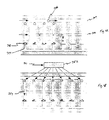
- Figures 4A-4F show a schematic illustration of the operation of the device shown in Figure 3, in screening a plurality of bead based test compounds.
- Figure 5 shows a schematic illustration of a continuous flow assay device incorporating a sample shunt for performing prolonged incubation followed by a separation step.
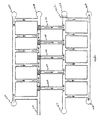
- Figure 6A shows a schematic illustration of a serial input parallel reaction device for use with fluid based test compounds.
- Figures 6B and 6C show a schematic illustration of fluid flow patterns within the device shown in figure 6A.
- Figure 7 shows a schematic illustration of one embodiment of an overall assay systems which employs multiple microlaboratory devices labeled as "LabChipsTM" for screening test compounds.
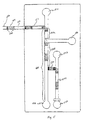
- Figure 8 is a schematic illustration of a chip layout used for a continuous-flow assay screening system.
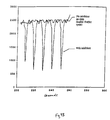
- Figure 9 shows fluorescence data from a continuous flow assay screen.
- Figure 9A shows fluorescence data from a test screen which periodically introduced a known inhibitor (IPTG) into a ⁇ -galactosidase assay system in a chip format.
- Figure 9B shows a superposition of two data segments from Figure 9A, directly comparing the inhibitor data with control (buffer) data.
- Figure 10 illustrates the operating parameters of a fluid flow system on a small chip device for performing enzyme inhibitor screening.
- Figure 11 shows a schematic illustration of timing for sample/spacer loading in a microfluidic device channel.
- FIG. 12 panels A-G schematically illustrate electrodes used in apparatuses of the invention.
- the present invention provides novel microlaboratory systems and methods that are useful for performing high-throughput screening assays.
- the present invention provides microfluidic devices and methods of using such devices in screening large numbers of different compounds for their effects on a variety of chemical, and preferably, biochemical systems.
- biochemical system generally refers to a chemical interaction that involves molecules of the type generally found within living organisms. Such interactions include the full range of catabolic and anabolic reactions which occur in living systems including enzymatic, binding, signalling and other reactions. Further, biochemical systems, as defined herein, also include model systems which are mimetic of a particular biochemical interaction. Examples of biochemical systems of particular interest in practicing the present invention include, e.g., receptor-ligand interactions, enzyme-substrate interactions, cellular signaling pathways, transport reactions involving model barrier systems (e.g., cells or membrane fractions) for bioavailability screening, and a variety of other general systems.
- model barrier systems e.g., cells or membrane fractions
- Cellular or organismal viability or activity may also be screened using the methods and apparatuses of the present invention, e.g., in toxicology studies.
- Biological materials which are assayed include, but are not limited to, cells, cellular fractions (membranes, cytosol preparations, etc.), agonists and antagonists of cell membrane receptors (e.g., cell receptor-ligand interactions such as e . g ., transferrin, c-kit, viral receptor ligands (e.g.
- CD4-HIV cytokine receptors
- chemokine receptors interleukin receptors
- immunoglobulin receptors and antibodies the cadherein family, the integrin family, the selectin family, and the like; see, e.g., Pigott and Power (1993) The Adhesion Molecule FactsBook Academic Press New York and Hulme (ed) Receptor Ligand Interactions A Practical Approach Rickwood and Hames (series editors) IRL Press at Oxford Press NY), toxins and venoms, viral epitopes, hormones (e.g., opiates, steroids, etc.), intracellular receptors (e.g.
- peptides such as retro-inverso peptides, polymers of ⁇ -, ⁇ -, or ⁇ -amino acids (D- or L-), enzymes, enzyme substrates, cofactors, drugs, lectins, sugars, nucleic acids (both linear and cyclic polymer configurations), oligosaccharides, proteins, phospholipids and antibodies.
- Synthetic polymers such as heteropolymers in which a known drug is covalently bound to any of the above, such as polyurethanes, polyesters, polycarbonates, polyureas, polyamides, polyethyleneimines, polyarylene sulfides, polysiloxanes, polyimides, and polyacetates are also assayed.
- Such manufacturers include, e.g., the SIGMA chemical company (Saint Louis, MO), R&D systems (Minneapolis, MN), Pharmacia LKB Biotechnology (Piscataway, NJ), CLONTECH Laboratories, Inc. (Palo Alto, CA), Chem Genes Corp., Aldrich Chemical Company (Milwaukee, WI), Glen Research, Inc., GIBCO BRL Life Technologies, Inc. (Gaithersberg, MD), Fluka Chemica-Biochemika Analytika (Fluka Chemie AG, Buchs, Switzerland), Invitrogen, San Diego, CA, and Applied Biosystems (Foster City, CA), as well as many other commercial sources known to one of skill.
- the present invention generally incorporates model in vitro systems which mimic a given biochemical system in vivo for which effector compounds are desired.
- the range of systems against which compounds can be screened and for which effector compounds are desired, is extensive.
- compounds are optionally screened for effects in blocking, slowing or otherwise inhibiting key events associated with biochemical systems whose effect is undesirable.
- test compounds are optionally screened for their ability to block systems that are responsible, at least in part, for the onset of disease or for the occurrence of particular symptoms of diseases, including, e.g., hereditary diseases, cancer, bacterial or viral infections and the like.
- Compounds which show promising results in these screening assay methods can then be subjected to further testing to identify effective pharmacological agents for the treatment of disease or symptoms of a disease.
- compounds can be screened for their ability to stimulate, enhance or otherwise induce biochemical systems whose function is believed to be desirable, e.g., to remedy existing deficiencies in a patient.
- batteries of test compounds can then be applied against these model systems. By identifying those test compounds that have an effect on the particular biochemical system, in vitro, one can identify potential effectors of that system, in vivo.
- the biochemical system models employed in the methods and apparatuses of the present invention will screen for an effect of a test compound on an interaction between two components of a biochemical system, e.g., receptor-ligand interaction, enzyme-substrate interaction, and the like.
- the biochemical system model will typically include the two normally interacting components of the system for which an effector is sought, e.g., the receptor and its ligand or the enzyme and its substrate.
- Determining whether a test compound has an effect on this interaction then involves contacting the system with the test compound and assaying for the functioning of the system, e.g., receptor-ligand binding or substrate turnover.
- the assayed function is then compared to a control, e.g., the same reaction in the absence of the test compound or in the presence of a known effector.
- a control e.g., the same reaction in the absence of the test compound or in the presence of a known effector.
- such assays involve the measurement of a parameter of the biochemical system.
- parameter of the biochemical system is meant some measurable evidence of the system's functioning, e.g., the presence or absence of a labeled group or a change in molecular weight (e.g., in binding reactions, transport screens), the presence or absence of a reaction product or substrate (in substrate turnover measurements), or an alteration in electrophoretic mobility (typically detected by a change in elution time of a labeled compound).
- the methods and apparatuses may also be used to screen for effectors of much more complex systems, where the result or end product of the system is known and assayable at some level, e.g., enzymatic pathways, cell signaling pathways and the like.
- the methods and apparatuses described herein are optionally used to screen for compounds that interact with a single component of a biochemical system, e.g., compounds that specifically bind to a particular biochemical compound, e.g., a receptor, ligand, enzyme, nucleic acid, structural macromolecule, etc.
- Biochemical system models may also be embodied in whole cell systems. For example, where one is seeking to screen test compounds for an effect on a cellular response, whole cells are optionally utilized. Modified cell systems may also be employed in the screening systems encompassed herein.
- chimeric reporter systems are optionally employed as indicators of an effect of a test compound on a particular biochemical system.
- Chimeric reporter systems typically incorporate a heterogenous reporter system integrated into a signaling pathway which signals the binding of a receptor to its ligand.
- a receptor is fused to a heterologous protein, e.g., an enzyme whose activity is readily assayable. Activation of the receptor by ligand binding then activates the heterologous protein which then allows for detection.
- the surrogate reporter system produces an event or signal which is readily detectable, thereby providing an assay for receptor/ligand binding. Examples of such chimeric reporter systems have been previously described in the art.
- biological barriers generally refers to cellular or membranous layers within biological systems, or synthetic models thereof. Examples of such biological barriers include the epithelial and endothelial layers, e.g. vascular endothelia and the like.
- Biological responses are often triggered and/or controlled by the binding of a receptor to its ligand.
- growth factors i.e., EGF, FGF, PDGF, etc.
- EGF EGF
- FGF FGF
- PDGF PDGF
- control of the interaction of the receptor and its ligand may offer control of the biological responses caused by that interaction.
- the present invention will be useful in screening for compounds that affect an interaction between a receptor molecule and its ligands.
- the term "receptor” generally refers to one member of a pair of compounds which specifically recognize and bind to each other. The other member of the pair is termed a "ligand.”
- a receptor/ligand pair may include a typical protein receptor, usually membrane associated, and its natural ligand, e.g., another protein or small molecule.
- Receptor/ligand pairs may also include antibody/antigen binding pairs, complementary nucleic acids, nucleic acid associating proteins and their nucleic acid ligands.
- a large number of specifically associating biochemical compounds are well known in the art and can be utilized in practicing the present invention.
- test compound is determined to be an inhibitor of the receptor/ligand binding.
- enhancer or inducer of the interaction is determined to be an enhancer or inducer of the interaction.
- screening assays have typically been set up in multiwell reaction plates, e.g., multi-well microplates, which allow for the simultaneous, parallel screening of large numbers of test compounds.
- a similar, and perhaps overlapping, set of biochemical systems includes the interactions between enzymes and their substrates.
- enzyme as used herein, generally refers to a protein which acts as a catalyst to induce a chemical change in other compounds or "substrates.”
- effectors of an enzyme's activity toward its substrate are screened by contacting the enzyme with a substrate in the presence and absence of the compound to be screened and under conditions optimal for detecting changes in the enzyme's activity. After a set time for reaction, the mixture is assayed for the presence of reaction products or a decrease in the amount of substrate. The amount of substrate that has been catalyzed is them compared to a control, i.e., enzyme contacted with substrate in the absence of test compound or presence of a known effector.
- a control i.e., enzyme contacted with substrate in the absence of test compound or presence of a known effector.
- a compound that reduces the enzymes activity toward its substrate is termed an "inhibitor”
- a compound that accentuates that activity is termed an "inducer.”
- the various screening methods encompassed by the present invention involve the serial introduction of a plurality of test compounds into a microfluidic device. Once injected into the device, the test compound is screened for effect on a biological system using a continuous serial or parallel assay orientation.
- test compound refers to the collection of compounds that are to be screened for their ability to affect a particular biochemical system.
- Test compounds may include a wide variety of different compounds, including chemical compounds, mixtures of chemical compounds, e.g., polysaccharides, small organic or inorganic molecules, biological macromolecules, e.g., peptides, proteins, nucleic acids, or an extract made from biological materials such as bacteria, plants, fungi, or animal cells or tissues, naturally occurring or synthetic compositions.
- the test compounds are provided, e.g., injected, free in solution. or are optionally attached to a carrier, or a solid support, e.g., beads.
- test compounds are screened individually, or in groups. Group screening is particularly useful where hit rates for effective test compounds are expected to be low such that one would not expect more than one positive result for a given group. Alternatively, such group screening is used where the effects of different test compounds are differentially detected in a single system, e.g., through electrophoretic separation of the effects, or differential labelling which enables separate detection.
- Test compounds are commercially available, or derived from any of a variety of biological sources apparent to one of skill and as described, supra.
- a tissue homogenate or blood sample from a patient is tested in the assay systems of the invention.
- blood is tested for the presence or activity of a biologically relevant molecule.
- the presence and activity level of an enzyme are detected by supplying and enzyme substrate to the biological sample and detecting the formation of a product using an assay systems of the invention.
- infectious pathogens viruss, bacteria, fungi, or the like
- cancerous tumors can be tested by monitoring binding of a labeled ligand to the pathogen or tumor cells, or a component of the pathogen or tumor such as a protein, cell membrane, cell extract or the like, or alternatively, by monitoring the presence of an antibody against the pathogen or tumor in the patient's blood.
- a labeled ligand to the pathogen or tumor cells, or a component of the pathogen or tumor such as a protein, cell membrane, cell extract or the like
- an antibody against the pathogen or tumor in the patient's blood for example, the binding of an antibody from a patient's blood to a viral protein such as an HIV protein is a common test for monitoring patient exposure to the virus.
- a viral protein such as an HIV protein
- Many assays for detecting pathogen infection are well known, and are adapted to the assay systems of the present invention.
- Bio samples are derived from patients using well known techniques such as venipuncture or tissue biopsy. Where the biological material is derived from non-human animals, such as commercially relevant livestock, blood and tissue samples are conveniently obtained from livestock processing plants. Similarly, plant material used in the assays of the invention are conveniently derived from agricultural or horticultural sources. Alternatively, a biological sample can be from a cell or blood bank where tissue and/or blood are stored, or from an in vitro source such as a culture of cells. Techniques and methods for establishing a culture of cells for use as a source for biological materials are well known to those of skill in the art. Freshney Culture of Animal Cells, a Manual of Basic Technique, Third Edition Wiley- Liss, New York (1994) provides a general introduction to cell culture.
- the screening methods of the present invention are generally carried out in microfluidic devices or "microlaboratory systems," which allow for integration of the elements required for performing the assay, automation, and minimal environmental effects on the assay system, e.g., evaporation, contamination, human error, or the like.
- a number of devices for carrying out the assay methods of the invention are described in substantial detail below. However, it will be recognized that the specific configuration of these devices will generally vary depending upon the type of assay and/or assay orientation desired.
- the screening methods of the invention can be carried out using a microfluidic device having two intersecting channels. For more complex assays or assay orientations, multichannel/intersection devices are optionally employed. The small scale, integratability and self-contained nature of these devices allows for virtually any assay orientation to be realized within the context of the microlaboratory system.
- the devices, methods and systems described herein employ electrokinctic material transport systems, and preferably, controlled electrokinetic material transport systems.
- electrokinetic material transport systems include systems which transport and direct materials within an interconnected channel and/or chamber containing structure, through the application of electrical fields to the materials, thereby causing material movement through and among the channel and/or chambers, i.e., cations will move toward the negative electrode, while anions will move toward the positive electrode.
- Such electrokinetic material transport and direction systems include those systems that rely upon the electrophoretic mobility of charged species within the electric field applied to the structure. Such systems are more particularly referred to as electrophoretic material transport systems.
- Other electrokinetic material direction and transport systems rely upon the electroosmotic flow of fluid and material within a channel or chamber structure which results from the application of an electric field across such structures.
- a fluid is placed into a channel which has a surface bearing charged functional groups, e.g., hydroxyl groups in etched glass channels or glass microcapillaries, those groups can ionize.
- this ionization e.g., at neutral pH, results in the release of protons from the surface and into the fluid, creating a concentration of protons at near the fluid/surface interface, or a positively charged sheath surrounding the bulk fluid in the channel.
- Application of a voltage gradient across the length of the channel will cause the proton sheath, as well as the fluid it surrounds, to move in the direction of the voltage drop, i.e., toward the negative electrode.
- Controlled electrokinetic material transport and direction refers to electrokinetic systems as described above, which employ active control of the voltages applied at multiple, i.e., more than two, electrodes. Rephrased, such controlled electrokinetic systems concomitantly regulate voltage gradients applied across at least two intersecting channels. Controlled electrokinetic material transport is described in Published PCT Application No. WO 96/04547, to Ramsey, which is incorporated herein by reference in its entirety for all purposes.
- the preferred microfluidic devices and systems described herein include a body structure which includes at least two intersecting channels or fluid conduits, e.g., interconnected, enclosed chambers, which channels include at least three unintersected termini.
- intersection of two channels refers to a point at which two or more channels are in fluid communication with each other, and encompasses "T" intersections, cross intersections, "wagon wheel” intersections of multiple channels, or any other channel geometry where two or more channels are in such fluid communication.
- An unintersected terminus of a channel is a point at which a channel terminates not as a result of that channel's intersection with another channel, e.g., a "T" intersection.
- the devices will include at least three intersecting channels having at least four unintersected termini.
- controlled electrokinetic material transport operates to controllably direct material flow through the intersection, by providing constraining flows from the other channels at the intersection. For example, assuming one was desirous of transporting a first material through the horizontal channel, e.g., from left to right, across the intersection with the vertical channel. Simple electrokinetic material flow of this material across the intersection could be accomplished by applying a voltage gradient across the length of the horizontal channel, i.e., applying a first voltage to the left terminus of this channel, and a second, lower voltage to the right terminus of this channel, or by allowing the right terminus to float (applying no voltage). However, this type of material flow through the intersection would result in a substantial amount of diffusion at the intersection, resulting from both the natural diffusive properties of the material being transported in the medium used, as well as convective effects at the intersection.
- the material being transported across the intersection is constrained by low level flow from the side channels, e.g., the top and bottom channels. This is accomplished by applying a slight voltage gradient along the path of material flow, e.g., from the top or bottom termini of the vertical channel, toward the right terminus. The result is a "pinching" of the material flow at the intersection, which prevents the diffusion of the material into the vertical channel.
- the pinched volume of material at the intersection may then be injected into the vertical channel by applying a voltage gradient across the length of the vertical channel, i.e., from the top terminus to the bottom terminus.
- a low level of flow is directed back into the side channels, resulting in a "pull back" of the material from the intersection.
- controlled electrokinetic material transport is readily utilized to create virtual valves which include no mechanical or moving pans.
- flow of material from one channel segment to another e.g., the left arm to the right arm of the horizontal channel
- a controlled flow from the vertical channel e.g., from the bottom arm to the top arm of the vertical channel.
- the material is transported from the left arm, through the intersection and into the top arm by applying a voltage gradient across the left and top termini.
- a constraining flow is directed from the bottom arm to the top arm by applying a similar voltage gradient along this path (from the bottom terminus to the top terminus).
- Metered amounts of material are then dispensed from the left arm into the right arm of the horizontal channel by switching the applied voltage gradient from left to top, to left to right.
- the amount of time and the voltage gradient applied dictates the amount of material that will be dispensed in this manner.
- the methods and apparatuses of the invention are used in screening test compounds using a continuous flow assay system.
- the continuous flow assay system can be readily used in screening for inhibitors or inducers of enzymatic activity, or for agonists or antagonists of receptor-ligand binding.
- the continuous flow assay system involves the continuous flow of the particular biochemical system along a microfabricated channel.
- the term "continuous" generally refers to an unbroken or contiguous stream of the particular composition that is being continuously flowed.
- a continuous flow may include a constant fluid flow having a set velocity, or alternatively, a fluid flow which includes pauses in the flow rate of the overall system, such that the pause does not otherwise interrupt the flow stream.
- detectable signals include optically detectable chromophoric or fluorescent signals that are associated with the functioning of the particular model system used.
- detectable signals will generally be produced by products of the enzyme's catalytic action, e.g., on a chromogenic or fluorogenic substrate.
- binding systems e.g., receptor ligand interactions
- signals will typically involve the association of a labeled ligand with the receptor, or vice versa.
- detectable signals and labels can also be used in the assays and apparatuses of the invention.
- radioactive decay, electron density, changes in pH, solvent viscosity, temperature and salt concentration are also conveniently measured.
- labels are commonly detectable by spectroscopic, photochemical, biochemical, immunochemical, or chemical means.
- useful nucleic acid labels include 32P, 35S, fluorescent dyes, electron-dense reagents, enzymes ( e . g ., as commonly used in an ELISA), biotin, dioxigenin, or haptens and proteins for which antisera or monoclonal antibodies are available.
- enzymes e . g ., as commonly used in an ELISA
- biotin e. g ., as commonly used in an ELISA
- haptens and proteins for which antisera or monoclonal antibodies are available.
- Suitable labels include radionucleotides, enzymes, substrates, cofactors, inhibitors, fluorescent moieties, chemiluminescent moieties, magnetic particles, and the like.
- Labeling agents optionally include e.g., monoclonal antibodies, polyclonal antibodies, proteins, or other polymers such as affinity matrices, carbohydrates or lipids. Detection proceeds by any of a variety of known methods, including spectrophotometric or optical tracking of radioactive or fluorescent markers, or other methods which track a molecule based upon size, charge or affinity.
- a detectable moiety can be of any material having a detectable physical or chemical property.
- a label is any composition detectable by spectroscopic, photochemical, biochemical, immunochemical, electrical, optical thermal, or chemical means.
- Useful labels in the present invention include fluorescent dyes (e.g., fluorescein isothiocyanate, Texas red, rhodamine, and the like), radiolabels (e.g., 3H, 125I, 35S, 14C, 32P or 33P), enzymes (e.g., LacZ, CAT, horse radish peroxidase, alkaline phosphatase and others, commonly used as detectable enzymes, either as marker products or as in an ELISA), nucleic acid intercalators (e.g. , ethidium bromide) and colorimetric labels such as colloidal gold or colored glass or plastic (e.g. polystyrene, polypropylene, latex, etc.) beads.
- fluorescent dyes e.g., fluorescein isothiocyanate, Texas red, rhodamine, and the like
- radiolabels e.g., 3H, 125I, 35S, 14C, 32P or 33P
- Fluorescent labels are particularly preferred labels.
- Preferred labels are typically characterized by one or more of the following: high sensitivity, high stability, low background, low environmental sensitivity and high specificity in labeling.
- Fluorescent moieties which are incorporated into the labels of the invention, are generally are known, including 1- and 2-aminonaphthalene, p,p'- -diaminostilbenes, pyrenes, quaternary phenanthridine salts, 9-aminoacridines, p,p' -diaminobenzophenone imines.
- anthracenes oxacarbocyanine, merocyanine, 3-aminoequilenin, perylene, bis -benzoxazole, bis - p -oxazolyl benzene, 1,2-benzophenazin, retinol, bis -3-aminopyridinium salts, hellebrigenin, tetracycline, sterophenol, benzimidazolylphenylamine, 2-oxo-3-chromen, indole, xanthen, 7-hydroxycoumarin, phenoxazine, calicylate, strophanthidin, porphyrins, triarylmethanes and flavin.
- Individual fluorescent compounds which have functionalities for linking to an element desirably detected in an apparatus or assay of the invention, or which can be modified to incorporate such functionalities include, e.g. , dansyl chloride; fluoresceins such as 3,6-dihydroxy-9-phenylxanthhydrol; rhodamineisothiocyanate; N-phenyl 1-amino-8--sulfonatonaphthalene; N-phenyl 2-amino-6-sulfonatonaphthalene; 4-acetamido-4-isothiocyanato-stilbene-2,2'-disulfonic acid; pyrene-3-sulfonic acid; 2-toluidinonaphthalene-6-sulfonate; N-phenyl-N-methyl-2-aminoaphthalene-6-sulfonate; ethidium bromide; stebrine; auromine-0,2-(9'-anthroyl)palmitate; dans
- fluorescent tags are commercially available from SIGMA chemical company (Saint Louis, MO), Molecular Probes, R&D systems (Minneapolis, MN), Pharmacia LKB Biotechnology (Piscataway, NJ), CLONTECH Laboratories, Inc. (Palo Alto, CA), Chem Genes Corp., Aldrich Chemical Company (Milwaukee, WI), Glen Research, Inc., GIBCO BRL Life Technologies, Inc. (Gaithersberg, MD), Fluka Chemica-Biochemika Analytika (Fluka Chemie AG, Buchs, Switzerland), and Applied Biosysiems (Foster City, CA) as well as other commercial sources known to one of skill.
- fluorescent labels absorb light above about 300 nm, preferably about 350 nm, and more preferably above about 400 nm, usually emitting at wavelengths greater than about 10 nm higher than the wavelength of the light absorbed. It should be noted that the absorption and emission characteristics of the bound label may differ from the unbound label. Therefore, when referring to the various wavelength ranges and characteristics of the labels, it is intended to indicate the labels as employed and not the label which is unconjugated and characterized in an arbitrary solvent.
- Fluorescent labels are one preferred class of detectable labels, in part because by irradiating a fluorescent label with light, one can obtain a plurality of emissions. Thus, a single label can provide for a plurality of measurable events.
- Detectable signal may also be provided by chemiluminescent and bioluminescent sources.
- Chemiluminescent sources include a compound which becomes electronically excited by a chemical reaction and may then emit light which serves as the detectible signal or donates energy to a fluorescent acceptor.
- a diverse number of families of compounds have been found to provide chemiluminescence under a variety or conditions.
- One family of compounds is 2,3-dihydro-1,4--phthalazinedione. The most popular compound is luminol, which is a 5-amino compound.
- Chemiluminescent analogs include para -dimethylamino and -methoxy substituents. Chemiluminescence may also be obtained with oxalates, usually oxalyl active esters, e.g., p -nitrophenyl and a peroxide, e.g., hydrogen peroxide, under basic conditions.
- chemiluminescent compounds include -N-alkyl acridinum esters (basic H 2 O 2 ) and dioxetanes.
- luciferins may be used in conjunction with luciferase or lucigenins to provide bioluminescence.
- the label is coupled directly or indirectly to a molecule to be detected (a product, substrate, enzyme, or the like) according to methods well known in the art.
- a molecule to be detected a product, substrate, enzyme, or the like
- Non radioactive labels are often attached by indirect means.
- a ligand molecule e.g., biotin
- the ligand then binds to an anti-ligand (e.g., streptavidin) molecule which is either inherently detectable or covalently bound to a signal system, such as a detectable enzyme, a fluorescent compound, or a chemiluminescent compound.
- a number of ligands and anti-ligands can be used. Where a ligand has a natural anti-ligand, for example, biotin, thyroxine, and cortisol, it can be used in conjunction with labeled, anti-ligands. Alternatively, any haptenic or antigenic compound can be used in combination with an antibody. Labels can also be conjugated directly to signal generating compounds, e . g ., by conjugation with an enzyme or fluorophore. Enzymes of interest as labels will primarily be hydrolases, particularly phosphatases, esterases and glycosidases, or oxidoreductases, particularly peroxidases.
- Fluorescent compounds include fluorescein and its derivatives, rhodamine and its derivatives, dansyl, umbelliferone, etc.
- Chemiluminescent compounds include luciferin, and 2,3-dihydrophthalazinediones, e.g., luminol.
- Means of detecting labels are well known to those of skill in the art. Thus, for example, where the label is a radioactive label, means for detection include a scintillation counter or photographic film as in autoradiography.
- the label is a fluorescent label
- it may be detected by exciting the fluorochrome with the appropriate wavelength of light and detecting the resulting fluorescence, e.g., by microscopy, visual inspection, via photographic film, by the use of electronic detectors such as digital cameras, charge coupled devices (CCDs) or photomultipliers and phototubes, and the like. Fluorescent labels and detection techniques, particularly microscopy and spectroscopy are preferred. Similarly, enzymatic labels are detected by providing appropriate substrates for the enzyme and detecting the resulting reaction product. Finally, simple colorimetric labels are often detected simply by observing the color associated with the label. For example, conjugated gold often appears pink, while various conjugated beads appear the color of the bead.
- the continuous system generates a constant signal which varies only when a test compound is introduced that affects the system. Specifically, as the system components flow along the channel, they will produce a relatively constant signal level at a detection zone or window of the channel. Test compounds are periodically introduced into the channel and mixed with the system components. Where those test compounds have an effect on the system, it will cause a deviation from the constant signal level at the detection window. This deviation may then be correlated to the particular test compound screened.
- FIG. 1 One embodiment of a device for use in a serial or continuous assay geometry is shown in Figure 1.
- the overall device 100 is fabricated in a planar substrate 102.
- Suitable substrate materials are generally selected based upon their compatibility with the conditions present in the particular operation to be performed by the device. Such conditions can include extremes of pH, temperature, salt concentration, and application of electrical fields. Additionally, substrate materials are also selected for their inertness to critical components of an analysis or synthesis to be carried out by the device.
- substrate materials include, e.g., glass, quartz and silicon as well as polymeric substrates, e.g. plastics.
- conductive or semi-conductive substrates it will generally be desirable to include an insulating layer on the substrate. This is particularly important where the device incorporates electrical elements, e.g., electrical material and fluid direction systems, sensors and the like.
- the substrate materials are optionally rigid, semi-rigid, or non-rigid, opaque, semi-opaque or transparent, depending upon the use for which they are intended.
- devices which include an optical or visual detection element will generally be fabricated, at least in part, from transparent materials to allow, or at least, facilitate that detection.
- the polymeric materials may have linear or branched backbones, and are optionally crosslinked or non-crosslinked.
- particularly preferred polymeric materials include, e.g., polydimethylsiloxanes (PDMS), polyurethane, polyvinylchloride (PVC) polystyrene, polysulfone, polycarbonate and the like.
- the device shown in Figure 1 includes a series of channels 110, 112, and optional reagent channel 114, fabricated into the surface of the substrate. At least one of these channels will typically have very small cross sectional dimensions, e.g., in the range of from about 0.1 ⁇ m to about 500 ⁇ m. Preferably the cross-sectional dimensions of the channels will be in the range of from about 0.1 to about 200 ⁇ m and more preferably in the range of from about 0.1 to about 100 ⁇ m. In particularly preferred aspects, each of the channels will have at least one cross-sectional dimension in the range of from about 0.1 ⁇ m to about 100 ⁇ m. Although generally shown as straight channels, it will be appreciated that in order to maximize the use of space on a substrate, serpentine, saw tooth or other channel geometries, to incorporate effectively longer channels in shorter distances.
- Manufacturing of these microscale elements into the surface of the substrates may generally be carried out by any number of microfabrication techniques that are well known in the art.
- lithographic techniques are optionally employed in fabricating, e.g., glass, quartz or silicon substrates, using methods well known in the semiconductor manufacturing industries such as photolithographic etching, plasma etching or wet chemical etching.
- micromachining methods such as laser drilling, micromilling and the like are optionally employed.
- polymeric substrates well known manufacturing techniques may also be used. These techniques include injection molding or stamp molding methods where large numbers of substrates are optionally produced using, e.g., rolling stamps to produce large sheets of microscale substrates or polymer microcasting techniques where the substrate is polymerized within a micromachined mold.
- the devices will typically include an additional planar element which overlays the channeled substrate enclosing and fluidly sealing the various channels to form conduits.
- Attaching the planar cover element is achieved by a variety of means, including, e.g., thermal bonding, adhesives or, in the case of certain substrates, e.g., glass, or semi-rigid and non-rigid polymeric substrates, a natural adhesion between the two components.
- the planar cover element may additionally be provided with access ports and/or reservoirs for introducing the various fluid elements needed for a particular screen.
- the device shown in Figure 1 also includes reservoirs 104, 106 and 108 , disposed and fluidly connected at the ends of the channels 110 and 114.
- sample channel 112 is used to introduce the plurality of different test compounds into the device.
- this channel will generally be fluidly connected to a source of large numbers of separate test compounds that will be individually introduced into the sample channel 112 and subsequently into channel 110.
- micropipettors are optionally used to introduce the test compounds into the device.
- an electropipettor is used which is fluidly connected to sample channel 112.
- An example of such an electropipettor is described in, e.g., U.S. Patent Application Serial No. 08/671,986, filed June 28, 1996 (Attorney Docket No. 017646-000500) the disclosure of which is hereby incorporated herein by reference in its entirety for all purposes.
- this electropipettor utilizes electroosmotic fluid direction as described herein, to alternately sample a number of test compounds, or "subject materials," and spacer compounds.
- the pipettor then delivers individual, physically isolated sample or test compound volumes in subject material regions, in series, into the sample channel for subsequent manipulation within the device.
- Individual samples are typically separated by a spacer region of low ionic strength spacer fluid. These low ionic strength spacer regions have higher voltage drop over their length than do the higher ionic strength subject material or test compound regions, thereby driving the electrokinetic pumping.
- first spacer regions also referred to as “guard bands”
- first spacer regions typically comprise a high ionic strength solution to prevent migration of the sample elements into the lower ionic strength fluid regions, or second spacer region, which would result in electrophoretic bias.
- first and second spacer regions are described in greater detail in U.S. Patent Application Serial No. 08/671,986, filed June 28, 1996, (Attorney Docket No. 017646-000500) which is incorporated herein by reference.
- the sample channel 112 is optionally individually fluidly connected to a plurality of separate reservoirs via separate channels.
- the separate reservoirs each contain a separate test compound with additional reservoirs being provided for appropriate spacer compounds.
- the test compounds and/or spacer compounds are then transported from the various reservoirs into the sample channels using appropriate material direction schemes. In either case, it generally is desirable to separate the discrete sample volumes, or test compounds, with appropriate spacer regions.
- the device also includes a detection window or zone 116 at which a signal from the biochemical system is optionally monitored.
- This detection window typically will include a transparent cover allowing visual or optical observation and detection of the assay results, e.g., observation of a colorometric or fluorometric response.
- monitoring of the signals at the detection window is achieved using an optical detection system.
- fluorescence based signals are typically monitored using, e.g., laser activated fluorescence detection systems which employ a laser light source at an appropriate wavelength for activating the fluorescent indicator within the system. Fluorescence is then detected using an appropriate detector element, e.g., a photomultiplier tube (PMT).
- PMT photomultiplier tube
- spectrophotometric detection systems which direct a light source at the sample are optionally used, providing a measurement of absorbance or transmissivity of the sample.
- the detection system may comprise non-optical detectors or sensors for detecting a particular characteristic of the system disposed within detection window 116 .
- sensors may include temperature, conductivity, potentiometric (pH, ions), amperometric (for compounds that are oxidized or reduced, e.g., O 2 , H 2 O 2 , I 2 , oxidizable/reducible organic compounds, and the like).
- a flowable first component of a biological system e.g., a fluid comprising a receptor or enzyme
- This first component is flowed through main channel 110, past the detection window, 116 , and toward waste reservoir 108 .
- a second component of the biochemical system e.g., a ligand or substrate, is concurrently flowed into the main channel 110 from the side channel 114, whereupon the first and second components mix and are able to interact.
- Deposition of these elements within the device is carried out in a number of ways.
- the enzyme and substrate, or receptor and ligand solutions can be introduced into the device through open or sealable access ports in the planar cover.
- these components are optionally added to their respective reservoirs during manufacture of the device.
- the enzyme/substrate or receptor/ligand components are optionally provided within the device in lyophilized form. Prior to use, these components are easily reconstituted by introducing a buffer solution into the reservoirs. Alternatively, the components are lyophilized with appropriate buffering salts, whereby simple water addition is all that is required for reconstitution.
- the interaction of the first and second components is typically accompanied by a detectable signal.
- the substrate is a chromogenic or fluorogenic substrate which produces an optically detectable signal when the enzyme acts upon the substrate.
- the first component is a receptor and the second is a ligand
- either the ligand or the receptor optionally includes a detectable signal.
- the mixture and flow rate of compounds will typically remain constant such that the flow of the mixture of the first and second components past the detection window 116 will produce a steady-state signal.
- steady state signal is generally meant a signal that has a regular, predictable signal intensity profile.
- the steady-state signal may include signals having a constant signal intensity, or alternatively, a signal with a regular periodic intensity, against which variations in the normal signal profile is measured.
- This latter signal is generated in cases where fluid flow is periodically interrupted for, e.g., loading additional test compounds, as described in the description of the continuous flow systems.
- the signal produced in the above-described enzymatic system will vary along the length of the channel, i.e., increasing with time of exposure as the enzyme converts the fluorogenic substrate to the fluorescent product, the signal at any specific point along the channel will remain constant, given a constant flow rate.
- test compounds is periodically or serially introduced into the main channel 110 and into the stream of first and second components as fluid regions containing the test compound, also referred to as the "subject material regions.” Where these test compounds have an effect on the interaction of the first and second elements, it will produce a deviation in the signal detected at the detection window corresponding to the subject material region.
- the various different test compounds to be injected through channel 112 will be separated by a first and even second spacer fluid regions to allow differentiation of the effects, or lack of effects, from one test compound to another.
- the spacer fluid regions may also function to reduce any electrophoretic bias that can occur within the test sample.
- a steady, continuous flow of enzyme and fluorogenic substrate through main channel 110 will produce a constant fluorescent signal at the detection window 116 .
- introduction of a test compound i.e., in a subject material region, will produce a momentary but detectable drop in the level of signal at the detection window corresponding with that subject material region.
- the timing of the drop in signal can then be correlated with a particular test compound based upon a known injection to detection time-frame. Specifically, the time required for an injected compound to produce an observed effect can be readily determined using positive controls.
- the receptor and its fluorescent ligand can be made to have different flow rates along the channel. This can be accomplished by incorporating size exclusion matrices within the channel, or, in the case of electroosmotic methods, altering the relative electrophoretic mobility of the two compounds so that the receptor flows more rapidly down the channel. Again, this is accomplished through the use of size exclusion matrices, or through the use of different surface charges in the channel which will result in differential flow rates of charge-varied compounds. Where a test compound binds to the receptor, it will result in a dark pulse in the fluorescent signal followed by a brighter pulse.
- the steady state signal is a result of both free fluorescent ligand, and fluorescent ligand bound to the receptor.
- the bound ligand is traveling at the same flow rate as the receptor while the unbound ligand is traveling more slowly.
- the receptor will not 'bring along' the fluorescent ligand, thereby diluting the fluorescent ligand in the direction of flow, and leaving an excess of free fluorescent ligand behind. This results in a temporary reduction in the steady-state signal, followed by a temporary increase in fluorescence.
- schemes similar to those employed for the enzymatic system is employed, where there is a signal that reflects the interaction of the receptor with its ligand.
- pH indicators which indicate pH effects of receptor-ligand binding is incorporated into the device along with the biochemical system, i.e., in the form of encapsulated cells, whereby slight pH changes resulting from binding can be detected. See Weaver, et al., Bio/Technology (1988) 6:1084-1089. Additionally, one can monitor activation of enzymes resulting from receptor ligand binding, e.g., activation of kinases, or detect conformational changes in such enzymes upon activation, e.g., through incorporation of a fluorophore which is activated or quenched by the conformational change to the enzyme upon activation.
- the devices may include integrated microfluidic structures, such as micropumps and microvalves, or external elements, e.g., pumps and switching valves, for the pumping and direction of the various fluids through the device.
- integrated microfluidic structures such as micropumps and microvalves
- external elements e.g., pumps and switching valves
- microfluidic structures are described in, e.g., U.S. Patent Nos. 5,271,724, 5,277,556, 5,171,132, and 5,375,979. See also, Published U.K. Patent Application No. 2 248 891 and Published European Patent Application No. 568 902.
- the devices of the invention will typically include an electroosmotic fluid direction system.
- electroosmotic fluid direction systems combine the elegance of a fluid direction system devoid of moving parts, with an ease of manufacturing, fluid control and disposability.
- electroosmotic fluid direction systems include, e.g., those described in International Patent Application No. WO 96/04547 to Ramsey et al., which is incorporated herein by reference in its entirety for all purposes.
- these fluidic control systems typically include electrodes disposed within the reservoirs that are placed in fluid connection with the plurality of intersecting channels fabricated into the surface of the substrate.
- the materials stored in the reservoirs are transported through the channel system delivering appropriate volumes of the various materials to one or more regions on the substrate in order to carry out a desired screening assay.
- Fluid and materials transport and direction is accomplished through electroosmosis or electrokinesis.
- an appropriate material typically comprising a fluid
- those groups can ionize.
- protons can leave the surface of the channel and enter the fluid.
- the surface will possess a net negative charge
- the fluid will possess an excess of protons or positive charge, particularly localized near the interface between the channel surface and the fluid.
- cations will flow toward the negative electrode. Movement of the positively charged species in the fluid pulls the solvent with them.
- ⁇ is the solvent velocity
- ⁇ is the dielectric constant of the fluid
- ⁇ is the zeta potential of the surface
- E is the electric field strength
- ⁇ the solvent viscosity
- the system generally includes a voltage controller that is capable of applying selectable voltage levels, simultaneously, to each of the reservoirs, including ground.
- a voltage controller can be implemented using multiple voltage dividers and multiple relays to obtain the selectable voltage levels. Alternatively, multiple, independent voltage sources are optionally used.
- the voltage controller is electrically connected to each of the reservoirs via an electrode positioned or fabricated within each of the plurality of reservoirs.
- Incorporating this electroosmotic fluid direction system into the device shown in Figure 1 involves incorporation of an electrode within each of the reservoirs 104, 106 and 108 , and at the terminus of sample channel 112 or at the terminus of any fluid channels connected thereto, whereby the electrode is in electrical contact with the fluid disposed in the respective reservoir or channel.
- Substrate materials are also selected to produce channels having a desired surface charge. In the case of glass substrates, the etched channels will possess a net negative charge resulting from the ionized hydroxyls naturally present at the surface.
- surface modifications are optionally employed to provide an appropriate surface charge, e.g., coatings, derivatization, e.g., silanation, or impregnation of the surface to provide appropriately charged groups on the surface.
- coatings e.g., coatings, derivatization, e.g., silanation, or impregnation of the surface to provide appropriately charged groups on the surface. Examples of such treatments are described in, e.g., Provisional Patent Application Serial No. 60/015,498, filed April 16, 1996 (Attorney Docket No. 017646-002600) which is hereby incorporated herein by reference in its entirety for all purposes.
- suitable substrate materials are generally selected based upon their compatibility with the conditions present in the particular operation to be performed by the device. Such conditions can include extremes of pH, temperature and salt concentration. Additionally, substrate materials are also selected for their inertness to critical components of an analysis or synthesis to be carried out by the device.
- Polymeric substrate materials may be rigid, semi-rigid, or non-rigid, opaque, semi-opaque or transparent, depending upon the use for which they are intended.
- devices which include an optical or visual detection element will generally be fabricated, at least in part, from a transparent polymeric material to facilitate that detection. Alternatively, transparent windows of , e.g. glass or quartz, may be incorporated into the device for these detection elements.
- polymeric materials may have linear or branched backbones, and may be crosslinked or non-crosslinked.
- polymeric materials include, e.g., Acrylics, especially PMMAs (polymethylmethacrylates); exemplar acrylics include e .
- the electrokinetic fluid control systems employed in the devices of the present invention generally utilize a substrate having charged functional groups at its surface, such as the hydroxyl groups present on glass surfaces.
- devices of the present invention can also employ plastic or other polymeric substrates. In general, these substrate materials have hydrophobic surfaces.
- use of electrokinetic fluid control systems in devices utilizing polymeric substrates used in the present invention typically employs modification of the surfaces of the substrate that are in contact with fluids.
- surface modification of polymeric substrates may take on a variety of different forms.
- surfaces may be coated with an appropriately charged material.
- surfactants with charged groups and hydrophobic tails are desirable coating materials.
- the hydrophobic tails will localize to the hydrophobic surface of the substrate, thereby presenting the charged head group at the fluid layer.
- preparation of a charged surface on the substrate involves the exposure of the surface to be modified, e.g., the channels and/or reaction chambers, to an appropriate solvent which partially dissolves or softens the surface of the polymeric substrate.
- a detergent is then contacted with the partially dissolved surface.
- the hydrophobic portion of the detergent molecules will associate with the partially dissolve polymer.
- the solvent is then washed from the surface, e.g., using water, whereupon the polymer surface hardens with the detergent embedded into the surface, presenting the charged head group to the fluid interface.
- polymeric materials such as polydimethylsiloxane
- plasma irradiation of PDMS oxidizes the methyl groups, liberating the carbons and leaving hydroxyl groups in their place, effectively creating a glass-like surface on the polymeric material, with its associated hydroxyl functional groups.
- the polymeric substrate may be rigid, semi-rigid, nonrigid or a combination of rigid and nonrigid elements, depending upon the particular application for which the device is to be used.
- a substrate is made up of at least one softer, flexible substrate element and at least one harder, more rigid substrate element, one of which includes the channels and chambers manufactured into its surface.
- the inclusion of the soft element allows formation of an effective fluid seal for the channels and chambers, obviating the need and problems associated with gluing or melting more rigid plastic components together.
- a number of additional elements are added to the polymeric substrate to provide for the electrokinetic fluid control systems. These elements may be added either during the substrate formation process, i.e., during the molding or stamping steps, or they may be added during a separate, subsequent step. These elements typically include electrodes for the application of voltages to the various fluid reservoirs, and in some embodiments, voltage sensors at the various channel intersections to monitor the voltage applied.
- Electrodes may be incorporated as a portion of the molding process.
- the electrodes may be patterned within the mold so that upon introduction of the polymeric material into the mold, the electrodes will be appropriately placed.
- the electrodes and other elements may be added after the substrate is formed, using well known microfabrication methods, e.g., sputtering or controlled vapor deposition methods followed by chemical etching.
- modulating voltages are concomitantly applied to the various reservoirs to affect a desired fluid flow characteristic, e.g., continuous flow of receptor/enzyme, ligand/substrate toward the waste reservoir with the periodic introduction of test compounds.
- a desired fluid flow characteristic e.g., continuous flow of receptor/enzyme, ligand/substrate toward the waste reservoir with the periodic introduction of test compounds.
- modulation of the voltages applied at the various reservoirs can move and direct fluid flow through the interconnected channel structure of the device in a controlled manner to effect the fluid flow for the desired screening assay and apparatus.
- FIG. 2A shows a schematic illustration of fluid direction during a typical assay screen. Specifically, shown is the injection of a test compound (in a subject material region) into a continuous stream of an enzyme-fluorogenic substrate mixture.
- a continuous stream of enzyme is flowed from reservoir 104 , along main channel 110 .
- Test compounds 120 separated by appropriate spacer regions 121 , e.g., low ionic strength spacer regions, are introduced from sample channel 112 into main channel 110 . Once introduced into the main channel, the test compounds will interact with the flowing enzyme stream.
- the mixed enzyme/test compound regions are then flowed along main channel 110 past the intersection with channel 114.
- Action of the enzyme upon the substrate will produce an increasing level of the fluorescent or chromatic signal.
- This increasing signal is indicated by the increasing shading within the main channel as it approaches the detection window.
- This signal trend will also occur within those test compound or subject material regions which have no effect on the enzyme/substrate interaction, e.g., test compound 126. Where a test compound does have an effect on the interaction of the enzyme and the substrate, a variation will appear in the signal produced.
- a test compound which inhibits the interaction of the enzyme with its substrate will result in less fluorescent product being produced within that subject material region. This will result in a non-fluorescent, or detectably less fluorescent region within the flowing stream as it passes detection window 116 , which corresponds to the subject material region.
- a subject material region including a test compound 128 which is a putative inhibitor of the enzyme-substrate interaction, shows detectably lower fluorescence than the surrounding stream. This is indicated by a lack of shading of subject material region 128.
- a detector adjacent to the detection window monitors the level of fluorescent signal being produced by the enzyme's activity on the fluorogenic or chromogenic substrate. This signal remains at a relatively constant level for those test compounds which have no effect on the enzyme-substrate interaction. When an inhibitory compound is screened, however, it will produce a momentary drop in the fluorescent signal representing the reduced or inhibited enzyme activity toward the substrate. Conversely, inducer compounds, upon screening, produce a momentary increase in the fluorescent signal, corresponding to the increased enzyme activity toward the substrate.
- Figure 2B provides a similar schematic illustration of a screen for effectors of a receptor-ligand interaction.
- a continuous stream of receptor is flowed from reservoir 104 through main channel 110.
- Test compounds or subject material regions 150 separated by appropriate spacer fluid regions 121 are introduced into the main channel 110 from sample channel 112, and a continuous stream of fluorescent ligand from reservoir 106 is introduced from side channel 114. Fluorescence is indicated by shading within the channel.
- the continuous stream of fluorescent ligand and receptor past the detection window 116 will provide a constant signal intensity.
- the subject material regions in the stream containing the test compounds which have no effect on the receptor-ligand interaction, will provide the same or similar level of fluorescence as the rest of the surrounding stream, e.g., test compound or subject material region 152 .
- the presence of test compounds which possess antagonistic or inhibitory activity toward the receptor-ligand interaction will result in lower levels of that interaction in those portions of the stream where those compounds are located, e.g., test compound or subject material region 154.
- differential flow rates for the receptor bound fluorescent ligand and free fluorescent ligand will result in a detectable drop in the level of fluorescence which corresponds to the dilution of the fluorescence resulting from unbound, faster moving receptor. The drop in fluorescence is then followed by an increase in fluorescence 156 which corresponds to an accumulation of the slower moving, unbound fluorescent ligand.
- FIG. 5 A schematic illustration of one embodiment of a device 500 for performing this sample or subject material shunting or extraction is shown in Figure 5.
- the subject materials or test compounds 504 are introduced to the device or chip via the sample channel 512. Again, these are typically introduced via an appropriate injection device 506, e.g., a capillary pipettor.
- the ionic strength and lengths of the first spacer regions 508 and second spacer regions 502 are selected such that those samples with the highest electrophoretic mobility will not migrate through the first spacer regions 508 into the second spacer regions 502 in the length of time that it takes the sample to travel down the reaction channel.
- test compounds pass into the device 500 and into reaction channel 510 , where they are first combined with the receptor.
- the test compound/receptor in the form of the subject material regions, are flowed along the reaction channel in the incubation zone 510a .
- the test compound/receptor mix is combined with a labelled ligand (e.g., fluorescent ligand) whereupon this mixture flows along the second incubation region 510b of reaction channel 510.
- a labelled ligand e.g., fluorescent ligand
- the lengths of the incubation regions and the flow rates of the system determine the time of incubation of the receptor with the fluorescent ligand and test compound.
- the ionic strengths of the solutions containing the receptors and fluorescent ligands, as well as the flow rates of material from the reservoirs housing these elements into the sample channel are selected so as to not interfere with the first and second spacer regions.
- the isolated subject material regions containing receptor, fluorescent ligand and test compound are flowed along the reaction channel 510 by the application of potentials at, e.g., reservoirs 514, 516, 518 and at the terminus of sample channel 512 .
- Potentials are also applied at reservoirs 520 and 522, at the opposite ends of separation channel 524 , to match the potentials at the two ends of the transfer channel, so that the net flow across the transfer channel is zero.
- reaction channel 510 and transfer channel 526 As the subject material region passes the intersection of reaction channel 510 and transfer channel 526, the potentials are allowed to float at reservoirs 518 and 522, whereupon the potentials applied at reservoirs 514, 516 , 520, and at the terminus of sample channel 512, result in the subject material region being shunted through transfer channel 526 and into separation channel 524 . Once in the separation channel, the original potentials are reapplied to all of the reservoirs to stop the net fluid flow through transfer channel 526 . The diversion of the subject material can then be repeated with each subsequent subject material region. Within the separation channel, the subject material region is exposed to different conditions than those of the reaction channel.
- the subject material is shunted into the separation channel to place the subject material into a capillary filled with high ionic strength buffer, i.e., to remove the low ionic strength spacer regions, thereby allowing separation of the various sample components outside the confines of the original subject material region.
- the receptor/ligand complex may have a different electrophorelic mobility from the ligand alone, in the transfer channel, thereby allowing more pronounced separation of the complex from the ligand, and its subsequent detection.
- FIG. 3 a schematic illustration of one alternate embodiment employing a "serial input parallel reaction" geometry is shown in Figure 3.
- the device 300 again includes a planar substrate 302 as described previously. Fabricated into the surface of the substrate 302 are a series of parallel reaction channels 312-324. Also shown are three transverse channels fluidly connected to each of these parallel reaction channels. The three transverse channels include a sample injection channel 304, an optional seeding channel 306 and a collection channel 308 .
- the substrate and channels are generally fabricated utilizing the materials and to the dimensions generally described above.
- the reaction channels may also be fabricated in a variety of different orientations.
- the channels are optionally fabricated connecting to and extending radially outward from a central reservoir, or are optionally arranged in some other non-parallel fashion.
- the channels are optionally fabricated connecting to and extending radially outward from a central reservoir, or are optionally arranged in some other non-parallel fashion.
- the serial-in- parallel devices of the present invention will typically include at least two and preferably three, four, five or more transverse channels.
- the microscale devices of the present invention will be capable of comprising more than 7 channels, depending upon the needs of the particular screen.
- the devices will include from 10 to about 500 reaction channels, and more preferably, from 20 to about 200 reaction channels.
- This device may be particularly useful for screening test compounds serially injected into the device, but employing a parallel assay geometry, once the samples are introduced into the device, to allow for increased throughput.
- test compounds in discrete subject material regions are serially introduced into the device, separated as described above, and flowed along the transverse sample injection channel 304 until the separate subject material regions are adjacent the intersection of the sample channel 304 with the parallel reaction channels 310-324 .
- the test compounds are optionally provided immobilized on individual beads.
- the parallel channels are optionally fabricated to include bead resting wells 326-338 at the intersection of the reaction channels with the sample injection channel 304.
- Arrows 340 indicate the net fluid flow during this type of sample/bead injection. As individual beads settle into a resting well, fluid flow through that particular channel will be generally restricted. The next bead in the series following the unrestricted fluid flow, then flows to the next available resting well to settle in place.
- the test compound is directed into its respective reaction channel by redirecting fluid flows down those channels.
- the immobilization will typically be via a cleavable linker group, e.g., a photolabile, acid or base labile linker group.
- the test compound will typically need to be released from the bead, e.g., by exposure to a releasing agent such as light, acid, base or the like prior to flowing the test compound down the reaction channel.
- the test compound will be contacted with the biochemical system for which an effector compound is being sought.
- the first component of the biochemical system is placed into the reaction channels using a similar technique to that described for the test compounds.
- the biochemical system is typically introduced via one or more transverse seeding channels 306 .
- Arrows 342 illustrate the direction of fluid flow within the seeding channel 306.
- the biochemical system are optionally solution based, e.g., a continuously flowing enzyme/substrate or receptor-ligand mixture, like that described above, or as shown in Figures 4A-4F, may be a whole cell or bead based system, e.g., beads which have enzyme/substrate systems immobilized thereon.
- the parallel channel may include a particle retention zone 344.
- retention zones will include a particle sieving or filtration matrix, e.g., a porous gel or microstructure which retains particulate material but allows the free flow of fluids.
- microstructures for this filtration include, e.g., those described in U.S. Patent No. 5,304,487, which is hereby incorporated by reference in its entirety for all purposes.
- fluid direction within the more complex systems may be generally controlled using microfabricated fluid direction structures, e.g., pumps and valves.
- electroosmotic systems are generally preferred for controlling fluid in these more complex systems.
- such systems will incorporate electrodes within reservoirs disposed at the termini of the various transverse channels to control fluid flow thorough the device.
- it may often be desirable in parallel systems e.g., where two fluids are desired to move at similar rates in parallel channels, to adjust the geometries of the various flow channels. In particular, as channel length increases, resistance along that channel will also increase.
- flow lengths between electrodes should be designed to be substantially the same regardless of the parallel path chosen. This will generally prevent the generation of transverse electrical fields and thus promote equal flow in all parallel channels.
- resistance of channels are optionally adjusted by varying the cross-sectional dimensions of the paths, thereby creating uniform resistance levels regardless of the path taken.
- the particular biochemical system will typically include a flowable indicator system which indicates the relative functioning of that system, e.g., a soluble indicator such as chromogenic or fluorogenic substrate, labelled ligand, or the like, or a particle based signal, such as a precipitate or bead bound signalling group.
- a flowable indicator system which indicates the relative functioning of that system, e.g., a soluble indicator such as chromogenic or fluorogenic substrate, labelled ligand, or the like, or a particle based signal, such as a precipitate or bead bound signalling group.
- Figures 4A-4F show a schematic illustration of the progression of the injection of test compounds and biochemical system components into the "serial input parallel reaction” device, exposure of the system to the test compounds, and flowing of the resulting signal out of the parallel reaction channels and past the detection window.
- Figure 4A shows the introduction of test compounds immobilized on beads 346 through sample injection channel 304.
- the biochemical system components 348 are introduced into the reaction channels 312-324 through seeding channel 306.
- the components of the model system to be screened are optionally incorporated into the reaction channels during manufacture. Again, such components are optionally provided in liquid form or in lyophilized form for increased shelf life of the particular screening device.
- biochemical system components are embodied in a cellular or particle based system, however, fluid components may also be used as described herein.
- fluid components may also be used as described herein.
- particulate components flow into the reaction channels, they are optionally retained upon an optional particle retaining matrix 344, as described above.
- Figure 4B illustrates the release of test compounds from the beads 346 by exposing the beads to a releasing agent. As shown, the beads are exposed to light from an appropriate light source 352, e.g., which is able to produce light in a wavelength sufficient to photolyze the linker group, thereby releasing compounds that are coupled to their respective beads via a photolabile linker group.
- an appropriate light source 352 e.g., which is able to produce light in a wavelength sufficient to photolyze the linker group, thereby releasing compounds that are coupled to their respective beads via a photolabile linker group.
- the released test compounds are flowed into and along the parallel reaction channels as shown by arrows 354 until they contact the biochemical system components.
- the biochemical system components 348 are then allowed to perform their function, e.g., enzymatic reaction, receptor/ligand interaction, and the like, in the presence of the test compounds.
- release of the components from their supports can provide the initiating event for the system.
- a soluble signal 356 which corresponds to the functioning of the biochemical system is then generated ( Figure 4D).
- a variation in the level of signal produced is an indication that the particular test compound is an effector of the particular biochemical system. This is illustrated by the lighter shading of signal 358 .
- the soluble signal is then flowed out of reactions channels 312-324 into the detection channel 308 , and along the detection channel past the detection window 116 .
- the beads which bore the test compounds are optionally recovered to identify the test compounds which were present thereon. This is typically accomplished by incorporation of a tagging group during the synthesis of the test compound on the bead.
- spent bead 360 i.e., from which a test compound has been released, is optionally transported out of the channel structure through port 362 for identification of the test compound that had been coupled to it.
- identification are optionally accomplished outside of the device by directing the bead to a fraction collector, whereupon the test compounds present on the beads are optionally identified, either through identification of a tagging group, or through identification of residual compounds.
- Figure 6A shows an alternate embodiment of a "serial input parallel reaction" device which can be used for fluid based as opposed to bead based systems.
- the device 600 generally incorporates at least two transverse channels as were shown in Figures 3 and 4, namely, sample injection channel 604 and detection channel 606. These transverse channels are interconnected by the series of parallel channels 612-620 which connect sample channel 604 to detection channel 606 .
- the device shown also includes an additional set of channels for directing the flow of fluid test compounds into the reaction channels.
- an additional transverse pumping channel 634 is fluidly connected to sample channel 604 via a series of parallel pumping channels 636-646 .
- the pumping channel includes reservoirs 650 and 652 at its termini.
- the intersections of parallel channels 636-646 are staggered from the intersections of parallel channels 612-620 with sample channel 604, e.g., half way between.
- transverse pumping channel 608 is connected to detection channel 606 via parallel pumping channels 622-632 . Again, the intersections of parallel pumping channels 622-632 with detection channel 606 are staggered from the intersections of reaction channels 612-620 with the detection channel 606.
- FIG. 6B-6C A schematic illustration of the operation of this system is shown in Figures 6B-6C.
- a series of test compounds physically isolated from each other in separate subject material regions, are introduced into sample channel 604 using the methods described previously.
- potentials are applied at the terminus of sample channel 604, as well as reservoir 648.
- Potentials are also applied at reservoirs 650:652, 654:656, and 658:660. This results in a fluid flow along the transverse channels 634, 604, 606 and 608, as illustrated by the arrows, and a zero net flow through the parallel channel arrays interconnecting these transverse channels, as shown in Figure 6B.
- the geometry of the channels can be varied to maximize the use of space on the substrate. For example, where the sample channel is straight, the distance between reaction channels (and thus, the number of parallel reactions that can be carried out in a size limited substrate) is dictated by the distance between subject material regions. These restrictions, however, can be eliminated through the inclusion of altered channel geometries. For example, in some aspects, the length of a first and second spacer regions can be accommodated by a serpentine, square-wave, saw tooth or other reciprocating channel geometry. This allows packing a maximum number of reaction channels onto the limited area of the substrate surface.
- the sample, or subject material is then moved into the parallel reaction channels 612-620 by applying a first potential to reservoirs 650 and 652, while applying a second potential to reservoirs 658 and 660, whereby fluid flow through parallel pumping channels 636-646 forces the subject material into parallel reaction channels 612-620 , as shown in Figure 6C.
- no potential is applied at reservoirs - 648, 654, 656, or the terminus of sample channel 604.
- Parallel channels 636-646 and 622-632 are generally adjusted in length such that the total channel length, and thus the level of resistance, from reservoirs 650 and 652 to channel 604 and from reservoirs 658 and 660 to channel 606, for any path taken will be the same.
- Resistance can generally be adjusted by adjusting channel length or width.
- channels can be lengthened by including folding or serpentine geometries.
- channels 636 and 646 would be the longest and 640 and 642 the shortest, to create symmetric flow, thereby forcing the samples into the channels.
- the resistance within these channels will be the same, as the individual channel length is the same.
- the subject material region/signal element is moved into detection channel 606 by applying a potential from reservoirs 650 and 652 to reservoirs 658 and 660, while the potentials at the remaining reservoirs are allowed to float.
- the subject material regions/signal are then serially moved past the detection window/detector 662 by applying potentials to reservoirs 654 an d 656 , while applying appropriate potentials at the termini of the other transverse channels to prevent any flow along the various parallel channels.
- the present invention provides microfluidic devices for affecting serial to parallel conversion, by ensuring that current flow through each of a plurality of parallel channels is at an appropriate level to ensure a desired flow pattern through those channels or channel networks. A number of methods and substrate/channel designs for accomplishing these goals are appropriate.
- the substrate includes a main channel.
- a series of parallel channels terminate in a main channel.
- the opposite termini of these parallel channels are connected to parabolic channels.
- Electrodes are disposed at the termini of these parabolic channels.
- the current flow in each of the parallel channels is maintained constant or equivalent, by adjusting the length of the parallel channels, resulting in a parabolic channel structure connecting each of the parallel channels to its respective electrodes.
- the voltage drop within the parabolic channel between the parallel channels is maintained constant by adjusting the channel width to accommodate variations in the channel current resulting from the parallel current paths created by these parallel channels.
- the parabolic design of the channels results in the resistance along all of the parallel channels being equal, resulting in an equal fluid flow, regardless of the path chosen.
- determining the dimensions of channels to ensure that the resistances among the channels are controlled as desired may be carried out by well known methods, and generally depends upon factors such as the make-up of the fluids being moved through the substrates.
- microlaboratory systems may also be used to screen for compounds which specifically interact with a component of a biochemical system without necessarily affecting an interaction between that component and another element of the biochemical system.
- Such compounds typically include binding compounds which may generally be used in, e.g., diagnostic and therapeutic applications as targeting groups for therapeutics or marker groups, i.e. radionuclides, dyes and the like.
- binding compounds may generally be used in, e.g., diagnostic and therapeutic applications as targeting groups for therapeutics or marker groups, i.e. radionuclides, dyes and the like.
- these systems are optionally used to screen test compounds for the ability to bind to a given component of a biochemical system.
- the system may include a test compound processing system 700.
- the system shown includes a platform 702 which can hold a number of separate assay chips or devices 704.
- each chip includes a number of discrete assay channels 706, each having a separate interface 708, e.g., pipettor, for introducing test compounds into the device. These interfaces are used to sip test compounds into the device, separated by sipping first and second spacer fluids, into the device.
- the interfaces of the chip are inserted through an opening 710 in the bottom of the platform 702, which is capable of being raised and lowered to place the interfaces in contact with test compounds or wash/first spacer fluids/second spacer fluids, which are contained in, e.g., multiwell micro plates 711 , positioned below the platform, e.g., on a conveyor system 712.
- multiwell plates containing large numbers of different test compounds are stacked 714 at one end of the conveyor system.
- the plates are placed upon the conveyor separated by appropriate buffer reservoirs 716 and 718 , which may be filled by buffer system 720 .
- the plates are stepped down the conveyor and the test compounds are sampled into the chips, interspersed by appropriate spacer fluid regions.
- the overall control system includes a number of individual microlaboratory systems or devices, e.g., as shown in Figure 7. Each device is connected to a computer system which is appropriately programmed to control fluid flow and direction within the various chips, and to monitor, record and analyze data resulting from the screening assays that are performed by the various devices.
- the devices will typically be connected to the computer through an intermediate adapter module which provides an interface between the computer and the individual devices for implementing operational instructions from the computer to the devices, and for reporting data from the devices to the computer.
- the adapter will generally include appropriate connections to corresponding elements on each device, e.g., electrical leads connected to the reservoir based electrodes that are used for electroosmotic fluid flow, power inputs and data outputs for detection systems, either electrical or fiberoptic, and data relays for other sensor elements incorporated into the devices.
- the adapter device may also provide environmental control over the individual devices where such control is necessary, e.g., maintaining the individual devices at optimal temperatures for performing the particular screening assays.
- each device is also equipped with appropriate fluid interfaces, e.g., micropipettors, for introducing test compounds into the individual devices.
- the devices may readily be attached to robotic systems which allow test compounds to be sampled from a number of multiwell plates that are moved along a conveyor system. Intervening spacer fluid regions can also be introduced via a spacer solution reservoir.
- FIG 12 A shows a typical electrode design, in which electrode 1211 is partially submerged in reservoir 1215 fluidly connected to fluid channel 1217.
- FIG 12 B utilizes a salt bridge between electrode with frit 1219 and fluid reservoir 1221 fluidly connected to fluid channel 1223.
- FIG 12 C reduces degradation of chemical species by providing electrode 1225 submersed in first fluid reservoir 1227 fluidly connected to second fluid reservoir 1229 by large channel 1231 which limits diffusion, but has a low electroosmotic flow.
- FIG 12D provides a similar two part reservoir, in which electrode 1235 is submersed in first fluid reservoir 1237 fluidly connected to second fluid reservoir 1241 by small channel 1243 which is treated to reduce or eliminate electroosmotic flow.
- FIG 12E provides another similar two part reservoir, in which electrode 1245 is submersed in first fluid reservoir 1247 fluidly connected to second fluid reservoir 1251 by channel 1253.
- Channel 1253 is filled with a material such as gel, Agar, glass beads or other matrix material for reducing electroosmotic flow.
- FIG 12F provides a variant two part reservoir system, in which electrode 1255 is submersed in first fluid reservoir 1257 fluidly connected to second fluid reservoir 1259 by channel 1261.
- the fluid level in second fluid reservoir 1259 is higher than the fluid level in first fluid reservoir 1257 , which forces fluid towards electrode 1255.
- FIG 12G provides a second variant two part reservoir, in which electrode 1265 is submersed in first fluid reservoir 1267 fluidly connected to second fluid reservoir 1269 by channel 1271.
- the diameter on first fluid reservoir 1267 is small enough that capillary forces draw fluid into first fluid reservoir 1267 .
- microfluidic system containing at least a first substrate having a first channel and a second channel intersecting said first channel, at least one of said channels having at least one cross-sectional dimension in a range from 0.1 to 500 ⁇ m, in order to test the effect of each of a plurality of test compounds on a biochemical system.
- microfluidic system as hereinbefore described, wherein said biochemical system flows through one of said channels substantially continuously, enabling sequential testing of said plurality of test compounds.
- microfluidic system as hereinbefore described, wherein the provision of a plurality of reaction channels in said first substrate enables parallel exposure of a plurality of test compounds to at least one biochemical system.
- test compound is physically isolated from adjacent test compounds.
- the invention provides, inter alia, an apparatus for detecting an effect of a test compound on a biochemical system, comprising a substrate having at least one surface with a plurality of reaction channels fabricated into the surface.
- Apparatus as hereinbefore described having at least two transverse channels fabricated into the surface, wherein each of the plurality of reaction channels is fluidly connected to a first of the at least two transverse channels at a first point in each of the reaction channels, and fluidly connected to a second transverse channel at a second point in each of the reaction channels and an assay apparatus including an apparatus as hereinbefore described are also provided.
- the efficacy of performing an enzyme inhibition assay screen was demonstrated in a planar chip format.
- a 6-port planar chip was employed having the layout shown in Figure 8. The numbers adjacent the channels represent the lengths of each channel in millimeters.
- Two voltage states were applied to the ports of the chip.
- the first state (State 1) resulted in flowing of enzyme with buffer from the top buffer well into the main channel.
- the second voltage state (State 2) resulted in the interruption of the flow of buffer from the top well, and the introduction of inhibitor from the inhibitor well, into the main channel along with the enzyme.
- a control experiment was also run in which buffer was placed into the inhibitor well.
- an assay was designed to screen inhibitors of ⁇ -galactosidase using the following enzyme/substrate/inhibitor reagents:
- An assay screen is performed to identify inhibitors of an enzymatic reaction.
- a schematic of the chip to be used is shown in Figure 10.
- the chip has a reaction channel 5 cm in length which includes a 1 cm incubation zone and a 4 cm reaction zone.
- the reservoir at the beginning of the sample channel is filled with enzyme solution and the side reservoir is filled with the fluorogenic substrate.
- Each of the enzyme and substrate are diluted to provide for a steady state signal in the linear signal range for the assay system, at the detector.
- Potentials are applied at each of the reservoirs (sample source, enzyme, substrate and waste) to achieve an applied field of 200 V/cm. This applied field produces a flow rate of 2 mm/second.
- Subject material regions containing test compounds in 150 mM NaCl are introduced into the sample channel separated by first spacer regions of 150 mM NaCl and second spacer regions of 5 mM borate buffer. Once introduced into the sample channel shown, the subject material region requires 12 seconds to travel the length of the sample channel and reach the incubation zone of the reaction channel. This is a result of the flow rate of 2 mm/sec, allowing for 1 second for moving the sample pipettor from the sample to the spacer compounds. Allowing for these interruptions, the net flow rate is 0.68 mm/sec. Another 12 seconds is required for the enzyme/test compound mixture to travel through the incubation zone to the intersection with the substrate channel where substrate is continuously flowing into the reaction zone of the reaction channel.
- Each subject material region containing the test compounds then requires 48 seconds to travel the length of the reaction zone and past the fluorescence detector.
- a schematic of timing for subject material region/spacer region loading is shown in Figure 11.
- the top panel shows the subject material/first spacer region/second spacer region distribution within a channel, whereas the lower panel shows the timing required for loading the channel.
- the schematic includes the loading (sipping) of high salt (HS) first spacer fluid ("A"), moving the pipettor to the sample or subject material ("B"), sipping the sample or subject material ("C"), moving the pipettor to the high salt first spacer fluid ("D") sipping the first spacer fluid ("E"), moving the pipettor to the low salt (LS) or second spacer fluid (“F”), sipping the second spacer fluid ("G”) and returning to the first spacer fluid (“H”).
- the process is then repeated for each additional test compound.
- a constant base fluorescent signal is established at the detector in the absence of test compounds.
- a decrease in fluorescence is seen similar to that shown in Figures 9A and 9B, which, based upon time delays, corresponds to a specific individual test compound.
- This test compound is tentatively identified as an inhibitor of the enzyme, and further testing is conducted to confirm this and quantitate the efficacy of this inhibitor.
- An apparatus for screening test compounds for an effect on a biochemical system comprising:
- the apparatus further comprising a source of a second component of said biochemical system, and a third channel fabricated into said surface, said third channel fluidly connecting at least one of said at least two intersecting channels with said source of said second component of said biochemical system.
- said fluid direction system comprises:
- said detection system includes a detection window in said second channel.
- said detection system is a fluorescent detection system.
- said substrate comprises etched glass.
- said substrate comprises etched silicon.
- the apparatus further comprising an insulating layer disposed over said etched silicon substrate.
- said at least one component of a biochemical system comprises an enzyme, and a substrate which produces a detectable signal when reacted with said enzyme.
- said substrate is selected from the group consisting of chromogenic and fluorogenic substrates.
- said at least first component of a biochemical system comprises a receptor/ligand binding pair, wherein at least one of said receptor or ligand has a detectable signal associated therewith.
- said first component of a biochemical system comprises a receptor/ligand binding pair, wherein binding of said receptor to said ligand produces a detectable signal.
- the apparatus further comprising a plurality of electrodes in a plurality of reservoirs fluidly connected to one or more of said intersecting channels and a control system for concomitantly applying a voltage to each of said electrodes, whereby movement of said first component in said at least two intersecting channels is controlled.
- the apparatus wherein the apparatus minimizes degradation of chemical species present in said reservoirs or said intersecting channels.
- the apparatus further comprises one or more component for reducing electroosmotic flow, selected from the group consisting of:
- An apparatus for detecting an effect of a test compound on a biochemical system comprising:
- said fluid control system comprises:
- each of said plurality of reaction channels comprises a bead resting well at said first point in said plurality of reaction channels.
- said source of at least one component of a biochemical system is fluidly connected to said plurality of reaction channels by a third transverse channel, said third transverse channel having at least one cross sectional dimension in a range of from 0.1 to 500 ⁇ m and being fluidly connected to each of said plurality of reaction channels at a third point in said reaction channels.
- the apparatus urther comprising a particle retention zone in each of said plurality of reaction channels, between said third and said second points in said plurality of reaction channels.
- said particle retention zone comprises a particle retention matrix
- said particle retention zone comprises a microstructural filter.
- said plurality of reaction channels comprises a plurality of parallel reaction channels fabricated into said surface of said substrate and said at least two transverse channels are connected at opposite ends of each of said parallel reaction channels.
- said at least two transverse channels are fabricated on said surface of said substrate in inner and outer concentric channels, respectively, and said plurality of reaction channels . extend radially from said inner concentric channel to said outer concentric channel.
- said detection system comprises a detection window in said second channel.
- said detection system is a fluorescent detection system.
- said substrate comprises etched glass.
- said substrate comprises etched silicon.
- the apparatus further comprising an insulating layer disposed over said etched silicon substrate.
- said at least one component of a biochemical system comprises an enzyme, and an enzyme substrate which produces a detectable signal when reacted with said enzyme.
- said enzyme substrate is selected from the group consisting of chromogenic and fluorogenic substrates.
- said at least first component of a biochemical system comprises a receptor/ligand binding pair. wherein at least one of said receptor or ligand has a detectable signal associated therewith.
- said first component of a biochemical system comprises a receptor/ligand binding pair, wherein binding of said receptor to said ligand produces a detectable signal.
- a method of determining whether a sample contains a compound capable of affecting a biochemical system comprising:
- said at least first component of a biochemical system comprises at least one member of an antibody/antigen binding pair, wherein said antibody is specifically immunoreactive with said antigen.
- said at least first component of a biochemical system comprises an antibody and an antigen specifically reactive with said antibody.
- one of said antibody or antigen comprises a detectable labelling group.
- said at least first component of a biochemical system comprises at least one member of a recepior/ligand binding pair.
- said at least first component of a biochemical system comprises a receptor and a ligand capable of specifically binding to said ligand.
- said detecting step comprises measuring a parameter of said biochemical system in the presence and absence of said sample, and comparing the measured parameter in the presence of said sample to the measured parameter in the absence of said sample, a change in said parameter being indicative that said sample has an effect on said biochemical system.
- An apparatus for screening test compounds for an effect on a biochemical system comprising:
- a method of screening a plurality of test compounds for an effect on a biochemical system comprising:
- said at least first component further comprises an indicator compound which interacts with said first component to produce a detectable signal representative of a functioning of said biochemical system.
- said first component of a biochemical system comprises an enzyme and a substrate for said enzyme, wherein action of said enzyme on said substrate produces a detectable signal.
- said first component of a biochemical system comprises a receptor/ligand binding pair, wherein at least one of said receptor or ligand has a detectable signal associated therewith.
- said first component of a biochemical system comprises a receptor/ligand binding pair, wherein binding of said receptor to said ligand produces a detectable signal.
- said at least first component of a biochemical system is a biological barrier and said effect of said at least first test compound is an ability of said test compound to traverse said barrier.
- said barrier is selected from the group consisting of an epithelial or an endothelial layer.
- said detecting step comprises determining an effect of said test compound on said cells.
- said detecting step comprises detecting an effect of said test compound on said cellular function by detecting a level of said detectable signal.
- said detecting step comprises detecting an effect of said test compound on viability of said cells.
- a method of screening a plurality of test compounds for an effect on a biochemical system comprising:
- the method of wherein said step of periodically introducing comprises flowing a plurality of different test compounds into said first channel from a second channel of said at least two intersecting channels, each of said plurality of different test compounds being physically isolated from each other of said plurality of different test compounds.
- said detecting comprises monitoring said detectable signal from said continuously flowing first component at a point on said first channel, said detectable signal having a steady state intensity, and wherein said effect of said interaction between said first component and said test compound comprises a deviation from said steady state intensity of said detectable signal.
- said at least first component further comprises an indicator compound which interacts with said first component to produce a detectable signal representative of a functioning of said biochemical system.
- said first component of a biochemical system comprises an enzyme and said indicator compound comprises a substrate for said enzyme, wherein action of said enzyme on said substrate produces a detectable signal.
- said at least first component of a biochemical system comprises a receptor/ligand binding pair, wherein at least one of said receptor or ligand has a detectable signal associated therewith.
- said first component of a biochemical system comprises a receptor/ligand binding pair, wherein binding of said receptor to said ligand produces a detectable signal.
- said detecting step comprises determining an effect of said test compound on said cells.
- said detecting step comprises detecting an effect of said test compound on said cellular function by detecting a level of said detectable signal.
- said detecting step comprises detecting an effect of said test compound on viability of said cells.
- a method of screening a plurality of different test compounds for an effect on a biochemical system comprising:
- said soluble signal is selected from fluorescent or colorimetric signals.
- said at least first component further comprises an indicator compound which interacts with said first component to produce a detectable signal representative of a functioning of said biochemical system.
- said first component of a biochemical system comprises an enzyme and said indicator compound comprises a substrate for said enzyme, wherein action of said enzyme on said substrate produces a detectable signal.
- said at least first component of a biochemical system comprises a receptor/ligand binding pair, wherein at least one of said receptor or ligand has a detectable signal associated therewith.
- said first component of a biochemical system comprises a receptor/ligand binding pair, wherein binding of said receptor to said ligand produces a detectable signal.
- said detecting step comprises determining an effect of said test compound on said cells.
- said detecting step comprises detecting an effect of said test compound on said cellular function by detecting a level of said detectable signal.
- said detecting step comprises detecting an effect of said test compound on viability of said cells.
- microfluidic system containing at least a first substrate having a first channel and a second channel intersecting said first channel, at least one of said channels having at least one cross-sectional dimension in a range from 0.1 to 500 ⁇ m, in order to test the effect of each of a plurality of test compounds on a biochemical system.
- a use wherein the provision of a plurality of reaction channels in said first substrate enables parallel exposure of a plurality of test compounds to at least one biochemical system.
- test compound is physically isolated from adjacent test compounds.
- An apparatus for detecting an effect of a test compound on a biochemical system comprising a substrate having at least one surface with a plurality of reaction channels fabricated into the surface.
- An apparatus having at least two transverse channels fabricated into the surface, wherein each of the plurality of reaction channels is fluidly connected to a first of the at least two transverse channels at a first point in each of the reaction channels, and fluidly connected to a second transverse channel at a second point in each of the reaction channels.
Landscapes
- Health & Medical Sciences (AREA)
- Life Sciences & Earth Sciences (AREA)
- Chemical & Material Sciences (AREA)
- Engineering & Computer Science (AREA)
- Immunology (AREA)
- Biomedical Technology (AREA)
- Hematology (AREA)
- Molecular Biology (AREA)
- Urology & Nephrology (AREA)
- General Health & Medical Sciences (AREA)
- Analytical Chemistry (AREA)
- Cell Biology (AREA)
- Physics & Mathematics (AREA)
- Biochemistry (AREA)
- General Physics & Mathematics (AREA)
- Pathology (AREA)
- Food Science & Technology (AREA)
- Medicinal Chemistry (AREA)
- Biotechnology (AREA)
- Microbiology (AREA)
- Chemical Kinetics & Catalysis (AREA)
- Tropical Medicine & Parasitology (AREA)
- Dispersion Chemistry (AREA)
- Clinical Laboratory Science (AREA)
- Bioinformatics & Cheminformatics (AREA)
- Toxicology (AREA)
- Physiology (AREA)
- Ecology (AREA)
- Organic Chemistry (AREA)
- Electrochemistry (AREA)
- Fluid Mechanics (AREA)
- Apparatus Associated With Microorganisms And Enzymes (AREA)
- Measuring Or Testing Involving Enzymes Or Micro-Organisms (AREA)
- Automatic Analysis And Handling Materials Therefor (AREA)
Applications Claiming Priority (5)
| Application Number | Priority Date | Filing Date | Title |
|---|---|---|---|
| US08/671,987 US5942443A (en) | 1996-06-28 | 1996-06-28 | High throughput screening assay systems in microscale fluidic devices |
| US671987 | 1996-06-28 | ||
| US761575 | 1996-12-06 | ||
| US08/761,575 US6046056A (en) | 1996-06-28 | 1996-12-06 | High throughput screening assay systems in microscale fluidic devices |
| EP97931337A EP0907412B1 (fr) | 1996-06-28 | 1997-06-24 | Systeme de dosage de criblage a fort rendement dans des dispositifs microscopiques de transfert de fluides |
Related Parent Applications (1)
| Application Number | Title | Priority Date | Filing Date |
|---|---|---|---|
| EP97931337A Division EP0907412B1 (fr) | 1996-06-28 | 1997-06-24 | Systeme de dosage de criblage a fort rendement dans des dispositifs microscopiques de transfert de fluides |
Publications (2)
| Publication Number | Publication Date |
|---|---|
| EP1145760A2 true EP1145760A2 (fr) | 2001-10-17 |
| EP1145760A3 EP1145760A3 (fr) | 2003-05-14 |
Family
ID=24696690
Family Applications (2)
| Application Number | Title | Priority Date | Filing Date |
|---|---|---|---|
| EP02012605A Expired - Lifetime EP1271148B1 (fr) | 1996-06-28 | 1997-06-24 | Système de dosage de criblage à fort rendement dans des dispositifs microscopiques de transfert de fluides |
| EP01115283A Withdrawn EP1145760A3 (fr) | 1996-06-28 | 1997-06-24 | Système de dosage de criblage à fort rendement dans des dispositifs microscopiques de transfert de fluides |
Family Applications Before (1)
| Application Number | Title | Priority Date | Filing Date |
|---|---|---|---|
| EP02012605A Expired - Lifetime EP1271148B1 (fr) | 1996-06-28 | 1997-06-24 | Système de dosage de criblage à fort rendement dans des dispositifs microscopiques de transfert de fluides |
Country Status (4)
| Country | Link |
|---|---|
| US (13) | US5942443A (fr) |
| EP (2) | EP1271148B1 (fr) |
| AT (2) | ATE410686T1 (fr) |
| DE (2) | DE69739036D1 (fr) |
Cited By (3)
| Publication number | Priority date | Publication date | Assignee | Title |
|---|---|---|---|---|
| US7338760B2 (en) | 2001-10-26 | 2008-03-04 | Ntu Ventures Private Limited | Sample preparation integrated chip |
| EP1476536A4 (fr) * | 2002-02-12 | 2008-07-23 | Cellectricon Ab | Systemes et procedes de changement rapide de l'environnement liquide autour de capteurs |
| US8232074B2 (en) | 2002-10-16 | 2012-07-31 | Cellectricon Ab | Nanoelectrodes and nanotips for recording transmembrane currents in a plurality of cells |
Families Citing this family (781)
| Publication number | Priority date | Publication date | Assignee | Title |
|---|---|---|---|---|
| US5593852A (en) * | 1993-12-02 | 1997-01-14 | Heller; Adam | Subcutaneous glucose electrode |
| US6048734A (en) | 1995-09-15 | 2000-04-11 | The Regents Of The University Of Michigan | Thermal microvalves in a fluid flow method |
| US6541213B1 (en) | 1996-03-29 | 2003-04-01 | University Of Washington | Microscale diffusion immunoassay |
| US20020090644A1 (en) * | 1999-05-21 | 2002-07-11 | Weigl Bernhard H. | Microscale diffusion immunoassay |
| US20030211507A1 (en) * | 1996-03-29 | 2003-11-13 | Anson Hatch | Microscale diffusion immunoassay in hydrogels |
| US5885470A (en) | 1997-04-14 | 1999-03-23 | Caliper Technologies Corporation | Controlled fluid transport in microfabricated polymeric substrates |
| US5942443A (en) * | 1996-06-28 | 1999-08-24 | Caliper Technologies Corporation | High throughput screening assay systems in microscale fluidic devices |
| US6399023B1 (en) * | 1996-04-16 | 2002-06-04 | Caliper Technologies Corp. | Analytical system and method |
| CN1173776C (zh) * | 1996-06-28 | 2004-11-03 | 卡钳技术有限公司 | 在微规模流体性设备里的高通过量的筛选分析系统 |
| US5699157A (en) * | 1996-07-16 | 1997-12-16 | Caliper Technologies Corp. | Fourier detection of species migrating in a microchannel |
| US6074827A (en) * | 1996-07-30 | 2000-06-13 | Aclara Biosciences, Inc. | Microfluidic method for nucleic acid purification and processing |
| US6280967B1 (en) | 1996-08-02 | 2001-08-28 | Axiom Biotechnologies, Inc. | Cell flow apparatus and method for real-time of cellular responses |
| US6465257B1 (en) * | 1996-11-19 | 2002-10-15 | Caliper Technologies Corp. | Microfluidic systems |
| US6391622B1 (en) | 1997-04-04 | 2002-05-21 | Caliper Technologies Corp. | Closed-loop biochemical analyzers |
| EP1959255A3 (fr) | 1997-04-04 | 2008-09-24 | Caliper Life Sciences, Inc. | Analyseurs biochimiques en boucle fermée |
| US6235471B1 (en) * | 1997-04-04 | 2001-05-22 | Caliper Technologies Corp. | Closed-loop biochemical analyzers |
| US7033474B1 (en) | 1997-04-25 | 2006-04-25 | Caliper Life Sciences, Inc. | Microfluidic devices incorporating improved channel geometries |
| WO1998049548A1 (fr) * | 1997-04-25 | 1998-11-05 | Caliper Technologies Corporation | Dispositifs microfluidiques a geometrie de canaux amelioree |
| DE69823347T2 (de) | 1997-05-16 | 2005-05-12 | Alberta Research Council, Edmonton | Mikrofluidisches system und verfahren zu dessen betrieb |
| US6632619B1 (en) * | 1997-05-16 | 2003-10-14 | The Governors Of The University Of Alberta | Microfluidic system and methods of use |
| US6090251A (en) | 1997-06-06 | 2000-07-18 | Caliper Technologies, Inc. | Microfabricated structures for facilitating fluid introduction into microfluidic devices |
| EP1021566A4 (fr) * | 1997-06-09 | 2002-06-19 | Caliper Techn Corp | Dispositifs et procedes pour la correction des variations de vitesse dans les systemes microfluidiques |
| US6425972B1 (en) | 1997-06-18 | 2002-07-30 | Calipher Technologies Corp. | Methods of manufacturing microfabricated substrates |
| US5989402A (en) | 1997-08-29 | 1999-11-23 | Caliper Technologies Corp. | Controller/detector interfaces for microfluidic systems |
| US5965410A (en) * | 1997-09-02 | 1999-10-12 | Caliper Technologies Corp. | Electrical current for controlling fluid parameters in microchannels |
| US6833242B2 (en) * | 1997-09-23 | 2004-12-21 | California Institute Of Technology | Methods for detecting and sorting polynucleotides based on size |
| US7214298B2 (en) * | 1997-09-23 | 2007-05-08 | California Institute Of Technology | Microfabricated cell sorter |
| US6012902A (en) | 1997-09-25 | 2000-01-11 | Caliper Technologies Corp. | Micropump |
| JP2001518624A (ja) | 1997-09-26 | 2001-10-16 | ユニバーシティ・オブ・ワシントン | 同時の粒子分離および化学反応 |
| WO1999022228A1 (fr) * | 1997-10-24 | 1999-05-06 | Northeastern University | Microsysteme multicanaux de separation preparative a haut rendement a collecte et analyse exhaustive |
| US6685809B1 (en) * | 1999-02-04 | 2004-02-03 | Ut-Battelle, Llc | Methods for forming small-volume electrical contacts and material manipulations with fluidic microchannels |
| US7794946B1 (en) | 1998-02-04 | 2010-09-14 | Life Technologies Corporation | Microarray and uses therefor |
| US6756019B1 (en) | 1998-02-24 | 2004-06-29 | Caliper Technologies Corp. | Microfluidic devices and systems incorporating cover layers |
| US6103033A (en) * | 1998-03-04 | 2000-08-15 | Therasense, Inc. | Process for producing an electrochemical biosensor |
| US6134461A (en) | 1998-03-04 | 2000-10-17 | E. Heller & Company | Electrochemical analyte |
| US6719868B1 (en) | 1998-03-23 | 2004-04-13 | President And Fellows Of Harvard College | Methods for fabricating microfluidic structures |
| US8346337B2 (en) | 1998-04-30 | 2013-01-01 | Abbott Diabetes Care Inc. | Analyte monitoring device and methods of use |
| US6175752B1 (en) | 1998-04-30 | 2001-01-16 | Therasense, Inc. | Analyte monitoring device and methods of use |
| US8465425B2 (en) | 1998-04-30 | 2013-06-18 | Abbott Diabetes Care Inc. | Analyte monitoring device and methods of use |
| US8480580B2 (en) | 1998-04-30 | 2013-07-09 | Abbott Diabetes Care Inc. | Analyte monitoring device and methods of use |
| US8688188B2 (en) | 1998-04-30 | 2014-04-01 | Abbott Diabetes Care Inc. | Analyte monitoring device and methods of use |
| US9066695B2 (en) | 1998-04-30 | 2015-06-30 | Abbott Diabetes Care Inc. | Analyte monitoring device and methods of use |
| US8974386B2 (en) | 1998-04-30 | 2015-03-10 | Abbott Diabetes Care Inc. | Analyte monitoring device and methods of use |
| US6949816B2 (en) | 2003-04-21 | 2005-09-27 | Motorola, Inc. | Semiconductor component having first surface area for electrically coupling to a semiconductor chip and second surface area for electrically coupling to a substrate, and method of manufacturing same |
| US6123798A (en) * | 1998-05-06 | 2000-09-26 | Caliper Technologies Corp. | Methods of fabricating polymeric structures incorporating microscale fluidic elements |
| US6274089B1 (en) | 1998-06-08 | 2001-08-14 | Caliper Technologies Corp. | Microfluidic devices, systems and methods for performing integrated reactions and separations |
| EP1084391A4 (fr) | 1998-06-08 | 2006-06-14 | Caliper Life Sciences Inc | Dispositifs microfluidiques, systemes et procedes pour realiser des reactions et des separations integrees |
| US6529835B1 (en) | 1998-06-25 | 2003-03-04 | Caliper Technologies Corp. | High throughput methods, systems and apparatus for performing cell based screening assays |
| US6897073B2 (en) * | 1998-07-14 | 2005-05-24 | Zyomyx, Inc. | Non-specific binding resistant protein arrays and methods for making the same |
| US6406921B1 (en) | 1998-07-14 | 2002-06-18 | Zyomyx, Incorporated | Protein arrays for high-throughput screening |
| US6794197B1 (en) * | 1998-07-14 | 2004-09-21 | Zyomyx, Inc. | Microdevice and method for detecting a characteristic of a fluid |
| US20020119579A1 (en) * | 1998-07-14 | 2002-08-29 | Peter Wagner | Arrays devices and methods of use thereof |
| US20030138973A1 (en) * | 1998-07-14 | 2003-07-24 | Peter Wagner | Microdevices for screening biomolecules |
| US6780582B1 (en) | 1998-07-14 | 2004-08-24 | Zyomyx, Inc. | Arrays of protein-capture agents and methods of use thereof |
| US6682942B1 (en) * | 1998-07-14 | 2004-01-27 | Zyomyx, Inc. | Microdevices for screening biomolecules |
| US6576478B1 (en) * | 1998-07-14 | 2003-06-10 | Zyomyx, Inc. | Microdevices for high-throughput screening of biomolecules |
| US6908770B1 (en) | 1998-07-16 | 2005-06-21 | Board Of Regents, The University Of Texas System | Fluid based analysis of multiple analytes by a sensor array |
| US6540896B1 (en) | 1998-08-05 | 2003-04-01 | Caliper Technologies Corp. | Open-Field serial to parallel converter |
| US6132685A (en) | 1998-08-10 | 2000-10-17 | Caliper Technologies Corporation | High throughput microfluidic systems and methods |
| JP4278872B2 (ja) * | 1998-08-17 | 2009-06-17 | フィロス インク. | 蛋白質・核酸融合分子ライブラリーを用いた化合物・蛋白質相互作用の同定 |
| US20020192719A1 (en) * | 1998-09-30 | 2002-12-19 | Caliper Technologies Corp. | Homogeneous assay methods |
| US6498005B1 (en) | 1998-09-30 | 2002-12-24 | Caliper Technologies Corp. | Homogeneous assay methods |
| EP1125129A1 (fr) | 1998-10-13 | 2001-08-22 | Biomicro Systems, Inc. | Composants de circuit fluidique bases sur la dynamique passive des fluides |
| US6601613B2 (en) | 1998-10-13 | 2003-08-05 | Biomicro Systems, Inc. | Fluid circuit components based upon passive fluid dynamics |
| US6591852B1 (en) | 1998-10-13 | 2003-07-15 | Biomicro Systems, Inc. | Fluid circuit components based upon passive fluid dynamics |
| US6637463B1 (en) | 1998-10-13 | 2003-10-28 | Biomicro Systems, Inc. | Multi-channel microfluidic system design with balanced fluid flow distribution |
| US6149787A (en) | 1998-10-14 | 2000-11-21 | Caliper Technologies Corp. | External material accession systems and methods |
| US6150119A (en) * | 1999-01-19 | 2000-11-21 | Caliper Technologies Corp. | Optimized high-throughput analytical system |
| US20020019059A1 (en) * | 1999-01-28 | 2002-02-14 | Calvin Y.H. Chow | Devices, systems and methods for time domain multiplexing of reagents |
| CN1296703C (zh) | 1999-02-02 | 2007-01-24 | 卡钳生命科学股份有限公司 | 鉴定蛋白质的方法、装置和系统 |
| ATE556149T1 (de) * | 1999-02-23 | 2012-05-15 | Caliper Life Sciences Inc | Manipulation von mikropartikeln in mikrofluidischen systemen |
| US6749814B1 (en) | 1999-03-03 | 2004-06-15 | Symyx Technologies, Inc. | Chemical processing microsystems comprising parallel flow microreactors and methods for using same |
| US6334960B1 (en) | 1999-03-11 | 2002-01-01 | Board Of Regents, The University Of Texas System | Step and flash imprint lithography |
| US6500323B1 (en) | 1999-03-26 | 2002-12-31 | Caliper Technologies Corp. | Methods and software for designing microfluidic devices |
| JP2000283960A (ja) * | 1999-03-31 | 2000-10-13 | Shimadzu Corp | マイクロチップ電気泳動装置 |
| US6436292B1 (en) | 1999-04-02 | 2002-08-20 | Symyx Technologies, Inc. | Parallel high-performance liquid chromatography with post-separation treatment |
| US7214540B2 (en) | 1999-04-06 | 2007-05-08 | Uab Research Foundation | Method for screening crystallization conditions in solution crystal growth |
| US7244396B2 (en) * | 1999-04-06 | 2007-07-17 | Uab Research Foundation | Method for preparation of microarrays for screening of crystal growth conditions |
| CA2369935A1 (fr) * | 1999-04-06 | 2000-10-12 | The Uab Research Foundation | Procede de criblage des conditions de cristallisation dans une solution de tirage d'un cristal |
| US7247490B2 (en) | 1999-04-06 | 2007-07-24 | Uab Research Foundation | Method for screening crystallization conditions in solution crystal growth |
| US20030022383A1 (en) * | 1999-04-06 | 2003-01-30 | Uab Research Foundation | Method for screening crystallization conditions in solution crystal growth |
| US7250305B2 (en) * | 2001-07-30 | 2007-07-31 | Uab Research Foundation | Use of dye to distinguish salt and protein crystals under microcrystallization conditions |
| US6322683B1 (en) | 1999-04-14 | 2001-11-27 | Caliper Technologies Corp. | Alignment of multicomponent microfabricated structures |
| US6605475B1 (en) * | 1999-04-16 | 2003-08-12 | Perspective Biosystems, Inc. | Apparatus and method for sample delivery |
| US7312087B2 (en) * | 2000-01-11 | 2007-12-25 | Clinical Micro Sensors, Inc. | Devices and methods for biochip multiplexing |
| US20020177135A1 (en) * | 1999-07-27 | 2002-11-28 | Doung Hau H. | Devices and methods for biochip multiplexing |
| US20040053290A1 (en) * | 2000-01-11 | 2004-03-18 | Terbrueggen Robert Henry | Devices and methods for biochip multiplexing |
| WO2000066155A1 (fr) | 1999-04-30 | 2000-11-09 | La Jolla Institute For Allergy And Immunology | Methodes pouvant empecher la reactivation d'un virus latent et controler sa replication |
| EP1179087B1 (fr) | 1999-05-17 | 2019-03-27 | Caliper Life Sciences, Inc. | Focalisation de microparticules dans des systemes microfluidiques |
| US6592821B1 (en) | 1999-05-17 | 2003-07-15 | Caliper Technologies Corp. | Focusing of microparticles in microfluidic systems |
| EP1185871A4 (fr) | 1999-06-01 | 2003-01-15 | Caliper Techn Corp | Dosages a micro-echelle et dispositifs microfluidiques destines au controle des activites de transporteur, de gradient induit et de liaison |
| FR2795476B1 (fr) * | 1999-06-22 | 2001-07-27 | Biomerieux Sa | Vanne permettant de diriger un fluide dans une carte d'analyse |
| US20080277007A1 (en) * | 1999-06-28 | 2008-11-13 | California Institute Of Technology | Microfabricated elastomeric valve and pump systems |
| US7244402B2 (en) * | 2001-04-06 | 2007-07-17 | California Institute Of Technology | Microfluidic protein crystallography |
| US8709153B2 (en) | 1999-06-28 | 2014-04-29 | California Institute Of Technology | Microfludic protein crystallography techniques |
| US7306672B2 (en) * | 2001-04-06 | 2007-12-11 | California Institute Of Technology | Microfluidic free interface diffusion techniques |
| US7217321B2 (en) * | 2001-04-06 | 2007-05-15 | California Institute Of Technology | Microfluidic protein crystallography techniques |
| US6929030B2 (en) * | 1999-06-28 | 2005-08-16 | California Institute Of Technology | Microfabricated elastomeric valve and pump systems |
| US7601270B1 (en) * | 1999-06-28 | 2009-10-13 | California Institute Of Technology | Microfabricated elastomeric valve and pump systems |
| US7195670B2 (en) * | 2000-06-27 | 2007-03-27 | California Institute Of Technology | High throughput screening of crystallization of materials |
| US8550119B2 (en) * | 1999-06-28 | 2013-10-08 | California Institute Of Technology | Microfabricated elastomeric valve and pump systems |
| US7459022B2 (en) | 2001-04-06 | 2008-12-02 | California Institute Of Technology | Microfluidic protein crystallography |
| US6899137B2 (en) * | 1999-06-28 | 2005-05-31 | California Institute Of Technology | Microfabricated elastomeric valve and pump systems |
| US7144616B1 (en) * | 1999-06-28 | 2006-12-05 | California Institute Of Technology | Microfabricated elastomeric valve and pump systems |
| US7052545B2 (en) * | 2001-04-06 | 2006-05-30 | California Institute Of Technology | High throughput screening of crystallization of materials |
| US8052792B2 (en) * | 2001-04-06 | 2011-11-08 | California Institute Of Technology | Microfluidic protein crystallography techniques |
| WO2001002850A1 (fr) | 1999-07-06 | 2001-01-11 | Caliper Technologies Corp. | Systemes et methodes microfluidiques permettant de determiner la cinetique d'un modulateur |
| US6533914B1 (en) | 1999-07-08 | 2003-03-18 | Shaorong Liu | Microfabricated injector and capillary array assembly for high-resolution and high throughput separation |
| US6395232B1 (en) * | 1999-07-09 | 2002-05-28 | Orchid Biosciences, Inc. | Fluid delivery system for a microfluidic device using a pressure pulse |
| AU1325201A (en) | 1999-07-16 | 2001-02-05 | Board Of Regents, The University Of Texas System | Detection system based on an analyte reactive particle |
| US7022517B1 (en) | 1999-07-16 | 2006-04-04 | Board Of Regents, The University Of Texas System | Method and apparatus for the delivery of samples to a chemical sensor array |
| EP1203096B1 (fr) * | 1999-07-28 | 2008-12-31 | Merck Serono Biodevelopment | Dispositif microfluidique dans lequel un changement de température locale agit sur un echantillon en flux continu |
| US6800437B1 (en) * | 1999-08-06 | 2004-10-05 | Tibotec Bvba | Method of monitoring a biological system by labeling with an apo metal binding protein |
| JP2003507715A (ja) * | 1999-08-13 | 2003-02-25 | カーティージャン テクノロジーズ、 インコーポレイテッド | 液体試料取扱い装置 |
| US6495104B1 (en) * | 1999-08-19 | 2002-12-17 | Caliper Technologies Corp. | Indicator components for microfluidic systems |
| US6858185B1 (en) | 1999-08-25 | 2005-02-22 | Caliper Life Sciences, Inc. | Dilutions in high throughput systems with a single vacuum source |
| US6613581B1 (en) | 1999-08-26 | 2003-09-02 | Caliper Technologies Corp. | Microfluidic analytic detection assays, devices, and integrated systems |
| WO2001017797A1 (fr) | 1999-09-10 | 2001-03-15 | Caliper Technologies Corp. | Procedes et dispositifs de microfabrication |
| US6673352B1 (en) * | 1999-09-14 | 2004-01-06 | The General Hospital Corporation | Use of Mullerian inhibiting substance for treating excess androgen states |
| US6468763B1 (en) | 1999-09-29 | 2002-10-22 | Caliper Technologies Corp. | Optical detection of transmembrane potential changes |
| US7416903B2 (en) * | 1999-09-30 | 2008-08-26 | Stc.Unm | Wavy interface mixer |
| US6890487B1 (en) | 1999-09-30 | 2005-05-10 | Science & Technology Corporation ©UNM | Flow cytometry for high throughput screening |
| WO2001027253A1 (fr) * | 1999-10-08 | 2001-04-19 | Caliper Technologies Corp. | Utilisation de teintures sensibles au potentiel de nernst pour mesurer le potentiel transmembranaire |
| WO2001031322A1 (fr) * | 1999-10-27 | 2001-05-03 | Caliper Technologies Corp. | Introduction de reactif induite par la pression et separation par electrophorese |
| US7432634B2 (en) | 2000-10-27 | 2008-10-07 | Board Of Regents, University Of Texas System | Remote center compliant flexure device |
| US6873087B1 (en) | 1999-10-29 | 2005-03-29 | Board Of Regents, The University Of Texas System | High precision orientation alignment and gap control stages for imprint lithography processes |
| US7329388B2 (en) * | 1999-11-08 | 2008-02-12 | Princeton Biochemicals, Inc. | Electrophoresis apparatus having staggered passage configuration |
| US6406604B1 (en) * | 1999-11-08 | 2002-06-18 | Norberto A. Guzman | Multi-dimensional electrophoresis apparatus |
| US6875619B2 (en) * | 1999-11-12 | 2005-04-05 | Motorola, Inc. | Microfluidic devices comprising biochannels |
| US6592733B1 (en) | 1999-11-12 | 2003-07-15 | Motorola, Inc. | Capillary electrophoresis devices incorporating optical waveguides |
| US6361958B1 (en) * | 1999-11-12 | 2002-03-26 | Motorola, Inc. | Biochannel assay for hybridization with biomaterial |
| US6386014B1 (en) | 1999-11-18 | 2002-05-14 | Eagle Research Corporation | Energy measurement device for flowing gas using microminiature gas chromatograph |
| US6432290B1 (en) | 1999-11-26 | 2002-08-13 | The Governors Of The University Of Alberta | Apparatus and method for trapping bead based reagents within microfluidic analysis systems |
| CA2290731A1 (fr) * | 1999-11-26 | 2001-05-26 | D. Jed Harrison | Appareil et methode de piegeage de reactifs en forme de perles, dans le cadre d'un systeme d'analyse de microfluides |
| US6271038B1 (en) | 1999-12-15 | 2001-08-07 | Glaxo Wellcome Inc. | Methods for high throughout determination and ranking of formulations and solubility |
| EP1246698B1 (fr) | 2000-01-06 | 2006-09-20 | Caliper Life Sciences, Inc. | Systemes et procedes d'echantillonnage et d'analyse a rendement ultra eleve |
| US6379884B2 (en) * | 2000-01-06 | 2002-04-30 | Caliper Technologies Corp. | Methods and systems for monitoring intracellular binding reactions |
| US6468761B2 (en) | 2000-01-07 | 2002-10-22 | Caliper Technologies, Corp. | Microfluidic in-line labeling method for continuous-flow protease inhibition analysis |
| CA2397415A1 (fr) * | 2000-01-12 | 2001-07-19 | Zyomyx, Inc. | Microdispositif et procede destines a detecter une caracteristique d'un fluide |
| US7037416B2 (en) * | 2000-01-14 | 2006-05-02 | Caliper Life Sciences, Inc. | Method for monitoring flow rate using fluorescent markers |
| US6556923B2 (en) | 2000-01-26 | 2003-04-29 | Caliper Technologies Corp. | Software for high throughput microfluidic systems |
| ATE403145T1 (de) * | 2000-01-31 | 2008-08-15 | Univ Texas | Tragbare vorrichtung mit einer sensor-array- anordnung |
| US6589729B2 (en) | 2000-02-04 | 2003-07-08 | Caliper Technologies Corp. | Methods, devices, and systems for monitoring time dependent reactions |
| WO2001057509A1 (fr) * | 2000-02-04 | 2001-08-09 | Caliper Technologies Corp. | Procedes, dispositifs, et systemes destines a surveiller des reactions dependantes du temps |
| WO2001059429A1 (fr) * | 2000-02-10 | 2001-08-16 | The University Of New Mexico | Cytometrie de flux pour criblage a haut rendement |
| EP1123739B1 (fr) * | 2000-02-11 | 2006-11-29 | STMicroelectronics S.r.l. | Dispositif intégré pour la régulation thermique microfluidique et procédé pour sa fabrication |
| EP1259324A2 (fr) * | 2000-02-18 | 2002-11-27 | Aclara BioSciences, Inc. | Procede et dispositif de reaction sur plusieurs sites |
| ATE382858T1 (de) * | 2000-02-23 | 2008-01-15 | Caliper Life Sciences Inc | Mehrfach-reservoir-drucksteuersystem |
| US6454924B2 (en) * | 2000-02-23 | 2002-09-24 | Zyomyx, Inc. | Microfluidic devices and methods |
| US6681616B2 (en) * | 2000-02-23 | 2004-01-27 | Caliper Technologies Corp. | Microfluidic viscometer |
| US7040144B2 (en) * | 2000-02-23 | 2006-05-09 | Caliper Life Sciences, Inc. | Microfluidic viscometer |
| US7230315B2 (en) * | 2000-02-29 | 2007-06-12 | Stmicroelectronics S.R.L. | Integrated chemical microreactor with large area channels and manufacturing process thereof |
| US7452713B2 (en) * | 2000-02-29 | 2008-11-18 | Stmicroelectronics S.R.L. | Process for manufacturing a microfluidic device with buried channels |
| US7732192B2 (en) * | 2000-02-29 | 2010-06-08 | Stmicroelectronics S.R.L. | Integrated chemical microreactor with large area channels and manufacturing process thereof |
| GB2359765B (en) * | 2000-03-02 | 2003-03-05 | Univ Newcastle | Capillary reactor distribution device and method |
| WO2001067369A2 (fr) * | 2000-03-03 | 2001-09-13 | California Institute Of Technology | Jeux ordonnes d'echantillons combinatoires pour analyse d'acides nucleiques |
| US7485454B1 (en) | 2000-03-10 | 2009-02-03 | Bioprocessors Corp. | Microreactor |
| US20020012971A1 (en) * | 2000-03-20 | 2002-01-31 | Mehta Tammy Burd | PCR compatible nucleic acid sieving medium |
| US6358387B1 (en) | 2000-03-27 | 2002-03-19 | Caliper Technologies Corporation | Ultra high throughput microfluidic analytical systems and methods |
| US20050118073A1 (en) * | 2003-11-26 | 2005-06-02 | Fluidigm Corporation | Devices and methods for holding microfluidic devices |
| US7867763B2 (en) | 2004-01-25 | 2011-01-11 | Fluidigm Corporation | Integrated chip carriers with thermocycler interfaces and methods of using the same |
| WO2001077683A1 (fr) * | 2000-04-06 | 2001-10-18 | Caliper Technologies Corp. | Procedes et dispositifs de realisation de longues durees d'incubation dans des systemes a haut rendement |
| JP2003532871A (ja) * | 2000-04-14 | 2003-11-05 | カリパー・テクノロジーズ・コープ. | ターゲットプーリングを使用するスクリーニングアッセイ及びシステム |
| US6733645B1 (en) | 2000-04-18 | 2004-05-11 | Caliper Technologies Corp. | Total analyte quantitation |
| AU5935501A (en) | 2000-05-03 | 2001-11-12 | Caliper Techn Corp | Multi depth substrate fabrication processes |
| AU2001259512B2 (en) | 2000-05-04 | 2007-03-01 | Yale University | High density protein arrays for screening of protein activity |
| AU6154101A (en) | 2000-05-11 | 2001-11-20 | Caliper Techn Corp | Microfluidic devices and methods to regulate hydrodynamic and electrical resistance utilizing bulk viscosity enhancers |
| AU2001261523B2 (en) * | 2000-05-12 | 2005-11-17 | Caliper Life Sciences, Inc. | Detection of nucleic acid hybridization by fluorescence polarization |
| US6635487B1 (en) | 2000-05-17 | 2003-10-21 | Caliper Technologies Corp. | Fluorescence standard for use in microfluidic instruments |
| KR20010109843A (ko) * | 2000-06-02 | 2001-12-12 | 김희태 | 포획 항체를 사다리와 같은 형태로 다중 고정하고, 폭이좁게 제작된 멤브레인 스트립 여러개를 동시에 사용하여용액의 전개 효율을 증대시켜 시료내 특정 성분을 정량검사하고자 하는 경우에 활용하는 멤브레인 이뮤노크로마토그래피 기법. |
| DE60023464T2 (de) * | 2000-06-05 | 2006-07-20 | Stmicroelectronics S.R.L., Agrate Brianza | Verfahren zur Herstellung integrierter chemischer Mikroreaktoren aus Halbleitermaterial sowie integrierter Mikroreaktor |
| US7351376B1 (en) * | 2000-06-05 | 2008-04-01 | California Institute Of Technology | Integrated active flux microfluidic devices and methods |
| US7087375B1 (en) | 2000-06-23 | 2006-08-08 | Johan Lennerstrand | Method for determining the mechanism of HIV RT inhibitors |
| WO2002000100A2 (fr) * | 2000-06-23 | 2002-01-03 | Daniel Armstrong | Methode de separation, d'identification et d'evaluation de microbes et de cellules |
| US7062418B2 (en) * | 2000-06-27 | 2006-06-13 | Fluidigm Corporation | Computer aided design method and system for developing a microfluidic system |
| CN1232343C (zh) * | 2000-07-03 | 2005-12-21 | 艾克索特罗恩公司 | 利用光生反应物进行化学反应的设备及方法 |
| SG142150A1 (en) | 2000-07-16 | 2008-05-28 | Univ Texas | High-resolution overlay alignment systems for imprint lithography |
| KR100827741B1 (ko) | 2000-07-17 | 2008-05-07 | 보드 오브 리전츠, 더 유니버시티 오브 텍사스 시스템 | 임프린트 리소그래피 공정을 위한 자동 유체 분배 방법 및시스템 |
| CA2391317A1 (fr) * | 2000-07-26 | 2002-01-31 | The Regent Of The University Of California | Manipulation de cellules vivantes et d'objets inorganiques au moyen de reseaux optiques de micro-faisceaux |
| JP2004505273A (ja) | 2000-08-01 | 2004-02-19 | ボード・オブ・リージエンツ,ザ・ユニバーシテイ・オブ・テキサス・システム | 転写リソグラフィのための透明テンプレートと基板の間のギャップおよび配向を高精度でセンシングするための方法 |
| AU2001284700B2 (en) * | 2000-08-03 | 2005-12-08 | Caliper Life Sciences, Inc. | Methods and devices for high throughput fluid delivery |
| US6615856B2 (en) * | 2000-08-04 | 2003-09-09 | Biomicro Systems, Inc. | Remote valving for microfluidic flow control |
| US20020142618A1 (en) * | 2000-08-04 | 2002-10-03 | Caliper Technologies Corp. | Control of operation conditions within fluidic systems |
| ATE433574T1 (de) * | 2000-08-10 | 2009-06-15 | Biomerieux Bv | Diagnostischer test auf basis von bewegenden tropfen |
| AU2001286573A1 (en) * | 2000-08-21 | 2002-03-04 | Board Of Regents, The University Of Texas System | Flexure based macro motion translation stage |
| AU8664901A (en) | 2000-08-22 | 2002-03-04 | Harvard College | Doped elongated semiconductors, growing such semiconductors, devices including such semiconductors and fabricating such devices |
| US7301199B2 (en) | 2000-08-22 | 2007-11-27 | President And Fellows Of Harvard College | Nanoscale wires and related devices |
| DE10041853C1 (de) * | 2000-08-25 | 2002-02-28 | Gmd Gmbh | Konfigurierbares Mikroreaktornetzwerk |
| US6610499B1 (en) | 2000-08-31 | 2003-08-26 | The Regents Of The University Of California | Capillary array and related methods |
| DE60140553D1 (de) * | 2000-09-14 | 2009-12-31 | Caliper Life Sciences Inc | MIKROFLUIDISCHE VORRICHTUNGEN UND METHODEN UM TEMPERATUR-VERMITTELTE REAKTIONEN DURCHZUFüHREN |
| WO2002023163A1 (fr) | 2000-09-15 | 2002-03-21 | California Institute Of Technology | Dispositifs a debit transversal microfabriques et procedes associes |
| CA2422110A1 (fr) * | 2000-09-18 | 2002-03-21 | President And Fellows Of Harvard College | Procede et appareil de generation de gradient |
| US6939451B2 (en) * | 2000-09-19 | 2005-09-06 | Aclara Biosciences, Inc. | Microfluidic chip having integrated electrodes |
| DE60032772T2 (de) * | 2000-09-27 | 2007-11-08 | Stmicroelectronics S.R.L., Agrate Brianza | Integrierter chemischer Mikroreaktor mit thermisch isolierten Messelektroden und Verfahren zu dessen Herstellung |
| US7678547B2 (en) * | 2000-10-03 | 2010-03-16 | California Institute Of Technology | Velocity independent analyte characterization |
| US7097809B2 (en) * | 2000-10-03 | 2006-08-29 | California Institute Of Technology | Combinatorial synthesis system |
| AU2002211389A1 (en) * | 2000-10-03 | 2002-04-15 | California Institute Of Technology | Microfluidic devices and methods of use |
| US6508988B1 (en) * | 2000-10-03 | 2003-01-21 | California Institute Of Technology | Combinatorial synthesis system |
| US20050274219A1 (en) * | 2004-06-01 | 2005-12-15 | Molecular Imprints, Inc. | Method and system to control movement of a body for nano-scale manufacturing |
| CN100365507C (zh) * | 2000-10-12 | 2008-01-30 | 德克萨斯州大学系统董事会 | 用于室温下低压微刻痕和毫微刻痕光刻的模板 |
| EP1336097A4 (fr) | 2000-10-13 | 2006-02-01 | Fluidigm Corp | Systeme d'injection d'echantillons utilisant un dispositif microfluidique, pour dispositifs d'analyse |
| KR20020032752A (ko) * | 2000-10-27 | 2002-05-04 | 김희태 | 다중 면역 반응을 통해 여러 종류의 표적 물질을 동시에검출하는 방법 및 이를 위한 검출용 키트 |
| US20050011761A1 (en) * | 2000-10-31 | 2005-01-20 | Caliper Technologies Corp. | Microfluidic methods, devices and systems for in situ material concentration |
| US20030057092A1 (en) * | 2000-10-31 | 2003-03-27 | Caliper Technologies Corp. | Microfluidic methods, devices and systems for in situ material concentration |
| US7232109B2 (en) * | 2000-11-06 | 2007-06-19 | California Institute Of Technology | Electrostatic valves for microfluidic devices |
| US7105304B1 (en) | 2000-11-07 | 2006-09-12 | Caliper Life Sciences, Inc. | Pressure-based mobility shift assays |
| US20050221385A1 (en) * | 2000-11-07 | 2005-10-06 | Caliper Life Sciences, Inc. | Pressure based mobility shift assays |
| US20090118139A1 (en) * | 2000-11-07 | 2009-05-07 | Caliper Life Sciences, Inc. | Microfluidic method and system for enzyme inhibition activity screening |
| US7033821B2 (en) * | 2000-11-08 | 2006-04-25 | Surface Logix, Inc. | Device for monitoring cell motility in real-time |
| US7326563B2 (en) | 2000-11-08 | 2008-02-05 | Surface Logix, Inc. | Device and method for monitoring leukocyte migration |
| US6699665B1 (en) * | 2000-11-08 | 2004-03-02 | Surface Logix, Inc. | Multiple array system for integrating bioarrays |
| US6893851B2 (en) | 2000-11-08 | 2005-05-17 | Surface Logix, Inc. | Method for arraying biomolecules and for monitoring cell motility in real-time |
| US6844184B2 (en) * | 2000-11-08 | 2005-01-18 | Surface Logix, Inc. | Device for arraying biomolecules and for monitoring cell motility in real-time |
| US7374906B2 (en) | 2000-11-08 | 2008-05-20 | Surface Logix, Inc. | Biological assays using gradients formed in microfluidic systems |
| US6864065B2 (en) * | 2000-11-08 | 2005-03-08 | Surface Logix, Inc. | Assays for monitoring cell motility in real-time |
| US7033819B2 (en) | 2000-11-08 | 2006-04-25 | Surface Logix, Inc. | System for monitoring cell motility in real-time |
| US6936811B2 (en) | 2000-11-13 | 2005-08-30 | Genoptix, Inc. | Method for separating micro-particles |
| US6833542B2 (en) | 2000-11-13 | 2004-12-21 | Genoptix, Inc. | Method for sorting particles |
| US20020121443A1 (en) * | 2000-11-13 | 2002-09-05 | Genoptix | Methods for the combined electrical and optical identification, characterization and/or sorting of particles |
| US6744038B2 (en) | 2000-11-13 | 2004-06-01 | Genoptix, Inc. | Methods of separating particles using an optical gradient |
| US6784420B2 (en) | 2000-11-13 | 2004-08-31 | Genoptix, Inc. | Method of separating particles using an optical gradient |
| US20030007894A1 (en) * | 2001-04-27 | 2003-01-09 | Genoptix | Methods and apparatus for use of optical forces for identification, characterization and/or sorting of particles |
| US20050202470A1 (en) * | 2000-11-16 | 2005-09-15 | Caliper Life Sciences, Inc. | Binding assays using molecular melt curves |
| EP1343973B2 (fr) | 2000-11-16 | 2020-09-16 | California Institute Of Technology | Appareil et procedes pour effectuer des dosages et des criblages a haut rendement |
| US8900811B2 (en) | 2000-11-16 | 2014-12-02 | Caliper Life Sciences, Inc. | Method and apparatus for generating thermal melting curves in a microfluidic device |
| AU2002248149A1 (en) * | 2000-11-16 | 2002-08-12 | Fluidigm Corporation | Microfluidic devices for introducing and dispensing fluids from microfluidic systems |
| US6942778B1 (en) * | 2000-11-28 | 2005-09-13 | Nanogen, Inc. | Microstructure apparatus and method for separating differently charged molecules using an applied electric field |
| US6778724B2 (en) | 2000-11-28 | 2004-08-17 | The Regents Of The University Of California | Optical switching and sorting of biological samples and microparticles transported in a micro-fluidic device, including integrated bio-chip devices |
| ATE408140T1 (de) | 2000-12-11 | 2008-09-15 | Harvard College | Vorrichtung enthaltend nanosensoren zur ekennung eines analyten und verfahren zu ihrer herstellung |
| US7024281B1 (en) | 2000-12-11 | 2006-04-04 | Callper Life Sciences, Inc. | Software for the controlled sampling of arrayed materials |
| US20020123134A1 (en) * | 2000-12-26 | 2002-09-05 | Mingxian Huang | Active and biocompatible platforms prepared by polymerization of surface coating films |
| US6560471B1 (en) | 2001-01-02 | 2003-05-06 | Therasense, Inc. | Analyte monitoring device and methods of use |
| US20020110926A1 (en) * | 2001-01-16 | 2002-08-15 | Caliper Technologies Corp. | Emulator device |
| US7070681B2 (en) * | 2001-01-24 | 2006-07-04 | The Board Of Trustees Of The Leland Stanford Junior University | Electrokinetic instability micromixer |
| WO2002060754A1 (fr) * | 2001-01-29 | 2002-08-08 | Caliper Technologies Corp. | Vannes non mecaniques pour systemes fluidiques |
| US20020160363A1 (en) * | 2001-01-31 | 2002-10-31 | Mcdevitt John T. | Magnetic-based placement and retention of sensor elements in a sensor array |
| US20020100714A1 (en) * | 2001-01-31 | 2002-08-01 | Sau Lan Tang Staats | Microfluidic devices |
| US20020197622A1 (en) * | 2001-01-31 | 2002-12-26 | Mcdevitt John T. | Method and apparatus for the confinement of materials in a micromachined chemical sensor array |
| WO2002063270A2 (fr) * | 2001-02-05 | 2002-08-15 | Board Of Regents, The University Of Texas System | Utilisation de l'autoassemblage et de la reconnaissance a moyenne echelle pour apporter un reactif de detection a des capteurs disposes en reseau |
| US6756018B2 (en) * | 2001-02-12 | 2004-06-29 | Agilent Technologies, Inc. | Method and apparatus for selective execution of microfluidic circuits utilizing electrically addressable gas generators |
| US6692700B2 (en) * | 2001-02-14 | 2004-02-17 | Handylab, Inc. | Heat-reduction methods and systems related to microfluidic devices |
| WO2002103323A2 (fr) * | 2001-02-15 | 2002-12-27 | Caliper Technologies Corp. | Systemes microfluides avec systemes de detection renforces |
| US7670559B2 (en) | 2001-02-15 | 2010-03-02 | Caliper Life Sciences, Inc. | Microfluidic systems with enhanced detection systems |
| US6720148B1 (en) | 2001-02-22 | 2004-04-13 | Caliper Life Sciences, Inc. | Methods and systems for identifying nucleotides by primer extension |
| US7867776B2 (en) * | 2001-03-02 | 2011-01-11 | Caliper Life Sciences, Inc. | Priming module for microfluidic chips |
| US20050196785A1 (en) * | 2001-03-05 | 2005-09-08 | California Institute Of Technology | Combinational array for nucleic acid analysis |
| US20020127740A1 (en) * | 2001-03-06 | 2002-09-12 | Ho Winston Z. | Quantitative microfluidic biochip and method of use |
| US7150999B1 (en) | 2001-03-09 | 2006-12-19 | Califer Life Sciences, Inc. | Process for filling microfluidic channels |
| US7759067B2 (en) * | 2001-03-19 | 2010-07-20 | Gyros Patent Ab | Method for determining the amount of an analyte with a disc-shaped microfluidic device |
| US20060029955A1 (en) * | 2001-03-24 | 2006-02-09 | Antonio Guia | High-density ion transport measurement biochip devices and methods |
| US20050009004A1 (en) * | 2002-05-04 | 2005-01-13 | Jia Xu | Apparatus including ion transport detecting structures and methods of use |
| EP1372828A4 (fr) * | 2001-03-24 | 2008-10-29 | Aviva Biosciences Corp | Biopuces comprenant des structures de detection de transport d'ions et procedes d'utilisation correspondants |
| US20050058990A1 (en) * | 2001-03-24 | 2005-03-17 | Antonio Guia | Biochip devices for ion transport measurement, methods of manufacture, and methods of use |
| US20040146849A1 (en) * | 2002-01-24 | 2004-07-29 | Mingxian Huang | Biochips including ion transport detecting structures and methods of use |
| US20050196746A1 (en) * | 2001-03-24 | 2005-09-08 | Jia Xu | High-density ion transport measurement biochip devices and methods |
| US8895311B1 (en) | 2001-03-28 | 2014-11-25 | Handylab, Inc. | Methods and systems for control of general purpose microfluidic devices |
| US7010391B2 (en) * | 2001-03-28 | 2006-03-07 | Handylab, Inc. | Methods and systems for control of microfluidic devices |
| US6852287B2 (en) | 2001-09-12 | 2005-02-08 | Handylab, Inc. | Microfluidic devices having a reduced number of input and output connections |
| US7270786B2 (en) | 2001-03-28 | 2007-09-18 | Handylab, Inc. | Methods and systems for processing microfluidic samples of particle containing fluids |
| US7829025B2 (en) | 2001-03-28 | 2010-11-09 | Venture Lending & Leasing Iv, Inc. | Systems and methods for thermal actuation of microfluidic devices |
| US7192557B2 (en) | 2001-03-28 | 2007-03-20 | Handylab, Inc. | Methods and systems for releasing intracellular material from cells within microfluidic samples of fluids |
| US7323140B2 (en) | 2001-03-28 | 2008-01-29 | Handylab, Inc. | Moving microdroplets in a microfluidic device |
| US6575188B2 (en) | 2001-07-26 | 2003-06-10 | Handylab, Inc. | Methods and systems for fluid control in microfluidic devices |
| US7670429B2 (en) | 2001-04-05 | 2010-03-02 | The California Institute Of Technology | High throughput screening of crystallization of materials |
| WO2002081183A1 (fr) | 2001-04-06 | 2002-10-17 | Fluidigm Corporation | Modification de surface polymere |
| EP1384022A4 (fr) | 2001-04-06 | 2004-08-04 | California Inst Of Techn | Amplification d'acide nucleique au moyen de dispositifs microfluidiques |
| US20020164816A1 (en) * | 2001-04-06 | 2002-11-07 | California Institute Of Technology | Microfluidic sample separation device |
| WO2002082047A2 (fr) * | 2001-04-06 | 2002-10-17 | California Institute Of Technology | Criblage a haut rendement de la cristallisation de materiaux |
| US6752922B2 (en) * | 2001-04-06 | 2004-06-22 | Fluidigm Corporation | Microfluidic chromatography |
| US20050032204A1 (en) * | 2001-04-10 | 2005-02-10 | Bioprocessors Corp. | Microreactor architecture and methods |
| US20040132166A1 (en) * | 2001-04-10 | 2004-07-08 | Bioprocessors Corp. | Determination and/or control of reactor environmental conditions |
| US20040058437A1 (en) * | 2001-04-10 | 2004-03-25 | Rodgers Seth T. | Materials and reactor systems having humidity and gas control |
| CA2440785A1 (fr) * | 2001-04-10 | 2002-10-24 | Bioprocessors Corporation | Microdispositif de fermentation et procede de criblage a base de cellules |
| US20040058407A1 (en) * | 2001-04-10 | 2004-03-25 | Miller Scott E. | Reactor systems having a light-interacting component |
| US7440684B2 (en) * | 2001-04-12 | 2008-10-21 | Spaid Michael A | Method and apparatus for improved temperature control in microfluidic devices |
| WO2002083310A2 (fr) * | 2001-04-13 | 2002-10-24 | Nanostream, Inc. | Systemes de mesure microfluidique et procedes associes |
| DE60239398D1 (de) * | 2001-04-19 | 2011-04-21 | Adhesives Res Inc | Hydrophile diagnosevorrichtungen zur verwendung beim testen biologischer flüssigkeiten |
| US20030153024A1 (en) * | 2001-04-19 | 2003-08-14 | Sullivan Brian M | Charged bio-molecule/binding agent conjugate for biological capture |
| US7476533B2 (en) * | 2002-04-19 | 2009-01-13 | Adhesives Research, Inc. | Diagnostic devices for use in the assaying of biological fluids |
| US6727479B2 (en) * | 2001-04-23 | 2004-04-27 | Stmicroelectronics S.R.L. | Integrated device based upon semiconductor technology, in particular chemical microreactor |
| EP1390624A1 (fr) * | 2001-04-25 | 2004-02-25 | President And Fellows Of Harvard College | Commutateurs fluidiques et procede de commande de flux de systemes fluidiques |
| US6964793B2 (en) * | 2002-05-16 | 2005-11-15 | Board Of Regents, The University Of Texas System | Method for fabricating nanoscale patterns in light curable compositions using an electric field |
| US20050009101A1 (en) * | 2001-05-17 | 2005-01-13 | Motorola, Inc. | Microfluidic devices comprising biochannels |
| US20020179457A1 (en) * | 2001-05-18 | 2002-12-05 | Adam Heller | Electrochemical method for high-throughput screening of minute quantities of candidate compounds |
| EP1262545A1 (fr) * | 2001-05-31 | 2002-12-04 | Direvo Biotech AG | Microstructures et leur utilisation dans l'évolution visée de biomolécules |
| US7723123B1 (en) * | 2001-06-05 | 2010-05-25 | Caliper Life Sciences, Inc. | Western blot by incorporating an affinity purification zone |
| US20020187564A1 (en) * | 2001-06-08 | 2002-12-12 | Caliper Technologies Corp. | Microfluidic library analysis |
| US6977163B1 (en) | 2001-06-13 | 2005-12-20 | Caliper Life Sciences, Inc. | Methods and systems for performing multiple reactions by interfacial mixing |
| US20030077570A1 (en) * | 2001-09-20 | 2003-04-24 | Coventor, Inc. | Small molecule substrate based enzyme activity assays |
| DE60203506T2 (de) * | 2001-06-22 | 2006-02-16 | Marie Lindner | Screening-verfahren mit hohem durchsatz (hts) unter verwendung von labormühlen oder microfluidics |
| US20050149304A1 (en) * | 2001-06-27 | 2005-07-07 | Fluidigm Corporation | Object oriented microfluidic design method and system |
| GB0116384D0 (en) * | 2001-07-04 | 2001-08-29 | Diagnoswiss Sa | Microfluidic chemical assay apparatus and method |
| US7670556B2 (en) * | 2001-07-10 | 2010-03-02 | Wisconsin Alumni Research Foundation | Surface plasmon resonance imaging of micro-arrays |
| US20030027225A1 (en) * | 2001-07-13 | 2003-02-06 | Caliper Technologies Corp. | Microfluidic devices and systems for separating components of a mixture |
| US6783928B2 (en) * | 2001-07-17 | 2004-08-31 | Georgi Hvichia | Microstructures for cell proliferation assays and semen analysis |
| US6825127B2 (en) | 2001-07-24 | 2004-11-30 | Zarlink Semiconductor Inc. | Micro-fluidic devices |
| WO2003093168A2 (fr) * | 2001-07-26 | 2003-11-13 | Motorola, Inc. | Systeme et procedes permettant d'effectuer des melanges dans un dispositif microfluidique |
| US20060062696A1 (en) * | 2001-07-27 | 2006-03-23 | Caliper Life Sciences, Inc. | Optimized high throughput analytical systems |
| US7060171B1 (en) * | 2001-07-31 | 2006-06-13 | Caliper Life Sciences, Inc. | Methods and systems for reducing background signal in assays |
| GB2379018B (en) * | 2001-08-10 | 2006-02-22 | Univ Hull | Monitoring of chemical reactions |
| WO2003018753A2 (fr) * | 2001-08-23 | 2003-03-06 | Aclara Biosciences, Inc. | Appareil a sites multiples et procede de traitement d'un echantillon |
| US7075162B2 (en) * | 2001-08-30 | 2006-07-11 | Fluidigm Corporation | Electrostatic/electrostrictive actuation of elastomer structures using compliant electrodes |
| US20030062833A1 (en) * | 2001-10-03 | 2003-04-03 | Wen-Yen Tai | Mini-type decorative bulb capable of emitting light through entire circumferential face |
| US20030108664A1 (en) * | 2001-10-05 | 2003-06-12 | Kodas Toivo T. | Methods and compositions for the formation of recessed electrical features on a substrate |
| US7192629B2 (en) | 2001-10-11 | 2007-03-20 | California Institute Of Technology | Devices utilizing self-assembled gel and method of manufacture |
| US6966880B2 (en) * | 2001-10-16 | 2005-11-22 | Agilent Technologies, Inc. | Universal diagnostic platform |
| US7094379B2 (en) * | 2001-10-24 | 2006-08-22 | Commissariat A L'energie Atomique | Device for parallel and synchronous injection for sequential injection of different reagents |
| US20030138819A1 (en) * | 2001-10-26 | 2003-07-24 | Haiqing Gong | Method for detecting disease |
| US8440093B1 (en) | 2001-10-26 | 2013-05-14 | Fuidigm Corporation | Methods and devices for electronic and magnetic sensing of the contents of microfluidic flow channels |
| SE526185C2 (sv) * | 2001-11-07 | 2005-07-19 | Prolight Diagnostics Ab | Metod och anordning för immunanalys |
| US6750661B2 (en) * | 2001-11-13 | 2004-06-15 | Caliper Life Sciences, Inc. | Method and apparatus for controllably effecting samples using two signals |
| US7247274B1 (en) | 2001-11-13 | 2007-07-24 | Caliper Technologies Corp. | Prevention of precipitate blockage in microfluidic channels |
| WO2003048295A1 (fr) | 2001-11-30 | 2003-06-12 | Fluidigm Corporation | Dispositif microfluidique et procedes d'utilisation de ce dernier |
| US7691333B2 (en) | 2001-11-30 | 2010-04-06 | Fluidigm Corporation | Microfluidic device and methods of using same |
| WO2003050035A2 (fr) * | 2001-12-06 | 2003-06-19 | Nanostream, Inc. | Fabrication d'un dispositif microfluidique non adhesif |
| US6800849B2 (en) | 2001-12-19 | 2004-10-05 | Sau Lan Tang Staats | Microfluidic array devices and methods of manufacture and uses thereof |
| US6739576B2 (en) | 2001-12-20 | 2004-05-25 | Nanostream, Inc. | Microfluidic flow control device with floating element |
| ATE429482T1 (de) * | 2001-12-31 | 2009-05-15 | Trinity College Dublin | Vorrichtung zur durchführung von auf zellen basierende analyseverfahren |
| US20030178641A1 (en) * | 2002-01-23 | 2003-09-25 | Blair Steven M. | Microfluidic platforms for use with specific binding assays, specific binding assays that employ microfluidics, and methods |
| US6814859B2 (en) * | 2002-02-13 | 2004-11-09 | Nanostream, Inc. | Frit material and bonding method for microfluidic separation devices |
| US7459127B2 (en) * | 2002-02-26 | 2008-12-02 | Siemens Healthcare Diagnostics Inc. | Method and apparatus for precise transfer and manipulation of fluids by centrifugal and/or capillary forces |
| AU2003206034A1 (en) * | 2002-03-05 | 2003-09-16 | Bayer Healthcare Llc | Absorbing organic reagent into diagnostic test devices by formation of amine salt complexes |
| EP1485191B1 (fr) * | 2002-03-05 | 2012-08-01 | Caliper Life Sciences, Inc. | Système et procédé microfluidique en mode mixte |
| US7303727B1 (en) | 2002-03-06 | 2007-12-04 | Caliper Life Sciences, Inc | Microfluidic sample delivery devices, systems, and methods |
| DE10210051B4 (de) * | 2002-03-07 | 2005-10-13 | Siemens Ag | Vorrichtung zum elektrochemischen Nachweis einer Nukleotidsequenz, Analyse-Kassette für eine solche Vorrichtung und Verfahren zur Herstellung einer solchen Analyse-Kassette |
| US20030170131A1 (en) * | 2002-03-08 | 2003-09-11 | The Board Of Trustees Of The Leland Stanford Junior University | Microfluidic device including a micropump |
| EP1490520A4 (fr) * | 2002-03-12 | 2006-06-07 | Surface Logix Inc | Dispositif de dosage permettant d'analyser l'absorption, le metabolisme, la permeabilite et/ou la toxicite d'un compose etudie |
| US7312085B2 (en) | 2002-04-01 | 2007-12-25 | Fluidigm Corporation | Microfluidic particle-analysis systems |
| AU2003224817B2 (en) * | 2002-04-01 | 2008-11-06 | Fluidigm Corporation | Microfluidic particle-analysis systems |
| US7419784B2 (en) * | 2002-04-02 | 2008-09-02 | Dubrow Robert S | Methods, systems and apparatus for separation and isolation of one or more sample components of a sample biological material |
| US20050026134A1 (en) * | 2002-04-10 | 2005-02-03 | Bioprocessors Corp. | Systems and methods for control of pH and other reactor environment conditions |
| US20070065808A1 (en) * | 2002-04-17 | 2007-03-22 | Cytonome, Inc. | Method and apparatus for sorting particles |
| US6808075B2 (en) | 2002-04-17 | 2004-10-26 | Cytonome, Inc. | Method and apparatus for sorting particles |
| US6976590B2 (en) | 2002-06-24 | 2005-12-20 | Cytonome, Inc. | Method and apparatus for sorting particles |
| US9943847B2 (en) | 2002-04-17 | 2018-04-17 | Cytonome/St, Llc | Microfluidic system including a bubble valve for regulating fluid flow through a microchannel |
| US8241883B2 (en) | 2002-04-24 | 2012-08-14 | Caliper Life Sciences, Inc. | High throughput mobility shift |
| US7112444B2 (en) | 2002-04-24 | 2006-09-26 | Wisconsin Alumni Research Foundation | Method of performing gradient-based assays in a microfluidic device |
| US8257967B2 (en) | 2002-04-26 | 2012-09-04 | Board Of Regents, The University Of Texas System | Method and system for the detection of cardiac risk factors |
| WO2003093494A2 (fr) * | 2002-05-04 | 2003-11-13 | Aviva Biosciences Corporation | Appareil comportant des structures de detection de transport d'ions et procedes d'utilisation |
| US8206666B2 (en) * | 2002-05-21 | 2012-06-26 | Battelle Memorial Institute | Reactors having varying cross-section, methods of making same, and methods of conducting reactions with varying local contact time |
| US20030217923A1 (en) * | 2002-05-24 | 2003-11-27 | Harrison D. Jed | Apparatus and method for trapping bead based reagents within microfluidic analysis systems |
| DE10223127C1 (de) * | 2002-05-24 | 2003-10-02 | Fraunhofer Ges Forschung | Elektrisches Mikrofluidik-Multiplex-System und dessen Verwendung |
| US7161356B1 (en) | 2002-06-05 | 2007-01-09 | Caliper Life Sciences, Inc. | Voltage/current testing equipment for microfluidic devices |
| US20050106714A1 (en) * | 2002-06-05 | 2005-05-19 | Zarur Andrey J. | Rotatable reactor systems and methods |
| US20060086309A1 (en) * | 2002-06-24 | 2006-04-27 | Fluiding Corporation | Recirculating fluidic network and methods for using the same |
| US20030235787A1 (en) * | 2002-06-24 | 2003-12-25 | Watts Michael P.C. | Low viscosity high resolution patterning material |
| JP2006507921A (ja) | 2002-06-28 | 2006-03-09 | プレジデント・アンド・フェロウズ・オブ・ハーバード・カレッジ | 流体分散のための方法および装置 |
| US7208125B1 (en) * | 2002-06-28 | 2007-04-24 | Caliper Life Sciences, Inc | Methods and apparatus for minimizing evaporation of sample materials from multiwell plates |
| US7179079B2 (en) | 2002-07-08 | 2007-02-20 | Molecular Imprints, Inc. | Conforming template for patterning liquids disposed on substrates |
| US6932934B2 (en) * | 2002-07-11 | 2005-08-23 | Molecular Imprints, Inc. | Formation of discontinuous films during an imprint lithography process |
| US7077992B2 (en) | 2002-07-11 | 2006-07-18 | Molecular Imprints, Inc. | Step and repeat imprint lithography processes |
| US7442336B2 (en) * | 2003-08-21 | 2008-10-28 | Molecular Imprints, Inc. | Capillary imprinting technique |
| US7235164B2 (en) | 2002-10-18 | 2007-06-26 | Eksigent Technologies, Llc | Electrokinetic pump having capacitive electrodes |
| WO2004010552A1 (fr) | 2002-07-19 | 2004-01-29 | President And Fellows Of Harvard College | Composants optiques coherents nanometriques |
| EP1546367A4 (fr) * | 2002-07-24 | 2006-08-16 | Univ Texas | Capture et detection de microbes au moyen de methodes membranaires |
| US7041258B2 (en) * | 2002-07-26 | 2006-05-09 | Applera Corporation | Micro-channel design features that facilitate centripetal fluid transfer |
| US6916584B2 (en) | 2002-08-01 | 2005-07-12 | Molecular Imprints, Inc. | Alignment methods for imprint lithography |
| US20040053315A1 (en) * | 2002-08-12 | 2004-03-18 | Caliper Technologies Corp. | Methods and systems for monitoring molecular interactions |
| BR0313618A (pt) | 2002-08-21 | 2005-06-21 | Shell Int Research | Método para análise quìmica de fluidos de poço |
| US7071088B2 (en) * | 2002-08-23 | 2006-07-04 | Molecular Imprints, Inc. | Method for fabricating bulbous-shaped vias |
| US7094345B2 (en) * | 2002-09-09 | 2006-08-22 | Cytonome, Inc. | Implementation of microfluidic components, including molecular fractionation devices, in a microfluidic system |
| US6878271B2 (en) * | 2002-09-09 | 2005-04-12 | Cytonome, Inc. | Implementation of microfluidic components in a microfluidic system |
| US7455770B2 (en) * | 2002-09-09 | 2008-11-25 | Cytonome, Inc. | Implementation of microfluidic components in a microfluidic system |
| US20040053209A1 (en) * | 2002-09-12 | 2004-03-18 | Genoptix, Inc | Detection and evaluation of topoisomerase inhibitors using optophoretic analysis |
| ITTO20020809A1 (it) * | 2002-09-17 | 2004-03-18 | St Microelectronics Srl | Micropompa, in particolare per un dispositivo integrato di analisi del dna. |
| ITTO20020808A1 (it) * | 2002-09-17 | 2004-03-18 | St Microelectronics Srl | Dispositivo integrato di analisi del dna. |
| US20040058327A1 (en) * | 2002-09-20 | 2004-03-25 | Pan Jeffrey Y | Method for using a blank matrix in a continuous format high throughput screening process |
| GB2393246A (en) * | 2002-09-21 | 2004-03-24 | Sonoptix Ltd | Transducer sensor |
| US8220494B2 (en) * | 2002-09-25 | 2012-07-17 | California Institute Of Technology | Microfluidic large scale integration |
| JP2006501056A (ja) * | 2002-09-25 | 2006-01-12 | カリフォルニア インスティテュート オブ テクノロジー | ミクロ流体大規模集積 |
| WO2004040001A2 (fr) | 2002-10-02 | 2004-05-13 | California Institute Of Technology | Analyse microfluidique d'acides nucleiques |
| US8349241B2 (en) | 2002-10-04 | 2013-01-08 | Molecular Imprints, Inc. | Method to arrange features on a substrate to replicate features having minimal dimensional variability |
| US20040065252A1 (en) * | 2002-10-04 | 2004-04-08 | Sreenivasan Sidlgata V. | Method of forming a layer on a substrate to facilitate fabrication of metrology standards |
| US20040067167A1 (en) * | 2002-10-08 | 2004-04-08 | Genoptix, Inc. | Methods and apparatus for optophoretic diagnosis of cells and particles |
| US20050118603A1 (en) * | 2002-10-11 | 2005-06-02 | Ahram Biosystems Inc. | Target detection system having a conformationally sensitive probe comprising a nucleic acid based signal transducer |
| JP4310616B2 (ja) * | 2002-10-16 | 2009-08-12 | 泰三 山本 | 扁平錠剤の外観検査機 |
| US7179357B2 (en) * | 2002-10-25 | 2007-02-20 | Beckman Coulter, Inc. | Serial sample injection in capillary electrophoresis |
| GB2395006A (en) * | 2002-10-29 | 2004-05-12 | Micro Chemical Systems Ltd | Apparatus and method for performing an assay |
| US20040091850A1 (en) * | 2002-11-08 | 2004-05-13 | Travis Boone | Single cell analysis of membrane molecules |
| US20060211055A1 (en) * | 2002-11-12 | 2006-09-21 | Caliper Life Sciences, Inc. | Capture and release assay system and method |
| US6929762B2 (en) * | 2002-11-13 | 2005-08-16 | Molecular Imprints, Inc. | Method of reducing pattern distortions during imprint lithography processes |
| FR2846957B1 (fr) * | 2002-11-13 | 2005-09-30 | Commissariat Energie Atomique | Micro-systeme a remplissage de micro-billes et procede d'obtention |
| CN101158695A (zh) * | 2002-12-04 | 2008-04-09 | 斯宾克斯公司 | 流体的可程控微量控制用方法 |
| US6871558B2 (en) * | 2002-12-12 | 2005-03-29 | Molecular Imprints, Inc. | Method for determining characteristics of substrate employing fluid geometries |
| US7087444B2 (en) * | 2002-12-16 | 2006-08-08 | Palo Alto Research Center Incorporated | Method for integration of microelectronic components with microfluidic devices |
| WO2004058216A2 (fr) * | 2002-12-17 | 2004-07-15 | Elan Pharma International Ltd. | Broyage de quantites de composes candidats nanoparticulaires de l'ordre du microgramme |
| US7094354B2 (en) * | 2002-12-19 | 2006-08-22 | Bayer Healthcare Llc | Method and apparatus for separation of particles in a microfluidic device |
| US7125711B2 (en) | 2002-12-19 | 2006-10-24 | Bayer Healthcare Llc | Method and apparatus for splitting of specimens into multiple channels of a microfluidic device |
| JP4395133B2 (ja) * | 2002-12-20 | 2010-01-06 | カリパー・ライフ・サイエンシズ・インク. | Dnaの単一分子増幅および検出 |
| AU2003303439A1 (en) * | 2002-12-20 | 2004-07-22 | Applied Materials, Inc. | Micromachined intergrated fluid delivery system |
| US7445926B2 (en) | 2002-12-30 | 2008-11-04 | The Regents Of The University Of California | Fluid control structures in microfluidic devices |
| US7122153B2 (en) * | 2003-01-08 | 2006-10-17 | Ho Winston Z | Self-contained microfluidic biochip and apparatus |
| JP3819847B2 (ja) * | 2003-01-09 | 2006-09-13 | 株式会社日立製作所 | 細胞培養による蛋白質生産プラントにおける蛋白質計測方法及びその装置 |
| US7332129B2 (en) * | 2003-01-09 | 2008-02-19 | 3M Innovative Properties Company | Sample processing device having process chambers with bypass slots |
| DE10302720A1 (de) * | 2003-01-23 | 2004-08-05 | Steag Microparts Gmbh | Mikrofluidischer Schalter zum Anhalten des Flüssigkeitsstroms während eines Zeitintervalls |
| US7355010B2 (en) | 2003-01-30 | 2008-04-08 | Bellbrook Labs, Llc | Assay method for group transfer reactions |
| US8088897B2 (en) * | 2003-01-30 | 2012-01-03 | BellBrook Labs, Inc. | Assay method for group transfer reactions |
| CA2514877A1 (fr) * | 2003-01-30 | 2004-08-12 | Bellbrook Labs, Llc | Procede relatif a des essais de reactions a transfert de groupe |
| US7452574B2 (en) * | 2003-02-27 | 2008-11-18 | Molecular Imprints, Inc. | Method to reduce adhesion between a polymerizable layer and a substrate employing a fluorine-containing layer |
| US20040179972A1 (en) * | 2003-03-14 | 2004-09-16 | Nanostream, Inc. | Systems and methods for detecting manufacturing defects in microfluidic devices |
| US7186656B2 (en) * | 2004-05-21 | 2007-03-06 | Molecular Imprints, Inc. | Method of forming a recessed structure employing a reverse tone process |
| US8075778B2 (en) * | 2003-03-25 | 2011-12-13 | Massachusetts Institute Of Technology | Fluid separation |
| US7323417B2 (en) * | 2004-09-21 | 2008-01-29 | Molecular Imprints, Inc. | Method of forming a recessed structure employing a reverse tone process |
| US7122079B2 (en) * | 2004-02-27 | 2006-10-17 | Molecular Imprints, Inc. | Composition for an etching mask comprising a silicon-containing material |
| US7179396B2 (en) * | 2003-03-25 | 2007-02-20 | Molecular Imprints, Inc. | Positive tone bi-layer imprint lithography method |
| WO2004087882A2 (fr) * | 2003-03-26 | 2004-10-14 | Washington University | Regulation de proteines synaptiques par le biais de proteines de « neureguline » |
| EP1613160A4 (fr) | 2003-03-27 | 2008-01-02 | Ptc Therapeutics Inc | Ciblage d'enzymes du trajet d'epissage d'arnt pour l'identification de molecules anti-fongiques et/ou anti-proliferatives |
| US20060078893A1 (en) | 2004-10-12 | 2006-04-13 | Medical Research Council | Compartmentalised combinatorial chemistry by microfluidic control |
| US20040223874A1 (en) * | 2003-03-31 | 2004-11-11 | Canon Kabushiki Kaisha | Biochemical reaction cartridge |
| GB0307428D0 (en) | 2003-03-31 | 2003-05-07 | Medical Res Council | Compartmentalised combinatorial chemistry |
| GB0307403D0 (en) | 2003-03-31 | 2003-05-07 | Medical Res Council | Selection by compartmentalised screening |
| US8828663B2 (en) | 2005-03-18 | 2014-09-09 | Fluidigm Corporation | Thermal reaction device and method for using the same |
| US20050145496A1 (en) | 2003-04-03 | 2005-07-07 | Federico Goodsaid | Thermal reaction device and method for using the same |
| US7476363B2 (en) * | 2003-04-03 | 2009-01-13 | Fluidigm Corporation | Microfluidic devices and methods of using same |
| CA2521171C (fr) | 2003-04-03 | 2013-05-28 | Fluidigm Corp. | Dispositifs microfluidiques et leurs procedes d'utilisation |
| US7604965B2 (en) | 2003-04-03 | 2009-10-20 | Fluidigm Corporation | Thermal reaction device and method for using the same |
| GB0307999D0 (en) * | 2003-04-07 | 2003-05-14 | Glaxo Group Ltd | A system |
| AU2004229440B2 (en) * | 2003-04-10 | 2010-08-12 | President And Fellows Of Harvard College | Formation and control of fluidic species |
| WO2004094020A2 (fr) * | 2003-04-17 | 2004-11-04 | Fluidigm Corporation | Dispositifs et systemes de cristallogenese et methodes d'utilisation de ceux-ci |
| US7396475B2 (en) | 2003-04-25 | 2008-07-08 | Molecular Imprints, Inc. | Method of forming stepped structures employing imprint lithography |
| US9317922B2 (en) | 2003-05-16 | 2016-04-19 | Board Of Regents The University Of Texas System | Image and part recognition technology |
| WO2004104922A2 (fr) * | 2003-05-16 | 2004-12-02 | Board Of Regents, The University Of Texas System | Technologie de reconnaissance d'une image et d'une partie d'image |
| DE10322942A1 (de) * | 2003-05-19 | 2004-12-09 | Hans-Knöll-Institut für Naturstoff-Forschung e.V. | Vorrichtung zum Positionieren und Ausschleusen von in Separationsmedium eingebetteten Fluidkompartimenten |
| AU2004240944A1 (en) | 2003-05-20 | 2004-12-02 | Fluidigm Corporation | Method and system for microfluidic device and imaging thereof |
| US7435381B2 (en) * | 2003-05-29 | 2008-10-14 | Siemens Healthcare Diagnostics Inc. | Packaging of microfluidic devices |
| US7910064B2 (en) * | 2003-06-03 | 2011-03-22 | Nanosys, Inc. | Nanowire-based sensor configurations |
| EP1628748A2 (fr) * | 2003-06-05 | 2006-03-01 | Bioprocessors Corporation | Reacteur a composant a memoire |
| US20040248323A1 (en) | 2003-06-09 | 2004-12-09 | Protometrix, Inc. | Methods for conducting assays for enzyme activity on protein microarrays |
| US20040248306A1 (en) * | 2003-06-09 | 2004-12-09 | Hernandez Juan J. | Microfluidic water analytical device |
| US7157036B2 (en) * | 2003-06-17 | 2007-01-02 | Molecular Imprints, Inc | Method to reduce adhesion between a conformable region and a pattern of a mold |
| US20050160934A1 (en) * | 2004-01-23 | 2005-07-28 | Molecular Imprints, Inc. | Materials and methods for imprint lithography |
| EP1655363A1 (fr) * | 2003-06-20 | 2006-05-10 | Nitto Denko Corporation | Micropuce a cellule |
| US20040265171A1 (en) * | 2003-06-27 | 2004-12-30 | Pugia Michael J. | Method for uniform application of fluid into a reactive reagent area |
| US20040265172A1 (en) * | 2003-06-27 | 2004-12-30 | Pugia Michael J. | Method and apparatus for entry and storage of specimens into a microfluidic device |
| US20080257754A1 (en) * | 2003-06-27 | 2008-10-23 | Pugia Michael J | Method and apparatus for entry of specimens into a microfluidic device |
| WO2005003769A1 (fr) * | 2003-07-04 | 2005-01-13 | Kubota Corporation | Biopuce |
| AU2004261655A1 (en) * | 2003-07-28 | 2005-02-10 | Fluidigm Corporation | Image processing method and system for microfluidic devices |
| WO2005011867A2 (fr) | 2003-07-31 | 2005-02-10 | Handylab, Inc. | Traitement d'echantillons contenant des particules |
| US7413712B2 (en) | 2003-08-11 | 2008-08-19 | California Institute Of Technology | Microfluidic rotary flow reactor matrix |
| US20050037508A1 (en) * | 2003-08-12 | 2005-02-17 | Juan Hernandez | Microfluidic titration apparatus |
| US7347617B2 (en) | 2003-08-19 | 2008-03-25 | Siemens Healthcare Diagnostics Inc. | Mixing in microfluidic devices |
| WO2005021151A1 (fr) | 2003-08-27 | 2005-03-10 | President And Fellows Of Harvard College | Controle electronique d'especes fluidiques |
| EP1668355A4 (fr) | 2003-08-28 | 2011-11-09 | Celula Inc | Procedes et appareil pour le tri de cellules mettant en oeuvre un commutateur optique dans un reseau de canaux microfluidiques |
| EP1694731B1 (fr) | 2003-09-23 | 2012-03-28 | University Of North Carolina At Chapel Hill | Perfluoropolyethers photopolymerisables destines a etre utilises comme nouveaux materiaux dans des dispositifs microfluidiques |
| US7136150B2 (en) * | 2003-09-25 | 2006-11-14 | Molecular Imprints, Inc. | Imprint lithography template having opaque alignment marks |
| US7111501B2 (en) * | 2003-10-03 | 2006-09-26 | Agilent Technologies, Inc. | Devices and methods for separating constituents |
| US20060046305A1 (en) * | 2003-10-15 | 2006-03-02 | National University Of Singapore | Method and apparatus for detecting analyte with filter |
| US8007724B2 (en) * | 2003-11-07 | 2011-08-30 | Princeton Biochemicals, Inc. | Electrophoresis apparatus having at least one auxiliary buffer passage |
| JP2007510935A (ja) * | 2003-11-07 | 2007-04-26 | プリンストン・バイオケミカルズ・インコーポレーテッド | 多次元電気泳動装置 |
| US20050106321A1 (en) * | 2003-11-14 | 2005-05-19 | Molecular Imprints, Inc. | Dispense geometery to achieve high-speed filling and throughput |
| US7416897B2 (en) * | 2003-11-21 | 2008-08-26 | Palo Alto Research Center Incorporated | Method for high-throughput screening assay sample preparation and analysis |
| EP1535665A1 (fr) * | 2003-11-28 | 2005-06-01 | STMicroelectronics S.r.l. | Microréacteur chimique integré, avec des canaux séparés pour l'isolation de fluides et procédé de sa fabrication |
| EP1544612A1 (fr) * | 2003-12-09 | 2005-06-22 | Agilent Technologies, Inc. | Système de chromatographie et procédé d'opération dudit système |
| EP1695082A2 (fr) * | 2003-12-11 | 2006-08-30 | Board of Regents, The University of Texas System | Procede et systeme destines a analyser la salive au moyen d'un reseau de capteurs |
| EP1541991A1 (fr) * | 2003-12-12 | 2005-06-15 | STMicroelectronics S.r.l. | Réacteur chimique integré de matériel semiconducteur pour la surveillance des réactions biologiques en temps réel |
| US20050130319A1 (en) * | 2003-12-15 | 2005-06-16 | Xerox Corporation | Molecular binding event detection using separation channels |
| US20050161327A1 (en) * | 2003-12-23 | 2005-07-28 | Michele Palmieri | Microfluidic device and method for transporting electrically charged substances through a microchannel of a microfluidic device |
| EP1547688A1 (fr) * | 2003-12-23 | 2005-06-29 | STMicroelectronics S.r.l. | Système microfluidique et procédé permettant la concentration de particules en suspension dans un liquide |
| WO2005066372A2 (fr) * | 2003-12-31 | 2005-07-21 | Applera Corporation | Amplification et detection quantitatives de petits nombres de polynucleotides cibles |
| US20050156353A1 (en) * | 2004-01-15 | 2005-07-21 | Watts Michael P. | Method to improve the flow rate of imprinting material |
| US7407799B2 (en) | 2004-01-16 | 2008-08-05 | California Institute Of Technology | Microfluidic chemostat |
| SG10201405756WA (en) * | 2004-01-25 | 2014-11-27 | Fluidigm Corp | Crystal forming devices and systems and methods for making and using the same |
| EP2523004B1 (fr) | 2004-01-26 | 2020-05-20 | President and Fellows of Harvard College | Procédé pour déterminer un analyte et test immunologique |
| US8030057B2 (en) * | 2004-01-26 | 2011-10-04 | President And Fellows Of Harvard College | Fluid delivery system and method |
| JP4464158B2 (ja) * | 2004-02-13 | 2010-05-19 | キヤノン株式会社 | 生化学反応カートリッジ |
| US8076386B2 (en) * | 2004-02-23 | 2011-12-13 | Molecular Imprints, Inc. | Materials for imprint lithography |
| US8101431B2 (en) | 2004-02-27 | 2012-01-24 | Board Of Regents, The University Of Texas System | Integration of fluids and reagents into self-contained cartridges containing sensor elements and reagent delivery systems |
| US7906180B2 (en) | 2004-02-27 | 2011-03-15 | Molecular Imprints, Inc. | Composition for an etching mask comprising a silicon-containing material |
| US8105849B2 (en) | 2004-02-27 | 2012-01-31 | Board Of Regents, The University Of Texas System | Integration of fluids and reagents into self-contained cartridges containing sensor elements |
| US20060257991A1 (en) * | 2004-02-27 | 2006-11-16 | Mcdevitt John T | Integration of fluids and reagents into self-contained cartridges containing particle-based sensor elements and membrane-based sensor elements |
| US20060257941A1 (en) * | 2004-02-27 | 2006-11-16 | Mcdevitt John T | Integration of fluids and reagents into self-contained cartridges containing particle and membrane sensor elements |
| US20060257854A1 (en) * | 2004-02-27 | 2006-11-16 | Mcdevitt John T | Membrane assay system including preloaded particles |
| US7781226B2 (en) * | 2004-02-27 | 2010-08-24 | The Board Of Regents Of The University Of Texas System | Particle on membrane assay system |
| US8058056B2 (en) * | 2004-03-12 | 2011-11-15 | The Regents Of The University Of California | Method and apparatus for integrated cell handling and measurements |
| US20050221339A1 (en) | 2004-03-31 | 2005-10-06 | Medical Research Council Harvard University | Compartmentalised screening by microfluidic control |
| US7387877B2 (en) * | 2004-04-06 | 2008-06-17 | Oro Grande Technology | Bio-sensor and bio-sensor reporting system |
| US20050227350A1 (en) * | 2004-04-13 | 2005-10-13 | Agency For Science, Technology And Research | Device and method for studying cell migration and deformation |
| US8852862B2 (en) | 2004-05-03 | 2014-10-07 | Handylab, Inc. | Method for processing polynucleotide-containing samples |
| ES2572382T3 (es) | 2004-05-03 | 2016-05-31 | Handylab Inc | Un dispositivo microfluídico para el procesamiento de muestras que contienen polinucleótidos |
| US20050253307A1 (en) * | 2004-05-11 | 2005-11-17 | Molecualr Imprints, Inc. | Method of patterning a conductive layer on a substrate |
| US7799553B2 (en) * | 2004-06-01 | 2010-09-21 | The Regents Of The University Of California | Microfabricated integrated DNA analysis system |
| US20050275311A1 (en) * | 2004-06-01 | 2005-12-15 | Molecular Imprints, Inc. | Compliant device for nano-scale manufacturing |
| US20050276919A1 (en) * | 2004-06-01 | 2005-12-15 | Molecular Imprints, Inc. | Method for dispensing a fluid on a substrate |
| US20060024751A1 (en) * | 2004-06-03 | 2006-02-02 | Fluidigm Corporation | Scale-up methods and systems for performing the same |
| DE602005022874D1 (de) * | 2004-06-03 | 2010-09-23 | Molecular Imprints Inc | Fluidausgabe und tropfenausgabe nach bedarf für die herstellung im nanobereich |
| US20050271560A1 (en) * | 2004-06-07 | 2005-12-08 | Bioprocessors Corp. | Gas control in a reactor |
| EP1758674A2 (fr) * | 2004-06-07 | 2007-03-07 | Bioprocessors Corporation | Creation de cisaillement dans un reacteur |
| EP1761331A2 (fr) * | 2004-06-07 | 2007-03-14 | Bioprocessors Corporation | Regulation des conditions environnementales d'un reacteur |
| CN103884698B (zh) * | 2004-06-07 | 2017-04-12 | 先锋生物科技股份有限公司 | 用于微流体器件的光学透镜系统和方法 |
| EP1765487A1 (fr) * | 2004-06-07 | 2007-03-28 | Bioprocessors Corporation | Melange de reacteur |
| US20070228593A1 (en) * | 2006-04-03 | 2007-10-04 | Molecular Imprints, Inc. | Residual Layer Thickness Measurement and Correction |
| EP1612530B9 (fr) * | 2004-07-02 | 2008-03-19 | Vivactis NV | Porte-échantillon jetable pour utilisation avec des capteurs thermiques |
| US9477233B2 (en) | 2004-07-02 | 2016-10-25 | The University Of Chicago | Microfluidic system with a plurality of sequential T-junctions for performing reactions in microdroplets |
| US7655470B2 (en) | 2004-10-29 | 2010-02-02 | University Of Chicago | Method for manipulating a plurality of plugs and performing reactions therein in microfluidic systems |
| EP1618955B1 (fr) * | 2004-07-19 | 2010-12-22 | STMicroelectronics Srl | Dispositif pour la détection de molécules biologiques avec taux de détection augmenté et procédé de détection rapide de molécules biologiques |
| US7785526B2 (en) | 2004-07-20 | 2010-08-31 | Molecular Imprints, Inc. | Imprint alignment method, system, and template |
| US20060017876A1 (en) * | 2004-07-23 | 2006-01-26 | Molecular Imprints, Inc. | Displays and method for fabricating displays |
| US8563328B2 (en) * | 2004-07-26 | 2013-10-22 | University Of Louisville Research Foundation, Inc. | Fiber-optic biosensor and biosensing methods |
| KR20070052770A (ko) | 2004-07-28 | 2007-05-22 | 캐논 유.에스. 라이프 사이언시즈, 인크. | 유기체의 게놈 dna의 모니터링 방법 |
| US7105452B2 (en) * | 2004-08-13 | 2006-09-12 | Molecular Imprints, Inc. | Method of planarizing a semiconductor substrate with an etching chemistry |
| US7939131B2 (en) * | 2004-08-16 | 2011-05-10 | Molecular Imprints, Inc. | Method to provide a layer with uniform etch characteristics |
| EP1783202B1 (fr) * | 2004-08-25 | 2013-10-02 | Panasonic Corporation | Sonde de mesure d'un potentiel cellulaire |
| CN101073002B (zh) | 2004-09-15 | 2012-08-08 | 英特基因有限公司 | 微流体装置 |
| US7041604B2 (en) * | 2004-09-21 | 2006-05-09 | Molecular Imprints, Inc. | Method of patterning surfaces while providing greater control of recess anisotropy |
| US7252777B2 (en) * | 2004-09-21 | 2007-08-07 | Molecular Imprints, Inc. | Method of forming an in-situ recessed structure |
| US7205244B2 (en) * | 2004-09-21 | 2007-04-17 | Molecular Imprints | Patterning substrates employing multi-film layers defining etch-differential interfaces |
| US7547504B2 (en) * | 2004-09-21 | 2009-06-16 | Molecular Imprints, Inc. | Pattern reversal employing thick residual layers |
| US7241395B2 (en) * | 2004-09-21 | 2007-07-10 | Molecular Imprints, Inc. | Reverse tone patterning on surfaces having planarity perturbations |
| US20060062922A1 (en) * | 2004-09-23 | 2006-03-23 | Molecular Imprints, Inc. | Polymerization technique to attenuate oxygen inhibition of solidification of liquids and composition therefor |
| US7550267B2 (en) * | 2004-09-23 | 2009-06-23 | University Of Washington | Microscale diffusion immunoassay utilizing multivalent reactants |
| US7244386B2 (en) * | 2004-09-27 | 2007-07-17 | Molecular Imprints, Inc. | Method of compensating for a volumetric shrinkage of a material disposed upon a substrate to form a substantially planar structure therefrom |
| JP2006098129A (ja) * | 2004-09-28 | 2006-04-13 | Aisin Seiki Co Ltd | マイクロチャネルチップシステム及び検出チップ |
| US7968287B2 (en) | 2004-10-08 | 2011-06-28 | Medical Research Council Harvard University | In vitro evolution in microfluidic systems |
| US20060099626A1 (en) * | 2004-10-27 | 2006-05-11 | Harbury Pehr B | DNA-templated combinatorial library device and method for use |
| JP4643973B2 (ja) * | 2004-11-08 | 2011-03-02 | 富士フイルム株式会社 | ポンプの作動状態の検査方法 |
| WO2006060757A2 (fr) * | 2004-12-01 | 2006-06-08 | Molecular Imprints, Inc. | Elimination de l'imprimabilite de defauts de sous-resolution dans la lithographie par impression |
| US9260693B2 (en) | 2004-12-03 | 2016-02-16 | Cytonome/St, Llc | Actuation of parallel microfluidic arrays |
| JP2008523590A (ja) | 2004-12-06 | 2008-07-03 | プレジデント・アンド・フェロウズ・オブ・ハーバード・カレッジ | ナノスケールワイヤベースのデータ格納装置 |
| US7281919B2 (en) | 2004-12-07 | 2007-10-16 | Molecular Imprints, Inc. | System for controlling a volume of material on a mold |
| US20060145398A1 (en) * | 2004-12-30 | 2006-07-06 | Board Of Regents, The University Of Texas System | Release layer comprising diamond-like carbon (DLC) or doped DLC with tunable composition for imprint lithography templates and contact masks |
| KR100682920B1 (ko) | 2005-01-20 | 2007-02-15 | 삼성전자주식회사 | 다중 바이오어세이용 미세유체 칩 및 그 제조방법 |
| US20060177532A1 (en) * | 2005-02-04 | 2006-08-10 | Molecular Imprints, Inc. | Imprint lithography method to control extrusion of a liquid from a desired region on a substrate |
| US7636999B2 (en) * | 2005-01-31 | 2009-12-29 | Molecular Imprints, Inc. | Method of retaining a substrate to a wafer chuck |
| US20060177535A1 (en) * | 2005-02-04 | 2006-08-10 | Molecular Imprints, Inc. | Imprint lithography template to facilitate control of liquid movement |
| US7635263B2 (en) * | 2005-01-31 | 2009-12-22 | Molecular Imprints, Inc. | Chucking system comprising an array of fluid chambers |
| GB0503145D0 (en) * | 2005-02-15 | 2005-03-23 | Isis Innovation | Compounds |
| AU2006214085A1 (en) * | 2005-02-18 | 2006-08-24 | Canon U.S. Life Sciences, Inc. | Devices and methods for identifying genomic DNA of organisms |
| WO2006096571A2 (fr) | 2005-03-04 | 2006-09-14 | President And Fellows Of Harvard College | Procede et dispositif permettant de former des emulsions multiples |
| US20070054119A1 (en) * | 2005-03-04 | 2007-03-08 | Piotr Garstecki | Systems and methods of forming particles |
| US20060246493A1 (en) | 2005-04-04 | 2006-11-02 | Caliper Life Sciences, Inc. | Method and apparatus for use in temperature controlled processing of microfluidic samples |
| US7918980B2 (en) * | 2005-04-05 | 2011-04-05 | George Mason Intellectual Properties, Inc. | Electrocapturing flow cell |
| US7300631B2 (en) * | 2005-05-02 | 2007-11-27 | Bioscale, Inc. | Method and apparatus for detection of analyte using a flexural plate wave device and magnetic particles |
| KR101637140B1 (ko) * | 2005-05-09 | 2016-07-06 | 테라노스, 인코포레이티드 | 현장진료 유체 시스템 및 그 용도 |
| US20070228608A1 (en) * | 2006-04-03 | 2007-10-04 | Molecular Imprints, Inc. | Preserving Filled Features when Vacuum Wiping |
| US8097222B2 (en) * | 2005-05-12 | 2012-01-17 | Stmicroelectronics, S.R.L. | Microfluidic device with integrated micropump, in particular biochemical microreactor, and manufacturing method thereof |
| US20100227382A1 (en) | 2005-05-25 | 2010-09-09 | President And Fellows Of Harvard College | Nanoscale sensors |
| WO2007053186A2 (fr) | 2005-05-31 | 2007-05-10 | Labnow, Inc. | Méthodes et compositions en rapport avec la détermination et l’utilisation de la numération de globules blancs |
| WO2006132659A2 (fr) | 2005-06-06 | 2006-12-14 | President And Fellows Of Harvard College | Heterostructures nanofils |
| US7263874B2 (en) * | 2005-06-08 | 2007-09-04 | Bioscale, Inc. | Methods and apparatus for determining properties of a fluid |
| WO2006138543A1 (fr) * | 2005-06-16 | 2006-12-28 | Core-Microsolutions, Inc. | Detection amelioree par biocapteurs comprenant le guidage, l'agitation et l'evaporation des gouttelettes |
| US9637715B2 (en) | 2005-07-07 | 2017-05-02 | Emd Millipore Corporation | Cell culture and invasion assay method and system |
| EP3029135B1 (fr) | 2005-07-07 | 2021-03-17 | The Regents of the University of California | Appareil pour réseau de culture cellulaire |
| US9388374B2 (en) | 2005-07-07 | 2016-07-12 | Emd Millipore Corporation | Microfluidic cell culture systems |
| US9354156B2 (en) | 2007-02-08 | 2016-05-31 | Emd Millipore Corporation | Microfluidic particle analysis method, device and system |
| US8257964B2 (en) | 2006-01-04 | 2012-09-04 | Cell ASIC | Microwell cell-culture device and fabrication method |
| US7256131B2 (en) * | 2005-07-19 | 2007-08-14 | Molecular Imprints, Inc. | Method of controlling the critical dimension of structures formed on a substrate |
| ITBO20050481A1 (it) | 2005-07-19 | 2007-01-20 | Silicon Biosystems S R L | Metodo ed apparato per la manipolazione e/o l'individuazione di particelle |
| US8808808B2 (en) | 2005-07-22 | 2014-08-19 | Molecular Imprints, Inc. | Method for imprint lithography utilizing an adhesion primer layer |
| EP2537657A3 (fr) | 2005-08-09 | 2016-05-04 | The University of North Carolina At Chapel Hill | Procédés et matériaux permettant de fabriquer des dispositifs microfluidiques |
| WO2007024798A2 (fr) * | 2005-08-22 | 2007-03-01 | Applera Corporation | Dispositif, systeme et procede utilisant des volumes discrets de fluides non miscibles |
| US7665981B2 (en) * | 2005-08-25 | 2010-02-23 | Molecular Imprints, Inc. | System to transfer a template transfer body between a motion stage and a docking plate |
| US20070064384A1 (en) * | 2005-08-25 | 2007-03-22 | Molecular Imprints, Inc. | Method to transfer a template transfer body between a motion stage and a docking plate |
| US7316554B2 (en) | 2005-09-21 | 2008-01-08 | Molecular Imprints, Inc. | System to control an atmosphere between a body and a substrate |
| US20070077763A1 (en) * | 2005-09-30 | 2007-04-05 | Molecular Imprints, Inc. | Deposition technique to planarize a multi-layer structure |
| WO2007044888A2 (fr) * | 2005-10-11 | 2007-04-19 | The Johns Hopkins Univerisity | Dispositif microfluidique et procédé pour gradient cellulaire à haut rendement et études de dose-efficacité |
| US8822206B2 (en) * | 2005-10-11 | 2014-09-02 | The Johns Hopkins University | Device for high-throughput stimulation, immunostaining, and visualization of single cells |
| US8206975B2 (en) * | 2005-10-28 | 2012-06-26 | California Institute Of Technology | Method and device for regulating fluid flow in microfluidic devices |
| WO2007056561A2 (fr) * | 2005-11-09 | 2007-05-18 | Liquidia Technologies, Inc. | Dispositif medical, materiaux et procedes |
| JP2007163459A (ja) * | 2005-11-18 | 2007-06-28 | Sharp Corp | 分析用マイクロチップ |
| US8152477B2 (en) * | 2005-11-23 | 2012-04-10 | Eksigent Technologies, Llc | Electrokinetic pump designs and drug delivery systems |
| US7906058B2 (en) * | 2005-12-01 | 2011-03-15 | Molecular Imprints, Inc. | Bifurcated contact printing technique |
| US7803308B2 (en) * | 2005-12-01 | 2010-09-28 | Molecular Imprints, Inc. | Technique for separating a mold from solidified imprinting material |
| US7670530B2 (en) * | 2006-01-20 | 2010-03-02 | Molecular Imprints, Inc. | Patterning substrates employing multiple chucks |
| MY144847A (en) * | 2005-12-08 | 2011-11-30 | Molecular Imprints Inc | Method and system for double-sided patterning of substrates |
| US20070154895A1 (en) * | 2005-12-30 | 2007-07-05 | Caliper Life Sciences, Inc. | Multi-assay microfluidic chips |
| WO2007081385A2 (fr) | 2006-01-11 | 2007-07-19 | Raindance Technologies, Inc. | Dispositifs microfluidiques et leurs procédés d'utilisation dans la formation et le contrôle de nanoréacteurs |
| DE602007009811D1 (de) * | 2006-01-27 | 2010-11-25 | Harvard College | Koaleszenz fluider tröpfchen |
| US7749365B2 (en) | 2006-02-01 | 2010-07-06 | IntegenX, Inc. | Optimized sample injection structures in microfluidic separations |
| EP1979079A4 (fr) | 2006-02-03 | 2012-11-28 | Integenx Inc | Dispositifs microfluidiques |
| US7815868B1 (en) | 2006-02-28 | 2010-10-19 | Fluidigm Corporation | Microfluidic reaction apparatus for high throughput screening |
| US7766033B2 (en) * | 2006-03-22 | 2010-08-03 | The Regents Of The University Of California | Multiplexed latching valves for microfluidic devices and processors |
| US8741230B2 (en) * | 2006-03-24 | 2014-06-03 | Theranos, Inc. | Systems and methods of sample processing and fluid control in a fluidic system |
| US10900066B2 (en) | 2006-03-24 | 2021-01-26 | Handylab, Inc. | Microfluidic system for amplifying and detecting polynucleotides in parallel |
| US11287421B2 (en) | 2006-03-24 | 2022-03-29 | Labrador Diagnostics Llc | Systems and methods of sample processing and fluid control in a fluidic system |
| US7998708B2 (en) | 2006-03-24 | 2011-08-16 | Handylab, Inc. | Microfluidic system for amplifying and detecting polynucleotides in parallel |
| US8088616B2 (en) | 2006-03-24 | 2012-01-03 | Handylab, Inc. | Heater unit for microfluidic diagnostic system |
| DK3088083T3 (en) | 2006-03-24 | 2018-11-26 | Handylab Inc | Method of carrying out PCR down a multi-track cartridge |
| US11806718B2 (en) | 2006-03-24 | 2023-11-07 | Handylab, Inc. | Fluorescence detector for microfluidic diagnostic system |
| ITTO20060226A1 (it) | 2006-03-27 | 2007-09-28 | Silicon Biosystem S P A | Metodo ed apparato per il processamento e o l'analisi e o la selezione di particelle, in particolare particelle biologiche |
| US8293524B2 (en) * | 2006-03-31 | 2012-10-23 | Fluxion Biosciences Inc. | Methods and apparatus for the manipulation of particle suspensions and testing thereof |
| US8142850B2 (en) | 2006-04-03 | 2012-03-27 | Molecular Imprints, Inc. | Patterning a plurality of fields on a substrate to compensate for differing evaporation times |
| US8850980B2 (en) | 2006-04-03 | 2014-10-07 | Canon Nanotechnologies, Inc. | Tessellated patterns in imprint lithography |
| US7780893B2 (en) * | 2006-04-03 | 2010-08-24 | Molecular Imprints, Inc. | Method of concurrently patterning a substrate having a plurality of fields and a plurality of alignment marks |
| US7802978B2 (en) | 2006-04-03 | 2010-09-28 | Molecular Imprints, Inc. | Imprinting of partial fields at the edge of the wafer |
| US8012395B2 (en) * | 2006-04-18 | 2011-09-06 | Molecular Imprints, Inc. | Template having alignment marks formed of contrast material |
| US7547398B2 (en) * | 2006-04-18 | 2009-06-16 | Molecular Imprints, Inc. | Self-aligned process for fabricating imprint templates containing variously etched features |
| US7854867B2 (en) | 2006-04-21 | 2010-12-21 | Molecular Imprints, Inc. | Method for detecting a particle in a nanoimprint lithography system |
| US8007999B2 (en) | 2006-05-10 | 2011-08-30 | Theranos, Inc. | Real-time detection of influenza virus |
| EP2530167A1 (fr) * | 2006-05-11 | 2012-12-05 | Raindance Technologies, Inc. | Dispositifs microfluidiques |
| US9562837B2 (en) | 2006-05-11 | 2017-02-07 | Raindance Technologies, Inc. | Systems for handling microfludic droplets |
| US7674924B2 (en) | 2006-05-22 | 2010-03-09 | Third Wave Technologies, Inc. | Compositions, probes, and conjugates and uses thereof |
| CA2655340C (fr) | 2006-06-12 | 2016-10-25 | President And Fellows Of Harvard College | Nano-capteurs et technologies associees |
| US20080003585A1 (en) * | 2006-06-29 | 2008-01-03 | Bio-Rad Laboratories, Inc., A Corporation Of The State Of Delaware | Purification and amplification of nucleic acids in a microfluidic device |
| EP2077912B1 (fr) | 2006-08-07 | 2019-03-27 | The President and Fellows of Harvard College | Tensioactifs fluorocarbonés stabilisateurs d'émulsions |
| WO2008033303A2 (fr) | 2006-09-11 | 2008-03-20 | President And Fellows Of Harvard College | Fils ramifiés à l'échelle nano |
| US8012744B2 (en) | 2006-10-13 | 2011-09-06 | Theranos, Inc. | Reducing optical interference in a fluidic device |
| US8841116B2 (en) * | 2006-10-25 | 2014-09-23 | The Regents Of The University Of California | Inline-injection microdevice and microfabricated integrated DNA analysis system using same |
| TWI463713B (zh) | 2006-11-09 | 2014-12-01 | 南諾西斯股份有限公司 | 用於奈米導線對準及沈積的方法 |
| US20080113391A1 (en) | 2006-11-14 | 2008-05-15 | Ian Gibbons | Detection and quantification of analytes in bodily fluids |
| WO2008060604A2 (fr) | 2006-11-14 | 2008-05-22 | Handylab, Inc. | Système microfluidique utilisé pour amplifier et détecter des polynucléotides en parallèle |
| US8709787B2 (en) | 2006-11-14 | 2014-04-29 | Handylab, Inc. | Microfluidic cartridge and method of using same |
| US20080110557A1 (en) * | 2006-11-15 | 2008-05-15 | Molecular Imprints, Inc. | Methods and Compositions for Providing Preferential Adhesion and Release of Adjacent Surfaces |
| US20080118402A1 (en) * | 2006-11-21 | 2008-05-22 | David Brancazio | Method and apparatus for analyte processing |
| US8202491B2 (en) * | 2006-11-21 | 2012-06-19 | Bioscale, Inc. | Apparatus for analyte processing |
| WO2008127314A1 (fr) | 2006-11-22 | 2008-10-23 | President And Fellows Of Harvard College | Capteurs à nanofil à haute sensibilité |
| EP1931158B1 (fr) * | 2006-12-08 | 2013-04-10 | Samsung Electronics Co., Ltd. | Appareil et procédé de sélection de structure de cadre dans un système de communication d'accès sans fil à large bande de relais à sauts multiples |
| WO2008091031A1 (fr) * | 2007-01-25 | 2008-07-31 | Seoul National University Industry Foundation | Procédé de disposition en réseau de cellules à un niveau d'une seule cellule dans un canal microfluidique et procédé d'analyse de cellules mettant en œuvre ce procédé, et puce d'analyse de cellules pour effectuer un tel procédé |
| US12497656B2 (en) | 2007-01-26 | 2025-12-16 | Illumina, Inc. | Independently removable nucleic acid sequencing system and method |
| US20110039303A1 (en) | 2007-02-05 | 2011-02-17 | Stevan Bogdan Jovanovich | Microfluidic and nanofluidic devices, systems, and applications |
| WO2008097559A2 (fr) | 2007-02-06 | 2008-08-14 | Brandeis University | Manipulation de fluides et de réactions dans des systèmes microfluidiques |
| US7799656B2 (en) | 2007-03-15 | 2010-09-21 | Dalsa Semiconductor Inc. | Microchannels for BioMEMS devices |
| US8317990B2 (en) * | 2007-03-23 | 2012-11-27 | Advanced Liquid Logic Inc. | Droplet actuator loading and target concentration |
| EP2136786B8 (fr) * | 2007-03-28 | 2012-11-14 | President and Fellows of Harvard College | Dispositif de formation de gouttelettes |
| CA2682761C (fr) | 2007-04-04 | 2015-10-13 | Network Biosystems, Inc. | Procedes d'amplification multiplexe rapide d'acides nucleiques cibles |
| US8592221B2 (en) | 2007-04-19 | 2013-11-26 | Brandeis University | Manipulation of fluids, fluid components and reactions in microfluidic systems |
| JP5305361B2 (ja) | 2007-05-04 | 2013-10-02 | オプコ・ダイアグノスティクス・リミテッド・ライアビリティ・カンパニー | 流体コネクタおよびマイクロ流体システム |
| US7892610B2 (en) * | 2007-05-07 | 2011-02-22 | Nanosys, Inc. | Method and system for printing aligned nanowires and other electrical devices |
| US8287820B2 (en) | 2007-07-13 | 2012-10-16 | Handylab, Inc. | Automated pipetting apparatus having a combined liquid pump and pipette head system |
| USD621060S1 (en) | 2008-07-14 | 2010-08-03 | Handylab, Inc. | Microfluidic cartridge |
| US9186677B2 (en) | 2007-07-13 | 2015-11-17 | Handylab, Inc. | Integrated apparatus for performing nucleic acid extraction and diagnostic testing on multiple biological samples |
| US9618139B2 (en) | 2007-07-13 | 2017-04-11 | Handylab, Inc. | Integrated heater and magnetic separator |
| US20090136385A1 (en) | 2007-07-13 | 2009-05-28 | Handylab, Inc. | Reagent Tube |
| US8105783B2 (en) | 2007-07-13 | 2012-01-31 | Handylab, Inc. | Microfluidic cartridge |
| US8133671B2 (en) | 2007-07-13 | 2012-03-13 | Handylab, Inc. | Integrated apparatus for performing nucleic acid extraction and diagnostic testing on multiple biological samples |
| US8182763B2 (en) | 2007-07-13 | 2012-05-22 | Handylab, Inc. | Rack for sample tubes and reagent holders |
| AU2008276211B2 (en) | 2007-07-13 | 2015-01-22 | Handylab, Inc. | Polynucleotide capture materials, and methods of using same |
| US8454906B2 (en) | 2007-07-24 | 2013-06-04 | The Regents Of The University Of California | Microfabricated droplet generator for single molecule/cell genetic analysis in engineered monodispersed emulsions |
| US8158430B1 (en) | 2007-08-06 | 2012-04-17 | Theranos, Inc. | Systems and methods of fluidic sample processing |
| CA3138078C (fr) | 2007-10-02 | 2024-02-13 | Labrador Diagnostics Llc | Dispositifs modulaires a utiliser sur place et leurs utilisations |
| US8381169B2 (en) * | 2007-10-30 | 2013-02-19 | International Business Machines Corporation | Extending unified process and method content to include dynamic and collaborative content |
| US9211537B2 (en) * | 2007-11-07 | 2015-12-15 | The University Of British Columbia | Microfluidic device and method of using same |
| WO2009076134A1 (fr) | 2007-12-11 | 2009-06-18 | Eksigent Technologies, Llc | Pompe électrocinétique présentant un volume de course fixe |
| EP3173787B1 (fr) * | 2008-01-03 | 2021-06-02 | EMD Millipore Corporation | Système de réseau de culture de cellules pour épreuves automatisées et procédés de fonctionnement et de fabrication de celui-ci |
| KR20110030415A (ko) | 2008-01-22 | 2011-03-23 | 인터젠엑스 인크. | 만능 샘플 제조 시스템 및 집적 분석 시스템에서의 용도 |
| US8397762B2 (en) * | 2008-02-04 | 2013-03-19 | Bioscale, Inc. | Fluidic system with improved flow characteristics |
| CN101556273B (zh) | 2008-04-08 | 2013-03-20 | 博奥生物有限公司 | 利用电阻抗传感技术分析细胞迁移的方法及其专用装置 |
| US8222049B2 (en) | 2008-04-25 | 2012-07-17 | Opko Diagnostics, Llc | Flow control in microfluidic systems |
| AU2009269054A1 (en) * | 2008-07-11 | 2010-01-14 | Intellicyt | Multi-sample particle analyzer system and method for high throughput screening |
| USD618820S1 (en) | 2008-07-11 | 2010-06-29 | Handylab, Inc. | Reagent holder |
| USD787087S1 (en) | 2008-07-14 | 2017-05-16 | Handylab, Inc. | Housing |
| US12038438B2 (en) | 2008-07-18 | 2024-07-16 | Bio-Rad Laboratories, Inc. | Enzyme quantification |
| EP4047367A1 (fr) | 2008-07-18 | 2022-08-24 | Bio-Rad Laboratories, Inc. | Procedé de détection d'analytes cibles au moyens des bibliothèques de gouttelettes |
| US8962258B2 (en) * | 2008-08-29 | 2015-02-24 | Korea Advanced Institute Of Science And Technology | Apparatus and method for multiple immunoassays on a chip |
| US10895575B2 (en) | 2008-11-04 | 2021-01-19 | Menarini Silicon Biosystems S.P.A. | Method for identification, selection and analysis of tumour cells |
| IT1391619B1 (it) | 2008-11-04 | 2012-01-11 | Silicon Biosystems Spa | Metodo per l'individuazione, selezione e analisi di cellule tumorali |
| WO2010080115A2 (fr) | 2008-12-18 | 2010-07-15 | Claros Diagnostics, Inc. | Stockage de réactifs amélioré dans des systèmes microfluidiques et articles et procédés associés |
| US8448499B2 (en) | 2008-12-23 | 2013-05-28 | C A Casyso Ag | Cartridge device for a measuring system for measuring viscoelastic characteristics of a sample liquid, a corresponding measuring system, and a corresponding method |
| US20110251099A1 (en) | 2008-12-30 | 2011-10-13 | Sudha Visvanathan | SERUM MARKERS PREDICTING CLINICAL RESPONSE TO ANTI-TNFa ANTIBODIES IN PATIENTS WITH ANKYLOSING SPONDYLITIS |
| KR20110111449A (ko) | 2008-12-31 | 2011-10-11 | 인터젠엑스 인크. | 미세유체 칩을 갖는 기구 |
| US7927904B2 (en) | 2009-01-05 | 2011-04-19 | Dalsa Semiconductor Inc. | Method of making BIOMEMS devices |
| DK2391451T3 (en) | 2009-02-02 | 2018-10-15 | Opko Diagnostics Llc | STRUCTURES FOR MANAGING LIGHT INTERACTION WITH MICROFLUIDIC DEVICES |
| WO2010111231A1 (fr) | 2009-03-23 | 2010-09-30 | Raindance Technologies, Inc. | Manipulation de gouttelettes microfluidiques |
| US8790916B2 (en) * | 2009-05-14 | 2014-07-29 | Genestream, Inc. | Microfluidic method and system for isolating particles from biological fluid |
| WO2010135627A1 (fr) | 2009-05-21 | 2010-11-25 | Intellicyt | Système et procédé pour séparer des échantillons dans un flux continu |
| JP2012528020A (ja) | 2009-05-26 | 2012-11-12 | ナノシス・インク. | ナノワイヤおよび他のデバイスの電場沈着のための方法およびシステム |
| CN102459565A (zh) | 2009-06-02 | 2012-05-16 | 尹特根埃克斯有限公司 | 具有隔膜阀的流控设备 |
| DE112010002222B4 (de) | 2009-06-04 | 2024-01-25 | Leidos Innovations Technology, Inc. (n.d.Ges.d. Staates Delaware) | Mehr-Proben-Mikrofluidchip fur DNA-Analyse |
| EP3586945A3 (fr) | 2009-06-05 | 2020-03-04 | IntegenX Inc. | Système universel de préparation d'échantillons et utilisation dans un système d'analyse intégré |
| EP2443254A2 (fr) | 2009-06-15 | 2012-04-25 | NetBio, Inc. | Procédés perfectionnés pour une quantification d'adn à des fins médicolégales |
| US9752964B1 (en) | 2009-06-22 | 2017-09-05 | Stc.Unm | Flow cytometry apparatus pulling sample stream through observation chamber |
| WO2011028764A2 (fr) | 2009-09-02 | 2011-03-10 | President And Fellows Of Harvard College | Multiples émulsions créées par éjection et autres techniques |
| WO2011038228A1 (fr) | 2009-09-24 | 2011-03-31 | President And Fellows Of Harvard College | Nanofils incurvés et détection associée d'espèces |
| US10520500B2 (en) | 2009-10-09 | 2019-12-31 | Abdeslam El Harrak | Labelled silica-based nanomaterial with enhanced properties and uses thereof |
| EP3859746B1 (fr) | 2009-10-19 | 2024-10-16 | Labrador Diagnostics LLC | Système de capture et d'analyse intégré de données de santé |
| US9651568B2 (en) | 2009-11-23 | 2017-05-16 | Cyvek, Inc. | Methods and systems for epi-fluorescent monitoring and scanning for microfluidic assays |
| ES2649559T3 (es) | 2009-11-23 | 2018-01-12 | Cyvek, Inc. | Método y aparato para realizar ensayos |
| US9500645B2 (en) | 2009-11-23 | 2016-11-22 | Cyvek, Inc. | Micro-tube particles for microfluidic assays and methods of manufacture |
| WO2013134741A2 (fr) | 2012-03-08 | 2013-09-12 | Cyvek, Inc. | Procédés et systèmes de fabrication de systèmes d'analyse de microréseaux, de mise en oeuvre d'analyses microfluidiques, et de surveillance et de balayage pour obtenir des résultats d'analyse microfluidique |
| US9700889B2 (en) | 2009-11-23 | 2017-07-11 | Cyvek, Inc. | Methods and systems for manufacture of microarray assay systems, conducting microfluidic assays, and monitoring and scanning to obtain microfluidic assay results |
| US9855735B2 (en) | 2009-11-23 | 2018-01-02 | Cyvek, Inc. | Portable microfluidic assay devices and methods of manufacture and use |
| US9759718B2 (en) | 2009-11-23 | 2017-09-12 | Cyvek, Inc. | PDMS membrane-confined nucleic acid and antibody/antigen-functionalized microlength tube capture elements, and systems employing them, and methods of their use |
| US10065403B2 (en) | 2009-11-23 | 2018-09-04 | Cyvek, Inc. | Microfluidic assay assemblies and methods of manufacture |
| EA024999B1 (ru) | 2009-11-24 | 2016-11-30 | Опкоу Дайагностикс, Ллк. | Смешивание и доставка текучих сред в микрофлюидных системах |
| US8584703B2 (en) | 2009-12-01 | 2013-11-19 | Integenx Inc. | Device with diaphragm valve |
| US10837883B2 (en) | 2009-12-23 | 2020-11-17 | Bio-Rad Laboratories, Inc. | Microfluidic systems and methods for reducing the exchange of molecules between droplets |
| US9353342B2 (en) | 2010-01-21 | 2016-05-31 | Emd Millipore Corporation | Cell culture and gradient migration assay methods and devices |
| US10351905B2 (en) | 2010-02-12 | 2019-07-16 | Bio-Rad Laboratories, Inc. | Digital analyte analysis |
| US9366632B2 (en) | 2010-02-12 | 2016-06-14 | Raindance Technologies, Inc. | Digital analyte analysis |
| US9399797B2 (en) | 2010-02-12 | 2016-07-26 | Raindance Technologies, Inc. | Digital analyte analysis |
| EP4484577A3 (fr) | 2010-02-12 | 2025-03-26 | Bio-Rad Laboratories, Inc. | Analyse numérique d'analyte |
| KR20130016284A (ko) * | 2010-03-17 | 2013-02-14 | 바스프 에스이 | 용융 유화 |
| CA3016967C (fr) | 2010-04-16 | 2021-08-31 | Opko Diagnostics, Llc | Systemes et appareils d'analyse d'echantillons |
| ITTO20100068U1 (it) * | 2010-04-20 | 2011-10-21 | Eltek Spa | Dispositivi microfluidici e/o attrezzature per dispositivi microfluidici |
| US9101573B2 (en) | 2010-05-04 | 2015-08-11 | Virginia Tech Intellectual Properties, Inc. | Lanthionine synthetase component C-like proteins as molecular targets for preventing and treating diseases and disorders |
| USD645971S1 (en) | 2010-05-11 | 2011-09-27 | Claros Diagnostics, Inc. | Sample cassette |
| US8512538B2 (en) | 2010-05-28 | 2013-08-20 | Integenx Inc. | Capillary electrophoresis device |
| PT2407777T (pt) | 2010-07-06 | 2016-09-23 | Molecular Control Ag | Extracção de analitos separados por isotacoforese |
| CN103140755B (zh) | 2010-07-22 | 2016-03-16 | 哈希公司 | 用于碱度分析的芯片上实验室 |
| EP2606154B1 (fr) | 2010-08-20 | 2019-09-25 | Integenx Inc. | Système d'analyse intégrée |
| WO2012024657A1 (fr) | 2010-08-20 | 2012-02-23 | IntegenX, Inc. | Dispositifs microfluidiques pourvus de soupapes à diaphragme mécaniquement scellées |
| US9562897B2 (en) | 2010-09-30 | 2017-02-07 | Raindance Technologies, Inc. | Sandwich assays in droplets |
| GB2497501A (en) | 2010-10-15 | 2013-06-12 | Lockheed Corp | Micro fluidic optic design |
| US20120167410A1 (en) * | 2010-12-21 | 2012-07-05 | Basf Se | Spray drying techniques |
| MX349288B (es) | 2011-01-21 | 2017-07-21 | Theranos Inc | Sistemas y metodos para maximizacion de uso de muestras. |
| EP3412778A1 (fr) | 2011-02-11 | 2018-12-12 | Raindance Technologies, Inc. | Procédés permettant de former des gouttelettes mélangées |
| WO2012112804A1 (fr) | 2011-02-18 | 2012-08-23 | Raindance Technoligies, Inc. | Compositions et méthodes de marquage moléculaire |
| WO2012129455A2 (fr) * | 2011-03-22 | 2012-09-27 | Cyvek, Inc | Dispositifs micro-fluidiques et leurs procédés de fabrication et d'utilisation |
| US10526572B2 (en) | 2011-04-01 | 2020-01-07 | EMD Millipore Corporaticn | Cell culture and invasion assay method and system |
| ES2769028T3 (es) | 2011-04-15 | 2020-06-24 | Becton Dickinson Co | Termociclador microfluídico de barrido en tiempo real |
| JP2014519570A (ja) | 2011-05-05 | 2014-08-14 | エクシジェント テクノロジーズ, エルエルシー | 動電学的送出システム用のゲル結合部 |
| CA3106132C (fr) | 2011-05-12 | 2023-08-29 | Ande Corporation | Procedes et compositions destines a l'amplification multiplex rapide de loci de sequences courtes repetees en tandem |
| BR112013029729A2 (pt) | 2011-05-23 | 2017-01-24 | Basf Se | controle de emulsões, incluindo emulsões múltiplas |
| JP4934750B1 (ja) * | 2011-05-31 | 2012-05-16 | 株式会社メトラン | ポンプユニット、呼吸補助装置 |
| EP3216872B1 (fr) | 2011-06-02 | 2020-04-01 | Bio-Rad Laboratories, Inc. | Quantification d'enzyme |
| US8841071B2 (en) | 2011-06-02 | 2014-09-23 | Raindance Technologies, Inc. | Sample multiplexing |
| CN103764265A (zh) | 2011-07-06 | 2014-04-30 | 哈佛学院院长等 | 多重乳剂和用于配制多重乳剂的技术 |
| US8658430B2 (en) | 2011-07-20 | 2014-02-25 | Raindance Technologies, Inc. | Manipulating droplet size |
| US9404864B2 (en) | 2013-03-13 | 2016-08-02 | Denovo Sciences, Inc. | System for imaging captured cells |
| US10466160B2 (en) | 2011-08-01 | 2019-11-05 | Celsee Diagnostics, Inc. | System and method for retrieving and analyzing particles |
| CN103998394B (zh) | 2011-08-01 | 2016-08-17 | 德诺弗科学公司 | 细胞捕获系统和使用方法 |
| US9174216B2 (en) | 2013-03-13 | 2015-11-03 | DeNovo Science, Inc. | System for capturing and analyzing cells |
| USD692162S1 (en) | 2011-09-30 | 2013-10-22 | Becton, Dickinson And Company | Single piece reagent holder |
| ES2645966T3 (es) | 2011-09-30 | 2017-12-11 | Becton, Dickinson And Company | Tira reactiva unificada |
| US10865440B2 (en) | 2011-10-21 | 2020-12-15 | IntegenX, Inc. | Sample preparation, processing and analysis systems |
| US20150136604A1 (en) | 2011-10-21 | 2015-05-21 | Integenx Inc. | Sample preparation, processing and analysis systems |
| ITTO20110990A1 (it) | 2011-10-28 | 2013-04-29 | Silicon Biosystems Spa | Metodo ed apparato per l'analisi ottica di particelle a basse temperature |
| CN104040238B (zh) | 2011-11-04 | 2017-06-27 | 汉迪拉布公司 | 多核苷酸样品制备装置 |
| US9050593B2 (en) | 2011-11-23 | 2015-06-09 | Wisconsin Alumni Research Foundation | Self-loading microfluidic device and methods of use |
| CN107345204B (zh) | 2011-12-03 | 2021-02-12 | Emd密理博公司 | 用于微流体细胞培养的微型培育系统和方法 |
| ITBO20110766A1 (it) | 2011-12-28 | 2013-06-29 | Silicon Biosystems Spa | Dispositivi, apparato, kit e metodo per il trattamento di un campione biologico |
| WO2013101741A1 (fr) | 2011-12-30 | 2013-07-04 | Abbott Molecular, Inc. | Canaux fluidiques caractérisés par des gradients thermiques en coupe transversale |
| AU2013214849B2 (en) | 2012-02-03 | 2016-09-01 | Becton, Dickinson And Company | External files for distribution of molecular diagnostic tests and determination of compatibility between tests |
| US9322054B2 (en) | 2012-02-22 | 2016-04-26 | Lockheed Martin Corporation | Microfluidic cartridge |
| MY193914A (en) | 2012-03-05 | 2022-11-01 | Oy Arctic Partners Ab | Methods and apparatuses for predicting risk of prostate cancer and prostate gland volume |
| US9180449B2 (en) | 2012-06-12 | 2015-11-10 | Hach Company | Mobile water analysis |
| WO2014026098A2 (fr) | 2012-08-10 | 2014-02-13 | Massachusetts Institute Of Technology | Régulation de pression dans des systèmes fluidiques |
| CN110579435B (zh) | 2012-10-15 | 2023-09-26 | 纳诺赛莱克特生物医药股份有限公司 | 颗粒分选的系统、设备和方法 |
| US9518977B2 (en) * | 2012-10-19 | 2016-12-13 | University Of Washington Through Its Center For Commercialization | Microfluidic assay apparatus and methods of use |
| USD768872S1 (en) | 2012-12-12 | 2016-10-11 | Hach Company | Cuvette for a water analysis instrument |
| US9791453B2 (en) * | 2012-12-26 | 2017-10-17 | International Business Machines Corporation | Methods for determining binding capability of target ligands with G protein-coupled receptors using translocation through nanochannels |
| US9752181B2 (en) | 2013-01-26 | 2017-09-05 | Denovo Sciences, Inc. | System and method for capturing and analyzing cells |
| WO2014134228A1 (fr) * | 2013-02-26 | 2014-09-04 | The Regents Of The University Of California | Système et procédés de micro-réseau d'adn multiplexe de chémotypage (mcm) |
| EP2969156B1 (fr) | 2013-03-13 | 2019-04-10 | Opko Diagnostics, LLC | Mélange de fluides dans des systèmes fluidiques |
| US9707562B2 (en) | 2013-03-13 | 2017-07-18 | Denovo Sciences, Inc. | System for capturing and analyzing cells |
| US10391490B2 (en) | 2013-05-31 | 2019-08-27 | Celsee Diagnostics, Inc. | System and method for isolating and analyzing cells |
| US9856535B2 (en) | 2013-05-31 | 2018-01-02 | Denovo Sciences, Inc. | System for isolating cells |
| JP6449266B2 (ja) | 2013-06-21 | 2019-01-09 | バイオ−ラッド・ラボラトリーズ・インコーポレーテッド | 流体ピックアップを備えるマイクロ流体システム |
| US11901041B2 (en) | 2013-10-04 | 2024-02-13 | Bio-Rad Laboratories, Inc. | Digital analysis of nucleic acid modification |
| US10024851B2 (en) | 2013-10-15 | 2018-07-17 | International Business Machines Corporation | Use of disulfide bonds to form a reversible and reusable coating for nanofluidic devices |
| CN114471756B (zh) | 2013-11-18 | 2024-04-16 | 尹特根埃克斯有限公司 | 用于样本分析的卡盒和仪器 |
| US9944977B2 (en) | 2013-12-12 | 2018-04-17 | Raindance Technologies, Inc. | Distinguishing rare variations in a nucleic acid sequence from a sample |
| WO2015103367A1 (fr) | 2013-12-31 | 2015-07-09 | Raindance Technologies, Inc. | Système et procédé de détection d'une espèce d'arn |
| WO2015112635A1 (fr) | 2014-01-21 | 2015-07-30 | The Board Of Trustees Of The University Of Illinois | Substrats présentant des motifs de mouillabilité pour transport et drainage de liquides sans pompe |
| US8820538B1 (en) * | 2014-03-17 | 2014-09-02 | Namocell LLC | Method and apparatus for particle sorting |
| WO2015179098A1 (fr) | 2014-05-21 | 2015-11-26 | Integenx Inc. | Cartouche fluidique comprenant un mécanisme de soupape |
| US10525464B2 (en) | 2014-09-02 | 2020-01-07 | Bio-Rad Laboratories, Inc. | Microscale fluidic devices and components having a fluid retention groove |
| CN107106983B (zh) | 2014-10-22 | 2021-04-16 | 尹特根埃克斯有限公司 | 用于样品制备、处理和分析的系统和方法 |
| KR102587637B1 (ko) | 2014-12-12 | 2023-10-10 | 옵코 다이어그노스틱스, 엘엘씨 | 성형에 의해 제조되는 유체 시스템을 비롯한, 항온 처리 채널을 포함하는 유체 시스템 |
| WO2016115537A2 (fr) * | 2015-01-15 | 2016-07-21 | Massachusetts Institute Of Technology | Systèmes, procédés, et appareil pour l'identification et la récupération in vitro de cellules individuelles |
| WO2016161081A1 (fr) | 2015-04-03 | 2016-10-06 | Fluxion Biosciences, Inc. | Caractérisation moléculaire de cellules individuelles et de populations de cellules pour diagnostics non invasifs |
| USD804682S1 (en) | 2015-08-10 | 2017-12-05 | Opko Diagnostics, Llc | Multi-layered sample cassette |
| US10647981B1 (en) | 2015-09-08 | 2020-05-12 | Bio-Rad Laboratories, Inc. | Nucleic acid library generation methods and compositions |
| WO2017095813A1 (fr) | 2015-11-30 | 2017-06-08 | Intabio, Inc. | Dispositifs et procédés de caracterisation d'échantillon |
| US10228367B2 (en) | 2015-12-01 | 2019-03-12 | ProteinSimple | Segmented multi-use automated assay cartridge |
| US10852310B2 (en) | 2015-12-11 | 2020-12-01 | Opko Diagnostics, Llc | Fluidic systems involving incubation of samples and/or reagents |
| US10386276B2 (en) | 2016-09-20 | 2019-08-20 | International Business Machines Corporation | Phosphoprotein detection using a chip-based pillar array |
| EP3540042A4 (fr) * | 2016-11-10 | 2020-07-15 | The Asan Foundation | Puce microfluidique, structure de canal tridimensionnelle, procédé de culture cellulaire utilisant celle-ci et procédé d'évaluation d'activité d'une substance bioactive utilisant celle-ci |
| WO2018148693A1 (fr) | 2017-02-13 | 2018-08-16 | Bio-Rad Laboratories, Inc. | Système, procédé et dispositif de formation d'une série d'émulsions |
| WO2018175411A1 (fr) | 2017-03-20 | 2018-09-27 | Nanocellect Biomedical, Inc. | Systèmes, appareils et procédés de tri de cellules et cytométrie de flux |
| US10391492B2 (en) | 2017-08-29 | 2019-08-27 | Celsee Diagnostics, Inc. | System and method for isolating and analyzing cells |
| US11041185B2 (en) | 2017-11-10 | 2021-06-22 | Reliant Immune Diagnostics, Inc. | Modular parallel/serial dual microfluidic chip |
| US11200986B2 (en) | 2017-11-10 | 2021-12-14 | Reliant Immune Diagnostics, Inc. | Database and machine learning in response to parallel serial dual microfluidic chip |
| US10930381B2 (en) | 2017-11-10 | 2021-02-23 | Reliant Immune Diagnostics, Inc. | Microfluidic testing system for mobile veterinary applications |
| US11527324B2 (en) | 2017-11-10 | 2022-12-13 | Reliant Immune Diagnostics, Inc. | Artificial intelligence response system based on testing with parallel/serial dual microfluidic chip |
| WO2019094848A1 (fr) * | 2017-11-10 | 2019-05-16 | Reliant Immune Diagnostics, Inc. | Système de test microfluidique avec régions de capture/analyse de cellules pour traitement en parallèle et en série |
| US10930380B2 (en) | 2017-11-10 | 2021-02-23 | Reliant Immune Diagnostics, Inc. | Communication loop and record loop system for parallel/serial dual microfluidic chip |
| US11124821B2 (en) | 2017-11-10 | 2021-09-21 | Reliant Immune Diagnostics, Inc. | Microfluidic testing system with cell capture/analysis regions for processing in a parallel and serial manner |
| KR102691269B1 (ko) | 2018-01-29 | 2024-08-05 | 인타바이오 엘엘씨 | 샘플 특성화를 위한 장치, 방법 및 키트 |
| US11161124B2 (en) * | 2018-04-11 | 2021-11-02 | The Trustees Of Princeton University | System and method for separating particles in suspension utilizing bubbles |
| KR102790154B1 (ko) | 2018-05-31 | 2025-04-04 | 인타바이오 엘엘씨 | 질량분광법과 인터페이스로 연결된 미소유체 시스템을 위한 소프트웨어 |
| US10633693B1 (en) | 2019-04-16 | 2020-04-28 | Celsee Diagnostics, Inc. | System and method for leakage control in a particle capture system |
| AU2020267743B2 (en) | 2019-05-07 | 2023-04-06 | Bio-Rad Laboratories, Inc. | System and method for automated single cell processing |
| US11273439B2 (en) | 2019-05-07 | 2022-03-15 | Bio-Rad Laboratories, Inc. | System and method for target material retrieval from microwells |
| WO2020251802A1 (fr) | 2019-06-14 | 2020-12-17 | Bio-Rad Laboratories, Inc. | Système et procédé de traitement automatique de cellules individuelles et analyses |
| US12594557B2 (en) | 2019-08-12 | 2026-04-07 | Intabio, Llc | Isoelectric focusing devices and fixtures |
| US11285484B2 (en) | 2019-08-12 | 2022-03-29 | Intabio, Llc | Multichannel isoelectric focusing devices and high voltage power supplies |
| US11504719B2 (en) | 2020-03-12 | 2022-11-22 | Bio-Rad Laboratories, Inc. | System and method for receiving and delivering a fluid for sample processing |
| US12345618B2 (en) * | 2020-03-24 | 2025-07-01 | Kyocera Corporation | Flow path device for separating target particles in a fluid |
| WO2021216258A1 (fr) | 2020-04-22 | 2021-10-28 | Rowan University | Dispositif d'impression multi-substance pour la fabrication de puces microfluidiques de criblage à haut rendement |
| CN118369438A (zh) | 2021-12-10 | 2024-07-19 | 伯乐实验室有限公司 | 用形态可调节功能化颗粒进行样品处理的组合物、方法和系统 |
| CN120155251B (zh) * | 2025-03-05 | 2025-12-05 | 天津大学 | 一种用于核酸检测的增强微混合装置及其控制方法 |
Family Cites Families (159)
| Publication number | Priority date | Publication date | Assignee | Title |
|---|---|---|---|---|
| US3018224A (en) | 1957-08-23 | 1962-01-23 | Technicon Instr | Analysis and production-monitoring methods and apparatus |
| NL235965A (fr) | 1958-03-07 | |||
| US3065148A (en) | 1959-07-14 | 1962-11-20 | Technicon Instr | Method and apparatus for use in conducting studies on cells |
| US3701716A (en) | 1969-04-15 | 1972-10-31 | Beckman Instruments Inc | Liquid analysis apparatus |
| US3615241A (en) | 1970-02-27 | 1971-10-26 | Nasa | Firefly pump-metering system |
| US3699004A (en) | 1970-08-31 | 1972-10-17 | Technicon Instr | Method and apparatus for sample analysis on a continuous flow basis |
| US3918908A (en) | 1974-05-17 | 1975-11-11 | Geomet | Method for prothrombin testing |
| FI52025C (fi) | 1976-04-08 | 1977-06-10 | Osmo Antero Suovaniemi | Menetelmä ja laitteisto nesteannosteluun, nesteen siirtoon ja laimennu ssarjoihin. |
| US4077845A (en) | 1977-04-20 | 1978-03-07 | Miles Laboratories, Inc. | Disposable inoculation device and process of using same |
| US4444879A (en) * | 1981-01-29 | 1984-04-24 | Science Research Center, Inc. | Immunoassay with article having support film and immunological counterpart of analyte |
| US4443408A (en) | 1981-07-09 | 1984-04-17 | International Technidyne, Inc. | Apparatus for analyzing the influence of additive reagents upon the coagulation of blood |
| US4390403A (en) | 1981-07-24 | 1983-06-28 | Batchelder J Samuel | Method and apparatus for dielectrophoretic manipulation of chemical species |
| US4629686A (en) | 1982-02-19 | 1986-12-16 | Endotronics, Inc. | Apparatus for delivering a controlled dosage of a chemical substance |
| DK429682A (da) | 1982-09-28 | 1984-03-29 | Inflow Aps | Integrerede mikroroersystemer til kontinuerlig gennemstroemningsanalyse |
| US4618586A (en) | 1983-04-08 | 1986-10-21 | Endotronics, Inc. | Apparatus for administering a controlled dosage of a chemical substance having an improved culture chamber |
| US4554839A (en) | 1983-10-14 | 1985-11-26 | Cetus Corporation | Multiple trough vessel for automated liquid handling apparatus |
| US5171534A (en) * | 1984-01-16 | 1992-12-15 | California Institute Of Technology | Automated DNA sequencing technique |
| AU588245B2 (en) * | 1984-06-13 | 1989-09-14 | Inverness Medical Switzerland Gmbh | Devices for use in chemical test procedures |
| US4952518A (en) | 1984-10-01 | 1990-08-28 | Cetus Corporation | Automated assay machine and assay tray |
| US5096807A (en) * | 1985-03-06 | 1992-03-17 | Murex Corporation | Imaging immunoassay detection system with background compensation and its use |
| US5140161A (en) * | 1985-08-05 | 1992-08-18 | Biotrack | Capillary flow device |
| US4963498A (en) * | 1985-08-05 | 1990-10-16 | Biotrack | Capillary flow device |
| US4756884A (en) * | 1985-08-05 | 1988-07-12 | Biotrack, Inc. | Capillary flow device |
| US5164598A (en) * | 1985-08-05 | 1992-11-17 | Biotrack | Capillary flow device |
| US5144139A (en) * | 1985-08-05 | 1992-09-01 | Biotrack, Inc. | Capillary flow device |
| US4675300A (en) * | 1985-09-18 | 1987-06-23 | The Board Of Trustees Of The Leland Stanford Junior University | Laser-excitation fluorescence detection electrokinetic separation |
| US4737464A (en) * | 1985-09-26 | 1988-04-12 | Molecular Devices Corporation | Solid-state optical assay imaging apparatus |
| US5108703A (en) | 1986-03-26 | 1992-04-28 | Beckman Instruments, Inc. | Automated multi-purpose analytical chemistry processing center and laboratory work station |
| GB2191110B (en) | 1986-06-06 | 1989-12-06 | Plessey Co Plc | Chromatographic separation device |
| US4915812A (en) * | 1986-06-20 | 1990-04-10 | Molecular Devices Corporation | Zero volume cell |
| US4783413A (en) | 1986-07-30 | 1988-11-08 | Contraves Ag | Apparatus for supplying a medium to a reaction chamber |
| CA1296622C (fr) * | 1986-08-12 | 1992-03-03 | Jeffrey E. Anderson | Methode et appareil d'evaluation automatisee de l'immuno-regulationdu systeme immunitaire des mononucleaires |
| US4740708A (en) | 1987-01-06 | 1988-04-26 | International Business Machines Corporation | Semiconductor wafer surface inspection apparatus and method |
| US5079600A (en) * | 1987-03-06 | 1992-01-07 | Schnur Joel M | High resolution patterning on solid substrates |
| US4849340A (en) * | 1987-04-03 | 1989-07-18 | Cardiovascular Diagnostics, Inc. | Reaction system element and method for performing prothrombin time assay |
| US4908112A (en) * | 1988-06-16 | 1990-03-13 | E. I. Du Pont De Nemours & Co. | Silicon semiconductor wafer for analyzing micronic biological samples |
| US5188963A (en) * | 1989-11-17 | 1993-02-23 | Gene Tec Corporation | Device for processing biological specimens for analysis of nucleic acids |
| US5278048A (en) * | 1988-10-21 | 1994-01-11 | Molecular Devices Corporation | Methods for detecting the effect of cell affecting agents on living cells |
| JP2993982B2 (ja) * | 1988-10-21 | 1999-12-27 | モレキユラー デヴアイシズ コーポレイシヨン | 生細胞に対する細胞作用剤の効果を検出するための方法及び装置 |
| US5032381A (en) | 1988-12-20 | 1991-07-16 | Tropix, Inc. | Chemiluminescence-based static and flow cytometry |
| DK374889D0 (da) | 1989-07-28 | 1989-07-28 | Koege Kemisk Vaerk | Fremgangsmaade til procesovervaagning |
| SE464763B (sv) | 1989-10-05 | 1991-06-10 | Gunnar Engstroem | Metod och anordning foer att studera cellers/cellaggregats reaktionsmoenster vid perfusion med ett testmedium |
| US5264101A (en) | 1989-11-06 | 1993-11-23 | Applied Biosystems, Inc. | Capillary electrophoresis molecular weight separation of biomolecules using a polymer-containing solution |
| IE903930A1 (en) | 1989-11-06 | 1991-05-08 | Akzo Nv | Immunoassays for and monoclonal antibodies to prothrombin¹activation peptides and their degradation products |
| US5015350A (en) | 1989-11-06 | 1991-05-14 | Applied Biosystems, Inc. | Flow-rate-controlled surface-charge coating for capillary electrophoresis |
| KR910012538A (ko) * | 1989-12-27 | 1991-08-08 | 야마무라 가쯔미 | 마이크로 펌프 및 그 제조 방법 |
| US5770029A (en) | 1996-07-30 | 1998-06-23 | Soane Biosciences | Integrated electrophoretic microdevices |
| US5750015A (en) | 1990-02-28 | 1998-05-12 | Soane Biosciences | Method and device for moving molecules by the application of a plurality of electrical fields |
| US5858188A (en) | 1990-02-28 | 1999-01-12 | Aclara Biosciences, Inc. | Acrylic microchannels and their use in electrophoretic applications |
| US5126022A (en) * | 1990-02-28 | 1992-06-30 | Soane Tecnologies, Inc. | Method and device for moving molecules by the application of a plurality of electrical fields |
| SE470347B (sv) * | 1990-05-10 | 1994-01-31 | Pharmacia Lkb Biotech | Mikrostruktur för vätskeflödessystem och förfarande för tillverkning av ett sådant system |
| US5104804A (en) | 1990-06-04 | 1992-04-14 | Molecular Devices Corporation | Cell assay device used in a microphysiometer |
| ES2069896T3 (es) * | 1990-07-10 | 1995-05-16 | Westonbridge Int Ltd | Valvula, metodo para producir dicha valvula y microbomba que incorpora dicha valvula. |
| US5147606A (en) | 1990-08-06 | 1992-09-15 | Miles Inc. | Self-metering fluid analysis device |
| EP0498863B1 (fr) * | 1990-08-31 | 1995-07-26 | Westonbridge International Limited | Soupape equipee d'un detecteur de position et micropompe integree a ladite soupape |
| GB2248891A (en) * | 1990-10-18 | 1992-04-22 | Westonbridge Int Ltd | Membrane micropump |
| US5192405A (en) * | 1991-01-11 | 1993-03-09 | Millipore Corporation | Process for effecting high efficiency separations by capillary electrophoresis |
| DE59108006D1 (de) | 1991-01-28 | 1996-08-22 | Ciba Geigy Ag | Vorrichtung zur Vorbereitung von Proben insbesondere für Analysezwecke |
| US5488469A (en) | 1991-08-30 | 1996-01-30 | Omron Corporation | Cell analyzing apparatus |
| GB9119382D0 (en) | 1991-09-11 | 1991-10-23 | Knight Scient Ltd | Apparatus for monitoring liquids |
| US5639603A (en) * | 1991-09-18 | 1997-06-17 | Affymax Technologies N.V. | Synthesizing and screening molecular diversity |
| US5605662A (en) * | 1993-11-01 | 1997-02-25 | Nanogen, Inc. | Active programmable electronic devices for molecular biological analysis and diagnostics |
| US5384261A (en) * | 1991-11-22 | 1995-01-24 | Affymax Technologies N.V. | Very large scale immobilized polymer synthesis using mechanically directed flow paths |
| DE59108591D1 (de) | 1991-12-06 | 1997-04-10 | Ciba Geigy Ag | Elektrophoretische Trennvorrichtung und elektrophoretisches Trennverfahren |
| US5670113A (en) * | 1991-12-20 | 1997-09-23 | Sibia Neurosciences, Inc. | Automated analysis equipment and assay method for detecting cell surface protein and/or cytoplasmic receptor function using same |
| US5451525A (en) | 1992-02-14 | 1995-09-19 | Coulter Corporation | Method and materials for determining particle count in a flow cytometer |
| SE500702C2 (sv) | 1992-04-07 | 1994-08-15 | Staffan Birnbaum | Sätt och anordning för optisk analys av prov separerade i tunna kapillärer |
| US5223219A (en) | 1992-04-10 | 1993-06-29 | Biotrack, Inc. | Analytical cartridge and system for detecting analytes in liquid samples |
| US5726026A (en) | 1992-05-01 | 1998-03-10 | Trustees Of The University Of Pennsylvania | Mesoscale sample preparation device and systems for determination and processing of analytes |
| CA2134474C (fr) * | 1992-05-01 | 1999-07-06 | The Trustees Of The University Of Pennsylvania | Dispositif microfabrique de manutention d'echantillons de sperme |
| US5637469A (en) * | 1992-05-01 | 1997-06-10 | Trustees Of The University Of Pennsylvania | Methods and apparatus for the detection of an analyte utilizing mesoscale flow systems |
| US5744366A (en) * | 1992-05-01 | 1998-04-28 | Trustees Of The University Of Pennsylvania | Mesoscale devices and methods for analysis of motile cells |
| US5498392A (en) * | 1992-05-01 | 1996-03-12 | Trustees Of The University Of Pennsylvania | Mesoscale polynucleotide amplification device and method |
| US5304487A (en) | 1992-05-01 | 1994-04-19 | Trustees Of The University Of Pennsylvania | Fluid handling in mesoscale analytical devices |
| US5486335A (en) * | 1992-05-01 | 1996-01-23 | Trustees Of The University Of Pennsylvania | Analysis based on flow restriction |
| US5296375A (en) * | 1992-05-01 | 1994-03-22 | Trustees Of The University Of Pennsylvania | Mesoscale sperm handling devices |
| US5587128A (en) | 1992-05-01 | 1996-12-24 | The Trustees Of The University Of Pennsylvania | Mesoscale polynucleotide amplification devices |
| GB2266751A (en) * | 1992-05-02 | 1993-11-10 | Westonbridge Int Ltd | Piezoelectric micropump excitation voltage control. |
| DE4220077A1 (de) * | 1992-06-19 | 1993-12-23 | Bosch Gmbh Robert | Mikropumpe |
| US5598052A (en) | 1992-07-28 | 1997-01-28 | Philips Electronics North America | Vacuum microelectronic device and methodology for fabricating same |
| US5639423A (en) * | 1992-08-31 | 1997-06-17 | The Regents Of The University Of Calfornia | Microfabricated reactor |
| JPH08501392A (ja) * | 1992-09-14 | 1996-02-13 | パーデュー リサーチ ファウンデーション | 電気泳動法による化学分析 |
| US5547849A (en) | 1993-02-17 | 1996-08-20 | Biometric Imaging, Inc. | Apparatus and method for volumetric capillary cytometry |
| DE69413012T2 (de) * | 1993-03-19 | 1999-03-25 | Du Pont | Integrierte vorrichtung für chemische verfahrensschritte und herstellungsverfahren dafür |
| US5441894A (en) | 1993-04-30 | 1995-08-15 | Abbott Laboratories | Device containing a light absorbing element for automated chemiluminescent immunoassays |
| US5460709A (en) | 1993-06-21 | 1995-10-24 | Helena Laboratories Corporation | Automatic electrophoresis method and apparatus |
| US5415999A (en) * | 1993-07-09 | 1995-05-16 | Biocircuits Corporation | Fluorescent lipid polymer-macromolecular ligand compositions as detection element in ligand assays |
| US5429734A (en) * | 1993-10-12 | 1995-07-04 | Massachusetts Institute Of Technology | Monolithic capillary electrophoretic device |
| BR9407947A (pt) * | 1993-11-02 | 1996-11-26 | Affymax Tech Nv | Processo para sintetizar moléculas diversas em uma pluralidade de substratos e uma coleçao molecular etiquetade para realizaçao reaçoes de copulaçao em contas em paralelo para triar uma coleçao molecular etiquetada para detectar a presença de um ou mais diferentes etiquetas e para determinar a sequência de síntese aparelho para reaçoes de copulaçao paralelas em suportes sólidos bloco de alinhamento ótico para uso com um detector ótico sistemas de distribuiçao para distribuir reagentes dispositiv |
| US5503805A (en) * | 1993-11-02 | 1996-04-02 | Affymax Technologies N.V. | Apparatus and method for parallel coupling reactions |
| DE4411266C2 (de) * | 1994-03-31 | 2001-05-17 | Danfoss As | Analyseverfahren und Analysevorrichtung |
| DE4411268C2 (de) * | 1994-03-31 | 2001-02-01 | Danfoss As | Analyseverfahren und Analysevorrichtung |
| US5540889A (en) | 1994-05-11 | 1996-07-30 | Whitehead Institute For Biomedical Research | Apparatus and method for a highly parallel pipetter |
| DE69527585T2 (de) * | 1994-06-08 | 2003-04-03 | Affymetrix, Inc. | Verfahren und Vorrichtung zum Verpacken von Chips |
| US5637458A (en) | 1994-07-20 | 1997-06-10 | Sios, Inc. | Apparatus and method for the detection and assay of organic molecules |
| US5595712A (en) | 1994-07-25 | 1997-01-21 | E. I. Du Pont De Nemours And Company | Chemical mixing and reaction apparatus |
| US6001229A (en) | 1994-08-01 | 1999-12-14 | Lockheed Martin Energy Systems, Inc. | Apparatus and method for performing microfluidic manipulations for chemical analysis |
| US5571410A (en) * | 1994-10-19 | 1996-11-05 | Hewlett Packard Company | Fully integrated miniaturized planar liquid sample handling and analysis device |
| US5500071A (en) | 1994-10-19 | 1996-03-19 | Hewlett-Packard Company | Miniaturized planar columns in novel support media for liquid phase analysis |
| US5645702A (en) | 1995-06-07 | 1997-07-08 | Hewlett-Packard Company | Low voltage miniaturized column analytical apparatus and method |
| ATE235292T1 (de) | 1994-10-22 | 2003-04-15 | Central Research Lab Ltd | Verfahren und vorichtung fur diffusionsaustausch zwischen nicht mischbare flüssigkeiten |
| US5632876A (en) | 1995-06-06 | 1997-05-27 | David Sarnoff Research Center, Inc. | Apparatus and methods for controlling fluid flow in microchannels |
| US5585069A (en) * | 1994-11-10 | 1996-12-17 | David Sarnoff Research Center, Inc. | Partitioned microelectronic and fluidic device array for clinical diagnostics and chemical synthesis |
| US5603351A (en) | 1995-06-07 | 1997-02-18 | David Sarnoff Research Center, Inc. | Method and system for inhibiting cross-contamination in fluids of combinatorial chemistry device |
| DE69533554T2 (de) * | 1994-11-10 | 2005-01-27 | Orchid Biosciences, Inc. | Flüssigkeitsverteilungssystem |
| ATE269160T1 (de) * | 1994-11-14 | 2004-07-15 | Univ Pennsylvania | Miniaturisierte probenvorbereitungsvorrichtungen sowie systeme zur feststellung und behandlung von analyten |
| ATE212064T1 (de) * | 1994-11-14 | 2002-02-15 | Univ Pennsylvania | Gerät zur amplifikation von polynukleotiden im mesomassstab |
| US5731212A (en) | 1994-12-20 | 1998-03-24 | International Technidyne Corporation | Test apparatus and method for testing cuvette accommodated samples |
| US5560811A (en) | 1995-03-21 | 1996-10-01 | Seurat Analytical Systems Incorporated | Capillary electrophoresis apparatus and method |
| US5607565A (en) | 1995-03-27 | 1997-03-04 | Coulter Corporation | Apparatus for measuring analytes in a fluid sample |
| US5757482A (en) * | 1995-04-20 | 1998-05-26 | Perseptive Biosystems, Inc. | Module for optical detection in microscale fluidic analyses |
| US5650075A (en) * | 1995-05-30 | 1997-07-22 | Motorola, Inc. | Method for etching photolithographically produced quartz crystal blanks for singulation |
| US5800778A (en) | 1995-05-31 | 1998-09-01 | Biomerieux Vitek, Inc. | Sealant for sample holder |
| US5609828A (en) | 1995-05-31 | 1997-03-11 | bio M erieux Vitek, Inc. | Sample card |
| US5856174A (en) * | 1995-06-29 | 1999-01-05 | Affymetrix, Inc. | Integrated nucleic acid diagnostic device |
| WO1997005249A2 (fr) | 1995-07-31 | 1997-02-13 | The Government Of The United States Of America, Represented By The Secretary, Department Of Healt H And Human Services | Prolongement d'une surface d'interaction proteine-proteine afin d'inactiver le fonctionnement d'une proteine cellulaire |
| US6130098A (en) | 1995-09-15 | 2000-10-10 | The Regents Of The University Of Michigan | Moving microdroplets |
| US5716825A (en) | 1995-11-01 | 1998-02-10 | Hewlett Packard Company | Integrated nucleic acid analysis system for MALDI-TOF MS |
| WO1997017426A1 (fr) * | 1995-11-08 | 1997-05-15 | Trustees Of Boston University | Postes de travail pour physiologie cellulaire permettant une acquisition automatique des donnees et une gestion automatique des perfusions |
| US5783397A (en) * | 1995-12-11 | 1998-07-21 | Northeastern University | Screening natural samples for new therapeutic compounds using capillary electrophoresis |
| US5942443A (en) | 1996-06-28 | 1999-08-24 | Caliper Technologies Corporation | High throughput screening assay systems in microscale fluidic devices |
| US6399023B1 (en) | 1996-04-16 | 2002-06-04 | Caliper Technologies Corp. | Analytical system and method |
| US5885470A (en) | 1997-04-14 | 1999-03-23 | Caliper Technologies Corporation | Controlled fluid transport in microfabricated polymeric substrates |
| US5846727A (en) | 1996-06-06 | 1998-12-08 | Board Of Supervisors Of Louisiana State University And Agricultural & Mechanical College | Microsystem for rapid DNA sequencing |
| US5824204A (en) | 1996-06-27 | 1998-10-20 | Ic Sensors, Inc. | Micromachined capillary electrophoresis device |
| CN1173776C (zh) | 1996-06-28 | 2004-11-03 | 卡钳技术有限公司 | 在微规模流体性设备里的高通过量的筛选分析系统 |
| CN1329729C (zh) * | 1996-06-28 | 2007-08-01 | 卡钳生命科学股份有限公司 | 微流体系统 |
| US5779868A (en) | 1996-06-28 | 1998-07-14 | Caliper Technologies Corporation | Electropipettor and compensation means for electrophoretic bias |
| US5800690A (en) | 1996-07-03 | 1998-09-01 | Caliper Technologies Corporation | Variable control of electroosmotic and/or electrophoretic forces within a fluid-containing structure via electrical forces |
| US5699157A (en) | 1996-07-16 | 1997-12-16 | Caliper Technologies Corp. | Fourier detection of species migrating in a microchannel |
| US5804436A (en) * | 1996-08-02 | 1998-09-08 | Axiom Biotechnologies, Inc. | Apparatus and method for real-time measurement of cellular response |
| US6280967B1 (en) * | 1996-08-02 | 2001-08-28 | Axiom Biotechnologies, Inc. | Cell flow apparatus and method for real-time of cellular responses |
| US5858187A (en) | 1996-09-26 | 1999-01-12 | Lockheed Martin Energy Systems, Inc. | Apparatus and method for performing electrodynamic focusing on a microchip |
| US5800696A (en) | 1996-11-12 | 1998-09-01 | Phillips Petroleum Company | Method for inhibiting the rate of coke formation during the zeolite catalyzed aromatization of hydrocarbons |
| US6447727B1 (en) | 1996-11-19 | 2002-09-10 | Caliper Technologies Corp. | Microfluidic systems |
| EP1959255A3 (fr) | 1997-04-04 | 2008-09-24 | Caliper Life Sciences, Inc. | Analyseurs biochimiques en boucle fermée |
| US5964995A (en) | 1997-04-04 | 1999-10-12 | Caliper Technologies Corp. | Methods and systems for enhanced fluid transport |
| WO1998049548A1 (fr) | 1997-04-25 | 1998-11-05 | Caliper Technologies Corporation | Dispositifs microfluidiques a geometrie de canaux amelioree |
| US6156273A (en) | 1997-05-27 | 2000-12-05 | Purdue Research Corporation | Separation columns and methods for manufacturing the improved separation columns |
| US6090251A (en) | 1997-06-06 | 2000-07-18 | Caliper Technologies, Inc. | Microfabricated structures for facilitating fluid introduction into microfluidic devices |
| US5869004A (en) | 1997-06-09 | 1999-02-09 | Caliper Technologies Corp. | Methods and apparatus for in situ concentration and/or dilution of materials in microfluidic systems |
| EP1021566A4 (fr) | 1997-06-09 | 2002-06-19 | Caliper Techn Corp | Dispositifs et procedes pour la correction des variations de vitesse dans les systemes microfluidiques |
| US5882465A (en) | 1997-06-18 | 1999-03-16 | Caliper Technologies Corp. | Method of manufacturing microfluidic devices |
| US5959291A (en) | 1997-06-27 | 1999-09-28 | Caliper Technologies Corporation | Method and apparatus for measuring low power signals |
| US5876675A (en) | 1997-08-05 | 1999-03-02 | Caliper Technologies Corp. | Microfluidic devices and systems |
| EP1003759A2 (fr) | 1997-08-13 | 2000-05-31 | Cepheid | Microstructures permettant de manipuler des echantillons fluides |
| US6368871B1 (en) | 1997-08-13 | 2002-04-09 | Cepheid | Non-planar microstructures for manipulation of fluid samples |
| US5989402A (en) | 1997-08-29 | 1999-11-23 | Caliper Technologies Corp. | Controller/detector interfaces for microfluidic systems |
| JP2001515204A (ja) | 1997-09-02 | 2001-09-18 | カリパー テクノロジーズ コーポレイション | 電気流体制御および電気熱制御を有するマイクロ流体システム |
| US6012902A (en) | 1997-09-25 | 2000-01-11 | Caliper Technologies Corp. | Micropump |
| US5842787A (en) | 1997-10-09 | 1998-12-01 | Caliper Technologies Corporation | Microfluidic systems incorporating varied channel dimensions |
| US5958694A (en) | 1997-10-16 | 1999-09-28 | Caliper Technologies Corp. | Apparatus and methods for sequencing nucleic acids in microfluidic systems |
| US6022733A (en) * | 1997-12-02 | 2000-02-08 | Tam; Yun K. | Simulated biological dissolution and absorption system |
| US6074725A (en) | 1997-12-10 | 2000-06-13 | Caliper Technologies Corp. | Fabrication of microfluidic circuits by printing techniques |
| US5948227A (en) | 1997-12-17 | 1999-09-07 | Caliper Technologies Corp. | Methods and systems for performing electrophoretic molecular separations |
| US6167910B1 (en) * | 1998-01-20 | 2001-01-02 | Caliper Technologies Corp. | Multi-layer microfluidic devices |
| US6251343B1 (en) * | 1998-02-24 | 2001-06-26 | Caliper Technologies Corp. | Microfluidic devices and systems incorporating cover layers |
| US6132685A (en) | 1998-08-10 | 2000-10-17 | Caliper Technologies Corporation | High throughput microfluidic systems and methods |
| US6103199A (en) | 1998-09-15 | 2000-08-15 | Aclara Biosciences, Inc. | Capillary electroflow apparatus and method |
-
1996
- 1996-06-28 US US08/671,987 patent/US5942443A/en not_active Expired - Lifetime
- 1996-12-06 US US08/761,575 patent/US6046056A/en not_active Expired - Lifetime
-
1997
- 1997-06-24 DE DE69739036T patent/DE69739036D1/de not_active Expired - Lifetime
- 1997-06-24 EP EP02012605A patent/EP1271148B1/fr not_active Expired - Lifetime
- 1997-06-24 DE DE69738941T patent/DE69738941D1/de not_active Expired - Lifetime
- 1997-06-24 EP EP01115283A patent/EP1145760A3/fr not_active Withdrawn
- 1997-06-24 AT AT02012605T patent/ATE410686T1/de not_active IP Right Cessation
- 1997-06-24 AT AT97931337T patent/ATE406206T1/de not_active IP Right Cessation
-
1999
- 1999-07-01 US US09/346,660 patent/US6558944B1/en not_active Expired - Lifetime
- 1999-07-26 US US09/360,782 patent/US6150180A/en not_active Expired - Lifetime
-
2000
- 2000-11-22 US US09/721,508 patent/US7285411B1/en not_active Expired - Fee Related
-
2001
- 2001-10-10 US US09/975,133 patent/US20020039751A1/en not_active Abandoned
- 2001-10-11 US US09/975,500 patent/US20020031821A1/en not_active Abandoned
- 2001-10-24 US US10/038,245 patent/US20020090665A1/en not_active Abandoned
-
2002
- 2002-02-21 US US10/078,363 patent/US20020102742A1/en not_active Abandoned
- 2002-02-28 US US10/084,635 patent/US20020146845A1/en not_active Abandoned
- 2002-04-02 US US10/115,275 patent/US7041509B2/en not_active Expired - Fee Related
- 2002-06-04 US US10/160,289 patent/US20030054425A1/en not_active Abandoned
- 2002-08-27 US US10/228,273 patent/US20030077634A1/en not_active Abandoned
Cited By (6)
| Publication number | Priority date | Publication date | Assignee | Title |
|---|---|---|---|---|
| US7338760B2 (en) | 2001-10-26 | 2008-03-04 | Ntu Ventures Private Limited | Sample preparation integrated chip |
| EP1476536A4 (fr) * | 2002-02-12 | 2008-07-23 | Cellectricon Ab | Systemes et procedes de changement rapide de l'environnement liquide autour de capteurs |
| EP2347824A3 (fr) * | 2002-02-12 | 2012-03-07 | Cellectricon Ab | Systèmes et procédés de changement rapide de l'environnement de solution autour de capteurs |
| EP2368635A3 (fr) * | 2002-02-12 | 2012-03-07 | Cellectricon Ab | Systèmes et procédés de changement rapide de l'environnement de solution autour de capteurs |
| EP2368636A3 (fr) * | 2002-02-12 | 2012-03-07 | Cellectricon Ab | Systèmes et procédés de changement rapide de l'environnement de solution autour de capteurs |
| US8232074B2 (en) | 2002-10-16 | 2012-07-31 | Cellectricon Ab | Nanoelectrodes and nanotips for recording transmembrane currents in a plurality of cells |
Also Published As
| Publication number | Publication date |
|---|---|
| US6150180A (en) | 2000-11-21 |
| US20030077634A1 (en) | 2003-04-24 |
| US20030054425A1 (en) | 2003-03-20 |
| US6046056A (en) | 2000-04-04 |
| ATE410686T1 (de) | 2008-10-15 |
| US20020090665A1 (en) | 2002-07-11 |
| US20020031821A1 (en) | 2002-03-14 |
| US20020102742A1 (en) | 2002-08-01 |
| US7285411B1 (en) | 2007-10-23 |
| US5942443A (en) | 1999-08-24 |
| US20020146845A1 (en) | 2002-10-10 |
| ATE406206T1 (de) | 2008-09-15 |
| US7041509B2 (en) | 2006-05-09 |
| EP1145760A3 (fr) | 2003-05-14 |
| US20020039751A1 (en) | 2002-04-04 |
| EP1271148B1 (fr) | 2008-10-08 |
| EP1271148A1 (fr) | 2003-01-02 |
| US20020168688A1 (en) | 2002-11-14 |
| US6558944B1 (en) | 2003-05-06 |
| DE69739036D1 (de) | 2008-11-20 |
| DE69738941D1 (de) | 2008-10-09 |
Similar Documents
| Publication | Publication Date | Title |
|---|---|---|
| US6413782B1 (en) | Methods of manufacturing high-throughput screening systems | |
| EP1271148B1 (fr) | Système de dosage de criblage à fort rendement dans des dispositifs microscopiques de transfert de fluides | |
| WO1998000231A9 (fr) | Systeme de dosage de criblage a fort rendement dans des dispositifs microscopiques de transfert de fluides | |
| AU729537B2 (en) | High throughput screening assay systems in microscale fluidic devices | |
| US20060000722A1 (en) | High throughput screening assay systems in microscale fluidic devices | |
| KR100453100B1 (ko) | 미세규모의유체장치내의고처리율스크리닝검정시스템 | |
| AU759505B2 (en) | High-throughput screening assay systems in microscale fluidic devices | |
| AU2003213516B2 (en) | High-throughput Screening Assay Systems in Microscale Fluidic Devices | |
| AU2005234635B2 (en) | High-throughput screening assay systems in microscale fluidic devices |
Legal Events
| Date | Code | Title | Description |
|---|---|---|---|
| PUAI | Public reference made under article 153(3) epc to a published international application that has entered the european phase |
Free format text: ORIGINAL CODE: 0009012 |
|
| AC | Divisional application: reference to earlier application |
Ref document number: 907412 Country of ref document: EP |
|
| AK | Designated contracting states |
Kind code of ref document: A2 Designated state(s): AT BE CH DE DK ES FI FR GB GR IE IT LI LU MC NL PT SE |
|
| AX | Request for extension of the european patent |
Free format text: AL PAYMENT 20010711;LT PAYMENT 20010711;LV PAYMENT 20010711;MK;RO PAYMENT 20010711;SI PAYMENT 20010711 |
|
| RIN1 | Information on inventor provided before grant (corrected) |
Inventor name: BOUSSE, LUC, J. Inventor name: KOPF-SILL, ANNE, R. Inventor name: CHOW, CALVIN Inventor name: KNAPP, MICHAEL Inventor name: PARCE, JOHN WALLACE |
|
| PUAL | Search report despatched |
Free format text: ORIGINAL CODE: 0009013 |
|
| AK | Designated contracting states |
Designated state(s): AT BE CH DE DK ES FI FR GB GR IE IT LI LU MC NL PT SE |
|
| AX | Request for extension of the european patent |
Extension state: AL LT LV MK RO SI |
|
| AKX | Designation fees paid |
Designated state(s): AT BE CH DE DK ES FI FR GB GR IE IT LI LU MC NL PT SE |
|
| AXX | Extension fees paid |
Extension state: SI Payment date: 20010711 Extension state: RO Payment date: 20010711 Extension state: LV Payment date: 20010711 Extension state: LT Payment date: 20010711 Extension state: AL Payment date: 20010711 |
|
| STAA | Information on the status of an ep patent application or granted ep patent |
Free format text: STATUS: THE APPLICATION IS DEEMED TO BE WITHDRAWN |
|
| 18D | Application deemed to be withdrawn |
Effective date: 20031115 |