EP1409558B1 - Procede de polymerisation de monomeres vinyliques et/ou d'oligomeres comportant au moins un radical vinylique - Google Patents
Procede de polymerisation de monomeres vinyliques et/ou d'oligomeres comportant au moins un radical vinylique Download PDFInfo
- Publication number
- EP1409558B1 EP1409558B1 EP02787154A EP02787154A EP1409558B1 EP 1409558 B1 EP1409558 B1 EP 1409558B1 EP 02787154 A EP02787154 A EP 02787154A EP 02787154 A EP02787154 A EP 02787154A EP 1409558 B1 EP1409558 B1 EP 1409558B1
- Authority
- EP
- European Patent Office
- Prior art keywords
- aldehyde
- accelerator
- tert
- peroxide
- oxygen
- Prior art date
- Legal status (The legal status is an assumption and is not a legal conclusion. Google has not performed a legal analysis and makes no representation as to the accuracy of the status listed.)
- Expired - Lifetime
Links
- 238000000034 method Methods 0.000 title claims abstract description 30
- 239000000178 monomer Substances 0.000 title claims abstract description 21
- 229920002554 vinyl polymer Polymers 0.000 title claims abstract description 19
- 125000000391 vinyl group Chemical group [H]C([*])=C([H])[H] 0.000 title claims abstract description 18
- ORGHESHFQPYLAO-UHFFFAOYSA-N vinyl radical Chemical compound C=[CH] ORGHESHFQPYLAO-UHFFFAOYSA-N 0.000 title claims description 5
- MYMOFIZGZYHOMD-UHFFFAOYSA-N Dioxygen Chemical compound O=O MYMOFIZGZYHOMD-UHFFFAOYSA-N 0.000 claims abstract description 10
- 239000000203 mixture Substances 0.000 claims abstract description 9
- 229910052751 metal Inorganic materials 0.000 claims abstract description 7
- 239000002184 metal Substances 0.000 claims abstract description 7
- 229910001882 dioxygen Inorganic materials 0.000 claims abstract description 6
- 150000003839 salts Chemical class 0.000 claims abstract description 4
- 150000001299 aldehydes Chemical class 0.000 claims description 24
- QVGXLLKOCUKJST-UHFFFAOYSA-N atomic oxygen Chemical compound [O] QVGXLLKOCUKJST-UHFFFAOYSA-N 0.000 claims description 17
- 239000001301 oxygen Substances 0.000 claims description 17
- 229910052760 oxygen Inorganic materials 0.000 claims description 17
- 239000003795 chemical substances by application Substances 0.000 claims description 15
- MHAJPDPJQMAIIY-UHFFFAOYSA-N Hydrogen peroxide Chemical compound OO MHAJPDPJQMAIIY-UHFFFAOYSA-N 0.000 claims description 12
- WTEVQBCEXWBHNA-UHFFFAOYSA-N Citral Natural products CC(C)=CCCC(C)=CC=O WTEVQBCEXWBHNA-UHFFFAOYSA-N 0.000 claims description 8
- 239000003054 catalyst Substances 0.000 claims description 8
- IQVAERDLDAZARL-UHFFFAOYSA-N 2-phenylpropanal Chemical compound O=CC(C)C1=CC=CC=C1 IQVAERDLDAZARL-UHFFFAOYSA-N 0.000 claims description 7
- 238000007254 oxidation reaction Methods 0.000 claims description 7
- -1 3,7-dimethyl-2,6-octadienal aldehyde Chemical class 0.000 claims description 6
- 150000001412 amines Chemical class 0.000 claims description 6
- 150000002978 peroxides Chemical class 0.000 claims description 6
- 239000012071 phase Substances 0.000 claims description 6
- 150000001768 cations Chemical class 0.000 claims description 5
- 150000001875 compounds Chemical group 0.000 claims description 5
- KMPQYAYAQWNLME-UHFFFAOYSA-N undecanal Chemical compound CCCCCCCCCCC=O KMPQYAYAQWNLME-UHFFFAOYSA-N 0.000 claims description 5
- WJUFSDZVCOTFON-UHFFFAOYSA-N veratraldehyde Chemical compound COC1=CC=C(C=O)C=C1OC WJUFSDZVCOTFON-UHFFFAOYSA-N 0.000 claims description 5
- 230000003647 oxidation Effects 0.000 claims description 4
- DTUQWGWMVIHBKE-UHFFFAOYSA-N phenylacetaldehyde Chemical compound O=CCC1=CC=CC=C1 DTUQWGWMVIHBKE-UHFFFAOYSA-N 0.000 claims description 4
- KDGNCLDCOVTOCS-UHFFFAOYSA-N (2-methylpropan-2-yl)oxy propan-2-yl carbonate Chemical compound CC(C)OC(=O)OOC(C)(C)C KDGNCLDCOVTOCS-UHFFFAOYSA-N 0.000 claims description 3
- NALFRYPTRXKZPN-UHFFFAOYSA-N 1,1-bis(tert-butylperoxy)-3,3,5-trimethylcyclohexane Chemical compound CC1CC(C)(C)CC(OOC(C)(C)C)(OOC(C)(C)C)C1 NALFRYPTRXKZPN-UHFFFAOYSA-N 0.000 claims description 3
- 241001104043 Syringa Species 0.000 claims description 3
- JUIBLDFFVYKUAC-UHFFFAOYSA-N [5-(2-ethylhexanoylperoxy)-2,5-dimethylhexan-2-yl] 2-ethylhexaneperoxoate Chemical compound CCCCC(CC)C(=O)OOC(C)(C)CCC(C)(C)OOC(=O)C(CC)CCCC JUIBLDFFVYKUAC-UHFFFAOYSA-N 0.000 claims description 3
- 239000003112 inhibitor Substances 0.000 claims description 3
- 150000002976 peresters Chemical class 0.000 claims description 3
- KCDXJAYRVLXPFO-UHFFFAOYSA-N syringaldehyde Chemical compound COC1=CC(C=O)=CC(OC)=C1O KCDXJAYRVLXPFO-UHFFFAOYSA-N 0.000 claims description 3
- MWOOGOJBHIARFG-UHFFFAOYSA-N vanillin Chemical compound COC1=CC(C=O)=CC=C1O MWOOGOJBHIARFG-UHFFFAOYSA-N 0.000 claims description 3
- NOBYOEQUFMGXBP-UHFFFAOYSA-N (4-tert-butylcyclohexyl) (4-tert-butylcyclohexyl)oxycarbonyloxy carbonate Chemical compound C1CC(C(C)(C)C)CCC1OC(=O)OOC(=O)OC1CCC(C(C)(C)C)CC1 NOBYOEQUFMGXBP-UHFFFAOYSA-N 0.000 claims description 2
- UICXTANXZJJIBC-UHFFFAOYSA-N 1-(1-hydroperoxycyclohexyl)peroxycyclohexan-1-ol Chemical compound C1CCCCC1(O)OOC1(OO)CCCCC1 UICXTANXZJJIBC-UHFFFAOYSA-N 0.000 claims description 2
- XMNIXWIUMCBBBL-UHFFFAOYSA-N 2-(2-phenylpropan-2-ylperoxy)propan-2-ylbenzene Chemical compound C=1C=CC=CC=1C(C)(C)OOC(C)(C)C1=CC=CC=C1 XMNIXWIUMCBBBL-UHFFFAOYSA-N 0.000 claims description 2
- CARSMBZECAABMO-UHFFFAOYSA-N 3-chloro-2,6-dimethylbenzoic acid Chemical compound CC1=CC=C(Cl)C(C)=C1C(O)=O CARSMBZECAABMO-UHFFFAOYSA-N 0.000 claims description 2
- GUUHFMWKWLOQMM-NTCAYCPXSA-N alpha-hexylcinnamaldehyde Chemical compound CCCCCC\C(C=O)=C/C1=CC=CC=C1 GUUHFMWKWLOQMM-NTCAYCPXSA-N 0.000 claims description 2
- GUUHFMWKWLOQMM-UHFFFAOYSA-N alpha-n-hexylcinnamic aldehyde Natural products CCCCCCC(C=O)=CC1=CC=CC=C1 GUUHFMWKWLOQMM-UHFFFAOYSA-N 0.000 claims description 2
- 150000001721 carbon Chemical group 0.000 claims description 2
- 229910052799 carbon Inorganic materials 0.000 claims description 2
- 150000001868 cobalt Chemical class 0.000 claims description 2
- 239000007791 liquid phase Substances 0.000 claims description 2
- XAEFZNCEHLXOMS-UHFFFAOYSA-M potassium benzoate Chemical compound [K+].[O-]C(=O)C1=CC=CC=C1 XAEFZNCEHLXOMS-UHFFFAOYSA-M 0.000 claims description 2
- COBXDAOIDYGHGK-UHFFFAOYSA-N syringaldehyde Natural products COC1=CC=C(C=O)C(OC)=C1O COBXDAOIDYGHGK-UHFFFAOYSA-N 0.000 claims description 2
- WYKYCHHWIJXDAO-UHFFFAOYSA-N tert-butyl 2-ethylhexaneperoxoate Chemical compound CCCCC(CC)C(=O)OOC(C)(C)C WYKYCHHWIJXDAO-UHFFFAOYSA-N 0.000 claims description 2
- GJBRNHKUVLOCEB-UHFFFAOYSA-N tert-butyl benzenecarboperoxoate Chemical compound CC(C)(C)OOC(=O)C1=CC=CC=C1 GJBRNHKUVLOCEB-UHFFFAOYSA-N 0.000 claims description 2
- 150000003681 vanadium Chemical class 0.000 claims description 2
- FGQOOHJZONJGDT-UHFFFAOYSA-N vanillin Natural products COC1=CC(O)=CC(C=O)=C1 FGQOOHJZONJGDT-UHFFFAOYSA-N 0.000 claims description 2
- WFUGQJXVXHBTEM-UHFFFAOYSA-N 2-hydroperoxy-2-(2-hydroperoxybutan-2-ylperoxy)butane Chemical compound CCC(C)(OO)OOC(C)(CC)OO WFUGQJXVXHBTEM-UHFFFAOYSA-N 0.000 claims 2
- YRKCREAYFQTBPV-UHFFFAOYSA-N acetylacetone Chemical compound CC(=O)CC(C)=O YRKCREAYFQTBPV-UHFFFAOYSA-N 0.000 claims 2
- 239000000011 acetone peroxide Substances 0.000 claims 1
- 235000019401 acetone peroxide Nutrition 0.000 claims 1
- 239000011203 carbon fibre reinforced carbon Substances 0.000 claims 1
- 239000011347 resin Substances 0.000 abstract description 12
- 229920005989 resin Polymers 0.000 abstract description 12
- 239000003973 paint Substances 0.000 abstract description 10
- 239000002966 varnish Substances 0.000 abstract description 6
- 239000002131 composite material Substances 0.000 abstract description 2
- 238000004519 manufacturing process Methods 0.000 abstract description 2
- 125000002485 formyl group Chemical class [H]C(*)=O 0.000 abstract 1
- 239000000499 gel Substances 0.000 abstract 1
- 238000006116 polymerization reaction Methods 0.000 description 34
- 239000000047 product Substances 0.000 description 23
- 230000008569 process Effects 0.000 description 11
- NIXOWILDQLNWCW-UHFFFAOYSA-N acrylic acid group Chemical group C(C=C)(=O)O NIXOWILDQLNWCW-UHFFFAOYSA-N 0.000 description 9
- VYPSYNLAJGMNEJ-UHFFFAOYSA-N silicon dioxide Inorganic materials O=[Si]=O VYPSYNLAJGMNEJ-UHFFFAOYSA-N 0.000 description 9
- 239000003570 air Substances 0.000 description 7
- 150000003254 radicals Chemical class 0.000 description 7
- 229920000642 polymer Polymers 0.000 description 6
- UCJPLWGLXQYWER-UHFFFAOYSA-N COOC.C(C)C(=O)CC Chemical compound COOC.C(C)C(=O)CC UCJPLWGLXQYWER-UHFFFAOYSA-N 0.000 description 5
- XXUKNWCJFNYLDP-UHFFFAOYSA-N 2-(4-amino-2-oxopyrimidin-1-yl)ethoxymethylphosphonic acid Chemical compound NC=1C=CN(CCOCP(O)(O)=O)C(=O)N=1 XXUKNWCJFNYLDP-UHFFFAOYSA-N 0.000 description 4
- 239000002253 acid Substances 0.000 description 4
- 230000004913 activation Effects 0.000 description 4
- MMEDJBFVJUFIDD-UHFFFAOYSA-N 2-[2-(carboxymethyl)phenyl]acetic acid Chemical compound OC(=O)CC1=CC=CC=C1CC(O)=O MMEDJBFVJUFIDD-UHFFFAOYSA-N 0.000 description 3
- 241001080024 Telles Species 0.000 description 3
- 230000008901 benefit Effects 0.000 description 3
- 230000015572 biosynthetic process Effects 0.000 description 3
- 238000006243 chemical reaction Methods 0.000 description 3
- 230000009257 reactivity Effects 0.000 description 3
- 235000012239 silicon dioxide Nutrition 0.000 description 3
- 239000000377 silicon dioxide Substances 0.000 description 3
- 239000007921 spray Substances 0.000 description 3
- CSCPPACGZOOCGX-UHFFFAOYSA-N Acetone Chemical compound CC(C)=O CSCPPACGZOOCGX-UHFFFAOYSA-N 0.000 description 2
- HGINCPLSRVDWNT-UHFFFAOYSA-N Acrolein Chemical compound C=CC=O HGINCPLSRVDWNT-UHFFFAOYSA-N 0.000 description 2
- 239000004342 Benzoyl peroxide Substances 0.000 description 2
- OMPJBNCRMGITSC-UHFFFAOYSA-N Benzoylperoxide Chemical compound C=1C=CC=CC=1C(=O)OOC(=O)C1=CC=CC=C1 OMPJBNCRMGITSC-UHFFFAOYSA-N 0.000 description 2
- OKTJSMMVPCPJKN-UHFFFAOYSA-N Carbon Chemical compound [C] OKTJSMMVPCPJKN-UHFFFAOYSA-N 0.000 description 2
- VVQNEPGJFQJSBK-UHFFFAOYSA-N Methyl methacrylate Chemical compound COC(=O)C(C)=C VVQNEPGJFQJSBK-UHFFFAOYSA-N 0.000 description 2
- PPBRXRYQALVLMV-UHFFFAOYSA-N Styrene Chemical compound C=CC1=CC=CC=C1 PPBRXRYQALVLMV-UHFFFAOYSA-N 0.000 description 2
- GWEVSGVZZGPLCZ-UHFFFAOYSA-N Titan oxide Chemical compound O=[Ti]=O GWEVSGVZZGPLCZ-UHFFFAOYSA-N 0.000 description 2
- 239000000443 aerosol Substances 0.000 description 2
- 125000001931 aliphatic group Chemical group 0.000 description 2
- 239000012080 ambient air Substances 0.000 description 2
- LJCFOYOSGPHIOO-UHFFFAOYSA-N antimony pentoxide Chemical compound O=[Sb](=O)O[Sb](=O)=O LJCFOYOSGPHIOO-UHFFFAOYSA-N 0.000 description 2
- 235000019400 benzoyl peroxide Nutrition 0.000 description 2
- IISBACLAFKSPIT-UHFFFAOYSA-N bisphenol A Chemical compound C=1C=C(O)C=CC=1C(C)(C)C1=CC=C(O)C=C1 IISBACLAFKSPIT-UHFFFAOYSA-N 0.000 description 2
- 229910017052 cobalt Inorganic materials 0.000 description 2
- 239000010941 cobalt Substances 0.000 description 2
- GUTLYIVDDKVIGB-UHFFFAOYSA-N cobalt atom Chemical compound [Co] GUTLYIVDDKVIGB-UHFFFAOYSA-N 0.000 description 2
- 238000004040 coloring Methods 0.000 description 2
- JHIVVAPYMSGYDF-UHFFFAOYSA-N cyclohexanone Chemical compound O=C1CCCCC1 JHIVVAPYMSGYDF-UHFFFAOYSA-N 0.000 description 2
- 239000000839 emulsion Substances 0.000 description 2
- 150000002148 esters Chemical class 0.000 description 2
- 239000003063 flame retardant Substances 0.000 description 2
- WTEVQBCEXWBHNA-JXMROGBWSA-N geranial Chemical compound CC(C)=CCC\C(C)=C\C=O WTEVQBCEXWBHNA-JXMROGBWSA-N 0.000 description 2
- 230000002401 inhibitory effect Effects 0.000 description 2
- 239000000463 material Substances 0.000 description 2
- 239000010445 mica Substances 0.000 description 2
- 229910052618 mica group Inorganic materials 0.000 description 2
- 239000012188 paraffin wax Substances 0.000 description 2
- 229920003229 poly(methyl methacrylate) Polymers 0.000 description 2
- 239000000843 powder Substances 0.000 description 2
- 239000010453 quartz Substances 0.000 description 2
- SMQUZDBALVYZAC-UHFFFAOYSA-N salicylaldehyde Chemical compound OC1=CC=CC=C1C=O SMQUZDBALVYZAC-UHFFFAOYSA-N 0.000 description 2
- 231100000419 toxicity Toxicity 0.000 description 2
- 230000001988 toxicity Effects 0.000 description 2
- BEQKKZICTDFVMG-UHFFFAOYSA-N 1,2,3,4,6-pentaoxepane-5,7-dione Chemical compound O=C1OOOOC(=O)O1 BEQKKZICTDFVMG-UHFFFAOYSA-N 0.000 description 1
- HSOOIVBINKDISP-UHFFFAOYSA-N 1-(2-methylprop-2-enoyloxy)butyl 2-methylprop-2-enoate Chemical compound CC(=C)C(=O)OC(CCC)OC(=O)C(C)=C HSOOIVBINKDISP-UHFFFAOYSA-N 0.000 description 1
- VOBUAPTXJKMNCT-UHFFFAOYSA-N 1-prop-2-enoyloxyhexyl prop-2-enoate Chemical compound CCCCCC(OC(=O)C=C)OC(=O)C=C VOBUAPTXJKMNCT-UHFFFAOYSA-N 0.000 description 1
- LVGFPWDANALGOY-UHFFFAOYSA-N 8-methylnonyl prop-2-enoate Chemical compound CC(C)CCCCCCCOC(=O)C=C LVGFPWDANALGOY-UHFFFAOYSA-N 0.000 description 1
- CERQOIWHTDAKMF-UHFFFAOYSA-M Methacrylate Chemical compound CC(=C)C([O-])=O CERQOIWHTDAKMF-UHFFFAOYSA-M 0.000 description 1
- ZLMJMSJWJFRBEC-UHFFFAOYSA-N Potassium Chemical compound [K] ZLMJMSJWJFRBEC-UHFFFAOYSA-N 0.000 description 1
- XUIMIQQOPSSXEZ-UHFFFAOYSA-N Silicon Chemical compound [Si] XUIMIQQOPSSXEZ-UHFFFAOYSA-N 0.000 description 1
- DAKWPKUUDNSNPN-UHFFFAOYSA-N Trimethylolpropane triacrylate Chemical compound C=CC(=O)OCC(CC)(COC(=O)C=C)COC(=O)C=C DAKWPKUUDNSNPN-UHFFFAOYSA-N 0.000 description 1
- OKKRPWIIYQTPQF-UHFFFAOYSA-N Trimethylolpropane trimethacrylate Chemical compound CC(=C)C(=O)OCC(CC)(COC(=O)C(C)=C)COC(=O)C(C)=C OKKRPWIIYQTPQF-UHFFFAOYSA-N 0.000 description 1
- 240000008042 Zea mays Species 0.000 description 1
- VKLPRSFOOXGLKX-UHFFFAOYSA-N acetyl ethaneperoxoate;propan-2-one Chemical compound CC(C)=O.CC(=O)OOC(C)=O VKLPRSFOOXGLKX-UHFFFAOYSA-N 0.000 description 1
- 229920006397 acrylic thermoplastic Polymers 0.000 description 1
- 239000002318 adhesion promoter Substances 0.000 description 1
- HIGRAKVNKLCVCA-UHFFFAOYSA-N alumine Chemical compound C1=CC=[Al]C=C1 HIGRAKVNKLCVCA-UHFFFAOYSA-N 0.000 description 1
- PNEYBMLMFCGWSK-UHFFFAOYSA-N aluminium oxide Inorganic materials [O-2].[O-2].[O-2].[Al+3].[Al+3] PNEYBMLMFCGWSK-UHFFFAOYSA-N 0.000 description 1
- WATWJIUSRGPENY-UHFFFAOYSA-N antimony atom Chemical compound [Sb] WATWJIUSRGPENY-UHFFFAOYSA-N 0.000 description 1
- 230000002238 attenuated effect Effects 0.000 description 1
- 238000009835 boiling Methods 0.000 description 1
- 150000004649 carbonic acid derivatives Chemical class 0.000 description 1
- 239000000805 composite resin Substances 0.000 description 1
- 239000010431 corundum Substances 0.000 description 1
- 229910052593 corundum Inorganic materials 0.000 description 1
- 238000000354 decomposition reaction Methods 0.000 description 1
- 230000007547 defect Effects 0.000 description 1
- 238000004200 deflagration Methods 0.000 description 1
- 239000010432 diamond Substances 0.000 description 1
- 229910003460 diamond Inorganic materials 0.000 description 1
- 150000002118 epoxides Chemical class 0.000 description 1
- UHESRSKEBRADOO-UHFFFAOYSA-N ethyl carbamate;prop-2-enoic acid Chemical compound OC(=O)C=C.CCOC(N)=O UHESRSKEBRADOO-UHFFFAOYSA-N 0.000 description 1
- WGOQVOGFDLVJAW-UHFFFAOYSA-N ethyl carbamate;prop-2-enoic acid Chemical compound OC(=O)C=C.OC(=O)C=C.OC(=O)C=C.CCOC(N)=O WGOQVOGFDLVJAW-UHFFFAOYSA-N 0.000 description 1
- 239000000835 fiber Substances 0.000 description 1
- 239000012467 final product Substances 0.000 description 1
- 238000009472 formulation Methods 0.000 description 1
- 239000003292 glue Substances 0.000 description 1
- LLLBJMVAWBVFEW-UHFFFAOYSA-N hexane-1,1-diol prop-2-enoic acid Chemical compound OC(=O)C=C.OC(=O)C=C.OC(=O)C=C.CCCCCC(O)O LLLBJMVAWBVFEW-UHFFFAOYSA-N 0.000 description 1
- 231100000086 high toxicity Toxicity 0.000 description 1
- MHAJPDPJQMAIIY-UHFFFAOYSA-M hydroperoxide group Chemical group [O-]O MHAJPDPJQMAIIY-UHFFFAOYSA-M 0.000 description 1
- 150000002432 hydroperoxides Chemical class 0.000 description 1
- 238000005470 impregnation Methods 0.000 description 1
- 238000011065 in-situ storage Methods 0.000 description 1
- 230000005764 inhibitory process Effects 0.000 description 1
- 239000003999 initiator Substances 0.000 description 1
- 238000010030 laminating Methods 0.000 description 1
- 125000005395 methacrylic acid group Chemical group 0.000 description 1
- 238000000465 moulding Methods 0.000 description 1
- 125000005474 octanoate group Chemical group 0.000 description 1
- 239000005011 phenolic resin Substances 0.000 description 1
- 229920001568 phenolic resin Polymers 0.000 description 1
- 239000000049 pigment Substances 0.000 description 1
- 239000002574 poison Substances 0.000 description 1
- 231100000614 poison Toxicity 0.000 description 1
- 229920000728 polyester Polymers 0.000 description 1
- 239000004848 polyfunctional curative Substances 0.000 description 1
- 239000004926 polymethyl methacrylate Substances 0.000 description 1
- 229920002635 polyurethane Polymers 0.000 description 1
- 239000004814 polyurethane Substances 0.000 description 1
- 229910052700 potassium Inorganic materials 0.000 description 1
- 239000011591 potassium Substances 0.000 description 1
- 230000037452 priming Effects 0.000 description 1
- 230000000750 progressive effect Effects 0.000 description 1
- KCTAWXVAICEBSD-UHFFFAOYSA-N prop-2-enoyloxy prop-2-eneperoxoate Chemical compound C=CC(=O)OOOC(=O)C=C KCTAWXVAICEBSD-UHFFFAOYSA-N 0.000 description 1
- OANVFVBYPNXRLD-UHFFFAOYSA-M propyromazine bromide Chemical compound [Br-].C12=CC=CC=C2SC2=CC=CC=C2N1C(=O)C(C)[N+]1(C)CCCC1 OANVFVBYPNXRLD-UHFFFAOYSA-M 0.000 description 1
- 230000005855 radiation Effects 0.000 description 1
- 238000010526 radical polymerization reaction Methods 0.000 description 1
- 239000012783 reinforcing fiber Substances 0.000 description 1
- 239000004576 sand Substances 0.000 description 1
- 230000035945 sensitivity Effects 0.000 description 1
- HBMJWWWQQXIZIP-UHFFFAOYSA-N silicon carbide Chemical compound [Si+]#[C-] HBMJWWWQQXIZIP-UHFFFAOYSA-N 0.000 description 1
- 229910010271 silicon carbide Inorganic materials 0.000 description 1
- 239000007787 solid Substances 0.000 description 1
- 239000000126 substance Substances 0.000 description 1
- ISXSCDLOGDJUNJ-UHFFFAOYSA-N tert-butyl prop-2-enoate Chemical compound CC(C)(C)OC(=O)C=C ISXSCDLOGDJUNJ-UHFFFAOYSA-N 0.000 description 1
- 239000004408 titanium dioxide Substances 0.000 description 1
- 231100000331 toxic Toxicity 0.000 description 1
- 230000002588 toxic effect Effects 0.000 description 1
- 230000009466 transformation Effects 0.000 description 1
- 150000004684 trihydrates Chemical class 0.000 description 1
- GPPXJZIENCGNKB-UHFFFAOYSA-N vanadium Chemical compound [V]#[V] GPPXJZIENCGNKB-UHFFFAOYSA-N 0.000 description 1
- 229910052720 vanadium Inorganic materials 0.000 description 1
- XLYOFNOQVPJJNP-UHFFFAOYSA-N water Substances O XLYOFNOQVPJJNP-UHFFFAOYSA-N 0.000 description 1
- 238000004383 yellowing Methods 0.000 description 1
Images
Classifications
-
- C—CHEMISTRY; METALLURGY
- C08—ORGANIC MACROMOLECULAR COMPOUNDS; THEIR PREPARATION OR CHEMICAL WORKING-UP; COMPOSITIONS BASED THEREON
- C08F—MACROMOLECULAR COMPOUNDS OBTAINED BY REACTIONS ONLY INVOLVING CARBON-TO-CARBON UNSATURATED BONDS
- C08F4/00—Polymerisation catalysts
- C08F4/40—Redox systems
Definitions
- vinyl covers in particular the terms acrylic and methacrylic.
- crosslinked acrylic paints or varnishes is desirable because of their advantageous properties.
- moldable resins such as, for example, phenolic resins, polyesters, epoxides, acrylics, polyurethanes, the MODAR® from the company Ashland (oligomer with a double bond in solution in methyl methacrylate which reacts with a catalyst for polymerize)
- these resins have the same disadvantages as those mentioned above: Inside the molds, it always remains at the molding surfaces of the air bubbles locally generating poor polymerization.
- the polymerization of solid parts by UV radiation is not suitable because of the thickness of the parts, it being understood that the UV rays are strongly attenuated on the surface and do not penetrate to the heart of the parts.
- the invention starts from the observation that it is known to produce vinyl monomers and oligomers containing vinyl radicals which have particularly desirable properties (absence of odor, high vapor point eliminating the risk of ignition and deflagration, absence toxicity, possibility of working under normal atmospheric conditions).
- radical polymerization which uses a peroxide and optionally an accelerator such as for example amines do not work well:
- the radicals which react with C C double bonds to initiate their polymerization and thus to initiate the growth of the polymer chain do not have sufficient activation energy.
- certain types of compounds lead to a suitable polymerization reaction but to a final product tainted with defects such as in particular yellowing or inadmissible toxicity.
- radicals formed during a polymerization reaction are very sensitive to oxygen coming mainly from the ambient air. Indeed, the oxygen reacts with the radical active centers, from the peroxides and / or polymer chains in formation, and thus inhibits the polymerization of vinyl or acrylic.
- Methyl methyl ketone peroxide PMEC which is used frequently, especially for the polymerization of styrene, does not have an energy sufficient activation to initiate the polymerization of acrylic or vinyl monomers.
- one of the decomposition reactions of this peroxide provides dioxygen which, adding to the dioxygen of the air, contributes to inhibiting the polymerization reaction, including the core of the polymer; the atmospheric oxygen inhibiting acrylic or vinyl polymerization more particularly at the surface.
- the invention therefore more particularly aims to overcome these disadvantages so as to exploit the advantages of vinyl monomers and oligomers while overcoming the problems resulting from their polymerization.
- a peculiarity of the process according to the invention is to use the oxygen in the polymerization process, contrary to the prejudice of those skilled in the art who considered it hitherto as a poison of the polymerization reaction.
- This use has the advantage of avoiding the problem resulting from the presence of oxygen in the immediate environment of the reaction (for example at the surfaces of the molds).
- a second advantage of this process lies in the kinetics of the polymerization which allows an elongation of a phase where the polymer has the texture of a gel.
- aldehyde used according to the process according to the invention corresponds to the following general formula: formula in which the radical R is a compound comprising at least one carbon atom.
- the invention uses the known process which consists in the fact that the more the radical R is electron donor, the more the formation of a hydroperoxide group in situ is favored, and then the presence of an accelerator creates radicals causing priming. of the polymerization ..
- This accelerator may represent for example from 0.1% to 1.0% of the mass of the mixture.
- all the components used in the implementation of the method according to the invention may be in the liquid phase.
- These products may be presented for sale in two-component form, one of these components comprising an oxygen-generating agent, an aldehyde and a possible inhibitor, while the other may comprise the monomer (or the oligomer). and an accelerator.
- the product thus obtained may be applied by brush or spray. Polymerization will be obtained with a flat film and not tacky at the surface.
- the product thus obtained may be applied by brush or spray on a metal support.
- Polymerization will be obtained with a film filming and not tacky on the surface, hanging particularly well on the metal.
- the product thus obtained can be applied by brush or spray on a mold. Polymerization will be obtained with a flat film and not tacky at the surface. We can then apply a composite resin and reinforcing fiber that will hang perfectly on this "gel coat”. After polymerization of this composite, we will obtain a "gel coat” surface very beautiful appearance, chemically resistant and in particular antigraffiti.
- the mixed products are thus obtained once a resin concrete that can be cast in a mold or spread on an industrial floor. After polymerization will be obtained a non-tacky product surface and very beautiful appearance.
- the last three PMEC products, 3,7-dimethyl-2,6-octadienaldehyde and hydratropic or phenacetic aldehyde can be premixed with a TBC tertiobutylcatecol inhibitor (between 0.01 and 1%) to form a stable hardener which will be to be mixed with the previously indicated formulations.
Landscapes
- Chemical & Material Sciences (AREA)
- Polymers & Plastics (AREA)
- Materials Engineering (AREA)
- Health & Medical Sciences (AREA)
- Chemical Kinetics & Catalysis (AREA)
- Medicinal Chemistry (AREA)
- Engineering & Computer Science (AREA)
- Organic Chemistry (AREA)
- Polymerization Catalysts (AREA)
- Organic Low-Molecular-Weight Compounds And Preparation Thereof (AREA)
- Addition Polymer Or Copolymer, Post-Treatments, Or Chemical Modifications (AREA)
- Paints Or Removers (AREA)
- Compositions Of Macromolecular Compounds (AREA)
- Polymerisation Methods In General (AREA)
Description
- La présente invention a pour objet un procédé de polymérisation de monomères vinyliques et/ou d'oligomères comportant au moins un radical vinylique. Elle concerne également le catalyseur pour la mise en oeuvre de ce procédé ainsi que les produits spécifiquement obtenus par ledit procédé, à savoir notamment, mais non exclusivement, les produits appartenant aux familles suivantes :
- produits non chargés : vernis translucides, résines translucides pouvant éventuellement servir à l'imprégnation de fibres, "gel coats" translucides,
- produits pigmentés : peintures, résines opaques, "gel coats" opaques,
- produits incorporant des charges appropriées aux résultats recherchés, notamment :
- résistance au feu : produits ignifugés incluant des matières ignifugeantes telles que le Tri hydrate d'alumine, le mica standard ou expansible, le tri ou pentoxyde d'antimoine, ...
- dureté : produits incluant des matières dures telles que le corindon, le carbure de silicium, le diamant synthétique, ...
- transparence : produits transparents ou translucides incluant du quartz, de la silice pure, ...
- coût : produits dont la charge est constituée par des matières bon marché telles que des carbonates, de la silice, etc... (par exemple pour la réalisation de revêtements de sol),
- aptitude au moulage.
- Il est rappelé pour tout ce qui suit que le terme vinylique couvre en particulier les termes acrylique et méthacrylique.
- D'une façon générale, on sait qu'il existe dans le commerce de nombreux types de peintures ou de vernis tels que, par exemple, des peintures glycérophtaliques, acryliques ou vinyliques. Néanmoins, on constate que mis à part les peintures à l'eau acryliques ou vinyliques qui présentent une mauvaise tenue chimique, il n'existe pas de peintures acryliques ou vinyliques réticulables par polymérisation. Ceci est principalement dû au fait que l'oxygène de l'air ambiant inhibe le processus de polymérisation.
- Il existe des solutions utilisant des photos initiateurs permettant de faire polymériser ce type de peintures aux UV. Ces produits sont très chers. Les installations sont lourdes, onéreuses et nécessitent une protection complexe du personnel. La forme et la taille des pièces à peindre sont limitées ainsi que l'épaisseur du feuil de peinture dès qu'il y a des pigments ou charges opacifiants.
- Or, dans de _nombreuses applications, l'usage de peintures ou de vernis acryliques réticulés est souhaitable en raison de leurs propriétés avantageuses.
- En ce qui concerne les résines moulables telles que, par exemple, les résines phénoliques, polyesters, époxydes, acryliques, polyuréthanes, le MODAR® de la société Ashland (oligomère à double liaison en solution dans du méthacrylate de méthyle qui réagit avec un catalyseur pour polymériser), ces résines présentent les mêmes inconvénients que ceux précédemment évoqués : A l'intérieur des moules, il demeure toujours au niveau des surfaces de moulage des bulles d'air engendrant localement une mauvaise polymérisation.
- En outre, la polymérisation des pièces massives par rayonnement UV ne convient pas en raison de l'épaisseur des pièces, étant entendu que les rayons UV sont fortement atténués en surface et ne pénètrent pas à coeur des pièces.
- Un autre inconvénient de la plupart de ces résines consiste en ce qu'en dessous de 100°C la polymérisation exige l'emploi d'un catalyseur très puissant, habituellement à base de peroxyde de benzoyle (habituellement en poudre) et d'un accélérateur aminé extrêmement toxique qui engendre une coloration du produit fini. Cette coloration évolutive rend difficile, voire même impossible, l'obtention d'une couleur souhaitée, en particulier une couleur claire ou blanche pour une peinture ou un "gel coat".
- Pour résoudre le problème de l'inhibition du catalyseur par l'oxygène lors de la polymérisation, on a proposé d'incorporer au mélange monomère/catalyseur, de la paraffine de manière à créer à la surface du mélange un écran étanche à l'oxygène. Cette solution qui permet d'obtenir une bonne polymérisation en surface de la résine présente néanmoins l'inconvénient d'obtenir des pièces dont la surface est mate, non brillante, qu'il est nécessaire de repolir. D'autre part, la paraffine située en surface nuit à l'accrochage ultérieur de tout produit comme une colle ou une résine de stratification.
- Il a été également proposé un procédé (résine "Santolink"® de la Société MONSANTO) consistant à effectuer une transformation d'un monomère particulier en hydroperoxyde pour effectuer la polymérisation des monomères. Toutefois, cette solution n'a pas eu le succès escompté du fait d'une part de sa faible réactivité et d'autre part en raison du dégagement d'acroléine lors de la réaction de polymérisation, produit bien connu pour sa forte toxicité.
- Le brevet DE 44 01 387 décrit quant à lui un procédé de polymérisation à chaud de monomères acryliques en émulsion qui utilise des aldéhydes comme catalyseurs. L'inconvénient de cette solution tient au fait :
- qu'elle utilise une émulsion à chaud,
- qu'elle ne fait pas intervenir d'accélérateur,
- qu'elle présente une grande sensibilité au dioxygène. En présence de dioxygène (par exemple de l'air) l'aldéhyde s'oxyde en formant un acide.
- L'invention part de la constatation que l'on sait réaliser des monomères vinyliques et des oligomèrés comportant des radicaux vinyliques qui présentent des propriétés particulièrement recherchées (absence d'odeur, point de vapeur élevé écartant le risque d'inflammation et de déflagration, absence de toxicité, possibilité de travail dans des conditions atmosphériques normales).
- Or, jusqu'ici, ces monomères ou ces oligomères n'étaient pas exploités dans les applications précédemment évoquées, faute de savoir les polymériser dans des conditions satisfaisantes : La polymérisation radicalaire qui met en oeuvre un peroxyde et éventuellement un accélérateur tel que par exemple des amines ne fonctionne pas bien : Les radicaux qui réagissent avec les doubles liaisons C = C afin d'initier leur polymérisation et d'amorcer ainsi la croissance de la chaîne de polymères, n'ont pas une énergie d'activation suffisante. D'autre part, certains types de composés conduisent à une réaction de polymérisation convenable mais à un produit final entaché de défauts tels que notamment le jaunissement ou une toxicité inadmissible.
- On sait en outre que les radicaux formés lors d'une réaction de polymérisation sont très sensibles au dioxygène provenant principalement de l'air ambiant. En effet, le dioxygène réagit avec les centres actifs radicalaires, provenant des peroxydes et/ou des chaînes de polymères en formation, et inhibe donc la polymérisation des vinyliques ou acryliques.
- Le peroxyde de méthyle éthyle cétone PMEC que l'on utilise fréquemment, notamment pour la polymérisation du styrène, ne possède pas une énergie d'activation suffisante pour initier la polymérisation des monomères acryliques ou vinyliques. De plus, l'une des réactions de décomposition de ce peroxyde fournit du dioxygène qui, s'ajoutant au dioxygène de l'air, contribue à inhiber la réaction de polymérisation, y compris au coeur du polymère ; le dioxygène atmosphérique inhibant la polymérisation acrylique ou vinylique plus particulièrement en surface.
- L'invention a donc plus particulièrement pour but de supprimer ces inconvénients de manière à pouvoir exploiter les avantages des monomères et des oligomères vinyliques tout en surmontant les problèmes résultant de leur polymérisation.
- A cet effet, elle propose un procédé de polymérisation consistant à mélanger le monomère vinylique ou l'oligomère possédant au moins un radical vinylique avec :
- au moins un agent fournissant du dioxygène,
- au moins un aldéhyde représentant, par exemple entre 0,1 % et 15% de la masse du mélange,
- au moins un accélérateur.
- Une particularité du procédé selon l'invention est d'utiliser le dioxygène dans le processus de polymérisation, contrairement au préjugé de l'homme de l'art qui le considérait jusqu'ici comme un poison de la réaction de polymérisation. Cette utilisation présente l'avantage de s'affranchir du problème résultant de la présence de dioxygène dans l'environnement immédiat de la réaction (par exemple au niveau des surfaces des moules).
- Un deuxième avantage de ce procédé réside dans une cinétique de la polymérisation qui permet un allongement d'une phase où le polymère présente la texture d'un gel.
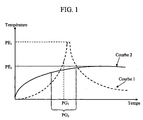
- On sait que, dans les procédés classiques, les polymérisations utilisant par exemple une amine et du peroxyde de benzoyle ont un pic exothermique, PE1, élevé comme le montre la courbe 1 de la figure 1 indiquant la température de réaction en fonction du temps et une très brève période de phase gel, PG1.
Ce type de réaction présente un pic exothermique très élevé dépassant le point d'ébullition des monomères, ce qui présente le risque de formation de bulles dans la masse du polymère. De plus ces variations brutales de températures provoquent des tensions internes.
De surcroît, dans ce cas, le polymère ne possède la texture d'un gel que sur une très brève période.
Le procédé selon l'invention permet d'étaler le pic exothermique, PE2, comme le montre la courbe 2 de la figure 1, évitant ainsi les bulles d'air et les contraintes.
En jouant sur les aldéhydes, il permet également d'allonger la durée de la phase de gel PG2, ce qui permet par exemple d'ébarber les pièces pendant qu'elles sont malléables. - L'aldéhyde utilisé conformément au procédé selon l'invention répond à la formule générale ci-après :
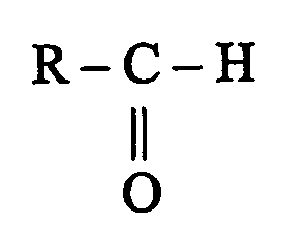
- L'invention utilise ici le processus connu qui consiste en ce que plus le radical R est donneur d'électrons, plus la formation d'un groupe hydroperoxyde in situ est favorisée, puis la présence d'un accélérateur crée des radicaux provoquant l'amorçage de la polymérisation..
- A titre d'exemple, l'aldéhyde utilisé pourra consister en l'un des aldéhydes énumérés ci-après ou en une combinaison d'au moins deux de ces aldéhydes :
- aldéhyde hydratropique (bonne réactivité)
- aldéhyde phénylacétique (réactivité moyenne)
- aldéhyde 3,7-diméthyl-2,6-octadienal (plus d'efficacité avec l'air selon les monomères utilisés)
- 3-méthoxy-4-hydroxy benzaldéhyde
- 3,4-diméthoxy benzaldéhyde
- hydroxy-2-benzaldéhyde
- aldéhyde hydratropique
- 4-hydroxy-3,5-diméthoxy benzaldéhyde (aldéhyde syringa)
- decenal-4-trans
- aldéhyde alpha hexylcinnamique
- aldéhyde undécylique (aldéhyde C11).
- L'agent fournissant du dioxygène pourra comprendre au moins un des catalyseurs énumérés dans la liste ci-après :
- eau oxygénée H2O2
- un hydroperoxyde (R - O - O - H : esters acides de l'eau oxygénée)
- PMEC (peroxyde de méthyle éthyle cétone)
- PAA (peroxyde d'acétyle acétone)
- peroxyde de cyclohexanone
- peroxybenzoate de tert-butyle
- tert-butyl peroxy isopropyl carbonate
- 2,5-bis(2-éthylhexanoyl-peroxy)-2,5-diméthylhexane
- peroxy-2-éthylhexanoate de tert-butyle
- peroxy-3,5,5-triméthylhexanoate de tert-butyle
- 1,1-bis(tert-butylperoxy)-3,3,5-triméthylcyclohexane
- peroxyde de dicumyle
- peroxydicarbonate de bis (4-tert-butylcyclohexyle)
- peroxyde de cétone
- perester.
- Comme précédemment mentionné, l'accélérateur utilisé pourra consister en tout produit pouvant décomposer un peroxyde. Il pourra comprendre par exemple un ou plusieurs des composés suivants :
- un sel métallique tel qu'un sel de vanadium, un sel de cobalt,
- un sel de potassium,
- une amine.
- Cet accélérateur pourra représenter par exemple de 0,1 % à 1,0 % de la masse du mélange.
- En fait, le processus de polymérisation conforme au procédé selon l'invention est un processus en quatre étapes, à savoir :
- Une première étape au cours de laquelle l'accélérateur réagit avec l'agent de génération d'oxygène pour produire du dioxygène O2.
- Une deuxième étape d'oxydation de l'aldéhyde grâce à l'oxygène dégagé par l'agent générateur d'oxygène et à l'oxygène éventuellement dissout ou présent en surface selon le schéma suivant :

- Une troisième étape dans laquelle l'hydroperoxyde obtenu à l'issue de la phase d'oxydation réagit avec le reste d'accélérateur pour produire un cation RCO2 • selon le schéma suivant :

Le cation RCO2 • désigné par la lettre A° ci-après possède une énergie d'activation suffisante pour initier la polymérisation du monomère vinylique ou de l'oligomère. - Une quatrième étape de polymérisation du monomère vinylique (ou de l'oligomère) selon le schéma suivant :

- Avantageusement, tous les composants utilisés dans la mise en oeuvre du procédé selon l'invention pourront se présenter en phase liquide.
- Ces produits pourront être présentés à la vente sous forme bi-composants, l'un de ces composants comprenant un agent générateur d'oxygène, un aldéhyde et un inhibiteur éventuel, tandis que l'autre pourra comprendre le monomère (ou l'oligomère) et un accélérateur.
- Des exemples de mise en oeuvre du procédé selon l'invention seront décrits ci-après.
-
- Aliphatique uréthane triacrylate 32%
- Hexanediol triacrylate 23%
- Promoteur d'adhésion triacrylate acide 7%
- Accélérateur octoate de cobalt à 6% type NL51P de AKZO 0,3%
- Peroxyde de méthyle éthyle cétone à 50 % type Butanox LPT de AKZO 1%
- Aldéhyde 3,7-diméthyl-2,6-octadienal 5%
- Aldéhyde hydratropique 3,7%
- Une fois les produits mélangés, on peut appliquer le produit ainsi obtenu au pinceau ou au pistolet. On obtiendra une polymérisation avec un film billant et non poisseux en surface.
-
- Acrylate uréthane aliphatique 17%
- Hexanediol diacrylate 40%
- Epoxyacrylate tétrafonctionnel 17%
- Triméthylolpropane triacrylate étoxylé 20%
- Accélérateur Octoate de cobalt à 6% type NL51P de la société AKZO 0,3%
- Peroxyde de méthyle éthyle cétone à 50 % type Butanox LPT de AKZO 1%
- Aldéhyde 3,7-diméthyl-2,6-octadienal 2,5%
- Aldéhyde phénacétique 2,2 %
- Une fois les produits mélangés, on peut appliquer le produit ainsi obtenu au pinceau ou au pistolet sur un support métallique. On obtiendra une polymérisation avec un film billant et non poisseux en surface, accrochant particulièrement bien sur le métal.
-
- Méthacrylate de bisphénol A 54%
- Triméthylolpropane triméthacrylate 14%
- Acrylate d'isodécyl 20%
- Dioxyde de titane 5%
- Agent tixotropant silice type aérosol 200 de Degussa 0,3%
- Accélérateur octoate de cobalt à 6% type NL51P de AKZO 0,3%
- Peroxyde de méthyle éthyle cétone à 50 % type Butanox LPT de AKZO 1%
- Aldéhyde 3,7-diméthyl-2,6-octadienal 3%
- Aldéhyde hydratropique 1%
- Une fois les produits mélangés, on peut appliquer le produit ainsi obtenu au pinceau ou au pistolet sur un moule. On obtiendra une polymérisation avec un film billant et non poisseux en surface. On pourra après appliquer un composite résine et fibre de renforcement qui accrochera parfaitement sur ce "gel coat". Après polymérisation de ce composite, on obtiendra un "gel coat" de surface de très bel aspect, résistant chimiquement et en particulier antigraffiti.
-
- Butanediol diméthacrylate 3%
- Méthyle méthacrylate 14,4%
- Polyméthylméthacrylate en poudre 2%
- Sable de fontainebleau 75%
- Agent tixotropant silice type aérosol 200 de Degussa 0,3%
- Accélérateur octoate de cobalt à 6% type NL51P de AKZO 0,3%
- Peroxyde de méthyle éthyle cétone à 50 % type Butanox LPT de AKZO 1%
- Aldéhyde 3,7-diméthyl-2,6-octadienal 3%
- Aldéhyde hydratropique 1%
- On obtient ainsi une fois les produits mélangés un béton de résine que l'on peut couler dans un moule ou étaler sur un sol industriel. On obtiendra après polymérisation un produit non poisseux en surface et de très bel aspect.
- Dans ces quatre exemples, les trois derniers produits PMEC, aldéhyde 3,7-diméthyl-2,6-octadienal et aldéhyde hydratropique ou phénacétique peuvent être pré-mélangés avec un inhibiteur type TBC tertiobutylcatécol (entre 0,01 et 1%) pour former un durcisseur stable qui sera à mélanger aux formulations précédemment indiquées.
Claims (12)
- Procédé de polymérisation de monomères vinyliques et/ou d'oligomères comportant au moins un radical vinylique,
caractérisée en ce qu'il consiste à mélanger le monomère vinylique ou l'oligomère possédant au moins un radical vinylique avec :- au moins un agent fournissant du dioxygène,- au moins un aldéhyde,- au moins un accélérateur. - Procédé selon la revendication 1,
caractérisé en ce que le susdit aldéhyde représente entre 0,1% et 15% de la masse du mélange. - Procédé selon la revendication 1,
caractérisé en ce que le susdit aldéhyde répond à la formule générale ci-après :
- Procédé selon l'une des revendications 1, 2 et 3,
caractérisé en ce que le susdit aldéhyde consiste en l'un des aldéhydes énumérés ci-après ou en une combinaison d'au moins deux de ces aldéhydes :• aldéhyde hydratropique• aldéhyde phénylacétique• aldéhyde 3,7-diméthyl-2,6-octadienal• 3-méthoxy-4-hydroxy benzaldéhyde• 3,4-diméthoxy benzaldéhyde• hydroxy-2-benzaldéhyde• aldéhyde hydratropique• 4-hydroxy-3,5-diméthoxy benzaldéhyde (aldéhyde syringa)• decenal-4-trans• aldéhyde alpha hexylcinnamique• aldéhyde undécylique (aldéhyde C11). - Procédé selon l'une des revendications précédentes,
caractérisé en ce que l'agent fournissant du dioxygène consiste en l'un des catalyseurs énumérés dans la liste ci-après :• eau oxygénée H2O2• PMEC (peroxyde de méthyle éthyle cétone)• PAA (peroxyde d'acétyle acétone)• peroxyde de cyclohexanone• peroxybenzoate de tert-butyle• tert-butyl peroxy isopropyl carbonate• 2,5-bis(2-éthylhexanoyl-peroxy)-2,5-diméthylhexane• peroxy-2-éthylhexanoate de tert-butyle• peroxy-3,5,5-triméthylhexanoate de tert-butyle• 1,1-bis(tert-butylperoxy)-3,3,5-triméthylcyclohexane• peroxyde de dicumyle• peroxydicarbonate de bis (4-tert-butylcyclohexyle)• peroxyde de cétone• perester. - Procédé selon l'une des revendications précédentes,
caractérisé en ce que le susdit accélérateur consiste en tout produit pouvant décomposer un peroxyde. - Procédé selon l'une des revendications précédentes,
caractérisé en ce que le susdit accélérateur comprend un ou plusieurs des composés suivants :• un sel métallique tel qu'un sel de vanadium, un sel de cobalt,• un sel de potassium,• une amine. - Procédé selon l'une des revendications précédentes,
caractérisé en ce que le susdit accélérateur représente de 0,1 % à 1 % de la masse du mélange. - Procédé selon l'une des revendications précédentes, caractérisé en ce qu'il comprend quatre étapes, à savoir :- Une première étape au cours de laquelle l'accélérateur réagit avec l'agent de génération d'oxygène pour produire du dioxygène O2.- Une deuxième étape d'oxydation de l'aldéhyde grâce à l'oxygène dégagé par l'agent générateur d'oxygène et à l'oxygène éventuellement dissout ou présent en surface selon le schéma suivant :
 - Une troisième étape dans laquelle l'hydroperoxyde obtenu à l'issue de la phase d'oxydation réagit avec le reste d'accélérateur pour produire un cation RCO2 + selon le schéma suivant :
 - Une quatrième étape de polymérisation du monomère vinylique (ou de l'oligomère) selon le schéma suivant :
- Procédé selon l'une des revendications précédentes,
caractérisé en ce que tous les composants utilisés se présentent en phase liquide. - Procédé selon l'une des revendications précédentes,
caractérisé en ce que les produits qu'il met en oeuvre se présentent sous une forme bi-composants. - Procédé selon la revendication 10,
caractérisé en ce que l'un des composants comprend un agent générateur d'oxygène, un aldéhyde et un inhibiteur éventuel tandis que l'autre comprend le monomère et/ou l'oligomère et un accélérateur.
Applications Claiming Priority (3)
| Application Number | Priority Date | Filing Date | Title |
|---|---|---|---|
| FR0109636 | 2001-07-17 | ||
| FR0109636A FR2827607B1 (fr) | 2001-07-17 | 2001-07-17 | Procede de polymerisation de monomeres vinyliques et/ou d'oligomeres comportant au moins un radical vinylique |
| PCT/FR2002/002517 WO2003008463A1 (fr) | 2001-07-17 | 2002-07-15 | Procede de polymerisation de monomeres vinyliques et/ou d'oligomeres comportant au moins un radical vinylique |
Publications (2)
| Publication Number | Publication Date |
|---|---|
| EP1409558A1 EP1409558A1 (fr) | 2004-04-21 |
| EP1409558B1 true EP1409558B1 (fr) | 2006-09-13 |
Family
ID=8865686
Family Applications (1)
| Application Number | Title | Priority Date | Filing Date |
|---|---|---|---|
| EP02787154A Expired - Lifetime EP1409558B1 (fr) | 2001-07-17 | 2002-07-15 | Procede de polymerisation de monomeres vinyliques et/ou d'oligomeres comportant au moins un radical vinylique |
Country Status (7)
| Country | Link |
|---|---|
| US (1) | US20040225086A1 (fr) |
| EP (1) | EP1409558B1 (fr) |
| AT (1) | ATE339454T1 (fr) |
| DE (1) | DE60214723T9 (fr) |
| ES (1) | ES2272791T3 (fr) |
| FR (1) | FR2827607B1 (fr) |
| WO (1) | WO2003008463A1 (fr) |
Families Citing this family (5)
| Publication number | Priority date | Publication date | Assignee | Title |
|---|---|---|---|---|
| FR2875505B1 (fr) * | 2004-09-21 | 2007-01-26 | Gti Process Sa | Procede de fabrication de revetements anti-graffiti |
| FR2924119B1 (fr) * | 2007-11-28 | 2012-09-28 | A Et A Mader | Composition polymerisable sous rayonnement et procede de polymerisation radicalaire d'une telle composition |
| FR3005057B1 (fr) * | 2013-04-25 | 2015-05-15 | Arkema France | Sirop liquide (meth)acrylique, son procede de polymerisation, son utilisation et objet moule obtenu a partir de celui-ci |
| FR3030547B1 (fr) | 2014-12-22 | 2018-08-17 | Arkema France | Sirop (meth)acrylique liquide, procede d'impregnation d'un substrat fibreux par ledit sirop, et materiau composite obtenu apres polymerisation dudit sirop d'impregnation |
| FR3030546B1 (fr) | 2014-12-22 | 2018-04-06 | Arkema France | Sirop (meth)acrylique liquide, procede d'impregnation d'un substrat fibreux par ledit sirop, et materiau composite obtenu apres polymerisation dudit sirop d'impregnation |
Family Cites Families (5)
| Publication number | Priority date | Publication date | Assignee | Title |
|---|---|---|---|---|
| US4196269A (en) * | 1974-06-21 | 1980-04-01 | Akzona Incorporated | Process for the preparation of a copolymerizable composition |
| JPS60120774A (ja) * | 1983-12-05 | 1985-06-28 | Okura Ind Co Ltd | 接着性と保存安定性に優れた二液型アクリル系接着剤 |
| US4886618A (en) * | 1984-07-19 | 1989-12-12 | Rohm And Haas Company | Aldehyde or imine oxygen scavengers for vinyl polymerizations |
| JPH0781115B2 (ja) * | 1988-12-29 | 1995-08-30 | カネボウ・エヌエスシー株式会社 | 二液型アクリル系接着剤組成物 |
| DE4401387A1 (de) * | 1994-01-19 | 1995-07-20 | Bayer Ag | Verfahren zur Herstellung von Vinylpolymerisatharzen |
-
2001
- 2001-07-17 FR FR0109636A patent/FR2827607B1/fr not_active Expired - Fee Related
-
2002
- 2002-07-15 WO PCT/FR2002/002517 patent/WO2003008463A1/fr not_active Ceased
- 2002-07-15 DE DE60214723T patent/DE60214723T9/de active Active
- 2002-07-15 ES ES02787154T patent/ES2272791T3/es not_active Expired - Lifetime
- 2002-07-15 EP EP02787154A patent/EP1409558B1/fr not_active Expired - Lifetime
- 2002-07-15 AT AT02787154T patent/ATE339454T1/de not_active IP Right Cessation
- 2002-07-17 US US10/484,252 patent/US20040225086A1/en not_active Abandoned
Also Published As
| Publication number | Publication date |
|---|---|
| FR2827607A1 (fr) | 2003-01-24 |
| ATE339454T1 (de) | 2006-10-15 |
| DE60214723T9 (de) | 2008-02-14 |
| FR2827607B1 (fr) | 2005-08-26 |
| ES2272791T3 (es) | 2007-05-01 |
| DE60214723T2 (de) | 2007-10-04 |
| DE60214723D1 (de) | 2006-10-26 |
| WO2003008463A1 (fr) | 2003-01-30 |
| EP1409558A1 (fr) | 2004-04-21 |
| US20040225086A1 (en) | 2004-11-11 |
Similar Documents
| Publication | Publication Date | Title |
|---|---|---|
| CA3044541A1 (fr) | Melanges d'initiateurs et compositions photodurcissables contenant de tels melanges d'initiateurs utiles pour l'impression 3d | |
| EP1409558B1 (fr) | Procede de polymerisation de monomeres vinyliques et/ou d'oligomeres comportant au moins un radical vinylique | |
| JPH04214703A (ja) | フイラー含有膨潤性ビーズ重合体 | |
| JP2005163041A (ja) | 光硬化性樹脂の製造方法 | |
| WO2016166470A1 (fr) | Procédé de réticulation duale photochimique/thermique activable sous irradiation uv/visible, et composition pour la mise en oeuvre dudit procédé | |
| Garra et al. | Charge-transfer complexes as new inhibitors/photoinitiators for on-demand amine/peroxide redox polymerization | |
| FR2546891A1 (fr) | Polymere reactif, procede pour sa preparation et son emploi | |
| JPS63203606A (ja) | 付け爪用樹脂組成物 | |
| JPH0699265B2 (ja) | 歯科用光不透過性コーテイング剤および歯科用材料のコーテイング法 | |
| JP3043692B2 (ja) | 歯科用アクリル樹脂組成物の加工方法 | |
| JP3262328B2 (ja) | 空気欠如状態で保存可能な新規のラジカル重合性多成分混合物とその使用 | |
| JP5354353B2 (ja) | 自己光重合性化合物を含有する光硬化性組成物及びその硬化方法 | |
| TW202104458A (zh) | 使用乳液製造特效色素的方法 | |
| CA2596766C (fr) | Activateur d'autopolymerisation | |
| JP3767598B2 (ja) | 塗膜形成方法 | |
| Pemberton et al. | Polymerization of vinyl acetate using visible radiation and a dye-reducing agent sensitizer: 2. Kinetic studies and polymerization mechanism | |
| JP2018127514A (ja) | 色相調整用粒子及びその製造方法、色相調整用樹脂組成物並びに色相調整用シート | |
| JPS59127761A (ja) | 表面保護層形成方法 | |
| JPH02296876A (ja) | 紫外線硬化性陰ぺい塗膜形成性組成物 | |
| EP1802711A1 (fr) | Procede de fabrication de revetements anti-graffiti | |
| EP0401385A1 (fr) | Preparation dentaire et procede de production d'une forme de poids moleculaire eleve pour utilisation dentaire | |
| JPH0680944A (ja) | 粘着テープの製造方法及び粘着テープ | |
| JPS6160603A (ja) | 可視光線硬化性歯科用組成物 | |
| JP2000017092A (ja) | ゲルコート付frp成形品の製造方法 | |
| JPS61103573A (ja) | 表面保護層形成方法 |
Legal Events
| Date | Code | Title | Description |
|---|---|---|---|
| PUAI | Public reference made under article 153(3) epc to a published international application that has entered the european phase |
Free format text: ORIGINAL CODE: 0009012 |
|
| 17P | Request for examination filed |
Effective date: 20040113 |
|
| AK | Designated contracting states |
Kind code of ref document: A1 Designated state(s): AT BE BG CH CY CZ DE DK EE ES FI FR GB GR IE IT LI LU MC NL PT SE SK TR |
|
| AX | Request for extension of the european patent |
Extension state: AL LT LV MK RO SI |
|
| 17Q | First examination report despatched |
Effective date: 20050413 |
|
| GRAP | Despatch of communication of intention to grant a patent |
Free format text: ORIGINAL CODE: EPIDOSNIGR1 |
|
| RAP1 | Party data changed (applicant data changed or rights of an application transferred) |
Owner name: GTI PROCESS |
|
| GRAS | Grant fee paid |
Free format text: ORIGINAL CODE: EPIDOSNIGR3 |
|
| GRAA | (expected) grant |
Free format text: ORIGINAL CODE: 0009210 |
|
| AK | Designated contracting states |
Kind code of ref document: B1 Designated state(s): AT BE BG CH CY CZ DE DK EE ES FI FR GB GR IE IT LI LU MC NL PT SE SK TR |
|
| PG25 | Lapsed in a contracting state [announced via postgrant information from national office to epo] |
Ref country code: IT Free format text: LAPSE BECAUSE OF FAILURE TO SUBMIT A TRANSLATION OF THE DESCRIPTION OR TO PAY THE FEE WITHIN THE PRESCRIBED TIME-LIMIT;WARNING: LAPSES OF ITALIAN PATENTS WITH EFFECTIVE DATE BEFORE 2007 MAY HAVE OCCURRED AT ANY TIME BEFORE 2007. THE CORRECT EFFECTIVE DATE MAY BE DIFFERENT FROM THE ONE RECORDED. Effective date: 20060913 Ref country code: FI Free format text: LAPSE BECAUSE OF FAILURE TO SUBMIT A TRANSLATION OF THE DESCRIPTION OR TO PAY THE FEE WITHIN THE PRESCRIBED TIME-LIMIT Effective date: 20060913 Ref country code: SK Free format text: LAPSE BECAUSE OF FAILURE TO SUBMIT A TRANSLATION OF THE DESCRIPTION OR TO PAY THE FEE WITHIN THE PRESCRIBED TIME-LIMIT Effective date: 20060913 Ref country code: CZ Free format text: LAPSE BECAUSE OF FAILURE TO SUBMIT A TRANSLATION OF THE DESCRIPTION OR TO PAY THE FEE WITHIN THE PRESCRIBED TIME-LIMIT Effective date: 20060913 Ref country code: IE Free format text: LAPSE BECAUSE OF FAILURE TO SUBMIT A TRANSLATION OF THE DESCRIPTION OR TO PAY THE FEE WITHIN THE PRESCRIBED TIME-LIMIT Effective date: 20060913 Ref country code: AT Free format text: LAPSE BECAUSE OF FAILURE TO SUBMIT A TRANSLATION OF THE DESCRIPTION OR TO PAY THE FEE WITHIN THE PRESCRIBED TIME-LIMIT Effective date: 20060913 |
|
| REG | Reference to a national code |
Ref country code: GB Ref legal event code: FG4D Free format text: NOT ENGLISH |
|
| REG | Reference to a national code |
Ref country code: CH Ref legal event code: EP |
|
| REG | Reference to a national code |
Ref country code: IE Ref legal event code: FG4D Free format text: LANGUAGE OF EP DOCUMENT: FRENCH |
|
| REF | Corresponds to: |
Ref document number: 60214723 Country of ref document: DE Date of ref document: 20061026 Kind code of ref document: P |
|
| PG25 | Lapsed in a contracting state [announced via postgrant information from national office to epo] |
Ref country code: BG Free format text: LAPSE BECAUSE OF FAILURE TO SUBMIT A TRANSLATION OF THE DESCRIPTION OR TO PAY THE FEE WITHIN THE PRESCRIBED TIME-LIMIT Effective date: 20061213 Ref country code: DK Free format text: LAPSE BECAUSE OF FAILURE TO SUBMIT A TRANSLATION OF THE DESCRIPTION OR TO PAY THE FEE WITHIN THE PRESCRIBED TIME-LIMIT Effective date: 20061213 Ref country code: SE Free format text: LAPSE BECAUSE OF FAILURE TO SUBMIT A TRANSLATION OF THE DESCRIPTION OR TO PAY THE FEE WITHIN THE PRESCRIBED TIME-LIMIT Effective date: 20061213 |
|
| REG | Reference to a national code |
Ref country code: CH Ref legal event code: NV Representative=s name: BUGNION S.A. |
|
| GBT | Gb: translation of ep patent filed (gb section 77(6)(a)/1977) |
Effective date: 20061213 |
|
| PG25 | Lapsed in a contracting state [announced via postgrant information from national office to epo] |
Ref country code: PT Free format text: LAPSE BECAUSE OF FAILURE TO SUBMIT A TRANSLATION OF THE DESCRIPTION OR TO PAY THE FEE WITHIN THE PRESCRIBED TIME-LIMIT Effective date: 20070226 |
|
| REG | Reference to a national code |
Ref country code: IE Ref legal event code: FD4D |
|
| REG | Reference to a national code |
Ref country code: ES Ref legal event code: FG2A Ref document number: 2272791 Country of ref document: ES Kind code of ref document: T3 |
|
| PLBE | No opposition filed within time limit |
Free format text: ORIGINAL CODE: 0009261 |
|
| STAA | Information on the status of an ep patent application or granted ep patent |
Free format text: STATUS: NO OPPOSITION FILED WITHIN TIME LIMIT |
|
| 26N | No opposition filed |
Effective date: 20070614 |
|
| PG25 | Lapsed in a contracting state [announced via postgrant information from national office to epo] |
Ref country code: GR Free format text: LAPSE BECAUSE OF FAILURE TO SUBMIT A TRANSLATION OF THE DESCRIPTION OR TO PAY THE FEE WITHIN THE PRESCRIBED TIME-LIMIT Effective date: 20061214 |
|
| PG25 | Lapsed in a contracting state [announced via postgrant information from national office to epo] |
Ref country code: EE Free format text: LAPSE BECAUSE OF FAILURE TO SUBMIT A TRANSLATION OF THE DESCRIPTION OR TO PAY THE FEE WITHIN THE PRESCRIBED TIME-LIMIT Effective date: 20060913 |
|
| REG | Reference to a national code |
Ref country code: CH Ref legal event code: NV Representative=s name: CABINET MOUTARD |
|
| PG25 | Lapsed in a contracting state [announced via postgrant information from national office to epo] |
Ref country code: CY Free format text: LAPSE BECAUSE OF FAILURE TO SUBMIT A TRANSLATION OF THE DESCRIPTION OR TO PAY THE FEE WITHIN THE PRESCRIBED TIME-LIMIT Effective date: 20060913 |
|
| PG25 | Lapsed in a contracting state [announced via postgrant information from national office to epo] |
Ref country code: TR Free format text: LAPSE BECAUSE OF FAILURE TO SUBMIT A TRANSLATION OF THE DESCRIPTION OR TO PAY THE FEE WITHIN THE PRESCRIBED TIME-LIMIT Effective date: 20060913 |
|
| REG | Reference to a national code |
Ref country code: CH Ref legal event code: PFA Owner name: GTI PROCESS Free format text: GTI PROCESS#1 PARC D'ACTIVITE DES QUATRE CHEMINS BP 24#95 540 MERY SUR OISE (FR) -TRANSFER TO- GTI PROCESS#1 PARC D'ACTIVITE DES QUATRE CHEMINS BP 24#95 540 MERY SUR OISE (FR) |
|
| REG | Reference to a national code |
Ref country code: CH Ref legal event code: PCAR Free format text: NEW ADDRESS: RUE DE LYON 75 - 4EME ETAGE, 1203 GENEVE (CH) |
|
| REG | Reference to a national code |
Ref country code: FR Ref legal event code: PLFP Year of fee payment: 15 |
|
| REG | Reference to a national code |
Ref country code: CH Ref legal event code: PCAR Free format text: NEW ADDRESS: BOULEVARD GEORGES-FAVON 3 (1ER ETAGE), 1204 GENEVE (CH) |
|
| REG | Reference to a national code |
Ref country code: FR Ref legal event code: PLFP Year of fee payment: 16 |
|
| REG | Reference to a national code |
Ref country code: CH Ref legal event code: NV Representative=s name: P&TS SA, CH |
|
| REG | Reference to a national code |
Ref country code: FR Ref legal event code: PLFP Year of fee payment: 17 |
|
| PGFP | Annual fee paid to national office [announced via postgrant information from national office to epo] |
Ref country code: LU Payment date: 20210617 Year of fee payment: 20 Ref country code: MC Payment date: 20210623 Year of fee payment: 20 Ref country code: NL Payment date: 20210615 Year of fee payment: 20 |
|
| PGFP | Annual fee paid to national office [announced via postgrant information from national office to epo] |
Ref country code: FR Payment date: 20210721 Year of fee payment: 20 Ref country code: IT Payment date: 20210707 Year of fee payment: 20 |
|
| PGFP | Annual fee paid to national office [announced via postgrant information from national office to epo] |
Ref country code: ES Payment date: 20210812 Year of fee payment: 20 Ref country code: GB Payment date: 20210720 Year of fee payment: 20 Ref country code: CH Payment date: 20210722 Year of fee payment: 20 Ref country code: DE Payment date: 20210712 Year of fee payment: 20 Ref country code: BE Payment date: 20210726 Year of fee payment: 20 |
|
| REG | Reference to a national code |
Ref country code: DE Ref legal event code: R071 Ref document number: 60214723 Country of ref document: DE Ref country code: CH Ref legal event code: PL |
|
| REG | Reference to a national code |
Ref country code: NL Ref legal event code: MK Effective date: 20220714 |
|
| REG | Reference to a national code |
Ref country code: ES Ref legal event code: FD2A Effective date: 20220727 |
|
| REG | Reference to a national code |
Ref country code: BE Ref legal event code: MK Effective date: 20220715 |
|
| REG | Reference to a national code |
Ref country code: GB Ref legal event code: PE20 Expiry date: 20220714 |
|
| PG25 | Lapsed in a contracting state [announced via postgrant information from national office to epo] |
Ref country code: GB Free format text: LAPSE BECAUSE OF EXPIRATION OF PROTECTION Effective date: 20220714 Ref country code: ES Free format text: LAPSE BECAUSE OF EXPIRATION OF PROTECTION Effective date: 20220716 |