EP1539766B1 - Antagonistes des recepteurs du peptide relie au gene de la calcitonine - Google Patents
Antagonistes des recepteurs du peptide relie au gene de la calcitonine Download PDFInfo
- Publication number
- EP1539766B1 EP1539766B1 EP03736721.6A EP03736721A EP1539766B1 EP 1539766 B1 EP1539766 B1 EP 1539766B1 EP 03736721 A EP03736721 A EP 03736721A EP 1539766 B1 EP1539766 B1 EP 1539766B1
- Authority
- EP
- European Patent Office
- Prior art keywords
- oxo
- dihydro
- piperidine
- indazol
- quinazolin
- Prior art date
- Legal status (The legal status is an assumption and is not a legal conclusion. Google has not performed a legal analysis and makes no representation as to the accuracy of the status listed.)
- Expired - Lifetime
Links
- 0 CN(CCCCC=C(*)CN1)C1O Chemical compound CN(CCCCC=C(*)CN1)C1O 0.000 description 5
- WSRSOQFIMLOIJK-DHUJRADRSA-N C#[N][C@](CC(N(CC1)CCC1N(Cc1ccccc1N1)C1=O)=O)(C(N(CC1)CCC1N1CCCCC1)=O)NC(c1cc(Cl)ccc1)=O Chemical compound C#[N][C@](CC(N(CC1)CCC1N(Cc1ccccc1N1)C1=O)=O)(C(N(CC1)CCC1N1CCCCC1)=O)NC(c1cc(Cl)ccc1)=O WSRSOQFIMLOIJK-DHUJRADRSA-N 0.000 description 1
- GTWXOHSKPXCUGP-JAVCKPHESA-N CC(C)(C[C@@H](C(OC)=O)N)CNC(N)OC Chemical compound CC(C)(C[C@@H](C(OC)=O)N)CNC(N)OC GTWXOHSKPXCUGP-JAVCKPHESA-N 0.000 description 1
- RIHCBSBHAIUEKV-AAWPKVBNSA-N CC(C)CN(C/C(/[C@@H]1OC1)=C\N(C)C)COC(C)(C)C Chemical compound CC(C)CN(C/C(/[C@@H]1OC1)=C\N(C)C)COC(C)(C)C RIHCBSBHAIUEKV-AAWPKVBNSA-N 0.000 description 1
- ABMZUPVCLLYGAJ-UHFFFAOYSA-N CCOC(C(CC(N(CC1)CCC1N(Cc1ccccc1N1)C1=O)=O)Nc1ccc2[nH]ncc2c1)=O Chemical compound CCOC(C(CC(N(CC1)CCC1N(Cc1ccccc1N1)C1=O)=O)Nc1ccc2[nH]ncc2c1)=O ABMZUPVCLLYGAJ-UHFFFAOYSA-N 0.000 description 1
- JZLNWJMMMDUFSA-HKBQPEDESA-N CCOc(cccc1)c1NC(N[C@@H](CC(N(CC1)CCC1N(Cc(cccc1)c1N1)C1=O)=O)C(N(CC1)CCC1N1CCCCC1)=O)=O Chemical compound CCOc(cccc1)c1NC(N[C@@H](CC(N(CC1)CCC1N(Cc(cccc1)c1N1)C1=O)=O)C(N(CC1)CCC1N1CCCCC1)=O)=O JZLNWJMMMDUFSA-HKBQPEDESA-N 0.000 description 1
- YARYXDAAKZHQDQ-UHFFFAOYSA-N COC(C(Cc(cc1)cc(cc2)c1[n]2S(CC[SiH-](C)(C)C)(=O)=O)NC(OCc1ccccc1)=O)=O Chemical compound COC(C(Cc(cc1)cc(cc2)c1[n]2S(CC[SiH-](C)(C)C)(=O)=O)NC(OCc1ccccc1)=O)=O YARYXDAAKZHQDQ-UHFFFAOYSA-N 0.000 description 1
- BJHPGDJZNITPHG-UHFFFAOYSA-N COC(C(Cc(cc1)cc(cn2)c1[n]2S(CC[SiH-](C)(C)C)(=O)=O)NC(OCc1ccccc1)=O)=O Chemical compound COC(C(Cc(cc1)cc(cn2)c1[n]2S(CC[SiH-](C)(C)C)(=O)=O)NC(OCc1ccccc1)=O)=O BJHPGDJZNITPHG-UHFFFAOYSA-N 0.000 description 1
- RUJNOFDNYSMIFF-UHFFFAOYSA-N COC(C(Cc(cn1)ccc1OCc1ccccc1)N)=O Chemical compound COC(C(Cc(cn1)ccc1OCc1ccccc1)N)=O RUJNOFDNYSMIFF-UHFFFAOYSA-N 0.000 description 1
- JGDPXZCTXIMPTA-CXTNFCFCSA-N C[C@@H]([C@H](CCN1CC(C(OC)=O)N(C(OC(C)(C)C)=O)C(OC(C)(C)C)=O)OCC2[C@@H](C)CCCCC2)C1[IH]O Chemical compound C[C@@H]([C@H](CCN1CC(C(OC)=O)N(C(OC(C)(C)C)=O)C(OC(C)(C)C)=O)OCC2[C@@H](C)CCCCC2)C1[IH]O JGDPXZCTXIMPTA-CXTNFCFCSA-N 0.000 description 1
- NIZIWHXLSAONLL-UHFFFAOYSA-N C[Si](C)(C)CCS([n](cc1)c2c1cc(CC(C(O)=O)NC(N(CC1)CCC1N(c(cccc1)c1N1)C1=O)=O)cc2)(=O)=O Chemical compound C[Si](C)(C)CCS([n](cc1)c2c1cc(CC(C(O)=O)NC(N(CC1)CCC1N(c(cccc1)c1N1)C1=O)=O)cc2)(=O)=O NIZIWHXLSAONLL-UHFFFAOYSA-N 0.000 description 1
- DUCLIWFVLBXRTO-UHFFFAOYSA-N Cc1c2[nH]ncc2cc(CC(C(O)=O)NC(N(CC2)CCC22N=C(c3ccccc3)NC2=O)=O)c1 Chemical compound Cc1c2[nH]ncc2cc(CC(C(O)=O)NC(N(CC2)CCC22N=C(c3ccccc3)NC2=O)=O)c1 DUCLIWFVLBXRTO-UHFFFAOYSA-N 0.000 description 1
- RECUNMSCXPOHDT-UHFFFAOYSA-N Cc1c2[nH]ncc2cc(CC(C(OC)=O)NC(N(CC2)CCC22N=C(c3ccccc3)NC2=O)=O)c1 Chemical compound Cc1c2[nH]ncc2cc(CC(C(OC)=O)NC(N(CC2)CCC22N=C(c3ccccc3)NC2=O)=O)c1 RECUNMSCXPOHDT-UHFFFAOYSA-N 0.000 description 1
- GZTMXLOVEPOPNX-UHFFFAOYSA-N Cc1cc(CC(C(N(C)C)=O)NC(N(CC2)CCC2(c(cccc2)c2N2)OC2=O)=O)cc2c1[nH]nc2 Chemical compound Cc1cc(CC(C(N(C)C)=O)NC(N(CC2)CCC2(c(cccc2)c2N2)OC2=O)=O)cc2c1[nH]nc2 GZTMXLOVEPOPNX-UHFFFAOYSA-N 0.000 description 1
- IQSRPQLSDHXAIZ-UHFFFAOYSA-N Clc1c2[nH]ncc2cc(Br)c1 Chemical compound Clc1c2[nH]ncc2cc(Br)c1 IQSRPQLSDHXAIZ-UHFFFAOYSA-N 0.000 description 1
- ZYODBVFKHMXORT-UHFFFAOYSA-N O=C(C(Cc(cc1)cnc1OCc1ccccc1)NC(N(CC1)CCC1N(Cc(cccc1)c1N1)C1=O)=O)N(CC1)CCC1N1CCCCC1 Chemical compound O=C(C(Cc(cc1)cnc1OCc1ccccc1)NC(N(CC1)CCC1N(Cc(cccc1)c1N1)C1=O)=O)N(CC1)CCC1N1CCCCC1 ZYODBVFKHMXORT-UHFFFAOYSA-N 0.000 description 1
- IGMSWNYDGFNYAI-UHFFFAOYSA-N O=C(C(Cc(cc1O2)cc(Cl)c1NC2=O)NC(N(CC1)CCC1N(Cc(cccc1)c1N1)C1=O)=O)N(CC1)CCC1N1CCCCC1 Chemical compound O=C(C(Cc(cc1O2)cc(Cl)c1NC2=O)NC(N(CC1)CCC1N(Cc(cccc1)c1N1)C1=O)=O)N(CC1)CCC1N1CCCCC1 IGMSWNYDGFNYAI-UHFFFAOYSA-N 0.000 description 1
- DSBOAKUVARGLEG-UHFFFAOYSA-N O=C(C(Cc(cc1O2)cc(Cl)c1NC2=O)NC(N(CC1)CCC1N(Cc(cccc1)c1N1)C1=O)=O)N1CCCCC1 Chemical compound O=C(C(Cc(cc1O2)cc(Cl)c1NC2=O)NC(N(CC1)CCC1N(Cc(cccc1)c1N1)C1=O)=O)N1CCCCC1 DSBOAKUVARGLEG-UHFFFAOYSA-N 0.000 description 1
- GCXINXNLNNHOGR-UHFFFAOYSA-N O=C(C(Cc1ccc2[nH]ncc2c1)NC(N(CC1)CCC1N(Cc1ccccc1N1)C1=O)=O)N1CCN(Cc2ccc[nH]2)CC1 Chemical compound O=C(C(Cc1ccc2[nH]ncc2c1)NC(N(CC1)CCC1N(Cc1ccccc1N1)C1=O)=O)N1CCN(Cc2ccc[nH]2)CC1 GCXINXNLNNHOGR-UHFFFAOYSA-N 0.000 description 1
- JOYCCBMWJIETFJ-MHZLTWQESA-N O=C(C[C@@H](C(N(CC1)CCC1N1CCCCC1)=O)NC(C1CC1)=O)N(CC1)CCC1N(Cc(cccc1)c1N1)C1=O Chemical compound O=C(C[C@@H](C(N(CC1)CCC1N1CCCCC1)=O)NC(C1CC1)=O)N(CC1)CCC1N(Cc(cccc1)c1N1)C1=O JOYCCBMWJIETFJ-MHZLTWQESA-N 0.000 description 1
- SSLBTEPHYMRJBN-SIABPNFTSA-N O=C(C[C@@H](C(N(CC1)CCC1N1CCCCC1)=O)NC(N[C@H](C1)[C@@H]1c1ccccc1)=O)N(CC1)CCC1N(Cc1ccccc1N1)C1=O Chemical compound O=C(C[C@@H](C(N(CC1)CCC1N1CCCCC1)=O)NC(N[C@H](C1)[C@@H]1c1ccccc1)=O)N(CC1)CCC1N(Cc1ccccc1N1)C1=O SSLBTEPHYMRJBN-SIABPNFTSA-N 0.000 description 1
- NFBPXKCJHMRWLD-BHVANESWSA-N O=C(C[C@@H](C(N(CC1)CCC1N1CCCCC1)=O)NC(Nc(cc1)ccc1-c1ccccc1)=O)N(CC1)CCC1N(Cc(cccc1)c1N1)C1=O Chemical compound O=C(C[C@@H](C(N(CC1)CCC1N1CCCCC1)=O)NC(Nc(cc1)ccc1-c1ccccc1)=O)N(CC1)CCC1N(Cc(cccc1)c1N1)C1=O NFBPXKCJHMRWLD-BHVANESWSA-N 0.000 description 1
- IJGGGJDIXLCMHL-AKWYTYQQSA-N O=CC(CN(CC1)CCC1N(Cc1ccccc1N1)C1=O)[C@@H](C(N(CC1)CCC1N1CCCCC1)=O)NC(Nc(cc1)ccc1Cl)=O Chemical compound O=CC(CN(CC1)CCC1N(Cc1ccccc1N1)C1=O)[C@@H](C(N(CC1)CCC1N1CCCCC1)=O)NC(Nc(cc1)ccc1Cl)=O IJGGGJDIXLCMHL-AKWYTYQQSA-N 0.000 description 1
- PNHKKQFBBOHSLY-FVEFLQRYSA-N OC(CC1)CCC1NC[C@@H](CC(N(CC1)CCC1N(Cc1ccccc1N1)C1=O)=O)C(N(CC1)CCC1N1CCCCC1)=O Chemical compound OC(CC1)CCC1NC[C@@H](CC(N(CC1)CCC1N(Cc1ccccc1N1)C1=O)=O)C(N(CC1)CCC1N1CCCCC1)=O PNHKKQFBBOHSLY-FVEFLQRYSA-N 0.000 description 1
Images


Classifications
-
- A—HUMAN NECESSITIES
- A01—AGRICULTURE; FORESTRY; ANIMAL HUSBANDRY; HUNTING; TRAPPING; FISHING
- A01K—ANIMAL HUSBANDRY; AVICULTURE; APICULTURE; PISCICULTURE; FISHING; REARING OR BREEDING ANIMALS, NOT OTHERWISE PROVIDED FOR; NEW BREEDS OF ANIMALS
- A01K67/00—Rearing or breeding animals, not otherwise provided for; New or modified breeds of animals
- A01K67/027—New or modified breeds of vertebrates
- A01K67/0275—Genetically modified vertebrates, e.g. transgenic
-
- A—HUMAN NECESSITIES
- A61—MEDICAL OR VETERINARY SCIENCE; HYGIENE
- A61K—PREPARATIONS FOR MEDICAL, DENTAL OR TOILETRY PURPOSES
- A61K49/00—Preparations for testing in vivo
- A61K49/0004—Screening or testing of compounds for diagnosis of disorders, assessment of conditions, e.g. renal clearance, gastric emptying, testing for diabetes, allergy, rheuma, pancreas functions
- A61K49/0008—Screening agents using (non-human) animal models or transgenic animal models or chimeric hosts, e.g. Alzheimer disease animal model, transgenic model for heart failure
-
- A—HUMAN NECESSITIES
- A61—MEDICAL OR VETERINARY SCIENCE; HYGIENE
- A61P—SPECIFIC THERAPEUTIC ACTIVITY OF CHEMICAL COMPOUNDS OR MEDICINAL PREPARATIONS
- A61P11/00—Drugs for disorders of the respiratory system
-
- A—HUMAN NECESSITIES
- A61—MEDICAL OR VETERINARY SCIENCE; HYGIENE
- A61P—SPECIFIC THERAPEUTIC ACTIVITY OF CHEMICAL COMPOUNDS OR MEDICINAL PREPARATIONS
- A61P11/00—Drugs for disorders of the respiratory system
- A61P11/06—Antiasthmatics
-
- A—HUMAN NECESSITIES
- A61—MEDICAL OR VETERINARY SCIENCE; HYGIENE
- A61P—SPECIFIC THERAPEUTIC ACTIVITY OF CHEMICAL COMPOUNDS OR MEDICINAL PREPARATIONS
- A61P15/00—Drugs for genital or sexual disorders; Contraceptives
- A61P15/12—Drugs for genital or sexual disorders; Contraceptives for climacteric disorders
-
- A—HUMAN NECESSITIES
- A61—MEDICAL OR VETERINARY SCIENCE; HYGIENE
- A61P—SPECIFIC THERAPEUTIC ACTIVITY OF CHEMICAL COMPOUNDS OR MEDICINAL PREPARATIONS
- A61P17/00—Drugs for dermatological disorders
-
- A—HUMAN NECESSITIES
- A61—MEDICAL OR VETERINARY SCIENCE; HYGIENE
- A61P—SPECIFIC THERAPEUTIC ACTIVITY OF CHEMICAL COMPOUNDS OR MEDICINAL PREPARATIONS
- A61P25/00—Drugs for disorders of the nervous system
-
- A—HUMAN NECESSITIES
- A61—MEDICAL OR VETERINARY SCIENCE; HYGIENE
- A61P—SPECIFIC THERAPEUTIC ACTIVITY OF CHEMICAL COMPOUNDS OR MEDICINAL PREPARATIONS
- A61P25/00—Drugs for disorders of the nervous system
- A61P25/04—Centrally acting analgesics, e.g. opioids
-
- A—HUMAN NECESSITIES
- A61—MEDICAL OR VETERINARY SCIENCE; HYGIENE
- A61P—SPECIFIC THERAPEUTIC ACTIVITY OF CHEMICAL COMPOUNDS OR MEDICINAL PREPARATIONS
- A61P25/00—Drugs for disorders of the nervous system
- A61P25/06—Antimigraine agents
-
- A—HUMAN NECESSITIES
- A61—MEDICAL OR VETERINARY SCIENCE; HYGIENE
- A61P—SPECIFIC THERAPEUTIC ACTIVITY OF CHEMICAL COMPOUNDS OR MEDICINAL PREPARATIONS
- A61P29/00—Non-central analgesic, antipyretic or antiinflammatory agents, e.g. antirheumatic agents; Non-steroidal antiinflammatory drugs [NSAID]
-
- A—HUMAN NECESSITIES
- A61—MEDICAL OR VETERINARY SCIENCE; HYGIENE
- A61P—SPECIFIC THERAPEUTIC ACTIVITY OF CHEMICAL COMPOUNDS OR MEDICINAL PREPARATIONS
- A61P9/00—Drugs for disorders of the cardiovascular system
-
- C—CHEMISTRY; METALLURGY
- C07—ORGANIC CHEMISTRY
- C07D—HETEROCYCLIC COMPOUNDS
- C07D401/00—Heterocyclic compounds containing two or more hetero rings, having nitrogen atoms as the only ring hetero atoms, at least one ring being a six-membered ring with only one nitrogen atom
- C07D401/14—Heterocyclic compounds containing two or more hetero rings, having nitrogen atoms as the only ring hetero atoms, at least one ring being a six-membered ring with only one nitrogen atom containing three or more hetero rings
-
- C—CHEMISTRY; METALLURGY
- C07—ORGANIC CHEMISTRY
- C07D—HETEROCYCLIC COMPOUNDS
- C07D405/00—Heterocyclic compounds containing both one or more hetero rings having oxygen atoms as the only ring hetero atoms, and one or more rings having nitrogen as the only ring hetero atom
- C07D405/14—Heterocyclic compounds containing both one or more hetero rings having oxygen atoms as the only ring hetero atoms, and one or more rings having nitrogen as the only ring hetero atom containing three or more hetero rings
-
- C—CHEMISTRY; METALLURGY
- C07—ORGANIC CHEMISTRY
- C07D—HETEROCYCLIC COMPOUNDS
- C07D409/00—Heterocyclic compounds containing two or more hetero rings, at least one ring having sulfur atoms as the only ring hetero atoms
- C07D409/14—Heterocyclic compounds containing two or more hetero rings, at least one ring having sulfur atoms as the only ring hetero atoms containing three or more hetero rings
-
- C—CHEMISTRY; METALLURGY
- C07—ORGANIC CHEMISTRY
- C07D—HETEROCYCLIC COMPOUNDS
- C07D471/00—Heterocyclic compounds containing nitrogen atoms as the only ring hetero atoms in the condensed system, at least one ring being a six-membered ring with one nitrogen atom, not provided for by groups C07D451/00 - C07D463/00
- C07D471/02—Heterocyclic compounds containing nitrogen atoms as the only ring hetero atoms in the condensed system, at least one ring being a six-membered ring with one nitrogen atom, not provided for by groups C07D451/00 - C07D463/00 in which the condensed system contains two hetero rings
- C07D471/10—Spiro-condensed systems
-
- C—CHEMISTRY; METALLURGY
- C07—ORGANIC CHEMISTRY
- C07D—HETEROCYCLIC COMPOUNDS
- C07D487/00—Heterocyclic compounds containing nitrogen atoms as the only ring hetero atoms in the condensed system, not provided for by groups C07D451/00 - C07D477/00
- C07D487/02—Heterocyclic compounds containing nitrogen atoms as the only ring hetero atoms in the condensed system, not provided for by groups C07D451/00 - C07D477/00 in which the condensed system contains two hetero rings
- C07D487/04—Ortho-condensed systems
-
- C—CHEMISTRY; METALLURGY
- C07—ORGANIC CHEMISTRY
- C07D—HETEROCYCLIC COMPOUNDS
- C07D487/00—Heterocyclic compounds containing nitrogen atoms as the only ring hetero atoms in the condensed system, not provided for by groups C07D451/00 - C07D477/00
- C07D487/12—Heterocyclic compounds containing nitrogen atoms as the only ring hetero atoms in the condensed system, not provided for by groups C07D451/00 - C07D477/00 in which the condensed system contains three hetero rings
- C07D487/14—Ortho-condensed systems
-
- C—CHEMISTRY; METALLURGY
- C07—ORGANIC CHEMISTRY
- C07D—HETEROCYCLIC COMPOUNDS
- C07D487/00—Heterocyclic compounds containing nitrogen atoms as the only ring hetero atoms in the condensed system, not provided for by groups C07D451/00 - C07D477/00
- C07D487/12—Heterocyclic compounds containing nitrogen atoms as the only ring hetero atoms in the condensed system, not provided for by groups C07D451/00 - C07D477/00 in which the condensed system contains three hetero rings
- C07D487/20—Spiro-condensed systems
-
- C—CHEMISTRY; METALLURGY
- C07—ORGANIC CHEMISTRY
- C07D—HETEROCYCLIC COMPOUNDS
- C07D491/00—Heterocyclic compounds containing in the condensed ring system both one or more rings having oxygen atoms as the only ring hetero atoms and one or more rings having nitrogen atoms as the only ring hetero atoms, not provided for by groups C07D451/00 - C07D459/00, C07D463/00, C07D477/00 or C07D489/00
- C07D491/02—Heterocyclic compounds containing in the condensed ring system both one or more rings having oxygen atoms as the only ring hetero atoms and one or more rings having nitrogen atoms as the only ring hetero atoms, not provided for by groups C07D451/00 - C07D459/00, C07D463/00, C07D477/00 or C07D489/00 in which the condensed system contains two hetero rings
- C07D491/10—Spiro-condensed systems
-
- C—CHEMISTRY; METALLURGY
- C12—BIOCHEMISTRY; BEER; SPIRITS; WINE; VINEGAR; MICROBIOLOGY; ENZYMOLOGY; MUTATION OR GENETIC ENGINEERING
- C12N—MICROORGANISMS OR ENZYMES; COMPOSITIONS THEREOF; PROPAGATING, PRESERVING, OR MAINTAINING MICROORGANISMS; MUTATION OR GENETIC ENGINEERING; CULTURE MEDIA
- C12N15/00—Mutation or genetic engineering; DNA or RNA concerning genetic engineering, vectors, e.g. plasmids, or their isolation, preparation or purification; Use of hosts therefor
- C12N15/09—Recombinant DNA-technology
- C12N15/63—Introduction of foreign genetic material using vectors; Vectors; Use of hosts therefor; Regulation of expression
- C12N15/79—Vectors or expression systems specially adapted for eukaryotic hosts
- C12N15/85—Vectors or expression systems specially adapted for eukaryotic hosts for animal cells
- C12N15/8509—Vectors or expression systems specially adapted for eukaryotic hosts for animal cells for producing genetically modified animals, e.g. transgenic
-
- G—PHYSICS
- G01—MEASURING; TESTING
- G01N—INVESTIGATING OR ANALYSING MATERIALS BY DETERMINING THEIR CHEMICAL OR PHYSICAL PROPERTIES
- G01N33/00—Investigating or analysing materials by specific methods not covered by groups G01N1/00 - G01N31/00
- G01N33/48—Biological material, e.g. blood, urine; Haemocytometers
- G01N33/50—Chemical analysis of biological material, e.g. blood, urine; Testing involving biospecific ligand binding methods; Immunological testing
- G01N33/53—Immunoassay; Biospecific binding assay; Materials therefor
- G01N33/566—Immunoassay; Biospecific binding assay; Materials therefor using specific carrier or receptor proteins as ligand binding reagents where possible specific carrier or receptor proteins are classified with their target compounds
-
- A—HUMAN NECESSITIES
- A01—AGRICULTURE; FORESTRY; ANIMAL HUSBANDRY; HUNTING; TRAPPING; FISHING
- A01K—ANIMAL HUSBANDRY; AVICULTURE; APICULTURE; PISCICULTURE; FISHING; REARING OR BREEDING ANIMALS, NOT OTHERWISE PROVIDED FOR; NEW BREEDS OF ANIMALS
- A01K2207/00—Modified animals
- A01K2207/15—Humanized animals
-
- A—HUMAN NECESSITIES
- A01—AGRICULTURE; FORESTRY; ANIMAL HUSBANDRY; HUNTING; TRAPPING; FISHING
- A01K—ANIMAL HUSBANDRY; AVICULTURE; APICULTURE; PISCICULTURE; FISHING; REARING OR BREEDING ANIMALS, NOT OTHERWISE PROVIDED FOR; NEW BREEDS OF ANIMALS
- A01K2217/00—Genetically modified animals
-
- A—HUMAN NECESSITIES
- A01—AGRICULTURE; FORESTRY; ANIMAL HUSBANDRY; HUNTING; TRAPPING; FISHING
- A01K—ANIMAL HUSBANDRY; AVICULTURE; APICULTURE; PISCICULTURE; FISHING; REARING OR BREEDING ANIMALS, NOT OTHERWISE PROVIDED FOR; NEW BREEDS OF ANIMALS
- A01K2217/00—Genetically modified animals
- A01K2217/05—Animals comprising random inserted nucleic acids (transgenic)
-
- A—HUMAN NECESSITIES
- A01—AGRICULTURE; FORESTRY; ANIMAL HUSBANDRY; HUNTING; TRAPPING; FISHING
- A01K—ANIMAL HUSBANDRY; AVICULTURE; APICULTURE; PISCICULTURE; FISHING; REARING OR BREEDING ANIMALS, NOT OTHERWISE PROVIDED FOR; NEW BREEDS OF ANIMALS
- A01K2227/00—Animals characterised by species
- A01K2227/10—Mammal
- A01K2227/106—Primate
-
- A—HUMAN NECESSITIES
- A01—AGRICULTURE; FORESTRY; ANIMAL HUSBANDRY; HUNTING; TRAPPING; FISHING
- A01K—ANIMAL HUSBANDRY; AVICULTURE; APICULTURE; PISCICULTURE; FISHING; REARING OR BREEDING ANIMALS, NOT OTHERWISE PROVIDED FOR; NEW BREEDS OF ANIMALS
- A01K2267/00—Animals characterised by purpose
- A01K2267/03—Animal model, e.g. for test or diseases
- A01K2267/0306—Animal model for genetic diseases
-
- G—PHYSICS
- G01—MEASURING; TESTING
- G01N—INVESTIGATING OR ANALYSING MATERIALS BY DETERMINING THEIR CHEMICAL OR PHYSICAL PROPERTIES
- G01N2500/00—Screening for compounds of potential therapeutic value
- G01N2500/10—Screening for compounds of potential therapeutic value involving cells
-
- G—PHYSICS
- G01—MEASURING; TESTING
- G01N—INVESTIGATING OR ANALYSING MATERIALS BY DETERMINING THEIR CHEMICAL OR PHYSICAL PROPERTIES
- G01N2800/00—Detection or diagnosis of diseases
- G01N2800/28—Neurological disorders
- G01N2800/2807—Headache; Migraine
Definitions
- the present invention relates to novel small molecule antagonists of calcitonin gene-related peptide receptors ("CGRP-receptor”), pharmaceutical compositions comprising them, methods for identifying them, their use in methods of treatment and their use in therapy for treatment of migraine and other conditions the treatment of which can be effected by the antagonism of CGRP-receptors.
- CGRP-receptor novel small molecule antagonists of calcitonin gene-related peptide receptors
- Calcitonin gene-related peptide is a naturally occurring 37-amino-acid peptide first identified in 1982 ( Amara, S. G. et al, Science 1982, 298, 240-244 ). Two forms of the peptide are expressed ( ⁇ CGRP and ⁇ CGRP) which differ by one and three amino acids in rats and humans, respectively.
- the peptide is widely distributed in both the peripheral (PNS) and central nervous system (CNS), principally localized in sensory afferent and central neurons, and displays a number of biological effects, including vasodilation.
- CGRP When released from the cell, CGRP binds to specific cell surface G protein-coupled receptors and exerts its biological action predominantly by activation of intracellular adenylate cyclase ( Poyner, D. R. et al, Br J Pharmacol 1992, 105, 441-7 ; Van Valen, F. et al, Neurosci Lett 1990, 119, 195-8 .).
- Two classes of CGRP receptors, CGRP 1 and CGRP 2 have been proposed based on the antagonist properties of the peptide fragment CGRP(8-37) and the ability of linear analogues of CGRP to activate CGRP 2 receptors ( Juaneda, C. et al. TiPS 2000, 21, 432-438 ).
- the CGRP 1 receptor has three components: (i) a 7 transmembrane calcitonin receptor-like receptor (CRLR); (ii) the single transmembrane receptor activity modifying protein type one (RAMP1); and (iii) the intracellular receptor component protein (RCP) ( Evans B. N. et al., J Biol Chem. 2000, 275, 31438-43 ).
- RAMP1 is required for transport of CRLR to the plasma membrane and for ligand binding to the CGRP-receptor ( McLatchie, L. M.
- RCP is required for signal transduction ( Evans B. N. et al., J Biol Chem. 2000, 275, 31438-43 ).
- RAMP1 The amino acid sequence of RAMP1 determines the species selectivity, in particular, the amino acid residue Trp74 is responsible for the phenotype of the human receptor ( Mallee et al. J Biol Chem 2002, 277, 14294-8 ).
- Inhibitors at the receptor level to CGRP are postulated to be useful in pathophysiologic conditions where excessive CGRP receptor activation has occurred. Some of these include neurogenic vasodilation, neurogenic inflammation, migraine, cluster headache and other headaches, thermal injury, circulatory shock, menopausal flushing, and asthma. CGRP receptor activation has been implicated in the pathogenesis of migraine headache ( Edvinsson L. CNS Drugs 2001;15(10):745-53 ; Williamson, D. J. Microsc. Res. Tech. 2001, 53, 167-178 .; Grant, A. D. Brit. J. Pharmacol. 2002, 135, 356-362 .).
- Serum levels of CGRP are elevated during migraine ( Goadsby PJ, et al. Ann Neurol 1990;28:183-7 ) and treatment with anti-migraine drugs returns CGRP levels to normal coincident with alleviation of headache ( Gallai V. et al. Cephalalgia 1995;15: 384-90 ).
- Migraineurs exhibit elevated basal CGRP levels compared to controls ( Ashina M, et al., Pain. 2000;86(1-2): 133-8.2000 ).
- Intravenous CGRP infusion produces lasting headache in migraineurs ( Lassen LH, et al. Cephalalgia. 2002 Feb;22(1):54-61 ).
- CGRP-receptor antagonists may present a novel treatment for migraine that avoids the cardiovascular liabilities of active vasoconstriction associated with non-selective 5-HT 1B/1D agonists, 'triptans' (e.g., sumatriptan).
- peripheral nerves e.g., saphenous
- vascular beds e.g., abdominal blood flow
- All models have been shown to be blocked by pretreatment with the peptide antagonist CGPR(8-37) a peptide fragment that is absent the 1 st seven residues, or by a small molecule CGRP-receptor antagonist.
- exogenous CGRP has been used as a stimulus.
- CGRP as the stimulus in rats and measured laser Doppler changes in blood flow in the skin of the back in a terminal method using sodium pentobarb anesthetized and tracheal cannulated animals; and showed pretreatment blockade by continuous release of CGRP(8-37) from subcutaneously (s.c.) implanted osmotic pumps.
- Hall et al Br J Pharmacol 1995 114, 592-7 and Hall et al Br J Pharmacol. 1999 126, 280-4 inter alia used topical CGRP to increase hamster cheek pouch arteriole diameter, and i.d.
- CGRP to increase blood flow in rat dorsal skin of sodium pentobarb anesthetized animals outfitted with cannulated jugular veins for anesthetic and drug delivery. The effect was blocked by pretreatment with i.v. CGRP(8-37).
- Doods et al. Br J Pharmacol. 2000 Feb;129(3):420-3 inter alia drilled into the skull of the marmoset (new world monkey) and used brain electrodes to produce electrical stimulation of the trigeminal ganglion and measured facial blood flow in an invasive terminal procedure involving neuromuscular blockade and artificial ventilation of sodium pentobarbital anesthetized primates. Increase in flow was blocked by pretreatment of a small molecule CGRP antagonist.
- CGRP-receptor antagonists A number of non-peptidic, small molecule CGRP-receptor antagonists have been recently reported.
- WO 97/09046 and equivalents disclose inter alia quinine and quinidine related compounds which are ligands, in particular antagonists, of CGRP-receptor.
- WO 98/09630 and WO 98/56779 and equivalents disclose inter asia variously substituted, nitrobenzamide compounds as CGRP-receptor antagonists.
- WO 01/32649 , WO 01/49676 , and WO 01/32648 and equivalents disclose inter alia a series of 4-oxobutanamides and related cyclopropane derivatives as CGRP-receptor antagonists.
- WO 00/18764 disclose inter alia benzimidazolinyl piperidines as antagonists to CGRP-receptor.
- a series of somatostatin antagonists have been disclosed in WO 99/52875 and WO 01/25228 and equivalents. See also U.S. 6,344,449 , U.S. 6,313,097 , U.S. 6,521,609 , U.S. 6,552,043 and related applications.
- novel CGRP-receptor antagonists effective for the treatment of neurogenic inflammation, migraine and other disorders would be greatly advantageous.
- R 4 is H, C 1-6 alkyl, C 1-4 haloalkyl or (C 1-4 alkylene) 0-1 R 4' ;
- R 4' is C 3-7 cycloalkyl, phenyl, adamantyl, quinuclidyl, azabicyclo[2.2.1]heptyl, azetidinyl, tetrahydrofuranyl, furanyl, dioxolanyl, thienyl, tetrahydrothienyl, pyrrolyl, pyrrolinyl, pyrrolidinyl, imidazolyl, imidazolinyl, imidazolidinyl, pyrazolyl, pyrazolinyl, pyrazolidinyl, oxazolyl, isoxazolyl, thiazolyl, isothiazolyl
- R 4 is H, C 1-6 alkyl, C 1-4 haloalkyl or (C 1-4 alkylene) 0-1 R 4' ;
- R 4' is C 3-7 cycloalkyl, phenyl, adamantyl, quinuclidyl, azabicyclo[2.2.1]heptyl, azetidinyl, tetrahydrofuranyl, furanyl, dioxolanyl, thienyl, tetrahydrothienyl, pyrrolyl, pyrrolinyl, pyrrolidinyl, imidazolyl, imidazolinyl, imidazolidinyl, pyrazolyl, pyrazolinyl, pyrazolidinyl, oxazolyl, isoxazolyl, thiazolyl, isothiazolyl
- R 4 is H, C 1-6 alkyl or (C 1-4 alkylene) 1-4 R 4' ; R 4' is C 3-7 cycloalkyl,.
- V is -N(R 1 )(R 2 ) and wherein R 1 and R 2 are each independently L 1 , wherein L 1 is selected from the group consisting of H, C 1-6 alkyl.
- R 3a is a heterocycle having two fused rings with 5 to 7 members in each of said rings, said heterocycle containing one to five of the same or different heteroatoms selected from the group consisting of O, N and S.
- R 3a is a heterocycle having two fused rings with 5 to 7 members in each of said rings, said heterocycle containing one to five of the same or different heteroatoms selected from the group consisting of O, N and S and said heterocycle optionally containing 1 or 2 carbonyls wherein the carbon atom of said carbonyl is a member of said fused rings.
- R 3a is a heterocycle having two fused rings with 5 to 7 members in each of said rings, said heterocycle containing one to five of the same or different heteroatoms selected from the group consisting of O, N and S and said heterocycle optionally containing 1 or 2 carbonyls wherein the carbon atom of said carbonyl is a member of said fused rings; wherein R 3a is optionally substituted with 1 to 3 of the same or different substituents selected from the group consisting of benzyl, phenyl, -O-phenyl, -O-C 1-3 alkylphenyl, -C 1-3 alkylene-OC(O)-phenyl, cyano, amino, nitro, halo, C 1-3 mono-bi-tri-haloalkyl, C 1-3 mono-bi-tri-haloalkyloxy, C 1-6 alkoxy, (C 1-3 alkoxy, (C 1-3 alkoxy, (C 1-3 alkoxy, (C 1-3 alkoxy, (C
- R 3 is R 3a and R 3a is dihydroquinolinonyl, hydroquinolinonyl, quinolinyl, dihydroisoquinolinonyl, hydroisoquinolinonyl, isoquinolinyl, dihydroquinazolinonyl, hydroquinazolinonyl, quinazolinyl, dihydroquinoxalinonyl, hydroquinoxalinonyl, quinoxalinyl, benzimidazolyl, indazolyl, dihydrobenzimidazolonyl, hydrobenzimidazolonyl, benzimidazolinyl, dihydro-benzthiazolonyl, hydrobenzthiazolonyl, benzthiazolyl, dihydrobenzoxazolyl, benzotriazolyl, dihydrobenzothiophenonyl,
- R 3 is R 3a and R 3a is indazolyl, benzimidazolinyl, dihydrobenzoxazolyl, benzotriazolyl, benzothienyl, benzdioxolanyl, dihydroindolonyl, indolyl, purinyl, carbazolyl, triazolopyrimidinyl, or tetrahydropyrazolopyridinyl; optionally substituted as provided in the first embodiment of the first aspect.
- R 3 is R 3a and R 3a is dihydro-benzthiazolonyl, hydrobenzthiazolonyl, benzthiazolyl, dihydrobenzothiophenonyl, hydrobenzothiophenonyl, benzothienyl, dihydrobenzofuranonyl, hydrobenzofuranonyl, benzofuranyl, dihydroindolonyl, hydroindolonyl, indolyl, indolizinyl, isoindolyl, indolinyl or indazolyl; optionally substituted as provided in the first embodiment of the first aspect.
- R 3 is R 3a and R 3a is dihydrobenzoxazolyl, benzotriazolyl, indolyl, halopurinyl, triazolopyrimidinyl, indazolyl, or benzdioxolanyl; optionally substituted as provided in the first embodiment of the first aspect.
- T y is H, C 1-4 alkyl, F, Cl, Br or nitrile.
- R 3 is R 3b and R 3b is dihydroquinolinonyl, hydroquinolinonyl, dihydroisoquinolinonyl, hydroisoquinolinonyl, dihydroquinazolinonyl, hydroquinazolinonyl, quinazolinyl, dihydroquinoxalinonyl, hydroquinoxalinonyl, quinoxalinyl, benzimidazolyl, 1H-indazol-5-yl, dihydrobenzimidazolonyl, hydrobenzimidazolonyl, benzimidazolinyl, dihydro-benzthiazolonyl, hydrobenzthiazolonyl, benzthiazolyl, dihydrobenzothiophenonyl, hydrobenzothiophenonyl, dihydrobenzofuranonyl, hydrobenzofur
- R 3 is R 3b and R 3b is dihydrobenzimidazolonyl, hydrobenzimidazolonyl, benzimidazolinyl, dihydro-benzthiazolonyl, hydrobenzthiazolonyl, benzthiazolyl, dihydrobenzothiophenonyl, hydrobenzothiophenonyl, dihydrobenzofuranonyl, hydrobenzofuranonyl, 1H-indazol-5-yl, benzdioxolanyl, dihydrobenzoxazolyl, benzotriazolyl, dihydroindolonyl, hydroindolonyl, indolizinyl, isoindolyl, indolinyl, purinyl, or carbazolyl; optionally substituted as provided in the first embodiment of the first aspect.
- R 3 is R 3b and R 3b is dihydroquinolinonyl, hydroquinolinonyl, dihydroisoquinolinonyl, hydroisoquinolinonyl, dihydroquinazolinonyl, hydroquinazolinonyl, quinazolinyl, dihydroquinoxalinonyl, hydroquinoxalinonyl, quinoxalinyl, benzimidazolyl, 1H-indazol-5-yl, dihydrobenzimidazolonyl, hydrobenzimidazolonyl, benzimidazolinyl, dihydro-benzthiazolonyl, hydrobenzthiazolonyl, benzthiazolyl, dihydrobenzothiophenonyl, hydrobenzothiophenonyl, dihydrobenzofuranonyl, hydrobenzofur
- R 3 is R 3b and R 3b is dihydroquinolinonyl, hydroquinolinonyl, dihydroisoquinolinonyl, hydroisoquinolinonyl, dihydroquinazolinonyl, hydroquinazolinonyl, quinazolinyl, dihydroquinoxalinonyl, hydroquinoxalinonyl, quinoxalinyl, benzimidazolyl, benzdioxolanyl, dihydrobenzoxazolyl, benzotriazolyl, dihydroindolonyl, hydroindolonyl, 1H-indazol-5-yl, indolizinyl, isoindolyl, indolinyl, purinyl, or carbazolyl,; optionally substituted as provided in the first embodiment of the first aspect.
- R 3 is R 3b and R 3b is benzdioxolanyl, dihydrobenzoxazolyl, benzotriazolyl, purinyl, carbazolyl; optionally substituted as provided in the first embodiment of the first aspect.
- R 3 is R 3b and R 3b is dihydrobenzoxazolyl, benzotriazolyl, indolyl, halopurinyl, triazolopyrimidinyl, 1H-indazol-5-yl, or benzdioxolanyl.
- a x is a fused heterocycle having two fused rings with 5 to 7 members in each of said rings, said heterocycle containing one to four of the same or different heteroatoms selected from the group consisting of O, N and S; and optionally containing 1 or 2 carbonyls wherein the carbon atom of said carbonyl is a member of said fused heterocycle.
- a x is a fused heterocycle having two fused rings with 5 to 7 members in each of said rings, said heterocycle containing one to four of the same or different heteroatoms selected from the group consisting of O, N and S.
- a x is a fused heterocycle having two fused rings with 5 to 7 members in each of said rings, said heterocycle containing one to four of the same or different heteroatoms selected from the group consisting of O, N and S and wherein A x is substituted with phenyl.
- a y is a 4 to 6 membered heterocycle containing one to three heteroatoms selected from the group consisting of O, N and S; and optionally containing 1 to 2 carbonyls, wherein the carbon atom of said carbonyl is a member of said 4 to 6 membered heterocycle.
- a y is a 4 to 6 membered heterocycle containing one to three heteroatoms selected from the group consisting of O, N and S.
- a y is a 4 to 6 membered heterocycle containing one to three heteroatoms selected from the group consisting of O, N and S; and optionally containing 1 to 2 carbonyls, wherein the carbon atom of said carbonyl is a member of said 4 to 6 membered heterocycle; and wherein A y is substituted with phenyl.
- compounds according to the first embodiment of the first aspect of the present invention wherein p is 0 such that G and J are each attached to A, then G, J and A together form a spirocyclic ring system with said rings of said system containing A and wherein G, J and A together are GJA' and GJA' is A x .
- compounds according to the first embodiment of the first aspect of the present invention wherein p is 0 such that G and J are each attached to A, then G, J and A together form a spirocyclic ring system with said rings of said system containing A and wherein G, J and A together are GJA' and GJA' is A y .
- compounds according to the first embodiment of the first aspect of the present invention wherein p is 0 such that G and J are each attached to A, then G, J and A together form a spirocyclic ring system with said rings of said system containing A and wherein G, J and A together are GJA" and GJA" is A x .
- compounds according to the first embodiment of the first aspect of the present invention wherein p is 0 such that G and J are each attached to A, then G, J and A together form a spirocyclic ring system with said rings of said system containing A and wherein G, J and A together are GJA" and GJA" is A y .
- compounds according to the first embodiment of the first aspect of the present invention wherein p is 0 such that G and J are each attached to A, then G, J and A together form a spirocyclic ring system with said rings of said system containing A and wherein G, J and A together are form a heterocycle selected from the group consisting of imidazolinonyl, imidazolidinonyl, dihydroquinolinonyl, dihydroisoquino linonyl, dihydroquinazo linonyl, dihydroquinoxalinonyl, dihydrobenzoxazinyl, hydrobenzoxazinyl, dihydrobenzoxazinonyl, dihydrobenzimidazolonyl, dihydrobenzimidazolyl, dihydro-benzthiazolonyl, dihydrobenzthiazolyl, dihydrobenzothiophenonyl, dihydrobenzofuran
- compounds according to the first embodiment of the first aspect of the present invention wherein p is 0 such that G and J are each attached to A, then G, J and A together form a spirocyclic ring system with said rings of said system containing A and wherein G, J and A together are form a heterocycle selected from the group consisting of imidazolinonyl, imidazolidinonyl, dihydroquinolinonyl, dihydroisoquino linonyl, dihydroquinazo linonyl, dihydroquinoxalinonyl, dihydrobenzoxazinyl, hydrobenzoxazinyl, dihydrobenzoxazinonyl, dihydrobenzimidazolonyl, dihydrobenzimidazolyl, dihydro-benzthiazolonyl, dihydrobenzthiazolyl, dihydrobenzothiophenonyl, dihydrobenzofuran
- first aspect of the present invention are provided compounds according to the first embodiment of the first aspect of the present invention wherein p is 0 such that G and J are each attached to A, then G, J and A together form a spirocyclic ring system with said rings of said system containing A and wherein G, J and A together are form a heterocycle selected from the group consisting of imidazolinonyl, imidazolidinonyl, dihydroquinolinonyl, dihydroisoquino linonyl, dihydroquinazo linonyl, dihydrobenzofuranonyl, dihydroindolonyl, indolinyl, pyrazolinyl, pyrazolidinyl, pyrrolinyl, pyrrolidinyl, imidazolinyl, imidazolidinyl, piperidinyl, piperazinyl and morpholino; wherein said heterocycle is optionally substituted with C
- compounds according to the first embodiment of the first aspect of the present invention wherein p is 0 such that G and J are each attached to A, then G, J and A together form a spirocyclic ring system with said rings of said system containing A and wherein G, J and A together are form a heterocycle selected from the group consisting of imidazolinonyl, imidazolidinonyl, dihydroquinolinonyl, dihydroisoquino linonyl, dihydroquinazo linonyl, dihydroquinoxalinonyl, dihydrobenzoxazinyl, hydrobenzoxazinyl, dihydrobenzoxazinonyl, dihydrobenzimidazolonyl, dihydrobenzimidazolyl, dihydro-benzthiazolonyl, dihydrobenzthiazolyl, dihydrobenzothiophenonyl, dihydrobenzofuran
- compounds according to the first embodiment of the first aspect of the present invention wherein p is 0 such that G and J are each attached to A, then G, J and A together form a spirocyclic ring system with said rings of said system containing A and wherein G, J and A together are form a heterocycle selected from the group consisting of imidazolinonyl, imidazolidinonyl, dihydroquinolinonyl, dihydroisoquino linonyl, dihydroquinazo linonyl, dihydroquinoxalinonyl, dihydrobenzoxazinyl, hydrobenzoxazinyl and dihydrobenzoxazinonyl.
- compounds according to the first embodiment of the first aspect of the present invention wherein p is 0 such that G and J are each attached to A, then G, J and A together form a spirocyclic ring system with said rings of said system containing A and wherein G, J and A together are form a heterocycle selected from the group consisting of imidazolinonyl, imidazolidinonyl, dihydroquinolinonyl, dihydroisoquinolinonyl, dihydroquinazolinonyl, dihydroquinoxalinonyl and dihydrobenzoxazinyl.
- compositions comprising compounds of Formula (I) as defined herein.
- compounds of the invention for use in methods of treating inflammation (particularly neurogenic inflammation), headache (particularly migraine), pain, thermal injury, circulatory shock, diabetes, Reynaud's syndrome, peripheral arterial insufficiency, subarachnoid/ cranial hemorrhage, tumor growth, flushing associated with menopause and other conditions the treatment of which can be effected by the antagonism of the CGRP receptor by the administration of pharmaceutical compositions comprising compounds of the invention as defined herein.
- a fourth aspect of the present invention are uses of the compounds of the present invention selected from the group consisting of (a) immune regulation in gut mucosa (b) protective effect against cardiac anaphylactic injury (c) stimulating or preventing interleukin-1b(IL-1b)-stimulation of bone resorption (d) modulating expression of NK1 receptors in spinal neurons and (e) airway inflammatory diseases and chronic obstructive pulmonary disease including asthma. See (a) Calcitonin Receptor-Like Receptor Is Expressed on Gastrointestinal Immune Cells.
- inventions of the present invention may comprise a suitable combination of two or more of the embodiments and/or aspects disclosed herein.
- inventions of the present invention may comprise a suitable subset of an embodiment and/or aspect disclosed herein.
- heterocyclic or “heterocycle” includes cyclic moieties containing one or more heteroatoms, ( e . g ., O, N or S) said heterocycles include those that are aromatic and those that are not, i . e ., "alicyclic", unless otherwise specified.
- fused bicyclic system when describing for example a 5.6-fused bicyclic system containing 1 to 4 nitrogen atoms includes aromatic and alicyclic systems, e . g . indolizine, indole, isoindole, 3H-indole, indoline, indazole or benzimidazole.
- a substitutent is named generically, then any and all species of that genus comprise that aspect of the invention.
- a substituent generically named as “pyrrolonyl” (the radical of "pyrrolone", a pyrrole having a carbonyl) includes pyrrol-2-onyls wherein the carbonyl is adjacent to the nitrogen and pyrrol-3-onyls wherein the carbonyl and nitrogen have an intervening methylene.
- the present invention comprises that a substituent may be attached at any and all suitable points of attachement on said substituent unless otherwise specified.
- the compounds encompassed by the present invention are those that are chemically stable, i.e., heteroalicyclic substituents of the present invention should not be attached in such a way that a heteroatom in said heteroalicyclic substituent is alpha to a point of attachment wherein said point of attachment is also a heteroatom.
- alkylene means a divalent alkane, i . e ., an alkane having two hydrogen atoms removed from said alkane (said hydrogen removed from two different carbon atoms when said alkane contains more than one carbon atom), e . g ., -CH 2 CH 2 CH 2 - .
- alkylidene means an alkane having two hydrogen atoms removed from one carbon atom in said alkane, e . g . ,
- aryl or "ar-” includes phenyl or napthyl.
- heterocyclic or “heterocyclo” includes both heteroaryl and heteroalicyclic.
- acyclic hydrocarbons such as alkyl, alkoxy, alkenyl and alkynyl may be branched or straight chained.
- the present invention may include any and all possible stereoisomers, geometric isomers, diastereoisomers, enantiomers, anomers and optical isomers, unless a particular description specifies otherwise.
- Trp74 means that the 74 th residue in RAMP 1 is tryptophan ( Mallee et al. J Biol Chem 2002, 277, 14294-8 ).
- anti-migraine compound includes any compound, peptide or peptide fragment (modified or unmodified) capable of reversing or attenuating CGRP-receptor mediated vasodilation, ( e . g ., CGRP-receptor antagonists).
- test compound includes any compound, peptide or peptide fragment (modified or unmodified) being tested to determine if it is capable of reversing or attenuating CGRP-receptor mediated vasodilation, ( e . g ., putative CGRP-receptor antagonists).
- CGRP-receptor agonist includes any compound, peptide or peptide fragment (modified or unmodified) capable of inducing CGRP-receptor mediated vasodilation particularly by example ⁇ CGRP or ⁇ CGRP; other members of the calcitonin family, e.g, adrenomedullin; N-terminal CGRP fragments, e.g, CGRP(1-12) CGRP(1-15) and CGRP(1-22); C-terminal amide (NH2) versions of CGRP e .
- CGRP(1-8+NH2) CGRP(1-13+NH2) or CGRP(1-14+NH2)
- non-naturally occurring CGRP analogues e . g ., [Ala 1 ⁇ (CH2NH)Cys 2 ]hCGRP which contains a pseudopeptide bond between Ala 1 and Cys 2 .
- CGRP(1-8+NH2) CGRP(1-13+NH2) or CGRP(1-14+NH2)
- non-naturally occurring CGRP analogues e . g ., [Ala 1 ⁇ (CH2NH)Cys 2 ]hCGRP which contains a pseudopeptide bond between Ala 1 and Cys 2 .
- the compounds of this invention may exist in the form of pharmaceutically acceptable salts.
- Such salts may include addition salts with inorganic acids such as, for example, hydrochloric acid and sulfuric acid, and with organic acids such as, for example, acetic acid, citric acid, methanesulfonic acid, toluenesulfonic acid, tartaric acid and maleic acid.
- the acidic group may exist in the form of alkali metal salts such as, for example, a potassium salt and a sodium salt; alkaline earth metal salts such as, for example, a magnesium salt and a calcium salt; and salts with organic bases such as a triethylammonium salt and an arginine salt.
- a saccharin salt or maleate salt may be of particular benefit.
- the compounds of the present invention may be hydrated or non-hydrated.
- the compounds of this invention can be administered in such oral dosage forms as tablets, capsules (each of which includes sustained release or timed release formulations), pills, powders, granules, elixirs, tinctures, suspensions, syrups and emulsions.
- the compounds of this invention may also be administered intravenously, intraperitoneally, subcutaneously, or intramuscularly, all using dosage forms well known to those skilled in the pharmaceutical arts.
- the compounds can be administered alone, but generally will be administered with a pharmaceutical carrier selected upon the basis of the chosen route of administration and standard pharmaceutical practice.
- Compounds of this invention can also be administered in intranasal form by topical use of suitable intranasal vehicles, or by transdermal routes, using transdermal skin patches. When compounds of this invention are administered transdermally the dosage will be continuous throughout the dosage regimen.
- the dosage and dosage regimen and scheduling of a compounds of the present invention must in each case be carefully adjusted, utilizing sound professional judgment and considering the age, weight and condition of the recipient, the route of administration and the nature and extent of the disease condition. In accordance with good clinical practice, it is preferred to administer the instant compounds at a concentration level which will produce effective beneficial effects without causing any harmful or untoward side effects.
- a compound of Formula II which is an amino acid with a protected amino terminus.
- Common amino protecting groups include BOC, CBZ, and FMOC and their addition and removal are well known in the field.
- the carboxylic acid moiety of a Formula II compound is coupled with an amine of formula HNR 1 R 2 using standard peptide coupling reagents to form an amide of Formula III.
- the amino protecting group is removed resulting in a Formula IV compound.
- This compound is then coupled with an amine of Formula V (see below) in a mixed urea or urea isostere reaction, generating a Formula I compound.
- urea formation is conveniently carried using phosgene, disuccinimidyl carbonate, carbonyl diimidazole or other equivalents. Formation of urea isosteres, such as cyanoguanidines and sulfonylguanidines, are known in the literature.
- the synthesis described by Scheme 2 begins with a compound of Formula V, which is an amino acid with a protected carboxylate terminus.
- the protection is generally a methlyl ester, but other protecting groups such as ethyl, t-butyl, and benzyl esters may also be used.
- the Formula V compound is coupled with an amine of Formula VIII (see below) in a mixed urea or urea isostere reaction, as above, to generate a Formula VI compound.
- the Formula VI compound is converted to a free acid compound of Formula VII which is then coupled with an amine of Formula HNR 1 R 2 to generate a Formula I compound.
- Formula VIII and HNR 1 R 2 amines are commercially available, made by literature methods or described herein.
- Such reductions can result from transfer hydrogenation from hydrogen donors such as formic acid or cyclohexadiene, or hydrogenation using gaseous hydrogen, both in the presence of a suitable catalyst.
- Compounds of Formula II are prepared by acid or base hydrolysis of the ester.
- Compounds of Formula V are prepared by removal of the protecting group (PG) using methods well known in the art.
- compounds of Formula XIV are nucleophilic compounds such as amines or alcohols that are able to participate in a Michael Reaction with a compound of Formula XIII as shown.
- Scheme 7 also starts with commercially available or synthesized aldehydes. These are reacted with dimethyl succinate in the presence of bases to give compounds of Formula XXI.
- the double bond of the Formula XXI compound is reduced to give compounds of Formula XXII.
- Reduction can be carried out to give either a racemate or by use of a stereoselective catalyst to give either enantiomer of Formula XXII.
- Such reductions can result from transfer hydrogenation from hydrogen donors such as formic acid or cyclohexadiene, or hydrogenation using gaseous hydrogen, both in the presence of a suitable catalyst.
- Amide coupling with amines of Formula VIII lead to compounds of Formula XXIII using well known amide synthesis protocols.
- Hydrolysis of methyl ester leads to Formula XXIV compounds, which are further coupleded with various amines or alcohols to give amides of Formula I and esters of Formula I, respectively.
- the resulting compounds of Formula XXVIII are then reacted with a variety of electrophilic reagents to generate Formula I compounds.
- they can be coupled with halo-aromatic compounds using known methods involving heating at various temperatures or by catalysis with transition metals such as palladium or copper, either in stoichiometric amounts or as catalysts. They can also react with various aldehydes or ketones under reductive alkylation conditions, well described in the art. They can also react with isocyanates, acyl chlorides, or carbamoyl chlorides to generate urea, amide or carbamate derivatives, respectively. It is understood that the sequence of the modifications described above can be changed depending on the selection of protecting groups and the order of their removal.
- Solvent A- was:10% methanol/90% water/0.1% trifluoroacetic acid
- solvent B was 90% methanol/10% water/0.1% trifluoroacetic acid with a UV detector set at 220 nm.
- Polyphosphoric acid 113 g was heated to 100-110°C and stirred while 1-benzyl-piperidin-4-one (9.27 ml, 50 mmol) was added. Immediately afterwards, phenyl urea (9.55 g, 70. mmol) was added in portions small enough to avoid excessive foaming. The mixture was heated at 150-160°C overnight. Water (200 mL) was then added slowly to the mixture which had been allowed to cool to 100-110°C (at lower temperatures the mixture becomes too viscous to stir). The resulting solution was neutralized with 10N NaOH to ca. pH 8, and then extracted wth chloroform.
- aqueous ammonium chloride 200 mL was added, and the mixture was extracted with ethyl acetate (300 mL). After separation, the aqueous layer was extracted with ethyl acetate (2 x 150 mL). The combined organic layers were washed with brine (3 x 150 mL), and dried over anhydrous sodium sulfate. Solvents were removed in vacuo and the residue was subjected to flash chromatography on silica gel using 1:1.5 methylene chloride/hexanes as eluent to afford the title compound as a white solid (15.8 g, 79%).
- 1,1,3,3-Tetramethylguanidine (0.68 mL, 5.43 mmol) was added at room temperature to a solution of N-(benzyloxycarbonyl)- ⁇ -phophonoglycine trimethyl ester (1.88g, 5.69 mmol) in tetrahydrofuran (40 mL). The mixture was stirred at room temperature for 15 min and cooled to -78°C, and a solution of 1-(2-trimethylsilanyl-ethanesulfonyl)-1 H -indole-5-carbaldehyde (1.6g, 5.17 mmol) in tetrahydrofuran (15 mL) was added slowly.
- the 2-benzyloxycarbonylamino-3-[1-(2-trimethylsilanyl-ethanesulfonyl)-1 H -indazol-5-yl]-acrylic acid methyl ester (1.75 g, 3.40 mmol) was weighed into a second AIRFREE ® (Schlenk) reaction flask equipped with stir bar and sealed with a rubber septum. After 3 vacuum/nitrogen purge cycles, it was dissolved in a mixture of anhydrous methanol (75 mL) and anhydrous methylene chloride (15 mL). Both solvents were deoxygenated prior to addition by sparging with nitrogen for at least 1 h. Once in solution, the mixture was again subjected to 3 vacuum/nitrogen purge cycles.
- the dehydroamino acid solution was introduced into the AIRFREE ® (Schlenk) reaction flask containing the catalyst via cannula.
- the reaction mixture was subjected to 5 vacuum/hyrogen purge cycles before opening the flask to 1 atm. of hydrogen (balloon). After 16 h, the reaction mixture was purged with 3 vacuum/nitrogen purge cycles.
- the 2-benzyloxycarbonylamino-3-[7-methyl-2-(2-trimethylsilanyl-ethanesulfonyl)-2 H -indazol-5-yl]-acrylic acid methyl ester (2.03 g, 3.83 mmol) was weighed into a second AIRFREE ® (Schlenk) reaction flask equipped with stir bar and sealed with a rubber septum. After 3 vacuum/nitrogen purge cycles, it was dissolved in anhydrous methanol (80 mL, deoxygenated prior to addition by sparging with nitrogen for at least 1 h). Once in solution, it was again subjected to 3 vacuum/nitrogen purge cycles.
- the dehydroamino acid solution was transferred via cannula to the AIRFREE ® (Schlenk) reaction flask containing the catalyst.
- the reaction mixture was purged with 5 vacuum/hydrogen purge cycles before opening the flask to a balloon of hydrogen (1 atm). After 2.5 h, the reaction mixture was purged with 3 vacuum/nitrogen purge cycles.
- the reaction mixture was stirred at 0°C for 2 h and then placed in the freezer at -15°C for 16 h. While cooling the reaction mixture with an ice bath, the pH was increased to ca. 7 by addition of 1N hydrochloric acid (3.8 mL). Organic solvents were removed under vacuum. The resulting aqueous solution was extracted with ethyl acetate after additon of more 1N hydrochloric acid (0.5 mL). The combined extracts were dried over magnesium sulfate, filtered and evaporated to give 684 mg (90%) of the title compound as a white solid.
- reaction mixture was stirred for 16 h at room temperature. It was then concentrated to approximately 2 mL and subjected to flash column chromatography using methylene chloride/methanol/triethylamine (94:5:1) as eluent to give 599 mg (87%) of the title compound as a white solid.
- dimethylformamide (10 mL) was added over several minutes. The mixture was allowed to warm to room temperature and was stirred overnight. It was then cooled to 0°C and carefully treated with 1N hydrochloric acid (60 mL). After a few minutes, solid sodium bicarbonate was added to basify the mixture to pH 9-10. The layers were separated and the aqueous phase washed twice with ethyl acetate. The combined organic phases were extracted with 0.8M sodium hydrogen sulfate (3 x 125 mL). The combined aqueous phases were washed with ethyl acetate (100 mL) and then the pH was adjusted to ca. 10 with solid sodium hydroxide.
- Example 39 The appropriate aldehyde (0.04 mmol) was added to a solution of Example 39 piperazine (0.02 mmol) in MeOH (2.0 mL) and the resulting solution was shaken at room temperature for 1 h. Sodium triacetoxyborohydride (0.2 mmol) was then added and the solution allowed stir overnight at room temperature. The solution was then filtered through a SCX cartridge and the cartridge washed with MeOH and an ammonia/MeOH solution. The ammonia/MeOH solution was concentrated in vacuo and the crude products were purified by preparative HPLC to the afford the products listed in Table 1. Table 1. Examples 40b-40k. Example No.
- the solution was cooled to 0°C, treated with aqueous 1 M potassium hydrogen sulfate (60 ⁇ L, 2.0 equiv), and concentrated to give the crude acid which was immediately used without purification.
- the crude acid was dissolved in dimethylformamide (0.3 mL) and sequentially treated with methylene chloride (0.15 mL), 4-piperidyl-piperidine (10.1 mg, 2 equiv), diisopropylethylamine (10 ⁇ L, 2 equiv), and PyBOP ® (16.5 mg, 1.1 equiv). The solution was stirred 30 minutes and concentrated. The product was purified by column chromatography to give 14.7 mg (77%, 2 steps).
- the solution was cooled to 0°C, treated with aqueous 1 M potassium hydrogen sulfate (60 ⁇ L, 2.0 equiv), and concentrated to give the crude acid which was immediately used without purification.
- the crude acid was dissolved in dimethylformamide (0.4 mL), cooled to 0°C, and sequentially treated with methylene chloride (0.2 mL), 4-piperidyl-piperidine (11 mg, 2.2 equiv), diisopropylethylamine (12 ⁇ L, 2.3 equiv.), and PyBOP ® (19 mg, 1.2 equiv). The solution was stirred for 15 min at 0°C, warmed to room temperature, stirred 1.5 h, and concentrated.
- BH 3 -tetrahydrofuran complex (1M in tetrahydrofuran, 800 mL, 800 mmol) was added at -20°C over 45 min to a solution of 3,4-dinitrobenzoic acid (93.5 g, 441 mmol) in tetrahydrofuran (300 mL). The resulting mixture was stirred at -20°C for 1 h and then warmed to room temperature and stirred overnight. It was quenched by the addition of 32 mL of 1:1 acetic acid/water. Solvents were removed in vacuo and the residue was poured into an ice-cold 1000 mL of sat. sodium bicarbonate with vigorous stirring over 15 min.
- 1,1,3,3-Tetramethylguanidine (41.2 mL, 329 mmol) was added at room temperature to a solution of N-(benzyloxycarbonyl)-alpha-phophonoglycine trimethyl ester (114.1g, 344 mmol) in tetrahydrofuran (800 mL). The mixture was stirred at room temperature for 15 min and cooled to -78°C. A solution 3,4-dinitro-benzaldehyde (61.4 g, 313 mmol) in tetrahydrofuran (200 mL) was slowly added via cannula. The resulting mixture was stirred at -78°C for 2h and then allowed to warm to room temperature overnight.
- 1,4,6,7-Tetrahydro-pyrazolo[4,3-c]pyridine-5-carboxylic acid tert -butyl ester (0.70 g, 3.1 mmol) was dissolved in trifluoroacetic acid (10 mL) at 0°C, stirred for 1 h, and was concentrated. The residue was dissolved in ethanol and treated with concentrated hydrochloric acid (1 mL). The bis-hydrochloride salt precipitated out as a white solid which was filtered to give 510 mg (83%). The free base was prepared as needed by dissolving the salt in water, loading it onto an SCX column, flushing with methanol, and then eluting with 2 M ammonia in methanol.
- the solution was cooled to 0°C, treated with aqueous 1 M potassium hydrogen sulfate (60 ⁇ l, 1.8 equiv), and concentrated to give the crude acid which was immediately used without purification.
- the crude acid was dissolved in dimethylformamide (0.3 mL) and sequentially treated with methylene chloride (0.15 mL), 4-piperidyl-piperidine (11 mg, 2 equiv), diisopropylethylamine (12 ⁇ L, 2 equiv), and PyBOP ® (19 mg, 1.1 equiv). The solution was stirred 30 minutes and concentrated. The product was purified by column chromatography to give 17.6 mg (85%, 2 steps).
- the solution was cooled to 0°C, treated with aqueous 1M potassium hydrogen sulfate (75 ⁇ l, 1.8 equiv), and concentrated to give the crude acid which was immediately used without purification.
- the crude acid was dissolved in dimethylformamide (0.3 mL) and sequentially treated with methylene chloride (0.15 mL), 4-piperidyl-piperidine (13 mg, 2 equiv), diisopropylethylamine (14 ⁇ L, 2 equiv), and PyBOP ® (22 mg, 1.1 equiv). The solution was stirred 1.5 h and concentrated.
- the product was purified by column chromatography to give a product which was tainted with HOBT.
- the resulted mixture was stirred at room temperature overnight (15 h).
- the mixture was diluted with methylene chloride and washed with sodium hydroxide (0.5 N) solution and water.
- the layers were separated and the organic layer was dried with sodium sulfate and concentrated in vacuo to give a light yellow foam.
- the crude product was purified by flash column chromatography (10% (1M ammonia in methanol) in methylene chloride) to give a colorless foam (1.08 g, 71 %).
Landscapes
- Chemical & Material Sciences (AREA)
- Organic Chemistry (AREA)
- Health & Medical Sciences (AREA)
- Life Sciences & Earth Sciences (AREA)
- Engineering & Computer Science (AREA)
- General Health & Medical Sciences (AREA)
- Veterinary Medicine (AREA)
- Biomedical Technology (AREA)
- Animal Behavior & Ethology (AREA)
- Bioinformatics & Cheminformatics (AREA)
- Medicinal Chemistry (AREA)
- Public Health (AREA)
- General Chemical & Material Sciences (AREA)
- Pharmacology & Pharmacy (AREA)
- Chemical Kinetics & Catalysis (AREA)
- Nuclear Medicine, Radiotherapy & Molecular Imaging (AREA)
- Biotechnology (AREA)
- Genetics & Genomics (AREA)
- Zoology (AREA)
- Immunology (AREA)
- Molecular Biology (AREA)
- Urology & Nephrology (AREA)
- Biochemistry (AREA)
- Pathology (AREA)
- Hematology (AREA)
- Wood Science & Technology (AREA)
- Environmental Sciences (AREA)
- Microbiology (AREA)
- General Engineering & Computer Science (AREA)
- Physics & Mathematics (AREA)
- Pain & Pain Management (AREA)
- Endocrinology (AREA)
- Rheumatology (AREA)
- Pulmonology (AREA)
- Neurosurgery (AREA)
- Neurology (AREA)
- Gastroenterology & Hepatology (AREA)
- Biophysics (AREA)
- Food Science & Technology (AREA)
- Plant Pathology (AREA)
Claims (30)
- Composé selon la Formule (I):
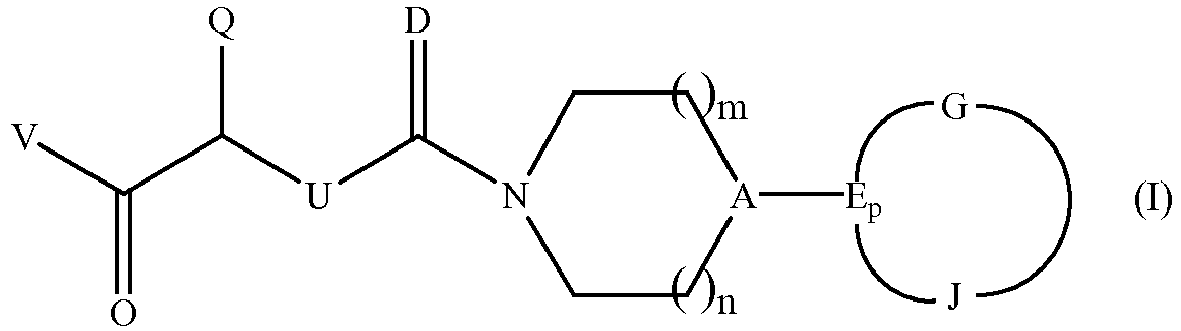
dans lequel:V est -N(R1)(R2) ou OR4;
R4 est H, un C1-6 alkyle, un C1-4 haloalkyle ou un (C1-4 alkylène)0-1R4';
R4' est un C3-7 cycloalkyle, un phényle, un adamantyle, un quinuclidyle, un azabicyclo[2.2.1]heptyle, un azétidinyle, un tétrahydrofuranyle, un furanyle, un dioxolanyle, un thiényle, un tétrahydrothiényle, un pyrrolyle, un pyrrolinyle, un pyrrolidinyle, un imidazolyle, un imidazolinyle, un imidazolidinyle, un pyrazolyle, un pyrazolinyle, un pyrazolidinyle, un oxazolyle, un isoxazolyle, un thiazolyle, un isothiazolyle, un oxadiazolyle, un thiadiazolyle, un triazolyle, un pyranyle, un pyridyle, un pyrimidinyle, un pyrazinyle, un pyridazinyle, un triazinyle, un pipéridinyle, un pipérazinyle, un morpholino, un thiomorpholino ou un dioxolanyle; et
R4' est optionnellement substitué avec 1 ou 2 des substituants identiques ou différents choisis parmi un halo, un cyano, un C1-4 alkyle, un C1-4 haloalkyle, un C1-4 alcoxy, un hydroxy, un amino, un C3-7 cycloalkyle, un C1-3 alkylamino, un C1-3 dialkylamino, un (C1-3 alkyle)0-2uréido, un phényle et un benzyle; et
R4' contient optionnellement 1 or 2 carbonyles où l'atome de carbone dudit carbonyle est un membre de la structure cyclique de R4';
R1 et R2 sont chacun indépendamment L1, où L1 est choisi parmi H, un C1-6 alkyle, un C2-6 alcényle, un C2-6 alcynyle, un -C1-6 alkylène-amino(C1-3 alkyle)2, un C3-7 cycloalkyle, un phényle, un azétidinyle, un adamantyle, un tétrahydrofuranyle, un furanyle, un dioxolanyle, un thiényle, un tétrahydrothiényle, un pyrrolyle, un pyrrolinyle, un pyrrolidinyle, un imidazolyle, un imidazolinyle, un imidazolidinyle, un pyrazolyle, un pyrazolinyle, un pyrazolidinyle, un oxazolyle, un isoxazolyle, un thiazolyle, un isothiazolyle, un oxadiazolyle, un thiadiazolyle, un triazolyle, un pyranyle, un pyridyle, un pyrimidinyle, un pyrazinyle, un pyridazinyle, un triazinyle, un pipéridinyle, un pipérazinyle, un morpholino, un thiomorpholino et un dioxolanyle; et
R1 et R2 sont chacun optionnellement et indépendamment substitués avec 1 ou 2 des substituants identiques ou différents choisis parmi un halo, un cyano, un C1-4 alkyle, un C1-4 haloalkyle, un C1-4 alcoxy, un hydroxy, un amino, un C3-7 cycloalkyle, un C1-3 alkylamino, un C1-3 dialkylamino, un (C1-3 alkyle)0-2uréido, un phényle et un benzyle;
R1 et R2 contiennent optionnellement et indépendamment 1 ou 2 carbonyles où l'atome de carbone dudit carbonyle est un membre des hétérocycles comprenant R1 et R2;
dans lequel L1 est optionnellement et indépendamment interrompu à partir de l'azote auquel il est attaché par L2, où L2 est indépendamment un C1-3 alkylène ou un C1-3 alkylidène; ou
R1 et R2 accompagnés de l'azote auquel ils sont attachés forment X,
dans lequel X est un azétidinyle, un pyrrolyle, un pyrrolinyle, un pyrrolidinyle, un imidazolinyle, un imidazolidinyle, un pyrazolinyle, un pyrazolidinyle, un azépinyle, un diazépinyle, un pipérazinyle, un pipéridinyle, un morpholino ou un thiomorpholino;
dans lequel X est optionnellement substitué avec Y, où Y est un dioxolanyle, un C1-9 alkyle, un C2-9 alcényle, un C2-9 alcynyle, un C1-4 alkylamino, un C1-4 dialkylamino, un C1-4 alcoxy, un C3-7 cycloalkyle, un phényle, un azétidinyle, un furanyle, un thiényle, un pyrrolyle, un pyrrolinyle, un pyrrolidinyle, un pyrrolidinonyle, un imidazolyle, un imidazolinyle, un imidazolidinyle, un imidazolidinonyle, un pyrazolyle, un pyrazolinyle, un pyrazolidinyle, un azépinyle, un diazépinyle, un pyridyle, un pyrimidinyle, un dihydrobenzimidazolonyle, un pipérazinyle, un pipéridinyle, un morpholino, un benzothiazolyle, un benzisothiazolyle ou un thiomorpholino; et dans lequel X et Y sont:optionnellement interrompus avec Z, où Z est -NHC(O)O-, -NHC(O)NH-, NC(O)NH2, -NH-, un -C1-3 alkylène-, un -C1-3 alkylène-, un -C1-3 alcénylène-NHC(O)O-C1-3 alkylène-; etoptionnellement et indépendamment substitués avec 1 ou 2 des substituants identiques ou différents choisis parmi un C1-4 alkyle, un amino, C1-3 alkylamino, un -C1-6 alkylène-amino(C1-3 alkyle)2, un (C1-3 alkyle)0-2uréido, un phényle et un benzyle;X et Y contiennent optionnellement and indépendamment 1 ou 2 carbonyles où l'atome de carbone dudit carbonyle est un membre des hétérocycles comprenant X et Y;à condition que si X est substitué avec Y et si X et Y ne sont pas interrompus avec Z, alors X et Y partagent optionnellement un atome de carbone et forment ensemble une fraction spirocyclique;Q est Q';
dans lequel:Q' est (Sy)sR3; etdans lequel Sy est un C1-3 alkylène ou un C1-3 alkylidène et s est 1;U est CH2 ou NH;R3 est R3a ou R3b,
dans lequel:R3a est:(i) un hétérocycle possédant deux cycles condensés avec de 5 à 7 membres dans chacun desdits cycles, ledit hétérocycle contenant de un à cinq des hétéroatomes identiques ou différents choisis parmi O, N et S et ledit hétérocycle contenant optionnellement 1 ou 2 carbonyles où l'atome de carbone dudit carbonyle est un membre desdits cycles condensés;dans lequel R3a est optionnellement substitué avec de 1 à 3 des substituants identiques ou différents choisis parmi un benzyle, un phényle, un -O-phényle, un -O-C1-3 alkylènephényle, un -C1-3 alkylène-OC(O)-phényle, un cyano, un amino, un nitro, un halo, un C1-6 alkyle, un C1-3 mono-bi-tri-haloalkyle, un C1-3 mono-bi-tri-haloalkyloxy, une (C1-3 alkyle)1-2amine, -OR3', -C(O)R3', -C(O)O-R3', -O-C(O)R3', -N(R3')2, -C(O)N(R3')2,-N(R3')C(O)(R3')2, -N(R3')C(O)N(R3')2, -N(R3')C(O)OR3', -O-C(O)N(R3)2,-N(R3')SO2R3' , -SO2N(R3')2 et -SO2R3';
R3' est H ou un -C1-6 alkyle;
R3b est R3a mais n'est pas un 1H-indol-3-yle, un 1-méthyl-1H-indol-3-yle, un 1-formyl-1H-indol-3-yle, un 1-(1,1-diméthyléthoxycarbonyl)-1H-indol-3-yle, un 1H-indazol-3-yle, un 1-méthyl-1H-indazol-3-ylbenzo[b]fur-3-yle, un benzo[b]thién-3-yle, un quinoléinyle ou un isoquinoléinyle; optionnellement substitué dans le squelette carboné avec mono-, di- ou trisubstitué par des atomes de fluor, de chlore ou de brome ou par des groupes alkyles ramifiés ou non ramifiés, des groupes C3-8 cycloalkyles, des groupes phénylalkyles, des groupes alcényle, alcoxy, phényle, phénylalcoxy, trifluorométhyle, alcoxycarbonylalkyle, carboxyalkyle, alcoxycarbonyle, carboxy, dialkylaminoalkyle, dialkylaminoalcoxy, hydroxy, nitro, amino, acétylamino, propionylamino, benzoyle, benzoylamino, benzoylméthylamino, méthylsulfonyloxy, aminocarbonyle, alkylaminocarbonyle, dialkylaminocarbonyle, alcanoyle, cyano, tétrazolyle, phényle, pyridinyle, thiazolyle, furyle, trifluorométhoxy, trifluorométhylthio, trifluorométhylsulfinyle ou trifluorométhylsulfonyle;
dans lequel lesdits substituants peuvent être identiques ou différents et les groupes benzoyle, benzoylamino et benzoylméthylamino mentionnés ci-dessus peuvent à leur tour être substitués davantage dans la fraction phényle par un atome de fluor, de chlore ou de brome ou par un groupe alkyle, trifluorométhyle, amino ou acétylamino;D est O;A est CH;m et n sont indépendamment 0, 1 ou 2; à condition que:si m et n sont 0, alors A ne soit pas N;si m est 2, alors n ne soit pas 2; ousi n est 2, alors m ne soit pas 2;E est N, CH ou C;p est 0 ou 1;
si p est 1, alors G, J et E forment ensemble Ax ou Ay;
Ax est un hétérocycle condensé possédant deux cycles condensés avec de 5 à 7 membres dans chacun desdits cycles, ledit hétérocycle contenant de un à quatre des hétéroatomes identiques ou différents choisis parmi O, N et S; et
contenant optionnellement 1 ou 2 carbonyles où l'atome de carbone dudit carbonyle est un membre dudit hétérocycle condensé;
Ay est un hétérocycle de 4 à 6 membres contenant de un à trois hétéroatomes choisis parmi O, N et S; et
contenant optionnellement 1 à 2 carbonyles, où l'atome de carbone dudit carbonyle est un membre dudit hétérocycle de 4 à 6 membres;
dans lequel Ax et Ay sont optionnellement substitués avec un C1-4 alkyle, un C1-4 alcoxy, un C1-4 haloalkyle, un cyano, un C3-7 cycloalkyle, un phényle, un halophényle, un halo, un furanyle, un pyrrolyle, un pyrrolinyle, un pyrrolidinyle, un imidazolyle, un imidazolinyle, un imidazolidinyle, un pyrazolyle, un pyrazolinyle, un pyrazolidinyle, un pyridyle, un pyrimidinyle, un pipéridinyle, un pipérazinyle ou un morpholino; ou
si p est 0 de sorte que G et J sont chacun attachés à A, alors A est C et G, J et A forment ensemble un système cyclique spirocyclique avec lesdits cycles dudit système contenant A et dans lequel G, J et A sont ensemble GJA' ou GJA";
dans lequel:GJA' est Ax ou Ay; etGJA" est Ax ou Ay;à condition que:et en outre à condition que:Ax ne soit pas un hétérocycle 1,3-diaza-condensé; etAy ne soit pas un 1,3-diaza-hétérocycle;si Q est Q', alorsR3 soit R3b ; ouR3 soit R3a, p soit 0 et G, J et A forment ensemble GJA". - Composé selon la revendication 1, dans lequel Q est Q' et R3 est R3b.
- Composé selon la revendication 1, dans lequel Q est Q', R3 est R3a et p est 0 de sorte que G, J et A forment ensemble GJA".
- Composé selon les revendications 2 ou 3, dans lequel Q est Q' et U est CH2.
- Composé selon les revendications 2 ou 3, dans lequel Q est Q' et U est NH.
- Composé selon la revendication 1, dans lequel V est OR4.
- Composé selon la revendication 1, dans lequel V est -N(R1)(R2).
- Composé selon la revendication 1, dans lequel R4 est H, un C1-6 alkyle ou un (C1-4 alkylène)0-1R4' et R4' est un C3-7 cycloalkyle.
- Composé selon la revendication 1, dans lequel V est -N(R1)(R2) et
R1 et R2 sont chacun indépendamment L1, où L1 est choisi parmi H, un C1-6 alkyle, un -C1-6 alkylène-amino(C1-3 alkyle)2, un C3-7 cycloalkyle, un phényle, un azétidinyle, un adamantyle, un tétrahydrofuranyle, un furanyle, un dioxolanyle, un thiényle, un tétrahydrothiényle, un pyrrolyle, un pyrrolinyle, un pyrrolidinyle, un imidazolyle, un imidazolinyle, un imidazolidinyle, un pyrazolyle, un pyrazolinyle, un pyrazolidinyle, un oxazolyle, un isoxazolyle, un thiazolyle, un isothiazolyle, un oxadiazolyle, un thiadiazolyle, un triazolyle, un pyranyle, un pyridyle, un pyrimidinyle, un pyrazinyle, un pyridazinyle, un triazinyle, un pipéridinyle, un pipérazinyle, un morpholino, un thiomorpholino et un dioxolanyle; ou
R1 et R2 accompagnés de l'azote auquel ils sont attachés forment X,
dans lequel X est un azétidinyle, un pyrrolinyle, un pyrrolidinyle, un imidazolinyle, un imidazolidinyle, un pyrazolinyle, un pyrazolidinyle, un azépinyle, un diazépinyle, un pipérazinyle, un pipéridinyle, un morpholino ou un thiomorpholino;
dans lequel X est substitué avec Y, où Y est un dioxolanyle, un C1-4 alkyle, un C1-4 alcoxy, un C3-7 cycloalkyle, un phényle, un azétidinyle, un pyrrolyle, un pyrrolinyle, un pyrrolidinyle, un pyrrolidinonyle, un imidazolyle, un imidazolinyle, un imidazolidinyle, un imidazolidinonyle, un pyrazolyle, un pyrazolinyle, un pyrazolidinyle, un azépinyle, un diazépinyle, un pyridyle, un pyrimidinyle, un dihydrobenzimidazolonyle, un pipérazinyle, un pipéridinyle, un morpholino, un benzothiazolyle, un benzisothiazolyle ou un thiomorpholino;
et dans lequel X et Y partagent optionnellement un atome de carbone et forment ensemble une fraction spirocyclique. - Composé selon la revendication 1, dans lequel V est -N(R1)(R2) et
R1 et R2 sont chacun indépendamment L1, où L1 est choisi parmi H, un C1-6 alkyle, ou
R1 et R2 accompagnés de l'azote auquel ils sont attachés forment X,
dans lequel X est un pipéridinyle ou un morpholino;
dans lequel X est substitué avec Y, où Y est un dioxolanyle, un C1-4 alkyle ou un pipéridinyle;
et dans lequel X et Y partagent optionnellement un atome de carbone et forment ensemble une fraction spirocyclique. - Composé selon la revendication 1, dans lequel V est -N(R1)(R2) et dans lequel R1 et R2 sont chacun indépendamment L1, où L1 est choisi parmi H, un C1-6 alkyle.
- Composé selon la revendication 1, dans lequel V est -N(R1)(R2) et dans lequel:
R1 et R2 accompagnés de l'azote auquel ils sont attachés forment X,
dans lequel X est un pipéridinyle ou un morpholino;
dans lequel X est substitué avec Y, où Y est un dioxolanyle, un C1-4 alkyle ou un pipéridinyle;
et dans lequel X et Y partagent optionnellement un atome de carbone et forment ensemble une fraction spirocyclique. - Composé selon la revendication 1, dans lequel V est -N(R1)(R2) et dans lequel:
R1 et R2 accompagnés de l'azote auquel ils sont attachés forment X,
dans lequel X est un pipéridinyle;
dans lequel X est substitué avec Y, où Y est un pipéridinyle. - Composé selon la revendication 1, dans lequel V est -N(R1)(R2) et dans lequel:
R1 et R2 accompagnés de l'azote auquel ils sont attachés forment X,
dans lequel X est un morpholino;
dans lequel X est substitué avec Y, où Y est un C1-4 alkyle. - Composé selon la revendication 1, dans lequel V est -N(R1)(R2) et dans lequel:
R1 et R2 accompagnés de l'azote auquel ils sont attachés forment X,
dans lequel X est un pipéridinyle;
dans lequel X est substitué avec Y, où Y est un C1-4 alkyle. - Composé selon la revendication 1, dans lequel V est -N(R1)(R2) et dans lequel:
R1 et R2 accompagnés de l'azote auquel ils sont attachés forment X,
dans lequel X est un pipéridinyle;
dans lequel X est substitué avec Y, où Y est un dioxolanyle;
et dans lequel X et Y partagent un atome de carbone et forment ensemble une fraction spirocyclique. - Composé selon la revendication 1, dans lequel R3 est R3a et R3a est substitué ou non substitué et il est un dihydroquinolinonyle, un hydroquinolinonyle, un quinoléinyle, un dihydroisoquinolinonyle, un hydroisoquinolinonyle, un isoquinoléinyle, un dihydroquinazolinonyle, un hydroquinazolinonyle, un quinazolinyle, un dihydroquinoxalinonyle, un hydroquinoxalinonyle, un quinoxalinyle, un benzimidazolyle, un indazolyle, un dihydrobenzimidazolonyle, un hydrobenzimidazolonyle, un benzimidazolinyle, un dihydrobenzthiazolonyle, un hydrobenzthiazolonyle, un benzthiazolyle, un dihydrobenzoxazolyle, un benzotriazolyle, un dihydrobenzothiophénonyle, un hydrobenzothiophénonyle, un benzothiényle, un dihydrobenzofuranonyle, un hydrobenzofuranonyle, un benzofuranyle, un benzdioxolanyle, un dihydroindolonyle, un hydroindolonyle, un indolyle, un indolizinyle, un isoindolyle, un indolinyle, un indazolyle, un purinyle, un triazolopyrimidinyle ou un tétrahydropyrazo lopyridinyle.
- Composé selon la revendication 1, dans lequel R3 est R3b et R3b est substitué ou non substitué et il est un dihydrobenzimidazolonyle, un hydrobenzimidazolonyle, un benzimidazolinyle, un dihydrobenzthiazolonyle, un hydrobenzthiazolonyle, un benzthiazolyle, un dihydrobenzothiophénonyle, un hydrobenzothiophénonyle, un dihydrobenzofuranonyle, un hydrobenzofuranonyle, un 1H-indazol-5-yle, un benzdioxolanyle, un dihydrobenzoxazolyle, un benzotriazolyle, un dihydroindolonyle, un hydroindolonyle, un indolizinyle, un isoindolyle, un indolinyle, un purinyle, optionnellement substitué comme il est prévu dans la revendication 1.
- Composé selon la revendication 1, dans lequel D est O et m et n sont chacun 1.
- Composé selon la revendication 1, dans lequel p est 1; et G, J et E forment ensemble Ax ou Ay.
- Composé selon la revendication 1, dans lequel p est 0 de sorte que G et J sont chacun attachés à A, alors A est C et G, J et A forment ensemble un système cyclique spirocyclique avec lesdits cycles dudit système contenant A et dans lequel G, J et A sont ensemble GJA' ou GJA".
- Composé selon la revendication 1, dans lequel p est 0 de sorte que G et J sont chacun attachés à A, alors A est C et G, J et A forment ensemble un système cyclique spirocyclique avec lesdits cycles dudit système contenant A et dans lequel G, J et A sont ensemble GJA'.
- Composé selon la revendication 1, dans lequel p est 0 de sorte que G et J sont chacun attachés à A, alors A est C et G, J et A forment ensemble un système cyclique spirocyclique avec lesdits cycles dudit système contenant A et dans lequel G, J et A sont ensemble GJA".
- Composé selon la revendication 1, dans lequel p est 0 de sorte que G et J sont chacun attachés à A, alors G, J et A forment ensemble un système cyclique spirocyclique avec lesdits cycles dudit système contenant A et dans lequel G, J et A forment ensemble un hétérocycle choisi parmi un imidazolinonyle, un imidazolidinonyle, un dihydroquinolinonyle, un dihydroisoquinolinonyle, un dihydroquinazolinonyle, un dihydroquinoxalinonyle, un dihydrobenzoxazinyle, un hydrobenzoxazinyle, un dihydrobenzoxazinonyle, un dihydrobenzimidazolonyle, un dihydrobenzimidazolyle, un dihydro-benzthiazolonyle, un dihydrobenzthiazolyle, un dihydrobenzothiophénonyle, un dihydrobenzofuranonyle, un dihydroindolonyle, un indolinyle, un pyrazolinyle, un pyrazolidinyle, un pyrrolinyle, un pyrrolidinyle, un imidazolinyle, un imidazolidinyle, un pipéridinyle, un pipérazinyle et un morpholino; dans lequel ledit hétérocycle est optionnellement substitué avec un C1-4 alkyle, un C1-4 alcoxy, un C1-4 haloalkyle, un cyano, un C3-7 cycloalkyle, un phényle, un halophényle, un furanyle, un pyrrolyle, un pyrrolinyle, un pyrrolidinyle, un imidazolyle, un imidazolinyle, un imidazolidinyle, un pyrazolyle, un pyrazolinyle, un pyrazolidinyle, un pyridyle, un pyrimidinyle, un pipéridinyle, un pipérazinyle ou un morpholino.
- Composé choisi parmi:acide (±)-3-(1H-indazol-5-yl)-2-{[4-(2-oxo-1,4-dihydro-2H-quinazolin-3-yl)-pipéridine-1-carbonyl]-amino}-propionique;[2-[1,4']bipipéridinyl-1'-yl-1-(1H-indazol-5-ylméthyl)-2-oxo-éthyl]-amide d'acide (R)-4-(2-oxo-1,4-dihydro-2H-quinazolin-3-yl)-pipéridine-1-carboxylique;[2-[1,4']bipipéridinyl-1'-yl-1-(1H-indol-5-ylméthyl)-2-oxo-éthyl]-amide d'acide (±)-4-(2-oxo-2,3-dihydro-benzoimidazol-1-yl)-pipéridine-1-carboxylique;[2-[1,4']bipipéridinyl-1'-yl-1-(1H-indazol-5-ylméthyl)-2-oxo-éthyl]-amide d'acide (±)-4-(2-oxo-2,3-dihydro-benzoimidazol-1-yl)-pipéridine-1-carboxylique;[2-[1,4']bipipéridinyl-1'-yl-1-(1H-indol-5-ylméthyl)-2-oxo-éthyl]-amide d'acide (±)-4-(2-oxo-1,4-dihydro-2H-quinazolin-3-yl)-pipéridine-1-carboxylique;[2-[1,4']bipipéridinyl-1'-yl-1-(1H-indazol-5-ylméthyl)-2-oxo-éthyl]-amide d'acide (±)-4-(2-oxo-1,4-dihydro-2H-quinazolin-3-yl)-pipéridine-1-carboxylique;[1-(1H-indol-5-ylméthyl)-2-(4-isobutyl-pipérazin-1-yl)-2-oxo-éthyl]-amide d'acide (±)-4-(2-oxo-2,3-dihydro-benzoimidazol-1-yl)-pipéridine-1-carboxylique;[2-(1,4-dioxa-8-aza-spiro[4.5]déc-8-yl)-1-(1H-indol-5-ylméthyl)-2-oxo-éthyl]-amide d'acide (±)-4-(2-oxo-2,3-dihydro-benzoimidazol-1-yl)-pipéridine-1-carboxylique;[1-(1H-indazol-5-ylméthyl)-2-(4-isobutyl-pipérazin-1-yl)-2-oxo-éthyl]-amide d'acide (±)-4-(2-oxo-2,3-dihydro-benzoimidazol-1-yl)-pipéridine-1-carboxylique;[2-(1,4-dioxa-8-aza-spiro[4.5]déc-8-yl)-1-(1H-indazol-5-ylméthyl)-2-oxo-éthyl]-amide d'acide (±)-4-(2-oxo-2,3-dihydro-benzoimidazol-1-yl)-pipéridine-1-carboxylique;[2-(1,4-dioxa-8-aza-spiro[4.5]déc-8-yl)-1-(1H-indazol-5-ylméthyl)-2-oxo-éthyl]-amide d'acide (±)-4-(2-oxo-1,4-dihydro-2H-quinazolin-3-yl)-pipéridine-1-carboxylique;ester de méthyle d'acide (±)-3-(7-méthyl-1H-indazol-5-yl)-2-{[4-(2-oxo-1,4-dihydro-2H-quinazolin-3-yl)-pipéridine-1-carbonyl]-amino}-propionique;ester de méthyle d'acide 3-(7-méthyl-1H-indazol-5-yl)-2-[2',3'-dihydro-2'-oxospiro-(pipéridine-4,4'-(1H)-quinazoline)carbonylamino]-propionique;ester de méthyle d'acide 3-(7-méthyl-1H-indazol-5-yl)-2-(1,2-dihydro-2-oxospiro-4H-3,1-dihydro-benzoxazine-4'4-pipéridine-carbonylamino)-propionique;acide (±)-3-(7-méthyl-1H-indazol-5-yl)-2-{[4-(2-oxo-1,4-dihydro-2H-quinazolin-3-yl)-pipéridine-1-carbonyl]-amino}-propionique;[2-[1,4']bipipéridinyl-1'-yl-1-(7-méthyl-1H-indazol-5-ylméthyl)-2-oxo-éthyl]-amide d'acide (±)-4-(2-oxo-1,4-dihydro-2H-quinazolin-3-yl)-pipéridine-1-carboxylique;[1-(7-méthyl-1H-indazol-5-ylméthyl)-2-oxo-2-pipéridin-1-yl-éthyl]-amide d'acide (±)-4-(2-oxo-1,4-dihydro-2H-quinazolin-3-yl)-pipéridine-1-carboxylique;[1-diméthylcarbamoyl-2-(7-méthyl-1H-indazol-5-yl)-éthyl]-amide d'acide (±)-4-(2-oxo-1,4-dihydro-2H-quinazolin-3-yl)-pipéridine-1-carboxylique;[1-(7-méthyl-1H-indazol-5-ylméthyl)-2-(4-méthyl-pipérazin-1-yl)-2-oxo-éthyl]-amide d'acide (±)-4-(2-oxo-1,4-dihydro-2H-quinazolin-3-yl)-pipéridine-1-carboxylique;[1-(7-méthyl-1H-indazol-5-ylméthyl)-2-oxo-2-pyrrolidin-1-yl-éthyl]-amide d'acide (±)-4-(2-oxo-1,4-dihydro-2H-quinazolin-3-yl)-pipéridine-1-carboxylique;[1-(7-méthyl-1H-indazol-5-ylméthyl)-2-oxo-2-(4-pyridin-4-yl-pipérazin-1-yl)-éthyl]-amide d'acide (±)-4-(2-oxo-1,4-dihydro-2H-quinazolin-3-yl)-pipéridine-1-carboxylique;[1-(7-méthyl-1H-indazol-5-ylméthyl)-2-oxo-2-(4-pyridin-2-yl-pipérazin-1-yl)-éthyl]-amide d'acide (±)-4-(2-oxo-1,4-dihydro-2H-quinazolin-3-yl)-pipéridine-1-carboxylique;(±)-1-(7-méthyl-1H-indazol-5-ylméthyl)-2-[1,4-bipipéridin]-1-yl-2-oxoéthyl]-2',3'-dihydro-2'-oxospiro-[pipéridine-4,4'-(1H)-quinazoline]-1-carboxamide;(±)-1-(7-méthyl-1H-indazol-5-ylméthyl)-2-(1-pipéridinyl)-2-oxoéthyl]-2',3'-dihydro-2'-oxospiro-[pipéridine-4,4'-(1H)-quinazoline]-1-carboxamide;(±)-1-(7-méthyl-1H-indazol-5-ylméthyl)-2-[1,4-bipipéridin]-1-yl-2-oxoéthyl]-1',2'-dihydro-2'-oxospiro-[4H-3',1-benzoxazine-4,4'-pipéridine]-1-carboxamide;(±)-1-(7-méthyl-1H-indazol-5-ylméthyl)-2-(1-pipéridinyl)-2-oxoéthyl]-1',2'-dihydro-2'-oxospiro-[4H-3',1-benzoxazine-4,4'-pipéridine]-1-carboxamide;(±)-[1-diméthylcarbamoyl-2-(7-méthyl-1H-indazol-5-yl)-éthyl]-1',2'-dihydro-2'-oxospiro-[4H-3',1-benzoxazine-4,4'-pipéridine]-1-carboxamide;(±)-[1-(2-adamantyl-carbamoyl)-2-(7-méthyl-1H-indazol-5-yl)-éthyl]-1',2'-dihydro-2'-oxospiro-[4H-3',1-benzoxazine-4,4'-pipéridine]-1-carboxamide;[1-(7-méthyl-1H-indazol-5-ylméthyl)-2-oxo-2-(4-pyridin-4-yl-pipérazin-1-yl)-éthyl]-amide d'acide (±)-1',2'-dihydro-2'-oxospiro-[4H-3',1-benzoxazine-4,4'-pipéridine-1-carboxylique;{2-(7-méthyl-1H-indazol-5-yl)-1-[(pyridin-4-ylméthyl)-carbamoyl]-éthyl}-amide d'acide (±)-1',2'-dihydro-2'-oxospiro-[4H-3',1-benzoxazine-4,4'-pipéridine-1-carboxylique;(±)-1-(7-méthyl-1H-indazol-5-ylméthyl)-2-[1,4-bipipéridin]-1-yl-2-oxoéthyl]-3',4'-dihydro-2'-oxospiro-[pipéridine-4,4'-(1H)-quinoléine]-1-carboxamide;(±)-1-(7-méthyl-1H-indazol-5-ylméthyl)-2-[1-pipéridinyl]-2-oxoéthyl]-3',4'-dihydro-2'-oxospiro-[pipéridine-4,4'-(1H)-quinoléine]-1-carboxamide;(±)-[1-diméthylcarbamoyl-2-(7-méthyl-1H-indazol-5-yl)-ethy]1-3',4'-dihydro-2'-oxospiro-[pipéridine-4,4'-(1H)-quinoléine]-1-carboxamide;{1-(7-méthyl-1H-indazol-5-ylméthyl)-2-[1,4]bipipéridinyl-1'-yl-2-oxo-éthyl}-amide d'acide (±)-4-oxo-2-phényl-1,3,8-triaza-spiro[4,5]déc-1-ène-8-carboxylique;{1-(7-méthyl-1H-indazol-5-ylméthyl)-2-[1-pipéridinylyl]-2-oxo-éthyl}-amide d'acide (±)-4-oxo-2-phényl-1,3,8-triaza-spiro[4,5]déc-1-ène-8-carboxylique;[1-diméthylcarbamoyl-2-(7-méthyl-1H-indazol-5-yl)-éthyl]amide d'acide (±)-4-oxo-2-phényl-1,3,8-triaza-spiro[4,5]déc-1-ène-8-carboxylique;{1-(1H-indazol-5-ylméthyl)-2-oxo-2-[4-(2-oxo-1,4-dihydro-2H-quinazolin-3-yl)-pipéridin-1-yl]-éthyl}-amide d'acide 4-(2-oxo-1,4-dihydro-2H-quinazolin-3-yl)-pipéridine-1-carboxylique;ester de benzyle d'acide 4-(3-(1H-indazol-5-yl)-2-{[4-(2-oxo-1,4-dihydro-2H-quinazolin-3-yl)-pipéridine-1-carbonyl]-amino}-propionyl)-pipérazine-1-carboxylique;[1-(1H-indazol-5-ylméthyl)-2-oxo-2-pipérazin-1-yl-éthyl]-amide d'acide 4-(2-oxo-1,4-dihydro-2H-quinazolin-3-yl)-pipéridine-1-carboxylique;{1-(1H-indazol-5-ylméthyl)-2-[4-(2-méthyl-butyl)-pipérazin-1-yl]-2-oxo-éthyl}-amide d'acide 4-(2-oxo-1,4-dihydro-2H-quinazolin-3-yl)-pipéridine-1-carboxylique;ester de cyclohexyle d'acide 3-(7-méthyl-1H-indazol-5-yl)-2-{[4-(2-oxo-1,4-dihydro-2H-quinazolin-3-yl)-pipéridine-1-carbonyl]-amino}-propionique;ester de méthyle d'acide (±)-3-(7-chloro-1H-indazol-5-yl)-2-{[4-(2-oxo-1,4-dihydro-2H-quinazolin-3-yl)-pipéridine-1-carbonyl]-amino}-propionique;[2-[1,4']bipipéridinyl-1'-yl-1-(7-chloro-1H-indazol-5-ylméthyl)-2-oxo-éthyl]-amide d'acide (±)-4-(2-oxo-1,4-dihydro-2H-quinazolin-3-yl)-pipéridine-1-carboxylique;ester de méthyle d'acide (±)-3-(7-éthyl-1H-indazol-5-yl)-2-{[4-(2-oxo-1,4-dihydro-2H-quinazolin-3-yl)-pipéridine-1-carbonyl]-amino}-propionique;[2-[1,4']bipipéridinyl-1'-yl-1-(7 -éthyl-1H-indazol-5-ylméthyl)-2-oxo-éthyl]-amide d'acide (±)-4-(2-oxo-1,4-dihydro-2H-quinazolin-3-yl)-pipéridine-1-carboxylique;ester de méthyle d'acide (±)-2-(7-méthyl-1H-indazol-5-ylméthyl)-4-oxo-4-[1',2'-dihydro-2'-oxospiro-[4H-3',1-benzoxazine-4,4'-pipéridinyl]-butyrique;ester de méthyle d'acide (±)-2-(7-méthyl-1H-indazol-5-ylméthyl)-4-oxo-4-[4-(2-oxo-1,4-dihydro-2H-quinazolin-3-yl)-pipéridin-1-yl]-butyrique;(±)-1-[1,4']bipipéridinyl-1'-yl-2-(7-méthyl-1H-indazol-5-ylméthyl)-4-[1',2'-dihydro-2'-oxospiro-[4H-3',1-benzoxazine-4,4'-pipéridinyl]-butane-1,4-dione;(±)-1-[1,4']bipipéridinyl-1'-yl-2-(7-méthyl-1H-indazol-5-ylméthyl)-4-[4-(2-oxo-1,4-dihydro-2H-quinazolin-3-yl)-pipéridin-1-yl]-butane-1,4-dione;(±)-1-(1,4-dioxa-8-aza-spiro[4.5]déc-8-yl)-2-(7-méthyl-1H-indazol-5-ylméthyl)-4-[4-(2-oxo-1,4-dihydro-2H-quinazolin-3-yl)-pipéridin-1-yl]-butane-1,4-dione;(±)-1-(1,4-dioxa-8-aza-spiro[4.5]déc-8-yl)-2-(7-méthyl-1H-indazol-5-ylméthyl)-4-[1',2'-dihydro-2'-oxospiro-[4H-3',1-benzoxazine-4,4'-pipéridinyl]-butane-1,4-dione;(±)-N,N-diméthyl-2-(7-méthyl-1H-indazol-5-ylméthyl)-4-oxo-4-[4-(2-oxo-1,4-dihydro-2H-quinazolin-3-yl)-pipéridin-1-yl]-butyramide;(±)-1-(2,6-diméthyl-morpholin-4-yl)-2-(7-méthyl-1H-indazol-5-ylméthyl)-4-[4-(2-oxo-1,4-dihydro-2H-quinazolin-3-yl)-pipéridin-1-yl]-butane-1,4-dione;(±)-2-(7-méthyl-1H-indazol-5-ylméthyl)-1-(4-méthyl-pipéridin-1-yl)-4-[4-(2-oxo-1,4-dihydro-2H-quinazolin-3-yl)-pipéridin-1-yl]-butane-1,4-dione;(±)-2-(7-méthyl-1H-indazol-5-ylméthyl)-1-morpholin-4-yl-4-[4-(2-oxo-1,4-dihydro-2H-quinazolin-3-yl)-pipéridin-1-yl]-butane-1,4-dione;(±)-N,N-diméthyl-2-(7-méthyl-1H-indazol-5-ylméthyl)-4-oxo-4-[1',2'-dihydro-2'-oxospiro-[4H-3',1-benzoxazine-4,4'-pipéridinyl]-butyramide;(±)-2-(7-méthyl-1H-indazol-5-ylméthyl)-1-(pipéridin-1-yl)-4-[1',2'-dihydro-2'-oxospiro-[4H-3',1-benzoxazine-4,4'-pipéridinyl]-butane-1,4-dione;(±)-2-(7-méthyl-1H-indazol-5-ylméthyl)-4-[4-(2-oxo-1,4-dihydro-2H-quinazolin-3-yl)-pipéridin-1-yl]-1-pipéridin-1-yl-butane-1,4-dione;(±)-1-[1,4']bipipéridinyl-1'-yl-2-(1H-indazol-5-ylméthyl)-4-[1',2'-dihydro-2'-oxospiro-[4H-3',1-benzoxazine-4,4'-pipéridinyl]-butane-1,4-dione;(±)-1-(1,4-dioxa-8-aza-spiro[4.5]déc-8-yl)-2-(1H-indazol-5-ylméthyl)-4-[1',2'-dihydro-2'-oxospiro-[4H-3',1-benzoxazine-4,4'-pipéridinyl]-butane-1,4-dione;(±)-1-(1,4-dioxa-8-aza-spiro[4.5]déc-8-yl)-2-(1H-indazol-5-ylméthyl)-4-[4-(2-oxo-1,4-dihydro-2H-quinazolin-3-yl)-pipéridin-1-yl]-butane-1,4-dione;(±)-2-(1H-indazol-5-ylméthyl)-N,N-diméthyl-4-oxo-4-[4-(2-oxo-1,4-dihydro-2H-quinazolin-3-yl)-pipéridin-1-yl]-butyramide;ester de tert-butyle d'acide (±)-5-{2-([1,4']bipipéridinyl-1'-carbonyl)-4-oxo-4-[4-(2-oxo-1,4-dihydro-2H-quinazolin-3-yl)-pipéridin-1-yl]-butyl}-indazo le-1-carboxylique;(±)-2-(7-méthyl-1H-indazol-5-ylméthyl)-4-oxo-4-[4-(2-oxo-1,4-dihydro-2H-quinazolin-3-yl)-pipéridin-1-yl]-N-prop-2-ynyl-butyramide;et un de leurs sels pharmaceutiquement acceptables et solvates.
- Composé selon la revendication 1, dans lequel R3 est R3b et R3b est:1H-indol-5-yle
 1H-indazol-5-yle
 1H-benzotriazol-5-yle
 1,3-dihydro-indol-2-on-5-yle
 3H-benzooxazol-2-on-6-yle
 1,3-dihydro-benzoimidazol-2-on-5-yle
 1-méthyl-1,3-dihydro-benzoimidazol-2-on-6-yle
 3,4-dihydro-1H-quinolin-2-on-6-yle
 1,4-dihydro-benzo[d][1,3]oxazin-2-on-6-yle
 3,4-dihydro-1H-quinazolin-2-on-6-yle
 3-méthyl-3,4-dihydro-1H-quinazo lin-2-on-6-yle
 4H-benzo[1,4]oxazin-3-on-7-yledans lequel Ty est H, un C1-4 alkyle, F, Cl, Br ou un nitrile.
- Composé choisi parmi:[2-[1,4']bipipéridinyl-1'-yl-1-(7-bromo-1H-indazol-5-ylméthyl)-2-oxo-éthyl]-amide d'acide 4-(2-oxo-1,4-dihydro-2H-quinazolin-3-yl)-pipéridine-1-carboxylique;[2-oxo-1-(2-oxo-2,3-dihydro-benzoxazol-6-ylméthyl)-2-(4-pyridin-4-yl-pipérazin-1-yl)-éthyl]-amide d'acide 4-(2-oxo-1,4-dihydro-2H-quinazolin-3-yl)-pipéridine-1-carboxylique;[2-oxo-1-(2-oxo-2,3-dihydro-benzoxazol-6-ylméthyl)-2-pipéridin-1-yl-éthyl]-amide d'acide 4-(2-oxo-1,4-dihydro-2H-quinazolin-3-yl)-pipéridine-1-carboxylique;[2-(4-méthyl-pipérazin-1-yl)-2-oxo-1-(2-oxo-2,3-dihydro-benzoxazol-6-ylméthyl)-éthyl]-amide d'acide 4-(2-oxo-1,4-dihydro-2H-quinazolin-3-yl)-pipéridine-1-carboxylique;[2-[1,4']bipipéridinyl-1'-yl-1-(4-méthyl-2-oxo-2,3-dihydro-benzoxazol-6-ylméthyl)-2-oxo-éthyl]-amide d'acide 4-(2-oxo-1,4-dihydro-2H-quinazolin-3-yl)-pipéridine-1-carboxylique;[2-[1,4']bipipéridinyl-1'-yl-1-(4-chloro-2-oxo-2,3-dihydro-benzoxazol-6-ylméthyl)-2-oxo-éthyl]-amide d'acide 4-(2-oxo-1,4-dihydro-2H-quinazolin-3-yl)-pipéridine-1-carboxylique;[1-(4-méthyl-2-oxo-2,3-dihydro-benzoxazol-6-ylméthyl)-2-oxo-2-pipéridin-1-yl-éthyl]-amide d'acide 4-(2-oxo-1,4-dihydro-2H-quinazolin-3-yl)-pipéridine-1-carboxylique;[1-(4-chloro-2-oxo-2,3-dihydro-benzoxazol-6-ylméthyl)-2-oxo-2-pipéridin-1-yl-éthyl]-amide d'acide 4-(2-oxo-1,4-dihydro-2H-quinazolin-3-yl)-pipéridine-1-carboxylique;[1-diméthylcarbamoyl-2-(4-méthyl-2-oxo-2,3-dihydro-benzoxazol-6-yl)-éthyl]-amide d'acide 4-(2-oxo-1,4-dihydro-2H-quinazolin-3-yl)-pipéridine-1-carboxylique;[2-(4-chloro-2-oxo-2,3-dihydro-benzoxazol-6-yl)-1-diméthylcarbamoyl-éthyl]-amide d'acide 4-(2-oxo-1,4-dihydro-2H-quinazolin-3-yl)-pipéridine-1-carboxylique;[1-(4-méthyl-2-oxo-2,3-dihydro-benzoxazol-6-ylméthyl)-2-oxo-2-(4-pyridin-4-yl-pipérazin-1 -yl)-éthyl]-amide d'acide 4-(2-oxo-1,4-dihydro-2H-quinazolin-3-yl)-pipéridine-1-carboxylique;[1-(4-chloro-2-oxo-2,3-dihydro-benzoxazol-6-ylméthyl)-2-oxo-2-(4-pyridin-4-yl-pipérazin-1 -yl)-éthyl]-amide d'acide 4-(2-oxo-1,4-dihydro-2H-quinazolin-3-yl)-pipéridine-1-carboxylique;[2-[1,4']bipipéridinyl-1'-yl-1-(4-éthyl-2-oxo-2,3-dihydro-benzoxazol-6-ylméthyl)-2-oxo-éthyl]-amide d'acide 4-(2-oxo-1,4-dihydro-2H-quinazolin-3-yl)-pipéridine-1-carboxylique;[2-[1,4']bipipéridinyl-1'-yl-2-oxo-1-(2-oxo-2,3-dihydro-1H-benzimidazol-5-ylméthyl)-éthyl]-amide d'acide 4-(2-oxo-1,4-dihydro-2H-quinazolin-3-yl)-pipéridine-1-carboxylique;[2-[1,4']bipipéridinyl-1'-yl-1-(7-méthyl-2-oxo-2,3-dihydro-1H-benzimidazol-5-ylméthyl)-2-oxo-éthyl]-amide d'acide 4-(2-oxo-1,4-dihydro-2H-quinazolin-3-yl)-pipéridine-1-carboxylique;[2-[1,4']bipipéridinyl-1'-yl-1-(7-chloro-2-oxo-2,3-dihydro-1H-benzimidazol-5-ylméthyl)-2-oxo-éthyl]-amide d'acide 4-(2-oxo-1,4-dihydro-2H-quinazolin-3-yl)-pipéridine-1-carboxylique;[2-[1,4']bipipéridinyl-1'-yl-1-(7-éthyl-2-oxo-2,3-dihydro-1H-benzimidazol-5-ylméthyl)-2-oxo-éthyl]-amide d'acide 4-(2-oxo-1,4-dihydro-2H-quinazolin-3-yl)-pipéridine-1-carboxylique;[2-[1,4']bipipéridinyl-1'-yl-1-(3-méthyl-2-oxo-2,3-dihydro-1H-benzimidazol-5-ylméthyl)-2-oxo-éthyl]-amide d'acide 4-(2-oxo-1,4-dihydro-2H-quinazolin-3-yl)-pipéridine-1-carboxylique;[2-[1,4']bipipéridinyl-1'-yl-1-(3,7-diméthyl-2-oxo-2,3-dihydro-1H-benzimidazol-5-ylméthyl)-2-oxo-éthyl]-amide d'acide 4-(2-oxo-1,4-dihydro-2H-quinazolin-3-yl)-pipéridine-1-carboxylique;[2-[1,4']bipipéridinyl-1'-yl-1-(7-chloro-3-méthyl-2-oxo-2,3-dihydro-1H-benzimidazol-5-ylméthyl)-2-oxo-éthyl]-amide d'acide 4-(2-oxo-1,4-dihydro-2H-quinazolin-3-yl)-pipéridine-1-carboxylique;[2-[1,4']bipipéridinyl-1'-yl-1-(7-éthyl-3-méthyl-2-oxo-2,3-dihydro-1H-benzimidazol-5-ylméthyl)-2-oxo-éthyl]-amide d'acide 4-(2-oxo-1,4-dihydro-2H-quinazolin-3-yl)-pipéridine-1-carboxylique;ester d'isopropyle d'acide 3-(7-méthyl-1H-indazol-5-yl)-2-{[4-(2-oxo-1,4-dihydro-2H-quinazolin-3-yl)-pipéridine-1-carbonyl]-amino}-propionique;ester d'isopropyle d'acide 3-(7-chloro-1H-indazol-5-yl)-2-{[4-(2-oxo-1,4-dihydro-2H-quinazolin-3-yl)-pipéridine-1-carbonyl]-amino}-propionique;ester d'isopropyle d'acide 3-(7-éthyl-1H-indazol-5-yl)-2-{[4-(2-oxo-1,4-dihydro-2H-quinazolin-3-yl)-pipéridine-1-carbonyl]-amino}-propionique;ester de tert-butyle d'acide 3-(7-méthyl-1H-indazol-5-yl)-2-{[4-(2-oxo-1,4-dihydro-2H-quinazolin-3-yl)-pipéridine-1-carbonyl]-amino}-propionique;ester de tert-butyle d'acide 3-(7-chloro-1H-indazol-5-yl)-2-{[4-(2-oxo-1,4-dihydro-2H-quinazolin-3-yl)-pipéridine-1-carbonyl]-amino}-propionique;ester de tert-butyle d'acide 3-(7-éthyl-1H-indazol-5-yl)-2-{[4-(2-oxo-1,4-dihydro-2H-quinazolin-3-yl)-pipéridine-1-carbonyl]-amino}-propionique;ester de cyclohexyle d'acide 3-(7-chloro-1H-indazol-5-yl)-2-{[4-(2-oxo-1,4-dihydro-2H-quinazolin-3-yl)-pipéridine-1-carbonyl]-amino}-propionique;ester de cyclohexyle d'acide 3-(7-éthyl-1H-indazol-5-yl)-2-{[4-(2-oxo-1,4-dihydro-2H-quinazolin-3-yl)-pipéridine-1-carbonyl]-amino}-propionique;ester de 1-méthyl-pipéridin-4-yle d'acide 3-(7-méthyl-1H-indazol-5-yl)-2-[4-(2-oxo-1,4-dihydro-2H-quinazolin-3-yl)-pipéridine-1-carbonyl]-amino}-propionique;ester de 1-méthyl-pipéridin-4-yle d'acide 3-(7-chloro-1H-indazol-5-yl)-2-{[4-(2-oxo-1,4-dihydro-2H-quinazolin-3-yl)-pipéridine-1-carbonyl]-amino}-propionique;ester de 1-méthyl-pipéridin-4-yle d'acide 3-(7-éthyl-1H-indazol-5-yl)-2-{[4-(2-oxo-1,4-dihydro-2H-quinazolin-3-yl)-pipéridine-1-carbonyl]-amino}-propionique;ester de 1-méthyl-cyclohexyle d'acide 3-(7-méthyl-1H-indazol-5-yl)-2-{[4-(2-oxo-1,4-dihydro-2H-quinazolin-3-yl)-pipéridine-1-carbonyl]-amino}-propionique;ester de 1-méthyl-cyclohexyle d'acide 3-(7-chloro-1H-indazol-5-yl)-2-{[4-(2-oxo-1,4-dihydro-2H-quinazolin-3-yl)-pipéridine-1-carbonyl]-amino}-propionique;ester de 1-méthyl-cyclohexyle d'acide 3-(7-éthyl-1H-indazol-5-yl)-2-{[4-(2-oxo-1,4-dihydro-2H-quinazolin-3-yl)-pipéridine-1-carbonyl]-amino}-propionique;ester de 4-phényl-cyclohexyle d'acide 3-(7-méthyl-1H-indazol-5-yl)-2-{[4-(2-oxo-1,4-dihydro-2H-quinazolin-3-yl)-pipéridine-1-carbonyl]-amino}-propionique;ester de 4-phényl-cyclohexyle d'acide 3-(7-chloro-1H-indazol-5-yl)-2-{[4-(2-oxo-1,4-dihydro-2H-quinazolin-3-yl)-pipéridine-1-carbonyl]-amino}-propionique;ester de 4-phényl-cyclohexyle d'acide 3-(7-éthyl-1H-indazol-5-yl)-2-{[4-(2-oxo-1,4-dihydro-2H-quinazolin-3-yl)-pipéridine-1-carbonyl]-amino}-propionique;ester de 1-benzyl-pipéridin-4-yle d'acide 3-(7-méthyl-1H-indazol-5-yl)-2-{[4-(2-oxo-1,4-dihydro-2H-quinazolin-3-yl)-pipéridine-1-carbonyl]-amino}-propionique;ester de 1-pyridin-4-yl-éthyle d'acide 3-(7-méthyl-1H-indazol-5-yl)-2-{[4-(2-oxo-1,4-dihydro-2H-quinazolin-3-yl)-pipéridine-1-carbonyl]-amino}-propionique; etester de 1-pyridin-3-yl-éthyle d'acide 3-(7-méthyl-1H-indazol-5-yl)-2-{[4-(2-oxo-1,4-dihydro-2H-quinazolin-3-yl)-pipéridine-1-carbonyl]-amino}-propionique,ou un de leurs sels pharmaceutiquement acceptables ou solvates.
- Composition pharmaceutique comprenant un composé selon l'une quelconque des revendications 1 à 27.
- Composé selon l'une quelconque des revendications 1 à 27 pour une utilisation dans une méthode de traitement d'une migraine.
- Utilisation d'un composé selon l'une quelconque des revendications 1 à 27 pour la préparation d'une composition pharmaceutique pour le traitement d'une migraine.
Applications Claiming Priority (11)
| Application Number | Priority Date | Filing Date | Title |
|---|---|---|---|
| US38613802P | 2002-06-05 | 2002-06-05 | |
| US386138P | 2002-06-05 | ||
| US38861702P | 2002-06-13 | 2002-06-13 | |
| US388617P | 2002-06-13 | ||
| US38987002P | 2002-06-19 | 2002-06-19 | |
| US389870P | 2002-06-19 | ||
| US39320002P | 2002-07-01 | 2002-07-01 | |
| US393200P | 2002-07-01 | ||
| US41353402P | 2002-09-25 | 2002-09-25 | |
| US413534P | 2002-09-25 | ||
| PCT/US2003/016576 WO2003104236A1 (fr) | 2002-06-01 | 2003-05-27 | Antagonistes des recepteurs du peptide relie au gene de la calcitonine |
Publications (3)
| Publication Number | Publication Date |
|---|---|
| EP1539766A1 EP1539766A1 (fr) | 2005-06-15 |
| EP1539766A4 EP1539766A4 (fr) | 2007-08-08 |
| EP1539766B1 true EP1539766B1 (fr) | 2016-12-21 |
Family
ID=29741144
Family Applications (1)
| Application Number | Title | Priority Date | Filing Date |
|---|---|---|---|
| EP03736721.6A Expired - Lifetime EP1539766B1 (fr) | 2002-06-05 | 2003-05-27 | Antagonistes des recepteurs du peptide relie au gene de la calcitonine |
Country Status (24)
| Country | Link |
|---|---|
| US (2) | US20040063735A1 (fr) |
| EP (1) | EP1539766B1 (fr) |
| JP (1) | JP4490809B2 (fr) |
| KR (2) | KR20120004541A (fr) |
| CN (1) | CN100558728C (fr) |
| AU (1) | AU2003237255B8 (fr) |
| BR (1) | BRPI0311812B8 (fr) |
| CA (1) | CA2487976C (fr) |
| CY (1) | CY1118764T1 (fr) |
| DK (1) | DK1539766T3 (fr) |
| ES (1) | ES2616539T3 (fr) |
| GE (1) | GEP20074231B (fr) |
| HR (1) | HRP20041147A2 (fr) |
| HU (1) | HUE032132T2 (fr) |
| IS (1) | IS7583A (fr) |
| LT (1) | LT1539766T (fr) |
| MX (1) | MXPA04011960A (fr) |
| NO (1) | NO332691B1 (fr) |
| NZ (1) | NZ537315A (fr) |
| PL (1) | PL374017A1 (fr) |
| PT (1) | PT1539766T (fr) |
| RS (1) | RS52552B (fr) |
| TW (1) | TWI308151B (fr) |
| WO (1) | WO2003104236A1 (fr) |
Families Citing this family (69)
| Publication number | Priority date | Publication date | Assignee | Title |
|---|---|---|---|---|
| US7220862B2 (en) * | 2002-06-05 | 2007-05-22 | Bristol-Myers Squibb Company | Calcitonin gene related peptide receptor antagonists |
| DE10250082A1 (de) * | 2002-10-25 | 2004-05-13 | Boehringer Ingelheim Pharma Gmbh & Co. Kg | Ausgewählte CGRP-Antagonisten, Verfahren zu deren Herstellung sowie deren Verwendung als Arzneimittel |
| US7595312B2 (en) | 2002-10-25 | 2009-09-29 | Boehringer Ingelheim Pharma Gmbh & Co. Kg | Selected CGRP antagonists, processes for preparing them and their use as pharmaceutical compositions |
| DE10300973A1 (de) * | 2003-01-14 | 2004-07-22 | Boehringer Ingelheim Pharma Gmbh & Co. Kg | Neue Carbonsäuren und deren Ester, diese Verbindungen enthaltende Arzneimittel und Verfahren zu ihrer Herstellung |
| JO2355B1 (en) | 2003-04-15 | 2006-12-12 | ميرك شارب اند دوم كوربوريشن | Hereditary calcitonin polypeptide receptor antagonists |
| CA2545644C (fr) * | 2003-11-12 | 2011-11-01 | Lg Life Sciences Ltd. | Agonistes du recepteur de la melanocortine |
| US7569578B2 (en) * | 2003-12-05 | 2009-08-04 | Bristol-Meyers Squibb Company | Heterocyclic anti-migraine agents |
| CA2549330A1 (fr) * | 2003-12-05 | 2005-07-21 | Bristol-Myers Squibb Company | Antagonistes du recepteur peptidique lie au gene de la calcitonine |
| EP1695961A4 (fr) * | 2003-12-17 | 2007-10-24 | Takeda Pharmaceutical | Derives d'uree, processus de production correspondant et utilisation |
| WO2005084672A1 (fr) * | 2004-03-03 | 2005-09-15 | Boehringer Ingelheim International Gmbh | Antagonistes de cgrp selectionnes, procedes de fabrication et utilisation en tant que medicament |
| US7384946B2 (en) * | 2004-03-17 | 2008-06-10 | Glaxo Group Limited | M3 muscarinic acetylcholine receptor antagonists |
| ATE399155T1 (de) | 2004-03-23 | 2008-07-15 | Pfizer Prod Inc | Imidazolverbindungen zur behandlung von neurodegenerativen erkrankungen |
| TW200533398A (en) * | 2004-03-29 | 2005-10-16 | Bristol Myers Squibb Co | Novel therapeutic agents for the treatment of migraine |
| DE102004015723A1 (de) | 2004-03-29 | 2005-10-20 | Boehringer Ingelheim Pharma | Ausgewählte CGRP-Antagonisten, Verfahren zu deren Herstellung sowie deren Verwendung als Arzneimittel |
| US7279471B2 (en) | 2004-04-15 | 2007-10-09 | Boehringer Ingelheim International Gmbh | Selected CGRP-antagonists, process for preparing them and their use as pharmaceutical compositions |
| DE102004018794A1 (de) * | 2004-04-15 | 2005-10-27 | Boehringer Ingelheim Pharma Gmbh & Co. Kg | Ausgewählte CGRP-Antagonisten, Verfahren zu deren Herstellung sowie deren Verwendung als Arzneimittel |
| DE102004018795A1 (de) * | 2004-04-15 | 2005-10-27 | Boehringer Ingelheim Pharma Gmbh & Co. Kg | Ausgewählte CGRP-Antagonisten, Verfahren zu deren Herstellung sowie deren Verwendung als Arzneimittel |
| US7547694B2 (en) * | 2004-04-15 | 2009-06-16 | Boehringer Ingelheim International Gmbh | Selected CGRP-antagonists, process for preparing them and their use as pharmaceutical compositions |
| JP2008512456A (ja) * | 2004-09-09 | 2008-04-24 | メルク エンド カムパニー インコーポレーテッド | 三環式アニリドスピロラクタムcgrp受容体拮抗薬 |
| ATE537153T1 (de) * | 2004-09-09 | 2011-12-15 | Merck Sharp & Dohme | Arylspirolactamverbindungen als antagonisten des cgrp-rezeptors |
| ATE518852T1 (de) * | 2004-09-13 | 2011-08-15 | Merck Sharp & Dohme | Tricyclische anilid-spirohydantoin-cgrp- rezeptorantagonisten |
| WO2006041830A2 (fr) * | 2004-10-07 | 2006-04-20 | Merck & Co., Inc. | Antagonistes du recepteur de cgrp |
| BRPI0517418A (pt) | 2004-10-13 | 2008-10-07 | Merck & Co Inc | composto, composição farmacêutica, e, métodos para antagonismo de atividade do receptor de cgrp em um mamìfero, para tratar, controlar, melhorar ou reduzir o risco de dor de cabeça, enxaqueca ou cefalgia, e de tratamento ou prevenção de dores de cabeça de enxaqueca, cefalgias, e dores de cabeça |
| CN101039718A (zh) * | 2004-10-14 | 2007-09-19 | 默克公司 | Cgrp受体拮抗剂 |
| US7745427B2 (en) | 2004-10-22 | 2010-06-29 | Merck Sharp & Dohme Corp. | CGRP receptor antagonists |
| US7384930B2 (en) | 2004-11-03 | 2008-06-10 | Bristol-Myers Squibb Company | Constrained compounds as CGRP-receptor antagonists |
| US7384931B2 (en) | 2004-11-03 | 2008-06-10 | Bristol-Myers Squibb Company | Constrained compounds as CGRP-receptor antagonists |
| US7449586B2 (en) * | 2004-12-03 | 2008-11-11 | Bristol-Myers Squibb Company | Processes for the preparation of CGRP-receptor antagonists and intermediates thereof |
| EP1770091A1 (fr) * | 2005-09-29 | 2007-04-04 | Boehringer Ingelheim Pharma GmbH & Co. KG | Antagonistes CGRP, leur procédé de préparation ansi que leur utilisation comme médicaments |
| US7491717B2 (en) | 2005-03-23 | 2009-02-17 | Boehringer Ingelheim International Gmbh | Selected CGRP-antagonists, process for preparing them and their use as pharmaceutical compositions |
| US7834007B2 (en) * | 2005-08-25 | 2010-11-16 | Bristol-Myers Squibb Company | CGRP antagonists |
| BRPI0616141A2 (pt) | 2005-09-22 | 2011-06-07 | Pfizer Prod Inc | compostos imidazol para o tratamento de distúrbios neurológicos |
| US8168592B2 (en) * | 2005-10-21 | 2012-05-01 | Amgen Inc. | CGRP peptide antagonists and conjugates |
| ES2433251T5 (es) | 2005-11-14 | 2020-03-13 | Teva Pharmaceuticals Int Gmbh | Anticuerpos antagonistas dirigidos contra un péptido relacionado con el gen de la calcitonina y procedimientos que utilizan los mismos |
| EP1987034B1 (fr) | 2006-02-22 | 2011-07-20 | Vertex Pharmceuticals Incorporated | Modulateurs des recepteurs muscariniques |
| US7834000B2 (en) | 2006-06-13 | 2010-11-16 | Vertex Pharmaceuticals Incorporated | CGRP receptor antagonists |
| US8163737B2 (en) | 2006-06-13 | 2012-04-24 | Vertex Pharmaceuticals Incorporated | CGRP receptor antagonists |
| EP2027106A2 (fr) * | 2006-06-13 | 2009-02-25 | Vertex Pharmaceuticals Incorporated | Antagonistes du récepteur du cgrp |
| AU2007284548A1 (en) * | 2006-08-15 | 2008-02-21 | Vertex Pharmaceuticals Incorporated | Modulators of muscarinic receptors |
| US8067447B2 (en) * | 2006-11-01 | 2011-11-29 | Bristol-Myers Squibb Company | Modulators of glucocorticoid receptor, AP-1, and/or NF-κB activity and use thereof |
| EP2091533B1 (fr) | 2006-12-08 | 2012-11-28 | Merck Sharp & Dohme Corp. | Composés spirocycliques contraints servant d'antagonistes des récepteurs du cgrp |
| US8026365B2 (en) | 2007-05-25 | 2011-09-27 | Hoffman-La Roche Inc. | 4,4-disubstituted piperidine derivatives |
| US8450327B2 (en) | 2007-10-18 | 2013-05-28 | Boehringer Ingelheim International Gmbh | CGRP antagonists |
| EP2062889A1 (fr) | 2007-11-22 | 2009-05-27 | Boehringer Ingelheim Pharma GmbH & Co. KG | Composés |
| WO2009109911A1 (fr) | 2008-03-04 | 2009-09-11 | Pfizer Limited | Procédés de traitement d'une douleur chronique |
| ES2912569T3 (es) | 2009-08-28 | 2022-05-26 | Teva Pharmaceuticals Int Gmbh | Métodos para tratar el dolor visceral administrando anticuerpos antagonistas dirigidos contra el péptido relacionado con el gen de la calcitonina |
| US8481546B2 (en) * | 2010-03-30 | 2013-07-09 | Bristol-Myers Squibb Company | CGRP receptor antagonist |
| SG10201604040PA (en) | 2011-05-20 | 2016-07-28 | Alderbio Holdings Llc | Anti-cgrp compositions and use thereof |
| RS66303B1 (sr) | 2011-05-20 | 2025-01-31 | H Lundbeck As | Upotreba anti-cgrp antitela i fragmenata antitela za sprečavanje ili inhibiranje fotofobije ili odbojnosti prema svetlu kod subjekata kojima je to potrebno, naročito kod subjekata koji pate od migrene |
| NZ732875A (en) | 2011-05-20 | 2022-08-26 | H Lundbeck As | Use of anti-cgrp or anti-cgrp-r antibodies or antibody fragments to treat or prevent chronic and acute forms of diarrhea |
| US20170114122A1 (en) | 2015-10-23 | 2017-04-27 | Alderbio Holdings Llc | Regulation of glucose metabolism using anti-cgrp antibodies |
| US10556945B2 (en) | 2014-03-21 | 2020-02-11 | Teva Pharmaceuticals International Gmbh | Antagonist antibodies directed against calcitonin gene-related peptide and methods using same |
| MX378344B (es) | 2014-03-21 | 2025-03-10 | Teva Pharmaceuticals Int Gmbh | Anticuerpos antagonistas dirigidos contra el peptido relacionado con el gen de calcitonina y metodos que usan los mismos. |
| GB201519196D0 (en) | 2015-10-30 | 2015-12-16 | Heptares Therapeutics Ltd | CGRP Receptor Antagonists |
| GB201519194D0 (en) | 2015-10-30 | 2015-12-16 | Heptares Therapeutics Ltd | CGRP receptor antagonists |
| GB201519195D0 (en) | 2015-10-30 | 2015-12-16 | Heptares Therapeutics Ltd | CGRP Receptor Antagonists |
| AU2017331593B2 (en) | 2016-09-23 | 2022-04-28 | Teva Pharmaceuticals International Gmbh | Treating refractory migraine |
| EP3366286A1 (fr) | 2017-02-22 | 2018-08-29 | Johannes Keller | Composés destinés au traitement de septicémie |
| WO2019112024A1 (fr) * | 2017-12-08 | 2019-06-13 | キッセイ薬品工業株式会社 | Composé de pyrrolidine |
| PE20211707A1 (es) | 2019-01-08 | 2021-09-01 | H Lundbeck As | Tratamiento agudo y tratamiento rapido de la cefalea usando anticuerpos anticgrp |
| WO2020210723A1 (fr) | 2019-04-11 | 2020-10-15 | R.P. Scherer Technologies, Llc | Formulation pour administration orale de protéines, de peptides et de petites molécules à faible perméabilité |
| WO2021152113A1 (fr) | 2020-01-31 | 2021-08-05 | Bayer Aktiengesellschaft | Dérivés de 2,3-benzodiazépines substitués |
| KR20210124867A (ko) | 2020-04-06 | 2021-10-15 | 하. 룬드벡 아크티에셀스카브 | 항-cgrp 항체를 사용하는 편두통 관련 성가심 증상 (mbs) 의 치료 |
| CN116456981A (zh) * | 2020-11-19 | 2023-07-18 | 辉瑞爱尔兰制药公司 | 用于改善的grp抑制剂递送的组合物 |
| CN117624191A (zh) * | 2022-08-30 | 2024-03-01 | 熙源安健医药(上海)有限公司 | 吲唑甲酰胺类衍生物及其制备方法和用途 |
| KR20260005249A (ko) | 2023-04-28 | 2026-01-09 | 청두 시베이보 파마수티컬 테크놀로지 컴퍼니 리미티드 | 옥소 피리도 지방족 고리 또는 지방족 헤테로고리 구조를 포함하는 화합물 및 이의 의학적 용도 |
| WO2026092415A1 (fr) * | 2024-10-28 | 2026-05-07 | 四川普锐特药业有限公司 | Forme cristalline d'un antagoniste du cgrp |
| WO2026092420A1 (fr) * | 2024-10-28 | 2026-05-07 | 四川普锐特药业有限公司 | Solution aqueuse pharmaceutique d'antagoniste de cgrp et spray nasal de type en solution |
| WO2026091094A1 (fr) * | 2024-11-01 | 2026-05-07 | Aconcagua Bio, Inc. | Composés, compositions et méthodes |
Family Cites Families (47)
| Publication number | Priority date | Publication date | Assignee | Title |
|---|---|---|---|---|
| WO1994013696A1 (fr) | 1992-12-11 | 1994-06-23 | Merck & Co., Inc. | Spiro-piperidines et homologues favorisant la liberation de l'hormone de croissance |
| WO1996016981A2 (fr) * | 1994-12-02 | 1996-06-06 | Fujisawa Pharmaceutical Co., Ltd. | Composes peptidiques pour la prevention et/ou le traitement de maladies induites par no |
| EP0851759A4 (fr) | 1995-09-05 | 2000-12-06 | Smithkline Beecham Corp | Composes et procedes associes |
| US5869489A (en) * | 1996-03-25 | 1999-02-09 | Merck & Co., Inc. | Trypthophan ureas as neurokinnin antagonists |
| US6184254B1 (en) * | 1996-05-16 | 2001-02-06 | Board Of Regents, The University Of Texas System | Methods of identifying modulators of perivascular sensory nerve Ca2+ receptors |
| EP0934068A1 (fr) | 1996-09-09 | 1999-08-11 | Smithkline Beecham Corporation | Composes et methodes |
| AU721035C (en) * | 1996-09-10 | 2004-09-02 | Dr. Karl Thomae Gmbh | Modified aminoacids, pharmaceuticals containing these compounds and method for their production |
| US6057338A (en) * | 1997-04-04 | 2000-05-02 | Merck & Co., Inc. | Somatostatin agonists |
| US6063796A (en) * | 1997-04-04 | 2000-05-16 | Merck & Co., Inc. | Somatostatin agonists |
| US6025372A (en) * | 1997-04-04 | 2000-02-15 | Merck & Co., Inc. | Somatostatin agonists |
| WO1998056779A1 (fr) | 1997-06-13 | 1998-12-17 | Smithkline Beecham Corporation | 4-sulfinyle benzamides utiles comme antagonistes du recepteur de peptides lies au gene de la calcitonine |
| US20030069231A1 (en) * | 1999-10-12 | 2003-04-10 | Klaus Rudolf | Modified aminoacids, pharmaceuticals containing these compounds and method for their production |
| AU5265599A (en) | 1998-04-08 | 1999-11-01 | Takeda Chemical Industries Ltd. | Amine compounds, their production and their use as somatostatin receptor antagonists or agonists |
| WO2000018764A1 (fr) * | 1998-09-30 | 2000-04-06 | Merck Sharp & Dohme Limited | Piperidines de benzimidazolinyle en tant que ligands de cgrp |
| US6313097B1 (en) | 1999-03-02 | 2001-11-06 | Boehringer Ingelheim Pharma Kg | Antagonists of calcitonin gene-related peptide |
| DE19911039A1 (de) | 1999-03-12 | 2000-09-14 | Boehringer Ingelheim Pharma | Abgewandelte Aminosäureamide, diese Verbindungen enthaltende Arzneimittel und Verfahren zu ihrer Herstellung |
| US6521609B1 (en) | 1999-08-10 | 2003-02-18 | Boehringer Ingelheim Pharma Kg | Use of CGRP antagonists and CGRP release inhibitors for combating menopausal hot flushes |
| WO2001025228A1 (fr) | 1999-10-07 | 2001-04-12 | Tadeka Chemical Industries, Ltd. | Derives d'amines |
| DE19952146A1 (de) | 1999-10-29 | 2001-06-07 | Boehringer Ingelheim Pharma | Arylalkane, Arylalkene und Aryl-azaalkane, diese Verbindungen enthaltende Arzneimittel und Verfahren zu ihrer Herstellung |
| DE19952147A1 (de) | 1999-10-29 | 2001-05-03 | Boehringer Ingelheim Pharma | Neue Cyclopropane, diese Verbindungen enthaltende Arzneimittel und Verfahren zu ihrer Herstellung |
| DE19963868A1 (de) * | 1999-12-30 | 2001-07-12 | Boehringer Ingelheim Pharma | Neue substituierte Piperidine, diese Verbindungen enthaltende Arzneimittel und Verfahren zu ihrer Herstellung |
| WO2002022563A1 (fr) * | 2000-09-14 | 2002-03-21 | Toray Industries, Inc. | Derive d'uree et inhibiteur de molecule adhesive contenant celui-ci en tant que substance active |
| US20030181462A1 (en) * | 2001-08-17 | 2003-09-25 | Boehringer Ingelheim Pharma Kg | Use of BIBN4096 in combination with other antimigraine drugs for the treatment of migraine |
| ATE453661T1 (de) | 2001-09-27 | 2010-01-15 | Merck & Co Inc | Isolierte dna-moleküle, die für einen humanisierten calcitonin gene-related peptide receptor kodieren, damit verwandte, nichthumane transgene tiere und assayverfahren |
| US6900317B2 (en) * | 2002-02-19 | 2005-05-31 | Boehringer Ingelheim Pharma Gmbh & Co. Kg | Salts of the CGRP antagonist BIBN4096 and inhalable powdered medicaments containing them |
| US20040014679A1 (en) * | 2002-02-20 | 2004-01-22 | Boehringer Ingelheim Pharma Gmbh & Co., Kg | Inhalation powder containing the CGRP antagonist BIBN4096 and process for the preparation thereof |
| US7026312B2 (en) * | 2002-03-14 | 2006-04-11 | Boehringer Ingelheim Pharma Gmbh & Co. Kg | Substituted piperidines, pharmaceutical compositions containing these compounds, their use and processes for the preparation thereof |
| US7057046B2 (en) * | 2002-05-20 | 2006-06-06 | Bristol-Myers Squibb Company | Lactam glycogen phosphorylase inhibitors and method of use |
| US20040076587A1 (en) * | 2002-06-19 | 2004-04-22 | Boehringer Ingelheim Pharma Gmbh & Co. Kg | Pharmaceutical composition for intranasal administration containing a CGRP antagonist |
| DE10250082A1 (de) * | 2002-10-25 | 2004-05-13 | Boehringer Ingelheim Pharma Gmbh & Co. Kg | Ausgewählte CGRP-Antagonisten, Verfahren zu deren Herstellung sowie deren Verwendung als Arzneimittel |
| DE10300973A1 (de) * | 2003-01-14 | 2004-07-22 | Boehringer Ingelheim Pharma Gmbh & Co. Kg | Neue Carbonsäuren und deren Ester, diese Verbindungen enthaltende Arzneimittel und Verfahren zu ihrer Herstellung |
| US20040248816A1 (en) * | 2003-04-01 | 2004-12-09 | Boehringer Ingelheim International Gmbh | Treatment of migraine |
| JO2355B1 (en) * | 2003-04-15 | 2006-12-12 | ميرك شارب اند دوم كوربوريشن | Hereditary calcitonin polypeptide receptor antagonists |
| US20050032783A1 (en) * | 2003-07-07 | 2005-02-10 | Boehringer Ingelheim International Gmbh | Use of CGRP antagonists in treatment and prevention of hot flushes in prostate cancer patients |
| US20050065094A1 (en) * | 2003-09-05 | 2005-03-24 | Boehringer Ingelheim International Gmbh | Use of telmisartan for the prevention and treatment of vascular headache |
| US7569578B2 (en) * | 2003-12-05 | 2009-08-04 | Bristol-Meyers Squibb Company | Heterocyclic anti-migraine agents |
| WO2005084672A1 (fr) * | 2004-03-03 | 2005-09-15 | Boehringer Ingelheim International Gmbh | Antagonistes de cgrp selectionnes, procedes de fabrication et utilisation en tant que medicament |
| TW200533398A (en) * | 2004-03-29 | 2005-10-16 | Bristol Myers Squibb Co | Novel therapeutic agents for the treatment of migraine |
| DE102004015723A1 (de) * | 2004-03-29 | 2005-10-20 | Boehringer Ingelheim Pharma | Ausgewählte CGRP-Antagonisten, Verfahren zu deren Herstellung sowie deren Verwendung als Arzneimittel |
| US7279471B2 (en) * | 2004-04-15 | 2007-10-09 | Boehringer Ingelheim International Gmbh | Selected CGRP-antagonists, process for preparing them and their use as pharmaceutical compositions |
| DE102004018796A1 (de) * | 2004-04-15 | 2005-11-03 | Boehringer Ingelheim Pharma Gmbh & Co. Kg | Ausgewählte CGRP-Antagonisten, Verfahren zu deren Herstellung sowie deren Verwendung als Arzneimittel |
| US20050233980A1 (en) * | 2004-04-20 | 2005-10-20 | Boehringer Ingelheim International Gmbh | CGRP-antagonist in combination with a serotonin-reuptake inhibitor for the treatment of migraine |
| US7696195B2 (en) * | 2004-04-22 | 2010-04-13 | Boehringer Ingelheim International Gmbh | Selected CGRP-antagonists, process for preparing them and their use as pharmaceutical compositions |
| DE102004027912A1 (de) * | 2004-06-09 | 2005-12-29 | Grünenthal GmbH | Substituierte Cyclopenten-Verbindungen |
| US7384930B2 (en) * | 2004-11-03 | 2008-06-10 | Bristol-Myers Squibb Company | Constrained compounds as CGRP-receptor antagonists |
| US7384931B2 (en) * | 2004-11-03 | 2008-06-10 | Bristol-Myers Squibb Company | Constrained compounds as CGRP-receptor antagonists |
| US7449586B2 (en) * | 2004-12-03 | 2008-11-11 | Bristol-Myers Squibb Company | Processes for the preparation of CGRP-receptor antagonists and intermediates thereof |
-
2003
- 2003-05-27 DK DK03736721.6T patent/DK1539766T3/en active
- 2003-05-27 LT LTEP03736721.6T patent/LT1539766T/lt unknown
- 2003-05-27 KR KR1020117028478A patent/KR20120004541A/ko not_active Ceased
- 2003-05-27 HU HUE03736721A patent/HUE032132T2/en unknown
- 2003-05-27 NZ NZ537315A patent/NZ537315A/en not_active IP Right Cessation
- 2003-05-27 HR HR20041147A patent/HRP20041147A2/hr not_active Application Discontinuation
- 2003-05-27 WO PCT/US2003/016576 patent/WO2003104236A1/fr not_active Ceased
- 2003-05-27 PL PL03374017A patent/PL374017A1/xx not_active Application Discontinuation
- 2003-05-27 US US10/445,523 patent/US20040063735A1/en not_active Abandoned
- 2003-05-27 BR BRPI0311812A patent/BRPI0311812B8/pt active IP Right Grant
- 2003-05-27 ES ES03736721.6T patent/ES2616539T3/es not_active Expired - Lifetime
- 2003-05-27 CN CNB038184753A patent/CN100558728C/zh not_active Expired - Lifetime
- 2003-05-27 CA CA2487976A patent/CA2487976C/fr not_active Expired - Lifetime
- 2003-05-27 JP JP2004511306A patent/JP4490809B2/ja not_active Expired - Lifetime
- 2003-05-27 AU AU2003237255A patent/AU2003237255B8/en not_active Expired
- 2003-05-27 KR KR10-2004-7019744A patent/KR20050008790A/ko not_active Ceased
- 2003-05-27 EP EP03736721.6A patent/EP1539766B1/fr not_active Expired - Lifetime
- 2003-05-27 MX MXPA04011960A patent/MXPA04011960A/es active IP Right Grant
- 2003-05-27 GE GEAP8575A patent/GEP20074231B/en unknown
- 2003-05-27 PT PT37367216T patent/PT1539766T/pt unknown
- 2003-05-27 RS YU104004A patent/RS52552B/sr unknown
- 2003-06-03 TW TW092115067A patent/TWI308151B/zh not_active IP Right Cessation
-
2004
- 2004-11-29 NO NO20045219A patent/NO332691B1/no not_active IP Right Cessation
- 2004-12-03 IS IS7583A patent/IS7583A/is unknown
-
2006
- 2006-12-19 US US11/641,974 patent/US20070148093A1/en not_active Abandoned
-
2017
- 2017-03-20 CY CY20171100344T patent/CY1118764T1/el unknown
Non-Patent Citations (1)
| Title |
|---|
| None * |
Also Published As
Similar Documents
| Publication | Publication Date | Title |
|---|---|---|
| JP4490809B2 (ja) | カルシトニン遺伝子関連ペプチド受容体拮抗薬 | |
| US7754732B2 (en) | Spirocyclic anti-migraine compounds | |
| US7772244B2 (en) | Therapeutic agents for the treatment of migraine | |
| WO2005065779A1 (fr) | Antagonistes du recepteur peptidique lie au gene de la calcitonine | |
| US7842808B2 (en) | Anti-migraine spirocycles | |
| HK1072942A (en) | Calcitonin gene related peptide receptor antagonists | |
| HK1072942B (en) | Calcitonin gene related peptide receptor antagonists | |
| MXPA06006070A (en) | Calcitonin gene related peptide receptor antagonists | |
| IL165445A (en) | Heterocyclic compounds and pharmaceutical compositions containing the same | |
| ZA200604503B (en) | Calcitonin gene related peptide receptor antagonists | |
| KR20060125832A (ko) | 칼시토닌 유전자 관련 펩티드 수용체 길항제 | |
| MXPA06011025A (es) | Antagonistas de los receptores del peptido relacionado con el gen de calcitonina (cgrp) heterociclicos para el tratamiento de la migraña |
Legal Events
| Date | Code | Title | Description |
|---|---|---|---|
| PUAI | Public reference made under article 153(3) epc to a published international application that has entered the european phase |
Free format text: ORIGINAL CODE: 0009012 |
|
| 17P | Request for examination filed |
Effective date: 20041203 |
|
| AK | Designated contracting states |
Kind code of ref document: A1 Designated state(s): AT BE BG CH CY CZ DE DK EE ES FI FR GB GR HU IE IT LI LU MC NL PT RO SE SI SK TR |
|
| AX | Request for extension of the european patent |
Extension state: AL LT LV MK |
|
| REG | Reference to a national code |
Ref country code: HK Ref legal event code: DE Ref document number: 1072942 Country of ref document: HK |
|
| RIC1 | Information provided on ipc code assigned before grant |
Ipc: A61K 31/517 20060101ALI20070413BHEP Ipc: C07D 487/22 20060101ALI20070413BHEP Ipc: C07D 487/14 20060101AFI20031230BHEP Ipc: A61P 11/06 20060101ALI20070413BHEP Ipc: A61K 31/4427 20060101ALI20070413BHEP Ipc: A61K 31/496 20060101ALI20070413BHEP Ipc: A61P 25/06 20060101ALI20070413BHEP Ipc: C07D 487/04 20060101ALI20070413BHEP Ipc: A61P 11/00 20060101ALI20070413BHEP |
|
| A4 | Supplementary search report drawn up and despatched |
Effective date: 20070711 |
|
| 17Q | First examination report despatched |
Effective date: 20071219 |
|
| GRAP | Despatch of communication of intention to grant a patent |
Free format text: ORIGINAL CODE: EPIDOSNIGR1 |
|
| INTG | Intention to grant announced |
Effective date: 20160707 |
|
| GRAS | Grant fee paid |
Free format text: ORIGINAL CODE: EPIDOSNIGR3 |
|
| STAA | Information on the status of an ep patent application or granted ep patent |
Free format text: STATUS: GRANT OF PATENT IS INTENDED |
|
| GRAA | (expected) grant |
Free format text: ORIGINAL CODE: 0009210 |
|
| STAA | Information on the status of an ep patent application or granted ep patent |
Free format text: STATUS: THE PATENT HAS BEEN GRANTED |
|
| AK | Designated contracting states |
Kind code of ref document: B1 Designated state(s): AT BE BG CH CY CZ DE DK EE ES FI FR GB GR HU IE IT LI LU MC NL PT RO SE SI SK TR |
|
| AX | Request for extension of the european patent |
Extension state: AL LT LV MK |
|
| REG | Reference to a national code |
Ref country code: GB Ref legal event code: FG4D |
|
| REG | Reference to a national code |
Ref country code: CH Ref legal event code: EP |
|
| REG | Reference to a national code |
Ref country code: IE Ref legal event code: FG4D |
|
| REG | Reference to a national code |
Ref country code: CH Ref legal event code: NV Representative=s name: SERVOPATENT GMBH, CH |
|
| REG | Reference to a national code |
Ref country code: AT Ref legal event code: REF Ref document number: 855378 Country of ref document: AT Kind code of ref document: T Effective date: 20170115 |
|
| REG | Reference to a national code |
Ref country code: DE Ref legal event code: R096 Ref document number: 60349741 Country of ref document: DE |
|
| REG | Reference to a national code |
Ref country code: PT Ref legal event code: SC4A Ref document number: 1539766 Country of ref document: PT Date of ref document: 20170302 Kind code of ref document: T Free format text: AVAILABILITY OF NATIONAL TRANSLATION Effective date: 20170223 |
|
| REG | Reference to a national code |
Ref country code: RO Ref legal event code: EPE |
|
| REG | Reference to a national code |
Ref country code: DK Ref legal event code: T3 Effective date: 20170328 |
|
| REG | Reference to a national code |
Ref country code: NL Ref legal event code: FP |
|
| REG | Reference to a national code |
Ref country code: FR Ref legal event code: PLFP Year of fee payment: 15 |
|
| REG | Reference to a national code |
Ref country code: SE Ref legal event code: TRGR |
|
| REG | Reference to a national code |
Ref country code: EE Ref legal event code: FG4A Ref document number: E013434 Country of ref document: EE Effective date: 20170315 |
|
| REG | Reference to a national code |
Ref country code: ES Ref legal event code: FG2A Ref document number: 2616539 Country of ref document: ES Kind code of ref document: T3 Effective date: 20170613 |
|
| REG | Reference to a national code |
Ref country code: SK Ref legal event code: T3 Ref document number: E 23718 Country of ref document: SK |
|
| REG | Reference to a national code |
Ref country code: GR Ref legal event code: EP Ref document number: 20170400865 Country of ref document: GR Effective date: 20170831 |
|
| REG | Reference to a national code |
Ref country code: DE Ref legal event code: R097 Ref document number: 60349741 Country of ref document: DE |
|
| REG | Reference to a national code |
Ref country code: HU Ref legal event code: AG4A Ref document number: E032132 Country of ref document: HU |
|
| PLBE | No opposition filed within time limit |
Free format text: ORIGINAL CODE: 0009261 |
|
| STAA | Information on the status of an ep patent application or granted ep patent |
Free format text: STATUS: NO OPPOSITION FILED WITHIN TIME LIMIT |
|
| 26N | No opposition filed |
Effective date: 20170922 |
|
| REG | Reference to a national code |
Ref country code: HK Ref legal event code: GR Ref document number: 1072942 Country of ref document: HK |
|
| REG | Reference to a national code |
Ref country code: FR Ref legal event code: PLFP Year of fee payment: 16 |
|
| REG | Reference to a national code |
Ref country code: CH Ref legal event code: PCAR Free format text: NEW ADDRESS: WANNERSTRASSE 9/1, 8045 ZUERICH (CH) |
|
| PGFP | Annual fee paid to national office [announced via postgrant information from national office to epo] |
Ref country code: BG Payment date: 20220309 Year of fee payment: 20 |
|
| PGFP | Annual fee paid to national office [announced via postgrant information from national office to epo] |
Ref country code: NL Payment date: 20220420 Year of fee payment: 20 |
|
| PGFP | Annual fee paid to national office [announced via postgrant information from national office to epo] |
Ref country code: SK Payment date: 20220413 Year of fee payment: 20 Ref country code: SE Payment date: 20220411 Year of fee payment: 20 Ref country code: RO Payment date: 20220427 Year of fee payment: 20 Ref country code: PT Payment date: 20220527 Year of fee payment: 20 Ref country code: MC Payment date: 20220426 Year of fee payment: 20 Ref country code: LU Payment date: 20220512 Year of fee payment: 20 Ref country code: IT Payment date: 20220412 Year of fee payment: 20 Ref country code: IE Payment date: 20220413 Year of fee payment: 20 Ref country code: HU Payment date: 20220412 Year of fee payment: 20 Ref country code: GB Payment date: 20220407 Year of fee payment: 20 Ref country code: FR Payment date: 20220408 Year of fee payment: 20 Ref country code: ES Payment date: 20220603 Year of fee payment: 20 Ref country code: EE Payment date: 20220421 Year of fee payment: 20 Ref country code: DK Payment date: 20220510 Year of fee payment: 20 Ref country code: DE Payment date: 20220406 Year of fee payment: 20 Ref country code: CZ Payment date: 20220517 Year of fee payment: 20 Ref country code: CY Payment date: 20220420 Year of fee payment: 20 |
|
| PGFP | Annual fee paid to national office [announced via postgrant information from national office to epo] |
Ref country code: TR Payment date: 20220525 Year of fee payment: 20 Ref country code: SI Payment date: 20220401 Year of fee payment: 20 Ref country code: GR Payment date: 20220420 Year of fee payment: 20 Ref country code: FI Payment date: 20220509 Year of fee payment: 20 Ref country code: CH Payment date: 20220421 Year of fee payment: 20 Ref country code: BE Payment date: 20220420 Year of fee payment: 20 Ref country code: AT Payment date: 20220425 Year of fee payment: 20 |
|
| REG | Reference to a national code |
Ref country code: DE Ref legal event code: R071 Ref document number: 60349741 Country of ref document: DE |
|
| REG | Reference to a national code |
Ref country code: DK Ref legal event code: EUP Expiry date: 20230527 |
|
| REG | Reference to a national code |
Ref country code: NL Ref legal event code: MK Effective date: 20230526 Ref country code: CH Ref legal event code: PL |
|
| REG | Reference to a national code |
Ref country code: ES Ref legal event code: FD2A Effective date: 20230602 |
|
| REG | Reference to a national code |
Ref country code: BE Ref legal event code: MK Effective date: 20230527 |
|
| REG | Reference to a national code |
Ref country code: LT Ref legal event code: MM9A Effective date: 20230527 |
|
| REG | Reference to a national code |
Ref country code: SK Ref legal event code: MK4A Ref document number: E 23718 Country of ref document: SK Expiry date: 20230527 |
|
| REG | Reference to a national code |
Ref country code: GB Ref legal event code: PE20 Expiry date: 20230526 |
|
| REG | Reference to a national code |
Ref country code: SE Ref legal event code: EUG |
|
| REG | Reference to a national code |
Ref country code: AT Ref legal event code: MK07 Ref document number: 855378 Country of ref document: AT Kind code of ref document: T Effective date: 20230527 |
|
| PG25 | Lapsed in a contracting state [announced via postgrant information from national office to epo] |
Ref country code: PT Free format text: LAPSE BECAUSE OF EXPIRATION OF PROTECTION Effective date: 20230607 Ref country code: IE Free format text: LAPSE BECAUSE OF EXPIRATION OF PROTECTION Effective date: 20230527 Ref country code: ES Free format text: LAPSE BECAUSE OF EXPIRATION OF PROTECTION Effective date: 20230528 Ref country code: CZ Free format text: LAPSE BECAUSE OF EXPIRATION OF PROTECTION Effective date: 20230527 |
|
| PG25 | Lapsed in a contracting state [announced via postgrant information from national office to epo] |
Ref country code: SK Free format text: LAPSE BECAUSE OF EXPIRATION OF PROTECTION Effective date: 20230527 Ref country code: SI Free format text: LAPSE BECAUSE OF EXPIRATION OF PROTECTION Effective date: 20230528 |
|
| PG25 | Lapsed in a contracting state [announced via postgrant information from national office to epo] |
Ref country code: GB Free format text: LAPSE BECAUSE OF EXPIRATION OF PROTECTION Effective date: 20230526 |