EP1818725B1 - Elektrofotografischer lichtempfindlicher körper - Google Patents
Elektrofotografischer lichtempfindlicher körper Download PDFInfo
- Publication number
- EP1818725B1 EP1818725B1 EP05809375.8A EP05809375A EP1818725B1 EP 1818725 B1 EP1818725 B1 EP 1818725B1 EP 05809375 A EP05809375 A EP 05809375A EP 1818725 B1 EP1818725 B1 EP 1818725B1
- Authority
- EP
- European Patent Office
- Prior art keywords
- substituted
- group
- unsubstituted
- alkyl group
- unsubstituted alkyl
- Prior art date
- Legal status (The legal status is an assumption and is not a legal conclusion. Google has not performed a legal analysis and makes no representation as to the accuracy of the status listed.)
- Expired - Lifetime
Links
Images


Classifications
-
- G—PHYSICS
- G03—PHOTOGRAPHY; CINEMATOGRAPHY; ANALOGOUS TECHNIQUES USING WAVES OTHER THAN OPTICAL WAVES; ELECTROGRAPHY; HOLOGRAPHY
- G03G—ELECTROGRAPHY; ELECTROPHOTOGRAPHY; MAGNETOGRAPHY
- G03G5/00—Recording-members for original recording by exposure, e.g. to light, to heat or to electrons; Manufacture thereof; Selection of materials therefor
- G03G5/02—Charge-receiving layers
- G03G5/04—Photoconductive layers; Charge-generation layers or charge-transporting layers; Additives therefor; Binders therefor
- G03G5/05—Organic bonding materials; Methods for coating a substrate with a photoconductive layer; Inert supplements for use in photoconductive layers
- G03G5/0503—Inert supplements
- G03G5/051—Organic non-macromolecular compounds
- G03G5/0517—Organic non-macromolecular compounds comprising one or more cyclic groups consisting of carbon-atoms only
-
- G—PHYSICS
- G03—PHOTOGRAPHY; CINEMATOGRAPHY; ANALOGOUS TECHNIQUES USING WAVES OTHER THAN OPTICAL WAVES; ELECTROGRAPHY; HOLOGRAPHY
- G03G—ELECTROGRAPHY; ELECTROPHOTOGRAPHY; MAGNETOGRAPHY
- G03G5/00—Recording-members for original recording by exposure, e.g. to light, to heat or to electrons; Manufacture thereof; Selection of materials therefor
- G03G5/02—Charge-receiving layers
- G03G5/04—Photoconductive layers; Charge-generation layers or charge-transporting layers; Additives therefor; Binders therefor
- G03G5/05—Organic bonding materials; Methods for coating a substrate with a photoconductive layer; Inert supplements for use in photoconductive layers
-
- G—PHYSICS
- G03—PHOTOGRAPHY; CINEMATOGRAPHY; ANALOGOUS TECHNIQUES USING WAVES OTHER THAN OPTICAL WAVES; ELECTROGRAPHY; HOLOGRAPHY
- G03G—ELECTROGRAPHY; ELECTROPHOTOGRAPHY; MAGNETOGRAPHY
- G03G5/00—Recording-members for original recording by exposure, e.g. to light, to heat or to electrons; Manufacture thereof; Selection of materials therefor
- G03G5/02—Charge-receiving layers
- G03G5/04—Photoconductive layers; Charge-generation layers or charge-transporting layers; Additives therefor; Binders therefor
- G03G5/05—Organic bonding materials; Methods for coating a substrate with a photoconductive layer; Inert supplements for use in photoconductive layers
- G03G5/0503—Inert supplements
- G03G5/051—Organic non-macromolecular compounds
-
- G—PHYSICS
- G03—PHOTOGRAPHY; CINEMATOGRAPHY; ANALOGOUS TECHNIQUES USING WAVES OTHER THAN OPTICAL WAVES; ELECTROGRAPHY; HOLOGRAPHY
- G03G—ELECTROGRAPHY; ELECTROPHOTOGRAPHY; MAGNETOGRAPHY
- G03G5/00—Recording-members for original recording by exposure, e.g. to light, to heat or to electrons; Manufacture thereof; Selection of materials therefor
- G03G5/02—Charge-receiving layers
- G03G5/04—Photoconductive layers; Charge-generation layers or charge-transporting layers; Additives therefor; Binders therefor
- G03G5/05—Organic bonding materials; Methods for coating a substrate with a photoconductive layer; Inert supplements for use in photoconductive layers
- G03G5/0503—Inert supplements
- G03G5/051—Organic non-macromolecular compounds
- G03G5/0514—Organic non-macromolecular compounds not comprising cyclic groups
-
- G—PHYSICS
- G03—PHOTOGRAPHY; CINEMATOGRAPHY; ANALOGOUS TECHNIQUES USING WAVES OTHER THAN OPTICAL WAVES; ELECTROGRAPHY; HOLOGRAPHY
- G03G—ELECTROGRAPHY; ELECTROPHOTOGRAPHY; MAGNETOGRAPHY
- G03G5/00—Recording-members for original recording by exposure, e.g. to light, to heat or to electrons; Manufacture thereof; Selection of materials therefor
- G03G5/02—Charge-receiving layers
- G03G5/04—Photoconductive layers; Charge-generation layers or charge-transporting layers; Additives therefor; Binders therefor
- G03G5/05—Organic bonding materials; Methods for coating a substrate with a photoconductive layer; Inert supplements for use in photoconductive layers
- G03G5/0503—Inert supplements
- G03G5/051—Organic non-macromolecular compounds
- G03G5/0521—Organic non-macromolecular compounds comprising one or more heterocyclic groups
-
- G—PHYSICS
- G03—PHOTOGRAPHY; CINEMATOGRAPHY; ANALOGOUS TECHNIQUES USING WAVES OTHER THAN OPTICAL WAVES; ELECTROGRAPHY; HOLOGRAPHY
- G03G—ELECTROGRAPHY; ELECTROPHOTOGRAPHY; MAGNETOGRAPHY
- G03G5/00—Recording-members for original recording by exposure, e.g. to light, to heat or to electrons; Manufacture thereof; Selection of materials therefor
- G03G5/02—Charge-receiving layers
- G03G5/04—Photoconductive layers; Charge-generation layers or charge-transporting layers; Additives therefor; Binders therefor
- G03G5/06—Photoconductive layers; Charge-generation layers or charge-transporting layers; Additives therefor; Binders therefor characterised by the photoconductive material being organic
-
- G—PHYSICS
- G03—PHOTOGRAPHY; CINEMATOGRAPHY; ANALOGOUS TECHNIQUES USING WAVES OTHER THAN OPTICAL WAVES; ELECTROGRAPHY; HOLOGRAPHY
- G03G—ELECTROGRAPHY; ELECTROPHOTOGRAPHY; MAGNETOGRAPHY
- G03G5/00—Recording-members for original recording by exposure, e.g. to light, to heat or to electrons; Manufacture thereof; Selection of materials therefor
- G03G5/02—Charge-receiving layers
- G03G5/04—Photoconductive layers; Charge-generation layers or charge-transporting layers; Additives therefor; Binders therefor
- G03G5/06—Photoconductive layers; Charge-generation layers or charge-transporting layers; Additives therefor; Binders therefor characterised by the photoconductive material being organic
- G03G5/0601—Acyclic or carbocyclic compounds
- G03G5/0612—Acyclic or carbocyclic compounds containing nitrogen
- G03G5/0614—Amines
- G03G5/06142—Amines arylamine
- G03G5/06144—Amines arylamine diamine
- G03G5/061446—Amines arylamine diamine terphenyl-diamine
-
- G—PHYSICS
- G03—PHOTOGRAPHY; CINEMATOGRAPHY; ANALOGOUS TECHNIQUES USING WAVES OTHER THAN OPTICAL WAVES; ELECTROGRAPHY; HOLOGRAPHY
- G03G—ELECTROGRAPHY; ELECTROPHOTOGRAPHY; MAGNETOGRAPHY
- G03G5/00—Recording-members for original recording by exposure, e.g. to light, to heat or to electrons; Manufacture thereof; Selection of materials therefor
- G03G5/02—Charge-receiving layers
- G03G5/04—Photoconductive layers; Charge-generation layers or charge-transporting layers; Additives therefor; Binders therefor
- G03G5/06—Photoconductive layers; Charge-generation layers or charge-transporting layers; Additives therefor; Binders therefor characterised by the photoconductive material being organic
- G03G5/0622—Heterocyclic compounds
- G03G5/0624—Heterocyclic compounds containing one hetero ring
- G03G5/0627—Heterocyclic compounds containing one hetero ring being five-membered
- G03G5/0633—Heterocyclic compounds containing one hetero ring being five-membered containing three hetero atoms
-
- G—PHYSICS
- G03—PHOTOGRAPHY; CINEMATOGRAPHY; ANALOGOUS TECHNIQUES USING WAVES OTHER THAN OPTICAL WAVES; ELECTROGRAPHY; HOLOGRAPHY
- G03G—ELECTROGRAPHY; ELECTROPHOTOGRAPHY; MAGNETOGRAPHY
- G03G5/00—Recording-members for original recording by exposure, e.g. to light, to heat or to electrons; Manufacture thereof; Selection of materials therefor
- G03G5/02—Charge-receiving layers
- G03G5/04—Photoconductive layers; Charge-generation layers or charge-transporting layers; Additives therefor; Binders therefor
- G03G5/06—Photoconductive layers; Charge-generation layers or charge-transporting layers; Additives therefor; Binders therefor characterised by the photoconductive material being organic
- G03G5/0664—Dyes
- G03G5/0675—Azo dyes
- G03G5/0679—Disazo dyes
-
- G—PHYSICS
- G03—PHOTOGRAPHY; CINEMATOGRAPHY; ANALOGOUS TECHNIQUES USING WAVES OTHER THAN OPTICAL WAVES; ELECTROGRAPHY; HOLOGRAPHY
- G03G—ELECTROGRAPHY; ELECTROPHOTOGRAPHY; MAGNETOGRAPHY
- G03G5/00—Recording-members for original recording by exposure, e.g. to light, to heat or to electrons; Manufacture thereof; Selection of materials therefor
- G03G5/02—Charge-receiving layers
- G03G5/04—Photoconductive layers; Charge-generation layers or charge-transporting layers; Additives therefor; Binders therefor
- G03G5/06—Photoconductive layers; Charge-generation layers or charge-transporting layers; Additives therefor; Binders therefor characterised by the photoconductive material being organic
- G03G5/0664—Dyes
- G03G5/0675—Azo dyes
- G03G5/0679—Disazo dyes
- G03G5/0683—Disazo dyes containing polymethine or anthraquinone groups
- G03G5/0685—Disazo dyes containing polymethine or anthraquinone groups containing hetero rings in the part of the molecule between the azo-groups
Definitions
- the present invention relates to an electrophotographic photosensitive body. More particularly, it relates to an electrophotographic photosensitive body which shows little change in charged potential and residual potential when repeatedly used and excellent durability.
- inorganic photoconductive substances such as selenium, zinc oxide, cadmium sulfide and silicon have widely been used in an electrophotographic photosensitive body.
- Those inorganic substances had many advantages, and simultaneously had various disadvantages.
- selenium has the disadvantages that its production conditions are difficult and it is liable to crystallize by heat or mechanical shock.
- Zinc oxide and cadmium sulfide have problems in moisture resistance and mechanical strength, and have the disadvantage such that electrostatic charge and exposure deterioration take place by a coloring matter added as a sensitizer, thus lacking in durability.
- Silicon involves that its production conditions are difficult, cost is expensive because of using a gas having strong irritating properties, and care should be taken to handling because of being sensitive to humidity.
- selenium and cadmium sulfide have the problem in toxicity.
- Organic photosensitive bodies using various organic compounds that improved disadvantages of those inorganic photosensitive bodies are widely used.
- Organic photosensitive bodies include a single layer photosensitive body having a charge generating agent and a charge transport agent dispersed in a binder resin, and a multi-layered photosensitive body having a charge generating layer and a charge transport layer functionally separated.
- the characteristics of such a photosensitive body called a functional separation type are that a material suitable to the respective function can be selected from a wide range, and a photosensitive body having an optional function can easily be produced. From such a situation, many investigations have been carried out.
- organic materials have many advantages that are not possessed by inorganic materials, it is the present situation that organic materials sufficiently satisfying all of characteristics required in electrophotographic photosensitive bodies are not obtained. That is, a decrease in charged potential, an increase in residual potential change in sensitivity and the like due to repeated use give rise to deterioration of image quality. Cause of this deterioration is not completely clarified, but active gases such as ozone and NO x generated when charging due to corona discharge, decomposition of a charge transport agent or the like by ultraviolet light and heat contained in light for exposure and light for removal of electricity, and the like are considered as some factors.
- active gases such as ozone and NO x generated when charging due to corona discharge, decomposition of a charge transport agent or the like by ultraviolet light and heat contained in light for exposure and light for removal of electricity, and the like are considered as some factors.
- JP 62112163 A describes an electrophotographic sensitive body containing a styryl dye of a specific formula and a specific organic photoconductor in an amount of 10 to 90 wt.-% of the total solid amount in the photosensitive layer.
- JP 2001 305764 A relates to an electrophotographic photoreceptor having a charge generating layer and an inhomogeneous charge transfer layer on a conductive supporting body.
- the inhomogeneous charge transfer layer contains a binder resin and charge transfer domains containing an organic low molecular weight charge transfer material and dispersed in the binder resin, and is a diamine derivative having a specific formula.
- EP 1 816 522 A which is a document pursuant to Art. 54(3)EPC, relates to an electrophotographic body having improved electrophotographic characteristics such as sensitivity and residual potential and durability.
- the body has a layer containing at least one specific p-terphenyl compound and at least one polycarbonate compound having a specific formula.
- EP 1 752 441 A describes p-terphenyl comopounds of specific formulas having improved solubility in an organic solvent and being useful as a charge transporting agent used in an electrophotogrpahic photoconductor.
- JP 2003 202 687 A provides an electrophotographic photoconductor free of impairment of electrophotographic properties and having a photosensitive layer containing one or more of indane compounds of a specific formula and an organic additive for an electrophotographic photoreceptor.
- an object of the present invention is to provide an electrophotographic photosensitive body having high sensitivity and low residual potential in the initial state, being stable to ozone, light, heat, and showing less fatigue deterioration even in repeated use.
- the present invention relates to an electrophotographic photosensitive body which has stable electrophotographic characteristics such as charged potential and residual potential and which is highly durable, comprising a conductive support having thereon a layer comprising at least one p-terphenyl compound selected from the following compounds (1) to (5) and an additive as specified below.
- the additive comprises at least one selected from:
- the electrophotographic photosensitive body of the present invention has a photosensitive layer containing at least one p-terphenyl compound and further containing at least one additive.
- the present invention can provide an electrophotographic photosensitive body which shows little change in charged potential and residual potential and which is excellent in durability by using in combination a p-terphenyl compound having a specific structure as a charge transport agent and a compound having a specific structure as an additive.
- the charge transport agent includes the p-terphenyl compound of the compounds (1) to (5).
- a photosensitive layer used in the electrophotographic photosensitive body of the present invention may be any of those.
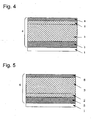
- Such photosensitive bodies are shown in Figs. 1 to 7 as the representative examples.
- Figs. 1 and 2 shows a structure comprising a conductive support 1 having provided thereon a photosensitive layer 4 comprising a laminate of a charge generating layer 2 comprising a charge generating substance as a main component and a charge transport layer 3 comprising a charge transport substance and a binder resin as main components.
- the photosensitive layer 4 may be provided through an undercoat layer 5 for adjusting charges provided on the conductive support, and a protective layer 8 may be provided as an outermost layer.
- the photosensitive layer 4 comprising a charge generating substance 7 dissolved or dispersed in a layer 6 comprising a charge transport substance and a binder resin as main components may be provided on the conductive support 1 directly or through the undercoat layer 5.
- the photosensitive body of the present invention can be prepared according to the conventional method as follows. For example, at least one p-terphenyl compound selected from the compounds (1) to (5) and at least one additive selected from the general formulae (A1) to (A11) are dissolved in an appropriate solvent together with a binder resin, and according to need, charge generating substances, electron withdrawing compounds, plasticizers, pigments are added, thereby preparing a coating liquid. This coating liquid is applied to the conductive support and dried to form a photosensitive layer of from several ⁇ m to several tens ⁇ m. Thus, a photosensitive body can e produced. When the photosensitive layer comprises two layers of a charge generating layer and a charge transport layer, the photosensitive layer can be prepared as follow.
- At least one p-terphenyl compound selected from the compounds (1) to (5) and at least one additive selected from the general formulae (A1), (A3)-(A6) and (A8)-(A10) are dissolved in an appropriate solvent together with a binder resin, and plasticizers, pigments are added thereto, thereby preparing a coating liquid, and the coating liquid thus prepared is applied to the charge generating layer, or a charge transport layer is obtained by applying the coating liquid, and a charge generating layer is then formed on the charge transport layer.
- the photosensitive body thus prepared may be provided with an undercoat layer and a protective layer.
- the p-terphenyl compound of the compounds (1) to (5) can be synthesized by, for example, condensation reaction such as Ullmann reaction of 4,4"-diiodo-p-terphenyl or 4,4"-dibromo-p-terphenyl and the corresponding amino compound.
- the corresponding amino compound can be synthesized by, for example, condensation reaction such as Ullmann reaction of aminoindane and p-iodotoluene or p-bromotoluene, and condensation reaction such as Ullmann reaction of the corresponding aniline derivatives and the corresponding iodobenzene derivatives or the corresponding bromobenzene derivatives.
- the aminoindane can be synthesized by, for example, amination (for example, see Non-Patent Document 2) after passing halogenation (for example, see Non-Patent Document 1) of indane.
- a proportion of the additive used in the photosensitive body of the present invention is from 0.05 to 30 mass% based on the p-terphenyl compound.
- the preferable use amount is the case that the proportion of the additive is from 0.1 to 20 mass% based on the p-terphenyl compound.
- the conductive support on which the photosensitive layer of the present invention is formed can use the materials used in the conventional electrophotographic photosensitive bodies.
- the conductive support that can be used include metal drums or sheets of aluminum, aluminum alloy, stainless steel, copper, zinc, vanadium, molybdenum, chromium, titanium, nickel, indium, gold, platinum or the like; laminates or depositions of those metals; plastic films, plastic drums, papers or paper cores, obtained by applying conductive substances such as metal powder, carbon black, copper iodide and polymer electrolyte thereto together with an appropriate binder to conduct conducting treatment; and plastic films or plastic drums, obtained by containing conductive substances therein to impart conductivity.
- an undercoat layer comprising a resin, or a resin and a pigment may be provided between the conductive support and the photosensitive layer.
- the pigment dispersed in the undercoat layer may be a powder generally used, but is desirably a while pigment that does not substantially absorb near infrared light or the similar pigment when high sensitization is considered.
- Examples of such a pigment include metal oxides represented by titanium oxide, zinc oxide, tin oxide, indium oxide, zirconium oxide, alumina and silica. The metal oxides that do not have hygroscopic properties and have less environmental change are desirable.
- a resin used in the undercoat layer resins having high solvent resistance to general organic solvents are desirable, considering that a photosensitive layer is applied to the undercoat layer, using a solvent.
- a resin include water-soluble resins such as polyvinyl alcohol, casein and sodium polyacrylate; alcohol-soluble resins such as copolymer nylon and methoxymethylated nylon; and curing resins that form a three-dimensional network structure such as polyurethane, melamine resin and epoxy resin.
- the charge generating layer in the present invention comprises a charge generating agent, a binder resin, and additives added according to need, and its production method includes a coating method, a deposition method and a CVD method.
- the charge generating agent examples include phthalocyanine pigments such as various crystal titanyl phthalocyanines, titanyl phthalocyanine having strong peaks of a diffraction angle 2 ⁇ 0.2° in X-ray diffraction spectrum of Cu-K ⁇ at 9.3, 10.6, 13.2, 15.1, 20.8, 23.3 and 26.3, titanyl phthalocyanine having strong peaks of a diffraction angle 2 ⁇ 0.2° at 7.5, 10.3, 12.6, 22.5, 24.3, 25.4 and 28.6, titanyl phthalocyanine having strong peaks of a diffraction angle 2 ⁇ 0.2° at 9.6, 24.1 and 27.2, various crystal metal-free phthalocyanine such as ⁇ type and X type, copper phthalocyanine, aluminum phthalocyanine, zinc phthalocyanine, ⁇ type, ⁇ type and Y type oxotitanyl phthalocyanines, cobalt phthalocyanine, hydroxygallium phthalocyanine, chloroaluminum
- the binder resin in the charge generating layer is not particularly limited, and examples thereof include polycarbonate, polyarylate, polyester, polyamide, polyethylene, polystyrene, polyacrylate, polymethacrylate, polyvinyl butyral, polyvinyl acetal, polyvinyl formal, polyvinyl alcohol, polyacrylonitrile, polyacrylamide, styrene-acryl copolymer, styrene-maleic anhydride copolymer, acrylonitrile-butadiene copolymer, polysulfone, polyether sulfone, silicon resin and phenoxy resin. Those may be used alone or as mixtures of two or more thereof according to need.
- the additives used according to need include antioxidants, ultraviolet absorbers, light stabilizers, dispersing agents, pressure-sensitive adhesives, and sensitizers.
- the charge generating layer prepared using the above materials has a film thickness of from 0.1 to 2.0 ⁇ m, and preferably from 0.1 to 1.0 ⁇ m.
- the charge transport layer in the present invention can be formed by dissolving a charge transport agent, a binder resin and according to need, an electron accepting substance and additives in a solvent, applying the resulting solution to the charge generating layer, the conductive support or the undercoat layer, and drying.
- Examples of materials used as a binder resin in the charge transport layer include polymers or copolymers of a vinyl compound such as styrene, vinyl acetate, vinyl chloride, acrylic ester, methacrylic ester and butadiene, and various resins having compatibility with the charge transport layer and the additive, such as polyvinyl acetal, polycarbonate (for example, see Patent Documents 21 to 24), polyester, polyphenylene oxide, polyurethane cellulose ester, phenoxy resin, silicon resin and epoxy resin.
- a vinyl compound such as styrene, vinyl acetate, vinyl chloride, acrylic ester, methacrylic ester and butadiene
- various resins having compatibility with the charge transport layer and the additive such as polyvinyl acetal, polycarbonate (for example, see Patent Documents 21 to 24), polyester, polyphenylene oxide, polyurethane cellulose ester, phenoxy resin, silicon resin and epoxy resin.
- Amount of the binder resin used is generally from 0.4 to 10 mass times, and preferably from 0.5 to 5 mass times, the charge transport agent.
- Specific examples of the particularly effective resin include polycarbonate resins such as IUPILON, a product of Mitsubishi Engineering-Plastics Corporation and bisphenol A-biphenol copolycarbonate (a product of Idemitsu Kosan Co., Ltd.
- the solvent used for the charge transport layer is not particularly limited so long as it dissolves a charge transport agent, a binder resin, an electron accepting substance and additives.
- the solvent that can be used include polar organic solvents such as tetrahydrofuran, 1,4-dioxane, methyl ethyl ketone, cyclohexanone, acetonitrile, N,N-dimethylformamide and ethyl acetate; aromatic organic solvents such as toluene, xylene and chlorobenzene; and chlorine-based hydrocarbon solvents such as chloroform, trichloroethylene, dichloromethane and 1,2-dichloroethane. Those may be used alone or as mixtures of two or more thereof according to need.
- the photosensitive layer of the present invention can contain an electron accepting substance for the purpose of improvement of sensitivity, decrease of residual potential or reduction of fatigue when used repeatedly.
- the electron accepting substance include succinic anhydride, maleic anhydride, dibromosuccinic anhydride, phthalic anhydride, tetrachlorophthalic anhydride, tetrabromophthalic anhydride, 3-nitrophthalic anhydride, 4-nitrophthalic anhydride, pyromellitic anhydride, mellitic anhydride, tetracyanoethylene, tetracyanoquinodiethane, o-dinitrobenzene, m-dinitrobenzene, 1,3,5-trinitrobenzene, p-nitrobenzonitrile, picryl chloride, quinonechloroimide, chloranil, bromanil, dichlorodicyano-p-benzoquinone, anthraquinone, dinitroanthraquinone, 2,3-dichloro-1
- a surface protective layer may be provided on the surface of the photosensitive body.
- Materials that can be used for the protective layer include resins such as polyester and polyamide, and mixtures of those resins and metals, metal oxides, and the like that can control electric resistance.
- the surface protective layer is desirable to be transparent as much as possible in a wavelength region of light absorption of the charge generating agent.
- AMILAN CM-400 1 part of alcohol-soluble polyamide (AMILAN CM-400, a product of Toray Industries, Inc.) was dissolved in 13 parts of methanol. 5 parts of titanium oxide (TIPAQUE CR-EL, a product of Ishihara Sangyo Kaisha, Ltd.) was added to the solution. The titanium oxide was dispersed with a paint shaker for 8 hours to prepare a coating liquid for an undercoat layer. The coating liquid was applied to an aluminum surface of an aluminum-deposited PET film using a wire bar to form an undercoat layer having a thickness of 1 ⁇ m.
- AMILAN CM-400 1 part of alcohol-soluble polyamide (AMILAN CM-400, a product of Toray Industries, Inc.) was dissolved in 13 parts of methanol. 5 parts of titanium oxide (TIPAQUE CR-EL, a product of Ishihara Sangyo Kaisha, Ltd.) was added to the solution. The titanium oxide was dispersed with a paint shaker for 8 hours to prepare
- a photosensitive body was prepared in the same manner as in Example 4, except for using the exemplified compound 3-(6) in place of the exemplified compound 1-(6).
- a photosensitive body was prepared in the same manner as in Example 4, except for using the exemplified compound 4-(8) in place of the exemplified compound 1-(6).
- a photosensitive body was prepared in the same manner as in Example 4, except for using the exemplified compound 6-(5) in place of the exemplified compound 1-(6).
- a photosensitive body was prepared in the same manner as in Example 4, except for using the exemplified compound 10-(6) in place of the exemplified compound 1-(6).
- a photosensitive body was prepared in the same manner as in Example 5, except for using titanyl phthalocyanine having strong peaks of a diffraction angle 28 ⁇ 0.2° in X-ray diffraction spectrum of Cu-K ⁇ at 7.5, 10.3, 12.6, 22.5, 24.3, 25.4 and 28.6 (charge generating agent No. 2) in place of the charge generating agent No. 1 and using the p-terphenyl compound of the compound (2) (charge transport agent No. 2) in place of the charge transport agent No. 1.
- a photosensitive body was prepared in the same manner as in Example 9, except for using the exemplified compound 3-(10) in place of the exemplified compound 3-(6).
- a photosensitive body was prepared in the same manner as in Example 5, except for using titanyl phthalocyanine having strong peaks of a diffraction angle 2 ⁇ 0.2° in X-ray diffraction spectrum of Cu-K ⁇ at 9.3, 10.6, 13.2, 15. 1, 20.8, 23.3 and 26.3 (charge generating agent No. 3) in place of the charge generating agent No. 1 and using the p-terphenyl compound of the compound (3) (charge transport agent No. 3) in place of the charge transport agent No. 1.
- a photosensitive body was prepared in the same manner as in Example 11, except for using the exemplified compound 6-(5) in place of the exemplified compound 3-(6).
- alcohol-soluble polyamide (AMILAN CM-8000, a product of Toray Industries, Inc.) was dissolved in 190 parts of methanol. The resulting solution was applied to an aluminum surface of an aluminum-deposited PET film using a wire bar, and dried to form an undercoat layer having a thickness of 1 ⁇ m.
- charge generating agent No. 4 ⁇ -type metal-free phthalocyanine
- charge generating agent No. 4 ⁇ -type metal-free phthalocyanine
- a charge generating agent 1.5 parts of the following ⁇ -type metal-free phthalocyanine (charge generating agent No. 4) as a charge generating agent was added to 50 parts of a 3% cyclohexanone solution of a polyvinyl butyral resin (S-LEC BL-S, a product of Sekisui Chemical Co., Ltd.), and dispersed with an ultrasonic dispersing machine for 1 hour.
- the dispersion obtained was applied to the undercoat layer obtained above using a wire bar, and dried at 110°C under atmospheric pressure for 1 hour to form a charge generating layer having a thickness of 0.6 ⁇ m.
- a photosensitive body was prepared in the same manner as in Example 9, except for using a mixture of the charge transport agent No. 3 and the p-terphenyl compound of the compound (4) (charge transport agent No. 4) in a mass ratio of 8:2 in place of the charge transport No. 2.
- a photosensitive body was prepared in the same manner as in Example 14, except for using the exemplified compound 6-(5) in place of the exemplified compound 3-(6).
- a photosensitive body was prepared in the same manner as in Example 17, except for using the following bisazo pigment (charge generating agent No. 6) in place of the charge generating No. 5.
- a photosensitive body for comparison was prepared in the same manner as in Example 4, except for excluding the exemplified compound 1-(6).
- a photosensitive body for comparison was prepared in the same manner as in Example 9, except for excluding the exemplified compound 3-(6).
- a photosensitive body for comparison was prepared in the same manner as in Example 14, except for excluding the exemplified compound 3-(6).
- a photosensitive body for comparison was prepared in the same manner as in Example 17, except for excluding the exemplified compound (6).
- Electrophotographic characteristics of the photosensitive bodies prepared in Examples 4 to 15 and Comparative Examples 1 to 3 were evaluated using a photosensitive drum characteristic-measuring apparatus (trade name: ELYSIA-II, a product of TREK JAPAN).
- ELYSIA-II a product of TREK JAPAN.
- the photosensitive body was subjected to corona discharge of -5.5 kV in a dark place, and an erase lamp of 70 lux was lighted. Charged potential V 0 at this time was measured.
- the photosensitive body was exposed with monochromatic light of image exposure 780 nm-30 ⁇ W to obtain residual potential V r .
- Electrophotographic characteristics of the photosensitive bodies prepared in Examples 16 to 18 and Comparative Example 4 were evaluated using a photosensitive drum characteristic-measuring apparatus (trade name: ELYSIA-II, a product of TREK JAPAN).
- ELYSIA-II a product of TREK JAPAN.
- the photosensitive body was subjected to corona discharge of -4.8 kV in a dark place, and an erase lamp of 70 lux was lighted. Charged potential V 0 at this time was measured.
- the photosensitive body was exposed with monochromatic light of image exposure 40 lux to obtain residual potential V r .
- This photosensitive body was exposed to an ozone gas of 20 ppm in a room under illumination of fluorescent lamps for 5 days, and charged potential V 0 and residual potential V r were measured in the same manner as in before exposure.
- the present invention can provide an electrophotographic photosensitive body which shows less change in charged potential and residual potential and which is excellent in durability, by using in combination a p-terphenyl compound having a specific structure as a charge transport agent and a compound having a specific structure as an additive.
- the present invention is useful as an electrophotographic photosensitive body which shows less change in electrophotographic characteristics and which is capable of realizing high durability.
Landscapes
- Physics & Mathematics (AREA)
- General Physics & Mathematics (AREA)
- Spectroscopy & Molecular Physics (AREA)
- Photoreceptors In Electrophotography (AREA)
Claims (2)
- Elektrofotografischer lichtempfindlicher Körper, umfassend einen leitenden Träger, der darauf eine Schicht aufweist, umfassend zumindest eine p-Terphenylverbindung, ausgewählt aus den folgenden Verbindungen (1) bis (5)


 einer organischen Phosphitverbindung mit der allgemeinen Formel (A1)
 einer Thioetherverbindung mit der allgemeinen Formel (A3)
R10-S-R11 (A3)
worin R10 und R11, die gleich oder verschieden sein können, eine substituierte oder unsubstituierte Alkylgruppe, substituierte oder unsubstituierte Alkenylgruppe oder substituierte oder unsubstituierte Arylgruppe sind;Hydrochinonverbindung mit der allgemeinen Formel (A4) Benzotriazolverbindung mit der allgemeinen Formel (A5)
 Benzotriazol-Alkylenbisphenol-Verbindung mit der allgemeinen Formel (A6)
 gehinderter Phenolverbindung mit der allgemeinen Formel (A8)
 gehinderter Aminverbindung mit der allgemeinen Formel (A10)
worin die Schicht das Additiv in einer Menge von 0,05 bis 30 Massen-%, bezogen auf die p-Terphenylverbindung, enthält. - Elektrofotografischer lichtempfindlicher Körper nach Anspruch 1, worin das Additiv in einer Menge von 0,1 bis 20 Massen-% enthalten ist, bezogen auf die p-Terphenylverbindung.
Priority Applications (2)
| Application Number | Priority Date | Filing Date | Title |
|---|---|---|---|
| EP11159768A EP2341393A1 (de) | 2004-11-24 | 2005-11-21 | Elektrofotographischer lichtempfindlicher körper |
| EP11159767A EP2341392A1 (de) | 2004-11-24 | 2005-11-21 | Elektrofotographischer lichtempfindlicher körper |
Applications Claiming Priority (2)
| Application Number | Priority Date | Filing Date | Title |
|---|---|---|---|
| JP2004338784 | 2004-11-24 | ||
| PCT/JP2005/021746 WO2006057373A1 (ja) | 2004-11-24 | 2005-11-21 | 電子写真用感光体 |
Related Child Applications (2)
| Application Number | Title | Priority Date | Filing Date |
|---|---|---|---|
| EP11159768A Division-Into EP2341393A1 (de) | 2004-11-24 | 2005-11-21 | Elektrofotographischer lichtempfindlicher körper |
| EP11159767A Division-Into EP2341392A1 (de) | 2004-11-24 | 2005-11-21 | Elektrofotographischer lichtempfindlicher körper |
Publications (3)
| Publication Number | Publication Date |
|---|---|
| EP1818725A1 EP1818725A1 (de) | 2007-08-15 |
| EP1818725A4 EP1818725A4 (de) | 2009-01-07 |
| EP1818725B1 true EP1818725B1 (de) | 2014-09-10 |
Family
ID=36498106
Family Applications (3)
| Application Number | Title | Priority Date | Filing Date |
|---|---|---|---|
| EP05809375.8A Expired - Lifetime EP1818725B1 (de) | 2004-11-24 | 2005-11-21 | Elektrofotografischer lichtempfindlicher körper |
| EP11159768A Withdrawn EP2341393A1 (de) | 2004-11-24 | 2005-11-21 | Elektrofotographischer lichtempfindlicher körper |
| EP11159767A Withdrawn EP2341392A1 (de) | 2004-11-24 | 2005-11-21 | Elektrofotographischer lichtempfindlicher körper |
Family Applications After (2)
| Application Number | Title | Priority Date | Filing Date |
|---|---|---|---|
| EP11159768A Withdrawn EP2341393A1 (de) | 2004-11-24 | 2005-11-21 | Elektrofotographischer lichtempfindlicher körper |
| EP11159767A Withdrawn EP2341392A1 (de) | 2004-11-24 | 2005-11-21 | Elektrofotographischer lichtempfindlicher körper |
Country Status (7)
| Country | Link |
|---|---|
| US (1) | US7919219B2 (de) |
| EP (3) | EP1818725B1 (de) |
| JP (2) | JP4879753B2 (de) |
| KR (1) | KR101207139B1 (de) |
| CN (1) | CN101065711B (de) |
| TW (1) | TWI401550B (de) |
| WO (1) | WO2006057373A1 (de) |
Families Citing this family (7)
| Publication number | Priority date | Publication date | Assignee | Title |
|---|---|---|---|---|
| CN1956945B (zh) | 2004-05-25 | 2010-09-22 | 保土谷化学工业株式会社 | 对三联苯化合物和使用该化合物的电子照相用感光体 |
| WO2006054805A1 (ja) * | 2004-11-22 | 2006-05-26 | Hodogaya Chemical Co., Ltd. | 電子写真用感光体 |
| JP5209325B2 (ja) | 2006-01-25 | 2013-06-12 | 保土谷化学工業株式会社 | p−ターフェニル化合物混合物及び該化合物混合物を用いた電子写真用感光体 |
| WO2016076298A1 (ja) * | 2014-11-10 | 2016-05-19 | 三菱化学株式会社 | 電子写真感光体、画像形成装置、及び感光層形成用塗布液 |
| JP6055497B2 (ja) * | 2015-02-02 | 2016-12-27 | 京セラドキュメントソリューションズ株式会社 | 電子写真感光体、電子写真感光体の製造方法、プロセスカートリッジ、及び画像形成装置 |
| JP6662111B2 (ja) * | 2015-03-13 | 2020-03-11 | 三菱ケミカル株式会社 | 正帯電用単層型電子写真感光体、電子写真感光体カートリッジ、及び画像形成装置 |
| JP7230522B2 (ja) * | 2019-01-18 | 2023-03-01 | 京セラドキュメントソリューションズ株式会社 | 電子写真感光体、プロセスカートリッジ、及び画像形成装置 |
Family Cites Families (39)
| Publication number | Priority date | Publication date | Assignee | Title |
|---|---|---|---|---|
| US203298A (en) | 1878-05-07 | Improvement in dental-engine hand-pieces | ||
| JPS6027012B2 (ja) | 1977-01-31 | 1985-06-26 | 株式会社リコー | 電子写真用感光体 |
| JPS6027013B2 (ja) | 1977-04-25 | 1985-06-26 | 株式会社リコー | 電子写真用感光体 |
| JPS6027014B2 (ja) | 1977-04-27 | 1985-06-26 | 株式会社リコー | 電子写真用感光体 |
| JPS5814791B2 (ja) | 1977-05-09 | 1983-03-22 | 三洋電機株式会社 | 抜き取りパルス発生装置 |
| JPS6027016B2 (ja) | 1977-06-30 | 1985-06-26 | 株式会社リコー | 電子写真感光体 |
| JPS6027015B2 (ja) | 1977-06-08 | 1985-06-26 | 株式会社リコー | 電子写真用感光体 |
| JPS6032858B2 (ja) | 1977-07-08 | 1985-07-30 | 株式会社リコー | 電子写真用感光体 |
| JPS6027017B2 (ja) | 1977-07-08 | 1985-06-26 | 株式会社リコー | 電子写真用感光体 |
| JPS6027018B2 (ja) | 1977-07-19 | 1985-06-26 | 株式会社リコー | 電子写真用感光体 |
| JPS6029109B2 (ja) | 1977-07-22 | 1985-07-09 | 株式会社リコー | 電子写真用感光体 |
| JPS57195768A (en) | 1981-05-28 | 1982-12-01 | Ricoh Co Ltd | Novel trisazo compound and production thereof |
| JPS57195767A (en) | 1981-05-28 | 1982-12-01 | Ricoh Co Ltd | Novel trisazo compound and production thereof |
| JPS57202545A (en) | 1981-06-08 | 1982-12-11 | Ricoh Co Ltd | Electrophotographic receptor |
| JPS59136351A (ja) | 1983-01-26 | 1984-08-04 | Ricoh Co Ltd | 電子写真用感光体 |
| JPS59129857A (ja) | 1983-01-17 | 1984-07-26 | Ricoh Co Ltd | 電子写真用感光体 |
| JPS58222152A (ja) | 1982-06-18 | 1983-12-23 | Ricoh Co Ltd | 新規なジスアゾ化合物及びその製造法 |
| JPS60172044A (ja) | 1984-02-16 | 1985-09-05 | Konishiroku Photo Ind Co Ltd | 電子写真感光体の製造方法 |
| JPS62112163A (ja) | 1985-11-11 | 1987-05-23 | Fuji Photo Film Co Ltd | 電子写真感光体 |
| JPH071393B2 (ja) | 1985-12-10 | 1995-01-11 | 富士ゼロックス株式会社 | 電子写真感光体の製造方法 |
| JPS62147462A (ja) | 1985-12-20 | 1987-07-01 | Canon Inc | 電子写真感光体 |
| JPH0820739B2 (ja) | 1986-12-12 | 1996-03-04 | 三菱化学株式会社 | 電子写真感光体 |
| JPH0753829B2 (ja) | 1986-05-15 | 1995-06-07 | 株式会社リコー | 新規なビスアゾ化合物及びその製造方法 |
| JPS6444946A (en) | 1987-08-13 | 1989-02-17 | Konishiroku Photo Ind | Electrophotographic sensitive body |
| JP2643952B2 (ja) | 1987-09-22 | 1997-08-25 | 株式会社リコー | 電子写真用感光体 |
| US4877702A (en) | 1987-10-30 | 1989-10-31 | Mita Industrial Co., Ltd. | Electrophotographic sensitive material |
| JPH01118143A (ja) | 1987-10-30 | 1989-05-10 | Mita Ind Co Ltd | 電子写真用感光体 |
| JPH01118845A (ja) | 1987-11-02 | 1989-05-11 | Hitachi Chem Co Ltd | 電子写真感光体 |
| JP2639074B2 (ja) | 1989-03-29 | 1997-08-06 | 富士ゼロックス株式会社 | 電子写真感光体 |
| JPH0673018A (ja) | 1992-08-27 | 1994-03-15 | Shikoku Chem Corp | 4(5)−シアノイミダゾール化合物の合成方法 |
| JP2001305764A (ja) * | 2000-04-21 | 2001-11-02 | Fuji Xerox Co Ltd | 電子写真用感光体及びこれを用いた電子写真装置 |
| JP2002328480A (ja) * | 2001-04-27 | 2002-11-15 | Hodogaya Chem Co Ltd | 電子写真用感光体 |
| US6790574B2 (en) * | 2001-09-27 | 2004-09-14 | Hodogaya Chemical Co., Ltd. | Electrophotographic photoreceptor |
| JP2003202687A (ja) | 2001-10-30 | 2003-07-18 | Hodogaya Chem Co Ltd | 電子写真用感光体 |
| KR100538218B1 (ko) * | 2002-07-16 | 2005-12-21 | 삼성전자주식회사 | 전자 사진용 감광체 |
| JP3681379B2 (ja) | 2003-05-19 | 2005-08-10 | 大洋化学株式会社 | 収納袋の排気弁 |
| US7166397B2 (en) * | 2003-12-23 | 2007-01-23 | Xerox Corporation | Imaging members |
| CN1956945B (zh) | 2004-05-25 | 2010-09-22 | 保土谷化学工业株式会社 | 对三联苯化合物和使用该化合物的电子照相用感光体 |
| WO2006054805A1 (ja) * | 2004-11-22 | 2006-05-26 | Hodogaya Chemical Co., Ltd. | 電子写真用感光体 |
-
2005
- 2005-11-21 EP EP05809375.8A patent/EP1818725B1/de not_active Expired - Lifetime
- 2005-11-21 KR KR1020077011687A patent/KR101207139B1/ko not_active Expired - Lifetime
- 2005-11-21 WO PCT/JP2005/021746 patent/WO2006057373A1/ja not_active Ceased
- 2005-11-21 CN CN2005800403603A patent/CN101065711B/zh not_active Expired - Lifetime
- 2005-11-21 US US11/720,078 patent/US7919219B2/en active Active
- 2005-11-21 EP EP11159768A patent/EP2341393A1/de not_active Withdrawn
- 2005-11-21 EP EP11159767A patent/EP2341392A1/de not_active Withdrawn
- 2005-11-21 JP JP2006547885A patent/JP4879753B2/ja not_active Expired - Lifetime
- 2005-11-24 TW TW094141254A patent/TWI401550B/zh not_active IP Right Cessation
-
2011
- 2011-05-31 JP JP2011122407A patent/JP4880080B2/ja not_active Expired - Lifetime
Also Published As
| Publication number | Publication date |
|---|---|
| JP4880080B2 (ja) | 2012-02-22 |
| JPWO2006057373A1 (ja) | 2008-06-05 |
| EP2341392A1 (de) | 2011-07-06 |
| JP4879753B2 (ja) | 2012-02-22 |
| KR101207139B1 (ko) | 2012-11-30 |
| EP2341393A1 (de) | 2011-07-06 |
| TWI401550B (zh) | 2013-07-11 |
| CN101065711B (zh) | 2010-11-24 |
| EP1818725A4 (de) | 2009-01-07 |
| JP2011170388A (ja) | 2011-09-01 |
| US7919219B2 (en) | 2011-04-05 |
| KR20070088647A (ko) | 2007-08-29 |
| EP1818725A1 (de) | 2007-08-15 |
| CN101065711A (zh) | 2007-10-31 |
| US20080044750A1 (en) | 2008-02-21 |
| TW200627099A (en) | 2006-08-01 |
| WO2006057373A1 (ja) | 2006-06-01 |
Similar Documents
| Publication | Publication Date | Title |
|---|---|---|
| US8530124B2 (en) | Hydroxygallium phthalocyanine composite pigment, electrophotographic photoconductor containing the same, and image forming device and process cartridge for image forming device using the same | |
| JP4880080B2 (ja) | 電子写真用感光体 | |
| US8808951B2 (en) | Electrophotographic photosensitive body | |
| JP2535240B2 (ja) | 電子写真感光体 | |
| US8088540B2 (en) | Photoreceptor for electrophotography | |
| JP3525238B2 (ja) | 電子写真感光体 | |
| EP0648737B1 (de) | Benzidinderivate und elektrophotoempfindliches Material unter Verwendung derselben | |
| JPH07319179A (ja) | 電子写真用感光体 | |
| US8247144B2 (en) | Photoreceptor for electrophotography | |
| EP1942097B1 (de) | Photorezeptor für die elektrophotographie | |
| US6790574B2 (en) | Electrophotographic photoreceptor | |
| JPH10273461A (ja) | フェノール系化合物及び電子写真感光体 | |
| JP3709596B2 (ja) | 電子写真用感光体 | |
| JP3938607B2 (ja) | 電子写真感光体 | |
| JPH1152596A (ja) | 電子写真感光体およびそれを用いた電子写真装置 | |
| JP2003202687A (ja) | 電子写真用感光体 | |
| JPH05210251A (ja) | 感光体 | |
| JP2000010311A (ja) | 電子写真感光体 |
Legal Events
| Date | Code | Title | Description |
|---|---|---|---|
| PUAI | Public reference made under article 153(3) epc to a published international application that has entered the european phase |
Free format text: ORIGINAL CODE: 0009012 |
|
| 17P | Request for examination filed |
Effective date: 20070523 |
|
| AK | Designated contracting states |
Kind code of ref document: A1 Designated state(s): DE NL |
|
| DAX | Request for extension of the european patent (deleted) | ||
| RBV | Designated contracting states (corrected) |
Designated state(s): DE NL |
|
| A4 | Supplementary search report drawn up and despatched |
Effective date: 20081209 |
|
| 17Q | First examination report despatched |
Effective date: 20090327 |
|
| GRAP | Despatch of communication of intention to grant a patent |
Free format text: ORIGINAL CODE: EPIDOSNIGR1 |
|
| INTG | Intention to grant announced |
Effective date: 20140331 |
|
| GRAS | Grant fee paid |
Free format text: ORIGINAL CODE: EPIDOSNIGR3 |
|
| GRAA | (expected) grant |
Free format text: ORIGINAL CODE: 0009210 |
|
| RAP1 | Party data changed (applicant data changed or rights of an application transferred) |
Owner name: HODOGAYA CHEMICAL CO., LTD. |
|
| AK | Designated contracting states |
Kind code of ref document: B1 Designated state(s): DE NL |
|
| REG | Reference to a national code |
Ref country code: DE Ref legal event code: R096 Ref document number: 602005044715 Country of ref document: DE Effective date: 20141016 |
|
| REG | Reference to a national code |
Ref country code: NL Ref legal event code: VDEP Effective date: 20140910 |
|
| PG25 | Lapsed in a contracting state [announced via postgrant information from national office to epo] |
Ref country code: NL Free format text: LAPSE BECAUSE OF FAILURE TO SUBMIT A TRANSLATION OF THE DESCRIPTION OR TO PAY THE FEE WITHIN THE PRESCRIBED TIME-LIMIT Effective date: 20140910 |
|
| REG | Reference to a national code |
Ref country code: DE Ref legal event code: R119 Ref document number: 602005044715 Country of ref document: DE |
|
| PLBE | No opposition filed within time limit |
Free format text: ORIGINAL CODE: 0009261 |
|
| STAA | Information on the status of an ep patent application or granted ep patent |
Free format text: STATUS: NO OPPOSITION FILED WITHIN TIME LIMIT |
|
| 26N | No opposition filed |
Effective date: 20150611 |
|
| PG25 | Lapsed in a contracting state [announced via postgrant information from national office to epo] |
Ref country code: DE Free format text: LAPSE BECAUSE OF NON-PAYMENT OF DUE FEES Effective date: 20150602 |