EP1904069B1 - Tetrahydrobenzazepines substituees par aryle et heteroaryle, et leur utilisation pour bloquer la reabsorption de la noradrenaline, de la dopamine, et de la serotonine - Google Patents
Tetrahydrobenzazepines substituees par aryle et heteroaryle, et leur utilisation pour bloquer la reabsorption de la noradrenaline, de la dopamine, et de la serotonine Download PDFInfo
- Publication number
- EP1904069B1 EP1904069B1 EP06787476.8A EP06787476A EP1904069B1 EP 1904069 B1 EP1904069 B1 EP 1904069B1 EP 06787476 A EP06787476 A EP 06787476A EP 1904069 B1 EP1904069 B1 EP 1904069B1
- Authority
- EP
- European Patent Office
- Prior art keywords
- benzo
- azepine
- methyl
- tetrahydro
- pyridazin
- Prior art date
- Legal status (The legal status is an assumption and is not a legal conclusion. Google has not performed a legal analysis and makes no representation as to the accuracy of the status listed.)
- Not-in-force
Links
- 0 *c(cc1)ccc1C1=CCN(*)Cc2ccc(*)cc12 Chemical compound *c(cc1)ccc1C1=CCN(*)Cc2ccc(*)cc12 0.000 description 2
Classifications
-
- C—CHEMISTRY; METALLURGY
- C07—ORGANIC CHEMISTRY
- C07D—HETEROCYCLIC COMPOUNDS
- C07D223/00—Heterocyclic compounds containing seven-membered rings having one nitrogen atom as the only ring hetero atom
- C07D223/14—Heterocyclic compounds containing seven-membered rings having one nitrogen atom as the only ring hetero atom condensed with carbocyclic rings or ring systems
- C07D223/16—Benzazepines; Hydrogenated benzazepines
-
- A—HUMAN NECESSITIES
- A61—MEDICAL OR VETERINARY SCIENCE; HYGIENE
- A61K—PREPARATIONS FOR MEDICAL, DENTAL OR TOILETRY PURPOSES
- A61K31/00—Medicinal preparations containing organic active ingredients
- A61K31/33—Heterocyclic compounds
- A61K31/395—Heterocyclic compounds having nitrogen as a ring hetero atom, e.g. guanethidine or rifamycins
- A61K31/55—Heterocyclic compounds having nitrogen as a ring hetero atom, e.g. guanethidine or rifamycins having seven-membered rings, e.g. azelastine, pentylenetetrazole
-
- A—HUMAN NECESSITIES
- A61—MEDICAL OR VETERINARY SCIENCE; HYGIENE
- A61P—SPECIFIC THERAPEUTIC ACTIVITY OF CHEMICAL COMPOUNDS OR MEDICINAL PREPARATIONS
- A61P1/00—Drugs for disorders of the alimentary tract or the digestive system
- A61P1/14—Prodigestives, e.g. acids, enzymes, appetite stimulants, antidyspeptics, tonics, antiflatulents
-
- A—HUMAN NECESSITIES
- A61—MEDICAL OR VETERINARY SCIENCE; HYGIENE
- A61P—SPECIFIC THERAPEUTIC ACTIVITY OF CHEMICAL COMPOUNDS OR MEDICINAL PREPARATIONS
- A61P11/00—Drugs for disorders of the respiratory system
-
- A—HUMAN NECESSITIES
- A61—MEDICAL OR VETERINARY SCIENCE; HYGIENE
- A61P—SPECIFIC THERAPEUTIC ACTIVITY OF CHEMICAL COMPOUNDS OR MEDICINAL PREPARATIONS
- A61P13/00—Drugs for disorders of the urinary system
- A61P13/02—Drugs for disorders of the urinary system of urine or of the urinary tract, e.g. urine acidifiers
-
- A—HUMAN NECESSITIES
- A61—MEDICAL OR VETERINARY SCIENCE; HYGIENE
- A61P—SPECIFIC THERAPEUTIC ACTIVITY OF CHEMICAL COMPOUNDS OR MEDICINAL PREPARATIONS
- A61P15/00—Drugs for genital or sexual disorders; Contraceptives
-
- A—HUMAN NECESSITIES
- A61—MEDICAL OR VETERINARY SCIENCE; HYGIENE
- A61P—SPECIFIC THERAPEUTIC ACTIVITY OF CHEMICAL COMPOUNDS OR MEDICINAL PREPARATIONS
- A61P15/00—Drugs for genital or sexual disorders; Contraceptives
- A61P15/08—Drugs for genital or sexual disorders; Contraceptives for gonadal disorders or for enhancing fertility, e.g. inducers of ovulation or of spermatogenesis
-
- A—HUMAN NECESSITIES
- A61—MEDICAL OR VETERINARY SCIENCE; HYGIENE
- A61P—SPECIFIC THERAPEUTIC ACTIVITY OF CHEMICAL COMPOUNDS OR MEDICINAL PREPARATIONS
- A61P15/00—Drugs for genital or sexual disorders; Contraceptives
- A61P15/10—Drugs for genital or sexual disorders; Contraceptives for impotence
-
- A—HUMAN NECESSITIES
- A61—MEDICAL OR VETERINARY SCIENCE; HYGIENE
- A61P—SPECIFIC THERAPEUTIC ACTIVITY OF CHEMICAL COMPOUNDS OR MEDICINAL PREPARATIONS
- A61P21/00—Drugs for disorders of the muscular or neuromuscular system
-
- A—HUMAN NECESSITIES
- A61—MEDICAL OR VETERINARY SCIENCE; HYGIENE
- A61P—SPECIFIC THERAPEUTIC ACTIVITY OF CHEMICAL COMPOUNDS OR MEDICINAL PREPARATIONS
- A61P25/00—Drugs for disorders of the nervous system
-
- A—HUMAN NECESSITIES
- A61—MEDICAL OR VETERINARY SCIENCE; HYGIENE
- A61P—SPECIFIC THERAPEUTIC ACTIVITY OF CHEMICAL COMPOUNDS OR MEDICINAL PREPARATIONS
- A61P25/00—Drugs for disorders of the nervous system
- A61P25/04—Centrally acting analgesics, e.g. opioids
-
- A—HUMAN NECESSITIES
- A61—MEDICAL OR VETERINARY SCIENCE; HYGIENE
- A61P—SPECIFIC THERAPEUTIC ACTIVITY OF CHEMICAL COMPOUNDS OR MEDICINAL PREPARATIONS
- A61P25/00—Drugs for disorders of the nervous system
- A61P25/06—Antimigraine agents
-
- A—HUMAN NECESSITIES
- A61—MEDICAL OR VETERINARY SCIENCE; HYGIENE
- A61P—SPECIFIC THERAPEUTIC ACTIVITY OF CHEMICAL COMPOUNDS OR MEDICINAL PREPARATIONS
- A61P25/00—Drugs for disorders of the nervous system
- A61P25/08—Antiepileptics; Anticonvulsants
-
- A—HUMAN NECESSITIES
- A61—MEDICAL OR VETERINARY SCIENCE; HYGIENE
- A61P—SPECIFIC THERAPEUTIC ACTIVITY OF CHEMICAL COMPOUNDS OR MEDICINAL PREPARATIONS
- A61P25/00—Drugs for disorders of the nervous system
- A61P25/14—Drugs for disorders of the nervous system for treating abnormal movements, e.g. chorea, dyskinesia
-
- A—HUMAN NECESSITIES
- A61—MEDICAL OR VETERINARY SCIENCE; HYGIENE
- A61P—SPECIFIC THERAPEUTIC ACTIVITY OF CHEMICAL COMPOUNDS OR MEDICINAL PREPARATIONS
- A61P25/00—Drugs for disorders of the nervous system
- A61P25/14—Drugs for disorders of the nervous system for treating abnormal movements, e.g. chorea, dyskinesia
- A61P25/16—Anti-Parkinson drugs
-
- A—HUMAN NECESSITIES
- A61—MEDICAL OR VETERINARY SCIENCE; HYGIENE
- A61P—SPECIFIC THERAPEUTIC ACTIVITY OF CHEMICAL COMPOUNDS OR MEDICINAL PREPARATIONS
- A61P25/00—Drugs for disorders of the nervous system
- A61P25/18—Antipsychotics, i.e. neuroleptics; Drugs for mania or schizophrenia
-
- A—HUMAN NECESSITIES
- A61—MEDICAL OR VETERINARY SCIENCE; HYGIENE
- A61P—SPECIFIC THERAPEUTIC ACTIVITY OF CHEMICAL COMPOUNDS OR MEDICINAL PREPARATIONS
- A61P25/00—Drugs for disorders of the nervous system
- A61P25/20—Hypnotics; Sedatives
-
- A—HUMAN NECESSITIES
- A61—MEDICAL OR VETERINARY SCIENCE; HYGIENE
- A61P—SPECIFIC THERAPEUTIC ACTIVITY OF CHEMICAL COMPOUNDS OR MEDICINAL PREPARATIONS
- A61P25/00—Drugs for disorders of the nervous system
- A61P25/22—Anxiolytics
-
- A—HUMAN NECESSITIES
- A61—MEDICAL OR VETERINARY SCIENCE; HYGIENE
- A61P—SPECIFIC THERAPEUTIC ACTIVITY OF CHEMICAL COMPOUNDS OR MEDICINAL PREPARATIONS
- A61P25/00—Drugs for disorders of the nervous system
- A61P25/24—Antidepressants
-
- A—HUMAN NECESSITIES
- A61—MEDICAL OR VETERINARY SCIENCE; HYGIENE
- A61P—SPECIFIC THERAPEUTIC ACTIVITY OF CHEMICAL COMPOUNDS OR MEDICINAL PREPARATIONS
- A61P25/00—Drugs for disorders of the nervous system
- A61P25/28—Drugs for disorders of the nervous system for treating neurodegenerative disorders of the central nervous system, e.g. nootropic agents, cognition enhancers, drugs for treating Alzheimer's disease or other forms of dementia
-
- A—HUMAN NECESSITIES
- A61—MEDICAL OR VETERINARY SCIENCE; HYGIENE
- A61P—SPECIFIC THERAPEUTIC ACTIVITY OF CHEMICAL COMPOUNDS OR MEDICINAL PREPARATIONS
- A61P25/00—Drugs for disorders of the nervous system
- A61P25/30—Drugs for disorders of the nervous system for treating abuse or dependence
-
- A—HUMAN NECESSITIES
- A61—MEDICAL OR VETERINARY SCIENCE; HYGIENE
- A61P—SPECIFIC THERAPEUTIC ACTIVITY OF CHEMICAL COMPOUNDS OR MEDICINAL PREPARATIONS
- A61P25/00—Drugs for disorders of the nervous system
- A61P25/30—Drugs for disorders of the nervous system for treating abuse or dependence
- A61P25/32—Alcohol-abuse
-
- A—HUMAN NECESSITIES
- A61—MEDICAL OR VETERINARY SCIENCE; HYGIENE
- A61P—SPECIFIC THERAPEUTIC ACTIVITY OF CHEMICAL COMPOUNDS OR MEDICINAL PREPARATIONS
- A61P25/00—Drugs for disorders of the nervous system
- A61P25/30—Drugs for disorders of the nervous system for treating abuse or dependence
- A61P25/34—Tobacco-abuse
-
- A—HUMAN NECESSITIES
- A61—MEDICAL OR VETERINARY SCIENCE; HYGIENE
- A61P—SPECIFIC THERAPEUTIC ACTIVITY OF CHEMICAL COMPOUNDS OR MEDICINAL PREPARATIONS
- A61P25/00—Drugs for disorders of the nervous system
- A61P25/30—Drugs for disorders of the nervous system for treating abuse or dependence
- A61P25/36—Opioid-abuse
-
- A—HUMAN NECESSITIES
- A61—MEDICAL OR VETERINARY SCIENCE; HYGIENE
- A61P—SPECIFIC THERAPEUTIC ACTIVITY OF CHEMICAL COMPOUNDS OR MEDICINAL PREPARATIONS
- A61P29/00—Non-central analgesic, antipyretic or antiinflammatory agents, e.g. antirheumatic agents; Non-steroidal antiinflammatory drugs [NSAID]
-
- A—HUMAN NECESSITIES
- A61—MEDICAL OR VETERINARY SCIENCE; HYGIENE
- A61P—SPECIFIC THERAPEUTIC ACTIVITY OF CHEMICAL COMPOUNDS OR MEDICINAL PREPARATIONS
- A61P3/00—Drugs for disorders of the metabolism
-
- A—HUMAN NECESSITIES
- A61—MEDICAL OR VETERINARY SCIENCE; HYGIENE
- A61P—SPECIFIC THERAPEUTIC ACTIVITY OF CHEMICAL COMPOUNDS OR MEDICINAL PREPARATIONS
- A61P3/00—Drugs for disorders of the metabolism
- A61P3/02—Nutrients, e.g. vitamins, minerals
-
- A—HUMAN NECESSITIES
- A61—MEDICAL OR VETERINARY SCIENCE; HYGIENE
- A61P—SPECIFIC THERAPEUTIC ACTIVITY OF CHEMICAL COMPOUNDS OR MEDICINAL PREPARATIONS
- A61P3/00—Drugs for disorders of the metabolism
- A61P3/04—Anorexiants; Antiobesity agents
-
- A—HUMAN NECESSITIES
- A61—MEDICAL OR VETERINARY SCIENCE; HYGIENE
- A61P—SPECIFIC THERAPEUTIC ACTIVITY OF CHEMICAL COMPOUNDS OR MEDICINAL PREPARATIONS
- A61P3/00—Drugs for disorders of the metabolism
- A61P3/08—Drugs for disorders of the metabolism for glucose homeostasis
- A61P3/10—Drugs for disorders of the metabolism for glucose homeostasis for hyperglycaemia, e.g. antidiabetics
-
- A—HUMAN NECESSITIES
- A61—MEDICAL OR VETERINARY SCIENCE; HYGIENE
- A61P—SPECIFIC THERAPEUTIC ACTIVITY OF CHEMICAL COMPOUNDS OR MEDICINAL PREPARATIONS
- A61P43/00—Drugs for specific purposes, not provided for in groups A61P1/00-A61P41/00
-
- A—HUMAN NECESSITIES
- A61—MEDICAL OR VETERINARY SCIENCE; HYGIENE
- A61P—SPECIFIC THERAPEUTIC ACTIVITY OF CHEMICAL COMPOUNDS OR MEDICINAL PREPARATIONS
- A61P5/00—Drugs for disorders of the endocrine system
- A61P5/24—Drugs for disorders of the endocrine system of the sex hormones
-
- C—CHEMISTRY; METALLURGY
- C07—ORGANIC CHEMISTRY
- C07D—HETEROCYCLIC COMPOUNDS
- C07D401/00—Heterocyclic compounds containing two or more hetero rings, having nitrogen atoms as the only ring hetero atoms, at least one ring being a six-membered ring with only one nitrogen atom
- C07D401/02—Heterocyclic compounds containing two or more hetero rings, having nitrogen atoms as the only ring hetero atoms, at least one ring being a six-membered ring with only one nitrogen atom containing two hetero rings
- C07D401/04—Heterocyclic compounds containing two or more hetero rings, having nitrogen atoms as the only ring hetero atoms, at least one ring being a six-membered ring with only one nitrogen atom containing two hetero rings directly linked by a ring-member-to-ring-member bond
-
- C—CHEMISTRY; METALLURGY
- C07—ORGANIC CHEMISTRY
- C07D—HETEROCYCLIC COMPOUNDS
- C07D401/00—Heterocyclic compounds containing two or more hetero rings, having nitrogen atoms as the only ring hetero atoms, at least one ring being a six-membered ring with only one nitrogen atom
- C07D401/02—Heterocyclic compounds containing two or more hetero rings, having nitrogen atoms as the only ring hetero atoms, at least one ring being a six-membered ring with only one nitrogen atom containing two hetero rings
- C07D401/12—Heterocyclic compounds containing two or more hetero rings, having nitrogen atoms as the only ring hetero atoms, at least one ring being a six-membered ring with only one nitrogen atom containing two hetero rings linked by a chain containing hetero atoms as chain links
-
- C—CHEMISTRY; METALLURGY
- C07—ORGANIC CHEMISTRY
- C07D—HETEROCYCLIC COMPOUNDS
- C07D401/00—Heterocyclic compounds containing two or more hetero rings, having nitrogen atoms as the only ring hetero atoms, at least one ring being a six-membered ring with only one nitrogen atom
- C07D401/14—Heterocyclic compounds containing two or more hetero rings, having nitrogen atoms as the only ring hetero atoms, at least one ring being a six-membered ring with only one nitrogen atom containing three or more hetero rings
-
- C—CHEMISTRY; METALLURGY
- C07—ORGANIC CHEMISTRY
- C07D—HETEROCYCLIC COMPOUNDS
- C07D403/00—Heterocyclic compounds containing two or more hetero rings, having nitrogen atoms as the only ring hetero atoms, not provided for by group C07D401/00
- C07D403/02—Heterocyclic compounds containing two or more hetero rings, having nitrogen atoms as the only ring hetero atoms, not provided for by group C07D401/00 containing two hetero rings
- C07D403/04—Heterocyclic compounds containing two or more hetero rings, having nitrogen atoms as the only ring hetero atoms, not provided for by group C07D401/00 containing two hetero rings directly linked by a ring-member-to-ring-member bond
-
- C—CHEMISTRY; METALLURGY
- C07—ORGANIC CHEMISTRY
- C07D—HETEROCYCLIC COMPOUNDS
- C07D403/00—Heterocyclic compounds containing two or more hetero rings, having nitrogen atoms as the only ring hetero atoms, not provided for by group C07D401/00
- C07D403/14—Heterocyclic compounds containing two or more hetero rings, having nitrogen atoms as the only ring hetero atoms, not provided for by group C07D401/00 containing three or more hetero rings
-
- C—CHEMISTRY; METALLURGY
- C07—ORGANIC CHEMISTRY
- C07D—HETEROCYCLIC COMPOUNDS
- C07D405/00—Heterocyclic compounds containing both one or more hetero rings having oxygen atoms as the only ring hetero atoms, and one or more rings having nitrogen as the only ring hetero atom
- C07D405/14—Heterocyclic compounds containing both one or more hetero rings having oxygen atoms as the only ring hetero atoms, and one or more rings having nitrogen as the only ring hetero atom containing three or more hetero rings
-
- C—CHEMISTRY; METALLURGY
- C07—ORGANIC CHEMISTRY
- C07D—HETEROCYCLIC COMPOUNDS
- C07D409/00—Heterocyclic compounds containing two or more hetero rings, at least one ring having sulfur atoms as the only ring hetero atoms
- C07D409/02—Heterocyclic compounds containing two or more hetero rings, at least one ring having sulfur atoms as the only ring hetero atoms containing two hetero rings
- C07D409/04—Heterocyclic compounds containing two or more hetero rings, at least one ring having sulfur atoms as the only ring hetero atoms containing two hetero rings directly linked by a ring-member-to-ring-member bond
-
- C—CHEMISTRY; METALLURGY
- C07—ORGANIC CHEMISTRY
- C07D—HETEROCYCLIC COMPOUNDS
- C07D409/00—Heterocyclic compounds containing two or more hetero rings, at least one ring having sulfur atoms as the only ring hetero atoms
- C07D409/14—Heterocyclic compounds containing two or more hetero rings, at least one ring having sulfur atoms as the only ring hetero atoms containing three or more hetero rings
-
- C—CHEMISTRY; METALLURGY
- C07—ORGANIC CHEMISTRY
- C07D—HETEROCYCLIC COMPOUNDS
- C07D413/00—Heterocyclic compounds containing two or more hetero rings, at least one ring having nitrogen and oxygen atoms as the only ring hetero atoms
- C07D413/02—Heterocyclic compounds containing two or more hetero rings, at least one ring having nitrogen and oxygen atoms as the only ring hetero atoms containing two hetero rings
- C07D413/04—Heterocyclic compounds containing two or more hetero rings, at least one ring having nitrogen and oxygen atoms as the only ring hetero atoms containing two hetero rings directly linked by a ring-member-to-ring-member bond
-
- C—CHEMISTRY; METALLURGY
- C07—ORGANIC CHEMISTRY
- C07D—HETEROCYCLIC COMPOUNDS
- C07D413/00—Heterocyclic compounds containing two or more hetero rings, at least one ring having nitrogen and oxygen atoms as the only ring hetero atoms
- C07D413/14—Heterocyclic compounds containing two or more hetero rings, at least one ring having nitrogen and oxygen atoms as the only ring hetero atoms containing three or more hetero rings
-
- C—CHEMISTRY; METALLURGY
- C07—ORGANIC CHEMISTRY
- C07D—HETEROCYCLIC COMPOUNDS
- C07D471/00—Heterocyclic compounds containing nitrogen atoms as the only ring hetero atoms in the condensed system, at least one ring being a six-membered ring with one nitrogen atom, not provided for by groups C07D451/00 - C07D463/00
- C07D471/02—Heterocyclic compounds containing nitrogen atoms as the only ring hetero atoms in the condensed system, at least one ring being a six-membered ring with one nitrogen atom, not provided for by groups C07D451/00 - C07D463/00 in which the condensed system contains two hetero rings
- C07D471/04—Ortho-condensed systems
-
- C—CHEMISTRY; METALLURGY
- C07—ORGANIC CHEMISTRY
- C07D—HETEROCYCLIC COMPOUNDS
- C07D487/00—Heterocyclic compounds containing nitrogen atoms as the only ring hetero atoms in the condensed system, not provided for by groups C07D451/00 - C07D477/00
- C07D487/02—Heterocyclic compounds containing nitrogen atoms as the only ring hetero atoms in the condensed system, not provided for by groups C07D451/00 - C07D477/00 in which the condensed system contains two hetero rings
- C07D487/04—Ortho-condensed systems
Definitions
- the present invention relates to compounds according to claim 1, compositions according to claim 3,, and the use of the compounds according to claims 4 and 5where the compounds are novel aryl- and heteroaryl-substituted tetrahydrobenzazepine derivatives.
- Selective inhibitors of DAT, NET, and SERT reuptake may also be co-administered with each other or with other drugs.
- U.S. Patent No. 5,532,244 discloses the use of serotonin reuptake inhibitors in combination with a serotonin 1A antagonist for the treatment of obsessive-compulsive disorder, depression, and obesity.
- the use of a serotonin or norepinephrine reuptake inhibitor in combination with a neurokinin-1 receptor antagonist has been disclosed in U.S. Patent No. 6,121,261 for the treatment of ADHD.
- PCT International Patent Publication No. WO 2001/003680 discloses compounds of formula 7 (where C is a carbon; N is a nitrogen; H is a hydrogen; A 1 , A 2 , A 3 , A 4 , A 5 , and A 6 are independently alkyl, O, S, or -NH; m and n (for each individual A group) are independently 0 or 1; p, q, and 1 are independently 0, 1, or 2; R 7 , R 8 , R 9 , R 10 , R 11 , R 12 , and each R 14 are independently hydrogen, alkyl, alicyclyl, heterocyclyl, or aryl, each R 13 is independently hydrogen, alkyl, alicyclyl, heterocycyl, aryl, or an anionic group, and adjacent R groups (e.g., R 7 and R 8 ) may form an unsubstituted or substituted cyclic or heterocyclic ring) as inhibitors of islet amyloid polypeptide (IAPP)
- PCT International Patent Publication No. WO 99/045013 discloses compounds of formula 10 (where A together with the double bond of formula 10 forms a cyclic system selected from the group consisting of benzene, thiophene, furan, pyridine, pyrimidine, pyrazine, pyridazine, pyrrole, indole, pyrazole, imidazole, oxazole, isoxazole, and thiazole; R 2 is an optionally substituted C 1-6 -alkyl, optionally substituted heterocyclyl; R 1 is heteroaryl, optionally substituted; R 4 and R 5 are independently hydrogen, halogen, perhalomethyl, optionally substituted C 1-6 -alkyl, hydroxy, optionally substituted C 1-6 -alkoxy, nitro, cyano, amino, optionally substituted mono- or optionally substituted di-C 1-6 -alkylamino, acylamino, C 1-6 -alkoxycarbony
- the present invention relates to compounds represented by the formulae I(A-E) having the structure defined in Claim 1. Also described herein are compounds having the following structure: where:
- alkoxy means an alkyl-O-group where the alkyl group is as herein described.
- Representative alkoxy groups include methoxy, ethoxy, n-propoxy, i-propoxy, n-butoxy and heptoxy.
- alkanoyl such as acetyl, propionyl, butyryl, and the like
- unsubstituted and substituted aroyl such as benzoyl and substituted benzoyl
- alkoxycarbonyl such as ethoxycarbonyl
- trialkylsilyl such as trimethyl- and triethysilyl
- monoesters formed with dicarboxylic acids such as succinyl
- the compounds bearing such groups act as pro-drugs.
- One embodiment of the present invention relates to the compound of formula (IA), where X is substituted phenyl and R 4 is substituted monocyclic or bicyclic aryl or heteroaryl.
- R 2 as any of H, C 1 , C 2 , C 3 , C 4 , C 5 , or C 6 alkyl or C 1 , C 2 , C 3 , C 4 , C 5 , or C 6 haloalkyl does not limit the selection of R 3 in particular to any one of H, halogen, -OR 11 , -S(O) n R 12 , -CN, -C(O)R 12 , C 1 -C 6 alkyl, C 3 -C 6 cycloalkyl, C 4 -C 7 cycloalkylalkyl, or substituted C 4 -C 7 cycloalkylalkyl.
- the method of the present invention is capable of treating subjects afflicted with various neurological and psychiatric disorders including, without limitation: lower back pain, attention deficit hyperactivity disorder (ADHD), cognition impairment, anxiety disorders especially generalized anxiety disorder (GAD), panic disorder, bipolar disorder, also known as manic depression or manic-depressive disorder, obsessive compulsive disorder (OCD), posttraumatic stress disorder (PTSD), acute stress disorder, social phobia, simple phobias, pre-menstrual dysphoric disorder (PMDD), social anxiety disorder (SAD), major depressive disorder (MDD), postnatal depression, dysthymia, depression associated with Alzheimer's disease, Parkinson's disease, or psychosis, supranuclear palsy, eating disorders, especially obesity, anorexia nervosa, bulimia nervosa, and binge eating disorder, analgesia, substance abuse disorders (including chemical dependencies) such as nicotine addiction, cocaine addiction, alcohol and amphetamine addiction, Lesch-Nyhan syndrome, neurodegenerative diseases
- Spiperone (8-[4-(4-fluorophenyl)-4-oxobutyl]-1-phenyl-1,3,8-triazaspiro[4,5]decan-4-one) is a well-known compound and is disclosed in U.S. Patent Nos. 3,155,669 and 3,155,670 .
- the activity of spiperone as a serotonin 1A antagonist is described in Middlemiss et al., Neurosc and Biobehav Rev. 16:75-82 (1992 ).
- kits comprising a compound of Claim 1, and at least one compound selected from the group consisting of: a serotonin 1A receptor antagonist compound, a selective neurokinin-1 receptor antagonist compound, and a norepinephrine precursor compound.
- Another aspect of the present invention relates to compounds accoding to Claim 1 for use in treating a disorder referred to in the above-mentioned embodiments in a patient in need thereof.
- the use involves inhibiting synaptic serotonin and dopamine uptake by administering a therapeutically effective inhibitory amount of the compound of Claim 1, which functions as both a dual acting serotonin and dopamine uptake inhibitor.
- Another aspect of the present invention relates to compounds accoding to Claim 1 for use in treating a disorder referred to in the above-mentioned embodiments in a patient in need thereof.
- the method involves inhibiting synaptic norepinephrine, dopamine and serotonin uptake by administering a therapeutically effective inhibitory amount of the compound of Claim 1, which functions as a triple acting norepinephrine, dopamine, and serotonin uptake inhibitor.
- Compounds of formula (VI) may be cyclized to the dihydrobenzazepinone compounds of formula (VII) by treatment with a strong acid.
- Suitable acids include, but are not limited to, concentrated sulfuric acid, polyphosphoric acid, methanesulfonic acid, and trifluoroacetic acid.
- the reactions are run neat or in the optional presence of a co-solvent such as, for example, methylene chloride or 1,2-dichloroethane.
- the cyclizations may be conducted at temperatures ranging from 0°C up to the reflux point of the solvent employed.
- One skilled in the art of heterocyclic chemistry will readily understand these conditions or may consult the teachings of Euerby et al., J. Chem. Research (S), 40-41 (1987 ).
- Cyclizations may also be effected by treatment of compounds of formula (VI) with strong Lewis acids, such as for example, aluminum trichloride, typically in halogenated solvents, such as methylene chloride
- Metal catalysts include, but are not limited to, salts or phosphine complexes of Cu, Pd, or Ni (e.g., Cu(OAc) 2 , PdCb (PPh 3 ) 2 , NiCh (PPh 3 ) 2 , Pd(PPh 3 ) 4 ).
- Metal catalysts include, but are not limited to, salts or complexes of Cu, Pd, or Ni (e.g., CuI, Cu(OAc) 2 , PdCl 2 (dppf), NiCl(OAc) 2 , Ni(COD) 2 ).
- Bases may include, but are not limited to, alkali metal carbonates, alkali metal hydrides (preferably sodium hydride), alkali metal alkoxides (preferably, sodium tert -butoxide), and alkali metal bis(trialkylsilyl)amides (preferably, lithium bis(trimethylsilyl)amide).
- alkali metal carbonates alkali metal hydrides (preferably sodium hydride), alkali metal alkoxides (preferably, sodium tert -butoxide), and alkali metal bis(trialkylsilyl)amides (preferably, lithium bis(trimethylsilyl)amide).
- alkali metal carbonates preferably sodium hydride
- alkali metal alkoxides preferably, sodium tert -butoxide
- alkali metal bis(trialkylsilyl)amides preferably, lithium bis(trimethylsilyl)amide.
- a supporting ligand such as, but not limited to L-proline or dimethylethylenediamine
- Compounds of formula (X) may be cyclized to give intermediates with the formula (XI) on treatment with a strong acid.
- Suitable acids include, but are not limited to, concentrated sulfuric acid, polyphosphoric acid, methanesulfonic acid and trifluoroacetic acid.
- cyclization may be effected by the use of a suitable Lewis acid such as, but not limited to, aluminum trichloride and boron trifluoride etherate.
- the reactions are run neat or in the optional presence of a co-solvent such as, for example, methylene chloride or 1,2-dichloroethane.
- the cyclizations may be conducted at temperatures ranging from 0°C up to the reflux point of the solvent employed.
- the secondary alcohol of the formula (XIV) may also be converted into the corresponding mesylate, tosylate, bromide, or iodide using various methods familiar to one skilled in the art of organic synthesis.
- Treatment of the intermediate with the formula (XV) with an organozinc reagent such as (2-methoxy-2-oxoethyl)zinc gives the ester of the formula (XVI).
- organozinc reagent such as (2-methoxy-2-oxoethyl)zinc
- One skilled in the art will be familiar with synthetic routes toward the preparation of the aforementioned organozinc reagent.
- Removal of the acetal protecting group from the intermediate of formula (XVI) may be effected on treatment with, but not limited to, hydrochloric acid, to give the aldehyde with the formula (XVII).
- the present invention includes individual geometrical isomers and stereoisomers and mixtures thereof, including racemic mixtures, of compounds of formulae I(A-E) hereinabove.
- Such isomers can be separated from their mixtures, by the application or adaptation of known methods, for example chromatographic techniques and recrystallization techniques, or they are separately prepared from the appropriate isomers of their intermediates.
- the doses are generally from about 0.01 to about 100 mg/kg body weight, preferably about 0.01 to about 10 mg/kg body weight per day by inhalation, from about 0.01 to about 100 mg/kg body weight, preferably 0.1 to 70 mg/kg body weight, more especially 0.5 to 10 mg/kg body weight per day by oral administration, and from about 0.01 to about 50 mg/kg body weight, preferably 0.01 to 10 mg/kg body weight per day by intravenous administration.
- the doses will be determined in accordance with the factors distinctive to the subject to be treated, such as age, weight, general state of health and other characteristics which can influence the efficacy of the medicinal product.
- Still other compounds of the present invention may demonstrate selectivity towards the SERT and the DAT over the transporter for other neurochemical, e.g., the NET.
- Still other compounds of the present invention may demonstrate selectivity towards the NET and the DAT over the transporter for other neurochemical, e.g., the SERT.
- Binding affinities are demonstrated by a number of means well known to ordinarily skilled artisans, including, without limitation, those described in the Examples section hereinbelow. Briefly, for example, protein-containing extracts from cells, e.g., HEK293E cells, expressing the transporter proteins are incubated with radiolabelled ligands for the proteins. The binding of the radioligands to the proteins is reversible in the presence of other protein ligands, e.g., the compounds of the present invention; said reversibility, as described below, provides a means of measuring the compounds' binding affinities for the proteins (Ki). A higher Ki value for a compound is indicative that the compound has less binding affinity for a protein than is so for a compound with a lower Ki; conversely, lower Ki values are indicative of greater binding affinities.
- Selected compounds (“triple action transporter reuptake inhibitors") of the present invention have potent binding affinity simultaneously for all three of the biogenic amine transporters, NET, DAT or SERT.
- selected compounds of this invention possess potent (NET, DAT & SERT Ki values ⁇ 100 nM) where the Ki ratios of NET/DAT, NET/SERT, DAT/NET, DAT/SERT, SERT/NET and SERT/DAT are all less than 10:1.
- selected compounds of the present invention have less potent binding affinity (Ki values between 100 nM and 1000 nM) for one, two, or three of the biogenic amine transporters, NET, DAT, and SERT, where the Ki ratios for any of NET/SERT, NET/DAT, DAT/NET, DAT/SERT, SERT/NET, and SERT/DAT fall outside of the bounds defined for the "mono-, dual or triple action transporter reuptake inhibitors" defined above.
- Step B A mixture of the product from step A (1.0 g, 3.74 mmol) and pyrophosphoric acid (25 g) in 1,2-dichloroethane (5 mL) was heated at 100°C for 1 hour. The reaction mixture was cooled, mixed with ice and adjusted to pH 9 with ammonium hydroxide. The reaction mixture was extracted with ethyl acetate (3 ⁇ ). The combined extracts were washed with brine, dried over anhydrous sodium sulfate and concentrated.
- Step C To a solution of 8-methoxy-2-methyl-5-phenyl-2,3,4,5-tetrahydro-1 H -benzo[ c ]azepine from step B (260 mg, 0.97 mmol) in ethanol (4 mL) was added fumaric acid (123 mg, 0.97 mmol) in methanol (2 mL). The solvent was removed under reduced pressure. The residue was triturated with ethyl acetate and diethyl ether.
- Step A To a mixture of (3-methoxybenzyl)methylamine (3.02 g, 20 mmol) and cesium carbonate (7.82 g, 24 mmol) in DMF (50 mL) was added cinnamyl bromide (4.47 g, 22 mmol). The reaction mixture was stirred at room temperature for 15 hours. The reaction mixture was diluted with water and extracted with 1:1 hexanes/ethyl acetate (3 ⁇ ).
- Step B A mixture of the product from step A (1.0 g, 3.74 mmol) and pyrophosphoric acid (25 g) in 1,2-dichloroethane (5 mL) was heated at 100°C for 1 hour. The reaction mixture was cooled, mixed with ice and adjusted to pH 9 with ammonium hydroxide. The reaction mixture was extracted with ethyl acetate (3 ⁇ ). The combined extracts were washed with brine, dried over anhydrous sodium sulfate and concentrated.
- Step C To a solution of 6-methoxy-2-methyl-5-phenyl-2,3,4,5-tetrahydro-1 H -benzo[ c ]azepine from step B (334 mg, 1.25 mmol) in ethanol (5 mL) was added fumaric acid (145 mg, 1.25 mmol) in methanol (3 mL). The solvent was removed under reduced pressure. The residue was triturated with ethyl acetate and diethyl ether.
- Step A A solution of 4-fluorocinnamic acid (2.0 g, 12.0 mmol) and N- methylmorpholine (1.9 mL, 16.9 mmol) in anhydrous methylene chloride (100 mL) was cooled to -20°C. Isobutyl chloroformate (1.7 mL, 12.8 mmol) was added dropwise. After 15 minutes, a solution of (3-methoxybenzyl)methylamine (1.8 g, 12.0 mmol) in anhydrous methylene chloride (20 mL) was added dropwise. The reaction was allowed to warm to room temperature and stir under N 2 for 3 hours.
- Step B An excess of polyphosphoric acid (1.5 g) in 1,2-dichloroethane (10 mL) was heated to 100°C. A solution of the product from Step A (614 mg, 2.1 mmol) in 1,2-dichloroethane (5 mL) was added dropwise. The reaction was then allowed to stir at 100°C overnight under N 2 . After cooling to room temperature, the reaction was mixed with ice and the pH adjusted to 10 using 6 N NaOH. The reaction mixture was then extracted with ethyl acetate (3 ⁇ ) and the combined extracts were dried over sodium sulfate, filtered, and concentrated in vacuo.
- Step C To a stirred solution of lithium aluminum hydride (1 M solution in THF, 0.61 mL, 0.61 mmol) at 0°C under N 2 was added a solution of the product of Step B (167 mg, 0.56 mmol) in anhydrous THF (5 mL) dropwise via an addition funnel. The reaction mixture was heated to reflux and allowed to stir for 2 hours. The reaction was then cooled back down to 0°C and quenched slowly with 1 N NaOH (2 mL). After diluting with H 2 O, the aqueous phase was extracted with ethyl acetate (3 ⁇ ) and the combined extracts were washed with brine, dried over sodium sulfate, filtered, and concentrated in vacuo.
- Step D The product of Step C (110 mg, 0.39 mmol) was converted to its hydrochloride salt by dissolving the oil in a minimum amount of ether, adding one equivalent of HCl (1 M solution in ether), and sonicating the solution for a few minutes until salt precipitation occurred.
- Step A A mixture of (+)-5-(4-fluorophenyl)-8-methoxy-2-methyl-2,3,4,5-tetrahydro-1 H -benzo[ c ]azepine (367 mg, 1.3 mmol) and HBr (48% solution in H 2 O, 10 mL) was heated to reflux and allowed to stir for two hours. The solvent and excess HBr were removed under reduced pressure and the resulting solid was partitioned between ethyl acetate and saturated NaHCO 3 (aq). After separating the two layers, the aqueous phase was extracted with ethyl acetate (3 ⁇ ).
- Step B To a stirred mixture of the product of Step A (125 mg, 0.31 mmol) and PdCl 2 (dppf)•CH 2 Cl 2 (2.5 mg, 0.0031 mmol) in anhydrous dioxane (1.8 mL) was added Zn(CH 3 ) 2 (2 M solution in toluene, 0.3 mL, 0.62 mmol) dropwise under N 2 . The reaction was heated to reflux and allowed to stir for two hours. The reaction was then quenched methanol (a few drops), diluted with ethyl acetate, and washed with H 2 O and brine. The organic phase was dried over sodium sulfate, filtered, and concentrated in vacuo.
- Step C An excess of polyphosphoric acid (11 g) in 1,2-dichloroethane (10 mL) was heated to 100°C. A solution of the amide from Step B above (3.8 g, 13.5 mmol) in 1,2-dichloroethane (15 mL) was added dropwise and the reaction was stirred at 100°C for 15 hours under N 2 . After cooling to room temperature, the reaction was mixed with ice and the pH adjusted to 9 using concentrated ammonium hydroxide. The reaction mixture was then extracted with ethyl acetate (3 ⁇ ) and the combined extracts were dried over sodium sulfate, filtered, and concentrated in vacuo.
- Step E A mixture of the (+)-enantiomer from Step D above (1.19 g, 4.5 mmol) and hydrobromic acid (48% solution in water, 34 mL) was heated to reflux and stirred for 2 hours. The solvent and excess hydrobromic acid were removed under reduced pressure and the resulting solid was partitioned between ethyl acetate and saturated sodium bicarbonate (aq). After separating the two layers, the aqueous phase was extracted with ethyl acetate (3 ⁇ ).
- Step A To a solution of aqueous 2N sodium hydroxide (100 mL) was added methyl 3,3-dimethoxy propionate (25.0 g, 0.17 mol). The reaction solution was stirred at 50°C for 1 hour and then cooled to room temperature. The resultant reaction mixture was acidified with 6N hydrochloric acid to pH 1 and extracted with dichloromethane three times.
- Step B To a solution of m-anisaldehyde (205 g, 1.5 mol) in methanol (800 mL) at room temperature was added a solution of methylamine in water (130 mL, 1.5 mol, 40 wt. % solution). The resultant solution was cooled to 0°C and sodium borohydride (83 g, 2.3 mol) was added to it in portions. The reaction solution was stirred at 0°C for 2 hours and then warmed to room temperature. The resultant reaction mixture was concentrated in vacuo and diluted with water.
- Step D To the acetal (42.0 g, 157 mmol) from step C above was added pre-cooled concentrated hydrochloric acid (200 mL) at 0°C. The mixture was gradually warmed to 10°C over 2 hours and 30 minutes. The cold reaction mixture was diluted with ice-cold water, and the white precipitate formed was filtered, washed with cold water and dried. The solid obtained was taken up in dichloromethane and washed with saturated sodium bicarbonate.
- Step H A mixture of the (+)-enantiomer from Step G above (1.19 g, 4.5 mmol) and hydrobromic acid (48% solution in water, 34 mL) was heated to reflux and stirred for 2 h. The solvent and excess hydrobromic acid were removed under reduced pressure and the resulting solid was partitioned between ethyl acetate and saturated sodium bicarbonate. After separating the two layers, the aqueous phase was extracted with ethyl acetate (3 ⁇ ).
- Step L To a stirred solution of the alcohol from Step K above (33 mg, 0.11 mmol) in methanol (3 mL) at room temperature was added L-tartaric acid (17 mg, 0.11 mmol). The mixture was stirred at room temperature for 1 hour and then the solvent was concentrated to approximately 0.5 mL.
- Step C An excess of polyphosphoric acid (2 g) in 1,2-dichloroethane (10 mL) was heated to 100°C. A solution of the amide from Step B above (527 mg, 1.7 mmol) in 1,2-dichloroethane (5 mL) was added dropwise and the reaction was stirred at 100°C for 15 hours under N 2 . After cooling to room temperature, the reaction was mixed with ice and the pH adjusted to 10 using 6N NaOH. The reaction mixture was then extracted with ethyl acetate (3 ⁇ ) and the combined extracts were dried over sodium sulfate, filtered, and concentrated in vacuo.
- Step E A mixture of the benzazepine from Step D above (1.40 g, 4.6 mmol) and hydrobromic acid (48% solution in water, 30 mL) was heated to reflux and stirred for 2 hours. The solvent and excess hydrobromic acid were removed under reduced pressure and the resulting solid was partitioned between ethyl acetate and saturated sodium bicarbonate (aq). After separating the two layers, the aqueous phase was extracted with ethyl acetate (3 ⁇ ).
- Step F To a stirred mixture of the phenol from Step E above (552 mg, 1.9 mmol) and pyridine (0.2 mL, 2.3 mmol) in anhydrous methylene chloride (19 mL) at 0°C under N 2 was added triflic anhydride (0.4 mL, 2.3 mmol). The reaction was stirred at 0°C for 1 hour, at which time TLC analysis indicated the reaction went to completion. The mixture was then diluted with methylene chloride, washed with saturated sodium bicarbonate (aq) and brine, dried over sodium sulfate, filtered, and concentrated in vacuo.
- Step H The free base of the benzazepine from step G (0.15 g) was resolved by preparative chiral HPLC (CHIRALCEL OD column, using 97:3:0.1 heptanes/isopropanol/diethylamine as the eluent) to give the (-)-enantiomer [[ ⁇ ] 25 D - 7.11° (c 0.23, methanol)] and the (+)-enantiomer [[ ⁇ ] 25 D +5.95° (c 0.22, methanol)]. Both enantiomers were washed with water to remove residual diethylamine.
- Step G To a disposable sealed tube were added the product of Step F (200 mg, 0.55 mmol, theoretical) as a solution in anhydrous DMF (4.5 mL), sodium carbonate (175 mg, 1.7 mmol) as a solution in H 2 O (1 mL), and 3-chloro-6-methylpyridazine (85 mg, 0.66 mmol). The reaction mixture was degassed by a subsurface purge with Ar for one minute. PdCl 2 (dppf)•CH 2 Cl 2 (27 mg, 0.033 mmol) was then added under Ar. The reaction was heated to 100°C and allowed to stir overnight. TLC analysis showed that the reaction went to completion.
- Step H The product of Step G (70 mg, 0.21 mmol) was converted to its hydrochloride salt by dissolving the oil in a minimum amount of ether, adding one equivalent of HCl (1 M solution in ether), and sonicating the solution for a few minutes until salt precipitation occurred.
- Step C An excess of polyphosphoric acid (11 g) in 1,2-dichloroethane (10 mL) was heated to 100°C. A solution of the amide from Step B above (3.8 g, 13.5 mmol) in 1,2-dichloroethane (15 mL) was added dropwise and the reaction was stirred at 100°C for 15 hours under N 2 . After cooling to room temperature, the reaction was mixed with ice and the pH adjusted to 9 using concentrated ammonium hydroxide. The reaction mixture was then extracted with ethyl acetate (3 ⁇ ) and the combined extracts were dried over sodium sulfate, filtered, and concentrated in vacuo.
- Step D To a stirred solution of lithium aluminum hydride (1M solution in THF, 14.7 mL, 14.7 mmol) at 0°C under N 2 was added a solution of the product of Step C above (3.8 g, 13.4 mmol) in anhydrous THF (100 mL) dropwise. The reaction mixture was heated to reflux and stirred for 2 hours. The reaction was then cooled back down to 0°C and quenched slowly with 1N NaOH (30 mL). After diluting with water, the aqueous phase was extracted with ethyl acetate (3 ⁇ ) and the combined extracts were washed with brine, dried over sodium sulfate, filtered, and concentrated in vacuo.
- Step G To a stirred solution of the triflate from Step F above (2.60 g, 6.8 mmol) in DMF (30 mL) at room temperature was added zinc cyanide (1.58 g, 13.5 mmol). The reaction mixture was degassed with argon for 2 minutes, then tris(dibenzylideneacetone)-dipalladium(0) (247 mg, 0.27 mmol) and 1,1'-bis(diphenylphosphino)ferrocene (599 mg, 1.1 mmol) were added under argon. The reaction was heated to 130°C and stirred for 4 hours. After cooling to room temperature, the mixture was diluted with ethyl acetate and washed with saturated sodium bicarbonate.
- Step H To a stirred solution of hydroxylamine hydrochloride (467 mg, 6.7 mmol) in water (8.5 mL) was added sodium carbonate (712 mg, 6.7 mmol) and the nitrile from Step G above (235 mg, 0.90 mmol). The reaction was stirred at reflux for 16 hours, at which time ESI MS indicated the reaction went to completion. After cooling to room temperature, the reaction mixture was partitioned between methylene chloride and water.
- Step I The amidoxime from Step H above (230 mg, 0.78 mmol) and N, -dimethylacetamide dimethylacetal (1.4 mL, 9.4 mmol) were heated at reflux for 4 hours, at which time ESI MS indicated the reaction went to completion.
- Step J To a stirred solution of the oxadiazole from Step I above (25 mg, 0.078 mmol) in methanol (2 mL) at room temperature was added L-tartaric acid (12 mg, 0.078 mmol). The mixture was stirred at room temperature for 1 hour and then the solvent was concentrated to approximately 0.5 mL.
- Step B A solution of trans -cinnamic acid (5.0 g, 33.8 mmol) and N- methylmorpholine (5.2 mL, 47.3 mmol) in anhydrous methylene chloride (120 mL) was cooled to -20°C, and then isobutyl chloroformate (4.8 mL, 35.8 mmol) was added dropwise. After 15 minutes, a solution of the amine from Step A above (5.1 g, 33.8 mmol) in anhydrous methylene chloride (30 mL) was added dropwise, then the reaction was allowed to warm to room temperature and stir under N 2 for 3 hours.
- Step C An excess of polyphosphoric acid (11 g) in 1,2-dichloroethane (10 mL) was heated to 100°C. A solution of the amide from Step B above (3.8 g, 13.5 mmol) in 1,2-dichloroethane (15 mL) was added dropwise and the reaction was stirred at 100°C for 15 hours under N 2 . After cooling to room temperature, the reaction was mixed with ice and the pH adjusted to 9 using concentrated ammonium hydroxide. The reaction mixture was then extracted with ethyl acetate (3 ⁇ ) and the combined extracts were dried over sodium sulfate, filtered, and concentrated in vacuo.
- Step E A mixture of the (+)-enantiomer from Step D above (1.19 g, 4.5 mmol) and hydrobromic acid (48% solution in water, 34 mL) was heated to reflux and stirred for 2 hours. The solvent and excess hydrobromic acid were removed under reduced pressure and the resulting solid was partitioned between ethyl acetate and saturated sodium bicarbonate (aq). After separating the two layers, the aqueous phase was extracted with ethyl acetate (3 ⁇ ).
- Step F To a stirred mixture of the phenol from Step E above (581 mg, 2.3 mmol) and pyridine (0.22 mL, 2.8 mmol) in anhydrous methylene chloride (23 mL) at 0°C under N 2 was added triflic anhydride (0.46 mL, 2.8 mmol). The reaction was stirred at 0°C for 1 hour, at which time TLC analysis indicated the reaction went to completion. The mixture was then diluted with methylene chloride, washed with saturated sodium bicarbonate (aq) and brine, dried over sodium sulfate, filtered, and concentrated in vacuo.
- Step H To a stirred solution of the morpholine from Step G above (160 mg, 0.50 mmol) in methanol (4 mL) at room temperature was added maleic acid (57 mg, 0.50 mmol). The mixture was stirred for 1 hour and then the solvent was concentrated to approximately 0.5 mL.
- Step B A solution of trans -cinnamic acid (5.0 g, 33.8 mmol) and N- methylmorpholine (5.2 mL, 47.3 mmol) in anhydrous methylene chloride (120 mL) was cooled to -20°C, and then isobutyl chloroformate (4.8 mL, 35.8 mmol) was added dropwise. After 15 minutes, a solution of the amine from Step A above (5.1 g, 33.8 mmol) in anhydrous methylene chloride (30 mL) was added dropwise, then the reaction was allowed to warm to room temperature and stir under N 2 for 3 h.
- Step D To a stirred solution of lithium aluminum hydride (1M solution in THF, 14.7 mL, 14.7 mmol) at 0°C under N 2 was added a solution of the product of Step C above (3.8 g, 13.4 mmol) in anhydrous THF (100 mL) dropwise. The reaction mixture was heated to reflux and stirred for 2 hours. The reaction was then cooled back down to 0°C and quenched slowly with 1N NaOH (30 mL). After diluting with water, the aqueous phase was extracted with ethyl acetate (3 ⁇ ) and the combined extracts were washed with brine, dried over sodium sulfate, filtered, and concentrated in vacuo.
- Step E A mixture of the (+)-enantiomer from Step D above (1.19 g, 4.5 mmol) and hydrobromic acid (48% solution in water, 34 mL) was heated to reflux and stirred for 2 hours. The solvent and excess hydrobromic acid were removed under reduced pressure and the resulting solid was partitioned between ethyl acetate and saturated sodium bicarbonate. After separating the two layers, the aqueous phase was extracted with ethyl acetate (3 ⁇ ).
- Step F To a stirred mixture of the phenol from Step E above (581 mg, 2.3 mmol) and pyridine (0.22 mL, 2.8 mmol) in anhydrous methylene chloride (23 mL) at 0°C under N 2 was added triflic anhydride (0.46 mL, 2.8 mmol). The reaction was stirred at 0°C for 1 hour, at which time TLC analysis indicated the reaction went to completion. The mixture was then diluted with methylene chloride, washed with saturated sodium bicarbonate and brine, dried over sodium sulfate, filtered, and concentrated in vacuo.
- Step G To a sealed tube were added 9,9-dimethyl-4,5-bis(diphenylphosphino)xanthene (21 mg, 0.036 mmol), cesium carbonate (275 mg, 0.84 mmol) and the triflate from Step F above (232 mg, 0.60 mmol) in 1,4-dioxane (2.5 mL), and 2-pyrrolidinone (55 ⁇ L, 0.72 mmol). The reaction mixture was degassed with argon for 2 minutes, then tris(dibenzylideneacetone)dipalladium(0) (11 mg, 0.012 mmol) was added under argon.
- Step B A solution of 4-chlorocinnamic acid (2.0 g, 10.9 mmol) and N -methylmorpholine (1.7 mL, 15.3 mmol) in anhydrous methylene chloride (80 mL) was cooled to -20°C. Isobutyl chloroformate (1.5 mL, 11.6 mmol) was added dropwise. After 15 minutes, a solution of the product from Step A (1.66 g, 10.9 mmol) in anhydrous methylene chloride (20 mL) was added dropwise. The reaction was allowed to warm to room temperature and stir under N 2 for 3 hours.
- Step D To a stirred solution of lithium aluminum hydride (1 M solution in THF, 6.6 mL, 6.6 mmol) at 0°C under N 2 was added a solution of the product of Step C (1.89 g, 6.0 mmol) in anhydrous THF (40 mL) dropwise. The reaction mixture was heated to reflux and allowed to stir for 2 hours. The reaction was then cooled back down to 0°C and quenched slowly with 1 N NaOH (15 mL). After diluting with H 2 O, the aqueous phase was extracted with ethyl acetate (3 ⁇ ) and the combined extracts were washed with brine, dried over sodium sulfate, filtered, and concentrated in vacuo.
- Step E A mixture of (+)-5-(4-chlorophenyl)-8-methoxy-2-methyl-2,3,4,5-tetrahydro-1 H- benzo[ c ]azepine (252 mg, 0.84 mmol) and HBr (48% solution in H 2 O, 6.5 mL) was heated to reflux and allowed to stir for 2 hours. The solvent and excess HBr were removed under reduced pressure and the resulting solid was partitioned between ethyl acetate and saturated NaHCO 3 (aq). After separating the two layers, the aqueous phase was extracted with ethyl acetate (3 ⁇ ).
- Step F To a stirred mixture of the product of Step E (226 mg, 0.78 mmol) and pyridine (76 ⁇ L, 0.94 mmol) in anhydrous CH 2 Cl 2 (8 mL) at 0°C under N 2 was added triflic anhydride (0.16 mL, 0.94 mmol). Stirring was continued at 0°C for one hour at which time TLC analysis indicated that the reaction had gone to completion. The mixture was then diluted with CH 2 Cl 2 , washed with sat. NaHCO 3 (aq) and brine, dried over sodium sulfate, filtered, and concentrated in vacuo.
- Step H To a disposable sealed tube were added the product of Step G (123 mg, 0.31 mmol) as a solution in anhydrous DMF (2.6 mL), sodium carbonate (98 mg, 0.93 mmol) as a solution in H 2 O (0.6 mL), and 3-chloro-6-methylpyridazine (48 mg, 0.37 mmol). The reaction mixture was degassed by a subsurface purge with Ar for one minute. PdCl 2 (dppf)•CH 2 Cl 2 (15 mg, 0.019 mmol) was then added under Ar. The reaction was heated to 100°C and allowed to stir overnight. TLC analysis showed that the reaction had gone to completion.
- Step I The product of Step H (43 mg, 0.12 mmol) was converted to its hydrochloride salt by dissolving the oil in a minimum amount of ether, adding one equivalent of HCl (1 M solution in ether), and sonicating the solution for a few minutes until salt precipitation occurred.
- Step C An excess of polyphosphoric acid (2 g) in 1,2-dichloroethane (10 mL) was heated to 100°C. A solution of the amide from Step B above (527 mg, 1.7 mmol) in 1,2-dichloroethane (5 mL) was added dropwise. The reaction was stirred at 100°C for 15 hours under N 2 . After cooling to room temperature, the reaction was mixed with ice and the pH adjusted to 10 using 6N NaOH. The reaction mixture was then extracted with ethyl acetate (3 ⁇ ) and the combined extracts were dried over sodium sulfate, filtered, and concentrated in vacuo.
- Step F To a stirred mixture of the phenol from Step E above (552 mg, 1.9 mmol) and pyridine (0.2 mL, 2.3 mmol) in anhydrous methylene chloride (19 mL) at 0°C under N 2 was added triflic anhydride (0.4 mL, 2.3 mmol). The reaction was stirred at 0°C for 1 hour, at which time TLC analysis indicated the reaction went to completion. The mixture was then diluted with methylene chloride, washed with saturated sodium bicarbonate (aq) and brine, dried over sodium sulfate, filtered, and concentrated in vacuo.
- Step G To a stirred solution of the triflate from Step F above (252 mg, 0.60 mmol) in anhydrous toluene (6 mL) at room temperature were added morpholine (0.10 mL, 1.2 mmol), cesium carbonate (586 mg, 1.8 mmol), and 2-(dicyclohexylphosphino)-2',4',6'-tri- i -isopropyl-1,1'-biphenyl (86 mg, 0.18 mmol). The reaction mixture was degassed with argon for 2 minutes, then palladium(II) acetate (20 mg, 0.09 mmol) was added under argon.
- Step B An excess of polyphosphoric acid (4 g) was heated to 80°C. A solution of the product from step A (2 g, 6.0 mmol) in 1,2-dichloroethane (10.5 mL) was added dropwise to the hot acid. The reaction mixture was maintained at this temperature for 1 hour, and then chlorobenzene (7 mL) was added to it. The reaction mixture was then heated gradually to 120°C over the next one hour and 15 minutes, and then allowed to stir at 120°C overnight. After cooling to room temperature, the reaction was diluted with ethyl acetate and concentrated ammonium hydroxide and stirred for 2 hours. The reaction mixture was then diluted further with water and extracted with dichloromethane (4 ⁇ ).
- Step E SAM-I-174: To a solution of the (-)-enantiomer (38 mg, 0.12 mmol) in methanol (2 mL), was added maleic acid (14 mg, 0.12 mmol), and the mixture was stirred for 3 hours.
- Step A A mixture of (+)-8-methoxy-2-methyl-5-naphthalen-2-yl-2,3,4,5-tetrahydro-1 H -benzo[ c ]azepine (592 mg, 1.9 mmol) and HBr (48% solution in H 2 O, 15 mL) was heated to reflux and allowed to stir for 3 hours. The solvent and excess HBr were removed under reduced pressure and the resulting solid was partitioned between ethyl acetate and saturated NaHCO 3 (aq). After separating the two layers, the aqueous phase was extracted with ethyl acetate (3 ⁇ ).
- Step B To a stirred mixture of the product of Step A (539 mg, 1.8 mmol) and pyridine (0.17 mL, 2.1 mmol) in anhydrous CH 2 Cl 2 (18 mL) at 0°C under N 2 was added triflic anhydride (0.36 mL, 2.1 mmol). Stirring was continued at 0°C for one hour at which time TLC analysis indicated the reaction had gone to completion. The mixture was then diluted with CH 2 Cl 2 , washed with saturated NaHCO 3 (aq) and brine, dried over sodium sulfate, filtered, and concentrated in vacuo.
- Step C To a disposable sealed tube were added bis(pinacolato)diboron (200 mg, 0.72 mmol), potassium acetate (211 mg, 2.2 mmol), and the product of Step B (312 mg, 0.72 mmol) as a solution in anhydrous DMSO (3 mL). The reaction mixture was degassed by a subsurface sparge with Ar for 2 minutes. PdCl 2 (dppf)•CH 2 Cl 2 (18 mg, 0.022 mmol) was then added under Ar. The reaction was heated to 80°C and allowed to stir for 3 hours, at which time ESI MS showed that the reaction had gone to completion.
- Step D To a disposable sealed tube were added the product of Step C (296 mg, 0.72 mmol) as a solution in anhydrous DMF (3 mL), sodium carbonate (228 mg, 2.2 mmol) as a solution in H 2 O (1.4 mL), and 3-chloropyridazine (188 mg, 1.6 mmol). The reaction mixture was degassed by a subsurface sparge with Ar for 2 minutes. PdCl 2 (dppf)•CH 2 Cl 2 (35 mg, 0.043 mmol) was then added under Ar. The reaction was heated to 100°C and allowed to stir overnight. TLC analysis showed that the reaction had gone to completion.
- Step E To a stirred solution of the product of Step D (126 mg, 0.35 mmol) in absolute ethanol (3 mL) at room temperature was added maleic acid (40 mg, 0.35 mmol). Stirring was continued for one hour, and the solvents were then removed under reduced pressure.
- Step A To a stirred solution of trifluoromethanesulfonic acid 2-methyl-5-naphthalen-2-yl-2,3-4,5-tetrahydro-1 H -benzo[ c ]azepine-8-yl ester (325 mg, 0.75 mmol) in anhydrous toluene (4.5 mL) were added morpholine (0.13 mL, 1.5 mmol), cesium carbonate (729 mg, 2.2 mmol), and (2-biphenyl)di- tert- butylphosphine (67 mg, 0.22 mmol).
- Step B To a stirred solution of the product of Step A (72 mg, 0.19 mmol) in absolute ethanol (2 mL) at room temperature was added maleic acid (22 mg, 0.19 mmol). Stirring was continued for one hour, and the solvents were then removed under reduced pressure.
- Step A To a solution of 5-bromobenzo [ b ] thiophene (5.0 g, 23.5 mmol) in N , N dimethylformamide (50 mL) at room temperature were added trio-tolylphosphine (0.64 g, 2.1 mmol) and triethylamine (9.9 mL, 70.4 mmol). The reaction mixture was degreased with argon and then ethyl acrylate (7.7 mL, 70.4 mmol) and tris(dibenzylideneacetone)dipalladium(0) (0.65 g, 0.7 mmol) were added to it. The resultant solution was degreased with argon and then heated at 100°C overnight.
- Step B To a solution of the ethyl ester (1.76 g, 7.6 mmol) from step A above in a mixture of tetrahydrofuran (30 mL) and methanol (15 mL) was added aqueous sodium hydroxide (15 mL, 1 M). The reaction solution was stirred at room temperature overnight and then acidified with aqueous hydrochloric acid (3 mL, 6 M). The resultant solution was concentrated under reduced pressure and the residue obtained was diluted with water, and then extracted with a 3:1 mixture of chloroform and 2-propanol (3 ⁇ ).
- Step C To a solution of the acid (1.85 g, 7.6 mmol) from step B above and N -methyl morpholine (1.5 mL, 13.7 mmol) in dichloromethane (50 mL) at -20°C was added isobutyl chloroformate (1.2 mL, 9.1 mmol) dropwise. The reaction solution was stirred at -20°C for 45 minutes and then a solution of 3-(methoxybenzyl) methylamine (1.3 g, 8.4 mmol) in dichloromethane (10 mL) was added to it dropwise. The resultant solution was warmed to room temperature and stirred overnight.
- Step D To a solution of the amide (2.8 g, 8.3 mmol) from step C above in dichloroethane (200 mL) was added Eaton's reagent (20 mL, 126 mmol) and the resultant solution was heated at 90°C for 16 hours. The reaction solution was then cooled to room temperature and diluted with dichloromethane (100 mL) and water (300 mL). To this solution was then added sodium hydroxide (110 mL, 2 M) dropwise. After the addition, the organic layer was separated and the aqueous layer was extracted with dichloromethane (3 ⁇ ). The combined organic extract was washed with brine, dried over sodium sulfate and concentrated under reduced pressure.
- Eaton's reagent 20 mL, 126 mmol
- Step E To a solution of the lactam (0.90 g, 2.7 mmol) from step D above in tetrahydrofuran (40 mL) was added borane-tetrahydrofuran complex (5.4 mL, 5.4 mmol, 1M in tetrahydrofuran) at room temperature. The resultant solution was heated under reflux for 1 hour and then cooled to room temperature. To this solution was then added an aqueous solution of hydrochloric acid (17 mL, 6 M). The resultant solution was heated under reflux for 1 hour, and then was cooled to room temperature and concentrated under reduced pressure.
- borane-tetrahydrofuran complex 5.4 mL, 5.4 mmol, 1M in tetrahydrofuran
- Step B To a solution of 3-methoxybenzylamine (7.8 g, 57 mmol) and the acid (7.6 g, 57 mmol) from step A above in dichloromethane (400 mL) at room temperature was added 1-(3-(dimethylamino)propyl)-3-ethylcarbodiimide hydrochloride (12.0 g, 62.7 mmol). The reaction solution was stirred at room temperature for 16 hours. The resultant reaction mixture was washed with water, aqueous 1 N hydrochloric acid, water and aqueous saturated sodium bicarbonate, dried over sodium sulfate and concentrated in vacuo.
- Step C A solution of the acetal (12.2 g, 48.2 mmol) from step B above in concentrated hydrochloric acid (120 mL) was stirred at room temperature for 2 hours. The resultant reaction mixture was diluted with water, saturated with sodium chloride and extracted with chloroform.
- Step D To a mixture of the lactam (3.0 g, 16 mmol) from step C above and benzene (9.0 mL, 0.10 mol) was added triflic acid (24.0 mL, 0.27 mol). The reaction solution was stirred at room temperature for 5 hours and then it was diluted with water and extracted with dichloromethane (3 ⁇ ).
- Step E To a solution of the 5-phenyllactam (4.2 g, 19.5 mmol) from step D above in THF (120 mL) was added borane•dimethylsulfide (24.5 mL of 2M in tetrahydrofuran, 49 mmol) in batches. The reaction solution was stirred at room temperature for 16 h and then additional borane•dimethylsulfide (5.0 mL of 2M in tetrahydrofuran, 10 mmol) was added to it. The reaction solution was stirred at room temperature for 5 hours and then quenched with methanol.
- Step F To a solution of the newly obtained benzazepine (0.60 g, 2.4 mmol) from step E above in methanol (10 mL) were added maleic acid (0.28 g, 2.4 mmol). The resultant solution was sonicated for 5 minutes and concentrated in vacuo. The residue obtained was dissolved in ethyl acetate and sonicated.
- Step A To a solution of aqueous 2N sodium hydroxide (100 mL) was added methyl 3,3-dimethoxy propionate (25.0 g, 0.17 mol). The reaction solution was stirred at 50°C for 1 hour and then cooled to room temperature. The resultant reaction mixture was acidified with 6 N hydrochloric acid to pH 1 and extracted with dichloromethane (3 ⁇ ).
- Step B To a solution of 3-methoxybenzylamine (7.8 g, 57 mmol) and the acid (7.6 g, 57 mmol) from step A above in dichloromethane (400 mL) at room temperature was added 1-(3-(dimethylamino)propyl)-3-ethylcarbodiimide hydrochloride (12.0 g, 62.7 mmol). The reaction solution was stirred at room temperature for 16 hours. The resultant reaction mixture was washed with water, aqueous 1 N hydrochloric acid, water and aqueous saturated sodium bicarbonate, dried over sodium sulfate and concentrated in vacuo.
- Step C A solution of the acetal (12.2 g, 48.2 mmol) from step B above in concentrated hydrochloric acid (120 mL) was stirred at room temperature for 2 hours. The resultant reaction mixture was diluted with water, saturated with sodium chloride and extracted with chloroform.
- Step D To a mixture of the lactam (3.0 g, 16 mmol) from step C above and benzene (9.0 mL, 0.10 mol) was added triflic acid (24.0 mL, 0.27 mol). The reaction solution was stirred at room temperature for 5 hours and then it was diluted with water and extracted with dichloromethane (3 ⁇ ).
- Step E To a solution of the 5-phenyllactam (4.2 g, 19.5 mmol) from step D above in THF (120 mL) was added borane-dimethylsulfide (24.5 mL of 2M in tetrahydrofuran, 49 mmol) in batches. The reaction solution was stirred at room temperature for 16 hours and then additional borane-dimethylsulfide (5.0 mL of 2M in tetrahydrofuran, 10 mmol) was added to it. The reaction solution was stirred at room temperature for 5 hours and then quenched with methanol.
- Step F To a solution of the secondary benzazepine (0.98 g, 3.9 mmol) from step E above in dichloromethane (50 mL) were added acetaldehyde (0.44 mL, 7.7 mmol), sodium triacetoxyborohydride (1.8 g, 8.3 mmol), acetic acid (0.2 mL), and 3 ⁇ molecular sieves (1.0 g). The reaction solution was stirred at room temperature for 24 h and then it was diluted with dichloromethane, washed with aqueous 1 N sodium carbonate, dried over sodium sulfate and concentrated in vacuo.
- Step G To a solution of the newly obtained N -ethyl benzazepine (61 mg, 0.22 mmol) from step F above in methanol (2 mL) were added maleic acid (25 mg, 0.22 mmol) and water (10 mL).
- Step B To a solution of 3-methoxybenzylamine (7.8 g, 57 mmol) and the acid (7.6 g, 57 mmol) from step A above in dichloromethane (400 mL) at room temperature was added 1-(3-(dimethylamino)propyl)-3-ethylcarbodiimide hydrochloride (12.0 g, 62.7 mmol). The reaction solution was stirred at room temperature for 16 hours. The resultant reaction mixture was washed with water, aqueous 1N hydrochloric acid, water and aqueous saturated sodium bicarbonate, dried over sodium sulfate and concentrated in vacuo.
- Step C A solution of the acetal (12.2 g, 48.2 mmol) from step B above in concentrated hydrochloric acid (120 mL) was stirred at room temperature for 2 hours. The resultant reaction mixture was diluted with water, saturated with sodium chloride and extracted with chloroform.
- Step D To a mixture of the lactam (3.0 g, 16 mmol) from step C above and benzene (9.0 mL, 0.10 mol) was added triflic acid (24.0 mL, 0.27 mol). The reaction solution was stirred at room temperature for 5 hours and then it was diluted with water and extracted with dichloromethane (3 ⁇ ).
- Step E To a solution of the 5-phenyllactam (4.2 g, 19.5 mmol) from step D above in THF (120 mL) was added borane-dimethyl sulfide (24.5 mL of 2M in tetrahydrofuran, 49 mmol) in batches. The reaction solution was stirred at room temperature for 16 hours and then additional borane-dimethyl sulfide (5.0 mL of 2M in tetrahydrofuran, 10 mmol) was added to it. The reaction solution was stirred at room temperature for 5 hours and then quenched with methanol.
- Step H To a solution of the phenol (1.7 mmol) from step G above in dichloromethane (20 mL) at 0°C were added pyridine (0.24 mL, 3.0 mmol) and triflic anhydride (0.34 mL, 2.0 mmol). The resultant reaction solution was stirred at 0°C for 2 hours, and then it was diluted with dichloromethane, washed with aqueous saturated sodium bicarbonate, dried over sodium sulfate and concentrated in vacuo.
- reaction solution was capped and heated at 100°C under argon for 4 hours, and then cooled to room temperature.
- the resultant mixture was diluted with dichloromethane, washed with water and brine, dried over sodium sulfate and concentrated in vacuo.
- Step B To a solution of 3-methoxybenzylamine (7.8 g, 57 mmol) and the acid (7.6 g, 57 mmol) from step A above in dichloromethane (400 mL) at room temperature was added 1-(3-(dimethylamino)propyl)-3-ethylcarbodiimide hydrochloride (12.0 g, 62.7 mmol). The reaction solution was stirred at room temperature for 16 hours. The resultant reaction mixture was washed with water, aqueous 1 N hydrochloric acid, water and aqueous saturated sodium bicarbonate, dried over sodium sulfate and concentrated in vacuo.
- Step D To a mixture of the lactam (3.0 g, 16 mmol) from step C above and benzene (9.0 mL, 0.10 mol) was added triflic acid (24.0 mL, 0.27 mol). The reaction solution was stirred at room temperature for 5 hours and then it was diluted with water and extracted with dichloromethane (3 ⁇ ).
- Step G To a solution of the 8-methoxybenzazepine (3.2 g, 10.8 mmol) from step F above in dichloromethane (90 mL) at -78°C was added boron tribromide (10 mL, 0.11 mol) slowly. After the addition, the reaction solution was stirred at - 78°C for 4 h and at room temperature for 1 hour. The resultant reaction mixture was cooled to 0°C, quenched by slow addition of methanol and concentrated in vacuo.
- Step I To a solution of the triflate (0.20 g, 0.48 mmol) from step H above in toluene (5 mL) were added cesium carbonate (0.49 g, 1.5 mmol), 2-(dicyclohexylphosphino)-2',4',6'-tri- i -propyl-1,1'-biphenyl (24 g, 0.05 mmol) and morpholine (0.042 mL, 1.0 mmol). The resultant mixture was flushed with argon for 10 minutes, and then palladium(II) acetate (11 mg, 0.05 mmol) was added to it.
- cesium carbonate (0.49 g, 1.5 mmol
- 2-(dicyclohexylphosphino)-2',4',6'-tri- i -propyl-1,1'-biphenyl 24 g, 0.05 mmol
- morpholine 0.042 mL, 1.0
- Step J To a solution of the N- acetyl benzazepine (0.14 g, 0.40 mmol) from step I above in methanol (10 mL) was added an aqueous 2 N solution of sodium hydroxide (10 mL). The reaction solution was heated under reflux for 72 hours and then cooled to room temperature. The resultant reaction mixture was extracted with dichloromethane, washed with water and aqueous saturated sodium bicarbonate, dried over sodium sulfate and concentrated in vacuo.
- Step A To a solution of aqueous 2 N sodium hydroxide (100 mL) was added methyl 3,3-dimethoxy propionate (25.0 g, 0.17 mol). The reaction solution was stirred at 50°C for 1 hour and then cooled to room temperature. The resultant reaction mixture was acidified with 6 N hydrochloric acid to pH 1 and extracted with dichloromethane three times.
- Step B To a solution of m -anisaldehyde (205 g, 1.5 mol) in methanol (800 mL) at room temperature was added a solution of methylamine in water (130 mL, 1.5 mol, 40 wt. % solution). The resultant solution was cooled to 0°C and sodium borohydride (83 g, 2.3 mol) was added to it in portions. The reaction solution was stirred at 0°C for 2 hours and then warmed to room temperature. The resultant reaction mixture was concentrated in vacuo and diluted with water.
- Step E To a solution of the lactam (2.0 g, 9.84 mmol) from step D in trifluoromethanesulfonic acid (20 mL) was added 2,6-difluorophenol (3.84 g, 29.5 mmol). The reaction mixture was stirred at room temperature for 4 hours. The reaction mixture was diluted with cold water, basified with sodium hydroxide until pH 8-9 and extracted with dichloromethane (3 ⁇ 300 mL). The extracts were dried other sodium sulfate, filtered and concentrated under reduced pressure.
- Step F To a solution of the 5-aryllactam (2.0 g, 6.0 mmol) from step E in tetrahydrofuran (18 mL) was added borane-dimethylsulfide complex in THF (6 mL, 12.0 mmol, 2M solution). The reaction mixture was heated to reflux for one hour then was concentrated to dryness under reduced pressure. The residue was dissolved in 1,4-dioxane (40 mL) and treated with an aqueous solution of hydrochloric acid (6N, 20 mL) and the mixture was heated to reflux for 3 hours, then concentrated under reduced pressure. The residue was diluted with water (20 mL) and basified until pH 8-9 with a saturated sodium bicarbonate. The solution was extracted with dichloromethane (3 ⁇ ), the combined extracts was dried other sodium sulfate, filtered and concentrated to dryness under reduced pressure to afford the 5-arylbenzazepine (2.04 g, quantitative) as an off-white solid.
- Step G An analytical sample of the 5-arylbenzazepine (0.32 g) was triturated with a mixture of methanol and ethyl acetate to afford a white solid (0.19 g). To a solution of the 5-arylbenzazepine (0.19 g, 0.59 mmol) in a mixture of water and methanol was added citric acid (0.112 g, 0.59 mmol).
- Step B To a solution of m -anisaldehyde (205 g, 1.5 mol) in methanol (800 mL) at room temperature was added a solution of methylamine in water (130 mL, 1.5 mol, 40 wt. % solution). The resultant solution was cooled to 0°C and sodium borohydride (83 g, 2.3 mol) was added to it in portions. The reaction solution was stirred at 0°C for 2 hours and then warmed to room temperature. The resultant reaction mixture was concentrated in vacuo and diluted with water.
- Step E To an ice-cold mixture of the lactam (20.3 g, 100 mmol) from step D above and benzene (80 mL) was added trifluoromethanesulfonic acid (100 mL). The reaction mixture was warmed to room temperature and stirred for 3 hours. The reddish-brown mixture was then poured into ice-water mixture, and stirred until the ice melted. The product was extracted into dichloromethane (4 ⁇ ), and the combined organic extracts were washed with saturated sodium bicarbonate and brine, dried over magnesium sulfate, filtered and concentrated under reduced pressure. The crude product was dissolved in ethyl acetate and filtered through a plug of silica gel.
- Step G The free base of the benzazepine from step F (19.4 g) was resolved by preparative chiral HPLC (CHIRALCEL OJ column, using 80:20:0.1 heptanes/ethanol/diethylamine as the eluent) to give the (+)-enantiomer [[ ⁇ ] 25 D +3.66° (c 0.41, methanol)] and (-)-enantiomer [[ ⁇ ] 25 D -1.16° (c 0.43, methanol)].
- Step H A mixture of the (+)-enantiomer from Step G above (1.19 g, 4.5 mmol) and hydrobromic acid (48% solution in water, 34 mL) was heated to reflux and stirred for 2 hours. The solvent and excess hydrobromic acid were removed under reduced pressure and the resulting solid was partitioned between ethyl acetate and saturated sodium bicarbonate. After separating the two layers, the aqueous phase was extracted with ethyl acetate (3 ⁇ ).
- Step I To a stirred mixture of the phenol from Step H above (581 mg, 2.3 mmol) and pyridine (0.22 mL, 2.8 mmol) in anhydrous methylene chloride (23 mL) at 0°C under N 2 was added triflic anhydride (0.46 mL, 2.8 mmol). The reaction was stirred at 0°C for 1 hour, at which time TLC analysis indicated the reaction went to completion. The mixture was then diluted with methylene chloride, washed with saturated sodium bicarbonate and brine, dried over sodium sulfate, filtered, and concentrated in vacuo.
- Step J To a sealed tube were added 3-cyanophenylboronic acid (79 mg, 0.54 mmol), potassium bromide (149 mg, 1.3 mmol), potassium hydroxide (70 mg, 1.3 mmol), and a solution of the triflate from Step I above (160 mg, 0.42 mmol) in toluene (4 mL). The reaction mixture was degassed with argon for 1 minute, then tetrakis(triphenylphosphine)palladium(0) (24 mg, 0.021 mmol) was added. After degassing briefly with argon again, the reaction was heated to 80°C and stirred for 5 hours.
- Step A To a solution of aqueous 2 N sodium hydroxide (100 mL) was added methyl 3,3-dimethoxy propionate (25.0 g, 0.17 mol). The reaction solution was stirred at 50°C for 1 hour and then cooled to room temperature. The resultant reaction mixture was acidified with 6 N hydrochloric acid to pH 1 and extracted with dichloromethane three times.
- Step B To a solution of m -anisaldehyde (205 g, 1.5 mol) in methanol (800 mL) at room temperature was added a solution of methylamine in water (130 mL, 1.5 mol, 40 wt. % solution). The resultant solution was cooled to 0°C and sodium borohydride (83 g, 2.3 mol) was added to it in portions. The reaction solution was stirred at 0°C for 2 hours and then warmed to room temperature. The resultant reaction mixture was concentrated in vacuo and diluted with water.
- Step D To the acetal (42.0 g, 157 mmol) from step C above was added pre-cooled concentrated hydrochloric acid (200 mL) at 0°C. The mixture was gradually warmed to 10°C over 2 hours and 30 minutes. The cold reaction mixture was diluted with ice-cold water, and the white precipitate formed was filtered, washed with cold water and dried. The solid obtained was taken up in dichloromethane and washed with saturated sodium bicarbonate.
- Step E To an ice-cold mixture of the lactam (20.3 g, 100 mmol) from step D above and benzene (80 mL) was added trifluoromethanesulfonic acid (100 mL). The reaction mixture was warmed to room temperature and stirred for 3 hours. The reddish-brown mixture was then poured into ice-water mixture, and stirred until the ice melted. The product was extracted into dichloromethane (4 ⁇ ), and the combined organic extracts were washed with saturated sodium bicarbonate and brine, dried over magnesium sulfate, filtered and concentrated under reduced pressure. The crude product was dissolved in ethyl acetate and filtered through a plug of silica gel.
- Step G The free base of the benzazepine from step F (19.4 g) was resolved by preparative chiral HPLC (CHIRALCEL OJ column, using 80:20:0.1 heptanes/ethanol/diethylamine as the eluent) to give the (+)-enantiomer [[ ⁇ ] 25 D +3.66° (c 0.41, methanol)] and (-)-enantiomer [[ ⁇ ] 25 D -1.16° (c 0.43, methanol)].
- Step H A mixture of the (+)-enantiomer from Step G above (1.19 g, 4.5 mmol) and hydrobromic acid (48% solution in water, 34 mL) was heated to reflux and stirred for 2 hours. The solvent and excess hydrobromic acid were removed under reduced pressure and the resulting solid was partitioned between ethyl acetate and saturated sodium bicarbonate. After separating the two layers, the aqueous phase was extracted with ethyl acetate (3 ⁇ ).
- Step J To a stirred solution of the triflate from Step I above (298 mg, 0.77 mmol) in anhydrous toluene (7 mL) at room temperature under N 2 were added 1-methylpiperazine (0.17 mL, 1.6 mmol), sodium tert -butoxide (223 mg, 2.3 mmol), and 2-(dicyclohexylphosphino)-2',4',6'-tri- i -isopropyl-1,1'-biphenyl (111 mg, 0.23 mmol). The reaction mixture was degassed with argon for 2 minutes, then palladium(II) acetate (26 mg, 0.12 mmol) was added under argon.
- 1-methylpiperazine (0.17 mL, 1.6 mmol
- sodium tert -butoxide (223 mg, 2.3 mmol)
- reaction mixture was diluted with methylene chloride and filtered through Celite. The filtrate was then washed with saturated ammonium chloride and brine, dried over sodium sulfate, filtered, and concentrated in vacuo.
- Step K To a stirred solution of the piperazine from Step J above (132 mg, 0.39 mmol) in methanol (4 mL) at room temperature was added L-tartaric acid (59 mg, 0.39 mmol). The mixture was stirred at room temperature for 1 hour and then the solvent was concentrated to approximately 0.5 mL.
- Step L A mixture of the (-)-enantiomer from Step G above (2.76 g, 10.3 mmol) and hydrobromic acid (48% solution in H 2 O, 70 mL) was heated to reflux and stirred for 2 hours. The solvent and excess hydrobromic acid were removed under reduced pressure and the resulting solid was partitioned between ethyl acetate and saturated sodium bicarbonate. After separating the two layers, the aqueous phase was extracted with ethyl acetate (3 ⁇ ).
- Step M To a stirred mixture of the phenol from Step L above (2.21 g, 8.7 mmol) and pyridine (0.85 mL, 10.5 mmol) in anhydrous methylene chloride (50 mL) at 0°C under N 2 was added triflic anhydride (1.8 mL, 10.5 mmol). The reaction was stirred at 0°C for 1 hour, at which time TLC analysis indicated the reaction went to completion. The mixture was then diluted with methylene chloride, washed with saturated sodium bicarbonate and brine, dried over sodium sulfate, filtered, and concentrated in vacuo.
- Step N To a stirred solution of the triflate from Step M above (300 mg, 0.78 mmol) in anhydrous toluene (8 mL) at room temperature under N 2 were added 1-methylpiperazine (0.17 mL, 1.6 mmol), sodium tert -butoxide (224 mg, 2.3 mmol), and 2-(dicyclohexylphosphino)-2',4',6'-tri- i -isopropyl-1,1'-biphenyl (111 mg, 0.23 mmol). The reaction mixture was degassed with argon for 2 minutes, then palladium(II) acetate (26 mg, 0.12 mmol) was added under argon.
- 1-methylpiperazine (0.17 mL, 1.6 mmol
- sodium tert -butoxide 224 mg, 2.3 mmol
- reaction mixture was diluted with methylene chloride and filtered through Celite. The filtrate was then washed with saturated ammonium chloride and brine, dried over sodium sulfate, filtered, and concentrated in vacuo.
- Step O To a stirred solution of the piperazine from Step N above (124 mg, 0.37 mmol) in methanol (4 mL) at room temperature was added L-tartaric acid (55 mg, 0.37 mmol). The mixture was stirred at room temperature for 1 hour and then the solvent was concentrated to approximately 0.5 mL.
- Example 72 Preparation of 1-(2-methyl-5-phenyl-2,3,4,5-tetrahydro-1 H- benzo[ c ]azepin-8-yl)pyridin-2(1H)-one, tartrate salt and N 1, N 2-dimethyl- N1 -(2-methyl-5-phenyl-2,3,4,5-tetrahydro-1 H- benzo[ c ]azepin-8-yl)ethane-1,2-diamine, tartrate salt
- Step A To a solution of aqueous 2N sodium hydroxide (100 mL) was added methyl 3,3-dimethoxy propionate (25.0 g, 0.17 mol). The reaction solution was stirred at 50°C for 1 hour and then cooled to room temperature. The resultant reaction mixture was acidified with 6N hydrochloric acid to pH 1 and extracted with dichloromethane three times.
- Step B To a solution of 3-bromobenzaldehyde (47.5 mL, 0.4 mol) in methanol (460 mL) at room temperature was added a solution of methylamine in water (35 mL, 0.4 mol, 40 wt. % solution). The resultant solution was cooled to 0°C and sodium borohydride (22 g, 0.6 mol) was added to it in portions. The reaction solution was stirred at 0°C for 3 hours and 30 minutes, and then warmed to room temperature. The resultant reaction mixture was concentrated in vacuo and partitioned between dichloromethane and water. The aqueous layer was separated and washed with dichloromethane (3 ⁇ ).
- Step C To a mixture of the benzylamine (31.9 g, 159 mmol) from Step B above, 3,3-dimethoxypropanoic acid (21.4 g, 159 mmol) and dichloromethane (150 mL) at 0°C was added 1-(3-dimethylaminopropyl)-3-ethylcarbodiimide hydrochloride (33.6 g, 175 mmol). The mixture was stirred at room temperature overnight, and then washed with water, 2 N sodium carbonate and 1 N HCl.
- Step E To a mixture of the lactam (1.04 g, 4.13 mmol) from step D and benzene (5 mL) was added trifluoromethanesulfonic acid (20 mL). The reaction mixture was warmed to room temperature and stirred for 48 hours. The reaction mixture was then poured on ice and stirred until the ice melted. The product was extracted into dichloromethane (3 ⁇ ), and the combined organic extract was washed with saturated sodium bicarbonate and brine, dried over sodium sulfate, filtered and concentrated under reduced pressure.
- Step G To a mixture of the amine (0.30 g, 0.95 mmol) from step F, 2-hydroxypyridine (0.11 g, 1.14 mmol), dimethylethylene diamine (40 ⁇ L, 0.4 mmol) and potassium phosphate (0.40 g, 1.90 mmol) in a sealed tube was added 1,4-dioxane (1.2 mL), followed by copper(I) iodide (36 mg, 0.19 mmol). The mixture was flushed with argon and heated at 110°C for 17 hours. The reaction was then cooled to room temperature and partitioned between dichloromethane and water.
- Step M To a stirred solution of the pyridazine from Step L above (126 mg, 0.32 mmol) in methanol (5 mL) at room temperature was added L-tartaric acid (47 mg, 0.32 mmol). The mixture was stirred at room temperature for 1 hour and then the solvent was concentrated to approximately 0.5 mL.
- Step C To a mixture of benzylamine (26.3 g, 174 mmol) from Step B above, 3,3-dimethoxypropanoic acid (23.4 g, 174 mmol) from Step A above and dichloromethane (182 mL) at 0 °C was added 1-(3-dimethylaminopropyl)-3-ethylcarbodiimide hydrochloride (36.8 g, 192 mmol). The mixture was stirred at room temperature overnight, and then washed with water and saturated sodium bicarbonate.
- Step E To an ice-cold mixture of the lactam (20.3 g, 100 mmol) from step D above and benzene (80 mL) was added trifluoromethanesulfonic acid (100 mL). The reaction mixture was warmed to room temperature and stirred for 3 hours. The reddish-brown mixture was then poured into ice-water mixture, and stirred until the ice melted. The product was extracted into dichloromethane (4 ⁇ ), and the combined organic extracts were washed with saturated sodium bicarbonate and brine, dried over magnesium sulfate, filtered and concentrated under reduced pressure. The crude product was dissolved in ethyl acetate and filtered through a plug of silica gel.
- Step F To an ice-cold mixture of the lactam (26.8 g, 95.4 mmol) from step E and THF (980 mL) was added borane-dimethylsulfide complex (19.0 mL, 200 mmol). The mixture was warmed to room temperature, and then heated in an oil bath at 50°C for 75 minutes. The reaction mixture was then cooled to 0°C, quenched with methanol (100 mL), and concentrated under reduced pressure. To the residue was added 1,4-dioxane (200 mL) followed by 6 N HCl (100 mL) and the mixture was heated under reflux for 2 hours.
- Step G The free base of the benzazepine from step F (19.4 g) was resolved by preparative chiral HPLC (CHIRALCEL OJ column, using 80:20:0.1 heptanes/ethanol/diethylamine as the eluent) to give the (+)-enantiomer [[ ⁇ ] 25 D +3.66° ( c 0.41, methanol)] and (-)-enantiomer [[ ⁇ ] 25 D -1.16° ( c 0.43, methanol)].
- Step H A mixture of the (+)-enantiomer from Step G above (1.19 g, 4.5 mmol) and hydrobromic acid (48% solution in water, 34 mL) was heated to reflux and stirred for 2 hours. The solvent and excess hydrobromic acid were removed under reduced pressure and the resulting solid was partitioned between ethyl acetate and saturated sodium bicarbonate. After separating the two layers, the aqueous phase was extracted with ethyl acetate (3 ⁇ ).
- Step I To a stirred mixture of the phenol from Step H above (581 mg, 2.3 mmol) and pyridine (0.22 mL, 2.8 mmol) in anhydrous methylene chloride (23 mL) at 0°C under N 2 was added triflic anhydride (0.46 mL, 2.8 mmol). The reaction was stirred at 0°C for 1 hour, at which time TLC analysis indicated the reaction went to completion. The mixture was then diluted with methylene chloride, washed with saturated sodium bicarbonate and brine, dried over sodium sulfate, filtered, and concentrated in vacuo.
- Step J To a disposable sealed tube were added bis(pinacolato)diboron (471 mg, 1.7 mmol), potassium acetate (498 mg, 5.1 mmol), and the triflate from Step I above (650 mg, 1.7 mmol) as a solution in anhydrous DMSO (8 mL). The reaction mixture was degassed with argon for 1 minute, then dichloro[1,1'-bis(diphenylphosphino)ferrocene]palladium(II) dichloromethane adduct (41 mg, 0.051 mmol) was added under argon. The reaction was heated to 80°C and stirred for 3 hours, at which time ESI MS indicated the reaction went to completion.
- Step K To a sealed tube were added 6-bromopyridine (0.14 mL, 1.5 mmol), the boronate ester from Step J above (446 mg, 1.2 mmol, theoretical) as a solution in anhydrous DMF (8 mL), and cesium carbonate (1.2 g, 3.7 mmol) as a solution in water (2 mL). The reaction mixture was degassed with argon for 3 minutes, then dichloro[1,1'-bis(diphenylphosphino)ferrocene]palladium(II) dichloromethane adduct (60 mg, 0.074 mmol) was added under argon.
- reaction was heated to 100°C and stirred for 3.5 hours, at which time ESI MS indicated the reaction went to completion. After cooling to room temperature, the reaction mixture was diluted with ethyl acetate, washed with water (2 ⁇ ), and then dried over sodium sulfate, filtered, and concentrated in vacuo.
- Step L To a solution of the pyridine from Step K above (260 mg, 0.83 mmol) in absolute ethanol (20 mL) in a Parr bottle was added concentrated hydrochloric acid (2.5 mL). The solution was degassed with argon for 5 minutes, then platinum(IV) oxide (20 mg) was added and the mixture was hydrogenated at 50 psi for 15 hours. The catalyst was removed by filtration over Celite and the filtrate was concentrated in vacuo.
- Step M The free base of the benzazepine from Step L above (65 mg) was resolved by preparative chiral HPLC (CHIRALCEL OD column, using 95:5:0.1 heptane/ethanol/diethylamine as the eluent) to give diastereomer A [[ ⁇ ] 23 D +8.00° (c 0.065, methanol)] and diastereomer B [[ ⁇ ] 23 D -16.90° (c 0.065, methanol).
- Step N To a stirred solution of diastereomer A from Step M above (21 mg, 0.066 mmol) in methanol (2 mL) at room temperature was added L-tartaric acid (10 mg, 0.066 mmol). The mixture was stirred at room temperature for 1 hour and then the solvent was concentrated to approximately 0.5 mL.
- Step O To a stirred solution of diastereomer B from Step M above (22 mg, 0.069 mmol) in methanol (2 mL) at room temperature was added L-tartaric acid (10 mg, 0.069 mmol). The mixture was stirred at room temperature for 1 hour and then the solvent was concentrated to approximately 0.5 mL.
- Step A To a solution of aqueous 2 N sodium hydroxide (100 mL) was added methyl 3,3-dimethoxy propionate (25.0 g, 0.17 mol). The reaction solution was stirred at 50°C for 1 hour and then cooled to room temperature. The resultant reaction mixture was acidified with 6 N hydrochloric acid to pH 1 and extracted with dichloromethane three times.
- Step C To a mixture of benzylamine (26.3 g, 174 mmol) from Step B above, 3,3-dimethoxypropanoic acid (23.4 g, 174 mmol) from Step A above and dichloromethane (182 mL) at 0 °C was added 1-(3-dimethylaminopropyl)-3-ethylcarbodiimide hydrochloride (36.8 g, 192 mmol). The mixture was stirred at room temperature overnight, and then washed with water and saturated sodium bicarbonate.
- Step D To the acetal (42.0 g, 157 mmol) from step C above was added pre-cooled concentrated hydrochloric acid (200 mL) at 0°C. The mixture was gradually warmed to 10°C over 2 h and 30 minutes. The cold reaction mixture was diluted with ice-cold water, and the white precipitate formed was filtered, washed with cold water and dried. The solid obtained was taken up in dichloromethane and washed with saturated sodium bicarbonate.
- Step E To an ice-cold mixture of the lactam (20.3 g, 100 mmol) from step D above and benzene (80 mL) was added trifluoromethanesulfonic acid (100 mL). The reaction mixture was warmed to room temperature and stirred for 3 hours. The reddish-brown mixture was then poured into ice-water mixture, and stirred until the ice melted. The product was extracted into dichloromethane (4 ⁇ ), and the combined organic extracts were washed with saturated sodium bicarbonate and brine, dried over magnesium sulfate, filtered and concentrated under reduced pressure. The crude product was dissolved in ethyl acetate and filtered through a plug of silica gel.
- Step F To an ice-cold mixture of the lactam (26.8 g, 95.4 mmol) from step E and THF (980 mL) was added borane-dimethylsulfide complex (19.0 mL, 200 mmol). The mixture was warmed to room temperature, and then heated in an oil bath at 50°C for 75 minutes. The reaction mixture was then cooled to 0°C, quenched with methanol (100 mL), and concentrated under reduced pressure. To the residue was added 1,4-dioxane (200 mL) followed by 6N HCl (100 mL) and the mixture was heated under reflux for 2 hours.
- Step G The free base of the benzazepine from step F (19.4 g) was resolved by preparative chiral HPLC (CHIRALCEL OJ column, using 80:20:0.1 heptanes/ethanol/diethylamine as the eluent) to give the (+)-enantiomer [[ ⁇ ] 25 D +3.66° ( c 0.41, methanol)] and (-)-enantiomer [[ ⁇ ] 25 D -1.16° ( c 0.43, methanol)].
- Step H A mixture of the (+)-enantiomer from Step G above (1.19 g, 4.5 mmol) and hydrobromic acid (48% solution in water, 34 mL) was heated to reflux and stirred for 2 hours. The solvent and excess hydrobromic acid were removed under reduced pressure and the resulting solid was partitioned between ethyl acetate and saturated sodium bicarbonate. After separating the two layers, the aqueous phase was extracted with ethyl acetate (3 ⁇ ).
- Step I To a stirred mixture of the phenol from Step H above (581 mg, 2.3 mmol) and pyridine (0.22 mL, 2.8 mmol) in anhydrous methylene chloride (23 mL) at 0°C under N 2 was added triflic anhydride (0.46 mL, 2.8 mmol). The reaction was stirred at 0°C for 1 hour, at which time TLC analysis indicated the reaction went to completion. The mixture was then diluted with methylene chloride, washed with saturated sodium bicarbonate and brine, dried over sodium sulfate, filtered, and concentrated in vacuo.
- Step J To a stirred solution of the triflate from Step I above (516 mg, 1.3 mmol) in anhydrous DMF (6.5 mL) was added lithium chloride (170 mg, 4.0 mmol). The mixture was degassed with argon for 2 minutes, then dichlorobis(triphenylphosphine)palladium(II) (47 mg, 0.067 mmol) was added. After degassing briefly with argon again, tributyl(1-ethoxyvinyl)tin (0.54 mL, 1.6 mmol) was added and the mixture was degassed briefly with argon one more time.
- the reaction was heated to 90°C and stirred for 3.5 hours, at which time TLC and ESI MS analyses both indicated complete consumption of the starting material and formation of the desired intermediate.
- the solvent was removed in vacuo and the crude material was purified by flash column chromatography (50%-100% ethyl acetate/hexanes) to provide the desired intermediate as a yellow oil.
- the oil was stirred in 1 N HCl (20 mL) at room temperature for 1 hour, solid potassium carbonate was added to adjust the pH to 9, and then the solution was extracted with ethyl acetate (3 ⁇ ).
- Step K To a stirred solution of the ketone from Step J above (22 mg, 0.079 mmol) in methanol (2 mL) at room temperature was added L-tartaric acid (12 mg, 0.079 mmol). The mixture was stirred at room temperature for 1 hour and then the solvent was concentrated to approximately 0.5 mL.
- Step A To a solution of 3-bromobenzaldehyde (47.5 mL, 0.4 mol) in methanol (460 mL) at room temperature was added a solution of methylamine in water (35 mL, 0.4 mol, 40 wt % solution). The resultant solution was cooled to 0°C and sodium borohydride (22 g, 0.60 mol) was added to it in portions. The reaction solution was stirred at 0°C for 3 hours and 30 minutes, and then warmed to room temperature. The resultant reaction mixture was concentrated in vacuo and partitioned between dichloromethane and water. The aqueous layer was separated and washed with dichloromethane (3 ⁇ ).
- Step B A solution of benzylamine (0.33 g, 46.6 mmol) from Step A above and 3,3-dimethoxypropanoic acid (6.25 g, 46.6 mmol) in anhydrous dichloromethane (180 mL) was cooled to 0°C, and then 1-(3-dimethylaminopropyl)-3-ethylcarbodiimide hydrochloride (9.82 g, 51.2 mmol) was added. The reaction was allowed to warm to room temperature and stirred for 14 hours.
- Step C Aluminum chloride (13.50 g, 101.2 mmol) was mixed with anhydrous 1,2-dichloroethane (500 mL) and the resulting slurry stirred and cooled in an ice bath. A solution of the amide from Step B in dichloromethane (100 mL) was added dropwise over approximately 20 minutes. After the addition was complete the reaction mixture was stirred at room temperature for 2.5 hours before being placed in a refrigerator (-20°C) for 60 hours. After warming to room temperature 6 N HCl (200 mL) was added and the mixture stirred for 30 minutes before water (200 mL) was added. The organic phase was separated and the residual aqueous phase extracted with dichloromethane (200 mL).
- Step E To a stirred solution of lactam (500 mg, 1.51 mmol) from Step D in THF (2.5 mL) at 0°C under N 2 was added borane-dimethylsulfide complex (2.25 mL, 4.53 mmol, 2.0M in THF). After 10 minutes the reaction mixture was allowed to warm to room temperature for 1 hour before heating at 50°C for 2 hours. The reaction mixture was cooled in an ice bath before slowly adding methanol (2 mL). After 10 minutes of stirring at room temperature the mixture was concentrated in vacuo, taken up in methanol (3 mL) and treated with concentrated hydrochloric acid (1 mL). The mixture was heated at 80°C for 3 hours before concentrating in vacuo.
- Step I The racemic benzazepine from Step H above (175 mg) was resolved by preparative chiral HPLC (CHIRALPAK AD column, using 85:15:0.1 heptane/isopropanol/diethylamine as the eluent) to give the (+)-enantiomer (60 mg) [[ ⁇ ] 25 D +3.8° (c 0.10, methanol)] and the (-)-enantiomer (62 mg) [[ ⁇ ] 25 D -3.2° (c 0.06, methanol)].
- Step J To a solution of the (+)-enantiomer (60 mg, 0.17 mmol) from step I in methanol (15 mL) at room temperature was added L-(+)-tartaric acid (25 mg, 0.17 mmol). The mixture was stirred until the tartaric acid had dissolved before concentrating in vacuo.
- Step K To a solution of the (-)-enantiomer (62 mg, 0.17 mmol) from Step I above in methanol (15 mL) at room temperature was added L-(+)-tartaric acid (26 mg, 0.17 mmol). The mixture was stirred until the tartaric acid had dissolved before concentrating in vacuo.
- Example 82 Preparation of (+)-6-(5-(4-chlorophenyl)-2-methyl-2,3,4,5-tetrahydro-1 H -benzo[ c ]azepin-8-yl)- N -methylpyridazin-3-amine, L-tartrate salt and (-)-6-(5-(4-chlorophenyl)-2-methyl-2,3,4,5-tetrahydro-1 H -benzo[ c ]azepin-8-yl)- N -methylpyridazin-3-amine, L-tartrate salt
- Step A To a solution of aqueous 2 N sodium hydroxide (100 mL) was added methyl 3,3-dimethoxy propionate (25.0 g, 0.17 mol). The reaction solution was stirred at 50°C for 1 hour and then cooled to room temperature. The resultant reaction mixture was acidified with 6 N hydrochloric acid to pH 1 and extracted with dichloromethane three times.
- Step B To a solution of m -anisaldehyde (205 g, 1.5 mol) in methanol (800 mL) at room temperature was added a solution of methylamine in water (130 mL, 1.5 mol, 40 wt. % solution). The resultant solution was cooled to 0°C and sodium borohydride (83 g, 2.3 mol) was added to it in portions. The reaction solution was stirred at 0°C for 2 hours and then warmed to room temperature. The resultant reaction mixture was concentrated in vacuo and diluted with water.
- Step C To a mixture of benzylamine (26.3 g, 174 mmol) from Step B above, 3,3-dimethoxypropanoic acid (23.4 g, 174 mmol) and dichloromethane (182 mL) at 0 °C was added 1-(3-dimethylaminopropyl)-3-ethylcarbodiimide hydrochloride (36.8 g, 192 mmol). The mixture was stirred at room temperature overnight, and then washed with water and saturated sodium bicarbonate.
- Step D To the acetal (42.0 g, 157 mmol) from step C above was added pre-cooled concentrated hydrochloric acid (200 mL) at 0°C. The mixture was gradually warmed to 10°C over 2 hours and 30 minutes. The cold reaction mixture was diluted with ice-cold water, and the white precipitate formed was filtered, washed with cold water and dried. The solid obtained was taken up in dichloromethane and washed with saturated sodium bicarbonate.
- Step E To an ice-cold mixture of the lactam (4 g, 19.7 mmol) from step D and chlorobenzene (4 mL) was added trifluoromethanesulfonic acid (32 mL). The reaction mixture was warmed to room temperature and stirred for 3 hours and 45 minutes. The reaction mixture was then poured on ice and stirred until the ice melted. The product was extracted into ethyl acetate (4 ⁇ ), and the combined organic extract was washed with saturated sodium bicarbonate and brine, dried over magnesium sulfate, filtered and concentrated under reduced pressure. The crude product from this reaction was combined with the product from a second run (1 g scale).
- Step F To an ice-cold mixture of the lactam (2.26 g, 7.19 mmol) from step E in THF (74 mL) was added a solution of borane-dimethylsulfide complex in THF (7.6 mL, 15.1 mmol, 2M solution). The mixture was warmed to room temperature and then heated in an oil bath at 50°C for 1. The reaction mixture was cooled to 0°C, quenched with methanol (50 mL) and concentrated under reduced pressure. To the residue was added 1,4-dioxane (30 mL) followed by 6 N HCl (10 mL) and the mixture was heated under reflux for 1 hour and 30 minutes.
- the mixture was cooled in an ice-bath and a solution of 2 N sodium hydroxide was added until pH 10.
- the crude product was extracted into dichloromethane (4 ⁇ ), and the combined organic extract was dried over magnesium sulfate, filtered and concentrated under reduced pressure.
- Step G A mixture of the amine from Step F above (1.40 g, 4.6 mmol) and hydrobromic acid (48% solution in water, 30 mL) was heated to reflux and stirred for 2 hours. The solvent and excess hydrobromic acid were removed under reduced pressure and the resulting solid was partitioned between ethyl acetate and saturated sodium bicarbonate. After separating the two layers, the aqueous phase was extracted with ethyl acetate (3 ⁇ ).
- Step I To a mixture of the triflate (1.40 g, 3.34 mmol) from step H, potassium acetate (0.98 g, 10 mmol) and bis(pinacolato)diboron (0.93 g, 3.67 mmol) was added DMSO (21.5 mL). The solution was purged with argon for 10 minutes, and dichloro[1,1'-bis(diphenylphosphine)ferrocene]palladium(II) dichloromethane adduct (82 mg, 0.10 mmol) was added to it. The mixture was heated at 80°C for 3 hours, cooled to room temperature and poured into water.
- dichloro[1,1'-bis(diphenylphosphine)ferrocene]palladium(II) dichloromethane adduct (0.11 mg, 0.13 mmol)
- dichloro[1,1'-bis(diphenylphosphine)ferrocene]palladium(II) dichloromethane adduct (0.11 mg, 0.13 mmol)
- the reaction was then cooled to room temperature, and partitioned between dichloromethane and water.
- the aqueous layer was separated and re-extracted with dichloromethane (2 ⁇ ), and the combined organic extract was dried over magnesium sulfate, filtered and concentrated under reduced pressure.
Landscapes
- Chemical & Material Sciences (AREA)
- Health & Medical Sciences (AREA)
- Organic Chemistry (AREA)
- Engineering & Computer Science (AREA)
- Bioinformatics & Cheminformatics (AREA)
- Medicinal Chemistry (AREA)
- Pharmacology & Pharmacy (AREA)
- Life Sciences & Earth Sciences (AREA)
- Animal Behavior & Ethology (AREA)
- General Health & Medical Sciences (AREA)
- Public Health (AREA)
- Veterinary Medicine (AREA)
- General Chemical & Material Sciences (AREA)
- Nuclear Medicine, Radiotherapy & Molecular Imaging (AREA)
- Chemical Kinetics & Catalysis (AREA)
- Neurology (AREA)
- Biomedical Technology (AREA)
- Neurosurgery (AREA)
- Addiction (AREA)
- Diabetes (AREA)
- Psychiatry (AREA)
- Endocrinology (AREA)
- Pain & Pain Management (AREA)
- Obesity (AREA)
- Hematology (AREA)
- Reproductive Health (AREA)
- Gynecology & Obstetrics (AREA)
- Nutrition Science (AREA)
- Psychology (AREA)
- Epidemiology (AREA)
- Child & Adolescent Psychology (AREA)
- Urology & Nephrology (AREA)
- Anesthesiology (AREA)
- Rheumatology (AREA)
- Pulmonology (AREA)
- Hospice & Palliative Care (AREA)
- Pregnancy & Childbirth (AREA)
- Emergency Medicine (AREA)
- Orthopedic Medicine & Surgery (AREA)
- Physical Education & Sports Medicine (AREA)
Claims (17)
- Composé de formule I(A-E) ayant la structure suivante :
 l'atome de carbone désigné * est dans la configuration R ou S ; etX est du phényle, facultativement substitué entre 1 et 4 fois par des substituants tels que définis dans R14 ;R1 est du méthyle, de l'éthyle ou de l'isopropyle ;R2 est H, du méthyle ou du gem-diméthyle ;R3 est H, du méthyle, de l'hydroxy, du méthoxy, du fluoro, du chloro, du cyano, du trifluorométhyle ou du trifluorométhoxy ;R4 est choisi parmi(A) H, l'halogène, -OR12, -S(O)nR13, -CN, -C(O)R13, -NR10R11, l'alkyle en C1-C6, l'alcényle en C2-C6, l'alcynyle en C2-C6, le cycloalkyle en C3-C6 ou le cycloalkylalkyle en C4-C7, où chacun de l'alkyle en C1-C6, de l'alcényle en C2-C6, de l'alcynyle en C2-C6, du cycloalkyle en C3-C6 et du cycloalkylalkyle en C4-C7 est facultativement substitué entre 1 et 3 fois par des substituants tels que définis dans R15 ; ou R4 est un noyau cyclique ponté contenant 6 à 12 atomes de carbone et contenant facultativement un ou plusieurs hétéroatomes choisis dans le groupe constitué par l'oxygène, l'azote et le soufre, où le noyau cyclique ponté est facultativement substitué entre 1 et 3 fois par des substituants choisis dans le groupe constitué par l'alkyle en C1-C3, -C(O)R13 et-S(O)nR13 ; ou(B) le phényle, le pyridyle, le 2-oxo-pyridin-1-yle, le pyrimidinyle, le pyridazinyle, le pyrazinyle, le triazinyle, le pyranyle, le furanyle, le pyrrolyle, le thiophényle, le pyrazolyle, l'imidazolyle, l'oxazolyle, l'isoxazolyle, le thiazolyle, l'isothiazolyle, le triazolyle, l'oxadiazolyle, le thiadiazolyle, le tétrazolyle, l'indanyle, l'indényle, l'indolyle, l'isoindolyle, le benzofuranyle, le benzothiophényle, l'indolinyle, le dihydrobenzofuranyle, le dihydrobenzothiophényle, l'indazolyle, le benzimidazolyle, le benzooxazolyle, le benzothiazolyle, le benzoisoxazolyle, le benzoisothiazolyle, le benzotriazolyle, le benzo[1,3]dioxolyle, le naphtyle, le quinoléinyle, l'isoquinoléinyle, le quinazoléinyle, le cinnolinyle, le phtalazinyle, le quinoxalinyle, le 2,3-dihydro-benzo[1,4]dioxinyle, le benzo[1,2,3]triazinyle, le benzo[1,2,4]triazinyle, le 4H-chroményle, l'indolizinyle, le quinolizinyle, le 6aH-thiéno[2,3-d]imidazolyle, le 1H-pyrrolo[2,3-b]pyridinyle, l'imidazo[1,2-a]pyridinyle, le pyrazolo[1,5-a]pyridinyle, le [1,2,4]triazolo[4,3-a]pyridinyle, le [1,2,4]triazolo[1,5-a]pyridinyle, le thiéno[2,3-b]furanyle, le thiéno[2,3-b]pyridinyle, le thiéno[3,2-b]pyridinyle, le furo[2,3-b]pyridinyle, le furo[3,2-b]pyridinyle, le thiéno[3,2-d]pyrimidinyle, le furo[3,2-d]pyrimidinyle, le thiéno[2,3-b]pyrazinyle, l'imidazo[1,2-a]pyrazinyle, le 5,6,7,8-tétrahydroimidazo[1,2-a]pyrazinyle, le 6,7-dihydro-4H-pyrazolo[5,1-c][1,4]oxazinyle, le 2-oxo-2,3-dihydrobenzo[d]oxazolyle, le 3,3-diméthyl-2-oxoindolinyle, le 2-oxo-2,3-dihydro-1H-pyrrolo[2,3-b]pyridinyle, le benzo[c][1,2,5]oxadiazolyle, le benzo[c][1,2,5]thiadiazolyle, le 3,4-dihydro-2H-benzo[b][1,4]oxazinyle, le 5,6,7,8-tétrahydro-[1,2,4]triazolo[4,3-a]pyrazinyle, le [1,2,4]triazolo[4,3-a]pyrazinyle, le 3-oxo-[1,2,4]triazolo[4,3-a]pyridin-2(3H)-yle ou d'autres carbocycles ou hétérocycles aromatiques ou non aromatiques à 5 ou 6 chaînons ou des carbocycles ou hétérocycles bicycliques fusionnés en [5,5], [6,5], [6,6] ou [6,7] contenant 1 à 5 hétéroatomeschoisis dans le groupe constitué par l'oxygène, l'azote et le soufre, facultativement substitués entre 1 et 4 fois par des substituants tels que définis ci-dessous dans R14 ;R5 est H, du fluoro, du chloro, du méthyle, du trifluorométhyle, du trifluorométhoxy, du cyano, de l'hydroxy ou du méthoxy ;R6 est H, du fluoro, du chloro, du méthyle, du trifluorométhyle, du trifluorométhoxy, du cyano, de l'hydroxy ou du méthoxy ;R7 est H, du gem-diméthyle ou de l'alkyle en C1-C4, où chacun de l'alkyle en C1-C4 est facultativement substitué entre 1 et 3 fois par des substituants tels que définis dans R15 ;R8 est H, de l'hydroxy, du fluoro, du chloro ;R9 est H, du fluoro, du chloro, du méthyle, de l'hydroxy ou du cyano ;R14 est indépendamment choisi à chaque occurrence parmi un substituant dans le groupe constitué par l'halogène, -NO2, -OR12, -NR10R11, -NR12C(O)2R13, -NR12C(O)NR12R13, -S(O)nR13, -CN, -C(O)R13, l'alkyle en C1-C6, l'alcényle en C2-C6, l'alcynyle en C2-C6, le cycloalkyle en C3-C6 ou le cycloalkylalkyle en C4-C7, où chacun de l'alkyle en C1-C6, de l'alcényle en C2-C6, de l'alcynyle en C2-C6, du cycloalkyle en C3-C6 et du cycloalkylalkyle en C4-C7 est facultativement substitué entre 1 et 3 fois par des substituants tels que définis ci-dessous dans R15 ; etR15 est indépendamment choisi à chaque occurrence parmi un substituant dans le groupe constitué par -CN, l'halogène, C(O)R13, l'alkyle en C1-C3, -OR12, -NR10R11, -S(O)nR13, l'aryle et l'hétéroaryle, où chacun des groupes aryle ou hétéroaryle est facultativement substitué entre 1 et 4 fois par des substituants tels que définis ci-dessus dans R14 ;R10 et R11 sont chacun indépendamment choisis dans le groupe constitué par H, -C(O)R13, l'alkyle en C1-C4, le cycloalkyle en C3-C6 et le cycloalkylalkyle en C4-C7, où chacun de l'alkyle en C1-C4, du cycloalkyle en C3-C6 et du cycloalkylalkyle en C4-C7 est facultativement substitué entre 1 et 3 fois par des substituants tels que définis ci-dessous dans R15 ;R10 et R11 sont chacun indépendamment choisis dans le groupe constitué par le phényle, le benzyle et d'autres hétérocycles monocycliques à 5 ou 6 chaînons, où chacun du phényle, du benzyle et de l'hétérocycle monocyclique à 5 ou 6 chaînons est facultativement substitué entre 1 et 3 fois par des substituants tels que définis ci-dessous dans R14 ;R10 et R11 sont pris conjointement avec l'azote auquel ils sont liés pour former un hétérocycle monocyclique ou bicyclique fusionné saturé ou partiellement saturé choisi dans le groupe constitué par la pipéridine, la pyrrolidine, la morpholine, la thiomorpholine, le [1,2]oxazinane, l'isoxazolidine, le 2-oxopipéridinyle, le 2-oxopyrrolidinyle, le 3-oxomorpholino, le 3-oxothiomorpholino, la 5,6,7,8-tétrahydroimidazo[1,2-a]pyrazine, la 5,6,7,8-tétrahydro-[1,2,4]triazolo[4,3-a]pyrazine et d'autres hétérocycles monocycliques ou bicycliques fusionnés contenant 1 à 4 hétéroatomes choisis parmi l'oxygène, l'azote et le soufre, où l'hétérocycle est lié au noyau benzazépine par l'intermédiaire de l'atome d'azote, et est facultativement substitué entre 1 et 3 fois par un substituant choisi indépendamment à chaque occurrence de celui-ci dans le groupe constitué par l'halogène, le cyano, -OR12, -NR12R13, -S(O)nR13, -C(O)R13 et l'alkyle en C1-C4, où chacun de l'alkyle en C1-C4 est facultativement substitué entre 1 et 3 fois par des substituants tels que définis ci-dessous dans R15 ;R10 et R11 sont pris conjointement avec l'azote auquel ils sont liés pour former un hétérocycle choisi dans le groupe constitué par la pipérazine, le 2-oxopipérazinyle, le 2-oxo-1,4-diazépanyle, le 5-oxo-1,4-diazépanyle, le 1,4-diazépane, et d'autres hétérocycles contenant un atome d'azote supplémentaire dans le noyau, où l'hétérocycle est facultativement substitué sur un carbone du noyau entre 1 et 3 fois par un substituant indépendamment choisi à chaque occurrence de celui-ci dans le groupe constitué par l'halogène, le cyano, -OR12, -NR12R13,-S(O)nR13, -C(O)R13 et l'alkyle en C1-C4, ou sur l'atome d'azote supplémentaire entre 1 et 3 fois par un substituant indépendamment choisi à chaque occurrence de celui-ci dans le groupe constitué par S(O)nR13, -C(O)R13 et l'alkyle en C1-C4, où chacun de l'alkyle en C1-C4 est facultativement substitué entre 1 et 3 fois par des substituants tels que définis ci-dessous dans R15 ;R10 et R11 sont pris conjointement avec l'azote auquel ils sont liés pour former un hétérocycle choisi dans le groupe constitué par la pipérazine, le 2-oxopipérazinyle, le 2-oxo-1,4-diazépanyle, le 5-oxo-1,4-diazépanyle, le 1,4-diazépane, et d'autres hétérocycles contenant un atome d'azote supplémentaire dans le noyau, où l'hétérocycle est facultativement substitué sur l'atome d'azote supplémentaire par un substituant indépendamment choisi à chaque occurrence de celui-ci dans le groupe constitué par le phényle, le benzyle et des hétérocycles aromatiques à 5 ou 6 chaînons contenant 1 à 3 hétéroatomes choisis dans le groupe constitué par l'oxygène, l'azote et le soufre, où chacun du phényle, du benzyle et de l'hétérocycle à 5 et 6 chaînons est facultativement substitué entre 1 et 3 fois par des substituants tels que définis ci-dessous dans R14 ; oulorsque R4 est -NR10R11 ou -C(O)NR10R11, soit R10 soit R11 est un noyau bicyclique ponté contenant 6 à 12 atomes de carbone et contenant facultativement un ou plusieurs hétéroatomes choisis dans le groupe constitué par l'oxygène, l'azote et le soufre, où le noyau bicyclique ponté est facultativement substitué entre 1 et 3 fois par des substituants choisis dans le groupe constitué par l'alkyle en C1-C3, -C(O)R13 et -S(O)nR13, ou soit R10 soit R11 est un alkyle en C1-C3 substitué par un noyau bicyclique ponté contenant 6 à 12 atomes de carbone et contenant facultativement un ou plusieurs hétéroatomes choisis dans le groupe constitué par l'oxygène, l'azote et le soufre, où le noyau bicyclique ponté est facultativement substitué entre 1 et 3 fois par des substituants choisis dans le groupe constitué par l'alkyle en C1-C3, -C(O)R13 et -S(O)nR13 ;R12 est choisi dans le groupe constitué par H, le cycloalkyle en C3-C6, le cycloalkylalkyle en C4-C7 et -C(O)R13, où chacun de l'alkyle en C1-C6, du cycloalkyle en C3-C6 et du cycloalkylalkyle en C4-C7 est facultativement substitué entre 1 et 3 fois par des substituants tels que définis ci-dessous dans R15 ;R13 est choisi dans le groupe constitué par H, -NR10R11, l'alkyle en C1-C4, le cycloalkyle en C3-C6 et le cycloalkylalkyle en C4-C7, où chacun de l'alkyle en C1-C6, du cycloalkyle en C3-C6 et du cycloalkylalkyle en C4-C7 est facultativement substitué entre 1 et 3 fois par des substituants tels que définis ci-dessous dans R15 ; ouR12 et R13 sont chacun indépendamment choisis dans le groupe constitué par le phényle, le benzyle, le pyridazinyle, le pyrimidinyle, le pyrazinyle, des hétérocycles monocycliques aromatiques à 5 ou 6 chaînons, et des carbocycles bicycliques fusionnés en [5,5], [6,5], [6,6] ou [6,7] contenant 1 à 5 hétéroatomes choisis dans le groupe constitué par l'oxygène, l'azote et le soufre, facultativement substitués entre 1 et 4 fois par des substituants tels que définis ci-dessous dans R14 ; ouR12 et R13 sont pris conjointement avec l'azote auquel ils sont liés pour former un hétérocycle choisi dans le groupe constitué par la pipéridine, la pyrrolidine, la pipérazine, le 1,4-diazépane, la morpholine, la thiomorpholine et d'autres hétérocycles contenant 1 à 4 hétéroatomes choisis dans le groupe constitué par l'oxygène, l'azote et le soufre, où l'hétérocycle est facultativement substitué entre 1 et 3 fois par un substituant choisi indépendamment à chaque occurrence de celui-ci dans le groupe constitué par l'halogène, le cyano, -OR10, -S(O)nR10, -C(O)R10, -C(O)NR10R11 et l'alkyle en C1-C4, où chacun de l'alkyle en C1-C4 est facultativement substitué entre 1 et 3 fois par des substituants tels que définis ci-dessous dans R15 ;n est égal à 0, 1 ou 2 ;à condition que (1) lorsque R4 est H, X ne peut pas être du phényle ; (2) lorsque R4 est (a) de l'alkyle en C1-6, (b) de l'alcoxy en C1-6, (c) de l'hydroxyle, (d) de l'halogène ou (e) CN, X ne peut pas être substitué en position para par le même R4 ; et (3) lorsque R4 est -S(O)nR13, n ne peut pas être égal à 0 ;ou oxyde de celui-ci, ou sel pharmaceutiquement acceptable de celui-ci.
 - Composé selon la revendication 1, lequel composé est un stéréoisomère (+) ou lequel composé est un stéréoisomère (-).
- Composition pharmaceutique comprenant un vecteur pharmaceutiquement acceptable et une quantité thérapeutiquement efficace du composé selon la revendication 1.
- Composé selon la revendication 1, ou sel pharmaceutiquement acceptable de celui-ci, pour une utilisation dans le traitement d'un trouble créé par ou dépendant de la disponibilité réduite de norépinéphrine, de dopamine ou de sérotonine, où le trouble est choisi dans le groupe constitué par : le trouble dépressif majeur (TDM), la douleur neuropathique, la neuropathie diabétique, le syndrome fibromyalgique (SF), la dépression associée à la maladie d'Alzheimer, l'obésité, la douleur lombaire, le trouble du déficit de l'attention avec hyperactivité (TDAH), le trouble cognitif, le trouble anxieux, le trouble anxieux généralisé (TAG), le trouble panique, le trouble bipolaire ou la maniaco-dépression ou le trouble maniaco-dépressif, le trouble obsessionnel compulsif (TOC), le trouble de stress post-traumatique (TSPT), le trouble de stress aigu, la phobie sociale, les phobies simples, le trouble dysphorique prémenstruel (TDPM), le trouble d'anxiété sociale (TAS), la dépression postnatale, la dysthymie, la maladie de Parkinson ou la psychose, la paralysie pseudo-bulbaire, les troubles de l'alimentation, l'anorexie nerveuse, la boulimie nerveuse, l'hyperphagie boulimique, l'analgésie, les troubles de toxicomanie, les chimiodépendances, la tabacomanie, la cocaïnomanie, l'alcoolisme et l'amphétaminomanie, le syndrome de Lesch-Nyhan, les maladies neurodégénératives, la maladie de Parkinson, le syndrome de phase lutéale tardive ou la narcolepsie, les symptômes psychiatriques, la colère, la sensibilité au rejet, les troubles moteurs, le syndrome extrapyramidal, les tics, le syndrome des jambes sans repos (SJSR), la dyskinésie tardive, la paralysie pseudo-bulbaire, le trouble de l'alimentation lié au sommeil (TALS), le syndrome d'alimentation nocturne (SAN), l'incontinence urinaire due au stress (IUS), la migraine, le syndrome de fatigue chronique (SFC), la dysfonction sexuelle, l'éjaculation précoce, le dysfonctionnement érectile ou les troubles de la thermorégulation.
- Utilisation d'un composé selon la revendication 1, ou d'un sel pharmaceutiquement acceptable de celui-ci, pour la fabrication d'un médicament pour le traitement d'un trouble créé par ou dépendant de la disponibilité réduite de norépinéphrine, de dopamine ou de sérotonine, où le trouble est choisi dans le groupe constitué par : la douleur lombaire, le trouble du déficit de l'attention avec hyperactivité (TDAH), le trouble cognitif, le trouble anxieux, le trouble anxieux généralisé (TAG), le trouble panique, le trouble bipolaire ou la maniaco-dépression ou le trouble maniaco-dépressif, le trouble obsessionnel compulsif (TOC), le trouble de stress post-traumatique (TSPT), le trouble de stress aigu, la phobie sociale, les phobies simples, le trouble dysphorique prémenstruel (TDPM), le trouble d'anxiété sociale (TAS), le trouble dépressif majeur (TDM), la dépression postnatale, la dysthymie, la dépression associée à la maladie d'Alzheimer, la maladie de Parkinson ou la psychose, la paralysie pseudo-bulbaire, les troubles de l'alimentation, l'obésité, l'anorexie nerveuse, la boulimie nerveuse, l'hyperphagie boulimique, l'analgésie, les troubles de toxicomanie, les chimiodépendances, la tabacomanie, la cocaïnomanie, l'alcoolisme et l'amphétaminomanie, le syndrome de Lesch-Nyhan, les maladies neurodégénératives, la maladie de Parkinson, le syndrome de phase lutéale tardive ou la narcolepsie, les symptômes psychiatriques, la colère, la sensibilité au rejet, les troubles moteurs, le syndrome extrapyramidal, les tics, le syndrome des jambes sans repos (SJSR), la dyskinésie tardive, la paralysie pseudo-bulbaire, le trouble de l'alimentation lié au sommeil (TALS), le syndrome d'alimentation nocturne (SAN), l'incontinence urinaire due au stress (IUS), la migraine, la douleur neuropathique, la neuropathie diabétique, le syndrome fibromyalgique (SF), le syndrome de fatigue chronique (SFC), la dysfonction sexuelle, l'éjaculation précoce, le dysfonctionnement érectile ou les troubles de la thermorégulation.
- Composé pour une utilisation selon la revendication 4, où le traitement comprend en outre l'administration d'une quantité thérapeutiquement efficace d'un antagoniste des récepteurs de la sérotonine 1A ou d'un sel pharmaceutiquement acceptable de celui-ci.
- Utilisation selon la revendication 5, où le médicament est pour l'administration à un patient qui reçoit également une administration d'une quantité thérapeutiquement efficace d'un antagoniste des récepteurs de la sérotonine 1A ou d'un sel pharmaceutiquement acceptable de celui-ci.
- Composé pour une utilisation selon la revendication 6, ou utilisation selon la revendication 7, où l'antagoniste des récepteurs de la sérotonine 1A est WAY 100135 ou la spipérone.
- Composé pour une utilisation selon la revendication 4, où le traitement comprend en outre l'administration d'une quantité thérapeutiquement efficace d'un antagoniste sélectif des récepteurs de la neurokinine 1 ou d'un sel pharmaceutiquement acceptable de celui-ci.
- Utilisation selon la revendication 5, où le médicament est pour l'administration à un patient qui reçoit également une administration d'une quantité thérapeutiquement efficace d'un antagoniste sélectif des récepteurs de la neurokinine 1 ou d'un sel pharmaceutiquement acceptable de celui-ci.
- Composé pour une utilisation selon la revendication 4, où le traitement comprend en outre l'administration d'une quantité thérapeutiquement efficace d'un précurseur de la norépinéphrine ou d'un sel pharmaceutiquement acceptable de celui-ci.
- Utilisation selon la revendication 5, où le médicament est pour l'administration à un patient qui reçoit également une administration d'une quantité thérapeutiquement efficace d'un précurseur de la norépinéphrine ou d'un sel pharmaceutiquement acceptable de celui-ci.
- Composé pour une utilisation selon la revendication 11, ou utilisation selon la revendication 12, où le précurseur de la norépinéphrine est la L-tyrosine ou la L-phénylalanine.
- Composé pour une utilisation selon la revendication 4, ou utilisation selon la revendication 5, où le trouble est la douleur lombaire, le trouble du déficit de l'attention avec hyperactivité (TDAH), le trouble anxieux, le trouble bipolaire ou le trouble maniaco-dépressif, le trouble dépressif majeur, la dépression postnatale, la dysthymie, la dépression associée à la maladie d'Alzheimer, la maladie de Parkinson ou la psychose, le trouble de l'alimentation, l'obésité, le troubles de toxicomanie, la maladie neurodégénérative, la maladie de Parkinson, la douleur neuropathique, la neuropathie diabétique, le syndrome fibromyalgique, la dysfonction sexuelle, l'éjaculation précoce ou l'incontinence urinaire due au stress.
- Composé pour une utilisation selon la revendication 4, ou utilisation selon la revendication 5, où le trouble est le trouble de la thermorégulation.
- Composé pour une utilisation, ou utilisation selon la revendication 15, où le trouble de la thermorégulation est les bouffées de chaleur.
- Procédé de préparation d'un composé de formule I(A-E), tel que défini dans la revendication 1 ou 2, lequel procédé comprend(i) pour les composés de formule I(A-E) où R4 représente un groupe aryle, hétéroaryle ou hétérocyclique tel que défini dans la revendication 1 et R7 représente H, la réduction d'un composé de formule VII,
 (ii) pour les composés de formule I(A-E) où R4 représente un groupe aryle, hétéroaryle ou hétérocyclique tel que défini dans la revendication 1 et R7 à R9 représentent H, la réduction d'un composé de formule XII,
 (iii) pour les composés de formule I(A-E) où R4 représente un groupe aryle, hétéroaryle ou hétérocyclique tel que défini dans la revendication 1 et R7, R8 et R9 représentent H, la cyclisation d'un composé de formule XVIII,
 (iv) pour les composés de formule I(A-E) où R4 représente un groupe aryle, hétéroaryle ou hétérocyclique tel que défini dans la revendication 1 et R9 représente H, la déshydratation et la réduction d'un composé de formule XXII,
 (v) pour les composés de formule I(A-E) où R4 représente un groupe aryle ou hétéroaryle tel que défini dans la revendication 1 et R9 représente H, la réaction d'un composé de formule I(A-E), où R4 représente Br ou I, avec un acide boronique d'aryle ou d'hétéroaryle ou un ester d'acide boronique d'aryle ou d'hétéroaryle, de formule R4-Z où Z est équivalent à B(OH)2 ou B(ORa)(ORb) (où Ra et Rb sont de l'alkyle inférieur, ou pris conjointement, Ra et Rb sont de l'alkylène inférieur) et R4 est un groupe aryle ou hétéroaryle tel que défini dans la revendication 1 ;(vi) pour les composés de formule I(A-E) où R4 représente un groupe aryle ou hétéroaryle tel que défini dans la revendication 1 et R9 représente H, la conversion d'un composé de formule I(A-E), où R4 représente Cl, Br ou I, et R9 représente H, en un acide boronique ou un ester de boronate, et la réaction avec un composé de formule R4-X où X est un halogénure et R4 est un groupe aryle ou hétéroaryle tel que défini dans la revendication 1 ;(vii) pour les composés de formule I(A-E) où X représente un group aryle tel que défini dans la revendication 1, R4 représente Cl, Br, I ou OCH3, et R9 représente H, l'hydrogénation d'un composé de formule II,
 (viii) pour les composés de formule I(A-E) où R4 représente un groupe aryle, hétéroaryle ou hétérocyclique tel que défini dans la revendication 1, X représente un groupe aryle tel que défini dans la revendication 1, et R9 représente H, l'hydrogénation d'un composé de formule II, comme indiqué ci-dessus, où X représente un groupe aryle tel que défini dans la revendication 1, R4 représente un groupe aryle, hétéroaryle ou hétérocyclique tel que défini dans la revendication 1, et R1 à R3 et R5 à R8 sont tels que définis dans la revendication 1 ;(ix) pour les composés de formule I(A-E) où R4 représente un groupe aryle, hétéroaryle ou hétérocyclique tel que défini dans la revendication 1, et R7, R8 et R9 représentent H, la réduction d'un composé de formule XXVII,
 (x) pour les composés de formule I(A-E) où R4 représente un groupe aryle, hétéroaryle ou hétérocyclique tel que défini dans la revendication 1, et R7, R8 et R9 représentent H, la cyclisation d'un composé de formule XXXI,
 (xi) pour les composés de formule I(A-E) où R4 représente un groupe aryle, hétéroaryle ou hétérocyclique tel que défini dans la revendication 1, et R8 = F ou OH, la réduction d'un composé de formule XXXIII,
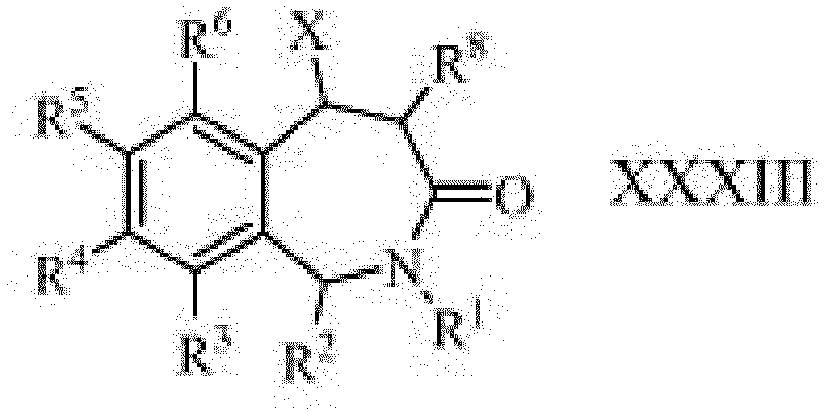 (xii) pour les composés de formule I(A-E) où R4 représente l'O-aryle ou l'O-hétéroaryle tel que défini dans la revendication 1, la réaction avec un composé de formule XXXIV,
 (xiii) pour les composés de formule I(A-E) où R4 représente l'O-aryle ou l'O-hétéroaryle tel que défini dans la revendication 1, la réaction avecun composé de formule XXXIV,
 (xiv) pour les composés de formule I(A-E) où R4 représente un groupe aryle, hétéroaryle ou hétérocyclique tel que défini dans la revendication 1 et R7 à R9 représentent H, la réduction et la cyclisation d'un composé de formule XLII,
Applications Claiming Priority (2)
| Application Number | Priority Date | Filing Date | Title |
|---|---|---|---|
| US70005705P | 2005-07-15 | 2005-07-15 | |
| PCT/US2006/027574 WO2007011820A2 (fr) | 2005-07-15 | 2006-07-17 | Tetrahydrobenzazepines substituees par aryle et heteroaryle, et leur utilisation pour bloquer la reabsorption de la noradrenaline, de la dopamine, et de la serotonine |
Publications (3)
| Publication Number | Publication Date |
|---|---|
| EP1904069A2 EP1904069A2 (fr) | 2008-04-02 |
| EP1904069A4 EP1904069A4 (fr) | 2010-08-18 |
| EP1904069B1 true EP1904069B1 (fr) | 2018-06-13 |
Family
ID=37669440
Family Applications (1)
| Application Number | Title | Priority Date | Filing Date |
|---|---|---|---|
| EP06787476.8A Not-in-force EP1904069B1 (fr) | 2005-07-15 | 2006-07-17 | Tetrahydrobenzazepines substituees par aryle et heteroaryle, et leur utilisation pour bloquer la reabsorption de la noradrenaline, de la dopamine, et de la serotonine |
Country Status (17)
| Country | Link |
|---|---|
| US (4) | US7956050B2 (fr) |
| EP (1) | EP1904069B1 (fr) |
| JP (2) | JP5258561B2 (fr) |
| KR (3) | KR101594898B1 (fr) |
| CN (1) | CN101495184A (fr) |
| AU (1) | AU2006270071B2 (fr) |
| BR (1) | BRPI0613403A2 (fr) |
| CA (1) | CA2615403C (fr) |
| EA (1) | EA019115B1 (fr) |
| GE (1) | GEP20125566B (fr) |
| IL (3) | IL188758A (fr) |
| MX (1) | MX2008000717A (fr) |
| NZ (1) | NZ565111A (fr) |
| PH (1) | PH12014501033A1 (fr) |
| UA (1) | UA95454C2 (fr) |
| WO (1) | WO2007011820A2 (fr) |
| ZA (1) | ZA200800440B (fr) |
Families Citing this family (45)
| Publication number | Priority date | Publication date | Assignee | Title |
|---|---|---|---|---|
| AU2005274927B2 (en) | 2004-07-15 | 2011-11-03 | Albany Molecular Research, Inc. | Aryl-and heteroaryl-substituted tetrahydroisoquinolines and use thereof to block reuptake of norepinephrine, dopamine, and serotonin |
| EP2386554A1 (fr) | 2005-07-04 | 2011-11-16 | High Point Pharmaceuticals, LLC | Composés actives sur le recepteur histamine H3 |
| KR101594898B1 (ko) | 2005-07-15 | 2016-02-18 | 알바니 몰레큘라 리써치, 인크. | 아릴- 및 헤테로아릴-치환된 테트라히드로벤자제핀, 및 노르에피네프린, 도파민 및 세로토닌의 재흡수를 차단하기 위한 용도 |
| EP2079732B9 (fr) | 2006-05-29 | 2012-03-21 | High Point Pharmaceuticals, LLC | 3-(1,3-benzodioxol-5-yl)-6-(4-cyclopropylpiperazin-1-yl)-pyradine, ses sels et solvates et son utilisation comme antagoniste du recepteur d'histamin h3 |
| WO2007137953A1 (fr) * | 2006-05-31 | 2007-12-06 | F. Hoffmann-La Roche Ag | Dérivés de la benzazépine en tant qu'inhibiteurs de la réabsorption de la monoamine |
| CA2685860A1 (fr) * | 2007-05-10 | 2008-11-20 | Amr Technology, Inc. | Tetrahydrobenzo-l,4-diazepines substituees par un aryle ou un heteroaryle et utilisation desdites dans le blocage de la reassimilation de la norepinephrine, de la dopamine et de la serotonine |
| NZ580802A (en) | 2007-05-10 | 2012-09-28 | Albany Molecular Res Inc | Aryloxy-and heteroaryloxy-substituted tetrahydrobenzazepines and use thereof to block reuptake of norepinephrine, dopamine, and serotonin |
| EP2014656A3 (fr) | 2007-06-11 | 2011-08-24 | High Point Pharmaceuticals, LLC | Nouveaux antagonistes d'hétéocycliques h3 |
| ES2397764T3 (es) | 2008-04-01 | 2013-03-11 | Abbott Gmbh & Co. Kg | Tetrahidroisoquinolinas, composiciones farmacéuticas que las contienen, y su uso en terapia |
| US9156812B2 (en) | 2008-06-04 | 2015-10-13 | Bristol-Myers Squibb Company | Crystalline form of 6-[(4S)-2-methyl-4-(2-naphthyl)-1,2,3,4-tetrahydroisoquinolin-7-yl]pyridazin-3-amine |
| AR071997A1 (es) * | 2008-06-04 | 2010-07-28 | Bristol Myers Squibb Co | Forma cristalina de 6-((4s)-2-metil-4-(2-naftil)-1,2,3,4-tetrahidroisoquinolin-7-il)piridazin-3-amina |
| FR2932800B1 (fr) * | 2008-06-20 | 2015-02-20 | Servier Lab | Nouveau procede de synthese de la 7,8-dimethoxy-1,3-dihydro- 2h-3-benzazepin-2-one, et application a la synthese de l'ivabradine et de ses sels d'addition a un acide pharmaceutiquement acceptable |
| DE102008035596A1 (de) * | 2008-07-31 | 2010-02-04 | Westfälische Wilhelms-Universität Münster Körperschaft des öffentlichen Rechts | Derivate benzoannelierter Stickstoff-Heterocyclen |
| AR075442A1 (es) | 2009-02-16 | 2011-03-30 | Abbott Gmbh & Co Kg | Derivados de aminotetralina, composiciones farmaceuticas que las contienen y sus usos en terapia |
| WO2010132487A1 (fr) | 2009-05-12 | 2010-11-18 | Bristol-Myers Squibb Company | Formes cristallines de (s)-7-([1,2,4]triazolo[1,5-a] pyridin -6-yl)-4-(3,4-dichlorophenyl)-1,2,3,4-tetrahydroisoquinoline et leurs utilisations |
| US8802696B2 (en) | 2009-05-12 | 2014-08-12 | Albany Molecular Research, Inc. | 7-([1,2,4]triazolo[1,5-a]pyridin-6-yl)-4-(3,4-dichlorophenyl)-1,2,3,4-tetrahydroisoqu inoli and use thereof |
| CN102458123A (zh) * | 2009-05-12 | 2012-05-16 | 阿尔巴尼分子研究公司 | 芳基、杂芳基和杂环取代的四氢异喹啉及其用途 |
| JP5663572B2 (ja) * | 2009-07-14 | 2015-02-04 | アルバニー モレキュラー リサーチ, インコーポレイテッド | 5−ht3受容体モジュレーター、その作製方法、およびその使用 |
| US8364581B2 (en) | 2010-05-20 | 2013-01-29 | Huntington Bancshares Incorporated | System and method for providing time to cure negative balances in financial accounts while encouraging rapid curing of those balances to a positive net position |
| US8877794B2 (en) | 2010-08-13 | 2014-11-04 | Abbott Laboratories | Phenalkylamine derivatives, pharmaceutical compositions containing them, and their use in therapy |
| US9051280B2 (en) | 2010-08-13 | 2015-06-09 | AbbVie Deutschland GmbH & Co. KG | Tetraline and indane derivatives, pharmaceutical compositions containing them, and their use in therapy |
| US8846743B2 (en) | 2010-08-13 | 2014-09-30 | Abbott Laboratories | Aminoindane derivatives, pharmaceutical compositions containing them, and their use in therapy |
| US9045459B2 (en) | 2010-08-13 | 2015-06-02 | AbbVie Deutschland GmbH & Co. KG | Phenalkylamine derivatives, pharmaceutical compositions containing them, and their use in therapy |
| US8883839B2 (en) | 2010-08-13 | 2014-11-11 | Abbott Laboratories | Tetraline and indane derivatives, pharmaceutical compositions containing them, and their use in therapy |
| WO2012024397A2 (fr) | 2010-08-17 | 2012-02-23 | Albany Molecular Research, Inc. | Dérivés 2,5-méthano- et 2,5-éthano-tétrahydrobenzazépine et utilisation de ceux-ci pour bloquer le recaptage de la norépinéphrine, de la dopamine, et de la sérotonine |
| US9309200B2 (en) | 2011-05-12 | 2016-04-12 | AbbVie Deutschland GmbH & Co. KG | Benzazepine derivatives, pharmaceutical compositions containing them, and their use in therapy |
| JP2014521682A (ja) | 2011-08-05 | 2014-08-28 | アッヴィ・ドイチュラント・ゲー・エム・ベー・ハー・ウント・コー・カー・ゲー | アミノクロマン、アミノチオクロマンおよびアミノ−1,2,3,4−テトラヒドロキノリン誘導体、これらを含有する医薬組成物、ならびに治療におけるこれらの使用 |
| JP5862353B2 (ja) * | 2011-08-05 | 2016-02-16 | 東京エレクトロン株式会社 | 半導体装置の製造方法 |
| EP2780328A1 (fr) | 2011-11-18 | 2014-09-24 | Abbvie Deutschland GmbH & Co. KG | Dérivés aminobenzocycloheptène, aminotétraline, aminoindane et phénalkylamine n-substitués, composition pharmaceutiques les contenant, et leur application thérapeutique |
| US9365512B2 (en) | 2012-02-13 | 2016-06-14 | AbbVie Deutschland GmbH & Co. KG | Isoindoline derivatives, pharmaceutical compositions containing them, and their use in therapy |
| JP5923823B2 (ja) | 2012-02-16 | 2016-05-25 | 国立大学法人広島大学 | アセンジカルコゲノフェン誘導体用中間体及びその合成方法 |
| US9656955B2 (en) | 2013-03-15 | 2017-05-23 | Abbvie Inc. | Pyrrolidine derivatives, pharmaceutical compositions containing them, and their use in therapy |
| US9650334B2 (en) | 2013-03-15 | 2017-05-16 | Abbvie Inc. | Pyrrolidine derivatives, pharmaceutical compositions containing them, and their use in therapy |
| MX2016004936A (es) | 2013-10-17 | 2016-12-20 | Abbvie Deutschland | Derivados de aminocromano, aminotiocromano y amino-1,2,3,4-tetrahi droquinilina, composiciones farmaceuticas que los contienen, y su uso en terapia. |
| WO2015055771A1 (fr) | 2013-10-17 | 2015-04-23 | AbbVie Deutschland GmbH & Co. KG | Dérivés d'aminotétraline et d'aminoindane, compositions pharmaceutiques les contenant et leur utilisation en thérapie |
| RU2571546C1 (ru) * | 2014-07-14 | 2015-12-20 | Государственное бюджетное образовательное учреждение высшего профессионального образования "Воронежский государственный медицинский университет имени Н.Н. Бурденко" Министерства здравоохранения Российской Федерации | Способ дифференцированной диагностики и терапии синдрома ночной еды |
| KR101674557B1 (ko) * | 2015-01-12 | 2016-11-09 | 강원대학교산학협력단 | 우수한 안정성을 가지는 아조메틴 일라이드 제조방법 및 다성분 [5+2] 고리화 첨가반응을 통한 1,4-다이아제핀 유도체 제조방법 |
| CN105906635A (zh) * | 2016-06-08 | 2016-08-31 | 上海大学 | 全氟烷基苯并氮杂*并喹喔啉衍生物及其合成方法 |
| WO2019170543A1 (fr) | 2018-03-07 | 2019-09-12 | Bayer Aktiengesellschaft | Identification et utilisation d'inhibiteurs d'erk5 |
| SG11202009438UA (en) | 2018-04-18 | 2020-11-27 | Constellation Pharmaceuticals Inc | Modulators of methyl modifying enzymes, compositions and uses thereof |
| CN112262143A (zh) | 2018-05-21 | 2021-01-22 | 星座制药公司 | 甲基修饰酶的调节剂、其组合物和用途 |
| EP3870173A4 (fr) | 2018-10-24 | 2022-06-22 | Vanderbilt University | Modulateurs et inhibiteurs de wdr5 |
| US12577227B2 (en) | 2019-06-04 | 2026-03-17 | Vanderbilt University | WDR5 inhibitors and modulators |
| PH12022550188A1 (en) | 2019-07-24 | 2022-11-21 | Constellation Pharmaceuticals Inc | Crystalline forms of 7-chloro-2-(4-(3-methoxyazetidin-1-yl)cyclohexyl)-2,4-dimethyl-n-((6-methyl-4-(methylthio)-2-oxo-1,2-dihydropyridin-3-yl)methyl)benzo[d][1,3]dioxole-5-carboxamide |
| BR112022021228A2 (pt) * | 2020-04-26 | 2022-12-06 | Jiangsu Nhwa Pharmaceutical Co Ltd | Derivado da 1,5-di-hidro-2,4-benzodiazepin-3-ona e aplicação do mesmo |
Family Cites Families (251)
| Publication number | Priority date | Publication date | Assignee | Title |
|---|---|---|---|---|
| US3155669A (en) | 1962-06-22 | 1964-11-03 | Res Lab Dr C Janssen N V | 2, 4, 8-triaza-spiro (4, 5) dec-2-enes |
| US3155670A (en) | 1962-06-22 | 1964-11-03 | Res Lab Dr C Janssen N V | 1-oxo-2, 4, 8, triaza-spiro (4, 5) decanes |
| BE637260A (fr) | 1962-09-11 | |||
| US3225031A (en) | 1963-07-22 | 1965-12-21 | Schering Corp | Phenyl-benzazepines and methods for their manufacture |
| US3242164A (en) | 1964-03-16 | 1966-03-22 | Schering Corp | Certain benzazepine compounds and their preparation |
| US3642993A (en) | 1969-07-17 | 1972-02-15 | Allen & Hanburys Ltd | Pharmaceutical composition containing 2-methyl - 5 - phenyl - 1 2-dihydro-3h-2-benzazepine for treatment of a condition associated with anxiety or tension |
| GB1242963A (en) | 1969-07-17 | 1971-08-18 | Allen & Hanburys Ltd | Novel benzazepine derivative |
| CH538477A (de) | 1970-01-06 | 1973-06-30 | Hoffmann La Roche | Verfahren zur Herstellung von Isochinolin-Derivaten |
| US3947456A (en) | 1970-01-06 | 1976-03-30 | Hoffman-La Roche Inc. | Substituted 4-phenyl isoquinolines |
| US3666763A (en) | 1970-01-06 | 1972-05-30 | Hoffmann La Roche | 4-phenyl isoquinolines and process for preparing same |
| GB1504424A (en) | 1975-08-09 | 1978-03-22 | Beecham Group Ltd | Isoquinoline-derived aminoethers |
| GB1525845A (en) | 1976-07-30 | 1978-09-20 | Ucb Sa | 1,2,4,5-tetrahydro-3h-2-benzazepin-3-ones |
| CS192861B1 (en) | 1977-10-10 | 1979-09-17 | Miroslav Rajsner | 8-fluor-5/4-fluorphenyl/tetrahydrobenzazepines and lactams thereof |
| ZA786230B (en) | 1977-12-21 | 1979-10-31 | Smithkline Corp | 8 and/or 9 substituted 2-benzazepine compounds |
| US4340600A (en) | 1980-05-22 | 1982-07-20 | Smithkline Corporation | Renal dilating methods and compositions using 4-(3,4-dihydroxyphenyl)-1,2,3,4-tetrahydroisoquinolines |
| JPS5913761A (ja) | 1982-07-15 | 1984-01-24 | Sanwa Kagaku Kenkyusho:Kk | 新規の5−フエニル−2−ベンザゼピン誘導体及びその製法 |
| US4535186A (en) | 1983-04-19 | 1985-08-13 | American Home Products Corporation | 2-Phenyl-2-(1-hydroxycycloalkyl or 1-hydroxycycloalk-2-enyl)ethylamine derivatives |
| DE3333994A1 (de) | 1983-09-21 | 1985-04-04 | Troponwerke GmbH & Co KG, 5000 Köln | Neue pyridoindolderivate, verfahren zu ihrer herstellung und ihre verwendung |
| JPS6394239A (ja) | 1986-10-08 | 1988-04-25 | Konica Corp | 色素画像の安定性を改良したハロゲン化銀写真感光材料 |
| US4843071A (en) | 1986-12-05 | 1989-06-27 | Serotonin Industries Of Charleston | Method and composition for treating obesity, drug abuse, and narcolepsy |
| KR880007433A (ko) | 1986-12-22 | 1988-08-27 | 메리 앤 터커 | 3-아릴옥시-3-치환된 프로판아민 |
| ZA885824B (en) | 1987-08-14 | 1989-04-26 | Merrell Dow Pharma | Novel antidepressants |
| EP0360390A1 (fr) | 1988-07-25 | 1990-03-28 | Glaxo Group Limited | Dérivés de spirolactames |
| WO1990005525A1 (fr) | 1988-11-23 | 1990-05-31 | Pfizer Inc. | Derives de quinuclidine en tant qu'antagonsites de substance p |
| US4902710A (en) | 1988-12-14 | 1990-02-20 | Eli Lilly And Company | Serotonin and norepinephrine uptake inhibitors |
| US5114976A (en) | 1989-01-06 | 1992-05-19 | Norden Michael J | Method for treating certain psychiatric disorders and certain psychiatric symptoms |
| GB8909209D0 (en) | 1989-04-22 | 1989-06-07 | Wyeth John & Brother Ltd | Piperazine derivatives |
| DK67489D0 (da) | 1989-02-14 | 1989-02-14 | Novo Industri As | Nye benzazepinderivater |
| BG49761A1 (en) | 1989-04-24 | 1992-02-14 | Vissh Khim T I | 4- (4'- chalophenyl)- 2- methyl- 1, 2, 3, 4- tetrahydroisohinolines and method for its preparation |
| US5164372A (en) | 1989-04-28 | 1992-11-17 | Fujisawa Pharmaceutical Company, Ltd. | Peptide compounds having substance p antagonism, processes for preparation thereof and pharmaceutical composition comprising the same |
| IE903957A1 (en) | 1989-11-06 | 1991-05-08 | Sanofi Sa | Aromatic amine compounds, their method of preparation and¹pharmaceutical compositions in which they are present |
| FR2654726B1 (fr) | 1989-11-23 | 1992-02-14 | Rhone Poulenc Sante | Nouveaux derives de l'isoindolone et leur preparation. |
| FR2654725B1 (fr) | 1989-11-23 | 1992-02-14 | Rhone Poulenc Sante | Nouveaux derives de l'isoindolone, leur preparation et les compositions pharmaceutiques qui les contiennent. |
| GB8929070D0 (en) | 1989-12-22 | 1990-02-28 | Fujisawa Pharmaceutical Co | Peptide compounds,processes for preparation thereof and pharmaceutical composition comprising the same |
| UA41251C2 (uk) | 1990-01-04 | 2001-09-17 | Пфайзер, Інк. | Гідровані азотвмісні гетероциклічні сполуки, похідні піперидину, фармацевтична композиція та спосіб пригнічення активності речовини р в організмі |
| US5232929A (en) | 1990-11-28 | 1993-08-03 | Pfizer Inc. | 3-aminopiperidine derivatives and related nitrogen containing heterocycles and pharmaceutical compositions and use |
| EP0515681A4 (en) | 1990-02-15 | 1993-12-29 | Fujisawa Pharmaceutical Co., Ltd. | Peptide compound |
| AU648317B2 (en) | 1990-06-01 | 1994-04-21 | Pfizer Inc. | 3-amino-2-aryl quinuclidines, process for their preparation and pharmaceutical compositions containing them |
| JP2935541B2 (ja) | 1990-06-28 | 1999-08-16 | サントリー株式会社 | 縮合複素環化合物 |
| DK0540526T3 (da) | 1990-07-23 | 1995-04-18 | Pfizer | Quinuclidinderivater |
| YU155791A (sh) | 1990-09-25 | 1994-01-20 | Agouron Pharmaceuticals Inc. | Antiproliferativna supstituisana triciklična jedinjenja |
| EP0550635B1 (fr) | 1990-09-28 | 1995-04-19 | Pfizer Inc. | Analogues cycliques d'heterocycles non aromatiques contenant de l'azote |
| GB9023116D0 (en) | 1990-10-24 | 1990-12-05 | Fujisawa Pharmaceutical Co | Peptide compounds,processes for preparation thereof and pharmaceutical composition comprising the same |
| JPH04169906A (ja) | 1990-11-01 | 1992-06-17 | Fanuc Ltd | Cnc装置のプログラム修正方式 |
| JPH04193867A (ja) | 1990-11-23 | 1992-07-13 | Nippon Shinyaku Co Ltd | イソキノリノール誘導体及び医薬 |
| DE69114117T2 (de) | 1990-12-21 | 1996-03-21 | Fujisawa Pharmaceutical Co | Neue Verwendung von Peptidderivat. |
| WO1992012151A1 (fr) | 1991-01-10 | 1992-07-23 | Pfizer Inc. | Sels de n-alkyle quinuclidinium utilises comme antagonistes de substance p |
| US5242930A (en) | 1991-02-11 | 1993-09-07 | Merck Sharp & Dohme Ltd. | Azabicyclic compounds, pharmaceutical compositions containing them and their use in therapy |
| ES2065175T3 (es) | 1991-03-01 | 1995-02-01 | Pfizer | Derivados de 1-azabiciclo(3.2.2)nonan-3-amina. |
| JPH0794440B2 (ja) | 1991-03-26 | 1995-10-11 | フアイザー・インコーポレイテツド | 置換ピペリジンの立体選択的製造 |
| FR2677361A1 (fr) | 1991-06-04 | 1992-12-11 | Adir | Nouveaux peptides et pseudopeptides, derives de tachykinines, leur procede de preparation et les compositions pharmaceutiques qui les contiennent. |
| WO1992018462A1 (fr) | 1991-04-12 | 1992-10-29 | Schering Corporation | Amides bicycliques de l'acyle-coenzyme a: cholesterol acyltransferase |
| FR2676053B1 (fr) | 1991-05-03 | 1993-08-27 | Sanofi Elf | Nouveaux composes dialkylenepiperidino et leurs enantiomeres, procede pour leur preparation et compositions pharmaceutiques les contenant. |
| FR2676055B1 (fr) | 1991-05-03 | 1993-09-03 | Sanofi Elf | Composes polycycliques amines et leurs enantiomeres, procede pour leur preparation et compositions pharmaceutiques les contenant. |
| FR2676447B1 (fr) | 1991-05-17 | 1993-08-06 | Rhone Poulenc Rorer Sa | Nouveaux derives du thiopyranopyrrole et leur preparation. |
| FR2676443B1 (fr) | 1991-05-17 | 1993-08-06 | Rhone Poulenc Rorer Sa | Nouveaux derives de perhydroisoindole et leur preparation. |
| FR2676442B1 (fr) | 1991-05-17 | 1993-08-06 | Rhone Poulenc Rorer Sa | Nouveau derives de perhydroisoindole, leur preparation et les compositions pharmaceutiques qui les contiennent. |
| FR2676446B1 (fr) | 1991-05-17 | 1993-08-06 | Rhone Poulenc Rorer Sa | Nouveaux derives du thiopyranopyrrole, leur preparation et les compositions pharmaceutiques qui les contiennent. |
| WO1992020661A1 (fr) | 1991-05-22 | 1992-11-26 | Merck & Co., Inc. | N, n-diacylpiperazines |
| PL172069B1 (pl) | 1991-05-22 | 1997-07-31 | Pfizer | Sposób wytwarzania nowych pochodnych podstawionej 3-aminochinuklidyny PL PL PL PL PL |
| CA2102179C (fr) | 1991-05-31 | 1998-10-27 | Fumitaka Ito | Derives quinuclidine |
| GB9113219D0 (en) | 1991-06-19 | 1991-08-07 | Fujisawa Pharmaceutical Co | Peptide compound,processes for preparation thereof and pharmaceutical composition comprising the same |
| HU224443B1 (hu) | 1991-06-20 | 2005-09-28 | Pfizer Inc. | Fluor-alkoxi-benzaldehid-származékok |
| TW202432B (fr) | 1991-06-21 | 1993-03-21 | Pfizer | |
| US5288730A (en) | 1991-06-24 | 1994-02-22 | Merck Sharp & Dohme Limited | Azabicyclic compounds, pharmaceutical compositions containing them and their use in therapy |
| WO1993001160A1 (fr) | 1991-07-05 | 1993-01-21 | Merck Sharp & Dohme Limited | Composes aromatiques, compositions pharmaceutiques les contenant et leur utilisation therapeutique |
| WO1993001169A2 (fr) | 1991-07-05 | 1993-01-21 | Merck Sharp & Dohme Limited | Composes aromatiques, compositions pharmaceutiques les contenant et leur utilisation therapeutique |
| EP0536817A1 (fr) | 1991-07-05 | 1993-04-14 | MERCK SHARP & DOHME LTD. | Composés azabicycliques comme antagonistes des tachykinines |
| ATE133658T1 (de) | 1991-07-10 | 1996-02-15 | Merck Sharp & Dohme | Aromatische verbindungen diese enthaltende pharmazeutische zusammensetzungen und ihre therapeutische verwendung |
| US5495047A (en) | 1991-07-10 | 1996-02-27 | Merck, Sharp & Dohme (Ltd.) | Fused tricyclic compounds, pharmaceutical compositions containing them and their use in therapy |
| MY110227A (en) | 1991-08-12 | 1998-03-31 | Ciba Geigy Ag | 1-acylpiperindine compounds. |
| EP0600952B1 (fr) | 1991-08-20 | 1996-04-17 | MERCK SHARP & DOHME LTD. | Composes azacycliques, procedes de preparation et compositions pharmaceutiques les contenant |
| US5098901A (en) | 1991-09-10 | 1992-03-24 | Sterling Drug Inc. | Imidazo [1,2-b][2]benzazepine and pyrimido [1,2-b][2]benzazepine antiarrhythmic agents |
| JP2535134B2 (ja) | 1991-09-16 | 1996-09-18 | ファイザー・インコーポレーテッド | 縮合三環式窒素含有複素環 |
| EP1082959A1 (fr) | 1991-09-20 | 2001-03-14 | Glaxo Group Limited | Utilisation des NK1-antagonistes pour le traitement de la depression |
| US5250679A (en) | 1991-10-18 | 1993-10-05 | Genentech, Inc. | Nonpeptidyl platelet aggregation inhibitors having specificity for the GPIIb III.sub. receptor |
| JP2553020B2 (ja) | 1991-11-07 | 1996-11-13 | 吉富製薬株式会社 | キヌクリジン化合物およびその医薬用途 |
| FI942187A7 (fi) | 1991-11-12 | 1994-05-11 | Pfizer | Asyklisiä etyleenidiamiinijohdannaisia aine P-reseptoriantagonisteina |
| EP0545478A1 (fr) | 1991-12-03 | 1993-06-09 | MERCK SHARP & DOHME LTD. | Composés hétérocycliques comme tachykinine antagonistes |
| GB9200535D0 (en) | 1992-01-10 | 1992-02-26 | Fujisawa Pharmaceutical Co | New compound |
| GB9201179D0 (en) | 1992-01-21 | 1992-03-11 | Glaxo Group Ltd | Chemical compounds |
| US5328927A (en) | 1992-03-03 | 1994-07-12 | Merck Sharpe & Dohme, Ltd. | Hetercyclic compounds, processes for their preparation and pharmaceutical compositions containing them |
| JP2656702B2 (ja) | 1992-03-23 | 1997-09-24 | ファイザー製薬株式会社 | ペプチド性キヌクリジン |
| FR2689888B1 (fr) | 1992-04-10 | 1994-06-10 | Rhone Poulenc Rorer Sa | Nouveaux derives de perhydroisoindole, leur preparation et les compositions pharmaceutiques qui les contiennent. |
| EP0636130A1 (fr) | 1992-04-15 | 1995-02-01 | Merck Sharp & Dohme Ltd. | Composes azacycliques |
| GB2266529A (en) | 1992-05-01 | 1993-11-03 | Merck Sharp & Dohme | Tetrahydroisoquinoline derivatives |
| ATE209186T1 (de) | 1992-05-18 | 2001-12-15 | Pfizer | Überbrückte azabicyclische derivate als substanz p antagonisten |
| GB9211193D0 (en) | 1992-05-27 | 1992-07-08 | Merck Sharp & Dohme | Therapeutic agents |
| IL106142A (en) | 1992-06-29 | 1997-03-18 | Merck & Co Inc | Morpholine and thiomorpholine tachykinin receptor antagonists, their preparation and pharmaceutical compositions containing them |
| US5637699A (en) | 1992-06-29 | 1997-06-10 | Merck & Co., Inc. | Process for preparing morpholine tachykinin receptor antagonists |
| AU4713293A (en) | 1992-07-13 | 1994-01-31 | Merck Sharp & Dohme Limited | Heterocyclic amide derivatives as tachykinin derivatives |
| EP1251170A3 (fr) | 1992-07-17 | 2002-10-30 | Ribozyme Pharmaceuticals, Inc. | Procédé et réactif pour le traitement de maladies animales dépendants de NF-kappaB |
| GB2268931A (en) | 1992-07-22 | 1994-01-26 | Merck Sharp & Dohme | Azabicyclic tachykinin-receptor antagonists |
| ES2124318T3 (es) | 1992-07-28 | 1999-02-01 | Merck Sharp & Dohme | Compuestos azaciclicos. |
| GB2269170A (en) | 1992-07-29 | 1994-02-02 | Merck Sharp & Dohme | Azatricyclic tachykinin antagonists |
| WO1994003429A1 (fr) | 1992-07-31 | 1994-02-17 | Merck Sharp & Dohme Limited | Amines substituees utiles comme antagonistes du recepteur de la tachykinine |
| CA2141051A1 (fr) | 1992-08-04 | 1994-02-17 | Terry J. Rosen | Derives de substitution d'heterocycles azotes |
| GB9216911D0 (en) | 1992-08-10 | 1992-09-23 | Merck Sharp & Dohme | Therapeutic agents |
| EP1000930A3 (fr) | 1992-08-13 | 2003-10-29 | Warner-Lambert Company | Antagonistes de tachykinines |
| US5721255A (en) | 1992-08-19 | 1998-02-24 | Pfizer Inc. | Substituted benzylamino nitrogen containing non-aromatic heterocycles |
| US5387595A (en) | 1992-08-26 | 1995-02-07 | Merck & Co., Inc. | Alicyclic compounds as tachykinin receptor antagonists |
| ATE161530T1 (de) | 1992-09-04 | 1998-01-15 | Takeda Chemical Industries Ltd | Kondensierte heterozyklische verbindungen, deren herstellung und verwendung |
| AU4973693A (en) | 1992-09-10 | 1994-03-29 | Merck Sharp & Dohme Limited | Alcohols and ethers with aromatic substituents as tachykinin-antagonists |
| GB9220286D0 (en) | 1992-09-25 | 1992-11-11 | Merck Sharp & Dohme | Therapeutic agents |
| GB2271566A (en) | 1992-10-14 | 1994-04-20 | Merck & Co Inc | HIV integrase inhibitors |
| JP2656699B2 (ja) | 1992-10-21 | 1997-09-24 | ファイザー製薬株式会社 | 置換ベンジルアミノキヌクリジン |
| GB9222262D0 (en) | 1992-10-23 | 1992-12-09 | Merck Sharp & Dohme | Therapeutic agents |
| GB9222486D0 (en) | 1992-10-26 | 1992-12-09 | Merck Sharp & Dohme | Therapeutic agents |
| JP2656700B2 (ja) | 1992-10-28 | 1997-09-24 | ファイザー製薬株式会社 | 置換キヌクリジン誘導体 |
| CA2146767A1 (fr) | 1992-10-28 | 1994-05-11 | Timothy Harrison | 4-arylmethyloxymethylpiperidines, antagonistes de la tachykinine |
| AU5342894A (en) | 1992-10-30 | 1994-05-24 | Merck Sharp & Dohme Limited | Tachykinin antagonists |
| US5886009A (en) | 1992-11-12 | 1999-03-23 | Pfizer Inc. | Quinuclidine derivative as a substance P antagonist |
| US5261188A (en) | 1992-11-23 | 1993-11-16 | The Standard Products Company | Belt weatherstrip with bulb |
| JPH06153997A (ja) | 1992-11-27 | 1994-06-03 | Canon Inc | 検出信号増幅による標的核酸の検出方法 |
| EP0675886B1 (fr) | 1992-12-10 | 2000-07-05 | Pfizer Inc. | Heterocycles non aromatiques substitues par aminomethylene et leur utilisation comme antagonistes de substance p |
| EP0673367A1 (fr) | 1992-12-14 | 1995-09-27 | MERCK SHARP & DOHME LTD. | 4-aminomethyl/thiomethyl/sulfonylmethyl-4-phenylpiperidines en tant qu'antagonistes du recepteur de tachykinine |
| GB9226581D0 (en) | 1992-12-21 | 1993-02-17 | Merck Sharp & Dohme | Therapeutic agents |
| SG63579A1 (en) | 1992-12-21 | 1999-03-30 | Smithkline Beecham Corp | Bicyclic fibrinogen antagonists |
| DK154192D0 (da) | 1992-12-23 | 1992-12-23 | Neurosearch As | Heterocycliske forbindelser |
| GB9300051D0 (en) | 1993-01-04 | 1993-03-03 | Merck Sharp & Dohme | Therapeutic agents |
| EP0610793A1 (fr) | 1993-02-08 | 1994-08-17 | Takeda Chemical Industries, Ltd. | Dérivés de morpholine tétracycliques et leur utilisation comme analgésiques |
| ATE166867T1 (de) | 1993-02-18 | 1998-06-15 | Merck Sharp & Dohme | Azacyclische verbindungen, sie enthaltende zusammensetzungen und ihre verwendung als tachykinin antagoniste |
| US5674889A (en) | 1993-02-22 | 1997-10-07 | Merck, Sharp & Dohme, Ltd. | Aromatic compounds, compositions containing them and their use in therapy |
| WO1994020500A1 (fr) | 1993-03-04 | 1994-09-15 | Pfizer Inc. | Derives spiroazacycliques utilises comme antagonistes de la substance p |
| US5496833A (en) | 1993-04-13 | 1996-03-05 | Merck Sharp & Dohme Limited | Piperidine tachykinin receptor antagonists |
| HU224496B1 (hu) | 1993-05-06 | 2005-10-28 | Merrel Dow Pharmaceuticals Inc. | Pirrolidin-3-il-alkil-piperidin-származékok és e vegyületeket tartalmazó gyógyászati készítmények |
| IL109646A0 (en) | 1993-05-19 | 1994-08-26 | Pfizer | Heteroatom substituted alkyl benzylamino-quinuclidines |
| AU680020B2 (en) | 1993-06-07 | 1997-07-17 | Merck & Co., Inc. | Spiro-substituted azacycles as neurokinin antagonists |
| EP0634402A1 (fr) | 1993-07-14 | 1995-01-18 | Takeda Chemical Industries, Ltd. | Dérivés d'isoquinolinone, leur production et utilisation |
| EP0708771B1 (fr) | 1993-07-15 | 1998-10-07 | Pfizer Inc. | Benzylaminoquinuclidines en tant qu'antagonistes de substance p |
| GB9315808D0 (en) | 1993-07-30 | 1993-09-15 | Merck Sharp & Dohme | Therapeutic agents |
| TW365603B (en) | 1993-07-30 | 1999-08-01 | Rhone Poulenc Rorer Sa | Novel perhydroisoindole derivatives, their preparation and pharmaceutical compositions which contain them |
| GB9317987D0 (en) | 1993-08-26 | 1993-10-13 | Glaxo Group Ltd | Chemical compounds |
| EP1209157A1 (fr) | 1993-09-17 | 2002-05-29 | Pfizer Inc. | 3-Benzylaminométhyl-pipéridines à substitution hétéroarylamino et hétéroarylsulfonamido, et composés apparents |
| ES2217269T3 (es) | 1993-09-17 | 2004-11-01 | Pfizer Inc. | Piperidinas 3-amino-5-carboxi sustituidas y pirrolidinas 3-amino-4-carboxi sustituidas como antagonistas de taquininas. |
| IS4208A (is) | 1993-09-22 | 1995-03-23 | Glaxo Group Limited | 3-(tetrazólýl-benzyl)amínó-piperadidín afleiður |
| AU7947594A (en) | 1993-10-27 | 1995-05-22 | Merck Sharp & Dohme Limited | Substituted amides as tachykinin antagonists |
| US5440033A (en) | 1993-11-09 | 1995-08-08 | Schering Corporation | Indolyl-, pyrrolyl- and pyrazolyl substituted benzazepines |
| US6403577B1 (en) | 1993-11-17 | 2002-06-11 | Eli Lilly And Company | Hexamethyleneiminyl tachykinin receptor antagonists |
| IT1271462B (it) | 1993-12-03 | 1997-05-28 | Menarini Farma Ind | Antagonisti delle tachichinine,procedimento per la loro preparazione e loro impiego in formulazioni farmaceutiche. |
| IL111960A (en) | 1993-12-17 | 1999-12-22 | Merck & Co Inc | Morpholines and thiomorpholines their preparation and pharmaceutical compositions containing them |
| WO1995017382A1 (fr) | 1993-12-21 | 1995-06-29 | Eli Lilly And Company | Antagonistes non peptidiques des recepteurs des tachykinines |
| NZ274915A (en) | 1993-12-29 | 1997-11-24 | Pfizer | N-(hetero)aryl methyl diazabicycloalkane derivatives |
| DE69434063D1 (de) | 1993-12-29 | 2004-11-11 | Merck Sharp & Dohme | Substituierte Morpholinderivate und ihre Verwendung als therapeutische Mittel |
| JPH09507500A (ja) | 1994-01-13 | 1997-07-29 | メルク シヤープ エンド ドーム リミテツド | gem二置換アザシクロ系のタキキニン拮抗薬 |
| EP0741704A1 (fr) | 1994-01-28 | 1996-11-13 | MERCK SHARP & DOHME LTD. | Agents therapeutiques azacycliques avec substitution par un groupe aralkyamino |
| GB9402688D0 (en) | 1994-02-11 | 1994-04-06 | Merck Sharp & Dohme | Therapeutic agents |
| US5610165A (en) | 1994-02-17 | 1997-03-11 | Merck & Co., Inc. | N-acylpiperidine tachykinin antagonists |
| IL112778A0 (en) | 1994-03-04 | 1995-05-26 | Merck & Co Inc | Substituted heterocycles, their preparation and pharmaceutical compositions containing them |
| FR2718136B1 (fr) | 1994-03-29 | 1996-06-21 | Sanofi Sa | Composés aromatiques aminés, procédé pour leur obtention et compositions pharmaceutiques les contenant. |
| US5610145A (en) | 1994-04-15 | 1997-03-11 | Warner-Lambert Company | Tachykinin antagonists |
| US5607939A (en) | 1994-04-28 | 1997-03-04 | Takeda Chemical Industries, Ltd. | Condensed heterocyclic compounds, their production and use |
| PE27997A1 (es) | 1994-04-29 | 1997-09-20 | Lilly Co Eli | Antagonistas de receptores de taquicininas |
| EP0758329A1 (fr) | 1994-05-05 | 1997-02-19 | MERCK SHARP & DOHME LTD. | Derives de morpholine et utilisation comme antagonistes des tachykinines |
| PL317127A1 (en) | 1994-05-07 | 1997-03-17 | Boehringer Ingelheim Kg | Novel derivatives of amino acids, method of obtaining them and pharmaceutic agents containing such derivatives |
| ATE206710T1 (de) | 1994-06-06 | 2001-10-15 | Warner Lambert Co | Tachykinin (nk1) rezeptor antagonisten |
| EP0686629A3 (fr) | 1994-06-10 | 1999-02-10 | Eli Lilly And Company | Antagonistes des récepteurs de tachycinine cyclohexyliques |
| CA2134038C (fr) | 1994-06-16 | 1997-06-03 | David Taiwai Wong | Potentialisation des effets de medicaments |
| CA2194471C (fr) | 1994-07-12 | 2005-04-12 | Sung-Yong Stephen Cho | Antagoniste du recepteur de tachykinine bis-piperidinyl non-peptidyl |
| CA2154116A1 (fr) | 1994-07-22 | 1996-01-23 | Philip Arthur Hipskind | Derives 1-aryl-2-acetamidopentanone, destines a servir d'antagonistes du recepteur de tachykinine |
| GB9415997D0 (en) | 1994-08-08 | 1994-09-28 | Merck Sharp & Dohme | Therapeutic agents |
| GB9415996D0 (en) | 1994-08-08 | 1994-09-28 | Merck Sharp & Dohme | Therapeutic agents |
| TW432061B (en) | 1994-08-09 | 2001-05-01 | Pfizer Res & Dev | Lactams |
| ES2157337T3 (es) | 1994-08-15 | 2001-08-16 | Merck Sharp & Dohme | Derivados de morfolina y su uso como agentes terapeuticos. |
| WO1996006087A1 (fr) | 1994-08-22 | 1996-02-29 | Smithkline Beecham Corporation | Composes bicycliques |
| DE4430086A1 (de) | 1994-08-25 | 1996-02-29 | Henkel Kgaa | Verwendung von Phosphinsäure oder Organophosphonsäuren zur Farbstabilisierung von Estern ungesättigter Carbonsäuren mit 3 - 5 C-Atomen |
| DK0777666T3 (da) | 1994-08-25 | 1999-09-27 | Merrell Pharma Inc | Substituerede piperidiner anvendelige ved behandling af allergiske sygdomme |
| ES2107118T3 (es) | 1994-08-29 | 1997-11-16 | Akzo Nobel Nv | Procedimiento para la preparacion de diesteres cuaternarios. |
| GB9417956D0 (en) | 1994-09-02 | 1994-10-26 | Merck Sharp & Dohme | Therapeutic agents |
| IT1271007B (it) | 1994-09-13 | 1997-05-26 | Zambon Spa | Derivati del 2-ammino-1,2,3,4-tetraidronaftalene attivi sul sistema cardiovascolare |
| GB9418545D0 (en) | 1994-09-15 | 1994-11-02 | Merck Sharp & Dohme | Therapeutic agents |
| US5457107A (en) | 1994-09-16 | 1995-10-10 | Merck & Co., Inc. | Polymorphic form of a tachykinin receptor antagonist |
| ES2172595T3 (es) | 1994-09-30 | 2002-10-01 | Novartis Ag | Compuestos de 1-acil-4-alifatilaminopiperidina. |
| TW397825B (en) | 1994-10-14 | 2000-07-11 | Novartis Ag | Aroyl-piperidine derivatives |
| FR2725986B1 (fr) | 1994-10-21 | 1996-11-29 | Adir | Nouveaux derives de piperidine, leur procede de preparation et les compositions pharmaceutiques qui les contiennent |
| DE69534213T2 (de) | 1994-10-25 | 2006-01-12 | Astrazeneca Ab | Therapeutisch wirksame Heterocyclen |
| GB9421709D0 (en) | 1994-10-27 | 1994-12-14 | Zeneca Ltd | Therapeutic compounds |
| US6015791A (en) | 1994-11-21 | 2000-01-18 | Cortech Inc. | Serine protease inhibitors-cycloheptane derivatives |
| CA2162786A1 (fr) | 1994-11-22 | 1996-05-23 | Philip Arthur Hipskind | Antagonistes heterocycliques des recepteurs des tachykinines |
| FR2727411B1 (fr) | 1994-11-30 | 1997-01-03 | Rhone Poulenc Rorer Sa | Nouveaux derives de perhydroisoindole, leur preparation et les compositions pharmaceutiques qui les contiennent |
| PE38997A1 (es) | 1994-12-13 | 1997-10-02 | Novartis Ag | Antagonista de taquicinina |
| GB9426103D0 (en) | 1994-12-23 | 1995-02-22 | Merck Sharp & Dohme | Therapeutic agents |
| JP3925662B2 (ja) | 1995-01-12 | 2007-06-06 | グラクソ,グループ,リミテッド | タキキニンアンタゴニスト活性を有するピペリジン誘導体 |
| FR2729951B1 (fr) | 1995-01-30 | 1997-04-18 | Sanofi Sa | Nouveaux composes heterocycliques, procede pour leur preparation et compositions pharmaceutiques en contenant |
| WO1996026190A1 (fr) | 1995-02-22 | 1996-08-29 | Smithkline Beecham Corporation | Antagonistes des recepteurs a l'integrine |
| GB9505492D0 (en) | 1995-03-18 | 1995-05-03 | Merck Sharp & Dohme | Therapeutic agents |
| GB9505491D0 (en) | 1995-03-18 | 1995-05-03 | Merck Sharp & Dohme | Therapeutic agents |
| US5554641A (en) | 1995-03-20 | 1996-09-10 | Horwell; David C. | Nonpeptides as tachykinin antagonists |
| GB9505692D0 (en) | 1995-03-21 | 1995-05-10 | Glaxo Group Ltd | Chemical compounds |
| TW394773B (en) | 1995-03-24 | 2000-06-21 | Takeda Chemical Industries Ltd | Cyclic compounds for antagonizing tachykinin receptor, substance p receptor and neurokinin a receptor, their production and pharmaceutical composition |
| US5565568A (en) | 1995-04-06 | 1996-10-15 | Eli Lilly And Company | 2-acylaminopropanamides as tachykinin receptor antagonists |
| CA2217006C (fr) | 1995-04-13 | 2001-05-22 | Hoechst Marion Roussel, Inc. | Nouveaux derives de piperazine substitues presentant une activite d'antagonistes des recepteurs de la tachykinine |
| WO1996037489A1 (fr) | 1995-05-25 | 1996-11-28 | Fujisawa Pharmaceutical Co., Ltd. | Derives de 1-benzoyl-2-(indolyl-3-alkyl)-piperazine utilises comme antagonistes du recepteur de la neurokinine |
| DE19520964A1 (de) | 1995-06-08 | 1996-12-12 | Inst Neue Mat Gemein Gmbh | Beschichtete anorganische Pigmente, Verfahren zu deren Herstellung und deren Verwendung |
| GB9513117D0 (en) | 1995-06-28 | 1995-08-30 | Merck Sharp & Dohme | Therapeutic agents |
| GB9513118D0 (en) | 1995-06-28 | 1995-08-30 | Merck Sharp & Dohme | Therapeutic agents |
| GB9513121D0 (en) | 1995-06-28 | 1995-08-30 | Merck Sharp & Dohme | Therapeutic agents |
| JP3042894B2 (ja) | 1995-07-07 | 2000-05-22 | ファイザー製薬株式会社 | サブスタンスpアンタゴニストとしての置換ベンゾラクタム化合物 |
| TW340842B (en) | 1995-08-24 | 1998-09-21 | Pfizer | Substituted benzylaminopiperidine compounds |
| WO1997014671A1 (fr) | 1995-10-18 | 1997-04-24 | Merck & Co., Inc. | Antagonistes des recepteurs de la cyclopentyle-tachykinine |
| DE19541283A1 (de) | 1995-11-06 | 1997-05-07 | Boehringer Ingelheim Kg | Neue Aminosäurederivate, Verfahren zu ihrer Herstellung und diese Verbindungen enthaltende pharmazeutische Zusammensetzungen |
| GB9523244D0 (en) | 1995-11-14 | 1996-01-17 | Merck Sharp & Dohme | Therapeutic agents |
| WO1997019084A1 (fr) | 1995-11-23 | 1997-05-29 | Merck Sharp & Dohme Limited | Derives de spiro-piperidine et leur utilisation en tant qu'antagonistes de tachykinine |
| GB9524157D0 (en) | 1995-11-25 | 1996-01-24 | Pfizer Ltd | Therapeutic agents |
| HU224225B1 (hu) | 1995-12-01 | 2005-06-28 | Sankyo Co. Ltd. | Tachikinin receptor antagonista hatású heterociklusos vegyületek, ezek előállítási eljárása és alkalmazásuk gyógyszerkészítmények előállítására |
| GB9525296D0 (en) | 1995-12-11 | 1996-02-07 | Merck Sharp & Dohme | Therapeutic agents |
| ZA9610738B (en) | 1995-12-22 | 1997-06-24 | Warner Lambert Co | Subtype selective nmda receptor ligands and the use thereof |
| BR9707636A (pt) | 1996-02-22 | 1999-07-27 | Neurosearch As | Composto composição farmacêutica uso de um composto e processos para preparar composto e para tratar um distúrbio ou doença de um organismo animal vivo |
| JPH09301953A (ja) | 1996-03-12 | 1997-11-25 | Sanwa Kagaku Kenkyusho Co Ltd | マロン酸ジアミド誘導体及びその用途 |
| AU715658B2 (en) | 1996-04-03 | 2000-02-10 | Merck & Co., Inc. | Inhibitors of farnesyl-protein transferase |
| NZ332777A (en) | 1996-06-21 | 2000-06-23 | Merck Sharp & Dohme | 3,6-bi-phenyl substituted spiro-piperidine derivatives |
| WO1998002432A1 (fr) | 1996-07-16 | 1998-01-22 | Takeda Chemical Industries, Ltd. | Composes bicycliques pour commander la miction |
| WO1998021186A1 (fr) | 1996-11-13 | 1998-05-22 | Cephalon, Inc. | Inhibiteurs benzothiazo, ou contenant des groupes heterocycliques apparentes, de la cysteine ou des proteases serines |
| US5907041A (en) | 1997-03-12 | 1999-05-25 | Rhone-Poulenc Inc. | Process for preparing pyrazole derivatives |
| TW527355B (en) | 1997-07-02 | 2003-04-11 | Bristol Myers Squibb Co | Inhibitors of farnesyl protein transferase |
| US6121261A (en) | 1997-11-19 | 2000-09-19 | Merck & Co., Inc. | Method for treating attention deficit disorder |
| WO1999045013A1 (fr) | 1998-03-06 | 1999-09-10 | Novo Nordisk A/S | Derives de 4,5,6,7-tetrahydro-thieno[3,2-c]pyridine |
| EP1069900B1 (fr) | 1998-04-09 | 2005-08-10 | Pharmacia & Upjohn Company LLC | Nouveaux traitements avec "reboxetine" pour troubles nerveux |
| TW462964B (en) | 1998-05-26 | 2001-11-11 | Sumitomo Pharma | Guanidine derivatives for the treatment and prevention of disorders caused by inhibiting hyperactivity of Na/H exchange transport system and process for producing the same |
| WO2000023437A1 (fr) | 1998-10-16 | 2000-04-27 | Takeda Chemical Industries, Ltd. | Composes azotes hererocycliques condenses; procede de fabrication et agents les renfermant |
| WO2000027802A1 (fr) | 1998-11-12 | 2000-05-18 | Ariad Pharmaceuticals, Inc. | Inhibiteurs de transduction de signaux bicycliques, compositions les contenant et utilisation de ces dernieres |
| WO2000038618A2 (fr) | 1998-12-24 | 2000-07-06 | Du Pont Pharmaceuticals Company | BENZODIAZEPINES SUCCINOYLAMINO UTILISEES COMME INHIBITEURS DE LA PRODUCTION DE PROTEINE A$g(b) |
| EP1150965A4 (fr) | 1999-02-03 | 2002-05-15 | Merck & Co Inc | Derives de la benzazepine utilises comme antagonistes du recepteur alpha-v de l'integrine |
| GB9903671D0 (en) | 1999-02-17 | 1999-04-14 | Cenes Ltd | Dopamine D-1 receptor agonist compounds |
| AU5994900A (en) | 1999-07-09 | 2001-01-30 | Isis Innovation Limited | Compounds for inhibiting diseases and preparing cells for transplantation |
| DE10028575A1 (de) | 2000-06-14 | 2002-03-14 | Basf Ag | Integrinliganden |
| US6410736B1 (en) | 1999-11-29 | 2002-06-25 | Pfizer Inc. | Biaryl ether derivatives useful as monoamine reuptake inhibitors |
| WO2001032625A1 (fr) | 1999-11-03 | 2001-05-10 | Du Pont Pharmaceuticals Company | Tetrahydroisoquinolines a substitution aryle et heteroaryle et utilisation de ces composes pour bloquer le recaptage de norepinephrine, de dopamine et de serotonine |
| NZ519146A (en) * | 1999-11-03 | 2004-02-27 | Albany Molecular Res Inc | 4-phenyl-substituted tetrahydroisoquinolines and use thereof to block reuptake of norepinephrine, dopamine and serotonin |
| AU2001228810A1 (en) | 2000-01-26 | 2001-08-07 | Ono Pharmaceutical Co. Ltd. | Benzene-fused heterocycle derivatives and drugs containing the same as the active ingredient |
| WO2002006241A1 (fr) | 2000-06-14 | 2002-01-24 | Muscagen Limited | Derives de 1, 2, 3, 5 -tetrahydrobenzo`c!azepine-4-one presentant une activite antagoniste muscarinique |
| JP5132864B2 (ja) | 2000-07-11 | 2013-01-30 | アルバニー モレキュラー リサーチ, インコーポレイテッド | 4−フェニル置換テトラヒドロイソキノリンおよびその使用方法 |
| FR2819510B1 (fr) | 2001-01-18 | 2003-10-31 | Servier Lab | Nouveaux composes cyclo[c] azepane, leur procede de preparation et les compositions pharmaceutiques qui le contiennent |
| FR2825705B1 (fr) | 2001-06-08 | 2005-05-20 | Aventis Pharma Sa | Nouveaux composes heterocycliques, leur preparation et leur utilisation comme medicaments, notamment comme anti-bacteriens |
| US6635675B2 (en) | 2001-11-05 | 2003-10-21 | Cypress Bioscience, Inc. | Method of treating chronic fatigue syndrome |
| US6911453B2 (en) | 2001-12-05 | 2005-06-28 | Aventis Pharma Deutschland Gmbh | Substituted 4-phenyltetrahydroisoquinolinium, process for their preparation, their use as a medicament, and medicament containing them |
| AU2002360561A1 (en) | 2001-12-11 | 2003-06-23 | Sepracor, Inc. | 4-substituted piperidines, and methods of use thereof |
| US7057046B2 (en) | 2002-05-20 | 2006-06-06 | Bristol-Myers Squibb Company | Lactam glycogen phosphorylase inhibitors and method of use |
| EP1513529B1 (fr) | 2002-05-30 | 2011-12-14 | NeuroSearch A/S | Triple inhibiteurs de recaptage de momoamine pour le traitement de douleur chronique |
| GB0224557D0 (en) | 2002-10-22 | 2002-11-27 | Glaxo Group Ltd | Novel compounds |
| FR2848210B1 (fr) | 2002-12-06 | 2007-10-19 | Aventis Pharma Sa | Nouveaux composes heterocycliques, leur preparation et leur utilisation comme medicaments, notamment comme anti-bacteriens et inhibiteurs de beta-lactamases |
| JPWO2004087131A1 (ja) | 2003-03-31 | 2006-06-29 | 協和醗酵工業株式会社 | 鎮咳剤 |
| WO2004089919A1 (fr) | 2003-04-02 | 2004-10-21 | Banyu Pharmaceutical Co., Ltd. | Derive de cyclohexanecarboxamido |
| EP1729774A4 (fr) | 2004-03-09 | 2009-05-06 | Nat Health Research Institutes | Composes de pyrrolidine |
| AU2005274927B2 (en) | 2004-07-15 | 2011-11-03 | Albany Molecular Research, Inc. | Aryl-and heteroaryl-substituted tetrahydroisoquinolines and use thereof to block reuptake of norepinephrine, dopamine, and serotonin |
| US20060111394A1 (en) | 2004-11-22 | 2006-05-25 | Molino Bruce F | Aryl-and heteroaryl-substituted tetrahydroisoquinolines and use thereof to block reuptake of norepinephrine, dopamine and serotonin |
| US20060111393A1 (en) | 2004-11-22 | 2006-05-25 | Molino Bruce F | 4-Phenyl substituted tetrahydroisoquinolines and use thereof to block reuptake of norepinephrine, dopamine and serotonin |
| US20060111385A1 (en) | 2004-11-22 | 2006-05-25 | Molino Bruce F | Novel 4-phenyl substituted tetrahydroisoquinolines and therapeutic use thereof |
| KR101594898B1 (ko) | 2005-07-15 | 2016-02-18 | 알바니 몰레큘라 리써치, 인크. | 아릴- 및 헤테로아릴-치환된 테트라히드로벤자제핀, 및 노르에피네프린, 도파민 및 세로토닌의 재흡수를 차단하기 위한 용도 |
| WO2007137953A1 (fr) | 2006-05-31 | 2007-12-06 | F. Hoffmann-La Roche Ag | Dérivés de la benzazépine en tant qu'inhibiteurs de la réabsorption de la monoamine |
| US8791102B2 (en) | 2008-10-17 | 2014-07-29 | Exelixis, Inc. | Acetanilide sphingosine-1-phosphate receptor antagonists |
-
2006
- 2006-07-17 KR KR1020157002258A patent/KR101594898B1/ko not_active Expired - Fee Related
- 2006-07-17 WO PCT/US2006/027574 patent/WO2007011820A2/fr not_active Ceased
- 2006-07-17 MX MX2008000717A patent/MX2008000717A/es active IP Right Grant
- 2006-07-17 NZ NZ565111A patent/NZ565111A/en not_active IP Right Cessation
- 2006-07-17 EP EP06787476.8A patent/EP1904069B1/fr not_active Not-in-force
- 2006-07-17 CA CA2615403A patent/CA2615403C/fr not_active Expired - Fee Related
- 2006-07-17 GE GEAP200610473A patent/GEP20125566B/en unknown
- 2006-07-17 US US11/487,884 patent/US7956050B2/en not_active Expired - Fee Related
- 2006-07-17 BR BRPI0613403-3A patent/BRPI0613403A2/pt not_active IP Right Cessation
- 2006-07-17 CN CNA2006800340647A patent/CN101495184A/zh active Pending
- 2006-07-17 EA EA200800341A patent/EA019115B1/ru not_active IP Right Cessation
- 2006-07-17 KR KR1020137033762A patent/KR101589551B1/ko not_active Expired - Fee Related
- 2006-07-17 AU AU2006270071A patent/AU2006270071B2/en not_active Ceased
- 2006-07-17 UA UAA200801920A patent/UA95454C2/uk unknown
- 2006-07-17 JP JP2008521685A patent/JP5258561B2/ja not_active Expired - Fee Related
- 2006-07-17 KR KR1020087003758A patent/KR20080044840A/ko not_active Ceased
- 2006-07-17 ZA ZA200800440A patent/ZA200800440B/xx unknown
-
2008
- 2008-01-14 IL IL188758A patent/IL188758A/en not_active IP Right Cessation
- 2008-10-16 US US12/253,170 patent/US20090118260A1/en not_active Abandoned
-
2010
- 2010-11-01 US US12/917,066 patent/US8791101B2/en not_active Expired - Fee Related
-
2011
- 2011-11-09 IL IL216247A patent/IL216247A/en not_active IP Right Cessation
-
2012
- 2012-08-06 IL IL221326A patent/IL221326A/en not_active IP Right Cessation
- 2012-09-11 JP JP2012199316A patent/JP5485346B2/ja not_active Expired - Fee Related
-
2014
- 2014-01-27 PH PH12014501033A patent/PH12014501033A1/en unknown
- 2014-06-13 US US14/304,833 patent/US9403776B2/en not_active Expired - Fee Related
Non-Patent Citations (1)
| Title |
|---|
| None * |
Also Published As
Similar Documents
| Publication | Publication Date | Title |
|---|---|---|
| US9403776B2 (en) | Aryl- and heteroaryl-substituted tetrahydrobenzazepines and use thereof to block reuptake of norepinephrine, dopamine, and serotonin | |
| US9604960B2 (en) | Aryl, heteroaryl, and heterocycle substituted tetrahydroisoquinolines and use thereof | |
| US9096546B2 (en) | Aryl- and heteroaryl-substituted tetrahydrobenzo-1,4-diazepines and use thereof to block reuptake of norepinephrine, dopamine, and serotonin | |
| US8987252B2 (en) | Aryloxy- and heteroaryloxy-substituted tetrahydrobenzazepines and use thereof to block reuptake of norepinephrine, dopamine, and serotonin | |
| US9045468B2 (en) | 2,5-methano- and 2,5-ethano-tetrahydrobenzazepine derivatives and use thereof to block reuptake of norepinephrine, dopamine, and serotonin | |
| DK2429296T3 (en) | 7 - ([1,2,4,] TRIAZOLO [1,5, -A] PYRIDIN-6-YL) -4- (3,4-DICHLORPHENYL) -1,2,3,4- TETRAHYDROISOQUINOLINE AND USE thereof | |
| AU2012202570B2 (en) | Aryl-and heteroaryl-substituted tetrahydrobenzazepines and use thereof to block reuptake of norepinephrine, dopamine, and serotonin |
Legal Events
| Date | Code | Title | Description |
|---|---|---|---|
| PUAI | Public reference made under article 153(3) epc to a published international application that has entered the european phase |
Free format text: ORIGINAL CODE: 0009012 |
|
| 17P | Request for examination filed |
Effective date: 20080118 |
|
| AK | Designated contracting states |
Kind code of ref document: A2 Designated state(s): AT BE BG CH CY CZ DE DK EE ES FI FR GB GR HU IE IS IT LI LT LU LV MC NL PL PT RO SE SI SK TR |
|
| AX | Request for extension of the european patent |
Extension state: AL BA HR MK YU |
|
| RAX | Requested extension states of the european patent have changed |
Extension state: BA Extension state: RS Extension state: HR Extension state: AL Extension state: MK |
|
| REG | Reference to a national code |
Ref country code: HK Ref legal event code: DE Ref document number: 1110220 Country of ref document: HK |
|
| R17D | Deferred search report published (corrected) |
Effective date: 20090402 |
|
| RIC1 | Information provided on ipc code assigned before grant |
Ipc: A61P 25/00 20060101AFI20090520BHEP Ipc: C07D 223/16 20060101ALI20090520BHEP Ipc: A61K 31/55 20060101ALI20090520BHEP |
|
| A4 | Supplementary search report drawn up and despatched |
Effective date: 20100715 |
|
| 17Q | First examination report despatched |
Effective date: 20111212 |
|
| DAX | Request for extension of the european patent (deleted) | ||
| RAP1 | Party data changed (applicant data changed or rights of an application transferred) |
Owner name: ALBANY MOLECULAR RESEARCH, INC. Owner name: BRISTOL-MYERS SQUIBB COMPANY |
|
| STAA | Information on the status of an ep patent application or granted ep patent |
Free format text: STATUS: EXAMINATION IS IN PROGRESS |
|
| REG | Reference to a national code |
Ref country code: HK Ref legal event code: WD Ref document number: 1110220 Country of ref document: HK |
|
| GRAP | Despatch of communication of intention to grant a patent |
Free format text: ORIGINAL CODE: EPIDOSNIGR1 |
|
| STAA | Information on the status of an ep patent application or granted ep patent |
Free format text: STATUS: GRANT OF PATENT IS INTENDED |
|
| INTG | Intention to grant announced |
Effective date: 20170807 |
|
| GRAJ | Information related to disapproval of communication of intention to grant by the applicant or resumption of examination proceedings by the epo deleted |
Free format text: ORIGINAL CODE: EPIDOSDIGR1 |
|
| STAA | Information on the status of an ep patent application or granted ep patent |
Free format text: STATUS: EXAMINATION IS IN PROGRESS |
|
| GRAP | Despatch of communication of intention to grant a patent |
Free format text: ORIGINAL CODE: EPIDOSNIGR1 |
|
| STAA | Information on the status of an ep patent application or granted ep patent |
Free format text: STATUS: GRANT OF PATENT IS INTENDED |
|
| INTC | Intention to grant announced (deleted) | ||
| INTG | Intention to grant announced |
Effective date: 20180102 |
|
| GRAS | Grant fee paid |
Free format text: ORIGINAL CODE: EPIDOSNIGR3 |
|
| GRAA | (expected) grant |
Free format text: ORIGINAL CODE: 0009210 |
|
| STAA | Information on the status of an ep patent application or granted ep patent |
Free format text: STATUS: THE PATENT HAS BEEN GRANTED |
|
| AK | Designated contracting states |
Kind code of ref document: B1 Designated state(s): AT BE BG CH CY CZ DE DK EE ES FI FR GB GR HU IE IS IT LI LT LU LV MC NL PL PT RO SE SI SK TR |
|
| REG | Reference to a national code |
Ref country code: GB Ref legal event code: FG4D |
|
| REG | Reference to a national code |
Ref country code: CH Ref legal event code: EP Ref country code: AT Ref legal event code: REF Ref document number: 1007852 Country of ref document: AT Kind code of ref document: T Effective date: 20180615 |
|
| REG | Reference to a national code |
Ref country code: IE Ref legal event code: FG4D |
|
| REG | Reference to a national code |
Ref country code: DE Ref legal event code: R096 Ref document number: 602006055620 Country of ref document: DE |
|
| REG | Reference to a national code |
Ref country code: NL Ref legal event code: MP Effective date: 20180613 |
|
| REG | Reference to a national code |
Ref country code: LT Ref legal event code: MG4D |
|
| PG25 | Lapsed in a contracting state [announced via postgrant information from national office to epo] |
Ref country code: SE Free format text: LAPSE BECAUSE OF FAILURE TO SUBMIT A TRANSLATION OF THE DESCRIPTION OR TO PAY THE FEE WITHIN THE PRESCRIBED TIME-LIMIT Effective date: 20180613 Ref country code: BG Free format text: LAPSE BECAUSE OF FAILURE TO SUBMIT A TRANSLATION OF THE DESCRIPTION OR TO PAY THE FEE WITHIN THE PRESCRIBED TIME-LIMIT Effective date: 20180913 Ref country code: FI Free format text: LAPSE BECAUSE OF FAILURE TO SUBMIT A TRANSLATION OF THE DESCRIPTION OR TO PAY THE FEE WITHIN THE PRESCRIBED TIME-LIMIT Effective date: 20180613 Ref country code: CY Free format text: LAPSE BECAUSE OF FAILURE TO SUBMIT A TRANSLATION OF THE DESCRIPTION OR TO PAY THE FEE WITHIN THE PRESCRIBED TIME-LIMIT Effective date: 20180613 Ref country code: LT Free format text: LAPSE BECAUSE OF FAILURE TO SUBMIT A TRANSLATION OF THE DESCRIPTION OR TO PAY THE FEE WITHIN THE PRESCRIBED TIME-LIMIT Effective date: 20180613 Ref country code: ES Free format text: LAPSE BECAUSE OF FAILURE TO SUBMIT A TRANSLATION OF THE DESCRIPTION OR TO PAY THE FEE WITHIN THE PRESCRIBED TIME-LIMIT Effective date: 20180613 |
|
| PG25 | Lapsed in a contracting state [announced via postgrant information from national office to epo] |
Ref country code: GR Free format text: LAPSE BECAUSE OF FAILURE TO SUBMIT A TRANSLATION OF THE DESCRIPTION OR TO PAY THE FEE WITHIN THE PRESCRIBED TIME-LIMIT Effective date: 20180914 Ref country code: LV Free format text: LAPSE BECAUSE OF FAILURE TO SUBMIT A TRANSLATION OF THE DESCRIPTION OR TO PAY THE FEE WITHIN THE PRESCRIBED TIME-LIMIT Effective date: 20180613 |
|
| REG | Reference to a national code |
Ref country code: AT Ref legal event code: MK05 Ref document number: 1007852 Country of ref document: AT Kind code of ref document: T Effective date: 20180613 |
|
| PG25 | Lapsed in a contracting state [announced via postgrant information from national office to epo] |
Ref country code: NL Free format text: LAPSE BECAUSE OF FAILURE TO SUBMIT A TRANSLATION OF THE DESCRIPTION OR TO PAY THE FEE WITHIN THE PRESCRIBED TIME-LIMIT Effective date: 20180613 |
|
| PG25 | Lapsed in a contracting state [announced via postgrant information from national office to epo] |
Ref country code: CZ Free format text: LAPSE BECAUSE OF FAILURE TO SUBMIT A TRANSLATION OF THE DESCRIPTION OR TO PAY THE FEE WITHIN THE PRESCRIBED TIME-LIMIT Effective date: 20180613 Ref country code: RO Free format text: LAPSE BECAUSE OF FAILURE TO SUBMIT A TRANSLATION OF THE DESCRIPTION OR TO PAY THE FEE WITHIN THE PRESCRIBED TIME-LIMIT Effective date: 20180613 Ref country code: EE Free format text: LAPSE BECAUSE OF FAILURE TO SUBMIT A TRANSLATION OF THE DESCRIPTION OR TO PAY THE FEE WITHIN THE PRESCRIBED TIME-LIMIT Effective date: 20180613 Ref country code: PL Free format text: LAPSE BECAUSE OF FAILURE TO SUBMIT A TRANSLATION OF THE DESCRIPTION OR TO PAY THE FEE WITHIN THE PRESCRIBED TIME-LIMIT Effective date: 20180613 Ref country code: AT Free format text: LAPSE BECAUSE OF FAILURE TO SUBMIT A TRANSLATION OF THE DESCRIPTION OR TO PAY THE FEE WITHIN THE PRESCRIBED TIME-LIMIT Effective date: 20180613 Ref country code: IS Free format text: LAPSE BECAUSE OF FAILURE TO SUBMIT A TRANSLATION OF THE DESCRIPTION OR TO PAY THE FEE WITHIN THE PRESCRIBED TIME-LIMIT Effective date: 20181013 Ref country code: SK Free format text: LAPSE BECAUSE OF FAILURE TO SUBMIT A TRANSLATION OF THE DESCRIPTION OR TO PAY THE FEE WITHIN THE PRESCRIBED TIME-LIMIT Effective date: 20180613 |
|
| REG | Reference to a national code |
Ref country code: DE Ref legal event code: R119 Ref document number: 602006055620 Country of ref document: DE |
|
| PG25 | Lapsed in a contracting state [announced via postgrant information from national office to epo] |
Ref country code: IT Free format text: LAPSE BECAUSE OF FAILURE TO SUBMIT A TRANSLATION OF THE DESCRIPTION OR TO PAY THE FEE WITHIN THE PRESCRIBED TIME-LIMIT Effective date: 20180613 |
|
| REG | Reference to a national code |
Ref country code: CH Ref legal event code: PL |
|
| PG25 | Lapsed in a contracting state [announced via postgrant information from national office to epo] |
Ref country code: LU Free format text: LAPSE BECAUSE OF NON-PAYMENT OF DUE FEES Effective date: 20180717 Ref country code: MC Free format text: LAPSE BECAUSE OF FAILURE TO SUBMIT A TRANSLATION OF THE DESCRIPTION OR TO PAY THE FEE WITHIN THE PRESCRIBED TIME-LIMIT Effective date: 20180613 |
|
| REG | Reference to a national code |
Ref country code: BE Ref legal event code: MM Effective date: 20180731 |
|
| REG | Reference to a national code |
Ref country code: IE Ref legal event code: MM4A |
|
| PLBE | No opposition filed within time limit |
Free format text: ORIGINAL CODE: 0009261 |
|
| STAA | Information on the status of an ep patent application or granted ep patent |
Free format text: STATUS: NO OPPOSITION FILED WITHIN TIME LIMIT |
|
| PG25 | Lapsed in a contracting state [announced via postgrant information from national office to epo] |
Ref country code: DE Free format text: LAPSE BECAUSE OF NON-PAYMENT OF DUE FEES Effective date: 20190201 Ref country code: IE Free format text: LAPSE BECAUSE OF NON-PAYMENT OF DUE FEES Effective date: 20180717 Ref country code: CH Free format text: LAPSE BECAUSE OF NON-PAYMENT OF DUE FEES Effective date: 20180731 Ref country code: LI Free format text: LAPSE BECAUSE OF NON-PAYMENT OF DUE FEES Effective date: 20180731 |
|
| 26N | No opposition filed |
Effective date: 20190314 |
|
| GBPC | Gb: european patent ceased through non-payment of renewal fee |
Effective date: 20180913 |
|
| PG25 | Lapsed in a contracting state [announced via postgrant information from national office to epo] |
Ref country code: SI Free format text: LAPSE BECAUSE OF FAILURE TO SUBMIT A TRANSLATION OF THE DESCRIPTION OR TO PAY THE FEE WITHIN THE PRESCRIBED TIME-LIMIT Effective date: 20180613 Ref country code: BE Free format text: LAPSE BECAUSE OF NON-PAYMENT OF DUE FEES Effective date: 20180731 Ref country code: DK Free format text: LAPSE BECAUSE OF FAILURE TO SUBMIT A TRANSLATION OF THE DESCRIPTION OR TO PAY THE FEE WITHIN THE PRESCRIBED TIME-LIMIT Effective date: 20180613 |
|
| PG25 | Lapsed in a contracting state [announced via postgrant information from national office to epo] |
Ref country code: FR Free format text: LAPSE BECAUSE OF NON-PAYMENT OF DUE FEES Effective date: 20180813 |
|
| PG25 | Lapsed in a contracting state [announced via postgrant information from national office to epo] |
Ref country code: GB Free format text: LAPSE BECAUSE OF NON-PAYMENT OF DUE FEES Effective date: 20180913 |
|
| PG25 | Lapsed in a contracting state [announced via postgrant information from national office to epo] |
Ref country code: TR Free format text: LAPSE BECAUSE OF FAILURE TO SUBMIT A TRANSLATION OF THE DESCRIPTION OR TO PAY THE FEE WITHIN THE PRESCRIBED TIME-LIMIT Effective date: 20180613 |
|
| PG25 | Lapsed in a contracting state [announced via postgrant information from national office to epo] |
Ref country code: PT Free format text: LAPSE BECAUSE OF FAILURE TO SUBMIT A TRANSLATION OF THE DESCRIPTION OR TO PAY THE FEE WITHIN THE PRESCRIBED TIME-LIMIT Effective date: 20180613 Ref country code: HU Free format text: LAPSE BECAUSE OF FAILURE TO SUBMIT A TRANSLATION OF THE DESCRIPTION OR TO PAY THE FEE WITHIN THE PRESCRIBED TIME-LIMIT; INVALID AB INITIO Effective date: 20060717 |