EP1978255A2 - Spiralfluidmaschine - Google Patents
Spiralfluidmaschine Download PDFInfo
- Publication number
- EP1978255A2 EP1978255A2 EP08005834A EP08005834A EP1978255A2 EP 1978255 A2 EP1978255 A2 EP 1978255A2 EP 08005834 A EP08005834 A EP 08005834A EP 08005834 A EP08005834 A EP 08005834A EP 1978255 A2 EP1978255 A2 EP 1978255A2
- Authority
- EP
- European Patent Office
- Prior art keywords
- scroll
- lap
- plate
- intermediate element
- orbiting
- Prior art date
- Legal status (The legal status is an assumption and is not a legal conclusion. Google has not performed a legal analysis and makes no representation as to the accuracy of the status listed.)
- Withdrawn
Links
- 239000012530 fluid Substances 0.000 title claims abstract description 49
- 238000007906 compression Methods 0.000 claims abstract description 27
- 230000006835 compression Effects 0.000 claims abstract description 23
- 230000007246 mechanism Effects 0.000 description 73
- 230000008878 coupling Effects 0.000 description 28
- 238000010168 coupling process Methods 0.000 description 28
- 238000005859 coupling reaction Methods 0.000 description 28
- 239000004519 grease Substances 0.000 description 8
- 238000005461 lubrication Methods 0.000 description 7
- 239000000463 material Substances 0.000 description 7
- 239000003921 oil Substances 0.000 description 7
- 230000006866 deterioration Effects 0.000 description 5
- 238000012423 maintenance Methods 0.000 description 5
- 238000000034 method Methods 0.000 description 5
- 230000002265 prevention Effects 0.000 description 5
- 230000008569 process Effects 0.000 description 5
- 230000004044 response Effects 0.000 description 5
- 238000005516 engineering process Methods 0.000 description 4
- 239000000314 lubricant Substances 0.000 description 3
- 238000007789 sealing Methods 0.000 description 3
- 229910000639 Spring steel Inorganic materials 0.000 description 2
- 238000010008 shearing Methods 0.000 description 2
- 229920000049 Carbon (fiber) Polymers 0.000 description 1
- 229910000831 Steel Inorganic materials 0.000 description 1
- 210000001015 abdomen Anatomy 0.000 description 1
- 230000005540 biological transmission Effects 0.000 description 1
- 239000004917 carbon fiber Substances 0.000 description 1
- 238000002485 combustion reaction Methods 0.000 description 1
- 238000001816 cooling Methods 0.000 description 1
- 238000006073 displacement reaction Methods 0.000 description 1
- 239000010687 lubricating oil Substances 0.000 description 1
- 238000003754 machining Methods 0.000 description 1
- 230000001105 regulatory effect Effects 0.000 description 1
- 239000011347 resin Substances 0.000 description 1
- 229920005989 resin Polymers 0.000 description 1
- 239000010959 steel Substances 0.000 description 1
Images



Classifications
-
- F—MECHANICAL ENGINEERING; LIGHTING; HEATING; WEAPONS; BLASTING
- F04—POSITIVE - DISPLACEMENT MACHINES FOR LIQUIDS; PUMPS FOR LIQUIDS OR ELASTIC FLUIDS
- F04C—ROTARY-PISTON, OR OSCILLATING-PISTON, POSITIVE-DISPLACEMENT MACHINES FOR LIQUIDS; ROTARY-PISTON, OR OSCILLATING-PISTON, POSITIVE-DISPLACEMENT PUMPS
- F04C18/00—Rotary-piston pumps specially adapted for elastic fluids
- F04C18/02—Rotary-piston pumps specially adapted for elastic fluids of arcuate-engagement type, i.e. with circular translatory movement of co-operating members, each member having the same number of teeth or tooth-equivalents
-
- F—MECHANICAL ENGINEERING; LIGHTING; HEATING; WEAPONS; BLASTING
- F04—POSITIVE - DISPLACEMENT MACHINES FOR LIQUIDS; PUMPS FOR LIQUIDS OR ELASTIC FLUIDS
- F04C—ROTARY-PISTON, OR OSCILLATING-PISTON, POSITIVE-DISPLACEMENT MACHINES FOR LIQUIDS; ROTARY-PISTON, OR OSCILLATING-PISTON, POSITIVE-DISPLACEMENT PUMPS
- F04C29/00—Component parts, details or accessories of pumps or pumping installations, not provided for in groups F04C18/00 - F04C28/00
- F04C29/0042—Driving elements, brakes, couplings, transmissions specially adapted for pumps
- F04C29/005—Means for transmitting movement from the prime mover to driven parts of the pump, e.g. clutches, couplings, transmissions
- F04C29/0057—Means for transmitting movement from the prime mover to driven parts of the pump, e.g. clutches, couplings, transmissions for eccentric movement
-
- F—MECHANICAL ENGINEERING; LIGHTING; HEATING; WEAPONS; BLASTING
- F04—POSITIVE - DISPLACEMENT MACHINES FOR LIQUIDS; PUMPS FOR LIQUIDS OR ELASTIC FLUIDS
- F04C—ROTARY-PISTON, OR OSCILLATING-PISTON, POSITIVE-DISPLACEMENT MACHINES FOR LIQUIDS; ROTARY-PISTON, OR OSCILLATING-PISTON, POSITIVE-DISPLACEMENT PUMPS
- F04C18/00—Rotary-piston pumps specially adapted for elastic fluids
- F04C18/02—Rotary-piston pumps specially adapted for elastic fluids of arcuate-engagement type, i.e. with circular translatory movement of co-operating members, each member having the same number of teeth or tooth-equivalents
- F04C18/0207—Rotary-piston pumps specially adapted for elastic fluids of arcuate-engagement type, i.e. with circular translatory movement of co-operating members, each member having the same number of teeth or tooth-equivalents both members having co-operating elements in spiral form
- F04C18/0215—Rotary-piston pumps specially adapted for elastic fluids of arcuate-engagement type, i.e. with circular translatory movement of co-operating members, each member having the same number of teeth or tooth-equivalents both members having co-operating elements in spiral form where only one member is moving
Definitions
- the stationary scroll 011 has a spiral wall-shape lap installed upright on a flat plate placed vertically to a revolving shaft axis of the machine; an orbiting scroll 013 has a spiral wall-shape lap of the same shape as the stationary scroll lap; thereby, the spiral lap of the orbiting scroll 013 is engaged into that of the stationary scroll 011, being placed point-symmetrically (placed rotated by 180 degrees) to that of the stationary scroll 011; a crescent shaped closed space 015 (a compression chamber) is formed between an inner-side periphery surface 011b of the stationary scroll (011) spiral-lap and an outer-side periphery surface 013a of the orbiting scroll (013) spiral-lap; a volume of the crescent shaped closed space changes with a relative movement between the stationary scroll 011 and the orbiting scroll 013, making a gas induced from a suction side be
- a lap outer-side periphery (back) surface 013a of the orbiting scroll 013 and a lap inner-side periphery (belly) surface 011b of the stationary scroll 011 begin to form a sealed space
- an inhaling process is finished; then, an inhaled gas through an inlet port 017 is confined to a compression chamber 015 as depicted with a region marked with dots in Fig.
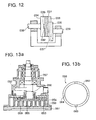
- Fig. 12 is a drawing to explain a working principle regarding an Oldham's coupling mechanism; a disk 031 is placed between an input shaft 038 and an output shaft 036 whereby both shaft axes are a little eccentric although the axes are parallel; there are key-boss type protrusions (032 and 033) on both parallel surfaces of the disk 031; here, the lines of the protrusions 032 and 033 lie at right angles each other; in response to the protrusions 032, there is a key-way type groove 035 for sliding the key-boss type protrusions 032, on a surface plane of an input shaft-flange-part disk 034; on the other hand, in response to the protrusions 033, there is a key-way type groove 037 for sliding the key-boss type protrusions 033, on a surface plane of an output shaft-flange-part disk 036; hereby, a line of the key-way type groove 035 intersects the axis of the input shaft 03
- the rotation movement of the input shaft 038 is transmitted to the output shaft 039 through the disk 031, with a same rotation speed. Further, if the rotational movement of the output shaft is fixed, then the input shaft has to orbit (revolve) around the axis of the output shaft. This orbiting movement mechanism can be applied to a scroll fluid machine.
- a patent reference 2 JP-A-2003-106268 discloses a scroll fluid machine provided with a pin-crank mechanism.
- a stationary scroll 070 and a orbiting scroll 071 form a compression chamber 072; an eccentric shaft that forms an end of a shaft 073 is engaged in an orbiting bearing 074 fitted in the orbiting scroll 071.
- a pin-crank mechanism 079 which comprises an orbiting pin-bearing 075 fitted to a base plate part of the orbiting scroll, a first stationary bearing 076 fitted into a hole made in a body-frame, a second stationary bearing 077 fitted to a further bottom side of the hole, and a pin-crank shaft 078 that is supported by the three kinds of rolling-element bearings; whereby, in usual practice, three sets of the mechanism are arranged at equal intervals on a circle.
- an Oldham's coupling mechanism cannot do without a key-way type groove and a key-boss type protrusion that is engaged therein and slides therein; thus, the mechanism is easy to accompany vibration problems, noise problems, excessive clearance-wear problems due to frictions; therefore, in the manner of the patent reference 1 ( Fig. 12 ), wear-resistant materials are adopted to the friction-wear parts of the mechanism.
- the first scroll and the second scroll having the second scroll lap which forms a closed compression chamber by engaging with the first scroll lap, to be translated parallel to each other.
- the first scroll and the second scroll having the second scroll lap which forms a closed compression chamber by engaging with the first scroll lap
- the second scroll lap which forms a closed compression chamber by engaging with the first scroll lap
- the sliding part-free configuration makes it possible to do without lubrication oil or grease; thus, an easy maintenance management of the scroll fluid machine can be realized.
- the sliding part-free configuration can reduce driving energy of the scroll fluid machines and yields less noise or less vibration of the machines.
- a second preferable embodiment is the scroll fluid machine of the first embodiment, whereby the intermediate element is formed in a ring-shape and is arranged so as to surround the first scroll lap of the first scroll and the second scroll lap of the second scroll.
- the ring-shaped intermediate element is placed outside of where the first and second scrolls mesh each other, so that the ring shaped intermediate element surround the scrolls.
- the intermediate element does not require additional space to be fitted in the axial direction.
- a structure of a scroll fluid machine can be simply configured so that a relative orbiting movement between the orbiting scroll and the stationary scroll is performed by means of making the orbiting scroll revolve around the axis of the stationary scroll, with a radius of the eccentricity of a eccentric crank shaft; thereby, a closed compression chamber formed by an engagement of the orbiting scroll lap and the stationary scroll lap is directed toward the revolution center, while the volume of the chamber gradually reduces.
- the scroll fluid machines configured as described above enables to do without sliding parts such as used in conventional Oldham's coupling mechanisms or pin-crank mechanisms as well as to provide the orbiting scroll with a self-rotating prevention mechanism
- the machines can be free from wear-based deterioration thanks to sliding-part-free configuration as well as can enhance durability against an increase as to rotational part clearances; in addition, the sliding-part-free configuration enables to dispense with lubrication oil or grease, realizing easy maintenance machine-management.
- a fourth preferable embodiment of the invention is an embodiment in which the second scroll is a driven scroll that rotates around the rotation axis of the second scroll and is supported by the casing of the machine, while the second scroll is rotated by the first scroll the axis of which eccentric against the axis of the second scroll with the eccentricity; further, a relative revolving (orbiting) movement is performed between the first scroll and the second scroll.
- a rotational force given to the driving scroll makes a rotational movement of the driving scroll be transmitted to the driven scroll, through a coupling mechanism comprising the intermediate element, the first plate sprig element, and the second plate sprig element, thanks to a rotation-free configuration as to the driving scroll and the driven scroll; in addition, the force can bring a relative revolution movement (an orbiting movement) between the driving scroll and the driven scroll.
- a scroll fluid machine configured as in the above embodiment can dispense with sliding parts such as used in conventional Oldham's coupling mechanisms or pin-crank mechanisms as well as can provide the orbiting scroll with a self-rotating prevention mechanism, as the situation is the same as in the preceding embodiment; thus, the machines can be free from wear-based deterioration thanks to sliding-part-free configuration as well as can enhance durability against an increase as to rotational part clearances; further, the sliding-part-free configuration enables to dispense with lubrication oil or grease, realizing further maintenance-free machine-operation; moreover, the sliding part-free configuration reduces driving energy of the scroll fluid machines and yields less noises or vibrations of the machines.
- a fifth preferable embodiment of the invention is an embodiment of the above embodiment 1, 2, 3 or 4; whereby, a configuration of this embodiment comprises a polygon-shape and a ring-shape (loop-shaped) intermediate element as the intermediate element; whereby, a pair of the first plate sprig elements are fitted to opposite-side edges (locations) of the polygon or the ring, and a pair of the second plate sprig elements are fitted to another opposite-side edges (locations) of the polygon or the ring; whereby, the former opposite-side edges (locations) coincide with the latter opposite-side edges (locations) when the former edges (locations) or the latter edges (locations) are rotationally moved by 90 degrees in a plane orthogonal to the axis of the machine.
- a sixth preferable embodiment of the invention is an embodiment of any one of the above embodiments 1 to 5; whereby, the first plate spring element and the second plate spring element are of an oval track shape; a part of a line part of the oval track of the first plate spring element is fitted to the intermediate element, while a part of another line part of the oval track of the first plate spring element is fitted to the first scroll; on the other hand, a part of a line part of the oval track of the second plate spring element is fitted to the intermediate element, while a part of another line part of the oval track of the second plate spring element is fitted to the second scroll.
- a long side of the oval track of the first or second plate spring can be fitted on the intermediate element and the first scroll side part or the second scroll part; thus, the fitting of the first and second plate springs are secured with long fitting length.
- a seventh preferable embodiment of the invention is an embodiment according to the above embodiment 4 or 5; wherein, a plurality of the first plate springs and a plurality of the second plate springs are placed on each edge of the intermediate element.
- a plurality of the plate spring elements are fitted to each polygon edge of the intermediate element, an enhanced stiffness as to an axial direction of the fluid machine is obtained; namely, an axial clearance between the first scroll and the second scroll is kept further constant; consequently, a desirable condition regarding sliding movement between a tip part of the first scroll lap and the second scroll is preserved; in the same way, a desirable condition regarding sliding movement between a tip part of the second scroll lap and the first scroll is preserved; as a result, it becomes possible to expect a desirable sealing condition of the aforementioned compression chamber formed through an engagement of the first scroll and the second scroll.
- the present invention provides a scroll fluid machine wherein a relative revolution (orbiting) movement between the first scroll and the second scroll can be performed.
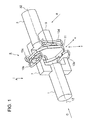
- FIG.1 shows a perspective view as to a whole constitution of a coupling mechanism in which a principle of a revolution (orbiting) mechanism of the invention is explained;
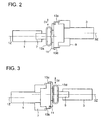
- FIG. 2 shows an A-arrow view of Fig. 1 ;
- FIG. 3 shows a B-arrow view of Fig. 1 ;
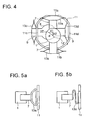
- FIG.4 shows a C-arrow view of Fig. 1 ;
- FIG.5 shows a variation example of a plate spring element;
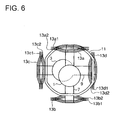
- FIG. 6 shows another variation example of a plate spring element;
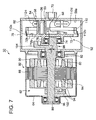
- FIG.7 shows a whole constitution of a scroll fluid machine according to the first invention mode;
- FIG. 1 shows a perspective view as to a whole constitution of a coupling mechanism in which a principle of a revolution (orbiting) mechanism of the invention is explained;
- FIG. 2 shows an A-arrow view of Fig. 1 ;
- FIG. 3 shows a B-arrow view of Fig. 1 ;
- FIG.4 shows a C-arrow view of Fig. 1 ;
- FIG. 8 shows a perspective view as to principal parts of a scroll fluid machine according to the first invention mode
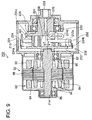
- FIG.9 shows a whole constitution of a scroll fluid machine according to the second invention mode
- Fig. 10 shows a whole constitution of a scroll fluid machine according to the third invention mode
- Figs. 11a to 11d explain a principle of compression process of a scroll fluid machine, wherein the situation of Fig.11a proceeds to those of Fig. 11b, Fig. 11c, and Fig. 11d in sequence, as the revolution angle of an orbiting scroll around a stationary scroll advances every 90 degrees.
- a revolving (orbiting) mechanism is explained with an example of a coupling mechanism according to the present invention.
- a coupling mechanism 5 that performs a rotation movement transmission from a drive-shaft 1 to a driven shaft 3 wherein the axes of the two shaft are parallel to each other, with an eccentricity.
- a square U-shaped part 7 is formed at an end of the drive-shaft 1 while a square U-shaped part 9 is formed at an end of the driven shaft 1; whereby, the both ends of the two shafts are placed so as to face each other; in addition, each plane including each of the U-shaped parts intersects each other with substantially right angle.
- an intermediate ring (an intermediate element) 11 the rotating plane of which is vertical to an axis 1Z of the drive-shaft 1 as well as an axis 3Z of the driven shaft 3.
- the intermediate ring 11 of steel is substantially octagonal; to each of opposing (counter-facing) edges of the intermediate ring, namely, an upper edge 11a and a lower edge 11b, a longer part of the oval track-shape element as the first plate spring element is fastened by welded joints or with bolts.
- another longer part of the first plate spring element 13a or 13b is fastened to either of outer-end sides of the aforementioned square U-shaped part 7, by welded joints or with bolts.
- the first plate springs 13a and 13b of spring steel can deflect so that the springs mainly deform (mainly due to the elasticity of a circular part of the oval track) in a minor axis direction of the oval track, namely, in the Y-direction in Fig. 1 ; here, the Y-direction is an above or below direction (a vertical direction), and is defined as a first direction vertical to the axes 1Z and 3Z, for the convenience of later description; anyway, the intermediate ring 11 can be fitted so as to move in the first direction within an allowable amplitude of the springs 13a and 13b.
- the second plate spring elements 13c and 13d are made of spring steel as the first plate spring elements 13a and 13b are; the second plate spring elements 13c and 13d can deflect so that the springs mainly deform (mainly due to the elasticity of a circular part of the oval track) in a minor axis direction of the oval track, namely, in the X-direction in Fig. 1 ; here, the X-direction is an left or right direction (a horizontal direction), and is defined as a second direction vertical to the axes 1Z and 3Z, for the convenience of later description; anyway, the intermediate ring 11 can be fitted so as to move in the second direction within an allowable amplitude of the springs 13c and 13d.
- an eccentricity d1 i.e. an X-direction component of d can be absorbed by a deflection of the second plate springs 13c and 13d
- an eccentricity d2 i.e. an y-direction component of d can be absorbed by a deflection of the first plate springs 13a and 13b.
- the coupling mechanism 5 can be realized with a plate spring mechanism, without conventional Oldham's coupling mechanisms or pin-crank mechanisms; in addition, since there is no sliding parts in the mechanism of the invention, the machines according the invention are free from deterioration due to wear; further, the machines of the invention can be free from wear-based deterioration thanks to sliding-part-free configuration as well as can enhance durability against an increase as to rotational part clearances; further, the sliding-part-free configuration enables to dispense with lubrication oil or grease, realizing further maintenance-free machine-operation; moreover, the sliding part-free configuration reduces driving energy of the scroll fluid machines and yields less noises or vibrations of the machines.
- Figs. 5a and 5b show another variation examples of the first plate spring elements 13a and 13b as well as the second plate spring elements 13c and 13d.
- Fig. 5a is shown a trapezoid-shaped ring plate spring; whereby, the plate spring can be fixed to the intermediate ring 11 with a fitting length longer than a straight length of the aforementioned oval track; thus, a secured fitting is possible.
- Fig. 5a is shown a trapezoid-shaped ring plate spring; whereby, the plate spring can be fixed to the intermediate ring 11 with a fitting length longer than a straight length of the aforementioned oval track; thus, a secured fitting is possible.
- the plate springs are not necessarily of a ring shape; the plate springs may be those of flat plate; further, the plate springs may be made of a plurality of plate springs such as those of superposed plate layers.
- Fig. 6 is shown a variation of a manner in which the first plate springs 13a and 13b as well as the second plate springs 13c and 13d are provided; namely, is shown an example in which a plurality of the first/second springs are provided; in fact, in Fig.
- first plate springs including those marked with 13a1, 13a2, 13b1 and 13b2 as well as plural second plate springs including those marked with 13c1, 13c2, 13d1 and 13d2; in this way, by means of laying a plurality of plate springs, enhanced stiffness is obtained; as a result, since an axial direction rigidity between the drive-shaft 1 and the driven shaft 3 is also heightened, a relative displacement between the shafts 1 and 3 is kept constant, although a deflection of the first/second plate springs in X-direction and Y-direction becomes smaller.
- a rotation (orbiting) mechanism can be realized so that the drive-shaft 1 can revolve (orbit) around the axis 3Z of the driven shaft 3; that is, it becomes possible that the axis 1Z of the drive-shaft 1 can perform a parallel translation around the axis 3Z of the driven shaft 3 on a condition that a relative axial movement (in 1Z-direction or 3Z-direction) between the axis 1Z and the axis 3Z is kept substantially zero.
- the premise means that the opposing (counter-facing) end face planes of the drive-shaft 1 and the driven shaft 3 are substantially parallel with a substantially constant distance.
- a scroll compressor 50 comprises:
- the stationary scroll 58 is provided with a discharge port 68 at a center part of a mirror surface 58a that is an inner side surface of the stationary scroll 58 of a disk shape; whereby, the discharge port 68 is connected to a discharge mouth 70.
- the stationary scroll lap 56 of a spiral wall shape is implanted in the inner side surface of the stationary scroll 58; here, the spiral starts from the center part of the mirror surface 58 toward an outer circumference circle.
- a tip seal (not shown) of self-lubricating material.
- an end plate 72 of the orbiting scroll 52 is substantially of an octagonal plate shape that is obtained from a square plate shape by means of cutting-off the four corners thereof; in a mirror surface 72a of the orbiting scroll, is implanted the orbiting scroll lap 54 of a spiral wall shape; the wall of the orbiting scroll lap 54 faces the spiral wall of the stationary scroll lap 56; further, in a groove engraved on a tip ridge surface of the orbiting scroll lap 54, is installed a tip seal (not shown) of self-lubricating material.
- a bearing room 76 is provided at a rear surface 72b that is located at an opposite side of the mirror surface 72a; whereby, a ball bearing 74 is engaged into the bearing room 76.
- a suction mouth 78 is provided in an upper part of the scroll casing 60; in addition, a bearing room 82 into which a ball bearing 80 is engaged is provided to the scroll casing 60.
- a motor casing 64 is provided:
- the motor casing 64 is fastened to the scroll casing 60 by bolts (not shown); a first end side of the rotating shaft 86 is fitted into a ball bearing 96 and supported by the ball bearing 96 so that the shaft 86 can rotate; a second end side of the shaft 86 is fitted into the aforementioned ball bearing 74 and supported by the ball bearing 74 so that the shaft 86 can rotate.
- a cranked shaft part (a revolving/orbiting means) 100 the axis of which is eccentric against the axis of a main part of the shaft 86; the cranked shaft part 100 is fitted into a ball bearing 74 of the orbiting scroll 52 as well as is supported by the ball bearing 74.
- a first counter-weight 102 is provided, while a second counter-weight 104 is provided at the second side end part 98 of the shaft 86; thanks to the counter-weights, an imbalance moment due to the cranked shaft part 100 is canceled; thus, a rotational balance (a lessened vibration) of the shaft 86 as a whole is secured; by the way, a term “unbalance” is sometimes used in stead of the term “imbalance” in the field of rotational machines, especially in the field of internal combustion engines.
- An intermediate ring (an intermediate element) 110 of a polygon-shape is arranged so as to surround the orbiting scroll lap 54 of the orbiting scroll 52; the intermediate ring 110 is substantially of an octagonal shape that is obtained from a square shape by means of cutting-off the four corners thereof; the above octagonal shape is obtained in such a similar way as the aforementioned end plate 72 of the orbiting scroll 52 in Fig. 8 is obtained.
- an upper edge 52a of the orbiting scroll 52 is connected to an upper edge 110a of the intermediate ring 110 through a first plate spring 112a, while a lower edge 52b of the orbiting scroll 52 is connected to a lower edge 110b of the intermediate ring 110 through a first plate spring 112b; hence, the intermediate ring 110 is supported by the first plate springs against the drive-shaft 1, so as to be able to move in an above or below direction (a first direction) vertical to the axes of the shaft 86.
- a first plate spring 112a As shown in Fig. 8 , an upper edge 52a of the orbiting scroll 52 is connected to an upper edge 110a of the intermediate ring 110 through a first plate spring 112a, while a lower edge 52b of the orbiting scroll 52 is connected to a lower edge 110b of the intermediate ring 110 through a first plate spring 112b; hence, the intermediate ring 110 is supported by the first plate springs against the drive-shaft 1, so as to be able to move in an above or below direction
- the first plate springs 112a and 112b are of an oval track shape and two plate springs are provided per each edge; and, a line part of the track is used so that the first plate springs are fixed to the orbiting scroll and/or the intermediate spring.
- a left edge 110c (not shown) of the intermediate ring 110 is connected to a left side edge 112c (not shown) of the stationary scroll 58 through a second plate spring 112c, while a right edge 110d of the stationary scroll 58 through a second plate spring 112d, hence, the intermediate ring 110 is supported by the second plate springs against the driven shaft 3, so as to be able to move in a left or right direction (a second direction) vertical to the first direction.
- the second plate springs 112c and 112d are of an oval track shape as the first plate springs are; two second plate springs are provided per each left or right edge of the intermediate ring 110; and, as in the case of the first plate springs, a line part of the track is used so that the second plate springs are fixed to the intermediate spring and/or the stationary scroll.
- the cranked shaft part 100 that is located eccentrically to the rotating shaft 86 revolves (orbits) around the axis thereof, when the shaft 86 is rotated by the drive motor 62; during this process, the orbiting scroll 52 can be rotated (can orbit) around an axis of the scroll compressor, without self-rotation, through the aforementioned functions of the first plate springs 112a and 112b, the intermediate ring 110, and the second plate springs 112c and 112d; on this occasion, a relative distance in an axial direction of the compressor between the orbiting scroll 52 and the mirror surface 58a of the scroll casing 60 is kept substantially constant.
- the scroll compressor 50 can be realized with a simple configuration that enables an orbiting mechanism, as well as with sufficient functions as a scroll compressor.
- a fluid suctioned through the suction mouth 78 of the scroll casing 60 is induced by the orbiting scroll lap 54, to the closed compression chamber 59 formed with the orbiting scroll lap 54 and the stationary scroll lap 56; the closed compression chamber 59 is directed toward the revolution center, while the volume of the chamber gradually reduces, that is, the induced gas is gradually pressurized; finally, a compressed gas is discharged through the discharge mouth 70 via the discharge port 68.
- the first invention mode of the scroll compressor 50 as described thus far enables a self-rotating prevention mechanism different from that used in a conventional pin-crank mechanism or Oldham's coupling mechanism; namely, the self-rotating prevention mechanism of the present invention can be realized not by sliding parts or elements, but by means of the first plate springs 112a and 112b, the intermediate ring 110, and the second plate springs 112c and 112d; thus, the machines according to the invention can achieve enhanced wear durability without clearance-growth thanks to sliding-part-free configuration; moreover, the sliding part-free configuration makes it possible to do without lubrication oil or grease; still further, an easy maintenance management of the scroll compressor can be realized, while the sliding part-free configuration can reduce driving energy of the scroll compressor and yields less noises or less vibrations of the machines.
- a scroll compressor 200 of the second invention mode is of what is called "a mono-rotating type"; wherein, a drive scroll (a first scroll) and a driven scroll (a second scroll) are engaged in each other whereby both axes of the two kinds of scrolls are eccentric each other; and, a rotation movement is transmitted from the drive scroll to the driven scroll, when the drive scroll is rotated; in response to the relative revolving (orbiting) movement, a closed compression chamber formed by an engagement of the drive scroll lap and the driven scroll lap is directed toward the revolution center, while the volume of the chamber continuously reduces.
- a mono-rotating type wherein, a drive scroll (a first scroll) and a driven scroll (a second scroll) are engaged in each other whereby both axes of the two kinds of scrolls are eccentric each other; and, a rotation movement is transmitted from the drive scroll to the driven scroll, when the drive scroll is rotated; in response to the relative revolving (orbiting) movement, a closed compression chamber formed by an engagement of the drive scroll lap
- a scroll compressor 200 comprises:
- an end plate 212 (in Fig. 9 ) of the drive scroll 202 (in Fig. 9 ) is substantially of an octagonal plate shape that is obtained from a square plate shape by means of cutting-off the four corners thereof; in a mirror surface 212a of the drive scroll, is implanted the drive scroll lap 204 of a spiral wall shape the wall of which faces the spiral wall of the driven scroll lap; whereby, the spiral starts from the center part of the end plate 212 toward an outer circumference thereof; further, in a groove engraved on a tip ridge surface of the drive scroll lap 204, is installed a tip seal (not shown) of self-lubricating material.
- an end of a drive-shaft 214 is connected to a rear surface of the end plate 212 that is located at an opposite side of the mirror surface 212a; thus, a torque is transmitted from the drive-shaft 214 to the driven scroll 202.
- an end plate 222 of the driven scroll 208 is substantially of an octagonal plate shape that is obtained from a square plate shape by means of cutting-off the four corners thereof; in a mirror surface 222a of the driven scroll, is implanted the driven scroll lap 206 of a spiral wall shape the wall of which faces the spiral wall of the drive-scroll lap; whereby, the spiral starts from the center part of the end plate 222 toward an outer circumference thereof; further, in a groove engraved on a tip ridge surface of the driven scroll lap 208, is installed a tip seal (not shown) of self-lubricating material.
- the spiral of the driven scroll lap 206 and that of the drive scroll lap 204 is substantially congruent; the former is engaged into the latter with a predetermined rotation angle so as to form a closed chamber.
- an driven shaft 224 together with the driven scroll, in one body; along a center axis of the driven shaft 224, a discharge hole 226 is bored; the hole 226 communicates with a discharge mouth 228.
- the driven shaft 224 is fitted into a ball bearing 230 and is supported thereby so as to be able to rotate freely in the scroll casing 210.
- a suction mouth 231 is provided in an upper part of the scroll casing 210; in addition, a bearing room 82 into which a ball bearing 80 is engaged is provided to the scroll casing 210. Further, the motor casing 64 is fastened to the scroll casing 210 by bolts (not shown).
- An intermediate ring (an intermediate element) 232 of a polygon-shape is arranged so as to surround the drive scroll lap 204 of the drive scroll 202 as well as the driven scroll lap 206 of the driven scroll 208; the intermediate ring 232 is substantially of an octagonal shape that is obtained from a square shape by means of cutting-off the four corners thereof; an upper edge of the end plate 212 (of the drive scroll 202) of the aforementioned (substantially) octagonal shape is connected to an upper edge of the intermediate ring 232 through a first plate spring 234a, while a lower edge of the end plate 212 (of the drive scroll 202) is connected to a lower edge of the intermediate ring 232 through a first plate spring 234b; hence, the intermediate ring 232 is supported by the first plate springs against the drive scroll 202, so as to be able to move in an above or below direction (a first direction) vertical to an axis of the drive-shaft 214; whereby, the first plate springs 234
- left/right side edges of the intermediate ring 232 are connected to left/right side edges of the end plate 222 (of the driven scroll 208) of substantially octagonal shape, respectively, through a second plate springs 234c and 234d; hence, the intermediate ring 232 is supported by the second plate springs against the driven scroll 208, so as to be able to move in a left or right direction (a second direction) vertical to the first direction; whereby, as in the case of the first plate springs 234a and 234b, the second plate springs 234c and 234d are of an oval track shape and two plate springs are provided per each edge.
- an axis of the drive-shaft 214 and an axis of the driven shaft 224 are arranged with the eccentricity ⁇ ; hence, thanks to a parallel translation mechanism that is realized with the intermediate ring 232, the first plate springs 234a and 234b, and the second plate springs 234c and 234d, a rotational movement of the drive scroll is transmitted to the driven scroll, while a relative revolving (orbiting) movement between the drive scroll and the driven scroll is realized.
- a closed compression chamber formed by an engagement of the drive scroll lap 204 and the driven scroll lap 206 is directed toward the revolution center, while the volume of the chamber gradually (continuously) reduces; a fluid suctioned through the suction mouth 231 of the scroll casing 210 is induced, by the drive scroll lap 204, to the closed compression chamber formed by the drive scroll lap 204 and the driven scroll lap 206; the closed compression chamber 59 is directed toward the revolution center, while the volume of the chamber gradually reduces, that is, the induced fluid is gradually pressurized; finally, a compressed fluid is discharged through the discharge mouth 228 via the discharge port 226.
- a relative distance in an axial direction of the compressor between the mirror surface 212a of the drive scroll 202 and the mirror surface 222a of the driven scroll 208 is kept substantially constant; thus, a sealing (gas-tightness) condition of a closed compression chamber formed by the drive scroll lap 204 and the driven scroll lap 206 is not spoiled; namely, the scroll compressor 200 can be realized with a simple configuration that enables an revolving (orbiting) mechanism, as well as with sufficient functions as a scroll compressor.
- the scroll compressor 200 can transmit a rotational movement from the drive-shaft to the driven shaft as well as the compressor 200 can realize a relative revolving (orbiting) movement between the drive scroll and the driven scroll, without a conventional mechanism such as a crank-mechanism that is provided between the drive scroll and the driven scroll; further, the scroll compressor 200 can not use a sliding parts thanks to a set of elements comprising the first plate springs 234a and 234b, the intermediate ring 232, and the second plate springs 234c and 234d; thus, the scroll compressor 200 according to the invention can achieve enhanced wear durability without clearance-growth because of sliding-part-free configuration; moreover, the sliding part-free configuration makes it possible to do without lubrication oil or grease; still further, an easy maintenance management of the scroll compressor can be realized, while the sliding part-free configuration can reduce driving energy of the scroll compressor and yields less noises or less vibrations of the machines.
- a scroll compressor 300 of the third mode is different from those of the first mode and the second mode, in arrangement of an intermediate element.
- the intermediate ring 110 of a polygon-shape is placed so as to surround the orbiting scroll lap 54 of the orbiting scroll 52 as well as the stationary scroll lap 56 of the stationary scroll 58
- the intermediate ring 232 of a polygon-shape is placed so as to surround the driven scroll lap 206 as well as the drive scroll lap 204.
- an intermediate ring 310 is placed between a rear surface 352b of an orbiting scroll 352 and a scroll casing 360 that forms a stationary scroll 358. Except the parts related to the above-mentioned parts such as the orbiting scroll, the stationary scroll, the intermediate ring, and scroll casing, most of the parts in the third mode are common to those in the first mode; hence, a same numeral is assigned to such a common part in both modes (i.e. in Fig. 7 and in Fig. 10 ).
- a bearing room 76 is provided at a rear surface 372b that is located at an opposite side of the mirror surface 372a; outside the outer periphery of the bearing room 76, the intermediate ring (an intermediate element) 310 of a polygon-shape is placed so as to surround the room 76; hereupon, as shown in the perspective figure 8 that is used for the explanation of the first mode, the contour of the intermediate ring 310 is substantially of an octagonal plate shape that is obtained from a square plate shape by means of cutting-off the four corners thereof.
- An upper edge of the end plate 372 (of the orbiting scroll 352) of a substantially-octagonal shape is connected to an upper edge of the intermediate ring 310 through a first plate spring 312a, while a lower edge of the end plate 372 (of the orbiting scroll 352) is connected to a lower edge of the intermediate ring 310 through a first plate spring 312b; hence, the intermediate ring 310 is supported by the first plate springs 312a and 312b against the orbiting scroll 352, so as to be able to move in an above or below direction (a first direction) vertical to an axis of a rotating shaft 86.
- the first plate springs 312a and 312b are of an oval track shape and two plate springs are provided per each edge; further, a part of a straight segment of the track is fixed to the intermediate ring or the end plate (of the orbiting scroll 352).
- left/right side edges of the intermediate ring 310 are connected to left/right side edges of the scroll casing 360 that forms the stationary scroll 358, through a second plate spring 312c, and a second plate spring 312d (not shown as the spring 312d is located at a viewer side of the figure-sheet), respectively; thus, the intermediate ring 310 is supported by the second plate springs against the stationary scroll 358, so as to be able to move in a left or right direction (a second direction) vertical to the first direction; whereby, as in the case of the first plate springs 312a and 312b, the second plate springs 312c and 312d are of an oval track shape and two plate springs are provided per each edge; further, a part of a straight segment of the track is fixed to the intermediate ring or the scroll casing.
- a cranked shaft part 100 that is located eccentrically to the rotating shaft 86 revolves (orbits) around the axis thereof, when the shaft 86 is rotated by a drive motor 62; during this process, the orbiting scroll 352 can be rotated (can orbit) around an axis of the scroll compressor, without self-rotation, through the aforementioned functions of the first plate springs 312a and 312b, the intermediate ring 310, and the second plate springs 312c and 312d (not shown); thus, is secured a function of a scroll compressor that an induced air (gas/fluid) in a closed compression chamber 359 that an orbiting scroll lap 354 and a stationary scroll lap 356 form is gradually compressed, while being sent toward a central part of the scrolls.
- the above-described function in the third mode is essentially equivalent to that in the first mode; on the other hand, this third mode makes it possible that the configuration elements such as the intermediate ring 310, the first plate springs 312a/312b, and the second plate springs 312c/312d need to be placed not outside the outer periphery of the orbiting scroll lap 354 and the stationary scroll lap 356, but on a side of the rear surface 372b that is located opposite to the mirror surface 372a of the end plate 372 in the orbiting scroll 352; therefore, the intermediate ring can be provided independently of the heights (space) as to the orbiting scroll lap 354 and the stationary scroll lap 356.
- this invention mode realizes a compact scroll compressor even when there is little room outside the outer periphery of the orbiting scroll lap 354 and the stationary scroll lap 356 as the intermediate ring can be installed on a side of the rear surface 372b of the end plate 372.
- the invention enhances the degree of freedom as to the scroll compressor design.
- the present invention provides a scroll fluid machine that realizes a relative revolving (orbiting) movement between a drive scroll and the driven scroll without a sliding element configuration such as used in conventional Oldham's coupling mechanisms and/or pin-crank mechanisms; thus, the invention discloses a useful and contributive technology.
Landscapes
- Engineering & Computer Science (AREA)
- Mechanical Engineering (AREA)
- General Engineering & Computer Science (AREA)
- Rotary Pumps (AREA)
Applications Claiming Priority (1)
| Application Number | Priority Date | Filing Date | Title |
|---|---|---|---|
| JP2007095579 | 2007-03-30 |
Publications (2)
| Publication Number | Publication Date |
|---|---|
| EP1978255A2 true EP1978255A2 (de) | 2008-10-08 |
| EP1978255A3 EP1978255A3 (de) | 2013-05-29 |
Family
ID=39639600
Family Applications (1)
| Application Number | Title | Priority Date | Filing Date |
|---|---|---|---|
| EP08005834.0A Withdrawn EP1978255A3 (de) | 2007-03-30 | 2008-03-27 | Spiralfluidmaschine |
Country Status (5)
| Country | Link |
|---|---|
| US (1) | US7976294B2 (de) |
| EP (1) | EP1978255A3 (de) |
| JP (1) | JP5076242B2 (de) |
| KR (1) | KR20080089289A (de) |
| CN (1) | CN101275558B (de) |
Families Citing this family (3)
| Publication number | Priority date | Publication date | Assignee | Title |
|---|---|---|---|---|
| JP6768406B2 (ja) * | 2016-08-19 | 2020-10-14 | 三菱重工業株式会社 | 両回転スクロール型圧縮機 |
| CN111890377B (zh) * | 2020-07-16 | 2024-12-06 | 中国航空工业集团公司北京航空精密机械研究所 | 机器人末端执行机构、机器人及磨削系统 |
| US12116998B2 (en) | 2022-05-09 | 2024-10-15 | Air Squared, Inc. | Flexible spinning scroll coupling device |
Citations (2)
| Publication number | Priority date | Publication date | Assignee | Title |
|---|---|---|---|---|
| JP2756808B2 (ja) | 1988-12-28 | 1998-05-25 | 三井精機工業株式会社 | スクロール圧縮機のオルダム継手構造 |
| JP2003106268A (ja) | 2001-09-28 | 2003-04-09 | 哲哉 ▲荒▼田 | スクロール流体機械の逆転阻止機構 |
Family Cites Families (19)
| Publication number | Priority date | Publication date | Assignee | Title |
|---|---|---|---|---|
| JPS5853601A (ja) | 1981-09-28 | 1983-03-30 | Hitachi Ltd | スクロ−ル流体機械 |
| JPS62119533U (de) * | 1986-01-22 | 1987-07-29 | ||
| JPS6444384U (de) * | 1987-09-10 | 1989-03-16 | ||
| JPH066947B2 (ja) * | 1988-04-11 | 1994-01-26 | 新明和工業株式会社 | スクロール形流体機械 |
| JPH068632B2 (ja) * | 1988-09-28 | 1994-02-02 | ダイキン工業株式会社 | スクロール形流体機械 |
| US5149255A (en) * | 1990-02-20 | 1992-09-22 | Arthur D. Little, Inc. | Gearing system having interdigital concave-convex teeth formed as invalutes or multi-faceted polygons |
| JP2713655B2 (ja) * | 1990-09-20 | 1998-02-16 | 三菱重工業株式会社 | 自転阻止機構 |
| DE69103604T2 (de) * | 1990-10-01 | 1994-12-22 | Copeland Corp | Oldham's Kupplung für Spiralverdichter. |
| JP3055726B2 (ja) | 1991-11-20 | 2000-06-26 | トキコ株式会社 | スクロール式流体機械 |
| JP3061469B2 (ja) * | 1992-02-14 | 2000-07-10 | 東芝キヤリア株式会社 | スクロ−ル形圧縮機 |
| JP3066171B2 (ja) * | 1992-03-05 | 2000-07-17 | 三洋電機株式会社 | スクロール圧縮機 |
| JPH0681780A (ja) * | 1992-09-04 | 1994-03-22 | Toshiba Corp | スクロ−ル形圧縮機 |
| US5403172A (en) * | 1993-11-03 | 1995-04-04 | Copeland Corporation | Scroll machine sound attenuation |
| JP3156520B2 (ja) * | 1994-09-20 | 2001-04-16 | 株式会社日立製作所 | スクロール流体機械 |
| JPH09112448A (ja) * | 1995-10-18 | 1997-05-02 | Matsushita Electric Ind Co Ltd | スクロール圧縮機 |
| JP3762494B2 (ja) * | 1996-10-22 | 2006-04-05 | サンデン株式会社 | スクロール型流体機械 |
| US6113371A (en) * | 1998-10-05 | 2000-09-05 | Scroll Technologies | Scroll-type machine with compact Oldham coupling |
| JP4074075B2 (ja) * | 2001-09-19 | 2008-04-09 | アネスト岩田株式会社 | スクロール流体機械 |
| JP2008256002A (ja) * | 2007-03-30 | 2008-10-23 | Anest Iwata Corp | 平行移動機構、それを用いた軸継手機構および旋回機構 |
-
2008
- 2008-03-13 JP JP2008064999A patent/JP5076242B2/ja not_active Expired - Fee Related
- 2008-03-27 EP EP08005834.0A patent/EP1978255A3/de not_active Withdrawn
- 2008-03-28 KR KR1020080029284A patent/KR20080089289A/ko not_active Ceased
- 2008-03-31 CN CN2008101003016A patent/CN101275558B/zh not_active Expired - Fee Related
- 2008-03-31 US US12/058,878 patent/US7976294B2/en not_active Expired - Fee Related
Patent Citations (2)
| Publication number | Priority date | Publication date | Assignee | Title |
|---|---|---|---|---|
| JP2756808B2 (ja) | 1988-12-28 | 1998-05-25 | 三井精機工業株式会社 | スクロール圧縮機のオルダム継手構造 |
| JP2003106268A (ja) | 2001-09-28 | 2003-04-09 | 哲哉 ▲荒▼田 | スクロール流体機械の逆転阻止機構 |
Also Published As
| Publication number | Publication date |
|---|---|
| KR20080089289A (ko) | 2008-10-06 |
| EP1978255A3 (de) | 2013-05-29 |
| CN101275558B (zh) | 2012-06-13 |
| US20080240956A1 (en) | 2008-10-02 |
| CN101275558A (zh) | 2008-10-01 |
| JP5076242B2 (ja) | 2012-11-21 |
| US7976294B2 (en) | 2011-07-12 |
| JP2008274930A (ja) | 2008-11-13 |
Similar Documents
| Publication | Publication Date | Title |
|---|---|---|
| US8007260B2 (en) | Scroll fluid machine having a coupling mechanism to allow relative orbiting movement of scrolls | |
| JP3869865B2 (ja) | スクロール型機械 | |
| JPH1182333A (ja) | スクロール流体機械 | |
| JPH04121478A (ja) | スクロール型圧縮機 | |
| KR870000927B1 (ko) | 스크롤형 유체기계 | |
| JPH07189932A (ja) | スクロール式機械 | |
| KR101011323B1 (ko) | 유체 기계 | |
| JP3747358B2 (ja) | スクロール形流体機械の製作方法 | |
| EP1978255A2 (de) | Spiralfluidmaschine | |
| JP3590432B2 (ja) | スクロール式機械 | |
| JP2003129968A (ja) | スクロール圧縮機 | |
| CN111788394A (zh) | 压缩机 | |
| JPH051399B2 (de) | ||
| JPH072961Y2 (ja) | 無給油式スクロール流体機械 | |
| JP3592810B2 (ja) | スクロール型流体機械 | |
| JPH0988823A (ja) | 軸受構造およびそれを用いた容積型機械 | |
| JP3361535B2 (ja) | スクロール型流体装置 | |
| JPS62191685A (ja) | スクロ−ル圧縮機 | |
| US20060233654A1 (en) | Compressor with radial compliance mechanism | |
| JP2008256002A (ja) | 平行移動機構、それを用いた軸継手機構および旋回機構 | |
| JP2687873B2 (ja) | 圧縮機 | |
| JPH04365901A (ja) | スクロール式流体機械 | |
| JP4013992B2 (ja) | スクロール型流体機械 | |
| JP3874018B2 (ja) | スクロール型流体機械 | |
| JP3976081B2 (ja) | スクロール型流体機械 |
Legal Events
| Date | Code | Title | Description |
|---|---|---|---|
| PUAI | Public reference made under article 153(3) epc to a published international application that has entered the european phase |
Free format text: ORIGINAL CODE: 0009012 |
|
| AK | Designated contracting states |
Kind code of ref document: A2 Designated state(s): AT BE BG CH CY CZ DE DK EE ES FI FR GB GR HR HU IE IS IT LI LT LU LV MC MT NL NO PL PT RO SE SI SK TR |
|
| AX | Request for extension of the european patent |
Extension state: AL BA MK RS |
|
| PUAL | Search report despatched |
Free format text: ORIGINAL CODE: 0009013 |
|
| AK | Designated contracting states |
Kind code of ref document: A3 Designated state(s): AT BE BG CH CY CZ DE DK EE ES FI FR GB GR HR HU IE IS IT LI LT LU LV MC MT NL NO PL PT RO SE SI SK TR |
|
| AX | Request for extension of the european patent |
Extension state: AL BA MK RS |
|
| RIC1 | Information provided on ipc code assigned before grant |
Ipc: F04C 18/02 20060101AFI20130419BHEP Ipc: F04C 29/00 20060101ALI20130419BHEP |
|
| AKY | No designation fees paid | ||
| REG | Reference to a national code |
Ref country code: DE Ref legal event code: R108 |
|
| REG | Reference to a national code |
Ref country code: DE Ref legal event code: R108 Effective date: 20140205 |
|
| STAA | Information on the status of an ep patent application or granted ep patent |
Free format text: STATUS: THE APPLICATION IS DEEMED TO BE WITHDRAWN |
|
| 18D | Application deemed to be withdrawn |
Effective date: 20131130 |