EP2045848A1 - Material für ein organisches elektrolumineszenzgerät und organisches elektrolumineszenzgerät - Google Patents
Material für ein organisches elektrolumineszenzgerät und organisches elektrolumineszenzgerät Download PDFInfo
- Publication number
- EP2045848A1 EP2045848A1 EP08778146A EP08778146A EP2045848A1 EP 2045848 A1 EP2045848 A1 EP 2045848A1 EP 08778146 A EP08778146 A EP 08778146A EP 08778146 A EP08778146 A EP 08778146A EP 2045848 A1 EP2045848 A1 EP 2045848A1
- Authority
- EP
- European Patent Office
- Prior art keywords
- group
- hole
- organic
- ring
- substituted
- Prior art date
- Legal status (The legal status is an assumption and is not a legal conclusion. Google has not performed a legal analysis and makes no representation as to the accuracy of the status listed.)
- Granted
Links
- 0 **c(c(*)c1*)c2-c3c(*)c(C(c4c(C5*6)c([*+2])c(*)c(*)c4*)=*)c5c6c3*c2c1[I+] Chemical compound **c(c(*)c1*)c2-c3c(*)c(C(c4c(C5*6)c([*+2])c(*)c(*)c4*)=*)c5c6c3*c2c1[I+] 0.000 description 4
- KNWBICKSHQTYPJ-UHFFFAOYSA-N C(CC1)CCC1c1c(CCCC2)c2c(C2CCCCC2)c2c1CCCC2 Chemical compound C(CC1)CCC1c1c(CCCC2)c2c(C2CCCCC2)c2c1CCCC2 KNWBICKSHQTYPJ-UHFFFAOYSA-N 0.000 description 2
- STBZRBJTFUABTQ-XBHZYYNSSA-N C/C(/c(cc1)ccc1N(c1cccc(C)c1)c1cccc(C)c1)=C\c1ccc(/C=C/c(cc2)ccc2N(c2cc(C)ccc2)c2cccc(C)c2)cc1 Chemical compound C/C(/c(cc1)ccc1N(c1cccc(C)c1)c1cccc(C)c1)=C\c1ccc(/C=C/c(cc2)ccc2N(c2cc(C)ccc2)c2cccc(C)c2)cc1 STBZRBJTFUABTQ-XBHZYYNSSA-N 0.000 description 1
- SXKVKVYSFWOMIY-UHFFFAOYSA-O CC1(C=CC(c2ccnc(F)c2)=CC11)c(cc(c(-c(cc2)c3cc2-c2c(C)c[nH+]c(F)c2)c2)C3=C(C#N)C#N)c2C1=C(C#N)C#N Chemical compound CC1(C=CC(c2ccnc(F)c2)=CC11)c(cc(c(-c(cc2)c3cc2-c2c(C)c[nH+]c(F)c2)c2)C3=C(C#N)C#N)c2C1=C(C#N)C#N SXKVKVYSFWOMIY-UHFFFAOYSA-O 0.000 description 1
- NMHQEFUOAJFDLJ-LYWFMZLMSA-N N#C/N=C(/c(cc(c(/C(/c1c2)=N/C#N)c3)-c1cc1c2nccn1)c3-c1c2)\c1cc1c2nccn1 Chemical compound N#C/N=C(/c(cc(c(/C(/c1c2)=N/C#N)c3)-c1cc1c2nccn1)c3-c1c2)\c1cc1c2nccn1 NMHQEFUOAJFDLJ-LYWFMZLMSA-N 0.000 description 1
- WYILJHBUVYOPNW-NQWAKLOSSA-N N#C/N=C(/c1c2)\c(cc(cc3)-c4ccc(C(F)(F)F)cc4)c3-c1cc(/C(/c1c3)=N/C#N)c2-c1ccc3F Chemical compound N#C/N=C(/c1c2)\c(cc(cc3)-c4ccc(C(F)(F)F)cc4)c3-c1cc(/C(/c1c3)=N/C#N)c2-c1ccc3F WYILJHBUVYOPNW-NQWAKLOSSA-N 0.000 description 1
- IONPVONWQFNDPK-NCOOAAOESA-N N#C/N=C1\c2cc(-c3ccc(C(F)(F)F)cc3)ccc2-c2c1cc(-c(c(/C1=N\C#N)c3)ccc3-c3ccc(C(F)(F)F)cc3)c1c2 Chemical compound N#C/N=C1\c2cc(-c3ccc(C(F)(F)F)cc3)ccc2-c2c1cc(-c(c(/C1=N\C#N)c3)ccc3-c3ccc(C(F)(F)F)cc3)c1c2 IONPVONWQFNDPK-NCOOAAOESA-N 0.000 description 1
- OPCUCNRFKXGBJW-UHFFFAOYSA-N N#CC(C#N)=C(c(cc(c(C(c1c2)=C(C#N)C#N)c3)-c1cc1c2nccn1)c3-c1c2)c1cc1c2nccn1 Chemical compound N#CC(C#N)=C(c(cc(c(C(c1c2)=C(C#N)C#N)c3)-c1cc1c2nccn1)c3-c1c2)c1cc1c2nccn1 OPCUCNRFKXGBJW-UHFFFAOYSA-N 0.000 description 1
Images
Classifications
-
- C—CHEMISTRY; METALLURGY
- C09—DYES; PAINTS; POLISHES; NATURAL RESINS; ADHESIVES; COMPOSITIONS NOT OTHERWISE PROVIDED FOR; APPLICATIONS OF MATERIALS NOT OTHERWISE PROVIDED FOR
- C09K—MATERIALS FOR MISCELLANEOUS APPLICATIONS, NOT PROVIDED FOR ELSEWHERE
- C09K11/00—Luminescent materials, e.g. electroluminescent or chemiluminescent
- C09K11/06—Luminescent materials, e.g. electroluminescent or chemiluminescent containing organic luminescent materials
-
- H—ELECTRICITY
- H10—SEMICONDUCTOR DEVICES; ELECTRIC SOLID-STATE DEVICES NOT OTHERWISE PROVIDED FOR
- H10K—ORGANIC ELECTRIC SOLID-STATE DEVICES
- H10K85/00—Organic materials used in the body or electrodes of devices covered by this subclass
- H10K85/60—Organic compounds having low molecular weight
- H10K85/615—Polycyclic condensed aromatic hydrocarbons, e.g. anthracene
- H10K85/623—Polycyclic condensed aromatic hydrocarbons, e.g. anthracene containing five rings, e.g. pentacene
-
- C—CHEMISTRY; METALLURGY
- C07—ORGANIC CHEMISTRY
- C07C—ACYCLIC OR CARBOCYCLIC COMPOUNDS
- C07C211/00—Compounds containing amino groups bound to a carbon skeleton
- C07C211/43—Compounds containing amino groups bound to a carbon skeleton having amino groups bound to carbon atoms of six-membered aromatic rings of the carbon skeleton
- C07C211/44—Compounds containing amino groups bound to a carbon skeleton having amino groups bound to carbon atoms of six-membered aromatic rings of the carbon skeleton having amino groups bound to only one six-membered aromatic ring
- C07C211/49—Compounds containing amino groups bound to a carbon skeleton having amino groups bound to carbon atoms of six-membered aromatic rings of the carbon skeleton having amino groups bound to only one six-membered aromatic ring having at least two amino groups bound to the carbon skeleton
- C07C211/50—Compounds containing amino groups bound to a carbon skeleton having amino groups bound to carbon atoms of six-membered aromatic rings of the carbon skeleton having amino groups bound to only one six-membered aromatic ring having at least two amino groups bound to the carbon skeleton with at least two amino groups bound to carbon atoms of six-membered aromatic rings of the carbon skeleton
- C07C211/51—Phenylenediamines
-
- C—CHEMISTRY; METALLURGY
- C07—ORGANIC CHEMISTRY
- C07C—ACYCLIC OR CARBOCYCLIC COMPOUNDS
- C07C255/00—Carboxylic acid nitriles
- C07C255/01—Carboxylic acid nitriles having cyano groups bound to acyclic carbon atoms
- C07C255/32—Carboxylic acid nitriles having cyano groups bound to acyclic carbon atoms having cyano groups bound to acyclic carbon atoms of a carbon skeleton containing at least one six-membered aromatic ring
- C07C255/34—Carboxylic acid nitriles having cyano groups bound to acyclic carbon atoms having cyano groups bound to acyclic carbon atoms of a carbon skeleton containing at least one six-membered aromatic ring with cyano groups linked to the six-membered aromatic ring, or to the condensed ring system containing that ring, by unsaturated carbon chains
-
- C—CHEMISTRY; METALLURGY
- C07—ORGANIC CHEMISTRY
- C07C—ACYCLIC OR CARBOCYCLIC COMPOUNDS
- C07C255/00—Carboxylic acid nitriles
- C07C255/01—Carboxylic acid nitriles having cyano groups bound to acyclic carbon atoms
- C07C255/32—Carboxylic acid nitriles having cyano groups bound to acyclic carbon atoms having cyano groups bound to acyclic carbon atoms of a carbon skeleton containing at least one six-membered aromatic ring
- C07C255/35—Carboxylic acid nitriles having cyano groups bound to acyclic carbon atoms having cyano groups bound to acyclic carbon atoms of a carbon skeleton containing at least one six-membered aromatic ring the carbon skeleton being further substituted by halogen atoms, or by nitro or nitroso groups
-
- C—CHEMISTRY; METALLURGY
- C07—ORGANIC CHEMISTRY
- C07C—ACYCLIC OR CARBOCYCLIC COMPOUNDS
- C07C261/00—Derivatives of cyanic acid
- C07C261/04—Cyanamides
-
- C—CHEMISTRY; METALLURGY
- C07—ORGANIC CHEMISTRY
- C07D—HETEROCYCLIC COMPOUNDS
- C07D215/00—Heterocyclic compounds containing quinoline or hydrogenated quinoline ring systems
- C07D215/02—Heterocyclic compounds containing quinoline or hydrogenated quinoline ring systems having no bond between the ring nitrogen atom and a non-ring member or having only hydrogen atoms or carbon atoms directly attached to the ring nitrogen atom
- C07D215/16—Heterocyclic compounds containing quinoline or hydrogenated quinoline ring systems having no bond between the ring nitrogen atom and a non-ring member or having only hydrogen atoms or carbon atoms directly attached to the ring nitrogen atom with hetero atoms or with carbon atoms having three bonds to hetero atoms with at the most one bond to halogen, e.g. ester or nitrile radicals, directly attached to ring carbon atoms
- C07D215/20—Oxygen atoms
- C07D215/24—Oxygen atoms attached in position 8
- C07D215/26—Alcohols; Ethers thereof
- C07D215/30—Metal salts; Chelates
-
- C—CHEMISTRY; METALLURGY
- C07—ORGANIC CHEMISTRY
- C07D—HETEROCYCLIC COMPOUNDS
- C07D271/00—Heterocyclic compounds containing five-membered rings having two nitrogen atoms and one oxygen atom as the only ring hetero atoms
- C07D271/02—Heterocyclic compounds containing five-membered rings having two nitrogen atoms and one oxygen atom as the only ring hetero atoms not condensed with other rings
- C07D271/06—1,2,4-Oxadiazoles; Hydrogenated 1,2,4-oxadiazoles
-
- C—CHEMISTRY; METALLURGY
- C07—ORGANIC CHEMISTRY
- C07D—HETEROCYCLIC COMPOUNDS
- C07D401/00—Heterocyclic compounds containing two or more hetero rings, having nitrogen atoms as the only ring hetero atoms, at least one ring being a six-membered ring with only one nitrogen atom
- C07D401/02—Heterocyclic compounds containing two or more hetero rings, having nitrogen atoms as the only ring hetero atoms, at least one ring being a six-membered ring with only one nitrogen atom containing two hetero rings
- C07D401/10—Heterocyclic compounds containing two or more hetero rings, having nitrogen atoms as the only ring hetero atoms, at least one ring being a six-membered ring with only one nitrogen atom containing two hetero rings linked by a carbon chain containing aromatic rings
-
- C—CHEMISTRY; METALLURGY
- C07—ORGANIC CHEMISTRY
- C07D—HETEROCYCLIC COMPOUNDS
- C07D403/00—Heterocyclic compounds containing two or more hetero rings, having nitrogen atoms as the only ring hetero atoms, not provided for by group C07D401/00
- C07D403/02—Heterocyclic compounds containing two or more hetero rings, having nitrogen atoms as the only ring hetero atoms, not provided for by group C07D401/00 containing two hetero rings
- C07D403/10—Heterocyclic compounds containing two or more hetero rings, having nitrogen atoms as the only ring hetero atoms, not provided for by group C07D401/00 containing two hetero rings linked by a carbon chain containing aromatic rings
-
- C—CHEMISTRY; METALLURGY
- C07—ORGANIC CHEMISTRY
- C07D—HETEROCYCLIC COMPOUNDS
- C07D413/00—Heterocyclic compounds containing two or more hetero rings, at least one ring having nitrogen and oxygen atoms as the only ring hetero atoms
- C07D413/02—Heterocyclic compounds containing two or more hetero rings, at least one ring having nitrogen and oxygen atoms as the only ring hetero atoms containing two hetero rings
- C07D413/10—Heterocyclic compounds containing two or more hetero rings, at least one ring having nitrogen and oxygen atoms as the only ring hetero atoms containing two hetero rings linked by a carbon chain containing aromatic rings
-
- C—CHEMISTRY; METALLURGY
- C07—ORGANIC CHEMISTRY
- C07D—HETEROCYCLIC COMPOUNDS
- C07D487/00—Heterocyclic compounds containing nitrogen atoms as the only ring hetero atoms in the condensed system, not provided for by groups C07D451/00 - C07D477/00
- C07D487/02—Heterocyclic compounds containing nitrogen atoms as the only ring hetero atoms in the condensed system, not provided for by groups C07D451/00 - C07D477/00 in which the condensed system contains two hetero rings
- C07D487/04—Ortho-condensed systems
-
- H—ELECTRICITY
- H10—SEMICONDUCTOR DEVICES; ELECTRIC SOLID-STATE DEVICES NOT OTHERWISE PROVIDED FOR
- H10K—ORGANIC ELECTRIC SOLID-STATE DEVICES
- H10K50/00—Organic light-emitting devices
- H10K50/10—OLEDs or polymer light-emitting diodes [PLED]
- H10K50/11—OLEDs or polymer light-emitting diodes [PLED] characterised by the electroluminescent [EL] layers
-
- H—ELECTRICITY
- H10—SEMICONDUCTOR DEVICES; ELECTRIC SOLID-STATE DEVICES NOT OTHERWISE PROVIDED FOR
- H10K—ORGANIC ELECTRIC SOLID-STATE DEVICES
- H10K50/00—Organic light-emitting devices
- H10K50/10—OLEDs or polymer light-emitting diodes [PLED]
- H10K50/14—Carrier transporting layers
- H10K50/15—Hole transporting layers
-
- H—ELECTRICITY
- H10—SEMICONDUCTOR DEVICES; ELECTRIC SOLID-STATE DEVICES NOT OTHERWISE PROVIDED FOR
- H10K—ORGANIC ELECTRIC SOLID-STATE DEVICES
- H10K50/00—Organic light-emitting devices
- H10K50/10—OLEDs or polymer light-emitting diodes [PLED]
- H10K50/14—Carrier transporting layers
- H10K50/16—Electron transporting layers
-
- H—ELECTRICITY
- H10—SEMICONDUCTOR DEVICES; ELECTRIC SOLID-STATE DEVICES NOT OTHERWISE PROVIDED FOR
- H10K—ORGANIC ELECTRIC SOLID-STATE DEVICES
- H10K50/00—Organic light-emitting devices
- H10K50/10—OLEDs or polymer light-emitting diodes [PLED]
- H10K50/17—Carrier injection layers
-
- H—ELECTRICITY
- H10—SEMICONDUCTOR DEVICES; ELECTRIC SOLID-STATE DEVICES NOT OTHERWISE PROVIDED FOR
- H10K—ORGANIC ELECTRIC SOLID-STATE DEVICES
- H10K85/00—Organic materials used in the body or electrodes of devices covered by this subclass
- H10K85/60—Organic compounds having low molecular weight
- H10K85/611—Charge transfer complexes
-
- H—ELECTRICITY
- H10—SEMICONDUCTOR DEVICES; ELECTRIC SOLID-STATE DEVICES NOT OTHERWISE PROVIDED FOR
- H10K—ORGANIC ELECTRIC SOLID-STATE DEVICES
- H10K85/00—Organic materials used in the body or electrodes of devices covered by this subclass
- H10K85/60—Organic compounds having low molecular weight
- H10K85/615—Polycyclic condensed aromatic hydrocarbons, e.g. anthracene
- H10K85/621—Aromatic anhydride or imide compounds, e.g. perylene tetra-carboxylic dianhydride or perylene tetracarboxylic di-imide
-
- H—ELECTRICITY
- H10—SEMICONDUCTOR DEVICES; ELECTRIC SOLID-STATE DEVICES NOT OTHERWISE PROVIDED FOR
- H10K—ORGANIC ELECTRIC SOLID-STATE DEVICES
- H10K85/00—Organic materials used in the body or electrodes of devices covered by this subclass
- H10K85/60—Organic compounds having low molecular weight
- H10K85/631—Amine compounds having at least two aryl rest on at least one amine-nitrogen atom, e.g. triphenylamine
-
- C—CHEMISTRY; METALLURGY
- C07—ORGANIC CHEMISTRY
- C07C—ACYCLIC OR CARBOCYCLIC COMPOUNDS
- C07C2603/00—Systems containing at least three condensed rings
- C07C2603/02—Ortho- or ortho- and peri-condensed systems
- C07C2603/52—Ortho- or ortho- and peri-condensed systems containing five condensed rings
-
- C—CHEMISTRY; METALLURGY
- C09—DYES; PAINTS; POLISHES; NATURAL RESINS; ADHESIVES; COMPOSITIONS NOT OTHERWISE PROVIDED FOR; APPLICATIONS OF MATERIALS NOT OTHERWISE PROVIDED FOR
- C09K—MATERIALS FOR MISCELLANEOUS APPLICATIONS, NOT PROVIDED FOR ELSEWHERE
- C09K2211/00—Chemical nature of organic luminescent or tenebrescent compounds
- C09K2211/10—Non-macromolecular compounds
- C09K2211/1003—Carbocyclic compounds
- C09K2211/1007—Non-condensed systems
-
- C—CHEMISTRY; METALLURGY
- C09—DYES; PAINTS; POLISHES; NATURAL RESINS; ADHESIVES; COMPOSITIONS NOT OTHERWISE PROVIDED FOR; APPLICATIONS OF MATERIALS NOT OTHERWISE PROVIDED FOR
- C09K—MATERIALS FOR MISCELLANEOUS APPLICATIONS, NOT PROVIDED FOR ELSEWHERE
- C09K2211/00—Chemical nature of organic luminescent or tenebrescent compounds
- C09K2211/10—Non-macromolecular compounds
- C09K2211/1003—Carbocyclic compounds
- C09K2211/1011—Condensed systems
-
- C—CHEMISTRY; METALLURGY
- C09—DYES; PAINTS; POLISHES; NATURAL RESINS; ADHESIVES; COMPOSITIONS NOT OTHERWISE PROVIDED FOR; APPLICATIONS OF MATERIALS NOT OTHERWISE PROVIDED FOR
- C09K—MATERIALS FOR MISCELLANEOUS APPLICATIONS, NOT PROVIDED FOR ELSEWHERE
- C09K2211/00—Chemical nature of organic luminescent or tenebrescent compounds
- C09K2211/10—Non-macromolecular compounds
- C09K2211/1003—Carbocyclic compounds
- C09K2211/1014—Carbocyclic compounds bridged by heteroatoms, e.g. N, P, Si or B
-
- C—CHEMISTRY; METALLURGY
- C09—DYES; PAINTS; POLISHES; NATURAL RESINS; ADHESIVES; COMPOSITIONS NOT OTHERWISE PROVIDED FOR; APPLICATIONS OF MATERIALS NOT OTHERWISE PROVIDED FOR
- C09K—MATERIALS FOR MISCELLANEOUS APPLICATIONS, NOT PROVIDED FOR ELSEWHERE
- C09K2211/00—Chemical nature of organic luminescent or tenebrescent compounds
- C09K2211/10—Non-macromolecular compounds
- C09K2211/1018—Heterocyclic compounds
- C09K2211/1025—Heterocyclic compounds characterised by ligands
- C09K2211/1029—Heterocyclic compounds characterised by ligands containing one nitrogen atom as the heteroatom
-
- C—CHEMISTRY; METALLURGY
- C09—DYES; PAINTS; POLISHES; NATURAL RESINS; ADHESIVES; COMPOSITIONS NOT OTHERWISE PROVIDED FOR; APPLICATIONS OF MATERIALS NOT OTHERWISE PROVIDED FOR
- C09K—MATERIALS FOR MISCELLANEOUS APPLICATIONS, NOT PROVIDED FOR ELSEWHERE
- C09K2211/00—Chemical nature of organic luminescent or tenebrescent compounds
- C09K2211/10—Non-macromolecular compounds
- C09K2211/1018—Heterocyclic compounds
- C09K2211/1025—Heterocyclic compounds characterised by ligands
- C09K2211/1044—Heterocyclic compounds characterised by ligands containing two nitrogen atoms as heteroatoms
-
- H—ELECTRICITY
- H10—SEMICONDUCTOR DEVICES; ELECTRIC SOLID-STATE DEVICES NOT OTHERWISE PROVIDED FOR
- H10K—ORGANIC ELECTRIC SOLID-STATE DEVICES
- H10K85/00—Organic materials used in the body or electrodes of devices covered by this subclass
- H10K85/60—Organic compounds having low molecular weight
- H10K85/615—Polycyclic condensed aromatic hydrocarbons, e.g. anthracene
Definitions
- the invention relates to a material for an organic electroluminescence device and an organic electroluminescence device.
- An organic electroluminescence device (hereinafter the term “electroluminescence” is often abbreviated as "EL”) is a self-emission device utilizing the principle that a fluorescent compound emits light by the recombination energy of holes injected from an anode and electrons injected from a cathode when an electric field is impressed.
- the organic EL device reported by Tang et al. has a multilayer structure in which tris (8-hydroxyquinolinol) aluminum is used as an emitting layer and a triphenyldiamine derivative is used as a hole-transporting layer.
- the advantages of the multilayer structure include increased injection efficiency of holes to the emitting layer, increased generation efficiency of excitons generated by recombination by blocking electrons injected from the cathode, confinement of the generated excitons in the emitting layer, and so on.
- the multilayer structure of the organic EL device As the multilayer structure of the organic EL device, a two-layered type of a hole-transporting (injecting) layer and an electron-transporting emitting layer, and a three-layered type of a hole-transporting (injecting) layer, an emitting layer and an electron-transporting (injecting) layer are widely known. In such multilayer structure devices, their device structures and fabrication methods have been contrived to increase recombination efficiency of injected holes and electrons.
- aromatic diamine derivatives or aromatic condensed ring diamine derivatives have been known as hole-transporting materials used in the organic EL device.
- problems such as shortened device life and increased consumption power occur, since an applied voltage is required to be increased.
- Patent Document Nos. 1 to 7 As the method to solve these problems, a method has been proposed in which an electron-acceptable compound such as Lewis acid is doped to the hole-injecting layer of the organic EL device (Patent Document Nos. 1 to 7, or the like).
- the electron-accepting compound used in Patent Document Nos. 1 to 4 suffers from a problem in which it becomes unstable when handling during the production process of the organic EL device or the device life is shortened due to insufficient stability such as heat resistance at the time of driving of the organic EL device.
- TCNQF 4 tetrafluorotetracyanoquinodimethane
- TCNQF 4 tetrafluorotetracyanoquinodimethane
- the invention has been made based on the above-mentioned problems, and an object thereof is to provide an electron-acceptable material which is suitable as a material constituting an organic EL device.
- an unsubstituted indenofluorenedione skeleton has a high degree of crystallinity, leak current may be generated due to crystallization when the thickness is increased. Therefore, in fabricating an organic EL device, crystallization can be suppressed by reducing the film thickness or by mixing with a hole-transporting material such as an amine-based compound. If this compound is used in a film with an increased thickness, or crystallization caused by the device fabrication conditions becomes problematic, a derivative of which the crystal condition has been changed by introducing into an indenofluorenedione skeleton a bulky substituent such as a phenyl group can be obtained.
- the inventors have found that, if the indenofluorenedinone derivatives of the invention with the above-mentioned properties are used in an organic EL device, in particular, in a hole-transporting layer, a lowered driving voltage, prolonged device life and suppression of increases in voltage can be attained.
- the invention can provide the following material for an organic EL device or the like.
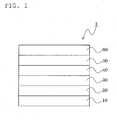
- FIG. 1 is a schematic cross-sectional view showing one embodiment of the organic EL device of the invention.
- the material for an organic EL device of the invention comprises an indenofluorenedione derivative shown by the following formula (I) : wherein X 1 and X 2 , which may be the same or different, are any one of divalent groups shown by the following formulas (a) to (e); and R 1 to R 10 , which may be the same or different, are a hydrogen atom, an alkyl group, an aryl group, a heterocycle, a halogen atom, a fluoroalkyl group, an alkoxy group, an aryloxy group or a cyano group; and R 3 to R 6 or R 7 to R 10 may be bonded to each other to form a ring;
- R 51 to R 53 which may be the same or different, are independently a hydrogen atom, a fluoroalkyl group, an alkyl group, an aryl group or a heterocyclic group; and R 52 and R 53 may be bonded to each other to form a ring.
- halogen atom shown by R 1 to R 10
- a fluorine atom, a chlorine atom, a bromine atom or an iodine atom can be given.
- the alkyl group include a methyl group, an ethyl group, an n-propyl group, an iso-propyl group, an n-butyl group, an iso-butyl group, a tert-butyl group, a cyclopentyl group and a cyclohexyl group.
- Examples of the aryl group include a phenyl group, a biphenyl group, a naphthyl group, a fluorophenyl group and a trifluoromethylphenyl group.
- Examples of the fluoroalkyl group include a trifluoromethyl group, a pentafluoroethyl group, a perfluorocyclohexyl group and a perfluouroadamantyl group.
- Examples of the alkoxy group include a methoxy group, an ethoxy group and a trifiluoromethoxy group.
- Examples of the aryloxy group include a benzyloxy group, a pentafluorobenzyloxy group and a 4-trifluoromethylbenzyloxy group.
- Examples of the heterocycle include pyridine, pyrazine, furane, imidazole, benzimidazole and thiophene.
- Each of the alkyl group, aryl group, fluoroalkyl group or heterocycle shown by R 1 to R 10 may be further substituted by a substituent.
- substituents may be the same as the halogen atom, the cyano group, the alkyl group, the aryl group, the fluoroalkyl group or the heterocycle as mentioned above. The same can be applied to the fluoroalkyl group, the alkyl group, the aryl group or the heterocyclic group shown by R 51 to R 53 .
- R 3 to R 6 or R 7 to R 10 may be bonded to each other to form a ring.
- the ring include a benzene ring, a naphthalene ring, a pyrazine ring, a pyridine ring and a furan ring.
- R 52 and R 53 may be bonded to each other to form a ring.
- the compound Due to the structure shown by the formula (I), stability such as the heat resistance and sublimation property or electron acceptability can be enhanced.
- This compound has electron acceptability and improved heat resistance. Also, due to its capability of being purified through sublimation, the purity thereof can be enhanced.
- driving voltage can be reduced and the life can be prolonged. Furthermore, since the compound does not scatter inside the film-forming apparatus during the production of a device, there is no fear that the film-forming apparatus or the organic EL device may be contaminated by the compound.
- the compound is suitable as the material for an organic EL device, in particular, as the hole-injecting material.
- the compound shown by the above formula (I) be any compounds shown by the following formulas (IIa), (IIb), (IIc) or (III).
- R 11 to R 50 which may be the same or different, are independently a hydrogen atom, an alkyl group, an aryl group, a heterocycle, a fluorine atom, a fluoroalkyl group, an alkoxy group, an aryloxy group or a cyano group, provided that a case where all of R 11 to R 50 are a hydrogen atom is excluded; and R 11 to R 50 may be bonded.to each other to form a ring.
- Examples of the alkyl group, the aryl group, the fluoroalkyl group, the alkoxy group, the aryloxy group or the heterocycle shown by R 11 to R 50 are the same as those exemplified above for R 1 to R 10 .
- isomers are present.
- the isomers (IIb) (IIc) are present which have different bonding positions of the two cyano groups of the cyanoimine groups.
- the material of the invention is not restricted to a specific isomer. It may be a compound having no isomers, a syn-type isomer, an anti-type isomer, or a mixture thereof.
- the material for an organic EL device of the invention have a reduction potential in an acetonitrile solution of -1.0V (vsFc + /Fc) or more, particularly preferably -0.8V (vsFc + /Fc) or more.
- Fc indicates ferrocene.
- Electron acceptability is further increased by using a compound with a reduction potential of -1.0V or more.
- An increase in electron-acceptability has the following merits. Electron transfer with an anode formed of ITO or a material having a work function smaller than that of ITO is facilitated.
- the HOMO level of a hole-transporting material and the LUMO level of an electron-transporting material get close to each other, holes can be injected more easily. Specific examples of the material for an organic EL device of the invention will be shown below.
- the indenofluorenedione derivative of the invention can be obtained by the synthesis of the following scheme 1 from an indenofluorenedione derivative which has been synthesized by the synthesis method described, for example, in Organic Letters Vol. 4, page 2157 (2002 ) or in Organic Letters Vol. 7, page 4229 (2005 ).
- synthesis conditions reference can be made to Liebigs Ann. Chem. (1986), page 142 .
- R 1 to R 10 are the same as in the above formula (I).
- the organic EL device of the invention has organic thin film layers between the anode and the cathode.
- Organic thin film layers include a hole-injection layer, a hole-transporting layer, an emitting layer and an electron-transporting layer in this order, and the hole-injecting layer contains the material for an organic EL device of the invention.
- FIG. 1 is a schematic cross-sectional view showing one embodiment of the organic EL device of the invention.
- an organic EL device 1 an anode 10, a hole-injecting layer 20, a hole-transporting layer 30, an emitting layer 40, an electron-transporting layer 50 and a cathode 60 are sequentially stacked on a substrate (not shown).
- organic thin film layers are of a multilayer structure comprising the hole-injecting layer 20, the hole-transporting layer 30, the emitting layer 40 and the electron-transporting layer 50.
- the hole-injecting layer 20 contains the material for an organic EL device of the invention. As a result, the organic EL device can be driven at a lower voltage and has a prolonged device life.
- Other organic layers than the hole-injecting layer may contain the material for an organic EL device of the invention.
- the material for an organic EL device of the invention may be used in mixture with materials constituting each layer, which will be mentioned layer.
- the content of the material for an organic EL device of the invention in the hole-injecting layer is preferably 1 to 100 mole%.
- the hole-injecting layer contain a phenylenediamine compound shown by the following formula (IV), in addition to the compounds shown by (I), (IIa), (IIb), (IIc) or (III) as mentioned above.
- R 61 to R 66 which may be the same or different, are independently a hydrogen atom, a halogen atom, a trifluoromethyl group, an alkyl group, an aryl group or a heterocycle, or may form a naphthalene skeleton, a carbazole skeleton or a fluorene skeleton with a phenyl group to which R 61 to R 66 bond; and n is 1 or 2.
- phenylenediamine compound When the phenylenediamine compound is contained, uniformity of a film, heat resistance or carrier-injecting properties may be improved as compared with the case where the compound of the invention is used singly.
- alkyl group shown by R 61 to R 66 a methyl group, an isopropyl group, a tert-butyl group and a cyclohexyl group are preferable, for example.
- aryl group shown by R 61 to R 66 a phenyl groups, a naphthyl group and a fluorenyl group are preferable, for example. They may be substituted with a methyl group or the like.
- a pyridine ring and a pyrazine ring are preferable, for example.
- R 61 to R 66 may form a naphthalene skeleton, a carbazole skeleton or a fluorene skeleton with a bonded phenyl group. They may be substituted with a methyl group or the like.
- the content of the compound shown by the formula (IV) in the hole-injecting layer is preferably 0.1 to 98 mole%.
- the mixing ratio of the compound shown by the above-mentioned formula (I), (IIa), (IIb), (IIc) or (III) and the phenylenediamine compound shown by the formula (IV) may be selected appropriately according to the material of the anode. Preferred examples of the compound (IV) are given below.
- the material for the organic EL device of the invention can be used for a device with a configuration other than that in the above-mentioned embodiment.
- the material for the organic EL device of the invention may be used as a material for each organic layer such as an emitting layer constituting a device with the following configurations (1) to (15).
- the configurations (4), (6), (7), (8), (12), (13) and (15) are preferably used.
- Each member constituting the organic EL device of the invention will be described below.
- the organic EL device is usually formed on a transparent substrate.
- the transparent substrate is a substrate for supporting the organic EL device, and is preferably a flat and smooth substrate having a 400-to-700-nm-visible-light transmittance of 50% or more.
- Specific examples thereof include glass plates and polymer plates.
- the glass plate include soda-lime glass, barium/stron-tium-containing glass, lead glass, aluminosilicate glass, borosilicate glass, barium borosilicate glass, and quartz.
- the polymer plate include polycarbonate, acrylic polymer, polyethylene terephthalate, polyethersulfide, and polysulfone. Transparency is not required when the supporting substrate is positioned in the direction opposite to the light-outcoupling direction.
- the anode of the organic EL device plays a role for injecting holes into its hole-transporting layer or emitting layer.
- indium tin oxide alloy ITO
- tin oxide NESA
- indium zinc oxide alloy IZO
- gold silver, platinum, copper, and the like
- a reflective electrode which does not require transparency is used, in addition to those metals, a metal such as aluminum, molybdenum, chromium, and nickel or alloys thereof may also be used.
- the anode with a small work function for example, 5.0 eV or less
- the hole-injecting layer using the material for the organic EL device of the invention shows good injection properties.
- These materials may be used singly, or alloys of these materials or a material to which other elements are added may be selected appropriately and used.
- the anode can be prepared by forming a thin film using these electrode materials by a method such as the vapor deposition method or the sputtering method. In the case where emission from the emitting layer is taken out through the anode, the transmittance of the anode to the emission is preferably more than 10%.
- the sheet resistance of the anode is preferably several hundred ⁇ / ⁇ or less.
- the film thickness of the anode which varies depending upon the material thereof, is usually from 1 nm to 1 ⁇ m, preferably from 10 to 200 nm.
- the emitting layer of the organic EL device has the following functions (1), (2) and (3) in combination.
- Ar is a substituted or unsubstituted condensed aromatic group having 10 to 50 carbon atoms forming a ring (hereinafter referred to as a "ring carbon atom")
- Ar' is a substituted or unsubstituted aromatic group having 6 to 50 ring carbon atoms
- X 3 to X 5 are independently a substituted or unsubstituted aromatic group having 6 to 50 ring carbon atoms, a substituted or unsubstituted aromatic heterocyclic group having 5 to 50 atoms forming a ring (hereinafter referred to as a "ring atom")
- a substituted or unsubstituted alkyl group having 1 to 50 carbon atoms a substituted or unsubstituted alkoxy group having 1 to 50 carbon atoms
- a substituted or unsubstituted aralkyl group having 6 to 50 carbon atoms a substituted or unsubstituted aryloxy group having 5 to 50 ring atom
- R 71 to R 80 are independently a hydrogen atom, a substituted or unsubstituted aromatic ring group having 6 to 50 ring carbon atoms, a substituted or unsubstituted aromatic hetrocyclic group having 5 to 50 ring atoms, a substituted or unsubstituted alkyl group having 1 to 50 carbon atoms, a substituted or unsubstituted cycloalkyl group, a substituted or unsubstituted alkoxy group having 1 to 50 carbon atoms, a substituted or unsubstituted aralkyl group having 6 to 50 carbon atoms, a substituted or unsubstituted aryloxy group having 5 to 50 ring atoms, a substituted or unsubstituted arylthio group having 5 to 50 ring atoms, a substituted or unsubstituted alkoxycarbonyl group having 1 to 50 carbon atoms, a substituted or unsubstituted sily
- Ar 3 and Ar 4 are independently a substituted or unsubstituted aromatic group having 6 to 50 ring carbon atoms;
- L 1 and L 2 are each a substituted or unsubstituted phenylene group, a substituted or unsubstituted naphthalenylene group, a substituted or unsubstituted fluolenylene group, or a substituted or unsubstituted dibenzosilolylene group;
- m is an integer of 0 to 2
- n is an integer of 1 to 4
- s is an integer of 0 to 2
- t is an integer of 0 to 4;
- a 1 and A 2 are independently a substituted or unsubstituted condensed aromatic ring group having 10 to 20 ring carbon atoms
- Ar 5 and Ar 6 are independently a hydrogen atom or a substituted or unsubstituted aromatic ring group with 6 to 50 ring carbon atoms
- R 81 to R 90 are independently a hydrogen atom, a substituted or unsubstituted aromatic ring group having 6 to 50 ring carbon atoms, a substituted or unsubstituted aromatic heterocyclic group having 5 to 50 ring atoms, a substituted or unsubstituted alkyl group having 1 to 50 carbon atoms, a substituted or unsubstituted cycloalkyl group, a substituted or unsubstituted alkoxy group having 1 to 50 carbon atoms, a substituted or unsubstituted aralkyl group having 6 to 50 carbon atoms, a substituted or unsubstituted aryloxy group having 5
- R 91 to R 100 are independently a hydrogen atom, an alkyl group, a cycloalkyl group, an aryl group which may be substituted, an alkoxy group, an aryloxy groups, an alkylamino group, an alkenyl group, an arylamino group or a heterocyclic group which may be substituted; a and b are each an integer of 1 to 5; when they are 2 or more, R 91 s or R 92 s may be the same or different, or R 91 s or R 92 s may be bonded together to form a ring; R 93 and R 94 , R 95 and R 96 , R 97 and R 98 , or R 99 and R 100 may be bonded together to form a ring; and L 3 is a single bond, -O-, -S-, -N(R)- (R is an alkyl group or a substituted or unsubstituted aryl group), an alkylene group or
- R 101 to R 110 are independently a hydrogen atom, an alkyl group, a cycloalkyl group, an aryl group, an alkoxy group, an aryloxy group, an alkylamino group, an arylamino group or a heterocyclic group which may be substituted; c, d, e and f are each an integer of 1 to 5; when they are 2 or more, R 101 s, R 102 s, R 106 s or R 107 s may be the same or different, R 101 s, R 102 s, R 106 s or R 107 s may,be bonded to each other to form a ring, or R 103 and R 104 , or R 108 and R 109 may be bonded to each other to form a ring; L 4 is a single bond, -O-, -S-, -N(R)- (R is an alkyl group or a substituted or unsubstituted aryl group) ,
- a 5 to A 8 are independently a substituted or unsubstituted biphenyl group or a substituted or unsubstituted naphthyl group.
- a 9 to A 14 are the same as the above-described ones and R 111 to R 113 are independently a hydrogen atom, alkyl group having 1 to 6 carbon atoms, cycloalkyl group having 3 to 6 carbon atoms, alkoxy group having 1 to 6 carbon atoms, aryloxy group having 5 to 18 carbon atoms, aralkyloxy group having 7 to 18 carbon atoms, arylamino group having 5 to 16 carbon atoms, nitro group, cyano group, ester group having 1 to 6 carbon atoms, or a halogen atom, provided that at least one of A 9 to A 14 is a group having a condensed aromatic ring with three or more rings.
- R 114 and R 115 are a hydrogen atom, a substituted or unsubstituted alkyl group, substituted or unsubstituted aralkyl group, substituted or unsubstituted aryl group, substituted or unsubstituted heterocyclic group, substituted amino group, cyano group, or a halogen atom;
- R 114 s bonded to different fluorene groups may be the same or different, and R 114 and R 115 bonded to a single fluorene group may be the same or different,
- R 116 and R 117 are a hydrogen atom, a substituted or unsubstituted alkyl group, substituted or unsubstituted aralkyl group, substituted or unsubstituted aryl group, or substituted or unsubstituted heterocyclic group, provided that R 116 s or R 117 s bonded to different fluorene groups may be the same or different, and R 116 and R
- the anthracene derivative is preferable, and the monoanthracene derivative is more preferable with the asymmetrical anthracene being particularly preferable.
- Phosphorescent compounds can be used as an emitting material. When using a phosphorescent compound, compounds containing a carbazole ring are preferred for a host material.
- a dopant is a compound that can emit light from triplet excitons. The dopant is not limited so long as it can emit light from triplet excitons, but it is preferably a metal complex containing at least one metal selected from the group of Ir, Ru, Pd, Pt, Os and Re. A porphyrin metal complex or an ortho-metalated metal complex is preferable.
- the compounds containing a carbazole ring which are a host suitable for phosphorescence emission, is a compound which allows a phosphorescent compound to emit as a result of energy transfer from its excited state to the phosphorescent compound.
- the host compound is not limited so long as the compound can transfer its excited energy to a phosphorescent compound and it can be selected depending on purposes.
- the host compound may contain any heterocyclic ring other than a carbazole ring.
- the host compounds include carbazole, triazole, oxazole, oxadiazole, imidazole, polyarylalkane, pyrazoline, pyrazolone, phenylenediamine, arylamine, amino-substituted calcone, styryl anthracene, fluorenone, hydrazone, stilbene and silazane derivatives; aromatic tertiary amine, styrylamine, aromatic dimethylidene and porphyrin compounds; anthraquinodimethane, anthrone, diphenylquinone, thiopyrandioxide, carbodiimide, fluoreniridenemethane and distyrylpyrazine derivatives; heterocyclic tetracarboxylic anhydrides such as naphthaleneperylene; phthalocyanine derivatives; metal complexes of 8-quinolinol derivatives; various metal complex polysilane compounds shown by metal
- a phosphorescent dopant is a compound that can emit light from triplet excitons.
- the dopant is not limited so long as it can emit light from triplet excitons, but it is preferably a metal complex containing at least one metal selected from the group of Ir, Ru, Pd, Pt, Os and Re.
- a porphyrin metal complex or an ortho-metalated metal complex is preferable.
- a porphyrin metal complex a porphyrin platinum complex is preferable.
- the phosphorescent compounds can be used individually or as a combination of two or more kinds. There are various ligands forming an ortho-metalated metal complex.
- Preferable ligands include 2-phenylpyridine, 7,8-benzoquinoline, 2-(2-thienyl)pyridine, 2-(1-naphtyl)pyridine and 2-phenylquinoline derivatives. These derivatives may have substituents, if necessary. Fluorides and derivatives with a trifluoromethyl group introduced are particularly preferable as a blue dopant.
- auxiliary ligand ligands other than the above-mentioned ligands, such as acetylacetonate and picric acid may be contained.
- the content of a phosphorescent dopant in an emitting layer is not limited and can be properly selected according to purposes; for example, it is 0.1 to 70 mass %, preferably 1 to 30 mass %.
- emission may be weak and the advantages thereof may not be sufficiently obtained.
- concentration quenching may significantly proceed, thereby degrading the device performance.
- the emitting layer may contain hole-transporting materials, electron-transporting materials and polymer binders, if necessary.
- the thickness of an emitting layer is preferably from 5 to 50 nm, more preferably from 7 to 50 nm and most preferably from 10 to 50 nm. When it is less than 5 nm, the formation of an emitting layer and the adjustment of chromaticity may become difficult. When it exceeds 50 nm, the driving voltage may increase.
- the hole-transporting layer is a layer for helping the injection of holes into the emitting layer so as to transport holes to an emitting region.
- the hole mobility thereof is large and the ionization energy thereof is usually as small as 5.5 eV or less.
- Such a hole-transporting layer is preferably made of a material which can transport holes to the emitting layer at a low electric field intensify.
- the hole mobility be at least 10 -4 cm 2 /V ⁇ sec when an electric field of 10 4 to 10 6 V/cm is impressed.
- materials for a hole-transporting layer include triazole derivatives (see USP No. 3,112,197 and others), oxadiazole derivatives (see USP No. 3,189,447 and others), imidazole derivatives (see JP-B-37-16096 and others) , polyarylalkane derivatives (see USP Nos. 3, 615, 402 , 3, 820, 989 and 3,542,544 , JP-B-45-555 and 51-10983 , JP-A-51-93224 , 55-17105 , 56-4148 , 55-108667 , 55-156953 and 56-36656 , and others), pyrazoline derivatives and pyrazolone derivatives (see USP Nos.
- the hole-injecting layer be provided separately.
- the organic EL material of the invention may be used singly or in combination with other materials.
- the same materials as used for the hole-transporting layer or the compounds exemplified by the above-mentioned formula (IV) can be used.
- the following can also be used: porphyrin compounds (disclosed in JP-A-63-295695 and others), aromatic tertiary amine compounds and styrylamine compounds (see USP No.
- NPD 4,4'-bis(N-(1-naphthyl)-N-phenylamino)biphenyl
- MTDATA 4,4',4"-tris(N-(3-methylphenyl)-N-phenylamino)triphenylamin e
- JP-A-4-308688 4,4'-bis(N-(1-naphthyl)-N-phenylamino)biphenyl
- MTDATA 4,4',4"-tris(N-(3-methylphenyl)-N-phenylamino)triphenylamin e
- Inorganic compounds such as p-type Si and p-type SiC as well as aromatic dimethylidene type compounds can also be used as the material of the hole-injecting layer.
- the hole-injecting layer or the hole-transporting layer can be formed, for example, from the above-mentioned compounds by a known method such as vacuum deposition, spin coating, casting or LB technique.
- the film thickness of the hole-injecting layer and hole-transporting layer is not particularly limited, and is usually from 1 nm to 5 ⁇ m.
- the hole-injecting layer or hole-transporting layer may be a single layer made of one or two or more of the above-mentioned materials, or may be stacked hole-injecting layers or hole-transporting layers made of different compounds, insofar as the compound of the invention is contained in the hole-transporting region.
- An organic semiconductor layer is one type of a hole-transporting layer for helping the injection of holes or electrons into an emitting layer, and is preferably a layer having an electric conductivity of 10 -10 S/cm or more.
- electroconductive oligomers such as thiophene-containing oligomers or arylamine-containing oligomers disclosed in JP-A-8-193191
- electroconductive dendrimers such as arylamine-containing dendrimers
- the electron-injecting/transporting layer is a layer which assists injection of electrons into the emitting layer and transports electrons to the emitting region, and exhibits a high degree of electron mobility.
- An adhesion-improving layer is formed of a material which exhibits excellent adhesion to the cathode.
- the thickness of the electron-transporting layer is arbitrarily selected in the range of several nanometers to several micrometers. When the electron-transporting layer has a large thickness, it is preferable that the electron mobility be at least 10 -5 cm 2 /Vs or more at an applied electric field of 10 4 to 10 6 V/cm in order to prevent an increase in voltage.
- the material used in the electron-transporting layer is preferably a metal complex of 8-hydroxyquinoline or a derivative thereof or an oxadiazole derivative.
- 8-hydroxyquinoline and a metal complex of an 8-hydroxyquinoline derivative metal chelate oxinoid compounds including a chelate of oxine (8-quinolinol or 8-hydroxyquinoline) can be given.
- An electron-transporting compound of the following general formula can be given as the oxadiazole derivative.
- Ar 11 , Ar 12 , Ar 13 , Ar 15 , Ar 16 and Ar 19 are independently substituted or unsubstituted aryl groups and may be the same or different.
- Ar 14 , Ar 17 and Ar 18 are independently substituted or unsubstituted arylene groups and may be the same or different.
- the aryl group a phenyl group, a biphenyl group, an anthryl group, a perylenyl group, and a pyrenyl group can be given.
- arylene group a phenylene group, a naphthylene group, a biphenylene group, an anthrylene group, a perylenylene group, a pyrenylene group, and the like can be given.
- substituent an alkyl group having 1 to 10 carbon atoms, an alkoxy group having 1 to 10 carbon atoms, a cyano group, and the like can be given.
- the electron-transporting compound is preferably one from which a thin film can be formed.
- a 21 to A 23 are independently a nitrogen atom or a carbon atom;
- Ar 21 is a substituted or unsubstituted aryl group having 6 to 60 ring carbon atoms or a substituted or unsubstituted heteroaryl group having 3 to 60 ring carbon atoms;
- Ar 22 is a hydrogen atom, a substituted or unsubstituted aryl group having 6 to 60 ring carbon atoms, a substituted or unsubstituted heteroaryl group having 3 to 60 ring carbon atoms, a substituted or unsubstituted alkyl group having 1 to 20 carbon atoms, a substituted or unsubstituted alkoxy group having 1 to 20 carbon atoms, or a divalent group of these; provided that one of Ar 21 and Ar 22 is a substituted or unsubstituted condensed ring group having 10 to 60 ring carbon atoms,
- L 14 is a single bond, an arylene group with 6 to 60 carbon atoms which may have a substituent, a heteroarylene group with 3 to 60 carbon atoms which may have a substituent or a fluorenylene group which may have a substituent;
- Ar 24 is a divalent aromatic hydrocarbon group with 6 to 60 carbon atoms which may have a substituent; and
- Ar 25 is an aryl group with 6 to 60 carbon atoms which may have a substituent or a heteroaryl group with 3 to 60 carbon atoms which may have a substituent.
- R 131 to R 138 and Z 2 are independently a hydrogen atom, a saturated or unsaturated hydrocarbon group, an aromatic group, a heterocyclic group, a substituted amino group, a substituted boryl group, an alkoxy group, or an aryloxy group
- X 12 , Y 12 , and Z 1 are independently a saturated or unsaturated hydrocarbon group, an aromatic group, a heterocyclic group, a substituted amino group, an alkoxy group, or an aryloxy group
- the substituents for Z 1 and Z 2 may be bonded to form a condensed ring
- n is an integer of 1 to 3, provided that the Z 1 s may differ when n is 2 or more, and a case in which n is 1, X 12 , Y 12 , and R 132 are methyl groups
- R 138 is a hydrogen atom or a substituted boryl group, and a case in which n is 3 and Z 1 is a methyl
- Q 1 and Q 2 are independently ligands shown by the following formula (G) and L 15 is a halogen atom, a substituted or unsubstituted alkyl group, a substituted or unsubstituted cycloalkyl group, a substituted or unsubstituted aryl group, a substituted or unsubstituted heterocyclic group, -OR' (R' is a hydrogen atom, a substituted or unsubstituted alkyl group, a substituted or unsubstituted cycloalkyl group, a substituted or unsubstituted aryl group, or a substituted or unsubstituted heterocyclic group) or a ligand shown by-O-Ga-Q 3 (Q 4 ) (Q 3 and Q 4 have the same meanings as Q 1 and Q 2 ).
- rings A 24 and A 25 are a 6-membered aryl ring structure which may have a substituent, and are condensed to each other.
- the metal complexes have the strong nature of an n-type semiconductor and large ability of injecting electrons. Furthermore, the energy generated at the time of forming a complex is small so that a metal is then strongly bonded to ligands in the complex formed and the fluorescent quantum efficiency becomes large as the emitting material.
- substituents for the rings A 24 and A 25 forming the ligand of the above formula (G) include halogen atoms such as chlorine, bromine, iodine, and fluorine, substituted or unsubstituted alkyl groups such as a methyl group, ethyl group, propyl group, butyl group, sec-butyl group, tert-butyl group, pentyl group, hexyl group, heptyl group, octal group, stearyl group, and trichloromethyl group, substituted or unsubstituted aryl groups such as a phenyl group, naphthyl group, 3-methylphenyl group, 3-methoxyphenyl group, 3-fluorophenyl group, 3-trichloromethylphenyl group, 3-trifluoromethylphenyl group, and 3-nitrophenyl group, substituted or unsubstituted alkoxy groups such as a methoxy group,
- a preferred embodiment of the invention is a device containing a reducing dopant in an electron-transporting region or in an interfacial region between the cathode and the organic layer.
- the reducing dopant is defined as a substance which can reduce an electron-transporting compound. Accordingly, various substances which have given reducing properties can be used.
- At least one substance can be preferably used which is selected from the group consisting of alkali metals, alkaline earth metals, rare earth metals, alkali metal oxides, alkali metal.halides, alkaline earth metal oxides, alkaline earth metal halides, rare earth metal oxides, rare earth metal halides, alkali metal organic complexes, alkaline earth metal organic complexes, and rare earth metal organic complexes.
- the preferred reducing dopants include at least one alkali metal selected from the group consisting of Li (work function: 2.9 eV), Na (work function: 2.36 eV), K (work function: 2.28 eV), Rb (work function: 2.16 eV) and Cs (work function: 1.95 eV), and at least one alkaline earth metal selected from the group consisting of Ca (work function: 2.9 eV), Sr (work function: 2.0 to 2.5 eV), and Ba (work function: 2.52 eV).
- a reducing dopant having a work function of 2.9 eV or less is particularly preferable.
- a more preferable reducing dopant is at least one alkali metal selected from the group consisting of K, Rb and Cs. Even more preferable is Rb or Cs. Most preferable is Cs.
- alkali metals are particularly high in reducing ability.
- the addition of a relatively small amount thereof to an electron-injecting zone improves the luminance of the organic EL device and make the lifetime thereof long.
- a reducing agent having a work function of 2.9 eV or less combinations of two or more alkali metals are preferable, particularly combinations including Cs, such as Cs and Na, Cs and K, Cs and Rb, or Cs, Na and K are preferable.
- the combination containing Cs makes it possible to exhibit the reducing ability efficiently.
- the luminance of the organic EL device can be improved and the lifetime thereof can be made long by the addition thereof to its electron-injecting zone.
- an electron-injecting layer made of an insulator or a semiconductor may further be provided between a cathode and an organic layer.
- the electron-injecting layer By forming the electron-injecting layer, a current leakage can be effectively prevented and electron-injecting properties can be improved.
- the insulator at least one metal compound selected from the group consisting of alkali metal calcogenides, alkaline earth metal calcogenides, halides of alkali metals and halides of alkaline earth metals can be preferably used.
- the electron-injecting layer is formed of the alkali metal calcogenide or the like, the injection of electrons can be preferably further improved.
- alkali metal calcogenides include Li 2 O, LiO, Na 2 S, Na 2 Se and NaO and preferable alkaline earth metal calcogenides include CaO, BaO, SrO, BeO, BaS and CaSe.
- Preferable halides of alkali metals include LiF, NaF, KF, CsF, LiCl, KCl and NaCl.
- Preferable halides of alkaline earth metals include fluorides such as CaF 2 , BaF 2 , SrF 2 , MgF 2 and BeF 2 and halides other than fluorides.
- Semiconductors forming an electron-transporting layer include one or combinations of two or more of oxides, nitrides, and oxidized nitrides containing at least one element of Ba, Ca, Sr, Yb, Al, Ga, In, Li, Na, Cd, Mg, Si, Ta, Sb and Zn.
- An inorganic compound forming an.electron-transporting layer is preferably a microcrystalline or amorphous insulating thin film. When the electron-transporting layer is formed of the insulating thin films, more uniformed thin film is formed whereby pixel defects such as a dark spot are decreased. Examples of such an inorganic compound include the above-mentioned alkali metal calcogenides, alkaline earth metal calcogenides, halides of alkali metals, and halides of alkaline earth metals.
- the cathode the following may be used: an electrode substance made of a metal, an alloy or an electroconductive compound, or a mixture thereof which has a small work function (for example, 4 eV or less).
- the electrode substance include sodium, sodium-potassium alloy, magnesium, lithium, magnesium/silver alloy, aluminum/aluminum oxide, aluminum/lithium alloy, indium, and rare earth metals.
- This cathode can be formed by making the electrode substances into a thin film by vapor deposition, sputtering or some other method.
- the cathode preferably has a light transmittance of larger than 10%.
- the sheet resistance of the cathode is preferably several hundred ⁇ / ⁇ or less, and the film thickness thereof is usually from 10 nm to 1 ⁇ m, preferably from 50 to 200 nm.
- the organic EL device In the organic EL device, pixel defects based on leakage or a short circuit are easily generated since an electric field is applied to the ultrathin film. In order to prevent this, it is preferred to insert an insulative thin layer between the pair of electrodes.
- the material used in the insulating layer include aluminum oxide, lithium fluoride, lithium oxide, cesium fluoride, cesium oxide, magnesium oxide, magnesium fluoride, calcium oxide, calcium fluoride, cesium carbonate aluminum nitride, titanium oxide, silicon oxide, germanium oxide, silicon nitride, boron nitride, molybdenum oxide, ruthenium oxide, and vanadium oxide. A mixture or laminate thereof may be used.
- an organic EL device can be fabricated by forming an anode, a hole-injecting layer, a hole-transporting layer, an emitting layer, an electron-injecting layer or the like, followed by formation of a cathode.
- the organic EL device can be fabricated in the order reverse to the above, i.e., the order from a cathode to an anode.
- anode/hole-injecting layer/hole-transporting layer/emitting layer/electron-transporting layer/cathode has a structure wherein the following are successively formed on a transparent substrate: anode/hole-injecting layer/hole-transporting layer/emitting layer/electron-transporting layer/cathode.
- a thin film made of an anode material is formed into a thickness of 1 ⁇ m or less, preferably 10 to 200 nm on an appropriate transparent substrate by vapor deposition, sputtering or some other method, thereby forming an anode.
- a hole-injecting layer and a hole-transporting layer are formed on this anode.
- these layers can be formed by vacuum deposition, spin coating, casting, LB technique, or some other method. Vapor vacuum deposition is preferred since a homogenous film is easily obtained and pinholes are not easily generated.
- conditions for the deposition vary depending upon the compound used, the desired crystal structure or recombining structure of the hole-injecting layer and the hole-transporting layer, and others.
- the conditions are preferably selected from the following: deposition source temperature of 50 to 450°C, vacuum degree of 10 -7 to 10 -3 torr, vapor deposition rate of 0.01 to 50 nm/second, substrate temperature of -50 to 300°C, and film thickness of 1 nm to 5 ⁇ m.
- an emitting layer is formed on the hole-transporting layer.
- the emitting layer can also be formed by making a desired organic luminescent material into a thin film by vacuum vapor deposition, sputtering, spin coating, casting or some other method. Vacuum vapor deposition is preferred since a homogenous film is easily obtained and pinholes are not easily generated.
- conditions for the deposition which vary depending on a compound used, can be generally selected from conditions similar to those for the hole-transporting layer.
- an electron-transporting layer is formed on this emitting layer.
- the layer is preferably formed by vacuum vapor deposition because a homogenous film is required. Conditions for the deposition can be selected from conditions similar to those for the hole-transporting layer and the emitting layer.
- a cathode is stacked thereon to obtain an organic EL device.
- the cathode is made of a metal, and vapor deposition or sputtering may be used. However, vapor vacuum deposition is preferred in order to protect underlying organic layers from being damaged when the cathode film is formed.
- vapor vacuum deposition is preferred in order to protect underlying organic layers from being damaged when the cathode film is formed.
- it is preferred that the formation from the anode to the cathode is continuously carried out, using only one vacuuming operation.
- each of the layers in the organic EL device of the invention is not particularly limited.
- the layers can be formed by a known method, such as vacuum deposition, molecular beam deposition (MBE method), or coating method such as dipping, spin coating, casting, bar coating and roll coating using a solution obtained by dissolving materials in a solvent.
- MBE method molecular beam deposition
- coating method such as dipping, spin coating, casting, bar coating and roll coating using a solution obtained by dissolving materials in a solvent.
- the film thickness of each of the organic layers in the organic EL device of the invention is not particularly limited. In general, defects such as pinholes are easily generated when the film thickness is too small. Conversely, when the film thickness is too large, a high applied voltage becomes necessary, leading to low efficiency. Usually, the film thickness is preferably in the range of several nanometers to one micrometer.
- the organic EL device emits light when applying a voltage between electrodes. If a DC voltage is applied to the organic EL device, emission can be observed when the polarities of the anode and the cathode are positive and negative, respectively, and a DC voltage of 5 to 40 V is applied. When a voltage with an opposite polarity is applied, no electric current flows and hence, emission does not occur. If an AC voltage is applied, uniform emission can be observed only when the cathode and the anode have a positive polarity and a negative polarity, respectively.
- the waveform of the AC applied may be arbitrary.
- the compound (A-1) was synthesized by the following synthesis scheme.
- the compound was dissolved in acetonitrile with a concentration of 0.01 mol/l, and the reduction potential thereof was measured by cyclic voltammetry by using tetrabutylammonium perchlorate (TBAP) as a supporting electrolyte, a glassy carbon electrode as an active electrode, a platinum electrode as a counter electrode and a silver-silver chloride electrode as a reference electrode.
- the reduction potential of the compound (A-1) at a sweep rate of 0.1 V/s was -0.3 V.
- ferrocene hereinafter referred to as "Fc" was measured similarly.
- the first oxidation potential thereof was 0.5V. Taking this oxidation potential of ferrocene as a reference, the reduction potential of the compound (A-1) was -0.8 V(vs Fc + /Fc).
- the compound (A-15) was synthesized from the compound shown by the following formula B.
- a glass substrate of 25 mm by 75 mm by 1.1 mm thick with an ITO transparent electrode (GEOMATEC CO., LTD.) was subjected to ultrasonic cleaning with isopropyl alcohol for 5 minutes, and cleaned with ultraviolet rays and ozone for 30 minutes.
- the cleansed glass substrate having the transparent electrode lines was then secured to a substrate holder of an apparatus for vacuum deposition.
- the compound shown by the formula (A-2) synthesized in Example 2 and a compound shown by the following formula (C-1) were formed into a 60 nm-thick film, at a molar ratio of 2:98, on the glass substrate on which the transparent electrode lines were formed so as to cover the transparent electrodes.
- the film of the compound mixture functioned as a hole-injecting layer.
- HTM-1 a compound shown by the following formula (HTM-1) was formed on the above-obtained film of the compound mixture. This film functioned as a hole-transporting layer.
- EM1 with a thickness of 40 nm was deposited thereon to form a film.
- the following compound D1 having a styryl group was deposited such that the weight ratio of EM1 and D1 became 40:2. This film functioned as an emitting layer.
- a 10 nm-thick Alq film was formed on the above-obtained film.
- the film served as an electron-injecting layer.
- Li as a reductive dopant Li source: manufactured by SAES Getters Co., Ltd.
- Alq Alq
- An Alq:Li film film thickness: 10 nm
- Metal aluminum was deposited on the Alq:Li film to form a metallic cathode, whereby an organic EL emitting device was fabricated.
- the organic EL device was evaluated by measuring a driving voltage at a current density of 10 mA/cm 2 and a half life of luminance at an initial luminance of 1,000 nits, at room temperature, and with a DC constant power supply. The results obtained are shown in Table 1.
- An organic EL device was fabricated and evaluated in the same manner as in Example 8, except that the compound (A-4) alone which had been synthesized in Example 6 was used in the hole-injecting layer, the thickness thereof was rendered 10 nm, and the thickness of the hole-translating layer (HTM-1) was changed to 70 nm.
- the results are shown in Table 1.
- An organic EL device was fabricated and evaluated in the same manner as in Example 8, except that the compound shown by the formula (C-1) alone was used in the hole-injecting layer. The results are shown in Table 1. In the case of the organic EL device of Comparative Example 1, voltage was increased by 1V or more after 5, 000 hour-driving. In contract, in organic EL devices of Examples 8 to 13, voltage was increased by 0.5V or less, which showed that a voltage increase was suppressed in Examples 8 to 13.
- An organic EL device was fabricated and evaluated in the same manner as in Example 9, except that the compound B (2,7-difluoroindenofluorenedione) alone was used for forming a hole-injecting layer.
- the results showed that the resulting organic EL device suffered a large amount of leak current, and uniform emission could not be obtained.
- the reason therefor is thought to be the crystallization of the compound B, the shortage of an acceptor due to the quinone structure, or the like.
- the material for an organic EL device of the invention is suitable as a constitution material of an organic EL device, in particular, a hole-transporting layer or a hole-injecting layer.
- the material for an organic EL device of the invention can also be used as a charge-transporting material of an electrophotographic photoreceptor.
- the organic EL device of the invention can be suitably used as a light source such as a planar emitting body and backlight of a display, a display part of a portable phone, PDA, a car navigator, or an instruction panel of an automobile, an illuminator, and the like.
Landscapes
- Chemical & Material Sciences (AREA)
- Organic Chemistry (AREA)
- Physics & Mathematics (AREA)
- Engineering & Computer Science (AREA)
- Materials Engineering (AREA)
- Spectroscopy & Molecular Physics (AREA)
- Optics & Photonics (AREA)
- Electroluminescent Light Sources (AREA)
- Organic Low-Molecular-Weight Compounds And Preparation Thereof (AREA)
- Pyridine Compounds (AREA)
Applications Claiming Priority (2)
| Application Number | Priority Date | Filing Date | Title |
|---|---|---|---|
| JP2007186912 | 2007-07-18 | ||
| PCT/JP2008/062675 WO2009011327A1 (ja) | 2007-07-18 | 2008-07-14 | 有機エレクトロルミネッセンス素子用材料及び有機エレクトロルミネッセンス素子 |
Publications (3)
| Publication Number | Publication Date |
|---|---|
| EP2045848A1 true EP2045848A1 (de) | 2009-04-08 |
| EP2045848A4 EP2045848A4 (de) | 2009-08-12 |
| EP2045848B1 EP2045848B1 (de) | 2017-09-27 |
Family
ID=40259660
Family Applications (1)
| Application Number | Title | Priority Date | Filing Date |
|---|---|---|---|
| EP08778146.4A Active EP2045848B1 (de) | 2007-07-18 | 2008-07-14 | Material für ein organisches elektrolumineszenzgerät und organisches elektrolumineszenzgerät |
Country Status (7)
| Country | Link |
|---|---|
| US (3) | US8288013B2 (de) |
| EP (1) | EP2045848B1 (de) |
| JP (2) | JP5289979B2 (de) |
| KR (1) | KR101414914B1 (de) |
| CN (1) | CN101548408B (de) |
| TW (1) | TW200925241A (de) |
| WO (1) | WO2009011327A1 (de) |
Cited By (63)
| Publication number | Priority date | Publication date | Assignee | Title |
|---|---|---|---|---|
| EP2185496A1 (de) * | 2007-08-02 | 2010-05-19 | Northwestern University | Konjugierte monomere und polymere und deren herstellung und verwendung |
| WO2013000532A1 (en) * | 2011-06-28 | 2013-01-03 | Merck Patent Gmbh | Indaceno derivatives as organic semiconductors |
| WO2013083216A1 (de) | 2011-11-17 | 2013-06-13 | Merck Patent Gmbh | Spiro -dihydroacridinderivate und ihre verwendung als materialien für organische elektrolumineszenzvorrichtungen |
| WO2013120577A1 (en) | 2012-02-14 | 2013-08-22 | Merck Patent Gmbh | Spirobifluorene compounds for organic electroluminescent devices |
| WO2013135352A1 (de) | 2012-03-15 | 2013-09-19 | Merck Patent Gmbh | Elektronische vorrichtungen |
| WO2013182263A1 (de) | 2012-06-06 | 2013-12-12 | Merck Patent Gmbh | Phenanthrenverbindungen für organische elektronische vorrichtungen |
| WO2014044344A1 (de) | 2012-09-18 | 2014-03-27 | Merck Patent Gmbh | Materialien für elektronische vorrichtungen |
| WO2014067614A1 (de) | 2012-10-31 | 2014-05-08 | Merck Patent Gmbh | Elektronische vorrichtung |
| WO2014106522A1 (de) | 2013-01-03 | 2014-07-10 | Merck Patent Gmbh | Materialien für elektronische vorrichtungen |
| WO2015036080A1 (de) | 2013-09-11 | 2015-03-19 | Merck Patent Gmbh | Organische elektrolumineszenzvorrichtung |
| WO2015139808A1 (de) | 2014-03-18 | 2015-09-24 | Merck Patent Gmbh | Organische elektrolumineszenzvorrichtung |
| WO2016091353A1 (de) | 2014-12-12 | 2016-06-16 | Merck Patent Gmbh | Organische verbindungen mit löslichen gruppen |
| WO2017012687A1 (en) | 2015-07-22 | 2017-01-26 | Merck Patent Gmbh | Materials for organic electroluminescent devices |
| WO2017028940A1 (en) | 2015-08-14 | 2017-02-23 | Merck Patent Gmbh | Phenoxazine derivatives for organic electroluminescent devices |
| WO2017133829A1 (de) | 2016-02-05 | 2017-08-10 | Merck Patent Gmbh | Materialien für elektronische vorrichtungen |
| WO2017207596A1 (en) | 2016-06-03 | 2017-12-07 | Merck Patent Gmbh | Materials for organic electroluminescent devices |
| DE102017008794A1 (de) | 2016-10-17 | 2018-04-19 | Merck Patent Gmbh | Materialien zur Verwendung in elektronischen Vorrichtungen |
| WO2018069167A1 (de) | 2016-10-10 | 2018-04-19 | Merck Patent Gmbh | Elektronische vorrichtung |
| WO2018083053A1 (de) | 2016-11-02 | 2018-05-11 | Merck Patent Gmbh | Materialien für elektronische vorrichtungen |
| WO2018087020A1 (en) | 2016-11-08 | 2018-05-17 | Merck Patent Gmbh | Compounds for electronic devices |
| WO2018095940A1 (en) | 2016-11-25 | 2018-05-31 | Merck Patent Gmbh | Bisbenzofuran-fused indeno[1,2-b]fluorene derivatives and related compounds as materials for organic electroluminescent devices (oled) |
| WO2018095888A1 (en) | 2016-11-25 | 2018-05-31 | Merck Patent Gmbh | Bisbenzofuran-fused 2,8-diaminoindeno[1,2-b]fluorene derivatives and related compounds as materials for organic electroluminescent devices (oled) |
| WO2018141706A1 (de) | 2017-02-02 | 2018-08-09 | Merck Patent Gmbh | Materialien für elektronische vorrichtungen |
| WO2018157981A1 (de) | 2017-03-02 | 2018-09-07 | Merck Patent Gmbh | Materialien für organische elektronische vorrichtungen |
| EP3378857A1 (de) | 2012-11-12 | 2018-09-26 | Merck Patent GmbH | Materialien für elektronische vorrichtungen |
| WO2018234346A1 (en) | 2017-06-23 | 2018-12-27 | Merck Patent Gmbh | MATERIALS FOR ORGANIC ELECTROLUMINESCENT DEVICES |
| WO2019002190A1 (en) | 2017-06-28 | 2019-01-03 | Merck Patent Gmbh | MATERIALS FOR ELECTRONIC DEVICES |
| WO2019020654A1 (en) | 2017-07-28 | 2019-01-31 | Merck Patent Gmbh | SPIROBIFLUORENE DERIVATIVES FOR USE IN ELECTRONIC DEVICES |
| WO2019048443A1 (de) | 2017-09-08 | 2019-03-14 | Merck Patent Gmbh | Materialien für elektronische vorrichtungen |
| WO2019076789A1 (en) | 2017-10-17 | 2019-04-25 | Merck Patent Gmbh | MATERIALS FOR ORGANIC ELECTROLUMINESCENT DEVICES |
| WO2019101833A1 (en) | 2017-11-24 | 2019-05-31 | Merck Patent Gmbh | Materials for organic electroluminescent devices |
| WO2019101835A1 (en) | 2017-11-24 | 2019-05-31 | Merck Patent Gmbh | Materials for organic electroluminescent devices |
| WO2019101719A1 (de) | 2017-11-23 | 2019-05-31 | Merck Patent Gmbh | Materialien für elektronische vorrichtungen |
| WO2019115577A1 (en) | 2017-12-15 | 2019-06-20 | Merck Patent Gmbh | Substituted aromatic amines for use in organic electroluminescent devices |
| WO2019121483A1 (en) | 2017-12-20 | 2019-06-27 | Merck Patent Gmbh | Heteroaromatic compounds |
| WO2019170578A1 (en) | 2018-03-06 | 2019-09-12 | Merck Patent Gmbh | Materials for organic electroluminescent devices |
| WO2019170572A1 (en) | 2018-03-06 | 2019-09-12 | Merck Patent Gmbh | Materials for organic electroluminescent devices |
| WO2019175149A1 (en) | 2018-03-16 | 2019-09-19 | Merck Patent Gmbh | Materials for organic electroluminescent devices |
| WO2020011831A1 (en) * | 2018-07-13 | 2020-01-16 | Merck Patent Gmbh | Organic semiconducting compounds |
| WO2020043646A1 (en) | 2018-08-28 | 2020-03-05 | Merck Patent Gmbh | Materials for organic electroluminescent devices |
| WO2020043640A1 (en) | 2018-08-28 | 2020-03-05 | Merck Patent Gmbh | Materials for organic electroluminescent devices |
| WO2020043657A1 (en) | 2018-08-28 | 2020-03-05 | Merck Patent Gmbh | Materials for organic electroluminescent devices |
| WO2020053150A1 (en) | 2018-09-12 | 2020-03-19 | Merck Patent Gmbh | Materials for organic electroluminescent devices |
| WO2020089138A1 (en) | 2018-10-31 | 2020-05-07 | Merck Patent Gmbh | Materials for organic electroluminescent devices |
| WO2021110741A1 (en) | 2019-12-04 | 2021-06-10 | Merck Patent Gmbh | Materials for organic electroluminescent devices |
| WO2022017997A1 (en) | 2020-07-22 | 2022-01-27 | Merck Patent Gmbh | Materials for organic electroluminescent devices |
| EP3955330A4 (de) * | 2019-07-25 | 2022-08-10 | Idemitsu Kosan Co.,Ltd. | Mischung, organisches elektrolumineszentes element und elektronische vorrichtung |
| WO2023052272A1 (de) | 2021-09-28 | 2023-04-06 | Merck Patent Gmbh | Materialien für elektronische vorrichtungen |
| WO2023052275A1 (de) | 2021-09-28 | 2023-04-06 | Merck Patent Gmbh | Materialien für elektronische vorrichtungen |
| WO2023052313A1 (de) | 2021-09-28 | 2023-04-06 | Merck Patent Gmbh | Materialien für elektronische vorrichtungen |
| WO2023052314A1 (de) | 2021-09-28 | 2023-04-06 | Merck Patent Gmbh | Materialien für elektronische vorrichtungen |
| WO2023094412A1 (de) | 2021-11-25 | 2023-06-01 | Merck Patent Gmbh | Materialien für elektronische vorrichtungen |
| WO2023117836A1 (en) | 2021-12-21 | 2023-06-29 | Merck Patent Gmbh | Electronic devices |
| WO2023117835A1 (en) | 2021-12-21 | 2023-06-29 | Merck Patent Gmbh | Electronic devices |
| WO2023117837A1 (de) | 2021-12-21 | 2023-06-29 | Merck Patent Gmbh | Verfahren zur herstellung von deuterierten organischen verbindungen |
| WO2023152346A1 (de) | 2022-02-14 | 2023-08-17 | Merck Patent Gmbh | Materialien für elektronische vorrichtungen |
| EP4236652A2 (de) | 2015-07-29 | 2023-08-30 | Merck Patent GmbH | Materialien für organische elektrolumineszenzvorrichtungen |
| WO2023222559A1 (de) | 2022-05-18 | 2023-11-23 | Merck Patent Gmbh | Verfahren zur herstellung von deuterierten organischen verbindungen |
| WO2024013004A1 (de) | 2022-07-11 | 2024-01-18 | Merck Patent Gmbh | Materialien für elektronische vorrichtungen |
| WO2024170605A1 (en) | 2023-02-17 | 2024-08-22 | Merck Patent Gmbh | Materials for organic electroluminescent devices |
| WO2024218109A1 (de) | 2023-04-20 | 2024-10-24 | Merck Patent Gmbh | Materialien für elektronische vorrichtungen |
| WO2025012253A1 (en) | 2023-07-12 | 2025-01-16 | Merck Patent Gmbh | Materials for electronic devices |
| WO2025021855A1 (de) | 2023-07-27 | 2025-01-30 | Merck Patent Gmbh | Materialien für organische lichtemittierende vorrichtungen und organische sensoren |
Families Citing this family (131)
| Publication number | Priority date | Publication date | Assignee | Title |
|---|---|---|---|---|
| JP5289979B2 (ja) * | 2007-07-18 | 2013-09-11 | 出光興産株式会社 | 有機エレクトロルミネッセンス素子用材料及び有機エレクトロルミネッセンス素子 |
| JP5343089B2 (ja) * | 2008-12-03 | 2013-11-13 | 出光興産株式会社 | インデノフルオレンジオン誘導体、有機エレクトロルミネッセンス素子用材料及び有機エレクトロルミネッセンス素子 |
| KR20100108909A (ko) * | 2009-03-31 | 2010-10-08 | 다우어드밴스드디스플레이머티리얼 유한회사 | 신규한 유기 발광 화합물 및 이를 채용하고 있는 유기 전계발광 소자 |
| US20120074395A1 (en) * | 2009-04-01 | 2012-03-29 | Idemitsu Kosan Co., Ltd. | Organic electroluminescent element |
| KR20120066076A (ko) | 2009-11-16 | 2012-06-21 | 이데미쓰 고산 가부시키가이샤 | 방향족 아민 유도체 및 그것을 이용한 유기 전기발광 소자 |
| EP2643867B1 (de) | 2010-11-22 | 2019-10-30 | Idemitsu Kosan Co., Ltd. | Organische elektrolumineszenzvorrichtung |
| JP2012195054A (ja) | 2011-03-14 | 2012-10-11 | Idemitsu Kosan Co Ltd | 有機エレクトロルミネッセンス素子 |
| WO2013051234A1 (ja) * | 2011-10-04 | 2013-04-11 | ソニー株式会社 | 有機エレクトロルミネッセンス素子 |
| WO2013077352A1 (ja) | 2011-11-22 | 2013-05-30 | 出光興産株式会社 | 芳香族複素環誘導体、有機エレクトロルミネッセンス素子用材料および有機エレクトロルミネッセンス素子 |
| WO2013145667A1 (ja) | 2012-03-29 | 2013-10-03 | ソニー株式会社 | 有機エレクトロルミネッセンス素子 |
| WO2013145666A1 (ja) | 2012-03-29 | 2013-10-03 | ソニー株式会社 | 有機エレクトロルミネッセンス素子 |
| JP2015215940A (ja) | 2012-08-17 | 2015-12-03 | 出光興産株式会社 | 発光装置、電子機器および発光装置の製造方法 |
| WO2014047616A1 (en) | 2012-09-24 | 2014-03-27 | Arizona Board Of Regents For And On Behalf Of Arizona State University | Metal compounds, methods, and uses thereof |
| US20150274762A1 (en) | 2012-10-26 | 2015-10-01 | Arizona Board Of Regents Acting For And On Behalf Of Arizona State University | Metal complexes, methods, and uses thereof |
| JP6133583B2 (ja) | 2012-12-03 | 2017-05-24 | 出光興産株式会社 | 有機エレクトロルミネッセンス素子 |
| JP2016122672A (ja) | 2013-03-18 | 2016-07-07 | 出光興産株式会社 | 発光装置 |
| JP6804823B2 (ja) | 2013-10-14 | 2020-12-23 | アリゾナ・ボード・オブ・リージェンツ・オン・ビハーフ・オブ・アリゾナ・ステイト・ユニバーシティーArizona Board of Regents on behalf of Arizona State University | 白金錯体およびデバイス |
| KR102174919B1 (ko) * | 2013-12-03 | 2020-11-05 | 엘지디스플레이 주식회사 | 유기 발광 소자 및 유기 발광 표시장치 |
| US10020455B2 (en) | 2014-01-07 | 2018-07-10 | Arizona Board Of Regents On Behalf Of Arizona State University | Tetradentate platinum and palladium complex emitters containing phenyl-pyrazole and its analogues |
| US9941479B2 (en) | 2014-06-02 | 2018-04-10 | Arizona Board Of Regents On Behalf Of Arizona State University | Tetradentate cyclometalated platinum complexes containing 9,10-dihydroacridine and its analogues |
| US9923155B2 (en) | 2014-07-24 | 2018-03-20 | Arizona Board Of Regents On Behalf Of Arizona State University | Tetradentate platinum (II) complexes cyclometalated with functionalized phenyl carbene ligands and their analogues |
| US10793546B2 (en) | 2014-08-15 | 2020-10-06 | Arizona Board Of Regents On Behalf Of Arizona State University | Non-platinum metal complexes for excimer based single dopant white organic light emitting diodes |
| US11329244B2 (en) | 2014-08-22 | 2022-05-10 | Arizona Board Of Regents On Behalf Of Arizona State University | Organic light-emitting diodes with fluorescent and phosphorescent emitters |
| US10033003B2 (en) | 2014-11-10 | 2018-07-24 | Arizona Board Of Regents On Behalf Of Arizona State University | Tetradentate metal complexes with carbon group bridging ligands |
| KR102291895B1 (ko) * | 2014-11-27 | 2021-08-20 | 엘지디스플레이 주식회사 | 인덴 카보나이트릴 화합물 및 이를 포함하는 유기전계발광소자 |
| CN105810835B (zh) * | 2014-12-30 | 2018-01-19 | 北京维信诺科技有限公司 | 一种叠层oled器件及其制备方法 |
| US9929361B2 (en) | 2015-02-16 | 2018-03-27 | Universal Display Corporation | Organic electroluminescent materials and devices |
| US11056657B2 (en) | 2015-02-27 | 2021-07-06 | University Display Corporation | Organic electroluminescent materials and devices |
| US9859510B2 (en) | 2015-05-15 | 2018-01-02 | Universal Display Corporation | Organic electroluminescent materials and devices |
| US10418568B2 (en) | 2015-06-01 | 2019-09-17 | Universal Display Corporation | Organic electroluminescent materials and devices |
| US9879039B2 (en) | 2015-06-03 | 2018-01-30 | Arizona Board Of Regents On Behalf Of Arizona State University | Tetradentate and octahedral metal complexes containing naphthyridinocarbazole and its analogues |
| US11127905B2 (en) | 2015-07-29 | 2021-09-21 | Universal Display Corporation | Organic electroluminescent materials and devices |
| US10211411B2 (en) | 2015-08-25 | 2019-02-19 | Arizona Board Of Regents On Behalf Of Arizona State University | Thermally activated delayed fluorescent material based on 9,10-dihydro-9,9-dimethylacridine analogues for prolonging device longevity |
| US10361381B2 (en) | 2015-09-03 | 2019-07-23 | Universal Display Corporation | Organic electroluminescent materials and devices |
| JP2019024027A (ja) * | 2015-10-20 | 2019-02-14 | 出光興産株式会社 | 有機エレクトロルミネッセンス素子 |
| JP2019016614A (ja) * | 2015-10-20 | 2019-01-31 | 出光興産株式会社 | 有機エレクトロルミネッセンス素子 |
| US20170229663A1 (en) | 2016-02-09 | 2017-08-10 | Universal Display Corporation | Organic electroluminescent materials and devices |
| US10236456B2 (en) | 2016-04-11 | 2019-03-19 | Universal Display Corporation | Organic electroluminescent materials and devices |
| US11335865B2 (en) | 2016-04-15 | 2022-05-17 | Arizona Board Of Regents On Behalf Of Arizona State University | OLED with multi-emissive material layer |
| US10862054B2 (en) | 2016-06-20 | 2020-12-08 | Universal Display Corporation | Organic electroluminescent materials and devices |
| US11482683B2 (en) | 2016-06-20 | 2022-10-25 | Universal Display Corporation | Organic electroluminescent materials and devices |
| US10672997B2 (en) | 2016-06-20 | 2020-06-02 | Universal Display Corporation | Organic electroluminescent materials and devices |
| KR101872962B1 (ko) | 2016-08-31 | 2018-06-29 | 엘지디스플레이 주식회사 | 유기 화합물과 이를 포함하는 유기발광다이오드 및 유기발광표시장치 |
| US10608186B2 (en) | 2016-09-14 | 2020-03-31 | Universal Display Corporation | Organic electroluminescent materials and devices |
| US10680187B2 (en) | 2016-09-23 | 2020-06-09 | Universal Display Corporation | Organic electroluminescent materials and devices |
| US11196010B2 (en) | 2016-10-03 | 2021-12-07 | Universal Display Corporation | Organic electroluminescent materials and devices |
| US11011709B2 (en) | 2016-10-07 | 2021-05-18 | Universal Display Corporation | Organic electroluminescent materials and devices |
| US10822363B2 (en) | 2016-10-12 | 2020-11-03 | Arizona Board Of Regents On Behalf Of Arizona State University | Narrow band red phosphorescent tetradentate platinum (II) complexes |
| US12317745B2 (en) | 2016-11-09 | 2025-05-27 | Universal Display Corporation | Organic electroluminescent materials and devices |
| US10680188B2 (en) | 2016-11-11 | 2020-06-09 | Universal Display Corporation | Organic electroluminescent materials and devices |
| US11183670B2 (en) | 2016-12-16 | 2021-11-23 | Arizona Board Of Regents On Behalf Of Arizona State University | Organic light emitting diode with split emissive layer |
| US11780865B2 (en) | 2017-01-09 | 2023-10-10 | Universal Display Corporation | Organic electroluminescent materials and devices |
| KR102678967B1 (ko) | 2017-01-27 | 2024-06-26 | 아리조나 보드 오브 리젠츠 온 비하프 오브 아리조나 스테이트 유니버시티 | 피리도-피롤로-아크리딘 및 유사체를 사용하는 금속 보조 지연 형광 이미터 |
| US10844085B2 (en) | 2017-03-29 | 2020-11-24 | Universal Display Corporation | Organic electroluminescent materials and devices |
| US10944060B2 (en) | 2017-05-11 | 2021-03-09 | Universal Display Corporation | Organic electroluminescent materials and devices |
| US10392387B2 (en) | 2017-05-19 | 2019-08-27 | Arizona Board Of Regents On Behalf Of Arizona State University | Substituted benzo[4,5]imidazo[1,2-a]phenanthro[9,10-c][1,8]naphthyridines, benzo[4,5]imidazo[1,2-a]phenanthro[9,10-c][1,5]naphthyridines and dibenzo[f,h]benzo[4,5]imidazo[2,1-a]pyrazino[2,3-c]isoquinolines as thermally assisted delayed fluorescent materials |
| US10516117B2 (en) | 2017-05-19 | 2019-12-24 | Arizona Board Of Regents On Behalf Of Arizona State University | Metal-assisted delayed fluorescent emttters employing benzo-imidazo-phenanthridine and analogues |
| US11101435B2 (en) | 2017-05-19 | 2021-08-24 | Arizona Board Of Regents On Behalf Of Arizona State University | Tetradentate platinum and palladium complexes based on biscarbazole and analogues |
| US10615349B2 (en) | 2017-05-19 | 2020-04-07 | Arizona Board Of Regents On Behalf Of Arizona State University | Donor-acceptor type thermally activated delayed fluorescent materials based on imidazo[1,2-F]phenanthridine and analogues |
| KR102086890B1 (ko) * | 2017-05-31 | 2020-03-09 | 주식회사 엘지화학 | 유기 발광 소자 |
| US12098157B2 (en) | 2017-06-23 | 2024-09-24 | Universal Display Corporation | Organic electroluminescent materials and devices |
| US11228010B2 (en) | 2017-07-26 | 2022-01-18 | Universal Display Corporation | Organic electroluminescent materials and devices |
| US11744142B2 (en) | 2017-08-10 | 2023-08-29 | Universal Display Corporation | Organic electroluminescent materials and devices |
| WO2019079505A1 (en) | 2017-10-17 | 2019-04-25 | Jian Li | HOLES LOCKING MATERIAL FOR ORGANIC ELECTROLUMINESCENT DIODES |
| US11594688B2 (en) | 2017-10-17 | 2023-02-28 | Arizona Board Of Regents On Behalf Of Arizona State University | Display and lighting devices comprising phosphorescent excimers with preferred molecular orientation as monochromatic emitters |
| US12180230B2 (en) | 2017-11-28 | 2024-12-31 | University Of Southern California | Carbene compounds and organic electroluminescent devices |
| US11937503B2 (en) | 2017-11-30 | 2024-03-19 | Universal Display Corporation | Organic electroluminescent materials and devices |
| US11542289B2 (en) | 2018-01-26 | 2023-01-03 | Universal Display Corporation | Organic electroluminescent materials and devices |
| US12037348B2 (en) | 2018-03-09 | 2024-07-16 | Arizona Board Of Regents On Behalf Of Arizona State University | Blue and narrow band green and red emitting metal complexes |
| US11165028B2 (en) | 2018-03-12 | 2021-11-02 | Universal Display Corporation | Organic electroluminescent materials and devices |
| US12453279B2 (en) | 2018-08-22 | 2025-10-21 | Universal Display Corporation | Organic electroluminescent materials and devices |
| US11737349B2 (en) | 2018-12-12 | 2023-08-22 | Universal Display Corporation | Organic electroluminescent materials and devices |
| US11878988B2 (en) | 2019-01-24 | 2024-01-23 | Arizona Board Of Regents On Behalf Of Arizona State University | Blue phosphorescent emitters employing functionalized imidazophenthridine and analogues |
| US11594691B2 (en) | 2019-01-25 | 2023-02-28 | Arizona Board Of Regents On Behalf Of Arizona State University | Light outcoupling efficiency of phosphorescent OLEDs by mixing horizontally aligned fluorescent emitters |
| US11780829B2 (en) | 2019-01-30 | 2023-10-10 | The University Of Southern California | Organic electroluminescent materials and devices |
| US12477890B2 (en) | 2019-02-01 | 2025-11-18 | Universal Display Corporation | Organic electroluminescent materials and devices |
| JP2020158491A (ja) | 2019-03-26 | 2020-10-01 | ユニバーサル ディスプレイ コーポレイション | 有機エレクトロルミネセンス材料及びデバイス |
| US12281128B2 (en) | 2019-07-30 | 2025-04-22 | Universal Display Corporation | Organic electroluminescent materials and devices |
| US12139501B2 (en) | 2019-08-16 | 2024-11-12 | Universal Display Corporation | Organic electroluminescent materials and devices |
| US11785838B2 (en) | 2019-10-02 | 2023-10-10 | Arizona Board Of Regents On Behalf Of Arizona State University | Green and red organic light-emitting diodes employing excimer emitters |
| US20210135130A1 (en) | 2019-11-04 | 2021-05-06 | Universal Display Corporation | Organic electroluminescent materials and devices |
| US12538698B2 (en) | 2020-01-06 | 2026-01-27 | Universal Display Corporation | Organic electroluminescent materials and devices |
| US12426495B2 (en) | 2020-01-28 | 2025-09-23 | Universal Display Corporation | Organic electroluminescent materials and devices |
| US12168661B2 (en) | 2020-02-21 | 2024-12-17 | Arizona Board Of Regents On Behalf Of Arizona State University | Functional materials based on stable chemical structure |
| US11945985B2 (en) | 2020-05-19 | 2024-04-02 | Arizona Board Of Regents On Behalf Of Arizona State University | Metal assisted delayed fluorescent emitters for organic light-emitting diodes |
| CN113683625B (zh) | 2020-05-19 | 2025-06-10 | 亚利桑那州立大学董事会 | 用于有机发光二极管的金属辅助延迟荧光发射体 |
| EP3937268B1 (de) | 2020-07-10 | 2025-05-07 | Universal Display Corporation | Plasmonische oleds und vertikale dipolstrahler |
| US12545678B2 (en) | 2020-09-09 | 2026-02-10 | Arizona Board Of Regents On Behalf Of Arizon State University | Blue thermally activated delayed fluorescent emitters and hosts based on functionalized imidazolyl groups |
| US12497420B2 (en) | 2020-10-02 | 2025-12-16 | Universal Display Corporation | Organic electroluminescent materials and devices |
| US12707889B2 (en) | 2020-11-02 | 2026-08-11 | Universal Display Corporation | Organic electroluminescent materials and devices |
| US12187748B2 (en) | 2020-11-02 | 2025-01-07 | Universal Display Corporation | Organic electroluminescent materials and devices |
| US20220158096A1 (en) | 2020-11-16 | 2022-05-19 | Universal Display Corporation | Organic electroluminescent materials and devices |
| US12325717B2 (en) | 2020-11-24 | 2025-06-10 | Universal Display Corporation | Organic electroluminescent materials and devices |
| US20220165967A1 (en) | 2020-11-24 | 2022-05-26 | Universal Display Corporation | Organic electroluminescent materials and devices |
| US12575316B2 (en) | 2021-02-03 | 2026-03-10 | Universal Display Corporation | Organic electroluminescent materials and devices |
| EP4060758A3 (de) | 2021-02-26 | 2023-03-29 | Universal Display Corporation | Organische elektrolumineszente materialien und vorrichtungen |
| EP4723858A2 (de) | 2021-02-26 | 2026-04-08 | Universal Display Corporation | Organische elektrolumineszente materialien und vorrichtungen |
| US12624055B2 (en) | 2021-03-01 | 2026-05-12 | Universal Display Corporation | Organic electroluminescent materials and devices |
| US12673962B2 (en) | 2021-03-01 | 2026-07-07 | Universal Display Corporation | Organic electroluminescent materials and devices |
| US12606582B2 (en) | 2021-03-05 | 2026-04-21 | Universal Display Corporation | Organic electroluminescent materials and devices |
| US12428599B2 (en) | 2021-03-09 | 2025-09-30 | Universal Display Corporation | Organic electroluminescent materials and devices |
| US20220298190A1 (en) | 2021-03-12 | 2022-09-22 | Universal Display Corporation | Organic electroluminescent materials and devices |
| US12421262B2 (en) | 2021-03-15 | 2025-09-23 | Universal Display Corporation | Organic electroluminescent materials and devices |
| US20220340607A1 (en) | 2021-04-05 | 2022-10-27 | Universal Display Corporation | Organic electroluminescent materials and devices |
| US12480042B2 (en) | 2021-04-09 | 2025-11-25 | Universal Display Corporation | Organic electroluminescent materials and devices |
| EP4075531A1 (de) | 2021-04-13 | 2022-10-19 | Universal Display Corporation | Plasmonische oleds und vertikale dipolstrahler |
| US20220352478A1 (en) | 2021-04-14 | 2022-11-03 | Universal Display Corporation | Organic eletroluminescent materials and devices |
| US20220407020A1 (en) | 2021-04-23 | 2022-12-22 | Universal Display Corporation | Organic electroluminescent materials and devices |
| US12652948B2 (en) | 2021-04-23 | 2026-06-09 | Universal Display Corporation | Organic electroluminescent materials and devices |
| US12686815B2 (en) | 2021-06-04 | 2026-07-21 | Universal Display Corporation | Organic electroluminescent materials and devices |
| US20230133787A1 (en) | 2021-06-08 | 2023-05-04 | University Of Southern California | Molecular Alignment of Homoleptic Iridium Phosphors |
| US12550611B2 (en) | 2021-08-03 | 2026-02-10 | Universal Display Corporation | Organic electroluminescent materials and devices |
| EP4151699A1 (de) | 2021-09-17 | 2023-03-22 | Universal Display Corporation | Organische elektrolumineszente materialien und vorrichtungen |
| US12473318B2 (en) | 2021-10-08 | 2025-11-18 | Universal Display Corporation | Organic electroluminescent materials and devices |
| US12509628B2 (en) | 2021-12-16 | 2025-12-30 | Universal Display Corporation | Organic electroluminescent materials and devices |
| EP4231804A3 (de) | 2022-02-16 | 2023-09-20 | Universal Display Corporation | Organische elektrolumineszente materialien und vorrichtungen |
| US20230292592A1 (en) | 2022-03-09 | 2023-09-14 | Universal Display Corporation | Organic electroluminescent materials and devices |
| US20230337516A1 (en) | 2022-04-18 | 2023-10-19 | Universal Display Corporation | Organic electroluminescent materials and devices |
| US20230389421A1 (en) | 2022-05-24 | 2023-11-30 | Universal Display Corporation | Organic electroluminescent materials and devices |
| EP4293001A1 (de) | 2022-06-08 | 2023-12-20 | Universal Display Corporation | Organische elektrolumineszente materialien und vorrichtungen |
| US20240016051A1 (en) | 2022-06-28 | 2024-01-11 | Universal Display Corporation | Organic electroluminescent materials and devices |
| US20240107880A1 (en) | 2022-08-17 | 2024-03-28 | Universal Display Corporation | Organic electroluminescent materials and devices |
| US20240188316A1 (en) | 2022-10-27 | 2024-06-06 | Universal Display Corporation | Organic electroluminescent materials and devices |
| US20240188419A1 (en) | 2022-10-27 | 2024-06-06 | Universal Display Corporation | Organic electroluminescent materials and devices |
| US20240196730A1 (en) | 2022-10-27 | 2024-06-13 | Universal Display Corporation | Organic electroluminescent materials and devices |
| US20240188319A1 (en) | 2022-10-27 | 2024-06-06 | Universal Display Corporation | Organic electroluminescent materials and devices |
| US20240180025A1 (en) | 2022-10-27 | 2024-05-30 | Universal Display Corporation | Organic electroluminescent materials and devices |
| US20240247017A1 (en) | 2022-12-14 | 2024-07-25 | Universal Display Corporation | Organic electroluminescent materials and devices |
| CN120457803A (zh) | 2022-12-23 | 2025-08-08 | 默克专利有限公司 | 电子器件 |
| US20250204238A1 (en) | 2023-12-15 | 2025-06-19 | Universal Display Corporation | Organic electroluminscent materials and devices |
| US20250204239A1 (en) | 2023-12-15 | 2025-06-19 | Universal Display Corporation | Organic electroluminescent materials and devices |
Family Cites Families (104)
| Publication number | Priority date | Publication date | Assignee | Title |
|---|---|---|---|---|
| NL217825A (de) | 1956-06-04 | |||
| NL100993C (de) | 1956-06-27 | |||
| US3180729A (en) | 1956-12-22 | 1965-04-27 | Azoplate Corp | Material for electrophotographic reproduction |
| NL242505A (de) | 1958-08-20 | |||
| NL250330A (de) | 1959-04-09 | |||
| US3240597A (en) | 1961-08-21 | 1966-03-15 | Eastman Kodak Co | Photoconducting polymers for preparing electrophotographic materials |
| JPS45555B1 (de) | 1966-03-24 | 1970-01-09 | ||
| JPS463712B1 (de) | 1966-04-14 | 1971-01-29 | ||
| US3526501A (en) | 1967-02-03 | 1970-09-01 | Eastman Kodak Co | 4-diarylamino-substituted chalcone containing photoconductive compositions for use in electrophotography |
| US3542544A (en) | 1967-04-03 | 1970-11-24 | Eastman Kodak Co | Photoconductive elements containing organic photoconductors of the triarylalkane and tetraarylmethane types |
| US3567450A (en) | 1968-02-20 | 1971-03-02 | Eastman Kodak Co | Photoconductive elements containing substituted triarylamine photoconductors |
| US3658520A (en) | 1968-02-20 | 1972-04-25 | Eastman Kodak Co | Photoconductive elements containing as photoconductors triarylamines substituted by active hydrogen-containing groups |
| US3615404A (en) | 1968-04-25 | 1971-10-26 | Scott Paper Co | 1 3-phenylenediamine containing photoconductive materials |
| CA917980A (en) | 1969-06-20 | 1973-01-02 | J. Fox Charles | Alkylaminoaromatic organic photoconductors |
| US3717462A (en) | 1969-07-28 | 1973-02-20 | Canon Kk | Heat treatment of an electrophotographic photosensitive member |
| BE756375A (fr) | 1969-09-30 | 1971-03-01 | Eastman Kodak Co | Nouvelle composition photoconductrice et produit la contenant utilisables en electrophotographie |
| BE756943A (fr) | 1969-10-01 | 1971-03-16 | Eastman Kodak Co | Nouvelles compositions photoconductrices et produits les contenant, utilisables notamment en electrophotographie |
| JPS4725336B1 (de) | 1969-11-26 | 1972-07-11 | ||
| JPS5110983B2 (de) | 1971-09-10 | 1976-04-08 | ||
| GB1413352A (en) | 1972-02-09 | 1975-11-12 | Scott Paper Co | Electrophotographic material |
| US3837851A (en) | 1973-01-15 | 1974-09-24 | Ibm | Photoconductor overcoated with triarylpyrazoline charge transport layer |
| GB1505409A (en) | 1974-12-20 | 1978-03-30 | Eastman Kodak Co | Photoconductive compositions |
| US4127412A (en) | 1975-12-09 | 1978-11-28 | Eastman Kodak Company | Photoconductive compositions and elements |
| US4012376A (en) | 1975-12-29 | 1977-03-15 | Eastman Kodak Company | Photosensitive colorant materials |
| CA1104866A (en) | 1976-08-23 | 1981-07-14 | Milan Stolka | Imaging member containing a substituted n,n,n',n',- tetraphenyl-[1,1'-biphenyl]-4,4'-diamine in the chargge transport layer |
| US4175961A (en) | 1976-12-22 | 1979-11-27 | Eastman Kodak Company | Multi-active photoconductive elements |
| US4123269A (en) | 1977-09-29 | 1978-10-31 | Xerox Corporation | Electrostatographic photosensitive device comprising hole injecting and hole transport layers |
| US4150987A (en) | 1977-10-17 | 1979-04-24 | International Business Machines Corporation | Hydrazone containing charge transport element and photoconductive process of using same |
| JPS54112637A (en) | 1978-02-06 | 1979-09-03 | Ricoh Co Ltd | Electrophotographic photoreceptor |
| JPS54110837A (en) | 1978-02-17 | 1979-08-30 | Ricoh Co Ltd | Electrophotographic photoreceptor |
| JPS54119925A (en) | 1978-03-10 | 1979-09-18 | Ricoh Co Ltd | Photosensitive material for electrophotography |
| JPS6028342B2 (ja) | 1978-06-21 | 1985-07-04 | コニカ株式会社 | 電子写真感光体 |
| JPS6060052B2 (ja) | 1978-07-21 | 1985-12-27 | コニカ株式会社 | 電子写真感光体 |
| JPS5551086A (en) | 1978-09-04 | 1980-04-14 | Copyer Co Ltd | Novel pyrazoline compound, its preparation, and electrophotographic photosensitive substance comprising it |
| JPS5546760A (en) | 1978-09-29 | 1980-04-02 | Ricoh Co Ltd | Electrophotographic photoreceptor |
| JPS5552064A (en) | 1978-10-13 | 1980-04-16 | Ricoh Co Ltd | Electrophotographic receptor |
| JPS5552063A (en) | 1978-10-13 | 1980-04-16 | Ricoh Co Ltd | Electrophotographic receptor |
| JPS5574546A (en) | 1978-11-30 | 1980-06-05 | Ricoh Co Ltd | Electrophotographic photoreceptor |
| US4306008A (en) | 1978-12-04 | 1981-12-15 | Xerox Corporation | Imaging system with a diamine charge transport material in a polycarbonate resin |
| JPS5588064A (en) | 1978-12-05 | 1980-07-03 | Konishiroku Photo Ind Co Ltd | Electrophotographic receptor |
| JPS5588065A (en) | 1978-12-12 | 1980-07-03 | Konishiroku Photo Ind Co Ltd | Electrophotographic receptor |
| JPS55108667A (en) | 1979-02-13 | 1980-08-21 | Ricoh Co Ltd | Electrophotographic receptor |
| US4233384A (en) | 1979-04-30 | 1980-11-11 | Xerox Corporation | Imaging system using novel charge transport layer |
| JPS6035058B2 (ja) | 1979-05-17 | 1985-08-12 | 三菱製紙株式会社 | 有機光半導体電子写真材料 |
| JPS564148A (en) | 1979-06-21 | 1981-01-17 | Konishiroku Photo Ind Co Ltd | Electrophotographic receptor |
| JPS5622437A (en) | 1979-08-01 | 1981-03-03 | Ricoh Co Ltd | Electrophotographic receptor |
| US4232103A (en) | 1979-08-27 | 1980-11-04 | Xerox Corporation | Phenyl benzotriazole stabilized photosensitive device |
| JPS5636656A (en) | 1979-09-03 | 1981-04-09 | Mitsubishi Paper Mills Ltd | Electrophotographic material |
| JPS5646234A (en) | 1979-09-21 | 1981-04-27 | Ricoh Co Ltd | Electrophotographic receptor |
| US4273846A (en) | 1979-11-23 | 1981-06-16 | Xerox Corporation | Imaging member having a charge transport layer of a terphenyl diamine and a polycarbonate resin |
| JPS5680051A (en) | 1979-12-04 | 1981-07-01 | Ricoh Co Ltd | Electrophotographic receptor |
| JPS5688141A (en) | 1979-12-20 | 1981-07-17 | Konishiroku Photo Ind Co Ltd | Electrophotographic receptor |
| JPS6034099B2 (ja) | 1980-06-24 | 1985-08-07 | 富士写真フイルム株式会社 | 電子写真感光体 |
| US4356429A (en) | 1980-07-17 | 1982-10-26 | Eastman Kodak Company | Organic electroluminescent cell |
| JPS6059590B2 (ja) | 1980-09-03 | 1985-12-25 | 三菱製紙株式会社 | 電子写真感光体 |
| JPS57148749A (en) | 1981-03-11 | 1982-09-14 | Fuji Photo Film Co Ltd | Electrophotographic receptor |
| JPS6093455A (ja) | 1983-10-28 | 1985-05-25 | Fuji Xerox Co Ltd | 電子写真用現像剤 |
| JPS6094462A (ja) | 1983-10-28 | 1985-05-27 | Ricoh Co Ltd | スチルベン誘導体及びその製造法 |
| JPS60174749A (ja) | 1984-02-21 | 1985-09-09 | Ricoh Co Ltd | スチリル化合物及びその製造法 |
| JPS60175052A (ja) | 1984-02-21 | 1985-09-09 | Ricoh Co Ltd | 電子写真用感光体 |
| JPS6114642A (ja) | 1984-06-29 | 1986-01-22 | Konishiroku Photo Ind Co Ltd | 電子写真感光体 |
| JPS6172255A (ja) | 1984-09-14 | 1986-04-14 | Konishiroku Photo Ind Co Ltd | 電子写真感光体 |
| US4665000A (en) | 1984-10-19 | 1987-05-12 | Xerox Corporation | Photoresponsive devices containing aromatic ether hole transport layers |
| JPS61210363A (ja) | 1985-03-15 | 1986-09-18 | Canon Inc | 電子写真感光体 |
| JPS61228451A (ja) | 1985-04-03 | 1986-10-11 | Canon Inc | 電子写真感光体 |
| US4588666A (en) | 1985-06-24 | 1986-05-13 | Xerox Corporation | Photoconductive imaging members with alkoxy amine charge transport molecules |
| JPS6210652A (ja) | 1985-07-08 | 1987-01-19 | Minolta Camera Co Ltd | 感光体 |
| JPS6230255A (ja) | 1985-07-31 | 1987-02-09 | Minolta Camera Co Ltd | 電子写真感光体 |
| JPS6236674A (ja) | 1985-08-05 | 1987-02-17 | Fuji Photo Film Co Ltd | 電子写真感光体 |
| JPS6247646A (ja) | 1985-08-27 | 1987-03-02 | Konishiroku Photo Ind Co Ltd | 感光体 |
| US4720432A (en) | 1987-02-11 | 1988-01-19 | Eastman Kodak Company | Electroluminescent device with organic luminescent medium |
| JPH0657689B2 (ja) * | 1989-04-10 | 1994-08-03 | 富士ゼロックス株式会社 | フルオレン誘導体 |
| JPH02146050A (ja) | 1988-11-28 | 1990-06-05 | Ricoh Co Ltd | 電子写真感光体 |
| JPH02282263A (ja) | 1988-12-09 | 1990-11-19 | Nippon Oil Co Ltd | ホール輸送材料 |
| JP2727620B2 (ja) | 1989-02-01 | 1998-03-11 | 日本電気株式会社 | 有機薄膜el素子 |
| US5653713A (en) | 1989-04-24 | 1997-08-05 | Michelson; Gary Karlin | Surgical rongeur |
| US4950950A (en) | 1989-05-18 | 1990-08-21 | Eastman Kodak Company | Electroluminescent device with silazane-containing luminescent zone |
| JPH02311591A (ja) | 1989-05-25 | 1990-12-27 | Mitsubishi Kasei Corp | 有機電界発光素子 |
| US5061569A (en) | 1990-07-26 | 1991-10-29 | Eastman Kodak Company | Electroluminescent device with organic electroluminescent medium |
| JPH04297076A (ja) | 1991-01-31 | 1992-10-21 | Toshiba Corp | 有機el素子 |
| JP3016896B2 (ja) | 1991-04-08 | 2000-03-06 | パイオニア株式会社 | 有機エレクトロルミネッセンス素子 |
| JPH0770038A (ja) * | 1993-08-31 | 1995-03-14 | Ricoh Co Ltd | フルオレン化合物およびそれを用いた電子写真感光体 |
| JP3306735B2 (ja) | 1995-01-19 | 2002-07-24 | 出光興産株式会社 | 有機電界発光素子及び有機薄膜 |
| JPH11251067A (ja) | 1998-03-02 | 1999-09-17 | Junji Kido | 有機エレクトロルミネッセント素子 |
| JP3716096B2 (ja) | 1998-04-02 | 2005-11-16 | 三菱重工業株式会社 | 微粉炭セパレータ装置 |
| JP2000196140A (ja) | 1998-12-28 | 2000-07-14 | Sharp Corp | 有機エレクトロルミネッセンス素子とその製造法 |
| JP3978976B2 (ja) | 2000-04-17 | 2007-09-19 | 三菱化学株式会社 | 有機電界発光素子 |
| DE10058578C2 (de) | 2000-11-20 | 2002-11-28 | Univ Dresden Tech | Lichtemittierendes Bauelement mit organischen Schichten |
| JP4023204B2 (ja) | 2001-05-02 | 2007-12-19 | 淳二 城戸 | 有機電界発光素子 |
| US6597012B2 (en) * | 2001-05-02 | 2003-07-22 | Junji Kido | Organic electroluminescent device |
| US6764777B2 (en) * | 2002-02-21 | 2004-07-20 | Fuji Photo Film Co., Ltd. | Sulfur-containing compound and light-emitting device using same |
| EP1618170A2 (de) | 2003-04-15 | 2006-01-25 | Covion Organic Semiconductors GmbH | Mischungen von organischen zur emission befähigten halbleitern und matrixmaterialien, deren verwendung und elektronikbauteile enthaltend diese mischungen |
| JP2005121887A (ja) * | 2003-10-16 | 2005-05-12 | Mitsui Chemicals Inc | フルオレノン誘導体、および該化合物を用いた電子写真感光体、電子写真装置 |
| DE10356099A1 (de) * | 2003-11-27 | 2005-07-07 | Covion Organic Semiconductors Gmbh | Organisches Elektrolumineszenzelement |
| US7070892B2 (en) * | 2004-01-27 | 2006-07-04 | Xerox Corporation | Imaging members |
| JP5064034B2 (ja) | 2004-05-11 | 2012-10-31 | エルジー・ケム・リミテッド | 有機電気素子 |
| US7449831B2 (en) * | 2004-08-02 | 2008-11-11 | Lg Display Co., Ltd. | OLEDs having inorganic material containing anode capping layer |
| JP4297076B2 (ja) | 2005-04-15 | 2009-07-15 | トヨタ自動車株式会社 | 車輌用フード構造 |
| EP1968131A4 (de) * | 2005-12-27 | 2009-08-19 | Idemitsu Kosan Co | Material für ein organisches elektrolumineszenzgerät und organisches elektrolumineszenzgerät |
| JP5249781B2 (ja) * | 2006-12-15 | 2013-07-31 | 出光興産株式会社 | 有機エレクトロルミネッセンス素子用材料及び有機エレクトロルミネッセンス素子 |
| US20080160342A1 (en) * | 2006-12-29 | 2008-07-03 | Hong Meng | Host compositions for luminescent materials |
| JP5289979B2 (ja) * | 2007-07-18 | 2013-09-11 | 出光興産株式会社 | 有機エレクトロルミネッセンス素子用材料及び有機エレクトロルミネッセンス素子 |
| JP2010535270A (ja) * | 2007-08-02 | 2010-11-18 | ノースウエスタン ユニバーシティ | 共役モノマー及びポリマー並びにそれらの製造及び用途 |
| CN101874021B (zh) * | 2007-11-30 | 2013-06-19 | 出光兴产株式会社 | 氮杂茚并芴二酮衍生物、有机电致发光元件用材料和有机电致发光元件 |
-
2008
- 2008-07-14 JP JP2008555542A patent/JP5289979B2/ja active Active
- 2008-07-14 CN CN2008800007944A patent/CN101548408B/zh active Active
- 2008-07-14 EP EP08778146.4A patent/EP2045848B1/de active Active
- 2008-07-14 WO PCT/JP2008/062675 patent/WO2009011327A1/ja not_active Ceased
- 2008-07-14 KR KR1020087031375A patent/KR101414914B1/ko active Active
- 2008-07-14 US US12/373,788 patent/US8288013B2/en active Active
- 2008-07-16 TW TW097126938A patent/TW200925241A/zh unknown
-
2011
- 2011-07-18 US US13/185,283 patent/US8299247B2/en active Active
-
2012
- 2012-08-14 US US13/585,604 patent/US8481177B2/en active Active
- 2012-11-21 JP JP2012255618A patent/JP5619853B2/ja active Active
Cited By (75)
| Publication number | Priority date | Publication date | Assignee | Title |
|---|---|---|---|---|
| EP2185496A1 (de) * | 2007-08-02 | 2010-05-19 | Northwestern University | Konjugierte monomere und polymere und deren herstellung und verwendung |
| WO2013000532A1 (en) * | 2011-06-28 | 2013-01-03 | Merck Patent Gmbh | Indaceno derivatives as organic semiconductors |
| US9520565B2 (en) | 2011-06-28 | 2016-12-13 | Merck Patent Gmbh | Indaceno derivatives as organic semiconductors |
| WO2013083216A1 (de) | 2011-11-17 | 2013-06-13 | Merck Patent Gmbh | Spiro -dihydroacridinderivate und ihre verwendung als materialien für organische elektrolumineszenzvorrichtungen |
| EP3101088A1 (de) | 2012-02-14 | 2016-12-07 | Merck Patent GmbH | Materialien für organische elektrolumineszenzvorrichtungen |
| WO2013120577A1 (en) | 2012-02-14 | 2013-08-22 | Merck Patent Gmbh | Spirobifluorene compounds for organic electroluminescent devices |
| EP3235892A1 (de) | 2012-02-14 | 2017-10-25 | Merck Patent GmbH | Materialien für organische elektrolumineszenzvorrichtungen |
| WO2013135352A1 (de) | 2012-03-15 | 2013-09-19 | Merck Patent Gmbh | Elektronische vorrichtungen |
| EP3460864A1 (de) | 2012-03-15 | 2019-03-27 | Merck Patent GmbH | Elektronische vorrichtungen |
| WO2013182263A1 (de) | 2012-06-06 | 2013-12-12 | Merck Patent Gmbh | Phenanthrenverbindungen für organische elektronische vorrichtungen |
| WO2014044344A1 (de) | 2012-09-18 | 2014-03-27 | Merck Patent Gmbh | Materialien für elektronische vorrichtungen |
| EP3806176A1 (de) | 2012-10-31 | 2021-04-14 | Merck Patent GmbH | Elektronische vorrichtung |
| WO2014067614A1 (de) | 2012-10-31 | 2014-05-08 | Merck Patent Gmbh | Elektronische vorrichtung |
| EP3378857A1 (de) | 2012-11-12 | 2018-09-26 | Merck Patent GmbH | Materialien für elektronische vorrichtungen |
| WO2014106522A1 (de) | 2013-01-03 | 2014-07-10 | Merck Patent Gmbh | Materialien für elektronische vorrichtungen |
| WO2015036080A1 (de) | 2013-09-11 | 2015-03-19 | Merck Patent Gmbh | Organische elektrolumineszenzvorrichtung |
| WO2015139808A1 (de) | 2014-03-18 | 2015-09-24 | Merck Patent Gmbh | Organische elektrolumineszenzvorrichtung |
| WO2016091353A1 (de) | 2014-12-12 | 2016-06-16 | Merck Patent Gmbh | Organische verbindungen mit löslichen gruppen |
| WO2017012687A1 (en) | 2015-07-22 | 2017-01-26 | Merck Patent Gmbh | Materials for organic electroluminescent devices |
| EP4236652A2 (de) | 2015-07-29 | 2023-08-30 | Merck Patent GmbH | Materialien für organische elektrolumineszenzvorrichtungen |
| WO2017028940A1 (en) | 2015-08-14 | 2017-02-23 | Merck Patent Gmbh | Phenoxazine derivatives for organic electroluminescent devices |
| WO2017133829A1 (de) | 2016-02-05 | 2017-08-10 | Merck Patent Gmbh | Materialien für elektronische vorrichtungen |
| WO2017207596A1 (en) | 2016-06-03 | 2017-12-07 | Merck Patent Gmbh | Materials for organic electroluminescent devices |
| EP3978477A2 (de) | 2016-06-03 | 2022-04-06 | Merck Patent GmbH | Materialien für organische elektrolumineszente vorrichtungen |
| WO2018069167A1 (de) | 2016-10-10 | 2018-04-19 | Merck Patent Gmbh | Elektronische vorrichtung |
| EP4255151A2 (de) | 2016-10-10 | 2023-10-04 | Merck Patent GmbH | Spiro[fluoren-9,9'-(thio)xanthen] verbindungen |
| EP4113643A1 (de) | 2016-10-10 | 2023-01-04 | Merck Patent GmbH | Elektronische vorrichtung |
| DE102017008794A1 (de) | 2016-10-17 | 2018-04-19 | Merck Patent Gmbh | Materialien zur Verwendung in elektronischen Vorrichtungen |
| WO2018083053A1 (de) | 2016-11-02 | 2018-05-11 | Merck Patent Gmbh | Materialien für elektronische vorrichtungen |
| WO2018087020A1 (en) | 2016-11-08 | 2018-05-17 | Merck Patent Gmbh | Compounds for electronic devices |
| WO2018095888A1 (en) | 2016-11-25 | 2018-05-31 | Merck Patent Gmbh | Bisbenzofuran-fused 2,8-diaminoindeno[1,2-b]fluorene derivatives and related compounds as materials for organic electroluminescent devices (oled) |
| WO2018095940A1 (en) | 2016-11-25 | 2018-05-31 | Merck Patent Gmbh | Bisbenzofuran-fused indeno[1,2-b]fluorene derivatives and related compounds as materials for organic electroluminescent devices (oled) |
| WO2018141706A1 (de) | 2017-02-02 | 2018-08-09 | Merck Patent Gmbh | Materialien für elektronische vorrichtungen |
| WO2018157981A1 (de) | 2017-03-02 | 2018-09-07 | Merck Patent Gmbh | Materialien für organische elektronische vorrichtungen |
| WO2018234346A1 (en) | 2017-06-23 | 2018-12-27 | Merck Patent Gmbh | MATERIALS FOR ORGANIC ELECTROLUMINESCENT DEVICES |
| US11767299B2 (en) | 2017-06-23 | 2023-09-26 | Merck Patent Gmbh | Materials for organic electroluminescent devices |
| WO2019002190A1 (en) | 2017-06-28 | 2019-01-03 | Merck Patent Gmbh | MATERIALS FOR ELECTRONIC DEVICES |
| EP4603562A2 (de) | 2017-07-28 | 2025-08-20 | Merck Patent GmbH | Spirobifluorenderivate zur verwendung in elektronischen vorrichtungen |
| WO2019020654A1 (en) | 2017-07-28 | 2019-01-31 | Merck Patent Gmbh | SPIROBIFLUORENE DERIVATIVES FOR USE IN ELECTRONIC DEVICES |
| WO2019048443A1 (de) | 2017-09-08 | 2019-03-14 | Merck Patent Gmbh | Materialien für elektronische vorrichtungen |
| WO2019076789A1 (en) | 2017-10-17 | 2019-04-25 | Merck Patent Gmbh | MATERIALS FOR ORGANIC ELECTROLUMINESCENT DEVICES |
| WO2019101719A1 (de) | 2017-11-23 | 2019-05-31 | Merck Patent Gmbh | Materialien für elektronische vorrichtungen |
| EP4242286A2 (de) | 2017-11-23 | 2023-09-13 | Merck Patent GmbH | Materialien für elektronische vorrichtungen |
| WO2019101835A1 (en) | 2017-11-24 | 2019-05-31 | Merck Patent Gmbh | Materials for organic electroluminescent devices |
| WO2019101833A1 (en) | 2017-11-24 | 2019-05-31 | Merck Patent Gmbh | Materials for organic electroluminescent devices |
| WO2019115577A1 (en) | 2017-12-15 | 2019-06-20 | Merck Patent Gmbh | Substituted aromatic amines for use in organic electroluminescent devices |
| EP4451832A2 (de) | 2017-12-20 | 2024-10-23 | Merck Patent GmbH | Heteroaromatische verbindungen |
| WO2019121483A1 (en) | 2017-12-20 | 2019-06-27 | Merck Patent Gmbh | Heteroaromatic compounds |
| WO2019170578A1 (en) | 2018-03-06 | 2019-09-12 | Merck Patent Gmbh | Materials for organic electroluminescent devices |
| WO2019170572A1 (en) | 2018-03-06 | 2019-09-12 | Merck Patent Gmbh | Materials for organic electroluminescent devices |
| WO2019175149A1 (en) | 2018-03-16 | 2019-09-19 | Merck Patent Gmbh | Materials for organic electroluminescent devices |
| WO2020011831A1 (en) * | 2018-07-13 | 2020-01-16 | Merck Patent Gmbh | Organic semiconducting compounds |
| WO2020043640A1 (en) | 2018-08-28 | 2020-03-05 | Merck Patent Gmbh | Materials for organic electroluminescent devices |
| WO2020043657A1 (en) | 2018-08-28 | 2020-03-05 | Merck Patent Gmbh | Materials for organic electroluminescent devices |
| WO2020043646A1 (en) | 2018-08-28 | 2020-03-05 | Merck Patent Gmbh | Materials for organic electroluminescent devices |
| WO2020053150A1 (en) | 2018-09-12 | 2020-03-19 | Merck Patent Gmbh | Materials for organic electroluminescent devices |
| WO2020089138A1 (en) | 2018-10-31 | 2020-05-07 | Merck Patent Gmbh | Materials for organic electroluminescent devices |
| EP3955330A4 (de) * | 2019-07-25 | 2022-08-10 | Idemitsu Kosan Co.,Ltd. | Mischung, organisches elektrolumineszentes element und elektronische vorrichtung |
| WO2021110741A1 (en) | 2019-12-04 | 2021-06-10 | Merck Patent Gmbh | Materials for organic electroluminescent devices |
| WO2022017997A1 (en) | 2020-07-22 | 2022-01-27 | Merck Patent Gmbh | Materials for organic electroluminescent devices |
| WO2023052313A1 (de) | 2021-09-28 | 2023-04-06 | Merck Patent Gmbh | Materialien für elektronische vorrichtungen |
| WO2023052314A1 (de) | 2021-09-28 | 2023-04-06 | Merck Patent Gmbh | Materialien für elektronische vorrichtungen |
| WO2023052275A1 (de) | 2021-09-28 | 2023-04-06 | Merck Patent Gmbh | Materialien für elektronische vorrichtungen |
| WO2023052272A1 (de) | 2021-09-28 | 2023-04-06 | Merck Patent Gmbh | Materialien für elektronische vorrichtungen |
| WO2023094412A1 (de) | 2021-11-25 | 2023-06-01 | Merck Patent Gmbh | Materialien für elektronische vorrichtungen |
| WO2023117837A1 (de) | 2021-12-21 | 2023-06-29 | Merck Patent Gmbh | Verfahren zur herstellung von deuterierten organischen verbindungen |
| WO2023117835A1 (en) | 2021-12-21 | 2023-06-29 | Merck Patent Gmbh | Electronic devices |
| WO2023117836A1 (en) | 2021-12-21 | 2023-06-29 | Merck Patent Gmbh | Electronic devices |
| WO2023152346A1 (de) | 2022-02-14 | 2023-08-17 | Merck Patent Gmbh | Materialien für elektronische vorrichtungen |
| WO2023222559A1 (de) | 2022-05-18 | 2023-11-23 | Merck Patent Gmbh | Verfahren zur herstellung von deuterierten organischen verbindungen |
| WO2024013004A1 (de) | 2022-07-11 | 2024-01-18 | Merck Patent Gmbh | Materialien für elektronische vorrichtungen |
| WO2024170605A1 (en) | 2023-02-17 | 2024-08-22 | Merck Patent Gmbh | Materials for organic electroluminescent devices |
| WO2024218109A1 (de) | 2023-04-20 | 2024-10-24 | Merck Patent Gmbh | Materialien für elektronische vorrichtungen |
| WO2025012253A1 (en) | 2023-07-12 | 2025-01-16 | Merck Patent Gmbh | Materials for electronic devices |
| WO2025021855A1 (de) | 2023-07-27 | 2025-01-30 | Merck Patent Gmbh | Materialien für organische lichtemittierende vorrichtungen und organische sensoren |
Also Published As
| Publication number | Publication date |
|---|---|
| US8288013B2 (en) | 2012-10-16 |
| US20100019659A1 (en) | 2010-01-28 |
| WO2009011327A1 (ja) | 2009-01-22 |
| EP2045848A4 (de) | 2009-08-12 |
| CN101548408B (zh) | 2011-12-28 |
| JP5289979B2 (ja) | 2013-09-11 |
| US20120306362A1 (en) | 2012-12-06 |
| US8299247B2 (en) | 2012-10-30 |
| CN101548408A (zh) | 2009-09-30 |
| US8481177B2 (en) | 2013-07-09 |
| KR101414914B1 (ko) | 2014-07-04 |
| TW200925241A (en) | 2009-06-16 |
| JPWO2009011327A1 (ja) | 2010-09-24 |
| US20110275814A1 (en) | 2011-11-10 |
| JP5619853B2 (ja) | 2014-11-05 |
| JP2013100288A (ja) | 2013-05-23 |
| EP2045848B1 (de) | 2017-09-27 |
| KR20100031653A (ko) | 2010-03-24 |
Similar Documents
| Publication | Publication Date | Title |
|---|---|---|
| EP2045848B1 (de) | Material für ein organisches elektrolumineszenzgerät und organisches elektrolumineszenzgerät | |
| EP2213662B1 (de) | Azaindenofluorendionderivat, material für ein organisches elektrolumineszierendes gerät und organisches lumineszierendes gerät | |
| US8372527B2 (en) | Material for organic electroluminescent element, and organic electroluminescent element | |
| US8119828B2 (en) | Material for an organic electroluminescence device and an organic electroluminescence device | |
| US8168327B2 (en) | Imide derivative, material for organic electroluminescent device and organic electroluminescent device using the same | |
| US8044390B2 (en) | Material for organic electroluminescent device, organic electroluminescent device, and organic electroluminescent display | |
| US8076839B2 (en) | Organic electroluminescence device | |
| EP2000456A9 (de) | Material für ein organisches elektrolumineszenzgerät und organisches elektrolumineszenzgerät, das dieses verwendet | |
| EP2053672A1 (de) | Organische elektrolumineszenzeinrichtung | |
| EP2034803A1 (de) | Organisches elektrolumineszenzelement | |
| WO2008032631A1 (fr) | Dérivé d'amine aromatique et dispositif électroluminescent organique l'employant |
Legal Events
| Date | Code | Title | Description |
|---|---|---|---|
| PUAI | Public reference made under article 153(3) epc to a published international application that has entered the european phase |
Free format text: ORIGINAL CODE: 0009012 |
|
| 17P | Request for examination filed |
Effective date: 20090109 |
|
| AK | Designated contracting states |
Kind code of ref document: A1 Designated state(s): AT BE BG CH CY CZ DE DK EE ES FI FR GB GR HR HU IE IS IT LI LT LU LV MC MT NL NO PL PT RO SE SI SK TR |
|
| AX | Request for extension of the european patent |
Extension state: AL BA MK RS |
|
| RIC1 | Information provided on ipc code assigned before grant |
Ipc: H01L 51/50 20060101ALI20090702BHEP Ipc: C07C 261/04 20060101ALI20090702BHEP Ipc: C07C 255/35 20060101ALI20090702BHEP Ipc: C09K 11/06 20060101AFI20090702BHEP |
|
| A4 | Supplementary search report drawn up and despatched |
Effective date: 20090713 |
|
| 17Q | First examination report despatched |
Effective date: 20091029 |
|
| DAX | Request for extension of the european patent (deleted) | ||
| STAA | Information on the status of an ep patent application or granted ep patent |
Free format text: STATUS: EXAMINATION IS IN PROGRESS |
|
| GRAP | Despatch of communication of intention to grant a patent |
Free format text: ORIGINAL CODE: EPIDOSNIGR1 |
|
| STAA | Information on the status of an ep patent application or granted ep patent |
Free format text: STATUS: GRANT OF PATENT IS INTENDED |
|
| INTG | Intention to grant announced |
Effective date: 20170519 |
|
| GRAS | Grant fee paid |
Free format text: ORIGINAL CODE: EPIDOSNIGR3 |
|
| GRAA | (expected) grant |
Free format text: ORIGINAL CODE: 0009210 |
|
| STAA | Information on the status of an ep patent application or granted ep patent |
Free format text: STATUS: THE PATENT HAS BEEN GRANTED |
|
| AK | Designated contracting states |
Kind code of ref document: B1 Designated state(s): AT BE BG CH CY CZ DE DK EE ES FI FR GB GR HR HU IE IS IT LI LT LU LV MC MT NL NO PL PT RO SE SI SK TR |
|
| REG | Reference to a national code |
Ref country code: GB Ref legal event code: FG4D |
|
| REG | Reference to a national code |
Ref country code: CH Ref legal event code: EP |
|
| REG | Reference to a national code |
Ref country code: AT Ref legal event code: REF Ref document number: 931941 Country of ref document: AT Kind code of ref document: T Effective date: 20171015 |
|
| REG | Reference to a national code |
Ref country code: IE Ref legal event code: FG4D |
|
| REG | Reference to a national code |
Ref country code: DE Ref legal event code: R096 Ref document number: 602008052272 Country of ref document: DE |
|
| PG25 | Lapsed in a contracting state [announced via postgrant information from national office to epo] |
Ref country code: SE Free format text: LAPSE BECAUSE OF FAILURE TO SUBMIT A TRANSLATION OF THE DESCRIPTION OR TO PAY THE FEE WITHIN THE PRESCRIBED TIME-LIMIT Effective date: 20170927 Ref country code: NO Free format text: LAPSE BECAUSE OF FAILURE TO SUBMIT A TRANSLATION OF THE DESCRIPTION OR TO PAY THE FEE WITHIN THE PRESCRIBED TIME-LIMIT Effective date: 20171227 Ref country code: FI Free format text: LAPSE BECAUSE OF FAILURE TO SUBMIT A TRANSLATION OF THE DESCRIPTION OR TO PAY THE FEE WITHIN THE PRESCRIBED TIME-LIMIT Effective date: 20170927 Ref country code: HR Free format text: LAPSE BECAUSE OF FAILURE TO SUBMIT A TRANSLATION OF THE DESCRIPTION OR TO PAY THE FEE WITHIN THE PRESCRIBED TIME-LIMIT Effective date: 20170927 Ref country code: LT Free format text: LAPSE BECAUSE OF FAILURE TO SUBMIT A TRANSLATION OF THE DESCRIPTION OR TO PAY THE FEE WITHIN THE PRESCRIBED TIME-LIMIT Effective date: 20170927 |
|
| REG | Reference to a national code |
Ref country code: NL Ref legal event code: MP Effective date: 20170927 |
|
| REG | Reference to a national code |
Ref country code: LT Ref legal event code: MG4D |
|
| REG | Reference to a national code |
Ref country code: AT Ref legal event code: MK05 Ref document number: 931941 Country of ref document: AT Kind code of ref document: T Effective date: 20170927 |
|
| PG25 | Lapsed in a contracting state [announced via postgrant information from national office to epo] |
Ref country code: GR Free format text: LAPSE BECAUSE OF FAILURE TO SUBMIT A TRANSLATION OF THE DESCRIPTION OR TO PAY THE FEE WITHIN THE PRESCRIBED TIME-LIMIT Effective date: 20171228 Ref country code: LV Free format text: LAPSE BECAUSE OF FAILURE TO SUBMIT A TRANSLATION OF THE DESCRIPTION OR TO PAY THE FEE WITHIN THE PRESCRIBED TIME-LIMIT Effective date: 20170927 Ref country code: BG Free format text: LAPSE BECAUSE OF FAILURE TO SUBMIT A TRANSLATION OF THE DESCRIPTION OR TO PAY THE FEE WITHIN THE PRESCRIBED TIME-LIMIT Effective date: 20171227 |
|
| PG25 | Lapsed in a contracting state [announced via postgrant information from national office to epo] |
Ref country code: NL Free format text: LAPSE BECAUSE OF FAILURE TO SUBMIT A TRANSLATION OF THE DESCRIPTION OR TO PAY THE FEE WITHIN THE PRESCRIBED TIME-LIMIT Effective date: 20170927 |
|
| PG25 | Lapsed in a contracting state [announced via postgrant information from national office to epo] |
Ref country code: RO Free format text: LAPSE BECAUSE OF FAILURE TO SUBMIT A TRANSLATION OF THE DESCRIPTION OR TO PAY THE FEE WITHIN THE PRESCRIBED TIME-LIMIT Effective date: 20170927 Ref country code: ES Free format text: LAPSE BECAUSE OF FAILURE TO SUBMIT A TRANSLATION OF THE DESCRIPTION OR TO PAY THE FEE WITHIN THE PRESCRIBED TIME-LIMIT Effective date: 20170927 Ref country code: CZ Free format text: LAPSE BECAUSE OF FAILURE TO SUBMIT A TRANSLATION OF THE DESCRIPTION OR TO PAY THE FEE WITHIN THE PRESCRIBED TIME-LIMIT Effective date: 20170927 |
|
| PG25 | Lapsed in a contracting state [announced via postgrant information from national office to epo] |
Ref country code: EE Free format text: LAPSE BECAUSE OF FAILURE TO SUBMIT A TRANSLATION OF THE DESCRIPTION OR TO PAY THE FEE WITHIN THE PRESCRIBED TIME-LIMIT Effective date: 20170927 Ref country code: IT Free format text: LAPSE BECAUSE OF FAILURE TO SUBMIT A TRANSLATION OF THE DESCRIPTION OR TO PAY THE FEE WITHIN THE PRESCRIBED TIME-LIMIT Effective date: 20170927 Ref country code: IS Free format text: LAPSE BECAUSE OF FAILURE TO SUBMIT A TRANSLATION OF THE DESCRIPTION OR TO PAY THE FEE WITHIN THE PRESCRIBED TIME-LIMIT Effective date: 20180127 Ref country code: SK Free format text: LAPSE BECAUSE OF FAILURE TO SUBMIT A TRANSLATION OF THE DESCRIPTION OR TO PAY THE FEE WITHIN THE PRESCRIBED TIME-LIMIT Effective date: 20170927 Ref country code: AT Free format text: LAPSE BECAUSE OF FAILURE TO SUBMIT A TRANSLATION OF THE DESCRIPTION OR TO PAY THE FEE WITHIN THE PRESCRIBED TIME-LIMIT Effective date: 20170927 |
|
| REG | Reference to a national code |
Ref country code: DE Ref legal event code: R097 Ref document number: 602008052272 Country of ref document: DE |
|
| REG | Reference to a national code |
Ref country code: FR Ref legal event code: PLFP Year of fee payment: 11 |
|
| PG25 | Lapsed in a contracting state [announced via postgrant information from national office to epo] |
Ref country code: DK Free format text: LAPSE BECAUSE OF FAILURE TO SUBMIT A TRANSLATION OF THE DESCRIPTION OR TO PAY THE FEE WITHIN THE PRESCRIBED TIME-LIMIT Effective date: 20170927 |
|
| PLBE | No opposition filed within time limit |
Free format text: ORIGINAL CODE: 0009261 |
|
| STAA | Information on the status of an ep patent application or granted ep patent |
Free format text: STATUS: NO OPPOSITION FILED WITHIN TIME LIMIT |
|
| PG25 | Lapsed in a contracting state [announced via postgrant information from national office to epo] |
Ref country code: PL Free format text: LAPSE BECAUSE OF FAILURE TO SUBMIT A TRANSLATION OF THE DESCRIPTION OR TO PAY THE FEE WITHIN THE PRESCRIBED TIME-LIMIT Effective date: 20170927 |
|
| 26N | No opposition filed |
Effective date: 20180628 |
|
| PG25 | Lapsed in a contracting state [announced via postgrant information from national office to epo] |
Ref country code: SI Free format text: LAPSE BECAUSE OF FAILURE TO SUBMIT A TRANSLATION OF THE DESCRIPTION OR TO PAY THE FEE WITHIN THE PRESCRIBED TIME-LIMIT Effective date: 20170927 |
|
| REG | Reference to a national code |
Ref country code: CH Ref legal event code: PL |
|
| PG25 | Lapsed in a contracting state [announced via postgrant information from national office to epo] |
Ref country code: MC Free format text: LAPSE BECAUSE OF FAILURE TO SUBMIT A TRANSLATION OF THE DESCRIPTION OR TO PAY THE FEE WITHIN THE PRESCRIBED TIME-LIMIT Effective date: 20170927 Ref country code: LU Free format text: LAPSE BECAUSE OF NON-PAYMENT OF DUE FEES Effective date: 20180714 |
|
| REG | Reference to a national code |
Ref country code: BE Ref legal event code: MM Effective date: 20180731 |
|
| REG | Reference to a national code |
Ref country code: IE Ref legal event code: MM4A |
|
| PG25 | Lapsed in a contracting state [announced via postgrant information from national office to epo] |
Ref country code: CH Free format text: LAPSE BECAUSE OF NON-PAYMENT OF DUE FEES Effective date: 20180731 Ref country code: IE Free format text: LAPSE BECAUSE OF NON-PAYMENT OF DUE FEES Effective date: 20180714 Ref country code: LI Free format text: LAPSE BECAUSE OF NON-PAYMENT OF DUE FEES Effective date: 20180731 |
|
| PG25 | Lapsed in a contracting state [announced via postgrant information from national office to epo] |
Ref country code: BE Free format text: LAPSE BECAUSE OF NON-PAYMENT OF DUE FEES Effective date: 20180731 |
|
| PG25 | Lapsed in a contracting state [announced via postgrant information from national office to epo] |
Ref country code: MT Free format text: LAPSE BECAUSE OF NON-PAYMENT OF DUE FEES Effective date: 20180714 |
|
| PG25 | Lapsed in a contracting state [announced via postgrant information from national office to epo] |
Ref country code: TR Free format text: LAPSE BECAUSE OF FAILURE TO SUBMIT A TRANSLATION OF THE DESCRIPTION OR TO PAY THE FEE WITHIN THE PRESCRIBED TIME-LIMIT Effective date: 20170927 |
|
| PG25 | Lapsed in a contracting state [announced via postgrant information from national office to epo] |
Ref country code: HU Free format text: LAPSE BECAUSE OF FAILURE TO SUBMIT A TRANSLATION OF THE DESCRIPTION OR TO PAY THE FEE WITHIN THE PRESCRIBED TIME-LIMIT; INVALID AB INITIO Effective date: 20080714 Ref country code: PT Free format text: LAPSE BECAUSE OF FAILURE TO SUBMIT A TRANSLATION OF THE DESCRIPTION OR TO PAY THE FEE WITHIN THE PRESCRIBED TIME-LIMIT Effective date: 20170927 |
|
| PG25 | Lapsed in a contracting state [announced via postgrant information from national office to epo] |
Ref country code: CY Free format text: LAPSE BECAUSE OF FAILURE TO SUBMIT A TRANSLATION OF THE DESCRIPTION OR TO PAY THE FEE WITHIN THE PRESCRIBED TIME-LIMIT Effective date: 20170927 |
|
| P01 | Opt-out of the competence of the unified patent court (upc) registered |
Effective date: 20230522 |
|
| PGFP | Annual fee paid to national office [announced via postgrant information from national office to epo] |
Ref country code: DE Payment date: 20250528 Year of fee payment: 18 |
|
| PGFP | Annual fee paid to national office [announced via postgrant information from national office to epo] |
Ref country code: GB Payment date: 20260601 Year of fee payment: 19 |
|
| PGFP | Annual fee paid to national office [announced via postgrant information from national office to epo] |
Ref country code: FR Payment date: 20260608 Year of fee payment: 19 |