EP2075280A1 - Weiße, wärmehärtbare Silikonharzusammensetzung, optoelektrisches Teilegehäuse und Formverfahren - Google Patents
Weiße, wärmehärtbare Silikonharzusammensetzung, optoelektrisches Teilegehäuse und Formverfahren Download PDFInfo
- Publication number
- EP2075280A1 EP2075280A1 EP08254157A EP08254157A EP2075280A1 EP 2075280 A1 EP2075280 A1 EP 2075280A1 EP 08254157 A EP08254157 A EP 08254157A EP 08254157 A EP08254157 A EP 08254157A EP 2075280 A1 EP2075280 A1 EP 2075280A1
- Authority
- EP
- European Patent Office
- Prior art keywords
- composition
- heat
- silicone resin
- resin composition
- weight
- Prior art date
- Legal status (The legal status is an assumption and is not a legal conclusion. Google has not performed a legal analysis and makes no representation as to the accuracy of the status listed.)
- Granted
Links
Images

Classifications
-
- C—CHEMISTRY; METALLURGY
- C08—ORGANIC MACROMOLECULAR COMPOUNDS; THEIR PREPARATION OR CHEMICAL WORKING-UP; COMPOSITIONS BASED THEREON
- C08L—COMPOSITIONS OF MACROMOLECULAR COMPOUNDS
- C08L83/00—Compositions of macromolecular compounds obtained by reactions forming in the main chain of the macromolecule a linkage containing silicon with or without sulfur, nitrogen, oxygen or carbon only; Compositions of derivatives of such polymers
- C08L83/04—Polysiloxanes
-
- C—CHEMISTRY; METALLURGY
- C08—ORGANIC MACROMOLECULAR COMPOUNDS; THEIR PREPARATION OR CHEMICAL WORKING-UP; COMPOSITIONS BASED THEREON
- C08G—MACROMOLECULAR COMPOUNDS OBTAINED OTHERWISE THAN BY REACTIONS ONLY INVOLVING UNSATURATED CARBON-TO-CARBON BONDS
- C08G77/00—Macromolecular compounds obtained by reactions forming a linkage containing silicon with or without sulfur, nitrogen, oxygen or carbon in the main chain of the macromolecule
- C08G77/04—Polysiloxanes
- C08G77/14—Polysiloxanes containing silicon bound to oxygen-containing groups
- C08G77/18—Polysiloxanes containing silicon bound to oxygen-containing groups to alkoxy or aryloxy groups
-
- C—CHEMISTRY; METALLURGY
- C08—ORGANIC MACROMOLECULAR COMPOUNDS; THEIR PREPARATION OR CHEMICAL WORKING-UP; COMPOSITIONS BASED THEREON
- C08K—Use of inorganic or non-macromolecular organic substances as compounding ingredients
- C08K3/00—Use of inorganic substances as compounding ingredients
- C08K3/18—Oxygen-containing compounds, e.g. metal carbonyls
- C08K3/20—Oxides; Hydroxides
- C08K3/22—Oxides; Hydroxides of metals
-
- C—CHEMISTRY; METALLURGY
- C08—ORGANIC MACROMOLECULAR COMPOUNDS; THEIR PREPARATION OR CHEMICAL WORKING-UP; COMPOSITIONS BASED THEREON
- C08G—MACROMOLECULAR COMPOUNDS OBTAINED OTHERWISE THAN BY REACTIONS ONLY INVOLVING UNSATURATED CARBON-TO-CARBON BONDS
- C08G77/00—Macromolecular compounds obtained by reactions forming a linkage containing silicon with or without sulfur, nitrogen, oxygen or carbon in the main chain of the macromolecule
- C08G77/04—Polysiloxanes
- C08G77/14—Polysiloxanes containing silicon bound to oxygen-containing groups
- C08G77/16—Polysiloxanes containing silicon bound to oxygen-containing groups to hydroxyl groups
-
- C—CHEMISTRY; METALLURGY
- C08—ORGANIC MACROMOLECULAR COMPOUNDS; THEIR PREPARATION OR CHEMICAL WORKING-UP; COMPOSITIONS BASED THEREON
- C08K—Use of inorganic or non-macromolecular organic substances as compounding ingredients
- C08K3/00—Use of inorganic substances as compounding ingredients
- C08K3/18—Oxygen-containing compounds, e.g. metal carbonyls
- C08K3/20—Oxides; Hydroxides
- C08K3/22—Oxides; Hydroxides of metals
- C08K2003/2237—Oxides; Hydroxides of metals of titanium
- C08K2003/2241—Titanium dioxide
-
- C—CHEMISTRY; METALLURGY
- C08—ORGANIC MACROMOLECULAR COMPOUNDS; THEIR PREPARATION OR CHEMICAL WORKING-UP; COMPOSITIONS BASED THEREON
- C08K—Use of inorganic or non-macromolecular organic substances as compounding ingredients
- C08K3/00—Use of inorganic substances as compounding ingredients
- C08K3/01—Use of inorganic substances as compounding ingredients characterized by their specific function
- C08K3/011—Crosslinking or vulcanising agents, e.g. accelerators
-
- C—CHEMISTRY; METALLURGY
- C08—ORGANIC MACROMOLECULAR COMPOUNDS; THEIR PREPARATION OR CHEMICAL WORKING-UP; COMPOSITIONS BASED THEREON
- C08K—Use of inorganic or non-macromolecular organic substances as compounding ingredients
- C08K3/00—Use of inorganic substances as compounding ingredients
- C08K3/10—Metal compounds
-
- C—CHEMISTRY; METALLURGY
- C08—ORGANIC MACROMOLECULAR COMPOUNDS; THEIR PREPARATION OR CHEMICAL WORKING-UP; COMPOSITIONS BASED THEREON
- C08K—Use of inorganic or non-macromolecular organic substances as compounding ingredients
- C08K5/00—Use of organic ingredients
- C08K5/0008—Organic ingredients according to more than one of the "one dot" groups of C08K5/01 - C08K5/59
- C08K5/0025—Crosslinking or vulcanising agents; including accelerators
-
- C—CHEMISTRY; METALLURGY
- C08—ORGANIC MACROMOLECULAR COMPOUNDS; THEIR PREPARATION OR CHEMICAL WORKING-UP; COMPOSITIONS BASED THEREON
- C08K—Use of inorganic or non-macromolecular organic substances as compounding ingredients
- C08K5/00—Use of organic ingredients
- C08K5/56—Organo-metallic compounds, i.e. organic compounds containing a metal-to-carbon bond
-
- H—ELECTRICITY
- H10—SEMICONDUCTOR DEVICES; ELECTRIC SOLID-STATE DEVICES NOT OTHERWISE PROVIDED FOR
- H10W—GENERIC PACKAGES, INTERCONNECTIONS, CONNECTORS OR OTHER CONSTRUCTIONAL DETAILS OF DEVICES COVERED BY CLASS H10
- H10W90/00—Package configurations
- H10W90/701—Package configurations characterised by the relative positions of pads or connectors relative to package parts
- H10W90/751—Package configurations characterised by the relative positions of pads or connectors relative to package parts of bond wires
- H10W90/756—Package configurations characterised by the relative positions of pads or connectors relative to package parts of bond wires between a chip and a stacked lead frame, conducting package substrate or heat sink
Definitions
- This invention relates to white heat-curable silicone resin compositions which cure into white uniform products having heat resistance, light resistance and minimal yellowing so that the compositions are suited to form optoelectronic part cases, cases for optoelectronic parts, typically LED, and a molding method.
- Optical semiconductor parts such as light-emitting diodes (LED) have many advantages including small size, efficiency, vivid color emission, elimination of bulb failure, excellent drive characteristics, resistance to vibration, and withstanding repeated turn-on and off. These parts are often utilized as various indicators and light sources. Optoelectronic devices using optical semiconductor parts are enclosed in cases or packages, which are now typically made of polyphthalamide (PPA) resins.
- PPA polyphthalamide
- Photo-semiconductor devices are often encapsulated or encased using prior art PPA resins as colorless or white material.
- PPA resins as colorless or white material.
- these encapsulants and cases are substantially degraded during long-term service and susceptible to visible color variations, separation and a lowering of mechanical strength. It is desired to overcome these problems effectively.
- JP 2,656,336 discloses that an optoelectronic device is encapsulated with a B-staged epoxy resin composition, in the cured state, comprising an epoxy resin, a curing agent, and a cure promoter, the components being uniformly mixed on a molecular level.
- the epoxy resin it is described that bisphenol A epoxy resins or bisphenol F epoxy resins are mainly used although triglycidyl isocyanate and the like may also be used. In examples, a minor amount of triglycidyl isocyanate is added to the bisphenol A or F epoxy resin.
- the present inventors have empirically found that this B-staged epoxy resin composition for semiconductor encapsulation tends to yellow when held at high temperatures for a long period of time.
- Triazine derived epoxy resins are used in LED-encapsulating epoxy resin compositions as disclosed in JP-A 2000-196151 , JP-A 2003-224305 , and JP-A 2005-306952 . None of these patents succeed in solving the problem of yellowing during long-term service at high temperature.
- JP-A 2006-77234 describes a LED-encapsulating resin composition
- a LED-encapsulating resin composition comprising an organopolysiloxane having a weight average molecular weight of at least 5 ⁇ 10 3 and a condensation catalyst. Since this organopolysiloxane must be transparent and liquid at room temperature, the composition does not lend itself to transfer molding and compression molding.
- An object of the invention is to provide a white heat-curable silicone resin composition which cures into a white uniform product having heat resistance, light resistance and minimal yellowing; an optoelectronic part case made of the cured composition; and a molding method.
- a heat-curable silicone resin composition comprising (A) a heat-curable organopolysiloxane having a melting point of 40 to 130°C, (B) a white pigment, (C) an inorganic filler, and (D) a curing catalyst cures into a uniform product having white color, heat resistance and light resistance and experiencing minimal yellowing, and that an optoelectronic device having an LED or optoelectronic part enclosed in a case made of the composition in the cured state is useful.
- the invention provides a white heat-curable silicone resin composition for forming optoelectronic part cases, comprising as essential components,
- the heat-curable organopolysiloxane (A) has the average compositional formula (1): R 1 a Si(OR 2 ) b (OH) c O (4-a-b-c)/2 (1) wherein R 1 is each independently an organic group of 1 to 20 carbon atoms, R 2 is each independently an organic group of 1 to 4 carbon atoms, a, b and c are numbers satisfying the range: 0.8 ⁇ a s 1.5, 0 ⁇ b s 0.3, 0.001 s c s 0.5, and 0.801 s a+b+c ⁇ 2.
- the white pigment (B) comprises titanium oxide which is present in an amount of 1 to 50% by weight based on the total weight of the composition.
- the curing catalyst (D) is a condensation catalyst.
- the composition may further comprise whiskers.
- the composition cures into a product having an initial value of light reflectance at wavelength 450 nm which is at least 70% and an aged value of light reflectance at wavelength 450 nm which is at least 70% after a heat age test of heating at 180°C for 24 hours.
- the invention provides an optoelectronic part case comprising the white heat-curable silicone resin composition in the cured state, in which a transparent resin-encapsulated optoelectronic part is enclosed.
- the invention provides a method of making a case, surround, reflector or encapsulation for an optoelectronic part by molding a silicone resin composition as disclosed herein.
- Typical methods use a step of transfer molding the silicone resin composition e.g. at a temperature of 120 to 190°C for 30 to 500 seconds.
- An alternative is compression molding the silicone resin composition e.g. at a temperature of 120 to 190°C for 30 to 600 seconds.
- thermosetting silicone resin compositions disclosed herein cure to a uniform product having white colour, heat resistance and resistance to light (including emission from optoelectronic parts) and experiencing minimal yellowing.
- An optoelectronic device having an LED or optoelectronic part enclosed in a case made of the composition in the cured state is advantageous.
- Component (A) is a heat-curable organopolysiloxane, specifically a silanol-containing organopolysiloxane, and more specifically a silicone polymer having the average compositional formula (1): R 1 a Si(OR 2 ) b (OH) c O (4-a-b-c)/2 (1) wherein R 1 is each independently an organic group of 1 to 20 carbon atoms, R 2 is each independently an organic group of 1 to 4 carbon atoms, a, b and c are numbers satisfying the range: 0.8 ⁇ a s 1.5, 0 ⁇ b s 0.3, 0.001 ⁇ c ⁇ 0.5, and 0.801 s a+b+c ⁇ 2.
- the organic groups represented by R 1 include substituted or unsubstituted monovalent hydrocarbon groups of 1 to 20 carbon atoms, for example, C 1 -C 20 alkyl, C 2 -C 20 alkenyl, C 6 -C 20 aryl, and C 7 -C 20 aralkyl groups.
- C 1 -C 10 alkyl groups are preferred and may be straight, branched or cyclic.
- Examples include methyl, ethyl, n-propyl, isopropyl, n-butyl, isobutyl, sec-butyl, tert-butyl, pentyl, hexyl, octyl, cyclopentyl, and cyclohexyl.
- alkenyl groups C 2 -C 10 alkenyl groups are preferred, examples of which include vinyl, allyl and propenyl.
- aryl groups C 6 -C 10 aryl groups are preferred, examples of which include phenyl, tolyl, xylyl and naphthyl.
- aralkyl groups C 7 -C 10 aralkyl groups are preferred, examples of which include benzyl, phenethyl, phenylpropyl and naphthylmethyl. Also included are substituted forms of the foregoing monovalent hydrocarbon groups in which one or more hydrogen atoms are replaced by halogen atoms, cyano groups or the like.
- R 1 is most preferably methyl or phenyl.
- the C 1 -C 4 organic groups represented by R 2 include alkyl and alkenyl groups.
- OR 2 stands for a terminal group on a siloxane resin other than silanol (Si-OH) groups, for example, methoxy, ethoxy, propoxy, isopropoxy and butoxy groups. Of these, methoxy and isopropoxy are preferred because the source reactants are readily available.
- a, b and c are numbers satisfying the range: 0.8 ⁇ a ⁇ 1.5, 0 ⁇ b ⁇ 0.3, 0.001 s c s 0.5, and 0.801 ⁇ a+b+c ⁇ 2, and preferably 0.9 ⁇ a s 1.3, 0.001 s b s 0.2, 0.01 ⁇ c s 0.3, and 0.911 ⁇ a+b+c ⁇ 1.8. If "a" indicative of the content of R 1 is less than 0.8, the silicone resin becomes harder and less crack resistant.
- the organopolysiloxane having average compositional formula (1) as component (A) may also be represented by a combination of Q units (SiO 4/2 ) derived from tetrafunctional silane, T units (R 1 SiO 3/2 ) derived from trifunctional silane, D units (R 1 SiO 2/2 ) derived from difunctional silane, and M units (R 1 SiO 1/2 ) derived from monofunctional silane.
- a molar proportion of T units is at least 70 mol%, more desirably at least 75 mol%, and even more desirably at least 80 mol%, based on the total moles of entire siloxane units. If the proportion of T units is less than 70 mol%, an overall profile of hardness, adhesion and appearance may be compromised. It is noted that the balance may consist of M, D and Q units, the sum of these units being desirably equal to or less than 30 mol%.
- the melting point there is a tendency that the melting point rises as the proportion of Q and T units increases, and the melting point lowers as the proportion of D and M units increases. It is preferred that the molar proportion of T units (R 1 SiO 3/2 ) be at least 70 mol% and D units account for the remaining proportion of up to 30 mol%.
- organopolysiloxane (A) can be prepared with a preferred melting point of 40 to 130°C, more preferably 70 to 80°C. If the melting point is below 40°C, the organopolysiloxane is not solid or remains solid but with a sticky surface, and is difficult to transfer mold. If the melting point is above 130°C, the organopolysiloxane loses flow and is difficult to transfer mold. Desirable properties for transfer molding are well known.
- the organopolysiloxane as component (A) may be prepared through hydrolytic condensation of an organosilane having the general formula (2): R 1 n SiX 4-n (2) wherein R 1 is each independently an organic group of 1 to 20 carbon atoms, preferably C 1 -C 20 alkyl, C 2 -C 20 alkenyl, C 6 -C 20 aryl or C 7 -C 20 aralkyl group; X is a halogen atom such as chlorine or an alkoxy group, typically C 1 -C 4 alkoxy group; and n is 1, 2 or 3.
- X is preferably a halogen atom, especially chlorine because organopolysiloxanes in solid form can be prepared.
- silane compound having average compositional formula (2) examples include organotrichlorosilanes and organotrialkoxysilanes such as methyltrichlorosilane, ethyltrichlorosilane, phenyltrichlorosilane, methylvinyldichlorosilane, vinyltrichlorosilane, diphenyldichlorosilane, methyltrimethoxysilane, methyltriethoxysilane, ethyltrimethoxysilane, ethyltriethoxysilane, phenyltrimethoxysilane, vinyltrimethoxysilane, and phenyltriethoxysilane; and diorganodialkoxysilanes such as dimethyldimethoxysilane, dimethyldiethoxysilane, diphenyldimethoxysilane, diphenyldiethoxysilane, methylvinyldimethoxysilane, methyl
- a choice of a trichlorosilane or trialkoxysilane and its amount used are preferably determined so as to produce a silanol-bearing organopolysiloxane containing at least 70 mol% of T units.
- any standard technique may be applied when the above-mentioned silane compound having a hydrolyzable group is hydrolyzed and condensed.
- the reaction is carried out in the presence of an acid catalyst such as acetic acid, hydrochloric acid or sulfuric acid or a basic catalyst such as sodium hydroxide, potassium hydroxide or tetramethylammonium hydroxide.
- an acid catalyst such as acetic acid, hydrochloric acid or sulfuric acid
- a basic catalyst such as sodium hydroxide, potassium hydroxide or tetramethylammonium hydroxide.
- hydrochloric acid forms as a result of addition of water and serves as the catalyst whereby a hydrolytic condensate having the desired molecular weight may be obtained.
- the amount of water added is usually 0.9 to 1.6 moles and preferably 1.0 to 1.3 moles per mole of total hydrolyzable groups (e.g., chloro groups) in the silane compound(s). Insofar as the amount of water is in the range of 0.9 to 1.6 moles, the resulting composition is effective to work and cures into a tough product.
- total hydrolyzable groups e.g., chloro groups
- the silane compound having a hydrolyzable group is hydrolyzed in an organic solvent typically selected from alcohols, ketones, esters, cellosolves, and aromatic compounds.
- organic solvents include alcohols such as methanol, ethanol, isopropyl alcohol, isobutyl alcohol, n-butanol, and 2-butanol and aromatic compounds such as toluene and xylene. More preferably a mixture of isopropyl alcohol and toluene is used because the resulting composition becomes effectively curable and the cured product becomes tougher.
- the reaction temperature for hydrolysis and condensation is preferably 10 to 120°C, and more preferably 20 to 100°C. This reaction temperature range ensures to produce a solid hydrolytic condensate without gelation so that it is ready for use in the subsequent step.
- Illustrative examples of the compound having average compositional formula (1) include the compounds of the following formulas (3) and (4) which are obtained by starting with methyltrichlorosilane and phenyltrichlorosilane, respectively.
- (CH 3 ) 1.0 Si(OC 3 H 7 ) 0.06 (OH) 0.11 O 1.42
- Component (B) is a white pigment which is blended as a white colorant for enhancing whiteness.
- a typical white pigment is titanium dioxide whose unit cell may be of the rutile, anatase or brookite type, with the rutile type being preferred.
- the average particle size and shape of titanium dioxide are not limited although an average particle size of 0.05 to 5.0 ⁇ m is generally used. Titanium dioxide may be previously surface treated with hydrated oxides of aluminum, silicon and the like in order to enhance its compatibility with and dispersibility in resins and inorganic fillers. Note that the average particle size is determined as weight average value D 50 or median diameter upon particle size distribution measurement by the laser light diffraction method.
- titanium dioxide other white pigments such as potassium titanate, zirconium oxide, zinc sulfide, zinc oxide, and magnesium oxide may be used alone or in combination with titanium dioxide.
- the amount of the white pigment blended is 3 to 200 parts, desirably 5 to 150 parts, and more desirably 10 to 120 parts by weight per 100 parts by weight of component (A). Less than 3 phr of the white pigment may fail to achieve the desired whiteness, and the resulting composition may cure into a product not having an initial reflectance value of at least 70% at 450 nm, which is a desirable initial whiteness. Desirably the composition will also give an aged reflectance value of at least 70% after a heat age test of heating at 180°C for 24 hours. More than 200 phr of the white pigment may give rise to a problem of reducing the proportion of other components which are added for the purpose of enhancing mechanical strength.
- the white pigment is desirably present in an amount of 1 to 50% by weight, more desirably 5 to 30% by weight, and even more desirably 10 to 30% by weight, based on the total weight of the silicone resin composition.
- Component (C) is an inorganic filler.
- the filler is selectable from those commonly used in silicone resin compositions, for example, silicas such as fused silica, fused spherical silica, and crystalline silica, alumina, silicon nitride, aluminum nitride, boron nitride, and antimony trioxide. Neither the aforementioned white pigment (or white colorant) nor optional whiskers or fibres (described later) are considered in this category.
- Average particle size and shape of inorganic filler are not particularly limited although an average particle size of 5 to 40 ⁇ m is generally used. Note that the average particle size is determined as weight average value D 50 or median diameter upon particle size distribution measurement by the laser light diffraction method.
- fused silica and fused spherical silica are preferred.
- the particle size of silica is not particularly limited although an average particle size of 4 to 40 ⁇ m, especially 7 to 35 ⁇ m is preferred for moldability and fluidity. A higher fluidity is desirably achievable when a particulate combination of a fine fraction of up to 3 ⁇ m, a medium fraction of 4 to 8 ⁇ m, and a coarse fraction of 10 to 40 ⁇ m is used.
- the inorganic filler which has been surface treated with coupling agents such as silane and titanate coupling agents for enhancing the bond strength between the resin and the filler may also be blended.
- Suitable coupling agents include epoxy-functional alkoxysilanes such as ⁇ -glycidoxypropyltrimethoxysilane, ⁇ -glycidoxypropylmethyldiethoxysilane, and ⁇ -(3,4-epoxycyclohexyl)ethyltrimethoxysilane; amino-functional alkoxysilanes such as N- ⁇ -(aminoethyl)-y-aminopropyltrimethoxysilane, ⁇ -aminopropyltriethoxysilane and N-phenyl- ⁇ -aminopropyltrimethoxysilane; and mercapto-functional alkoxysilanes such as ⁇ -mercaptopropyltrimethoxysilane.
- the amount of the inorganic filler blended is desirably 200 to 900 parts, and more desirably 300 to 800 parts by weight per 100 parts by weight of component (A). Less than 200 phr of the inorganic filler may impart little strength whereas more than 900 phr of the inorganic filler may bring about a viscosity buildup and a loss of flexibility, leading to short-shots and defectives in packages such as delamination.
- the inorganic filler is desirably present in an amount of 20 to 92% by weight, and more desirably 30 to 90% by weight, based on the total weight of the silicone resin composition.
- Component (D) is a curing catalyst. It is a condensation catalyst for promoting the curing of a heat curable silicone resin as component (A). A particular condensation catalyst is selected while taking into account the stability of component (A), the hardness of a coating, non-yellowing, and curing ability.
- Suitable catalysts include basic compounds such as lithium hydroxide, sodium hydroxide, potassium hydroxide, sodium methylate, sodium propionate, potassium propionate, sodium acetate, potassium acetate, sodium formate, potassium formate, trimethylbenzylammonium hydroxide, tetramethylammonium hydroxide, n-hexylamine, tributylamine, diazabicycloundecene (DBU), and dicyandiamide; metal-containing compounds such as tetraisopropyl titanate, tetrabutyl titanate, titanium acetylacetonate, aluminum triisobutoxide, aluminum triisopropoxide, aluminum perchlorate, aluminum chloride, zirconium tetra(acetylacetonate), zirconium tetrabutyrate, cobalt octylate, cobalt acetylacetonate, iron acetylacetonate, tin acetylaceton
- sodium propionate sodium acetate, sodium formate, trimethylbenzylammonium hydroxide, tetramethylammonium hydroxide, zinc octylate, zinc benzoate, zinc p-tert-butylbenzoate, zinc laurate, zinc stearate, aluminum chloride, aluminum perchlorate, aluminum phosphate, and aluminum triisopropoxide.
- zinc benzoate and organotitanium chelates are most preferred.
- the curing catalyst is preferably used in an amount of 0.01 to 10 parts, more preferably 0.1 to 6 parts by weight per 100 parts by weight of component (A). An amount of the catalyst within this range provides an effective stable cure process.
- the silicone resin composition may further include various other additives.
- any of various whiskers, silicone powder, silane coupling agents, thermoplastic resins, thermoplastic elastomers, organic synthetic rubbers, internal parting agents such as fatty acid ester, glyceric acid esters, zinc stearate, and calcium stearate, and other additives may be used for the purposes of improving certain properties of the resin, in line with the skilled person's knowledge.
- Whiskers are whisker fibers of inorganic material and blended for the purpose of enhancing the strength and toughness of molded parts.
- Suitable mineral fibers include amorphous fibers such as glass fibers, borosilicate glass and rock wool, polycrystalline fibers such as carbon fibers and alumina fibers, single crystal fibers such as potassium titanate, calcium silicate, silicate glass, and aluminum borate, and metal fibers such as magnesium sulfate, silicon carbide and silicon nitride. Any type of fibers may be used. Inter alia, single crystal fibers are preferred when high strength is desired.
- the mineral whisker fibers generally have an average fiber diameter of 0.05 to 100 ⁇ m, preferably 0.05 to 50 ⁇ m, and more preferably 0.1 to 20 ⁇ m, and an average fiber length of 0.1 to 1,000 ⁇ m, preferably 1 to 500 ⁇ m, more preferably 2 to 250 ⁇ m, even more preferably 5 to 100 ⁇ m, and most preferably 10 to 30 ⁇ m.
- Whiskers with an average fiber diameter of less than 0.05 ⁇ m are less able to provide strength and toughness whereas whiskers of more than 100 ⁇ m diameter tend to exacerbate surface smoothness or be detrimental to microscopic uniform dispersion of whiskers. Whiskers with an average fiber length of less than 0.1 ⁇ m tend to reduce rigidity whereas whiskers of longer than 1,000 ⁇ m may not be dispersible with other components and may be detrimental to flow.
- Typical mineral whisker fibers have an aspect ratio (defined as average fiber length/average fiber diameter) at least 2/1, preferably at least 3/1. It may be up to 300/1, preferably up to 200/1, more preferably up to 50/1. An aspect ratio of less than 2/1 is not representative of whiskers and less effective in enhancing the strength of the composition whereas an aspect ratio of more than 300/1 may cause breakage during milling or unacceptably varying resin strength.
- the mineral whisker fibers are blended in an amount of 0.001 to 30% by weight, more preferably 0.01 to 20% by weight based on the total weight of the silicone resin composition. Less than 0.001 wt% of whisker fibers is usually too small to achieve improved strength and toughness whereas more than 30 wt% may have a deleterious impact on flow.
- silicone powder may be added to mitigate thermal expansion and shrinkage by external heat or stresses by external forces.
- Suitable silicone powders include powdered silicone rubbers obtained by three-dimensional crosslinking of linear organopolysiloxanes (see JP-A 63-77942 , JP-A 3-93834 , JP-A 4-198324 ), and other powdered silicone rubbers (see USP 3,843,601 , JP-A 62-270660 , JP-A 59-96122 ).
- composite silicone powders in which silicone rubber particles obtained by any of these methods are surface coated with a silicone resin in the form of a cured polyorganosilsesquioxane having a structure crosslinked in three-dimensional network, represented by (R'SiO 3/2 ) n wherein R' is a substituted or unsubstituted monovalent hydrocarbon group (see JP-A 7-196815 ).
- the silicone powder used herein may be of a single material while a blend of silicone powders of more than one material may also be used.
- the composite silicone powder in which silicone rubber particles are surface coated with a silicone resin is preferred.
- the silicone powder preferably has an average particle size of 0.01 to 50 ⁇ m, and more preferably 0.05 to 30 ⁇ m.
- a powder with an average particle size of less than 0.05 ⁇ m may fail to provide satisfactory toughness and low elasticity whereas a powder with an average particle size of more than 50 ⁇ m may lead to a decline of strength.
- the average particle size is determined by the laser light diffraction scattering method.
- Silicone powders which can be used herein are commercially available e.g. under the trade name of Trefil E-500, Trefil E-600, Trefil E-601 and Trefil E-850 from Dow Corning Toray Co., Ltd. and KMP-600, KMP-601, KMP-602, and KMP-605 from Shin-Etsu Chemical Co., Ltd.
- the silicone powder is blended in an amount of 0.001 to 30% by weight, more preferably 0.005 to 20% by weight based on the total weight of the silicone resin composition. Less than 0.001 wt% of silicone powder is too small to provide toughness and low elasticity whereas more than 30 wt% may have a deleterious impact on strength.
- phenol, phosphorus or sulfur-based antioxidants may be blended if desired. Even absent such antioxidants, the composition of the invention experiences less discoloration than conventional heat-curable silicone resin compositions.
- the silicone resin composition of the invention is heat curable. For example, it cures by heating at a temperature of 150 to 185°C for 30 to 180 seconds. This may be followed by post-curing at 150 to 180°C for 2 to 20 hours.
- the cured product obtained by curing the white heat-curable silicone resin composition comprising essential components (A) to (D) according to the invention has a light reflectance at wavelength 450 nm, wherein an initial (just as molded) value of light reflectance is at least 70%, preferably at least 80%, and more preferably at least 85%, and an aged value of light reflectance after a heat age test of heating at 180°C for 24 hours is at least 70%, preferably at least 80%, and more preferably at least 85%.
- the cured product with a reflectance value of less than 70%, when used as an optoelectronic device case, suffers from a shortened service lifetime.
- the cured product after irradiated with a high-pressure mercury lamp of 365 nm peak wavelength (60 mW/cm) for 24 hours, has a reflectance value of at least 70%, preferably at least 80%, and more preferably at least 85%.
- a reflectance value in the range may be achieved by using a silanol-bearing organopolysiloxane of formula (1) as component (A) and incorporating a specific amount of the white pigment, typically titanium oxide.
- a case may be formed by molding the silicone resin composition of the invention.
- the case encloses and holds in its interior an optoelectronic part, such as LED encapsulated with a transparent resin such as a silicone resin or epoxy resin.
- a transparent resin such as a silicone resin or epoxy resin.
- the interface between the case and the transparent resin with which LED is encapsulated becomes a reflecting surface (reflector).
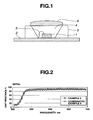
- FIG. 1 illustrates in cross section an LED reflector as one exemplary optoelectronic device using a case of the silicone resin composition of the invention.
- a semiconductor part 1 composed of compound semiconductor is die-bonded to a lead frame 2 and wire-bonded to another lead frame (not shown) via a bonding wire 3.
- a light receiving semiconductor part (not shown) which is die-bonded to a lead frame (not shown) and wire-bonded to another lead frame (not shown) via a bonding wire (not shown) is opposed to the semiconductor part 1.
- a transparent encapsulant resin 4 fills in between the semiconductor parts.
- the semiconductor part encapsulated with the encapsulant resin 4 is further encapsulated or enclosed in a case 5 made of the silicone resin composition of the invention in the cured state.
- the case serves as a white reflector.
- a lens 6 is disposed on top of the encapsulant resin 4.
- the method of molding or encapsulating the silicone resin composition around the semiconductor part is most often transfer molding or compression molding.
- transfer molding is carried out by feeding the silicone resin composition to a transfer molding machine and molding under a pressure of 5 to 20 N/mm 2 , preferably at a temperature of 120 to 190°C for 30 to 500 seconds, and more preferably at 150 to 185°C for 30 to 180 seconds.
- Compression molding is carried out by feeding the silicone resin composition to a compression molding machine and molding preferably at a temperature of 120 to 190°C for 30 to 600 seconds, and more preferably at 130 to 160°C for 120 to 300 seconds. Either of these molding methods may be followed by post-curing at 150 to 185°C for 2 to 20 hours.
- a 1-L flask was charged with 100 parts of methyltrichlorosilane and 200 parts of toluene. Under ice cooling, a mixture of 8 parts of water and 60 parts of isopropyl alcohol was added dropwise over 5 to 20 hours while maintaining an internal temperature between -5°C and 0°C. The reaction mixture was then heated and stirred at the reflux temperature for 20 minutes. The reaction mixture was cooled to room temperature, after which 12 parts of water was added dropwise below 30°C over 30 minutes, followed by 20 minutes of stirring. Further 25 parts of water was added dropwise, after which the mixture was stirred at 40-45°C for 60 minutes. Thereafter, 200 parts of water was added whereupon the organic layer was separated. The organic layer was was washed until neutral.
- a 1-L flask was charged with 50 parts of methyltrichlorosilane, 70.6 parts of phenyltrichlorosilane, and 200 parts of toluene. Under ice cooling, a mixture of 8 parts of water and 60 parts of methyl alcohol was added dropwise over 5 to 20 hours while maintaining an internal temperature between -5°C and 0°C. The reaction mixture was then heated and stirred at the reflux temperature for 20 minutes. The reaction mixture was cooled to room temperature, after which 12 parts of water was added dropwise below 30°C over 30 minutes, followed by 20 minutes of stirring. Further 25 parts of water was added dropwise, after which the mixture was stirred at 40-45°C for 60 minutes. Thereafter, 200 parts of water was added whereupon the organic layer was separated.
- a 1-L flask was charged with 50 parts of methyltrichlorosilane, 86.2 parts of dimethyldichlorosilane, and 200 parts of toluene. Under ice cooling, a mixture of 8 parts of water and 60 parts of methyl alcohol was added dropwise over 5 to 20 hours while maintaining an internal temperature between -5°C and 0°C. The reaction mixture was then heated and stirred at the reflux temperature for 20 minutes. The reaction mixture was cooled to room temperature, after which 12 parts of water was added dropwise below 30°C over 30 minutes, followed by 20 minutes of stirring. Further 25 parts of water was added dropwise, after which the mixture was stirred at 40-45°C for 60 minutes. Thereafter, 200 parts of water was added whereupon the organic layer was separated.
- a 1-L three-neck flask equipped with a stirrer and condenser was charged with 109 g (0.8 mol) of methyltrimethoxysilane, 24 g (0.2 mol) of dimethyldimethoxysilane, and 106 g of isobutyl alcohol, which were stirred under ice cooling.
- 60.5 g of a 0.05N hydrochloric acid solution was added dropwise while maintaining the system temperature between 0°C and 20°C. After the completion of dropwise addition, the mixture was stirred at the reflux temperature of 80°C for 11 hours.
- the reaction solution was cooled to room temperature and then diluted with 150 g of xylene.
- a 1-L flask was charged with 60 parts of methyltrichlorosilane, 40 parts of tetrachlorosilane, and 200 parts of toluene. Under ice cooling, a mixture of 10 parts of water and 60 parts of isopropyl alcohol was added dropwise over 5 to 20 hours while maintaining an internal temperature between -5°C and 0°C. The reaction mixture was then heated and stirred at the reflux temperature for 20 minutes. The reaction mixture was cooled to room temperature, after which 15 parts of water was added dropwise below 30°C over 30 minutes, followed by 20 minutes of stirring. Further 30 parts of water was added dropwise, after which the mixture was stirred at 40-45°C for 60 minutes. Thereafter, 200 parts of water was added whereupon the organic layer was separated.
- This solid polymer had no fluidity due to the high melting point and could not be transfer molded or tested for evaluation.
- B-1 titanium dioxide, rutile type, average particle size 0.4 ⁇ m, R-45M, Sakai Chemical Industry Co., Ltd.
- B-2 titanium dioxide, rutile type, average particle size 0.3 ⁇ m, PFC-104, Ishihara Sangyo K.K.
- C-1 ground fused silica, average particle size 20 ⁇ m, Meltech 82, Tatsumori Ltd.
- C-2 spherical fused silica, average particle size 20 ⁇ m, MSR-200, Tatsumori Ltd.
- C-3 spherical fused silica, average particle size 0.5 ⁇ m, Admafine S0-25R, Admatechs Co., Ltd.
- D-1 zinc benzoate, Wako Pure Chemical Industries, Ltd.
- D-2 aluminum trisacetylacetonate of the following structural formula, Kawaken Fine Chemicals Co., Ltd.
- D-3 aluminum bisethylacetoacetate of the following structural formula, Kawaken Fine Chemicals Co., Ltd.
- E-1 mineral whisker fibers, diameter 0.3 ⁇ m, length 10 ⁇ m, Tismo D, Otsuka Chemical Co., Ltd.
- White silicone resin compositions were prepared by blending (A) heat-curable organopolysiloxane, (B) white pigment, (C) inorganic filler, and (D) curing catalyst in accordance with the formulation shown in Table 1, melting and mixing the mixture on a hot two-roll mill until uniform, cooling and grinding.
- compositions were examined for various properties by the following tests, with the results shown in Table 1. In all runs, the compositions were molded on a transfer molding machine.
- the spiral flow was measured by molding the composition at 175°C and 6.9 N/mm 2 for 120 seconds in a mold in accordance with EMMI standards.
- the rating "full flow” means that the composition flowed beyond the measurement limit of the mold.
- the composition was thinly spread on a hot plate at 175°C and scraped off with a spatula.
- the gel time was measured as the time when the resin remained scrapable off from the hot plate.
- a specimen was molded in a mold in accordance with JIS K6911 at 175°C and 6.9 N/mm 2 for 120 seconds before it was measured for flexural strength and flexural modulus at room temperature (25°C).
- a specimen was molded in a mold in accordance with EMMI standards at 175°C and 6.9 N/mm 2 for 120 seconds and held in a thermostat chamber at 260°C for 5 minutes before it was measured for flexural strength and flexural modulus.
- a disc of 50 mm diameter and 3 mm thickness was molded at 175° C and 6.9 N/mm 2 for 2 minutes and held at 180° C for 24 hours. Any change of the surface (in color and cracking) was visually inspected as a measure of thermal yellowing resistance.
- a disc of 50 mm diameter and 3 mm thickness was molded at 175°C and 6.9 N/mm 2 for 180 seconds and then irradiated with UV radiation for 24 hours under a high-pressure mercury lamp (60 mW/cm) with 365 nm peak wavelength. Both at the initial (just as molded) and after 24 hours of UV irradiation, the disc (cured product) was measured for reflectance at wavelength 450 nm, using a spectrophotometer X-Rite 8200 (distributed by SDG Co., Ltd.).
- White silicone resin compositions were prepared by blending (A) heat-curable organopolysiloxane, (B) white pigment, (C) inorganic filler, (D) curing catalyst, and (E) mineral whisker fibers in accordance with the formulation shown in Table 2, melting and mixing the mixture on a continuous kneader until uniform, cooling and grinding.
- compositions were examined for various properties by the following tests, with the results shown in Table 2. In all runs, the compositions were molded on a transfer molding machine.
- a rod of 10 ⁇ 4 ⁇ 100 mm was molded at 175°C and 6.86 MPa for 120 seconds.
- the hardness when hot was measured using a Shore D hardness meter.
- a specimen was molded in a mold in accordance with JIS K6911 at 175° C and 6.9 N/mm 2 for 120 seconds before it was measured for flexural strength and flexural modulus at room temperature (25°C).
- composition was molded into a specimen of 5 ⁇ 5 ⁇ 15 mm at 175°C and 6.9 N/mm 2 for 120 seconds and post-cured at 180°C for 4 hours.
- analyzer TMA 8140C Radar Corp.
- Tg glass transition temperature
- CTE1 and CTE2 coefficients of linear expansion
- a disc of 50 mm diameter and 3 mm thickness was molded at 175° C and 6.9 N/mm 2 for 180 seconds and held at 180° C or 300° C for 24 hours. Any change of the surface was visually inspected as a measure of thermal yellowing resistance.
- a disc of 50 mm diameter and 3 mm thickness was molded at 175°C and 6.9 N/mm 2 for 180 seconds and then irradiated with UV radiation for 24 hours under a high-pressure mercury lamp (60 mW/cm) with 365 nm peak wavelength. Both at the initial (just as molded) and after 24 hours of UV irradiation, the disc (cured product) was measured for reflectance at wavelength 450 nm, using a spectrophotometer X-Rite 8200 (distributed by SDG Co., Ltd.).
- a commercially available polyphthalamide resin (PPA) was molded into a disc of 50 mm diameter and 3 mm thickness. As in Examples, the disc (cured product) was measured for reflectance both at the initial (just as molded) and after 24 hours of UV irradiation (high-pressure mercury lamp, 60 mW/cm, 365 nm peak wavelength), finding a reflectance of 85% and 58%, respectively.
- PPA polyphthalamide resin
- An epoxy resin compound was prepared by blending 50 parts of hydrogenated bisphenol A epoxy resin (YX-800, Japan Epoxy Resin Co., Ltd.) with 40 parts of methylhexahydrophthalic anhydride (MH, New Japan Chemical Co., Ltd.) and 1 part of an organic phosphonium salt (PX-4MP, Nippon Chemical Industrial Co., Ltd.). The compound was molded and cured at 150°C for 4 hours into a disc of 50 mm diameter and 3 mm thickness.
- the disc (cured product) was measured for reflectance both at the initial (just as molded) and after 24 hours of UV irradiation (high-pressure mercury lamp, 60 mW/cm, 365 nm peak wavelength), finding a reflectance of 75% and 65%, respectively.
- Example 3 and Comparative Example 9 were measured for reflectance both at the initial (just as molded) and after a heat age test of holding at 180°C for 24 hours, by the same spectrophotometer while varying the wavelength of light. The results are plotted in the diagrams of FIGS. 2 and 3 .
- the white heat-curable silicone resin compositions in Examples 1 to 11 are effectively curable and cure into uniform products having mechanical strength, white color, heat resistance, and light resistance and experiencing minimal yellowing. It is proven that an optoelectronic package in which an LED is enclosed in the cured product (reflector) of the composition performs well.
- Heat-curable silicone resin compositions were prepared by blending (A) heat-curable organopolysiloxane, (B) white pigment, (C) inorganic filler, (D) curing catalyst, and (E) mineral whisker fibers in accordance with the formulation shown in Table 3, and kneading the mixture on a roll mill.
- compositions were examined for various properties by the following tests, with the results shown in Table 3. In all runs, the compositions were molded on a transfer molding machine.
- Rods of 10 ⁇ 4 ⁇ 100 mm were molded at 175°C and 6.86 MPa for a molding time of 45, 60 or 90 seconds according to JIS K6911. The hardness when hot was measured using a Barcol Impressor.
- a specimen was molded in a mold in accordance with EMMI standards at 175°C and 6.9 N/mm 2 for 180 seconds before it was measured for flexural strength and flexural modulus at room temperature (RT).
- a disc of 50 mm diameter and 3 mm thickness was molded at 175° C and 6.9 N/mm 2 for 180 seconds and held at 180° C or 300° C for 24 hours. Any change of the surface was visually inspected as a measure of thermal yellowing resistance.
Landscapes
- Chemical & Material Sciences (AREA)
- Health & Medical Sciences (AREA)
- Chemical Kinetics & Catalysis (AREA)
- Medicinal Chemistry (AREA)
- Polymers & Plastics (AREA)
- Organic Chemistry (AREA)
- Compositions Of Macromolecular Compounds (AREA)
- Led Device Packages (AREA)
- Structures Or Materials For Encapsulating Or Coating Semiconductor Devices Or Solid State Devices (AREA)
- Silicon Polymers (AREA)
Applications Claiming Priority (1)
| Application Number | Priority Date | Filing Date | Title |
|---|---|---|---|
| JP2007333738A JP4623322B2 (ja) | 2007-12-26 | 2007-12-26 | 光半導体ケース形成用白色熱硬化性シリコーン樹脂組成物並びに光半導体ケース及びその成形方法 |
Publications (2)
| Publication Number | Publication Date |
|---|---|
| EP2075280A1 true EP2075280A1 (de) | 2009-07-01 |
| EP2075280B1 EP2075280B1 (de) | 2010-11-10 |
Family
ID=40494931
Family Applications (1)
| Application Number | Title | Priority Date | Filing Date |
|---|---|---|---|
| EP08254157A Active EP2075280B1 (de) | 2007-12-26 | 2008-12-24 | Weiße, wärmehärtbare Silikonharzusammensetzung, optoelektrisches Teilegehäuse und Formverfahren |
Country Status (7)
| Country | Link |
|---|---|
| US (1) | US8013056B2 (de) |
| EP (1) | EP2075280B1 (de) |
| JP (1) | JP4623322B2 (de) |
| KR (1) | KR101505626B1 (de) |
| CN (1) | CN101519531B (de) |
| DE (1) | DE602008003393D1 (de) |
| TW (1) | TWI432521B (de) |
Cited By (5)
| Publication number | Priority date | Publication date | Assignee | Title |
|---|---|---|---|---|
| EP2551929A4 (de) * | 2010-03-23 | 2013-08-14 | Asahi Rubber Inc | Reflektierendes silikonharzsubstrat, herstellungsverfahren dafür und basismaterialzusammensetzung für ein reflektierendes substrat |
| US8704258B2 (en) | 2009-06-26 | 2014-04-22 | Asahi Rubber Inc. | White color reflecting material and process for production thereof |
| EP2945197A4 (de) * | 2013-01-10 | 2016-08-03 | Konica Minolta Inc | Led-vorrichtung und beschichtungsflüssigkeit zur herstellung davon |
| EP3239245A4 (de) * | 2014-12-25 | 2018-08-22 | Shengyi Technology Co. Ltd. | Organische siliciumharzzusammensetzung, weisses prepreg und weisses laminat mit verwendung davon |
| WO2020043312A1 (en) * | 2018-08-31 | 2020-03-05 | Wacker Chemie Ag | Thermosetting silicone resin composition for reflector of led, reflector of led and semiconductor device using the same |
Families Citing this family (60)
| Publication number | Priority date | Publication date | Assignee | Title |
|---|---|---|---|---|
| JP5221122B2 (ja) * | 2007-12-28 | 2013-06-26 | 株式会社朝日ラバー | シリコーン樹脂基材 |
| JP4678415B2 (ja) * | 2008-03-18 | 2011-04-27 | 信越化学工業株式会社 | 光半導体ケース形成用白色熱硬化性シリコーン樹脂組成物並びに光半導体ケース |
| JP5108825B2 (ja) * | 2009-04-24 | 2012-12-26 | 信越化学工業株式会社 | 光半導体装置用シリコーン樹脂組成物及び光半導体装置 |
| KR100974854B1 (ko) * | 2009-07-28 | 2010-09-06 | 주식회사 유일씨엔티 | 발광 다이오드 모듈 |
| JP2011105869A (ja) * | 2009-11-18 | 2011-06-02 | Kaneka Corp | 白色硬化性組成物および反射コーティング材 |
| WO2011078239A1 (ja) | 2009-12-22 | 2011-06-30 | 三菱化学株式会社 | 半導体発光装置用樹脂成形体用材料 |
| WO2011125753A1 (ja) | 2010-04-02 | 2011-10-13 | 株式会社カネカ | 硬化性樹脂組成物、硬化性樹脂組成物タブレット、成形体、半導体のパッケージ、半導体部品及び発光ダイオード |
| JP2011249768A (ja) * | 2010-04-27 | 2011-12-08 | Mitsubishi Chemicals Corp | 半導体発光素子支持部材及び半導体発光装置 |
| JP5879739B2 (ja) * | 2010-04-28 | 2016-03-08 | 三菱化学株式会社 | 半導体発光装置用パッケージ及び発光装置 |
| WO2011136302A1 (ja) | 2010-04-28 | 2011-11-03 | 三菱化学株式会社 | 半導体発光装置用パッケージ及び発光装置 |
| JP5640476B2 (ja) * | 2010-06-08 | 2014-12-17 | 信越化学工業株式会社 | 光半導体素子封止用樹脂組成物及び発光装置 |
| JP5749543B2 (ja) * | 2010-06-18 | 2015-07-15 | 株式会社カネカ | 熱硬化性樹脂組成物タブレットおよびそれを用いた半導体のパッケージ |
| JP2012064928A (ja) * | 2010-08-18 | 2012-03-29 | Mitsubishi Chemicals Corp | 半導体発光装置用樹脂成形体用材料及び樹脂成形体 |
| JP5728961B2 (ja) * | 2011-01-17 | 2015-06-03 | 信越化学工業株式会社 | 光半導体ケース形成用白色熱硬化性シリコーン樹脂組成物及び光半導体ケース |
| JP5728960B2 (ja) * | 2011-01-17 | 2015-06-03 | 信越化学工業株式会社 | 光半導体ケース形成用白色熱硬化性シリコーン樹脂組成物及び光半導体ケース |
| JP5919903B2 (ja) * | 2011-03-31 | 2016-05-18 | 三菱化学株式会社 | 半導体発光装置用パッケージ及び該パッケージを有してなる半導体発光装置並びにそれらの製造方法 |
| CN102751391B (zh) * | 2011-04-18 | 2015-04-29 | 深圳市龙岗区横岗光台电子厂 | 一种led封装体及其制造方法和led |
| TW201247782A (en) * | 2011-05-25 | 2012-12-01 | Daxin Materials Corp | White thermocurable siloxane resin composition |
| JP5682497B2 (ja) | 2011-07-29 | 2015-03-11 | 信越化学工業株式会社 | 表面実装型発光装置の製造方法及びリフレクター基板 |
| US9793456B2 (en) | 2011-09-30 | 2017-10-17 | Kaneka Corporation | Molded resin body for surface-mounted light-emitting device, manufacturing method thereof, and surface-mounted light-emitting device |
| KR20140145198A (ko) * | 2012-04-12 | 2014-12-22 | 다우 코닝 코포레이션 | 실리콘-폴리에스테르 조성물 |
| JP5756054B2 (ja) | 2012-04-16 | 2015-07-29 | 信越化学工業株式会社 | Ledのリフレクター用熱硬化性樹脂組成物並びにこれを用いたled用リフレクター及び光半導体装置 |
| JP5814175B2 (ja) | 2012-04-16 | 2015-11-17 | 信越化学工業株式会社 | Ledのリフレクター用熱硬化性シリコーン樹脂組成物並びにこれを用いたled用リフレクター及び光半導体装置 |
| JP5167424B1 (ja) * | 2012-04-18 | 2013-03-21 | 積水化学工業株式会社 | 光半導体装置用白色硬化性組成物及び光半導体装置用成形体 |
| JP5825212B2 (ja) * | 2012-07-12 | 2015-12-02 | 豊田合成株式会社 | 発光装置の製造方法 |
| US8946350B2 (en) * | 2012-07-27 | 2015-02-03 | Lg Chem, Ltd. | Curable composition |
| KR101997243B1 (ko) * | 2012-09-13 | 2019-07-08 | 엘지이노텍 주식회사 | 발광 소자 및 조명 시스템 |
| TWI480344B (zh) * | 2012-11-05 | 2015-04-11 | Ind Tech Res Inst | 白色塗料組合物及包含其所形成之塗層的裝置 |
| JP6363618B2 (ja) | 2012-12-27 | 2018-07-25 | ダウ シリコーンズ コーポレーション | 優れた反射率及び難燃性を有する物品を形成するための組成物、並びにそれらから形成された物品 |
| CN104955905B (zh) | 2013-02-27 | 2017-11-28 | 株式会社朝日橡胶 | 白色反射膜用油墨、粉体涂料、白色反射膜及其制造方法、光源支架及照明器具遮光罩 |
| WO2014152522A1 (en) * | 2013-03-15 | 2014-09-25 | Dow Corning Corporation | Compositions of resin-linear organosiloxane block copolymers |
| KR20160019407A (ko) * | 2013-06-13 | 2016-02-19 | 닛토덴코 가부시키가이샤 | 광반도체 리플렉터용 에폭시 수지 조성물, 광반도체 장치용 열경화성 수지 조성물 및 그것을 이용하여 얻어지는 광반도체 장치용 리드 프레임, 밀봉형 광반도체 소자 및 광반도체 장치 |
| JP2015040238A (ja) * | 2013-08-21 | 2015-03-02 | 信越化学工業株式会社 | 光半導体ケース形成用熱硬化性シリコーン樹脂組成物 |
| JP6227975B2 (ja) * | 2013-10-30 | 2017-11-08 | 株式会社カネカ | 硬化性樹脂組成物、硬化性樹脂組成物タブレット、成形体、半導体のパッケージ |
| JP6213271B2 (ja) * | 2014-01-31 | 2017-10-18 | 住友化学株式会社 | Uv−led用ポリシルセスキオキサン系封止材組成物及びそのためのアセチルアセトネート系触媒の使用 |
| JP2015147376A (ja) * | 2014-02-07 | 2015-08-20 | 旭硝子株式会社 | ガラス複合体 |
| US9671085B2 (en) | 2014-04-22 | 2017-06-06 | Dow Corning Corporation | Reflector for an LED light source |
| JP6194853B2 (ja) * | 2014-06-06 | 2017-09-13 | 信越化学工業株式会社 | 光半導体装置用白色熱硬化性シリコーン樹脂組成物、及び光半導体素子搭載用ケース |
| JP5989063B2 (ja) * | 2014-11-10 | 2016-09-07 | 株式会社朝日ラバー | シリコーン樹脂基材 |
| CN105778506B (zh) * | 2014-12-25 | 2019-04-30 | 广东生益科技股份有限公司 | 一种有机硅树脂组合物及使用它的预浸料、层压板、覆铜板以及铝基板 |
| JP6707516B2 (ja) * | 2015-02-25 | 2020-06-10 | ダウ・東レ株式会社 | 硬化性粒状シリコーン組成物、およびその製造方法 |
| US10879439B2 (en) * | 2015-06-29 | 2020-12-29 | Kuraray Co., Ltd. | Polyamide composition for LED reflection plate, LED reflection plate, and light-emitting device including reflection plate |
| EP3498778A4 (de) * | 2016-08-08 | 2020-03-11 | Dow Toray Co., Ltd. | Härtbare partikelförmige silikonzusammensetzung, optisch reflektierendes material mit härtbarer partikelförmiger silikonzusammensetzung und herstellungsverfahren für optisch reflektierendes material mit härtbarer partikelförmiger silikonzusammensetzung |
| KR102358091B1 (ko) | 2016-08-08 | 2022-02-07 | 듀폰 도레이 스페셜티 머티리얼즈 가부시키가이샤 | 경화성 입상 실리콘 조성물, 이것으로 이루어지는 반도체용 부재 및 이의 성형 방법 |
| WO2018212440A1 (ko) | 2017-05-19 | 2018-11-22 | 주식회사 케이씨씨 | 경화성 오르가노 폴리실록산 조성물 및 이를 포함하는 광학 반도체용 반사재료 |
| JP7100636B2 (ja) | 2017-06-19 | 2022-07-13 | ダウ・東レ株式会社 | 硬化性粒状シリコーン組成物、それからなる半導体用部材、およびその成型方法 |
| CN107501942B (zh) * | 2017-08-29 | 2020-10-02 | 北京康美特科技股份有限公司 | 可模塑成型的有机硅树脂、组合物及其半导体发光元件 |
| CN111148796B (zh) | 2017-10-20 | 2021-11-09 | 陶氏东丽株式会社 | 硬化性粒状硅酮组合物、其硬化物、及其制造方法 |
| KR102114059B1 (ko) * | 2018-08-17 | 2020-05-25 | 주식회사 케이씨씨 | 경화성 오르가노 폴리실록산 조성물 및 이를 포함하는 광학 반도체용 반사 재료 |
| KR102873949B1 (ko) | 2018-10-30 | 2025-10-22 | 다우 도레이 캄파니 리미티드 | 경화 반응성 실리콘 조성물 및 그 경화물 및 이들의 용도 |
| WO2020138411A1 (ja) | 2018-12-27 | 2020-07-02 | ダウ・東レ株式会社 | トランスファー成型用硬化性シリコーン組成物、その硬化物、およびその製造方法 |
| KR102912731B1 (ko) | 2018-12-27 | 2026-01-16 | 다우 도레이 캄파니 리미티드 | 경화성 실리콘 조성물, 그의 경화물 및 그의 제조 방법 |
| TWI844606B (zh) | 2018-12-27 | 2024-06-11 | 日商陶氏東麗股份有限公司 | 具有熱熔性之固化性聚矽氧薄片之製造方法 |
| TWI843786B (zh) | 2018-12-27 | 2024-06-01 | 日商陶氏東麗股份有限公司 | 固化性聚矽氧組合物、其固化物及其製造方法 |
| WO2020203306A1 (ja) | 2019-03-29 | 2020-10-08 | ダウ・東レ株式会社 | 硬化性シリコーン組成物、その硬化物、およびその製造方法 |
| KR102952088B1 (ko) | 2019-03-29 | 2026-04-15 | 다우 도레이 캄파니 리미티드 | 경화성 실리콘 조성물, 그의 경화물 및 그의 제조 방법 |
| CN113631659B (zh) | 2019-03-29 | 2023-05-05 | 陶氏东丽株式会社 | 固化性有机硅组合物、其固化物及其制造方法 |
| CN110128834B (zh) * | 2019-05-30 | 2021-07-20 | 萍乡市第二高压电瓷厂 | 一种特高压用复合绝缘子及其制备方法 |
| CN110802821A (zh) * | 2019-10-09 | 2020-02-18 | 安徽川越通信科技有限责任公司 | 一种耦合器外盒生产方法 |
| US12134697B2 (en) | 2019-12-27 | 2024-11-05 | Dow Toray Co., Ltd. | Curable hot-melt silicone composition, cured material thereof, and laminate containing curable hot-melt silicone composition or cured material thereof |
Citations (22)
| Publication number | Priority date | Publication date | Assignee | Title |
|---|---|---|---|---|
| DE2262752A1 (de) * | 1971-12-23 | 1973-07-05 | Shinetsu Chemical Co | Granulierte siliconformmasse |
| US3843601A (en) | 1973-10-11 | 1974-10-22 | Stauffer Chemical Co | Hydraulic elastomer |
| JPS5996122A (ja) | 1982-11-22 | 1984-06-02 | Toray Silicone Co Ltd | 熱硬化性エポキシ樹脂組成物 |
| JPS59232146A (ja) * | 1983-06-16 | 1984-12-26 | Shin Etsu Chem Co Ltd | 圧送成形用シリコ−ン樹脂組成物 |
| JPS62270660A (ja) | 1986-03-03 | 1987-11-25 | ダウ コ−ニング コ−ポレ−シヨン | シリコ−ン粉の製造方法 |
| JPS6377942A (ja) | 1986-09-22 | 1988-04-08 | Toray Silicone Co Ltd | シリコ−ンゴム粒状物の製造方法 |
| JPH0393834A (ja) | 1989-09-05 | 1991-04-18 | Shin Etsu Chem Co Ltd | シリコーンエラストマー微粉末の製造方法 |
| JPH04198324A (ja) | 1990-11-28 | 1992-07-17 | Shin Etsu Chem Co Ltd | シリコーンエラストマー微粉末の製造方法 |
| JPH07196815A (ja) | 1993-12-28 | 1995-08-01 | Shin Etsu Chem Co Ltd | シリコーン微粒子およびその製造方法 |
| JP2656336B2 (ja) | 1989-01-18 | 1997-09-24 | 日東電工株式会社 | 光半導体装置およびそれに用いる光半導体封止用エポキシ樹脂組成物 |
| JPH09310007A (ja) | 1996-05-22 | 1997-12-02 | Matsushita Electric Works Ltd | 液状エポキシ樹脂組成物 |
| JP2000196151A (ja) | 1998-12-25 | 2000-07-14 | Nichia Chem Ind Ltd | 発光ダイオ―ド |
| JP2001234032A (ja) | 2000-02-24 | 2001-08-28 | Sumitomo Bakelite Co Ltd | 光半導体封止用エポキシ樹脂組成物 |
| JP2001316591A (ja) | 2000-04-28 | 2001-11-16 | Hitachi Chem Co Ltd | 絶縁材料組成物、絶縁材料付金属箔、両面金属箔付絶縁材料及び金属張積層板 |
| JP2002302533A (ja) | 2001-01-30 | 2002-10-18 | Sumitomo Bakelite Co Ltd | 光半導体封止用エポキシ樹脂組成物及び光半導体装置 |
| JP2003224305A (ja) | 2001-11-01 | 2003-08-08 | Nichia Chem Ind Ltd | 発光装置及びその形成方法 |
| JP3512732B2 (ja) | 2000-11-09 | 2004-03-31 | 京セラケミカル株式会社 | 封止用樹脂組成物および電子部品封止装置 |
| JP2005306952A (ja) | 2004-04-20 | 2005-11-04 | Japan Epoxy Resin Kk | 発光素子封止材用エポキシ樹脂組成物 |
| JP2006077234A (ja) | 2004-08-10 | 2006-03-23 | Shin Etsu Chem Co Ltd | Led素子封止用樹脂組成物および該組成物を硬化してなる硬化物 |
| WO2007099863A1 (en) * | 2006-03-01 | 2007-09-07 | Dow Corning Toray Co., Ltd. | Curable silicone resin composition and cured body thereof |
| JP2007270054A (ja) * | 2006-03-31 | 2007-10-18 | Jsr Corp | 金属酸化物微粒子含有ポリシロキサン組成物およびその製造方法 |
| EP1889877A1 (de) * | 2006-07-18 | 2008-02-20 | Shin-Etsu Chemical Co., Ltd. | In einer Silicium-Harz-Zusammensetzung eingekapseltes Halbleiterbauelement und Silicium-Harz-Tablette zur Einkapselung des Halbleiterbauelements |
Family Cites Families (42)
| Publication number | Priority date | Publication date | Assignee | Title |
|---|---|---|---|---|
| US429225A (en) * | 1890-06-03 | Process of treating slag | ||
| US3792012A (en) * | 1972-03-17 | 1974-02-12 | Gen Electric | Silicone resin useful in molding compositions |
| JPS5217540B2 (de) * | 1973-10-04 | 1977-05-16 | ||
| US4102970A (en) * | 1974-10-03 | 1978-07-25 | Wacker-Chemie Gmbh | Thermosetting compositions which can be cured to form molded objects or coatings |
| US4292225A (en) | 1980-01-04 | 1981-09-29 | Ford Motor Company | Highly filled thermally conductive elastomers IV |
| US4743670A (en) | 1986-09-22 | 1988-05-10 | Toray Silicone Co., Ltd. | Method for producing silicone rubber powder |
| JPH02288274A (ja) * | 1989-04-27 | 1990-11-28 | Unitika Ltd | 耐ハンダ性発光ダイオード用リフレクター |
| JP2814456B2 (ja) * | 1989-11-06 | 1998-10-22 | 東芝シリコーン株式会社 | 高強度室温硬化性ポリオルガノシロキサン組成物 |
| US6274890B1 (en) | 1997-01-15 | 2001-08-14 | Kabushiki Kaisha Toshiba | Semiconductor light emitting device and its manufacturing method |
| SG76540A1 (en) * | 1997-03-13 | 2000-11-21 | Mitsui Chemicals Inc | Semiaromatic polyamide resin composition |
| US6114429A (en) | 1997-08-06 | 2000-09-05 | Shin-Etsu Chemical Co., Ltd. | Thermally conductive silicone composition |
| US6069201A (en) | 1997-09-12 | 2000-05-30 | Shin-Etsu Chemical Co., Ltd. | Zinc oxide-filled addition-curable silicone rubber compositions |
| JP2000281874A (ja) | 1999-03-31 | 2000-10-10 | Sumitomo Bakelite Co Ltd | エポキシ樹脂組成物及び半導体装置 |
| KR100858836B1 (ko) | 2001-05-14 | 2008-09-17 | 다우 코닝 도레이 캄파니 리미티드 | 열전도성 실리콘 조성물 |
| US6924596B2 (en) | 2001-11-01 | 2005-08-02 | Nichia Corporation | Light emitting apparatus provided with fluorescent substance and semiconductor light emitting device, and method of manufacturing the same |
| TW200427111A (en) | 2003-03-12 | 2004-12-01 | Shinetsu Chemical Co | Material for coating/protecting light-emitting semiconductor and the light-emitting semiconductor device |
| JP5101788B2 (ja) * | 2003-12-22 | 2012-12-19 | 東レ・ダウコーニング株式会社 | 半導体装置の製造方法および半導体装置 |
| JP4300418B2 (ja) * | 2004-04-30 | 2009-07-22 | 信越化学工業株式会社 | エポキシ・シリコーン混成樹脂組成物及び発光半導体装置 |
| US20060035092A1 (en) | 2004-08-10 | 2006-02-16 | Shin-Etsu Chemical Co., Ltd. | Resin composition for sealing LED elements and cured product generated by curing the composition |
| JP5060707B2 (ja) | 2004-11-10 | 2012-10-31 | 日立化成工業株式会社 | 光反射用熱硬化性樹脂組成物 |
| KR100665117B1 (ko) * | 2005-02-17 | 2007-01-09 | 삼성전기주식회사 | Led 하우징 및 그 제조 방법 |
| JP4525917B2 (ja) * | 2005-03-18 | 2010-08-18 | 株式会社クラレ | Ledリフレクタ成形用ポリアミド樹脂組成物およびledリフレクタ |
| JP4876426B2 (ja) * | 2005-04-08 | 2012-02-15 | 日亜化学工業株式会社 | 耐熱性及び耐光性に優れる発光装置 |
| JP2006291018A (ja) * | 2005-04-08 | 2006-10-26 | Shin Etsu Chem Co Ltd | Led素子封止用硬化性樹脂組成物 |
| TWI256737B (en) * | 2005-05-19 | 2006-06-11 | Pi-Fu Yang | One-block light-emitting device and manufacturing method thereof |
| EP1897146A2 (de) * | 2005-06-27 | 2008-03-12 | Lamina Lighting, Inc. | Lichtemissionsdiodenpackung und herstellungsverfahren dafür |
| JP2007056146A (ja) * | 2005-08-25 | 2007-03-08 | Nagase Chemtex Corp | 光素子用封止樹脂組成物 |
| JP4781780B2 (ja) | 2005-10-27 | 2011-09-28 | 信越化学工業株式会社 | 光関連デバイス封止用樹脂組成物およびその硬化物ならびに半導体素子の封止方法 |
| JP4781779B2 (ja) | 2005-10-27 | 2011-09-28 | 信越化学工業株式会社 | 高分子量オルガノポリシロキサンの製造方法、該高分子量オルガノポリシロキサンを含む組成物およびその硬化物で封止された光半導体装置 |
| JP5232369B2 (ja) | 2006-02-03 | 2013-07-10 | 日立化成株式会社 | 光半導体素子搭載用パッケージ基板の製造方法およびこれを用いた光半導体装置の製造方法 |
| JP5201799B2 (ja) * | 2006-03-24 | 2013-06-05 | Jx日鉱日石エネルギー株式会社 | 全芳香族サーモトロピック液晶ポリエステル樹脂組成物、その射出成形体および該成形体を使用した光学装置 |
| JP2007297601A (ja) | 2006-04-06 | 2007-11-15 | Hitachi Chem Co Ltd | 光反射用熱硬化性樹脂組成物、これを用いた光半導体素子搭載用基板とその製造方法および光半導体装置 |
| JP2007291273A (ja) * | 2006-04-26 | 2007-11-08 | Asahi Kasei Corp | 封止材用組成物及び光学デバイス |
| US20070284589A1 (en) * | 2006-06-08 | 2007-12-13 | Keat Chuan Ng | Light emitting device having increased light output |
| US20080039555A1 (en) | 2006-08-10 | 2008-02-14 | Michel Ruyters | Thermally conductive material |
| JP4787128B2 (ja) | 2006-10-18 | 2011-10-05 | 信越化学工業株式会社 | 室温硬化型熱伝導性シリコーンゴム組成物 |
| US20080117619A1 (en) * | 2006-11-21 | 2008-05-22 | Siew It Pang | Light source utilizing a flexible circuit carrier and flexible reflectors |
| JP5608955B2 (ja) * | 2007-02-06 | 2014-10-22 | 日亜化学工業株式会社 | 発光装置及びその製造方法並びに発光装置用成形体 |
| JP2008189827A (ja) * | 2007-02-06 | 2008-08-21 | Shin Etsu Chem Co Ltd | 熱硬化性エポキシ樹脂組成物及び半導体装置 |
| JP2008189833A (ja) * | 2007-02-06 | 2008-08-21 | Shin Etsu Chem Co Ltd | 熱硬化性エポキシ樹脂組成物及び半導体装置 |
| JP5444631B2 (ja) * | 2007-04-06 | 2014-03-19 | 横浜ゴム株式会社 | 光半導体素子封止用組成物、その硬化物および光半導体素子封止体 |
| US8039862B2 (en) | 2009-03-10 | 2011-10-18 | Nepes Led Corporation | White light emitting diode package having enhanced white lighting efficiency and method of making the same |
-
2007
- 2007-12-26 JP JP2007333738A patent/JP4623322B2/ja active Active
-
2008
- 2008-12-23 TW TW097150255A patent/TWI432521B/zh active
- 2008-12-23 KR KR1020080132177A patent/KR101505626B1/ko active Active
- 2008-12-24 US US12/344,048 patent/US8013056B2/en active Active
- 2008-12-24 EP EP08254157A patent/EP2075280B1/de active Active
- 2008-12-24 DE DE602008003393T patent/DE602008003393D1/de active Active
- 2008-12-26 CN CN2008101074859A patent/CN101519531B/zh active Active
Patent Citations (22)
| Publication number | Priority date | Publication date | Assignee | Title |
|---|---|---|---|---|
| DE2262752A1 (de) * | 1971-12-23 | 1973-07-05 | Shinetsu Chemical Co | Granulierte siliconformmasse |
| US3843601A (en) | 1973-10-11 | 1974-10-22 | Stauffer Chemical Co | Hydraulic elastomer |
| JPS5996122A (ja) | 1982-11-22 | 1984-06-02 | Toray Silicone Co Ltd | 熱硬化性エポキシ樹脂組成物 |
| JPS59232146A (ja) * | 1983-06-16 | 1984-12-26 | Shin Etsu Chem Co Ltd | 圧送成形用シリコ−ン樹脂組成物 |
| JPS62270660A (ja) | 1986-03-03 | 1987-11-25 | ダウ コ−ニング コ−ポレ−シヨン | シリコ−ン粉の製造方法 |
| JPS6377942A (ja) | 1986-09-22 | 1988-04-08 | Toray Silicone Co Ltd | シリコ−ンゴム粒状物の製造方法 |
| JP2656336B2 (ja) | 1989-01-18 | 1997-09-24 | 日東電工株式会社 | 光半導体装置およびそれに用いる光半導体封止用エポキシ樹脂組成物 |
| JPH0393834A (ja) | 1989-09-05 | 1991-04-18 | Shin Etsu Chem Co Ltd | シリコーンエラストマー微粉末の製造方法 |
| JPH04198324A (ja) | 1990-11-28 | 1992-07-17 | Shin Etsu Chem Co Ltd | シリコーンエラストマー微粉末の製造方法 |
| JPH07196815A (ja) | 1993-12-28 | 1995-08-01 | Shin Etsu Chem Co Ltd | シリコーン微粒子およびその製造方法 |
| JPH09310007A (ja) | 1996-05-22 | 1997-12-02 | Matsushita Electric Works Ltd | 液状エポキシ樹脂組成物 |
| JP2000196151A (ja) | 1998-12-25 | 2000-07-14 | Nichia Chem Ind Ltd | 発光ダイオ―ド |
| JP2001234032A (ja) | 2000-02-24 | 2001-08-28 | Sumitomo Bakelite Co Ltd | 光半導体封止用エポキシ樹脂組成物 |
| JP2001316591A (ja) | 2000-04-28 | 2001-11-16 | Hitachi Chem Co Ltd | 絶縁材料組成物、絶縁材料付金属箔、両面金属箔付絶縁材料及び金属張積層板 |
| JP3512732B2 (ja) | 2000-11-09 | 2004-03-31 | 京セラケミカル株式会社 | 封止用樹脂組成物および電子部品封止装置 |
| JP2002302533A (ja) | 2001-01-30 | 2002-10-18 | Sumitomo Bakelite Co Ltd | 光半導体封止用エポキシ樹脂組成物及び光半導体装置 |
| JP2003224305A (ja) | 2001-11-01 | 2003-08-08 | Nichia Chem Ind Ltd | 発光装置及びその形成方法 |
| JP2005306952A (ja) | 2004-04-20 | 2005-11-04 | Japan Epoxy Resin Kk | 発光素子封止材用エポキシ樹脂組成物 |
| JP2006077234A (ja) | 2004-08-10 | 2006-03-23 | Shin Etsu Chem Co Ltd | Led素子封止用樹脂組成物および該組成物を硬化してなる硬化物 |
| WO2007099863A1 (en) * | 2006-03-01 | 2007-09-07 | Dow Corning Toray Co., Ltd. | Curable silicone resin composition and cured body thereof |
| JP2007270054A (ja) * | 2006-03-31 | 2007-10-18 | Jsr Corp | 金属酸化物微粒子含有ポリシロキサン組成物およびその製造方法 |
| EP1889877A1 (de) * | 2006-07-18 | 2008-02-20 | Shin-Etsu Chemical Co., Ltd. | In einer Silicium-Harz-Zusammensetzung eingekapseltes Halbleiterbauelement und Silicium-Harz-Tablette zur Einkapselung des Halbleiterbauelements |
Non-Patent Citations (5)
| Title |
|---|
| DATABASE WPI Week 198507, Derwent World Patents Index; AN 1985-040648, XP002522686 * |
| DATABASE WPI Week 200808, Derwent World Patents Index; AN 2008-b21389, XP002522685 * |
| ELECTRONICS PACKAGING TECHNOLOGY, April 2004 (2004-04-01) |
| M.BAHADUR, PROC.OF SPIE, vol. 6337, 2006, pages 63370F-1 - 63370F-7, XP002522684 * |
| WONG C P: "THERMAL-MECHANICAL ENHANCED HIGH-PERFORMANCE SILICONE GELS AND ELASTOMERIC ENCAPSULANTS IN MICROELECTRONIC PACKAGING", 1 June 1995, IEEE TRANSACTIONS ON COMPONENTS, PACKAGING ANDMANUFACTURING TECHNOLOGY: PART A, IEEE SERVICE CENTER, PISCATAWAY, NJ, US, PAGE(S) 270 - 273, ISSN: 1070-9886, XP000508429 * |
Cited By (10)
| Publication number | Priority date | Publication date | Assignee | Title |
|---|---|---|---|---|
| US8704258B2 (en) | 2009-06-26 | 2014-04-22 | Asahi Rubber Inc. | White color reflecting material and process for production thereof |
| EP2551929A4 (de) * | 2010-03-23 | 2013-08-14 | Asahi Rubber Inc | Reflektierendes silikonharzsubstrat, herstellungsverfahren dafür und basismaterialzusammensetzung für ein reflektierendes substrat |
| US9574050B2 (en) | 2010-03-23 | 2017-02-21 | Asahi Rubber Inc. | Silicone resin reflective substrate, manufacturing method for same, and base material composition used in reflective substrate |
| EP3490015A1 (de) * | 2010-03-23 | 2019-05-29 | Asahi Rubber Inc. | Reflektierendes silikonharzsubstrat, herstellungsverfahren dafür und basismaterialzusammensetzung für ein reflektierendes substrat |
| US10533094B2 (en) | 2010-03-23 | 2020-01-14 | Asahi Rubber Inc. | Silicone resin reflective substrate, manufacturing method for same, and base material composition used in reflective substrate |
| US11326065B2 (en) | 2010-03-23 | 2022-05-10 | Asahi Rubber Inc. | Silicone resin reflective substrate, manufacturing method for same, and base material composition used in reflective substrate |
| EP2945197A4 (de) * | 2013-01-10 | 2016-08-03 | Konica Minolta Inc | Led-vorrichtung und beschichtungsflüssigkeit zur herstellung davon |
| EP3239245A4 (de) * | 2014-12-25 | 2018-08-22 | Shengyi Technology Co. Ltd. | Organische siliciumharzzusammensetzung, weisses prepreg und weisses laminat mit verwendung davon |
| US10336905B2 (en) | 2014-12-25 | 2019-07-02 | Shengyi Technology Co., Ltd. | Organic silicon resin composition, white prepreg and white laminate using same |
| WO2020043312A1 (en) * | 2018-08-31 | 2020-03-05 | Wacker Chemie Ag | Thermosetting silicone resin composition for reflector of led, reflector of led and semiconductor device using the same |
Also Published As
| Publication number | Publication date |
|---|---|
| KR101505626B1 (ko) | 2015-03-24 |
| CN101519531B (zh) | 2013-04-10 |
| JP4623322B2 (ja) | 2011-02-02 |
| US20090171013A1 (en) | 2009-07-02 |
| KR20090071420A (ko) | 2009-07-01 |
| TW200940649A (en) | 2009-10-01 |
| US8013056B2 (en) | 2011-09-06 |
| JP2009155415A (ja) | 2009-07-16 |
| DE602008003393D1 (de) | 2010-12-23 |
| TWI432521B (zh) | 2014-04-01 |
| CN101519531A (zh) | 2009-09-02 |
| EP2075280B1 (de) | 2010-11-10 |
Similar Documents
| Publication | Publication Date | Title |
|---|---|---|
| EP2075280B1 (de) | Weiße, wärmehärtbare Silikonharzusammensetzung, optoelektrisches Teilegehäuse und Formverfahren | |
| EP2135898B1 (de) | Weiße, wärmehärtbare Silikonharzzusammensetzung und optoelektronisches Teilegehäuse | |
| EP2172522B1 (de) | Weiße, wärmehärtbare Silikonharzzusammensetzung und optoelektronisches Teilegehäuse | |
| EP2289998B1 (de) | Weiße, hitzehärtbare Silikon-/Epoxid-Hybridharzzusammensetzung zur optoelektronischen Verwendung, Herstellungsverfahren, vorgeformtes Gehäuse und LED-Vorrichtung | |
| JP5108825B2 (ja) | 光半導体装置用シリコーン樹脂組成物及び光半導体装置 | |
| KR101497158B1 (ko) | 광반도체 장치용 실리콘 수지 조성물 | |
| JP4678415B2 (ja) | 光半導体ケース形成用白色熱硬化性シリコーン樹脂組成物並びに光半導体ケース | |
| CN101619169B (zh) | 热固性硅氧烷树脂-环氧树脂组合物和由其模制的预制包装体 | |
| JP2011032392A (ja) | 光半導体装置用シリコーン樹脂組成物 | |
| JP2011054902A (ja) | 光半導体ケース形成用白色熱硬化性シリコーン樹脂組成物及び光半導体ケース | |
| JP2014177570A (ja) | 熱硬化性シリコーン樹脂組成物 | |
| JP2012041428A (ja) | シリコーン樹脂組成物及び光半導体ケース | |
| EP3147329B1 (de) | Wärmehärtbare silikonharzzusammensetzung, optische vorrichtung und halbleiterverpackung mit geformtem produkt daraus | |
| JP2011052115A (ja) | 光半導体ケース形成用白色熱硬化性シリコーン樹脂組成物及び光半導体ケース |
Legal Events
| Date | Code | Title | Description |
|---|---|---|---|
| PUAI | Public reference made under article 153(3) epc to a published international application that has entered the european phase |
Free format text: ORIGINAL CODE: 0009012 |
|
| AK | Designated contracting states |
Kind code of ref document: A1 Designated state(s): AT BE BG CH CY CZ DE DK EE ES FI FR GB GR HR HU IE IS IT LI LT LU LV MC MT NL NO PL PT RO SE SI SK TR |
|
| AX | Request for extension of the european patent |
Extension state: AL BA MK RS |
|
| 17P | Request for examination filed |
Effective date: 20090915 |
|
| 17Q | First examination report despatched |
Effective date: 20091014 |
|
| AKX | Designation fees paid |
Designated state(s): DE FR GB |
|
| GRAP | Despatch of communication of intention to grant a patent |
Free format text: ORIGINAL CODE: EPIDOSNIGR1 |
|
| GRAS | Grant fee paid |
Free format text: ORIGINAL CODE: EPIDOSNIGR3 |
|
| GRAA | (expected) grant |
Free format text: ORIGINAL CODE: 0009210 |
|
| AK | Designated contracting states |
Kind code of ref document: B1 Designated state(s): DE FR GB |
|
| REG | Reference to a national code |
Ref country code: GB Ref legal event code: FG4D |
|
| REF | Corresponds to: |
Ref document number: 602008003393 Country of ref document: DE Date of ref document: 20101223 Kind code of ref document: P |
|
| PLBE | No opposition filed within time limit |
Free format text: ORIGINAL CODE: 0009261 |
|
| STAA | Information on the status of an ep patent application or granted ep patent |
Free format text: STATUS: NO OPPOSITION FILED WITHIN TIME LIMIT |
|
| 26N | No opposition filed |
Effective date: 20110811 |
|
| REG | Reference to a national code |
Ref country code: DE Ref legal event code: R097 Ref document number: 602008003393 Country of ref document: DE Effective date: 20110811 |
|
| REG | Reference to a national code |
Ref country code: FR Ref legal event code: PLFP Year of fee payment: 8 |
|
| REG | Reference to a national code |
Ref country code: FR Ref legal event code: PLFP Year of fee payment: 9 |
|
| REG | Reference to a national code |
Ref country code: FR Ref legal event code: PLFP Year of fee payment: 10 |
|
| PGFP | Annual fee paid to national office [announced via postgrant information from national office to epo] |
Ref country code: FR Payment date: 20191115 Year of fee payment: 12 |
|
| PGFP | Annual fee paid to national office [announced via postgrant information from national office to epo] |
Ref country code: GB Payment date: 20191219 Year of fee payment: 12 |
|
| GBPC | Gb: european patent ceased through non-payment of renewal fee |
Effective date: 20201224 |
|
| PG25 | Lapsed in a contracting state [announced via postgrant information from national office to epo] |
Ref country code: FR Free format text: LAPSE BECAUSE OF NON-PAYMENT OF DUE FEES Effective date: 20201231 |
|
| PG25 | Lapsed in a contracting state [announced via postgrant information from national office to epo] |
Ref country code: GB Free format text: LAPSE BECAUSE OF NON-PAYMENT OF DUE FEES Effective date: 20201224 |
|
| PGFP | Annual fee paid to national office [announced via postgrant information from national office to epo] |
Ref country code: DE Payment date: 20251028 Year of fee payment: 18 |