EP2168968B1 - Inhibiteurs hétérobicycliques de la protéine kinase à anneau bicyclique substitué en 6,6 - Google Patents
Inhibiteurs hétérobicycliques de la protéine kinase à anneau bicyclique substitué en 6,6 Download PDFInfo
- Publication number
- EP2168968B1 EP2168968B1 EP09156987.1A EP09156987A EP2168968B1 EP 2168968 B1 EP2168968 B1 EP 2168968B1 EP 09156987 A EP09156987 A EP 09156987A EP 2168968 B1 EP2168968 B1 EP 2168968B1
- Authority
- EP
- European Patent Office
- Prior art keywords
- pyrimidin
- ylamine
- amino
- imidazo
- pyrazin
- Prior art date
- Legal status (The legal status is an assumption and is not a legal conclusion. Google has not performed a legal analysis and makes no representation as to the accuracy of the status listed.)
- Expired - Lifetime
Links
- 0 O=C(*CC1CCCCC1)C1OCCC1 Chemical compound O=C(*CC1CCCCC1)C1OCCC1 0.000 description 26
- JBBVCGPUFAQYAJ-MKPDMIMOSA-N CC(C)NC(CN(CC1)CCN1[C@H](C1)C[C@H]1c1nc(-c2cc3nc(-c4ccccc4)ccc3cc2)c2[n]1ccnc2N)=O Chemical compound CC(C)NC(CN(CC1)CCN1[C@H](C1)C[C@H]1c1nc(-c2cc3nc(-c4ccccc4)ccc3cc2)c2[n]1ccnc2N)=O JBBVCGPUFAQYAJ-MKPDMIMOSA-N 0.000 description 2
- DOZDXUUQVMAFCD-PLQXJYEYSA-N CN(C)S(N(CC1)CCN1[C@H](C1)C[C@H]1c1nc(-c2cc3nc(-c4ccccc4)ccc3cc2)c2[n]1ccnc2N)(=O)=O Chemical compound CN(C)S(N(CC1)CCN1[C@H](C1)C[C@H]1c1nc(-c2cc3nc(-c4ccccc4)ccc3cc2)c2[n]1ccnc2N)(=O)=O DOZDXUUQVMAFCD-PLQXJYEYSA-N 0.000 description 2
- WGMQYYYTCSRCSV-ZRZAMGCNSA-N Nc1ncc[n]2c1c(-c1cc3nc(-c4ccccc4)ccc3cc1)nc2[C@H](C1)C[C@H]1N1CCNCC1 Chemical compound Nc1ncc[n]2c1c(-c1cc3nc(-c4ccccc4)ccc3cc1)nc2[C@H](C1)C[C@H]1N1CCNCC1 WGMQYYYTCSRCSV-ZRZAMGCNSA-N 0.000 description 2
- RLEXCWASAGYXPF-UHFFFAOYSA-N C=C(C1)CC1c1ncc2[n]1ccnc2Cl Chemical compound C=C(C1)CC1c1ncc2[n]1ccnc2Cl RLEXCWASAGYXPF-UHFFFAOYSA-N 0.000 description 1
- CHXAOAOENODPAA-MBUZLKJLSA-N C=Nc1ncc[n]2c1c(-c1cc3nc(-c4ccccc4)cc(Cc4ncc(CN(CC5)CCN5C(C5)CC5c5nc(-c6cc7nc(-c8ccccc8)ccc7cc6)c6[n]5ccnc6N)[nH]4)c3cc1)nc2[C@H](C1)C[C@H]1O Chemical compound C=Nc1ncc[n]2c1c(-c1cc3nc(-c4ccccc4)cc(Cc4ncc(CN(CC5)CCN5C(C5)CC5c5nc(-c6cc7nc(-c8ccccc8)ccc7cc6)c6[n]5ccnc6N)[nH]4)c3cc1)nc2[C@H](C1)C[C@H]1O CHXAOAOENODPAA-MBUZLKJLSA-N 0.000 description 1
- GVRHVBDGIVVHJS-UHFFFAOYSA-N CC(C)(C)CN(CC1)CCN1C(C1)CC1c1nc(-c2cc3nc(-c4ccccc4)ccc3cc2)c2[n]1ccnc2N Chemical compound CC(C)(C)CN(CC1)CCN1C(C1)CC1c1nc(-c2cc3nc(-c4ccccc4)ccc3cc2)c2[n]1ccnc2N GVRHVBDGIVVHJS-UHFFFAOYSA-N 0.000 description 1
- GVRHVBDGIVVHJS-MKPDMIMOSA-N CC(C)(C)CN(CC1)CCN1[C@H](C1)C[C@H]1c1nc(-c2cc3nc(-c4ccccc4)ccc3cc2)c2[n]1ccnc2N Chemical compound CC(C)(C)CN(CC1)CCN1[C@H](C1)C[C@H]1c1nc(-c2cc3nc(-c4ccccc4)ccc3cc2)c2[n]1ccnc2N GVRHVBDGIVVHJS-MKPDMIMOSA-N 0.000 description 1
- FHFBRQOTKHPEGY-UHFFFAOYSA-N CC(C)(C)[Si+](C)(C)COc1cc2ncccc2cc1 Chemical compound CC(C)(C)[Si+](C)(C)COc1cc2ncccc2cc1 FHFBRQOTKHPEGY-UHFFFAOYSA-N 0.000 description 1
- AUBZEFUOYZCTGY-UHFFFAOYSA-N CC(N(CC1)CCC1c1nc(-c2cc3nc(-c4ccccc4)ccc3cc2)c2[n]1C=CNC2N)=O Chemical compound CC(N(CC1)CCC1c1nc(-c2cc3nc(-c4ccccc4)ccc3cc2)c2[n]1C=CNC2N)=O AUBZEFUOYZCTGY-UHFFFAOYSA-N 0.000 description 1
- UNZPTANSQCFIPX-UHFFFAOYSA-N CC(N(CC1)CCN1C(C1)CC1c1nc(I)c2[n]1ccnc2N)=O Chemical compound CC(N(CC1)CCN1C(C1)CC1c1nc(I)c2[n]1ccnc2N)=O UNZPTANSQCFIPX-UHFFFAOYSA-N 0.000 description 1
- KEWPSOWQAPEMCL-JKIUYZKVSA-N CC(NC[C@H](CC1)CC[C@@H]1c1nc(-c2cc3nc(-c4ccccc4)ccc3cc2)c2[n]1ccnc2N)=O Chemical compound CC(NC[C@H](CC1)CC[C@@H]1c1nc(-c2cc3nc(-c4ccccc4)ccc3cc2)c2[n]1ccnc2N)=O KEWPSOWQAPEMCL-JKIUYZKVSA-N 0.000 description 1
- YJWZHHLRVPCSGP-UHFFFAOYSA-N CC(c(c(N)c1)ccc1Cl)=O Chemical compound CC(c(c(N)c1)ccc1Cl)=O YJWZHHLRVPCSGP-UHFFFAOYSA-N 0.000 description 1
- IIRLTOZAAONGPZ-HNRBIFIRSA-N CC1=C(c2cc3nc(-c4ccccc4)ccc3cc2)[N]C([C@H](C2)C[C@H]2N2CCN(CCOC)CC2)=NC=CN=C1N Chemical compound CC1=C(c2cc3nc(-c4ccccc4)ccc3cc2)[N]C([C@H](C2)C[C@H]2N2CCN(CCOC)CC2)=NC=CN=C1N IIRLTOZAAONGPZ-HNRBIFIRSA-N 0.000 description 1
- IWXLUSJDGZXXMJ-UCWUDVSLSA-N CCN(C)C[C@H](CC1)CC[C@@H]1c1nc(C2=CC3=NC(c4ccccc4)=CCC3C=C2)c2[n]1ccnc2N Chemical compound CCN(C)C[C@H](CC1)CC[C@@H]1c1nc(C2=CC3=NC(c4ccccc4)=CCC3C=C2)c2[n]1ccnc2N IWXLUSJDGZXXMJ-UCWUDVSLSA-N 0.000 description 1
- PDTQXANLBSDXHH-ZSQTZEJBSA-N CCN(CC)C[C@H](C1)C[C@H]1c1nc(-c(cc2)cc3c2ccc(-c2ccccc2)c3)c2[n]1ccnc2N Chemical compound CCN(CC)C[C@H](C1)C[C@H]1c1nc(-c(cc2)cc3c2ccc(-c2ccccc2)c3)c2[n]1ccnc2N PDTQXANLBSDXHH-ZSQTZEJBSA-N 0.000 description 1
- IWFRLCCIXZZNFH-UHFFFAOYSA-N CCN1CCC(Cc2nc(-c3cc4nc(-c5ccccc5)ccc4cc3)c3[n]2ccnc3N)CC1 Chemical compound CCN1CCC(Cc2nc(-c3cc4nc(-c5ccccc5)ccc4cc3)c3[n]2ccnc3N)CC1 IWFRLCCIXZZNFH-UHFFFAOYSA-N 0.000 description 1
- DKWVNYPAQNXECQ-UHFFFAOYSA-N CCNC(N(CC1)CCC1c1nc(-c2cc3nc(-c4ccccc4)ccc3cc2)c2[n]1ccnc2N)=O Chemical compound CCNC(N(CC1)CCC1c1nc(-c2cc3nc(-c4ccccc4)ccc3cc2)c2[n]1ccnc2N)=O DKWVNYPAQNXECQ-UHFFFAOYSA-N 0.000 description 1
- MZMQELJJRYTZJJ-UHFFFAOYSA-N CCNC(NCC(CC1)CCC1c1nc(C2=CC3=NC(c4ccccc4)=CCC3C=C2)c2[n]1ccnc2N)=O Chemical compound CCNC(NCC(CC1)CCC1c1nc(C2=CC3=NC(c4ccccc4)=CCC3C=C2)c2[n]1ccnc2N)=O MZMQELJJRYTZJJ-UHFFFAOYSA-N 0.000 description 1
- VQTHFZAULSKQGN-WMPKNSHKSA-N CCOC(CN(CC1)CCN1[C@H](C1)C[C@H]1c1nc(-c2cc3nc(-c4ccccc4)ccc3cc2)c2[n]1ccnc2N)=O Chemical compound CCOC(CN(CC1)CCN1[C@H](C1)C[C@H]1c1nc(-c2cc3nc(-c4ccccc4)ccc3cc2)c2[n]1ccnc2N)=O VQTHFZAULSKQGN-WMPKNSHKSA-N 0.000 description 1
- FSYHSNLAYZLREB-UHFFFAOYSA-N CN(C)CC(C1)CC1c1nc(-c2cc3nc(-c4ccccc4)ccc3cc2)c2[n]1ccnc2N Chemical compound CN(C)CC(C1)CC1c1nc(-c2cc3nc(-c4ccccc4)ccc3cc2)c2[n]1ccnc2N FSYHSNLAYZLREB-UHFFFAOYSA-N 0.000 description 1
- VSGZQBHASSGMCK-UHFFFAOYSA-N CN(C)CC(N1CCC(Cc2nc(-c3cc4nc(-c5ccccc5)ccc4cc3)c3[n]2ccnc3N)CC1)=O Chemical compound CN(C)CC(N1CCC(Cc2nc(-c3cc4nc(-c5ccccc5)ccc4cc3)c3[n]2ccnc3N)CC1)=O VSGZQBHASSGMCK-UHFFFAOYSA-N 0.000 description 1
- PCCINXHRSZEBRT-UHFFFAOYSA-N CN(C)CC1CC(C[n]2c3ncnc(N)c3c(I)c2)C1 Chemical compound CN(C)CC1CC(C[n]2c3ncnc(N)c3c(I)c2)C1 PCCINXHRSZEBRT-UHFFFAOYSA-N 0.000 description 1
- AJFFMVDQRPGRRW-OLKSQBDNSA-N CN(C)C[C@H](C1)C[C@H]1C(N(C12)C=CN=C1N)=NC2c1cc2nc(-c3ccccn3)ccc2cc1 Chemical compound CN(C)C[C@H](C1)C[C@H]1C(N(C12)C=CN=C1N)=NC2c1cc2nc(-c3ccccn3)ccc2cc1 AJFFMVDQRPGRRW-OLKSQBDNSA-N 0.000 description 1
- OWGIMGPHUHRDTD-UHFFFAOYSA-N CN(CC1)CCN1C(C1)CC1c1nc(-c(ccc2ccc(-c3ccccc3)nc22)c2F)c2[n]1ccnc2N Chemical compound CN(CC1)CCN1C(C1)CC1c1nc(-c(ccc2ccc(-c3ccccc3)nc22)c2F)c2[n]1ccnc2N OWGIMGPHUHRDTD-UHFFFAOYSA-N 0.000 description 1
- GHDVMPDBIILRPA-PLQXJYEYSA-N CN(CCC1)CCN1[C@H](C1)C[C@H]1c1nc(-c2cc3nc(-c4ccccc4)ccc3cc2)c2[n]1ccnc2N Chemical compound CN(CCC1)CCN1[C@H](C1)C[C@H]1c1nc(-c2cc3nc(-c4ccccc4)ccc3cc2)c2[n]1ccnc2N GHDVMPDBIILRPA-PLQXJYEYSA-N 0.000 description 1
- ADBGZKLGGYHXEC-OGLKEZPNSA-N CN([C@H](C1)C[C@H]1c1nc(-c2cc3nc(-c4ccccc4)ccc3cc2)c2[n]1ccnc2N)C1CCN(C)CC1 Chemical compound CN([C@H](C1)C[C@H]1c1nc(-c2cc3nc(-c4ccccc4)ccc3cc2)c2[n]1ccnc2N)C1CCN(C)CC1 ADBGZKLGGYHXEC-OGLKEZPNSA-N 0.000 description 1
- ZWHVWWSWNYNTDR-IVHGUIJPSA-N CN1CCN(C[C@H](C2)C[C@H]2c2nc(-c3cc4nc(-c5ccccc5)ccc4cc3)c3[n]2ccnc3N)CC1 Chemical compound CN1CCN(C[C@H](C2)C[C@H]2c2nc(-c3cc4nc(-c5ccccc5)ccc4cc3)c3[n]2ccnc3N)CC1 ZWHVWWSWNYNTDR-IVHGUIJPSA-N 0.000 description 1
- RSDZNPSGXUDUOX-JKIUYZKVSA-N COCC(NC[C@H](CC1)CC[C@@H]1c1nc(-c2cc3nc(-c4ccccc4)ccc3cc2)c2[n]1ccnc2N)=O Chemical compound COCC(NC[C@H](CC1)CC[C@@H]1c1nc(-c2cc3nc(-c4ccccc4)ccc3cc2)c2[n]1ccnc2N)=O RSDZNPSGXUDUOX-JKIUYZKVSA-N 0.000 description 1
- BMEMBBFDTYHTLH-UHFFFAOYSA-N COCCN1CCNCC1 Chemical compound COCCN1CCNCC1 BMEMBBFDTYHTLH-UHFFFAOYSA-N 0.000 description 1
- SDIDHKXILKEDEO-PLQXJYEYSA-N CS(C)(N(CC1)CCN1[C@H](C1)C[C@H]1c1nc(-c2cc3nc(-c4ccccc4)ccc3cc2)c2[n]1ccnc2N)(O)=O Chemical compound CS(C)(N(CC1)CCN1[C@H](C1)C[C@H]1c1nc(-c2cc3nc(-c4ccccc4)ccc3cc2)c2[n]1ccnc2N)(O)=O SDIDHKXILKEDEO-PLQXJYEYSA-N 0.000 description 1
- KLLMBZADJWQYAI-UHFFFAOYSA-N CS(N1CCC(Cc2nc(-c3cc4nc(-c5ccccc5)ccc4cc3)c3[n]2ccnc3N)CC1)(O)=O Chemical compound CS(N1CCC(Cc2nc(-c3cc4nc(-c5ccccc5)ccc4cc3)c3[n]2ccnc3N)CC1)(O)=O KLLMBZADJWQYAI-UHFFFAOYSA-N 0.000 description 1
- SICNHIWGLLEKRZ-BETUJISGSA-N Cc(cc1)ccc1S(OC[C@H](C1)C[C@H]1[n]1c2ncnc(N)c2c(I)c1)(=O)=O Chemical compound Cc(cc1)ccc1S(OC[C@H](C1)C[C@H]1[n]1c2ncnc(N)c2c(I)c1)(=O)=O SICNHIWGLLEKRZ-BETUJISGSA-N 0.000 description 1
- DOEOIUFXLXNBKR-PSWAGMNNSA-N Cc1c(ccc(-c2c(c(N)ncc3)[n]3c([C@H](C3)C[C@H]3N3CCN(C)CC3)n2)c2)c2nc(-c2ccccc2)c1 Chemical compound Cc1c(ccc(-c2c(c(N)ncc3)[n]3c([C@H](C3)C[C@H]3N3CCN(C)CC3)n2)c2)c2nc(-c2ccccc2)c1 DOEOIUFXLXNBKR-PSWAGMNNSA-N 0.000 description 1
- FXRPEGTVXBMEDQ-UHGJSFDGSA-N Cc1c(ccc(-c2c(c(N)ncc3)[n]3c([C@H]3C[C@@H](CN4CCC4)C3)n2)c2)c2nc(-c2ccccc2)c1 Chemical compound Cc1c(ccc(-c2c(c(N)ncc3)[n]3c([C@H]3C[C@@H](CN4CCC4)C3)n2)c2)c2nc(-c2ccccc2)c1 FXRPEGTVXBMEDQ-UHGJSFDGSA-N 0.000 description 1
- PSIZRSBXKILMQT-UHFFFAOYSA-N Cc1c(ccc(Cl)c2)c2nc(-c2ccccc2)c1 Chemical compound Cc1c(ccc(Cl)c2)c2nc(-c2ccccc2)c1 PSIZRSBXKILMQT-UHFFFAOYSA-N 0.000 description 1
- IGULRQGUOHDHAM-UHFFFAOYSA-N Clc(c(-c1c(c(Cl)ncc2)[n]2c(C2CCC2)n1)c1)cc(cc2)c1nc2-c1ccccc1 Chemical compound Clc(c(-c1c(c(Cl)ncc2)[n]2c(C2CCC2)n1)c1)cc(cc2)c1nc2-c1ccccc1 IGULRQGUOHDHAM-UHFFFAOYSA-N 0.000 description 1
- IEQQIRNCSRWYMG-UHFFFAOYSA-N NC(C12)=NC=CN1C(CC(CC1)CCN1C(CCl)=O)=NC2c1cc2nc(-c3ccccc3)ccc2cc1 Chemical compound NC(C12)=NC=CN1C(CC(CC1)CCN1C(CCl)=O)=NC2c1cc2nc(-c3ccccc3)ccc2cc1 IEQQIRNCSRWYMG-UHFFFAOYSA-N 0.000 description 1
- DPBWFNDFMCCGGJ-UHFFFAOYSA-N NC(C1CCNCC1)=O Chemical compound NC(C1CCNCC1)=O DPBWFNDFMCCGGJ-UHFFFAOYSA-N 0.000 description 1
- VVBJXQJIAVQARJ-UHFFFAOYSA-N NC(c(cc1)cc2c1ccc(-c1ccccc1)n2)c1nccnc1Cl Chemical compound NC(c(cc1)cc2c1ccc(-c1ccccc1)n2)c1nccnc1Cl VVBJXQJIAVQARJ-UHFFFAOYSA-N 0.000 description 1
- ZJAKXMPHNRBZSH-UHFFFAOYSA-N Nc1c(c(-c2cc3nc(-c4ccccc4)ccc3cc2)c[n]2C3CC(CN4CCC4)C3)c2ncn1 Chemical compound Nc1c(c(-c2cc3nc(-c4ccccc4)ccc3cc2)c[n]2C3CC(CN4CCC4)C3)c2ncn1 ZJAKXMPHNRBZSH-UHFFFAOYSA-N 0.000 description 1
- CUJPLWUPQFNTAE-UHFFFAOYSA-N Nc1c(c(-c2cc3nc(-c4ccccc4)ccc3cc2)c[n]2C3CC(CO)C3)c2ncn1 Chemical compound Nc1c(c(-c2cc3nc(-c4ccccc4)ccc3cc2)c[n]2C3CC(CO)C3)c2ncn1 CUJPLWUPQFNTAE-UHFFFAOYSA-N 0.000 description 1
- LHCPRYRLDOSKHK-UHFFFAOYSA-N Nc1c(cn[nH]2)c2ncn1 Chemical compound Nc1c(cn[nH]2)c2ncn1 LHCPRYRLDOSKHK-UHFFFAOYSA-N 0.000 description 1
- HLCDWFWIIFAGIZ-KYZUINATSA-N Nc1ncc[n](c([C@H]2CC[C@H](CO)CC2)n2)c1c2I Chemical compound Nc1ncc[n](c([C@H]2CC[C@H](CO)CC2)n2)c1c2I HLCDWFWIIFAGIZ-KYZUINATSA-N 0.000 description 1
- QBJNKHYQDVEUGV-UHFFFAOYSA-N Nc1ncc[n]2c1c(-c(cc1)cc3c1ccc(-c1ccccc1)n3)nc2C1CCC(CNC(C2COCC2)=O)CC1 Chemical compound Nc1ncc[n]2c1c(-c(cc1)cc3c1ccc(-c1ccccc1)n3)nc2C1CCC(CNC(C2COCC2)=O)CC1 QBJNKHYQDVEUGV-UHFFFAOYSA-N 0.000 description 1
- NUKKCOWHLBALKL-UHFFFAOYSA-N Nc1ncc[n]2c1c(-c(cc1)cc3c1ncc(-c1ccccc1)n3)nc2C1CCC1 Chemical compound Nc1ncc[n]2c1c(-c(cc1)cc3c1ncc(-c1ccccc1)n3)nc2C1CCC1 NUKKCOWHLBALKL-UHFFFAOYSA-N 0.000 description 1
- BSYMNLSWXWMKJP-UHFFFAOYSA-N Nc1ncc[n]2c1c(-c1cc3nc(-c4ccccc4)ccc3cc1)nc2C(C1)CC1=O Chemical compound Nc1ncc[n]2c1c(-c1cc3nc(-c4ccccc4)ccc3cc1)nc2C(C1)CC1=O BSYMNLSWXWMKJP-UHFFFAOYSA-N 0.000 description 1
- SHSPMBIXEZKOQN-XPPIMPSXSA-N Nc1ncc[n]2c1c(-c1cc3nc(-c4ccccc4)ccc3cc1)nc2C(C1)CC1N(CC1)C[C@@H]1O Chemical compound Nc1ncc[n]2c1c(-c1cc3nc(-c4ccccc4)ccc3cc1)nc2C(C1)CC1N(CC1)C[C@@H]1O SHSPMBIXEZKOQN-XPPIMPSXSA-N 0.000 description 1
- FIGFBANSNZERLU-UHFFFAOYSA-N Nc1ncc[n]2c1c(-c1cc3nc(-c4ccccc4)ccc3cc1)nc2C(C1)CC1N1CCCC1 Chemical compound Nc1ncc[n]2c1c(-c1cc3nc(-c4ccccc4)ccc3cc1)nc2C(C1)CC1N1CCCC1 FIGFBANSNZERLU-UHFFFAOYSA-N 0.000 description 1
- RMJCHHFYLCZGOY-UHFFFAOYSA-N Nc1ncc[n]2c1c(-c1cc3nc(-c4ccccc4)ccc3cc1)nc2C1CC(CN2CCCCC2)C1 Chemical compound Nc1ncc[n]2c1c(-c1cc3nc(-c4ccccc4)ccc3cc1)nc2C1CC(CN2CCCCC2)C1 RMJCHHFYLCZGOY-UHFFFAOYSA-N 0.000 description 1
- HJHIMZGGFCQZRS-ZRZAMGCNSA-N Nc1ncc[n]2c1c(-c1cc3nc(-c4ccccc4)ccc3cc1)nc2[C@H](C1)C[C@H]1N(CC1)CCN1S Chemical compound Nc1ncc[n]2c1c(-c1cc3nc(-c4ccccc4)ccc3cc1)nc2[C@H](C1)C[C@H]1N(CC1)CCN1S HJHIMZGGFCQZRS-ZRZAMGCNSA-N 0.000 description 1
- HKWPKCRZCIEYJZ-ZRZAMGCNSA-N Nc1ncc[n]2c1c(-c1cc3nc(-c4ccccc4)ccc3cc1)nc2[C@H](C1)C[C@H]1N(CC1)CCN1S=O Chemical compound Nc1ncc[n]2c1c(-c1cc3nc(-c4ccccc4)ccc3cc1)nc2[C@H](C1)C[C@H]1N(CC1)CCN1S=O HKWPKCRZCIEYJZ-ZRZAMGCNSA-N 0.000 description 1
- PVIBNCCGAORTKS-RWDNANMHSA-N Nc1ncc[n]2c1c(-c1cc3nc(-c4ccccc4)ccc3cc1)nc2[C@H](C1)C[C@H]1N(CC1)CCN1c(cc1)ccc1F Chemical compound Nc1ncc[n]2c1c(-c1cc3nc(-c4ccccc4)ccc3cc1)nc2[C@H](C1)C[C@H]1N(CC1)CCN1c(cc1)ccc1F PVIBNCCGAORTKS-RWDNANMHSA-N 0.000 description 1
- GWTFZQDXWUAOAV-WMPKNSHKSA-N Nc1ncc[n]2c1c(-c1cc3nc(-c4ccccc4)ccc3cc1)nc2[C@H](C1)C[C@H]1N(CC1)CCN1c1cnccn1 Chemical compound Nc1ncc[n]2c1c(-c1cc3nc(-c4ccccc4)ccc3cc1)nc2[C@H](C1)C[C@H]1N(CC1)CCN1c1cnccn1 GWTFZQDXWUAOAV-WMPKNSHKSA-N 0.000 description 1
- YQACBJKCAARXMP-WMPKNSHKSA-N Nc1ncc[n]2c1c(-c1cc3nc(-c4ccccc4)ccc3cc1)nc2[C@H](C1)C[C@H]1N(CC1)CCN1c1ncccn1 Chemical compound Nc1ncc[n]2c1c(-c1cc3nc(-c4ccccc4)ccc3cc1)nc2[C@H](C1)C[C@H]1N(CC1)CCN1c1ncccn1 YQACBJKCAARXMP-WMPKNSHKSA-N 0.000 description 1
- SXXVVTBCLCWFED-GRGXKFILSA-N Nc1ncc[n]2c1c(-c1cc3nc(-c4ccccc4)ccc3cc1)nc2[C@H](C1)C[C@H]1NC1CC1 Chemical compound Nc1ncc[n]2c1c(-c1cc3nc(-c4ccccc4)ccc3cc1)nc2[C@H](C1)C[C@H]1NC1CC1 SXXVVTBCLCWFED-GRGXKFILSA-N 0.000 description 1
- ZYMBNNPIMNCXHR-QUPDYRNUSA-N Nc1ncc[n]2c1c(-c1cc3nc(-c4ccccc4)ccc3cc1)nc2[C@H](C1)C[C@H]1NC1CCCC1 Chemical compound Nc1ncc[n]2c1c(-c1cc3nc(-c4ccccc4)ccc3cc1)nc2[C@H](C1)C[C@H]1NC1CCCC1 ZYMBNNPIMNCXHR-QUPDYRNUSA-N 0.000 description 1
- RIJPTPGXSRRJTI-SAIGFBBZSA-N Nc1ncc[n]2c1c(-c1cc3nc(-c4ccccc4)ccc3cc1)nc2[C@H]1CC[C@H](CN2CCC2)CC1 Chemical compound Nc1ncc[n]2c1c(-c1cc3nc(-c4ccccc4)ccc3cc1)nc2[C@H]1CC[C@H](CN2CCC2)CC1 RIJPTPGXSRRJTI-SAIGFBBZSA-N 0.000 description 1
- QBJNKHYQDVEUGV-AHHGHADQSA-N Nc1ncc[n]2c1c(-c1cc3nc(-c4ccccc4)ccc3cc1)nc2[C@H]1CC[C@H](CNC(C2COCC2)=O)CC1 Chemical compound Nc1ncc[n]2c1c(-c1cc3nc(-c4ccccc4)ccc3cc1)nc2[C@H]1CC[C@H](CNC(C2COCC2)=O)CC1 QBJNKHYQDVEUGV-AHHGHADQSA-N 0.000 description 1
- WQRWFXVDLXDYJE-RZJSWYKGSA-N Nc1ncc[n]2c1c(-c1cc3nc(-c4ccccc4)ccc3cc1)nc2[C@H]1C[C@@H](CN2CCCC2)C1 Chemical compound Nc1ncc[n]2c1c(-c1cc3nc(-c4ccccc4)ccc3cc1)nc2[C@H]1C[C@@H](CN2CCCC2)C1 WQRWFXVDLXDYJE-RZJSWYKGSA-N 0.000 description 1
- RXACVQGKQQDPHW-UHFFFAOYSA-N Nc1ncc[n]2c1c(-c1cc3nc(-c4ccccn4)ccc3cc1)nc2C1CCC1 Chemical compound Nc1ncc[n]2c1c(-c1cc3nc(-c4ccccn4)ccc3cc1)nc2C1CCC1 RXACVQGKQQDPHW-UHFFFAOYSA-N 0.000 description 1
- OKGRHQDHKUHNEE-RHNCMZPLSA-N Nc1ncc[n]2c1c(-c1cc3nc(-c4ccccn4)ccc3cc1)nc2[C@H]1C[C@@H](CO)C1 Chemical compound Nc1ncc[n]2c1c(-c1cc3nc(-c4ccccn4)ccc3cc1)nc2[C@H]1C[C@@H](CO)C1 OKGRHQDHKUHNEE-RHNCMZPLSA-N 0.000 description 1
- KVJFPKGSTFVRNH-UHFFFAOYSA-N Nc1ncnc2c1c(-c1cc3nc(-c4ccccc4)ccc3cc1)n[nH]2 Chemical compound Nc1ncnc2c1c(-c1cc3nc(-c4ccccc4)ccc3cc1)n[nH]2 KVJFPKGSTFVRNH-UHFFFAOYSA-N 0.000 description 1
- UXKPRVFIQKJOSY-UHFFFAOYSA-N Nc1ncnc2c1c(I)c[n]2C1CCC1 Chemical compound Nc1ncnc2c1c(I)c[n]2C1CCC1 UXKPRVFIQKJOSY-UHFFFAOYSA-N 0.000 description 1
- LEJRWMNNXWPDNP-UHFFFAOYSA-N O=C(C1)CC1c1nc(-c2cc3nc(-c4ccccc4)ccc3cc2)c2[n]1ccnc2Cl Chemical compound O=C(C1)CC1c1nc(-c2cc3nc(-c4ccccc4)ccc3cc2)c2[n]1ccnc2Cl LEJRWMNNXWPDNP-UHFFFAOYSA-N 0.000 description 1
- JETOAMKJLFICGP-UHFFFAOYSA-N O=C(C1CCC1)NC(c(cc1)cc2c1ccc(-c1ccccc1)n2)c1nccnc1Cl Chemical compound O=C(C1CCC1)NC(c(cc1)cc2c1ccc(-c1ccccc1)n2)c1nccnc1Cl JETOAMKJLFICGP-UHFFFAOYSA-N 0.000 description 1
- DWSBXSUAJILPPH-UHFFFAOYSA-N O=C1NC(c2ccccc2)=Nc2c1ccc(Cl)c2 Chemical compound O=C1NC(c2ccccc2)=Nc2c1ccc(Cl)c2 DWSBXSUAJILPPH-UHFFFAOYSA-N 0.000 description 1
Classifications
-
- C—CHEMISTRY; METALLURGY
- C07—ORGANIC CHEMISTRY
- C07F—ACYCLIC, CARBOCYCLIC OR HETEROCYCLIC COMPOUNDS CONTAINING ELEMENTS OTHER THAN CARBON, HYDROGEN, HALOGEN, OXYGEN, NITROGEN, SULFUR, SELENIUM OR TELLURIUM
- C07F5/00—Compounds containing elements of Groups 3 or 13 of the Periodic Table
- C07F5/02—Boron compounds
- C07F5/025—Boronic and borinic acid compounds
-
- A—HUMAN NECESSITIES
- A61—MEDICAL OR VETERINARY SCIENCE; HYGIENE
- A61P—SPECIFIC THERAPEUTIC ACTIVITY OF CHEMICAL COMPOUNDS OR MEDICINAL PREPARATIONS
- A61P1/00—Drugs for disorders of the alimentary tract or the digestive system
- A61P1/04—Drugs for disorders of the alimentary tract or the digestive system for ulcers, gastritis or reflux esophagitis, e.g. antacids, inhibitors of acid secretion, mucosal protectants
-
- A—HUMAN NECESSITIES
- A61—MEDICAL OR VETERINARY SCIENCE; HYGIENE
- A61K—PREPARATIONS FOR MEDICAL, DENTAL OR TOILETRY PURPOSES
- A61K31/00—Medicinal preparations containing organic active ingredients
- A61K31/33—Heterocyclic compounds
- A61K31/395—Heterocyclic compounds having nitrogen as a ring hetero atom, e.g. guanethidine or rifamycins
- A61K31/495—Heterocyclic compounds having nitrogen as a ring hetero atom, e.g. guanethidine or rifamycins having six-membered rings with two or more nitrogen atoms as the only ring heteroatoms, e.g. piperazine or tetrazines
- A61K31/4985—Pyrazines or piperazines ortho- or peri-condensed with heterocyclic ring systems
-
- A—HUMAN NECESSITIES
- A61—MEDICAL OR VETERINARY SCIENCE; HYGIENE
- A61P—SPECIFIC THERAPEUTIC ACTIVITY OF CHEMICAL COMPOUNDS OR MEDICINAL PREPARATIONS
- A61P1/00—Drugs for disorders of the alimentary tract or the digestive system
- A61P1/16—Drugs for disorders of the alimentary tract or the digestive system for liver or gallbladder disorders, e.g. hepatoprotective agents, cholagogues, litholytics
-
- A—HUMAN NECESSITIES
- A61—MEDICAL OR VETERINARY SCIENCE; HYGIENE
- A61P—SPECIFIC THERAPEUTIC ACTIVITY OF CHEMICAL COMPOUNDS OR MEDICINAL PREPARATIONS
- A61P11/00—Drugs for disorders of the respiratory system
-
- A—HUMAN NECESSITIES
- A61—MEDICAL OR VETERINARY SCIENCE; HYGIENE
- A61P—SPECIFIC THERAPEUTIC ACTIVITY OF CHEMICAL COMPOUNDS OR MEDICINAL PREPARATIONS
- A61P11/00—Drugs for disorders of the respiratory system
- A61P11/06—Antiasthmatics
-
- A—HUMAN NECESSITIES
- A61—MEDICAL OR VETERINARY SCIENCE; HYGIENE
- A61P—SPECIFIC THERAPEUTIC ACTIVITY OF CHEMICAL COMPOUNDS OR MEDICINAL PREPARATIONS
- A61P13/00—Drugs for disorders of the urinary system
- A61P13/12—Drugs for disorders of the urinary system of the kidneys
-
- A—HUMAN NECESSITIES
- A61—MEDICAL OR VETERINARY SCIENCE; HYGIENE
- A61P—SPECIFIC THERAPEUTIC ACTIVITY OF CHEMICAL COMPOUNDS OR MEDICINAL PREPARATIONS
- A61P15/00—Drugs for genital or sexual disorders; Contraceptives
-
- A—HUMAN NECESSITIES
- A61—MEDICAL OR VETERINARY SCIENCE; HYGIENE
- A61P—SPECIFIC THERAPEUTIC ACTIVITY OF CHEMICAL COMPOUNDS OR MEDICINAL PREPARATIONS
- A61P15/00—Drugs for genital or sexual disorders; Contraceptives
- A61P15/08—Drugs for genital or sexual disorders; Contraceptives for gonadal disorders or for enhancing fertility, e.g. inducers of ovulation or of spermatogenesis
-
- A—HUMAN NECESSITIES
- A61—MEDICAL OR VETERINARY SCIENCE; HYGIENE
- A61P—SPECIFIC THERAPEUTIC ACTIVITY OF CHEMICAL COMPOUNDS OR MEDICINAL PREPARATIONS
- A61P17/00—Drugs for dermatological disorders
-
- A—HUMAN NECESSITIES
- A61—MEDICAL OR VETERINARY SCIENCE; HYGIENE
- A61P—SPECIFIC THERAPEUTIC ACTIVITY OF CHEMICAL COMPOUNDS OR MEDICINAL PREPARATIONS
- A61P17/00—Drugs for dermatological disorders
- A61P17/02—Drugs for dermatological disorders for treating wounds, ulcers, burns, scars, keloids, or the like
-
- A—HUMAN NECESSITIES
- A61—MEDICAL OR VETERINARY SCIENCE; HYGIENE
- A61P—SPECIFIC THERAPEUTIC ACTIVITY OF CHEMICAL COMPOUNDS OR MEDICINAL PREPARATIONS
- A61P17/00—Drugs for dermatological disorders
- A61P17/06—Antipsoriatics
-
- A—HUMAN NECESSITIES
- A61—MEDICAL OR VETERINARY SCIENCE; HYGIENE
- A61P—SPECIFIC THERAPEUTIC ACTIVITY OF CHEMICAL COMPOUNDS OR MEDICINAL PREPARATIONS
- A61P19/00—Drugs for skeletal disorders
- A61P19/02—Drugs for skeletal disorders for joint disorders, e.g. arthritis, arthrosis
-
- A—HUMAN NECESSITIES
- A61—MEDICAL OR VETERINARY SCIENCE; HYGIENE
- A61P—SPECIFIC THERAPEUTIC ACTIVITY OF CHEMICAL COMPOUNDS OR MEDICINAL PREPARATIONS
- A61P25/00—Drugs for disorders of the nervous system
-
- A—HUMAN NECESSITIES
- A61—MEDICAL OR VETERINARY SCIENCE; HYGIENE
- A61P—SPECIFIC THERAPEUTIC ACTIVITY OF CHEMICAL COMPOUNDS OR MEDICINAL PREPARATIONS
- A61P27/00—Drugs for disorders of the senses
- A61P27/02—Ophthalmic agents
-
- A—HUMAN NECESSITIES
- A61—MEDICAL OR VETERINARY SCIENCE; HYGIENE
- A61P—SPECIFIC THERAPEUTIC ACTIVITY OF CHEMICAL COMPOUNDS OR MEDICINAL PREPARATIONS
- A61P27/00—Drugs for disorders of the senses
- A61P27/02—Ophthalmic agents
- A61P27/06—Antiglaucoma agents or miotics
-
- A—HUMAN NECESSITIES
- A61—MEDICAL OR VETERINARY SCIENCE; HYGIENE
- A61P—SPECIFIC THERAPEUTIC ACTIVITY OF CHEMICAL COMPOUNDS OR MEDICINAL PREPARATIONS
- A61P27/00—Drugs for disorders of the senses
- A61P27/02—Ophthalmic agents
- A61P27/10—Ophthalmic agents for accommodation disorders, e.g. myopia
-
- A—HUMAN NECESSITIES
- A61—MEDICAL OR VETERINARY SCIENCE; HYGIENE
- A61P—SPECIFIC THERAPEUTIC ACTIVITY OF CHEMICAL COMPOUNDS OR MEDICINAL PREPARATIONS
- A61P29/00—Non-central analgesic, antipyretic or antiinflammatory agents, e.g. antirheumatic agents; Non-steroidal antiinflammatory drugs [NSAID]
-
- A—HUMAN NECESSITIES
- A61—MEDICAL OR VETERINARY SCIENCE; HYGIENE
- A61P—SPECIFIC THERAPEUTIC ACTIVITY OF CHEMICAL COMPOUNDS OR MEDICINAL PREPARATIONS
- A61P3/00—Drugs for disorders of the metabolism
- A61P3/08—Drugs for disorders of the metabolism for glucose homeostasis
- A61P3/10—Drugs for disorders of the metabolism for glucose homeostasis for hyperglycaemia, e.g. antidiabetics
-
- A—HUMAN NECESSITIES
- A61—MEDICAL OR VETERINARY SCIENCE; HYGIENE
- A61P—SPECIFIC THERAPEUTIC ACTIVITY OF CHEMICAL COMPOUNDS OR MEDICINAL PREPARATIONS
- A61P31/00—Antiinfectives, i.e. antibiotics, antiseptics, chemotherapeutics
- A61P31/04—Antibacterial agents
-
- A—HUMAN NECESSITIES
- A61—MEDICAL OR VETERINARY SCIENCE; HYGIENE
- A61P—SPECIFIC THERAPEUTIC ACTIVITY OF CHEMICAL COMPOUNDS OR MEDICINAL PREPARATIONS
- A61P31/00—Antiinfectives, i.e. antibiotics, antiseptics, chemotherapeutics
- A61P31/12—Antivirals
-
- A—HUMAN NECESSITIES
- A61—MEDICAL OR VETERINARY SCIENCE; HYGIENE
- A61P—SPECIFIC THERAPEUTIC ACTIVITY OF CHEMICAL COMPOUNDS OR MEDICINAL PREPARATIONS
- A61P31/00—Antiinfectives, i.e. antibiotics, antiseptics, chemotherapeutics
- A61P31/12—Antivirals
- A61P31/14—Antivirals for RNA viruses
- A61P31/18—Antivirals for RNA viruses for HIV
-
- A—HUMAN NECESSITIES
- A61—MEDICAL OR VETERINARY SCIENCE; HYGIENE
- A61P—SPECIFIC THERAPEUTIC ACTIVITY OF CHEMICAL COMPOUNDS OR MEDICINAL PREPARATIONS
- A61P31/00—Antiinfectives, i.e. antibiotics, antiseptics, chemotherapeutics
- A61P31/12—Antivirals
- A61P31/20—Antivirals for DNA viruses
- A61P31/22—Antivirals for DNA viruses for herpes viruses
-
- A—HUMAN NECESSITIES
- A61—MEDICAL OR VETERINARY SCIENCE; HYGIENE
- A61P—SPECIFIC THERAPEUTIC ACTIVITY OF CHEMICAL COMPOUNDS OR MEDICINAL PREPARATIONS
- A61P33/00—Antiparasitic agents
- A61P33/02—Antiprotozoals, e.g. for leishmaniasis, trichomoniasis, toxoplasmosis
-
- A—HUMAN NECESSITIES
- A61—MEDICAL OR VETERINARY SCIENCE; HYGIENE
- A61P—SPECIFIC THERAPEUTIC ACTIVITY OF CHEMICAL COMPOUNDS OR MEDICINAL PREPARATIONS
- A61P35/00—Antineoplastic agents
-
- A—HUMAN NECESSITIES
- A61—MEDICAL OR VETERINARY SCIENCE; HYGIENE
- A61P—SPECIFIC THERAPEUTIC ACTIVITY OF CHEMICAL COMPOUNDS OR MEDICINAL PREPARATIONS
- A61P35/00—Antineoplastic agents
- A61P35/02—Antineoplastic agents specific for leukemia
-
- A—HUMAN NECESSITIES
- A61—MEDICAL OR VETERINARY SCIENCE; HYGIENE
- A61P—SPECIFIC THERAPEUTIC ACTIVITY OF CHEMICAL COMPOUNDS OR MEDICINAL PREPARATIONS
- A61P35/00—Antineoplastic agents
- A61P35/04—Antineoplastic agents specific for metastasis
-
- A—HUMAN NECESSITIES
- A61—MEDICAL OR VETERINARY SCIENCE; HYGIENE
- A61P—SPECIFIC THERAPEUTIC ACTIVITY OF CHEMICAL COMPOUNDS OR MEDICINAL PREPARATIONS
- A61P37/00—Drugs for immunological or allergic disorders
- A61P37/02—Immunomodulators
-
- A—HUMAN NECESSITIES
- A61—MEDICAL OR VETERINARY SCIENCE; HYGIENE
- A61P—SPECIFIC THERAPEUTIC ACTIVITY OF CHEMICAL COMPOUNDS OR MEDICINAL PREPARATIONS
- A61P37/00—Drugs for immunological or allergic disorders
- A61P37/02—Immunomodulators
- A61P37/04—Immunostimulants
-
- A—HUMAN NECESSITIES
- A61—MEDICAL OR VETERINARY SCIENCE; HYGIENE
- A61P—SPECIFIC THERAPEUTIC ACTIVITY OF CHEMICAL COMPOUNDS OR MEDICINAL PREPARATIONS
- A61P37/00—Drugs for immunological or allergic disorders
- A61P37/02—Immunomodulators
- A61P37/06—Immunosuppressants, e.g. drugs for graft rejection
-
- A—HUMAN NECESSITIES
- A61—MEDICAL OR VETERINARY SCIENCE; HYGIENE
- A61P—SPECIFIC THERAPEUTIC ACTIVITY OF CHEMICAL COMPOUNDS OR MEDICINAL PREPARATIONS
- A61P37/00—Drugs for immunological or allergic disorders
- A61P37/08—Antiallergic agents
-
- A—HUMAN NECESSITIES
- A61—MEDICAL OR VETERINARY SCIENCE; HYGIENE
- A61P—SPECIFIC THERAPEUTIC ACTIVITY OF CHEMICAL COMPOUNDS OR MEDICINAL PREPARATIONS
- A61P43/00—Drugs for specific purposes, not provided for in groups A61P1/00-A61P41/00
-
- A—HUMAN NECESSITIES
- A61—MEDICAL OR VETERINARY SCIENCE; HYGIENE
- A61P—SPECIFIC THERAPEUTIC ACTIVITY OF CHEMICAL COMPOUNDS OR MEDICINAL PREPARATIONS
- A61P5/00—Drugs for disorders of the endocrine system
- A61P5/14—Drugs for disorders of the endocrine system of the thyroid hormones, e.g. T3, T4
-
- A—HUMAN NECESSITIES
- A61—MEDICAL OR VETERINARY SCIENCE; HYGIENE
- A61P—SPECIFIC THERAPEUTIC ACTIVITY OF CHEMICAL COMPOUNDS OR MEDICINAL PREPARATIONS
- A61P7/00—Drugs for disorders of the blood or the extracellular fluid
- A61P7/02—Antithrombotic agents; Anticoagulants; Platelet aggregation inhibitors
-
- A—HUMAN NECESSITIES
- A61—MEDICAL OR VETERINARY SCIENCE; HYGIENE
- A61P—SPECIFIC THERAPEUTIC ACTIVITY OF CHEMICAL COMPOUNDS OR MEDICINAL PREPARATIONS
- A61P7/00—Drugs for disorders of the blood or the extracellular fluid
- A61P7/06—Antianaemics
-
- A—HUMAN NECESSITIES
- A61—MEDICAL OR VETERINARY SCIENCE; HYGIENE
- A61P—SPECIFIC THERAPEUTIC ACTIVITY OF CHEMICAL COMPOUNDS OR MEDICINAL PREPARATIONS
- A61P9/00—Drugs for disorders of the cardiovascular system
-
- A—HUMAN NECESSITIES
- A61—MEDICAL OR VETERINARY SCIENCE; HYGIENE
- A61P—SPECIFIC THERAPEUTIC ACTIVITY OF CHEMICAL COMPOUNDS OR MEDICINAL PREPARATIONS
- A61P9/00—Drugs for disorders of the cardiovascular system
- A61P9/08—Vasodilators for multiple indications
-
- A—HUMAN NECESSITIES
- A61—MEDICAL OR VETERINARY SCIENCE; HYGIENE
- A61P—SPECIFIC THERAPEUTIC ACTIVITY OF CHEMICAL COMPOUNDS OR MEDICINAL PREPARATIONS
- A61P9/00—Drugs for disorders of the cardiovascular system
- A61P9/10—Drugs for disorders of the cardiovascular system for treating ischaemic or atherosclerotic diseases, e.g. antianginal drugs, coronary vasodilators, drugs for myocardial infarction, retinopathy, cerebrovascula insufficiency, renal arteriosclerosis
-
- C—CHEMISTRY; METALLURGY
- C07—ORGANIC CHEMISTRY
- C07D—HETEROCYCLIC COMPOUNDS
- C07D471/00—Heterocyclic compounds containing nitrogen atoms as the only ring hetero atoms in the condensed system, at least one ring being a six-membered ring with one nitrogen atom, not provided for by groups C07D451/00 - C07D463/00
- C07D471/02—Heterocyclic compounds containing nitrogen atoms as the only ring hetero atoms in the condensed system, at least one ring being a six-membered ring with one nitrogen atom, not provided for by groups C07D451/00 - C07D463/00 in which the condensed system contains two hetero rings
- C07D471/04—Ortho-condensed systems
-
- C—CHEMISTRY; METALLURGY
- C07—ORGANIC CHEMISTRY
- C07D—HETEROCYCLIC COMPOUNDS
- C07D487/00—Heterocyclic compounds containing nitrogen atoms as the only ring hetero atoms in the condensed system, not provided for by groups C07D451/00 - C07D477/00
- C07D487/02—Heterocyclic compounds containing nitrogen atoms as the only ring hetero atoms in the condensed system, not provided for by groups C07D451/00 - C07D477/00 in which the condensed system contains two hetero rings
- C07D487/04—Ortho-condensed systems
Definitions
- the present invention is directed to novel heterobicyclic compounds, their salts, and compositions comprising them.
- the present invention is directed to novel heterobicyclic compounds that inhibit the activity of tyrosine kinase enzymes in animals, including humans, for the treatment and/or prevention of various diseases and conditions such as cancer.
- PTKs Protein tyrosine kinases
- endothelial-cell specific receptor PTKs such as KDR and Tie-2 mediate the angiogenic process, and are thus involved in supporting the progression of cancers and other diseases involving inappropriate vascularization (e.g., diabetic retinopathy, choroidal neovascularization due to age-related macular degeneration, psoriasis, arthritis, retinopathy of prematurity, infantile hemangiomas).
- inappropriate vascularization e.g., diabetic retinopathy, choroidal neovascularization due to age-related macular degeneration, psoriasis, arthritis, retinopathy of prematurity, infantile hemangiomas.
- Tyrosine kinases can be of the receptor-type (having extracellular, transmembrane and intracellular domains) or the non-receptor type (being wholly intracellular).
- the Receptor Tyrosine Kinases (RTKs) comprise a large family of transmembrane receptors with at least nineteen distinct RTK subfamilies having diverse biological activities.
- the RTK family includes receptors that are crucial for the growth and differentiation of a variety of cell types ( Yarden and Ullrich, Ann. Rev. Biochem. 57:433-478, 1988 ; Ullrich and Schlessinger, Cell 61:243-254, 1990 ).
- RTKs The intrinsic function of RTKs is activated upon ligand binding, which results in phosphorylation of the receptor and multiple cellular substrates, and subsequently results in a variety of cellular responses ( Ullrich & Schlessinger, 1990, Cell 61:203-212 ).
- RTK mediated signal transduction is initiated by extracellular interaction with a specific growth factor (ligand), typically followed by receptor dimerization, stimulation of the intrinsic protein tyrosine kinase activity and receptor trans-phosphorylation.
- Binding sites are thereby created for intracellular signal transduction molecules and lead to the formation of complexes with a spectrum of cytoplasmic signaling molecules that facilitate a corresponding cellular response such as cell division, differentiation, metabolic effects, and changes in the extracellular microenvironment ( Schlessinger and Ullrich, 1992, Neuron 9:1-20 ).
- Malignant cells are associated with the loss of control over one or more cell cycle elements. These elements range from cell surface receptors to the regulators of transcription and translation, including the insulin-like growth factors, insulin growth factor-I (IGF-1) and insulin growth factor-2 (IGF-2) ( M.J. Ellis, "The Insulin-Like Growth Factor Network and Breast Cancer", Breast Cancer, Molecular Genetics, Pathogenesis and Therapeutics, Humana Press 1999 ).
- IGF-1 insulin growth factor-I
- IGF-2 insulin growth factor-2
- the insulin growth factor system consists of families of ligands, insulin growth factor binding proteins, and receptors.
- IGF-1R type 1 insulin-like growth factor receptor
- IGF-1 R plays an important role in the establishment and maintenance of the malignant phenotype.
- IGF-1R exists as a heterodimer, with several disulfide bridges.
- the tyrosine kinase catalytic site and the ATP binding site are located on the cytoplasmic portion of the beta subunit.
- EGF epidermal growth factor
- no mutant oncogenic forms of the IGF-1R have been identified.
- several oncogenes have been demonstrated to affect IGF-1 and IGF-1R expression. The correlation between a reduction of IGF-1 R expression and resistance to transformation has been seen. Exposure of cells to the mRNA antisense to IGF-1R RNA prevents soft agar growth of several human tumor cell lines.
- Apoptosis is a ubiquitous physiological process used to eliminate damaged or unwanted cells in multicellular organisms. Misregulation of apoptosis is believed to be involved in the pathogenesis of many human diseases. The failure of apoptotic cell death has been implicated in various cancers, as well as autoimmune disorders. Conversely, increased apoptosis is associated with a variety of diseases involving cell loss such as neurodegenerative disorders and AIDS. As such, regulators of apoptosis have become an important therapeutic target. It is now established that a major mode of tumor survival is escape from apoptosie IGF-1R abrogates progression into apoptosis, both in vivo and in vitro.
- IGF-1R is a transmembrane RTK that binds primarily to IGF-1 but also to IGF-II and insulin with lower affinity. Binding of IGF-1 to its receptor results in receptor oligomerization, activation of tyrosine kinase, intermolecular receptor autophosphorylation and phosphorylation of cellular substrates (major substrates are IRS1 and She). The ligand-activated IGF-1R induces mitogenic activity in normal cells and plays an important role in abnormal growth.
- IGF-1 pathway in human tumor development has an important role: 1) IGF-1R overexpression is frequently found in various tumors (breast, colon, lung, sarcoma) and is often associated with an aggressive phenotype. 2) High circulating IGF 1 concentrations are strongly correlated with prostate, lung and breast cancer risk. Furthermore, IGF-1R is required for establishment and maintenance of the transformed phenotype in vitro and in vivo ( Baserga R. Exp. Cell. Res., 1999, 253, 1-6 ). The kinase activity of IGF-1R is essential for the transforming activity of several oncogenes: EGFR, PDGFR, SV40 T antigen, activated Ras, Raf, and v-Src.
- IGF-1R insulin growth factor-1 receptor
- IGF-1R expression plays an important role in anchorage-independent growth. IGF-1R has also been shown to protect cells from chemotherapy-, radiation-, and cytokine-induced apoptosis. Conversely, inhibition of endogenous IGF-1R by dominant negative IGF-1R, triple helix formation or antisense expression vector has been shown to repress transforming activity in vitro and tumor growth in animal models.
- tyrosine kinases whether an RTK or non-receptor tyrosine kinase, have been found to be involved in cellular signaling pathways involved in numerous disorders, including cancer, psoriasis, fibrosis, atherosclerosis, restenosis, auto-immune disease, allergy, asthma, transplantation rejection, inflammation, thrombosis, nervous system diseases, and other hyperproliferative disorders or hyper-immune responses. It is desirable to provide novel inhibitors of kinases involved in mediating or maintaining disease states to treat such diseases.
- the identification of effective small compounds that specifically inhibit signal transduction and cellular proliferation, by modulating the activity of receptor and non-receptor tyrosine and serine/threonine kinases, to regulate and modulate abnormal or inappropriate cell proliferation, differentiation, or metabolism is therefore desirable.
- the identification of methods and compounds that specifically inhibit the function of a tyrosine kinase essential for angiogenic processes or for the formation of vascular hyperpermeability leading to edema, ascites, effusions, exudates, macromolecular extravasation, matrix deposition, and their associated disorders would be beneficial.
- inhibitors of protein-tyrosine kinases are useful as selective inhibitors of the growth of mammalian cancer cells.
- GleevecTM also known as imatinib mesylate, or STI571
- STI571 2-phenylpyrimidine tyrosine kinase inhibitor that inhibits the kinase activity of the BCR-ABL fusion gene product
- This compound in addition to inhibiting BCR-ABL kinase, also inhibits KIT kinase and PDGF receptor kinase, although it is not effective against all mutant isoforms of KIT kinase.
- WO 97/22596 International Patent Publication No. WO97/42187
- Bis(indolylmaleimide) compounds have been described as inhibiting particular PKC serine/threonine kinase isoforms whose signal transducing function is associated with altered vascular permeability in VEGF-related diseases (International Patent Publication Nos. WO 97/40830 and WO 97/40831 ).
- WO 00/71129 describes pyrrolotriazine inhibitors of kinases.
- International Patent Publication No. WO 97/28161 describes pyrrolo [2,3-d]pyrimidines and their use as tyrosine kinase inhibitors.
- Parrizas, et al. describes tyrphostins with in vitro and in vivo IGF-1R inhibitory activity ( Endocrinology, 138:1427-1433 (1997 )), and International Patent Publication No. WO 00/35455 describes heteroaryl-aryl ureas as IGF-1R inhibitors.
- International Patent Publication No. WO 03/048133 describes pyrimidine derivatives as modulators of IGF-1R.
- International Patent Publication No. WO 03/024967 describes chemical compounds with inhibitory effects towards kinase proteins.
- International Patent Publication No. WO 03/068265 describes methods and compositions for treating hyperproliferative conditions.
- WO 00/17203 describes pyrrolopyrimidines as protein kinase inhibitors.
- Japanese Patent Publication No. JP 07/133280 describes a cephem compound, its production and antimicrobial composition.
- A. Albert et al., Journal of the Chemical Society, 11: 1540-1547 (1970 ) describes pteridine studies and pteridines unsubstituted in the 4-position, a synthesis from pyrazines via 3,4-dhydropteridines.
- A. Albert et al., Chem. Biol. Pteridines Proc. Int. Symp., 4th, 4: 1-5 (1969 ) describes a synthesis of pteridines (unsubstituted in the 4-position) from pyrazines, via 3-4-dihydropteridines.
- WO 2005/061519 discloses quinolin-2-yl-1H-indol-2-ol compounds that may be used to inhibit kinases.
- WO 2005/037836 discloses imidazopyrazine compounds and pharmaceutically acceptable salts thereof that inhibit the IGF-1R enzyme and are useful for the treatment and/or prevention of various diseases and conditions that respond to treatment by inhibition of tyrosine kinases.
- WO 2004/056830 discloses pyrrolopyrimidine derivatives, or a pharmaceutically acceptable salt, prodrug or hydrate thereof, pharmaceutical compositions containing such compounds and methods of treating hyperproliferative disorders in a mammal by administering such compounds.
- WO 03/000187 discloses pyrazolo- and pyrrolo-pyrimidines and methods of treating a bone-related disorder and a proliferative disorder by administering a therapeutically effective amount of such a compound or a pharmaceutically acceptable derivative thereof to a subject in need thereof.
- IGF-1R performs important roles in cell division, development, and metabolism, and in its activated state, plays a role in oncogenesis and suppression of apoptosis.
- IGF-1R is known to be overexpressed in a number of cancer cell lines (IGF-1R overexpression is linked to acromegaly and to cancer of the prostate).
- IGF-1R overexpression is linked to acromegaly and to cancer of the prostate.
- downregulation of IGF-1R expression has been shown to result in the inhibition of tumorigenesis and an increased apoptosis of tumor cells.
- the present invention relates to compounds of Formula I: or a pharmaceutically acceptable salt thereof, wherein:
- a compound is represented by Formula I, or a salt thereof, wherein X 2 and X 4 are N; X 1 and X 5 are C-(E 1 ) aa ; X 3 , X 6 , and X 7 are C; and the other variables are described as above for Formula I.
- a compound is represented by Formula I, or a salt thereof, wherein X 3 and X 5 are N; X 1 and X 2 are C-(E 1 ) aa ; X 4 , X 6 , and X 7 are C; and the other variables are described as above for Formula I.
- a compound is represented by Formula I, or a salt thereof, wherein X 2 , X 3 , and X 5 are N; X 1 is C-(E 1 ) aa ; X 4 , X 6 and X 7 are C; and the other variables are described as above for Formula I.
- a compound is represented by Formula I, or a salt thereof, wherein X 2 , X 4 , and X 5 are N; X 1 is C-(E 1 ) aa ; X 3 , X 6 and X 7 are C; and the other variables are described as above for Formula I.
- a compound is represented by Formula I, or a pharmaceutically acceptable salt thereof, wherein X 14 , X 15 , and X 16 are N; X 11 , X 12 , and X 13 are C-(E 11 ) bb ; and the other variables are as described in each of the above aspects.
- a compound is represented by Formula I, or a pharmaceutically acceptable salt thereof, wherein X 14 and X 15 are N; X 11 , X 12 , X 13 , and X 16 are C-(E 11 ) bb ; and the other variables are as described in each of the above aspects.
- a compound is represented by Formula I, or a pharmaceutically acceptable salt thereof, wherein X 14 and X 16 are N; X 11 , X 12 , X 13 , and X 15 are C-(E 11 ) bb ; and the other variables are as described in each of the above aspects.
- a compound is represented by Formula I, or a pharmaceutically acceptable salt thereof, wherein X 15 and X 16 are N; X 11 , X 12 , X 13 , and X 14 are C-(E 11 ) bb ; and the other variables are as described in each of the above aspects.
- a compound is represented by Formula I, or a pharmaceutically acceptable salt thereof, wherein X 14 is N; X 11 , X 12 , X 13 , X 15 , and X 16 are C-(E 11 ) bb ; and the other variables are as described in each of the above aspects.
- a compound is represented by Formula I, or a pharmaceutically acceptable salt thereof, wherein X 15 is N; X 11 , X 12 , X 13 , X 14 , and X 16 are C-(E 11 ) bb ; and the other variables are as described in each of the above aspects.
- a compound is represented by Formula I, or a pharmaceutically acceptable salt thereof, wherein X 16 is N; X 11 , X 12 , X 13 , X 14 , and X 15 are C-(E 11 ) bb ; and the other variables are as described in each of the above aspects.
- the compounds of the present invention include compounds represented by Formula I above, or a pharmaceutically acceptable salt thereof, and wherein X 3 and X 5 are N; X 1 and X 2 are C-(E 1 ) aa ; and X 4 , X 6 , and X 7 are C; or wherein X 2 , X 3 , and X 5 are N; X 1 is C-(E 1 ) aa ; and X 4 , X 6 and X 7 are C; or wherein G 1 is -OR 2 , -NR 2 R 3 (R 2a ) j1 , -S(O) j1 R 2 , C 0-10 alkyl, cycloC 3-8 alkyl, heterocyclyl-C 0-10 alkyl, any of which is optionally substituted with one or more independent halo, oxo, -CF 3 , -OCF 3 , -OR 222 , - NR 222 R 333 (R 222
- the compounds of the present invention include any one of, ; or ; or ; or ; or ; or a pharmaceutically acceptable salt thereof.
- the compounds of the present invention include any one of, wherein X Y Z CH H H CH CH 3 H CH H F CH CH 3 F N H H N CH 3 H N H F N CH 3 F CF H H CF CH 3 H CF H F CF CH 3 F ; or wherein X Y Z CH H H CH CH 3 H CH H F CH CH 3 F N H H N CH 3 H N H F N CH 3 F CF H H CF CH 3 H CF H F CF CH 3 F ; or wherein X Y Z CH H H CH CH 3 H CH H F CH CH 3 F N H H N CH 3 H N H F N CH 3 F CF H H CF CH 3 H CF H F CF CH 3 F ;or wherein X Y Z CH H H CH CH 3 H CH H F CH CH 3 F N H H N CH 3 H N H F N CH 3 F CF H H CF CH 3 H CF H F CF CH 3 F ; or wherein X Y Z CH H H CH CH 3 H CH H F CH CH
- the compounds of the present invention may be used in a method of inhibiting protein kinase activity which comprises administering a compound of Formula I, or a pharmaceutically acceptable salt thereof.
- the method includes wherein the protein kinase is IGF-IR.
- the method includes wherein the activity of the protein kinase affects hyperproliferative disorders.
- a compounds of the present invention may be used in a method of treating a patient having a condition which is mediated by protein kinase activity, which comprises administering to the patient a therapeutically effective amount of a compound of Formula I, or a pharmaceutically acceptable salt thereof.
- the method includes wherein the protein kinase is IGF-IR.
- the method includes wherein the condition mediated by protein kinase activity is a hyperproliferative disorder.
- the method includes wherein the activity of the protein kinase influences angiogenesis, vascular permeability, immune response, cellular apoptosis, tumor growth, or inflammation.
- the method includes wherein the protein kinase is a protein serine/threonine kinase or a protein tyrosine kinase.
- the method includes wherein the condition mediated by protein kinase activity is one or more ulcers.
- the method includes wherein the ulcer or ulcers are caused by a bacterial or fungal infection; or the ulcer or ulcers are Mooren ulcers; or the ulcer or ulcers are a symptom of ulcerative colitis.
- the method includes wherein the condition mediated by protein kinase activity is Lyme disease, sepsis or infection by Herpes simplex, Herpes Zoster, human immunodeficiency virus, parapoxvirus, protozoa, or toxoplasmosis.
- the method includes wherein the condition mediated by protein kinase activity is von Hippel Lindau disease, pemphigoid, psoriasis, Paget's disease, or polycystic kidney disease.
- the method includes wherein the condition mediated by protein kinase activity is fibrosis, sarcoidosis, cirrhosis, thyroiditis, hyperviscosity syndrome, Osler-Weber-Rendu disease, chronic occlusive pulmonary disease, asthma, exudates, ascites, pleural effusions, pulmonary edema, cerebral edema or edema following burns, trauma, radiation, stroke, hypoxia, or ischemia.
- the method includes wherein the condition mediated by protein kinase activity is ovarian hyperstimulation syndrome, preeclampsia, menometrorrhagia, or endometriosis.
- the method includes wherein the condition mediated by protein kinase-activity is chronic inflammation, systemic lupus, glomerulonephritis, synovitis, inflammatory bowel disease, Crohn's disease, glomerulonephritis, rheumatoid arthritis and osteoarthritis, multiple sclerosis, or graft rejection.
- the method includes wherein the condition mediated by protein kinase activity is sickle cell anaemia.
- the method includes wherein the condition mediated by protein kinase activity is cancer.
- the method includes wherein the cancer is a solid tumor, a sarcoma, fibrosarcoma, osteoma, melanoma, retinoblastoma, a rhabdomyosarcoma, glioblastoma, neuroblastoma, teratocarcinoma, an hematopoietic malignancy, or malignant ascites.
- the method includes wherein the cancer is Kaposi's sarcoma, Hodgkin's disease, lymphoma, myeloma, or leukemia.
- the condition mediated by protein kinase activity is Crow-Fukase (POEMS) syndrome.
- POEMS Crow-Fukase
- the present invention includes a pharmaceutical composition comprising a therapeutically effective amount of a compound of Formula I, or a pharmaceutically acceptable salt thereof, and a pharmaceutically acceptable carrier.
- a method of inhibiting protein kinase activity comprises administering such pharmaceutical composition.
- the invention includes such pharmaceutical composition for use in a method of treating a patient having a condition which is mediated by protein kinase activity by administering to the patient a therapeutically effective amount of such pharmaceutical composition.
- the following include core structures of the present invention wherein the core structure can have Q 1 and R 1 substituents as defined above (the substituent is hydrogen where hydrogen is specified): Structure Name of unsubstituted core with NH 2 group 7 H -Pyrrolo[2,3- d ]pyrimidin-4-ylamine 1 H -Pyrazolo[3,4- d ]pyrimidin-4-ylamine Imidazo[1,5- a ]-pyrazin-8-ylamine Imidazo[5,1- f ]-[1,2,4]triazin-4-ylamine
- the following include core structures of the present invention wherein R 1 is absent and the core structure can have Q 1 substituent as defined above (the substituent is hydrogen where hydrogen is specified): Structure Name of unsubstituted core with NH 2 group 7 H -Purin-6-ylamine 1 H -[1,2,3]-Triazolo[4,5- d ]-pyrimidin-7-ylamine
- the compounds of the present invention include:
- connection of compound name moieties are at the rightmost recited moiety. That is, the substituent name starts with a terminal moiety, continues with any bridging moieties, and ends with the connecting moiety.
- substituent name starts with a terminal moiety, continues with any bridging moieties, and ends with the connecting moiety.
- hetarylthioC 1-4 alkyl has a heteroaryl group connected through a thio sulfur to a C 1-4 alkyl that connects to the chemical species bearing the substituent.
- C 0-4 alkyl is used to mean an alkyl having 0-4 carbons - that is, 0, 1, 2, 3, or 4 carbons in a straight or branched configuration.
- An alkyl having no carbon is hydrogen when the alkyl is a terminal group.
- An alkyl having no carbon is a direct bond when the alkyl is a bridging (connecting) group.
- C 0 alkyl includes being a substituted bond - that is, for example, -X-Y-Z is -C(O)-C 2-4 alkyl when X is C 0 alkyl, Y is C 0 alkyl, and Z is -C(O)-C 2-4 alkyl.
- alkyl includes both branched and straight chain alkyl groups.
- Typical alkyl groups are methyl, ethyl, n -propyl, isopropyl, n -butyl, sec -butyl, isobutyl, tert -butyl, n-pentyl, isopentyl, n -hexyl, n -heptyl, isooctyl, nonyl, decyl, undecyl, dodecyl, tetradecyl, hexadecyl, octadecyl, eicosyl, and the like.
- halo refers to fluoro, chloro, bromo, or iodo.
- haloalkyl refers to an alkyl group substituted with one or more halo groups, for example chloromethyl, 2-bromoethyl, 3-iodopropyl, trifluoromethyl, perfluoropropyl, 8-chlorononyl, and the like.
- cycloalkyl refers to a 3-8 carbon cyclic aliphatic ring structure, optionally substituted with for example, alkyl, hydroxy, oxo, and halo, such as cyclopropyl, methylcyclopropyl, cyclobutyl, cyclopentyl, 2-hydroxycyclopentyl, cyclohexyl, 4-chlorocyclohexyl, cycloheptyl, cyclooctyl, and the like.
- bicycloalkyl refers to a structure consisting of two cycloalkyl moieties that have two or more atoms in common. If the cycloalkyl moieties have exactly two atoms in common they are said to be “fused”. Examples include, but are not limited to, bicyclo[3.1.0]hexyl, perhydronaphthyl, and the like. If the cycloalkyl moieties have more than two atoms in common they are said to be "bridged”. Examples include, hut are not limited to, bicyclo[2.2.1]heptyl ("norbornyl"), bicyclo[2.2.2]octyl, and the like.
- spiroalkyl refers to a structure consisting of two cycloalkyl moieties that have exactly one atom in common. Examples include, but are not limited to, spiro[4.5]decyl, spiro[2.3]hexyl, and the like.
- heterocycloalkyl refers to a bicycloalkyl structure in which at least one carbon atom is replaced with a heteroatom independently selected from oxygen, nitrogen, and sulfur.
- heterospiroalkyl refers to a spiroalkyl structure in which at least one carbon atom is replaced with a heteroatom independently selected from oxygen, nitrogen, and sulfur.
- alkylcarbonyloxyalkyl refers to an ester moiety, for example acetoxymethyl, n-butyryloxyethyl, and the like.
- alkynylcarbonyl refers to an alkynylketo functionality, for example propynoyl and the like.
- hydroxyalkyl refers to an alkyl group substituted with one or more hydroxy groups, for example hydroxymethyl, 2,3-dihydroxybutyl, and the like.
- alkylsulfonylalkyl refers to an alkyl group substituted with an alkylsulfonyl moiety, for example mesylmethyl, isopropylsulfonylethyl, and the like.
- alkylsulfonyl refers to a sulfonyl moiety substituted with an alkyl group, for example mesyl, n-propylsulfonyl, and the like.
- acetylaminoalkyl refers to an alkyl group substituted with an amide moiety, for example acetylaminomethyl and the like.
- acetylaminoalkenyl refers to an alkenyl group substituted with an amide moiety, for example 2-(acetylamino)vinyl and the like.
- alkenyl refers to an ethylenically unsaturated hydrocarbon group, straight or branched chain, having 1 or 2 ethylenic bonds, for example vinyl, allyl, 1-butenyl, 2-butenyl, isopropenyl, 2-pentenyl, and the like.
- haloalkenyl refers to an alkenyl group substituted with one or more halo groups.
- cycloalkenyl refers to a cyclic aliphatic 3 to 8 ring structure, optionally substituted with alkyl, hydroxy and halo, having 1 or 2 ethylenic bonds such as methylcyclopropenyl, trifluoromethylcyclopropenyl, cyclopentenyl, cyclohexenyl, 1,4-cyclohexadienyl, and the like.
- alkynyl refers to an unsaturated hydrocarbon group, straight or branched, having at least one acetylenic bond, for example ethynyl, propargyl, and the like.
- haloalkynyl refers to an alkynyl group substituted with one or more independent halo groups.
- alkylcarbonyl refers to an alkylketo functionality, for example acetyl, n-butyryl, and the like.
- alkenylcarbonyl refers to an alkenylketo functionality, for example, propenoyl and the like.
- aryl refers to phenyl or naphthyl which may be optionally substituted.
- aryl include, but are not limited to, phenyl, 4-chlorophenyl, 4-fluorophenyl, 4-bromophenyl, 3-nitrophenyl, 2-methoxyphenyl, 2-methylphenyl, 3-methyphenyl, 4-methylphenyl, 4-ethylphenyl, 2-methyl-3-methoxyphenyl, 2,4-dibromophenyl, 3,5-difluorophenyl, 3,5-dimethylphenyl, 2,4,6-trichlorophenyl, 4-methoxyphenyl, naphthyl, 2-chloronaphthyl, 2,4-dimethoxyphenyl, 4-(trifluoromethyl)phenyl, and 2-iodo-4-methylphenyl.
- heteroaryl or “hetaryl” or “heteroar-” or “hetar-” refer to a substituted or unsubstituted 5- or 6-membered unsaturated ring containing one, two, three, or four independently selected heteroatoms, preferably one or, two heteroatoms independently selected from oxygen, nitrogen, and sulfur or to a bicyclic unsaturated ring system containing up to 10 atoms including at least one heteroatom selected from oxygen, nitrogen, and sulfur.
- hetaryls include, but are not limited to, 2-, 3- or 4-pyridinyl, pyrazinyl, 2-, 4-, or 5-pyrimidinyl, pyridazinyl, triazolyl, tetrazolyl, imidazolyl, 2- or 3-thienyl, 2- or 3-furyl, pyrrolyl, oxazolyl, isoxazolyl, thiazolyl, isothiazolyl, oxadiazolyl, thiadiazolyl, quinolyl, isoquinolyl, benzimidazolyl, benzotriazolyl, benzofuranyl, and benzothienyl.
- the heterocyclic ring may be optionally substituted with one or more substituents.
- aryl-alkyl or “arylalkyl” or “aralkyl” are used to describe a group wherein the alkyl chain can be branched or straight chain forming a bridging portion with the terminal aryl, as defined above, of the aryl-alkyl moiety.
- aryl-alkyl groups include, but are not limited to, optionally substituted benzyl, phenethyl, phenpropyl and phenbutyl such as 4-chlorobenzyl, 2,4-dibromobenzyl, 2-methylbenzyl, 2-(3-fluorophenyl)ethyl, 2-(4-methylphenyl)ethyl, 2-(4-(trifluoromethyl)phenyl)ethyl, 2-(2-methoxyphenyl)ethyl, 2-(3-nitrophenyl)ethyl, 2-(2,4-dichlorophenyl)ethyl, 2-(3,5-dimethoxyphenyl)ethyl, 3-phenylpropyl, 3-(3-chlorophenyl)propyl, 3-(2-methylphenyl)propyl, 3-(4-methoxyphenyl)propyl, 3-(4-(trifluoromethyl)phenyl)propyl
- aryl-cycloalkyl or "arylcycloalkyl” are used to describe a group wherein the terminal aryl group is attached to a cycloalkyl group, for example phenylcyclopentyl and the like.
- aryl-alkenyl or “arylalkenyl” or “aralkenyl” are used to describe a group wherein the alkenyl chain can be branched or straight chain forming a bridging portion of the aralkenyl moiety with the terminal aryl portion, as defined above, for example styryl (2-phenylvinyl), phenpropenyl, and the like.
- aryl-alkynyl or “arylalkynyl” or “aralkynyl” are used to describe a group wherein the alkynyl chain can be branched or straight chain forming a bridging portion of the aryl-alkynyl moiety with the terminal aryl portion, as defined above, for example 3-phenyl-1-propynyl, and the like.
- aryl-oxy or "aryloxy” or “aroxy” are used to describe a terminal aryl group attached to a bridging oxygen atom.
- Typical aryl-oxy groups include phenoxy, 3,4-dichlorophenoxy, and the like.
- aryl-oxyalkyl or "aryloxyalkyl” or “aroxyalkyl” are used to describe a group wherein an alkyl group is substituted with a terminal aryl-oxy group, for example pentafluorophenoxymethyl and the like.
- heterocycloalkenyl refers to a cycloalkenyl structure in which at least one carbon atom is replaced with a heteroatom selected from oxygen, nitrogen, and sulfur.
- hetaryl-oxy or “heteroaryl-oxy” or “hetaryloxy” or “heteroaryloxy” or “hetaroxy” or “heteroaroxy” are used to describe a terminal hetaryl group attached to a bridging oxygen atom.
- Typical hetaryl-oxy groups include 4,6-dimethoxypyrimidin-2-yloxy and the like.
- heteroarylalkyl or “heteroarylalkyl” or “hetaryl-alkyl” or “heteroaryl-alkyl” or “hetaralkyl” or “heteroaralkyl” are used to describe a group wherein the alkyl chain can be branched or straight chain forming a bridging portion of the heteroaralkyl moiety with the terminal heteroaryl portion, as defined above, for example 3-furylmethyl, thenyl, furfuryl, and the like.
- heteroarylalkenyl or “heteroarylalkenyl” or “hetaryl-alkenyl” or “heteroaryl-alkenyl” or “hetaralkenyl” or heteroaralkenyl” are used to describe a group wherein the alkenyl chain can be branched or straight chain forming a bridging portion of the heteroaralkenyl moiety with the terminal heteroaryl portion, as defined above, for example 3-(4-pyridyl)-1-propenyl.
- heteroarylalkynyl or “heteroarylalkynyl” or “hetaryl-alkynyl” or “heteroaryl-alkynyl” or “hetaralkynyl” or “heteroaralkynyl” are used to describe a group wherein the alkynyl chain can be branched or straight chain forming a bridging portion of the heteroaralkynyl moiety with the heteroaryl portion, as defined above, for example 4-(2-thienyl)-1-butynyl.
- heterocyclyl refers to a substituted or unsubstituted 4-, 5-, or 6-membered saturated or partially unsaturated ring containing one, two, or three heteroatoms, preferably one or two heteroatoms independently selected from oxygen, nitrogen and sulfur; or to a bicyclic ring system containing up to 10 atoms including at least one heteroatom independently selected from oxygen, nitrogen, and sulfur wherein the ring containing the heteroatom is saturated.
- heterocyclyls include, but are not limited to, tetrahydrofuranyl, tetrahydrofuryl, pyrrolidinyl, piperidinyl, 4-pyranyl, tetrahydropyranyl, thiolanyl, morpholinyl, piperazinyl, dioxolanyl, dioxanyl, indolinyl, and 5-methyl-6-chromanyl.
- heterocyclylalkyl or “heterocyclyl-alkyl” or “hetcyclylalkyl” or “hetcyclyl-alkyl” are used to describe a group wherein the alkyl chain can be branched or straight chain forming a bridging portion of the heterocyclylalkyl moiety with the terminal heterocyclyl portion, as defined above, for example 3-piperidinylmethyl and the like.
- heterocyclylalkenyl or “heterocyclyl-alkenyl” or “hetcyclylalkenyl” or “hetcyclyl-alkenyl” are used to describe a group wherein the alkenyl chain can be branched or straight chain forming a bridging portion of the heterocyclylalkenyl moiety with the terminal heterocyclyl portion, as defined above, for example 2-morpholinyl-1-propenyl and the like.
- heterocyclylalkynyl or “heterocyclyl-alkynyl” or “hetcyclylalkynyl” or “hetcyclyl-alkynyl” are used to describe a group wherein the alkynyl chain can be branched or straight chain forming a bridging portion of the heterocyclylalkynyl moiety with the terminal heterocyclyl portion, as defined above, for example 2-pyrrolidinyl-1-butynyl and the like.
- carboxylalkyl refers to a terminal carboxyl (-COOH) group attached to branched or straight chain alkyl groups as defined above.
- carboxylalkenyl refers to a terminal carboxyl (-COOH) group attached to branched or straight chain alkenyl groups as defined above.
- carboxylalkynyl refers to a terminal carboxyl (-COOH) group attached to branched or straight chain alkynyl groups as defined above.
- carboxylcycloalkyl refers to a terminal carboxyl (-COOH) group attached to a cyclic aliphatic ring structure as defined above.
- carboxylcycloalkenyl refers to a terminal carboxyl (-COOH) group attached to a cyclic aliphatic ring structure having ethylenic bonds as defined above.
- cycloalkylalkyl or "cycloalkyl-alkyl” refer to a terminal cycloalkyl group as defined above attached to an alkyl group, for example cyclopropylmethyl, cyclohexylethyl, and the like.
- cycloalkylalkenyl or “cycloalkyl-alkenyl” refer to a terminal cycloalkyl group as defined above attached to an alkenyl group, for example cyclohexylvinyl, cycloheptylallyl, and the like.
- cycloalkylalkynyl or “cycloalkyl-alkynyl” refer to a terminal cycloalkyl group as defined above attached to an alkynyl group, for example cyclopropylpropargyl, 4-cyclopentyl-2-butynyl, and the like.
- cycloalkenylalkyl or “cycloalkenyl-alkyl” refer to a terminal cycloalkenyl group as defined above attached to an alkyl group, for example 2-(cyclopenten-1-yl)ethyl and the like.
- cycloalkenylalkenyl or “cycloalkenyl-alkenyl” refer to terminal a cycloalkenyl group as defined above attached to an alkenyl group, for example 1-(cyclohexen-3-yl)allyl and the like.
- cycloalkenylalkynyl or “cycloalkenyl-alkynyl” refer to terminal a cycloalkenyl group as defined above attached to an alkynyl group, for example 1-(cyclohexen-3-yl)propargyl and the like.
- carboxylcycloalkylalkyl refers to a terminal carboxyl (-COOH) group attached to the cycloalkyl ring portion of a cycloalkylalkyl group as defined above.
- carboxylcycloalkylalkenyl refers to a terminal carboxyl (-COOH) group attached to the cycloalkyl ring portion of a cycloalkylalkenyl group as defined above.
- carboxylcycloalkylalkynyl refers to a terminal carboxyl (-COOH) group attached to the cycloalkyl ring portion of a cycloalkylalkynyl group as defined above.
- carboxylcycloalkenylalkyl refers to a terminal carboxyl (-COOH) group attached to the cycloalkenyl ring portion of a cycloalkenylalkyl group as defined above.
- carboxylcycloalkenylalkenyl refers to a terminal carboxyl (-COOH) group attached to the cycloalkenyl ring portion of a cycloalkenylalkenyl group as defined above.
- carboxylcycloalkenylalkynyl refers to a terminal carboxyl (-COOH) group attached to the cycloalkenyl ring portion of a cycloalkenylalkynyl group as defined above.
- alkoxy includes both branched and straight chain terminal alkyl groups attached to a bridging oxygen atom. Typical alkoxy groups include methoxy, ethoxy, n -propoxy, isopropoxy, tert -butoxy and the like.
- haloalkoxy refers to an alkoxy group substituted with one or more halo groups, for example chloromethoxy, trifluoromethoxy, difluoromethoxy, perfluoroisobutoxy, and the like.
- alkoxyalkoxyalkyl refers to an alkyl group substituted with an alkoxy moiety which is in turn is substituted with a second alkoxy moiety, for example methoxymethoxymethyl, isopropoxymethoxyethyl, and the like.
- alkylthio includes both branched and straight chain alkyl groups attached to a bridging sulfur atom, for example methylthio and the like.
- haloalkylthio refers to an alkylthio group substituted with one or more halo groups, for example trifluoromethylthio and the like.
- alkoxyalkyl refers to an alkyl group substituted with an alkoxy group, for example isopropoxymethyl and the like.
- alkoxyalkenyl refers to an alkenyl group substituted with an alkoxy group, for example 3-methoxyallyl and the like.
- alkoxyalkynyl refers to an alkynyl group substituted with an alkoxy group, for example 3-methoxypropargyl.
- alkoxycarbonylalkyl refers to a straight chain or branched alkyl substituted with an alkoxycarbonyl, for example ethoxycarbonylmethyl, 2-(methoxycarbonyl)propyl and the like.
- alkoxycarbonylalkenyl refers to a straight chain or branched alkenyl as defined above substituted with an alkoxycarbonyl, for example 4-(ethoxycarbonyl)-2-butenyl and the like.
- alkoxycarbonylalkynyl refers to a straight chain or branched alkynyl as defined above substituted with an alkoxycarbonyl, for example 4-(ethoxycarbonyl)-2-butynyl and the like.
- haloalkoxyalkyl refers to a straight chain or branched alkyl as defined above substituted with a haloalkoxy, for example 2-chloroethoxymethyl, trifluoromethoxymethyl and the like.
- haloalkoxyalkenyl refers to a straight chain or branched alkenyl as defined above substituted with a haloalkoxy, for example 4-(chloromethoxy)-2-butenyl and the like.
- haloalkoxyalkynyl refers to a straight chain or branched alkynyl as defined above substituted with a haloalkoxy, for example 4-(2-fluoroethoxy)-2-butynyl and the like.
- alkylthioalkyl refers to a straight chain or branched alkyl as defined above substituted with an alkylthio group, for example methylthiomethyl, 3-(isobutylthio)heptyl, and the like.
- alkylthioalkenyl refers to a straight chain or branched alkenyl as defined above substituted with an alkylthio group, for example 4-(methylthio)-2-butenyl and the like.
- alkylthioalkynyl refers to a straight chain or branched alkynyl as defined above substituted with an alkylthio group, for example 4-(ethylthio)-2-butynyl and the like.
- haloalkylthioalkyl refers to a straight chain or branched alkyl as defined above substituted with an haloalkylthio group, for example 2-chloroethylthiomethyl, trifluoromethylthiomethyl and the like.
- haloalkylthioalkenyl refers to a straight chain or branched alkenyl as defined above substituted with an haloalkylthio group, for example 4-(chloromethylthio)-2-butenyl and the like.
- haloalkylthioalkynyl refers to a straight chain or branched alkynyl as defined above substituted with a haloalkylthio group, for example, 4-(2-fluoroethylthio)-2-butynyl and the like.
- dialkoxyphosphorylalkyl refers to two straight chain or branched alkoxy groups as defined above attached to a pentavalent phosphorous atom, containing an oxo substituent, which is in turn attached to an alkyl, for example diethoxyphosphorylmethyl and the like.
- oxo requires a second bond from the atom to which the oxo is attached. Accordingly, it is understood that oxo cannot be substituted onto an aryl or heteroaryl ring.
- oligomer refers to a low-molecular weight polymer, whose number average molecular weight is typically less than about 5000 g/mol, and whose degree of polymerization (average number of monomer units per chain) is greater than one and typically equal to or less than about 50.
- Compounds described can contain one or more asymmetric centers and may thus give rise to diastereomers and optical isomers.
- the present invention includes all such possible diastereomers as well as their racemic mixtures, their substantially pure resolved enantiomers, all possible geometric isomers, and pharmaceutically acceptable salts thereof.
- the above Formula I is shown without a definitive stereochemistry at certain positions.
- the present invention includes all stereoisomers of Formula I and pharmaceutically acceptable salts thereof. Further, mixtures of stereoisomers as well as isolated specific stereoisomers are also included. During the course of the synthetic procedures used to prepare such compounds, or in using racemization or epimerization procedures known to those skilled in the art, the products of such procedures can be a mixture of stereoisomers.
- the invention also encompasses a pharmaceutical composition that is comprised of a compound of Formula I in combination with a pharmaceutically acceptable carrier.
- composition is comprised of a pharmaceutically acceptable carrier and a non-toxic therapeutically effective amount of a compound of Formula I as described above (or a pharmaceutically acceptable salt thereof).
- salts refers to salts prepared from pharmaceutically acceptable non-toxic bases or acids.
- the compound of the present invention is acidic, its corresponding salt can be conveniently prepared from pharmaceutically acceptable non-toxic bases, including inorganic bases and organic bases.
- Salts derived from such inorganic bases include aluminum, ammonium, calcium, copper (ic and ous), ferric, ferrous, lithium, magnesium, manganese (ic and ous), potassium, sodium, zinc and the like salts. Particularly preferred are the ammonium, calcium, magnesium, potassium and sodium slats.
- Salts derived from pharmaceutically acceptable organic non-toxic bases include salts of primary, secondary, and tertiary amines, as well as cyclic amines and substituted amines such as naturally occurring and synthesized substituted amines.
- Other pharmaceutically acceptable organic non-toxic bases from which salts can be formed include ion exchange resins such as, for example, arginine, betaine, caffeine, choline, N',N'-dibenzylethylenediamine, diethylamine, 2-diethylaminoethanol, 2-dimethylaminoethanol, ethanolamine, ethylenediamine, N-ethylmorpholine, N-ethylpiperidine, glucamine, glucosamine, histidine, hydrabamine, isopropylamine, lysine, methylglucamine, morpholine, piperazine, piperidine, polyamine resins, procaine, purines, theobromine, triethylameine, trimethyl
- the compound of the present invention When the compound of the present invention is basic, its corresponding salt can be conveniently prepared from pharmaceutically acceptable non-toxic acids, including inorganic and organic acids.
- Such acids include, for example, acetic, benzenesulfonic, benzoic, camphorsulfonic, citric, ethanesulfonic, formic, fumaric, gluconic, glutamic, hydrobromic, hydrochloric, isethionic, lactic, maleic, malic, mandelic, methanesulfonic, mucic, nitric, pamoic, pantothenic, phosphoric, succinic, sulfuric, tartaric, p-toluenesulfonic acid and the like.
- Preferred are citric, hydrobromic, formic, hydrochloric, maleic, phosphoric, sulfuric and tartaric acids. Particularly preferred are formic and hydrochloric acid.
- compositions of the present invention comprise a compound represented by Formula I (or a pharmaceutically acceptable salt thereof) as an active ingredient, a pharmaceutically acceptable carrier and optionally other therapeutic ingredients or adjuvants.
- the compositions include compositions suitable for oral, rectal, topical, and parenteral (including subcutaneous, intramuscular, and intravenous) administration, although the most suitable route in any given case will depend on the particular host, and nature and severity of the conditions for which the active ingredient is being administered.
- the pharmaceutical compositions may be conveniently presented in unit dosage form and prepared by any of the methods well known in the art of pharmacy.
- the compounds represented by Formula I, or a prodrug, or a metabolite, or a pharmaceutically acceptable salts thereof, of this invention can be combined as the active ingredient in intimate admixture with a pharmaceutical carrier according to conventional pharmaceutical compounding techniques.
- the carrier may take a wide variety of forms depending on the form of preparation desired for administration. e.g., oral or parenteral (including intravenous).
- the pharmaceutical compositions of the present invention can be presented as discrete units suitable for oral administration such as capsules, cachets or tablets each containing a predetermined amount of the active ingredient.
- compositions can be presented as a powder, as granules, as a solution, as a suspension in an aqueous liquid, as a non-aqueous liquid, as an oil-in-water emulsion, or as a water-in-oil liquid emulsion.
- the compound represented by Formula I, or a pharmaceutically acceptable salt thereof may also be administered by controlled release means and/or delivery devices.
- the compositions may be prepared by any of the methods of pharmacy. In general, such methods include a step of bringing into association the active ingredient with the carrier that constitutes one or more necessary ingredients.
- the compositions are prepared by uniformly and intimately admixing the active ingredient with liquid carriers or finely divided solid carriers or both. The product can then be conveniently shaped into the desired presentation.
- compositions of this invention may include a pharmaceutically acceptable carrier and a compound, or a pharmaceutically acceptable salt, of Formula I.
- the compounds of Formula I, or pharmaceutically acceptable salts thereof, can also be included in pharmaceutical compositions in combination with one or more other therapeutically active compounds.
- the pharmaceutical carrier employed can be, for example, a solid, liquid, or gas.
- solid carriers include lactose, terra alba, sucrose, talc, gelatin, agar, pectin, acacia, magnesium stearate, and stearic acid.
- liquid carriers are sugar syrup, peanut oil, olive oil, and water.
- gaseous carriers include carbon dioxide and nitrogen.
- any convenient pharmaceutical media may be employed.
- water, glycols, oils, alcohols, flavoring agents, preservatives, coloring agents, and the like may be used to form oral liquid preparations such as suspensions, elixirs and solutions; while carriers such as starches, sugars, microcrystalline cellulose, diluents, granulating agents, lubricants, binders, disintegrating agents, and the like may be used to form oral solid preparations such as powders, capsules and tablets. Because of their ease of administration, tablets and capsules are the preferred oral dosage units whereby solid pharmaceutical carriers are employed.
- tablets may be coated by standard aqueous or nonaqueous techniques.
- a tablet containing the composition of this invention may be prepared by compression or molding, optionally with one or more accessory ingredients or adjuvants.
- Compressed tablets may be prepared by compressing, in a suitable machine, the active ingredient in a free-flowing form such as powder or granules, optionally mixed with a binder, lubricant, inert diluent, surface active or dispersing agent. Molded tablets may be made by molding in a suitable machine, a mixture of the powdered compound moistened with an inert liquid diluent.
- Each tablet preferably contains from about 0.05mg to about 5g of the active ingredient and each cachet or capsule preferably containing from about 0.05mg to about 5g of the active ingredient.
- a formulation intended for the oral administration to humans may contain from about 0.5mg to about 5g of active agent, compounded with an appropriate and convenient amount of carrier material which may vary from about 5 to about 95 percent of the total composition.
- Unit dosage forms will generally contain between from about 1mg to about 2g of the active ingredient, typically 25mg, 50mg, 100mg, 200mg, 300mg, 400mg, 500mg, 600mg, 800mg, or 1000mg.
- compositions of the present invention suitable for parenteral administration may be prepared as solutions or suspensions of the active compounds in water.
- a suitable surfactant can be included such as, for example, hydroxypropylcellulose.
- Dispersions can also be prepared in glycerol, liquid polyethylene glycols, and mixtures thereof in oils. Further, a preservative can be included to prevent the detrimental growth of microorganisms.
- compositions of the present invention suitable for injectable use include sterile aqueous solutions or dispersions.
- the compositions can be in the form of sterile powders for the extemporaneous preparation of such sterile injectable solutions or dispersions.
- the final injectable form must be sterile and must be effectively fluid for easy syringability.
- the pharmaceutical compositions must be stable under the conditions of manufacture and storage; thus, preferably should be preserved against the contaminating action of microorganisms such as bacteria and fungi.
- the carrier can be a solvent or dispersion medium containing, for example, water, ethanol, polyol (e.g., glycerol, propylene glycol and liquid polyethylene glycol), vegetable oiis, and suitable mixtures thereof.
- compositions of the present invention can be in a form suitable for topical use such as, for example, an aerosol, cream, ointment, lotion, dusting powder, or the like. Further, the compositions can be in a form suitable for use in transdermal devices. These formulations may be prepared, utilizing a compound represented by Formula I of this invention, or a pharmaceutically acceptable salt thereof, via conventional processing methods. As an example, a cream or ointment is prepared by admixing hydrophilic material and water, together with about 5wt% to about 10wt% of the compound, to produce a cream or ointment having a desired consistency.
- compositions of this invention can be in a form suitable for rectal administration wherein the carrier is a solid. It is preferable that the mixture forms unit dose suppositories. Suitable carriers include cocoa butter and other materials commonly used in the art. The suppositories may be conveniently formed by first admixing the composition with the softened or melted carrier(s) followed by chilling and shaping in molds.
- the pharmaceutical formulations described above may include, as appropriate, one or more additional carrier ingredients such as diluents, buffers, flavoring agents, binders, surface-active agents, thickeners, lubricants, preservatives (including anti-oxidants) and the like.
- additional carrier ingredients such as diluents, buffers, flavoring agents, binders, surface-active agents, thickeners, lubricants, preservatives (including anti-oxidants) and the like.
- additional carrier ingredients such as diluents, buffers, flavoring agents, binders, surface-active agents, thickeners, lubricants, preservatives (including anti-oxidants) and the like.
- additional carrier ingredients such as diluents, buffers, flavoring agents, binders, surface-active agents, thickeners, lubricants, preservatives (including anti-oxidants) and the like.
- other adjuvants can be included to render the formulation isotonic with the blood of the intended recipient
- dosage levels on the order of from about 0.01mg/kg to about 150mg/kg of body weight per day are useful in the treatment of the above-indicated conditions, or alternatively about 0.5mg to about 7g per patient per day.
- inflammation, cancer, psoriasis, allergy/asthma, disease and conditions of the immune system, disease and conditions of the central nervous system (CNS) may be effectively treated by the administration of from about 0.01 to 50mg of the compound per kilogram of body weight per day, or alternatively about 0.5mg to about 3.5g per patient per day.
- the IGF-1R inhibitory of a compound of Formula I can be shown in a tyrosine kinase assay using purified GST fusion protein containing the cytoplasmic kinase domain of human IGF-1R expressed in Sf9 cells.
- This assay is carried out in a final volume of 90 ⁇ L containing 1-100nM (depending on the specific activity) in an Immulon-4 96-well plate (Thermo Labsystems) pre-coated with 1 ⁇ g/well of substrate poly-glu-tyr (4:1 ratio) in kinase buffer (50mM Hepes, pH 7.4, 125mM NaCl, 24mM MgCl 2 , 1mM MnCl 2 , 1% glycerol, 200 ⁇ M Na 3 VO 4 , and 2mM DTT).
- the enzymatic reaction was initiated by addition of ATP at a final concentration of 100 ⁇ M.
- HRP horseradish peroxidase
- the bound anti-phosphotyrosine antibody was detected by incubation with 100 ⁇ L/well ABTS (Kirkegaard & Perry Labs, Inc.) for 30min at rt. The reaction was stopped by the addition of 100 ⁇ L/well 1% SDS, and the phosphotyrosine dependent signal was measured by a plate reader at 405/490 nm.
- EXAMPLES showed inhibition of IGF-1R.
- the following EXAMPLES showed efficacy and activity by inhibiting IGF-1R in the biochemical assay with IC 50 values less than 50 ⁇ M to less than 50nM.
- the IC 50 value is less than 5 ⁇ M.
- the IC 50 value is less than 1 ⁇ M. More advantageously, the IC 50 value is less than 200nM. Even more advantageously, the IC 50 value is less than 100nM. Still more advantageously, the IC 50 value is less than 50nM.
- EXAMPLES are selective towards IGF-1R.
- NIH 3T3 cells stably expressing full-length human IGF-1R were seeded at 1x10 4 cells/well in 0.1mL Dulbecco's minimal essential medium (DMEM) supplemented with 10% fetal calf serum (FCS) per well in 96-well plates.
- DMEM Dulbecco's minimal essential medium
- FCS fetal calf serum
- the medium is replaced with starvation medium (DMEM containing 0.5% FCS) for 2h and a compound was diluted in 100% dimethyl sulfoxide (DMSO), added to the cells at six final concentrations in duplicates (20, 6.6, 2.2, 0.74, 0.25 and 0.082 ⁇ M), and incubated at 37°C for additional 2h.
- DMSO dimethyl sulfoxide
- Cell lysates were transferred to a 96-well microlite2 plate (Corning CoStar #3922) coated with 10ng/well of IGF-1R antibody (Calbiochem, Cat#GR31L) and incubated at 4°C overnight. Following washing with TGH buffer, the plate was incubated with anti-phosphotyrosine mouse monoclonal antibody pY-20 conjugated with horseradish peroxidase (HRP) for 2h at rt. The autophosphotyrosine was then detected by addition of Super Signal ELISA Femto Maximum Sensitivity Substrate (Pierce) and chemiluminescence was read on a Wallac Victor 2 1420 Multilabel Counter. The IC 50 curves of the compounds were plotted using an ExcelFit program.
- HRP horseradish peroxidase
- the preferred EXAMPLES showed inhibition of IGF-1R in the cell-based assay.
- the following EXAMPLES showed efficacy and activity by inhibiting IGF-1R with IC 50 values less than 50 ⁇ M, with selectivity over insulin receptor expected to be, but not limited to, in a range from 1-30 fold.
- the IC 50 value is less than 5 ⁇ M. More advantageously, the IC 50 value is less than 1 ⁇ M. Even more advantageously, the IC 50 value is less than 200nM.
- Ihsulin receptor autophosphotyrosine assays are performed essentially as described above for IGF-1R cell-based assays, but use insulin (10 nM) as activating ligand and an insulin receptor antibody as capture antibody with HepG2 cells expressing endogenous human insulin receptor.
- Suitable solvents for use in the above process included, but were not limited to, ethers such as tetrahydrofuran (THF), glyme, and the like; dimethylformamide (DMF); dimethyl sulfoxide (DMSO); acetonitrile; alcohols such as methanol, ethanol, isopropanol, trifluoroethanol, and the like; and chlorinated solvents such as methylene chloride (CH 2 Cl 2 ) or chloroform (CHCl 3 ).
- ethers such as tetrahydrofuran (THF), glyme, and the like
- DMF dimethylformamide
- DMSO dimethyl sulfoxide
- alcohols such as methanol, ethanol, isopropanol, trifluoroethanol, and the like
- chlorinated solvents such as methylene chloride (CH 2 Cl 2 ) or chloroform (CHCl 3 ).
- mixtures of these solvents were used, however, the preferred solvents were isopropanol and a mixture of THF and isopropanol.
- the above process was carried out at temperatures between about - 78°C and about 120°C. Preferably, the reaction was carried out between 80°C and about 120°C.
- the above process to produce compounds of the present invention was preferably carried in a sealed reaction vessel such as but not limited to a thick walled glass reaction vessel or a stainless steel Parr bomb. An excess amount of the reactant, ammonia, was preferably used.
- an intermediate of Formula III was treated with POCl 3 in a suitable solvent at a suitable reaction temperature.
- suitable solvents for use in the above process included, but were not limited to, ethers such as tetrahydrofuran (THF), glyme, and the like; acetonitrile; and chlorinated solvents such as methylene chloride (CH 2 Cl 2 ) or chloroform (CHCl 3 ). If desired, mixtures of these solvents were used or no solvent was used.
- the preferred solvents included methylene chloride and acetonitrile. The above process was carried out at temperatures between about -78°C and about 120°C.
- the reaction was carried out between 20°C and about 95°C.
- the above process to produce compounds of the present invention was preferably carried out at about atmospheric pressure although higher or lower pressures were used if desired.
- Substantially, equimolar amounts of reactants were preferably used although higher or lower amounts were used if desired.
- Suitable solvents for use in the above process included, but were not limited to, ethers such as tetrahydrofuran (THF), glyme, and the like; dimethylformamide (DMF); dimethyl sulfoxide (DMSO); acetonitrile; halogenated solvents such as chloroform or methylene chloride.
- mixtures of these solvents were used, however the preferred solvents were methylene chloride and DMF.
- the above process was carried out at temperatures between about 0°C and about 80°C. Preferably, the reaction was carried out at about rt.
- the above process to produce compounds of the present invention was preferably carried out at about atmospheric pressure although higher or lower pressures were used if desired. Substantially, equimolar amounts of reactants were preferably used although higher or lower amounts were used if desired.
- Suitable solvents for use in this process included, but were not limited to, ethers such as tetrahydrofuran (THF), glyme, and the like; dimethylformamide (DMF); dimethyl sulfoxide (DMSO); acetonitrile; halogenated solvents such as chloroform or methylene chloride. If desired, mixtures of these solvents were used, however the preferred solvent was methylene chloride.
- ethers such as tetrahydrofuran (THF), glyme, and the like
- DMF dimethylformamide
- DMSO dimethyl sulfoxide
- acetonitrile halogenated solvents
- chloroform or methylene chloride halogenated solvents
- mixtures of these solvents were used, however the preferred solvent was methylene chloride.
- the above process was carried out at temperatures between about -20°C and about 40°C. Preferably, the reaction was carried out between 0°C and 25°C.
- a compound of Formula VI is reacted under suitable reaction conditions in a suitable solvent.
- suitable conditions include treatment of compound of Formula VI with hydrazine in a suitable solvent.
- suitable solvents for use in the above process included, but were not limited to, ethers such as tetrahydrofuran (THF), glyme, and the like; dimethylformamide (DMF); dimethyl sulfoxide (DMSO); acetonitrile; halogenated solvents such as chloroform or methylene chloride; alcoholic solvents such as methanol and ethanol. If desired, mixtures of these solvents may be used, however the preferred solvent was ethanol.
- the above process was carried out at temperatures between about 0°C and about 80°C. Preferably, the reaction was carried out at about 22°C.
- the above process to produce compounds of the present invention was preferably carried out at about atmospheric pressure although higher or lower pressures were used if desired. Substantially, equimolar amounts of reactants were preferably used although higher or lower amounts were used if desired.
- a compound of Formula VII was reacted with a phthalimide under typical Mitsunobu conditions in a suitable solvent in the presence of suitable reactants.
- suitable solvents for use in the above process included, but were not limited to, ethers such as tetrahydrofuran (THF), glyme, and the like; dimethylformamide (DMF); dimethyl sulfoxide (DMSO); acetonitrile (CH 3 CN); chlorinated solvents such as methylene chloride (CH 2 Cl 2 ) or chloroform (CHCl 3 ). If desired, mixtures of these solvents were used, however, the preferred solvent was THF.
- ethers such as tetrahydrofuran (THF), glyme, and the like
- DMF dimethylformamide
- DMSO dimethyl sulfoxide
- CH 3 CN acetonitrile
- chlorinated solvents such as methylene chloride (CH 2 Cl 2 ) or chloroform (CHCl 3
- Suitable reactants for use in the above process included, but were not limited to, triphenylphosphine and the like, and an azodicarboxylate (DIAD, DEAD, DBAD).
- the preferred reactants were triphenylphosphine or resin-bound triphenylphosphine (PS-PPh 3 ), and DIAD.
- the above process may be carried out at temperatures between about - 78°C and about 100°C. Preferably, the reaction was carried out at about 22°C.
- the above process to produce compounds of the present invention was preferably carried out at about atmospheric pressure although higher or lower pressures were used if desired. Substantially, equimolar amounts of reactants were preferably used although higher or lower amounts were used if desired.
- compound of Formula VII can be reacted with Ts 2 O, Ms 2 O, Tf 2 O, TsCl, MsCl, or SOCl 2 in which the hydroxy group is converted to a leaving group such as its respective tosylate, mesylate, triflate, or halogen such as chloro and subsequently reacted with an amine equivalent such as NH(Boc) 2 , phthalimide, potassium phthalimide, or sodium azide.
- a leaving group such as its respective tosylate, mesylate, triflate, or halogen such as chloro
- an amine equivalent such as NH(Boc) 2 , phthalimide, potassium phthalimide, or sodium azide.
- a compound of Formula VIII was reacted under suitable reaction conditions in a suitable solvent with a compound of Formula Q 1 -CHO.
- suitable conditions included but were not limited to treating compounds of Formula VIII with a base such as lithium tetramethylpiperidide (Li-TMP) followed by treating with compounds of Formula Q 1 -CHO.
- Li-TMP lithium tetramethylpiperidide
- Lithium tetramethylpiperidide may be prepared by reacting tetramethylpiperidine with n -butyllithium at -78°C and warming up to 0°C.
- Suitable solvents for use in the above process included, but were not limited to, ethers such as tetrahydrofuran (THF), glyme, and the like.
- Polar solvents such as hexamethylphosphoramide (HMPA), 1,3-dimethyl-3,4,5,6-tetrahydro-2(1 H- pyrimidinone (DMPU), and the like may be added if necessary. If desired, mixtures of these solvents were used, however, the preferred solvent was THF.
- the above process may be carried out at temperatures between about -80°C and about 20°C. Preferably, the reaction was carried out at -78°C to 0°C.
- the above process to produce compounds of the present invention was preferably carried out at about atmospheric pressure although higher or lower pressures were used if desired. Substantially, equimolar amounts of reactants were preferably used although higher or lower amounts were used if desired.
- a suitable boronic acid/ester Q 1 -B(OR) 2
- Suitable solvents for use in the above process included, but were not limited to, ethers such as tetrahydrofuran (THF), glyme, dioxane, dimethoxyethane, and the like; dimethylformamide (DMF); dimethyl sulfoxide (DMSO); acetonitrile; alcohols such as methanol, ethanol, isopropanol, trifluoroethanol, and the like; and chlorinated solvents such as methylene chloride (CH 2 Cl 2 ) or chloroform (CHCl 3 ).
- THF tetrahydrofuran
- DMF dimethylformamide
- DMSO dimethyl sulfoxide
- chlorinated solvents such as methylene chloride (CH 2 Cl 2 ) or chloroform (CHCl 3 ).
- the preferred solvent was dimethoxyethane/water.
- the above process was carried out at temperatures between about - 78°C and about 120°C. Preferably, the reaction was carried out between 60°C and about 100°C.
- the above process to produce compounds of the present invention was preferably carried out at about atmospheric pressure although higher or lower pressures were used if desired. Substantially, equimolar amounts of reactants were preferably used although higher or lower amounts were used if desired.
- compound of Formula I-AAA could be reacted with a suitable organotin reagent Q 1 -SnBu 3 or the like in a suitable solvent via typical Stille coupling procedures.
- Suitable solvents for use in the above process included, but were not limited to, ethers such as tetrahydrofuran (THF), glyme, and the like; dimethylformamide (DMF); dimethyl sulfoxide (DMSO); acetonitrile; alcohols such as methanol, ethanol, isopropanol, trifluoroethanol, and the like; and chlorinated solvents such as methylene chloride (CH 2 Cl 2 ) or chloroform (CHCl 3 ).
- ethers such as tetrahydrofuran (THF), glyme, and the like
- DMF dimethylformamide
- DMSO dimethyl sulfoxide
- alcohols such as methanol, ethanol, isopropanol, trifluoroethanol, and the like
- chlorinated solvents such as methylene chloride (CH 2 Cl 2 ) or chloroform (CHCl 3 ).
- mixtures of these solvents were used, however, the preferred solvents were isopropanol and a mixture of THF and isopropanol.
- the above process was carried out at temperatures between about - 78°C and about 120°C. Preferably, the reaction was carried out between 80°C and about 120°C.
- the above process to produce compounds of the present invention was preferably carried in a sealed reaction vessel such as but not limited to a thick walled glass reaction vessel or a stainless steel Parr bomb. An excess amount of the reactant, ammonia, was preferably used.
- intermediate III-Z was converted to compound of Formula II-Z'.
- Intermediate of Formula III-Z was treated with POCl 3 in a suitable solvent at a suitable reaction temperature.
- suitable solvents for use in the above process included, but were not limited to, ethers such as tetrahydrofuran (THF), glyme, and the like; acetonitrile; and chlorinated solvents such as methylene chloride (CH 2 Cl 2 ) or chloroform (CHCl 3 ). If desired, mixtures of these solvents were used.
- the preferred solvents included methylene chloride and acetonitrile.
- the above process was carried out at temperatures between about -78°C and about 120°C.
- the reaction was carried out between 20°C and about 95°C.
- the above process to produce compounds of the present invention was preferably carried out at about atmospheric pressure although higher or lower pressures were used if desired. Substantially, equimolar amounts of reactants were preferably used although higher or lower amounts were used if desired.
- suitable halogenating agent were used, but were not limited to, Br 2 , I 2 , Cl 2 , N- chlorosuccinimide, N- bromosuccinimide, or N- iodosuccinimide.
- the preferred halogenating agent was N- iodosuccinimide.
- Suitable solvents for use in the above process included, but were not limited to, ethers such as tetrahydrofuran (THF), glyme, and the like; dimethylformamide (DMF); dimethyl sulfoxide (DMSO); acetonitrile; alcohols such as methanol, ethanol, isopropanol, trifluoroethanol, and the like; and chlorinated solvents such as methylene chloride (CH 2 Cl 2 ) or chloroform (CHCl 3 ). If desired, mixtures of these solvents were used, however, the preferred solvent was DMF.
- the above process was carried out at temperatures between about -78°C and about 120°C. Preferably, the reaction was carried out between 40°C and about 75°C.
- the above process to produce compounds of the present invention was preferably carried out at about atmospheric pressure although higher or lower pressures were used if desired. Substantially, equimolar amounts of reactants were preferably used although higher or lower amounts were used if desired
- Suitable solvents for use in the above process included, but were not limited to, ethers such as tetrahydrofuran (THF), glyme, and the like; dimethylformamide (DMF); dimethyl sulfoxide (DMSO); acetonitrile; halogenated solvents such as chloroform or methylene chloride.
- the preferred solvent was methylene chloride.
- the above process was carried out at temperatures between about 0°C and about 80°C. Preferably, the reaction was carried out at about 22°C.
- the above process to produce compounds of the present invention was preferably carried out at about atmospheric pressure although higher or lower pressures were used if desired. Substantially, equimolar amounts of reactants were preferably used although higher or lower amounts were used if desired. Additionally, if compound of Formula IV-Z was a salt or bis-salt, a suitable base was required and included, but was not limited to, diisopropylethylamine or triethylamine.
- compounds of Formula IV-Z and V were reacted with bases such as triethylamine or ethyldiisopropylamine and the like in conjunction with DMAP and the like.
- bases such as triethylamine or ethyldiisopropylamine and the like in conjunction with DMAP and the like.
- Suitable solvents for use in this process included, but were not limited to, ethers such as tetrahydrofuran (THF), glyme, and the like; dimethylformamide (DMF); dimethyl sulfoxide (DMSO); acetonitrile; halogenated solvents such as chloroform or methylene chloride. If desired, mixtures of these solvents were used, however the preferred solvent was methylene chloride.
- the above process was carried out at temperatures between about -20°C and about 40°C. Preferably, the reaction was carried out between 0°C and 25°C.
- the above process to produce compounds of the present invention was preferably carried out at about atmospheric pressure although higher or lower pressures were used if desired.
- other suitable reaction conditions for the conversion of an amine (compound of Formula IV-Z) to an amide (compound of Formaul III-Z) can be found in Larock, R. C. Comprehensive Organic Transformations, 2nd ed.; Wiley and Sons: New York, 1999, pp 1941-1949 .
- a compound of Formula VI-Z is reacted under suitable reaction conditions in a suitable solvent.
- suitable conditions include treatment of compound of Formula VI-Z with hydrazine in a suitable solvent.
- suitable solvents for use in the above process included, but were not limited to, ethers such as tetrahydrofuran (THF), glyme, and the like; dimethylformamide (DMF); dimethyl sulfoxide (DMSO); acetonitrile; halogenated solvents such as chloroform or methylene chloride; alcoholic solvents such as methanol and ethanol.
- mixtures of these solvents may be used, however the preferred solvent was ethanol.
- the above process was carried out at temperatures between about 0°C and about 80°C. Preferably, the reaction was carried out at about 22°C.
- the above process to produce compounds of the present invention was preferably carried out at about atmospheric pressure although higher or lower pressures were used if desired. Substantially, equimolar amounts of reactants were preferably used although higher or lower amounts were used if desired.
- a compound of Formula VII-Z was reacted with a phthalimide under typical Mitsunobu conditions in a suitable solvent in the presence of suitable reactants.
- suitable solvents for use in the above process included, but were not limited to, ethers such as tetrahydrofuran (THF), glyme, and the like; dimethylformamide (DMF); dimethyl sulfoxide (DMSO); acetonitrile (CH 3 CN); chlorinated solvents such as methylene chloride (CH 2 Cl 2 ) or chloroform (CHCl 3 ). If desired, mixtures of these solvents were used, however, the preferred solvent was THF.
- ethers such as tetrahydrofuran (THF), glyme, and the like
- DMF dimethylformamide
- DMSO dimethyl sulfoxide
- CH 3 CN acetonitrile
- chlorinated solvents such as methylene chloride (CH 2 Cl 2 ) or chloroform (CHC
- Suitable reactants for use in the above process included, but were not limited to, triphenylphosphine and the like, and an azodicarboxylate (DIAD, DEAD, DBAD).
- the preferred reactants were triphenylphosphine or resin-bound triphenylphosphine (PS-PPh 3 ) and DIAD.
- the above process may be carried out at temperatures between about -78°C and about 100°C. Preferably, the reaction was carried out at about 22°C.
- the above process to produce compounds of the present invention was preferably carried out at about atmospheric pressure although higher or lower pressures were used if desired. Substantially, equimolar amounts of reactants were preferably used although higher or lower amounts were used if desired.
- compound of Formula VII-Z can be reacted with Ts 2 O, Ms 2 O, Tf 2 O, TsCl, MsCl, or SOCl 2 in which the hydroxy group is converted to a leaving group such as its respective tosylate, mesylate, triflate, or halogen such as chloro and subsequently reacted with an amine equivalent such as NH(Boc) 2 , phthalimide, potassium phthalimide or sodium azide.
- a leaving group such as its respective tosylate, mesylate, triflate, or halogen such as chloro
- an amine equivalent such as NH(Boc) 2 , phthalimide, potassium phthalimide or sodium azide.
- a compound of Formula VIII was reacted under suitable reaction conditions in a suitable solvent.
- suitable reaction conditions included, but were not limited to, treating compounds of Formula VIII with a base such as lithium tetramethylpiperidide (Li-TMP) followed by treatment with a reagent containing a carbonyl equivalent followed by treatment with a suitable reducing agent.
- Li-TMP lithium tetramethylpiperidide
- Lithium tetramethylpiperidide may be prepared by reacting tetramethylpiperidine with n -butyllithium at -78°C and warming up to 0°C.
- Suitable solvents for use in the above process included, but were not limited to, ethers such as tetrahydrofuran (THF), glyme, and the like.
- Polar solvents such as hexamethylphosphoramide (HMPA), 1,3-dimethyl-3,4,5,6-tetrahydro-2(1 H )-pyrimidinone (DMPU), and the like may be added if necessary. If desired, mixtures of these solvents were used, however, the preferred solvent was THF.
- Suitable carbonyl equivalent reagents include, but are not limited to, formamides such as DMF or suitable chloroformate such as methyl or ethyl chloroformate.
- the reaction After addition of the suitable carbonyl equivalent reagent, the reaction if charged with a polar protic solvent such as, but not limited to, methanol or ethanol followed by treatment with a suitable reducing agent such as sodium borohydride.
- a polar protic solvent such as, but not limited to, methanol or ethanol
- a suitable reducing agent such as sodium borohydride.
- the above process may be carried out at temperatures between about -80°C and about 20°C.
- the reaction was carried out at -78°C to 0°C.
- the above process to produce compounds of the present invention was preferably carried out at about atmospheric pressure although higher or lower pressures were used if desired.
- equimolar amounts of reactants were preferably used although higher or lower amounts were used if desired.
- a compound of Formula IX-Z (Q 1 -CHO) was reacted with a suitable oxidizing agent under suitable reaction conditions.
- suitable oxidizing agents included, but were not limited to, selenium dioxide.
- Suitable reaction conditions for use in the above process included, but were not limited to, heating a mixture of selenium dioxide and compounds of Formula IX-Z (Q 1 -CH 3 ) neat or in a suitable solvent such as, but not limited to, chlorobenzene or sulpholane.
- the above process may be carried out at temperatures between about 120°C and about 180°C.
- the reaction was carried out at 150°C to 165°C.
- Suitable halogenating agents included, but were not limited to, bromine, N- bromosuccinimide, and chlorine.
- N- bromosuccinimide was used.
- Suitable radical initiators included, but were not limited to, 2,2'-azobisisobutyronitrile (AIBN) and UV light.
- AIBN 2,2'-azobisisobutyronitrile
- UV light Preferably, AIBN was used.
- carbon tetrachloride was used as solvent for the halogenation step, although other halogenated solvents may be added.
- the halogenation may be carried out at temperatures between about 60°C and about 100°C.
- the reaction was carried out at about 80°C.
- Suitable bases included, but were not limited to, sodium hydrogencarbonate, sodium dihydrogenphosphate, disodium hydrogenphosphate, and collidine.
- sodium hydrogencarbonate was used.
- DMSO was preferably used as solvent although other solvents may be added.
- the second step may be carried out at temperatures between about 40°C and about 140°C.
- the reaction was carried out at about 90°C.
- other suitable reaction conditions for the conversion of Q 1 -CH 3 to Q 1 -CHO can be found in Larock, R. C. Comprehensive Organic Transformations, 2nd ed.; Wiley and Sons: New York, 1999, pp 1205-1207 and 1222-1224 .
- a compound of Formula XI-Z was reacted first with an organolithium reagent Li-G 1 or a Grignard reagent Hal-Mg-G 1 in a suitable solvent to give a compound of Formula XII-Z that was then further reacted with an oxidizing agent in a suitable solvent.
- Suitable solvents for use in the first step of above process included, but were not limited to, ethers such as tetrahydrofuran (THF), glyme, and the like. If desired, mixtures of these solvents were used, however, the preferred solvent was THF.
- THF tetrahydrofuran
- the above process may be carried out at temperatures between about - 60°C and about 66°C.
- the reaction was carried out at about 0°C to about 25°C.
- Suitable oxidizing agents included, but were not limited to, air, sulfur, and 2,3-dichloro-5,6-dicyano-1,4-benzoquinone (DDQ).
- Preferred oxidizing agents were air and DDQ.
- Suitable solvents for this process included, but were not limited to, esters such as ethyl acetate, ethers such as THF, aromatic solvents such as toluene. This process may be carried out at temperatures between about 0°C and the reflux temperature of the solvent used.
- the reaction was carried out at about 20°C to about 25°C.
- a compound of Formula XII-Z or a mixture of compounds of Formula XII-Z and IX-ZA were subjected directly to the process described in Scheme 14 to obtain compounds of Formula X-Z (Q 1 -CHO).
- a compound of Formula XIV-Z (Q 1 - B(OR) 2 ) was reacted with a suitable metal catalyst and a suitable boronating agent under suitable reaction conditions.
- suitable metal catalyst agents included, but were not limited to, Pd(OAc) 2 in the presence of 1,3-bis(2,6-diisopropylphenyl)imidazolium chloride.
- Suitable boronating agents included, but were not limited to, bis(pinacolato)diboron.
- Suitable reaction conditions for use in the above process included, but were not limited to, heating a mixture of Pd(OAc) 2 , 1,3-bis(2,6-diisopropylphenyl)imidazolium chloride, KOAc, and bis(pinacol)borane in a suitable solvent such as, but not limited to, THF.
- a suitable solvent such as, but not limited to, THF.
- the above process may be carried out at temperatures between about 20°C and about 100°C.
- the reaction was carried out at 60°C to 80°C.
- the above process to produce compounds of the present invention was preferably carried out at about atmospheric pressure although higher or lower pressures were used if desired.
- compounds of Formula XIII-Z (Q 1 -A 111 ) and XIV-Z (Q 1 -B(OR) 2 ) are commercially available or synthesized according to literature procedures. In cases where neither are available, compounds of Formula XIII-Z (Q 1 -A 111 ) and XIV-Z (Q 1 -B(OR) 2 ) were synthesized via procedures described in the experimental section herein.
- Both R 1 and Q 1 in the compounds described herein in some instances contain functional groups which can be further manipulated. It would be appreciated by those skilled in the art that such manipulation of functional groups can be accomplished with key intermediates or with late stage compounds. Such functional group transformations are exemplified in the following Schemes 17-27 as well as in the experimental section but are in no way meant to limit the scope of such transformations. Additionally, the chemistry shown in Schemes 17-27 can also be applied to compounds of I-AAA, II-Z, and II-Z'.
- Suitable solvents for use in the above process included, but were not limited to, ethers such as tetrahydrofuran (THF), glyme, and the like; dimethylformamide (DMF); dimethyl sulfoxide (DMSO); acetonitrile; alcohols such as methanol, ethanol, isopropanol, trifluoroethanol, and the like; and chlorinated solvents such as methylene chloride (CH 2 Cl 2 ) or chloroform (CHCl 3 ). If desired, mixtures of these solvents were used, however, the preferred solvents were isopropanol and a mixture of isopropanol/THF.
- ethers such as tetrahydrofuran (THF), glyme, and the like
- DMF dimethylformamide
- DMSO dimethyl sulfoxide
- chlorinated solvents such as methylene chloride (CH 2 Cl 2 ) or chloroform (CHCl 3 ).
- the reaction was carried out between 80°C and about 120°C.
- Suitable solvents for use in the above process included, but were not limited to, ethers such as tetrahydrofuran (THF), glyme, and the like; dimethylformamide (DMF); dimethyl sulfoxide (DMSO); acetonitrile; alcohols such as methanol, ethanol, isopropanol, trifluoroethanol, and the like; and chlorinated solvents such as methylene chloride (CH 2 Cl 2 ) or chloroform (CHCl 3 ). If desired, mixtures of these solvents were used, however, the preferred solvent was isopropanol.
- ethers such as tetrahydrofuran (THF), glyme, and the like
- DMF dimethylformamide
- DMSO dimethyl sulfoxide
- chlorinated solvents such as methylene chloride (CH 2 Cl 2 ) or chloroform (CHCl 3 ). If desired, mixtures of these solvents were used, however, the preferred solvent was isoprop
- the above process was carried out at temperatures between about -78°C and about 120°C.
- the reaction was carried out between 100°C and about 120°C.
- the above process to produce compounds of the present invention was preferably carried out at about atmospheric pressure although higher or lower pressures were used if desired. In most cases, the reactions were run in a sealed tube. Substantially, equimolar amounts of reactants were preferably used although higher or lower amounts were used if desired. Typically, an excess of ammonia was used and the reaction was monitored in order to ensure that additional of ammonia to the ester moiety did not occur to an appreciable extent.
- compound of Formula I-A' was reacted under typical saponification conditions such as NaOH in THF/H 2 O/MeOH.
- suitable solvents for use in the above process included, but were not limited to, ethers such as tetrahydrofuran (THF), glyme, and the like; dimethylformamide (DMF); dimethyl sulfoxide (DMSO); acetonitrile; alcohols such as methanol, ethanol, isopropanol, trifluoroethanol, and the like; and chlorinated solvents such as methylene chloride (CH 2 Cl 2 ) or chloroform (CHCl 3 ).
- ethers such as tetrahydrofuran (THF), glyme, and the like
- DMF dimethylformamide
- DMSO dimethyl sulfoxide
- alcohols such as methanol, ethanol, isopropanol, trifluoroethanol, and the like
- chlorinated solvents such as methylene chloride (
- the preferred solvent was a mixture of THF/H 2 O/MeOH.
- the above process was carried out at temperatures between about -78°C and about 120°C.
- the reaction was carried out between rt and about 60°C.
- the above process to produce compounds of the present invention was preferably carried out at about atmospheric pressure although higher or lower pressures were used if desired.
- Substantially, equimolar amounts of reactants were preferably used although higher or lower amounts were used if desired.
- compound of Formula II-A is treated with a suitable reducing agent such as lithium aluminum hydride in a suitable solvent, such as THF to afford compound of Formula II-B.
- suitable solvents for use in the above process included, but were not limited to, ethers such as tetrahydrofuran (THF), glyme, and the like; dimethylformamide (DMF); dimethyl sulfoxide (DMSO); acetonitrile; alcohols such as methanol, ethanol, isopropanol, trifluoroethanol, and the like; and chlorinated solvents such as methylene chloride (CH 2 Cl 2 ) or chloroform (CHCl 3 ).
- ethers such as tetrahydrofuran (THF), glyme, and the like
- DMF dimethylformamide
- DMSO dimethyl sulfoxide
- alcohols such as methanol, ethanol, isopropanol, trifluoroethanol, and the like
- chlorinated solvents
- mixtures of these solvents were used.
- the preferred solvent was THF.
- the above process was carried out at temperatures between about -78°C and about 120°C.
- the reaction was carried out between 0°C and about 50°C.
- the above process to produce compounds of the present invention was preferably carried out at about atmospheric pressure although higher or lower pressures were used if desired.
- Substantially, equimolar amounts of reactants were preferably used although higher or lower amounts were used if desired.
- Subsequent treatment of compound of Formula II-B under previously described ammonolysis conditions (ammonia in isopropanol in a sealed tube at 120 °C), afforded compound of Formula I-B.
- Suitable solvents for use in the above process included, but were not limited to, ethers such as tetrahydrofuran (THF), glyme, and the like; and chlorinated solvents such as methylene chloride (CH 2 Cl 2 ) or chloroform (CHCl 3 ). If desired, mixtures of these solvents were used, however, the preferred solvent was chloroform.
- Suitable bases for use in the above process included, but were not limited to, trialkylamines such as diisopropylethylamine, triethylamine, or resion bound trialkylamines such as PS-DIEA. The preferred base was PS-DIEA.
- the above process was carried out at temperatures between about -78°C and about 120°C.
- the reaction was carried out between 0°C and about 20°C.
- the above process to produce compounds of the present invention was preferably carried out at about atmospheric pressure although higher or lower pressures were used if desired. Substantially, equimolar amounts of reactants were preferably used although higher or lower amounts were used if desired.
- compound of Formula II-E is treated with suitable reagents capable of converting N-G 99a to N-H and therefore afford compound of Formula I-D.
- suitable reagents capable of converting N-G 99a to N-H and therefore afford compound of Formula I-D.
- treatment of compound of Formula II-E (when G 99a is equal to CO 2 Bn) under previously described ammonolysis conditions followed by treatment with concentrated HCl and a suitable basic workup, affords compound of Formula I-D.
- Compound of Formula I-D can be subjected to various conditions including but not limited to reductive aminations, alkylations and ar(hetar)ylations, and acylations to afford amides, ureas, guanidines, carbamates, thiocarbamates, sulphonamides, and variously substituted nitrogen adducts to afford the net conversion of NH to NR 2 .
- Q 1 is as defined for a compound of Formula I;
- R 1 is C 0-10 alkyl, cycloC 3-10 alkyl, bicycloC 5-10 alkyl, aryl, heteroaryl, aralkyl, heteroaralkyl, heterocyclyl, heterobicycloC 5-10 alkyl, spiroalkyl, or heterospiroalkyl, any of which is optionally substituted by one or more independent G 11 substituents;
- G 11 is as defined for a compound of Formula I:
- Suitable solvents for use in the above process included, but were not limited to, ethers such as tetrahydrofuran (THF), glyme, and the like; dimethylformamide (DMF); dimethyl sulfoxide (DMSO); acetonitrile; alcohols such as methanol, ethanol, isopropanol, trifluoroethanol, and the like; and chlorinated solvents such as methylene chloride (CH 2 Cl 2 ) or chloroform (CHCl 3 ). If desired, mixtures of these solvents were used, however, the preferred solvent systems were THF/water and DMF/water. The above process was carried out at temperatures between about 20 °C and about 120 °C.
- the reaction was carried out between 80 °C and about 100 °C.
- the above process to produce compounds of the present invention was preferably carried out at about atmospheric pressure although higher or lower pressures were used if desired.
- Substantially, equimolar amounts of reactants were preferably used although higher or lower amounts were used if desired.
- compound of Formula I-ABA could be reacted with a suitable organotin reagent Q 1 -SnBu 3 or the like in a suitable solvent via typical Stille coupling procedures.
- a compound of Formula I-ABB was reacted with an alcohol R 1 -OH under typical Mitsunobu conditions in a suitable solvent in the presence of suitable reactants.
- suitable solvents for use in the above process included, but were not limited to, ethers such as tetrahydrofuran (THF), glyme, and the like; dimethylformamide (DMF); dimethyl sulfoxide (DMSO); acetonitrile (CH 3 CN); chlorinated solvents such as methylene chloride (CH 2 Cl 2 ) or chloroform (CHCl 3 ). If desired, mixtures of these solvents were used, however, the preferred solvent was THF.
- ethers such as tetrahydrofuran (THF), glyme, and the like
- DMF dimethylformamide
- DMSO dimethyl sulfoxide
- CH 3 CN acetonitrile
- chlorinated solvents such as methylene chloride (CH 2 Cl 2 ) or chloroform (
- Suitable reactants for use in the above process included, but were not limited to, triphenylphosphine and the like, and an azodicarboxylate (DIAD, DEAD, DBAD).
- the preferred reactants were triphenylphosphine or resin-bound triphenylphosphine and DIAD.
- the above process may be carried out at temperatures between about -78 °C and about 100 °C. Preferably, the reaction was carried out between about 0 °C and 25°C.
- the above process to produce compounds of the present invention was preferably carried out at about atmospheric pressure although higher or lower pressures were used if desired. Substantially, equimolar amounts of reactants were preferably used although higher or lower amounts were used if desired.
- one equivalent of triphenylphosphine, DIAD, and R 1 -OH was used per equivalent of compound of Formula I-ABB.
- the compounds of Formula I-ABA may be prepared by alkylating compounds of Formula I-ABB with an alkylating agent R 1 -LG, wherein LG is a leaving group including, but not limited to, chloride, bromide, iodide, tosylate, mesylate, trifluoromethanesulfonate, under typical alkylation conditions known to someone skilled in the art.
- a 11 Br and I.
- a 11 I: H. B. Cottam et al., J. Med. Chem. 1993, 36 (22), 3424-3430 ;
- a 11 Br: T. S. Leonova et al., Khim. Geterotsikl. Soedin. 1982, (7), 982-984 ).
- Q 1 is as defined for a compound of Formula I;
- R 1 is C 0-10 alkyl, cycloC 3-10 alkyl, bicycloC 5-10 alkyl, aryl, heteroaryl, aralkyl, heteroaralkyl, heterocyclyl, heterobicycloC 5-10 alkyl, spiroalkyl, or heterospiroalkyl, any of which is optionally substituted by one or more independent G 11 substituents;
- G 11 is as defined for a compound of Formula I:
- Suitable solvents for use in the above process included, but were not limited to, ethers such as tetrahydrofuran (THF), glyme, and the like; dimethylformamide (DMF); dimethyl sulfoxide (DMSO); acetonitrile; alcohols such as methanol, ethanol, isopropanol, trifluoroethanol, and the like; and chlorinated solvents such as methylene chloride (CH 2 Cl 2 ) or chloroform (CHCl 3 ).
- ethers such as tetrahydrofuran (THF), glyme, and the like
- DMF dimethylformamide
- DMSO dimethyl sulfoxide
- alcohols such as methanol, ethanol, isopropanol, trifluoroethanol, and the like
- chlorinated solvents such as methylene chloride (CH 2 Cl 2 ) or chloroform (CHCl 3 ).
- mixtures of these solvents were used, however, the preferred solvent systems were THF/water and DMF/water.
- the above process was carried out at temperatures between about 20 °C and about 120 °C.
- the reaction was carried out between 80 °C and about 100 °C.
- the above process to produce compounds of the present invention was preferably carried out at about atmospheric pressure although higher or lower pressures were used if desired.
- Substantially, equimolar amounts of reactants were preferably used although higher or lower amounts were used if desired.
- compound of Formula I-ACA could be reacted with a suitable organotin reagent Q 1 -SnBu 3 or the like in a suitable solvent via typical Stille coupling procedures.
- Suitable solvents for use in the above process included, but were not limited to, ethers such as tetrahydrofuran (THF), glyme, and the like; dimethylformamide (DMF); dimethyl sulfoxide (DMSO); acetonitrile; alcohols such as methanol, ethanol, isopropanol, trifluoroethanol, and the like; and chlorinated solvents such as methylene chloride (CH 2 Cl 2 ) or chloroform (CHCl 3 ). If desired, mixtures of these solvents were used, however, the preferred solvent was isopropanol.
- ethers such as tetrahydrofuran (THF), glyme, and the like
- DMF dimethylformamide
- DMSO dimethyl sulfoxide
- chlorinated solvents such as methylene chloride (CH 2 Cl 2 ) or chloroform (CHCl 3 ). If desired, mixtures of these solvents were used, however, the preferred solvent was isoprop
- the above process was carried out at temperatures between about -78 °C and about 120 °C.
- the reaction was carried out between 80 °C and about 100 °C.
- the above process to produce compounds of the present invention was preferably carried out in a glass pressure tube or a stainless steel reactor. Preferably, an excess of ammonia was used.
- a compound of Formula XVI was reacted with an alcohol R 1 -OH under typical Mitsunobu conditions in a suitable solvent in the presence of suitable reactants.
- suitable solvents for use in the above process included, but were not limited to, ethers such as tetrahydrofuran (THF), glyme, and the like; dimethylformamide (DMF); dimethyl sulfoxide (DMSO); acetonitrile (CH 3 CN); chlorinated solvents such as methylene chloride (CH 2 Cl 2 ) or chloroform (CHCl 3 ). If desired, mixtures of these solvents were used, however, the preferred solvent was THF.
- ethers such as tetrahydrofuran (THF), glyme, and the like
- DMF dimethylformamide
- DMSO dimethyl sulfoxide
- CH 3 CN acetonitrile
- chlorinated solvents such as methylene chloride (CH 2 Cl 2 ) or chloroform (C
- Suitable reactants for use in the above process included, but were not limited to, triphenylphosphine and the like, and an azodicarboxylate (DIAD, DEAD, DBAD).
- the preferred reactants were triphenylphosphine or resin-bound triphenylphosphine and DIAD.
- the above process may be carried out at temperatures between about -78 °C and about 100 °C. Preferably, the reaction was carried out between about 0 °C and 25 °C.
- the above process to produce compounds of the present invention was preferably carried out at about atmospheric pressure although higher or lower pressures were used if desired. Substantially, equimolar amounts of reactants were preferably used although higher or lower amounts were used if desired.
- one equivalent of triphenylphosphine, DIAD, and R 1 -OH was used per equivalent of compound of Formula XVI.
- the compounds of Formula XVA may be prepared by alkylating compounds of Formula XVI with an alkylating agent R 1 -LG, wherein LG is a leaving group including, but not limited to, chloride, bromide, iodide, tosylate, mesylate, trifluoromethanesulfonate, under typical alkylation conditions known to someone skilled in the art.
- an alkylating agent R 1 -LG wherein LG is a leaving group including, but not limited to, chloride, bromide, iodide, tosylate, mesylate, trifluoromethanesulfonate, under typical alkylation conditions known to someone skilled in the art.
- Suitable solvents for use in the above process included, but were not limited to, ethers such as tetrahydrofuran (THF), glyme, 1,4-dioxane, and the like; dimethylformamide (DMF); N -methylpyrrolidinone (NMP); chlorinated solvents such as methylene chloride (CH 2 Cl 2 ). If desired, mixtures of these solvents were used, however, the preferred solvent was methylene chloride (CH 2 Cl 2 ).
- ethers such as tetrahydrofuran (THF), glyme, 1,4-dioxane, and the like
- DMF dimethylformamide
- NMP N -methylpyrrolidinone
- chlorinated solvents such as methylene chloride (CH 2 Cl 2 ). If desired, mixtures of these solvents were used, however, the preferred solvent was methylene chloride (CH 2 Cl 2 ).
- Suitable reactants for use in the above process included, but were not limited to, copper(II) acetate (Cu(OAc) 2 ), copper(II) triflate (Cu(OTf) 2 ), and the like, and a base (pyridine, and the like).
- the preferred reactants were Cu(OAc) 2 and pyridine.
- the above process to produce compounds of the present invention was preferably carried out at about atmospheric pressure under air, although higher or lower pressures could be used if desired. Preferably, the reaction was carried out at about 22 °C. Generally, 1.5 eq. of copper(II) acetate, 2 eq. of pyridine, and 2 eq. of boronic acid of Formula R 1 -B(OH) 2 were used per equivalent of compound of Formula XVI.
- R 1 and Q 1 in the compounds described herein contain functional groups that can be further manipulated. It would be appreciated by those skilled in the art that such manipulation of functional groups can be accomplished with key intermediates or with late stage compounds. Such functional group transformations are exemplified in the following Schemes 34-35 as well as in the experimental section but are in no way meant to limit the scope of such transformations.
- reaction of compound of Formula XV' with ammonia in a suitable solvent afforded compound of Formula I-ACA'.
- suitable solvents for use in the above process included, but were not limited to, ethers such as tetrahydrofuran (THF), glyme, and the like; dimethylformamide (DMF); dimethyl sulfoxide (DMSO); acetonitrile; alcohols such as methanol, ethanol, isopropanol, trifluoroethanol, and the like; and chlorinated solvents such as methylene chloride (CH 2 Cl 2 ) or chloroform (CHCl 3 ).
- the preferred solvent was isopropanol.
- the above process was carried out at temperatures between about -78 °C and about 120 °C.
- the reaction was carried out between 80 °C and about 100 °C.
- the above process to produce compounds of the present invention was preferably carried out in a glass pressure tube or a stainless steel reactor. Preferably, an excess of ammonia was used.
- R 1 XVII Cl A 11 XV Z-CO 2 A 3 XVII NH 2 A 11 I-ACA Z-CO 2 A 3 XVII NH 2 Q 1 I-AC Z-CO 2 A 3 XVIII Cl A 11 XV Z-CH 2 OH XVIII NH 2 A 11 I-ACA Z-CH 2 OH XVIII NH 2 Q 1 I-AC Z-CH 2 OH XIX Cl A 11 XV Z-CH 2 LG XIX NH 2 A 11 I-ACA Z-CH 2 LG XIX NH 2 Q 1 I-AC Z-CH 2 LG XX Cl A 11 XV Z-CH 2 A 5 R 2 (R 3 ) d XX NH 2 A 11 I-ACA Z-CH 2 A 5 R 2 (R 3 ) d XX NH 2 Q 1 I-AC Z-CH 2 A 5 R 2 (R 3 ) d
- a suitable reducing agent such as lithium aluminum hydride or diisobutylaluminum hydride
- a suitable solvent such as THF or methylene chloride
- the compounds of Formula XXI may be prepared from aldehydes Q 1 -CHO (see scheme 14 for their preparation) by addition of methyllithium or a methyl Grignard reagent, followed by oxidation of the resulting alcohol to the ketone of Formula XXI.
- Other compounds are commercially available or can be prepared by methods well known to someone skilled in the art, see: Larock, R. C. Comprehensive Organic Transformations, 2nd ed.; Wiley and Sons: New York, 1999, 1197ff .
- Their reaction with amines of Formula H 2 N-R 1 gives the aminoketones of Formula XXIII that are converted to aminocyanopyrroles of Formula XXIV by reaction with malononitrile under basic conditions.
- reaction of compounds of Formula XXIV under typical cyclization conditions gives the compounds of Formula I-AC. Conditions for this cyclization include, but are not limited to, heating
- a suitable boronic acid/ester Q 1 -B(OR) 2
- Suitable solvents for use in the above process included, but were not limited to, water, ethers such as tetrahydrofuran (THF), glyme, and the like; dimethylformamide (DMF); dimethyl sulfoxide (DMSO); acetonitrile; alcohols such as methanol, ethanol, isopropanol, trifluoroethanol, and the like; and chlorinated solvents such as methylene chloride (CH 2 Cl 2 ) or chloroform (CHCl 3 ).
- mixtures of these solvents were used, however, the preferred solvent was glyme/water.
- the above process was carried out at temperatures between about -78°C and about 120°C.
- the reaction was carried out between 80°C and about 100°C.
- the above process to produce compounds of the present invention was preferably carried out at about atmospheric pressure although higher or lower pressures were used if desired. Substantially, equimolar amounts of reactants were preferably used although higher or lower amounts were used if desired.
- compound of Formula II-Q could be reacted with a suitable organotin reagent Q 1 -SnBu 3 or the like in a suitable solvent via typical Stille coupling procedures.
- compound of Formula III-Q was reacted with phosphorus oxychloride (POCl 3 ) and triazole, and pyridine followed by ammonia (NH 3 ) in a suitable solvent.
- POCl 3 phosphorus oxychloride
- pyridine pyridine followed by ammonia (NH 3 ) in a suitable solvent.
- Suitable solvents for use in the above process included, but were not limited to, ethers such as tetrahydrofuran (THF), glyme, and the like; dimethylformamide (DMF); dimethyl sulfoxide (DMSO); acetonitrile; alcohols such as methanol, ethanol, isopropanol, trifluoroethanol, and the like; and chlorinated solvents such as methylene chloride (CH 2 Cl 2 ) or chloroform (CHCl 3 ). If desired, mixtures of these solvents were used, however, the preferred solvent was isopropanol.
- ethers such as tetrahydrofuran (THF), glyme, and the like
- DMF dimethylformamide
- DMSO dimethyl sulfoxide
- acetonitrile alcohols such as methanol, ethanol, isopropanol, trifluoroethanol, and the like
- chlorinated solvents such as methylene chloride (CH 2 Cl
- the reaction was carried out between 0°C and about 25°C.
- the above process to produce compounds of the present invention was preferably carried out at about atmospheric pressure although higher or lower pressures were used if desired.
- Substantially, equimolar amounts of reactants were preferably used although higher or lower amounts were used if desired.
- intermediate V-Q was converted to compound of Formula N-Q.
- Intermediate of Formula V-Q was treated with phosphorus oxychloride (POCl 3 ) in a suitable solvent at a suitable reaction temperature.
- Suitable solvents for use in the above process included, but were not limited to, ethers such as tetrahydrofuran (THF), glyme, and the like, chlorinated solvents such as methylene chloride (CH 2 Cl 2 ) or chloroform (CHCl 3 ), and acetonitrile. If desired, mixtures of these solvents were used.
- the preferred solvent was acetonitrile.
- the above process was carried out at temperatures between about -78°C and about 120°C.
- reaction was carried out between 40°C and about 95°C.
- the above process to produce compounds of the present invention was preferably carried out at about atmospheric pressure although higher or lower pressures were used if desired.
- Intermediate for Formula III-Q was prepared by reacting intermediate of Formula IV-Q with a suitable halogenating agent.
- Suitable halogenating agents included, but were not limited to, Br 2 , I 2 , Cl 2 , N -chlorosuccinimide, N- bromosuccinimide, or N -iodosuccinimide.
- the preferred halogenating agent was N- iodosuccinimide.
- Suitable solvents for use in the above process included, but were not limited to, ethers such as tetrahydrofuran (THF), glyme, and the like; dimethylformamide (DMF); dimethyl sulfoxide (DMSO); acetonitrile; alcohols such as methanol, ethanol, isopropanol, trifluoroethanol, and the like; and chlorinated solvents such as methylene chloride (CH 2 Cl 2 ) or chloroform (CHCl 3 ). If desired, mixtures of these solvents were used, however, the preferred solvent was DMF.
- the above process was carried out at temperatures between about -78°C and about 120°C. Preferably, the reaction was carried out between 40°C and about 75°C.
- the above process to produce compounds of the present invention was preferably carried out at about atmospheric pressure although higher or lower pressures were used if desired. Substantially, equimolar amounts of reactants were preferably used although higher or lower amounts were used if desired
- Suitable solvents for use in the above process included, but were not limited to, ethers such as tetrahydrofuran (THF), glyme, and the like; dimethylformamide (DMF); dimethyl sulfoxide (DMSO); acetonitrile; halogenated solvents such as chloroform or methylene chloride.
- mixtures of these solvents were used, however the preferred solvent was methylene chloride.
- the above process was carried out at temperatures between about 0°C and about 80°C. Preferably, the reaction was carried out at about 22°C.
- the above process to produce compounds of the present invention was preferably carried out at about atmospheric pressure although higher or lower pressures were used if desired. Substantially, equimolar amounts of reactants were preferably used although higher or lower amounts were used if desired.
- Suitable solvents for use in this process included, but were not limited to, ethers such as tetrahydrofuran (THF), glyme, and the like; dimethylformamide (DMF); dimethyl sulfoxide (DMSO); acetonitrile; pyridine; halogenated solvents such as chloroform or methylene chloride. If desired, mixtures of these solvents were used, however the preferred solvent was DMF.
- the above process was carried out at temperatures between about -20°C and about 40°C. Preferably, the reaction was carried out between 0°C and 25°C.
- the above process to produce compounds of the present invention was preferably carried out at about atmospheric pressure although higher or lower pressures were used if desired.
- a compound of Formula VII-Q is reacted under suitable reaction conditions in a suitable solvent.
- suitable conditions include treatment of compound of Formula VII-Q with hydrazine in a suitable solvent.
- Suitable solvents for use in the above process included, but were not limited to, ethers such as tetrahydrofuran (THF), glyme, and the like; dimethylformamide (DMF); dimethyl sulfoxide (DMSO); acetonitrile; halogenated solvents such as chloroform or methylene chloride; alcoholic solvents such as methanol and ethanol. If desired, mixtures of these solvents may be used, however the preferred solvents were ethanol and methylene chloride.
- the above process was carried out at temperatures between about 0°C and about 80°C. Preferably, the reaction was carried out at about 22°C.
- the above process to produce compounds of the present invention was preferably carried out at about atmospheric pressure although higher or lower pressures were used if desired. Substantially, equimolar amounts of reactants were preferably used although higher or lower amounts were used if desired.
- a compound of Formula VIII-Q was reacted with Raney Nickel in a suitable solvent.
- suitable solvents for use in the above process included, but were not limited to, ethers such as tetrahydrofuran (THF), glyme, and the like; dimethylformamide (DMF); dimethyl sulfoxide (DMSO); acetonitrile (CH 3 CN); alcohols such as methanol, ethanol, isopropanol, trifluoroethanol, and the like; chlorinated solvents such as methylene chloride (CH 2 Cl 2 ) or chloroform (CHCl 3 ). If desired, mixtures of these solvents were used, however, the preferred solvent was ethanol.
- the above process may be carried out at temperatures between about rt and about 100°C. Preferably, the reaction was carried out at about 80°C.
- the above process to produce compounds of the present invention was preferably carried out at about atmospheric pressure although higher or lower pressures were used if desired. Substantially, equimolar amounts of reactants were preferably used although higher or lower amounts were used if desired.
- a compound of Formula VII-Q can be prepared by reacting a compound of Formula VIII-Q with a suitable oxidizing agent in a suitable solvent.
- a suitable oxidizing agent includes, but is not limited to hydrogen peroxide (H 2 O 2 ), 3-chloro peroxybenzoic acid (mCPBA) and the like.
- Suitable solvents for use in the above process included, but were not limited to, ethers such as THF, glyme, and the like; DMF; DMSO; CH 3 CN; and dimethylacetamide (DMA); chlorinated solvents such as CH 2 Cl 2 or CHCl 3 If desired, mixtures of these solvents were used, however, the preferred solvent was DMA.
- the above process may be carried out at temperatures between about 0°C and 100°C. Preferably, the reaction was carried out at about rt to 70°C.
- the above process to produce compounds of the present invention was preferably carried out at about atmospheric pressure although higher or lower pressures were used if desired. Substantially, equimolar amounts of reactants were preferably used although higher or lower amounts were used if desired.
- a compound of Formula IX-Q was reacted with thiosemicarbazide and a suitable base in a suitable solvent.
- Suitable bases include, but were not limited to triethylamine, ethyldiisopropylamine and the like.
- Suitable solvents for use in the above process included, but were not limited to, ethers such as tetrahydrofuran (THF), glyme, and the like; dimethylformamide (DMF); dimethylacetamide (DMA); dimethyl sulfoxide (DMSO); acetonitrile (CH 3 CN); alcohols such as methanol, ethanol, isopropanol, trifluoroethanol, and the like; chlorinated solvents such as methylene chloride (CH 2 Cl 2 ) or chloroform (CHCl 3 ). If desired, mixtures of these solvents were used, however, the preferred solvent was ethanol.
- ethers such as tetrahydrofuran (THF), glyme, and the like
- DMF dimethylformamide
- DMA dimethylacetamide
- DMSO dimethyl sulfoxide
- CH 3 CN acetonitrile
- alcohols such as methanol, ethanol, isopropanol, trifluor
- the reaction was carried out between about 40°C and 80°C.
- the above process to produce compounds of the present invention was preferably carried out at about atmospheric pressure although higher or lower pressures were used if desired. Substantially, equimolar amounts of reactants were preferably used although higher or lower amounts were used if desired.
- Compound of Formula IX-Q can be prepared according to literature procedures Knutsen, Lars J. S. et. al., J. Chem. Soc. Perkin Trans 1: Organic and Bio-Organic Chemistry (1972-1999), 1984, 229-238 .
- the line positions or multiplets are given in ppm ( ⁇ ) and the coupling constants ( J ) are given as absolute values in Hertz, while the multiplicities in 1 H NMR spectra are abbreviated as follows: s (singlet), d (doublet), t (triplet), q (quartet), quint (quintet), m (multiplet), m c (centered multiplet), br (broadened), AA'BB'.
- the signal multiplicities in 13 C NMR spectra were determined using the DEPT135 pulse sequence and are abbreviated as follows: + (CH or CH 3 ), - (CH 2 ), C quart (C).
- LC/MS analysis was performed using a Gilson 215 autosampler and Gilson 819 autoinjector attached to a Hewlett Packard HP1100 and a MicromassZQ mass spectrometer (also referred to as "OpenLynx”), or a Hewlett Packard HP1050 and a Micromass Platform II mass spectrometer. Both setups used XTERRA MS C18 5 ⁇ 4.6 ⁇ 50mm columns with detection at 254 nm and electrospray ionization in positive mode. For mass-directed purification (MDP), a Waters / Micromass system was used.
- MDP mass-directed purification
- Gaseous NH 3 is condensed into a cooled (dry ice / acetone) solution of 7-(8-chloro-3-cyclobutylimidazo[1,5-a]pyrazin-1-yl)-quinoline (160.0mg, 0.389mmol) in 2M NH 3 / i PrOH (4mL) in a pressure tube until the volume is doubled, then the tube is sealed and heated to 110°C (bath temp.) for 15h.
- More phthalimide 50mg, 0.34mmol
- PS-PPh 3 300mg, 0.636mmol
- DIAD 80 ⁇ L, 82mg, 0.41mmol
- the resin is filtered off on a glass frit (porosity M) and washed with CH 2 Cl 2 .
- a mixture of 7-methyl-2-phenylquinoline (2.49g, 11.4mmol) and selenium dioxide (1.92g, 17.3mmol, 1.5eq.) is heated to 160°C (bath temp.) for 22h.
- the cooled melt is suspended in CH 2 Cl 2 with the aid of sonication and filtered through Celite and then through a plug of silica gel. This effectively removes the red color and the major lower spots.
- the material thus obtained is crystallized from hexanes/CHCl 3 , yielding a pale beige solid, mp. 108°C.
- 2-phenylquinoline-7-carbaldehyde could be prepared as follows: To a solution of (2-phenylquinolin-7-yl)methanol (75 mg, 0.319 mmol) in chloroform (1 mL) was added MnO 2 (277 mg, 3.19 mmol). The mixture was stirred at rt for 20 h and filtered through a Celite pad. The filtrate was concentrated under reduced pressure and the residue was purified by silica gel chromatography (1% MeOH in dichloromethane) to afford the title compound.
- the aqueous layer was extracted with CHCl 3 (5 ⁇ ) and the combined organic layers were dried over Na 2 SO 4 , filtered, charged with silica gel, and concentrated to yellow solids.
- the crude material was purified by silica gel column chromatography [Jones Flashmaster, 20g / 70mL cartridge, eluting with 5% ⁇ 7 N NH 3 in MeOH, 5% MeOH/CHCl 3 ].
- the reaction mixture was concentrated to solids, taken up in CH 2 Cl 2 , charged with silica, and concentrated to brown solids.
- the crude material was purified by silica gel column chromatography [Jones Flashmaster, 5g / 25mL cartridge, eluting with 2% ⁇ 7 N NH 3 in MeOH/CH 2 Cl 2 ].
- N- [(3-Chloro-pyrazin-2-yl)-(2-phenyl-quinolin-7-yl)-methyl]-acetamide (273.0 mg, 0.702 mmol) was dissolved in 20 mL of POCl 3 .
- the reaction was heated to 80 °C for 24h.
- the excess POCl 3 was removed in vacuo.
- the residue was worked up by basifying with cold 2.0 M NH 3 in IPA followed by the addition of CH 2 Cl 2 and water.
- the aqueous layer was washed with CH 2 Cl 2 (2x).
- POCl 3 was evaporated (min. 2 h on high-vacuum), a cold solution of NH 3 / i -PrOH (2M, 10 mL) was added, the suspension was filtered, and the solid was washed several times with i -PrOH. The filtrate was concentrated, extracted with CH 2 Cl 2 (3 ⁇ 30 mL), washed with brine (50 mL), dried over MgSO 4 , filtered, and concentrated in vacuo.
- EXAMPLE 14 cis -3-[8-Amino-1-(2-phenyl-quinolin-7-yl)-imidazo[1,5-a]pyrazin-3-yl]-cyclobutanecarboxylic acid amide
- EXAMPLE 16 cis- 3-[8-Amino-1-(2-phenyl-quinolin-7-yl)-imidazo[1,5-a]pyrazin-3-yl]-cyclobutanecarboxylic acid
- This compound was prepared utilizing the same procedures as those used for the synthesis of cis -3-[8-amino-1-(2-phenyl-quinolin-7-yl)-imidazo[1,5-a]pyrazin-3-yl]-cyclobutanecarboxylic acid amide except the reaction was monitored at short intervals to minimize the amide formation.
- the reaction generated a mixture of ester and amide (2:1), which was treated with NaOH (0.15 mL) in THF (0.95 mL) and MeOH (1 mL). The reaction was left to stir at rt for 3h. The mixture was concentrated in vacuo , diluted with DCM and washed with water.
- Example 20 3- ⁇ 1-[(Dimethylamino)acetyl]piperidin-4-yl ⁇ -1-(2-phenylquinolin-7-yl)imidazo[1,5- a ]pyrazin-8-amine
- the reaction mixture was absorbed onto silica gel, and purified by silica gel column chromatography [Jones Flashmaster, 25 g/150 mL cartridge, eluting with 100% CH 2 Cl 2 to 5% 7N [NH3/CH 3 OH]/ CH 2 Cl 2 ] to obtain the desired chloroketone intermediate, which was transferred to a glass pressure reaction vessel and dissolved in 2M dimethylamine solution in THF (9 mL). The reaction was heated at 80°C for 18h. The reaction was absorbed onto silica gel and purified [Jones Flashmaster, 10 g/70 mL cartridge, eluting with 100% CH 2 Cl 2 to 5% 7N [NH3/CH 3 OH]/ CH 2 Cl 2 ] to obtain the desired product.
- Benzyl 4-[8-Chloro-1-(2-phenyl-quinolin-7-yl)-imidazo[1,5-a]pyrazin-3-ylmethyl]-piperidine-1-carboxylic acid benzyl ester (1.50 g, 2.55 mmol) was dissolved in anhydrous 2-propanol (70.0 mL, 916 mmol) in a Parr bombs. The solution was cooled to-78 °C and ammonia was bubbled into the solution for 4 min. The bomb was sealed, stirred and heated to 110 °C for 3 days. The solvent was evaporated in vacuo.
- Acetaldehyde (6.76 mg, 0.15 mmol) in dichloroethane (5 mL, 2 equiv) was added to 1-(2-Phenyl-quinolin-7-yl)-3-piperidin4-ylmethyl-imidazo[1,5-a]pyrazin-8-ylamine (100.00 mg, 0.23 mmol) and sodium triacetoxyborohydride (65.0 mg, 306.8 mmol). The reaction mixture was stirred at rt overnight.
- the crude product was purified by a 5 g Jones silica gel (dry loaded with silica, wetted with 100% CH 2 Cl 2 , eluted with 100% CH 2 Cl 2 ⁇ 3% (7N NH 3 ) in MeOH / CH 2 Cl 2 ⁇ 6% (7N NH 3 ) in MeOH / CH 2 Cl 2 ) and afforded the desired product.
- EXAMPLE 30 cis -3-[8-Amino-1-(2-phenyl-quinolin-7-yl)-imidazo[1,5-a]pyrazin-3-yl]-cyclobutanol:
- This compound was prepared utilizing the same procedures as those used for Example 1 except 3-[8-Chloro-1-(2-phenyl-quinolin-7-yl)-imidazo[1,5-a]pyrazin-3-yl]-cyclobutanol was used in place of 7-(8-chloro-3-cyclobutylimidazo[1,5- a ]pyrazin-1-yl)-quinoline.
- This compound was prepared utilizing the same procedures as those used for Example 1 except 3-[8-chloro-1-(2-phenyl-quinolin-7-yl)-imidazo[1,5-a]pyrazin-3-yl]-1-methyl-cyclobutanol was used in place of 7-(8-chloro-3-cyclobutylimidazo[1,5- a ]pyrazin-1-yl)-quinoline.
- cis -3-[8-amino-1-(2-phenyl-quinolin-7-yl)-imidazo[1,5-a]pyrazin-3-yl]-1-methyl-cyclobutanol was prepared as follows: A solution of 3-[8-amino-1-(2-phenylquinolin-7-yl)-imidazo[1,5-a]pyrazin-3-yl]-cyclobutanone (148 mg, 0.36 mmol) in THF (3 mL) at 10 °C was charged with methyl lithium and stirred at 10 °C for 10 min. The reaction was quenched with saturated ammonium chloride and extracted with DCM (3 ⁇ 25 mL).
- Example 32 trans -3-[8-Amino-1-(2-phenylquinolin-7-yl)-imidazo[1,5-a]pyrazin-3-yl]-1-methylcyclo butanol
- Cis & trans-3-[8-Chloro-1-(2-phenylquinolin-7-yl)-imidazo[1,5-a]pyrazin-3-yl]-1-methylcyclobutanol To a solution of 7-[8-chloro-3-(3-methylenecyclobutyl)-imidazo[1,5-a]pyrazin-1-yl]-2-phenylquinoline (75 mg, 0.177 mmol) in THF (3 mL) was added mercuric acetate (59 mg, 0.185 mmol) and water (3 mL) and the mixture was stirred for 15 min.
- Example 34 cis-3-[3-(Azidomethyl)cyclobutyl]-1-(2-phenylquinolin-7-yl) imidazo [1,5-a]pyrazin-8-amine
- Example 35 cis - 3 -[ 3 -( Aminomethyl ) cyclobutyl ]- 1 -( 2 - phenylquinolin - 7 - yl ) imidazo [ 1 , 5-a ] pyrazin - 8 - amine
- Example 36 cis - N - ⁇ [3-(8-Amino-1-(2-phenyiquinolin-7-yl)imidazo[1,5-a]pyrazin-3-yl) cyclobutyl]methyl ⁇ acetamide:
- Example 37 c i s - N - ⁇ [ 3 -( 8 - Amino - 1 -( 2 - phenylquinolin - 7 - yl ) imidazo [ 1 , 5 - a ] pyrazin - 3-yl)cyclobutyl]methyl ⁇ methanesulfonamide
- Example 38 cis -3-(4-Methoxy-cyclohexyl)-1-(2-phenyl-quinolin-7-yl)-imidazo[1,5-a ] pyrazin - 8 - ylamine
- Example 39 trans -3-(4-Methoxy-cyclohexyl)-1-(2-phenyl-quinolin-7-yl)-imidazo[1,5-a]pyrazin-8-ylamine
- reaction mixture was again cooled (ice-H 2 O) and treated with another portion of m CPBA (107 mg, max 0.48 mmol), stirred for 30 min at the temperature and then overnight at rt (15 h). After that time the crude mixture was filtered through hydromatrix (25 mL) pretreated with 2 M aq NaOH (10 mL). The hydromatrix column was washed with DCM ( ⁇ 100 mL) and the filtrate was concentrated under reduced pressure.
- the vessel was sealed and heated at 100-110 °C (bath temperature) for 2 d.
- the reaction mixture was then cooled to rt, concentrated under reduced pressure and purified by flash chromatography on silica gel (0-4 % MeOH + 2 % ⁇ 6 M NH 3 in MeOH.
- Tetrakis(triphenylphosphine)palladium(0) 7mg, 0.006mmol was added, and the reaction was heated to 75°C and maintained at this temperature for 16 hours. After cooling, the reaction mixture was poured into saturated sodium bicarbonate (NaHCO 3 solution (50ml) and extracted with EtOAc (3 ⁇ 50ml). The combined organics were washed with brine (2 ⁇ 50ml), dried over magnesium sulfate (MgSO 4 ), filtered and concentrated.
- reaction mixture was cooled to 0 °C quenched with 2M NH 3 in isopropanol (IPA) until basic then allowed to reach rt and stirred for an additional 2 h.
- IPA isopropanol
- N -[(3-chloropyrazin-2-yl)(3-phenylquinoxalin-6-yl)methyl]-cyclobutanecarboxamide (56 mg, 0.13 mmol) was heated in POCl 3 (5 mL) under Ar at 70°C for 26 h. Later the reaction was cooled to rt, evaporated under reduced pressure and then high vacuum. A solution of NH 3 in i -PrOH (2 M, 10 mL was added to the crude material cooled in an ice-H 2 O bath under Ar. The mixture was stirred, sonicated and filtered. The solids and the reaction flask were washed with i -PrOH multiple times. The filtrate was concentrated under reduced pressure.
- the flask was subjected to three vacuum, argon cycles and charged with tetrakis(triphenylphosphine)palladium(0) (35 mg, 0.000030 mole).
- the flask was subjected to three vacuum, argon cycles again.
- the reaction was stirred under argon at 75 °C (external temperature) overnight.
- the product mixture was concentrated in vacuo, then allowed to stand under vacuum for 1 h.
- the product mixture was then chromatographed on silica gel with methylene chloride, methanol, concentrated ammonium hydroxide (140:10:1). Only the purest fractions were combined and concentration in vacuo, and placement under high vacuum for 30 minutes afforded the title compound as a yellow solid.
- N 2 was bubbled into a stirred mixture of 1-bromo-3-cyclobutylimidazo[1,5-a]pyrazin-8-ylamine (48 mg, 0.18 mmol), 2-pyridin-4-yl-7-(4,4,5,5-tatramethyl-[1,3,2]dioxaborolan-2-yl)quinoline (90 mg, 0.27 mmol), Pd(PPh 3 ) 4 (12.5 mg, 0.0108 mmol), and Na 2 CO 3 (48 mg, 0.45 mmol) in DMF/H 2 O (5/1, 6 mL) for 5 min. This mixture was then stirred at 80 °C under N 2 for 40 h.
- Cis- and trans -toluene-4-sulfonic acid 3-[8-amino-1-(2-phenylquinolin-7-yl)-imidazo[1,5- a ]pyrazin-3-yl]-cyclobutylmethyl ester were prepared as follows: A suspension of ⁇ 3-[8-amino-1-(2-phenylquinolin-7-yl)-imidazo[1,5- a ]pyrazin-3-yl]-cyclobutyl ⁇ -methanol (125mg, 0.3mmol) in dry methylene chloride (5mL) and pyridine (2mL) was charged with a solution of Ts 2 O (108mg, 0.33mmol) in methylene chloride (1mL) at -40°C under N 2 atmosphere.
- Example 54 cis -toluene-4-sulfonic acid 3-[8-amino-1-(2-phenylquinolin-7-yl)-imidazo[1,5- a ]pyrazin-3-yl]-cyclobutylmethyl ester
- Example 55 trans -toluene-4-sulfonic acid 3-[8-amino-1-(2-phenylquinolin-7-yl)-imidazo[1,5- a ]pyrazin-3-yl]-cyclobutylmethyl ester
- EXAMPLE 56 ⁇ 3-[8-Amino-1-(2-phenylquinolin-7-yl)-imidazo[1,5- a ]pyrazin-3-yl)-cyclobutyl ⁇ -methanol
- Example 57 cis - ⁇ 3-(8-Amino-1-(2-phenylquinolin-7-yl)imidazo[1,5-a]pyrazin-3-yl]-cyclobutyl ⁇ -methanol
- the aqueous layer was washed with DCM (100 mL X 2) and the combined organic layer was dried over sodium sulfate, filtered and concentrated under reduced pressure.
- the crude product was purified by silica gel column chromatography (flash column) eluting with 20 - 50% EtOAc in hexane.
- HPLC: t R 1.73 min (OpenLynx, polar_5min) 65 cis -3- ⁇ 3-[(4-Methylpiperazin-1-yl)methyl]cyclobutyl ⁇ -1-(2-phenylquinolin-7-yl)imidazo[1,5-a]pyrazin-8-ylamine m / z 504.18 (100) [MH + ].
- HPLC: t R 1.65 min (OpenLynx, polar_5min)
- Example 69 cis -3-[8-Amino-1-(2-phenylquinolin-7-yl)imidazo[1,5- a ]pyrazin-3-yl ]- 1 - hydroxycyclobutylmethyl p - toluenesulfonate
- Example 70 trans - 3 -[ 8 - Amino -1-( 2 - phenylquinolin - 7 - yl ) imidazo [ 1 , 5 - a ] pyrazin-3-yl]-1-hydroxycyclobutylmethyl p -toluenesulfonate
- Reagent C (1.11 mmol) was then added in one portion. After 15 min, the reaction was monitored by TLC, and additional Reagent C (0.56 mmol) was added. Over the next 30 min., additional Reagent C was added in two different portions (0.27 mmol and 0.11 mmol). When the reaction was almost complete by LC/MS, the reaction was filtered, and the resins were rinsed multiple times with CH 2 Cl 2 , chloroform, 10% CH 3 OH/ CH 2 Cl 2 . The filtrate was concentrated and the bright orange/yellow solid was dissolved in CH 2 Cl 2 , then loaded onto Hydromatrix.
- the crude product was purified by purified by silica gel column chromatography [Jones Flashmaster, 20 g / 75 mL cartridge, 100% CH 2 Cl 2 , to 2% 7N ammonia in CH 3 OH/CH 2 Cl 2 ] to afford the desired product of >90% purity by LC/MS.
- the product was further purified by recrystallization from THF/diethyl ether to obtain the desired product as a yellow solid.
- Reagent C was a carboxylic acid
- the following procedure was used: trans -3-(4-Aminomethylcyclohexyl)-1-(2-phenylquinolin-7yl)imidazo[1,5- a ]pyrazin-8-ylamine (100 mg, 0.223 mmol) was dissolved in CH 2 Cl 2 (1 mL) and was charged with Reagent C (0.22 mmol), EDC (64 mg. 0.33 mmol), and PS-DIEA (120 mg, 0.45 mmol, 3.9 mmol/g loading).
- the reaction When the reaction progress was monitored with LC/MS after 15 min., the reaction consisted of the starting amine, mono-acylated, and di-acylated products (16%, 74%, and 10% respectively). The reaction was filtered, and the resins were rinsed multiple times with CH 2 Cl 2 , chloroform, 10% CH 3 OH/ CH 2 Cl 2 . The bright orange/yellow solid was dissolved in methanol and purified by MDP to obtain the desired product as a yellow powder.
- Example 90 ( trans -3-[4-(Dimethylamino)methyl-cyclohexyl]-1-(4-methyl-2-phenylquinolin-7-yl)imidazo[1,5-a]pyrazin-8-ylamine
- Example 92 ⁇ trans -3-[4-(Pyrrolidinylamino)methyl-cyclohexyl ⁇ -1-(4-methyl-2-phenylquinolin-7-yl)imidazo[1,5-a]pyrazin-8-ylamine
- trans - ⁇ 4-[8-Amino-(4-methyl-2-phenylquinolin-7-yl)imidazo[1,5-a]pyrazin-3-yl]cyclohexyl ⁇ methanol (200 mg, 0.43 mmol) and toluene-4-sulfonic anhydride (150 mg, 0.47 mmol) were dissolved in anhydrous pyridine (8.7 mL) under nitrogen and allowed to sit at -10°C for 24h. Saturated aqueous sodium bicarbonate solution (10 mL) was added to the reaction mixture, then, stirred for 10 min. The reaction mixture was concentrated in vacuo, then, partitioned between saturated aqueous sodium bicarbonate solution and dichloromethane.
- the reaction was degassed once again, then the mixture was heated at 75°C for 18h.
- the mixture was cooled to rt, was diluted with dichloromethane and washed with brine.
- the organic extract was dried over sodium sulfate, filtered and concentrated in vacuo.
- the yellow residue was purified by a silica gel chromatography [Jones Flashmaster; 20 g column; eluted with 100% chloroform to 4% MeOH/chloroform to 4% (7N ammonia/MeOH)/chloroform] to give the desired product as a yellow solid.
- the product was contaminated with PPh 3 (0.053 equiv by 1H NMR) and pinacol (0.549 equiv by 1H NMR).
- the product was further purified by an acid-base aqueous work-up.
- the yellow solid was taken up in dichloromethane (30 mL), then, the desired product was taken up in an aqueous layer with 1N aqueous HCl (30 mL).
- the acidic aqueous layer was washed with dichloromethane, then basified with solid sodium bicarbonate until ⁇ pH 9 to 10.
- the basic aqueous layer was extracted with dichloromethane, then twice with chloroform.
- trans -[4-(8-chloro-1-iodoimidazo[1,5- a ]pyrazin-3-yl)cyclohexyl]methanol (26.50 g, 67.66 mmol) was charged in a 400 mL steel bomb and was dissolved in 2M NH 3 in isopropanol (300 mL) and anhydrous THF (10 mL). The reaction mixture was cooled to -78 °C. Ammonia gas was bubbled vigorously into the solution for 8 min; then the bomb was tightly sealed and heated to 120 °C for 20h. The crude reaction mixture was concentrated in vacuo, then the reaction residue was taken up with MeOH/CHCl 3 , loaded onto silica gel.
- trans -Methyl 4-( ⁇ [(3-chloropyrazin-2-yl)methyl]amino ⁇ carbonyl)-cyclohexanecarboxylate (29.00 g, 93.02 mmol) was dissolved in anhydrous acetonitrile (930 mL) and anhydrous DMF (9 mL) and heated at 55°C under nitrogen for 3h.
- the reaction mixture was concentrated in vacuo, then, the solid residue was taken up in DCM, then, basified to pH 10 with 2M ammonia in isopropanol.
- the mixture was concentrated in vacuo, re-dissolved in DCM, then, loaded onto TEA-basified silica gel.
- Example 96 Toluene-4-sulfonic acid trans -3-[4-amino-5-(2-phenylquinolin-7-yl)pyrrolo[2,3- d ]pyrimidin-7-yl]-cyclobutylmethyl ester
- reaction solution was diltuted with CH 2 Cl 2 (25 mL), water and saturated NaHCO 3 sol. were added, the layers were separated, the aqueous layer was extracted with CH 2 Cl 2 (3 ⁇ 25 mL), and the combined CH 2 Cl 2 extracts were washed with water and brine and dried over MgSO 4 . Filtration and concentration after adding toluene (10 mL; to remove remaining pyridine as azeotrop) gave the desired product. No purification before the next step.
- Nitrogen is bubbled through a mixture of a 5-iodo-7 H- pyrrolo[2,3- d ]pyrimidin-4-ylamine (0.10 mmol), 2-phenyl-7-(4,4,5,5-tetramethyl-[1,3,2]dioxaborolan-2-yl)-quinoline (34 mg, 0.10 mmol; 1 equiv.), Na 2 CO 3 (26 mg, 0.25 mmol; 2.5 equiv.), and Pd(PPh 3 ) 4 (7 mg, 0.006 mmol; 6 mol%) in DMF (2.5 mL) / water (0.5 mL) for 2-5 min at ambient temperature, then the mixture is heated to 80 °C overnight under nitrogen, after which time the reaction is typically complete.
- the solvents are evaporated, and water and CH 2 Cl 2 are added. If necessary, the mixture is filtered through diatomaceous earth to remove a precipitate of palladium black. The layers are separated, the aqueous layer is extracted with CH 2 Cl 2 (2 ⁇ ), and the combined organic extracts are washed with brine, dried over MgSO 4 , filtered and concentrated. If deemed necessary, a preliminary purification on an SCX column effects removal of non-basic impurities. The crude material is purified by chromatography on silica gel or HPLC.
- trans- [3-(4-amino-5-iodopyrrolo[2,3- d ]pyrimidin-7-yl)-cyclobutyl]-methanol (139.2 mg, 0.4045 mmol) was reacted with 2-phenyl-7-(4,4,5,5-tetramethyl-[1,3,2]dioxaborolan-2-yl)-quinoline (141 mg, 0.426 mmol), Na 2 CO 3 (107 mg, 1.01 mmol) and Pd(PPh 3 ) 4 (30 mg, 0.026 mmol) in DMF (10 mL) / water (2 mL).
- the reaction was quenched 2 h later by adding potassium sodium tartrate solution, the mixture was extracted with CH 2 Cl 2 (3 ⁇ 20 mL), the combined extracts were washed with NaHCO 3 solution and brine, dried over MgSO 4 , filtered, and concentrated to give the target compound as 5:1 trans / cis mixture.
Landscapes
- Health & Medical Sciences (AREA)
- Chemical & Material Sciences (AREA)
- Organic Chemistry (AREA)
- Life Sciences & Earth Sciences (AREA)
- Veterinary Medicine (AREA)
- Medicinal Chemistry (AREA)
- Animal Behavior & Ethology (AREA)
- Pharmacology & Pharmacy (AREA)
- Public Health (AREA)
- General Health & Medical Sciences (AREA)
- Nuclear Medicine, Radiotherapy & Molecular Imaging (AREA)
- General Chemical & Material Sciences (AREA)
- Chemical Kinetics & Catalysis (AREA)
- Engineering & Computer Science (AREA)
- Bioinformatics & Cheminformatics (AREA)
- Immunology (AREA)
- Oncology (AREA)
- Virology (AREA)
- Diabetes (AREA)
- Hematology (AREA)
- Communicable Diseases (AREA)
- Pulmonology (AREA)
- Ophthalmology & Optometry (AREA)
- Endocrinology (AREA)
- Reproductive Health (AREA)
- Cardiology (AREA)
- Heart & Thoracic Surgery (AREA)
- Dermatology (AREA)
- Tropical Medicine & Parasitology (AREA)
- Rheumatology (AREA)
- Molecular Biology (AREA)
- Urology & Nephrology (AREA)
- AIDS & HIV (AREA)
- Orthopedic Medicine & Surgery (AREA)
- Vascular Medicine (AREA)
- Biomedical Technology (AREA)
- Neurology (AREA)
- Neurosurgery (AREA)
- Pain & Pain Management (AREA)
- Emergency Medicine (AREA)
Claims (20)
- Composé représenté par la formule I :
 X2 et X4 sont N ; X1 et X5 sont C-(E1)aa ; X3, X6, et X7 sont C ; ouX3 et X5 sont N ; X1 et X2 sont C-(E1)aa ; X4, X6, et X7 sont C ; ouX2, X3, et X5 sont N ; X1 est C-(E1)aa ; X4, X6 et X7 sont C ; ouX2, X4, et X5 sont N ; X1 est C-(E1)aa ; X3, X6 et X7 sont C ;Q1 est
 X14, X15, et X16 sont N ; X11, X12, et X13 sont C-(E11)bb ; ouX14 et X15 sont N ; X11, X12, X13, et X16 sont C-(E11)bb ; ouX14 et X16 sont N ; X11, X12, X13, et X15 sont C-(E11)bb ; ouX15 et X16 sont N ; X11, X12, X13, et X14 sont C-(E11)bb ; ouX14 est N ; X11, X12, X13, X15, et X16 sont C-(E11)bb ; ouX25 est N ; X11, X12, X13, X14, et X16 sont C-(E11)bb ; ouX16 est N ; X11, X12, X13, X14, et X15 sont C-(E11)bb ;sauf mention contraire, R1 est absent ou est un alkyle en C0 à C10, cycloalkyle en C3 à C10, bicyclo-alkyle en C5 à C10, aryle, hétéroaryle, aralkyle, hétéroaralkyle, hétérocyclyle, hétérobicyclo-alkyle en C5 à C10, spiroalkyle, ou hétérospiroalkyle, l'un quelconque de ceux-ci étant éventuellement substitué par un ou plusieurs substituant(s) G11 indépendant(s) ;chacun de E1, E11, G1, et G41 est indépendamment halogéno, -CF3, -OCF3, -OR2, -NR2R3(R2a)j1, -C (=O)R2, -CO2R2, -CONR2R3, -NO2, -CN, -S(O)j1R2, -SO2NR2R3, -NR2C(=O)R3, -NR2C(=O)OR3, -NR2C (O=)NR3R2a, -NR2S(O)j1R3, -C(=S)OR2, -C(=O)SR2, -NR2C(=NR3)NR2aR3a, -NR2C(=NR3)OR2a, -NR2C(=NR3)SR2a, -OC(=O)OR2, -OC(=O)NR2R3, -OC(=O)SR2, -SC(=O)OR2, -SC(=O)NR2R3, alkyle en C0 à C10, alcényle en C2 à C10, alcynyle en C2 à C10, (alcoxy en C1 à C10)alkyle en C1 à C10, (alcoxy en C1 à C10)alcényle en C2 à C10, (alcoxy en C1 à C10)alcynyle en C2 à C10, (alkyle en C1 à C10)thio-alkyle en C1 à C10, (alkyle en C1 à C10) thio-alcényle en C2 à C10, (alkyle en C1 à C10) thio-alcynyle en C2 à C10, cycloalkyle en C3 à C8, cycloalcényle en C3 à C8, (cycloalkyle en C3 à C8)alkyle en C1 à C10, (cycloalcényle en C3 à C8)alkyle en C1 à C10, (cycloalkyle en C3 à C8)alcényle en C2 à C10, (cycloalcényle en C3 à C8)alcényle en C2 à C10, (cycloalkyle en C3 à C8)alcynyle en C2 à C10, (cycloalcényle en C3 à C8)alcynyle en C2 à C10, hétérocyclyl-alkyle en C0 à C10, hétérocyclyl-alcényle en C2 à C10, ou hétérocyclyl-alcynyle en C2 à C10, l'un quelconque de ceux-ci étant éventuellement substitué par un ou plusieurs substituant(s) indépendant(s) halogéno, oxo, -CF3, -OCF3, -OR222, -NR222R333(R222a)j1a, -C(=O)R222, -CO2R222, -C(=O)NR222R333, -NO2, -CN, -S(=O)j1aR222, -SO2NR222R333, -NR222C(=O)R333, -NR222C(=O)OR333, -NR222C(=O)NR333R222a, -NR222S(O)j1aR333, -C(=S)OR222, -C(=O)SR222, -NR222C(=NR333)NR222aR333a, -NR222C(=NR333)OR222a, -NR222C(=NR333)SR222a, -OC(=O)OR222, -OC(=O)NR222R333, -OC(=O)SR222, -SC(=O)OR222, ou -SC(=O)NR222R333 ;ou bien E1, E11, ou G1 est éventuellement - (W1)n-(Y1)m-R4 ;ou bien E1, E11, G1, ou G41 est éventuellement indépendamment aryl-alkyle en C0 à C10, aryl-alcényle en C2 à C10, aryl-alcynyle en C2 à C10, hétéroaryl-alkyle en C0 à C10, hétéroaryl-alcényle en C2 à C10, ou hétéroaryle-alcynyle en C2 à C10, l'un quelconque de ceux-ci étant éventuellement substitué par un ou plusieurs substituant(s) indépendant(s) halogéno, -CF3, -OCF3, -OR222, -NR222R333(R222a)j2a, -C(O)R222, -CO2R222, -C(=O)NR222R333, -NO2, -CN, -S (O)j2aR222, -SO2NR222R333, -NR222C(=O)R333, -NR222C(=O)OR333, -NR222C(=O)NR333R222a, -NR222S(O)j2aR333, -C(=S)OR222, -C(=O)SR222, -NR222C(=NR333)NR222aR333a, -NR222C(=NR333)OR222a, -NR222C(=NR333)SR222a, -OC(=O)OR222, -OC(=O)NR222R333, -OC(=O)SR222, -SC(=O)OR222, ou -SC(=O)NR222R333 ;G11 est halo, oxo, -CF3, -OCF3, -OR21, -NR21R31(R2a1)j4, -C(O)R21, -CO2R21, -C(=O)NR21R31, -NO2, -CN, -S(O)j4R21, -SO2NR21R31, NR21(C=O)R31, NR21C(=O)OR31, NR21C(=O)NR31R2a1, NR21S(O)j4R31, -C(=S)OR21, -C(=O)SR21, -NR21C(=NR31)NR2a1R3a1, -NR21C(=NR31)OR2a1, -NR21C(=NR31)SR2a1, -OC(-O)OR21, -OC(=O)NR21R31, -OC(=O)SR21, -SC(=O)OR21, -SC(=O)NR21R31, alkylidène en C1 à C10, alkyle en C0 à C10, alcényle en C2 à C10, alcynyle en C2 à C10, (alcoxy en C1 à C10) alkyle en C1 à C10, (alcoxy en C1 à C10) alcényle en C2 à C10, (alcoxy en C1 à C10)alcynyle en C2 à C10, (alkyle en C1 à C10) thio-alkyle en C1 à C10, (alkyle en C1 à C10) thio-alcényle en C2 à C10, (alkyle en C1 à C10) thio-alcynyle en C2 à C10, cycloalkyl en C3 à C8, cycloalcényle en C3 à C8, (cycloalkyle en C3 à C8)alkyle en C1 à C10, (cycloalcényle en C3 à C8)alkyle en C1 à C10, (cycloalkyle en C3 à C8)alcényle en C2 à C10, (cycloalcényle en C3 à C8)alcényle en C2 à C10, (cycloalkyle en C3 à C8)alcynyle en C2 à C10, (cycloalcényle en C3 à C8)alcynyle en C2 à C10, hétérocyclyl-alkyle en C0 à C10, hétéracyclyl-alcényle en C2 à C10, ou hétérocyclyl-alcynyle en C2 à C10, l'un quelconque de ceux-ci étant éventuellement substitué par un ou plusieurs substituant(s) indépendant(s) halogéno, oxo, -CF3, -OCF3, -OR2221, -NR2221R3331(R222a1)j4a, -C(O)R2221, -CO2R2221, -C(=O)NR2221R3331, -NO2, -CN, -S(O)j4aR2221, -SO2NR2221R3331, -NR2221C(=O)R3331, -NR2221C(=O)OR3331, -NR2221C(=O)NR3331R222a1, -NR2221S(O)j4aR3331, -C(=S)OR2221, -C(=O)SR2221, -NR2221C(=NR3331)NR222a1R333a1, -NR2221C(=NR3331)OR222a1, -NR2221C(=NR3331)SR222a1, -OC(=O)OR2221, -OC(=O)NR2221R3331, -OC(=O)SR2221, -SC(=O)OR2221, ou -SC(=O)NR2221R3331;ou bien G11 est aryl-alkyle en C0 à C10, aryl-alcényle en C2 à C10, aryl-alcynyle en C2 à C10, hétéroaryl-alkyle en Co à C10, hétéroaryl-alcényle en C2 à C10, ou hétéroaryl-alcynyle en C2 à C10, l'un quelconque de ceux-ci étant éventuellement substitué par un ou plusieurs substituant(s) indépendant(s) halogéno, -CF3, -OCF3, -OR2221, -NR2221R3331(R222a1)j5a, -C (O)R2221, -CO2R2221, -C(=O)NR2221R3331, -NO2, -CN, -S(O)j5aR2221, -SO2NR2221R3331, -NR2221C(=O)R3331, -NR2221C(=O)OR3331, -NR2221C(=O)NR3331R222a1, -NR2221S(O)j5aR3331, -C(=S)OR2221, -C(=O)SR2221, -NR2221C(=NR3331)NR222a1R333a1, -NR2221C(=NR3331)OR222a1, -NR2221C(=NR3331)SR222a1, -OC(=O)OR2221, -OC(=O)NR2221R3331, -OC(=O)SR2221, -SC(=O)OR2221, ou -SC(=O)NR2221R3331 ;ou bien G11 est C et, pris conjointement avec le carbone auquel il est rattaché, forme une double liaison C=C qui est substituée par R5 et G111 ;chacun de R2, R2a, R3, R3a, R222, R222a, R333, R333a, R21, R2a1, R31, R3a1, R2221, R222a1, R3331, et R333a1 est indépendamment alkyle en C0 à C10, alcényle en C2 à C10, alcynyle en C2 à C10, (alcoxy en C1 à C10)alkyle en C1 à C10, (alcoxy en C1 à C10)alcényle en C2 à C10, (alcoxy en C1 à C10)alcynyle en C2 à C10, (alkyle en C1 à C10) thio-alkyle en C1 à C10, (alkyle en C1 à C10) thio-alcényle en C2 à C10, (alkyle en C1 à C10) thio-alcynyle en C2 à C10, cycloalkyle en C3 à C8, cycloalcényle en C3 à C8), (cycloalkyle en C3 à C8) alkyle en C1 à C10, (cycloalcényle en C3 à C8) alkyle en C1 à C10, (cycloalkyle en C3 à C8)alcényle en C2 à C10, (cycloalcényle en C3 à C8)alcényle en C2 à C10, (cycloalkyle en C3 à C8)alcynyle en C2 à C10, (cycloalcényle en C3 à C8)alcynyle en C2 à C10, hétérocyclyl-alkyle en C0 à C10, hétérocyclyl-alcényle en C2 à C10, hétérocyclyl-alcynyle en C2 à C10, aryl-alkyle en C0 à C10, aryl-alcényle en C2 à C10, ou aryl-alcynyle en C2 à C10, hétéroaryl-alkyle en C0 à C10, hétéroaryl-alcényle en C2 à C10, ou hétéroaryl-alcynyle en C2 à C10, l'un quelconque de ceux-ci étant éventuellement substitué par un ou plusieurs substituant(s) G111 indépendant(s) ;ou bien, dans le cas de -NR2R3(R2a)j1 ou -NR222R333(R222a)j1a ou -NR222R333(R222a)j2a ou -NR21R31(R2a1)j4 ou -NR2221R3331(R222a1)j4a ou -NR2221R3331(R222a1)j5a, alors R2 et R3, ou R222 et R333, ou R2221 et R3331, respectivement, sont éventuellement pris conjointement avec l'atome d'azote auquel ils sont rattachés pour former un cycle saturé ou insaturé à 3 à 10 chaînons, ledit cycle étant éventuellement substitué par un ou plusieurs substituant(s) G1111 indépendant(s), et ledit cycle contenant éventuellement un ou plusieurs hétéroatome(s) autre(s) que l'azote auquel R2 et R3, ou R222 et R333, ou R2221 et R3331 sont rattachés ;chacun de W1 et Y1 est indépendamment -O-, -NR7-, -S(O)j7-, -CR5R6-, -N(C(O)OR7)-, -N(C(O)R7)-, -N(SO2R7)-, -CH2O-, -CH2S-, -CH2N(R7)-, -CH(NR7)-, -CH2N(C(O)R7)-, -CH2N(C(O)OR7)-, -CH2N(SO2R7)-, -CH(NHR7)-, -CH(NHC(O)R7)-, -CH(NHSO2R7)-, -CH(NHC(O)OR7)-, -CH(OC(O)R7)-, -CH(OC(O)NHR7)-, -CH=CH-, -C≡C-, -C(=NOR7)-, -C(O)-, -CH(OR7)-, -C(O)N(R7)-, -N(R7)C(O)-, -N(R7)S(O)-, -N(R7)S(O)2- -OC(O)N(R7)-, -N(R7)C(O)N(R8)-, -NR7C(O)O-, -S(O)N(R7)-, -S(O)2N(R7)-, -N(C(O)R7)S(O)-, -N(C(O)R7)S(O)2-, -N(R7)S(O)N(R8)-, -N(R7)S(O)2N(R8)-, -C(O)N(R7)C(O)-, -S(O)N(R7)C(O)-, -S(O)2N(R7)C(O)-, -OS(O)N(R7)-, -OS(O)2N(R7)-, -N(R7)S(O)O-, -N(R7)S(O)2O-, -N(R7)S(O)C(O)-, -N(R7)S(O)2C(O)-, -SON(C(O)R7)-, -SO2N(C(O)R7)-, -N(R7)SON(R8)-, -N(R7)SO2N(R8)-, -C(0)0-, -CH(R7)S(O)-, -CH(R7)S(O)2-, -CH(R7)N(C(O)OR8)-, -CH(R7)N(C(O)R8)-, -CH(R7)N(SO2R8)-, -CH(R7)O-, -CH(R7)S-, -CH(R7)N(R8)-, -CH(R7)N(C(O)R8)-, -CH(R7)N(C(O)OR8)-, -CH(R7)N(SO2R8)-, -CH(R7)C(=NOR8)-, -CH(R7)C(O)-, -CH(R7)CH(OR8)-, -CH(R7)C(O)N(R8)-, -CH(R7)N(R8)C(O)-, -CH(R7)N(R8)S(O)-, -CH(R7)N(R8)S(O)2-, -CH(R7)OC(O)N(R8)-, -CH(R7)N(R8)C(O)N(R7a)-, -CH(R7)NR8C(O)O-, -CH(R7)S(O)N(R8)-, -CH(R7)S(O)2N(R8)-, -CH(R7)N(C(O)R8)S(O)-, -CH(R7)N(C(O)R8)S(O)-, -CH(R7)N(R8)S(O)N(R7a)-, -CH(R7)N(R8)S(O)2N(R7a)-, -CH(R7)C(O)N(R8)C(O)-, -CH(R7)S(O)N(R8)C(O)-, -CH(R7)S(O)2N(R8)C(O)-, -CH(R7)OS(O)N(R8)-, -CH(R7)OS(O)2N(R8)-, -CH(R7)N(R8)S(O)O-, -CH(R7)N(R8)S(O)2O-, -CH(R7)N(R8)S(O)C(O)-, -CH(R7)N(R8)S(O)2C(O)-, -CH(R7)SON(C(O)R8)-, -CH(R7)SO2N(C(O)R8)-, -CH(R7)N(R8)SON(R7a)-, -CH(R7)N(R8)SO2N(R7a)-, -CH(R7)C(O)O-, ;chacun de R5, R6, G111, et G1111 est indépendamment alkyle en C0 à C10, alcényle en C2 à C10, alcynyle en C2 à C10, (alcoxy en C1 à C10)alkyle en C1 à C10, (alcoxy en C1 à C10)alcényle en C2 à C10, (alcoxy en C1 à C10)alcynyle en C2 à C10, (alkyle en C1 à C10)thio-alkyle en C1 à C10, (alkyle en C1 à C10)thio-alcényle en C2 à C10, (alkyle en C1 à C10)thio-alcynyle en C2 à C10, cycloalkyle en C3 à C8, cycloalcényle en C3 à C8, (cycloalkyle en C3 à C8)alkyle en C1 à C10, (cycloalcényle en C3 à C8)alkyle en C1 à C10, (cycloalkyle en C3 à C8)alcényle en C2 à C10, (cycloalcényle en C3 à C8)alcényle en C2 à C10, (cycloalkyle en C3 à C8)alcynyle en C2 à C10, (cycloalcényle en C3 à C8)alcynyle en C2 à C10, hétérocyclyl-alkyle en C0 à C10, hétérocyclyl-alcényle en C2 à C10, hétérocyclyl-alcynyle en C2 à C10, aryl-alkyle en C0 à C10, aryl-alcényle en C2 à C10, aryl-alcynyle en C2 à C10, hétéroaryl-alkyle en C0 à C10, hétéroaryl-alcényle en C2 à C10, ou hétéroaryl-alcynyle en C2 à C10, l'un quelconque de ceux-ci étant éventuellement substitué par un ou plusieurs substituant(s) indépendant(s) halogéno, -CF3, -OCF3, -OR77, -NR77R87, -C(O)R77, -CO2R77, -CONR77R87, -NO2, -CN, -S(O)j5aR77, -SO2NR77R87, -NR77C(=O)R87, -NR77C(=O)OR87, -NR77C(=O)NR78R87, -NR77S(O)j5aR87, -C(=S)OR77, -C(=O)SR77, -NR77C(=NR87)NR78R88, -NR77C(=NR87)OR78, -NR77C(=NR87)SR78, -OC(=O)OR77, -OC(=O)NR77R87, -OC(=O)SR77, -SC(=O)OR77, ou -SC(=O)NR77R87;ou bien R5 et R6 sont éventuellement pris conjointement avec l'atome de carbone auquel ils sont rattachés pour former un cycle saturé ou insaturé à 3 à 10 chaînons, ledit cycle étant éventuellement substitué par un ou plusieurs substituant(s) R69 indépendant(s), et ledit cycle contenant éventuellement un ou plusieurs hétéroatome(s) ;chacun de R7, R7a, et R8 est indépendamment acyle, alkyle en C0 à C10, alcényle en C2 à C10, aryle, hétéroaryle, hétérocyclyle ou cycloalkyle en C3 à C10, l'un quelconque de ceux-ci étant éventuellement substitué par un ou plusieurs substituant(s) G111 indépendant(s) ;R4 est alkyle en C0 à C10, alcényle en C2 à C10, alcynyle en C2 à C10, aryle, hétéroaryle, cycloalkyle en C3 à C10, hétérocyclyle, cycloalcényle en C3 à C8, ou hétérocycloalcényle, l'un quelconque de ceux-ci étant éventuellement substitué par un ou plusieurs substituant(s) G41 indépendant(s) ;R69 est halogéno, -OR78, -SH, -NR78R88, -CO2R78, -C(=O)NR78R88, -NO2, -CN, -S(O)j8R78, -SO2NR78R88, alkyle en C0 à C10, alcényle en C2 à C10, alcynyle en C2 à C10, (alcoxy en C1 à C10) alkyle en C1 à C10, (alcoxy en C1 à C10) alcényle en C2 à C10, (alcoxy en C1 à C10)alcynyle en C2 à C10, (alkyle en C1 à C10)thio-alkyle en C1 à C10, (alkyle en C1 à C10)thio-alcényle en C2 à C10, (alkyle en C1 à C10)thio-alcynyle en C2 à C10, cycloalkyle en C3 à C8, cycloalcényle en C3 à C8, (cycloalkyle en C3 à C8)alkyle en C1 à C10, (cycloalcényle en C3 à C8)alkyle en C1 à C10, (cycloalkyle en C3 à C8)alcényle en C2 à C10, (cycloalcényle en C3 à C8)alcényle en C2 à C10, (cycloalkyle en C3 à C8)alcynyle en C2 à C10, (cycloalcényle en C3 à C8)alcynyle en C2 à C10, hétérocyclyl-alkyle en C0 à C10, hétérocyclyl-alcényle en C2 à C10, ou hétérocyclyl-alcynyle en C2 à C10, l'un quelconque de ceux-ci étant éventuellement substitué par un ou plusieurs substituant(s) indépendant(s) halogéno, cyano, nitro, -OR778, -SO2NR778R888, ou -NR778R888 ;ou bien R69 est aryl-alkyle en C0 à C10, aryl-alcényle en C2 à C10, aryl-alcynyle en C2 à C10, hétéroaryl-alkyle en C0 à C10, hétéroaryl-alcényle en C2 à C10, hétéroaryl-alcynyle en C2 à C10, mono(alkyle en C1 à C6)amino-alkyle en C1 à C6, di(alkyle en C1 à C6)amino-alkyle en C1 à C6, mono(aryl)amino-alkyle en C1 à C6, di(aryl)amino-alkyle en C1 à C6, ou -N(alkyle en C1 à C6)-(alkyle en C1 à C6)aryle, l'un quelconque de ceux-ci étant éventuellement substitué par un ou plusieurs substituant(s) indépendant(s) halogéno, cyano, nitro, -OR778, alkyle en C1 à C10, alcényle en C2 à C10, alcynyle en C2 à C10, halogénoalkyle en C1 à C10, halogénoalcényle en C2 à C10, halogénoalcynyle en C2 à C10, -COOH, (alcoxy en C1 à C4)carbonyle, -C(=O)NR778R888, -SO2NR778R888, ou -NR778R888 ;ou bien, dans le cas de -NR78R88, R78 et R88 sont éventuellement pris conjointement avec l'atome d'azote auquel ils sont rattachés pour former un cycle saturé ou insaturé à 3 à 10 chaînons, ledit cycle étant éventuellement substitué par un ou plusieurs substituant(s) indépendant(s) halogéno, cyano, hydroxy, nitro, alcoxy en C1 à C10, -SO2NR778R888, ou -NR778R888, et ledit cycle contient éventuellement un ou plusieurs hétéroatome(s) autre(s) que l'azote auquel R78 et R88 sont rattachés ;chacun de R77, R78, R87, R88, R778, et R888 est indépendamment alkyle en C0 à C10, alcényle en C2 à C10, alcynyle en C2 à C10, (alcoxy en C1 à C10)alkyle en C1 à C10, (alcoxy en C1 à C10)alcényle en C2 à C10, (alcoxy en C1 à C10)alcynyle en C2 à C10, (alkyle en C1 à C10)thio-alkyle en C1 à C10, (alkyle en C1 à C10)thio-alcényle en C2 à C10, (alkyle en C1 à C10)thio-alcynyle en C2 à C10, cycloalkyle en C3 à C8, cycloalcényle en C3 à C8, (cycloalkyle en C3 à C8)alkyle en C1 à C10, (cycloalcényle en C3 à C8)alkyle en C1 à C10, (cycloalkyle en C3 à C8)alcényle en C2 à C10, (cycloalcényle en C3 à C8)alcényle en C2 à C10, (cycloalkyle en C3 à C8)alcynyle en C2 à C10, (cycloalcényle en C3 à C8)alcynyle en C2 à C10, hétérocyclyl-alkyle en C0 à C10, hétérocyclyl-alcényle en C2 à C10, hétérocyclyl-alcynyle en C2 à C10, (alkyle en C1 à C10)carbonyle, (alcényle en C2 à C10)carbonyle, (alcynyle en C2 à C10)carbonyle, (alcoxy en C1 à C10)carbonyle, (alcoxy en C1 à C10)carbonyl-alkyle en C1 à C10, mono(alkyle en C1 à C6)aminocarbonyle, di(alkyle en C1 à C6)aminocarbonyle, mono(aryl)aminocarbonyle, di(aryl)aminocarbonyle, ou (alkyle en C1 à C10)aryl-aminocarbonyle, l'un quelconque de ceux-ci étant éventuellement substitué par un ou plusieurs substituant(s) indépendant(s) halogéno, cyano, hydroxy, nitro, alcoxy en C1 à C10, -SO2N(alkyle en C0 à C4)alkyle en C0 à C4, ou -N(alkyle en C0 à C4)alkyle en C0 à C4 ;ou bien chacun de R77, R78, R87, R88, R778, et R888 est indépendamment aryl-alkyle en C0 à C10, aryl-alcényle en C2 à C10, aryl-alcynyle en C2 à C10, hétéroaryl-alkyle en C0 à C10, hétéroaryl-alcényle en C2 à C10, hétéroaryl-alcynyle en C2 à C10, mono (alkyle en C1 à C6)amino-alkyle en C1 à C6, di(alkyle en C1 à C6)amino-alkyle en C1 à C6, mono(aryl)amino-alkyle en C1 à C6, di(aryl)amino-alkyle en C1 à C6, ou -N(alkyle en C1 à C6)-(alkyle en C1 à C6)aryle, l'un quelconque de ceux-ci étant éventuellement substitué par un ou plusieurs substituant(s) indépendant(s) halogéno, cyano, nitro, -O(alkyle en C0 à C4), alkyle en C1 à C10, alcényle en C2 à C10, alcynyle en C2 à C10, halogénoalkyle en C1 à C10, halogénoalcényle en C2 à C10, halogénoalcynyle en C2 à C10, -COOH, (alcoxy en C1 à C4)carbonyle, -CON(alkyle en C0 à C4)alkyle en C0 à C10, -SO2N(alkyle en C0 à C4)alkyle en C0 à C4, ou -N(alkyle en C0 à C4)alkyle en C0 à C4 ;chacun de n, m, j1, j1a, j2a, j4, j4a, j5a, j7, et j8 vaut indépendamment 0, 1 ou 2 ; etchacun de aa et bb vaut indépendamment 0 ou 1 ;
oùle terme aryle signifie phényle ou naphtyle ;le terme hétéroaryle signifie un cycle insaturé à 5 ou 6 chaînons contenant un, deux, trois ou quatre hétéroatome(s) sélectionné(s) indépendamment, choisi(s) parmi l'oxygène, l'azote et le soufre, ou un système cyclique insaturé bicyclique contenant jusqu'à 10 atomes y compris au moins un hétéroatome choisi parmi l'oxygène, l'azote et le soufre ;le terme spiroalkyle signifie deux structures cycliques aliphatiques de 3 à 8 carbones comportant exactement un seul atome en commun ;le terme hétérospiroalkyle signifie deux structures cycliques aliphatiques de 3 à 8 carbones condensées comportant exactement un seul atome en commun, dont au moins un atome de carbone est remplacé par un hétéroatome indépendamment choisi parmi l'oxygène, l'azote et le soufre ;le terme aralkyle signifie une chaîne alkyle formant une partie de pont avec l'aryle terminal, tel que défini ci-dessus ;le terme hétéroaralkyle signifie une chaîne alkyle formant une partie de pont du fragment hétéroaralkyle avec le fragment hétéroaryle terminal, tel que défini ci-dessus ;le terme hétérobicyclo signifie deux fragments de structure cyclique aliphatique de 3 à 8 carbones comportant ayant deux ou plus de deux atomes en commun ;le terme hétérocyclyle signifie un cycle saturé ou partiellement insaturé à 4, 5 ou 6 chaînons, substitué ou non substitué, contenant un, deux ou trois hétéroatome(s) indépendamment choisi(s) parmi l'oxygène, l'azote et le soufre ; ou un système cyclique bicyclique contenant jusqu'à 10 atomes y compris au moins un hétéroatome indépendamment choisi parmi l'oxygène, l'azote et le soufre, où le cycle qui contient l'hétéroatome est insaturé. - Composé selon la revendication 1, dans lequel X2 et X4 sont N ; X1 et X5 sont C-(E1)aa ; et X3, X6, et X7 sont C.
- Composé selon la revendication 1, dans lequel X3 et X5 sont N ; X1 et X2 sont C-(E1)aa ; et X4, X6, et X7 sont C.
- Composé selon la revendication 1, dans lequel X2, X3, et X5 sont N ; X1 est C-(E1)aa ; et X4, X6 et X7 sont C.
- Composé selon la revendication 1, dans lequel X2, X4, et X5 sont N ; X1 est C-(E1)aa ; et X3, X6, et X7 sont C.
- Composé selon l'une quelconque des revendications précédentes, dans lequel R1 est cycloalkyle en C3 à C10, bicycloaryle en C5 à C10, aryle, hétéroaralkyle, hétérocyclyle, hétérobicycloalkyle en C5 à C10, spiroalkyle, ou hétérospiroalkyle, l'un quelconque de ceux-ci étant éventuellement substitué par un ou plusieurs substituant(s) G11 indépendant(s).
- Composé selon l'une quelconque des revendications 1 à 5, dans lequel R1 est alkyle en C0 à C10, hétéroaralkyle, ou aralkyle, l'un quelconque de ceux-ci étant éventuellement substitué par un ou plusieurs substituant(s) G11 indépendant(s).
- Composé selon l'une quelconque des revendications 1 à 5, dans lequel R1 est alkyle en C0 à C10, cycloalkyle en C3 à C10, bicycloalkyle en C5 à C10, aralkyle, hétéroaralkyle, hétérocyclyle, hétérobicycloalkyle en C5 à C10, spiroalkyle, ou hétérospiroalkyle, l'un quelconque de ceux-ci étant éventuellement substitué par un ou plusieurs substituant(s) G11 indépendant(s).
- Composé selon la revendication 1, 6 ou 8, dans lequel X16 est N.
- Composé selon la revendication 1, 6 ou 8, dans lequel X14 et X16 sont N.
- Composé selon la revendication 1, 6 ou 8, dans lequel X15 et X16 sont N.
- Composé selon l'une quelconque des revendications 1 à 6 ou 8, dans lequel G1 est -OR2, -NR2R3(R2a)j1, -S(O)j1R2, alkyle en C0 à C10, cycloalkyle en C3 à C8, hétérocyclyl-alkyle en C0 à C10, l'un quelconque de ceux-ci étant éventuellement substitué par un ou plusieurs substituant(s) indépendant(s) halogéno, oxo, -CF3, -OCF3, -OR222, -NR222R333(R222a)j1a, -C(=O)R222, -CO2R222, -C(=O)NR222R333, -NO2, -CN, -S(=O)j1aR222, -SO2NR222R333, -NR222C(=O)R333, -NR222C(=O)OR333, -NR222C(=O)NR333R222a, -NR222S(O)j1aR333, -C(=S)OR222, -C(=O)SR222, -NR222C(=NR333)NR222aR333a, -NR222C(=NR333)OR222a, -NR222C(=NR333)SR222a, -OC(=O)OR222, -OC(=O)NR222R333, -OC(=O)SR222, -SC(=O)OR222, ou -SC(=O)NR222R333 ;
ou bien G1 est aryl-alkyle en C0 à C10, ou hétéroaryl-alkyle en C0 à C10, l'un quelconque de ceux-ci étant éventuellement substitué par un ou plusieurs substituant(s) indépendant(s) halogéno, -CF3, -OCF3, -OR222, -NR222R333(R222a)j2a, -C(O)R222, -CO2R222, -C(=O)NR222R333, -NO2, -CN, -S(O)j2aR222, -SO2NR222R333, -NR222C(=O)R333, -NR222C(=O)OR333, -NR222C(=O)NR333R222a, -NR222S(O)j2aR333, -C(=S)OR222, -C(=O)SR222, -NR222C(=NR333)NR222aR333a, -NR222C(=NR333)OR222a, -NR222C(=NR333)SR222a, -OC(=O)OR222, -OC(=O)NR222R333, -OC(=O)SR222, -SC(=O)OR222, ou -SC(=O)NR222R333. - Composé selon la revendication 12, dans lequel G1 est aryl-alkyle en C0 à C10, ou hétéroaryl-alkyle en C0 à C10, l'un quelconque de ceux-ci étant éventuellement substitué par un ou plusieurs substituant(s) indépendant (s) halogéno, -CF3, -OCF3, -OR222, -NR222R333(R222a)j2a, -C(O)R222, -CO2R222, -C(=O)NR222R333, -NO2, -CN, -S(O)j2aR222, -SO2NR222R333, -NR222C(=O)R333, -NR222C(=O)OR333, -NR222C(=O)NR333R222a, -NR222S(O)j2aR333, -C(=S)OR222, -C(=O)SR222, -NR222C(=NR333)NR222aR333a, -NR222C(=NR333)OR222a, -NR222C(=NR333)SR222a, -OC(=O)OR222, -OC(=O)NR222R333, -OC(=O)SR222, -SC(=O)OR222, ou -SC(=O)NR222R333.
- Composé selon l'une quelconque des revendications 1 à 5, dans lequel G11 est oxo, -OCF3, -OR21, -NR21R31(R2a1)j4, -C(O)R21, -CO2R21, -C(=O)NR21R31, -CN, -SO2NR21R31, -NR21(C=O)R31, -NR21C(=O)OR31, -NR21C(=O)NR31R2a1, -NR21S(O)j4R31, -OC(=O)NR21R31, alkyle en C0 à C10, (alcoxy en C1 à C10)alkyle en C1 à C10, (cycloalkyle en C3 à C8)alkyle en C1 à C10, hétérocyclyl-alkyle en C0 à C10, l'un quelconque de ceux-ci étant éventuellement substitué par un ou plusieurs substituant(s) indépendant(s) halogéno, oxo, -OR2221, ou -NR2221R3331(R222a1)j4a ;
ou bien G11 est hétéroaryl-alkyle en C0 à C10, éventuellement substitué par un ou plusieurs substituant(s) indépendant(s) halogéno, -CF3, -OCF3, -OR2221, -NR2221R3331(R222a1)j5a, -C(O)R2221, -CO2R2221, -C(=O)NR2221R3331, -NO2, -CN, -S(O)j5aR2221, -SO2NR2221R3331, -NR2221C(=O)R3331, -NR2221C(=O)OR3331, -NR2221C(=O)NR3331R222a1, -NR2221S(O)j5aR3331, -C(=S)OR2221, -C(=O)SR2221, -NR2221C(=NR3331)NR222a1R333a1, -NR2221C(=NR3331)OR222a1, -NR2221C(=NR3331)SR222a1, -OC(=O)OR2221, -OC(=O)NR2221R3331, -OC(=O)SR2221, -SC(=O)OR2221, ou -SC(=O)NR2221R3331. - Composé choisi parmi les suivants :3-cyclobutyl-1-(2-pyridin-2-ylquinolin-7-yl)-imidazo[1,5-a]pyrazin-8-ylamine ;3-cyclabutyl-1-(2-thiophén-2-ylquinolin-7-yl)-imidazo[1,5-a]pyrazin-8-ylamine ;3-cyclobutyl-1-(2-phénoxyquinolin-7-yl)-imidazo[1,5-a]pyrazin-8-ylamine ;[7-(8-amino-3-cyclobutylimidazo[1,5-a]pyrazin-1-yl)-quinolin-2-yl]-phénylamine ;1-(5-chloro-2-phénylquinolin-7-yl)-3-cyclobutylimidazo[1,5-a]pyrazin-8-ylamine ;1-(6-chloro-2-pyridin-2-ylquinolin-7-yl)-3-cyclobutylimidazo[1,5-a]pyrazin-8-ylamine ;1-(6-chloro-2-thiophén-2-ylquinolin-7-yl)-3-cyclobutylimidazo[1,5-a]pyrazin-8-ylamine ;1-(6-chloro-2-phénoxyquinolin-7-yl)-3-cyclobutylimidazo[1,5-a]pyrazin-8-ylamine ;[7-(8-amino-3-cyclobutylimidazo[1,5-a]pyrazin-1-yl)-6-chloroquinolin-2-yl]-phényl-amine ;3-cyclobutyl-1-(8-fluoro-2-phénylquinolin-7-yl)-imidazo[1,5-a]pyrazin-8-ylamine ;3-cyclobutyl-1-(8-fluoro-2-pyridin-2-ylquinolin-7-yl)-imidazo[1,5-a]pyrazin-8-ylamine ;3-cyclobutyl-1-(8-fluoro-2-thiophén-2-ylquinolin-7-yl)-imidazo[1,5-a]pyrazin-8-ylamine ;3-cyclobutyl-1-(8-fluoro-2-phénoxyquinolin-7-yl)-imidazo[1,5-a]pyrazin-8-ylamine ;[7-(8-amino-3-cyclobutylimidazo[1,5-a]pyrazin-1-yl)-8-fluoroquinolin-2-yl]-phényl-amine ;3-cyclobutyl-1-(4-méthyl-2-phénylquinolin-7-yl)-imidazo[1,5-a]pyrazin-8-ylamine ;3-cyclobutyl-1-(4-méthyl-2-pyridin-2-ylquinolin-7-yl)-imidazo[1,5-a]pyrazin-8-ylamine ;3-cyclobutyl-1-(4-méthyl-2-thiophén-2-ylquinolin-7-yl)-imidazo[1,5-a]pyrazin-8-ylamine ;[7-(8-amino-3-cyclobutylimidazo[1,5-a]pyrazin-1-yl)-4-méthylquinolin-2-yl]-phénylamine ;3-cyclobutyl-1-(4-méthyl-2-phénoxyquinolin-7yl)-imidazo[1,5-a]pyrazin-8-ylamine ;[7-(8-amino-3-cyclobutylimidazo[1,5-a]pyrazin-1-yl)-2-phénylquinolin-4-yl]-méthylamine ;[7-(8-amino-3-cyclobutylimidazo[1,5-a]pyrazin-1-yl)-2-pyridin-2-ylquinolin-4-yl]-méthylamine ;[7-(8-amino-3-cyclobutylimidazo[1,5-a]pyrazin-1-yl)-2-thiophén-2-ylquinolin-4-yl]-méthylamine ;[7-(8-amino-3-cyclobutylimidazo[1,5-a]pyrazin-1-yl)-2-phénoxyquinolin-4-yl]-méthylamine ;7-(8-amino-3-cyclobutylimidazo[1,5-a]pyrazin-1-yl)-N 4-méthyl-N 2-phénylquinoline-2,4-diamine ;3-[8-amino-1-(2-phénylquinolin-7-yl)-imidazo[1,5-a]pyrazin-3-yl]-cyclobutanol ;3-[8-amino-1-(2-pyridin-2-ylquinolin-7-yl)-imidazo[1,5-a]pyrazin-3-y1]-cyclobutanol ;3-[8-amino-1-(2-thiophén-2-ylquinolin-7-yl)-imidazo[1,5-a]pyrazin-3-yl]-cyclobutanol ;3-[8-amino-1-(2-phénoxyquinolin-7-yl)-imidazo[1,5-a]pyrazin-3-yl]-cyclobutanol ;3-[8-amino-1-(2-phénylaminoquinolin-7-yl)-imidazo[1,5-a]pyrazin-3-yl]-cyclobutanol ;3-[8-amino-1-(6-chloro-2-phénylquinolin-7yl)-imidazo[1,5-a]pyrazin-3-yl]-cyclobutanol ;3-[8-amino-1-(6-chloro-2-pyridin-2-ylquinolin-7-yl)-imidazo[1,5-a]pyrazin-3-yl]-cyclobutanol ;3-[8-amino-1-(6-chloro-2-thiophén-2-ylquinolin-7-yl)-imidazo[1,5-a]pyrazin-3-yl]-cyclobutanol ;3-[8-amino-1-(6-chloro-2-phénylaminoquinolin-7-yl)-imidazo[1,5-a]pyrazin-3-yl]-cyclobutanol ;3-[8-amino-1-(6-chloro-2-phénoxyquinolin-7-yl)-imidazo[1,5-a]pyrazin-3-yl]-cyclobutanol ;3-[8-amino-1-(8-fluoro-2-pyridin-2-ylquinolin-7-yl)-imidazo[1,5-a]pyrazin-3-yl]-cyclobutanol ;3-[8-amino-1-(8-fluoro-2-thiophén-2-ylquinolin-7-yl)-imidazo[1,5-a]pyrazin-3-yl]-cyclobutanol ;3-[8-amino-1-(8-fluoro-2-phénoxyquinolin-7-yl)-imidazo[1,5-a]pyrazin-3-yl]-cyclobutanol ;3-[8-amino-1-(8-fluoro-2-phénylaminoquinolin-7-yl)-imidazo[1,5-a]pyrazin-3-yl]-cyclobutanol ;3-[8-amino-1-(8-fluoro-2-phénylquinolin-7-yl)-imidazo[1,5-a]pyrazin-3-yl]-cyclobutanol ;3-[8-amino-1-(8-fluoro-4-méthyl-2-phénylquinolin-7-yl)-imidazo[1,5-a]pyrazin-3-yl]-cyclobutanol ;3-[8-amino-1-(8-fluoro-4-méthyl-2-thiophén-2-yl-quinolin-7-yl)-imidazo[1,5-a]pyrazin-3-yl]-cyclobutanol ;3-[8-amino-1-(8-fluoro-4-méthyl-2-pyridin-2-yl-quinolin-7-yl)-imidazo[1,5-a]pyrazin-3-yl]-cyclobutanol ;3-[8-amino-1-(8-fluoro-4-méthyl-2-phénylaminoquinolin-7-yl)-imidazo[1,5-a]pyrazin-3-yl]-cyclobutanol ;3-[8-amino-1-(8-fluoro-4-méthyl-2-phénoxyquinolin-7-yl)-imidazo[1,5-a]pyrazin-3-yl]-cyclobutanol ;3-(3-azétidin-1-ylméthylcyclobutyl)-1-(2-pyridin-2-ylquinolin-7-y1)-imidazo[1,5-a]pyrazin-8-ylamine ;3-(3-azétidin-1-ylméthylcyclobutyl)-1-(2-thiophén-2-ylquinolin-7-yl)-imidazo[1,5-a]pyrazin-8-ylamine ;3-(3-azétidin-1-ylméthylcyclobutyl)-1-(2-phénoxyquinolin-7-yl)-imidazo[1,5-a]pyrazin-8-ylamine ;{7-[8-amina-3-(3-azétidin-1-ylméthylcyclobutyl)-imidazo[1,5-a]pyrazin-1-yl]-quinolin-2-yl}-phénylamine ;3-(3-azétidin-1-ylméthylcyclobutyl)-1-(6-chloro-2-phénylquinolin-7-yl)-imidazo[1,5-a]pyrazin-8-ylamine ;3-(3-azétidin-1-ylméthylcyclobutyl)-1-(5-chloro-2-pyridin-2-yl-quinolin-7-yl)-imidazo[1,5-a]pyrazin-8-ylamine ;3-(3-azétidin-1-ylméthylcyclobutyl)-1-(6-chloro-2-thiophén-2-yl-quinolin-7-yl)-imidazo[1,5-a]pyrazin-8-ylamine ;{7-[8-amino-3-(3-azétidin-1-ylméthylcyclobutyl)-imidazo[1,5-a]pyrazin-1-yl]-6-chloro-quinolin-2-yl}-phénylamine ;3-(3-azétidin-1-ylméthylcyclobutyl)-1-(6-chloro-2-phénoxyquinolin-7-yl)-imidazo[1,5-a]pyrazin-8-ylamine ;3-(3-azétidin-1-ylméthylcyclobutyl)-1-(4-méthyl-2-phénylquinolin-7-yl)-imidazo[1,5-a]pyrazin-8-ylamine ;3-(3-azétidin-1-ylméthylcyclobutyl)-1-(4-méthyl-2-pyridin-2-ylquinolin-7-yl)-imidazo[1,5-a]pyrazin-8-ylamine ;3-(3-azétidin-1-ylméthylcyclobutyl)-1-(4-méthyl-2-thiophén-2-ylquinolin-7-yl)-imidazo[1,5-a]pyrazin-8-ylamine ;3-(3-azétidin-1-ylméthylcyclobutyl)-1-(4-méthyl-2-phénoxyquinolin-7-yl)-imidazo[1,5-a]pyrazin-8-ylamine ;{7-[8-amino-3-(3-azétidin-1-ylméthylcyclobutyl)-imidazo[1,5-a]pyrazin-1-yl]-4-méthyl-quinolin-2-yl}-phényl-amine ;3-(3-diméthylaminométhylcyclobutyl)-1-(2-phénylquinolin-7-yl)-imidazo[1,5-a]pyrazin-8-ylamine ;3-(3-diméthylaminométhylcyclobutyl)-1-(2-pyridin-2-ylquinolin-7-yl)-imidazo[1,5-a]pyrazin-8-ylamine ;3-(3-diméthylaminométhylcyclobutyl)-1-(2-thiophén-2-ylquinolin-7-yl)-imidazo[1,5-a]pyrazin-8-ylamine ;{7-[8-amino-3-(3-diméthylaminométhylcyclobutyl)-imidazo[1,5-a]pyrazin-1-yl]-quinolin-2-yl}-phénylamine ;3-(3-diméthylaminométhylcyclobutyl)-1-(2-phénoxyquinolin-7-yl)-imidazo[1,5-a]pyrazin-8-ylamine ;1-(6-chloro-2-phénylquinolin-7-yl)-3-(3-diméthylaminométhylcyclobutyl)-imidazo[1,5-a]pyrazin-8-ylamine ;1-(6-chloro-2-pyridin-2-ylquinolin-7-yl)-3-(3-diméthylaminométhylcyclobutyl)-imidazo[1,5-a]pyrazin-8-ylamine ;1-(6-chloro-2-thiophén-2-ylquinolin-7-yl)-3-(3-diméthylaminométhylcyclobutyl)-imidazo[1,5-a]pyrazin-8-ylamine ;1-(6-chloro-2-phénoxyquinolin-7-yl)-3-(3-diméthylaminométhylcyclobutyl)-imidazo[1,5-a]pyrazin-8-ylamine ;{7-[8-amino-3-(3-diméthylaminométhylcyclobutyl)-imidazo[1,5-a]pyrazin-1-yl]-6-chloroquinolin-2-yl}-phénylamine ;3-(3-diméthylaminométhylcyclobutyl)-1-(4-méthyl-2-phénylquinolin-7-yl)-imidazo[1,5-a]pyrazin-8-ylamine ;3-(3-diméthylaminométhylcyclobutyl)-1-(4-méthyl-2-pyridin-2-ylquinolin-7-yl)-imidazo[1,5-a]pyrazin-8-ylamine ;3-(3-diméthylaminométhylcyclobutyl)-1-(4-méthyl-2-thiophén-2-ylquinolin-7-yl)-imidazo[1,5-a]pyrazin-8-ylamine ;{7-[8-amino-3-(3-diméthylaminométhylcyclobutyl)-imidazo[1,5-a]pyrazin-1-yl]-4-méthylquinolin-2-yl}-phénylamine ;3-(3-diméthylaminométhylcyclobutyl)-1-(4-méthyl-2-phénoxyquinolin-7-yl}-imidazo[1,5-a]pyrazin-8-ylamine ;amide d'acide 4-[8-amino-1-(2-pyridin-2-ylquinolin-7-yl)-imidazo[1,5-a]pyrazin-3-yl]-cyclohexanecarboxylique ;amide d'acide 4-[8-amino-1-(2-thiophén-2-ylquinolin-7-yl)-imidazo[1,5-a]pyrazin-3-yl]-cyclohexanecarboxylique ;amide d'acide 4-[8-amino-1-(2-phénoxyquinolin-7-y1)-imidazo[1,5-a]pyrazin-3-yl]-cyclohexanecarboxylique ;amide d'acide 4-[8-amino-1-(2-phénylaminoquinolin-7-yl)-imidazo[1,5-a]pyrazin-3-y1]-cyclohexanecarboxylique ;amide d'acide 4-[8-amino-1-(6-chloro-2-phénylquinolin-7-yl)-imidazo[1,5-a]pyrazin-3-yl]-cyclohexanecarboxylique ;amide d'acide 4-[8-amino-1-(6-chloro-2-pyridin-2-ylquinolin-7-yl)-imidazo[1,5-a]pyrazin-3-yl]-cyclohexanecarboxylique ;amide d'acide 4-[8-amino-1-(6-chloro-2-thiophén-2-ylquinolin-7-yl)-imidazo[1,5-a]pyrazin-3-yl]-cyclohexanecarboxylique ;amide d'acide 4-[8-amino-1-(6-chloro-2-phénylaminoquinolin-7-yl)-imidazo[1,5-a]pyrazin-3-yl]-cyclohexanecarboxylique ;amide d'acide 4-[8-amino-1-(6-chloro-2-phénoxyquinolin-7-yl)-imidazo[1,5-a]pyrazin-3-yl]-cyclohexanecarboxylique ;amide d'acide 4-[8-amino-1-(4-méthyl-2-phénylquinolin-7-yl)-imidazo[1,5-a]pyrazin-3-yl]-cyclohexanecarboxylique ;amide d'acide 4-[8-amino-1-(4-méthyl-2-pyridin-2-ylquinolin-7-yl)-imidazo[1,5-a]pyrazin-3-yl]-cyclohexanecarboxylique ;amide d'acide 4-[8-amino-1-(4-méthyl-2-thiophén-2-ylquinolin-7-yl)-imidazo[1,5-a]pyrazin-3-yl]-cyclohexanecarboxylique ;amide d'acide 4-[8-amino-1-(4-méthyl-2-phénoxyquinolin-7-yl)-imidazo[1,5-a]pyrazin-3-yl]-cyclohexanecarboxylique ;amide d'acide 4-[8-amino-1-(4-méthyl-2-phénylaminoquinolin-7-yl)-imidazo[1,5-a]pyrazin-3-yl]-cyclohexanecarboxylique ;méthylamide d'acide 4-[8-amino-1-(2-pyridin-2-ylquinolin-7-yl)-imidazo[1,5-a]pyrazin-3-yl]-cyclohexanecarboxylique ;méthylamide d'acide 4-[8-amino-1-(2-thiophén-2-ylquinolin-7-yl)-imidazo[1,5-a]pyrazin-3-yl]-cyclohexanecarboxylique ;méthylamide d'acide 4-[8-amino-1-(2-phénylaminoquinolin-7-yl)-imidazo[1,5-a]pyrazin-3-yl]-cyclohexanecarboxylique ;méthylamide d'acide 4-[8-amino-1-(2-phénoxyquinolin-7-yl)-imidazo[1,5-a]pyrazin-3-yl]-cyclohexanecarboxylique ;3-(4-aminométhylcyclohexyl)-1-(2-pyridin-2-ylquinolin-7-yl)-imidazo[1,5-a]pyrazin-8-ylamine ;3-(4-aminométhylcyclohexyl)-1-(2-thiophén-2-ylquinolin-7-yl)-imidazo[1,5-a]pyrazin-8-ylamine ;3-(4-aminométhylcyclohexyl)-1-(2-phénoxyquinolin-7-yl)-imidazo[1,5-a]pyrazin-8-ylamine ;{7-[8-amino-3-(4-aminométhylcyclohexyl)-imidazo[1,5-a]pyrazin-1-yl]-quinolin-2-yl}-phénylamine ;7-cyclobutyl-5-(2-phénylquinolin-7-yl)-7H-pyrrolo[2,3-d]pyrimidin-4-ylamine ;7-cyclobutyl-5-(2-pyridin-2-ylquinolin-7-yl)-7H-pyrrolo[2,3-d]pyrimidin-4-ylamine ;7-cyclobutyl-5-(2-thiophén-2-ylquinolin-7-yl)-7H-pyrrolo[2,3-d]pyrimidin-4-ylamine ;[7-(4-amino-7-cyclobutyl-7H-pyrrolo[2,3-d]pyrimidin-5-yl)-quinolin-2-yl]-phénylamine ;7-cyclobutyl-5-(2-phénoxyquinolin-7-yl)-7H-pyrrolo[2,3-d]pyrimidin-4-ylamine ;5-(6-chloro-2-phénylquinolin-7-yl)-7-cyclobutyl-7H-pyrrolo[2,3-d]pyrimidin-4-ylamine ;5-(6-chloro-2-pyridin-2-ylquinolin-7-yl)-7-cyclobutyl-7H-pyrrolo[2,3-d]pyrimidin-4-ylamine ;5-(6-chloro-2-thiophén-2-ylquinolin-7-yl)-7-cyclobutyl-7H-pyrrolo[2,3-d]pyrimidin-4-ylamine ;5-(6-chloro-2-phénoxyquinolin-7-yl)-7-cyclobutyl-7H-pyrrolo[2,3-d]pyrimidin-4-ylamine ;[7-(4-amino-7-cyclobutyl-7H-pyrrolo[2,3-d]pyrimidin-5-yl)-6-chloroquinolin-2-yl]-phénylamine ;3-[4-amino-5-(2-phénylquinolin-7-yl)-pyrrolo[2,3-d]pyrimidin-7-yl]-cyclobutanol ;3-[4-amino-5-(2-thiophén-2-ylquinolin-7-yl)-pyrrolo[2,3-d]pyrimidin-7-yl]-cyclobutanol ;3-[4-amino-5-(2-pyridin-2-ylquinolin-7-yl)-pyrrolo[2,3-d]pyrimidin-7-yl]-cyclobutanol ;3-[4-amino-5-(2-phénylaminoquinolin-7-yl)-pyrrolo[2,3-d]pyrimidin-7-yl]-cyclobutanol ;3-[4-amino-5-(2-phénoxyquinolin-7-yl)-pyrrolo[2,3-d]pyrimidin-7-yl]-cyclobutanol ;3-[4-amino-5-(6-chloro-2-pyridin-2-ylquinolin-7-yl)-pyrrolo[2,3-d]pyrimidin-7-yl]-cyclobutanol ;3-[4-amino-5-(6-chloro-2-phénylquinolin-7-yl)-pyrrolo[2,3-d]pyrimidin-7-yl]-cyclobutanol ;3-[4-amino-5-(6-chloro-2-thiophén-2-ylquinolin-7-yl)-pyrrolo[2,3-d]pyrimidin-7-yl]-cyclobutanol ;3-[4-amino-5-(6-chloro-2-phénoxyquinolin-7-yl)-pyrrolo[2,3-d]pyrimidin-7-yl]-cyclobutanol ;3-[4-amino-5-(6-chloro-2-phénylaminoquinolin-7-yl)-pyrrolo[2,3-d]pyrimidin-7-yl]-cyclobutanol ;3-[4-amino-5-(8-fluoro-2-phénylquinolin-7-y1)-pyrrolo[2,3-d]pyrimidin-7-yl]-cyclobutanol ;3-[4-amino-5-(8-fluoro-2-thiophén-2-ylquinolin-7-yl)-pyrrolo[2,3-d]pyrimidin-7-yl]-cyclobutanol ;3-[4-amino-5-(8-fluoro-2-pyridin-2-ylquinolin-7-yl)-pyrrolo[2,3-d]pyrimidin-7-yl]-cyclobutanol ;3-[4-amino-5-(8-fluoro-2-phénylaminoquinolin-7-yl)-pyrrolo[2,3-d]pyrimidin-7-yl]-cyclobutanol ;3-[4-amino-5-(8-fluoro-2-phénoxyquinolin-7-yl)-pyrrolo[2,3-d]pyrimidin-7-yl]-cyclobutanol ;7-cyclobutyl-5-(8-fluoro-2-phénylquinolin-7-yl)-7H-pyrrolo[2,3-d]pyrimidin-4-ylamine ;7-cyclobutyl-5-(8-fluoro-2-pyridin-2-ylquinolin-7-yl)-7H-pyrrolo[2,3-d]pyrimidin-4-ylamine ;7-cyclobutyl-5-(8-fluoro-2-thiophén-2-yl-quinolin-7-yl)-7H-pyrrolo[2,3-d]pyrimidin-4-ylamine ;7-cyclobutyl-5-(8-fluoro-2-phénoxyquinolin-7-yl)-7H-pyrrolo[2,3-d]pyrimidin-4-ylamine ;[7-(4-amino-7-cyclobutyl-7H-pyrrolo[2,3-d]pyrimidin-5-yl)-8-fluoroquinolin-2-yl]-phénylamine ;7-(3-azétidin-1-ylméthylcyclobutyl)-5-(2-phénylquinolin-7-yl)-7H-pyrrolo[2,3-d]pyrimidin-4-ylamine ;7-(3-azétidin-1-ylméthylcyclobutyl)-5-(2-pyridin-2-ylquinolin-7-y1)-7H-pyrrolo[2,3-d]pyrimidin-4-ylamine ;7-(3-azétidin-1-ylméthylcyclobutyl)-5-(2-thiophén-2-yl-quinolin-7-yl)-7H-pyrrolo[2,3-d]pyrimidin-4-ylamine ;{7-[4-amino-7-(3-azétidin-1-ylméthylcyclobutyl)-7H-pyrrolo[2,3-d]pyrimidin-5-yl]-quinolin-2-yl}-phénylamine ;7-(3-azétidin-1-ylméthylcyclobutyl)-5-(2-phénoxyquinolin-7-yl)-7H-pyrrolo[2,3-d]pyrimidin-4-ylamine ;7-(3-azétidin-1-ylméthylcyclobutyl)-5-(6-chloro-2-pyridin-2-ylquinolin-7-yl)-7H-pyrrolo[2,3-d]pyrimidin-4-ylamine ;7-(3-azétidin-1-ylméthylcyclobutyl)-5-(6-chloro-2-phénylquinolin-7-yl)-7H-pyrrolo[2,3-d]pyrimidin-4-ylamine ;7-(3-azétidin-1-ylméthylcyclobutyl)-5-(6-chloro-2-thiophén-2-ylquinolin-7-yl)-7H-pyrrolo[2,3-d]pyrimidin-4-ylamine ;7-(3-azétidin-1-ylméthylcyclobutyl)-5-(6-chloro-2-phénoxyquinolin-7-yl)-7H-pyrrolo[2,3-d]pyrimidin-4-ylamine-;{7-[4-amino-7-(3-azétidin-1-ylméthylcyclobutyl)-7H-pyrrolo[2,3-d]pyrimidin-5-yl]-6-chloroquinolin-2-yl}-phénylamine ;7-(3-azétidin-1-ylméthylcyclobutyl)-5-(8-fluoro-2-phénylquinolin-7-yl)-7H-pyrrolo[2,3-d]pyrimidin-4-ylamine ;7-(3-azétidin-1-ylméthylcyclobutyl)-5-(8-fluoro-2-pyridin-2-ylquinolin-7-yl)-7H-pyrrolo[2,3-d]pyrimidin-4-ylamine ;7-(3-azétidin-1-ylméthylcyclobutyl)-5-(8-fluoro-2-thiophén-2-ylquinolin-7-yl)-7H-pyrrolo[2,3-d]pyrimidin-4-ylamine ;{7-[4-amino-7-(3-azétidin-1-ylméthylcyclobutyl)-7H-pyrrolo[2,3-d]pyrimidin-5-yl]-8-fluoroquinolin-2-yl}-phényl-amine ;7-(3-azétidin-1-ylméthylcyclobutyl)-5-(8-fluoro-2-phénoxyquinolin-7-yl)-7H-pyrrolo[2,3-d]pyrimidin-4-ylamine ;7-(3-azétidin-1-ylméthylcyclobutyl)-5-(4-méthyl-2-pyridin-2-ylquinolin-7-yl)-7H-pyrrolo[2,3-d]pyrimidin-4-ylamine ;7-(3-azétidin-1-ylméthylcyclobutyl)-5-(4-méthyl-2-phénylquinolin-7-yl)-7H-pyrrolo[2,3-d]pyrimidin-4-ylamine ;7-{3-azétidin-1-ylméthylcyclobutyl)-5-(4-méthyl-2-thiophén-2-ylquinolin-7-yl)-7H-pyrrolo[2,3-d]pyrimidin-4-ylamine ;7-(3-azétidin-1-ylméthylcyclobutyl)-5-(4-méthyl-2-phénoxyquinolin-7-y1)-7H-pyrrolo[2,3-d]pyrimidin-4-ylamine ;{7-[4-amino-7-(3-azétidin-1-ylméthylcyclobutyl)-7H-pyrrolo[2,3-d]pyrimidin-5-yl]-4-méthylquinolin-2-yl}-phénylamine ;{7-[4-amino-7-(3-azétidin-1-ylméthylcyclobutyl)-7H-pyrrolo[2,3-d]pyrimidin-5-yl]-2-phénylquinolin-4-yl}-méthylamine ;{7-[4-amino-7-(3-azétidin-1-ylméthylcyclobutyl)-7H-pyrrolo[2,3-d]pyrimidin-5-yl]-2-pyridin-2-ylquinolin-4-yl}-méthylamine ;{7-[4-amino-7-(3-azétidin-1-ylméthylcyclobutyl)-7H-pyrrolo[2,3-d]pyrimidin-5-yl]-2-thiophén-2-ylquinolin-4-yl}-méthylamine ;7-[4-amino-7-(3-azétidin-1-ylméthylcyclobutyl)-7H-pyrrolo[2,3-d]pyrimidin-5-yl]-N 4-méthyl-N 2-phénylquinoline-2,4-diamine ;{7-[4-amino-7-(3-azétidin-1-ylméthylcyclobutyl)-7H-pyrrolo[2,3-d]pyrimidin-5-yl]-2-phénoxyquinolin-4-yl}-méthylamine ;7-(3-diméthylaminométhylcyclobutyl)-5-(2-phénylquinolin-7-yl)-7H-pyrrolo[2,3-d]pyrimidin-4-ylamine ;7-(3-diméthylaminométhylcyclobutyl)-5-(2-pyridin-2-ylquinolin-7-yl)-7H-pyrrolo[2,3-d]pyrimidin-4-ylamine ;7-(3-diméthylaminométhylcyclobutyl)-5-(2-thiophén-2-ylquinolin-7-yl)-7H-pyrrolo[2,3-d]pyrimidin-4-ylamine ;7-(3-diméthylaminométhylcyclobutyl)-5-(2-phénoxyquinolin-7-yl)-7H-pyrrolo[2,3-d]pyrimidin-4-ylamine ;{7-[4-amino-7-(3-diméthylaminométhylcyclobutyl)-7H-pyrrolo[2,3-d]pyrimidin-5-yl]-quinolin-2-yl}-phénylamine ;5-(6-chloro-2-phénylquinolin-7-yl)-7-(3-diméthylaminométhylcyclobutyl)-7H-pyrrolo[2,3-d]pyrimidin-4-ylamine ;5-(6-chloro-2-pyridin-2-ylquinolin-7-yl)-7-(3-diméthylaminométhylcyclobutyl)-7H-pyrrolo[2,3-d]pyrimidin-4-ylamine ;5-(6-chloro-2-thiophén-2-ylquinolin-7-yl)-7-(3-diméthylaminométhylcyclobutyl)-7H-pyrrolo[2,3-d]pyrimidin-4-ylamine ;{7-[4-amino-7-(3-diméthylaminométhylcyclobutyl)-7H-pyrrolo[2,3-d]pyrimidin-5-yl]-6-chloroquinolin-2-yl}-phénylamine ;5-(6-chloro-2-phénoxyquinolin-7-yl)-7-(3-diméthylaminométhylcyclobutyl)-7H-pyrrolo[2,3-d]pyrimidin-4-ylamine ;7-(3-diméthylaminométhylcyclobutyl)-5-(8-fluoro-2-pyridin-2-ylquinolin-7-yl)-7H-pyrrolo[2,3-d]pyrimidin-4-ylamine ;7-(3-diméthylaminométhylcyclobutyl)-5-(8-fluoro-2-phénylquinolin-7-yl)-7H-pyrrolo[2,3-d]pyrimidin-4-ylamine ;7-(3-diméthylaminométhylcyclobutyl)-5-(8-fluoro-2-thiophén-2-ylquinolin-7-yl)-7H-pyrrolo[2,3-d]pyrimidin-4-ylamine ;7-(3-diméthylaminométhylcyclobutyl)-5-(8-fluoro-2-phénoxyquinolin-7-yl)-7H-pyrrolo[2,3-d]pyrimidin-4-ylamine ;7-(3-diméthylaminométhylcyclobutyl)-5-(4-méthyl-2-phénylquinolin-7-yl)-7H-pyrrolo[2,3-d]pyrimidin-4-ylamine ;7-(3-diméthylaminométhylcyclobutyl)-5-(4-méthyl-2-pyridin-2-ylquinolin-7-yl)-7H-pyrrolo[2,3-d]pyrimidin-4-ylamine ;7-(3-diméthylaminométhylcyclobutyl)-5-(4-méthyl-2-thiophén-2-ylquinolin-7-yl)-7H-pyrrolo[2,3-d]pyrimidin-4-ylamine ;7-(3-diméthylaminométhylcyclobutyl)-5-(4-méthyl-2-phénoxyquinolin-7-yl)-7H-pyrrolo[2,3-d]pyrimidin-4-ylamine ;amide d'acide 4-[4-amino-5-(2-phénylquinolin-7-yl)-pyrrolo[2,3-d]pyrimidin-7-yl]-cyclohexanecarboxylique ;amide d'acide 4-[4-amino-5-(2-pyridin-2-ylquinolin-7-yl)-pyrrolo[2,3-d]pyrimidin-7-yl]-cyclohexanecarboxylique ;amide d'acide 4-[4-amino-5-(2-thiophén-2-ylquinolin-7-yl)-pyrrolo[2,3-d]pyrimidin-7-yl]-cyclohexanecarboxylique ;amide d'acide 4-[4-amino-5-(2-phénoxyquinolin-7-yl)-pyrrolo[2,3-d]pyrimidin-7-yl]-cyclohexanecarboxylique ;méthylamide d'acide 4-[4-amino-5-(2-phénylquinolin-7-yl)-pyrrolo[2,3-d]pyrimidin-7-yl]-cyclohexanecarboxylique ;méthylamide d'acide 4-[4-amino-5-(2-thiophén-2-ylquinolin-7-yl)-pyrrolo[2,3-d]pyrimidin-7-yl]-cyclohexanecarboxylique ;méthylamide d'acide 4-[4-amino-5-(2-phénoxyquinolin-7-yl)-pyrrolo[2,3-d]pyrimidin-7-yl]-cyclohexanecarboxylique ;méthylamide d'acide 4-[4-amino-5-(2-pyridin-2-ylquinolin-7-yl)-pyrrolo[2,3-d]pyrimidin-7-yl]-cyclohexanecarboxylique ;méthylamide d'acide 4-[4-amino-5-(6-chloro-2-pyridin-2-ylquinolin-7-yl)-pyrrolo[2,3-d]pyrimidin-7-yl]-cyclohexanecarboxylique ;méthylamide d'acide 4-[4-amino-5-(6-chloro-2-phénylquinolin-7-yl)-pyrrolo[2,3-d]pyrimidin-7-yl]-cyclohexanecarboxylique ;méthylamide d'acide 4-[4-amino-5-(6-chloro-2-thiophén-2-ylquinolin-7-yl)-pyrrolo[2,3-d]pyrimidin-7-yl]-cyclohexanecarboxylique ;méthylamide d'acide 4-[4-amino-5-(6-chloro-2-phénoxyquinolin-7-yl)-pyrrolo[2,3-d]pyrimidin-7-yl]-cyclohexanecarboxylique ;amide d'acide 4-[4-amino-5-(6-chloro-2-pyridin-2-ylquinolin-7-yl}-pyrrolo[2,3-d]pyrimidin-7-yl] - cyclohexanecarboxylique ;amide d'acide 4-[4-amino-5-(6-chloro-2-phénylquinolin-7-yl)-pyrrolo[2,3-d]pyrimidin-7-yl]-cyclohexanecarboxylique ;amide d'acide 4-[4-amino-5-(6-chloro-2-thiophén-2-ylquinolin-7-yl)-pyrrolo[2,3-d]pyrimidin-7-yl]-cyclohexanecarboxylique ;amide d'acide 4-[4-amino-5-(6-chloro-2-phénoxyquinolin-7-yl)-pyrrolo[2,3-d]pyrimidin-7-yl]-cyclohexanecarboxylique amide ;7-(4-aminométhylcyclohexyl)-5-(2-thiophén-2-ylquinolin-7-yl)-7H-pyrrolo[2,3-d]pyrimidin-4-ylamine ;7-(4-aminométhylcyclohexyl)-5-(2-phénylquinolin-7-yl)-7H-pyrrolo[2,3-d]pyrimidin-4-ylamine ;7-(4-aminométhylcyclohexyl)-5-(2-phénoxyquinolin-7-yl)-7H-pyrrolo[2,3-d]pyrimidin-4-ylamine ;7-(4-aminométhylcyclohexyl)-5-(2-pyridin-2-ylquinolin-7-yl)-7H-pyrrolo[2,3-d]pyrimidin-4-ylamine ;7-(4-aminométhylcyclohexyl)-5-(6-chloro-2-thiophén-2-ylquinolin-7-yl)-7H-pyrrolo[2,3-d]pyrimidin-4-ylamine ;7-(4-aminométhylcyclohexyl)-5-(6-chloro-2-pyridin-2-ylquinolin-7-yl)-7H-pyrrolo[2,3-d]pyrimidin-4-ylamine ;7-(4-aminométhylcyclohexyl)-5-(6-chloro-2-phénoxyquinolin-7-yl)-7H-pyrrolo[2,3-d]pyrimidin-4-ylamine ;7-(4-aminométhylcyclohexyl)-5-(6-chloro-2-phénylquinolin-7-yl)-7H-pyrrolo[2,3-d]pyrimidin-4-ylamine ;7-(4-aminométhylcyclohexyl)-5-(4-méthyl-2-phénylquinolin-7-yl)-7H-pyrrolo[2,3-d]pyrimidin-4-ylamine ;7-(4-aminométhylcyclohexyl)-5-(4-méthyl-2-thiophén-2-ylquinolin-7-yl)-7H-pyrrolo[2,3-d]pyrimidin-4-ylamine ;7-(4-aminométhylcyclohexyl)-5-(4-méthyl-2-phénoxyquinolin-7-yl)-7H-pyrrolo[2,3-d]pyrimidin-4-ylamine :7-(4-aminométhylcyclohexyl)-5-(4-méthyl-2-pyridin-2-ylquinolin-7-yl)-7H-pyrrolo[2,3-d]pyrimidin-4-ylamine ;1-(4-aminométhylcyclohexyl)-3-(2-thiophén-2-ylquinolin-7-yl)-1H-pyrazolo[3,4-d]pyrimidin-4-ylamine ;1-(4-aminométhylcyclohexyl)-3-(2-pyridin-2-ylquinolin-7-yl)-1H-pyrazolo[3,4-d]pyrimidin-4-ylamine ;1-(4-aminométhylcyclohexyl)-3-(2-phénoxyquinolin-7-yl)-1H-pyrazolo[3,4-d]pyrimidin-4-ylamine ;1-(4-aminométhylcyclohexyl)-3-(2-phénylquinolin-7-yl)-1H-pyrazolo[3,4-d]pyrimidin-4-ylamine,1-(4-aminométhylcyclohexyl)-3-(6-chloro-2-phénylquinolin-7-yl)-1H-pyrazolo[3,4-d]pyrimidin-4-ylamine ;1-(4-aminométhylcyclohexyl)-3-(6-chloro-2-pyridin-2-ylquinolin-7-yl)-1H-pyrazolo[3,4-d]pyrimidin-4-ylamine ;1-(4-aminométhylcyclohexyl)-3-(6-chloro-2-thiophén-2-ylquinolin-7-yl)-1H-pyrazolo[3,4-d]pyrimidin-4-ylamine ;1-(4-aminométhylcyclohexyl)-3-(6-chloro-2-phénoxyquinolin-7-yl)-1H-pyrazolo[3,4-d]pyrimidin-4-ylamine ;1-(4-aminométhylcyclohexyl)-3-(4-méthyl-2-thiophén-2-ylquinolin-7-yl)-1H-pyrazolo[3,4-d]pyrimidin-4-ylamine ;1-(4-aminométhylcyclohexyl)-3-(4-méthyl-2-pyridin-2-ylquinolin-7-yl)-1H-pyrazolo[3,4-d]pyrimidin-4-ylamine ;1-(4-aminométhylcyclohexyl)-3-(4-méthyl-2-phénoxyquinolin-7-yl)-1H-pyrazolo[3,4-d]pyrimidin-4-ylamine ;1-(4-aminométhylcyclohexyl)-3-(4-méthyl-2-phénylquinolin-7-yl)-1H-pyrazolo[3,4-d]pyrimidin-4-ylamine ;1-(4-aminométhylcyclohexyl)-3-(8-fluoro-2-thiophén-2-yl-quinolin-7-yl)-1H-pyrazolo[3,4-d]pyrimidin-4-ylamine ;1-(4-aminométhylcyclohexyl)-3-(8-fluoro-2-phénylquinolin-7-yl)-1H-pyrazolo[3,4-d]pyrimidin-4-ylamine ;1-(4-aminométhylcyclohexyl)-3-(8-fluoro-2-phénoxyquinolin-7-yl)-1H-pyrazolo[3,4-d]pyrimidin-4-ylamine ;1-(4-aminométhylcyclohexyl)-3-(8-fluoro-2-pyridin-2-ylquinolin-7-yl)-1H-pyrazolo[3,4-d]pyrimidin-4-ylamine ;amide d'acide 4-[4-amino-3-(2-pyridin-2-ylquinolin-7-yl)-pyrazolo[3,4-d]pyrimidin-1-yl]-cyclohexanecarboxylique ;amide d'acide 4-[4-amino-3-(2-phénylquinolin-7-yl)-pyrazolo[3,4-d]pyrimidin-1-yl]-cyclohexanecarboxylique ;amide d'acide 4-[4-amino-3-(2-thiophén-2-ylquinolin-7-yl)-pyrazolo[3,4-d]pyrimidin-1-yl]-cyclohexanecarboxylique ;amide d'acide 4-[4-amino-3-(2-phénoxyquinolin-7-yl)-pyrazolo[3,4-d]pyrimidin-1-yl]-cyclohexanecarboxylique ;amide d'acide 4-[4-amino-3-(6-chloro-2-phénylquinolin-7-yl)-pyrazolo[3,4-d]pyrimidin-1-yl]-cyclohexanecarboxylique ;amide d'acide 4-[4-amino-3-(6-chloro-2-pyridin-2-ylquinolin-7-y1)-pyrazolo[3,4-d]pyrimidin-1-yl]-cyclohexanecarboxylique ;amide d'acide 4-[4-amino-3-(6-chloro-2-thiophén-2-ylquinolin-7-yl)-pyrazolo[3,4-d]pyrimidin-1-yl]-cyclohexanecarboxylique ;amide d'acide 4-[4-amino-3-(6-chloro-2-phénoxyquinolin-7-yl)-pyrazolo[3,4-d]pyrimidin-1-yl]-cyclohexanecarboxylique ;amide d'acide 4-[4-amino-3-(8-fluoro-2-phénylquinolin-7-yl)-pyrazolo[3,4-d]pyrimidin-1-yl]-cyclohexanecarboxylique ;amide d'acide 4-[4-amino-3-(6-chloro-2-thiophén-2-ylquinolin-7-yl)-pyrazolo[3,4-d]pyrimidin-1-yl]-cyclohexanecarboxylique ;amide d'acide 4-[4-amino-3-(8-fluoro-2-pyridin-2-ylquinolin-7-yl)-pyrazolo[3,4-d]pyrimidin-1-yl]-cyclohexanecarboxylique ;amide d'acide 4-[4-amino-3-(8-fluoro-2-phénoxyquinolin-7-yl)-pyrazolo[3,4-d]pyrimidin-1-yl]-cyclohexanecarboxylique ;amide d'acide 4-[4-amino-3-(4-méthyl-2-phénylquinolin-7-yl)-pyrazolo[3,4-d]pyrimidin-1-yl]-cyclohexanecarboxylique ;amide d'acide 4-[4-amino-3-(4-méthyl-2-thiophén-2-ylquinolin-7-yl)-pyrazolo[3,4-d]pyrimidin-1-yl]-cyclohexanecarboxylique ;amide d'acide 4-[4-amino-3-(4-méthyl-2-pyridin-2-ylquinolin-7-yl)-pyrazolo[3,4-d]pyrimidin-1-yl]-cyclohexanecarboxylique ;amide d'acide 4-[4-amino-3-(4-méthyl-2-phénoxyquinolin-7-yl)-pyrazolo[3,4-d]pyrimidin-1-yl]-cyclohexanecarboxylique ;méthylamide d'acide 4-[4-amino-3-(2-pyridin-2-ylquinolin-7-yl)-pyrazolo[3,4-d]pyrimidin-1-yl]-cyclohexanecarboxylique ;méthylamide d'acide 4-[4-amino-3-(2-phénylquinolin-7-yl)-pyrazolo[3,4-d]pyrimidin-1-yl]-cyclohexanecarboxylique ;méthylamide d'acide 4-[4-amino-3-(2-thiophén-2-ylquinolin-7-yl)-pyrazalo[3,4-d]pyrimidin-1-yl]-cyclohexanecarboxylique ;méthylamide d'acide 4-[4-amino-3-(2-phénoxyquinolin-7-yl)-pyrazolo[3,4-d]pyrimidin-1-yl]-cyclohexanecarboxylique ;méthylamide d'acide 4-[4-amino-3-(6-chloro-2-phénylquinolin-7-yl)-pyrazolo[3,4-d]pyrimidin-1-yl]-cyclohexanecarboxylique ;méthylamide d'acide 4-[4-amino-3-(6-chloro-2-pyridin-2-ylquinolin-7-yl)-pyrazolo[3,4-d]pyrimidin-1-yl]-cyclohexanecarboxylique ;méthylamide d'acide 4-[4-amino-3-(6-chloro-2-thiophén-2-ylquinolin-7-yl)-pyrazolo[3,4-d]pyrimidin-1-yl]-cyclohexanecarboxylique ;méthylamide d'acide 4-[4-amino-3-(6-chloro-2-phénoxyquinolin-7-yl)-pyrazolo[3,4-d]pyrimidin-1-yl]-cyclohexanecarboxylique ;méthylamide d'acide 4-[4-amino-3-(8-fluoro-2-phénylquinolin-7-yl)-pyrazolo[3,4-d]pyrimidin-1-yl]-cyclohexanecarboxylique ;méthylamide d'acide 4-[4-amino-3-(6-chloro-2-thiophén-2-ylquinolin-7-yl)-pyrazolo[3,4-d]pyrimidin-1-yl]-cyclohexanecarboxylique ;méthylamide d'acide 4-[4-amino-3-(8-fluoro-2-pyridin-2-ylquinolin-7-yl)-pyrazolo[3,4-d]pyrimidin-1-yl]-cyclohexanecarboxylique ;méthylamide d'acide 4-[4-amino-3-(8-fluoro-2-phénoxyquinolin-7-yl)-pyrazolo[3,4-d]pyrimidin-1-yl]-cyclohexanecarboxylique ;méthylamide d'acide 4-[4-amino-3-(4-méthyl-2-phénylquinolin-7-yl)-pyrazolo[3,4-d]pyrimidin-1-yl]-cyclohexanecarboxylique ;méthylamide d'acide 4-[4-amino-3-(4-méthyl-2-thiophén-2-ylquinolin-7-yl)-pyrazolo[3,4-d]pyrimidin-1-yl]-cyclohexanecarboxylique ;méthylamide d'acide 4-[4-amino-3-(4-méthyl-2-pyridin-2-ylquinolin-7-yl)-pyrazolo[3,4-d]pyrimidin-1-yl]-cyclohexanecarboxylique ;méthylamide d'acide 4-[4-amino-3-(4-méthyl-2-phénoxyquinolin-7-yl)-pyrazolo[3,4-d]pyrimidin-1-yl]-cyclohexanecarboxylique ;1-cyclobutyl-3-(2-thiophén-2-ylquinolin-7-yl)-1H-pyrazolo[3,4-d]pyrimidin-4-ylamine ;1-cyclobutyl-3-(2-phénylquinolin-7-yl)-1H-pyrazolo[3,4-d]pyrimidin-4-ylamine ;1-cyclobutyl-3-(2-phénoxyquinolin-7-yl)-1H-pyrazolo[3,4-d]pyrimidin-4-ylamine ;1-cyclobutyl-3-(2-pyridin-2-ylquinolin-7-yl)-1H-pyrazolo[3,4-d]pyrimidin-4-ylamine ;3-(6-chloro-2-phénylquinolin-7-yl)-1-cyclobutyl-1H-pyrazolo[3,4-d]pyrimidin-4-ylamine ;3-(6-chloro-2-pyridin-2-ylquinolin-7-yl)-1-cyclobutyl-1H-pyrazolo[3,4-d]pyrimidin-4-ylamine ;3-(6-chloro-2-thiophén-2-ylquinolin-7-yl)-1-cyclobutyl-1H-pyrazolo[3,4-d]pyrimidin-4-ylamine ;3-(6-chloro-2-phénoxyquinolin-7-yl)-1-cyclobutyl-1H-pyrazolo[3,4-d]pyrimidin-4-ylamine ;1-cyclobutyl-3-(4-méthyl-2-thiophén-2-ylquinolin-7-yl)-1H-pyrazolo[3,4-d]pyrimidin-4-ylamine ;1-cyclobutyl-3-(4-méthyl-2-pyridin-2-ylquinolin-7-yl)-1H-pyrazolo[3,4-d]pyrimidin-4-ylamine ;1-cyclobutyl-3-(4-méthyl-2-phénylquinolin-7-yl)-1H-pyrazolo[3,4-d]pyrimidin-4-ylamine ;1-cyclobutyl-3-(4-méthyl-2-phénoxyquinolin-7-yl)-1H-pyrazolo[3,4-d]pyrimidin-4-ylamine ;3-[4-amino-3-(2-phénylquinolin-7-yl)-pyrazolo[3,4-d]pyrimidin-1-yl]-cyclobutanol ;3-[4-amino-3-(2-pyridin-2-ylquinolin-7-yl)-pyrazolo[3,4-d]pyrimidin-1-yl]-cyclobutanol ;3-[4-amino-3-(2-thiophén-2-ylquinolin-7-yl)-pyrazolo[3,4-d]pyrimidin-1-yl]-cyclobutanol ;3-[4-amino-3-(2-phénoxyquinolin-7-yl)-pyrazolo[3,4-d]pyrimidin-1-yl]-cyclobutanol ;3-[4-amino-3-(6-chloro-2-thiophén-2-ylquinolin-7-yl)-pyrazolo[3,4-d]pyrimidin-1-yl]-cyclobutanol ;3-[4-amino-3-(6-chloro-2-pyridin-2-ylquinolin-7-yl)-pyrazolo[3,4-d]pyrimidin-1-yl]-cyclobutanol ;3-[4-amino-3-(6-chloro-2-phénylquinolin-7-yl)-pyrazolo[3,4-d]pyrimidin-1-yl]-cyclobutanol ;3-[4-amino-3-(6-chloro-2-phénoxyquinolin-7-yl)-pyrazolo[3,4-d]pyrimidin-1-yl]-cyclobutanol ;3-[4-amino-3-(4-méthyl-2-phénylquinolin-7-yl)-pyrazolo[3,4-d]pyrimidin-1-yl]-cyclobutanol ;3-[4-amino-3-(4-méthyl-2-pyridin-2-ylquinolin-7-yl)-pyrazolo[3,4-d]pyrimidin-1-yl]-cyclobutanol ;3-[4-amino-3-(4-méthyl-2-thiophén-2-ylquinolin-7-yl)-pyrazolo[3,4-d]pyrimidin-1-yl]-cyclobutanol ;3-[4-amino-3-(4-méthyl-2-phénoxyquinolin-7-yl)-pyrazolo[3,4-d]pyrimidin-1-yl]-cyclobutanol ;1-(3-azétidin-1-ylméthylcyclobutyl)-3-(2-pyridin-2-ylquinolin-7-yl)-1H-pyrazolo[3,4-d]pyrimidin-4-ylamine ;1-(3-azétidin-1-ylméthylcyclobutyl)-3-(2-phénylquinolin-7-yl)-1H-pyrazolo[3,4-d]pyrimidin-4-ylamine ;1-(3-azétidin-1-ylméthylcyclobutyl)-3-(2-thiophén-2-ylquinolin-7-yl)-1H-pyrazolo[3,4-d]pyrimidin-4-ylamine ;1-(3-azétidin-1-ylméthylcyclobutyl)-3-(2-phénoxyquinolin-7-yl)-1H-pyrazolo[3,4-d]pyrimidin-4-ylamine ;1-(3-azétidin-1-ylméthylcyclobutyl)-3-(6-chloro-2-thiophén-2-ylquinolin-7-yl)-1H-pyrazolo[3,4-d]pyrimidin-4-ylamine ;1-(3-azétidin-1-ylméthylcyclobutyl)-3-(6-chloro-2-phénylquinolin-7-yl)-1H-pyrazolo[3,4-d]pyrimidin-4-ylamine ;1-(3-azétidin-1-ylméthylcyclobutyl)-3-(6-chloro-2-phénoxyquinolin-7-yl)-1H-pyrazolo[3,4-d]pyrimidin-4-ylamine ;1-(3-azétidin-1-ylméthylcyclobutyl)-3-(6-chloro-2-pyridin-2-ylquinolin-7-yl)-1H-pyrazolo[3,4-d]pyrimidin-4-ylamine ;1-(3-azétidin-1-ylméthylcyclobutyl)-3-(4-méthyl-2-pyridin-2-ylquinolin-7-yl)-1H-pyrazolo[3,4-d]pyrimidin-4-ylamine ;1-(3-azétidin-1-ylméthylcyclobutyl)-3-(4-méthyl-2-phénylquinolin-7-yl)-1H-pyrazolo[3,4-d]pyrimidin-4-ylamine ;1-(3-azétidin-1-ylméthylcyclobutyl)-3-(4-méthyl-2-thiophén-2-ylquinolin-7-yl)-1H-pyrazolo[3,4-d]pyrimidin-4-ylamine ;1-(3-azétidin-1-ylméthylcyclobutyl)-3-(4-méthyl-2-phénoxyquinolin-7-yl)-1H-pyrazolo[3,4-d]pyrimidin-4-ylamine ;1-(3-diméthylaminométhylcyclobutyl)-3-(2-phénylquinolin-7-yl)-1H-pyrazolo[3,4-d]pyrimidin-4-ylamine ;1-(3-diméthylaminométhylcyclobutyl)-3-(2-thiophén-2-ylquinolin-7-yl)-1H-pyrazolo[3,4-d]pyrimidin-4-ylamine ;1-(3-diméthylaminométhylcyclobutyl)-3-(2-pyridin-2-ylquinolin-7-yl)-1H-pyrazolo[3,4-d]pyrimidin-4-ylamine ;1-(3-diméthylaminométhylcyclobutyl)-3-(2-phénoxyquinolin-7-yl)-1H-pyrazolo[3,4-d]pyrimidin-4-ylamine ;3-(6-chloro-2-phénylquinolin-7-yl)-1-(3-diméthylaminométhylcyclobutyl)-1H-pyrazolo[3,4-d]pyrimidin-4-ylamine ;3-(6-chloro-2-thiophén-2-ylquinolin-7-yl)-1-(3-diméthylaminométhylcyclobutyl)-1H-pyrazolo[3,4-d]pyrimidin-4-ylamine ;3-(6-chloro-2-phénoxyquinolin-7-yl)-1-(3-diméthylaminométhylcyclobutyl)-1H-pyrazolo[3,4-d]pyrimidin-4-ylamine ;3-(6-chloro-2-pyridin-2-ylquinolin-7-yl)-1-(3-diméthylaminométhylcyclobutyl)-1H-pyrazolo[3,4-d]pyrimidin-4-ylamine ;1-(3-diméthylaminométhylcyclobutyl)-3-(4-méthyl-2-pyridin-2-ylquinolin-7-yl)-1H-pyrazolo[3,4-d]pyrimidin-4-ylamine ;1-(3-diméthylaminométhylcyclobutyl)-3-(4-méthyl-2-phénylquinolin-7-yl)-1H-pyrazolo[3,4-d]pyrimidin-4-ylamine ;1-(3-diméthylaminométhylcyclobutyl)-3-(4-méthyl-2-thiophén-2-ylquinolin-7-yl)-1H-pyrazolo[3,4-d]pyrimidin-4-ylamine ;1-(3-diméthylaminaméthylcyclobutyl)-3-(4-méthyl-2-phénoxyquinolin-7-yl)-1H-pyrazolo[3,4-d]pyrimidin-4-ylamine ;1-(3-diméthylaminométhylcyclobutyl)-3-(8-fluoro-2-phénylquinolin-7-yl)-1H-pyrazolo[3,4-d]pyrimidin-4-ylamine ;1-(3-diméthylaminométhylcyclobutyl)-3-(8-fluoro-2-pyridin-2-ylquinolin-7-yl)-1H-pyrazolo[3,4-d]pyrimidin-4-ylamine ;1-(3-diméthylaminométhylcyclobutyl)-3-(8-fluoro-2-thiophén-2-ylquinolin-7-yl)-1H-pyrazolo[3,4-d]pyrimidin-4-ylamine ;1-(3-diméthylaminométhylcyclobutyl)-3-(8-fluoro-2-phénoxyquinolin-7-yl)-1H-pyrazolo[3,4-d]pyrimidin-4-ylamine ;3-cyclobutyl-1-(3-phénylquinoxalin-6-yl)-imidazo[1,5-a]pyrazin-8-ylamine ;3-[8-amino-1-(3-phénylquinoxalin-6-yl)-imidazo[1,5-a]pyrazin-3-yl]-cyclobutanol ;3-(3-azétidin-1-ylméthylcyclobutyl)-1-(3-phénylquinoxalin-6-yl)-imidazo[1,5-a]pyrazin-8-ylamine ;amide d'acide 4-[8-amino-1-(3-phénylquinoxalin-6-yl)-imidazo[1,5-a]pyrazin-3-yl]-cyclohexanecarboxylique ;méthylamide d'acide 4-[8-amino-1-(3-phénylquinoxalin-6-yl)-imidazo[1,5-a]pyrazin-3-yl]-cyclohexanecarboxylique ;amide d'acide 4-[8-amino-1-(2-phénylquinazolin-7-yl)-imidazo[1,5-a]pyrazin-3-yl]-cyclohexanecarboxylique ;méthylamide d'acide 4-[8-amino-1-(2-phénylquinazolin-7-yl)-imidazo[1,5-a]pyrazin-3-yl]-cyclohexanecarboxylique ;3-cyclobutyl-1-(2-phénylquinazolin-7-yl)-imidazo[1,5-a]pyrazin-8-ylamine ;3-[8-amino-1-(2-phénylquinazolin-7-yl)-imidazo[1,5-a]pyrazin-3-yl]-cyclobutanol ;3-(3-azétidin-1-ylméthylcyclobutyl)-1-(2-phénylquinazalin-7-yl)-imidazo[1,5-a]pyrazin-8-ylamine ;3-[3-(2-méthoxyéthoxy)-cyclobutyl]-1-(2-phénylquinolin-7-yl)-imidazo[1,5-a]pyrazin-8-ylamine ;1-(6-chloro-2-phénylquinolin-7-yl)-3-[3-(2-méthoxy-éthoxy)-cyclobutyl]-imidazo[1,5-a]pyrazin-8-ylamine ;3-[3-(2-méthoxyéthoxy)-cyclobutyl]-1-(4-méthyl-2-phénylquinolin-7-yl)-imidazo[1,5-a]pyrazin-8-ylamine ;3-(1-méthyl-1,2,3,6-tétrahydropyridin-4-yl)-1-(2-phénylquinolin-7-yl)-imidazo[1,5-a]pyrazin-8-ylamine ;1-{4-[8-amino-1-(2-phénylquinolin-7-yl)-imidazo[1,5-a]pyrazin-3-yl]-3,6-dihydro-2H-pyridin-1-yl}-éthanone ;3-bicyclo[3.1.0]hex-6-yl-1-(2-phénylquinolin-7-yl)-imidazo[1,5-a]pyrazin-8-ylamine ;6-[8-amino-1-(2-phénylquinolin-7-yl)-imidazo[1,5-a]pyrazin-3-yl]-bicyclo[3.1.0]hexan-3-ol ;7-cyclobutyl-5-(2-phénylquinolin-7-yl)-imidazo[5,1-f] [1,2,4]triazin-4-ylamine ;7-cyclobutyl-5-(2-thiophén-2-ylquinolin-7-yl)-imidazo[5,1-f] [1,2,4]triazin-4-ylamine ;7-cyclobutyl-5-(2-phénoxyquinolin-7-yl)-imidazo[5,1-f] [1,2,4]triazin-4-ylamine ;7-cyclobutyl-5-(2-pyridin-2-ylquinolin-7-yl)-imidazo[5,1-f] [1,2,4]triazin-4-ylamine ;3-[4-amino-5-(2-phénylquinolin-7-yl)-imidazo[5,1-f] [1,2,4]triazin-7-yl]-cyclobutanol ;3-[4-amino-5-(2-thiophén-2-ylquinolin-7-yl)-imidazo[5,1-f] [1,2,4]triazin-7-yl]-cyclobutanol ;3-[4-amino-5-(2-phénoxyquinolin-7-yl)-imidazo[5,1-f] [1,2,4]triazin-7-yl]-cyclobutanol ;3-[4-amino-5-(2-pyridin-2-ylquinolin-7-yl)-imidazo[5,1-f] [1,2,4]triazin-7-yl]-cyclobutanol ;7-(3-azétidin-1-ylméthylcyclobutyl)-5-(2-phénylquinolin-7-yl)-imidazo[5,1-f] [1,2,4]triazin-4-ylamine ;7-(3-azétidin-1-ylméthylcyclobutyl)-5-(2-thiophén-2-ylquinolin-7-yl)-imidazo[5,1-f] [1,2,4]triazin-4-ylamine ;7-(3-azétidin-1-ylméthylcyclobutyl)-5-(2-phénoxyquinolin-7-yl)-imidazo[5,1-f] [1,2,4]triazin-4-ylamine ;7-(3-azétidin-1-ylméthylcyclobutyl)-5-(2-pyridin-2-ylquinolin-7-yl)-imidazo[5,1-f] [1,2,4]triazin-4-ylamine ;7-(3-diméthylaminométhylcyclobutyl)-5-)2-pyridin-2-ylquinolin-7-yl)-imidazo[5,1-f] [1,2,4]triazin-4-ylamine ;7-(3-diméthylaminométhylcyclobutyl)-5-(2-thiophén-2-ylquinolin-7-yl)-imidazo[5,1-f] [1,2,4]triazin-4-ylamine ;7-(3-diméthylaminométhylcyclobutyl)-5-(2-phénylquinolin-7-yl)-imidazo[5,1-f] [1,2,4]triazin-4-ylamine ;7-(3-diméthylaminométhylcyclobutyl)-5-(2-phénoxyquinolin-7-yl)-imidazo[5,1-f] [1,2,4]triazin-4-ylamine ;amide d'acide 4-[4-amino-5-(2-phénylquinolin-7-yl)-imidazo[5,1-f]-[1,2,4]triazin-7-yl]-cyclohexanecarboxylique ;amide d'acide 4-[4-amino-5-(2-thiophén-2-ylquinolin-7-yl)-imidazo[5,1-f] [1,2,4]triazin-7-yl]-cyclohexanecarboxylique ;amide d'acide 4-[4-amino-5-(2-phénoxyquinolin-7-yl)-imidazo[5,1-f] [1,2,4]triazin-7-yl]-cyclohexanecarboxylique ;méthylamide d'acide 4-[4-amino-5-(2-phénylquinolin-7-yl)-imidazo[5,1-f] [1,2,4]triazin-7-yl]-cyclohexanecarboxylique ;méthylamide d'acide 4-[4-amino-5-(2-thiophén-2-ylquinolin-7-yl)-imidazo[5,1-f] [1,2,4]triazin-7-yl]-cyclohexanecarboxylique ;méthylamide d'acide 4-[4-amino-5-(2-phénoxyquinolin-7-yl)-imidazo[5,1-f] [1,2,4]triazin-7-yl]-cyclohexanecarboxylique ;7-(4-aminométhylcyclohexyl)-5-(2-phénylquinolin-7-yl)-imidazo[5,2-f] [1,2,4]triazin-4-ylamine ;7-(4-aminométhylcyclohexyl)-5-(2-thiophén-2-ylquinolin-7-yl)-imidazo[5,1-f] [1,2,4]triazin-4-ylamine ;7-(4-aminométhylcyclohexyl)-5-(2-phénoxyquinolin-7-yl)-imidazo[5,1-f] [1,2,4]triazin-4-ylamine ;7-(4-aminométhylcyclohexyl)-5-(6-chloro-2-phénylquinolin-7-yl)-imidazo[5,1-f] [1,2,4]triazin-4-ylamine ;amide d'acide 4-[4-amino-5-(6-chloro-2-phénylquinolin-7-yl)-imidazo[5,1-f] [1,2,4]triazin-7-yl]-cyclohexanecarboxylique ;méthylamide d'acide 4-[4-amino-5-(6-chloro-2-phénylquinolin-7-yl)-imidazo[5,1-f] [1,2,4]triazin-7-yl]-cyclohexanecarboxylique ;5-(6-chloro-2-phénylquinolin-7-yl)-7-cyclobutylimidazo[5,1-f] [1,2,4]triazin-4-ylamine ;3-[4-amino-5-(6-chloro-2-phénylquinolin-7-yl)-imidazo[5,1-f] [1,2,4]triazin-7-yl]-cyclobutanol ;7-(3-azétidin-1-ylméthylcyclobutyl)-5-(6-chloro-2-phénylquinolin-7-yl)-imidazo[5,1-f] [1,2,4]triazin-4-ylamine ;7-(3-azétidin-1-ylméthylcyclobutyl)-5-(2-phénylquinolin-7-yl)-5H-pyrrolo[3,2-d]pyrimidin-4-ylamine ;3-[4-amino-5-(2-phénylquinolin-7-yl)-5H-pyrrolo[3,2-d]pyrimidin-7-yl]-cyclobutanol ;7-cyclobutyl-5-(2-phénylquinolin-7-yl)-5H-pyrrolo[3,2-d]pyrimidin-4-ylamine ;7-phényl-5-(2-phénylquinolin-7-yl)-7H-pyrrolo[2,3-d]pyrimidin-4-ylamine ;3-isopropyl-1-(2-phénylquinolin-7-yl)-imidazo[1,5-a]pyrazin-8-ylamine ;3-tert-butyl-1-(2-phénylquinolin-7-yl)-imidazo[1,5-a]pyrazin-8-ylamine ;5-[8-amino-1-(2-phénylquinolin-7-yl)-imidazo[1,5-a]pyrazin-3-yl]-pyrrolidin-3-ol ;3-cyclobutyl-1-(2-phénylquinolin-7-yl)-2H-imidazo[1,5-a]pyrazin-8-ylamine ;amide d'acide trans-4-[8-amino-1-(2-phénylquinolin-7-yl)-imidazo[1,5-a]pyrazin-3-yl]-cyclohexanecarboxylique ;ester méthylique d'acide trans-4-[8-amino-1-(2-phénylquinolin-7-yl)-imidazo[1,5-a]pyrazin-3-yl]-cyclohexanecarboxylique ;acide trans-4-[8-amino-1-(2-phénylquinolin-7-yl)-imidazo[1,5-a]pyrazin-3-yl]-cyclohexanecarboxylique ;méthylamide d'acide trans-4-[8-amino-1-(2-phénylquinolxn-7-yl)-imidazo[1,5-a]pyrazin-3-yl]-cyclohexanecarboxylique ;trans-{4-[8-amino-1-(2-phénylquinolin-7-yl)-imidazo[1,5-a]pyrazin-3-yl]-cyclohexyl}-méthanol ;trans-2-{4-[8-amino-1-(2-phénylquinolin-7-yl)-imidazo[1,5-a]pyrazin-3-yl]-cyclohexylméthyl}-isoindole-1,3-dione ;trans-3-(4-aminométhylcyclohexyl)-1-(2-phénylquinolin-7-yl)-imidazo[1,5-a] pyrazin-8-ylamine ;3-(3-azétidin-1-ylméthylcyclobutyl)-1-(2-phénylquinolin-7-yl)-imidazo[1,5-a]pyrazin-8-ylamine ;{3-[8-amino-1-(2-phénylquinolin-7-yl)-imidazo[1,5-a]pyrazin-3-yl]-cyclobutyl}-méthanol ;3-cyclobutyl-1-(2-phénylquinolin-7-yl)-2H-imidazo[2,5-a]pyrazin-8-ylamine ;amide d'acide trans-4-[8-amino-1-(2-phénylquinolin-7-yl)-imidazo[1,5-a]pyrazin-3-yl]-cyclohexanecarboxylique ;ester méthylique d'acide trans-4-[8-amino-1-(2-phénylquinolin-7-yl)-imidazo[1,5-a]pyrazin-3-yl]-cyclohexanecarboxylique ;acide trans-4-[8-amino-1-(2-phénylquinolin-7-yl)-imidazo[1,5-a]pyrazin-3-yl]-cyclohexanecarboxylique ;méthylamide d'acide trans-4-[8-amino-1-(2-phénylquinolin-7-yl)-imidazo[1,5-a]pyrazin-3-yl]-cyclohexanecarboxylique ;trans-{4-[8-amino-1-(2-phénylquinolin-7-yl)-imidazo[1,5-a]pyrazin-3-yl]-cyclohexyl}-méthanol ;trans-2-{4-[8-amino-1-(2-phénylquinolin-7-yl)-imidazo[1,5-a]pyrazin-3-yl]-cyclohexylméthyl}-isoindole-1,3-dione ;trans-3-[4-aminométhylcyclohexyl)-1-(2-phénylquinolin-7-yl)-imidazo[1,5-a] pyrazin-8-ylamine ;3-(3-azétidin-1-ylméthylcyclobutyl)-1-(2-phénylquinolin-7-yl)-imidazo[1,5-a]pyrazin-8-ylamine ;{3-[8-amino-1-(2-phénylquinolin-7-yl)-imidazo[1,5-a]pyrazin-3-yl]-cyclobutyl}-méthanol ;3-cyclobutyl-2-(2-phénylquinolin-7-yl)-2H-imidazo[1,5-a]pyrazin-8-ylamine ;amide d'acide trans-4-[8-amino-1-(2-phénylquinolin-7-yl)-imidazo[1,5-a]pyrazin-3-yl]-cyclohexanecarboxylique ;ester méthylique d'acide trans-4-[8-amino-1-(2-phénylquinolin-7-yl)-imidazo[1,5-a]pyrazin-3-yl]-cyclohexanecarboxylique ;acide trans-4-[8-amino-1-(2-phénylquinolin-7-yl)-imidazo[1,5-a]pyrazin-3-yl]-cyclohexanecarboxylique ;méthylamide d'acide trans-4-[8-amino-1-(2-phénylquinolin-7-yl)-imidazo[1,5-a]pyrazin-3-yl]-cyclohexanecarboxylique ;trans-{4-[8-amino-1-(2-phénylquinolin-7-yl)-imidazo[1,5-a]pyrazin-3-yl]-cyclohexyl}-méthanol ;trans-2-{4-[8-amino-1-(2-phénylquinolin-7-yl)-imidazo[1,5-a]pyrazin-3-yl]-cyclohexylméthyl}-isoindole-1,3-dione ;trans-3-(4-aminométhylcyclohexyl)-1-(2-phénylquinolin-7-yl)-imidazo[1,5-a]pyrazin-8-ylamine ;3-(3-azétidin-1-ylméthylcyclobutyl)-1-(2-phénylquinolin-7-yl)-imidazo[1,5-a]pyrazin-8-ylamine ;{3-[8-amino-1-(2-phénylquinolin-7-yl)-imidazo[1,5-a]pyrazin-3-yl]-cyclobutyl}-méthanol ;ou un sel pharmaceutiquement acceptable d'un tel composé.
- Composé selon la revendication 1, dans lequel la formule I est choisie parmi les suivantes :


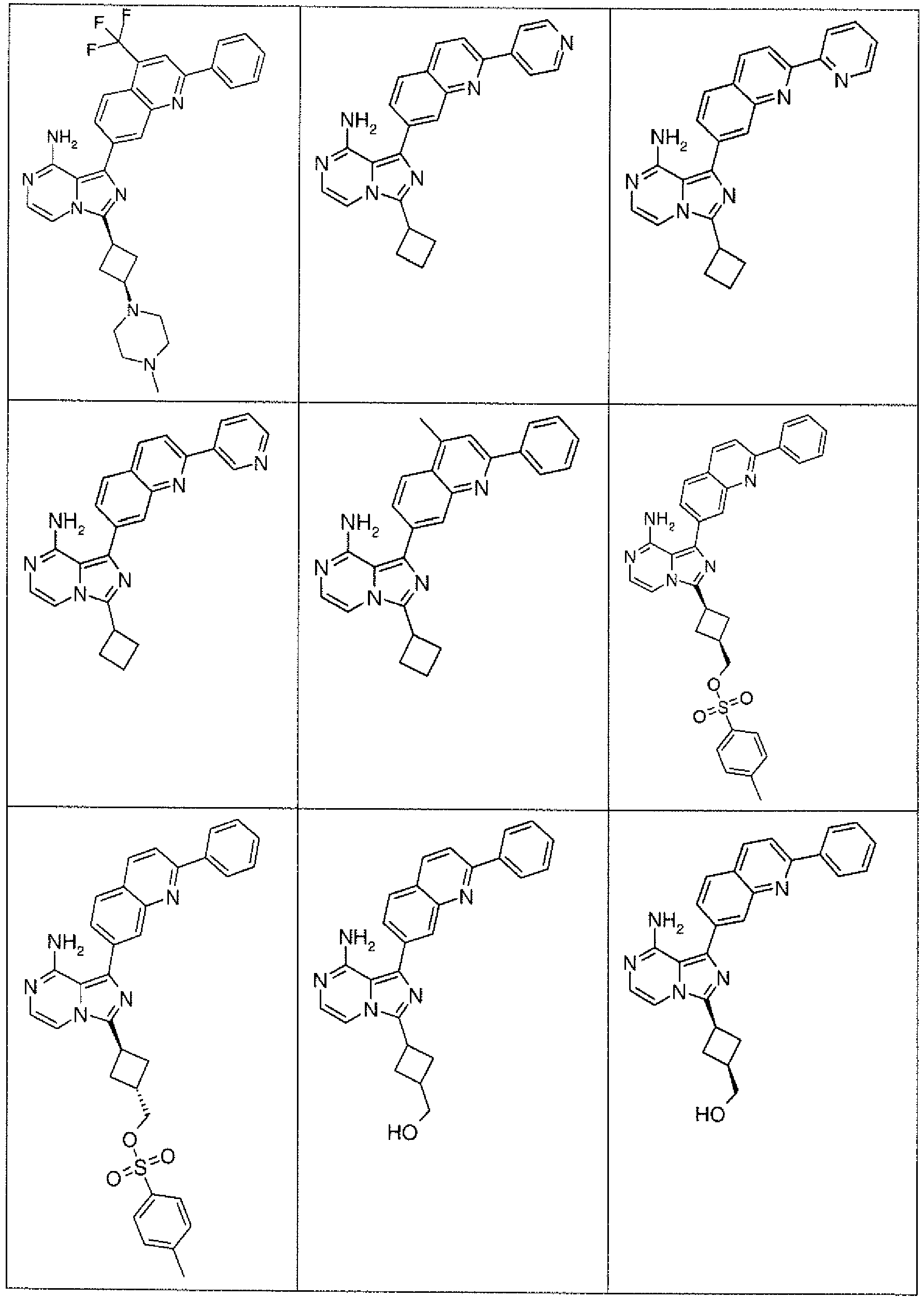


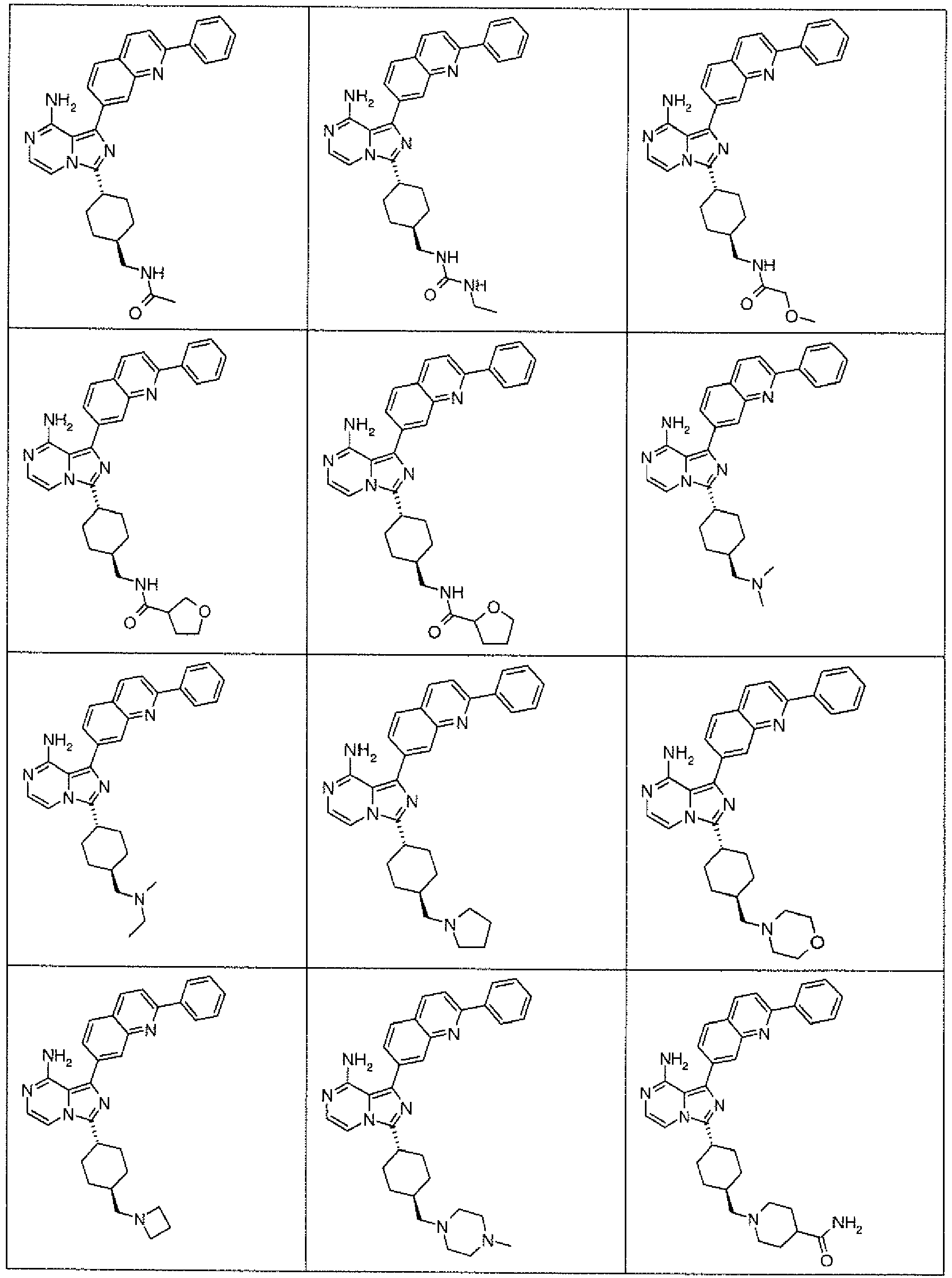


 ; ou
; ou

X Y Z CH H H CH CH3 H CH H F CH CH3 F N H H N CH3 H N H F N CH3 F CF H H CF CH3 H CF H F CF CH3 F 
X Y Z CH H H CH CH3 H CH H F CH CH3 F N H H N CH3 H N H F N CH3 F CF H H CF CH3 H CF H F CF CH3 F 
X Y Z CH H H CH CH3 H CH H F CH CH3 F N H H N CH3 H N H F N CH3 F CF H H CF CH3 H CF H F CF CH3 F 
X Y Z CH H H CH CH3 H CH H F CH CH3 F N H H N CH3 H N H F N CH3 F CF H H CF CH3 H CF H F CF CH3 F 
X Y Z CH H H CH CH3 H CH H F CH CH3 F N H H N CH3 H N H F N CH3 F CF H H CF CH3 H CF H F CF CH3 F 
X Y Z CH H H CH CH3 H CH H F CH CH3 F N H H N CH3 H N H F N CH3 F CF H H CF CH3 H CF H F CF CH3 F 
X Y Z CH H H CH CH3 H CH H F CH CH3 F N H H N CH3 H N H F N CH3 F CF H H CF CH3 H CF H F CF CH3 F 
X Y Z CH H H CH CH3 H CH H F CH CH3 F N H H N CH3 H N H F N CH3 F CF H H CF CH3 H CF H F CF CH3 F 
X Y Z CH H H CH CH3 H CH H F CH CH3 F N H H N CH3 H N H F N CH3 F CF H H CF CH3 H CF H F CF CH3 F 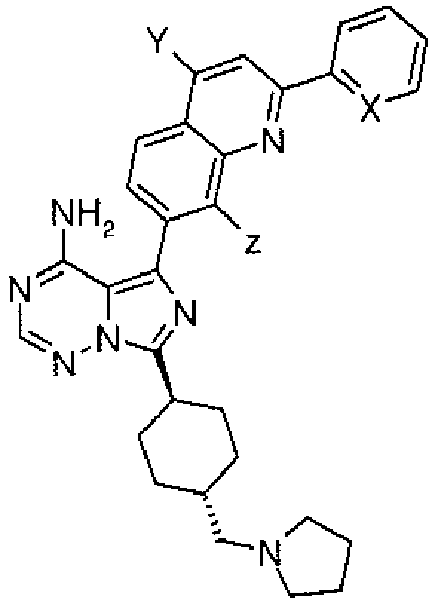
X Y Z CH H H CH CH3 H CH H F CH CH3 F N H H N CH3 H N H F N CH3 F CF H H CF CH3 H CF H F CF CH3 F 
X Y Z CH H H CH CH3 H CH H F CH CH3 F N H H N CH3 H N H F N CH3 F CF H H CF CH3 H CF H F CF CH3 F 
X Y Z CH H H CH CH3 H CH H F CH CH3 F N H H N CH3 H N H F N CH3 F CF H H CF CH3 H CF H F CF CH3 F 
X Y Z CH H H CH CH3 H CH H F CH CH3 F N H H N CH3 H N H F N CH3 F CF H H CF CH3 H CF H F CF CH3 F 
X Y Z CH H H CH CH3 H CH H F CH CH3 F N H H N CH3 H N H F N CH3 F CF H H CF CH3 H CF H F CF CH3 F 
X Y Z CH H H CH CH3 H CH H F CH CH3 F N H H N CH3 H N H F N CH3 F CF H H CF CH3 H CF H F CF CH3 F 
X Y Z CH H H CH CH3 H CH H F CH CH3 F N H H N CH3 H N H F N CH3 F CF H H CF CH3 H CF H F CF CH3 F 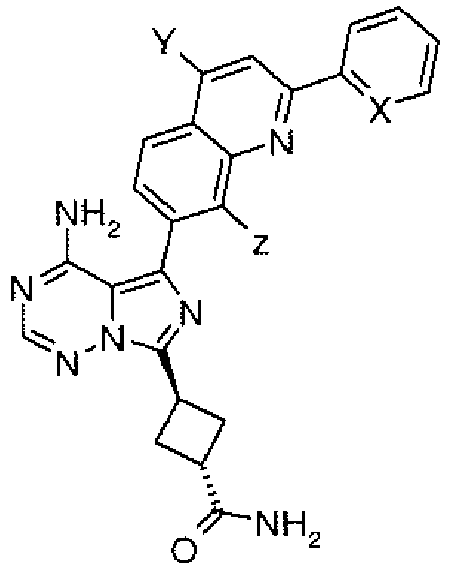
X Y Z CH H H CH CH3 H CH H F CH CH3 F N H H N CH3 H N H F N CH3 F CF H H CF CH3 H CF H F CF CH3 F 
X Y Z CH H H CH CH3 H CH H F CH CH3 F N H H N CH3 H N H F N CH3 F CF H H CF CH3 H CF H F CF CH3 F 
X Y Z CH H H CH CH3 H CH H F CH CH3 F N H H N CH3 H N H F N CH3 F CF H H CF CH3 H CF H F CF CH3 F 
X Y Z CH H H CH CH3 H CH H F CH CH3 F N H H N CH3 H N H F N CH3 F CF H H CF CH3 H CF H F CF CH3 F 
X Y Z CH H H CH CH3 H CH H F CH CH3 F N H H N CH3 H N H F N CH3 F CF H H CF CH3 H CF H F CF CH3 F 
X Y Z CH H H CH CH3 H CH H F CH CH3 F N H H N CH3 H N H F N CH3 F CF H H CF CH3 H CF H F CF CH3 F 
X Y Z CH H H CH CH3 H CH H F CH CH3 F N H H N CH3 H N H F N CH3 F CF H H CF CH3 H CF H F CF CH3 F 
X Y Z G CH H H CH CH CH3 H CH CH H F CH CH CH3 F CH N H H CH N CH3 H CH N H F CH N CH3 F CH CF H H CH CF CH3 H CH CF H F CH CF CH3 F CH CH H H N CH CH3 H N CH H F N CH CH3 F N N H H N N CH3 H N N H F N N CH3 F N CF H H N CF CH3 H N CF H F N CF CH3 F N 
X Y Z G CH H H CH CH CH3 H CH CH H F CH CH CH3 F CH N H H CH N CH3 H CH N H F CH N CH3 F CH CF H H CH CF CH3 H CH CF H F CH CF CH3 F CH CH H H N CH CH3 H N CH H F N CH CH3 F N N H H N N CH3 H N N H F N N CH3 F N CF H H N CF CH3 H N CF H F N CF CH3 F N 
X Y z G CH H H CH CH CH3 H CH CH H F CH CH CH3 F CH N H H CH N CH3 H CH N H F CH N CH3 F CH X Y Z G CF H H CH CF CH3 H CH CF H F CH CF CH3 F CH CH H H N CH CH3 H N CH H F N CH CH3 F N N H H N N CH3 H N N H F N N CH3 F N CF H H N CF CH3 H N CF H F N CF CH3 F N 
X Y z G CH CH3 H CH CH H F CH CH CH3 F CH N H H CH N CH3 H CH N H F CH X Y Z G N CH3 F CH CF H H CH CF CH3 H CH CF H F CH CF CH3 F CH CH H H N CH CH3 H N CH H F N CH CH3 F N N H H N N CH3 H N N H F N N CH3 F N CF H H N CF CH3 H N CF H F N CF CH3 F N 
X Y Z G CH H H CH CH CH3 H CH CH H F CH CH CH3 F CH N H H CH N CH3 H CH N H F CH N CH3 F CH CF H H CH CF CH3 H CH CF H F CH CF CH3 F CH CH H H N CH CH3 H N CH H F N CH CH3 F N N H H N N CH3 H N N H F N N CH3 F N CF H H N CF CH3 H N CF H F N CF CH3 F N 
X Y Z G CH H H CH CH CH3 H CH CH H F CH CH CH3 F CH N H H CH N CH3 H CH N H F CH N CH3 F CH CF H H CH CF CH3 H CH CF H F CH CF CH3 F CH CH H H N CH CH3 H N CH H F N CH CH3 F N N H H N N CH3 H N N H F N N CH3 F N CF H H N CF CH3 H N CF H F N CF CH3 F N 
X Y Z G CH H H CH CH CH3 H CH CH H F CH CH CH3 F CH N H H CH N CH3 H CH N H F CH N CH3 F CH CF H H CH CF CH3 H CH CF H F CH CF CH3 F CH CH H H N CH CH3 H N CH H F N CH CH3 F N N H H N N CH3 H N N H F N N CH3 F N CF H H N CF CH3 H N CF H F N CF CH3 F N 
X Y Z G CH H H CH CH CH3 H CH CH H F CH CH CH3 F CH N H H CH N CH3 H CH N H F CH N CH3 F CH CF H H CH CF CH3 H CH CF H F CH CF CH3 F CH CH H H N CH CH3 H N CH H F N CH CH3 F N N H H N N CH3 H N N H F N N CH3 F N CF H H N CF CH3 H N CF H F N CF CH3 F N 
X Y Z G CH H H CH CH CH3 H CH CH H F CH CH CH3 F CH N H H CH N CH3 H CH N H F CH N CH3 F CH CF H H CH CF CH3 H CH CF H F CH CF CH3 F CH CH H H N CH CH3 H N CH H F N CH CH3 F N N H H N N CH3 H N N H F N N CH3 F N CF H H N CF CH3 H N CF H F N CF CH3 F N 
X Y Z G CH H H CH CH CH3 H CH CH H F CH CH CH3 F CH N H H CH N CH3 H CH N H F CH N CH3 F CH CF H H CH CF CH3 H CH CF H F CH CF CH3 F CH CH H H N CH CH3 H N CH H F N CH CH3 F N N H H N N CH3 H N N H F N N CH3 F N CF H H N CF CH3 H N CF H F N CF CH3 F N 
X Y Z G CH H H CH CH CH3 H CH CH H F CH CH CH3 F CH N H H CH N CH3 H CH N H F CH N CH3 F CH CF H H CH CF CH3 H CH CF H F CH CF CH3 F CH CH H H N CH CH3 H N CH H F N CH CH3 F N N H H N N CH3 H N N H F N N CH3 F N CF H H N CF CH3 H N CF H F N CF CH3 F N 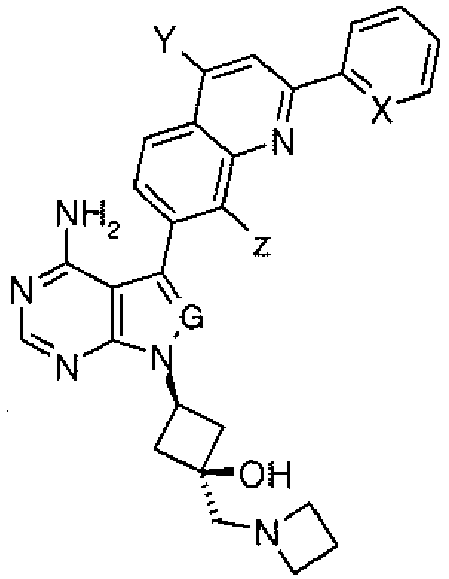
X Y Z G CH H H CH CH CH3 H CH CH H F CH CH CH3 F CH N H H CH N CH3 H CH N H F CH N CH3 F CH CF H H CH CF CH3 H CH CF H F CH CF CH3 F CH CH H H N CH CH3 H N CH H F N CH CH3 F N N H H N N CH3 H N N H F N N CH3 F N CF H H N CF CH3 H N CF H F N CF CH3 F N 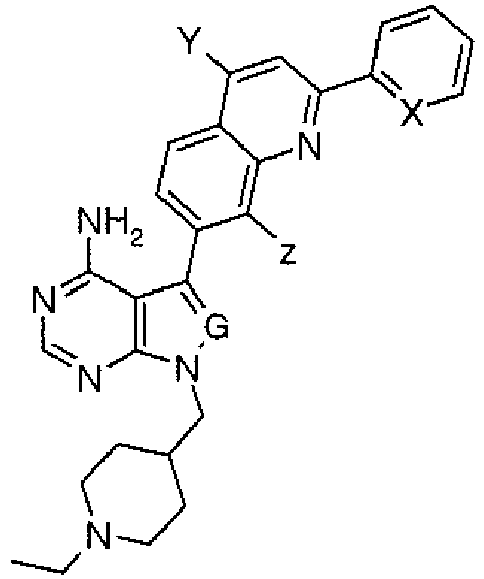
X Y Z G CH H H CH CH CH3 H CH CH H F CH CH CH3 F CH N H H CH N CH3 H CH N H F CH N CH3 F CH CF H H CH CF CH3 H CH CF H F CH CF CH3 F CH CH H H N CH CH3 H N CH H F N CH CH3 F N N H H N N CH3 H N N H F N N CH3 F N CF H H N CF CH3 H N CF H F N CF CH3 F N 
X Y Z G CH H H CH CH CH3 H CH CH H F CH CH CH3 F CH N H H CH N CH3 H CH N H F CH N CH3 F CH CF H H CH CF CH3 H CH CF H F CH CF CH3 F CH CH H H N CH CH3 H N CH H F N CH CH3 F N N H H N N CH3 H N N H F N N CH3 F N CF H H N CF CH3 H N CF H F N CF CH3 F N 
X Y Z G CH H H CH CH CH3 H CH CH H F CH CH CH3 F CH N H H CH N CH3 H CH N H F CH N CH3 F CH CF H H CH CF CH3 H CH CF H F CH CF CH3 F CH CH H H N CH CH3 H N CH H F N CH CH3 F N N H H N N CH3 H N N H F N N CH3 F N CF H H N CF CH3 H N CF H F N CF CH3 F N 
X Y Z G CH H H C-CH3 CH CH3 H CH CH H F CH CH CH3 F CH N H H CH N CH3 H CH N H F CH N CH3 F CH CF H H CH CF CH3 H CH CF H F CH CF CH3 F CH CH H H N CH CH3 H N CH H F N CH CH3 F N N H H N N CH3 H N N H F N N CH3 F N CF H H N CF CH3 H N CF H F N CF CH3 F N 
X Y Z G CH H H C-CH3 CH CH3 H CH CH H F CH CH CH3 F CH N H H CH N CH3 H CH N H F CH N CH3 F CH CF H H CH CF CH3 H CH CF H F CH CF CH3 F CH CH H H N CH CH3 H N CH H F N CH CH3 F N N H H N N CH3 H N N H F N N CH3 F N CF H H N CF CH3 H N CF H F N CF CH3 F N 
X Y Z G CH H H CH CH CH3 H CH CH H F CH CH CH3 F CH N H H CH N CH3 H CH N H F CH N CH3 F CH CF H H CH CF CH3 H CH CF H F CH CF CH3 F CH CH H H N CH CH3 H N CH H F N CH CH3 F N N H H N N CH3 H N N H F N N CH3 F N CF H H N CF CH3 H N CF H F N CF CH3 F N 
X Y Z G CH H H CH CH CH3 H CH CH H F CH CH CH3 F CH N H H CH N CH3 H CH N H F CH N CH3 F CH CF H H CH CF CH3 H CH CF H F CH CF CH3 F CH CH H H N CH CH3 H N CH H F N CH CH3 F N N H H N N CH3 H N N H F N N CH3 F N CF H H N CF CH3 H N CF H F N CF CH3 F N 
X Y Z G CH H H CH CH CH3 H CH CH H F CH CH CH3 F CH N H H CH N CH3 H CH N H F CH N CH3 F CH CF H H CH CF CH3 H CH CF H F CH CF CH3 F CH CH H H N CH CH3 H N CH H F N CH CH3 F N N H H N N CH3 H N N H F N N CH3 F N CF H H N CF CH3 H N CF H F N CF CH3 F N 
X Y Z G CH H H CH CH CH3 H CH CH H F CH CH CH3 F CH N H H CH N CH3 H CH N H F CH N CH3 F CH CF H H CH CF CH3 H CH CF H F CH CF CH3 F CH CH H H N CH CH3 H N CH H F N CH CH3 F N N H H N N CH3 H N N H F N N CH3 F N CF H H N CF CH3 H N CF H F N CF CH3 F N 
X Y Z G CH H H CH CH CH3 H CH CH H F CH CH CH3 F CH N H H CH N CH3 H CH N H F CH N CH3 F CH CF H H CH CF CH3 H CH CF H F CH CF CH3 F CH CH H H N CH CH3 H N CH H F N CH CH3 F N N H H N N CH3 H N N H F N N CH3 F N CF H H N CF CH3 H N CF H F N CF CH3 F N 
X Y Z G CH H H CH CH CH3 H CH CH H F CH CH CH3 F CH N H H CH N CH3 H CH N H F CH N CH3 F CH CF H H CH CF CH3 H CH CF H F CH CF CH3 F CH CH H H N CH CH3 H N CH H F N CH CH3 F N N H H N N CH3 H N N H F N N CH3 F N CF H H N CF CH3 H N CF H F N CF CH3 F N 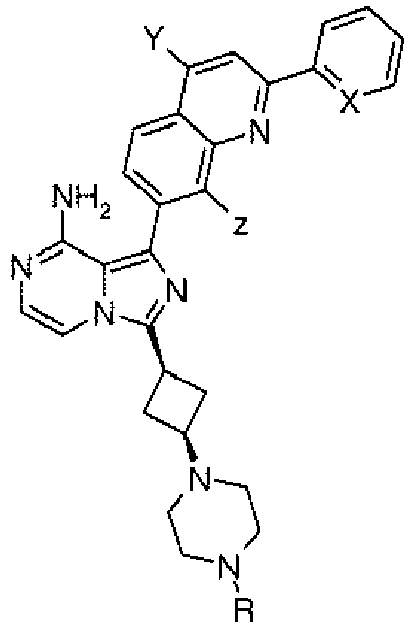
X Y Z R N H H CH3 N CH3 H CH3 N H F CH3 N CH3 F CH3 CF H H CH3 CF CH3 H CH3 CF H F CH3 CF CH3 F CH3 CH H H Ac CH CH3 F Ac N H H Ac N CH3 H Ac N H F Ac N CH3 F Ac CF H H Ac CF CH3 H Ac CF H F Ac CF CH3 F Ac CH CH3 H CO(CF3) CH H F CO(CF3) CH CH3 F CD(CF3) N H H CO(CF3) N CH3 H CO(CF3) N H F CO(CF3) N CH3 F CO(CF3) CF H H CO(CF3) CF CH3 H CO(CF3) CF H F CO(CF3) CF CH3 F CO(CF3) CH H H CO(CH2CH3) CH CH3 H CO(CH2CH3) CH H F CO(CH2CH3) CH CH3 F CO(CH2CH3) N H H CO(CH2CH3) N CH3 H CO(CH2CH3) N H F CO(CH2CH3) N CH3 F CO(CH2CH3) CF H H CO(CH2CH3) CF CH3 H CO(CH2CH3) CF H F CO(CH2CH3) CF CH3 F CO(CH2CH3) CH H H CO(NMe2) CH CH3 H CO(NMe2) CH H F CO(NMe2) CH CH3 F CO(NMe2) N H H CO(NMe2) N CH3 H CO(NMe2) N H F CO(NMe2) N CH3 F CO(NMe2) CF H H CO(NMe2) CF CH3 H CO(NMe2) CF H F CO(NMe2) CF CH3 F CO(NMe2) CH CH3 H CO(iPr) CH H F CO(iPr) CH CH3 F CO(iPr) N H H CO(iPr) N CH3 H CO(iPr) N H F CO(iPr) N CH3 F CO(iPr) CF H H CO(iPr) CF CH3 H CO(iPr) CF H F CO(iPr) CF CH3 F CO(iPr) CH H H CO(CH2OCH3) CH CH3 H CO(CH2OCH3) CH H F CO(CH2OCH3) CH CH3 F CO(CH2OCH3) N H H CO(CH2OCH3) N CH3 H CO(CH2OCH3) N H F CO(CH2OCH3) N CH3 F CO(CH2OCH3) CF H H CO(CH2OCH3) CF CH3 H CO(CH2OCH3) CF H F CO(CH2OCH3) CF CH3 F CO(CH2OCH3) CH H H CO(CH2NMe2) CH CH3 H CO(CH2NMe2) CH H F CO(CH2NMe2) CH CH3 F CO(CH2NMe2) N H H CO(CH2NMe2) N CH3 H CO(CH2NMe2) N H F CO(CH2NMe2) N CH3 F CO(CH2NMe2) CF H H CO(CH2NMe2) CF CH3 H CO(CH2NMe2) CF H F CO(CH2NMe2) CF CH3 F CO(CH2NMe2) CH H H CO2CH3 CH CH3 H CO2CH3 CH H F CO2CH3 CH CH3 F CO2CH3 N H H CO2CH3 N CH3 H CO2CH3 N H F CO2CH3 N CH3 F CO2CH3 CF H H CO2CH3 CF CH3 H CO2CH3 CF H F CO2CH3 CF CH3 F CO2CH3 CH CH3 H CO2CH2CH3 CH H F CO2CH2CH3 CH CH3 F CO2CH2CH3 N H H CO2CH2CH3 N CH3 H CO2CH2CH3 N H F CO2CH2CH3 N CH3 F CO2CH2CH3 CF H H CO2CH2CH3 CF CH3 H CO2CH2CH3 CF H F CO2CH2CH3 CF CH3 F CO2CH2CH3 CH CH3 H Et CH H F Et CH CH3 F Et N H H Et N CH3 H Et N H F Et N CH3 F Et CF H H Et CF CH3 H Et CF H F Et CF CH3 F Et 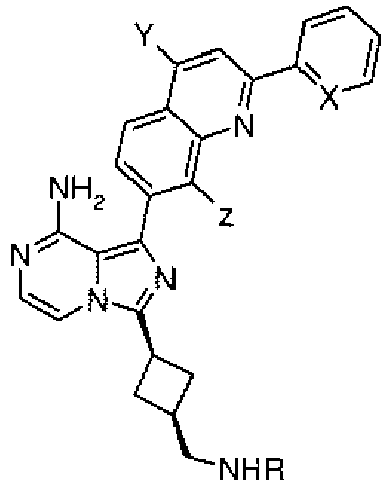
X Y Z R CH CH3 F CH3 N H H CH3 N CH3 H CH3 N H F CH3 N CH3 F CH3 CF H H CH3 CF CH3 H CH3 CF H F CH3 CF CH3 F CH3 CH H H Ac CH CH3 H Ac CH H F Ac CH CH3 F Ac N H H Ac N CH3 H Ac N H F Ac N CH3 F Ac CF H H Ac CF CH3 H Ac CF H F Ac CF CH3 F Ac CH H H CO(CF3) CH CH3 H CO(CF3) CH H F CO(CF3) CH CH3 F CO(CF3) N H H CO(CF3) N CH3 H CO(CF3) N H F CO(CF3) N CH3 F CO(CF3) CF H H CO(CF3) CF CH3 H CO(CF3) CF H F CO(CF3) CF CH3 F CO(CF3) CH H H CO(CH2CH3) CH CH3 H CO(CH2CH3) CH H F CO(CH2CH3) CH CH3 F CO(CH2CH3) N H H CO(CH2CH3) N CH3 H CO(CH2CH3) N H F CO(CH2CH3) N CH3 F CO(CH2CH3) CF H H CO(CH2CH3) CF CH3 H CO(CH2CH3) CF H F CO(CH2CH3) CF CH3 F CO(CH2CH3) CH H H CO(NMe2) CH CH3 H CO(NMe2) CH H F CO(NMe2) CH CH3 F CO(NMe2) N H H CO(NMe2) N CH3 H CO(NMe2) N H F CO(NMe2) N CH3 F CO(NMe2) CF H H CO(NMe2) CF CH3 H CO(NMe2) CF H F CO(NMe2) CF CH3 F CO(NMe2) CH H H CO(iPr) CH CH3 H CO(iPr) CH H F CO(iPr) CH CH3 F CO(iPr) N H H CO(iPr) N CH3 H CO(iPr) N H F CO(iPr) N CH3 F CO(iPr) CF H H CO(iPr) CF CH3 H CO(iPr) CF H F CO(iPr) CF CH3 F CO(iPr) CH H H CO(CH2OCH3) CH CH3 H CO(CH2OCH3) CH H F CO(CH2OCH3) CH CH3 F CO(CH2OCH3) N H H CO(CH2OCH3) N CH3 H CO(CH2OCH3) N H F CO(CH2OCH3) N CH3 F CO(CH2OCH3) CF H H CO(CH2OCH3) CF CH3 H CO(CH2OCH3) CF H F CO(CH2OCH3) CF CH3 F CO(CH2OCH3) CH H H CO(CH2NMe2) CH CH3 H CO(CH2NMe2) CH H F CO(CH2NMe2) CH CH3 F CO(CH2NMe2) N H H CO(CH2NMe2) N CH3 H CO(CH2NMe2) N H F CO(CH2NMe2) N CH3 F CO(CH2NMe2) CF H H CO(CH2NMe2) CF CH3 H CO(CH2NMe2) CF H F CO(CH2NMe2) CF CH3 F CO(CH2NMe2) CH H H CO2CH3 CH CH3 H CO2CH3 CH H F CO2CH3 CH CH3 F CO2CH3 N H H CO2CH3 N CH3 H CO2CH3 N H F CO2CH3 N CH3 F CO2CH3 CF H H CO2CH3 CF CH3 H CO2CH3 CF H F CO2CH3 CF CH3 F CO2CH3 CH H H CO2CH2CH3 CH CH3 H CO2CH2CH3 CH H F CO2CH2CH3 CH CH3 F CO2CH2CH3 N H H CO2CH2CH3 N CH3 H CO2CH2CH3 N H F CO2CH2CH3 N CH3 F CO2CH2CH3 CF H H CO2CH2CH3 CF CH3 H CO2CH2CH3 CF H F CO2CH2CH3 CF CH3 F CO2CH2CH3 CH H H Et CH CH3 H Et CH H F Et CH CH3 F Et N H H Et N CH3 H Et N H F Et N CH3 F Et CF H H Et CF CH3 H Et CF H F Et CF CH3 F Et 
X Y Z R CH CH3 F CH3 CH H F CH3 N H H CH3 N CH3 H CH3 N H F CH3 N CH3 F CH3 CF H H CH3 CF CH3 H CH3 CF H F CH3 CF CH3 F CH3 CH H H Ac CH CH3 H Ac CH H F Ac CH CH3 F Ac N H H Ac N CH3 H Ac N H F Ac N CH3 F Ac CF H H Ac CF CH3 H Ac CF H F Ac CF CH3 F Ac CH H H CO(CF3) CH CH3 H CO(CF3) CH H F CO(CF3) CH CH3 F CO(CF3) N H H CO(CF3) N CH3 H CO(CF3) N H F CO(CF3) N CH3 F CO(CF3) CF H H CO(CF3) CF CH3 H CO(CF3) CF H F CO(CF3) CF CH3 F CO(CF3) CH H H CO(CH2CH3) CH CH3 H CO(CH2CH3) CH H F CO(CH2CH3) CH CH3 F CO(CH2CH3) N H H CO(CH2CH3) N CH3 H CO(CH2CH3) N H F CO(CH2CH3) N CH3 F CO(CH2CH3) CF H H CO(CH2CH3) CF CH3 H CO(CH2CH3) CF H F CO(CH2CH3) CF CH3 F CO(CH2CH3) CH H H CO(NMe2) CH CH3 H CO(NMe2) CH H F CO(NMe2) CH CH3 F CO(NMe2) N H H CO(NMe2) N CH3 H CO(NMe2) N H F CO(NMe2) N CH3 F CO(NMe2) CF H H CO(NMe2) CF CH3 H CO(NMe2) CF H F CO(NMe2) CF CH3 F CO(NMe2) CH H H CO(iPr) CH CH3 H CO(iPr) CH H F CO(iPr) CH CH3 F CO(iPr) N H H CO(iPr) N CH3 H CO(iPr) N H F CO(iPr) N CH3 F CO(iPr) CF H H CO(iPr) CF CH3 H CO(iPr) CF H F CO(iPr) CF CH3 F CO(iPr) CH H H CO(CH2OCH3) CH CH3 H CO(CH2OCH3) CH H F CO(CH2OCH3) CH CH3 F CO(CH2OCH3) N H H CO(CH2OCH3) N CH3 H CO(CH2OCH3) N H F CO(CH2OCH3) N CH3 F CO(CH2OCH3) CF H H CO(CH2OCH3) CF CH3 H CO(CH2OCH3) CF H F CO(CH2OCH3) CF CH3 F CO(CH2OCH3) CH H H CO(CH2NMe2) CH CH3 H CO(CH2NMe2) CH H F CO(CH2NMe2) CH CH3 F CO(CH2NMe2) N H H CO(CH2NMe2) N CH3 H CO(CH2NMe2) N H F CO(CH2NMe2) N CH3 F CO(CH2NMe2) CF H H CO(CH2NMe2) CF CH3 H CO(CH2NMe2) CF H F CO(CH2NMe2) CF CH3 F CO(CH2NMe2) CH H H CO2CH3 CH CH3 H CO2CH3 CH H F CO2CH3 CH CH3 F CO2CH3 N H H CO2CH3 N CH3 H CO2CH3 N H F CO2CH3 N CH3 F CO2CH3 CF H H CO2CH3 CF CH3 H CO2CH3 CF H F CO2CH3 CF CH3 F CO2CH3 CH H H CO2CH2CH3 CH CH3 H CO2CH2CH3 CH H F CO2CH2CH3 CH CH3 F CO2CH2CH3 N H H CO2CH2CH3 N CH3 H CO2CH2CH3 N H F CO2CH2CH3 N CH3 F CO2CH2CH3 CF H H CO2CH2CH3 CF CH3 H CO2CH2CH3 CF H F CO2CH2CH3 CF CH3 F CO2CH2CH3 CH H H Et CH CH3 H Et CH H F Et CH CH3 F Et N H H Et N CH3 H Et N H F Et N CH3 F Et CF H H Et CF CH3 H Et CF H F Et CF CH3 F Et 
X Y Z R CH CH3 F CH3 N H H CH3 N CH3 H CH3 N H F CH3 N CH3 F CH3 CF H H CH3 CF CH3 H CH3 CF H F CH3 CF CH3 F CH3 CH H H iPr CH CH3 H Ac CH H F Ac CH CH3 F Ac N H H Ac N CH3 H Ac N H F Ac N CH3 F Ac CF H H Ac CF CH3 H Ac CF H F Ac CF CH3 F Ac CH H H CO(CF3) CH CH3 H CO(CF3) CH H F CO(CF3) CH CH3 F CO(CF3) N H H CO(CF3) N CH3 H CO(CF3) N H F CO(CF3) N CH3 F CO(CF3) CF H H CO(CF3) CF CH3 H CO(CF3) CF H F CO(CF3) CF CH3 F CO(CF3) CH H H CO(CH2CH3) CH CH3 H CO(CH2CH3) CH H F CO(CH2CH3) CH CH3 F CO(CH2CH3) N H H CO(CH2CH3) N CH3 H CO(CH2CH3) N H F CO(CH2CH3) N CH3 F CO(CH2CH3) CF H H CO(CH2CH3) CF CH3 H CO(CH2CH3) CF H F CO(CH2CH3) CF CH3 F CO(CH2CH3) CH H H CO(NMe2) CH CH3 H CO(NMe2) CH H F CO(NMe2) CH CH3 F CO(NMe2) N H H CO(NMe2) N CH3 H CO(NMe2) N H F CO(NMe2) N CH3 F CO(NMe2) CF H H CO(NMe2) CF CH3 H CO(NMe2) CF H F CO(NMe2) CF CH3 F CO(NMe2) CH H H CO(iPr) CH CH3 H CO(iPr) CH H F CO(iPr) CH CH3 F CO(iPr) N H H CO(iPr) N CH3 H CO(iPr) N H F CO(iPr) N CH3 F CO(iPr) CF H H CO(iPr) CF CH3 H CO(iPr) CF H F CO(iPr) CF CH3 F CO(iPr) CH H H CO(CH2OCH3) CH CH3 H CO(CH2OCH3) CH H F CO(CH2OCH3) CH CH3 F CO(CH2OCH3) N H H CO(CH2OCH3) N CH3 H CO(CH2OCH3) N H F CO(CH2OCH3) N CH3 F CO(CH2OCH3) CF H H CO(CH2OCH3) CF CH3 H CO(CH2OCH3) CF H F CO(CH2OCH3) CF CH3 F CO(CH2OCH3) CH H H CO(CH2NEt2) CH CH3 H CO(CH2NMe2) CH H F CO(CH2MMe2) CH CH3 F CO(CH2NMe2) N H H CO(CH2NMe2) N CH3 H CO(CH2NMe2) N H F CO(CH2NMe2) N CH3 F CO(CH2NMe2) CF H H CO(CH2NMe2) CF CH3 H CO(CH2NMe2) CF H F CO(CH2NMe2) CF CH3 F CO(CH2NMe2) CH H H CO2CH3 CH CH3 H CO2CH3 CH H F CO2CH3 CH CH3 F CO2CH3 N H H CO2CH3 N CH3 H CO2CH3 N H F CO2CH3 N CH3 F CO2CH3 CF H H CO2CH3 CF CH3 H CO2CH3 CF H F CO2CH3 CF CH3 F CO2CH3 CH H H CO2CH2CH3 CH CH3 H CO2CH2CH3 CH H F CO2CH2CH3 CH CH3 F CO2CH2CH3 N H H CO2CH2CH3 N CH3 H CO2CH2CH3 N H F CO2CH2CH3 N CH3 F CO2CH2CH3 CF H H CO2CH2CH3 CF CH3 H CO2CH2CH3 CF H F CO2CH2CH3 CF CH3 F CO2CH2CH3 CH H H Et CH CH3 H Et CH H F Et CH CH3 F Et N H H Et N CH3 H Et N H F Et N CH3 F Et CF H H Et CF CH3 H Et CF H F Et CF CH3 F Et 
X Y Z R CH CH3 F CH3 N H H CH3 N CH3 H CH3 N H F CH3 N CH3 F CH3 CF H H CH3 CF CH3 H CH3 CF H F CH3 CF CH3 F CH3 CH H H iPr CH CH3 H AC CH H F Ac CH CH3 F Ac N H H Ac N CH3 H Ac N H F Ac N CH3 F Ac CF H H Ac CF CH3 H Ac CF H F Ac CF CH3 F Ac CH H H CO(CF3) CH CH3 H CO(CF3) CH H F CO(CF3) CH CH3 F CO(CF3) N H H CO(CF3) N CH3 H CO(CF3) N H F CO(CF3) N CH3 F CO(CF3) CF H H CO(CF3) CF CH3 H CO(CF3) CF H F CO(CF3) CF CH3 F CO(CF3) CH H H CO(CH2CH3) CH CH3 H CO(CH2CH3) CH H F CO(CH2CH3) CH CH3 F CO(CH2CH3) N H H CO(CH2CH3) N CH3 H CO(CH2CH3) N H F CO(CH2CH3) N CH3 F CO(CH2CH3) CF H H CO(CH2CH3) CF CH3 H CO(CH2CH3) CF H F CO(CH2CH3) CF CH3 F CO(CH2CH3) CH H H CO(NMe2) CH CH3 H CO(NMe2) CH H F CO(NMe2) CH CH3 F CO(NMe2) N H H CO(NMe2) N CH3 H CO(NMe2) N H F CO(NMe2) N CH3 F CO(NMe2) CF H H CO(NMe2) CF CH3 H CO(NMe2) CF H F CO(NMe2) CF CH3 F CO(NMe2) CH H H CO(iPr) CH CH3 H CO(iPr) CH H F CO(iPr) CH CH3 F CO(iPr) N H H CO(iPr) N CH3 H CO(iPr) N H F CO(iPr) N CH3 F CO(iPr) CF H H CO(iPr) CF CH3 H CO(iPr) CF H F CO(iPr) CF CH3 F CO(iPr) CH H H CO(CH2OEt) CH CH3 H CO(CH2OCH3) CH H F CO(CH2OCH3) CH CH3 F CO(CH2OCH3) N H H CO(CH2OCH3) N CH3 H CO(CH2OCH3) N H F CO(CH2OCH3) N CH3 F CO(CH2OCH3) CF H H CO(CH2OCH3) CF CH3 H CO(CH2OCH3) CF H F CO(CH2OCH3) CF CH3 F CO(CH2OCH3) CH H H CO(CH2NEt2) CH CH3 H CO(CH2NMe2) CH H F CO(CH2NMe2) CH CH3 F CO(CH2NMe2) N H H CO(CH2NMe2) N CH3 H CO(CH2NMe2) N H F CO(CH2NMe2) N CH3 F CO(CH2NMe2) CF H H CO(CH2NMe2) CF CH3 H CO(CH2NMe2) CF H F CO(CH2NMe2) CF CH3 F CO(CH2NMe2) CH H H CO2CH3 CH CH3 H CO2CH3 CH H F CO2CH3 CH CH3 F CO2CH3 N H H CO2CH3 N CH3 H CO2CH3 N H F CO2CH3 N CH3 F CO2CH3 CF H H CO2CH3 CF CH3 H CO2CH3 CF H F CO2CH3 CF CH3 F CO2CH3 CH H H CO2CH2CH3 CH CH3 H CO2CH2CH3 CH H F CO2CH2CH3 CH CH3 F CO2CH2CH3 N H H CO2CH2CH3 N CH3 H CO2CH2CH3 N H F CO2CH2CH3 N CH3 F CO2CH2CH3 CF H H CO2CH2CH3 CF CH3 H CO2CH2CH3 CF H F CO2CH2CH3 CF CH3 F CO2CH2CH3 CH H H CH2CH2OCH3 CH CH3 H Et CH H F Et CH CH3 F Et N H H Et N CH3 H Et N H F Et N CH3 F Et CF H H Et CF CH3 H Et CF H F Et CF CH3 F Et 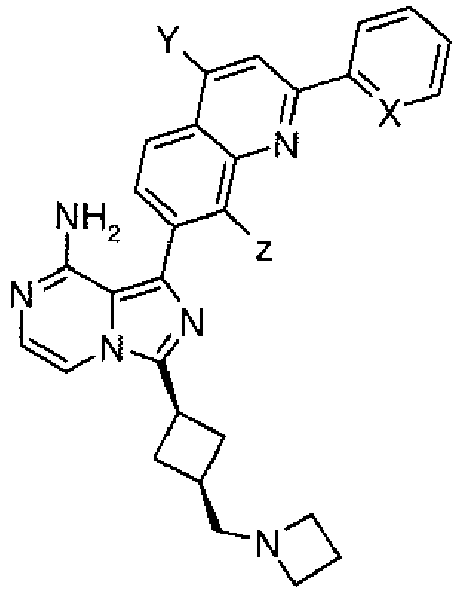
X Y Z CH Et H CH H F CH CH3 F N H H N CH3 H N H F N CH3 F CF H H CF CH3 H CF H F CF CH3 F 
X Y Z CH Et H CH H F CH CH3 F N H H N CH3 H N H F N CH3 F CF H H CF CH3 H CF H F CF CH3 F 
X Y Z CH Et H CH H F CH CH3 F N H H N CH3 H N H F N CH3 F CF H H CF CH3 H CF H F CF CH3 F 
X Y Z CH Et H CH H F CH CH3 F N H H N CH3 H N H F N CH3 F CF H H CF CH3 H CF H F CF CH3 F 
X Y Z CH Et H CH CH3 H CH H F CH CH3 F N H H N CH3 H N H F N CH3 F CF H H CF CH3 H CF H F CF CH3 F 
X Y Z CH Et H CH CH3 H CH H F CH CH3 F N H H N CH3 H N H F N CH3 F CF H H CF CH3 H CF H F CF CH3 F 
X Y Z CH Et H CH CH3 H CH H F CH CH3 F N H H N CH3 H N H F N CH3 F CF H H CF CH3 H CF H F CF CH3 F 
X Y Z CH Et H CH CH3 H CH H F CH CH3 F N H H N CH3 H N H F N CH3 F CF H H CF CH3 H CF H F CF CH3 F 
X Y Z CH Et H CH CH3 F N H H N CH3 H N H F N CH3 F CF H H CF CH3 H CF H F CF CH3 F 
X Y Z CH Et H CH CH3 H CH H F CH CH3 F N H H N CH3 H N H F N CH3 F CF H H CF CH3 H CF H F CF CH3 F 
X Y Z CH Et H CH CH3 H CH H F CH CH3 F N H H N CH3 H N H F N CH3 F CF H H CF CH3 H CF H F CF CH3 F - Composé, ou un sel pharmaceutiquement acceptable de celui-ci, selon l'une quelconque des revendications 1 à 16, pour une utilisation en thérapie.
- Composé, ou un sel pharmaceutiquement acceptable de celui-ci, selon l'une quelconque des revendications 1 à 16, pour une utilisation dans le traitement d'un état qui est à médiation par une activité de protéine kinase, dans lequel ledit état est un trouble hyperprolifératif, un cancer, un état cardiovasculaire, un état oculaire, un état diabétique, un ou plusieurs ulcère(s) du(s) à une infection bactérienne ou fongique, les ulcères de Mooren, un ou plusieurs ulcère(s) constituant un symptôme de recto-colite hémorragique, la maladie de Lyme, une sepsie ou infection par Herpes simplex, Herpes zoster, un virus de l'immunodéficience humaine, un parapoxvirus, un protozoaire, la toxoplasmose, la maladie de von Hippel-Lindau, un pemphigoïde, un psoriasis, la maladie de Paget, une maladie rénale polykystique, une fibrose, une sarcoïdose, une cirrhose, une thyroïdite, le syndrome d'hyperviscosité, la maladie d'Osler-Weber-Rendu, la broncho-pneumopathie chronique obstructive, l'asthme, les exsudats, les ascites, les effusions pleurales, un oedème pulmonaire, un oedème cérébral ou un oedème faisant suite à des brûlures, un traumatisme, une irradiation, un accident vasculaire, une hypoxie, une ischémie, le syndrome d'hyperstimulation ovarienne, une pré-éclampsie, une ménométrorrhagie, une endométriose, une inflammation chronique, un lupus disséminé, une glomérulonéphrite, une synovite, une maladie intestinale inflammatoire, la maladie de Crohn, une glomérulonéphrite, la polyarthrite rhumatoïde et l'arthrose, la sclérose en plaques, un rejet de greffe, une drépanocytose, ou un syndrome de Crow-Fukase (POEMS).
- Composé, ou un sel pharmaceutiquement acceptable de celui-ci, selon la revendication 18, dans lequel ledit état est un cancer et ledit cancer est une tumeur solide, un sarcome, un fibrosarcome, un ostéome, un mélanome, un rétinoblastome, un rhabdomyosarcome, un glioblastome, un neuroblastome, un tératocarcinome, une malignité hématopoïétique, un ascite malin, un sarcome de Kaposi, la maladie de Hodgkin, un lymphome, un myélome, ou une leucémie.
- Composition pharmaceutique comprenant un composé, ou un sel pharmaceutiquement acceptable de celui-ci, selon l'une quelconque des revendications 1 à 16, et un véhicule pharmaceutiquement acceptable.
Priority Applications (3)
| Application Number | Priority Date | Filing Date | Title |
|---|---|---|---|
| EP10185046A EP2308879A1 (fr) | 2004-04-02 | 2005-03-31 | Inhibiteurs hétérobicycliques de la protéine kinase à anneau bicyclique substitué en 6,6 |
| EP10185075A EP2305682A1 (fr) | 2004-04-02 | 2005-03-31 | Inhibiteurs hétérobicycliques de la protéine kinase à anneau bicyclique substitué en 6,6 |
| PL09156987T PL2168968T3 (pl) | 2004-04-02 | 2005-03-31 | Inhibitory kinazy białkowej stanowiące związki heterobicykliczne z podstawionym pierścieniem 6,6-bicyklicznym |
Applications Claiming Priority (2)
| Application Number | Priority Date | Filing Date | Title |
|---|---|---|---|
| US55925004P | 2004-04-02 | 2004-04-02 | |
| EP05742128A EP1740591B1 (fr) | 2004-04-02 | 2005-03-31 | Inhibiteurs de la proteine kinase heterobicycliques a substitution de noyau bicyclique 6,6 |
Related Parent Applications (4)
| Application Number | Title | Priority Date | Filing Date |
|---|---|---|---|
| EP05742128 Previously-Filed-Application | 2005-03-31 | ||
| EP05742128A Division EP1740591B1 (fr) | 2004-04-02 | 2005-03-31 | Inhibiteurs de la proteine kinase heterobicycliques a substitution de noyau bicyclique 6,6 |
| EP05742128A Previously-Filed-Application EP1740591B1 (fr) | 2004-04-02 | 2005-03-31 | Inhibiteurs de la proteine kinase heterobicycliques a substitution de noyau bicyclique 6,6 |
| EP05742128.1 Division | 2005-03-31 |
Related Child Applications (2)
| Application Number | Title | Priority Date | Filing Date |
|---|---|---|---|
| EP10185075A Division-Into EP2305682A1 (fr) | 2004-04-02 | 2005-03-31 | Inhibiteurs hétérobicycliques de la protéine kinase à anneau bicyclique substitué en 6,6 |
| EP10185046A Division-Into EP2308879A1 (fr) | 2004-04-02 | 2005-03-31 | Inhibiteurs hétérobicycliques de la protéine kinase à anneau bicyclique substitué en 6,6 |
Publications (2)
| Publication Number | Publication Date |
|---|---|
| EP2168968A1 EP2168968A1 (fr) | 2010-03-31 |
| EP2168968B1 true EP2168968B1 (fr) | 2017-08-23 |
Family
ID=34967819
Family Applications (4)
| Application Number | Title | Priority Date | Filing Date |
|---|---|---|---|
| EP09156987.1A Expired - Lifetime EP2168968B1 (fr) | 2004-04-02 | 2005-03-31 | Inhibiteurs hétérobicycliques de la protéine kinase à anneau bicyclique substitué en 6,6 |
| EP10185075A Withdrawn EP2305682A1 (fr) | 2004-04-02 | 2005-03-31 | Inhibiteurs hétérobicycliques de la protéine kinase à anneau bicyclique substitué en 6,6 |
| EP05742128A Expired - Lifetime EP1740591B1 (fr) | 2004-04-02 | 2005-03-31 | Inhibiteurs de la proteine kinase heterobicycliques a substitution de noyau bicyclique 6,6 |
| EP10185046A Withdrawn EP2308879A1 (fr) | 2004-04-02 | 2005-03-31 | Inhibiteurs hétérobicycliques de la protéine kinase à anneau bicyclique substitué en 6,6 |
Family Applications After (3)
| Application Number | Title | Priority Date | Filing Date |
|---|---|---|---|
| EP10185075A Withdrawn EP2305682A1 (fr) | 2004-04-02 | 2005-03-31 | Inhibiteurs hétérobicycliques de la protéine kinase à anneau bicyclique substitué en 6,6 |
| EP05742128A Expired - Lifetime EP1740591B1 (fr) | 2004-04-02 | 2005-03-31 | Inhibiteurs de la proteine kinase heterobicycliques a substitution de noyau bicyclique 6,6 |
| EP10185046A Withdrawn EP2308879A1 (fr) | 2004-04-02 | 2005-03-31 | Inhibiteurs hétérobicycliques de la protéine kinase à anneau bicyclique substitué en 6,6 |
Country Status (29)
| Country | Link |
|---|---|
| US (6) | US7534797B2 (fr) |
| EP (4) | EP2168968B1 (fr) |
| JP (2) | JP4832426B2 (fr) |
| KR (1) | KR101079272B1 (fr) |
| CN (2) | CN102924458B (fr) |
| AP (1) | AP2139A (fr) |
| AR (1) | AR048518A1 (fr) |
| AT (1) | ATE433979T1 (fr) |
| AU (1) | AU2005230818B2 (fr) |
| BR (1) | BRPI0509576A (fr) |
| CA (1) | CA2561950C (fr) |
| CY (1) | CY1109372T1 (fr) |
| DE (1) | DE602005014964D1 (fr) |
| DK (1) | DK1740591T3 (fr) |
| EA (1) | EA012873B1 (fr) |
| ES (2) | ES2652440T3 (fr) |
| HR (1) | HRP20090495T1 (fr) |
| IL (1) | IL178419A0 (fr) |
| MX (1) | MXPA06011423A (fr) |
| MY (1) | MY143225A (fr) |
| NO (1) | NO20064895L (fr) |
| PL (2) | PL1740591T3 (fr) |
| PT (2) | PT2168968T (fr) |
| RU (1) | RU2379308C2 (fr) |
| SG (1) | SG163576A1 (fr) |
| SI (1) | SI1740591T1 (fr) |
| TW (2) | TWI378934B (fr) |
| UA (1) | UA89493C2 (fr) |
| WO (1) | WO2005097800A1 (fr) |
Families Citing this family (168)
| Publication number | Priority date | Publication date | Assignee | Title |
|---|---|---|---|---|
| US7429596B2 (en) * | 2003-06-20 | 2008-09-30 | The Regents Of The University Of California | 1H-pyrrolo [2,3-D] pyrimidine derivatives and methods of use thereof |
| UA83509C2 (en) * | 2003-10-15 | 2008-07-25 | Оси Фармасьютикалз, Инк. | Imidazopyrazines as tyrosine kinase inhibitors |
| EP2168968B1 (fr) | 2004-04-02 | 2017-08-23 | OSI Pharmaceuticals, LLC | Inhibiteurs hétérobicycliques de la protéine kinase à anneau bicyclique substitué en 6,6 |
| TW200613306A (en) | 2004-07-20 | 2006-05-01 | Osi Pharm Inc | Imidazotriazines as protein kinase inhibitors |
| EP1831225A2 (fr) * | 2004-11-19 | 2007-09-12 | The Regents of the University of California | Pyrazolopyrimidines anti-inflammatoires |
| ES2365869T3 (es) * | 2005-11-17 | 2011-10-11 | OSI Pharmaceuticals, LLC | COMPUESTOS BICÍCLICOS FUSIONADOS INHIBIDORES DE LA mTOR. |
| AR057960A1 (es) * | 2005-12-02 | 2007-12-26 | Osi Pharm Inc | Inhibidores de proteina quinasa biciclicos |
| TW200730529A (en) * | 2005-12-07 | 2007-08-16 | Osi Pharm Inc | Process to prepare substituted imidazopyrazine compounds |
| US8575164B2 (en) * | 2005-12-19 | 2013-11-05 | OSI Pharmaceuticals, LLC | Combination cancer therapy |
| JP2009520028A (ja) * | 2005-12-19 | 2009-05-21 | オーエスアイ・ファーマスーティカルズ・インコーポレーテッド | Igfr抑制剤および抗癌剤の併用 |
| ES2545907T3 (es) * | 2005-12-29 | 2015-09-16 | Abbvie Inc. | Inhibidores de proteína quinasa |
| CN101003537A (zh) * | 2006-01-17 | 2007-07-25 | 上海恒瑞医药有限公司 | 吡咯并哒嗪类衍生物及其制备方法和用途 |
| TW200738725A (en) * | 2006-01-25 | 2007-10-16 | Osi Pharm Inc | Unsaturated mTOR inhibitors |
| WO2007114926A2 (fr) | 2006-04-04 | 2007-10-11 | The Regents Of The University Of California | Antagonistes de la kinase |
| DE102006016426A1 (de) * | 2006-04-07 | 2007-10-11 | Merck Patent Gmbh | Neuartige Cyclobutyl-Verbindungen als Kinase-Inhibitoren |
| EP2258700A1 (fr) | 2006-05-09 | 2010-12-08 | Pfizer Products Inc. | Dérivés d'acides aminés cycloalkyles et compositions pharmaceutiques les contenant |
| EP2057164A1 (fr) | 2006-08-07 | 2009-05-13 | Incyte Corporation | Utilisation de triazolotriazines en tant qu'inhibiteurs des kinases |
| DE102006043443A1 (de) * | 2006-09-15 | 2008-03-27 | Bayer Healthcare Ag | Neue aza-bicyclische Verbindungen und ihre Verwendung |
| RS54510B1 (sr) | 2006-11-22 | 2016-06-30 | Incyte Holdings Corporation | Imidazotriazini i imidazopirimidini kao inhibitori kinaze |
| WO2008076143A1 (fr) * | 2006-12-18 | 2008-06-26 | Osi Pharmaceuticals, Inc. | Combinaison d'un inhibiteur de l'igfr et d'un agent anticancéreux |
| TW200900070A (en) * | 2007-02-27 | 2009-01-01 | Osi Pharm Inc | Combination cancer therapy |
| CN101730700A (zh) * | 2007-05-09 | 2010-06-09 | 雅培制药有限公司 | 用作蛋白激酶抑制剂的稠合杂环化合物 |
| WO2008141140A1 (fr) * | 2007-05-09 | 2008-11-20 | Abbott Laboratories | Composés hétérocycliques condensés utilisés en tant qu'inhibiteurs de protéines kinases |
| US8124759B2 (en) | 2007-05-09 | 2012-02-28 | Abbott Laboratories | Inhibitors of protein kinases |
| US20090274698A1 (en) * | 2007-07-06 | 2009-11-05 | Shripad Bhagwat | Combination anti-cancer therapy |
| EP2173338A1 (fr) * | 2007-07-06 | 2010-04-14 | OSI Pharmaceuticals, Inc. | Traitement anticancéreux en combinaison |
| RU2399612C2 (ru) * | 2007-09-12 | 2010-09-20 | Учреждение Российской академии медицинских наук Научно-исследовательский институт биомедицинской химии имени В.Н.Ореховича РАМН(ИБМХ РАМН) | Способ выявления соединений, снижающих функциональную активность протеазы вируса иммунодефицита человека, и способ ингибирования димеризации субъединиц протеазы вич |
| JP2010540960A (ja) | 2007-10-03 | 2010-12-24 | オーエスアイ・ファーマスーティカルズ・インコーポレーテッド | インスリン様成長因子−1受容体キナーゼ阻害剤に対する抗癌反応を予測する生物学的マーカー |
| WO2009045389A2 (fr) | 2007-10-03 | 2009-04-09 | Osi Pharmaceuticals, Inc. | Marqueurs biologiques de prédiction de la réponse anti-cancéreuse aux inhibiteurs de la kinase du récepteur 1 du facteur de croissance insulinomimétique de type 1 (igf-1r) |
| GB2467670B (en) | 2007-10-04 | 2012-08-01 | Intellikine Inc | Chemical entities and therapeutic uses thereof |
| US8193182B2 (en) | 2008-01-04 | 2012-06-05 | Intellikine, Inc. | Substituted isoquinolin-1(2H)-ones, and methods of use thereof |
| MX2010007419A (es) | 2008-01-04 | 2010-11-12 | Intellikine Inc | Ciertas entidades quimicas, composiciones y metodos. |
| US20110046144A1 (en) * | 2008-01-18 | 2011-02-24 | Mulvihill Mark J | Imidazopyrazinol derivatives for the treatment of cancers |
| EP2252293B1 (fr) | 2008-03-14 | 2018-06-27 | Intellikine, LLC | Inhibiteurs de kinases, et procédés d utilisation associés |
| US8993580B2 (en) * | 2008-03-14 | 2015-03-31 | Intellikine Llc | Benzothiazole kinase inhibitors and methods of use |
| EP2276763A1 (fr) * | 2008-03-19 | 2011-01-26 | OSI Pharmaceuticals, Inc. | Formes de sel inhibiteur de mtor |
| ES2396613T3 (es) * | 2008-05-19 | 2013-02-22 | OSI Pharmaceuticals, LLC | Imidazopirazinas e imidazotriazinas sustituidas |
| TWI472529B (zh) | 2008-05-21 | 2015-02-11 | Incyte Corp | 2-氟-N-甲基-4-〔7-(喹啉-6-基-甲基)-咪唑并〔1,2-b〕〔1,2,4〕三-2-基〕苯甲醯胺之鹽類及其相關製備方法 |
| WO2010002877A2 (fr) * | 2008-07-03 | 2010-01-07 | Biota Scientific Management | Nucléosides bicycliques et nucléotides convenant comme agents thérapeutiques |
| BRPI0915231A2 (pt) | 2008-07-08 | 2018-06-12 | Intellikine Inc | compostos inibidores de quinase e métodos de uso |
| US20110224223A1 (en) | 2008-07-08 | 2011-09-15 | The Regents Of The University Of California, A California Corporation | MTOR Modulators and Uses Thereof |
| UA103195C2 (uk) | 2008-08-11 | 2013-09-25 | Глаксосмитклайн Ллк | Похідні пурину для застосування у лікуванні алергій, запальних та інфекційних захворювань |
| CA2738429C (fr) | 2008-09-26 | 2016-10-25 | Intellikine, Inc. | Inhibiteurs heterocycliques de kinases |
| EP2358720B1 (fr) | 2008-10-16 | 2016-03-02 | The Regents of The University of California | Inhibiteurs d'hétéroarylkinase à noyau fusionné |
| EP2350317A4 (fr) * | 2008-10-20 | 2012-06-27 | Univ Colorado Regents | Marqueurs biologiques prédictifs d une réponse anticancéreuse à des inhibiteurs de récepteur kinase de facteur de croissance 1 de type insuline |
| US8476431B2 (en) | 2008-11-03 | 2013-07-02 | Itellikine LLC | Benzoxazole kinase inhibitors and methods of use |
| WO2010099139A2 (fr) | 2009-02-25 | 2010-09-02 | Osi Pharmaceuticals, Inc. | Thérapie anti-cancer combinée |
| JP2012519170A (ja) | 2009-02-26 | 2012-08-23 | オーエスアイ・ファーマシューティカルズ,エルエルシー | 生体内の腫瘍細胞のemtステータスをモニターするためのinsitu法 |
| WO2010099363A1 (fr) | 2009-02-27 | 2010-09-02 | Osi Pharmaceuticals, Inc. | Méthodes d'identification d'agents qui inhibent les cellules cancéreuses mésenchymateuses ou leur formation |
| WO2010099364A2 (fr) | 2009-02-27 | 2010-09-02 | Osi Pharmaceuticals, Inc. | Méthodes d'identification d'agents qui inhibent les cellules cancéreuses mésenchymateuses ou leur formation |
| WO2010099138A2 (fr) | 2009-02-27 | 2010-09-02 | Osi Pharmaceuticals, Inc. | Procédés pour l'identification d'agents qui inhibent les cellules tumorales de type mésenchymateuses ou leur formation |
| EP2408479A1 (fr) | 2009-03-18 | 2012-01-25 | OSI Pharmaceuticals, LLC | Plurithérapie contre le cancer comprenant l'administration d'un inhibiteur de l'egfr et d'un inhibiteur de l'igf-1r |
| US8513415B2 (en) | 2009-04-20 | 2013-08-20 | OSI Pharmaceuticals, LLC | Preparation of C-pyrazine-methylamines |
| JP5789252B2 (ja) | 2009-05-07 | 2015-10-07 | インテリカイン, エルエルシー | 複素環式化合物およびその使用 |
| EP2427192A1 (fr) * | 2009-05-07 | 2012-03-14 | OSI Pharmaceuticals, LLC | Utilisation d'osi-906 dans le traitement du carcinome adrénocortical |
| NZ598220A (en) | 2009-08-17 | 2014-02-28 | Intellikine Llc | Heterocyclic compounds and uses thereof |
| CN102596963A (zh) | 2009-09-10 | 2012-07-18 | 诺瓦提斯公司 | 二环杂芳基的醚衍生物 |
| WO2011047384A2 (fr) | 2009-10-16 | 2011-04-21 | The Regents Of The University Of California | Procédés d'inhibition de l'activité ire1 |
| WO2011060112A1 (fr) | 2009-11-12 | 2011-05-19 | Osi Pharmaceuticals, Inc. | Inhibiteurs de tyrosine kinase deutérés |
| WO2011064211A1 (fr) | 2009-11-25 | 2011-06-03 | Novartis Ag | Dérivés hétérocycliques d'hétéroaryles bicycliques à 6 cycles benzéniques accolés de benzène contenant de l'oxygène |
| WO2011083391A2 (fr) | 2010-01-05 | 2011-07-14 | Pfizer Inc. | Biomarqueurs pour une thérapie du cancer par un anti-igf-1r |
| US9765037B2 (en) * | 2010-01-28 | 2017-09-19 | University Of Washington Through Its Center For Commercialization | Compositions and methods for treating toxoplasmosis, cryptosporidiosis, and other apicomplexan protozoan related diseases |
| MX2012008898A (es) | 2010-02-03 | 2012-11-06 | Incyte Corp | Imidazo - [1, 2 - b] [1, 2, 4] triazinas como inhibidores de c - met. |
| US20130137975A1 (en) | 2010-02-09 | 2013-05-30 | OSI Pharmaceuticals, LLC | Pet imaging |
| CA2783665A1 (fr) | 2010-03-03 | 2011-09-09 | OSI Pharmaceuticals, LLC | Marqueurs biologiques predictifs d'une reponse anticancereuse aux inhibiteurs de kinase du recepteur du facteur de croissance insulinique 1 |
| WO2011109572A2 (fr) | 2010-03-03 | 2011-09-09 | OSI Pharmaceuticals, LLC | Marqueurs biologiques prédictifs d'une réponse anticancéreuse aux inhibiteurs de kinase du récepteur du facteur de croissance insulinique 1 |
| EP2544672A1 (fr) | 2010-03-09 | 2013-01-16 | OSI Pharmaceuticals, LLC | Thérapie anticancéreuse combinatoire |
| CA2799579A1 (fr) | 2010-05-21 | 2011-11-24 | Intellikine, Inc. | Composes chimiques, compositions et procedes pour modulation de kinases |
| JP2013528635A (ja) | 2010-06-17 | 2013-07-11 | ノバルティス アーゲー | ビフェニル置換1,3−ジヒドロ−ベンゾイミダゾール−2−イリデンアミン誘導体 |
| WO2011157793A1 (fr) | 2010-06-17 | 2011-12-22 | Novartis Ag | Dérivés de 1,3‑dihydro-benzoimidazol-2-ylidène-amine à substitution pipéridinyle |
| US20130158264A1 (en) * | 2010-06-23 | 2013-06-20 | Arlindo L. Castelhano | Polymorphs of OSI-906 |
| BR112013002321A2 (pt) | 2010-07-30 | 2018-04-24 | Osi Pharmaceuticals Llc | processo para a preparação do composto osi-906 |
| JP2013545749A (ja) | 2010-11-10 | 2013-12-26 | インフィニティー ファーマシューティカルズ, インコーポレイテッド | 複素環化合物及びその使用 |
| ES2637113T3 (es) | 2011-01-10 | 2017-10-10 | Infinity Pharmaceuticals, Inc. | Procedimientos para preparar isoquinolinonas y formas sólidas de isoquinolinonas |
| MX2013008833A (es) | 2011-02-02 | 2013-12-06 | Amgen Inc | Metodos y composiciones relacionadas con la inhibicion de receptor del factor de crecimiento similar a la insulina 1 (igf-1r). |
| WO2012116040A1 (fr) | 2011-02-22 | 2012-08-30 | OSI Pharmaceuticals, LLC | Marqueurs biologiques prédictifs d'une réponse anticancéreuse aux inhibiteurs de la kinase du récepteur du facteur de croissance 1 analogue à l'insuline dans le carcinome hépatocellulaire |
| US9295673B2 (en) | 2011-02-23 | 2016-03-29 | Intellikine Llc | Combination of mTOR inhibitors and P13-kinase inhibitors, and uses thereof |
| KR101548443B1 (ko) | 2011-02-23 | 2015-08-28 | 화이자 인코포레이티드 | 신경 장애의 치료를 위한 이미다조[5,1-f][1,2,4]트라이아진 |
| WO2012122338A1 (fr) * | 2011-03-08 | 2012-09-13 | Abbott Laboratories | Procédé de préparation de dérivés 1,2,4-oxadiazol-3-yle d'acide carboxylique |
| JP2014507465A (ja) | 2011-03-08 | 2014-03-27 | ノバルティス アーゲー | フルオロフェニル二環式ヘテロアリール化合物 |
| WO2012129145A1 (fr) | 2011-03-18 | 2012-09-27 | OSI Pharmaceuticals, LLC | Polythérapie du cancer du poumon non à petites cellules (nsclc) |
| US8471027B2 (en) | 2011-04-06 | 2013-06-25 | Hoffmann-La Roche Inc. | Adamantyl compounds |
| WO2012149014A1 (fr) | 2011-04-25 | 2012-11-01 | OSI Pharmaceuticals, LLC | Utilisation de signatures de gènes de tem dans la découverte de médicaments contre le cancer, diagnostics et traitement du cancer |
| HK1198443A1 (en) | 2011-07-19 | 2015-04-24 | 无限药品股份有限公司 | Heterocyclic compounds and uses thereof |
| EP3689878B1 (fr) | 2011-07-19 | 2021-10-06 | Merck Sharp & Dohme B.V. | 4-imidazopyridazin-1-yl-benzamides et 4-imidazotriazin-1-yl-benzamides en tant qu'inhibiteurs btk |
| AR088218A1 (es) | 2011-07-19 | 2014-05-21 | Infinity Pharmaceuticals Inc | Compuestos heterociclicos utiles como inhibidores de pi3k |
| EP2548877A1 (fr) | 2011-07-19 | 2013-01-23 | MSD Oss B.V. | Dérivés de 4-(pyridine condensée à 5 chaînons)benzamide comme inhibiteurs de BTK |
| HRP20181667T1 (hr) | 2011-07-22 | 2018-12-14 | Glaxosmithkline Llc | Pripravak |
| MX2014002542A (es) | 2011-08-29 | 2014-07-09 | Infinity Pharmaceuticals Inc | Compuestos heterociclicos y usos de los mismos. |
| CA2846496C (fr) | 2011-09-02 | 2020-07-14 | The Regents Of The University Of California | Pyrazolo[3,4-d]pyrimidines substituees et utilisations de celles-ci |
| WO2013071056A2 (fr) | 2011-11-11 | 2013-05-16 | Duke University | Polythérapie médicamenteuse pour le traitement de tumeurs solides |
| UY34484A (es) | 2011-12-15 | 2013-07-31 | Bayer Ip Gmbh | Benzotienilo-pirrolotriazinas disustituidas y sus usos |
| CN104159900B (zh) | 2011-12-15 | 2016-08-24 | 拜耳知识产权有限责任公司 | 取代的苯并噻吩基-吡咯并三嗪及其在癌症治疗中的用途 |
| JP6082033B2 (ja) | 2012-02-23 | 2017-02-15 | バイエル・インテレクチュアル・プロパティ・ゲゼルシャフト・ミット・ベシュレンクテル・ハフツングBayer Intellectual Property GmbH | 置換ベンゾチエニル−ピロロトリアジンおよびその使用 |
| WO2013152252A1 (fr) | 2012-04-06 | 2013-10-10 | OSI Pharmaceuticals, LLC | Polythérapie antinéoplasique |
| US8940742B2 (en) | 2012-04-10 | 2015-01-27 | Infinity Pharmaceuticals, Inc. | Heterocyclic compounds and uses thereof |
| US8828998B2 (en) | 2012-06-25 | 2014-09-09 | Infinity Pharmaceuticals, Inc. | Treatment of lupus, fibrotic conditions, and inflammatory myopathies and other disorders using PI3 kinase inhibitors |
| US8980259B2 (en) | 2012-07-20 | 2015-03-17 | Novartis Ag | Combination therapy |
| EA026354B1 (ru) | 2012-08-24 | 2017-03-31 | ГЛАКСОСМИТКЛАЙН ЭлЭлСи | Пиразолопиримидиновые соединения |
| JP2015532287A (ja) | 2012-09-26 | 2015-11-09 | ザ・リージエンツ・オブ・ザ・ユニバーシテイー・オブ・カリフオルニア | Ire1の調節 |
| AU2013337717B2 (en) | 2012-11-01 | 2018-10-25 | Infinity Pharmaceuticals, Inc. | Treatment of cancers using PI3 kinase isoform modulators |
| AU2013348217B2 (en) | 2012-11-20 | 2016-10-06 | Glaxosmithkline Llc | Novel compounds |
| BR112015011439A2 (pt) | 2012-11-20 | 2017-07-11 | Glaxosmithkline Llc | composto, composição farmacêutica, composição de vacina, e, uso de um composto |
| EA028480B1 (ru) | 2012-11-20 | 2017-11-30 | ГЛАКСОСМИТКЛАЙН ЭлЭлСи | Новые соединения |
| US20140206681A1 (en) | 2013-01-23 | 2014-07-24 | Ronald M. Kim | Btk inhibitors |
| WO2014113942A1 (fr) | 2013-01-23 | 2014-07-31 | Merck Sharp & Dohme Corp. | Inhibiteurs de btk |
| US9481667B2 (en) | 2013-03-15 | 2016-11-01 | Infinity Pharmaceuticals, Inc. | Salts and solid forms of isoquinolinones and composition comprising and methods of using the same |
| WO2014153509A1 (fr) | 2013-03-22 | 2014-09-25 | Millennium Pharmaceuticals, Inc. | Combinaison d'inhibiteurs catalytiques de mtorc1/2 et inhibiteurs sélectifs de la kinase aurora a |
| CA2913035C (fr) | 2013-05-20 | 2017-08-01 | University Of Washington Through Its Center For Commercialization | Inhibiteurs 5-aminopyrazole-4-carboxamide de cdpk1 issues de t. gondii et c. parvum |
| US9751888B2 (en) | 2013-10-04 | 2017-09-05 | Infinity Pharmaceuticals, Inc. | Heterocyclic compounds and uses thereof |
| PT3052485T (pt) | 2013-10-04 | 2021-10-22 | Infinity Pharmaceuticals Inc | Compostos heterocíclicos e suas utilizações |
| CA2922058A1 (fr) * | 2013-10-18 | 2015-04-23 | Medivation Technologies, Inc. | Composes heterocycliques et procedes d'utilisation |
| CN105979948A (zh) | 2013-12-05 | 2016-09-28 | 安塞塔制药公司 | Pi3k抑制剂和btk抑制剂的治疗组合 |
| WO2015094929A1 (fr) * | 2013-12-18 | 2015-06-25 | Merck Sharp & Dohme Corp. | Inhibiteurs d'erk |
| WO2015095099A1 (fr) | 2013-12-20 | 2015-06-25 | Merck Sharp & Dohme Corp. | Inhibiteurs de btk |
| US9834554B2 (en) | 2013-12-20 | 2017-12-05 | Merck Sharp & Dohme Corp. | BTK inhibitors |
| US10272083B2 (en) | 2014-01-21 | 2019-04-30 | Acerta Pharma B.V. | Methods of treating chronic lymphocytic leukemia and small lymphocytic leukemia using a BTK inhibitor |
| MX382033B (es) | 2014-03-19 | 2025-03-13 | Infinity Pharmaceuticals Inc | Compuestos heterocíclicos para utilizarlos en el tratamiento de trastornos mediados por pi3k-gamma. |
| US9937171B2 (en) | 2014-04-11 | 2018-04-10 | Acerta Pharma B.V. | Methods of blocking the CXCR-4/SDF-1 signaling pathway with inhibitors of bruton's tyrosine kinase |
| WO2015160975A2 (fr) | 2014-04-16 | 2015-10-22 | Infinity Pharmaceuticals, Inc. | Polythérapies |
| US9949971B2 (en) | 2014-06-17 | 2018-04-24 | Acerta Pharma B.V. | Therapeutic combinations of a BTK inhibitor, a PI3K inhibitor and/or a JAK-2 inhibitor |
| PL3179991T3 (pl) | 2014-08-11 | 2022-02-14 | Acerta Pharma B.V. | Kombinacje terapeutyczne inhibitora btk i inhibitora bcl-2 |
| WO2016054491A1 (fr) | 2014-10-03 | 2016-04-07 | Infinity Pharmaceuticals, Inc. | Composés hétérocycliques et leurs utilisations |
| KR102562866B1 (ko) * | 2014-11-14 | 2023-08-04 | 네르비아노 메디칼 사이언시스 에스.알.엘. | 단백질 키나아제 억제제로서의 6-아미노-7-바이사이클로-7-데아자-퓨린 유도체 |
| WO2016106629A1 (fr) | 2014-12-31 | 2016-07-07 | Merck Sharp & Dohme Corp. | Inhibiteurs de btk |
| WO2016106626A1 (fr) | 2014-12-31 | 2016-07-07 | Merck Sharp & Dohme Corp. | Analogues de l'imidazopyrazine avec substitutions sur carbone tertiaire 3 en tant qu'inhibiteurs de btk |
| WO2016106628A1 (fr) | 2014-12-31 | 2016-07-07 | Merck Sharp & Dohme Corp. | Inhibiteurs de btk |
| WO2016106623A1 (fr) | 2014-12-31 | 2016-07-07 | Merck Sharp & Dohme Corp. | Composés benzamides et imidazopyrazines utilisés comme inhibiteurs de la btk |
| WO2016106624A1 (fr) | 2014-12-31 | 2016-07-07 | Merck Sharp & Dohme Corp. | Inhibiteurs de la btk comprenant une imidazopyrazine d'alcool tertiaire |
| CA2974702C (fr) * | 2015-01-26 | 2023-10-10 | University Of Washington | Compositions et methodes de traitement de la toxoplasmose, de la cryptosporidiose et d'autres maladies associees a un protozoaire apicomplexe |
| JO3627B1 (ar) * | 2015-04-30 | 2020-08-27 | H Lundbeck As | إيميدازو بيرازينونات على هيئة مثبطات pde1 |
| HUE062258T2 (hu) | 2015-07-02 | 2023-10-28 | Acerta Pharma Bv | (S)-4-(8-amino-3-(1-(but-2-inoil)pirrolidin-2-il)imidazo[1,5-a]pirazin-1-il)-N-(piridin-2-il)benzamid szilárd alakjai és készítményei |
| CN108137514A (zh) * | 2015-07-30 | 2018-06-08 | 百时美施贵宝公司 | 芳基取代的二环杂芳基化合物 |
| WO2017027883A1 (fr) | 2015-08-13 | 2017-02-16 | San Diego State University Research Foundation | Atropisomérisme pour une sélectivité accrue des inhibiteurs de kinase |
| BR112018003588A2 (pt) | 2015-08-26 | 2018-09-25 | Blueprint Medicines Corp | compostos e composições úteis para tratamento de distúrbios relacionados ao ntrk |
| WO2017048702A1 (fr) | 2015-09-14 | 2017-03-23 | Infinity Pharmaceuticals, Inc. | Formes solides de dérivés d'isoquinolinone, leur procédé de fabrication, compositions les comprenant et méthodes d'utilisation de celles-ci |
| SG10201912607SA (en) | 2015-11-19 | 2020-02-27 | Blueprint Medicines Corp | Compounds and compositions useful for treating disorders related to ntrk |
| WO2017129763A1 (fr) | 2016-01-28 | 2017-08-03 | INSERM (Institut National de la Santé et de la Recherche Médicale) | Méthodes et compositions pharmaceutiques pour le traitement du cancer de l'estomac à cellules en bague à chaton |
| WO2017156350A1 (fr) | 2016-03-09 | 2017-09-14 | K-Gen, Inc. | Méthodes de traitement du cancer |
| WO2017161116A1 (fr) | 2016-03-17 | 2017-09-21 | Infinity Pharmaceuticals, Inc. | Isotopologues de composés isoquinolinone et quinazolinone et leurs utilisations comme inhibiteurs de la kinase pi3k |
| KR102483020B1 (ko) | 2016-03-28 | 2023-01-04 | 인사이트 코포레이션 | Tam 저해제로서의 피롤로트리아진 화합물 |
| WO2017214269A1 (fr) | 2016-06-08 | 2017-12-14 | Infinity Pharmaceuticals, Inc. | Composés hétérocycliques et leurs utilisations |
| SG11201811237WA (en) | 2016-06-24 | 2019-01-30 | Infinity Pharmaceuticals Inc | Combination therapies |
| CA3047002A1 (fr) * | 2017-01-17 | 2018-07-26 | Board Of Regents, The University Of Texas System | Nouveaux composes utiles en tant qu'inhibteurs de l'indoleamine 2,3-dioxygenase et/ou du tryptophane dioxygenase |
| CN108658990B (zh) * | 2017-03-31 | 2021-03-23 | 南京科技职业学院 | 一类新型咪唑并[1,5-a]吡嗪类布鲁顿激酶抑制剂 |
| MA50655B1 (fr) | 2017-09-27 | 2021-11-30 | Incyte Corp | Sels de dérivés de pyrrolotriazine utiles en tant qu'inhibiteurs de tam |
| KR20190043437A (ko) | 2017-10-18 | 2019-04-26 | 씨제이헬스케어 주식회사 | 단백질 키나제 억제제로서의 헤테로고리 화합물 |
| CN108003163B (zh) * | 2017-11-30 | 2020-11-24 | 武汉九州钰民医药科技有限公司 | 用作激酶抑制剂的吡唑并嘧啶类化合物及其应用 |
| CA3102279A1 (fr) | 2018-06-01 | 2019-12-05 | Cornell University | Polytherapie pour maladie ou trouble associe a pi3k |
| AR117600A1 (es) | 2018-06-29 | 2021-08-18 | Incyte Corp | Formulaciones de un inhibidor de axl / mer |
| WO2020010197A1 (fr) | 2018-07-05 | 2020-01-09 | Incyte Corporation | Dérivés de pyrazine fusionnés en tant qu'inhibiteurs d'a2a/a2b |
| KR102195348B1 (ko) | 2018-11-15 | 2020-12-24 | 에이치케이이노엔 주식회사 | 단백질 키나제 억제제로서의 신규 화합물 및 이를 포함하는 약제학적 조성물 |
| EA202192575A1 (ru) | 2019-03-21 | 2022-01-14 | Онксео | Соединения dbait в сочетании с ингибиторами киназ для лечения рака |
| EP3969442A4 (fr) * | 2019-05-17 | 2023-08-02 | Kinnate Biopharma Inc. | Inhibiteurs des kinases du récepteur du facteur de croissance des fibroblastes |
| AU2020337958A1 (en) | 2019-08-28 | 2022-03-17 | Horizon Therapeutics Ireland Dac | Methods for the treatment of thyroid eye disease |
| WO2021038540A1 (fr) | 2019-08-31 | 2021-03-04 | Sun Pharma Advanced Research Company Limited | Acides cycloalkylidènecarboxyliques et dérivés en tant qu'inhibiteurs de la btk |
| CN114761006A (zh) | 2019-11-08 | 2022-07-15 | Inserm(法国国家健康医学研究院) | 对激酶抑制剂产生耐药性的癌症的治疗方法 |
| US12522606B2 (en) | 2020-01-09 | 2026-01-13 | University Of Washington | Modified pyrrolo- and pyrazolo-pyrimidines for prostate cancer therapy |
| WO2021148581A1 (fr) | 2020-01-22 | 2021-07-29 | Onxeo | Nouvelle molécule dbait et son utilisation |
| US11862306B1 (en) | 2020-02-07 | 2024-01-02 | Cvs Pharmacy, Inc. | Customer health activity based system for secure communication and presentation of health information |
| WO2021178779A1 (fr) | 2020-03-06 | 2021-09-10 | Incyte Corporation | Polythérapie comprenant des inhibiteurs d'axl/mer et de pd-1/pd-l1 |
| US11345681B1 (en) * | 2020-06-05 | 2022-05-31 | Kinnate Biopharma Inc. | Inhibitors of fibroblast growth factor receptor kinases |
| CN116096707A (zh) * | 2020-06-05 | 2023-05-09 | 金耐特生物制药公司 | 成纤维细胞生长因子受体激酶的抑制剂 |
| CN113740539B (zh) * | 2021-08-11 | 2023-07-25 | 中元汇吉生物技术股份有限公司 | 一种测定特异性生长因子的试剂盒 |
| CN114920745B (zh) * | 2022-03-28 | 2024-05-24 | 深圳海博为药业有限公司 | 一种咪唑并吡嗪类化合物及其作为igf1r抑制剂的应用 |
| WO2024263609A1 (fr) | 2023-06-20 | 2024-12-26 | Sling Therapeutics, Inc. | Sels cristallins de linsitinib pour traiter le cancer |
| US11976074B1 (en) | 2023-06-20 | 2024-05-07 | Sling Therapeutics, Inc. | Crystalline salts of Linsitinib |
| AU2024287547A1 (en) | 2023-07-07 | 2026-01-22 | Viridian Therapeutics, Inc. | Methods of treating chronic thyroid eye disease |
Family Cites Families (110)
| Publication number | Priority date | Publication date | Assignee | Title |
|---|---|---|---|---|
| BE791025A (fr) | 1971-11-19 | 1973-05-07 | Allen & Hanburys Ltd | Composes heterocycliques |
| US5217999A (en) | 1987-12-24 | 1993-06-08 | Yissum Research Development Company Of The Hebrew University Of Jerusalem | Styryl compounds which inhibit EGF receptor protein tyrosine kinase |
| WO1991015495A1 (fr) | 1990-04-02 | 1991-10-17 | Pfizer Inc. | Composes d'acide benzylphosphonique utilises comme inhibiteurs de la tyrosine kinase |
| US5302606A (en) | 1990-04-16 | 1994-04-12 | Rhone-Poulenc Rorer Pharmaceuticals Inc. | Styryl-substituted pyridyl compounds which inhibit EGF receptor tyrosine kinase |
| US5276028A (en) * | 1990-06-22 | 1994-01-04 | Nordisk A/S | Imidazoquinoxaline compounds |
| SG64322A1 (en) | 1991-05-10 | 1999-04-27 | Rhone Poulenc Rorer Int | Bis mono and bicyclic aryl and heteroaryl compounds which inhibit egf and/or pdgf receptor tyrosine kinase |
| US6645969B1 (en) | 1991-05-10 | 2003-11-11 | Aventis Pharmaceuticals Inc. | Aryl and heteroaryl quinazoline compounds which inhibit CSF-1R receptor tyrosine kinase |
| FI935279L (fi) | 1991-05-29 | 1993-11-26 | Pfizer | Tricykliska polyhydroxyltyrosinkinasininhibitorer |
| JP2914407B2 (ja) | 1991-09-11 | 1999-06-28 | 富士電機株式会社 | 自動販売機 |
| MX9304801A (es) | 1992-08-06 | 1997-06-28 | Warner Lambert Co | 2-toindoles (selenoidoles) disulfuros (seleniduros) relacinados, los cuales inhiben a las proteinas tirosina cinasas y los cuales tienen propiedades anti-tumorales. |
| WO1994003427A1 (fr) | 1992-08-06 | 1994-02-17 | Warner-Lambert Company | 2-thioindoles (selenoindoles) et disulfures associes (seleniures) inhibant les tyrosine kinases et presentant des proprietes antitumorales |
| GB9226855D0 (en) | 1992-12-23 | 1993-02-17 | Erba Carlo Spa | Vinylene-azaindole derivatives and process for their preparation |
| JPH07133280A (ja) | 1993-11-09 | 1995-05-23 | Takeda Chem Ind Ltd | セフェム化合物、その製造法および抗菌組成物 |
| US20030108545A1 (en) | 1994-02-10 | 2003-06-12 | Patricia Rockwell | Combination methods of inhibiting tumor growth with a vascular endothelial growth factor receptor antagonist |
| DE59500788D1 (de) * | 1994-05-03 | 1997-11-20 | Ciba Geigy Ag | Pyrrolopyrimidinderivate mit antiproliferativer Wirkung |
| GB9624482D0 (en) | 1995-12-18 | 1997-01-15 | Zeneca Phaema S A | Chemical compounds |
| CH690773A5 (de) | 1996-02-01 | 2001-01-15 | Novartis Ag | Pyrrolo(2,3-d)pyrimide und ihre Verwendung. |
| AU2103097A (en) | 1996-03-15 | 1997-10-10 | Zeneca Limited | Cinnoline derivatives and use as medicine |
| UA54427C2 (uk) | 1996-05-01 | 2003-03-17 | Елі Ліллі Енд Компані | Спосіб лікування очних захворювань, які пов'язані з фактором васкулярного ендотеліального росту |
| CZ350098A3 (cs) | 1996-05-01 | 1999-11-17 | Eli Lilly And Company | Způsob léčení neoplasie |
| US6232299B1 (en) | 1996-05-01 | 2001-05-15 | Eli Lilly And Company | Use of protein kinase C inhibitors to enhance the clinical efficacy of oncolytic agents and radiation therapy |
| GB9707800D0 (en) | 1996-05-06 | 1997-06-04 | Zeneca Ltd | Chemical compounds |
| US5932242A (en) | 1996-10-15 | 1999-08-03 | The Liposome Company, Inc. | Ether lipid-containing pharmaceutical compositions and therapeutic uses thereof |
| US7863444B2 (en) * | 1997-03-19 | 2011-01-04 | Abbott Laboratories | 4-aminopyrrolopyrimidines as kinase inhibitors |
| ZA200007412B (en) | 1998-05-15 | 2002-03-12 | Imclone Systems Inc | Treatment of human tumors with radiation and inhibitors of growth factor receptor tyrosine kinases. |
| ES2253930T3 (es) * | 1998-09-18 | 2006-06-01 | ABBOTT GMBH & CO. KG | 4-aminopirrolopirimidinas como inhibidores de quinasa. |
| RU2001111033A (ru) * | 1998-09-18 | 2003-05-20 | Басф Акциенгезелльшафт (De) | Пирролопиримидины в качестве ингибиторов протеинкиназ |
| US6713474B2 (en) | 1998-09-18 | 2004-03-30 | Abbott Gmbh & Co. Kg | Pyrrolopyrimidines as therapeutic agents |
| ID29028A (id) | 1998-09-18 | 2001-07-26 | Basf Ag | Pirolopirimidina sebagai penghambat protein kinase |
| WO2000035455A1 (fr) | 1998-12-15 | 2000-06-22 | Telik, Inc. | Urees heteroaryle-aryle utilisees comme antagonistes du recepteur igf-1 |
| US6383790B1 (en) * | 1999-01-11 | 2002-05-07 | Princeton University | High affinity protein kinase inhibitors |
| CZ20014083A3 (cs) | 1999-05-14 | 2002-08-14 | Imclone Systems Incorporated | Léčivo pro indikaci růstu refrakterních nádorů |
| JP4649046B2 (ja) | 1999-05-21 | 2011-03-09 | ブリストル−マイヤーズ スクイブ カンパニー | キナーゼのピロロトリアジン阻害剤 |
| US6982265B1 (en) | 1999-05-21 | 2006-01-03 | Bristol Myers Squibb Company | Pyrrolotriazine inhibitors of kinases |
| HUP0203162A3 (en) | 1999-08-12 | 2006-07-28 | Wyeth Holdings Corp Madison | Nsaid and efgr kinase inhibitor containing composition for the treatment or inhibition of colonic polyps and colorectal cancer |
| GB9919558D0 (en) | 1999-08-18 | 1999-10-20 | Hoechst Schering Agrevo Gmbh | Fungicidal compounds |
| US6137880A (en) * | 1999-08-27 | 2000-10-24 | Westell Technologies, Inc. | Passive splitter filter for digital subscriber line voice communication for complex impedance terminations |
| US7087613B2 (en) | 1999-11-11 | 2006-08-08 | Osi Pharmaceuticals, Inc. | Treating abnormal cell growth with a stable polymorph of N-(3-ethynylphenyl)-6,7-bis(2-methoxyethoxy)-4-quinazolinamine hydrochloride |
| AU2000240570A1 (en) | 2000-03-29 | 2001-10-08 | Knoll Gesellschaft Mit Beschraenkter Haftung | Pyrrolopyrimidines as tyrosine kinase inhibitors |
| GB0008368D0 (en) | 2000-04-06 | 2000-05-24 | Astrazeneca Ab | Combination product |
| GB0017635D0 (en) | 2000-07-18 | 2000-09-06 | Pharmacia & Upjohn Spa | Antitumor combined therapy |
| WO2002045653A2 (fr) | 2000-12-08 | 2002-06-13 | Uab Research Foundation | Radiotherapie et chimiotherapie combinees avec l'administration d'un anticorps du recepteur du facteur de croissance |
| KR100983997B1 (ko) | 2001-01-09 | 2010-09-28 | 메르크 파텐트 게엠베하 | 수용체 타이로신 키나아제 저해제 및 혈관형성 저해제를 사용하는 병용 요법 |
| US20040102455A1 (en) | 2001-01-30 | 2004-05-27 | Burns Christopher John | Method of inhibiting kinases |
| MXPA03008560A (es) | 2001-03-22 | 2004-06-30 | Abbot Gmbh & Co Kg | Pirazolopirimidinas como agentes terapeuticos. |
| GEP20053660B (en) | 2001-03-28 | 2005-11-10 | Bristol Myers Squibb Co | Novel Tyrosine Kinase Inhibitors |
| EP1385546A1 (fr) | 2001-05-08 | 2004-02-04 | MERCK PATENT GmbH | Therapie combinee utilisant des anticorps anti-egfr et des agents anti-hormonaux |
| TWI238824B (en) | 2001-05-14 | 2005-09-01 | Novartis Ag | 4-amino-5-phenyl-7-cyclobutyl-pyrrolo[2,3-d]pyrimidine derivatives |
| SE0102168D0 (sv) | 2001-06-19 | 2001-06-19 | Karolinska Innovations Ab | New use and new compounds |
| WO2003000187A2 (fr) * | 2001-06-21 | 2003-01-03 | Ariad Pharmaceuticals, Inc. | Nouvelles pyrazolo-pyrimidines et pyrrolo-pyrimidines et leur utilisation |
| JP4312594B2 (ja) * | 2001-07-13 | 2009-08-12 | ユニバーシティ オブ コネチカット | 新規な二環式及び三環式カンナビノイド |
| US6939874B2 (en) | 2001-08-22 | 2005-09-06 | Amgen Inc. | Substituted pyrimidinyl derivatives and methods of use |
| US7115617B2 (en) | 2001-08-22 | 2006-10-03 | Amgen Inc. | Amino-substituted pyrimidinyl derivatives and methods of use |
| BR0212760A (pt) | 2001-09-19 | 2004-12-07 | Aventis Pharma Sa | Compostos quìmicos |
| GB0122560D0 (en) | 2001-09-19 | 2001-11-07 | Aventis Pharma Ltd | Chemical compounds |
| SE0104140D0 (sv) | 2001-12-07 | 2001-12-07 | Astrazeneca Ab | Novel Compounds |
| EP1463834A4 (fr) | 2001-12-20 | 2005-08-10 | Tularik Inc | Identification d'un gene amplifie et cible pour une intervention medicamenteuse |
| CN100591355C (zh) | 2002-02-14 | 2010-02-24 | 达纳-法伯癌症研究公司 | 治疗过度增殖疾病的组合物及其制药用途 |
| US20050215564A1 (en) | 2002-02-14 | 2005-09-29 | Stiles Charles D | Methods and compositions for treating hyperproliferative conditions |
| US20030199525A1 (en) | 2002-03-21 | 2003-10-23 | Hirst Gavin C. | Kinase inhibitors |
| BR0309226A (pt) | 2002-04-16 | 2005-02-09 | Astrazeneca Ab | Métodos para a produção de um efeito de danificação vascular em um animal de sangue quente, e para o tratamento de um câncer envolvendo um tumor sólido em um animal de sangue quente, composição farmacêutica, kit, e, usos de zd6126 ou de um seu sal farmaceuticamente aceitável, e de zd1839 ou de um seu sal farmaceuticamente aceitável |
| DE10230605A1 (de) | 2002-07-08 | 2004-01-29 | Bayer Ag | Substituierte Imidazotriazine |
| DE10230604A1 (de) | 2002-07-08 | 2004-01-29 | Bayer Ag | Heterocyclisch substituierte Imidazotriazine |
| EP1545515A1 (fr) | 2002-08-12 | 2005-06-29 | Sugen, Inc. | 3-pyrrolyl-pyridopyrazoles et 3-pyrrolyl-indazoles utilises en tant que nouveaux inhibiteurs de la proteine kinase |
| TW200501960A (en) | 2002-10-02 | 2005-01-16 | Bristol Myers Squibb Co | Synergistic kits and compositions for treating cancer |
| US20040209930A1 (en) | 2002-10-02 | 2004-10-21 | Carboni Joan M. | Synergistic methods and compositions for treating cancer |
| EP1422220A1 (fr) | 2002-11-20 | 2004-05-26 | Bayer CropScience SA | Procédé pour la préparation des dérivés de 2-aminométhylpyridine |
| DE10254853A1 (de) | 2002-11-25 | 2004-06-03 | Basf Ag | Verbessertes Verfahren zur Herstellung von Cyclopentenonen |
| UA80171C2 (en) * | 2002-12-19 | 2007-08-27 | Pfizer Prod Inc | Pyrrolopyrimidine derivatives |
| US7157460B2 (en) | 2003-02-20 | 2007-01-02 | Sugen Inc. | Use of 8-amino-aryl-substituted imidazopyrazines as kinase inhibitors |
| US7186832B2 (en) * | 2003-02-20 | 2007-03-06 | Sugen Inc. | Use of 8-amino-aryl-substituted imidazopyrazines as kinase inhibitors |
| KR100767854B1 (ko) | 2003-03-12 | 2007-10-17 | 화이자 프로덕츠 인크. | 피리딜옥시메틸 및 벤즈이속사졸 아자비시클릭 유도체 |
| US20050043233A1 (en) | 2003-04-29 | 2005-02-24 | Boehringer Ingelheim International Gmbh | Combinations for the treatment of diseases involving cell proliferation, migration or apoptosis of myeloma cells or angiogenesis |
| UA83509C2 (en) * | 2003-10-15 | 2008-07-25 | Оси Фармасьютикалз, Инк. | Imidazopyrazines as tyrosine kinase inhibitors |
| TW200526684A (en) | 2003-11-21 | 2005-08-16 | Schering Corp | Anti-IGFR1 antibody therapeutic combinations |
| EP1694686A1 (fr) | 2003-12-19 | 2006-08-30 | Takeda San Diego, Inc. | Inhibiteurs de kinase |
| EP2168968B1 (fr) | 2004-04-02 | 2017-08-23 | OSI Pharmaceuticals, LLC | Inhibiteurs hétérobicycliques de la protéine kinase à anneau bicyclique substitué en 6,6 |
| RU2006146612A (ru) | 2004-06-03 | 2008-07-20 | Ф.Хоффманн-Ля Рош Аг (Ch) | Лечение цисплатином и ингибитором рецептора эпидермального фактора роста (egfr) |
| MXPA06015237A (es) | 2004-06-29 | 2007-12-10 | Amgen Inc | Pirrolo[2-3-d]pirimidinas que modulan la actividad de ack1 y lck. |
| TW200613306A (en) | 2004-07-20 | 2006-05-01 | Osi Pharm Inc | Imidazotriazines as protein kinase inhibitors |
| US7674907B2 (en) | 2004-07-23 | 2010-03-09 | Amgen Inc. | Furanopyridine derivatives and methods of use |
| WO2006033004A1 (fr) | 2004-09-23 | 2006-03-30 | Pfizer Products Inc. | Composes de quinoline en tant qu'inhibiteurs de cetp |
| WO2006033001A1 (fr) | 2004-09-23 | 2006-03-30 | Pfizer Products Inc. | Composes de quinoline |
| DE202005016343U1 (de) | 2005-10-19 | 2007-02-22 | Weidmüller Interface GmbH & Co. KG | Elektrische Steckverbindung mit Schnellentriegelung |
| ES2365869T3 (es) | 2005-11-17 | 2011-10-11 | OSI Pharmaceuticals, LLC | COMPUESTOS BICÍCLICOS FUSIONADOS INHIBIDORES DE LA mTOR. |
| AR057960A1 (es) | 2005-12-02 | 2007-12-26 | Osi Pharm Inc | Inhibidores de proteina quinasa biciclicos |
| US8575164B2 (en) | 2005-12-19 | 2013-11-05 | OSI Pharmaceuticals, LLC | Combination cancer therapy |
| JP2009520028A (ja) | 2005-12-19 | 2009-05-21 | オーエスアイ・ファーマスーティカルズ・インコーポレーテッド | Igfr抑制剤および抗癌剤の併用 |
| ES2545907T3 (es) | 2005-12-29 | 2015-09-16 | Abbvie Inc. | Inhibidores de proteína quinasa |
| TW200738725A (en) * | 2006-01-25 | 2007-10-16 | Osi Pharm Inc | Unsaturated mTOR inhibitors |
| EP1996193A2 (fr) | 2006-03-13 | 2008-12-03 | OSI Pharmaceuticals, Inc. | Traitement combiné avec un inhibiteur de kinase egfr et un agent sensibilisant les cellules tumorales aux effets des inhibiteurs de kinase egfr |
| US7893058B2 (en) | 2006-05-15 | 2011-02-22 | Janssen Pharmaceutica Nv | Imidazolopyrazine compounds useful for the treatment of degenerative and inflammatory diseases |
| PT2029602E (pt) * | 2006-05-31 | 2010-07-08 | Galapagos Nv | Compostos de triazolopirazina uteis para o tratamento de doenãas degenerativas e inflamatërias |
| DK2526933T3 (en) | 2006-09-22 | 2015-05-18 | Pharmacyclics Inc | Inhibitors of Bruton's tyrosine kinase |
| WO2008076143A1 (fr) | 2006-12-18 | 2008-06-26 | Osi Pharmaceuticals, Inc. | Combinaison d'un inhibiteur de l'igfr et d'un agent anticancéreux |
| TW200900070A (en) | 2007-02-27 | 2009-01-01 | Osi Pharm Inc | Combination cancer therapy |
| US20090274698A1 (en) | 2007-07-06 | 2009-11-05 | Shripad Bhagwat | Combination anti-cancer therapy |
| EP2173338A1 (fr) * | 2007-07-06 | 2010-04-14 | OSI Pharmaceuticals, Inc. | Traitement anticancéreux en combinaison |
| JP2010540960A (ja) * | 2007-10-03 | 2010-12-24 | オーエスアイ・ファーマスーティカルズ・インコーポレーテッド | インスリン様成長因子−1受容体キナーゼ阻害剤に対する抗癌反応を予測する生物学的マーカー |
| JP2011504926A (ja) | 2007-11-28 | 2011-02-17 | オーエスアイ・フアーマスーテイカルズ・インコーポレーテツド | Egfrキナーゼ阻害剤とc−kit阻害剤による併用治療 |
| US20110046144A1 (en) | 2008-01-18 | 2011-02-24 | Mulvihill Mark J | Imidazopyrazinol derivatives for the treatment of cancers |
| ES2396613T3 (es) * | 2008-05-19 | 2013-02-22 | OSI Pharmaceuticals, LLC | Imidazopirazinas e imidazotriazinas sustituidas |
| EP2408479A1 (fr) | 2009-03-18 | 2012-01-25 | OSI Pharmaceuticals, LLC | Plurithérapie contre le cancer comprenant l'administration d'un inhibiteur de l'egfr et d'un inhibiteur de l'igf-1r |
| WO2010120599A2 (fr) | 2009-04-16 | 2010-10-21 | Merck Sharp & Dohme Corp. | Compositions et procédés destinés au traitement du cancer |
| US8513415B2 (en) | 2009-04-20 | 2013-08-20 | OSI Pharmaceuticals, LLC | Preparation of C-pyrazine-methylamines |
| EP2427192A1 (fr) * | 2009-05-07 | 2012-03-14 | OSI Pharmaceuticals, LLC | Utilisation d'osi-906 dans le traitement du carcinome adrénocortical |
| WO2011060112A1 (fr) | 2009-11-12 | 2011-05-19 | Osi Pharmaceuticals, Inc. | Inhibiteurs de tyrosine kinase deutérés |
| EP2544672A1 (fr) | 2010-03-09 | 2013-01-16 | OSI Pharmaceuticals, LLC | Thérapie anticancéreuse combinatoire |
| US20130158264A1 (en) | 2010-06-23 | 2013-06-20 | Arlindo L. Castelhano | Polymorphs of OSI-906 |
| WO2012129145A1 (fr) | 2011-03-18 | 2012-09-27 | OSI Pharmaceuticals, LLC | Polythérapie du cancer du poumon non à petites cellules (nsclc) |
-
2005
- 2005-03-31 EP EP09156987.1A patent/EP2168968B1/fr not_active Expired - Lifetime
- 2005-03-31 JP JP2007506493A patent/JP4832426B2/ja not_active Expired - Lifetime
- 2005-03-31 TW TW094110343A patent/TWI378934B/zh not_active IP Right Cessation
- 2005-03-31 DE DE602005014964T patent/DE602005014964D1/de not_active Expired - Lifetime
- 2005-03-31 UA UAA200611523A patent/UA89493C2/uk unknown
- 2005-03-31 AU AU2005230818A patent/AU2005230818B2/en not_active Ceased
- 2005-03-31 US US11/095,162 patent/US7534797B2/en active Active
- 2005-03-31 WO PCT/US2005/010606 patent/WO2005097800A1/fr not_active Ceased
- 2005-03-31 PT PT91569871T patent/PT2168968T/pt unknown
- 2005-03-31 BR BRPI0509576-0A patent/BRPI0509576A/pt not_active IP Right Cessation
- 2005-03-31 RU RU2006138624/04A patent/RU2379308C2/ru not_active IP Right Cessation
- 2005-03-31 MX MXPA06011423A patent/MXPA06011423A/es active IP Right Grant
- 2005-03-31 EA EA200601850A patent/EA012873B1/ru not_active IP Right Cessation
- 2005-03-31 ES ES09156987T patent/ES2652440T3/es not_active Expired - Lifetime
- 2005-03-31 PL PL05742128T patent/PL1740591T3/pl unknown
- 2005-03-31 SI SI200530783T patent/SI1740591T1/sl unknown
- 2005-03-31 CA CA2561950A patent/CA2561950C/fr not_active Expired - Fee Related
- 2005-03-31 SG SG201004876-7A patent/SG163576A1/en unknown
- 2005-03-31 EP EP10185075A patent/EP2305682A1/fr not_active Withdrawn
- 2005-03-31 AP AP2006003795A patent/AP2139A/en active
- 2005-03-31 AR ARP050101277A patent/AR048518A1/es not_active Application Discontinuation
- 2005-03-31 PT PT05742128T patent/PT1740591E/pt unknown
- 2005-03-31 CN CN201210370045.9A patent/CN102924458B/zh not_active Expired - Lifetime
- 2005-03-31 AT AT05742128T patent/ATE433979T1/de active
- 2005-03-31 MY MYPI20051468A patent/MY143225A/en unknown
- 2005-03-31 DK DK05742128T patent/DK1740591T3/da active
- 2005-03-31 HR HR20090495T patent/HRP20090495T1/hr unknown
- 2005-03-31 CN CNA2005800179805A patent/CN1960993A/zh active Pending
- 2005-03-31 EP EP05742128A patent/EP1740591B1/fr not_active Expired - Lifetime
- 2005-03-31 EP EP10185046A patent/EP2308879A1/fr not_active Withdrawn
- 2005-03-31 TW TW100123371A patent/TW201134828A/zh unknown
- 2005-03-31 PL PL09156987T patent/PL2168968T3/pl unknown
- 2005-03-31 ES ES05742128T patent/ES2328833T3/es not_active Expired - Lifetime
-
2006
- 2006-10-03 IL IL178419A patent/IL178419A0/en not_active IP Right Cessation
- 2006-10-26 NO NO20064895A patent/NO20064895L/no not_active Application Discontinuation
- 2006-10-30 KR KR1020067022653A patent/KR101079272B1/ko not_active Expired - Fee Related
-
2008
- 2008-10-03 US US12/244,947 patent/US7820662B2/en not_active Expired - Lifetime
-
2009
- 2009-04-21 JP JP2009102856A patent/JP4330659B2/ja not_active Expired - Lifetime
- 2009-08-12 US US12/540,047 patent/US8101613B2/en not_active Expired - Lifetime
- 2009-09-17 CY CY20091100959T patent/CY1109372T1/el unknown
-
2011
- 2011-12-01 US US13/308,694 patent/US8367826B2/en not_active Expired - Fee Related
-
2012
- 2012-04-13 US US13/446,629 patent/US8735405B2/en not_active Expired - Lifetime
-
2013
- 2013-01-11 US US13/739,442 patent/US8653268B2/en not_active Expired - Fee Related
Non-Patent Citations (2)
| Title |
|---|
| BISHOP A C ET AL: "Generation of monospecific nanomolar tyrosine kinase inhibitors via a chemical genetic approach", JOURNAL OF THE AMERICAN CHEMICAL SOCIETY, ACS PUBLICATIONS, US, vol. 121, no. 4, 1 January 1999 (1999-01-01), pages 627 - 631, XP002142032, ISSN: 0002-7863, DOI: 10.1021/JA983267V * |
| MULVIHILL ET AL: "1,3-Disubstituted-imidazo[1,5-a]pyrazines as insulin-like growth-factor-I receptor (IGF-IR) inhibitors", BIOORGANIC & MEDICINAL CHEMISTRY LETTERS, PERGAMON, AMSTERDAM, NL, vol. 17, no. 4, 1 February 2007 (2007-02-01), pages 1091 - 1097, XP005868844, ISSN: 0960-894X, DOI: 10.1016/J.BMCL.2006.11.016 * |
Also Published As
Similar Documents
| Publication | Publication Date | Title |
|---|---|---|
| EP2168968B1 (fr) | Inhibiteurs hétérobicycliques de la protéine kinase à anneau bicyclique substitué en 6,6 | |
| EP1957496B1 (fr) | Inhibiteurs bicycliques de la proteine kinase | |
| EP1383768B1 (fr) | Derives d'imidazo-pyrimidine en tant que ligands pour recepteurs gaba | |
| RU2589053C1 (ru) | ПИРРОЛО[2,1-f][1,2,4]ТРИАЗИНОВОЕ СОЕДИНЕНИЕ, СПОСОБ ЕГО ПОЛУЧЕНИЯ И ПРИМЕНЕНИЯ | |
| AU2002241138B2 (en) | Imidazo-pyrimidine derivatives as ligands for GABA receptors | |
| SK287857B6 (sk) | Novel pyrrole derivatives as pharmaceutical agents | |
| EP2888262B1 (fr) | Pyrrolo[2,3-b]pyrazines en tant qu' inhibiteurs de syk | |
| WO2009091939A1 (fr) | Dérivés d'imidazopyrazinol pour le traitement des cancers | |
| HK1159077A (en) | 6,6-bicyclic ring substituted heterobicyclic protein kinase inhibitors | |
| HK1100040B (en) | 6, 6-bicyclic ring substituted heterobicyclic protein kinase inhibitors | |
| JP2011516522A (ja) | PKC−シータ阻害剤としてのピロロ[2,3−d]ピリミジン−2−イル−アミン誘導体 | |
| MXPA06004245A (en) | Imidazopyrazine tyrosine kinase inhibitors |
Legal Events
| Date | Code | Title | Description |
|---|---|---|---|
| PUAI | Public reference made under article 153(3) epc to a published international application that has entered the european phase |
Free format text: ORIGINAL CODE: 0009012 |
|
| 17P | Request for examination filed |
Effective date: 20090331 |
|
| AC | Divisional application: reference to earlier application |
Ref document number: 1740591 Country of ref document: EP Kind code of ref document: P |
|
| AK | Designated contracting states |
Kind code of ref document: A1 Designated state(s): AT BE BG CH CY CZ DE DK EE ES FI FR GB GR HU IE IS IT LI LT LU MC NL PL PT RO SE SI SK TR |
|
| AX | Request for extension of the european patent |
Extension state: AL HR LV |
|
| 17Q | First examination report despatched |
Effective date: 20101027 |
|
| AKX | Designation fees paid |
Designated state(s): AT BE BG CH CY CZ DE DK EE ES FI FR GB GR HU IE IS IT LI LT LU MC NL PL PT RO SE SI SK TR |
|
| AXX | Extension fees paid |
Extension state: LV Payment date: 20090331 Extension state: HR Payment date: 20090331 Extension state: AL Payment date: 20090331 |
|
| RAP1 | Party data changed (applicant data changed or rights of an application transferred) |
Owner name: OSI PHARMACEUTICALS, LLC |
|
| GRAP | Despatch of communication of intention to grant a patent |
Free format text: ORIGINAL CODE: EPIDOSNIGR1 |
|
| INTG | Intention to grant announced |
Effective date: 20170228 |
|
| GRAS | Grant fee paid |
Free format text: ORIGINAL CODE: EPIDOSNIGR3 |
|
| GRAA | (expected) grant |
Free format text: ORIGINAL CODE: 0009210 |
|
| AC | Divisional application: reference to earlier application |
Ref document number: 1740591 Country of ref document: EP Kind code of ref document: P |
|
| AK | Designated contracting states |
Kind code of ref document: B1 Designated state(s): AT BE BG CH CY CZ DE DK EE ES FI FR GB GR HU IE IS IT LI LT LU MC NL PL PT RO SE SI SK TR |
|
| AX | Request for extension of the european patent |
Extension state: AL HR LV |
|
| REG | Reference to a national code |
Ref country code: GB Ref legal event code: FG4D |
|
| REG | Reference to a national code |
Ref country code: CH Ref legal event code: EP |
|
| REG | Reference to a national code |
Ref country code: AT Ref legal event code: REF Ref document number: 921208 Country of ref document: AT Kind code of ref document: T Effective date: 20170915 |
|
| REG | Reference to a national code |
Ref country code: IE Ref legal event code: FG4D |
|
| REG | Reference to a national code |
Ref country code: DE Ref legal event code: R096 Ref document number: 602005052600 Country of ref document: DE |
|
| REG | Reference to a national code |
Ref country code: PT Ref legal event code: SC4A Ref document number: 2168968 Country of ref document: PT Date of ref document: 20171124 Kind code of ref document: T Free format text: AVAILABILITY OF NATIONAL TRANSLATION Effective date: 20171120 |
|
| REG | Reference to a national code |
Ref country code: SE Ref legal event code: TRGR |
|
| REG | Reference to a national code |
Ref country code: NL Ref legal event code: FP |
|
| REG | Reference to a national code |
Ref country code: LT Ref legal event code: MG4D |
|
| PG25 | Lapsed in a contracting state [announced via postgrant information from national office to epo] |
Ref country code: LT Free format text: LAPSE BECAUSE OF FAILURE TO SUBMIT A TRANSLATION OF THE DESCRIPTION OR TO PAY THE FEE WITHIN THE PRESCRIBED TIME-LIMIT Effective date: 20170823 Ref country code: FI Free format text: LAPSE BECAUSE OF FAILURE TO SUBMIT A TRANSLATION OF THE DESCRIPTION OR TO PAY THE FEE WITHIN THE PRESCRIBED TIME-LIMIT Effective date: 20170823 |
|
| REG | Reference to a national code |
Ref country code: ES Ref legal event code: FG2A Ref document number: 2652440 Country of ref document: ES Kind code of ref document: T3 Effective date: 20180202 |
|
| PG25 | Lapsed in a contracting state [announced via postgrant information from national office to epo] |
Ref country code: BG Free format text: LAPSE BECAUSE OF FAILURE TO SUBMIT A TRANSLATION OF THE DESCRIPTION OR TO PAY THE FEE WITHIN THE PRESCRIBED TIME-LIMIT Effective date: 20171123 Ref country code: IS Free format text: LAPSE BECAUSE OF FAILURE TO SUBMIT A TRANSLATION OF THE DESCRIPTION OR TO PAY THE FEE WITHIN THE PRESCRIBED TIME-LIMIT Effective date: 20171223 |
|
| REG | Reference to a national code |
Ref country code: FR Ref legal event code: PLFP Year of fee payment: 14 |
|
| PG25 | Lapsed in a contracting state [announced via postgrant information from national office to epo] |
Ref country code: RO Free format text: LAPSE BECAUSE OF FAILURE TO SUBMIT A TRANSLATION OF THE DESCRIPTION OR TO PAY THE FEE WITHIN THE PRESCRIBED TIME-LIMIT Effective date: 20170823 Ref country code: DK Free format text: LAPSE BECAUSE OF FAILURE TO SUBMIT A TRANSLATION OF THE DESCRIPTION OR TO PAY THE FEE WITHIN THE PRESCRIBED TIME-LIMIT Effective date: 20170823 Ref country code: CZ Free format text: LAPSE BECAUSE OF FAILURE TO SUBMIT A TRANSLATION OF THE DESCRIPTION OR TO PAY THE FEE WITHIN THE PRESCRIBED TIME-LIMIT Effective date: 20170823 |
|
| REG | Reference to a national code |
Ref country code: GR Ref legal event code: EP Ref document number: 20170403190 Country of ref document: GR Effective date: 20180420 |
|
| REG | Reference to a national code |
Ref country code: DE Ref legal event code: R097 Ref document number: 602005052600 Country of ref document: DE |
|
| PG25 | Lapsed in a contracting state [announced via postgrant information from national office to epo] |
Ref country code: SK Free format text: LAPSE BECAUSE OF FAILURE TO SUBMIT A TRANSLATION OF THE DESCRIPTION OR TO PAY THE FEE WITHIN THE PRESCRIBED TIME-LIMIT Effective date: 20170823 Ref country code: EE Free format text: LAPSE BECAUSE OF FAILURE TO SUBMIT A TRANSLATION OF THE DESCRIPTION OR TO PAY THE FEE WITHIN THE PRESCRIBED TIME-LIMIT Effective date: 20170823 |
|
| PLBE | No opposition filed within time limit |
Free format text: ORIGINAL CODE: 0009261 |
|
| STAA | Information on the status of an ep patent application or granted ep patent |
Free format text: STATUS: NO OPPOSITION FILED WITHIN TIME LIMIT |
|
| 26N | No opposition filed |
Effective date: 20180524 |
|
| PG25 | Lapsed in a contracting state [announced via postgrant information from national office to epo] |
Ref country code: SI Free format text: LAPSE BECAUSE OF FAILURE TO SUBMIT A TRANSLATION OF THE DESCRIPTION OR TO PAY THE FEE WITHIN THE PRESCRIBED TIME-LIMIT Effective date: 20170823 |
|
| PG25 | Lapsed in a contracting state [announced via postgrant information from national office to epo] |
Ref country code: MC Free format text: LAPSE BECAUSE OF FAILURE TO SUBMIT A TRANSLATION OF THE DESCRIPTION OR TO PAY THE FEE WITHIN THE PRESCRIBED TIME-LIMIT Effective date: 20170823 |
|
| PG25 | Lapsed in a contracting state [announced via postgrant information from national office to epo] |
Ref country code: LU Free format text: LAPSE BECAUSE OF NON-PAYMENT OF DUE FEES Effective date: 20180331 |
|
| PG25 | Lapsed in a contracting state [announced via postgrant information from national office to epo] |
Ref country code: HU Free format text: LAPSE BECAUSE OF FAILURE TO SUBMIT A TRANSLATION OF THE DESCRIPTION OR TO PAY THE FEE WITHIN THE PRESCRIBED TIME-LIMIT; INVALID AB INITIO Effective date: 20050331 |
|
| PG25 | Lapsed in a contracting state [announced via postgrant information from national office to epo] |
Ref country code: CY Free format text: LAPSE BECAUSE OF FAILURE TO SUBMIT A TRANSLATION OF THE DESCRIPTION OR TO PAY THE FEE WITHIN THE PRESCRIBED TIME-LIMIT Effective date: 20170823 |
|
| REG | Reference to a national code |
Ref country code: AT Ref legal event code: UEP Ref document number: 921208 Country of ref document: AT Kind code of ref document: T Effective date: 20170823 |
|
| PGFP | Annual fee paid to national office [announced via postgrant information from national office to epo] |
Ref country code: GR Payment date: 20240326 Year of fee payment: 20 |
|
| PGFP | Annual fee paid to national office [announced via postgrant information from national office to epo] |
Ref country code: IE Payment date: 20240327 Year of fee payment: 20 Ref country code: NL Payment date: 20240326 Year of fee payment: 20 |
|
| PGFP | Annual fee paid to national office [announced via postgrant information from national office to epo] |
Ref country code: AT Payment date: 20240304 Year of fee payment: 20 |
|
| PGFP | Annual fee paid to national office [announced via postgrant information from national office to epo] |
Ref country code: DE Payment date: 20240327 Year of fee payment: 20 Ref country code: GB Payment date: 20240327 Year of fee payment: 20 Ref country code: PT Payment date: 20240314 Year of fee payment: 20 |
|
| PGFP | Annual fee paid to national office [announced via postgrant information from national office to epo] |
Ref country code: TR Payment date: 20240308 Year of fee payment: 20 Ref country code: SE Payment date: 20240327 Year of fee payment: 20 Ref country code: PL Payment date: 20240305 Year of fee payment: 20 Ref country code: IT Payment date: 20240321 Year of fee payment: 20 Ref country code: FR Payment date: 20240325 Year of fee payment: 20 Ref country code: BE Payment date: 20240327 Year of fee payment: 20 |
|
| PGFP | Annual fee paid to national office [announced via postgrant information from national office to epo] |
Ref country code: CH Payment date: 20240402 Year of fee payment: 20 |
|
| PGFP | Annual fee paid to national office [announced via postgrant information from national office to epo] |
Ref country code: ES Payment date: 20240401 Year of fee payment: 20 |
|
| REG | Reference to a national code |
Ref country code: DE Ref legal event code: R071 Ref document number: 602005052600 Country of ref document: DE Ref country code: CH Ref legal event code: PL |
|
| REG | Reference to a national code |
Ref country code: NL Ref legal event code: MK Effective date: 20250330 |
|
| PG25 | Lapsed in a contracting state [announced via postgrant information from national office to epo] |
Ref country code: IE Free format text: LAPSE BECAUSE OF EXPIRATION OF PROTECTION Effective date: 20250331 |
|
| REG | Reference to a national code |
Ref country code: GB Ref legal event code: PE20 Expiry date: 20250330 Ref country code: IE Ref legal event code: MK9A |
|
| PG25 | Lapsed in a contracting state [announced via postgrant information from national office to epo] |
Ref country code: GB Free format text: LAPSE BECAUSE OF EXPIRATION OF PROTECTION Effective date: 20250330 |
|
| REG | Reference to a national code |
Ref country code: SE Ref legal event code: EUG |
|
| REG | Reference to a national code |
Ref country code: AT Ref legal event code: MK07 Ref document number: 921208 Country of ref document: AT Kind code of ref document: T Effective date: 20250331 |
|
| REG | Reference to a national code |
Ref country code: ES Ref legal event code: FD2A Effective date: 20250530 |
|
| REG | Reference to a national code |
Ref country code: BE Ref legal event code: MK Effective date: 20250331 |
|
| PG25 | Lapsed in a contracting state [announced via postgrant information from national office to epo] |
Ref country code: ES Free format text: LAPSE BECAUSE OF EXPIRATION OF PROTECTION Effective date: 20250401 |
|
| PG25 | Lapsed in a contracting state [announced via postgrant information from national office to epo] |
Ref country code: PT Free format text: LAPSE BECAUSE OF EXPIRATION OF PROTECTION Effective date: 20250409 |