EP2796228A1 - Poudre d'alliage de cuivre revêtue d'argent et son procédé de fabrication - Google Patents
Poudre d'alliage de cuivre revêtue d'argent et son procédé de fabrication Download PDFInfo
- Publication number
- EP2796228A1 EP2796228A1 EP13737989.7A EP13737989A EP2796228A1 EP 2796228 A1 EP2796228 A1 EP 2796228A1 EP 13737989 A EP13737989 A EP 13737989A EP 2796228 A1 EP2796228 A1 EP 2796228A1
- Authority
- EP
- European Patent Office
- Prior art keywords
- silver
- alloy powder
- copper alloy
- powder
- coated
- Prior art date
- Legal status (The legal status is an assumption and is not a legal conclusion. Google has not performed a legal analysis and makes no representation as to the accuracy of the status listed.)
- Granted
Links
Images
Classifications
-
- H—ELECTRICITY
- H01—ELECTRIC ELEMENTS
- H01B—CABLES; CONDUCTORS; INSULATORS; SELECTION OF MATERIALS FOR THEIR CONDUCTIVE, INSULATING OR DIELECTRIC PROPERTIES
- H01B1/00—Conductors or conductive bodies characterised by the conductive materials; Selection of materials as conductors
- H01B1/20—Conductive material dispersed in non-conductive organic material
- H01B1/22—Conductive material dispersed in non-conductive organic material the conductive material comprising metals or alloys
-
- B—PERFORMING OPERATIONS; TRANSPORTING
- B22—CASTING; POWDER METALLURGY
- B22F—WORKING METALLIC POWDER; MANUFACTURE OF ARTICLES FROM METALLIC POWDER; MAKING METALLIC POWDER; APPARATUS OR DEVICES SPECIALLY ADAPTED FOR METALLIC POWDER
- B22F1/00—Metallic powder; Treatment of metallic powder, e.g. to facilitate working or to improve properties
- B22F1/05—Metallic powder characterised by the size or surface area of the particles
-
- B—PERFORMING OPERATIONS; TRANSPORTING
- B22—CASTING; POWDER METALLURGY
- B22F—WORKING METALLIC POWDER; MANUFACTURE OF ARTICLES FROM METALLIC POWDER; MAKING METALLIC POWDER; APPARATUS OR DEVICES SPECIALLY ADAPTED FOR METALLIC POWDER
- B22F1/00—Metallic powder; Treatment of metallic powder, e.g. to facilitate working or to improve properties
- B22F1/10—Metallic powder containing lubricating or binding agents; Metallic powder containing organic material
- B22F1/107—Metallic powder containing lubricating or binding agents; Metallic powder containing organic material containing organic material comprising solvents, e.g. for slip casting
-
- B—PERFORMING OPERATIONS; TRANSPORTING
- B22—CASTING; POWDER METALLURGY
- B22F—WORKING METALLIC POWDER; MANUFACTURE OF ARTICLES FROM METALLIC POWDER; MAKING METALLIC POWDER; APPARATUS OR DEVICES SPECIALLY ADAPTED FOR METALLIC POWDER
- B22F1/00—Metallic powder; Treatment of metallic powder, e.g. to facilitate working or to improve properties
- B22F1/17—Metallic particles coated with metal
-
- C—CHEMISTRY; METALLURGY
- C22—METALLURGY; FERROUS OR NON-FERROUS ALLOYS; TREATMENT OF ALLOYS OR NON-FERROUS METALS
- C22C—ALLOYS
- C22C5/00—Alloys based on noble metals
- C22C5/06—Alloys based on silver
-
- C—CHEMISTRY; METALLURGY
- C22—METALLURGY; FERROUS OR NON-FERROUS ALLOYS; TREATMENT OF ALLOYS OR NON-FERROUS METALS
- C22C—ALLOYS
- C22C9/00—Alloys based on copper
- C22C9/04—Alloys based on copper with zinc as the next major constituent
-
- C—CHEMISTRY; METALLURGY
- C22—METALLURGY; FERROUS OR NON-FERROUS ALLOYS; TREATMENT OF ALLOYS OR NON-FERROUS METALS
- C22C—ALLOYS
- C22C9/00—Alloys based on copper
- C22C9/06—Alloys based on copper with nickel or cobalt as the next major constituent
-
- H—ELECTRICITY
- H01—ELECTRIC ELEMENTS
- H01B—CABLES; CONDUCTORS; INSULATORS; SELECTION OF MATERIALS FOR THEIR CONDUCTIVE, INSULATING OR DIELECTRIC PROPERTIES
- H01B1/00—Conductors or conductive bodies characterised by the conductive materials; Selection of materials as conductors
- H01B1/02—Conductors or conductive bodies characterised by the conductive materials; Selection of materials as conductors mainly consisting of metals or alloys
- H01B1/026—Alloys based on copper
-
- B—PERFORMING OPERATIONS; TRANSPORTING
- B22—CASTING; POWDER METALLURGY
- B22F—WORKING METALLIC POWDER; MANUFACTURE OF ARTICLES FROM METALLIC POWDER; MAKING METALLIC POWDER; APPARATUS OR DEVICES SPECIALLY ADAPTED FOR METALLIC POWDER
- B22F9/00—Making metallic powder or suspensions thereof
- B22F9/02—Making metallic powder or suspensions thereof using physical processes
- B22F9/06—Making metallic powder or suspensions thereof using physical processes starting from liquid material
- B22F9/08—Making metallic powder or suspensions thereof using physical processes starting from liquid material by casting, e.g. through sieves or in water, by atomising or spraying
- B22F9/082—Making metallic powder or suspensions thereof using physical processes starting from liquid material by casting, e.g. through sieves or in water, by atomising or spraying atomising using a fluid
-
- Y—GENERAL TAGGING OF NEW TECHNOLOGICAL DEVELOPMENTS; GENERAL TAGGING OF CROSS-SECTIONAL TECHNOLOGIES SPANNING OVER SEVERAL SECTIONS OF THE IPC; TECHNICAL SUBJECTS COVERED BY FORMER USPC CROSS-REFERENCE ART COLLECTIONS [XRACs] AND DIGESTS
- Y10—TECHNICAL SUBJECTS COVERED BY FORMER USPC
- Y10T—TECHNICAL SUBJECTS COVERED BY FORMER US CLASSIFICATION
- Y10T428/00—Stock material or miscellaneous articles
- Y10T428/29—Coated or structually defined flake, particle, cell, strand, strand portion, rod, filament, macroscopic fiber or mass thereof
- Y10T428/2982—Particulate matter [e.g., sphere, flake, etc.]
- Y10T428/2991—Coated
Definitions
- the present invention relates generally to a silver-coated copper alloy powder and a method for producing the same. More specifically, the invention relates to a silver-coated copper alloy powder for use in electrically conductive pastes and so forth, and a method for producing the same.
- an electrically conductive paste prepared by mixing or compounding a solvent, a resin, a dispersing agent and so forth with an electrically conductive metal powder, such as silver or copper powder, is used for forming electrodes and electric wirings of electronic parts by a printing method or the like.
- silver powder increases the costs of the paste since it is a noble metal although it is a good electrically conductive material having a very low volume resistivity.
- the storage stability (reliability) of copper powder is inferior to that of silver powder since copper powder is easily oxidized although it is a good electrically conductive material having a low volume resistivity.
- the inventors have diligently studied and found that it is possible to produce a silver-coated copper alloy powder which has a low volume resistivity and excellent storage stability (reliability) if a copper alloy powder, which has a chemical composition comprising 1 to 50 wt% of at least one of nickel and zinc and the balance being copper and unavoidable impurities, is coated with 7 to 50 wt% of a silver containing layer.
- a copper alloy powder which has a chemical composition comprising 1 to 50 wt% of at least one of nickel and zinc and the balance being copper and unavoidable impurities
- a silver-coated copper alloy powder comprises: a copper alloy powder having a chemical composition comprising 1 to 50 wt% of at least one of nickel and zinc and the balance being copper and unavoidable impurities; and 7 to 50 wt% of a silver containing layer coating the copper alloy powder.
- the silver containing layer is preferably a layer of silver or a silver compound.
- the particle diameter (D 50 diameter) corresponding to 50% of accumulation in cumulative distribution of the copper alloy powder, which is measured by a laser diffraction particle size analyzer, is preferably 0.1 to 15 ⁇ m.
- the rate of increase of weight of the copper alloy powder is preferably not greater than 5% when the temperature of the copper alloy powder is increased at a rate of temperature increase of 5 °C /min. from room temperature (25°C) to 300 °C.
- the silver-coated copper alloy powder preferably has a volume resistivity, which is not higher than 500 % of an initial volume resistivity thereof, when a load of 20 kN is applied to the silver-coated copper alloy powder after it is stored under an environment of a temperature of 85 °C and a humidity of 85 % for 1 week.
- the silver containing layer is a layer of silver
- the percentage of area of the silver containing layer occupying the surface of the silver-coated copper alloy powder with respect to that of the whole surface thereof is preferably not less than 70 area%, the percentage being calculated from results obtained by quantifying atoms on the outermost surface of the silver-coated copper alloy powder by a scanning Auger electron spectrometer.
- a method for producing a silver-coated copper alloy powder comprising the steps of: preparing a copper alloy powder having a chemical composition comprising 1 to 50 wt% of at least one of nickel and zinc and the balance being copper and unavoidable impurities; and coating the copper alloy powder with 7 to 50 wt% of a silver containing layer.
- the copper alloy powder is preferably produced by an atomizing method.
- the silver containing layer is preferably a layer of silver or a silver compound.
- the particle diameter (D 50 diameter) corresponding to 50% of accumulation in cumulative distribution of the copper alloy powder, which is measured by a laser diffraction particle size analyzer, is preferably 0.1 to 15 ⁇ m.
- an electrically conductive paste comprises: a solvent; a resin; and the above-described silver-coated copper alloy powder as an electrically conductive powder.
- an electrically conductive film is formed by curing the electrically conductive paste.
- the present invention it is possible to provide a silver-coated copper alloy powder which has a low volume resistivity and excellent storage stability (reliability), and a method for producing the same.
- a copper alloy powder which has a chemical compos it ion comprising 1 to 50 wt% of at least one of nickel and zinc and the balance being copper and unavoidable impurities, is coated with 7 to 50 wt% of a silver containing layer (with respect to the silver-coated copper alloy powder).
- the content of at least one of nickel and zinc in the copper alloy powder is 1 to 50 wt%, preferably 3 to 45 wt%, and more preferably 5 to 40 wt%. If the content of at least one of nickel and zinc is less than 1 wt%, the copper alloy powder is not preferable since copper in the copper alloy powder is violently oxidized so that the oxidation resistance thereof is not good. On the other hand, if the content of at least one of nickel and zinc exceeds 50 wt%, the copper alloy powder is not preferable since it has a bad influence on the electrical conductivity of the copper alloy powder.
- the copper alloy powder may have a spherical shape or a thin-piece shape (flake shape).
- such a flake-shaped copper alloy powder may be produced by mechanically plastic-deforming and flatting a spherical copper alloy powder by means of a ball mill or the like.
- the particle diameter (D 50 diameter) corresponding to 50% of accumulation in cumulative distribution of the copper alloy powder which is measured by a laser diffraction particle size analyzer (by HELOS system), is preferably 0.1 to 15 ⁇ m, more preferably 0.3 to 10 ⁇ m, and most preferably 0.5 to 5 ⁇ m.
- the copper alloy powder is coated with 7 to 50 wt%, preferably 8 to 45 wt% and more preferably 9 to 40 wt%, of the silver containing layer.
- the silver containing layer is preferably a layer of silver or a silver compound. If the silver containing layer is a layer of silver, the percentage of area of the silver containing layer occupying the surface of the silver-coated copper alloy powder with respect to that of the whole surface thereof, which is calculated from results obtained by quantifying atoms on the outermost surface of the silver-coated copper alloy powder by a scanning Auger electron spectrometer, is preferably not less than 70 area%, more preferably not less than 80 area%, and most preferably not less than 90 area%.
- the percentage of area of the silver containing layer occupying the surface of the silver-coated copper alloy powder with respect to that of the whole surface thereof is less than 70 area%, the oxidation of the silver-coated copper alloy powder easily progresses, so that the storage stability (reliability) thereof is deteriorated.
- a copper alloy powder having a chemical composition comprising 1 to 50 wt% of at least one of nickel and zinc and the balance being copper and unavoidable impurities is coated with 7 to 50 wt% of a silver containing layer (shell) (with respect to the silver-coated copper alloy powder).
- the copper alloy powder is preferably produced by a so-called atomizing method for producing a fine powder by rapidly cooling and solidifying alloy compositions, which are melted at a temperature of not lower than their melting temperatures, by causing a high-pressure gas or high-pressure water to collide with the alloy compositions while causing them to drop from the lower portion of a tundish.
- the copper alloy powder is produced by a so-called water atomizing method for spraying a high-pressure water, it is possible to obtain a copper alloy powder having small particle diameters, so that it is possible to improve the electric conductivity of an electrically conductive paste due to the increase of the number of contact points between the particles when the copper alloy powder is used for preparing the electrically conductive paste.
- a silver containing layer (a coating layer of silver or a silver compound) is formed on the surface of the copper alloy powder thus produced.
- a method for forming this coating layer there may be used a method for depositing silver or a silver compound on the surface of a copper alloy powder by a reduction method utilizing a substitution reaction of copper with silver or by a reduction method using a reducing agent.
- a method for depositing silver or a silver compound on the surface of a copper alloy powder while stirring a solution containing the copper alloy powder and the silver or silver compound in a solvent a method for depositing silver or a silver compound on the surface of a copper alloy powder while stirring a mixed solution prepared by mixing a solution, which contains the copper alloy powder and organic substances in a solvent, with a solution containing the silver or silver compound and organic substances in a solvent, and so forth.
- the solvent there may be used water, an organic solvent or a mixed solvent thereof. If a solvent prepared by mixing water with an organic solvent is used, it is required to use the organic solvent which is liquid at room temperature (20 to 30 °C), and the mixing ratio of water to the organic solvent may be suitably adjusted in accordance with the used organic solvent.
- water used as the solvent there may be used distilled water, ion-exchanged water, industrial water or the like unless there is the possibility that impurities are mixed therein.
- silver nitrate having a high solubility with respect to water and many organic solvents is preferably used since it is required to cause silver ions to exist in a solution.
- a silver nitrate solution which is prepared by dissolving silver nitrate in a solvent (water, an organic solvent or a mixed solvent thereof), not solid silver nitrate, is preferably used.
- the amount of the used silver nitrate solution, the concentration of silver nitrate in the silver nitrate solution, and the amount of the organic solvent may be determined in accordance with the amount of the intended silver containing layer (the coating layer of silver or the silver compound).
- a chelating agent may be added to the solution.
- the chelating agent there is preferably used a chelating agent having a high complex formation constant with respect to copper ions and so forth, so as to prevent the reprecipitation of copper ions which are formed as vice-generative products by a substitution reaction of silver ions with metallic copper.
- the chelating agent is preferably selected in view of the complex formation constant with respect to copper since the copper alloy powder serving as the core of the silver-coated copper alloy powder contains copper as a main composition element.
- chelating agent there may be used a chelating agent selected from the group consisting of ethylenediamine-tetraaceticacid (EDTA), iminodiacetic acid, diethylene-triamine, triethylene-diamine, and salts thereof.
- EDTA ethylenediamine-tetraaceticacid
- iminodiacetic acid diethylene-triamine
- triethylene-diamine triethylene-diamine
- a buffer for pH may be added to the solution.
- the buffer for pH there may be used ammonium carbonate, ammonium hydrogen carbonate, ammonia water, sodium hydrogen carbonate or the like.
- a solution containing a silver salt is preferably added to a solution in which the copper alloy powder is sufficiently dispersed by stirring the solution after the copper alloy powder is put therein before the silver salt is added thereto.
- the reaction temperature in this silver coating reaction may be a temperature at which the solidification and evaporation of the reaction solution are not caused.
- the reaction temperature is set to be preferably 20 to 80 °C, more preferably 25 to 75 °C, andmostpreferably 30 to 70 °C.
- the reaction time may be set in the range of from 1 minute to 5 hours although it varies in accordance with the amount of the coating silver or silver compound and the reaction temperature.
- a molten metal obtained by heating 7.2 kg of copper and 0.8 kg of nickel was rapidly cooled and solidified by spraying high-pressure water thereon while the molten metal is caused to drop from the lower portion of a tundish.
- An alloy powder thus obtained was filtered, washed with water, dried and broken to obtain a copper alloy powder (copper-nickel alloy powder).
- solution 1 61.9 g of EDTA-2Na dihydrate and 61.9 g of ammonium carbonate were dissolved in 720 g of pure water to prepare a solution (solution 1), and a solution obtained by dissolving 87.7 g of silver nitrate in 271 g of pure water was added to a solution, which was obtained by dissolving 263.2 g of EDTA-2Na dihydrate and 526.4 g of ammonium carbonate in 2097 g of pure water, to prepare a solution (solution 2).
- the composition of the powder, the amount of coating silver therein, the mean particle size thereof and the resistance of pressed powder thereof were derived, and the storage stability (reliability) of the silver-coated copper alloy powder was evaluated.
- the composition and mean particle size of the copper alloy powder before being coated with silver were derived, and the high-temperature stability of the copper alloy powder before being coated with silver was evaluated.
- the content of each of copper and nickel in the copper alloy powder before being coated with silver was derived as follows. That is, after the copper alloy powder (about 2.5 g) before being coated with silver was spread in a ring of vinyl chloride (having an inside diameter of 3.2 cm x a thickness of 4 mm), a load of 100 kN was applied thereto by means of a tablet type compression molding machine (Model Number BRE-50 produced by Maekawa Testing Machine MFG Co., LTD.) to prepare a pellet of the copper alloy before being coated with silver. The pellet thus prepared was put in a sample holder (having an opening size of 3.0 cm) to be set at a measuring position in an X-rayfluorescence spectrometer (RIX2000 produced by Rigaku Corporation).
- the content of each of copper and nickel in the copper alloy powder before being coated with silver was automatically calculated, by a software attached to the spectrometer, on the basis of the results of measurement at an X-ray output of 50 kV and 50 mA in a measuring atmosphere of a reduced pressure (of 8.0 Pa).
- the content of copper in the copper alloy powder before being coated with silver was 90.1 wt%, and the content of nickel therein was 9.9 wt%.
- the particle diameter (D 50 diameter) corresponding to 50% of accumulation in cumulative distribution of the copper alloy powder was measured by a laser diffraction particle size analyzer. As a result, the particle diameter (D 50 diameter) was 1.7 ⁇ m.
- thermo gravimetry differential thermal analyzer EXATER TG/DTA 6300 produced by SII Nanotechnology Inc.
- EXATER TG/DTA 6300 produced by SII Nanotechnology Inc.
- the analyzer was used for deriving a percentage (%) of increase of the difference (the weight of the copper alloy powder increased by the heating) with respect to the weight of the copper alloy powder before the heating.
- the high-temperature stability of the copper alloy powder (against oxidation) in the atmosphere was evaluated on the basis of the percentage (%) of increase assuming that all of the weight of the copper alloy powder increased by the heating was the weight of the copper alloy powder increased by oxidation. As a result, the rate of increase of the weight of the copper alloy powder was 2.6 %.
- the content of each of copper and nickel in the silver-coated copper alloy powder, and the amount of the coating silver of the silver-coated copper alloy powder were derived by the same method as that of the content of each of copper and nickel in the copper alloy powder before being coated with silver.
- the content of copper in the silver-coated copper alloy powder was 58.2 wt%
- the content of nickel therein was 6.6 wt%
- the amount of the coating silver therein was 34.9 wt%.
- the particle diameter (D 50 diameter) corresponding to 50% of accumulation in cumulative distribution of the silver-coated copper alloy powder was measured by a laser diffraction particle size analyzer. As a result, the particle diameter (D 50 diameter) was 4.5 ⁇ m.
- the volume resistivity (initial volume resistivity) (of the pressed powder) was measured when a load of 20 kN was applied thereto by starting pressurization after 6.5 g of the silver-coated copper alloy powder was filled in the measuring vessel of a pressed powder resistance measuring system (MCP-PD51 produced by Mitsubishi Analytic Co. , Ltd.).
- MCP-PD51 pressed powder resistance measuring system
- the volume resistivity (Volume Resistivity after being stored for 1 week) was measured when a load of 20 kN was applied thereto by starting pressurization after 6.
- the electrically conductive paste was printed on an aluminum substrate (in a pattern having a line width of 500 ⁇ m and a line length of 37.5 mm) by the screen printing method, the paste was calcinated at 200 °C for 40 minutes in the atmosphere to be cured to form a conductive film.
- the volume resistivity of the conductive film thus obtained was calculated, and the storage stability (reliability) thereof was evaluated.
- the line resistance of the obtained conductive film was measured by a two-terminal type resistivity meter (3540 milli-orm HiTESTER produced by Hioki E.E. Corporation) based on the two-terminal method.
- the thickness of the conductive film was measured by a surface roughness / contour measuring instrument (SARFCOM 1500DX produced by Tokyo Seimitsu Co., Ltd.).
- SARFCOM 1500DX surface roughness / contour measuring instrument
- the volume resistivity (Volume Resistivity after being stored for 1 week) was derived after the conductive film was stored for 1 week in a chamber held at a constant temperature (85 °C) and a constant humidity (85 %).
- the rate of variability of the volume resistivity of the conductive film after being stored for 1 week was -3 %.
- the rate of variability of the volume resistivity of the conductive film after being stored for 2 weeks was similarly evaluated to be -9 %.
- Example 2 The same copper alloy powder (copper-nickel alloy powder) as that in Example 1 was used for obtaining a copper-nickel alloy powder coated with silver (a silver-coated copper alloy powder) by the same method as that in Example 1, except that a solution prepared by dissolving 61.9 g of EDTA-2Na dihydrate and 61.9 g of ammonium carbonate in 720 g of pure water was used as the solution 1 and that a solution prepared by adding a solution, which was prepared by dissolving 51.2 g of silver nitrate in 222 g of pure water, to a solution, which was obtained by dissolving 307.1 g of EDTA-2Na dihydrate and 153.5 g of ammonium carbonate in 1223 g of pure water, was used as the solution 2.
- the composition of the powder, the amount of coating silver therein, the mean particle size thereof and the resistance of pressed powder thereof were derived by the same methods as those in Example 1, and the storage stability (reliability) of the powder was evaluated by the same method as that in Example 1.
- the content of copper in the silver-coated copper alloy powder was 69.6 wt%
- the content of nickel therein was 7.9 wt%
- the amount of coating silver therein was 22.4 wt%.
- the mean particle size of the silver-coated copper alloy powder was 2.9 ⁇ m.
- the initial volume resistivity of the silver-coated copper alloy powder was 6.5 x 10 -5 ⁇ • cm.
- the rate of variability of the volume resistivity after being stored for 1 week was 147 %
- the rate of variability of the volume resistivity after being stored for 2 weeks was 202 %.
- the obtained silver-coated copper alloy powder was used for preparing a conductive film by the same method as that in Example 1.
- the calculation of the volume resistivity thereof and the evaluation of the storage stability (reliability) thereof were carried out by the same methods as those in Example 1.
- the volume resistivity (initial volume resistivity) of the conductive film was 12.1 x 10 -5 ⁇ • cm.
- the rate of variability of the volume resistivity of the conductive film after being stored for 1 week was 0 %
- the rate of variability of the volume resistivity of the conductive film after being stored for 2 weeks was -1 %.
- Example 2 The same copper alloy powder (copper-nickel alloy powder) as that in Example 1 was used for obtaining a copper-nickel alloy powder coated with silver (a silver-coated copper alloy powder) by the same method as that in Example 1, except that a solution prepared by dissolving 19 g of EDTA-2Na dihydrate and 19 g of ammonium carbonate in 222 g of pure water was used as the solution 1 and that a solution prepared by adding a solution, which was obtained by dissolving 42 g of silver nitrate in 100 g of pure water, to a solution, which was obtained by dissolving 252 g of EDTA-2Na dihydrate and 126 g of ammonium carbonate in 1004 g of pure water, was used as the solution 2.
- the composition of the powder, the amount of coating silver therein, the mean particle size thereof and the resistance of pressed powder thereof were derived by the same methods as those in Example 1, and the storage stability (reliability) of the powder was evaluated by the same method as that in Example 1.
- the content of copper in the silver-coated copper alloy powder was 47.5 wt%
- the content of nickel therein was 5.6 wt%
- the amount of coating silver therein was 46.8 wt%.
- the mean particle size of the silver-coated copper alloy powder was 4.9 ⁇ m.
- the initial volume resistivity of the silver-coated copper alloy powder was 4.6 x 10 -5 ⁇ ⁇ cm.
- the rate of variability of the volume resistivity after being stored for 1 week was 19 %
- the rate of variability of the volume resistivity after being stored for 2 weeks was 14 %.
- the obtained silver-coated copper alloy powder was used for preparing a conductive film by the same method as that in Example 1.
- the calculation of the volume resistivity thereof and the evaluation of the storage stability (reliability) thereof were carried out by the same methods as those in Example 1.
- the volume resistivity (initial volume resistivity) of the conductive film was 13.6 x 10 -5 ⁇ ⁇ cm.
- the rate of variability of the volume resistivity of the conductive film after being stored for 1 week was -4 %
- the rate of variability of the volume resistivity of the conductive film after being stored for 2 weeks was -4 %.
- a copper alloy powder (copper-nickel alloy powder) was obtained by the same method as that in Example 1, except that 5.6 kg of copper and 2.4 kg of nickel were used in place of 7.2 kg of copper and 0.8 kg of nickel.
- the composition of the powder and the mean particle size thereof were derived by the same methods as those in Example 1, and the high-temperature stability thereof was evaluated by the same method as that in Example 1.
- the content of copper in the copper alloy powder was 70.4 wt%, and the content of nickel therein was 29.5 wt%.
- the mean particle size of the copper alloy powder was 1.7 ⁇ m.
- the rate of increase of the weight of the copper alloy powder was 0.3 %.
- the obtained copper alloy powder (copper-nickel alloy powder) was used for preparing a copper-nickel alloy powder coated with silver (a silver-coated copper alloy powder) by the same method as that in Example 1.
- the composition of the powder, the amount of coating silver therein, the mean particle size thereof and the resistance of pressed powder thereof were derived by the same methods as those in Example 1, and the storage stability (reliability) of the powder was evaluated by the same method as that in Example 1.
- the content of copper in the silver-coated copper alloy powder was 45.9 wt%
- the content of nickel therein was 19.7 wt%
- the amount of coating silver therein was 34.3 wt%.
- the mean particle size of the silver-coated copper alloy powder was 5.5 ⁇ m.
- the initial volume resistivity of the silver-coated copper alloy powder was 8.3 x 10 -5 ⁇ ⁇ cm.
- the rate of variability of the volume resistivity after being stored for 1 week was 180 %
- the rate of variability of the volume resistivity after being stored for 2 weeks was 412 %.
- the obtained silver-coated copper alloy powder was used for preparing a conductive film by the same method as that in Example 1.
- the calculation of the volume resistivity thereof and the evaluation of the storage stability (reliability) thereof were carried out by the same methods as those in Example 1.
- the volume resistivity (initial volume resistivity) of the conductive film was 15.5 x 10 -5 ⁇ ⁇ cm.
- the rate of variability of the volume resistivity of the conductive film after being stored for 1 week was -1 %
- the rate of variability of the volume resistivity of the conductive film after being stored for 2 weeks was -5 %.
- a copper alloy powder (copper-zinc alloy powder) was obtained by the same method as that in Example 1, except that 7.6 kg of copper and 0.4 kg of zinc were used in place of 7.2 kg of copper and 0.8 kg of nickel.
- the composition of the powder and the mean particle size thereof were derived by the same methods as those in Example 1, and the high-temperature stability thereof was evaluated by the same method as that in Example 1. Furthermore, the content of zinc in the copper alloy powder was calculated by the same method as the method for calculating the content of each of copper and nickel in the copper alloy powder in Example 1. As a result, the content of copper in the copper alloy powder was 95.3 wt%, and the content of zinc therein was 4.7 wt%.
- the mean particle size of the copper alloy powder was 2.1 ⁇ m.
- the rate of increase of the weight of the copper alloy powder was 4.2 %.
- the obtained copper alloy powder (copper-zinc alloy powder) was used for preparing a copper-zinc alloy powder coated with silver (a silver-coated copper alloy powder) by the same method as that in Example 1.
- the composition of the powder, the amount of coating silver therein, the mean particle size thereof and the resistance of pressed powder thereof were derived by the same methods as those in Example 1, and the storage stability (reliability) of the powder was evaluated by the same method as that in Example 1.
- the content of zinc in the silver-coated copper alloy powder was calculated by the same method as the method for calculating the content of each of copper and nickel in the silver-coated copper alloy powder in Example 1.
- the content of copper in the silver-coated copper alloy powder was 63.8 wt%
- the content of zinc therein was 2.7 wt%
- the amount of coating silver therein was 33.3 wt%.
- the mean particle size of the silver-coated copper alloy powder was 6.6 ⁇ m.
- the initial volume resistivity of the silver-coated copper alloy powder was 2.4 x 10 -5 ⁇ ⁇ cm.
- the rate of variability of the volume resistivity after being stored for 1 week was 10 %, and the rate of variability of the volume resistivity after being stored for 2 weeks was 4 %.
- the obtained silver-coated copper alloy powder was used for preparing a conductive film by the same method as that in Example 1.
- the calculation of the volume resistivity thereof and the evaluation of the storage stability (reliability) thereof were carried out by the same methods as those in Example 1.
- the volume resistivity (initial volume resistivity) of the conductive film was 6. 2 x 10 -5 ⁇ ⁇ cm.
- the rate of variability of the volume resistivity of the conductive film after being stored for 1 week was -8 %, and the rate of variability of the volume resistivity of the conductive film after being stored for 2 weeks was -7 %.
- a copper alloy powder (copper-zinc alloy powder) was obtained by the same method as that in Example 1, except that 0.8 kg of zinc was used in place of 0.8 kg of nickel.
- the composition of the powder and the mean particle size thereof were derived by the same methods as those in Example 1, and the high-temperature stability thereof was evaluated by the same method as that in Example 1. Furthermore, the content of zinc in the copper alloy powder was calculated by the same method as the method for calculating the content of each of copper and nickel in the copper alloy powder in Example 1. As a result, the content of copper in the copper alloy powder was 91.9 wt%, and the content of zinc therein was 7.1 wt%.
- the mean particle size of the copper alloy powder was 2.2 ⁇ m.
- the rate of increase of the weight of the copper alloy powder was 2.2 %.
- the obtained copper alloy powder (copper-zinc alloy powder) was used for preparing a copper-nickel alloy powder coated with silver (a silver-coated copper alloy powder) by the same method as that in Example 1.
- the composition of the powder, the amount of coating silver therein, the mean particle size thereof and the resistance of pressed powder thereof were derived by the same methods as those in Example 1, and the storage stability (reliability) of the powder was evaluated by the same method as that in Example 1.
- the content of zinc in the silver-coated copper alloy powder was calculated by the same method as the method for calculating the content of each of copper and nickel in the silver-coated copper alloy powder in Example 1.
- the content of copper in the silver-coated copper alloy powder was 66.8 wt%
- the content of zinc therein was 4.9 wt%
- the amount of coating silver therein was 27.6 wt%.
- the mean particle size of the silver-coated copper alloy powder was 4.6 ⁇ m.
- the initial volume resistivity of the silver-coated copper alloy powder was 3.3 x 10 -5 ⁇ ⁇ cm.
- the rate of variability of the volume resistivity after being stored for 1 week was 131 %, and the rate of variability of the volume resistivity after being stored for 2 weeks was 78 %.
- the obtained silver-coated copper alloy powder was used for preparing a conductive film by the same method as that in Example 1.
- the calculation of the volume resistivity thereof and the evaluation of the storage stability (reliability) thereof were carried out by the same methods as those in Example 1.
- the volume resistivity (initial volume resistivity) of the conductive film was 10.2 x 10 -5 ⁇ ⁇ cm.
- the rate of variability of the volume resistivity of the conductive film after being stored for 1 week was -6 %
- the rate of variability of the volume resistivity of the conductive film after being stored for 2 weeks was -2 %.
- Example 6 The same copper alloy powder (copper-zinc alloy powder) as that in Example 6 was used for obtaining a copper-zinc alloy powder coated with silver (a silver-coated copper alloy powder) by the same method as that in Example 1, except that a solution prepared by dissolving 61.9 g of EDTA-2Na dihydrate and 61.9 g of ammonium carbonate in 720 g of pure water was used as the solution 1 and that a solution prepared by adding a solution, which was obtained by dissolving 22.9 g of silver nitrate in 70 g of pure water, to a solution, which was obtained by dissolving 136.5 g of EDTA-2Na dihydrate and 68.2 g of ammonium carbonate in 544 g of pure water, was used as the solution 2.
- the composition of the powder, the amount of coating silver therein, the mean particle size thereof and the resistance of pressed powder thereof were derived by the same methods as those in Example 1, and the storage stability (reliability) of the powder was evaluated by the same method as that in Example 1.
- the content of copper in the silver-coated copper alloy powder was 83.0 wt%
- the content of zinc therein was 5.7 wt%
- the amount of coating silver therein was 11.0 wt%.
- the mean particle size of the silver-coated copper alloy powder was 3.3 ⁇ m.
- the initial volume resistivity of the silver-coated copper alloy powder was 3.8 x 10 -5 ⁇ ⁇ cm.
- the rate of variability of the volume resistivity after being stored for 1 week was 4 %
- the rate of variability of the volume resistivity after being stored for 2 weeks was 24 %.
- the outermost surface was evaluated by the scanning Auger electron spectroscopy.
- a scanning Auger electron spectrometer JAMP-7800 produced by JEOL Ltd.
- JAMP-7800 produced by JEOL Ltd.
- a current value of 1 x 10 -7 A in a measuring range of 100 ⁇ m ⁇ to carry out the semi-quantitative analysis of each of Ag, Cu, Zn and Ni atoms by relative sensitivity factors attached to the spectrometer.
- the obtained silver-coated copper alloy powder was used for preparing a conductive film by the same method as that in Example 1.
- the calculation of the volume resistivity thereof and the evaluation of the storage stability (reliability) thereof were carried out by the same methods as those in Example 1.
- the volume resistivity (initial volume resistivity) of the conductive film was 7.9 x 10 -5 ⁇ ⁇ cm.
- the rate of variability of the volume resistivity of the conductive film after being stored for 1 week was 1 %
- the rate of variability of the volume resistivity of the conductive film after being stored for 2 weeks was 1 %.
- a copper alloy powder (copper-zinc alloy powder) was obtained by the same method as that in Example 1, except that 5.6 kg of copper and 2.4 kg of zinc were used in place of 7.2 kg of copper and 0.8 kg of nickel.
- the composition of the powder and the mean particle size thereof were derived by the same methods as those in Example 1, and the high-temperature stability thereof was evaluated by the same method as that in Example 1. Furthermore, the content of zinc in the copper alloy powder was calculated by the same method as the method for calculating the content of each of copper and nickel in the copper alloy powder in Example 1. As a result, the content of copper in the copper alloy powder was 72.8 wt%, and the content of zinc therein was 27.1 wt%. The mean particle size of the copper alloy powder was 1.7 ⁇ m. The rate of increase of the weight of the copper alloy powder was 0.1 %.
- the obtained copper alloy powder (copper-zinc alloy powder) was used for preparing a copper-zinc alloy powder coated with silver (a silver-coated copper alloy powder) by the same method as that in Example 1.
- the composition of the powder, the amount of coating silver therein, the mean particle size thereof and the resistance of pressed powder thereof were derived by the same methods as those in Example 1, and the storage stability (reliability) of the powder was evaluated by the same method as that in Example 1.
- the content of zinc in the silver-coated copper alloy powder was calculated by the same method as the method for calculating the content of each of copper and nickel in the silver-coated copper alloy powder in Example 1.
- the content of copper in the silver-coated copper alloy powder was 49.3 wt%
- the content of zinc therein was 13.4 wt%
- the amount of coating silver therein was 36.9 wt%.
- the mean particle size of the silver-coated copper alloy powder was 5.6 ⁇ m.
- the initial volume resistivity of the silver-coated copper alloy powder was 3.9 x 10 -5 ⁇ ⁇ cm.
- the rate of variability of the volume resistivity after being stored for 1 week was 6 %, and the rate of variability of the volume resistivity after being stored for 2 weeks was -17 %.
- the obtained silver-coated copper alloy powder was used for preparing a conductive film by the same method as that in Example 1.
- the calculation of the volume resistivity thereof and the evaluation of the storage stability (reliability) thereof were carried out by the same methods as those in Example 1.
- the volume resistivity (initial volume resistivity) of the conductive film was 7.1 x 10 -5 ⁇ ⁇ cm.
- the rate of variability of the volume resistivity of the conductive film after being stored for 1 week was 0 %
- the rate of variability of the volume resistivity of the conductive film after being stored for 2 weeks was 0 %.
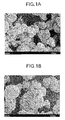
- FIGS. 1A and 1B show the SEM image of the silver-coated copper alloy powder obtained in this example when it was in the initial state, and the SEM image of the silver-coated copper alloy powder obtained in this example after it was stored for 1 week, respectively.
- a copper alloy powder (copper-zinc alloy powder) was obtained by the same method as that in Example 1, except that 4.0 kg of copper and 4.0 kg of zinc were used in place of 7.2 kg of copper and 0.8 kg of nickel.
- the composition of the powder and the mean particle size thereof were derived by the same methods as those in Example 1, and the high-temperature stability thereof was evaluated by the same method as that in Example 1. Furthermore, the content of zinc in the copper alloy powder was calculated by the same method as the method for calculating the content of each of copper and nickel in the copper alloy powder in Example 1. As a result, the content of copper in the copper alloy powder was 67.5 wt%, and the content of zinc therein was 32.2 wt%. The mean particle size of the copper alloy powder was 1.8 ⁇ m. The rate of increase of the weight of the copper alloy powder was 0.3 %.
- the obtained copper alloy powder (copper-zinc alloy powder) was used for preparing a copper-zinc alloy powder coated with silver (a silver-coated copper alloy powder) by the same method as that in Example 1.
- the composition of the powder, the amount of coating silver therein, the mean particle size thereof and the resistance of pressed powder thereof were derived by the same methods as those in Example 1, and the storage stability (reliability) of the powder was evaluated by the same method as that in Example 1.
- the content of zinc in the silver-coated copper alloy powder was calculated by the same method as the method for calculating the content of each of copper and nickel in the silver-coated copper alloy powder in Example 1.
- the content of copper in the silver-coated copper alloy powder was 46.8 wt%
- the content of zinc therein was 17.4 wt %
- the amount of coating silver therein was 35.7 wt%.
- the mean particle size of the silver-coated copper alloy powder was 4.7 ⁇ m.
- the initial volume resistivity of the silver-coated copper alloy powder was 3.5 x 10 -5 ⁇ ⁇ cm.
- the rate of variability of the volume resistivity after being stored for 1 week was 37%, and the rate of variability of the volume resistivity after being stored for 2 weeks was 50 %.
- the obtained silver-coated copper alloy powder was used for preparing a conductive film by the same method as that in Example 1.
- the calculation of the volume resistivity thereof and the evaluation of the storage stability (reliability) thereof were carried out by the same methods as those in Example 1.
- the volume resistivity (initial volume resistivity) of the conductive film was 11.8 x 10 -5 ⁇ ⁇ cm.
- the rate of variability of the volume resistivity of the conductive film after being stored for 1 week was -7 %
- the rate of variability of the volume resistivity of the conductive film after being stored for 2 weeks was -6 %.
- a copper alloy powder (copper-nickel-zinc alloy powder) was obtained by the same method as that in Example 1, except that 6.4 kg of copper, 0.8 kg of nickel and 0.8 kg of zinc were used in place of 7.2 kg of copper and 0.8 kg of nickel.
- the composition of the powder and the mean particle size thereof were derived by the same methods as those in Example 1, and the high-temperature stability thereof was evaluated by the same method as that in Example 1. Furthermore, the content of zinc in the copper alloy powder was calculated by the same method as the method for calculating the content of each of copper and nickel in the copper alloy powder in Example 1. As a result, the content of copper in the copper alloy powder was 84.5 wt%, the content of nickel therein was 10.8 wt% and the content of zinc therein was 4.3 wt%. The mean particle size of the copper alloy powder was 1.9 ⁇ m. The rate of increase of the weight of the copper alloy powder was 1.7 %.
- the obtained copper alloy powder (copper-nickel-zinc alloy powder) was used for preparing a copper-nickel-zinc alloy powder coated with silver (a silver-coated copper alloy powder) by the same method as that in Example 1.
- the composition of the powder, the amount of coating silver therein, the mean particle size thereof and the resistance of pressed powder thereof were derived by the same methods as those in Example 1, and the storage stability (reliability) of the powder was evaluated by the same method as that in Example 1.
- the content of zinc in the silver-coated copper alloy powder was calculated by the same method as the method for calculating the content of each of copper and nickel in the silver-coated copper alloy powder in Example 1.
- the content of copper in the silver-coated copper alloy powder was 56.0 wt%, and the content of nickel therein was 7.0 wt%.
- the content of zinc therein was 2.2 wt%, and the amount of coating silver therein was 34.7 wt%.
- the mean particle size of the silver-coated copper alloy powder was 6.1 ⁇ m.
- the initial volume resistivity of the silver-coated copper alloy powder was 4.0 x 10 -5 ⁇ ⁇ cm.
- the rate of variability of the volume resistivity after being stored for 1 week was 35%, and the rate of variability of the volume resistivity after being stored for 2 weeks was 44 %.
- the obtained silver-coated copper alloy powder was used for preparing a conductive film by the same method as that in Example 1.
- the calculation of the volume resistivity thereof and the evaluation of the storage stability (reliability) thereof were carried out by the same methods as those in Example 1.
- the volume resistivity (initial volume resistivity) of the conductive film was 8.1 x 10 -5 ⁇ ⁇ cm.
- the rate of variability of the volume resistivity of the conductive film after being stored for 1 week was -3 %
- the rate of variability of the volume resistivity of the conductive film after being stored for 2 weeks was -5 %.
- a copper alloy powder (copper-zinc alloy powder) was obtained by the same method as that in Example 1, except that 7.6 kg of copper and 0.4 kg of zinc were used in place of 7.2 kg of copper and 0.8 kg of nickel.
- the composition of the powder and the mean particle size thereof were derived by the same methods as those in Example 1, and the high-temperature stability thereof was evaluated by the same method as that in Example 1. Furthermore, the content of zinc in the copper alloy powder was calculated by the same method as the method for calculating the content of each of copper and nickel in the copper alloy powder in Example 1. As a result, the content of copper in the copper alloy powder was 95.5 wt%, and the content of zinc therein was 4.5 wt%. The mean particle size of the copper alloy powder was 4.7 ⁇ m. The rate of increase of the weight of the copper alloy powder was 2.4 %.
- solution 1 61.9 g of EDTA-2Na dihydrate and 61.9 g of ammonium carbonate were dissolved in 720 g of pure water to prepare a solution (solution 1), and a solution obtained by dissolving 51.2 g of silver nitrate in 158.2 g of pure water was added to a solution, which was obtained by dissolving 307.1 g of EDTA-2Na dihydrate and 153.5 g of ammonium carbonate in 1223.2 g of pure water, to prepare a solution (solution 2).
- the composition of the powder, the amount of coating silver therein, the mean particle size thereof and the resistance of pressed powder thereof were derived by the same methods as those in Example 1, and the storage stability (reliability) of the powder was evaluated by the same method as that in Example 1.
- the content of zinc in the silver-coated copper alloy powder was calculated by the same method as the method for calculating the content of each of copper and nickel in the silver-coated copper alloy powder in Example 1.
- the content of copper in the silver-coated copper alloy powder was 79.9 wt%
- the content of zinc therein was 3.5 wt%
- the amount of coating silver therein was 16.6 wt%.
- the mean particle size of the silver-coated copper alloy powder was 5.6 ⁇ m.
- the initial volume resistivity of the silver-coated copper alloy powder was 2.8 x 10 -5 ⁇ ⁇ cm.
- the rate of variability of the volume resistivity after being stored for 1 week was -27 %, and the rate of variability of the volume resistivity after being stored for 2 weeks was -5 %.
- the percentage (silver covering rate) (area%) of the silver layer occupying the surface of the silver-coated copper alloy powder with respect to that of the whole surface thereof was calculated by the same method as that in Example 7. As a result, the percentage was 95 area%.
- the obtained silver-coated copper alloy powder was used for preparing a conductive film by the same method as that in Example 1.
- the calculation of the volume resistivity thereof and the evaluation of the storage stability (reliability) thereof were carried out by the same methods as those in Example 1.
- the volume resistivity (initial volume resistivity) of the conductive film was 5.1 x 10 -5 ⁇ ⁇ cm.
- the rate of variability of the volume resistivity of the conductive film after being stored for 1 week was 2 %
- the rate of variability of the volume resistivity of the conductive film after being stored for 2 weeks was 2 %.
- the composition of the powder and the mean particle size thereof were derived by the same methods as those in Example 1, and the high-temperature stability thereof was evaluated by the same method as that in Example 1. Furthermore, the content of zinc in the flake-shaped copper alloy powder was calculated by the same method as the method for calculating the content of each of copper and nickel in the copper alloy powder in Example 1. As a result, the content of copper in the flake-shaped copper alloy powder was 95.5 wt%, and the content of zinc therein was 4.5 wt%. The mean particle size of the flake-shaped copper alloy powder was 6.1 ⁇ m. The rate of increase of the weight of the flake-shaped copper alloy powder was 2.9 %.
- the obtained flake-shaped copper alloy powder (copper-zinc alloy powder) was used for preparing a flake-shaped copper-zinc alloy powder coated with silver (a silver-coated flake-shaped copper alloy powder) by the same method as that in Example 11.
- the composition of the powder, the amount of coating silver therein, the mean particle size thereof and the resistance of pressed powder thereof were derived by the same methods as those in Example 1, and the storage stability (reliability) of the powder was evaluated by the same method as that in Example 1.
- the content of zinc in the silver-coated flake-shaped copper alloy powder was calculated by the same method as the method for calculating the content of each of copper and nickel in the silver-coated copper alloy powder in Example 1.
- the content of copper in the silver-coated flake-shaped copper alloy powder was 77.5 wt%
- the content of zinc therein was 3.3 wt%
- the amount of coating silver therein was 19.2 wt%.
- the mean particle size of the silver-coated flake-shaped copper alloy powder was 7.2 ⁇ m.
- the initial volume resistivity of the silver-coated flake-shaped copper alloy powder was 3.0 x 10 -5 ⁇ ⁇ cm.
- the rate of variability of the volume resistivity after being stored for 1 week was -16 %, and the rate of variability of the volume resistivity after being stored for 2 weeks was -10 %.
- the percentage (silver covering rate) (area%) of the silver layer occupying the surface of the silver-coated copper alloy powder with respect to that of the whole surface thereof was calculated by the same method as that in Example 7. As a result, the percentage was 88 area%.
- the silver-coated flake-shaped copper alloy powder was mixed with a resin to be formed as a paste.
- the paste thus formed was applied on a copper plate to be dried to form a film.
- the side face of the film thus formed was observed at a magnifying power of 1000 by means of a field emission-scanning electron microscope (FE-SEM) (S-4700 produced by Hitachi, Ltd.).
- FE-SEM field emission-scanning electron microscope
- the mean long diameter L and mean thickness T thus obtained were used for deriving (Mean Long Diameter L / Mean Thickness T) as the aspect ratio of the silver-coated flake-shaped copper alloy powder. As a result, the aspect ratio of the silver-coated flake-shaped copper alloy powder was 9.
- the obtained silver-coated flake-shaped copper alloy powder was used for preparing a conductive film by the same method as that in Example 1.
- the calculation of the volume resistivity thereof and the evaluation of the storage stability (reliability) thereof were carried out by the same methods as those in Example 1.
- the volume resistivity (initial volume resistivity) of the conductive film was 6.5 x 10 -5 ⁇ ⁇ cm.
- the rate of variability of the volume resistivity of the conductive film after being stored for 1 week was 4 %, and the rate of variability of the volume resistivity of the conductive film after being stored for 2 weeks was 4 %.
- the composition of the powder, the amount of coating silver therein, the mean particle size thereof and the resistance of pressed powder thereof were derived by the same methods as those in Example 1.
- the content of copper in the copper alloy powder was 90.1 wt%
- the content of nickel therein was 9.9 wt%
- the amount of coating silver therein was 0 wt %.
- the mean particle size of the copper alloy powder was 1.7 ⁇ m.
- the initial volume resistivity of the copper alloy powder was 3.3 x 10 4 ⁇ ⁇ cm.
- This copper alloy powder was used for preparing a conductive film by the same method as that in Example 1. With respect to the conductive film thus obtained, the calculation of the volume resistivity thereof and the evaluation of the storage stability (reliability) thereof were carried out by the same methods as those in Example 1. As a result, the volume resistivity (initial volume resistivity) of the conductive film was 2146.1 x 10 -5 ⁇ ⁇ cm, and the rate of variability of the volume resistivity of the conductive film after being stored for 1 week was 974 %.
- Example 2 The same copper alloy powder (copper-nickel alloy powder) as that in Example 1 was used for obtaining a copper-nickel alloy powder coated with silver (a silver-coated copper alloy powder) by the same method as that in Example 1, except that a solution prepared by dissolving 21.4 g of EDTA-2Na dihydrate and 21.4 g of ammonium carbonate in 249 g of pure water was used as the solution 1 and that a solution prepared by adding a solution, which was obtained by dissolving 1.45 g of silver nitrate in 4.5 g of pure water, to a solution, which was obtained by dissolving 8.68 g of EDTA-2Na dihydrate and 4.34 g of ammonium carbonate in 35 g of pure water, was used as the solution 2.
- the composition of the powder, the amount of coating silver therein, the mean particle size thereof and the resistance of pressed powder thereof were derived by the same methods as those in Example 1, and the storage stability (reliability) of the powder was evaluated by the same method as that in Example 1.
- the content of copper in the silver-coated copper alloy powder was 87.9 wt%
- the content of nickel therein was 9.9 wt%
- the amount of coating silver therein was 2.2 wt%.
- the mean particle size of the silver-coated copper alloy powder was 1.7 ⁇ m.
- the initial volume resistivity of the silver-coated copper alloy powder was 70.0 x 10 -5 ⁇ ⁇ cm.
- the rate of variability of the volume resistivity after being stored for 1 week was 419526798 %
- the rate of variability of the volume resistivity after being stored for 2 weeks was 646498597 %.
- the obtained silver-coated copper alloy powder was used for preparing a conductive film by the same method as that in Example 1.
- the calculation of the volume resistivity thereof and the evaluation of the storage stability (reliability) thereof were carried out by the same methods as those in Example 1.
- the volume resistivity (initial volume resistivity) of the conductive film was 79.5 x 10 -5 ⁇ ⁇ cm.
- the rate of variability of the volume resistivity of the conductive film after being stored for 1 week was 8 %, and the rate of variability of the volume resistivity of the conductive film after being stored for 2 weeks was 15 %.
- Example 2 The same copper alloy powder (copper-nickel alloy powder) as that in Example 1 was used for obtaining a copper-nickel alloy powder coated with silver (a silver-coated copper alloy powder) by the same method as that in Example 1, except that a solution prepared by dissolving 21.4 g of EDTA-2Na dihydrate and 21 .
- the composition of the powder, the amount of coating silver therein, the mean particle size thereof and the resistance of pressed powder thereof were derived by the same methods as those in Example 1, and the storage stability (reliability) of the powder was evaluated by the same method as that in Example 1.
- the content of copper in the silver-coated copper alloy powder was 85.0 wt%
- the content of nickel therein was 9.5 wt%
- the amount of coating silver therein was 5.5 wt%.
- the mean particle size of the silver-coated copper alloy powder was 1.8 ⁇ m.
- the initial volume resistivity of the silver-coated copper alloy powder was 18.0 x 10 -5 ⁇ ⁇ cm.
- the rate of variability of the volume resistivity after being stored for 1 week was 179844 %
- the rate of variability of the volume resistivity after being stored for 2 weeks was 318314 %.
- the obtained silver-coated copper alloy powder was used for preparing a conductive film by the same method as that in Example 1.
- the calculation of the volume resistivity thereof and the evaluation of the storage stability (reliability) thereof were carried out by the same methods as those in Example 1.
- the volume resistivity (initial volume resistivity) of the conductive film was 26.0 x 10 -5 ⁇ ⁇ cm.
- the rate of variability of the volume resistivity of the conductive film after being stored for 1 week was 4 %, and the rate of variability of the volume resistivity of the conductive film after being stored for 2 weeks was 8 %.
- a copper powder was obtained by the same method as that in Example 1, except that 8.0 kg of copper was used in place of 7.2 kg of copper and 0.8 kg of nickel.
- the mean particle size thereof was derived by the same method as that in Example 1, and the high-temperature stability thereof was evaluated by the same method as that in Example 1.
- the mean particle size of the copper powder was 2.0 ⁇ m, and the rate of increase of the weight of the copper powder was 8.8 %.
- the obtained copper powder was used for preparing a copper powder coated with silver (a silver-coated copper powder) by the same method as that in Example 1.
- the composition of the powder, the amount of coating silver therein, the mean particle size thereof and the resistance of pressed powder thereof were derived by the same methods as those in Example 1, and the storage stability (reliability) of the powder was evaluated by the same method as that in Example 1.
- the content of copper in the silver-coated copper powder was 72.9 wt%, and the amount of coating silver therein was 27.0 wt%.
- the mean particle size of the silver-coated copper powder was 4.7 ⁇ m.
- the initial volume resistivity of the silver-coated copper powder was 2. 9 x 10 -5 ⁇ ⁇ cm.
- the rate of variability of the volume resistivity after being stored for 1 week was 912 %, and the rate of variability of the volume resistivity after being stored for 2 weeks was 1709 %.
- the obtained silver-coated copper powder was used for preparing a conductive film by the same method as that in Example 1.
- the calculation of the volume resistivity thereof and the evaluation of the storage stability (reliability) thereof were carried out by the same methods as those in Example 1.
- the volume resistivity (initial volume resistivity) of the conductive film was 13.6 x 10 -5 ⁇ ⁇ cm.
- the rate of variability of the volume resistivity of the conductive film after being stored for 1 week was 11 %, and the rate of variability of the volume resistivity of the conductive film after being stored for 2 weeks was 43 %.
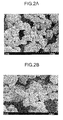
- FIGS. 2A and 2B show the SEM image of the silver-coated copper powder obtained in this comparative example when it was in the initial state, and the SEM image of the silver-coated copper powder obtained in this comparative example after it was stored for 1 week, respectively.
- the mean particle size thereof was derived by the same method as that in Example 1, and the high-temperature stability thereof was evaluated by the same method as that in Example 1.
- the mean particle size of the copper powder was 5.7 ⁇ m, and the rate of increase of the weight of the copper powder was 3.3 %.
- the spherical copper powder After 120 g of the spherical copper powder was added to 2 wt% of dilute nitric acid to be stirred for 5 minutes to remove oxides on the surface of the copper powder, it was filtered and washed with water. After the spherical copper powder, from the surface of which the oxides were thus removed, was added to a solution containing 408.7 of pure water, 32.7 g of AgCN and 30.7 g of NaCN to be stirred for 60 minutes, it was filtered, washed with water and dried to obtain a copper powder coated with silver.
- the composition of the powder, the amount of coating silver therein, the mean particle size thereof and the resistance of pressed powder thereof were derived by the same methods as those in Example 1, and the storage stability (reliability) of the powder was evaluated by the same method as that in Example 1.
- the content of copper in the silver-coated flake-shaped copper powder was 80.4 wt%, and the amount of coating silver therein was 19.6 wt%.
- the mean particle size of the silver-coated flake-shaped copper powder was 9.1 ⁇ m.
- the initial volume resistivity of the silver-coated flake-shaped copper powder was 8.4 x 10 -5 ⁇ ⁇ cm.
- the rate of variability of the volume resistivity after being stored for 1 week was 38400900801 %, and the rate of variability of the volume resistivity after being stored for 2 weeks was 24173914178 %.
- the percentage (silver covering rate) (area%) of the silver layer occupying the surface of the silver-coated copper powder with respect to that of the whole surface thereof was calculated by the same method as that in Example 7. As a result, the percentage was 31 area%.
- the aspect ratio of the silver-coated flake-shaped copper powder was obtained by the same method as that in Example 12. As a result, the aspect ratio of the silver-coated flake-shaped copper powder was 7.
- the obtained silver-coated flake-shaped copper powder was used for preparing a conductive film by the same method as that in Example 1.
- the calculation of the volume resistivity thereof and the evaluation of the storage stability (reliability) thereof were carried out by the same methods as those in Example 1.
- the volume resistivity (initial volume resistivity) of the conductive film was 144.1 x 10 -5 ⁇ ⁇ cm.
- the rate of variability of the volume resistivity of the conductive film after being stored for 1 week was 1 %
- the rate of variability of the volume resistivity of the conductive film after being stored for 2 weeks was -4 %.
- the rate of increase of the weight of the copper alloy powder used in each of Examples 1 through 12 and Comparative Examples 1 through 3 and 5 was a low rate of 5 % or less when the copper alloy (or copper) powder was heated to 300 °C in the atmosphere, so that the high-temperature stability of the copper alloy (or copper) powder (against oxidation) in the atmosphere was good.
- the rate of increase of the weight of the copper powder used in Comparative Example 4 was a high rate of 8.8 % when the copper powder was heated to 300 °C in the atmosphere, so that the high-temperature stability of the copper powder (against oxidation) in the atmosphere was not good.
- the initial volume resistivity of the pressed powder was a low value of 9 x 10 -5 ⁇ ⁇ cm or less, and the rate of variability of the volume resistivity after being stored for 1 week was a low rate of 500 % or less.
- the initial volume resistivity of the pressed powder was very high, and the rate of variability of the volume resistivity after being stored for 1 week was very high.
- the rate of variability of the volume resistivity after being stored for 1 week was very high although the initial volume resistivity of the pressed powder was low.
- the initial volume resistivity was a low value of 16 x 10 -5 ⁇ ⁇ cm or less, and the rate of variability of the volume resistivity after being stored for 1 week was a low value of -8 % to -4 %.
- the initial volume resistivity was high, and the volume resistivity after being stored for 1 week was also high.
- the silver-coated copper alloy powder obtained in each of Example 1 through 12 has a low volume resistivity and excellent storage stability (reliability).
- a silver-coated copper alloy powder produced by coating an alloy powder of 70 wt% of copper and 30 wt% of tin with 10 wt% of silver, and a silver-coated copper alloy powder produced by coating an alloy powder of 90 wt% of copper and 10 wt% of aluminum with 30 wt% of silver were observed by SEM images.
- the surface of each of the silver-coated copper alloy powders was not smooth even in the initial state thereof to have a patchy pattern (mottled effect). Since it was confirmed from the composition analysis thereof that silver exists on each of these alloy powders, it was found that silver coating the surface of the particles of each of the alloy powders exists in a patchy pattern.
Landscapes
- Chemical & Material Sciences (AREA)
- Engineering & Computer Science (AREA)
- Materials Engineering (AREA)
- Mechanical Engineering (AREA)
- Metallurgy (AREA)
- Organic Chemistry (AREA)
- Physics & Mathematics (AREA)
- Dispersion Chemistry (AREA)
- Spectroscopy & Molecular Physics (AREA)
- Powder Metallurgy (AREA)
- Manufacture Of Metal Powder And Suspensions Thereof (AREA)
- Conductive Materials (AREA)
- Non-Insulated Conductors (AREA)
- Manufacturing Of Printed Wiring (AREA)
Applications Claiming Priority (3)
| Application Number | Priority Date | Filing Date | Title |
|---|---|---|---|
| JP2012006886 | 2012-01-17 | ||
| JP2012120360 | 2012-05-28 | ||
| PCT/JP2013/051019 WO2013108916A1 (fr) | 2012-01-17 | 2013-01-15 | Poudre d'alliage de cuivre revêtue d'argent et son procédé de fabrication |
Publications (3)
| Publication Number | Publication Date |
|---|---|
| EP2796228A1 true EP2796228A1 (fr) | 2014-10-29 |
| EP2796228A4 EP2796228A4 (fr) | 2015-10-14 |
| EP2796228B1 EP2796228B1 (fr) | 2020-10-28 |
Family
ID=48799337
Family Applications (1)
| Application Number | Title | Priority Date | Filing Date |
|---|---|---|---|
| EP13737989.7A Active EP2796228B1 (fr) | 2012-01-17 | 2013-01-15 | Poudre d'alliage de cuivre revêtue d'argent et son procédé de fabrication |
Country Status (8)
| Country | Link |
|---|---|
| US (1) | US10062473B2 (fr) |
| EP (1) | EP2796228B1 (fr) |
| JP (4) | JP2014005531A (fr) |
| KR (1) | KR102011166B1 (fr) |
| CN (1) | CN104066535B (fr) |
| SG (1) | SG11201404017YA (fr) |
| TW (1) | TWI541365B (fr) |
| WO (1) | WO2013108916A1 (fr) |
Families Citing this family (19)
| Publication number | Priority date | Publication date | Assignee | Title |
|---|---|---|---|---|
| JPWO2015122345A1 (ja) * | 2014-02-12 | 2017-03-30 | 東レ株式会社 | 導電ペースト、パターンの製造方法、導電パターンの製造方法及びセンサー |
| JP6567921B2 (ja) * | 2014-08-29 | 2019-08-28 | Dowaエレクトロニクス株式会社 | 銀被覆銅粉およびその製造方法 |
| US20170253750A1 (en) * | 2014-09-12 | 2017-09-07 | Sumitomo Metal Mining Co., Ltd. | Silver-coated copper powder, and conductive paste, conductive coating material and conductive sheet, each of which uses said silver-coated copper powder |
| US20160143145A1 (en) * | 2014-11-13 | 2016-05-19 | E I Du Pont De Nemours And Company | Electrical device |
| JP6679312B2 (ja) * | 2015-01-13 | 2020-04-15 | Dowaエレクトロニクス株式会社 | 銀被覆銅粉およびその製造方法 |
| CN106537519B (zh) * | 2015-02-27 | 2018-12-28 | 拓自达电线株式会社 | 导电性糊剂及使用其的多层基板 |
| JP6256616B2 (ja) * | 2015-04-22 | 2018-01-10 | 日立金属株式会社 | 金属粒子およびその製造方法、被覆金属粒子、金属粉体 |
| JP5907302B1 (ja) | 2015-05-15 | 2016-04-26 | 住友金属鉱山株式会社 | 銅粉及びそれを用いた銅ペースト、導電性塗料、導電性シート、並びに銅粉の製造方法 |
| JP5907301B1 (ja) | 2015-05-15 | 2016-04-26 | 住友金属鉱山株式会社 | 銀コート銅粉及びそれを用いた銅ペースト、導電性塗料、導電性シート、並びに銀コート銅粉の製造方法 |
| JP6856350B2 (ja) * | 2015-10-30 | 2021-04-07 | Dowaエレクトロニクス株式会社 | 銀粉およびその製造方法 |
| JP6811080B2 (ja) * | 2016-02-03 | 2021-01-13 | Dowaエレクトロニクス株式会社 | 銀被覆銅粉およびその製造方法 |
| CN105921737B (zh) * | 2016-04-28 | 2018-01-19 | 中南大学 | 一种铜银复合粉的制备方法和导电胶 |
| KR102295909B1 (ko) * | 2016-08-31 | 2021-08-30 | 도와 일렉트로닉스 가부시키가이샤 | 은 피복 합금 분말, 도전성 페이스트, 전자 부품 및 전기 장치 |
| DE102017118386A1 (de) * | 2017-08-11 | 2019-02-14 | Grohe Ag | Kupferlegierung, Verwendung einer Kupferlegierung, Sanitärarmatur und Verfahren zur Herstellung einer Sanitärarmatur |
| CN111804931B (zh) * | 2019-04-11 | 2024-07-30 | 香港大学 | 原位分解辅助的粉末冶金方法制备抗菌不锈钢 |
| US11739232B2 (en) | 2019-06-12 | 2023-08-29 | Kyoto Elex Co., Ltd. | Conductive paste composition |
| KR20220024808A (ko) * | 2019-06-27 | 2022-03-03 | 도와 일렉트로닉스 가부시키가이샤 | 은 분말 및 그 제조 방법 |
| KR102202459B1 (ko) * | 2019-11-14 | 2021-01-13 | 삼성전기주식회사 | 전극형성용 도전성 금속 분말, 그 제조방법 및 이를 포함하는 전자부품 외부전극용 도전성 페이스트 |
| CN114783770B (zh) * | 2022-06-20 | 2022-12-13 | 西安宏星电子浆料科技股份有限公司 | 一种多层陶瓷电容器外部电极浆料及其制备方法 |
Family Cites Families (24)
| Publication number | Priority date | Publication date | Assignee | Title |
|---|---|---|---|---|
| JPH01119602A (ja) * | 1987-11-02 | 1989-05-11 | Mitsui Mining & Smelting Co Ltd | 銀被覆銅粉の製造法 |
| JPH0378906A (ja) * | 1989-08-23 | 1991-04-04 | Furukawa Electric Co Ltd:The | 導電性ペースト |
| US5951918A (en) * | 1995-02-08 | 1999-09-14 | Hitachi Chemical Company, Ltd. | Composite electroconductive powder, electroconductive paste, process for producing electroconductive paste, electric circuit and process for producing electric circuit |
| JPH08311304A (ja) * | 1995-05-16 | 1996-11-26 | Mitsui Kinzoku Toryo Kagaku Kk | 銅導電性組成物 |
| JPH10152630A (ja) | 1996-08-21 | 1998-06-09 | Hitachi Chem Co Ltd | 導電ペースト及び複合導電粉 |
| JP2000169970A (ja) * | 1998-12-07 | 2000-06-20 | Yoshinobu Abe | 不活性雰囲気めっき方法 |
| JP2001236827A (ja) * | 2000-02-23 | 2001-08-31 | Hitachi Chem Co Ltd | 導電ペースト |
| JP2002226973A (ja) * | 2001-01-31 | 2002-08-14 | Hitachi Chem Co Ltd | 銀めっき銅粉の製造方法 |
| JP2002332501A (ja) * | 2001-05-11 | 2002-11-22 | Mitsui Mining & Smelting Co Ltd | 銀コート銅粉の製造方法、その製造方法で得られた銀コート銅粉、その銀コート銅粉を用いた導電性ペースト、及びその導電性ペーストを用いたプリント配線板 |
| JP2003068139A (ja) * | 2001-08-23 | 2003-03-07 | Hitachi Chem Co Ltd | 導電ペースト |
| JP4223754B2 (ja) * | 2002-07-19 | 2009-02-12 | 三井金属鉱業株式会社 | 銀コート銅粉及びその製造方法 |
| CN1176873C (zh) * | 2003-03-20 | 2004-11-24 | 浙江大学 | 连续式粉体化学镀方法及其装置 |
| US7504199B2 (en) * | 2003-12-16 | 2009-03-17 | Samsung Electronics Co., Ltd. | Method of forming metal pattern having low resistivity |
| JP4660701B2 (ja) * | 2004-12-03 | 2011-03-30 | Dowaエレクトロニクス株式会社 | 銀被覆銅粉およびその製造方法並びに導電ペースト |
| JP4613362B2 (ja) * | 2005-01-31 | 2011-01-19 | Dowaエレクトロニクス株式会社 | 導電ペースト用金属粉および導電ペースト |
| JP5166704B2 (ja) * | 2006-05-12 | 2013-03-21 | 東炭化工株式会社 | 金属カーボン複合通電摺動材料 |
| JP2010077501A (ja) * | 2008-09-26 | 2010-04-08 | Kyocera Corp | ニッケル−銅合金粉末およびその製法、導体ペースト、ならびに電子部品 |
| JP5176824B2 (ja) | 2008-09-26 | 2013-04-03 | 住友金属鉱山株式会社 | 銀被覆銅微粒子とその分散液及びその製造方法 |
| JP5394084B2 (ja) | 2009-01-28 | 2014-01-22 | Jx日鉱日石金属株式会社 | 銀メッキ銅微粉及び銀メッキ銅微粉を用いて製造した導電ペースト並びに銀メッキ銅微粉の製造方法 |
| JP5402350B2 (ja) * | 2009-07-24 | 2014-01-29 | 藤倉化成株式会社 | 導電性ペーストの製造方法および導電性ペースト |
| JP5583572B2 (ja) * | 2010-12-28 | 2014-09-03 | 株式会社日本触媒 | 導電性微粒子 |
| JP5576319B2 (ja) * | 2011-03-01 | 2014-08-20 | 三井金属鉱業株式会社 | 銅粒子 |
| JP6194166B2 (ja) * | 2012-11-01 | 2017-09-06 | Dowaエレクトロニクス株式会社 | 銀被覆銅合金粉末の製造方法 |
| TWI722136B (zh) * | 2016-03-29 | 2021-03-21 | 拓自達電線股份有限公司 | 導電性塗料及使用其之屏蔽封裝體之製造方法 |
-
2013
- 2013-01-15 EP EP13737989.7A patent/EP2796228B1/fr active Active
- 2013-01-15 US US14/372,789 patent/US10062473B2/en active Active
- 2013-01-15 WO PCT/JP2013/051019 patent/WO2013108916A1/fr not_active Ceased
- 2013-01-15 JP JP2013004185A patent/JP2014005531A/ja active Pending
- 2013-01-15 SG SG11201404017YA patent/SG11201404017YA/en unknown
- 2013-01-15 KR KR1020147022463A patent/KR102011166B1/ko active Active
- 2013-01-15 CN CN201380005692.2A patent/CN104066535B/zh active Active
- 2013-01-16 TW TW102101618A patent/TWI541365B/zh active
-
2015
- 2015-09-03 JP JP2015173427A patent/JP5934829B2/ja active Active
-
2016
- 2016-03-14 JP JP2016049206A patent/JP6154507B2/ja active Active
-
2017
- 2017-04-06 JP JP2017075690A patent/JP2017150086A/ja active Pending
Also Published As
| Publication number | Publication date |
|---|---|
| CN104066535A (zh) | 2014-09-24 |
| WO2013108916A1 (fr) | 2013-07-25 |
| US10062473B2 (en) | 2018-08-28 |
| EP2796228A4 (fr) | 2015-10-14 |
| JP2016020544A (ja) | 2016-02-04 |
| JP2014005531A (ja) | 2014-01-16 |
| JP2017150086A (ja) | 2017-08-31 |
| KR20140123526A (ko) | 2014-10-22 |
| CN104066535B (zh) | 2016-11-09 |
| JP2016145422A (ja) | 2016-08-12 |
| SG11201404017YA (en) | 2014-09-26 |
| JP5934829B2 (ja) | 2016-06-15 |
| US20140346413A1 (en) | 2014-11-27 |
| TW201333226A (zh) | 2013-08-16 |
| JP6154507B2 (ja) | 2017-06-28 |
| TWI541365B (zh) | 2016-07-11 |
| KR102011166B1 (ko) | 2019-08-14 |
| EP2796228B1 (fr) | 2020-10-28 |
Similar Documents
| Publication | Publication Date | Title |
|---|---|---|
| EP2796228B1 (fr) | Poudre d'alliage de cuivre revêtue d'argent et son procédé de fabrication | |
| JP2886340B2 (ja) | 表面酸化物層を持つ導電性芯材と耐火性材料との複合材粒とそれを含有する電磁エネルギーの遮蔽若しくは静電気の消失用材料 | |
| EP2752270B1 (fr) | Poudre à braser et pâte à braser mettant en oeuvre ladite poudre à braser | |
| JP6186197B2 (ja) | 銀被覆銅合金粉末およびその製造方法 | |
| EP3508286B1 (fr) | Poudre d'alliage revêtue d'argent, pâte conductrice, composant électronique et dispositif électrique | |
| JP5156328B2 (ja) | 導電材ペースト用銅合金粉 | |
| KR20160003766A (ko) | 은-비스무트 분말, 도전성 페이스트 및 도전막 | |
| US20110031001A1 (en) | Composite metal fine particle material, metal film and manufacturing method of the metal film, and printed wiring board and cable | |
| JP6224933B2 (ja) | 銀被覆銅合金粉末およびその製造方法 | |
| EP3395474A1 (fr) | Poudre d'alliage d'argent et procédé pour la produire | |
| JP3687745B2 (ja) | 高分散性の金属粉、その製造方法及び該金属粉を含有する導電ペースト | |
| EP3345696A1 (fr) | Poudre de cuivre contenant du phosphore et son procédé de fabrication | |
| JP6194166B2 (ja) | 銀被覆銅合金粉末の製造方法 | |
| EP3674683B1 (fr) | Procédé d'évaluation de poudre de moulage de pièces en stratifié | |
| US20170232510A1 (en) | Silver-coated copper powder and method for producing same | |
| JP6258616B2 (ja) | 銀被覆銅合金粉末およびその製造方法 | |
| JP6681437B2 (ja) | 導電性ペースト | |
| JP7313195B2 (ja) | 金属粉末の製造方法及び銀被覆金属粉末の製造方法 | |
| JP7335768B2 (ja) | 銀被覆金属粉末およびその製造方法並びに導電性塗料 | |
| JP2017201062A (ja) | 銀被覆銅合金粉末の製造方法 | |
| JP2006196246A (ja) | 導電性ペースト及びそれを用いた配線回路基板 | |
| Sarac | Synergistic Effect of Ni and Co Alloying on Corrosion Behavior of Fe (Ni, Co) P13C7 Metallic Glasses in 1M NaCl Solution | |
| CN121889229A (zh) | 铜系金属粉末 | |
| JP2017210686A (ja) | 銀被覆銅合金粉末およびその製造方法 | |
| JP2017134889A (ja) | 導電フィラー用粉末 |
Legal Events
| Date | Code | Title | Description |
|---|---|---|---|
| PUAI | Public reference made under article 153(3) epc to a published international application that has entered the european phase |
Free format text: ORIGINAL CODE: 0009012 |
|
| 17P | Request for examination filed |
Effective date: 20140722 |
|
| AK | Designated contracting states |
Kind code of ref document: A1 Designated state(s): AL AT BE BG CH CY CZ DE DK EE ES FI FR GB GR HR HU IE IS IT LI LT LU LV MC MK MT NL NO PL PT RO RS SE SI SK SM TR |
|
| RIN1 | Information on inventor provided before grant (corrected) |
Inventor name: HIYAMA, YUTO Inventor name: UEYAMA, TOSHIHIKO Inventor name: EBARA, ATSUSHI Inventor name: INOUE, KENICHI Inventor name: OGI, KOZO Inventor name: YAMADA, TAKAHIRO |
|
| DAX | Request for extension of the european patent (deleted) | ||
| RA4 | Supplementary search report drawn up and despatched (corrected) |
Effective date: 20150914 |
|
| RIC1 | Information provided on ipc code assigned before grant |
Ipc: C22C 9/06 20060101ALI20150907BHEP Ipc: H01B 5/14 20060101ALI20150907BHEP Ipc: C22C 9/00 20060101ALI20150907BHEP Ipc: H01B 5/00 20060101ALI20150907BHEP Ipc: H01B 13/00 20060101ALI20150907BHEP Ipc: H01B 1/22 20060101ALI20150907BHEP Ipc: C22C 9/04 20060101ALI20150907BHEP Ipc: B22F 9/08 20060101ALI20150907BHEP Ipc: B22F 1/02 20060101AFI20150907BHEP Ipc: B22F 1/00 20060101ALI20150907BHEP |
|
| STAA | Information on the status of an ep patent application or granted ep patent |
Free format text: STATUS: EXAMINATION IS IN PROGRESS |
|
| 17Q | First examination report despatched |
Effective date: 20181017 |
|
| GRAP | Despatch of communication of intention to grant a patent |
Free format text: ORIGINAL CODE: EPIDOSNIGR1 |
|
| STAA | Information on the status of an ep patent application or granted ep patent |
Free format text: STATUS: GRANT OF PATENT IS INTENDED |
|
| INTG | Intention to grant announced |
Effective date: 20200714 |
|
| GRAS | Grant fee paid |
Free format text: ORIGINAL CODE: EPIDOSNIGR3 |
|
| GRAA | (expected) grant |
Free format text: ORIGINAL CODE: 0009210 |
|
| STAA | Information on the status of an ep patent application or granted ep patent |
Free format text: STATUS: THE PATENT HAS BEEN GRANTED |
|
| AK | Designated contracting states |
Kind code of ref document: B1 Designated state(s): AL AT BE BG CH CY CZ DE DK EE ES FI FR GB GR HR HU IE IS IT LI LT LU LV MC MK MT NL NO PL PT RO RS SE SI SK SM TR |
|
| REG | Reference to a national code |
Ref country code: GB Ref legal event code: FG4D |
|
| REG | Reference to a national code |
Ref country code: CH Ref legal event code: EP |
|
| REG | Reference to a national code |
Ref country code: DE Ref legal event code: R096 Ref document number: 602013073600 Country of ref document: DE |
|
| REG | Reference to a national code |
Ref country code: AT Ref legal event code: REF Ref document number: 1327705 Country of ref document: AT Kind code of ref document: T Effective date: 20201115 |
|
| REG | Reference to a national code |
Ref country code: IE Ref legal event code: FG4D |
|
| REG | Reference to a national code |
Ref country code: AT Ref legal event code: MK05 Ref document number: 1327705 Country of ref document: AT Kind code of ref document: T Effective date: 20201028 |
|
| REG | Reference to a national code |
Ref country code: NL Ref legal event code: MP Effective date: 20201028 |
|
| PG25 | Lapsed in a contracting state [announced via postgrant information from national office to epo] |
Ref country code: GR Free format text: LAPSE BECAUSE OF FAILURE TO SUBMIT A TRANSLATION OF THE DESCRIPTION OR TO PAY THE FEE WITHIN THE PRESCRIBED TIME-LIMIT Effective date: 20210129 Ref country code: PT Free format text: LAPSE BECAUSE OF FAILURE TO SUBMIT A TRANSLATION OF THE DESCRIPTION OR TO PAY THE FEE WITHIN THE PRESCRIBED TIME-LIMIT Effective date: 20210301 Ref country code: NL Free format text: LAPSE BECAUSE OF FAILURE TO SUBMIT A TRANSLATION OF THE DESCRIPTION OR TO PAY THE FEE WITHIN THE PRESCRIBED TIME-LIMIT Effective date: 20201028 Ref country code: NO Free format text: LAPSE BECAUSE OF FAILURE TO SUBMIT A TRANSLATION OF THE DESCRIPTION OR TO PAY THE FEE WITHIN THE PRESCRIBED TIME-LIMIT Effective date: 20210128 Ref country code: RS Free format text: LAPSE BECAUSE OF FAILURE TO SUBMIT A TRANSLATION OF THE DESCRIPTION OR TO PAY THE FEE WITHIN THE PRESCRIBED TIME-LIMIT Effective date: 20201028 Ref country code: FI Free format text: LAPSE BECAUSE OF FAILURE TO SUBMIT A TRANSLATION OF THE DESCRIPTION OR TO PAY THE FEE WITHIN THE PRESCRIBED TIME-LIMIT Effective date: 20201028 |
|
| REG | Reference to a national code |
Ref country code: LT Ref legal event code: MG4D |
|
| PG25 | Lapsed in a contracting state [announced via postgrant information from national office to epo] |
Ref country code: SE Free format text: LAPSE BECAUSE OF FAILURE TO SUBMIT A TRANSLATION OF THE DESCRIPTION OR TO PAY THE FEE WITHIN THE PRESCRIBED TIME-LIMIT Effective date: 20201028 Ref country code: LV Free format text: LAPSE BECAUSE OF FAILURE TO SUBMIT A TRANSLATION OF THE DESCRIPTION OR TO PAY THE FEE WITHIN THE PRESCRIBED TIME-LIMIT Effective date: 20201028 Ref country code: PL Free format text: LAPSE BECAUSE OF FAILURE TO SUBMIT A TRANSLATION OF THE DESCRIPTION OR TO PAY THE FEE WITHIN THE PRESCRIBED TIME-LIMIT Effective date: 20201028 Ref country code: IS Free format text: LAPSE BECAUSE OF FAILURE TO SUBMIT A TRANSLATION OF THE DESCRIPTION OR TO PAY THE FEE WITHIN THE PRESCRIBED TIME-LIMIT Effective date: 20210228 Ref country code: AT Free format text: LAPSE BECAUSE OF FAILURE TO SUBMIT A TRANSLATION OF THE DESCRIPTION OR TO PAY THE FEE WITHIN THE PRESCRIBED TIME-LIMIT Effective date: 20201028 Ref country code: ES Free format text: LAPSE BECAUSE OF FAILURE TO SUBMIT A TRANSLATION OF THE DESCRIPTION OR TO PAY THE FEE WITHIN THE PRESCRIBED TIME-LIMIT Effective date: 20201028 Ref country code: BG Free format text: LAPSE BECAUSE OF FAILURE TO SUBMIT A TRANSLATION OF THE DESCRIPTION OR TO PAY THE FEE WITHIN THE PRESCRIBED TIME-LIMIT Effective date: 20210128 |
|
| PG25 | Lapsed in a contracting state [announced via postgrant information from national office to epo] |
Ref country code: HR Free format text: LAPSE BECAUSE OF FAILURE TO SUBMIT A TRANSLATION OF THE DESCRIPTION OR TO PAY THE FEE WITHIN THE PRESCRIBED TIME-LIMIT Effective date: 20201028 |
|
| REG | Reference to a national code |
Ref country code: DE Ref legal event code: R097 Ref document number: 602013073600 Country of ref document: DE |
|
| PG25 | Lapsed in a contracting state [announced via postgrant information from national office to epo] |
Ref country code: RO Free format text: LAPSE BECAUSE OF FAILURE TO SUBMIT A TRANSLATION OF THE DESCRIPTION OR TO PAY THE FEE WITHIN THE PRESCRIBED TIME-LIMIT Effective date: 20201028 Ref country code: SK Free format text: LAPSE BECAUSE OF FAILURE TO SUBMIT A TRANSLATION OF THE DESCRIPTION OR TO PAY THE FEE WITHIN THE PRESCRIBED TIME-LIMIT Effective date: 20201028 Ref country code: LT Free format text: LAPSE BECAUSE OF FAILURE TO SUBMIT A TRANSLATION OF THE DESCRIPTION OR TO PAY THE FEE WITHIN THE PRESCRIBED TIME-LIMIT Effective date: 20201028 Ref country code: CZ Free format text: LAPSE BECAUSE OF FAILURE TO SUBMIT A TRANSLATION OF THE DESCRIPTION OR TO PAY THE FEE WITHIN THE PRESCRIBED TIME-LIMIT Effective date: 20201028 Ref country code: EE Free format text: LAPSE BECAUSE OF FAILURE TO SUBMIT A TRANSLATION OF THE DESCRIPTION OR TO PAY THE FEE WITHIN THE PRESCRIBED TIME-LIMIT Effective date: 20201028 Ref country code: SM Free format text: LAPSE BECAUSE OF FAILURE TO SUBMIT A TRANSLATION OF THE DESCRIPTION OR TO PAY THE FEE WITHIN THE PRESCRIBED TIME-LIMIT Effective date: 20201028 |
|
| PG25 | Lapsed in a contracting state [announced via postgrant information from national office to epo] |
Ref country code: DK Free format text: LAPSE BECAUSE OF FAILURE TO SUBMIT A TRANSLATION OF THE DESCRIPTION OR TO PAY THE FEE WITHIN THE PRESCRIBED TIME-LIMIT Effective date: 20201028 Ref country code: MC Free format text: LAPSE BECAUSE OF FAILURE TO SUBMIT A TRANSLATION OF THE DESCRIPTION OR TO PAY THE FEE WITHIN THE PRESCRIBED TIME-LIMIT Effective date: 20201028 |
|
| REG | Reference to a national code |
Ref country code: CH Ref legal event code: PL |
|
| PLBE | No opposition filed within time limit |
Free format text: ORIGINAL CODE: 0009261 |
|
| STAA | Information on the status of an ep patent application or granted ep patent |
Free format text: STATUS: NO OPPOSITION FILED WITHIN TIME LIMIT |
|
| GBPC | Gb: european patent ceased through non-payment of renewal fee |
Effective date: 20210128 |
|
| PG25 | Lapsed in a contracting state [announced via postgrant information from national office to epo] |
Ref country code: LU Free format text: LAPSE BECAUSE OF NON-PAYMENT OF DUE FEES Effective date: 20210115 |
|
| 26N | No opposition filed |
Effective date: 20210729 |
|
| REG | Reference to a national code |
Ref country code: BE Ref legal event code: MM Effective date: 20210131 |
|
| PG25 | Lapsed in a contracting state [announced via postgrant information from national office to epo] |
Ref country code: IT Free format text: LAPSE BECAUSE OF FAILURE TO SUBMIT A TRANSLATION OF THE DESCRIPTION OR TO PAY THE FEE WITHIN THE PRESCRIBED TIME-LIMIT Effective date: 20201028 Ref country code: AL Free format text: LAPSE BECAUSE OF FAILURE TO SUBMIT A TRANSLATION OF THE DESCRIPTION OR TO PAY THE FEE WITHIN THE PRESCRIBED TIME-LIMIT Effective date: 20201028 Ref country code: FR Free format text: LAPSE BECAUSE OF NON-PAYMENT OF DUE FEES Effective date: 20210131 |
|
| REG | Reference to a national code |
Ref country code: DE Ref legal event code: R079 Ref document number: 602013073600 Country of ref document: DE Free format text: PREVIOUS MAIN CLASS: B22F0001020000 Ipc: B22F0001000000 |
|
| PG25 | Lapsed in a contracting state [announced via postgrant information from national office to epo] |
Ref country code: GB Free format text: LAPSE BECAUSE OF NON-PAYMENT OF DUE FEES Effective date: 20210128 Ref country code: CH Free format text: LAPSE BECAUSE OF NON-PAYMENT OF DUE FEES Effective date: 20210131 Ref country code: SI Free format text: LAPSE BECAUSE OF FAILURE TO SUBMIT A TRANSLATION OF THE DESCRIPTION OR TO PAY THE FEE WITHIN THE PRESCRIBED TIME-LIMIT Effective date: 20201028 Ref country code: LI Free format text: LAPSE BECAUSE OF NON-PAYMENT OF DUE FEES Effective date: 20210131 |
|
| PG25 | Lapsed in a contracting state [announced via postgrant information from national office to epo] |
Ref country code: IE Free format text: LAPSE BECAUSE OF NON-PAYMENT OF DUE FEES Effective date: 20210115 |
|
| PG25 | Lapsed in a contracting state [announced via postgrant information from national office to epo] |
Ref country code: IS Free format text: LAPSE BECAUSE OF FAILURE TO SUBMIT A TRANSLATION OF THE DESCRIPTION OR TO PAY THE FEE WITHIN THE PRESCRIBED TIME-LIMIT Effective date: 20210228 |
|
| PG25 | Lapsed in a contracting state [announced via postgrant information from national office to epo] |
Ref country code: BE Free format text: LAPSE BECAUSE OF NON-PAYMENT OF DUE FEES Effective date: 20210131 |
|
| PG25 | Lapsed in a contracting state [announced via postgrant information from national office to epo] |
Ref country code: HU Free format text: LAPSE BECAUSE OF FAILURE TO SUBMIT A TRANSLATION OF THE DESCRIPTION OR TO PAY THE FEE WITHIN THE PRESCRIBED TIME-LIMIT; INVALID AB INITIO Effective date: 20130115 |
|
| PG25 | Lapsed in a contracting state [announced via postgrant information from national office to epo] |
Ref country code: CY Free format text: LAPSE BECAUSE OF FAILURE TO SUBMIT A TRANSLATION OF THE DESCRIPTION OR TO PAY THE FEE WITHIN THE PRESCRIBED TIME-LIMIT Effective date: 20201028 |
|
| PG25 | Lapsed in a contracting state [announced via postgrant information from national office to epo] |
Ref country code: MK Free format text: LAPSE BECAUSE OF FAILURE TO SUBMIT A TRANSLATION OF THE DESCRIPTION OR TO PAY THE FEE WITHIN THE PRESCRIBED TIME-LIMIT Effective date: 20201028 |
|
| PG25 | Lapsed in a contracting state [announced via postgrant information from national office to epo] |
Ref country code: TR Free format text: LAPSE BECAUSE OF FAILURE TO SUBMIT A TRANSLATION OF THE DESCRIPTION OR TO PAY THE FEE WITHIN THE PRESCRIBED TIME-LIMIT Effective date: 20201028 |
|
| PG25 | Lapsed in a contracting state [announced via postgrant information from national office to epo] |
Ref country code: MT Free format text: LAPSE BECAUSE OF FAILURE TO SUBMIT A TRANSLATION OF THE DESCRIPTION OR TO PAY THE FEE WITHIN THE PRESCRIBED TIME-LIMIT Effective date: 20201028 |
|
| PGFP | Annual fee paid to national office [announced via postgrant information from national office to epo] |
Ref country code: DE Payment date: 20251203 Year of fee payment: 14 |