EP3129767B1 - Composés de marquage réactifs et leurs utilisations - Google Patents
Composés de marquage réactifs et leurs utilisations Download PDFInfo
- Publication number
- EP3129767B1 EP3129767B1 EP15770237.4A EP15770237A EP3129767B1 EP 3129767 B1 EP3129767 B1 EP 3129767B1 EP 15770237 A EP15770237 A EP 15770237A EP 3129767 B1 EP3129767 B1 EP 3129767B1
- Authority
- EP
- European Patent Office
- Prior art keywords
- optionally substituted
- compound
- alkyl
- certain embodiments
- aryl
- Prior art date
- Legal status (The legal status is an assumption and is not a legal conclusion. Google has not performed a legal analysis and makes no representation as to the accuracy of the status listed.)
- Active
Links
- 0 **(*)(*1C(N)=C(*)C(N)=C1C(c1cc(*2*=*C(c3ccccc3)=C2)ccc1)=C1C(NC*=C)=C2*)*1=C2N=I Chemical compound **(*)(*1C(N)=C(*)C(N)=C1C(c1cc(*2*=*C(c3ccccc3)=C2)ccc1)=C1C(NC*=C)=C2*)*1=C2N=I 0.000 description 6
- IEEOCCAOTBRPEL-IPZNSGBESA-N CC(OC[C@H]([C@H](C([C@@H](C([C@@H]1F)OC(C)=O)NC(CCC#C)=O)O[C@]1(C(O)=O)I)OC(C)=O)OC(C)=O)=O Chemical compound CC(OC[C@H]([C@H](C([C@@H](C([C@@H]1F)OC(C)=O)NC(CCC#C)=O)O[C@]1(C(O)=O)I)OC(C)=O)OC(C)=O)=O IEEOCCAOTBRPEL-IPZNSGBESA-N 0.000 description 1
- BTAOFGWGONGYFJ-MMXYDMEUSA-N CC(c(c(O1)c2)ccc2OC(C(C2O)F)(C(O)=O)OC([C@@H]([C@@H](CO)O)O)C2NC(CCC#C)=O)=CC1=O Chemical compound CC(c(c(O1)c2)ccc2OC(C(C2O)F)(C(O)=O)OC([C@@H]([C@@H](CO)O)O)C2NC(CCC#C)=O)=CC1=O BTAOFGWGONGYFJ-MMXYDMEUSA-N 0.000 description 1
- UGCLDPKBQGXMAY-UHFFFAOYSA-N OC(CCCC1)Cc2c1cc(C=C(CO1)C=O)c1c2 Chemical compound OC(CCCC1)Cc2c1cc(C=C(CO1)C=O)c1c2 UGCLDPKBQGXMAY-UHFFFAOYSA-N 0.000 description 1
- HLXSWBJLBDPTAV-UHFFFAOYSA-N Oc1ccc(CCCCC2=O)c2c1 Chemical compound Oc1ccc(CCCCC2=O)c2c1 HLXSWBJLBDPTAV-UHFFFAOYSA-N 0.000 description 1
Classifications
-
- G—PHYSICS
- G01—MEASURING; TESTING
- G01N—INVESTIGATING OR ANALYSING MATERIALS BY DETERMINING THEIR CHEMICAL OR PHYSICAL PROPERTIES
- G01N33/00—Investigating or analysing materials by specific methods not covered by groups G01N1/00 - G01N31/00
- G01N33/48—Biological material, e.g. blood, urine; Haemocytometers
- G01N33/50—Chemical analysis of biological material, e.g. blood, urine; Testing involving biospecific ligand binding methods; Immunological testing
- G01N33/58—Chemical analysis of biological material, e.g. blood, urine; Testing involving biospecific ligand binding methods; Immunological testing involving labelled substances
- G01N33/582—Chemical analysis of biological material, e.g. blood, urine; Testing involving biospecific ligand binding methods; Immunological testing involving labelled substances with fluorescent label
-
- C—CHEMISTRY; METALLURGY
- C07—ORGANIC CHEMISTRY
- C07K—PEPTIDES
- C07K7/00—Peptides having 5 to 20 amino acids in a fully defined sequence; Derivatives thereof
- C07K7/04—Linear peptides containing only normal peptide links
- C07K7/08—Linear peptides containing only normal peptide links having 12 to 20 amino acids
-
- C—CHEMISTRY; METALLURGY
- C07—ORGANIC CHEMISTRY
- C07D—HETEROCYCLIC COMPOUNDS
- C07D309/00—Heterocyclic compounds containing six-membered rings having one oxygen atom as the only ring hetero atom, not condensed with other rings
- C07D309/02—Heterocyclic compounds containing six-membered rings having one oxygen atom as the only ring hetero atom, not condensed with other rings having no double bonds between ring members or between ring members and non-ring members
- C07D309/08—Heterocyclic compounds containing six-membered rings having one oxygen atom as the only ring hetero atom, not condensed with other rings having no double bonds between ring members or between ring members and non-ring members with hetero atoms or with carbon atoms having three bonds to hetero atoms with at the most one bond to halogen, e.g. ester or nitrile radicals, directly attached to ring carbon atoms
- C07D309/14—Nitrogen atoms not forming part of a nitro radical
-
- C—CHEMISTRY; METALLURGY
- C07—ORGANIC CHEMISTRY
- C07D—HETEROCYCLIC COMPOUNDS
- C07D311/00—Heterocyclic compounds containing six-membered rings having one oxygen atom as the only hetero atom, condensed with other rings
- C07D311/02—Heterocyclic compounds containing six-membered rings having one oxygen atom as the only hetero atom, condensed with other rings ortho- or peri-condensed with carbocyclic rings or ring systems
-
- C—CHEMISTRY; METALLURGY
- C07—ORGANIC CHEMISTRY
- C07F—ACYCLIC, CARBOCYCLIC OR HETEROCYCLIC COMPOUNDS CONTAINING ELEMENTS OTHER THAN CARBON, HYDROGEN, HALOGEN, OXYGEN, NITROGEN, SULFUR, SELENIUM OR TELLURIUM
- C07F5/00—Compounds containing elements of Groups 3 or 13 of the Periodic Table
- C07F5/02—Boron compounds
- C07F5/027—Organoboranes and organoborohydrides
-
- C—CHEMISTRY; METALLURGY
- C09—DYES; PAINTS; POLISHES; NATURAL RESINS; ADHESIVES; COMPOSITIONS NOT OTHERWISE PROVIDED FOR; APPLICATIONS OF MATERIALS NOT OTHERWISE PROVIDED FOR
- C09B—ORGANIC DYES OR CLOSELY-RELATED COMPOUNDS FOR PRODUCING DYES, e.g. PIGMENTS; MORDANTS; LAKES
- C09B23/00—Methine or polymethine dyes, e.g. cyanine dyes
- C09B23/02—Methine or polymethine dyes, e.g. cyanine dyes the polymethine chain containing an odd number of >CH- or >C[alkyl]- groups
- C09B23/04—Methine or polymethine dyes, e.g. cyanine dyes the polymethine chain containing an odd number of >CH- or >C[alkyl]- groups one >CH- group, e.g. cyanines, isocyanines, pseudocyanines
-
- C—CHEMISTRY; METALLURGY
- C09—DYES; PAINTS; POLISHES; NATURAL RESINS; ADHESIVES; COMPOSITIONS NOT OTHERWISE PROVIDED FOR; APPLICATIONS OF MATERIALS NOT OTHERWISE PROVIDED FOR
- C09B—ORGANIC DYES OR CLOSELY-RELATED COMPOUNDS FOR PRODUCING DYES, e.g. PIGMENTS; MORDANTS; LAKES
- C09B57/00—Other synthetic dyes of known constitution
- C09B57/02—Coumarine dyes
-
- G—PHYSICS
- G01—MEASURING; TESTING
- G01N—INVESTIGATING OR ANALYSING MATERIALS BY DETERMINING THEIR CHEMICAL OR PHYSICAL PROPERTIES
- G01N21/00—Investigating or analysing materials by the use of optical means, i.e. using sub-millimetre waves, infrared, visible or ultraviolet light
- G01N21/62—Systems in which the material investigated is excited whereby it emits light or causes a change in wavelength of the incident light
- G01N21/63—Systems in which the material investigated is excited whereby it emits light or causes a change in wavelength of the incident light optically excited
- G01N21/64—Fluorescence; Phosphorescence
-
- G—PHYSICS
- G01—MEASURING; TESTING
- G01N—INVESTIGATING OR ANALYSING MATERIALS BY DETERMINING THEIR CHEMICAL OR PHYSICAL PROPERTIES
- G01N2333/00—Assays involving biological materials from specific organisms or of a specific nature
- G01N2333/90—Enzymes; Proenzymes
- G01N2333/914—Hydrolases (3)
- G01N2333/924—Hydrolases (3) acting on glycosyl compounds (3.2)
-
- G—PHYSICS
- G01—MEASURING; TESTING
- G01N—INVESTIGATING OR ANALYSING MATERIALS BY DETERMINING THEIR CHEMICAL OR PHYSICAL PROPERTIES
- G01N2458/00—Labels used in chemical analysis of biological material
- G01N2458/30—Electrochemically active labels
Definitions
- the present disclosure relates to the field of triazole formation of cyclooctyne-fused fluorogenic probes, azido-BODIPY compounds, and fluorescently-cleaved probes for the diagnosis and imaging of alkyne- or azide- containing biomolecules.
- the present disclosure relates to a fluorescence enhancement strategy upon azide-alkyne cycloadditions (AAC).
- Copper-catalyzed azide-alkyne 1,3-dipolar cycloaddition has gained widespread use in chemical biology for applications such as labeling of biomolecules in complex mixtures and imaging of fixed cells and tissues.
- CuAAC Copper-catalyzed azide-alkyne 1,3-dipolar cycloaddition
- glycans in protein are displayed on the cell surface with implications in numerous physiological and pathological processes. Aberrant glycosylation on the surface of diseased cells is often observed in pathological conditions, such as inflammation and cancer metastasis. In particular, altered terminal sialylation and fucosylation, which are believed to result from changes in expression locations and levels of sialyltransferases and fucosyltransferases, are associated with tumor malignancy.
- the ability to explore the biological information content of glycans as biomarkers of cancer, attached to either proteins or lipids has become a major course of glycomics research. ( Hsu, et al., Proc. Nat. Acad. Sci. U.S.A., 2007, 104, 2614 ; Sawa, et al., Proc. Nat. Acad. Sci. U.S.A., 2006, 103, 12371 .)
- bioorthogonal chemical reporter has been applied to proteomic analysis of glycosylation in proteins and chemical remodeling of cell surfaces in living systems.
- Bioorthogonal chemical reactions have also been used for other applications, such as protein labeling, activity-based protein folding, protein targets identification, posttranslational modifications, and cell proliferation monitoring. Labeling of specific functional groups on living cell via bioorthogonal chemical reporter strategies have become increasingly powerful in cell biology.
- bioorthogonal chemistry especially that shows biocompatibility and selectivity in living systems.
- SPAAC ring strain-promoted azide-alkyne cycloadditions
- a cyclooctyne moiety is often incorporated as a stem structure into the SPAAC reagents, such as difluorinated cyclooctynes (DIFO) and the derivatives ( Agard, N. J.; Prescher, J. A.; Bertozzi, C. R. J. Am. Chem. Soc. 2004,126, 15046-15047 , Codelli, J. A.; Baskin, J. M.; Agard, N. J.; Bertozzi, C. R. J. Am. Chem. Soc. 2008, 130, 11486-11493 ).
- DIFO difluorinated cyclooctynes
- the cyclooctyne moiety can be fused with other rings to give SPAAC reagents with higher reactivity, such as dibenzylcyclooctyne (DIBO) ( Ning, X.; Guo, J.; Wolfert, M. A.; Boons, G.-J. Angew. Chem. Int. Ed. 2008, 47, 2253-2255 , Poloukhtine, A. A.; Mbua, N. E.; Wolfert, M. A.; Boons, G.-J.; Popik, V. V. J. Am. Chem. Soc.
- DIBO dibenzylcyclooctyne
- Tetramethylthiacycloheptyne (TMTH) bearing a contracted seven-membered ring also exhibits reactivity in cycloaddition reactions with azides ( de Almeida, G.; Sletten, E. M.; Nakamura, H.; Palaniappan, K. K.; Bertozzi, C. R. Angew. Chem. Int. Ed. 2012, 51, 2443-2447 , King, M., Baati, R.; Wagner, A. Chem. Commun. 2012, 48, 9308-9309 ).
- Two cyclooctyne-based fluorogenic probes, CoumBARAC Jewett, J. C.; Bertozzi, C. R. Org. Lett.
- BODIPY dyes 4,4-Difluoro-4-bora-3a,4a-diaza-5-indacene (also known as BODIPY) dyes are a type of popular fluorophores for many biological applications. BODIPY dyes have numerous advantages including great chemical and photophysical stability, relatively high molar absorption coefficients and fluorescence quantum yields ( ⁇ fl ), excitation/emission wavelengths in the visible spectral region (longer than 500 nm), and narrow emission bandwidths with high peak intensities.
- ⁇ fl fluorescence quantum yields
- Some azido-BODIPY derivatives have been developed for fluorescent labeling upon CuAAC reactions. ( Li, et al., J. Org. Chem. 2008, 73, 1963 .) Specifically, the low fluorescence 3-azido-BODIPY derivatives have been shown to undergo a CuAAC reaction to give the corresponding triazole with enhanced fluorescence. Although the triazole product provided a 300-fold increased emission compared to azido-BODIPY, it exhibited a low fluorescence quantum yield ( ⁇ fl ⁇ 0.03) and the unreacted azido-BODIPY compound is unstable and fails to react with alkynyl biomolecules under physiological conditions, making it is incompatible with many biological applications.
- WO 2013/088395 relates to conjugated somatostatin analogs stabilized by the incorporation of 1,2,3-triazole moieties for reproducing native bioactive conformation further modified with a BODIPY derivative.
- WO 2013/088395 does not disclose BODIPY derivates comprising an azide moiety.
- US 2014/051109 relates to BODIPY variants substituted with acrylic ester or acrylic acid moieties. US 2014/051109 also does not disclose BODIPY derivates comprising an azide moiety.
- the present disclosure relates to a new series of azido-BODIPY compounds containing a green-emitting BODIPY scaffold pertinent to cell environments.
- the BODIPY scaffold is used as a starting module for its appealing synthetic and fluorescent features.
- Exemplary BODIPYs are easily modified at the 8-position. Arylation at this position has no substantial influence on absorption and emission wavelengths because the aryl moiety and BODIPY core are twisted and conjugation uncoupled.
- alkyne-functionalized proteins are useful for labeling with alkyne-functionalized proteins without washing processes, and are suitable for visualizing the localization of alkyne-tagged glycosyl conjugates in cells by confocal microscopy.
- the alkynyl-saccharide modified cells can be lysed and analyzed on SDS-PAGE by using AzBOCEt labeling for direct detection of the probe-labeled glycoproteins without enrichment.
- the present disclosure also relates to cyclooctyne-based fluorogenic probes which are capable of reacting to alkyne-functionalized moieties.
- the cyclooctyne-based fluorogenic probes can be present in a cell.
- the cyclooctyne-based fluorogenic probes can be used to detect azide-glycoconjugates in a cell.
- the present disclosure also relates to the dual-imaging of both azido-functionalized glycoconjugates and alkynyl-functinonalized glyconjugates by contacting a sample with azido-BODIPY compounds of formula (I) and/or cyclooctyne-based fluorogenic probes of formula (IV) in a dual imaging mode.
- the present disclosure also relates to measuring the activity of enzymes using probes designed to form a covalent bond with the active site of an enzyme wherein said probes comprise an alkyne moiety for further detection by an azide-containing fluorogenic probe.
- the enzyme can be a sialidase.
- the fluorogenic sialidase probe can be based on 3-fluorosialyl fluoride as a mechanism-based inhibitor.
- the present disclosure relates to exemplary novel azido-BODIPY compounds of formula (I) that undergo azide-alkyne cycloadditions (AAC).
- the azide-alkyne cycloadditions (AAC) can be strain or catalyst (metal or organic) promoted.
- the catalyst is a metal catalyst.
- the metal catalyst is copper(I).
- Exemplary azido-BODIPY compounds described herein can react with alkyne compounds to give stable triazole products with enhanced fluorescence to facilitate the detection.
- the provided exemplary compounds represent a significant advance in cell-imaging without washing processes and are applicable to direct in-gel detection of the alkyne-tagged glycoproteins from cell lysates after SDS-PAGE.
- One aspect of the present disclosure relates to an azido-BODIPY compound of Formula (I): or a pharmaceutically acceptable salt thereof, and in which G 1 , G 2 , G 3 , G 4a , G 4b , G 5 , G 6 , G 7 and G 8 and n are as described herein.
- the present disclosure provides synthetic methods for preparation of azido-BODIPY compounds.
- the present disclosure also demonstrates that the azido-BODIPY compounds described herein can react with organic alkynes to form triazole products with enhanced fluorescence.
- the present disclosure provides a triazolyl-BODIPY compound of Formula (III): or a pharmaceutically acceptable salt thereof, and in which G 1 , G 2 , G 3 , G 4a , G 4b , G 5 , G 6 , G 7 , G 8 and n are as described herein.
- Target molecule includes, but not limited to, a biomolecule such as a DNA, RNA, protein and glycan.
- the azide-alkyne cycloadditions can be strain or catalyst (metal or organic) promoted.
- the catalyst is a metal catalyst.
- the metal catalyst is copper(I).
- present disclosure relates to methods for detecting and/or imaging biomolecules.
- the present disclosure provides a method for imaging an alkyne-containing molecule, the method comprising
- the present disclosure provides a method for detecting an alkyne-containing molecule in a sample, the method comprising:
- the present disclosure describes a method for imaging an azide-containing molecule, the method comprising
- the present disclosure describes a method for detecting an azide-containing molecule in a sample, the method comprising:
- this disclosure relates to compounds of formula (V) or formula (VI): wherein L is selected from the group consisting of Cl, Br, I, alkoxy, phenoxy, pentafluorophenoxy, 4-nitrophenoxy, umbelliferyl, alkanoate, benzoate, triflate, mesylate, or tosylate.
- the present disclosure provides a method for imaging the active site of a sialidase enzyme, the method comprising :
- the present disclosure provides a method for detecting the active site of a sialidase enzyme in a sample, comprising:
- Compounds described herein can comprise one or more asymmetric centers, and thus can exist in various stereoisomeric forms, e . g ., enantiomers and/or diastereomers.
- the compounds described herein can be in the form of an individual enantiomer, diastereomer or geometric isomer, or can be in the form of a mixture of stereoisomers, including racemic mixtures and mixtures enriched in one or more stereoisomer.
- Isomers can be isolated from mixtures using methods including chiral high pressure liquid chromatography (HPLC), and the formation and crystallization of chiral salts; or preferred isomers can be prepared by asymmetric syntheses.
- C 1-6 alkyl is intended to encompass, C 1 , C 2 , C 3 , C 4 , C 5 , C6, C 1-6 , C 1-5 , C 1-4 , C 1-3 , C 1-2 , C 2-6 , C 2-5 , C 2-4 , C 2-3 , C 3-6 , C 3-5 , C 3-4 , C 4-6 , C 4-5 , and C 5-6 alkyl.
- alkyl refers to a radical of a straight-chain or branched saturated hydrocarbon group having from 1 to 10 carbon atoms (“C 1-10 alkyl”). In some embodiments, an alkyl group has 1 to 9 carbon atoms ("C 1-9 alkyl”). In some embodiments, an alkyl group has 1 to 8 carbon atoms ("C 1-8 alkyl”). In some embodiments, an alkyl group has 1 to 7 carbon atoms (“C 1-7 alkyl”). In some embodiments, an alkyl group has 1 to 6 carbon atoms (“C 1-6 alkyl”). In some embodiments, an alkyl group has 1 to 5 carbon atoms (“C 1-5 alkyl”).
- an alkyl group has 1 to 4 carbon atoms ("C 1-4 alkyl”). In some embodiments, an alkyl group has 1 to 3 carbon atoms ("C 1-3 alkyl”). In some embodiments, an alkyl group has 1 to 2 carbon atoms ("C 1-2 alkyl”). In some embodiments, an alkyl group has 1 carbon atom (“C 1 alkyl”). In some embodiments, an alkyl group has 2 to 6 carbon atoms (“C 2-6 alkyl”).
- C 1-6 alkyl groups include methyl (C 1 ), ethyl (C2), n-propyl (C3), isopropyl (C3), n-butyl (C4), tert-butyl (C4), sec-butyl (C4), iso-butyl (C4), n-pentyl (C 5 ), 3-pentanyl (C 5 ), amyl (C 5 ), neopentyl (C 5 ), 3-methyl-2-butanyl (C 5 ), tertiary amyl (C 5 ), and n-hexyl (C6).
- alkyl groups include n-heptyl (C 7 ), n-octyl (C 8 ) and the like. Unless otherwise specified, each instance of an alkyl group is independently unsubstituted (an "unsubstituted alkyl") or substituted (a "substituted alkyl") with one or more substituents. In certain embodiments, the alkyl group is an unsubstituted C 1-10 alkyl (e.g., -CH3). In certain embodiments, the alkyl group is a substituted C 1-10 alkyl.
- alkenyl refers to a radical of a straight-chain or branched hydrocarbon group having from 2 to 10 carbon atoms and one or more carbon-carbon double bonds (e.g., 1, 2, 3, or 4 double bonds).
- an alkenyl group has 2 to 9 carbon atoms ("C 2-9 alkenyl”).
- an alkenyl group has 2 to 8 carbon atoms ("C 2-8 alkenyl”).
- an alkenyl group has 2 to 7 carbon atoms (“C 2-7 alkenyl”).
- an alkenyl group has 2 to 6 carbon atoms (“C 2-6 alkenyl”).
- an alkenyl group has 2 to 5 carbon atoms ("C 2-5 alkenyl”). In some embodiments, an alkenyl group has 2 to 4 carbon atoms ("C 2-4 alkenyl”). In some embodiments, an alkenyl group has 2 to 3 carbon atoms ("C 2-3 alkenyl”). In some embodiments, an alkenyl group has 2 carbon atoms ("C 2 alkenyl”).
- the one or more carbon-carbon double bonds can be internal (such as in 2-butenyl) or terminal (such as in 1-butenyl).
- Examples of C 2-4 alkenyl groups include ethenyl (C2), 1-propenyl (C3), 2-propenyl (C3), 1-butenyl (C4), 2-butenyl (C4), butadienyl (C4), and the like.
- Examples of C 2-6 alkenyl groups include the aforementioned C 2-4 alkenyl groups as well as pentenyl (C 5 ), pentadienyl (C 5 ), hexenyl (C6), and the like.
- Additional examples of alkenyl include heptenyl (C 7 ), octenyl (C 8 ), octatrienyl (C 8 ), and the like.
- each instance of an alkenyl group is independently unsubstituted (an "unsubstituted alkenyl") or substituted (a "substituted alkenyl") with one or more substituents.
- the alkenyl group is an unsubstituted C 2-10 alkenyl.
- the alkenyl group is a substituted C 2-10 alkenyl.
- alkynyl refers to a radical of a straight-chain or branched hydrocarbon group having from 2 to 10 carbon atoms and one or more carbon-carbon triple bonds (e.g., 1, 2, 3, or 4 triple bonds) ("C 2-10 alkynyl”). In some embodiments, an alkynyl group has 2 to 9 carbon atoms ("C 2-9 alkynyl”). In some embodiments, an alkynyl group has 2 to 8 carbon atoms (“C 2-8 alkynyl”). In some embodiments, an alkynyl group has 2 to 7 carbon atoms (“C 2-7 alkynyl”).
- an alkynyl group has 2 to 6 carbon atoms ("C 2-6 alkynyl”). In some embodiments, an alkynyl group has 2 to 5 carbon atoms ("C 2-5 alkynyl”). In some embodiments, an alkynyl group has 2 to 4 carbon atoms ("C 2-4 alkynyl”). In some embodiments, an alkynyl group has 2 to 3 carbon atoms ("C 2-3 alkynyl”). In some embodiments, an alkynyl group has 2 carbon atoms ("C 2 alkynyl”). The one or more carbon-carbon triple bonds can be internal (such as in 2-butynyl) or terminal (such as in 1-butynyl).
- Examples of C 2-4 alkynyl groups include, without limitation, ethynyl (C2), 1-propynyl (C3), 2-propynyl (C3), 1-butynyl (C4), 2-butynyl (C4), and the like.
- Examples of C 2-6 alkenyl groups include the aforementioned C 2-4 alkynyl groups as well as pentynyl (C5), hexynyl (C6), and the like. Additional examples of alkynyl include heptynyl (C 7 ), octynyl (C 8 ), and the like.
- each instance of an alkynyl group is independently unsubstituted (an "unsubstituted alkynyl") or substituted (a "substituted alkynyl") with one or more substituents.
- the alkynyl group is an unsubstituted C 2-10 alkynyl.
- the alkynyl group is a substituted C 2-10 alkynyl.
- carbocyclyl or “carbocyclic” refers to a radical of a non-aromatic cyclic hydrocarbon group having from 3 to 10 ring carbon atoms ("C 3-10 carbocyclyl") and zero heteroatoms in the non-aromatic ring system.
- a carbocyclyl group has 3 to 8 ring carbon atoms ("C 3-8 carbocyclyl”).
- a carbocyclyl group has 3 to 7 ring carbon atoms (“C 3-7 carbocyclyl”).
- a carbocyclyl group has 3 to 6 ring carbon atoms ("C 3-6 carbocyclyl”).
- a carbocyclyl group has 4 to 6 ring carbon atoms ("C 4-6 carbocyclyl”). In some embodiments, a carbocyclyl group has 5 to 6 ring carbon atoms ("C 5-6 carbocyclyl”). In some embodiments, a carbocyclyl group has 5 to 10 ring carbon atoms ("C 5-10 carbocyclyl”).
- Exemplary C 3-6 carbocyclyl groups include, without limitation, cyclopropyl (C3), cyclopropenyl (C3), cyclobutyl (C4), cyclobutenyl (C4), cyclopentyl (C5), cyclopentenyl (C5), cyclohexyl (C6), cyclohexenyl (C6), cyclohexadienyl (C6), and the like.
- Exemplary C 3-8 carbocyclyl groups include, without limitation, the aforementioned C 3-6 carbocyclyl groups as well as cycloheptyl (C 7 ), cycloheptenyl (C 7 ), cycloheptadienyl (C 7 ), cycloheptatrienyl (C 7 ), cyclooctyl (C 8 ), cyclooctenyl (C 8 ), bicyclo[2.2.1]heptanyl (C 7 ), bicyclo[2.2.2]octanyl (C 8 ), and the like.
- Exemplary C 3-10 carbocyclyl groups include, without limitation, the aforementioned C 3-8 carbocyclyl groups as well as cyclononyl (C9), cyclononenyl (C9), cyclodecyl (C 10 ), cyclodecenyl (C 10 ), octahydro-1 H -indenyl (C9), decahydronaphthalenyl (C 10 ), spiro[4.5]decanyl (C 10 ), and the like.
- the carbocyclyl group is either monocyclic (“monocyclic carbocyclyl") or polycyclic ( e .
- Carbocyclyl also includes ring systems wherein the carbocyclyl ring, as defined above, is fused with one or more aryl or heteroaryl groups wherein the point of attachment is on the carbocyclyl ring, and in such instances, the number of carbons continue to designate the number of carbons in the carbocyclic ring system.
- each instance of a carbocyclyl group is independently unsubstituted (an "unsubstituted carbocyclyl") or substituted (a "substituted carbocyclyl") with one or more substituents.
- the carbocyclyl group is an unsubstituted C 3-10 carbocyclyl.
- the carbocyclyl group is a substituted C 3-10 carbocyclyl.
- heterocyclyl or “heterocyclic” refers to a radical of a 3- to 14-membered non-aromatic ring system having ring carbon atoms and 1 to 4 ring heteroatoms, wherein each heteroatom is independently selected from nitrogen, oxygen, and sulfur ("3-14 membered heterocyclyl").
- the point of attachment can be a carbon or nitrogen atom, as valency permits.
- a heterocyclyl group can either be monocyclic (“monocyclic heterocyclyl”) or polycyclic (e.g., a fused, bridged or spiro ring system such as a bicyclic system (“bicyclic heterocyclyl”) or tricyclic system (“tricyclic heterocyclyl”)), and can be saturated or can contain one or more carbon-carbon double or triple bonds.
- Heterocyclyl polycyclic ring systems can include one or more heteroatoms in one or both rings.
- Heterocyclyl also includes ring systems wherein the heterocyclyl ring, as defined above, is fused with one or more carbocyclyl groups wherein the point of attachment is either on the carbocyclyl or heterocyclyl ring, or ring systems wherein the heterocyclyl ring, as defined above, is fused with one or more aryl or heteroaryl groups, wherein the point of attachment is on the heterocyclyl ring, and in such instances, the number of ring members continue to designate the number of ring members in the heterocyclyl ring system.
- each instance of heterocyclyl is independently unsubstituted (an "unsubstituted heterocyclyl") or substituted (a "substituted heterocyclyl") with one or more substituents.
- the heterocyclyl group is an unsubstituted 3-14 membered heterocyclyl. In certain embodiments, the heterocyclyl group is a substituted 3-14 membered heterocyclyl.
- aryl refers to a radical of a monocyclic or polycyclic (e.g., bicyclic or tricyclic) 4n+2 aromatic ring system ( e . g ., having 6, 10, or 14 ⁇ electrons shared in a cyclic array) having 6-14 ring carbon atoms and zero heteroatoms provided in the aromatic ring system ("C 6-14 aryl”).
- aromatic ring system e.g., having 6, 10, or 14 ⁇ electrons shared in a cyclic array
- an aryl group has 6 ring carbon atoms (“C 6 aryl”; e.g., phenyl).
- an aryl group has 10 ring carbon atoms ("C 10 aryl”; e.g ., naphthyl such as 1-naphthyl and 2-naphthyl).
- an aryl group has 14 ring carbon atoms ("C 14 aryl”; e.g., anthracyl).
- Aryl also includes ring systems wherein the aryl ring, as defined above, is fused with one or more carbocyclyl or heterocyclyl groups wherein the radical or point of attachment is on the aryl ring, and in such instances, the number of carbon atoms continue to designate the number of carbon atoms in the aryl ring system.
- each instance of an aryl group is independently unsubstituted (an "unsubstituted aryl") or substituted (a "substituted aryl") with one or more substituents.
- the aryl group is an unsubstituted C 6-14 aryl.
- the aryl group is a substituted C 6-14 aryl.
- heteroaryl refers to a radical of a 5-14 membered monocyclic or polycyclic (e.g., bicyclic, tricyclic) 4n+2 aromatic ring system (e.g., having 6, 10, or 14 ⁇ electrons shared in a cyclic array) having ring carbon atoms and 1-4 ring heteroatoms provided in the aromatic ring system, wherein each heteroatom is independently selected from nitrogen, oxygen and sulfur ("5-14 membered heteroaryl").
- the point of attachment can be a carbon or nitrogen atom, as valency permits.
- Heteroaryl polycyclic ring systems can include one or more heteroatoms in one or both rings.
- Heteroaryl includes ring systems wherein the heteroaryl ring, as defined above, is fused with one or more carbocyclyl or heterocyclyl groups wherein the point of attachment is on the heteroaryl ring, and in such instances, the number of ring members continue to designate the number of ring members in the heteroaryl ring system.
- Heteroaryl also includes ring systems wherein the heteroaryl ring, as defined above, is fused with one or more aryl groups wherein the point of attachment is either on the aryl or heteroaryl ring, and in such instances, the number of ring members designates the number of ring members in the fused polycyclic (aryl/heteroaryl) ring system.
- Polycyclic heteroaryl groups wherein one ring does not contain a heteroatom e . g ., indolyl, quinolinyl, carbazolyl, and the like
- the point of attachment can be on either ring, i.e ., either the ring bearing a heteroatom ( e . g ., 2-indolyl) or the ring that does not contain a heteroatom ( e . g ., 5-indolyl).
- alkyl, alkenyl, alkynyl, heteroalkyl, heteroalkenyl, heteroalkynyl, carbocyclyl, heterocyclyl, aryl, and heteroaryl groups, as defined herein, are, in certain embodiments, optionally substituted.
- Optionally substituted refers to a group which may be substituted or unsubstituted ( e .
- substituted means that at least one hydrogen present on a group is replaced with a permissible substituent, e . g ., a substituent which upon substitution results in a stable compound, e.g., a compound which does not spontaneously undergo transformation such as by rearrangement, cyclization, elimination, or other reaction.
- a "substituted” group has a substituent at one or more substitutable positions of the group, and when more than one position in any given structure is substituted, the substituent is either the same or different at each position.
- substituted is contemplated to include substitution with all permissible substituents of organic compounds, any of the substituents described herein that results in the formation of a stable compound.
- the present present disclosure contemplates any and all such combinations in order to arrive at a stable compound.
- heteroatoms such as nitrogen may have hydrogen substituents and/or any suitable substituent as described herein which satisfy the valencies of the heteroatoms and results in the formation of a stable moiety.
- halo refers to fluorine (fluoro, -F), chlorine (chloro, -Cl), bromine (bromo, -Br), or iodine (iodo, -I).
- the substituent present on the nitrogen atom is an nitrogen protecting group (also referred to herein as an "amino protecting group").
- Nitrogen protecting groups such as carbamate groups include, but are not limited to, methyl carbamate, ethyl carbamante, 9-fluorenylmethyl carbamate (Fmoc), 9-(2-sulfo)fluorenylmethyl carbamate, 9-(2,7-dibromo)fluoroenylmethyl carbamate, 2,7-di- t- butyl-[9-(10,10-dioxo-10,10,10,10-tetrahydrothioxanthyl)]methyl carbamate (DBD-Tmoc), 4-methoxyphenacyl carbamate (Phenoc), 2,2,2-trichloroethyl carbamate (Troc), 2-trimethylsilylethyl carbamate (Teoc), 2-phenylethyl carbamate (hZ), 1-(1-adamantyl)-1-methylethy
- Nitrogen protecting groups such as sulfonamide groups include, but are not limited to, p -toluenesulfonamide (Ts), benzenesulfonamide, 2,3,6,-trimethyl-4-methoxybenzenesulfonamide (Mtr), 2,4,6-trimethoxybenzenesulfonamide (Mtb), 2,6-dimethyl-4-methoxybenzenesulfonamide (Pme), 2,3,5,6-tetramethyl-4-methoxybenzenesulfonamide (Mte), 4-methoxybenzenesulfonamide (Mbs), 2,4,6-trimethylbenzenesulfonamide (Mts), 2,6-dimethoxy-4-methylbenzenesulfonamide (iMds), 2,2,5,7,8-pentamethylchroman-6-sulfonamide (Pmc), methanesulfonamide
- Ts p -toluenesulfon
- nitrogen protecting groups include, but are not limited to, phenothiazinyl-(10)-acyl derivative, N' -p-toluenesulfonylaminoacyl derivative, N '-phenylaminothioacyl derivative, N-benzoylphenylalanyl derivative, N -acetylmethionine derivative, 4,5-diphenyl-3-oxazolin-2-one, N -phthalimide, N -dithiasuccinimide (Dts), N -2,3-diphenylmaleimide, N-2,5- dimethylpyrrole, N -1,1,4,4-tetramethyldisilylazacyclopentane adduct (STABASE), 5-substituted 1,3-dimethyl-1,3,5-triazacyclohexan-2-one, 5-substituted 1,3-dibenzyl-1,3,5-triazacyclohexan-2-one, 1-substituted
- the substituent present on an oxygen atom is an oxygen protecting group (also referred to herein as an "hydroxyl protecting group").
- oxygen protecting groups include, but are not limited to, methyl, methoxylmethyl (MOM), methylthiomethyl (MTM), t -butylthiomethyl, (phenyldimethylsilyl)methoxymethyl (SMOM), benzyloxymethyl (BOM), p- methoxybenzyloxymethyl (PMBM), (4-methoxyphenoxy)methyl ( p -AOM), guaiacolmethyl (GUM), t -butoxymethyl, 4-pentenyloxymethyl (POM), siloxymethyl, 2-methoxyethoxymethyl (MEM), 2,2,2-trichloroethoxymethyl, bis(2-chloroethoxy)methyl, 2-(trimethylsilyl)ethoxymethyl (SEMOR), tetrahydropyranyl (THP), 3-bromotetrahydropyranyl, tetrahydrothiopyranyl, 1-methoxycyclohexyl, 4-methoxytetrahydropyranyl (MT
- the substituent present on an sulfur atom is a sulfur protecting group (also referred to as a "thiol protecting group").
- two entities when two entities are “conjugated” or “ligated” to one another, they are linked by a direct or indirect covalent or non-covalent interaction.
- the association is covalent.
- the association is non-covalent.
- Non-covalent interactions include hydrogen bonding, van der Waals interactions, hydrophobic interactions, magnetic interactions, electrostatic interactions, etc.
- two entities are covalently connected, optionally through a linker group.
- salt refers to any and all salts, including pharmaceutically acceptable salt which refers to those salts within the scope of sound medical judgment, suitable for use in contact with the tissues of humans and lower animals without undue toxicity, irritation, allergic response and the like, and are commensurate with a reasonable benefit/risk ratio (see Berge et al. describes pharmaceutically acceptable salts in detail in J. Pharmaceutical Sciences (1977) 66:1-19 ).
- Examples of pharmaceutically acceptable, nontoxic acid salts are salts of an amino group formed with inorganic acids such as hydrochloric acid, hydrobromic acid, phosphoric acid, sulfuric acid and perchloric acid or with organic acids such as acetic acid, oxalic acid, maleic acid, tartaric acid, citric acid, succinic acid, or malonic acid or by using other methods used in the art such as ion exchange.
- inorganic acids such as hydrochloric acid, hydrobromic acid, phosphoric acid, sulfuric acid and perchloric acid
- organic acids such as acetic acid, oxalic acid, maleic acid, tartaric acid, citric acid, succinic acid, or malonic acid or by using other methods used in the art such as ion exchange.
- salts include adipate, alginate, ascorbate, aspartate, benzenesulfonate, benzoate, bisulfate, borate, butyrate, camphorate, camphorsulfonate, citrate, cyclopentanepropionate, digluconate, dodecylsulfate, ethanesulfonate, formate, fumarate, glucoheptonate, glycerophosphate, gluconate, hemisulfate, heptanoate, hexanoate, hydroiodide, 2-hydroxy-ethanesulfonate, lactobionate, lactate, laurate, lauryl sulfate, malate, maleate, malonate, methanesulfonate, 2-naphthalenesulfonate, nicotinate, nitrate, oleate, oxalate, palmitate, pamoate, pectinate,
- Pharmaceutically acceptable salts derived from appropriate bases include alkali metal, alkaline earth metal, ammonium and N + (C 1-4 alkyl) 4 salts.
- Representative alkali or alkaline earth metal salts include sodium, lithium, potassium, calcium, magnesium, and the like.
- Further pharmaceutically acceptable salts include, when appropriate, nontoxic ammonium, quaternary ammonium, and amine cations formed using counterions such as halide, hydroxide, carboxylate, sulfate, phosphate, nitrate, lower alkyl sulfonate, and aryl sulfonate.
- a "subject" to which administration is contemplated includes, but is not limited to, humans (i.e ., a male or female of any age group, e.g., a pediatric subject (e.g., infant, child, adolescent) or adult subject ( e . g ., young adult, middle-aged adult, or senior adult)) and/or other non-human animals, for example, mammals (e.g., primates (e.g., cynomolgus monkeys, rhesus monkeys); commercially relevant mammals such as cattle, pigs, horses, sheep, goats, cats, and/or dogs) and birds ( e .
- humans i.e ., a male or female of any age group, e.g., a pediatric subject (e.g., infant, child, adolescent) or adult subject ( e . g ., young adult, middle-aged adult, or senior adult)
- mammals e.g., primates (
- the animal is a mammal.
- the animal may be a male or female and at any stage of development.
- a non-human animal may be a transgenic animal.
- condition As used herein, the terms “condition,” “disease,” and “disorder” are used interchangeably.
- inhibitors refer to the ability of a compound to reduce, slow, halt, or prevent the activity of a particular biological process.
- cell present disclosureis meant to encompass eukaryotic and prokaryotic cells of any genus or species, with mammalian cells being of particular interest.
- Cell is also meant to encompass both normal cells and diseased cells, e.g., cancerous cells.
- the cells described herein are living cells.
- sample includes any chemical sample or biological sample.
- Chemical sample refers to any chemical mixtures or chemical compounds.
- Biological sample includes, without limitation, cell cultures or extracts thereof; biopsied material obtained from an animal (e.g., mammal) or extracts thereof; and blood, saliva, urine, feces, semen, tears, or other body fluids or extracts thereof.
- biological sample refers to any solid or fluid sample obtained from, excreted by or secreted by any living organism, including single-celled microorganisms (such as bacteria and yeasts) and multicellular organisms (such as plants and animals, for instance a vertebrate or a mammal, and in particular a healthy or apparently healthy human subject or a human patient affected by a condition or disease to be diagnosed or investigated).
- the biological sample can be in any form, including a solid material such as a tissue, cells, a cell pellet, a cell extract, cell homogenates, or cell fractions; or a biopsy, or a biological fluid.
- the biological fluid may be obtained from any site (e.g.
- a transudate e.g. fluid obtained from an abscess or any other site of infection or inflammation
- a joint e.g. a normal joint or a joint affected by disease such as rheumatoid arthritis, osteoarthritis, gout or septic arthritis.
- the biological sample can be obtained from any organ or tissue (including a biopsy or autopsy specimen) or may comprise cells (whether primary cells or cultured cells) or medium conditioned by any cell, tissue or organ.
- Biological samples may also include sections of tissues such as frozen sections taken for histological purposes.
- Biological samples also include mixtures of biological molecules including proteins, lipids, carbohydrates and nucleic acids generated by partial or complete fractionation of cell or tissue homogenates.
- biological samples may be from any animal, plant, bacteria, virus, yeast, etc.
- the term animal, as used herein, refers to humans as well as non-human animals, at any stage of development, including, for example, mammals, birds, reptiles, amphibians, fish, worms and single cells.
- the non-human animal is a mammal (e.g., a rodent, a mouse, a rat, a rabbit, a monkey, a dog, a cat, a sheep, cattle, a primate, or a pig).
- An animal may be a transgenic animal or a human clone.
- the biological sample may be subjected to preliminary processing, including preliminary separation techniques.
- physiological conditions is meant to encompass those conditions compatible with living cells, e.g., predominantly aqueous conditions of a temperature, pH, salinity, etc. that are compatible with living cells.
- the present disclosure is based on the design and chemical synthesis of a new series of reactive labelling compounds.
- the compounds can be azido-BODIPY compounds containing a green-emitting BODIPY scaffold pertinent to cell environments.
- the BODIPY scaffold is used as a starting module for its appealing synthetic and fluorescent features.
- BODIPYs are easily modified at the 8-position. Arylation at this position has no substantial influence on absorption and emission wavelengths because the aryl moiety and BODIPY core are twisted and conjugation uncoupled.
- azido-BODIPY compounds that undergo azide-alkyne cycloadditions (AAC) in the presence of catalysts with alkyne-containing molecules to form triazolyl products that exhibit enhanced fluorescence to facilitate the detection of the molecules.
- AAC azide-alkyne cycloadditions
- the azido-BODIPY compounds represent an advance in cell-imaging without washing processes and are applicable to direct in-gel detection of the alkyne-tagged glycoproteins from cell lysates after SDS-PAGE.
- the reactive labelling compounds can also be cyclooctyne-based fluorogenic probes.
- the cyclooctyne-based fluorogenic probes can further comprise cyclooctynes linked to a coumarin moiety.
- described herein are cyclooctyne-based fluorogenic probes compounds that undergo azide-alkyne cycloadditions (AAC) in the presence of catalysts with azide-containing molecules to form triazolyl products that exhibit enhanced fluorescence to facilitate the detection of the molecules.
- AAC azide-alkyne cycloadditions
- Described herein are methods of using both azido-BODIPY and cyclooctyne-based fluorogenic probes for imaging azido-containing glycoconjugates and alkynyl-containing glycoconjugates in living cells.
- the enzyme is a sialidase enzyme.
- the compounds are alkynyl-containing compounds.
- the compounds form a covalent bond with the active site of the sialidase enzyme.
- An azido-BOBIPY compound is the Formula (I): or a pharmaceutically acceptable salt thereof, and wherein:
- G 1 is H. In certain embodiments, G 1 is halogen. In certain embodiments, G 1 is optionally substituted C 1 -C 6 alkyl. In certain embodiments, G 1 is methyl, ethyl, or n-propyl. In certain embodiments, G 1 is -OR A , wherein R A is independently hydrogen, optionally substituted C 1 -C 6 alkyl, optionally substituted alkenyl, optionally substituted alkynyl, optionally substituted heterocyclyl, optionally substituted aryl, optionally substituted heteroaryl, or an oxygen protecting group when attached to an oxygen, or a sulfur protecting group when attaching to sulfur. In certain embodiments, G 1 is -OH.
- G 1 is -OR A , wherein R A is optionally substituted C 1 -C 6 alkyl. In certain embodiments, G 1 is -OCH 3 or-OC 2 H 5 . In certain embodiments, G 1 is -OR A , wherein R A is an oxygen protecting group. In certain embodiments, G 1 is -N(R B ) 2 , wherein each instance of R B is independently hydrogen, optionally substituted C 1 -C 6 alkyl, optionally substituted alkenyl, optionally substituted alkynyl, optionally substituted heterocyclyl, and optionally substituted aryl, or a nitrogen protecting group, or two R B taken together with the intervening nitrogen form a heterocycle.
- G 1 is NH 2 . In certain embodiments, G 1 is NHR B , wherein R B is optionally substituted C 1 -C 6 alkyl. In certain embodiments, G 1 is NHCH3 or NHC 2 H 5 . In certain embodiments, G 1 is NHR B , wherein R B is a nitrogen protecting group.
- G 2 is H. In certain embodiments, G 2 is halogen. In certain embodiments, G 2 is optionally substituted C 1 -C 6 alkyl. In certain embodiments, G 2 is methyl, ethyl, or n-propyl. In certain embodiments, G 7 is -OR A , wherein R A is independently hydrogen, optionally substituted C 1 -C 6 alkyl, optionally substituted alkenyl, optionally substituted alkynyl, optionally substituted heterocyclyl, optionally substituted aryl, or an oxygen protecting group when attached to an oxygen, or a sulfur protecting group when attaching to sulfur. In certain embodiments, G 2 is -OH.
- G 2 is -OR A , wherein R A is optionally substituted C 1 -C 6 alkyl. In certain embodiments, G 2 is -OCH3 or - OC 2 H 5 . In certain embodiments, G 2 is -OR A , wherein R A is an oxygen protecting group. In certain embodiments, G 2 is -N(R B ) 2 , wherein each instance of R B is independently hydrogen, optionally substituted C 1 -C 6 alkyl, optionally substituted alkenyl, optionally substituted alkynyl, optionally substituted heterocyclyl, and optionally substituted aryl, or a nitrogen protecting group, or two R B taken together with the intervening nitrogen form a heterocycle.
- G 2 is NH2. In certain embodiments, G 2 is NHR B , wherein R B is optionally substituted C 1 -C 6 alkyl. In certain embodiments, G 2 is NHCH3 or NHC 2 H 5 . In certain embodiments, G 2 is NHR B , wherein R B is a nitrogen protecting group.
- G 3 is H. In certain embodiments, G 3 is halogen. In certain embodiments, G 3 is optionally substituted C 1 -C 6 alkyl. In certain embodiments, G 3 is methyl, ethyl, or n-propyl. In certain embodiments, G 7 is -OR A , wherein R A is independently hydrogen, optionally substituted C 1 -C 6 alkyl, optionally substituted alkenyl, optionally substituted alkynyl, optionally substituted heterocyclyl, optionally substituted aryl, or an oxygen protecting group when attached to an oxygen, or a sulfur protecting group when attaching to sulfur. In certain embodiments, G 3 is -OH.
- G 3 is -OR A , wherein R A is optionally substituted C 1 -C 6 alkyl. In certain embodiments, G 3 is -OCH3 or - OC 2 H 5 . In certain embodiments, G 3 is -OR A , wherein R A is an oxygen protecting group. In certain embodiments, G 3 is -N(R B ) 2 , wherein each instance of R B is independently hydrogen, optionally substituted C 1 -C 6 alkyl, optionally substituted alkenyl, optionally substituted alkynyl, optionally substituted heterocyclyl, and optionally substituted aryl, or a nitrogen protecting group, or two R B taken together with the intervening nitrogen form a heterocycle.
- G 3 is NH2. In certain embodiments, G 3 is NHR B , wherein R B is optionally substituted C 1 -C 6 alkyl. In certain embodiments, G 3 is NHCH3 or NHC 2 H 5 . In certain embodiments, G 3 is NHR B , wherein R B is a nitrogen protecting group.
- G 5 is H. In certain embodiments, G 5 is halogen. In certain embodiments, G 5 is optionally substituted C 1 -C 6 alkyl. In certain embodiments, G 5 is methyl, ethyl, or n-propyl. In certain embodiments, G 5 is -OR A , wherein R A is independently hydrogen, optionally substituted C 1 -C 6 alkyl, optionally substituted alkenyl, optionally substituted alkynyl, optionally substituted heterocyclyl, optionally substituted aryl, or an oxygen protecting group when attached to an oxygen, or a sulfur protecting group when attaching to sulfur. In certain embodiments, G 5 is -OH.
- G 5 is -OR A , wherein R A is optionally substituted C 1 -C 6 alkyl. In certain embodiments, G 5 is -OCH3 or - OC 2 H 5 . In certain embodiments, G 5 is -OR A , wherein R A is an oxygen protecting group. In certain embodiments, G 5 is -N(R B ) 2 , wherein each instance of R B is independently hydrogen, optionally substituted C 1 -C 6 alkyl, optionally substituted alkenyl, optionally substituted alkynyl, optionally substituted heterocyclyl, and optionally substituted aryl, or a nitrogen protecting group, or two R B taken together with the intervening nitrogen form a heterocycle.
- G 5 is NH 2 . In certain embodiments, G 5 is NHR B , wherein R B is optionally substituted C 1 -C 6 alkyl. In certain embodiments, G 5 is NHCH3 or NHC 2 H 5 . In certain embodiments, G 5 is NHR B , wherein R B is a nitrogen protecting group.
- G 6 is H. In certain embodiments, G 6 is halogen. In certain embodiments, G 6 is optionally substituted C 1 -C 6 alkyl. In certain embodiments, G 6 is methyl, ethyl, or n-propyl. In certain embodiments, G 6 is -OR A , wherein R A is independently hydrogen, optionally substituted C 1 -C 6 alkyl, optionally substituted alkenyl, optionally substituted alkynyl, optionally substituted heterocyclyl, optionally substituted aryl, or an oxygen protecting group when attached to an oxygen, or a sulfur protecting group when attaching to sulfur. In certain embodiments, G 6 is -OH.
- G 6 is -OR A , wherein R A is optionally substituted C 1 -C 6 alkyl. In certain embodiments, G 6 is -OCH3 or - OC 2 H 5 . In certain embodiments, G 6 is -OR A , wherein R A is an oxygen protecting group. In certain embodiments, G 6 is -N(R B ) 2 , wherein each instance of R B is independently hydrogen, optionally substituted C 1 -C 6 alkyl, optionally substituted alkenyl, optionally substituted alkynyl, optionally substituted heterocyclyl, and optionally substituted aryl, or a nitrogen protecting group, or two R B taken together with the intervening nitrogen form a heterocycle.
- G 6 is NH 2 . In certain embodiments, G 6 is NHR B , wherein R B is optionally substituted C 1 -C 6 alkyl. In certain embodiments, G 6 is NHCH3 or NHC 2 H 5 . In certain embodiments, G 6 is NHR B , wherein R B is a nitrogen protecting group.
- G 7 is H. In certain embodiments, G 7 is halogen. In certain embodiments, G 7 is optionally substituted C 1 -C 6 alkyl. In certain embodiments, G 7 is methyl, ethyl, or n-propyl. In certain embodiments, G 7 is -OR A , wherein R A is independently hydrogen, optionally substituted C 1 -C 6 alkyl, optionally substituted alkenyl, optionally substituted alkynyl, optionally substituted heterocyclyl, optionally substituted aryl, or an oxygen protecting group when attached to an oxygen, or a sulfur protecting group when attaching to sulfur. In certain embodiments, G 7 is -OH.
- G 7 is -OR A , wherein R A is optionally substituted C 1 -C 6 alkyl. In certain embodiments, G 7 is -OCH3 or - OC 2 H 5 . In certain embodiments, G 7 is -OR A , wherein R A is an oxygen protecting group. In certain embodiments, G 7 is -N(R B ) 2 , wherein each instance of R B is independently hydrogen, optionally substituted C 1 -C 6 alkyl, optionally substituted alkenyl, optionally substituted alkynyl, optionally substituted heterocyclyl, and optionally substituted aryl, or a nitrogen protecting group, or two R B taken together with the intervening nitrogen form a heterocycle.
- G 7 is NH 2 . In certain embodiments, G 7 is NHR B , wherein R B is optionally substituted C 1 -C 6 alkyl. In certain embodiments, G 7 is NHCH3 or NHC 2 H 5 . In certain embodiments, G 7 is NHR B , wherein R B is a nitrogen protecting group.
- G 8 is H. In certain embodiments, G 8 is halogen. In certain embodiments, G 8 is optionally substituted C 1 -C 6 alkyl. In certain embodiments, G 8 is methyl, ethyl, or n-propyl. In certain embodiments, G 8 is -OR A , wherein R A is independently hydrogen, optionally substituted C 1 -C 6 alkyl, optionally substituted alkenyl, optionally substituted alkynyl, optionally substituted heterocyclyl, optionally substituted aryl, or an oxygen protecting group when attached to an oxygen, or a sulfur protecting group when attaching to sulfur. In certain embodiments, G 8 is -OH.
- G 8 is -OR A , wherein R A is optionally substituted C 1 -C 6 alkyl. In certain embodiments, G 8 is -OCH3 or - OC 2 H 5 . In certain embodiments, G 8 is -OR A , wherein R A is an oxygen protecting group. In certain embodiments, G 8 is -N(R B ) 2 , wherein each instance of R B is independently hydrogen, optionally substituted C 1 -C 6 alkyl, optionally substituted alkenyl, optionally substituted alkynyl, optionally substituted heterocyclyl, and optionally substituted aryl, or a nitrogen protecting group, or two R B taken together with the intervening nitrogen form a heterocycle.
- G 8 is NH 2 . In certain embodiments, G 8 is NHR B , wherein R B is optionally substituted C 1 -C 6 alkyl. In certain embodiments, G 8 is NHCH3 or NHC 2 H 5 . In certain embodiments, G 8 is NHR B , wherein R B is a nitrogen protecting group.
- two of G 8 groups adjacent to each other are taken together with their intervening atoms to form an optionally substituted carbocycle or heterocycle. In certain embodiments, two of G 8 groups adjacent to each other are taken together with their intervening atoms to form an optionally substiuted carbocycle. In certain embodiments, two of G 8 groups adjacent to each other are taken together with their intervening atoms to form an optionally substiuted 5-membered carbocycle. In certain embodiments, two of G 8 groups adjacent to each other are taken together with their intervening atoms to form an optionally substiuted 6-membered carbocycle.
- two of G 8 groups adjacent to each other are taken together with their intervening atoms to form an optionally substituted phenyl. In certain embodiments, two of G 8 groups adjacent to each other are taken together with their intervening atoms to form an unsubstituted phenyl. In certain embodiments, two of G 8 groups adjacent to each other are taken together with their intervening atoms to form an optionally substiuted heterocycle. In certain embodiments, two of G 8 groups adjacent to each other are taken together with their intervening atoms to form an optionally substiuted 5-membered heterocycle with one heteroatom of S, N, or O.
- two of G 8 groups adjacent to each other are taken together with their intervening atoms to form an optionally substiuted 5-membered heterocycle with two heteroatom each independently selected from the group of S, N, and O.
- two of G 8 groups adjacent to each other are taken together with their intervening atoms to form an optionally substiuted 6-membered carbocycle with one heteroatom of S, N, or O.
- two of G 8 groups adjacent to each other are taken together with their intervening atoms to form an optionally substiuted 6-membered carbocycle with two heteroatoms each independently selected from the group consisting of S, N, and O.
- At least two of G 1 , G 3 , G 5 and G 7 are C 1 -C 6 alkyl. In certain embodiments, at least two of G 1 , G 3 , G 5 and G 7 is methyl, ethyl, or n-propyl. In some embodiments, each of G 1 , G 3 , G 5 and G 7 is C 1 -C 6 alkyl. In certain embodiments, each of G 1 , G 3 , G 5 and G 7 is methyl, ethyl, or n-propyl. In certain embodiments, each of G 1 , G 3 , G 5 and G 7 is methyl. In certain embodiments, the present disclosure is directed to a compound of Formula (II): or a pharmaceutically acceptable salt thereof, wherein G 2 , G 4a , G 4b , G 6 , G 8 and n are as described herein.
- each instance of R 8 is independently hydrogen, optionally substituted C 1 -C 6 alkyl, optionally substituted alkenyl, optionally substituted heterocyclyl, optionally substituted aryl, optionally substituted heteroaryl, or an oxygen protecting group.
- R 8 is hydrogen.
- R 8 is optionally substituted C 1 -C 6 alkyl.
- R 8 is methyl or ethyl.
- R 8 is an oxygen protecting group.
- each instance of R 9 is independently hydrogen, optionally substituted C 1 -C 6 alkyl, optionally substituted alkenyl, optionally substituted heterocyclyl, optionally substituted aryl, optionally substituted heteroaryl, or an oxygen protecting group when attached to an oxygen.
- R 9 is hydrogen.
- R 9 is optionally substituted C 1 -C 6 alkyl.
- R 9 is methyl or ethyl.
- R 9 is an oxygen protecting group.
- each instance of G 4a and G 4b is fluoro, alkyl, alkoxy, aryloxy, or alkynyl,
- a substituent may contribute to optical isomerism and/or stereo isomerism of a compound.
- Salts of a compound are also of interest. All such forms are embraced by the present disclosure.
- the compounds described herein include saltsand isomer forms thereof, including the pharmaceutically acceptable salts and isomers thereof.
- a compound may be a metabolized into a pharmaceutically active derivative.
- Exemplary Azido-BODIPY compounds were used to detect alkyne compounds, including the alkynyl-annexed biomolecules. After AAC reaction with an alkyne compound, the formation of triazole ring releases the fluorescence quenching, and results in a fluorescence-enhancing phenomenon.
- Compounds T2 and T9-T11 are examples of such type of probes that undergo AAC with azides to give fluorescent triazole products.
- Alkyne-containing molecule described in the disclosure is of the formula:
- alkyne-containing target molecules include, but are not limited to, amino acids and amino acid residues, polypeptides (including peptides and proteins), sugars or sugar residues, and the like, which contain or are modified to contain at least one alkyne.
- Exemplary target molecule includes, but not limited to, a biomolecule such as DNA, RNA, protein or glycan, and it can be naturally occurring, or may be synthetically or recombinantly produced, and may be isolated, substantially purified, or present within the native milieu of the unmodified molecule upon which the alkyne-containing target molecule is based (e.g., on a cell surface or within a cell, including within a host animal, e.g., a mammalian animal, such as a murine host (e.g., rat, mouse), hamster, canine, feline, bovine, swine, and the like).
- the target molecule is present in vitro in a cell-free reaction.
- the target molecule is present in a cell and/or displayed on the surface of a cell.
- the target molecule is in a living cell; on the surface of a living cell; in a living organism, e.g., in a living multicellular organism.
- Suitable living cells include cells that are part of a living multicellular organism; cells isolated from a multicellular organism; immortalized cell lines; and the like.
- the polypeptide may be composed of D-amino acids, L-amino acids, or both, and may be further modified, either naturally, synthetically, or recombinantly, to include other moieties.
- the target polypeptide may be a lipoprotein, a glycoprotein, or other such modified protein.
- the target molecule useful comprises at least one alkyne for reaction with modified azido-BODIPY according to the disclosure, but may comprise 2 or more, 3 or more, 5 or more, 10 or more alkynes.
- the number of alkynes that may be present in a suitable target molecule will vary according to the intended application of the final product of the reaction, the nature of the target molecule itself, and other considerations which will be readily apparent to the ordinarily skilled artisan in practicing the disclosure as disclosed herein.
- the target substrate is modified to comprise an alkynyl group at the point at which linkage to the modified azido-BODIPY is desired.
- the target substrate is a polypeptide
- the polypeptide is modified to contain an N-terminal alkyne.
- a sugar residue of the glycoprotein can be modified to contain an alkyne.
- a target molecule that is unmodified with an alkyne, but that is to be modified with an alkyne, is referred to herein as a "target substrate.”
- a target molecule that is modified with an alkyne is referred to herein as "an alkyne-modified target molecule” or "an alkyne-containing target molecule.”
- the target substrate can be generated in vitro and then introduced into the cell (e.g., via microinjection, liposome or lipofectin-mediated delivery, electroporation, etc.), which methods will vary according to the nature of the substrate to be targeted for modification and can be readily and appropriately selected by the ordinarily skilled artisan.
- the final target substrate can also be generated in vivo by exploiting a host cell's natural biosynthetic machinery.
- the cell can be provided with a biocompatible alkyne-derivative of a substrate for synthesis of the desired target molecule, which substrate is processed by the cell to provide an alkyne-derivative of the desired final target substrate.
- the cell can be provided with an alkyne derivative of a sugar residue found within the glycoprotein, which is subsequently processed by the cell through natural biosynthetic processes to produce a modified glycoprotein having at least one modified sugar moiety comprising an accessible alkyne group.
- the target substrate can also be produced in vivo using methods.
- unnatural amino acids having alkynes can be incorporated into recombinant polypeptides expressed in E. coli (see, e.g., Kiick et al. (2000) Tetrahedron 56:9487 ).
- Such recombinantly produced polypeptides can be selectively reacted with a modified azido-BODIPY according to the disclosure.
- an alkyne group is incorporated into the target molecule by providing a cell (e.g., a eukaryotic cell that glycosylates biopolymers such as proteins) with a synthetic building block for the desired biopolymer target substrate.
- a cell e.g., a eukaryotic cell that glycosylates biopolymers such as proteins
- the cell can be provided with a sugar molecule comprising an alkyne group to provide for incorporation of the alkyne group in a glycoprotein.
- the glycoprotein is expressed on the cell surface.
- the alkyne group can be incorporated into an amino acid, which is subsequently incorporated into a peptide or polypeptide synthesized by the cell.
- the target molecule is a carbohydrate-containing molecule (e.g., a glycoprotein; a polysaccharide; etc.), and an alkyne group is introduced into the target molecule using a synthetic substrate.
- the synthetic substrate is an alkyne derivative of a sugar utilized in production of a glycosylated molecule.
- the synthetic substrate is an alkyne derivative of a sugar utilized in production of a cell surface molecule, e.g., in the glycoprotein biosynthetic pathway.
- the host cell can be provided with a synthetic sialic acid alkynyl-derivative, which is incorporated into the pathway for sialic acid biosynthesis, eventually resulting in the incorporation of the synthetic sugar residue in glycoproteins.
- the glycoproteins are displayed on the cell surface.
- the synthetic substrate is an alkynyl derivative of mannosamine of the general formula: where n is from 0 to 7, generally from 1 to 4, more usually 1 to 2, and R 1 , R 2 , R 3 , and R 4 are independently hydrogen or acetyl.
- the synthetic substrate is an alkynyl sugar derivative of a general formula of, for example: either of which can be incorporated into the sialic acid biosynthesis pathway, and where n is from 1 to 6, generally from 1 to 4, more usually 1 to 2, and R 2 , R 3 , and R 4 are independently hydrogen or acetyl.
- the synthetic substrate is an alkynyl sugar derivative of a general formula of, for example: where R 1 , R 2 , R 3 , and R 4 are independently hydrogen or acetyl, and where the synthetic substrate is incorporated into biosynthetic pathways involving fucose.
- the synthetic substrate is an alkynyl sugar derivative of a general formula of, for example: where n is from 1 to 6, generally from 1 to 4, more usually 1 to 2, and R 1 , R 2 , R 3 , and R 4 are independently hydrogen or acetyl, and which is incorporated into biosynthetic pathways involving galactose.
- a subject method is used to modify the surface of a cell.
- the disclosure features a method of modifying the surface of cell in vitro or in vivo.
- the method generally involves reacting an alkyne group in a target molecule that comprises an alkynyl group with a modified azido-BODIPY to provide for chemoselective ligation at the cell surface.
- the method comprises modifying a target molecule on a cell surface with an alkynyl group; and reacting the alkynyl group in the target molecule with a modified azido-BODIPY.
- an alkynyl sugar is provided to a living cell, which alkynyl sugar is incorporated into a glycoprotein that is displayed on the cell surface.
- Subject modified azido-BODIPY compounds, and subject modification methods are useful in a variety of applications, including research applications and diagnostic applications.
- subject modified azido-BODIPY compounds are useful in research applications.
- Applications of interest include research applications, e.g., exploring functional and physical characteristics of a receptor; proteomics; metabolomics; and the like.
- Research applications also include drug discovery or other screening applications.
- Metabolomics aims to detect, identify, and quantify proteins to obtain biologically relevant information. Metabolomics is the detection, identification, and quantification of metabolites and other small molecules such as lipids and carbohydrates. Fiehn (2001) Comparative and Functional Genomics 2:155-168 ; and U.S. Pat. No. 6,873,914 .
- Drug discovery applications include, but are not limited to, identifying agents that inhibit cancer cell viability and/or growth.
- the instant disclosure provides methods of identifying an agent that inhibits cancer cell viability and/or growth. The methods generally involve modifying a component of the cell to comprise a first reactive partner comprising an alkyne; contacting the cell, in the presence of a test agent, with a second reactive partner comprising a modified azido-BODIPY, the contacting being under physiological conditions; where the contacting results in reaction between the alkynyl group of the first reactive partner and the azido-BODIPY compound of the second reactive partner, thereby synthetically and covalently modifying the cellular component; and determining the effect, if any, of the test agent on the level of modification of the cell with the second reactive partner.
- the method provides for identifying an agent that reduces growth and/or viability of the cancerous cell.
- Applications of interest also include diagnostic applications, e.g., for detection of cancer; and the like, where a subject modified cycloalkyne comprising a detectable label is used to label an alkyne-modified target molecule, e.g., an alkyne-labeled target molecule present on a cancer cell.
- Applications of interest also include therapeutic applications, where a drug or other therapeutic agent is delivered to an alkyne-modified target molecule, using a subject modified azido-BODIPY compound that comprises a covalently linked drug or other therapeutic agent.
- Certain embodiments of the present disclosure are used for in vivo imaging, e.g., to determine the metabolic or other state of a cell in an organism, e.g., an individual.
- a subject method can be applied to in vivo imaging of cancer cells in an individual (e.g., a mammal, including rodents, lagomorphs, felines, canines, equines, bovines, ovines, caprines, non-human primates, and humans).
- One exemplary, non-limiting application of a subject azide-alkyne cycloaddition is in the detection of metabolic change in cells that occur as they alter their phenotype.
- altered glycosylation patterns are a hallmark of the tumor phenotype, consisting of both the under- and over-expression of naturally-occurring glycans as well as the presentation of glycans normally restricted to expression during embryonic development.
- Examples of common antigens associated with transformed cells are sialyl Lewis a, sialyl Lewis x, sialyl T, sialyl Tn, and polysialic acid (PSA). J ⁇ rgensen et al. (1995) Cancer Res. 55, 1817-1819 ; Sell (1990) Hum.
- Elevated levels of sialic acid are highly correlated with the transformed phenotype in many cancers, including gastric ( Dohi et al. (1994) Cancer 73, 1552 ; and Yamashita et al. (1995) J. Natl. Cancer Inst. 87, 441-446 ), colon ( Yamashita et al. (1995) J. Natl. Cancer Inst. 87, 441-446 ; Hanski et al. (1995) Cancer Res. 55, 928-933 ; Hanski et al. (1993) Cancer Res. 53, 4082-4088 ; Yang et al. (1994) Glycobiology 4, 873-884 ; Saitoh et al. (1992) J. Biol.
- the collective display of multiple sialylated antigens on a single cancer cell can account for the fact that so many different tumor types share the high sialic acid phenotype without necessarily expressing an identical complement of antigens (Roth et al. (1988) supra). Consequently, diagnostic or therapeutic strategies that target cells on the basis of sialic acid levels have broad applicability to many cancers.
- ManNAl, GalNAl unnatural alkynylsugars
- the modified azido-BODIPY compound labels these cells in a living organism, and consequently detects changes in metabolic state. Early detection of tumorigenic cells and subsequent intervention reduces the severity and increases survival rates for cancer patients.
- a triazolyl-BODIPY compound is formed by reacting an azido-BODIPY compound with an alkyne-containing molecule via azide-alkyne cycloadditions (AAC).
- AAC azide-alkyne cycloadditions
- the triazolyl-BODIPY compound exhibits enhanced fluorescence compared to the corresponding azido-BODIPY compound.
- Triazolyl-BODIPY compound described in the disclosure is of Formula ( III ): or a pharmaceutically acceptable salt thereof, wherein:
- G 1 is H. In certain embodiments, G 1 is halogen. In certain embodiments, G 1 is optionally substituted C 1 -C 6 alkyl. In certain embodiments, G 1 is methyl, ethyl, or n-propyl. In certain embodiments, G 1 is -OR A , wherein R A is independently hydrogen, optionally substituted C 1 -C 6 alkyl, optionally substituted alkenyl, optionally substituted alkynyl, optionally substituted heterocyclyl, optionally substituted aryl, optionally substituted heteroaryl, or an oxygen protecting group when attached to an oxygen, or a sulfur protecting group when attaching to sulfur. In certain embodiments, G 1 is -OH.
- G 1 is -OR A , wherein R A is optionally substituted C 1 -C 6 alkyl. In certain embodiments, G 1 is -OCH 3 or -OC 2 H 5 . In certain embodiments, G 1 is -OR A , wherein R A is an oxygen protecting group. In certain embodiments, G 1 is -N(R B ) 2 , wherein each instance of R B is independently hydrogen, optionally substituted C 1 -C 6 alkyl, optionally substituted alkenyl, optionally substituted alkynyl, optionally substituted heterocyclyl, and optionally substituted aryl, or a nitrogen protecting group, or two R B taken together with the intervening nitrogen form a heterocycle.
- G 1 is NH 2 . In certain embodiments, G 1 is NHR B , wherein R B is optionally substituted C 1 -C 6 alkyl. In certain embodiments, G 1 is NHCH3 or NHC 2 H 5 . In certain embodiments, G 1 is NHR B , wherein R B is a nitrogen protecting group.
- G 2 is H. In certain embodiments, G 2 is halogen. In certain embodiments, G 2 is optionally substituted C 1 -C 6 alkyl. In certain embodiments, G 2 is methyl, ethyl, or n-propyl. In certain embodiments, G 7 is -OR A , wherein R A is independently hydrogen, optionally substituted C 1 -C 6 alkyl, optionally substituted alkenyl, optionally substituted alkynyl, optionally substituted heterocyclyl, optionally substituted aryl, or an oxygen protecting group when attached to an oxygen, or a sulfur protecting group when attaching to sulfur. In certain embodiments, G 2 is -OH.
- G 2 is -OR A , wherein R A is optionally substituted C 1 -C 6 alkyl. In certain embodiments, G 2 is -OCH3 or - OC 2 H 5 . In certain embodiments, G 2 is -OR A , wherein R A is an oxygen protecting group. In certain embodiments, G 2 is -N(R B ) 2 , wherein each instance of R B is independently hydrogen, optionally substituted C 1 -C 6 alkyl, optionally substituted alkenyl, optionally substituted alkynyl, optionally substituted heterocyclyl, and optionally substituted aryl, or a nitrogen protecting group, or two R B taken together with the intervening nitrogen form a heterocycle.
- G 2 is NH 2 . In certain embodiments, G 2 is NHR B , wherein R B is optionally substituted C 1 -C 6 alkyl. In certain embodiments, G 2 is NHCH3 or NHC 2 H 5 . In certain embodiments, G 2 is NHR B , wherein R B is a nitrogen protecting group.
- G 3 is H. In certain embodiments, G 3 is halogen. In certain embodiments, G 3 is optionally substituted C 1 -C 6 alkyl. In certain embodiments, G 3 is methyl, ethyl, or n-propyl. In certain embodiments, G 7 is -OR A , wherein R A is independently hydrogen, optionally substituted C 1 -C 6 alkyl, optionally substituted alkenyl, optionally substituted alkynyl, optionally substituted heterocyclyl, optionally substituted aryl, or an oxygen protecting group when attached to an oxygen, or a sulfur protecting group when attaching to sulfur. In certain embodiments, G 3 is -OH.
- G 3 is -OR A , wherein R A is optionally substituted C 1 -C 6 alkyl. In certain embodiments, G 3 is -OCH3 or - OC 2 H 5 . In certain embodiments, G 3 is -OR A , wherein R A is an oxygen protecting group. In certain embodiments, G 3 is -N(R B ) 2 , wherein each instance of R B is independently hydrogen, optionally substituted C 1 -C 6 alkyl, optionally substituted alkenyl, optionally substituted alkynyl, optionally substituted heterocyclyl, and optionally substituted aryl, or a nitrogen protecting group, or two R B taken together with the intervening nitrogen form a heterocycle.
- G 3 is NH 2 . In certain embodiments, G 3 is NHR B , wherein R B is optionally substituted C 1 -C 6 alkyl. In certain embodiments, G 3 is NHCH3 or NHC 2 H 5 . In certain embodiments, G 3 is NHR B , wherein R B is a nitrogen protecting group.
- G 5 is H. In certain embodiments, G 5 is halogen. In certain embodiments, G 5 is optionally substituted C 1 -C 6 alkyl. In certain embodiments, G 5 is methyl, ethyl, or n-propyl. In certain embodiments, G 5 is -OR A , wherein R A is independently hydrogen, optionally substituted C 1 -C 6 alkyl, optionally substituted alkenyl, optionally substituted alkynyl, optionally substituted heterocyclyl, optionally substituted aryl, or an oxygen protecting group when attached to an oxygen, or a sulfur protecting group when attaching to sulfur. In certain embodiments, G 5 is -OH.
- G 5 is -OR A , wherein R A is optionally substituted C 1 -C 6 alkyl. In certain embodiments, G 5 is -OCH3 or - OC 2 H 5 . In certain embodiments, G 5 is -OR A , wherein R A is an oxygen protecting group. In certain embodiments, G 5 is -N(R B ) 2 , wherein each instance of R B is independently hydrogen, optionally substituted C 1 -C 6 alkyl, optionally substituted alkenyl, optionally substituted alkynyl, optionally substituted heterocyclyl, and optionally substituted aryl, or a nitrogen protecting group, or two R B taken together with the intervening nitrogen form a heterocycle.
- G 5 is NH 2 . In certain embodiments, G 5 is NHR B , wherein R B is optionally substituted C 1 -C 6 alkyl. In certain embodiments, G 5 is NHCH 3 or NHC 2 H 5 . In certain embodiments, G 5 is NHR B , wherein R B is a nitrogen protecting group.
- G 6 is H. In certain embodiments, G 6 is halogen. In certain embodiments, G 6 is optionally substituted C 1 -C 6 alkyl. In certain embodiments, G 6 is methyl, ethyl, or n-propyl. In certain embodiments, G 6 is -OR A , wherein R A is independently hydrogen, optionally substituted C 1 -C 6 alkyl, optionally substituted alkenyl, optionally substituted alkynyl, optionally substituted heterocyclyl, optionally substituted aryl, or an oxygen protecting group when attached to an oxygen, or a sulfur protecting group when attaching to sulfur. In certain embodiments, G 6 is -OH.
- G 6 is -OR A , wherein R A is optionally substituted C 1 -C 6 alkyl. In certain embodiments, G 6 is -OCH3 or - OC 2 H 5 . In certain embodiments, G 6 is -OR A , wherein R A is an oxygen protecting group. In certain embodiments, G 6 is -N(R B ) 2 , wherein each instance of R B is independently hydrogen, optionally substituted C 1 -C 6 alkyl, optionally substituted alkenyl, optionally substituted alkynyl, optionally substituted heterocyclyl, and optionally substituted aryl, or a nitrogen protecting group, or two R B taken together with the intervening nitrogen form a heterocycle.
- G 6 is NH 2 . In certain embodiments, G 6 is NHR B , wherein R B is optionally substituted C 1 -C 6 alkyl. In certain embodiments, G 6 is NHCH3 or NHC 2 H 5 . In certain embodiments, G 6 is NHR B , wherein R B is a nitrogen protecting group.
- G 7 is H. In certain embodiments, G 7 is halogen. In certain embodiments, G 7 is optionally substituted C 1 -C 6 alkyl. In certain embodiments, G 7 is methyl, ethyl, or n-propyl. In certain embodiments, G 7 is -OR A , wherein R A is independently hydrogen, optionally substituted C 1 -C 6 alkyl, optionally substituted alkenyl, optionally substituted alkynyl, optionally substituted heterocyclyl, optionally substituted aryl, or an oxygen protecting group when attached to an oxygen, or a sulfur protecting group when attaching to sulfur. In certain embodiments, G 7 is -OH.
- G 7 is -OR A , wherein R A is optionally substituted C 1 -C 6 alkyl. In certain embodiments, G 7 is -OCH 3 or - OC 2 H 5 . In certain embodiments, G 7 is -OR A , wherein R A is an oxygen protecting group. In certain embodiments, G 7 is -N(R B ) 2 , wherein each instance of R B is independently hydrogen, optionally substituted C 1 -C 6 alkyl, optionally substituted alkenyl, optionally substituted alkynyl, optionally substituted heterocyclyl, and optionally substituted aryl, or a nitrogen protecting group, or two R B taken together with the intervening nitrogen form a heterocycle.
- G 7 is NH 2 . In certain embodiments, G 7 is NHR B , wherein R B is optionally substituted C 1 -C 6 alkyl. In certain embodiments, G 7 is NHCH3 or NHC 2 H 5 . In certain embodiments, G 7 is NHR B , wherein R B is a nitrogen protecting group.
- G 8 is H. In certain embodiments, G 8 is halogen. In certain embodiments, G 8 is optionally substituted C 1 -C 6 alkyl. In certain embodiments, G 8 is methyl, ethyl, or n-propyl. In certain embodiments, G 8 is -OR A , wherein R A is independently hydrogen, optionally substituted C 1 -C 6 alkyl, optionally substituted alkenyl, optionally substituted alkynyl, optionally substituted heterocyclyl, optionally substituted aryl, or an oxygen protecting group when attached to an oxygen, or a sulfur protecting group when attaching to sulfur. In certain embodiments, G 8 is -OH.
- G 8 is -OR A , wherein R A is optionally substituted C 1 -C 6 alkyl. In certain embodiments, G 8 is -OCH3 or - OC 2 H 5 . In certain embodiments, G 8 is -OR A , wherein R A is an oxygen protecting group. In certain embodiments, G 8 is -N(R B ) 2 , wherein each instance of R B is independently hydrogen, optionally substituted C 1 -C 6 alkyl, optionally substituted alkenyl, optionally substituted alkynyl, optionally substituted heterocyclyl, and optionally substituted aryl, or a nitrogen protecting group, or two R B taken together with the intervening nitrogen form a heterocycle.
- G 8 is NH 2 . In certain embodiments, G 8 is NHR B , wherein R B is optionally substituted C 1 -C 6 alkyl. In certain embodiments, G 8 is NHCH3 or NHC 2 H 5 . In certain embodiments, G 8 is NHR B , wherein R B is a nitrogen protecting group.
- two of G 8 groups adjacent to each other are taken together with their intervening atoms to form an optionally substiuted carbocycle or heterocycle. In certain embodiments, two of G 8 groups adjacent to each other are taken together with their intervening atoms to form an optionally substiuted carbocycle. In certain embodiments, two of G 8 groups adjacent to each other are taken together with their intervening atoms to form an optionally substiuted 5-membered carbocycle. In certain embodiments, two of G 8 groups adjacent to each other are taken together with their intervening atoms to form an optionally substiuted 6-membered carbocycle.
- two of G 8 groups adjacent to each other are taken together with their intervening atoms to form an optionally substituted phenyl. In certain embodiments, two of G 8 groups adjacent to each other are taken together with their intervening atoms to form an unsubstituted phenyl. In certain embodiments, two of G 8 groups adjacent to each other are taken together with their intervening atoms to form an optionally substiuted heterocycle. In certain embodiments, two of G 8 groups adjacent to each other are taken together with their intervening atoms to form an optionally substiuted 5-membered heterocycle with one heteroatom of S, N, or O.
- two of G 8 groups adjacent to each other are taken together with their intervening atoms to form an optionally substiuted 5-membered heterocycle with two heteroatom each independently selected from the group of S, N, and O.
- two of G 8 groups adjacent to each other are taken together with their intervening atoms to form an optionally substiuted 6-membered carbocycle with one heteroatom of S, N, or O.
- two of G 8 groups adjacent to each other are taken together with their intervening atoms to form an optionally substiuted 6-membered carbocycle with two heteroatoms each independently selected from the group consisting of S, N, and O.
- cyclooctyne-based fluorogenic probe is the Formula (IV): or a pharmaceutically acceptable salt, solvate, or hydrate thereof, and wherein:
- G 9 is H. In certain examples, G 9 is halogen. In certain examples, G 9 is optionally substituted C 1 -C 6 alkyl. In certain examples, G 1 is methyl, ethyl, or n-propyl. In certain examples, G 9 is -OR A , wherein R A is independently hydrogen, optionally substituted C 1 -C 6 alkyl, optionally substituted alkenyl, optionally substituted alkynyl, optionally substituted heterocyclyl, optionally substituted aryl, optionally substituted heteroaryl, or an oxygen protecting group when attached to an oxygen, or a sulfur protecting group when attaching to sulfur. In certain examples, G 9 is fluoro.
- a new fluorescence-forming probe 101 designed by fusing cyclooctyne with a coumarin fluorophore is described herein for the real-time imaging of azido-containing glycoconjugates in living cells under no-wash and no-fixation as well as catalyst-free conditions.
- This probe is cell-permeable with low cytotoxicity and generating fluorescence after triazole formation, thus enabling intracellular imaging of glycoprotein localization and trafficking with good fluorescent signal.
- combination of 101 and azido-BODIPY probes described herein allows detection of two different metabolically incorporated azido- and alkyne-containing glycoconjugates, respectively, upon triazole formations in live cells in a dual-labeling experiment.
- the low fluorescence 7-alkynylcoumarin 102 has been shown to undergo a CuAAC reaction to give triazole 103 with enhanced fluorescence due to the electron-donating property of the triazole ring. 6c
- incorporation of a cyclooctyne to the coumarin moiety 101 may decrease fluorescence, but the SPAAC reaction of 101 with azides can give highly fluorescent triazole products for sensitive detection.
- Figure 10 Design of the SPAAC-based fluorescence-forming probe 101, showing high fluorescence upon triazole formation for imaging of azido-containing glycoconjugates in living cells.
- 7-alkynylcoumarin 102 is a weakly fluorescent probe that undergoes a CuAAC reaction with azide to form a highly fluorescent triazole 103.
- DFSA activity-based sialidase probes
- CoumFSA CoumFSA
- a series of activity-based enzyme probes can be synthesized by varying the leaving group L added to compound 206.
- L can be alkoxy, phenoxy, pentafluorophenoxy, 4-nitrophenoxy, coumarin, alkanoate, benzoate, triflate, mesylate, or tosylate.
- Figure 12 depicts a general structure of an activity-based enzyme probe (ABP).
- the ABP contains a reactive group, a spacer or binding group, and a reporter tag.
- the reactive group is designed based on the catalytic mechanism of the enzyme targets, and it can contain a electrophile that can react with a nucleophilic residue in the enzyme active site to form covalent adduct.
- a variety of reporter tags can be used for enzyme visualization and enrichment, including fluorophores and biotin, as well as "clickable" handles, such as azides and acetylenes.
- This disclosure describes the design of an activity-based enzyme probe specifically for sialidases.
- 3-Fluorosialyl fluoride inactivates wild-type trans-sialidases in a time-dependent manner according to the kinetic model. Because of the strong electron-withdrawing group, the fluorine can destabilize the positively changed oxo-carbenium ion like transition state ( Figure 801), thereby slowing both the formation and hydrolysis of the covalent intermediate.
- the inventors have recognized that the crystal structure of the sialidase enzyme supports a neuraminidase-covalent complex with 3-fluorosialyl fluoride which can be further modified to incorporate novel chemical functionality into the active site.
- the Tyr406 in the neurminidase (sialidase) active site performs a nucleophilic attack on the C-2 on the 3-fluorosialyl fluoride substrate ( Nat. Commun. 2013, 4, 1491 ). Accordingly, modification of the C-2 with leaving groups will yield a covalent bond between the Tyr406 and the 3-fluorosialyl fluoride substrate.
- the covalently-bound substrate to be detected by azide-containing fluorogenic probes, such as those compounds described herein.
- Figure 14 The crystal structure of the neurminidase (sialidase) active site with the 3-fluorosialyl fluoride substrate.
- the activity based probes (ABP) described herein can be used to detect and identify sialidase enzymes. As depicted in Figure 26, the ABP can react with the active site of the sialidase forming a covalent bond.
- the cell can optionally be lysed.
- the ABP can be further reacted with an azide-containing reporter molecule (for example, the azide-containing fluorogenic probes described herein) to form a triazole complex.
- the triazole complex can then be detected (e.g. by mass-spectroscopy, fluorescence, luminescence, absorption spectroscopy).
- Figure 15 Fluorogenic reactions for identification of sialidases.
- a convenient route for the synthesis of azido-BODIPY compounds Az1, Az2, Az3, Az4, Az5, Az6, Az7 and Az8 is disclosed herein.
- the preparation made use of the key nitro intermediates 1, 2, 3, 4, 5, 6, 7 and 8 which were effectively converted into the corresponding azido-BODIPY compounds.
- the structure of azido-BODIPY compounds Az1, Az2, Az3, Az4, Az5, Az6, Az7 and Az8 is shown in Figure 1. Reagents and steps in the synthetic route are as follows.
- a convenient route for the synthesis of azido-BODIPY compounds Az9, Az10 and Az11 is disclosed herein.
- the preparation made use of the key nitro intermediates 9, 10 and 11 which were effectively converted into the corresponding azido-BODIPY compounds.
- the structure of azido-BODIPY compounds Az9, Az10 and Az11 is shown in Figure 3. Reagents and steps in the synthetic route are as follows.
- triazolyl-BODIPY compounds T2, T9, T10 and T11 A convenient route for the synthesis of triazolyl-BODIPY compounds T2, T9, T10 and T11 is disclosed herein.
- the structure of triazolyl-BODIPY compounds T2, T9, T10 and T11 is shown in Figure 3. Reagents and step in the synthetic route is as follows.
- the triazolyl-BODIPY compounds T2, T9, T10 and T11 were obtained in reasonable yields by 1,3-dipolar cycloaddition of the azido-BODIPY compounds Az2, Az9, Az10 and Az11 with 4-pentyn-1-ol in CuAAC conditions containing CuSO 4 , sodium ascorbate and a tris-triazole ligand prepared from tripropargylamine and ethyl azidoacetate. ( Zhou, Z.; Fahrni, C. J. J. Am. Chem. Soc. 2004, 126, 8862-8863 ).
- the crude compound was purified on a short alumina oxide column (CH 2 Cl 2 ) to afford brown solids of dipyrromethene.
- the crude dipyrromethene product and N,N -diisopropylethylamine (DIEA) (40 mmol) were dissolved in anhydrous toluene (150 mL) and stirred at room temperature for 10 min.
- BF 3 ⁇ OEt 2 55 mmol was added slowly, and stirring was continued for 1 h.
- the reaction mixture was washed with water (3 ⁇ 50 mL) and brine (50 mL), dried over MgSO 4 , filtered, and concentrated.
- the crude product was purified by column chromatography on silica gel by elution with CH 2 Cl 2 /hexane or EtOAc/hexane to afford the corresponding nitro-BODIPY product 1-11.
- Triethylamine (Et3N, 1.5 mmol) and a solution of CuSO 4 (25 ⁇ mol in 0.1 mL of water) were added to the flask.
- a solution of freshly prepared triflyl azide (TfN 3 ) (1.5 mmol in 3 mL of CH 2 Cl 2 ) was then added, and the mixture was brought to homogeneity by adding methanol (0.5 mL). After stirring for 3 h at room temperature, the mixture was poured into saturated aqueous NaHCO 3 (10 mL) and extracted with CH 2 Cl 2 (3 ⁇ 10 mL). The combined organic extracts were dried over MgSO 4 , filtered, and concentrated.
- Azido-BODIPY ( Az2 or Az9-Az11, 0.1 mmol) and 4-pentyn-1-ol (0.1 mmol) were dissolved in THF (5 mL).
- a freshly prepared 1 M solution of sodium ascorbate (0.2 mmol in 0.2 mL of water) was added, followed by addition of copper (II) pentahydrate (0.005 mmol in 0.1 mL of water).
- the mixture was brought to homogeneity by adding methanol (0.5 mL), and then stirred for 12 h at room temperature. TLC monitoring showed complete consumption of the reactants in 12 h. After evaporation of the solvents, the residue was purified by column chromatography on silica gel by elution with EtOAc/hexane to afford the corresponding triazole product T2 and T9-T11.
- ⁇ sample ⁇ standard A standard / A sample F sample / F standard n sample / n standard 2
- ⁇ is the quantum yield
- A is the absorbance at the excitation frequency
- F is the integrated area under the emission curve
- n is the refractive index of the solvent used.
- each well contained 200 ⁇ L of azido-BODIPY ( Az1-Az8 ) (15 ⁇ M) in EtOH/water (1:1).
- the overall volume in each well was 200 ⁇ L containing a solution of azido-BODIPY ( Az1-Az8 ) (15 ⁇ M), 4-pentyn-1-ol (75 ⁇ M), CuSO 4 (150 ⁇ M), sodium ascorbate (300 ⁇ M) and tris-triazole ligand (150 ⁇ M) in EtOH/water (1:1).
- CL1-5 cells were seeded on chamber slide (1 ⁇ 10 4 cells/1 mL per well), and incubated in culture medium (RPMI-1640 supplemented with 10% FBS, 100 U/mL penicillin, 100 ⁇ g/mL streptomycin, 1 mM L-glutamine and 1 mM sodium pyruvate) with 100 ⁇ M of respective alkynyl-sugar or control for 3 days.
- culture medium RPMI-1640 supplemented with 10% FBS, 100 U/mL penicillin, 100 ⁇ g/mL streptomycin, 1 mM L-glutamine and 1 mM sodium pyruvate
- the alkynyl-sugars include peracetylated alkynyl- N- acetylmannosamine (Ac 4 ManNAl), peracetylated alkynyl- N -acetylgalactosamine (Ac 4 GalNAl) and peracetylated alkynyl- N -acetylglucosamine (Ac 4 GlcNAl).
- the control sugars include peracetylated N -acetylmannosamine (Ac 4 ManNAc), peracetylated N -acetylgalactosamine (Ac 4 GalNAc) and peracetylated N -acetylglucosamine (Ac 4 GlcNAc).
- the cells were incubated with 0.1 ⁇ M AzBOCEt ( Az10 ), 100 ⁇ M tris-triazole ligand, 1 mM CuSO 4 , and 2 mM sodium ascorbate in PBS buffer with 50% ethanol at room temperature for 1 h. Fluorescence images of cells were acquired at 496-nm excitation by using confocal laser-scanning microscope.To identify the location of alkynyl-glycans, the probe-labeled cells were further stained with anti-GRASP65 followed by Cy3-conjugated anti-rabbit for Golgi, and Hoechst for nucleus ( Figure 6).
- the indicated 12 bands containing proteins labeled with fluorescence signal were excised and cut into small pieces.
- the gel pieces were destained with 50 mM NH 4 HCO 3 /CH 3 CN 1:1 (v/v), and then rehydrated with 10 mM dithiothreitol (DTT) in 25 mM NH 4 HCO 3 at 56 °C for 45 min.
- DTT dithiothreitol
- the excess DTT was removed and 55 mM iodoacetamide (IAA) in 25 mM NH 4 HCO 3 was added at room temperature for 30 min in the dark for alkylation.
- the digested peptides were analyzed and identified with a hybrid linear ion trap quadrupole fourier-transfer (LTQ-FT) mass spectrometer as shown in Table 2.
- Table 2. Sialyl glycoproteins identified by mass spectrometry in cell extracts. Proteins are tabulated by accession number and number of peptides (# of Pep.) found for that proteins are listed. Band No. Gene name Protein name Accession number # of Pep.
- CL1-5 cells were seeded on chamber slide (2.5 ⁇ 10 4 cells/0.5mL per wells) and incubated in culture medium (RPMI-1640 supplemented with 10% FBS, 100 U/mL penicillin, 100 ⁇ g/mL streptomycin, 1 mM L-glutamine and 1 mM sodium pyruvate) for 3 days with either 100 ⁇ M of alkynyl-sugar (peracetylated alkynyl- N -acetylmannosamine, Ac 4 ManNAl or azido-sugar (peracetylated azido- N -acetylglucosamine, Ac 4 GlcNAz) or both or without sugar as negative control.
- culture medium RPMI-1640 supplemented with 10% FBS, 100 U/mL penicillin, 100 ⁇ g/mL streptomycin, 1 mM L-glutamine and 1 mM sodium pyruvate
- Scheme 100 shows the synthesis of compound 101 using 1-benzosuberone as the starting material.
- 12 1-benzosuberone was subject to regioselective nitration at 8-position.
- the nitro group was then reduced, followed by diazotization and hydroxylation under acid conditions to give alcohol 104.
- the cyclic ketone 105 underwent a ring expansion by treatment with TMS-diazomethane in the presence of BF 3 ⁇ OEt 2 to afford the cyclooctanone product 106 in 73% yield.
- the benzyl group in 107 was removed by hydrogenation, and the phenol intermediate was treated with excess paraformaldehyde in the presence of Et 3 N and MgCl 2 to form the salicylaldehyde 108.
- the coumarin scaffold in 109 was constructed by treatment of 108 with freshly prepared ketenylidenetriphenylphosphosphorane. After desilylation and oxidation, ketone 110 was obtained in 78% yield.
- the carbonyl group in compound 110 was converted to enol triflate, which was subsequently treated with a strong base NaHMDS to render an elimination reaction, giving the coumOCT probe 101.
- Reagents and conditions (a) conc. H 2 SO 4 , KNO 3 , 0 °C, 1.5 h, 72%; (b) Sn, conc. HCl, C 2 H 5 OH, reflux, 50 min, 82%; (c) 10% aq.
- ketenylidenetriphenylphosphorane A stirred solution of carbethoxymethylenetriphenylphosphorane (10 g, 30 mmol) in anhydrous toluene (200 mL) was added dropwise a solution of sodium hexamethyldisilazide (17.5 mL, 2 M solution in THF, 35 mmol) at 0 °C. Once the addition was complete, the mixture was heated at 60 °C for 24 h. The reaction was then allowed to cool to room temperature and filtered out. The filtrate was concentrated under reduced pressure, and then poured into ether (200 mL). The precipitate was filtered, washed with ether, and air-dried to afford ketenylidenetriphenylphosphorane (5.8 g, 64%) as pale yellow solids.
- EXAMPLE 5 Measuring reaction scope and kinetics of cyclooctyne-fused fluorogenic probe using on a model substrate (not part of the invention)
- Part A Compound 101 and benzyl azide were predissolved in CD3CN, and then mixed at equimolar concentration of 20 mM. The reaction was monitored by 1 H-NMR analysis over a period of 1 h. The concentration of each component was determined, based on the concentration of initial compound 101, by integration at multiple chemical shifts in the 1 H-NMR spectrum. By plotting 1/[ 101 ] (M -1 ) vs. time (sec), a second order rate constant in unit of M -1 s -1 was determined using linear regression analysis. This procedure was repeated 3 times with a concentrated of 20 mM to afford a rate constant of 0.012 M -1 s -1 at 25 °C ( Figure 17).
- Figure 17 describes a Plot of 1/[101] vs. time for the reaction of compound 101 and benzyl azide in CD3CN as monitored by 1 H-NMR.
- Part B Compound 101 and N -azidoacetylmannosamine were predissolved in CD 3 OD/D 2 O (5:1, v/v), and then mixed at equimolar concentration of 20 mM. The reaction was monitored by 1 H-NMR analysis over a period of 1 h. The concentration of each component was determined, based on the concentration of initial compound 101, by integration at multiple chemical shifts in the 1 H-NMR spectrum. By plotting 1/[ 101 ] (M -1 ) vs. time (sec), a second order rate constant in unit of M -1 s -1 was determined using linear regression analysis. This procedure was repeated 3 times with a concentrated of 20 mM to afford a rate constant of 0.010 M -1 s -1 at 25 °C ( Figure 18).
- Figure 18 describes a Plot of 1/[ 101 ] vs. time for the reaction of compound 101 and N -azidoacetylmannosamine in a solution of CD 3 OD-D 2 O (5:1, v/v) as monitored by 1 H-NMR.
- EXAMPLE 6 Live cell imaging of stained samples using cyclooctyne-fused fluorogenic probe 101 (not part of the invention):
- CL1-5 highly sialylated lung cancer cells, CL1-5, were cultured in the presence of peracetylated N-azidoacetylmannosamine (Ac4ManNAz) for 3 days to metabolically produce the azido-sialic acid expressed cells.
- Ac4ManNAz peracetylated N-azidoacetylmannosamine
- Ac4ManNAc peracetylated N-acetylmannosamine
- the Ac 4 ManNAz treated cells showed a time-dependent increase of fluorescence intensity (upper row: cyan, bottom row: blue) and then reached saturation for 1.5 h incubation. In contrast, the control cells exhibited almost no fluorescence staining, supporting that background labeling is negligible. Furthermore, the localization of azido-containing glycoconjugates in living cells was visualized by confocal microscopy. The cells labeled by probe 101 were subsequently stained with anti-GRASP65 followed by FITC-conjugated anti-rabbit for Golgi and propidium iodide (PI, a nuclei marker). The blue fluorescent signal derived from the coumarin probe apparently showed in Ac 4 ManNAz treated cells without addition of Ac 4 ManNAc (Figure 20).
- sialylated glycoconjugates were visualized in the cytosol using coumOCT probe (blue fluorescence), and significantly overlapped with the Golgi apparatus (green staining), but not in the nucleus (red staining).
- Figure 19 describes Time-lapse fluorescence and overlaid images of living CL1-5 cells incubated with 200 ⁇ M of Ac 4 ManNAz and labeled with 100 ⁇ M of probe 101 under no-wash and no-fixation conditions: fluorescence image of cells (upper row) and bright field overlaid image of cells (bottom row). Control: cells incubated with Ac 4 ManNAc. (Scale bar: 10 ⁇ m)
- Figure 20 describes localization of probe-labeled sialyl glycoconjugates in CL1-5 cells as visualized by confocal microscopy.
- Cells incubated with 200 ⁇ M of Ac 4 ManNAz or Ac 4 ManNAc were labeled with 100 ⁇ M of 101 (blue) and stained with anti-GRASP65 followed by FITC-conjugated anti-rabbit (for Golgi, green) and propidium iodide (for nucleus, red). (Scale bar: 10 ⁇ m)
- coumOCT 101 could be a cell-permeable probe that could be utilized for direct intracellular labeling in live cells.
- CL1-5 cells were incubated with Ac 4 ManNAz for 1 h and subsequently removed excess Ac 4 ManNAz.
- the sialylated glycoconjugates were readily imaged by using coumOCT and significantly overlapped with the Golgi apparatus (red) at initial stage. However, the appearance of blue fluorescence signal was detected on the cell surface after 5 h.
- Figure 21 describes fluorescence imaging of glycoconjugates trafficking using coumOCT ( 1 ) of SPAAC in cells.
- CL1-5 cells were incubated with 500 ⁇ M of Ac 4 ManNAz for 1 h and subsequently washed with PBS buffer to remove excess Ac 4 ManNAz.
- the sugar-treated cells were incubated in culture medium for 3 h, 5 h and 8 h, and then labeled with 100 ⁇ M of probe 101 for 0.5 h under SPAAC conditions, respectively.
- the Golgi was labeled with anti-GRASP65 followed by Cy3-conjugated anti-rabbit. (Scale bar: 5 ⁇ m)
- N- acetylmannosamine (0.075 ⁇ mol) was added to the solution.
- CL1-5 cells were seeded on chamber slide (2.5 ⁇ 10 4 cells/0.5mL per wells) and incubated in culture medium (RPMI-1640 supplemented with 10% FBS, 100 U/mL penicillin, 100 ⁇ g/mL streptomycin, 1 mM L-glutamine and 1 mM sodium pyruvate) with either 200 ⁇ M of control sugar (peracetylated N -acetylmannosamine, Ac 4 ManNAc) or azido-sugar (peracetylated N-azidoacetylmannosamine, Ac 4 ManNAz) for 3 days.
- culture medium RPMI-1640 supplemented with 10% FBS, 100 U/mL penicillin, 100 ⁇ g/mL streptomycin, 1 mM L-glutamine and 1 mM sodium pyruvate
- control sugar peracetylated N -acetylmannosamine, Ac 4 ManNAc
- azido-sugar peracety
- probe-labeled cells were washed with PBS, fixed with 3% paraformaldehyde in PBS at room temperature for 20 min, permeablized with 0.2% Triton X-100 in PBS at room temperature for 20 min, and blocked with 3% bovine serum albumin in PBS at room temperature for 30 min.
- Cells were stained with anti-GRASP65 followed by FITC-conjugated anti-rabbit for Golgi, and propidium iodide (PI) for nucleus.
- PI propidium iodide
- Figure 22 describes time-lapse fluorescence and overlaid images of living CL1-5 cells incubated with 200 ⁇ M of Ac 4 ManNAz and labeled with 100 ⁇ M of probe 101 under no-wash and no-fixation conditions: fluorescence image of cells (upper row) and bright field overlaid image of cells (bottom row). Control: cells incubated with Ac 4 ManNAc. (Scale bar: 25 ⁇ m)
- CL1-5 cells were seeded on chamber slide (2.5 ⁇ 10 4 cells/0.5mL per wells) and incubated in culture medium (RPMI-1640 supplemented with 10% FBS, 100 U/mL penicillin, 100 ⁇ g/mL streptomycin, 1 mM L-glutamine and 1 mM sodium pyruvate) with 500 ⁇ M of azido-sugar (peracetylated N -azidoacetylmannosamine, Ac 4 ManNAz) for 1 h. Cells were washed three times with PBS and then incubated in culture medium.
- culture medium RPMI-1640 supplemented with 10% FBS, 100 U/mL penicillin, 100 ⁇ g/mL streptomycin, 1 mM L-glutamine and 1 mM sodium pyruvate
- azido-sugar peracetylated N -azidoacetylmannosamine, Ac 4 ManNAz
- probe-labeled cells were washed with PBS, fixed with 3% paraformaldehyde in PBS at room temperature for 20 min, permeablized with 0.2% Triton X-100 in PBS at room temperature for 20 min, and blocked with 3% bovine serum albumin in PBS at room temperature for 30 min. Cells were further stained with anti-GRASP65 followed by Cy3-conjugated anti-rabbit for Golgi.
- Figure 23 describes fluorescence imaging of glycoconjugates trafficking using coumOCT (101) of SPAAC in cells.
- CL1-5 cells were incubated with 500 ⁇ M of Ac 4 ManNAz for 1 h and subsequently washed with PBS buffer to remove excess Ac 4 ManNAz.
- the sugar-treated cells were incubated in culture medium for 3 h, 5 h and 8 h, and then labeled with 100 ⁇ M of probe 101 for 0.5 h under SPAAC conditions, respectively.
- the Golgi was labeled with anti-GRASP65 followed by Cy3-conjugated anti-rabbit. (Scale bar: 10 ⁇ m)
- a dual-labeling experiment was performed using SPAAC in combination with CuAAC for the concurrent fluorescence labeling of two different metabolically incorporated glycoconjugates.
- Peracetylated N -acetylmannosamine (Ac4ManNAc) and peracetylated N-acetylglucosamine (Ac 4 GlcNAc) were employed as the control sugars.
- ManNAc is converted metabolically to sialic acid that is found as a terminal monosaccharide of glycoproteins and glycolipids in cell, whereas GlcNAz is an internal monosaccharide that abundant in the N- and O -linked glycans produced in the endoplasmic reticulum and Golgi.
- CL1-5 cells were incubated in the presence of both alkyne-containing sugar (Ac4ManNAl) and azido-containing sugar (Ac 4 GlcNAz) for three days.
- the cells were stained by SPAAC with coumOCT (for azido sugars), followed by CuAAC with AzBOCEt 6j (for alkynyl sugars), and investigated by confocal microscopy (Figure 24).
- sialic acid is usually attached to N- and O- linked glycans by terminal glycosylation, incorporation of unnatural GlcNAz to glycoproteins may affect the specificity and efficiency of glycosyltransferase for further glycosylations. Thus, the immature aberrant glycoproteins may be transported to cytosol for degradation.
- Figure 24A, 24B shows dual fluorescence labeling in cells with coumOCT (1), AzBOCEt and imaging by confocal microscopy.
- A Illustration of the cell labeling experiments using Ac 4 ManNAl, Ac 4 GlcNAz, 101 and AzBOCEt. CL1-5 cells were incubated with 100 ⁇ M of Ac 4 ManNAl and AC 4 GlCNAz or control sugars (Ac 4 ManNAc and Ac 4 GlcNAc) for 3 days, which were treated with 100 ⁇ M of probe 101 for 0.5 h under SPAAC conditions, and then incubated with 0.1 ⁇ M of AzBOCEt for 1 h under CuAAC conditions.
- B Dual fluorescence imaging in CL1-5 cells. These glycoconjugates were labeled with probe 101 (cyan) for azido-containing glycoconjugates and AzBOCEt (green) for alkyne-containing glycoconjugates. (Scale bar: 10 ⁇ m)
- CL1-5 cells were seeded on chamber slide (2.5 ⁇ 10 4 cells/0.5mL per wells) and incubated in culture medium (RPMI-1640 supplemented with 10% FBS, 100 U/mL penicillin, 100 ⁇ g/mL streptomycin, 1 mM L-glutamine and 1 mM sodium pyruvate) for 3 days with either 100 ⁇ M of alkynyl-sugar (peracetylated alkynyl- N -acetylmannosamine, Ac 4 ManNAl or azido-sugar (peracetylated N -azidoacetylglucosamine, Ac 4 GlcNAz) or both or without sugar as negative control.
- culture medium RPMI-1640 supplemented with 10% FBS, 100 U/mL penicillin, 100 ⁇ g/mL streptomycin, 1 mM L-glutamine and 1 mM sodium pyruvate
- EXPERIMENT 8 Stability of Compound (101) and Compound (111) in Presence of 3-Mercaptopropionic acid (not part of the invention)
- a potential problematic side reaction of cyclooctynes is the addition with proteinic or endogenous thiols to the corresponding vinyl sulfides.
- the experiment was performed by incubation of 101 and 111 with 3-mercaptopropionic acid in CDCl 3 ( Figure 25 and 26).
- the NMR spectral analyses suggested that 101 and 111 were inactive to the thiol-yne or thiol-ene addition with 3-mercaptopropionic acid.
- Figure 25 show 1 H-NMR spectrum in CDCl 3 of compound 101 and 3-mercaptopropionic acid alone, and 1 H-NMR spectrum of compound 101 was treated with 3-mercaptopropionic acid at 25 °C for 0 h, 2 h and 24 h.
- Figure 26 shows 1 H-NMR spectrum in CDCl 3 of compound 111 and 3-mercaptopropionic acid alone, and 1 H-NMR spectrum of compound 111 was treated with 3-mercaptopropionic acid at 25 °C for 24 h.
- This disclosure describes a new SPAAC-based fluorescence-forming probe coumOCT (101) for real-time imaging in living cells under no-wash and no-fixation conditions.
- the SPAAC reactions of 101 with benzyl azide and N -azidoacetylmannosamine proceeded with a rate constant of 0.012 M -1 s -1 in CD 3 CN and 0.010 M -1 s -1 in a solution of CD 3 OD-D 2 O (5:1, v/v), respectively.
- this disclosure establishes that 101 is a fluorescence turn-on probe for imaging azido-containing glycoconjugates in living cells.
- the SPAAC reaction is spontaneous and no washing steps are needed.
- probe 101 is nontoxic and cell-permeable with no problem of background labeling, which allows the simultaneous labeling of two different sugars in combination with AzBOCEt under CuAAC.
- This disclosure represents a significant advance in cell imaging, and should be potentially applicable to real-time detection of biochemical events in vivo.
- Sialic acid (Neu5Ac) was treated with acetyl chloride to give the chloride intermediate in more than 90% yield according to 1 H NMR analysis.
- the crude product was dissolved in pyridine and heated to 50 °C, followed by concentration and trituration to remove pyridine hydrochloride, giving the glycal 201 with 78% overall yield from sialic acid.
- Neu5Boc2en 203 was synthesized from compound 201 by treating it with Boc 2 O to produce N-acetyl- N -Boc protected product 202, which was deacetyled under Zemplén condition followed by acetylation provided N-Boc protected compound 203.
- the obtained amine salt was treated with 4-pentynoic acid in the presence of base DIPEA and coupling reagent HBTU in DMF to afford the alkynyl product 208.
- the fluoro compound 209 was carried out by conversion of 208 into the triflate allowed reaction with tris(dimethylamino)sulfonium difluorotrimethylsilicate (TASF) in refluxing THF. Deprotection of 209 under alkaline condition produced CoumFSA (601) in 75% yield after purification on a reverse-phase column.
- DAST diethylaminosulfur trifluoride
- TFA trifluoroacetic acid
- the obtained amine salt was treated with 4-pentynoic acid in the presence of base DIPEA and coupling reagent HBTU in DMF to afford the alkynyl product 212.
- Deprotection of 212 under alkaline condition produced DFSA (501) in 55% yield after purification on a reverse-phase column.
- the present disclosure encompasses all variations, combinations, and permutations in which one or more limitations, elements, clauses, and descriptive terms from one or more of the listed claims is introduced into another claim.
- any claim that is dependent on another claim can be modified to include one or more limitations found in any other claim that is dependent on the same base claim.
- elements are presented as lists, e.g., in Markush group format, each subgroup of the elements is also disclosed, and any element(s) can be removed from the group. It should it be understood that, in general, where the present disclosure, or aspects of the present disclosure, is/are referred to as comprising particular elements and/or features, certain embodiments of the present disclosure or aspects of the present disclosure consist, or consist essentially of, such elements and/or features.
Landscapes
- Chemical & Material Sciences (AREA)
- Organic Chemistry (AREA)
- Health & Medical Sciences (AREA)
- Life Sciences & Earth Sciences (AREA)
- Molecular Biology (AREA)
- General Health & Medical Sciences (AREA)
- Biochemistry (AREA)
- Engineering & Computer Science (AREA)
- Immunology (AREA)
- Medicinal Chemistry (AREA)
- Biomedical Technology (AREA)
- Urology & Nephrology (AREA)
- Hematology (AREA)
- Analytical Chemistry (AREA)
- Physics & Mathematics (AREA)
- General Physics & Mathematics (AREA)
- Pathology (AREA)
- Biophysics (AREA)
- Genetics & Genomics (AREA)
- Proteomics, Peptides & Aminoacids (AREA)
- Microbiology (AREA)
- Food Science & Technology (AREA)
- Cell Biology (AREA)
- Biotechnology (AREA)
- Nuclear Medicine, Radiotherapy & Molecular Imaging (AREA)
- Investigating, Analyzing Materials By Fluorescence Or Luminescence (AREA)
- Measuring Or Testing Involving Enzymes Or Micro-Organisms (AREA)
- Investigating Or Analysing Materials By The Use Of Chemical Reactions (AREA)
- Saccharide Compounds (AREA)
- Medicines Containing Antibodies Or Antigens For Use As Internal Diagnostic Agents (AREA)
- Pharmaceuticals Containing Other Organic And Inorganic Compounds (AREA)
- Nitrogen Condensed Heterocyclic Rings (AREA)
- Pyrane Compounds (AREA)
- Plural Heterocyclic Compounds (AREA)
- Adhesives Or Adhesive Processes (AREA)
Claims (34)
- Composé de formule (I) :

où :B est le bore ;chaque instance de G1, G2, G3, G5, G6, G7 et G8 est indépendamment hydrogène, alkyle en C1-6 optionnellement substitué, alcényle en C1-6 optionnellement substitué, alcynyle en C1-6 optionnellement substitué, aryle optionnellement substitué, acyle optionnellement substitué, -ORA, -CH2ORA, -OC(O)RA, -SRA, - N(RB)2, -N(RA)C(O)RA, -C(O)N(RB)2, -CN, -NO2, -C(O)RA, -C(O)ORA, -S(O)RA, -SO2RA, - SO3RA, -SO2N(RB)2, et -NHSO2RB ;chaque RA est indépendamment choisi parmi hydrogène, alkyle en C1-C6 optionnellement substitué, alcényle optionnellement substitué, alcynyle optionnellement substitué, hétérocyclyle optionnellement substitué, et aryle optionnellement substitué ; etchaque RB est indépendamment choisi parmi hydrogène, alkyle en C1-C6 optionnellement substitué, alcényle optionnellement substitué, alcynyle optionnellement substitué, hétérocyclyle optionnellement substitué, et aryle optionnellement substitué, ou deux RB pris conjointement avec l'azote intervenant forment un hétérocycle.chaque instance de G4a et G4b est fluoro, alkyle, alcoxy, aryloxy, ou alcynyle,où les groupes alkyle et alcoxy sont non ramifiés, saturés, et ont 1 à 4 atomes de carbone ; les groupes aryle et les groupes aryle d'aryloxy peuvent être soit aryle carbocycliques, soit aryle hétérocycliques ;les groupes aryle carbocycliques ont un total de 6 à 20 atomes de carbone, y compris les atomes de carbone de substituants ; les groupes aryle hétérocycliques ont un total de 5 à 20 atomes de carbone, y compris les atomes de carbone de substituants ; les groupes carboalcoxy sont des esters d'alkyle d'un acide carboxylique où les groupes alkyle sont tels que définis ci-dessus ; chaque alkyle, aryle, alcoxy, aryloxy, benzo, et carboalcoxy, indépendamment, peut être non substitué ou substitué par au moins un substituant ; les substituants alkyle sont halogéno, hydroxyle, amino, ou aryle ; les substituants aryle sont halogéno, hydroxyle, amino, alkyle, aryle, nitro, ou carboxyle ; et les substituants halogéno sont fluoro ou chloro ; etn vaut 0, 1, 2, 3, ou 4. - Composé selon la revendication 1, où G1 et G3 sont méthyle.
- Composé selon la revendication 1, où G5 et G7 sont méthyle.
- Composé selon l'une quelconque des revendications 1 à 3, où le composé est de formule (II) :

- Composé selon la revendication 4, où le composé est décrit par une formule choisie parmi les composés ci-dessous


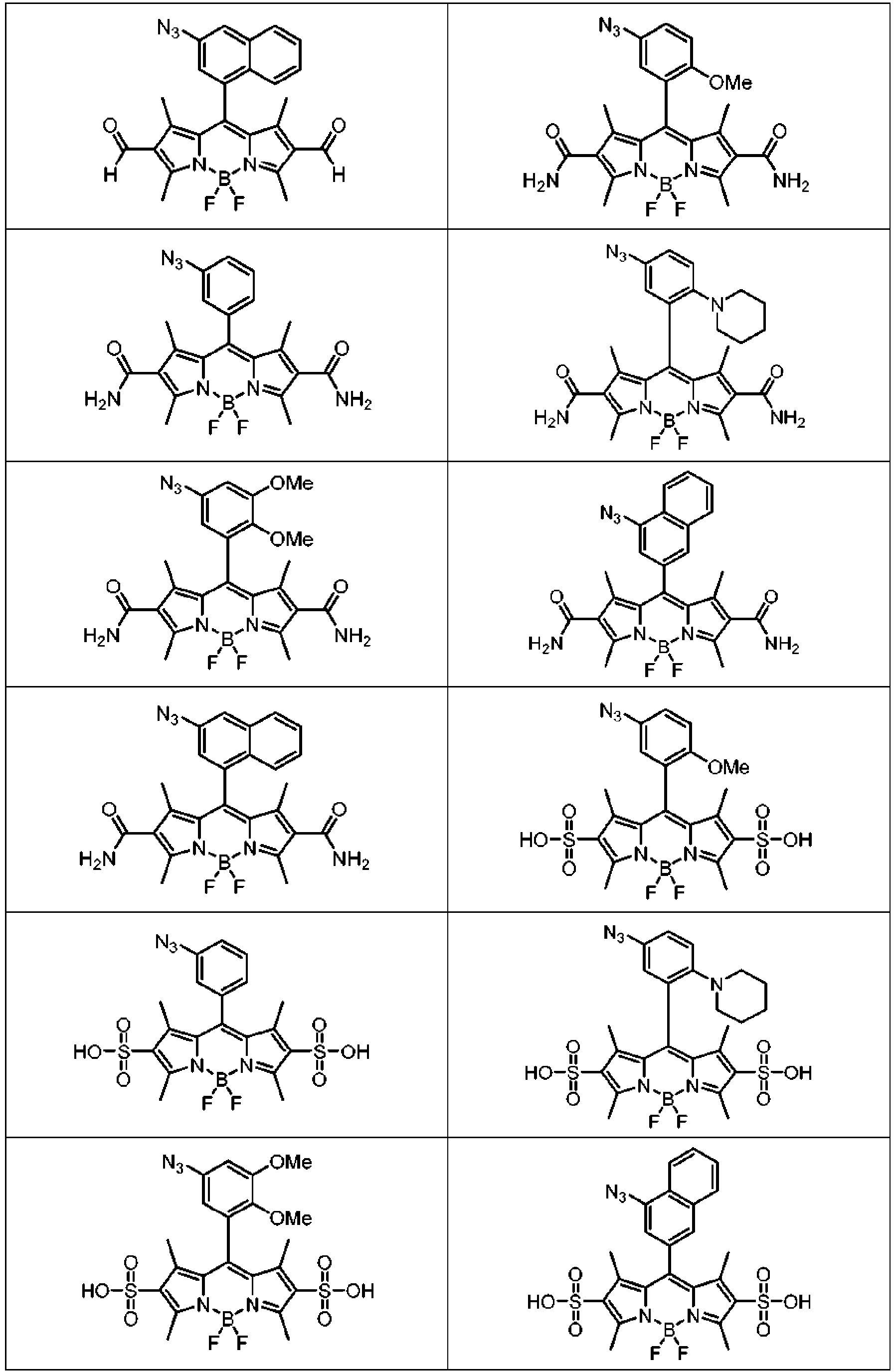


- Composé selon la revendication 4, où le composé est choisi dans le groupe constitué par:


- Procédé d'imagerie d'une molécule contenant un alcyne comprenant(a) la mise en contact d'un composé de la revendication 1 avec un échantillon contenant la molécule contenant un alcyne dans des conditions permettant la ligature du composé à un groupe alcyne de la molécule pour former un produit triazole ; et(b) la mesure d'un signal fluorescent dégagé par le produit triazole.
- Procédé selon la revendication 7, où l'étape de mise en contact est effectuée en présence d'un catalyseur métallique.
- Procédé selon la revendication 8, où le catalyseur métallique est le cuivre(I).
- Procédé selon la revendication 7, où le composé est lié de manière covalente au groupe alcyne.
- Procédé selon la revendication 7, où l'échantillon contient des cellules et la molécule contenant un alcyne est située sur la surface cellulaire ou à l'intérieur des cellules.
- Procédé selon la revendication 7, où le composé est décrit par une formule choisie parmi les composés tels que définis dans la revendication 5.
- Procédé selon la revendication 7, où le composé est choisi parmi un composé selon la revendication 6.
- Procédé selon l'une quelconque des revendications 7 à 11, où la molécule contenant un alcyne est une biomolécule.
- Procédé selon la revendication 14, où la biomolécule est un ADN, un ARN, une protéine ou un glycane.
- Procédé selon la revendication 14, où la biomolécule est située sur ou près de la surface d'une cellule.
- Procédé selon la revendication 14, où la biomolécule est une biomolécule intracellulaire.
- Procédé de détection d'une molécule contenant un alcyne dans un échantillon, comprenant :(a) la mise en contact du composé de la revendication 1 avec un échantillon suspecté d'avoir une molécule contenant un alcyne ;(b) la mesure du niveau d'un signal fluorescent dégagé par le mélange d'échantillon ; et(c) la détermination de la présence de la molécule contenant un alcyne dans l'échantillon, dans lequel un signal fluorescent renforcé en comparaison avec un niveau du signal fluorescent en l'absence de la molécule indique la présence de la molécule contenant un alcyne.
- Procédé selon la revendication 18, où l'étape de mise en contact est effectuée en présence d'un catalyseur métallique.
- Procédé selon la revendication 19, où le catalyseur métallique est le cuivre(I).
- Procédé selon l'une quelconque des revendications 18 à 20, où l'échantillon contient des cellules et la molécule contenant un alcyne est située sur ou près de la surface d'une cellule ou à l'intérieur d'une cellule.
- Procédé selon la revendication 18, où le composé est décrit par une formule choisie parmi les composés tels que définis dans la revendication 5.
- Procédé selon la revendication 18, où le composé est choisi parmi un composé selon la revendication 6.
- Procédé selon la revendication 18, où la molécule contenant un alcyne est une biomolécule.
- Procédé selon la revendication 24, où la biomolécule est un ADN, un ARN, une protéine ou un glycane.
- Procédé selon la revendication 24, où la biomolécule est située sur ou près de la surface d'une cellule.
- Procédé selon la revendication 24, où la biomolécule est une biomolécule intracellulaire.
- Procédé selon les revendications 7 ou 18, dans lequel le procédé comprend l'utilisation du composé pour une imagerie à fluorescence double dans une cellule.
- Composé de formule (V) ou de formule (VI) :


- Composé selon la revendication 29, où L est Cl, Br, ou I.
- Composé selon la revendication 29, où L est umbelliféryle.
- Composé selon la revendication 31, où le composé est le composé 601 :

- Procédé d'imagerie du site actif d'une enzyme sialidase comprenant(a) la mise en contact d'un composé de la revendication 29 avec un échantillon suspecté de comprendre l'enzyme sialidase dans des conditions permettant la ligature du composé à un site actif de l'enzyme sialidase pour former un produit de liaison covalente ;(b) la mise en contact du produit de liaison covalente avec une sonde fluorogénique contenant un azide telle que définie dans la revendication 1 pour former un produit triazole fluorogénique ; et(c) la mesure d'un signal fluorescent dégagé par le produit triazole.
- Procédé de détection du site actif d'une enzyme sialidase dans un échantillon, comprenant :(a) la mise en contact du composé de la revendication 29 avec un échantillon suspecté d'avoir une molécule d'enzyme sialidase ;(b) la mesure du niveau d'un signal fluorescent dégagé par la coumadine dans le mélange d'échantillon, et(c) la détermination de la présence de la molécule d'enzyme sialidase dans l'échantillon, dans laquell un signal fluorescent renforcé en comparaison avec un niveau du signal fluorescent en l'absence de la molécule indique la présence de la molécule contenant un azide telle que définie dans la revendication 1.
Applications Claiming Priority (2)
| Application Number | Priority Date | Filing Date | Title |
|---|---|---|---|
| US201461971313P | 2014-03-27 | 2014-03-27 | |
| PCT/US2015/022977 WO2015148915A1 (fr) | 2014-03-27 | 2015-03-27 | Composés de marquage réactifs et leurs utilisations |
Publications (3)
| Publication Number | Publication Date |
|---|---|
| EP3129767A1 EP3129767A1 (fr) | 2017-02-15 |
| EP3129767A4 EP3129767A4 (fr) | 2018-01-10 |
| EP3129767B1 true EP3129767B1 (fr) | 2021-09-01 |
Family
ID=54196439
Family Applications (1)
| Application Number | Title | Priority Date | Filing Date |
|---|---|---|---|
| EP15770237.4A Active EP3129767B1 (fr) | 2014-03-27 | 2015-03-27 | Composés de marquage réactifs et leurs utilisations |
Country Status (6)
| Country | Link |
|---|---|
| US (2) | US9759726B2 (fr) |
| EP (1) | EP3129767B1 (fr) |
| JP (2) | JP6562942B2 (fr) |
| CN (1) | CN106415244B (fr) |
| TW (2) | TWI797430B (fr) |
| WO (1) | WO2015148915A1 (fr) |
Families Citing this family (32)
| Publication number | Priority date | Publication date | Assignee | Title |
|---|---|---|---|---|
| US7960139B2 (en) | 2007-03-23 | 2011-06-14 | Academia Sinica | Alkynyl sugar analogs for the labeling and visualization of glycoconjugates in cells |
| JP5986745B2 (ja) | 2008-07-15 | 2016-09-06 | アカデミア シニカAcademia Sinica | Ptfe様のアルミニウム・コート・ガラススライド上のグリカンアレイおよび関連する方法 |
| US10087236B2 (en) | 2009-12-02 | 2018-10-02 | Academia Sinica | Methods for modifying human antibodies by glycan engineering |
| US11377485B2 (en) | 2009-12-02 | 2022-07-05 | Academia Sinica | Methods for modifying human antibodies by glycan engineering |
| WO2011130332A1 (fr) | 2010-04-12 | 2011-10-20 | Academia Sinica | Puces au glycane pour la recherche par criblage haut débit de virus |
| US10130714B2 (en) | 2012-04-14 | 2018-11-20 | Academia Sinica | Enhanced anti-influenza agents conjugated with anti-inflammatory activity |
| WO2014031498A1 (fr) * | 2012-08-18 | 2014-02-27 | Academia Sinica | Sondes perméables aux cellules pour l'identification et l'imagerie de sialidases |
| US10086054B2 (en) | 2013-06-26 | 2018-10-02 | Academia Sinica | RM2 antigens and use thereof |
| WO2014210564A1 (fr) | 2013-06-27 | 2014-12-31 | Academia Sinica | Conjugués de glycane et leur utilisation |
| JP6486368B2 (ja) | 2013-09-06 | 2019-03-20 | アカデミア シニカAcademia Sinica | 改変されたグリコシル基を含む糖脂質を用いたヒトiNKT細胞の活性化 |
| US10150818B2 (en) | 2014-01-16 | 2018-12-11 | Academia Sinica | Compositions and methods for treatment and detection of cancers |
| TW201620939A (zh) | 2014-01-16 | 2016-06-16 | 中央研究院 | 治療及檢測癌症之組合物及方法 |
| EP3129767B1 (fr) | 2014-03-27 | 2021-09-01 | Academia Sinica | Composés de marquage réactifs et leurs utilisations |
| AU2015267045B2 (en) | 2014-05-27 | 2021-02-25 | Academia Sinica | Anti-HER2 glycoantibodies and uses thereof |
| KR20170003720A (ko) | 2014-05-27 | 2017-01-09 | 아카데미아 시니카 | 항-cd20 글리코항체 및 이의 용도 |
| US10118969B2 (en) | 2014-05-27 | 2018-11-06 | Academia Sinica | Compositions and methods relating to universal glycoforms for enhanced antibody efficacy |
| DK3149045T3 (da) | 2014-05-27 | 2023-03-06 | Academia Sinica | Sammensætninger og fremgangsmåder vedrørende universelle glycoformer til forbedret antistofeffekt |
| JP7063538B2 (ja) | 2014-05-28 | 2022-05-09 | アカデミア シニカ | 抗TNFα糖操作抗体群およびその使用 |
| EP3191500A4 (fr) | 2014-09-08 | 2018-04-11 | Academia Sinica | Activation des cellules inkt humaines par des glycolipides |
| US9975965B2 (en) | 2015-01-16 | 2018-05-22 | Academia Sinica | Compositions and methods for treatment and detection of cancers |
| US10495645B2 (en) | 2015-01-16 | 2019-12-03 | Academia Sinica | Cancer markers and methods of use thereof |
| US10342858B2 (en) | 2015-01-24 | 2019-07-09 | Academia Sinica | Glycan conjugates and methods of use thereof |
| AU2017231749A1 (en) | 2016-03-08 | 2018-09-20 | Academia Sinica | Methods for modular synthesis of N-glycans and arrays thereof |
| JP7527537B2 (ja) * | 2016-05-10 | 2024-08-05 | ソニーグループ株式会社 | ペプチド骨格を有する超明色ポリマー染料 |
| AU2017316663B2 (en) | 2016-08-22 | 2024-02-22 | CHO Pharma Inc. | Antibodies, binding fragments, and methods of use |
| CN107973787B (zh) * | 2017-11-29 | 2021-02-02 | 山西大学 | 一种香豆素衍生物dmac及其制备方法和应用 |
| US11639364B2 (en) | 2018-01-29 | 2023-05-02 | Stichting Radboud Universiteit | Potent sialyltransferase inhibitors |
| JP7264344B2 (ja) * | 2019-02-27 | 2023-04-25 | 公立大学法人福井県立大学 | 生体高分子を認識するハイブリッド型蛍光プローブ |
| CN111349109B (zh) * | 2020-04-02 | 2022-09-16 | 三峡大学 | 一种七元氟硼二吡咯荧光染料的合成方法 |
| KR102628436B1 (ko) | 2020-04-29 | 2024-01-22 | 삼성에스디아이 주식회사 | 화합물, 이를 포함하는 반사방지 필름 및 디스플레이 장치 |
| CN113004311B (zh) * | 2021-02-05 | 2022-07-19 | 嘉兴学院 | 一种氟硼二吡咯类荧光探针、其制备方法及在金离子检测中的应用 |
| WO2025007135A2 (fr) * | 2023-06-30 | 2025-01-02 | Wayne State University | Systèmes d'ingénierie métabolique contrôlée de glycane et leurs applications |
Family Cites Families (348)
| Publication number | Priority date | Publication date | Assignee | Title |
|---|---|---|---|---|
| US3773919A (en) | 1969-10-23 | 1973-11-20 | Du Pont | Polylactide-drug mixtures |
| US3896111A (en) | 1973-02-20 | 1975-07-22 | Research Corp | Ansa macrolides |
| US4151042A (en) | 1977-03-31 | 1979-04-24 | Takeda Chemical Industries, Ltd. | Method for producing maytansinol and its derivatives |
| US4137230A (en) | 1977-11-14 | 1979-01-30 | Takeda Chemical Industries, Ltd. | Method for the production of maytansinoids |
| USRE30985E (en) | 1978-01-01 | 1982-06-29 | Serum-free cell culture media | |
| US4265814A (en) | 1978-03-24 | 1981-05-05 | Takeda Chemical Industries | Matansinol 3-n-hexadecanoate |
| US4307016A (en) | 1978-03-24 | 1981-12-22 | Takeda Chemical Industries, Ltd. | Demethyl maytansinoids |
| JPS5562090A (en) | 1978-10-27 | 1980-05-10 | Takeda Chem Ind Ltd | Novel maytansinoid compound and its preparation |
| JPS55164687A (en) | 1979-06-11 | 1980-12-22 | Takeda Chem Ind Ltd | Novel maytansinoid compound and its preparation |
| US4256746A (en) | 1978-11-14 | 1981-03-17 | Takeda Chemical Industries | Dechloromaytansinoids, their pharmaceutical compositions and method of use |
| JPS5566585A (en) | 1978-11-14 | 1980-05-20 | Takeda Chem Ind Ltd | Novel maytansinoid compound and its preparation |
| JPS55102583A (en) | 1979-01-31 | 1980-08-05 | Takeda Chem Ind Ltd | 20-acyloxy-20-demethylmaytansinoid compound |
| JPS55162791A (en) | 1979-06-05 | 1980-12-18 | Takeda Chem Ind Ltd | Antibiotic c-15003pnd and its preparation |
| JPS55164685A (en) | 1979-06-08 | 1980-12-22 | Takeda Chem Ind Ltd | Novel maytansinoid compound and its preparation |
| JPS55164686A (en) | 1979-06-11 | 1980-12-22 | Takeda Chem Ind Ltd | Novel maytansinoid compound and its preparation |
| US4309428A (en) | 1979-07-30 | 1982-01-05 | Takeda Chemical Industries, Ltd. | Maytansinoids |
| JPS5645483A (en) | 1979-09-19 | 1981-04-25 | Takeda Chem Ind Ltd | C-15003phm and its preparation |
| EP0028683A1 (fr) | 1979-09-21 | 1981-05-20 | Takeda Chemical Industries, Ltd. | Antibiotique C-15003 PHO et sa préparation |
| JPS5645485A (en) | 1979-09-21 | 1981-04-25 | Takeda Chem Ind Ltd | Production of c-15003pnd |
| US4270537A (en) | 1979-11-19 | 1981-06-02 | Romaine Richard A | Automatic hypodermic syringe |
| US4376110A (en) | 1980-08-04 | 1983-03-08 | Hybritech, Incorporated | Immunometric assays using monoclonal antibodies |
| WO1982001188A1 (fr) | 1980-10-08 | 1982-04-15 | Takeda Chemical Industries Ltd | Composes 4,5-deoxymaytansinoide et leur procede de preparation |
| US4450254A (en) | 1980-11-03 | 1984-05-22 | Standard Oil Company | Impact improvement of high nitrile resins |
| US4419446A (en) | 1980-12-31 | 1983-12-06 | The United States Of America As Represented By The Department Of Health And Human Services | Recombinant DNA process utilizing a papilloma virus DNA as a vector |
| US4313946A (en) | 1981-01-27 | 1982-02-02 | The United States Of America As Represented By The Secretary Of Agriculture | Chemotherapeutically active maytansinoids from Trewia nudiflora |
| US4315929A (en) | 1981-01-27 | 1982-02-16 | The United States Of America As Represented By The Secretary Of Agriculture | Method of controlling the European corn borer with trewiasine |
| JPS57192389A (en) | 1981-05-20 | 1982-11-26 | Takeda Chem Ind Ltd | Novel maytansinoid |
| US4596792A (en) | 1981-09-04 | 1986-06-24 | The Regents Of The University Of California | Safe vaccine for hepatitis containing polymerized serum albumin |
| US4741900A (en) | 1982-11-16 | 1988-05-03 | Cytogen Corporation | Antibody-metal ion complexes |
| US4601978A (en) | 1982-11-24 | 1986-07-22 | The Regents Of The University Of California | Mammalian metallothionein promoter system |
| US4560655A (en) | 1982-12-16 | 1985-12-24 | Immunex Corporation | Serum-free cell culture medium and process for making same |
| US4657866A (en) | 1982-12-21 | 1987-04-14 | Sudhir Kumar | Serum-free, synthetic, completely chemically defined tissue culture media |
| US4816567A (en) | 1983-04-08 | 1989-03-28 | Genentech, Inc. | Recombinant immunoglobin preparations |
| US4767704A (en) | 1983-10-07 | 1988-08-30 | Columbia University In The City Of New York | Protein-free culture medium |
| US4599230A (en) | 1984-03-09 | 1986-07-08 | Scripps Clinic And Research Foundation | Synthetic hepatitis B virus vaccine including both T cell and B cell determinants |
| US4599231A (en) | 1984-03-09 | 1986-07-08 | Scripps Clinic And Research Foundation | Synthetic hepatitis B virus vaccine including both T cell and B cell determinants |
| US4965199A (en) | 1984-04-20 | 1990-10-23 | Genentech, Inc. | Preparation of functional human factor VIII in mammalian cells using methotrexate based selection |
| US4970198A (en) | 1985-10-17 | 1990-11-13 | American Cyanamid Company | Antitumor antibiotics (LL-E33288 complex) |
| US4596556A (en) | 1985-03-25 | 1986-06-24 | Bioject, Inc. | Hypodermic injection apparatus |
| US4601903A (en) | 1985-05-01 | 1986-07-22 | The United States Of America As Represented By The Department Of Health And Human Services | Vaccine against Neisseria meningitidis Group B serotype 2 invasive disease |
| GB8516415D0 (en) | 1985-06-28 | 1985-07-31 | Celltech Ltd | Culture of animal cells |
| US4676980A (en) | 1985-09-23 | 1987-06-30 | The United States Of America As Represented By The Secretary Of The Department Of Health And Human Services | Target specific cross-linked heteroantibodies |
| US4927762A (en) | 1986-04-01 | 1990-05-22 | Cell Enterprises, Inc. | Cell culture medium with antioxidant |
| US5567610A (en) | 1986-09-04 | 1996-10-22 | Bioinvent International Ab | Method of producing human monoclonal antibodies and kit therefor |
| US5811128A (en) | 1986-10-24 | 1998-09-22 | Southern Research Institute | Method for oral or rectal delivery of microencapsulated vaccines and compositions therefor |
| US5075109A (en) | 1986-10-24 | 1991-12-24 | Southern Research Institute | Method of potentiating an immune response |
| US4886499A (en) | 1986-12-18 | 1989-12-12 | Hoffmann-La Roche Inc. | Portable injection appliance |
| IL85035A0 (en) | 1987-01-08 | 1988-06-30 | Int Genetic Eng | Polynucleotide molecule,a chimeric antibody with specificity for human b cell surface antigen,a process for the preparation and methods utilizing the same |
| US5079233A (en) | 1987-01-30 | 1992-01-07 | American Cyanamid Company | N-acyl derivatives of the LL-E33288 antitumor antibiotics, composition and methods for using the same |
| GB8704027D0 (en) | 1987-02-20 | 1987-03-25 | Owen Mumford Ltd | Syringe needle combination |
| EP0307434B2 (fr) | 1987-03-18 | 1998-07-29 | Scotgen Biopharmaceuticals, Inc. | Anticorps alteres |
| US4849222A (en) | 1987-03-24 | 1989-07-18 | The Procter & Gamble Company | Mixtures for treating hypercholesterolemia |
| US4940460A (en) | 1987-06-19 | 1990-07-10 | Bioject, Inc. | Patient-fillable and non-invasive hypodermic injection device assembly |
| US4941880A (en) | 1987-06-19 | 1990-07-17 | Bioject, Inc. | Pre-filled ampule and non-invasive hypodermic injection device assembly |
| US4790824A (en) | 1987-06-19 | 1988-12-13 | Bioject, Inc. | Non-invasive hypodermic injection device |
| US4975278A (en) | 1988-02-26 | 1990-12-04 | Bristol-Myers Company | Antibody-enzyme conjugates in combination with prodrugs for the delivery of cytotoxic agents to tumor cells |
| US5004697A (en) | 1987-08-17 | 1991-04-02 | Univ. Of Ca | Cationized antibodies for delivery through the blood-brain barrier |
| US5770701A (en) | 1987-10-30 | 1998-06-23 | American Cyanamid Company | Process for preparing targeted forms of methyltrithio antitumor agents |
| US5053394A (en) | 1988-09-21 | 1991-10-01 | American Cyanamid Company | Targeted forms of methyltrithio antitumor agents |
| US5606040A (en) | 1987-10-30 | 1997-02-25 | American Cyanamid Company | Antitumor and antibacterial substituted disulfide derivatives prepared from compounds possessing a methyl-trithio group |
| JP2670680B2 (ja) | 1988-02-24 | 1997-10-29 | 株式会社ビーエムジー | 生理活性物質含有ポリ乳酸系微小球およびその製造法 |
| US5339163A (en) | 1988-03-16 | 1994-08-16 | Canon Kabushiki Kaisha | Automatic exposure control device using plural image plane detection areas |
| JPH01287029A (ja) | 1988-05-13 | 1989-11-17 | Mect Corp | 新規抗ウィルス剤 |
| DE68925971T2 (de) | 1988-09-23 | 1996-09-05 | Cetus Oncology Corp | Zellenzuchtmedium für erhöhtes zellenwachstum, zur erhöhung der langlebigkeit und expression der produkte |
| GB8823869D0 (en) | 1988-10-12 | 1988-11-16 | Medical Res Council | Production of antibodies |
| FR2638359A1 (fr) | 1988-11-03 | 1990-05-04 | Tino Dalto | Guide de seringue avec reglage de la profondeur de penetration de l'aiguille dans la peau |
| US5175384A (en) | 1988-12-05 | 1992-12-29 | Genpharm International | Transgenic mice depleted in mature t-cells and methods for making transgenic mice |
| US5530101A (en) | 1988-12-28 | 1996-06-25 | Protein Design Labs, Inc. | Humanized immunoglobulins |
| DE3920358A1 (de) | 1989-06-22 | 1991-01-17 | Behringwerke Ag | Bispezifische und oligospezifische, mono- und oligovalente antikoerperkonstrukte, ihre herstellung und verwendung |
| EP0479909B1 (fr) | 1989-06-29 | 1996-10-30 | Medarex, Inc. | Reactifs bispecifiques pour le traitement du sida |
| US5690938A (en) | 1989-07-07 | 1997-11-25 | Oravax, Inc. | Oral immunization with multiple particulate antigen delivery system |
| US5518725A (en) | 1989-09-25 | 1996-05-21 | University Of Utah Research Foundation | Vaccine compositions and method for induction of mucosal immune response via systemic vaccination |
| CA2026147C (fr) | 1989-10-25 | 2006-02-07 | Ravi J. Chari | Agents cytotoxiques comprenant des maytansinoides et leur usage therapeutique |
| US5208020A (en) | 1989-10-25 | 1993-05-04 | Immunogen Inc. | Cytotoxic agents comprising maytansinoids and their therapeutic use |
| US5238843A (en) | 1989-10-27 | 1993-08-24 | Genencor International, Inc. | Method for cleaning a surface on which is bound a glycoside-containing substance |
| US5064413A (en) | 1989-11-09 | 1991-11-12 | Bioject, Inc. | Needleless hypodermic injection device |
| US5312335A (en) | 1989-11-09 | 1994-05-17 | Bioject Inc. | Needleless hypodermic injection device |
| ES2284161T3 (es) | 1990-01-12 | 2007-11-01 | Amgen Fremont Inc. | Generacion de anticuerpos xenogenicos. |
| US5061620A (en) | 1990-03-30 | 1991-10-29 | Systemix, Inc. | Human hematopoietic stem cell |
| US5112596A (en) | 1990-04-23 | 1992-05-12 | Alkermes, Inc. | Method for increasing blood-brain barrier permeability by administering a bradykinin agonist of blood-brain barrier permeability |
| US5268164A (en) | 1990-04-23 | 1993-12-07 | Alkermes, Inc. | Increasing blood-brain barrier permeability with permeabilizer peptides |
| CZ288492B6 (en) | 1990-04-24 | 2001-06-13 | Biota Scient Management | Derivatives of alpha-D-neuraminic acid, process of their preparation, their use and pharmaceutical preparations based thereon |
| US5643577A (en) | 1990-04-24 | 1997-07-01 | The University Of Newcastle Research Associates Limited | Oral vaccine comprising antigen surface-associated with red blood cells |
| US5229275A (en) | 1990-04-26 | 1993-07-20 | Akzo N.V. | In-vitro method for producing antigen-specific human monoclonal antibodies |
| US5427908A (en) | 1990-05-01 | 1995-06-27 | Affymax Technologies N.V. | Recombinant library screening methods |
| ATE204902T1 (de) | 1990-06-29 | 2001-09-15 | Large Scale Biology Corp | Melaninproduktion durch transformierte mikroorganismen |
| US5190521A (en) | 1990-08-22 | 1993-03-02 | Tecnol Medical Products, Inc. | Apparatus and method for raising a skin wheal and anesthetizing skin |
| US5661016A (en) | 1990-08-29 | 1997-08-26 | Genpharm International Inc. | Transgenic non-human animals capable of producing heterologous antibodies of various isotypes |
| AU8507191A (en) | 1990-08-29 | 1992-03-30 | Genpharm International, Inc. | Transgenic non-human animals capable of producing heterologous antibodies |
| US5545806A (en) | 1990-08-29 | 1996-08-13 | Genpharm International, Inc. | Ransgenic non-human animals for producing heterologous antibodies |
| US5625126A (en) | 1990-08-29 | 1997-04-29 | Genpharm International, Inc. | Transgenic non-human animals for producing heterologous antibodies |
| US5633425A (en) | 1990-08-29 | 1997-05-27 | Genpharm International, Inc. | Transgenic non-human animals capable of producing heterologous antibodies |
| US5714374A (en) | 1990-09-12 | 1998-02-03 | Rutgers University | Chimeric rhinoviruses |
| US5122469A (en) | 1990-10-03 | 1992-06-16 | Genentech, Inc. | Method for culturing Chinese hamster ovary cells to improve production of recombinant proteins |
| WO1992006691A1 (fr) | 1990-10-19 | 1992-04-30 | Biota Scientific Management Pty. Ltd. | Composes anti-viraux qui lient le site actif de la neuraminidase de la grippe et presentent une activite in vivo contre l'orthomixovirus et le paramyxovirus |
| US5264365A (en) | 1990-11-09 | 1993-11-23 | Board Of Regents, The University Of Texas System | Protease-deficient bacterial strains for production of proteolytically sensitive polypeptides |
| US5508192A (en) | 1990-11-09 | 1996-04-16 | Board Of Regents, The University Of Texas System | Bacterial host strains for producing proteolytically sensitive polypeptides |
| ES2113940T3 (es) | 1990-12-03 | 1998-05-16 | Genentech Inc | Metodo de enriquecimiento para variantes de proteinas con propiedades de union alteradas. |
| US5527288A (en) | 1990-12-13 | 1996-06-18 | Elan Medical Technologies Limited | Intradermal drug delivery device and method for intradermal delivery of drugs |
| US5571894A (en) | 1991-02-05 | 1996-11-05 | Ciba-Geigy Corporation | Recombinant antibodies specific for a growth factor receptor |
| EP0586515B1 (fr) | 1991-04-30 | 1997-09-17 | Eukarion, Inc. | Anticorps cationises contre des proteines intracellulaires |
| ATE255131T1 (de) | 1991-06-14 | 2003-12-15 | Genentech Inc | Humanisierter heregulin antikörper |
| GB9114948D0 (en) | 1991-07-11 | 1991-08-28 | Pfizer Ltd | Process for preparing sertraline intermediates |
| GB9118204D0 (en) | 1991-08-23 | 1991-10-09 | Weston Terence E | Needle-less injector |
| SE9102652D0 (sv) | 1991-09-13 | 1991-09-13 | Kabi Pharmacia Ab | Injection needle arrangement |
| CA2116774C (fr) | 1991-09-19 | 2003-11-11 | Paul J. Carter | Expression dans e. coli de fragments d'anticorps ayant au moins une cysteine presente sous forme de thiol libre. utilisation pour la production d'anticorps f(ab') bifonctionnels |
| EP0605522B1 (fr) | 1991-09-23 | 1999-06-23 | Medical Research Council | Méthodes de production d'anticorps humanisés |
| US5565332A (en) | 1991-09-23 | 1996-10-15 | Medical Research Council | Production of chimeric antibodies - a combinatorial approach |
| US5362852A (en) | 1991-09-27 | 1994-11-08 | Pfizer Inc. | Modified peptide derivatives conjugated at 2-hydroxyethylamine moieties |
| FI941572L (fi) | 1991-10-07 | 1994-05-27 | Oncologix Inc | Anti-erbB-2-monoklonaalisten vasta-aineiden yhdistelmä ja käyttömenetelmä |
| US5288502A (en) | 1991-10-16 | 1994-02-22 | The University Of Texas System | Preparation and uses of multi-phase microspheres |
| WO1993008829A1 (fr) | 1991-11-04 | 1993-05-13 | The Regents Of The University Of California | Compositions induisant la destruction de cellules infectees par l'hiv |
| DE69229880T2 (de) | 1991-11-19 | 2000-05-04 | The University Of Virginia Patent Foundation, Charlottesville | Kombinierte virustatikum-antimediator-behandlung (covam) von gewöhnlichen erkältungen |
| JPH0826057B2 (ja) | 1992-01-16 | 1996-03-13 | 株式会社ディ・ディ・エス研究所 | シアル酸オリゴ糖誘導体及び微粒子キャリヤー |
| US5667988A (en) | 1992-01-27 | 1997-09-16 | The Scripps Research Institute | Methods for producing antibody libraries using universal or randomized immunoglobulin light chains |
| WO1993016185A2 (fr) | 1992-02-06 | 1993-08-19 | Creative Biomolecules, Inc. | Proteine de liaison biosynthetique pour marqueur de cancer |
| US5328483A (en) | 1992-02-27 | 1994-07-12 | Jacoby Richard M | Intradermal injection device with medication and needle guard |
| US5733743A (en) | 1992-03-24 | 1998-03-31 | Cambridge Antibody Technology Limited | Methods for producing members of specific binding pairs |
| US5326856A (en) | 1992-04-09 | 1994-07-05 | Cytogen Corporation | Bifunctional isothiocyanate derived thiocarbonyls as ligands for metal binding |
| ZA932522B (en) | 1992-04-10 | 1993-12-20 | Res Dev Foundation | Immunotoxins directed against c-erbB-2(HER/neu) related surface antigens |
| JP2904647B2 (ja) | 1992-06-12 | 1999-06-14 | 株式会社蛋白工学研究所 | 5−ブロム−4−クロロインド−3−イル−2−シアル酸の製造方法 |
| AU687010B2 (en) | 1992-07-17 | 1998-02-19 | Dana-Farber Cancer Institute | Method of intracellular binding of target molecules |
| US5383851A (en) | 1992-07-24 | 1995-01-24 | Bioject Inc. | Needleless hypodermic injection device |
| EP0652775B1 (fr) | 1992-07-27 | 2000-04-19 | THE GOVERNMENT OF THE UNITED STATES OF AMERICA as represented by the SECRETARY OF THE DEPARTMENT OF HEALTH AND HUMAN SERVICES | Ciblage de liposomes sur la barriere hemato-encephalique |
| EP0656064B1 (fr) | 1992-08-17 | 1997-03-05 | Genentech, Inc. | Immunoadhesines bispecifiques |
| US5569189A (en) | 1992-09-28 | 1996-10-29 | Equidyne Systems, Inc. | hypodermic jet injector |
| KR100281264B1 (ko) | 1992-10-22 | 2001-02-01 | 마나배 게이사꾸 | 신규한 스핀고당 지질 및 그의 사용 |
| US5807722A (en) | 1992-10-30 | 1998-09-15 | Bioengineering Resources, Inc. | Biological production of acetic acid from waste gases with Clostridium ljungdahlii |
| US5334144A (en) | 1992-10-30 | 1994-08-02 | Becton, Dickinson And Company | Single use disposable needleless injector |
| US5736137A (en) | 1992-11-13 | 1998-04-07 | Idec Pharmaceuticals Corporation | Therapeutic application of chimeric and radiolabeled antibodies to human B lymphocyte restricted differentiation antigen for treatment of B cell lymphoma |
| DE69303494T2 (de) | 1992-11-13 | 1997-01-16 | Idec Pharma Corp | Therapeutische verwendung von chimerischen und markierten antikörper gegen menschlichen b lymphozyt beschränkter differenzierung antigen für die behandlung von b-zell-lymphoma |
| US5635483A (en) | 1992-12-03 | 1997-06-03 | Arizona Board Of Regents Acting On Behalf Of Arizona State University | Tumor inhibiting tetrapeptide bearing modified phenethyl amides |
| US5780588A (en) | 1993-01-26 | 1998-07-14 | Arizona Board Of Regents | Elucidation and synthesis of selected pentapeptides |
| US5374541A (en) | 1993-05-04 | 1994-12-20 | The Scripps Research Institute | Combined use of β-galactosidase and sialyltransferase coupled with in situ regeneration of CMP-sialic acid for one pot synthesis of oligosaccharides |
| US20020037517A1 (en) | 1993-05-28 | 2002-03-28 | Hutchens T. William | Methods for sequencing biopolymers |
| JPH08511420A (ja) | 1993-06-16 | 1996-12-03 | セルテック・セラピューテイクス・リミテッド | 抗 体 |
| EP0724432B1 (fr) | 1993-10-22 | 2002-09-18 | Genentech, Inc. | Compositions et procedes de microencapsulation d'antigenes a utiliser comme vaccins |
| US5369017A (en) | 1994-02-04 | 1994-11-29 | The Scripps Research Institute | Process for solid phase glycopeptide synthesis |
| JPH09509664A (ja) | 1994-02-25 | 1997-09-30 | イー・アイ・デユポン・ドウ・ヌムール・アンド・カンパニー | 4−n−置換シアル酸およびそれらのシアロシド類 |
| WO1995024176A1 (fr) | 1994-03-07 | 1995-09-14 | Bioject, Inc. | Dispositif de remplissage d'ampoule |
| US5466220A (en) | 1994-03-08 | 1995-11-14 | Bioject, Inc. | Drug vial mixing and transfer device |
| US5773001A (en) | 1994-06-03 | 1998-06-30 | American Cyanamid Company | Conjugates of methyltrithio antitumor agents and intermediates for their synthesis |
| US5622701A (en) | 1994-06-14 | 1997-04-22 | Protein Design Labs, Inc. | Cross-reacting monoclonal antibodies specific for E- and P-selectin |
| AU3272695A (en) | 1994-08-12 | 1996-03-07 | Immunomedics Inc. | Immunoconjugates and humanized antibodies specific for b-cell lymphoma and leukemia cells |
| US5639635A (en) | 1994-11-03 | 1997-06-17 | Genentech, Inc. | Process for bacterial production of polypeptides |
| CA2207869A1 (fr) | 1994-12-02 | 1996-06-06 | Chiron Corporation | Methode permettant d'induire une reponse immunitaire avec un anticorps bispecifique |
| US5663149A (en) | 1994-12-13 | 1997-09-02 | Arizona Board Of Regents Acting On Behalf Of Arizona State University | Human cancer inhibitory pentapeptide heterocyclic and halophenyl amides |
| US5599302A (en) | 1995-01-09 | 1997-02-04 | Medi-Ject Corporation | Medical injection system and method, gas spring thereof and launching device using gas spring |
| US5731168A (en) | 1995-03-01 | 1998-03-24 | Genentech, Inc. | Method for making heteromultimeric polypeptides |
| US5840523A (en) | 1995-03-01 | 1998-11-24 | Genetech, Inc. | Methods and compositions for secretion of heterologous polypeptides |
| US6673533B1 (en) | 1995-03-10 | 2004-01-06 | Meso Scale Technologies, Llc. | Multi-array multi-specific electrochemiluminescence testing |
| US5641870A (en) | 1995-04-20 | 1997-06-24 | Genentech, Inc. | Low pH hydrophobic interaction chromatography for antibody purification |
| US5869046A (en) | 1995-04-14 | 1999-02-09 | Genentech, Inc. | Altered polypeptides with increased half-life |
| KR19990008052A (ko) | 1995-04-25 | 1999-01-25 | 마이클 피 노바 | 기억 장치를 갖는 원격적으로 프로그램 가능한 매트릭스 및 이의 용도 |
| EP0822830B1 (fr) | 1995-04-27 | 2008-04-02 | Amgen Fremont Inc. | Anticorps anti-IL-8 dérivés de xenosouris immunisées |
| WO1996034096A1 (fr) | 1995-04-28 | 1996-10-31 | Abgenix, Inc. | Anticorps humains derives de xeno-souris immunisees |
| US5730723A (en) | 1995-10-10 | 1998-03-24 | Visionary Medical Products Corporation, Inc. | Gas pressured needle-less injection device and method |
| US6265150B1 (en) | 1995-06-07 | 2001-07-24 | Becton Dickinson & Company | Phage antibodies |
| US5714586A (en) | 1995-06-07 | 1998-02-03 | American Cyanamid Company | Methods for the preparation of monomeric calicheamicin derivative/carrier conjugates |
| US5837234A (en) | 1995-06-07 | 1998-11-17 | Cytotherapeutics, Inc. | Bioartificial organ containing cells encapsulated in a permselective polyether suflfone membrane |
| US5712374A (en) | 1995-06-07 | 1998-01-27 | American Cyanamid Company | Method for the preparation of substantiallly monomeric calicheamicin derivative/carrier conjugates |
| AU6505796A (en) | 1995-07-26 | 1997-02-26 | Maxim Pharmaceuticals | Mucosal delivery of polynucleotides |
| DE19544393A1 (de) | 1995-11-15 | 1997-05-22 | Hoechst Schering Agrevo Gmbh | Synergistische herbizide Mischungen |
| US5893397A (en) | 1996-01-12 | 1999-04-13 | Bioject Inc. | Medication vial/syringe liquid-transfer apparatus |
| AU2660397A (en) | 1996-04-05 | 1997-10-29 | Board Of Regents, The University Of Texas System | Methods for producing soluble, biologically-active disulfide bond-containing eukaryotic proteins in bacterial cells |
| GB9607549D0 (en) | 1996-04-11 | 1996-06-12 | Weston Medical Ltd | Spring-powered dispensing device |
| US5922845A (en) | 1996-07-11 | 1999-07-13 | Medarex, Inc. | Therapeutic multispecific compounds comprised of anti-Fcα receptor antibodies |
| US6340702B1 (en) | 1996-07-22 | 2002-01-22 | Sankyo Company, Limited | Neuraminic acid derivatives, their preparation and their medical use |
| US6506564B1 (en) | 1996-07-29 | 2003-01-14 | Nanosphere, Inc. | Nanoparticles having oligonucleotides attached thereto and uses therefor |
| AU732916C (en) | 1996-11-14 | 2002-06-06 | Biota Scientific Management Pty Ltd | Method and novel compounds for use therein |
| ATE549918T1 (de) | 1996-12-03 | 2012-04-15 | Amgen Fremont Inc | Menschliche antikörper, die ausdrücklich menschliches tnf alpha binden |
| TW555562B (en) | 1996-12-27 | 2003-10-01 | Kirin Brewery | Method for activation of human antigen-presenting cells, activated human antigen-presenting cells and use thereof |
| US6399071B1 (en) | 1997-04-18 | 2002-06-04 | Novartis Ag | Neoglycoproteins |
| US5993412A (en) | 1997-05-19 | 1999-11-30 | Bioject, Inc. | Injection apparatus |
| US6083715A (en) | 1997-06-09 | 2000-07-04 | Board Of Regents, The University Of Texas System | Methods for producing heterologous disulfide bond-containing polypeptides in bacterial cells |
| JPH1135593A (ja) | 1997-07-18 | 1999-02-09 | Daikin Ind Ltd | 2−フルオロフコシル−n−アロイルグルコサミン誘導体及びその中間物、並びにそれらの製造方法 |
| TW477783B (en) | 1997-12-12 | 2002-03-01 | Gilead Sciences Inc | Novel compounds useful as neuraminidase inhibitors and pharmaceutical compositions containing same |
| IT1298087B1 (it) | 1998-01-08 | 1999-12-20 | Fiderm S R L | Dispositivo per il controllo della profondita' di penetrazione di un ago, in particolare applicabile ad una siringa per iniezioni |
| AU765703B2 (en) | 1998-03-27 | 2003-09-25 | Bruce J. Bryan | Luciferases, fluorescent proteins, nucleic acids encoding the luciferases and fluorescent proteins and the use thereof in diagnostics, high throughput screening and novelty items |
| IL138608A0 (en) | 1998-04-02 | 2001-10-31 | Genentech Inc | Antibody variants and fragments thereof |
| AU3657899A (en) | 1998-04-20 | 1999-11-08 | James E. Bailey | Glycosylation engineering of antibodies for improving antibody-dependent cellular cytotoxicity |
| US6455571B1 (en) | 1998-04-23 | 2002-09-24 | Abbott Laboratories | Inhibitors of neuraminidases |
| BRPI9910332B8 (pt) | 1998-05-06 | 2021-05-25 | Genentech Inc | método para purificação de um polipeptídio a partir de uma composição |
| US6528286B1 (en) | 1998-05-29 | 2003-03-04 | Genentech, Inc. | Mammalian cell culture process for producing glycoproteins |
| JP3773153B2 (ja) | 1998-05-29 | 2006-05-10 | 独立行政法人理化学研究所 | シアル酸誘導体 |
| EP2306195A3 (fr) | 1998-09-18 | 2012-04-25 | Massachusetts Institute of Technology | Applications biologiques de nano-cristaux semi-conducteur |
| FR2783523B1 (fr) | 1998-09-21 | 2006-01-20 | Goemar Lab Sa | Fuco-oligosaccharides, enzyme pour leur preparation a partir des fucanes, bacterie productrice de l'enzyme et applications des fuco-oligosaccharides a la protection des plantes |
| US6696304B1 (en) | 1999-02-24 | 2004-02-24 | Luminex Corporation | Particulate solid phase immobilized protein quantitation |
| AUPP913999A0 (en) | 1999-03-12 | 1999-04-01 | Biota Scientific Management Pty Ltd | Novel chemical compounds and their use |
| US7090973B1 (en) | 1999-04-09 | 2006-08-15 | Oscient Pharmaceuticals Corporation | Nucleic acid sequences relating to Bacteroides fragilis for diagnostics and therapeutics |
| US7854934B2 (en) | 1999-08-20 | 2010-12-21 | Sloan-Kettering Institute For Cancer Research | Glycoconjugates, glycoamino acids, intermediates thereto, and uses thereof |
| JP2001131074A (ja) * | 1999-08-20 | 2001-05-15 | Inst Of Physical & Chemical Res | シアル酸誘導体を有効成分として含む医薬 |
| US6824780B1 (en) | 1999-10-29 | 2004-11-30 | Genentech, Inc. | Anti-tumor antibody compositions and methods of use |
| AUPQ422399A0 (en) * | 1999-11-24 | 1999-12-16 | University Of New South Wales, The | Method of screening transformed or transfected cells |
| US6727356B1 (en) | 1999-12-08 | 2004-04-27 | Epoch Pharmaceuticals, Inc. | Fluorescent quenching detection reagents and methods |
| US20020098513A1 (en) | 2000-02-17 | 2002-07-25 | Glycominds Ltd. | Combinatorial complex carbohydrate libraries and methods for the manufacture and uses thereof |
| US7019129B1 (en) | 2000-05-09 | 2006-03-28 | Biosearch Technologies, Inc. | Dark quenchers for donor-acceptor energy transfer |
| US7863020B2 (en) | 2000-06-28 | 2011-01-04 | Glycofi, Inc. | Production of sialylated N-glycans in lower eukaryotes |
| US6514221B2 (en) | 2000-07-27 | 2003-02-04 | Brigham And Women's Hospital, Inc. | Blood-brain barrier opening |
| WO2002017930A2 (fr) | 2000-08-30 | 2002-03-07 | The Board Of Trustees Of The Leland Stanford Junior University | Agents bloquants des glucocorticoides pour augmenter la permeabilite de la barriere hemato-encephalique |
| AUPR001000A0 (en) | 2000-09-08 | 2000-10-05 | Biota Scientific Management Pty Ltd | Novel chemical compounds and their use |
| US7034036B2 (en) | 2000-10-30 | 2006-04-25 | Pain Therapeutics, Inc. | Inhibitors of ABC drug transporters at the blood-brain barrier |
| US20030083299A1 (en) | 2000-11-04 | 2003-05-01 | Ferguson Ian A. | Non-invasive delivery of polypeptides through the blood-brain barrier |
| JP2002153272A (ja) | 2000-11-24 | 2002-05-28 | Inst Of Physical & Chemical Res | 生体分子マイクロアレイ |
| US7754208B2 (en) | 2001-01-17 | 2010-07-13 | Trubion Pharmaceuticals, Inc. | Binding domain-immunoglobulin fusion proteins |
| US20030104402A1 (en) | 2001-01-23 | 2003-06-05 | University Of Rochester | Methods of producing or identifying intrabodies in eukaryotic cells |
| US6884869B2 (en) | 2001-04-30 | 2005-04-26 | Seattle Genetics, Inc. | Pentapeptide compounds and uses related thereto |
| DE10121982B4 (de) | 2001-05-05 | 2008-01-24 | Lts Lohmann Therapie-Systeme Ag | Nanopartikel aus Protein mit gekoppeltem Apolipoprotein E zur Überwindung der Blut-Hirn-Schranke und Verfahren zu ihrer Herstellung |
| JP2005500336A (ja) | 2001-07-25 | 2005-01-06 | ニューヨーク・ユニバーシティ | 感染および癌に対するワクチンのためのアジュバントとしてのグリコシルセラミドの使用 |
| AU2002322720B2 (en) | 2001-07-25 | 2008-11-13 | Raptor Pharmaceutical Inc. | Compositions and methods for modulating blood-brain barrier transport |
| NZ581474A (en) | 2001-08-03 | 2011-04-29 | Glycart Biotechnology Ag | Antibody glycosylation variants having increased antibody-dependent cellular cytotoxicity |
| EP2042196B1 (fr) | 2001-10-10 | 2016-07-13 | ratiopharm GmbH | Remodelage et glycoconjugation de facteur stimulant les colonies de granulocytes (G-CSF) |
| EP1444055A4 (fr) | 2001-10-19 | 2007-04-18 | Superior Micropowders Llc | Composition de bande destinee au depot de caracteristiques electroniques |
| AUPR879601A0 (en) | 2001-11-09 | 2001-12-06 | Biota Scientific Management Pty Ltd | Novel chemical compounds and their use |
| US20040019430A1 (en) | 2001-11-21 | 2004-01-29 | Patrick Hurban | Methods and systems for analyzing complex biological systems |
| RU2004127458A (ru) | 2002-02-14 | 2005-10-27 | Иммуномедикс, Инк. (Us) | Анти-cd20 антитела, их гибридные белки и способы их использования |
| US20030162695A1 (en) | 2002-02-27 | 2003-08-28 | Schatzberg Alan F. | Glucocorticoid blocking agents for increasing blood-brain barrier permeability |
| US7317091B2 (en) | 2002-03-01 | 2008-01-08 | Xencor, Inc. | Optimized Fc variants |
| WO2003077945A1 (fr) | 2002-03-14 | 2003-09-25 | Medical Research Council | Anticorps intracellulaires |
| DE60328481D1 (de) | 2002-05-14 | 2009-09-03 | Novartis Vaccines & Diagnostic | Schleimhautapplizierter impfstoff, der das adjuvanz chitosan und menigokokkenantigene enthält |
| EP1551865B1 (fr) | 2002-07-08 | 2009-04-22 | GlaxoSmithKline istrazivacki centar Zagreb d.o.o. | Molecules hybrides de macrolides avec des molecules anti-inflammatoires steroidiennes/non-steroidiennes |
| US20080070324A1 (en) | 2002-07-15 | 2008-03-20 | Floyd Alton D | Quantity control device for microscope slide staining assays |
| EP1391213A1 (fr) | 2002-08-21 | 2004-02-25 | Boehringer Ingelheim International GmbH | Compositions et méthodes pour le traitement du cancer en utilisant un conjugué d'un anticorps contre le CD44 avec un maytansinoide et des agents chimiothérapeutiques |
| US20040062682A1 (en) | 2002-09-30 | 2004-04-01 | Rakow Neal Anthony | Colorimetric sensor |
| KR20110017020A (ko) | 2002-10-17 | 2011-02-18 | 젠맵 에이/에스 | Cd20에 대한 인간 모노클로날 항체 |
| AU2003302676A1 (en) | 2002-12-03 | 2004-06-23 | Blanchette Rockefeller Neurosciences Institute | Artificial low-density lipoprotein carriers for transport of substances across the blood-brain barrier |
| EP1944320A1 (fr) | 2002-12-16 | 2008-07-16 | Genentech, Inc. | Variantes de l'immunoglobuline et leurs utilisations |
| EP2368578A1 (fr) | 2003-01-09 | 2011-09-28 | Macrogenics, Inc. | Identification et ingénierie d'anticorps avec régions FC de variante et procédés d'utilisation associés |
| US8088387B2 (en) | 2003-10-10 | 2012-01-03 | Immunogen Inc. | Method of targeting specific cell populations using cell-binding agent maytansinoid conjugates linked via a non-cleavable linker, said conjugates, and methods of making said conjugates |
| AR044388A1 (es) | 2003-05-20 | 2005-09-07 | Applied Molecular Evolution | Moleculas de union a cd20 |
| US20040259142A1 (en) | 2003-06-04 | 2004-12-23 | Imperial College Innovations Limited | Products and methods |
| CA2528669A1 (fr) | 2003-06-09 | 2005-01-20 | The Regents Of The University Of Michigan | Compositions et methodes de traitement et de diagnostic du cancer |
| JP4148844B2 (ja) | 2003-06-11 | 2008-09-10 | ソニー・エリクソン・モバイルコミュニケーションズ株式会社 | 情報端末装置及び音声付画像ファイルの出力方法 |
| EP1663239A4 (fr) | 2003-09-10 | 2008-07-23 | Cedars Sinai Medical Center | Administration assistee par les canaux potassiques d'agents a travers la barriere hemato-encephalique |
| US20060286140A1 (en) | 2003-09-15 | 2006-12-21 | Eric Wickstrom | Implants with attached silylated therapeutic agents |
| EP1689439A2 (fr) | 2003-09-22 | 2006-08-16 | Acidophil LLC | Compositions a petites molecules et procedes destines a augmenter l'efficacite d'un medicament au moyen de ces compositions |
| WO2005033663A2 (fr) | 2003-09-30 | 2005-04-14 | Sequenom, Inc. | Procedes de fabrication de substrats pour analyse par spectrometrie de masse et dispositifs associes |
| US20050221337A1 (en) | 2003-10-02 | 2005-10-06 | Massachusetts Institute Of Technology | Microarrays and microspheres comprising oligosaccharides, complex carbohydrates or glycoproteins |
| PT1692182E (pt) | 2003-11-05 | 2010-05-13 | Roche Glycart Ag | Anticorpos de cd20 com uma afinidade de ligação acrescida ao receptor fc e uma função efectora acrescida |
| EP3434275A1 (fr) | 2003-11-06 | 2019-01-30 | Seattle Genetics, Inc. | Méthode de dépistage de cellules cancéreuses basé sur l'utilisation de conjugués d'auristatin avec anticorps |
| WO2005050224A2 (fr) | 2003-11-13 | 2005-06-02 | Epitome Biosystems Inc. | Agencements de peptides et de petites molecules et leurs utilisations |
| WO2005088310A2 (fr) | 2004-03-05 | 2005-09-22 | The Scripps Research Institute | Jeux ordonnes de microechantillons de glycanes a haut rendement |
| US20050221397A1 (en) | 2004-03-30 | 2005-10-06 | Northern Advancement Center For Science & Technology | RM2 antigen (beta1,4-GalNAc-disialyl-Lc4) as prostate cancer-associated antigen |
| WO2005103081A2 (fr) | 2004-04-20 | 2005-11-03 | Genmab A/S | Anticorps monoclonaux humains diriges contre cd20 |
| ITMI20040928A1 (it) | 2004-05-07 | 2004-08-07 | Uni Di Bologna Dipartiment O D | Procedura per la preparazione di coniugati della doxorubicina con l'albumina umana lattosaminata |
| AU2005258281A1 (en) | 2004-06-24 | 2006-01-05 | The Scripps Research Institute | Arrays with cleavable linkers |
| HRP20141111T1 (hr) | 2004-07-22 | 2015-01-02 | Genentech, Inc. | Sastav her2-protutijela |
| US8022043B2 (en) | 2004-08-27 | 2011-09-20 | Albert Einstein College Of Medicine Of Yeshiva University | Ceramide derivatives as modulators of immunity and autoimmunity |
| WO2006055925A2 (fr) | 2004-11-19 | 2006-05-26 | Swiss Federal Institute Of Technology | Jeux ordonnes de microechantillons pour la detection d'analytes |
| WO2006064983A1 (fr) | 2004-12-14 | 2006-06-22 | Korea Research Institute Of Bioscience And Biotechnology | Anticorps monoclonal specifique aux cellules souches embryonnaires humaines |
| US7923013B2 (en) | 2004-12-28 | 2011-04-12 | The Rockefeller University | Glycolipids and analogues thereof as antigens for NKT cells |
| EP1833489A4 (fr) | 2004-12-28 | 2011-08-03 | Univ Rockefeller | Glycolipides et analogues associes utilises en tant qu'antigenes des lymphocytes nkt |
| RU2415871C2 (ru) | 2005-03-31 | 2011-04-10 | Байомедикс Инк. | Моноклональное анти-cd20-антитело |
| KR20080039844A (ko) | 2005-05-24 | 2008-05-07 | 아베스타 겐그레인 테크놀로지스 피브이티 리미티드 | B―세포 림프종 치료를 위한 cd20에 대한 모노클로날항체의 제조 방법 |
| KR20080031001A (ko) | 2005-06-02 | 2008-04-07 | 아스트라제네카 아베 | Cd20에 대한 항체 및 그의 용도 |
| WO2007055364A1 (fr) * | 2005-11-14 | 2007-05-18 | The University Of Tokyo | Marqueur fluorescent pour peroxynitrure |
| US7781203B2 (en) | 2005-12-29 | 2010-08-24 | Corning Incorporated | Supports for assaying analytes and methods of making and using thereof |
| CA2647632C (fr) | 2006-03-27 | 2017-06-27 | University Of Maryland Biotechnology Institute | Synthese de glycoproteines et remodelage par transglycosylation enzymatique |
| KR20090031362A (ko) | 2006-05-18 | 2009-03-25 | 페터리내르메디찌니쉐 우니버지태트 빈 | 인플루엔자 바이러스의 검출 방법 |
| EP2035034A4 (fr) | 2006-06-09 | 2009-11-18 | Univ Maryland | Therapie utilisant des anticorps modifies par glycosylation |
| JP5215298B2 (ja) | 2006-07-12 | 2013-06-19 | メルク パテント ゲゼルシャフト ミット ベシュレンクテル ハフツング | グリコシル化された基質から切断される末端単糖の固相検出 |
| BRPI0715763A2 (pt) | 2006-08-18 | 2013-09-24 | Oncotherapy Science Inc | tratamento ou prevenÇço de cÂnceres superexpressando reg4 ou kiaa0101 |
| JP5391073B2 (ja) | 2006-11-27 | 2014-01-15 | ディアデクサス インコーポレーテッド | Ovr110抗体組成物および使用方法 |
| CA2676323A1 (fr) | 2007-01-18 | 2008-07-24 | Suomen Punainen Risti, Veripalvelu | Nouveaux procedes et reactifs pour la production de cellules |
| AU2008206887B9 (en) | 2007-01-18 | 2011-07-07 | Glykos Finland Oy | Novel specific cell binders |
| JP5286251B2 (ja) | 2007-03-07 | 2013-09-11 | 第一三共株式会社 | インフルエンザ治療剤 |
| WO2008153615A2 (fr) | 2007-03-07 | 2008-12-18 | Ada Technologies, Inc. | Microréseau de carbohydrate et nanoparticules conjuguées et procédés de fabrication |
| US7960139B2 (en) | 2007-03-23 | 2011-06-14 | Academia Sinica | Alkynyl sugar analogs for the labeling and visualization of glycoconjugates in cells |
| SI2308514T1 (sl) | 2007-03-23 | 2013-09-30 | To-Bbb Holding B.V. | Konjugati za prenos zdravila preko krvno-moĹľganske pregrade |
| US7943330B2 (en) | 2007-03-23 | 2011-05-17 | Academia Sinica | Tailored glycoproteomic methods for the sequencing, mapping and identification of cellular glycoproteins |
| TW200911274A (en) | 2007-04-13 | 2009-03-16 | Academia Sinica | Alpha-galatosyl ceramide analogs and their use as immunotherapies |
| WO2008133857A1 (fr) | 2007-04-23 | 2008-11-06 | Schering Corporation | Anticorps anti-mdl1 |
| CA2697508A1 (fr) | 2007-08-24 | 2009-03-05 | Tokyo Institute Of Technology | Procede de detection de cancer gynecologique |
| KR101535691B1 (ko) | 2007-08-31 | 2015-07-09 | 아카데미아 시니카 | 항인플루엔자 활성을 갖는 포스포네이트 동종체를 함유하는 오셀타미비르의 합성 |
| FR2921387B1 (fr) | 2007-09-26 | 2012-04-20 | Sanofi Pasteur | Procede de production du virus de la grippe |
| US8647626B2 (en) | 2007-10-02 | 2014-02-11 | Avaxia Biologics, Incorporated | Compositions comprising TNF-specific antibodies for oral delivery |
| US20090123439A1 (en) | 2007-11-09 | 2009-05-14 | The Jackson Laboratory | Diagnostic and prognosis methods for cancer stem cells |
| EP2799450A1 (fr) | 2007-12-31 | 2014-11-05 | Bayer Intellectual Property GmbH | Anticorps anti-TNFalpha |
| WO2009117689A1 (fr) | 2008-03-21 | 2009-09-24 | Danisco Us Inc., Genencor Division | Compositions enrichies en hémicellulase pour améliorer l'hydrolyse des biomasses |
| JP5561700B2 (ja) | 2008-03-25 | 2014-07-30 | 独立行政法人理化学研究所 | 新規糖脂質及びその用途 |
| US8383554B2 (en) | 2008-04-14 | 2013-02-26 | Academia Sinica | Quantitative microarray of intact glycolipid CD1d interaction and correlation with cell-based cytokine production |
| US8906832B2 (en) | 2008-04-30 | 2014-12-09 | Academia Sinica | Quantitative analysis of carbohydrate-protein interactions using glycan microarrays: determination of surface and solution dissociation constants |
| CN105363034A (zh) | 2008-05-23 | 2016-03-02 | 香港大学 | 治疗流感的联合疗法 |
| WO2009154964A2 (fr) | 2008-05-30 | 2009-12-23 | Glycome Technologies Inc. | Procédés d'analyse structurelle des glycanes |
| JP2011524375A (ja) | 2008-06-16 | 2011-09-01 | アカデミア シニカ | GloboHおよびSSEA3に特異的な免疫反応を誘起する組成物および癌治療におけるその使用 |
| CA2728574C (fr) | 2008-06-16 | 2020-10-20 | Academia Sinica | Diagnostic du cancer base sur des niveaux d'anticorps anti-globo h et ses fragments |
| JP2010014691A (ja) | 2008-06-20 | 2010-01-21 | Igaku Seibutsugaku Kenkyusho:Kk | 腹水中のメソテリン及び/又は巨核球増強因子を検出するための方法、キット、試薬及び装置 |
| US7928077B2 (en) | 2008-07-11 | 2011-04-19 | Academia Sinica | Alpha-galactosyl ceramide analogs and their use as immunotherapies |
| JP5986745B2 (ja) | 2008-07-15 | 2016-09-06 | アカデミア シニカAcademia Sinica | Ptfe様のアルミニウム・コート・ガラススライド上のグリカンアレイおよび関連する方法 |
| US20100022916A1 (en) | 2008-07-24 | 2010-01-28 | Javanbakhsh Esfandiari | Method and Apparatus for Collecting and Preparing Biological Samples for Testing |
| EP2411528B1 (fr) | 2009-03-27 | 2015-09-02 | Academia Sinica | Donneurs de sialylphosphate alpha-sélectifs pour la préparation de sialosides et puces à sialoside pour la détection de l'influenzavirus |
| JP6091892B2 (ja) * | 2009-06-16 | 2017-03-08 | グライセラ・リミテッド | グリコシル化に関連する物質および方法 |
| WO2011005756A1 (fr) | 2009-07-06 | 2011-01-13 | Puretech Ventures, Llc | Administration d'agents ciblés contre des niches de microbiote |
| CN102471361B (zh) | 2009-07-15 | 2016-06-01 | 不列颠哥伦比亚大学 | 作为神经氨酸酶抑制剂的2,3-氟化糖苷及其作为抗病毒药物的用途 |
| CA2768494A1 (fr) | 2009-07-22 | 2011-01-27 | Enzon Pharmaceuticals, Inc. | Procedes de traitement d'un cancer her2 positif avec un antagoniste du recepteur her2 en association avec des conjugues polymeres a multiples bras de la 7-ethyl-10-hydroxycamptothecine |
| WO2011031236A1 (fr) | 2009-09-14 | 2011-03-17 | Thailand Excellence Center For Tissue Engineering | Compositions phytochimiques comprenant des xanthones destinées à combattre une tempête de cytokines inflammatoires, et autres utilisations |
| US10087236B2 (en) | 2009-12-02 | 2018-10-02 | Academia Sinica | Methods for modifying human antibodies by glycan engineering |
| JPWO2011074621A1 (ja) | 2009-12-18 | 2013-04-25 | 株式会社医学生物学研究所 | メソセリン(msln)に対する抗体及びその用途 |
| EP2347769A1 (fr) | 2010-01-20 | 2011-07-27 | Glycotope GmbH | Marqueurs de cellules souches de cancer et utilisations associées |
| BR112012020101A2 (pt) | 2010-02-11 | 2018-09-25 | Alexion Pharma Inc | método diagnósticos e terapêuticos usando anticorpos anti-cd200. |
| MX338932B (es) | 2010-03-12 | 2016-05-06 | Immunogen Inc | Moleculas de union cd37 y sus inmunoconjugados. |
| WO2011130332A1 (fr) | 2010-04-12 | 2011-10-20 | Academia Sinica | Puces au glycane pour la recherche par criblage haut débit de virus |
| EP3072961A1 (fr) | 2010-04-16 | 2016-09-28 | Children's Medical Center Corporation | Expression de polypeptides prolongée à partir d'arn modifiés, synthétiques et leurs utilisations |
| EP2568976B1 (fr) | 2010-05-10 | 2015-09-30 | Academia Sinica | Congénères de phosphonate de zanamivir ayant une activité antigrippale et détermination de la sensibilité à l'oseltamivir d'influenzavirus |
| WO2011145957A1 (fr) * | 2010-05-20 | 2011-11-24 | Auckland Uniservices Limited | Agents et procédés de détection et/ou d'imagerie d'hypoxie |
| RU2604811C2 (ru) | 2010-05-27 | 2016-12-10 | Мерк Шарп Энд Домэ Корп. | Способ получения антител с улучшенными свойствами |
| GB201015569D0 (en) | 2010-09-16 | 2010-10-27 | Medical Res Council | Blood assay for prions |
| WO2012082635A1 (fr) | 2010-12-13 | 2012-06-21 | Ancora Pharmaceuticals, Inc. | Streptocoque du groupe a à base d'oligosaccharides synthétiques |
| BR112013017382B1 (pt) | 2011-01-05 | 2021-03-16 | National Taiwan University | método de preparação de um composto de fórmula (5) |
| EP2681226A4 (fr) * | 2011-03-01 | 2014-07-23 | Agency Science Tech & Res | Nouveaux composés ayant des propriétés de photoluminescence et applications associées |
| US10851174B2 (en) | 2011-03-03 | 2020-12-01 | University Of Maryland, Baltimore | Core fucosylated glycopeptides and glycoproteins: chemoenzymatic synthesis and uses thereof |
| JP2014517846A (ja) | 2011-05-25 | 2014-07-24 | メルク・シャープ・アンド・ドーム・コーポレーション | 改善された特性を有するFc含有ポリペプチドの製造方法 |
| WO2013012754A1 (fr) * | 2011-07-15 | 2013-01-24 | University Of Southern California | Sondes d'imagerie doubles à base de bore, compositions et procédés pour le marquage rapide par 18f aqueux et procédés d'imagerie les utilisant |
| EP3418300B1 (fr) | 2011-07-18 | 2020-10-28 | Institute for Research in Biomedicine | Anticorps neutralisant le virus de la grippe a et leurs utilisations |
| BR112014002472A2 (pt) * | 2011-08-12 | 2017-04-11 | Nissan Chemical Ind Ltd | "compostos heterocíclicos tricíclicos, seu uso, agente terapêutico para reumatismo articular e medicamento" |
| EP2780463A4 (fr) | 2011-11-18 | 2015-07-01 | Merck Sharp & Dohme | Polypeptides contenant fc ayant des propriétés anti-inflammatoires améliorées et une liaison améliorée à fcrn |
| EP2604281B1 (fr) * | 2011-12-14 | 2014-07-30 | Centre National de la Recherche Scientifique (CNRS) | Analogues conjugués de somatostatine coupés pour des applications biologiques |
| EP2812442B9 (fr) | 2012-02-10 | 2023-02-15 | University of Maryland, Baltimore | Glyco-ingénierie chimio-enzymatique d'anticorps et de leurs fragments fc |
| US9846160B2 (en) | 2012-02-27 | 2017-12-19 | Board Of Regents, The University Of Texas Systems | Ganglioside GD2 as a marker and target on cancer stem cells |
| EP2833915A1 (fr) | 2012-04-02 | 2015-02-11 | Merrimack Pharmaceuticals, Inc. | Dosage et administration d'anticorps anti-igf-1r et anti-erbb3 monospécifiques et bispécifiques |
| WO2013151649A1 (fr) | 2012-04-04 | 2013-10-10 | Sialix Inc | Composés d'interaction avec des glycanes |
| US10130714B2 (en) | 2012-04-14 | 2018-11-20 | Academia Sinica | Enhanced anti-influenza agents conjugated with anti-inflammatory activity |
| US20150158943A1 (en) | 2012-06-01 | 2015-06-11 | Momenta Pharmaceuticals, Inc. | Methods related to adalimumab |
| WO2014031498A1 (fr) * | 2012-08-18 | 2014-02-27 | Academia Sinica | Sondes perméables aux cellules pour l'identification et l'imagerie de sialidases |
| TWI563092B (en) | 2012-08-20 | 2016-12-21 | Academia Sinica | Large scale enzymatic synthesis of oligosaccharides |
| AU2013305827A1 (en) * | 2012-08-21 | 2015-03-05 | Academia Sinica | Benzocyclooctyne compounds and uses thereof |
| WO2014070957A1 (fr) | 2012-10-30 | 2014-05-08 | Esperance Pharmaceuticals, Inc. | Conjugués anticorps/médicament et leurs procédés d'utilisation |
| WO2014078373A1 (fr) | 2012-11-13 | 2014-05-22 | Iogenetics, Llc | Compositions antimicrobiennes |
| US10086054B2 (en) | 2013-06-26 | 2018-10-02 | Academia Sinica | RM2 antigens and use thereof |
| WO2014210564A1 (fr) | 2013-06-27 | 2014-12-31 | Academia Sinica | Conjugués de glycane et leur utilisation |
| TWI599370B (zh) | 2013-07-26 | 2017-09-21 | 中央研究院 | 靈芝多醣誘發之抗體介導抗腫瘤活性 |
| JP6486368B2 (ja) | 2013-09-06 | 2019-03-20 | アカデミア シニカAcademia Sinica | 改変されたグリコシル基を含む糖脂質を用いたヒトiNKT細胞の活性化 |
| WO2015038963A1 (fr) | 2013-09-12 | 2015-03-19 | Teva Pharmaceutical Industries, Ltd. | Expression génétique de biomarqueurs de la réceptivité au laquinimod |
| WO2015054039A1 (fr) | 2013-10-08 | 2015-04-16 | Merck Sharp & Dohme Corp. | Polypeptides contenant fc présentant une liaison accrue à fcgammariib |
| US10150818B2 (en) | 2014-01-16 | 2018-12-11 | Academia Sinica | Compositions and methods for treatment and detection of cancers |
| TW201620939A (zh) | 2014-01-16 | 2016-06-16 | 中央研究院 | 治療及檢測癌症之組合物及方法 |
| EP3129767B1 (fr) | 2014-03-27 | 2021-09-01 | Academia Sinica | Composés de marquage réactifs et leurs utilisations |
| AU2015267045B2 (en) | 2014-05-27 | 2021-02-25 | Academia Sinica | Anti-HER2 glycoantibodies and uses thereof |
| DK3149045T3 (da) | 2014-05-27 | 2023-03-06 | Academia Sinica | Sammensætninger og fremgangsmåder vedrørende universelle glycoformer til forbedret antistofeffekt |
| US10118969B2 (en) | 2014-05-27 | 2018-11-06 | Academia Sinica | Compositions and methods relating to universal glycoforms for enhanced antibody efficacy |
| KR20170003720A (ko) | 2014-05-27 | 2017-01-09 | 아카데미아 시니카 | 항-cd20 글리코항체 및 이의 용도 |
| JP7063538B2 (ja) | 2014-05-28 | 2022-05-09 | アカデミア シニカ | 抗TNFα糖操作抗体群およびその使用 |
| CA2959030C (fr) | 2014-08-22 | 2018-12-18 | Chi-Huey Wong | Nouveaux conjugues de glycane et leur utilisation |
| EP3191500A4 (fr) | 2014-09-08 | 2018-04-11 | Academia Sinica | Activation des cellules inkt humaines par des glycolipides |
| US10495645B2 (en) | 2015-01-16 | 2019-12-03 | Academia Sinica | Cancer markers and methods of use thereof |
| US9975965B2 (en) | 2015-01-16 | 2018-05-22 | Academia Sinica | Compositions and methods for treatment and detection of cancers |
| WO2016118090A1 (fr) | 2015-01-23 | 2016-07-28 | Agency For Science, Technology And Research | Protéines de liaison à l'antigène spécifiques du cancer |
| US20170283878A1 (en) | 2015-12-11 | 2017-10-05 | Academia Sinica | Modulation of globoseries glycosphingolipid synthesis and cancer biomarkers |
-
2015
- 2015-03-27 EP EP15770237.4A patent/EP3129767B1/fr active Active
- 2015-03-27 JP JP2016558730A patent/JP6562942B2/ja active Active
- 2015-03-27 TW TW109107959A patent/TWI797430B/zh active
- 2015-03-27 CN CN201580016671.XA patent/CN106415244B/zh active Active
- 2015-03-27 TW TW104110104A patent/TWI687428B/zh active
- 2015-03-27 WO PCT/US2015/022977 patent/WO2015148915A1/fr not_active Ceased
- 2015-04-28 US US14/698,660 patent/US9759726B2/en active Active
-
2017
- 2017-08-01 US US15/666,242 patent/US10119972B2/en active Active
-
2019
- 2019-07-23 JP JP2019135289A patent/JP6884177B2/ja active Active
Also Published As
| Publication number | Publication date |
|---|---|
| TWI687428B (zh) | 2020-03-11 |
| US9759726B2 (en) | 2017-09-12 |
| CN106415244B (zh) | 2020-04-24 |
| EP3129767A4 (fr) | 2018-01-10 |
| JP6562942B2 (ja) | 2019-08-28 |
| CN106415244A (zh) | 2017-02-15 |
| US10119972B2 (en) | 2018-11-06 |
| TW202026300A (zh) | 2020-07-16 |
| US20150309041A1 (en) | 2015-10-29 |
| TW201605873A (zh) | 2016-02-16 |
| EP3129767A1 (fr) | 2017-02-15 |
| JP2017518261A (ja) | 2017-07-06 |
| US20180011104A1 (en) | 2018-01-11 |
| TWI797430B (zh) | 2023-04-01 |
| WO2015148915A1 (fr) | 2015-10-01 |
| JP2020002139A (ja) | 2020-01-09 |
| WO2015148915A9 (fr) | 2016-12-22 |
| JP6884177B2 (ja) | 2021-06-09 |
Similar Documents
| Publication | Publication Date | Title |
|---|---|---|
| US10119972B2 (en) | Reactive labelling compounds and uses thereof | |
| JP6211084B2 (ja) | ベンゾシクロオクチン化合物およびその使用 | |
| US10214765B2 (en) | Cell-permeable probes for identification and imaging of sialidases | |
| US10961216B2 (en) | Small molecule modulators of the androgen receptor | |
| US9212381B2 (en) | Methods and compositions for labeling polypeptides | |
| US10106833B2 (en) | Methods and compounds for identifying glycosyltransferase inhibitors | |
| EP2850090B1 (fr) | Procédés chimio-enzymatiques pour synthétiser des analogues de la moénomycine | |
| Lo et al. | A near-infrared fluorescent probe with a substantial Stokes shift designed for the detection and imaging of β-galactosidase within living cells and animals | |
| Jaiswal et al. | Synthesis and evaluation of N α, N ε-diacetyl-l-lysine-inositol conjugates as cancer-selective probes for metabolic engineering of GPIs and GPI-anchored proteins | |
| Murali et al. | Elucidating cell surface glycan imbalance through SERS guided metabolic glycan labelling: An appraisal of metastatic potential in cancer cells | |
| JP6082488B1 (ja) | カルボキシル基により酸性になったpak1遮断剤のエステル体の調製および癌やその他のpak1依存性疾患治療への応用 | |
| US20140256015A1 (en) | Caged compound which can be photoactivated selectively for cell types |
Legal Events
| Date | Code | Title | Description |
|---|---|---|---|
| STAA | Information on the status of an ep patent application or granted ep patent |
Free format text: STATUS: THE INTERNATIONAL PUBLICATION HAS BEEN MADE |
|
| PUAI | Public reference made under article 153(3) epc to a published international application that has entered the european phase |
Free format text: ORIGINAL CODE: 0009012 |
|
| STAA | Information on the status of an ep patent application or granted ep patent |
Free format text: STATUS: REQUEST FOR EXAMINATION WAS MADE |
|
| 17P | Request for examination filed |
Effective date: 20161024 |
|
| AK | Designated contracting states |
Kind code of ref document: A1 Designated state(s): AL AT BE BG CH CY CZ DE DK EE ES FI FR GB GR HR HU IE IS IT LI LT LU LV MC MK MT NL NO PL PT RO RS SE SI SK SM TR |
|
| AX | Request for extension of the european patent |
Extension state: BA ME |
|
| DAV | Request for validation of the european patent (deleted) | ||
| DAX | Request for extension of the european patent (deleted) | ||
| A4 | Supplementary search report drawn up and despatched |
Effective date: 20171213 |
|
| RIC1 | Information provided on ipc code assigned before grant |
Ipc: C07K 7/08 20060101ALI20171207BHEP Ipc: C07D 311/02 20060101ALI20171207BHEP Ipc: G01N 21/64 20060101AFI20171207BHEP Ipc: C07D 309/14 20060101ALI20171207BHEP |
|
| STAA | Information on the status of an ep patent application or granted ep patent |
Free format text: STATUS: EXAMINATION IS IN PROGRESS |
|
| 17Q | First examination report despatched |
Effective date: 20191001 |
|
| GRAP | Despatch of communication of intention to grant a patent |
Free format text: ORIGINAL CODE: EPIDOSNIGR1 |
|
| STAA | Information on the status of an ep patent application or granted ep patent |
Free format text: STATUS: GRANT OF PATENT IS INTENDED |
|
| INTG | Intention to grant announced |
Effective date: 20210512 |
|
| GRAS | Grant fee paid |
Free format text: ORIGINAL CODE: EPIDOSNIGR3 |
|
| GRAA | (expected) grant |
Free format text: ORIGINAL CODE: 0009210 |
|
| STAA | Information on the status of an ep patent application or granted ep patent |
Free format text: STATUS: THE PATENT HAS BEEN GRANTED |
|
| AK | Designated contracting states |
Kind code of ref document: B1 Designated state(s): AL AT BE BG CH CY CZ DE DK EE ES FI FR GB GR HR HU IE IS IT LI LT LU LV MC MK MT NL NO PL PT RO RS SE SI SK SM TR |
|
| REG | Reference to a national code |
Ref country code: GB Ref legal event code: FG4D |
|
| REG | Reference to a national code |
Ref country code: CH Ref legal event code: EP Ref country code: AT Ref legal event code: REF Ref document number: 1426724 Country of ref document: AT Kind code of ref document: T Effective date: 20210915 |
|
| REG | Reference to a national code |
Ref country code: DE Ref legal event code: R096 Ref document number: 602015072883 Country of ref document: DE |
|
| REG | Reference to a national code |
Ref country code: IE Ref legal event code: FG4D |
|
| REG | Reference to a national code |
Ref country code: LT Ref legal event code: MG9D |
|
| REG | Reference to a national code |
Ref country code: NL Ref legal event code: MP Effective date: 20210901 |
|
| PG25 | Lapsed in a contracting state [announced via postgrant information from national office to epo] |
Ref country code: RS Free format text: LAPSE BECAUSE OF FAILURE TO SUBMIT A TRANSLATION OF THE DESCRIPTION OR TO PAY THE FEE WITHIN THE PRESCRIBED TIME-LIMIT Effective date: 20210901 Ref country code: SE Free format text: LAPSE BECAUSE OF FAILURE TO SUBMIT A TRANSLATION OF THE DESCRIPTION OR TO PAY THE FEE WITHIN THE PRESCRIBED TIME-LIMIT Effective date: 20210901 Ref country code: HR Free format text: LAPSE BECAUSE OF FAILURE TO SUBMIT A TRANSLATION OF THE DESCRIPTION OR TO PAY THE FEE WITHIN THE PRESCRIBED TIME-LIMIT Effective date: 20210901 Ref country code: NO Free format text: LAPSE BECAUSE OF FAILURE TO SUBMIT A TRANSLATION OF THE DESCRIPTION OR TO PAY THE FEE WITHIN THE PRESCRIBED TIME-LIMIT Effective date: 20211201 Ref country code: ES Free format text: LAPSE BECAUSE OF FAILURE TO SUBMIT A TRANSLATION OF THE DESCRIPTION OR TO PAY THE FEE WITHIN THE PRESCRIBED TIME-LIMIT Effective date: 20210901 Ref country code: FI Free format text: LAPSE BECAUSE OF FAILURE TO SUBMIT A TRANSLATION OF THE DESCRIPTION OR TO PAY THE FEE WITHIN THE PRESCRIBED TIME-LIMIT Effective date: 20210901 Ref country code: LT Free format text: LAPSE BECAUSE OF FAILURE TO SUBMIT A TRANSLATION OF THE DESCRIPTION OR TO PAY THE FEE WITHIN THE PRESCRIBED TIME-LIMIT Effective date: 20210901 Ref country code: BG Free format text: LAPSE BECAUSE OF FAILURE TO SUBMIT A TRANSLATION OF THE DESCRIPTION OR TO PAY THE FEE WITHIN THE PRESCRIBED TIME-LIMIT Effective date: 20211201 |
|
| REG | Reference to a national code |
Ref country code: AT Ref legal event code: MK05 Ref document number: 1426724 Country of ref document: AT Kind code of ref document: T Effective date: 20210901 |
|
| PG25 | Lapsed in a contracting state [announced via postgrant information from national office to epo] |
Ref country code: PL Free format text: LAPSE BECAUSE OF FAILURE TO SUBMIT A TRANSLATION OF THE DESCRIPTION OR TO PAY THE FEE WITHIN THE PRESCRIBED TIME-LIMIT Effective date: 20210901 Ref country code: LV Free format text: LAPSE BECAUSE OF FAILURE TO SUBMIT A TRANSLATION OF THE DESCRIPTION OR TO PAY THE FEE WITHIN THE PRESCRIBED TIME-LIMIT Effective date: 20210901 Ref country code: GR Free format text: LAPSE BECAUSE OF FAILURE TO SUBMIT A TRANSLATION OF THE DESCRIPTION OR TO PAY THE FEE WITHIN THE PRESCRIBED TIME-LIMIT Effective date: 20211202 |
|
| PG25 | Lapsed in a contracting state [announced via postgrant information from national office to epo] |
Ref country code: AT Free format text: LAPSE BECAUSE OF FAILURE TO SUBMIT A TRANSLATION OF THE DESCRIPTION OR TO PAY THE FEE WITHIN THE PRESCRIBED TIME-LIMIT Effective date: 20210901 |
|
| PG25 | Lapsed in a contracting state [announced via postgrant information from national office to epo] |
Ref country code: IS Free format text: LAPSE BECAUSE OF FAILURE TO SUBMIT A TRANSLATION OF THE DESCRIPTION OR TO PAY THE FEE WITHIN THE PRESCRIBED TIME-LIMIT Effective date: 20220101 Ref country code: SM Free format text: LAPSE BECAUSE OF FAILURE TO SUBMIT A TRANSLATION OF THE DESCRIPTION OR TO PAY THE FEE WITHIN THE PRESCRIBED TIME-LIMIT Effective date: 20210901 Ref country code: SK Free format text: LAPSE BECAUSE OF FAILURE TO SUBMIT A TRANSLATION OF THE DESCRIPTION OR TO PAY THE FEE WITHIN THE PRESCRIBED TIME-LIMIT Effective date: 20210901 Ref country code: RO Free format text: LAPSE BECAUSE OF FAILURE TO SUBMIT A TRANSLATION OF THE DESCRIPTION OR TO PAY THE FEE WITHIN THE PRESCRIBED TIME-LIMIT Effective date: 20210901 Ref country code: PT Free format text: LAPSE BECAUSE OF FAILURE TO SUBMIT A TRANSLATION OF THE DESCRIPTION OR TO PAY THE FEE WITHIN THE PRESCRIBED TIME-LIMIT Effective date: 20220103 Ref country code: NL Free format text: LAPSE BECAUSE OF FAILURE TO SUBMIT A TRANSLATION OF THE DESCRIPTION OR TO PAY THE FEE WITHIN THE PRESCRIBED TIME-LIMIT Effective date: 20210901 Ref country code: EE Free format text: LAPSE BECAUSE OF FAILURE TO SUBMIT A TRANSLATION OF THE DESCRIPTION OR TO PAY THE FEE WITHIN THE PRESCRIBED TIME-LIMIT Effective date: 20210901 Ref country code: CZ Free format text: LAPSE BECAUSE OF FAILURE TO SUBMIT A TRANSLATION OF THE DESCRIPTION OR TO PAY THE FEE WITHIN THE PRESCRIBED TIME-LIMIT Effective date: 20210901 Ref country code: AL Free format text: LAPSE BECAUSE OF FAILURE TO SUBMIT A TRANSLATION OF THE DESCRIPTION OR TO PAY THE FEE WITHIN THE PRESCRIBED TIME-LIMIT Effective date: 20210901 |
|
| REG | Reference to a national code |
Ref country code: DE Ref legal event code: R097 Ref document number: 602015072883 Country of ref document: DE |
|
| PLBE | No opposition filed within time limit |
Free format text: ORIGINAL CODE: 0009261 |
|
| STAA | Information on the status of an ep patent application or granted ep patent |
Free format text: STATUS: NO OPPOSITION FILED WITHIN TIME LIMIT |
|
| PG25 | Lapsed in a contracting state [announced via postgrant information from national office to epo] |
Ref country code: IT Free format text: LAPSE BECAUSE OF FAILURE TO SUBMIT A TRANSLATION OF THE DESCRIPTION OR TO PAY THE FEE WITHIN THE PRESCRIBED TIME-LIMIT Effective date: 20210901 Ref country code: DK Free format text: LAPSE BECAUSE OF FAILURE TO SUBMIT A TRANSLATION OF THE DESCRIPTION OR TO PAY THE FEE WITHIN THE PRESCRIBED TIME-LIMIT Effective date: 20210901 |
|
| 26N | No opposition filed |
Effective date: 20220602 |
|
| PG25 | Lapsed in a contracting state [announced via postgrant information from national office to epo] |
Ref country code: SI Free format text: LAPSE BECAUSE OF FAILURE TO SUBMIT A TRANSLATION OF THE DESCRIPTION OR TO PAY THE FEE WITHIN THE PRESCRIBED TIME-LIMIT Effective date: 20210901 |
|
| PG25 | Lapsed in a contracting state [announced via postgrant information from national office to epo] |
Ref country code: MC Free format text: LAPSE BECAUSE OF FAILURE TO SUBMIT A TRANSLATION OF THE DESCRIPTION OR TO PAY THE FEE WITHIN THE PRESCRIBED TIME-LIMIT Effective date: 20210901 |
|
| REG | Reference to a national code |
Ref country code: BE Ref legal event code: MM Effective date: 20220331 |
|
| PG25 | Lapsed in a contracting state [announced via postgrant information from national office to epo] |
Ref country code: LU Free format text: LAPSE BECAUSE OF NON-PAYMENT OF DUE FEES Effective date: 20220327 Ref country code: IE Free format text: LAPSE BECAUSE OF NON-PAYMENT OF DUE FEES Effective date: 20220327 |
|
| PG25 | Lapsed in a contracting state [announced via postgrant information from national office to epo] |
Ref country code: BE Free format text: LAPSE BECAUSE OF NON-PAYMENT OF DUE FEES Effective date: 20220331 |
|
| PG25 | Lapsed in a contracting state [announced via postgrant information from national office to epo] |
Ref country code: HU Free format text: LAPSE BECAUSE OF FAILURE TO SUBMIT A TRANSLATION OF THE DESCRIPTION OR TO PAY THE FEE WITHIN THE PRESCRIBED TIME-LIMIT; INVALID AB INITIO Effective date: 20150327 |
|
| PG25 | Lapsed in a contracting state [announced via postgrant information from national office to epo] |
Ref country code: MK Free format text: LAPSE BECAUSE OF FAILURE TO SUBMIT A TRANSLATION OF THE DESCRIPTION OR TO PAY THE FEE WITHIN THE PRESCRIBED TIME-LIMIT Effective date: 20210901 Ref country code: CY Free format text: LAPSE BECAUSE OF FAILURE TO SUBMIT A TRANSLATION OF THE DESCRIPTION OR TO PAY THE FEE WITHIN THE PRESCRIBED TIME-LIMIT Effective date: 20210901 |
|
| PG25 | Lapsed in a contracting state [announced via postgrant information from national office to epo] |
Ref country code: MT Free format text: LAPSE BECAUSE OF FAILURE TO SUBMIT A TRANSLATION OF THE DESCRIPTION OR TO PAY THE FEE WITHIN THE PRESCRIBED TIME-LIMIT Effective date: 20210901 |
|
| PGFP | Annual fee paid to national office [announced via postgrant information from national office to epo] |
Ref country code: CH Payment date: 20250401 Year of fee payment: 11 |
|
| PG25 | Lapsed in a contracting state [announced via postgrant information from national office to epo] |
Ref country code: TR Free format text: LAPSE BECAUSE OF FAILURE TO SUBMIT A TRANSLATION OF THE DESCRIPTION OR TO PAY THE FEE WITHIN THE PRESCRIBED TIME-LIMIT Effective date: 20210901 |
|
| REG | Reference to a national code |
Ref country code: CH Ref legal event code: R18 Free format text: ST27 STATUS EVENT CODE: U-0-0-R10-R18 (AS PROVIDED BY THE NATIONAL OFFICE) Effective date: 20260106 |
|
| REG | Reference to a national code |
Ref country code: CH Ref legal event code: U11 Free format text: ST27 STATUS EVENT CODE: U-0-0-U10-U11 (AS PROVIDED BY THE NATIONAL OFFICE) Effective date: 20260401 |
|
| PGFP | Annual fee paid to national office [announced via postgrant information from national office to epo] |
Ref country code: GB Payment date: 20260327 Year of fee payment: 12 |
|
| PGFP | Annual fee paid to national office [announced via postgrant information from national office to epo] |
Ref country code: DE Payment date: 20260327 Year of fee payment: 12 |
|
| PGFP | Annual fee paid to national office [announced via postgrant information from national office to epo] |
Ref country code: FR Payment date: 20260325 Year of fee payment: 12 |