EP0605522B1 - Méthodes de production d'anticorps humanisés - Google Patents
Méthodes de production d'anticorps humanisés Download PDFInfo
- Publication number
- EP0605522B1 EP0605522B1 EP92919846A EP92919846A EP0605522B1 EP 0605522 B1 EP0605522 B1 EP 0605522B1 EP 92919846 A EP92919846 A EP 92919846A EP 92919846 A EP92919846 A EP 92919846A EP 0605522 B1 EP0605522 B1 EP 0605522B1
- Authority
- EP
- European Patent Office
- Prior art keywords
- population
- antigen
- antibody
- polypeptide
- human
- Prior art date
- Legal status (The legal status is an assumption and is not a legal conclusion. Google has not performed a legal analysis and makes no representation as to the accuracy of the status listed.)
- Expired - Lifetime
Links
Images




Classifications
-
- C—CHEMISTRY; METALLURGY
- C40—COMBINATORIAL TECHNOLOGY
- C40B—COMBINATORIAL CHEMISTRY; LIBRARIES, e.g. CHEMICAL LIBRARIES
- C40B40/00—Libraries per se, e.g. arrays, mixtures
- C40B40/02—Libraries contained in or displayed by microorganisms, e.g. bacteria or animal cells; Libraries contained in or displayed by vectors, e.g. plasmids; Libraries containing only microorganisms or vectors
-
- A—HUMAN NECESSITIES
- A61—MEDICAL OR VETERINARY SCIENCE; HYGIENE
- A61P—SPECIFIC THERAPEUTIC ACTIVITY OF CHEMICAL COMPOUNDS OR MEDICINAL PREPARATIONS
- A61P35/00—Antineoplastic agents
-
- C—CHEMISTRY; METALLURGY
- C07—ORGANIC CHEMISTRY
- C07K—PEPTIDES
- C07K16/00—Immunoglobulins [IG], e.g. monoclonal or polyclonal antibodies
-
- C—CHEMISTRY; METALLURGY
- C07—ORGANIC CHEMISTRY
- C07K—PEPTIDES
- C07K16/00—Immunoglobulins [IG], e.g. monoclonal or polyclonal antibodies
- C07K16/005—Immunoglobulins [IG], e.g. monoclonal or polyclonal antibodies constructed by phage libraries
-
- C—CHEMISTRY; METALLURGY
- C07—ORGANIC CHEMISTRY
- C07K—PEPTIDES
- C07K16/00—Immunoglobulins [IG], e.g. monoclonal or polyclonal antibodies
- C07K16/18—Immunoglobulins [IG], e.g. monoclonal or polyclonal antibodies against material from animals or humans
-
- C—CHEMISTRY; METALLURGY
- C07—ORGANIC CHEMISTRY
- C07K—PEPTIDES
- C07K16/00—Immunoglobulins [IG], e.g. monoclonal or polyclonal antibodies
- C07K16/18—Immunoglobulins [IG], e.g. monoclonal or polyclonal antibodies against material from animals or humans
- C07K16/22—Immunoglobulins [IG], e.g. monoclonal or polyclonal antibodies against material from animals or humans against growth factors ; against growth regulators
-
- C—CHEMISTRY; METALLURGY
- C07—ORGANIC CHEMISTRY
- C07K—PEPTIDES
- C07K16/00—Immunoglobulins [IG], e.g. monoclonal or polyclonal antibodies
- C07K16/18—Immunoglobulins [IG], e.g. monoclonal or polyclonal antibodies against material from animals or humans
- C07K16/24—Immunoglobulins [IG], e.g. monoclonal or polyclonal antibodies against material from animals or humans against cytokines, lymphokines or interferons
- C07K16/241—Tumor Necrosis Factors
-
- C—CHEMISTRY; METALLURGY
- C07—ORGANIC CHEMISTRY
- C07K—PEPTIDES
- C07K16/00—Immunoglobulins [IG], e.g. monoclonal or polyclonal antibodies
- C07K16/18—Immunoglobulins [IG], e.g. monoclonal or polyclonal antibodies against material from animals or humans
- C07K16/28—Immunoglobulins [IG], e.g. monoclonal or polyclonal antibodies against material from animals or humans against receptors, cell surface antigens or cell surface determinants
-
- C—CHEMISTRY; METALLURGY
- C07—ORGANIC CHEMISTRY
- C07K—PEPTIDES
- C07K16/00—Immunoglobulins [IG], e.g. monoclonal or polyclonal antibodies
- C07K16/18—Immunoglobulins [IG], e.g. monoclonal or polyclonal antibodies against material from animals or humans
- C07K16/28—Immunoglobulins [IG], e.g. monoclonal or polyclonal antibodies against material from animals or humans against receptors, cell surface antigens or cell surface determinants
- C07K16/2803—Immunoglobulins [IG], e.g. monoclonal or polyclonal antibodies against material from animals or humans against receptors, cell surface antigens or cell surface determinants against the immunoglobulin superfamily
- C07K16/2812—Immunoglobulins [IG], e.g. monoclonal or polyclonal antibodies against material from animals or humans against receptors, cell surface antigens or cell surface determinants against the immunoglobulin superfamily against CD4
-
- C—CHEMISTRY; METALLURGY
- C07—ORGANIC CHEMISTRY
- C07K—PEPTIDES
- C07K16/00—Immunoglobulins [IG], e.g. monoclonal or polyclonal antibodies
- C07K16/18—Immunoglobulins [IG], e.g. monoclonal or polyclonal antibodies against material from animals or humans
- C07K16/28—Immunoglobulins [IG], e.g. monoclonal or polyclonal antibodies against material from animals or humans against receptors, cell surface antigens or cell surface determinants
- C07K16/2863—Immunoglobulins [IG], e.g. monoclonal or polyclonal antibodies against material from animals or humans against receptors, cell surface antigens or cell surface determinants against receptors for growth factors, growth regulators
-
- C—CHEMISTRY; METALLURGY
- C07—ORGANIC CHEMISTRY
- C07K—PEPTIDES
- C07K16/00—Immunoglobulins [IG], e.g. monoclonal or polyclonal antibodies
- C07K16/18—Immunoglobulins [IG], e.g. monoclonal or polyclonal antibodies against material from animals or humans
- C07K16/28—Immunoglobulins [IG], e.g. monoclonal or polyclonal antibodies against material from animals or humans against receptors, cell surface antigens or cell surface determinants
- C07K16/2866—Immunoglobulins [IG], e.g. monoclonal or polyclonal antibodies against material from animals or humans against receptors, cell surface antigens or cell surface determinants against receptors for cytokines, lymphokines, interferons
-
- C—CHEMISTRY; METALLURGY
- C07—ORGANIC CHEMISTRY
- C07K—PEPTIDES
- C07K16/00—Immunoglobulins [IG], e.g. monoclonal or polyclonal antibodies
- C07K16/18—Immunoglobulins [IG], e.g. monoclonal or polyclonal antibodies against material from animals or humans
- C07K16/28—Immunoglobulins [IG], e.g. monoclonal or polyclonal antibodies against material from animals or humans against receptors, cell surface antigens or cell surface determinants
- C07K16/30—Immunoglobulins [IG], e.g. monoclonal or polyclonal antibodies against material from animals or humans against receptors, cell surface antigens or cell surface determinants from tumour cells
- C07K16/3007—Carcino-embryonic Antigens
-
- C—CHEMISTRY; METALLURGY
- C07—ORGANIC CHEMISTRY
- C07K—PEPTIDES
- C07K16/00—Immunoglobulins [IG], e.g. monoclonal or polyclonal antibodies
- C07K16/40—Immunoglobulins [IG], e.g. monoclonal or polyclonal antibodies against enzymes
-
- C—CHEMISTRY; METALLURGY
- C07—ORGANIC CHEMISTRY
- C07K—PEPTIDES
- C07K16/00—Immunoglobulins [IG], e.g. monoclonal or polyclonal antibodies
- C07K16/42—Immunoglobulins [IG], e.g. monoclonal or polyclonal antibodies against immunoglobulins
- C07K16/4208—Immunoglobulins [IG], e.g. monoclonal or polyclonal antibodies against immunoglobulins against an idiotypic determinant on Ig
-
- C—CHEMISTRY; METALLURGY
- C07—ORGANIC CHEMISTRY
- C07K—PEPTIDES
- C07K16/00—Immunoglobulins [IG], e.g. monoclonal or polyclonal antibodies
- C07K16/46—Hybrid immunoglobulins
- C07K16/461—Igs containing Ig-regions, -domains or -residues form different species
- C07K16/462—Igs containing a variable region (Fv) from one specie and a constant region (Fc) from another
-
- C—CHEMISTRY; METALLURGY
- C07—ORGANIC CHEMISTRY
- C07K—PEPTIDES
- C07K16/00—Immunoglobulins [IG], e.g. monoclonal or polyclonal antibodies
- C07K16/46—Hybrid immunoglobulins
- C07K16/468—Immunoglobulins having two or more different antigen binding sites, e.g. multifunctional antibodies
-
- C—CHEMISTRY; METALLURGY
- C12—BIOCHEMISTRY; BEER; SPIRITS; WINE; VINEGAR; MICROBIOLOGY; ENZYMOLOGY; MUTATION OR GENETIC ENGINEERING
- C12N—MICROORGANISMS OR ENZYMES; COMPOSITIONS THEREOF; PROPAGATING, PRESERVING, OR MAINTAINING MICROORGANISMS; MUTATION OR GENETIC ENGINEERING; CULTURE MEDIA
- C12N15/00—Mutation or genetic engineering; DNA or RNA concerning genetic engineering, vectors, e.g. plasmids, or their isolation, preparation or purification; Use of hosts therefor
- C12N15/09—Recombinant DNA-technology
- C12N15/10—Processes for the isolation, preparation or purification of DNA or RNA
- C12N15/1034—Isolating an individual clone by screening libraries
- C12N15/1037—Screening libraries presented on the surface of microorganisms, e.g. phage display, E. coli display
-
- B—PERFORMING OPERATIONS; TRANSPORTING
- B01—PHYSICAL OR CHEMICAL PROCESSES OR APPARATUS IN GENERAL
- B01J—CHEMICAL OR PHYSICAL PROCESSES, e.g. CATALYSIS OR COLLOID CHEMISTRY; THEIR RELEVANT APPARATUS
- B01J2219/00—Chemical, physical or physico-chemical processes in general; Their relevant apparatus
- B01J2219/00274—Sequential or parallel reactions; Apparatus and devices for combinatorial chemistry or for making arrays; Chemical library technology
- B01J2219/00718—Type of compounds synthesised
-
- C—CHEMISTRY; METALLURGY
- C07—ORGANIC CHEMISTRY
- C07K—PEPTIDES
- C07K2317/00—Immunoglobulins specific features
- C07K2317/20—Immunoglobulins specific features characterized by taxonomic origin
- C07K2317/24—Immunoglobulins specific features characterized by taxonomic origin containing regions, domains or residues from different species, e.g. chimeric, humanized or veneered
-
- C—CHEMISTRY; METALLURGY
- C07—ORGANIC CHEMISTRY
- C07K—PEPTIDES
- C07K2317/00—Immunoglobulins specific features
- C07K2317/30—Immunoglobulins specific features characterized by aspects of specificity or valency
- C07K2317/34—Identification of a linear epitope shorter than 20 amino acid residues or of a conformational epitope defined by amino acid residues
-
- C—CHEMISTRY; METALLURGY
- C07—ORGANIC CHEMISTRY
- C07K—PEPTIDES
- C07K2317/00—Immunoglobulins specific features
- C07K2317/50—Immunoglobulins specific features characterized by immunoglobulin fragments
- C07K2317/55—Fab or Fab'
-
- C—CHEMISTRY; METALLURGY
- C07—ORGANIC CHEMISTRY
- C07K—PEPTIDES
- C07K2317/00—Immunoglobulins specific features
- C07K2317/60—Immunoglobulins specific features characterized by non-natural combinations of immunoglobulin fragments
- C07K2317/62—Immunoglobulins specific features characterized by non-natural combinations of immunoglobulin fragments comprising only variable region components
- C07K2317/622—Single chain antibody (scFv)
-
- C—CHEMISTRY; METALLURGY
- C07—ORGANIC CHEMISTRY
- C07K—PEPTIDES
- C07K2319/00—Fusion polypeptide
- C07K2319/01—Fusion polypeptide containing a localisation/targetting motif
- C07K2319/02—Fusion polypeptide containing a localisation/targetting motif containing a signal sequence
-
- C—CHEMISTRY; METALLURGY
- C07—ORGANIC CHEMISTRY
- C07K—PEPTIDES
- C07K2319/00—Fusion polypeptide
- C07K2319/40—Fusion polypeptide containing a tag for immunodetection, or an epitope for immunisation
- C07K2319/41—Fusion polypeptide containing a tag for immunodetection, or an epitope for immunisation containing a Myc-tag
-
- C—CHEMISTRY; METALLURGY
- C07—ORGANIC CHEMISTRY
- C07K—PEPTIDES
- C07K2319/00—Fusion polypeptide
- C07K2319/70—Fusion polypeptide containing domain for protein-protein interaction
- C07K2319/735—Fusion polypeptide containing domain for protein-protein interaction containing a domain for self-assembly, e.g. a viral coat protein (includes phage display)
Definitions
- the present invention relates to the production of antibodies. More particularly, it relates to the production of antibodies with increased human characteristics over a parent antibody specific for the same antigen.
- the foreign immunoglobulins can elicit an anti-globulin response (known as a human anti-mouse antibody (HAMA) response) which can interfere with therapy ( R.A. Miller et al, 1983 Blood 62 988-995) or cause allergic or immune complex hypersensitivity (B. Ratner, 1943, Allergy, Anaphylaxis and Immunotherapy Williams and Wilkins, Baltimore).
- HAMA human anti-mouse antibody
- CDRs complementarity determining regions
- CDR-grafting or “CDR-imprinting”.
- CAMPATH-1 L-. Riechmann et al, 1988 Nature 332, pp323-327 has been used successfully in the treatment of B cell lymphoma (G. Hale et al, 1988 Lancet 2, pp1394-1399) and vasculitis (P.W.
- CDR grafting involves the transfer of the antigen binding site from a non-human (animal) antibody to the human antibody. In most cases all three CDRs from both heavy and light chains have been transplanted from the animal antibody to a single human framework. It is expected that it should not always be necessary to transplant all the CDRs, as some CDRs may not be involved in binding to antigen, and CDRs with different sequences (and the same length) can have the same folding (and therefore contacts from antigen to the main chain contacts could be retained despite the different sequences). Indeed single domains (Ward et al, 1989, Nature 341, pp.544-546) or even single CDRs (R. Taub et al, 1989, J.
- Biol Chem 264, pp.259-265) can have antigen binding activities alone. However, whether all or only some of the CDRs are transplanted, the intention of CDR grafting is to transplant the same, or much the same antigen binding site, from animal to human antibodies.
- the simplest antibody comprises four polypeptide chains, two heavy (H) chains and two light (L) chains inter-connected by disulphide bonds (see figure 1).
- the light chains exist in two distinct forms called kappa (K) and lambda ( ⁇ ).
- K kappa
- ⁇ lambda
- Each chain has a constant region (C) and a variable region (V).
- Each chain is organized into a series of domains.
- the light chains have two domains, corresponding to the C region and the other to the V region.
- the heavy chains have four domains, one corresponding to the V region and three domains (1,2 and 3) in the C region.
- the antibody has two arms (each arm being a Fab region), each of which has a VL and a VH region associated with each other.
- each V region is made up from three complementarity determining regions (CDR) separated by four framework regions (FR).
- CDR complementarity determining regions
- FR framework regions
- Example binding fragments are (i) the Fab fragment consisting of the VL, VH, CL and CHl domains; (ii) the Fd fragment consisting of the VH and CH1 domains; (iii) the Fv fragment consisting of the VL and VH domains of a single arm of an antibody, (iv) the dAb fragment (Ward, E.S. et al., Nature 341, 544-546 (1989) which consists of a VH domain; (v) isolated CDR regions; and (vi) F(ab') 2 fragments, a bivalent fragment comprising two Fab fragments linked by a disulphide bridge at the hinge region.
- the particle can display on its surface at least part of a polypeptide.
- the polypeptide can be encoded by genetic information native to the particle and/or artificially placed into the particle or an ancestor of it.
- the displayed polypeptide may be any member of a specific binding pair eg. heavy or light chain domains based on an immunoglobulin molecule, an enzyme or a receptor etc.
- the particle may be a virus eg. a bacteriophage such as fd or M13.
- the package may be a bacteriophage which displays an antigen binding domain at its surface.
- This type of package has been called a phage antibody (pAb).
- Example antibodies are the immunoglobulin isotypes and the Fab, F(ab 1 ) 2 , scFv, Fv, dAb, Fd fragments.
- An antibody polypeptide dimer is an association of two polypeptide chain components of an antibody, capable of binding an antigen.
- it may be one arm of an antibody consisting of a heavy chain and a light chain, it may be a Fab fragment consisting of V L , V H , C L and C H l antibody domains, an Fv fragment consisting of a V L domain and a V H domain, or a scFv ("single chain Fv”) fragment consisting of a V L domain linked to a V H domain by a synthetic linker.
- An scFv fragment is a single polypeptide chain that falls within a definition of an "antibody polypeptide dimer” because it consists of two polypeptide chain components of an antibody, associated by means of the synthetic linker, and is capable of binding an antigen.
- Example members of an immunoglobulin superfamily are CD4, platelet derived growth factor receptor (PDGFR), intercellular adhesion molecule. (ICAM). Except where the context otherwise dictates, reference to immunoglobulins and immunoglobulin homologs in this application includes members of the immunoglobulin superfamily and homologs thereof.
- polypeptides having the same or conserved residues at a corresponding position in their primary, secondary or tertiary structure indicates polypeptides having the same or conserved residues at a corresponding position in their primary, secondary or tertiary structure.
- the term also extends to two or more nucleotide sequences encoding the homologous polypeptides.
- Example homologous peptides are the immunoglobulin isotypes.
- Mutation in vitro may for example, involve random mutagenesis using oligonucleotides having random mutations of the sequence desired to be varied.
- In vivo mutagenesis may for example, use mutator strains of host microorganisms to harbour the DNA (see Example 38 of WO 92/01047).
- the words "unique population" may be used to denote a plurality of e.g. polypeptide chains, which are not genetically diverse i.e. they are all the same.
- a restricted population is one which is diverse but less so than the full repertoire of an animal. The diversity may have been reduced by prior selection, eg using antigen binding specificity.
- a domain is a part of a protein that is folded within itself and independently of other parts of the same protein and independently of a complementary binding member.
- a gene may express a protein which is defective under one set of conditions, but not under another set.
- An example is a gene with a temperature sensitive mutation.
- Example mutator strains are NR9046mutD5 and NR9046 mut T1 (See Example 38 of WO 92/01047).
- the defective phage genome can be a phagemid or a phage with some function encoding gene sequences removed.
- helper phages are M13K07, M13K07 gene III no. 3; and phage displaying or encoding a binding molecule fused to a capsid protein.
- This is a vector derived by modification of a plasmid genome, containing an origin of replication for a bacteriophage as well as the plasmid origin of replication.
- a collection of naturally occurring nucleotides eg DNA sequences which encoded expressed immunoglobulin genes in an animal.
- the sequences are generated by the in vivo rearrangement of eg V, D and J segments for H chains and eg the V and J segments for L chains.
- the sequences may be generated from a cell line immunised in vitro and in which the rearrangement in response to immunisation occurs intracellularly.
- the word "repertoire" is used to indicate genetic diversity.
- DNA sequences may be derived by oligonucleotide synthesis.
- the linkage can be a non-covalent or covalent bond(s).
- the two molecules can be members of a sbp.
- the derivative polypeptide may differ from the encoded polypeptide by the addition, deletion, substitution or insertion of amino acids, or by the linkage of other molecules to the encoded polypetide. These changes may be made at the nucleotide or protein level.
- the encoded polypeptide may be a Fab fragment which is then linked to an Fc tail from another source.
- markers such as enzymes, flouresceins etc may be linked to eg Fab, scFv fragments.
- Antibody polypeptide dimers are defined elsewhere in the text. The term is broad enough to encompass Fab, Fv and scFv fragments of antibodies as well as a complete arm of anantibody.
- a “component part of an antibody antigen-binding site” may be or correspond to a polypeptide chain component, eg a VH or a VL domain. However, it may be a CDR, or a VL sequence plus CDR of a VH, a VH sequence plus CDR of a VL, a VH plus VL sequence lacking only a CDR, and so on.
- the proviso is that the first and second component parts of an antigen-binding site of an antibody must in combination (together) form an antigen-binding site.
- the first component part of an antigen-binding site of a human antibody will comprise the remainder of a VH and VL region required to form a antigen-binding site (with or without associated antibody constant domains (in a Fab format), or with or without a linker peptide sequence (in a Fv format).
- the second component part of an antigen-binding site of a non-human antibody may comprise a VL domain plus part of a VH domain, that part being one or more CDRs,for instance, perhaps CDR3.
- the first component part of an antigen-binding site of a human antibody would comprise the remainder of a VH sequence which in combination with the second component part forms an antigen-binding site.
- the converse situation holds and the person skilled in the art will be able to envisage other combinations of first and second component parts which together form an antigen-binding site.
- step (v) There may be an additional step (v) wherein antibody polypeptide dimers selected in step (iv) are modified to remove or reduce non-human characteristics.
- This modification may be by genetically altering the dimers or a component thereof.
- This genetic alteration may be mutation, point mutation, insertion or deletion, for instance, specifically to remove or mask non-human residues, particularly those residues which might invoke an anti-idiotypic immune response upon administration of the non-human/human hybrid antibody polypeptide dimers to a human.
- step (v) may comprise:
- Selected antibody polypeptide dimers may be expressed as soluble polypeptides or in free form.
- said second component part of an antigen-binding site of a non-human antibody may be an antibody region which makes contact with antigen, that region perhaps being a complementarity determining region (CDR).
- CDR complementarity determining region
- Said second component part of an antigen-binding site of a non-human antibody may be a second polypeptide chain component of an antibody.
- each said second component part of non-human antibody may be genetically altered to increase its homology to a second component part of a human antibody prior to said combination in step (ii) of the method.
- Each antibody polypeptide dimer of any of said libraries of antibody polypeptide dimers may be expressed as a single polypeptide chain, which could be a scFv fragment (preferably).
- An scFv fragment meets the requirements of the definition of an antibody polypeptide dimer.
- each antibody polypeptide dimer of any of said libraries of antibody polypeptide dimers may be expressed as two polypeptide chains, preferably as a Fv or a Fab fragment, but also perhaps as polypeptides with additional, non-antibody domains which will interact, either covalently or non-covalently, to hold the variable domains in a conformation which allows them to form an antigen-binding site.
- Said population A may be expressed from the same vector as said population B, or these populations may be not expressed from the same vector.
- Said population D may be expressed from the same vector as said population E, or these populations D and E may be not expressed from the same vector.
- the method might be in a dual combinatorial format or not, perhaps being in a hierarchical format, as discussed elsewhere, amongst other possibilities.
- Each antibody polypeptide dimer of any of said libraries of antibody polypeptide dimers may be expressed as a single polypeptide chain, which may be a scFv fragment.
- Each antibody polypeptide dimer of any of said libraries of antibody polypeptide dimers may be expressed as two polypeptide chains, preferably a Fv or Fab fragment, as discussed already above in the context of another aspect of the present invention.
- Polypeptides of said population B may be chimaeric, each comprising a human antibody constant domain (along with a non-human, eg. rodent, variable domain).
- the polypeptides of said population E may each comprise a region from a non-human antibody specific for said antigen, which region is one which makes contact with antigen, such as a complementarity determining region (CDR), particularly CDR3.
- CDR complementarity determining region
- Said first polypeptide chain may be antibody light chain, said second polypeptide chain being antibody heavy chain, or vice versa.
- Any one of said populations C and F may be selected by binding with said antigen.
- kits comprising vectors and reagents for use in any of the methods. It further extends to libraries and antibodies or antibody fragments produced by any of the methods. Also encompassed by the present invention is a method wherein nucleic acid encoding any selected polypeptide components of an antibody polypeptide dimer, or encoding a selected antibody polypeptide dimer, is used to express said polypeptide component or polypeptide dimer or a derivative thereof in a recombinant host organism. Any polypeptide or dimer from a library produced using a method according to the present invention may be modified to produce a derivative thereof, or used to prepare a therapeutic or prophylactic medicament or a diagnostic product.
- the light chain of a rodent antibody could be combined with a repertoire of human heavy chain variable domains; or the third CDR of the heavy chain of a rodent antibody could be combined with a repertoire of human heavy chains encoding the rest of the heavy chain variable domains and a repertoire of human light chain variable domains.
- the antigen binding sites comprising these sequences are then selected for binding to antigen.
- sequences comprising a component part of the antigen binding site could be a portion of primary sequence generally thought to be involved in antigen binding, for example a CDR or CDRs, or the residues at the tip of the loop of (a) CDR(s).
- the sequences could be sequences of the antibody that are known to contact the antigen, as determined for example from the structure of a complex of antigen and antibody solved by X-ray crystallography or NMR, or as determined from site directed mutagenesis of the antibody.
- the antigen binding sites created by this process differ from those created by CDR grafting, in that only the portion of sequence of the original rodent antibody is likely to make contacts with antigen in a similar manner.
- the selected human sequences are likely to differ in sequence and make alternative contacts with the antigen from those of the original binding site.
- the constraints imposed by binding of the portion of original sequence to antigen and the shapes of the antigen and its antigen binding sites are likely to drive the new contacts of the human sequences to the same region or epitope of the antigen. We have therefore termed the process "epitope imprinted selection" (EIS).
- antibodies that are partly human antibodies may be sufficiently similar in sequence to human antibodies to be used directly in therapy or after alteration of a few key residues.
- antibodies created with human heavy and light chain variable domains that also comprise the VH-CDR3 region from a rodent antibody will closely resemble genuine human antibodies as the CDR3 region of both human and rodent antibodies is highly variable.
- the light chains of some rodent antibodies are very similar in sequence to the light chains of human anitbodies. Thus antibodies created from these rodent light chains in combination with a repertoire of human heavy chains may closely resemble human antibodies.
- Sequence differences between the rodent component of the selected antibody with human sequences could be minimised by replacing those residues that differ with the residues of human sequences, for example, by site directed mutagenesis of individual residues, or by CDR grafting of entire loops.
- an animal antibody it should also be possible to start with an genetically engineered antibody derived from an animal antibody.
- the starting engineered antibody might for example be a CDR grafted antibody with human framework regions and mouse complementarity regions (as described in GB2188638B, for instance).
- the starting engineered antibody could comprise heavy or light chains in which residues had been altered to maximise sequence homology with human antibodies.
- the invention may also be used to create antibodies with entirely human sequences.
- the non-human light chain could be replaced by repertoires of human light chains.
- the sequences of the selected antibodies will be entirely human and yet the antigen binding site should be directed towards the same epitope of the antigen.
- EIS therefore offers a method for making partly human or entirely human antibodies that bind to the same epitope as animal or partly human antibodies respectively.
- Chain shuffling has been applied, for example, to obtaining further light chain and heavy chain partners for the complementary chain of a hapten binding antibody (Clackson et al, 1991, Nature, 352, 624-628) and to build high affinity human antibodies (J.D. Marks et al, 1992 Bio/Technology 10, 779-783).
- the new partner chains were highly related in sequence to those chains seen in the original combination.
- the CDR3 of the original mouse heavy chain was retained, and combined with a repertoire of human heavy chain variable domains by PCR amplification of a repertoire of human heavy chain variable domains with a primer incorporating the mouse CDR3.
- the retention of mouse VH-CDR3 may be particularly advantageous in that CDR3 of the heavy chain is often most important for antigen binding.
- This principle could be extended to a mouse CDR3 repertoire by amplifying the rearranged mouse VH genes with human JH primers (forward primers) and human VH framework 3 primers (backward primers). These primers would have to be designed with homology to both mouse and human V-genes.
- the amplified DNA repertoire of mouse CDR3s could then be assembled by PCR with a repertoire of human heavy chain genes.
- the chain shuffling can be performed in a single replicon using a PCR assembly process as in Clackson et al, 1991, supra, or by sequential cloning of libraries of restriction fragments at appropriate sites which have been incorporated into the original constructs, for instance into the linker region of a single chain Fv.
- the present invention encompasses the replacement of both chains by two shuffle steps and in one embodiment to the development of a human antibody with similar or improved characteristics to a non-human, eg. rodent, antibody.
- the parent eg rodent antibody would be made into a "phage antibody”.
- a phage antibody is defined as a bacteriophage virus particle which displays at its surface an antibody, an antibody derivative or fragment, such as Fab, Fv, scFv etc, or a domain homologous to an immunoglobulin domain: see WO 92/01047.
- One chain would be replaced with a repertoire of chains derived from a human immunoglobulin repertoire, for example from an adult lymphocyte population or from fetal or artificially derived sources.
- This mixed population of phage can be selected by binding to antigen to derive a population of phage antibodies that bind to the original antigen but now consists of one (eg) rodent and one human antibody chain.
- the remaining rodent chain can be replaced by a repertoire of similar chains derived from a human repertoire, either the same or a different source as was used in the initial shuffle.
- After selection a population of antibodies is obtained which still binds antigen, a population consisting of antibodies containing two human antibody chains.
- the original rodent antibody has been converted into a human antibody that binds the same antigen.
- humanised antibodies may have advantages beyond allowing selection of antibodies of desired affinity and specificity.
- humanised antibodies When humanised antibodies are used in humans in therapy it is possible that there may be an anti-idiotype response.
- the antibodies isolated may be surveyed for anti-idiotype response when administered in vivo and those with the lowest response selected. Alternatively, one antibody may be administered therapeutically until an anti-idiotype response is detected at which time the antibody used is switched to a second, equally effective antibody with a different idiotype.
- Humanised antibodies which may be obtained using the present invention are likely to be better than conventional CDR-grafted humanised antibodies, in the sense that they will be less likely to invoke an anti-idiotypic response.
- variable domains may be fused with further coding sequences, for example with human constant regions to generate antibody molecules with, for example, human effector functions.
- the variable domains could be fused to sequences encoding an enzyme or a toxin molecule to allow antibody directed targeting of drugs or toxins to particular cell types (although if these molecules are not of human origin some of the advantages of humanising are lost).
- the isolation of antibodies by selection for binding to antigen may be performed using phage display at each stage, where chain shuffling is performed by PCR assembly or insertion of restriction fragments, particularly when the numbers have been reduced the antibodies may be screened for antigen binding using a filter assay (A. Skerra et al 1991 Anal Biochem 196 151-155; M.L. Dreher et al 1991 J. Immunol Methods 139 197-205; PCT/GB90/01476). These procedures will be effective with a relatively small number of clones compared with the number which can be handled using phage display .
- Figure 1 shows the principle of Epitope Imprinted Selection.
- Figure 2 shows the polylinker region of vector pUC19-pelB-myc. (SEQ.ID NO: 126)
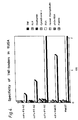
- Figure 3 shows results of ELISA of phage displaying Fab fragments, with one chain displayed on phage as a g3p fusion (indicated by fd-%), and the other chain provided as a secreted, soluble chain partner.
- Figure 4 shows a specificity ELISA of the original Mab32 antibody and a range of mouse (scFv-Mab32) and human (other scFv) antibodies.
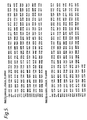
- Figure 5 shows nucleotide and deduced amino-acid sequences of the V-genes of Mab32.
- the CDR-regions are in bold. (Heavy chain nucleotides SEQ ID NO:2; Light chain amino acids SEQ ID NO:3; Light chain nucleotides SEQ ID NO:4).
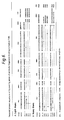
- Figure 6 shows the deduced protein sequences of V H and V L antibody genes of antibody fragments binding to human TNF.
- Light chains Mab32 SEQ ID NO:110; V ⁇ l-1-1 SEQ ID NO:111; V ⁇ AZ SEQ ID NO:112; V ⁇ C4 SEQ ID NO:113; V ⁇ D1 SEQ ID NO:114.
- Heavy chains Mab32 SEQ ID NO:115; DP-51 SEQ ID NO:116; VHP1 SEQ ID NO:117; VHP2 SEQ ID NO:133; VHP3 SEQ ID NO:134; DP-46 SEQ ID NO:118; VHLM2 SEQ ID NO:135; VHLM8 SEQ ID NO:141).
- Figure 7 shows the results of a competition ELISA between FabMab32 and single chain Fv fragments.
- Figure 8 shows an example of a scheme for humanising a mouse antibody using CDR imprinted selection using a dual combinatorial method.
- Figure 9 shows an example of a scheme for humanising a mouse antibody using CDR imprinted selection using combinatorial libraries in a single replicon, single chain Fv format.
- Figure 10 shows relative ELISA signals obtained with scFv fragments selected by CDR imprinted selection compared to the original F58 single chain Fv fragment.
- Figure 11 shows the deduced amino acid sequences of the selected heavy chains Graft/27, Graft/2, Graft/H3 and Graft/H9 in comparison to the original F58 heavy chain and to the most closely related human germ line VH genes.
- VH6 F58 SEQ ID NO:127; DP-74 SEQ ID NO:128; Graft/27 SEQ ID NO:136; Graft/2 SEQ ID NO:137; GRAFT/H3 SEQ ID NO:138; GRAFT/H9 SEQ ID NO:139.
- VH1 F58 SEQ ID NO:129, DP-2 SEQ ID NO:130; Graft/20 SEQ ID NO:140).
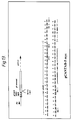
- Figure 12 shows the vector pCANTAB3-myc and the DNA and amino acid sequences in the region of the cloning site. (SEQ ID NO:131).
- Figure 13 shows the vector pCANTAB5-myc and the DNA and amino acid sequence in the region of the cloning site. (SEQ ID NO:132).
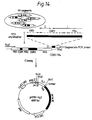
- Figure 14 shows the assembly of rearranged VH genes.
- Table 1 lists oligonucleotide primers and peptides mentioned in the text. The attention of readers of this document is directed to table 1 for sequence information on these oligonucleotides and peptides, complete with the SEQ ID NO of sequences in the listing.
- a mouse antibody directed against an epitope of TNF was cloned as a Fab fragment for display on phage, and by combining the heavy chain with repertoires of human light chains (or indeed the light chain with repertoires of human heavy chains), it was possible to select phage bearing Fab fragments with one mouse and one human chain. These antibody fragments bound to the same epitope of TNF as the original mouse antibody.
- the new human chain (heavy or light) was then combined with a repertoire of human partner chains to create an entirely human antibody Fab fragment which binds to the same epitope of TNF.
- Example 2 illustrates CDR imprinted selection in a dual combinatorial format.
- An anti-HIV gpl20 antibody was humanised by epitope imprinted selection with retention of the original mouse heavy chain CDR3.
- the VH and VL domains of the mouse antibody were cloned as fusions with mouse CHl and Ck chains.
- the resulting heavy chain VHCH1 fragment was displayed on phage in combination with a repertoire of human light chains expressed as a g3p fusion from phage vector.
- Human light chains displayed on phage were selected and the selected chains displayed in phage in combination with a library of human naive heavy chain VHCH1 fragments amplified so as to comprise the CDR3 of the original mouse heavy chain, expressed as g3p fusions.
- Selected phage were obtained displaying antibody polypeptide dimers which retain the original specificity against gp120 but are now of fully human origin apart from retaing the mouse heavy chain CDR3.
- Example 3 illustrates CDR imprinted selection in a single replicon, single chain Fv format.
- An anti-HIV gp120 antibody was humanised by epitope imprinted selection with retention of the original mouse heavy chain CDR3.
- a single chain Fv library was displayed on phage, the fragments comprising the original mouse light chain and CDR3 of the heavy chain but with the remainder of the light being of human origin, derived from a library of human naive heavy chains.
- the heavy chain variable domain of selected phage was then combined with a repertoire of human light chain variable domains to generate a scFv library on phage. Phage selected from this library displayed scFv fragments in which the variable domains were of fully human origin except for the retention of CDR3 of the mouse heavy chain.
- Example 4 illustrates the isolation of human antibodies derived from the immune repertoire of an immunised mouse.
- a repertoire of mouse heavy and light chain V genes derived from a mouse immunised with TNF are displayed as single chain Fv fragments and phage selected for binding to TNF.
- VH genes derived from this selected mouse population are then combined with VL genes derived from a human naive library as single chain Fv fragments and phage selected.
- Selected semi-humanised antibody polypeptide dimers are then fully humanised by pairing the human VLs with human VHs derived from a human naive library. Fully humanised antibody polypeptide dimers specific for TNF may then be selected from the resulting library.
- Example 5 illustrates creation of a synthetic library.
- TNF-alpha tumour necrosis factor alpha
- the antibody Mab32 (class IgG2b, k) (D. Rathjen et al., 1991 Mol. Immunol. 28, p79; D.Rathjen et al, 1992 Brit. J. Cancer 65, pp852-856; Australian Patent Application 7,576; EP 486,526) does not inhibit the cytolytic effect of TNF (presumably because it does not inhibit the binding of TNF to its receptors), but it enhances the in vivo anti-cancer and anti-viral effects of the cytokine.
- the antibody binding site is localised in a region of the TNF-trimer, which encompasses the first 18 residues of TNF.
- This example demonstrates that epitope imprinted selection can be used to generate human antibodies specifically recognising this same epitope on human TNF-alpha.
- the genes of the mouse Mab32 antibody (IgG2b, Kappa) were rescued by PCR essentially as described (Clackson et al., 1991, supra, Clackson et al in "PCR: a practical approach, eds Mr Phenox et al, IRL Press, Oxford pp 187-214) using the primers VH1BACk and VHlFOR2 for the VH gene and VK2BACK and VK4FOR for the VL gene and the polymerase chain reaction (PCR, R.K.Saiki et al., 1985, Science 230, p1350).
- mice VH and Vk genes were assembled for expression as scFv fragments by PCR assembly (Clackson et al., supra) amplified with VHlBACKSfi and VKFOR4NOT and ligated into phagemid pHEN1 (H.R.Hoogenboom et al., 1991 Nucl. Acids. Res. 19, pp4133-4137) as a SfiI-NotI cut restriction fragment, and electroporated into E.coli HB2151 cells. Of 96 clones analysed by ELISA (see below), 9 secreted TNF-binding soluble scFv fragments.
- the murine V-genes were recloned for soluble expression of heavy (Fd, VHCHl) or light chain, by linking the mouse V-genes to the human CHl (of the mu-isotype) or human Ck gene respectively by splice overlap extension.
- the mouse Vk gene was amplified from scFv-Mab32 DNA with oligonucleotides MOJK1FORNX (binds in joining region of V-gene; the sequences of all oligonucleotides used in these examples are shown in Table 1) and MVKBASFI (binds in 5' region and adds SfiI restriction site);
- the human Ck was obtained by PCR from a mouse-human chimaeric light chain gene (of NQ10.12.5, described in Hoogenboom et al., 1991, supra), with oligonucleotides MOVK-HUCK-BACK (binds in 5' of human Ck and is partially complementary with mouse Jk 1 region) and HUCKNOT16NOMYC (sits in 3' end of human Ck, retains the terminal cysteine, and tags on a NotI restriction site) as in Clackson et al, 1991 using a two fragment assembly.
- the two PCR fragments were mixed and amplified with MVKBASFI and HUCKNOT16NOMYC.
- the chimaeric VkCk gene was subsequently cloned as a SfiI-NotI fragment in pUC19 derivative containing the pelB signal peptide sequence and appropriate cloning sites for soluble expression of the light chain (pUC19-pelB-myc, Figure 2).
- mouse VH gene (amplified from scFv-Mab32 with LMB3 and VHlFOR-2) was combined by splicing by overlap extension PCR with the human u-CHl domain (amplified from human IgM-derived cDNA (Marks et al., 1991, supra WO 92/01047) with Mo-VH-Hu-CHl and HCMlFONO, and cloned as SfiI-NotI fragment into a pUCl9-pelB-myc for soluble expression of a tagged chain.
- the chimaeric light chain was displayed on phage fd by reamplification of the mouse/human chimaeric chain with HUCKCYSNOT and MVKBAAPA and cloning into fd-tet-DOGl as an ApaLI-NotI fragment.
- Cells harbouring a plasmid with the heavy Fd chain gene were grown in 2xTY containing AMP-GLU (1%) to logarithmic phase (OD600 of 0.5) and infected with a 20-fold excess of light-chain displaying phage.
- the heavy chain VHCH1 fragment was cloned into fd-tet-DOGl (after amplification of the Fd chain gene from the mouse/human chimeric construct with VHlBACKAPA and HCM1FONO), and phage used to infect cells capable of producing soluble light chain. Phage particles collected from the supernatant of such culture displayed TNF-binding Fab fragments anchored through the heavy chain VHCH1 fragment on their surface.
- the V-genes of the murine antibody Mab32 were cloned by amplifying the hybridoma V-genes, cloning the VH and Vk genes as scFv fragments in phagemid pHEN1 as above. Antibody scFv fragments which bind to TNF were identified by ELISA (see below for details).
- the mouse VH gene was recloned in pUC19-pelB-myc ( Figure 2) for soluble expression as a mouse VH linked to human mu-CHl, while the light chain was recloned with the human Ck domain in vector fd-tet-DOGl as a fusion with g3p.
- Kappa, lambda light chain and Mu-specific cDNA was made from the mRNA prepared from the peripheral blood lymphocytes from two healthy donors essentially as in Marks et al., 1991, supra.
- the first-strand cDNA synthesis was performed with oligonucleotides HCM1FO, HUCLCYS and HUCKCYS for Mu-specific, lambda and kappa libraries respectively.
- VH-CH 1 repertoire was amplified from this cDNA with oligonucleotides HCM1FO and six family specific VHBACK primers (as in Marks et al., 1991, supra), reamplified with a NotI-tagged forward primer (HCM1FONO) and ApaLI tagged VHBACK primers (6 primers HuVH1BAAPA to HuVH6BAAPA; Tablel).
- the light chain repertoires were amplified with HUCLCYS or HUCKCYS forward primers and HUV ⁇ 1BACK to HuV ⁇ 6BACK or HuVklBACK to HuVk6BACK back primers described in Marks et al., 1991, supra and PCT/GB91/01134 (WO 92/01047).
- the lambda and kappa chain variable repertoires were amplified separately.
- the amplified repertoires were reamplified with ApaLI and NotI tagged versions of these oligonucleotides (13 back primers HuV ⁇ 1BAAPA to HuV/ ⁇ 6BAAPA or HuVk1BAAPA to HuVkBAAPA and two forward primers HuCLCYSNOT and HuCKCYSNOT, respectively). All three repertoires were cloned into vector fd-tet-DOG1 as ApaLI-NotI fragments, and electroporated into E.coli MC1061 cells, to obtain libraries of 1.0 x 10 7 clones for V ⁇ C ⁇ , 1.4 x 10 7 clones for VkCk, and 5 x 10 6 clones for IgM-derived VHCHl. The presence of insert was checked and the frequency of inserts in the library found to be higher than 95% in all three cases.
- Figure 1 shows the principle of Epitope Imprinted Selection, as exemplified using a mouse antibody to start with.
- the clear rectangles represent the original mouse antibody VH and VL domains. Shaded rectangles represent human VH and VL domains.
- the human antibodies derived shown on the left on the bottom line are produced by a procedure involving:
- the human antibodies derived shown on the right on the bottom line are derived by the alternative pathway involving:
- the human antibodies in the middle of the bottom line are derived by;
- the mouse VH (linked to the human CHl domain), expressed from pUC19-pelB-myc, was paired as Fab fragment with a library of 10 7 different human V ⁇ C ⁇ , domains. Phage displaying the antibody fragments were subjected to rounds of panning on TNF-coated tubes. By following the titre of the eluted phage, the extent of selection can be monitored. After 4 rounds (with a 100-fold increase in the titre of eluted phage), 24 out of 28 individual clones were found to be binding to TNF in an ELISA with phage expressing Fab fragments (all with the mouse VH-human CH1). Phage only displaying the selected human V ⁇ C ⁇ domains gave a background similar to phage displaying only the chimaeric mouseVk-human Ck. Sixteen clones taken after the first round of selection were found to be negative.
- the germline character of the clones is also noted in the CDR3 sequence, with minimal variation in sequence and no length variation between the three clones. Hence, only a very limited number of genes with very similar sequences fit the stringent requirements (being compatible with the mouse VH and forming an antigen-binding pair).
- human germline encoded V-genes can supply domains that fit those conditions.
- the starting material of this library has proven to be very diverse in other experiments. For example, from an unimmunised scFv library made from the same two donors, we derived many different ⁇ chains with a range of nucleotide mutations compared to known germline genes (Marks et al., 1991, supra). In addition, light chain genes derived from the same donors were used in a chain shuffling experiment for affinity maturation, and light chain variants (all V ⁇ 1) with numerous mutations isolated (Marks et al., 1992, supra).
- V ⁇ genes were recloned in pUC19-pelB-myc for soluble expression as V ⁇ C ⁇ chains.
- E.coli cells harbouring the three light chain plasmids were mixed, infected with a phage library of human VHCH1 genes, expressed from the fd-tet-DOGl library described earlier and the library subjected to rounds of panning on TNF-coated Immuno tubes. Clones were picked after 5 rounds, when the titre of eluted phage increased 100-fold. Fifteen out of 20 clones analysed by BstNI fingerprint of the DNA insert used one of two patterns (with approximately the same frequency).
- the two patterns could be assigned to three unique human VH sequences (clones VHP1/2/3, with clone VHP1 having a BstNI fingerprint which is nearly identical to that of clone VHP2).
- the selected heavy chain genes are derived from the same germline VH gene (germline DP-51 from the VH3 family, Tomlinson et al., J. Mol. Biol. 227, pp776-798 1992; Figure 6), with minimal residue differences.
- Figure 6 shows the deduced protein sequences of V H and V L antibody genes of antibody fragments binding to human TNF.
- VH-CDR3 is naturally the most diverse region of all six antibody variable loops, the chance of selecting clones with a consensus in that region is very low indeed.
- Figure 3 shows results of ELISA of phage displaying Fab fragments, with one chain displayed on phage as a g3p fusion (indicated by fd-%), and the other chain provided as a secreted, soluble chain partner.
- Clones display a combination of the following chains: fd-DOG1 (no antibody); light chains : mouse MoV L (from Mab32), human V ⁇ A2 and V ⁇ C4 (selected with mouse V H ),; heavy chains : mouse MoV H (from Mab32), human V H P1,2,3 (selected with human V ⁇ A2, V ⁇ D1, V ⁇ C4), human V H LM2, V H LM8 (selected with mouse V L ). V ⁇ chains are indicated as VL. Fully humanised clones were obtained which bound to both peptide 301 and TNF.
- mice Mab32 antibody and purified, monomeric forms of the recombinant mouse scFv-Mab32 and the human scFv antibodies VHP1-V ⁇ A2, VH ⁇ P2-V ⁇ A2 and VHP3-V ⁇ A2, were subjected to competition ELISA for the determination of the relative affinity for TNF.
- Antibodies were incubated on a TNF-coated surface in the presence of increasing amounts of soluble TNF. All the clones showed a roughly similar decrease in the ELISA signal over the same range of increasing TNF concentrations (with an IC50 in the 10nM to 100nM range).
- the Mab32 and VHP3V ⁇ A2 fragments were also analysed for binding properties using the Pharmacia BIAcore. TNF was indirectly immobilised on the surface, and the binding of antibody monitored. The properties of the original mouse antibody were analysing two monomeric forms of Mab32. On the TNF surface, the Fab fragment from Mab32 by proteolytic cleavage and the scFv Mab32 showed very similar fast off rates (approximately 10 -2 s -1 ). The human VHP3-V ⁇ A2 antibody has an off rate in the same range as the original scFv-Mab32.
- VH-LM2 and VH-LM8 use a germline of the same (VH3) family, and share the same canonical loop structure for CDR1 and CDR2 (I.M.Tomlinson et al., 1992, supra; C.Chothia et al., 1992 J. Mol. Biol.
- VH-LM2 and VH-LM8 use a rather long VH ⁇ -CDR3 compared with VH ⁇ P1, 2 and 3 (18 and 14 amino acid residues compared to 8,9 and 10 residues respectively), and their respective germlines differ in 15 amino-acid residues.
- VH-LM2 domain was combined with the human V ⁇ A2 domain either as a Fab on phage or in a scFv configuration. Both yielded binding combinations ( Figure 3 and results not shown).
- the mouse VL forms a relatively weak binder in combination with the human VHP3 (as Fab fragments on phage).
- E.coli cells containing plasmid encoding the antibody chain for soluble expression were grown at 37'C in 10 ml 2 x TY containing 100 ug/ml ampicillin and 1% glucose to an OD600 of 0.5.
- the cells were infected with either 10 11 tranforming units (TU) prepared from the original library (by growing libraries at 37'C in 2 x TY with tetracyclin at 15 ug/ml and collecting phage by two rounds of PEG precipitation), or with 1 ml eluate (variable titre) from the panning experiments, by incubating at 37'C for 45 min without and 45 min with shaking.
- TU tranforming units
- the cells were inoculated into 500 ml of prewarmed medium with ampicillin (100 ug/ml) and tetracyclin (15 ug/ml), and after growing forl hour at 37'C transferred to a 30'C shaker for an overnight incubation. Phage was prepared by two rounds of PEG-NaCl precipitation, and resuspended in water to approximately 10 13 TU/ml before selection.
- Immuno tubes (Nunc) were coated overnight with 2 ml of a 10 ug TNF per ml of 50 mM bicarbonate buffer (pH 9.6). Incubation with phage, washing and elution conditions were as described by Marks et al., 1991. E.coli cells expressing the soluble complementary chain were infected with the eluted phage and grown in 2 x TY medium with tetracyclin ug/ml) for amplification of the selected phage population (as described above).
- Recombinant human TNF- ⁇ (produced in yeast, specific activity of 3.2 x 10 7 units/mg, Peptide Technology) was coated onto plastic flat-bottomed microtiterplates (Falcon 3912) at 10 ug/ml in 50 mM bicarbonate buffer (pH 9.6) or PBS, at 50 ul/well overnight at room temperature. After washing with PBS, blocking for 2 hours with 2% Dried Skimmed Milk Powder (Marvel), 50 ul phage per well was added to 50 ul 4% Marvel, after which the ELISA was continued (with anti-phage antiserum) as described (Marks et al., 1991 and PCT/GB91/01134).
- the 301-peptide (gift from Peptide Technology, sequence was coated by overnight incubation at room temperature with 100 ⁇ l per well of 10 ug/ml peptide in PBS. The wells were blocked for 2 hours with 3% BSA, and the ELISA continued as above (using incubations with Marvel).
- soluble antibody fragments were made by r ecloning the selected chains in one plasmid (either as scFv fragments), inducing expression in the appropriate strain and detecting bound antibody fragments in the supernatant of the E.coli cultures with the anti-myc-tag antibody.
- Purified monomeric scFv fragments (see below for purification) were used for competition ELISA experiments and to check the specificity of binding.
- plates were coated with various proteins as described (Marks et al., 1991, supra and WO 92/01047). In all cases where soluble fragments were assayed in ELISA, Marvel was replaced by BSA.
- Fab fragment derived by proteolytic cleavage of Mab32 gift of Peptide Technology
- 9E10-protein A purified mouse scFv-Mab32 or the protein A-purified human scFv fragments VHP1/2/3-V ⁇ 2
- TNF coated plate blocked with 3% BSA in PBS
- a mixture was added of one of each of the four scFv fragments and increasing amounts of the mouse Fab fragment (in 100ul total volume, 1.2ul, 4ul and 10ul of a 1 mg/ml solution.
- V-gene DNA of phage clones positive in TNF-ELISA was analysed by DNA-fingerprinting (as in Clackson et al., 1991, supra). Briefly, the genes were amplified with fd-PCR-BACK and, for heavy chains, fd-SEQ1, or, for light chains, HULAMBDASEQ, for 25 cycles (94'C, 1 min; 50'C, 1 min and 72'C, 2 min), and the DNA cut with BstNI. Analysis of the digest by agarose gelelectrophoresis allowed then to identify major differences between the positive clones. The nucleic acid sequences of selected V-regions were determined by the dideoxy chain termination method (F.Sanger et al., 1977 Proc.
- Murine V-genes cloned into pHENl were sequenced with pHEN-SEQ and LINKSEQ; human VH genes were sequenced with a primer sited in the human CH1(mu) region (Hu-MCH1FORSEQ2), while for human V ⁇ genes, HULAMBDASEQ was taken.
- Selected light chains were amplified with SfiI-tagged backward and NotI tagged forward primers for cloning into pUC19-pelB-myc.
- Human light chains V ⁇ A2, V ⁇ D1 and V ⁇ C4 were amplified from fd with HuVL1BACKSFI and HuCL1FORAMBNOT and cloned into pUC19-pelB-myc (as SfiI-NotI fragments) for soluble expression as tag-less light chains (in non-suppressor strains).
- V-genes were assembled as scFv genes essentially as described (Clackson et al., 1991, supra; Marks et al., 1991, supra and WO 92/01047) using oligonucleotides described in Marks et al. (1991, supra and WO 92/01047) and cloned into pHENl (Hoogenboom et al., 1991, supra) for expression in HB2151 E.coli cells as soluble scFv fragments with a C-terminal myc-tag.
- the original mouse scFv-Mab32-c14 fragment with the C-terminal myc-tag was purified from E.coli supernatant using an affinity 9E10-Protein A column (as described in Clackson et al., 1991, supra).
- the human scFv fragments (all with VH3 genes) were purified on Protein A-sepharose columns (H.R.Hoogenboom and G.Winter, J. Mol. Biol. 227, pp381-388, 1992). All proteins were further purified using gelfiltration (Superdex-75, Pharmacia), and the monomeric fraction taken for BIAcore analysis.
- the standard reaction mixture for the polymerase chain reaction was: 5 ⁇ l template DNA; 20pmol back primer(s); 20pmol forward primer(s); 10mM KCl; 10mM (NH 4 ) 2 SO 4 ; 20mM Tris HCl (pH88); 2mM MgCl 2 ; 100 ⁇ g BSA/ml and 1 unit Taq DNA polymerase (Perkin Elmer Cetus).
- the reaction mixture was overlaid with mineral oil and subjected to 30 cycles of amplification using a Techne thermal cycler (Duxford, England). The cycle was 94°C for 1 min (denaturation), 55°C for 1 min (annealing) and 72°C for 1.5 min (extension). Other PCR conditions are given in the text or in references.
- mice antibody can be rebuilt into a human antibody with the same specificity by the process of epitope imprinted selection (EIS).
- EIS epitope imprinted selection
- a library of human light chains were shuffled with a mouse VH domain, binding combinations selected and then used in a second shuffle as 'docking domains' for a library of human VH genes.
- Completely human antibodies were isolated from such 'genuine' human library. The antibodies were shown to bind retain binding specificity.
- the mouse VL was used as docking chain for selecting human VH partners.
- Such VH domains can be used to find human VL genes, or, alternatively, can be combined with human VL domains selected with the mouse VH domain. Indeed, binding activity was obtained by combining two independently selected V-genes, pointing towards potential additivity of the EIS procedure.
- the EIS approach may serve to humanise antibodies more rapidly than by CDR-grafting (Riechmann et al., 1988, supra), as this method requires very often a detailed knowledge of the 3-D structure of the antibody.
- the EIS method can be extended to for example antibody repertoires obtained by phage selection from immunised rodents. Following immunisation with antigen, a repertoire of V-genes with high affinity and specificity may be selected and then used in a epitope imprinted selection (see example 4) to generate a range of human antibodies of high affini ty and enriched for the desired specificity.
- CDR 3 of the heavy chain is generally found to be the most variable of all CDRs in terms of both length and sequence, and can make important contacts with antigen (Winter, G. and Milstein C. Man-made Antibodies.(1991) Nature 349, pp293-299). This is an important consideration when humanising, whether by CDR-grafting (Patent GB2188638B) or as described in this application using chain-shuffling. It may be advantageous to apply the polycombinatorial approach to humanising by a chain-shuffling process in which the VHCDR3 sequence of the rodent antibody is imprinted upon the human VH segments.
- one fragment eg VHCHl is displayed on phage as a fusion from a phage vector and the other, eg light chain, is expressed as a soluble fragment from eg a plasmid.
- Super-infection with phage is used to display both fragments on phage as a Fab fragment.
- a mouse anti-HIVgp120 monoclonal antibody was humanised.
- the VH domain of this mouse antibody was fused to the human Cgammal domain and cloned into pUC19Sfi/Not/polymyc.
- fd-DOG-1 also known as fd-CAT-2 in WO 92/01047
- fd-CAT-2 in WO 92/01047
- Light chains selected this way were then paired with a library of naive human VH domains, PCR-amplified in such a way that CDR3 of the human antibodies were replaced with that of the original mouse heavy chain.
- Section (a) deals with construction of a chimaeric Fab fragment in which the mouse F58 VH and VL domains are fused to human CH1 and CK sequences. This clone was used in early characterisation of the antibody and served as a template for subsequent PCR amplification of the heavy chain, which was then cloned into pUC19 Sfi-Not polymyc as a PstI-Not I fragment (section (b)). Section (c) describes construction of a human light chain repertoire in fdDOG, which was then infected into cells containing the chimaeric heavy chain on pUC19 (section (d)).
- the resulting phage were panned against the peptide (section (e)) and the selected light chains PCR-amplified and cloned as Asc I-Not I fragments alongside the chimaeric heavy chain (section (f)) and assayed for their ability to bind antigen by ELISA (section (g)).
- Selected light chains were recloned in pUC (section (h)) and naive human VH domains amplified with a mutagenic primer imposing the F58 CDR3 sequence on the domains, and the resulting fragments cloned in phage (section (i)).
- AMV avian myeloblastosis virus
- the reaction mixture was overlaid with paraffin oil and subjected to 30 cycles of amplification using a Techne PHC-2 thermal cycler.
- the cycle was 94'C for 1 minute (denaturation), 55'C for 1 minute (annealing) and 72'C for 1 minute (extension).
- the product was analyzed by running 5 ul on a 2% agarose gel. The remainder was extracted twice with ether, once with phenol/chloroform, ethanol precipitated and resuspended in 50 ul of water.
- the amplified VH DNA was digested with PstI and BstEII, purified on a 2% low melting point agarose gel and ligated into M13VHPCR1 digested with PstI and BstEII (Orlandi, R., D. H. Gussow, P. T. Jones and G. Winter. (1989). Cloning immunoglobulin variable domains for expression by the polymerase chain reaction. Proc. Natl. Acad. Sci., USA, 86 (10), pp3833-7).
- the amplified VK DNA was digested with PvuII and Bgl II and ligated into M13VKPCR1 digested with Pvu II and Bcl I. The ligation mixtures were used to transform competent TG1 cells. Two clones from separate amplifications were sequenced for each VH and Vk chain using the dideoxynucleotide chain termination method.
- a chimaeric Fab containing the F58 variable domains and the human IgG1 CH1 and Ck domains was constructed by ligating the F58 V-domains into a vector containing the constant domains.
- M13VHPCRl containing the F58 VH was digested with PstI and BstEII.
- the resulting F58VH fragment was then purified on a 1.5 % agarose gel, isolated from the gel with Geneclean and ligated into pJM-1FabD1.3 (PCT/GB91/01134) digested with PstI and BstEII.
- the ligation mixture was used to transform competent E. coli N4830-1 cells (Gottesman, M.E., Adhya, S.
- the F58 Vk was amplified by PCR with the primers Vk2BACK and Vk3FOR2 (Clackson, T. et al. (1991) supra.) using M13VkPCR containing the F58 Vk as template.
- the PCR product was digested with SacI and XhoI, purified on a 1.5% agarose gel, isolated from the gel with Geneclean and ligated into pJM-1 Fab vector containing the F58 VH digested with SacI and XhoI.
- the ligation mixture was used to transform competent E. coli N4830-1 cells and clones containing the F58 Vk identified by restriction analysis of RF DNA.
- the F58 chimaeric heavy chain derived above was PCR amplified from F58 Fab clone DNA, using the primers VH1BACKSFI15 and HUCH1FORASCNOT (Tablel).
- the resulting ca. 700bp fragment was digested with Pst I and Not I and cloned into Pst I and Not I-cut pUC19Sfi/Not/polymyc plasmid using standard procedures (Sambrook, J. et al. 1989, supra. and example 1).
- Kappa and lambda-chain genes were amplified separately using an equimolar mixture of the appropriate family based BACK and FORWARD primers (Table 1).
- Kappa-chain genes were amplified from the cDNA synthesis using HUCKFOR primer, using an equimolar mixture of the 6 HUVKBACK 1a-6a primers in conjunction with the HUCKFORSER primer.
- Lambda-chain genes were amplified from the cDNA synthesis using the HUCLFOR primer, and amplified using an equimolar mixture of the 7 HULBACK 1-6 primers in conjunction with the HUCLFORSER primer.
- reaction mixtures were prepared containing 5 ⁇ l of the supernatant from the appropriate cDNA synthesis, 20pmol total concentration of the BACK primers, 20pmol total concentration of the FORWARD primers, 250 ⁇ M dNTPs, 10mM KCl, 10mM (NH 4 ) 2 SO 4 , 20mM Tris.HCl (pH 8.8), 2.0mM MgCl2, 100mg/ml BSA and 1 ⁇ l (1 unit) Vent DNA polymerase (New England Biolabs).
- the reaction mixture was overlaid with mineral (paraffin) oil and subjected to 30 cycles of amplification using a Techne thermal cycler.
- the cycle was 94°C for 1 minute (denaturation), 57°C for 1 minute (annealing) and 72°C for 2.5 minutes (extension).
- the products were purified on a 2% agarose gel, isolated from the gel by Geneclean (Bio-101) and resuspended in 25 ⁇ l of H 2 O.
- Kappa-chain genes were amplified in two reactions, using an equimolar mixture of the 6 HUVKBAAPA primers in conjunction with HUCKFORSERNOT.
- Lambda-chain genes were also amplified in two reactions, using an equimolar mixture of the 7 HUVLBAAPA primers in conjunction with HUCLFORSERNOT. Pullthrough conditions were performed as for the primary light chain PCRs above except that 25 cycles of amplification were used.
- PCR products were digested with Apa LI and Not I using the standard format and cloned into Apa LI and Not I-cut fd-DOG as described in example 1. Phage were prepared from the library clones as described in example 1 and used to infect cells containing the heavy chain (see below).
- Cells containing the F58 chimaeric heavy chain were grown overnight at 37'C in 2YTAG and 500ul added to 50 mls fresh 2YTAmp medium, prewarmed to 37'C, in a conical flask. The cells were grown with shaking to OD600 of about 0.5 before adding a total of 10 11 phage from the light chain repertoire. The culture was left at 37'C for 45 minutes without shaking then shaken vigorously for another 45 minutes at 37'C before adding tetracyline to 15 ug/ml and shaking overnight.
- Phage were harvested by PEG precipitation of the culture supernatant as previously described (example 1) and used for selection experiments.
- Selected light chains were PCR-amplified from fd-DOG Light chain DNA using primers G3LASCGTGBACK and HUCLFORSERNOT or HUCKFORSERNOT.
- the G3LASCGTGBACK primer anneals upstream of the translational start of the gIII signal in fd, and brings in an Asc I site and a ribosome binding site (RBS).
- RBS ribosome binding site
- Light chains were PCR-amplified from DNA of selected clones using an equimolar mix of the 7 HUVLBAS FI primers in conjunction with HUCLFORSERASCNOT or an equimolar mix of the 6 HUVKBASFIprimers in conjunction with HUCKFORSERASCNOT. Reaction conditions were as described for the primary PCR reactions above except that 25 cycles of amplification were used. PCR fragments were cut with Sfi I and Not I and cloned into Sfi I and Not I-cut pUC19Sfi/Not/polym yc then transformed into TG1.
- VH domains were amplified from the pooled primary PCR material prepared as described below.
- Two preparations of PCR-amplified VH genes were made. Both preparations used an equimolar mixture of the HUJHFOR primers (Table 1); in one of the preparations, 6 separate PCR amplifications were performed with each of the HUVHBACK primers individually (Table 1), and in the other, a single PCR reaction was performed with an equimolar mix of all 6 HUVHBACK primers.
- reaction mixtures were prepared containing 5 ⁇ l of the supernatant from the cDNA synthesis using the HUIGMFOR primer, 20pmol total concentration of the BACK primers, 20pmol total concentration of the FORWARD primers, 250 ⁇ M dNTPs, 10mM KCl, 10mM (NH 4 ) 2 SO 4 , 20mM Tris. HCl (pH 8.8), 2.0mM MgC12, 100mg/ml BSA and 1 ⁇ l (1 units) Vent DNA polymerase (New England Biolabs).
- the reaction mixture was overlaid with mineral (paraffin) oil and subjected to 30 cycles of amplification using a Techne PHC-2 thermal cycler.
- the cycle was 94°C for 1 minute (denaturation), 57°C for 1 minute (annealing) and 72°C for 1 minute (extension).
- the products were purified on a 1.5% agarose gel, isolated from the gel by Geneclean (Bio-101) and resuspended in 25 ⁇ l of H 2 O. The seven products were then pooled and 'pullthrough' PCR reactions performed.
- Pullthrough reactions were set up with the primers HUVHBAAPA (equimolar mix of all 6 primers) and HUJHFORSAL (equimolar mix of all 4 primers). 50 ⁇ l reactions of containing 5 ⁇ l of the pooled PCR products from the previous step were amplified using the same conditions as for the primary PCR except that 25 cycles of amplification were used, and the annealing temperature was 45°C.
- VH fragments were pooled and cut with Apa LI and Sal I using standard conditions and cloned into Apa LI and Xho I-cut fd-DOG-G1CH1 using standard protocols (Sall and Xho I produce compatible CTAG overh angs). Phage were prepared from this library as described above, this time using the heavy chain phage to infect cells carrying the selected light chains expressed in pUC19Sfi/Not/polymyc.
- the end-products are completely human Fab fragments with the same or similar antigen-specificity as the parent rodent antibody.
- mice anti-HIV-1 gp120 monoclonal antibody F58 was humanised as shown schematically in fig. 9.
- a vector (pHENMBF58VL) was constructed carrying the F58 Vk-domain, the single chain Fv linker and the first residues of a human VH-framework 4 with a Xhol restriction site. This vector allows the cloning of VH repertoires as Nco I/Sal I fragments to give complete scFvs.
- a human repertoire of VHs was amplified by PCR in such a way that each heavy chain contained the CDR3 of the original mouse mab F58 and a human framework 4 and was finally cloned into pHENMBF58VL.
- the scFv library was selected for binding to a HIV-1 gp120 derived peptide. Heavy chain variable domains from selected scFvs were then combined by PCR-assembly with a repertoire of human light chain variable domains to give fully humanised scFvs and again selected for antigen binding.
- the procedure illustrated here is therefore a synthesis of CDR-grafting and combinatorial phage display libraries.
- VH and VL domains characterised above were assembled to form, scFv fragments, basically as described by Clackson et al, 1991, supra.
- PCR amplifications Two 50 ul reactions were prepared containing 1 ng of either the above mentioned templates, 20 pmol VH1BACK and 20 pmol VH1FOR-1 (20 pmol VK2BACK and 20 pmol VK4FOR to amplify the VL), 250 uM dNTPs, 5 ul 10xVent polymerase reaction buffer (as obtained from the supplier New England Biolabs) and 2 units Vent DNA polymerase. The amplifications were performed with 25 cycles of PCR (94'C for 1 min, 55'C for 1 min, 72'C for 2 min).
- linker DNA was similarly amplified from about 1 ng of template DNA pSW2scD1.3 (McCafferty et al., Nature 348, 552-554, 1990) using the primers LINKBACK and LINKFOR (Clackson et al., 1991, supra).
- each of the VH and the Vk product were mixed with 300 ng of linker in a 25 ul PCR mix without primers. and cycled 7 times(94'C 2 min, 72'C 4min) to join the fragments, then amplified for 20 cycles (94'C 1.5 min, 72'C 2.5 min) using 25 pmol each of VH1BACK and VK4FOR primers.
- the assembled product was gel purified and reamplified with the primers VH1BACK-SfiI and VK4FOR-NotI to append restriction sites (Note VK4FOR and VK4FOR-NotI are equimolar mixture of 4 different primers).
- the F58 scFv was then digested with SfiI and NotI and cloned into the similarly digested vector pUC119Sfi-Notpolymyc. Recombinants were subsequently verified by DNA sequencing.
- the 6 separate reactions to amplify the heavy chain variable domains contained each 2 ul of the cDNA synthesis from above, 20 pmol of the individual HUVHBACKSfi primers and 20 pmol of the primer F58GRAFTSAL in an otherwise standard PCR mixture. Since the primer F58GRAF TSAL had to anneal to the framework 3 regions of the 6 human VH families, the annealing temperature for the PCR cycling was reduced to 45'C. The PCR was run for 25 cycles (94'C 1 min, 45'C 1 min, 72'C 1 min), after which the products were gel purified.
- the peptide antigen corresponds to the gp120 V3 loop of the HIV-1 isolate IIIB and was obtained from the AIDS-directed program of the MRC (repository reference ADP737).
- the sequence is:
- the end products are completely human scFv fragments with the same or very similar specificity as the parent murine antibody F58, ie they bind to gp120 V3 loop but not to heterologous proteins.
- This example describes the generation of human antibodies specific for TNF-alpha from an original library of mouse antibodies derived from an immunised mouse by successive rounds of chain shuffling, illustrating a further embodiment of the present invention.
- the method depends upon the fact that an intermediate VH/VL combination, where one chain is mouse and the other is human, binds to the antigenic epitope to which the original mouse VH/VL pairings are directed.
- mice VH chains from the selected mouse population are kept fixed and assembled with a set of human VL chains from a naive human library.
- This mouse VH/human VL library is then subjected to rounds of selection for binders to the antigen of interest.
- This selected population of semi-humanised antibodies is then fully humanised by pairing these human VLs with human VHs again derived from a naive human library.
- the resulting library can then be selected for binders specific for the antigen.
- mouse VL chains can be fixed and assembled with human VH chains, and after selection for binding to antigen fully humanised by pairing the isolated human VH chains with VL from the naive human library.
- RNA is extracted from lymphocytes prepared from the spleen of a mouse hyperimmunised with TNF-alpha.
- DNA sequences encoding variable regions of the heavy and light chains are amplified by PCR and assembled as single chain Fv fragments as described in WO 92/01047. Sites are incorporated into the 5' and 3' ends for restriction endonucleases ApaLl and Notl. Following digestion with ApaLl and Notl the assembled DNA is ligated into ApaLl/Notl digested pCANTAB3-myc ( Figure 12) and electroporated into E.coli TGl cells and plated on ampicillin selection media (see protocol (h) below).
- Phagemids are rescued by superinfection with M13K07 helper phage and precipitated using 1/5 volume 20% polyethylene glycol/2.5 M NaCl.
- a selected population of TNF-alpha binding phage antibodies is prepared by panning the phage antibodies on TNF-alpha coated immunosorb tubes (1 mL, 10ug/mL in PBS) and eluting with 1 mL 100mM triethylamine for 5 minutes followed by neutralisation with 0.5 mL TRIS (1M, pH 7.4).
- the eluted phage is used to infect 10 mL TGl cells in logarithmic growth for 30 minutes at 37'C and plated for ampicillin resistant colonies. The resulting colonies are scraped into 2YT media and rescued with M13K07. Phage antibodies are selected once again on TNF-alpha coated immunosorb tubes as above. E.coli TGl cells are infected with the eluted phage and plated and ampicillin resistant colonies are scraped into 2YT media and glycerol added to 15% and stored at -70'C. The frequency of clones binding to TNF in the selected population is checked at this stage by ELISA as described in example 1.
- a library encoding scFv fragments derived from the V genes of unimmunised humans has been constructed in the vector pHENl (WO 92/01047, example 42).
- Miniprep DNA was prepared by alkaline lysis from the colonies of the second round of selection (mouse DNA) and from the naive human library (human DNA).
- LMB3 and FDTSEQ1 anneal, respectively, to sequences 5' and 3' flanking the antibody cloning sites of the pCANTAB series of vectors.
- PCRHLINK and LINKPCRL and anneal with the sequence encoding the (gly4ser3) peptide linker.
- primers in pairs LMB3/PCRHLINK and FDTSEQ1/LINKPCRL in PCT amplifications heavy and light chain fragments will be generated that have complementary 3'/5' ends and restriction recognition sites at the 5'/3' ends.
- HEAVY LIGHT Miniprep DNA e.g.mouse
- 2ng Miniprep DNA e.g. human
- 2ng LMB3 primer 10pmoles/ ⁇ l) 2.5 ⁇ l
- FDTSEQ1 primer 10pmoles/ ⁇ l
- PCRHLINK primer 10pmoles/ ⁇ l
- LINKPCRL primer 10pmoles/ ⁇ l
- 10X PCR 10X PCR reaction buffer 1 5.0 ⁇ l reaction buffer 1 5.0 ⁇ l 5mM each dNTP's 2.5 ⁇ l 5mM each dNTP's 2.5 ⁇ l Taq polmerase (5U/ ⁇ l) 0.3 ⁇ l Taq polymerase (5U/ ⁇ l) 0.3 ⁇ l water 37 ⁇ l water 37 ⁇ l
- the "reaction buffer” is 10X PCR reaction buffer: 0.1M TRIS pH 8.3, 0.5M KCl, 15 mM MgCl 2 , 0.1% gelatine. PCR conditions are 25 cycles of 94'C 1
- PCR conditions are 25 cycles of 94'C 1 minute and 65'C for 4 minutes, followed by a final 10 minutes at 72'C.
- the PCR conditions given for the primary PCR will also work, but 65'C is preferred for the linkage reaction.
- PCR conditions are 25 cycles of 94'C 1 minute, 60'C 1 minute, 72'C 2 minutes with a final 10 minutes at 72'C.
- 10X ApaLl buffer 0.5M potassium acetate, 0.2M TRIS-acetate, 100mM magnesium acetate, lOmM dithiothreitol (pH 7.9 @ 25'C).
- 10X Notl buffer 1.5M NaCl, 100mM TRIS-HCl, 100mM MgCl 2 , 0.1% Triton X-100 (pH 7.9 @ 25'C).
- 10X Sfil buffer 0.5M NaCl, 100mM TRIS-HCl, 100mM MgCl 2 , lOmM dithiothreitol (pH 7.9 @ 25'C).
- the digest is treated with phenol:chloroform, ethanol precipitated and dissolved in 20 ul water.
- the product is run out on a 1.5% agarose gel, the band at approximately 750 bp is excised from the gel and purified using a geneclean kit.
- the DNA is eluted into a final volume of 10-15ul water and is ready for cloning.
- Plasmid DNA is prepared by the alkaline lysis method and is purified by cesium chloride centrifugation.
- the purified DNA is digested using a DNA concentration of 100ug/ml with Sfil (for pCANTAB5-myc) or ApaL1 (for pCANTAB3-myc) according to manufacturers instructions (50'C for Sfil, overnight if convenient) followed by a 3 hour digestion with Not 1.
- the digestion product is loaded on directly on to a Chromaspin 1000 column to remove the stuffer fragment and spun for 3 minutes at 2200 r.p.m. in a bench top centrifuge .
- the DNA was then phenol:chloroform extracted and dissolved at 100ug/ml for use.
- Ligations are carried out using an Amersham ligation kit as follows: Vector DNA 1 ⁇ l(100ng) insert DNA 2 ⁇ l( 10-50ng) 10mMMgCl, 200mM Tris pH7.4 3 ⁇ l buffer A 24 ⁇ l buffer B 6 ⁇ l
- the selected clones from this first shuffle are used as a source of miniprep DNA to repeat the chain shuffling and cloning procedure described in 4 and 5 above, e.g. with the human naive heavy chain variable domains of the library derived in WO 92/01047, example 42. Selection is then performed on this second shuffled library to isolate fully humanised antibodies binding to TNF-alpha derived by this repertoire imprinted selection procedure.
- V-genes By display of antibody repertoires on the surface of filamentous phage and selection of the phage with antigen 1 , we can mimic immune selection 2,3 and make human antibodies from the rearranged V-genes of unimmunised donors 4 .
- Human antibodies have now been made by synthesis from defined V-gene elements.
- a repertoire of 49 human germ line V H gene segments was rearranged in vitro by joining to a synthetic "D-segment" of five random amino acid residues and a J-segment, to create a synthetic third complementarity determining region 5 (CDR) of eight residues.
- CDR complementarity determining region 5
- the library of 10 7 phages was panned with a hapten 2-phenyl-oxazol-5-one (phOx) conjugate to bovine serum albumin (BSA), and phage isolated that encoded fragments with specific binding activity to phOx-BSA, and with affinities to phOx-gamma-aminobutyric acid (phOx-GABA) in the micromolar range.
- BSA bovine serum albumin
- phOx-GABA phOx-gamma-aminobutyric acid
- Antibody variable domains consist of a ⁇ -sheet framework with three loops of hypervariable sequence or CDRs 5 .
- the loops create antigen binding sites of a variety of shapes, ranging from flat surfaces 7 to pockets 8 .
- the sequence diversity of the first two CDRs are encoded by a repertoire of about fifty germ line V H segments. (I.M. Tomlinson et al., supra).
- the third CDR is generated from the recombination of these segments with about thirty D and six J segments 9 , and although its sequence is highly variable, it often includes a salt bridge from Asp101 of the loop to Arg94 of the framework 10 .
- the structures and lengths of the first two CDRs are restricted 10,11 , but those of CDR3 differ greatly, with lengths ranging from 4 to 25 residues 5 .
- V H genes with a CDR3 of eight residues including AsplOl, in combination with a single V ⁇ (ref.12) light chain.
- V H segments encoding most of the human V H repertoire (Tomlinson et al., supra) were each amplified using the polymerase chain reaction 13 and oligonucleotide primers that introduce a synthetic D-segment (of 15 bases of random sequence at the 3' end of the V H segment) and a J-segment, together encoding a CDR3 loop of eight residues (Fig.14).
- the rearranged segments were pooled and cloned for phage display with a human V ⁇ 3 light chain, creating a synthetic library of 10 7 phage clones.
- the synthetic library of 10 7 phage clones can tap only a small fraction of the potential diversity.
- the library was subjected to four rounds of growth and panning on phOx-bovine serum albumin (BSA) coated tubes, and clones screened as soluble 14 single chain Fv fragments 15,16 for binding activity to phOx-BSA by ELISA 4 .
- BSA phOx-bovine serum albumin
- 14/96 and 61/96 clones respectively were identified with binding activities to phOx-BSA and of these (29 tested) none bound to other proteins (see legend Table 4).
- their binding to phOx-BSA coated plates could be competed with the soluble hapten (Table 4).
- the majority of the unique clones (16/21) were derived from the VH26 segment 6 and have related sequences in the third hypervariable loop: in this group the first residue tends to have a branched aliphatic side chain (15/16), the second residue tends to be lysine or arginine (11/16), while the fourth residue is always an aromatic residue (most frequently tyrosine).
- the affinities (K d ) of two of the stronger binders (Ox 13 and Ox-31, Table 4) for phOx-GABA were determined by fluorescence quench titration 17 as 3.1 ⁇ 0.2 ⁇ M and 6.7 ⁇ 0.7 ⁇ M respectively.
- the synthetic antibody library lacks the diverse VH-CDR3 lengths and the different light chains of antibodies made in vivo
- the affinities for phOx-GABA compare with 0.5 ⁇ M for a (phage) antibody made from unimmunised human donors 4 , or 1 ⁇ M for several hybridomas from a mouse primary immune response 18 (but see caveat, Table 3 legend). To improve these affinities, one could systematically alter (see below) the many different phOx antibodies selected (Table 3).
- phage display libraries of V-genes rearranged in vitro offers an attractive alternative to those rearranged in vivo 4 .
- the framework regions and first two hypervariable loops of both heavy and light chains of the synthetic human antibodies created from the library are essentially germ line. This contrasts with the "primary" phage antibodies tapped from human V-genes rearranged in vivo, in which the extent of somatic mutation varied widely 4 . Leaving aside polymorphism, the VH gene segments are identical in different individuals, and the synthetic antibodies are potentially less immunogenic.
- both kinds of libraries are highly biased.
- the bias is outside our control, and is imposed for example by allelic variation, deletion polymorphism and deletion of self-reactive clones.
- the synthetic library the bias can be introduced systematically.
- all the VH-gene segments were chosen and thereby the folding of the first and second hypervariable loops: also fixed were the length and diversity of VH-CDR3 and the light chain.
- design principles into the encoded structures. If the shape of the antigen were known, an envelope of roughly complementary binding sites might be designed and built with defined V-gene elements.
- VH segments Library x 10 -6 size (%) V H 1 14 1-5,7,8,10,12, 14,15,20,21,25 2.3 (20) V H 2 1 27 1.0 (9) V H 3 23 29-33,35,38-40, 42,44-54,58,59 2.1 (19) V H 4 9 63-71 2.6 (23) V H 5 1 73 1.4 (12) V H 6 1 74 1.9 (17) Total: 49 11.3 (100)
- V H segments Forty nine human V H segments (Tomlinson et al, supra) were used, one for each of the V H 2, V H 5 and V H 6 gene families and multiple segments for the other three families, and cloned according to family. Clones from the V H segments of each family (see legend Fig.1) were checked for presence of insert (on average 85%) and pooled into a single large library as in Table 4, creating a (controlled) bias for certain gene families. The segments from the V H 2, V H 5, V H 6 families are thereby "overrepresented" with respect to the segments from other families.
- V H segments were identified in clones with detectable expression levels, for example V H 1 (DP-7), V H 2 (DP-27), V H 3 ( DP-29,35,38,44,47,51,53), V H 4 (DP-63,69), V H 5 (DP-73) and V H 6 (DP-74).
- V H 1 DP-7
- V H 2 DP-27
- V H 3 DP-29,35,38,44,47,51,53
- V H 4 DP-63,69
- V H 5 DP-73
- V H 6 DP-74
- the clones were checked for presence of insert by 'PCR-screening' 21 with oligonucleotides LMB3 and pHEN-SEQ (ref.4) and sequenced from double-stranded DNA by the dideoxy chain termination method 22 with oligonucleotide LINKSEQ (5'-CGA TCC GCC ACC GCC AGA G-3'). (The numbers in the tables are corrected for insert). Expression of soluble scFv fragments was checked by spotting 10 ⁇ l supernatant of induced overnight cultures in E.
- Phage were prepared from the library by rescue with VCS-M13, and subjected to rounds of panning in phOx-BSA coated tubes as in ref.4.
- the sequences of 21 phage binding to phOx revealed four germ line VH segments, DP-42,45,47 (VH3 family) and DP-67 (VH4 family).
- DP-47 is identical to VH26 (ref.6, corrected in ref.24), while DP-42, DP-45 and DP-67 only differ in one or a few framework residues from 8-1B (ref.25), 65-2 (ref.26) or VH4.22 (ref.27) respectively.
- Clones from the unselected library using the DP47 V H segment and lacking the characteristic pattern of CDR3 did not bind to phOx. Of the 21 phOx binders tested, none bound to BSA, NIP-BSA, plastic, chymotrypsinogen A, cytochrome c, bovine thyroglobulin, keyhole limpet haemocyanin or turkey egg white lysozyme. Four clones that bound to BSA (but not to phOx) were found to be contaminants (aBSA3 clones, from ref.4).
- the relative affinities of the scFv fragments were determined by inhibition ELISA 28 .
- the concentration of phOx-GABA resulting in a 50% reduction of the signal (I 50 ) for binding to phOx-BSA was noted.
- the affinities of the clones Ox-13 and Ox-31 for phOx-GABA were determined by fluorescence quench titration using scFv purified by the c-myc tag (ref.4). Ideally, the affinity for the phOx-BSA conjugate would have been measured directly, or that for phOx-caproic acid, but phOx-GABA was used here to allow comparison with the hybridoma data of ref.18.
- the affinities of the antibodies for the phOx conjugate, or for phOx-caproic acid are likely to be better than those measured for phOx-GABA.
- a synthetic oligonucleotide SYNLIB1 5' GCC TCC ACC TCT CGA GAC GGT GAC CAG GGT ACC TTG GCC CCA ATA GTC AAA ([A/C]NN) 5 TCT TGC ACA GTA ATA CAC GGC CGT GTC 3' (SEQ ID NO: 109, see Table 1) introduced a D-segment with a five residue random amino acid sequence, a J-segment and an XhoI restriction site, to the 3' end of each of 49 human V H germline segments (Tomlinson et al., supra).
- VHBACK V H family based back primer
Landscapes
- Chemical & Material Sciences (AREA)
- Health & Medical Sciences (AREA)
- Organic Chemistry (AREA)
- Immunology (AREA)
- Life Sciences & Earth Sciences (AREA)
- Genetics & Genomics (AREA)
- General Health & Medical Sciences (AREA)
- Medicinal Chemistry (AREA)
- Molecular Biology (AREA)
- Biochemistry (AREA)
- Biophysics (AREA)
- Proteomics, Peptides & Aminoacids (AREA)
- Engineering & Computer Science (AREA)
- Biotechnology (AREA)
- Zoology (AREA)
- Virology (AREA)
- General Chemical & Material Sciences (AREA)
- Wood Science & Technology (AREA)
- Bioinformatics & Cheminformatics (AREA)
- General Engineering & Computer Science (AREA)
- Microbiology (AREA)
- Biomedical Technology (AREA)
- Chemical Kinetics & Catalysis (AREA)
- Plant Pathology (AREA)
- Animal Behavior & Ethology (AREA)
- Cell Biology (AREA)
- Oncology (AREA)
- Veterinary Medicine (AREA)
- Public Health (AREA)
- Physics & Mathematics (AREA)
- Pharmacology & Pharmacy (AREA)
- Crystallography & Structural Chemistry (AREA)
- Nuclear Medicine, Radiotherapy & Molecular Imaging (AREA)
- Peptides Or Proteins (AREA)
- Preparation Of Compounds By Using Micro-Organisms (AREA)
- Medicines Containing Antibodies Or Antigens For Use As Internal Diagnostic Agents (AREA)
- Micro-Organisms Or Cultivation Processes Thereof (AREA)
- Medicines That Contain Protein Lipid Enzymes And Other Medicines (AREA)
Claims (34)
- Méthode de production de diméres polypeptides d'anticorps ou de fragments scFv spécifiques d'un antigène d'intérêt ayant les étapes suivantes :(i) prévoir des vecteurs d'expression d'acide nucléique qui sont capables d'être compactés en utilisant un composant d'un compactage de présentation génétique replicable (rgdp);(ii) combiner (a) un répertoire génétiquement divers de séquences d'acides nucléiques dont chacune code pour une première partie composante d'un site de liaison d'antigène d'un anticorps humain avec (b) un acide nucléique qui code pour une population unique ou génétiquement diverse d'une seconde partie composante d'un site de liaison d'anticorps d'un anticorps non humain connu comme liant ledit antigène d'intérêt, pour former une banque de séquences d'acides nucléiques sur lesdits vecteurs d'expression codant pour les dimères de polypeptides d'anticorps de fragments scFv, lesquels dimères ou fragments ScFv consistent chacun en un premier composant de chaíne polypeptidique et un second composant de chaíne polypeptidique, une première partie composante de site de liaison d'antigène et une seconde partie composante de site de liaison d'antigène formant en combinaison un site de liaison d'antigène d'un dimère polypeptide d'anticorps ou d'un fragment scFv ;(iii) exprimer ladite banque desdits vecteurs dans des cellules d'organismes hôtes recombinants chacun desdits premiers composants de chaíne polypeptidique étant exprimé en tant que fusion avec un composant d'in rgdp qui présente ainsi ledit premier composant de chaíne polypeptidique a la surface des rgdp ;(iv) sélectionner de ladite banque exprimée par liaison avec l'antigène d'une population unique ou restreinte desdits dimères polypeptidique d'anticorps ou fragments scFv qui ont une spécificité de liaison pour ledit antigène d'intérêt chaque dimère polypeptidique d'anticorps sélectionné ou fragment scFv étant associé, dans son rgdp respectif, avec un acide nucléique codant pour une première partie composante de son site de liaison d'antigène.
- Méthode selon la revendication 1 où lesdits dimères polypeptides d'anticorps ou fragments scFv sont exprimés en tant que polypeptides solubles après sélection dans l'étape (iv).
- Méthode selon la revendication 1 ou la revendication 2 où la séquence codant pour chaque seconde partie composante de l'anticorps non humain est génétiquement modifiée pour augmenter son homologie avec une seconde partie composante d'un anticorps humain avant ladite combinaison à l'étape (ii).
- Méthode selon l'une quelconque des revendications précédentes ayant une étape additionnelle (v) où les dimères polypeptides d'anticorps ou fragments scFv sélectionnés à l'étape (iv) sont génétiquement modifiés pour éliminer ou réduire les caractéristiques non humaines.
- Méthode selon la revendication 4 où l'étape (v) consiste à :(a) combiner une population unique ou restreinte d'acide nucléique codant pour les premières parties composantes de site de liaison d'antigène sélectionnées à l'étape (iv) avec un répertoire génétiquement divers de séquences d'acides nucléiques dont chacune code pour une seconde partie composante d'un site de liaison d'antigène d'un anticorps humain, pour former une seconde banque de séquences d'acides nucléiques codant pour les dimères polypeptides d'anticorps ou les fragments scFv, chaque dimère polypeptide d'anticorps ou fragment ScFv comprenant un second composant de chaíne polypeptidique d'anticorps qui est exprimé par l'acide nucléique qui est capable d'être compacté en utilisant un composant d'un rgdp, ledit second composant de chaíne étant exprimé en tant que fusion avec un composant d'un rgdp qui ainsi le présente à la surface des rgdp de façon que les diméres polypeptides d'anticorps ou fragments scFv spécifiques dudit antigène d'intérêt, puissent être sélectionnés de ladite seconde banque par liaison avec ledit antigène d'intérêt, chaque dimère polypeptide d'anticorps ou fragment scFv étant associé dans son rgdp à l'acide nucléique codant pour son second composant polypeptide.
- Méthode selon la revendication 4, où l'étape (v) consiste à :a) prévoir des vecteurs d'expression d'acide nucléique qui sont capables d'être compactés en utilisant un composant d'un compactage de présentation génétique réplicable (rgdp);b) combiner l'acide nucléique qui code pour une population unique ou génétiquement diverse d'une première partie composante d'un site de liaison d'antigène d'un anticorps non humain connu comme liant ledit antigène d'intérêt avec un répertoire génétiquement divers de séquences d'acides nucléiques dont chacune code pour une seconde partie composante d'un site de liaison d'antigène d'un anticorps humain, pour former une seconde banque de séquences d'acides nucléiques sur lesdits vecteurs d'expression codant pour les dimères polypeptides d'anticorps ou les fragments scFv, lesquels dimères ou fragments scFv consistent chacun en un premier composant de chaíne polypeptidique et un second composant de chaíne polypeptidique, une première partie composante de site de liaison d'antigène et une seconde partie composante de site de liaison d'antigène formant en combinaison un site de liaison d'antigène d'un dimère polypeptide d'anticorps ou d'un fragment scFv ;c) exprimer ladite seconde banque à partir desdits vecteurs dans des cellules d'organismes hôptes recombinants, chacun desdits seconds composants de chaíne polypeptidique étant exprimé en tant que fusion avec un composant de rgdp qui ainsi présente ledit composant de chaíne polypeptidique à la surface des rgdp ;d) sélectionner, de ladite seconde banque exprimée par liaison avec un antigène, une population unique ou restreinte desdits dimères polypeptides d'anticorps ou des fragments scFv qui ont une spécificité de liaison pour ledit antigène d'intérêt, chaque dimère polypeptide d'anticorps sélectionné ou fragment scFv étant associé dans son rgdp respectif avec un acide nucléique codant pour une seconde partie composante de son site de liaison d'antigène ;e) combiner une population unique ou restreinte d'acide nucléique codant pour les premières parties composantes de site de liaison d'antigène sélectionnées à l'étape (iv) avec la population unique ou restreinte d'acide nucléique codant pour lesdites secondes parties composantes du site de liaison d'antigène sélectionnées à l'étape (d) pour former une troisième banque de séquences d'acides nucléiques codant pour des dimères polypeptides d'anticorps ou des fragments de scFv, d'où une population unique ou restreinte de dimères polypeptides humains ou des fragments scFv spécifiques dudit antigène peuvent être sélectionnés.
- Méthode selon l'une quelconque des revendications précédentes où ladite seconde partie composante d'un site de liaison d'antigène d'un anticorps non humain est une région d'anticorps qui est en contact avec l'antigène.
- Méthode selon la revendication 7 où ladite région est une région déterminant la complémentarité (CDR).
- Méthode selon l'une quelconque des revendications 1 à 6 où ladite seconde partie composante d'un site de liaison d'antigène d'un anticorps non humain est un second composant de chaíne polypeptidique d'un anticorps.
- Méthode de production de dimères polypeptides d'anticorps humains ou de fragments scFv spécifiques d'un antigène d'intérêt, comprenant(i) la combinaison d'une population diverse de polypeptides dont chacun comprend un domaine variable d'une première chaíne polypeptidique d'un anticorps humain (population A) avec une population unique ou restreinte de polypeptides, chacun comprenant un domaine variable d'une seconde chaíne polypeptidique d'un anticorps non humain spécifique dudit antigène (population B), pour ainsir former une banque de dimères polypeptides d'anticorps ou de fragments scFv chacune consistant en un polypeptide qui comprend un domaine variable d'une première chaíne polypeptidique d'un anticorps humain et un polypeptide qui comprend un domaine variable d'une seconde chaíne polypeptidique d'un anticorps non humain ;(ii) la sélection, de ladite banque, d'une population unique ou restreinte desdits dimères polypeptides d'anticorps ou fragments scFv qui ont une spécificité de liaison pour ledit antigène (population C) ;(iii) la combinaison d'une population unique ou restreinte de polypeptides dérivés des dimères polypeptides ou des fragments scFv sélectionnés à l'étape (ii), chacun comprenant une première chaíne polypeptidique humaine (population D) avec une population diverse de polypeptides, chacun comprenant un domaine variable d'une seconde chaíne polypeptidique d'un anticorps humain (population E), pour ainsi former une banque de dimères à chaíne polypeptidique d'anticorps humain ou de fragments scFv d'où une population unique ou restreinte de dimères polypeptides d'anticorps humain ou des fragments scFv spécifiques dudit antigène (population F) peuvent être sélectionnés.
- Méthode selon la revendication 10 où :(a) chacun desdits polypeptides de la population A sont exprimés à partir d'un vecteur (X) dans des cellules d'organisme hôtes combinant en tant que fusion avec un composant d'un compactage de présentation génétique réplicable (rgdp) qui ainsi présente ledit polypeptide à la surface des rgdp dans une première population de rdgp ;(b) l'acide nucléique dudit vecteur (X) peut être compacté en utilisant ledit composant de rgdp, ainsi le matériel génétique de chaque rgdp code pour un polypeptide de population A, donc les dimères polypeptides d'anticorps ou les fragments scFv de la population C sont associés dans leur rgdp respectif avec un acide nucléique codant pour un polypeptide comprenant un domaine variable d'une première chaíne polypeptidique d'un anticorps humain ;(c) chacun desdits polypeptides de la population E est exprimé par un vecteur (Y) dans des cellules d'organisme hôtes recombinants sous la forme d'une fusion avec un composant d'un rgdp qui ainsi le présente à la surface des rgdp dans une seconde population de rgdp ; et(d) l'acide nucléique dudit vecteur (Y) peut être compacté en utilisant ledit composant de rgdp, ainsi le matériel génétique de chaque rgdp dans la seconde population de rgdp code pour un polypeptide de la population E.
- Méthode selon la revendication 10 ou la revendication 11 où ladite population A n'est pas exprimée par le même vecteur que ladite population B ; et ladite population D n'est pas exprimée par le même vecteur que ladite population E.
- Méthode selon la revendication 10 ou la revendication 11 où ladite population A est exprimée par le même vecteur que ladite population B ; et ladite population D est exprimée par le même vecteur que ladite population E.
- Méthode selon la revendication 10 ou la revendication 11 où des polypeptides de ladite population B sont chimériques, chacun comprenant un domaine constant d'anticorps humain.
- Méthode selon la revendication 10 ou la revendication 11 où les polypeptides de ladite population E comprennent chacun une région d'un anticorps non humain spécifique dudit antigène, laquelle région en est une qui est en contact avec l'antigène.
- Méthode selon la revendication 15 où ladite région est une région déterminant la complémentarité (CDR).
- Méthode selon la revendication 16 où CDR est CDR3.
- Méthode selon l'une quelconque des revendications 10 à 17 où ladite première chaíne polypeptidique est une chaíne légère d'anticorps, ladite seconde chaíne polypeptidique étant une chaíne lourde d'anticorps.
- Méthode de production de dimères de polypeptide d'anticorps humains ou de fragments scFv spécifiques d'un antigène d'intérêt, comprenanti) la combinaison d'une population diverse de polypeptides, chacun comprenant un domaine variable d'une première chaíne polypeptidique d'un anticorps humain (population A) avec une population unique ou restreinte de polypeptides, chacun comprenant un domaine variable d'une seconde chaíne polypeptidique d'un anticorps non humain spécifique dudit antigène (population B), pour ainsi former une banque de dimères polypeptides d'anticorps ou de fragments scFv, chacun consistant en un polypeptide qui comprend un domaine variable d'une première chaíne polypeptidique d'un anticorps humain et un polypeptide qui comprend un domaine variable d'une seconde chaíne polypeptidique d'un anticorps non humain ;ii) la sélection, dans ladite banque, d'une population unique ou restreinte desdits dimères polypeptides d'anticorps ou fragments scFv qui ont une spécificité de liaison pour ledit antigène (population C) ;iii) la combinaison d'une population unique ou restreinte de polypeptides, chacun comprenant un domaine variable d'une première chaíne polypeptidique d'un anticorps non humain spécifique dudit antigène (population H) avec une population diverse de polypeptides chacun comprenant un domaine variable d'une seconde chaíne polypeptidique d'un anticorps humain (population I), pour ainsi former une seconde banque de dimères polypeptides d'anticorps ou de fragments scFv, chacun consistant en un polypeptide qui comprend un domaine variable d'une première chaíne polypeptidique d'un anticorps non humain et un polypeptide qui comprend un domaine variable d'une seconde chaíne polypeptidique d'un anticorps humain ;iv) la sélection de ladite seconde banque, d'une population unique ou restreinte desdits dimères polypeptides d'anticorps ou fragments scFv qui ont une spécificité de liaison pour ledit antigène (population J)v) la combinaison d'une population unique ou restreinte de polypeptides dérivés des dimères polypeptides ou des fragments scFv sélectionnés à l'étape (ii), chacun comprenant une première chaíne polypeptidique humaine (population K) avec une population unique ou restreinte de polypeptides dérivés de dimères polypeptides ou de fragments scFv sélectionnés à l'étape (iv), chacun comprenant une seconde chaíne polypeptidique humain (population L), pour ainsi former une banque de dimères de chaínes polypeptidiques d'anticorps humain ou de fragments scFv d'où une population unique ou restreinte de dimères polypeptides humains ou de fragments scFv spécifiques dudit antigène (population F) peuvent être sélectionnés.
- Méthode selon la revendication 19 où :(a) lesdits polypeptides de la population A sont exprimés par un vecteur (X) dans des cellules d'organismes hôtes recombinants en tant que fusion avec un composant d'un compactage pour présentation génétique réplicable (rgdp) qui ainsi présente ledit polypeptide à la surface des rgdp dans une première population de rgdp ;(b) l'acide nucléique dudit vecteur (X) est capable d'être compacté en utilisant ledit composant de rgdp, ainsi le matériel génétique de chaque rgdp code pour un polypeptide de la population A, donc les dimères polypeptides d'anticorps ou fragments de scFv de la population C sont associés dans leur rgdp respectif avec l'acide nucléique codant pour un polypeptide comprenant un domaine variable d'une première chaíne polypeptidique d'un anticorps humain ;(c) chacun desdits polypeptides de la population I est exprimé par un vecteur (Z) dans des cellules d'organismes hôtes recombinants en tant que fusion avec un composant de rdgp qui ainsi le présente à la surface des rgdp dans une seconde population de rgdp ; et(d) l'acide nucléique dudit vecteur (Z) est capable d'être compacté en utilisant ledit composant de rdgp, ainsi le matériel génétique de chaque rgdp dans la seconde population de rgdp code pour un polypeptide de la population I.
- Méthode selon la revendication 19 ou la revendication 20, où ladite population A n'est pas exprimée par le même vecteur que ladite population B ; et ladite population H n'est pas exprimée par le même vecteur que ladite population I.
- Méthode selon la revendication 19 ou la revendication 20 où ladite population A est exprimée par le même vecteur que ladite population B et ladite population H est exprimée par le même vecteur que ladite population I.
- Méthode selon la revendication 19 ou la revendication 20 où des polypeptides de l'une des populations B et H sont chimériques, chacun comprenant un domaine constant d'anticorps humain.
- Méthode selon la revendication 19 ou la revendication 20 où les polypeptides de ladite population I comprennent chacun une région d'un anticorps non humain spécifique dudit antigène, laquelle région est celle qui fait le contact avec l'antigène.
- Méthode selon la revendication 24 où ladite région est une région déterminant la complémentarité (CDR).
- Méthode selon la revendication 25 où ladite CDR est CDR3.
- Méthode selon l'une quelconque des revendications 19 à 26 où ladite première chaíne polypeptidique est la chaíne légère de l'anticorps et ladite seconde chaíne polypeptidique étant la chaíne lourde de l'anticorps.
- Méthode selon l'une quelconque des revendications 10 à 27 comprenant une étape additionnelle de sélection de ladite population F de dimères polypeptides d'anticorps humains ou de fragments scFv spécifique dudit antigène.
- Méthode selon l'une quelconque des revendications 10 à 28 où l'une desdites populations C et F est sélectionnée par liaison avec ledit antigène.
- Méthode selon l'une des revendications 19 à 30 où la population I est sélectionnée par liaison avec ledit antigène.
- Méthode selon l'une quelconque des revendications précédentes où chaque dimère polypeptides d'anticorps de l'une desdites banques de dimères polypeptides d'anticorps est exprimé en tant que fragment Fv ou Fab.
- Méthode selon l'une quelconque des revendications 1 à 9 où l'acide nucléique codant pour un dimère polypeptide d'anticorps sélectionné ou fragment scFv ou une partie composante d'un rdgp associé est utilisé pour exprimer le dimère polypeptide d'anticorps codé ou fragment de scFv ou une partie composante ou est modifié et utilisé pour exprimer un dérivé du dimère polypeptide d'anticorps codé ou fragment de scFv ou une partie composante par addition, délétion, substitution ou insertion d'acides aminés ou enchaínement d'une autre molécule.
- Méthode selon la revendication 32 où le dimère polypeptide d'anticorps exprimé ou fragment scFv ou son dérivé est utilisé pour préparer un médicament.
- Méthode selon la revendication 28 où un dimère polypeptide d'anticorps humain ou fragment scFv spécifique dudit antigène sélectionné dans ladite population F est utilisé pour préparer un médicament.
Applications Claiming Priority (11)
| Application Number | Priority Date | Filing Date | Title |
|---|---|---|---|
| GB919120252A GB9120252D0 (en) | 1991-09-23 | 1991-09-23 | Improvement binding substances |
| GB9120252 | 1991-09-23 | ||
| GB919120377A GB9120377D0 (en) | 1991-09-25 | 1991-09-25 | Improved binding substances |
| GB9120377 | 1991-09-25 | ||
| GB929206372A GB9206372D0 (en) | 1992-03-24 | 1992-03-24 | Binding substances |
| GB929206318A GB9206318D0 (en) | 1992-03-24 | 1992-03-24 | Binding substances |
| GB9206318 | 1992-03-24 | ||
| GB9206372 | 1992-03-24 | ||
| WOPCT/GB92/00883 | 1992-05-15 | ||
| PCT/GB1992/000883 WO1992020791A1 (fr) | 1990-07-10 | 1992-05-15 | Methode de production de chainons de paires de liaison specifique |
| PCT/GB1992/001755 WO1993006213A1 (fr) | 1991-09-23 | 1992-09-23 | Production d'anticorps chimeriques - une approche combinatoire |
Publications (2)
| Publication Number | Publication Date |
|---|---|
| EP0605522A1 EP0605522A1 (fr) | 1994-07-13 |
| EP0605522B1 true EP0605522B1 (fr) | 1999-06-23 |
Family
ID=27517078
Family Applications (1)
| Application Number | Title | Priority Date | Filing Date |
|---|---|---|---|
| EP92919846A Expired - Lifetime EP0605522B1 (fr) | 1991-09-23 | 1992-09-23 | Méthodes de production d'anticorps humanisés |
Country Status (8)
| Country | Link |
|---|---|
| EP (1) | EP0605522B1 (fr) |
| JP (1) | JP3540315B2 (fr) |
| AT (1) | ATE181571T1 (fr) |
| AU (1) | AU665025B2 (fr) |
| CA (1) | CA2119930C (fr) |
| DE (1) | DE69229477T2 (fr) |
| DK (1) | DK0605522T3 (fr) |
| WO (1) | WO1993006213A1 (fr) |
Cited By (6)
| Publication number | Priority date | Publication date | Assignee | Title |
|---|---|---|---|---|
| US7527791B2 (en) | 2004-03-31 | 2009-05-05 | Genentech, Inc. | Humanized anti-TGF-beta antibodies |
| US7696324B2 (en) | 1998-11-30 | 2010-04-13 | Perlan Therapeutics, Inc. | Humanized antibodies |
| US7741077B2 (en) | 2001-12-22 | 2010-06-22 | 4-Antibody Ag | Method for the generation of genetically modified vertebrate precursor lymphocytes and use thereof for the production of heterologous binding proteins |
| US8394771B1 (en) | 2001-07-19 | 2013-03-12 | Perlan Therapeutics, Inc. | Multimeric proteins and methods of making and using same |
| US8921281B2 (en) | 2009-05-20 | 2014-12-30 | Novimmune S.A. | Synthetic polypeptide libraries and methods for generating naturally diversified polypeptide variants |
| US9290564B2 (en) | 2012-05-24 | 2016-03-22 | Mountgate Group Limited | Compositions and methods related to the prevention and treatment of rabies infection |
Families Citing this family (774)
| Publication number | Priority date | Publication date | Assignee | Title |
|---|---|---|---|---|
| JP3443119B2 (ja) | 1989-08-07 | 2003-09-02 | ペプテック リミテッド | 腫瘍壊死因子結合リガンド |
| US20030225254A1 (en) | 1989-08-07 | 2003-12-04 | Rathjen Deborah Ann | Tumour necrosis factor binding ligands |
| PT1696031E (pt) | 1991-12-02 | 2010-06-25 | Medical Res Council | Produção de auto-anticorpos a partir de reportórios de segmentos de anticorpo e exibidos em fagos |
| PT744958E (pt) | 1994-01-31 | 2003-11-28 | Univ Boston | Bancos de anticorpos policlonais |
| NZ278607A (en) * | 1994-02-07 | 1999-05-28 | Knoll Ag | Use of tnf antagonists for treating disorders involving elevated serum levels of il-6 wherein the serum levels are 500pg/ml or above |
| US5605793A (en) | 1994-02-17 | 1997-02-25 | Affymax Technologies N.V. | Methods for in vitro recombination |
| US20060257890A1 (en) * | 1996-05-20 | 2006-11-16 | Maxygen, Inc. | Methods and compositions for cellular and metabolic engineering |
| US6309883B1 (en) | 1994-02-17 | 2001-10-30 | Maxygen, Inc. | Methods and compositions for cellular and metabolic engineering |
| US6165793A (en) * | 1996-03-25 | 2000-12-26 | Maxygen, Inc. | Methods for generating polynucleotides having desired characteristics by iterative selection and recombination |
| US5837458A (en) | 1994-02-17 | 1998-11-17 | Maxygen, Inc. | Methods and compositions for cellular and metabolic engineering |
| US6117679A (en) | 1994-02-17 | 2000-09-12 | Maxygen, Inc. | Methods for generating polynucleotides having desired characteristics by iterative selection and recombination |
| US6335160B1 (en) | 1995-02-17 | 2002-01-01 | Maxygen, Inc. | Methods and compositions for polypeptide engineering |
| US6995017B1 (en) | 1994-02-17 | 2006-02-07 | Maxygen, Inc. | Methods for generating polynucleotides having desired characteristics by iterative selection and recombination |
| US5877016A (en) | 1994-03-18 | 1999-03-02 | Genentech, Inc. | Human trk receptors and neurotrophic factor inhibitors |
| WO1996034112A1 (fr) * | 1995-04-24 | 1996-10-31 | Chromaxome Corp. | Procedes de generation et de criblage de nouvelles voies metaboliques |
| ATE219517T1 (de) | 1995-08-18 | 2002-07-15 | Morphosys Ag | Protein-/(poly)peptidbibliotheken |
| US7368111B2 (en) | 1995-10-06 | 2008-05-06 | Cambridge Antibody Technology Limited | Human antibodies specific for TGFβ2 |
| US6090382A (en) * | 1996-02-09 | 2000-07-18 | Basf Aktiengesellschaft | Human antibodies that bind human TNFα |
| AU2013257402B2 (en) * | 1996-02-09 | 2014-02-20 | Abbvie Biotechnology Ltd | Human antibodies that bind human TNFalpha |
| HU230048B1 (hu) * | 1996-02-09 | 2015-06-29 | Abbvie Biotechnology Ltd | Humán TNFalfa-kötő antitestek alkalmazása |
| AU2006241387B2 (en) * | 1996-02-09 | 2009-07-23 | Abbvie Biotechnology Ltd | Human antibodies that bind human TNFalpha |
| AU2013203420B2 (en) * | 1996-02-09 | 2014-02-20 | Abbvie Biotechnology Ltd | Human antibodies that bind human TNFalpha |
| AU2012261708B2 (en) * | 1996-02-09 | 2014-02-20 | Abbvie Biotechnology Ltd | Human antibodies that bind human TNFalpha |
| US6747136B2 (en) | 1996-04-19 | 2004-06-08 | Karolinska Innovations Ab | Human monoclonal antibodies specific for hepatitis C virus (HCV) E2 antigen |
| US6538114B1 (en) | 1996-04-19 | 2003-03-25 | Karolina Innovations Ab | Human monoclonal antibodies specific for hepatitis C virus (HCV) E2 antigen |
| US6242211B1 (en) | 1996-04-24 | 2001-06-05 | Terragen Discovery, Inc. | Methods for generating and screening novel metabolic pathways |
| US5783431A (en) * | 1996-04-24 | 1998-07-21 | Chromaxome Corporation | Methods for generating and screening novel metabolic pathways |
| US6153410A (en) * | 1997-03-25 | 2000-11-28 | California Institute Of Technology | Recombination of polynucleotide sequences using random or defined primers |
| EP0985033A4 (fr) * | 1997-04-04 | 2005-07-13 | Biosite Inc | Bibliotheques polyvalentes et polyclonales |
| US20030148463A1 (en) | 1997-04-14 | 2003-08-07 | Micromet Ag | Novel method for the production of anti-human antigen receptors and uses thereof |
| US6342369B1 (en) | 1997-05-15 | 2002-01-29 | Genentech, Inc. | Apo-2-receptor |
| US6610293B1 (en) * | 1997-06-16 | 2003-08-26 | The Henry M. Jackson Foundation For The Advancement Of Military Medicine | Opsonic and protective monoclonal and chimeric antibodies specific for lipoteichoic acid of gram positive bacteria |
| GB9712512D0 (en) | 1997-06-16 | 1997-08-20 | Bioinvent Int Ab | A method for in vitro molecular evolution of protein function |
| EP1046036A4 (fr) * | 1997-07-29 | 2003-08-27 | James S Huston | Procedes d'obtention de sondes de fonction de peptides |
| US6342220B1 (en) | 1997-08-25 | 2002-01-29 | Genentech, Inc. | Agonist antibodies |
| AU746786B2 (en) | 1997-12-08 | 2002-05-02 | California Institute Of Technology | Method for creating polynucleotide and polypeptide sequences |
| ATE443723T1 (de) | 1998-06-12 | 2009-10-15 | Genentech Inc | Monoklonale antikörper, kreuz-reaktive antikörper und deren produktionsverfahren |
| US7153655B2 (en) | 1998-06-16 | 2006-12-26 | Alligator Bioscience Ab | Method for in vitro molecular evolution of protein function involving the use of exonuclease enzyme and two populations of parent polynucleotide sequence |
| US6312689B1 (en) | 1998-07-23 | 2001-11-06 | Millennium Pharmaceuticals, Inc. | Anti-CCR2 antibodies and methods of use therefor |
| CZ20012925A3 (cs) | 1999-02-12 | 2002-01-16 | Genetics Institute, Inc. | Humanizovaný imunoglobulin reaktivní s B7 molekulami a způsob léčení |
| US6972125B2 (en) | 1999-02-12 | 2005-12-06 | Genetics Institute, Llc | Humanized immunoglobulin reactive with B7-2 and methods of treatment therewith |
| US6914128B1 (en) | 1999-03-25 | 2005-07-05 | Abbott Gmbh & Co. Kg | Human antibodies that bind human IL-12 and methods for producing |
| US6492497B1 (en) | 1999-04-30 | 2002-12-10 | Cambridge Antibody Technology Limited | Specific binding members for TGFbeta1 |
| ATE404216T1 (de) | 1999-08-23 | 2008-08-15 | Chugai Pharmaceutical Co Ltd | Verstärker der hm1.24 antigen-expression |
| US20010046496A1 (en) | 2000-04-14 | 2001-11-29 | Brettman Lee R. | Method of administering an antibody |
| EP1176200A3 (fr) | 2000-06-20 | 2005-01-12 | Switch Biotech Aktiengesellschaft | Utilisation des polypeptides ou leurs acides nucléiques pour le diagnose ou traitement des maladies de la peau ou de la cicatrisation de blessures et leurs utilisations pour l'identification des substances pharmacologiquement actives |
| US6958213B2 (en) | 2000-12-12 | 2005-10-25 | Alligator Bioscience Ab | Method for in vitro molecular evolution of protein function |
| US20020086292A1 (en) | 2000-12-22 | 2002-07-04 | Shigeaki Harayama | Synthesis of hybrid polynucleotide molecules using single-stranded polynucleotide molecules |
| PA8535501A1 (es) | 2001-01-05 | 2003-07-28 | Pfizer | Anticuerpos contra el receptor del factor de crecimiento similar a insulina |
| JP3986439B2 (ja) | 2001-02-07 | 2007-10-03 | 中外製薬株式会社 | 造血器腫瘍の治療剤 |
| US7087726B2 (en) | 2001-02-22 | 2006-08-08 | Genentech, Inc. | Anti-interferon-α antibodies |
| UA80091C2 (en) | 2001-04-02 | 2007-08-27 | Chugai Pharmaceutical Co Ltd | Remedies for infant chronic arthritis-relating diseases and still's disease which contain an interleukin-6 (il-6) antagonist |
| EP2340849A1 (fr) | 2001-05-30 | 2011-07-06 | Genentech, Inc. | Anticorps anti-NGF pour le traitement de diverses maladies |
| CA2817619A1 (fr) | 2001-06-08 | 2002-12-08 | Abbott Laboratories (Bermuda) Ltd. | Methodes pour administrer des anticorps anti-tnf.alpha. |
| CA2453662A1 (fr) * | 2001-07-19 | 2003-01-30 | Stefan Ewert | Modification de domaines humains variables |
| BR0212070A (pt) | 2001-08-29 | 2004-09-28 | Genentech Inc | ácidos nucléicos e polipeptìdeos bv8 com atividade mitogênica |
| AR039067A1 (es) | 2001-11-09 | 2005-02-09 | Pfizer Prod Inc | Anticuerpos para cd40 |
| US7094579B2 (en) | 2002-02-13 | 2006-08-22 | Xoma Technology Ltd. | Eukaryotic signal sequences for prokaryotic expression |
| EP3192528A1 (fr) | 2002-02-14 | 2017-07-19 | Chugai Seiyaku Kabushiki Kaisha | Formulation des solutions contenant des anti-corps anti-il-6r comportant un sucre comme stabilisateur |
| ATE435239T1 (de) | 2002-03-29 | 2009-07-15 | Schering Corp | Menschliche monoklonale antikörper gegen interleukin-5 sowie diese umfassende verfahren und zusammensetzungen |
| US20030206898A1 (en) | 2002-04-26 | 2003-11-06 | Steven Fischkoff | Use of anti-TNFalpha antibodies and another drug |
| CA2485506C (fr) | 2002-05-17 | 2012-02-28 | Alligator Bioscience Ab | Methode de developpement moleculaire in vitro d'une fonction de proteine |
| CA2488441C (fr) | 2002-06-03 | 2015-01-27 | Genentech, Inc. | Bibliotheques de phages et anticorps synthetiques |
| EP2305710A3 (fr) | 2002-06-03 | 2013-05-29 | Genentech, Inc. | Bibliothèques de phages et anticorps synthétiques |
| US9321832B2 (en) | 2002-06-28 | 2016-04-26 | Domantis Limited | Ligand |
| US7572442B2 (en) | 2002-07-15 | 2009-08-11 | Board Of Regents, The University Of Texas System | Selected antibody compositions for binding to aminophospholipids |
| AU2003257536A1 (en) | 2002-08-27 | 2004-03-19 | Chugai Seiyaku Kabushiki Kaisha | Method of stabilizing protein solution preparation |
| ES2626268T3 (es) | 2002-09-11 | 2017-07-24 | Chugai Seiyaku Kabushiki Kaisha | Método de purificación de proteínas |
| UA80447C2 (en) | 2002-10-08 | 2007-09-25 | Methods for treating pain by administering nerve growth factor antagonist and opioid analgesic | |
| US7255860B2 (en) | 2002-10-08 | 2007-08-14 | Rinat Neuroscience Corp. | Methods for treating post-surgical pain by administering an anti-nerve growth factor antagonist antibody |
| EP1556083B1 (fr) | 2002-10-08 | 2011-02-02 | Rinat Neuroscience Corp. | Procedes de traitement d'une douleur post-chirurgicale par administration d'un anticop contre le facteur de croissance neuronal, et compositions renfermant celui-ci |
| MY150740A (en) | 2002-10-24 | 2014-02-28 | Abbvie Biotechnology Ltd | Low dose methods for treating disorders in which tnf? activity is detrimental |
| US7569364B2 (en) | 2002-12-24 | 2009-08-04 | Pfizer Inc. | Anti-NGF antibodies and methods using same |
| US9498530B2 (en) | 2002-12-24 | 2016-11-22 | Rinat Neuroscience Corp. | Methods for treating osteoarthritis pain by administering a nerve growth factor antagonist and compositions containing the same |
| EP2270048B1 (fr) | 2002-12-24 | 2015-11-11 | Rinat Neuroscience Corp. | Anticorps anti-NGF et leurs procédés d'utilisation |
| KR20050111598A (ko) * | 2003-02-19 | 2005-11-25 | 리나트 뉴로사이언스 코퍼레이션 | 신경 성장 인자 길항제 및 nsaid를 투여함으로써통증을 치료하는 방법 및 그것을 함유하는 조성물 |
| AU2004219592C1 (en) | 2003-03-12 | 2011-02-24 | Genentech, Inc. | Use of Bv8 and/or EG-VEGF to promote hematopoiesis |
| GB2401040A (en) | 2003-04-28 | 2004-11-03 | Chugai Pharmaceutical Co Ltd | Method for treating interleukin-6 related diseases |
| US9708410B2 (en) | 2003-05-30 | 2017-07-18 | Janssen Biotech, Inc. | Anti-tissue factor antibodies and compositions |
| ES2348008T3 (es) | 2003-06-18 | 2010-11-26 | Chugai Seiyaku Kabushiki Kaisha | Transportador de fucosa. |
| EP1498133A1 (fr) | 2003-07-18 | 2005-01-19 | Aventis Pharma Deutschland GmbH | Utilisation d'inhibiteur de pak pour le traitement d'une maladie articulaire |
| KR101672664B1 (ko) * | 2003-07-21 | 2016-11-04 | 이뮤노젠 아이엔씨 | 인간화된 항체 또는 그의 항원결정기 결합절편 |
| US7834155B2 (en) | 2003-07-21 | 2010-11-16 | Immunogen Inc. | CA6 antigen-specific cytotoxic conjugate and methods of using the same |
| HN2004000285A (es) | 2003-08-04 | 2006-04-27 | Pfizer Prod Inc | ANTICUERPOS DIRIGIDOS A c-MET |
| EP1652923B1 (fr) | 2003-08-08 | 2011-10-12 | Perseus Proteomics Inc. | Gene surexprime dans le cancer |
| NZ592039A (en) | 2003-08-27 | 2013-03-28 | Ophthotech Corp | Combination therapy for the treatment of ocular neovascular disorders |
| AR045563A1 (es) | 2003-09-10 | 2005-11-02 | Warner Lambert Co | Anticuerpos dirigidos a m-csf |
| FR2859725B1 (fr) | 2003-09-16 | 2006-03-10 | Neovacs | Procede a haut rendement pour l'obtention d'anticorps humains neutralisant l'activite biologique d'une cytokine humaine |
| PT2380985E (pt) | 2003-09-23 | 2014-03-26 | Univ North Carolina | Células que expressam a vitamina k epóxido reductase e sua utilização |
| US7662929B2 (en) | 2003-10-10 | 2010-02-16 | Alchemia Oncology Pty Limited | Antibody that specifically binds hyaluronan synthase |
| DK2189523T3 (da) | 2003-10-14 | 2012-03-12 | Baxter Int | VKORC1 (vitamin K-epoxid-tilbageføringspolypeptid), et terapeutisk mål for coumarin og dets derivater |
| JP2007521248A (ja) | 2003-12-10 | 2007-08-02 | ミレニアム ファーマシューティカルズ, インコーポレイテッド | ヒト化抗ccr2抗体および該抗体を使用する方法 |
| ITRM20030601A1 (it) | 2003-12-24 | 2005-06-25 | Lay Line Genomics Spa | Metodo per l'umanizzazione di anticorpi e anticorpi umanizzati con esso ottenuti. |
| MX370489B (es) | 2004-01-09 | 2019-12-16 | Pfizer | Anticuerpos contra madcam. |
| CA2555820C (fr) | 2004-02-19 | 2016-01-19 | Genentech, Inc. | Anticorps a regions hypervariables reparees |
| EP2275445A3 (fr) | 2004-03-12 | 2012-02-29 | Vasgene Therapeutics, Inc. | Anticorps anti-ephb4 pour inhiber l'angiogenese et la croissance tumorale |
| SI1730191T1 (sl) | 2004-03-30 | 2011-11-30 | Glaxo Group Ltd | Imunoglobulin-vezavni hOSM |
| AU2005243247B2 (en) | 2004-04-07 | 2012-03-01 | Regents Of The University Of Minnesota | Methods for treating bone cancer pain by administering a nerve growth factor antagonist |
| TWI439284B (zh) | 2004-04-09 | 2014-06-01 | 艾伯維生物技術有限責任公司 | 用於治療TNFα相關失調症之多重可變劑量療法 |
| US7785903B2 (en) | 2004-04-09 | 2010-08-31 | Genentech, Inc. | Variable domain library and uses |
| ES2442386T3 (es) | 2004-04-23 | 2014-02-11 | Bundesrepublik Deutschland Letztvertreten Durch Das Robert Koch-Institut Vertreten Durch Seinen Pr | Método para el tratamiento de condiciones mediadas por células T por la disminución de las células positivas de ICOS in vivo. |
| US7311906B2 (en) | 2004-04-30 | 2007-12-25 | Brigham Young University | Anti-viral activity of an anti-thymidine kinase monoclonal antibody |
| CA2810292C (fr) | 2004-05-14 | 2015-09-29 | Euroscreen S.A. | Ligand pour recepteur fprl2 couple aux proteines g et leur utilisation |
| US7837998B2 (en) | 2004-05-21 | 2010-11-23 | Nathaniel Lallatin | Anti-cancer activity of an anti-thymidine kinase monoclonal antibody |
| US8551486B2 (en) | 2004-05-21 | 2013-10-08 | Savoy Pharmaceuticals, Inc. | Monoclonal antibodies to human thymidine kinase to treat cancer |
| US8921528B2 (en) | 2004-06-01 | 2014-12-30 | Domantis Limited | Bispecific fusion antibodies with enhanced serum half-life |
| GB0414054D0 (en) | 2004-06-23 | 2004-07-28 | Owen Mumford Ltd | Improvements relating to automatic injection devices |
| TWI307630B (en) | 2004-07-01 | 2009-03-21 | Glaxo Group Ltd | Immunoglobulins |
| RU2342159C2 (ru) | 2004-07-16 | 2008-12-27 | Пфайзер Продактс Инк. | Комбинированная терапия негематологических злокачественных опухолей с использованием анти-igf-1r-антитела |
| EP2476427B1 (fr) | 2004-08-02 | 2018-01-17 | Zenyth Operations PTY. Ltd. | Procédé de traitement de cancer comportant un antagoniste VEGF-B |
| WO2006026759A2 (fr) | 2004-09-03 | 2006-03-09 | Genentech, Inc. | Antagonistes anti-beta7 humanises et utilisations de ceux-ci |
| BRPI0518761A2 (pt) | 2004-12-02 | 2008-12-09 | Domantis Ltd | fusço de droga, conjugado de droga, Ácido nucleico recombinante, construÇço de Ácido nucleico, cÉlula hospedeira, mÉtodo para produzir uma fusço de droga, composiÇço farmacÊutica, droga, mÉtodo de tratamento e/ou prevenÇço de uma condiÇço em um paciente, mÉtodo de retardo ou prevenÇço de progressço de doenÇa, e, mÉtodo para diminuir a absorÇço de alimentos por um paciente |
| JPWO2006067847A1 (ja) | 2004-12-22 | 2008-06-12 | 中外製薬株式会社 | フコーストランスポーターの機能が阻害された細胞を用いた抗体の作製方法 |
| EP1831258B2 (fr) * | 2004-12-28 | 2023-06-07 | Innate Pharma S.A. | Anticorps monoclonaux contre le nkg2a |
| US8029783B2 (en) | 2005-02-02 | 2011-10-04 | Genentech, Inc. | DR5 antibodies and articles of manufacture containing same |
| CN101163502A (zh) | 2005-02-08 | 2008-04-16 | 根茨美公司 | 针对TGFβ的抗体 |
| KR101338885B1 (ko) | 2005-03-11 | 2013-12-12 | 사노피 | Mgc4504의 용도 |
| CA2601574C (fr) | 2005-03-15 | 2014-12-02 | University Of North Carolina At Chapel Hill | Procedes et compositions pour la production de proteines actives dependantes de la vitamine k |
| EP3312196B1 (fr) | 2005-03-23 | 2019-07-17 | Genmab A/S | Anticorps dirigés contre cd38 pour le traitement du myélome multiple |
| CN101198698B (zh) | 2005-03-31 | 2014-03-19 | 中外制药株式会社 | 通过调节多肽缔合制备多肽的方法 |
| EP1877075A4 (fr) | 2005-04-25 | 2008-07-30 | Pfizer | Anticorps diriges contre la myostatine |
| US20060252096A1 (en) * | 2005-04-26 | 2006-11-09 | Glycofi, Inc. | Single chain antibody with cleavable linker |
| NZ562234A (en) | 2005-04-26 | 2009-09-25 | Pfizer | P-cadherin antibodies |
| EP1882044A1 (fr) | 2005-05-11 | 2008-01-30 | sanofi-aventis | Utilisation du polymorphisme d'un promoteur gip |
| KR101465456B1 (ko) | 2005-05-16 | 2014-11-27 | 애브비 바이오테크놀로지 리미티드 | 미란성 다발관절염의 치료를 위한 tnf 억제제의 용도 |
| AU2006249144B2 (en) | 2005-05-18 | 2011-11-17 | Ablynx Nv | Improved NanobodiesTM against Tumor Necrosis Factor-alpha |
| MX2007014564A (es) | 2005-05-20 | 2008-02-07 | Ablynx Nv | Anticuerpos de vhh de dominio unico contra el factor de von willebrand. |
| US8454511B2 (en) | 2005-05-27 | 2013-06-04 | Board Of Regents, The University Of Texas System | Magneto-motive ultrasound detection of magnetic nanoparticles |
| US8355776B2 (en) | 2005-05-27 | 2013-01-15 | Board Of Regents, The University Of Texas System | Hemoglobin contrast in magneto-motive optical doppler tomography, optical coherence tomography, and ultrasound imaging methods and apparatus |
| ITRM20050290A1 (it) | 2005-06-07 | 2006-12-08 | Lay Line Genomics Spa | Uso di molecole in grado di inibire il legame tra ngf e il suo recettore trka come analgesici ad effetto prolungato. |
| CN101237890A (zh) | 2005-06-10 | 2008-08-06 | 中外制药株式会社 | 含有葡甲胺的蛋白质制剂的稳定剂及其利用 |
| EP1899376A2 (fr) | 2005-06-16 | 2008-03-19 | The Feinstein Institute for Medical Research | Anticorps diriges contre hmgb1 et fragments de ceux-ci |
| CN103146708A (zh) | 2005-06-30 | 2013-06-12 | Abbvie公司 | Il-12/p40结合蛋白 |
| WO2007014169A2 (fr) | 2005-07-22 | 2007-02-01 | Y's Therapeutics Co, Ltd. | Anticorps anti-cd26 et methodes d'utilisation de ces derniers |
| US7612181B2 (en) | 2005-08-19 | 2009-11-03 | Abbott Laboratories | Dual variable domain immunoglobulin and uses thereof |
| US20070041905A1 (en) | 2005-08-19 | 2007-02-22 | Hoffman Rebecca S | Method of treating depression using a TNF-alpha antibody |
| KR101536506B1 (ko) | 2005-09-07 | 2015-07-14 | 암젠 프레몬트 인코포레이티드 | 액티빈 수용체 유사 키나제-1에 대한 인간 모노클로날 항체 |
| CN101277974A (zh) | 2005-09-30 | 2008-10-01 | 阿伯特有限及两合公司 | 排斥性引导分子(rgm)蛋白质家族的蛋白质的结合结构域及其功能性片段和它们的用途 |
| DE102005048898A1 (de) | 2005-10-12 | 2007-04-19 | Sanofi-Aventis Deutschland Gmbh | EGLN2-Varianten und ihre Verwendung bei der Vorbeugung oder Behandlung thromboembolischer Erkrankungen und koronarer Herzerkrankungen |
| AU2006300234B2 (en) | 2005-10-14 | 2013-01-10 | Chugai Seiyaku Kabushiki Kaisha | Agents for suppressing damage to transplanted islets after islet transplantation |
| US8945558B2 (en) | 2005-10-21 | 2015-02-03 | Chugai Seiyaku Kabushiki Kaisha | Methods for treating myocardial infarction comprising administering an IL-6 inhibitor |
| PT1948235E (pt) | 2005-11-01 | 2013-11-26 | Abbvie Biotechnology Ltd | Métodos de determinação da eficácia de adalimumab em sujeitos com espondilite anquilosante, utilizando ctx-ii e mmp3 como biomarcadores |
| EP1957531B1 (fr) | 2005-11-07 | 2016-04-13 | Genentech, Inc. | Polypeptides de liaison comprenant des sequences diversifiees et des sequences consensus hypervariables vh/vl |
| WO2007055378A1 (fr) | 2005-11-14 | 2007-05-18 | Cell Signals Inc. | Procede de traitement ou de prevention d’une maladie associee a un trouble fonctionnel des lymphocytes t regulateurs |
| ES2433251T5 (es) | 2005-11-14 | 2020-03-13 | Teva Pharmaceuticals Int Gmbh | Anticuerpos antagonistas dirigidos contra un péptido relacionado con el gen de la calcitonina y procedimientos que utilizan los mismos |
| AR057582A1 (es) | 2005-11-15 | 2007-12-05 | Nat Hospital Organization | Agentes para suprimir la induccion de linfocitos t citotoxicos |
| WO2007061029A1 (fr) | 2005-11-25 | 2007-05-31 | Keio University | Agent thérapeutique pour le cancer de la prostate |
| KR101434682B1 (ko) | 2005-12-02 | 2014-08-27 | 제넨테크, 인크. | 결합 폴리펩티드 및 이들의 용도 |
| AU2006342792A1 (en) | 2005-12-02 | 2007-11-08 | Genentech, Inc. | Compositions and methods for the treatment of diseases and disorders associated with cytokine signaling involving antibodies that bind to IL-22 and IL-22R |
| CN103396485B (zh) | 2005-12-15 | 2016-08-10 | 健泰科生物技术公司 | 靶向多聚泛蛋白的方法和组合物 |
| JP5231810B2 (ja) | 2005-12-28 | 2013-07-10 | 中外製薬株式会社 | 抗体含有安定化製剤 |
| EP1973950B1 (fr) | 2006-01-05 | 2014-09-17 | Genentech, Inc. | Anticorps anti-ephb4 et procedes qui les utilisent |
| US8541177B2 (en) | 2006-01-13 | 2013-09-24 | A Chan Holding B.V. | Treatment and diagnosis of abnormal bone density with an inhibitor of the glypican-sclerostin interaction |
| EP3135298B1 (fr) | 2006-01-27 | 2018-06-06 | Keio University | Agents thérapeutiques pour maladie associée à la neovascularisation choroïdienne |
| EP2596807B1 (fr) | 2006-03-08 | 2015-12-16 | Archemix LLC | Aptamères de liaison complémentaires et agents anti-C5 utiles dans le traitement des troubles oculaires |
| EP1996942A1 (fr) | 2006-03-10 | 2008-12-03 | Tethys Bioscience, Inc. | Fractionnement multiplex de proteines |
| AR059851A1 (es) | 2006-03-16 | 2008-04-30 | Genentech Inc | Anticuerpos de la egfl7 y metodos de uso |
| CN104761637B (zh) | 2006-03-31 | 2021-10-15 | 中外制药株式会社 | 调控抗体血液动力学的方法 |
| EP2009101B1 (fr) | 2006-03-31 | 2017-10-25 | Chugai Seiyaku Kabushiki Kaisha | Procede de modification d'anticorps pour purifier un anticorps bispecifique |
| EP2738179A1 (fr) | 2006-04-05 | 2014-06-04 | AbbVie Biotechnology Ltd | Purification d'anticorps |
| US8071323B2 (en) | 2006-04-07 | 2011-12-06 | The United States Of America As Represented By The Secretary Of The Department Of Health And Human Services | Human monoclonal antibodies that bind human insulin like growth factors and their use |
| EP2025346B1 (fr) | 2006-04-07 | 2016-08-10 | Osaka University | Promoteur de régénération musculaire |
| US9605064B2 (en) | 2006-04-10 | 2017-03-28 | Abbvie Biotechnology Ltd | Methods and compositions for treatment of skin disorders |
| WO2007120656A2 (fr) | 2006-04-10 | 2007-10-25 | Abbott Biotechnology Ltd. | Utilisations et compositions pour le traitement de la polyarthrite rhumatoïde |
| EP2708242A3 (fr) | 2006-04-10 | 2014-03-26 | Abbott Biotechnology Ltd | Utilisations et compositions pour le traitement de la spondylarthrite ankylosante |
| EP2666472A3 (fr) | 2006-04-10 | 2014-04-02 | Abbott Biotechnology Ltd | Utilisations et compositions pour le traitement de l'arthrite psoriasique |
| CA2564435A1 (fr) | 2006-04-10 | 2007-10-10 | Abbott Biotechnology Ltd. | Methodes de controle et de traitement des troubles intestinaux |
| WO2007119796A1 (fr) | 2006-04-14 | 2007-10-25 | Medical And Biological Laboratories Co., Ltd. | Polypeptide mutant doté d'une fonction d'effecteur |
| WO2007140371A2 (fr) | 2006-05-30 | 2007-12-06 | Genentech, Inc. | Anticorps et immuno-conjugués, et leurs utilisations |
| CN101516912B (zh) | 2006-06-07 | 2013-10-30 | 生物联合公司 | 识别癌细胞上表达的cd-43和cea的含糖表位的抗体及其使用方法 |
| DK2047863T3 (da) | 2006-06-08 | 2013-09-16 | Chugai Pharmaceutical Co Ltd | Middel til forebyggelse eller behandling af inflammatoriske sygdomme |
| TWI498137B (zh) | 2006-06-30 | 2015-09-01 | Abbvie Biotechnology Ltd | 自動注射裝置 |
| CL2007002057A1 (es) | 2006-07-13 | 2008-01-11 | Chugai Pharmaceutical Co Ltd | Diacuerpo anti-antigeno leucocitario humano (hla), usos del diacuerpo para preparar un medicamento util como inductor de muerte celular, supresor del crecimeinto celular o como agente antitumoral. |
| EP2574625B1 (fr) | 2006-07-21 | 2015-02-25 | HuBit genomix, Inc. | Médicament agissant contre une maladie rénale |
| JP5638804B2 (ja) | 2006-08-04 | 2014-12-10 | アストラゼネカ アクチボラグ | ErbB2に対する抗体 |
| US9867530B2 (en) | 2006-08-14 | 2018-01-16 | Volcano Corporation | Telescopic side port catheter device with imaging system and method for accessing side branch occlusions |
| CA2658050A1 (fr) | 2006-08-14 | 2008-02-21 | Forerunner Pharma Research Co., Ltd. | Diagnostic et traitement du cancer a l'aide de l'anticorps anti-desmogleine-3 |
| PL3339445T3 (pl) | 2006-09-08 | 2020-12-14 | Abbvie Bahamas Ltd. | Białka wiążące interleukinę 13 |
| JPWO2008032833A1 (ja) | 2006-09-14 | 2010-01-28 | 株式会社医学生物学研究所 | Adcc活性を増強させた抗体及びその製造方法 |
| AU2007302448C1 (en) | 2006-09-26 | 2019-02-14 | Genmab A/S | Combination treatment of CD38-expressing tumors |
| NZ601022A (en) | 2006-10-12 | 2014-09-26 | Chugai Pharmaceutical Co Ltd | Diagnosis and treatment of cancer using anti-ereg antibody |
| EP2078731A4 (fr) | 2006-10-20 | 2012-08-01 | Forerunner Pharma Res Co Ltd | Composition pharmaceutique comprenant un anticorps anti-hb-egf comme ingrédient actif |
| WO2008047914A1 (fr) | 2006-10-20 | 2008-04-24 | Forerunner Pharma Research Co., Ltd. | Agent anticancéreux comprenant un anticorps anti-hb-egf en tant qu'ingrédient actif |
| US8108030B2 (en) | 2006-10-20 | 2012-01-31 | Board Of Regents, The University Of Texas System | Method and apparatus to identify vulnerable plaques with thermal wave imaging of heated nanoparticles |
| AU2007308792B2 (en) | 2006-10-27 | 2013-01-24 | Genentech, Inc. | Antibodies and immunoconjugates and uses therefor |
| ATE555128T1 (de) | 2006-11-30 | 2012-05-15 | Res Dev Foundation | Verbesserte immunglobulin-bibliotheken |
| CA2672581A1 (fr) | 2006-12-14 | 2008-06-19 | Forerunner Pharma Research Co., Ltd. | Anticorps monoclonal anti-claudine 3, et traitement et diagnostic du cancer au moyen d'un tel anticorps |
| CA2673331A1 (fr) | 2006-12-19 | 2008-06-26 | Ablynx N.V. | Sequences d'acides amines dirigees contre les gpcr et polypeptides les contenant pour le traitement de maladies et de troubles lies au gpcr |
| AU2007336243B2 (en) | 2006-12-19 | 2012-07-26 | Ablynx N.V. | Amino acid sequences directed against a metalloproteinase from the ADAM family and polypeptides comprising the same for the treatment of ADAM-related diseases and disorders |
| US20100129358A1 (en) | 2006-12-22 | 2010-05-27 | University Of Utah Research Foundation | Method of detecting ocular diseases and pathologic conditions and treatment of same |
| JP5618172B2 (ja) | 2007-01-05 | 2014-11-05 | 国立大学法人東京大学 | 抗prg−3抗体を用いる癌の診断および治療 |
| AU2008205512B2 (en) | 2007-01-16 | 2014-06-12 | Abbvie Inc. | Methods for treating psoriasis |
| KR101508019B1 (ko) | 2007-01-23 | 2015-04-06 | 고쿠리츠 다이가쿠 호우징 신슈 다이가쿠 | 만성 거부반응 억제제 |
| BRPI0806403A2 (pt) | 2007-02-09 | 2011-09-06 | Genentech Inc | anticorpo anti-robo4, usode um anticorpo e método de obtenção de imagem |
| US8192740B2 (en) | 2007-02-27 | 2012-06-05 | Forerunner Pharma Research Co., Ltd. | Pharmaceutical composition comprising anti-GRP78 antibody as active ingredient |
| CL2008000719A1 (es) | 2007-03-12 | 2008-09-05 | Univ Tokushima Chugai Seiyaku | Agente terapeutico para cancer resistente a agentes quimioterapeuticos que comprende un anticuerpo que reconoce hla de clase i como ingrediente activo; composicion farmaceutica que comprende dicho anticuerpo; y metodo para tratar cancer resistente a |
| US7960139B2 (en) | 2007-03-23 | 2011-06-14 | Academia Sinica | Alkynyl sugar analogs for the labeling and visualization of glycoconjugates in cells |
| PA8775101A1 (es) | 2007-04-02 | 2008-11-19 | Pfizer | Anticuerpos anti-ige |
| JP5117765B2 (ja) | 2007-05-28 | 2013-01-16 | 国立大学法人 東京大学 | 抗robo1抗体を含むpet用腫瘍診断剤 |
| PE20090321A1 (es) | 2007-06-04 | 2009-04-20 | Genentech Inc | Anticuerpos anti-notch1 nrr, metodo de preparacion y composicion farmaceutica |
| US8999337B2 (en) | 2007-06-11 | 2015-04-07 | Abbvie Biotechnology Ltd. | Methods for treating juvenile idiopathic arthritis by inhibition of TNFα |
| CA2691075C (fr) | 2007-06-15 | 2017-04-11 | Daniela Gast | Traitement de tumeurs a l'aide d'un anticorps anti-l1 specifique |
| US9596993B2 (en) | 2007-07-12 | 2017-03-21 | Volcano Corporation | Automatic calibration systems and methods of use |
| WO2009009799A1 (fr) | 2007-07-12 | 2009-01-15 | Volcano Corporation | Cathéter pour imagerie in-vivo |
| US10219780B2 (en) | 2007-07-12 | 2019-03-05 | Volcano Corporation | OCT-IVUS catheter for concurrent luminal imaging |
| EP3246045B1 (fr) | 2007-07-26 | 2025-09-03 | Osaka University | Agents thérapeutiques pour une maladie inflammatoire oculaire comprenant un inhibiteur du récepteur de l'interleukine 6 en tant qu'ingrédient actif |
| EP2023144A1 (fr) | 2007-08-01 | 2009-02-11 | Sanofi-Aventis | Nouvelle protéine de type AS160, systèmes d'essai, procédés et utilisations l'impliquant pour l'identification de thérapies du diabète de type 2 |
| CA2696210A1 (fr) | 2007-08-28 | 2009-03-12 | Abbott Biotechnology Ltd. | Compositions et procedes comprenant des proteines de liaison pour adalimumab |
| SI2199390T1 (sl) | 2007-08-30 | 2017-02-28 | Daiichi Sankyo Company, Limited | Proti-epha2 protitelo |
| CN101874042B9 (zh) | 2007-09-26 | 2019-01-01 | 中外制药株式会社 | 利用cdr的氨基酸取代来改变抗体等电点的方法 |
| EP2196541B1 (fr) | 2007-09-28 | 2012-11-07 | Chugai Seiyaku Kabushiki Kaisha | Anticorps anti-glypican-3 dont la cinétique dans le plasma est améliorée |
| AU2008308163B2 (en) | 2007-10-02 | 2013-03-21 | Chugai Seiyaku Kabushiki Kaisha | Therapeutic agents for graft-versus-host disease comprising interleukin 6 receptor inhibitor as active ingredient |
| US8470560B2 (en) | 2007-10-03 | 2013-06-25 | The United States Of America As Represented By The Secretary Of The Army | CR-2 binding peptide P28 as molecular adjuvant for DNA vaccines |
| US8546540B2 (en) | 2007-10-11 | 2013-10-01 | Daiichi Sankyo Company, Limited | Antibody targeting osteoclast-related protein Siglec-15 |
| BRPI0818674B1 (pt) | 2007-10-15 | 2023-01-17 | Chugai Seiyaku Kabushiki Kaisha | Métodos para produção de um anticorpo inteiro ou de um fragmento do mesmo e para preparação de fármacos, bem como vetor recombinante |
| JP5620106B2 (ja) | 2007-10-24 | 2014-11-05 | 株式会社糖鎖工学研究所 | 増強されたエフェクター機能を有するポリペプチド |
| WO2009055656A2 (fr) | 2007-10-26 | 2009-04-30 | Centocor, Inc. | Vecteurs, cellules hôtes, procédés de production et utilisations |
| RU2503460C2 (ru) | 2007-11-07 | 2014-01-10 | Дженентек Инк. | Применение противомикробного полипептида для лечения микробных нарушений |
| CA2705509A1 (fr) | 2007-11-14 | 2009-05-22 | Forerunner Pharma Research Co., Ltd. | Diagnostic et traitement du cancer a l'aide d'un anticorps anti-gpr49 |
| KR101568051B1 (ko) | 2007-11-15 | 2015-11-10 | 추가이 세이야쿠 가부시키가이샤 | Anexelekto에 결합하는 단일클론항체, 및 그의 이용 |
| TWI580694B (zh) | 2007-11-30 | 2017-05-01 | 建南德克公司 | 抗-vegf抗體 |
| WO2009072598A1 (fr) | 2007-12-05 | 2009-06-11 | Chugai Seiyaku Kabushiki Kaisha | Agent thérapeutique contre le prurit |
| BRPI0821110B8 (pt) | 2007-12-05 | 2021-05-25 | Chugai Pharmaceutical Co Ltd | anticorpo de neutralização de anti-nr10/il31ra, composição farmacêutica compreendendo o referido anticorpo e uso do mesmo |
| WO2009079242A2 (fr) | 2007-12-05 | 2009-06-25 | Massachusetts Institute Of Technology | Mutants d'immunoglobuline aglycosylée |
| WO2009075344A1 (fr) | 2007-12-12 | 2009-06-18 | Japan As Represented By Director General Of Agency Of National Cancer Center | Agent thérapeutique pour une leucémie mll et une leucémie moz dont la cible moléculaire est le récepteur m-csf, et son utilisation |
| KR101577843B1 (ko) | 2007-12-14 | 2015-12-16 | 브리스톨-마이어스 스큅 컴퍼니 | 인간 ox40 수용체에 대한 결합 분자 |
| CN105732813A (zh) | 2007-12-18 | 2016-07-06 | 生物联合公司 | 识别癌细胞上表达的cd-43和cea的含糖表位的抗体及其使用方法 |
| PE20091174A1 (es) | 2007-12-27 | 2009-08-03 | Chugai Pharmaceutical Co Ltd | Formulacion liquida con contenido de alta concentracion de anticuerpo |
| AU2009204467B2 (en) | 2008-01-11 | 2012-09-06 | Adheron Therapeutics, Inc. | Cadherin-11 ECl domain antagonists for treating inflammatory joint disorders |
| US9274119B2 (en) | 2008-01-11 | 2016-03-01 | The University Of Tokyo | Anti-CLDN6 antibody |
| EP2249809A1 (fr) | 2008-01-15 | 2010-11-17 | Abbott GmbH & Co. KG | Composition de protéine pulvérisée et procédés de fabrication de celle-ci |
| US8962803B2 (en) | 2008-02-29 | 2015-02-24 | AbbVie Deutschland GmbH & Co. KG | Antibodies against the RGM A protein and uses thereof |
| EP2098536A1 (fr) | 2008-03-05 | 2009-09-09 | 4-Antibody AG | Isolation et identification de protéines de liaison spécifiques à des antigènes ou à des ligands |
| BRPI0908715A2 (pt) | 2008-03-18 | 2016-05-03 | Abbott Lab | métodos para tratamento da psoríase |
| EP2105742A1 (fr) | 2008-03-26 | 2009-09-30 | Sanofi-Aventis | Utilisation de cathepsine C |
| CL2009000647A1 (es) | 2008-04-04 | 2010-06-04 | Chugai Pharmaceutical Co Ltd | Composicion farmaceutica para tratar o prevenir cancer hepatico que comprende una combinacion de un agente quimioterapeutico y un anticuerpo anti-glipicano 3; agente para atenuar un efecto secundario que comprende dicho anticuerpo; metodo para tratar o prevenir un cancer hepatico de un sujeto. |
| AU2009235467A1 (en) | 2008-04-07 | 2009-10-15 | Ablynx Nv | Single variable domains against the Notch pathways |
| EP2275443B1 (fr) | 2008-04-11 | 2015-12-02 | Chugai Seiyaku Kabushiki Kaisha | Molécule de liaison à l antigène capable de se lier à deux molécules d antigène ou plus de manière répétée |
| JP5646457B2 (ja) | 2008-04-29 | 2014-12-24 | アッヴィ・インコーポレイテッド | 二重可変ドメイン免疫グロブリン及びその使用 |
| RU2518351C2 (ru) | 2008-05-09 | 2014-06-10 | Эббви Дойчланд Гмбх Унд Ко.Кг, | Антитела к рецептору конечных продуктов глубокого гликирования (rage) и их применения |
| NZ589036A (en) | 2008-05-16 | 2012-07-27 | Ablynx Nv | AMINO ACID SEQUENCES DIRECTED AGAINST CXCR4 AND OTHER GPCRs AND COMPOUNDS COMPRISING THE SAME |
| WO2009147781A1 (fr) | 2008-06-02 | 2009-12-10 | 国立大学法人東京大学 | Agent antitumoral |
| PE20100054A1 (es) | 2008-06-03 | 2010-03-03 | Abbott Lab | Inmunoglobulina con dominio variable dual |
| EP3002299A1 (fr) | 2008-06-03 | 2016-04-06 | AbbVie Inc. | Immunoglobulines à deux domaines variables et leurs utilisations |
| TWI528973B (zh) | 2008-06-05 | 2016-04-11 | Chugai Pharmaceutical Co Ltd | Nerve infiltration inhibitor |
| US8741287B2 (en) | 2008-06-18 | 2014-06-03 | Abbott Laboratories | PlGF-1 assay and kits and components thereof |
| CA2728473A1 (fr) | 2008-06-20 | 2009-12-23 | National University Corporation Okayama University | Anticorps contre un complexe ldl/.beta.2gpi oxyde et son utilisation |
| MX2010014574A (es) | 2008-07-08 | 2011-04-27 | Abbott Lab | Inmunoglobulinas de dominio variable dual para prostaglandina e2 y usos de las mismas. |
| JP5986745B2 (ja) | 2008-07-15 | 2016-09-06 | アカデミア シニカAcademia Sinica | Ptfe様のアルミニウム・コート・ガラススライド上のグリカンアレイおよび関連する方法 |
| KR20160116056A (ko) | 2008-08-14 | 2016-10-06 | 테바 파마슈티컬즈 오스트레일리아 피티와이 엘티디 | 항-il-12/il-23 항체 |
| TWI516501B (zh) | 2008-09-12 | 2016-01-11 | 禮納特神經系統科學公司 | Pcsk9拮抗劑類 |
| KR101834999B1 (ko) | 2008-10-14 | 2018-03-06 | 제넨테크, 인크. | 이뮤노글로불린 변이체 및 그의 용도 |
| EP3199553B1 (fr) | 2008-10-29 | 2019-04-24 | Circular Commitment Company | Méthodes et agents pour diagnostiquer et traiter un carcinome hépatocellulaire |
| US8497075B2 (en) | 2008-12-09 | 2013-07-30 | Novartis Ag | Methods of identifying a modulator that inhibits the binding between Epstein-Barr virus induced receptor 2 and cholesterol derived ligands |
| AR074777A1 (es) | 2008-12-19 | 2011-02-09 | Glaxo Group Ltd | Proteinas de union a antigeno |
| EP2382234A2 (fr) | 2008-12-23 | 2011-11-02 | Genentech, Inc. | Variantes d'immunoglobuline de propriétés de liaison vis-à-vis de la protéine a altérées |
| US8349325B2 (en) | 2008-12-23 | 2013-01-08 | Abbott Laboratories | Soluble FMS-like tyrosine kinase-1 (sFLT-1) antibody and related composition, kit, methods of using, and materials and method for making |
| WO2010074192A1 (fr) | 2008-12-26 | 2010-07-01 | 国立大学法人東京大学 | Diagnostic et traitement du cancer à l'aide d'un anticorps anti-lgr7 |
| ES2539045T3 (es) | 2009-01-19 | 2015-06-25 | Innate Pharma | Anticuerpos anti-KIR3D |
| CN102369217A (zh) | 2009-01-29 | 2012-03-07 | 雅培制药有限公司 | Il-1结合蛋白 |
| EP2219029A1 (fr) | 2009-01-30 | 2010-08-18 | Sanofi-Aventis | Systèmes d'essai, procédés et utilisations impliquant la protéine AS160 |
| WO2010086828A2 (fr) | 2009-02-02 | 2010-08-05 | Rinat Neuroscience Corporation | Anticorps monoclonaux agonistes anti-trkb |
| US8030026B2 (en) | 2009-02-24 | 2011-10-04 | Abbott Laboratories | Antibodies to troponin I and methods of use thereof |
| ES2589769T3 (es) | 2009-02-27 | 2016-11-16 | Massachusetts Institute Of Technology | Proteínas modificadas con alta afinidad por quelatos de DOTA |
| TW201613969A (en) | 2009-03-05 | 2016-04-16 | Abbvie Inc | IL-17 binding proteins |
| JP2010210772A (ja) | 2009-03-13 | 2010-09-24 | Dainippon Screen Mfg Co Ltd | 液晶表示装置の製造方法 |
| HRP20150965T1 (hr) | 2009-03-25 | 2015-11-06 | Genentech, Inc. | Anti-fgr3 protutijela i metode koje ih koriste |
| MX2011007342A (es) | 2009-04-09 | 2011-07-21 | Daiichi Sankyo Co Ltd | Anticuerpo anti-lectina similar a inmunoglobulina de union a acido sialico-15. |
| US8748581B2 (en) | 2009-04-10 | 2014-06-10 | Ablynx N.V. | Anti-IL-6R polypeptides and pharmaceutical compositions thereof |
| MX2011011541A (es) | 2009-04-29 | 2012-02-28 | Abbott Biotech Ltd | Dispositivo de inyeccion automatico. |
| US8455249B2 (en) | 2009-05-01 | 2013-06-04 | The University Of Tokyo | Highly effective anti-cadherin antibody for induction of antibody-dependent cellular cytotoxicity in vivo |
| EP2270053A1 (fr) | 2009-05-11 | 2011-01-05 | U3 Pharma GmbH | Anticorps AXL humanisés |
| WO2010136598A1 (fr) | 2009-05-29 | 2010-12-02 | Morphosys Ag | Collection et ses procédés d'utilisation |
| EP2436397B1 (fr) | 2009-05-29 | 2017-05-10 | Chugai Seiyaku Kabushiki Kaisha | Composition pharmaceutique contenant un antagoniste d'un ligand de la famille de l'egf en tant que composant |
| KR101852204B1 (ko) | 2009-06-05 | 2018-04-26 | 아블린쓰 엔.브이. | 기도 감염의 예방 및/또는 치료를 위한 일가, 이가 및 삼가 항 인간 호흡기 세포융합 바이러스 (hrsv) 나노바디 구조물 |
| US9090690B2 (en) | 2009-06-18 | 2015-07-28 | Pfizer Inc. | Anti Notch-1 antibodies |
| TW201106972A (en) | 2009-07-27 | 2011-03-01 | Genentech Inc | Combination treatments |
| TW201600110A (zh) | 2009-07-31 | 2016-01-01 | Shin Maeda | 癌之轉移抑制劑 |
| PE20120630A1 (es) | 2009-08-17 | 2012-05-26 | Roche Glycart Ag | Inmunoconjugados dirigidos |
| US20120282173A1 (en) | 2009-08-17 | 2012-11-08 | Forerunner Pharma Research Co., Ltd. | Pharmaceutical composition comprising anti-hb-egf antibody as active ingredient |
| US8623358B2 (en) | 2009-08-29 | 2014-01-07 | Abbvie Inc. | Therapeutic DLL4 binding proteins |
| EP2293072A1 (fr) | 2009-08-31 | 2011-03-09 | Sanofi-Aventis | Utilisation de la cathepsine H |
| AR078254A1 (es) | 2009-09-01 | 2011-10-26 | Abbott Lab | Inmunoglobulinas con dominio variable dual y usos de las mismas |
| DK2473522T3 (en) | 2009-09-02 | 2016-11-28 | Genentech Inc | Smoothened MUTANT AND METHODS OF USING THE SAME |
| AU2010291927A1 (en) | 2009-09-14 | 2012-04-12 | AbbVie Deutschland GmbH & Co. KG | Methods for treating psoriasis |
| TW201118166A (en) | 2009-09-24 | 2011-06-01 | Chugai Pharmaceutical Co Ltd | HLA class I-recognizing antibodies |
| CA2774636C (fr) | 2009-09-25 | 2019-05-21 | The United States Of America, As Represented By The Secretary, Department Of Health And Human Services | Anticorps neutralisants diriges contre le vih-1 et utilisation associee |
| MX2012004415A (es) | 2009-10-15 | 2012-05-08 | Abbott Lab | Inmunoglobulinas de dominio variable doble y usos de las mismas. |
| BR112012009412A2 (pt) | 2009-10-22 | 2016-11-29 | Genentech Inc | 'anticorpo anti-hepsina isolado, molécula de ácido nucleico, célula hospedeira, método para fabricar um anticorpo, imunoconjugado, formulação farmacêutica, uso do anticorpo e método para fabricar um anticorpo anti-serina protease' |
| WO2011056494A1 (fr) | 2009-10-26 | 2011-05-12 | Genentech, Inc. | Combinaisons d'antagonistes de la kinase-1 du type récepteur de l'activine et d'antagonistes vegfr3 |
| WO2011056497A1 (fr) | 2009-10-26 | 2011-05-12 | Genentech, Inc. | Compositions de récepteur de l'activine de type iib et leurs méthodes d'utilisation |
| WO2011056502A1 (fr) | 2009-10-26 | 2011-05-12 | Genentech, Inc. | Compositions du gene recepteur de proteine morphogenetique osseuse type ii et procedes d'utilisation |
| UY32979A (es) | 2009-10-28 | 2011-02-28 | Abbott Lab | Inmunoglobulinas con dominio variable dual y usos de las mismas |
| WO2011053707A1 (fr) | 2009-10-31 | 2011-05-05 | Abbott Laboratories | Anticorps pour récepteur pour produits terminaux de glycation avancée (rage) et utilisations de ceux-ci |
| SI2496601T1 (sl) | 2009-11-05 | 2017-09-29 | F. Hoffmann-La Roche Ag | Tehnike in sestavek za sekrecijo heterolognih polipeptidov |
| WO2011057188A1 (fr) | 2009-11-06 | 2011-05-12 | Idexx Laboratories, Inc. | Anticorps anti-cd20 canins |
| AR078986A1 (es) | 2009-11-12 | 2011-12-14 | Genentech Inc | Un metodo para promover la densidad de espinas dendriticas |
| US9872905B2 (en) | 2009-12-01 | 2018-01-23 | President And Fellows Of Harvard College | Modulation of NK cell antigen specific effector activity by modulation of CXCR6 (CD186) |
| US11377485B2 (en) | 2009-12-02 | 2022-07-05 | Academia Sinica | Methods for modifying human antibodies by glycan engineering |
| US10087236B2 (en) | 2009-12-02 | 2018-10-02 | Academia Sinica | Methods for modifying human antibodies by glycan engineering |
| KR20120118002A (ko) | 2009-12-08 | 2012-10-25 | 애보트 게엠베하 운트 콤파니 카게 | 망막 신경 섬유 층 변성의 치료에 사용하기 위한 rgm a 단백질에 대한 모노클로날 항체 |
| WO2011080050A2 (fr) | 2009-12-11 | 2011-07-07 | Novartis Ag | Molécules de liaison |
| TWI505836B (zh) | 2009-12-11 | 2015-11-01 | Genentech Inc | 抗-vegf-c抗體及其使用方法 |
| BR112012013093A2 (pt) | 2009-12-21 | 2017-12-12 | Genentech Inc | ''formulação farmacêutica aquosa estável, artigo, métodos para estabilizar um anticorpo, para tratamento de uma doença ou distúrbio em um indivíduo, para reduzir a agregação de um anticorpo monoclonal terapêutico e de fabricação de uma formulação farmaceutica, frasco e tanque de aço inoxidável |
| NZ600826A (en) | 2009-12-23 | 2014-09-26 | Genentech Inc | Anti-bv8 antibodies and uses thereof |
| WO2011082345A2 (fr) | 2009-12-30 | 2011-07-07 | Brigham Young University | Compositions et procédés de gestion du cancer à l'aide d'anticorps de liaison aux enzymes des voies de récupération nucléotidique et à leurs complexes |
| AR080428A1 (es) | 2010-01-20 | 2012-04-11 | Chugai Pharmaceutical Co Ltd | Formulaciones liquidas estabilizadas contentivas de anticuerpos |
| KR20130028055A (ko) | 2010-01-28 | 2013-03-18 | 글락소 그룹 리미티드 | Cd 127 결합 단백질 |
| WO2011092989A1 (fr) | 2010-01-29 | 2011-08-04 | 東レ株式会社 | Feuille de résine à base d'acide polylactique |
| WO2011097301A2 (fr) | 2010-02-02 | 2011-08-11 | Abbott Biotechnology Ltd. | Procédés et compositions de prédiction de la réponse à un traitement avec un inhibiteur du tnf-α |
| KR101900110B1 (ko) | 2010-02-10 | 2018-09-18 | 후지필름 알아이 파르마 가부시키가이샤 | 방사성 금속 표지 항카드헤린 항체 |
| AR080291A1 (es) | 2010-02-24 | 2012-03-28 | Rinat Neuroscience Corp | Anticuerpos antagonistas anti receptor de il-7 y procedimientos |
| AR080301A1 (es) | 2010-02-24 | 2012-03-28 | Immunogen Inc | Anticuerpos e inmunoconjugados del receptor 1 de folato y sus usos |
| EP2542582A4 (fr) | 2010-03-02 | 2013-12-04 | Abbvie Inc | Protéines thérapeutiques de liaison à dll4 |
| UA108227C2 (xx) | 2010-03-03 | 2015-04-10 | Антигензв'язуючий білок | |
| US10435458B2 (en) | 2010-03-04 | 2019-10-08 | Chugai Seiyaku Kabushiki Kaisha | Antibody constant region variants with reduced Fcgammar binding |
| BR112012022917A2 (pt) | 2010-03-11 | 2017-01-10 | Pfizer | anticorpos com ligação a antígeno dependente de ph |
| TWI667257B (zh) | 2010-03-30 | 2019-08-01 | 中外製藥股份有限公司 | 促進抗原消失之具有經修飾的FcRn親和力之抗體 |
| WO2011130332A1 (fr) | 2010-04-12 | 2011-10-20 | Academia Sinica | Puces au glycane pour la recherche par criblage haut débit de virus |
| WO2011133512A1 (fr) | 2010-04-19 | 2011-10-27 | Research Development Foundation | Variants de rtef-1 et utilisations de ceux-ci |
| EP2568976B1 (fr) | 2010-05-10 | 2015-09-30 | Academia Sinica | Congénères de phosphonate de zanamivir ayant une activité antigrippale et détermination de la sensibilité à l'oseltamivir d'influenzavirus |
| AU2011252883B2 (en) | 2010-05-14 | 2015-09-10 | Abbvie Inc. | IL-1 binding proteins |
| SI2578231T1 (sl) | 2010-05-28 | 2023-01-31 | Chugai Seiyaku Kabushiki Kaisha | Okrepljen protitumorski T celični odzivnik |
| EP2578233B1 (fr) | 2010-05-28 | 2017-04-26 | National Cancer Center | Agent thérapeutique contre le cancer du pancréas |
| CA2801917C (fr) | 2010-06-03 | 2017-04-25 | Abbvie Biotechnology Ltd | Utilisations et compositions pour le traitement de l'hidrosadenite (hs) |
| BR112012029866A2 (pt) | 2010-06-03 | 2017-03-07 | Genentech Inc | método para a determinação da presença de uma proteína steap-1 |
| AR081556A1 (es) | 2010-06-03 | 2012-10-03 | Glaxo Group Ltd | Proteinas de union al antigeno humanizadas |
| US9499813B2 (en) | 2010-06-10 | 2016-11-22 | President And Fellows Of Harvard College | Systems and methods for amplification and phage display |
| PT2580240T (pt) | 2010-06-14 | 2019-03-29 | Lykera Biomed S A | Anticorpos as100a4 e utilizações terapêuticas dos mesmos |
| MX343376B (es) | 2010-07-15 | 2016-11-03 | Adheron Therapeutics Inc | Anticuerpos humanizados que tienen como objetivo el dominio ec1 de cadherina-11 y composiciones y metodos relacionados. |
| US8735546B2 (en) | 2010-08-03 | 2014-05-27 | Abbvie Inc. | Dual variable domain immunoglobulins and uses thereof |
| WO2012024650A2 (fr) | 2010-08-19 | 2012-02-23 | Abbott Laboratories | Anticorps anti-ngf et leur utilisation |
| PH12013500337A1 (en) | 2010-08-26 | 2017-08-23 | Abbvie Inc | Dual variable domain immunoglobulins and uses thereof |
| EA032336B1 (ru) | 2010-09-17 | 2019-05-31 | Баксалта Инкорпорейтид | Стабильная водная иммуноглобулиновая композиция и способ стабилизации иммуноглобулиновой композиции |
| AU2011312205B2 (en) | 2010-10-05 | 2015-08-13 | Curis, Inc. | Mutant smoothened and methods of using the same |
| AU2011323784A1 (en) | 2010-10-25 | 2013-05-30 | Regents Of The University Of Minnesota | Therapeutic composition for treatment of glioblastoma |
| KR20140075639A (ko) | 2010-10-27 | 2014-06-19 | 더 리서치 파운데이션 포 더 스테이트 유니버시티 오브 뉴욕 | 암 치료법을 위한 e-카드헤린의 가용성 세포외 도메인의 표적화 조성물 및 관련 방법 |
| PL2634194T3 (pl) | 2010-10-29 | 2018-12-31 | Perseus Proteomics Inc | Przeciwciało przeciwko cdh3 o dużej zdolności do internalizacji |
| NZ610153A (en) | 2010-10-29 | 2014-07-25 | Daiichi Sankyo Co Ltd | Novel anti-dr5 antibody |
| US20120115244A1 (en) | 2010-11-09 | 2012-05-10 | Abbott Laboratories | Materials and methods for immunoassay of pterins |
| WO2012068463A2 (fr) | 2010-11-18 | 2012-05-24 | Beth Israel Deaconess Medicall Center, Inc. | Méthodes de traitement de l'obésité par inhibition de la nicotinamide n-méthyltransférase (nnmt) |
| AR084141A1 (es) | 2010-11-19 | 2013-04-24 | Imai Toshio | Anticuerpos neutralizadores anti-ccl20 |
| HRP20181811T1 (hr) | 2010-11-19 | 2018-12-28 | Morphosys Ag | Zbirka sljedova protutijela i njezina upotreba |
| TWI638833B (zh) | 2010-11-30 | 2018-10-21 | 中外製藥股份有限公司 | 細胞傷害誘導治療劑 |
| TWI654204B (zh) | 2010-11-30 | 2019-03-21 | Chugai Seiyaku Kabushiki Kaisha | 具有鈣依存性的抗原結合能力之抗體 |
| RU2622083C2 (ru) | 2010-12-15 | 2017-06-09 | ВАЙЕТ ЭлЭлСи | Антитела против notch1 |
| UY33807A (es) | 2010-12-17 | 2012-07-31 | Sanofi Sa | miRNAs como indicadores del estado tisular o de enfermedades como osteoartritis |
| TW201238974A (en) | 2010-12-17 | 2012-10-01 | Sanofi Sa | MiRNAs in joint disease |
| TW201241179A (en) | 2010-12-17 | 2012-10-16 | Sanofi Sa | MiRNAs in joint disease |
| TW201239097A (en) | 2010-12-17 | 2012-10-01 | Sanofi Sa | MiRNAs in joint disease |
| TW201307388A (zh) | 2010-12-21 | 2013-02-16 | Abbott Lab | Il-1結合蛋白 |
| EP2655607A4 (fr) | 2010-12-21 | 2014-05-14 | Univ North Carolina | Procédés et compositions pour la production de protéines actives dépendantes de la vitamine k |
| US11141063B2 (en) | 2010-12-23 | 2021-10-12 | Philips Image Guided Therapy Corporation | Integrated system architectures and methods of use |
| US11040140B2 (en) | 2010-12-31 | 2021-06-22 | Philips Image Guided Therapy Corporation | Deep vein thrombosis therapeutic methods |
| WO2012092539A2 (fr) | 2010-12-31 | 2012-07-05 | Takeda Pharmaceutical Company Limited | Anticorps contre dll4 et leurs utilisations |
| RU2602039C2 (ru) | 2011-01-24 | 2016-11-10 | Эббви Байотекнолоджи Лтд. | Автоматические инъекционные устройства, имеющие наформованные поверхности захвата |
| WO2012104824A1 (fr) | 2011-02-04 | 2012-08-09 | Ecole polytechnique fédérale de Lausanne (EPFL) | Anticorps thérapeutiques ciblant app-c99 |
| AU2012214643B2 (en) | 2011-02-07 | 2016-12-15 | Research Development Foundation | Engineered immunoglobulin Fc polypeptides |
| CA2827923C (fr) | 2011-02-25 | 2021-11-23 | Chugai Seiyaku Kabushiki Kaisha | Anticorps fc specifique de fcgriib |
| PT2683406T (pt) | 2011-03-11 | 2019-07-08 | Beth Israel Deaconess Medical Ct Inc | Anticorpos anti-cd40 e utilização dos mesmos |
| EP2698431B1 (fr) | 2011-03-30 | 2020-09-09 | Chugai Seiyaku Kabushiki Kaisha | Rétention de molécules de liaison à l'antigène dans le plasma sanguin et procédé de modification du caractère immunogène |
| MX356426B (es) | 2011-04-04 | 2018-05-29 | Univ Iowa Res Found | Metodos para mejorar inmunogenicidad de vacuna. |
| US9150644B2 (en) | 2011-04-12 | 2015-10-06 | The United States Of America, As Represented By The Secretary, Department Of Health And Human Services | Human monoclonal antibodies that bind insulin-like growth factor (IGF) I and II |
| JP6104794B2 (ja) | 2011-04-18 | 2017-03-29 | 国立大学法人 東京大学 | 抗itm2a抗体を用いる癌の診断および治療 |
| KR102030987B1 (ko) | 2011-04-25 | 2019-11-11 | 다이이찌 산쿄 가부시키가이샤 | 항 b7-h3항체 |
| EP2518157A1 (fr) | 2011-04-26 | 2012-10-31 | Sanofi | Systèmes de test et procédés d'identification d'un composant altérant l'activité cellulaire de DDR |
| US9062106B2 (en) | 2011-04-27 | 2015-06-23 | Abbvie Inc. | Methods for controlling the galactosylation profile of recombinantly-expressed proteins |
| CN103534272B (zh) | 2011-05-09 | 2016-05-11 | 株式会社英仙蛋白质科学 | 能够特异性识别转铁蛋白受体的抗体 |
| KR102072250B1 (ko) | 2011-05-27 | 2020-03-02 | 아블린쓰 엔.브이. | Rankl 결합 펩티드를 이용한 골 재흡수 억제 |
| EP2537532A1 (fr) | 2011-06-22 | 2012-12-26 | J. Stefan Institute | Composés capables de se lier à une cathepsine, liés à un nanodispositif et leur utilisation thérapeutique et diagnostique |
| JP5997151B2 (ja) | 2011-06-30 | 2016-09-28 | 中外製薬株式会社 | ヘテロ二量化ポリペプチド |
| WO2013012022A1 (fr) | 2011-07-19 | 2013-01-24 | 中外製薬株式会社 | Préparation à teneur en protéines stable renfermant de l'argininamide ou un composé analogue correspondant |
| WO2013027802A1 (fr) | 2011-08-23 | 2013-02-28 | 中外製薬株式会社 | Nouvel anticorps anti-ddr1 ayant une activité anti-tumorale |
| WO2013033592A1 (fr) | 2011-08-31 | 2013-03-07 | Volcano Corporation | Joint rotatif électro-optique et procédés d'utilisation |
| WO2013035824A1 (fr) | 2011-09-07 | 2013-03-14 | ファーマロジカルズ・リサーチ プライベート リミテッド | Séparation de cellules souches cancéreuses |
| WO2013047752A1 (fr) | 2011-09-30 | 2013-04-04 | 中外製薬株式会社 | Molécule de liaison aux antigènes pour favoriser la perte d'antigènes |
| SG11201401102VA (en) | 2011-09-30 | 2014-09-26 | Chugai Pharmaceutical Co Ltd | Ion concentration-dependent binding molecule library |
| US20150050269A1 (en) | 2011-09-30 | 2015-02-19 | Chugai Seiyaku Kabushiki Kaisha | Antigen-binding molecule promoting disappearance of antigens having plurality of biological activities |
| TW201817744A (zh) | 2011-09-30 | 2018-05-16 | 日商中外製藥股份有限公司 | 具有促進抗原清除之FcRn結合域的治療性抗原結合分子 |
| BR112014007484A2 (pt) | 2011-09-30 | 2017-04-04 | Chugai Pharmaceutical Co Ltd | molécula de ligação a antígeno de indução de resposta imune a antígeno alvo |
| EP2765192A4 (fr) | 2011-10-05 | 2015-04-15 | Chugai Pharmaceutical Co Ltd | Molécule se liant à l'antigène pour favoriser la clairance du plasma d'un antigène comprenant un domaine de liaison aux récepteurs de type chaîne saccharidique |
| MX390891B (es) | 2011-10-14 | 2025-03-19 | Genentech Inc | ANTICUERPOS ANTI-HtrA1 Y MÉTODOS DE USO. |
| EP2771360A1 (fr) | 2011-10-24 | 2014-09-03 | AbbVie Inc. | Agents de liaison immunologique dirigés contre la sclérostine |
| EP2772268B8 (fr) | 2011-10-28 | 2020-01-08 | Chugai Seiyaku Kabushiki Kaisha | Molécule spécifique des cellules souches cancéreuses |
| ES2732712T3 (es) | 2011-10-31 | 2019-11-25 | Chugai Pharmaceutical Co Ltd | Molécula de unión a antígeno que tiene una conjugación regulada entre la cadena pesada y la cadena ligera |
| HK1205522A1 (en) | 2011-11-08 | 2015-12-18 | 辉瑞公司 | Methods of treating inflammatory disorders using anti-m-csf antibodies |
| US8871908B2 (en) | 2011-11-11 | 2014-10-28 | Rinat Neuroscience Corp. | Antibodies specific for Trop-2 and their uses |
| JP2015501639A (ja) | 2011-11-23 | 2015-01-19 | アイジェニカ バイオセラピューティクス インコーポレイテッド | 抗cd98抗体およびその使用方法 |
| US20140017174A1 (en) | 2011-11-30 | 2014-01-16 | Raja Atreya | Methods and compositions for determining responsiveness to treatment with a tnf-alpha inhibitor |
| CA3233142A1 (fr) | 2011-11-30 | 2013-06-06 | Chugai Seiyaku Kabushiki Kaisha | Support contenant des medicaments dans une cellule pour former un complexe immunitaire |
| WO2013093693A1 (fr) | 2011-12-22 | 2013-06-27 | Rinat Neuroscience Corp. | Anticorps spécifiques de staphylococcus aureus et leurs utilisations |
| WO2013091903A1 (fr) | 2011-12-22 | 2013-06-27 | Novo Nordisk A/S | Anticorps anti-canal crac |
| JP2015502975A (ja) | 2011-12-22 | 2015-01-29 | ライナット ニューロサイエンス コーポレイション | ヒト成長ホルモン受容体アンタゴニスト抗体およびその使用方法 |
| TWI593705B (zh) | 2011-12-28 | 2017-08-01 | Chugai Pharmaceutical Co Ltd | Humanized anti-epiregulin antibody and cancer therapeutic agent containing the antibody as an active ingredient |
| US9120870B2 (en) | 2011-12-30 | 2015-09-01 | Abbvie Inc. | Dual specific binding proteins directed against IL-13 and IL-17 |
| EP3369746A1 (fr) | 2012-01-27 | 2018-09-05 | AbbVie Deutschland GmbH & Co KG | Composition et procédé pour le diagnostic et le traitement de maladies associées à la dégénérescence des neurites |
| EP2813568B1 (fr) | 2012-02-09 | 2025-04-23 | Chugai Seiyaku Kabushiki Kaisha | Région fc modifiée d'un anticorps |
| WO2013125667A1 (fr) | 2012-02-24 | 2013-08-29 | 中外製薬株式会社 | MOLÉCULE DE LIAISON D'ANTIGÈNE DESTINÉE À FAVORISER LA DISPARITION D'ANTIGÈNE VIA LE RÉCEPTEUR FcγRIIB |
| JP6280031B2 (ja) | 2012-03-29 | 2018-02-14 | 中外製薬株式会社 | 抗lamp5抗体およびその利用 |
| HK1204797A1 (en) | 2012-03-30 | 2015-12-04 | Daiichi Sankyo Company, Limited | Novel anti-siglec15 antibody |
| CA2869704A1 (fr) | 2012-04-04 | 2013-10-10 | Perseus Proteomics Inc. | Conjugue d'anticorps anti-cdh3 anticorps (p-cadherine) et medicament |
| CN104334724B (zh) | 2012-04-09 | 2020-09-01 | 第一三共株式会社 | 抗-fgfr2抗体 |
| US10130714B2 (en) | 2012-04-14 | 2018-11-20 | Academia Sinica | Enhanced anti-influenza agents conjugated with anti-inflammatory activity |
| WO2013158279A1 (fr) | 2012-04-20 | 2013-10-24 | Abbvie Inc. | Procédés de purification de protéines pour réduire des espèces acides |
| WO2013158273A1 (fr) | 2012-04-20 | 2013-10-24 | Abbvie Inc. | Procédés de modulation de la distribution de variant de lysine c-terminal |
| US9067990B2 (en) | 2013-03-14 | 2015-06-30 | Abbvie, Inc. | Protein purification using displacement chromatography |
| KR20190020838A (ko) | 2012-04-27 | 2019-03-04 | 다이이찌 산쿄 가부시키가이샤 | 항-robo4 항체 |
| US9249182B2 (en) | 2012-05-24 | 2016-02-02 | Abbvie, Inc. | Purification of antibodies using hydrophobic interaction chromatography |
| SG10202006507XA (en) | 2012-05-30 | 2020-08-28 | Chugai Pharmaceutical Co Ltd | Target-tissue-specific antigen-binding molecule |
| EP3892638A1 (fr) | 2012-05-30 | 2021-10-13 | Chugai Seiyaku Kabushiki Kaisha | Molécule de liaison d'antigène supprimant un antigène associé |
| JP6629069B2 (ja) | 2012-06-06 | 2020-01-15 | ゾエティス・エルエルシー | イヌ化抗ngf抗体およびその方法 |
| EP4310191A3 (fr) | 2012-06-14 | 2024-05-15 | Chugai Seiyaku Kabushiki Kaisha | Molécule de liaison à l'antigène contenant une région fc modifiée |
| TW201402608A (zh) | 2012-07-12 | 2014-01-16 | Abbvie Inc | Il-1結合蛋白質 |
| DK2885010T3 (da) | 2012-08-16 | 2020-02-03 | Ipierian Inc | Fremgangsmåder til behandling med tauopati |
| WO2014031498A1 (fr) | 2012-08-18 | 2014-02-27 | Academia Sinica | Sondes perméables aux cellules pour l'identification et l'imagerie de sialidases |
| AU2013305827A1 (en) | 2012-08-21 | 2015-03-05 | Academia Sinica | Benzocyclooctyne compounds and uses thereof |
| SG11201500873XA (en) | 2012-08-24 | 2015-04-29 | Chugai Pharmaceutical Co Ltd | Fcgriib-specific fc region variant |
| WO2014030750A1 (fr) | 2012-08-24 | 2014-02-27 | 中外製薬株式会社 | ANTICORPS Fc SPÉCIFIQUE À FcyRII DE SOURIS |
| KR20150046316A (ko) | 2012-08-31 | 2015-04-29 | 이뮤노젠 아이엔씨 | 엽산 수용체 1의 검출을 위한 진단성 검정 및 키트 |
| KR20150043523A (ko) | 2012-09-02 | 2015-04-22 | 애브비 인코포레이티드 | 단백질 불균일성의 제어 방법 |
| US9512214B2 (en) | 2012-09-02 | 2016-12-06 | Abbvie, Inc. | Methods to control protein heterogeneity |
| US9376489B2 (en) | 2012-09-07 | 2016-06-28 | Novartis Ag | IL-18 binding molecules |
| CA2886002C (fr) | 2012-09-27 | 2020-06-09 | Chugai Seiyaku Kabushiki Kaisha | Gene de fusion fgfr3 et medicament pharmaceutique ciblant celui-ci |
| KR102149565B1 (ko) * | 2012-10-03 | 2020-08-28 | 가부시키가이샤 리부텍쿠 | in vivo 에서 항종양 활성을 갖는 항인간 Dlk-1 항체 |
| US10070827B2 (en) | 2012-10-05 | 2018-09-11 | Volcano Corporation | Automatic image playback |
| US10568586B2 (en) | 2012-10-05 | 2020-02-25 | Volcano Corporation | Systems for indicating parameters in an imaging data set and methods of use |
| US9292918B2 (en) | 2012-10-05 | 2016-03-22 | Volcano Corporation | Methods and systems for transforming luminal images |
| US9367965B2 (en) | 2012-10-05 | 2016-06-14 | Volcano Corporation | Systems and methods for generating images of tissue |
| US11272845B2 (en) | 2012-10-05 | 2022-03-15 | Philips Image Guided Therapy Corporation | System and method for instant and automatic border detection |
| US9286673B2 (en) | 2012-10-05 | 2016-03-15 | Volcano Corporation | Systems for correcting distortions in a medical image and methods of use thereof |
| US9307926B2 (en) | 2012-10-05 | 2016-04-12 | Volcano Corporation | Automatic stent detection |
| US9858668B2 (en) | 2012-10-05 | 2018-01-02 | Volcano Corporation | Guidewire artifact removal in images |
| US20140100454A1 (en) | 2012-10-05 | 2014-04-10 | Volcano Corporation | Methods and systems for establishing parameters for three-dimensional imaging |
| WO2014055880A2 (fr) | 2012-10-05 | 2014-04-10 | David Welford | Systèmes et procédés pour amplifier la lumière |
| US9324141B2 (en) | 2012-10-05 | 2016-04-26 | Volcano Corporation | Removal of A-scan streaking artifact |
| EP2903692B1 (fr) | 2012-10-08 | 2019-12-25 | St. Jude Children's Research Hospital | Thérapies fondées sur la régulation de la stabilité et de la fonction des lymphocytes t régulateurs par l'intermédiaire d'un axe neuropiline-1:sémaphorine |
| JP2015533832A (ja) | 2012-10-09 | 2015-11-26 | アイジェニカ バイオセラピューティクス インコーポレイテッド | 抗C16orf54抗体およびその使用方法 |
| WO2014057687A1 (fr) | 2012-10-11 | 2014-04-17 | 第一三共株式会社 | Conjugué anticorps-médicament |
| WO2014061277A1 (fr) | 2012-10-19 | 2014-04-24 | 第一三共株式会社 | Conjugué anticorps-médicament produit par liaison par l'intermédiaire d'un lieur ayant une structure hydrophile |
| US9840734B2 (en) | 2012-10-22 | 2017-12-12 | Raindance Technologies, Inc. | Methods for analyzing DNA |
| WO2014066744A2 (fr) | 2012-10-25 | 2014-05-01 | True North Therapeutics, Inc. | Anticorps de la c1s anti-complément et leurs utilisations |
| AU2013337775B2 (en) | 2012-11-01 | 2017-03-30 | Abbvie Inc. | Anti-VEGF/DLL4 dual variable domain immunoglobulins and uses thereof |
| PL2914291T3 (pl) | 2012-11-02 | 2022-10-03 | Bioverativ Usa Inc. | Przeciwciała anty-C1s dopełniacza i ich zastosowania |
| EP2915819B1 (fr) | 2012-11-05 | 2019-08-14 | Zenyaku Kogyo Kabushikikaisha | Procédé de production d'anticorps et de composition d'anticorps |
| CA2893794C (fr) | 2012-11-08 | 2021-11-09 | University Of Miyazaki | Anticorps capable de reconnaitre specifiquement un recepteur de transferrine |
| EP2917238A1 (fr) | 2012-11-08 | 2015-09-16 | Eleven Biotherapeutics, Inc. | Antagonistes de l'il-6 et leurs utilisations |
| KR20150082503A (ko) | 2012-11-09 | 2015-07-15 | 화이자 인코포레이티드 | 혈소판 유래 성장 인자 b 특이적 항체, 및 그의 조성물 및 용도 |
| WO2014085821A2 (fr) | 2012-11-30 | 2014-06-05 | The Regents Of The University Of California | Anticorps entièrement humains et fragments reconnaissant la protéine c-met humaine |
| CA2894403A1 (fr) | 2012-12-13 | 2014-06-19 | Volcano Corporation | Dispositifs, systemes et procedes de canulation ciblee |
| US10939826B2 (en) | 2012-12-20 | 2021-03-09 | Philips Image Guided Therapy Corporation | Aspirating and removing biological material |
| JP2016504589A (ja) | 2012-12-20 | 2016-02-12 | ナサニエル ジェイ. ケンプ, | 異なる撮像モード間で再構成可能な光コヒーレンストモグラフィシステム |
| CA2895770A1 (fr) | 2012-12-20 | 2014-07-24 | Jeremy Stigall | Localisation d'images intravasculaires |
| US10024844B2 (en) | 2012-12-20 | 2018-07-17 | Hospital For Special Surgery | Identification of an inhibitor of iRhom1 or an inhibitor of iRhom2 |
| US10942022B2 (en) | 2012-12-20 | 2021-03-09 | Philips Image Guided Therapy Corporation | Manual calibration of imaging system |
| US10595820B2 (en) | 2012-12-20 | 2020-03-24 | Philips Image Guided Therapy Corporation | Smooth transition catheters |
| US11406498B2 (en) | 2012-12-20 | 2022-08-09 | Philips Image Guided Therapy Corporation | Implant delivery system and implants |
| US10191220B2 (en) | 2012-12-21 | 2019-01-29 | Volcano Corporation | Power-efficient optical circuit |
| EP2934323A4 (fr) | 2012-12-21 | 2016-08-17 | Andrew Hancock | Système et procédé pour le traitement multivoie de signaux d'image |
| US9612105B2 (en) | 2012-12-21 | 2017-04-04 | Volcano Corporation | Polarization sensitive optical coherence tomography system |
| US10413317B2 (en) | 2012-12-21 | 2019-09-17 | Volcano Corporation | System and method for catheter steering and operation |
| US10166003B2 (en) | 2012-12-21 | 2019-01-01 | Volcano Corporation | Ultrasound imaging with variable line density |
| CA2895769A1 (fr) | 2012-12-21 | 2014-06-26 | Douglas Meyer | Catheter d'imagerie ultrasonore rotatif muni d'un telescope de corps de catheter etendu |
| US9486143B2 (en) | 2012-12-21 | 2016-11-08 | Volcano Corporation | Intravascular forward imaging device |
| WO2014100542A1 (fr) | 2012-12-21 | 2014-06-26 | Abbvie, Inc. | Humanisation d'anticorps à haut rendement |
| JP2016508757A (ja) | 2012-12-21 | 2016-03-24 | ジェイソン スペンサー, | 医療データのグラフィカル処理のためのシステムおよび方法 |
| US10058284B2 (en) | 2012-12-21 | 2018-08-28 | Volcano Corporation | Simultaneous imaging, monitoring, and therapy |
| EP2936626A4 (fr) | 2012-12-21 | 2016-08-17 | David Welford | Systèmes et procédés permettant de réduire une émission de longueur d'onde de lumière |
| US10766960B2 (en) | 2012-12-27 | 2020-09-08 | Chugai Seiyaku Kabushiki Kaisha | Heterodimerized polypeptide |
| US10226597B2 (en) | 2013-03-07 | 2019-03-12 | Volcano Corporation | Guidewire with centering mechanism |
| JP6243453B2 (ja) | 2013-03-07 | 2017-12-06 | ボルケーノ コーポレイション | 血管内画像におけるマルチモーダルセグメンテーション |
| EP3895604A1 (fr) | 2013-03-12 | 2021-10-20 | Collins, Donna | Systèmes et procédés de diagnostic d'une maladie microvasculaire coronarienne |
| WO2014142117A1 (fr) | 2013-03-12 | 2014-09-18 | 全薬工業株式会社 | Anticorps anti-staphylocoque, son procédé de fabrication et son utilisation |
| SG11201507230PA (en) | 2013-03-12 | 2015-10-29 | Abbvie Inc | Human antibodies that bind human tnf-alpha and methods of preparing the same |
| US11154313B2 (en) | 2013-03-12 | 2021-10-26 | The Volcano Corporation | Vibrating guidewire torquer and methods of use |
| AU2014243700B2 (en) | 2013-03-13 | 2019-01-24 | Genentech, Inc. | Formulations with reduced oxidation |
| SI2968467T1 (sl) | 2013-03-13 | 2020-11-30 | F. Hoffmann-La Roche Ag | Pripravki z zmanjšano oksidacijo |
| CN105209069B (zh) | 2013-03-13 | 2019-08-23 | 豪夫迈·罗氏有限公司 | 抗体配制剂 |
| US11026591B2 (en) | 2013-03-13 | 2021-06-08 | Philips Image Guided Therapy Corporation | Intravascular pressure sensor calibration |
| AR095399A1 (es) | 2013-03-13 | 2015-10-14 | Genentech Inc | Formulaciones con oxidación reducida, método |
| EP2967488B1 (fr) | 2013-03-13 | 2021-06-16 | Jinhyoung Park | Système pour produire une image à partir d'un dispositif ultrasonore intravasculaire rotatif |
| AR095398A1 (es) | 2013-03-13 | 2015-10-14 | Genentech Inc | Formulaciones con oxidación reducida |
| US9301687B2 (en) | 2013-03-13 | 2016-04-05 | Volcano Corporation | System and method for OCT depth calibration |
| US10219887B2 (en) | 2013-03-14 | 2019-03-05 | Volcano Corporation | Filters with echogenic characteristics |
| CN105378099B (zh) | 2013-03-14 | 2021-05-11 | 雅培制药有限公司 | Hcv核心脂质结合结构域单克隆抗体 |
| WO2014152365A2 (fr) | 2013-03-14 | 2014-09-25 | Volcano Corporation | Filtres ayant des caractéristiques échogènes |
| WO2014151878A2 (fr) | 2013-03-14 | 2014-09-25 | Abbvie Inc. | Procédés pour la modulation des profils de glycosylation de protéines de traitements à base de protéines recombinantes au moyen de monosaccharides et d'oligosaccharides |
| US8921526B2 (en) | 2013-03-14 | 2014-12-30 | Abbvie, Inc. | Mutated anti-TNFα antibodies and methods of their use |
| JP6505076B2 (ja) | 2013-03-14 | 2019-04-24 | アボット・ラボラトリーズAbbott Laboratories | Hcv抗原−抗体組み合わせアッセイおよびこれに使用するための方法および組成物 |
| HK1218534A1 (zh) | 2013-03-14 | 2017-02-24 | 多伦多大学管理委员会 | 支架化肽文库以及其制备和筛选方法 |
| US9017687B1 (en) | 2013-10-18 | 2015-04-28 | Abbvie, Inc. | Low acidic species compositions and methods for producing and using the same using displacement chromatography |
| US10292677B2 (en) | 2013-03-14 | 2019-05-21 | Volcano Corporation | Endoluminal filter having enhanced echogenic properties |
| US10081673B2 (en) | 2013-03-14 | 2018-09-25 | Ffe Therapeutics Llc | Compositions and methods for treating angiogenesis-related disorders |
| EP2970947A4 (fr) | 2013-03-14 | 2016-10-12 | Abbott Lab | Antigènes recombinants ns3 de vhc et leurs mutants pour la détection d'anticorps améliorée |
| US12343198B2 (en) | 2013-03-14 | 2025-07-01 | Philips Image Guided Therapy Corporation | Delivery catheter having imaging capabilities |
| EP2970459A2 (fr) | 2013-03-15 | 2016-01-20 | AbbVie Inc. | Protéines de liaison spécifiques à domaines variables doubles dirigées contre il -1beta et il -17 |
| WO2014145098A1 (fr) | 2013-03-15 | 2014-09-18 | Genentech, Inc. | Compositions de culture cellulaire ayant anti-oxydants et procédés pour une production de polypeptide |
| CA2903091C (fr) | 2013-03-15 | 2022-09-06 | Beth Israel Deaconess Medical Center, Inc. | Procedes et compositions pour la generation et l'utilisation d'anticorps specifiques a une conformation |
| AR095348A1 (es) | 2013-03-15 | 2015-10-07 | Genentech Inc | Medios de cultivo celular y métodos de producción de anticuerpos |
| TWI636062B (zh) | 2013-04-02 | 2018-09-21 | 中外製藥股份有限公司 | Fc region variant |
| EP2992331A4 (fr) | 2013-04-30 | 2017-03-29 | Université de Montréal | Nouveaux biomarqueurs pour la leucémie myéloïde aiguë |
| WO2014181229A2 (fr) | 2013-05-07 | 2014-11-13 | Rinat Neuroscience Corp. | Anticorps anti-récepteur du glucagon et leurs procédés d'utilisation |
| JP6537143B2 (ja) | 2013-05-16 | 2019-07-03 | 国立大学法人京都大学 | 癌の予後を診断する方法 |
| LT3007726T (lt) | 2013-06-10 | 2020-09-10 | Ipierian, Inc. | Tautopatijos gydymo būdai |
| WO2014200018A1 (fr) | 2013-06-11 | 2014-12-18 | 独立行政法人 国立精神・神経医療研究センター | Procédé permettant de prédire le pronostic post-thérapie d'un patient atteint de sclérose en plaques à périodes progressives et rémittentes (spppr) et procédé permettant de déterminer l'applicabilité d'une nouvelle thérapie |
| BR112015032414A2 (pt) | 2013-06-24 | 2017-11-07 | Chugai Pharmaceutical Co Ltd | agente terapêutico compreendendo anticorpo antiepirregulina humanizado como ingrediente ativo para carcinoma de pulmão de célula não pequena excluindo adenocarcinoma |
| US10086054B2 (en) | 2013-06-26 | 2018-10-02 | Academia Sinica | RM2 antigens and use thereof |
| WO2014210564A1 (fr) | 2013-06-27 | 2014-12-31 | Academia Sinica | Conjugués de glycane et leur utilisation |
| KR101809072B1 (ko) | 2013-08-02 | 2017-12-14 | 화이자 인코포레이티드 | 항-cxcr4 항체 및 항체-약물 접합체 |
| EP3042956A4 (fr) | 2013-09-05 | 2017-03-15 | University of Miyazaki | Anticorps qui réagit spécifiquement avec l'intégrine humaine a6b4 |
| JP6486368B2 (ja) | 2013-09-06 | 2019-03-20 | アカデミア シニカAcademia Sinica | 改変されたグリコシル基を含む糖脂質を用いたヒトiNKT細胞の活性化 |
| RU2666141C2 (ru) | 2013-09-17 | 2018-09-06 | Оби Фарма, Инк. | Композиции углеводной вакцины для индукции иммунного ответа и их применение при лечении рака |
| US20160229922A1 (en) | 2013-09-20 | 2016-08-11 | Chugai Seiyaku Kabushiki Kaisha | Treatment for hemorrhagic diseases by anti-protein-c antibody |
| EP3049438B1 (fr) | 2013-09-24 | 2018-07-25 | The Feinstein Institute for Medical Research | Peptides inhibant l'activité de protéines de liaison à l'arn inductibles par le froid |
| PT3049085T (pt) | 2013-09-26 | 2021-10-01 | Beth Israel Deaconess Medical Ct Inc | Inibidores de sgk1 no tratamento da síndrome do qt longo |
| DK3049441T3 (da) | 2013-09-27 | 2020-02-03 | Hoffmann La Roche | Anti-PDL1-antistofformuleringer |
| CN105764922B (zh) | 2013-09-27 | 2020-07-17 | 中外制药株式会社 | 多肽异源多聚体的制备方法 |
| SG11201602490UA (en) | 2013-09-30 | 2016-04-28 | Daiichi Sankyo Co Ltd | Anti-lps o11 antibody |
| EP3052640A2 (fr) | 2013-10-04 | 2016-08-10 | AbbVie Inc. | Utilisation d'ions métaux pour la modulation des profils de glycosylation de protéines recombinantes |
| US9931401B2 (en) | 2013-10-08 | 2018-04-03 | Daiichi Sankyo Company, Limited | Combination comprising anti-fibroblast growth factor receptor 2 (FGFR2) antibody and a tyrosine kinase inhibitor |
| US9181337B2 (en) | 2013-10-18 | 2015-11-10 | Abbvie, Inc. | Modulated lysine variant species compositions and methods for producing and using the same |
| US9085618B2 (en) | 2013-10-18 | 2015-07-21 | Abbvie, Inc. | Low acidic species compositions and methods for producing and using the same |
| US8946395B1 (en) | 2013-10-18 | 2015-02-03 | Abbvie Inc. | Purification of proteins using hydrophobic interaction chromatography |
| EP3069137A1 (fr) | 2013-11-05 | 2016-09-21 | Novartis Ag | Composés organiques |
| TWI652279B (zh) | 2013-11-11 | 2019-03-01 | 中外製藥股份有限公司 | 含改變的抗體可變區之抗原結合分子 |
| EP3068801A1 (fr) | 2013-11-13 | 2016-09-21 | Pfizer Inc. | Anticorps spécifiques du ligand 1a de type facteur de nécrose tumorale et compositions ainsi qu'utilisations associées |
| WO2015073884A2 (fr) | 2013-11-15 | 2015-05-21 | Abbvie, Inc. | Compositions de protéines de liaison génétiquement glycomodifiées |
| CN111569063A (zh) | 2013-11-27 | 2020-08-25 | 伊皮埃里安股份有限公司 | 治疗tau病变的方法 |
| JP6667437B2 (ja) | 2013-12-02 | 2020-03-18 | ベイラー カレッジ オブ メディスンBaylor College Of Medicine | 最適な体重及び血糖を維持するための新規ポリペプチドホルモンの同定 |
| AU2014358191B2 (en) | 2013-12-04 | 2020-12-24 | Chugai Seiyaku Kabushiki Kaisha | Antigen-binding molecules, the antigen-binding activity of which varies according to the concentration of compounds, and libraries of said molecules |
| EP3611191A1 (fr) | 2013-12-09 | 2020-02-19 | Allakos Inc. | Anticorps anti-siglec-8 et leurs procédés d'utilisation |
| WO2015087187A1 (fr) | 2013-12-10 | 2015-06-18 | Rinat Neuroscience Corp. | Anticorps anti-sclérostine |
| PT3088419T (pt) | 2013-12-25 | 2019-01-11 | Daiichi Sankyo Co Ltd | Conjugado de anticorpo anti-trop2-fármaco |
| KR102344170B1 (ko) | 2013-12-27 | 2021-12-27 | 추가이 세이야쿠 가부시키가이샤 | 등전점이 낮은 항체의 정제방법 |
| ES2756175T3 (es) | 2013-12-27 | 2020-04-27 | Chugai Pharmaceutical Co Ltd | Genes mutantes guardián de fgfr y fármacos que se dirigen a los mismos |
| US10150818B2 (en) | 2014-01-16 | 2018-12-11 | Academia Sinica | Compositions and methods for treatment and detection of cancers |
| WO2016114819A1 (fr) | 2015-01-16 | 2016-07-21 | Academia Sinica | Compositions et méthodes pour traiter et détecter des cancers |
| TW201620939A (zh) | 2014-01-16 | 2016-06-16 | 中央研究院 | 治療及檢測癌症之組合物及方法 |
| WO2015109212A1 (fr) | 2014-01-17 | 2015-07-23 | Pfizer Inc. | Anticorps anti-il-2 et compositions et utilisations de ceux-ci |
| PL3097122T3 (pl) | 2014-01-24 | 2020-10-19 | Ngm Biopharmaceuticals, Inc. | Przeciwciała wiążące domenę 2 beta klotho oraz sposoby ich stosowania |
| HRP20190431T1 (hr) | 2014-01-31 | 2019-04-19 | Daiichi Sankyo Company, Limited | Anti-her2 antitijelo-lijek konjugat |
| ES2694857T3 (es) | 2014-02-04 | 2018-12-27 | Genentech, Inc. | Smoothened mutante y métodos de uso de la misma |
| JP6825909B2 (ja) | 2014-02-28 | 2021-02-03 | アラコス インコーポレイテッド | シグレック−8関連疾患を処置するための方法および組成物 |
| MX378344B (es) | 2014-03-21 | 2025-03-10 | Teva Pharmaceuticals Int Gmbh | Anticuerpos antagonistas dirigidos contra el peptido relacionado con el gen de calcitonina y metodos que usan los mismos. |
| EP3129767B1 (fr) | 2014-03-27 | 2021-09-01 | Academia Sinica | Composés de marquage réactifs et leurs utilisations |
| DK3125936T3 (da) | 2014-03-31 | 2019-08-05 | Debiopharm Int Sa | Fgfr-fusioner |
| CA3104268A1 (fr) | 2014-04-10 | 2015-10-15 | Obi Pharma Inc. | Anticorps, compositions pharmaceutiques et leurs utilisations |
| CN111228511B (zh) | 2014-04-10 | 2024-06-18 | 第一三共株式会社 | 抗her3抗体-药物偶联物 |
| GB201406767D0 (en) | 2014-04-15 | 2014-05-28 | Cancer Rec Tech Ltd | Humanized anti-Tn-MUC1 antibodies anf their conjugates |
| KR20170003720A (ko) | 2014-05-27 | 2017-01-09 | 아카데미아 시니카 | 항-cd20 글리코항체 및 이의 용도 |
| US10118969B2 (en) | 2014-05-27 | 2018-11-06 | Academia Sinica | Compositions and methods relating to universal glycoforms for enhanced antibody efficacy |
| DK3149045T3 (da) | 2014-05-27 | 2023-03-06 | Academia Sinica | Sammensætninger og fremgangsmåder vedrørende universelle glycoformer til forbedret antistofeffekt |
| AU2015267045B2 (en) | 2014-05-27 | 2021-02-25 | Academia Sinica | Anti-HER2 glycoantibodies and uses thereof |
| JP7063538B2 (ja) | 2014-05-28 | 2022-05-09 | アカデミア シニカ | 抗TNFα糖操作抗体群およびその使用 |
| NL2013661B1 (en) | 2014-10-21 | 2016-10-05 | Ablynx Nv | KV1.3 Binding immunoglobulins. |
| US20170362304A1 (en) | 2014-08-20 | 2017-12-21 | Chugai Seiyaku Kabushiki Kaisha | Method for measuring viscosity of protein solution |
| EP3191500A4 (fr) | 2014-09-08 | 2018-04-11 | Academia Sinica | Activation des cellules inkt humaines par des glycolipides |
| SG11201701821QA (en) | 2014-09-15 | 2017-04-27 | Genentech Inc | Antibody formulations |
| ES2748295T3 (es) | 2014-09-16 | 2020-03-16 | Symphogen As | Anticuerpos anti-MET y composiciones |
| MA40764A (fr) | 2014-09-26 | 2017-08-01 | Chugai Pharmaceutical Co Ltd | Agent thérapeutique induisant une cytotoxicité |
| WO2016059602A2 (fr) | 2014-10-16 | 2016-04-21 | Glaxo Group Limited | Méthodes de traitement du cancer et compositions associées |
| CN107108740B (zh) | 2014-11-05 | 2021-09-17 | 豪夫迈·罗氏有限公司 | 抗fgfr2/3抗体及其使用方法 |
| WO2016073157A1 (fr) | 2014-11-06 | 2016-05-12 | Genentech, Inc. | Anticorps anti-ang2 et procédés d'utilisation de ces anticorps |
| US11142571B2 (en) | 2014-11-07 | 2021-10-12 | Sesen Bio, Inc. | IL-6 antibodies |
| WO2016073894A1 (fr) | 2014-11-07 | 2016-05-12 | Eleven Biotherapeutics, Inc. | Agents thérapeutiques avec une rétention oculaire accrue |
| EP4632120A3 (fr) | 2014-11-11 | 2026-01-07 | Chugai Seiyaku Kabushiki Kaisha | Bibliothèque de molécules de liaison à l'antigène comprenant une région variable d'anticorps modifié |
| TWI595006B (zh) | 2014-12-09 | 2017-08-11 | 禮納特神經系統科學公司 | 抗pd-1抗體類和使用彼等之方法 |
| US10093733B2 (en) | 2014-12-11 | 2018-10-09 | Abbvie Inc. | LRP-8 binding dual variable domain immunoglobulin proteins |
| WO2016102588A1 (fr) * | 2014-12-22 | 2016-06-30 | Genmab A/S | Procédé de production d'anticorps |
| US10495645B2 (en) | 2015-01-16 | 2019-12-03 | Academia Sinica | Cancer markers and methods of use thereof |
| US9975965B2 (en) | 2015-01-16 | 2018-05-22 | Academia Sinica | Compositions and methods for treatment and detection of cancers |
| US10342858B2 (en) | 2015-01-24 | 2019-07-09 | Academia Sinica | Glycan conjugates and methods of use thereof |
| KR102630294B1 (ko) | 2015-01-24 | 2024-01-26 | 아카데미아 시니카 | 암 마커 및 이를 사용하는 방법 |
| TWI717333B (zh) | 2015-01-30 | 2021-02-01 | 中央研究院 | 增進抗體功效之通用糖型組合物及方法 |
| WO2016126972A1 (fr) | 2015-02-04 | 2016-08-11 | Genentech, Inc. | Mutant smoothened et méthodes d'utilisation de celui-ci |
| WO2016130516A1 (fr) | 2015-02-09 | 2016-08-18 | Research Development Foundation | Polypeptides ayant un domaine fc d'immunoglobuline modifié manifestant une activation du complément améliorée |
| TWI873632B (zh) | 2015-02-27 | 2025-02-21 | 日商中外製藥股份有限公司 | Il-6受體抗體用於製備醫藥組成物的用途 |
| PL3280440T3 (pl) | 2015-04-06 | 2023-06-19 | Bioverativ Usa Inc. | Humanizowane przeciwciała anty-c1s i sposoby ich zastosowania |
| IL310723A (en) | 2015-04-13 | 2024-04-01 | Pfizer | Therapeutic antibodies and their uses |
| EP3095465A1 (fr) | 2015-05-19 | 2016-11-23 | U3 Pharma GmbH | Combinaison d'un inhibiteur de fgfr4 et d'un chélateur d'acides biliaires |
| TW201710286A (zh) | 2015-06-15 | 2017-03-16 | 艾伯維有限公司 | 抗vegf、pdgf及/或其受體之結合蛋白 |
| US10774145B2 (en) | 2015-06-17 | 2020-09-15 | Allakos Inc. | Methods and compositions for treating fibrotic diseases |
| EP3954394A1 (fr) | 2015-06-19 | 2022-02-16 | Centurion BioPharma Corporation | Systèmes d'administration pour la libération contrôlée de médicaments |
| CN116059395A (zh) | 2015-06-29 | 2023-05-05 | 第一三共株式会社 | 用于选择性制造抗体-药物缀合物的方法 |
| US11066481B2 (en) | 2015-07-23 | 2021-07-20 | The Regents Of The University Of California | Antibodies to coagulation factor XIa and uses thereof |
| WO2017023861A1 (fr) | 2015-08-03 | 2017-02-09 | The Regents Of The University Of California | Compositions et procédés pour moduler l'activité d'abhd2 |
| TWI870789B (zh) | 2015-08-04 | 2025-01-21 | 美商再生元醫藥公司 | 補充牛磺酸之細胞培養基及用法 |
| WO2017040380A2 (fr) | 2015-08-28 | 2017-03-09 | Research Development Foundation | Variants de fc d'anticorps modifiés |
| ES2911015T3 (es) | 2015-08-31 | 2022-05-17 | Helixmith Co Ltd | Receptores quiméricos de antígeno anti-sialil Tn |
| MX2018002610A (es) | 2015-09-02 | 2018-09-27 | Immutep Sas | Anticuerpos anti-lag-3. |
| JP2018532990A (ja) | 2015-09-04 | 2018-11-08 | オービーアイ ファーマ,インコーポレイテッド | グリカンアレイおよび使用の方法 |
| HUE056769T2 (hu) | 2015-09-04 | 2022-03-28 | Primatope Therapeutics Inc | Humanizált anti-CD40 antitestek és felhasználásuk |
| JP6959912B2 (ja) | 2015-09-23 | 2021-11-05 | ジェネンテック, インコーポレイテッド | 抗vegf抗体の最適化変異体 |
| EP4349997A3 (fr) | 2015-09-24 | 2024-07-10 | Daiichi Sankyo Company, Limited | Anticorps anti-garp |
| EP3355920A4 (fr) | 2015-09-29 | 2019-05-15 | Celgene Corporation | Protéines de liaison à pd-1 et leurs méthodes d'utilisation |
| US10604577B2 (en) | 2015-10-22 | 2020-03-31 | Allakos Inc. | Methods and compositions for treating systemic mastocytosis |
| WO2017070561A1 (fr) | 2015-10-23 | 2017-04-27 | Pfizer Inc. | Anticorps anti-il-2, compositions les contenant et leurs utilisations |
| SG11201803356SA (en) | 2015-10-30 | 2018-05-30 | Genentech Inc | Anti-htra1 antibodies and methods of use thereof |
| WO2017086367A1 (fr) | 2015-11-18 | 2017-05-26 | 中外製薬株式会社 | Polythérapie utilisant une molécule de liaison à l'antigène à rôle de redirection des cellules t, ciblant des cellules immunosupressives |
| EP3378488A4 (fr) | 2015-11-18 | 2019-10-30 | Chugai Seiyaku Kabushiki Kaisha | Procédé pour renforcer la réponse immunitaire humorale |
| CA3007491A1 (fr) | 2015-12-30 | 2017-07-06 | Genentech, Inc. | Utilisation de derives du tryptophane pour formulations proteiques |
| EP3397287B8 (fr) | 2015-12-30 | 2025-07-23 | F. Hoffmann-La Roche AG | Formulations présentant une moindre dégradation des polysorbates |
| JP7078536B2 (ja) | 2016-01-08 | 2022-05-31 | アルトゥルバイオ, インコーポレイテッド | 四価抗psgl-1抗体とその使用 |
| CN109219618B (zh) | 2016-01-21 | 2022-08-09 | 辉瑞大药厂 | 针对表皮生长因子受体变体iii和cd3的单特异性和双特异性抗体及其用途 |
| AU2017213826A1 (en) | 2016-02-04 | 2018-08-23 | Curis, Inc. | Mutant smoothened and methods of using the same |
| EP3419599A4 (fr) | 2016-02-23 | 2019-09-11 | Sesen Bio, Inc. | Formulations d'antagonistes d'il-6 et leurs utilisations |
| AU2017231749A1 (en) | 2016-03-08 | 2018-09-20 | Academia Sinica | Methods for modular synthesis of N-glycans and arrays thereof |
| CA3016424A1 (fr) | 2016-03-14 | 2017-09-21 | Chugai Seiyaku Kabushiki Kaisha | Medicament therapeutique induisant des lesions cellulaires a utiliser dans le traitement du cancer |
| US10980894B2 (en) | 2016-03-29 | 2021-04-20 | Obi Pharma, Inc. | Antibodies, pharmaceutical compositions and methods |
| US11041017B2 (en) | 2016-03-29 | 2021-06-22 | Obi Pharma, Inc. | Antibodies, pharmaceutical compositions and methods |
| WO2017176651A1 (fr) | 2016-04-04 | 2017-10-12 | True North Therapeutics, Inc. | Anticorps anti-facteur bb du complément et utilisations de ceux-ci |
| WO2017180993A1 (fr) | 2016-04-14 | 2017-10-19 | Bluebird Bio, Inc. | Systèmes de récepteur d'antigène chimère de récupération |
| KR20250048399A (ko) | 2016-04-22 | 2025-04-08 | 오비아이 파머 인코퍼레이티드 | 글로보 계열 항원을 통한 면역 활성화 또는 면역 조정에 의한 암 면역요법 |
| TWI762487B (zh) | 2016-06-08 | 2022-05-01 | 美商艾伯維有限公司 | 抗-b7-h3抗體及抗體藥物結合物 |
| US10562975B2 (en) | 2016-06-15 | 2020-02-18 | The Regents Of The University Of Michigan | CD6 antibody for treatment of T-cell mediated diseases or disorders |
| WO2018022933A1 (fr) | 2016-07-27 | 2018-02-01 | Obi Pharma, Inc. | Compositions de glycanes immunogènes/thérapeutiques et utilisations associées |
| EP3491026A4 (fr) | 2016-07-29 | 2020-07-29 | OBI Pharma, Inc. | Anticorps humains, compositions pharmaceutiques et procédés |
| AU2017316663B2 (en) | 2016-08-22 | 2024-02-22 | CHO Pharma Inc. | Antibodies, binding fragments, and methods of use |
| US11098113B2 (en) | 2016-09-15 | 2021-08-24 | Vib Vzw | Immunoglobulin single variable domains directed against macrophage migration inhibitory factor |
| EP3515943A4 (fr) | 2016-09-19 | 2020-05-06 | Celgene Corporation | Méthodes de traitement du vitiligo au moyen de protéines de liaison à pd-1 |
| WO2018053405A1 (fr) | 2016-09-19 | 2018-03-22 | Celgene Corporation | Procédés de traitement de troubles immunitaires à l'aide de protéines de liaison à pd-1 |
| AU2017341000B2 (en) | 2016-10-07 | 2024-11-28 | Daiichi Sankyo Company, Limited | Therapy for drug-resistant cancer by administration of anti-HER2 antibody/drug conjugate |
| EP4652926A3 (fr) | 2016-10-12 | 2026-03-18 | Bioverativ USA Inc. | Anticorps anti-c1s et leurs procédés d'utilisation |
| KR102613430B1 (ko) | 2016-10-19 | 2023-12-18 | 더 스크립스 리서치 인스티튜트 | 인간화된 표적화 모이어티 및/또는 최적화된 키메라 항원 수용체-상호작용 도메인을 갖는 키메라 항원 수용체 효과기 세포 스위치 및 이의 용도 |
| EP3532496A1 (fr) | 2016-10-28 | 2019-09-04 | Banyan Biomarkers, Inc. | Anticorps dirigés contre l'ubiquitine c-terminale hydrolase l1 (uch-l1) et la protéine acide fibrillaire gliale (gfap) et méthodes associées |
| MX2019005661A (es) | 2016-11-16 | 2019-10-07 | Janssen Biotech Inc | Método para tratar la psoriasis con el anticuerpo específico anti-il23. |
| DK3541833T5 (da) | 2016-11-17 | 2024-09-02 | 2Seventy Bio Inc | TGFß signalkonverter |
| JP2019535731A (ja) | 2016-11-21 | 2019-12-12 | オービーアイ ファーマ,インコーポレイテッド | コンジュゲートさせた生物学的分子、医薬組成物及び方法 |
| EP3544628A4 (fr) | 2016-11-23 | 2020-11-18 | Immunoah Therapeutics, Inc. | Protéines de liaison à 4-1bb et leurs utilisations |
| TW202235438A (zh) | 2016-11-28 | 2022-09-16 | 日商中外製藥股份有限公司 | 能夠調節配體結合活性的配體結合分子 |
| ES3039621T3 (en) | 2016-12-22 | 2025-10-23 | Daiichi Sankyo Co Ltd | Anti-cd3 antibody, and molecule containing said antibody |
| KR102646046B1 (ko) | 2017-01-06 | 2024-03-08 | 바이오션, 인코포레이티드 | Erbb2 항체 및 이의 용도 |
| EP3572428A4 (fr) | 2017-01-17 | 2020-12-30 | Daiichi Sankyo Company, Limited | Anticorps anti-gpr20 et conjugué anticorps-médicament anti-gpr20 |
| JP2020506916A (ja) | 2017-01-30 | 2020-03-05 | ヤンセン バイオテツク,インコーポレーテツド | 活動性乾癬性関節炎の治療のための抗tnf抗体、組成物、及び方法 |
| RU2019128134A (ru) | 2017-02-07 | 2021-03-09 | Дайити Санкио Компани, Лимитед | Антитело против gprc5d и молекула, содержащая антитело |
| EP3579871A4 (fr) | 2017-02-07 | 2021-07-21 | Janssen Biotech, Inc. | Anticorps anti-tnf, compositions et méthodes pour le traitement de la spondylarthrite ankylosante active |
| KR20190124753A (ko) | 2017-03-03 | 2019-11-05 | 리나트 뉴로사이언스 코프. | 항-gitr 항체 및 이의 사용 방법 |
| BR112019018950A2 (pt) | 2017-03-14 | 2020-04-22 | Bioverativ Usa Inc. | métodos para tratamento de doenças e distúrbios mediados por complemento |
| IL269000B2 (en) | 2017-03-15 | 2024-06-01 | Cue Biopharma Inc | Methods for modulating an immune response |
| AU2018240938A1 (en) | 2017-03-24 | 2019-10-10 | Zenyaku Kogyo Co., Ltd. | Anti-IgM/B cell surface antigen bispecific antibody |
| US20180284118A1 (en) | 2017-04-04 | 2018-10-04 | The Johns Hopkins University | Anti-pad2 antibody for treating and evaluating autoimmune and inflammatory diseases |
| US20230192839A1 (en) | 2017-04-12 | 2023-06-22 | Pfizer Inc. | Antibodies having conditional affinity and methods of use thereof |
| US11851486B2 (en) | 2017-05-02 | 2023-12-26 | National Center Of Neurology And Psychiatry | Method for predicting and evaluating therapeutic effect in diseases related to IL-6 and neutrophils |
| BR112019022912A2 (pt) | 2017-05-05 | 2020-05-26 | Allakos Inc. | Métodos e composições para tratar doenças oculares alérgicas |
| TWI855528B (zh) | 2017-05-15 | 2024-09-11 | 日商第一三共股份有限公司 | 抗體-藥物結合物之製造方法 |
| PE20242042A1 (es) | 2017-06-02 | 2024-10-10 | Pfizer | Anticuerpos especificos para flt3 y sus usos |
| MX2019014504A (es) | 2017-06-02 | 2020-07-20 | Merck Patent Gmbh | Inmunoglobulinas de union a agrecano. |
| UY37758A (es) | 2017-06-12 | 2019-01-31 | Novartis Ag | Método de fabricación de anticuerpos biespecíficos, anticuerpos biespecíficos y uso terapéutico de dichos anticuerpos |
| US20210145828A1 (en) | 2017-06-29 | 2021-05-20 | Rutgers, The State University Of New Jersey | Compositions And Methods Targeting G12 Signaling For Bronchodilator Therapy |
| JP7181535B2 (ja) | 2017-06-30 | 2022-12-01 | 国立大学法人北海道大学 | 成長障害を生じない小児骨粗鬆症治療薬 |
| AU2018300189B2 (en) | 2017-07-14 | 2025-05-15 | Pfizer, Inc. | Antibodies to MAdCAM |
| EP3660155A4 (fr) | 2017-07-27 | 2021-04-07 | Daiichi Sankyo Company, Limited | Anticorps anti cd147 |
| EP3625254B1 (fr) | 2017-07-31 | 2023-12-13 | F. Hoffmann-La Roche AG | Procédé d'humanisation fondé sur une structure tridimensionnelle |
| EP3444275A1 (fr) | 2017-08-16 | 2019-02-20 | Exiris S.r.l. | Anticorps monoclonaux anti-fgfr4 |
| TW201922780A (zh) | 2017-09-25 | 2019-06-16 | 美商健生生物科技公司 | 以抗il12/il23抗體治療狼瘡之安全且有效之方法 |
| SG11202001430SA (en) | 2017-09-29 | 2020-04-29 | Daiichi Sankyo Co Ltd | Antibody-pyrrolobenzodiazepine derivative conjugate |
| TW201927336A (zh) | 2017-10-05 | 2019-07-16 | 日商第一三共股份有限公司 | 細胞毒性t細胞耗竭用組成物 |
| EP3694552A1 (fr) | 2017-10-10 | 2020-08-19 | Tilos Therapeutics, Inc. | Anticorps anti-lap et leurs utilisations |
| US11692037B2 (en) | 2017-10-20 | 2023-07-04 | Hyogo College Of Medicine | Anti-IL-6 receptor antibody-containing medicinal composition for preventing post-surgical adhesion |
| US20190135910A1 (en) | 2017-11-06 | 2019-05-09 | Janssen Biotech, Inc. | Safe and Effective Method of Treating Psoriatic Arthritis with Anti-IL23 Specific Antibody |
| US11591385B2 (en) | 2017-11-09 | 2023-02-28 | Pinteon Therapeutics Inc. | Methods and compositions for the generation and use of humanized conformation-specific phosphorylated tau antibodies |
| TWI880235B (zh) | 2017-11-28 | 2025-04-11 | 日商中外製藥股份有限公司 | 可調整配體結合活性的配體結合分子 |
| DK3717503T3 (da) | 2017-11-30 | 2024-01-22 | Ladrx Corp | Albumin-bindende prodrugs af auristatin E derivater |
| CN111712263B (zh) | 2017-11-30 | 2024-12-17 | 拉德克斯公司 | 基于美登木素生物碱的药物递送系统 |
| EP3732195A4 (fr) | 2017-12-28 | 2022-02-09 | Chugai Seiyaku Kabushiki Kaisha | Agent thérapeutique induisant une cytotoxicité |
| WO2019151418A1 (fr) | 2018-01-31 | 2019-08-08 | 元一 加藤 | Agent thérapeutique pour l'asthme contenant un inhibiteur d'il-6 |
| TW201936633A (zh) | 2018-02-01 | 2019-09-16 | 美商輝瑞大藥廠 | 標靶至cd70的嵌合抗原受體 |
| TWI878213B (zh) | 2018-02-01 | 2025-04-01 | 美商輝瑞大藥廠 | 對cd70具特異性抗體及其用途 |
| EP3752195A4 (fr) | 2018-02-14 | 2021-11-17 | Viela Bio, Inc. | Anticorps dirigés contre le ligand du récepteur 3 de la tyrosine kinase 3 du sarcome de mcdonough félin (fms) (flt3l) et leurs utilisations pour le traitement de maladies auto-immunes et inflammatoires |
| ES3064335T3 (en) | 2018-03-05 | 2026-04-24 | Janssen Biotech Inc | Methods of treating crohn's disease with anti-il23 specific antibody |
| EP3763386A4 (fr) | 2018-03-05 | 2021-12-29 | Saitama Medical University | Composition pharmaceutique pour le traitement ou la prévention de l'ossification hétérotopique |
| MX2020009526A (es) | 2018-03-12 | 2020-10-28 | Zoetis Services Llc | Anticuerpos anti-ngf y metodos de estos. |
| CA3093838A1 (fr) | 2018-03-14 | 2019-09-19 | Memorial Sloan Kettering Cancer Center | Anticorps anti-acide polysialique et leurs utilisations |
| US20190345261A1 (en) | 2018-05-10 | 2019-11-14 | Sensei Biotherapeutics, Inc. | Aspartate beta-hydroxylase chimeric antigen receptors and uses thereof |
| US20210196568A1 (en) | 2018-05-21 | 2021-07-01 | Chugai Seiyaku Kabushiki Kaisha | Lyophilized formulation sealed in glass container |
| BR112020022595A2 (pt) | 2018-05-23 | 2021-02-09 | Pfizer Inc. | anticorpos específicos para gucy2c e usos dos mesmos |
| DK3797121T3 (da) | 2018-05-23 | 2024-07-08 | Pfizer | Antistoffer, der er specifikke for CD3, og anvendelser deraf |
| CN112243381B (zh) | 2018-06-14 | 2025-02-07 | 2赛文缇生物公司 | 抗bcma car抗体、缀合物和使用方法 |
| DK3806903T5 (da) | 2018-06-14 | 2024-08-19 | 2Seventy Bio Inc | Cd79a kimæriske antigenreceptorer |
| TW202016144A (zh) | 2018-06-21 | 2020-05-01 | 日商第一三共股份有限公司 | 包括cd3抗原結合片段之組成物及其用途 |
| US11203645B2 (en) | 2018-06-27 | 2021-12-21 | Obi Pharma, Inc. | Glycosynthase variants for glycoprotein engineering and methods of use |
| JP7634474B2 (ja) | 2018-07-18 | 2025-02-21 | ヤンセン バイオテツク,インコーポレーテツド | 抗il23特異的抗体で治療した後の持続応答予測因子 |
| SG11202100601TA (en) | 2018-08-08 | 2021-02-25 | Genentech Inc | Use of tryptophan derivatives and l-methionine for protein formulation |
| PL3883606T3 (pl) | 2018-09-24 | 2023-11-27 | Janssen Biotech, Inc. | Bezpieczny i skuteczny sposób leczenia wrzodziejącego zapalenia jelita grubego przeciwciałami anty-il12/il23 |
| TW202028237A (zh) | 2018-09-27 | 2020-08-01 | 美商西建公司 | SIRPα結合蛋白及其使用方法 |
| EP3856773A1 (fr) | 2018-09-28 | 2021-08-04 | Kyowa Kirin Co., Ltd. | Anticorps il-36 et leurs utilisations |
| US11130802B2 (en) | 2018-10-10 | 2021-09-28 | Tilos Therapeutics, Inc. | Anti-lap antibody variants |
| CN113039203A (zh) | 2018-10-18 | 2021-06-25 | 中国抗体制药有限公司 | 通过破坏siglec型抗原的顺式配体结合调节自身免疫的方法 |
| US20220016257A1 (en) | 2018-11-14 | 2022-01-20 | Daiichi Sankyo Company, Limited | Anti-cdh6 antibody-pyrrolobenzodiazepine derivative conjugate |
| MX2021005905A (es) | 2018-11-20 | 2021-06-23 | Janssen Biotech Inc | Metodo seguro y eficaz para tratar la psoriasis con el anticuerpo especifico anti-il-23. |
| JP7410051B2 (ja) | 2018-11-20 | 2024-01-09 | 株式会社ペルセウスプロテオミクス | 細胞内への鉄の取り込み阻害剤 |
| JP2022514561A (ja) | 2018-12-18 | 2022-02-14 | ヤンセン バイオテツク,インコーポレーテツド | 抗il12/il23抗体でループスを治療する安全かつ有効な方法 |
| EP3915581A4 (fr) | 2019-01-24 | 2023-03-22 | Chugai Seiyaku Kabushiki Kaisha | Nouveaux antigènes du cancer et anticorps desdits antigènes |
| CN113508140B (zh) | 2019-02-28 | 2024-11-19 | 学校法人顺天堂 | 与切断型的突变型Calreticulin结合的抗体以及骨髄增殖性肿瘤的诊断、预防或治疗药 |
| KR20210152472A (ko) | 2019-03-11 | 2021-12-15 | 메모리얼 슬로안 케터링 캔서 센터 | Cd22 항체 및 이를 사용하는 방법 |
| JP7635137B2 (ja) | 2019-03-14 | 2025-02-25 | ヤンセン バイオテツク,インコーポレーテツド | 抗tnf抗体組成物を産生するための方法 |
| WO2020183269A1 (fr) | 2019-03-14 | 2020-09-17 | Janssen Biotech, Inc. | Procédés de fabrication pour la production de compositions d'anticorps anti-tnf |
| CN113840837A (zh) | 2019-03-14 | 2021-12-24 | 詹森生物科技公司 | 用于产生抗tnf抗体组合物的方法 |
| WO2020183418A1 (fr) | 2019-03-14 | 2020-09-17 | Janssen Biotech, Inc. | Méthodes de fabrication permettant de produire des compositions d'anticorps anti-il12/il23 |
| AU2020243588C1 (en) | 2019-03-18 | 2026-04-02 | Janssen Biotech, Inc. | Method of treating psoriasis in pediatric subjects with anti-IL12/IL23 antibody |
| CN113613676A (zh) | 2019-03-19 | 2021-11-05 | 中外制药株式会社 | 包含对抗原的结合活性因mta而变化的抗原结合结构域的抗原结合分子及用于获得该抗原结合结构域的文库 |
| TWI856078B (zh) | 2019-03-25 | 2024-09-21 | 日商第一三共股份有限公司 | 抗體–吡咯并苯二氮呯衍生物結合物、其製造方法及其用途 |
| WO2020196475A1 (fr) | 2019-03-25 | 2020-10-01 | 第一三共株式会社 | Conjugué anticorps anti-her2/dérivé de pyrrolobenzodiazépine |
| BR112021017350A2 (pt) | 2019-03-27 | 2021-11-16 | Daiichi Sankyo Co Ltd | Combinação de conjugado de anticorpo-derivado de pirrolobenzodiazepina e inibidor de parp |
| AU2020273072B2 (en) | 2019-04-10 | 2026-01-22 | Chugai Seiyaku Kabushiki Kaisha | Method for purifying Fc region-modified antibody |
| WO2020213665A1 (fr) | 2019-04-17 | 2020-10-22 | 国立大学法人広島大学 | Agent thérapeutique pour cancer urologique caractérisé en ce qu'il est administré avec un inhibiteur de il-6 et un inhibiteur de ccr2 en combinaison |
| WO2020215037A1 (fr) | 2019-04-18 | 2020-10-22 | The Regents Of The University Of Michigan | Combinaison d'inhibiteurs de points de contrôle pour le traitement du cancer |
| JPWO2020213724A1 (fr) | 2019-04-19 | 2020-10-22 | ||
| US11780911B2 (en) | 2019-05-23 | 2023-10-10 | Janssen Biotech, Inc. | Method of treating inflammatory bowel disease with a combination therapy of antibodies to IL-23 and TNF alpha |
| IL288485B2 (en) | 2019-05-29 | 2026-04-01 | Daiichi Sankyo Co Ltd | Anti-TROP2 antibody conjugates - a drug for use in cancer treatment |
| JP2022536088A (ja) | 2019-06-04 | 2022-08-12 | ヤンセン バイオテツク,インコーポレーテツド | 抗il23特異的抗体で乾癬性関節炎を治療する安全かつ有効な方法 |
| JPWO2020246563A1 (fr) | 2019-06-05 | 2020-12-10 | ||
| US12384832B2 (en) | 2019-06-19 | 2025-08-12 | Christopher Oelkrug | Antibody-mediated neutralization of beta-lactamases |
| US20220267452A1 (en) | 2019-07-12 | 2022-08-25 | Chugai Seiyaku Kabushiki Kaisha | Anti-mutation type fgfr3 antibody and use therefor |
| EP4008350A4 (fr) | 2019-07-26 | 2023-06-14 | Saitama Medical University | Anticorps reconnaissant la région extracellulaire d'alk2/acvr1 |
| WO2021045184A1 (fr) | 2019-09-04 | 2021-03-11 | 株式会社ペルセウスプロテオミクス | Agent thérapeutique contre la polycythémie |
| US12297451B1 (en) | 2019-10-25 | 2025-05-13 | Regeneron Pharmaceuticals, Inc. | Cell culture medium |
| JPWO2021079958A1 (fr) | 2019-10-25 | 2021-04-29 | ||
| CN114786718B (zh) | 2019-11-27 | 2025-07-25 | 株式会社英仙蛋白质科学 | 癌性腹膜炎的治疗药 |
| CN114929277A (zh) | 2019-12-16 | 2022-08-19 | 2赛文缇生物公司 | 抗bcma car抗体、缀合物及使用方法 |
| WO2021193928A1 (fr) | 2020-03-27 | 2021-09-30 | 株式会社PhotoQ3 | Médicament pharmaceutique pour détruire des cellules tumorales |
| KR20220160598A (ko) | 2020-03-30 | 2022-12-06 | 고쿠리츠다이가쿠호진 미에다이가쿠 | 이중 특이적 항체 |
| EP4134099A4 (fr) | 2020-04-06 | 2024-05-29 | PhotoQ3 Inc. | Médicament pour tuer des cellules tumorales |
| WO2021205325A1 (fr) | 2020-04-08 | 2021-10-14 | Pfizer Inc. | Anticorps anti-gucy2c et leurs utilisations |
| JP2023524125A (ja) | 2020-05-05 | 2023-06-08 | ヤンセン バイオテツク,インコーポレーテツド | 抗il23特異的抗体によるクローン病の治療方法 |
| MX2022014430A (es) | 2020-05-21 | 2023-02-22 | Janssen Biotech Inc | Método para tratar la enfermedad inflamatoria del intestino con una terapia de combinación de anticuerpos para il-23 y tnf alfa. |
| US12600734B2 (en) | 2020-06-24 | 2026-04-14 | The University Of Tokyo | Photosensitizing dye |
| CA3189402A1 (fr) | 2020-07-13 | 2022-01-20 | Janssen Biotech, Inc. | Methode sure et efficace de traitement de l'arthrite psoriasique au moyen d'un anticorps specifique anti-il23 |
| CA3189590A1 (fr) | 2020-07-17 | 2022-01-20 | Pfizer Inc. | Anticorps therapeutiques et leurs utilisations |
| BR112023000216A2 (pt) | 2020-07-28 | 2023-02-07 | Chugai Pharmaceutical Co Ltd | Preparação de seringa pré-carregada com agulha, com proteção de agulha e incluindo anticorpo modificado |
| WO2022024065A1 (fr) | 2020-07-30 | 2022-02-03 | Janssen Biotech, Inc. | Méthode de traitement du psoriasis chez des sujets pédiatriques avec un anticorps anti-il12/il23 |
| CN116194124A (zh) | 2020-07-31 | 2023-05-30 | 中外制药株式会社 | 包含表达嵌合受体的细胞的药物组合物 |
| IL300376A (en) | 2020-08-06 | 2023-04-01 | Bioverativ Usa Inc | Inflammatory cytokines and fatigue in subjects with complement-mediated disease |
| US20240092890A1 (en) | 2020-08-27 | 2024-03-21 | Juntendo Educational Foundation | Anti-cleaved mutant calr-cd3 bispecific antibody and pharmaceutical composition |
| WO2022075439A1 (fr) | 2020-10-08 | 2022-04-14 | 国立大学法人東海国立大学機構 | Méthode de détermination de sensibilité ou d'effet médicinal d'un anticorps anti-récepteur de la transferrine |
| WO2022153195A1 (fr) | 2021-01-13 | 2022-07-21 | Memorial Sloan Kettering Cancer Center | Conjugué anticorps-médicament anti-dll3 |
| WO2022153194A1 (fr) | 2021-01-13 | 2022-07-21 | Memorial Sloan Kettering Cancer Center | Conjugué anticorps-dérivé de pyrrolobenzodiazépine |
| AR124681A1 (es) | 2021-01-20 | 2023-04-26 | Abbvie Inc | Conjugados anticuerpo-fármaco anti-egfr |
| US12521444B2 (en) | 2021-02-25 | 2026-01-13 | Fortvita Biologics Limited | Anti-HER2 antibody-drug conjugates and uses thereof |
| CA3211328A1 (fr) | 2021-03-12 | 2022-09-15 | Takatoshi Ozawa | Composition pharmaceutique pour le traitement ou la prevention de la myasthenie grave |
| MX2023010837A (es) | 2021-03-17 | 2023-09-29 | Receptos Llc | Métodos de tratamiento de la dermatitis atopica. |
| AU2022248779A1 (en) | 2021-03-29 | 2023-09-28 | Daiichi Sankyo Company, Limited | Stable multispecific molecule and use thereof |
| CN117241828A (zh) | 2021-03-31 | 2023-12-15 | 美国比奥维拉迪维股份有限公司 | 减少冷凝集素病患者的手术相关溶血 |
| US20240294626A1 (en) | 2021-06-22 | 2024-09-05 | Novartis Ag | Bispecific antibodies for use in treatment of hidradenitis suppurativa |
| CN117957251A (zh) | 2021-07-09 | 2024-04-30 | 詹森生物科技公司 | 用于制备抗tnf抗体组合物的制造方法 |
| CN117836003A (zh) | 2021-08-26 | 2024-04-05 | 株式会社英仙蛋白质科学 | Ros(活性氧类)产生增强剂 |
| AU2022347380A1 (en) | 2021-09-15 | 2024-04-11 | Daiichi Sankyo Company, Limited | Antibody-drug conjugate for use in methods of treating chemotherapy-resistant cancer |
| WO2023048231A1 (fr) | 2021-09-24 | 2023-03-30 | 株式会社PhotoQ3 | Médicament destiné à tuer des cellules tumorales |
| EP4412583A1 (fr) | 2021-10-04 | 2024-08-14 | Novartis AG | Stabilisants tensioactifs |
| MX2024004117A (es) | 2021-10-08 | 2024-04-19 | Chugai Pharmaceutical Co Ltd | Metodo para preparar formulacion de jeringa precargada. |
| MX2024004048A (es) | 2021-10-18 | 2024-04-25 | Daiichi Sankyo Co Ltd | Conjugado anticuerpo-farmaco anti-cd37. |
| WO2023090361A1 (fr) | 2021-11-16 | 2023-05-25 | 国立大学法人鳥取大学 | Vecteur chromosomique artificiel de mammifère ayant un locus de chaîne lourde d'immunoglobuline humaine contenant une région d modifiée, et cellule ou animal non humain contenant ledit vecteur |
| KR20240113514A (ko) | 2021-11-30 | 2024-07-22 | 다이이찌 산쿄 가부시키가이샤 | 프로테아제 분해성 마스크 항체 |
| AU2022399314A1 (en) | 2021-12-01 | 2024-06-20 | Chugai Seiyaku Kabushiki Kaisha | Method for preparing antibody-containing formulation |
| KR20240141757A (ko) | 2022-02-09 | 2024-09-27 | 다이이찌 산쿄 가부시키가이샤 | 환경 응답성 마스킹 항체 및 그 이용 |
| US20250161441A1 (en) | 2022-02-25 | 2025-05-22 | Juntendo Educational Foundation | Medicine comprising combination of anti-mutant-calr antibody and another drug |
| TW202400232A (zh) | 2022-03-16 | 2024-01-01 | 日商第一三共股份有限公司 | 多特異性分子與免疫檢查點抑制劑之組合 |
| JPWO2023204181A1 (fr) | 2022-04-19 | 2023-10-26 | ||
| TW202400262A (zh) | 2022-04-26 | 2024-01-01 | 日商中外製藥股份有限公司 | 含有醫藥製劑的內含過濾器之注射器 |
| WO2023209568A1 (fr) | 2022-04-26 | 2023-11-02 | Novartis Ag | Anticorps multispécifiques ciblant il-13 et il-18 |
| JP2025517908A (ja) | 2022-05-24 | 2025-06-12 | 第一三共株式会社 | 抗cdh6抗体-薬物コンジュゲートの投薬量レジメン |
| JP2025519556A (ja) | 2022-06-10 | 2025-06-26 | リサーチ ディベロップメント ファウンデーション | 操作されたFcRIIb選択的IgG1 Fcバリアントおよびその使用 |
| TW202417039A (zh) | 2022-06-15 | 2024-05-01 | 美商百歐維拉提夫美國公司 | 抗補體c1s抗體調配物 |
| AU2023286689A1 (en) | 2022-06-24 | 2025-02-06 | Bioverativ Usa Inc. | Methods for treating complement-mediated diseases |
| EP4554969A1 (fr) | 2022-07-15 | 2025-05-21 | Janssen Biotech, Inc. | Matériau et procédés d'appariement amélioré par génie biologique de régions variables de liaison à l'antigène |
| EP4610277A1 (fr) | 2022-10-25 | 2025-09-03 | Daiichi Sankyo Company, Limited | Procédé pour éviter un rejet immunitaire à l'aide d'un agoniste pour kir inhibiteur |
| WO2024089551A1 (fr) | 2022-10-25 | 2024-05-02 | Janssen Biotech, Inc. | Agents de liaison msln et cd3 et leurs méthodes d'utilisation |
| EP4703474A1 (fr) | 2023-01-27 | 2026-03-04 | Daiichi Sankyo Company, Limited | Anticorps anti-lrrc15 |
| CN120917143A (zh) | 2023-03-29 | 2025-11-07 | 第一三共株式会社 | 抗cd25抗体及抗cd25抗体-药物偶联物 |
| WO2024214811A1 (fr) | 2023-04-14 | 2024-10-17 | 中外製薬株式会社 | Procédé de stabilisation d'une préparation pharmaceutique contenant des protéines |
| KR20250175330A (ko) | 2023-04-19 | 2025-12-16 | 다이이찌 산쿄 가부시키가이샤 | 항체-약물 콘주게이트와 다른 약제의 조합 |
| IL324556A (en) | 2023-05-19 | 2026-01-01 | Servier Lab | Anti-met antibodies, antibody-drug conjugates, compositions and uses thereof |
| KR20260051068A (ko) | 2023-08-07 | 2026-04-15 | 얀센 바이오테크 인코포레이티드 | Enpp3 및 cd3 결합제 및 이의 사용 방법 |
| WO2025126102A1 (fr) | 2023-12-12 | 2025-06-19 | Janssen Biotech, Inc. | Anticorps bispécifiques enpp3 × cd3 et leur utilisation |
| WO2025198912A1 (fr) | 2024-03-21 | 2025-09-25 | Hoffmann-La Roche Inc. | Méthodes de traitement de la myasthénie grave |
Family Cites Families (3)
| Publication number | Priority date | Publication date | Assignee | Title |
|---|---|---|---|---|
| DE3852304T3 (de) * | 1987-03-02 | 1999-07-01 | Enzon Labs Inc., Piscataway, N.J. | Organismus als Träger für "Single Chain Antibody Domain (SCAD)". |
| EP0478627A4 (en) * | 1989-05-16 | 1992-08-19 | William D. Huse | Co-expression of heteromeric receptors |
| GB9015198D0 (en) * | 1990-07-10 | 1990-08-29 | Brien Caroline J O | Binding substance |
-
1992
- 1992-09-23 EP EP92919846A patent/EP0605522B1/fr not_active Expired - Lifetime
- 1992-09-23 AT AT92919846T patent/ATE181571T1/de active
- 1992-09-23 WO PCT/GB1992/001755 patent/WO1993006213A1/fr not_active Ceased
- 1992-09-23 AU AU25933/92A patent/AU665025B2/en not_active Expired
- 1992-09-23 DE DE69229477T patent/DE69229477T2/de not_active Expired - Lifetime
- 1992-09-23 DK DK92919846T patent/DK0605522T3/da active
- 1992-09-23 JP JP50593293A patent/JP3540315B2/ja not_active Expired - Lifetime
- 1992-09-23 CA CA002119930A patent/CA2119930C/fr not_active Expired - Lifetime
Cited By (8)
| Publication number | Priority date | Publication date | Assignee | Title |
|---|---|---|---|---|
| US7696324B2 (en) | 1998-11-30 | 2010-04-13 | Perlan Therapeutics, Inc. | Humanized antibodies |
| US8586712B2 (en) | 1998-11-30 | 2013-11-19 | Perlan Therapeutics, Inc. | Humanized antibodies |
| US8394771B1 (en) | 2001-07-19 | 2013-03-12 | Perlan Therapeutics, Inc. | Multimeric proteins and methods of making and using same |
| US7741077B2 (en) | 2001-12-22 | 2010-06-22 | 4-Antibody Ag | Method for the generation of genetically modified vertebrate precursor lymphocytes and use thereof for the production of heterologous binding proteins |
| US7527791B2 (en) | 2004-03-31 | 2009-05-05 | Genentech, Inc. | Humanized anti-TGF-beta antibodies |
| US8012482B2 (en) | 2004-03-31 | 2011-09-06 | Genentech, Inc. | Humanized anti-TGF-beta antibodies |
| US8921281B2 (en) | 2009-05-20 | 2014-12-30 | Novimmune S.A. | Synthetic polypeptide libraries and methods for generating naturally diversified polypeptide variants |
| US9290564B2 (en) | 2012-05-24 | 2016-03-22 | Mountgate Group Limited | Compositions and methods related to the prevention and treatment of rabies infection |
Also Published As
| Publication number | Publication date |
|---|---|
| CA2119930C (fr) | 2002-10-01 |
| DE69229477T2 (de) | 1999-12-09 |
| ATE181571T1 (de) | 1999-07-15 |
| DE69229477D1 (de) | 1999-07-29 |
| AU2593392A (en) | 1993-04-27 |
| JP3540315B2 (ja) | 2004-07-07 |
| CA2119930A1 (fr) | 1993-04-01 |
| DK0605522T3 (da) | 2000-01-17 |
| JPH06510671A (ja) | 1994-12-01 |
| EP0605522A1 (fr) | 1994-07-13 |
| WO1993006213A1 (fr) | 1993-04-01 |
| AU665025B2 (en) | 1995-12-14 |
Similar Documents
| Publication | Publication Date | Title |
|---|---|---|
| AU665025B2 (en) | Production of chimeric antibodies - a combinatorial approach | |
| US5565332A (en) | Production of chimeric antibodies - a combinatorial approach | |
| US7195866B2 (en) | Production of anti-self antibodies from antibody segment repertoires and displayed on phage | |
| US5871907A (en) | Methods for producing members of specific binding pairs | |
| EP1024191B1 (fr) | Production d'auto-anticorps à partir de répertoires de segments d'anticorps exprimés à la surfaces de phages | |
| US6225447B1 (en) | Methods for producing members of specific binding pairs | |
| EP0585287B1 (fr) | Methode de production de chainons de paires de liaison specifique | |
| US5858657A (en) | Methods for producing members of specific binding pairs | |
| EP0589877B1 (fr) | METHODE POUR PRODUIRE DES FRAGMENTS FONCTIONEL D'ANTICORPS Fv A CHAINE SIMPLE SUR LA SURFACE DES BACTERIOPHAGES | |
| EP0656941B1 (fr) | Procedes de production d'elements de paires de liaison specifiques | |
| US7662557B2 (en) | Methods for producing members of specific binding pairs | |
| Marks | V-Gene Repertoires Expressed on Bacteriophage | |
| EP1696031B1 (fr) | Production d'autoanticorps à partir de répertoires de segments d'anticorps exprimés à la surface de phages | |
| Sblattero | The Development of a Single Vector Recombination System to Make Large Phage Antibody Libraries | |
| HK1131637B (en) | Methods for producing members of specific binding pairs | |
| HK1108714A (en) | Methods for producing members of specific binding pairs |
Legal Events
| Date | Code | Title | Description |
|---|---|---|---|
| PUAI | Public reference made under article 153(3) epc to a published international application that has entered the european phase |
Free format text: ORIGINAL CODE: 0009012 |
|
| 17P | Request for examination filed |
Effective date: 19940412 |
|
| AK | Designated contracting states |
Kind code of ref document: A1 Designated state(s): AT BE CH DE DK ES FR GB GR IE IT LI LU MC NL SE |
|
| 17Q | First examination report despatched |
Effective date: 19970901 |
|
| GRAG | Despatch of communication of intention to grant |
Free format text: ORIGINAL CODE: EPIDOS AGRA |
|
| GRAG | Despatch of communication of intention to grant |
Free format text: ORIGINAL CODE: EPIDOS AGRA |
|
| GRAG | Despatch of communication of intention to grant |
Free format text: ORIGINAL CODE: EPIDOS AGRA |
|
| GRAH | Despatch of communication of intention to grant a patent |
Free format text: ORIGINAL CODE: EPIDOS IGRA |
|
| GRAH | Despatch of communication of intention to grant a patent |
Free format text: ORIGINAL CODE: EPIDOS IGRA |
|
| GRAA | (expected) grant |
Free format text: ORIGINAL CODE: 0009210 |
|
| AK | Designated contracting states |
Kind code of ref document: B1 Designated state(s): AT BE CH DE DK ES FR GB GR IE IT LI LU MC NL SE |
|
| REF | Corresponds to: |
Ref document number: 181571 Country of ref document: AT Date of ref document: 19990715 Kind code of ref document: T |
|
| REG | Reference to a national code |
Ref country code: CH Ref legal event code: EP |
|
| REF | Corresponds to: |
Ref document number: 69229477 Country of ref document: DE Date of ref document: 19990729 |
|
| REG | Reference to a national code |
Ref country code: IE Ref legal event code: FG4D |
|
| ITF | It: translation for a ep patent filed | ||
| ET | Fr: translation filed | ||
| REG | Reference to a national code |
Ref country code: ES Ref legal event code: FG2A Ref document number: 2136092 Country of ref document: ES Kind code of ref document: T3 |
|
| REG | Reference to a national code |
Ref country code: DK Ref legal event code: T3 |
|
| PLBE | No opposition filed within time limit |
Free format text: ORIGINAL CODE: 0009261 |
|
| STAA | Information on the status of an ep patent application or granted ep patent |
Free format text: STATUS: NO OPPOSITION FILED WITHIN TIME LIMIT |
|
| 26N | No opposition filed | ||
| REG | Reference to a national code |
Ref country code: GB Ref legal event code: IF02 |
|
| PGFP | Annual fee paid to national office [announced via postgrant information from national office to epo] |
Ref country code: GR Payment date: 20050531 Year of fee payment: 14 |
|
| PGFP | Annual fee paid to national office [announced via postgrant information from national office to epo] |
Ref country code: MC Payment date: 20050614 Year of fee payment: 14 |
|
| PGFP | Annual fee paid to national office [announced via postgrant information from national office to epo] |
Ref country code: LU Payment date: 20050928 Year of fee payment: 14 |
|
| PG25 | Lapsed in a contracting state [announced via postgrant information from national office to epo] |
Ref country code: MC Free format text: LAPSE BECAUSE OF NON-PAYMENT OF DUE FEES Effective date: 20060930 |
|
| PG25 | Lapsed in a contracting state [announced via postgrant information from national office to epo] |
Ref country code: LU Free format text: LAPSE BECAUSE OF NON-PAYMENT OF DUE FEES Effective date: 20060923 |
|
| PG25 | Lapsed in a contracting state [announced via postgrant information from national office to epo] |
Ref country code: GR Free format text: LAPSE BECAUSE OF NON-PAYMENT OF DUE FEES Effective date: 20070404 |
|
| PGFP | Annual fee paid to national office [announced via postgrant information from national office to epo] |
Ref country code: DK Payment date: 20110725 Year of fee payment: 20 Ref country code: FR Payment date: 20110804 Year of fee payment: 20 Ref country code: IE Payment date: 20110726 Year of fee payment: 20 Ref country code: CH Payment date: 20110725 Year of fee payment: 20 |
|
| PGFP | Annual fee paid to national office [announced via postgrant information from national office to epo] |
Ref country code: ES Payment date: 20110727 Year of fee payment: 20 Ref country code: GB Payment date: 20110720 Year of fee payment: 20 Ref country code: SE Payment date: 20110725 Year of fee payment: 20 Ref country code: AT Payment date: 20110726 Year of fee payment: 20 Ref country code: DE Payment date: 20110725 Year of fee payment: 20 |
|
| PGFP | Annual fee paid to national office [announced via postgrant information from national office to epo] |
Ref country code: NL Payment date: 20110728 Year of fee payment: 20 Ref country code: BE Payment date: 20110727 Year of fee payment: 20 Ref country code: IT Payment date: 20110727 Year of fee payment: 20 |
|
| REG | Reference to a national code |
Ref country code: DE Ref legal event code: R071 Ref document number: 69229477 Country of ref document: DE |
|
| REG | Reference to a national code |
Ref country code: DK Ref legal event code: EUP |
|
| REG | Reference to a national code |
Ref country code: DE Ref legal event code: R071 Ref document number: 69229477 Country of ref document: DE |
|
| REG | Reference to a national code |
Ref country code: CH Ref legal event code: PL |
|
| BE20 | Be: patent expired |
Owner name: CAMBRIDGE *ANTIBODY TECHNOLOGY LTD Effective date: 20120923 Owner name: *MEDICAL RESEARCH COUNCIL Effective date: 20120923 |
|
| REG | Reference to a national code |
Ref country code: NL Ref legal event code: V4 Effective date: 20120923 |
|
| REG | Reference to a national code |
Ref country code: GB Ref legal event code: PE20 Expiry date: 20120922 |
|
| REG | Reference to a national code |
Ref country code: SE Ref legal event code: EUG |
|
| PG25 | Lapsed in a contracting state [announced via postgrant information from national office to epo] |
Ref country code: GB Free format text: LAPSE BECAUSE OF EXPIRATION OF PROTECTION Effective date: 20120922 Ref country code: DE Free format text: LAPSE BECAUSE OF EXPIRATION OF PROTECTION Effective date: 20120925 |
|
| REG | Reference to a national code |
Ref country code: AT Ref legal event code: MK07 Ref document number: 181571 Country of ref document: AT Kind code of ref document: T Effective date: 20120923 |
|
| REG | Reference to a national code |
Ref country code: IE Ref legal event code: MM4A |
|
| REG | Reference to a national code |
Ref country code: ES Ref legal event code: FD2A Effective date: 20130717 |
|
| PG25 | Lapsed in a contracting state [announced via postgrant information from national office to epo] |
Ref country code: IE Free format text: LAPSE BECAUSE OF EXPIRATION OF PROTECTION Effective date: 20120923 Ref country code: ES Free format text: LAPSE BECAUSE OF EXPIRATION OF PROTECTION Effective date: 20120924 |