EP3706742B1 - Inhibiteurs de prmt5 - Google Patents
Inhibiteurs de prmt5 Download PDFInfo
- Publication number
- EP3706742B1 EP3706742B1 EP18875596.1A EP18875596A EP3706742B1 EP 3706742 B1 EP3706742 B1 EP 3706742B1 EP 18875596 A EP18875596 A EP 18875596A EP 3706742 B1 EP3706742 B1 EP 3706742B1
- Authority
- EP
- European Patent Office
- Prior art keywords
- alkyl
- compound
- mmol
- inhibitors
- dihydro
- Prior art date
- Legal status (The legal status is an assumption and is not a legal conclusion. Google has not performed a legal analysis and makes no representation as to the accuracy of the status listed.)
- Active
Links
Classifications
-
- C—CHEMISTRY; METALLURGY
- C07—ORGANIC CHEMISTRY
- C07D—HETEROCYCLIC COMPOUNDS
- C07D471/00—Heterocyclic compounds containing nitrogen atoms as the only ring hetero atoms in the condensed system, at least one ring being a six-membered ring with one nitrogen atom, not provided for by groups C07D451/00 - C07D463/00
- C07D471/02—Heterocyclic compounds containing nitrogen atoms as the only ring hetero atoms in the condensed system, at least one ring being a six-membered ring with one nitrogen atom, not provided for by groups C07D451/00 - C07D463/00 in which the condensed system contains two hetero rings
- C07D471/04—Ortho-condensed systems
-
- A—HUMAN NECESSITIES
- A61—MEDICAL OR VETERINARY SCIENCE; HYGIENE
- A61P—SPECIFIC THERAPEUTIC ACTIVITY OF CHEMICAL COMPOUNDS OR MEDICINAL PREPARATIONS
- A61P35/00—Antineoplastic agents
Definitions
- PRMT5 (aka JBP1, SKB1, 1BP72, SKB1his and HRMTIL5) is a Type II arginine methyltransferase, and was first identified in a two-hybrid search for proteins interacting with the Janus tyrosine kinase (Jak2) (Pollack et al., 1999). PRMT5 plays a significant role in control and modulation of gene transcription. Inter alia, PRMT5 is known to methylate histone H3 at Arg-8 (a site distinct from that methylated by PRMT4) and histone H4 at Arg-3 (the same site methylated by PRMT1) as part of a complex with human SWI/SNF chromatin remodelling components BRG1 and BRM.
- PRMT5 is involved in the methylation and functional modulation of the tumor suppressor protein p53.
- Most of the physiological functions of p53 are attributable to its role as a transcriptional activator, responding to agents that damage DNA.
- p53 status is wild type in approximately half of human cancer cases. These include 94% in cervix, 87% in blood malignancies, 85% in bones and endocrine glands, and 75% of primary breast cancer.
- Restoration of p53 in cancer cells harbouring wild type p53, by way of inhibiting mechanisms that suppress its function leads to growth arrest and apoptosis, and is regarded as a potentially effective means of tumor suppression.
- knockdown of PRMT5 results in an increase in sub-G1 population and concomitant reduction in G1 cells and, in the presence of p53, a significant increase in apoptosis.
- Knockdown of PRMTS also resulted in a reduced level of p21, a key p53 target gene that regulates cell cycle arrest during the p53 response and MDM2, a p53 E3 ubiquitin ligase, but not PUMA, NOXA, AlP1 & APAF1, p53 target genes linked to apoptosis.
- Knockdown of PRMTS results in decreased p53 stabilisation, decreased basal p53 levels, decreased p53 oligomerisation, and also decreased expression of elF4E a major component of translational machinery involved in ribosome binding to mRNA. Indeed, elF4E is a potent oncogene, which has been shown to promote malignant transformation in vitro and human cancer formation.
- pS3KKK also has a significantly reduced ability to induce transcription of p21, by contrast with APAF1.
- the promoter binding specificity of wild-type p53 to key target genes is also significantly affected by arginine methylating status: Knockdown of PRMT5 results in decreased p53 binding to the promoter regions of the p21 and (intriguingly) PUMA genes, but does not affect p53 binding to the promoter regions of NOXA or APAF1.
- PRMT5 is aberrantly expressed in around half of human cancer cases, further linking this mechanism to cancers.
- PRMT5 overexpression has been observed in patient tissue samples and cell lines of Prostate cancer (Gu et al., 2012), Lung cancer (Zhongping et al., 2012), Melanoma cancer (Nicholas et al., 2012), Breast cancer (Powers et al., 2011), Colorectal cancer (Cho et al., 2012), Gastric cancer (Kim et al., 2005), Esophagus and Lung carcinoma (Aggarwal et al., 2010) and B-Cell lymphomas and leukemia (Wang, 2008).
- elevated expression of PRMT5 in Melanoma, Breast and Colorectal cancers has been demonstrated to correlate with a poor prognosis.
- Lymphoid malignancies including chronic lymphcytic leukemia (CLL) are associated with over-expression of PRMT5.
- PRMT5 is over-expressed (at the protein level) in the nucleus and cytosol in a number of patient derived Burkitt's lymphoma; mantle cell lymphoma (MCL); in vitro EBV-transformed lymphoma; leukaemia cell lines; and B-CLL cell lines, relative to normal CD19+ B lymphocytes (Pal et al., 2007; Wang et al., 2008).
- MCL mantle cell lymphoma
- B-CLL cell lines in vitro EBV-transformed lymphoma
- B-CLL cell lines relative to normal CD19+ B lymphocytes
- CLL In addition to genomic changes, CLL, like almost all cancers, has aberrant epigenetic abnormalities characterised by global hypomethylation and hot-spots of repressive hypermethylation of promoters including tumor suppressor genes. While the role of epigenetics in the origin and progression of CLL remains unclear, epigenetic changes appear to occur early in the disease and specific patterns of DNA methylation are associated with worse prognosis (Chen et al., 2009; Kanduri et al., 2010).
- PRMT5 is therefore a target for the identification of novel cancer therapeutics.
- Hemoglobin is a major protein in red blood cells and is essential for the transport of oxygen from the lungs to the tissues.
- the most common hemoglobin type is a tetramer called hemoglobin A, consisting of two ⁇ and two ⁇ subunits.
- the hemoglobin molecule In human infants, the hemoglobin molecule is made up of two ⁇ and two ⁇ chains. The gamma chains are gradually replaced by subunits as the infant grows.
- the developmental switch in human ⁇ -like globin gene subtype from foetal ( ⁇ ) to adult ( ⁇ ) that begins at birth heralds the onset of the hemoglobinopathies ⁇ -thalassemia and sickle cell disease (SCD). In ⁇ -thalassemia the adult chains are not produced.
- PRMT5 plays a critical role in triggering coordinated repressive epigenetic events that initiate with dimethylation of histone H4 Arginine 3 (H4R3me2s), and culminate in DNA methylation and transcriptional silencing of the ⁇ -genes (Rank et al., 2010). Integral to the synchronous establishment of the repressive markers is the assembly of a PRMT5-dependent complex containing the DNA methyltransferase DNMT3A, and other repressor proteins (Rank et al., 2010).
- DNMT3A is directly recruited to bind to the PRMT5-induced H4R3me2s mark, and loss of this mark through shRNA-mediated knock-down of PRMT5, or enforced expression of a mutant form of PRMT5 lacking methyltransferase activity leads to marked upregulation of y-gene expression, and complete abrogation of DNA methylation at the ⁇ -promoter.
- Treatment of human erythroid progenitors with non-specific methyltransferase inhibitors (Adox and MTA) also resulted in upregulation of ⁇ -gene expression (He Y, 2013).
- Inhibitors of PRMT5 thus have potential as therapeutics for hemoglobinopathies such as ⁇ -thalassemia and Sickle Cell Disease (SCD).
- the present inventors have developed particular tetrahydroisoquinolines that inhibit the activity of PRMT5 and therefore may be of use in treating conditions ameliorated by the inhibition of the activity of PRMT5.
- compositions comprising compounds of Formula I, and these compounds for use to treat cancer.
- WO 2014/100695 discloses compounds that inhibit PRMT5 activity.
- WO 2014/100716 discloses serine/threonine kinase inhibitors.
- R 1 is CH 3 or CH 2 CH 3 .
- R 2 is hydrogen or CH 3 .
- R 3 is Cl, or
- the compound is N-(2-aminoethyl)-2-aminoethyl-N-(2-aminoethyl)-2-aminoethyl-N-(2-aminoethyl)-2-aminoethyl-N-(2-aminoethyl)-2-aminoethyl-N-(2-aminoethyl)-2-aminoethyl
- composition is intended to encompass a product comprising the specified ingredients in the specified amounts, as well as any product which results, directly or indirectly, from combination of the specified ingredients in the specified amounts.
- anti-cancer agent means a drug (medicament or pharmaceutically active ingredient) for treating cancer.
- antipolyplastic agent means a drug (medicament or pharmaceutically active ingredient) for treating cancer (i.e., a chemotherapeutic agent).
- at least one means one or more than one. The meaning of "at least one" with reference to the number of compounds of the invention is independent of the meaning with reference to the number of chemotherapeutic agents.
- chemotherapeutic agent means a drug (medicament or pharmaceutically active ingredient) for treating cancer (i.e., an antineoplastic agent).
- compound with reference to the antineoplastic agents, includes the agents that are antibodies.
- effective amount means a "therapeutically effective amount”.
- therapeutically effective amount means that amount of active compound or pharmaceutical agent that elicits the biological or medicinal response in a tissue, system, animal or human that is being sought by a researcher, veterinarian, medical doctor or other clinician.
- an effective amount means, the amount of the compound (or drug), or radiation, that results in: (a) the reduction, alleviation or disappearance of one or more symptoms caused by the cancer, (b) the reduction of tumor size, (c) the elimination of the tumor, and/or (d) long-term disease stabilization (growth arrest) of the tumor.
- an effective amount, or a therapeutically effective amount of the PRMT5 inhibitor i.e., a compound of the invention
- treating cancer refers to administration to a mammal afflicted with a cancerous condition and refers to an effect that alleviates the cancerous condition by killing the cancerous cells, and also refers to an effect that results in the inhibition of growth and/or metastasis of the cancer.
- the invention also provides a pharmaceutical composition comprising an effective amount of at least one compound of Formula I and a pharmaceutically acceptable carrier.
- the invention also provides a pharmaceutical composition comprising an effective amount of at least one compound of Formula I and an effective amount of at least one other pharmaceutically active ingredient (such as, for example, a chemotherapeutic agent), and a pharmaceutically acceptable carrier.
- the invention also provides at least one compound of Formula I for use in inhibiting PRMT5.
- the invention also provides at least one compound of Formula I for use in treating cancer.
- the invention also provides at least one compound of Formula I in combination with at least one chemotherapeutic agent for use in treating cancer.
- the invention includes a pharmaceutical composition comprising at least one compound of the invention and a pharmaceutically acceptable carrier for the uses described.
- the invention also provides at least one compound of Formula I for use in treating cancer wherein the cancer is colorectal.
- the invention also provides at least one compound of Formula I for use in treating cancer wherein the cancer is melanoma.
- the uses of treating cancers described herein can optionally include the administration of an effective amount of radiation (i.e., the uses of treating cancers described herein optionally include the administration of radiation therapy).
- treating cancer described herein include uses of treating cancer that comprise administering a therapeutically effective amount of a compound of the instant invention in combination with radiation therapy and/or in combination with a second compound selected from: an estrogen receptor modulator, an androgen receptor modulator, a retinoid receptor modulator, a cytotoxicytostatic agent, an antiproliferative agent, a prenyl-protein transferase inhibitor, an HMG-CoA reductase inhibitor, an HIV protease inhibitor, a reverse transcriptase inhibitor, an angiogenesis inhibitor, PPAR- ⁇ agonists, PPAR-6 agonists, an inhibitor of inherent multidrug resistance, an anti-emetic agent, an agent useful in the treatment of anemia, an agent useful in the treatment of neutropenia, an immunologic-enhancing drug, an inhibitor of cell proliferation and survival signaling, a bisphosphonate, an aromatase inhibitor, an siRNA therapeutic, ⁇ -secretase and/or NOTCH inhibitors, agents that interfere with receptor
- the uses can optionally include the administration of an effective amount of radiation therapy.
- ⁇ -radiation is preferred.
- another example of the invention is a compound of Formula I for use in treating cancer.
- Another example of the invention is directed to a compound of Formula I and at least one chemotherapeutic agent for use in treating cancer.
- the therapy cycle can be repeated according to the judgment of the skilled clinician.
- the patient can be continued on the compounds of the invention at the same dose that was administered in the treatment protocol. This maintenance dose can be continued until the patient progresses or can no longer tolerate the dose (in which case the dose can be reduced and the patient can be continued on the reduced dose).
- the actual dosages and protocols for administration employed in the methods of the invention may be varied according to the judgment of the skilled clinician.
- the actual dosage employed may be varied depending upon the requirements of the patient and the severity of the condition being treated. Determination of the proper dosage for a particular situation is within the skill of the art. A determination to vary the dosages and protocols for administration may be made after the skilled clinician takes into account such factors as the patient's age, condition and size, as well as the severity of the cancer being treated and the response of the patient to the treatment.
- the amount and frequency of administration of the compound of formula (1) and the chemotherapeutic agents will be regulated according to the judgment of the attending clinician (physician) considering such factors as age, condition and size of the patient as well as severity of the cancer being treated.
- the chemotherapeutic agent can be administered according to therapeutic protocols well known in the art. It will be apparent to those skilled in the art that the administration of the chemotherapeutic agent can be varied depending on the cancer being treated and the known effects of the chemotherapeutic agent on that disease. Also, in accordance with the knowledge of the skilled clinician, the therapeutic protocols (e.g., dosage amounts and times of administration) can be varied in view of the observed effects of the administered therapeutic agents on the patient, and in view of the observed responses of the cancer to the administered therapeutic agents.
- the initial administration can be made according to established protocols known in the art, and then, based upon the observed effects, the dosage, modes of administration and times of administration can be modified by the skilled clinician.
- chemotherapeutic agent will depend upon the diagnosis of the attending physicians and their judgement of the condition of the patient and the appropriate treatment protocol.
- the practicing physician can modify each protocol for the administration of a chemotherapeutic agent according to the individual patient's needs, as the treatment proceeds. All such modifications are within the scope of the present invention.
- the attending clinician in judging whether treatment is effective at the dosage administered, will consider the general well-being of the patient as well as more definite signs such as relief of cancer-related symptoms (e.g., pain), inhibition of tumor growth, actual shrinkage of the tumor, or inhibition of metastasis. Size of the tumor can be measured by standard methods such as radiological studies, e.g., CAT or MRI scan, and successive measurements can be used to judge whether or not growth of the tumor has been retarded or even reversed. Relief of disease-related symptoms such as pain, and improvement in overall condition can also be used to help judge effectiveness of treatment.
- cancer-related symptoms e.g., pain
- Size of the tumor can be measured by standard methods such as radiological studies, e.g., CAT or MRI scan, and successive measurements can be used to judge whether or not growth of the tumor has been retarded or even reversed.
- Relief of disease-related symptoms such as pain, and improvement in overall condition can also be used to help judge effectiveness of treatment.
- Cancers that may be treated by the compounds, compositions and methods disclosed herein include, but are not limited to: (1) Cardiac: sarcoma (angiosarcoma, fibrosarcoma, rhabdomyosarcoma, liposarcoma), myxoma, rhabdomyoma, fibroma, lipoma and teratoma; (2) Lung: bronchogenic carcinoma (squamous cell, undifferentiated small cell, undifferentiated large cell, adenocarcinoma), alveolar (bronchiolar) carcinoma, bronchial adenoma, sarcoma, lymphoma, chondromatous hamartoma, mesothelioma, non-small cell; (3) Gastrointestinal: esophagus (squamous cell carcinoma, adenocarcinoma, leiomyosarcoma, lymphoma),
- cancer examples include thyroid cancer, anaplastic thyroid carcinoma, epidermal cancer, head and neck cancer (e.g., squamous cell cancer of the head and neck), sarcoma, tetracarcinoma, hepatoma and multiple myeloma.
- thyroid cancer anaplastic thyroid carcinoma
- epidermal cancer e.g., epidermal cancer
- head and neck cancer e.g., squamous cell cancer of the head and neck
- sarcoma e.g., squamous cell cancer of the head and neck
- tetracarcinoma tetracarcinoma
- hepatoma hepatoma
- multiple myeloma multiple myeloma
- the compound of formula (1) may be used with an effective amount of at least one antihormonal agent selected from the group consisting of: (a) aromatase inhibitors, (b) antiestrogens, and (c) LHRH analogues; and optionally an effective amount of at least one chemotherapeutic agent.
- at least one antihormonal agent selected from the group consisting of: (a) aromatase inhibitors, (b) antiestrogens, and (c) LHRH analogues; and optionally an effective amount of at least one chemotherapeutic agent.
- aromatase inhibitors include but are not limited to: Anastrozole (e.g., Arimidex), Letrozole (e.g., Femara), Exemestane (Aromasin), Fadrozole and Formestane (e.g., Lentaron).
- antiestrogens include but are not limited to: Tamoxifen (e.g., Nolvadex), Fulvestrant (e.g., Faslodex), Raloxifene (e.g., Evista), and Acolbifene.
- LHRH analogues include but are not limited to: Goserelin (e.g., Zoladex) and Leuprolide (e.g., Leuprolide Acetate, such as Lupron or Lupron Depot).
- chemotherapeutic agents include but are not limited to: Trastuzumab (e.g., Herceptin), Gefitinib (e.g., Iressa), Erlotinib (e.g., Erlotinib HCl, such as Tarceva), Bevacizumab (e.g., Avastin), Cetuximab (e.g., Erbitux), and Bortezomib (e.g., Velcade).
- Trastuzumab e.g., Herceptin
- Gefitinib e.g., Iressa
- Erlotinib e.g., Erlotinib HCl, such as Tarceva
- Bevacizumab e.g.
- the cancer treated is colo-rectal cancer (such as, for example, colon adenocarcinoma and colon adenoma).
- colo-rectal cancer such as, for example, colon adenocarcinoma and colon adenoma
- another example of the invention is directed to at least one compound of Formula I, or a pharmaceutically acceptable salt thereof for use in treating colo-rectal cancer.
- Another example of the invention is directed a compound of Formula I, or a pharmaceutically acceptable salt thereof, and at least one chemotherapeutic agent for use in treating colo-rectal cancer.
- the cancer treated is melanoma.
- another example of the invention is directed to a compound of Formula I, or a pharmaceutically acceptable salt thereof, for use in treating melanoma.
- Another example of the invention is directed to a compound of Formula I, or a pharmaceutically acceptable salt thereof, and at least one chemotherapeutic agent for use in treating melanoma.
- the compounds of the invention are also useful in preparing a medicament that is useful in treating cancer.
- the instant compounds are also useful in combination with therapeutic, chemotherapeutic and anti-cancer agents.
- Combinations of the presently disclosed compounds with therapeutic, chemotherapeutic and anti-cancer agents are within the scope of the invention. Examples of such agents can be found in Cancer Principles and Practice of Oncology by V.T. Devita and S. Hellman (editors), 6th edition (February 15, 2001), Lippincott Williams & Wilkins Publishers . A person of ordinary skill in the art would be able to discern which combinations of agents would be useful based on the particular characteristics of the drugs and the cancer involved.
- Such agents include the following: estrogen receptor modulators, programmed cell death protein 1 (PD-1) inhibitors, programmed death-ligand 1 (PD-L1) inhibitors, androgen receptor modulators, retinoid receptor modulators, cytotoxic/cytostatic agents, antiproliferative agents, prenyl-protein transferase inhibitors, HMG-CoA reductase inhibitors and other angiogenesis inhibitors, HIV protease inhibitors, reverse transcriptase inhibitors, inhibitors of cell proliferation and survival signaling, bisphosphonates, aromatase inhibitors, siRNA therapeutics, ⁇ -secretase inhibitors, agents that interfere with receptor tyrosine kinases (RTKs) and agents that interfere with cell cycle checkpoints.
- the instant compounds are particularly useful when co-administered with radiation therapy.
- Estrogen receptor modulators refers to compounds that interfere with or inhibit the binding of estrogen to the receptor, regardless of mechanism.
- Examples of estrogen receptor modulators include, but are not limited to, tamoxifen, raloxifene, idoxifene, LY353381, LY117081, toremifene, fulvestrant, 4-[7-(2,2-dimethyl-1-oxopropoxy-4-methyl-2-[4-[2-(1-piperidinyl)ethoxy]phenyl]-2H-1-benzopyran-3-yl]-phenyl-2,2-dimethylpropanoate, 4,4'-dihydroxybenzophenone-2,4-dinitrophenyl-hydrazone, and SH646.
- PD-1 inhibitors include pembrolizumab (lambrolizumab), nivolumab and MPDL3280A.
- PD-L1 inhibitors include atezolizumab, avelumab, and durvalumab.
- Androgen receptor modulators refers to compounds which interfere or inhibit the binding of androgens to the receptor, regardless of mechanism.
- Examples of androgen receptor modulators include finasteride and other 5 ⁇ -reductase inhibitors, nilutamide, flutamide, bicalutamide, liarozole, and abiraterone acetate.
- Retinoid receptor modulators refers to compounds which interfere or inhibit the binding of retinoids to the receptor, regardless of mechanism.
- retinoid receptor modulators include bexarotene, tretinoin, 13-cis-retinoic acid, 9-cis-retinoic acid, ⁇ -difluoromethylomithine, ILX23-7553, trans-N-(4'-hydroxyphenyl) retinamide, and N-4-carboxyphenyl retinamide.
- Cytotoxic/cytostatic agents refer to compounds which cause cell death or inhibit cell proliferation primarily by interfering directly with the cell's functioning or inhibit or interfere with cell myosis, including alkylating agents, tumor necrosis factors, intercalators, hypoxia activatable compounds, microtubule inhibitors/microtubule-stabilizing agents, inhibitors of mitotic kinesins, histone deacetylase inhibitors, inhibitors of kinases involved in mitotic progression, inhibitors of kinases involved in growth factor and cytokine signal transduction pathways, antimetabolites, biological response modifiers, hormonal/anti-hormonal therapeutic agents, haematopoietic growth factors, monoclonal antibody targeted therapeutic agents, topoisomerase inhibitors, proteosome inhibitors, ubiquitin ligase inhibitors, and aurora kinase inhibitors.
- cytotoxic/cytostatic agents include, but are not limited to, sertenef, cachectin, ifosfamide, tasonermin, lonidamine, carboplatin, altretamine, prednimustine, dibromodulcitol, ranimustine, fotemustine, nedaplatin, oxaliplatin, temozolomide, heptaplatin, estramustine, improsulfan tosilate, trofosfamide, nimustine, dibrospidium chloride, pumitepa, lobaplatin, satraplatin, profiromycin, cisplatin, irofulven, dexifosfamide, cis-aminedichloro(2-methyl-pyridine)platinum, benzylguanine, glufosfamide, GPX100, (trans, trans, trans)-bis-mu-(hexane-1,6-diamine,
- hypoxia activatable compound is tirapazamine.
- proteosome inhibitors include but are not limited to lactacystin and MLN-341 (Velcade).
- microtubule inhibitors/microtubule-stabilising agents include paclitaxel, vindesine sulfate, 3',4'-didehydro-4'-deoxy-8'-norvincaleukoblastine, docetaxol, rhizoxin, dolastatin, mivobulin isethionate, auristatin, cemadotin, RPR109881, BMS184476, vinflunine, cryptophycin, 2,3,4,5,6-pentafluoro-N-(3-fluoro-4-methoxyphenyl) benzene sulfonamide, anhydrovinblastine, TDX258, the epothilones (see for example U.S. Pat. Nos. 6,284,781 and 6,288,237 ) and BMS188797. In an example the epothilones are not included in the microtubule inhibitors/microtubule-stabilising agents.
- topoisomerase inhibitors are topotecan, hycaptamine, irinotecan, rubitecan, 6-ethoxypropionyl-3',4'-O-exo-benzylidene-chartreusin, 9-methoxy-N,N-dimethyl-5-nitropyrazolo[3,4,5-kl]acridine-2-(6H) propanamine, 1-amino-9-ethyl-5-fluoro-2,3-dihydro-9-hydroxy-4-methyl-1H,12H-benzo[de]pyrano[3',4' :b,7]-indolizino[1,2b]quinoline-10,13(9H,15H)dione, lurtotecan, 7-[2-(N-isopropylamino)ethyl]-(20S)camptothecin, BNP1350, BNPI1100, BN80915, BN80942, etoposide phosphate
- inhibitors of mitotic kinesins are described in Publications WO03/039460 , WO03/050064 , WO03/050122 , WO03/049527 , WO03/049679 , WO03/049678 , WO04/039774 , WO03/079973 , WO03/099211 , WO03/105855 , WO03/106417 , WO04/037171 , WO04/058148 , WO04/058700 , WO04/126699 , WO05/018638 , WO05/019206 , WO05/019205 , WO05/018547 , WO05/017190 , US2005/0176776 .
- inhibitors of mitotic kinesins include, but are not limited to inhibitors of KSP, inhibitors of MKLP1, inhibitors of CENP-E
- histone deacetylase inhibitors include, but are not limited to, SAHA, TSA, oxamflatin, PXD101, MG98 and scriptaid. Further reference to other histone deacetylase inhibitors may be found in the following manuscript; Miller, T.A. et al. J. Med. Chem. 46(24):5097-5116 (2003 ).
- “Inhibitors of kinases involved in mitotic progression” include, but are not limited to, inhibitors of aurora kinase, inhibitors of Polo-like kinases (PLK; in particular inhibitors of PLK-1), inhibitors of bub-1 and inhibitors of bub-R1.
- PLK Polo-like kinases
- An example of an “aurora kinase inhibitor” is VX-680 (tozasertib).
- Antiproliferative agents includes antisense RNA and DNA oligonucleotides such as G3139, ODN698, GEM231, and INX3001, and antimetabolites such as enocitabine, carmofur, tegafur, pentostatin, doxifluridine, trimetrexate, fludarabine, capecitabine, galocitabine, cytarabine ocfosfate, fosteabine sodium hydrate, raltitrexed, paltitrexid, emitefur, tiazofurin, decitabine, nolatrexed, pemetrexed, nelzarabine, 2'-deoxy-2'-methylidenecytidine, 2'-fluoromethylene-2'-deoxycytidine, N-[5-(2,3-dihydro-benzofuryl)sulfonyl]-N'-(3,4-dichlorophenyl)urea, N6-[
- monoclonal antibody targeted therapeutic agents include those therapeutic agents which have cytotoxic agents or radioisotopes attached to a cancer cell specific or target cell specific monoclonal antibody. Examples include Bexxar.
- HMG-CoA reductase inhibitors refers to inhibitors of 3-hydroxy-3-methylglutaryl-CoA reductase.
- HMG-CoA reductase inhibitors include but are not limited to lovastatin (MEVACOR ® ; see U.S. Patent Nos. 4,231,938 , 4,294,926 and 4,319,039 ), simvastatin (ZOCOR ® ; see U.S. Patent Nos. 4,444,784 , 4,820,850 and 4,916,239 ), pravastatin (PRAVACHOL ® ; see U.S. Patent Nos.
- HMG-CoAreductase inhibitor as used herein includes all pharmaceutically acceptable lactone and open-acid forms (i.e., where the lactone ring is opened to form the free acid) as well as salt and ester forms of compounds which have HMG-CoA reductase inhibitory activity, and therefor the use of such salts, esters, open-acid and lactone forms is included within the scope of the invention.
- Prenyl-protein transferase inhibitor refers to a compound which inhibits any one or any combination of the prenyl-protein transferase enzymes, including farnesyl-protein transferase (FPTase), geranylgeranyl-protein transferase type I (GGPTase-I), and geranylgeranyl-protein transferase type-II (GGPTase-II, also called Rab GGPTase).
- FPTase farnesyl-protein transferase
- GGPTase-I geranylgeranyl-protein transferase type I
- GGPTase-II geranylgeranyl-protein transferase type-II
- prenyl-protein transferase inhibitors can be found in the following publications and patents: WO 96/30343 , WO 97/18813 , WO 97/21701 , WO 97/23478 , WO 97/38665 , WO 98/28980 , WO 98/29119 , WO 95/32987 , U.S. Patent Nos. 5,420,245 , 5,523,430 , 5,532,359 , 5,510,510 , 5,589,485 , and 5,602,098 , European Patent Publ. 0 618 221 , European Patent Publ. 0 675 112 , European Patent Publ. 0 604 181 , European Patent Publ.
- Angiogenesis inhibitors refers to compounds that inhibit the formation of new blood vessels, regardless of mechanism.
- angiogenesis inhibitors include, but are not limited to, tyrosine kinase inhibitors, such as inhibitors of the tyrosine kinase receptors Flt-1 (VEGFR1) and Flk-1/KDR (VEGFR2), inhibitors of epidermal-derived, fibroblast-derived, or platelet derived growth factors, MMP (matrix metalloprotease) inhibitors, integrin blockers, interferon- ⁇ , interleukin-12, pentosan polysulfate, cyclooxygenase inhibitors, including nonsteroidal anti-inflammatories (NSAIDs) like aspirin and ibuprofen as well as selective cyclooxy-genase-2 inhibitors like celecoxib, etoricoxib, and rofecoxib ( PNAS, Vol.
- NSAIDs nonsteroidal anti-inflammatories
- steroidal anti-inflammatories such as corticosteroids, mineralocorticoids, dexamethasone, prednisone, prednisolone, methylpred, betamethasone), carboxyamidotriazole, combretastatin A-4, squalamine, 6-O-chloroacetyl-carbonyl)-fumagillol, thalidomide, angiostatin, troponin-1, angiotensin II antagonists (see Fernandez et al., J. Lab. Clin. Med.
- agents that modulate or inhibit angiogenesis and may also be used in combination with the compounds of the instant invention include agents that modulate or inhibit the coagulation and fibrinolysis systems (see review in Clin. Chem. La. Med. 38:679-692 (2000 )).
- agents that modulate or inhibit the coagulation and fibrinolysis pathways include, but are not limited to, heparin (see Thromb. Haemost. 80:10-23 (1998 )), low molecular weight heparins and carboxypeptidase U inhibitors (also known as inhibitors of active thrombin activatable fibrinolysis inhibitor [TAFIa]) (see Thrombosis Res. 101:329-354 (2001 )).
- TAFIa inhibitors have been described in U.S. Ser. Nos. 60/310,927 (filed August 8, 2001 ) and 60/349,925 (filed January 18, 2002 ).
- Agents that interfere with cell cycle checkpoints refer to compounds that inhibit protein kinases that transduce cell cycle checkpoint signals, thereby sensitizing the cancer cell to DNA damaging agents.
- agents include inhibitors of ATR, ATM, the CHK1 and CHK2 kinases and cdk and cdc kinase inhibitors and are specifically exemplified by 7-hydroxystaurosporin, flavopiridol, CYC202 (Cyclacel) and BMS-387032.
- agents that interfere with receptor tyrosine kinases refer to compounds that inhibit RTKs and therefore mechanisms involved in oncogenesis and tumor progression.
- agents include inhibitors of c-Kit, Eph, PDGF, Flt3 and c-Met.
- Further agents include inhibitors of RTKs as described by Bume-Jensen and Hunter, Nature, 411:355-365, 2001 .
- “Inhibitors of cell proliferation and survival signalling pathway” refer to compounds that inhibit signal transduction cascades downstream of cell surface receptors. Such agents include inhibitors of serine/threonine kinases (including but not limited to inhibitors of Akt such as described in WO 02/083064 , WO 02/083139 , WO 02/083140 , US 2004-0116432 , WO 02/083138 , US 2004-0102360 , WO 03/086404 , WO 03/086279 , WO 03/086394 , WO 03/084473 , WO 03/086403 , WO 2004/041162 , WO 2004/096131 , WO 2004/096129 , WO 2004/096135 , WO 2004/096130 , WO 2005/100356 , WO 2005/100344 , US 2005/029941 , US 2005/44294 , US 2005/43361 , 60/734188 , 60/652737 , 60/
- NSAID's which are potent COX-2 inhibiting agents.
- an NSAID is potent if it possesses an IC 50 for the inhibition of COX-2 of 1 ⁇ M or less as measured by cell or microsomal assays.
- the invention also encompasses combinations with NSAID's which are selective COX-2 inhibitors.
- NSAID's which are selective inhibitors of COX-2 are defined as those which possess a specificity for inhibiting COX-2 over COX-1 of at least 100 fold as measured by the ratio of IC 50 for COX-2 over IC 50 for COX-1 evaluated by cell or microsomal assays.
- Such compounds include, but are not limited to those disclosed in U.S. Patent 5,474,995 , U.S. Patent 5,861,419 , U.S. Patent 6,001,843 , U.S. Patent 6,020,343 , U.S. Patent 5,409,944 , U.S. Patent 5,436,265 , U.S.
- Patent 5,536,752 U.S. Patent 5,550,142 , U.S. Patent 5,604,260 , U.S. 5,698,584 , U.S. Patent 5,710,140 , WO 94/15932 , U.S. Patent 5,344,991 , U.S. Patent 5,134,142 , U.S. Patent 5,380,738 , U.S. Patent 5,393,790 , U.S. Patent 5,466,823 , U.S. Patent 5,633,272 and U.S. Patent 5,932,598 .
- Inhibitors of COX-2 that are particularly useful in the instant method of treatment are: 3-phenyl-4-(4-(methylsulfonyl)phenyl)-2-(5 H )-furanone; and 5-chloro-3-(4-methylsulfonyl)-phenyl-2-(2-methyl-5-pyridinyl)pyridine; or a pharmaceutically acceptable salt thereof.
- Compounds that have been described as specific inhibitors of COX-2 and are therefore useful in the present invention include, but are not limited to, the following: rofecoxib, etoricoxib, parecoxib, BEXTRA ® and CELEBREX ® or a pharmaceutically acceptable salt thereof.
- angiogenesis inhibitors include, but are not limited to, endostatin, ukrain, ranpirnase, IM862, 5-methoxy-4-[2-methyl-3-(3-methyl-2-butenyl)oxiranyl]-1-oxaspiro[2,5]oct-6-yl(chloroacetyl)carbamate, acetyldinanaline, 5-amino-1-[[3,5-dichloro-4-(4-chlorobenzoyl)phenyl]methyl]-1H-1,2,3-triazole-4-carboxamide,CM101, squalamine, combretastatin, RPI4610, NX31838, sulfated mannopentaose phosphate, 7,7-(carbonylbis[imino-N-methyl-4,2-pyrrolocarbonylimino[N-methyl-4,2-pyrrole]-carbonylimino]-bis-(1,3-naphthalene
- integrin blockers refers to compounds which selectively antagonize, inhibit or counteract binding of a physiological ligand to the ⁇ v ⁇ 3 integrin, to compounds which selectively antagonize, inhibit or counteract binding of a physiological ligand to the ⁇ v ⁇ 5 integrin, to compounds which antagonize, inhibit or counteract binding of a physiological ligand to both the ⁇ v ⁇ 3 integrin and the ⁇ v ⁇ 5 integrin, and to compounds which antagonize, inhibit or counteract the activity of the particular integrin(s) expressed on capillary endothelial cells.
- the term also refers to antagonists of the ⁇ v ⁇ 6 , ⁇ v ⁇ 8 , ⁇ 1 ⁇ 1 , ⁇ 2 ⁇ 1 , ⁇ 5 ⁇ 1 , ⁇ 6 ⁇ 1 and ⁇ 6 ⁇ 4 integrins.
- the term also refers to antagonists of any combination of ⁇ v ⁇ 3 , ⁇ v ⁇ 5 , ⁇ v ⁇ 6 , ⁇ v ⁇ 8 , ⁇ 1 ⁇ 1 , ⁇ 2 ⁇ 1 , ⁇ 5 ⁇ 1 , ⁇ 6 ⁇ 1 and ⁇ 6 ⁇ 4 integrins.
- tyrosine kinase inhibitors include N-(trifluoromethylphenyl)-5-methylisoxazol-4-carboxamide, 3-[(2,4-dimethylpyrrol-5-yl)methylidenyl)indolin-2-one, 17-(allylamino)-17-demethoxygeldanamycin, 4-(3-chloro-4-fluorophenylamino)-7-methoxy-6-[3-(4-morpholinyl)propoxyl]quinazoline, N-(3-ethynylphenyl)-6,7-bis(2-methoxyethoxy)-4-quinazolinamine, BIBX1382, 2,3,9,10,11,12-hexahydro-10-(hydroxymethyl)-10-hydroxy-9-methyl-9,12-epoxy-1H-diindolo[1,2,3-fg:3',2',1'-kl]pyrrolo[3,4-i][1,
- Combinations with compounds other than anti-cancer compounds are also encompassed in the instant methods.
- combinations of the instantly claimed compounds with PPAR- ⁇ (i.e., PPAR-gamma) agonists and PPAR- ⁇ (i.e., PPAR-delta) agonists are useful in the treatment of certain malingnancies.
- PPAR- ⁇ and PPAR- ⁇ are the nuclear peroxisome proliferator-activated receptors ⁇ and ⁇ .
- the expression of PPAR- ⁇ on endothelial cells and its involvement in angiogenesis has been reported in the literature (see J. Cardiovasc. Pharmacol. 1998; 31:909-913 ; J. Biol. Chem. 1999; 274:9116-9121 ; Invest.
- PPAR- ⁇ agonists and PPAR- ⁇ / ⁇ agonists include, but are not limited to, thiazolidinediones (such as DRF2725, CS-011, troglitazone, rosiglitazone, and pioglitazone), fenofibrate, gemfibrozil, clofibrate, GW2570, SB219994, AR-H039242, JTT-501, MCC-555, GW2331, GW409544, NN2344, KRP297, NP0110, DRF4158, NN622, GI262570, PNU182716, DRF552926, 2-[(5,7-dipropyl-3-trifluoromethyl-1,2-benzisoxazol-6-yl)oxy]-2-methylpropionic acid (disclosed in USSN 09/782,856 ), and 2(R)-7-(3-(2-chloro-4-(4-fluorophenoxy) pheny
- Another example of the instant invention is the use of the presently disclosed compounds in combination with gene therapy for the treatment of cancer.
- Gene therapy can be used to deliver any tumor suppressing gene. Examples of such genes include, but are not limited to, p53, which can be delivered via recombinant virus-mediated gene transfer (see U.S. Patent No.
- a uPA/uPAR antagonist (" Adenovirus-Mediated Delivery of a uPA/uPAR Antagonist Suppresses Angiogenesis-Dependent Tumor Growth and Dissemination in Mice," Gene Therapy, August 1998;5(8):1105-13 ), and interferon gamma ( J. Immunol. 2000;164:217-222 ).
- the compounds of the instant invention may also be administered in combination with an inhibitor of inherent multidrug resistance (MDR), in particular MDR associated with high levels of expression of transporter proteins.
- MDR inhibitors include inhibitors of p-glycoprotein (P-gp), such as LY335979, XR9576, OC144-093, R101922, VX853 and PSC833 (valspodar).
- a compound of the present invention may be employed in conjunction with anti-emetic agents to treat nausea or emesis, including acute, delayed, late-phase, and anticipatory emesis, which may result from the use of a compound of the present invention, alone or with radiation therapy.
- a compound of the present invention may be used in conjunction with other anti-emetic agents, especially neurokinin-1 receptor antagonists, 5HT3 receptor antagonists, such as ondansetron, granisetron, tropisetron, and zatisetron, GABAB receptor agonists, such as baclofen, a corticosteroid such as Decadron (dexamethasone), Kenalog, Aristocort, Nasalide, Preferid, Benecorten or others such as disclosed in U.S.PatentNos.
- neurokinin-1 receptor antagonists especially 5HT3 receptor antagonists, such as ondansetron, granisetron, tropisetron, and zatisetron, GABAB receptor agonists, such as baclofen, a corticosteroid such as Decadron (dexamethasone), Kenalog, Aristocort, Nasalide, Preferid, Benecorten or others such as disclosed in U.S.PatentNos.
- an antidopaminergic such as the phenothiazines (for example prochlorperazine, fluphenazine, thioridazine and mesoridazine), metoclopramide or dronabinol.
- phenothiazines for example prochlorperazine, fluphenazine, thioridazine and mesoridazine
- metoclopramide metoclopramide or dronabinol.
- conjunctive therapy with an anti-emesis agent selected from a neurokinin-1 receptor antagonist, a 5HT3 receptor antagonist and a corticosteroid is disclosed for the treatment or prevention of emesis that may result upon administration of the instant compounds.
- Neurokinin-1 receptor antagonists of use in conjunction with the compounds of the present invention are fully described, for example, in U.S. Patent Nos. 5,162,339 , 5,232,929 , 5,242,930 , 5,373,003 , 5,387,595 , 5,459,270 , 5,494,926 , 5,496,833 , 5,637,699 , 5,719,147 ; European Patent Publication Nos.
- the neurokinin-1 receptor antagonist for use in conjunction with the compounds of the present invention is selected from: 2-(R)-(1-(R)-(3,5-bis(trifluoromethyl)phenyl)ethoxy)-3-(S)-(4-fluorophenyl)-4-(3-(5-oxo-1H,4H-1,2,4-triazolo)methyl)morpholine, or a pharmaceutically acceptable salt thereof, which is described in U.S. Patent No. 5,719,147 .
- a compound of the instant invention may also be administered with an agent useful in the treatment of anemia.
- an anemia treatment agent is, for example, a continuous erythropoiesis receptor activator (such as epoetin alfa).
- a compound of the instant invention may also be administered with an agent useful in the treatment of neutropenia.
- a neutropenia treatment agent is, for example, a hematopoietic growth factor which regulates the production and function of neutrophils such as a human granulocyte colony stimulating factor, (G-CSF).
- G-CSF human granulocyte colony stimulating factor
- Examples of a G-CSF include filgrastim.
- a compound of the instant invention may also be administered with an immunologic-enhancing drug, such as levamisole, isoprinosine and Zadaxin.
- an immunologic-enhancing drug such as levamisole, isoprinosine and Zadaxin.
- a compound of the instant invention may also be useful for treating or preventing cancer in combination with P450 inhibitors including: xenobiotics, quinidine, tyramine, ketoconazole, testosterone, quinine, methyrapone, caffeine, phenelzine, doxorubicin, troleandomycin, cyclobenzaprine, erythromycin, cocaine, furafyline, cimetidine, dextromethorphan, ritonavir, indinavir, amprenavir, diltiazem, terfenadine, verapamil, cortisol, itraconazole, mibefradil, nefazodone and nelfinavir.
- P450 inhibitors including: xenobiotics, quinidine, tyramine, ketoconazole, testosterone, quinine, methyrapone, caffeine, phenelzine, doxorubicin, troleandomycin, cyclo
- a compound of the instant invention may also be useful for treating or preventing cancer in combination with Pgp and/or BCRP inhibitors including: cyclosporin A, PSC833, GF120918, cremophorEL, fumitremorgin C, Ko132, Ko134, Iressa, Imatnib mesylate, EKI-785, Cl1033, novobiocin, diethylstilbestrol, tamoxifen, resperpine, VX-710, tryprostatin A, flavonoids, ritonavir, saquinavir, nelfinavir, omeprazole, quinidine, verapamil, terfenadine, ketoconazole, nifidepine, FK506, amiodarone, XR9576, indinavir, amprenavir, cortisol, testosterone, LY335979, OC144-093, erythromycin, vincristine, digoxin and talinolol.
- a compound of the instant invention may also be useful for treating or preventing cancer, including bone cancer, in combination with bisphosphonates (understood to include bisphosphonates, diphosphonates, bisphosphonic acids and diphosphonic acids).
- bisphosphonates include but are not limited to: etidronate (Didronel), pamidronate (Aredia), alendronate (Fosamax), risedronate (Actonel), zoledronate (Zometa), ibandronate (Boniva), incadronate or cimadronate, clodronate, EB-1053, minodronate, neridronate, piridronate and tiludronate including any and all pharmaceutically acceptable salts, derivatives, hydrates and mixtures thereof.
- a compound of the instant invention may also be useful for treating or preventing breast cancer in combination with aromatase inhibitors.
- aromatase inhibitors include but are not limited to: anastrozole, letrozole and exemestane.
- a compound of the instant invention may also be useful for treating or preventing cancer in combination with siRNA therapeutics.
- the compounds of the instant invention may also be administered in combination with ⁇ -secretase inhibitors and/or inhibitors of NOTCH signaling.
- Such inhibitors include compounds described in WO 01/90084 , WO 02/30912 , WO 01/70677 , WO 03/013506 , WO 02/36555 , WO 03/093252 , WO 03/093264 , WO 03/093251 , WO 03/093253 , WO 2004/039800 , WO 2004/039370 , WO 2005/030731 , WO 2005/014553 , USSN 10/957,251 , WO 2004/089911 , WO 02/081435 , WO 02/081433 , WO 03/018543 , WO 2004/031137 , WO 2004/031139 , WO 2004/031138 , WO 2004/101538 , WO 2004/101539 and WO 02/47671 (including LY
- a compound of the instant invention may also be useful for treating or preventing cancer in combination with PARP inhibitors.
- a compound of the instant invention may also be useful for treating cancer in combination with the following therapeutic agents: pembrolizumab (Keytruda ® ), abarelix (Plenaxis depot ® ); aldesleukin (Prokine ® ); Aldesleukin (Proleukin ® ); Alemtuzumabb (Campath ® ); alitretinoin (Panretin ® ); allopurinol (Zyloprim ® ); altretamine (Hexalen ® ); amifostine (Ethyol ® ); anastrozole (Arimidex ® ); arsenic trioxide (Trisenox ® ); asparaginase (Elspar ® ); azacitidine (Vidaza ® ); bevacuzimab (Avastin ® ); bexarotene capsules (Targretin ® ); bexarotene gel (Targretin ® );
- the angiogenesis inhibitor to be used as the second compound is selected from a tyrosine kinase inhibitor, an inhibitor of epidermal-derived growth factor, an inhibitor of fibroblast-derived growth factor, an inhibitor of platelet derived growth factor, an MMP (matrix metalloprotease) inhibitor, an integrin blocker, interferon- ⁇ , interleukin-12, pentosan polysulfate, a cyclooxygenase inhibitor, carboxyamidotriazole, combretastatin A-4, squalamine, 6-O-chloroacetyl-carbonyl)-fumagillol, thalidomide, angiostatin, troponin-1, or an antibody to VEGF.
- the estrogen receptor modulator is tamoxifen or raloxifene.
- the scope of the instant invention encompasses the use of the instantly claimed compounds in combination with a second compound selected from: an estrogen receptor modulator, an androgen receptor modulator, a retinoid receptor modulator, a cytotoxic/cytostatic agent, an antiproliferative agent, a prenyl-protein transferase inhibitor, an HMG-CoA reductase inhibitor, an HIV protease inhibitor, a reverse transcriptase inhibitor, an angiogenesis inhibitor, PPAR- ⁇ agonists, PPAR- ⁇ agonists, an inhibitor of inherent multidrug resistance, an anti-emetic agent, an agent useful in the treatment of anemia, an agent useful in the treatment of neutropenia, an immunologic-enhancing drug, an inhibitor of cell proliferation and survival signaling, a bisphosphonate, an aromatase inhibitor, an siRNA therapeutic, ⁇ -secretase and/or NOTCH inhibitors, agents that interfere with receptor tyrosine kinases (RTKs), an agent that interferes with a
- At least one compound of Formula I for use in treating cancer comprises administering a therapeutically effective amount of a compound of the instant invention in combination with radiation therapy and/or in combination with a second compound selected from: an estrogen receptor modulator, an androgen receptor modulator, a retinoid receptor modulator, a cytotoxiccytostatic agent, an antiproliferative agent, a prenyl-protein transferase inhibitor, an HMG-CoA reductase inhibitor, an HIV protease inhibitor, a reverse transcriptase inhibitor, an angiogenesis inhibitor, PPAR- ⁇ agonists, PPAR-6 agonists, an inhibitor of inherent multidrug resistance, an anti-emetic agent, an agent useful in the treatment of anemia, an agent useful in the treatment of neutropenia, an immunologic-enhancing drug, an inhibitor of cell proliferation and survival signaling, a bisphosphonate, an aromatase inhibitor, an siRNA therapeutic, ⁇ -secretase and/or NOTCH inhibitors
- Yet another example of the invention is a compound of the instant invention in combination with paclitaxel or trastuzumab for use in treating cancer.
- the invention further encompasses a compound of the instant invention in combination with a COX-2 inhibitor for use in treating or preventing cancer.
- the instant invention also includes a pharmaceutical composition useful for treating or preventing cancer that comprises a therapeutically effective amount of a compound of the instant invention and a second compound selected from: an estrogen receptor modulator, an androgen receptor modulator, a retinoid receptor modulator, a cytotoxic/cytostatic agent, an antiproliferative agent, a prenyl-protein transferase inhibitor, an HMG-CoA reductase inhibitor, an HIV protease inhibitor, a reverse transcriptase inhibitor, an angiogenesis inhibitor, a PPAR- ⁇ agonist, a PPAR- ⁇ agonist, an inhibitor of cell proliferation and survival signaling, a bisphosphonate, an aromatase inhibitor, an siRNA therapeutic, ⁇ -secretase and/or NOTCHinhibitors, agents that interfere with receptor tyrosine kinases (RTKs), an agent that interferes with a cell cycle checkpoint, and any of the therapeutic agents listed above.
- a pharmaceutical composition useful for treating or preventing cancer that comprises
- substituents and substitution patterns on the compounds of the instant invention can be selected by one of ordinary skill in the art to provide compounds that are chemically stable and that can be readily synthesized by techniques known in the art, as well as those methods set forth below, from readily available starting materials. If a substituent is itself substituted with more than one group, it is understood that these multiple groups may be on the same carbon or on different carbons, so long as a stable structure results. Also, “optionally substituted” means optional substitution with the specified groups, radicals or moieties.
- references to the compounds of structural Formula I are meant to also include the pharmaceutically acceptable salts, and also salts that are not pharmaceutically acceptable when they are used as precursors to the free compounds or their pharmaceutically acceptable salts or in other synthetic manipulations.
- the compounds of the structural Formula I may be administered in the form of a pharmaceutically acceptable salt.
- pharmaceutically acceptable salt refers to salts prepared from pharmaceutically acceptable non-toxic bases or acids including inorganic or organic bases and inorganic or organic acids. Salts of basic compounds encompassed within the term “pharmaceutically acceptable salt” refer to non-toxic salts of the compounds of the invention which are generally prepared by reacting the free base with a suitable organic or inorganic acid.
- Representative salts of basic compounds of the present invention include, but are not limited to, the following: acetate, ascorbate, adipate, alginate, aspirate, benzenesulfonate, benzoate, bicarbonate, bisulfate, bitartrate, borate, bromide, butyrate, camphorate, camphorsulfonate, camsylate, carbonate, chloride, clavulanate, citrate, cyclopentane propionate, diethylacetic, digluconate, dihydrochloride, dodecylsulfanate, edetate, edisylate, estolate, esylate, ethanesulfonate, formic, fumarate, gluceptate, glucoheptanoate, gluconate, glutamate, glycerophosphate, glycollylarsanilate, hemisulfate, heptanoate, hexanoate, hexyl
- suitable pharmaceutically acceptable salts thereof include, but are not limited to, salts derived from inorganic bases including aluminum, ammonium, calcium, copper, ferric, ferrous, lithium, magnesium, manganic, mangamous, potassium, sodium, zinc, and the like. Particularly preferred are the ammonium, calcium, magnesium, potassium, and sodium salts.
- Salts derived from pharmaceutically acceptable organic non-toxic bases include salts of primary, secondary, and tertiary amines, cyclic amines, dicyclohexyl amines and basic ion-exchange resins, such as arginine, betaine, caffeine, choline, N,N-dibenzylethylenediamine, diethylamine, 2-diethylaminoethanol, 2-dimethylaminoethanol, ethanolamine, ethylamine, ethylenediamine, N-ethylmorpholine, N-ethylpiperidine, glucamine, glucosamine, histidine, hydrabamine, isopropylamine, lysine, methylglucamine, morpholine, piperazine, piperidine, polyamine resins, procaine, purines, theobromine, triethylamine, trimethylamine, tripropylamine, tromethamine, and the like.
- the basic nitrogen-containing groups may be quaternized with such agents as lower alkyl halides, such as methyl, ethyl, propyl, and butyl chloride, bromides and iodides; dialkyl sulfates like dimethyl, diethyl, dibutyl; and diamyl sulfates, long chain halides such as decyl, lauryl, myristyl and stearyl chlorides, bromides and iodides, aralkyl halides like benzyl and phenethyl bromides and others.
- lower alkyl halides such as methyl, ethyl, propyl, and butyl chloride, bromides and iodides
- dialkyl sulfates like dimethyl, diethyl, dibutyl
- diamyl sulfates long chain halides
- salts can be obtained by known methods, for example, by mixing a compound of structural Formula I with an equivalent amount and a solution containing a desired acid, base, or the like, and then collecting the desired salt by filtering the salt or distilling off the solvent.
- the compounds of the present invention and salts thereof may form solvates with a solvent such as water, ethanol, or glycerol.
- the compounds of the present invention may form an acid addition salt and a salt with a base at the same time according to the type of substituent of the side chain.
- the present invention encompasses all stereoisomeric forms of the compounds of Formula I. Centers of asymmetry that are present in the compounds of Formula I can all independently of one another have (R) configuration or (S) configuration. When bonds to the chiral carbon are depicted as straight lines in the structural Formulas of the invention, it is understood that both the (R) and (S) configurations of the chiral carbon, and hence both enantiomers and mixtures thereof, are embraced within the Formula. Similarly, when a compound name is recited without a chiral designation for a chiral carbon, it is understood that both the (R) and (S) configurations of the chiral carbon, and hence individual enantiomers and mixtures thereof, are embraced by the name. The production of specific stereoisomers or mixtures thereof may be identified in the Examples where such stereoisomers or mixtures were obtained, but this in no way limits the inclusion of all stereoisomers and mixtures thereof from being within the scope of the invention.
- the invention includes all possible enantiomers and diastereomers and mixtures of two or more stereoisomers, for example mixtures of enantiomers and/or diastereomers, in all ratios.
- enantiomers are a subject of the invention in enantiomerically pure form, both as levorotatory and as dextrorotatory antipodes, in the form of racemates and in the form of mixtures of the two enantiomers in all ratios.
- the invention includes both the cis form and the trans form as well as mixtures of these forms in all ratios.
- the preparation of individual stereoisomers can be carried out, if desired, by separation of a mixture by customary methods, for example by chromatography or crystallization, by the use of stereochemically uniform starting materials for the synthesis or by stereoselective synthesis.
- a derivatization can be carried out before a separation of stereoisomers.
- the separation of a mixture of stereoisomers can be carried out at an intermediate step during the synthesis of a compound of Formula I or it can be done on a final racemic product.
- Absolute stereochemistry may be determined by X-ray crystallography of crystalline products or crystalline intermediates which are derivatized, if necessary, with a reagent containing a stereogenic center of known configuration.
- Centers of asymmetry that are present in the compounds of Formula I can all independently of one another have (R) configuration or (S) configuration.
- bonds to the chiral carbon are depicted as straight lines in the structural Formulas of the invention, it is understood that both the (R) and (S) configurations of the chiral carbon, and hence both enantiomers and mixtures thereof, are embraced within the Formula.
- a compound name is recited without a chiral designation for a chiral carbon, it is understood that both the (R) and (S) configurations of the chiral carbon, and hence individual enantiomers and mixtures thereof, are embraced by the name.
- the production of specific stereoisomers or mixtures thereof may be identified in the Examples where such stereoisomers or mixtures were obtained, but this in no way limits the inclusion of all stereoisomers and mixtures thereof from being within the scope of the invention.
- the atoms may exhibit their natural isotopic abundances, or one or more of the atoms may be artificially enriched in a particular isotope having the same atomic number, but an atomic mass or mass number different from the atomic mass or mass number predominantly found in nature.
- the present invention is meant to include all suitable isotopic variations of the specifically and generically described compounds.
- different isotopic forms of hydrogen (H) include protium ( 1 H) and deuterium ( 2 H).
- Protium is the predominant hydrogen isotope found in nature.
- Enriching for deuterium may afford certain therapeutic advantages, such as increasing in vivo half-life or reducing dosage requirements, or may provide a compound useful as a standard for characterization of biological samples.
- Isotopically-enriched compounds can be prepared without undue experimentation by conventional techniques well known to those skilled in the art or by processes analogous to those described in the general process schemes and examples herein using appropriate isotopically-enriched reagents and/or intermediates.
- compounds of the present invention may exist in amorphous form and/or one or more crystalline forms, and as such all amorphous and crystalline forms and mixtures thereof of the compounds of Formula I are intended to be included within the scope of the present invention.
- some of the compounds of the instant invention may form solvates with water (i.e., a hydrate) or common organic solvents.
- solvates and hydrates, particularly the pharmaceutically acceptable solvates and hydrates, of the instant compounds are likewise encompassed within the scope of the invention, along with un-solvated and anhydrous forms.
- alkyl is intended to include both branched- and straight-chain saturated aliphatic hydrocarbon groups having the specified number of carbon atoms.
- Commonly used abbreviations for alkyl groups are used throughout the specification, e.g. methyl may be represented by conventional abbreviations including "Me” or CH 3 or a symbol that is an extended bond as the terminal group, e.g. " ", ethyl may be represented by “Et” or CH 2 CH 3 , propyl may be represented by “Pr” or CH 2 CH 2 CH 3 , butyl may be represented by "Bu” or CH 2 CH 2 CH 2 CH 3 , etc.
- C 1-4 alkyl (or “C 1 -C 4 alkyl”) for example, means linear or branched chain alkyl groups, including all isomers, having the specified number of carbon atoms.
- the structures have equivalent meanings.
- C 1-4 alkyl includes n-, iso-, sec- and t-butyl, n- and isopropyl, ethyl and methyl. If no number is specified, 1-4 carbon atoms are intended for linear or branched alkyl groups.
- esters of carboxylic acid derivatives such as methyl, ethyl, or pivaloyloxymethyl
- acyl derivatives of alcohols such as O -acetyl, O -pivaloyl, O -benzoyl, and O -aminoacyl
- esters and acyl groups known in the art for modifying the solubility or hydrolysis characteristics for use as sustained-release formulations.
- the invention also includes, in addition to the salt forms mentioned, inner salts or betaines (zwitterions). Salts can be obtained from the compounds of Formula I by customary methods which are known to the person skilled in the art, for example by combination with an organic or inorganic acid or base in a solvent or dispersant, or by anion exchange or cation exchange from other salts.
- the present invention also includes all salts of the compounds of Formula I which, owing to low physiological compatibility, are not directly suitable for use in pharmaceuticals but which can be used, for example, as intermediates for chemical reactions or for the preparation of physiologically acceptable salts.
- esters can optionally be made by esterification of an available carboxylic acid group or by formation of an ester on an available hydroxy group in a compound.
- labile amides can be made.
- Pharmaceutically acceptable esters or amides of the compounds of the invention may be prepared to act as prodrugs which can be hydrolyzed back to an acid (or -COO- depending on the pH of the fluid or tissue where conversion takes place) or hydroxy form particularly in vivo and as such are encompassed within the scope of the invention.
- Examples of pharmaceutically acceptable prodrug modifications include, but are not limited to, -C 1-6 alkyl esters and -C 1-6 alkyl substituted with phenyl esters.
- alkanol is intended to include aliphatic alcohols having the specified number of carbon atoms, such as methanol, ethanol, propanol, etc., where the -OH group is attached at any aliphatic carbon, e.g., propan-1-ol, propan-2-ol, etc.
- Alkyl groups may be unsubstituted, or substituted with 1 to 3 substituents on any one or more carbon atoms, with halogen, C 1 -C 20 alkyl, CF 3 , NH 2 , -NH(C 1 -C 6 alkyl), -N(C 1 -C 6 alkyl) 2 , NO 2 , oxo, CN, N 3 , -OH, -O(C 1 -C 6 alkyl), C 3 -C 10 cycloalkyl, C 2 -C 6 alkenyl, C 2 -C 6 alkynyl, (C 1 -C 6 alkyl)S(O) 0-2 -, HS(O) 0-2 -, (C 1 -C 6 alkyl)S(O) 0-2 (C 1 -C 6 alkyl)-, HS(O) 0-2 (C 1 -C 6 alkyl) 0-2 (C 1 -C 6 alkyl
- halogen means fluorine, chlorine, bromine or iodine.
- saturated heterocycle refers to a stable 4- to 7-membered mono-cyclic or stable 7- to 12-membered bicyclic or stable 12- to 14-membered tricyclic heteroatom-containing ring system unsubstituted or substituted with C 1-4 alkyl or halogen, and which consists of carbon atoms and from one to four heteroatoms independently selected from the group consisting of N, O and S, and wherein the nitrogen and sulfur heteroatoms may optionally be oxidized, and the nitrogen heteroatom may optionally be quaternized.
- rings containing one oxygen or sulfur, one to four nitrogen atoms, or one oxygen or sulfur combined with one or two nitrogen atoms are especially useful.
- the heterocyclic ring may be attached at any heteroatom or carbon atom which results in the creation of a stable structure.
- Representative examples include azetidine, oxetane, thietane, diazetidine, dioxetane, dithietane, pyrrolidine, tetrahydrofuran, thiolane, imidazolidine, pyrazolidine, oxazolidine, isoxazolidine, thiazolidine, isothiazolidine, dioxolane, dithiolane, piperidine, oxane, thiane, piperazine, morpholine, thiomorpholine, dioxane, dithiane, trioxane, trithiane, azepane, oxepane, thiepane and homopiperazine.
- the term "unsaturated heterocycle” refers to a monocyclic unsaturated heterocycle having a specified number of atom members (e.g., 4, 5, 6 or 7-membered), including a specified number of heteroatoms (e.g., 1, 2, 3 or 4 heteroatoms independently selected from N, O or S), or a bicyclic unsaturated ring system having a specified number of atom members (e.g., 7, 8, 9, 10, 11 or 12-membered) including a specified number of heteroatoms (e.g., 1, 2, 3, 4, 5, 6, 7, 8, 9 or 10 heteroatoms independently selected from N, S or O) or a tricyclic unsaturated ring system having a specified number of atom members (e.g., 12-, 13- or 14-membered) including a specified number of heteroatoms (e.g., 1, 2, 3, 4, 5, 6, 7, 8, 9 or 10 heteroatoms independently selected from N, S or O) e.g., 5-membered rings containing one nitrogen (pyr
- unsaturated bicyclic heterocycle or “unsaturated tricyclic heterocycle” refers to a heterocycle having fused rings in which at least one of the rings is not fully saturated, e.g. is a 9-membered unsaturated bicyclic heterocycle having one nitrogen atom.
- carbocycle refers to a C 3 to C 8 monocyclic saturated or unsaturated ring, e.g., C 3-8 monocyclic carbocycle, or a C 9 to C 12 bicyclic saturated or unsaturated ring, e.g., C 9-12 bicyclic carbocycle.
- the carbocycle may be attached to the rest of the molecule at any carbon atom which results in a stable compound.
- Saturated carbocyclic rings include, for example, "cycloalkyl” rings, e.g., cyclopropyl, cyclobutyl, etc.
- Unsaturated carbocyclic rings include, for example Unsaturated bicyclic carbocyclic ring systems includefused ring systems where all ring system members are carbon atoms and where at least one of the fused rings is not saturated.
- unsaturated bicyclic carbocycle or “unsaturated tricyclic carbocycle” refers to a carbocycle having fused rings in which at least one of the rings is not fully saturated, e.g. is a 9-membered unsaturated bicyclic carbocycle.
- aryl refers to a stable 6- to 10-membered mono- or bicyclic unsaturated carbocyclic ring system such as phenyl, or naphthyl.
- the aryl ring can be unsubstituted or substituted with one or more of C 1-4 alkyl, hydroxyl, alkoxy, halogen, or amino.
- Celite ® (Fluka) diatomite is diatomaceous earth, and can be referred to as "celite”.
- Carbocycle groups may be unsubstituted, or substituted on any one or more carbon atoms, with halogen, C 1 -C 20 alkyl, CF 3 , NH 2 , -NH(C 1 -C 6 alkyl), -N(C 1 -C 6 alkyl) 2 , NO 2 , oxo, CN, N 3 , -OH, -O(C 1 -C 6 alkyl), C 3 -C 10 cycloalkyl, C 2 -C 6 alkenyl, C 2 -C 6 alkynyl, HS(O) 0-2 -, (C 1 -C 6 alkyl)S(O) 0-2 -, (C 1 -C 6 alkyl)S(O) 0-2 (C 1 -C 6 alkyl)-, HS(O) 0-2 (C 1 -C 6 alkyl)-, (C 1 -C 6 alkyl)S(O) 0
- Heterocycles may be unsubstituted, or substituted on any one or more carbon atoms, with halogen, C 1 -C 20 alkyl, CF 3 , NH 2 , -NH(C 1 -C 6 alkyl), -N(C 1 -C 6 alkyl) 2 , NO 2 , oxo, CN, N 3 , -OH, -O(C 1 -C 6 alkyl), C 3 -C 10 cycloalkyl, C 2 -C 6 alkenyl, C 2 -C 6 alkynyl, (C 1 -C 6 alkyl)S(O) 0-2 -, HS(O) 0-2 -, (C 1 -C 6 alkyl)S(O) 0-2 (C 1 -C 6 alkyl)-, HS(O) 0-2 (C 1 -C 6 alkyl)S(O) 0-2 (C 1 -C 6 alkyl)-
- Heterocycles may also be independently substituted with a substituent on any one or more nitrogen atoms, with C 1 -C 20 alkyl, oxo, C 3 -C 10 cycloalkyl, C 2 -C 6 alkenyl, C 2 -C 6 alkynyl, aryl, -C(O)C 1-6 alkyl, -C(O)NHC 1 -C 6 alkyl, -C(O) NH 2 , - C 1 -C 6 alkylC(O)NH 2 , - C 1 -C 6 alkylOC(O)NH 2 , or independently or additionally substituted with 1 substituent on any one or more sulfur atoms, with C 1 -C 20 alkyl, oxo, C 3 -C 10 cycloalkyl, C 2 -C 6 alkenyl, C 2 -C 6 alkynyl, aryl, where such substitution results in formation of a stable compound.
- variable R substituent variables such as variable "R" below: which are depicted as not being attached to any one particular bicyclic ring carbon atom, represent structures in which the variable can be optionally attached to any bicyclic ring carbon atom.
- variable R shown in the above structure can be attached to any one of 6 bicyclic ring carbon atoms i, ii, iii, iv, v or vi.
- a bicyclic heterocycle can be
- ring atoms are represented by variables such as "X", e.g, the variables are defined by indicating the atom located at the variable ring position without depicting the ring bonds associated with the atom.
- the variables are defined by indicating the atom located at the variable ring position without depicting the ring bonds associated with the atom.
- X is a carbon atom that is substituted with bromide
- the definition will show "C-Br" and will not depict the bonds associated with it, e.g., will not show
- prodrugs also describes derivatives of the compound of Formula I, acting as prodrugs and solvates.
- Prodrugs following administration to the patient, are converted in the body by normal metabolic or chemical processes, such as through hydrolysis in the blood, to the compound of Formula 1.
- Such prodrugs include those that demonstrate enhanced bioavailability, tissue specificity, and/or cellular delivery, to improve drug absorption of the compound of Formula I.
- the effect of such prodrugs may result from modification of physicochemical properties such as lipophilicity, molecular weight, charge, and other physicochemical properties that determine the permeation properties of the drug.
- the preparation of pharmacologically acceptable salts from compounds of the Formula (I) capable of salt formation, including their stereoisomeric forms is carried out in a manner known per se.
- basic reagents such as hydroxides, carbonates, hydrogencarbonates, alkoxides and ammonia or organic bases, for example, trimethyl- or triethylamine, ethanolamine, diethanolamine or triethanolamine, trometamol or alternatively basic amino acids, for example lysine, ornithine or arginine
- the compounds of the Formula (I) form stable alkali metal, alkaline earth metal or optionally substituted ammonium salts.
- stable acid addition salts can also be prepared using strong acids.
- inorganic and organic acids such as hydrochloric, hydrobromic, sulfuric, hemisulfuric, phosphoric, methanesulfonic, benzenesulfonic, p-toluenesulfonic, 4-bromobenzenesulfonic, cyclohexylamidosulfonic, trifluoromethylsulfonic, 2-hydroxyethanesulfonic, acetic, oxalic, tartaric, succinic, glycerol phosphoric, lactic, malic, adipic, citric, fumaric, maleic, gluconic, glucuronic, palmitic or trifluoroacetic acid are suitable.
- the invention also relates to medicaments containing at least one compound of the Formula (I) and/or of a pharmaceutically acceptable salt of the compound of the Formula (I) and/or an optionally stereoisomeric form of the compound of the Formula (I) or a pharmaceutically acceptable salt of the stereoisomeric form of the compound of Fomula (I), together with a pharmaceutically suitable and pharmaceutically acceptable vehicle, additive and/or other active substances and auxiliaries.
- the medicaments according to the invention can be administered by oral, inhalative, rectal or transdermal administration or by subcutaneous, intraarticular, intraperitoneal or intravenous injection. Oral administration is preferred. Coating of stents with compounds of the Formula (I) and other surfaces which come into contact with blood in the body is possible.
- the invention also relates to a process for the production of a medicament, which comprises bringing at least one compound of the Formula (I) into a suitable administration form using a pharmaceutically suitable and pharmaceutically acceptable carrier and optionally further suitable active substances, additives or auxiliaries.
- Suitable solid or galenical preparation forms are, for example, granules, powders, coated tablets, tablets, (micro)capsules, suppositories, syrups, juices, suspensions, emulsions, drops or injectable solutions and preparations having prolonged release of active substance, in whose preparation customary excipients such as vehicles, disintegrants, binders, coating agents, swelling agents, glidants or lubricants, flavorings, sweeteners and solubilizers are used.
- auxiliaries which may be mentioned are magnesium carbonate, titanium dioxide, lactose, mannitol and other sugars, talc, lactose, gelatin, starch, cellulose and its derivatives, animal and plant oils such as cod liver oil, sunflower, peanut or sesame oil, polyethylene glycol and solvents such as, for example, sterile water and mono- or polyhydric alcohols such as glycerol.
- the dosage regimen utilizing the compounds is selected in accordance with a variety of factors including type, species, age, weight, sex and medical condition of the patient; the severity of the condition to be treated; the route of administration; the renal and hepatic function of the patient; and the particular compound or salt thereof employed.
- An ordinarily skilled physician or veterinarian can readily determine and prescribe the effective amount of the drug required to prevent, counter, or arrest the progress of the condition.
- Oral dosages of the compounds when used for the indicated effects, will range between about 0.01 mg per kg of body weight per day (mg/kg/day) to about 30 mg/kg/day, preferably 0.025-7.5 mg/kg/day, more preferably 0.1-2.5 mg/kg/day, and most preferably 0.1-0.5 mg/kg/day (unless specificed otherwise, amounts of active ingredients are on free base basis).
- an 80 kg patient would receive between about 0.8 mg/day and 2.4 g/day, preferably 2-600 mg/day, more preferably 8-200 mg/day, and most preferably 8-40 mg/kg/day.
- a suitably prepared medicament for once a day administration would thus contain between 0.8 mg and 2.4 g, preferably between 2 mg and 600 mg, more preferably between 8 mg and 200 mg, and most preferably 8 mg and 40 mg, e.g., 8 mg, 10 mg, 20 mg and 40 mg.
- the compounds may be administered in divided doses of two, three, or four times daily.
- a suitably prepared medicament would contain between 0.4 mg and 4 g, preferably between 1 mg and 300 mg, more preferably between 4 mg and 100 mg, and most preferably 4 mg and 20 mg, e.g., 4 mg, 5 mg, 10 mg and 20 mg.
- the patient would receive the active ingredient in quantities sufficient to deliver about 0.01 mg per kg of body weight per day (mg/kg/day) to about 30 mg/kg/day, preferably 0.025-7.5 mg/kg/day, more preferably 0.1-2.5 mg/kg/day, and even more preferably 0.1-0.5 mg/kg/day.
- Such quantities may be administered in a number of suitable ways, e.g. large volumes of low concentrations of active ingredient during one extended period of time or several times a day, low volumes of high concentrations of active ingredient during a short period of time, e.g. once a day.
- a conventional intravenous formulation may be prepared which contains a concentration of active ingredient of between about 0.01-1.0 mg/ml, e.g.
- 0.1 mg/ml, 0.3 mg/ml, and 0.6 mg/ml and administered in amounts per day of between 0.01 ml/kg patient weight and 10.0 ml/kg patient weight, e.g. 0.1 ml/kg, 0.2 ml/kg, 0.5 ml/kg.
- an 80 kg patient receiving 8 ml twice a day of an intravenous formulation having a concentration of active ingredient of 0.5 mg/ml, receives 8 mg of active ingredient per day.
- Glucuronic acid, L-lactic acid, acetic acid, citric acid or any pharmaceutically acceptable acid/conjugate base with reasonable buffering capacity in the pH range acceptable for intravenous administration may be used as buffers.
- the choice of appropriate buffer and pH of a formulation, depending on solubility of the drug to be administered, is readily made by a person having ordinary skill in the art.
- the compounds of the invention may be prepared by employing reactions as shown in the following Reaction Schemes, in addition to other standard manipulations that are known in the literature or exemplified in the experimental procedures.
- the illustrative Reaction Schemes below are not limited by the compounds listed or by any particular substituents employed for illustrative purposes.
- Substituent numbering as shown in the Reaction Schemes do not necessarily correlate to that used in the claims and often, for clarity, a single substituent is shown attached to the compound where multiple substituents are optionally allowed under the definitions of Formula I hereinabove.
- the compounds of the present invention can be readily produced from known compounds or commercially available compounds by, for example, known processes described in published documents, and produced by production processes described below.
- the present invention is not limited to the production processes described below.
- the invention also includes processes for the preparation of compounds of the invention.
- a compound of structural Formula I when a compound of structural Formula I has a reactive group such as hydroxy group, amino group, carboxyl group, or thiol group as its substituent, such group may be adequately protected with a protective group in each reaction step and the protective group may be removed at an adequate stage.
- the process of such introduction and removal of the protective group may be adequately determined depending on the group to be protected and the type of the protective group, and such introduction and removal are conducted, for example, by the process described in the review section of Greene, T.W., et. al., "Protective Groups in Organic Synthesis", 2007, 4th Ed., Wiley, New York , or Kocienski, P., "Protecting Groups” 1994, Thieme .
- LCMS analyses were performed on a SHIMADZU LCMS consisting of an UFLC 20-AD and LCMS 2020 MS detector.
- the column used was a Shim-pack XR-ODS, 2.2 ⁇ m, 3.0 ⁇ 50 mm.
- a linear gradient was applied, starting at 95 % A (A: 0.05% TFA in water) and ending at 100% B (B: 0.05% TFA in MeCN) over 2.2 min with a total run time of 3.6 min.
- the column temperature was at 40 °C with the flow rate of 1.0 mL/min.
- the Diode Array Detector was scanned from 200-400 nm.
- the mass spectrometer was equipped with an electrospray ion source (ES) operated in a positive or negative mode.
- ES electrospray ion source
- HPLC analyses were performed on a SHIMADZU UFLC with two LC20 AD pump and a SPD-M20A Photodiiode Array Detector.
- the column used was an XBridge C 18 , 3.5 ⁇ m, 4.6 ⁇ 100 mm. A linear gradient was applied, starting at 90 % A (A: 0.05% TFA in water) and ending at 95% B (B: 0.05% TFA in MeCN) over 10 min with a total run time of 15 min.
- the column temperature was at 40 °C with the flow rate of 1.5 mL/min.
- the Diode Array Detector was scanned from 200-400 nm.
- TLC Thin layer chromatography
- Flash chromatography was preformed using 40-63 ⁇ m (230-400 mesh) silica gel from Silicycle following analogous techniques to those disclosed in Still, W.C.; Kahn, M.; and Mitra, M. Journal of Organic Chemistry, 1978, 43, 2923 .
- Typical solvents used for flash chromatography or thin layer chromatography were mixtures of chloroform/methanol, dichloromethane/methanol, ethyl acetate/methanol and petroleum ether/ethyl acetate.
- Preparative HPLC was performed on either a Waters Prep LC 4000 System using a Waters 2487 Diode Array or on a Waters LC Module 1 plus.
- the column used was SunFire Prep C18 OBD Column, 5 ⁇ m, 19 ⁇ 150 mm.
- Narrow gradients with acetonitrile/water, with the water containing either 0.1% trifluoroacetic acid or 0.1% NH 4 HCO 3 were used to elute the compound at a flow rate of 20 mL/min and a total run time between 20 - 30 min.
- Detector 254 nm, 220 nm.
- Chiral HPLC conditions Column, Chiralpak IA, 5 ⁇ m, 20 ⁇ 150 mm; Mobile phase, Hex/EtOH or IPA; Detector, 254 nm, 220 nm.
- Compound 6 can be formed in the following sequence. Alkylation of acid 1 affords ester 2, while LiBH 4 reduction followed by Swern oxidation affords aldehyde 4. Alkyl magnesium chloride addition to aldehyde 4 affords alcohol 5, which cyclizes under basic conditions to give epoxide 6.
- Compound 11 can be formed in the following sequence. Reduction of nitro 7 affords amino pyridine 8, which converts into pyridyl bromide 9 in the presence of tert-butyl nitroxide and copper bromide. Treating aryl bromide 9 with iPrMgCl and trapped by carbon dioxide affords acid 10, which undergoes esterification affords ester 11. Alternatively, compound 11 can be formed via a two-step sequence. Esterification of acid 12 affords ester 13 followed by Pd-catalyzed methylation of pyridyl bromide to afford compound 11.
- Compound 16 can be formed in the following sequence. Benzylic bromination of ester 11 affords bromide 16. Nucleophilic replacement of bromide 14 with TMSCN affords nitrile 15. Alkylation of 15 in the presence of NaH affords monoalkylated ester 16.
- Compound 16 can be formed via double alkylation of compound 15 in the presence of NaH.
- Compound of formula 20 can be formed in the following sequence. Reduction of nitrile 17 followed by ring closure affords lactam 18. Reacting lactam 18 with epoxide 6 affords intermediate 19, which upon deprotection under basic conditions affords compound of formula 20. Boc protection of compound 20 affords compound of formula 21, which can be converted back to compound 20 in the presence of acid.
- Compound of formula 25 can be formed in the following sequence. Pd-catalyzed C-N cross coupling between heterocyclic aryl chloride 19 and amine 22 affords amino pyridine 23. Boc deprotection under acidic conditions followed by acylation affords compound of formula 24. Deprotection under basic conditions affords compound 25.
- Step 1 To a mixture of (S)-2-(tert-butoxycarbonyl)-1,2,3,4-tetrahydroisoquinoline-3-carboxylic acid (100 g, 361 mmol) and K 2 CO 3 (150 g, 1082 mmol) in MeOH (500 ml) was added a solution of MeI (120 ml, 1916 mmol) in DMF (150 ml) at 30 °C. The resulting solution was stirred at 30 °C for 72 h. Water (1500 mL) was then added and the mixture was extracted with EtOAc (500 mL ⁇ 3).
- Step 2 To a solution of (S)-2-tert-butyl 3-methyl 3,4-dihydroisoquinoline-2,3(1H)-dicarboxylate (105 g, 360 mmol) in THF (600 ml) was added LiBH 4 (20.41 g, 937 mmol) slowly at 30 °C. The mixture was stirred at 30 °C for 12 h. The mixture was diluted with water (1500 mL) and with ethyl acetate (200 mL). The resulting mixture was extracted with ethyl acetate (100 mL ⁇ 3). The combined organic layers were washed with brine, dried over anhydrous Na 2 SO 4 , filtered and concentrated.
- Step 3 To a solution of oxalyl dichloride (32.4 ml, 383 mmol) in DCM (1300 mL) was added DMSO (54.3 ml, 766 mmol) in DCM (200 mL) at -78 °C. The mixture was stirred at -78 °C for 30 min. To the mixture was then added (S)-tert-butyl 3-(hydroxymethyl)-3,4-dihydroisoquinoline-2(1H)-carboxylate (56 g, 213 mmol) in DCM (500 mL) at -78 °C. The resulting mixture was stirred at -78 °C for 30 min.
- Step 4 To a stirred solution of chloroiodomethane (46.6 g, 264 mmol) in THF (1500 ml) was added isopropylmagnesium chloride (106 ml, 211 mmol) at -78 °C under N 2 atmosphere. The solution was stirred at -78 °C for 20 min and then (S)-tert-butyl 3-formyl-3,4-dihydroisoquinoline-2(1H)-carboxylate (46 g, 176 mmol) in THF (300 ml) was added. The resulting solution was stirred for 2 h at -78 °C.
- Step 5 A stirred solution of (3S)-tert-butyl 3-(2-chloro-1-hydroxyethyl)-3,4-dihydroisoquinoline-2(1H)-carboxylate (15 g, 48.1 mmol) in THF (75 ml) was added KOH (13.17 g, 192 mmol) in MeOH (50 ml) dropwise at 0 °C. The resulting solution was stirred at 20 °C for 0.5 h. The mixture was diluted with water (250 mL) and EtOAc (100 mL). The resulting mixture was extracted with EtOAc (100 mL ⁇ 3).
- Step 1 To a mixture of 2-chloro-5-methyl-4-nitropyridine 1-oxide (50 g, 265 mmol) in acetic acid (200 mL) was added iron (74.0 g, 1326 mmol) at 30 °C. The solution was stirred at 80 °C for 40 min. The mixture was poured into aq. NaOH (1M, 4000 mL) and extracted with EtOAc (1000 mL ⁇ 3). The combined organic layers were washed with brine (800 mL), dried over anhydrous Na 2 SO 4 and filtered. The filtrate was concentrated in vacuum to give 2-chloro-5-methylpyridin-4-amine as a light yellow oil, which was used directly without further purification. MS: 143 (M + 1). 1 H NMR (400 MHz, d4-methanol) ⁇ 7.65 (s, 1H), 6.55 (s, 1H), 2.03 (s, 3H).
- Step 2 To a mixture of tert -butyl nitrite (150 mL, 1262 mmol) in acetonitrile (1000 mL) was added copper(II) bromide (226 g, 1010 mmol) at 30 °C. The solution was then stirred at 22 °C for 40 min and then cooled to 0 °C. A solution of 2-chloro-5-methylpyridin-4-amine (120 g, 842 mmol) in acetonitrile (500 mL) was added at 0 °C. The reaction was stirred at 0 °C for 1 h and then warmed to 22 °C and stirred for 12 h. The resulting mixture was concentrated in vacuum.
- Step 3 To a solution 4-bromo-2-chloro-5-methylpyridine (75 g, 363 mmol) in THF (500 mL) was added isopropylmagnesium chloride lithium chloride (1397 mL of 1.3M solution in THF, 1816 mmol) at 0 °C, The resulting mixture stirred at 22 °C for 1 h. Then, the resulting mixture was stirred at 22 °C under CO 2 (1 atm) for 40 min. The mixture was quenched with H 2 O (1500 mL) and extracted with EtOAc (300 mL ⁇ 2).
- Step 4 To a solution 2-chloro-5-methylisonicotinic acid (29 g, 169 mmol) in MeOH (200 mL) was added SOCl 2 (37.0 mL, 507 mmol) at 0 °C. The resulting mixture was stirred at 80 °C for 12 h and then concentrated in vacuum. The residue was purified by flash silica gel chromatography (eluting with ethyl acetate/pet. ether gradient) to give methyl 2-chloro-5-methylisonicotinate as light yellow oil. MS: 186 (M + 1). 1 H NMR (400 MHz, CDCl 3 ) ⁇ 8.32 (s, 1H), 7.73 (s, 1H), 3.93 (s, 3H), 2.52 (s, 3H).
- Step 5 A mixture of methyl 2-chloro-5-methylisonicotinate (25 g, 135 mmol), NBS (21.58 g, 121 mmol) and BPO (4.89 g, 20.20 mmol) in CCl 4 (200 mL) was stirred at 80 °C for 3 h. The mixture was concentrated in vacuum and the residue was purified by flash silica gel chromatography (eluting with ethyl acetate/pet. ether gradient) to give methyl 5-(bromomethyl)-2-chloroisonicotinate as colorless oil. MS: 264/266 (M + 1 / M + 3). 1 H NMR (400 MHz, CDCl 3 ) ⁇ 8.51 (s, 1H), 7.80 (s, 1H), 4.85 (s, 2H), 3.99 (s, 3H).
- Step 6 A mixture of methyl 5-(bromomethyl)-2-chloroisonicotinate (26.5 g, 100 mmol), TMSCN (67.2 mL, 501 mmol) and potassium fluoride (29.1 g, 501 mmol) in MeOH (200 mL) was stirred at 18 °C for 12 h. The reaction was concentrated in vacuum. The residue was purified by flash silica gel chromatography (eluting with ethyl acetate/pet. ether gradient) to give methyl 2-chloro-5-(cyanomethyl)isonicotinate as a yellow solid. MS: 211 (M + 1). 1 H NMR (400 MHz, CDCl 3 ) ⁇ 8.61 (s, 1H), 7.92 (s, 1H), 4.14 (s, 2H), 3.99 (s, 3H).
- Step 7 To a mixture of methyl 2-chloro-5-(cyanomethyl)isonicotinate (15.7 g, 74.5 mmol) in DMF (100 mL) was slowly added NaH (3.28 g, 82 mmol) at 15 °C. The mixture was stirred at 15 °C for 0.5 h. Iodoethane (6.59 mL, 82 mmol) was then added to the mixture at 15 °C. The resulting mixture was stirred at 15 °C for 2 h. The reaction was quenched with water (500 mL) and extracted with EtOAc (100 mL ⁇ 3).
- Step 8 To a mixture of methyl 2-chloro-5-(1-cyanopropyl)isonicotinate (14 g, 58.7 mmol) in MeOH (150 mL) was added cobalt(II) chloride (45.7 g, 352 mmol) at 0 °C and followed by addition of NaBH 4 (13.32 g, 352 mmol). The mixture was stirred at 0 °C for 0.5 h and then quenched with sat. aqueous NH 4 Cl (500 mL). The aqueous layer was extracted with EtOAc (80 mL ⁇ 3). The combined organic layers were dried over anhydrous Na 2 SO 4 , filtered, and concentrated in vacuum.
- cobalt(II) chloride 45.7 g, 352 mmol
- NaBH 4 13.32 g, 352 mmol
- Step 9 To a solution of NaH (0.068 g, 1.709 mmol) in DMF (6 mL) was added 7-chloro-4-ethyl-3,4-dihydro-2,6-naphthyridin-1( 2H )-one (0.3 g, 1.424 mmol). The mixture was stirred at 15 °C for 0.5 h. Then, to the mixture was added tert-butyl (3S)-3-(oxiran-2-yl)-3,4-dihydroisoquinoline-2(1H)-carboxylate (0.471 g, 1.709 mmol). The reaction was stirred at 20 °C for 16 h.
- Step 10 To a solution of (10aS)-1-((7-chloro-4-ethyl-1-oxo-3,4-dihydro-2,6-naphthyridin-2(1 H )-yl)methyl)-10,10a-dihydro-1 H- oxazolo[3,4-b]isoquinolin-3(5 H )-one (600 mg, 1.457 mmol) in MeOH (5 mL) and water (5 mL) was added NaOH (233 mg, 5.83 mmol) at 20 °C. The resulting solution was stirred at 70 °C for 12 h. Water (40 mL) was added, and the mixture was extracted with EtOAc (20 mL ⁇ 3).
- Step 11 To a solution of 7-chloro-4-ethyl-2-(2-hydroxy-2-((S)-1,2,3,4-tetrahydroisoquinolin-3-yl)ethyl)-3,4-dihydro-2,6-naphthyridin-1( 2H )-one (1.4g, 3.63 mmol) in DCM (15 mL) was added di-tert-butyl dicarbonate (1.264 mL, 5.44 mmol) and DIEA (1.267 mL, 7.26 mmol). The reaction was stirred at 15 °C for 1 h.
- Step 1 The four stereoisomers of tert-butyl (3S)-3-(2-(7-chloro-4-ethyl-1-oxo-3,4-dihydro-2,6-naphthyridin-2(1H)-yl)-1-hydroxyethyl)-3,4-dihydroisoquinoline-2(1H)-carboxylate were separarted by chiral SFC (AS column, 15%/60% ethanol/CO 2 ) to afford:
- Step 2 A solution of tert-butyl (3S)-3-(2-(7-chloro-4-ethyl-1-oxo-3,4-dihydro-2,6-naphthyridin-2(1H)-yl)-1-hydroxyethyl)-3,4-dihydroisoquinoline-2(1H)-carboxylate Isomer 1 (30 mg, 0.062 mmol) in HCl (10 mL of 4 M solution in EtOAc) was stirred at 15 °C for 10 min.
- Example 5 7-((1-acetylpiperidin-4-yl)amino)-2-(2-hydroxy-2-(( S )-1,2,3,4-tetrahydroisoquinolin-3-yl)ethyl)-3,4-dihydro-2,6-naphthyridin-1( 2H )-one Isomer 1 and
- Example 6 7-((1-acetylpiperidin-4-yl)amino)-2-(2-hydroxy-2-(( S )-1,2,3,4-tetrahydroisoquinolin-3-yl)ethyl)-3,4-dihydro-2,6-naphthyridin-1( 2H )-one Isomer 2
- Step 1 To a solution of 5-bromo-2-chloroisonicotinic acid (30 g, 127 mmol) in MeOH (300 mL) was added SOCl 2 (27.8 mL, 381 mmol) at 0 °C. The solution was then heated to and stirred at 80 °C for 10 h. The resulting mixture was concentrated in vacuum and the residue was purified by flash silica gel chromatography (eluting with ethyl acetate/pet. ether gradient) to give methyl 5-bromo-2-chloroisonicotinate as colorless oil. MS: 250/252 (M + 1/M + 3). 1 H NMR (400 MHz, CDCl 3 ) ⁇ 8.58 (s, 1H), 7.63 (s, 1H), 3.94 (s, 3H).
- Step 2 To a mixture of methyl 5-bromo-2-chloroisonicotinate (10 g, 39.9 mmol) and Pd(Ph 3 P) 4 (4.61 g, 3.99 mmol) in THF (100 mL) was added trimethylaluminum (26.0 mL, 51.9 mmol) at 25 °C. The mixture was then heated to and stirred at 80 °C for 6 h. Water (5 mL) was added to quench the reaction and the mixture was concentrated in vacuum. The residue was purified by flash silica gel chromatography (eluting with ethyl acetate/pet. ether gradient) to give methyl 2-chloro-5-methylisonicotinate as a colorless oil. MS: 186 (M + 1). 1 H NMR (400 MHz, CDCl 3 ) ⁇ 8.29 (s, 1H), 7.70 (s, 1H), 3.91 (s, 3H), 2.49 (s, 3H).
- Step 3 A mixture of methyl 2-chloro-5-methylisonicotinate (12 g, 64.7 mmol), NBS (10.36 g, 58.2 mmol) and BPO (2.35 g, 9.70 mmol) in CCl 4 (100 mL) was stirred at 80 °C for 12 h. The mixture was concentrated in vacuum and the residue was purified by flash silica gel chromatography (eluting with ethyl acetate/pet. ether gradient) to give methyl 5-(bromomethyl)-2-chloroisonicotinate as colorless oil. MS: 264/266 (M + 1/M + 3). 1 H NMR (400 MHz, CDCl 3 ) ⁇ 8.50 (s, 1H), 7.80 (s, 1H), 4.85 (s, 2H), 3.99 (s, 3H).
- Step 4 To a mixture of methyl 5-(bromomethyl)-2-chloroisonicotinate (10 g, 37.8 mmol) and cesium fluoride (28.7 g, 189 mmol) in MeOH (80 mL) was added TMS-CN (25.3 mL, 189 mmol) at 30 °C. The solution was stirred at 30 °C for 12 h. The reaction was filtered and the filtrate was concentrated in vacuum. The resulting residue was purified by flash silica gel chromatography (eluting with ethyl acetate/pet. ether gradient) to afford methyl 2-chloro-5-(cyanomethyl)isonicotinate as a white solid. MS: 211 (M + 1). 1 H NMR (400 MHz, CDCl 3 ) ⁇ 8.60 (s, 1H), 7.91 (s, 1H), 4.14 (s, 2H), 3.99 (s, 3H).
- Step 5 To a mixture of methyl 2-chloro-5-(cyanomethyl)isonicotinate (1.6 g, 7.60 mmol) in MeOH (20 mL) was added cobalt(II) chloride (5.92 g, 45.6 mmol) at 0 °C. NaBH 4 (1.72 g, 45.6 mmol) was then added. The mixture was stirred at 0 °C for 0.5 h. The solution was then quenched with saturated aqueous ammonium chloride (50 mL). The aqueous layer was extracted with EtOAc (20 mL x 3).
- Step 6 To a solution of 7-chloro-3,4-dihydro-2,6-naphthyridin-1(2 H )-one (450 mg, 2.464 mmol) in DMF (8 mL) was added NaH (148 mg, 3.7 mmol) and the reaction mixture was stirred at 80 °C for 0.5 h. To the mixture was then added tert-butyl (3S)-3-(oxiran-2-yl)-3,4-dihydroisoquinoline-2(1H)-carboxylate (814 mg, 2.96 mmol). The reaction was stirred at 80 °C for 16 h.
- Step 7 To a solution of ( 10 ⁇ S )-1-((7-chloro-1-oxo-3,4-dihydro-2,6-naphthyridin-2( 1H )-yl)methyl)-10,10a-dihydro- 1H -oxazolo[ 3,4-b ]isoquinolin-3( 5H )-one (220 mg, 0.573 mmol) and tert-butyl 4-aminopiperidine-1-carboxylate (172 mg, 0.86 mmol) in THF (5 mL) was added Cs 2 CO 3 (467 mg, 1.43 mmol) and RuPhos Pd G 1 (94 mg, 0.115 mmol) in a glove-box.
- Step 8 A solution of tert -butyl 4-((5-oxo-6-((( 10 ⁇ S )-3-oxo-3,5,10,10a-tetrahydro- 1H- oxazolo[ 3,4-b ]isoquinolin-1-yl)methyl)-5,6,7,8-tetrahydro-2,6-naphthyridin-3-yl)amino)piperidine-1-carboxylate (210 mg, 0.383 mmol) in HCl (3 mL of a 4 M solution in EtOAc) was stirred at 26 °C for 1.5 h.
- Step 9 To a solution of ( 10 ⁇ S )-1-((1-oxo-7-(piperidin-4-ylamino)-3,4-dihydro-2,6-naphthyridin-2( 1H )-yl)methyl)-10,10a-dihydro- 1H -oxazolo[ 3 , 4 - b ]isoquinolin-3( 5H )-one (218 mg, 0.49 mmol) in DCM (5 mL) was added acetic anhydride (59.7 mg, 0.59 mmol) and DIEA (0.17 mL, 0.97 mmol). The reaction was stirred at 26 °C for 2 h.
- Step 10 ( 10 ⁇ S )-1-((7-((1-acetylpiperidin-4-yl)amino)-1-oxo-3,4-dihydro-2,6-naphthyridin-2( 1H )-yl)methyl)-10,10a-dihydro- 1H -oxazolo[3,4-b]isoquinolin-3( 5H )-one (200 mg, 0.41 mmol) was separated by SFC (OD column, 55%/55% EtOH/CO 2 ) to afford (10 ⁇ S ) - 1 - ((7-((1-acetylpiperidin-4-yl)amino)-1-oxo-3,4-dihydro-2,6-naphthyridin-2( 1H )-yl)methyl)-10,10a-dihydro- 1H -oxazolo[3,4-b]isoquinolin-3( 5H )-one Isome
- Step 11 To a mixture of (10aS)-1-((7-((1-acetylpiperidin-4-yl)amino)-1-oxo-3,4-dihydro-2,6-naphthyridin-2( 1H )-yl)methyl)-10,10a-dihydro- 1H -oxazolo[3,4-b]isoquinolin-3( 5H )-one Isomer 1 (31 mg, 0.063 mmol) in THF (2 mL) and water (2 mL) was added NaOH (5.1 mg, 0.13 mmol) at 20 °C. The solution was then stirred at 70 °C for 8 h.
- Example 6 7-((1-acetylpiperidin-4-yl)amino)-2-(2-hydroxy-2-(( S )-1,2,3,4-tetrahydroisoquinolin-3-yl)ethyl)-3,4-dihydro-2,6-naphthyridin-1( 2H )-one
- Isomer 2 was prepared following an analogous procedure as described for Example 5 but starting with (10aS)-1-((7-((1-acetylpiperidin-4-yl)amino)-1-oxo-3,4-dihydro-2,6-naphthyridin-2( 1H )-yl)methyl)-10,10a-dihydro- 1H -oxazolo[3,4-b]isoquinolin-3( 5H )-one Isomer 2
- Example 7 7-((1-acetylpiperidin-4-yl)amino)-4-ethyl-2-(2-hydroxy-2-((S)-1,2,3,4-tetrahydroisoquinolin-3-yl)ethyl)-3,4-dihydro-2,6-naphthyridin-1(2H)-one Isomer 1
- Example 8 7-((1-acetylpiperidin-4-yl)amino)-4-ethyl-2-(2-hydroxy-2-((S)-1,2,3,4-tetrahydroisoquinolin-3-yl)ethyl)-3,4-dihydro-2,6-naphthyridin-1(2H)-one Isomer 2
- Example 10 7-((1-acetylpiperidin-4-yl)amino)-4-ethyl-2-(2-hydroxy-2-((S)-1,2,3,4-tetrahydroisoquinolin-3-yl)ethyl)-3,4-dihydro-2,6-naphthyridin-1(2H)-one Isomer 3-2
- Step 1 To a solution of (10aS)-1-((7-chloro-4-ethyl-1-oxo-3,4-dihydro-2,6-naphthyridin-2( 1H )-yl)methyl)-10,10a-dihydro- 1H -oxazolo[3,4-b]isoquinolin-3( 5H )-one (120 mg, 0.291 mmol) and tert-butyl 4-aminopiperidine-1-carboxylate (88 mg, 0.437 mmol) in THF (2 mL) was added Cs 2 CO 3 (237 mg, 0.73 mmol) and RuPhos Pd G1 (47.6 mg, 0.058 mmol) in glove-box.
- Step 2 A solution of tert-butyl 4-((8-ethyl-5-oxo-6-(((10aS)-3-oxo-3,5,10,10a-tetrahydro- 1H- oxazolo[3,4-b]isoquinolin-1-yl)methyl)-5,6,7,8-tetrahydro-2,6-naphthyridin-3-yl)amino)piperidine-1-carboxylate (260 mg, 0.452 mmol) in HCl (10 mL of a 4 M solution in EtOAc) was stirred at 13 °C for 1 h.
- Step 3 To a solution of (10aS)-1-((4-ethyl-1-oxo-7-(piperidin-4-ylamino)-3,4-dihydro-2,6-naphthyridin-2( 1H )-yl)methyl)-10,10a-dihydro- 1H -oxazolo[3,4-b]isoquinolin-3( 5H )-one (210 mg, 0.44 mmol) in DCM (5 mL) was added acetic anhydride (54 mg, 0.530 mmol) and DIEA (0.154 mL, 0.88 mmol). The reaction was stirred at 15 °C for 1 h.
- Step 4 To a mixture of (10aS)-1-((7-((1-acetylpiperidin-4-yl)amino)-4-ethyl-1-oxo-3,4-dihydro-2,6-naphthyridin-2( 1H )-yl)methyl)-10,10a-dihydro- 1H -oxazolo[3,4-b]isoquinolin-3( 5H )-one (180 mg, 0.348 mmol) in MeOH (2 mL) and water (2 mL) was added NaOH (27.8 mg, 0.695 mmol) at 20 °C, then the solution was stirred at 70 °C for 12 h.
- Step 5 To a solution of 4-ethyl-2-(2-hydroxy-2-(( S )-1,2,3,4-tetrahydroisoquinolin-3-yl)ethyl)-7-(piperidin-4-ylamino)-3,4-dihydro-2,6-naphthyridin-1( 2H )-one (140 mg, 0.311 mmol) in DCM (5 ml) was added 2,5-dioxocyclopentyl acetate (48.6 mg, 0.311 mmol) and DIEA (0.109 mL, 0.623 mmol). The reaction was stirred at 15 °C for 10 min.
- Example 12 7-((1-acetylpiperidin-4-yl)amino)-2-(2-hydroxy-2-((S)-1,2,3,4-tetrahydroisoquinolin-3-yl)ethyl)-4,4-dimethyl-3,4-dihydro-2,6-naphthyridin-1(2H)-one Isomer 2
- Step 1 To a mixture of methyl 2-chloro-5-(cyanomethyl)isonicotinate (2.6 g, 12.34 mmol) in DMF (20 mL) was slowly added NaH (1.481 g, 37.0 mmol) at 8 °C. The mixture was stirred at 8 °C for 0.5 h. Iodomethane (8.76 g, 61.7 mmol) was then added at 8 °C and the mixture was stirred at 8 °C for 2 h. Water (100 mL) was then added and the resulting mixture was extracted with EtOAc (50 mL x 3). The combined organic layers were washed with brine (100 mL), dried over anhydrous sodium sulfate, and concentrated.
- Step 2 To a mixture of methyl 2-chloro-5-(2-cyanopropan-2-yl)isonicotinate (1.4 g, 5.87 mmol) in MeOH (20 mL) was added cobalt(II) chloride (4.57 g, 35.2 mmol) at 0 °C. Then, NaBH 4 (1.332 g, 35.2 mmol) was added. The mixture was stirred at 0 °C for 0.5 h. The solution was quenched with saurated aqueous NH 4 Cl (50 mL). The aqueous layer was extracted with EtOAc (20 mL ⁇ 3). The combined organic extracts were dried over anhydrous sodium sulfate, filtered, and concentrated in vacuum.
- Step 3 To a solution of NaH (22.78 mg, 0.570 mmol) in DMF (2 mL) was added 7-chloro-4,4-dimethyl-3,4-dihydro-2,6-naphthyridin-1( 2H )-one (100 mg, 0.475 mmol) and the reaction was stirred at 15°C for 30 minutes. Then, to the mixture was added tert-butyl (3S)-3-(oxiran-2-yl)-3,4-dihydroisoquinoline-2(1H)-carboxylate (196 mg, 0.712 mmol). The reaction was stirred at 20 °C for 16 h.
- Step 4 To a solution of (10aS)-1-((7-chloro-4,4-dimethyl-1-oxo-3,4-dihydro-2,6-naphthyridin-2( 1H )-yl)methyl)-10,10a-dihydro- 1H -oxazolo[3,4-b]isoquinolin-3( 5H )-one (50 mg, 0.121 mmol) and tert-butyl 4-aminopiperidine-1-carboxylate (36.5 mg, 0.182 mmol) in THF (5 mL) was added Cs 2 CO 3 (99 mg, 0.303 mmol) and RuPhos Pd G 1 (19.83 mg, 0.024 mmol) in glove-box.
- Step 5 A solution of tert-butyl 4-((8,8-dimethyl-5-oxo-6-((( 10aS )-3-oxo-3,5,10,10a-tetrahydro- 1H -oxazolo[ 3,4-b ]isoquinolin-1-yl)methyl)-5,6,7,8-tetrahydro-2,6-naphthyridin-3-yl)amino)piperidine-1-carboxylate (110 mg, 0.191 mmol) in HCl (3 mL of a 4 M solution in EtOAc) was stirred at 10 °C for 1 h.
- Step 6 To a solution of ( 10 ⁇ S )-1-((4,4-dimethyl-1-oxo-7-(piperidin-4-ylamino)-3,4-dihydro-2,6-naphthyridin-2( 1H )-yl)methyl)-10,10a-dihydro- 1H -oxazolo[3,4-b]isoquinolin-3( 5H )-one (100 mg, 0.210 mmol) in DCM (5 mL) was added acetic anhydride (25.8 mg, 0.252 mmol) and DIEA (0.073 mL, 0.421 mmol). The reaction was stirred at 10 °C for 1 h.
- Step 7 (10aS)-1-((7-((1-acetylpiperidin-4-yl)amino)-4,4-dimethyl-1-oxo-3,4-dihydro-2,6-naphthyridin-2( 1H )-yl)methyl)-10,10a-dihydro- 1H -oxazolo[3,4-b]isoquinolin-3( 5H )-one (100 mg, 0.193 mmol) was purified by chiral SFC (OD column, 45%/45% EtOH/CO 2 ) to afford two isomers as white solids: Isomer 1 (first eluting) and Isomer 2 (second eluting).
- Step 8 To a mixture of ( 10 ⁇ S )-1-((7-((1-acetylpiperidin-4-yl)amino)-4,4-dimethyl-1-oxo-3,4-dihydro-2,6-naphthyridin-2( 1H )-yl)methyl)-10,10a-dihydro- 1H -oxazolo[3,4-b]isoquinolin-3( 5H )-one Isomer 1 (40 mg, 0.077 mmol) in MeOH (0.5 mL) and water (0.5 mL) was added NaOH (6.18 mg, 0.155 mmol) at 10 °C.
- Example 12 7-((1-acetylpiperidin-4-yl)amino)-2-(2-hydroxy-2-(( S )-1,2,3,4-tetrahydroisoquinolin-3-yl)ethyl)-4,4-dimethyl-3,4-dihydro-2,6-naphthyridin-1( 2H )-one
- Isomer 2 was prepared in an anlogous fashion starting with ( 10 ⁇ S )-1-((7-((1-acetylpiperidin-4-yl)amino)-4,4-dimethyl-1-oxo-3,4-dihydro-2,6-naphthyridin-2( 1H )-yl)methyl)-10,10a-dihydro- 1H -oxazolo[ 3,4-b ]isoquinolin-3( 5H )-one
- Isomer 2 MS: 492 (M + 1).
- PRMT5/MEP50 biochemical assay is a direct measurement of the methylation activity of the enzyme complex on a short peptide substrate derived from the N-terminus of H4 histone. Methylation experiment is performed with recombinant protein. The assessment of inhibitory effect (IC 50 ) of small molecules is measured by the effectiveness of the compounds to inhibit this reaction.
- the potency (IC 50 ) of each compound was determined from a twenty-point (1:2 serial dilution; top compound concentration of 100000 nM) titration curve using the following outlined procedure.
- 100 nL of compound 1% DMSO in final assay volume of 10 ⁇ L
- 1x assay buffer 50 mM Bicine pH 8.0, 1 mM DTT, 0.004% Tween20, 0.01% BSA
- FL Full-length
- the PRMT5 TE assay is a biomarker assay for identifying compounds that inhibit symmetric dimethylation of arginine (SDMA) of PRMT5 substrates.
- SDMA symmetric dimethylation of arginine
- This assay detects symmetrically dimethylated nuclear proteins using high content imaging technology. Detection of the expression of symmetrically dimethylated nucleo proteins is through a mixture of primary rabbit monoclonal antibodies to SDMA (CST 13222), which in turn recognized by an Alexafluor 488 dye-conjugated anti-rabbit IgG secondary antibody.
- the IN Cell Analyzer 2200 measures nuclear Alexafluor 488 fluorescent dye intensity that is directly related to the level of expression of symmetrically dimethylated nuclear proteins at the single cell level. Nuclear AF488 dye intensities are compared to the mean value for DMSO treated cells (MIN) to report percent of inhibition for each compound-treated well.
- the cell potency (EC 50 ) of each compound was determined from a ten point (1:3 serial dilution; top compound concentration of 10000 nM) titration curve using the following outlined procedure.
- Each well of a BD falcon collagen coated black/clear bottom 384-well plate was seeded with 4000 MCF-7 cells and allowed to attach for 5 hours.
- Media from cell plate was removed at 0.5mm above the bottom of the plate and replaced with 30 ⁇ L of fresh media containing 1.2x compounds in 0.1% DMSO. Cells were treated for 3 days in 37°C CO 2 incubator.
- a final washing step (three washes) was performed before sealing plate for imaging on In Cell Analyzer 2200. Images from analyzer were uploaded to Columbus (at WP) for image analysis. IC 50 values were determined by 4 parameters robust fit of percent fluorescence units vs. (Logic) compound concentrations. Ex. No.
- Enzyme Methylation Assay (IC 50_ 1, nM; IC 50_ 2, nM) TE Assay (EC 50 , nM) 1 5187; 100000 10000 2 3835; 100000 10000 3 28250; 100000 10000 4 42920; 100000 10000 5 10.84; 8160 1590 6 481.5; 100000 10000 7 7.15; 4987 682.3 8 96.8; 29100 3245 9 1.08; 1184 102.9 10 272; 64520 10000 11 56.89; 9226 3895 12 1.53; 631 102.4
Landscapes
- Chemical & Material Sciences (AREA)
- Organic Chemistry (AREA)
- Health & Medical Sciences (AREA)
- General Chemical & Material Sciences (AREA)
- Medicinal Chemistry (AREA)
- Nuclear Medicine, Radiotherapy & Molecular Imaging (AREA)
- Chemical Kinetics & Catalysis (AREA)
- Pharmacology & Pharmacy (AREA)
- Life Sciences & Earth Sciences (AREA)
- Animal Behavior & Ethology (AREA)
- General Health & Medical Sciences (AREA)
- Public Health (AREA)
- Veterinary Medicine (AREA)
- Pharmaceuticals Containing Other Organic And Inorganic Compounds (AREA)
Claims (11)
- Composé de formule I,
 R1 est un hydrogène ou un alkyle en C1-4, etR2 est un hydrogène ou un alkyle en C1-4, ouR1 et R2, ensemble avec l'atome auquel ils sont attachés, forment un cycle cycloalkyle en C3-6;R3 est un halogène ou -NHR4;R4 est un hétérocycle saturé à 5 ou 6 chaînons ou un hétérocycle saturé à 5 ou 6 chaînons contenant 1 atome N, dans lequel l'hétérocycle est non substitué ou substitué par une, deux ou trois fractions sélectionnées indépendamment parmi le groupe constitué de C(O)R5 et d'halogène;R5 est un alkyle en C1-4; etR6, R7, R8 et R9 sont sélectionnés indépendamment parmi un hydrogène, un halogène et un alkyle en C1-4.
 - Composé selon la revendication 1, ou un sel pharmaceutiquement acceptable de celui-ci,
dans lequelR1 est un hydrogène ou un alkyle en C1-4, etR2 est un hydrogène ou un alkyle en C1-4, ouR1 et R2, ensemble avec l'atome auquel ils sont attachés, forment un cycle cycloalkyle en C3-6;R3 est un halogène ou -NHR4;R4 est un hétérocycle saturé à 5 ou 6 chaînons contenant 1 atome N, dans lequel l'hétérocycle est non substitué ou substitué par une, deux ou trois fractions sélectionnées indépendamment parmi le groupe constitué de C(O)R5 et d'halogène;R5 est un alkyle en C1-4; etR6, R7, R8 et R9 sont sélectionnés indépendamment parmi un hydrogène, un halogène et un alkyle en C1-4. - Composé selon la revendication 2, ou un sel pharmaceutiquement acceptable de celui-ci, dans lequelR1 est un hydrogène ou un alkyle en C1-4, etR2 est un hydrogène ou un alkyle en C1-4, ouR3 est un halogène ou -NHR4;R4 est un hétérocycle saturé à 6 chaînons contenant 1 atome N, dans lequel l'hétérocycle est non substitué ou substitué par C(O)R5; etR5 est un alkyle en C1-4.
- Composé selon la revendication 3, ou un sel pharmaceutiquement acceptable de celui-ci, où R1 est un hydrogène, CH3 ou CH2CH3.
- Composé selon la revendication 3, ou un sel pharmaceutiquement acceptable de celui-ci, où R2 est un hydrogène ou CH3.
- Composé selon la revendication 3, ou un sel pharmaceutiquement acceptable de celui-ci, où R3 est
Cl, ou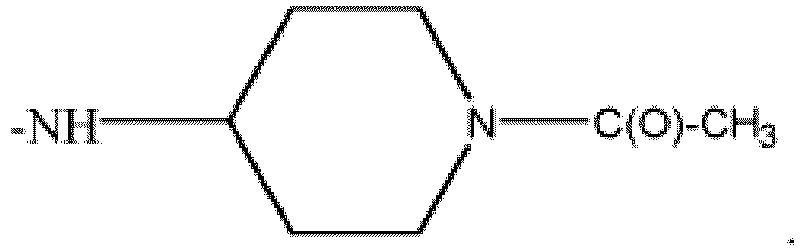
- Composé selon la revendication 2,
qui est


- Composition pharmaceutique comprenant au moins un composé selon l'une quelconque des revendications précédentes, ou un sel pharmaceutiquement acceptable de celui-ci et un véhicule pharmaceutiquement acceptable.
- Composé selon l'une quelconque des revendications 1-7, ou un sel pharmaceutiquement acceptable de celui-ci, pour utilisation en thérapie.
- Composé selon l'une quelconque des revendications 1-7, ou un sel pharmaceutiquement acceptable de celui-ci, pour utilisation dans le traitement du cancer.
- Combinaison comprenant un composé selon l'une quelconque des revendications 1-7, ou un sel pharmaceutiquement acceptable de celui-ci et des agents anticancéreux.
Applications Claiming Priority (2)
| Application Number | Priority Date | Filing Date | Title |
|---|---|---|---|
| US201762583250P | 2017-11-08 | 2017-11-08 | |
| PCT/US2018/059130 WO2019094311A1 (fr) | 2017-11-08 | 2018-11-05 | Inhibiteurs de prmt5 |
Publications (3)
| Publication Number | Publication Date |
|---|---|
| EP3706742A1 EP3706742A1 (fr) | 2020-09-16 |
| EP3706742A4 EP3706742A4 (fr) | 2021-05-05 |
| EP3706742B1 true EP3706742B1 (fr) | 2023-03-15 |
Family
ID=66438946
Family Applications (1)
| Application Number | Title | Priority Date | Filing Date |
|---|---|---|---|
| EP18875596.1A Active EP3706742B1 (fr) | 2017-11-08 | 2018-11-05 | Inhibiteurs de prmt5 |
Country Status (3)
| Country | Link |
|---|---|
| US (1) | US10947234B2 (fr) |
| EP (1) | EP3706742B1 (fr) |
| WO (1) | WO2019094311A1 (fr) |
Families Citing this family (7)
| Publication number | Priority date | Publication date | Assignee | Title |
|---|---|---|---|---|
| US11077101B1 (en) | 2018-07-18 | 2021-08-03 | Tango Therapeutics, Inc. | Compounds and methods of use |
| WO2020259478A1 (fr) * | 2019-06-24 | 2020-12-30 | 南京圣和药物研发有限公司 | Composé tricyclique utilisé en tant qu'inhibiteur de prmt5 et son application |
| TWI905118B (zh) * | 2019-10-12 | 2025-11-21 | 大陸商南京聖和藥業股份有限公司 | 作為prmt5抑制劑的取代三環類化合物及其應用 |
| WO2021086879A1 (fr) | 2019-10-28 | 2021-05-06 | Tango Therapeutics, Inc. | Composés et procédés d'utilisation |
| BR112022012015A2 (pt) * | 2019-12-17 | 2022-08-30 | Merck Sharp & Dohme Llc | Inibidores de prmt5 |
| CA3160153A1 (fr) | 2019-12-17 | 2021-06-24 | Michelle Machacek | Inhibiteurs de prmt5 |
| EP4188920A1 (fr) | 2020-07-31 | 2023-06-07 | Tango Therapeutics, Inc. | Dérivés de pipéridin-1-yl-n-pyrydine-3-yl-2-oxo-acétamide utiles pour le traitement de cancers déficients en mtap et/ou accumulant mta |
Family Cites Families (338)
| Publication number | Priority date | Publication date | Assignee | Title |
|---|---|---|---|---|
| US4319039A (en) | 1979-06-15 | 1982-03-09 | Merck & Co., Inc. | Preparation of ammonium salt of hypocholesteremic fermentation product |
| US4231938A (en) | 1979-06-15 | 1980-11-04 | Merck & Co., Inc. | Hypocholesteremic fermentation products and process of preparation |
| US4294926A (en) | 1979-06-15 | 1981-10-13 | Merck & Co., Inc. | Hypocholesteremic fermentation products and process of preparation |
| US4444784A (en) | 1980-08-05 | 1984-04-24 | Merck & Co., Inc. | Antihypercholesterolemic compounds |
| MX7065E (es) | 1980-06-06 | 1987-04-10 | Sankyo Co | Un procedimiento microbiologico para preparar derivados de ml-236b |
| JPS5889191A (ja) | 1981-11-20 | 1983-05-27 | Sankyo Co Ltd | 3−ヒドロキシ−ml−236b誘導体の製造法 |
| US5354772A (en) | 1982-11-22 | 1994-10-11 | Sandoz Pharm. Corp. | Indole analogs of mevalonolactone and derivatives thereof |
| US4911165A (en) | 1983-01-12 | 1990-03-27 | Ethicon, Inc. | Pliabilized polypropylene surgical filaments |
| US4681893A (en) | 1986-05-30 | 1987-07-21 | Warner-Lambert Company | Trans-6-[2-(3- or 4-carboxamido-substituted pyrrol-1-yl)alkyl]-4-hydroxypyran-2-one inhibitors of cholesterol synthesis |
| US4782084A (en) | 1987-06-29 | 1988-11-01 | Merck & Co., Inc. | HMG-COA reductase inhibitors |
| US4885314A (en) | 1987-06-29 | 1989-12-05 | Merck & Co., Inc. | Novel HMG-CoA reductase inhibitors |
| US4820850A (en) | 1987-07-10 | 1989-04-11 | Merck & Co., Inc. | Process for α-C-alkylation of the 8-acyl group on mevinolin and analogs thereof |
| US5180589A (en) | 1988-03-31 | 1993-01-19 | E. R. Squibb & Sons, Inc. | Pravastatin pharmaceuatical compositions having good stability |
| US5030447A (en) | 1988-03-31 | 1991-07-09 | E. R. Squibb & Sons, Inc. | Pharmaceutical compositions having good stability |
| US4916239A (en) | 1988-07-19 | 1990-04-10 | Merck & Co., Inc. | Process for the lactonization of mevinic acids and analogs thereof |
| EP0360390A1 (fr) | 1988-07-25 | 1990-03-28 | Glaxo Group Limited | Dérivés de spirolactames |
| US5290946A (en) | 1988-10-13 | 1994-03-01 | Sandoz Ltd. | Processes for the synthesis of 3-(substituted indolyl-2-yl)propenaldehydes |
| US5118853A (en) | 1988-10-13 | 1992-06-02 | Sandoz Ltd. | Processes for the synthesis of 3-disubstituted aminoacroleins |
| WO1990005525A1 (fr) | 1988-11-23 | 1990-05-31 | Pfizer Inc. | Derives de quinuclidine en tant qu'antagonsites de substance p |
| US4929437A (en) | 1989-02-02 | 1990-05-29 | Merck & Co., Inc. | Coenzyme Q10 with HMG-CoA reductase inhibitors |
| US5164372A (en) | 1989-04-28 | 1992-11-17 | Fujisawa Pharmaceutical Company, Ltd. | Peptide compounds having substance p antagonism, processes for preparation thereof and pharmaceutical composition comprising the same |
| US5189164A (en) | 1989-05-22 | 1993-02-23 | Sandoz Ltd. | Processes for the synthesis of syn-(E)-3,5-dihydroxy-7-substituted hept-6-enoic and heptanoic acids and derivatives and intermediates thereof |
| FI94339C (fi) | 1989-07-21 | 1995-08-25 | Warner Lambert Co | Menetelmä farmaseuttisesti käyttökelpoisen /R-(R*,R*)/-2-(4-fluorifenyyli)- , -dihydroksi-5-(1-metyylietyyli)-3-fenyyli-4-/(fenyyliamino)karbonyyli/-1H-pyrroli-1-heptaanihapon ja sen farmaseuttisesti hyväksyttävien suolojen valmistamiseksi |
| PH27357A (en) | 1989-09-22 | 1993-06-21 | Fujisawa Pharmaceutical Co | Pyrazole derivatives and pharmaceutical compositions comprising the same |
| IE903957A1 (en) | 1989-11-06 | 1991-05-08 | Sanofi Sa | Aromatic amine compounds, their method of preparation and¹pharmaceutical compositions in which they are present |
| FR2654726B1 (fr) | 1989-11-23 | 1992-02-14 | Rhone Poulenc Sante | Nouveaux derives de l'isoindolone et leur preparation. |
| FR2654725B1 (fr) | 1989-11-23 | 1992-02-14 | Rhone Poulenc Sante | Nouveaux derives de l'isoindolone, leur preparation et les compositions pharmaceutiques qui les contiennent. |
| GB8929070D0 (en) | 1989-12-22 | 1990-02-28 | Fujisawa Pharmaceutical Co | Peptide compounds,processes for preparation thereof and pharmaceutical composition comprising the same |
| US5232929A (en) | 1990-11-28 | 1993-08-03 | Pfizer Inc. | 3-aminopiperidine derivatives and related nitrogen containing heterocycles and pharmaceutical compositions and use |
| UA41251C2 (uk) | 1990-01-04 | 2001-09-17 | Пфайзер, Інк. | Гідровані азотвмісні гетероциклічні сполуки, похідні піперидину, фармацевтична композиція та спосіб пригнічення активності речовини р в організмі |
| EP0515681A4 (en) | 1990-02-15 | 1993-12-29 | Fujisawa Pharmaceutical Co., Ltd. | Peptide compound |
| US5420245A (en) | 1990-04-18 | 1995-05-30 | Board Of Regents, The University Of Texas | Tetrapeptide-based inhibitors of farnesyl transferase |
| AU648317B2 (en) | 1990-06-01 | 1994-04-21 | Pfizer Inc. | 3-amino-2-aryl quinuclidines, process for their preparation and pharmaceutical compositions containing them |
| DK0540526T3 (da) | 1990-07-23 | 1995-04-18 | Pfizer | Quinuclidinderivater |
| EP0550635B1 (fr) | 1990-09-28 | 1995-04-19 | Pfizer Inc. | Analogues cycliques d'heterocycles non aromatiques contenant de l'azote |
| GB9023116D0 (en) | 1990-10-24 | 1990-12-05 | Fujisawa Pharmaceutical Co | Peptide compounds,processes for preparation thereof and pharmaceutical composition comprising the same |
| US5177080A (en) | 1990-12-14 | 1993-01-05 | Bayer Aktiengesellschaft | Substituted pyridyl-dihydroxy-heptenoic acid and its salts |
| DE69114117T2 (de) | 1990-12-21 | 1996-03-21 | Fujisawa Pharmaceutical Co | Neue Verwendung von Peptidderivat. |
| WO1992012151A1 (fr) | 1991-01-10 | 1992-07-23 | Pfizer Inc. | Sels de n-alkyle quinuclidinium utilises comme antagonistes de substance p |
| US5242930A (en) | 1991-02-11 | 1993-09-07 | Merck Sharp & Dohme Ltd. | Azabicyclic compounds, pharmaceutical compositions containing them and their use in therapy |
| ES2065175T3 (es) | 1991-03-01 | 1995-02-01 | Pfizer | Derivados de 1-azabiciclo(3.2.2)nonan-3-amina. |
| US5747469A (en) | 1991-03-06 | 1998-05-05 | Board Of Regents, The University Of Texas System | Methods and compositions comprising DNA damaging agents and p53 |
| JPH0794440B2 (ja) | 1991-03-26 | 1995-10-11 | フアイザー・インコーポレイテツド | 置換ピペリジンの立体選択的製造 |
| FR2677361A1 (fr) | 1991-06-04 | 1992-12-11 | Adir | Nouveaux peptides et pseudopeptides, derives de tachykinines, leur procede de preparation et les compositions pharmaceutiques qui les contiennent. |
| FR2676055B1 (fr) | 1991-05-03 | 1993-09-03 | Sanofi Elf | Composes polycycliques amines et leurs enantiomeres, procede pour leur preparation et compositions pharmaceutiques les contenant. |
| FR2676053B1 (fr) | 1991-05-03 | 1993-08-27 | Sanofi Elf | Nouveaux composes dialkylenepiperidino et leurs enantiomeres, procede pour leur preparation et compositions pharmaceutiques les contenant. |
| FR2676447B1 (fr) | 1991-05-17 | 1993-08-06 | Rhone Poulenc Rorer Sa | Nouveaux derives du thiopyranopyrrole et leur preparation. |
| FR2676442B1 (fr) | 1991-05-17 | 1993-08-06 | Rhone Poulenc Rorer Sa | Nouveau derives de perhydroisoindole, leur preparation et les compositions pharmaceutiques qui les contiennent. |
| FR2676443B1 (fr) | 1991-05-17 | 1993-08-06 | Rhone Poulenc Rorer Sa | Nouveaux derives de perhydroisoindole et leur preparation. |
| FR2676446B1 (fr) | 1991-05-17 | 1993-08-06 | Rhone Poulenc Rorer Sa | Nouveaux derives du thiopyranopyrrole, leur preparation et les compositions pharmaceutiques qui les contiennent. |
| WO1992020661A1 (fr) | 1991-05-22 | 1992-11-26 | Merck & Co., Inc. | N, n-diacylpiperazines |
| PL172069B1 (pl) | 1991-05-22 | 1997-07-31 | Pfizer | Sposób wytwarzania nowych pochodnych podstawionej 3-aminochinuklidyny PL PL PL PL PL |
| CA2102179C (fr) | 1991-05-31 | 1998-10-27 | Fumitaka Ito | Derives quinuclidine |
| GB9113219D0 (en) | 1991-06-19 | 1991-08-07 | Fujisawa Pharmaceutical Co | Peptide compound,processes for preparation thereof and pharmaceutical composition comprising the same |
| HU224443B1 (hu) | 1991-06-20 | 2005-09-28 | Pfizer Inc. | Fluor-alkoxi-benzaldehid-származékok |
| TW202432B (fr) | 1991-06-21 | 1993-03-21 | Pfizer | |
| US5288730A (en) | 1991-06-24 | 1994-02-22 | Merck Sharp & Dohme Limited | Azabicyclic compounds, pharmaceutical compositions containing them and their use in therapy |
| JP2648897B2 (ja) | 1991-07-01 | 1997-09-03 | 塩野義製薬株式会社 | ピリミジン誘導体 |
| WO1993001160A1 (fr) | 1991-07-05 | 1993-01-21 | Merck Sharp & Dohme Limited | Composes aromatiques, compositions pharmaceutiques les contenant et leur utilisation therapeutique |
| WO1993001169A2 (fr) | 1991-07-05 | 1993-01-21 | Merck Sharp & Dohme Limited | Composes aromatiques, compositions pharmaceutiques les contenant et leur utilisation therapeutique |
| EP0536817A1 (fr) | 1991-07-05 | 1993-04-14 | MERCK SHARP & DOHME LTD. | Composés azabicycliques comme antagonistes des tachykinines |
| ATE133658T1 (de) | 1991-07-10 | 1996-02-15 | Merck Sharp & Dohme | Aromatische verbindungen diese enthaltende pharmazeutische zusammensetzungen und ihre therapeutische verwendung |
| US5495047A (en) | 1991-07-10 | 1996-02-27 | Merck, Sharp & Dohme (Ltd.) | Fused tricyclic compounds, pharmaceutical compositions containing them and their use in therapy |
| MY110227A (en) | 1991-08-12 | 1998-03-31 | Ciba Geigy Ag | 1-acylpiperindine compounds. |
| EP0600952B1 (fr) | 1991-08-20 | 1996-04-17 | MERCK SHARP & DOHME LTD. | Composes azacycliques, procedes de preparation et compositions pharmaceutiques les contenant |
| JP2535134B2 (ja) | 1991-09-16 | 1996-09-18 | ファイザー・インコーポレーテッド | 縮合三環式窒素含有複素環 |
| EP1082959A1 (fr) | 1991-09-20 | 2001-03-14 | Glaxo Group Limited | Utilisation des NK1-antagonistes pour le traitement de la depression |
| JP2553020B2 (ja) | 1991-11-07 | 1996-11-13 | 吉富製薬株式会社 | キヌクリジン化合物およびその医薬用途 |
| FI942187A7 (fi) | 1991-11-12 | 1994-05-11 | Pfizer | Asyklisiä etyleenidiamiinijohdannaisia aine P-reseptoriantagonisteina |
| EP0545478A1 (fr) | 1991-12-03 | 1993-06-09 | MERCK SHARP & DOHME LTD. | Composés hétérocycliques comme tachykinine antagonistes |
| HU217629B (hu) | 1991-12-12 | 2000-03-28 | Novartis Ag. | Eljárás fluvasztatint tartalmazó stabilizált gyógyszerkészítmények előállítására |
| GB9200535D0 (en) | 1992-01-10 | 1992-02-26 | Fujisawa Pharmaceutical Co | New compound |
| GB9201179D0 (en) | 1992-01-21 | 1992-03-11 | Glaxo Group Ltd | Chemical compounds |
| US5328927A (en) | 1992-03-03 | 1994-07-12 | Merck Sharpe & Dohme, Ltd. | Hetercyclic compounds, processes for their preparation and pharmaceutical compositions containing them |
| JP2656702B2 (ja) | 1992-03-23 | 1997-09-24 | ファイザー製薬株式会社 | ペプチド性キヌクリジン |
| FR2689888B1 (fr) | 1992-04-10 | 1994-06-10 | Rhone Poulenc Rorer Sa | Nouveaux derives de perhydroisoindole, leur preparation et les compositions pharmaceutiques qui les contiennent. |
| EP0636130A1 (fr) | 1992-04-15 | 1995-02-01 | Merck Sharp & Dohme Ltd. | Composes azacycliques |
| GB2266529A (en) | 1992-05-01 | 1993-11-03 | Merck Sharp & Dohme | Tetrahydroisoquinoline derivatives |
| ATE209186T1 (de) | 1992-05-18 | 2001-12-15 | Pfizer | Überbrückte azabicyclische derivate als substanz p antagonisten |
| GB9211193D0 (en) | 1992-05-27 | 1992-07-08 | Merck Sharp & Dohme | Therapeutic agents |
| US5637699A (en) | 1992-06-29 | 1997-06-10 | Merck & Co., Inc. | Process for preparing morpholine tachykinin receptor antagonists |
| US5719147A (en) | 1992-06-29 | 1998-02-17 | Merck & Co., Inc. | Morpholine and thiomorpholine tachykinin receptor antagonists |
| IL106142A (en) | 1992-06-29 | 1997-03-18 | Merck & Co Inc | Morpholine and thiomorpholine tachykinin receptor antagonists, their preparation and pharmaceutical compositions containing them |
| AU4713293A (en) | 1992-07-13 | 1994-01-31 | Merck Sharp & Dohme Limited | Heterocyclic amide derivatives as tachykinin derivatives |
| EP1251170A3 (fr) | 1992-07-17 | 2002-10-30 | Ribozyme Pharmaceuticals, Inc. | Procédé et réactif pour le traitement de maladies animales dépendants de NF-kappaB |
| GB2268931A (en) | 1992-07-22 | 1994-01-26 | Merck Sharp & Dohme | Azabicyclic tachykinin-receptor antagonists |
| ES2124318T3 (es) | 1992-07-28 | 1999-02-01 | Merck Sharp & Dohme | Compuestos azaciclicos. |
| GB2269170A (en) | 1992-07-29 | 1994-02-02 | Merck Sharp & Dohme | Azatricyclic tachykinin antagonists |
| WO1994003429A1 (fr) | 1992-07-31 | 1994-02-17 | Merck Sharp & Dohme Limited | Amines substituees utiles comme antagonistes du recepteur de la tachykinine |
| CA2141051A1 (fr) | 1992-08-04 | 1994-02-17 | Terry J. Rosen | Derives de substitution d'heterocycles azotes |
| GB9216911D0 (en) | 1992-08-10 | 1992-09-23 | Merck Sharp & Dohme | Therapeutic agents |
| EP1000930A3 (fr) | 1992-08-13 | 2003-10-29 | Warner-Lambert Company | Antagonistes de tachykinines |
| US5721255A (en) | 1992-08-19 | 1998-02-24 | Pfizer Inc. | Substituted benzylamino nitrogen containing non-aromatic heterocycles |
| US5387595A (en) | 1992-08-26 | 1995-02-07 | Merck & Co., Inc. | Alicyclic compounds as tachykinin receptor antagonists |
| ATE161530T1 (de) | 1992-09-04 | 1998-01-15 | Takeda Chemical Industries Ltd | Kondensierte heterozyklische verbindungen, deren herstellung und verwendung |
| AU4973693A (en) | 1992-09-10 | 1994-03-29 | Merck Sharp & Dohme Limited | Alcohols and ethers with aromatic substituents as tachykinin-antagonists |
| GB9220286D0 (en) | 1992-09-25 | 1992-11-11 | Merck Sharp & Dohme | Therapeutic agents |
| JP2656699B2 (ja) | 1992-10-21 | 1997-09-24 | ファイザー製薬株式会社 | 置換ベンジルアミノキヌクリジン |
| GB9222262D0 (en) | 1992-10-23 | 1992-12-09 | Merck Sharp & Dohme | Therapeutic agents |
| GB9222486D0 (en) | 1992-10-26 | 1992-12-09 | Merck Sharp & Dohme | Therapeutic agents |
| CA2146767A1 (fr) | 1992-10-28 | 1994-05-11 | Timothy Harrison | 4-arylmethyloxymethylpiperidines, antagonistes de la tachykinine |
| JP2656700B2 (ja) | 1992-10-28 | 1997-09-24 | ファイザー製薬株式会社 | 置換キヌクリジン誘導体 |
| AU5342894A (en) | 1992-10-30 | 1994-05-24 | Merck Sharp & Dohme Limited | Tachykinin antagonists |
| US5886009A (en) | 1992-11-12 | 1999-03-23 | Pfizer Inc. | Quinuclidine derivative as a substance P antagonist |
| US5261188A (en) | 1992-11-23 | 1993-11-16 | The Standard Products Company | Belt weatherstrip with bulb |
| EP0675886B1 (fr) | 1992-12-10 | 2000-07-05 | Pfizer Inc. | Heterocycles non aromatiques substitues par aminomethylene et leur utilisation comme antagonistes de substance p |
| US5604260A (en) | 1992-12-11 | 1997-02-18 | Merck Frosst Canada Inc. | 5-methanesulfonamido-1-indanones as an inhibitor of cyclooxygenase-2 |
| EP0673367A1 (fr) | 1992-12-14 | 1995-09-27 | MERCK SHARP & DOHME LTD. | 4-aminomethyl/thiomethyl/sulfonylmethyl-4-phenylpiperidines en tant qu'antagonistes du recepteur de tachykinine |
| EP0604181A1 (fr) | 1992-12-21 | 1994-06-29 | Eli Lilly And Company | Compositions antitumeurs et méthodes de traitement |
| GB9226581D0 (en) | 1992-12-21 | 1993-02-17 | Merck Sharp & Dohme | Therapeutic agents |
| GB9300051D0 (en) | 1993-01-04 | 1993-03-03 | Merck Sharp & Dohme | Therapeutic agents |
| EP0679157B1 (fr) | 1993-01-15 | 1997-11-19 | G.D. Searle & Co. | Nouveaux thiophenes 3,4-diaryle et leurs analogues utilises comme agents anti-inflammatoires |
| EP0610793A1 (fr) | 1993-02-08 | 1994-08-17 | Takeda Chemical Industries, Ltd. | Dérivés de morpholine tétracycliques et leur utilisation comme analgésiques |
| ATE166867T1 (de) | 1993-02-18 | 1998-06-15 | Merck Sharp & Dohme | Azacyclische verbindungen, sie enthaltende zusammensetzungen und ihre verwendung als tachykinin antagoniste |
| US5674889A (en) | 1993-02-22 | 1997-10-07 | Merck, Sharp & Dohme, Ltd. | Aromatic compounds, compositions containing them and their use in therapy |
| WO1994019357A1 (fr) | 1993-02-23 | 1994-09-01 | Merrell Dow Pharmaceuticals Inc. | Inhibiteurs de la transferase farnesyl:proteine utiles comme agents anticancereux |
| US5298627A (en) | 1993-03-03 | 1994-03-29 | Warner-Lambert Company | Process for trans-6-[2-(substituted-pyrrol-1-yl)alkyl]pyran-2-one inhibitors of cholesterol synthesis |
| WO1994020500A1 (fr) | 1993-03-04 | 1994-09-15 | Pfizer Inc. | Derives spiroazacycliques utilises comme antagonistes de la substance p |
| US5409944A (en) | 1993-03-12 | 1995-04-25 | Merck Frosst Canada, Inc. | Alkanesulfonamido-1-indanone derivatives as inhibitors of cyclooxygenase |
| CA2118985A1 (fr) | 1993-04-02 | 1994-10-03 | Dinesh V. Patel | Inhibiteurs heterocycliques de la farnesyl proteine transferase |
| US5496833A (en) | 1993-04-13 | 1996-03-05 | Merck Sharp & Dohme Limited | Piperidine tachykinin receptor antagonists |
| HU224496B1 (hu) | 1993-05-06 | 2005-10-28 | Merrel Dow Pharmaceuticals Inc. | Pirrolidin-3-il-alkil-piperidin-származékok és e vegyületeket tartalmazó gyógyászati készítmények |
| WO1994026723A2 (fr) | 1993-05-14 | 1994-11-24 | Genentech, Inc. | INHIBITEURS DE LA ras FARNESYL-TRANSFERASE |
| US5602098A (en) | 1993-05-18 | 1997-02-11 | University Of Pittsburgh | Inhibition of farnesyltransferase |
| IL109646A0 (en) | 1993-05-19 | 1994-08-26 | Pfizer | Heteroatom substituted alkyl benzylamino-quinuclidines |
| US5380738A (en) | 1993-05-21 | 1995-01-10 | Monsanto Company | 2-substituted oxazoles further substituted by 4-fluorophenyl and 4-methylsulfonylphenyl as antiinflammatory agents |
| AU680020B2 (en) | 1993-06-07 | 1997-07-17 | Merck & Co., Inc. | Spiro-substituted azacycles as neurokinin antagonists |
| US5474995A (en) | 1993-06-24 | 1995-12-12 | Merck Frosst Canada, Inc. | Phenyl heterocycles as cox-2 inhibitors |
| US5436265A (en) | 1993-11-12 | 1995-07-25 | Merck Frosst Canada, Inc. | 1-aroyl-3-indolyl alkanoic acids and derivatives thereof useful as anti-inflammatory agents |
| GB9602877D0 (en) | 1996-02-13 | 1996-04-10 | Merck Frosst Canada Inc | 3,4-Diaryl-2-hydroxy-2,5- dihydrofurans as prodrugs to cox-2 inhibitors |
| EP0634402A1 (fr) | 1993-07-14 | 1995-01-18 | Takeda Chemical Industries, Ltd. | Dérivés d'isoquinolinone, leur production et utilisation |
| EP0708771B1 (fr) | 1993-07-15 | 1998-10-07 | Pfizer Inc. | Benzylaminoquinuclidines en tant qu'antagonistes de substance p |
| TW365603B (en) | 1993-07-30 | 1999-08-01 | Rhone Poulenc Rorer Sa | Novel perhydroisoindole derivatives, their preparation and pharmaceutical compositions which contain them |
| GB9315808D0 (en) | 1993-07-30 | 1993-09-15 | Merck Sharp & Dohme | Therapeutic agents |
| GB9317987D0 (en) | 1993-08-26 | 1993-10-13 | Glaxo Group Ltd | Chemical compounds |
| EP1209157A1 (fr) | 1993-09-17 | 2002-05-29 | Pfizer Inc. | 3-Benzylaminométhyl-pipéridines à substitution hétéroarylamino et hétéroarylsulfonamido, et composés apparents |
| ES2217269T3 (es) | 1993-09-17 | 2004-11-01 | Pfizer Inc. | Piperidinas 3-amino-5-carboxi sustituidas y pirrolidinas 3-amino-4-carboxi sustituidas como antagonistas de taquininas. |
| WO1995008542A1 (fr) | 1993-09-22 | 1995-03-30 | Kyowa Hakko Kogyo Co., Ltd. | Inhibiteur de la farnesyl-transferase |
| IS4208A (is) | 1993-09-22 | 1995-03-23 | Glaxo Group Limited | 3-(tetrazólýl-benzyl)amínó-piperadidín afleiður |
| SG48750A1 (en) | 1993-10-15 | 1998-05-18 | Schering Corp | Tricyclic carbonate compounds useful for inhabition of g-protein function for treatment of proliferative diseases |
| US5661152A (en) | 1993-10-15 | 1997-08-26 | Schering Corporation | Tricyclic sulfonamide compounds useful for inhibition of G-protein function and for treatment of proliferative diseases |
| EP0723539B1 (fr) | 1993-10-15 | 2001-12-12 | Schering Corporation | Composes sulfonamides tricycliques servant a inhiber la fonction de la proteine g et au traitement de maladies proliferatives |
| US5721236A (en) | 1993-10-15 | 1998-02-24 | Schering Corporation | Tricyclic carbamate compounds useful for inhibition of G-protein function and for treatment of proliferative diseases |
| IL111235A (en) | 1993-10-15 | 2001-03-19 | Schering Plough Corp | Medicinal preparations for inhibiting protein G activity and for the treatment of malignant diseases, containing tricyclic compounds, some such new compounds and a process for the preparation of some of them |
| US5719148A (en) | 1993-10-15 | 1998-02-17 | Schering Corporation | Tricyclic amide and urea compounds useful for inhibition of g-protein function and for treatment of proliferative diseases |
| FI961621L (fi) | 1993-10-25 | 1996-04-12 | Parke Davis & Co | Proteiini:farnesyylitranseraasin substituoidut tetra- ja pentapeptidi-inhibiittorit |
| AU7947594A (en) | 1993-10-27 | 1995-05-22 | Merck Sharp & Dohme Limited | Substituted amides as tachykinin antagonists |
| US5344991A (en) | 1993-10-29 | 1994-09-06 | G.D. Searle & Co. | 1,2 diarylcyclopentenyl compounds for the treatment of inflammation |
| DE69417012T2 (de) | 1993-11-04 | 1999-10-07 | Abbott Laboratories, Abbott Park | Cyclobutan-derivate als inhibitoren der squalen-synthetase und der protein-farnesyltransferase |
| US5783593A (en) | 1993-11-04 | 1998-07-21 | Abbott Laboratories | Inhibitors of squalene synthetase and protein farnesyltransferase |
| WO1995012612A1 (fr) | 1993-11-05 | 1995-05-11 | Warner-Lambert Company | Inhibiteurs di- et tripeptidiques substitues de l'enzyme proteine:la farnesyle transferase |
| US6403577B1 (en) | 1993-11-17 | 2002-06-11 | Eli Lilly And Company | Hexamethyleneiminyl tachykinin receptor antagonists |
| US5466823A (en) | 1993-11-30 | 1995-11-14 | G.D. Searle & Co. | Substituted pyrazolyl benzenesulfonamides |
| IT1271462B (it) | 1993-12-03 | 1997-05-28 | Menarini Farma Ind | Antagonisti delle tachichinine,procedimento per la loro preparazione e loro impiego in formulazioni farmaceutiche. |
| US5484799A (en) | 1993-12-09 | 1996-01-16 | Abbott Laboratories | Antifungal dorrigocin derivatives |
| IL111960A (en) | 1993-12-17 | 1999-12-22 | Merck & Co Inc | Morpholines and thiomorpholines their preparation and pharmaceutical compositions containing them |
| WO1995017382A1 (fr) | 1993-12-21 | 1995-06-29 | Eli Lilly And Company | Antagonistes non peptidiques des recepteurs des tachykinines |
| NZ274915A (en) | 1993-12-29 | 1997-11-24 | Pfizer | N-(hetero)aryl methyl diazabicycloalkane derivatives |
| DE69434063D1 (de) | 1993-12-29 | 2004-11-11 | Merck Sharp & Dohme | Substituierte Morpholinderivate und ihre Verwendung als therapeutische Mittel |
| JPH09507500A (ja) | 1994-01-13 | 1997-07-29 | メルク シヤープ エンド ドーム リミテツド | gem二置換アザシクロ系のタキキニン拮抗薬 |
| EP0741704A1 (fr) | 1994-01-28 | 1996-11-13 | MERCK SHARP & DOHME LTD. | Agents therapeutiques azacycliques avec substitution par un groupe aralkyamino |
| US5393790A (en) | 1994-02-10 | 1995-02-28 | G.D. Searle & Co. | Substituted spiro compounds for the treatment of inflammation |
| GB9402688D0 (en) | 1994-02-11 | 1994-04-06 | Merck Sharp & Dohme | Therapeutic agents |
| US5610165A (en) | 1994-02-17 | 1997-03-11 | Merck & Co., Inc. | N-acylpiperidine tachykinin antagonists |
| IL112778A0 (en) | 1994-03-04 | 1995-05-26 | Merck & Co Inc | Substituted heterocycles, their preparation and pharmaceutical compositions containing them |
| WO1995024612A1 (fr) | 1994-03-07 | 1995-09-14 | International Business Machines Corporation | Procede et dispositif d'interpolation rapide de valeurs intermediaires derivees de signaux periodiques dephases et de detection de defauts de corps rotatifs |
| HUT77406A (hu) | 1994-03-15 | 1998-04-28 | Eisai Co., Ltd., | 1-(4-Amino-5-tio-pent-2-en)-il oldalláncot tartalmazó peptidomimetikumok és az ezeket tartalmazó gyógyszerkészítmények |
| FR2718136B1 (fr) | 1994-03-29 | 1996-06-21 | Sanofi Sa | Composés aromatiques aminés, procédé pour leur obtention et compositions pharmaceutiques les contenant. |
| AU1615895A (en) | 1994-03-31 | 1995-10-12 | Bristol-Myers Squibb Company | Imidazole-containing inhibitors of farnesyl protein transferase |
| US5523430A (en) | 1994-04-14 | 1996-06-04 | Bristol-Myers Squibb Company | Protein farnesyl transferase inhibitors |
| US5610145A (en) | 1994-04-15 | 1997-03-11 | Warner-Lambert Company | Tachykinin antagonists |
| PE27997A1 (es) | 1994-04-29 | 1997-09-20 | Lilly Co Eli | Antagonistas de receptores de taquicininas |
| EP0758329A1 (fr) | 1994-05-05 | 1997-02-19 | MERCK SHARP & DOHME LTD. | Derives de morpholine et utilisation comme antagonistes des tachykinines |
| PL317127A1 (en) | 1994-05-07 | 1997-03-17 | Boehringer Ingelheim Kg | Novel derivatives of amino acids, method of obtaining them and pharmaceutic agents containing such derivatives |
| US5510510A (en) | 1994-05-10 | 1996-04-23 | Bristol-Meyers Squibb Company | Inhibitors of farnesyl protein transferase |
| US5563255A (en) | 1994-05-31 | 1996-10-08 | Isis Pharmaceuticals, Inc. | Antisense oligonucleotide modulation of raf gene expression |
| ATE206710T1 (de) | 1994-06-06 | 2001-10-15 | Warner Lambert Co | Tachykinin (nk1) rezeptor antagonisten |
| JPH10501259A (ja) | 1994-06-10 | 1998-02-03 | ローン−プーラン・ロレ・ソシエテ・アノニム | 新規ファルネシルトランスフェラーゼインヒビター、それらの製造およびそれらを含む医薬組成物 |
| EP0686629A3 (fr) | 1994-06-10 | 1999-02-10 | Eli Lilly And Company | Antagonistes des récepteurs de tachycinine cyclohexyliques |
| US5571792A (en) | 1994-06-30 | 1996-11-05 | Warner-Lambert Company | Histidine and homohistidine derivatives as inhibitors of protein farnesyltransferase |
| CA2194471C (fr) | 1994-07-12 | 2005-04-12 | Sung-Yong Stephen Cho | Antagoniste du recepteur de tachykinine bis-piperidinyl non-peptidyl |
| CA2154116A1 (fr) | 1994-07-22 | 1996-01-23 | Philip Arthur Hipskind | Derives 1-aryl-2-acetamidopentanone, destines a servir d'antagonistes du recepteur de tachykinine |
| GB9415997D0 (en) | 1994-08-08 | 1994-09-28 | Merck Sharp & Dohme | Therapeutic agents |
| GB9415996D0 (en) | 1994-08-08 | 1994-09-28 | Merck Sharp & Dohme | Therapeutic agents |
| TW432061B (en) | 1994-08-09 | 2001-05-01 | Pfizer Res & Dev | Lactams |
| WO1996005529A1 (fr) | 1994-08-09 | 1996-02-22 | Micron Optics, Inc. | Filtres de fabry-perot a fibres compense en temperature |
| AU3192395A (en) | 1994-08-11 | 1996-03-07 | Banyu Pharmaceutical Co., Ltd. | Substituted amide derivative |
| CA2155448A1 (fr) | 1994-08-11 | 1996-02-12 | Katerina Leftheris | Inhibiteurs de la farnesyl-proteine-transferase |
| AU3192495A (en) | 1994-08-12 | 1996-03-07 | Banyu Pharmaceutical Co., Ltd. | N,n-disubstituted amic acid derivative |
| ES2157337T3 (es) | 1994-08-15 | 2001-08-16 | Merck Sharp & Dohme | Derivados de morfolina y su uso como agentes terapeuticos. |
| DE4429506B4 (de) | 1994-08-19 | 2007-09-13 | Degussa Gmbh | Verfahren zur Extraktion natürlicher Carotinoid-Farbstoffe |
| DE4429653C2 (de) | 1994-08-20 | 1997-04-03 | Anton Dr More | Konverter und Verfahren zum Frischen von Metallschmelzen insbesondere von Roheisen zu Stahl |
| DK0777666T3 (da) | 1994-08-25 | 1999-09-27 | Merrell Pharma Inc | Substituerede piperidiner anvendelige ved behandling af allergiske sygdomme |
| ES2107118T3 (es) | 1994-08-29 | 1997-11-16 | Akzo Nobel Nv | Procedimiento para la preparacion de diesteres cuaternarios. |
| GB9417956D0 (en) | 1994-09-02 | 1994-10-26 | Merck Sharp & Dohme | Therapeutic agents |
| GB9418545D0 (en) | 1994-09-15 | 1994-11-02 | Merck Sharp & Dohme | Therapeutic agents |
| US5457107A (en) | 1994-09-16 | 1995-10-10 | Merck & Co., Inc. | Polymorphic form of a tachykinin receptor antagonist |
| ES2172595T3 (es) | 1994-09-30 | 2002-10-01 | Novartis Ag | Compuestos de 1-acil-4-alifatilaminopiperidina. |
| TW397825B (en) | 1994-10-14 | 2000-07-11 | Novartis Ag | Aroyl-piperidine derivatives |
| FR2725986B1 (fr) | 1994-10-21 | 1996-11-29 | Adir | Nouveaux derives de piperidine, leur procede de preparation et les compositions pharmaceutiques qui les contiennent |
| DE69534213T2 (de) | 1994-10-25 | 2006-01-12 | Astrazeneca Ab | Therapeutisch wirksame Heterocyclen |
| GB9421709D0 (en) | 1994-10-27 | 1994-12-14 | Zeneca Ltd | Therapeutic compounds |
| KR100389754B1 (ko) | 1994-11-22 | 2003-10-17 | 코닌클리즈케 필립스 일렉트로닉스 엔.브이. | 반도체장치 |
| CA2162786A1 (fr) | 1994-11-22 | 1996-05-23 | Philip Arthur Hipskind | Antagonistes heterocycliques des recepteurs des tachykinines |
| FR2727411B1 (fr) | 1994-11-30 | 1997-01-03 | Rhone Poulenc Rorer Sa | Nouveaux derives de perhydroisoindole, leur preparation et les compositions pharmaceutiques qui les contiennent |
| JPH10510261A (ja) | 1994-12-09 | 1998-10-06 | ワーナー−ランバート・カンパニー | タンパク質:ファルネシルトランスフェラーゼの置換テトラーおよびペンタペプチド阻害剤 |
| PE38997A1 (es) | 1994-12-13 | 1997-10-02 | Novartis Ag | Antagonista de taquicinina |
| GB9426103D0 (en) | 1994-12-23 | 1995-02-22 | Merck Sharp & Dohme | Therapeutic agents |
| WO1996021701A2 (fr) | 1995-01-09 | 1996-07-18 | Magla International Ltd. | Impression d'image resistant a l'usure sur des surfaces en latex |
| JP3929069B2 (ja) | 1995-01-12 | 2007-06-13 | ユニバーシティ オブ ピッツバーグ | プレニルトランスフェラーゼの阻害剤 |
| JP3925662B2 (ja) | 1995-01-12 | 2007-06-06 | グラクソ,グループ,リミテッド | タキキニンアンタゴニスト活性を有するピペリジン誘導体 |
| FR2729390A1 (fr) | 1995-01-18 | 1996-07-19 | Rhone Poulenc Rorer Sa | Nouveaux inhibiteurs de farnesyl transferase, leur preparation et les compositions pharmaceutiques qui les contiennent |
| FR2729951B1 (fr) | 1995-01-30 | 1997-04-18 | Sanofi Sa | Nouveaux composes heterocycliques, procede pour leur preparation et compositions pharmaceutiques en contenant |
| FR2730491B1 (fr) | 1995-02-09 | 1997-03-14 | Rhone Poulenc Rorer Sa | Nouveaux inhibiteurs de farnesyl transferase, leur preparation et les compositions pharmaceutiques qui les contiennent |
| FR2730492B1 (fr) | 1995-02-09 | 1997-03-14 | Rhone Poulenc Rorer Sa | Nouveaux inhibiteurs de farnesyl transferase, leur preparation et les compositions pharmaceutiques qui les contiennent |
| US5633272A (en) | 1995-02-13 | 1997-05-27 | Talley; John J. | Substituted isoxazoles for the treatment of inflammation |
| GB9505491D0 (en) | 1995-03-18 | 1995-05-03 | Merck Sharp & Dohme | Therapeutic agents |
| GB9505492D0 (en) | 1995-03-18 | 1995-05-03 | Merck Sharp & Dohme | Therapeutic agents |
| US5554641A (en) | 1995-03-20 | 1996-09-10 | Horwell; David C. | Nonpeptides as tachykinin antagonists |
| GB9505692D0 (en) | 1995-03-21 | 1995-05-10 | Glaxo Group Ltd | Chemical compounds |
| US5684013A (en) | 1995-03-24 | 1997-11-04 | Schering Corporation | Tricyclic compounds useful for inhibition of g-protein function and for treatment of proliferative diseases |
| US5700806A (en) | 1995-03-24 | 1997-12-23 | Schering Corporation | Tricyclic amide and urea compounds useful for inhibition of G-protein function and for treatment of proliferative diseases |
| TW394773B (en) | 1995-03-24 | 2000-06-21 | Takeda Chemical Industries Ltd | Cyclic compounds for antagonizing tachykinin receptor, substance p receptor and neurokinin a receptor, their production and pharmaceutical composition |
| IL117580A0 (en) | 1995-03-29 | 1996-07-23 | Merck & Co Inc | Inhibitors of farnesyl-protein transferase and pharmaceutical compositions containing them |
| US5565568A (en) | 1995-04-06 | 1996-10-15 | Eli Lilly And Company | 2-acylaminopropanamides as tachykinin receptor antagonists |
| IL117798A (en) | 1995-04-07 | 2001-11-25 | Schering Plough Corp | Tricyclic compounds useful for inhibiting the function of protein - G and for the treatment of malignant diseases, and pharmaceutical preparations containing them |
| US5891872A (en) | 1995-04-07 | 1999-04-06 | Schering Corporation | Tricyclic compounds |
| CA2217351C (fr) | 1995-04-07 | 2003-03-18 | Schering Corporation | Composes de piperazinyle et de piperidinyle carbonyles inhibant la transferase de proteine farnesyle |
| US5712280A (en) | 1995-04-07 | 1998-01-27 | Schering Corporation | Tricyclic compounds useful for inhibition of G-protein function and for treatment of proliferative diseases |
| CA2217006C (fr) | 1995-04-13 | 2001-05-22 | Hoechst Marion Roussel, Inc. | Nouveaux derives de piperazine substitues presentant une activite d'antagonistes des recepteurs de la tachykinine |
| US5831115A (en) | 1995-04-21 | 1998-11-03 | Abbott Laboratories | Inhibitors of squalene synthase and protein farnesyltransferase |
| IL118101A0 (en) | 1995-05-03 | 1996-09-12 | Abbott Lab | Inhibitors of farnesyltransferase |
| WO1996037489A1 (fr) | 1995-05-25 | 1996-11-28 | Fujisawa Pharmaceutical Co., Ltd. | Derives de 1-benzoyl-2-(indolyl-3-alkyl)-piperazine utilises comme antagonistes du recepteur de la neurokinine |
| WO1997000252A1 (fr) | 1995-06-16 | 1997-01-03 | Warner-Lambert Company | Inhibiteurs tricycliques de farnesyltransferase de proteines |
| GB9513118D0 (en) | 1995-06-28 | 1995-08-30 | Merck Sharp & Dohme | Therapeutic agents |
| GB9513117D0 (en) | 1995-06-28 | 1995-08-30 | Merck Sharp & Dohme | Therapeutic agents |
| GB9513121D0 (en) | 1995-06-28 | 1995-08-30 | Merck Sharp & Dohme | Therapeutic agents |
| JP3042894B2 (ja) | 1995-07-07 | 2000-05-22 | ファイザー製薬株式会社 | サブスタンスpアンタゴニストとしての置換ベンゾラクタム化合物 |
| FR2736641B1 (fr) | 1995-07-10 | 1997-08-22 | Rhone Poulenc Rorer Sa | Nouveaux inhibiteurs de farnesyl transferase, leur preparation et les compositions pharmaceutiques qui les contiennent |
| AT402617B (de) | 1995-07-11 | 1997-07-25 | Datacon Schweitzer & Zeindl Gm | Anlage zum automatisierten, hermetischen anlage zum automatisierten, hermetischen verschliessen von gehäusen verschliessen von gehäusen |
| FR2736638B1 (fr) | 1995-07-12 | 1997-08-22 | Rhone Poulenc Rorer Sa | Nouveaux inhibiteurs de farnesyl transferase, leur preparation et les compositions pharmaceutiques qui les contiennent |
| CH690163A5 (fr) | 1995-07-28 | 2000-05-31 | Symphar Sa | Dérivés gem-diphosphonates substitués utiles en tant qu'agents anti-cancers. |
| TW340842B (en) | 1995-08-24 | 1998-09-21 | Pfizer | Substituted benzylaminopiperidine compounds |
| US6020343A (en) | 1995-10-13 | 2000-02-01 | Merck Frosst Canada, Inc. | (Methylsulfonyl)phenyl-2-(5H)-furanones as COX-2 inhibitors |
| WO1997014671A1 (fr) | 1995-10-18 | 1997-04-24 | Merck & Co., Inc. | Antagonistes des recepteurs de la cyclopentyle-tachykinine |
| DE19541283A1 (de) | 1995-11-06 | 1997-05-07 | Boehringer Ingelheim Kg | Neue Aminosäurederivate, Verfahren zu ihrer Herstellung und diese Verbindungen enthaltende pharmazeutische Zusammensetzungen |
| WO1997017070A1 (fr) | 1995-11-06 | 1997-05-15 | University Of Pittsburgh | Inhibiteurs de proteine-isoprenyle-transferases |
| GB9523244D0 (en) | 1995-11-14 | 1996-01-17 | Merck Sharp & Dohme | Therapeutic agents |
| ATE218556T1 (de) | 1995-11-17 | 2002-06-15 | Biotechnolog Forschung Gmbh | Epothilon-derivate und deren herstellung |
| JP2000500502A (ja) | 1995-11-22 | 2000-01-18 | メルク エンド カンパニー インコーポレーテッド | ファルネシル―タンパク質トランスフェラーゼ阻害剤 |
| WO1997019084A1 (fr) | 1995-11-23 | 1997-05-29 | Merck Sharp & Dohme Limited | Derives de spiro-piperidine et leur utilisation en tant qu'antagonistes de tachykinine |
| GB9524157D0 (en) | 1995-11-25 | 1996-01-24 | Pfizer Ltd | Therapeutic agents |
| HU224225B1 (hu) | 1995-12-01 | 2005-06-28 | Sankyo Co. Ltd. | Tachikinin receptor antagonista hatású heterociklusos vegyületek, ezek előállítási eljárása és alkalmazásuk gyógyszerkészítmények előállítására |
| EE03484B1 (et) | 1995-12-08 | 2001-08-15 | Janssen Pharmaceutica N.V. | Farnesüülproteiintransferaasi inhibeerivad (5-imidasolüül)metüül-2-kinolinooni derivaadid ja nende kasutamine |
| GB9525296D0 (en) | 1995-12-11 | 1996-02-07 | Merck Sharp & Dohme | Therapeutic agents |
| CZ292791B6 (cs) | 1995-12-22 | 2003-12-17 | Schering Corporation | Tricyklické amidy, které se používají pro inhibici G-proteinové funkce a k léčení proliferativních onemocnění |
| US6008372A (en) | 1996-01-16 | 1999-12-28 | Warner-Lambert Company | Substituted dinaphthylmethyl and diheteroarylmethylacetyl histidine inhibitors of protein farnesyltransferase |
| US6673927B2 (en) | 1996-02-16 | 2004-01-06 | Societe De Conseils De Recherches Et D'applications Scientifiques, S.A.S. | Farnesyl transferase inhibitors |
| CA2249601A1 (fr) | 1996-04-03 | 1997-10-23 | Thorsten E. Fisher | Inhibiteurs de la farnesyl-proteine transferase |
| WO1997038986A1 (fr) | 1996-04-12 | 1997-10-23 | G.D. Searle & Co. | Derives benzenesulfonamide substitue utilisables comme precurseurs des inhibiteurs du cox-2 |
| IL126833A0 (en) | 1996-05-22 | 1999-08-17 | Warner Lambert Co | Inhibitors of protein farnesyl transferase |
| AU709409B2 (en) | 1996-07-15 | 1999-08-26 | Bristol-Myers Squibb Company | Thiadioxobenzodiazepine inhibitors of farnesyl protein transferase |
| US5861419A (en) | 1996-07-18 | 1999-01-19 | Merck Frosst Canad, Inc. | Substituted pyridines as selective cyclooxygenase-2 inhibitors |
| US6242469B1 (en) | 1996-12-03 | 2001-06-05 | Sloan-Kettering Institute For Cancer Research | Synthesis of epothilones, intermediates thereto, analogues and uses thereof |
| AU6013998A (en) | 1996-12-30 | 1998-07-31 | Merck & Co., Inc. | Inhibitors of farnesyl-protein transferase |
| AU5719598A (en) | 1996-12-30 | 1998-07-31 | Merck & Co., Inc. | Inhibitors of farnesyl-protein transferase |
| JP2002536968A (ja) | 1999-01-29 | 2002-11-05 | イムクローン システムズ インコーポレイティド | Kdrに特異的な抗体およびその使用 |
| GB9904387D0 (en) | 1999-02-25 | 1999-04-21 | Pharmacia & Upjohn Spa | Antitumour synergistic composition |
| AU4972900A (en) | 1999-04-08 | 2000-11-14 | Arch Development Corporation | Use of anti-vegf antibody to enhance radiation in cancer therapy |
| CA2404125C (fr) | 2000-03-20 | 2011-01-25 | Merck Sharp & Dohme Limited | Derives de bicyxloalkyle a pontage a substitution sulphonamido |
| GB0012671D0 (en) | 2000-05-24 | 2000-07-19 | Merck Sharp & Dohme | Therapeutic agents |
| GB0025173D0 (en) | 2000-10-13 | 2000-11-29 | Merck Sharp & Dohme | Therapeutic agents |
| ES2248397T3 (es) | 2000-11-02 | 2006-03-16 | MERCK SHARP & DOHME LTD. | Sulfamidas como inhibidores de la gamma-secretasa. |
| UA74849C2 (en) | 2000-11-17 | 2006-02-15 | Lilly Co Eli | Lactam |
| GB0108591D0 (en) | 2001-04-05 | 2001-05-23 | Merck Sharp & Dohme | Therapeutic agents |
| GB0108592D0 (en) | 2001-04-05 | 2001-05-23 | Merck Sharp & Dohme | Therapeutic agents |
| WO2002083139A1 (fr) | 2001-04-10 | 2002-10-24 | Merck & Co., Inc. | Inhibiteurs de l'activite d'akt |
| WO2002083064A2 (fr) | 2001-04-10 | 2002-10-24 | Merck & Co., Inc. | Methode de traitement du cancer |
| AU2002251266A1 (en) | 2001-04-10 | 2002-10-28 | Merck Sharp And Dohme Limited | Inhibitors of akt activity |
| WO2002083140A1 (fr) | 2001-04-10 | 2002-10-24 | Merck & Co., Inc. | Inhibiteurs de l'activite d'akt |
| ATE400274T1 (de) | 2001-04-10 | 2008-07-15 | Merck & Co Inc | Hemmstoffe der akt aktivität |
| GB0119152D0 (en) | 2001-08-06 | 2001-09-26 | Merck Sharp & Dohme | Therapeutic agents |
| DK1421062T3 (da) | 2001-08-21 | 2008-02-18 | Merck Sharp & Dohme | Cyclohexylsulfoner |
| AU2002363429B2 (en) | 2001-11-07 | 2008-05-08 | Merck & Co., Inc. | Mitotic kinesin inhibitors |
| ATE424388T1 (de) | 2001-12-06 | 2009-03-15 | Merck & Co Inc | Mitotische kinesinhemmer |
| US7378411B2 (en) | 2001-12-06 | 2008-05-27 | Merck & Co., Inc. | Substituted thienopyrimidinones as a mitotic kinesin inhibitor |
| WO2003049679A2 (fr) | 2001-12-06 | 2003-06-19 | Merck & Co., Inc. | Inhibiteurs mitotiques de la kinésine |
| AU2002363960B2 (en) | 2001-12-06 | 2008-07-10 | Merck Sharp & Dohme Corp. | Mitotic kinesin inhibitors |
| CA2467726A1 (fr) | 2001-12-06 | 2003-06-19 | Merck & Co., Inc. | Inhibiteurs mitotiques de la kinesine |
| AU2003249597B2 (en) | 2002-03-08 | 2007-06-28 | Merck Sharp & Dohme Corp. | Mitotic kinesin inhibitors |
| US20060142178A1 (en) | 2002-04-08 | 2006-06-29 | Barnett Stanley F | Method of treating cancer |
| WO2003086394A1 (fr) | 2002-04-08 | 2003-10-23 | Merck & Co., Inc. | Inhibiteurs de l'activite akt |
| WO2003086403A1 (fr) | 2002-04-08 | 2003-10-23 | Merck & Co., Inc. | Inhibiteurs de l'activite de akt |
| WO2003086279A2 (fr) | 2002-04-08 | 2003-10-23 | Merck & Co., Inc. | Inhibiteurs de l'activite de akt |
| US7273869B2 (en) | 2002-04-08 | 2007-09-25 | Merck & Co., Inc. | Inhibitors of Akt activity |
| GB0209991D0 (en) | 2002-05-01 | 2002-06-12 | Merck Sharp & Dohme | Therapeutic agents |
| DE60328182D1 (de) | 2002-05-01 | 2009-08-13 | Merck Sharp & Dohme | Heteroaryl substituierte spirocyclische sulfamide zur hemmung von gamma sekretase |
| GB0209995D0 (en) | 2002-05-01 | 2002-06-12 | Merck Sharp & Dohme | Therapeutic agents |
| GB0209997D0 (en) | 2002-05-01 | 2002-06-12 | Merck Sharp & Dohme | Therapeutic agents |
| AU2003231799A1 (en) | 2002-05-23 | 2003-12-12 | Merck & Co., Inc. | Mitotic kinesin inhibitors |
| CA2485343A1 (fr) | 2002-05-23 | 2004-05-13 | Merck & Co., Inc. | Inhibiteurs de kinesine mitotique |
| KR20050010515A (ko) | 2002-06-14 | 2005-01-27 | 머크 앤드 캄파니 인코포레이티드 | 유사분열 키네신 억제제 |
| EP1515949B1 (fr) | 2002-06-14 | 2007-03-14 | Merck & Co., Inc. | Inhibiteurs de kinesine mitotique |
| GB0223039D0 (en) | 2002-10-04 | 2002-11-13 | Merck Sharp & Dohme | Therapeutic compounds |
| GB0223040D0 (en) | 2002-10-04 | 2002-11-13 | Merck Sharp & Dohme | Therapeutic compounds |
| GB0223038D0 (en) | 2002-10-04 | 2002-11-13 | Merck Sharp & Dohme | Therapeutic compounds |
| AU2003287057B2 (en) | 2002-10-18 | 2008-08-21 | Merck Sharp & Dohme Corp. | Mitotic kinesin inhibitors |
| US7399764B2 (en) | 2002-10-30 | 2008-07-15 | Merck & Co., Inc. | Inhibitors of Akt activity |
| US20040102360A1 (en) | 2002-10-30 | 2004-05-27 | Barnett Stanley F. | Combination therapy |
| GB0225475D0 (en) | 2002-11-01 | 2002-12-11 | Merck Sharp & Dohme | Therapeutic agents |
| GB0225474D0 (en) | 2002-11-01 | 2002-12-11 | Merck Sharp & Dohme | Therapeutic agents |
| BR0316923A (pt) | 2002-12-06 | 2005-10-18 | Pharmacia Corp | Polipeptìdeo mitoneet de membranas mitocondriais, seus moduladores e métodos para utilização do mesmo |
| JP2006516140A (ja) | 2002-12-20 | 2006-06-22 | メルク エンド カムパニー インコーポレーテッド | 有糸分裂キネシン阻害剤 |
| WO2004058700A2 (fr) | 2002-12-20 | 2004-07-15 | Merck & Co., Inc. | Inhibiteurs de kinesine mitotique |
| GB0308318D0 (en) | 2003-04-10 | 2003-05-14 | Merck Sharp & Dohme | Therapeutic agents |
| JP4679514B2 (ja) | 2003-04-24 | 2011-04-27 | メルク・シャープ・エンド・ドーム・コーポレイション | Akt活性の阻害剤 |
| WO2004096131A2 (fr) | 2003-04-24 | 2004-11-11 | Merck & Co., Inc. | Inhibiteurs de l'activite akt |
| DE602004026047D1 (de) | 2003-04-24 | 2010-04-29 | Merck Sharp & Dohme | Hemmer der akt aktivität |
| CN1809351A (zh) | 2003-04-24 | 2006-07-26 | 麦克公司 | Akt活性抑制剂 |
| KR20060013404A (ko) | 2003-05-16 | 2006-02-09 | 머크 샤프 앤드 돔 리미티드 | γ-세크레타제 억제용 사이클릭 설폰아미드 |
| US7454431B2 (en) | 2003-07-17 | 2008-11-18 | At&T Corp. | Method and apparatus for window matching in delta compressors |
| KR100536215B1 (ko) | 2003-08-05 | 2005-12-12 | 삼성에스디아이 주식회사 | 플라즈마 디스플레이 패널 |
| GB0318447D0 (en) | 2003-08-05 | 2003-09-10 | Merck Sharp & Dohme | Therapeutic agents |
| WO2005018638A1 (fr) | 2003-08-13 | 2005-03-03 | Merck & Co., Inc. | Inhibiteurs mitotiques de la kinesine |
| CN1835746A (zh) | 2003-08-15 | 2006-09-20 | 默克公司 | 有丝分裂驱动蛋白抑制剂 |
| EP1664026B1 (fr) | 2003-08-15 | 2009-01-21 | Merck & Co., Inc. | Inhibiteurs de la kinesine mitotique |
| PE20050730A1 (es) | 2003-08-15 | 2005-09-20 | Merck & Co Inc | Derivados de 2,5-dihidropirrol 2,2-disustituidos como inhibidores de quinesinas mitoticas |
| EP1656146A4 (fr) | 2003-08-15 | 2009-04-15 | Merck & Co Inc | Inhibiteurs de kinesine mitotique |
| WO2005030731A1 (fr) | 2003-09-24 | 2005-04-07 | Merck Sharp & Dohme Limited | Inhibiteurs de gamma-secretase |
| US7294640B2 (en) | 2004-02-06 | 2007-11-13 | Merck & Co., Inc. | Mitotic kinesin inhibitors |
| EP1737843B1 (fr) | 2004-04-09 | 2011-02-23 | Merck Sharp & Dohme Corp. | Inhibiteurs de l'activite d'akt |
| CN1942470A (zh) | 2004-04-09 | 2007-04-04 | 默克公司 | Akt活性抑制剂 |
| MX2012008451A (es) | 2010-01-20 | 2012-08-15 | Magna Int Inc | Componente bimetalico y metodo para fabricar el mismo. |
| CN103635472B (zh) | 2011-02-28 | 2018-01-12 | 阵列生物制药公司 | 丝氨酸/苏氨酸激酶抑制剂 |
| WO2014100716A1 (fr) | 2012-12-21 | 2014-06-26 | Epizyme, Inc. | Inhibiteurs de prmt5 et leurs utilisations |
| US8993555B2 (en) | 2012-12-21 | 2015-03-31 | Epizyme, Inc. | PRMT5 inhibitors and uses thereof |
| US9908887B2 (en) * | 2012-12-21 | 2018-03-06 | Epizyme, Inc. | PRMT5 inhibitors and uses thereof |
| EP3189041B1 (fr) | 2014-09-03 | 2021-04-28 | Ctxt Pty Ltd | Derives de la tetrahydroisoquinoline en tant qu'inhibiteurs de la prmt5 |
-
2018
- 2018-11-05 WO PCT/US2018/059130 patent/WO2019094311A1/fr not_active Ceased
- 2018-11-05 EP EP18875596.1A patent/EP3706742B1/fr active Active
- 2018-11-05 US US16/762,201 patent/US10947234B2/en active Active
Also Published As
| Publication number | Publication date |
|---|---|
| EP3706742A4 (fr) | 2021-05-05 |
| EP3706742A1 (fr) | 2020-09-16 |
| US10947234B2 (en) | 2021-03-16 |
| WO2019094311A1 (fr) | 2019-05-16 |
| US20200361931A1 (en) | 2020-11-19 |
Similar Documents
| Publication | Publication Date | Title |
|---|---|---|
| EP4077282B1 (fr) | Dérivés de 4-(3,4-dihydroisoquinolin-2(1h)-yl)-3-hydroxypipéridine en tant qu'inhibiteurs de prmt5 pour le traitement du cancer et de la drépanocytose | |
| EP3706747B1 (fr) | Inhibiteurs de prmt5 | |
| US10947234B2 (en) | PRMT5 inhibitors | |
| US12552826B2 (en) | PRMT5 inhibitors | |
| US11993602B2 (en) | PRMT5 inhibitors | |
| EP4076452B1 (fr) | Inhibiteurs de prmt5 | |
| EP3833667B1 (fr) | Inhibiteurs de prmt5 | |
| US20200048259A1 (en) | Kdm5 inhibitors | |
| EP3525785A1 (fr) | Inhibiteurs de kdm5 | |
| OA20817A (en) | PRMT5 inhibitors | |
| OA21000A (en) | PRMT5 inhibitors. |
Legal Events
| Date | Code | Title | Description |
|---|---|---|---|
| STAA | Information on the status of an ep patent application or granted ep patent |
Free format text: STATUS: THE INTERNATIONAL PUBLICATION HAS BEEN MADE |
|
| PUAI | Public reference made under article 153(3) epc to a published international application that has entered the european phase |
Free format text: ORIGINAL CODE: 0009012 |
|
| STAA | Information on the status of an ep patent application or granted ep patent |
Free format text: STATUS: REQUEST FOR EXAMINATION WAS MADE |
|
| 17P | Request for examination filed |
Effective date: 20200608 |
|
| AK | Designated contracting states |
Kind code of ref document: A1 Designated state(s): AL AT BE BG CH CY CZ DE DK EE ES FI FR GB GR HR HU IE IS IT LI LT LU LV MC MK MT NL NO PL PT RO RS SE SI SK SM TR |
|
| AX | Request for extension of the european patent |
Extension state: BA ME |
|
| DAV | Request for validation of the european patent (deleted) | ||
| DAX | Request for extension of the european patent (deleted) | ||
| REG | Reference to a national code |
Ref country code: DE Ref legal event code: R079 Ref document number: 602018047340 Country of ref document: DE Free format text: PREVIOUS MAIN CLASS: A61K0031437500 Ipc: C07D0471040000 |
|
| A4 | Supplementary search report drawn up and despatched |
Effective date: 20210409 |
|
| RIC1 | Information provided on ipc code assigned before grant |
Ipc: C07D 471/04 20060101AFI20210401BHEP Ipc: A61K 31/4375 20060101ALI20210401BHEP Ipc: A61P 35/00 20060101ALI20210401BHEP |
|
| STAA | Information on the status of an ep patent application or granted ep patent |
Free format text: STATUS: EXAMINATION IS IN PROGRESS |
|
| 17Q | First examination report despatched |
Effective date: 20211214 |
|
| GRAP | Despatch of communication of intention to grant a patent |
Free format text: ORIGINAL CODE: EPIDOSNIGR1 |
|
| STAA | Information on the status of an ep patent application or granted ep patent |
Free format text: STATUS: GRANT OF PATENT IS INTENDED |
|
| RAP1 | Party data changed (applicant data changed or rights of an application transferred) |
Owner name: CTXT PTY LTD Owner name: MERCK SHARP & DOHME LLC |
|
| INTG | Intention to grant announced |
Effective date: 20220927 |
|
| GRAS | Grant fee paid |
Free format text: ORIGINAL CODE: EPIDOSNIGR3 |
|
| GRAA | (expected) grant |
Free format text: ORIGINAL CODE: 0009210 |
|
| STAA | Information on the status of an ep patent application or granted ep patent |
Free format text: STATUS: THE PATENT HAS BEEN GRANTED |
|
| AK | Designated contracting states |
Kind code of ref document: B1 Designated state(s): AL AT BE BG CH CY CZ DE DK EE ES FI FR GB GR HR HU IE IS IT LI LT LU LV MC MK MT NL NO PL PT RO RS SE SI SK SM TR |
|
| REG | Reference to a national code |
Ref country code: CH Ref legal event code: EP Ref country code: GB Ref legal event code: FG4D |
|
| REG | Reference to a national code |
Ref country code: DE Ref legal event code: R096 Ref document number: 602018047340 Country of ref document: DE |
|
| REG | Reference to a national code |
Ref country code: IE Ref legal event code: FG4D |
|
| REG | Reference to a national code |
Ref country code: AT Ref legal event code: REF Ref document number: 1553962 Country of ref document: AT Kind code of ref document: T Effective date: 20230415 |
|
| REG | Reference to a national code |
Ref country code: LT Ref legal event code: MG9D |
|
| REG | Reference to a national code |
Ref country code: NL Ref legal event code: MP Effective date: 20230315 |
|
| PG25 | Lapsed in a contracting state [announced via postgrant information from national office to epo] |
Ref country code: RS Free format text: LAPSE BECAUSE OF FAILURE TO SUBMIT A TRANSLATION OF THE DESCRIPTION OR TO PAY THE FEE WITHIN THE PRESCRIBED TIME-LIMIT Effective date: 20230315 Ref country code: NO Free format text: LAPSE BECAUSE OF FAILURE TO SUBMIT A TRANSLATION OF THE DESCRIPTION OR TO PAY THE FEE WITHIN THE PRESCRIBED TIME-LIMIT Effective date: 20230615 Ref country code: LV Free format text: LAPSE BECAUSE OF FAILURE TO SUBMIT A TRANSLATION OF THE DESCRIPTION OR TO PAY THE FEE WITHIN THE PRESCRIBED TIME-LIMIT Effective date: 20230315 Ref country code: LT Free format text: LAPSE BECAUSE OF FAILURE TO SUBMIT A TRANSLATION OF THE DESCRIPTION OR TO PAY THE FEE WITHIN THE PRESCRIBED TIME-LIMIT Effective date: 20230315 Ref country code: HR Free format text: LAPSE BECAUSE OF FAILURE TO SUBMIT A TRANSLATION OF THE DESCRIPTION OR TO PAY THE FEE WITHIN THE PRESCRIBED TIME-LIMIT Effective date: 20230315 |
|
| REG | Reference to a national code |
Ref country code: AT Ref legal event code: MK05 Ref document number: 1553962 Country of ref document: AT Kind code of ref document: T Effective date: 20230315 |
|
| PG25 | Lapsed in a contracting state [announced via postgrant information from national office to epo] |
Ref country code: SE Free format text: LAPSE BECAUSE OF FAILURE TO SUBMIT A TRANSLATION OF THE DESCRIPTION OR TO PAY THE FEE WITHIN THE PRESCRIBED TIME-LIMIT Effective date: 20230315 Ref country code: NL Free format text: LAPSE BECAUSE OF FAILURE TO SUBMIT A TRANSLATION OF THE DESCRIPTION OR TO PAY THE FEE WITHIN THE PRESCRIBED TIME-LIMIT Effective date: 20230315 Ref country code: GR Free format text: LAPSE BECAUSE OF FAILURE TO SUBMIT A TRANSLATION OF THE DESCRIPTION OR TO PAY THE FEE WITHIN THE PRESCRIBED TIME-LIMIT Effective date: 20230616 Ref country code: FI Free format text: LAPSE BECAUSE OF FAILURE TO SUBMIT A TRANSLATION OF THE DESCRIPTION OR TO PAY THE FEE WITHIN THE PRESCRIBED TIME-LIMIT Effective date: 20230315 |
|
| PG25 | Lapsed in a contracting state [announced via postgrant information from national office to epo] |
Ref country code: SM Free format text: LAPSE BECAUSE OF FAILURE TO SUBMIT A TRANSLATION OF THE DESCRIPTION OR TO PAY THE FEE WITHIN THE PRESCRIBED TIME-LIMIT Effective date: 20230315 Ref country code: RO Free format text: LAPSE BECAUSE OF FAILURE TO SUBMIT A TRANSLATION OF THE DESCRIPTION OR TO PAY THE FEE WITHIN THE PRESCRIBED TIME-LIMIT Effective date: 20230315 Ref country code: PT Free format text: LAPSE BECAUSE OF FAILURE TO SUBMIT A TRANSLATION OF THE DESCRIPTION OR TO PAY THE FEE WITHIN THE PRESCRIBED TIME-LIMIT Effective date: 20230717 Ref country code: ES Free format text: LAPSE BECAUSE OF FAILURE TO SUBMIT A TRANSLATION OF THE DESCRIPTION OR TO PAY THE FEE WITHIN THE PRESCRIBED TIME-LIMIT Effective date: 20230315 Ref country code: EE Free format text: LAPSE BECAUSE OF FAILURE TO SUBMIT A TRANSLATION OF THE DESCRIPTION OR TO PAY THE FEE WITHIN THE PRESCRIBED TIME-LIMIT Effective date: 20230315 Ref country code: CZ Free format text: LAPSE BECAUSE OF FAILURE TO SUBMIT A TRANSLATION OF THE DESCRIPTION OR TO PAY THE FEE WITHIN THE PRESCRIBED TIME-LIMIT Effective date: 20230315 Ref country code: AT Free format text: LAPSE BECAUSE OF FAILURE TO SUBMIT A TRANSLATION OF THE DESCRIPTION OR TO PAY THE FEE WITHIN THE PRESCRIBED TIME-LIMIT Effective date: 20230315 |
|
| PG25 | Lapsed in a contracting state [announced via postgrant information from national office to epo] |
Ref country code: SK Free format text: LAPSE BECAUSE OF FAILURE TO SUBMIT A TRANSLATION OF THE DESCRIPTION OR TO PAY THE FEE WITHIN THE PRESCRIBED TIME-LIMIT Effective date: 20230315 Ref country code: PL Free format text: LAPSE BECAUSE OF FAILURE TO SUBMIT A TRANSLATION OF THE DESCRIPTION OR TO PAY THE FEE WITHIN THE PRESCRIBED TIME-LIMIT Effective date: 20230315 Ref country code: IS Free format text: LAPSE BECAUSE OF FAILURE TO SUBMIT A TRANSLATION OF THE DESCRIPTION OR TO PAY THE FEE WITHIN THE PRESCRIBED TIME-LIMIT Effective date: 20230715 |
|
| REG | Reference to a national code |
Ref country code: DE Ref legal event code: R097 Ref document number: 602018047340 Country of ref document: DE |
|
| PLBE | No opposition filed within time limit |
Free format text: ORIGINAL CODE: 0009261 |
|
| STAA | Information on the status of an ep patent application or granted ep patent |
Free format text: STATUS: NO OPPOSITION FILED WITHIN TIME LIMIT |
|
| PG25 | Lapsed in a contracting state [announced via postgrant information from national office to epo] |
Ref country code: SI Free format text: LAPSE BECAUSE OF FAILURE TO SUBMIT A TRANSLATION OF THE DESCRIPTION OR TO PAY THE FEE WITHIN THE PRESCRIBED TIME-LIMIT Effective date: 20230315 Ref country code: DK Free format text: LAPSE BECAUSE OF FAILURE TO SUBMIT A TRANSLATION OF THE DESCRIPTION OR TO PAY THE FEE WITHIN THE PRESCRIBED TIME-LIMIT Effective date: 20230315 |
|
| 26N | No opposition filed |
Effective date: 20231218 |
|
| PG25 | Lapsed in a contracting state [announced via postgrant information from national office to epo] |
Ref country code: IT Free format text: LAPSE BECAUSE OF FAILURE TO SUBMIT A TRANSLATION OF THE DESCRIPTION OR TO PAY THE FEE WITHIN THE PRESCRIBED TIME-LIMIT Effective date: 20230315 |
|
| REG | Reference to a national code |
Ref country code: CH Ref legal event code: PL |
|
| PG25 | Lapsed in a contracting state [announced via postgrant information from national office to epo] |
Ref country code: MC Free format text: LAPSE BECAUSE OF FAILURE TO SUBMIT A TRANSLATION OF THE DESCRIPTION OR TO PAY THE FEE WITHIN THE PRESCRIBED TIME-LIMIT Effective date: 20230315 |
|
| PG25 | Lapsed in a contracting state [announced via postgrant information from national office to epo] |
Ref country code: LU Free format text: LAPSE BECAUSE OF NON-PAYMENT OF DUE FEES Effective date: 20231105 |
|
| PG25 | Lapsed in a contracting state [announced via postgrant information from national office to epo] |
Ref country code: CH Free format text: LAPSE BECAUSE OF NON-PAYMENT OF DUE FEES Effective date: 20231130 |
|
| PG25 | Lapsed in a contracting state [announced via postgrant information from national office to epo] |
Ref country code: MC Free format text: LAPSE BECAUSE OF FAILURE TO SUBMIT A TRANSLATION OF THE DESCRIPTION OR TO PAY THE FEE WITHIN THE PRESCRIBED TIME-LIMIT Effective date: 20230315 Ref country code: LU Free format text: LAPSE BECAUSE OF NON-PAYMENT OF DUE FEES Effective date: 20231105 Ref country code: CH Free format text: LAPSE BECAUSE OF NON-PAYMENT OF DUE FEES Effective date: 20231130 |
|
| REG | Reference to a national code |
Ref country code: BE Ref legal event code: MM Effective date: 20231130 |
|
| REG | Reference to a national code |
Ref country code: IE Ref legal event code: MM4A |
|
| PG25 | Lapsed in a contracting state [announced via postgrant information from national office to epo] |
Ref country code: IE Free format text: LAPSE BECAUSE OF NON-PAYMENT OF DUE FEES Effective date: 20231105 |
|
| PG25 | Lapsed in a contracting state [announced via postgrant information from national office to epo] |
Ref country code: BE Free format text: LAPSE BECAUSE OF NON-PAYMENT OF DUE FEES Effective date: 20231130 |
|
| PG25 | Lapsed in a contracting state [announced via postgrant information from national office to epo] |
Ref country code: IE Free format text: LAPSE BECAUSE OF NON-PAYMENT OF DUE FEES Effective date: 20231105 Ref country code: BE Free format text: LAPSE BECAUSE OF NON-PAYMENT OF DUE FEES Effective date: 20231130 |
|
| PG25 | Lapsed in a contracting state [announced via postgrant information from national office to epo] |
Ref country code: BG Free format text: LAPSE BECAUSE OF FAILURE TO SUBMIT A TRANSLATION OF THE DESCRIPTION OR TO PAY THE FEE WITHIN THE PRESCRIBED TIME-LIMIT Effective date: 20230315 |
|
| PG25 | Lapsed in a contracting state [announced via postgrant information from national office to epo] |
Ref country code: BG Free format text: LAPSE BECAUSE OF FAILURE TO SUBMIT A TRANSLATION OF THE DESCRIPTION OR TO PAY THE FEE WITHIN THE PRESCRIBED TIME-LIMIT Effective date: 20230315 |
|
| PG25 | Lapsed in a contracting state [announced via postgrant information from national office to epo] |
Ref country code: CY Free format text: LAPSE BECAUSE OF FAILURE TO SUBMIT A TRANSLATION OF THE DESCRIPTION OR TO PAY THE FEE WITHIN THE PRESCRIBED TIME-LIMIT; INVALID AB INITIO Effective date: 20181105 |
|
| PG25 | Lapsed in a contracting state [announced via postgrant information from national office to epo] |
Ref country code: HU Free format text: LAPSE BECAUSE OF FAILURE TO SUBMIT A TRANSLATION OF THE DESCRIPTION OR TO PAY THE FEE WITHIN THE PRESCRIBED TIME-LIMIT; INVALID AB INITIO Effective date: 20181105 |
|
| PG25 | Lapsed in a contracting state [announced via postgrant information from national office to epo] |
Ref country code: TR Free format text: LAPSE BECAUSE OF FAILURE TO SUBMIT A TRANSLATION OF THE DESCRIPTION OR TO PAY THE FEE WITHIN THE PRESCRIBED TIME-LIMIT Effective date: 20230315 |
|
| PGFP | Annual fee paid to national office [announced via postgrant information from national office to epo] |
Ref country code: DE Payment date: 20251013 Year of fee payment: 8 |
|
| PGFP | Annual fee paid to national office [announced via postgrant information from national office to epo] |
Ref country code: GB Payment date: 20251009 Year of fee payment: 8 |
|
| PGFP | Annual fee paid to national office [announced via postgrant information from national office to epo] |
Ref country code: FR Payment date: 20251013 Year of fee payment: 8 |