EP3978886A1 - Cellule de charge pour déterminer une force radiale agissant sur un vilebrequin - Google Patents
Cellule de charge pour déterminer une force radiale agissant sur un vilebrequin Download PDFInfo
- Publication number
- EP3978886A1 EP3978886A1 EP21208360.4A EP21208360A EP3978886A1 EP 3978886 A1 EP3978886 A1 EP 3978886A1 EP 21208360 A EP21208360 A EP 21208360A EP 3978886 A1 EP3978886 A1 EP 3978886A1
- Authority
- EP
- European Patent Office
- Prior art keywords
- ring
- gear
- shaft
- wheel
- load cell
- Prior art date
- Legal status (The legal status is an assumption and is not a legal conclusion. Google has not performed a legal analysis and makes no representation as to the accuracy of the status listed.)
- Granted
Links
Images
























Classifications
-
- G—PHYSICS
- G01—MEASURING; TESTING
- G01L—MEASURING FORCE, STRESS, TORQUE, WORK, MECHANICAL POWER, MECHANICAL EFFICIENCY, OR FLUID PRESSURE
- G01L5/00—Apparatus for, or methods of, measuring force, work, mechanical power, or torque, specially adapted for specific purposes
- G01L5/0009—Force sensors associated with a bearing
- G01L5/0019—Force sensors associated with a bearing by using strain gages, piezoelectric, piezo-resistive or other ohmic-resistance based sensors
-
- F—MECHANICAL ENGINEERING; LIGHTING; HEATING; WEAPONS; BLASTING
- F16—ENGINEERING ELEMENTS AND UNITS; GENERAL MEASURES FOR PRODUCING AND MAINTAINING EFFECTIVE FUNCTIONING OF MACHINES OR INSTALLATIONS; THERMAL INSULATION IN GENERAL
- F16C—SHAFTS; FLEXIBLE SHAFTS; ELEMENTS OR CRANKSHAFT MECHANISMS; ROTARY BODIES OTHER THAN GEARING ELEMENTS; BEARINGS
- F16C19/00—Bearings with rolling contact, for exclusively rotary movement
- F16C19/22—Bearings with rolling contact, for exclusively rotary movement with bearing rollers essentially of the same size in one or more circular rows, e.g. needle bearings
- F16C19/34—Bearings with rolling contact, for exclusively rotary movement with bearing rollers essentially of the same size in one or more circular rows, e.g. needle bearings for both radial and axial load
- F16C19/38—Bearings with rolling contact, for exclusively rotary movement with bearing rollers essentially of the same size in one or more circular rows, e.g. needle bearings for both radial and axial load with two or more rows of rollers
- F16C19/381—Bearings with rolling contact, for exclusively rotary movement with bearing rollers essentially of the same size in one or more circular rows, e.g. needle bearings for both radial and axial load with two or more rows of rollers with at least one row for radial load in combination with at least one row for axial load
-
- G—PHYSICS
- G01—MEASURING; TESTING
- G01L—MEASURING FORCE, STRESS, TORQUE, WORK, MECHANICAL POWER, MECHANICAL EFFICIENCY, OR FLUID PRESSURE
- G01L5/00—Apparatus for, or methods of, measuring force, work, mechanical power, or torque, specially adapted for specific purposes
- G01L5/0061—Force sensors associated with industrial machines or actuators
-
- B—PERFORMING OPERATIONS; TRANSPORTING
- B62—LAND VEHICLES FOR TRAVELLING OTHERWISE THAN ON RAILS
- B62J—CYCLE SADDLES OR SEATS; AUXILIARY DEVICES OR ACCESSORIES SPECIALLY ADAPTED TO CYCLES AND NOT OTHERWISE PROVIDED FOR, e.g. ARTICLE CARRIERS OR CYCLE PROTECTORS
- B62J45/00—Electrical equipment arrangements specially adapted for use as accessories on cycles, not otherwise provided for
- B62J45/40—Sensor arrangements; Mounting thereof
- B62J45/41—Sensor arrangements; Mounting thereof characterised by the type of sensor
- B62J45/411—Torque sensors
-
- B—PERFORMING OPERATIONS; TRANSPORTING
- B62—LAND VEHICLES FOR TRAVELLING OTHERWISE THAN ON RAILS
- B62J—CYCLE SADDLES OR SEATS; AUXILIARY DEVICES OR ACCESSORIES SPECIALLY ADAPTED TO CYCLES AND NOT OTHERWISE PROVIDED FOR, e.g. ARTICLE CARRIERS OR CYCLE PROTECTORS
- B62J45/00—Electrical equipment arrangements specially adapted for use as accessories on cycles, not otherwise provided for
- B62J45/40—Sensor arrangements; Mounting thereof
- B62J45/42—Sensor arrangements; Mounting thereof characterised by mounting
- B62J45/421—Sensor arrangements; Mounting thereof characterised by mounting at the pedal crank
-
- B—PERFORMING OPERATIONS; TRANSPORTING
- B62—LAND VEHICLES FOR TRAVELLING OTHERWISE THAN ON RAILS
- B62M—RIDER PROPULSION OF WHEELED VEHICLES OR SLEDGES; POWERED PROPULSION OF SLEDGES OR SINGLE-TRACK CYCLES; TRANSMISSIONS SPECIALLY ADAPTED FOR SUCH VEHICLES
- B62M11/00—Transmissions characterised by the use of interengaging toothed wheels or frictionally-engaging wheels
- B62M11/04—Transmissions characterised by the use of interengaging toothed wheels or frictionally-engaging wheels of changeable ratio
- B62M11/14—Transmissions characterised by the use of interengaging toothed wheels or frictionally-engaging wheels of changeable ratio with planetary gears
- B62M11/145—Transmissions characterised by the use of interengaging toothed wheels or frictionally-engaging wheels of changeable ratio with planetary gears built in, or adjacent to, the bottom bracket
-
- B—PERFORMING OPERATIONS; TRANSPORTING
- B62—LAND VEHICLES FOR TRAVELLING OTHERWISE THAN ON RAILS
- B62M—RIDER PROPULSION OF WHEELED VEHICLES OR SLEDGES; POWERED PROPULSION OF SLEDGES OR SINGLE-TRACK CYCLES; TRANSMISSIONS SPECIALLY ADAPTED FOR SUCH VEHICLES
- B62M11/00—Transmissions characterised by the use of interengaging toothed wheels or frictionally-engaging wheels
- B62M11/04—Transmissions characterised by the use of interengaging toothed wheels or frictionally-engaging wheels of changeable ratio
- B62M11/14—Transmissions characterised by the use of interengaging toothed wheels or frictionally-engaging wheels of changeable ratio with planetary gears
- B62M11/18—Transmissions characterised by the use of interengaging toothed wheels or frictionally-engaging wheels of changeable ratio with planetary gears with a plurality of planetary gear units
-
- B—PERFORMING OPERATIONS; TRANSPORTING
- B62—LAND VEHICLES FOR TRAVELLING OTHERWISE THAN ON RAILS
- B62M—RIDER PROPULSION OF WHEELED VEHICLES OR SLEDGES; POWERED PROPULSION OF SLEDGES OR SINGLE-TRACK CYCLES; TRANSMISSIONS SPECIALLY ADAPTED FOR SUCH VEHICLES
- B62M6/00—Rider propulsion of wheeled vehicles with additional source of power, e.g. combustion engine or electric motor
- B62M6/40—Rider propelled cycles with auxiliary electric motor
- B62M6/45—Control or actuating devices therefor
- B62M6/50—Control or actuating devices therefor characterised by detectors or sensors, or arrangement thereof
-
- B—PERFORMING OPERATIONS; TRANSPORTING
- B62—LAND VEHICLES FOR TRAVELLING OTHERWISE THAN ON RAILS
- B62M—RIDER PROPULSION OF WHEELED VEHICLES OR SLEDGES; POWERED PROPULSION OF SLEDGES OR SINGLE-TRACK CYCLES; TRANSMISSIONS SPECIALLY ADAPTED FOR SUCH VEHICLES
- B62M6/00—Rider propulsion of wheeled vehicles with additional source of power, e.g. combustion engine or electric motor
- B62M6/40—Rider propelled cycles with auxiliary electric motor
- B62M6/55—Rider propelled cycles with auxiliary electric motor power-driven at crank shafts parts
-
- F—MECHANICAL ENGINEERING; LIGHTING; HEATING; WEAPONS; BLASTING
- F16—ENGINEERING ELEMENTS AND UNITS; GENERAL MEASURES FOR PRODUCING AND MAINTAINING EFFECTIVE FUNCTIONING OF MACHINES OR INSTALLATIONS; THERMAL INSULATION IN GENERAL
- F16C—SHAFTS; FLEXIBLE SHAFTS; ELEMENTS OR CRANKSHAFT MECHANISMS; ROTARY BODIES OTHER THAN GEARING ELEMENTS; BEARINGS
- F16C19/00—Bearings with rolling contact, for exclusively rotary movement
- F16C19/02—Bearings with rolling contact, for exclusively rotary movement with bearing balls essentially of the same size in one or more circular rows
- F16C19/10—Bearings with rolling contact, for exclusively rotary movement with bearing balls essentially of the same size in one or more circular rows for axial load mainly
- F16C19/12—Bearings with rolling contact, for exclusively rotary movement with bearing balls essentially of the same size in one or more circular rows for axial load mainly for supporting the end face of a shaft or other member, e.g. footstep bearings
-
- F—MECHANICAL ENGINEERING; LIGHTING; HEATING; WEAPONS; BLASTING
- F16—ENGINEERING ELEMENTS AND UNITS; GENERAL MEASURES FOR PRODUCING AND MAINTAINING EFFECTIVE FUNCTIONING OF MACHINES OR INSTALLATIONS; THERMAL INSULATION IN GENERAL
- F16C—SHAFTS; FLEXIBLE SHAFTS; ELEMENTS OR CRANKSHAFT MECHANISMS; ROTARY BODIES OTHER THAN GEARING ELEMENTS; BEARINGS
- F16C19/00—Bearings with rolling contact, for exclusively rotary movement
- F16C19/52—Bearings with rolling contact, for exclusively rotary movement with devices affected by abnormal or undesired conditions
- F16C19/522—Bearings with rolling contact, for exclusively rotary movement with devices affected by abnormal or undesired conditions related to load on the bearing, e.g. bearings with load sensors or means to protect the bearing against overload
-
- F—MECHANICAL ENGINEERING; LIGHTING; HEATING; WEAPONS; BLASTING
- F16—ENGINEERING ELEMENTS AND UNITS; GENERAL MEASURES FOR PRODUCING AND MAINTAINING EFFECTIVE FUNCTIONING OF MACHINES OR INSTALLATIONS; THERMAL INSULATION IN GENERAL
- F16C—SHAFTS; FLEXIBLE SHAFTS; ELEMENTS OR CRANKSHAFT MECHANISMS; ROTARY BODIES OTHER THAN GEARING ELEMENTS; BEARINGS
- F16C35/00—Rigid support of bearing units; Housings, e.g. caps, covers
- F16C35/04—Rigid support of bearing units; Housings, e.g. caps, covers in the case of ball or roller bearings
- F16C35/06—Mounting or dismounting of ball or roller bearings; Fixing them onto shaft or in housing
- F16C35/07—Fixing them on the shaft or housing with interposition of an element
- F16C35/077—Fixing them on the shaft or housing with interposition of an element between housing and outer race ring
-
- F—MECHANICAL ENGINEERING; LIGHTING; HEATING; WEAPONS; BLASTING
- F16—ENGINEERING ELEMENTS AND UNITS; GENERAL MEASURES FOR PRODUCING AND MAINTAINING EFFECTIVE FUNCTIONING OF MACHINES OR INSTALLATIONS; THERMAL INSULATION IN GENERAL
- F16C—SHAFTS; FLEXIBLE SHAFTS; ELEMENTS OR CRANKSHAFT MECHANISMS; ROTARY BODIES OTHER THAN GEARING ELEMENTS; BEARINGS
- F16C41/00—Other accessories, e.g. devices integrated in the bearing not relating to the bearing function as such
-
- F—MECHANICAL ENGINEERING; LIGHTING; HEATING; WEAPONS; BLASTING
- F16—ENGINEERING ELEMENTS AND UNITS; GENERAL MEASURES FOR PRODUCING AND MAINTAINING EFFECTIVE FUNCTIONING OF MACHINES OR INSTALLATIONS; THERMAL INSULATION IN GENERAL
- F16D—COUPLINGS FOR TRANSMITTING ROTATION; CLUTCHES; BRAKES
- F16D41/00—Freewheels or freewheel clutches
- F16D41/06—Freewheels or freewheel clutches with intermediate wedging coupling members between an inner and an outer surface
- F16D41/064—Freewheels or freewheel clutches with intermediate wedging coupling members between an inner and an outer surface the intermediate members wedging by rolling and having a circular cross-section, e.g. balls
- F16D41/066—Freewheels or freewheel clutches with intermediate wedging coupling members between an inner and an outer surface the intermediate members wedging by rolling and having a circular cross-section, e.g. balls all members having the same size and only one of the two surfaces being cylindrical
- F16D41/067—Freewheels or freewheel clutches with intermediate wedging coupling members between an inner and an outer surface the intermediate members wedging by rolling and having a circular cross-section, e.g. balls all members having the same size and only one of the two surfaces being cylindrical and the members being distributed by a separate cage encircling the axis of rotation
-
- F—MECHANICAL ENGINEERING; LIGHTING; HEATING; WEAPONS; BLASTING
- F16—ENGINEERING ELEMENTS AND UNITS; GENERAL MEASURES FOR PRODUCING AND MAINTAINING EFFECTIVE FUNCTIONING OF MACHINES OR INSTALLATIONS; THERMAL INSULATION IN GENERAL
- F16D—COUPLINGS FOR TRANSMITTING ROTATION; CLUTCHES; BRAKES
- F16D41/00—Freewheels or freewheel clutches
- F16D41/12—Freewheels or freewheel clutches with hinged pawl co-operating with teeth, cogs, or the like
-
- F—MECHANICAL ENGINEERING; LIGHTING; HEATING; WEAPONS; BLASTING
- F16—ENGINEERING ELEMENTS AND UNITS; GENERAL MEASURES FOR PRODUCING AND MAINTAINING EFFECTIVE FUNCTIONING OF MACHINES OR INSTALLATIONS; THERMAL INSULATION IN GENERAL
- F16D—COUPLINGS FOR TRANSMITTING ROTATION; CLUTCHES; BRAKES
- F16D41/00—Freewheels or freewheel clutches
- F16D41/24—Freewheels or freewheel clutches specially adapted for cycles
-
- F—MECHANICAL ENGINEERING; LIGHTING; HEATING; WEAPONS; BLASTING
- F16—ENGINEERING ELEMENTS AND UNITS; GENERAL MEASURES FOR PRODUCING AND MAINTAINING EFFECTIVE FUNCTIONING OF MACHINES OR INSTALLATIONS; THERMAL INSULATION IN GENERAL
- F16H—GEARING
- F16H1/00—Toothed gearings for conveying rotary motion
- F16H1/28—Toothed gearings for conveying rotary motion with gears having orbital motion
- F16H1/32—Toothed gearings for conveying rotary motion with gears having orbital motion in which the central axis of the gearing lies inside the periphery of an orbital gear
-
- G—PHYSICS
- G01—MEASURING; TESTING
- G01L—MEASURING FORCE, STRESS, TORQUE, WORK, MECHANICAL POWER, MECHANICAL EFFICIENCY, OR FLUID PRESSURE
- G01L5/00—Apparatus for, or methods of, measuring force, work, mechanical power, or torque, specially adapted for specific purposes
- G01L5/0009—Force sensors associated with a bearing
-
- G—PHYSICS
- G01—MEASURING; TESTING
- G01L—MEASURING FORCE, STRESS, TORQUE, WORK, MECHANICAL POWER, MECHANICAL EFFICIENCY, OR FLUID PRESSURE
- G01L5/00—Apparatus for, or methods of, measuring force, work, mechanical power, or torque, specially adapted for specific purposes
- G01L5/0028—Force sensors associated with force applying means
- G01L5/0042—Force sensors associated with force applying means applying a torque
-
- G—PHYSICS
- G01—MEASURING; TESTING
- G01L—MEASURING FORCE, STRESS, TORQUE, WORK, MECHANICAL POWER, MECHANICAL EFFICIENCY, OR FLUID PRESSURE
- G01L5/00—Apparatus for, or methods of, measuring force, work, mechanical power, or torque, specially adapted for specific purposes
- G01L5/0061—Force sensors associated with industrial machines or actuators
- G01L5/0066—Calibration arrangements
-
- G—PHYSICS
- G01—MEASURING; TESTING
- G01M—TESTING STATIC OR DYNAMIC BALANCE OF MACHINES OR STRUCTURES; TESTING OF STRUCTURES OR APPARATUS, NOT OTHERWISE PROVIDED FOR
- G01M13/00—Testing of machine parts
- G01M13/02—Gearings; Transmission mechanisms
- G01M13/027—Test-benches with force-applying means, e.g. loading of drive shafts along several directions
-
- G—PHYSICS
- G01—MEASURING; TESTING
- G01M—TESTING STATIC OR DYNAMIC BALANCE OF MACHINES OR STRUCTURES; TESTING OF STRUCTURES OR APPARATUS, NOT OTHERWISE PROVIDED FOR
- G01M13/00—Testing of machine parts
- G01M13/04—Bearings
-
- G—PHYSICS
- G01—MEASURING; TESTING
- G01M—TESTING STATIC OR DYNAMIC BALANCE OF MACHINES OR STRUCTURES; TESTING OF STRUCTURES OR APPARATUS, NOT OTHERWISE PROVIDED FOR
- G01M15/00—Testing of engines
- G01M15/04—Testing internal-combustion engines
- G01M15/06—Testing internal-combustion engines by monitoring positions of pistons or cranks
-
- F—MECHANICAL ENGINEERING; LIGHTING; HEATING; WEAPONS; BLASTING
- F16—ENGINEERING ELEMENTS AND UNITS; GENERAL MEASURES FOR PRODUCING AND MAINTAINING EFFECTIVE FUNCTIONING OF MACHINES OR INSTALLATIONS; THERMAL INSULATION IN GENERAL
- F16C—SHAFTS; FLEXIBLE SHAFTS; ELEMENTS OR CRANKSHAFT MECHANISMS; ROTARY BODIES OTHER THAN GEARING ELEMENTS; BEARINGS
- F16C19/00—Bearings with rolling contact, for exclusively rotary movement
- F16C19/02—Bearings with rolling contact, for exclusively rotary movement with bearing balls essentially of the same size in one or more circular rows
- F16C19/04—Bearings with rolling contact, for exclusively rotary movement with bearing balls essentially of the same size in one or more circular rows for radial load mainly
- F16C19/06—Bearings with rolling contact, for exclusively rotary movement with bearing balls essentially of the same size in one or more circular rows for radial load mainly with a single row or balls
-
- F—MECHANICAL ENGINEERING; LIGHTING; HEATING; WEAPONS; BLASTING
- F16—ENGINEERING ELEMENTS AND UNITS; GENERAL MEASURES FOR PRODUCING AND MAINTAINING EFFECTIVE FUNCTIONING OF MACHINES OR INSTALLATIONS; THERMAL INSULATION IN GENERAL
- F16C—SHAFTS; FLEXIBLE SHAFTS; ELEMENTS OR CRANKSHAFT MECHANISMS; ROTARY BODIES OTHER THAN GEARING ELEMENTS; BEARINGS
- F16C19/00—Bearings with rolling contact, for exclusively rotary movement
- F16C19/54—Systems consisting of a plurality of bearings with rolling friction
- F16C19/546—Systems with spaced apart rolling bearings including at least one angular contact bearing
- F16C19/547—Systems with spaced apart rolling bearings including at least one angular contact bearing with two angular contact rolling bearings
-
- F—MECHANICAL ENGINEERING; LIGHTING; HEATING; WEAPONS; BLASTING
- F16—ENGINEERING ELEMENTS AND UNITS; GENERAL MEASURES FOR PRODUCING AND MAINTAINING EFFECTIVE FUNCTIONING OF MACHINES OR INSTALLATIONS; THERMAL INSULATION IN GENERAL
- F16C—SHAFTS; FLEXIBLE SHAFTS; ELEMENTS OR CRANKSHAFT MECHANISMS; ROTARY BODIES OTHER THAN GEARING ELEMENTS; BEARINGS
- F16C2326/00—Articles relating to transporting
- F16C2326/20—Land vehicles
- F16C2326/28—Bicycle propulsion, e.g. crankshaft and its support
-
- F—MECHANICAL ENGINEERING; LIGHTING; HEATING; WEAPONS; BLASTING
- F16—ENGINEERING ELEMENTS AND UNITS; GENERAL MEASURES FOR PRODUCING AND MAINTAINING EFFECTIVE FUNCTIONING OF MACHINES OR INSTALLATIONS; THERMAL INSULATION IN GENERAL
- F16C—SHAFTS; FLEXIBLE SHAFTS; ELEMENTS OR CRANKSHAFT MECHANISMS; ROTARY BODIES OTHER THAN GEARING ELEMENTS; BEARINGS
- F16C2380/00—Electrical apparatus
- F16C2380/26—Dynamo-electric machines or combinations therewith, e.g. electro-motors and generators
- F16C2380/27—Motor coupled with a gear, e.g. worm gears
-
- F—MECHANICAL ENGINEERING; LIGHTING; HEATING; WEAPONS; BLASTING
- F16—ENGINEERING ELEMENTS AND UNITS; GENERAL MEASURES FOR PRODUCING AND MAINTAINING EFFECTIVE FUNCTIONING OF MACHINES OR INSTALLATIONS; THERMAL INSULATION IN GENERAL
- F16H—GEARING
- F16H49/00—Other gearings
- F16H49/001—Wave gearings, e.g. harmonic drive transmissions
Definitions
- the present description discloses a load cell for determining a radial force on a crankshaft.
- the load cell has a cylindrical receiving sleeve for receiving a ring of a bearing, and a fastening ring for fastening the load cell in a transmission housing.
- the ring can in particular be an outer ring of a roller bearing.
- the fastening ring of the load cell is connected to the receiving ring via connection areas or measuring areas. The measuring areas are provided for absorbing radial forces of the receiving sleeve, which are transferred from the ring of the bearing to the measuring areas.
- Strain sensors are attached to at least two of the measuring areas, for example as strain gauges that are glued on. Furthermore, the load cell has axial support areas that are provided on the fastening ring for axial support of the outer ring of the bearing or for absorbing axial forces. In this case, axial forces are aligned parallel to the longitudinal direction of the receiving sleeve and radial forces are perpendicular thereto.
- the load cell can be designed to accommodate a bearing that is located radially inside the receiving sleeve, with an outer ring of the bearing being in contact with an inner surface of the receiving sleeve and the measuring areas and the axial support area can connect radially inward to the fastening ring.
- the axial support areas are separated from the measuring areas by radial slots, with the axial support areas being separated from the receiving sleeve by a circumferential slot.
- the measuring areas can have measuring tabs designed as angles, in which case the angles can in particular have a radial area and an axial area adjoining the radial area. This shape is well suited to create a controlled deformation under the influence of radial forces.
- the radial area is connected to the fastening ring and the axial area is connected to the receiving sleeve.
- the radial area can be arranged at an angle of approximately 90 degrees to the axial area.
- the axial area terminates flush with a cylindrical inner surface of the receiving sleeve.
- the axial support tabs can be designed in such a way that they protrude radially inward beyond an inner surface of the receiving sleeve.
- a bearing can be inserted into the receiving sleeve in such a way that a ring of the bearing, in particular an outer ring, abuts the protruding area and the axial forces acting on the bearing are transmitted to the load cell and diverted via the fastening area.
- At least one of the strain sensors is designed as a strain gauge.
- a strain sensor is attached to each of the measuring areas; in particular, the strain sensor can be attached to a radial area of the measuring area.
- At least two of the measurement areas have recessed areas for attachment of the strain sensors, as a result of which the strain sensors can be easily positioned and protected from damage.
- the load cell has four measuring areas that are arranged at a distance of 90 degrees.
- the fastening ring can have fastening areas in which fastening holes are provided which are suitable for screwing the fastening ring onto a housing.
- the fastening ring can have recesses, with the measuring areas being arranged in the recesses.
- the measuring lugs, the slits that delimit the measuring lugs and the axial support areas can in particular be dimensioned such that an angular range of the measuring lugs and the slots delimiting the measuring lugs corresponds approximately to an angular range of the axial support areas.
- an angular extension of the measurement areas in the circumferential direction is less than or equal to 30 degrees.
- the load cell can be integrally made of metal, which deforms elastically and offers good stability and dimensional stability.
- metal refers to a metallic material and in particular also includes metal alloys.
- the present description discloses a measuring device for determining a force on a crankshaft.
- the measuring device has a crankshaft with a bearing arranged on the crankshaft and with the load cell described above.
- the receiving sleeve of the load cell is arranged on an outer ring of the bearing, and the axial support portions of the load cell are supported in the axial direction on the outer ring of the bearing.
- evaluation electronics are connected to the strain sensors of the load cell and are set up to determine a force acting on the crankshaft from signals from the strain sensors.
- the crankshaft can in particular be a pedal shaft, but also, for example, a crankshaft of a piston engine.
- the present description discloses a transmission arrangement with the aforementioned measuring device.
- the transmission arrangement has a transmission housing and a crankshaft, the crankshaft being mounted in the transmission housing via a first bearing and a second bearing.
- the first bearing is accommodated in the transmission housing via the load cell of the measuring device.
- the load cell is in turn accommodated in the transmission housing via the fastening ring.
- the receiving sleeve accommodates an outer ring of the first bearing and the axial support areas are supported on the outer ring of the first bearing.
- the crankshaft in particular, can have a first shoulder and a second shoulder for supporting the bearings.
- the paragraphs can be formed, for example, in that the crankshaft has a larger diameter in the middle than at its two ends.
- an inner ring of the first bearing of the measuring device can rest against the first shoulder of the pedal shaft and an inner ring of the second bearing can lie against the second shoulder of the crankshaft so that an X-arrangement of an inclined bearing is formed.
- the first bearing of the measuring device and the second bearing of the measuring device can be specially designed as single-row angular contact ball bearings.
- the second bearing is supported on the second shoulder of the pedal shaft or on the housing via a wave spring.
- the second bearing is supported via a spacer on the second shoulder of the pedal shaft or on the housing.
- the present specification discloses a gear arrangement having the above features, further comprising a motor and a reduction gear connected to the motor, and a hollow output shaft connected to the reduction gear.
- the crankshaft is designed as a pedal shaft, and the first bearing and the second bearing are each designed as roller bearings.
- the pedal shaft is passed through the output hollow shaft, and a freewheel is provided between the pedal shaft and the output hollow shaft to decouple the pedal shaft from the output hollow shaft.
- the present description discloses an electrically operated vehicle with the aforementioned transmission arrangement.
- the motor is designed as an electric motor, and a battery of the electrically operated vehicle is connected to the electric motor.
- the present specification discloses a pin-ring harmonic transmission having an input shaft and an output shaft.
- the input shaft can be designed as a hollow shaft, which is suitable as a rotor shaft of an electric motor
- the output shaft can be designed as a hollow shaft, which is located in the power flow behind the inner wheel mentioned below.
- a cam disk which is used to press a traction mechanism against external wheels, is formed in one piece with a hollow drive shaft, it being possible for the hollow drive shaft to form in particular a rotor of an electric motor.
- the transmission has a first outer gear and an inner gear concentrically arranged with respect to the first outer gear in a first axial plane.
- a second outer wheel is arranged in a second axial plane and a traction means extends between the first outer wheel and the inner wheel.
- an axial area of the traction means is located in an intermediate space formed between the outer wheel and the inner wheel.
- a rotating transmitter lifts the traction means from an outer circumference of the inner wheel, pushes it against an inner circumference of the first outer wheel and against an inner circumference of the second outer wheel.
- the transmitter has a hollow drive shaft and a cam disk.
- the cam plate and a pin retaining ring of the pin ring are arranged in a third axial plane which is between the first axial plane and the second axial plane.
- the cam is formed in one piece with the hollow drive shaft.
- the traction means is designed as a pin ring, with pins or extensions protruding from a central area on two opposite sides, with the central area being arranged in the third axial plane.
- the central area can be flexible in particular and corresponds to a pin retaining ring.
- the central area of the pin ring can have an inner bearing surface for bearing on a cam disc and an outer bearing surface for bearing on a transmission part, such as a support ring.
- the rotating transmitter lifts the pins from an outer circumference of the inner wheel and presses the pins against an inner circumference of the first outer wheel and against an inner circumference of the second outer wheel.
- a periphery of the cam is configured to have an oval shape, such as a sine-superimposed circular shape or an ellipse.
- a circumference of the cam has a circular shape and is arranged eccentrically to a transmission center axis.
- a roller bearing can be arranged radially between the cam disk and the traction mechanism, with the roller bearing advantageously being deformable in the case of an oval cam disk.
- the transmitter may consist essentially of lightweight aluminum and be manufactured in one piece with a hollow shaft forming a rotor of an electric motor.
- the transmitter can have a ring which is connected to the hollow drive shaft via connecting struts.
- the present specification discloses a pin ring harmonic transmission with a backup ring.
- the gearbox has the following components.
- a first outer gear an inner gear arranged concentrically with respect to the first outer gear in a first axial plane, and a second outer gear arranged in a second axial plane.
- the transmission further includes a traction means extending between the first outer wheel and the inner wheel, and a rotating transmitter that lifts the traction means from an outer circumference of the inner wheel, presses against an inner circumference of the first outer wheel, and against an inner circumference of the second outer wheel presses.
- the transmitter has a hollow drive shaft and a cam, the cam and a pin retaining ring of the pin ring being disposed in a third axial plane located between the first axial plane and the second axial plane.
- the first outer gear is formed by a first outer ring
- the second outer gear is formed by a second outer ring, the first outer ring and the second outer ring being inserted into a support ring.
- the second outer ring can be structurally identical and/or mirror-symmetrical to the first outer ring.
- first outer ring and the second outer ring can each be made of plastic such as PA66 or polymethyl methacrylate (PMMA) using an injection molding process.
- plastic such as PA66 or polymethyl methacrylate (PMMA)
- a suitable dimensioning of the pins of a pin ring and a suitably selected toothing can ensure that each of the pins rests either on the internal toothing of the outer wheel or on the external toothing of the inner wheel.
- first outer ring and the second outer ring can each have radially outwardly protruding pegs, which are distributed over the circumference of the respective outer ring, the support ring having matching recesses into which the pegs are inserted.
- notches are formed in the first outer ring and the second outer ring distributed circumferentially around the first outer ring and the second outer ring, respectively, and the support ring is formed as a portion of a gear case having pins that engage the notches .
- This embodiment is particularly suitable for a geared motor.
- the support ring that houses the outer wheels can be made of lightweight aluminum, in particular it can be made by an aluminum die-casting process.
- the support ring has two partial rings which abut one another in the axial direction. In this way, the housing parts support each other in the axial direction.
- the first outer ring, the second outer ring and the support ring may have matching and aligned screw openings for easier connection to the transmission housing.
- the outer wheels or outer rings and the support ring can be connected to the gear housing by screws being passed through screw openings of a gear cover and through the matching screw openings of the first outer ring, the support ring and the second outer ring and in a thread of a gear housing of the harmonic pin ring gear are screwed down.
- the present description discloses a harmonic transmission with a traction mechanism, and in particular a harmonic pin ring transmission with a pin ring, which has a freewheel device.
- the transmission has an input shaft for inputting a driving force of a motor and an output shaft for outputting an output force. Furthermore, the transmission has a first outer wheel, an inner wheel which is arranged concentrically with respect to the first outer wheel in a first axial plane, and a second outer wheel which is arranged in a second axial plane, and a traction means which is located between the first outer wheel and the inner wheel extends.
- the transmission further includes a rotating transmitter that lifts the traction means from an outer circumference of the inner wheel, pushes against an inner circumference of the first outer wheel, and pushes against an inner circumference of the second outer wheel.
- the transmitter has a hollow drive shaft and a cam disk, the cam disk and the traction means being arranged in a third axial plane which is located between the first axial plane and the second axial plane.
- a pin ring When a pin ring is used, a pin retaining ring of the pin ring or an area of a one-piece pin ring that corresponds to a pin retaining ring is arranged in the third axial plane.
- the transmission optionally has a hollow output shaft, which is mounted in the inner wheel via a freewheel motor, and a pedal shaft, which is mounted in the hollow output shaft via a freewheel pedal shaft.
- the pedal shaft is accommodated in a gear housing of the gear.
- the pedal shaft has a receiving area or an interface for the freewheel motor on an outer circumference.
- On an inner circumference, which is opposite the outer circumference, the pedal shaft has a receiving area for the pedal shaft free wheel.
- the motor freewheel can be designed as a clamping roller freewheel and the pedal shaft freewheel can be designed as a pawl freewheel.
- both the motor freewheel and the pedal shaft freewheel are designed as clamping roller freewheels.
- the output shaft or output hollow shaft extends in the axial direction on the output side of the input hollow shaft, with a ball bearing being arranged between the output hollow shaft and the pedal shaft, and with the output hollow shaft having a fastening area for an output element such as a gear wheel or a Has pulley.
- a one-way clutch assembly having an outer pinch roller one-way clutch and an inner pawl one-way clutch.
- the freewheel arrangement has a hollow drive shaft, a hollow driven shaft and a pedal shaft.
- the pedal shaft, the hollow output shaft and the hollow input shaft are arranged concentrically with one another.
- the hollow output shaft is arranged radially inside the hollow input shaft and the pedal shaft is arranged radially inside the hollow output shaft.
- the hollow output shaft has a step-shaped pawl engagement area on an inner circumference and has on an outer circumference, the radial opposite an inner circumference, has a stepped pinch roller unwinding area.
- the pedal shaft has a star-shaped receiving area for pawls, the star-shaped receiving area having ratchet seats distributed evenly over the circumference for accommodating pawls and spring seats arranged adjacent to the pawl seats for accommodating springs.
- steps of the stair-shaped pawl engaging portion and steps of the stair-shaped pinch roller rolling portion formed on the pedal shaft are aligned so that a driving direction of the outer pinch roller freewheel coincides with a driving direction of the inner pawl freewheel.
- the outer clamping roller freewheel has, among other things, the hollow drive shaft and the stepped clamping roller rolling area of the output hollow shaft and the inner pawl freewheel has, among other things, the pedal shaft and the stepped pawl engagement area.
- radially inside in relation to a hollow shaft refers to the inner circumference or its imaginary extension. The component does not need to be located completely within the hollow shaft in the axial direction.
- the stepped sprag rolling area on the outer circumference of the hollow output shaft and the stepped pawl engagement area on the inner circumference of the hollow output shaft are located essentially in the same axial plane.
- the hollow drive shaft of the freewheel arrangement has a disk-shaped area with external teeth that are provided on an outer circumference of the disk-shaped area.
- the disk-shaped area does not have to be designed as a full disk, but can also be designed, for example, as a disk that is perforated or has other interruptions, or as a ring with a strut.
- the disk-shaped area serves to absorb an output torque. For example, it can be designed as an inner wheel of a harmonic pin ring gear.
- the output hollow shaft has an annular thickening at a first end and, at a second end opposite the first end, has a fastening area for an output means, in particular for a chainring adapter.
- the outer circumference of the output hollow shaft of the freewheel arrangement has a stepped support area for a roller bearing.
- the inner circumference of the output hollow shaft can also have a stepped support area for a roller bearing.
- the output hollow shaft has an internal thread on an output-side end.
- the freewheel assembly includes pawls rotatably disposed in the pawl seats and spring members disposed in the spring seats and in contact with the pawls.
- the freewheel arrangement has a freewheel cage with bars and pinch rollers arranged between the bars, the freewheel cage and the pinch rollers being arranged radially between the pinch roller rolling area of the hollow output shaft and an inner circumference of the hollow drive shaft.
- the pawl seats are cylindrical in shape, closed off at one end by a wall and are open at an end opposite thereto.
- the step-shaped clamping body rolling area and the freewheel cage each have at least two receiving areas for spring elements, such as coil springs, with one spring element being arranged between a receiving area of the clamping body rolling area and a receiving area of the freewheel cage.
- the pedal shaft can have a force sensor unit, wherein the force sensor unit has a load cell made of metal and a drive-side pedal shaft ball bearing, and the load cell is arranged on the pedal shaft ball bearing.
- the load cell of the freewheel arrangement has an inner ring-shaped area which is fastened to an outer ring-shaped area via fastening lugs, which can in particular be four fastening lugs arranged at 45° intervals.
- the pedal shaft ball bearing is inserted in the inner annular area.
- the inner area and the outer area of the load cell are radially offset from one another, with the fastening straps being delimited laterally by radial slots, and with at least two of the fastening straps having a strain sensor.
- the fastening lugs are suitable for absorbing radial forces and are also referred to as measuring lugs.
- an axial thickness of the outer ring can be reduced in the area of the fastening tabs, so that the fastening tabs are set back in relation to an annular fastening area, which is used for fastening to a transmission housing.
- the present application discloses a pedal shaft for a freewheel arrangement, wherein the pedal shaft has a first attachment area for a pedal crank at a first end and a second attachment area for a pedal crank at an opposite second end. Furthermore, near the first end, the pedal shaft has a star-shaped receiving area for pawls.
- the star-shaped receiving area has steps, the steps each having a first side surface, a second side surface, a pawl support area inclined by about 45° in a predefined direction with respect to the circumferential direction, and a spring seat. Furthermore, the steps have a top surface that is substantially parallel to the circumference of the shaft.
- the steps have an end region with a pawl seat, the pawl seat being at least partially cylindrical in shape, being open axially on one side and closed on a side axially opposite thereto.
- the steps can be six stages.
- the present description discloses a harmonic transmission, in particular a harmonic pin ring transmission, with an output shaft which has integrated interfaces for freewheels.
- the harmonic transmission has an input shaft and an output shaft and further has the following features.
- a second outer gear is arranged in a second axial plane.
- a traction mechanism is provided, which extends between the first outer wheel and the inner wheel, for example a pin ring.
- a rotating transmitter is connected to the input shaft.
- the transmitter lifts the traction means from an outer circumference of the inner wheel and pushes it against an inner circumference of the first outer wheel and against an inner circumference of the second outer wheel.
- the transmitter has a hollow drive shaft and a cam disk, the cam disk and, if the traction means is designed as a pin ring, a pin retaining ring of the pin ring being arranged in a third axial plane, which is between the first axial plane and the second axial plane is located.
- the harmonic transmission has a hollow output shaft, which is mounted in the inner wheel via a freewheel motor, and a pedal shaft, which is mounted in the hollow output shaft via a freewheel pedal shaft.
- the pedal shaft is accommodated in a gear housing of the harmonic gear.
- the pedal shaft has a receiving area or an interface for the motor freewheel on an outer circumference and a receiving area for the pedal shaft freewheel on an inner circumference radially opposite the outer circumference.
- the motor freewheel is designed as a clamping roller freewheel and the pedal shaft freewheel is designed as a pawl freewheel.
- the output shaft extends in the axial direction on the output side of the hollow input shaft, with a ball bearing being arranged between the hollow output shaft and the pedal shaft, and the hollow output shaft having a fastening area for an output element, in particular an output element such as a gear wheel or a belt pulley for connection to a traction device.
- the present specification discloses a pin-ring harmonic transmission having an input shaft and an output shaft, the transmission including the following components.
- a first outer gear and an inner gear are provided in the transmission, the inner gear being arranged concentrically with respect to the first outer gear in a first axial plane.
- a second outer gear is arranged in a second axial plane.
- a pin ring with pins extends between the first outer wheel and the inner wheel.
- a rotating transmitter is placed in the area of the inner wheel and the outer wheels.
- the rotating transmitter lifts the pins of the pin ring from an outer circumference of the inner wheel and presses the pins against an inner circumference of the first outer wheel and against an inner circumference of the second outer wheel.
- the transmitter includes a drive sleeve and a cam, wherein the cam and a central portion of the pin ring are disposed in a third axial plane that is between the first axial plane and the second axial plane.
- the pin ring is made in one piece.
- the pin ring can be made of metal.
- the pins of the pin ring will be formed by extensions projecting from two axially opposite sides of a central portion of the pin ring, the central portion having a smooth cylindrical inner bearing surface for bearing on a bearing and a smooth cylindrical outer surface.
- the extensions are cylindrical on a first side of the two opposite sides and the extensions are partially cylindrical on a second of the two opposite sides, with a cylindrically configured area being located on the outside of the pin ring in the radial direction.
- the extensions have an inner rounded engagement area on a first side of the two opposite sides in the radial direction on the inside of the pin ring and an outer rounded engagement area in the radial direction on the outside of the pin ring. Furthermore, the extensions have an outer rounded engagement area on a second of the two opposite sides.
- a bearing such as a roller or ball bearing or a flexible roller or ball bearing between the cam and the Pin ring is arranged, and wherein the pin ring has a shoulder for supporting the bearing on an inner side.
- the present specification discloses a one-piece Pin ring for a harmonic pin ring gear, which is formed from one piece and consists of metal.
- the pin ring has pins formed by extensions protruding from two axially opposite sides of a central portion of the pin ring.
- the central area has a smooth, cylindrical inner bearing surface for bearing on a bearing and a smooth, cylindrical outer bearing surface for bearing on a support cylinder.
- the extensions are cylindrical on a first side of the two opposite sides and the extensions are partially cylindrical on a second of the two opposite sides.
- a cylindrical area is located on the outside of the pin ring in the radial direction.
- the extensions have an inner rounded engagement area on a first side of the two opposite sides in the radial direction on the inside of the pin ring and an outer rounded engagement area in the radial direction on the outside of the pin ring. Furthermore, the extensions have an outer rounded engagement area on a second of the two opposite sides.
- a tangentially arranged web is located between the extensions on the first of the two opposite sides, with an outer boundary line of a cross section of the extensions smoothly merging into an outer boundary line of the web.
- smooth may be construed to refer to a continuous first derivative when averaging over surface roughness.
- a bearing such as a roller or ball bearing, or a flexible roller or ball bearing, is arranged between the cam disc and the pin ring.
- the pin ring has a shoulder on an inside for supporting the bearing.
- the present specification discloses a harmonic transmission with an offset bearing.
- the transmission has a first outer gear and an inner gear arranged concentrically with respect to the first outer gear in a first axial plane and a second outer gear arranged in a second axial plane.
- a traction device extends between the first outer wheel and the inner wheel. Furthermore, a revolving transmitter is provided, which lifts the traction mechanism from an outer circumference of the inner wheel and presses it against an inner circumference of the first outer wheel and against an inner circumference of the second outer wheel.
- the transmitter has a hollow drive shaft and a cam, the cam and a pin retaining ring of the pin ring being disposed in a third axial plane located between the first axial plane and the second axial plane.
- a pedal shaft is arranged radially inside the output shaft, the pedal shaft being mounted in the motor housing via a pedal shaft ball bearing on the drive side and a load cell made of metal or a metal alloy.
- the load cell has an inner annular region which is fastened to an outer annular region via fastening straps, with the pedal shaft ball bearing being inserted into the inner annular region.
- fastening straps can be four fastening straps arranged at a distance of 45 degrees from one another.
- the fastening tabs are also referred to as measuring tabs.
- the outer annular portion is fitted into a cylindrical portion of the motor housing.
- the inner area and the outer area are radially offset from one another.
- the fastening tabs are delimited laterally by radial slits and a material recess is provided radially outside or measuring tabs. Among other things, this reduces the thickness of the measuring tabs, making it easier for the measuring tabs to be deformed.
- Strain sensors such as strain gauges can be applied to at least two of the measuring tabs on a surface of at least two of the measuring tabs.
- a wave spring can be arranged between the load cell and the drive-side rotor ball bearing, which can serve, among other things, to compensate for tolerances.
- the present description discloses a harmonic pin ring gear with a crank gear, which is designed as a planetary gear.
- the harmonic pinring gear has an input shaft and an output shaft, also referred to as input shaft and output shaft.
- the transmission further includes a first outer gear and an inner gear arranged concentrically with respect to the first outer gear in a first axial plane, and a second outer gear arranged in a second axial plane.
- a traction device extends between the first outer wheel and the inner wheel.
- a revolving transmitter is provided to lift the traction means from an outer circumference of the inner wheel and to press it against an inner circumference of the first outer wheel.
- the transmitter includes a drive sleeve and a cam, wherein the cam is disposed in a third axial plane located between the first axial plane and the second axial plane.
- a pedal shaft is arranged radially inside the output shaft, and a planetary gear and a pedal shaft freewheel are arranged in the power flow between the pedal shaft and the output shaft.
- a planet carrier of the planetary gear is connected to the pedal shaft, a ring gear of the planetary gear has a connection area for connection to a gear housing, and a sun gear of the planetary gear is mounted on the pedal shaft.
- the pedal shaft freewheel is arranged between a sun gear connected to the hollow shaft of the planetary gear and the output shaft.
- the pedal shaft freewheel is arranged between the crankshaft and a planet carrier of the planetary gear, with a ring gear of the planetary gear being rotatably mounted in the harmonic gear and with a sun gear of the planetary gear being designed for attachment to a stationary housing part of the harmonic gear.
- the present description discloses an expansion shaft transmission, in which case the toothing geometry can be designed in such a way that there is complete meshing between the internal and external toothing. This is the case even if the transmitter has an eccentric disk instead of an oval cam disk.
- the expansion shaft gear has essentially two designs, namely: firstly, a design with a driven pot-shaped expansion shaft, which has a fastening area for an output shaft, and secondly, a design with a movable second outer wheel and a cylindrical expansion shaft.
- the tension shaft gear has an outer wheel with internal teeth, the outer wheel having a fastening area for attachment to a gear housing, and a tension shaft with external teeth, the tension shaft being arranged concentrically with respect to the outer wheel in an axial plane.
- a rotating transmitter is designed so that it is suitable for attachment to a rotating input shaft and so that it is suitable in use to press the winding shaft against the internal teeth of the outer gear.
- the transmitter is arranged within the expansion shaft and an outer periphery of the transmitter is suitable for pressing the expansion shaft.
- the transmitter has a hollow drive shaft and a cam disc, which preferably has a circular circumference arranged eccentrically to the central axis of the outer wheel or an oval or elliptical circumference arranged centered on the central axis of the outer wheel, with a ball bearing being arranged on the circumference of the cam disc, which is Case of oval or elliptical circumference is preferably a flexible ball bearing.
- the toothing of the outer wheel specified below is particularly suitable for an oval transmitter and in this case causes a particularly good meshing of the teeth.
- a cross section of the tips of the teeth of the external toothing of the clamping shaft essentially corresponds to a section of a circle.
- the cross section of the tooth tips corresponds to a cross section of a partial area of cylindrical pins and preferably substantially to a semicircle.
- the x and y coordinates relate to a right-angled coordinate system which is arranged perpendicularly to the central axis of the outer wheel and has its origin in the central axis of the outer wheel or the transmission.
- the clamping shaft can be designed in a pot shape, with a fastening area for fastening an output shaft being designed at the base of the pot shape. This can also be done in such a way that the tensioning shaft is designed in one piece with the output shaft.
- a central circular hole may be formed at the bottom of the cup shape, and the attachment portion of the tension shaft has attachment holes arranged around the central circular hole.
- This embodiment can be particularly advantageous for a geared motor.
- the tensioning shaft is in the form of a circular cylinder, the transmission having a second rotatably arranged outer wheel which has a mounting area for mounting an output shaft, the internal teeth of the outer wheel being determined by the same construction or formula as the internal teeth of the first outer wheel.
- substantially in particular in relation to a toothing can, for example, deviate to a maximum of 5% or 10% in relation to that in the description with reference to 117, 118 refer to the mentioned distance mass.
- the shape of the outer wheel toothing can also be specified by explicitly specifying the epicycle construction, according to which the tooth surface of the inner wheel toothing of the outer wheel is determined by a radial distance from a central axis of the inner wheel as a function of a cycle angle. The radial distance from the central axis is in turn determined by an inner equidistant to a wheel curve, with a location on the wheel curve being determined by the vector sum of a cycle vector, a first epicycle vector and a second epicycle vector.
- a starting point of the cycle vector lies on the central axis
- a starting point of the first epicycle vector lies in the ending point of the cycle vector
- a starting point of the second epicycle vector lies in the ending point of the first epicycle vector.
- an epicycle angle of the first epicycle vector is n + 1 times the cycle angle and an epicycle angle of the second epicycle vector is n + 3 times the cycle angle, where n is a number of pins of the harmonic pinring gear that is at least four is.
- a length of the cycle vector is greater than the sum of the lengths of the first epicycle vector and the second epicycle vector, and a length of the first epicycle vector is greater than a length of the second epicycle vector.
- the present specification discloses a two-stage reduction gear, which has an outer wheel with a first internal toothing which is fixedly attached to the gear housing, the outer wheel having an attachment area for attachment to a gear housing.
- An outer wheel rotatably mounted on the transmission housing is provided with a second internal toothing, the outer wheel having a fastening area for fastening to an output shaft.
- a two-part or two-section, but nevertheless one-piece pin ring is arranged concentrically to the outer wheels, the two-part one-piece pin ring having a first external toothing and a second external toothing.
- the first external toothing of the two-piece one-piece pin ring engages with the internal toothing of the stationary outer wheel.
- the second external toothing of the two-piece one-piece pin ring engages in the internal toothing of the rotatable outer wheel.
- a rotating transmitter is designed to press the two-part one-piece pin ring against the internal teeth of the stationary outer wheel and against the internal teeth of the rotatable outer wheel.
- a ball bearing is disposed on a circumference of the rotating transmitter.
- the number of teeth of the internal teeth of the stationary external gear may be greater than the number of teeth of the first external teeth, and the number of teeth of the internal teeth of the rotatable external gear may be greater than the number of teeth of the second external gear, further the number of teeth of the stationary external gear is greater than the number of teeth of the rotatable external gear; and the number of teeth of the first external gear is greater than the number of teeth of the second external gear.
- the transmitter can have a circular ring arranged eccentrically to the axis of the stationary outer wheel.
- the eccentric gear offers a particularly simple and robust design that does not require a deformable bearing.
- a cross section of the tips of the teeth of the first external toothing and a cross section of the tips of the teeth of the second external toothing can essentially correspond to a sector of a circle, preferably a semicircle.
- the toothing geometry thus corresponds to that of cylindrical pins, which is particularly beneficial for eccentric gears.
- the toothing can correspond to this shape along the entire circumference, and not just in the area of the tooth tips.
- this type of toothing can apply to the toothing along the entire circumference, and not just in the area of the tooth tips.
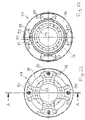
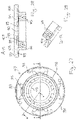
- the present description discloses a load cell for determining a radial force on a crankshaft with a receiving sleeve for receiving a ring of a bearing, a fastening ring for fastening the load cell in a transmission housing, and axial support areas provided on the fastening ring for axially supporting the ring of the bearing are.
- measuring areas are provided for recording radial forces of the receiving sleeve, which connect the receiving sleeve to the fastening ring, strain sensors being attached to at least two of the measuring areas.
- the present description discloses a freewheel arrangement with an outer gear freewheel and an inner pedal shaft freewheel.
- the freewheel arrangement has a hollow drive shaft, a hollow driven shaft and a pedal shaft.
- the pedal shaft, the hollow output shaft and the hollow drive shaft are arranged concentrically to one another.
- the hollow output shaft is arranged radially inside the hollow drive shaft, and the pedal shaft is arranged radially inside the hollow output shaft, with the pedal shaft freewheel being arranged between the pedal shaft and the hollow output shaft.
- the gear freewheel is arranged opposite the Tretwell freewheel on the output hollow shaft.
- the hollow output shaft has adapted areas on an inside and on an outside in the area of the respective freewheel.
- the double freewheel can be integrated into the drive in a space-saving manner in the area of the pedal shaft without requiring a separate outer ring or inner ring.
- the outer freewheel can in particular be a clamping roller freewheel and the inner freewheel can in particular be a ratchet freewheel.
- both freewheels can also be clamping roller freewheels. Other combinations are also possible.
- the present description discloses a one-piece pin ring, which is preferably used in connection with an eccentric gear.
- the one-piece pin ring is made of metal, wherein a pin holding ring and an arrangement of pins protruding in the axial direction on two opposite sides from the pin holding ring are made in one piece.
- the pins can be connected to one another in the circumferential direction, which offers additional stability and can enable more efficient production.
- the pins on a first of the two opposite sides may be formed as half pins capable of engaging an internal spline, and the pins on a second of the opposite side may be formed as full pins capable of engaging an internal spline and engaging in an external toothing opposite the internal toothing.
- the one-piece pin retaining ring has a smooth inner circumference on an inside and rounded bulges on an outside. which are made in one piece with the pin retaining ring.
- This embodiment is suitable, for example, for a two-stage reduction gear with an eccentric.
- At least one head region of the rounded bulges can have a semicircular cross section. This means that the same toothing can be used that is also suitable for a pin ring with cylindrical pins.
- the present description discloses a support ring arrangement for a reduction gear with a first external wheel and a second external wheel, which has a support ring, a first external wheel with a first internal toothing and a second external wheel with a second internal toothing, the first external wheel and the second external wheel are inserted into the support ring on opposite sides, and wherein the support ring has a fastening area, for example axial bores, for fastening to a transmission housing.
- first outer wheel and the second outer wheel can be made of plastic. Furthermore, the first outer wheel and the second outer wheel can each be connected to the support wheel via a pin and groove connection, so that they can be easily assembled.
- the present description discloses a one-piece rotor-transmitter element for a reduction gear, which has a hollow shaft which has a fastening area for fastening a rotor stack on a first side and a cam disk on a second side opposite to the first side, wherein an outer periphery of the cam is designed as a receiving area for a ball bearing.
- the one-piece rotor-transmitter element can be made of aluminum.
- the hollow shaft of the one-piece rotor-transmitter element can be dimensioned in such a way that a pedal shaft can be passed through the hollow shaft.
- the cam disk has a circular circumference arranged eccentrically to the central axis of the hollow shaft.
- the cam disc has an oval circumference relative to the central axis of the hollow shaft.
- crank gears that provide a step-up ratio.
- the crank mechanism has a drive shaft, in particular a crank or pedal shaft with a on the drive shaft arranged planetary gear, wherein a planet carrier of the planetary gear is firmly connected to the drive shaft, a ring gear of the planetary gear has a fastening area for fastening to a gear housing and a receiving area for a torque sensor, and a sun gear of the planetary gear is designed as a ring gear that is concentric to the drive shaft is arranged, and wherein the sun gear is connected to an output hollow shaft of the planetary gear, which is rotatably mounted on the input shaft.
- the crank gear has a drive shaft, in particular a crank or pedal shaft, with a planetary gear arranged on the drive shaft, with a planet carrier of the planetary gear being mounted on the drive shaft via a freewheel, a sun gear of the planetary gear having a fastening area for fastening to a Transmission housing and a receiving area for a torque sensor, and a ring gear of the planetary gear has a receiving area for a ball bearing for support on a transmission housing.
- the crank gear has a drive shaft, in particular a crank or pedal shaft, with a planetary gear arranged on the drive shaft, with a planet carrier of the planetary gear having a fastening area for fastening to a gear housing, with a hollow shaft of the planetary gear being firmly connected to the drive shaft is, and wherein a sun gear of the planetary gear is formed as a hollow shaft which is arranged concentrically to the drive shaft rotatably on the drive shaft.
- the present specification discloses a cycloidal transmission, the cycloidal transmission comprising the following components: a transmission housing, an external gear with internal teeth fixed to the transmission housing, and an input shaft arranged concentrically with the external gear, the input shaft has a drive-side eccentric disc on which a first ball bearing is arranged and an output-side eccentric disc on which a second ball bearing is arranged.
- a drive-side internal gear with external teeth is mounted on the first ball bearing, and an output-side internal gear with external teeth is mounted on the second ball bearing.
- the drive-side inner gear and the driven-side inner gear are arranged inside the outer gear, and the external gear teeth of the drive-side inner gear and the driven-side outer gear mesh with the inner gear teeth of the outer gear, respectively.
- the cycloidal gear can have a crankshaft, which is mounted within the input shaft, and the previously described load cell, which is mounted on the crankshaft on the drive side.
- the input shaft can be designed as a one-piece rotor-transmitter element as described above.
- the cycloidal gear has a crankshaft which is mounted within the input shaft and the crankshaft has one of the planetary gears described above, the crankshaft forming the drive shaft of the planetary gear.
- a third ball bearing is arranged on the input shaft on the output side of the output-side eccentric disk, with a driven disk being arranged on the third ball bearing, with the driven disk having driving pins which engage in openings of the drive-side inner wheel and the driven-side inner wheel arranged axially one behind the other, wherein an output shaft is formed radially on the inside of the driven pulley.
- an output shaft can be formed radially on the inside of the output disk, with the third ball bearing being arranged on an inner shoulder of the output shaft. Furthermore, an inner gear ball bearing is disposed diagonally opposite to the third ball bearing in the axial direction with respect to the centers of the bearings, the inner gear ball bearing being supported on a case cover of the transmission case.
- At least one of the inner wheels has a first toothing and a second outer toothing.
- the cycloidal gear further has a rotatable outer wheel with an internal toothing, the second external toothing meshing with the internal toothing of the rotatable external wheel, and wherein the rotatable external wheel has a fastening area for fastening an output shaft.
- the internal toothing can be formed by an inner surface of the outer wheel or by an arrangement of stationary pins on which rollers are arranged.
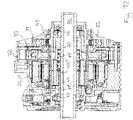
- FIG. 1 shows a cross-sectional view of a harmonic pin ring gear 10.
- the cross-sectional plane AA of 1 is in 9 marked.
- the left side corresponds to a drive side and the right side to a driven side of the harmonic pinring gear 10.
- the viewing direction is from 10 directed in the direction of travel.
- a stator 20 of a stator assembly of the pin ring type harmonic drive 10 is disposed in a motor housing 22 .
- the stator 20 has three separate coils 21 for connection to three phases of a three-phase inverter.
- the three coils of the stator 20 are connected to the three-phase inverter by three terminals 25, one of which is in 1 is shown.
- the three-phase inverter is in the form of power electronics which are arranged on a circuit board 23, the circuit board 23 being arranged in a cooling cover 24 which is placed on the motor housing 22 on the drive side.
- the printed circuit board 23 is formed as an annular disk, which is located outside of cylindrical projecting sections of the motor housing and the cooling cover, so that the motor electronics located thereon are sealed against oil and grease of the transmission.
- a pedal shaft 35 running centrally through the motor housing 22 is stepped on the output side and has three steps, the diameter of which increases from the outside inwards and on which the shaft sealing ring 50, the output-side pedal shaft ball bearing 46 and the pedal shaft freewheel 49 are arranged.
- the diameter of the pedal shaft 35 is also graduated on the drive side and has two stages, with the shaft sealing ring and a sensor ring 68 being arranged on the outer stage and the ball bearing 45 being arranged on the inner stage.
- the gradation of the pedal shaft is also in the perspective view of 4 shown.
- This outer rotor shaft is also referred to as the "rotor package”.
- the outer rotor shaft 26 has an elastic area on its inside, which is slipped onto an inner rotor shaft 27 .
- An eccentrically arranged oval cam disc 28 is formed on the output side of the inner rotor shaft 27 3 is shown in more detail.
- the inner rotor shaft 27 is supported outwardly on the drive side by a drive-side rotor ball bearing 29 in the motor housing 22 .
- a drive-side rotor ball bearing 29 in the motor housing 22 .
- an outer ring of the drive-side rotor ball bearing 29 is arranged in a cylindrical recess of the motor housing 22 .
- the inner rotor shaft 27 is mounted on the output side in an output-side rotor ball bearing 30 radially outwards in an inner wheel 7 .
- a hollow shaft of the inner wheel 7 is integrally connected on the output side to an annular area of the inner wheel 7 which has external teeth 5 .
- the hollow shaft of the inner wheel 7 is in turn mounted radially outwards via an inner wheel ball bearing 31 on a housing cover 32 which is screwed to the motor housing 22 by screws 33 .
- the inner gear ball bearing 31 is shifted toward the driven side in the axial direction from the driven-side rotor ball bearing 30 and is shifted outward in the radial direction.
- the inner gear ball bearing 31 overlaps with the driven-side rotor ball bearing 30 in the axial direction.
- a flexible ball bearing or thin ring ball bearing 33 is clamped on the cam disc 28 of the inner rotor shaft 27, in which an inner ring and an outer ring are deformable.
- a pin retaining ring 103 with pins 101 rests on the flexible ball bearing 33, the pins 101 being held in cylindrical recesses on the inside of a pin retaining ring.
- the pins 101 are connected to each other.
- the pins 101 of the pin ring 103 protrude in the axial direction on both sides over the flexible ball bearing 33 and over the pin retaining ring 103 .
- the pin ring arrangement made up of pin retaining ring 103 and pins 101 is also referred to as pin ring 102 in the following.
- Cam 28 and flexible ball bearing 33 together form a transmitter assembly that converts torque into radial force.
- a flexible ball bearing with a flexible inner and outer ring instead of a flexible ball bearing with a flexible inner and outer ring, a wire roller bearing or a flexible ball bearing without an outer ring, or a different type of flexible roller bearing can also be used.
- the housing cover 32 is screwed to the motor housing on the output side of the motor housing with fastening screws 34 . Furthermore, an external wheel 8 ′ on the input side and an external wheel 8 on the output side are inserted into a support ring 36 and screwed to the support ring 36 by the screws 34 .
- the support ring 36 is in two to each other in the axial direction divided into mirror-symmetrical halves, which together form a track 67 for the pin retaining ring 103.
- the drive-side outer wheel 8 ′ and the driven-side outer wheel 8 are arranged outside of the cam disk 28 and the flexible ball bearing 33 in the axial direction.
- the outer wheel 8' on the drive side faces in the radial direction the areas of the pins 101 which protrude beyond the pin retaining ring 103 in the axial direction on the drive side.
- the outer wheel 8 on the output side faces in the radial direction the regions of the pins 101 which protrude beyond the pin retaining ring 103 in the axial direction on the output side.
- a drive-side stop ring 37 is arranged in the motor housing 22 in such a way that it faces the drive-side end faces of the pins 101 in the axial direction.
- a thrust ring 38 on the output side is arranged in the motor housing 22 on the output side in such a way that it faces the end faces of the pins 101 on the output side in the axial direction.
- An output shaft 39 is arranged radially inside the hollow shaft of the inner wheel 7 , with a gear freewheel 40 being arranged between the hollow shaft of the inner wheel 7 and the output shaft 39 .
- the output shaft 39 is mounted radially outwards in an output ball bearing 41 on the output side, which is inserted in a cylindrical recess or shoulder of the housing cover 32 .
- the area of the output shaft 39 on the output side protrudes beyond the housing cover 32 in the axial direction.
- a sprocket adapter 43 is fitted onto the output shaft 39 which is held in place by a round output nut 44 which is screwed into an internal thread of the output shaft 39 .
- the pedal shaft 35 is arranged concentrically with the rotor shaft 27 and the output shaft 39 partly inside the rotor shaft 27 and partly inside the output shaft 39 .
- the pedal shaft 35 is mounted radially outwards via a pedal shaft ball bearing 45 on the drive side in a load cell 47 , which in turn is inserted into the motor housing 22 .
- a printed circuit board 48 also referred to as a "PCB force sensor”, with evaluation electronics is attached to the load cell 47 and a connection of the printed circuit board 48 is routed radially outwards via a ribbon cable 63 and connected to the electronics on the printed circuit board 23.
- the load cell 47 has strain gauges that generate electrical signals that correspond to a deformation of the load cell 47 that serves as a suspension for the drive-side pedal shaft ball bearing.
- the load cell 47 has four webs, which are arranged at 45 degrees apart in the circumferential direction and which are connected to a ring in which the outer ring of the output-side bottom bracket ball bearing is inserted.
- a strain gauge which is electrically connected to the ring-shaped printed circuit board 22 , is applied to each of these webs.
- a pedal shaft freewheel 49 is arranged between the pedal shaft 35 and the output shaft 39 in the drive-side direction from the output-side pedal shaft ball bearing 46 .
- the gear freewheel 40, the hollow shaft of the inner wheel 7 and the inner wheel ball bearing 31 connect radially outwards.
- two adjacent freewheels or a single freewheel and a roller bearing adjacent thereto, such as a needle bearing can also be installed.
- An inner shaft sealing ring 50 is inserted between the pedal shaft 35 and the output shaft 39 on the output side of the output-side pedal shaft ball bearing 46 opposite the output-side pedal shaft ball bearing 46 . Furthermore, an outer shaft sealing ring 51 is arranged opposite the output ball bearing 46 on the output side, between the output shaft 39 and the housing cover 32 . Another shaft sealing ring 52 is arranged on the drive side between the cooling cover 24 and the pedal shaft 35 . An O-ring 42 is inserted radially on the outside between the output-side outer wheel 8 and the housing cover 32 .
- an input torque is transmitted from the stator 20 by electromagnetic force to the outer rotor shaft 26 and from there to the inner rotor shaft 27, which is converted into a radial force by the cam disk 28 and the flexible ball bearing 33.
- This radial force is converted into an output torque on the tooth flanks of the internal gearing 6, 6' of the outer gears 8, 8' and the external gearing 5 of the inner gear 7, with the inner gear 7 being driven off and the outer gears 8, 8' being fixed to the housing .
- the output torque is greater than the input torque by the reduction ratio.
- the inner toothing which is formed by the outer toothing 5 of the inner wheel 7, lies opposite the inner toothing 6 of the output-side outer wheel 8, and thereby provides the output torque, in particular through those pins 101 that are attached to both the outer toothing 5 and the inner toothing 6 , 6'.
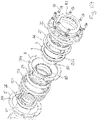
- FIG 2 shows an exploded view of the transmission of FIG 1 , in which, viewed from the drive side to the driven side, the drive-side rotor ball bearing 29, the inner rotor shaft 27, the cam disk 28, the driven-side rotor ball bearing 30, the second outer wheel 8', the flexible ball bearing 33, the pin retaining ring 103 with the pins 101, the support ring 36, the first Outer gear 8, the inner gear 7 with the inner gear hollow shaft and the inner gear ball bearing 31 are shown.
- the outer wheels 8, 8' each have pins 53 which protrude radially outwards from the respective outer wheel 8, 8' and are distributed at regular intervals over the circumference of the outer wheel 8, 8'.
- the support ring 36 has on radially opposite sides to the pins 53 matching radial slots 54 distributed on the circumference.
- screw holes 55 are provided for fastening the outer wheels, which can be found in the exemplary embodiment of FIG 2 partly in the outer wheels 8, 8' and partly in the support ring 36.
- a wave spring 61 is arranged between the drive-side rotor ball bearing 29 and the motor housing 22 on the drive side of the drive-side rotor ball bearing 29, and a spacer ring 62 is arranged between the drive-side rotor ball bearing 29 and the outer rotor shaft 26 on the output side of the drive-side rotor ball bearing 29 .
- the support ring 36 can be made of aluminum and the outer wheels 8, 8 'of plastic, such as polyamide 66 (PA66), wherein the support ring 36 can be made in particular by aluminum die casting, and the outer wheels can be made in particular by plastic injection molding be able.
- the inner rotor shaft 27 can be made of aluminum.
- the screws 34 in the assembled state reach through the gear cover 32, the first outer wheel 8, the second outer wheel 8' and the support ring 36 into the motor housing 22.
- FIG. 12 shows a drive-side part of an exploded view of the transmission of FIG 1 , in which, seen from the drive side, the cooling cover 24, the printed circuit board 23, the motor housing 22 with the stator 20 and the coil 21 or with the coils 21, the printed circuit board 48, the load cell 47, the wave spring 61, the drive-side Thrust ring 37, the second outer wheel 8 'with the internal teeth 6', the drive-side rotor ball bearing 29, the spacer ring 62, the outer rotor shaft 26, and part of the inner rotor shaft 27 are shown.
- FIG 3 shows an output-side part of an exploded view of the transmission of FIG 1 , in which, viewed from the input side, the inner rotor shaft 27 with the cam disc 28, the output-side rotor ball bearing 30, the pin ring 102 with the pin retaining ring 103 and the pins 101, the support ring 36, the output-side outer wheel 8, the Inner wheel 7 with the outer teeth 5, the output shaft 37, the gear freewheel 40, the O-ring, the thrust washer on the output side 38, the inner wheel ball bearing 31, the housing cover 32 with the fastening screws 34 and the shaft sealing ring 50 are shown.
- the gear freewheel 40 has, as in 3 shown, coil springs on cylindrical rollers 64, which are arranged in a sprag cage 65. Coil springs 66 are also provided in the clamping body cage 65 for pressing the cylindrical rollers 64 on.
- FIG. 12 shows an exploded view of an internal assembly of the transmission of FIG 1 , and in particular the pedal shaft freewheel 49. Shows in detail 4 , seen from the drive side, a sensor ring 68, the drive-side pedal shaft ball bearing 45, the pedal shaft 35, the pedal shaft freewheel 49, the output-side pedal shaft ball bearing 46, a spacer 69, a chain ring adapter 43, a wave spring 70, an inner shaft sealing ring 50, an O-ring 76 and the output nut 44.
- the pedal shaft freewheel 49 has, as in 4 shown, shovel-shaped steps 71 formed on the pedal shaft 35. Between the steps 71 pawls 73 and coil springs 72 are arranged. At both ends of the pedal shaft there are fastening areas 74, 75 for pedal cranks, which are 1 are shown in cross section.
- figure 5 12 shows a perspective view of an internal assembly of the transmission of FIG 1 in assembled condition.
- the inner wheel 7 and the flexible ball bearing 33 are omitted.
- the pedal shaft assembly 80 shows a pedal shaft assembly 80 or pedal shaft unit 80 of the transmission 10 of FIG 1 , with the input side on the right and the output side on the left.
- the pedal shaft assembly 80 includes a freewheel assembly 81 and a sensor assembly 82 .
- the viewing direction of the view from 6 is in the opposite direction when installed.
- FIG 7 shows a cross section through the freewheel assembly 81 of FIG 6 along the line of intersection DD, viewed from the output side, with the flat cable 63 belonging to the sensor arrangement 82 being visible in the background. Furthermore, the screw heads of the screws with which the ring-shaped circuit board 23 is screwed to the load cell 47 can be seen on the right-hand side of the load cell 47 .
- the freewheel assembly 81 has the Tretwellen freewheel 49 and the gear freewheel 40, the output shaft 39 at the same time as the outer ring of the Tretwellen freewheel 49 and as Inner ring of the gear freewheel 40 is formed.
- the pedal shaft freewheel 49 is designed as a pawl freewheel while the geared freewheel 40 is designed as a pinch roller freewheel with cylindrical pinch rollers 64 .
- the inner circumference of the output shaft 39 forms a jagged staircase, the steps of which form stops for the pawls 73 which are pressed against the inner circumference of the output shaft 39 by the coil springs 72 .
- the outer circumference of the output shaft 39 forms a jagged staircase, also known as a "star", the steps of which form stops for the cylindrical rollers 64 of the gear freewheel 40 .
- the freewheel cage 65 and thus the cylindrical rollers 64 are pressed against the outer periphery of the drive shaft 39 by the coil springs 66 which are arranged between the outer periphery of the output shaft 39 and the freewheel cage 65 .
- the stages of the drive shaft 39 are arranged in such a way that a freewheeling direction of the pedal shaft freewheel 49 and a freewheeling direction of the transmission freewheel 40 in the view from FIG 7 runs counterclockwise.
- This freewheeling direction is the opposite of the respective drive direction or blocking direction.
- the pedal shaft 35 can drive the output shaft 39 clockwise as long as the output shaft 39 does not move faster than the pedal shaft 35 and the outer ring of the gear freewheel 40, which is formed by an inner portion of the inner wheel 5, the output shaft 39 can rotate clockwise drive as long as the output shaft 39 does not move faster than the outer ring.
- the driving and blocking directions of the freewheels 40, 49 are in 7 each indicated by arrows.
- FIG. 12 shows a simplified cross-sectional view showing the components used in the transmission of FIG 1 used load cell 47 and the use of an inclined storage is illustrated.
- the electric motor and the drive train of the electric motor are omitted in this illustration, so that the pedal shaft 35 is mounted directly on a housing cover 32'.
- the drive-side pedal shaft ball bearing 45 and the driven-side pedal shaft ball bearing 46 are each designed as an angular ball bearing that can absorb axial forces to a certain extent.
- ball bearings other types of bearings can also be provided which, in addition to radial forces, can also absorb axial forces, such as, for example, angular roller bearings.
- this is usually more complex than using ball bearings.
- the load cell 47 which is mounted on the pedal shaft 35 via the bearing 45 , has support tabs 91 and measuring tabs 90 .
- the support tabs 91 are supported in the axial direction on an outer ring of the ball bearing and the measuring tabs 90 are supported on the outer ring in the radial direction.
- Strain gauges are attached to at least two of the 90 measuring straps.
- the inner ring of the ball bearing 45 rests towards the center of the pedal shaft 35 against a shoulder or a shoulder of the pedal shaft 35 .
- the inner ring of the ball bearing 46 rests towards the center of the pedal shaft 35 via a wave spring 70 on a shoulder of the pedal shaft 35 .
- the outer ring of the ball bearing 46 rests on the gear cover 44' via a spacer disk.
- a rider transmits radial forces to the pedal shaft 35 via a pedal crank. These radial forces are absorbed by the measuring lugs 90 and lead to a deformation of the measuring lugs 90, which is determined by the strain gauges.
- axial forces on the outer ring of the ball bearing 45 do not lead to a deformation of the second tabs. Instead, the axial forces are absorbed by the support brackets 91 of the load cell 47, as a result of which the ball bearing 45 is held laterally.
- any torque that may be present due to an auxiliary drive does not or only insignificantly lead to a deformation of the second brackets.
- the contribution of the driver can thus be determined for himself.
- there can be an angular position sensor with the help of which the position of the pedal cranks can be determined and thereby the lever arm of the pedals.
- the torque provided by the driver can be reconstructed from the measured radial forces by means of a suitable calculation model, which is implemented by a stored program and/or circuit.
- figure 10 illustrates a derivation of axial forces into the housing according to the storage concept of the transmission of FIG Figures 1 to 9 .
- an output-side axial force of the pedal shaft 35 is shown via a shoulder of the pedal shaft 35, the output-side pedal shaft ball bearing 46, the wave spring 70, the output nut 44, the internal thread of the output hollow shaft 39, the output hollow shaft 39, a shoulder of the output hollow shaft 39, the output ball bearing 41, the housing cover 32, the screws 34 and the screw thread 60 in the housing 22 derived.
- a drive-side axial force of the pedal shaft 35 is derived via a drive-side shoulder 123 of the pedal shaft 35, the drive-side pedal shaft ball bearing 45, axial support brackets of the load cell 47 and a fastening ring of the load cell 47 into the housing 22.
- an output-side axial force of the rotor shaft 28 is derived via the output-side rotor ball bearing 30, the inner wheel 7 and the inner wheel ball bearing 31 in the housing cover. From there, the axial force is dissipated via the screws 34 into the housing 22, as shown in the bottom right 10 shown.
- a drive-side axial force of the rotor shaft 27 is derived into the housing 22 via a shoulder 9 of the rotor shaft 27 , the outer rotor shaft 26 , the spacer ring 62 , the drive-side rotor ball bearing 29 and the wave spring 61 . Furthermore, an axial force on the ball bearing 33 arranged on the cam disc is diverted via the inner wheel 7 and the ball bearing 31 into the gear housing 22 . The opposing force to this is derived via a shoulder 9 of the cam disk 28 into the rotor shaft 27 and from there into the housing 22 via the path described above.
- the inner gear 7 tapers radially inward of an outer circumference so that only the outer ring of the ball bearing 33 abuts the inner gear 7, which moves substantially synchronously with the pin ring 101 and with the inner gear 7, and not the inner ring of the ball bearing 33, which much faster than the inner wheel 7 rotates.
- the width of the wave spring 70 is adjusted so that the sprocket adapter 43 does not hit the case cover 32 .
- the Figures 11 to 20 show a harmonic pin ring gear with an eccentric cam disk, the eccentric cam disk being an eccentrically arranged circular disk.
- 11 shows a cross-sectional view of a harmonic pin ring gear 10.
- the cross-sectional plane AA of 11 is in 19 marked.
- the left side corresponds to a drive side and the right side to a driven side of the harmonic pinring gear 10.
- a stator 20 of a stator assembly of the pin-ring harmonic transmission 10 is disposed in a motor housing 22 .
- the stator 20 has three separate coils 21 for connection to three phases of a three-phase inverter.
- the three-phase inverter is designed as a power electronics, which is arranged on a printed circuit board 23, wherein the Printed circuit board 23 is arranged in a cooling cover 24 which is placed on the motor housing 22 on the drive side.
- the three coils of the stator 20 are connected to the three-phase inverter by three terminals 25, one of which is in 11 is shown.
- the motor housing 22 and the cooling cover 24 each have cylindrical protruding sections which enclose a pedal shaft 35 running centrally through the motor housing 22 .
- the printed circuit board 23 is designed as a perforated disk, which is located outside the protruding sections, so that the electronics located thereon are sealed against the oil and grease of the transmission.
- This outer rotor shaft 26 is also referred to as "rotor package”.
- the outer rotor shaft 26 has an elastic area on its inside, which is slipped onto an inner rotor shaft 27 .
- an eccentrically arranged, circular eccentric disk 28' is formed on the output side 12 is shown in more detail.
- the inner rotor shaft 17 is supported outwardly on the drive side by a drive-side rotor ball bearing 29 in the motor housing 22 .
- a drive-side rotor ball bearing 29 in the motor housing 22 .
- an outer ring of the drive-side rotor ball bearing 29 is arranged in a cylindrical recess of the motor housing 22 .
- the inner rotor shaft 27 is mounted radially outwards in an inner wheel 7 on the output side in a rotor ball bearing 30 on the output side.
- a hollow shaft of the inner wheel 7 is integrally connected on the output side to an annular area of the inner wheel 7 which has external teeth 5 .
- the hollow shaft of the inner wheel 7 is in turn mounted radially outwards via an inner wheel ball bearing 31 on a housing cover 32 which is screwed to the motor housing 22 by screws 34 .
- the inner gear ball bearing 31 is shifted toward the driven side in the axial direction from the driven-side rotor ball bearing 30 and is shifted outward in the radial direction.
- the inner gear ball bearing 31 overlaps with the driven-side rotor ball bearing 30 in the axial direction.
- a ball bearing 33 is clamped on the eccentric circular disk 28 of the inner rotor shaft 27 .
- a pin retaining ring 103 with pins 101 rests on the ball bearing 33, the pins 101 being held in cylindrical recesses on the inside of a pin retaining ring.
- the pin ring arrangement of pins 101 and pin retaining ring 103 is in the Figures 15 to 17 shown closer.
- the pin ring 103 unlike in the embodiment Figures 1 to 10 , is formed in one piece and has areas corresponding to the pins 101 and the pin retaining ring 103.
- the one-piece embodiment of the pin ring 103 is particularly well suited for a transmission in which the pin ring is not deformed or only slightly deformed. This is the case, for example, in a transmission with an eccentrically arranged circular disc Figures 11 to 20 , 61 to 66 , 67 and 72 is shown.
- the pins 101 of the pin ring 103 protrude in the axial direction on both sides over the flexible ball bearing 33 and over the pin retaining ring 103 .
- the eccentric disk 28' and the ball bearing 33 together form a transmitter arrangement which converts rotary motion into radial motion which is transmitted through the ball bearing 33 and pin ring 103 to the pins 101 and which is then transmitted through the engagement of the pins 101 with the outer wheels 8, 8' is converted back into a rotary movement.
- the housing cover 32 is screwed onto the motor housing on the output side of the motor housing with fastening screws 34 . Furthermore, an external wheel 8 ′ on the input side and an external wheel 8 on the output side are inserted into a support ring 36 and screwed to the support ring 36 by the screws 34 . An O-ring 42 is inserted radially on the outside between the output-side outer wheel 8 and the housing cover.
- the drive-side outer wheel 8' and the driven-side outer wheel 8 are arranged in the axial direction outside of the eccentric disk 28' and the ball bearing 33.
- the outer wheel 8' on the drive side faces in the radial direction the areas of the pins 101 which protrude beyond the pin retaining ring 103 in the axial direction on the drive side.
- the outer wheel 8 on the output side faces in the radial direction the regions of the pins 101 which protrude beyond the pin retaining ring 103 in the axial direction on the output side.
- a drive-side thrust ring 37 is arranged in the motor housing 22 in such a way that it faces the drive-side end faces of the pins 101 in the axial direction.
- a thrust ring 38 on the output side is arranged in the motor housing 22 on the output side in such a way that it faces the end faces of the pins 101 on the output side in the axial direction.
- An output shaft 39 is arranged radially inside the hollow shaft of the inner wheel 7, with a gear freewheel 40 between the hollow shaft of the inner wheel 7 and the output shaft 39 is arranged.
- the output shaft 39 is mounted radially outwards in an output ball bearing 41 on the output side, which is inserted in a cylindrical recess or shoulder of the housing cover 32 .
- the area of the output shaft 39 on the output side protrudes beyond the housing cover 32 in the axial direction.
- a chainring adapter 43 is placed on the output shaft 39 which is held in place by a gear cover 44 which is screwed into an internal thread of the output shaft 39 .
- the pedal shaft 35 mentioned above is arranged concentrically with the rotor shaft 27 and the output shaft 39 partly inside the rotor shaft 27 and partly inside the output shaft 39 .
- the pedal shaft 35 is mounted radially outwards via a pedal shaft ball bearing 45 on the drive side in a load cell 47 , which in turn is inserted into the motor housing 22 .
- a printed circuit board 48 with a force sensor is attached to the load cell 47 and a connection of the printed circuit board 48 is routed radially outwards via a flat cable 63 and connected to the electronics on the printed circuit board 23 .
- a pedal shaft freewheel 49 is arranged between the pedal shaft 35 and the output shaft 39 in the drive-side direction from the output-side pedal shaft ball bearing 46 .
- the gear freewheel 40, the hollow shaft of the inner wheel 7 and the inner wheel ball bearing 31 connect radially outwards.
- two adjacent freewheels or a single freewheel and a roller bearing adjacent thereto, such as a needle bearing can also be installed.
- An inner shaft sealing ring 50 is inserted between the pedal shaft 35 and the output shaft 39 on the output side of the output-side pedal shaft ball bearing 46 opposite the output-side pedal shaft ball bearing 46 . Furthermore, an outer shaft sealing ring 51 is arranged opposite the output ball bearing 46 on the output side, between the output shaft 39 and the housing cover 32 . Another shaft sealing ring 52 is arranged on the drive side between the cooling cover 24 and the pedal shaft 35 .
- an input torque is transmitted from the stator 20 by electromagnetic force to the outer rotor shaft 26 and from there to the inner rotor shaft 27, which is converted into a radial force by the eccentric disk 28' and the ball bearing 33.
- This radial force is converted into an output torque on the tooth flanks of the internal teeth 6, 6' of the outer wheels 8, 8' and the external toothing 5 of the inner wheel 7, with the inner wheel 7 being driven off and the outer wheels 8, 8' being fixed to the housing.
- the output torque is greater than the input torque by the reduction ratio.
- the inner toothing which is formed by the outer toothing 5 of the inner wheel 7, lies opposite the inner toothing 6 of the driven-side outer wheel 8, and thereby provides the output torque, in particular through those pins 101 that are attached both to the outer toothing 5 and to the Internal teeth 6, 6 'abut.
- FIG 12 shows an exploded view of the transmission of FIG 11 , in which, seen from the drive side to the driven side, the drive-side rotor ball bearing 29, the inner rotor shaft 27, the eccentric disk 28', the driven-side rotor ball bearing 30, the second outer wheel 8', the ball bearing 33, the pin retaining ring 103 with the pins 101, the support ring 36, the first outer wheel 8, the inner wheel 7 with the inner wheel hollow shaft and the inner wheel ball bearing 31 are shown.
- the outer wheels 8, 8' each have pins 53 which protrude radially outwards from the respective outer wheel 8, 8' and are distributed at regular intervals over the circumference of the outer wheel 8, 8'.
- the support ring 36 has on radially opposite sides to the pins 53 matching radial slots 54 distributed on the circumference.
- screw holes 55 are provided for fastening the outer wheels, which can be found in the exemplary embodiment of FIG 12 partly in the outer wheels 8, 8' and partly in the support ring 36.
- a wave spring 61 is arranged between the drive-side rotor ball bearing 29 and the motor housing 22 on the drive side of the drive-side rotor ball bearing 29 and between the drive-side rotor ball bearing 29 and the outer rotor shaft 26 is on the output side of the drive-side rotor Ball bearing 29, a spacer ring 62 is arranged.
- the support ring 36 can be made of aluminum and the outer wheels 8, 8' made of plastic, such as polyamide 66 (PA66), wherein the support ring 36 can be made in particular by die-cast aluminum, and the outer wheels can be made in particular by plastic injection molding could be.
- the inner rotor shaft 27 can be made of aluminum.
- the screws 34 in the assembled state reach through the gear cover 32, the first outer wheel 8, the second outer wheel 8' and the support ring 36 into the motor housing 22.
- FIG 13 shows a side view, seen from the output side, of an assembled arrangement of inner rotor shaft 27, inner wheel 7, pins 101 and outer wheel 8.
- the pins 101 are in contact with a predetermined position of the eccentric disc 28' a first position completely against the external internal toothing 6 and in a second position, which is opposite the first position, completely against the internal external toothing 5.
- FIG 14 shows a cross-sectional view through the assembly of FIG 13 along the cutting line EE.
- the eccentric disk 28' has a shoulder 11 on the drive side, by which an inner ring of the ball bearing 33 is held in place from the drive side.
- FIG. 12 shows an output side view of a pin ring 102 for use in the transmission of FIG 11 .
- the Figures 16 and 17 show detailed views of the pin ring 102 of 15 and figure 18 12 shows a drive side view of the pin ring 102 of FIG 15 .
- the pin ring 102 has a pin retaining ring 103 and pins 101 .
- the pin ring 102 is integrally formed, with the pin holding ring 103 and the pins 101 being respectively formed by portions of the pin ring 102 integrally formed.
- the pins 101 are each shaped differently on an output side and on an opposite input side.
- the pins on the output side of the pin ring 102, on which the pins 101 engage both in the inner wheel 7 and in the outer wheel 8, are lens-shaped, with two radially opposite areas each having a circular segment-shaped boundary and two peripherally opposite areas each pointed run up This is best seen in the side view 17 recognizable, the in 15 marked with "G".
- the pins 101 on the driving side where the pins 101 only mesh with the second outer gear 8', are shaped as "half pins" each forming tines of a comb running along the circumference of the pin ring 102, as shown in the cross-sectional view of FIG 16 and in the view of 18 shown.
- a first area 255 of a pin 101 is also shown, which transmits torque to the inner wheel 7, and a second area 56, radially opposite thereto, which transmits torque to the outer wheel 8.
- the areas of the pins 101 tapering to a point along the circumferential direction result in tangential transitions between the pins 101.
- the pin ring is manufactured by flow forming.
- a hollow ring is first produced, from which the pins 101 are then formed by cutting off or milling.
- a rotating milling machine can be used which moves in a circular line, with the pins being shaped in the radial direction first from the inside and then from the outside.
- Flow forming is defined in more detail in the DIN 8582 and DIN 8583 standards, for example.
- a workpiece to be formed is first placed on an assembly mandrel.
- the workpiece to be formed is then formed from the outside by flow forming wheels, which are driven in a controlled manner by a feed drive, press against the workpiece and thin out the material in a controlled manner.
- a shoulder 57 is formed radially on the inside on the output side of the pins 101 . As in 11 As can be seen, when the pin ring 102 is installed, this shoulder 57 rests on the outer ring of the ball bearing 33 on the output side.
- a comb with round depressions 58 and intermediate plateaus 59 is formed on the drive side of the pin ring 102 .
- the intermediate plateaus 59 form an extension of the in 17 pins 101 shown in detail and can thus be interpreted as the area of the pins 101 on the drive side.
- FIG. 12 shows an output side view of the assembled transmission of FIG 11 , in which the cross-sectional plane of the figure 11 marked with "A".
- figure 20 illustrates a derivation of axial forces into the housing according to the storage concept of the transmission of FIG Figures 11 to 19 .
- an output-side axial force of the pedal shaft 35 is transmitted via a shoulder of the pedal shaft 35, the output-side pedal shaft ball bearing 46, the wave spring 70, the output nut 44, the internal thread of the output hollow shaft 39, the output hollow shaft 39, a shoulder of the Output hollow shaft 39, the output ball bearing 41, the housing cover 32, the screws 34 and the screw thread 69 in the housing 22 derived.
- a drive-side axial force of the treadle shaft 35 is driven by a paragraph 123 of the treadle shaft 35, the drive-side treadle shaft ball bearing 45, the axial support tabs Load cell 47 and a fastening ring of the load cell 47 derived into the housing 22.
- an output-side axial force of the rotor shaft 27 is derived via the output-side rotor ball bearing 30, the inner wheel 7 and the inner wheel ball bearing 31 into the housing cover. From there, the axial force is dissipated via the screws 34 into the housing 22, as shown in the bottom right 20 shown.
- An axial force of the rotor shaft 27 on the drive side is diverted into the housing 22 via a step on the rotor shaft 27 on the drive side, the outer rotor shaft 26 , the spacer ring 62 , the rotor ball bearing 29 on the drive side and the wave spring 61 .
- an axial force is derived via a shoulder 9 of the cam disk 28 on the ball bearing 33 via a shoulder 10 of the pin ring 100, the inner wheel 7 and the ball bearing 31 in the gear housing 22.
- the corresponding counterforce is derived via shoulder 9 of cam disk 28 into rotor shaft 28 and from there into housing 22 via the path described above.
- the inner gear 7 tapers radially inward of an outer circumference so that only the outer ring of the ball bearing 33 abuts the inner gear 7, which moves substantially synchronously with the pin ring 101 and with the inner gear 7, and not the inner ring of the ball bearing 33, which much faster than the inner wheel 7 rotates.
- the width of the wave spring 70 is adjusted so that the sprocket adapter 43 does not hit the case cover 32 .
- the exemplary embodiments Figures 21 to 44 disclose devices and methods for measuring a torque acting on a pedal shaft of a bicycle that is assisted by an electric drive.
- the support of an electric motor for an electric bicycle can be adjusted by measuring the torque on a pedal shaft.
- the torque can be determined contact-free by magnetically measuring the tension of the pedal shaft.
- a mechanical deformation of the bottom bracket suspension is determined.
- a corresponding device is for example in the patent application DE 102013220871 A1 disclosed. According to this device, a single electromagnetic or mechanical sensor is used to determine a horizontal deflection or deformation of the bottom bracket.
- the present description discloses a load cell for determining a radial force on a crankshaft with a receiving sleeve for receiving a ring of a bearing and a fastening ring for fastening the load cell in a transmission housing.
- Axial support portions are provided on the mounting ring for axially supporting the outer ring of the first bearing.
- Measuring areas, which connect the receiving sleeve to the fastening ring, are provided to absorb radial forces of the receiving sleeve.
- Strain sensors are attached to at least two of the measurement areas.
- the strain sensors can in particular be designed as strain gauges, it being possible for the strain gauges to be glued to a surface of the measuring areas.
- the axial support areas and the measuring areas can be designed in particular as tabs or fingers. Furthermore, the measurement areas can be designed as angular brackets.
- the radial force on the crankshaft is determined indirectly by a radial force acting on the receiving sleeve, which in turn is transmitted via a bearing from the crankshaft to the receiving sleeve.
- the crankshaft can in particular be a pedal shaft.
- the load cell can be used in particular in electric bicycles to regulate motor support, with a pedal shaft being supported in the axial direction via the load cell.
- the load cell can be used wherever a radial force on a shaft is converted into a rotary movement of the shaft, in particular on a bicycle pedal shaft or on a piston driven by an internal combustion engine or other drive.
- measuring the radial forces via the load cell can allow the torque exerted on the shaft to be calculated.
- the radial forces can also be used to generate control signals without the intermediate step of a torque calculation.
- a load cell When there is no conversion of radial forces, such as in a gear train, a load cell according to the present description can also be used to determine an imbalance on the shaft.
- the load cell is particularly advantageous in the case of a mechanical drive such as a pedal shaft, since in this case the applied torque cannot already be determined via a motor output, which is easily possible with an electric motor, for example.
- radial and axial forces are decoupled in that axial forces are absorbed by the axial support areas or brackets and radial forces are absorbed by the measuring areas or brackets.
- This allows the load cell to be used in an offset mounting, such as an O-arrangement or an X-arrangement.
- decoupling the radial from the axial forces may allow a more accurate measurement of the radial force component, and thus a more accurate determination of the torque applied to the shaft.
- a load cell according to the present description has a simple structure and requires little space in a transmission, particularly in the axial direction.
- the overall width of the load cell is essentially determined by the width of the bearing and by the width of the axially adjoining fastening area.
- the load cell can therefore be made relatively narrow in the axial direction, for example it can only have approximately twice the width of a roller bearing or less.
- the axial forces are advantageously absorbed by the load cell on the stationary outer ring of the ball bearing and not on the movable inner ring or on the shaft, where the relative movement would lead to friction losses.
- the axial support areas are advantageously in contact only with the outer ring of the bearing.
- the support function of the axial support areas can be achieved in particular in that the axial support areas or lugs protrude radially inwards beyond an inner surface of the receiving sleeve, it being sufficient if the axial support areas only protrude inwards to the extent that corresponds to the width of a bearing ring.
- the axial support areas may also be profiled for alignment with the bearing ring.
- the measuring lugs are expediently designed as angles, with an axial area of the angle connected to the receiving sleeve running in the axial direction and a radial area of the angle connected to the fastening area running in the radial direction.
- the angle forms a lever arm that causes the radial area of the measuring lugs to bend relative to the radial alignment. Due to the bending, one surface of the measuring tabs is stretched or compressed and a surface axially opposite thereto is compressed or stretched. This compression or stretching is detected by the strain gauges, which are applied to one of the two surfaces of the radial area.
- the two areas of the angle formed by the measuring tab can also be slightly inclined with respect to the axial or radial orientation, for example to allow greater deformation.
- the measuring tabs are sufficiently thin in the axial direction to enable good deformation.
- the second area can be made thinner than the first area.
- the second portion may be reinforced near the apex of the angle to avoid deformation near the apex of the angle.
- the axial area of the measuring clip is advantageously designed in such a way that it does not protrude beyond the surface of the receiving sleeve that rests on the roller bearing. This avoids a ring of a roller bearing, on which the receiving sleeve rests, hitting the measuring clip and axial forces being transmitted via the measuring clip.
- the axial area can terminate or be designed flush with a surface of the receiving sleeve, the surface being a cylindrical inner surface of the receiving sleeve.
- the measuring areas have measuring tabs designed as angles or are designed as angular measuring tabs.
- the measuring tabs have a radial area and an axial area adjoining the radial area. The radial area is connected to the fastening ring and the axial area is connected to the receiving sleeve, the radial area being arranged at an angle of approximately 90 degrees to the axial area.
- measuring tabs are provided, so that the shaft can be supported in four directions.
- the measuring tabs can be arranged at a distance of 90 degrees, so that the directions are perpendicular to one another.
- the measuring lugs are also supporting lugs for radial support.
- the designation "measuring lug” means that the deformation of the measuring lug can be used to measure forces that act on the receiving sleeve in the radial direction.
- an angular expansion of the measuring clip in the circumferential direction can be suitably selected in order to detect a force in a defined direction and to enable good deformation.
- the angular extent of the measuring tab along the circumferential direction can be limited to 30 degrees or less or to 25 degrees or less, with 90 degrees corresponding to a right angle.
- the load cell has four measurement areas that are spaced 90 degrees apart. As a result, radial forces can be measured in four mutually perpendicular directions if all four measuring ranges or measuring lugs are equipped with strain sensors.
- strain sensors can be designed as strain gauges, which are inexpensive and robust, in particular compared to an optical strain measurement.
- a strain sensor can be attached to each of the measuring areas or measuring tabs in order to measure radial forces in as many directions as possible.
- the surfaces of the measurement areas to which the strain gauges are attached may have depressed areas or pockets for attachment of the strain sensors or strain gauges.
- strain gauges can be arranged close to the fastening area, for example in order to keep the electrical connection to a circuit board fastened to the transmission housing as short as possible or because greater deformation occurs there.
- the axial support areas or tabs are separated from the measuring areas by radial slots. Furthermore, the axial support areas or tabs are separated from the receiving sleeve by a peripheral slot. Among other things, this allows the axial support areas and the measuring areas to be formed from a workpiece in a simple manner.
- the load cell can also be cast in this form.
- the radial or circumferential slots are expediently straight slots in the radial or circumferential direction. However, the shape can also deviate from a straight line.
- the direction of the radial slits can deviate from a radial direction, for example in order to achieve that the measuring clip tapers more strongly towards the inside.
- the orientation of the radial slots can be inclined inwards by up to 5 degrees or by up to 10 degrees with respect to the radial direction.
- the fastening ring has fastening areas in which fastening holes are provided for fastening to the transmission housing.
- the attachment areas can be part of the attachment ring, or they can be extensions that protrude from the attachment ring.
- the attachment fixes the load cell both in the axial direction and against rotation in the circumferential direction, with the attachment being able to be loosened again mechanically.
- this is also achieved by a positive connection such as a mortise and tenon connection or a snap lock.
- the fastening ring has recesses, with the measuring areas being arranged in the recesses, with the recesses being able to be shaped in the radial and in the axial direction. In this way it can be avoided, for example, that the measuring lugs hit the transmission housing directly, or the thickness of the fastening ring can be adjusted independently of the thickness of the measuring lugs.
- an angular extension of the measuring tabs and the slots delimiting the measuring tabs is approximately equal to an angular range of the axial support areas.
- an angular extent of the measurement areas in the circumferential direction is less than or equal to 30 degrees, so that the force can be measured in a defined direction.
- the design of a load cell according to the present description is particularly suitable for manufacturing the load cell integrally from metal, for example by casting from a mold and mechanical post-processing steps.
- the present description discloses a measuring device for determining a force on a crankshaft, in particular a pedal shaft.
- the measuring device has a crankshaft with a bearing arranged on the crankshaft, and a load cell according to one of the previously mentioned exemplary embodiments.
- the receiving sleeve of the load cell is arranged on an outer ring of the bearing, and the axial support portions of the load cell are supported in the axial direction on the outer ring of the bearing.
- evaluation electronics are connected to the strain sensors of the load cell.
- the gear arrangement has a gear housing and a crankshaft, in particular a pedal shaft.
- the crankshaft is accommodated or supported directly or indirectly in the transmission housing via a first bearing on the input side and a second bearing on the output side.
- the bearings can be provided in particular by roller bearings.
- crankshaft can be passed through a hollow output shaft, in which case, in particular for decoupling the pedal shaft from the hollow drive shaft, a freewheel can be arranged between the pedal shaft and the hollow drive shaft.
- the first bearing is accommodated in the transmission housing via the load cell, with the load cell being accommodated in the transmission housing or fastened to the transmission housing via the fastening ring.
- the receiving sleeve receives an outer ring of the first bearing, with the axial support portions being supported on the outer ring of the first bearing.
- the crankshaft of the transmission arrangement has a larger diameter in the middle than at its two ends.
- a first step and a second step of the crankshaft are formed.
- An inner ring of the first bearing of the measuring device bears against the first shoulder of the pedal shaft, and an inner ring of the second bearing bears against the second shoulder of the pedal shaft.
- an X-arrangement of an inclined bearing is formed and the load cell absorbs part of the forces of the inclined bearing.
- the first bearing of the measuring device and the second bearing are each designed as single-row angular contact ball bearings. According to a further exemplary embodiment, the first bearing of the measuring device and the second bearing are each designed as inclined cylindrical roller bearings.
- the second bearing is supported via a wave spring on the second shoulder of the pedal shaft or on the housing or on a component connected to the housing.
- the second roller bearing is also supported via a spacer disk on the second shoulder of the pedal shaft or on the housing or on a component connected to the housing.
- the present description discloses a transmission arrangement which also has the following features: a motor, a reduction gear connected to the motor, and a quill output shaft connected to the reduction gear.
- the crankshaft is designed as a pedal shaft
- the first bearing and the second bearing are each designed as rolling bearings
- the pedal shaft is passed through the output hollow shaft
- the pedal shaft is decoupled from the output hollow shaft
- a freewheel is provided between the pedal shaft and the output hollow shaft.
- the present description discloses an electrically operated vehicle, in particular an electric bicycle, with the transmission arrangement described above, the motor being designed as an electric motor, and a battery of the electrically operated vehicle being connected to the electric motor.
- the 21 shows a perspective view of a load cell 47 seen from the drive side.
- the load cell 47 has four axial support brackets 91, on which an outer ring of a ball bearing 45 is supported in the axial direction, and four measuring brackets 90 arranged between the axial support brackets 91, on each of which a strain gauge 92 is applied.
- the surfaces of the measuring tabs 90 can be provided with indentations.
- the axial support tabs 91 have an outer portion 93 which bears on an outer ring of the ball bearing and an inner portion 94.
- the portion on which the outer ring of the ball bearing bears is shown in detail in the cross-sectional view of FIG 9 recognizable.
- the measuring tabs 90 and the axial support tabs 91 are each separated from one another laterally by a milled radial slot 95 .
- the measuring lugs 90 merge into a receiving sleeve 96 which accommodates the outer ring of the ball bearing 45 .
- This receiving sleeve 96 is best in 26 to recognize.
- the tabs 90 , 91 merge into an outer ring 97 on the drive side.
- the areas of the outer ring 97 opposite the measuring tabs 90 and the radial slots 95 each have a circumferential slot 105 in the radial direction, which has approximately half the radial extent of the measuring tabs 90 .
- a first radial slot 95, a peripheral slot 105 and a second radial slot 95 together form a delimiting slot which runs in an angled U-shape and which separates the axial support tab 91 from the receiving sleeve 96 and from the adjacent measuring tabs.
- the outer ring 97 has four mounting holes 98 for attaching the load cell 47 to an in 1 gear housing, not shown, can be fastened, one end face of the outer ring 97 resting against the gear housing.
- a fastening of the load cell 47 on the transmission housing is exemplified in FIGS Figures 12 to 14 shown.
- the measuring tabs 90 have areas 99 on the output-side end face of the outer ring 97 which are slightly set back compared to the output-side end face of the outer ring 97 . As a result, the thickness of the measuring tabs can be reduced, resulting in greater deformation.
- FIG. 12 shows a cross-sectional view of the load cell 47 along the cross-section line AA of FIG 22 , in which the recessed areas 99, the sleeve 96 and the outer ring 97 can be seen.
- 25 14 is a side view of load cell 47 showing slots 104 opposite support tabs 91 and separating support tabs 91 from sleeve 96.
- 26 shows a perspective view of the load cell 47 seen from the output side.
- FIG. 27 shows a top view of the load cell 47 seen from the output side.
- FIG 28 shows a cross-sectional view of the load cell 47 along the section line AA of FIG figure 26 .
- 29 shows a cross-sectional view along line BB of FIG figure 26 .
- 30 shows a harmonic pin ring gear, in which the load cell 47 of 21 installed and which is described in detail below.
- the left side corresponds to a drive side and the right side to a driven side of the harmonic pinring gear 10.
- the viewing direction is from 10 directed in the direction of travel.
- a stator 20 of a stator assembly of the pin-ring harmonic transmission 10 is disposed in a motor housing 22 .
- the stator 20 has three separate coils 21 for connection to three phases of a three-phase inverter.
- the three coils of the stator 20 are connected to the three-phase inverter by three terminals 25, one of which is in 30 is shown.
- the three-phase inverter is in the form of power electronics which are arranged on a circuit board 23, the circuit board 23 being arranged in a cooling cover 24 which is placed on the motor housing 22 on the drive side.
- the printed circuit board 23 is formed as an annular disk, which is located outside of cylindrical projecting sections of the motor housing and the cooling cover, so that the motor electronics located thereon are sealed against oil and grease of the transmission.
- a pedal shaft 35 running centrally through the motor housing 22 is stepped on the output side and has three steps, the diameter of which increases from the outside inwards and on which the shaft sealing ring 50, the output-side pedal shaft ball bearing 46 and the pedal shaft freewheel 49 are arranged.
- the diameter of the pedal shaft 35 is also graduated on the drive side and has two stages, with the shaft sealing ring and a sensor ring 68 being arranged on the outer stage and the ball bearing 45 being arranged on the inner stage.
- This outer rotor shaft is also referred to as the "rotor package”.
- the outer rotor shaft 26 has an elastic area on its inside, which is slipped onto an inner rotor shaft 27 .
- An eccentrically arranged oval cam disc 28 is formed on the inner rotor shaft 27 on the output side.
- the inner rotor shaft 27 is supported outwardly on the drive side by a drive-side rotor ball bearing 29 in the motor housing 22 .
- a drive-side rotor ball bearing 29 in the motor housing 22 .
- an outer ring of the drive-side rotor ball bearing 29 arranged in a cylindrical recess of the motor housing 22.
- the inner rotor shaft 27 is mounted on the output side in an output-side rotor ball bearing 30 radially outwards in an inner wheel 7 .
- a hollow shaft of the inner wheel 7 is integrally connected on the output side to an annular area of the inner wheel 7 which has external teeth 5 .
- the hollow shaft of the inner wheel 7 is in turn mounted radially outwards via an inner wheel ball bearing 31 on a housing cover 32 which is screwed to the motor housing 22 by screws 33 .
- the inner gear ball bearing 31 is shifted toward the driven side in the axial direction from the driven-side rotor ball bearing 30 and is shifted outward in the radial direction.
- the inner gear ball bearing 31 overlaps with the driven-side rotor ball bearing 30 in the axial direction.
- a flexible ball bearing or thin ring ball bearing 33 is clamped on the circular disc 28 of the inner rotor shaft 27, in which an inner ring and an outer ring are deformable.
- a pin retaining ring 103 with pins 101 rests on the flexible ball bearing 33, the pins 101 being held in cylindrical recesses on the inside of a pin retaining ring.
- the pins 101 are connected to each other.
- the pins 101 of the pin ring 103 protrude in the axial direction on both sides over the flexible ball bearing 33 and over the pin retaining ring 103 .
- the pin ring arrangement made up of pin retaining ring 103 and pins 101 is also referred to as pin ring 102 in the following.
- Cam 28 and flexible ball bearing 33 together form a transmitter assembly that converts torque into radial force.
- a flexible ball bearing with a flexible inner and outer ring instead of a flexible ball bearing with a flexible inner and outer ring, a wire roller bearing or a flexible ball bearing without an outer ring, or a different type of flexible roller bearing can also be used.
- the housing cover 32 is screwed onto the motor housing on the output side of the motor housing with fastening screws 34 . Furthermore, an external wheel 8 ′ on the input side and an external wheel 8 on the output side are inserted into a support ring 36 and screwed to the support ring 36 by the screws 34 .
- the support ring 36 is divided in the axial direction into two halves which are mirror-symmetrical to one another and which together form a raceway 67 for the pin retaining ring 103 .
- the drive-side outer wheel 8 ′ and the driven-side outer wheel 8 are arranged outside of the cam disc 28 and the flexible ball bearing 33 in the axial direction.
- the outer wheel 8' on the drive side faces in the radial direction the areas of the pins 101 which protrude beyond the pin retaining ring 103 in the axial direction on the drive side.
- the outer wheel 8 on the output side faces in the radial direction the regions of the pins 101 which protrude beyond the pin retaining ring 103 in the axial direction on the output side.
- a drive-side stop ring 37 is arranged in the motor housing 22 in such a way that it faces the drive-side end faces of the pins 101 in the axial direction.
- a thrust ring 38 on the output side is arranged in the motor housing 22 on the output side in such a way that it faces the end faces of the pins 101 on the output side in the axial direction.
- An output shaft 39 is arranged radially inside the hollow shaft of the inner wheel 7 , with a gear freewheel 40 being arranged between the hollow shaft of the inner wheel 7 and the output shaft 39 .
- the output shaft 39 is mounted radially outwards in an output ball bearing 41 on the output side, which is inserted in a cylindrical recess or a projection of the housing cover 32 .
- the area of the output shaft 39 on the output side protrudes beyond the housing cover 32 in the axial direction.
- a sprocket adapter 43 is fitted onto the output shaft 39 which is held in place by a round output nut 44 which is screwed into an internal thread of the output shaft 39 .
- the motor housing 22 is sealed towards the transmission cover 32 by an O-ring 42 and towards the cooling cover 24 by a further O-ring 77 .
- 21 shows a section of the pinring gear from 19 in the area of the load cell 47.
- a sensor ring 68 is shown on the pedal shaft 35 . in operation, the sensor ring 68 can be used to determine a position or a speed of the pedal shaft 35 .
- the load cell is oriented in such a way that the measuring tabs are arranged perpendicularly and horizontally to the road surface, i.e. parallel to the driver's pedaling movement and perpendicular to it.
- the measuring tabs are arranged perpendicularly and horizontally to the road surface, i.e. parallel to the driver's pedaling movement and perpendicular to it.
- other orientations are also possible.
- the load cell described above can be used in particular in a transmission of an electric bicycle in order to determine a measurement of the force exerted on a pedal shaft and thus a required motor support.
- the load cell has no moving parts and takes up little space, especially in the axial direction, which allows better use of the available space. With an electric bicycle, the installation space is limited and the use of the load cell can therefore be particularly advantageous there. In particular, the axial installation space is severely limited by the specified optimum distance between the pedal cranks.
- a driver applies forces to the pedals, particularly the down pedal.
- a downward force acts on the pedal shaft on the side of the depressed pedal.
- a forward force acts on the pedal shaft on the depressed pedal side. Due to the lever arm on the bearing of the pedal shaft, an opposing force acts on the opposite side of the pedal shaft.
- the electrical signal of a strain gauge is approximately the same size and opposite to a signal of a radially opposite strain gauge.
- the measurement amplitude can be doubled with an arrangement of radially opposing strain gauges. This can be achieved by subtractive superimposition of the signals, which can be done by analog electronics or after the signal has been digitized.
- the signals from the strain gauges are forwarded via connecting lines to evaluation electronics that are arranged on a circuit board that is attached to the gearbox housing.
- evaluation electronics that are arranged on a circuit board that is attached to the gearbox housing.
- an average torque is determined from one or more temporally adjacent maximum deflections of the signals from the strain gauges according to a calibration curve that is stored in a permanent memory of the evaluation electronics and from which an output signal is generated that is correlated in a simple manner with the torque exerted on the pedal shaft, for example by proportional dependence.
- the further course of the signals over time is also included in the electronic evaluation and an output signal is generated from this using data such as calibration curves and parameters previously stored in the memory. Furthermore, a current angular position and/or rotational speed of the pedal shaft can be determined and included in the electronic evaluation.
- the output signal can then be forwarded to a further area of the evaluation electronics, which determines a required motor support of an electric motor of an electrically operated bicycle and generates a corresponding motor control signal.
- This engine control signal can in turn depend on other parameters, such as the inclination angle of the vehicle, the current speed, a battery status or also on certain driving situations that are determined from these parameters, such as driving over a curb, starting from a standstill, or starting up an incline.
- a calibration can take place in that a calibration curve and other calibration parameters are calculated directly from the component properties and stored in the memory.
- a calibration can also be carried out by attaching another sensor that measures the actual deformation of the pedal shaft and thus the torque exerted on the pedal shaft, while at the same time a periodically exerted pedaling force is applied to the pedals of the pedal shaft by a test device.
- Calibration parameters are determined from the correlation between the applied pedaling force and the actual torque. These calibration parameters can then be stored in the memory of the evaluation electronics for all electric bicycles of the same model. Calibration parameters for different models can also be stored in the same memory, with another stored indication being the model of electric bicycle currently in use.
- a measurement of the torque exerted on the pedal shaft can also be carried out for the purpose of calibration without a sensor attached directly to the pedal shaft, in which the torque on the output shaft or on downstream gear elements is measured.
- Figures 32 to 34 illustrate the absorption of radial and axial forces by two pedal shaft ball bearings, which are placed on the pedal shaft in an X arrangement, and by a load cell 47.
- the viewing direction from Figures 21 to 24 is in the direction of travel.
- the load cell 47 is fastened by screws that are subjected to tensile loads.
- the load cell can also be attached to a gear housing on the opposite side, as in 30 and 31 is shown. In this case, the axially outward forces are absorbed directly by the gearbox housing.
- FIG. 32 shows a transmission arrangement with a load cell 47 according to a first exemplary embodiment, the load cell 47 being supported on a drive-side ball bearing 45 of an inclined bearing.
- the inclined bearing has a pedal shaft 35 which has a larger diameter towards the center than at both ends, whereby a shoulder 106 on the drive side and a shoulder 107 on the driven side are formed.
- An inner ring of a drive-side ball bearing 45 is supported in the axial direction on the drive-side step 106 and an inner ring of a driven-side ball bearing 46 is supported in the axial direction via a ring on the driven-side step 107 of the pedal shaft 35 .
- This arrangement of the ball bearings 45, 46 supported on the inside of the shaft is also referred to as an "X arrangement".
- the ball bearings 45, 46 of the inclined bearing are designed as single-row angular ball bearings, with the higher side of the respective inner ring pointing towards the middle of the pedal shaft 35.
- a support bracket, shown in cross section, of the load cell 47 is supported in the axial direction on the heel of the pedal shaft 35 on the output side.
- a measuring lug 90 located behind it, to which a strain gauge 92 is attached, is supported in the radial direction on an outer ring of the ball bearing 45 on the drive side.
- the Figures 33 and 34 show a similar arrangement as 32 , in which a radial area of the measuring tabs 90 and the supporting tabs 91 lies in the same plane.
- the figure shows an axial cross-section of the measuring tab 90 in the area of the strain gauge 92 that is narrower than the axial cross-section of the support tab 91.
- the thinning of the cross section can be achieved, for example, by milling.
- the Figures 35 to 52 show further embodiments of a force measuring sensor for a pedal shaft.
- the force measuring sensor can be used to determine radial forces on a suspension of a pedal shaft. A torque that a driver exerts on the pedal shaft can be indirectly determined from this. For this reason, the corresponding device for determining the radial forces is also referred to below as a torque measuring device.
- FIG 35 shows a further embodiment of a torque measuring device 110 which is arranged in a bottom bracket 109 .
- the bottom bracket 190 contains a pedal shaft 111 with fastening areas for pedal cranks, not shown here.
- a cup-shaped sleeve 114 is arranged on the bottom bracket spindle 111 between a first roller bearing 112 and a second roller bearing 113 .
- the cup-shaped sleeve 114 is fixed at an end face 115 on the pedal shaft 111 .
- the sleeve 114 has a torque transmitting portion 116 .
- a first strain gauge 117 is arranged between the sleeve 114 and the first roller bearing 112 on the pedal shaft 111 .
- a second strain gauge 118 is disposed within the sleeve 114 on the pedal shaft 111 and a third strain gauge 119 is disposed on an outer surface 120 of the sleeve 114 .
- strain gauges 117, 118, 119 are each electrically connected separately to a slip ring 121, which is arranged on the outside of the pedal shaft 111.
- a torque flow from the pedal shaft 111 via the bushing 114 is in 15 indicated by arrows.
- Figure 36 shows a second embodiment of a torque measuring device 110'.
- slip rings 121 to which a strain gauge 119 is connected on the outer surface 120 of the sleeve 114 are arranged on the outer surface 120 of the sleeve 114 .
- FIG 37 shows a third embodiment of a torque measuring device 110".
- Strain gauges 117, 118 and 119 are connected to a transmitter 122.
- 38 11 shows a fourth embodiment of a torque measuring device 110'''.
- a strain gauge 124 is arranged on an outer ring of the right-hand ball bearing 112.
- a strain gauge can also be arranged on an intermediate ring.
- Figure 39 and 40 show another embodiment of a torque measuring device 130, in which a deformation of a transmission housing is measured.
- a first pair of radially opposite strain gauges 131, 132 is arranged on a housing 135 and a second pair of radially opposite strain gauges 133, 134 is offset by 90 degrees to the first pair of strain gauges 131, 132 on the housing 135 .
- a board 136 is arranged on the housing 35, on which an evaluation logic for the signals of the strain gauges 31, 32, 33, 34 is provided. If the individual strain gauges are offset by 90 degrees, the arrangement can be installed in any orientation or angular position. This does not rule out the possibility that there are preferred orientations that are better suited than others.
- figure 40 shows another embodiment of a torque measuring device 130', which is similar to the embodiment of FIG Figure 39 is.
- the second pair of strain gauges is only slightly offset from the first pair of strain gauges, for example by about 10 degrees.
- Figure 41 shows a first course of measured values of a torque sensor according to FIG Figure 39 .
- Figure 42 shows another course of measured values of a torque sensor according to FIG Figure 39 .
- a value range of the measurement signal in millivolts is plotted on the right-hand axis and a value range of a force derived from the measurement signal in newton meters is plotted on the left-hand axis.
- Figure 43 shows a cross-section of another HCD transmission 10 'with a load cell 47, which belongs to the transmission 10 of 30 is similar.
- a magnetized sensor ring 137 is integrated into a side cover of the ball bearing 45 connected to the inner ring of the ball bearing 45 .
- the encoder ring 137 can be magnetized in such a way that north and south poles alternate, so that the rotational movement of the encoder ring 137 generates a periodically changing field at the location of the speed pickup 138 .
- the pedal shaft 35 is designed as a hollow shaft, which has an enlarged circumference only in the areas near the heels.
- the outer rotor shaft 26 is screwed onto a thread 140 of the inner rotor shaft 27 .
- the inner rotor shaft 27 has a drive-side shoulder 141 on which the ball bearing 29 is supported.
- the cam disk 28 has an annular projection 139, through which the cam disk 28 is supported in the axial direction on the outer rotor shaft 26 toward the drive side.
- a first drive-side power flow runs from the cam disc 28 via the outer rotor shaft 26 and the thread 140 into an output-side area of the pedal shaft 35.
- a second drive-side power flow runs from a drive-side step 141 of the inner rotor shaft 27 via the ball bearing 29 and the corrugated spring 61 into the Gear case 22.
- a Tretwellenquerat 49 'in the embodiment of Figure 43 designed as a clamping roller freewheel, similar to the motor freewheel 40.
- a clamping roller retaining ring of the clamping roller freewheel 49' is placed on a shoulder of the pedal shaft 35 and supported by an O-ring 142.
- Figure 44 shows an enlarged area of the Figure 43 in the area of the load cell 47.
- FIG. 12 shows an exploded view of a pedal shaft assembly 80, in which from a drive side to a driven side an inner gear 7, coil springs 66 of an outer or one-way clutch 40, cylindrical pinch rollers 64 of the one-way clutch 40, a pedal shaft 35, coil springs 72 of an inner or one-way clutch 49, pawls 73 the pedal shaft freewheel 49, an output shaft 39 and a freewheel cage 65 of the gear freewheel 49 are shown.
- the output side of the pedal shaft assembly 80 is to be understood here as the side on which there is a receiving area 220 of the output shaft 39 for an output. Accordingly, the input side is the opposite side to the output side.
- the radius of the pedal shaft 35 is graduated in such a way that two steps 222, 223 are formed on the drive side and three steps 224, 225, 226 are formed on the driven side.
- the stages 222, 223, 224, 225, 226, which in 3 are best recognizable, form receiving areas for further transmission elements, which are in Figure 45 are not shown.
- a star arrangement 227 with teeth 71 is formed on the output side on the third stage.
- the gear freewheel 40 is also referred to as "motor freewheel", which makes sense to differentiate when the pedal shaft 35 is connected to the output shaft 39 via an intermediate gear such as a planetary gear.
- the outside of the output shaft 39 has a stepped rolling area 228 for the clamping rollers 64 and recesses for the coil springs 66 and has.
- the inside of the output shaft 39 or the output hollow shaft 39 has a stepped stop area 229 for the pawls 73 radially opposite to the stepped rolling area 128
- the output shaft 39 on the output side has a receiving area 220 for an in Figure 45 not shown output means, wherein the output means can in particular be a chainring adapter, and has an internal thread radially opposite to the receiving area for the output means for fastening a Figure 45 gear cover, not shown.
- Figure 46 shows a side view of the pedal shaft assembly 80 from the driven side, in which a side cover of the freewheels has been removed to better illustrate the geared freewheel 40 and the pedal shaft freewheel 49 .
- figure 47 12 shows a cross-sectional view of the pedal shaft assembly 80 of FIG Figure 45 along the in Figure 46 shown cross-section line.
- an inner radius of the output shaft 39 designed as a hollow shaft is stepped and forms three steps 230, 231, 232.
- the outermost step of the output shaft 39 has the internal thread 233.
- the second outermost shoulder of the output shaft 39 and the opposite second outermost shoulder of the pedal shaft 35 are used to hold an in Figure 47 not shown ball bearing.
- a hollow shaft 234 is formed on the output side of the inner wheel 7 and at the same time forms an outer ring of the transmission freewheel 40 . Furthermore, the inner wheel 7 has a disk-shaped area 235 with external teeth 5 on the drive side.
- an annular thickening is formed on a side edge of the output shaft 39 with which the drive shaft 39 is inserted into the hollow shaft 134 of the inner wheel 7 .
- a radius of the outside of the output shaft 39 is also stepped, with the outermost step in the radial direction being adapted to receive the freewheel cage 65 in the radial direction.
- the other steps on the outside of the output shaft 39 are designed to accommodate a ball bearing, not shown here, together with a shaft sealing ring, and to accommodate an output means, not shown here.
- FIG. 14 is a perspective view of the pedal shaft assembly 80 of FIG Figure 45 in which a side cover has been removed and in which the stop area of the pedal shaft freewheel 49, the freewheel cage 65 and the clamping rollers 64 can be seen in part.
- Figure 49 12 shows another perspective view of the transmission assembly of FIG Figure 45 , which is viewed from the drive side, and in which in particular the inner stepped area 229, the pawls 73, the coil springs 72 and the outer stepped area 228 of the pedal shaft freewheel 49 and the pinch rollers 64, the freewheel cage 65 and the coil springs 66 of the geared freewheel 40 are recognizable.
- figure 50 12 shows a side view of the pedal shaft 35 of the pedal shaft assembly 80 of FIG Figure 45 , in which in particular the receiving areas 74, 75 for pedal cranks, the gradation of the circumference of the pedal shaft 35 and the star arrangement 227 are shown.
- the prongs 71 of the star arrangement 227 of which in figure 50 A total of four prongs 71 are visible, each with a rolling area 243 , an end area 244 and a pawl receiving area 245 .
- the prongs 71 each have a bore 236 for receiving the in figure 50 not shown coil spring 72, wherein the bore 136 is aligned perpendicular to the rolling region 233.
- the bore 236 is slightly offset from a center of the roll-off area 243 towards the pawl receiving area 245 .
- Figure 51 shows a side view of the output shaft 35, in which in particular the rolling area 233 with the receiving areas for the 7 coil spring 72, not shown, outer circumference step 228 and output means receiving portion 220 are shown.
- Figure 52 shows a side view of the pedal shaft 35 along the central axis of the pedal shaft 35 seen from the drive side, in which in particular the receiving area 75 for a pedal crank, the output-side gradation of the outer diameter of the pedal shaft 35 and the star arrangement 227 are shown.
- the end regions 234 of the prongs 71 have a chamfer 237 on one side.
- the coil springs 72 push the pawls 73 outwardly against the stepped portion 229 of the inside of the output shaft 39 so that the tip of the pawl 73 engages an opposite step when the pedal shaft 35 is in a drive direction, which is determined by the orientation of the pawls 73 and the orientation of the steps, moves faster than the drive shaft 39.
- the pawls 73 slide along the steps and are pressed inward against the spring force of the coil springs 72 until the next step is reached. At the transition of two stages, the pawl 73 jumps outward by the action of the coil spring 72, thus causing a characteristic click.
- the clicking of the pedal shaft freewheel 49 can fulfill a warning function, in which passers-by are made aware of an electric bicycle, which, in contrast to a moped or motor scooter, runs relatively silently. Further, it allows function control based on noise and can meet an expectation of customers used to idle noise.
- Figure 53 shows a view of the output shaft 39 on the output side Figure 53 in clockwise direction.
- less inclined step sections of the inner 229 form the step shoulders and the more inclined step shoulders form step stops.
- the steps are aligned in such a way that the drive direction corresponds to the direction of travel if the output is provided in the conventional manner on the right in the direction of travel.
- the output can also be provided in a mirror-inverted manner on the left in the direction of travel. This is particularly important for three or four-wheelers.
- the direction of the steps must be opposite to the arrangement of 9 be reversed to allow propulsion in the direction of travel.
- a switchable freewheel can also be useful, or an additional drive connection such as a switchable clutch, which allows motor drive in reverse direction, for example to reverse on a ramp, especially if the vehicle is equipped for transporting loads.
- Figure 54 show the Figure 53 corresponding supervision of the output shaft 35 from the drive side.
- 11 shows a side view of the freewheel cage 65, the viewing direction being perpendicular to the central axis of the pedal shaft 35.
- 12 shows a side view of the gear freewheel 40 in which the pinch rollers 64 and the freewheel cage 65 are partially shown.
- the freewheel cage 65 has webs 150 distributed evenly around the circumference and two opposite receiving areas for 251, 252 for the coil springs 66, which are aligned with the recesses of the output shaft 39.
- FIG. 57 Fig. 12 shows a side view of a pedal shaft assembly 80 showing an inner portion of Fig 1 shown freewheel assembly 81 and in 1 sensor assembly not shown includes.
- Figure 58 shows a cross-sectional view along the in 13 marked cross-section line DD.
- FIG. 12 shows a cross-sectional view similar to the cross-sectional view of FIG 14 but with the viewing direction directed from the drive side.
- the in Figure 58 not shown hollow shaft region 235 of the inner wheel 7, which forms the outer ring of the gear freewheel 40.
- the pawls 73 of the pedal shaft freewheel 49 have a cylindrical hinge area 246 on one side, which engages in a matching round hinge area 247 of the step-shaped area. Furthermore, the pawls have a plate-shaped area 248 which merges into the hinge area 247 at one end and is bevelled to form a pointed edge 249 at an end opposite thereto.
- the pawls 73 can be easily inserted from the output side into the round hinge area 247 formed from the pedal shaft 35, without the need for additional components such as an axle to form the required hinge.
- the two springs 66 of the gear freewheel 40 push all the clamping rollers 64 almost into the in Figure 59 shown end or adhesion position.
- the clamping rollers 64 come into contact with the outer ring formed by the hollow shaft area 234 of the inner wheel 7 and can be moved into the end position by a relative movement of the outer ring.
- the individual webs of the cage 65 can be elastic be formed, and thereby compensate for an uneven contact pressure on the individual pinch rollers 64.
- figure 60 shows a cross section of a harmonic pin ring gear 10', in which a pedal shaft freewheel 49' is designed as a clamping roller freewheel. Accordingly, in this embodiment, there is no stepped engaging portion for pawls on the inside of the output shaft.
- a clamping roller retaining ring of the clamping roller freewheel 49' is placed on a shoulder of the pedal shaft 35 and supported by an O-ring 262.
- Figures 61 to 66 show a geared motor with a harmonic pin ring gear, which has an eccentric circular disk.
- Figure 61 shows a cross-sectional view of a harmonic pin ring gear 10.
- the cross-sectional plane AA of Figure 61 is in Figure 62 marked.
- the left side corresponds to a drive side and the right side to a driven side of the harmonic pinring gear 10.
- a stator 20 of a stator assembly of the pin-ring harmonic transmission 10 is disposed in a motor housing 22 .
- the stator 20 has a Figure 61 not shown stator coil 21 for connection to a power supply.
- An outer rotor shaft 26 fitted with permanent magnets is arranged radially inside the stator 20 on an inner rotor shaft 27 .
- An eccentrically arranged circular eccentric disc 28' or an eccentric circular disc 28' is formed on the output side of the inner rotor shaft 27, which can be seen in the exploded view of FIG Figure 64 is shown in more detail.
- the inner rotor shaft 27 is supported outwardly on the drive side by a drive-side rotor ball bearing 29 in the motor housing 22 .
- An outer ring of the drive-side rotor ball bearing 29 is arranged in a cylindrical recess of the motor housing 22 .
- a sensor ring 68 is arranged axially adjacent to the outer rotor shaft 26 on the inner rotor shaft 27, which is opposite a Hall sensor 353, which is arranged in the motor housing 22.
- the inner rotor shaft 27 is mounted radially outwards in an inner wheel 7 on the output side in a rotor ball bearing 30 on the output side.
- a hollow shaft of the inner wheel 7 is integrally connected on the output side to an annular area of the inner wheel 7 which has external teeth 5 .
- a housing cover 32 is screwed to the motor housing 22 by screws 34 on the output side.
- an inner housing 346 is screwed to the motor housing 22 with screws 347 .
- the inner housing has a support cylinder 348 .
- the hollow shaft 52 of the inner wheel 7 is in turn mounted radially outwards via an inner wheel ball bearing 31 on the housing cover 32 .
- the inner wheel ball bearing 31 is shifted toward the driven side in the axial direction with respect to the driven-side rotor ball bearing 30 and is shifted outward in the radial direction with respect to the driven-side rotor ball bearing 30 .
- the inner gear ball bearing 31 overlaps with the driven-side rotor ball bearing 30 in the axial direction.
- a transmitter ball bearing 33 is arranged on the eccentric circular disk 28 of the inner rotor shaft 27 .
- the eccentric disk 28' and the transmitter ball bearing 33 together form a transmitter assembly which converts torque into radial force.
- a pin retaining ring 103 with pins 101 rests on the transmitter ball bearing 33 , the pins 101 being retained in cylindrical recesses on the inside of the pin retaining ring 103 .
- the pins 101 of the pin ring 103 protrude in the axial direction on both sides over the ball bearing 33 and over the pin retaining ring 103 .
- the pin ring arrangement made up of pin retaining ring 103 and pins 101 is also referred to as pin ring 102 in the following.
- a drive-side outer wheel 8 ′ and a driven-side outer wheel 8 are inserted into webs 349 of the motor housing 22 .
- the webs 49 of the motor housing 22 are in the exploded view of Figure 63 shown.
- An O-ring 42 is arranged radially on the outside between the motor housing 22 and the housing cover 32 on the output side.
- Another O-ring 343 is arranged on the drive side between a shoulder of the inner rotor shaft 27 and the drive-side rotor ball bearing 29 .
- the drive-side outer wheel 8' and the output-side outer wheel 8 are arranged in the axial direction outside of the eccentric disc 28' and the transmitter ball bearing 33.
- the outer wheel 8' on the drive side faces in the radial direction the areas of the pins 101 which protrude beyond the pin retaining ring 103 in the axial direction on the drive side.
- the outer wheel 8 on the output side faces in the radial direction the regions of the pins 101 which protrude beyond the pin retaining ring 103 in the axial direction on the output side.
- a drive-side thrust ring 37 is arranged in the motor housing 22 in such a way that it faces the drive-side end faces of the pins 101 in the axial direction.
- a thrust ring 38 on the output side is arranged in the motor housing 22 on the output side in such a way that it faces the end faces of the pins 101 on the output side in the axial direction.
- the hollow shaft 352 of the inner wheel 7 has screw holes for connecting an output, which Figure 61 are not shown.
- An inner shaft sealing ring 50 is inserted between the inner cylinder 348 of the inner housing 46 and the housing cover 32 . Furthermore, an outer shaft sealing ring 51 is arranged opposite the output-side pedal shaft ball bearing 46 between the hollow shaft of the inner wheel 7 and the housing cover 32 .
- the stator 20 transmits an input torque by electromagnetic force to the outer rotor shaft 26 and from there to the inner rotor shaft 27, which is converted into a radial force by the eccentric disc 28' and the flexible ball bearing 33.
- This radial force is converted into an output torque on the tooth flanks of the internal gearing 6, 6' of the outer gears 8, 8' and the external gearing 5 of the inner gear 7, with the inner gear 7 being driven off and the outer gears 8, 8' being fixed to the housing .
- the output torque is greater than the input torque by the reduction ratio.
- the inner toothing which is formed by the outer toothing 5 of the inner wheel 7, lies opposite the inner toothing 6 of the driven-side outer wheel 8, and thereby provides the output torque, in particular through those pins 101 that are attached both to the outer toothing 5 and to the Internal teeth 6, 6 'abut.
- Figure 63 shows a drive-side part of an exploded view of the transmission of FIG Figure 61 , in which, seen from the drive side to the driven side, the inner housing 346 with the inner cylinder 348, the drive-side rotor ball bearing 29, the round wire wave spring 44, the Motor housing 22 with the drive-side thrust washer 37, the sensor ring 68 and the rotor shaft 26 are shown.
- Figure 64 shows an output-side part of an exploded view of the transmission from Figure 61 , in which, viewed from the input side to the output side, the rotor shaft 26 with the eccentric disk 28', the second outer wheel 8', the pin ring 102 with the pins 101 and the pin retaining ring 103, the transmitter ball bearing 34, the output-side Rotor ball bearing 30, the first outer wheel 8, the shaft sealing ring 50, the inner wheel with the inner wheel hollow shaft, the driven-side thrust washer 38, the inner wheel ball bearing 31, the gear cover 32 and the shaft sealing ring 51 are shown.
- the outer wheels 8, 8' each have notches 354 which are directed radially inwards from the circumference of the respective outer wheel 8, 8' and are distributed at regular intervals over the circumference of the respective outer wheel 8, 8'.
- the motor housing 2 has pins 355 distributed around the circumference that match the notches 354 .
- the screws 34 in the assembled state reach through the gear cover 32, the first outer wheel 8, the second outer wheel 8' and the support ring 36 into the motor housing 22.
- the Figures 67 to 76 show a harmonic pin ring gear with a crank gear.
- the crank gear is a planetary gear which is arranged on the pedal shaft and which increases the pedaling frequency of a rider.
- the planetary gear can also be shiftable, especially if the planetary gear contains additional gear stages that are Figures 67 to 76 are not shown, such as is the case with a Ravigneaux or Lepelletier planetary gear.
- the switching allows a choice between a 1 to 1 translation and a translation into the fast.
- the switching of the crank mechanism can be done manually via a control element or automatically. With an automatic switchover, the switchover can be based on readings from a torque sensor.
- the bottom bracket sensor unit is replaced by a crank mechanism.
- a smaller secondary ratio to the rear wheel can be selected. This in turn makes it possible to rotate the output shaft faster, so that the engine and / or the reduction gear can be made smaller or deliver more power with the same dimensions.
- the planetary gear can be used to measure the torque on the pedal shaft or pedal crank by measuring the supporting force of an element of the planetary gear fixed to the housing, for example using strain gauges glued on.
- the sun gear is fixed to the housing and the ring gear is driven off, as in the embodiment of 72 to 76 , can be translated into speed in a ratio of 1.59:1, which in turn can reduce the motor power delivered by a factor of 0.63.
- the ring gear is fixed to the housing and the sun gear is driven off, as in the embodiment of Figures 67 to 71 , can, for example, be speed-translated in a ratio of 3:1.
- the torque output of the motor can even be reduced by a factor of 0.33.
- the translation of the planetary gear can be used, for example, to increase the power density, but this can also increase the engine speed and thus the engine noise.
- the planetary gear can be used as the basis for a motor with an integrated manual gearbox.
- the manual transmission can be dimensioned correspondingly smaller or, due to an increased engine power density, the necessary installation space for the manual transmission can be made available.
- the show Figures 67 to 71 a harmonic pinring gear with a planetary gear arranged on a pedal shaft, in which a drive takes place via a planetary carrier positively connected to the pedal shaft, and in which an output takes place via a sun gear.
- the Figures 72 to 76 show a harmonic pin ring gear with a planetary gear arranged on a pedal shaft, in which a drive takes place via a planetary carrier rotatably mounted on the pedal shaft, and in which an output takes place via a ring gear rotatably mounted in the gear housing.
- the gears are similar to the harmonic pinring gears from 11 , which has an eccentric disc.
- the crank gears of Figures 67 to 76 can also be combined with other reduction gears.
- the crank mechanism of Figures 67 to 76 be combined with a harmonic pinring gear similar to the gearbox of 1 and has an oval shaped cam and a flexible ball bearing.
- FIG. 4 shows a perspective view of a planetary gear assembly 400 of FIG Figure 67 , in which a ring gear 401, a fastening sleeve 402 of the ring gear 401 and an output shaft 39 can be seen.
- Figure 69 FIG. 4 shows a side view of the planetary gear assembly 400 of FIG Figure 68 .
- Figure 70 12 shows a cross section of the planetary gear assembly 400 along line CC of FIG Figure 69 .
- a sun gear 403 is formed as a hollow shaft which is separated from the pedal shaft 35 by a gap 404 so that the sun gear 403 can rotate relative to the pedal shaft 35 .
- Planetary gears 405 are each arranged on planetary axles 406, with a roller bearing or a plain bearing being located between the planetary gears 405, which is formed by a sliding film.
- Figure 71 12 shows a cross section of the planetary gear assembly 400 along section line BB of FIG Figure 69 .
- This cross-sectional view also shows that the planetary axles 406 are arranged in a planetary carrier 407 which is positively connected to the pedal shaft 35 .
- the sun gear 403 is integrally connected to another hollow shaft 410, which has a slightly larger diameter than the sun gear 403, which is dimensioned such that a roller bearing 408 can be arranged between the hollow shaft 410 and the pedal shaft 35, which in the embodiment of Figure 71 has two needle bearings.
- a pedal shaft freewheel 49 is arranged on the second hollow shaft 410 .
- a torque flow from the pedal shaft 35 to the output shaft is in Figure 71 indicated by arrows.
- the ring gear mounting flange 402 is fixed to the transmission housing 22 .
- the stationary ring gear absorbs the counteracting forces that arise from the pedaling movement of the rider.
- deformation sensors such as strain gauges are attached to ring gear 401 and are connected to evaluation electronics are.
- an area of the ring gear in which the deformation sensors are attached can be made thinner.
- Figure 72 shows a harmonic pin ring gear with a planetary gear arranged on a pedal shaft 35, in which an output takes place via a ring gear.
- Figure 73 12 shows a perspective view of the planetary gear assembly 400' of FIG Figure 67 .
- Figure 74 12 shows a side view of the planetary gear assembly 400' of FIG Figure 68 .
- FIG 75 shows a cross section along line CC of FIG Figure 74 .
- a sun gear 403' is separated from the pedal shaft by a gap 404.
- the sun gear 403' is connected to the transmission housing 22 via a fastening area.
- this fastening area can be designed as a load cell.
- the planetary gears 405 are rotatably arranged on planetary axles 406 which are arranged in a planetary carrier 405 .
- Figure 76 shows a cross-section along line BB of FIG Figure 74 .
- a region of the planet carrier 405 designed as a hollow shaft 409, which is arranged on the pedal shaft 35 via a pedal shaft freewheel 49'.
- a hollow shaft of a planetary gear arranged on the pedal shaft is fixed to the housing on the drive side, a hollow shaft of the planetary gear is firmly connected to the pedal shaft, and a sun gear is coupled to an output shaft via a pedal shaft freewheel.
- the hollow shaft can be fastened around the planetary gear from a drive side.
- the pedal shaft can also generally be a crankshaft, such as a crankshaft of an internal combustion engine, or a drive shaft of a drive. Like the two aforementioned crank gears, this crank gear also provides a speed-up ratio.
- Figures 77 - 81 show a cyclo transmission according to the present description and a motor-transmission unit with the cyclo transmission.
- FIG. 12 shows a cross-sectional view of a motor-gear unit for an electric bicycle in which a cyclo-gear is used as a reduction gear.
- the cyclo-transmission has a three-bearing arrangement, in which an output element is molded in one piece with a hollow output shaft and is supported on two diagonally opposite bearings inwardly on a housing cover and outwardly on an inner hollow shaft.
- an output element is molded in one piece with a hollow output shaft and is supported on two diagonally opposite bearings inwardly on a housing cover and outwardly on an inner hollow shaft.
- the outer bearings of the rotor shaft can be further apart. This is the case in particular with a motor-gear unit for an electric bicycle, in which a limited axial installation space is better utilized by using fewer bearings. Thus, leverage of an external tilting moment on the bearings and on the rotor shaft is reduced, and the rotor shaft can be constructed as a thin cylinder. This is the case with many such motor-transmission units.
- the driven element on which the hollow driven shaft is formed, is formed by a driven pulley with driving pins and driving rollers arranged thereon.
- the driven inner wheel on which a hollow driven shaft is formed.
- An inner rotor shaft 27' of the cycloidal gear is made up of a drive shaft 426 and a rotor shaft 427 placed thereon.
- the input shaft 426 has an input-side circular eccentric disk 428, an output-side circular eccentric disk 429 and a centered circular disk 430, which are formed on the input shaft 426 and which are arranged side by side.
- the driven-side eccentric disc 429 is offset by 180 degrees in relation to the drive-side eccentric disc 428 .
- a first ball bearing 423 is arranged, on which a drive-side inner wheel 433 is mounted.
- An internal wheel 434 on the output side is mounted on the eccentric disk 429 on the output side via a second ball bearing 424 .
- the internal wheel 433 on the input side and the internal wheel 434 on the output side are structurally identical and have each have an external toothing 435, 436, which engages in each case in an opposite internal toothing 437 of an external wheel 439 which is stationarily connected to the housing.
- a driven disk 440 is mounted on a third ball bearing 425 via a ring 441 which is arranged on the centered circular disk 430 .
- the driven pulley 440 has driving pins 442 which are arranged at regular intervals on the driven pulley 441 and which engage in circular openings 444 of the two inner wheels 433, 434.
- the driving pins 442 are provided with rollers 443 which are rotatably arranged on the driving pins 442 .
- the input shaft 426 of the inner rotor shaft 27' acts as the input sleeve shaft 426 of the cycloidal reduction gear.
- a pressure washer 451 and a thread 450 opposite the pressure washer are formed on the rotor shaft 427 of the inner rotor shaft 27'.
- a pressure ring 452 is screwed onto the thread, so that the rotor core 26 or the outer rotor shaft 26 is clamped between the pressure ring and the retaining ring.
- the drive-side inner wheel 433 and the driven-side inner wheel 434 are also referred to as "cam disks".
- a stationary pin ring can also be provided, which Figure 79 is indicated. This stationary pin ring can have rollers to reduce friction and shear and allow for rolling motion.
- Figure 78 shows, seen from left to right, the outer wheel 439 with the inner toothing 437, the driven-side inner wheel 433, the first ball bearing 423, the inner rotor shaft 27', on which the drive-side eccentric disc 428, the driven-side eccentric disc 429 and the centered circular disc 430 are arranged , the second ball bearing 424, the output-side internal gear 434, a spacer 445, the ring 441, the third ball bearing 425, the driver rollers 443 and the driver pins 442 arranged on the output disk 440, and the output disk 440.
- FIG. 79 shows, seen from the inside out, the ring 441, the third ball bearing 425, the driven pulley 440, the driven-side inner wheel 434 with the outer teeth 436, the outer teeth 435 of the drive-side inner wheel 433, and the inner teeth 437 of the outer wheel 439.
- FIG. 80 shows a cross section through the cycloidal gear of the motor-gear unit of FIG Figure 77 , in which the inner rotor shaft 27' with the drive-side eccentric disk 428 and the drive-side inner wheel 433 mounted on it, the driven-side eccentric disk 429 and the driven-side inner wheel 434 mounted on it, the centered circular disk 430 and the driven disk 440 mounted on it with the driver bolts 442 and driver rollers 443 , and the outer wheel 439 with the inner teeth 437 are shown.
- a mounting hole 448 of the outer gear 439 is shown in the bottom of the figure 80 .
- the outer gear 439 is secured to the transmission case by mounting bolts that pass through the mounting holes 448 .
- Figure 81 shows a side view of a section of the cycloidal gear from FIG Figure 77 , in which hidden components are also visible. In the view of Figure 81 it can be seen that all tooth tips of the two inner wheels are engaged or in contact with the inner teeth of the stationary outer wheel. Furthermore shows Figure 81 at the same time an alternative embodiment in which the outer wheel has an arrangement of stationary pins or bolts with rollers arranged thereon instead of an inner toothing.
- the members located in the motor housing 22 drivingly from the rotor shaft 427 are inserted into the motor housing 22 or fixed to the motor housing 22 .
- the drive-side rotor ball bearing 29 , the load cell 47 , the drive-side pedal shaft ball bearing 45 and a stator assembly of the motor are inserted into the motor housing 22 .
- the outer wheel 439 is screwed onto the motor housing 22.
- the rotor shaft 427 is slipped onto the output shaft 426 on the drive side.
- the drive-side inner wheel 433 and the first ball bearing 423 are placed on the drive-side eccentric disc 428 from the drive side.
- the rotor stack is placed on the inner rotor shaft 27' from the drive side and the pressure ring 452 is screwed onto the rotor stack. Then the assembly of the rotor shaft 427 and the output shaft 426 with the components mounted thereon is introduced into the motor-gear unit from the output side.
- the second ball bearing 242 and the output-side internal wheel 434 are placed on the output-side eccentric disk 429 from the output side.
- the ring 441 is placed on the centered circular disc 430 and the third ball bearing 425 is placed on the ring 441.
- the driver rollers 443 are placed on the driver pins 442 of the output ring 440 and the output ring 440 is placed on the third ball bearing 425 so that an inner shoulder of the output ring 440 rests on the outer ring of the third ball bearing 425 .
- the driver pins 442 with the driver rollers 443 are passed through the circular openings 444 of the output-side inner wheel 433 and the drive-side inner wheel 434 .
- the ball bearing 31 is placed against a shoulder of the output pulley and the gear cover is bolted together with the outer wheel to the motor housing 22 with the mounting holes of the gear cover and the outer wheel lying one on top of the other.
- the rotor stack 26 and the inner rotor shaft 27 ′ are set in rotation by energizing the stator 22 .
- This rotation is transmitted to the eccentric discs 428,429.
- the eccentric discs 428, 429 in turn set the inner wheels 433, 434 arranged on them in an eccentric circular motion, as a result of which the teeth of the inner wheels 433, 434 are moved past the teeth of the stationary outer wheel 439.
- the inner teeth 437 of the outer wheel 439 exert a reaction force on the inner wheels 433, 434.
- This reaction force of the outer wheel 439 causes the inner wheels 433, 434 to rotate about their own axis of rotation.
- This rotation is picked up by the driving pins 442 and transmitted to the output disk, whereby the movement of the inner gears 433, 434 is converted into a centered circular movement. From there, the rotation is transmitted directly to a consumer, for example in the case of a geared motor, or, for example in the case of an electric bicycle, initially via a freewheel 40 to an output shaft 39 .
- Figures 82 - 88 show a tension shaft transmission and a motor-gear unit with a tension shaft transmission according to the present description.
- Figure 12 shows a cross-section of a motor-gear unit with the tension shaft or flexspline gear according to the present description. The elements not shown here correspond to those of 1 .
- An external toothing 5′′ of a tensioning shaft 453 is arranged between a cam disc 455′ with a flexible ball bearing 33 and an external wheel 457 with an internal toothing 6′′, which is screwed to a motor housing 22 .
- the idler shaft is rivet-fastened via a fastening portion to an output shaft 458 which is supported on the ball bearings 31 and 30 diagonally opposed.
- Figure 83 shows an exploded drawing of the expansion shaft or flexspline gear from Figure 82 , in which a stationary outer wheel 8" is provided with the toothing referred to below as the toothing for the HPD-F gear. This enables a particularly good meshing of the two toothings to be achieved.
- the opposing external toothing of the expansion shaft is derived from the geometry of a pin ring with cylindrical pins.
- a cross section of the tooth tips in a plane perpendicular to the axial direction corresponds to a sector of a circle, preferably a semicircle. this is in Figure 87 recognizable.
- Figure 83 shows, viewed from left to right or from the output side to the input side, the stationary outer wheel 8" or the outer ring 8", the cup-shaped clamping shaft 453 with the internal toothing 6" and the fastening area 454, the flexible ball bearing 33 and the drive cylinder 455 with oval circumference and mounting flange 456.
- the drive cylinder from Figure 83 is suitable, for example, for a gear motor and differs from the cam 455 'of Figure 82 from which is arranged on an inner rotor shaft.
- oval preferably designates an oval with two mutually perpendicular mirror symmetries or main axes, such as an ellipse or a sine-superimposed circular shape.
- oval can also denote, for example, an oval with three axes of symmetry, in which the center distance is at a maximum, so that instead of two meshing areas with complete meshing, three meshing areas are generated.
- the tensioning shaft attachment area 454 is suitable for attachment of an output shaft. Furthermore, the stationary outer wheel 8" has a fastening area 457 for fastening to a transmission housing and the drive cylinder 455 has a flange 456 for fastening a drive axle. In one embodiment of the tension shaft transmission for an electric bicycle, the drive cylinder 455 can also be designed as part of an inner rotor shaft and need not have a mounting flange 456 in this case.
- FIG. 12 shows a side view of the take-up shaft transmission from FIG Figure 82 Assembled condition showing, from the inside out, the take-up shaft attachment area, the drive cylinder, the flexible ball bearing, the take-up shaft external splines, the external gear internal splines, and the outer gear.
- Figure 85 shows a cross-section along the cross-section line AA of FIG Figure 84 , which runs along a semi-minor axis of the drive cylinder 455.
- the tensioning shaft 453 is prestressed inwards, so that it bears against the outer ring of the flexible ball bearing 33 in the area of the small semi-axis of the drive cylinder 455 .
- Figure 86 shows a cross-section along the cross-section line BB of FIG Figure 84 , which runs along a semi-major axis of the drive cylinder 455 .
- the outer wheel 8" and the idler shaft 453 each have smooth, cylindrical bores or openings, while the drive cylinder 455 has threaded bores.
- Figure 87 shows one in the previous Figure 84 Enlarged section marked "C" in which the shape of the eccentric toothing can be seen.
- Figure 88 shows the expanding shaft gear from Figure 82 in assembled condition.
- Figures 89 - 93 show a two-stage reduction gear with a two-part one-piece pin ring 102 'and two outer wheels 8′′′, 8 (4) , wherein the two-part one-piece pin ring 102' is mounted on an eccentric disc.
- the two-part, one-piece pin ring 102 has a first external toothing 5'" on a first section and a second external toothing 5 (4) on an adjacent section.
- the first external toothing 5'" of the pin ring 102' is one in relation to a first internal toothing 6''".
- rotatably mounted outer wheel 8''" and the second outer toothing 5 (4) of the pin ring 102' is arranged opposite a second inner toothing 6 (4) of a stationary outer wheel 8 (4) .
- a number of teeth of the first external toothing 5'" is less than a number of teeth of the internal toothing 6'" and a number of teeth of the second external tooth 5 (4) is less than a number of teeth of the internal tooth 6 (4) .
- a number of teeth of the first external teeth 5'" is 28 and a number of teeth of the internal teeth 6'" of the movable outer wheel 8'" is 29, and a number of teeth of the second external teeth is the same 29 and a number of teeth of the internal gear 6 (4) of the stationary outer gear is 30.
- a reduction of a first gear stage on the input side is greater than a reduction of a second gear stage on the output side, and the number of teeth on the respective outer wheel is greater than the number of teeth on the respective radially opposite toothing of the pin ring.
- the internal external gearing moves in the reference system of the external internal gearing in the opposite direction to the drive.
- the inner teeth of the movable outer wheel move in the direction of the drive and reduce the reduction of the first gear stage.
- the number of teeth of opposite toothings can be different in each case.
- the difference in the number of teeth must be at least one. Furthermore, the ball bearing and a transmission element arranged thereon, such as a pin ring, need not be deformable.
- the difference in the number of teeth of the opposing toothing is a multiple of two.
- a transmission means acts at the same time as an inner wheel with external teeth, such as in the tension shaft transmission of FIG Figure 83 or with the two-stage eccentric gear from Figure 89 , the difference in the number of teeth relates to the toothing of the transmission medium and the toothing opposite the transmission medium.
- Figure 89 shows a side view of the two-stage reduction gear from the output side.
- Figure 90 shows a cross-section along the in Figure 89 designated cross-section line AA in the in Figure 89 designated line of sight.
- the upper half of the Figure 90 a true cross-section, whereas the lower half of the Figure 90 shows a side view.
- FIG. 12 shows a side view of the two-stage reduction gear of FIG Figure 82 , where hidden components are indicated by dashed lines in order to clarify the engagement of the opposite teeth.
- FIG Figure 92 12 shows a partially cutaway perspective view of the two-stage reduction gear of FIG Figure 82 , which is viewed from the output side or from the side of the movable outer wheel 8 ′′′ ago.
- FIG. 93 12 shows a partially cutaway perspective view of the two-stage reduction gear of FIG Figure 82 , which is viewed from the driving side or the stationary outer gear 8 (4) side.
- the stationary outer gear 8 (4) has a fixing portion for fixing to a gear case, which is in the Figures 89 to 93 is not shown.
- the movable outer wheel 8 ′′′ has a mounting portion for mounting an output shaft in the Figures 89 to 93 is not shown.
- the two-part pin ring of the two-stage pin ring gear from 89 - 93 differs from an externally toothed expansion shaft according to the prior art, among other things, by the shape of the toothing.
- the toothing form of the two pinring toothings is essentially an inner equidistant to a wheel curve, which is determined by the formula (1) given below for a wheel curve of a harmonic pinring gear with an eccentric disk, the equidistant preferably being the distance of a pin radius from the wheel curve (1) has.
- the harmonic pin ring gear is also called HPD-E gear.
- Formula (1) describes a non-retrograde epicycle pathway with one epicycle.
- the toothing of the stationary outer wheel 8 (4) and the movable outer wheel 8′′′ is an outer equidistant to the wheel curve specified by formula (1), preferably at a distance of one pin radius.
- the number of teeth is determined by the parameter "n" of formula (1). In the case of both the external toothing and the internal toothing, it can be sufficient if only the tips of the teeth are determined using formula (1).
- the teeth of the two-stage transmission are Figures 89 - 93 designed in such a way that a high-reduction gear is created in which a gear reduction of the first gear stage is further reduced by the second gear stage, specifically in that the second angular velocity generated by the second gear stage is in the opposite direction to a first angular velocity which is generated by the first gear stage will.
- the second angular velocity is less than twice the first angular velocity, so that the resulting angular velocity at the transmission output is smaller in absolute terms than the angular velocity of the first gear stage.
- the second angular velocity can also be greater than the first angular velocity, as a result of which a reversal of the direction of rotation is produced, so that the output now takes place in the same direction as the input.
- the reversal of the direction of rotation can, for example, be favorable for generator operation in a hybrid vehicle or also in order to superimpose the rotary movements of the input and output.
- the eccentric disk is set in rotation by a motor, for example an electric motor.
- This rotational movement is converted into an eccentric movement of the two-part pin ring via the ball bearing.
- the teeth of the two-part pin ring are guided past the outer teeth of the two outer wheels or scraped into the outer teeth.
- the two-stage reduction gear can also be built with an oval transmitter, a malleable ball bearing and a malleable split pin ring.
- a different internal toothing is preferably used than in the Figures 89-93 shown.
- the toothing geometry of the in 83 - 87 expansion shaft gear shown can be used.
- the two-stage reduction gear can also be operated in the reverse direction and used for speed-up.
- a high gear ratio can be useful for a streak camera with a rotating mirror that can have several thousand revolutions per second.
- a two-stage transmission gear with driven outer wheel can also be used in the cycloidal gear.
- the driven pulley with the driving pins is omitted.
- at least one inner wheel is designed as a split inner wheel with two different toothings, with one inner toothing of the rotatable outer wheel being arranged opposite the second of the two toothings.
- HPD-E gear a harmonic pin ring gear with eccentric disc
- the HPD-E transmission has a first wheel with a first toothing, a second wheel with a second toothing and a pin ring with round engagement areas.
- the pin ring can be formed by a flexible pin retaining ring with cylindrical pins inserted therein. It can also be made in one piece, with the one-piece pin ring having an annular area from which pin-like extensions protrude to the side in the axial direction.
- a third gear is provided as a support wheel and if the pins or pin-like extensions are non-rotatably connected to the annular area or to the flexible pin retaining ring, the pins or pin-like extensions on the side of the support wheel can also be on just one side be designed as a round engagement area.
- a second outer wheel in a configuration with an outer wheel and an inner wheel, can be provided as a support wheel, which is aligned concentrically with the first outer wheel, with a radius and a toothing of the second outer wheel corresponding to the first outer wheel and the toothing of the second outer wheel for toothing of the first external gear is aligned in such a way that the tooth tips are one behind the other in the axial direction.
- the pin ring is designed in one piece and has an inner toothing and an outer toothing with round tooth tips.
- the round engagement area of the pin ring has a cross section in the shape of a segment of a circle and can generally be formed by the pins of the pin ring, the pin-like extensions of the pin ring or by round-shaped tips of the teeth of the pin ring.
- the circular section-shaped cross section is preferably constant along an axial direction of the transmission.
- the cross section in the form of a segment of a circle can take the form of a semicircle or a full circle.
- the HPD-E gear has a revolving transmitter for scraping the engagement areas of the pin ring into the first toothing of the first wheel and into the second toothing of the second wheel.
- the first wheel, the transmitter and the second wheel are arranged concentrically to one another and the transmitter is arranged radially inside the pin ring.
- the pin ring is arranged between the first wheel and the second wheel. If the first wheel and the second wheel are in the same axial plane, as is the case in an arrangement with an inner wheel and an outer wheel, an arrangement between the first wheel and the second wheel is to be understood such that the round engagement areas, the pins or the pin-like extensions in the radial direction are at least partially between the first wheel and the second wheel.
- first wheel and the second wheel are in different axial planes, as is the case in an arrangement with two outer wheels, in which one of the outer wheels is driven and the other outer wheel is stationary connected to the housing, an arrangement between the first wheel and the second wheel to be understood that the pin retaining ring or the pin retaining ring corresponding area of the pin ring is located in the axial direction between the first wheel and the second wheel.
- the transmitter has a transmitter disk or cam disk arranged eccentrically to a transmission center axis, it being possible for the disk to be designed in particular as a circular disk.
- an annular structure such as a ring that is attached to a shaft of the transmitter via struts, is also regarded as a disk.
- the transmitter deforms the pin ring so that the outer wheel and inner wheel rotate relative to each other.
- the first toothing of the first wheel and the second toothing of the second wheel are each formed according to an epicycle construction, which will be explained in more detail below in relation to an inner wheel or an outer wheel according to the epicycle construction.
- locations on the respective tooth surface of the first toothing and the second toothing are each determined by a radial distance from the transmission center axis as a function of a cycle angle.
- the radial distance is in turn determined by an equidistant to a wheel curve, with locations on the wheel curve each being determined by the vector sum of a cycle vector and an epicycle vector.
- a starting point of the cycle vector lies on the transmission center axis and a starting point of the epicycle vector lies at the end point of the cycle vector.
- an epicycle angle of the epicycle vector is n times as large as the cycle angle and a length of the cycle vector is greater than a length of the epicycle vector, where n is a number of the round meshing portions of the harmonic pinring gear being at least three.
- This profile shape can also be summarized by the following formula, where the plus sign refers to the internal gear teeth and the minus sign to the external gear teeth.
- the further round engagement area specified above relates to the pins, to the pin-like extensions or to the round tooth tips of the toothing of the pin ring.
- the first wheel is an internal wheel with external teeth and the second wheel is an external wheel with internal teeth.
- the inner wheel is arranged radially inside the outer wheel.
- the epicycle angle is measured in the same direction as the cycle angle, and the equidistant is an internal equidistant.
- the epicycle angle is measured in the opposite direction to the cycle angle, and the equidistant is an external equidistant.
- the first wheel and the second wheel are each an external wheel with internal teeth.
- the first toothing is formed by an internal toothing of a first external wheel and the second toothing is formed by an internal toothing of a second external wheel.
- the epicycle angle is measured in the opposite direction to the cycle angle and the equidistant is an external equidistant.
- the respective equidistant of the first toothing or the second toothing can be an equidistant at the distance of the sum of a radius of the round engagement areas and a correction value, the correction value depending on a gear backlash.
- the radius of the round engagement area is equal to the pin radius of the pins. In the case of approximately cylindrical pins, the radius corresponds to a radius of a round engagement area of the pins.
- the correction value is greater than or equal to zero; in particular, it can also be equal to zero. If the correction value is greater than zero, the correction factor corresponds to a fraction of the radius of the circular engagement area, for example 5% or 10%.
- the harmonic pin ring gearing can have a roller bearing that rests on the transmitter disk, the cycle radius being equal to half the diameter of the roller bearing.
- the cycle radius is equal to half the diameter of the transmitter disk.
- the transmitter disc can be rotatably mounted on an inside.
- the epicycle radius can be equal to half an eccentric offset by which the transmitter disk is offset relative to the central axis of the transmission.
- the drive shaft can be designed in particular as a rotor of an electric motor.
- a drive shaft can be connected to the transmitter.
- an output shaft can be connected to either the first wheel, the second wheel, or the pin ring. If the output shaft is connected to the first or to the second wheel, then the respective other wheel is generally fixed to the housing or connected to the transmission housing.
- the output torque is taken from the pins, this can be done, for example, by a can-shaped component that has openings for inserting the pins.
- the can-shaped or cylindrical component can in turn be mounted on the transmission housing for stabilization.
- either the outer wheel or the inner wheel usually runs along with the pin ring, while the other wheel is attached to the transmission housing.
- the present specification discloses an internal gear for the "HPD-E gear” with a single eccentric, which has a pin ring with round engagement areas.
- the radial distance is in turn determined by an inner equidistant to a wheel curve.
- Geometric locations on the wheel curve are each determined by the vector sum of a cycle vector and an epicycle vector.
- a starting point of the cycle vector lies on a central axis of the outer wheel
- a starting point of the epicycle vector lies at the end point of the cycle vector.
- the cycle vector and the epicycle vector(s) are in a common plane which is perpendicular to the central axis.
- the cycle angle and an epicycle angle of the epicycle vector are determined relative to a reference line that runs through the center axis of the inner gear perpendicular to the center axis of the inner gear. This also applies to the cycle angles and mentioned below Epicycle angles determined relative to a reference line perpendicular to the center axis of each gear and passing through the center axis of each gear. When the gear wheel or the inner or outer wheel is installed, this central axis coincides with the central axis of the transmission.
- An epicycle angle of the epicycle vector is n times the cycle angle, where the epicycle angle is measured in the same direction as the cycle angle, and where n is a number of pins of the harmonic pinring gear that is greater than two.
- a number of teeth of the internal gear is at least two and preferably one less than the number of pins.
- the epicycle angle is (Z_inside + 1) times the cycle angle, where Z_inside is at least two.
- a length of the cycle vector is greater than a length of the epicycle vector.
- the radii or the lengths of the sum vectors can be selected in such a way that the wheel curve does not reverse, ie does not have any self-intersections.
- This profile shape of the toothing of the inner wheel can also be summarized by the following formula right 1 ⁇ sin a + right 2 ⁇ sin n ⁇ 1 ⁇ a ⁇ right 3 ⁇ sin n ⁇ 3 ⁇ a
- the present specification discloses an outer gear for a harmonic pin ring gear mechanism with a single eccentric, the pins preferably being of circular cross-section.
- the outer wheel has internal gearing, with geometric locations on the tooth surface of the internal gearing being determined in each case by a radial distance from a center axis of the outer wheel as a function of a cycle angle ⁇ .
- the radial distance is in turn defined by an outer equidistant to a wheel curve, with the terms “inner equidistant” and “outer equidistant” being understood in relation to the distance from the respective central axis of the gear wheel.
- the loci on the wheel curve are each determined by the vector sum of a cycle vector and an epicycle vector, with a starting point of the cycle vector lies on a central axis of the outer gear and a start point of the epicycle vector lies in the end point of the cycle vector.
- an epicycle angle of the epicycle vector is n times the cycle angle, the epicycle angle being measured in the opposite direction to the cycle angle, where n is a number of pins of the harmonic pinring gear greater than two.
- the number Z_outside of the teeth of the outer wheel is preferably one greater than the number of pins.
- the epizkel angle is (Z_outside - 1) times the cycle angle, with Z_outside being at least four.
- a length of the cycle vector is greater than a length of the epicycle vector.
- the lengths of the vectors or the ratio of the vector lengths can be selected in such a way that the wheel curve does not intersect itself.
- the length of the cycle vector determines the average distance of the teeth from the central axis, i.e. the pitch circle, while the length of the epicycle vector or epicycle vectors determines the height of the teeth.
- the tooth geometry ie the radial distance from the central axis of the wheel, is preferably independent of a position in the axial direction on the central axis.
- a cross section of the pins is preferably independent of a position on the longitudinal axis of the pins.
- the cross-section of the pins is preferably circular, but it can also be other than circular.
- the pins can have a slightly larger diameter in a circumferential direction of the pin ring than perpendicular thereto. Accordingly, a cross section of the round engaging portions is preferably independent of an axial position.
- This profile form of the toothing of the outer wheel can also be summarized using the following formula: right 1 ⁇ sin a ⁇ right 2 ⁇ sin n + 1 ⁇ a + right 3 ⁇ sin n + 3 ⁇ a
- the present description discloses an internal gear for a harmonic pinring gear with an oval transmitter or a double eccentric, where oval also refers to oval-like designs, for example with an elliptical shape.
- This gearbox is also referred to as "HPD-F gearbox”.
- the inner wheel has external teeth, with a tooth surface of the external teeth being determined by a radial distance from a central axis of the outer wheel as a function of a cycle angle ⁇ .
- the radial distance from the central axis is in turn determined by an inner equidistant to a wheel curve.
- a locus on the wheel curve is determined by the vector sum of a cycle vector, a first epicycle vector and a second epicycle vector.
- a starting point of the cycle vector lies on the central axis of the inner gear, a starting point of the first epicycle vector lies at the end point of the cycle vector, and a starting point of the second epicycle vector lies at the end point of the first epicycle vector.
- the first epicycle vector is also referred to as the first-order epicycle vector and the second epicycle vector is also referred to as the second-order epicycle vector.
- the associated epicycles are also referred to as first-order or second-order epicycles. Accordingly, in a construction with only one epicycle, there is only one first-order epicycle.
- an epicycle angle of the first epicycle vector is (n-1) times the cycle angle
- an epicycle angle of the second epicycle vector is (n-3) times the cycle angle.
- n is a number of pins of the harmonic pin ring gear that is greater than two, ie at least three.
- the first epicycle angle is measured in the same direction as the cycle angle and the second epicycle angle is measured in an opposite direction to the cycle angle.
- the internal gear has at least two teeth and preferably has two teeth fewer than the number of pins.
- a length of the cycle vector is greater than the sum of the lengths of the first epicycle vector and the second epicycle vector, and a length of the first epicycle vector is greater than a length of the second epicycle vector.
- the conditions of Lengths or radii should be selected in such a way that the wheel curve does not have any self-intersections.
- the present description discloses an outer wheel for a harmonic pin ring gear with an oval eccentric or a double eccentric or for an HPD-F gear.
- the outer wheel has an internal toothing, with geometric locations on the tooth surface of the internal toothing being determined in each case by a radial distance from a central axis of the external wheel as a function of a cycle angle ⁇ .
- the radial distance is in turn defined by an outer equidistant to a wheel curve, with geometric locations on the wheel curve being determined in each case by the vector sum of a cycle vector, a first epicycle vector and a second epicycle vector.
- a starting point of the cycle vector lies on the central axis, a starting point of the first epicycle vector lies at the end point of the cycle vector, and a starting point of the second epicycle vector lies at the end point of the first epicycle vector.
- an epicycle angle of the first epicycle vector is (n+1) times the cycle angle
- an epicycle angle of the second epicycle vector is (n+3) times the cycle angle.
- n is a number of pins of the harmonic pin ring gear which is greater than three, ie at least four.
- the number Z_outside of the teeth of the outer wheel is preferably greater by two than the number of pins.
- the first epicycle angle is measured in an opposite direction to the cycle angle
- the second epicycle angle is measured in the same direction as the cycle angle is measured.
- a length of the cycle vector is greater than the sum of lengths of the first epicycle vector and the second epicycle vector
- a length of the first epicycle vector is greater than a length of the second epicycle vector.
- the ratios of the lengths or radii are preferably selected in such a way that the wheel curve does not have any self-intersections.
- the present description discloses a harmonic pin ring gear with an inner wheel with the external teeth previously described in relation to the HPD-F gear and an outer wheel with the internal teeth previously described in relation to the HPD-F gear.
- the gearbox has a pin ring with round engagement areas.
- the round engagement areas can be formed by pins or pin-like extensions, which preferably have a circular cross section.
- a revolving transmitter is provided for squeegeeing round engagement portions of the pin ring into the internal splines of the outer gear and into the external splines of the inner gear.
- the inner gear, the transmitter and the outer gear are arranged concentrically with each other, and the transmitter is arranged radially inward of the pin ring.
- the pin ring or the round engagement areas or the pins or pin-like extensions of the pin ring are arranged radially between the inner wheel and the outer wheel.
- the transmitter has an oval-shaped cam or a double eccentric. In operation, the cam or double eccentric deforms the pin ring so that the outer wheel and the inner wheel rotate relative to each other.
- the inner and outer wheels are arranged in a first axial plane.
- a portion of the pin ring that corresponds to a pin retaining ring and that is in contact with the transmitter is located in a second axial plane.
- a further external wheel is expediently provided in a third axial plane to support the pin ring, the second external wheel having essentially the same dimensions and the same tooth shape as the first external wheel and the toothing being aligned with that of the first external wheel.
- the second axial plane lies between the first and the third axial plane.
- the present description discloses a harmonic pin ring gear with a first outer wheel according to the internal gearing described above in relation to the HPD-F gear and a second outer wheel according to the inner gearing described above in relation to the HPD-F gear.
- the harmonic pin ring gear has a pin ring with round engagement areas and a rotating transmitter for squeegeeing the round engagement areas of the pin ring the internal teeth of the first external wheel and into the internal teeth of the second external wheel.
- the transmitter, the first outer wheel and the second outer wheel are arranged concentrically with one another, and the transmitter is arranged radially inside the pin ring.
- the first outer gear and the second outer gear are in different axial planes, and the pin ring, or a central portion of the pin ring corresponding to a pin retaining ring, is between the first in the axial direction Outer wheel and the second outer wheel arranged.
- a drive shaft may be connected to the transmitter.
- an output shaft can be connected to the pin ring.
- an output shaft may be connected to the inner gear or to the outer gear.
- one of the outer wheels can be driven off and the other can be fixed to the housing.
- an output shaft can be connected to the driven outer wheel.
- the wheels that are not driven off are expediently connected to the housing or fixed to the housing.
- the second outer wheel serves to take the rotational motion from the pin ring.
- the number of teeth of the second outer wheel can correspond to the number of round engagement areas of the pin ring in order to ensure better engagement.
- the pin ring twists easily.
- a pin ring having a central area from which the pins, the pin-like extensions or the round engaging portions protrude on two opposite sides in the axial direction.
- the round engagement areas can also extend continuously from one side to the other.
- the respective equidistant of the epicycle construction can in particular be an equidistant at the distance of the sum of a radius of the round engagement areas and a correction value, the correction value being determined by a gear backlash.
- the round engagement areas can be formed in particular by pins or pin-like extensions.
- the transmitter of the above-described harmonic pin ring gear has an oval-shaped cam disc and a flexible roller bearing, oval also including, in particular, oval-like.
- Oval-like shapes are, for example, the sine-superimposed circular shapes that result from a Taylor expansion of the ellipse equation.
- the flexible roller bearing rests on the oval-shaped cam disc.
- the cycle radius for the respective epicycle design of the tooth shapes is equal to the sum of half the diameter of the flexible rolling bearing and a correction factor.
- the diameter of the flexible roller bearing corresponds to a pitch circle diameter of the pin ring or of the pin arrangement formed by the pin ring in the non-deformed state.
- the harmonic pin ring gear has a first circular disc arranged eccentrically to a gear center axis and a second circular disc arranged eccentrically to a gear center axis.
- the cycle radius is equal to the sum of a mean radius of the envelope curve of the two eccentrically arranged circular discs and a correction factor.
- the envelope curve is the curve that is formed by the inner circumference of a traction device, such as a pin ring, when the traction device is clamped onto the circular disks.
- the first epicycle radius is less than or equal to the sum of half a pin ring stroke and a second correction factor, the second correction factor being less than or equal to zero.
- the pin stroke is determined by the difference between the largest and the smallest radius of the flexible rolling bearing in the deformed state.
- the first epicycle radius can be greater than 1/4 of the pin ring stroke, and in particular equal to 3/8 of the pin stroke.
- the pin ring stroke is the stroke of the round engagement areas of the pin ring, ie the distance by which the round engagement areas move in the radial direction when the pin ring is deformed by the transmitter.
- the length of the second epicycle vector is approximately one third of the length of the first epicycle vector, where "approximately” can refer in particular to a range of plus or minus 10% or 5%.
- the tolerances of the gears of the present description correspond to the usual technical tolerances for linear and angular dimensions, such as DIN 7168 T1 or T2, or for gearing accuracy between pins and teeth, such as DIN 3961 or DIN 3976.
- the tolerance values calculated according to a specified standard can be used in particular to determine whether a specified toothing corresponds within the tolerance with a toothing according to the present description.
- a standardized photographic view of a gear profile can be used, or a gear measuring machine, such as a flank testing device, which scans the gear surface mechanically or optically.
- the tolerances can relate in particular to the tooth thickness or to the center distance.
- the corresponding fitting systems are also referred to as "uniform center distance" or “uniform tooth thickness” fitting system.
- a measured tooth profile may be considered to conform to a predetermined tooth profile according to the present specification if a distance from a tooth flank does not exceed 5% or 1% of the predetermined tooth thickness.
- the distance can be measured, for example, perpendicular to the tooth surface or as a distance in the direction of a central axis of the gear. Compliance with the tolerance can also apply in the static sense, for example with a probability of 90% if a standard probability distribution such as a Gaussian curve is used as a basis. This can also be taken into account independently of the model in that only a predetermined percentage of measurement points, for example 90%, needs to be within the tolerance limit. It is assumed that a sufficient number of measuring points are distributed sufficiently evenly over the tooth surface in order to approximately record the tooth profile.
- Figures 94 and 95 show, by way of example, two types of gears of harmonic pin ring gears, for which corresponding tooth geometries are disclosed in the present description.
- Figure 94 shows a harmonic pin ring gear (HPRD-F) 510 with a cam disk and a deformable bearing resting on it.
- the HPRD 510 has a rotor 513 which is supported on a gear housing via a ball bearing (not shown here).
- the outer ring 508 is attached to a cylindrical housing part 509 . If the outer ring is driven off, this housing part is in turn rotatably mounted on the gear housing.
- a second external gear tooth 506' formed as an internal tooth is formed on a second outer ring 508' which is inserted into the cylindrical housing part 509 on a side opposite to the first side.
- First inner gear teeth 505 embodied as external gears are formed on a periphery of an inner ring or inner gear 507 and arranged concentrically within first outer gear teeth 506 .
- a second internal wheel tooth or inner tooth 505' designed as an external tooth is formed on a periphery of a second inner ring 507' and arranged concentrically inside the second external tooth 506'.
- the inner toothing 505, 505' and the outer toothing 506, 506' are arranged concentrically to a central axis of the transmission, the inner toothing 505, 505' being rotatable about the central axis of the transmission.
- the external toothing 506, 506′ or also the external and internal toothing can be rotatable about the transmission center axis or the internal toothing can be fastened to the transmission housing, depending on which toothing is used for the output or the drive.
- a flexible thin-ring ball bearing 502 is clamped onto a specially shaped flange 504 of the rotor shaft 513 .
- the flange 504 forms a transmitter and can be shaped, for example, as an oval, similar to an oval, or as a circular shape superimposed on a sine wave.
- a correspondingly formed disc or ring can also be provided on the motor shaft.
- the transmitter can be used with the gear type from Figure 94 also have a so-called double eccentric, which is formed by two circular disks arranged eccentrically to the central axis of the transmission.
- the circular disks can be mounted such that they can rotate about their respective axis of symmetry, with the pin ring being clamped onto the circular disks.
- the circular discs can be attached to the rotating transmitter and a flexible roller bearing can be clamped onto the circular discs, with the pin ring resting on the roller bearing.
- a flexible pin retaining ring 503 is positioned between the flexible thin-race ball bearing 502 and the external splines 506, 506'.
- the flexible pin retaining ring 503 has grooves on an inside for receiving pins 501, which are arranged on the pin retaining ring 503 at regular intervals.
- the pins are cylindrical in shape and have a circular cross-section.
- the pin holding ring 503 is designed to be flexible so that it can deform according to an angular position of the flange 504 . Because of the rigidity, the pin ring formed from the pin retaining ring 503 and the pins 501 acts both as a traction means that pulls the driven gear part along with it and as a pressure means that pushes the driven gear part.
- Figure 13 shows a three-row arrangement in which a first pair 507, 508 of inner and outer gears is in a first axial plane, a second pair 507, 508' of inner and outer gears is in a second axial plane, and a transmitter is in a third axial plane that is between the first axial plane and the second axial plane.
- a two-and-a-half-row arrangement with a pair of inner and outer wheels and a further outer wheel is also possible. This is particularly advantageous in the case of a driven inner wheel, because then the driven end of the second inner wheel generally cannot be guided to the outside. In this case, in a three-row arrangement, the second inner wheel only runs to support the pins.
- the pin ring is supported both on the inside and on the outside.
- an arrangement with only two outer wheels or with only two inner wheels, which are arranged concentrically to the central axis of the transmission is also possible for an HPD-F transmission as well as for an HPD-E transmission, with one gear wheel being attached to the transmission housing and the other gear wheel is rotatable.
- the pin ring is arranged axially between the two inner gears or between the two outer gears and the pins engage the respective inner gears or outer gears.
- Figure 95 shows an exploded view of a single eccentric disc harmonic pinring gear 510', also referred to for brevity as an "HPD-E" gear. Components belonging to those of Figure 94 are similar have the same reference numbers or are provided with an apostrophe ′′′ ⁇ .
- the HPD-E gearbox 510' from Figure 95 has a particularly simple design, in which the inner wheel has only 2 teeth and the outer wheel has 4 teeth. In general, the outer wheel of this type of gear always has two more teeth than the outer wheel.
- an inner wheel 505 with two teeth is arranged concentrically within a first outer wheel 506' with four teeth and concentrically to a transmission central axis 515 in a first axial plane and a second outer wheel 506, which is structurally identical to the first outer wheel 506', is in a second axial plane concentric to the transmission center axis 515.
- a disk 514 arranged eccentrically on the transmission center axis and a pin retaining ring 503 are arranged.
- the eccentrically arranged disc 514 is arranged on a shaft, not shown here, which can be the rotor shaft of a motor, for example.
- the pin retaining ring 503 has three semicircular recesses 516 formed at equal intervals on an inner circumference of the pin retaining ring 503.
- the three pins 501 are arranged in the semicircular recesses 516 so that they protrude from the pin retaining ring 503 in the axial direction on two opposite sides and protrude into the first and second axial planes in such a way that they can engage in the outer gear teeth 506, 506' and in the inner gear teeth.
- the outer gear has 2 more teeth than the inner gear and the number of pins is the arithmetic mean of the number of teeth. In the simplest case, this results in a gear with 2 inner wheel teeth, 3 pins and 4 outer wheel teeth, as in the Figure 95 shown.
- the difference can be the The number of teeth can also be a multiple of two, but a smaller difference in the number of teeth results in a higher gear reduction and better torque support.
- HPD-E gear A harmonic pin gear with a single eccentric, in which a pin ring is only pressed into the teeth of an outer wheel at one squeegee point, is also referred to as "HPD-E gear" for short in the following.
- this designation also refers to harmonic pin gears with several outer wheels, in which there is only one such doctoring point per outer wheel. In particular, this is the case when a common eccentric is provided for two or more outer wheels, as in the embodiment of FIG figure 2 .
- the Figures 3 to 6 show epicycle constructions for the generation of a tooth geometry according to the present description, wherein 96 on the internal gearing of the HPD-E gearbox, Figure 97 on the outer wheel teeth of the HPD-E gearbox, Figure 98 on the internal gear teeth of the HPD-F gearbox and Figure 99 refers to the external wheel teeth of the HPD-F gearbox.
- the cross section of a pin is symbolized by a circle 520 and the position vector of the wheel curve is denoted by the reference numeral 521.
- the circular pin cross-section has its center in the position vector 521. If the cycle vector and the epicycle vector or the cycle vector and the two epicycle vectors according to the angle specifications of the 95 to 99
- the pin cross section 520 describes two enveloping curves with the angle ⁇ , which define an inner and an outer equidistant to the wheel curve, and which determine the respective inner wheel toothing and outer wheel toothing of the transmission.
- "n" designates a number of pins.
- a wheel curve is generated by an epicycle construction, and the tooth geometry of the HPD-E gearing results from this wheel curve as an envelope curve of the circular pins or as an equidistant.
- the gear curve of an internal wheel toothing of an HPD-E gear results from the fact that a radius of a cycle rotates 360 degrees around the gear axis, while a radius of an epicycle rotates in the same direction by n ⁇ 360 degrees relative to the reference system of the gear axis, where n is the number of pins.
- the epicycle radius rotates by (n-1) ⁇ 360 degrees, where n -1 is the number of teeth of the inner gear.
- the radius r_1 of the cycle is equal to the radius of the bearing on which the pins rest plus the radius of the pins. This radius is also referred to as the "first order radius”.
- the radius r_2 of the epicycle is equal to half the pin radius.
- the end point of the epicycle describes the pin trajectory.
- An inner rolling curve results as an equidistant to the pin trajectory at a distance that results from the sum of the pin radius and a bearing clearance. This inner rolling curve is equal to the tooth geometry of the inner wheel toothing.
- the tooth shape of the external wheel toothing of the HPD-E gear results from a similar construction, according to which a radius of a cycle rotates 360 degrees around the gear axis, while a radius of an epicycle rotates in the opposite direction by n ⁇ 360 degrees. Relative to the connecting line from the coordinate origin to the center of the epicycle, however, the epicycle radius rotates by (n + 1) ⁇ 360 degrees, where n + 1 is the number of teeth of the inner gear. The n+1 revolutions of the epicycle radius result in n+1 maxima and n+1 minima of the overall radius, which correspond to the teeth and the indentations or tooth bases in between.
- variable amount Unit meaning/purpose n 58 1 number of pins tkPin 103 mm Pitch circle diameter of the pin arrangement dpin 3 mm diameter of a pin Exver 0.75 mm Eccentric misalignment of the pin arrangement pewter 3 mm Wide gear inside bzaussen 3 mm Wide gear outside lpin 3 mm length pin Gsi 0.0 mm Additional gear play between pin and gear inside Gsa 0.0 mm Additional gear play between pin and gear on the outside
- the gear curve results from the superposition of a cycle with radius r_1, a 1st order epicycle with radius r_2 and a 2nd order epicycle with radius r_3.
- the 1st order epicycle rotates (n - 1) times as fast in the same direction as the cycle and the 2nd order epicycle rotates (n - 3) times as fast and in the opposite direction to the cycle.
- r_1 can correspond to half the diameter or half the pitch circle diameter of the undeformed pin arrangement
- r_2 can correspond to three eighths of the pin stroke
- r_3 one third of the radius r_2 .
- the pin stroke is in turn given by the difference between the largest and the smallest radius of the cam.
- correction terms are inserted which are determined by parameters a and b.
- the radius r_1 is replaced by the effective radius r_1 + (a+b)/2 and the radius r_2 is replaced by the effective radius r_2 - (ba)/2.
- r 1 .eff r 1 + ( a + b )/2 and r 2.
- eff r 2 - ( b - a )/2.
- the tooth geometry results as an equidistant to the wheel curve at the distance of the pin radius to which a positive correction factor can be added if necessary to take gear play into account.
- r_2 is always larger than half the pin radius and f is always larger than n times the pin diameter, which represents a lower limit for the circumference of the pin ring.
- variable amount Unit meaning/purpose n 150 1 number of pins tkPnom 111.5 mm Pitch circle diameter of the pin arrangement nominal (undeformed) dpin 1.4 mm diameter of a pin hub 1.29 mm Stroke of the pins (from the gear center) aedFL 12.5 mm Equidistant flexible bearing (outer contour to cam) bFL 13 mm Wide flexible bearing kwKS 0 mm Correction value cam (to compensate for radial clearance in the flexible ball bearing and deformation of the cam) pewter 2.9 mm Wide gear inside bzaussen 3 mm Wide gear outside lpin 3 mm length pin a 0.03 mm Tooth correction a, adjustment regarding large axis and shape under load b 0.07 mm Tooth correction b, minor axis adjustment and shaping under load Gsi 0.0 mm Additional gear play between pin and gear inside Gsa 0.0 mm Additional gear play between pin and gear on the outside
- a curve formed by the pin centers of the HPD-F gear results from the sine superimposed circular shape, which is formed from the following two vectors:
- the curve of the pin centers is a circle with the radius r1, which is offset from the gear center axis 515 by half the pin stroke or by the eccentric offset.
- the respective curve of the pin centers rotates at the speed of the input shaft around the gear center axis 515. This also results in the path of the individual pins, which revolve around this rotating curve at the angular speed of the driven gear part.
- the Figures 7 - 10 show the generation of a wheel curve and an equidistant to it for an inner wheel toothing of an HPD-E gear with 2 inner wheel teeth and 4 outer wheel teeth.
- the Figures 11 to 14 the generation of a wheel curve and an equidistant to it for an external wheel toothing of the HPD-E gearbox.
- the tooth surface of the internal wheel toothing is generated by an equidistant 519 to a wheel curve 518 at a distance of half a pin radius.
- the cross section of a pin is symbolized by a circle 520 .
- the equidistant means the inner equidistant that is closer to the transmission center axis 515 .
- a location 21 is created on wheel curve 518, as also in 96 is shown as the sum or superposition of the cycle vector with the epicycle vector.
- the tooth surface of the external wheel toothing is generated by an equidistant 519 to a wheel curve 518 at a distance of half a pin radius.
- the cross section of a pin is symbolized by a circle 520 .
- the equidistant means the outer equidistant that is further away from the transmission center axis 515 .
- Figure 108 12 shows tooth geometry for an inner gear and an outer gear obtained for the three-pin HPD-E transmission using the following parameters from Table 5.
- variable amount meaning dcamp 50mm diameter of the bearing dpin 20mm pin diameter Exver 5mm eccentric offset hub 10mm Pin stroke ( Exver x 2) Tkpin 70mm pin pitch circle
- Figures 16 to 18 show different views of the in Figure 95 HPD-E gearbox 510' shown in an exploded view with 3 pins.
- Figure 109 shows a plan view of the HPD-E gear 510' from the side of the eccentric 514.
- Figure 107 shows a cross-sectional view through the HPD-E transmission 510' along the in 16 designated cross-section line AA.
- 111 shows a plan view of the HPD-E gear 510' from the side of the inner wheel 507.
- 112 shows another tooth geometry that results for the HPE-E gear with 58 pins with the parameters given above.
- the inner wheel toothing results from the equidistant 529 to the wheel curve 528 of the inner wheel and the outer wheel toothing from the equidistant 529' to the wheel curve 528' of the outer wheel.
- Figure 5 shows a gear curve 528 of the inner gear of the transmission 113 and the associated equidistant 529.
- 115 shows a zero contour 525 of a toothing that was manufactured according to an epicycle design without corrections, a worn-in toothing 527 after 147 hours of operation and a corrected toothing 526 in which the effect of running-in is already taken into account by a provision.
- the torque was only transmitted in one direction, so that the wear mainly occurred on the right-hand tooth flank.
- additional auxiliary lines such as the root circle or the axis of symmetry of the zero contour 525.
- This reserve can be taken into account, for example, by the correction factors a and b given above for the HPD-F gearbox.
- the correction is particularly relevant for the gearing of the HPD-F gear, since the tooth shapes are more pointed here, which change more strongly during operation than the rounder tooth shape of the HPD-E gear
- the one-sided stress on the tooth flanks as in the example of figure 22 is typically given in a vehicle drive. If the stress is on one side, it can make sense to apply an asymmetric correction. In the case of the epicycle design, this can be taken into account by an angle-dependent radius of an epicycle or the epicycle, the epicycle radius being chosen in such a way that there is a smaller radius for the internal gear teeth and a larger radius for the external gear teeth when a starting angle is reached, the starting angle lies in front of the center of the tooth in the selected direction of rotation.
- the difference between the epizicle radius of the zero curve and the corrected curve may decrease to zero according to a linear function, polynomial, Gaussian curve, exponential function, or trigonometric function.
- the traction means is not formed by cylindrical pins 501, which are inserted into an elastic pin retaining ring 503, but by an integrally formed pin ring 530.
- the integrally formed pin ring 530 has an internal toothing and an external toothing, in which the tooth tips in a force-transmitting area are round.
- the integrally formed pin ring 530 has an internal toothing and an external toothing, the internal toothing and the external toothing each having outer areas or teeth 531 in the shape of a circular segment and inner areas or tooth bases 532 in the shape of a circular segment, which are connected to one another by transition areas 533.
- a tooth base 532 of the outer toothing of the pin ring 530 is opposite a tooth 531 of the inner toothing and a tooth 531 of the inner toothing is respectively opposite a tooth base 532 of the outer toothing.
- the number of teeth 531 of the external and internal toothing corresponds to the number of pins in the embodiment of FIG 113 .
- the teeth of the pin ring 530 each have two teeth more than the inner wheel and two teeth fewer than the outer wheel.
- the integral pin ring 530 is formed from a resilient material, such as rubber, plastic, or metal, or from a resilient composite material. In particular, it can be formed from an annular element by milling.
- the pin ring 530 can also be used for an HPD-E gear, where the number of teeth is one greater than the number of teeth on the inner wheel and one less than the number of teeth on the outer wheel.
- 117 shows a tolerance range 535 of a predetermined tooth profile 536 defined by an inner envelope 533 and an outer envelope 534.
- a tooth profile 537 to be measured is considered to match the predetermined tooth profile 536 if it lies within the envelopes 536, 537 which have the distance ⁇ (delta) from the predetermined tooth profile 536 .
- the distance ⁇ can be specified, for example, as a fraction of a tooth width s, as a fraction of a tooth spacing p, as a fraction of a distance r from a central axis of the gear wheel, or in absolute terms.
- the tooth width s can be measured, for example, at half the height between the tooth base and the tooth tip or at the level of the turning points of the profile curve 536 .
- the value delta can be 0.5 mm, 0.2 mm or 0.08 mm, for example, or it can be 5%, 1%, 0.5% or 0.2% of the tooth width s.
- a comparison value is determined by a mean value of the distances from the specified profile at specified measurement points, for example as an arithmetic mean or as a quadratic mean.
- the distance can be measured, in particular, perpendicularly to the specified profile curve 536 .
- Other comparison methods can be found in the industry standards given above.
- the predetermined tooth profile 536 may be a predetermined tooth profile as described herein, such as that provided by equations (1), (3), or (5) above.
- Equations (1), (3) and (5) describe families of profile curves, from which the profile curve is to be selected in which a comparison value between the toothing to be measured and the selected profile curve is minimized under the given boundary conditions.
- boundary conditions that are determined from the gearing to be measured can already specify the sum of the radii and the number n in the argument of the trigonometric functions.
- 118 shows a tolerance range 535' of a tooth profile defined by profile shifts.
- An outer curve 536' is given by profile 536 shifted radially outward by distance delta, and an inner curve 535' is given by profile 536 shifted radially inward by distance delta.
- a tooth profile to be measured can be considered to match the specified profile if it is in the tolerance range defined by the outer curve 536' and the inner curve 535' at all measuring points or also in the statistical sense, for example for 95% of all measuring points .
- a bearing concept of the present description which relates in particular to the bearing of the rotor shaft, an output element and an output shaft connected thereto, three bearings are provided on which the aforementioned components are mounted in the housing.
- the output element and the output shaft are designed in such a way that they are supported by two diagonally opposite bearings inwardly relative to the rotor shaft and outwardly relative to the housing.
- the three bearing arrangement expands to a five bearing arrangement.
- the hollow output shaft connected to the output element forms an outer hollow output shaft, which is connected to a further hollow output shaft via an external freewheel.
- the pedal shaft is connected to the output hollow shaft via an internal freewheel, with a step-up transmission, such as by the in Figures 67 to 76 Planetary gear shown, can be connected between the pedal shaft and the output shaft.
- the inner wheel and the output shaft can be made of one piece by means of two hollow shafts connected to one another, the hollow output shaft having a smaller diameter than the inner wheel.
- An inner bearing may then be located on an inner shoulder of the hollow output shaft and a diagonally opposed outer bearing may be located on an outer shoulder of the hollow output shaft, the outer shoulder being in the connection area between the inner gear and the hollow output shaft.
- ball bearings can also stand for roller bearings in general. Roller bearings can be used in particular for bearings that are used for support.
- a ball bearing with balls is preferably used, but a roller bearing can also be used.
- 119 shows a principle drawing of a first drive.
- a driving torque is transmitted from a motor to a reduction gear and from there to an output shaft, the reduction gear being a gear of the types described in the present specification, as indicated for example in schematic drawings 121-124.
- the motor can in particular be an electric motor such as a three-phase external rotor motor. All reduction gears mentioned in the present description can also be installed in a motor-gear unit without a crankshaft, as shown in 119 is shown, for example in a geared motor. The components arranged on the pedal shaft are omitted. Such a design is suitable, for example, for a robot arm.
- Figure 120 shows a principle drawing of another drive.
- a drive torque is transmitted from a motor to a reduction gear and from there to an outer one-way clutch of a double one-way clutch and an output shaft.
- Another driving torque is transmitted from a pedal shaft to an inner one-way clutch of a double one-way clutch and to the output shaft.
- a pedal shaft instead of a pedal shaft, another type of crankshaft or, in general, a drive shaft can also be provided.
- the inner drive shaft can also be driven by another motor or by another mechanical drive such as wind or water power.
- Figure 12 shows a schematic drawing of a flexspline or stress shaft drive according to the present description.
- the flexspline drive motor torque is transmitted to a transmitter and from there to a flexspline.
- the Flexspline is rotatably mounted on the transmitter, for example by means of a deformable ball bearing.
- the Flexspline is supported on a stationary outer wheel that is fixed to a housing. This support is marked by a double arrow. The outer wheel and the housing thus absorb the reaction force of the output.
- Figure 122 Figure 12 shows a schematic diagram of a harmonic pinring drive according to the present description.
- a motor force is transmitted to and from a transmitter there on a pin ring.
- the pin ring is rotatably mounted on the transmitter, for example by means of a deformable ball bearing.
- the output torque is transmitted from the pin ring to a rotatably arranged inner wheel and from there to an output shaft.
- the pin ring is supported on a stationary outer wheel that is fixed to a housing, which is also indicated by a double arrow. The outer wheel and the housing thus absorb the reaction force of the output.
- a motor torque is transmitted to one or more eccentrics and from there to one or more inner wheels.
- the inner wheels are rotatably mounted on the eccentrics by a bearing.
- Torque is transmitted to an output plate by means of an arrangement of bearings and journals.
- bearings and pins represents a centering device or a centering gear with a 1:1 ratio.
- two eccentrics offset by 180° relative to one another can be provided.
- the Figures 124 to 126 show another motor-gear unit with a tension shaft gear.
- the tensioning shaft 453' is here formed on an outer output shaft 458 instead of a tensioning shaft 453 being fastened to an outer output shaft 458 with rivets.
- the outer output shaft 458 with the tensioning shaft 435 is supported on diagonally opposite ball bearings 30 and 31. This corresponds to a three-bearing arrangement with the ball bearings 30, 31 and 29 or a five-bearing arrangement with the ball bearings 30, 31, 29, 45 and 46.
- the output shaft 39 is also space-saving only two ball bearings 46, 41 mounted, which are diagonally offset from each other. This results in the following combination of features: xxxx
- Figures 21 to 40 which relate to a torque measuring device
- Figures 45 to 59 which relate to a freewheel device
- Figures 67 to 76 which relate to a crank mechanism
- the in the Figures 1 to 10 , 11 to 20 and 61 to 66 shown harmonic pinring gears and also with the in the Figures 77 to 93 and 124 to 126 shown further reduction gears or motor-gear units are combined.
- These features can also be combined with gears or reduction gears, not shown here.
- the in figure 1 Bearing arrangement shown can also be combined with the other gear units shown in the present description.
- the same also applies to the one-piece rotor-transmitter element and the support ring arrangement for the outer wheel or wheels, as well as to the one-piece pin ring, insofar as the transmission has a pin ring.
Landscapes
- Engineering & Computer Science (AREA)
- General Engineering & Computer Science (AREA)
- Mechanical Engineering (AREA)
- Chemical & Material Sciences (AREA)
- Physics & Mathematics (AREA)
- General Physics & Mathematics (AREA)
- Combustion & Propulsion (AREA)
- Analytical Chemistry (AREA)
- Transportation (AREA)
- Retarders (AREA)
- Force Measurement Appropriate To Specific Purposes (AREA)
- Rolling Contact Bearings (AREA)
Priority Applications (1)
| Application Number | Priority Date | Filing Date | Title |
|---|---|---|---|
| EP23193087.6A EP4325191A1 (fr) | 2016-11-28 | 2017-11-28 | Cellule de charge pour determiner une force radiale agissant sur un vilebrequin |
Applications Claiming Priority (3)
| Application Number | Priority Date | Filing Date | Title |
|---|---|---|---|
| DE102016122845.1A DE102016122845A1 (de) | 2016-11-28 | 2016-11-28 | Harmonisches Pinring-Getriebe, Drehmomentmessvorrichtung und Freilaufanordnung |
| PCT/IB2017/057452 WO2018096521A2 (fr) | 2016-11-28 | 2017-11-28 | Éléments de transmission de force, dispositif de mesure de couple et ensemble roue libre |
| EP17822453.1A EP3545276B1 (fr) | 2016-11-28 | 2017-11-28 | Cellule de mesure de force pour mesurer une force radiale |
Related Parent Applications (1)
| Application Number | Title | Priority Date | Filing Date |
|---|---|---|---|
| EP17822453.1A Division EP3545276B1 (fr) | 2016-11-28 | 2017-11-28 | Cellule de mesure de force pour mesurer une force radiale |
Related Child Applications (2)
| Application Number | Title | Priority Date | Filing Date |
|---|---|---|---|
| EP23193087.6A Division-Into EP4325191A1 (fr) | 2016-11-28 | 2017-11-28 | Cellule de charge pour determiner une force radiale agissant sur un vilebrequin |
| EP23193087.6A Division EP4325191A1 (fr) | 2016-11-28 | 2017-11-28 | Cellule de charge pour determiner une force radiale agissant sur un vilebrequin |
Publications (2)
| Publication Number | Publication Date |
|---|---|
| EP3978886A1 true EP3978886A1 (fr) | 2022-04-06 |
| EP3978886B1 EP3978886B1 (fr) | 2023-10-04 |
Family
ID=60857134
Family Applications (3)
| Application Number | Title | Priority Date | Filing Date |
|---|---|---|---|
| EP17822453.1A Active EP3545276B1 (fr) | 2016-11-28 | 2017-11-28 | Cellule de mesure de force pour mesurer une force radiale |
| EP21208360.4A Active EP3978886B1 (fr) | 2016-11-28 | 2017-11-28 | Cellule de charge pour determiner une force radiale agissant sur un vilebrequin |
| EP23193087.6A Pending EP4325191A1 (fr) | 2016-11-28 | 2017-11-28 | Cellule de charge pour determiner une force radiale agissant sur un vilebrequin |
Family Applications Before (1)
| Application Number | Title | Priority Date | Filing Date |
|---|---|---|---|
| EP17822453.1A Active EP3545276B1 (fr) | 2016-11-28 | 2017-11-28 | Cellule de mesure de force pour mesurer une force radiale |
Family Applications After (1)
| Application Number | Title | Priority Date | Filing Date |
|---|---|---|---|
| EP23193087.6A Pending EP4325191A1 (fr) | 2016-11-28 | 2017-11-28 | Cellule de charge pour determiner une force radiale agissant sur un vilebrequin |
Country Status (6)
| Country | Link |
|---|---|
| US (4) | US11286979B2 (fr) |
| EP (3) | EP3545276B1 (fr) |
| JP (3) | JP7093351B2 (fr) |
| CN (2) | CN114486035B (fr) |
| DE (1) | DE102016122845A1 (fr) |
| WO (1) | WO2018096521A2 (fr) |
Cited By (2)
| Publication number | Priority date | Publication date | Assignee | Title |
|---|---|---|---|---|
| WO2024074455A1 (fr) * | 2022-10-07 | 2024-04-11 | Robert Bosch Gmbh | Unité d'entraînement d'un véhicule pouvant être entraîné par la force musculaire et/ou par la puissance d'un moteur |
| EP4481232A1 (fr) * | 2023-06-21 | 2024-12-25 | SRAM Deutschland GmbH | Transmission cycloidale et unite d'entrainement electrique pour bicyclette avec transmission cycloidale |
Families Citing this family (62)
| Publication number | Priority date | Publication date | Assignee | Title |
|---|---|---|---|---|
| US11280394B2 (en) | 2009-03-30 | 2022-03-22 | Tq-Systems Gmbh | Gear, motor-gear unit, vehicle, generator with a gear, and force transmitting element |
| EP2414704B8 (fr) | 2009-03-30 | 2013-10-16 | TQ-Systems GmbH | Engrenage, unite moteur-engrenage, et element de transmission de force |
| EP4400400A3 (fr) | 2013-03-20 | 2025-01-22 | TQ-Systems GmbH | Engrenage harmonique à pinring |
| DE102016122845A1 (de) * | 2016-11-28 | 2018-05-30 | Tq-Systems Gmbh | Harmonisches Pinring-Getriebe, Drehmomentmessvorrichtung und Freilaufanordnung |
| GB201716311D0 (en) * | 2017-10-05 | 2017-11-22 | Freeflow Tech Limited | Apparatus and Method |
| US12117065B2 (en) | 2018-05-31 | 2024-10-15 | Tq-Systems Gmbh | Traction mechanism with internal toothing and external toothing and transmission with traction mechanism |
| CN109279312B (zh) * | 2018-11-27 | 2024-02-20 | 深圳市宇道机电技术有限公司 | 自动撕膜设备 |
| FR3091517B1 (fr) * | 2019-01-08 | 2022-07-15 | Mavic Sas | Dispositif d’assistance électrique pour vélo |
| FR3095269B1 (fr) * | 2019-04-17 | 2021-11-26 | Mavic Sas | Capteur de mesure d ’effort |
| GB2580446B (en) * | 2019-06-05 | 2020-12-16 | Ebike Systems Ltd | Electrically-assisted pedal cycles |
| GB201912737D0 (en) * | 2019-09-04 | 2019-10-16 | Freeflow Tech Limited | Apparatus |
| JP6961655B2 (ja) | 2019-10-11 | 2021-11-05 | ヤマハ発動機株式会社 | 駆動ユニットおよび電動補助自転車 |
| DE102019134361A1 (de) | 2019-12-13 | 2021-06-17 | Auma Riester Gmbh & Co. Kg | Vorrichtung und Verfahren zur Drehmomentmessung in einem Stellantrieb |
| CN110878794B (zh) * | 2019-12-27 | 2024-04-12 | 瓦房店轴承集团国家轴承工程技术研究中心有限公司 | 轧机工作辊用双列圆锥滚子止推轴承 |
| WO2021141588A1 (fr) * | 2020-01-09 | 2021-07-15 | Konecranes Global Corporation | Système de contrôle d'état structural pour systèmes de manipulation de matériaux |
| DE102020203276A1 (de) * | 2020-03-13 | 2021-09-16 | Robert Bosch Gesellschaft mit beschränkter Haftung | Antriebseinrichtung für ein Bremssystem, Bremssystem |
| DE102020203714B4 (de) * | 2020-03-23 | 2021-10-07 | Zf Friedrichshafen Ag | Antriebseinheit und Baugruppe |
| CN111547639B (zh) * | 2020-05-12 | 2021-07-16 | 天长市千盛建设有限公司 | 一种建筑工程手动升降装置 |
| DE102020206482A1 (de) * | 2020-05-25 | 2021-11-25 | Aktiebolaget Skf | Verfahren zum Zentrieren des magnetischen Mittelpunkts eines Impulsrings einer Lagereinheit an dem Rotationsmittelpunkt der Lagereinheit |
| TWI734537B (zh) * | 2020-06-23 | 2021-07-21 | 天正國際精密機械股份有限公司 | 迴轉機構 |
| BR112023000011A2 (pt) * | 2020-07-03 | 2023-01-31 | Indexator Rotator Sys Ab | Rotator para uma ferramenta |
| US11338447B2 (en) * | 2020-07-06 | 2022-05-24 | XYZ Robotics Global Inc. | Structural load cell cases for encasing sensors in robotic systems |
| CN112461464A (zh) * | 2020-11-20 | 2021-03-09 | 中国直升机设计研究所 | 一种中心弹性轴承扭转刚度试验加载装置 |
| JP7609621B2 (ja) * | 2020-12-11 | 2025-01-07 | 株式会社マキタ | ねじ締め機及びねじ締め機の組立方法 |
| US20240175768A1 (en) * | 2020-12-24 | 2024-05-30 | Tq-Systems Gmbh | External force measurement system, measurement method and electrically assisted bicycle |
| CN116783112A (zh) * | 2020-12-24 | 2023-09-19 | Tq系统公司 | 外力测量系统、测量方法和电动辅助自行车 |
| CN113094824B (zh) * | 2021-03-25 | 2021-12-07 | 武汉理工大学 | 大型环件径-轴向轧制协调变形设计方法 |
| JP7589091B2 (ja) * | 2021-03-31 | 2024-11-25 | ニデックコンポーネンツ株式会社 | トルクセンサ |
| TW202246116A (zh) * | 2021-04-20 | 2022-12-01 | 德商矢倫德國股份有限公司 | 帶轉矩測量裝置的電動自行車驅動單元 |
| TWI783587B (zh) * | 2021-07-22 | 2022-11-11 | 姚立和 | 動力輸出扭力感知機構 |
| CN113567115B (zh) * | 2021-07-22 | 2024-09-20 | 中国船舶重工集团公司第七0三研究所 | 一种用于立式齿轮传动性能验证的轴向加载装置 |
| EP4124556B1 (fr) * | 2021-07-26 | 2024-03-06 | TQ-Systems GmbH | Unité de motorisation et bicyclette à assistance électrique |
| EP4388648A4 (fr) * | 2021-08-18 | 2025-06-11 | National Oilwell Varco, L.P. | Système de transmission magnétique |
| FR3128263B1 (fr) * | 2021-10-14 | 2023-09-22 | Mavic Group | Motoréducteur et cycle associé |
| CN114184390B (zh) * | 2022-02-16 | 2022-05-06 | 成都中科翼能科技有限公司 | 一种燃气轮机转子轴向力测试传感器及参数设计方法 |
| DE102022203237B3 (de) | 2022-04-01 | 2023-05-25 | Zf Friedrichshafen Ag | Antriebsbaugruppe für ein mit Muskelkraft angetriebenes Fahrzeug und Fahrzeug mit einer solchen Antriebsbaugruppe |
| US11885701B2 (en) * | 2022-05-17 | 2024-01-30 | New Kailung Gear Co., Ltd | Bicycle torque detector |
| CN119654503A (zh) * | 2022-06-06 | 2025-03-18 | 迈克尔·罗马尼·法齐 | 最大化旋转动力的机器 |
| CN117284406A (zh) * | 2022-06-17 | 2023-12-26 | 台达电子工业股份有限公司 | 电动助力自行车的动力模块 |
| WO2024086083A1 (fr) * | 2022-10-17 | 2024-04-25 | The Regents Of The University Of Michigan | Ensemble d'engrenages |
| DE102022128664B3 (de) | 2022-10-28 | 2024-02-22 | Porsche Ebike Performance Gmbh | Sensoreinheit und Antriebsvorrichtung für ein Elektrofahrrad und Elektrofahrrad |
| TWI834361B (zh) * | 2022-10-28 | 2024-03-01 | 車王電子股份有限公司 | 同軸式自行車中置動力裝置 |
| CN118178957A (zh) * | 2022-12-12 | 2024-06-14 | 什拉姆有限责任公司 | 自行车训练器扭矩测量装置 |
| US12496504B2 (en) * | 2022-12-12 | 2025-12-16 | Sram, Llc | Bicycle trainer torque measurement device |
| CN115628905B (zh) * | 2022-12-19 | 2023-03-10 | 常熟鑫利茗动力科技有限公司 | 一种行星减速器的扭转刚度检测装置 |
| CN116105902B (zh) * | 2022-12-21 | 2024-06-07 | 上海睿提工业智能科技有限公司 | 一种多模块测力传感器 |
| TWI848561B (zh) * | 2023-02-13 | 2024-07-11 | 鈞興機電股份有限公司 | 電動輔助自行車之中置電機結構 |
| CN116039151A (zh) * | 2023-02-17 | 2023-05-02 | 贵州大学 | 一种有机-无机复合固体电解质的成型设备 |
| DE102023107117A1 (de) * | 2023-03-21 | 2024-09-26 | Brose Antriebstechnik GmbH & Co. Kommanditgesellschaft, Berlin | Antriebseinheit für ein Elektrofahrrad mit einem Dichtungselement |
| DE102023204103B3 (de) | 2023-05-04 | 2024-05-16 | Zf Friedrichshafen Ag | Freilaufvorrichtung für einen Antriebsstrang eines Fahrrads und Fahrrad mit einer solchen Freilaufvorrichtung |
| CN116697018A (zh) * | 2023-06-07 | 2023-09-05 | 中国人民解放军第六九O五工厂 | 一种内置多种限位的谐波减速机 |
| WO2025048652A1 (fr) * | 2023-08-28 | 2025-03-06 | Ampify Limited | Dispositif de transmission cycloïdale et de mesure de couple |
| DE102023210287A1 (de) * | 2023-10-19 | 2025-04-24 | Zf Friedrichshafen Ag | Antriebsanordnung für ein Fahrrad |
| CN117134142B (zh) * | 2023-10-26 | 2024-02-27 | 安费诺汽车连接系统(常州)有限公司 | 充电座分体式端子安装结构 |
| CN117353510B (zh) * | 2023-12-05 | 2024-02-13 | 成都精密电机有限公司 | 一种伺服电机 |
| CN117394607B (zh) * | 2023-12-07 | 2024-03-15 | 成都精密电机有限公司 | 具有跳动监测功能的直流力矩电机 |
| DE102024105418A1 (de) * | 2024-02-27 | 2025-08-28 | Robert Bosch Gesellschaft mit beschränkter Haftung | Antriebseinheit eines Fahrzeugs mit einer Freilaufanordnung |
| CN118258433B (zh) * | 2024-03-20 | 2025-10-21 | 泰尔重工股份有限公司 | 一种传动轴的智能模块总成结构 |
| DE102024112259B4 (de) * | 2024-05-02 | 2025-11-13 | Schaeffler Technologies AG & Co. KG | Antriebsvorrichtung für ein Fahrrad |
| DE102024205289A1 (de) * | 2024-06-07 | 2025-12-11 | Robert Bosch Gesellschaft mit beschränkter Haftung | Antriebsanordnung eines Elektrofahrrads |
| CN120445633B (zh) * | 2025-07-11 | 2025-09-09 | 上海天佑铁道新技术研究所股份有限公司 | 一种球铰密封圈检测装置 |
| CN120948017B (zh) * | 2025-09-01 | 2026-03-17 | 江苏索达重工有限公司 | 一种蛇簧联轴器的蛇形弹簧疲劳扭矩检测装置及其检测方法 |
Citations (5)
| Publication number | Priority date | Publication date | Assignee | Title |
|---|---|---|---|---|
| DE3009454A1 (de) * | 1980-03-12 | 1981-09-24 | Fried. Krupp Gmbh, 4300 Essen | Messeinheit zur ermittlung der belastung von wellen |
| DE19917020A1 (de) * | 1999-04-15 | 2000-11-02 | Dieter Michael Krone | Meßbuchse zur Ermittlung von Lagerkräften |
| WO2012080570A1 (fr) * | 2010-12-13 | 2012-06-21 | Konecranes Plc | Dispositif destiné à mesurer des forces radiales dans un palier |
| DE102013220871A1 (de) | 2013-10-15 | 2015-04-16 | Continental Automotive Gmbh | Verfahren zum Messen des von einem Fahrer auf die Pedale eines E-Bikes aufgebrachten Drehmomentes und E-Bike |
| CN104374511B (zh) * | 2014-12-09 | 2016-06-29 | 株洲联诚集团有限责任公司 | 一种三相感应电机转子轴承径向力测量装置及测量方法 |
Family Cites Families (162)
| Publication number | Priority date | Publication date | Assignee | Title |
|---|---|---|---|---|
| US499694A (en) | 1893-06-13 | To charles n | ||
| US541713A (en) | 1895-06-25 | Changeable driving-gear | ||
| US550474A (en) | 1895-11-26 | Changeable driving-gear | ||
| US618190A (en) | 1899-01-24 | George frederick sturgess | ||
| US573230A (en) | 1896-12-15 | Gearing for bicycles | ||
| US1423028A (en) | 1918-07-13 | 1922-07-18 | Roth Ernest | Driving means for tanning drums |
| US1670144A (en) | 1926-03-08 | 1928-05-15 | Thomas S Ewart | Reverse drive |
| US1877338A (en) | 1929-10-23 | 1932-09-13 | Diamond Chain And Mfg Company | Chain drive |
| US2210240A (en) | 1938-08-03 | 1940-08-06 | Homer K Herrick | Variable transmission mechanism |
| US2326235A (en) | 1940-03-26 | 1943-08-10 | Magus A G | Tread crank mechanism, particularly for cycles |
| US2852954A (en) | 1954-03-05 | 1958-09-23 | Hobbs Transmission Ltd | Power transmission gears |
| US2941421A (en) | 1957-10-08 | 1960-06-21 | Plotti Riccardo | Variable speed transmission suitable for reversing the rotation sense |
| US2966808A (en) | 1958-12-23 | 1961-01-03 | Curtiss Wright Corp | Power actuated hinge device |
| US3052138A (en) * | 1960-04-11 | 1962-09-04 | Gen Motors Corp | Speed reducing gearing |
| US3068719A (en) | 1961-08-11 | 1962-12-18 | Bell Aerospace Corp | Mechanical drive |
| US3148560A (en) | 1962-11-05 | 1964-09-15 | Emerson Electric Co | Variable speed drive mechanism utilizing belts and pulleys |
| US3258994A (en) | 1963-06-03 | 1966-07-05 | Alex M Gorfin | Speed changing device |
| US3468175A (en) | 1967-08-15 | 1969-09-23 | Jan W Rabek | Transmission |
| JPS4831368Y1 (fr) | 1970-06-30 | 1973-09-26 | ||
| US3726158A (en) | 1971-02-04 | 1973-04-10 | H Brown | Speed-reducing coupling |
| JPS5114653B2 (fr) | 1971-08-30 | 1976-05-11 | ||
| US3861242A (en) | 1973-11-07 | 1975-01-21 | Esco Mfg Co | Composite gear structure |
| US3893532A (en) | 1974-04-29 | 1975-07-08 | Panpacific Recreational Produc | Power assisted golf cart |
| DE2433675C3 (de) | 1974-07-12 | 1981-07-23 | Braren, Rudolf, 8000 München | Planetengetriebe mit Exzenter und Zyklidenverzahnung |
| GB1519588A (en) | 1974-08-02 | 1978-08-02 | Precision Mechanical Dev | Motion transmiting devices |
| US3956930A (en) * | 1974-09-23 | 1976-05-18 | Gse, Inc. | Driveline torque and/or thrust sensor |
| US3950950A (en) | 1975-05-05 | 1976-04-20 | E. I. Du Pont De Nemours And Company | Rotary Rankine engine powered electric generating apparatus |
| US4060006A (en) | 1976-09-20 | 1977-11-29 | International Business Machines Corporation | Device for and method of affixing the ends of a substantially plastic ladder chain to make a continuous ladder chain thereof |
| US4117746A (en) | 1976-10-29 | 1978-10-03 | Compudrive Corporation | Orbital drive mechanism |
| US4227092A (en) | 1977-11-30 | 1980-10-07 | The United States Of America As Represented By The Secretary Of The Army | Hand cranked electrical power source |
| US4235129A (en) | 1978-03-30 | 1980-11-25 | Isamu Takasu | Speed reduction mechanism |
| US4194415A (en) | 1978-05-08 | 1980-03-25 | Dimitracopoulos Panayotis C | Quadrant drive |
| US4223757A (en) | 1978-06-30 | 1980-09-23 | Gustafson Mfg. Co. | Forward and reverse power control apparatus |
| AT372767B (de) | 1978-08-24 | 1983-11-10 | Falkner Raimund | Untersetzungsgetriebe |
| US4307630A (en) | 1979-10-15 | 1981-12-29 | Osborn Merritt A | Gearing |
| IE51023B1 (en) | 1980-04-02 | 1986-09-03 | Precision Mechanical Dev | Motion transmitting devices having a toothed wheel and independently movable meshing elements |
| JPS61547Y2 (fr) | 1980-04-28 | 1986-01-09 | ||
| US4429595A (en) | 1980-10-23 | 1984-02-07 | Emerson Electric Co. | Motion transmitting device |
| CS228653B1 (en) * | 1980-11-24 | 1984-05-14 | Zdenek Sladek | Antifriction spur gearbox |
| IE820231L (en) | 1981-02-09 | 1982-08-09 | Prec Mechanical Developments L | Quadrant drive motion transmitting device - i.e. having¹tooth engagement of more than one tooth |
| DE3131612A1 (de) | 1981-08-10 | 1983-02-24 | Zahnräderfabrik Renk AG, 8900 Augsburg | Getriebe zur positionierung von sonnenenergie-kollektoren |
| US4567790A (en) | 1981-11-18 | 1986-02-04 | Emerson Electric Company | Motion transmitting system |
| US4471672A (en) | 1981-11-18 | 1984-09-18 | Emerson Electric Co. | Motion transmitting system |
| US4518308A (en) | 1982-03-01 | 1985-05-21 | Acrobe Technology Inc. | Manipulator apparatus |
| US4584904A (en) | 1982-03-26 | 1986-04-29 | Advanced Energy Concepts '81, Limited | Epicyclic transmission having free rolling roller driving elements |
| JPS58220720A (ja) | 1982-06-16 | 1983-12-22 | Mitsuboshi Belting Ltd | タイミングベルトならびにダブルタイミングベルトの製造方法 |
| DE3277224D1 (en) | 1982-06-18 | 1987-10-15 | Matsushita Electric Industrial Co Ltd | Reduction gear |
| US4537094A (en) * | 1983-02-14 | 1985-08-27 | Prvni Brnenska Stojirna, Koncernovy Podnik | Gear transmission |
| JPS59187152A (ja) | 1983-04-06 | 1984-10-24 | Yamaha Motor Co Ltd | 減速装置 |
| JPS59187152U (ja) | 1983-05-31 | 1984-12-12 | 株式会社東芝 | 半導体装置の冷却装置 |
| US4491033A (en) | 1983-06-23 | 1985-01-01 | Usm Corporation | Double eccentric wave generator arrangement |
| US4604916A (en) | 1984-02-10 | 1986-08-12 | Advanced Energy Concepts '81 Ltd. | Epicyclic transmission having cam driven roller retainer |
| JPH0243813B2 (ja) | 1984-06-13 | 1990-10-01 | Mitsubishi Metal Corp | Gasutaabinyokokyodocokitainetsugokin |
| US4583962A (en) | 1984-12-07 | 1986-04-22 | Litens Automotive Inc. | Timing belt tensioner with damped constant spring tensioning and belt tooth disegagement prevention |
| DE3667832D1 (de) | 1985-04-12 | 1990-02-01 | Beijing Inst Of Aeronautics An | Exzentergetriebe mit oszillierenden zaehnen. |
| DE8513367U1 (de) | 1985-05-07 | 1986-06-26 | Krueger-Beuster, Helmut, 2420 Eutin | Umlaufrädergetriebe |
| US4627341A (en) * | 1985-09-06 | 1986-12-09 | New Holland, Inc. | Bale density control sensing apparatus and method |
| US4715247A (en) | 1985-09-26 | 1987-12-29 | Kabushiki Kaisha Toshiba | Transmission apparatus with reduced frictional force |
| US4807494A (en) | 1986-07-31 | 1989-02-28 | Lew Hyok S | Stepwise variable speed planetary drive |
| US4729756A (en) | 1987-01-29 | 1988-03-08 | Emerson Electric Co. | Roller chain |
| JP2503027B2 (ja) | 1987-09-21 | 1996-06-05 | 株式会社ハーモニック・ドライブ・システムズ | 撓みかみ合い式歯車装置 |
| DE3736154A1 (de) * | 1987-10-26 | 1989-05-03 | Schenck Ag Carl | Kraftmessdose |
| DE3738521C1 (de) | 1987-11-13 | 1988-12-01 | Delta Getriebe Gmbh | Planetengetriebe |
| JPH01261537A (ja) | 1988-04-08 | 1989-10-18 | Sumitomo Heavy Ind Ltd | 外ピン駆動形遊星歯車減速機 |
| US4900165A (en) * | 1988-08-15 | 1990-02-13 | Union Carbide Corporation | Bearing support system |
| CA2011232A1 (fr) | 1989-03-04 | 1990-09-04 | Ingo Kobler | Engrenages planetaires |
| US5445572A (en) | 1991-01-15 | 1995-08-29 | Parker; Bruce H. | Low cost, lightweight differential |
| US5286237A (en) | 1991-08-13 | 1994-02-15 | Sumitomo Heavy Industries, Ltd. | Inscribed meshing planetary gear construction |
| US5123300A (en) | 1991-08-28 | 1992-06-23 | Dynamics Research & Development Corp. | Phasing transmission |
| DE4309871A1 (de) * | 1993-03-26 | 1994-09-29 | Fichtel & Sachs Ag | Anordnung zur Befestigung einer Kupplung an einer Kurbelwelle |
| US5417186A (en) | 1993-06-28 | 1995-05-23 | Clemson University | Dual-acting apparatus for variable valve timing and the like |
| US5456139A (en) | 1993-08-30 | 1995-10-10 | Teppin Seiki Boston, Inc. | Tooth profile arrangement to eliminate tooth intererence in extended contact harmonic drive devices |
| US5662008A (en) | 1993-08-30 | 1997-09-02 | Teijin Seiki Boston, Inc. | Extended contact harmonic drive devices |
| DE19549626A1 (de) | 1995-02-01 | 1999-09-09 | Mannesmann Sachs Ag | Betätigungsvorrichtung, insbesondere für ein Fahrzeug |
| US5772573A (en) | 1996-02-26 | 1998-06-30 | Baker Hughes Incorporated | Decanter centrifuge and gear box with harmonic drive and associated operating method |
| JP3698855B2 (ja) | 1996-07-31 | 2005-09-21 | ナブテスコ株式会社 | 回転運動伝動装置 |
| JP3786377B2 (ja) | 1996-10-02 | 2006-06-14 | 株式会社ハーモニック・ドライブ・システムズ | 位相調整装置 |
| WO1999049238A1 (fr) | 1996-10-02 | 1999-09-30 | Harmonic Drive Systems Inc. | Appareil de regulation de phase |
| JP3336603B2 (ja) | 1996-11-05 | 2002-10-21 | トヨタ自動車株式会社 | 動力舵取り装置 |
| US5954611A (en) | 1997-06-04 | 1999-09-21 | Davinci Technology Corporation | Planetary belt transmission and drive |
| KR100262485B1 (ko) | 1997-05-15 | 2000-08-01 | 정재연 | 일방향 자전거 구동장치 |
| JP3924858B2 (ja) | 1997-09-02 | 2007-06-06 | 株式会社明電舎 | ホームエレベータ昇降用駆動装置 |
| DE59802310D1 (de) | 1997-09-19 | 2002-01-17 | Tcg Unitech Ag | Vorrichtung zur verstellung der nockenwelle einer brennkraftmaschine mit innerer verbrennung |
| CN2312173Y (zh) | 1997-11-25 | 1999-03-31 | 北京中技克美谐波传动有限责任公司 | 一种电动助力自行车 |
| US6191561B1 (en) | 1998-01-16 | 2001-02-20 | Dresser Industries, Inc. | Variable output rotary power generator |
| JPH11227666A (ja) * | 1998-02-13 | 1999-08-24 | Bridgestone Cycle Co | 自転車用補助動力装置 |
| JPH11258078A (ja) * | 1998-03-09 | 1999-09-24 | Toyoda Mach Works Ltd | トルク検出装置 |
| US6026711A (en) | 1998-09-10 | 2000-02-22 | Harmonic Drive Technologies | Harmonic drive bearing arrangement |
| DE69915672D1 (de) * | 1998-10-30 | 2004-04-22 | Vernon A Lambson | Verfahren und vorrichtung zur drehmomentmessung |
| US6296072B1 (en) | 1999-01-20 | 2001-10-02 | Opti-Bike Llc | Electric bicycle and methods |
| US6148684A (en) | 1999-03-10 | 2000-11-21 | Heidelberger Druckmaschinen Aktiengesellschaft | Anti-backlash gear |
| US6328006B1 (en) | 1999-03-23 | 2001-12-11 | Tcg Unitech Aktiengesellschaft | Device for adjusting the phase angle of a camshaft of an internal combustion engine |
| US6258007B1 (en) | 1999-05-27 | 2001-07-10 | Teijin Seiki Boston, Inc | Multi-sensor harmonic drive actuator arrangement assembly |
| DE10012601A1 (de) | 2000-03-04 | 2001-10-04 | Oechsler Ag | Wellgetriebe und Innenrad für ein solches Getriebe |
| DE10010680C2 (de) | 2000-03-04 | 2002-01-03 | Oechsler Ag | Wellgetriebe und Innenrad für ein solches Getriebe |
| DE10026038C2 (de) | 2000-05-25 | 2002-04-25 | Oechsler Ag | Wellgetriebe mit Axialabtrieb |
| JP2003019996A (ja) * | 2001-07-09 | 2003-01-21 | Toshio Nakahira | 電気式補助動力付自転車の踏力検出装置 |
| US7294078B2 (en) | 2002-05-21 | 2007-11-13 | Delphi Technologies, Inc. | Over-molded beaded cable for driving applications |
| EP1549235A4 (fr) | 2002-09-17 | 2010-05-05 | Extraortho Inc | Dispositif de correction unilateral |
| US7249534B1 (en) | 2002-10-15 | 2007-07-31 | Raytheon Company | Leadscrew mechanical drive with differential leadscrew follower structure |
| US6982498B2 (en) | 2003-03-28 | 2006-01-03 | Tharp John E | Hydro-electric farms |
| JP2004301761A (ja) * | 2003-03-31 | 2004-10-28 | Toyota Industries Corp | 巻掛伝動部材の張力検出装置及びトルク検出装置 |
| WO2004088166A1 (fr) | 2003-04-04 | 2004-10-14 | Hammerbeck John P R | Procede et appareil de changement de rapports |
| US7051696B2 (en) * | 2003-09-30 | 2006-05-30 | Honda Motor Co., Ltd. | Bearing structure of crankshaft in internal combustion engine |
| US20070158497A1 (en) | 2003-10-09 | 2007-07-12 | Edelson Jonathan S | Geared wheel motor design |
| DE102004018947A1 (de) | 2004-04-20 | 2005-11-17 | Daimlerchrysler Ag | Verstellgetriebe für eine Nockenwellenanordnung |
| JP2005330990A (ja) | 2004-05-18 | 2005-12-02 | Mamoru Tamura | 減速機構 |
| DE102004032141A1 (de) | 2004-07-02 | 2006-02-23 | Ina-Schaeffler Kg | Nockenwellenversteller |
| EP1764530B1 (fr) | 2004-07-02 | 2012-03-28 | Honda Motor Co., Ltd. | Mecanisme d'entrainement avec reducteur de vitesse |
| US20060027201A1 (en) | 2004-08-09 | 2006-02-09 | Ryou Ono | Engine starter |
| US7178427B2 (en) | 2004-08-26 | 2007-02-20 | Honeywell International, Inc. | Motor driven harmonic drive actuator having an interposed output mechanism |
| WO2006055978A1 (fr) | 2004-11-22 | 2006-05-26 | Bosch Rexroth Corporation | Systeme d'entrainement hybride hydro-electrique pour automobile |
| US20060135305A1 (en) | 2004-12-13 | 2006-06-22 | Shmuel Erez | Harmonic belt drive |
| WO2006119033A2 (fr) | 2005-04-29 | 2006-11-09 | Delphi Technologies, Inc. | Actionneur de commande lineaire harmonique |
| US20060283289A1 (en) | 2005-06-16 | 2006-12-21 | Baudendistel Thomas A | Harmonic drive motor with flex-spline interlock |
| DE102005032222A1 (de) * | 2005-07-09 | 2007-01-25 | Schaeffler Kg | Lageranordnung zur Lagerung wenigstens eines Maschinenelements an einer Stütze |
| WO2007030461A1 (fr) | 2005-09-06 | 2007-03-15 | The Timken Company | Palier capteur de charge |
| US7240570B2 (en) | 2005-09-06 | 2007-07-10 | The Timken Company | Load-sensing bearing |
| US7552664B2 (en) | 2005-11-04 | 2009-06-30 | Northrop Grumman Guidance and Electronics Co., Inc. | Harmonic drive gear assembly with asymmetrical wave generator and associated flexspline |
| JP2007155076A (ja) | 2005-12-08 | 2007-06-21 | Nabtesco Corp | 車輪駆動装置 |
| JP2007205397A (ja) | 2006-01-31 | 2007-08-16 | Jtekt Corp | 波動歯車装置及び伝達比可変装置 |
| US7421990B2 (en) | 2006-08-22 | 2008-09-09 | Delphi Technologies, Inc. | Harmonic drive camshaft phaser |
| DE102006042786B4 (de) | 2006-09-08 | 2008-09-11 | Wittenstein Ag | Hohlwellengetriebe |
| JP4222407B2 (ja) | 2006-10-25 | 2009-02-12 | トヨタ自動車株式会社 | 動力出力装置およびハイブリッド自動車 |
| WO2008058164A2 (fr) * | 2006-11-06 | 2008-05-15 | Quarq Technology, Inc. | Mesure de puissance de vélo à partir du pédalier |
| JP4397927B2 (ja) | 2006-12-28 | 2010-01-13 | 本田技研工業株式会社 | 自動二輪車用エンジン |
| JP2008174069A (ja) | 2007-01-18 | 2008-07-31 | Mazda Motor Corp | ホイール駆動装置 |
| JP4999475B2 (ja) | 2007-01-24 | 2012-08-15 | 株式会社ハーモニック・ドライブ・システムズ | フラット型波動歯車装置 |
| US20100093479A1 (en) * | 2007-02-12 | 2010-04-15 | Fallbrook Technologies Inc. | Continuously variable transmissions and methods therefor |
| DE102007019607A1 (de) | 2007-04-02 | 2008-10-16 | Wittenstein Ag | Koaxialgetriebe, insbesondere Hohlwellengetriebe für die industrielle Antriebstechnik |
| US7699329B2 (en) | 2007-04-11 | 2010-04-20 | Sram, Llc | Mounting system for an internal bicycle transmission |
| US20090139357A1 (en) | 2007-12-04 | 2009-06-04 | Harmonic Drive Systems Inc. | Method For Setting Nonpositive Deflection, Maximum Meshable Tooth Profile In Flat Wave Gear Device |
| DE102007055883A1 (de) | 2007-12-20 | 2009-06-25 | Forschungsgesellschaft für Zahnräder und Getriebe mbH | Getriebevorrichtung mit wenigstens zwei Ausgangswellen |
| US7777385B2 (en) | 2008-05-15 | 2010-08-17 | Honeywell International Inc. | Compact, electromagnetically braked actuator assembly |
| JP5064300B2 (ja) | 2008-05-28 | 2012-10-31 | 株式会社ハーモニック・ドライブ・システムズ | 波動歯車式直動機構 |
| EP2128494B1 (fr) * | 2008-05-29 | 2012-05-23 | Girotto Brevetti S.R.L. | Transmission variable continue |
| KR100988215B1 (ko) | 2008-06-24 | 2010-10-18 | 한국과학기술연구원 | 전위기어를 이용하는 하모닉 감속기 |
| JP4948479B2 (ja) | 2008-06-26 | 2012-06-06 | 株式会社ハーモニック・ドライブ・システムズ | 複合型波動歯車減速機 |
| GB2461704B (en) * | 2008-07-08 | 2010-09-29 | John Douglas Bisby | Mechanical transmission systems |
| CN102105313B (zh) | 2008-07-26 | 2014-01-08 | Skf公司 | 轮轴承单元 |
| KR100987950B1 (ko) | 2008-12-18 | 2010-10-18 | 삼익에이치디에스(주) | 탄성 이중 링기어형 감속기 |
| EP2414704B8 (fr) | 2009-03-30 | 2013-10-16 | TQ-Systems GmbH | Engrenage, unite moteur-engrenage, et element de transmission de force |
| US11280394B2 (en) | 2009-03-30 | 2022-03-22 | Tq-Systems Gmbh | Gear, motor-gear unit, vehicle, generator with a gear, and force transmitting element |
| US8852048B2 (en) | 2010-08-19 | 2014-10-07 | Ben Shelef | Planetary harmonic differential transmission |
| JP5741893B2 (ja) * | 2010-09-03 | 2015-07-01 | 株式会社ジェイテクト | カムシャフト装置 |
| DE202011110841U1 (de) * | 2010-10-07 | 2016-11-03 | Tq-Systems Gmbh | Getriebe, Motor-Getriebe Einheit, Generator mit einem Getriebe- und Kraftübertragungselement |
| CN201867275U (zh) * | 2010-11-29 | 2011-06-15 | 盖茨优霓塔传动系统(上海)有限公司 | 一种测量径向力的传感器 |
| JP2014019169A (ja) * | 2012-07-12 | 2014-02-03 | Nissan Motor Co Ltd | 駆動力配分装置 |
| EP2909510B1 (fr) | 2012-10-18 | 2022-12-21 | TQ-Systems GmbH | Géométrie des dents d'un démultiplicateur harmonique à anneau à broches |
| EP3163122A1 (fr) | 2012-10-18 | 2017-05-03 | TQ-Systems GmbH | Anneau à broches pour démultiplicateur harmonique |
| CN103017967B (zh) * | 2012-12-06 | 2014-12-03 | 哈尔滨工程大学 | 一种水下轮辐式力传感器 |
| GB2511101B (en) * | 2013-02-22 | 2017-05-10 | Transense Tech Plc | Torque measurement flexplates |
| US9228651B2 (en) | 2013-03-05 | 2016-01-05 | Karem Aircraft, Inc. | Compact torque-transmitting gearbox with high reduction ratio |
| EP4400400A3 (fr) | 2013-03-20 | 2025-01-22 | TQ-Systems GmbH | Engrenage harmonique à pinring |
| DE102013207383B4 (de) * | 2013-04-24 | 2022-03-24 | Schaeffler Technologies AG & Co. KG | Nockenwellenverstelleinrichtung |
| JP6579690B2 (ja) * | 2014-05-27 | 2019-09-25 | ジーイー・アーヴィオ・ソチエタ・レスポンサビリタ・リミタータGe Avio Srl | 遊星トランスミッション |
| DE102014115043B4 (de) | 2014-10-16 | 2021-12-23 | Obrist Technologies Gmbh | Stromaggregat |
| CN104276251B (zh) * | 2014-10-31 | 2017-05-03 | 太仓市荣驰电机有限公司 | 一种电动车中轴力矩传感系统 |
| ITUB20159160A1 (it) * | 2015-12-22 | 2017-06-22 | Ge Avio Srl | Procedimento di assemblaggio per montare un cuscinetto volvente su un albero di ingranaggio, e gruppo ingranaggio ottenibile tramite tale procedimento |
| DE102016122845A1 (de) | 2016-11-28 | 2018-05-30 | Tq-Systems Gmbh | Harmonisches Pinring-Getriebe, Drehmomentmessvorrichtung und Freilaufanordnung |
| US12117065B2 (en) | 2018-05-31 | 2024-10-15 | Tq-Systems Gmbh | Traction mechanism with internal toothing and external toothing and transmission with traction mechanism |
| EP4124556B1 (fr) * | 2021-07-26 | 2024-03-06 | TQ-Systems GmbH | Unité de motorisation et bicyclette à assistance électrique |
-
2016
- 2016-11-28 DE DE102016122845.1A patent/DE102016122845A1/de active Pending
-
2017
- 2017-11-28 EP EP17822453.1A patent/EP3545276B1/fr active Active
- 2017-11-28 JP JP2019528689A patent/JP7093351B2/ja active Active
- 2017-11-28 CN CN202210054793.XA patent/CN114486035B/zh active Active
- 2017-11-28 WO PCT/IB2017/057452 patent/WO2018096521A2/fr not_active Ceased
- 2017-11-28 US US16/462,744 patent/US11286979B2/en active Active
- 2017-11-28 EP EP21208360.4A patent/EP3978886B1/fr active Active
- 2017-11-28 EP EP23193087.6A patent/EP4325191A1/fr active Pending
- 2017-11-28 CN CN201780073655.3A patent/CN110088585B/zh active Active
-
2022
- 2022-02-08 US US17/667,124 patent/US11592056B2/en active Active
- 2022-06-17 JP JP2022098131A patent/JP7417669B2/ja active Active
-
2023
- 2023-01-26 US US18/101,964 patent/US11781590B2/en active Active
- 2023-09-01 US US18/241,325 patent/US20230407911A1/en active Pending
-
2024
- 2024-01-05 JP JP2024000890A patent/JP7710057B2/ja active Active
Patent Citations (5)
| Publication number | Priority date | Publication date | Assignee | Title |
|---|---|---|---|---|
| DE3009454A1 (de) * | 1980-03-12 | 1981-09-24 | Fried. Krupp Gmbh, 4300 Essen | Messeinheit zur ermittlung der belastung von wellen |
| DE19917020A1 (de) * | 1999-04-15 | 2000-11-02 | Dieter Michael Krone | Meßbuchse zur Ermittlung von Lagerkräften |
| WO2012080570A1 (fr) * | 2010-12-13 | 2012-06-21 | Konecranes Plc | Dispositif destiné à mesurer des forces radiales dans un palier |
| DE102013220871A1 (de) | 2013-10-15 | 2015-04-16 | Continental Automotive Gmbh | Verfahren zum Messen des von einem Fahrer auf die Pedale eines E-Bikes aufgebrachten Drehmomentes und E-Bike |
| CN104374511B (zh) * | 2014-12-09 | 2016-06-29 | 株洲联诚集团有限责任公司 | 一种三相感应电机转子轴承径向力测量装置及测量方法 |
Cited By (2)
| Publication number | Priority date | Publication date | Assignee | Title |
|---|---|---|---|---|
| WO2024074455A1 (fr) * | 2022-10-07 | 2024-04-11 | Robert Bosch Gmbh | Unité d'entraînement d'un véhicule pouvant être entraîné par la force musculaire et/ou par la puissance d'un moteur |
| EP4481232A1 (fr) * | 2023-06-21 | 2024-12-25 | SRAM Deutschland GmbH | Transmission cycloidale et unite d'entrainement electrique pour bicyclette avec transmission cycloidale |
Also Published As
| Publication number | Publication date |
|---|---|
| JP2024029194A (ja) | 2024-03-05 |
| US11592056B2 (en) | 2023-02-28 |
| EP3545276B1 (fr) | 2021-11-17 |
| WO2018096521A3 (fr) | 2018-10-18 |
| EP3978886B1 (fr) | 2023-10-04 |
| US20200063793A1 (en) | 2020-02-27 |
| US11781590B2 (en) | 2023-10-10 |
| CN110088585A (zh) | 2019-08-02 |
| JP2019537019A (ja) | 2019-12-19 |
| CN114486035B (zh) | 2025-01-28 |
| US20230235782A1 (en) | 2023-07-27 |
| US11286979B2 (en) | 2022-03-29 |
| EP4325191A1 (fr) | 2024-02-21 |
| JP7093351B2 (ja) | 2022-06-29 |
| CN114486035A (zh) | 2022-05-13 |
| US20230407911A1 (en) | 2023-12-21 |
| EP3545276A2 (fr) | 2019-10-02 |
| CN110088585B (zh) | 2022-02-15 |
| DE102016122845A1 (de) | 2018-05-30 |
| WO2018096521A2 (fr) | 2018-05-31 |
| JP7710057B2 (ja) | 2025-07-17 |
| US20220163063A1 (en) | 2022-05-26 |
| JP7417669B2 (ja) | 2024-01-18 |
| JP2022120179A (ja) | 2022-08-17 |
Similar Documents
| Publication | Publication Date | Title |
|---|---|---|
| EP3978886B1 (fr) | Cellule de charge pour determiner une force radiale agissant sur un vilebrequin | |
| EP3929469B1 (fr) | Démultiplicateur harmonique à couronne de broches | |
| DE202011110841U1 (de) | Getriebe, Motor-Getriebe Einheit, Generator mit einem Getriebe- und Kraftübertragungselement | |
| EP3483473A1 (fr) | Transmission | |
| EP4234973A2 (fr) | Engrenage avec moyen de traction | |
| DE102017126737A1 (de) | Getriebe | |
| DE102022125866A1 (de) | Vorrichtung zur Drehmomentübertragung, Vorrichtung zur elektrischen Unterstützung und dazugehöriges Zweirad | |
| DE102013211431B4 (de) | Antriebsvorrichtung zum Antreiben eines Fahrrads mit einem Spannungswellengetriebe und Tretlager für ein Fahrrad sowie ein Fahrrad | |
| EP4322380A1 (fr) | Système d'entraînement modulaire | |
| DE102022134824A1 (de) | Antriebsvorrichtung und elektrofahrzeug | |
| DE102013211430B4 (de) | Antriebsvorrichtung zum Antreiben eines Fahrrads und Tretlager für ein Fahrrad sowie ein Fahrrad | |
| DE102013211437B4 (de) | Tretlager für ein Fahrrad sowie ein Fahrrad | |
| EP2298636B9 (fr) | Dispositif de transmission pour un vélo équipé d'un entraînement auxiliaire | |
| AT514272B1 (de) | Antriebseinheit und Fahrzeug | |
| DE102013211433B4 (de) | Antriebsvorrichtung zum Antreiben eines fahrbaren Transportmittels | |
| DE102013211436B4 (de) | Tretlager für ein Fahrrad sowie ein Fahrrad | |
| DE102013211435B4 (de) | Antriebsvorrichtung zum Antreiben eines Fahrrades mit einem Lager für eine Tretlagerkurbelwelle | |
| DE102013211438A1 (de) | Antriebsvorrichtung zum Antreiben eines Fahrrades und Tretlager für ein Fahrrad |
Legal Events
| Date | Code | Title | Description |
|---|---|---|---|
| PUAI | Public reference made under article 153(3) epc to a published international application that has entered the european phase |
Free format text: ORIGINAL CODE: 0009012 |
|
| STAA | Information on the status of an ep patent application or granted ep patent |
Free format text: STATUS: THE APPLICATION HAS BEEN PUBLISHED |
|
| AC | Divisional application: reference to earlier application |
Ref document number: 3545276 Country of ref document: EP Kind code of ref document: P |
|
| AK | Designated contracting states |
Kind code of ref document: A1 Designated state(s): AL AT BE BG CH CY CZ DE DK EE ES FI FR GB GR HR HU IE IS IT LI LT LU LV MC MK MT NL NO PL PT RO RS SE SI SK SM TR |
|
| STAA | Information on the status of an ep patent application or granted ep patent |
Free format text: STATUS: REQUEST FOR EXAMINATION WAS MADE |
|
| 17P | Request for examination filed |
Effective date: 20220906 |
|
| RBV | Designated contracting states (corrected) |
Designated state(s): AL AT BE BG CH CY CZ DE DK EE ES FI FR GB GR HR HU IE IS IT LI LT LU LV MC MK MT NL NO PL PT RO RS SE SI SK SM TR |
|
| GRAP | Despatch of communication of intention to grant a patent |
Free format text: ORIGINAL CODE: EPIDOSNIGR1 |
|
| STAA | Information on the status of an ep patent application or granted ep patent |
Free format text: STATUS: GRANT OF PATENT IS INTENDED |
|
| INTG | Intention to grant announced |
Effective date: 20230504 |
|
| GRAS | Grant fee paid |
Free format text: ORIGINAL CODE: EPIDOSNIGR3 |
|
| GRAA | (expected) grant |
Free format text: ORIGINAL CODE: 0009210 |
|
| STAA | Information on the status of an ep patent application or granted ep patent |
Free format text: STATUS: THE PATENT HAS BEEN GRANTED |
|
| AC | Divisional application: reference to earlier application |
Ref document number: 3545276 Country of ref document: EP Kind code of ref document: P |
|
| AK | Designated contracting states |
Kind code of ref document: B1 Designated state(s): AL AT BE BG CH CY CZ DE DK EE ES FI FR GB GR HR HU IE IS IT LI LT LU LV MC MK MT NL NO PL PT RO RS SE SI SK SM TR |
|
| REG | Reference to a national code |
Ref country code: GB Ref legal event code: FG4D Free format text: NOT ENGLISH |
|
| REG | Reference to a national code |
Ref country code: CH Ref legal event code: EP |
|
| REG | Reference to a national code |
Ref country code: DE Ref legal event code: R096 Ref document number: 502017015466 Country of ref document: DE |
|
| REG | Reference to a national code |
Ref country code: IE Ref legal event code: FG4D Free format text: LANGUAGE OF EP DOCUMENT: GERMAN |
|
| REG | Reference to a national code |
Ref country code: LT Ref legal event code: MG9D |
|
| REG | Reference to a national code |
Ref country code: NL Ref legal event code: MP Effective date: 20231004 |
|
| PG25 | Lapsed in a contracting state [announced via postgrant information from national office to epo] |
Ref country code: NL Free format text: LAPSE BECAUSE OF FAILURE TO SUBMIT A TRANSLATION OF THE DESCRIPTION OR TO PAY THE FEE WITHIN THE PRESCRIBED TIME-LIMIT Effective date: 20231004 |
|
| PG25 | Lapsed in a contracting state [announced via postgrant information from national office to epo] |
Ref country code: GR Free format text: LAPSE BECAUSE OF FAILURE TO SUBMIT A TRANSLATION OF THE DESCRIPTION OR TO PAY THE FEE WITHIN THE PRESCRIBED TIME-LIMIT Effective date: 20240105 |
|
| PG25 | Lapsed in a contracting state [announced via postgrant information from national office to epo] |
Ref country code: IS Free format text: LAPSE BECAUSE OF FAILURE TO SUBMIT A TRANSLATION OF THE DESCRIPTION OR TO PAY THE FEE WITHIN THE PRESCRIBED TIME-LIMIT Effective date: 20240204 |
|
| PG25 | Lapsed in a contracting state [announced via postgrant information from national office to epo] |
Ref country code: LT Free format text: LAPSE BECAUSE OF FAILURE TO SUBMIT A TRANSLATION OF THE DESCRIPTION OR TO PAY THE FEE WITHIN THE PRESCRIBED TIME-LIMIT Effective date: 20231004 |
|
| PG25 | Lapsed in a contracting state [announced via postgrant information from national office to epo] |
Ref country code: ES Free format text: LAPSE BECAUSE OF FAILURE TO SUBMIT A TRANSLATION OF THE DESCRIPTION OR TO PAY THE FEE WITHIN THE PRESCRIBED TIME-LIMIT Effective date: 20231004 |
|
| PG25 | Lapsed in a contracting state [announced via postgrant information from national office to epo] |
Ref country code: LT Free format text: LAPSE BECAUSE OF FAILURE TO SUBMIT A TRANSLATION OF THE DESCRIPTION OR TO PAY THE FEE WITHIN THE PRESCRIBED TIME-LIMIT Effective date: 20231004 Ref country code: IS Free format text: LAPSE BECAUSE OF FAILURE TO SUBMIT A TRANSLATION OF THE DESCRIPTION OR TO PAY THE FEE WITHIN THE PRESCRIBED TIME-LIMIT Effective date: 20240204 Ref country code: GR Free format text: LAPSE BECAUSE OF FAILURE TO SUBMIT A TRANSLATION OF THE DESCRIPTION OR TO PAY THE FEE WITHIN THE PRESCRIBED TIME-LIMIT Effective date: 20240105 Ref country code: ES Free format text: LAPSE BECAUSE OF FAILURE TO SUBMIT A TRANSLATION OF THE DESCRIPTION OR TO PAY THE FEE WITHIN THE PRESCRIBED TIME-LIMIT Effective date: 20231004 Ref country code: BG Free format text: LAPSE BECAUSE OF FAILURE TO SUBMIT A TRANSLATION OF THE DESCRIPTION OR TO PAY THE FEE WITHIN THE PRESCRIBED TIME-LIMIT Effective date: 20240104 Ref country code: PT Free format text: LAPSE BECAUSE OF FAILURE TO SUBMIT A TRANSLATION OF THE DESCRIPTION OR TO PAY THE FEE WITHIN THE PRESCRIBED TIME-LIMIT Effective date: 20240205 |
|
| PG25 | Lapsed in a contracting state [announced via postgrant information from national office to epo] |
Ref country code: SE Free format text: LAPSE BECAUSE OF FAILURE TO SUBMIT A TRANSLATION OF THE DESCRIPTION OR TO PAY THE FEE WITHIN THE PRESCRIBED TIME-LIMIT Effective date: 20231004 Ref country code: RS Free format text: LAPSE BECAUSE OF FAILURE TO SUBMIT A TRANSLATION OF THE DESCRIPTION OR TO PAY THE FEE WITHIN THE PRESCRIBED TIME-LIMIT Effective date: 20231004 Ref country code: PL Free format text: LAPSE BECAUSE OF FAILURE TO SUBMIT A TRANSLATION OF THE DESCRIPTION OR TO PAY THE FEE WITHIN THE PRESCRIBED TIME-LIMIT Effective date: 20231004 Ref country code: NO Free format text: LAPSE BECAUSE OF FAILURE TO SUBMIT A TRANSLATION OF THE DESCRIPTION OR TO PAY THE FEE WITHIN THE PRESCRIBED TIME-LIMIT Effective date: 20240104 Ref country code: LV Free format text: LAPSE BECAUSE OF FAILURE TO SUBMIT A TRANSLATION OF THE DESCRIPTION OR TO PAY THE FEE WITHIN THE PRESCRIBED TIME-LIMIT Effective date: 20231004 Ref country code: HR Free format text: LAPSE BECAUSE OF FAILURE TO SUBMIT A TRANSLATION OF THE DESCRIPTION OR TO PAY THE FEE WITHIN THE PRESCRIBED TIME-LIMIT Effective date: 20231004 |
|
| REG | Reference to a national code |
Ref country code: CH Ref legal event code: PL |
|
| REG | Reference to a national code |
Ref country code: DE Ref legal event code: R082 Ref document number: 502017015466 Country of ref document: DE Representative=s name: WUNDERLICH & HEIM PATENTANWAELTE PARTNERSCHAFT, DE |
|
| REG | Reference to a national code |
Ref country code: DE Ref legal event code: R097 Ref document number: 502017015466 Country of ref document: DE |
|
| PG25 | Lapsed in a contracting state [announced via postgrant information from national office to epo] |
Ref country code: DK Free format text: LAPSE BECAUSE OF FAILURE TO SUBMIT A TRANSLATION OF THE DESCRIPTION OR TO PAY THE FEE WITHIN THE PRESCRIBED TIME-LIMIT Effective date: 20231004 |
|
| PG25 | Lapsed in a contracting state [announced via postgrant information from national office to epo] |
Ref country code: LU Free format text: LAPSE BECAUSE OF NON-PAYMENT OF DUE FEES Effective date: 20231128 |
|
| PG25 | Lapsed in a contracting state [announced via postgrant information from national office to epo] |
Ref country code: CH Free format text: LAPSE BECAUSE OF NON-PAYMENT OF DUE FEES Effective date: 20231130 |
|
| PG25 | Lapsed in a contracting state [announced via postgrant information from national office to epo] |
Ref country code: CZ Free format text: LAPSE BECAUSE OF FAILURE TO SUBMIT A TRANSLATION OF THE DESCRIPTION OR TO PAY THE FEE WITHIN THE PRESCRIBED TIME-LIMIT Effective date: 20231004 |
|
| PG25 | Lapsed in a contracting state [announced via postgrant information from national office to epo] |
Ref country code: SK Free format text: LAPSE BECAUSE OF FAILURE TO SUBMIT A TRANSLATION OF THE DESCRIPTION OR TO PAY THE FEE WITHIN THE PRESCRIBED TIME-LIMIT Effective date: 20231004 |
|
| PG25 | Lapsed in a contracting state [announced via postgrant information from national office to epo] |
Ref country code: SM Free format text: LAPSE BECAUSE OF FAILURE TO SUBMIT A TRANSLATION OF THE DESCRIPTION OR TO PAY THE FEE WITHIN THE PRESCRIBED TIME-LIMIT Effective date: 20231004 Ref country code: SK Free format text: LAPSE BECAUSE OF FAILURE TO SUBMIT A TRANSLATION OF THE DESCRIPTION OR TO PAY THE FEE WITHIN THE PRESCRIBED TIME-LIMIT Effective date: 20231004 Ref country code: RO Free format text: LAPSE BECAUSE OF FAILURE TO SUBMIT A TRANSLATION OF THE DESCRIPTION OR TO PAY THE FEE WITHIN THE PRESCRIBED TIME-LIMIT Effective date: 20231004 Ref country code: IT Free format text: LAPSE BECAUSE OF FAILURE TO SUBMIT A TRANSLATION OF THE DESCRIPTION OR TO PAY THE FEE WITHIN THE PRESCRIBED TIME-LIMIT Effective date: 20231004 Ref country code: EE Free format text: LAPSE BECAUSE OF FAILURE TO SUBMIT A TRANSLATION OF THE DESCRIPTION OR TO PAY THE FEE WITHIN THE PRESCRIBED TIME-LIMIT Effective date: 20231004 Ref country code: DK Free format text: LAPSE BECAUSE OF FAILURE TO SUBMIT A TRANSLATION OF THE DESCRIPTION OR TO PAY THE FEE WITHIN THE PRESCRIBED TIME-LIMIT Effective date: 20231004 Ref country code: CZ Free format text: LAPSE BECAUSE OF FAILURE TO SUBMIT A TRANSLATION OF THE DESCRIPTION OR TO PAY THE FEE WITHIN THE PRESCRIBED TIME-LIMIT Effective date: 20231004 Ref country code: CH Free format text: LAPSE BECAUSE OF NON-PAYMENT OF DUE FEES Effective date: 20231130 Ref country code: LU Free format text: LAPSE BECAUSE OF NON-PAYMENT OF DUE FEES Effective date: 20231128 |
|
| REG | Reference to a national code |
Ref country code: BE Ref legal event code: MM Effective date: 20231130 |
|
| PLBE | No opposition filed within time limit |
Free format text: ORIGINAL CODE: 0009261 |
|
| STAA | Information on the status of an ep patent application or granted ep patent |
Free format text: STATUS: NO OPPOSITION FILED WITHIN TIME LIMIT |
|
| PG25 | Lapsed in a contracting state [announced via postgrant information from national office to epo] |
Ref country code: MC Free format text: LAPSE BECAUSE OF FAILURE TO SUBMIT A TRANSLATION OF THE DESCRIPTION OR TO PAY THE FEE WITHIN THE PRESCRIBED TIME-LIMIT Effective date: 20231004 |
|
| PG25 | Lapsed in a contracting state [announced via postgrant information from national office to epo] |
Ref country code: MC Free format text: LAPSE BECAUSE OF FAILURE TO SUBMIT A TRANSLATION OF THE DESCRIPTION OR TO PAY THE FEE WITHIN THE PRESCRIBED TIME-LIMIT Effective date: 20231004 |
|
| 26N | No opposition filed |
Effective date: 20240705 |
|
| REG | Reference to a national code |
Ref country code: IE Ref legal event code: MM4A |
|
| PG25 | Lapsed in a contracting state [announced via postgrant information from national office to epo] |
Ref country code: IE Free format text: LAPSE BECAUSE OF NON-PAYMENT OF DUE FEES Effective date: 20231128 |
|
| PG25 | Lapsed in a contracting state [announced via postgrant information from national office to epo] |
Ref country code: BE Free format text: LAPSE BECAUSE OF NON-PAYMENT OF DUE FEES Effective date: 20231130 |
|
| PG25 | Lapsed in a contracting state [announced via postgrant information from national office to epo] |
Ref country code: SI Free format text: LAPSE BECAUSE OF FAILURE TO SUBMIT A TRANSLATION OF THE DESCRIPTION OR TO PAY THE FEE WITHIN THE PRESCRIBED TIME-LIMIT Effective date: 20231004 |
|
| PG25 | Lapsed in a contracting state [announced via postgrant information from national office to epo] |
Ref country code: SI Free format text: LAPSE BECAUSE OF FAILURE TO SUBMIT A TRANSLATION OF THE DESCRIPTION OR TO PAY THE FEE WITHIN THE PRESCRIBED TIME-LIMIT Effective date: 20231004 Ref country code: IE Free format text: LAPSE BECAUSE OF NON-PAYMENT OF DUE FEES Effective date: 20231128 Ref country code: BE Free format text: LAPSE BECAUSE OF NON-PAYMENT OF DUE FEES Effective date: 20231130 |
|
| REG | Reference to a national code |
Ref country code: AT Ref legal event code: MM01 Ref document number: 1618179 Country of ref document: AT Kind code of ref document: T Effective date: 20231128 |
|
| PG25 | Lapsed in a contracting state [announced via postgrant information from national office to epo] |
Ref country code: AT Free format text: LAPSE BECAUSE OF NON-PAYMENT OF DUE FEES Effective date: 20231128 |
|
| PG25 | Lapsed in a contracting state [announced via postgrant information from national office to epo] |
Ref country code: AT Free format text: LAPSE BECAUSE OF NON-PAYMENT OF DUE FEES Effective date: 20231128 |
|
| PG25 | Lapsed in a contracting state [announced via postgrant information from national office to epo] |
Ref country code: FI Free format text: LAPSE BECAUSE OF FAILURE TO SUBMIT A TRANSLATION OF THE DESCRIPTION OR TO PAY THE FEE WITHIN THE PRESCRIBED TIME-LIMIT Effective date: 20231004 |
|
| PG25 | Lapsed in a contracting state [announced via postgrant information from national office to epo] |
Ref country code: CY Free format text: LAPSE BECAUSE OF FAILURE TO SUBMIT A TRANSLATION OF THE DESCRIPTION OR TO PAY THE FEE WITHIN THE PRESCRIBED TIME-LIMIT; INVALID AB INITIO Effective date: 20171128 |
|
| PG25 | Lapsed in a contracting state [announced via postgrant information from national office to epo] |
Ref country code: HU Free format text: LAPSE BECAUSE OF FAILURE TO SUBMIT A TRANSLATION OF THE DESCRIPTION OR TO PAY THE FEE WITHIN THE PRESCRIBED TIME-LIMIT; INVALID AB INITIO Effective date: 20171128 |
|
| PG25 | Lapsed in a contracting state [announced via postgrant information from national office to epo] |
Ref country code: TR Free format text: LAPSE BECAUSE OF FAILURE TO SUBMIT A TRANSLATION OF THE DESCRIPTION OR TO PAY THE FEE WITHIN THE PRESCRIBED TIME-LIMIT Effective date: 20231004 |
|
| PGFP | Annual fee paid to national office [announced via postgrant information from national office to epo] |
Ref country code: DE Payment date: 20251118 Year of fee payment: 9 |
|
| PGFP | Annual fee paid to national office [announced via postgrant information from national office to epo] |
Ref country code: GB Payment date: 20251125 Year of fee payment: 9 |
|
| PGFP | Annual fee paid to national office [announced via postgrant information from national office to epo] |
Ref country code: FR Payment date: 20251126 Year of fee payment: 9 |