EP4177501A1 - Schiebekomponente - Google Patents
Schiebekomponente Download PDFInfo
- Publication number
- EP4177501A1 EP4177501A1 EP21838110.1A EP21838110A EP4177501A1 EP 4177501 A1 EP4177501 A1 EP 4177501A1 EP 21838110 A EP21838110 A EP 21838110A EP 4177501 A1 EP4177501 A1 EP 4177501A1
- Authority
- EP
- European Patent Office
- Prior art keywords
- dynamic pressure
- pressure generation
- sliding surface
- grooves
- groove
- Prior art date
- Legal status (The legal status is an assumption and is not a legal conclusion. Google has not performed a legal analysis and makes no representation as to the accuracy of the status listed.)
- Pending
Links
Images




Classifications
-
- F—MECHANICAL ENGINEERING; LIGHTING; HEATING; WEAPONS; BLASTING
- F16—ENGINEERING ELEMENTS AND UNITS; GENERAL MEASURES FOR PRODUCING AND MAINTAINING EFFECTIVE FUNCTIONING OF MACHINES OR INSTALLATIONS; THERMAL INSULATION IN GENERAL
- F16J—PISTONS; CYLINDERS; SEALINGS
- F16J15/00—Sealings
- F16J15/16—Sealings between relatively-moving surfaces
- F16J15/34—Sealings between relatively-moving surfaces with slip-ring pressed against a more or less radial face on one member
-
- F—MECHANICAL ENGINEERING; LIGHTING; HEATING; WEAPONS; BLASTING
- F16—ENGINEERING ELEMENTS AND UNITS; GENERAL MEASURES FOR PRODUCING AND MAINTAINING EFFECTIVE FUNCTIONING OF MACHINES OR INSTALLATIONS; THERMAL INSULATION IN GENERAL
- F16J—PISTONS; CYLINDERS; SEALINGS
- F16J15/00—Sealings
- F16J15/16—Sealings between relatively-moving surfaces
- F16J15/34—Sealings between relatively-moving surfaces with slip-ring pressed against a more or less radial face on one member
- F16J15/3404—Sealings between relatively-moving surfaces with slip-ring pressed against a more or less radial face on one member and characterised by parts or details relating to lubrication, cooling or venting of the seal
- F16J15/3408—Sealings between relatively-moving surfaces with slip-ring pressed against a more or less radial face on one member and characterised by parts or details relating to lubrication, cooling or venting of the seal at least one ring having an uneven slipping surface
- F16J15/3412—Sealings between relatively-moving surfaces with slip-ring pressed against a more or less radial face on one member and characterised by parts or details relating to lubrication, cooling or venting of the seal at least one ring having an uneven slipping surface with cavities
-
- F—MECHANICAL ENGINEERING; LIGHTING; HEATING; WEAPONS; BLASTING
- F04—POSITIVE - DISPLACEMENT MACHINES FOR LIQUIDS; PUMPS FOR LIQUIDS OR ELASTIC FLUIDS
- F04C—ROTARY-PISTON, OR OSCILLATING-PISTON, POSITIVE-DISPLACEMENT MACHINES FOR LIQUIDS; ROTARY-PISTON, OR OSCILLATING-PISTON, POSITIVE-DISPLACEMENT PUMPS
- F04C18/00—Rotary-piston pumps specially adapted for elastic fluids
- F04C18/02—Rotary-piston pumps specially adapted for elastic fluids of arcuate-engagement type, i.e. with circular translatory movement of co-operating members, each member having the same number of teeth or tooth-equivalents
-
- F—MECHANICAL ENGINEERING; LIGHTING; HEATING; WEAPONS; BLASTING
- F04—POSITIVE - DISPLACEMENT MACHINES FOR LIQUIDS; PUMPS FOR LIQUIDS OR ELASTIC FLUIDS
- F04C—ROTARY-PISTON, OR OSCILLATING-PISTON, POSITIVE-DISPLACEMENT MACHINES FOR LIQUIDS; ROTARY-PISTON, OR OSCILLATING-PISTON, POSITIVE-DISPLACEMENT PUMPS
- F04C18/00—Rotary-piston pumps specially adapted for elastic fluids
- F04C18/02—Rotary-piston pumps specially adapted for elastic fluids of arcuate-engagement type, i.e. with circular translatory movement of co-operating members, each member having the same number of teeth or tooth-equivalents
- F04C18/0207—Rotary-piston pumps specially adapted for elastic fluids of arcuate-engagement type, i.e. with circular translatory movement of co-operating members, each member having the same number of teeth or tooth-equivalents both members having co-operating elements in spiral form
- F04C18/0215—Rotary-piston pumps specially adapted for elastic fluids of arcuate-engagement type, i.e. with circular translatory movement of co-operating members, each member having the same number of teeth or tooth-equivalents both members having co-operating elements in spiral form where only one member is moving
-
- F—MECHANICAL ENGINEERING; LIGHTING; HEATING; WEAPONS; BLASTING
- F04—POSITIVE - DISPLACEMENT MACHINES FOR LIQUIDS; PUMPS FOR LIQUIDS OR ELASTIC FLUIDS
- F04C—ROTARY-PISTON, OR OSCILLATING-PISTON, POSITIVE-DISPLACEMENT MACHINES FOR LIQUIDS; ROTARY-PISTON, OR OSCILLATING-PISTON, POSITIVE-DISPLACEMENT PUMPS
- F04C29/00—Component parts, details or accessories of pumps or pumping installations, not provided for in groups F04C18/00 - F04C28/00
-
- F—MECHANICAL ENGINEERING; LIGHTING; HEATING; WEAPONS; BLASTING
- F16—ENGINEERING ELEMENTS AND UNITS; GENERAL MEASURES FOR PRODUCING AND MAINTAINING EFFECTIVE FUNCTIONING OF MACHINES OR INSTALLATIONS; THERMAL INSULATION IN GENERAL
- F16C—SHAFTS; FLEXIBLE SHAFTS; ELEMENTS OR CRANKSHAFT MECHANISMS; ROTARY BODIES OTHER THAN GEARING ELEMENTS; BEARINGS
- F16C17/00—Sliding-contact bearings for exclusively rotary movement
- F16C17/04—Sliding-contact bearings for exclusively rotary movement for axial load only
- F16C17/045—Sliding-contact bearings for exclusively rotary movement for axial load only with grooves in the bearing surface to generate hydrodynamic pressure, e.g. spiral groove thrust bearings
-
- F—MECHANICAL ENGINEERING; LIGHTING; HEATING; WEAPONS; BLASTING
- F16—ENGINEERING ELEMENTS AND UNITS; GENERAL MEASURES FOR PRODUCING AND MAINTAINING EFFECTIVE FUNCTIONING OF MACHINES OR INSTALLATIONS; THERMAL INSULATION IN GENERAL
- F16C—SHAFTS; FLEXIBLE SHAFTS; ELEMENTS OR CRANKSHAFT MECHANISMS; ROTARY BODIES OTHER THAN GEARING ELEMENTS; BEARINGS
- F16C33/00—Parts of bearings; Special methods for making bearings or parts thereof
- F16C33/02—Parts of sliding-contact bearings
- F16C33/04—Brasses; Bushes; Linings
- F16C33/06—Sliding surface mainly made of metal
- F16C33/10—Construction relative to lubrication
- F16C33/1025—Construction relative to lubrication with liquid, e.g. oil, as lubricant
- F16C33/106—Details of distribution or circulation inside the bearings, e.g. details of the bearing surfaces to affect flow or pressure of the liquid
- F16C33/1065—Grooves on a bearing surface for distributing or collecting the liquid
-
- F—MECHANICAL ENGINEERING; LIGHTING; HEATING; WEAPONS; BLASTING
- F16—ENGINEERING ELEMENTS AND UNITS; GENERAL MEASURES FOR PRODUCING AND MAINTAINING EFFECTIVE FUNCTIONING OF MACHINES OR INSTALLATIONS; THERMAL INSULATION IN GENERAL
- F16C—SHAFTS; FLEXIBLE SHAFTS; ELEMENTS OR CRANKSHAFT MECHANISMS; ROTARY BODIES OTHER THAN GEARING ELEMENTS; BEARINGS
- F16C33/00—Parts of bearings; Special methods for making bearings or parts thereof
- F16C33/02—Parts of sliding-contact bearings
- F16C33/04—Brasses; Bushes; Linings
- F16C33/06—Sliding surface mainly made of metal
- F16C33/10—Construction relative to lubrication
- F16C33/1025—Construction relative to lubrication with liquid, e.g. oil, as lubricant
- F16C33/106—Details of distribution or circulation inside the bearings, e.g. details of the bearing surfaces to affect flow or pressure of the liquid
- F16C33/107—Grooves for generating pressure
-
- F—MECHANICAL ENGINEERING; LIGHTING; HEATING; WEAPONS; BLASTING
- F16—ENGINEERING ELEMENTS AND UNITS; GENERAL MEASURES FOR PRODUCING AND MAINTAINING EFFECTIVE FUNCTIONING OF MACHINES OR INSTALLATIONS; THERMAL INSULATION IN GENERAL
- F16C—SHAFTS; FLEXIBLE SHAFTS; ELEMENTS OR CRANKSHAFT MECHANISMS; ROTARY BODIES OTHER THAN GEARING ELEMENTS; BEARINGS
- F16C33/00—Parts of bearings; Special methods for making bearings or parts thereof
- F16C33/72—Sealings
- F16C33/74—Sealings of sliding-contact bearings
-
- F—MECHANICAL ENGINEERING; LIGHTING; HEATING; WEAPONS; BLASTING
- F04—POSITIVE - DISPLACEMENT MACHINES FOR LIQUIDS; PUMPS FOR LIQUIDS OR ELASTIC FLUIDS
- F04C—ROTARY-PISTON, OR OSCILLATING-PISTON, POSITIVE-DISPLACEMENT MACHINES FOR LIQUIDS; ROTARY-PISTON, OR OSCILLATING-PISTON, POSITIVE-DISPLACEMENT PUMPS
- F04C2240/00—Components
- F04C2240/50—Bearings
-
- F—MECHANICAL ENGINEERING; LIGHTING; HEATING; WEAPONS; BLASTING
- F04—POSITIVE - DISPLACEMENT MACHINES FOR LIQUIDS; PUMPS FOR LIQUIDS OR ELASTIC FLUIDS
- F04C—ROTARY-PISTON, OR OSCILLATING-PISTON, POSITIVE-DISPLACEMENT MACHINES FOR LIQUIDS; ROTARY-PISTON, OR OSCILLATING-PISTON, POSITIVE-DISPLACEMENT PUMPS
- F04C2240/00—Components
- F04C2240/50—Bearings
- F04C2240/54—Hydrostatic or hydrodynamic bearing assemblies specially adapted for rotary positive displacement pumps or compressors
Definitions
- the present invention relates to a sliding component used in a rotating machine including an eccentric mechanism.
- Machines entailing rotational driving and used in various industrial fields include not only a rotating machine rotating with its central axis held at a fixed position but also a rotating machine rotating with its central axis entailing eccentricity.
- the rotating machine rotating with eccentricity is, for example, a scroll compressor.
- This type of compressor is provided with, for example, a scroll compression mechanism including a fixed scroll having a spiral lap on the surface of an end plate and a movable scroll having a spiral lap on the surface of an end plate and an eccentric mechanism eccentrically rotating a rotary shaft.
- the movable scroll is slid relative to the fixed scroll with eccentric rotation.
- the fluid supplied from the low-pressure chamber on the outer diameter side of the two scrolls is pressurized and a high-pressure fluid is discharged from the discharge hole formed in the middle of the fixed scroll.
- the scroll compressor described in Patent Citation 1 includes a thrust plate sliding relative to a movable scroll on the back surface side of the movable scroll. A part of a refrigerant compressed by a scroll compression mechanism is supplied to the back pressure chamber formed on the back surface side of the thrust plate, and the movable scroll is pressed toward a fixed scroll. As a result, it is possible to reduce the leakage of the refrigerant from the axial gap between the two scrolls when the refrigerant is compressed.
- Patent Citation 1 JP 2016-61208 A (Pages 5 to 6, FIG. 1 )
- the present invention has been made in view of such a problem, and an object of the present invention is to provide a sliding component capable of stably reducing the frictional resistance between sliding surfaces entailing eccentric rotation.
- a sliding component according to the present invention is a sliding component having a sliding surface sliding relatively to a facing sliding surface with eccentric rotation, wherein the sliding surface is provided with a plurality of dynamic pressure generation grooves arranged in a circumferential direction and each having, in a plan view, a tapered portion configured to become narrower toward a downstream side in an eccentric rotation direction of the facing sliding surface relatively to the sliding surface.
- the fluid in the dynamic pressure generation groove is collected in the tapered portion forming a tapered shape toward the downstream side in the relative eccentric rotation direction of the sliding surface and the facing sliding surface in the dynamic pressure generation groove, and dynamic pressure can be reliably generated at the part of the dynamic pressure generation groove on the downstream side in the relative eccentric rotation direction. According to this, lubricity is improved by separating the sliding surfaces from each other, and the frictional resistance between the sliding surfaces can be reduced.
- an end portion of each of the dynamic pressure generation grooves on the downstream side in the eccentric rotation direction is an acute-angled corner portion. According to this preferable configuration, the fluid in the dynamic pressure generation groove is collected at the acute-angled corner portion, and a large dynamic pressure can be generated in the corner portion.
- each of the dynamic pressure generation grooves communicates with an external space on an inner diameter side or an outer diameter side of the sliding surface. According to this preferable configuration, a fluid can be introduced into the dynamic pressure generation groove from the external space, and thus dynamic pressure can be reliably generated in the dynamic pressure generation groove.
- the sliding surface and the facing sliding surface slide relative to each other with eccentric rotation such that the facing sliding surface overlaps with part of the plurality of dynamic pressure generation grooves and the facing sliding surface does not overlap with remains of the dynamic pressure generation grooves at any moment.
- dynamic pressure is generated only in some of the dynamic pressure generation grooves that the facing sliding surface overlaps and no dynamic pressure is generated in the other dynamic pressure generation grooves that the facing sliding surface does not overlap among the plurality of dynamic pressure generation grooves disposed in the circumferential direction of the sliding surface. According to this, unintended negative pressure generation can be prevented in the other dynamic pressure generation grooves.
- the dynamic pressure generation grooves are arranged in the circumferential direction on one of an inner diameter side and an outer diameter side of the sliding surface, and the sliding surface is further provided with a plurality of other dynamic pressure generation grooves arranged in the circumferential direction on remaining one of the inner diameter side and the outer diameter side of the sliding surface and each having, in a plan view, a tapered portion configured to become narrower toward the upstream side in the eccentric rotation direction of the facing sliding surface relatively to the sliding surface.
- dynamic pressure can be generated by the respective dynamic pressure generation grooves on the outer diameter side and the inner diameter side of the sliding surface.
- the dynamic pressure generation grooves and the other dynamic pressure generation grooves are radially separated from each other with a separation width larger than a radial width of the facing sliding surface formed in an annular shape. According to this preferable configuration, no annular facing sliding surface is disposed over the dynamic pressure generation groove and the other dynamic pressure generation groove adjacent to each other in the radial direction, and thus simultaneous positive and negative pressure generation can be prevented in the dynamic pressure generation groove and the other dynamic pressure generation groove adjacent to each other in the radial direction.
- a plurality of non-communication grooves surrounded by a land partitioning the dynamic pressure generation grooves and the other dynamic pressure generation grooves are provided in the circumferential direction between the dynamic pressure generation grooves and the other dynamic pressure generation grooves.
- the facing sliding surface that performs an eccentric rotation motion overlaps any of the dynamic pressure generation groove, the other dynamic pressure generation groove, and the non-communication groove over the circumferential direction, and thus dynamic pressure is generated over the circumferential direction between the sliding surfaces regardless of the relative positions of the sliding surface and the facing sliding surface.
- a plurality of the non-communication grooves are radially arranged between adjacent two of the dynamic pressure generation grooves and the other dynamic pressure generation grooves in the radial direction, and the non-communication grooves arranged in the radial direction are different in shape. According to this preferable configuration, the dynamic pressure generated in accordance with the relative positions of the sliding surface and the facing sliding surface can be changed.
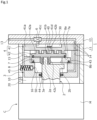
- FIGS. 1 to 6 The sliding component according to a first embodiment of the present invention will be described with reference to FIGS. 1 to 6 . It should be noted that in the drawings, the groove formed in the sliding surface of the sliding component or the like is dotted for convenience of description.
- the sliding component according to the first embodiment of the present invention is applied to a rotating machine including an eccentric mechanism such as a scroll compressor C that suctions, compresses, and discharges a refrigerant as a fluid used in the air conditioning system of an automobile or the like.
- a rotating machine including an eccentric mechanism such as a scroll compressor C that suctions, compresses, and discharges a refrigerant as a fluid used in the air conditioning system of an automobile or the like.
- the refrigerant in the present embodiment is a gas mixed with a mist-like lubricating oil.
- the scroll compressor C mainly includes a housing 1, a rotary shaft 2, an inner casing 3, a scroll compression mechanism 4, a side seal 7, a thrust plate 8 as a sliding component, and a drive motor M.
- the housing 1 includes a cylindrical casing 11 and a cover 12.
- the cover 12 blocks an opening of the casing 11.
- the drive motor M blocks the opening in the casing 11 that is on the side axially opposite to the opening in the casing 11 that is blocked by the cover 12.
- a low-pressure chamber 20 Formed in the casing 11 are a low-pressure chamber 20, a high-pressure chamber 30, and a back pressure chamber 50.
- a low-pressure refrigerant is supplied from a refrigerant circuit (not illustrated) to the low-pressure chamber 20 as the external space on the low-pressure side through a suction port 10.
- a high-pressure refrigerant compressed by the scroll compression mechanism 4 is discharged to the high-pressure chamber 30.
- a part of the refrigerant compressed by the scroll compression mechanism 4 is supplied, together with lubricating oil, to the back pressure chamber 50 as the external space on the high-pressure side.
- the back pressure chamber 50 is formed in the cylindrical inner casing 3 accommodated in the casing 11.
- a discharge communication passage 13 is formed in the cover 12.
- the discharge communication passage 13 allows the refrigerant circuit (not illustrated) and the high-pressure chamber 30 to communicate with each other.
- a part of a back pressure communication passage 14 for communication between the high-pressure chamber 30 and the back pressure chamber 50 is formed in the cover 12 by branching off from the discharge communication passage 13. It should be noted that the discharge communication passage 13 is provided with an oil separator 6 for lubricating oil separation from a refrigerant.
- the inner casing 3 is fixed with an axial end portion of the inner casing 3 abutting against an end plate 41a of a fixed scroll 41 constituting the scroll compression mechanism 4.
- the inner casing 3 has a side wall where a suction communication passage 15 penetrating the wall in the radial direction is formed.
- the low-pressure chamber 20 is formed from the outside of the inner casing 3 to the inside of the inner casing 3 via the suction communication passage 15. The refrigerant supplied to the inside of the inner casing 3 through the suction communication passage 15 is suctioned into the scroll compression mechanism 4.
- the scroll compression mechanism 4 mainly includes the fixed scroll 41 and a movable scroll 42.
- the fixed scroll 41 is fixed to the cover 12 in a substantially sealed shape.
- the movable scroll 42 is accommodated in the inner casing 3.
- the fixed scroll 41 is made of metal and includes a spiral lap 41b.
- the spiral lap 41b projects toward the movable scroll 42 from the surface of the disk-shaped end plate 41a, that is, the end plate 41a.
- the fixed scroll 41 has a recessed portion 41c where the inner diameter side of the back surface of the end plate 41a, that is, the end surface of the end plate 41a that abuts against the cover 12 is recessed in the direction opposite to the cover 12.
- the high-pressure chamber 30 is defined from the recessed portion 41c and the cover 12.
- the movable scroll 42 is made of metal and includes a spiral lap 42b.
- the spiral lap 42b projects toward the fixed scroll 41 from the surface of a disk-shaped end plate 42a, that is, the end plate 42a.
- a boss 42c protruding from the middle of the back surface of the end plate 42a is formed on the movable scroll 42.
- An eccentric portion 2a formed on the rotary shaft 2 is fitted into the boss 42c so as to be relatively rotatable. It should be noted that an eccentric mechanism causing the rotary shaft 2 to perform eccentric rotation is configured by the eccentric portion 2a of the rotary shaft 2 and a counterweight portion 2b protruding in the outer diameter direction from the rotary shaft 2 in the present embodiment.
- the eccentric portion 2a rotates eccentrically and the movable scroll 42 slides, in a posture-maintained state, relative to the fixed scroll 41 with the eccentric rotation.
- the movable scroll 42 rotates eccentrically with respect to the fixed scroll 41 and, with this rotation, the contact positions of the laps 41b and 42b sequentially move in the rotation direction and a compression chamber 40 formed between the laps 41b and 42b gradually shrinks while moving toward the middle.
- the side seal 7 is made of resin and has a rectangular cross section and an annular shape in an axial view (see FIG. 4 ).
- the side seal 7 is fixed to the back surface of the end plate 42a of the movable scroll 42.
- the side seal 7 has a sliding surface 7a as a facing sliding surface abutting against a sliding surface 8a of the thrust plate 8, and the sliding surface 7a is formed on a flat surface without unevenness or the like.
- FIG. 3B illustrates a state where the A-A cross-sectional view is linearly unfolded for convenience of description.
- the thrust plate 8 is made of metal and has an annular shape.
- the thrust plate 8 has the sliding surface 8a abutting against the sliding surface 7a of the side seal 7 (see FIG. 1 ).
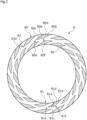
- the sliding surface 8a of the thrust plate 8 includes an external dynamic pressure generation groove 80, an internal dynamic pressure generation groove 81, and a land 82.
- a plurality of the (15 in the present embodiment) external dynamic pressure generation grooves 80 as dynamic pressure generation grooves are provided on the outer diameter side of the sliding surface 8a.
- a plurality of the (15 in the present embodiment) internal dynamic pressure generation grooves 81 as other dynamic pressure generation grooves are provided on the inner diameter side of the sliding surface 8a.
- the land 82 partitions the external dynamic pressure generation groove 80 and the internal dynamic pressure generation groove 81.
- the external dynamic pressure generation groove 80 extends from the outer diameter end edge of the sliding surface 8a toward the inner diameter side while being inclined in the circumferential direction. In addition, the external dynamic pressure generation groove 80 communicates with the low-pressure chamber 20 (see FIG. 1 ) as an external space on the outer diameter side.
- the external dynamic pressure generation groove 80 is partitioned by side walls 80a and 80b, an inner end wall 80c, and a bottom wall 80d.
- the side walls 80a and 80b extend in the depth direction orthogonal to a flat surface 82a of the land 82 and extend from the outer diameter end edge of the sliding surface 8a toward the inner diameter side in the counterclockwise direction while being inclined in the circumferential direction.
- the inner end wall 80c interconnects the inner diameter end portions of the side walls 80a and 80b.
- the bottom wall 80d extends parallel to the surface 82a and interconnects the depth-direction end portions of the side walls 80a and 80b and the inner end wall 80c.
- the inner end wall 80c is shorter than the side walls 80a and 80b and extends substantially along the circumferential direction. In addition, the inner end wall 80c is smaller in circumferentially inclined component than the side walls 80a and 80b.
- a corner portion 80e formed by the side wall 80a and the inner end wall 80c has an acute angle
- a corner portion 80f formed by the side wall 80b and the inner end wall 80c has an obtuse angle
- the external dynamic pressure generation groove 80 extends in a tapered shape toward the counterclockwise direction.
- the corner portion 80e functions as the tapered portion of the external dynamic pressure generation groove 80.
- the tapering toward the counterclockwise direction that is, the downstream side in the eccentric rotation direction
- the angle formed by the two side walls facing the eccentric rotation direction in the side wall of each groove that is, two side walls facing the circumferential and radial components in the eccentric rotation direction in any state
- the presence of the corner portion smaller than 180 degrees allows fluid collection and dynamic pressure generation.
- the downstream side in the eccentric rotation direction means a downstream side in a movement direction of the sliding surface 7a along an orbit of the sliding surface 7a sliding relatively to the sliding surface 8a.
- the internal dynamic pressure generation groove 81 extends from the inner diameter end edge of the sliding surface 8a toward the outer diameter side while being inclined in the circumferential direction.
- the internal dynamic pressure generation groove 81 communicates with the back pressure chamber 50 (see FIG. 1 ) as an external space on the inner diameter side.
- the internal dynamic pressure generation groove 81 is partitioned by side walls 81a and 81b, an outer end wall 81c, and a bottom wall 81d.
- the side walls 81a and 81b extend in the depth direction orthogonal to the flat surface 82a of the land 82.
- the side walls 81a and 81b extend from the inner diameter end edge of the sliding surface 8a toward the outer diameter side in the clockwise direction while being inclined in the circumferential direction.
- the outer end wall 81c interconnects the outer diameter end portions of the side walls 81a and 81b.
- the bottom wall 81d extends parallel to the surface 82a and interconnects the depth-direction end portions of the side walls 81a and 81b and the outer end wall 81c.
- the outer end wall 81c is shorter than the side walls 81a and 81b and extends substantially along the circumferential direction. In addition, the outer end wall 81c is smaller in inclined component than the side walls 81a and 81b. In addition, a corner portion 81e formed by the side wall 81a and the outer end wall 81c has an acute angle, and a corner portion 81f formed by the side wall 81b and the outer end wall 81c has an obtuse angle.
- the internal dynamic pressure generation groove 81 extends in a tapered shape toward the clockwise direction.
- the corner portion 81e forming an acute angle functions as the tapered portion of the internal dynamic pressure generation groove 81, and the tapered portion of the external dynamic pressure generation groove 80 and the tapered portion of the internal dynamic pressure generation groove 81 face in opposite directions in the circumferential direction.
- a width dimension L1 of the external dynamic pressure generation groove 80 (that is, the separation width of the side walls 80a and 80b) is formed larger than a depth dimension L2 of the external dynamic pressure generation groove 80 (i.e., L1 > L2). It should be noted that here, the width dimension of the opening portion of the external dynamic pressure generation groove 80 is illustrated as the width dimension L1 of the external dynamic pressure generation groove 80.
- a width dimension L3 of the internal dynamic pressure generation groove 81 (that is, the separation width of the side walls 81a and 81b) is formed larger than a depth dimension L4 of the internal dynamic pressure generation groove 81 (i.e., L3 > L4). It should be noted that here, the width dimension of the opening portion of the internal dynamic pressure generation groove 81 is illustrated as the width dimension L3 of the internal dynamic pressure generation groove 81.
- the width dimensions L1 and L3 are preferably 10 times or more the depth dimensions L2 and L4 although the width and depth dimensions of the external dynamic pressure generation groove 80 and the internal dynamic pressure generation groove 81 can be freely changed on condition that the width dimensions of the external dynamic pressure generation groove 80 and the internal dynamic pressure generation groove 81 are formed larger than the depth dimensions of the external dynamic pressure generation groove 80 and the internal dynamic pressure generation groove 81.
- the width dimensions L1 and L3 may be equal to or different from each other.
- the depth dimensions L2 and L4 may be equal to or different from each other.
- the inner end wall 80c of the external dynamic pressure generation groove 80 and the outer end wall 81c of the internal dynamic pressure generation groove 81 are separated from each other in the radial direction, and the external dynamic pressure generation groove 80 and the internal dynamic pressure generation groove 81 have a radial separation width L5 formed larger than a radial width L6 of the sliding surface 7a of the side seal 7 (L5 > L6).
- a seal ring 43 is fixed to the thrust plate 8.
- the seal ring 43 abuts against the inner peripheral surface of the inner casing 3 on the surface on the side axially opposite to the sliding surface 8a.
- the thrust plate 8 functions as a thrust bearing that receives an axial load of the movable scroll 42 via the side seal 7.
- the side seal 7 and the seal ring 43 partition the low-pressure chamber 20 formed on the outer diameter side of the movable scroll 42 and the back pressure chamber 50 formed on the back surface side of the movable scroll 42 in the inner casing 3.
- the back pressure chamber 50 is a closed space formed between the inner casing 3 and the rotary shaft 2.
- a seal ring 44 is fixed to the inner periphery of a through hole 3a provided in the middle of the other end of the inner casing 3 and is in sliding contact in a sealed shape with the rotary shaft 2 inserted through the through hole 3a.
- the back pressure communication passage 14 allowing the high-pressure chamber 30 and the back pressure chamber 50 to communicate with each other is formed over the cover 12, the fixed scroll 41, and the inner casing 3.
- the back pressure communication passage 14 is provided with an orifice (not illustrated) and, after depressurization adjustment by means of the orifice, the refrigerant in the high-pressure chamber 30 is supplied to the back pressure chamber 50 together with the lubricating oil separated by the oil separator 6. At this time, the pressure in the back pressure chamber 50 is adjusted to be higher than the pressure in the low-pressure chamber 20.
- a pressure release hole 16 is formed in the inner casing 3, penetrates the inner casing 3 in the radial direction, and allows the low-pressure chamber 20 and the back pressure chamber 50 to communicate with each other.
- a pressure adjustment valve 45 is provided in the pressure release hole 16. The pressure adjustment valve 45 is opened by the pressure of the back pressure chamber 50 exceeding a set value.
- the boss 42c of the movable scroll 42 is inserted through a through hole 8b in the middle of the thrust plate 8.
- the through hole 8b is formed to have a diameter size at which it is possible to allow eccentric rotation by the eccentric portion 2a of the rotary shaft 2 fitted into the boss 42c.
- the sliding surface 7a of the side seal 7 is capable of sliding relative to the sliding surface 8a of the thrust plate 8 with eccentric rotation by the eccentric rotation of the rotary shaft 2 (see FIG. 4 ).
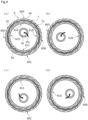
- FIGS. 4A to 4D in FIG. 4 illustrate the rotational trajectory of the boss 42c that is viewed from the fixed scroll 41 side. Respectively illustrated in FIGS. 4B to 4D are the boss 42c rotated counterclockwise by 90 degrees, 180 degrees, and 270 degrees with FIG. 4A serving as a reference.
- the sliding region between the sliding surface 7a of the side seal 7 and the sliding surface 8a of the thrust plate 8 is schematically illustrated by dots.
- the counterweight portion 2b constituting the eccentric mechanism and so on are not illustrated and only the eccentric portion 2a fitted into the boss 42c is illustrated for convenience of description.
- the thrust plate 8 is a sliding component having the sliding surface 8a sliding relative to the eccentric rotation of the sliding surface 7a of the side seal 7.
- the thrust plate 8 when the thrust plate 8 is regarded as an analog clock, directly above the paper surface is the 12 o'clock position and, in the sliding surface 8a, the plurality of external dynamic pressure generation grooves near 12 o'clock are referred to as external dynamic pressure generation grooves 80A, the plurality of external dynamic pressure generation grooves near 3 o'clock are referred to as external dynamic pressure generation grooves 80B, the plurality of external dynamic pressure generation grooves near 6 o'clock are referred to as external dynamic pressure generation grooves 80C, and the plurality of external dynamic pressure generation grooves near 9 o'clock are referred to as external dynamic pressure generation grooves 80D.
- the plurality of internal dynamic pressure generation grooves near 12 o'clock are referred to as internal dynamic pressure generation grooves 81A
- the plurality of internal dynamic pressure generation grooves near 3 o'clock are referred to as internal dynamic pressure generation grooves 81B
- the plurality of internal dynamic pressure generation grooves near 6 o'clock are referred to as internal dynamic pressure generation grooves 81C
- the plurality of internal dynamic pressure generation grooves near 9 o'clock are referred to as internal dynamic pressure generation grooves 81D.
- the sliding surface 7a overlaps the plurality of external dynamic pressure generation grooves 80A at the part of the sliding surface 8a near 10 o'clock to 2 o'clock.
- the sliding surface 7a is disposed on the land 82 between the external dynamic pressure generation groove 80B and the internal dynamic pressure generation groove 81B without overlapping the external dynamic pressure generation groove 80B and the internal dynamic pressure generation groove 81B.
- the sliding surface 7a overlaps the plurality of internal dynamic pressure generation grooves 81C.
- the sliding surface 7a is disposed on the land 82 between the external dynamic pressure generation groove 80D and the internal dynamic pressure generation groove 81D without overlapping the external dynamic pressure generation groove 80D and the internal dynamic pressure generation groove 81D.
- the sliding surface 7a overlaps the external dynamic pressure generation grooves 80A, which are a part of the external dynamic pressure generation grooves 80A to 80D, and does not overlap the other external dynamic pressure generation grooves 80B to 80D. Further, the sliding surface 7a overlaps the internal dynamic pressure generation grooves 81C, which are a part of the internal dynamic pressure generation grooves 81A to 81D, and does not overlap the other internal dynamic pressure generation grooves 81A, 81B, and 81D.
- the sliding surface 7a is disposed on the land 82 between the external dynamic pressure generation groove 80A and the internal dynamic pressure generation groove 81A without overlapping the external dynamic pressure generation groove 80A and the internal dynamic pressure generation groove 81A.
- the sliding surface 7a overlaps the plurality of internal dynamic pressure generation grooves 81B.
- the sliding surface 7a is disposed on the land 82 between the external dynamic pressure generation groove 80C and the internal dynamic pressure generation groove 81C without overlapping the external dynamic pressure generation groove 80C and the internal dynamic pressure generation groove 81C.
- the sliding surface 7a overlaps the plurality of external dynamic pressure generation grooves 80D.
- the sliding surface 7a overlaps the external dynamic pressure generation grooves 80D, which are a part of the external dynamic pressure generation grooves 80A to 80D, and does not overlap the other external dynamic pressure generation grooves 80A to 80C. Further, the sliding surface 7a overlaps the internal dynamic pressure generation grooves 81B, which are a part of the internal dynamic pressure generation grooves 81A to 81D, and does not overlap the other internal dynamic pressure generation grooves 81A, 81C, and 81D.
- the sliding surface 7a overlaps the plurality of internal dynamic pressure generation grooves 81A at the part of the sliding surface 8a near 10 o'clock to 2 o'clock.
- the sliding surface 7a is disposed on the land 82 between the external dynamic pressure generation groove 80B and the internal dynamic pressure generation groove 81B without overlapping the external dynamic pressure generation groove 80B and the internal dynamic pressure generation groove 81B.
- the sliding surface 7a overlaps the plurality of external dynamic pressure generation grooves 80C.
- the sliding surface 7a is disposed on the land 82 between the external dynamic pressure generation groove 80D and the internal dynamic pressure generation groove 81D without overlapping the external dynamic pressure generation groove 80D and the internal dynamic pressure generation groove 81D.
- the sliding surface 7a overlaps the external dynamic pressure generation grooves 80C, which are a part of the external dynamic pressure generation grooves 80A to 80D, and does not overlap the other external dynamic pressure generation grooves 80A, 80B, and 80D. Further, the sliding surface 7a overlaps the internal dynamic pressure generation grooves 81A, which are a part of the internal dynamic pressure generation grooves 81A to 81D, and does not overlap the other internal dynamic pressure generation grooves 81B to 81D.
- the sliding surface 7a is disposed on the land 82 between the external dynamic pressure generation groove 80A and the internal dynamic pressure generation groove 81A without overlapping the external dynamic pressure generation groove 80A and the internal dynamic pressure generation groove 81A.
- the sliding surface 7a overlaps the plurality of external dynamic pressure generation grooves 80B.
- the sliding surface 7a is disposed on the land 82 between the external dynamic pressure generation groove 80C and the internal dynamic pressure generation groove 81C without overlapping the external dynamic pressure generation groove 80C and the internal dynamic pressure generation groove 81C.
- the sliding surface 7a overlaps the plurality of internal dynamic pressure generation grooves 81A.
- the sliding surface 7a overlaps the external dynamic pressure generation grooves 80B, which are a part of the external dynamic pressure generation grooves 80A to 80D, and does not overlap the other external dynamic pressure generation grooves 80A, 80C, and 80D. Further, the sliding surface 7a overlaps the internal dynamic pressure generation grooves 81D, which are a part of the internal dynamic pressure generation grooves 81A to 81D, and does not overlap the other internal dynamic pressure generation grooves 81A to 81C.
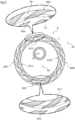
- FIG. 5 illustrates an aspect when the side seal 7 moves from the state of FIG. 4A toward the state of FIG. 4B
- FIG. 6 illustrates an aspect when the side seal 7 moves from the state of FIG. 4C toward the state of FIG. 4D .
- the thrust plate 8 that is viewed from the fixed scroll 41 side is illustrated, and the circle marks illustrated in the enlarged portions indicate the points where the pressure increases in the external dynamic pressure generation groove 80 and the internal dynamic pressure generation groove 81.
- the fluid in the external dynamic pressure generation groove 80A moves to follow in the direction of the white arrow, that is, the eccentric rotation direction of the sliding surface 7a, the fluid is collected in the acute-angled corner portion 80e, and a large dynamic pressure is generated in the corner portion 80e.
- the fluid in the internal dynamic pressure generation groove 81C moves to follow in the direction of the white arrow, the fluid is collected in the acute-angled corner portion 81e, and a large dynamic pressure is generated in the corner portion 81e.
- the sliding surfaces 7a and 8a can be separated from each other by generating a large dynamic pressure in the corner portion 80e of the external dynamic pressure generation groove 80A and the corner portion 81e of the internal dynamic pressure generation groove 81C. Accordingly, the fluid forms a fluid film between the sliding surfaces 7a and 8a and the frictional resistance between the sliding surfaces 7a and 8a can be reduced.
- the fluid in the external dynamic pressure generation groove 80A and the internal dynamic pressure generation groove 81C moves to follow in the eccentric rotation direction of the sliding surface 7a
- the fluid in the low-pressure chamber 20 is introduced into the external dynamic pressure generation groove 80A through the outer diameter side opening of the external dynamic pressure generation groove 80A
- the fluid in the back pressure chamber 50 is introduced into the internal dynamic pressure generation groove 81C through the inner diameter side opening of the internal dynamic pressure generation groove 81C.
- the fluid can be introduced into the external dynamic pressure generation groove 80A and the internal dynamic pressure generation groove 81C from the low-pressure chamber 20 and the back pressure chamber 50, and thus dynamic pressure can be reliably generated in the external dynamic pressure generation groove 80A and the internal dynamic pressure generation groove 81C.
- the sliding surface 7a overlaps the external dynamic pressure generation grooves 80A, which are a part of the external dynamic pressure generation grooves 80A to 80D, and does not overlap the other external dynamic pressure generation grooves 80B to 80D. Accordingly, unintended dynamic pressure (negative pressure) generation can be prevented in the external dynamic pressure generation grooves 80B to 80D, which the sliding surface 7a does not overlap.
- the sliding surface 7a overlaps the internal dynamic pressure generation grooves 81C, which are a part of the internal dynamic pressure generation grooves 81A to 81D, and does not overlap the other internal dynamic pressure generation grooves 81A, 81B, and 81D. Accordingly, unintended dynamic pressure (negative pressure) generation can be prevented in the internal dynamic pressure generation grooves 81A, 81B, and 81D, which the sliding surface 7a does not overlap.
- each external dynamic pressure generation groove 80 and the corner portion 81e of the internal dynamic pressure generation groove 81 face in opposite directions in the circumferential direction.
- the corner portion 80e of the external dynamic pressure generation groove 80 and the corner portion 81e of the internal dynamic pressure generation groove 81 adjacent to each other in the radial direction face in opposite directions in the eccentric rotation direction of the sliding surface 7a. Accordingly, in the state of FIG.
- a large dynamic pressure can be generated in the corner portion 80e of the external dynamic pressure generation groove 80A at the position on the sliding surface 8a near 10 o'clock to 2 o'clock and the corner portion 81e of the internal dynamic pressure generation groove 81C at the position on the sliding surface 8a near 10 o'clock to 2 o'clock, that is, on both radial sides of the sliding surface 8a. Accordingly, the sliding surfaces 7a and 8a can be separated from each other with the inclination of the sliding surfaces 7a and 8a suppressed.
- the back pressure chamber 50 extends to the inner diameter side of the sliding surfaces 7a and 8a. Accordingly, when the sliding surfaces 7a and 8a are separated from each other, the fluid in the back pressure chamber 50 is introduced from the inner diameter side of the sliding surfaces 7a and 8a. In addition, when the scroll compression mechanism 4 is driven, the pressure of the back pressure chamber 50 increases, a high-pressure fluid is introduced between the sliding surfaces 7a and 8a from the back pressure chamber 50, and thus the sliding surfaces 7a and 8a can be further separated from each other by the pressure of the fluid.
- the radial separation width L5 between each external dynamic pressure generation groove 80 and each internal dynamic pressure generation groove 81 is formed larger than the radial width L6 of the sliding surface 7a of the side seal 7. Accordingly, in a case where the sliding surface 7a overlaps one of the external dynamic pressure generation groove 80 and the internal dynamic pressure generation groove 81 adjacent to each other in the radial direction, the sliding surface 7a does not overlap the other of the external dynamic pressure generation groove 80 and the internal dynamic pressure generation groove 81 adjacent to each other in the radial direction.
- the sliding surface 7a in a case where the sliding surface 7a overlaps the external dynamic pressure generation groove 80A, the sliding surface 7a does not overlap the internal dynamic pressure generation groove 81A adjacent in the radial direction.
- the sliding surface 7a in a case where the sliding surface 7a overlaps the internal dynamic pressure generation groove 81A, the sliding surface 7a does not overlap the external dynamic pressure generation groove 80A adjacent in the radial direction.
- the sliding surface 7a is not disposed over the external dynamic pressure generation groove 80A and the internal dynamic pressure generation groove 81A adjacent to each other in the radial direction, and thus simultaneous positive pressure generation in the external dynamic pressure generation groove 80A and negative pressure generation in the internal dynamic pressure generation groove 81A can be prevented and simultaneous negative pressure generation in the external dynamic pressure generation groove 80C and positive pressure generation in the internal dynamic pressure generation groove 81C can be prevented.
- FIG. 5 illustrates a form when the side seal 7 moves from the state of FIG. 4A toward the state of FIG. 4B
- FIG. 6 illustrates a form when the side seal 7 moves from the state of FIG. 4C toward the state of FIG. 4D
- dynamic pressure is generated in substantially the same form when the side seal 7 moves from the state of FIG. 4A toward the state of FIG. 4B
- the side seal 7 moves from the state of FIG. 4C toward the state of FIG. 4D
- the side seal 7 moves from the state of FIG. 4B toward the state of FIG. 4C
- the side seal 7 moves from the state of FIG. 4D toward the state of FIG. 4A
- description is omitted as to the forms when the side seal 7 moves from the state of FIG. 4B toward the state of FIG. 4C and from the state of FIG. 4D toward the state of FIG. 4A .
- a plurality of external dynamic pressure generation grooves 180 are provided in the circumferential direction in the sliding surface 108a of the thrust plate 108.
- the external dynamic pressure generation groove 180 communicates with the external space on the outer diameter side (that is, the low-pressure chamber 20 (see FIG. 1 )).
- the sliding surface 108a is not provided with the internal dynamic pressure generation groove 81 as in the first embodiment, and the inner diameter side of the sliding surface 108a is formed on a flat surface by a surface 182a of a land 182.
- FIG. 7 illustrates a state where the side seal 7 is disposed close to 12 o'clock from a position concentric with the thrust plate 108 (see FIG. 4A ).
- the sliding surface 7a overlaps the plurality of external dynamic pressure generation grooves 180 near 10 o'clock to 2 o'clock on the sliding surface 108a (that is, some dynamic pressure generation grooves).
- the sliding surface 7a does not overlap the plurality of external dynamic pressure generation grooves 180 near 3 o'clock to 9 o'clock on the sliding surface 108a (that is, the other dynamic pressure generation grooves).
- the present second embodiment exemplifies a form in which the plurality of external dynamic pressure generation grooves 180 are provided in the circumferential direction and no internal dynamic pressure generation groove is provided, a plurality of internal dynamic pressure generation grooves may be provided in the circumferential direction and no external dynamic pressure generation groove may be provided in an alternative form.
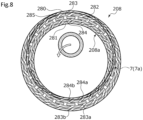
- each external dynamic pressure generation groove 280 and each internal dynamic pressure generation groove 281 in the sliding surface 208a of the thrust plate 208 a plurality of (three in the present third embodiment) non-communication grooves surrounded by a land 282 are provided side by side in the radial direction.
- the sliding surface 208a of the thrust plate 208 has a first non-communication groove 283 adjacent to the inner diameter side of the external dynamic pressure generation groove 280, a second non-communication groove 284 adjacent to the outer diameter side of the internal dynamic pressure generation groove 281, and a third non-communication groove 285 disposed between the first non-communication groove 283 and the second non-communication groove 284.
- the external dynamic pressure generation groove 280, the internal dynamic pressure generation groove 281, the first non-communication groove 283, the second non-communication groove 284, and the third non-communication groove 285 of the present third embodiment are wider in the circumferential direction than in the radial direction.
- the first non-communication groove 283 has a substantially parallelogram shape when viewed from the axial direction, and acute-angled corner portions 283a and 283b are formed toward the counterclockwise inner diameter side and the clockwise outer diameter side.
- the second non-communication groove 284 has a substantially parallelogram shape when viewed from the axial direction, and acute-angled corner portions 284a and 284b are formed toward the counterclockwise inner diameter side and the clockwise outer diameter side.
- the third non-communication groove 285 has a substantially rectangular shape having a long side in the circumferential direction when viewed from the axial direction.
- the external dynamic pressure generation groove 280, the internal dynamic pressure generation groove 281, the first non-communication groove 283, and the second non-communication groove 284 are disposed on a virtual line (not illustrated) radially extending from the center point of the thrust plate 208.
- the third non-communication groove 285 is disposed so as to slightly deviate in the circumferential direction from the external dynamic pressure generation groove 280, the internal dynamic pressure generation groove 281, the first non-communication groove 283, and the second non-communication groove 284 arranged in the radial direction.
- FIG. 8 illustrates a state where the side seal 7 is disposed close to 12 o'clock from a position concentric with the thrust plate 208 (see FIG. 4A ).
- the sliding surface 7a overlaps the plurality of external dynamic pressure generation grooves 280 at the part of the sliding surface 208a near 11 o'clock to 1 o'clock.
- the sliding surface 7a overlaps the plurality of first non-communication grooves 283, second non-communication grooves 284, and third non-communication grooves 285.
- the sliding surface 7a overlaps the plurality of internal dynamic pressure generation grooves 281.
- the sliding surface 7a overlaps the plurality of first non-communication grooves 283, second non-communication grooves 284, and third non-communication grooves 285.
- dynamic pressure is generated mainly at the part of the sliding surface 208a near 11 o'clock to 1 o'clock and the part of the sliding surface 208a near 5 o'clock to 7 o'clock by the plurality of external dynamic pressure generation grooves 280 and the plurality of internal dynamic pressure generation grooves 281.
- dynamic pressure can be generated at the part of the sliding surface 208a near 2 o'clock to 4 o'clock and the part of the sliding surface 208a near 8 o'clock to 10 o'clock by the plurality of first non-communication grooves 283, second non-communication grooves 284, and third non-communication grooves 285. Accordingly, the sliding surface 7a and the sliding surface 208a can be separated from each other with the inclination of the sliding surface 7a and the sliding surface 208a suppressed.
- the side seal 7 overlaps any of the external dynamic pressure generation groove 280, the internal dynamic pressure generation groove 281, the first non-communication groove 283, the second non-communication groove 284, and the third non-communication groove 285 over the circumferential direction of the sliding surface 208a. Accordingly, dynamic pressure can be generated over the circumferential direction regardless of the relative positions of the side seal 7 and the sliding surface 208a.
- first non-communication groove 283, the second non-communication groove 284, and the third non-communication groove 285 are in a state of non-communication with the external space. Accordingly, in sliding with the side seal 7, no fluid flows out from each non-communication groove to the external space and dynamic pressure can be reliably generated. Further, a large dynamic pressure can be generated by the corner portions 283a and 283b and the corner portions 284a and 284b.
- first non-communication groove 283, the second non-communication groove 284, and the third non-communication groove 285 have different shapes, and thus the dynamic pressure can be changed in accordance with the relative positions of the side seal 7 and the sliding surface 208a.
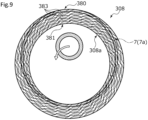
- non-communication grooves 383 have identical and substantially parallelogram shapes when viewed from the axial direction.
- the external dynamic pressure generation groove 380, the internal dynamic pressure generation groove 381, and each non-communication groove 383 are arranged side by side in the radial direction.
- the side seal 7 overlaps any of the external dynamic pressure generation groove 380, the internal dynamic pressure generation groove 381, and the non-communication groove 383 over the circumferential direction of the sliding surface 308a. Accordingly, dynamic pressure can be generated over the circumferential direction regardless of the relative positions of the side seal 7 and the sliding surface 308a.
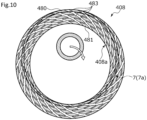
- the external dynamic pressure generation groove 480, the internal dynamic pressure generation groove 481, and each non-communication groove 483 are inverted in shape from the various grooves of the second and third embodiments.
- the single row of the external dynamic pressure generation groove 480, the internal dynamic pressure generation groove 481, and each non-communication groove 483 arranged in the radial direction is disposed along the eccentric rotation direction of the side seal 7 from the external dynamic pressure generation groove 480 toward the internal dynamic pressure generation groove 481.
- the external dynamic pressure generation groove 480, the internal dynamic pressure generation groove 481, and each non-communication groove 483 arranged in the radial direction are disposed so as to be inclined in the circumferential direction.
- the dimensions between the circumferential directions of the grooves are constant and the grooves are inclined and continuous in the circumferential directions. It should be noted that the dimension between the circumferential directions is not limited to being constant and may be increased or decreased at a predetermined rate toward the outer diameter.
- the external dynamic pressure generation groove 480, the internal dynamic pressure generation groove 481, and each non-communication groove 483 are formed by inversion from the second and third embodiments.
- dynamic pressure corresponding to the eccentric rotation direction of the side seal 7 that is opposite to those of the second and third embodiments can be generated.
- a plurality of external dynamic pressure generation grooves 580 and internal dynamic pressure generation grooves 581 are formed in the circumferential direction in the sliding surface 508a of the thrust plate 508.
- a corner portion 580e having an acute angle is formed at the inner diameter end in the counterclockwise direction.
- a corner portion 581e having an acute angle is formed at the outer diameter end in the counterclockwise direction.
- the external dynamic pressure generation groove 580 communicates with the external space on the outer diameter side (that is, the low-pressure chamber 20 (see FIG. 1 )).
- the internal dynamic pressure generation groove 581 communicates with the external space on the inner diameter side (that is, the back pressure chamber 50 (see FIG. 1 )).
- a first non-communication groove 583, a second non-communication groove 584, and a third non-communication groove 585 are formed between the external dynamic pressure generation groove 580 and the internal dynamic pressure generation groove 581 that are radially adjacent to each other in the sliding surface 508a.
- the first non-communication groove 583 adjacent to the inner diameter side of the external dynamic pressure generation groove 580 has a substantially parallelogram shape having acute-angled corner portions 583a and 583b on the inner diameter side in the counterclockwise direction and the outer diameter side in the clockwise direction.
- the second non-communication groove 584 adjacent to the outer diameter side of the internal dynamic pressure generation groove 581 has a substantially parallelogram shape having acute-angled corner portions 584a and 584b on the outer diameter side in the counterclockwise direction and the inner diameter side in the clockwise direction.
- the third non-communication groove 585 has a substantially rectangular shape having a long side in the circumferential direction when viewed from the axial direction.
- the first non-communication groove 583 deviates in the clockwise direction from the third non-communication groove 585 and is disposed on the outer diameter side thereof
- the external dynamic pressure generation groove 580 deviates in the clockwise direction from the first non-communication groove 583 and is disposed on the outer diameter side thereof.
- the center lines between the circumferential directions of the grooves deviate in the circumferential direction, that is, the center lines between the grooves adjacent in the radial direction are not continuous.
- the second non-communication groove 584 deviates in the clockwise direction from the third non-communication groove 585 and is disposed on the inner diameter side thereof
- the external dynamic pressure generation groove 580 deviates in the clockwise direction from the first non-communication groove 583 and is disposed on the inner diameter side thereof.
- the center lines between the circumferential directions of the grooves deviate in the circumferential direction, that is, the center lines between the grooves adjacent in the radial direction are not continuous.
- the sliding surface 7a overlaps the plurality of external dynamic pressure generation grooves 580 at the part of the sliding surface 508a near 11 o'clock to 1 o'clock.
- the sliding surface 7a overlaps the plurality of first non-communication grooves 583, second non-communication grooves 584, and third non-communication grooves 585.
- the sliding surface 7a overlaps the plurality of internal dynamic pressure generation grooves 581.
- the sliding surface 7a overlaps the plurality of first non-communication grooves 583, second non-communication grooves 584, and third non-communication grooves 585.
- dynamic pressure is generated at the part of the sliding surface 508a near 8 o'clock to 4 o'clock by plurality of external dynamic pressure generation grooves 580 and the plurality of first non-communication grooves 583, second non-communication grooves 584, and third non-communication grooves 585.
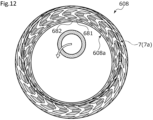
- a sliding surface 608a of a thrust plate 608 as a sliding component according to a seventh embodiment will be described with reference to FIG. 12 . It should be noted that the description of configurations identical to those of the first embodiment will be omitted for redundancy avoidance.
- an internal dynamic pressure generation groove 681 of the sliding surface 608a of the thrust plate 608 is partitioned by a land 682 in a state of non-communication with the external space on the inner diameter side (that is, the back pressure chamber 50 (see FIG. 1 )).
- the other shapes are the same as those in the sixth embodiment.
- dynamic pressure can be generated over the circumferential direction of the sliding surface 608a, and thus the sliding surfaces 7a and 608a can be separated from each other in a state where the relative inclination of the sliding surfaces 7a and 608a is small.
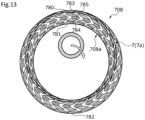
- each external dynamic pressure generation groove 780 in the sliding surface 708a of the thrust plate 708 is partitioned by a land 782 in a state of non-communication with the external space on the outer diameter side (that is, the low-pressure chamber 20 (see FIG. 1 )).
- each internal dynamic pressure generation groove 781 communicates with the external space on the inner diameter side (that is, the back pressure chamber 50 (see FIG. 1 )).
- a first non-communication groove 783, a second non-communication groove 784, and a third non-communication groove 785 are disposed between each external dynamic pressure generation groove 780 and each internal dynamic pressure generation groove 781.
- the external dynamic pressure generation groove 780, the internal dynamic pressure generation groove 781, the first non-communication groove 783, the second non-communication groove 784, and the third non-communication groove 785 are inverted in shape from the various grooves of the sixth and seventh embodiments.
- the external dynamic pressure generation groove 780, the internal dynamic pressure generation groove 781, the first non-communication groove 783, the second non-communication groove 784, and the third non-communication groove 785 are formed by inversion from the sixth and seventh embodiments.
- dynamic pressure corresponding to the eccentric rotation direction of the side seal 7 that is opposite to those of the sixth and seventh embodiments can be generated.
- the external dynamic pressure generation groove 780 is partitioned by the land 782 in a state of non-communication with the external space on the outer diameter side, and thus dynamic pressure can be reliably generated during sliding relative to the side seal 7.
- the present invention is not limited thereto and the side seal 7 as a sliding component may be applied to, for example, a scroll expansion compressor provided integrally with an expander and a compressor insofar as it is a rotating machine including an eccentric mechanism.
- each of the fluids in the spaces inside and outside the sliding surface of the sliding component may be any of a gas, a liquid, and a gas-liquid mixture.
- the sliding component of the present invention may be used in an environment in which the pressure inside the sliding surface and the pressure outside the sliding surface are equal to each other without being limited to an environment in which there is a pressure difference between the inside and outside of the sliding surface.
- the sliding component of the present invention does not have to function as a seal and may be one capable of stably reducing the frictional resistance of a sliding surface.
- the side seal having the relatively sliding surface is made of resin and the thrust plate is made of metal in the first to eighth embodiments, the material of the sliding component may be freely selected in accordance with the environment of use and so on.
- a dynamic pressure generation groove may be formed in the sliding surface of the side seal, which is a sliding component having a sliding surface relatively sliding with eccentric rotation.
- dynamic pressure generation grooves may be formed in both the sliding surface of the side seal and the sliding surface of the thrust plate.
- a dynamic pressure generation groove may be formed in the sliding surface relatively sliding with eccentric rotation with only one of the side seal and the thrust plate provided.
- dynamic pressure generation grooves may be formed in one or both of the sliding surface of the thrust plate as a sliding component and the back surface of the end plate of the movable scroll.
- a dynamic pressure generation groove may be formed in the sliding surface of the side seal as a sliding component.
- the side seal also functions as a thrust bearing that abuts against the inner peripheral surface of the inner casing and receives the axial load of the movable scroll.
- a dynamic pressure generation groove may be formed in the sliding surface formed on the back surface of the end plate of the movable scroll or the inner casing.
- the external space on the low-pressure side is on the outer diameter side of the side seal and the high-pressure external space is on the inner diameter side of the side seal.
- the external space on the low-pressure side may be on the inner diameter side of the side seal with the high-pressure external space on the outer diameter side of the side seal.
- the dynamic pressure generation groove may be tapered toward the eccentric rotation direction and the tip thereof may form a surface orthogonal to the eccentric rotation direction or a curved surface shape.
- the first to eighth embodiments exemplify a form in which the facing sliding surface slides relative to the sliding surface so as not to overlap the other external dynamic pressure generation grooves and the other internal dynamic pressure generation grooves when the facing sliding surface overlaps one of the external dynamic pressure generation grooves and one of the internal dynamic pressure generation grooves
- the facing sliding surface may be relatively slid so as to always overlap each external dynamic pressure generation groove and each internal dynamic pressure generation groove.
- first to eighth embodiments exemplify a form in which the side walls of the external and internal dynamic pressure generation grooves are curved, the walls may be formed linearly.
- the numbers of the external and internal dynamic pressure generation grooves can be freely changed without being limited to the forms of the first to eighth embodiments.
- the first and third to eighth embodiments exemplify a form in which the external and internal dynamic pressure generation grooves are equal in number, the present invention is not limited thereto and the grooves may be different in number.
- the external dynamic pressure generation groove is a dynamic pressure generation groove and the internal dynamic pressure generation groove is another dynamic pressure generation groove.
- the external dynamic pressure generation groove may be another dynamic pressure generation groove and the internal dynamic pressure generation groove may be a dynamic pressure generation groove.
Landscapes
- Engineering & Computer Science (AREA)
- General Engineering & Computer Science (AREA)
- Mechanical Engineering (AREA)
- Chemical & Material Sciences (AREA)
- Oil, Petroleum & Natural Gas (AREA)
- Physics & Mathematics (AREA)
- Fluid Mechanics (AREA)
- Rotary Pumps (AREA)
- Sliding-Contact Bearings (AREA)
Applications Claiming Priority (2)
| Application Number | Priority Date | Filing Date | Title |
|---|---|---|---|
| JP2020116360 | 2020-07-06 | ||
| PCT/JP2021/024945 WO2022009771A1 (ja) | 2020-07-06 | 2021-07-01 | 摺動部品 |
Publications (2)
| Publication Number | Publication Date |
|---|---|
| EP4177501A1 true EP4177501A1 (de) | 2023-05-10 |
| EP4177501A4 EP4177501A4 (de) | 2024-08-14 |
Family
ID=79552534
Family Applications (1)
| Application Number | Title | Priority Date | Filing Date |
|---|---|---|---|
| EP21838110.1A Pending EP4177501A4 (de) | 2020-07-06 | 2021-07-01 | Schiebekomponente |
Country Status (6)
| Country | Link |
|---|---|
| US (1) | US11933303B2 (de) |
| EP (1) | EP4177501A4 (de) |
| JP (1) | JP7700121B2 (de) |
| KR (1) | KR102841101B1 (de) |
| CN (1) | CN115803548B (de) |
| WO (1) | WO2022009771A1 (de) |
Families Citing this family (12)
| Publication number | Priority date | Publication date | Assignee | Title |
|---|---|---|---|---|
| CN112739941B (zh) | 2018-10-01 | 2023-11-14 | 伊格尔工业股份有限公司 | 滑动部件 |
| WO2020085122A1 (ja) | 2018-10-24 | 2020-04-30 | イーグル工業株式会社 | 摺動部材 |
| KR102610647B1 (ko) | 2019-02-04 | 2023-12-07 | 이구루코교 가부시기가이샤 | 슬라이딩 부품 |
| KR102639196B1 (ko) | 2019-02-14 | 2024-02-21 | 이구루코교 가부시기가이샤 | 슬라이딩 부품 |
| WO2020171102A1 (ja) * | 2019-02-21 | 2020-08-27 | イーグル工業株式会社 | 摺動部品 |
| WO2021246372A1 (ja) | 2020-06-02 | 2021-12-09 | イーグル工業株式会社 | 摺動部品 |
| US12276338B2 (en) * | 2020-06-02 | 2025-04-15 | Eagle Industry Co., Ltd. | Sliding component |
| US12247666B2 (en) | 2021-03-12 | 2025-03-11 | Eagle Industry Co., Ltd. | Sliding component |
| KR20240019290A (ko) | 2021-07-13 | 2024-02-14 | 이구루코교 가부시기가이샤 | 슬라이딩 부품 |
| JPWO2023053964A1 (de) | 2021-09-28 | 2023-04-06 | ||
| CN119790228A (zh) * | 2022-11-17 | 2025-04-08 | 伊格尔工业股份有限公司 | 推力支承机构 |
| EP4696891A1 (de) * | 2023-04-14 | 2026-02-18 | Eagle Industry Co., Ltd. | Schiebekomponente |
Family Cites Families (196)
| Publication number | Priority date | Publication date | Assignee | Title |
|---|---|---|---|---|
| US3380040A (en) | 1964-04-01 | 1968-04-23 | Hughes Aircraft Co | Hydrodynamic bearing support for a magnetic drum |
| US3383116A (en) * | 1964-09-30 | 1968-05-14 | J C Carter Company | Face seal |
| FR1505487A (fr) | 1966-10-28 | 1967-12-15 | Guinard Pompes | Perfectionnement aux joints tournants à régulation de fuite |
| US3695789A (en) | 1970-04-13 | 1972-10-03 | Case Co J I | Balancing mechanism for fluid translating device |
| US3704019A (en) | 1970-06-19 | 1972-11-28 | Gen Electric | Spiral groove face seals |
| US3675935A (en) | 1970-07-13 | 1972-07-11 | Nasa | Spiral groove seal |
| US3782737A (en) | 1970-07-13 | 1974-01-01 | Nasa | Spiral groove seal |
| US4056478A (en) | 1973-10-04 | 1977-11-01 | Sargent Industries, Inc. | Bearing material employing frangible microcapsules containing lubricant |
| JPS5236566B2 (de) * | 1973-12-29 | 1977-09-16 | ||
| JPS5134974A (en) | 1974-09-19 | 1976-03-25 | Kinugawa Rubber Ind | Dainamitsukushiiru no seiho |
| DE2504204C3 (de) | 1975-02-01 | 1981-11-12 | Skf Kugellagerfabriken Gmbh, 8720 Schweinfurt | Selbstdruckerzeugendes Axialgleitlager |
| FR2342440A1 (fr) | 1976-02-27 | 1977-09-23 | Ca Atomic Energy Ltd | Joint facial pour arbre tournant |
| DE2610045C2 (de) * | 1976-03-11 | 1982-06-16 | M.A.N. Maschinenfabrik Augsburg-Nürnberg AG, 4200 Oberhausen | Gasgesperrte Wellendichtung |
| DE2622772C3 (de) | 1976-05-21 | 1980-05-08 | Hoesch Werke Ag, 4600 Dortmund | Einrichtung für den Transport und Wechsel von Walzen an Walzenbearbeitungsmaschinen |
| JPS5693599U (de) | 1979-12-21 | 1981-07-25 | ||
| JPS57163770A (en) | 1981-04-01 | 1982-10-08 | Eagle Ind Co Ltd | Mechanical seal |
| DE3223703C2 (de) | 1982-06-25 | 1984-05-30 | M.A.N. Maschinenfabrik Augsburg-Nürnberg AG, 4200 Oberhausen | Gasgesperrte Wellendichtung mit radialem Dichtspalt |
| JPS5960145U (ja) | 1982-10-15 | 1984-04-19 | 株式会社太洋商会 | ロ−ル状連続袋 |
| JPS59195253A (ja) | 1983-04-20 | 1984-11-06 | Canon Inc | 電子写真装置 |
| JPS59195254A (ja) | 1983-04-20 | 1984-11-06 | Fujitsu Ltd | プリンタの露光量調整方法及び装置 |
| JPS618402A (ja) | 1984-06-20 | 1986-01-16 | Daikin Ind Ltd | スクロール形圧縮機 |
| CH677266A5 (de) | 1986-10-28 | 1991-04-30 | Pacific Wietz Gmbh & Co Kg | |
| KR910002402B1 (ko) * | 1986-11-05 | 1991-04-22 | 미쓰비시전기 주식회사 | 스크롤압축기 |
| JPS63134883A (ja) | 1986-11-27 | 1988-06-07 | Mitsubishi Electric Corp | スクロ−ル圧縮機 |
| US4889348A (en) | 1987-06-10 | 1989-12-26 | John Crane-Houdaille, Inc. | Spiral groove seal system for high vapor-pressure liquids |
| JPH0216381A (ja) | 1988-07-01 | 1990-01-19 | Daikin Ind Ltd | スクロール型流体装置 |
| JPH02136863A (ja) | 1988-11-18 | 1990-05-25 | Toshiba Corp | 画像形成装置の現像剤 |
| DE3839106A1 (de) | 1988-11-18 | 1990-05-23 | Burgmann Dichtungswerk Feodor | Gleitringdichtung |
| JPH06105105B2 (ja) | 1989-03-03 | 1994-12-21 | 日本ピラー工業株式会社 | 端面非接触形メカニカルシール |
| US5316455A (en) | 1989-10-25 | 1994-05-31 | Matsushita Refrigeration Company | Rotary compressor with stabilized rotor |
| JPH0660690B2 (ja) | 1990-06-18 | 1994-08-10 | 日本ピラー工業株式会社 | 動圧非接触形メカニカルシール |
| JPH0756345B2 (ja) | 1990-07-09 | 1995-06-14 | 株式会社荏原製作所 | 非接触端面シール |
| US5071141A (en) | 1990-07-17 | 1991-12-10 | John Crane Inc. | Spiral groove seal arrangement for high vapor-pressure liquids |
| JPH0743038B2 (ja) * | 1990-07-18 | 1995-05-15 | 株式会社荏原製作所 | 非接触端面シール |
| US5224714A (en) | 1990-07-18 | 1993-07-06 | Ebara Corporation | Noncontacting face seal |
| JPH07117167B2 (ja) | 1991-05-09 | 1995-12-18 | 日本ピラー工業株式会社 | 非接触形メカニカルシール装置 |
| JP3024267B2 (ja) | 1991-06-11 | 2000-03-21 | 松下電器産業株式会社 | スクロールコンプレッサ |
| JP2516301B2 (ja) | 1991-06-13 | 1996-07-24 | インターナショナル・ビジネス・マシーンズ・コーポレイション | テ―プ駆動装置 |
| US5174584A (en) * | 1991-07-15 | 1992-12-29 | General Electric Company | Fluid bearing face seal for gas turbine engines |
| JPH0560247A (ja) | 1991-08-26 | 1993-03-09 | Nippon Pillar Packing Co Ltd | 非接触形メカニカルシール |
| JPH0680623B2 (ja) | 1991-09-25 | 1994-10-12 | 北海道電力株式会社 | 電力需給用計器用変成器 |
| DE4303237A1 (de) | 1992-02-06 | 1993-10-21 | Eagle Ind Co Ltd | Gasdichtung |
| JPH05296248A (ja) | 1992-04-21 | 1993-11-09 | Sumitomo Electric Ind Ltd | 摺動部材 |
| JP3517888B2 (ja) | 1992-09-18 | 2004-04-12 | ブラザー工業株式会社 | カラー電子写真画像形成装置 |
| JPH0769020B2 (ja) | 1992-10-07 | 1995-07-26 | 日本ピラー工業株式会社 | メカニカルシール |
| JPH0769021B2 (ja) | 1992-12-11 | 1995-07-26 | 日本ピラー工業株式会社 | 非接触形軸封装置 |
| JPH0743038A (ja) | 1993-07-30 | 1995-02-10 | Mitsubishi Heavy Ind Ltd | 吸収式冷凍機 |
| US5441283A (en) | 1993-08-03 | 1995-08-15 | John Crane Inc. | Non-contacting mechanical face seal |
| EP0720709B1 (de) | 1993-09-01 | 2002-03-06 | Flowserve Management Company | Gleitringdichtung mit winkel- und ringförmigen nuten |
| US5558341A (en) | 1995-01-11 | 1996-09-24 | Stein Seal Company | Seal for sealing an incompressible fluid between a relatively stationary seal and a movable member |
| US5769604A (en) | 1995-05-04 | 1998-06-23 | Eg&G Sealol, Inc. | Face seal device having high angular compliance |
| JP2903458B2 (ja) | 1995-09-29 | 1999-06-07 | 日本ピラー工業株式会社 | 大型缶水循環ポンプ用熱水軸封装置 |
| JPH09292034A (ja) | 1996-04-25 | 1997-11-11 | Mitsubishi Heavy Ind Ltd | メカニカルシール |
| US5941532A (en) * | 1996-06-20 | 1999-08-24 | Rexnord Corporation | Aerospace housing and shaft assembly with noncontacting seal |
| US5833518A (en) | 1996-08-02 | 1998-11-10 | Flowserve Management Company | Method for forming a wavy face ring |
| US5834094A (en) | 1996-09-30 | 1998-11-10 | Surface Technologies Ltd. | Bearing having micropores and design method thereof |
| JPH10281299A (ja) | 1997-04-11 | 1998-10-23 | Mitsubishi Heavy Ind Ltd | メカニカルシール装置 |
| JPH10292867A (ja) | 1997-04-16 | 1998-11-04 | Mitsubishi Heavy Ind Ltd | ガスシール装置 |
| JP3041592B2 (ja) | 1997-06-05 | 2000-05-15 | 株式会社ゼクセル | 横置き型スクロールコンプレッサ |
| US6152452A (en) | 1997-10-17 | 2000-11-28 | Wang; Yuming | Face seal with spiral grooves |
| JPH11132163A (ja) | 1997-10-23 | 1999-05-18 | Zexel:Kk | 横置き型スクロールコンプレッサ |
| US6135458A (en) | 1997-11-21 | 2000-10-24 | Nippon Pillar Packing Co., Ltd. | Static pressure non-contact gas seal |
| CN1133834C (zh) | 1997-11-21 | 2004-01-07 | 日本皮拉工业株式会社 | 静压型非接触气封 |
| JPH11287329A (ja) | 1998-04-03 | 1999-10-19 | Eagle Ind Co Ltd | 摺動材 |
| JPH11303858A (ja) | 1998-04-17 | 1999-11-02 | Matsushita Electric Ind Co Ltd | 動圧多孔質軸受 |
| US6213473B1 (en) | 1999-03-06 | 2001-04-10 | Utex Industries, Inc. | Double gas seal with coplanar pad faces |
| JP4232278B2 (ja) | 1999-06-25 | 2009-03-04 | パナソニック株式会社 | 動圧軸受及びそれを搭載したスピンドルモータ |
| JP3066367U (ja) | 1999-08-05 | 2000-02-18 | 第一精工株式会社 | 遊漁用容器と付属部材 |
| US7044470B2 (en) | 2000-07-12 | 2006-05-16 | Perkinelmer, Inc. | Rotary face seal assembly |
| US6446976B1 (en) | 2000-09-06 | 2002-09-10 | Flowserve Management Company | Hydrodynamic face seal with grooved sealing dam for zero-leakage |
| CN2460801Y (zh) | 2001-01-18 | 2001-11-21 | 王玉明 | 可双向旋转的螺旋槽端面密封装置 |
| US6655693B2 (en) | 2001-04-26 | 2003-12-02 | John Crane Inc. | Non-contacting gas compressor seal |
| US6692006B2 (en) | 2001-10-15 | 2004-02-17 | Stein Seal Company | High-pressure film-riding seals for rotating shafts |
| JP4054608B2 (ja) | 2002-05-23 | 2008-02-27 | イーグル工業株式会社 | 板ブラシシール |
| CN100427816C (zh) | 2002-09-20 | 2008-10-22 | 徐万福 | 一种由角形微槽族组成的螺旋槽端面机械密封 |
| JP4316956B2 (ja) | 2002-10-23 | 2009-08-19 | イーグル工業株式会社 | 摺動部品 |
| DE10324849B4 (de) | 2003-06-02 | 2005-12-22 | Minebea Co., Ltd. | Elektromotor mit einer Wellendichtung zur Abdichtung einer Motorwelle des Elektromotors |
| JP4296292B2 (ja) | 2003-10-31 | 2009-07-15 | 株式会社豊田中央研究所 | 流体軸受 |
| KR100548489B1 (ko) | 2003-12-20 | 2006-02-02 | 엘지전자 주식회사 | 스크롤 압축기의 급유구조 |
| JP4719414B2 (ja) | 2003-12-22 | 2011-07-06 | イーグル工業株式会社 | 摺動部品 |
| GB2413603A (en) | 2004-04-30 | 2005-11-02 | Corac Group Plc | A dry gas seal assembly |
| JP4119398B2 (ja) | 2004-04-30 | 2008-07-16 | 日本ピラー工業株式会社 | 非接触形メカニカルシール |
| US7377518B2 (en) | 2004-05-28 | 2008-05-27 | John Crane Inc. | Mechanical seal ring assembly with hydrodynamic pumping mechanism |
| JP2006009614A (ja) | 2004-06-23 | 2006-01-12 | Matsushita Electric Ind Co Ltd | スクロール圧縮機 |
| JP4262656B2 (ja) | 2004-09-10 | 2009-05-13 | 日本ピラー工業株式会社 | 非接触型シール装置 |
| JP2006090524A (ja) | 2004-09-27 | 2006-04-06 | Nissei Co Ltd | 動圧流体軸受 |
| WO2006051702A1 (ja) | 2004-11-09 | 2006-05-18 | Eagle Industry Co., Ltd. | メカニカルシール装置 |
| JP2006183702A (ja) | 2004-12-27 | 2006-07-13 | Hitachi Industrial Equipment Systems Co Ltd | スラスト軸受 |
| JP4511412B2 (ja) | 2005-05-11 | 2010-07-28 | 株式会社デンソー | スクロール型圧縮機 |
| JP2007162045A (ja) | 2005-12-12 | 2007-06-28 | Japan Science & Technology Agency | 摺動材及びその製造方法 |
| US20070228664A1 (en) | 2006-03-31 | 2007-10-04 | Krishnamurthy Anand | Mechanical seals and methods of making |
| US7793940B2 (en) | 2006-05-16 | 2010-09-14 | Skf Usa Inc. | Mechanical end face seal with ultrahard face material |
| WO2007139618A2 (en) | 2006-05-26 | 2007-12-06 | Sulzer Metco Venture. Llc. | Mechanical seals and method of manufacture |
| US20080284105A1 (en) | 2006-06-21 | 2008-11-20 | Thurai Manik Vasagar | Low and reverse pressure application hydrodynamic pressurizing seals |
| JP5580532B2 (ja) | 2006-07-25 | 2014-08-27 | イーグル工業株式会社 | メカニカルシール装置 |
| US7878777B2 (en) | 2006-08-25 | 2011-02-01 | Denso Corporation | Scroll compressor having grooved thrust bearing |
| JP4906438B2 (ja) | 2006-08-25 | 2012-03-28 | 株式会社デンソー | スクロール型圧縮機 |
| JP4772623B2 (ja) | 2006-08-25 | 2011-09-14 | 株式会社デンソー | スクロール型圧縮機 |
| US8162322B2 (en) | 2006-10-25 | 2012-04-24 | Rexnord Industries, Llc | Hydrodynamic seal with circumferentially varying lift force |
| EP2213915B1 (de) | 2007-11-20 | 2018-05-23 | Eagle Industry Co., Ltd. | Mechanische dichtung und tandemdichtung |
| WO2009066573A1 (ja) | 2007-11-21 | 2009-05-28 | Kabushiki Kaisha Yaskawa Denki | 搬送ロボット、それを備えた局所クリーン化された筐体、及びそれを備えた半導体製造装置 |
| US20090326087A1 (en) | 2008-06-27 | 2009-12-31 | Xerox Corporation | Method for treating microcapsules for use in imaging member |
| DE102008038396A1 (de) | 2008-08-19 | 2010-02-25 | Surcoatec International Ag | Gleitring für eine Gleitringdichtung |
| JP5271679B2 (ja) * | 2008-12-02 | 2013-08-21 | 三菱重工業株式会社 | スクロール型圧縮機 |
| US8100405B2 (en) | 2009-01-06 | 2012-01-24 | General Electric Company | System and method for providing compliant rotating seals |
| JP5757087B2 (ja) | 2009-02-10 | 2015-07-29 | Nok株式会社 | 摺動部材及びその製造方法 |
| US9784372B2 (en) | 2009-05-25 | 2017-10-10 | Eagle Industry Co., Ltd. | Sealing device |
| CN201496542U (zh) | 2009-08-06 | 2010-06-02 | 浙江工业大学 | 三维似鱼鳞织构底面型槽流体动压型液体机械密封结构 |
| CN101793324B (zh) | 2009-08-06 | 2011-12-28 | 浙江工业大学 | 三维似鱼鳞织构底面型槽流体动压型液体机械密封结构 |
| CN101644333B (zh) | 2009-08-20 | 2011-08-31 | 浙江工业大学 | 三维似羽毛织构底面型槽气体端面密封结构 |
| US7931277B2 (en) | 2009-08-27 | 2011-04-26 | Stein Seal Company | Hydrodynamic circumferential seal system for large translations |
| JP2011074931A (ja) | 2009-09-29 | 2011-04-14 | Ihi Corp | 可燃性ガス圧縮機のシール装置 |
| WO2011105513A1 (ja) | 2010-02-26 | 2011-09-01 | Nok株式会社 | シールリング |
| JP5518527B2 (ja) | 2010-03-04 | 2014-06-11 | イーグル工業株式会社 | 摺動部品 |
| US9228660B2 (en) | 2010-03-15 | 2016-01-05 | Eagle Industry Co., Ltd. | Sliding member |
| JP5122607B2 (ja) | 2010-06-17 | 2013-01-16 | キヤノンマシナリー株式会社 | 平面摺動機構 |
| DE202010011173U1 (de) | 2010-08-09 | 2011-12-22 | Eagleburgmann Germany Gmbh & Co. Kg | Gleitring mit verbesserten Einlaufeigenschaften |
| JP5693599B2 (ja) | 2010-10-06 | 2015-04-01 | イーグル工業株式会社 | 摺動部品 |
| JP2012082794A (ja) | 2010-10-14 | 2012-04-26 | Sanden Corp | スクロール型流体機械 |
| JP2012122135A (ja) | 2010-11-18 | 2012-06-28 | Furukawa Electric Co Ltd:The | めっき助材、めっき液およびめっき材料 |
| CN201972927U (zh) | 2010-12-22 | 2011-09-14 | 艾默生环境优化技术有限公司 | 用于卧式涡旋压缩机的止推板和卧式涡旋压缩机 |
| CN103732957B (zh) | 2011-09-03 | 2016-04-13 | 伊格尔工业股份有限公司 | 滑动部件 |
| US9447884B2 (en) | 2011-09-03 | 2016-09-20 | Eagle Industry Co., Ltd. | Sliding parts |
| US9371912B2 (en) | 2011-09-10 | 2016-06-21 | Eagle Industry Co., Ltd. | Sliding parts |
| WO2013035502A1 (ja) | 2011-09-10 | 2013-03-14 | イーグル工業株式会社 | 摺動部品 |
| DE102011116162A1 (de) | 2011-10-14 | 2013-04-18 | Eagleburgmann Germany Gmbh & Co. Kg | Gleitring einer Gleitringdichtungsanordnung mit laufzeitverlängernden Eigenschaften sowie Verfahren zu dessen Herstellung |
| JP6037622B2 (ja) * | 2012-02-16 | 2016-12-07 | 三菱重工業株式会社 | スクロール型圧縮機 |
| JP5928106B2 (ja) | 2012-04-02 | 2016-06-01 | オイレス工業株式会社 | 静圧気体軸受及びこの静圧気体軸受を用いた直動案内装置 |
| WO2013176011A1 (ja) | 2012-05-21 | 2013-11-28 | イーグル工業株式会社 | 摺動部品 |
| US9772037B2 (en) | 2012-08-04 | 2017-09-26 | Eagle Industry Co., Ltd. | Sliding component |
| CN104285088B (zh) | 2012-08-04 | 2016-09-21 | 伊格尔工业股份有限公司 | 滑动部件 |
| JP6279474B2 (ja) | 2012-09-11 | 2018-02-14 | イーグル工業株式会社 | 摺動部品 |
| EP2853789B1 (de) | 2012-10-18 | 2019-03-06 | Eagle Industry Co., Ltd. | Schiebeelement |
| EP2940353B1 (de) | 2012-12-25 | 2020-01-15 | Eagle Industry Co., Ltd. | Gleitkomponente |
| WO2014116800A1 (en) | 2013-01-23 | 2014-07-31 | Flowserve Management Company | Mechanical face seal with a reverse trapezoidal face pattern |
| CN203098871U (zh) | 2013-01-30 | 2013-07-31 | 浙江工业大学 | 似蘑菇型槽双向旋转流体动压型机械密封结构 |
| EP2891836B1 (de) | 2013-03-14 | 2018-11-07 | Eagle Burgmann Japan Co., Ltd. | Mechanische abdichtungsvorrichtung |
| US9353867B2 (en) | 2013-03-17 | 2016-05-31 | Eagle Industry Co., Ltd. | Sliding parts |
| CN104769340B (zh) | 2013-03-17 | 2016-08-24 | 伊格尔工业股份有限公司 | 滑动部件 |
| EP2990700B1 (de) | 2013-04-24 | 2019-08-07 | Eagle Industry Co., Ltd. | Schiebeteil |
| GB2513867A (en) | 2013-05-07 | 2014-11-12 | Mahle Int Gmbh | Sliding engine component |
| CN103267132B (zh) | 2013-05-28 | 2015-08-05 | 南京林业大学 | 自泵送流体动压型机械密封 |
| CN203641506U (zh) | 2013-08-20 | 2014-06-11 | 浙江工业大学 | 倾斜渐变多孔端面非接触式机械密封结构 |
| JP6210814B2 (ja) | 2013-09-26 | 2017-10-11 | ポリプラスチックス株式会社 | 摺動部材 |
| JP2015068330A (ja) | 2013-10-01 | 2015-04-13 | 三菱重工業株式会社 | 摺動部材 |
| CN103557229A (zh) | 2013-10-22 | 2014-02-05 | 申科滑动轴承股份有限公司 | 一种水润滑阶梯瓦动压推力轴承的设计方法 |
| CN103557334A (zh) | 2013-11-14 | 2014-02-05 | 江苏大学 | 一种实现零泄漏非接触的多端面组合式机械密封 |
| CN110081173B (zh) | 2014-01-24 | 2021-04-30 | Nok株式会社 | 密封圈 |
| EP3112078B1 (de) | 2014-02-24 | 2020-04-15 | Eagle Industry Co., Ltd. | Gleitelement und verarbeitungsverfahren für gleitelement |
| JP6329411B2 (ja) | 2014-03-25 | 2018-05-23 | Ntn株式会社 | 内接歯車ポンプ |
| US20150345642A1 (en) | 2014-05-29 | 2015-12-03 | Caterpillar Inc. | Thin film coating on mechanical face seals |
| EP3190317B1 (de) | 2014-09-04 | 2022-02-09 | Eagle Industry Co., Ltd. | Mechanische dichtung |
| JP6548880B2 (ja) | 2014-09-17 | 2019-07-24 | 三菱重工サーマルシステムズ株式会社 | スクロール圧縮機 |
| AU2015319396B2 (en) | 2014-09-20 | 2018-07-05 | Eagle Industry Co., Ltd. | Sliding component |
| WO2016072325A1 (ja) | 2014-11-08 | 2016-05-12 | イーグル工業株式会社 | 摺動部品 |
| WO2016104535A1 (ja) | 2014-12-22 | 2016-06-30 | イーグル工業株式会社 | すべり軸受及びポンプ |
| JP6683630B2 (ja) | 2015-02-14 | 2020-04-22 | イーグル工業株式会社 | しゅう動部品 |
| BR112017022194A2 (pt) * | 2015-04-15 | 2018-07-03 | Eagle Industry Co., Ltd. | componente deslizante |
| AU2016248669B2 (en) | 2015-04-16 | 2019-04-11 | Eagle Industry Co., Ltd. | Sliding part |
| EP3299685B1 (de) | 2015-05-19 | 2020-02-19 | Eagle Industry Co., Ltd. | Gleitkomponente |
| EP3299684B1 (de) | 2015-05-20 | 2022-03-23 | Eagle Industry Co., Ltd. | Gleitkomponente |
| EP3299686B1 (de) | 2015-05-21 | 2022-03-23 | Eagle Industry Co., Ltd. | Gleitkomponente |
| JP6776232B2 (ja) | 2015-06-15 | 2020-10-28 | イーグル工業株式会社 | 摺動部品 |
| WO2017002774A1 (ja) | 2015-06-30 | 2017-01-05 | イーグル工業株式会社 | シール装置 |
| US10274087B2 (en) | 2015-09-25 | 2019-04-30 | Flowserve Management Company | Reverse pressure capable mechanical seal |
| US10626995B2 (en) | 2015-10-05 | 2020-04-21 | Eagle Industry Co., Ltd. | Sliding component |
| JP6568578B2 (ja) | 2015-12-25 | 2019-08-28 | 三菱マテリアル株式会社 | 焼結含油軸受及びその製造方法 |
| US11162591B2 (en) | 2016-03-10 | 2021-11-02 | General Electric Company | Seal ring assembly for a dynamoelectric machine |
| US11473626B2 (en) | 2016-05-16 | 2022-10-18 | Roller Bearing Company Of America, Inc. | Bearing system with self-lubrication features, seals, grooves and slots for maintenance-free operation |
| CN205877184U (zh) | 2016-06-20 | 2017-01-11 | 昆明理工大学 | 一种具有仿枫叶形槽的机械密封环 |
| CN205877198U (zh) | 2016-06-20 | 2017-01-11 | 昆明理工大学 | 一种具有椭圆槽的机械密封环 |
| CN106439023B (zh) | 2016-07-28 | 2018-03-06 | 浙江工业大学 | 一种余弦曲线型机械密封端面结构 |
| US10954790B2 (en) * | 2016-08-02 | 2021-03-23 | Eagle Industry Co., Ltd. | Stepped sealing device circumferential pumping groove |
| WO2018043307A1 (ja) | 2016-09-01 | 2018-03-08 | イーグル工業株式会社 | しゅう動部品 |
| CN109891136B (zh) | 2016-11-14 | 2020-07-03 | 伊格尔工业股份有限公司 | 滑动部件 |
| WO2018092742A1 (ja) | 2016-11-16 | 2018-05-24 | イーグル工業株式会社 | しゅう動部品 |
| KR102447226B1 (ko) | 2016-12-07 | 2022-09-26 | 이구루코교 가부시기가이샤 | 슬라이딩 부품 |
| EP3575643B1 (de) | 2017-01-30 | 2023-03-22 | Eagle Industry Co., Ltd. | Gleitkomponente |
| EP3575621B1 (de) | 2017-01-30 | 2022-01-12 | Eagle Industry Co., Ltd. | Gleitkomponente |
| EP3650722B1 (de) | 2017-07-07 | 2022-01-19 | Eagle Industry Co., Ltd. | Gleitelement |
| US20210048062A1 (en) | 2017-07-13 | 2021-02-18 | Eagle Industry Co., Ltd. | Sliding member |
| CN107489770A (zh) | 2017-09-29 | 2017-12-19 | 重庆三峡学院 | 一种双向机械密封环 |
| EP3693638A4 (de) | 2017-10-03 | 2021-06-23 | Eagle Industry Co., Ltd. | Gleitkomponente |
| CN111542713A (zh) | 2018-01-12 | 2020-08-14 | 伊格尔工业股份有限公司 | 滑动部件 |
| JP7139077B2 (ja) | 2018-02-01 | 2022-09-20 | イーグル工業株式会社 | 摺動部品 |
| JP7214722B2 (ja) | 2018-05-17 | 2023-01-30 | イーグル工業株式会社 | シールリング |
| CN112088266B (zh) | 2018-05-17 | 2022-12-06 | 伊格尔工业股份有限公司 | 密封环 |
| JP7043038B2 (ja) * | 2018-05-30 | 2022-03-29 | 三輪精機株式会社 | エアコンプレッサ |
| US11608897B2 (en) | 2018-08-01 | 2023-03-21 | Eagle Industry Co., Ltd. | Slide component |
| US10731702B2 (en) | 2018-11-05 | 2020-08-04 | Energy Recovery, Inc. | System and method for hybrid hydrodynamic-hydrostatic thrust bearings |
| CN109237042A (zh) | 2018-11-14 | 2019-01-18 | 北京动力机械研究所 | 自清洗齿形动压型槽端面机械密封结构 |
| WO2020129846A1 (ja) | 2018-12-21 | 2020-06-25 | Tpr株式会社 | スラストワッシャ |
| KR102748145B1 (ko) | 2019-12-17 | 2024-12-31 | 이구루코교 가부시기가이샤 | 슬라이딩 부품 |
| CN110925426A (zh) | 2019-12-26 | 2020-03-27 | 温州市天成密封件制造有限公司 | 一种具有椭圆型槽的上游泵送机械密封环 |
| CN111350824B (zh) * | 2020-02-02 | 2022-02-15 | 江苏大学 | 一种双向似月牙型槽端面双向旋转机械密封结构 |
| US11913454B2 (en) | 2020-07-06 | 2024-02-27 | Eagle Industry Co., Ltd. | Sliding component |
-
2021
- 2021-07-01 JP JP2022535280A patent/JP7700121B2/ja active Active
- 2021-07-01 CN CN202180046022.XA patent/CN115803548B/zh active Active
- 2021-07-01 KR KR1020237001803A patent/KR102841101B1/ko active Active
- 2021-07-01 EP EP21838110.1A patent/EP4177501A4/de active Pending
- 2021-07-01 WO PCT/JP2021/024945 patent/WO2022009771A1/ja not_active Ceased
- 2021-07-01 US US18/013,515 patent/US11933303B2/en active Active
Also Published As
| Publication number | Publication date |
|---|---|
| KR102841101B1 (ko) | 2025-07-31 |
| JPWO2022009771A1 (de) | 2022-01-13 |
| CN115803548B (zh) | 2026-03-20 |
| KR20230025880A (ko) | 2023-02-23 |
| WO2022009771A1 (ja) | 2022-01-13 |
| JP7700121B2 (ja) | 2025-06-30 |
| US20230258184A1 (en) | 2023-08-17 |
| EP4177501A4 (de) | 2024-08-14 |
| CN115803548A (zh) | 2023-03-14 |
| US11933303B2 (en) | 2024-03-19 |
Similar Documents
| Publication | Publication Date | Title |
|---|---|---|
| EP4177501A1 (de) | Schiebekomponente | |
| US11913454B2 (en) | Sliding component | |
| US12060909B2 (en) | Sliding component | |
| US12152676B2 (en) | Sliding component | |
| US12135030B2 (en) | Sliding component | |
| US12404935B2 (en) | Sliding component | |
| EP4080092B1 (de) | Scroll verdichter mit gleitkomponente | |
| US12104598B2 (en) | Eccentric sliding assembly with a plurality of dynamic pressure generation mechanisms | |
| US12110923B2 (en) | Sliding component | |
| EP4696891A1 (de) | Schiebekomponente | |
| EP4621235A1 (de) | Schubträgermechanismus |
Legal Events
| Date | Code | Title | Description |
|---|---|---|---|
| STAA | Information on the status of an ep patent application or granted ep patent |
Free format text: STATUS: THE INTERNATIONAL PUBLICATION HAS BEEN MADE |
|
| PUAI | Public reference made under article 153(3) epc to a published international application that has entered the european phase |
Free format text: ORIGINAL CODE: 0009012 |
|
| STAA | Information on the status of an ep patent application or granted ep patent |
Free format text: STATUS: REQUEST FOR EXAMINATION WAS MADE |
|
| 17P | Request for examination filed |
Effective date: 20230109 |
|
| AK | Designated contracting states |
Kind code of ref document: A1 Designated state(s): AL AT BE BG CH CY CZ DE DK EE ES FI FR GB GR HR HU IE IS IT LI LT LU LV MC MK MT NL NO PL PT RO RS SE SI SK SM TR |
|
| DAV | Request for validation of the european patent (deleted) | ||
| DAX | Request for extension of the european patent (deleted) | ||
| A4 | Supplementary search report drawn up and despatched |
Effective date: 20240711 |
|
| RIC1 | Information provided on ipc code assigned before grant |
Ipc: F04C 29/00 20060101ALI20240705BHEP Ipc: F04C 18/02 20060101ALI20240705BHEP Ipc: F16J 15/34 20060101ALI20240705BHEP Ipc: F16J 15/16 20060101AFI20240705BHEP |
|
| STAA | Information on the status of an ep patent application or granted ep patent |
Free format text: STATUS: EXAMINATION IS IN PROGRESS |