EP4549449A2 - Constructions d'arn et leurs utilisations - Google Patents
Constructions d'arn et leurs utilisations Download PDFInfo
- Publication number
- EP4549449A2 EP4549449A2 EP25151261.2A EP25151261A EP4549449A2 EP 4549449 A2 EP4549449 A2 EP 4549449A2 EP 25151261 A EP25151261 A EP 25151261A EP 4549449 A2 EP4549449 A2 EP 4549449A2
- Authority
- EP
- European Patent Office
- Prior art keywords
- rna
- sequence
- rna polynucleotide
- cap
- lipid
- Prior art date
- Legal status (The legal status is an assumption and is not a legal conclusion. Google has not performed a legal analysis and makes no representation as to the accuracy of the status listed.)
- Pending
Links
Images










Classifications
-
- A—HUMAN NECESSITIES
- A61—MEDICAL OR VETERINARY SCIENCE; HYGIENE
- A61K—PREPARATIONS FOR MEDICAL, DENTAL OR TOILETRY PURPOSES
- A61K31/00—Medicinal preparations containing organic active ingredients
- A61K31/70—Carbohydrates; Sugars; Derivatives thereof
- A61K31/7088—Compounds having three or more nucleosides or nucleotides
-
- A—HUMAN NECESSITIES
- A61—MEDICAL OR VETERINARY SCIENCE; HYGIENE
- A61K—PREPARATIONS FOR MEDICAL, DENTAL OR TOILETRY PURPOSES
- A61K31/00—Medicinal preparations containing organic active ingredients
- A61K31/70—Carbohydrates; Sugars; Derivatives thereof
- A61K31/7088—Compounds having three or more nucleosides or nucleotides
- A61K31/7105—Natural ribonucleic acids, i.e. containing only riboses attached to adenine, guanine, cytosine or uracil and having 3'-5' phosphodiester links
-
- A—HUMAN NECESSITIES
- A61—MEDICAL OR VETERINARY SCIENCE; HYGIENE
- A61K—PREPARATIONS FOR MEDICAL, DENTAL OR TOILETRY PURPOSES
- A61K31/00—Medicinal preparations containing organic active ingredients
- A61K31/70—Carbohydrates; Sugars; Derivatives thereof
- A61K31/7088—Compounds having three or more nucleosides or nucleotides
- A61K31/711—Natural deoxyribonucleic acids, i.e. containing only 2'-deoxyriboses attached to adenine, guanine, cytosine or thymine and having 3'-5' phosphodiester links
-
- A—HUMAN NECESSITIES
- A61—MEDICAL OR VETERINARY SCIENCE; HYGIENE
- A61K—PREPARATIONS FOR MEDICAL, DENTAL OR TOILETRY PURPOSES
- A61K31/00—Medicinal preparations containing organic active ingredients
- A61K31/70—Carbohydrates; Sugars; Derivatives thereof
- A61K31/7088—Compounds having three or more nucleosides or nucleotides
- A61K31/7115—Nucleic acids or oligonucleotides having modified bases, i.e. other than adenine, guanine, cytosine, uracil or thymine
-
- A—HUMAN NECESSITIES
- A61—MEDICAL OR VETERINARY SCIENCE; HYGIENE
- A61K—PREPARATIONS FOR MEDICAL, DENTAL OR TOILETRY PURPOSES
- A61K31/00—Medicinal preparations containing organic active ingredients
- A61K31/70—Carbohydrates; Sugars; Derivatives thereof
- A61K31/7088—Compounds having three or more nucleosides or nucleotides
- A61K31/712—Nucleic acids or oligonucleotides having modified sugars, i.e. other than ribose or 2'-deoxyribose
-
- A—HUMAN NECESSITIES
- A61—MEDICAL OR VETERINARY SCIENCE; HYGIENE
- A61K—PREPARATIONS FOR MEDICAL, DENTAL OR TOILETRY PURPOSES
- A61K39/00—Medicinal preparations containing antigens or antibodies
- A61K39/0005—Vertebrate antigens
- A61K39/0008—Antigens related to auto-immune diseases; Preparations to induce self-tolerance
-
- A—HUMAN NECESSITIES
- A61—MEDICAL OR VETERINARY SCIENCE; HYGIENE
- A61K—PREPARATIONS FOR MEDICAL, DENTAL OR TOILETRY PURPOSES
- A61K39/00—Medicinal preparations containing antigens or antibodies
- A61K39/0005—Vertebrate antigens
- A61K39/0011—Cancer antigens
-
- A—HUMAN NECESSITIES
- A61—MEDICAL OR VETERINARY SCIENCE; HYGIENE
- A61K—PREPARATIONS FOR MEDICAL, DENTAL OR TOILETRY PURPOSES
- A61K39/00—Medicinal preparations containing antigens or antibodies
- A61K39/12—Viral antigens
-
- A—HUMAN NECESSITIES
- A61—MEDICAL OR VETERINARY SCIENCE; HYGIENE
- A61K—PREPARATIONS FOR MEDICAL, DENTAL OR TOILETRY PURPOSES
- A61K39/00—Medicinal preparations containing antigens or antibodies
- A61K39/12—Viral antigens
- A61K39/215—Coronaviridae, e.g. avian infectious bronchitis virus
-
- A—HUMAN NECESSITIES
- A61—MEDICAL OR VETERINARY SCIENCE; HYGIENE
- A61K—PREPARATIONS FOR MEDICAL, DENTAL OR TOILETRY PURPOSES
- A61K40/00—Cellular immunotherapy
- A61K40/40—Cellular immunotherapy characterised by antigens that are targeted or presented by cells of the immune system
- A61K40/41—Vertebrate antigens
- A61K40/42—Cancer antigens
-
- A—HUMAN NECESSITIES
- A61—MEDICAL OR VETERINARY SCIENCE; HYGIENE
- A61K—PREPARATIONS FOR MEDICAL, DENTAL OR TOILETRY PURPOSES
- A61K45/00—Medicinal preparations containing active ingredients not provided for in groups A61K31/00 - A61K41/00
- A61K45/06—Mixtures of active ingredients without chemical characterisation, e.g. antiphlogistics and cardiaca
-
- A—HUMAN NECESSITIES
- A61—MEDICAL OR VETERINARY SCIENCE; HYGIENE
- A61K—PREPARATIONS FOR MEDICAL, DENTAL OR TOILETRY PURPOSES
- A61K47/00—Medicinal preparations characterised by the non-active ingredients used, e.g. carriers or inert additives; Targeting or modifying agents chemically bound to the active ingredient
- A61K47/44—Oils, fats or waxes according to two or more groups of A61K47/02-A61K47/42; Natural or modified natural oils, fats or waxes, e.g. castor oil, polyethoxylated castor oil, montan wax, lignite, shellac, rosin, beeswax or lanolin
-
- A—HUMAN NECESSITIES
- A61—MEDICAL OR VETERINARY SCIENCE; HYGIENE
- A61K—PREPARATIONS FOR MEDICAL, DENTAL OR TOILETRY PURPOSES
- A61K48/00—Medicinal preparations containing genetic material which is inserted into cells of the living body to treat genetic diseases; Gene therapy
- A61K48/0008—Medicinal preparations containing genetic material which is inserted into cells of the living body to treat genetic diseases; Gene therapy characterised by an aspect of the 'non-active' part of the composition delivered, e.g. wherein such 'non-active' part is not delivered simultaneously with the 'active' part of the composition
- A61K48/0025—Medicinal preparations containing genetic material which is inserted into cells of the living body to treat genetic diseases; Gene therapy characterised by an aspect of the 'non-active' part of the composition delivered, e.g. wherein such 'non-active' part is not delivered simultaneously with the 'active' part of the composition wherein the non-active part clearly interacts with the delivered nucleic acid
-
- A—HUMAN NECESSITIES
- A61—MEDICAL OR VETERINARY SCIENCE; HYGIENE
- A61K—PREPARATIONS FOR MEDICAL, DENTAL OR TOILETRY PURPOSES
- A61K48/00—Medicinal preparations containing genetic material which is inserted into cells of the living body to treat genetic diseases; Gene therapy
- A61K48/0008—Medicinal preparations containing genetic material which is inserted into cells of the living body to treat genetic diseases; Gene therapy characterised by an aspect of the 'non-active' part of the composition delivered, e.g. wherein such 'non-active' part is not delivered simultaneously with the 'active' part of the composition
- A61K48/0025—Medicinal preparations containing genetic material which is inserted into cells of the living body to treat genetic diseases; Gene therapy characterised by an aspect of the 'non-active' part of the composition delivered, e.g. wherein such 'non-active' part is not delivered simultaneously with the 'active' part of the composition wherein the non-active part clearly interacts with the delivered nucleic acid
- A61K48/0033—Medicinal preparations containing genetic material which is inserted into cells of the living body to treat genetic diseases; Gene therapy characterised by an aspect of the 'non-active' part of the composition delivered, e.g. wherein such 'non-active' part is not delivered simultaneously with the 'active' part of the composition wherein the non-active part clearly interacts with the delivered nucleic acid the non-active part being non-polymeric
-
- A—HUMAN NECESSITIES
- A61—MEDICAL OR VETERINARY SCIENCE; HYGIENE
- A61K—PREPARATIONS FOR MEDICAL, DENTAL OR TOILETRY PURPOSES
- A61K48/00—Medicinal preparations containing genetic material which is inserted into cells of the living body to treat genetic diseases; Gene therapy
- A61K48/005—Medicinal preparations containing genetic material which is inserted into cells of the living body to treat genetic diseases; Gene therapy characterised by an aspect of the 'active' part of the composition delivered, i.e. the nucleic acid delivered
- A61K48/0066—Manipulation of the nucleic acid to modify its expression pattern, e.g. enhance its duration of expression, achieved by the presence of particular introns in the delivered nucleic acid
-
- A—HUMAN NECESSITIES
- A61—MEDICAL OR VETERINARY SCIENCE; HYGIENE
- A61K—PREPARATIONS FOR MEDICAL, DENTAL OR TOILETRY PURPOSES
- A61K9/00—Medicinal preparations characterised by special physical form
- A61K9/0012—Galenical forms characterised by the site of application
- A61K9/0019—Injectable compositions; Intramuscular, intravenous, arterial, subcutaneous administration; Compositions to be administered through the skin in an invasive manner
-
- A—HUMAN NECESSITIES
- A61—MEDICAL OR VETERINARY SCIENCE; HYGIENE
- A61K—PREPARATIONS FOR MEDICAL, DENTAL OR TOILETRY PURPOSES
- A61K9/00—Medicinal preparations characterised by special physical form
- A61K9/10—Dispersions; Emulsions
- A61K9/127—Synthetic bilayered vehicles, e.g. liposomes or liposomes with cholesterol as the only non-phosphatidyl surfactant
-
- A—HUMAN NECESSITIES
- A61—MEDICAL OR VETERINARY SCIENCE; HYGIENE
- A61K—PREPARATIONS FOR MEDICAL, DENTAL OR TOILETRY PURPOSES
- A61K9/00—Medicinal preparations characterised by special physical form
- A61K9/10—Dispersions; Emulsions
- A61K9/127—Synthetic bilayered vehicles, e.g. liposomes or liposomes with cholesterol as the only non-phosphatidyl surfactant
- A61K9/1271—Non-conventional liposomes, e.g. PEGylated liposomes or liposomes coated or grafted with polymers
-
- A—HUMAN NECESSITIES
- A61—MEDICAL OR VETERINARY SCIENCE; HYGIENE
- A61K—PREPARATIONS FOR MEDICAL, DENTAL OR TOILETRY PURPOSES
- A61K9/00—Medicinal preparations characterised by special physical form
- A61K9/48—Preparations in capsules, e.g. of gelatin, of chocolate
- A61K9/50—Microcapsules having a gas, liquid or semi-solid filling; Solid microparticles or pellets surrounded by a distinct coating layer, e.g. coated microspheres, coated drug crystals
- A61K9/51—Nanocapsules; Nanoparticles
- A61K9/5107—Excipients; Inactive ingredients
- A61K9/5123—Organic compounds, e.g. fats, sugars
-
- A—HUMAN NECESSITIES
- A61—MEDICAL OR VETERINARY SCIENCE; HYGIENE
- A61K—PREPARATIONS FOR MEDICAL, DENTAL OR TOILETRY PURPOSES
- A61K9/00—Medicinal preparations characterised by special physical form
- A61K9/48—Preparations in capsules, e.g. of gelatin, of chocolate
- A61K9/50—Microcapsules having a gas, liquid or semi-solid filling; Solid microparticles or pellets surrounded by a distinct coating layer, e.g. coated microspheres, coated drug crystals
- A61K9/51—Nanocapsules; Nanoparticles
- A61K9/5107—Excipients; Inactive ingredients
- A61K9/513—Organic macromolecular compounds; Dendrimers
- A61K9/5146—Organic macromolecular compounds; Dendrimers obtained otherwise than by reactions only involving carbon-to-carbon unsaturated bonds, e.g. polyethylene glycol, polyamines, polyanhydrides
-
- A—HUMAN NECESSITIES
- A61—MEDICAL OR VETERINARY SCIENCE; HYGIENE
- A61P—SPECIFIC THERAPEUTIC ACTIVITY OF CHEMICAL COMPOUNDS OR MEDICINAL PREPARATIONS
- A61P31/00—Antiinfectives, i.e. antibiotics, antiseptics, chemotherapeutics
- A61P31/12—Antivirals
- A61P31/14—Antivirals for RNA viruses
-
- A—HUMAN NECESSITIES
- A61—MEDICAL OR VETERINARY SCIENCE; HYGIENE
- A61P—SPECIFIC THERAPEUTIC ACTIVITY OF CHEMICAL COMPOUNDS OR MEDICINAL PREPARATIONS
- A61P35/00—Antineoplastic agents
-
- A—HUMAN NECESSITIES
- A61—MEDICAL OR VETERINARY SCIENCE; HYGIENE
- A61P—SPECIFIC THERAPEUTIC ACTIVITY OF CHEMICAL COMPOUNDS OR MEDICINAL PREPARATIONS
- A61P37/00—Drugs for immunological or allergic disorders
- A61P37/02—Immunomodulators
-
- B—PERFORMING OPERATIONS; TRANSPORTING
- B82—NANOTECHNOLOGY
- B82Y—SPECIFIC USES OR APPLICATIONS OF NANOSTRUCTURES; MEASUREMENT OR ANALYSIS OF NANOSTRUCTURES; MANUFACTURE OR TREATMENT OF NANOSTRUCTURES
- B82Y5/00—Nanobiotechnology or nanomedicine, e.g. protein engineering or drug delivery
-
- C—CHEMISTRY; METALLURGY
- C12—BIOCHEMISTRY; BEER; SPIRITS; WINE; VINEGAR; MICROBIOLOGY; ENZYMOLOGY; MUTATION OR GENETIC ENGINEERING
- C12N—MICROORGANISMS OR ENZYMES; COMPOSITIONS THEREOF; PROPAGATING, PRESERVING, OR MAINTAINING MICROORGANISMS; MUTATION OR GENETIC ENGINEERING; CULTURE MEDIA
- C12N15/00—Mutation or genetic engineering; DNA or RNA concerning genetic engineering, vectors, e.g. plasmids, or their isolation, preparation or purification; Use of hosts therefor
- C12N15/09—Recombinant DNA-technology
- C12N15/11—DNA or RNA fragments; Modified forms thereof; Non-coding nucleic acids having a biological activity
-
- C—CHEMISTRY; METALLURGY
- C12—BIOCHEMISTRY; BEER; SPIRITS; WINE; VINEGAR; MICROBIOLOGY; ENZYMOLOGY; MUTATION OR GENETIC ENGINEERING
- C12N—MICROORGANISMS OR ENZYMES; COMPOSITIONS THEREOF; PROPAGATING, PRESERVING, OR MAINTAINING MICROORGANISMS; MUTATION OR GENETIC ENGINEERING; CULTURE MEDIA
- C12N15/00—Mutation or genetic engineering; DNA or RNA concerning genetic engineering, vectors, e.g. plasmids, or their isolation, preparation or purification; Use of hosts therefor
- C12N15/09—Recombinant DNA-technology
- C12N15/11—DNA or RNA fragments; Modified forms thereof; Non-coding nucleic acids having a biological activity
- C12N15/113—Non-coding nucleic acids modulating the expression of genes, e.g. antisense oligonucleotides; Antisense DNA or RNA; Triplex- forming oligonucleotides; Catalytic nucleic acids, e.g. ribozymes; Nucleic acids used in co-suppression or gene silencing
-
- C—CHEMISTRY; METALLURGY
- C12—BIOCHEMISTRY; BEER; SPIRITS; WINE; VINEGAR; MICROBIOLOGY; ENZYMOLOGY; MUTATION OR GENETIC ENGINEERING
- C12N—MICROORGANISMS OR ENZYMES; COMPOSITIONS THEREOF; PROPAGATING, PRESERVING, OR MAINTAINING MICROORGANISMS; MUTATION OR GENETIC ENGINEERING; CULTURE MEDIA
- C12N15/00—Mutation or genetic engineering; DNA or RNA concerning genetic engineering, vectors, e.g. plasmids, or their isolation, preparation or purification; Use of hosts therefor
- C12N15/09—Recombinant DNA-technology
- C12N15/63—Introduction of foreign genetic material using vectors; Vectors; Use of hosts therefor; Regulation of expression
- C12N15/67—General methods for enhancing the expression
-
- C—CHEMISTRY; METALLURGY
- C12—BIOCHEMISTRY; BEER; SPIRITS; WINE; VINEGAR; MICROBIOLOGY; ENZYMOLOGY; MUTATION OR GENETIC ENGINEERING
- C12N—MICROORGANISMS OR ENZYMES; COMPOSITIONS THEREOF; PROPAGATING, PRESERVING, OR MAINTAINING MICROORGANISMS; MUTATION OR GENETIC ENGINEERING; CULTURE MEDIA
- C12N15/00—Mutation or genetic engineering; DNA or RNA concerning genetic engineering, vectors, e.g. plasmids, or their isolation, preparation or purification; Use of hosts therefor
- C12N15/09—Recombinant DNA-technology
- C12N15/87—Introduction of foreign genetic material using processes not otherwise provided for, e.g. co-transformation
- C12N15/88—Introduction of foreign genetic material using processes not otherwise provided for, e.g. co-transformation using microencapsulation, e.g. using amphiphile liposome vesicle
-
- C—CHEMISTRY; METALLURGY
- C12—BIOCHEMISTRY; BEER; SPIRITS; WINE; VINEGAR; MICROBIOLOGY; ENZYMOLOGY; MUTATION OR GENETIC ENGINEERING
- C12N—MICROORGANISMS OR ENZYMES; COMPOSITIONS THEREOF; PROPAGATING, PRESERVING, OR MAINTAINING MICROORGANISMS; MUTATION OR GENETIC ENGINEERING; CULTURE MEDIA
- C12N7/00—Viruses; Bacteriophages; Compositions thereof; Preparation or purification thereof
-
- C—CHEMISTRY; METALLURGY
- C12—BIOCHEMISTRY; BEER; SPIRITS; WINE; VINEGAR; MICROBIOLOGY; ENZYMOLOGY; MUTATION OR GENETIC ENGINEERING
- C12P—FERMENTATION OR ENZYME-USING PROCESSES TO SYNTHESISE A DESIRED CHEMICAL COMPOUND OR COMPOSITION OR TO SEPARATE OPTICAL ISOMERS FROM A RACEMIC MIXTURE
- C12P19/00—Preparation of compounds containing saccharide radicals
- C12P19/26—Preparation of nitrogen-containing carbohydrates
- C12P19/28—N-glycosides
- C12P19/30—Nucleotides
- C12P19/34—Polynucleotides, e.g. nucleic acids, oligoribonucleotides
-
- C—CHEMISTRY; METALLURGY
- C12—BIOCHEMISTRY; BEER; SPIRITS; WINE; VINEGAR; MICROBIOLOGY; ENZYMOLOGY; MUTATION OR GENETIC ENGINEERING
- C12P—FERMENTATION OR ENZYME-USING PROCESSES TO SYNTHESISE A DESIRED CHEMICAL COMPOUND OR COMPOSITION OR TO SEPARATE OPTICAL ISOMERS FROM A RACEMIC MIXTURE
- C12P21/00—Preparation of peptides or proteins
- C12P21/02—Preparation of peptides or proteins having a known sequence of two or more amino acids, e.g. glutathione
-
- A—HUMAN NECESSITIES
- A61—MEDICAL OR VETERINARY SCIENCE; HYGIENE
- A61K—PREPARATIONS FOR MEDICAL, DENTAL OR TOILETRY PURPOSES
- A61K39/00—Medicinal preparations containing antigens or antibodies
- A61K2039/51—Medicinal preparations containing antigens or antibodies comprising whole cells, viruses or DNA/RNA
- A61K2039/53—DNA (RNA) vaccination
-
- A—HUMAN NECESSITIES
- A61—MEDICAL OR VETERINARY SCIENCE; HYGIENE
- A61K—PREPARATIONS FOR MEDICAL, DENTAL OR TOILETRY PURPOSES
- A61K39/00—Medicinal preparations containing antigens or antibodies
- A61K2039/54—Medicinal preparations containing antigens or antibodies characterised by the route of administration
-
- A—HUMAN NECESSITIES
- A61—MEDICAL OR VETERINARY SCIENCE; HYGIENE
- A61K—PREPARATIONS FOR MEDICAL, DENTAL OR TOILETRY PURPOSES
- A61K39/00—Medicinal preparations containing antigens or antibodies
- A61K2039/545—Medicinal preparations containing antigens or antibodies characterised by the dose, timing or administration schedule
-
- A—HUMAN NECESSITIES
- A61—MEDICAL OR VETERINARY SCIENCE; HYGIENE
- A61K—PREPARATIONS FOR MEDICAL, DENTAL OR TOILETRY PURPOSES
- A61K39/00—Medicinal preparations containing antigens or antibodies
- A61K2039/555—Medicinal preparations containing antigens or antibodies characterised by a specific combination antigen/adjuvant
- A61K2039/55511—Organic adjuvants
- A61K2039/55555—Liposomes; Vesicles, e.g. nanoparticles; Spheres, e.g. nanospheres; Polymers
-
- A—HUMAN NECESSITIES
- A61—MEDICAL OR VETERINARY SCIENCE; HYGIENE
- A61K—PREPARATIONS FOR MEDICAL, DENTAL OR TOILETRY PURPOSES
- A61K2121/00—Preparations for use in therapy
-
- A—HUMAN NECESSITIES
- A61—MEDICAL OR VETERINARY SCIENCE; HYGIENE
- A61K—PREPARATIONS FOR MEDICAL, DENTAL OR TOILETRY PURPOSES
- A61K2300/00—Mixtures or combinations of active ingredients, wherein at least one active ingredient is fully defined in groups A61K31/00 - A61K41/00
-
- A—HUMAN NECESSITIES
- A61—MEDICAL OR VETERINARY SCIENCE; HYGIENE
- A61K—PREPARATIONS FOR MEDICAL, DENTAL OR TOILETRY PURPOSES
- A61K38/00—Medicinal preparations containing peptides
-
- C—CHEMISTRY; METALLURGY
- C12—BIOCHEMISTRY; BEER; SPIRITS; WINE; VINEGAR; MICROBIOLOGY; ENZYMOLOGY; MUTATION OR GENETIC ENGINEERING
- C12N—MICROORGANISMS OR ENZYMES; COMPOSITIONS THEREOF; PROPAGATING, PRESERVING, OR MAINTAINING MICROORGANISMS; MUTATION OR GENETIC ENGINEERING; CULTURE MEDIA
- C12N2310/00—Structure or type of the nucleic acid
- C12N2310/30—Chemical structure
- C12N2310/33—Chemical structure of the base
- C12N2310/335—Modified T or U
-
- C—CHEMISTRY; METALLURGY
- C12—BIOCHEMISTRY; BEER; SPIRITS; WINE; VINEGAR; MICROBIOLOGY; ENZYMOLOGY; MUTATION OR GENETIC ENGINEERING
- C12N—MICROORGANISMS OR ENZYMES; COMPOSITIONS THEREOF; PROPAGATING, PRESERVING, OR MAINTAINING MICROORGANISMS; MUTATION OR GENETIC ENGINEERING; CULTURE MEDIA
- C12N2770/00—MICROORGANISMS OR ENZYMES; COMPOSITIONS THEREOF; PROPAGATING, PRESERVING, OR MAINTAINING MICROORGANISMS; MUTATION OR GENETIC ENGINEERING; CULTURE MEDIA ssRNA viruses positive-sense
- C12N2770/00011—Details
- C12N2770/18011—Comoviridae
- C12N2770/18022—New viral proteins or individual genes, new structural or functional aspects of known viral proteins or genes
-
- C—CHEMISTRY; METALLURGY
- C12—BIOCHEMISTRY; BEER; SPIRITS; WINE; VINEGAR; MICROBIOLOGY; ENZYMOLOGY; MUTATION OR GENETIC ENGINEERING
- C12N—MICROORGANISMS OR ENZYMES; COMPOSITIONS THEREOF; PROPAGATING, PRESERVING, OR MAINTAINING MICROORGANISMS; MUTATION OR GENETIC ENGINEERING; CULTURE MEDIA
- C12N2770/00—MICROORGANISMS OR ENZYMES; COMPOSITIONS THEREOF; PROPAGATING, PRESERVING, OR MAINTAINING MICROORGANISMS; MUTATION OR GENETIC ENGINEERING; CULTURE MEDIA ssRNA viruses positive-sense
- C12N2770/00011—Details
- C12N2770/18011—Comoviridae
- C12N2770/18034—Use of virus or viral component as vaccine, e.g. live-attenuated or inactivated virus, VLP, viral protein
-
- C—CHEMISTRY; METALLURGY
- C12—BIOCHEMISTRY; BEER; SPIRITS; WINE; VINEGAR; MICROBIOLOGY; ENZYMOLOGY; MUTATION OR GENETIC ENGINEERING
- C12N—MICROORGANISMS OR ENZYMES; COMPOSITIONS THEREOF; PROPAGATING, PRESERVING, OR MAINTAINING MICROORGANISMS; MUTATION OR GENETIC ENGINEERING; CULTURE MEDIA
- C12N2770/00—MICROORGANISMS OR ENZYMES; COMPOSITIONS THEREOF; PROPAGATING, PRESERVING, OR MAINTAINING MICROORGANISMS; MUTATION OR GENETIC ENGINEERING; CULTURE MEDIA ssRNA viruses positive-sense
- C12N2770/00011—Details
- C12N2770/18011—Comoviridae
- C12N2770/18071—Demonstrated in vivo effect
-
- C—CHEMISTRY; METALLURGY
- C12—BIOCHEMISTRY; BEER; SPIRITS; WINE; VINEGAR; MICROBIOLOGY; ENZYMOLOGY; MUTATION OR GENETIC ENGINEERING
- C12N—MICROORGANISMS OR ENZYMES; COMPOSITIONS THEREOF; PROPAGATING, PRESERVING, OR MAINTAINING MICROORGANISMS; MUTATION OR GENETIC ENGINEERING; CULTURE MEDIA
- C12N2770/00—MICROORGANISMS OR ENZYMES; COMPOSITIONS THEREOF; PROPAGATING, PRESERVING, OR MAINTAINING MICROORGANISMS; MUTATION OR GENETIC ENGINEERING; CULTURE MEDIA ssRNA viruses positive-sense
- C12N2770/00011—Details
- C12N2770/20011—Coronaviridae
- C12N2770/20034—Use of virus or viral component as vaccine, e.g. live-attenuated or inactivated virus, VLP, viral protein
-
- C—CHEMISTRY; METALLURGY
- C12—BIOCHEMISTRY; BEER; SPIRITS; WINE; VINEGAR; MICROBIOLOGY; ENZYMOLOGY; MUTATION OR GENETIC ENGINEERING
- C12N—MICROORGANISMS OR ENZYMES; COMPOSITIONS THEREOF; PROPAGATING, PRESERVING, OR MAINTAINING MICROORGANISMS; MUTATION OR GENETIC ENGINEERING; CULTURE MEDIA
- C12N2840/00—Vectors comprising a special translation-regulating system
-
- Y—GENERAL TAGGING OF NEW TECHNOLOGICAL DEVELOPMENTS; GENERAL TAGGING OF CROSS-SECTIONAL TECHNOLOGIES SPANNING OVER SEVERAL SECTIONS OF THE IPC; TECHNICAL SUBJECTS COVERED BY FORMER USPC CROSS-REFERENCE ART COLLECTIONS [XRACs] AND DIGESTS
- Y02—TECHNOLOGIES OR APPLICATIONS FOR MITIGATION OR ADAPTATION AGAINST CLIMATE CHANGE
- Y02A—TECHNOLOGIES FOR ADAPTATION TO CLIMATE CHANGE
- Y02A50/00—TECHNOLOGIES FOR ADAPTATION TO CLIMATE CHANGE in human health protection, e.g. against extreme weather
- Y02A50/30—Against vector-borne diseases, e.g. mosquito-borne, fly-borne, tick-borne or waterborne diseases whose impact is exacerbated by climate change
Definitions
- RNA polynucleotides as therapeutics is a new and emerging field.
- the present disclosure identifies certain challenges that can be associated with RNA therapeutics.
- the present disclosure identifies the source of certain problems that can be encountered with expression of polypeptides encoded by RNA therapeutics.
- the present disclosure provides technologies for improving translation efficiency of an RNA encoding a payload, and/or expression of a polypeptide payload encoded by an RNA.
- translation efficiency and/or expression of an RNA-encoded payload can be improved with an RNA polynucleotide comprising: a Cap1 structure (e.g., a m 2 7,3'-O Gpp(m 1 2'-O )ApG cap); a 5' UTR comprising a cap proximal sequence disclosed herein, and a sequence encoding a payload.
- the present disclosure proposes that improved translation efficiency and/or polypeptide payload expression can be achieved through preferential binding of eukaryotic translation initiation factor 4E (eIF4E), rather than IFN-induced protein with tetratricopeptide repeats-1 (IFIT1) to an RNA comprising a Cap1 structure, e.g., a m 2 7,3'-O Gppp(m 1 2'-O )ApG cap, and/or a 5' UTR comprising a cap proximal sequence disclosed herein.
- elF4E may compete with IFIT1 for binding to an RNA polynucleotide based on a 5' cap structure.
- the present disclosure provides certain technologies that may favor eIF4E binding, at least relative to IFIT1 binding, and/or may otherwise enhance translation.
- the present disclosure teaches that identity of particular sequence(s) proximal to a 5' cap (e.g., a 5' Cap1 structure) can influence translation efficiency of an associated payload.
- identity of particular sequence(s) proximal to a 5' cap e.g., a 5' Cap1 structure
- the present disclosure proposes that eIF4E competes with IFIT1 for binding to an RNA polynucleotide based on the identity of one or more nucleotides downstream of a 5' cap, e.g., a cap proximal sequence as disclosed herein.
- the present disclosure demonstrates that an AGAAU or an AGCAC sequence downstream of a 5' cap (e.g., a 5' Cap 1 structure) can improve translation.
- presence of such sequence e.g., AGAAU or an AGCAC can increase eIF4E binding, at least relative to IFIT1.
- the present disclosure documents certain advantages of avoiding (e.g., ensuring that absence of) a self-hybridizing sequence (which may, in some instances, be referred to as a self-complementary sequence) in an RNA polynucleotide encoding a payload,
- a self-hybridizing sequence which may, in some instances, be referred to as a self-complementary sequence
- the present disclosure demonstrates that such absence can improve, and/or be required for, translation (e.g., translation efficiency) of an associated (e.g., RNA-encoded) payload, and/or otherwise for expression of a polypeptide encoded thereby.
- a self-hybridizing sequence (and in particular a sequence that hybridizes with sequences within or comprising one or more of a Kozak sequence, a 5' UTR element, and/or a 3' UTR element) interfere with one or more aspects of translation.
- a self-hybridizing sequence may inhibit binding of transcription and/or translation factors to an RNA polynucleotide by self-hybridizing to a complementary sequence in said RNA polynucleotide.
- the present disclosure defines particular lipid components, and/or ratios thereof, that may be especially useful or effective in delivering nucleic acids, and in particular RNAs (e.g., therapeutic RNAs or other RNAs encoding a polypeptide) upon administration (e.g., by injection, such as by intramuscular injection or by intravenous injection) to a subject.
- RNAs e.g., therapeutic RNAs or other RNAs encoding a polypeptide
- the present disclosure demonstrates that lipid ALC-0315 is unusually and particularly useful for delivery as described herein.
- composition or medical preparation comprising an RNA polynucleotide, comprising: (i) a 5' cap that is or comprises a cap1 structure, e.g., as disclosed herein; (ii) a 5' UTR sequence comprising a cap proximal sequence, e.g., as disclosed herein; and (iii) a sequence encoding a payload. Also disclosed herein are methods of making and using the same to, e.g., induce an immune response in a subject.
- composition or medical preparation comprising an RNA polynucleotide comprising: a 5' cap comprising a Cap1 structure; a cap proximal sequence comprising positions +1, +2, +3, +4, and +5 of the RNA polynucleotide; and a sequence encoding a payload, wherein:
- composition or medical preparation comprising an RNA polynucleotide comprising: a 5' cap; a cap proximal sequence comprising positions +1, +2, +3, +4, and +5 of an RNA polynucleotide; and a sequence encoding a payload, wherein:
- composition or medical preparation comprising an RNA polynucleotide comprising: a 5' cap comprising a Cap1 structure; a cap proximal sequence comprising positions +1, +2, +3, +4, and +5 of the RNA polynucleotide; and a sequence encoding a payload, wherein:
- composition or medical preparation comprising a capped RNA polynucleotide encoding a gene product, which RNA polynucleotide comprises the formula:
- a pharmaceutical composition comprising an RNA polynucleotide disclosed herein.
- a pharmaceutical composition comprises a composition or a medical preparation disclosed herein.
- a pharmaceutical composition e.g., comprising an RNA polynucleotide disclosed herein, by combining an RNA polynucleotide with lipids to form lipid nanoparticles that encapsulate said RNA.
- a nucleic acid template suitable to produce a cap1-capped RNA, in which the first five nucleotides transcribed from the template strand of the nucleic acid template comprise the sequence N 1 pN 2 pN 3 pN 4 pN 5 , wherein N 1 is any nucleotide, preferably T; N 2 is any nucleotide, preferably C; N 3 is any nucleotide, preferably T or G; N 4 is any nucleotide; and N 5 is any nucleotide.
- a DNA template comprises: a 5' UTR, a sequence encoding a payload, a 3' UTR and a polyA sequence.
- an vitro transcription reaction comprising:
- RNA polynucleotide isolated from an in vitro transcription reaction provided.
- This disclosure provides, a method for producing a capped RNA comprising, transcribing a nucleic acid template in the presence of a cap structure, wherein the cap structure comprises G*ppp(m 1 2'-O )N 1 pN 2 ,
- composition comprising a DNA polynucleotide comprising a sequence complementary to an RNA polynucleotide sequence provided.
- a DNA polynucleotide disclosed herein can be used to transcribe an RNA polynucleotide disclosed herein.
- This disclosure provides, a method comprising: administering to a subject, a pharmaceutical composition comprising an RNA polynucleotide disclosed herein formulated in a lipid nanoparticle (LNP) or a lipoplex (LPX) particle, e.g., as disclosed herein.
- a pharmaceutical composition comprising an RNA polynucleotide disclosed herein formulated in a lipid nanoparticle (LNP) or a lipoplex (LPX) particle, e.g., as disclosed herein.
- Also provided herein is a method of inducing an immune response in a subject comprising administering to a subject, a pharmaceutical composition comprising an RNA polynucleotide disclosed herein formulated in a lipid nanoparticle (LNP) or a lipoplex (LPX) particle, e.g., as disclosed herein
- a pharmaceutical composition comprising an RNA polynucleotide disclosed herein formulated in a lipid nanoparticle (LNP) or a lipoplex (LPX) particle, e.g., as disclosed herein
- RNA polynucleotide disclosed herein formulated in a lipid nanoparticle (LNP) or a lipoplex (LPX) particle, e.g., as disclosed herein.
- LNP lipid nanoparticle
- LPX lipoplex
- This disclosure provides, a method of decreasing interaction with IFIT1 of an RNA polynucleotide that comprises a 5' cap and a cap proximal sequence comprising positions +1, +2, +3, +4, and +5 of the RNA polynucleotide, the method comprising a step of:
- Also provided herein is a method of producing a polypeptide comprising a step of:
- RNA polynucleotide that comprises a 5' cap, a cap proximal sequence that comprises positions +1, +2, +3, +4, and +5 of the RNA polynucleotide and a sequence encoding a payload, the method comprising a step of:
- a therapeutic RNA comprising a 5' cap that includes a Cap1 structure, a cap proximal sequence and a sequence encoding a payload, the improvement that comprises: including one or more of the following residues in a cap proximal sequence: X at position +1 of an RNA polynucleotide, X at position +2 of an RNA polynucleotide, A at position +3 of an RNA polynucleotide, A at position +4 of an RNA polynucleotide, and X at position +5 of an RNA polynucleotide, demonstrated to increase expression of an RNA when administered to a subject in an LNP formulation.
- X is chosen from A, C, G or U.
- a therapeutic RNA comprising a 5' cap that includes a Cap1 structure, a cap proximal sequence and a sequence encoding a payload, the improvement that comprises: including one or more of the following residues in a cap proximal sequence: X at position +1 of an RNA polynucleotide, X at position +2 of an RNA polynucleotide, C at position +3 of an RNA polynucleotide, A at position +4 of an RNA polynucleotide, and X at position +5 of an RNA polynucleotide, demonstrated to increase expression of an RNA when administered to a subject in an LNP formulation.
- X is chosen from A, C, G or U.
- RNA comprising a 5' cap that includes a Cap1 structure, a cap proximal sequence and a sequence encoding a payload
- the improvement that comprises:including one or more of the following residues in a cap proximal sequence: A at position +1 of an RNA polynucleotide, G at position +2 of an RNA polynucleotide, A at position +3 of an RNA polynucleotide, A at position +4 of an RNA polynucleotide, and U at position +5 of an RNA polynucleotide, demonstrated to increase expression of an RNA when administered to a subject in an LNP formulation.
- This discosure provides, a method of increasing translation of an RNA polynucleotide comprising a 5' cap that includes a Cap1 structure, a cap proximal sequence and a sequence encoding a payload, the improvement that comprises: including one or more of the following residues in a cap proximal sequence: X at position +1 of an RNA polynucleotide, X at position +2 of an RNA polynucleotide, A at position +3 of an RNA polynucleotide, A at position +4 of an RNA polynucleotide, and X at position +5 of an RNA polynucleotide.
- X is chosen from A, C, G or U.
- RNA polynucleotide comprising a 5' cap that includes a Cap1 structure, a cap proximal sequence and a sequence encoding a payload
- the improvement that comprises: including one or more of the following residues in a cap proximal sequence: X at position +1 of an RNA polynucleotide, X at position +2 of an RNA polynucleotide, C at position +3 of an RNA polynucleotide, A at position +4 of an RNA polynucleotide, and X at position +5 of an RNA polynucleotide.
- X is chosen from A, C, G or U.
- RNA polynucleotide comprising a 5' cap that includes a Cap1 structure, a cap proximal sequence and a sequence encoding a payload
- the improvement that comprises: including one or more of the following residues in a cap proximal sequence: A at position +1 of an RNA polynucleotide, G at position +2 of an RNA polynucleotide, A at position +3 of an RNA polynucleotide, A at position +4 of an RNA polynucleotide, and U at position +5 of an RNA polynucleotide.
- RNA polynucleotide that comprises a 5' cap, a cap proximal sequence, and a payload sequence
- the method comprising a step of:
- the term “comprising” is used in the context of the present document to indicate that further members may optionally be present in addition to the members of the list introduced by “comprising”. It is, however, contemplated as a specific embodiment of the present disclosure that the term “comprising” encompasses the possibility of no further members being present, i.e., for the purpose of this embodiment "comprising” is to be understood as having the meaning of “consisting of” or “consisting essentially of”.
- RNA polynucleotide comprising (i) a 5' cap that is or comprises a cap1 structure, e.g., as disclosed herein; (ii) a 5' UTR sequence comprising a cap proximal sequence, e.g., as disclosed herein; and (iii) a sequence encoding a payload.
- compositions and medical preparations comprising the same, as well as methods of making and using the same.
- translation efficiency of an RNA encoding a payload, and/or expression of a payload encoded by an RNA can be improved with an RNA polynucleotide comprising a 5' cap comprising a Cap1 structure disclosed herein, e.g., m 2 7,3'-O Gppp(m 1 2'-O )ApG cap; a 5' UTR comprising a cap proximal sequence disclosed herein, and a sequence encoding a payload.
- absence of a self-hybridizing sequence in an RNA polynucleotide encoding a payload can further improve translation efficiency of an RNA encoding a payload, and/or expression of a payload encoded by an RNA payload.
- polynucleotide refers to DNA and RNA such as genomic DNA, cDNA, mRNA, recombinantly produced and chemically synthesized molecules.
- a nucleic acid may be single-stranded or double-stranded.
- RNA includes in vitro transcribed RNA (IVT RNA) or synthetic RNA. According to the invention, a polynucleotide is preferably isolated.
- nucleic acids may be comprised in a vector.
- vector includes any vectors known to the skilled person including plasmid vectors, cosmid vectors, phage vectors such as lambda phage, viral vectors such as retroviral, adenoviral or baculoviral vectors, or artificial chromosome vectors such as bacterial artificial chromosomes (BAC), yeast artificial chromosomes (YAC), or P1 artificial chromosomes (PAC).
- a vector may be an expression vector; alternatively or additionally, in some embodiments, a vector may be a cloning vector.
- an expression vector may be, for example, a plasmid; alternatively or additionally, in some embodiments, an expression vector may be a viral vector.
- an expression vector will contain a desired coding sequence and appropriate other sequences necessary for the expression of the operably linked coding sequence in a particular host organism (e.g., bacteria, yeast, plant, insect, or mammal) or in in vitro expression systems.
- Cloning vectors are generally used to engineer and amplify a certain desired fragment (typically a DNA fragment), and may lack functional sequences needed for expression of the desired fragment(s).
- a nucleic acid as described and/or utilized herein may be or comprise recombinant and/or isolated molecules.
- RNA typically refers to a nucleic acid molecule which includes ribonucleotide residues.
- an RNA contains all or a majority of ribonucleotide residues.
- ribonucleotide refers to a nucleotide with a hydroxyl group at the 2'-position of a ⁇ -D-ribofuranosyl group.
- an RNA may be partly or fully double stranded RNA; in some embodiments, an RNA may comprise two or more distinct nucleic acid strands (e.g., separate molecules) that are partly or fully hybridized with one another.
- an RNA is a single strand, which may in some embodiments, self-hybridize or otherwise fold into secondary and/or tertiary structures. In some embodiments, an RNA as described and/or utilized herein does not self-hybridize, at least with respect to certain sequences as described herein.
- an RNA may be an isolated RNA such as partially purified RNA, essentially pure RNA, synthetic RNA, recombinantly produced RNA, and/or a modified RNA (where the term "modified” is understood to indicate that one or more residues or other structural elements of the RNA differs from naturally occurring RNA; for example, in some embodiments, a modified RNA differs by the addition, deletion, substitution and/or alteration of one or more nucleotides and/or by one or more moieties or characteristics of a nucleotide- e.g., of a nucleoside or of a backbone structure or linkage).
- a modification may be or comprise addition of non-nucleotide material to internal RNA nucleotides or to the end(s) of RNA. It is also contemplated herein that nucleotides in RNA (e.g., in a modified RNA) may be non-standard nucleotides, such as chemically synthesized nucleotides or deoxynucleotides. For the present disclosure, these altered RNAs are considered analogs of naturally-occurring RNA.
- an RNA is or comprises messenger RNA (mRNA) that relates to an RNA transcript which encodes a polypeptide.
- mRNA messenger RNA
- an RNA disclosed herein comprises: a 5' cap comprising a 5' cap disclosed herein; a 5' untranslated region comprising a cap proximal sequence (5'-UTR), a sequence encoding a payload (e.g., a polypeptide); a 3' untranslated region (3'-UTR); and/or a polyadenylate (PolyA) sequence.
- a 5' cap comprising a 5' cap disclosed herein
- a 5' untranslated region comprising a cap proximal sequence (5'-UTR), a sequence encoding a payload (e.g., a polypeptide); a 3' untranslated region (3'-UTR); and/or a polyadenylate (PolyA) sequence.
- 5' cap comprising a 5' cap disclosed herein
- a 5' untranslated region comprising a cap proximal sequence
- a sequence encoding a payload e.g., a polypeptid
- an RNA disclosed herein comprises the following components in 5' to 3' orientation: a 5' cap comprising a 5' cap disclosed herein; a 5' untranslated region comprising a cap proximal sequence (5'-UTR), a sequence encoding a payload (e.g., a polypeptide); a 3' untranslated region (3'-UTR); and a PolyA sequence.
- an RNA is produced by in vitro transcription or chemical synthesis.
- an mRNA is produced by in vitro transcription using a DNA template where DNA refers to a nucleic acid that contains deoxyribonucleotides.
- an RNA disclosed herein is in vitro transcribed RNA (IVT-RNA) and may be obtained by in vitro transcription of an appropriate DNA template.
- the promoter for controlling transcription can be any promoter for any RNA polymerase.
- a DNA template for in vitro transcription may be obtained by cloning of a nucleic acid, in particular cDNA, and introducing it into an appropriate vector for in vitro transcription.
- the cDNA may be obtained by reverse transcription of RNA.
- an RNA is "replicon RNA” or simply a “replicon”, in particular "self-replicating RNA” or “self-amplifying RNA”.
- a replicon or self-replicating RNA is derived from or comprises elements derived from a ssRNA virus, in particular a positive-stranded ssRNA virus such as an alphavirus.
- Alphaviruses are typical representatives of positive-stranded RNA viruses.
- Alphaviruses replicate in the cytoplasm of infected cells (for review of the alphaviral life cycle see Jose et al., Future Microbiol., 2009, vol. 4, pp. 837-856 ).
- the total genome length of many alphaviruses typically ranges between 11,000 and 12,000 nucleotides, and the genomic RNA typically has a 5'-cap, and a 3' poly(A) tail.
- the genome of alphaviruses encodes non-structural proteins (involved in transcription, modification and replication of viral RNA and in protein modification) and structural proteins (forming the virus particle). There are typically two open reading frames (ORFs) in the genome.
- the four non-structural proteins (nsP1-nsP4) are typically encoded together by a first ORF beginning near the 5' terminus of the genome, while alphavirus structural proteins are encoded together by a second ORF which is found downstream of the first ORF and extends near the 3' terminus of the genome.
- the first ORF is larger than the second ORF, the ratio being roughly 2:1.
- the nucleic acid sequence encoding non-structural proteins is translated from the genomic RNA, while the genetic information encoding structural proteins is translatable from a subgenomic transcript, which is an RNA polynucleotide that resembles eukaryotic messenger RNA (mRNA; Gould et al., 2010, Antiviral Res., vol. 87 pp. 111-124 ).
- mRNA RNA polynucleotide that resembles eukaryotic messenger RNA
- the (+) stranded genomic RNA directly acts like a messenger RNA for the translation of the open reading frame encoding the non-structural poly-protein (nsP1234).
- Alphavirus-derived vectors have been proposed for delivery of foreign genetic information into target cells or target organisms. In simple approaches, the open reading frame encoding alphaviral structural proteins is replaced by an open reading frame encoding a protein of interest.
- Alphavirus-based trans-replication systems rely on alphavirus nucleotide sequence elements on two separate nucleic acid molecules: one nucleic acid molecule encodes a viral replicase, and the other nucleic acid molecule is capable of being replicated by said replicase in trans (hence the designation trans-replication system).
- Trans-replication requires the presence of both these nucleic acid molecules in a given host cell.
- the nucleic acid molecule capable of being replicated by the replicase in trans must comprise certain alphaviral sequence elements to allow recognition and RNA synthesis by the alphaviral replicase.
- an RNA described herein may have modified nucleosides.
- an RNA comprises a modified nucleoside in place of at least one (e.g., every) uridine.
- uracil describes one of the nucleobases that can occur in the nucleic acid of RNA.
- the structure of uracil is:
- uridine describes one of the nucleosides that can occur in RNA.
- the structure of uridine is:
- UTP (uridine 5'-triphosphate) has the following structure:
- Pseudo-UTP (pseudouridine-5'-triphosphate) has the following structure:
- Pseudouridine is one example of a modified nucleoside that is an isomer of uridine, where the uracil is attached to the pentose ring via a carbon-carbon bond instead of a nitrogen-carbon glycosidic bond.
- N1-methylpseudouridine (m1 ⁇ ), which has the structure:
- N1-methylpseudouridine-5'-triphosphate (m1 ⁇ TP) has the following structure:
- m5U 5-methyluridine
- one or more uridine in an RNA described herein is replaced by a modified nucleoside.
- a modified nucleoside is a modified uridine.
- an RNA comprises a modified nucleoside in place of at least one uridine.
- an RNA comprises a modified nucleoside in place of each uridine.
- a modified nucleoside is independently selected from pseudouridine ( ⁇ ), Nl-methylpseudouridine (m1 ⁇ ), and 5-methyluridine (m5U).
- a modified nucleoside comprises pseudouridine ( ⁇ ).
- a modified nucleoside comprises N1-methyl-pseudouridine (m1 ⁇ ).
- a modified nucleoside comprises 5-methyluridine (m5U).
- an RNA may comprise more than one type of modified nucleoside, and a modified nucleosides are independently selected from pseudouridine ( ⁇ ), N1-methylpseudouridine (m1 ⁇ ), and 5-methyluridine (m5U).
- a modified nucleosides comprise pseudouridine ( ⁇ ) and N1-methylpseudouridine (m1 ⁇ ). In some embodiments, a modified nucleosides comprise pseudouridine ( ⁇ ) and 5-methyluridine (m5U). In some embodiments, a modified nucleosides comprise N1-methylpseudouridine (m1 ⁇ ) and 5-methyluridine (m5U). In some embodiments, a modified nucleosides comprise pseudouridine ( ⁇ ), N1-methylpseudouridine (m1 ⁇ ), and 5-methyluridine (m5U).
- a modified nucleoside replacing one or more, e.g., all, uridine in the RNA may be any one or more of 3-methyl-uridine (m 3 U), 5-methoxy-uridine (mo 5 U), 5-aza-uridine, 6-aza-uridine, 2-thio-5-aza-uridine, 2-thio-uridine (s 2 U), 4-thio-uridine (s 4 U), 4-thio-pseudouridine, 2-thio-pseudouridine, 5-hydroxy-uridine (ho 5 U), 5-aminoallyl-uridine, 5-halo-uridine (e.g., 5-iodo-uridine or 5-bromo-uridine), uridine 5-oxyacetic acid (cmo 5 U), uridine 5-oxyacetic acid methyl ester (mcmo 5 U), 5-carboxymethyl-uridine (cm 5 U), 1-carboxymethyl-pseudouridine, 5-carboxyhydroxymethyl-uridine (chm
- an RNA comprises other modified nucleosides or comprises further modified nucleosides, e.g., modified cytidine.
- 5-methylcytidine is substituted partially or completely, preferably completely, for cytidine.
- an RNA comprises 5-methylcytidine and one or more selected from pseudouridine ( ⁇ ), N1-methyl-pseudouridine (m1 ⁇ ), and 5-methyl-uridine (m5U).
- an RNA comprises 5-methylcytidine and N1-methyl-pseudouridine (m1 ⁇ ).
- the RNA comprises 5-methylcytidine in place of each cytidine and N1-methyl-pseudouridine (m1 ⁇ ) in place of each uridine.
- an RNA encoding a payload is expressed in cells of a subject treated to provide a payload, e.g., vaccine antigen.
- the RNA is transiently expressed in cells of the subject.
- the RNA is in vitro transcribed RNA.
- expression of a payload, e.g., a vaccine antigen is at the cell surface.
- a payload, e.g., a vaccine antigen is expressed and presented in the context of MHC.
- expression of a payload, e.g., a vaccine antigen is into the extracellular space, i.e., the vaccine antigen is secreted.
- transcription relates to a process, wherein the genetic code in a DNA sequence is transcribed into RNA. Subsequently, the RNA may be translated into peptide or protein.
- the term “transcription” comprises “in vitro transcription”, wherein the term “ in vitro transcription” relates to a process wherein RNA, in particular mRNA, is in vitro synthesized in a cell-free system, preferably using appropriate cell extracts.
- cloning vectors are applied for the generation of transcripts. These cloning vectors are generally designated as transcription vectors and are according to the present invention encompassed by the term "vector”.
- the RNA used in the present invention preferably is in vitro transcribed RNA (IVT-RNA) and may be obtained by in vitro transcription of an appropriate DNA template.
- the promoter for controlling transcription can be any promoter for any RNA polymerase.
- RNA polymerases are the T7, T3, and SP6 RNA polymerases.
- the in vitro transcription according to the invention is controlled by a T7 or SP6 promoter.
- a DNA template for in vitro transcription may be obtained by cloning of a nucleic acid, in particular cDNA, and introducing it into an appropriate vector for in vitro transcription.
- the cDNA may be obtained by reverse transcription of RNA.
- RNA With respect to RNA, the term "expression” or “translation” relates to the process in the ribosomes of a cell by which a strand of mRNA directs the assembly of a sequence of amino acids to make a peptide or protein.
- RNA is delivered to a target cell.
- at least a portion of the RNA is delivered to the cytosol of the target cell.
- the RNA is translated by the target cell to produce the peptide or protein it encodes.
- the target cell is a spleen cell.
- the target cell is an antigen presenting cell such as a professional antigen presenting cell in the spleen.
- the target cell is a dendritic cell or macrophage.
- RNA particles such as RNA lipid particles described herein may be used for delivering RNA to such target cell. Accordingly, the present disclosure also relates to a method for delivering RNA to a target cell in a subject comprising the administration of the RNA particles described herein to the subject.
- the RNA is delivered to the cytosol of the target cell.
- the RNA is translated by the target cell to produce the peptide or protein encoded by the RNA.
- Encoding refers to the inherent property of specific sequences of nucleotides in a polynucleotide, such as a gene, a cDNA, or an mRNA, to serve as templates for synthesis of other polymers and macromolecules in biological processes having either a defined sequence of nucleotides (i.e., rRNA, tRNA and mRNA) or a defined sequence of amino acids and the biological properties resulting therefrom.
- a gene encodes a protein if transcription and translation of mRNA corresponding to that gene produces the protein in a cell or other biological system.
- Both the coding strand the nucleotide sequence of which is identical to the mRNA sequence and is usually provided in sequence listings, and the non-coding strand, used as the template for transcription of a gene or cDNA, can be referred to as encoding the protein or other product of that gene or cDNA.
- nucleic acid compositions described herein are characterized by (e.g., when administered to a subject) sustained expression of an encoded polypeptide.
- compositions are characterized in that, when administered to a human, they achieve detectable polypeptide expression in a biological sample (e.g., serum) from such human and, in some embodiments, such expression persists for a period of time that is at least at least 36 hours or longer, including, e.g., at least 48 hours, at least 60 hours, at least 72 hours, at least 96 hours, at least 120 hours, at least 148 hours, or longer.
- the RNA encoding vaccine antigen to be administered according to the invention is non-immunogenic.
- RNA encoding immunostimulant may be administered according to the invention to provide an adjuvant effect.
- the RNA encoding immunostimulant may be standard RNA or non-immunogenic RNA.
- non-immunogenic RNA refers to RNA that does not induce a response by the immune system upon administration, e.g., to a mammal, or induces a weaker response than would have been induced by the same RNA that differs only in that it has not been subjected to the modifications and treatments that render the non-immunogenic RNA non-immunogenic, i.e., than would have been induced by standard RNA (stdRNA).
- stdRNA standard RNA
- non-immunogenic RNA which is also termed modified RNA (modRNA) herein, is rendered non-immunogenic by incorporating modified nucleosides suppressing RNA-mediated activation of innate immune receptors into the RNA and removing double-stranded RNA (dsRNA).
- modified RNA dsRNA
- any modified nucleoside may be used as long as it lowers or suppresses immunogenicity of the RNA.
- Particularly preferred are modified nucleosides that suppress RNA-mediated activation of innate immune receptors.
- the modified nucleosides comprises a replacement of one or more uridines with a nucleoside comprising a modified nucleobase.
- the modified nucleobase is a modified uracil.
- the nucleoside comprising a modified nucleobase is selected from the group consisting of 3-methyl-uridine (m 3 U), 5-methoxy-uridine (mo 5 U), 5-aza-uridine, 6-aza-uridine, 2-thio-5-aza-uridine, 2-thio-uridine (s 2 U), 4-thio-uridine (s 4 U), 4-thio-pseudouridine, 2-thio-pseudouridine, 5-hydroxy-uridine (ho 5 U), 5-aminoallyl-uridine, 5-halo-uridine (e.g., 5-iodo-uridine or 5-bromo-uridine), uridine 5-oxyacetic acid (cmo 5 U), uridine 5-oxyacctic acid methyl ester (memo 5 U), 5-carboxymethyl-uridine (cm 5 U), 1-carboxymethyl-pseudouridine, 5-carboxyhydroxymethyl-uridine (chm 5 U), 5-carboxyhydroxymethyl-uridine
- the nucleoside comprising a modified nucleobase is pseudouridine ( ⁇ ), N1-methyl-pseudouridine (m1 ⁇ ) or 5-methyl-uridine (m5U), in particular N1-methyl-pseudouridine.
- the replacement of one or more uridines with a nucleoside comprising a modified nucleobase comprises a replacement of at least 1%, at least 2%, at least 3%, at least 4%, at least 5%, at least 10%, at least 25%, at least 50%, at least 75%, at least 90%, at least 95%, at least 96%, at least 97%, at least 98%, at least 99% or 100% of the uridines.
- IVTT in vitro transcription
- dsRNA double-stranded RNA
- dsRNA induces inflammatory cytokines and activates effector enzymes leading to protein synthesis inhibition.
- dsRNA can be removed from RNA such as IVT RNA, for example, by ion-pair reversed phase HPLC using a non-porous or porous C-18 polystyrene-divinylbenzene (PS-DVB) matrix.
- PS-DVB polystyrene-divinylbenzene
- an enzymatic based method using E. coli RNaseIII that specifically hydrolyzes dsRNA but not ssRNA, thereby eliminating dsRNA contaminants from IVT RNA preparations can be used.
- dsRNA can be separated from ssRNA by using a cellulose material.
- an RNA preparation is contacted with a cellulose material and the ssRNA is separated from the cellulose material under conditions which allow binding of dsRNA to the cellulose material and do not allow binding of ssRNA to the cellulose material.
- remove or “removal” refers to the characteristic of a population of first substances, such as non-immunogenic RNA, being separated from the proximity of a population of second substances, such as dsRNA, wherein the population of first substances is not necessarily devoid of the second substance, and the population of second substances is not necessarily devoid of the first substance.
- a population of first substances characterized by the removal of a population of second substances has a measurably lower content of second substances as compared to the non-separated mixture of first and second substances.
- the removal of dsRNA from non-immunogenic RNA comprises a removal of dsRNA such that less than 10%, less than 5%, less than 4%, less than 3%, less than 2%, less than 1%, less than 0.5%, less than 0.3%, or less than 0.1% of the RNA in the non-immunogenic RNA composition is dsRNA.
- the non-immunogenic RNA is free or essentially free of dsRNA.
- the non-immunogenic RNA composition comprises a purified preparation of single-stranded nucleoside modified RNA.
- the purified preparation of single-stranded nucleoside modified RNA is substantially free of double stranded RNA (dsRNA).
- the purified preparation is at least 90%, at least 91%, at least 92%, at least 93 %, at least 94%, at least 95%, at least 96%, at least 97%, at least 98%, at least 99%, at least 99.5%, or at least 99.9% single stranded nucleoside modified RNA, relative to all other nucleic acid molecules (DNA, dsRNA, etc.).
- the non-immunogenic RNA is translated in a cell more efficiently than standard RNA with the same sequence.
- translation is enhanced by a factor of 2-fold relative to its unmodified counterpart.
- translation is enhanced by a 3-fold factor.
- translation is enhanced by a 4-fold factor.
- translation is enhanced by a 5-fold factor.
- translation is enhanced by a 6-fold factor.
- translation is enhanced by a 7-fold factor.
- translation is enhanced by an 8-fold factor.
- translation is enhanced by a 9-fold factor.
- translation is enhanced by a 10-fold factor.
- translation is enhanced by a 15-fold factor.
- translation is enhanced by a 20-fold factor. In some embodiments, translation is enhanced by a 50-fold factor. In some embodiments, translation is enhanced by a 100-fold factor. In some embodiments, translation is enhanced by a 200-fold factor. In some embodiments, translation is enhanced by a 500-fold factor. In some embodiments, translation is enhanced by a 1000-fold factor. In some embodiments, translation is enhanced by a 2000-fold factor. In some embodiments, the factor is 10-1000-fold. In some embodiments, the factor is 10-100-fold. In some embodiments, the factor is 10-200-fold. In some embodiments, the factor is 10-300-fold. In some embodiments, the factor is 10-500-fold. In some embodiments, the factor is 20-1000-fold.
- the factor is 30-1000-fold. In some embodiments, the factor is 50-1000-fold. In some embodiments, the factor is 100-1000-fold. In some embodiments, the factor is 200-1000-fold. In some embodiments, translation is enhanced by any other significant amount or range of amounts.
- the non-immunogenic RNA exhibits significantly less innate immunogenicity than standard RNA with the same sequence. In some embodiments, the non-immunogenic RNA exhibits an innate immune response that is 2-fold less than its unmodified counterpart. In some embodiments, innate immunogenicity is reduced by a 3-fold factor. In some embodiments, innate immunogenicity is reduced by a 4-fold factor. In some embodiments, innate immunogenicity is reduced by a 5-fold factor. In some embodiments, innate immunogenicity is reduced by a 6-fold factor. In some embodiments, innate immunogenicity is reduced by a 7-fold factor. In some embodiments, innate immunogenicity is reduced by a 8-fold factor.
- innate immunogenicity is reduced by a 9-fold factor. In some embodiments, innate immunogenicity is reduced by a 10-fold factor. In some embodiments, innate immunogenicity is reduced by a 15-fold factor. In some embodiments, innate immunogenicity is reduced by a 20-fold factor. In some embodiments, innate immunogenicity is reduced by a 50-fold factor. In some embodiments, innate immunogenicity is reduced by a 100-fold factor. In some embodiments, innate immunogenicity is reduced by a 200-fold factor. In some embodiments, innate immunogenicity is reduced by a 500-fold factor. In some embodiments, innate immunogenicity is reduced by a 1000-fold factor. In some embodiments, innate immunogenicity is reduced by a 2000-fold factor.
- the term “exhibits significantly less innate immunogenicity” refers to a detectable decrease in innate immunogenicity.
- the term refers to a decrease such that an effective amount of the non-immunogenic RNA can be administered without triggering a detectable innate immune response.
- the term refers to a decrease such that the non-immunogenic RNA can be repeatedly administered without eliciting an innate immune response sufficient to detectably reduce production of the protein encoded by the non-immunogenic RNA.
- the decrease is such that the non-immunogenic RNA can be repeatedly administered without eliciting an innate immune response sufficient to eliminate detectable production of the protein encoded by the non-immunogenic RNA.
- Immunogenicity is the ability of a foreign substance, such as RNA, to provoke an immune response in the body of a human or other animal.
- the innate immune system is the component of the immune system that is relatively unspecific and immediate. It is one of two main components of the vertebrate immune system, along with the adaptive immune system.
- endogenous refers to any material from or produced inside an organism, cell, tissue or system.
- exogenous refers to any material introduced from or produced outside an organism, cell, tissue or system.
- expression is defined as the transcription and/or translation of a particular nucleotide sequence.
- a payload (e.g., a polypeptide) described herein is encoded by a coding sequence which is codon-optimized and/or the G/C content of which is increased compared to wild type coding sequence.
- one or more sequence regions of the coding sequence are codon-optimized and/or increased in the G/C content compared to the corresponding sequence regions of the wild type coding sequence.
- codon-optimization and/or increased the G/C content does not change the sequence of the encoded amino acid sequence.
- coding regions are preferably codon-optimized for optimal expression in a subject to be treated using an RNA polynucleotide described herein. Codon-optimization is based on the finding that the translation efficiency is also determined by a different frequency in the occurrence of tRNAs in cells. Thus, the sequence of RNA may be modified such that codons for which frequently occurring tRNAs are available are inserted in place of "rare codons".
- guanosine/cytidine (G/C) content of a coding region (e.g., of a payload sequence) of an RNA is increased compared to the G/C content of the corresponding coding sequence of a wild type RNA encoding the payload, wherein the amino acid sequence encoded by the RNA is preferably not modified compared to the amino acid sequence encoded by the wild type RNA.
- This modification of the RNA sequence is based on the fact that the sequence of any RNA region to be translated is important for efficient translation of that mRNA. Sequences having an increased G (guanosine)/C (cytidine) content are more stable than sequences having an increased A (adenosine)/U (uridine) content.
- codons which contain A and/or U nucleosides can be modified by substituting these codons by other codons, which code for the same amino acids but contain no A and/or U or contain a lower content of A and/or U nucleosides.
- G/C content of a coding region of an RNA described herein is increased by at least 10%, at least 20%, at least 30%, at least 40%, at least 50%, at least 55%, or even more compared to the G/C content of a coding region of a wild type RNA. 5' cap
- RNA capping is well researched and is described, e.g., in Decroly E et al. (2012) Nature Reviews 10: 51-65 ; and in Ramanathan A. et al., (2016) Nucleic Acids Res; 44(16): 7511-7526 , the entire contents of each of which is hereby incorporated by reference.
- 5' caps include a Cap-0 (also referred herein as "CapO”), a Cap-1 (also referred herein as "Cap1”), or Cap-2 (also referred herein as "Cap2"). See, e.g., Figure 1 of Ramanathan A et al., and Figure 1 of Decroly E et al.
- RNA refers to a structure found on the 5'-end of an RNA, e.g., mRNA, and generally includes a guanosine nucleotide connected to an RNA, e.g., mRNA, via a 5'- to 5'-triphosphate linkage (also referred to as Gppp or G(5')ppp(5')).
- a guanosine nucleoside included in a 5' cap may be modified, for example, by methylation at one or more positions (e.g., at the 7-position) on a base (guanine), and/or by methylation at one or more positions of a ribose.
- a guanosine nucleoside included in a 5' cap comprises a 3'O methylation at a ribose (3'OMeG). In some embodiments, a guanosine nucleoside included in a 5' cap comprises methylation at the 7-position of guanine (m7G). In some embodiments, a guanosine nucleoside included in a 5' cap comprises methylation at the 7-position of guanine and a 3' O methylation at a ribose (m7(3'OMeG)).
- providing an RNA with a 5'-cap disclosed herein or a 5'-cap analog may be achieved by in vitro transcription, in which a 5'-cap is co-transcriptionally expressed into an RNA strand, or may be attached to an RNA post-transcriptionally using capping enzymes.
- co-transcriptional capping with a cap disclosed herein e.g., with a cap1 or a cap1 analog, improves the capping efficiency of an RNA compared to co-transcriptional capping with an appropriate reference comparator.
- improving capping efficiency can increase a translation efficiency and/or translation rate of an RNA, and/or increase expression of an encoded polypeptide.
- an RNA described herein comprises a 5'-cap or a 5' cap analog, e.g., a Cap0, a Cap1 or a Cap2.
- a provided RNA does not have uncapped 5'-triphosphates.
- an RNA may be capped with a 5'- cap analog.
- an RNA described herein comprises a Cap0.
- an RNA described herein comprises a Cap1, e.g., as described herein.
- an RNA described herein comprises a Cap2.
- a Cap0 structure comprises a guanosine nucleoside methylated at the 7-position of guanine (m7G).
- a Cap0 structure is connected to an RNA via a 5'- to 5'-triphosphate linkage and is also referred to herein as m7Gppp or m7G(5')ppp(5').
- a Cap1 structure comprises a guanosine nucleoside methylated at the 7-position of guanine (m7G) and a 2'O methylated first nucleotide in an RNA (2'OMeN 1 ).
- a Cap1 structure is connected to an RNA via a 5'- to 5'-triphosphate linkage and is also referred to herein as m7Gppp(2'OMeN 1 ) or m7G(5')ppp(5')(2'OMeN 1 ).
- N 1 is chosen from A, C, G, or U.
- N 1 is A.
- N 1 is C.
- N 1 is G.
- N 1 is U.
- a m7G(5')ppp(5')(2'OMeN 1 ) Cap1 structure comprises a second nucleotide, N 2 which is a cap proximal nucleotide at position 2 and is chosen from A, G, C, or U (m7G(5')ppp(5')(2'OMeN 1 )N 2 ).
- N 2 is A.
- N 2 is C.
- N 2 is G.
- N 2 is U.
- a cap1 structure is or comprises m7G(5')ppp(5')(2'OMeA 1 )pG 2 wherein A is a cap proximal nucleotide at position +1 and G is a cap proximal nucleotide at position +2, and has the following structure:
- a cap1 structure is or comprises m7G(5')ppp(5')(2'OMeA 1 )pU 2 wherein A is a cap proximal nucleotide at position 1 and U is a cap proximal nucleotide at position 2, and has the following structure:
- a cap1 structure is or comprises m7G(5')ppp(5')(2'OMeG 1 )pG 2 wherein G is a cap proximal nucleotide at position 1 and G is a cap proximal nucleotide at position 2, and has the following structure:
- a Cap1 structure comprises a guanosine nucleoside methylated at the 7-position of guanine (m7G) and one or more additional modifications, e.g., methylation on a ribose, and a 2'O methylated first nucleotide in an RNA.
- a Cap1 structure comprises a guanosine nucleoside methylated at the 7-position of guanine and a 3'O methylation at a ribose (m7(3'OMeG)); and a 2'O methylated first nucleotide in an RNA (2'OMeN 1 ).
- a Cap1 structure is connected to an RNA via a 5'- to 5'-triphosphate linkage and is also referred to herein as m7(3'OMeG)ppp(2'OMeN 1 ) or m7(3'OMeG)(5')ppp(5')(2'OMeN 1 ).
- N 1 is chosen from A, C, G, or U. In some embodiments, N 1 is A. In some embodiments, N 1 is C. In some embodiments, N 1 is G. In some embodiments, N 1 is U.
- a m7(3'oMeG)(5')ppp(5')(2'OMeN 1 ) Cap1 structure comprises a second nucleotide, N 2 which is a cap proximal nucleotide at position 2 and is chosen from A, G, C, or U (m7(3'OMeG)(5')ppp(5')(2'OMeN 1 )N 2 ).
- N 2 is A.
- N 2 is C.
- N 2 is G.
- N 2 is U.
- a cap1 structure is or comprises m7(3'OMeG)(5')ppp(5')(2'OMeA 1 )pG 2 wherein A is a cap proximal nucleotide at position 1 and G is a cap proximal nucleotide at position 2, and has the following structure:
- a cap1 structure is or comprises m7(3'OMeG)(5')ppp(5')(2'OMeG 1 )pG 2 wherein G is a cap proximal nucleotide at position 1 and G is a cap proximal nucleotide at position 2, and has the following structure:
- a second nucleotide in a Cap1 structure can comprise one or more modifications, e.g., methylation.
- a Cap1 structure comprising a second nucleotide comprising a 2'O methylation is a Cap2 structure.
- an RNA polynucleotide comprising a Cap1 structure has increased translation efficiency, increased translation rate and/or increased expression of an encoded payload relative to an appropriate reference comparator.
- an RNA polynucleotide comprising a cap1 structure having m7(3'OMeG)(5')ppp(5')(2'OMeA 1 )pG 2 wherein A is a cap proximal nucleotide at position 1 and G is a cap proximal nucleotide at position 2 has increased transaltion efficiency relative to an RNA polynucleotide comprising a cap1 structure having m7(3'OMeG)(5')ppp(5')(2'OMeG 1 )pG 2 wherein G 1 is a cap proximal nucleotide at position 1 and G 2 is a cap proximal nucleotide at position 2.
- increased translation effieicny is assessed upon administration
- a cap analog used in an RNA polynucleotide is m 2 7,3'-O Gppp(m 1 2'-O )ApG (also sometimes referred to as m 2 7,3'O G(5')ppp(5')m 2'-O ApG or m7(3'OMcG)(5')ppp(5')(2'OMcA)pG), which has the following structure:
- Cap1 RNA which comprises RNA and m 2 7,3'O G(5')ppp(5')m 2'-O ApG:
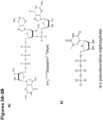
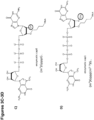
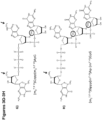
- an RNA polynucleotide disclosed herein comprises a Cap shown in any one of Figures 3A-3I .
- an RNA polynucleotide disclosed herein comprises a Cap shown in Figure 3A .
- an RNA polynucleotide disclosed herein comprises a Cap shown in Figure 3B .
- an RNA polynucleotide disclosed herein comprises a Cap shown in Figure 3C .
- an RNA polynucleotide disclosed herein comprises a Cap shown in Figure 3D .
- an RNA polynucleotide disclosed herein comprises a Cap shown in Figure 3E .
- an RNA polynucleotide disclosed herein comprises a Cap shown in Figure 3F . In some embodiments, an RNA polynucleotide disclosed herein comprises a Cap shown in Figure 3G . In some embodiments, an RNA polynucleotide disclosed herein comprises a Cap shown in Figure 3H . In some embodiments, an RNA polynucleotide disclosed herein comprises a Cap shown in Figure 3I .
- an RNA disclosed herein comprises a 5'-UTR.
- the term "untranslated region" or “UTR” relates to a region in a DNA molecule which is transcribed but is not translated into an amino acid sequence, or to the corresponding region in an RNA polynucleotide, such as an mRNA molecule.
- An untranslated region (UTR) can be present 5' (upstream) of an open reading frame (5'-UTR) and/or 3' (downstream) of an open reading frame (3'-UTR).
- a 5'-UTR, if present, is located at the 5' end, upstream of the start codon of a protein-encoding region.
- a 5'-UTR is downstream of the 5'-cap (if present), e.g. directly adjacent to the 5'-cap.
- a 5' UTR disclosed herein comprises a cap proximal sequence, e.g., as disclosed herein.
- a cap proximal sequence comprises a sequence adjacent to a 5' cap.
- a cap proximal sequence comprises nucleotides in positions +1, +2, +3, +4, and/or +5 of an RNA polynucleotide.
- a Cap structure comprises one or more polynucleotides of a cap proximal sequence.
- a Cap structure comprises an m7 Guanosine cap and nucleotide +1 (N 1 ) of an RNA polynucleotide.
- a Cap structure comprises an m7 Guanosine cap and nucleotide +2 (N 2 ) of an RNA polynucleotide.
- a Cap structure comprises an m7 Guanosine cap and nucleotides +1 and +2 (N 1 and N 2 ) of an RNA polynucleotide.
- one or more residues of a cap proximal sequence may be included in an RNA by virtue of having been included in a cap entity that (e.g., a Cap1 structure, etc); alternatively, in some embodiments, at least some of the residues in a cap proximal sequence may be enzymatically added (e.g., by a polymerase such as a T7 polymerase).
- +1 and +2 are the (m 1 2'-O )A and G residues of the cap, and +3, +4, and +5 are added by polymerase (e.g., T7 polymerase).
- a cap proximal sequence comprises N 1 and N 2 of a Cap structure, wherein N 1 and N 2 are any nucleotide, e.g., A, C, G or U.
- N 1 is A.
- N 1 is C.
- N 1 is G.
- N 1 is U.
- N 2 is A.
- N 2 is C.
- N 2 is G.
- N 2 is U.
- N 1 is A and N 2 is A. In some embodiments, N 1 is A and N 2 is C. In some embodiments, N 1 is A and N 2 is G. In some embodiments, N 1 is A and N 2 is U.
- N 1 is C and N 2 is A. In some embodiments, N 1 is C and N 2 is C. In some embodiments, N 1 is C and N 2 is G. In some embodiments, N 1 is C and N 2 is U.
- N 1 is G and N 2 is A. In some embodiments, N 1 is G and N 2 is C. In some embodiments, N 1 is G and N 2 is G. In some embodiments, N 1 is G and N 2 is U.
- N 1 is U and N 2 is A. In some embodiments, N 1 is U and N 2 is C. In some embodiments, N 1 is U and N 2 is G. In some embodiments, N 1 is U and N 2 is U.
- a cap proximal sequence comprises N 1 and N 2 of a Cap structure and N 3 , N 4 and N 5 , wherein N 1 to N 5 correspond to positions +1, +2, +3, +4, and/or +5 of an RNA polynucleotide.
- N 1 , N 2 , N 3 , N 4 , or N 5 arc any nucleotide, e.g., A, C, G or U.
- N 1 is A and N 2 is G.
- N 3 is A.
- N 4 is A.
- Ns is A.
- N 1 , N 2 , N 3 , N 4 , or N 5 are any nucleotide, e.g., A, C, G or U. In some embodiments, N 1 is A and N 2 is G. In some embodiments, N 3 is A. In some embodiments, N 4 is C. In some embodiments, N 5 is A.
- N 1 , N 2 , N 3 , N 4 , or N 5 are any nucleotide, e.g., A, C, G or U.
- N 1 is A and N 2 is G.
- N 3 is A.
- N 4 is G.
- N 5 is A.
- N 1 , N 2 , N 3 , N 4 , or N 5 are any nucleotide, e.g., A, C, G or U. In some embodiments, N 1 is A and N 2 is G. In some embodiments, N 3 is A. In some embodiments, N 4 is U. In some embodiments, N 5 is A.
- N 1 , N 2 , N 3 , N 4 ,or N 5 are any nucleotide, e.g., A, C, G or U.
- N 1 is A and N 2 is G.
- N 3 is A.
- N 4 is A.
- N 5 is G.
- N 1 , N 2 , N 3 , N 4 , or N 5 are any nucleotide, e.g., A, C, G or U.
- N 1 is A and N 2 is G.
- N 3 is A.
- N 4 is G.
- N 5 is G.
- N 1 , N 2 , N 3 , N 4 , or N 5 are any nucleotide, e.g., A, C, G or U.
- N 1 is A and N 2 is G.
- N 3 is A.
- N 4 is C.
- N 5 is G.
- N 1 , N 2 , N 3 , N 4 , or N 5 are any nucleotide, e.g., A, C, G or U.
- N 1 is A and N 2 is G.
- N 3 is A.
- N 4 is U.
- N 5 is G.
- N 1 , N 2 , N 3 , N 4 , or N 5 are any nucleotide, e.g., A, C, G or U. In some embodiments, N 1 is A and N 2 is G. In some embodiments, N 3 is A. In some embodiments, N 4 is A. In some embodiments, N 5 is C.
- N 1 , N 2 , N 3 , N 4 , or N 5 are any nucleotide, e.g., A, C, G or U. In some embodiments, N 1 is A and N 2 is G. In some embodiments, N 3 is A. In some embodiments, N 4 is C. In some embodiments, N 5 is C.
- N 1 , N 2 , N 3 , N 4 , or N 5 are any nucleotide, e.g., A, C, G or U.
- N 1 is A and N 2 is G.
- N 3 is A.
- N 4 is G.
- N 5 is C.
- N 1 , N 2 , N 3 , N 4 , or N 5 are any nucleotide, e.g., A, C, G or U. In some embodiments, N 1 is A and N 2 is G. In some embodiments, N 3 is A. In some embodiments, N 4 is U. In some embodiments, N 5 is C.
- N 1 , N 2 , N 3 , N 4 , or N 5 are any nucleotide, e.g., A, C, G or U. In some embodiments, N 1 is A and N 2 is G. In some embodiments, N 3 is A. In some embodiments, N 4 is A. In some embodiments, N 5 is U.
- N 1 , N 2 , N 3 , N 4 , or N 5 are any nucleotide, e.g., A, C, G or U.
- N 1 is A and N 2 is G.
- N 3 is A.
- N 4 is C.
- N 5 is U.
- N 1 , N 2 , N 3 , N 4 , or N 5 are any nucleotide, e.g., A, C, G or U.
- N 1 is A and N 2 is G.
- N 3 is A.
- N 4 is G.
- N 5 is U.
- N 1 , N 2 , N 3 , N 4 , or N 5 are any nucleotide, e.g., A, C, G or U.
- N 1 is A and N 2 is G.
- N 3 is A.
- N 4 is U.
- N 5 is U.
- N 1 , N 2 , N 3 , N 4 , or N 5 are any nucleotide, e.g., A, C, G or U. In some embodiments, N 1 is A and N 2 is G. In some embodiments, N 3 is C. In some embodiments, N 4 is A. In some embodiments, N 5 is A.
- N 1 , N 2 , N 3 , N 4 , or N 5 are any nucleotide, e.g., A, C, G or U. In some embodiments, N 1 is A and N 2 is G. In some embodiments, N 3 is C. In some embodiments, N 4 is C. In some embodiments, N 5 is A.
- N 1 , N 2 , N 3 , N 4 , or N 5 are any nucleotide, e.g., A, C, G or U.
- N 1 is A and N 2 is G.
- N 3 is C.
- N 4 is G.
- N 5 is A.
- N 1 , N 2 , N 3 , N 4 , or N 5 are any nucleotide, e.g., A, C, G or U. In some embodiments, N 1 is A and N 2 is G. In some embodiments, N 3 is C. In some embodiments, N 4 is U. In some embodiments, N 5 is A.
- N 1 , N 2 , N 3 , N 4 , or N 5 are any nucleotide, e.g., A, C, G or U.
- N 1 is A and N 2 is G.
- N 3 is C.
- N 4 is A.
- N 5 is G.
- N 1 , N 2 , N 3 , N 4 , or N 5 are any nucleotide, e.g., A, C, G or U.
- N 1 is A and N 2 is G.
- N 3 is C.
- N 4 is G.
- N 5 is G.
- N 1 , N 2 , N 3 , N 4 , or N 5 are any nucleotide, e.g., A, C, G or U.
- N 1 is A and N 2 is G.
- N 3 is C.
- N 4 is C.
- N 5 is G.
- N 1 , N 2 , N 3 , N 4 , or N 5 are any nucleotide, e.g., A, C, G or U.
- N 1 is A and N 2 is G.
- N 3 is C.
- N 4 is U.
- N 5 is G.
- N 1 , N 2 , N 3 , N 4 , or N 5 are any nucleotide, e.g., A, C, G or U. In some embodiments, N 1 is A and N 2 is G. In some embodiments, N 3 is C. In some embodiments, N 4 is A. In some embodiments, N 5 is C.
- N 1 , N 2 , N 3 , N 4 , or N 5 are any nucleotide, e.g., A, C, G or U. In some embodiments, N 1 is A and N 2 is G. In some embodiments, N 3 is C. In some embodiments, N 4 is C. In some embodiments, N 5 is C.
- N 1 , N 2 , N 3 , N 4 , or N 5 are any nucleotide, e.g., A, C, G or U.
- N 1 is A and N 2 is G.
- N 3 is C.
- N 4 is G.
- N 5 is C.
- N 1 , N 2 , N 3 , N 4 , or N 5 are any nucleotide, e.g., A, C, G or U. In some embodiments, N 1 is A and N 2 is G. In some embodiments, N 3 is C. In some embodiments, N 4 is U. In some embodiments, N 5 is C.
- N 1 , N 2 , N 3 , N 4 , or N 5 are any nucleotide, e.g., A, C, G or U. In some embodiments, N 1 is A and N 2 is G. In some embodiments, N 3 is C. In some embodiments, N 4 is A. In some embodiments, N 5 is U.
- N 1 , N 2 , N 3 , N 4 , or N 5 are any nucleotide, e.g., A, C, G or U. In some embodiments, N 1 is A and N 2 is G. In some embodiments, N 3 is C. In some embodiments, N 4 is C. In some embodiments, N 5 is U.
- N 1 , N 2 , N 3 , N 4 , or N 5 are any nucleotide, e.g., A, C, G or U.
- N 1 is A and N 2 is G.
- N 3 is C.
- N 4 is G.
- N 5 is U.
- N 1 , N 2 , N 3 , N 4 , or N 5 are any nucleotide, e.g., A, C, G or U.
- N 1 is A and N 2 is G.
- N 3 is C.
- N 4 is U.
- N 5 is U.
- N 1 , N 2 , N 3 , N 4 , or N 5 are any nucleotide, e.g., A, C, G or U.
- N 1 is A and N 2 is G.
- N 3 is G.
- N 4 is A.
- N 5 is A.
- N 1 , N 2 , N 3 , N 4 , or N 5 are any nucleotide, e.g., A, C, G or U.
- N 1 is A and N 2 is G.
- N 3 is G.
- N 4 is C.
- N 5 is A.
- N 1 , N 2 , N 3 , N 4 , or N 5 are any nucleotide, e.g., A, C, G or U.
- N 1 is A and N 2 is G.
- N 3 is G.
- N 4 is G.
- N 5 is A.
- N 1 , N 2 , N 3 , N 4 , or N 5 are any nucleotide, e.g., A, C, G or U.
- N 1 is A and N 2 is G.
- N 3 is G.
- N 4 is U.
- N 5 is A.
- N 1 , N 2 , N 3 , N 4 , or N 5 are any nucleotide, e.g., A, C, G or U.
- N 1 is A and N 2 is G.
- N 3 is G.
- N 4 is A.
- N 5 is G.
- N 1 , N 2 , N 3 , N 4 , or N 5 are any nucleotide, e.g., A, C, G or U.
- N 1 is A and N 2 is G.
- N 3 is G.
- N 4 is G.
- N 5 is G.
- N 1 , N 2 , N 3 , N 4 , or N 5 are any nucleotide, e.g., A, C, G or U.
- N 1 is A and N 2 is G.
- N 3 is G.
- N 4 is C.
- N 5 is G.
- N 1 , N 2 , N 3 , N 4 , or N 5 are any nucleotide, e.g., A, C, G or U.
- N 1 is A and N 2 is G.
- N 3 is G.
- N 4 is U.
- N 5 is G.
- N 1 , N 2 , N 3 , N 4 , or N 5 are any nucleotide, e.g., A, C, G or U.
- N 1 is A and N 2 is G.
- N 3 is G.
- N 4 is A.
- N 5 is C.
- N 1 , N 2 , N 3 , N 4 , or N 5 are any nucleotide, e.g., A, C, G or U.
- N 1 is A and N 2 is G.
- N 3 is G.
- N 4 is C.
- N 5 is C.
- N 1 , N 2 , N 3 , N 4 , or N 5 are any nucleotide, e.g., A, C, G or U.
- N 1 is A and N 2 is G.
- N 3 is G.
- N 4 is G.
- N 5 is C.
- N 1 , N 2 , N 3 , N 4 , or N 5 are any nucleotide, e.g., A, C, G or U.
- N 1 is A and N 2 is G.
- N 3 is G.
- N 4 is U.
- N 5 is C.
- N 1 , N 2 , N 3 , N 4 , or N 5 are any nucleotide, e.g., A, C, G or U.
- N 1 is A and N 2 is G.
- N 3 is G.
- N 4 is A.
- N 5 is U.
- N 1 , N 2 , N 3 , N 4 , or N 5 are any nucleotide, e.g., A, C, G or U.
- N 1 is A and N 2 is G.
- N 3 is G.
- N 4 is C.
- N 5 is U.
- N 1 , N 2 , N 3 , N 4 , or N 5 are any nucleotide, e.g., A, C, G or U.
- N 1 is A and N 2 is G.
- N 3 is G.
- N 4 is G.
- N 5 is U.
- N 1 , N 2 , N 3 , N 4 , or N 5 are any nucleotide, e.g., A, C, G or U.
- N 1 is A and N 2 is G.
- N 3 is G.
- N 4 is U.
- N 5 is U.
- N 1 , N 2 , N 3 , N 4 , or N 5 are any nucleotide, e.g., A, C, G or U. In some embodiments, N 1 is A and N 2 is G. In some embodiments, N 3 is U. In some embodiments, N 4 is A. In some embodiments, N 5 is A.
- N 1 , N 2 , N 3 , N 4 , or N 5 are any nucleotide, e.g., A, C, G or U. In some embodiments, N 1 is A and N 2 is G. In some embodiments, N 3 is U. In some embodiments, N 4 is C. In some embodiments, N 5 is A.
- N 1 , N 2 , N 3 , N 4 , or N 5 are any nucleotide, e.g., A, C, G or U.
- N 1 is A and N 2 is G.
- N 3 is U.
- N 4 is G.
- N 5 is A.
- N 1 , N 2 , N 3 , N 4 , or N 5 are any nucleotide, e.g., A, C, G or U.
- N 1 is A and N 2 is G.
- N 3 is U.
- N 4 is U.
- N 5 is A.
- N 1 , N 2 , N 3 , N 4 , or N 5 are any nucleotide, e.g., A, C, G or U.
- N 1 is A and N 2 is G.
- N 3 is U.
- N 4 is A.
- N 5 is G.
- N 1 , N 2 , N 3 , N 4 , or N 5 are any nucleotide, e.g., A, C, G or U.
- N 1 is A and N 2 is G.
- N 3 is U.
- N 4 is G.
- N 5 is G.
- N 1 , N 2 , N 3 , N 4 , or N 5 are any nucleotide, e.g., A, C, G or U.
- N 1 is A and N 2 is G.
- N 3 is U.
- N 4 is C.
- N 5 is G.
- N 1 , N 2 , N 3 , N 4 , or N 5 are any nucleotide, e.g., A, C, G or U.
- N 1 is A and N 2 is G.
- N 3 is U.
- N 4 is U.
- N 5 is G.
- N 1 , N 2 , N 3 , N 4 , or N 5 are any nucleotide, e.g., A, C, G or U. In some embodiments, N 1 is A and N 2 is G. In some embodiments, N 3 is U. In some embodiments, N 4 is A. In some embodiments, N 5 is C.
- N 1 , N 2 , N 3 , N 4 , or N 5 are any nucleotide, e.g., A, C, G or U. In some embodiments, N 1 is A and N 2 is G. In some embodiments, N 3 is U. In some embodiments, N 4 is C. In some embodiments, N 5 is C.
- N 1 , N 2 , N 3 , N 4 , or N 5 are any nucleotide, e.g., A, C, G or U.
- N 1 is A and N 2 is G.
- N 3 is U.
- N 4 is G.
- N 5 is C.
- N 1 , N 2 , N 3 , N 4 , or N 5 are any nucleotide, e.g., A, C, G or U.
- N 1 is A and N 2 is G.
- N 3 is U.
- N 4 is U.
- N 5 is C.
- N 1 , N 2 , N 3 , N 4 , or N 5 are any nucleotide, e.g., A, C, G or U.
- N 1 is A and N 2 is G.
- N 3 is U.
- N 4 is A.
- N 5 is U.
- N 1 , N 2 , N 3 , N 4 , or N 5 are any nucleotide, e.g., A, C, G or U.
- N 1 is A and N 2 is G.
- N 3 is U.
- N 4 is C.
- N 5 is U.
- N 1 , N 2 , N 3 , N 4 , or N 5 are any nucleotide, e.g., A, C, G or U.
- N 1 is A and N 2 is G.
- N 3 is U.
- N 4 is G.
- N 5 is U.
- N 1 , N 2 , N 3 , N 4 , or N 5 are any nucleotide, e.g., A, C, G or U.
- N 1 is A and N 2 is G.
- N 3 is U.
- N 4 is U.
- N 5 is U.
- a 5' UTR disclosed herein comprises a cap proximal sequence, e.g., as disclosed herein.
- a cap proximal sequence comprises a sequence adjacent to a 5' cap.
- a cap proximal sequence comprises nucleotides in positions +1, +2, +3, +4, and/or +5 of an RNA polynucleotide.
- a Cap structure comprises one or more polynucleotides of a cap proximal sequence.
- a Cap structure comprises an m7 Guanosine cap and nucleotide +1 (Ni) of an RNA polynucleotide.
- a Cap structure comprises an m7 Guanosine cap and nucleotide +2 (N 2 ) of an RNA polynucleotide.
- a Cap structure comprises an m7 Guanosine cap and nucleotides +1 and +2 (N 1 and N 2 ) of an RNA polynucleotide.
- N 1 and N 2 are each independently chosen from: A, C, G, or U. In some embodiments, N 1 is A. In some embodiments, N 1 is C. In some embodiments, N 1 is G. In some embodiments, N 1 is U. In some embodiments, N 2 is A. In some embodiments, N 2 is C. In some embodiments, N 2 is G. In some embodiments, N 2 is U.
- N 1 and N 2 are each independently chosen from: A, C, G, or U. In some embodiments, N 1 is A. In some embodiments, N 1 is C. In some embodiments, N 1 is G. In some embodiments, N 1 is U. In some embodiments, N 2 is A. In some embodiments, N 2 is C. In some embodiments, N 2 is G. In some embodiments, N 2 is U.
- N 1 is A and N 2 is A. In some embodiments, N 1 is A and N 2 is C. In some embodiments, N 1 is A and N 2 is G. In some embodiments, N 1 is A and N 2 is U.
- N 1 is C and N 2 is A. In some embodiments, N 1 is C and N 2 is C. In some embodiments, N 1 is C and N 2 is G. In some embodiments, N 1 is C and N 2 is U.
- N 1 is G and N 2 is A. In some embodiments, N 1 is G and N 2 is C. In some embodiments, N 1 is G and N 2 is G. In some embodiments, N 1 is G and N 2 is U.
- N 1 is U and N 2 is A. In some embodiments, N 1 is U and N 2 is C. In some embodiments, N 1 is U and N 2 is G. In some embodiments, N 1 is U and N 2 is U.
- a cap proximal sequence comprises N 1 and N 2 of a Cap structure, and a sequence comprising: A 3 A 4 X 5 (SEQ ID NO: 1).
- N 1 and N 2 are each independently chosen from: A, C, G, or U.
- N 1 is A and N 2 is G.
- X 5 is chosen from A, C, G or U.
- X 5 is A.
- X 5 is C.
- X 5 is G.
- X 5 is U.
- a cap proximal sequence comprises N 1 and N 2 of a Cap structure, and a sequence comprising: C 3 A 4 X 5 (SEQ ID NO: 2).
- N 1 and N 2 are each independently chosen from: A, C, G, or U.
- N 1 is A and N 2 is G.
- X 5 is chosen from A, C, G or U.
- X 5 is A.
- X 5 is C.
- X 5 is G.
- X 5 is U.
- a cap proximal sequence comprises N 1 and N 2 of a Cap structure, and a sequence comprising X 3 Y 4 X 5 (SEQ ID NO: 7).
- N 1 and N 2 are each independently chosen from: A, C, G, or U.
- N 1 is A and N 2 is G.
- X 3 and X 5 is each independently chosen from A, C, G or U.
- X 3 and/or X 5 is A.
- X 3 and/or X 5 is C.
- X 3 and/or X 5 is G.
- X 3 and/or X 5 is U.
- Y 4 is not C.
- Y 4 is A.
- Y 4 is G.
- Y 4 is U.
- a cap proximal sequence comprises N 1 and N 2 of a Cap structure, and a sequence comprising X 3 Y 4 X 5 (SEQ ID NO: 7).
- N 1 and N 2 are each independently chosen from: A, C, G, or U.
- N 1 is A and N 2 is G.
- X 3 and X 5 is each independently chosen from A, C, G or U.
- X 3 and/or X 5 is A.
- X 3 and/or X 5 is C.
- X 3 and/or X 5 is G.
- X 3 and/or X 5 is U.
- Y 4 is not G.
- Y 4 is A.
- Y 4 is C.
- Y 4 is U.
- a cap proximal sequence comprises N 1 and N 2 of a Cap structure, and a sequence comprising A 3 C 4 A 5 (SEQ ID NO: 3).
- N 1 and N 2 are each independently chosen from: A, C, G, or U.
- N 1 is A and N 2 is G.
- a cap proximal sequence comprises N 1 and N 2 of a Cap structure, and a sequence comprising A 3 U 4 G 5 (SEQ ID NO: 4).
- N 1 and N 2 are each independently chosen from: A, C, G, or U.
- N 1 is A and N 2 is G.
- a Cap structure comprises one or more polynucleotides of a cap proximal sequence.
- a Cap structure comprises an m7 Guanosine cap and nucleotide +1 (Ni) of an RNA polynucleotide.
- a Cap structure comprises an m7 Guanosine cap and nucleotide +2 (N 2 ) of an RNA polynucleotide.
- a Cap structure comprises an m7 Guanosine cap and nucleotides +1 and +2 (N 1 and N 2 ) of an RNA polynucleotide.
- N 1 and N 2 are any nucleotide, e.g., A, C, G, or U.
- N 1 is A.
- N 1 is C.
- N 1 is G.
- N 1 is U.
- N 2 is A.
- N 2 is C.
- N 2 is G.
- N 2 is U.
- N 1 and N 2 are any nucleotide, e.g., A, C, G, or U.
- N 1 is A.
- N 1 is C.
- N 1 is G.
- N 1 is U.
- N 2 is A.
- N 2 is C.
- N 2 is G.
- N 2 is U.
- N 1 is A and N 2 is A. In some embodiments, N 1 is A and N 2 is C. In some embodiments, N 1 is A and N 2 is G. In some embodiments, N 1 is A and N 2 is U.
- N 1 is C and N 2 is A. In some embodiments, N 1 is C and N 2 is C. In some embodiments, N 1 is C and N 2 is G. In some embodiments, N 1 is C and N 2 is U.
- N 1 is G and N 2 is A. In some embodiments, N 1 is G and N 2 is C. In some embodiments, N 1 is G and N 2 is G. In some embodiments, N 1 is G and N 2 is U.
- N 1 is U and N 2 is A. In some embodiments, N 1 is U and N 2 is C. In some embodiments, N 1 is U and N 2 is G. In some embodiments, N 1 is U and N 2 is U.
- a cap proximal sequence comprises N 1 and N 2 of a Cap structure, and a sequence comprising: A 3 A 4 X 5 (SEQ ID NO: 1).
- N 1 and N 2 are any nucleotide, e.g., A, C, G, or U.
- N 1 is A and N 2 is G.
- X 5 is chosen from A, C, G or U.
- X 5 is A.
- X 5 is C.
- X 5 is G.
- X 5 is U.
- a cap proximal sequence comprises N 1 and N 2 of a Cap structure, and a sequence comprising: C 3 A 4 X 5 (SEQ ID NO: 2).
- N 1 and N 2 are any nucleotide, e.g., A, C, G, or U.
- N 1 is A and N 2 is G.
- X 5 is any nucleotide, e.g., A, C, G or U.
- X 5 is A.
- X 5 is C.
- X 5 is G.
- X 5 is U.
- a cap proximal sequence comprises N 1 and N 2 of a Cap structure, and a sequence comprising X 3 Y 4 X 5 (SEQ ID NO: 7).
- N 1 and N 2 are any nucleotide, e.g., A, C, G, or U.
- N 1 is A and N 2 is G.
- X 3 and X 5 is any nucleotide, e.g., A, C, G or U.
- X 3 and/or X 5 is A.
- X 3 and/or X 5 is C.
- X 3 and/or X 5 is G.
- X 3 and/or X 5 is U.
- Y 4 is not C.
- Y 4 is A.
- Y 4 is G.
- Y 4 is U.
- a cap proximal sequence comprises N 1 and N 2 of a Cap structure, and a sequence comprising X 3 Y 4 X 5 (SEQ ID NO: 7).
- N 1 and N 2 are any nucleotide, e.g., A, C, G, or U.
- N 1 is A and N 2 is G.
- X 3 and X 5 is any nucleotide, e.g., A, C, G or U.
- X 3 and/or X 5 is A.
- X 3 and/or X 5 is C.
- X 3 and/or X 5 is G.
- X 3 and/or X 5 is U.
- Y 4 is not G.
- Y 4 is A.
- Y 4 is C.
- Y 4 is U.
- a cap proximal sequence comprises N 1 and N 2 of a Cap structure, and a sequence comprising A 3 C 4 A 5 (SEQ ID NO: 3).
- N 1 and N 2 are any nucleotide, e.g., A, C, G, or U.
- N 1 is A and N 2 is G.
- a cap proximal sequence comprises N 1 and N 2 of a Cap structure, and a sequence comprising A 3 U 4 G 5 (SEQ ID NO: 4).
- N 1 and N 2 are any nucleotide, e.g., A, C, G, or U.
- N 1 is A and N 2 is G.
- Exemplary 5' UTRs include a human alpha globin (hAg) 5'UTR or a fragment thereof, a TEV 5' UTR or a fragment thereof, a HSP70 5' UTR or a fragment thereof, or a c-Jun 5' UTR or a fragment thereof.
- hAg human alpha globin
- an RNA disclosed herein comprises a hAg 5' UTR or a fragment thereof. In some embodiments, an RNA disclosed herein comprises a hAg 5' UTR having 99%, 98%, 97%, 96%, 95%, 90%, 85%, or 80% identity to a human alpha globin 5' UTR provided in SEQ ID NO: 11. In some embodiments, an RNA disclosed herein comprises a hAg 5' UTR provided in SEQ ID NO: 11.
- an RNA disclosed herein comprises a hAg 5' UTR having 99%, 98%, 97%, 96%, 95%, 90%, 85%, or 80% identity to a human alpha globin 5' UTR provided in SEQ ID NO: 12. In some embodiments, an RNA disclosed herein comprises a hAg 5' UTR provided in SEQ ID NO: 12.
- an RNA disclosed herein comprises a 3'-UTR.
- a 3'-UTR if present, is located at the 3' end, downstream of the termination codon of a protein-encoding region, but the term "3'-UTR" does preferably not include the poly(A) sequence.
- the 3'-UTR is upstream of the poly(A) sequence (if present), e.g. directly adjacent to the poly(A) sequence.
- an RNA disclosed herein comprises a 3' UTR comprising an F element and/or an I element.
- a 3' UTR or a proximal sequence thereto comprises a restriction site.
- a restriction site is a BamHI site.
- a restriction site is a XhoI site.
- an RNA disclosed herein comprises a 3' UTR having 99%, 98%, 97%, 96%, 95%, 90%, 85%, or 80% identity to a 3' UTR provided in SEQ ID NO: 13. In some embodiments, an RNA disclosed herein comprises a 3' UTR provided in SEQ ID NO: 13.
- an RNA disclosed herein comprises a polyadenylate (PolyA) sequence, e.g., as described herein.
- a PolyA sequence is situated downstream of a 3'-UTR, e.g., adjacent to a 3'-UTR.
- poly(A) sequence or "poly-A tail” refers to an uninterrupted or interrupted sequence of adenylate residues which is typically located at the 3'-end of an RNA polynucleotide.
- Poly(A) sequences are known to those of skill in the art and may follow the 3'-UTR in the RNAs described herein.
- An uninterrupted poly(A) sequence is characterized by consecutive adenylate residues. In nature, an uninterrupted poly(A) sequence is typical.
- RNAs disclosed herein can have a poly(A) sequence attached to the free 3'-end of the RNA by a template-independent RNA polymerase after transcription or a poly(A) sequence encoded by DNA and transcribed by a template-dependent RNA polymerase.
- a poly(A) sequence of about 120 A nucleotides has a beneficial influence on the levels of RNA in transfected eukaryotic cells, as well as on the levels of protein that is translated from an open reading frame that is present upstream (5') of the poly(A) sequence ( Holtkamp et al., 2006, Blood, vol. 108, pp. 4009-4017 ).
- the poly(A) sequence may be of any length.
- a poly(A) sequence comprises, essentially consists of, or consists of at least 20, at least 30, at least 40, at least 80, or at least 100 and up to 500, up to 400, up to 300, up to 200, or up to 150 A nucleotides, and, in particular, about 120 A nucleotides.
- nucleotides in the poly(A) sequence typically at least 75%, at least 80%, at least 85%, at least 90%, at least 95%, at least 96%, at least 97%, at least 98%, or at least 99% by number of nucleotides in the poly(A) sequence are A nucleotides, but permits that remaining nucleotides are nucleotides other than A nucleotides, such as U nucleotides (uridylate), G nucleotides (guanylate), or C nucleotides (cytidylate).
- consists of means that all nucleotides in the poly(A) sequence, i.e., 100% by number of nucleotides in the poly(A) sequence, are A nucleotides.
- a nucleotide or “A” refers to adenylate.
- a poly(A) sequence is attached during RNA transcription, e.g., during preparation of in vitro transcribed RNA, based on a DNA template comprising repeated dT nucleotides (deoxythymidylate) in the strand complementary to the coding strand.
- the DNA sequence encoding a poly(A) sequence (coding strand) is referred to as poly(A) cassette.
- the poly(A) cassette present in the coding strand of DNA essentially consists of dA nucleotides, but is interrupted by a random sequence of the four nucleotides (dA, dC, dG, and dT). Such random sequence may be 5 to 50, 10 to 30, or 10 to 20 nucleotides in length.
- a cassette is disclosed in WO 2016/005324 A1 , hereby incorporated by reference. Any poly(A) cassette disclosed in WO 2016/005324 A1 may be used in the present invention.
- a poly(A) cassette that essentially consists of dA nucleotides, but is interrupted by a random sequence having an equal distribution of the four nucleotides (dA, dC, dG, dT) and having a length of e.g., 5 to 50 nucleotides shows, on DNA level, constant propagation of plasmid DNA in E. coli and is still associated, on RNA level, with the beneficial properties with respect to supporting RNA stability and translational efficiency is encompassed.
- the poly(A) sequence contained in an RNA polynucleotide described herein essentially consists of A nucleotides, but is interrupted by a random sequence of the four nucleotides (A, C, G, U). Such random sequence may be 5 to 50, 10 to 30, or 10 to 20 nucleotides in length.
- no nucleotides other than A nucleotides flank a poly(A) sequence at its 3'-end, i.e., the poly(A) sequence is not masked or followed at its 3'-end by a nucleotide other than A.
- the poly(A) sequence may comprise at least 20, at least 30, at least 40, at least 80, or at least 100 and up to 500, up to 400, up to 300, up to 200, or up to 150 nucleotides. In some embodiments, the poly(A) sequence may essentially consist of at least 20, at least 30, at least 40, at least 80, or at least 100 and up to 500, up to 400, up to 300, up to 200, or up to 150 nucleotides. In some embodiments, the poly(A) sequence may consist of at least 20, at least 30, at least 40, at least 80, or at least 100 and up to 500, up to 400, up to 300, up to 200, or up to 150 nucleotides. In some embodiments, the poly(A) sequence comprises at least 100 nucleotides. In some embodiments, the poly(A) sequence comprises about 150 nucleotides. In some embodiments, the poly(A) sequence comprises about 120 nucleotides.
- an RNA disclosed herein comprises a poly(A) sequence comprising the nucleotide sequence of SEQ ID NO: 14, or a nucleotide sequence having at least 99%, 98%, 97%, 96%, 95%, 90%, 85%, or 80% identity to the nucleotide sequence of SEQ ID NO: 14. In some embodiments, an RNA disclosed herein comprises a poly(A) sequence of SEQ ID NO: 14.
- an RNA polynucleotide disclosed herein comprises a sequence encoding a payload, e.g., as described herein.
- a sequence encoding a payload comprises a promoter sequence.
- a sequence encoding a payload comprises a sequence encoding a secretory signal peptide.
- a payload is chosen from: a protein replacement polypeptide; an antibody agent; a cytokine; an antigenic polypeptide; a gene editing component; a regenerative medicine component or combinations thereof.
- a payload is or comprises a protein replacement polypeptide.
- a protein replacement polypeptide comprises a polypeptide with aberrant expression in a disease or disorder.
- a protein replacement polypeptide comprises an intracellular protein, an extracellular protein, or a transmembrane protein.
- a protein replacement polypeptide comprises an enzyme.
- a disease or disorder with aberrant expression of a polypeptide includes but is not limited to: a rare disease, a metabolic disorder, a muscular dystrophy, a cardiovascular disease, or a monogenic disease.
- a payload is or comprises a cytokine or a fragment or a variant thereof.
- a cytokine comprises: IL-12 or a fragment or variant or a fusion thereof, IL-15 or a fragment or a variant or a fusion thereof, GMCSF or a fragment or a variant thereof; or IFN-alpha or a fragment or a variant thereof.
- a payload is or comprises an antigenic polypeptide or an immunogenic variant or an immunogenic fragment thereof.
- an antigenic polypeptide comprises one epitope from an antigen.
- an antigenic polypeptide comprises a plurality of distinct epitopes from an antigen.
- an antigenic polypeptide comprising a plurality of distinct epitopes from an antigen is polyepitopic.
- an antigenic polypeptide comprises: an antigenic polypeptide from an allergen, a viral antigenic polypeptide, a bacterial antigenic polypeptide, a fungal antigenic polypeptide, a parasitic antigenic polypeptide, an antigenic polypeptide from an infectious agent, an antigenic polypeptide from a pathogen, a tumor antigenic polypeptide, or a self-antigenic polypeptide.
- a viral antigenic polypeptide comprises an HIV antigenic polypeptide, an influenza antigenic polypeptide, a Coronavirus antigenic polypeptide, a Rabies antigenic polypeptide, or a Zika virus antigenic polypeptide.
- a viral antigenic polypeptide is or comprises a Coronavirus antigenic polypeptide.
- a Coronavirus antigen is or comprises a SARS-CoV-2 protein.
- a SARS-CoV-2 protein comprises a SARS-CoV-2 Spike (S) protein, or an immunogenic variant or an immunogenic fragment thereof.
- a SARS-CoV-2 protein, or immunogenic variant or immunogenic fragment thereof comprises proline residues at positions 986 and 987.
- a SARS-CoV-2 S polypeptide has at least 99%, 98%, 97%, 96%, 95%, 90%, 85%, or 80% identity to a SARS-CoV-2 S polypeptide disclosed herein. In some embodiments, a SARS-CoV-2 S polypeptide has at least 99%, 98%, 97%, 96%, 95%, 90%, 85%, or 80% identity to SEQ ID NO: 9.
- a SARS-CoV-2 S polypeptide is encoded by an RNA having at least 99%, 98%, 97%, 96%, 95%, 90%, 85%, or 80% identity to a SARS-CoV-2 S polynucleotide disclosed herein. In some embodiments, a SARS-CoV-2 S polypeptide is encoded by an RNA having at least 99%, 98%, 97%, 96%, 95%, 90%, 85%, or 80% identity to SEQ ID NO: 10.
- a payload is or comprises a tumor antigenic polypeptide or an immunogenic variant or an immunogenic fragment thereof.
- a tumor antigenic polypeptide comprises a tumor specific antigen, a tumor associated antigen, a tumor neoantigen, or a combination thereof.
- a tumor antigenic polypeptide comprises p53, ART-4, BAGE, ss-catenin/m, Bcr-abL CAMEL, CAP-1, CASP-8, CDC27/m, CDK4/m, CEA, CLAUDIN-12, c-MYC, CT, Cyp-B, DAM, ELF2M, ETV6-AML1, G250, GAGE, GnT-V, Gap100, HAGE, HER-2/neu, HPV-E7, HPV-E6, HAST-2, hTERT (or hTRT), LAGE, LDLR/FUT, MAGE-A, preferably MAGE-A1, MAGE-A2, MAGE-A3, MAGE-A4, MAGE-A5, MAGE-A6, MAGE-A7, MAGE-A8, MAGE-A9, MAGE-A10, MAGE-A11, or MAGE-A12, MAGE-B, MAGE-C, MART-1/Melan-
- a tumor antigenic polypeptide comprises a tumor antigen from a carcinoma, a sarcoma, a melanoma, a lymphoma, a leukemia, or a combination thereof.
- a tumor antigenic polypeptide comprises a melanoma tumor antigen.
- a tumor antigenic polypeptide comprises a prostate cancer antigen.
- a tumor antigenic polypeptide comprises a HPV16 positive head and neck cancer antigen.
- a tumor antigenic polypeptide comprises a breast cancer antigen.
- a tumor antigenic polypeptide comprises an ovarian cancer antigen.
- a tumor antigenic polypeptide comprises a lung cancer antigen.
- a tumor antigenic polypeptide comprises an NSCLC antigen.
- a payload is or comprises a self-antigenic polypeptide or an immunogenic variant or an immunogenic fragment thereof.
- a self-antigenic polypeptide comprises an antigen that is typically expressed on cells and is recognized as a self-antigen by an immune system.
- a self-antigenic polypeptide comprises: a multiple sclerosis antigenic polypeptide, a Rheumatoid arthritis antigenic polypeptide, a lupus antigenic polypeptide, a celiac disease antigenic polypeptide, a Sjogren's syndrome antigenic polypeptide, or an ankylosing spondylitis antigenic polypeptide, or a combination thereof.
- an RNA polynucleotide described herein or a composition or medical preparation comprising the same comprises a nucleotide sequence disclosed herein.
- an RNA polynucleotide comprises a sequence having at least 80% identity to a nucleotide sequence disclosed herein.
- an RNA polynucleotide comprises a sequence encoding a polypeptide having at least 80% identity to a polypeptide sequence disclosed herein. Exemplary nucleotide and polypeptide sequences are provided e.g., in Table 1 or in this section titled "Exemplary polynucleotides" or in Example 2.
- an RNA polynucleotide described herein or a composition or medical preparation comprising the same is transcribed by a DNA template.
- a DNA template used to transcribe an RNA polynucleotide described herein comprises a sequence complementary to an RNA polynucleotide.
- a payload described herein is encoded by an RNA polynucleotide described herein comprising a nucleotide sequence disclosed herein, e.g., in Table 1 or in this section titled "Exemplary polynucleotides" or in Example 2.
- an RNA polynucleotide encodes a polypeptide payload having at least 80% identity to a polypeptide payload sequence disclosed herein.
- a payload described herein is encoded by an RNA polynucleotide transcribed by a DNA template comprising a sequence complementary to an RNA polynucleotide.
- Sequence 1 Cap proximal consensus sequence (nucleotides 1-5 of a 5' UTR) A 3 A 4 X 5 wherein X 5 is A, G, C, or U 2 Cap proximal consensus sequence (nucleotides +3 to +5 of a 5' UTR) C 3 A 4 X 5 wherein X 5 is A, G, C, or U 3 Cap proximal sequence (nucleotides +3 to +5 of a 5' UTR) A 3 C 4 A 5 4 Cap proximal sequence (nucleotides +3 to +5 of a 5' UTR) A 3 U 4 G 5 5 Cap proximal sequence (nucleotides +3 to +5 of a 5' UTR) A 3 A 4 U 5 6 Cap proximal sequence (nucleotides +3 to +5 of a 5' UTR) C 3 A 4 C 5 7 Cap proximal consensus sequence (nucleotides 1-5 of a 5' UTR)
- RBL063.1 (SEQ ID NO: 28 nucleotide; SEQ ID NO: 9 amino acid)
- RBL063.2 (SEQ ID NO: 29 nucleotide; SEQ ID NO: 9 amino acid)
- BNT162a1; RBL063.3 SEQ ID NO: 30 nucleotide; SEQ ID NO: 21 amino acid
- beta-S-ARCA(D1)-hAg-Kozak-RBD-GS-Fibritin-FI-A30L70 Encoded antigen Viral spike protein (S protein) of the SARS-CoV-2 (partial sequence, Receptor Binding Domain (RBD) of S1S2 protein) SEQ ID NO: 30
- BNT162b2; RBP020.1 SEQ ID NO: 31 nucleotide; SEQ ID NO: 9 amino acid
- RBP020.2 SEQ ID NO: 10 nucleotide; SEQ ID NO: 9 amino acid (see Table 1)
- S1S2 protein encoded antigen Viral spike protein (S1S2 protein) of the SARS-CoV-2 (partial sequence, Receptor Binding Domain (RBD) of S1S2 protein fused to fibritin)
- SEQ ID NO: 32 encoded antigen Viral spike protein (S1S2 protein) of the SARS-CoV-2 (partial sequence, Receptor Binding Domain (RBD) of S1S2 protein fused to fibritin)
- RBS004.1 (SEQ ID NO: 33; SEQ ID NO: 9 amino acid)
- RBS004.2 (SEQ ID NO: 34; SEQ ID NO: 9 amino acid)
- RBS004.4 (SEQ ID NO: 36; SEQ ID NO: 37)
- S1S2 protein encoded antigen Viral spike protein (S1S2 protein) of the SARS-CoV-2 (partial sequence, Receptor Binding Domain (RBD) of S1S2 protein fused to Fibritin fused to Transmembrane Domain (TM) of S1S2 protein); intrinsic S1S2 protein secretory signal peptide (aa 1-19) at the N-terminus of the antigen sequence SEQ ID NO: 38 SEQ ID NO: 39
- S1S2 protein encoded antigen Viral spike protein (S1S2 protein) of the SARS-CoV-2 (partial sequence, Receptor Binding Domain (RBD) of S1S2 protein fused to Fibritin fused to Transmembrane Domain (TM) of S1S2 protein); immunoglobulin secretory signal peptide (aa 1-22) at the N-terminus of the antigen sequence SEQ ID NO: 40 SEQ ID NO: 41
- Nucleic acids described herein such as RNA encoding a payload may be administered formulated as particles.
- the term “particle” relates to a structured entity formed by molecules or molecule complexes.
- the term “particle” relates to a micro- or nano-sized structure, such as a micro- or nano-sized compact structure dispersed in a medium.
- a particle is a nucleic acid containing particle such as a particle comprising DNA, RNA or a mixture thereof.
- nanoparticle refers to a particle having an average diameter suitable for parenteral administration.
- a “nucleic acid particle” can be used to deliver nucleic acid to a target site of interest (e.g., cell, tissue, organ, and the like).
- a nucleic acid particle may be formed from at least one cationic or cationically ionizable lipid or lipid-like material, at least one cationic polymer such as protamine, or a mixture thereof and nucleic acid.
- Nucleic acid particles include lipid nanoparticle (LNP)-based and lipoplex (LPX)-based formulations.
- the cationic or cationically ionizable lipid or lipid-like material and/or the cationic polymer combine together with the nucleic acid to form aggregates, and this aggregation results in colloidally stable particles.
- nucleic acid particles comprise more than one type of nucleic acid molecules, where the molecular parameters of the nucleic acid molecules may be similar or different from each other, like with respect to molar mass or fundamental structural elements such as molecular architecture, capping, coding regions or other features.
- Nucleic acid particles described herein may have an average diameter that in some embodiments ranges from about 30 nm to about 1000 nm, from about 50 nm to about 800 nm, from about 70 nm to about 600 nm, from about 90 nm to about 400 nm, or from about 100 nm to about 300 nm.
- Nucleic acid particles described herein may exhibit a polydispersity index less than about 0.5, less than about 0.4, less than about 0.3, or about 0.2 or less.
- the nucleic acid particles can exhibit a polydispersity index in a range of about 0.1 to about 0.3 or about 0.2 to about 0.3.
- the N/P ratio gives the ratio of the nitrogen groups in the lipid to the number of phosphate groups in the RNA. It is correlated to the charge ratio, as the nitrogen atoms (depending on the pH) are usually positively charged and the phosphate groups are negatively charged.
- the N/P ratio where a charge equilibrium exists, depends on the pH. Lipid formulations are frequently formed at N/P ratios larger than four up to twelve, because positively charged nanoparticles are considered favorable for transfection. In that case, RNA is considered to be completely bound to nanoparticles.
- Nucleic acid particles described herein can be prepared using a wide range of methods that may involve obtaining a colloid from at least one cationic or cationically ionizable lipid or lipid-like material and/or at least one cationic polymer and mixing the colloid with nucleic acid to obtain nucleic acid particles.
- the term "colloid” as used herein relates to a type of homogeneous mixture in which dispersed particles do not settle out.
- the insoluble particles in the mixture are microscopic, with particle sizes between 1 and 1000 nanometers.
- the mixture may be termed a colloid or a colloidal suspension. Sometimes the term “colloid” only refers to the particles in the mixture and not the entire suspension.
- colloids comprising at least one cationic or cationically ionizable lipid or lipid-like material and/or at least one cationic polymer methods are applicable herein that are conventionally used for preparing liposomal vesicles and are appropriately adapted.
- the most commonly used methods for preparing liposomal vesicles share the following fundamental stages: (i) lipids dissolution in organic solvents, (ii) drying of the resultant solution, and (iii) hydration of dried lipid (using various aqueous media).
- lipids are firstly dissolved in a suitable organic solvent, and dried down to yield a thin film at the bottom of the flask.
- the obtained lipid film is hydrated using an appropriate aqueous medium to produce a liposomal dispersion.
- an additional downsizing step may be included.
- Reverse phase evaporation is an alternative method to the film hydration for preparing liposomal vesicles that involves formation of a water-in-oil emulsion between an aqueous phase and an organic phase containing lipids. A brief sonication of this mixture is required for system homogenization. The removal of the organic phase under reduced pressure yields a milky gel that turns subsequently into a liposomal suspension.
- ethanol injection technique refers to a process, in which an ethanol solution comprising lipids is rapidly injected into an aqueous solution through a needle. This action disperses the lipids throughout the solution and promotes lipid structure formation, for example lipid vesicle formation such as liposome formation.
- the RNA lipoplex particles described herein are obtainable by adding RNA to a colloidal liposome dispersion. Using the ethanol injection technique, such colloidal liposome dispersion is, in some embodiments, formed as follows: an ethanol solution comprising lipids, such as cationic lipids and additional lipids, is injected into an aqueous solution under stirring.
- the RNA lipoplex particles described herein are obtainable without a step of extrusion.
- extruding refers to the creation of particles having a fixed, cross-sectional profile. In particular, it refers to the downsizing of a particle, whereby the particle is forced through filters with defined pores.
- LNPs typically comprise four components: ionizable cationic lipids, neutral lipids such as phospholipids, a steroid such as cholesterol, and a polymer conjugated lipid such as polyethylene glycol (PEG)-lipids. Each component is responsible for payload protection, and enables effective intracellular delivery.
- LNPs may be prepared by mixing lipids dissolved in ethanol rapidly with nucleic acid in an aqueous buffer.
- average diameter refers to the mean hydrodynamic diameter of particles as measured by dynamic laser light scattering (DLS) with data analysis using the so-called cumulant algorithm, which provides as results the so-called Zaverage with the dimension of a length, and the polydispersity index (PI), which is dimensionless ( Koppel, D., J. Chem. Phys. 57, 1972, pp 4814-4820, ISO 13321 ).
- PI polydispersity index
- the "polydispersity index” is preferably calculated based on dynamic light scattering measurements by the so-called cumulant analysis as mentioned in the definition of the "average diameter". Under certain prerequisites, it can be taken as a measure of the size distribution of an ensemble of nanoparticles.
- nucleic acid containing particles have been described previously to be suitable for delivery of nucleic acid in particulate form (e.g. Kaczmarek, J. C. et al., 2017, Genome Medicine 9, 60 ).
- nanoparticle encapsulation of nucleic acid physically protects nucleic acid from degradation and, depending on the specific chemistry, can aid in cellular uptake and endosomal escape.
- the present disclosure describes particles comprising nucleic acid, at least one cationic or cationically ionizable lipid or lipid-like material, and/or at least one cationic polymer which associate with nucleic acid to form nucleic acid particles and compositions comprising such particles.
- the nucleic acid particles may comprise nucleic acid which is complexed in different forms by non-covalent interactions to the particle.
- the particles described herein are not viral particles, in particular infectious viral particles, i.e., they are not able to virally infect cells.
- Suitable cationic or cationically ionizable lipids or lipid-like materials and cationic polymers are those that form nucleic acid particles and are included by the term "particle forming components" or “particle forming agents".
- the term “particle forming components” or “particle forming agents” relates to any components which associate with nucleic acid to form nucleic acid particles. Such components include any component which can be part of nucleic acid particles.
- compositions, methods and uses involving more than one, e.g., 2, 3, 4, 5, 6 or even more nucleic acid species such as RNA species e.g., a) a nucleic acid comprising a first nucleotide sequence encoding an amino acid sequence comprising at least a fragment of a parental virus protein, wherein amino acid positions in the at least a fragment of a parental virus protein are modified to comprise amino acids found in the corresponding amino acid positions of one or more virus protein variants; and b) a nucleic acid comprising a second nucleotide sequence encoding an amino acid sequence comprising at least a fragment of a parental virus protein, wherein amino acid positions in the at least a fragment of a parental virus protein are modified to comprise amino acids found in the corresponding amino acid positions of one or more virus protein variants.
- each nucleic acid species is separately formulated as an individual particulate formulation.
- each individual particulate formulation will comprise one nucleic acid species.
- the individual particulate formulations may be present as separate entities, e.g. in separate containers.
- Such formulations are obtainable by providing each nucleic acid species separately (typically each in the form of a nucleic acid-containing solution) together with a particle-forming agent, thereby allowing the formation of particles.
- Respective particles will contain exclusively the specific nucleic acid species that is being provided when the particles are formed (individual particulate formulations).
- a composition such as a pharmaceutical composition comprises more than one individual particle formulation.
- Respective pharmaceutical compositions are referred to as mixed particulate formulations.
- Mixed particulate formulations according to the invention are obtainable by forming, separately, individual particulate formulations, as described above, followed by a step of mixing of the individual particulate formulations. By the step of mixing, a formulation comprising a mixed population of nucleic acid-containing particles is obtainable. Individual particulate populations may be together in one container, comprising a mixed population of individual particulate formulations.
- nucleic acid species are formulated together as a combined particulate formulation.
- Such formulations are obtainable by providing a combined formulation (typically combined solution) of different RNA species together with a particle-forming agent, thereby allowing the formation of particles.
- a combined particulate formulation will typically comprise particles which comprise more than one RNA species.
- different RNA species are typically present together in a single particle.
- polymeric materials are commonly used for nanoparticle-based delivery.
- cationic materials are used to electrostatically condense the negatively charged nucleic acid into nanoparticles.
- These positively charged groups often consist of amines that change their state of protonation in the pH range between 5.5 and 7.5, thought to lead to an ion imbalance that results in endosomal rupture.
- Polymers such as poly-L-lysine, polyamidoamine, protamine and polyethyleneimine, as well as naturally occurring polymers such as chitosan have all been applied to nucleic acid delivery and are suitable as cationic materials useful in some embodiments herein.
- some investigators have synthesized polymeric materials specifically for nucleic acid delivery. Poly( ⁇ -amino esters), in particular, have gained widespread use in nucleic acid delivery owing to their ease of synthesis and biodegradability.
- such synthetic materials may be suitable for use as cationic materials herein.
- a "polymeric material”, as used herein, is given its ordinary meaning, i.e., a molecular structure comprising one or more repeat units (monomers), connected by covalent bonds. In some embodiments, such repeat units can all be identical; alternatively, in some cases, there can be more than one type of repeat unit present within the polymeric material.
- a polymeric material is biologically derived, e.g., a biopolymer such as a protein.
- additional moieties can also be present in the polymeric material, for example targeting moieties such as those described herein.
- a polymer (or polymeric moiety) utilized in accordance with the present disclosure may be a copolymer. Repeat units forming the copolymer can be arranged in any fashion.
- repeat units can be arranged in a random order; alternatively or additionally, in some embodiments, repeat units may be arranged in an alternating order, or as a "block" copolymer, i.e., comprising one or more regions each comprising a first repeat unit (e.g., a first block), and one or more regions each comprising a second repeat unit (e.g., a second block), etc.
- Block copolymers can have two (a diblock copolymer), three (a triblock copolymer), or more numbers of distinct blocks.
- a polymeric material for use in accordance with the present disclosure is biocompatible.
- Biocompatible materials are those that typically do not result in significant cell death at moderate concentrations.
- a biocompatible material is biodegradable, i.e., is able to degrade, chemically and/or biologically, within a physiological environment, such as within the body.
- a polymeric material may be or comprise protamine or polyalkyleneimine, in particular protamine.
- protamine is often used to refer to any of various strongly basic proteins of relatively low molecular weight that are rich in arginine and are found associated especially with DNA in place of somatic histones in the sperm cells of various animals (as fish).
- protamine is often used to refer to proteins found in fish sperm that are strongly basic, are soluble in water, are not coagulated by heat, and yield chiefly arginine upon hydrolysis. In purified form, they are used in a long-acting formulation of insulin and to neutralize the anticoagulant effects of heparin.
- protamine refers to a protamine amino acid sequence obtained or derived from natural or biological sources, including fragments thereof and/or multimeric forms of said amino acid sequence or fragment thereof, as well as (synthesized) polypeptides which are artificial and specifically designed for specific purposes and cannot be isolated from native or biological sources.
- a polyalkyleneimine comprises polyethylenimine and/or polypropylenimine, preferably polyethyleneimine.
- a preferred polyalkyleneimine is polyethyleneimine (PEI).
- the average molecular weight of PEI is preferably 0.75-102 to 107 Da, preferably 1000 to 105 Da, more preferably 10000 to 40000 Da, more preferably 15000 to 30000 Da, even more preferably 20000 to 25000 Da.
- linear polyalkyleneimine such as linear polyethyleneimine (PEI).
- Cationic materials contemplated for use herein include those which are able to electrostatically bind nucleic acid.
- cationic polymeric materials contemplated for use herein include any cationic polymeric materials with which nucleic acid can be associated, e.g. by forming complexes with the nucleic acid or forming vesicles in which the nucleic acid is enclosed or encapsulated.
- particles described herein may comprise polymers other than cationic polymers, e.g., non-cationic polymeric materials and/or anionic polymeric materials. Collectively, anionic and neutral polymeric materials are referred to herein as non-cationic polymeric materials.
- Lipid and lipid-like material Lipid and lipid-like material
- lipid and "lipid-like material” are used herein to refer to molecules which comprise one or more hydrophobic moieties or groups and optionally also one or more hydrophilic moieties or groups. Molecules comprising hydrophobic moieties and hydrophilic moieties are also frequently denoted as amphiphiles. Lipids are usually poorly soluble in water. In an aqueous environment, the amphiphilic nature allows the molecules to self-assemble into organized structures and different phases. One of those phases consists of lipid bilayers, as they are present in vesicles, multilamellar/unilamellar liposomes, or membranes in an aqueous environment.
- Hydrophobicity can be conferred by the inclusion of apolar groups that include, but are not limited to, long-chain saturated and unsaturated aliphatic hydrocarbon groups and such groups substituted by one or more aromatic, cycloaliphatic, or heterocyclic group(s).
- hydrophilic groups may comprise polar and/or charged groups and include carbohydrates, phosphate, carboxylic, sulfate, amino, sulfhydryl, nitro, hydroxyl, and other like groups.
- amphiphilic refers to a molecule having both a polar portion and a non-polar portion. Often, an amphiphilic compound has a polar head attached to a long hydrophobic tail. In some embodiments, the polar portion is soluble in water, while the non-polar portion is insoluble in water. In addition, the polar portion may have either a formal positive charge, or a formal negative charge. Alternatively, the polar portion may have both a formal positive and a negative charge, and be a zwitterion or inner salt.
- the amphiphilic compound can be, but is not limited to, one or a plurality of natural or non-natural lipids and lipid-like compounds.
- lipid-like material lipid-like compound or “lipid-like molecule” relates to substances that structurally and/or functionally relate to lipids but may not be considered as lipids in a strict sense.
- the term includes compounds that are able to form amphiphilic layers as they are present in vesicles, multilamellar/unilamellar liposomes, or membranes in an aqueous environment and includes surfactants, or synthesized compounds with both hydrophilic and hydrophobic moieties.
- the term refers to molecules, which comprise hydrophilic and hydrophobic moieties with different structural organization, which may or may not be similar to that of lipids.
- the term “lipid” is to be construed to cover both lipids and lipid-like materials unless otherwise indicated herein or clearly contradicted by context.
- amphiphilic compounds that may be included in an amphiphilic layer include, but are not limited to, phospholipids, aminolipids and sphingolipids.
- the amphiphilic compound is a lipid.
- lipid refers to a group of organic compounds that are characterized by being insoluble in water, but soluble in many organic solvents. Generally, lipids may be divided into eight categories: fatty acids, glycerolipids, glycerophospholipids, sphingolipids, saccharolipids, polyketides (derived from condensation of ketoacyl subunits), sterol lipids and prenol lipids (derived from condensation of isoprene subunits). Although the term “lipid” is sometimes used as a synonym for fats, fats are a subgroup of lipids called triglycerides. Lipids also encompass molecules such as fatty acids and their derivatives (including tri-, di-, monoglycerides, and phospholipids), as well as sterol-containing metabolites such as cholesterol.
- Fatty acids, or fatty acid residues are a diverse group of molecules made of a hydrocarbon chain that terminates with a carboxylic acid group; this arrangement confers the molecule with a polar, hydrophilic end, and a nonpolar, hydrophobic end that is insoluble in water.
- the carbon chain typically between four and 24 carbons long, may be saturated or unsaturated, and may be attached to functional groups containing oxygen, halogens, nitrogen, and sulfur. If a fatty acid contains a double bond, there is the possibility of either a cis or trans geometric isomerism, which significantly affects the molecule's configuration. Cis-double bonds cause the fatty acid chain to bend, an effect that is compounded with more double bonds in the chain.
- Other major lipid classes in the fatty acid category are the fatty esters and fatty amides.
- Glycerolipids are composed of mono-, di-, and tri-substituted glycerols, the best-known being the fatty acid triesters of glycerol, called triglycerides.
- triacylglycerol is sometimes used synonymously with "triglyceride”.
- the three hydroxyl groups of glycerol are each esterified, typically by different fatty acids.
- Additional subclasses of glycerolipids are represented by glycosylglycerols, which are characterized by the presence of one or more sugar residues attached to glycerol via a glycosidic linkage.
- the glycerophospholipids are amphipathic molecules (containing both hydrophobic and hydrophilic regions) that contain a glycerol core linked to two fatty acid-derived "tails" by ester linkages and to one "head” group by a phosphate ester linkage.
- Examples of glycerophospholipids usually referred to as phospholipids (though sphingomyelins are also classified as phospholipids) are phosphatidylcholine (also known as PC, GPCho or lecithin), phosphatidylethanolamine (PE or GPEtn) and phosphatidylserine (PS or GPSer).
- Sphingolipids are a complex family of compounds that share a common structural feature, a sphingoid base backbone.
- the major sphingoid base in mammals is commonly referred to as sphingosine.
- Ceramides N-acyl-sphingoid bases
- the fatty acids are typically saturated or mono-unsaturated with chain lengths from 16 to 26 carbon atoms.
- the major phosphosphingolipids of mammals are sphingomyelins (ceramide phosphocholines), whereas insects contain mainly ceramide phosphoethanolamines and fungi have phytoceramide phosphoinositols and mannose-containing headgroups.
- the glycosphingolipids are a diverse family of molecules composed of one or more sugar residues linked via a glycosidic bond to the sphingoid base. Examples of these are the simple and complex glycosphingolipids such as cerebrosides and gangliosides.
- Sterol lipids such as cholesterol and its derivatives, or tocopherol and its derivatives, are an important component of membrane lipids, along with the glycerophospholipids and sphingomyelins.
- Saccharolipids describe compounds in which fatty acids are linked directly to a sugar backbone, forming structures that are compatible with membrane bilayers.
- a monosaccharide substitutes for the glycerol backbone present in glycerolipids and glycerophospholipids.
- the most familiar saccharolipids are the acylated glucosamine precursors of the Lipid A component of the lipopolysaccharides in Gram-negative bacteria.
- Typical lipid A molecules are disaccharides of glucosamine, which are derivatized with as many as seven fatty-acyl chains. The minimal lipopolysaccharide required for growth in E.
- Kdo2-Lipid A a hexa-acylated disaccharide of glucosamine that is glycosylated with two 3-deoxy-D-manno-octulosonic acid (Kdo) residues.
- Polyketides are synthesized by polymerization of acetyl and propionyl subunits by classic enzymes as well as iterative and multimodular enzymes that share mechanistic features with the fatty acid synthases. They comprise a large number of secondary metabolites and natural products from animal, plant, bacterial, fungal and marine sources, and have great structural diversity. Many polyketides are cyclic molecules whose backbones are often further modified by glycosylation, methylation, hydroxylation, oxidation, or other processes.
- lipids and lipid-like materials may be cationic, anionic or neutral.
- Neutral lipids or lipid-like materials exist in an uncharged or neutral zwitterionic form at a selected pH.
- nucleic acid particles described and/or utilized in accordance with the present disclosure may comprise at least one cationic or cationically ionizable lipid or lipid-like material as particle forming agent.
- Cationic or cationically ionizable lipids or lipid-like materials contemplated for use herein include any cationic or cationically ionizable lipids or lipid-like materials which are able to electrostatically bind nucleic acid.
- cationic or cationically ionizable lipids or lipid-like materials contemplated for use herein can be associated with nucleic acid, e.g. by forming complexes with the nucleic acid or forming vesicles in which the nucleic acid is enclosed or encapsulated.
- a "cationic lipid” or “cationic lipid-like material” refers to a lipid or lipid-like material having a net positive charge. Cationic lipids or lipid-like materials bind negatively charged nucleic acid by electrostatic interaction. Generally, cationic lipids possess a lipophilic moiety, such as a sterol, an acyl chain, a diacyl or more acyl chains, and the head group of the lipid typically carries the positive charge.
- a cationic lipid or lipid-like material has a net positive charge only at certain pH, in particular acidic pH, while it has preferably no net positive charge, preferably has no charge, i.e., it is neutral, at a different, preferably higher pH such as physiological pH.
- This ionizable behavior is thought to enhance efficacy through helping with endosomal escape and reducing toxicity as compared with particles that remain cationic at physiological pH.
- cationic lipid or lipid-like material are comprised by the term “cationic lipid or lipid-like material” unless contradicted by the circumstances.
- a cationic or cationically ionizable lipid or lipid-like material comprises a head group which includes at least one nitrogen atom (N) which is positive charged or capable of being protonated.
- cationic lipids include, but are not limited to: ((4-hydroxybutyl)azanediyl)bis(hexane-6,1-diyl)bis(2-hexyldecanoate); 1,2-dioleoyl-3-trimethylammonium propane (DOTAP); N,N-dimethyl-2,3-dioleyloxypropylamine (DODMA), 1,2-di-O-octadecenyl-3-trimethylammonium propane (DOTMA), 3-(N-(N',N'-dimethylaminoethane)-carbamoyl)cholesterol (DC-Chol), dimethyldioctadecylammonium (DDAB); 1,2-dioleoyl-3-dimethylammonium-propane (DODAP); 1,2-diacyloxy-3-dimethylammonium propanes; 1,2-dialkyloxy-3-dimethylammonium propanes; dio
- a cationic lipid is or comprises heptadecan-9-yl 8-((2-hydroxyethyl) (6-oxo-6-(undecyloxy) hexyl) amino) octanoate (SM-102).
- a cationic lipid is or comprises a cationic lipid shown in the structure below.
- a cationic lipid is or comprises ((4-hydroxybutyl)azanediyl)bis(hexane-6,1-diyl)bis(2-hexyldecanoate) which is also referred to as ALC-0315 herein.
- a cationic lipid may comprise from about 10 mol % to about 100 mol %, about 20 mol % to about 100 mol %, about 30 mol % to about 100 mol %, about 40 mol % to about 100 mol %, or about 50 mol % to about 100 mol % of the total lipid present in the particle.
- a particle for use in accordance with the present disclosure includes ALC-0315, for example in a weight percent within a range of about 40-55 mol percent of total lipids.
- particles described herein comprise (e.g., in addition to a cationic lipid such as ALC315), one or more lipids or lipid-like materials other than cationic or cationically ionizable lipids or lipid-like materials, e.g., non-cationic lipids or lipid-like materials (including non-cationically ionizable lipids or lipid-like materials).
- a cationic lipid such as ALC315
- lipids or lipid-like materials other than cationic or cationically ionizable lipids or lipid-like materials, e.g., non-cationic lipids or lipid-like materials (including non-cationically ionizable lipids or lipid-like materials).
- anionic and neutral lipids or lipid-like materials are referred to herein as non-cationic lipids or lipid-like materials.
- nucleic acid particles by addition of other hydrophobic moieties, such as cholesterol and lipids, in addition to an ionizable/cationic lipid or lipid-like material may enhance particle stability and efficacy of nucleic acid delivery.
- hydrophobic moieties such as cholesterol and lipids
- an additional lipid or lipid-like material may be incorporated which may or may not affect the overall charge of the nucleic acid particles.
- the additional lipid or lipid-like material is a non-cationic lipid or lipid-like material.
- the non-cationic lipid may comprise, e.g., one or more anionic lipids and/or neutral lipids.
- an "anionic lipid” refers to any lipid that is negatively charged at a selected pH.
- a neutral lipid refers to any of a number of lipid species that exist either in an uncharged or neutral zwitterionic form at a selected pH.
- the additional lipid comprises one of the following neutral lipid components: (1) a phospholipid, (2) cholesterol or a derivative thereof; or (3) a mixture of a phospholipid and cholesterol or a derivative thereof.
- cholesterol derivatives include, but are not limited to, cholestanol, cholestanone, cholestenone, coprostanol, cholesteryl-2'-hydroxyethyl ether, cholesteryl-4'- hydroxybutyl ether, tocopherol and derivatives thereof, and mixtures thereof.
- Specific phospholipids that can be used include, but are not limited to, phosphatidylcholines, phosphatidylethanolamines, phosphatidylglycerols, phosphatidic acids, phosphatidylserines or sphingomyelin.
- Such phospholipids include in particular diacylphosphatidylcholines, such as distearoylphosphatidylcholine (DSPC), dioleoylphosphatidylcholine (DOPC), dimyristoylphosphatidylcholine (DMPC), dipentadecanoylphosphatidylcholine, dilauroylphosphatidylcholine, dipalmitoylphosphatidylcholine (DPPC), diarachidoylphosphatidylcholine (DAPC), dibehenoylphosphatidylcholine (DBPC), ditricosanoylphosphatidylcholine (DTPC), dilignoceroylphatidylcholine (DLPC), palmitoyloleoyl-phosphatidylcholine (POPC), 1,2-di-O-octadecenyl-sn-glycero-3-phosphocholine (18:0 Diether PC), 1-oleoyl-2
- the additional lipid is DSPC or DSPC and cholesterol.
- the nucleic acid particles include both a cationic lipid and an additional lipid.
- particles described herein include a polymer conjugated lipid such as a pegylated lipid.
- a polymer conjugated lipid such as a pegylated lipid.
- pegylated lipid refers to a molecule comprising both a lipid portion and a polyethylene glycol portion. Pegylated lipids are known in the art.
- a pegylated lipid is ALC-0159, also referred to herein as (2-[(polyethylene glycol)-2000]-N,N-ditetradecylacetamide).
- the amount of the at least one cationic lipid compared to the amount of the at least one additional lipid may affect important nucleic acid particle characteristics, such as charge, particle size, stability, tissue selectivity, and bioactivity of the nucleic acid. Accordingly, in some embodiments, the molar ratio of the at least one cationic lipid to the at least one additional lipid is from about 10:0 to about 1:9, about 4:1 to about 1:2, or about 3:1 to about 1:1.
- the non-cationic lipid, in particular neutral lipid, may comprise from about 0 mol % to about 90 mol %, from about 0 mol % to about 80 mol %, from about 0 mol % to about 70 mol %, from about 0 mol % to about 60 mol %, or from about 0 mol % to about 50 mol %, of the total lipid present in the particle.
- particles for use in accordance with the present disclosure may include, for example, ALC-0315, DSPC, CHOL, and ALC-0159, for example, wherein ALC-0315 is at about 40 to 55 mol percent; DSPC is at about 5 to 15 mol percent; CHOL is at about 30 to 50 mol percent; and ALC-0159 is at about 1 to 10 mol percent.
- an RNA may be present in RNA lipoplex particles.
- RNA lipoplex particle relates to a particle that contains lipid, in particular cationic lipid, and RNA. Electrostatic interactions between positively charged liposomes and negatively charged RNA results in complexation and spontaneous formation of RNA lipoplex particles. Positively charged liposomes may be generally synthesized using a cationic lipid, such as DOTMA, and additional lipids, such as DOPE. In some embodiments, a RNA lipoplex particle is a nanoparticle.
- the RNA lipoplex particles include both a cationic lipid and an additional lipid.
- the cationic lipid is DOTMA and the additional lipid is DOPE.
- the molar ratio of the at least one cationic lipid to the at least one additional lipid is from about 10:0 to about 1:9, about 4:1 to about 1:2, or about 3:1 to about 1:1. In specific embodiments, the molar ratio may be about 3:1, about 2.75:1, about 2.5:1, about 2.25:1, about 2:1, about 1.75:1, about 1.5:1, about 1.25:1, or about 1:1. In an exemplary embodiment, the molar ratio of the at least one cationic lipid to the at least one additional lipid is about 2:1.
- RNA lipoplex particles described herein have an average diameter that in some embodiments ranges from about 200 nm to about 1000 nm, from about 200 nm to about 800 nm, from about 250 to about 700 nm, from about 400 to about 600 nm, from about 300 nm to about 500 nm, or from about 350 nm to about 400 nm.
- the RNA lipoplex particles have an average diameter of about 200 nm, about 225 nm, about 250 nm, about 275 nm, about 300 nm, about 325 nm, about 350 nm, about 375 nm, about 400 nm, about 425 nm, about 450 nm, about 475 nm, about 500 nm, about 525 nm, about 550 nm, about 575 nm, about 600 nm, about 625 nm, about 650 nm, about 700 nm, about 725 nm, about 750 nm, about 775 nm, about 800 nm, about 825 nm, about 850 nm, about 875 nm, about 900 nm, about 925 nm, about 950 nm, about 975 nm, or about 1000 nm.
- the RNA lipoplex particles have an average diameter that ranges from about 250 nm to about 700 nm. In another embodiment, the RNA lipoplex particles have an average diameter that ranges from about 300 nm to about 500 nm. In an exemplary embodiment, the RNA lipoplex particles have an average diameter of about 400 nm.
- RNA lipoplex particles andor compositions comprising RNA lipoplex particles described herein are useful for delivery of RNA to a target tissue after parenteral administration, in particular after intravenous administration.
- RNA lipoplex particles may be prepared using liposomes that may be obtained by injecting a solution of the lipids in ethanol into water or a suitable aqueous phase.
- the aqueous phase has an acidic pH.
- the aqueous phase comprises acetic acid, e.g., in an amount of about 5 mM.
- Liposomes may be used for preparing RNA lipoplex particles by mixing the liposomes with RNA.
- the liposomes and RNA lipoplex particles comprise at least one cationic lipid and at least one additional lipid.
- the at least one cationic lipid comprises 1,2-di-O-octadecenyl-3-trimethylammonium propane (DOTMA) and/or 1,2-dioleoyl-3-trimethylammonium-propane (DOTAP).
- the at least one additional lipid comprises 1,2-di-(9Z-octadecenoyl)-sn-glycero-3-phosphoethanolamine (DOPE), cholesterol (Chol) and/or 1,2-dioleoyl-sn-glycero-3-phosphocholine (DOPC).
- DOPE 1,2-di-(9Z-octadecenoyl)-sn-glycero-3-phosphoethanolamine
- DOPC 1,2-dioleoyl-sn-glycero-3-phosphocholine
- the at least one cationic lipid comprises 1,2-di-O-octadecenyl-3-trimethylammonium propane (DOTMA) and the at least one additional lipid comprises 1,2-di-(9Z-octadecenoyl)-sn-glycero-3-phosphoethanolamine (DOPE).
- the liposomes and RNA lipoplex particles comprise 1,2-di-O-octadecenyl-3-trimethylammonium propane (DOTMA) and 1,2-di-(9Z-octadecenoyl)-sn-glycero-3-phosphoethanolamine (DOPE).
- RNA lipoplex particles having a net negative charge may be used to preferentially target spleen tissue or spleen cells such as antigen-presenting cells, in particular dendritic cells. Accordingly, following administration of the RNA lipoplex particles, RNA accumulation and/or RNA expression in the spleen occurs. Thus, RNA lipoplex particles of the disclosure may be used for expressing RNA in the spleen. In an embodiment, after administration of the RNA lipoplex particles, no or essentially no RNA accumulation and/or RNA expression in the lung and/or liver occurs.
- RNA lipoplex particles of the disclosure may be used for expressing RNA in such antigen presenting cells.
- the antigen presenting cells are dendritic cells and/or macrophages.
- Lipid nanoparticles Lipid nanoparticles
- nucleic acid such as RNA described herein is administered in the form of lipid nanoparticles (LNPs).
- LNP lipid nanoparticles
- the LNP may comprise any lipid capable of forming a particle to which the one or more nucleic acid molecules are attached, or in which the one or more nucleic acid molecules are encapsulated.
- the LNP comprises one or more cationic lipids, and one or more stabilizing lipids.
- Stabilizing lipids include neutral lipids and pegylated lipids.
- the LNP comprises a cationic lipid, a neutral lipid, a steroid, a polymer conjugated lipid; and the RNA, encapsulated within or associated with the lipid nanoparticle.
- an LNP comprises from 40 to 55 mol percent, from 40 to 50 mol percent, from 41 to 49 mol percent, from 41 to 48 mol percent, from 42 to 48 mol percent, from 43 to 48 mol percent, from 44 to 48 mol percent, from 45 to 48 mol percent, from 46 to 48 mol percent, from 47 to 48 mol percent, or from 47.2 to 47.8 mol percent of the cationic lipid.
- the LNP comprises about 47.0, 47.1, 47.2, 47.3, 47.4, 47.5, 47.6, 47.7, 47.8, 47.9 or 48.0 mol percent of the cationic lipid.
- the neutral lipid is present in a concentration ranging from 5 to 15 mol percent, from 7 to 13 mol percent, or from 9 to 11 mol percent. In some embodiments, the neutral lipid is present in a concentration of about 9.5, 10 or 10.5 mol percent.
- the steroid is present in a concentration ranging from 30 to 50 mol percent, from 35 to 45 mol percent or from 38 to 43 mol percent. In some embodiments, the steroid is present in a concentration of about 40, 41, 42, 43, 44, 45 or 46 mol percent.
- the LNP comprises from 1 to 10 mol percent, from 1 to 5 mol percent, or from 1 to 2.5 mol percent of the polymer conjugated lipid.
- the LNP comprises from 40 to 50 mol percent a cationic lipid; from 5 to 15 mol percent of a neutral lipid; from 35 to 45 mol percent of a steroid; from 1 to 10 mol percent of a polymer conjugated lipid; and the RNA, encapsulated within or associated with the lipid nanoparticle.
- the mol percent is determined based on total mol of lipid present in the lipid nanoparticle.
- the neutral lipid is selected from the group consisting of DSPC, DPPC, DMPC, DOPC, POPC, DOPE, DOPG, DPPG, POPE, DPPE, DMPE, DSPE, and SM. In some embodiments, the neutral lipid is selected from the group consisting of DSPC, DPPC, DMPC, DOPC, POPC, DOPE and SM. In some embodiments, the neutral lipid is DSPC.
- the steroid is cholesterol
- the polymer conjugated lipid is a pegylated lipid.
- the pegylated lipid has the following structure: or a pharmaceutically acceptable salt, tautomer or stereoisomer thereof, wherein: R12 and R13 are each independently a straight or branched, saturated or unsaturated alkyl chain containing from 10 to 30 carbon atoms, wherein the alkyl chain is optionally interrupted by one or more ester bonds; and w has a mean value ranging from 30 to 60.
- R12 and R13 are each independently straight, saturated alkyl chains containing from 12 to 16 carbon atoms.
- w has a mean value ranging from 40 to 55.
- the average w is about 45.
- R12 and R13 are each independently a straight, saturated alkyl chain containing about 14 carbon atoms, and w has a mean value of about 45.
- the pegylated lipid is DMG-PEG 2000, e.g., having the following structure:
- the cationic lipid component of the LNPs has the structure of Formula (III): or a pharmaceutically acceptable salt, tautomer, prodrug or stereoisomer thereof, wherein:
- the lipid has one of the following structures (IIIA) or (IIIB): wherein:
- the lipid has structure (IIIA), and in other embodiments, the lipid has structure (IIIB).
- the lipid has one of the following structures (IIIC) or (IIID): wherein y and z are each independently integers ranging from 1 to 12.
- the lipid has one of the following structures (IIIE) or (IIIF):
- the lipid has one of the following structures (IIIG), (IIIH), (IIII), or (IIIJ):
- n is an integer ranging from 2 to 12, for example from 2 to 8 or from 2 to 4.
- n is 3, 4, 5 or 6.
- n is 3.
- n is 4.
- n is 5.
- n is 6.
- y and z are each independently an integer ranging from 2 to 10.
- y and z are each independently an integer ranging from 4 to 9 or from 4 to 6.
- R6 is H. In other of the foregoing embodiments, R6 is C1-C24 alkyl. In other embodiments, R6 is OH.
- G3 is unsubstituted. In other embodiments, G3 is substituted. In various different embodiments, G3 is linear C1-C24 alkylene or linear C1-C24 alkenylene.
- R1 or R2 is C6-C24 alkenyl.
- R1 and R2 each, independently have the following structure: wherein:
- At least one occurrence of R7a is H.
- R7a is H at each occurrence.
- at least one occurrence of R7b is C1-C8 alkyl.
- C1-C8 alkyl is methyl, ethyl, n-propyl, iso-propyl, n-butyl, iso-butyl, tert-butyl, n-hexyl or n-octyl.
- R1 or R2, or both has one of the following structures:
- R4 is methyl or ethyl.
- the cationic lipid of Formula (III) has one of the structures set forth in the table below.
- an LNP comprises a lipid of Formula (III), RNA, a neutral lipid, a steroid and a pegylated lipid.
- a lipid of Formula (III) is compound III-3.
- a neutral lipid is DSPC.
- a steroid is cholesterol.
- a pegylated lipid is ALC-0159.
- the cationic lipid is present in the LNP in an amount from about 40 to about 50 mole percent. In some embodiments, the neutral lipid is present in the LNP in an amount from about 5 to about 15 mole percent. In some embodiments, the steroid is present in the LNP in an amount from about 35 to about 45 mole percent. In some embodiments, the pegylated lipid is present in the LNP in an amount from about 1 to about 10 mole percent.
- the LNP comprises compound III-3 in an amount from about 40 to about 50 mole percent, DSPC in an amount from about 5 to about 15 mole percent, cholesterol in an amount from about 35 to about 45 mole percent, and ALC-0159 in an amount from about 1 to about 10 mole percent.
- the LNP comprises compound III-3 in an amount of about 47.5 mole percent, DSPC in an amount of about 10 mole percent, cholesterol in an amount of about 40.7 mole percent, and ALC-0159 in an amount of about 1.8 mole percent.
- the cationic lipid has one of the structures set forth in the table below. No. Structure A B C D E F
- the LNP comprises a cationic lipid that is an ionizable lipid-like material (lipidoid).
- the cationic lipid has the following structure:
- the N/P value is preferably at least about 4. In some embodiments, the N/P value ranges from 4 to 20, 4 to 12, 4 to 10, 4 to 8, or 5 to 7. In some embodiments, the N/P value is about 6.
- LNP described herein may have an average diameter that in some embodiments ranges from about 30 nm to about 200 nm, or from about 60 nm to about 120 nm.
- a pharmaceutical composition comprises an RNA polynucleotide disclosed herein formulated as a particle.
- a particle is or comprises a lipid nanoparticle (LNP) or a lipoplex (LPX) particle.
- LNP lipid nanoparticle
- LPX lipoplex
- an RNA polynucleotide disclosed herein may be administered in a pharmaceutical composition or a medicament and may be administered in the form of any suitable pharmaceutical composition.
- a pharmaceutical composition described herein is an immunogenic composition for inducing an immune response.
- an immunogenic composition is a vaccine.
- an RNA polynucleotide disclosed herein may be administered in a pharmaceutical composition which may comprise a pharmaceutically acceptable carrier and may optionally comprise one or more adjuvants, stabilizers etc.
- a pharmaceutical composition is for therapeutic or prophylactic treatments.
- adjuvant relates to a compound which prolongs, enhances or accelerates an immune response.
- adjuvants comprise a heterogeneous group of compounds such as oil emulsions (e.g., Freund's adjuvants), mineral compounds (such as alum), bacterial products (such as Bordetella pertussis toxin), or immune-stimulating complexes.
- adjuvants include, without limitation, LPS, GP96, CpG oligodeoxynucleotides, growth factors, and cytokines, such as monokines, lymphokines, interleukins, chemokines.
- the cytokines may be IL1, IL2, IL3, IL4, IL5, IL6, IL7, IL8, IL9, IL10, IL12, IFN ⁇ , IFN ⁇ , GM-CSF, LT-a.
- Further known adjuvants are aluminium hydroxide, Freund's adjuvant or oil such as Montanide ® ISA51.
- Other suitable adjuvants for use in the present disclosure include lipopeptides, such as Pam3Cys.
- compositions according to the present disclosure are generally applied in a “pharmaceutically effective amount” and in “a pharmaceutically acceptable preparation”.
- pharmaceutically acceptable refers to the non-toxicity of a material which does not interact with the action of the active component of the pharmaceutical composition.
- the term "pharmaceutically effective amount” or “therapeutically effective amount” refers to the amount which achieves a desired reaction or a desired effect alone or together with further doses.
- the desired reaction preferably relates to inhibition of the course of the disease. This comprises slowing down the progress of the disease and, in particular, interrupting or reversing the progress of the disease.
- the desired reaction in a treatment of a disease may also be delay of the onset or a prevention of the onset of said disease or said condition.
- compositions described herein will depend on the condition to be treated, the severeness of the disease, the individual parameters of the patient, including age, physiological condition, size and weight, the duration of treatment, the type of an accompanying therapy (if present), the specific route of administration and similar factors. Accordingly, the doses administered of the compositions described herein may depend on various of such parameters. In the case that a reaction in a patient is insufficient with an initial dose, higher doses (or effectively higher doses achieved by a different, more localized route of administration) may be used.
- a pharmaceutical composition disclosed herein may contain salts, buffers, preservatives, and optionally other therapeutic agents.
- a pharmaceutical composition disclosed herein comprises one or more pharmaceutically acceptable carriers, diluents and/or excipients.
- Suitable preservatives for use in a pharmaceutical compositions of the present disclosure include, without limitation, benzalkonium chloride, chlorobutanol, paraben and thimerosal.
- excipient refers to a substance which may be present in a pharmaceutical composition of the present disclosure but is not an active ingredient.
- excipients include without limitation, carriers, binders, diluents, lubricants, thickeners, surface active agents, preservatives, stabilizers, emulsifiers, buffers, flavoring agents, or colorants.
- diluting and/or thinning agent relates a diluting and/or thinning agent.
- the term “diluent” includes any one or more of fluid, liquid or solid suspension and/or mixing media. Examples of suitable diluents include ethanol, glycerol and water.
- carrier refers to a component which may be natural, synthetic, organic, inorganic in which the active component is combined in order to facilitate, enhance or enable administration of the pharmaceutical composition.
- a carrier as used herein may be one or more compatible solid or liquid fillers, diluents or encapsulating substances, which are suitable for administration to subject. Suitable carrier include, without limitation, sterile water, Ringer, Ringer lactate, sterile sodium chloride solution, isotonic saline, polyalkylene glycols, hydrogenated naphthalenes and, in particular, biocompatible lactide polymers, lactide/glycolide copolymers or polyoxyethylene/polyoxy-propylene copolymers.
- the pharmaceutical composition of the present disclosure includes isotonic saline.
- compositions for therapeutic use are well known in the pharmaceutical art, and are described, for example, in Remington's Pharmaceutical Sciences, Mack Publishing Co. (A. R Gennaro edit. 1985 ).
- compositions can be selected with regard to the intended route of administration and standard pharmaceutical practice.
- a pharmaceutical composition described herein may be administered intravenously, intraarterially, subcutaneously, intradermally or intramuscularly.
- the pharmaceutical composition is formulated for local administration or systemic administration.
- Systemic administration may include enteral administration, which involves absorption through the gastrointestinal tract, or parenteral administration.
- parenteral administration refers to the administration in any manner other than through the gastrointestinal tract, such as by intravenous injection.
- the pharmaceutical composition is formulated for intramuscular administration.
- the pharmaceutical composition is formulated for systemic administration, e.g., for intravenous administration.
- an RNA polynucleotide disclosed herein is characterized in that, when assessed in an organism administered a composition or medical preparation comprising an RNA polynucleotide, elevated expression of a payload is observed relative to an appropriate reference comparator.
- an RNA polynucleotide disclosed herein is characterized in that, when assessed in an organism administered a composition or medical preparation comprising an RNA polynucleotide, increased duration of expression (e.g., prolonged expression) of a payload is observed relative to an appropriate reference comparator.
- an RNA polynucleotide disclosed herein is characterized in that, when assessed in an organism administered a composition or medical preparation comprising an RNA polynucleotide, increased translation an RNA polynucleotide is observed relative to an appropriate reference comparator.
- a reference comparator comprises an organism administered an otherwise similar RNA polynucleotide without a m7(3'OMeG)(5')ppp(5')(2'OMeA 1 )pG 2 cap. In some embodiments, a reference comparator comprises an organism administered an otherwise similar RNA polynucleotide without a cap proximal sequence disclosed herein. In some embodiments, a reference comparator comprises an organism administered an otherwise similar RNA polynucleotide with a self-hybridizing sequence.
- an RNA polynucleotide disclosed herein is characterized in that, when assessed in an organism administered a composition or medical preparation comprising an RNA polynucleotide, elevated expression and increased duration of expression (e.g., prolonged expression) of a payload is observed relative to an appropriate reference comparator.
- elevated expression is determined at least 24 hours, at least 48 hours at least 72 hours, at least 96 hours or at least 120 hours after administration of a composition or medical preparation comprising an RNA polynucleotide. In some embodiments, elevated expression is determined at least 24 hours after administration of a composition or medical preparation comprising an RNA polynucleotide.. In some embodiments, elevated expression is determined at least 48 hours after administration of a composition or medical preparation comprising an RNA polynucleotide.. In some embodiments, elevated expression is determined at least 72 hours after administration of a composition or medical preparation comprising an RNA polynucleotide.
- elevated expression is determined at least 96 hours after administration of a composition or medical preparation comprising an RNA polynucleotide. In some embodiments, elevated expression is determined at least 120 hours after administration of a composition or medical preparation comprising an RNA polynucleotide.
- elevated expression is determined at about 24-120 hours after administration of a composition or medical preparation comprising an RNA polynucleotide. In some embodiments, elevated expression is determined at about 24-110 hours, about 24-100 hours, about 24-90 hours, about 24-80 hours, about 24-70 hours, about 24-60 hours, about 24-50 hours, about 24-40 hours, about 24-30 hours, about 30-120 hours, about 40-120 hours, about 50-120 hours, about 60-120 hours, about 70-120 hours, about 80-120 hours, about 90-120 hours, about 100-120 hours, or about 110-120 hours after administration of a composition or medical preparation comprising an RNA polynucleotide.
- elevated expression of a payload is at least 2-fold to at least 10-fold. In some embodiments, elevated expression of a payload is at least 2-fold. In some embodiments, elevated expression of a payload is at least 3-fold. In some embodiments, elevated expression of a payload is at least 4-fold. In some embodiments, elevated expression of a payload is at least 6-fold. In some embodiments, elevated expression of a payload is at least 8-fold. In some embodiments, elevated expression of a payload is at least 10-fold.
- elevated expression of a payload is about 2-fold to about 50-fold. In some embodiments, elevated expression of a payload is about 2-fold to about 45-fold, about 2-fold to about 40-fold, about 2-fold to about 30-fold, about 2-fold to about 25-fold, about 2-fold to about 20-fold, about 2-fold to about 15-fold, about 2-fold to about 10-fold, about 2-fold to about 8-fold, about 2-fold to about 5-fold, about 5-fold to about 50-fold, about 10-fold to about 50-fold, about 15-fold to about 50-fold, about 20-fold to about 50-fold, about 25-fold to about 50-fold, about 30-fold to about 50-fold, about 40-fold to about 50-fold, or about 45-fold to about 50-fold.
- elevated expression (e.g., increased duration of expression) of a payload persists for at least 24 hours, at least 48 hours, at least 72 hours, at least 96 hours, or at least 120 hours after administration of a composition or a medical preparation comprising an RNA polynucleotide.
- elevated expression of a payload persists for at least 24 hours after administration.
- elevated expression of a payload persists for at least 48 hours after administration.
- elevated expression of a payload persists for at least 72 hours after administration.
- elevated expression of a payload persists for at least 96 hours after administration.
- elevated expression of a payload persists for at least 120 hours after administration of a composition or medical preparation comprising an RNA polynucleotide.
- elevated expression of a payload persists for at about 24-120 hours after administration of a composition or medical preparation comprising an RNA polynucleotide. In some embodiments, elevated expression persists for about 24-110 hours, about 24-100 hours, about 24-90 hours, about 24-80 hours, about 24-70 hours, about 24-60 hours, about 24-50 hours, about 24-40 hours, about 24-30 hours, about 30-120 hours, about 40-120 hours, about 50-120 hours, about 60-120 hours, about 70-120 hours, about 80-120 hours, about 90-120 hours, about 100-120 hours, or about 110-120 hours after administration of a composition or medical preparation comprising an RNA polynucleotide.
- RNA polynucleotide comprising a 5'cap; a 5' UTR comprising a cap proximal structure; and a sequence encoding a payload.
- an in vitro transcription reaction comprising: (i) a template DNA comprising a polynucleotide sequence complementary to an RNA polynucleotide sequence disclosed herein; (ii) a polymerase; and (iii) an RNA polynucleotide.
- a polymerase is or comprises a T7 polymerase.
- a reaction further comprises a 5' cap or a 5' cap analog.
- a 5' cap analog is or comprises a Cap1 structure.
- a method for producing a capped RNA comprising, transcribing a nucleic acid template in the presence of a cap structure, wherein the cap structure comprises G*ppp(m1 2'-O )N 1 pN 2 ,
- RNA polynucleotide that comprises a 5' cap, a cap proximal sequence that comprises positions +1, +2, +3, +4, and +5 of an RNA polynucleotide, and a sequence encoding a payload; wherein an RNA polynucleotide is characterized in that when assessed in an organism administered an RNA polynucleotide or a composition comprising the same, elevated expression and/or increased duration of expression of an payload is observed relative to an appropriate reference comparator.
- a method comprising: administering to a subject, a pharmaceutical composition comprising an RNA polynucleotide formulated in a lipid nanoparticle (LNP) or a lipoplex (LPX) particle disclosed herein.
- a pharmaceutical composition comprising an RNA polynucleotide formulated in a lipid nanoparticle (LNP) or a lipoplex (LPX) particle disclosed herein.
- LNP lipid nanoparticle
- LPX lipoplex
- a method of inducing an immune response in a subject comprising administering to a subject, a pharmaceutical composition comprising an RNA polynucleotide formulated in a lipid nanoparticle (LNP) or a lipoplex (LPX) particle disclosed herein.
- a pharmaceutical composition comprising an RNA polynucleotide formulated in a lipid nanoparticle (LNP) or a lipoplex (LPX) particle disclosed herein.
- LNP lipid nanoparticle
- LPX lipoplex
- a method of vaccination of a subject comprising administering to a subject, a pharmaceutical composition comprising an RNA polynucleotide formulated in a lipid nanoparticle (LNP) or a lipoplex (LPX) particle disclosed herein.
- a pharmaceutical composition comprising an RNA polynucleotide formulated in a lipid nanoparticle (LNP) or a lipoplex (LPX) particle disclosed herein.
- a methood of decreasing interaction with IFIT1 of an RNA polynucleotide that comprises a 5' cap and a cap proximal sequence comprising positions +1, +2, +3, +4, and +5 of the RNA polynucleotide
- the method comprising a step of: providing a variant of an RNA polynucleotide that differs from a parental RNA polynucleotide by substitution of one or more residues within the cap proximal sequence, and determining that interaction of a variant with IFIT1 is decreased relative to that of a parental RNA polynucleotide.
- determining comprises administering the RNA polynucleotide or a composition comprising the same to a cell or an organism.
- RNA polynucleotide that comprises a 5' cap, a cap proximal sequence that comprises positions +1, +2, +3, +4, and +5 of the RNA polynucleotide and a sequence encoding a payload
- the method comprising a step of: providing a variant of an RNA polynucleotide that differs from a parental RNA polynucleotide by substitution of one or more residues within a cap proximal sequence; and determining that expression of a variant is increased relative to that of a parental RNA polynucleotide.
- determining comprises administering the RNA polynucleotide or a composition comprising the same to a cell or an organism.
- increased translatability is assessed by increased expression and/or a persistence of expression of the payload.
- increased expression is determined at least 6 hours, at least 24 hours, at least 48 hours at least 72 hours, at least 96 hours or at least 120 hours after administering.
- increase in expression is at least 2-fold to 10-fold.
- increase in expression is about 2-fold to 50-fold.
- elevated expression persists for at least 24 hours, at least 48 hours, at least 72 hours, at least 96 hours, or at least 120 hours after administration.
- a therapeutic RNA comprising a 5' cap that includes a Cap1 structure, a cap proximal sequence and a sequence encoding a payload, the improvement that comprises: including one or more of the following residues in a cap proximal sequence: X at position +1 of an RNA polynucleotide, X at position +2 of an RNA polynucleotide, A at position +3 of an RNA polynucleotide, A at position +4 of an RNA polynucleotide, and X at position +5 of an RNA polynucleotide, demonstrated to increase expression of the RNA when administered to a subject in an LNP formulation.
- X is chosen from A, C, G or U.
- a therapeutic RNA comprising a 5' cap that includes a Cap1 structure, a cap proximal sequence and a sequence encoding a payload, the improvement that comprises: including one or more of the following residues in a cap proximal sequence: A at position +1 of an RNA polynucleotide, G at position +2 of an RNA polynucleotide, A at position +3 of an RNA polynucleotide, A at position +4 of an RNA polynucleotide, and U at position +5 of an RNA polynucleotide, demonstrated to increase expression of the RNA when administered to a subject in an LNP formulation.
- a therapeutic RNA comprising a 5' cap that includes a Cap1 structure, a cap proximal sequence and a sequence encoding a payload, the improvement that comprises: including one or more of the following residues in a cap proximal sequence: X at position +1 of an RNA polynucleotide, X at position +2 of an RNA polynucleotide, C at position +3 of an RNA polynucleotide, A at position +4 of an RNA polynucleotide, and X at position +5 of an RNA polynucleotide, demonstrated to increase expression of the RNA when administered to a subject in an LNP formulation.
- X is chosen from A, C, G or U.
- RNA polynucleotide comprising a 5' cap that includes a Cap1 structure, a cap proximal sequence and a sequence encoding a payload
- the improvement that comprises: including one or more of the following residues in a cap proximal sequence: X at position +1 of an RNA polynucleotide, X at position +2 of an RNA polynucleotide, A at position +3 of an RNA polynucleotide, A at position +4 of an RNA polynucleotide, and X at position +5 of an RNA polynucleotide.
- X is chosen from A, C, G or U.
- RNA polynucleotide comprising a 5' cap that includes a Cap1 structure, a cap proximal sequence and a sequence encoding a payload
- the improvement that comprises: including one or more of the following residues in a cap proximal sequence: A at position +1 of an RNA polynucleotide, G at position +2 of an RNA polynucleotide, A at position +3 of an RNA polynucleotide, A at position +4 of an RNA polynucleotide, and U at position +5 of an RNA polynucleotide.
- RNA polynucleotide comprising a 5' cap that includes a Cap1 structure, a cap proximal sequence and a sequence encoding a payload
- the improvement that comprises: including one or more of the following residues in a cap proximal sequence: X at position +1 of an RNA polynucleotide, X at position +2 of an RNA polynucleotide, C at position +3 of an RNA polynucleotide, A at position +4 of an RNA polynucleotide, and X at position +5 of an RNA polynucleotide.
- X is chosen from A, C, G or U.
- an immune response is induced in a subject. In some embodiments of any of the methods disclosed herein, an immune response is a prophylactic immune response or a therapeutic immune response.
- a subject is a mammal.
- a subject is a human.
- a subject has a disease or disorder disclosed herein.
- vaccination generates an immune response to an agent.
- an immune response is a prophylactic immune response.
- a subject has a disease or disorder disclosed herein.
- one dose of a pharmaceutical composition is administered.
- a plurality of doses of a pharmaceutical composition is administered.
- the method further comprises administration of one or more therapeutic agents.
- one or more therapeutic agents are administered before, after, or concurrently with administration of a pharmaceutical composition comprising an RNA polynucleotide.
- RNA polynucleotide that comprises a 5' cap, a cap proximal sequence, and a payload sequence
- the method comprising a step of:
- assessing comprises administering an RNA construct or a composition comprising the same to a cell or an organism:
- elevated expression of a payload is detected at a time point at least 6 hours, at least 24 hours, at least 48 hours, at least 72 hours, at least 96 hours, or at least 120 hours after administering.
- elevated expression is at least 2-fold to 10-fold. In some embodiments, elevated expression is about 2-fold to about 50-fold.
- elevated expression of a payload persists for at least 24 hours, at least 48 hours, at least 72 hours, at least 96 hours, or at least 120 hours after administering.
- an RNA polynucleotide comprises one or more features of an RNA polynucleotide provided herein.
- a composition comprising an RNA polynucleotide comprises a pharmaceutical composition provided herein.
- Example 1- Generation of an RNA cassette that provides improved and sustained expression of the encoded protein
- plasmids encoding codon-optimized murine erythropoietin (mEPO) were used.
- the plasmids corresponding to 5' untranslated region sequences of tobacco etch virus 5' leader RNA (TEV) or human ⁇ -globin (hAg) mRNA were linearized with BspQI (New England Biolabs, Cat# R0712L) to generate templates.
- the MEGAscript T7 RNA polymerase kit (Thermo Fisher Scientific, Cat#AMB1334-5) was used for transcription, and UTP was replaced with N1-methylpseudouridine (m1 ⁇ ) 5'-triphosphate (TriLink, Cat#N-1081).
- Capping of the mRNAs was performed co-transcriptionally using anti-reverse Cap1 analogue CleanCap413 (TriLink, Cat#N-7413) at a final concentration of 3 mM.
- TriLink anti-reverse Cap1 analogue CleanCap413
- the initial GTP concentration in a transcription reaction was reduced from 7.5 mM to 1.5 mM and was incubated at 37°C for 30 min in a hybridization chamber.
- the initial concentration of additional nucleotides including ATP, CTP and m1 ⁇ TP corresponded to the final 7.5 mM concentration. Adding of extra 1.5 mM GTP to the mixture was required after 30, 60, 90 and 120 minutes of incubation and incubated further at 37°C for 30 minutes.
- the mRNAs were transcribed to contain 100 nt-long 3' poly(A) tail.
- DNA Turbo DNase Thermo Fisher Scientific, Cat#AM1907
- Thermo Fisher Scientific, Cat#AM1907 was added to the reaction mix and incubated the mixture at 37°C for 15 minutes.
- the synthesized mRNA was isolated from the reaction mix by precipitation with half reaction volume of 8 M LiCl solution (Sigma-Aldrich, Cat#L7026). After chilling at - 20°C for at least 1 hour, the RNA pellet was collected by centrifuging at 17.000 ⁇ g at 4°C for 5 minutes.
- RNA pellet After washing the RNA pellet twice with at least 200 ⁇ l ice-cold 75% Ethanol solution, it was dissolved in nuclease free water. The concentration and quality of in vitro transcribed mRNA were measured on a NanoDrop2000C spectrophotometer (Thermo Fisher Scientific, Cat#ND-2000c). Aliquots of denatured IVT mRNAs were analyzed by electrophoresis in agarose gels containing 0.005% (v/v) GelRed TM nucleic acid gel stain ( Masek T et al., (2005) Anal Biochem 336: 46-50 ). Small aliquots of mRNA samples were stored in siliconized tubes at -20°C. All mRNAs were cellulose-purified as described ( Baiersdorfer M. et al. (2019) Mol Ther Nucleic Acids 15(15):26-35 ).
- mice For quantification of mouse EPO levels, plasma samples were collected from mice injected with IVT mRNA encoding for murine erythropoietin complexed with TransIT mRNA (Mirusbio, Cat#MIR2255) at the indicated time points and analyzed by mouse Erythropoietin DuoSet ELISA kit (R&D Systems, Cat#DY959).
- TransIT mRNA Mantonbio, Cat#MIR2255
- R&D Systems Cat#DY959
- Flat-bottom 96-well plates were pre-coated with 2 ⁇ g/ml rat anti-mouse EPO capture antibody (100 ⁇ l/well) and incubated at room temperature (RT) overnight.
- the plates were washed three times with PBS containing 0.05% Tween-20 and incubated with 1% BSA (bovine serum albumin) (Sigma-Aldrich, Cat#2153) solution at RT for 2 hours to prevent non-specific binding of the antibody and washed again.
- BSA bovine serum albumin
- a seven point standard curve using 2-fold serial dilutions and a high standard of 4000 pg/ml was applied.
- At a final volume of 50 ⁇ l plasma samples and standard diluted in 1% BSA solution were added to the appropriate wells and incubated at RT for 2 hours.
- This Example assesses the effect of sequence elements in an RNA on the expression level and/or duration of expression of a payload encoded by the RNA.
- the first evaluation focused on assessing the impact of self-hybridization sequences in 3' UTR sequence of an RNA polynucleotide.
- RNA constructs with or without a self-hybridization sequence termed "Lig3" were generated and injected intravenously into mice. At 6, 24, 48, and 72 h after mRNA injection, blood was collected from the animals and assessed for expression of EPO -the polypeptide encoded by the RNA constructs.
- RNA encoded payload One of the structural elements of an RNA which is required for translation and/or stability is a 5' cap.
- the different 5' Cap structures that can be used with an RNA are shown in FIGs. 3A-3H . It was previously shown that the IFIT1 (interferon-induced tetratricopeptide1) protein can bind to the 5'-end of the mRNA with very high affinity when the mRNA has a cap0 structure (PLoS pathogens (2013) 9, e1003663). The affinity of IFIT1's interaction with an mRNA reduces when it has a cap1 structure and this allows for preferential binding by translation factors such as the elongation factor eIF4E.
- IFIT1 interferon-induced tetratricopeptide1
- RNAs having different residues in positions +3, +4 and +5 of the RNA sequence were generated and tested. Positions +1 and +2 of the RNA sequences tested were A and G respectively. Animals were injected intravenously with the various RNA constructs shown in FIG. 4 . At 6, 24, 48, and 72 h after injection, blood was collected from the animals and assessed for expression of EPO -the polypeptide encoded by the RNA constructs.
- EPO expression level at 6 hours and 24 hours after administration of RNA was comparable in all animals administered the various constructs. At 48 hours post-administration, some constructs resulted in better in vivo expression of EPO compared to others (compare AGAAU with AGACA at 48 hours). At 72 hours, the difference in in vivo EPO expression between animals dosed with the different constructs was even more significant with the AGACA construct showing more than a 10-fold reduced expression of EPO compared to several constructs including the AGAAU, AGAAC, AGCAA, AGCAC constructs.
- RNA construct having an optimized cap proximal RNA sequence with increased payload expression and/or duration of expression in vivo allows for administration of a lower dose of said RNA or a composition comprising the same to an organism relative to a comparator, e.g., an RNA sequence without an optimized cap proximal sequence.
- the present Example describes certain coronavirus vaccine RNAs.
- Exemplified constructs include sequences encoding at least one epitope of a coronavirus spike protein, and various other structural elements and/or features.
- documents that exemplified RNAs including, for example, a cap1 structure and proximal cap sequences as described herein are well expressed and strongly immunogenic.
- Table 2 Exemplary sequences used in this example.
- Table 3 Vaccine candidates Vaccine mRNA type Vaccine encoded antigen BNT162a1 uRNA RBD (Receptor Binding Domain) of SARS-CoV-2 Spike protein (S protein) BNT162b1 modRNA RBD (Receptor Binding Domain) of SARS-CoV-2 Spike protein (S protein) BNT 162b2 modRNA Modified version of SARS-CoV-2 Spike protein (S protein) BNT162c1 saRNA RBD (Receptor Binding Domain) of SARS-CoV-2 Spike protein (S protein)
- Table 4 Vaccine candidates Vaccine mRNA type Vaccine encoded antigen BNT162a1 uRNA RBD (Receptor Binding Domain) of SARS-CoV-2 Spike protein (S protein) BNT162b1 modRNA RBD (Receptor Binding Domain) of SARS-CoV-2 Spike protein (S protein)
- BNT162c1 saRNA RBD Receptor Bin
- SARS-CoV-2-S specific antibody responses directed against the recombinant S1 subunit or the RBD were detected by ELISA.
- high protein-binding 96-well plates (MaxiSorp ELISA plates, VWR International GmbH, Cat. No. 7341284) were coated with 100 ng recombinant S1 subunit (Sino Biological Inc., Cat. No. 40591-V08H) or RBD (Sino Biological Inc., Cat. No. 40592-V02H) per well in 100 ⁇ L coating buffer (50 mM sodium carbonate-bicarbonate buffer, pH9.6) overnight at 4 °C.
- coating buffer 50 mM sodium carbonate-bicarbonate buffer, pH9.6
- Plates were again washed three times with 300 ⁇ L/well 1x PBS supplemented with 0.01% Tween 20 and incubated with mouse serum samples diluted in 1x Casein Blocking Buffer for 1 hour at 37°C on a microplate shaker. Plates were washed three times with 300 ⁇ L/well 1x PBS supplemented with 0.01% Tween 20 and subsequently incubated with Peroxidase-conjugated goat anti-mouse secondary antibody (Jackson ImmunoResearch Ltd., Cat. No. 115-036-071; diluted 1:7500 in 1x Casein Blocking Buffer) for 45 minutes at 37°C on a microplate shaker.
- Peroxidase-conjugated goat anti-mouse secondary antibody Jackson ImmunoResearch Ltd., Cat. No. 115-036-071; diluted 1:7500 in 1x Casein Blocking Buffer
- Plates were washed three times with 300 ⁇ L/well 1x PBS supplemented with 0.01% Tween 20 and 100 ⁇ L/well TMB substrate (Biotrend Chemiekalien GmbH, Cat. No. 4380A) was added. Plates were incubated for 8 min at room temperature and the reaction stopped by addition of 100 ⁇ L 25% sulphuric acid (VWR International GmbH, Cat. No. 1007161000). Plates were read on a microplate reader and the recorded absorbance at 450 nm corrected by subtracting the reference absorbance at 620 nM.
- VSV vesicular stomatitis virus
- ORF open-reading frame
- GFP green fluorescent protein
- VSV/SARS-CoV-2 pseudovirus was generated according to a published protocol ( Hoffmann et al., Cell, 2020; PMID 32142651 ).
- the pseudotype virus bears the SARS-CoV-2 S protein, which mediates cell entry. Therefore, the pseudovirus can be inactivated by neutralizing antibodies that bind SARS-CoV-2 S. This inactivation can be analyzed via in vitro methods.
- Vero 76 cells (ATCC ® CRL-1587 TM ) per well were seeded in a 96-well plate (Greiner Bio-Onc GmbH, Cat. No. 655160) in 150 ⁇ L/well DMEM (Thermo Fisher Scientific, Cat. No. 61965059) supplemented with 10% fetal bovine serum (FBS, Sigma-Aldrich GmbH, Cat. No. F7524). Cells were incubated for 4 to 6 hours at 37°C and 7.5% CO 2 . Meanwhile, mouse serum samples were diluted 1:6 up to 1:768 in DMEM/10% FBS in two-fold dilution steps.
- Diluted serum samples were combined with an equal volume of titrated and pre-diluted VSV/SARS CoV-2 pseudovirus supernatant, resulting in a serum dilution ranging from 1:12 up to 1:1536.
- the pseudovirus/serum dilution mix was incubated for 5 min at RT on a microplate shaker at 750 rpm with an additional 5 min incubation at RT without agitation.
- 50 ⁇ L/well pseudovirus/serum dilution mix was added to the seeded Vero-76 cells with the applied pseudovirus volume per well corresponding to 200 infectious units (IU). Each dilution of serum samples was tested in duplicate wells. Cells were incubated for 16 to 24 hours at 37°C and 7.5% CO 2 .
- Vero 76 cells incubated with pseudovirus in the absence of mouse sera were used as positive controls. Vero 76 cells incubated without pseudovirus were used as negative controls. After the incubation, the cell culture plates were removed from the incubator, placed in an IncuCyte Live Cell Analysis system (Essen Bioscience) and incubated for 30 min prior to the analysis. Whole well scanning for brightfield and GFP fluorescence was performed using a 4 ⁇ objective. To calculate the neutralizing titer, infected GFP-positive cell number per well was compared with the pseudovirus positive control. Mean values of the pseudovirus positive control multiplied by 0.5 represent the pseudovirus neutralization 50% (pVN50). Serum samples with mean values below this cut-off exhibit >50% virus neutralization activity, respectively.
- pVN50 pseudovirus neutralization 50%
- mice were immunized IM once as outlined in Table 3. The immunogenicity of the RNA vaccine will be investigated by focusing on the antibody immune response.
- ELISA data 7, 14, 21 and 28 d after the first immunization show an early, dose-dependent immune activation against the S1 protein and the receptor binding domain ( Figure 5 ).
- mice were immunized 1M once as outlined in Table 3. The immunogenicity of the RNA vaccine will be investigated by focusing on the antibody immune response.
- ELISA data 7, 14, 21 and 28 d after the first immunization show an early, dose-dependent immune activation against the S1 protein and the receptor binding domain ( Figure 6 ).
- Sera obtained 14, 21, and 28 d after immunization show high SARS-CoV-2 pseudovirus neutralization, especially sera from mice immunized with 1 or 5 ⁇ g BNT162b1 and correlating with the strong increase of IgG antibody titers ( Figure 7 ).
- mice were immunized IM once as outlined in Table 3. The immunogenicity of the RNA vaccine will be investigated by focusing on the antibody immune response.
- ELISA data 7, 14 and 21 d after the first immunization show an early, dose-dependent immune activation against the S1 protein and the receptor binding domain ( Figure 8 ).
- Sera obtained 14, and 21 d after immunization show dose-dependent SARS-CoV-2 pseudovirus neutralization activity ( Figure 9 ).
- mice were immunized IM once as outlined in Table 3. The immunogenicity of the RNA vaccine will be investigated by focusing on the antibody immune response.
- ELISA data 7, 14, 21 and 28 d after the first immunization are available that show an early, dose-dependent immune activation against the S1 protein and the receptor binding domain ( Figure 10 ).
- Sera obtained 14, 21 and 28 d after immunization show dose-dependent SARS-CoV-2 pseudovirus neutralization activity ( Figure 11 ).
- ELISA data 7, 14, and 21 d after the first immunization are available that show an early, dose-dependent immune activation against the S1 protein and the receptor binding domain ( Figure 12 ).
- Sera obtained 14, and 21 d after immunization show dose-dependent SARS-CoV-2 pseudovirus neutralization activity ( Figure 13 ).
- mice were immunized IM once as outlined in Table 3. The immunogenicity of the RNA vaccine will be investigated by focusing on the antibody immune response.
- ELISA data 7, 14, and 21 d after the first immunization are available that show an early, dose-dependent immune activation against the S1 protein and the receptor binding domain ( Figure 14 ).
- Sera obtained 14, and 21 d after immunization show dose-dependent SARS-CoV-2 pseudovirus neutralization activity ( Figure 15 ).
- the induction of an antibody response using a very low immunization dose of 0.2 ⁇ g/mouse when using the modRNA platform (BNT162b1, BNT162b2) as well as the saRNA platform (BNT162c1) indicates a high potency of the vaccine candidates.
- mice BNT162b2 induced a higher antigen-specific titer compared to BNT162b1 encoded with the identical RNA platform.
- the immunogenicity in mice against the antigens differs between the RNA platforms.
- the most immunogenic platform based on antigen-specific antibody induction is the modRNA followed by saRNA.
- the uRNA platform induces the lowest antigen-specific antibody titer.
- An exemplary LNP delivery system was developed to effectively and safely deliver therapeutic nucleic acids into the cytosol of various cell types after local administration in vivo.
- the early formulation work was performed with several promising LNP formulations and surrogate RNA coding for luciferase.
- the aim of the experiments was to correlate the effect of different ionizable cationic lipids on the efficacy of RNA delivery by LNPs in vivo.
- Formulations were compared in terms of RNA encapsulation efficiency, apparent pKa, LNP size and polydispersity.
- ALC-0315 exhibited suitable physical characteristics regarding particle size, homogeneity, and RNA encapsulation efficiency.
- ALC-0315/DSPC/CHOL/ALC-0159 prototype was submitted for in vivo screening.
- the results presented in Figure 16 summarize the in vivo testing of two independent pilot batches using luciferase (Luc) RNA.
- the results demonstrate improved potency of the ALC-0315 prototype as compared to an internal benchmark (ALC-0218).
- ALC-0315 was identified as a highly potent cationic lipid and brought forward for further product development studies.
- the formulation screening procedure described above involves intravenous administration resulting in delivery primarily to the liver.
- the mechanism of LNP uptake into hepatocytes is driven by binding of endogenous apolipoproteins to the LNP followed by receptor-mediated endocytosis e.g. through low density lipoprotein receptors.
- Luc RNA containing LNPs comprising ALC-0315 were injected intravenously (0.3 mg/kg) and intramuscularly (0.2 mg/kg) into ApoE knockout mice in the presence or absence of recombinant human ApoE3.
- wild-type C57Bl/6 mice were also treated by the different routes of administration.
- RNA-LNP were pre-incubated with recombinant human ApoE3 (1 mg encapsulated mRNA with 1 mg ApoE3) for 1 hour at room temperature (RT) prior to administration. Luc expression was monitored at 4, 24, 72 and 96 hours post administration ( Figure 17 ).
- mice When mice were administered intravenously, Luc expression was detected in the wild-type C57B1/6 mice. In the ApoE knockout mice Luc expression was significantly reduced however when preincubated with exogenous ApoE the expression of Luc was recovered to similar expression levels as wild-type mice ( Figure 18 ).
- RNA-LNP in vivo Luc expression experiments using mouse models showed, that similar mechanisms are involved in the uptake of RNA-LNP in case of intramuscular administration as for intravenous administration, and this is not only true for hepatocytes but also for the cells local to the administration site.
- the invention provides, in particular, the following:
Landscapes
- Health & Medical Sciences (AREA)
- Life Sciences & Earth Sciences (AREA)
- Chemical & Material Sciences (AREA)
- Engineering & Computer Science (AREA)
- General Health & Medical Sciences (AREA)
- Medicinal Chemistry (AREA)
- Pharmacology & Pharmacy (AREA)
- Public Health (AREA)
- Animal Behavior & Ethology (AREA)
- Veterinary Medicine (AREA)
- Genetics & Genomics (AREA)
- Epidemiology (AREA)
- Molecular Biology (AREA)
- Bioinformatics & Cheminformatics (AREA)
- Organic Chemistry (AREA)
- Biotechnology (AREA)
- Biomedical Technology (AREA)
- Biochemistry (AREA)
- Wood Science & Technology (AREA)
- Zoology (AREA)
- General Engineering & Computer Science (AREA)
- Microbiology (AREA)
- Virology (AREA)
- Physics & Mathematics (AREA)
- Immunology (AREA)
- Biophysics (AREA)
- General Chemical & Material Sciences (AREA)
- Chemical Kinetics & Catalysis (AREA)
- Nanotechnology (AREA)
- Mycology (AREA)
- Plant Pathology (AREA)
- Nuclear Medicine, Radiotherapy & Molecular Imaging (AREA)
- Oncology (AREA)
- Communicable Diseases (AREA)
- Optics & Photonics (AREA)
- Dispersion Chemistry (AREA)
- Pulmonology (AREA)
- Crystallography & Structural Chemistry (AREA)
- Medical Informatics (AREA)
- Proteomics, Peptides & Aminoacids (AREA)
Applications Claiming Priority (26)
| Application Number | Priority Date | Filing Date | Title |
|---|---|---|---|
| EP2020061239 | 2020-04-22 | ||
| EP2020066968 | 2020-06-18 | ||
| EP2020068174 | 2020-06-26 | ||
| EP2020069805 | 2020-07-13 | ||
| EP2020071733 | 2020-07-31 | ||
| EP2020071839 | 2020-08-03 | ||
| EP2020073668 | 2020-08-24 | ||
| EP2020081544 | 2020-11-09 | ||
| EP2020081981 | 2020-11-12 | ||
| EP2020082601 | 2020-11-18 | ||
| EP2020082989 | 2020-11-20 | ||
| EP2020083435 | 2020-11-25 | ||
| EP2020084342 | 2020-12-02 | ||
| EP2020085145 | 2020-12-08 | ||
| EP2020085653 | 2020-12-10 | ||
| EP2020087844 | 2020-12-23 | ||
| EP2021050027 | 2021-01-04 | ||
| EP2021050874 | 2021-01-15 | ||
| EP2021050875 | 2021-01-15 | ||
| EP2021051772 | 2021-01-26 | ||
| EP2021052572 | 2021-02-03 | ||
| EP2021052716 | 2021-02-04 | ||
| EP2021054622 | 2021-02-24 | ||
| PCT/EP2021/059947 WO2021213924A1 (fr) | 2020-04-22 | 2021-04-16 | Vaccin contre un coronavirus |
| EP21720748.9A EP4139452A1 (fr) | 2020-04-22 | 2021-04-22 | Constructions d'arn et leurs utilisations |
| PCT/EP2021/060508 WO2021214204A1 (fr) | 2020-04-22 | 2021-04-22 | Constructions d'arn et leurs utilisations |
Related Parent Applications (1)
| Application Number | Title | Priority Date | Filing Date |
|---|---|---|---|
| EP21720748.9A Division EP4139452A1 (fr) | 2020-04-22 | 2021-04-22 | Constructions d'arn et leurs utilisations |
Publications (2)
| Publication Number | Publication Date |
|---|---|
| EP4549449A2 true EP4549449A2 (fr) | 2025-05-07 |
| EP4549449A3 EP4549449A3 (fr) | 2025-08-13 |
Family
ID=75438688
Family Applications (6)
| Application Number | Title | Priority Date | Filing Date |
|---|---|---|---|
| EP21168938.5A Withdrawn EP3901260A1 (fr) | 2020-04-22 | 2021-04-16 | Vaccin contre le coronavirus |
| EP21168950.0A Withdrawn EP3901261A1 (fr) | 2020-04-22 | 2021-04-16 | Vaccin contre le coronavirus |
| EP21720413.0A Withdrawn EP4138897A1 (fr) | 2020-04-22 | 2021-04-16 | Vaccin contre un coronavirus |
| EP21720748.9A Pending EP4139452A1 (fr) | 2020-04-22 | 2021-04-22 | Constructions d'arn et leurs utilisations |
| EP25151261.2A Pending EP4549449A3 (fr) | 2020-04-22 | 2021-04-22 | Constructions d'arn et leurs utilisations |
| EP25176988.1A Pending EP4592306A3 (fr) | 2020-04-22 | 2021-04-22 | Constructions d'arn et leurs utilisations |
Family Applications Before (4)
| Application Number | Title | Priority Date | Filing Date |
|---|---|---|---|
| EP21168938.5A Withdrawn EP3901260A1 (fr) | 2020-04-22 | 2021-04-16 | Vaccin contre le coronavirus |
| EP21168950.0A Withdrawn EP3901261A1 (fr) | 2020-04-22 | 2021-04-16 | Vaccin contre le coronavirus |
| EP21720413.0A Withdrawn EP4138897A1 (fr) | 2020-04-22 | 2021-04-16 | Vaccin contre un coronavirus |
| EP21720748.9A Pending EP4139452A1 (fr) | 2020-04-22 | 2021-04-22 | Constructions d'arn et leurs utilisations |
Family Applications After (1)
| Application Number | Title | Priority Date | Filing Date |
|---|---|---|---|
| EP25176988.1A Pending EP4592306A3 (fr) | 2020-04-22 | 2021-04-22 | Constructions d'arn et leurs utilisations |
Country Status (14)
| Country | Link |
|---|---|
| US (8) | US11547673B1 (fr) |
| EP (6) | EP3901260A1 (fr) |
| JP (5) | JP2023522249A (fr) |
| KR (2) | KR102813425B1 (fr) |
| CN (7) | CN113521269A (fr) |
| AU (3) | AU2021261471B2 (fr) |
| BR (2) | BR112022019781A2 (fr) |
| CA (2) | CA3174215A1 (fr) |
| GB (3) | GB2594365B (fr) |
| IL (5) | IL297419B2 (fr) |
| MX (4) | MX2022013254A (fr) |
| TW (2) | TWI860474B (fr) |
| WO (2) | WO2021213924A1 (fr) |
| ZA (2) | ZA202210526B (fr) |
Families Citing this family (84)
| Publication number | Priority date | Publication date | Assignee | Title |
|---|---|---|---|---|
| DE102005046490A1 (de) | 2005-09-28 | 2007-03-29 | Johannes-Gutenberg-Universität Mainz | Modifikationen von RNA, die zu einer erhöhten Transkriptstabilität und Translationseffizienz führen |
| WO2016005004A1 (fr) | 2014-07-11 | 2016-01-14 | Biontech Rna Pharmaceuticals Gmbh | Stabilisation de séquences d'adn codant pour une séquence poly (a) |
| CN120842296A (zh) | 2015-09-21 | 2025-10-28 | 垂林克生物技术有限公司 | 用于合成5’-加帽rna的组合物和方法 |
| US20180128545A1 (en) | 2016-11-08 | 2018-05-10 | Berry Metal Company | Modular furnace cooling wall |
| HRP20240586T1 (hr) | 2018-10-09 | 2024-07-19 | The University Of British Columbia | Sastavi i sustavi koji sadrže transfekcijske sposobne vezikle bez organskih otapala i deterdženta i s njim povezanim postupcima |
| US12384811B2 (en) | 2019-04-05 | 2025-08-12 | Academia Sinica | Sialidase-resistant saccharide and method of making and using the same |
| US12194089B2 (en) | 2020-02-04 | 2025-01-14 | CureVac SE | Coronavirus vaccine |
| CN113527510A (zh) * | 2020-04-22 | 2021-10-22 | 上海交通大学 | 融合蛋白分子及其制备方法和用途 |
| IL297419B2 (en) | 2020-04-22 | 2025-02-01 | BioNTech SE | Coronavirus vaccine |
| WO2025056938A1 (fr) | 2023-09-11 | 2025-03-20 | BioNTech SE | Compositions d'arn pour l'administration d'agents d'incrétine |
| CN112029781B (zh) * | 2020-08-14 | 2023-01-03 | 中山大学 | 一种新型冠状病毒SARS-CoV-2的安全型复制子系统及其应用 |
| GB202017649D0 (en) * | 2020-11-09 | 2020-12-23 | Autolus Ltd | Polypeptide |
| JP2023550094A (ja) * | 2020-11-12 | 2023-11-30 | ティースキャン セラピューティクス インコーポレイテッド | Sars-cov-2免疫優性ペプチドの構築物及びその使用 |
| WO2022115645A1 (fr) | 2020-11-25 | 2022-06-02 | Akagera Medicines, Inc. | Nanoparticules lipidiques utilisées pour l'administration d'acides nucléiques, et méthodes d'utilisation associées |
| US11918643B2 (en) | 2020-12-22 | 2024-03-05 | CureVac SE | RNA vaccine against SARS-CoV-2 variants |
| EP4274592A4 (fr) * | 2021-01-11 | 2025-03-19 | The Trustees of The University of Pennsylvania | Compositions pour le traitement de l'ataxie de friedreich |
| US20240102065A1 (en) * | 2021-01-27 | 2024-03-28 | CureVac SE | Method of reducing the immunostimulatory properties of in vitro transcribed rna |
| DK4319803T3 (da) | 2021-04-08 | 2025-12-15 | Vaxthera Sas | Coronavirusvaccine omfattende et mosaikprotein |
| AU2022271249A1 (en) | 2021-05-04 | 2023-11-16 | BioNTech SE | Immunogen selection |
| EP4419136A1 (fr) * | 2021-10-21 | 2024-08-28 | BioNTech SE | Vaccin contre le coronavirus |
| US12186387B2 (en) | 2021-11-29 | 2025-01-07 | BioNTech SE | Coronavirus vaccine |
| WO2023098679A1 (fr) * | 2021-11-30 | 2023-06-08 | 石药集团巨石生物制药有限公司 | Nouveau vaccin à arnm de coronavirus dirigé contre des souches mutantes |
| US20240415954A1 (en) | 2021-12-16 | 2024-12-19 | Hcemm Nonprofit Kft. | Vaccine preparation |
| KR20230095025A (ko) * | 2021-12-20 | 2023-06-28 | 아이진 주식회사 | 변이 SARS-CoV-2 백신 조성물 및 이의 용도 |
| CN114031675B (zh) * | 2022-01-10 | 2022-06-07 | 广州市锐博生物科技有限公司 | 基于SARS-CoV-2的S蛋白的疫苗和组合物 |
| EP4475882A1 (fr) * | 2022-02-09 | 2024-12-18 | ModernaTX, Inc. | Méthodes et formulations d'administration par voie muqueuse |
| US20250164479A1 (en) * | 2022-02-11 | 2025-05-22 | Attana Ab | Analytical method |
| CN116768987A (zh) * | 2022-03-09 | 2023-09-19 | 中生复诺健生物科技(上海)有限公司 | 编码新型冠状病毒S蛋白的mRNA疫苗 |
| WO2023172547A1 (fr) * | 2022-03-11 | 2023-09-14 | National Health Research Institutes | Nanoparticule d'acide nucléique-lipide et procédé l'utilisant |
| AU2023237601A1 (en) * | 2022-03-22 | 2024-09-05 | Osivax | Mrna vaccine compositions and their use |
| WO2023202711A1 (fr) * | 2022-04-22 | 2023-10-26 | 仁景(苏州)生物科技有限公司 | Vaccin à arnm basé sur un nouveau coronavirus |
| AU2023260227A1 (en) | 2022-04-27 | 2024-11-21 | Shanghai Regenelead Therapies Co., Ltd | Nucleic acid construct and use thereof |
| CN119563028A (zh) * | 2022-05-12 | 2025-03-04 | 尚威天成信使核糖核酸治疗公司 | 具有分泌抗原和免疫调节物的合成自扩增mRNA分子 |
| CN114989308B (zh) * | 2022-05-12 | 2023-04-04 | 中国科学院微生物研究所 | 新冠病毒嵌合核酸疫苗及其用途 |
| AU2023268051A1 (en) | 2022-05-13 | 2025-01-02 | BioNTech SE | Rna compositions targeting hiv |
| WO2023220842A1 (fr) * | 2022-05-19 | 2023-11-23 | Shenzhen Genius Biotech Service Co.,Ltd. | Protéine de fusion utilisée en tant qu'immunogène de vaccin de sous-unité contre le sars-cov-2 et sa préparation |
| WO2023228116A1 (fr) * | 2022-05-24 | 2023-11-30 | Access To Advanced Health Institute | Administration intranasale de vaccins à arn thermostables |
| CA3256897A1 (fr) | 2022-05-25 | 2023-11-30 | Akagera Medicines, Inc. | Nanoparticules lipidiques pour l'administration d'acides nucléiques et leurs procédés d'utilisation |
| US11654121B1 (en) | 2022-06-22 | 2023-05-23 | Flagship Pioneering Innovations Vi, Llc | Combination therapies for the treatment of viral infections |
| WO2023250111A1 (fr) | 2022-06-22 | 2023-12-28 | Flagship Pioneering Innovations Vi, Llc | Polythérapies pour le traitement d'infections virales |
| CN114934056B (zh) * | 2022-06-24 | 2023-10-20 | 仁景(苏州)生物科技有限公司 | 一种基于新型冠状病毒奥密克戎突变株的mRNA疫苗 |
| WO2024002985A1 (fr) | 2022-06-26 | 2024-01-04 | BioNTech SE | Vaccin contre le coronavirus |
| KR102918706B1 (ko) | 2022-07-14 | 2026-01-29 | 엠큐렉스 주식회사 | mRNA 백신 및 치료제의 제조를 위한 변형된 RNA |
| WO2024014770A1 (fr) * | 2022-07-14 | 2024-01-18 | 엠큐렉스 주식회사 | Arn modifié pour la préparation d'un vaccin à arnm et d'un agent thérapeutique |
| CN117414418A (zh) * | 2022-07-19 | 2024-01-19 | 深圳深信生物科技有限公司 | 一种新型冠状病毒变异株的mRNA疫苗及其应用 |
| AU2023310896A1 (en) * | 2022-07-19 | 2025-01-30 | Shenzhen Shenxin Biotechnology Co., Ltd. | Mrna for sars-cov-2 s protein and use thereof |
| WO2024026287A2 (fr) * | 2022-07-25 | 2024-02-01 | University Of Utah Research Foundation | Synthèse d'arnm sous-stoechiométriques modifiés chimiquement par transcription in vitro |
| CN115716866A (zh) * | 2022-09-30 | 2023-02-28 | 珠海丽凡达生物技术有限公司 | 新型冠状病毒疫苗及其制备方法和应用 |
| WO2024057237A1 (fr) | 2022-09-16 | 2024-03-21 | Pfizer Inc. | Nanoparticules lipidiques |
| WO2024075022A2 (fr) | 2022-10-04 | 2024-04-11 | BioNTech SE | Constructions d'arn et leurs utilisations |
| WO2024074634A1 (fr) | 2022-10-06 | 2024-04-11 | BioNTech SE | Compositions d'arn ciblant la claudine 18.2 |
| WO2024086575A1 (fr) | 2022-10-17 | 2024-04-25 | BioNTech SE | Combinaison de vaccins contre une infection au coronavirus, une infection grippale et/ou une infection à vrs |
| CN115869332A (zh) * | 2022-10-27 | 2023-03-31 | 北京新合睿恩生物医疗科技有限公司 | 递送至体内后在肝脏少表达的mRNA药物及其制备方法 |
| EP4608442A1 (fr) | 2022-10-28 | 2025-09-03 | GlaxoSmithKline Biologicals S.A. | Vaccin à base d'acide nucléique |
| CN118045169A (zh) * | 2022-11-10 | 2024-05-17 | 中国科学院化学研究所 | 脂质-带电分子偶联物、可吸入式脂质纳米颗粒及其制备方法和应用 |
| EP4624574A1 (fr) | 2022-11-24 | 2025-10-01 | Suzhou Abogen Biosciences Co., Ltd. | Molécule utr pour augmenter le niveau d'expression de protéines |
| CN120435560A (zh) * | 2022-12-16 | 2025-08-05 | 深圳深信生物科技有限公司 | 提高rna分子翻译效率和/或稳定性的utr及其应用 |
| EP4642797A1 (fr) | 2022-12-28 | 2025-11-05 | BioNTech SE | Compositions d'arn ciblant le vih |
| WO2024151687A1 (fr) | 2023-01-09 | 2024-07-18 | Flagship Pioneering Innovations V, Inc. | Commutateurs génétiques et leur utilisation dans le traitement du cancer |
| WO2024153324A1 (fr) | 2023-01-18 | 2024-07-25 | BioNTech SE | Formulations d'arn à usage pharmaceutique |
| AU2024221970A1 (en) | 2023-02-14 | 2025-09-11 | Radiovaxx Gmbh | Drug and treatment method |
| CN116410992A (zh) * | 2023-03-10 | 2023-07-11 | 北京新合睿恩生物医疗科技有限公司 | 预防和/或治疗新型冠状病毒的mRNA、疫苗及其制备方法和应用 |
| WO2024197098A2 (fr) * | 2023-03-20 | 2024-09-26 | Cartesian Therapeutics, Inc. | Conditionnement local de ganglions lymphatiques avec des particules à diffusion limitée pour thérapie car in vivo |
| CN115998714B (zh) * | 2023-03-20 | 2023-06-30 | 威瑞生物科技(昆明)有限责任公司 | 一种脂质纳米颗粒、递送系统及递送系统的制备方法 |
| US12318485B2 (en) | 2023-04-08 | 2025-06-03 | Rock Biomedical, Inc. | Methods and compositions for targeted delivery by polymersomes |
| AU2024252371B2 (en) * | 2023-04-08 | 2026-02-12 | Rock Biomedical Inc. | Methods and compositions for dendritic cell targeting nano-delivery |
| WO2024216212A1 (fr) * | 2023-04-14 | 2024-10-17 | BioNTech SE | Arn pour la prévention ou le traitement de la tuberculose |
| WO2024222737A1 (fr) * | 2023-04-28 | 2024-10-31 | 北京先声祥瑞生物制品股份有限公司 | Arnm modifié et son utilisation |
| WO2024238734A2 (fr) | 2023-05-17 | 2024-11-21 | Rock Biomedical Inc. | Cellules déficientes en mgat1 et leurs utilisations |
| WO2024245344A1 (fr) * | 2023-05-30 | 2024-12-05 | 石药集团巨石生物制药有限公司 | Vaccin à arnm pour la prévention face à la souche mutante omicron du sars-cov-2 |
| TW202515531A (zh) | 2023-07-07 | 2025-04-16 | 美商輝瑞股份有限公司 | 兩親性tlr7/8佐劑及其用途 |
| WO2025017029A1 (fr) * | 2023-07-17 | 2025-01-23 | Eleven Therapeutics Ltd | Blocs de construction non naturels pour une traduction et une stabilité améliorées d'arnm |
| CN121866336A (zh) | 2023-08-03 | 2026-04-14 | 百欧恩泰欧洲股份公司 | 靶向hiv的rna组合物 |
| WO2025027579A2 (fr) | 2023-08-03 | 2025-02-06 | BioNTech SE | Compositions d'arn ciblant le vih |
| CN117224662B (zh) * | 2023-08-24 | 2025-05-16 | 北京悦康科创医药科技股份有限公司 | 测定多价新冠mRNA疫苗各组分含量的方法 |
| WO2025054401A2 (fr) * | 2023-09-06 | 2025-03-13 | Trilink Biotechnologies, Llc | Analogues de coiffe et leurs méthodes d'utilisation |
| WO2025057088A1 (fr) | 2023-09-11 | 2025-03-20 | BioNTech SE | Compositions d'arn pour administration d'agents d'incrétine |
| WO2025078604A1 (fr) * | 2023-10-13 | 2025-04-17 | Smartcella Solutions Ab | Procédés et compositions pour l'administration de constructions d'arnm non modifiées à l'aide de cellules souches mésenchymateuses |
| WO2025179238A2 (fr) | 2024-02-23 | 2025-08-28 | BioNTech SE | Vaccin contre le coronavirus |
| WO2025201315A1 (fr) * | 2024-03-25 | 2025-10-02 | 南京金斯瑞生物科技有限公司 | Procédé d'utilisation d'arn auto-réplicatif pour préparer un anticorps se liant de manière spécifique à une protéine transmembranaire à passages multiples |
| EP4650358A3 (fr) | 2024-04-26 | 2026-01-14 | Beijing Youcare Kechuang Pharmaceutical Technology Co., Ltd. | Analogue de coiffe modifié par un ribose et son utilisation |
| CN118389495B (zh) * | 2024-06-24 | 2024-10-01 | 北京悦康科创医药科技股份有限公司 | 一种核糖修饰的加帽类似物及其应用 |
| WO2026061971A1 (fr) | 2024-09-17 | 2026-03-26 | Lonza Ltd | Régions non traduites d'acide nucléique |
| KR102832944B1 (ko) | 2024-12-27 | 2025-07-15 | 대한민국 | 제2형 중증급성호흡기증후군 코로나바이러스 변이들의 공통 서열을 포함하는 코로나바이러스감염증-19 범용 백신 조성물 |
Citations (2)
| Publication number | Priority date | Publication date | Assignee | Title |
|---|---|---|---|---|
| WO2013143683A1 (fr) | 2012-03-26 | 2013-10-03 | Biontech Ag | Formulation d'arn pour l'immunothérapie |
| WO2016005324A1 (fr) | 2014-07-11 | 2016-01-14 | Biontech Rna Pharmaceuticals Gmbh | Stabilisation de séquences d'adn codant pour une séquence poly (a) |
Family Cites Families (366)
| Publication number | Priority date | Publication date | Assignee | Title |
|---|---|---|---|---|
| US4898278A (en) | 1986-12-05 | 1990-02-06 | Nalge Company | Storage container |
| JPH10113117A (ja) | 1996-10-11 | 1998-05-06 | Tomoji Tanaka | 保冷箱 |
| AU733310C (en) | 1997-05-14 | 2001-11-29 | University Of British Columbia, The | High efficiency encapsulation of charged therapeutic agents in lipid vesicles |
| US20030083272A1 (en) | 1997-09-19 | 2003-05-01 | Lahive & Cockfield, Llp | Sense mrna therapy |
| CA2370478A1 (fr) | 1999-03-24 | 2000-09-28 | Serge L. Beaucage | N-acylphosphoramidites et leur utilisation dans la synthese d'oligonucleotides |
| US6381981B1 (en) | 2001-05-02 | 2002-05-07 | Advanced Tissue Sciences, Inc. | Container for shipping and storing frozen products |
| ES2340499T3 (es) | 2001-06-05 | 2010-06-04 | Curevac Gmbh | Arnm de antigeno tumoral estabilizado con un contenido de g/c aumentado. |
| US20030082357A1 (en) | 2001-09-05 | 2003-05-01 | Cem Gokay | Multi-layer core for vacuum insulation panel and insulated container including vacuum insulation panel |
| US7074596B2 (en) | 2002-03-25 | 2006-07-11 | Board Of Supervisors Of Louisiana State University And Agricultural And Mechanical College | Synthesis and use of anti-reverse mRNA cap analogues |
| WO2004002415A2 (fr) | 2002-06-27 | 2004-01-08 | Dana-Farber Cancer Institute, Inc. | Compositions et methodes de modulation d'une reponse immunitaire avec les lymphocytes t cytotoxiques |
| EP1519714B1 (fr) | 2002-06-28 | 2010-10-20 | Protiva Biotherapeutics Inc. | Appareil liposomal et procedes de fabrication |
| DE10229872A1 (de) | 2002-07-03 | 2004-01-29 | Curevac Gmbh | Immunstimulation durch chemisch modifizierte RNA |
| DE602004008582T2 (de) * | 2003-02-17 | 2008-05-21 | Peter Burkhard | Peptidische nanoteilchen als arzneimittelabgabe- und antigen-display-systeme |
| US7897744B2 (en) | 2003-04-28 | 2011-03-01 | The Public Health Agency Of Canada | SARS virus nucleotide and amino acid sequences and uses thereof |
| CN1820020B (zh) | 2003-05-06 | 2010-04-28 | 技术持有有限公司 | Sars-冠状病毒病毒样颗粒以及应用方法 |
| EP1632094A4 (fr) | 2003-06-10 | 2010-06-23 | Nokia Corp | Procede et appareil permettant de faire basculer une station mobile entre des transmissions autonomes et planifiees |
| WO2005005596A2 (fr) | 2003-06-18 | 2005-01-20 | Chinese National Human Genome Center At Shanghai | Caracterisation des stades les plus precoces du virus du syndrome respiratoire aigu severe (sras), et applications |
| WO2005012337A2 (fr) | 2003-07-15 | 2005-02-10 | Crucell Holland B.V. | Peptides antigeniques du coronavirus du syndrome respiratoire aigu severe et applications de ceux-ci |
| SG128680A1 (en) | 2003-07-22 | 2007-01-30 | Crucell Holland Bv | Binding molecules against sars-coronavirus and uses thereof |
| US20070270361A1 (en) | 2003-08-04 | 2007-11-22 | Shan Lu | Sars Nucleic Acids, Proteins, Vaccines, and Uses Thereof |
| TW200515917A (en) * | 2003-09-15 | 2005-05-16 | Us Government | Methods and compositions for the generation of a protective immune response against SARS-COV |
| US7129042B2 (en) | 2003-11-03 | 2006-10-31 | Diagnostic Hybrids, Inc. | Compositions and methods for detecting severe acute respiratory syndrome coronavirus |
| CA2549188A1 (fr) | 2003-12-02 | 2005-06-23 | Universite Paris 7 | Utilisation des proteines et des peptides codes par le genome d'une nouvelle souche de coronavirus associe au sras |
| US20050178142A1 (en) | 2004-02-17 | 2005-08-18 | Perry Ralph J. | 96 hour duration insulated cryo-pack for maintaining -40 degree fahrenheit |
| WO2005118813A2 (fr) | 2004-06-04 | 2005-12-15 | Institut Pasteur | Acides nucleiques, polypeptides, methodes d'expression, et compositions immunogenes associees a la proteine spike du coronavirus sras |
| US7870748B2 (en) | 2005-02-25 | 2011-01-18 | Byrne Kathleen H | Method for controlled rate freezing and long term cryogenic storage |
| EP2478760A1 (fr) | 2005-05-10 | 2012-07-25 | Monsanto Technology LLC | Gènes et utilisations pour l'amélioration de plantes |
| WO2006138380A2 (fr) | 2005-06-15 | 2006-12-28 | Massachusetts Institute Of Technology | Lipides contenant des amines et utilisations |
| PL2578685T3 (pl) | 2005-08-23 | 2020-01-31 | The Trustees Of The University Of Pennsylvania | Rna zawierający zmodyfikowane nukleozydy i sposoby jego zastosowania |
| DE102005046490A1 (de) | 2005-09-28 | 2007-03-29 | Johannes-Gutenberg-Universität Mainz | Modifikationen von RNA, die zu einer erhöhten Transkriptstabilität und Translationseffizienz führen |
| US8304529B2 (en) | 2006-07-28 | 2012-11-06 | Life Technologies Corporation | Dinucleotide MRNA cap analogs |
| US8865398B2 (en) | 2006-09-01 | 2014-10-21 | Abbott Laboratories | Combination hepatitis C virus antigen and antibody detection method |
| DE102006051516A1 (de) | 2006-10-31 | 2008-05-08 | Curevac Gmbh | (Basen-)modifizierte RNA zur Expressionssteigerung eines Proteins |
| CN104072561B (zh) | 2007-06-19 | 2017-12-22 | 路易斯安那州州立大学及农业机械学院管理委员会 | 信使rna帽的抗‑反向硫代磷酸类似物的合成和用途 |
| WO2009030254A1 (fr) | 2007-09-04 | 2009-03-12 | Curevac Gmbh | Complexes d'arn et de peptides cationiques pour transfection et immunostimulation |
| CA2721333C (fr) * | 2008-04-15 | 2020-12-01 | Protiva Biotherapeutics, Inc. | Nouvelles formulations lipidiques pour l'administration d'acides nucleiques |
| PL215513B1 (pl) | 2008-06-06 | 2013-12-31 | Univ Warszawski | Nowe boranofosforanowe analogi dinukleotydów, ich zastosowanie, czasteczka RNA, sposób otrzymywania RNA oraz sposób otrzymywania peptydów lub bialka |
| AU2015210364B2 (en) | 2008-10-09 | 2017-03-09 | Arbutus Biopharma Corporation | Improved amino lipids and methods for the delivery of nucleic acids |
| GB0818663D0 (en) * | 2008-10-10 | 2008-11-19 | Ark Therapeutics Ltd | Gene regulation and its use in therapy |
| PL2370099T3 (pl) | 2008-12-09 | 2016-10-31 | Zmodyfikowane białka F RSV i sposoby ich zastosowania | |
| EP3243504A1 (fr) | 2009-01-29 | 2017-11-15 | Arbutus Biopharma Corporation | Formulation lipidique améliorée |
| CA2766907A1 (fr) | 2009-07-06 | 2011-01-13 | Novartis Ag | Molecules d'arn autorepliquantes et leurs utilisations |
| EP2281579A1 (fr) | 2009-08-05 | 2011-02-09 | BioNTech AG | Composition de vaccin comportant un ADN modifié 5'-Cap |
| EP3318248B1 (fr) | 2009-12-01 | 2019-04-10 | Translate Bio, Inc. | Administration d'arnm pour l'augmentation des protéines et des enzymes dans des maladies génétiques humaines |
| EP2591114B1 (fr) | 2010-07-06 | 2016-06-08 | GlaxoSmithKline Biologicals SA | Immunisation de grands mammifères à l'aide de faibles doses d'arn |
| WO2012019168A2 (fr) | 2010-08-06 | 2012-02-09 | Moderna Therapeutics, Inc. | Acides nucléiques modifiés et leurs procédés d'utilisation |
| AU2015210336B2 (en) | 2010-08-17 | 2017-05-25 | Sirna Therapeutics, Inc. | RNA interference mediated inhibition of hepatitis B virus (HBV) gene expression using short interfering nucleic acid (siNA) |
| SI4043040T1 (sl) * | 2010-08-31 | 2023-04-28 | Glaxosmithkline Biologicals Sa | Mali liposomi za dostavo imunogen-kodirajoče RNA |
| EP2625189B1 (fr) | 2010-10-01 | 2018-06-27 | ModernaTX, Inc. | Synthèse d'acides nucléiques et méthodes d'utilisation associées |
| WO2012116715A1 (fr) | 2011-03-02 | 2012-09-07 | Curevac Gmbh | Vaccination chez des nouveaux-nés et des enfants en bas âge |
| WO2012116714A1 (fr) | 2011-03-02 | 2012-09-07 | Curevac Gmbh | Vaccination chez des patients âgés |
| AU2012236099A1 (en) | 2011-03-31 | 2013-10-03 | Moderna Therapeutics, Inc. | Delivery and formulation of engineered nucleic acids |
| CA2835428A1 (fr) | 2011-05-17 | 2012-11-22 | Moderna Therapeutics, Inc. | Acides nucleiques manipules et leurs procedes d'utilisation pour des vertebres non humains |
| RU2013154295A (ru) | 2011-06-08 | 2015-07-20 | Шир Хьюман Дженетик Терапис, Инк. | КОМПОЗИЦИИ ЛИПИДНЫХ НАНОЧАСТИЦ И СПОСОБЫ ДЛЯ ДОСТАВКИ мРНК |
| WO2013039861A2 (fr) | 2011-09-12 | 2013-03-21 | modeRNA Therapeutics | Acides nucléiques modifiés et leurs procédés d'utilisation |
| US9464124B2 (en) | 2011-09-12 | 2016-10-11 | Moderna Therapeutics, Inc. | Engineered nucleic acids and methods of use thereof |
| DE19216461T1 (de) | 2011-10-03 | 2021-10-07 | Modernatx, Inc. | Modifizierte nukleoside, nukleotide und nukleinsäuren und verwendungen davon |
| WO2013086373A1 (fr) | 2011-12-07 | 2013-06-13 | Alnylam Pharmaceuticals, Inc. | Lipides pour l'administration d'agents actifs |
| WO2013130161A1 (fr) | 2011-12-14 | 2013-09-06 | modeRNA Therapeutics | Procédés de réponse à une menace biologique |
| CA3018046A1 (fr) | 2011-12-16 | 2013-06-20 | Moderna Therapeutics, Inc. | Nucleoside, nucleotide, et compositions d'acide nucleique modifies |
| CN104968354A (zh) | 2011-12-21 | 2015-10-07 | 现代治疗公司 | 增加器官或器官外植体的活力或寿命的方法 |
| WO2013120499A1 (fr) | 2012-02-15 | 2013-08-22 | Curevac Gmbh | Acide nucléique comprenant ou codant pour une tige-boucle d'histone et une séquence poly(a) ou un signal de polyadénylation pour augmenter l'expression d'un antigène pathogène codé |
| EP2831241B1 (fr) | 2012-03-27 | 2017-08-23 | CureVac AG | Molécules d'acide nucléique artificielles pour une expression protéique ou peptidique améliorée |
| MX362981B (es) | 2012-03-27 | 2019-02-28 | Curevac Ag | Moleculas artificiales de acido nucleico para la expresion mejorada de proteina o peptido. |
| US9283287B2 (en) | 2012-04-02 | 2016-03-15 | Moderna Therapeutics, Inc. | Modified polynucleotides for the production of nuclear proteins |
| WO2013151665A2 (fr) | 2012-04-02 | 2013-10-10 | modeRNA Therapeutics | Polynucléotides modifiés destinés à la production de protéines associées à une maladie humaine |
| US10501513B2 (en) | 2012-04-02 | 2019-12-10 | Modernatx, Inc. | Modified polynucleotides for the production of oncology-related proteins and peptides |
| US9254311B2 (en) | 2012-04-02 | 2016-02-09 | Moderna Therapeutics, Inc. | Modified polynucleotides for the production of proteins |
| US20150050354A1 (en) * | 2012-04-02 | 2015-02-19 | Moderna Therapeutics, Inc. | Modified polynucleotides for the treatment of otic diseases and conditions |
| WO2014028429A2 (fr) | 2012-08-14 | 2014-02-20 | Moderna Therapeutics, Inc. | Enzymes et polymérases destinées à la synthèse d'arn |
| WO2014093924A1 (fr) | 2012-12-13 | 2014-06-19 | Moderna Therapeutics, Inc. | Molécules d'acide nucléique modifiées et leurs utilisations |
| PL2922554T3 (pl) | 2012-11-26 | 2022-06-20 | Modernatx, Inc. | Na zmodyfikowany na końcach |
| WO2014089239A1 (fr) | 2012-12-07 | 2014-06-12 | Alnylam Pharmaceuticals, Inc. | Formulations de particules lipidiques d'acide nucléique améliorées |
| WO2014093574A1 (fr) | 2012-12-13 | 2014-06-19 | Moderna Therapeutics, Inc. | Polynucléotides modifiés pour modifier le phénotype cellulaire |
| EP3292873B1 (fr) | 2013-02-22 | 2019-05-01 | CureVac AG | Combinaison de vaccination et d'inhibition de la voie pd-1 |
| US9974845B2 (en) | 2013-02-22 | 2018-05-22 | Curevac Ag | Combination of vaccination and inhibition of the PD-1 pathway |
| US20160022840A1 (en) | 2013-03-09 | 2016-01-28 | Moderna Therapeutics, Inc. | Heterologous untranslated regions for mrna |
| EP2968391A1 (fr) | 2013-03-13 | 2016-01-20 | Moderna Therapeutics, Inc. | Molécules polynucléotidiques à longue durée de vie |
| JP6586075B2 (ja) | 2013-03-14 | 2019-10-02 | トランスレイト バイオ, インコーポレイテッド | メッセンジャーrnaの精製方法 |
| WO2014152211A1 (fr) | 2013-03-14 | 2014-09-25 | Moderna Therapeutics, Inc. | Formulation et administration de compositions de nucléosides, de nucléotides, et d'acides nucléiques modifiés |
| BR112015022505A2 (pt) | 2013-03-14 | 2017-10-24 | Shire Human Genetic Therapies | avaliação quantitativa para eficiência do cap de rna mensageiro |
| EP2971165A4 (fr) | 2013-03-15 | 2016-11-23 | Moderna Therapeutics Inc | Elimination de fragments d'adn dans des procédés de production d'arnm |
| US20160017313A1 (en) | 2013-03-15 | 2016-01-21 | Moderna Therapeutics, Inc. | Analysis of mrna heterogeneity and stability |
| WO2014152027A1 (fr) | 2013-03-15 | 2014-09-25 | Moderna Therapeutics, Inc. | Procédés de fabrication pour la production de transcrits d'arn |
| CN105143456A (zh) | 2013-03-15 | 2015-12-09 | 不列颠哥伦比亚大学 | 用于转染的脂质纳米粒子和相关方法 |
| WO2014144039A1 (fr) | 2013-03-15 | 2014-09-18 | Moderna Therapeutics, Inc. | Caractérisation de molécules d'arnm |
| WO2014152031A1 (fr) | 2013-03-15 | 2014-09-25 | Moderna Therapeutics, Inc. | Purification d'acide ribonucléique |
| US10590161B2 (en) | 2013-03-15 | 2020-03-17 | Modernatx, Inc. | Ion exchange purification of mRNA |
| TW201534578A (zh) | 2013-07-08 | 2015-09-16 | Daiichi Sankyo Co Ltd | 新穎脂質 |
| KR102354389B1 (ko) | 2013-08-21 | 2022-01-20 | 큐어백 아게 | Rna―암호화된 단백질의 발현을 증가시키는 방법 |
| EP3036330B1 (fr) | 2013-08-21 | 2018-09-12 | CureVac AG | Methodes pour augmenter d'expression des proteins codées par rna |
| EP3052511A4 (fr) | 2013-10-02 | 2017-05-31 | Moderna Therapeutics, Inc. | Molécules de polynucléotides et leurs utilisations |
| AU2014337156A1 (en) | 2013-10-18 | 2016-05-12 | Modernatx, Inc. | Compositions and methods for tolerizing cellular systems |
| WO2015062738A1 (fr) | 2013-11-01 | 2015-05-07 | Curevac Gmbh | Arn modifié à propriétés immunostimulantes réduites |
| EP3062798B1 (fr) | 2013-11-01 | 2020-05-06 | CureVac AG | Arn modifié à propriétés immunostimulantes réduites |
| CN105934441A (zh) * | 2013-11-26 | 2016-09-07 | 贝勒医学院 | 新型sars免疫原性组合物 |
| SG11201604198YA (en) | 2013-12-30 | 2016-07-28 | Curevac Ag | Methods for rna analysis |
| EP3540060A1 (fr) | 2013-12-30 | 2019-09-18 | CureVac AG | Procédés d'analyse d'arn |
| US10821175B2 (en) | 2014-02-25 | 2020-11-03 | Merck Sharp & Dohme Corp. | Lipid nanoparticle vaccine adjuvants and antigen delivery systems |
| PL4023249T3 (pl) | 2014-04-23 | 2025-03-10 | Modernatx, Inc. | Szczepionki z kwasem nukleinowym |
| US9850269B2 (en) | 2014-04-25 | 2017-12-26 | Translate Bio, Inc. | Methods for purification of messenger RNA |
| WO2015196128A2 (fr) | 2014-06-19 | 2015-12-23 | Moderna Therapeutics, Inc. | Molécules d'acide nucléique alternatives et leurs utilisations |
| HUE060907T2 (hu) | 2014-06-25 | 2023-04-28 | Acuitas Therapeutics Inc | Új lipidek és lipid nanorészecske formulációk nukleinsavak bevitelére |
| CN106794141B (zh) | 2014-07-16 | 2021-05-28 | 诺华股份有限公司 | 将核酸包封在脂质纳米粒主体中的方法 |
| US20170204152A1 (en) | 2014-07-16 | 2017-07-20 | Moderna Therapeutics, Inc. | Chimeric polynucleotides |
| CA2955375A1 (fr) | 2014-07-17 | 2016-01-21 | Modernatx, Inc. | Modifications de terminal de polynucleotides |
| WO2016045732A1 (fr) | 2014-09-25 | 2016-03-31 | Biontech Rna Pharmaceuticals Gmbh | Formulations stables de lipides et de liposomes |
| WO2016077123A1 (fr) | 2014-11-10 | 2016-05-19 | Moderna Therapeutics, Inc. | Optimisation d'acides nucléiques à plusieurs paramètres |
| PT4023755T (pt) | 2014-12-12 | 2023-07-05 | CureVac SE | Moléculas de ácido nucleico artificiais para uma expressão melhorada de proteína |
| EP3247363A4 (fr) | 2015-01-21 | 2018-10-03 | Moderna Therapeutics, Inc. | Compositions de nanoparticules lipidiques |
| WO2016164762A1 (fr) | 2015-04-08 | 2016-10-13 | Moderna Therapeutics, Inc. | Polynucléotides codant pour des mutants, au niveau des domaines egf-a et intracellulaire, du récepteur des lipoprotéines basse densité et et leurs procédés d'utilisation |
| EP4026568A1 (fr) | 2015-04-17 | 2022-07-13 | CureVac Real Estate GmbH | Lyophilisation de l'arn |
| AU2016253972B2 (en) | 2015-04-27 | 2020-01-02 | Acuitas Therapeutics Inc. | Nucleoside-modified RNA for inducing an adaptive immune response |
| WO2016180430A1 (fr) | 2015-05-08 | 2016-11-17 | Curevac Ag | Procédé de production d'arn |
| EP3297682B1 (fr) | 2015-05-20 | 2021-07-14 | CureVac AG | Composition de poudre sèche comprenant de l'arn à chaîne longue |
| WO2016184575A1 (fr) | 2015-05-20 | 2016-11-24 | Curevac Ag | Composition de poudre sèche comprenant de l'arn à chaîne longue |
| EP4660315A3 (fr) | 2015-05-29 | 2026-03-18 | CureVac Manufacturing GmbH | Procédé de production et de purification d'arn, comprenant au moins une étape de filtration à flux tangentiel |
| WO2016201377A1 (fr) | 2015-06-10 | 2016-12-15 | Moderna Therapeutics, Inc. | Vaccins adaptatifs ciblés |
| WO2017015457A1 (fr) | 2015-07-21 | 2017-01-26 | Modernatx, Inc. | Vaccin contre le virus ebola |
| MA42502A (fr) | 2015-07-21 | 2018-05-30 | Modernatx Inc | Vaccins contre une maladie infectieuse |
| US20190008887A1 (en) | 2015-07-30 | 2019-01-10 | ModernaTX Inc. | Multimeric mrna |
| MA42543A (fr) | 2015-07-30 | 2018-06-06 | Modernatx Inc | Arn épitope peptidiques concatémériques |
| DE22195354T1 (de) | 2015-08-10 | 2023-05-25 | CureVac Manufacturing GmbH | Verfahren zur erhöhung der replikation eines zirkulären dna-moleküls |
| WO2017031241A1 (fr) | 2015-08-17 | 2017-02-23 | Modernatx, Inc. | Cartographie/profilage de l'arn |
| US11564893B2 (en) | 2015-08-17 | 2023-01-31 | Modernatx, Inc. | Methods for preparing particles and related compositions |
| US10808242B2 (en) | 2015-08-28 | 2020-10-20 | Biontech Rna Pharmaceuticals Gmbh | Method for reducing immunogenicity of RNA |
| WO2017049286A1 (fr) | 2015-09-17 | 2017-03-23 | Moderna Therapeutics, Inc. | Polynucléotides contenant un lieur morpholino |
| JP6948313B6 (ja) | 2015-09-17 | 2022-01-14 | モデルナティエックス インコーポレイテッド | 治療剤の細胞内送達のための化合物および組成物 |
| EP3350333B2 (fr) | 2015-09-17 | 2025-08-06 | ModernaTX, Inc. | Polynucléotides contenant une région de queue de stabilisation |
| CN120842296A (zh) * | 2015-09-21 | 2025-10-28 | 垂林克生物技术有限公司 | 用于合成5’-加帽rna的组合物和方法 |
| EP3359670B2 (fr) | 2015-10-05 | 2024-02-14 | ModernaTX, Inc. | Procédés d'administration thérapeutique de médicaments à base d'acide ribonucléique messager |
| WO2017059902A1 (fr) | 2015-10-07 | 2017-04-13 | Biontech Rna Pharmaceuticals Gmbh | Séquences utr 3' permettant la stabilisation d'arn |
| WO2017066793A1 (fr) | 2015-10-16 | 2017-04-20 | Modernatx, Inc. | Analogues de coiffes arnm et procédés de coiffage d'arnm |
| WO2017066797A1 (fr) | 2015-10-16 | 2017-04-20 | Modernatx, Inc. | Analogues de coiffes d'arnm trinucléotidiques |
| SI3362461T1 (sl) | 2015-10-16 | 2022-05-31 | Modernatx, Inc. | Analogi kape MRNA z modificirano fosfatno povezavo |
| WO2017066789A1 (fr) | 2015-10-16 | 2017-04-20 | Modernatx, Inc. | Analogues de coiffe d'arnm avec sucre modifié |
| EP4011451A1 (fr) | 2015-10-22 | 2022-06-15 | ModernaTX, Inc. | Vaccins contre le virus respiratoire |
| EA201891000A1 (ru) | 2015-10-22 | 2018-12-28 | МОДЕРНАТиЭкс, ИНК. | Вакцина против респираторно-синцитиального вируса |
| AU2016341309A1 (en) | 2015-10-22 | 2018-06-07 | Modernatx, Inc. | Cancer vaccines |
| AU2016342045A1 (en) | 2015-10-22 | 2018-06-07 | Modernatx, Inc. | Human cytomegalovirus vaccine |
| EP3365009A4 (fr) | 2015-10-22 | 2019-07-03 | ModernaTX, Inc. | Vaccin contre le virus de l'herpès simplex |
| WO2017070624A1 (fr) | 2015-10-22 | 2017-04-27 | Modernatx, Inc. | Vaccins contre des maladies tropicales |
| AU2016342376A1 (en) | 2015-10-22 | 2018-06-07 | Modernatx, Inc. | Sexually transmitted disease vaccines |
| JP7384512B2 (ja) | 2015-10-22 | 2023-11-21 | モデルナティエックス インコーポレイテッド | 広域インフルエンザウイルスワクチン |
| WO2017070601A1 (fr) | 2015-10-22 | 2017-04-27 | Modernatx, Inc. | Vaccins à base d'acide nucléique contre le virus varicelle-zona (vzv) |
| HRP20230209T1 (hr) | 2015-10-28 | 2023-04-14 | Acuitas Therapeutics Inc. | Novi lipidi i lipidne formulacije nanočestica za isporuku nukleinskih kiselina |
| WO2017100551A1 (fr) | 2015-12-09 | 2017-06-15 | Alexion Pharmaceuticals, Inc. | Séquences utr hétérologues pour l'amplification de l'expression d'arnm |
| PL3386484T3 (pl) | 2015-12-10 | 2022-07-25 | Modernatx, Inc. | Kompozycje i sposoby dostarczania środków terapeutycznych |
| MA43568A (fr) | 2015-12-17 | 2018-11-14 | Modernatx Inc | Polynucléotides codant pour la méthylmalonyl-coa mutase |
| LT3394030T (lt) | 2015-12-22 | 2022-04-11 | Modernatx, Inc. | Junginiai ir kompozicijos terapinei medžiagai teikti intraceliuliniu būdu |
| US10465190B1 (en) | 2015-12-23 | 2019-11-05 | Modernatx, Inc. | In vitro transcription methods and constructs |
| GB2546257A (en) | 2016-01-08 | 2017-07-19 | The Wool Packaging Company Ltd | Temperature controlled packaging and transportation method |
| EP3405579A1 (fr) | 2016-01-22 | 2018-11-28 | Modernatx, Inc. | Acides ribonucléiques messagers pour la production de polypeptides de liaison intracellulaires et leurs procédés d'utilisation |
| WO2017162266A1 (fr) * | 2016-03-21 | 2017-09-28 | Biontech Rna Pharmaceuticals Gmbh | Réplicon d'arn pour une expression génique polyvalente et efficace |
| WO2017180917A2 (fr) | 2016-04-13 | 2017-10-19 | Modernatx, Inc. | Compositions lipidiques et leurs utilisations pour l'administration intratumorale de polynucléotides |
| WO2017191274A2 (fr) | 2016-05-04 | 2017-11-09 | Curevac Ag | Arn codant pour une protéine thérapeutique |
| JP2019519516A (ja) | 2016-05-18 | 2019-07-11 | モデルナティーエックス, インコーポレイテッド | がんの治療のためのmRNA併用療法 |
| WO2017201342A1 (fr) | 2016-05-18 | 2017-11-23 | Modernatx, Inc. | Polynucléotides codant pour jagged1 pour le traitement du syndrome d'alagille |
| US11001861B2 (en) | 2016-05-18 | 2021-05-11 | Modernatx, Inc. | Polynucleotides encoding galactose-1-phosphate uridylyltransferase for the treatment of galactosemia type 1 |
| EP3458108A4 (fr) | 2016-05-18 | 2020-04-22 | ModernaTX, Inc. | Polynucléotides codant pour un régulateur de conductance transmembranaire de fibrose kystique pour le traitement de la fibrose kystique |
| US20190298657A1 (en) | 2016-05-18 | 2019-10-03 | Modernatx, Inc. | Polynucleotides Encoding Acyl-CoA Dehydrogenase, Very Long-Chain for the Treatment of Very Long-Chain Acyl-CoA Dehydrogenase Deficiency |
| WO2017201328A1 (fr) | 2016-05-18 | 2017-11-23 | Modernatx, Inc. | Polynucléotides codant pour l'α-galactosidase a pour le traitement de la maladie de fabry |
| JP2019519601A (ja) | 2016-05-18 | 2019-07-11 | モダーナティエックス・インコーポレイテッドModernaTX, Inc. | 急性間欠性ポルフィリン症の治療のためのポルホビリノゲン脱アミノ酵素をコードするポリヌクレオチド |
| IL263079B2 (en) | 2016-05-18 | 2024-05-01 | Modernatx Inc | Polynucleotides encoding relaxin |
| MA45036A (fr) | 2016-05-18 | 2019-03-27 | Modernatx Inc | Polynucléotides codant pour la citrine pour le traitement de la citrullinémie de type 2 |
| WO2017201317A1 (fr) | 2016-05-18 | 2017-11-23 | Modernatx, Inc. | Polyribonucléotides contenant une teneur réduite en uracile et utilisations associées |
| US12123030B2 (en) | 2016-05-18 | 2024-10-22 | Modernatx, Inc. | Polynucleotides encoding lipoprotein lipase for the treatment of hyperlipidemia |
| WO2017218704A1 (fr) | 2016-06-14 | 2017-12-21 | Modernatx, Inc. | Formulations stabilisées de nanoparticules lipidiques |
| GB201611050D0 (en) | 2016-06-24 | 2016-08-10 | Softbox Systems Ltd | A passive temperature control system for transport and storage containers |
| CA3036831A1 (fr) | 2016-09-14 | 2018-03-22 | Modernatx, Inc. | Compositions d'arn de haute purete et procedes pour leur preparation |
| US10487105B2 (en) * | 2016-10-19 | 2019-11-26 | Arcturus Therapeutics, Inc. | Trinucleotide MRNA cap analogs |
| EP3528821A4 (fr) | 2016-10-21 | 2020-07-01 | ModernaTX, Inc. | Vaccin contre le cytomégalovirus humain |
| US10960070B2 (en) | 2016-10-25 | 2021-03-30 | The United States Of America, As Represented By The Secretary, Department Of Health And Human Services | Prefusion coronavirus spike proteins and their use |
| EP3532103B1 (fr) | 2016-10-26 | 2025-12-03 | Acuitas Therapeutics, Inc. | Formulations de nanoparticules lipidiques |
| WO2018081462A1 (fr) | 2016-10-26 | 2018-05-03 | Modernatx, Inc. | Méthodes et compositions pour le mappage d'arn |
| CN110402145A (zh) | 2016-10-26 | 2019-11-01 | 莫得纳特斯公司 | 用于增强免疫应答的信使核糖核酸及其使用方法 |
| CA3040337A1 (fr) | 2016-10-26 | 2018-05-03 | Curevac Ag | Vaccins a arnm a nanoparticules lipidiques |
| US11583504B2 (en) | 2016-11-08 | 2023-02-21 | Modernatx, Inc. | Stabilized formulations of lipid nanoparticles |
| MA46766A (fr) | 2016-11-11 | 2019-09-18 | Modernatx Inc | Vaccin antigrippal |
| WO2018107088A2 (fr) | 2016-12-08 | 2018-06-14 | Modernatx, Inc. | Vaccins à acide nucléique contre des virus respiratoires |
| US11384352B2 (en) | 2016-12-13 | 2022-07-12 | Modernatx, Inc. | RNA affinity purification |
| WO2018115527A2 (fr) * | 2016-12-23 | 2018-06-28 | Curevac Ag | Vaccin contre le coronavirus du syndrome respiratoire du moyen-orient |
| US20180243225A1 (en) | 2017-01-25 | 2018-08-30 | Modernatx, Inc. | Ebola/marburg vaccines |
| EP3577221A4 (fr) | 2017-02-01 | 2020-12-23 | ModernaTX, Inc. | Structure secondaire de polynucléotide |
| BR112019015797A2 (pt) | 2017-02-01 | 2020-03-17 | Modernatx, Inc. | Composições de mrna terapêuticas imunomoduladoras que codificam peptídeos de mutação de oncogene de ativação |
| US20190351040A1 (en) | 2017-02-01 | 2019-11-21 | Modernatx, Inc. | Rna cancer vaccines |
| MA47515A (fr) | 2017-02-16 | 2019-12-25 | Modernatx Inc | Compositions immunogènes très puissantes |
| WO2018157009A1 (fr) | 2017-02-24 | 2018-08-30 | Modernatx, Inc. | Thérapie de dystrophies musculaires à base d'acide nucléique |
| TW202428301A (zh) | 2017-02-28 | 2024-07-16 | 法商賽諾菲公司 | 治療性rna |
| WO2018170270A1 (fr) * | 2017-03-15 | 2018-09-20 | Modernatx, Inc. | Vaccin contre le virus varicelle-zona |
| WO2018170245A1 (fr) | 2017-03-15 | 2018-09-20 | Modernatx, Inc. | Vaccin à large spectre contre le virus de la grippe |
| WO2018170256A1 (fr) | 2017-03-15 | 2018-09-20 | Modernatx, Inc. | Vaccin contre le virus de l'herpès simplex |
| EP3595713A4 (fr) | 2017-03-15 | 2021-01-13 | ModernaTX, Inc. | Vaccin contre le virus respiratoire syncytial |
| EP4186888B1 (fr) | 2017-03-15 | 2025-11-26 | ModernaTX, Inc. | Composé et compositions pour l'administration intracellulaire d'agents thérapeutiques |
| CA3055653A1 (fr) | 2017-03-15 | 2018-09-20 | Modernatx, Inc. | Formulation de nanoparticules lipidiques |
| WO2018170322A1 (fr) | 2017-03-15 | 2018-09-20 | Modernatx, Inc. | Formes cristallines d'aminolipides |
| US20200010528A1 (en) | 2017-03-15 | 2020-01-09 | Cue Biopharma, Inc. | Methods for modulating an immune response |
| EP3595676A4 (fr) | 2017-03-17 | 2021-05-05 | Modernatx, Inc. | Vaccins à base d'arn contre des maladies zoonotiques |
| WO2018175783A1 (fr) | 2017-03-22 | 2018-09-27 | Modernatx, Inc. | Vaccins antibactériens à arn |
| US11905525B2 (en) | 2017-04-05 | 2024-02-20 | Modernatx, Inc. | Reduction of elimination of immune responses to non-intravenous, e.g., subcutaneously administered therapeutic proteins |
| WO2018188730A1 (fr) * | 2017-04-11 | 2018-10-18 | Biontech Rna Pharmaceuticals Gmbh | Arn pour le traitement de maladies auto-immunes |
| WO2018200737A1 (fr) | 2017-04-26 | 2018-11-01 | Modernatx, Inc. | Vaccin contre le virus de l'herpès simplex |
| US11485972B2 (en) | 2017-05-18 | 2022-11-01 | Modernatx, Inc. | Modified messenger RNA comprising functional RNA elements |
| CN107033250B (zh) | 2017-05-23 | 2020-01-21 | 山东省农业科学院奶牛研究中心 | 牛冠状病毒重组多表位抗原及其应用 |
| MA49421A (fr) | 2017-06-15 | 2020-04-22 | Modernatx Inc | Formulations d'arn |
| WO2018232355A1 (fr) | 2017-06-15 | 2018-12-20 | Modernatx, Inc. | Anticorps d'arn |
| WO2019035998A1 (fr) | 2017-08-17 | 2019-02-21 | Modernatx, Inc. | Systèmes avec commande et régulation de trajet de fluide |
| MA49914A (fr) | 2017-08-18 | 2021-04-21 | Modernatx Inc | Procédés analytiques par hplc |
| EP3668979A4 (fr) | 2017-08-18 | 2021-06-02 | Modernatx, Inc. | Procédés pour analyse par clhp |
| WO2019036682A1 (fr) | 2017-08-18 | 2019-02-21 | Modernatx, Inc. | Variants d'arn polymérase |
| US20200254086A1 (en) | 2017-08-18 | 2020-08-13 | Moderna TX, Inc. | Efficacious mrna vaccines |
| WO2019055807A1 (fr) | 2017-09-14 | 2019-03-21 | Modernatx, Inc. | Vaccins à arn contre le virus zika |
| US20190192646A1 (en) | 2017-11-03 | 2019-06-27 | Modernatx, Inc. | Salmonella vaccines |
| WO2019092002A1 (fr) | 2017-11-07 | 2019-05-16 | Valneva Se | Compositions pharmaceutiques pour le traitement ou la prévention des infections virales |
| GB201718660D0 (en) | 2017-11-10 | 2017-12-27 | Ucl Business Plc | Improved liposome for mRNA delivery to cells |
| MA50813A (fr) | 2017-11-21 | 2020-09-30 | Modernatx Inc | Vaccins contre le virus d'epstein-barr |
| EP3746090A4 (fr) | 2018-01-29 | 2021-11-17 | ModernaTX, Inc. | Vaccins à base d'arn contre le vrs |
| US20190314291A1 (en) | 2018-01-30 | 2019-10-17 | Modernatx, Inc. | Compositions and methods for delivery of agents to immune cells |
| CA3106812A1 (fr) | 2018-04-27 | 2019-10-31 | Seattle Children's Hospital (dba Seattle Children's Research Institute) | Conception et administration de modele de reparation dirigee par homologie pour modifier des mutations liees a l'hemoglobine |
| CA3101484A1 (fr) | 2018-05-30 | 2019-12-05 | Translate Bio, Inc. | Lipides cationiques de phosphoesters |
| AU2019293244B2 (en) | 2018-06-27 | 2026-04-02 | Modernatx, Inc. | Personalized cancer vaccine epitope selection |
| TW202019955A (zh) | 2018-07-31 | 2020-06-01 | 德商英麥提克生物技術股份有限公司 | B*07 限制肽和肽組合的抗癌免疫治療和相關方法 |
| CA3111836A1 (fr) | 2018-09-13 | 2020-03-19 | Modernatx, Inc. | Arnm modifie pour le traitement de troubles de la cholestase intrahepatique familiale progressive |
| WO2020061295A1 (fr) | 2018-09-19 | 2020-03-26 | Modernatx, Inc. | Lipides peg de haute pureté et leurs utilisations |
| CA3113025A1 (fr) | 2018-09-19 | 2020-03-26 | Modernatx, Inc. | Lipides peg et leurs utilisations |
| WO2020061367A1 (fr) | 2018-09-19 | 2020-03-26 | Modernatx, Inc. | Composés et compositions pour l'administration intracellulaire d'agents thérapeutiques |
| WO2020061457A1 (fr) | 2018-09-20 | 2020-03-26 | Modernatx, Inc. | Préparation de nanoparticules lipidiques et leurs méthodes d'administration |
| US20220009878A1 (en) | 2018-10-02 | 2022-01-13 | Intellia Therapeutics, Inc. | Ionizable amine lipids |
| KR102076917B1 (ko) * | 2018-10-25 | 2020-02-13 | 연세대학교 산학협력단 | 자가조립 나노 입자를 제조하기 위한 유전자 재조합 발현 벡터 시스템 및 이를 이용하는 방법 |
| MA54192A (fr) | 2018-11-07 | 2021-09-15 | Modernatx Inc | Vaccins à arn contre le cancer |
| CN111200358B (zh) | 2018-11-19 | 2021-09-03 | 广东美的白色家电技术创新中心有限公司 | 抑制冷媒散热器的电磁干扰的系统及家用电器 |
| AU2020208193A1 (en) | 2019-01-14 | 2021-07-29 | BioNTech SE | Methods of treating cancer with a PD-1 axis binding antagonist and an RNA vaccine |
| CN118697900A (zh) | 2019-01-31 | 2024-09-27 | 摩登纳特斯有限公司 | 制备脂质纳米颗粒的方法 |
| AU2020224103A1 (en) | 2019-02-20 | 2021-09-16 | Modernatx, Inc. | Rna polymerase variants for co-transcriptional capping |
| CN113874502A (zh) | 2019-03-11 | 2021-12-31 | 摩登纳特斯有限公司 | 补料分批体外转录方法 |
| US12070495B2 (en) | 2019-03-15 | 2024-08-27 | Modernatx, Inc. | HIV RNA vaccines |
| WO2020198337A1 (fr) * | 2019-03-25 | 2020-10-01 | Ohio State Innovation Foundation | Séquences d'arnm modifiées et leurs utilisations |
| US20220236253A1 (en) | 2019-05-31 | 2022-07-28 | Modernatx, Inc. | Expanded t cell assay |
| US20220387628A1 (en) | 2019-06-24 | 2022-12-08 | Modernatx, Inc. | Messenger rna comprising functional rna elements and uses thereof |
| TWI817018B (zh) * | 2019-06-28 | 2023-10-01 | 美商艾瑞生藥股份有限公司 | 用於治療braf相關的疾病和失調症之化合物 |
| CN110378000B (zh) | 2019-07-11 | 2020-11-24 | 上海理工大学 | 基于强度场的结构静强度设计方法 |
| CN114901253A (zh) | 2019-08-14 | 2022-08-12 | 爱康泰生治疗公司 | 用于递送核酸的改进的脂质纳米颗粒 |
| CN114269918A (zh) | 2019-08-14 | 2022-04-01 | 摩登纳特斯有限公司 | 用于纯化体外转录的下游产物的方法 |
| CA3154082A1 (fr) | 2019-09-11 | 2021-03-18 | Modernatx, Inc. | Vaccin contre le cytomegalovirus humain |
| CN114729159A (zh) * | 2019-09-16 | 2022-07-08 | 阿尔托大学基金会 | 基于生物油和/或水的均质纤维产品及其生产方法 |
| WO2021055811A1 (fr) | 2019-09-19 | 2021-03-25 | Modernatx, Inc. | Guides de coiffe et leurs procédés d'utilisation pour la cartographie d'arn |
| GB201915905D0 (en) | 2019-11-01 | 2019-12-18 | Spybiotech Ltd | Viruses with modified capsid proteins |
| MX2022007905A (es) | 2019-12-31 | 2022-08-25 | Elixirgen Therapeutics Inc | Administracion transitoria basada en temperatura de acidos nucleicos y proteinas a celulas y tejidos. |
| EP4088281A4 (fr) | 2020-01-10 | 2024-02-21 | ModernaTX, Inc. | Auto-encodeur variationnel pour génération de séquence biologique |
| WO2021147025A1 (fr) | 2020-01-22 | 2021-07-29 | The University Of Hong Kong-Shenzhen Hospital | Vaccin anti-2019-ncov |
| US20230070886A1 (en) | 2020-01-27 | 2023-03-09 | Novavax, Inc. | Coronavirus vaccine formulations |
| US10953089B1 (en) | 2020-01-27 | 2021-03-23 | Novavax, Inc. | Coronavirus vaccine formulations |
| JP2023511633A (ja) * | 2020-01-28 | 2023-03-20 | モデルナティエックス インコーポレイテッド | コロナウイルスrnaワクチン |
| US20210228707A1 (en) | 2020-01-28 | 2021-07-29 | Modernatx, Inc. | Coronavirus rna vaccines |
| JP2023513073A (ja) | 2020-01-30 | 2023-03-30 | モデルナティエックス インコーポレイテッド | 呼吸器系ウイルス免疫化組成物 |
| JP2023512519A (ja) * | 2020-01-31 | 2023-03-27 | ベス イスラエル ディーコネス メディカル センター インコーポレイテッド | コロナウイルス感染症を予防および処置するための組成物および方法-sars-cov-2ワクチン |
| CN113215178B (zh) | 2020-02-03 | 2023-09-08 | 康希诺(上海)生物科技有限公司 | 用于2019-nCoV型冠状病毒mRNA疫苗、制备方法及其应用 |
| KR20220144416A (ko) * | 2020-02-04 | 2022-10-26 | 큐어백 아게 | 코로나바이러스 백신 |
| US11241493B2 (en) | 2020-02-04 | 2022-02-08 | Curevac Ag | Coronavirus vaccine |
| US12194089B2 (en) | 2020-02-04 | 2025-01-14 | CureVac SE | Coronavirus vaccine |
| CN113498417B (zh) | 2020-02-05 | 2022-11-01 | 山西锦波生物医药股份有限公司 | 多肽、其制备方法和用途 |
| US12029786B2 (en) | 2020-02-07 | 2024-07-09 | RNAimmune, Inc. | Composition and method of mRNA vaccines against novel coronavirus infection |
| BR112022015565A2 (pt) | 2020-02-07 | 2022-09-27 | Modernatx Inc | Vacinas de domínio de mrna para sars-cov-2 |
| WO2021159648A1 (fr) | 2020-02-10 | 2021-08-19 | 中国科学院微生物研究所 | Antigène du coronavirus bêta, son procédé de préparation et son utilisation |
| WO2021163365A1 (fr) * | 2020-02-11 | 2021-08-19 | The United States Of America, As Represented By The Secretary, Department Of Health And Human Services | Vaccin contre le sars-cov-2 |
| EP4103584A4 (fr) | 2020-02-12 | 2024-08-07 | La Jolla Institute for Immunology | Nouveaux épitopes de lymphocytes t du coronavirus et utilisations associées |
| CA3167611A1 (fr) | 2020-02-13 | 2021-08-19 | Etienne Simon-Loriere | Vaccin a base d'acide nucleique contre le coronavirus sars-cov-2 |
| CN113186203B (zh) | 2020-02-13 | 2022-12-30 | 斯微(上海)生物科技股份有限公司 | 治疗或者预防冠状病毒病的疫苗试剂 |
| CA3166811A1 (fr) | 2020-02-13 | 2021-08-19 | Nicolas Robert Xavier Escriou | Compositions et vaccins immunogeniques contre la covid-19 a base d'un vecteur de virus de la rougeole |
| EP4103234A4 (fr) | 2020-02-14 | 2025-03-12 | Epivax, Inc. | Groupes d'épitopes de lymphocytes t et compositions associées utiles dans la prévention, le diagnostic et le traitement de la covid-19 |
| GB2594683A (en) | 2020-02-17 | 2021-11-10 | Vaxbio Ltd | Vaccine |
| CN111303254A (zh) | 2020-02-20 | 2020-06-19 | 北京新创生物工程有限公司 | 新型冠状病毒(SARS-CoV-2)抗原检测试剂盒 |
| CN110974950B (zh) | 2020-03-05 | 2020-08-07 | 广州恩宝生物医药科技有限公司 | 一种用于预防SARS-CoV-2感染的腺病毒载体疫苗 |
| CN110951756B (zh) | 2020-02-23 | 2020-08-04 | 广州恩宝生物医药科技有限公司 | 表达SARS-CoV-2病毒抗原肽的核酸序列及其应用 |
| US20210283244A1 (en) | 2020-02-23 | 2021-09-16 | Guangzhou N Biomed Ltd. | Adenovirus-vectored vaccine for preventing sars-cov-2 infection |
| CN112300251B (zh) | 2020-02-24 | 2022-04-05 | 成都威斯克生物医药有限公司 | 抗SARS-CoV-2感染的蛋白及疫苗 |
| CN111218458B (zh) | 2020-02-27 | 2020-11-20 | 珠海丽凡达生物技术有限公司 | 编码SARS-CoV-2病毒抗原的mRNA和疫苗及疫苗的制备方法 |
| WO2021178306A1 (fr) | 2020-03-01 | 2021-09-10 | Dynavax Technologies Corporation | Vaccins à coronavirus comprenant un agoniste de tlr9 |
| US11213482B1 (en) | 2020-03-05 | 2022-01-04 | University of Pittsburgh—Of the Commonwealth System of Higher Educat | SARS-CoV-2 subunit vaccine and microneedle array delivery system |
| WO2021178623A1 (fr) | 2020-03-05 | 2021-09-10 | New York Blood Center, Inc. | Compositions immunogènes contre le coronavirus-2 responsable du syndrome respiratoire aigu sévère |
| US12269846B2 (en) | 2020-03-05 | 2025-04-08 | Swey-Shen Chen | CoV-2 (CoV-n) antibody neutralizing and CTL vaccines using protein scaffolds and molecular evolution |
| AU2021236068A1 (en) | 2020-03-09 | 2022-10-06 | Arcturus Therapeutics, Inc. | Compositions and methods for inducing immune responses |
| US12285480B2 (en) | 2020-03-11 | 2025-04-29 | Nantcell, Inc. | Method of inducing immunity against SARS-CoV-2 using spike and nucleocapsid-ETSD immunogens delivered by RNA and replication-defective adenoviruses |
| JP2023517286A (ja) | 2020-03-13 | 2023-04-25 | オックスフォード ユニヴァーシティ イノヴェーション リミテッド | 免疫応答を誘導するための組成物及び方法 |
| CN111218459B (zh) | 2020-03-18 | 2020-09-11 | 中国人民解放军军事科学院军事医学研究院 | 一种以人复制缺陷腺病毒为载体的重组新型冠状病毒疫苗 |
| WO2021188906A1 (fr) | 2020-03-19 | 2021-09-23 | Nature's Toolbox, Inc. | Nouveau vaccin multivalent covid-19 à base d'arnm et ses procédés de production mis à l'échelle |
| TW202200199A (zh) | 2020-03-20 | 2022-01-01 | 美商百歐恩泰美國公司 | 冠狀病毒疫苗及使用方法 |
| CN111560074B (zh) | 2020-03-20 | 2021-07-09 | 中山大学 | 一种基于幽门螺旋杆菌铁蛋白的新型冠状病毒s蛋白单区域亚单位纳米疫苗 |
| CN111088283B (zh) | 2020-03-20 | 2020-06-23 | 苏州奥特铭医药科技有限公司 | mVSV病毒载体及其病毒载体疫苗、一种基于mVSV介导的新冠肺炎疫苗 |
| US20230167159A1 (en) | 2020-03-20 | 2023-06-01 | Kansas State University Research Foundation | Sars-coronavirus 2 (sars-cov-2) subunit vaccine candidates |
| WO2021194826A2 (fr) | 2020-03-24 | 2021-09-30 | Icahn School Of Medicine At Mount Sinai | Protéine de spicule de sars-cov-2 de recombinaison et ses utilisations |
| GB202004493D0 (en) | 2020-03-27 | 2020-05-13 | Imp College Innovations Ltd | Coronavirus vaccine |
| TW202144574A (zh) | 2020-03-30 | 2021-12-01 | 國立大學法人大阪大學 | 冠狀病毒感染或伴隨冠狀病毒感染之症狀的預防或治療疫苗 |
| US11559577B2 (en) | 2020-03-31 | 2023-01-24 | Engimata, Inc. | Immunogenic composition forming a vaccine, and a method for its manufacture |
| WO2021201612A1 (fr) | 2020-03-31 | 2021-10-07 | 주식회사 에스엘백시젠 | Nouvelle composition vaccinale pour la prévention et le traitement du coronavirus |
| US11278617B2 (en) | 2020-03-31 | 2022-03-22 | Engimata, Inc | Immunogenic composition forming a SARS-CoV-2 vaccine, and a method for its manufacture |
| US20240285751A1 (en) | 2020-04-01 | 2024-08-29 | Diosynvax Ltd | Coronavirus vaccines |
| EP4126030A1 (fr) | 2020-04-01 | 2023-02-08 | University Of Florida Research Foundation, Incorporated | Vaccin à nanoparticule d'arn multilamellaire contre le sars-cov-2 |
| WO2021202599A2 (fr) | 2020-04-01 | 2021-10-07 | Valiant Biosciences, Llc | Compositions à base de virus adéno-associés et méthodes associées pour induire une immunité humorale |
| TW202202169A (zh) | 2020-04-02 | 2022-01-16 | 中央研究院 | 預防嚴重急性呼吸症候群冠狀病毒第二型(sars-cov-2)感染的生物可降解奈米複合物疫苗及方法 |
| CN111748557B (zh) | 2020-04-03 | 2022-03-11 | 苏州吉玛基因股份有限公司 | 抑制新型冠状病毒的小干扰核酸及组合物和应用 |
| EP4126027A1 (fr) | 2020-04-03 | 2023-02-08 | PepTC Vaccines Limited | Vaccin à coronavirus |
| WO2021203044A2 (fr) | 2020-04-03 | 2021-10-07 | Icahn School Of Medicine At Mount Sinai | Dosage à haut rendement pour la circulation d'anticorps contre le coronavirus 2 du syndrome respiratoire aigu sévère |
| GB202004974D0 (en) | 2020-04-03 | 2020-05-20 | Treos Bio Ltd | Coronavirus vaccine |
| RU2747762C1 (ru) | 2020-04-05 | 2021-05-13 | Илья Владимирович Духовлинов | Вакцина для профилактики или лечения коронавирусной инфекции на основе генетической конструкции |
| CN112023035A (zh) | 2020-04-07 | 2020-12-04 | 中国医学科学院医学生物学研究所 | 一种以SARS-CoV-2病毒S蛋白RBD区为抗原的纳米疫苗及其制备 |
| WO2021205455A1 (fr) | 2020-04-07 | 2021-10-14 | Ramot At Tel-Aviv University Ltd. | Rbm reconstitué de coronavirus sras-cov2 et ses utilisations |
| EP4132576A1 (fr) | 2020-04-09 | 2023-02-15 | Suzhou Abogen Biosciences Co., Ltd. | Vaccins à base d'acide nucléique pour coronavirus |
| WO2021211688A1 (fr) | 2020-04-14 | 2021-10-21 | Duke University | Conceptions de protéine de spicule du sras-2, compositions et procédés pour leur utilisation |
| WO2021211749A1 (fr) | 2020-04-14 | 2021-10-21 | The Regents Of The University Of California | Compositions de vaccin pan-coronavirus multi-épitope |
| WO2021209824A1 (fr) | 2020-04-17 | 2021-10-21 | Institut Pasteur | Procédés et produits pour l'analyse sérologique d'une infection par le sars-cov-2 |
| TWI891771B (zh) | 2020-04-17 | 2025-08-01 | 美商Vlp醫療股份有限公司 | 冠狀病毒疫苗 |
| EP4136095A1 (fr) | 2020-04-17 | 2023-02-22 | Regents of the University of Minnesota | Domaine de liaison au récepteur de spicule du sars-cov-2 et compositions et méthodes associées |
| AU2021258419A1 (en) | 2020-04-20 | 2022-11-17 | NEC Laboratories Europe GmbH | SARS-CoV-2 vaccines |
| US20230143228A1 (en) | 2020-04-21 | 2023-05-11 | Emory University | Coronavirus vaccines, compositions, and methods related thereto |
| EP4138893A4 (fr) | 2020-04-21 | 2024-06-12 | Intima Bioscience, Inc. | Plate-forme de vaccin cellulaire et leurs procédés d'utilisation |
| WO2021216738A2 (fr) | 2020-04-21 | 2021-10-28 | Intima Bioscience, Inc. | Compositions et procédés de génération d'une réponse immunitaire |
| WO2021212568A1 (fr) | 2020-04-21 | 2021-10-28 | 苏州方科生物科技有限公司 | Nouveaux peptides d'antigènes spécifiques du coronavirus et leur utilisation |
| IL297419B2 (en) | 2020-04-22 | 2025-02-01 | BioNTech SE | Coronavirus vaccine |
| CA3176481A1 (fr) | 2020-04-22 | 2021-10-28 | Marjoh NAUTA | Vaccin contre le coronavirus |
| WO2021222304A1 (fr) | 2020-04-27 | 2021-11-04 | Modernatx, Inc. | Vaccins à arn contre le sars-cov-2 |
| KR102482994B1 (ko) | 2020-04-29 | 2022-12-29 | 에스케이바이오사이언스(주) | 사스-코로나바이러스-2 감염증 예방 또는 치료용 백신 조성물 |
| IT202000009625A1 (it) | 2020-04-30 | 2021-10-30 | Takis S R L | Polinucleotidi codificanti antigeni di sars-cov-2 e relativo uso in campo medico come vaccini. |
| WO2021223647A1 (fr) | 2020-05-06 | 2021-11-11 | The University Of Hong Kong | Compositions et procédés de production et d'utilisation de vaccins contre la covid-19 |
| EP4146265A1 (fr) | 2020-05-07 | 2023-03-15 | Translate Bio, Inc. | Séquences nucléotidiques optimisées codant pour des antigènes du sras-cov-2 |
| WO2021224946A1 (fr) | 2020-05-07 | 2021-11-11 | Bharat Biotech International Limited | Vaccin contre le coronavirus par immunisation nasale |
| EP4105228A4 (fr) | 2020-05-11 | 2023-10-11 | Hengda Biomedical Technology Co., Ltd. | Polypeptide antigénique du sras-cov-2, virus adéno-associé recombinant de celui-ci, et utilisation dans la préparation de vaccin |
| CN111518175B (zh) | 2020-05-11 | 2021-02-26 | 广东珩达生物医药科技有限公司 | Sars-cov-2抗原多肽及其重组腺相关病毒和在制备疫苗中的应用 |
| US20230226170A1 (en) | 2020-05-12 | 2023-07-20 | Greffex, Inc. | Engineering coronavirus spike proteins as vaccine antigens, their design and uses |
| EP4149485A4 (fr) | 2020-05-15 | 2024-10-23 | ModernaTX, Inc. | Formulations d'arn pour une distribution de volume élevé, et leurs méthodes d'utilisation pour traiter la covid-19 |
| WO2021159130A2 (fr) | 2020-05-15 | 2021-08-12 | Modernatx, Inc. | Vaccins a arn de coronavirus et procédés d'utilisation |
| US12331078B2 (en) | 2020-05-18 | 2025-06-17 | The Regents Of The University Of Colorado, A Body Corporate | Stabilizing mutants of prefusion SARS-CoV-2 (COVID-19) spike protein and improved yeast surface display engineering platform for the same |
| CN111363858B (zh) | 2020-05-26 | 2020-09-29 | 南京黎明生物制品有限公司 | 2019-nCoV S基因检测核酸组合物及试剂盒与生产方法 |
| CA3170740A1 (fr) | 2020-05-29 | 2021-12-02 | Curevac Ag | Vaccins combines a base d'acide nucleique |
| WO2021253172A1 (fr) | 2020-06-15 | 2021-12-23 | 上海市公共卫生临床中心 | Procédé d'induction d'un anticorps neutralisant anti-nouveau coronavirus à l'aide d'un domaine de reconnaissance de récepteur |
| US10906944B2 (en) | 2020-06-29 | 2021-02-02 | The Scripps Research Institute | Stabilized coronavirus spike (S) protein immunogens and related vaccines |
| WO2022003119A1 (fr) | 2020-07-01 | 2022-01-06 | CEBINA GmbH | Vaccin contre un coronavirus à réaction croisée |
| WO2022000845A1 (fr) | 2020-07-01 | 2022-01-06 | 江苏省疾病预防控制中心(江苏省公共卫生研究院) | Vaccin à base de protéine recombinée pour la prévention du sars-cov-2 et son procédé de préparation |
| WO2022006565A1 (fr) | 2020-07-03 | 2022-01-06 | Kang Zhang | Polypeptides, compositions de vaccin et leur utilisation pour induire une réponse immunitaire au sars-cov-2 chez les primates |
| GB2596820A (en) | 2020-07-07 | 2022-01-12 | Spicona Inc | Combination vaccine |
| EP4178544A4 (fr) | 2020-07-08 | 2024-09-25 | The Trustees of the University of Pennsylvania | Arn modifié par nucléoside pour induire une réponse immunitaire contre le virus sars-cov-2 |
| CN111978377B (zh) | 2020-07-09 | 2022-05-31 | 苏州和锐生物科技有限公司 | Covid-19抗原、制备方法和应用 |
| EP4178545A4 (fr) | 2020-07-10 | 2024-08-07 | Engimata, Inc | Composition immunogène formant un vaccin et sa méthode de fabrication |
| CN112043825B (zh) | 2020-07-13 | 2023-12-05 | 中国医学科学院医学生物学研究所 | 一种基于新型冠状病毒突刺蛋白s1区域预防新型冠状病毒感染的亚单位疫苗 |
| CN111848753B (zh) | 2020-07-20 | 2022-03-15 | 中国科学院过程工程研究所 | 新型冠状病毒抗原表位及其应用 |
| RU2733834C1 (ru) | 2020-07-28 | 2020-10-07 | Федеральное бюджетное учреждение науки Государственный научный центр вирусологии и биотехнологии "Вектор" Федеральной службы по надзору в сфере защиты прав потребителей и благополучия человека (ФБУН ГНЦ ВБ "Вектор" Роспотребнадзора) | Искусственный ген EctoS_SC2, кодирующий эктодомен гликопротеина S коронавируса SARS-CoV-2 с C-концевым тримеризующим доменом, рекомбинантная плазмида pStem-rVSV-EctoS_SC2, обеспечивающая экспрессию искусственного гена, и рекомбинантный штамм вируса везикулярного стоматита rVSV-EctoS_SC2, используемый для создания вакцины против коронавируса SARS-CoV-2 |
| CN112028976A (zh) | 2020-08-05 | 2020-12-04 | 上海裕隆生物科技有限公司 | 2019新型冠状病毒刺突蛋白受体结合结构域蛋白及应用 |
| CN111939250B (zh) | 2020-08-17 | 2022-07-29 | 郑州大学 | 一种预防covid-19的疫苗及其制备方法 |
| RU2731356C9 (ru) | 2020-08-22 | 2021-10-05 | федеральное государственное бюджетное учреждение "Национальный исследовательский центр эпидемиологии и микробиологии имени почетного академика Н.Ф. Гамалеи" Министерства здравоохранения Российской Федерации | Экспрессионный вектор для создания иммунобиологического средства для индукции специфического иммунитета против вируса тяжелого острого респираторного синдрома SARS-CoV-2 (варианты) |
| RU2731342C9 (ru) | 2020-08-22 | 2021-10-05 | федеральное государственное бюджетное учреждение "Национальный исследовательский центр эпидемиологии и микробиологии имени почетного академика Н.Ф. Гамалеи" Министерства здравоохранения Российской Федерации | Фармацевтическое средство и способ его использования для индукции специфического иммунитета против вируса тяжелого острого респираторного синдрома SARS-CoV-2 (варианты) |
| CN112048005B (zh) | 2020-09-04 | 2022-09-09 | 江苏省中国科学院植物研究所 | 新型冠状病毒s蛋白片段多倍体及其制备方法、检测试剂盒、疫苗及药物 |
| CN112094327A (zh) | 2020-09-25 | 2020-12-18 | 军事科学院军事医学研究院军事兽医研究所 | 基于新型冠状病毒rbd-sd1蛋白的截短体及其应用 |
| CN112266411B (zh) | 2020-09-25 | 2022-06-24 | 北京诺思兰德生物技术股份有限公司 | 一种新型冠状病毒疫苗及其应用 |
| CN112226445B (zh) | 2020-10-20 | 2021-05-11 | 成都欧林生物科技股份有限公司 | 编码SARS-CoV-2病毒刺突蛋白的核酸及其的应用 |
| CN113980140B (zh) | 2020-10-23 | 2024-06-25 | 江苏省疾病预防控制中心(江苏省公共卫生研究院) | 融合蛋白及其应用 |
| CN112358533B (zh) | 2020-10-30 | 2023-07-14 | 上海泽润生物科技有限公司 | 重组刺突蛋白及其制备方法和用途 |
| CN112220920B (zh) | 2020-10-30 | 2023-06-13 | 上海泽润生物科技有限公司 | 一种重组新型冠状病毒疫苗组合物 |
| US20240041785A1 (en) | 2020-11-16 | 2024-02-08 | BioNTech SE | Compositions and methods for stabilization of lipid nanoparticle mrna vaccines |
| CN114517205A (zh) | 2020-11-20 | 2022-05-20 | 北京震旦鼎泰生物科技有限公司 | 融合基因及一种重组新型冠状病毒高效免疫鼎分子dna疫苗及其构建方法和应用 |
| CN112480217B (zh) | 2020-11-30 | 2022-04-08 | 广州阿格纳生物医药制造有限公司 | 基于SARS-CoV-2的S抗原蛋白的疫苗和组合物 |
| CN112626089B (zh) | 2020-12-08 | 2022-03-11 | 杭州百凌生物科技有限公司 | 一种SARS-CoV-2病毒S蛋白受体结合区域编码基因、抗体及应用 |
| US11918643B2 (en) | 2020-12-22 | 2024-03-05 | CureVac SE | RNA vaccine against SARS-CoV-2 variants |
| CN112794884B (zh) | 2020-12-28 | 2022-02-18 | 中国科学院微生物研究所 | 新型冠状病毒蛋白、制备方法及中和抗体检测试剂盒 |
| CN112321688B (zh) | 2021-01-06 | 2021-03-26 | 广东华南疫苗股份有限公司 | 稳定的冠状病毒重组蛋白二聚体及其表达载体 |
| JP2024511346A (ja) | 2021-03-15 | 2024-03-13 | モデルナティエックス インコーポレイテッド | Sars-cov-2 mrnaドメインワクチンの治療的使用 |
| CN116003496A (zh) * | 2021-11-24 | 2023-04-25 | 南京吉迈生物技术有限公司 | 经修饰的mRNA5`-帽类似物 |
-
2021
- 2021-04-16 IL IL297419A patent/IL297419B2/en unknown
- 2021-04-16 AU AU2021261471A patent/AU2021261471B2/en active Active
- 2021-04-16 KR KR1020227040676A patent/KR102813425B1/ko active Active
- 2021-04-16 BR BR112022019781A patent/BR112022019781A2/pt unknown
- 2021-04-16 CN CN202110414349.XA patent/CN113521269A/zh active Pending
- 2021-04-16 TW TW110113684A patent/TWI860474B/zh active
- 2021-04-16 CA CA3174215A patent/CA3174215A1/fr active Pending
- 2021-04-16 CN CN202410650527.2A patent/CN118490818A/zh active Pending
- 2021-04-16 EP EP21168938.5A patent/EP3901260A1/fr not_active Withdrawn
- 2021-04-16 GB GB2105481.2A patent/GB2594365B/en active Active
- 2021-04-16 JP JP2022564006A patent/JP2023522249A/ja active Pending
- 2021-04-16 JP JP2021069840A patent/JP2021185136A/ja active Pending
- 2021-04-16 GB GB2105465.5A patent/GB2594364A/en not_active Withdrawn
- 2021-04-16 IL IL315743A patent/IL315743A/en unknown
- 2021-04-16 TW TW113143512A patent/TW202508622A/zh unknown
- 2021-04-16 CN CN202180029692.0A patent/CN115811986A/zh active Pending
- 2021-04-16 JP JP2021069705A patent/JP7514206B2/ja active Active
- 2021-04-16 EP EP21168950.0A patent/EP3901261A1/fr not_active Withdrawn
- 2021-04-16 EP EP21720413.0A patent/EP4138897A1/fr not_active Withdrawn
- 2021-04-16 WO PCT/EP2021/059947 patent/WO2021213924A1/fr not_active Ceased
- 2021-04-16 GB GBGB2307565.8A patent/GB202307565D0/en not_active Ceased
- 2021-04-16 US US17/233,396 patent/US11547673B1/en active Active
- 2021-04-16 MX MX2022013254A patent/MX2022013254A/es unknown
- 2021-04-16 CN CN202110413326.7A patent/CN113521268A/zh active Pending
- 2021-04-22 JP JP2022563994A patent/JP7604519B2/ja active Active
- 2021-04-22 EP EP21720748.9A patent/EP4139452A1/fr active Pending
- 2021-04-22 CN CN202180041726.8A patent/CN115867654A/zh active Pending
- 2021-04-22 KR KR1020227040675A patent/KR102796212B1/ko active Active
- 2021-04-22 EP EP25151261.2A patent/EP4549449A3/fr active Pending
- 2021-04-22 CA CA3173922A patent/CA3173922A1/fr active Pending
- 2021-04-22 IL IL297417A patent/IL297417B2/en unknown
- 2021-04-22 EP EP25176988.1A patent/EP4592306A3/fr active Pending
- 2021-04-22 CN CN202310385622.XA patent/CN116585464A/zh active Pending
- 2021-04-22 CN CN202410244486.7A patent/CN118121722A/zh active Pending
- 2021-04-22 MX MX2022013255A patent/MX2022013255A/es unknown
- 2021-04-22 IL IL317516A patent/IL317516A/en unknown
- 2021-04-22 WO PCT/EP2021/060508 patent/WO2021214204A1/fr not_active Ceased
- 2021-04-22 BR BR112022019782A patent/BR112022019782A2/pt active IP Right Grant
- 2021-04-22 IL IL315928A patent/IL315928A/en unknown
- 2021-04-22 AU AU2021260099A patent/AU2021260099B2/en active Active
- 2021-12-30 US US17/565,921 patent/US11951185B2/en active Active
- 2021-12-30 US US17/565,842 patent/US11779659B2/en active Active
-
2022
- 2022-03-18 US US17/699,035 patent/US20230073461A1/en not_active Abandoned
- 2022-03-18 US US17/698,829 patent/US11925694B2/en active Active
- 2022-09-22 ZA ZA2022/10526A patent/ZA202210526B/en unknown
- 2022-09-22 ZA ZA2022/10524A patent/ZA202210524B/en unknown
- 2022-10-20 MX MX2024009072A patent/MX2024009072A/es unknown
- 2022-10-20 MX MX2024011779A patent/MX2024011779A/es unknown
- 2022-11-16 US US17/988,742 patent/US12133899B2/en active Active
-
2024
- 2024-04-05 US US18/628,304 patent/US20240390524A1/en active Pending
- 2024-09-10 US US18/830,483 patent/US20250242059A1/en active Pending
- 2024-12-11 JP JP2024216309A patent/JP2025063030A/ja active Pending
-
2025
- 2025-01-24 AU AU2025200483A patent/AU2025200483A1/en active Pending
Patent Citations (2)
| Publication number | Priority date | Publication date | Assignee | Title |
|---|---|---|---|---|
| WO2013143683A1 (fr) | 2012-03-26 | 2013-10-03 | Biontech Ag | Formulation d'arn pour l'immunothérapie |
| WO2016005324A1 (fr) | 2014-07-11 | 2016-01-14 | Biontech Rna Pharmaceuticals Gmbh | Stabilisation de séquences d'adn codant pour une séquence poly (a) |
Non-Patent Citations (16)
| Title |
|---|
| "A multilingual glossary of biotechnological terms: (IUPAC Recommendations", 1995, HELVETICA CHIMICA ACTA |
| "Molecular Cloning: A Laboratory Manual", 1989, COLD SPRING HARBOR LABORATORY PRESS |
| "Remington's Pharmaceutical Sciences", 1985, MACK PUBLISHING CO. |
| BAIERSDORFER M. ET AL., MOL THER NUCLEIC ACIDS, vol. 15, no. 15, 2019, pages 26 - 35 |
| DECROLY E ET AL., NATURE REVIEWS, vol. 10, 2012, pages 51 - 65 |
| GOULD ET AL., ANTIVIRAL RES., vol. 87, 2010, pages 111 - 124 |
| HOFFMANN ET AL., CELL, 2020 |
| HOLTKAMP ET AL., BLOOD, vol. 108, 2006, pages 4009 - 4017 |
| JOSE ET AL., FUTURE MICROBIOL., vol. 4, 2009, pages 837 - 856 |
| KACZMAREK, J. C. ET AL., GENOME MEDICINE, vol. 9, 2017, pages 60 |
| KARIKO K ET AL., MOL. THER., 2012, pages 948 - 953 |
| KOPPEL, D., J. CHEM. PHYS., vol. 57, 1972, pages 4814 - 4820 |
| MAHIN AJ ET AL., METHODS MOL BIOL, vol. 1428, 2016, pages 297 - 306 |
| MASEK T ET AL., ANAL BIOCHEM, vol. 336, 2005, pages 46 - 50 |
| PNAS, vol. 114, no. 11, 2017, pages E2106 - E2115 |
| RAMANATHAN A. ET AL., NUCLEIC ACIDS RES, vol. 44, no. 16, 2016, pages 7511 - 7526 |
Also Published As
Similar Documents
| Publication | Publication Date | Title |
|---|---|---|
| US11779659B2 (en) | RNA constructs and uses thereof | |
| US20250122546A1 (en) | Rna constructs and uses thereof | |
| AU2023237054B2 (en) | Potency assay for therapeutic potential of coding nucleic acid | |
| US20260048110A1 (en) | Rna for preventing or treating tuberculosis | |
| US20260109727A1 (en) | Rna constructs and uses thereof | |
| CN121398842A (zh) | 用于预防或治疗结核病的rna | |
| WO2024027910A1 (fr) | Arn pour la prévention ou le traitement de la tuberculose | |
| US20230099898A1 (en) | Composite rna particles | |
| WO2024213776A1 (fr) | Arn pour prévenir ou traiter la tuberculose | |
| EP4694919A1 (fr) | Arn pour la prévention ou le traitement de la tuberculose | |
| RU2838444C1 (ru) | Рнк-конструкции и их применение | |
| HK40099133A (zh) | Rna构建体及其用途 | |
| HK40053113A (zh) | 包含聚肌氨酸的rna颗粒 |
Legal Events
| Date | Code | Title | Description |
|---|---|---|---|
| PUAI | Public reference made under article 153(3) epc to a published international application that has entered the european phase |
Free format text: ORIGINAL CODE: 0009012 |
|
| STAA | Information on the status of an ep patent application or granted ep patent |
Free format text: STATUS: THE APPLICATION HAS BEEN PUBLISHED |
|
| AC | Divisional application: reference to earlier application |
Ref document number: 4139452 Country of ref document: EP Kind code of ref document: P |
|
| AK | Designated contracting states |
Kind code of ref document: A2 Designated state(s): AL AT BE BG CH CY CZ DE DK EE ES FI FR GB GR HR HU IE IS IT LI LT LU LV MC MK MT NL NO PL PT RO RS SE SI SK SM TR |
|
| REG | Reference to a national code |
Ref country code: DE Ref legal event code: R079 Free format text: PREVIOUS MAIN CLASS: C07H0021020000 Ipc: C12N0015110000 |
|
| PUAL | Search report despatched |
Free format text: ORIGINAL CODE: 0009013 |
|
| AK | Designated contracting states |
Kind code of ref document: A3 Designated state(s): AL AT BE BG CH CY CZ DE DK EE ES FI FR GB GR HR HU IE IS IT LI LT LU LV MC MK MT NL NO PL PT RO RS SE SI SK SM TR |
|
| RIC1 | Information provided on ipc code assigned before grant |
Ipc: C12N 15/11 20060101AFI20250707BHEP Ipc: A61K 39/215 20060101ALI20250707BHEP Ipc: A61K 45/06 20060101ALI20250707BHEP Ipc: C12N 15/00 20060101ALI20250707BHEP Ipc: C12N 15/10 20060101ALI20250707BHEP Ipc: C07H 21/00 20060101ALI20250707BHEP Ipc: C07H 21/02 20060101ALI20250707BHEP |
|
| REG | Reference to a national code |
Ref country code: HK Ref legal event code: DE Ref document number: 40125471 Country of ref document: HK |
|
| STAA | Information on the status of an ep patent application or granted ep patent |
Free format text: STATUS: REQUEST FOR EXAMINATION WAS MADE |
|
| 17P | Request for examination filed |
Effective date: 20260211 |