US8025894B2 - Innovative formulation - Google Patents
Innovative formulation Download PDFInfo
- Publication number
- US8025894B2 US8025894B2 US11/912,299 US91229906A US8025894B2 US 8025894 B2 US8025894 B2 US 8025894B2 US 91229906 A US91229906 A US 91229906A US 8025894 B2 US8025894 B2 US 8025894B2
- Authority
- US
- United States
- Prior art keywords
- component
- formulation
- pbo
- microcapsule
- microcapsules
- Prior art date
- Legal status (The legal status is an assumption and is not a legal conclusion. Google has not performed a legal analysis and makes no representation as to the accuracy of the status listed.)
- Expired - Fee Related, expires
Links
Images

Classifications
-
- A—HUMAN NECESSITIES
- A01—AGRICULTURE; FORESTRY; ANIMAL HUSBANDRY; HUNTING; TRAPPING; FISHING
- A01N—PRESERVATION OF BODIES OF HUMANS OR ANIMALS OR PLANTS OR PARTS THEREOF; BIOCIDES, e.g. AS DISINFECTANTS, AS PESTICIDES OR AS HERBICIDES; PEST REPELLANTS OR ATTRACTANTS; PLANT GROWTH REGULATORS
- A01N43/00—Biocides, pest repellants or attractants, or plant growth regulators containing heterocyclic compounds
- A01N43/02—Biocides, pest repellants or attractants, or plant growth regulators containing heterocyclic compounds having rings with one or more oxygen or sulfur atoms as the only ring hetero atoms
- A01N43/24—Biocides, pest repellants or attractants, or plant growth regulators containing heterocyclic compounds having rings with one or more oxygen or sulfur atoms as the only ring hetero atoms with two or more hetero atoms
- A01N43/26—Biocides, pest repellants or attractants, or plant growth regulators containing heterocyclic compounds having rings with one or more oxygen or sulfur atoms as the only ring hetero atoms with two or more hetero atoms five-membered rings
- A01N43/28—Biocides, pest repellants or attractants, or plant growth regulators containing heterocyclic compounds having rings with one or more oxygen or sulfur atoms as the only ring hetero atoms with two or more hetero atoms five-membered rings with two hetero atoms in positions 1,3
- A01N43/30—Biocides, pest repellants or attractants, or plant growth regulators containing heterocyclic compounds having rings with one or more oxygen or sulfur atoms as the only ring hetero atoms with two or more hetero atoms five-membered rings with two hetero atoms in positions 1,3 with two oxygen atoms in positions 1,3, condensed with a carbocyclic ring
-
- A—HUMAN NECESSITIES
- A01—AGRICULTURE; FORESTRY; ANIMAL HUSBANDRY; HUNTING; TRAPPING; FISHING
- A01N—PRESERVATION OF BODIES OF HUMANS OR ANIMALS OR PLANTS OR PARTS THEREOF; BIOCIDES, e.g. AS DISINFECTANTS, AS PESTICIDES OR AS HERBICIDES; PEST REPELLANTS OR ATTRACTANTS; PLANT GROWTH REGULATORS
- A01N25/00—Biocides, pest repellants or attractants, or plant growth regulators, characterised by their forms, or by their non-active ingredients or by their methods of application, e.g. seed treatment or sequential application; Substances for reducing the noxious effect of the active ingredients to organisms other than pests
- A01N25/26—Biocides, pest repellants or attractants, or plant growth regulators, characterised by their forms, or by their non-active ingredients or by their methods of application, e.g. seed treatment or sequential application; Substances for reducing the noxious effect of the active ingredients to organisms other than pests in coated particulate form
- A01N25/28—Microcapsules or nanocapsules
-
- A—HUMAN NECESSITIES
- A01—AGRICULTURE; FORESTRY; ANIMAL HUSBANDRY; HUNTING; TRAPPING; FISHING
- A01N—PRESERVATION OF BODIES OF HUMANS OR ANIMALS OR PLANTS OR PARTS THEREOF; BIOCIDES, e.g. AS DISINFECTANTS, AS PESTICIDES OR AS HERBICIDES; PEST REPELLANTS OR ATTRACTANTS; PLANT GROWTH REGULATORS
- A01N53/00—Biocides, pest repellants or attractants, or plant growth regulators containing cyclopropane carboxylic acids or derivatives thereof
-
- A—HUMAN NECESSITIES
- A61—MEDICAL OR VETERINARY SCIENCE; HYGIENE
- A61P—SPECIFIC THERAPEUTIC ACTIVITY OF CHEMICAL COMPOUNDS OR MEDICINAL PREPARATIONS
- A61P7/00—Drugs for disorders of the blood or the extracellular fluid
Definitions
- the present invention relates to the field of insecticide, acaricide, fungicide, snailcide and vermicide compositions, particularly those in which the active principle (A) is mixed with synergistic substances (B) having various mechanisms of action, for example substances inhibitory to detoxification mechanisms in insects.
- Said innovative formulations are particularly more effective than those available commercially, mainly against damaging species which have developed resistance to the biological activity of component (A).
- formulations are: greater stability, prolonged biological effect due to a gradual release over time with consequent dilution of side-effects over time, and lower toxicity for operators, other animal species and the ecosystem etc.
- the invention also relates to its use for eradicating damaging species in agriculture, veterinary medicine, domestic hygiene or in manufactured articles.
- the new formulation is obtained according to one of the following alternatives using per se known procedures (in addition to the scientific and patent literature already cited, see for example the following U.S. Pat. No. 3,577,515, U.S. Pat. No. 4,280,833, U.S. Pat. No. 4,285,720 and patent application US 2002/0158356 whose teachings are herein incorporated).
- the process is as follows:
- an oil phase containing the component (A) alone or (A)+(B) to be encapsulated, a possible solvent (e.g. Solvesso 200) if the active substances are solids, and a polyisocyanate alone or mixed with a variable quantity of a different polyisocyanate e.g.
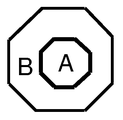
- toluene diisocyanate is dispersed in an aqueous phase containing a surfactant such as a lignin sulfonate b) a polyamine such as hexamethylenediamine which gives rise to polymerisation is then added, or alternatively heating is applied to induce a partial hydrolysis of the isocyanate groups which subsequently self-condense under hot conditions c) the capsules thus formed consist of a polyurea wall within which component (A) alone or components (A)+(B) are present d) where the capsule contains component (A) alone, the operation can be repeated such that the new polymerisation takes place this time in the presence of the species (B) to obtain multilayer capsules such as those shown in FIG. 1 .
- a surfactant such as a lignin sulfonate
- a polyamine such as hexamethylenediamine which gives rise to polymerisation
- the single layer capsule already contains the two components (A) and B, a emulsion/microemulsion formed by mixtures of anionic and nonionic surfactants containing the immediate-release component (B) is added in order to obtain the desired formulation ( FIG. 2 ).
- the material constituting the capsule wall represents a fraction of the capsule weight, ranging between 5% and 30%.
- an oil phase containing the component (A) alone or (A)+(B) to be encapsulated, a possible solvent (e.g. Solvesso 200) if the active substances are solids, and an acid chloride e.g. sebacoyl chloride alone or mixed with a variable quantity of other acid chlorides, is dispersed in an aqueous phase containing a surfactant such as a lignin sulfonate b) a polyamine or a polyoxyalkylene polyamine (e.g.
- the capsules thus formed consist of a polyamide wall, formed by discontinuous or continuous process, within which component (A) alone or components (A)+(B) are present.
- the capsule contains component (A) alone the operation can be repeated so that the new polymerisation takes place this time in the presence of the species (B) to obtain multilayer capsules such as those shown in FIG. 1 .
- the single layer capsule already contains the two components (A) and B, a emulsion/microemulsion formed by mixtures of anionic and nonionic surfactants containing the immediate-release component (B) is added in order to obtain the desired formulation ( FIG. 2 ).
- capsules can be formed having as membrane a polyester, a polycarbamate, a polyurethane or a urea-formaldehyde polymer by selecting suitable monomer precursors of the capsule polymer.
- the thickness and structure of the capsule membrane can be controlled.
- modulatable parameters for this purpose are: temperature and time of polymerisation, quantity of solvent, use of polymerisation inhibitors in suitable quantities, addition of polymer cross-linking substances.
- average release time [t (A) ] it is meant the time by which 50% (by weight) of the total amount of (A) present in the microcapsule has been released.
- immediate-release is used to highlight the standard behaviour of emulsions/microemulsions, which do not cause any appreciable delay in releasing the emulsified active principle, as compared to normal solutions; thus no particular provisions are required for preparing the immediate-release emulsions/microemulsions of component (B), and they can be obtained by reference to standard procedures for preparing emulsions/microemulsion.
- microcapsules of the invention are stable when moist; the breakage of the microcapsule wall and, consequently, the phenomenon of release initiates immediately when microcapsules start to dry.
- the release from the microcapsules initiates immediately after the solution is removed, i.e. typically when the formulation is applied/sprayed e.g. onto a plant, in the ground, in the air, etc).
- the above referred ⁇ t corresponds to the actual difference in time of administration to plants and insects.
- t (A) and t (B) can be made as follows. An aliquot of the suspension of the microcapsules is immediately put onto a series of glass plates; the loaded glass plates are maintained at standard ambient conditions for different times; at the end of each time, the corresponding glass plate is washed with a solvent of (A) or (B) which is not solvent of the microcapsule wall (typically n-hexane); in such a way only the released components are extracted for quantification, by e.g. HPLC. The time corresponding to a 50% release (as compared to the total (A) or (B) loaded into the microcapsules), will be respectively the t (A) or t (B) .
- the new formulation is particularly effective against damaging species that have developed resistance to treatment with the same active substance, and induces, for the same quantity of active principle, a substantially higher mortality of the damaging species than that demonstrated by the same components (A) and (B) used in a mixture as such or microencapsulated separately within the same polymer materials or microencapsulated jointly but with the same release time.
- FIG. 1 shows individual microencapsulation of both components (A) and (B) within a multilayer system
- FIG. 2 shows microencapsulation of both components within a single layer system of suitable thickness in combination with an immediate-release emulsion/microemulsion containing an additional amount of component (B).
- the polymers constituting the microcapsules can be polyesters, polyamides, polyureas, polycarbamates, polyurethanes or based on urea-formaldehyde polymers. Polymerisation is performed in accordance with methods known to the expert of the art.
- Active principles (A) usable in the present invention belong to one of the following classes of chemical products: pyrethroids, carbamates, organophosphates, thioureas, pentatomic or hexatomic heterocycles where 1, 2 or 3 nitrogen atoms are present, such as pyridine, pyrrole, imidazole, benzimidazole, thiazole, pyrazole, pyridazine, quinazoline, oxadiazine, triazine.
- pyrethroids such as Allethrin, Bioallethrin, Tetramethrin, Prallethrin, Cypermethrin, ⁇ -Cypermethrin, ⁇ -Cypermethrin, ⁇ -Cypermethrin, Esbiothrin, Permethrin, Fenpropathrin, Transfluthrin, Bifenthrin, Resmethrin, Bioresmethrin, Fenvalerate, Esfenvalerate, Tetramethrin, Imiprothrin, Phenothrin, ⁇ -Cyfluthrin, Deltamethrin, Cyhalothrins, Etofenprox, Silafluofen, extracts of pyrethrum and mixtures thereof etc., 2) neonicotinoids such as Imidacloprid, Acetamiprid, Thiacloprid, Thiamethoxam and AKD1022; 3) carbamates such as Imidaclo
- the quantities of monomers i.e. the components of the encapsulating polymer
- the quantities of monomers are preferably between 1% and 50% (weight/weight) and even more preferably between 2% and 30%.
- synergistic compounds able to synergistically enhance the activity of active principle (A) are substances known and already in use.
- Preferred examples of synergistic compounds (B) are piperonyl butoxide (PBO) and its analogues, sesamol, verbutin, MGK 264 and DEF, with PBO and its analogues and verbutin being preferred. PBO is particularly preferred.
- the synergistic compounds can be used as such or already pre-formulated with additives; an example of a commercially available pre-formulation is designated as PB80EC-NF which contains 88% PBO and 12% emulsifier (dialkylsulfosuccinate, also known as SOITEM).
- the quantity of component (A) relative to component B is between 1% and 1500%, preferably between 2% and 200% and even more preferably between 5% and 100%.
- Emulsifiers, UV stabilizers, antioxidants and other additives non-specific for active principle activity but useful for the specific application can also be present in the aforesaid formulation.
- the quantity of said additives relative to the constituent polymer of the capsule is preferably between 0% and 30% (weight/weight), more preferably between 1% and 15%. These percentages refer to all additives present, also including those already present in the pre-formulations of the active principles utilized.
- Usable emulsifiers are for example dodecylbenzenesulfonate, dialkylsulfosuccinate, lignin sulfonates, phospholipids, polyethylene glycols.
- UV stabilizers are for example 2-hydroxy-4-methoxy-benzophenone, 2-hydroxy-4-octoxy-benzophenone, 4-hydroxy-2,2,6,6-tetramethylpiperidine sebaca-te.
- a usable antioxidant is for example 2,6-di-tert-butyl-1-hydroxy-toluene.
- a synergistic compound is also present as a emulsion/microemulsion
- the latter can be the same as or different from that present in the microcapsule.
- composition of the invention can be provided as a solid, as an oily solid/suspension composition or as a homogeneous emulsion/microemulsion and is soluble or completely emulsifiable in water or in aqueous mixtures of water-miscible solvents.
- Said formulations can be used as such or previously emulsified in water or in aqueous solutions of water-miscible solvents, such as a C1-4 alcohol; the content of water miscible solvent is between 0% and 99%, preferably between 0% and 60%.
- the process for preparing the microcapsules, forming the basis of the aforesaid compositions uses per se known technologies.
- process for preparing the microcapsules can be performed in accordance with one of the following methods, indicated as process (i) and process (ii) respectively.
- a concentrated aqueous microcapsule suspension containing component (A) is prepared by interfacial polymerisation in a water/oil mixture in the presence of the required quantity of component A, the surfactant and the necessary quantities of suitable monomers and co-monomers of the encapsulating polymer; b) component (B) and further quantities of the surfactant and suitable monomers and co-monomers of the encapsulating polymer are added to the concentrated aqueous microcapsule suspension obtained in (a), the latter being subjected to further encapsulation.
- the microcapsules obtained in (b) can be recovered and stored in water or in any other suitable solvent which does not dissolve the microcapsule wall, or in an emulsion/microemulsion containing further amounts of component B.
- Process (ii) Single Layer Microcapsule ( FIG.
- encapsulated component (B) can have various functions useful for the application: for example modulating even more precisely the release time of component A, for the same encapsulating membrane; sensitising damaging species which may have resisted initial contact with component B; possibility of using two different synergists when considered necessary.
- Possible further components of said formulations can be mixed as solids or as emulsion/microemulsions immediately prior to use.
- a further aspect of the invention is the use of said formulations as insecticides, acaricides, fungicides, snailcides or vermicides in agriculture, for veterinary medicine use, for eradicating household insects and for the protection of manufactured articles.
- the formation of a formulation, characterised by the presence of two components, one of which (A) possesses insecticidal, acaricidal, fungicidal, snailcidal or vermicidal activity and the other (B) exhibits synergistic activity with the first by enhancing its effectiveness, and in which the average release time of component (A) [t (A) ] is delayed by a time interval ⁇ t [t (A) ] ⁇ [t (B) ] of between 1 and 12 hours, preferably between 2 and 10 hours, relative to the average release time of component (B) [t (B) ], has surprisingly resulted in a significant increase in composition effectiveness compared to mixtures of the two components used as such or microencapsulated individually or microencapsulated jointly but with
- Enhancement of activity leads to various advantages of industrial significance: for example for the same active substance used, compositions with higher activity can be obtained; or compositions with an effectiveness equal to known compositions can be obtained but with reduced active substance use; the lesser amount of active substance used leads to lowed product cost, lower environmental impact of the manufacturing process, and lower volume/weight ratio of the final composition, with further practical advantages for the operator concerned with the procedures for using these formulations.
- insecticide, acaricide, fungicide, snailcide or vermicide formulations are unexpectedly obtained which are highly effective and less costly than known formulations.
- the organic phase containing the active principles to be encapsulated and the polyisocyanate is dispersed, rapidly and under vigorous stirring, in the aqueous phase containing lignin sulfonate at the temperature of 50° C.
- stirring is decreased and hexamethylenediamine is rapidly added.
- Polymerisation starts rapidly with moderate hexothermy.
- the mixture is maintained under stirring for 4 hours at 50° C. and then cooled at room temperature and added with silicon antifoam agent, xanthan gum, and soluble calcium and sodium salts, to provide a concentrated microcapsule suspension with a viscosity of 500-1000 cps.
- Emulsifier (mixture of anionic and nonionic surfactants) 19%
- PBO technical is mixed with a suitable emulsifying agent consisting of a mixture of anionic and non ionic surfactants.
- Premix A 10% Premix B 13.1% Nonionic polymeric dispersant 2% Antimould agent 0.1% Silicon antifoam agent 0.2% Xanthan gum 0.15% Water remainder to 100%
- Premix A and the other components are introduced into a reactor.
- Premix B is added lastly under sufficient agitation to form a fine emulsion.
- the formulation thus prepared had the following characteristics:
- bifenthrin titre 2% PBO titre 10%; density 1.01; pH 8-9; viscosity 200-800 cps; microcapsule dimensions (average diameter) 3-10 micron; emulsion size 1-5 micron.
- a formulation consisting of a PBO emulsion (18%) and an aqueous suspension of a-cypermethrin+PBO encapsulated together (components at 8%) in PU, starting from a premix A containing a-cypermethrin (15%) and PBO (15%) and from a premix B containing PBO (81%), with the following final composition:
- a-cypermethrin titre 8% total PBO titre 26%; density 1.04; pH 8-9; viscosity 200-800 cps; microcapsule dimension (average diameter): 5-10 micron; emulsion size 1-5 micron
- a formulation consisting of a PBO emulsion (8%) and of an aqueous suspension of diazinon+PBO encapsulated together (respectively 8% and 16%) in PU, starting from a premix A containing pure diazinon (10%) and PBO (20%) and from a premix B containing PBO (81%), with the following final composition:
- a formulation consisting of a PBO emulsion (15%) and an aqueous suspension of acetamiprid+PBO microincapsulated together (5%) in PU, starting from a premix A containing acetamiprid (12%) and PBO (0.4%), and from a premix B containing PBO (81%) with the following final composition:
- acetamiprid titre 4.9%; total PBO titre 15%; density 1.02; pH 8-9; viscosity 200-800 cps; microcapsule dimension (average diameter) 3-10 micron; emulsion size 1-5 micron.
- a formulation consisting of a PBO emulsion (12%) and an aqueous suspension of deltamethrin+PBO encapsulated together (6 and 12% respectively) in PU, starting from a premix A containing deltamethrin (12%) and PBO (24%) and from a premix B containing PBO (81%) with the following final composition:
- deltamethrin titre 5.9%; total PBO titre 23.9%; density 1.06; pH 8-9; viscosity 200-800 cps; microcapsule dimension (average diameter) 5-14 micron; emulsion size 1-5 micron
- a formulation consisting of a PBO emulsion (20%) and an aqueous suspension of etofenprox+PBO encapsulated together (20%) in PU, starting from a premix A containing etofenprox (98%) and PBO (2.0%) and from a premix B containing PBO (81%), with the following final composition:
- etofenprox titre 19.9%; total PBO titre 20.4%; density 1.01; pH 8-9; viscosity 200-800 cps; microcapsule dimension (average diameter) 5-10 micron; emulsion size 1-5 micron.
- a formulation consisting of a PBO emulsion (15%) and an aqueous suspension of z-cypermethrin and PBO encapsulated together (both 10%) in PU, starting from a premix A containing z-cypermethrin (33%) and PBO (33%), and from a premix B containing PBO (81%), with the following final composition:
- z-cypermethrin titre 9.9%; total PBO titre 25.1%; density 1.02; pH 8-9; viscosity 200-800 cps; microcapsule dimension (average diameter) 6-14 micron; emulsion size 1-5 micron.
- a formulation consisting in a PBO emulsion (30%) and an aqueous suspension of fenazaquin+PBO encapsulated together (10%) in PU starting from a premix A containing fenazaquin al 25% e PBO al 1% and from a premix B containing PBO al 81% with the following final composition:
- a formulation consisting of a PBO emulsion (20%) and an aqueous suspension of pyridaben+PBO microencapsulated together (5%) in PU, starting from a premix A containing pyridaben (16%) and PBO (3%), and from a premix B containing PBO (81%) with the following final composition:
- pyridaben titre 4.9%; total PBO titre 20.8%; density 1.03; pH 8-9; viscosity 200-800 cps; microcapsule dimension (average diameter): 4-10 micron; emulsion size 1-5 micron.
- a formulation consisting of a PBO emulsion (20%) and an aqueous suspension of pyrimethanyl+PBO microincapsulated together (10%) in PU, starting from a premix A containing pyrimethanyl (33%) and PBO (3%), and from a premix B containing PBO (81%) with the following final composition:
- the preparation process is herein described of a formulation according to FIG. 1 , where (A) is bifenthrin and (B) is PBO.
- a bifenthrin-containing microcapsule concentrate is prepared starting from the following reagents:
- microcapsule concentrate thus obtained is added to an organic solution containing PBO, polyisocyanate and the diamine under vigorous stirring in an aqeuos phase containing lignin sulfonate at a temperature of 50° C., as reported here below:
- Microcapsule bifenthrin (20%) 10% PBO 95% 6.4% Solvent (Solvesso 200) 20% Voronate M220 2.95% Hexamethylendiammine 40% 2.81% Lignin sulfonate 1% Soluble Ca and Na salts 9% Silicon antifoam agent 0.2% Xanthan gum 0.1% Water remainder to 100%
- microcapsule suspension is added with silicon antifoam agent, xanthan gum and soluble calcium and sodium salts, obtaining a suspension o multilayered microcapsules with viscosity 600-1200 cps.
- release time for active principle and PBO from polyurea microcapsules is performed as follows:
- the formulation containing active principle and PBO encapsulated together in PU and microemulsified PBO is diluted at a temperature of about 20° C. with distilled water, so as to obtain a dilution of agronomic type (e.g. 20 g active principle/1000 l water).
- agronomic type e.g. 20 g active principle/1000 l water.
- the suspension is homogenised under stirring, and a 100 ml sample thereof is withdrawn; the sample, maintained homogenised by stirring, is split into four 25 ml aliquots. Three aliquots are simultaneously transferred onto three glass plates, and kept at ambient conditions, respectively for 1, 2, 6 hrs.
- the corresponding glass plate is washed with a fixed amount of n-hexane (which dissolves both active principle and PBO, but not the polymeric wall).
- n-hexane dissolves both active principle and PBO, but not the polymeric wall.
- the organic phase, containing all released active principle and PBO is then analysed by HPLC, thereby assessing the amount of release at the given time point.
- the fourth aliquot, used to determine the release at time zero, is directly added with n-hexane; the organic phase, containing all PBO (and possible active ingredient) being immediately available form the formulation, is separated and assayed as above by HPLC, to determine the amounts of the two components.
- the obtained release data are as follows:
- Cotton plants ( Gossypium hirsutum L.) were grown without any exposure to the insecticides. The leaves were cut up into disc shapes and immersed in an aqueous solution of insecticide containing 0.01% of Agral then left to dry at 25° C.
- Control leaves were immersed in Agral and distilled water only.
- insects were allowed to feed and maximum mortality was evaluated at 24 and 48 hours.
- LC50% a.i. ( active ingredient) and LC99% a.i. indicate the quantity of insecticide able to achieve mortality for 50% and 99% of the insects tested.
Landscapes
- Life Sciences & Earth Sciences (AREA)
- Health & Medical Sciences (AREA)
- General Health & Medical Sciences (AREA)
- Engineering & Computer Science (AREA)
- Pest Control & Pesticides (AREA)
- Agronomy & Crop Science (AREA)
- Environmental Sciences (AREA)
- Zoology (AREA)
- Wood Science & Technology (AREA)
- Dentistry (AREA)
- Plant Pathology (AREA)
- Toxicology (AREA)
- Organic Chemistry (AREA)
- Pharmacology & Pharmacy (AREA)
- Diabetes (AREA)
- Public Health (AREA)
- Veterinary Medicine (AREA)
- Hematology (AREA)
- Bioinformatics & Cheminformatics (AREA)
- Animal Behavior & Ethology (AREA)
- Chemical & Material Sciences (AREA)
- Nuclear Medicine, Radiotherapy & Molecular Imaging (AREA)
- Medicinal Chemistry (AREA)
- General Chemical & Material Sciences (AREA)
- Chemical Kinetics & Catalysis (AREA)
- Agricultural Chemicals And Associated Chemicals (AREA)
Applications Claiming Priority (4)
| Application Number | Priority Date | Filing Date | Title |
|---|---|---|---|
| ITMI2005A000728 | 2005-04-22 | ||
| ITMI2005A0728 | 2005-04-22 | ||
| IT000728A ITMI20050728A1 (it) | 2005-04-22 | 2005-04-22 | Formulazione innovativa |
| PCT/EP2006/061688 WO2006111553A1 (en) | 2005-04-22 | 2006-04-20 | Innovative formulation |
Publications (2)
| Publication Number | Publication Date |
|---|---|
| US20090130156A1 US20090130156A1 (en) | 2009-05-21 |
| US8025894B2 true US8025894B2 (en) | 2011-09-27 |
Family
ID=36811033
Family Applications (1)
| Application Number | Title | Priority Date | Filing Date |
|---|---|---|---|
| US11/912,299 Expired - Fee Related US8025894B2 (en) | 2005-04-22 | 2006-04-20 | Innovative formulation |
Country Status (10)
| Country | Link |
|---|---|
| US (1) | US8025894B2 (pl) |
| EP (1) | EP1879451B1 (pl) |
| JP (1) | JP5318564B2 (pl) |
| CN (1) | CN101163401B (pl) |
| AU (1) | AU2006237358B2 (pl) |
| BR (1) | BRPI0610080B1 (pl) |
| ES (1) | ES2414154T3 (pl) |
| IT (1) | ITMI20050728A1 (pl) |
| PL (1) | PL1879451T3 (pl) |
| WO (1) | WO2006111553A1 (pl) |
Cited By (37)
| Publication number | Priority date | Publication date | Assignee | Title |
|---|---|---|---|---|
| RU2531096C1 (ru) * | 2013-07-05 | 2014-10-20 | Александр Александрович Кролевец | Способ инкапсуляции фенбендазола |
| RU2531101C1 (ru) * | 2013-05-17 | 2014-10-20 | Александр Александрович Кролевец | Способ биоинкапсуляции |
| RU2531095C1 (ru) * | 2013-07-01 | 2014-10-20 | Александр Александрович Кролевец | Способ инкапсуляции фенбендазола |
| RU2532405C1 (ru) * | 2013-07-05 | 2014-11-10 | Александр Александрович Кролевец | Способ инкапсуляции фенбендазола |
| RU2532409C1 (ru) * | 2013-07-05 | 2014-11-10 | Александр Александрович Кролевец | Способ инкапсуляции фенбендазола |
| RU2533454C1 (ru) * | 2013-07-05 | 2014-11-20 | Екатерина Евгеньевна Быковская | Способ инкапсуляции фенбендазола |
| RU2535884C1 (ru) * | 2013-05-17 | 2014-12-20 | Александр Александрович Кролевец | Способ инкапсуляции фенбендазола |
| RU2535885C1 (ru) * | 2013-05-20 | 2014-12-20 | Александр Александрович Кролевец | Способ инкапсуляции фенбендазола |
| RU2537259C1 (ru) * | 2013-07-05 | 2014-12-27 | Александр Александрович Кролевец | Способ инкапсуляции фенбендазола |
| RU2537250C1 (ru) * | 2013-05-17 | 2014-12-27 | Александр Александрович Кролевец | Способ инкапсуляции фенбендазола |
| RU2537258C1 (ru) * | 2013-06-25 | 2014-12-27 | Александр Александрович Кролевец | Способ инкапсуляции фенбендазола |
| RU2537236C1 (ru) * | 2013-05-14 | 2014-12-27 | Александр Александрович Кролевец | Способ биоинкапсуляции |
| RU2537255C1 (ru) * | 2013-05-15 | 2014-12-27 | Екатерина Евгеньевна Быковская | Способ инкапсуляции фенбендазола |
| RU2537249C1 (ru) * | 2013-05-14 | 2014-12-27 | Екатерина Евгеньевна Быковская | Способ инкапсуляции фенбендазола |
| RU2537254C1 (ru) * | 2013-05-29 | 2014-12-27 | Александр Александрович Кролевец | Способ биоинкапсуляции |
| RU2538660C1 (ru) * | 2013-06-28 | 2015-01-10 | Александр Александрович Кролевец | Способ инкапсуляции фенбендазола |
| RU2538665C1 (ru) * | 2013-07-05 | 2015-01-10 | Александр Александрович Кролевец | Способ инкапсуляции фенбендазола |
| RU2538730C2 (ru) * | 2013-05-17 | 2015-01-10 | Александр Александрович Кролевец | Способ инкапсуляции фенбендазола |
| RU2538670C2 (ru) * | 2013-05-24 | 2015-01-10 | Екатерина Евгеньевна Быковская | Способ инкапсуляции фенбендазола |
| RU2538667C1 (ru) * | 2013-07-01 | 2015-01-10 | Александр Александрович Кролевец | Способ инкапсуляции фенбендазола |
| RU2538679C2 (ru) * | 2012-08-21 | 2015-01-10 | Федеральное государственное бюджетное образовательное учреждение высшего профессионального образования Курская государственная сельскохозяйственная академия имени профессора И.И. Иванова Министерства сельского хозяйства Российской Федерации | Способ инкапсуляции фенбендазола |
| RU2538805C1 (ru) * | 2013-08-26 | 2015-01-10 | Александр Александрович Кролевец | Способ получения микрокапсул фенбендазола, обладающих супрамолекулярными свойствами |
| RU2544175C2 (ru) * | 2013-07-05 | 2015-03-10 | Александр Александрович Кролевец | Способ инкапсуляции фенбендазола |
| RU2544174C2 (ru) * | 2013-06-25 | 2015-03-10 | Екатерина Евгеньевна Быковская | Способ инкапсуляции фенбендазола |
| RU2544172C2 (ru) * | 2013-06-13 | 2015-03-10 | Александр Александрович Кролевец | Способ инкапсуляции фенбендазола |
| RU2544165C2 (ru) * | 2013-07-09 | 2015-03-10 | Александр Александрович Кролевец | Способ инкапсуляции фенбендазола |
| RU2544167C2 (ru) * | 2013-07-05 | 2015-03-10 | Александр Александрович Кролевец | Способ инкапсуляции фенбендазола |
| RU2545746C1 (ru) * | 2013-09-10 | 2015-04-10 | Александр Александрович Кролевец | Способ инкапсуляции фенбендазола |
| RU2545719C2 (ru) * | 2013-07-05 | 2015-04-10 | Александр Александрович Кролевец | Способ инкапсуляции фенбендазола |
| RU2545713C2 (ru) * | 2013-07-05 | 2015-04-10 | Александр Александрович Кролевец | Способ инкапсуляции фенбендазола |
| RU2545803C2 (ru) * | 2013-06-14 | 2015-04-10 | Александр Александрович Кролевец | Способ инкапсуляции фенбендазола |
| RU2548738C2 (ru) * | 2013-07-10 | 2015-04-20 | Александр Александрович Кролевец | Способ инкапсуляции фенбендазола |
| RU2548715C1 (ru) * | 2013-12-25 | 2015-04-20 | Александр Александрович Кролевец | Способ инкапсуляции фенбендазола |
| RU2549959C2 (ru) * | 2013-08-01 | 2015-05-10 | Александр Александрович Кролевец | Способ биоинкапсуляции |
| RU2552346C1 (ru) * | 2014-03-26 | 2015-06-10 | Александр Александрович Кролевец | Способ инкапсуляции фенбендазола |
| RU2552344C1 (ru) * | 2014-03-18 | 2015-06-10 | Александр Александрович Кролевец | Способ инкапсуляции фенбендазола |
| US20240041028A1 (en) * | 2021-01-04 | 2024-02-08 | Omya International Ag | Delivery system for plant protection |
Families Citing this family (24)
| Publication number | Priority date | Publication date | Assignee | Title |
|---|---|---|---|---|
| AP2009004930A0 (en) * | 2007-02-13 | 2009-08-31 | Vestergaard Frandsen Sa | Process and composition for synergistically enhanced insecticidal impregnation of a fabric or netting or other kind of non-living material |
| IT1383062B (it) * | 2007-06-28 | 2010-12-22 | Endura Spa | Metodo per modulare la velocita' di rilascio di principi attivi microincapsulati |
| US20100132245A1 (en) * | 2007-06-29 | 2010-06-03 | Mikkel Vestergaard Frandsen | Insecticidal barrier partly with synergist |
| GB0713790D0 (en) | 2007-07-16 | 2007-08-22 | Nettforsk As | Method |
| GB0721761D0 (en) | 2007-11-06 | 2007-12-19 | Plant Bioscience Ltd | Compositions and methods for synergistic manipulation of plant and insect defences |
| ITMI20080010A1 (it) * | 2008-01-04 | 2009-07-05 | Endura Spa | Metodo per modulare la velocita'di rilascio d principi attivi p.a. microincapsulati |
| CN101305725B (zh) * | 2008-07-17 | 2011-05-11 | 浙江省农业科学院 | 一种毒死蜱和吡蚜酮复配微胶囊悬浮剂及其制备方法 |
| TW201018757A (en) * | 2008-08-06 | 2010-05-16 | Vestergaard Frandsen Sa | Insecticidal polymer matrix comprising HDPE and LDPE |
| TW201028088A (en) | 2008-08-06 | 2010-08-01 | Vestergaard Frandsen Sa | Insecticidal polymer matrix comprising PBO and DM |
| GB0908949D0 (en) | 2009-05-26 | 2009-07-01 | Plant Bioscience Ltd | Novel polypeptides having endolysin activity and uses thereof |
| CN101961028A (zh) * | 2009-07-24 | 2011-02-02 | 上海美兴化工股份有限公司 | 一种杀虫气雾剂 |
| CN101669472B (zh) * | 2009-10-13 | 2013-01-02 | 深圳诺普信农化股份有限公司 | 一种增效农药组合物 |
| MX2012014303A (es) * | 2010-06-07 | 2013-05-30 | Dow Agrosciences Llc | Suspensiones de microcapsulas que incluyen niveles elevados de ingredientes agricolamente activos. |
| WO2011160982A1 (en) * | 2010-06-25 | 2011-12-29 | Syngenta Participations Ag | Methods for controlling mites |
| WO2012024297A2 (en) | 2010-08-18 | 2012-02-23 | Gowan Comercio Internacional E Servicos Limitada | Improved processes for the control of undesired vegetative growth in crops |
| ES2383414B1 (es) * | 2010-11-25 | 2013-05-10 | Quimica De Munguia, S.A. (Quimunsa) | Composición insecticida |
| GB201104156D0 (en) * | 2011-03-11 | 2011-04-27 | Rothamstead Res Ltd | Compositions and methods for controlling pesticide resistant pests |
| JP5763570B2 (ja) * | 2011-03-11 | 2015-08-12 | 大阪ガスケミカル株式会社 | 徐放性粒子およびその製造方法 |
| ES2527187T3 (es) | 2011-11-04 | 2015-01-21 | Endura S.P.A. | Microcápsulas que comprenden un piretroide y/o un neonicotinoide y un agente sinérgico |
| ITMI20121206A1 (it) * | 2012-07-11 | 2014-01-12 | Endura Spa | Formulazioni insetticide di microcapsule |
| CN103222463B (zh) * | 2013-03-26 | 2014-10-15 | 中国农业科学院烟草研究所 | 噻菌铜缓释型微胶囊的制备方法及制备的微胶囊 |
| PY1506528A (es) * | 2014-02-19 | 2017-10-02 | Fmc Corp | Formulaciones de tratamiento de semillas encapsuladas con piretroide de alta carga |
| CN107285968A (zh) * | 2017-07-25 | 2017-10-24 | 张忠庆 | 具有氮肥缓控释功能的微胶囊悬浮制剂及其制备方法和应用 |
| MX2024007123A (es) | 2021-12-16 | 2024-06-24 | United Ind Corporation | Pesticidas de barrera y de derribo listos para usarse. |
Citations (12)
| Publication number | Priority date | Publication date | Assignee | Title |
|---|---|---|---|---|
| DE2411373A1 (de) | 1974-03-09 | 1975-09-11 | Ekof Erz Und Kohleflotation Gm | Schaedlingsbekaempfungsverfahren |
| US4056610A (en) * | 1975-04-09 | 1977-11-01 | Minnesota Mining And Manufacturing Company | Microcapsule insecticide composition |
| GB1513614A (en) | 1975-04-09 | 1978-06-07 | Minnesota Mining & Mfg | Microcapsule insecticide composition |
| US4524068A (en) | 1982-11-09 | 1985-06-18 | Chinoin Gyogyszer Es Vegyeszeti Termekek Gyara Rt. | Cyclodextrin inclusion complex of piperonyl butoxide |
| DE3708671A1 (de) | 1986-03-17 | 1987-09-24 | Sumitomo Chemical Co | Mikroverkapselte pyrethroide, insektizide und/oder akarizide mittel sowie verfahren zu ihrer herstellung |
| EP0282706A1 (en) | 1987-02-16 | 1988-09-21 | ENDURA S.p.A. | Use of methylenedioxybenzene derivatives as synergists in compositions for insecticide use |
| JPH01299203A (ja) | 1988-05-26 | 1989-12-04 | Dainippon Jochugiku Co Ltd | 土壌処理用白アリ防除剤 |
| US4936901A (en) * | 1986-07-09 | 1990-06-26 | Monsanto Company | Formulations of water-dispersible granules and process for preparation thereof |
| WO1997014308A1 (en) | 1995-10-20 | 1997-04-24 | Chinoin Gyógyszer és Vegyészeti Termékek Gyára Rt. | Microencapsulated insecticide preparations and a process for the preparation thereof |
| US5707638A (en) | 1994-12-23 | 1998-01-13 | Bayer Aktiengesellschaft | Insecticidal attract-and-kill formulations |
| WO2003092378A1 (en) | 2002-04-29 | 2003-11-13 | Rothamsted Research Ltd | Compositions and methods for preventing or reducing resistance ofinsects to insecticides |
| WO2005039287A2 (en) | 2003-10-27 | 2005-05-06 | Endura S.P.A. | Formulation of a synergistic insecticidal composition as a cyclodextrin-complex |
Family Cites Families (4)
| Publication number | Priority date | Publication date | Assignee | Title |
|---|---|---|---|---|
| JPH0676286B2 (ja) * | 1986-03-17 | 1994-09-28 | 住友化学工業株式会社 | 農業用殺虫、殺ダニ組成物 |
| JP2969916B2 (ja) * | 1989-11-10 | 1999-11-02 | 住友化学工業株式会社 | 改良された有害生物防除剤 |
| JPH1059812A (ja) * | 1996-08-15 | 1998-03-03 | Mitsui Petrochem Ind Ltd | 殺虫性マイクロカプセル剤組成物 |
| US6045816A (en) * | 1998-06-17 | 2000-04-04 | Isp Investments Inc. | Water-based microemulsion of a pyrethroid |
-
2005
- 2005-04-22 IT IT000728A patent/ITMI20050728A1/it unknown
-
2006
- 2006-04-20 EP EP06743357.3A patent/EP1879451B1/en not_active Expired - Lifetime
- 2006-04-20 BR BRPI0610080-5A patent/BRPI0610080B1/pt not_active IP Right Cessation
- 2006-04-20 JP JP2008507077A patent/JP5318564B2/ja not_active Expired - Fee Related
- 2006-04-20 US US11/912,299 patent/US8025894B2/en not_active Expired - Fee Related
- 2006-04-20 PL PL06743357T patent/PL1879451T3/pl unknown
- 2006-04-20 AU AU2006237358A patent/AU2006237358B2/en not_active Ceased
- 2006-04-20 ES ES06743357T patent/ES2414154T3/es not_active Expired - Lifetime
- 2006-04-20 CN CN2006800134654A patent/CN101163401B/zh not_active Expired - Fee Related
- 2006-04-20 WO PCT/EP2006/061688 patent/WO2006111553A1/en not_active Ceased
Patent Citations (12)
| Publication number | Priority date | Publication date | Assignee | Title |
|---|---|---|---|---|
| DE2411373A1 (de) | 1974-03-09 | 1975-09-11 | Ekof Erz Und Kohleflotation Gm | Schaedlingsbekaempfungsverfahren |
| US4056610A (en) * | 1975-04-09 | 1977-11-01 | Minnesota Mining And Manufacturing Company | Microcapsule insecticide composition |
| GB1513614A (en) | 1975-04-09 | 1978-06-07 | Minnesota Mining & Mfg | Microcapsule insecticide composition |
| US4524068A (en) | 1982-11-09 | 1985-06-18 | Chinoin Gyogyszer Es Vegyeszeti Termekek Gyara Rt. | Cyclodextrin inclusion complex of piperonyl butoxide |
| DE3708671A1 (de) | 1986-03-17 | 1987-09-24 | Sumitomo Chemical Co | Mikroverkapselte pyrethroide, insektizide und/oder akarizide mittel sowie verfahren zu ihrer herstellung |
| US4936901A (en) * | 1986-07-09 | 1990-06-26 | Monsanto Company | Formulations of water-dispersible granules and process for preparation thereof |
| EP0282706A1 (en) | 1987-02-16 | 1988-09-21 | ENDURA S.p.A. | Use of methylenedioxybenzene derivatives as synergists in compositions for insecticide use |
| JPH01299203A (ja) | 1988-05-26 | 1989-12-04 | Dainippon Jochugiku Co Ltd | 土壌処理用白アリ防除剤 |
| US5707638A (en) | 1994-12-23 | 1998-01-13 | Bayer Aktiengesellschaft | Insecticidal attract-and-kill formulations |
| WO1997014308A1 (en) | 1995-10-20 | 1997-04-24 | Chinoin Gyógyszer és Vegyészeti Termékek Gyára Rt. | Microencapsulated insecticide preparations and a process for the preparation thereof |
| WO2003092378A1 (en) | 2002-04-29 | 2003-11-13 | Rothamsted Research Ltd | Compositions and methods for preventing or reducing resistance ofinsects to insecticides |
| WO2005039287A2 (en) | 2003-10-27 | 2005-05-06 | Endura S.P.A. | Formulation of a synergistic insecticidal composition as a cyclodextrin-complex |
Non-Patent Citations (11)
| Title |
|---|
| Benchaoui, H.A. And McKellar, Q.A. 1996 "Interaction between Fenbendazole and Piperonyl Butoxide: Pharmacokinetic and Pharmacodynamic Implications" J Pham Pharmacol 48:753-759. |
| Biebel, R. et al. (2003) "Action of pyrethrum-based formulations against weevils" International Journal of Pharmaceutics 256:175-181. |
| Database WPI Section Ch, Week 199003 Derwent Publications Ltd., London, GB; An 1990-019276 XP002322687 & JP 01 299203 A, Dec. 4, 1989. |
| Finch, C.A. 1993 "Industrial Microencapsulation: Polymers for Microcapsule Walls" Special Publication Rolay Soc Chem 138:1-12. |
| Gimeno, M. 1996 "An Overview of the Latest Development of Microencapsulation for Agricultural Products" J. Environ. Sci. Health, B31(3):407-420. |
| Gunning R.V. et al. (1999) Esterase inhibitors synergise the toxicity of pyrethroids in Australian Helicoverpa armigera (Hubner) (Lepidotera: Noctuidae) Pesticide Biochemistry ad Physiology 63:50-62. |
| Gunning, R.V. et al. 1998 in Piperonyl Butoxide, Chapter 13, "Inhibition of Resistance-related Esterases by Piperonyl Butoxide in Helicoverpa atmigera (Lepidoptera: Noctuidae) and Aphis gossypii (Hemiptera: Aphididae)" Academic Press pp. 215-226. |
| Lajos, S. et al. (1990) "Formulation of insect controlling agents with B-cyclodextrin" Pesticide Science, Elsevier Applied Science Publisher. Barking, GB, 28:7-16. |
| Nishiwaki, H. et al. 2004 "Metabolism of Imidacloprid in Houseflies" J Pestic Sci 29:110-116. |
| Wen, Z. and Scott, J.G. 1997 "Cross-Resistance to Imidacloprid in Strains of German Cockroach (Blattella germanica) and House Fly (Musca domestica)" Pestic Sci 49:367-371. |
| Zhao, J.-Z. et al. 2000 Inheritance and Synergism of Resistance to Imidacloprid in the Colorado Potato Beetle (Coleoptera: Chrysomelidae) J Econ Entomology 93:1508-1514. |
Cited By (37)
| Publication number | Priority date | Publication date | Assignee | Title |
|---|---|---|---|---|
| RU2538679C2 (ru) * | 2012-08-21 | 2015-01-10 | Федеральное государственное бюджетное образовательное учреждение высшего профессионального образования Курская государственная сельскохозяйственная академия имени профессора И.И. Иванова Министерства сельского хозяйства Российской Федерации | Способ инкапсуляции фенбендазола |
| RU2537249C1 (ru) * | 2013-05-14 | 2014-12-27 | Екатерина Евгеньевна Быковская | Способ инкапсуляции фенбендазола |
| RU2537236C1 (ru) * | 2013-05-14 | 2014-12-27 | Александр Александрович Кролевец | Способ биоинкапсуляции |
| RU2537255C1 (ru) * | 2013-05-15 | 2014-12-27 | Екатерина Евгеньевна Быковская | Способ инкапсуляции фенбендазола |
| RU2537250C1 (ru) * | 2013-05-17 | 2014-12-27 | Александр Александрович Кролевец | Способ инкапсуляции фенбендазола |
| RU2531101C1 (ru) * | 2013-05-17 | 2014-10-20 | Александр Александрович Кролевец | Способ биоинкапсуляции |
| RU2538730C2 (ru) * | 2013-05-17 | 2015-01-10 | Александр Александрович Кролевец | Способ инкапсуляции фенбендазола |
| RU2535884C1 (ru) * | 2013-05-17 | 2014-12-20 | Александр Александрович Кролевец | Способ инкапсуляции фенбендазола |
| RU2535885C1 (ru) * | 2013-05-20 | 2014-12-20 | Александр Александрович Кролевец | Способ инкапсуляции фенбендазола |
| RU2538670C2 (ru) * | 2013-05-24 | 2015-01-10 | Екатерина Евгеньевна Быковская | Способ инкапсуляции фенбендазола |
| RU2537254C1 (ru) * | 2013-05-29 | 2014-12-27 | Александр Александрович Кролевец | Способ биоинкапсуляции |
| RU2544172C2 (ru) * | 2013-06-13 | 2015-03-10 | Александр Александрович Кролевец | Способ инкапсуляции фенбендазола |
| RU2545803C2 (ru) * | 2013-06-14 | 2015-04-10 | Александр Александрович Кролевец | Способ инкапсуляции фенбендазола |
| RU2544174C2 (ru) * | 2013-06-25 | 2015-03-10 | Екатерина Евгеньевна Быковская | Способ инкапсуляции фенбендазола |
| RU2537258C1 (ru) * | 2013-06-25 | 2014-12-27 | Александр Александрович Кролевец | Способ инкапсуляции фенбендазола |
| RU2538660C1 (ru) * | 2013-06-28 | 2015-01-10 | Александр Александрович Кролевец | Способ инкапсуляции фенбендазола |
| RU2538667C1 (ru) * | 2013-07-01 | 2015-01-10 | Александр Александрович Кролевец | Способ инкапсуляции фенбендазола |
| RU2531095C1 (ru) * | 2013-07-01 | 2014-10-20 | Александр Александрович Кролевец | Способ инкапсуляции фенбендазола |
| RU2544175C2 (ru) * | 2013-07-05 | 2015-03-10 | Александр Александрович Кролевец | Способ инкапсуляции фенбендазола |
| RU2545713C2 (ru) * | 2013-07-05 | 2015-04-10 | Александр Александрович Кролевец | Способ инкапсуляции фенбендазола |
| RU2532405C1 (ru) * | 2013-07-05 | 2014-11-10 | Александр Александрович Кролевец | Способ инкапсуляции фенбендазола |
| RU2531096C1 (ru) * | 2013-07-05 | 2014-10-20 | Александр Александрович Кролевец | Способ инкапсуляции фенбендазола |
| RU2538665C1 (ru) * | 2013-07-05 | 2015-01-10 | Александр Александрович Кролевец | Способ инкапсуляции фенбендазола |
| RU2532409C1 (ru) * | 2013-07-05 | 2014-11-10 | Александр Александрович Кролевец | Способ инкапсуляции фенбендазола |
| RU2533454C1 (ru) * | 2013-07-05 | 2014-11-20 | Екатерина Евгеньевна Быковская | Способ инкапсуляции фенбендазола |
| RU2544167C2 (ru) * | 2013-07-05 | 2015-03-10 | Александр Александрович Кролевец | Способ инкапсуляции фенбендазола |
| RU2537259C1 (ru) * | 2013-07-05 | 2014-12-27 | Александр Александрович Кролевец | Способ инкапсуляции фенбендазола |
| RU2545719C2 (ru) * | 2013-07-05 | 2015-04-10 | Александр Александрович Кролевец | Способ инкапсуляции фенбендазола |
| RU2544165C2 (ru) * | 2013-07-09 | 2015-03-10 | Александр Александрович Кролевец | Способ инкапсуляции фенбендазола |
| RU2548738C2 (ru) * | 2013-07-10 | 2015-04-20 | Александр Александрович Кролевец | Способ инкапсуляции фенбендазола |
| RU2549959C2 (ru) * | 2013-08-01 | 2015-05-10 | Александр Александрович Кролевец | Способ биоинкапсуляции |
| RU2538805C1 (ru) * | 2013-08-26 | 2015-01-10 | Александр Александрович Кролевец | Способ получения микрокапсул фенбендазола, обладающих супрамолекулярными свойствами |
| RU2545746C1 (ru) * | 2013-09-10 | 2015-04-10 | Александр Александрович Кролевец | Способ инкапсуляции фенбендазола |
| RU2548715C1 (ru) * | 2013-12-25 | 2015-04-20 | Александр Александрович Кролевец | Способ инкапсуляции фенбендазола |
| RU2552344C1 (ru) * | 2014-03-18 | 2015-06-10 | Александр Александрович Кролевец | Способ инкапсуляции фенбендазола |
| RU2552346C1 (ru) * | 2014-03-26 | 2015-06-10 | Александр Александрович Кролевец | Способ инкапсуляции фенбендазола |
| US20240041028A1 (en) * | 2021-01-04 | 2024-02-08 | Omya International Ag | Delivery system for plant protection |
Also Published As
| Publication number | Publication date |
|---|---|
| EP1879451A1 (en) | 2008-01-23 |
| ES2414154T3 (es) | 2013-07-18 |
| AU2006237358B2 (en) | 2012-08-02 |
| US20090130156A1 (en) | 2009-05-21 |
| JP2008536891A (ja) | 2008-09-11 |
| JP5318564B2 (ja) | 2013-10-16 |
| ITMI20050728A1 (it) | 2006-10-23 |
| EP1879451B1 (en) | 2013-05-15 |
| WO2006111553A1 (en) | 2006-10-26 |
| PL1879451T3 (pl) | 2013-09-30 |
| AU2006237358A1 (en) | 2006-10-26 |
| CN101163401A (zh) | 2008-04-16 |
| BRPI0610080B1 (pt) | 2021-04-27 |
| CN101163401B (zh) | 2012-07-04 |
| BRPI0610080A2 (pt) | 2010-05-25 |
Similar Documents
| Publication | Publication Date | Title |
|---|---|---|
| EP1879451B1 (en) | Innovative formulation | |
| US5229122A (en) | Pesticidal compositions | |
| JP2008536891A5 (pl) | ||
| KR100525613B1 (ko) | 고체 물질의 마이크로캡슐화 방법 | |
| FI80822C (fi) | Inkapslingsfoerfarande samt genom foerfarandet framstaelld, mikrokapslar innehaollande insektisidkomposition. | |
| AU2013289339B2 (en) | Insecticidal formulations of microcapsules | |
| US9044012B2 (en) | Use of formulations having insecticidal activity | |
| CN101848642B (zh) | 灭害剂组合物 | |
| RU2567168C2 (ru) | Суспензии микрокапсул, содержащие высокие уровни сельскохозяйственно-активных ингредиентов | |
| CN102123590B (zh) | 用于调节微囊化的活性成分的释放速率的方法 | |
| HU213529B (en) | Water-emulsifiable plant protective granulate and preparation thereof | |
| EP1941093A2 (en) | Insecticidal textile material | |
| WO2003051116A1 (en) | Microencapsulated insecticide | |
| EP0238184B1 (en) | Pesticidal formulations | |
| NZ231218A (en) | Pesticidal composition comprising part of the poorly soluble active agent encapsulated in a water insoluble polymer coating and the remainder emulsified in water | |
| JPH03218301A (ja) | 改良された有害生物防除剤 | |
| JPH1059812A (ja) | 殺虫性マイクロカプセル剤組成物 | |
| JP2002205903A (ja) | 殺虫組成物の防虫網への加工方法と殺虫組成物 | |
| JP2784362B2 (ja) | 殺虫剤組成物及びその製造方法 |
Legal Events
| Date | Code | Title | Description |
|---|---|---|---|
| AS | Assignment |
Owner name: ENDURA S.P.A., ITALY Free format text: ASSIGNMENT OF ASSIGNORS INTEREST;ASSIGNORS:BORZATTA, VALERIO;PICCOLO, ORESTE;CAPPARELLA, ELISA;REEL/FRAME:020011/0533 Effective date: 20060428 |
|
| ZAAA | Notice of allowance and fees due |
Free format text: ORIGINAL CODE: NOA |
|
| ZAAB | Notice of allowance mailed |
Free format text: ORIGINAL CODE: MN/=. |
|
| STCF | Information on status: patent grant |
Free format text: PATENTED CASE |
|
| FPAY | Fee payment |
Year of fee payment: 4 |
|
| MAFP | Maintenance fee payment |
Free format text: PAYMENT OF MAINTENANCE FEE, 8TH YR, SMALL ENTITY (ORIGINAL EVENT CODE: M2552); ENTITY STATUS OF PATENT OWNER: SMALL ENTITY Year of fee payment: 8 |
|
| FEPP | Fee payment procedure |
Free format text: MAINTENANCE FEE REMINDER MAILED (ORIGINAL EVENT CODE: REM.); ENTITY STATUS OF PATENT OWNER: SMALL ENTITY |
|
| LAPS | Lapse for failure to pay maintenance fees |
Free format text: PATENT EXPIRED FOR FAILURE TO PAY MAINTENANCE FEES (ORIGINAL EVENT CODE: EXP.); ENTITY STATUS OF PATENT OWNER: SMALL ENTITY |
|
| STCH | Information on status: patent discontinuation |
Free format text: PATENT EXPIRED DUE TO NONPAYMENT OF MAINTENANCE FEES UNDER 37 CFR 1.362 |
|
| FP | Lapsed due to failure to pay maintenance fee |
Effective date: 20230927 |