WO1987007268A1 - Aryloxyurees substituees, procede de preparation et leur utilisation - Google Patents
Aryloxyurees substituees, procede de preparation et leur utilisation Download PDFInfo
- Publication number
- WO1987007268A1 WO1987007268A1 PCT/JP1987/000334 JP8700334W WO8707268A1 WO 1987007268 A1 WO1987007268 A1 WO 1987007268A1 JP 8700334 W JP8700334 W JP 8700334W WO 8707268 A1 WO8707268 A1 WO 8707268A1
- Authority
- WO
- WIPO (PCT)
- Prior art keywords
- formula
- group
- atom
- same
- above formula
- Prior art date
- Legal status (The legal status is an assumption and is not a legal conclusion. Google has not performed a legal analysis and makes no representation as to the accuracy of the status listed.)
- Ceased
Links
Classifications
-
- C—CHEMISTRY; METALLURGY
- C07—ORGANIC CHEMISTRY
- C07D—HETEROCYCLIC COMPOUNDS
- C07D213/00—Heterocyclic compounds containing six-membered rings, not condensed with other rings, with one nitrogen atom as the only ring hetero atom and three or more double bonds between ring members or between ring members and non-ring members
- C07D213/02—Heterocyclic compounds containing six-membered rings, not condensed with other rings, with one nitrogen atom as the only ring hetero atom and three or more double bonds between ring members or between ring members and non-ring members having three double bonds between ring members or between ring members and non-ring members
- C07D213/04—Heterocyclic compounds containing six-membered rings, not condensed with other rings, with one nitrogen atom as the only ring hetero atom and three or more double bonds between ring members or between ring members and non-ring members having three double bonds between ring members or between ring members and non-ring members having no bond between the ring nitrogen atom and a non-ring member or having only hydrogen or carbon atoms directly attached to the ring nitrogen atom
- C07D213/60—Heterocyclic compounds containing six-membered rings, not condensed with other rings, with one nitrogen atom as the only ring hetero atom and three or more double bonds between ring members or between ring members and non-ring members having three double bonds between ring members or between ring members and non-ring members having no bond between the ring nitrogen atom and a non-ring member or having only hydrogen or carbon atoms directly attached to the ring nitrogen atom with hetero atoms or with carbon atoms having three bonds to hetero atoms with at the most one bond to halogen, e.g. ester or nitrile radicals, directly attached to ring carbon atoms
- C07D213/62—Oxygen or sulfur atoms
- C07D213/63—One oxygen atom
- C07D213/64—One oxygen atom attached in position 2 or 6
-
- A—HUMAN NECESSITIES
- A01—AGRICULTURE; FORESTRY; ANIMAL HUSBANDRY; HUNTING; TRAPPING; FISHING
- A01N—PRESERVATION OF BODIES OF HUMANS OR ANIMALS OR PLANTS OR PARTS THEREOF; BIOCIDES, e.g. AS DISINFECTANTS, AS PESTICIDES OR AS HERBICIDES; PEST REPELLANTS OR ATTRACTANTS; PLANT GROWTH REGULATORS
- A01N47/00—Biocides, pest repellants or attractants, or plant growth regulators containing organic compounds containing a carbon atom not being member of a ring and having no bond to a carbon or hydrogen atom, e.g. derivatives of carbonic acid
- A01N47/08—Biocides, pest repellants or attractants, or plant growth regulators containing organic compounds containing a carbon atom not being member of a ring and having no bond to a carbon or hydrogen atom, e.g. derivatives of carbonic acid the carbon atom having one or more single bonds to nitrogen atoms
- A01N47/28—Ureas or thioureas containing the groups >N—CO—N< or >N—CS—N<
- A01N47/32—Ureas or thioureas containing the groups >N—CO—N< or >N—CS—N< containing >N—CO—N< or >N—CS—N< groups directly attached to a cycloaliphatic ring
-
- A—HUMAN NECESSITIES
- A01—AGRICULTURE; FORESTRY; ANIMAL HUSBANDRY; HUNTING; TRAPPING; FISHING
- A01N—PRESERVATION OF BODIES OF HUMANS OR ANIMALS OR PLANTS OR PARTS THEREOF; BIOCIDES, e.g. AS DISINFECTANTS, AS PESTICIDES OR AS HERBICIDES; PEST REPELLANTS OR ATTRACTANTS; PLANT GROWTH REGULATORS
- A01N47/00—Biocides, pest repellants or attractants, or plant growth regulators containing organic compounds containing a carbon atom not being member of a ring and having no bond to a carbon or hydrogen atom, e.g. derivatives of carbonic acid
- A01N47/08—Biocides, pest repellants or attractants, or plant growth regulators containing organic compounds containing a carbon atom not being member of a ring and having no bond to a carbon or hydrogen atom, e.g. derivatives of carbonic acid the carbon atom having one or more single bonds to nitrogen atoms
- A01N47/28—Ureas or thioureas containing the groups >N—CO—N< or >N—CS—N<
- A01N47/38—Ureas or thioureas containing the groups >N—CO—N< or >N—CS—N< containing the group >N—CO—N< where at least one nitrogen atom is part of a heterocyclic ring; Thio analogues thereof
-
- C—CHEMISTRY; METALLURGY
- C07—ORGANIC CHEMISTRY
- C07C—ACYCLIC OR CARBOCYCLIC COMPOUNDS
- C07C275/00—Derivatives of urea, i.e. compounds containing any of the groups, the nitrogen atoms not being part of nitro or nitroso groups
- C07C275/64—Derivatives of urea, i.e. compounds containing any of the groups, the nitrogen atoms not being part of nitro or nitroso groups having nitrogen atoms of urea groups singly-bound to oxygen atoms
-
- C—CHEMISTRY; METALLURGY
- C07—ORGANIC CHEMISTRY
- C07D—HETEROCYCLIC COMPOUNDS
- C07D213/00—Heterocyclic compounds containing six-membered rings, not condensed with other rings, with one nitrogen atom as the only ring hetero atom and three or more double bonds between ring members or between ring members and non-ring members
- C07D213/02—Heterocyclic compounds containing six-membered rings, not condensed with other rings, with one nitrogen atom as the only ring hetero atom and three or more double bonds between ring members or between ring members and non-ring members having three double bonds between ring members or between ring members and non-ring members
- C07D213/04—Heterocyclic compounds containing six-membered rings, not condensed with other rings, with one nitrogen atom as the only ring hetero atom and three or more double bonds between ring members or between ring members and non-ring members having three double bonds between ring members or between ring members and non-ring members having no bond between the ring nitrogen atom and a non-ring member or having only hydrogen or carbon atoms directly attached to the ring nitrogen atom
- C07D213/60—Heterocyclic compounds containing six-membered rings, not condensed with other rings, with one nitrogen atom as the only ring hetero atom and three or more double bonds between ring members or between ring members and non-ring members having three double bonds between ring members or between ring members and non-ring members having no bond between the ring nitrogen atom and a non-ring member or having only hydrogen or carbon atoms directly attached to the ring nitrogen atom with hetero atoms or with carbon atoms having three bonds to hetero atoms with at the most one bond to halogen, e.g. ester or nitrile radicals, directly attached to ring carbon atoms
- C07D213/78—Carbon atoms having three bonds to hetero atoms, with at the most one bond to halogen, e.g. ester or nitrile radicals
- C07D213/84—Nitriles
-
- C—CHEMISTRY; METALLURGY
- C07—ORGANIC CHEMISTRY
- C07D—HETEROCYCLIC COMPOUNDS
- C07D239/00—Heterocyclic compounds containing 1,3-diazine or hydrogenated 1,3-diazine rings
- C07D239/02—Heterocyclic compounds containing 1,3-diazine or hydrogenated 1,3-diazine rings not condensed with other rings
- C07D239/24—Heterocyclic compounds containing 1,3-diazine or hydrogenated 1,3-diazine rings not condensed with other rings having three or more double bonds between ring members or between ring members and non-ring members
- C07D239/28—Heterocyclic compounds containing 1,3-diazine or hydrogenated 1,3-diazine rings not condensed with other rings having three or more double bonds between ring members or between ring members and non-ring members with hetero atoms or with carbon atoms having three bonds to hetero atoms with at the most one bond to halogen, directly attached to ring carbon atoms
- C07D239/32—One oxygen, sulfur or nitrogen atom
- C07D239/34—One oxygen atom
-
- C—CHEMISTRY; METALLURGY
- C07—ORGANIC CHEMISTRY
- C07D—HETEROCYCLIC COMPOUNDS
- C07D239/00—Heterocyclic compounds containing 1,3-diazine or hydrogenated 1,3-diazine rings
- C07D239/02—Heterocyclic compounds containing 1,3-diazine or hydrogenated 1,3-diazine rings not condensed with other rings
- C07D239/24—Heterocyclic compounds containing 1,3-diazine or hydrogenated 1,3-diazine rings not condensed with other rings having three or more double bonds between ring members or between ring members and non-ring members
- C07D239/28—Heterocyclic compounds containing 1,3-diazine or hydrogenated 1,3-diazine rings not condensed with other rings having three or more double bonds between ring members or between ring members and non-ring members with hetero atoms or with carbon atoms having three bonds to hetero atoms with at the most one bond to halogen, directly attached to ring carbon atoms
- C07D239/46—Two or more oxygen, sulphur or nitrogen atoms
- C07D239/56—One oxygen atom and one sulfur atom
-
- C—CHEMISTRY; METALLURGY
- C07—ORGANIC CHEMISTRY
- C07D—HETEROCYCLIC COMPOUNDS
- C07D251/00—Heterocyclic compounds containing 1,3,5-triazine rings
- C07D251/02—Heterocyclic compounds containing 1,3,5-triazine rings not condensed with other rings
- C07D251/12—Heterocyclic compounds containing 1,3,5-triazine rings not condensed with other rings having three double bonds between ring members or between ring members and non-ring members
- C07D251/26—Heterocyclic compounds containing 1,3,5-triazine rings not condensed with other rings having three double bonds between ring members or between ring members and non-ring members with only hetero atoms directly attached to ring carbon atoms
- C07D251/30—Only oxygen atoms
-
- C—CHEMISTRY; METALLURGY
- C07—ORGANIC CHEMISTRY
- C07D—HETEROCYCLIC COMPOUNDS
- C07D251/00—Heterocyclic compounds containing 1,3,5-triazine rings
- C07D251/02—Heterocyclic compounds containing 1,3,5-triazine rings not condensed with other rings
- C07D251/12—Heterocyclic compounds containing 1,3,5-triazine rings not condensed with other rings having three double bonds between ring members or between ring members and non-ring members
- C07D251/26—Heterocyclic compounds containing 1,3,5-triazine rings not condensed with other rings having three double bonds between ring members or between ring members and non-ring members with only hetero atoms directly attached to ring carbon atoms
- C07D251/38—Sulfur atoms
-
- C—CHEMISTRY; METALLURGY
- C07—ORGANIC CHEMISTRY
- C07D—HETEROCYCLIC COMPOUNDS
- C07D295/00—Heterocyclic compounds containing polymethylene-imine rings with at least five ring members, 3-azabicyclo [3.2.2] nonane, piperazine, morpholine or thiomorpholine rings, having only hydrogen atoms directly attached to the ring carbon atoms
- C07D295/16—Heterocyclic compounds containing polymethylene-imine rings with at least five ring members, 3-azabicyclo [3.2.2] nonane, piperazine, morpholine or thiomorpholine rings, having only hydrogen atoms directly attached to the ring carbon atoms acylated on ring nitrogen atoms
- C07D295/20—Heterocyclic compounds containing polymethylene-imine rings with at least five ring members, 3-azabicyclo [3.2.2] nonane, piperazine, morpholine or thiomorpholine rings, having only hydrogen atoms directly attached to the ring carbon atoms acylated on ring nitrogen atoms by radicals derived from carbonic acid, or sulfur or nitrogen analogues thereof
- C07D295/215—Radicals derived from nitrogen analogues of carbonic acid
Definitions
- the present invention relates to a novel substituted aryloxy urea, a method for producing the same, and a herbicide containing the same as an active ingredient.
- Urea compounds such as DCMU, which is widely used as an upland herbicide, have the drawback that they cannot be used in paddy fields because of their high phytotoxicity.
- R 1 is phenyl or halodene-substituted phenyl or a formula
- R wherein R s and R e are the same alkyl or aralkyl, or R s and R 6 together with the nitrogen atom to which they are attached can form bipyridine or morpholino,
- a group represented by: R 2 is lower aliphatic hydrocarbon radical or phenyl or phenyl substituted with at least one of halogen, alkyl mercapto, nitro and alkoxy;
- R 3 and R i are the same alkyl or aralkyl R 3 and R 4 together with the nitrogen atom to which they are attached can also form biridino or morpholino;
- X is oxygen or sulfur
- the substituted urea or thiourea represented by and the compounds thereof are described as herbicides, although no biological data is disclosed.
- R is C t -C 4 alkyl
- Y is a halogen atom of F, C, Br or I, C ⁇ C alkyl, or C t ⁇ alkoxy;
- ⁇ is 0, or a number from 1 to 3 when Y is a haloden atom, or 1 when Y is alkyl or alkoxy.
- Z is a halogen atom of F, Cl, Br or I, or ( ⁇ to ( ⁇ alkyl;
- a is 0 or an integer of 1 to 5 when Z is a halogen atom, or 1 when Z is alkyl;
- ⁇ is a halogen atom or trifluoromethyl
- X, Y and Z are each a hydrogen atom, a halogen atom or trifluoromethyl
- R d Ce alkyl, lower alkoxy, lower ⁇ alkoxy-substituted lower alkyl, cycloalkyl-substituted lower alkyl, lower alkenyl, lower alkyl, lower haloalkyl, lower haloalkenyl or C 3 ⁇ C 3 nonaromatic cyclic hydrocarbon A hydrogen group;
- R 2 is hydrogen, C t -C e alkyl, lower alkenyl or lower alkynyl;
- R 2 may be double- bonded with a nitrogen atom to which they are attached, contain a double bond or an oxygen atom, or have one or more branches. Can form a good 3- to 8-membered ring (which may be a bicyclo ring),
- An object of the present invention is to provide novel substituted aryloxy ureas. Another object of the present invention is to provide novel substituted aryloxy ureas which exhibit an excellent herbicidal effect.
- Still another object of the present invention is to provide novel substituted aryloxy ureas which are applied to weeds for a wide period of time from pre-emergence to the growing season and exhibit an excellent herbicidal effect on weeds. .
- Still another object of the present invention is to provide novel substituted aryloxy ureas which exhibit a herbicidal effect but are highly safe for crops or crop plants.
- Still another object of the present invention is to industrially advantageously produce the compound having excellent herbicidal activity of the present invention.
- Equation (a) Wherein X 1 is a hydrogen atom, a lower alkyl or a lower alkoxy;
- X 2 is a hydrogen atom or a halogen atom
- X 3 is a halogen atom
- i is an integer of 2 or 3
- X i is a fluorine atom, a bromine atom or an iodine atom
- m is an integer of 1, 2 or 3.
- X s is a hydrogen atom, a halogen atom, a lower alkyl, a lower alkoxy or a trifluoromethyl
- X s is a hydrogen atom or a halogen atom
- X 7 is a hydrogen atom, a halogen atom, cyano, low-alkoxy or trifluoromethyl, and n is an integer of 1 or 2,
- X 8 is a hydrogen atom, a chlorine atom or a lower alkylthio, and p is an integer of 1 or 2.
- X 3 and X 1 are the same or different and are a chlorine atom, a less sensitive alkoxy or a lower alkylthio,
- X 11 is a hydrogen atom or a chlorine atom
- R or C ⁇ C e alkyl, lower alkenyl, lower alkynyl or C 3
- R 2 is a hydrogen atom or C, -C s alkyl
- heterocyclic group may contain an oxygen atom as a ring member atom and may be substituted with a lower alkyl group or a lower alkylene group.
- Ar is any of the groups represented by the above formulas (a) to G).
- the groups represented by the formulas (a) to (j) are substituted phenyl ((a) to)), pyridyl (8), bilimidyl (h), triazinyl ( ⁇ ), and virazinyl.
- Group (j) and all are aromatic groups.
- X ′ is a hydrogen atom, lower alkyl or lower alkoxy.
- a linear or branched alkyl having 1 to 4 carbon atoms is preferable.
- an alkoxy having a straight-chain or branched-chain alkyl moiety having 1 to 4 carbon atoms is preferable.
- Examples of the group of the formula (a) include 2-chlorophenyl, 2-chloro-5-methylphenyl, 2-chloro-3-methylphenyl, 2-chloro-4-methylphenyl, 2-chloro-6-methylphenyl, 2-chloro-5-methoxyphenyl, 2-chloro ⁇ -6-methoxyphenyl, 2-chloro-4-methoxy7enyl, 2-chloro-3-methoxyphenyl, etc. are mentioned as preferred ones. be able to.
- X 2 is a hydrogen atom or a halogen atom.
- Preferred halogen atoms include, for example, fluorine, chlorine, bromine and iodine.
- Examples of the group of the formula (b) include: 4-chlorophenyl, 2,4-dichlorophenyl ;! And 2-chloro-1-phenylphenyl, 4-chloro-2-7-fluorophenyl and the like.
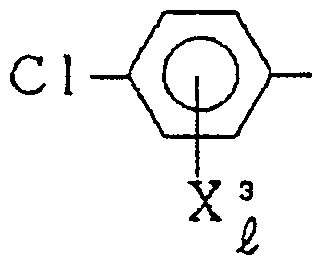
- X 3 is a halogen atom, and is an integer of 2 or 3.
- Halodene atoms include, for example, fluorine, chlorine, bromine and iodine as preferred.
- Examples of the group of the formula (c) include 2,4,5-tricyclomouth phenyl, 3,4,5-tricyclomouth phenyl, 2,3,4-tricyclomouth phenyl, 2,4,6 — Trichlorophenyl, 2, 3, 4, 5—preferably tetrachlorophenol Can be listed as
- Examples of the group of the formula (d) include 2-fluorophenyl, 3-fluorophenyl, 4-fluorophenyl, 2,5-difluorophenyl, 3,5-difluorophenyl, 2,4-diphnolerophenyl, Preferred examples include 1-bromophenyl, 3-bromophenyl, 2-bromophenyl, 2-phenol, 4-phenyl, and the like.
- X s is a hydrogen atom, a halogen atom, a lower alkyl, lower alkoxy or preparative Rifuruoromechiru.
- halodene atom the same as those exemplified for X 3 can be mentioned as preferred specific examples.
- X s is a hydrogen atom or a halogen atom.
- halogen atom the same as those exemplified for X 3 can be mentioned as preferred specific examples.
- Examples of the group of the formula (e) include 2-cyanophenyl, 3-cyanophenyl, 4-cyanophenyl, 3-chloro-2-cyanophenyl, 4-chloro-2-cyanophenyl, 5-chloro-2-cyanophenyl, 6-chloro-
- X 7 is a hydrogen atom, a halogen atom, cyano, low-alkoxy or trifluoromethyl. .
- Halogen atom a lower alkoxy
- X s X s
- Groups of formula fe) include, for example, 6-chloro-2-pyridyl, 5-chloro-
- X 8 is a hydrogen atom, a chlorine atom, or a lower alkylthio
- p is an integer of 1 or 2.
- an alkylthio group having a linear or branched alkyl moiety having 1 to 4 carbon atoms is preferable, such as methylthio, ethylthio, n-bromothio, iso-bromothio, n-butylthio, and the like.
- Preferred are iso-butylthio, sec-butylthio, t-butylthio and the like.
- Examples of the group of the formula (h) include 4-bilimidinyl, 2-chloro-4-1-pyrimidinyl, 6-chloro-2-bilimidinyl, 2,6-dichloro-4-bilimidyl, —Chloro-2-methylthio-14-pyrimidinyl, 2-methylthio-14-pyrimidinyl and the like can be mentioned as preferred.
- X 3 and X 1 are the same or different and are a chlorine atom, a hypoalkoxy or a lower alkylthio.
- the lower alkylthio can be mentioned as preferred examples of the same as those exemplified for X 8.
- Examples of the group of the formula (II) include 4-chloro-6-methoxy-2-triazinyl, 4,6-dimethoxy-2-triazinyl, and 4-methoxy-6-methylthio-12-triazin. And phenyl-6-methylthio-12-triazinyl and 4,6-dimethylthio-12-triazyl.
- X 11 is a hydrogen atom or a chlorine atom.
- a 2-biradixyl group for example, there can be mentioned a 2-biradixyl group, a 3-chloro-2-virazinyl group, a 5-chloro-2-birazinyl group and a 6-chloro-2-birazinyl group.
- Ar is preferably a group represented by formulas (a), (d), (e), fe), (h) and G).
- C, -C S alkyl may be a branched be linear, For example a methyl group, Echiru group, n- Purobiru group, isopropyl building group, n- butyl group, isobutyl group, sec —Butyl group, tert-butyl group, n-amyl group, isoamyl group, sec-amyl group, active amyl group, tert-amyl group, 1,2-dimethylbutyl building group, 2,2-dimethylbutyl ⁇ building group , 1,1-dimethylbutyl, 1,2-dimethylbutyl, 1,3-dimethylbutyl, 2,2-dimethylbutyl, 2,3-dimethylbutyl, 3,3-dimethylbutyl, 1,1 , 2-trimethyl propyl group, 1, 2, 2-trimethyl bromo group, 1-ethyl pi vir group, 2-ethyl butyl group and the like.
- an unsaturated hydrocarbon group having 3 to 5 carbon atoms in the longest carbon chain portion is preferable.
- a non-planar hydrocarbon group having 3 to 5 carbon atoms in the longest carbon chain portion is preferable, for example, 2-brovinyl, 2-butynyl, 3- Butul, 1-methyl-2-bromovinyl, 1,1-dimethyl-2-bromovinyl and the like can be mentioned.
- C 3 -C 7 cycloalkyl As the example Shikurobu port building, Shikurobuchi Le, cyclopentyl, butyl can and Ageruko to cyclohexyl and cyclo.
- R ′ lower alkyl and C 3 -C 7 cycloalkyl are particularly preferred.
- R 2 is a hydrogen atom or Ct Cs alkyl. Of these, d to C 6 alkyl is preferred.
- Lower alkyl can be the same as described above for R 1 .
- R 'and R 2 are 4-8 membered can you to form together with the nitrogen atom to which they are attached together, preferably 6-7 membered, heterocyclic group containing an oxygen atom as ring atoms And may be substituted with lower alkyl or lower alkylene.
- the lower alkyl as the substituent those described above for R 1 can be used.
- the lower alkylene as a substituent an alkylene group having 2 to 4 carbon atoms is preferable, and examples thereof include ethylene, trimethylene and tetramethylene.
- heterocyclic group examples include the following groups.
- Heterocyclic group containing oxygen atom Heterocyclic group containing oxygen atom:
- Heterocyclic group containing lower alkylene group (bicyclo ring group):
- Preferred compounds of the above formula (I) of the present invention include, for example, the compounds described in Table 1 below.
- the substance of the present invention may be in the form of a harbor or in the form of a salt, for example, a form that is sufficiently acid-added.
- the acid constituting the acid addition salt include mineral acids such as hydrochloric acid, base acid, and phosphoric acid; and organic acids such as drunk acid, chloroacetic acid, trichloroacetic acid, maleic acid, and citric acid. Can be.
- Ar ′ is a group selected from the group consisting of aryl groups represented by the formulas (a) to fe) in the definition of ⁇ in the above formula (I), and R 1 is defined by the above formula ( I), and
- R 21 is d Cs alkyl, and R ′ and R 21 form the same nitrogen group as the 4- to 8-membered heterocyclic group formed by R 1 and R 2 in the above formula (I). Good,
- R 1 and R 21 are the same as those in the above formula (I).
- Ar ' is a group selected from the group consisting of Ariru groups I table by the formula (a) ⁇ (g) in the definition of Ar of Formula (I), also the definition of R 21
- R 2 in the above formula (I) does not include a hydrogen atom
- R 1 is the same as in the above formula (I). Therefore, specific examples of the compound represented by the above formula (H) will be apparent to those skilled in the art from specific examples of the compound represented by the above formula (I).
- the compound of the above formula ( ⁇ ) and the carbamic acid of the above formula (1 ⁇ ) can be quenched in the presence of a sulphate group.
- Organic bases include, for example, pyridine bases such as pyridine, bicholine, lutidine, and coridine; tertiary amines, tertiary amines, 1,8-diazabicyclo [5,4,0-undecene-17, and tertiary amines such as ⁇ , ⁇ -dimethylanine; Mines are preferably used.
- NaHC0 3, KHC0 3, Na 2 C0 3, K 2 C0 3 , or the like can be preferably ⁇ Geru.
- the warp temperature is usually from 20 to 100, preferably from -10 to 60.
- the reaction time is usually 30 minutes to 30 hours. It is desirable that the reaction be carried out under a towel.
- a solvent may not be used, but an inert solvent such as aromatic hydrocarbons such as benzene, toluene and xylene, chloroform, dichloromethane, carbon tetrachloride, dichloroethane and trichloroethane.
- Hydrogen halides such as tetrachloroethane, cyclobenzene, dichlorobenzene, etc., tetrahydrofuran, ethyl acetate, dimethylformamide and the like may be used.
- the desired product can be obtained from the mixture by a conventional method as described in Examples below.
- Ar ′ is as defined above, and A is a substituted or unsubstituted phenyl
- Ar ′ By reacting an amine represented by the following formula:
- A is a substituted or unsubstituted phenyl.
- the substituted phenyl is, for example, a ⁇ -genated phenyl such as chlorophenyl or the like. Lower alkyl-substituted phenols such as tolyl are preferred.
- An aryloxy group represented by the formula (W); ⁇ -rubamic acid ester can be obtained, for example, by converting an aryloxyamine of the above formula (H) and a compound represented by AOCO C1 in the presence of a base and a solvent. Manufacture by reversing be able to.
- the base and the solvent the same ones as exemplified in the above-mentioned method for producing the compound of the formula (I) -11 can be similarly used.
- the reaction temperature is usually from 0 to: I00, preferably from 0 to 80.
- the reaction time is usually 30 minutes to 5 hours. It is desirable to carry out the anti-boiler underneath.
- the warp be actually planeed in a solvent.
- the same solvents as those exemplified in the above method for producing the compound of formula (I) -11 can be used.
- an amine of the formula (V) in which R 2 is C, -Ce alkyl it is particularly preferable to use dimethylformamide as a solvent.
- ⁇ ⁇ is a group selected from the group consisting of aryl groups represented by the formulas 0, G) and ⁇ in the definition of Ar in the above formula (I), and
- R ′ and R 2 are the same as in formula (I) above,
- R 1 and R 2 are the same as in the above formula (I), Can be produced by reacting N-hydroxyureas represented by the formula in the presence of a base.
- chloride kink Mi oxazines of formula (VI) specific examples of the chloride preparative triazine compounds and chlorides pyrazine compounds of formula (W) of formula (W) is, X 8, P, X 3 and X 1. It will be clear from the above example.
- the N-hydroxyurea compound of the formula (IX) is usually used in an amount of 0.8 to 5 mol per 1 mol of the chloride selected from the virimidine compound of the formula (VI) and the triazine chloride of the formula (VI). Preferably, 1 to 2 mol is used.
- the reaction temperature is usually from 150 to 50, preferably from 30 to 40C.
- the reaction time is usually 30 minutes to 10 hours.
- the base used in the reaction the same bases as those exemplified in the method for producing the compound represented by the formula (I) -11 can be used.
- other metal alkoxides such as sodium ethoxide and potassium-t-butoxy can be preferably used.
- the base is used in an amount of usually 0.5 to 10 mol, preferably 1 to 5 mol, per 1 mol of the chloride used.
- reaction can be carried out without solvent or in a solvent.
- solvent The same compounds as those exemplified in the method for producing the compound of formula (I) -11 can be used.
- a herbicide containing the substituted aryloxyureas of the present invention or an acid addition salt thereof as an active ingredient for herbicidal use is also provided.
- the compound of the present invention may be used as it is.
- the herbicides having the K dosage form can be used in the compounds of the present invention, for example, talc, Solid carriers such as bentonite, clay, kaolin, diatomaceous earth, white carbon, vermiculite, slaked lime, silica sand, ammonium sulfate, urea, etc .; alcohols, dioxane, acetone, cyclohexanone, methylnaphthalene, dimethylformamide *, Liquid carriers such as dimethyl sulfoxide; salts of alkyl sulfates, alkylaryl sulfonates, polyoxyethylene glycol ethers, It can be produced by using an emulsifier or dispersant such as boroxyethylene alkylaryl ether or polyoxyethylene sorbitam / alkylate, or various auxiliary agents such as ruboxymethyl cellulose or gum arabic.
- the herbicide of the present invention may be diluted with water or the like as it is or as appropriate. In cloudy form, apply an effective amount to control the organism.
- the amount of the compound of the present invention used as a herbicide cannot be specified unconditionally due to differences in soil contact conditions, shape, timing of use, method of use, and the frequency of cultivated crops and weeds. It is effective to apply 10 g to 5 kg.
- the herbicide of the present invention is more effective than commercial herbicides for annual perennial weeds such as Nobie, Tamagayalli, Konagi, Kikasigusa, Azena and Abnome, which occur in paddy fields, as well as perennial weeds such as fireflies, pine trees, Mizugayalli and Heramodaka.
- the removal method of the present invention can be applied to various grasses that are problematic in upland fields, for example, grasses such as barnyardgrass, crabgrass, ginkgo biloba, sparrows, and pods. It shows high herbicidal effect on broadleaf weeds such as white fir by soil treatment or foliage treatment, and also shows high safety against major crops such as rice, wheat, corn, soybean, and ivy. Has features.
- the herbicidal plant of the present invention can be used as a herbicide for orchards, pastures, lawns, and non-agricultural lands.
- the removal of the present invention can be used in combination with other agricultural chemicals or feeds, if desired. Examples
- N- (3-cyanophenoxy) carpamic acid phenol ester 2.1 Og (8.3a »o £) is dissolved in a mixed solvent of N, N-dimethyl lumamide 20 * and toluene 20» £, and then hexamethylene imidate. 1.64 g (l 6.5 ao £) was added and the mixture was stirred at 60 for 1 hour. After cooling the reaction mixture to room temperature, water 120 was added, and the mixture was extracted with ethyl acetate. The extract was washed with brine and dried over anhydrous magnesium sulfate.
- 80 parts of this mixture is mixed with 20 parts of water, kneaded, processed into a powder of 14 to 32 mesh by an extrusion granulator, and then dried to make granules.
- An emulsion is prepared by uniformly dissolving 30% of the compound of the present invention, 20% of cyclohexanenone, 11% of polyoxyethylene alkylaryl ether, 4% of calcium alkylbenzenesulfonate and 35% of methylnaphthalene.
- Production Example 5 B dust
- Paddy field soil was filled in a magnetic bot with a diameter of 1 Oca, and seeds of Tinebiye, Tama Gayalli, Konagi and Hoers were sown after the generation and flooded to a depth of 3c lake The next day, a wettable powder prepared according to Formulation Example 3B was diluted with water and dropped on the water surface (application rate; 4 kg per hectare as an active ingredient). Then grow in a greenhouse, 30 days after processing: The removal activity was examined according to the criteria in Table C. The results are shown in Table 2C.
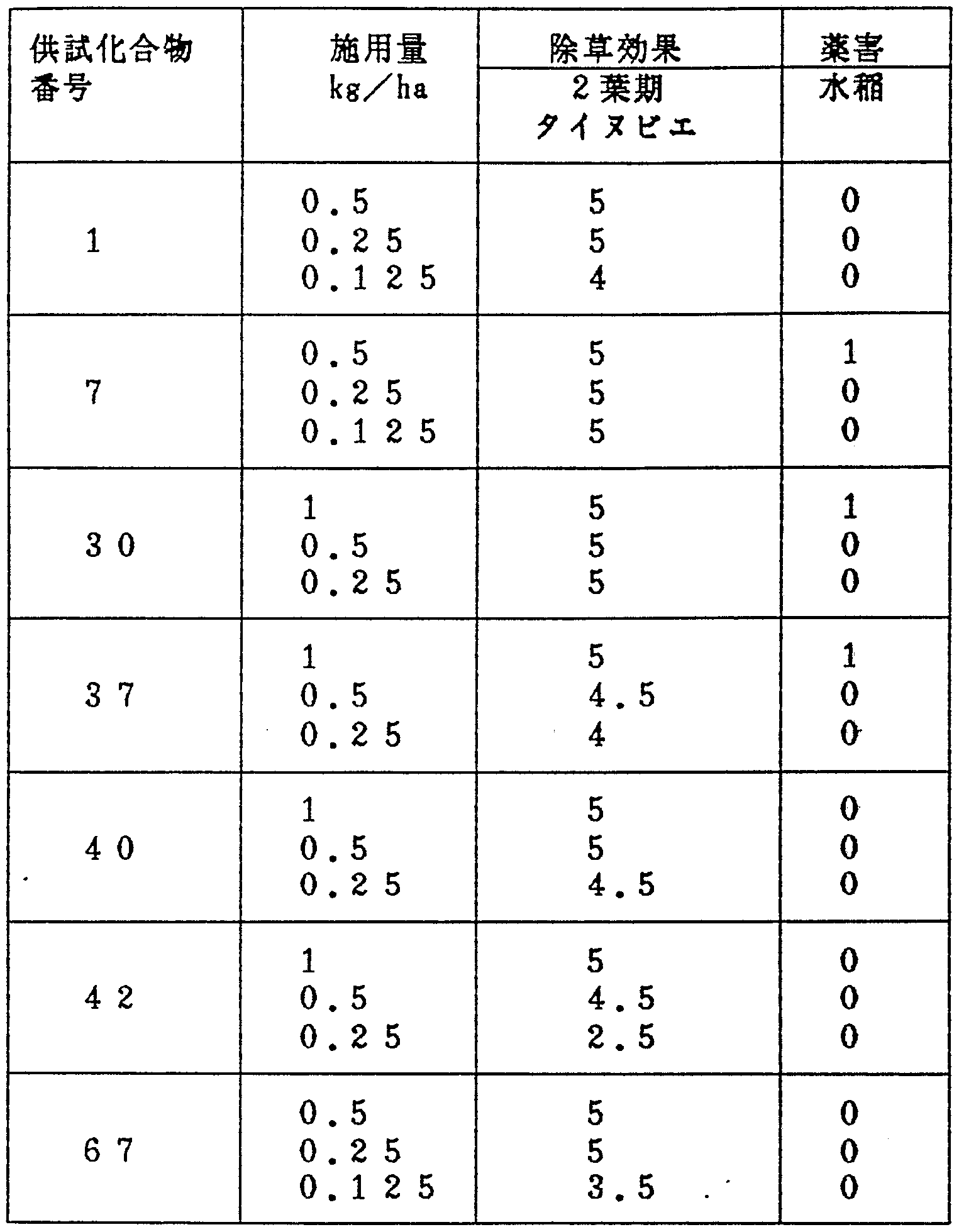
- Test Example 2 C selective weeding test between rice and hieh
- Paddy soil was filled in 1Z5,000 Oa Wagner bot, and after generation, Tainubie seeds were sown and grown in the greenhouse until the second leaf stage.
- the number of tillers at the 2 leaf stage was adjusted to 15 per bot, and the test compound was used as a wettable powder according to 3B, and a predetermined amount thereof was diluted with water and dropped on the water surface.
- rice plants at the two-leaf stage were transplanted to other 1Z5,000 Oa Wagner pots, and the test compounds were dropped in the same manner the day after transplantation.
- the plants were grown in a greenhouse for 30 days after the treatment, and the removal activity and phytotoxicity were investigated according to the criteria in Table 1C. The results are shown in Table 3C. Table 3C
- Test compound was converted to a wettable powder according to Formulation Example 3B, and a predetermined amount of the test compound was diluted with water and sprayed uniformly on the soil surface with a small sprayer at a spraying rate of 100 J2 / ha. (Amount: 4 kg per hectare as active ingredient). After growing for 20 days in a greenhouse, herbicidal effects and phytotoxicity were investigated according to the criteria in Table 1C. The result 4 As shown in Table C ⁇
- Test example 4 C Herbicidal effect and phytotoxicity test by upland soil treatment
- Field soil was filled into a plastic bat of 60 O ca 2 , and seeds of hee, meshishiba, enokorogusa, aoba, kogomekamari, rice, wheat, corn, soybean, potato, and beet were seeded and covered with soil.
- the test compound was made into hydrated hydrate according to the solvent 3B, and a predetermined amount thereof was diluted with water and sprayed uniformly on the soil surface with a small sprayer at a spraying rate of 100,000 pounds per hectare.
- the plants were grown in a greenhouse for 30 days after treatment, and the herbicidal effects and phytotoxicity were investigated according to the criteria in Table 1C. The results are shown in Table 5C.
- Test Example 5 C (Removal test by foliar treatment)
- Paddy soil is filled in a magnetic pot with a diameter of 10 c, and seedlings of rice varieties, tamagayalli, konagi, and hotle are sown after the cultivation and submerged at a water depth of 3 ⁇ ; concession.
- « ⁇ Example 3B The so-called prepared wettable powder was diluted with water and applied dropwise to the surface of the water (application rate: 4 kg per hectare as an active ingredient). 30 days after treatment, herbicidal activity was investigated according to the criteria in Table 1C below. The results are shown in Table 7C.
- Test Example 8 C (Test for removing apple and phytotoxicity by upland soil treatment)
- Test example 3 C Weighting test by paddy soil treatment
- Paddy field soil was filled in a magnetic bot having a diameter of 1 O ca, and seeds of Tinevier, Tama Gayalli, Konagi and Hoers were sown after the generation and submerged at a water depth of 3 c gut Next day, a wettable powder prepared in accordance with Formulation Example 3 B was diluted with water and dropwise 1 ⁇ 2 sense the water surface; e then (application rate hectares per kg to as the active ingredient) form education in the greenhouse, 1 ⁇ 2 sense Thirty days later, the herbicidal activity was examined according to the criteria shown in Table 1C below. The results are shown in Table 10C. Table 10C
- the field soil was filled in a 12 O ca 2 plastic bot, and seeds of hee, mehishiba, aobu, and kogomekamari were sown and covered. ⁇ ⁇
- the test compound was converted into a wettable powder according to Example 3B, diluted with water, and sprayed uniformly on the soil surface with a small sprayer at a spraying rate of 100,000 pounds per hectare. (Amount; 4 kg of hectares as active ingredient) 0 ; Grow in a greenhouse for 20 days after treatment The herbicidal effect and phytotoxicity were so-called according to the criteria in Table 1C. The results are shown in Table 11C.
- Test example 1 1 C (herbicidal effect and phytotoxicity test by field soil treatment)
Landscapes
- Organic Chemistry (AREA)
- Chemical & Material Sciences (AREA)
- Life Sciences & Earth Sciences (AREA)
- Health & Medical Sciences (AREA)
- Environmental Sciences (AREA)
- Engineering & Computer Science (AREA)
- Dentistry (AREA)
- General Health & Medical Sciences (AREA)
- Wood Science & Technology (AREA)
- Zoology (AREA)
- Plant Pathology (AREA)
- Pest Control & Pesticides (AREA)
- Agronomy & Crop Science (AREA)
- Agricultural Chemicals And Associated Chemicals (AREA)
- Plural Heterocyclic Compounds (AREA)
- Organic Low-Molecular-Weight Compounds And Preparation Thereof (AREA)
- Pyridine Compounds (AREA)
- Pharmaceuticals Containing Other Organic And Inorganic Compounds (AREA)
- Saccharide Compounds (AREA)
Description
明 細 書
置換ァリ ールォキシ尿素類、 それらの製法および用途
技術分野
本発明は新規な置換ァリールォキシ尿素、 その製法およびそれを有効 成分として含有する除草剤に関するものである。
背景技術
作物の収量を確保する為に、 多くの除草剤が使用されてきた。 尿素系 化合物は、 例えば畑地用除草剤として広く用いられている D C M Uなど は、 水田では薬害が強く使用できないという欠点を有していた。
米国特許第 3 , 3 3 2 , 9 7 5号明細書には、 本発明の化合物と化学構 造が相違する ID—ク π πフヱノキシ尿素類が医薬として使用できること が開示されているが、 これらの化合物は後述するように、 除草効果を発 揮せず、 また発揮したとしても非常に弱い。
特公昭 4 1 - 5 2 5 4号公報には、 下記式

ここで、 R ,はフエ二ル又はハロデン置換フエ二ル又は式
R 5
- N
R ここで、 R sと R eは同一のアルキル又はァラルキルであるか又 は R sと R 6はそれらが結合している窒素原子と共にビぺリジノ 又はモルホ リ ノを形成することもできる、 で表わされる基であり;
R 2は低級脂肪族炭化水素基又はフエュルであるか或はハロゲン、 アルキルメルカブト、 ニト ロおよびアルコキシの少く とも 1種で置 換されたフエニルであり;
R 3と R i同一のアルキル又はァラルキルであるか R 3と R 4はそれ らが結合している窒素原子と共にビぺリジノ又はモルホリノを形成 することもでき;そして
Xは酸素又は硫黄である、
で表わされる置換尿素又はチォ尿素、 およびそれらの化合物が、 生物学 的データの開示はないが、 除草剤であることが記載されている。
特公昭 4 6— 6 3 3 9号公報には、 下記式

ここで、 Rは C t〜 C 4アルキルであり;
Yは F、 Cし B r又は Iのハロゲン原子、 C^ C アルキル、 又は C t ~ アルコキシであり;
πは 0であるかあるいは Yがハロデン原子であるとき 1 ~ 3の簦数 であるかあるいは Yがアルキル又はアルコキシであるとき 1であり
Zは F、 C l、 B r又は Iのハロゲン原子であるか又は(^〜(^アル キルであり;
aは 0であるかあるいは Zがハロゲン原子であるとき 1 ~ 5の整数 であるかあるいは Zがアルキルであるとき 1である、
である化合物が植物またはその生長部位に施用する除草剤であることが
開示されている。
また、 本顆の先穎に係る米国特許出願第 SN 800,031号明細書 および欧州特許出顋第 ΕΡ— 183174号明細書には、
下記式( I )

ここで、 Αはハロゲン原子又はト リフルォロメチルであり; X、 Yおよび Zはそれぞれ水素原子、 ハロゲン原子又はト リフルォ ロメチルであり;
R,は d Ceアルキル、 低級アルコキシ、 低珐アルコキシ置換低 級アルキル、 シクロアルキル置換低級アルキル、 低級アルケニル、 低級アルキ-ル、 低級ハロアルキル、 低級ハロアルケニル又は C3 〜 C3非芳香族性環状炭化水素基であり;
R2は水素原子、 Ct〜Ceアルキル、 低轵アルケニル又は低鞔アル キニルであり;また
と R2は、 それらが結合している窒素原子とー锗になって、 環内 に二重結合又は酸素原子を含有していてもよくまた 1つ又はそれ以 上の分岐を有してもよい 3〜 8員環(ビシクロ環でもよい)を形成す ることができる、
で表わされる化合物、 およびそれらが除草効果を有することが開示され ている。
本発明の目的は、 新規な置換ァリールォキシ尿素類を提供することに ある。
本発明の他の目的は、 優れた除草効果を発現する新規な置換ァリール ォキシ尿素類を提供することにある。
本発明のさらに他の目的は、 発芽前から生育期に亘る巾広い期間に亘 つて雑草に施用して、 雑草に対し優れた除草効果を発現する新規な置換 ァリールォキシ尿素類を提供することにある。
本発明のさらに他の目的は、 除草効果を発現するも、 作物或いは作物 植物に対して安全性の高い新規な置換ァリールォキシ尿素類を提供する ことにある。
本発明のさらに他の目的は上記本発明の優れた除草活性を持つ化合物 を工業的に有利に製造することにある。
本発明のさらに他の目的およぴ利点は、 以下の説明から明らかとなろ 発明の開示
本発明によれば、 本発明の上記目的及び利点は.
下記式( I )
( I )

ここで、 Arは、
(a) 式
 ここで、 X 1は水素原子、 低袋アルキル又は低級アルコキシで ある、
(b) 式

ここで、 X 2は水素原子又はハロゲン原子である
(c) 式

ここで、 X 3はハロゲン原子であり、 そして
i は 2又は 3の整数である、
(d) 式

ここで、 X iフッ素原子、 臭素原子又は沃素原子であり、 そ して mは 1、 2又は 3の整数である、
(e) 式

ここで、 X sは水素原子、 ハロゲン原子、 低級アルキル、 低級 アルコキシ又はト リ フルォロメチルである、
(f) 式

ここで、 Xsは水素原子又はハロゲン原子である
(g) 式
 ここで、 X7は水素原子、 ハロゲン原子、 シァノ、 低轵アルコ キシ又はト リフルォロメチルであり、 nは 1又は 2の整数であ る、
(h) 式

ここで、 X8は水素原子、 塩素原子又は低級アルキルチオであ り、 そして pは 1又は 2の整数である、
(i) 式

ここで、 X 3および X1。は同一もしくは異なり、 塩素原子、 低 敏アルコキシ又は低級アルキルチオである、
および
(j) 式

5 ここで、 X11は水素原子又は塩素原子である、
で表わされるァリール基より成る群から選ばれる基であり;
Rリま C, ~Ceアルキル、 低級アルケニル、 低級アルキニル又は C3
〜C7シクロアルキルであり;そして
R2は水素原子又は C,〜 Csアルキルであり;
10 R1と R2は一緒になつてそれらが秸合している窒素原子と共に、 4
~ 8員の複素環基を形成してもよく、 ここで該複素環基は環員原子 ' として酸素原子を含有することができまた低鞔アルキル基又は低毅 アルキレン基で置換されていてもよい
で表わされる置換ァリールォキシ尿素類およびその酸付加塩によって達
15 成される。
上記式( I )において、 Arは上記 (a)〜G)の式で表わされる基のいずれ かである。 (a)〜(j)の式で表わされる基は、 置換フエニル((a)〜 ))、 ピ リ ジル(8)、 ビリ ミ ジ-ル (h)、 ト リアジこル (ί)およびビラジニル基 (j)であ り、 いずれも芳香族基である点で軌を一にする。
20 式 (a)の基において、 X'は水素原子、 低級アルキル又は低級アルコキ
'
シである。
低級アルキルとしては、 炭素数 1〜 4の直鎖状又は分枝鎖状のアルキ ルが好ましく、 例えばメチル、 ェチル、 π—ブ口ビル、 iso—プロビル、 n—ブチル、 sec—ブチル、 iso—ブチル、 t一ブチル等を挙げることがで
きる。
低轵アルコキシとしては、 炭素数 1 ~ 4の直鎖状又は分枝鎖妆のアル キル部分を持つアルコキシが好ましく、 例えばメ トキシ、 エトキシ、 n ーブ πポキシ、 1 so—ブロホキシ、 n—ブトキシ、 sec—ブト キシ、 iso— ブトキシ、 t一ブトキシ等を挙げることができる。
式 (a)の基としては、 例えば、 2—クロ口フエニル、 2—クロ ロー 5— メチルフエニル、 2—クロ口一 3—メチルフエニル、 2—クロロー 4一 メチルフエニル、 2—クロロー 6—メチルフエ-ル、 2—クロロー 5— メ トキシフエ二ル、 2—クロ α— 6—メ トキシフエ二ル、 2—クロロー 4ーメ トキシ 7ェニル、 2—クロロー 3—メ ト キシフエ二ル等を好まし いものとして挙げることができる。
式 (b)において、 X 2は水素原子又はハロゲン原子である。
ハロゲン原子としては、 例えばフッ素、 塩素、 臭素および沃素を好ま しいものとして挙げることができる。
式 (b)の基としては、 例えば 4一クロ口フエニル、 2 , 4—ジクロロフ ェ;!ル、 2—ブロム一 4一クロ口フエニル、 4一クロロー 2— 7ルォロ フエ二ル等を好ましいものとして挙げることができる。
式 (c)において、 X 3はハロゲン原子であり、 そして は 2又は 3の整 数である。
ハロデン原子としては、 例えばフッ素、 塩素、 臭素および沃素を好ま しいものとして挙げることができる。
式 (c)の基としては、 例えば 2, 4, 5—ト リクロ口フエニル、 3, 4, 5 一ト リ クロ口フエニル、 2, 3, 4—ト リ クロ 口フエニル、 2, 4 , 6— ト リ クロロフエニル、 2, 3, 4, 5—テ ト ラクロ口フエ二ル等を好ましい
ものとして挙げることができる。
式 (d)において、 まフッ素原子、 臭素原子又は沃素原子であり、 18は
1、 2又は 3の整数である。
式 (d)の基としては、 例えば 2—フルオロフェ -ル、 3—フルオロフェ ニル、 4一フルオロフェュル、 2 , 5—ジフルオロフェニル、 3, 5—ジ フルオロフェニル、 2, 4ージフノレオロフェニル、 4一ブロムフエニル、 3—ブロムフエニル、 2—ブロムフエニル、 2—ョー ドフエ-ル、 4一 ョードフエ二ル等を好ましいものとして挙げることができる。
式 (e)において、 X sは水素原子、 ハロゲン原子、 低 アルキル、 低級 アルコキシ又はト リフルォロメチルである。
ハロデン原子としては、 X 3について例示したと同じものを好ましい 具体例として挙げることができる。
低敏アルキルおよび低級アルコキシとしては、 X 'について例示した ものと同じものを好ましい具体例として挙げることができる。
式 (e)の基としては、 例えば 2—二 ト ロフエニル、 3—= ト ロフエ-ル,
4一二 口フエ二ノレ、 4一クロロー 2—二 ト ロフエ二ノレ、 5—クロロー 2一二 口フエニノレ、 5—クロロー 2—二 ト ロフエ二ノレ、 3一クロ口—
5—二 口フエ =ル、. 5—メチノレー 2—二 ト 口フエニル、 4ーメチルー 2一二 口フエニノレ、 3—クロロー 4一二 ト ロフエ二ノレ、 2—クロロー 4一二 口フエニル、 2—メチルー 6—二 ト αフエニル、 3—メチルー
4一二 口フエニル、 2—メチルー 4一二 ト ロフエ-ル、 2—メチルー
5一二 πフエニル、 2—メ ト キシー 5 —- ト ロフエニル、 2—ニ ト ロ - 4 - リフルォロメチルフエニル 3—二 ト ロー 5—ト リフルォロメ チルフエニル、 5 -ニ ト ロ一 2—ト リフルォロメチル等を挙げることが
できる。
式 fe)において、 X sは水素原子又はハロゲン原子である。
ハロゲン原子としては、 X 3について例示したと同じものを好ましい 具体例として挙げることができる。
式 (e)の基としては、 例えば 2—シァノフエニル、 3—シァノフエニル、 4一シァノフエニル、 3—クロロー 2—シァノフエニル、 4一クロロー 2—シァノフエニル、 5—クロロー 2—シァノフエニル、 6—クロロー
2—シァノフエニル、 2—ク口ロー 3—シァノフエ-ル、 4一クロロー
3—シァノフエニル、 3—クロロー 5—シァノフエニル、 2—クロロー 5—シァノフエニル、 3—クロロー 4一シァノフエニル、 2—クロロー
4一シァノフエ二ル等を好ましいものとして挙げることができる。
式 (g)において、 X 7は水素原子、 ハロゲン原子、 シァノ、 低轵アルコ キシ又はト リフルォロメチルである。 .
ハロゲン原子、 低級アルコキシとしては、 X sについて例示したもの と同じものを好ましい具体例として挙げることができる。
式 fe)の基としては、 例えば 6—クロロー 2—ピリジル、 5—クロロー
2—ピ リジル、 4—クロ 口一 2—ピリジル、 3—クロロー 2—ピリジル、 3 , 5—ジクロロー 2—ピリジル、 6—メ トキシー 2—ピリジル、 5— メ トキシー 2—ビリジル、 4—メ トキシー 2—ピリジル、 3—メ トキシ 一 2—ピ リジル、 4一ト リ フルォロメチルー 2—ピリ ジル、 5—ト リフ ルォロメチルー 2—ピリジル、 6—ト リフルォロメチル一 2—ビリジル、
3—クロロー 5—ト リフルォロメチルー 2—ビリジル等を挙げることが できる。 これらのうち、 例えば 6—クロロー 2—ピリジルおよび 6—ト リフルォロメチルー 2—ビ リ ジルが好ましい。
式 (h)において、 X 8は水素原子、 塩素原子、 又は低轵アルキルチオで であり、 そして pは 1又は 2の整数である。
低級アルキルチオとしては、 炭素数 1 ~ 4の直鎖状又は分枝鎖状のァ ルキル部分を持つアルキルチオ基が好ましく、 例えばメチルチオ、 ェチ ルチオ、 n—ブロビルチオ、 i so—ブロビルチオ、 n—ブチルチオ、 i so— ブチルチオ、 sec—ブチルチオ、 tーブチルチオ等を好ましいものとして 挙げることができる。
式 (h)の基としては、 例えば 4ービ リ ミ ジニル、 2—クロロー 4一ピリ ミ ジニル、 6—クロロー 2—ビリ ミ ジニル、 2, 6—ジクロロー 4ービ リ ミ ジ-ル、 6—クロロー 2—メチルチオ一 4一ピリ ミ ジニル、 2—メ チルチオ一 4一ビリ ミジニル等を好ましいものとして举げることができ る。
式 (i)において、 X 3および X 1。は同一も しくは異なり、 塩素原子、 低 敏アルコキシ又は低級アルキルチオである。
低級アルコキシとしては、 X 1について例示したものと同じものを好 ましい具体例として挙げることができる。
低級アルキルチオとしては、 X 8について例示したものと同じものを 好ましい具体例として挙げることができる。
式 (ί)の基としては、 例えば 4一クロロー 6—メ ト キシー 2—ト リアジ ニル、 4, 6—ジメ ト キシー 2—ト リアジニル、 4ーメ ト キシー 6—メ チルチオ一 2—ト リアジ二ル、 4一クロ π— 6—メチルチオ一 2—ト リ アジニル、 4, 6—ジメチルチオ一 2 - ト リアジ-ル等を挙げることが できる。
式(j )において、 X 1 1ほ水素原子又は塩素原子である。 式(j )の基とし
ては、 例えば、 2—ビラジこル基、 3—クロロー 2—ビラジニル基、 5 一クロロー 2—ビラジニル基、 6—クロロー 2—ビラジニル基を挙げる ことができる。 Arとしては、 式 (a)、 (d)、 (e)、 fe)、 (h)および G)で表わさ れる基が好ましい。
上記式( I )中、
 アルキル、 低級ァルケ-ル、 低級アル キニル又は C3~C7シクロアルキルである。 これらのうち、 Ct Csァ ルキルおよび C:!〜 C7シク口アルキルが好ましい。
C,〜CSアルキルは直鎖状であっても分枝鎖状であってもよく、 例え ばメチル基、 ェチル基、 n—プロビル基、 イソプロビル基、 n—ブチル基、 イソブチル基、 sec—ブチル基、 tert—ブチル基、 n—ァミル基、 イソァ ミル基、 sec—ァミル基、 活性アミル基、 tert—ァミル基、 1 ,2—ジメ チルブ口ビル基、 2 , 2—ジメチルブ πビル基、 1, 1ージメチルブチル 基、 1, 2—ジメチルブチル基、 1,3—ジメチルブチル基、 2,2—ジ メチルブチル基、 2, 3—ジメチルブチル基、 3, 3—ジメチルブチル基、 1, 1, 2—ト リ メチルプロビル基、 1, 2, 2—ト リメチルブロビル基、 1ーェチルブ πビル基、 2—ェチルブチル基などを挙げることができる。
低級アルケニル基としては、 最長炭素鎖部分の炭素数が 3〜 5の不飽 和炭化水素基が好ましく、 例えばァリル基、 2—ブテ-ル基、 3—ブテ ニル基、: 1—メチルー 2—プロぺニル基、 2—メチルー 2—プロぺニル 基、 1, 2—ジ、メチルー 2—ブロぺニル基、 2—メチルー 2 -ブテニル 基、 3—メチルー 2—ブテニル基、 2, 3—ジメチルー 2—ブテニル基 などを挙げることができる。
低級アルケニル基としてほ、 最長炭素鎖部分の炭素数が 3 ~ 5の不鉋 和炭化水素基が好ましく、 例えば 2—ブロビニル、 2—プチニル、 3—
ブチュル、 1ーメチルー 2—ブロビニル、 1 , 1ージメチルー 2—ブロ ビニル等を挙げることができる。
C3〜C7シクロアルキルとしては例えばシクロブ口ビル、 シクロブチ ル、 シクロペンチル、 シクロへキシルおよびシクロへブチルを挙げるこ とができる。
R'としては、 低級アルキルおよび C3〜C7シク口アルキルが特に好 ましい。
上記式( I )中、 R2は水素原子又は Ct Csアルキルである。 これら のうち、 d ~C6アルキルが好ましい。
低級アルキルとしては、 R1について上記したものと同じものを挙げ ることができる。
R'と R2は一緒になってそれらが結合している窒素原子と共に形成す ることができる 4〜 8員、 好ましくは 6〜 7員、 の複素環基は環員原子 として酸素原子を含有することができまた低級アルキル又は低珐アルキ レンで置換されていてもよい。 置換基としての上記低級アルキルとして は R1について上記したものと同じものを季げることができる。 置換基 としての低級アルキレンとしては、 炭素数 2〜 4のアルキレン基が好ま しく、 例えばエチレン、 ト リメチレン又はテト ラメチレンを挙げること ができる。
かかる複素環基として例えば下記基を挙げることができる。
4員環基:

5員環基:
4

6員環基:

7員環基:


酸素原子を含む複素環基:

低級アルキレン基を含む複素環基(ビシクロ環基):
」

本発明の上記式( I )の好ましい化合物としては例えば下記第 1表に記 載した化合物を举げることができる。
第 1表 Ar-ONHC-N
II
0


第 1表 (競き)
 第 1表 (耪き)


( 裟) ^ τϋ z z
oz
0Ϊ

( ) 拏 I
第 1表 (较き)


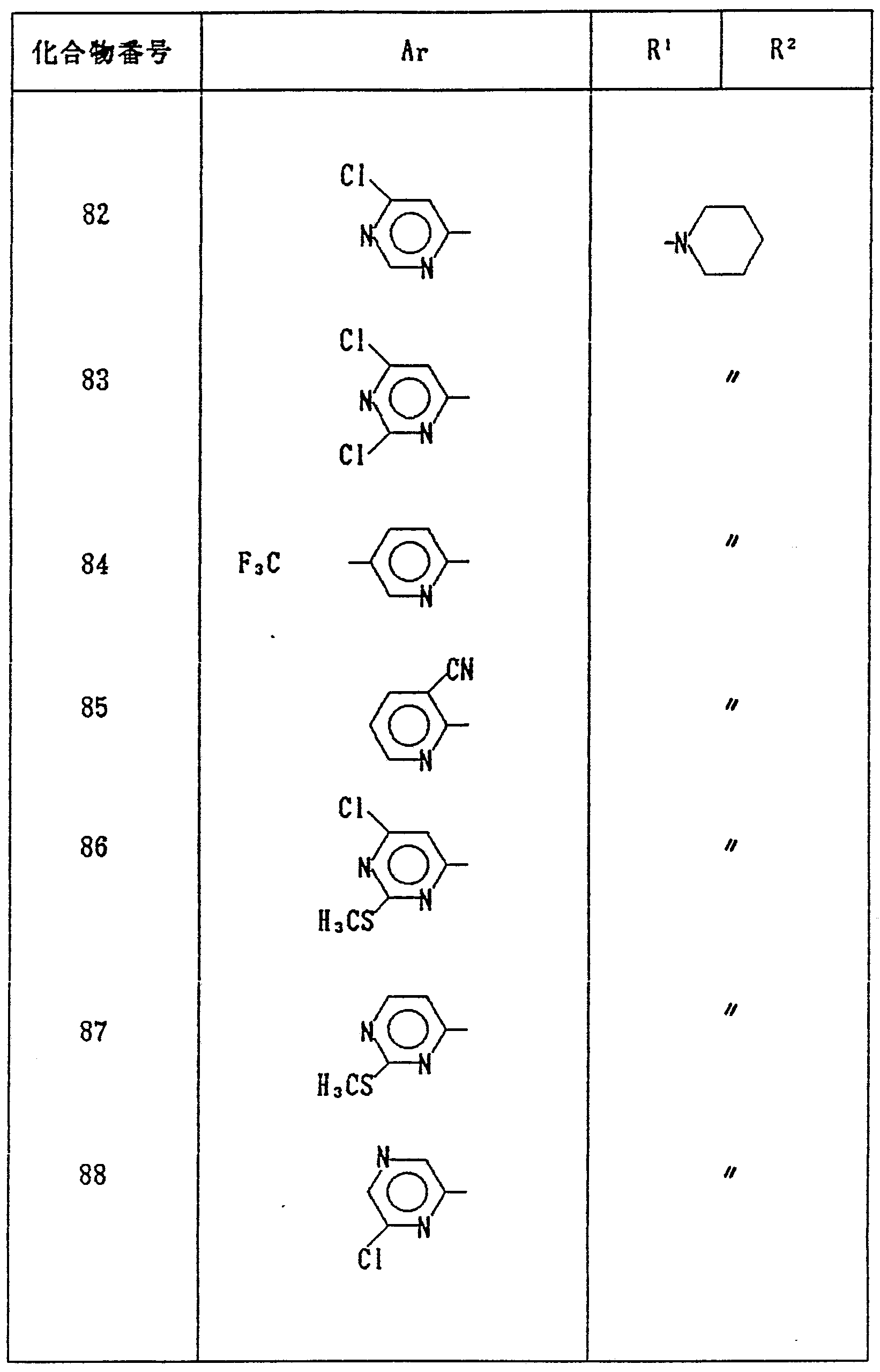

上記第 1表の化合物のうち、 化合物番号 1 〜 5、 7、 1 1、 1 6、 1
7、 21 ~ 26 30、 3 1、 35 - 38, 41、 43 - 45, 48、 51、 53、 59〜62、 64、 65、 67〜72、 74、 76、 77、 73、 81、 84、 86〜 31および 93の化合物がより好ましく、 就 中化合物番号 2、 3、 7、 1 1、 2 1、 22、 43、 44、 53、 60、 62、 64、 65、 68〜70、 76、 77、 84、 86 ~ 88および 93の化合物が特に好ましい。
また、 本発明の物質は港雜の状想であっても塩の形、 例えば酸付加堪 の形になっていてもよい。 酸付加塩を構成する酸としては、 例えば塩酸、 據酸、 リン酸の如き鉱酸;醉酸、 クロ口酢酸、 ト リクロ口醉酸、 マレイ ン酸、 クェン酸の如き有機酸を例示することができる。
本発明に従えば、 本発明の上記式( I )の化合物のうち、 下記式( I )一
ΑΓ' * · · ( I )-ΐ

ここで、 Ar' は上記式( I )の ΑΓの定義における (a)~fe)の式で表わ ' されるァリール基より成る群から選ばれる基であり、 R1の定義は 上記式( I )に同じであり、 そして
R21は d Csアルキルであり、 そして R'と R21は上記式( I )に おける R1と R2が形成する 4 ~ 8員の複素環基と同じ筷素漯基を形 成してもよい、
で表わされる置換ァリールォキシ尿素は、
下記式(H)
Ar' — ONH2 ♦ · · (!!)
ここで、 Ar' の定義は上記に同じである、
で表わされるァリールォキシアミン類と
下記式(BI)

ここで、 R1および R21の定義は上記式( I )に同じである、 で表わされるカルバミン酸塩化物とを、 塩基の存在下で反応させること によって S造することができる。
上記(II)中、 Ar' は上記式( I )の Arの定義における (a)~(g)の式で表 わされるァリール基より成る群から選ばれる基であり、 R21の定義も上 記式( I )の R2の定義と水素原子を含まない点で相違するのみであり、 そして、 R1の定義は上記式( I )に同じである。 それ故、 上記式(I)で 表わされる化合物の具体例から上記式( H )の化合物の具体例は当業者に 明らかであろう。
上記式(Π)の化合物は、 欧州特許出順 EP— 1 83 1 74号明細書、 特開昭 61— 1 26065号公報、 特頭昭 60— 257691号明箱書 およぴ特頋昭 61— 1 1 3233号明箱書に記載された方法および基本 的にそれらの方法に従って ¾造することができる。
また、 上記式(ΠΙ)で表わされる化合物の具体锊もまた、 上記式(I)の R 'および R2の定義から当業者には明らかであろう。
上記式(Π)の化合物と上記式(1Π)のカルバミン酸堪は、 堪基の存在下 で反おせしめられる。
塩基としては、 有機塩基および無攒塩基のいずれを使用することもで
きる。 有機塩基としては、 例えばビリジン、 ビコリン、 ルチジン、 コリ ジンなどのビリジン塩基;ト リェチルァミ ン、 1,8—ジァザビシクロ [5 ,4,0〗ゥンデセン一 7、 Ν,Ν—ジメチルァニ ンなどの第三 ァミ ン 類が好ましくは用いられる。
また無機塩基としては、 例えば NaHC03、 KHC03、 Na2C03、 K2C03などを好ましく举げることができる。
反おには、 通常、 上記式(inの化合物 1モルに対して上記式(m)の力 ルバミン酸堪化物が 0.8 ~ 3モル、 好ましくは 1〜 2モル使用される。 また、 塩基は通常、 上記式(ΠΠの ルバミ ン酸塩化物 1モルに対し 0. 5 ~ 20モル、 好ましくは 1 ~ 10モル使用される。
反お温度は通常一 20~ 100でであり、 -10~60でが好ましい。 反応時間は通常 30分〜 30時間である。 反応は搔袢下に実鬼するのが 望ましい。
反お溶媒は使用しなくてもよいが、 反おに不活性な溶媒、 例えばベン ゼン、 トルエン、 キシレンなどの芳香族炭化水素、 クロ口ホルム、 ジク ロロメタン、 四塩化炭素、 ジクロロエタン、 ト リ クロロェタン、 テト ラ クロロェタン、 クロ口ベンゼン、 ジクロロベンゼンなどのハロゲンィ匕戾 化水素、 テト ラヒ ドロフラン、 酢酸ェチル、 ジメチルホルムァミ ドなど を用いてもよい。
反応後は後記実施例に示すような常法により、 反お混合物から目的物 を得ることができる。
また、 本発明によれば、 上記式( I )の化合物のうち、 下記式(1 )— 2

ここで、 Ar' 、 R1および R2の定義は上記に同じである.
で表わされる置換ァリールォキシ尿素類は、
下記式(IV)
Ar' )

ここで、 Ar' の定義は上記に同じであり、 そして Aは置換又は未置換のフエニルである、
で表わされるァリールォキシ^ルバミン酸エステル類と
下記式(V)
.R1
HN. (V) ここで、 R 'および R2の定義は上記式( I )に同じである、
で表わされるアミン類を反応させることによって製造することができる。 上記式(ΙΠ中、 Ar' の定義は上記に同じであり、 また Aは置換また は未置換のフエ-ルである。 置換フエニルとしては、 例えばクロ口フエ ニルの如きハ πゲン化フエュルあるいはト リルの如き低級アルキル置換 フエ-ルを好ましいものとして举げることができる。
式(W)の表わされるァリールォキシ; ίτルバミン酸エステル類は、 例え ば上記式( H)のァリールォキシアミ ン類と AO CO C1で表わされる化 合物とを、 塩基および溶媒の存在下で反 させることによって製造する
ことができる。 塩基および溶媒としては、 前記式( I )一 1の化合物を製 造する前記方法において例示したものと同じものを同様に使用すること ができる。
上記(V)中、 R 'および R2の定義は上記式( I )に同じである。
反おにほ、 式(W)のァリールォキシ^ルバミ ン酸エステル類 1モル当 り、 式(V)のァミン類が、 通常 0· 8〜 5モル、 好ましくは 1 ~ 3モル 使用される。
反応温度は、 通常 0〜: I 00で、 好ましくは 0 ~ 80でである。 また, 反応時阇は通常 30分〜 5時間である。 反おは攙袢下に実施するのが望 ましい。
反おは溶媒中で実鉋するのが好ましい。 溶媒としては、 上記式(I)一 1の化合物を »造する上記方法において例示したものと同じものを使用 できる。 R2が C,~Ceアルキルである式(V)のアミン類を使用する場 合には、 とりわけ、 ジメチルホルムアミ ドを反お溶媒として使用するの が望ましい。
さらに、 本発明に徒えば、 上記式( I )の化合物のうち、 下記式(I)一
3 ( 1 -3

で、 Αι ^は上記式( I )の Arの定義における 0 , G)および ωの式で 表わされるァリール基より成る群から選ばれる基であり、 そ して
R 'および R2の定義は上記式( I )に同じである、
で表わされる置換ァリールォキシ尿素類は、
下記式(VI)

下記式(VI)

ここで、 X3および X1。の定義は上記式( I )に同じである、 で表わされる塩化ト リアジン類および
下記式(W)

で表わされる堪化ビラジン類より成る群から選ばれる塩化物と, 下記式(IX)
(

上記式(VI)中、 X8および Pの定義は上記式( I )に同じであり、 また上 記式( )中、 X3と X1。の定義も上記式( I )に同じであり、 また上記式 ( )中 X"も上記式( I )に同じであ 5。
それ故、 上記式(VI)の塩化ビリ ミ ジン類、 式(W)の塩化ト リアジン類 および式(W)の塩化ビラジン類の具体例は、 X8、 P、 X3および X1。の 前記具体例から明らかであろう。
上記式(K)中、 R1およ R2の定義は上記式( I )に同じであり、式(E) の N—ビトロキシ尿素類の具体例もそれ故それらの具体例から明らかで あろう。
反応には、 式(VI)の堪化ビリミ ジン類および式(VI)の塩化ト リアジン 類から選ばれる塩化物 1モルに対し、 通常式(IX)の N—ヒ ドロキシ尿素 類 0.8 ~5モル、 好ましくは 1 ~ 2モル使用される。
反お温度は、 通常一 50で〜 50でであり、 好ましくは一 30で〜 4 O'Cである。 反応時間は通常 30分 ~ 10時間である。
反おは攪袢下に実 ¾するのが望ましい。
また、 反応に使用される塩基としては、 上記式( I)一 1で表わされる 化合物の製造法において例示したものと同じものを使用することができ る。 また、 その他にも、 好適に、 ナト リウムエトキシド、 カリウム一 t 一ブトキシなどのアル力リ金属アルコキシドを用いることができる。 塩基は、 使用する塩化物 1モル当り、 通常 0.5~ 10モル、 好まし くは 1 ~ 5モル使用される。
- また、 反おは無溶媒下あるいは溶媒中で実施することができる。 溶媒
としてほ上記式( I )一 1の化合物の製造法に例示したものと同じものを 使用できる。
本発明の上記式( I )の置換ァリールォキシ尿素類およびその酸付加堪 は優れた且つ特徴的な除草効果を発現する。
それ故、 本発明によれば、 本究明の置換ァリールォキシ尿素類または その酸付加塩を除草のための有効成分として含有する除荜剤が同様に提 供される。
本発明の化合物を除荜剤として使用するには、 本発明の化合物をその まま使用してもよく、 また例えば拉剤、 水和剤、 乳剤、 粉劑、 微粉剤等 のいずれかの ¾剤形想に加工して使用することができる, ¾ ^形想で使 用すると更に良好な結果を得ることができる, これらの K剤形想をもつ 除草剤は、 本発明の化合物に、 例えばタルク、 ベントナイ ト、 クレー、 カオリン、 珪藻土、 ホワイ ト カーボン、 バーミキュライ ト、 消石灰、 珪 砂、 硫安、 尿素等の固体の担体;アルコール、 ジォキサン、 アセト ン、 シクロへキサノン、 メチルナフタレン、 ジメチルホルムァミ ト *、 ジメチ ルスルホキシド等の液体の担体;アルキル硫酸エステルの塩類、 アルキ ルァリ一ルスルホン酸塩類、 ポリオキシエチレングリコールエーテル類、 ボリォキシエチレンアルキルァリールエーテル、 ポリオキシエチレンソ ルビタンモ /アルキレート等の乳化剤又は分散剁あるいは ルポキシメ チルセルロース、 アラビアゴム等の各種補助剤を通宜使用して製造する ことができる。 有効成分の配合割合は必要に応じて加滅し得るが、 粉剤 とする場合は、 0 . 5 ~ 2 0 % (重量)が、 また乳剤或いほ水和剤とする 場合は、 5〜 7 0 % (重量)が適当である。
本発明の除草剤はそのまま、 又は更に水等で適宜に希积し若しくは想
濁させた形で、 当該雜荜を防除するに有効な量を施用する。 本発明化合 物の除草剤としての使用量は、 土接条件、 形想、 使用時期、 使用方 法、 栽培作物や対家雑草の種頻等の相違により、 一概には規定できない が、 ヘクタール当り 1 0 g〜 5 kgになるように施用するのが有効である。 本発明の除草剤は、 市販除草剤に比べて、 水田に発生するノビエ、 タ マガヤッリ、 コナギ、 キカシグサ、 ァゼナ、 アブノメ等の一年生雑草は もとより、 ホタルイ、 マツバイ、 ミズガヤッリ、 ヘラォモダカ等の多年 生雑草の発芽時及び生育期に適用することによつて優れた除荜効果を発 揮し、 一方有効作物特に水稲に対して髙薬量でも薬害を与えず、 極めて 高い選択性を有する。 又本発明の除窣 ¾は、 畑作地において問題となる 種々の雑荜、 例えばヒェ、 メヒシバ、 ェノコログサ、 スズメノカタビラ、 スズメノテツポゥ等のイネ科? d苹、 及びコゴメ *ャッリ等のカャッリグ サ科雑草、 ァオビュ、 シロザ等の広葉雜草等に対し土壤¾理或いは茎葉 ½理によって高い除草効果を示し、 しかも、 イネ、 コムギ、 トウモロコ シ、 ダイズ、 ヮタ等の主要作物に対し高い安全性をも示すという特徴を 有する。 更に、 本発明の除草 ¾ほ、 樹園地、 牧草地、 芝生地及び非農耕 地の除草剤としても用いることができる。
本発明の除荜¾は、.所望により、 他の農薬、 或いは飼料等と配合して 使用することもできる。
施 例
実施例 1 A
1 , 1 -へキサメチレン- 3 -( 3 -ニ ト 口フエ/キシ)尿素
(化合物番号 1 )
3 -: ト ロフエノキシァミ ン 3.0 2 g( :i 9. 6 moll)をピリジン 7.9 に溶かしたのち、 N,N-へキサメチレン力ルパモイルクロ リ ド 4.7 5 g( 2 9. 4I»ID0J2)を加え、 2 5でで 1 0時間さらに 3 5 ~ 4 0でで 6. 5時間携袢した。 反応混合物に飽和食塩水 1 5 0 を加え、 醉酸ェチル で抽出した。 抽出液を無水硫酸マグネシウムで乾燥後、 酸ェチルを滅 圧留去した。 残渣をトルェン -へキサンから再結晶すると黄色結晶の目 的物 3. 9 2 sが得られた(収率 7 2%)。
融点: 9 7 ~ 3 3で
質量スぺク トル(F D法):
/z2 7 9 (分子ィオンビーク)
I Rスぺクトル(K Br 錠剤法、 cmーリ:
3 1 3 0、 1 6 4 3、 5 3 0、 1 4 7 4、 1 3 4 7、 7 3 6
' H-NMRスペク ト ル(CD C 3 溶液、 ρρια)

(a) 1.5 - 2.0 ( 8 H、 to)
(b) 3. 4 4 ( 4 H、 》)
(c) 7. 2〜 7. 9 ( 4 H、 m)
(d) 7.96( 1 H、 s)
実施例 2 A
1 -シクロペンチル -3 -(5-メチル -2-ニ ト 口フエ/キシ)尿素
(化合物番号 2 )
N-(5 -メチル -2- -ト 口フエ/キシ)力ルバミ ン酸フエニルエステル 3.86g( 13.4iaaoj を酢 ¾ェチル 6 Oar£に溶かしたのち、 シクロぺ ンチルァミ ン 2.85 g( 33.5Β(ΒΟ£)を加え、 60でで 1.5時間攪拌し た。 反応混合物を室温まで冷却後、 3%水酸化ナト リウム水溶液、 次い で飽和食塩水で洗浄し無水硫酸マグネシゥムで乾燥した。 酢酸ェチルを 滅圧留去したのち、 残渣をトルェン -へキサンから再桔晶すると黄色秸 晶の目的物が 1.83s得られた (収率 49%)。
融点: 13 1 ~ 1 32で(分解)
質量スぺク トル(FD法):
Zz 273(分子ィ オンビーク)
1 Rスペク トル(ΚΒι· 錠剤法、 car'):
3390、 1 660、 1 605、 1 590, 1 340、 1 3 10、 1
260、 1 240
'H-NMRスペク トル(CDC 3 溶液、 ppm)

(a) 1.4 ~ 2.2(8 H, m)
(b) 2.44(3 H、 s)
(c) 4.1 6( 1 H、 )
(d) 6.7 4 ( 1 H, d, J = 7.2 Hz)
(e) 6.9 8 ( 1 H、 J = 8 , 3、 1.3 Hz)
(f) 7.4 8 ( 1 H、 d、 J =1.3 Hz)
(g) 7.8 2 ( 1 H, d, J = 8.3 Hz)
(h) 8.7 ( 1 H、 br.s)
実施例 3 A
3 -( 3 -シァノフエノキシ)- 1 , 1 -へキサメチレン尿素
(化合物番号 3 )
N-( 3 -シァノフエノキシ)カルパミ ン酸フエ-ルエステル 2.1 Og ( 8.3a»o£)を N,N-ジメチル ルムァミ ド 2 0* 、 トルェン 2 0»£の 混合溶媒に溶かしたのち、 へキサメチレンィ ミ ン 1.6 4 g( l 6.5 a o£) を加え、 6 0でで 1時間摄袢した。 反応混合物を室温まで冷却後、 水 1 2 0 を加え酢酸ェチルで抽出した。 抽出液を飽和食塩水で洗浄後、 無 水硫酸マグネシウムで乾燥した。 酢酸ェチルを滅圧留去し得られた残渣 をシリ カゲルカラムクロマトグラフィ一(溶出溶媒:酢酸ェチル-へキサ ン)で精製し、 さらにトルエン-へキサンから再轱晶すると淡黄色結晶の 目的物 2.0 5sが得られた (収率 9 1%)。
融点: 7 7〜 7 9で
質量スペク トル(FD法)
/z 2 5 9(分子ィ オンビーク)
I Rスペク トル(K Br 绽剤法、 co ')
3 2 8 5、 2 2 3 0、 1 6 5 6、 1 5 7 5、 1 4 8 2、 1 4 0 5、 1 2 4 1、 1 2 0 5、 8 0 0、 6 8 4
'1"!-1^1^1 スぺク トル(00< 3 溶液、 ppa)

(a) 1.4〜 2.0(8 H、 e)
(b) 3.40(4H »)
(c) 7.36(4 H, »)
(d) 8.04(1 H, s)
実施例 4 A
' 3-(2-クロ口- 4-ピリミ ニル) - 1 , 1 -ペンタメチレン尿素
(化合物番号 4 )
2, 4 -ジクロロビリ ミ ジン 3.00 g( 20.1 Bao£)およぴ 3 -ヒ ドロキ シ - 1, 1 -ペンタメチレン尿素 2.90 (20.1 aaoj を Ν,Ν-ジメチル ホルムアミ ド(DM F) 40 に溶かし、 一 25でに冷却したのち、 カリ ゥ厶 -t-ブト キシト * 2.26 g( 20.1 Ο£)の DMF溶液 2 Oa を 25分 間かけて滴下した。 一 25〜一 1 0でで 3時間擾袢したのち水 25 M& を加え齚酸ェチルで抽出した。 抽出液を飽和食塩水で洗浄後、 無水硫酸 マグネシウムで乾燥した。 酢酸ェチルを減圧留去し得られた残渣をシリ カデルカラムクロマトグラフィー(溶出溶媒:酢酸ェチル -へキサン)で精 製し、 さらにトルェン -へキサンから再結晶すると無色結晶の目的物が 0.78 gが得られた(収率 1 5%)。
融点: 1 36 ~ 1 38で
質量スぺク トル(FD法)
M/Z 2 5 3 (分チイオンピーク)
I Rスペク ト ル(K Br 錠剤法、 era )
3200、 1 660、 1 555、 1 5 1 0、 1 408、 1 347、 1 294、 1 265、 1 252、 1 220、 1 210, 1 1 92, 107 6、 1 01 5、 978、 910、 862、 840、 765、 720 ^-1^{ 1 スぺク ト ル(〇0<^3 溶液、 ρρ»)

(a) 1.65 ( 6 H »)
(b) 3.44( 4 H、 》)
(c) 6.96( 1 H, d, J = 5.7 Hz)
(d) 8.42 ( 1 H d J = 5.7 Hz)
(e) 8.78( 1 H s)
実施例 5 A〜 80 A
実施例 1 A~ 4 Aの製造法と同様にして、 相当する出発原料から第 1 表に記載した目的化合物 5 - 80を合成した。 結果を第 1 A表に示した《 なお、 第 1 A表における製造法 A、 B、 C、 Dとはそれぞれ実施例 1 A、 2 A、 3 A、 4 Aに記載した製造法に相当することを表わす。
o x 第 1 Α表
1u PI W i
tm ' 、 I Rスペク ト ル( CIO )
番号 (%) CO V C = 0 VN-H 他の特性吸収
5 A 81 113〜115 1645 3200
(分解)
6 B 59 103〜 105 1650 3500、 3170
(分解)
7 A 52 112〜114 1643 mo
(分解)
8 B 75 urn 1660 3390、 3150
(分解)
9 A 42 109〜: 110 1650 3120
(分解)
10 B 85 139-140.5 1665 3400、 3160
(分解)
11 A 65 118-120 1655 3200
(分解)
n A 32 116〜120 1660 3140
CJ1 第 1 A表(つづき)

o o 第 1 A表(つづき) 化合物 Si造法 収率 融 点 I Rスペク トル(
番号 (%) (•C) =0 他の特性吸収
21 B 75 12ト 125 1650 3340
(分解)
11 B 77 138〜140 1660 3290
(分解)
C 87 123〜 : 125 1655 3275 i OQ
Λ 1 *1 〜 1 Q tC
CO 1670 3140 1510、1340( vN0 )
(分解)
25 B 32 112-114 1670 3395、 3150、 1520a350( ι Νθ2)
3080
26 A 52 1665 3190 3290( ν≡ハ Η )
(分解) 1515,1355( vNOj!)
27 A 70 132- 133.5 1670 3190 1520,1350( vNOz)
28 A 78 80〜 82 1655 3150

1530a355( f N02)
ο
第 1 Α表(つづき) 化合物 製造法 収率 融 点 I Rスぺク トル ( cm-*)
(%) CO
c=o N-H 他の特性吸収
Λ 71 145〜 147 1660 3180、3110 1525、 ldoo( v NO2)
30 A 67 102.5〜; 104.5 1645 3110 1540,1355( ι Νθ2)
31 A 46 150〜 152 1670 3200 1540、1340( vN(j2)
(分解)
32 B 79 143〜144·5 1660 3400 a-i^O 1540、難( )
( \分 J4解 ΠΤノ 1 3250
33 B 62 136〜 138 1670 3420、 3140、 15 5,1330( ^Νθ2)
(分解) 3090
34 B 68 136〜 : 138 1670 3380、 3140、 1530,1345( νΝθ2)
(分解) 3090
35 B 63 136〜 : 137 1665 3320,3220
1510、1345( vNo2)
36 B 80 139〜1" 1660 3380、 3150 1530,1345( i NOz) O
! I
o at 第 1 A表(つづき) 化合物 製造法 収率 融 点 I Rスペク ト ル( cm"')
番号 (96) CO -0 他の特性吸収
37 B 32 142〜: 144 1675 3380、 3160 1540、1335( νΝθ2)
38 B 53 146 ~ 148 1685 3380、 3160 3300( V n )
39 B 74 153 ~ 155 1665 3390、 3150
(分解)
40 B 47 166〜 168 1665 3400、 3100 1530,1330( vN02)
(分解)
41 A 49 〜ii3 1665 3100 1510、1345( )
42 B 31 158〜 160 1655 3380、 3140 1535、1340( vNo2)
(分解) 3090
43 A 18 121-123 1655 3110 1515、1345( vN02)
44 A 9 . 132〜134 1665 3110 1515,1345( i NOz)N
45 A 45 139〜141 1665 3160 1510、1340( »/Νθ2)
(分解)
o o n 第 1 A表(つづき) 化合物 製造法 収率 融 点 I Rスぺク ト ル( CBT' )
世号 {%) CO =0 他の特性吸収
46 B 58 157 159 1670 3410>3170 1510 1340( ι Νθ2)
(分解)
47 A 20 116.5-118.5 1655 3120 1510%1335( »/ )
(分解)
48 B 24 11 116 1665 32710 1530,13ΕΟ( ^Νθ2)
49 B 1 126-128 1670 3300 3230 1530 1320( νΝθ2)
50 C 59 115 117 1650 3270
51 C 65 137 139 1655 3220 ΕΕ30( ν„_Ν )
52 A 79 151 152 1670 . 3130 2220( vc_N )
(分解)
53 C 71 140.5 142 1665 3200
54 C 6 153-155 1645 3220
55 B 52 163 165 1650 3300,3250 2220( i c≡N )
(分解)
第 1 A表(つづき) 、、
化合物 魁造法 収率 m 点 I Rスペク ト ル( cur' ) 番号 {%) CO V C = 0 " N -H 他の特性吸収
56 C 30 99〜 101 1650 3260
57 C n 硖体 1675 3190
58 B 70 103〜 105 1660 3300、 3160
59 A 55 121〜 122 1645 3180
60 C 35 64〜 66 1660 3110
61 C 63 76 - 78 1660 3140
62 A 55 102 - 104 1650 3185
63 B 88 141〜 143 1660 3280、 3170、
3080
64 A 65 138〜 139 1645 3180
65 A 57 160〜 163 1655 3190
66 C 49 161〜 163 1665 3130
67 C 56 U7 ~ 129 1675, 1650 3150
68 A 65 109〜 111 1640 3150
69 C 42 121 - 1E3 1665 3180
o cm 第 1 A表(つづき)


第 1 A表 (つづき) 化合物 ¾ϋ造法 収率 点 I Rスペク ト ル( CM-1 )
番号 {%) CO VC = 0 VN-H 他の特性吸収
82 D 24 10ト 104 1655 3210
83 D 20 86〜88 1660 3150
84 C 20 120-123 1655 3150
85 C 39 236〜 239 1665 3180
86 D 31 102〜 104 1655 3150
87 D 20 硖体 1660 3180 o
88 D 24 127〜 129 1655 3200
89 D 20 125-127 1660 3150
90 D 33 114〜116 1655 3180
91 D 56 135-137 1660 3150
92 D 19 123-125 1660 3140
93 D 51 169-171 1660 3130
(分解)
次に本発明の除草剤の製剤例を挙げて説明する。 尚製剂例中の%ほ重 量百分率を意味する。
製剤例 1 B (拉剤〉
本発明化合物 10%、 ラウリルアルコール硫酸エステルのナト リウム 塩 2%、 リグニンスルホン酸ナト リ ウム 5%、 カルボキシメチルセル口 ース 2%及びクレー 8 1%を均一に混合粉砕する。
この混合物 80部に対して水 20部を加えて練合し押出式造粒機で 1 4〜 32メッシュの粉状に加工後乾煉して粒剤とする。
製剤例 2 B (粉剤)
ラウリルアルコール硫酸エステルのナト リウム塩 2 %、 リグ-ンスル ホン酸ナト リウム 5%、 カルポキシメチルセルロース 2%及びレーモン モリ口ナイ ト混合物 91%を均一に混合粉碎する。 この混合物 78部に 対して水 22部を加えて練合し、 押出式造粒機で 1 4〜 32メッシュの 粉状に加工後、 乾燥して吸着用基剤とする。 この基剤 80部に本発明化 合物 20%とポリエチレングリコール 80%を混合溶解したもの 20部 を均一に吸着させ粉粒とする。
製剤例 3 B (水和剤)
本発明化合物 1 0%、 珪藻土 8 5%、 ジナフチルメタンジスルホン酸 ナト リウム 2%及びリグニンスルホン酸ナト リ ゥム 3%を均一に混合粉 碎して水和剤とする。
製剤例 4 B (乳剤)
本発明化合物 30%、 シクロへキサンノン 20%、 ポリオキシェチレ ンアルキルァリールエーテル 1 1 %、 アルキルベンゼンスルホン酸カル シゥム 4%及ぴメチルナフタレン 3 5%を均一に溶解して乳剤とする。
製造例 5 B (粉剤)
本発明化合物 4 %、 珪藻土 5%及びクレー 91%を均一に混合粉碎し て粉剤とする。
次に本発明除草剤の奏する効果を試験例を挙げて説明する。
試験例 1 C (水田土壤½理による除草試験)
直径 1 Ocaの磁性ボットに水田土壌をつめ、 代搔後タイネビエ、 タマ ガヤッリ、 コナギ、 ホタイルの種子を播種し、 水深 3c»に湛水した。 翌 日、 製剤例 3 Bに準じて謂整した水和剤を水で稀釈し、 水面に滴下 ½理 した(施用量;有効成分としてへクタール当り 4kg)。 その後温室内で育 成し、 ½理30日後に下記第:! C表の基準に従い除萆活性を調査した。 その結果を第 2 C表に示す。
第 1 C表
指数 ' 除草効果及び薬害
5 枯死
4.5 90%以上 99%迄の除草効果 (薬害)
4 80%以上 89%迄の除草効果 (薬害)
3.5 70%以上 73%迄の除草効果 (薬害)
3 60%以上 69%迄の除草効果(薬害)
2.5 50%以上 59%迄の除草効果(薬害)
2 0%以上 43%迄の除草効果(薬害)
1.5 30%以上 39%迄の除草効果(薬害)
1 20%以上 29%迄の除草効果 (薬害)
0.5 1 9%以下 1%迄の除草効果(薬害)
0 除草効果なし(薬害なし)
第 2 C表
供試化合物 除草効果
货号 タイ ヌビエ タマガヤッ リ コナギ ホタルイ
1 5 5 5 5
2 5 5 5 5
3 5 5 5 5
6 5 5 5 5
7 5 5 5 5
8 5 5 5 5
9 4 4 5 4
1 0 5 5 5 5
1 5 5 5 5
1 5 5 5 5 5
1 6 5 5 5 5
1 7 5 5 5 5
1 8 5 5 5 5
1 9 5 5 5 5
2 1 5 5 5 5
2 2 5 5 5 5
2 3 5 5 5 5
2 4 5 5 4 5
2 5 5 5 5 5
第 2 C表(つづき)
供試化合物
J ^ τίϊ タ ル ί 番号 タイ ヌビ グマメ , / 7 7 - c C
2 8 5 c
O 0
3 0 C c
0 0 o
C ς
3 2 0
3 3 . C
D 5
3 4 C o c o c
r c
3 5 o c
D
3 6 c o c
O o c
3 7 C c
0 リ
o c
3 8 0 o c ς r c
3 9 0 o c C
0 ο c c
4 0 O D
c c C 1 0 D ο
o c
4 2 o c C
D ο
4 3 o c o c c
D ο
4 4 i c> o c C
4 5 \j 4 2 4
4 6 5 5 5 3
4 8 5 5 5 5
4 9 5 5 5 4
第 2 C表(つづき) 供試化合物 除草効果
&
V タイ ヌビエ タマガヤッリ コナギ ホタルイ
5 5 5 5
5 5 5 5 ひ 5 5 4 5 ς Q 5 5 5 5
D U 5 5 5 5
0 丄 5 5 5 5
D 5 5 5 5 a Q
D u 5 5 4 5
5 5 5 5
Ό O 5 5 5 5 o o 5 5 5 5
Λ 7 5 5 5 5
Ό O 5 5 5 5 a Q
D J 5 5 5 5
7 Λ 5 5 5 5
( 丄 5 5 5 4
7 ( 9 5 5 5 5
7 3 5 5 5 5
7 4 5 5 5 5
7 5 5 5 5 5
第 2 C表(つづき)
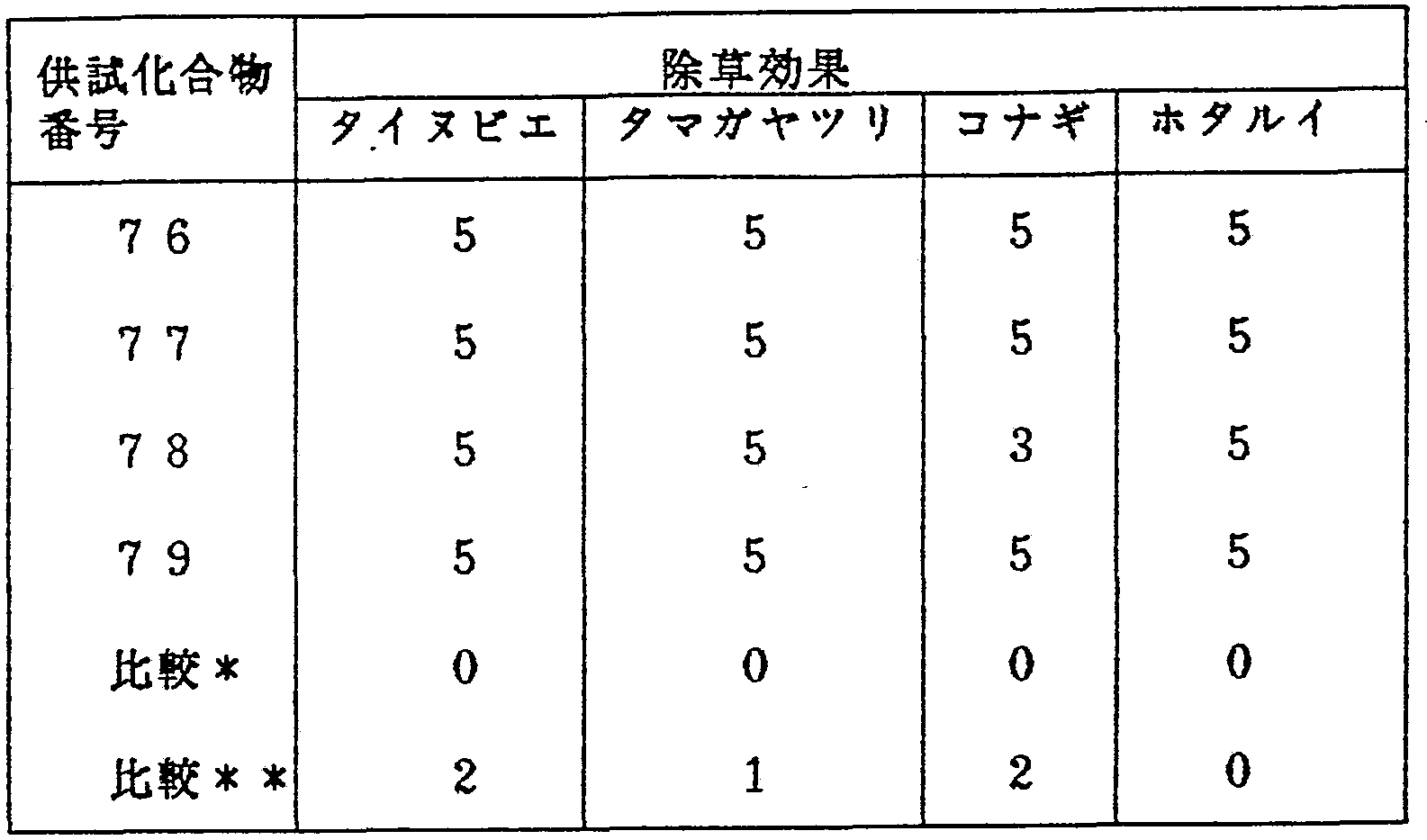

試験例 2 C (イネ、 ヒェ間選択性除草試験)
1Z5,00 Oaワグネルボットに水田土壌をつめ、 代搔後、 タイヌビ ェ種子を播種し、 温室内で 2葉期まで育成した。 2葉期のタイズビエの 本数をボットあたり 1 5本に調整し、 ¾剤锊 3 Bに準じて供試化合物を 水和剤とし、 その所定量を水に稀釈し水面に滴下 ½理した。 一方、 他の 1Z5,00 Oaワグネルポットには 2葉期のイネを移植し、 移植翌日同 様に供試化合物を滴下 理した。 ½理後 30日間温室内で育成し、 第 1 C表の基準に従い除荜活性および薬害を調査した。 その結果を第 3 C表 に示す。
第 3 C表
試験例 3 C (畑作土壤¾理による除草試験)
1 2 O cn2ブラスチックボッ ト に畑地土缜をつめ、 ヒェ、 メヒシパ、 ァオビュ、 コゴメカャッリの種子を播種し、 覆土した。 »剤例 3 Bに準 じて供試化合物を水和剤にし、 その所定量を水に稀釈し、 ヘクタール当 り 1 0 0 0 J2の散布割合で小型の噴霧器で土壤表面に均一に散布した (施 用量;有効成分としへクタール当り 4 kg)。 後 2 0日間温室内で育成 し、 第 1 C表の基準に従い除草効果および薬害を調査した。 その結果を
4 C表に示す <
第 4C表 供試化合物 除草効果
番号 レ Cェ τ t ンノヽ + ,
Λ -*· コ 》X て / 7
1 0 c 3 c O C
2 C 1
0 D 1 D c
3 c tr c c
0 0 O O
5 C c
D 0 0 o c
6 rr c
0 D 4 o
7 r tr
O 0 c o c
8 4 s 1
9 r tr r
O 0 5 O
10 c c r rr
O o O 0
1 1 c c Q c
0 o o O
13 o c o c Q D c
14 5 5 4 5
15 4 5 2.5 5
16 5 5 4 5
17 5 5 3 5
18 5 4 0 5
19 4 5 2 5
第 4 C表 (つづき) 供試化合物 除草 杲
ヒェ メヒシ / ァオビュ コゴメ ャッ リ
Z 1 5 5 5 5
2 2 5 5 5 5
5 5 5 5
2 4 5 5 2 5
2 5 5 5 4 5
2 6 5 5 4 5
2 8 4 5 2 5
2 9 3 3 0 5
3 0 5 5 5 5
3 3 4 5 1 5
3 4 4 4 1 5
3 5 5 5 1 5
3 6 5 5 2 5
3 7 5 5 1 5
3 8 5 5 2 5 ύ 3 5 4 1 5 1 5 5 5 5
4 3 5 5 4 5
4 4 5 5 5 5
第 4 C表(つづき)

試験例 4 C (畑作土 ¾½理による除草効果および薬害試験)
6 0 O ca2のブラスチックバットに畑地土壌をつめ、 ヒェ、 メヒシバ、 エノコログサ、 ァオビュ、 コゴメカャッリ、 イネ、 コムギ、 トウモロコ シ、 ダイズ、 ヮタ、 ビートの種子を播種し、 覆土した。 製劑锊 3 Bに準 じて供試化合物を水和剞にし、 その所定量を水に稀^し、 ヘクタール当 1 0 0 0 £の散布割合で小型の噴霧器で土壌表面に均一に散布した。
½理後 3 0日間温室内で育成し、 第 1 C表の基準に従い除草効果および 薬害を調査した。 その秸果を第 5 C表に示す。
ο 第 5 C表 除草効果 薬害
供試 施用量
し ェ マ コ コ L Γ ダ V ヒ
化合物 ( kg/ha ) ヒ / 才 ゴ ム ク ィ 1
X シ ビ メ 冬 ギ モ ズ タ
& ノ ST Ο D
グ ャ
サ ッ
2 5 5 5 1 5 0 0 0 0 0 0
2 1 5 5 5 0 5 0 0 0 0 0 0
0.ド5 4.5 0 4 0 5 0 0 U 0 0 0
2 5 5 , 5 5 5 2 0.5 4 1 0 1 t
7 1 5 D 5 5 5 2 0.5 4 0 0 1
0. ピ
D 0 5 5 4 0 0.5 0 2 0 0 1
2 5 5 5 5 5 4.5 2.5 3.5 0 0 I
21 1 5 5 5 5 5 Z 1 1 0 0 0
0.5 4. 5 5 5 4 5 1 1 0 0 0 0
2 5 5 ": 5 5 5 I 0. 5 2.5 0 0 0
22 1 5 5 5 5 5 1 0 1 0 0 0
0. 5 4. 5 5 5 2 5 0 0 0.5 0 0 0
2 5 5 5 5 5 3 1.5 3 0 0 0
43 1 5 5 5 5 5 1 0 3 0 0 0
0. 5 5 5 4 5 5 0.5 0 0 0 0 0
試験例 5 C (畑作茎葉 ½理による除萆試験)
1 2 O ca2のブラスチックポッ トに畑地土壤をつめ、 ヒェ、 メヒシバ、 ァォビュ、 コゴメ) 5ャッリの種子を播種し、 ヒェが 3葉期になるまで温 室内で育成した。 ヒェの 3葉期に S剤例 3 Bに準じて供試化合物を水和 剤にし、 有効成分でヘクタール当り 4 kg相当量を水で稀釈し、 ヘクター ル当り 1 0 0 0 J2の散布割合で、 小型噴霧器で植物体の上方から茎葉飲 布した, 飮布後 2 0日間温室内で育成し、 第 1 C表の基準に従い除草活 性を調査した。 その結果を第 6 C表に示す。 第 6 C表
供試化合物 除草効果
ヒェ メヒシノ < ァオビュ コゴメ ャッリ
1 4 5 0
2 4 5 2 5
3 5 5 3 5
7 5 5 2 3
9 5 5 4 5
1 1 4 3 1 5
1 7 4 4 4 5
1 8 3 3 3 5
1 9 4 4 5 5
2 1 5 5 4 5
2 2 5 5 3 5
2 3 5 5 ·' 4 5
第 6 C表(つづき) 除草効果
番号 ヒェ メ ヒシノゝ * ァオビュ コゴメカャッ リ
2 4 4 4 4 5
3 0 4 4 1 4
3 5 4 3 0 5
3 6 4 3 2 4
3 7 4 2 1 4
4 1 4 4 2 5
4 3 4 4 2 5
4 4 5 5 4 5
4 7 3 3 5 5
5 9 5 4 2 5
6 7 5 4 3 4
6 8 5 4 4 4
7 0 5 5 2 5
7 2 5 4 3 5
7 4 5 4 2 5
7 6 5 4 3 5
7 7 4 4 2 4
7 9 5 4 1 5
試験例 6 C (水田土 理による除草試験)
直径 1 0 c«の磁性ポットに水田土壌をつめ、 代搔後タイネビエ、 タマ ガヤッリ、 コナギ、 ホタイルの種子を播種し、 水深 3 <;譲に湛水した, 翌 日、 «荆例 3 Bに準じて謂整した水和剤を水で稀釈し、 水面に滴下 ½理 した(施用量;有効成分としてへクタール当り 4 kg). その後温室内で育 成し、 ¾!理 3 0日後に下記第 1 C表の基準に従 除草活性を調査した · その結果を第 7 C表に示す, 第 7 C表

1 2 O ca2ブラスチックポットに畑地土壤をつめ、 ヒェ、 メヒシバ、 ァオビュ、 コゴメカャッリの種子を播種し、 覆土した. »剤例 3 Bに準 じて供試化合物を水和剤にし、 その所定量を水に稀釈し、 ヘクタール当 り 1 0 0 0 £の散布割合で小型の噴霧器で土 ¾表面に均一に散布した (施 用量;有効成分としてへクタール当り 4 ks)。 ^理後 2 0日閎温室内で育 成し、 第 1 C表の基準に従い除草効果おょぴ薬害を調査した。 その結果 を第 8 C表に示す。
第 8 C表

6 0 O ca2ブラスチックバットに畑地土 ¾をつめ、 ヒェ、 メヒシバ、 ェ /コログサ、 ァ才ビュ、 コゴメカャッリ、 イネ、 コムギ、 トウモロコ シ、 ダイズ、 ヮダ、 ビートの種子を播種し、 S土した。 S剁倒 3 Bに準 じて供試化合物を水和剤にし、 その所定量を水に稀釈し、 ヘクタール当 り 1 0 0 0 £の散布割合で小型の噴 器で土壌表面に均^に散布した。 处理後 3 0日間温室内で育成し、 第.1 C表の ¾準に従い除革効果および 薬宵を調査した。 その結果を第 9 C表に示す。
x o CJl
第 9C表

試験例 3 C (水田土壌 ¾理による除草試験)
直径 1 O caの磁性ボットに水田土壌をつめ、 代搔後タイネビエ、 タマ ガヤッリ、 コナギ、 ホタイルの種子を播種し、 水深 3 c»に湛水した。 翌 日、 製剤例 3 Bに準じて調整した水和剤を水で稀釈し、 水面に滴下 ½理 した(施用量;有効成分としてへクタール当り kg)e その後温室内で育 成し、 ½理3 0日後に下記第 1 C表の基準に従い除草活性を調査した。 その結果を第 1 0 C表に示す。 第 1 0 C表

1 2 O ca2ブラスチックボッ トに畑地土壌をつめ、 ヒェ、 メヒシバ、 ァオビュ、 コゴメカャッリの種子を播種し、 覆土した。 ¾剤例 3 Bに準 じて供試化合物を水和剤にし、 その所定量を水に稀釈し、 ヘクタール当 り 1 0 0 0 £の散布割合で小型の噴霧器で土壌表面に均一に散布した (施 用量;有効成分としてへクタール当 4 kg)0 ;¾理後 2 0日間温室内で育
成し、 第 1 C表の基準に従い除草効果および薬害を謂查した。 その結果 を第 1 1 C表に示す。
第 1 1 C表

6 0 O ca2プラスチックパットに畑地土攘をつめ、 ヒェ、 メヒシバ、 ェノコログサ、 ァオビュ、 コゴメ ^ャッリ、 イネ、 コムギ、 トウモロコ シ、 ダイズ、 ヮタ、 ビートの種子を播種し、 覆土した。 製剤例 3 Bに準 じて供試化合物を水和 にし、 その所定量を水に稀釈し、 ヘクタール当 り 1 0 0 の散布割合で小型の噴霧器で土攘表面に均一に散布した。 ¾理後 3 0日問温室内で育成し、 第 1 C表の基準に従い除荜効果および 薬害を調査した。 その結果を第 1 2 C表に示す。
o 第 12C表

註) * フルオメスロン(fluoweturon) NHC0N

Claims
1. 下記式( I
( I )

ここで、 Arは、
(a) 式

ここで、 X'は水素原子、 低級アルキル又は低 »アルコキシで ある、
(b) 式

ここで、 X2は水素原子又はハロゲン原子である
(c) 式
ここで、 X3はハロゲン原子であり、 そして
i は 2又は 3の整数である、
(d) 式

ここで、 まフッ素原子、 臭素原子又は沃素原子であり そ
して aは 1、 2又は 3の整数である、
(e) 式 ―

ここで、 X sは水素原子、 ハロゲン原子、 低鞔アルキル、 低級
アルコキシ又はト リフルォロメチルである、
(f) 式

ここで、 X 6は水素原子又はハロゲン原子である
ω 式

ここで、 X 7は水素原子、 ハロデン原子、 シァノ、 低袋アルコ キシ又はト リフル才ロメチルである、
0 式
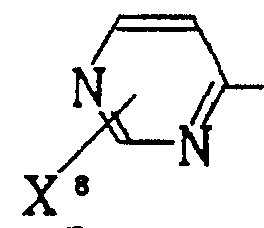
ここで、 X8は水素原子、 塩素原子又は低級アルキルチオであ り、 そして pは 1又は 2の整数である、
(ί) 式

ここで、 X 3および X1。は同一もしくは異なり、 塩素原子、 低 級アルコキシ又は低級アルキルチオである、
および
(j) 式

ここで、 X11は水素原子又は堪素原子である、
で表わされるァリール基より成る群から選ばれる基であり;
Rリ id Csアルキル、 低»ァルケュル、 低級アルキニル又は C3
~C7シクロアルキルであり;そして
R2ほ水素原子又は C,〜C6アルキルであり;
R1と R2はー锗になってそれらが結合している窒素原子と共に、 4
~ 8員の複素環基を形成してもよく、 ここで該複素環基は環員原子 として酸素原子を含有することができまた低級アルキル基又は低級
アルキレン基で置換されていてもよい
で表わされる置換ァリールォキシ尿素類およびその酸付加堪。
2. 上記式( I )において、 Arが式 ( 、 (d)、 (e)、 fe)、 ()および (j)より 成る群から選ばれ、 R1が Ci ~CSアルキル又は C3~C7シクロアルキ ルであり、 R2が Ct〜C6アルキルであるか又は R'と R2はー锗になつ てそれらが結合している窒素原子と共に 6〜 7員の複素環基を形成する 請求の範囲第 1項に記載の化合物。
3. 上記式( I )において、 Arが式 であり、 そして R1および R2が 一緒になつてそれらが桔合している窒素原子と共に 6 ~ 7員の複素塩基 を形成する請求の範囲第 1項に記載の化合物。
4. 上記式( I)において、 Arが 6—クロロー 2—ビリ ジル又は 6— ト リフルォロメチルー 2—ビリジルであり、 そして
一

である請求の範囲第 1項に記載の化合物。
5. 下記式(H)
Ar' -ONH2 ♦ ♦ ♦ (Π)
ここで、 で, は上記式( I )の Arの定義における (a)~(g)の式で表わ されるァリール基より成る群から選ばれる基である、 で表わされるァリールォキシァミ ン類と
下記式(ΠΙ)

ここで、 R'の定義は上記式( I )に同じであり、
R21は C,~Csアルキルであり、
そして R1と R21は上記式( I )における R'と Rzが形成す る 4〜 8員の褀素環基と同じ複素環基を形成してもよい、 で表わされるカルバミ ン酸塩化物とを、 塩基の存在下で反応させること を特徴とする
下記式( I)一 1
Ar' ( I H

ここで、 Ar' 、 R1および R2'の定義ほ上記に同じである、 で表わされる置換ァリールォキシ尿素の製造法。
6. 下記式(W)

ここで、 A の定義は上記式(Π)に同じであり、 そして
Αは置換又は未置換のフエ-ルである、
で表わされるァリールォキシカルバミ ン酸エステル類と
下記式(V)
R
HN (V)
R ここで、 R 'および R2の定義ほ上記式( I )に同じである、 で表わされるアミン類を反応させることを特徴とする下記式( I )一 2

ここで、 Ar' 、 R1および R2の定義は上記に同じである、 で表わされる置換ァリールォキシ尿素類の ¾造法。
7. 下記式(ff)
 • ( )
ここで、 X8および ρの定義は上記式( I )に同じである
で表わされる塩化ピリミジン類
下記式(W)

ここで、 Xsおよび X1。の定義は上記式( I )に同じである
で表わされる塩化ト リアジン類
および
下記式(¾)
07268 T/J 87
77

ここで、 X'1の定義は上記式( I )に同じである
り成る群から選ばれる堪化物と
下記式(IX)
(IX)

ここで、 R1および R2の定義は上記式( I )に同じである、
で表わされる N—ヒドロキシ尿素類を、 塩基の存在下で反応させるこ を特徴とする、
下記式( I )ー3
( 1)-3
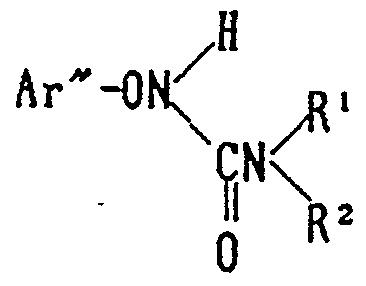
ここで、 A ^は上記式( I )の Arの定義における 0 , (ί)および (j)の式で 表わされるァリール基より成る群から選ばれる基であり、 そ して
R 'および R2の定義は上記式( I )に同じである、 で表わされる置換ァリールォキシ尿素類の製造法。
8. 上記式( I)で表わされる置換ァリールォキシ尿素類又はその酸付 加塩を有効成分として含有することを特锒とする除草剤。
Priority Applications (3)
| Application Number | Priority Date | Filing Date | Title |
|---|---|---|---|
| JP62-503167A JPH06104652B2 (ja) | 1986-05-26 | 1987-05-26 | 置換アリールオキシ尿素類、それらの製法および用途 |
| DE8787903425T DE3777095D1 (de) | 1986-05-26 | 1987-05-26 | Substituierte aryloxyureas, verfahren zu deren herstellung und deren verwendung. |
| AT87903425T ATE73130T1 (de) | 1986-05-26 | 1987-05-26 | Substituierte aryloxyureas, verfahren zu deren herstellung und deren verwendung. |
Applications Claiming Priority (2)
| Application Number | Priority Date | Filing Date | Title |
|---|---|---|---|
| JP11929386 | 1986-05-26 | ||
| JP61/119293 | 1986-05-26 |
Publications (1)
| Publication Number | Publication Date |
|---|---|
| WO1987007268A1 true WO1987007268A1 (fr) | 1987-12-03 |
Family
ID=14757821
Family Applications (1)
| Application Number | Title | Priority Date | Filing Date |
|---|---|---|---|
| PCT/JP1987/000334 Ceased WO1987007268A1 (fr) | 1986-05-26 | 1987-05-26 | Aryloxyurees substituees, procede de preparation et leur utilisation |
Country Status (5)
| Country | Link |
|---|---|
| EP (1) | EP0268688B1 (ja) |
| JP (1) | JPH06104652B2 (ja) |
| AT (1) | ATE73130T1 (ja) |
| DE (1) | DE3777095D1 (ja) |
| WO (1) | WO1987007268A1 (ja) |
Citations (1)
| Publication number | Priority date | Publication date | Assignee | Title |
|---|---|---|---|---|
| JPS61126065A (ja) * | 1984-11-26 | 1986-06-13 | Mitsui Petrochem Ind Ltd | 置換フエノキシ尿素、その製造法およびそれを有効成分として含有する除草剤 |
Family Cites Families (1)
| Publication number | Priority date | Publication date | Assignee | Title |
|---|---|---|---|---|
| US3332975A (en) * | 1965-03-05 | 1967-07-25 | American Cyanamid Co | Mono-and di-substituted ureas |
-
1987
- 1987-05-26 AT AT87903425T patent/ATE73130T1/de not_active IP Right Cessation
- 1987-05-26 EP EP87903425A patent/EP0268688B1/en not_active Expired - Lifetime
- 1987-05-26 WO PCT/JP1987/000334 patent/WO1987007268A1/ja not_active Ceased
- 1987-05-26 DE DE8787903425T patent/DE3777095D1/de not_active Expired - Lifetime
- 1987-05-26 JP JP62-503167A patent/JPH06104652B2/ja not_active Expired - Lifetime
Patent Citations (1)
| Publication number | Priority date | Publication date | Assignee | Title |
|---|---|---|---|---|
| JPS61126065A (ja) * | 1984-11-26 | 1986-06-13 | Mitsui Petrochem Ind Ltd | 置換フエノキシ尿素、その製造法およびそれを有効成分として含有する除草剤 |
Non-Patent Citations (1)
| Title |
|---|
| See also references of EP0268688A4 * |
Also Published As
| Publication number | Publication date |
|---|---|
| ATE73130T1 (de) | 1992-03-15 |
| JPH06104652B2 (ja) | 1994-12-21 |
| EP0268688B1 (en) | 1992-03-04 |
| EP0268688A4 (en) | 1988-09-28 |
| EP0268688A1 (en) | 1988-06-01 |
| DE3777095D1 (de) | 1992-04-09 |
| JPH06104652B1 (ja) | 1994-12-21 |
Similar Documents
| Publication | Publication Date | Title |
|---|---|---|
| JPS59163372A (ja) | ピラゾ−ル誘導体とその製造法及び除草剤 | |
| JPS62126178A (ja) | 新規トリアジン誘導体及びこれを含む除草剤 | |
| JPS6314782A (ja) | 新規ジアルキルマレインイミド類及び除草剤 | |
| JPH0399066A (ja) | 置換されたカルバモイルトリアゾール | |
| CN112624989A (zh) | 一种酰胺类化合物及其应用 | |
| JPH02275841A (ja) | ハロゲン化ニトロエタンの製造方法およびこれを用いる殺虫性α―不飽和アミン類の製造方法 | |
| WO1987007269A1 (fr) | Aryloxyurees, procede de preparation et leur utilisation | |
| JPS61126065A (ja) | 置換フエノキシ尿素、その製造法およびそれを有効成分として含有する除草剤 | |
| JPWO1987007269A1 (ja) | アリールオキシ尿素類、それらの製法および用途 | |
| JPH01131146A (ja) | アリールオキシ尿素類、その製造法およびそれを有効成分として含有する除草剤 | |
| JPH02229164A (ja) | N―(2―クロロイソニコチノイル)イミノ誘導体、それを有効成分とする農園芸用殺菌剤 | |
| EP0268688B1 (en) | Substituted aryloxyureas, process for their preparation, and their use | |
| JP2689093B2 (ja) | 置換ピリジンスルホンアミド系化合物、それらを含有する除草剤並びにそれらの化合物の製造方法 | |
| JPH02229161A (ja) | 2―クロロイソニコチン酸アミド誘導体およびそれを有効成分とする農園芸用殺菌剤 | |
| JPH01250363A (ja) | 4―ベンジルアミノピリミジン誘導体及び除草剤 | |
| JPH05286969A (ja) | チエニル−アゾリル−オキシアセトアミド誘導体、その製造方法及び該誘導体を有効成分とする除草剤 | |
| EP0122130B1 (en) | Herbicidal tetrahydrobenzothiazole derivatives | |
| JPH0723355B2 (ja) | 置換フエノキシ尿素、製造法および除草剤 | |
| JPS60155153A (ja) | チオカ−バメ−ト誘導体 | |
| JPWO1987007268A1 (ja) | 置換アリールオキシ尿素類、それらの製法および用途 | |
| JPH0532641A (ja) | メルカプトトリアジン誘導体及びそれを有効成分とする除草剤 | |
| JPS62161761A (ja) | N−フエニルスルホニルイソニコチン酸アミド誘導体およびそれを有効成分とする農園芸用殺菌剤組成物 | |
| JPS63130582A (ja) | N−シアノメチルイソニコチン酸アミド誘導体およびそれを有効成分とする農園芸用殺菌剤 | |
| JPH05230034A (ja) | ピリミジン誘導体、その製造法およびそれを有効成分とする除草剤 | |
| JPS62190171A (ja) | 新規なスルホニルウレア誘導体及び除草剤 |
Legal Events
| Date | Code | Title | Description |
|---|---|---|---|
| AK | Designated states |
Kind code of ref document: A1 Designated state(s): JP US |
|
| AL | Designated countries for regional patents |
Kind code of ref document: A1 Designated state(s): AT BE CH DE FR GB IT NL |
|
| WWE | Wipo information: entry into national phase |
Ref document number: 1987903425 Country of ref document: EP |
|
| WWP | Wipo information: published in national office |
Ref document number: 1987903425 Country of ref document: EP |
|
| WWG | Wipo information: grant in national office |
Ref document number: 1987903425 Country of ref document: EP |