WO1994001602A1 - Tole en acier resistant a la rouille et presentant des caracteristiques ameliorees y compris la resistance a la corrosion - Google Patents
Tole en acier resistant a la rouille et presentant des caracteristiques ameliorees y compris la resistance a la corrosion Download PDFInfo
- Publication number
- WO1994001602A1 WO1994001602A1 PCT/JP1993/000956 JP9300956W WO9401602A1 WO 1994001602 A1 WO1994001602 A1 WO 1994001602A1 JP 9300956 W JP9300956 W JP 9300956W WO 9401602 A1 WO9401602 A1 WO 9401602A1
- Authority
- WO
- WIPO (PCT)
- Prior art keywords
- phase
- alloy
- corrosion resistance
- steel sheet
- crystal system
- Prior art date
- Legal status (The legal status is an assumption and is not a legal conclusion. Google has not performed a legal analysis and makes no representation as to the accuracy of the status listed.)
- Ceased
Links
Classifications
-
- C—CHEMISTRY; METALLURGY
- C25—ELECTROLYTIC OR ELECTROPHORETIC PROCESSES; APPARATUS THEREFOR
- C25D—PROCESSES FOR THE ELECTROLYTIC OR ELECTROPHORETIC PRODUCTION OF COATINGS; ELECTROFORMING; APPARATUS THEREFOR
- C25D3/00—Electroplating: Baths therefor
- C25D3/02—Electroplating: Baths therefor from solutions
- C25D3/56—Electroplating: Baths therefor from solutions of alloys
- C25D3/565—Electroplating: Baths therefor from solutions of alloys containing more than 50% by weight of zinc
-
- Y—GENERAL TAGGING OF NEW TECHNOLOGICAL DEVELOPMENTS; GENERAL TAGGING OF CROSS-SECTIONAL TECHNOLOGIES SPANNING OVER SEVERAL SECTIONS OF THE IPC; TECHNICAL SUBJECTS COVERED BY FORMER USPC CROSS-REFERENCE ART COLLECTIONS [XRACs] AND DIGESTS
- Y10—TECHNICAL SUBJECTS COVERED BY FORMER USPC
- Y10S—TECHNICAL SUBJECTS COVERED BY FORMER USPC CROSS-REFERENCE ART COLLECTIONS [XRACs] AND DIGESTS
- Y10S428/00—Stock material or miscellaneous articles
- Y10S428/922—Static electricity metal bleed-off metallic stock
- Y10S428/9335—Product by special process
- Y10S428/934—Electrical process
- Y10S428/935—Electroplating
-
- Y—GENERAL TAGGING OF NEW TECHNOLOGICAL DEVELOPMENTS; GENERAL TAGGING OF CROSS-SECTIONAL TECHNOLOGIES SPANNING OVER SEVERAL SECTIONS OF THE IPC; TECHNICAL SUBJECTS COVERED BY FORMER USPC CROSS-REFERENCE ART COLLECTIONS [XRACs] AND DIGESTS
- Y10—TECHNICAL SUBJECTS COVERED BY FORMER USPC
- Y10T—TECHNICAL SUBJECTS COVERED BY FORMER US CLASSIFICATION
- Y10T428/00—Stock material or miscellaneous articles
- Y10T428/12—All metal or with adjacent metals
- Y10T428/12493—Composite; i.e., plural, adjacent, spatially distinct metal components [e.g., layers, joint, etc.]
- Y10T428/12771—Transition metal-base component
- Y10T428/12785—Group IIB metal-base component
- Y10T428/12792—Zn-base component
- Y10T428/12799—Next to Fe-base component [e.g., galvanized]
Definitions
- the invention of the present application is one of various properties required for a steel sheet used for automobiles and the like, and in particular, not only corrosion resistance, but also outer surface resistance, formability, chipping resistance, corrosion resistance after processing, hot water. Steel sheet with excellent quality in either secondary adhesion or perforation resistance
- Fig. 1 shows the results of a salt spray test in accordance with JISZ 2371 to determine the number of days until 2% of red ash is generated.
- the test specimens used were 17% tensile processed.
- the unit symbol (g / m 2 ) may be omitted when indicating the basis weight.
- the basis weight is 3 Og / m 2 , it is indicated as 30 basis weight.
- EG 30 in the figure is a commercial electro-galvanized steel sheet with a weight of 30.
- GA60 is a commercially available alloyed hot-dip Zn coated steel sheet with a basis weight of 60.
- Zn-Ni30 represents a commercially available steel sheet with a Ni-content of 13 wt% and having a basis weight of 30%. The amount of Zn—Cr attached was all 20 basis weight.
- the excellent bare corrosion resistance of the Zn-Cr alloy coated steel sheet is due to the fact that the surface oxide film of Cr significantly suppresses the dissolved oxygen reduction reaction in a corrosive environment, resulting in a lower corrosion current density. Corrosion speed It is considered that the degree becomes slow.
- the results of this experiment are mainly tests assuming corrosion in areas where the electrodeposition coating on the inner side of the vehicle body is poorly exposed and left bare.
- the corrosion resistance of various surface-treated steel sheets greatly depends on the corrosive environment, and the order of the corrosion resistance may be changed due to environmental changes.
- the demand for corrosion resistance has been growing strictly on the outer surface of the vehicle body with the advancement of luxury.
- the outer surface (1) travels under the coating film mainly from a damaged portion of the coating film due to a splashing stone, etc., and impairs the appearance as reddish coating film swelling and the like.
- the corrosion resistance of the Zn-Cr alloy-plated steel sheet increases linearly with an increase in the Cr content.
- the outer surface resistance of the vehicle body is not necessarily improved by an increase in the Cr content, but may be degraded by an increase in the Cr content. For this reason, there is a problem that the Zn—Cr coated metal sheet has better bare corrosion resistance than other Zn-plated steel sheets, but is inferior in body outer resistance.
- a first object of the present invention is to provide a steel sheet having excellent outer surface resistance in addition to corrosion resistance.
- Figure 2 shows the results of a test assuming corrosion when used on the outer surface of an automobile. Normally, the exterior surface of the vehicle is painted, so corrosion starts at the damaged part of the coating due to stone splashes.
- the most reliable corrosion test for automobile bodies is the actual vehicle test, but it has a long period of time until the evaluation results are obtained and is costly.
- Zn-plated steel sheet prepared by electro-galvanizing according to a conventional method (hereinafter referred to as EG).
- GA is a commercially available galvannealed steel sheet.
- Zn—13wt% Ni is a commercially available zinc-plated steel plate having a Ni content of 13wt% (hereinafter referred to as Zn—Ni).
- Zn-13wt% Cr is a Zn-Cr alloy-plated steel sheet with a Cr content of l3wt% (hereinafter referred to as Zn-Cr).
- the corrosion resistance of all alloyed steel sheets is higher than that of EG with the same basis weight, but the effect is greatest for Zn—Cr alloy coated steel sheets.
- the strength of the weight per unit area is larger than that of the EG with the weight of 20 but is inferior to that of the EG or Zn-Ni alloy with the weight of 30 .
- the corrosion resistance is improved by the increase in the basis weight, but the change in the basis weight is particularly remarkable between 10 and 30 g / m 2 .
- a second object of the present invention is to provide a steel sheet having excellent formability in addition to corrosion resistance.
- the demand for corrosion resistance against the heat generated on the outer surface side of the vehicle body is becoming stricter in recent years as luxury is advanced.
- the outer surface ⁇ progresses under the coating film mainly from a damaged portion of the coating film caused by running stones or the like (hereinafter referred to as chipping), and impairs the appearance as reddish coating film swelling. Therefore, durability against chipping that triggers corrosion becomes important.
- the corrosion resistance of the Zn—Cr alloy-plated steel sheet increases linearly as the Cr content increases.
- the resistance to chipping does not necessarily improve with an increase in the Cr content, but rather tends to deteriorate with an increase in the Cr content.
- the Zn-Cr alloy-coated steel sheet has a problem that the bare corrosion resistance is excellent but the chipping resistance is inferior to other Zn-based plated steel sheets.
- the third object of the present invention is to provide: Providing steel sheets with excellent resistance to chipping
- the fourth object of the present invention is to provide not only corrosion resistance before processing but also corrosion resistance after processing.
- An object of the present invention is to provide a steel sheet having excellent heat resistance.
- a fifth object of the present invention is to provide a steel sheet which is excellent not only in corrosion resistance but also in hot water secondary adhesion.
- a sixth object of the present invention is to provide a steel sheet having excellent resistance to puncturing, and to provide a steel sheet having the following features.
- a protected steel sheet is provided.
- the present invention provides a steel sheet having excellent corrosion resistance and hot water secondary adhesion, which is provided with a Zn—Cr alloy substantially consisting of a phase having the same.
- c 4.4
- Substantially composed of a phase having a structure such that 3 to 4.60 and a phase having a structure such that the crystal system is cubic and the lattice constant is a 3.00 to 3.06.
- the present invention provides a corrosion-resistant steel sheet having excellent corrosion resistance and puncture resistance, which is coated with a Zn—Cr alloy.
- FIG. 1 is a graph showing the relationship between bare corrosion resistance and alloy composition of a steel sheet coated with a Zn—Cr alloy.
- Fig. 2 is a diagram showing the relationship between the maximum blister width and the basis weight in the appearance of various surface-treated steel sheets.
- Figure 3 is a flow chart of the combined corrosion cycle test.
- Figure 4 is a graph showing the results of a hot water secondary adhesion test of a Zn-Cr alloy-coated steel sheet.
- FIG. 5 is a view for explaining the phase structures (1) m, (2) ⁇ and (3) ⁇ of the electrodeposited Zn—Cr alloy.
- Figure 6 shows the changes in phase structure (1) to (3) and the phase structure in thermal equilibrium (4) depending on the composition of the deposited Zn-Cr binary alloy under production conditions 1-3.
- FIG. 7 is a diagram showing the relationship between the body surface resistance of the Zn—Cr alloy plated steel sheet and the alloy composition.
- FIG. 8 is a diagram showing the influence of the phase structure on the relationship between the formability (LDR) and the basis weight of a Zn—Cr alloy-coated steel sheet.
- FIG. 9 is a graph showing the relationship between the anti-chipping property and the Cr content of a steel sheet coated with a Zn—Cr alloy.
- Figure 10 shows the relationship between the Cr content in the plating layer of the Zn-Cr alloy coated steel sheet and the bare corrosion resistance of the flat plate and the bare corrosion resistance after hat drawing. ?
- This is an example of a plated steel sheet having an X phase and a ⁇ phase, and (b) shows a comparative example having a combination of other phases.
- FIG. 11 is a diagram showing the results of a hot water secondary adhesion test of a Zn—Cr alloy-plated steel sheet.
- FIG. 12 is a diagram showing the relationship between the puncture resistance and the alloy composition of a steel sheet coated with a Zn—Cr alloy.
- BEST MODE FOR CARRYING OUT THE INVENTION hereinafter, the present invention will be described in more detail.
- Disclosed in the present invention is a steel sheet provided with a Zn—Cr alloy plating, which has a single phase of 7? X, (5x and ⁇ ) in the Zn—Cr alloy plating. And combinations of two or more of these phases have been found to have excellent properties in addition to corrosion resistance, as described below.
- the inventions of the embodiments are collectively shown in the following table for easy understanding, and each embodiment will be individually described: Mode ⁇ 3 ⁇ 4 Claims ZnCr alloy phase characteristics
- phase structure may be different even with the same alloy composition.
- present inventors believe that there is a correlation between the vehicle body exterior surface resistance and the phase structure. Therefore, we thought that by specifying the phase structure by utilizing the characteristics of the electrodeposition method, it would be possible to obtain an additional layer due to its excellent outer surface resistance.
- the Cr content in which the 5 ⁇ phase and the ⁇ ⁇ ⁇ phase appear, varies depending on the manufacturing conditions and cannot be unconditionally determined, but the results obtained under some manufacturing conditions are shown in Fig. 6 as an example.
- the phase structure of the electrodeposited Zn-Cr alloy is considered to consist of only three phases.
- the range of Cr content for obtaining a Zn-Cr alloy alloy consisting essentially of only 77 X-phase cannot be uniquely defined because it varies depending on the manufacturing method. , And 1 to 15 wt%. If the content is less than 1 wt%, the corrosion resistance is insufficient.If the content is more than 15 wt%, a phase or a ⁇ phase appears, and it becomes difficult to obtain a plating layer consisting essentially of the 77 ⁇ phase. Because.
- weight per unit area 1 0 ⁇ 4 0 g / m 2 is desirable, is because corrosion resistance is insufficient in less than 1 0 g / m 2, because Kosutomeritsu Bok disappears at 4 0 g / m 2 greater .
- the production conditions for obtaining the Zn—Cr alloy plating of the present invention are not necessarily limited, for example, when electrodeposition is performed from a sulfuric acid bath, zinc sulfate and chromium sulfate are used as main agents.
- Sodium sulfate can be added as an auxiliary agent, boric acid and various organic acids as a pH buffer, and other various surfactants can be added.
- a desirable phase configuration is obtained by appropriately selecting a bath pH, a bath temperature, a liquid flow rate, an electrolytic current density, and the like. Since all of these conditions affect the phase structure, an alloy deposition consisting essentially of 77X is obtained when a combination of these conditions is appropriate. In actual plating on an industrial scale, there may be cases where phases other than 7-X phase are unavoidably mixed even under the optimal plating conditions, but it is almost the same as the plating consisting of pure 77 X-phase. The present invention does not refuse the incorporation of some heterogeneous phase within the range where the effect is obtained.
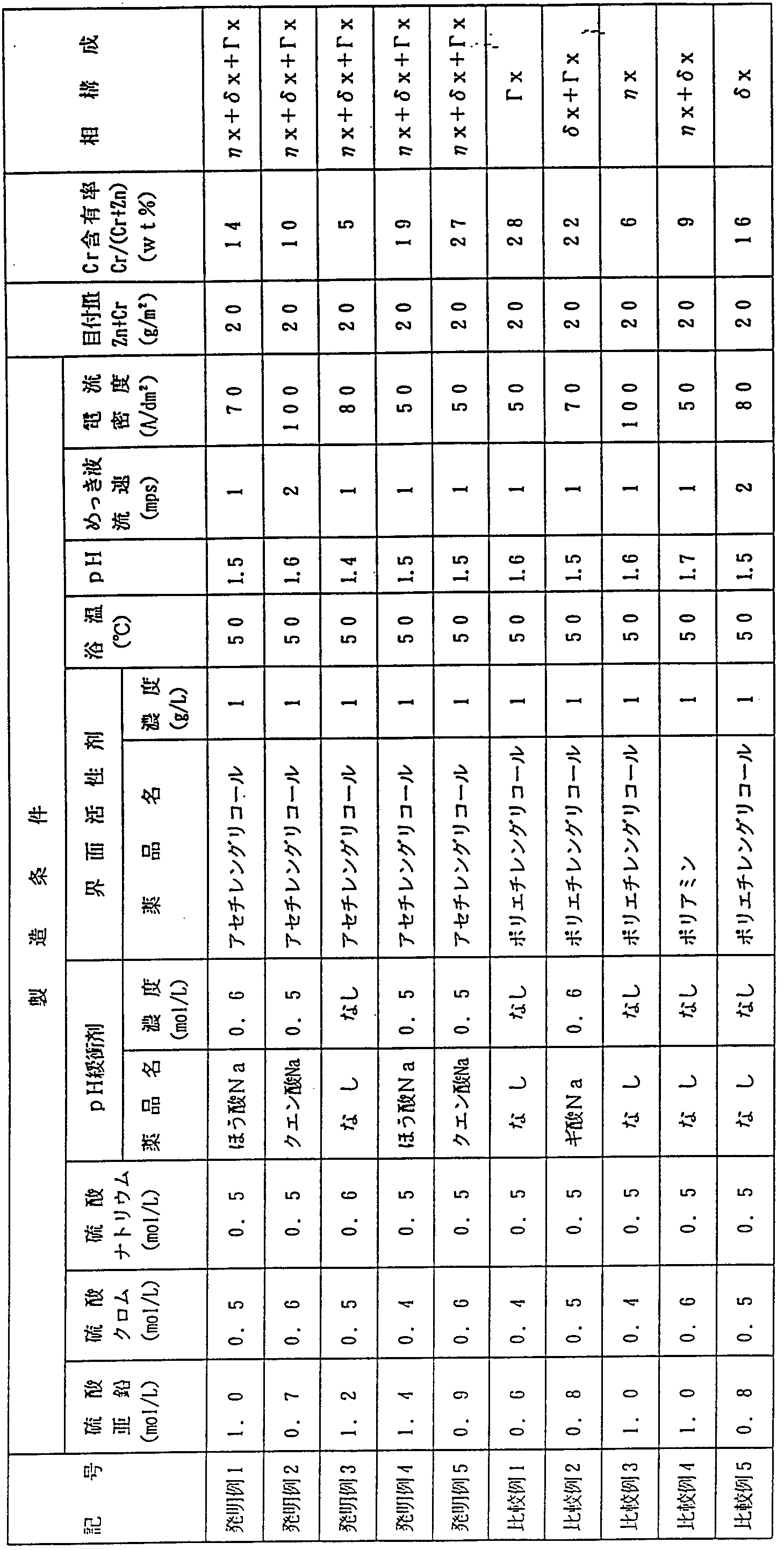
- Table 1 shows the manufacturing conditions, the basis weight, the Cr content, and the phase constitution of the invention examples and comparative examples.
- a 0.7 mm-thick SPCD was used as an original plate, and after performing depigmenting and pickling according to a conventional method, plating was performed to prepare a sample.
- All of the examples of the present invention are substantially composed of only the ⁇ phase, whereas the comparative examples (which clearly include the 5x phase and the ⁇ phase. However, the ⁇ ⁇ ⁇ phase and the ⁇ or ⁇ phase are contained up to about 1%. It was assumed that the material consisted essentially of only the ⁇ ? ⁇ phase The body surface resistance was evaluated using the samples shown in Table 1.
- the body surface resistance was evaluated as 15 Ommx 70
- the specimens of mm were subjected to cationic electrodeposition coating (film thickness 20 / m), intermediate coating (film thickness 40m), Apply 3 coats of top coat (film thickness 40), make a scratch to reach the substrate with a force cutter knife, and expose to the corrosive environment of the cycle shown in Fig. 3 using a combined corrosion tester for 1 month.
- the measurement was performed by measuring the swollen width.
- Fig. 7 shows the above measurement results.
- Comparative Example 1 has a phase constitution of only 7? Phase but does not contain Cr, so that the corrosion resistance is insufficient.
- Comparative Examples 2 and thereafter show that the external appearance resistance is degraded due to an increase in the Cr content because the phase configuration substantially contains the ⁇ X phase and / or ⁇ phase.
- the invention of the present application is to provide a steel sheet for automobiles excellent in outer surface resistance of a vehicle body.
- phase structure may be different even with the same alloy composition.
- the present inventors believe that there is a correlation between the press formability and the phase structure. Therefore, we thought that by specifying the phase structure using the characteristics of the electrodeposition method, it would be possible to obtain an additional layer due to its excellent formability.
- Figure 3 shows the above results.
- the Cr content in which the 77 X phase, the 5 X phase and the ⁇ ⁇ ⁇ phase appear differs depending on the production conditions, and cannot be specified unconditionally.
- the results obtained under some production conditions are shown in FIG. 6 as an example.
- the phase structure of the deposited Zn-Cr alloy is considered to consist of only three phases.
- the range of the Cr content for obtaining a Zn—Cr alloy alloy consisting essentially of the ⁇ phase cannot be uniquely defined because it varies depending on the manufacturing method. It is desirably about 30 wt%. If the amount is less than 5 wt%, the ⁇ phase does not appear, and if the amount exceeds 30 wt%, the adhesion of the plating layer itself is deteriorated, and the effect of the present invention is impaired. Further, the basis weight is preferably from 10 to 40 g / m 2 . If it is less than 10 g / m 2 , the corrosion resistance is insufficient, and if it exceeds 40 g / m 2 , the formability is deteriorated. Desirably, 20 to 30 g / m 2 has good corrosion resistance and moldability.
- the production conditions for obtaining the Zn—Cr alloy plating of the present invention are not necessarily limited.
- zinc sulfate and chromium sulfate are used as main agents, and a conductive assistant is used.
- Sodium borate as a pH buffer, boric acid and various organic acids, and other surfactants.
- bath pH, bath temperature, liquid flow rate, electrolytic current density, and the like can be appropriately selected. Since all of these factors affect the phase structure, a phase structure mainly composed of the X phase can be obtained if the combination of these factors is appropriate.
- ⁇ the force that may cause phases other than the X phase to be mixed ⁇ pure ⁇ the same effect as the plating from the X phase
- the composition substantially consists of the X phase.
- Table 2 shows the manufacturing conditions, the basis weight, the Cr content, and the phase constitution of the invention examples and comparative examples.
- a 0.7 mm-thick SPCD was used as an original plate, and after performing depigmenting and pickling according to a conventional method, plating was performed to prepare a sample.
- Each of the present inventions is substantially composed of only the ⁇ phase, but is there any comparative example? It clearly includes 7 X phase and ⁇ 5 X phase. However, those containing up to about 1% of 77 ⁇ and ⁇ or ⁇ phases were considered to be substantially composed of only ⁇ X phase.
- the moldability was evaluated using the samples shown in Table 2.
- the formability was evaluated by applying a 35 mm ⁇ punch with a wrinkle holding force of 1 ton and a punching speed of 120 mm / min after applying oil, and calculating the limit drawing ratio (LDR).
- LDR limit drawing ratio
- Figure 8 shows the results of the above measurements. From FIG. 8, it can be seen that the moldability of the comparative example rapidly deteriorates with an increase in the basis weight.
- the same corrosion resistance as GA60, which is currently used most in Japan is secured. To do so, a basis weight of about 30 gZm 2 is required.
- the basis weight is 30 g Zm 2 or more, it is clear that the formability is deteriorated rather than GA60.
- the phase structure of the plating layer is controlled to be substantially composed of only the ⁇ phase, the deterioration of the formability is small even with the basis weight of 30 g / m 2 .
- the Zn—Cr alloy coated steel sheet of the present invention is considered to have sufficiently excellent formability in a region having a basis weight excellent in corrosion resistance.
- Illustrative example 71 Na citric acid Na 0.4 acetylene glycol
- the present invention is to provide a corrosion-resistant steel sheet having sufficient formability while ensuring sufficient corrosion resistance.
- phase structure may be different.
- the present inventors believe that there is a correlation between the anti-chipping property and the phase structure. Therefore, we thought that by specifying the phase structure by utilizing the characteristics of the electrodeposition method, it would be possible to obtain an additional layer because of its excellent chipping resistance.
- Figure 5 shows the above results. 77 ⁇ phase, (5 ⁇ phase and ⁇ phase appear, the Cr content varies depending on the manufacturing conditions, so it cannot be said unconditionally, but the results obtained under some manufacturing conditions are shown in Fig. 6 as an example.
- the phase structure of the deposited Zn-Cr alloy is considered to consist of only three phases.
- the range of the Cr content for obtaining a Zn-Cr alloy substantially composed of 77 X phase and (x phase) differs depending on the manufacturing method, intentionally. Although it cannot be defined, it is desirable that the content be 5 to 3% by weight, and if it is less than 5% by weight, the corrosion resistance is insufficient.
- the basis weight is preferably from 10 to 40 per unit area, and if the basis weight is less than 10, the corrosion resistance is insufficient, and if the per unit area is more than 40, the cost advantage is lost. is there.
- the production conditions for obtaining the Zn—Cr alloy plating of the present invention are not necessarily limited.
- zinc sulfate and chromium sulfate are used as main agents.
- Sodium sulfate can be added as a conduction aid, boric acid and various organic acids as a pH buffer, and various surfactants can be added.
- the desired phase structure can be selected by appropriately selecting bath pH, bath temperature, liquid flow rate, electrolytic current density, etc. And Since all of these conditions affect the phase structure, a combination of these conditions can result in an alloy deposition consisting essentially of the 7? X and (5X phases only) o
- Table 3 shows the production conditions, the basis weight, the Cr content, and the phase constitutions of the invention examples and the comparative examples.
- a 0.7 mm thick SPCD was used as an original plate, degreased and pickled according to a conventional method, and then plated to prepare samples.
- the invention examples are substantially composed of the X phase and the (5x phase), whereas the comparative example is a combination of phases other than the above.
- the ⁇ phase is reduced to about 1%. It was considered to be composed of 7 ⁇ phase and 5 ⁇ phase
- the chipping resistance was evaluated using the samples shown in Table 3.
- the chipping resistance was evaluated as 150 mm X 7 After subjecting a 0-mm specimen to the same zinc phosphate chemical conversion treatment that is performed on ordinary cold-rolled steel sheets for automobiles, it is then subjected to cationic electrodeposition coating (Nippon Paint's PTV-80) and intermediate coating (Kansai Pain). TP 307) and Topcoat (TM13 RC manufactured by Kansai Paint Co., Ltd.) are applied, and are stipulated in JISA 5001 using a gravel port meter based on SAE J400. After spraying road crushed stone onto the test piece, the tape is peeled off and painted. The state of peeling of the film was determined based on the following criteria.
- FIG. 9 shows that the chipping resistance of the Zn—Cr alloy plated steel sheet satisfying the conditions of the present invention has been improved to a level substantially equal to that of commercially available EG30.
- the invention of the present application is directed to an automotive solar panel having excellent anti-chipping properties.
- phase structure may be different even with the same alloy composition.
- the present inventors believe that there is a correlation between corrosion resistance after processing and phase structure. Therefore, we thought that by specifying the phase structure by utilizing the characteristics of the electrodeposition method, it would be possible to obtain an additional layer due to its excellent corrosion resistance after processing.
- Figure 5 shows the above results.
- the Cr content in which the X phase, the 5 X phase and the ⁇ phase appear differs depending on the manufacturing conditions and cannot be unconditionally determined.
- the results obtained under some manufacturing conditions are shown in FIG. 6 as an example.
- the phase structure of the deposited Zn-Cr alloy is considered to consist of only three phases.
- the range of Cr content for obtaining Zn—Cr alloy plating substantially consisting of 7? X phase and ⁇ phase cannot be uniquely defined because it varies depending on the manufacturing method. It is desirable that the power be 5 to 30 wt%. If the amount is less than 5%, the varnish phase does not appear, and if it exceeds 30% by weight, the adhesion of the plating phase before painting is deteriorated, and the effect of the present invention is impaired. Further, the basis weight is preferably from 10 to 40 g / m 2 . If it is less than 10 gZm 2 , the corrosion resistance is insufficient, and if it is more than 40 g / m 2 , the cost advantage is lost.
- the production conditions for obtaining the Zn—Cr alloy plating of the present invention are not necessarily limited.
- electrodeposition is performed from a sulfuric acid bath
- zinc sulfate and chromium sulfate are used as main agents
- Sodium sulfate and various other surfactants can be added.
- a desirable phase configuration is obtained by appropriately selecting a bath pH, a bath temperature, a liquid flow rate, an electrolytic current density, and the like. Since all of these conditions affect the phase structure, an alloy deposition consisting essentially of the 77 X and ⁇ X phases is obtained when the combination of these elements is appropriate. In actual electric plating on an industrial scale, there may be cases where phases other than 7?
- Table 4 shows the manufacturing conditions, the basis weight, the Cr content, and the phase constitution of the invention examples and comparative examples.
- a cold-rolled steel sheet having a thickness of 0.7 mm was used as an original plate, degreased and pickled according to a conventional method, and then plated to prepare a sample.
- Each of the examples of the present invention is substantially composed of the 7-X phase and the X-phase, whereas the comparative example is a combination of phases other than those described above. However, it is assumed that (the one containing 5% of the X phase up to about 1% is substantially composed of the 77 X phase and the ⁇ X phase.
- FIG. 10 shows the number of cycles of the conventional bare corrosion resistance test after hat drawing with a Zn-based plating for comparison, while Fig. 10 (b) shows the comparison of (a) the 77th invention example. It can be seen that there is little deterioration in the Zn—Cr alloy, which is composed essentially of the X and ⁇ phases, and that it has excellent post-machining corrosion resistance. 3 ⁇ 44 cases and comparative examples! ⁇ ⁇ cases, basis weight 11 and Cr content
- Comparative example 3 I. 0 0 .4 0.5 Polyethylene glycol 50 IC 60 20 8 ⁇ ⁇ + ⁇ ⁇ Comparative example 4 1, 0 0 .4 0.5 Polyethylene glycol 50 1.6 4 0 20 5 37 X Comparative example 5 1. 0 0.5 0.5 Polyamine 50 1.6 60 20 9 77 ⁇ + 5 X Specific example G I. 0 0.5 0.5 Polyethylene glycol 50 1.6 1 00 20 1 1 ⁇ ⁇ Comparative 7 1.0.0 0.8 0.5 Polyethylene glycol 50 1.0 1 00 20 6 X ratio Example 8 1.0.0 0.8 0.5 Polyethylene glycol 50 1.0 1 00 20 15 ⁇ ⁇ + ⁇ + ⁇
- the present invention provides a steel sheet for use in automobiles and the like which has excellent corrosion resistance before and after processing as well as corrosion resistance before processing.
- phase in general, in the case of an alloy obtained by an electrodeposition method, a phase is not always thermodynamically stable, and an equilibrium phase may be generated. Also, various phases may appear depending on the manufacturing conditions such as the plating bath composition and electrolysis conditions. For this reason, the phase structure may be different even with the same alloy composition.
- the present inventors believe that there is a correlation between the hot water secondary adhesion and the phase structure. Therefore, we thought that by making use of the characteristics of the electrodeposition method and specifying the phase structure, it would be possible to obtain a secondary layer due to its excellent hot water secondary adhesion.
- FIG. 5 shows the above results.
- the Cr content, in which the X phase, the phase and the ⁇ phase appear varies depending on the manufacturing conditions, and cannot be specified unconditionally.
- FIG. 6 shows results obtained under some manufacturing conditions as examples.
- the phase structure of the deposited Zn-Cr alloy is considered to consist of only three phases.
- the range of the Cr content for obtaining the Zn—Cr alloy plating substantially consisting of 5x phase and ⁇ phase cannot be defined uniquely because it varies depending on the manufacturing method. If the content is less than 5% by weight, the ⁇ phase does not appear, and if the content is more than 3% by weight, the adhesion of the plating phase before coating is deteriorated, and the effect of the present invention is impaired.
- the basis weight is preferably from 10 to 40 gZm 2 ′, because if it is less than 10 gZm 2 , the corrosion resistance is insufficient, and if it exceeds 40 g / m 2 , the cost advantage is lost. is there.
- the production conditions for obtaining the Zn—Cr alloy plating of the present invention are not necessarily limited.
- zinc sulfate and chromium sulfate are used as main agents, and a conductive assistant is used.
- Sodium sulfate, formic acid and various organic acids as pH buffers, and various surfactants.
- the desired phase composition is selected by appropriately selecting the bath PH, bath temperature, liquid flow rate, electrolytic current density, and the like. Since all of these conditions affect the phase structure, a combination of these conditions With proper matching, an alloy plating consisting essentially of only the 5x phase and the ⁇ x phase is obtained.
- Table 5 shows the manufacturing conditions, the basis weight, the Cr content, and the phase constitution of the invention examples and comparative examples.
- a cold-rolled steel sheet having a thickness of 0.7 mm was used as an original plate, degreased and pickled according to a conventional method, and then plated to prepare a sample.
- Each of the examples of the present invention is substantially composed of (5 X phase and ⁇ X phase, whereas the comparative example is a combination of phases other than those described above. % Was considered to be substantially composed of phase X and 77 phase X.
- the secondary adhesion of hot water was evaluated using the samples shown in Table 5. The evaluation of secondary adhesion of hot water was as follows.
- a 15 Omm x 70 mm test piece was subjected to the same zinc phosphate conversion treatment as that performed on ordinary cold rolled steel sheets for automobiles, and then was electroplated with force Zion (Nippon Paint Powertop U-10 0, 20 ⁇ m), middle coat (Kansai Paint OTO Aurora Gray, 40 m) and top coat (Kansai Paint OTO Aurora White, 40 / m) After being sealed and immersed in pure water at 50 ° C for 10 days, it is taken out of the water and the grid is immediately peeled off. Was performed visually determined. Shows the results in FIG. 1 1 You.
- Example 3 1.3 0.5 0.5 0.5 None None Acetylene glycolone 5 0 1.3 8 0 2 0 6 ⁇ + ⁇
- the present invention provides a steel sheet for use in automobiles and the like, which is excellent in both corrosion resistance and hot water secondary adhesion.
- a phase in general, in the case of an alloy obtained by an electrodeposition method, a phase is not always thermodynamically stable, and a non-equilibrium phase may be generated. Also, various phases may appear depending on the manufacturing conditions such as the plating bath composition and electrolysis conditions. For this reason, the phase structure may be different even with the same alloy composition.
- the present inventors believe that there is a correlation between the porosity resistance and the phase structure. Therefore, we thought that by specifying the phase structure by utilizing the characteristics of the electrodeposition method, it would be possible to obtain an additional layer due to its excellent porosity resistance.
- the range of the Cr content for obtaining the Cr alloy plating cannot be uniquely defined because it varies depending on the production method, but is preferably 5 to 3 Owt%. If the amount is less than 5 wt%, (5X phase and ⁇ phase do not appear, and if it exceeds 30 wt%, the adhesion of the plating phase before painting is deteriorated, and the effect of the present invention is impaired. is an amount is because it is less than 1 0 ⁇ 4 0 g / m 2 is preferable. 1 0 gZm 2 corrosion resistance is insufficient, the 4 0 g / m 2 greater because the cost benefits Bok is eliminated.
- the production conditions for obtaining the Zn—Cr alloy plating of the present invention are not necessarily limited.
- Electrodeposition when electrodeposition is performed from a sulfuric acid bath, zinc sulfate and chromium sulfate are used as main agents, and a conductive assistant is used.
- Sodium sulfate, boric acid, various organic acids, and other surfactants can be added as a pH buffer, and the pH, bath temperature, liquid flow rate, and electrolytic current density can be selected as appropriate.
- Better Phase configuration Since all of these conditions affect the phase structure, an alloy deposition consisting essentially of the VX, SX, and ⁇ X phases is obtained when a combination of these conditions is appropriate.
- Table 6 shows the manufacturing conditions, the basis weight, the Cr content, and the phase constitutions of the invention examples and the comparative examples.
- a cold-rolled steel sheet having a thickness of 0.7 mm was used as an original sheet, degreased and pickled according to a conventional method, and then plated to prepare a sample.
- Each of the examples of the present invention is substantially composed of 77 X phase, SX phase and ⁇ X phase, whereas the comparative example is composed of a single phase or a combination of two phases.
- the samples shown in Table 6 were used to evaluate the puncture resistance.
- the evaluation of the puncture resistance was carried out by subjecting a 15 Omm x 70 mm specimen to the same zinc phosphate chemical conversion treatment as performed for ordinary cold-rolled steel sheets for automobiles, followed by cationic electrodeposition coating (Nippon Paint Co., Ltd.). Co., Ltd. power top U-1000, 20 zm), scratched to reach the substrate with a cutter knife, and exposed to the corrosive environment of the cycle shown in Fig. 3 for one month using a combined corrosion test. Later, the maximum thickness reduction around the damaged part was measured.
- the puncture resistance of the Zn—Cr alloy plated steel sheet that satisfies the conditions of the present invention is higher than that of the comparative example. It turns out that it is superior also in comparison.
- the present invention provides a steel sheet having excellent perforation resistance and used for automobiles and the like.
Landscapes
- Chemical & Material Sciences (AREA)
- Engineering & Computer Science (AREA)
- Chemical Kinetics & Catalysis (AREA)
- Electrochemistry (AREA)
- Materials Engineering (AREA)
- Metallurgy (AREA)
- Organic Chemistry (AREA)
- Electroplating Methods And Accessories (AREA)
- Heat Treatment Of Steel (AREA)
- Coating With Molten Metal (AREA)
- Chemical Treatment Of Metals (AREA)
Description

Claims
Priority Applications (4)
| Application Number | Priority Date | Filing Date | Title |
|---|---|---|---|
| DE69321097T DE69321097D1 (de) | 1992-07-10 | 1993-07-09 | Verwendung eines rostbeständigen stahlblechs mit verschiedenen hervorragenden eigenschaften v.a. korrosionsbeständigkeit |
| AU45143/93A AU671843B2 (en) | 1992-07-10 | 1993-07-09 | Rustproof steel sheet excellent in various characteristics including corrosion resistance |
| US08/204,298 US5510196A (en) | 1992-07-10 | 1993-07-09 | Corrosion resistant steel sheets improved in corrosion resistance and other characteristics |
| EP93914985A EP0607452B1 (en) | 1992-07-10 | 1993-07-09 | Uses of a rustproof steel sheet excellent in various characteristics including corrosion resistance |
Applications Claiming Priority (12)
| Application Number | Priority Date | Filing Date | Title |
|---|---|---|---|
| JP18413492A JPH0625889A (ja) | 1992-07-10 | 1992-07-10 | 耐食性および耐外面錆性に優れた防錆鋼板 |
| JP4/184133 | 1992-07-10 | ||
| JP18413392A JPH0625887A (ja) | 1992-07-10 | 1992-07-10 | 耐食性および成形性に優れた防錆鋼板 |
| JP4/184134 | 1992-07-10 | ||
| JP30091392A JPH06146061A (ja) | 1992-11-11 | 1992-11-11 | 加工後耐食性に優れた防錆鋼板 |
| JP4/300915 | 1992-11-11 | ||
| JP4/300913 | 1992-11-11 | ||
| JP4/300914 | 1992-11-11 | ||
| JP30091492A JPH06146062A (ja) | 1992-11-11 | 1992-11-11 | 耐食性および温水2次密着性に優れた防錆鋼板 |
| JP30091592A JPH06146063A (ja) | 1992-11-11 | 1992-11-11 | 耐孔あき性に優れた防錆鋼板 |
| JP5/21050 | 1993-02-09 | ||
| JP2105093A JPH06235084A (ja) | 1993-02-09 | 1993-02-09 | 耐チッピング性に優れた防錆鋼板 |
Publications (1)
| Publication Number | Publication Date |
|---|---|
| WO1994001602A1 true WO1994001602A1 (fr) | 1994-01-20 |
Family
ID=27548952
Family Applications (1)
| Application Number | Title | Priority Date | Filing Date |
|---|---|---|---|
| PCT/JP1993/000956 Ceased WO1994001602A1 (fr) | 1992-07-10 | 1993-07-09 | Tole en acier resistant a la rouille et presentant des caracteristiques ameliorees y compris la resistance a la corrosion |
Country Status (7)
| Country | Link |
|---|---|
| US (1) | US5510196A (ja) |
| EP (1) | EP0607452B1 (ja) |
| AU (1) | AU671843B2 (ja) |
| CA (1) | CA2118714A1 (ja) |
| DE (1) | DE69321097D1 (ja) |
| ES (1) | ES2125338T3 (ja) |
| WO (1) | WO1994001602A1 (ja) |
Cited By (1)
| Publication number | Priority date | Publication date | Assignee | Title |
|---|---|---|---|---|
| WO2008014885A1 (de) * | 2006-07-31 | 2008-02-07 | Voestalpine Stahl Gmbh | Korrosionsschutzschicht mit verbesserten eigenschaften |
Families Citing this family (6)
| Publication number | Priority date | Publication date | Assignee | Title |
|---|---|---|---|---|
| RU2151827C1 (ru) * | 1998-02-03 | 2000-06-27 | Волгоградская государственная архитектурно-строительная академия | Электролит для нанесения коррозионно-стойких покрытий сплавом хром-цинк |
| FR2800098B1 (fr) * | 1999-10-26 | 2002-03-01 | Lorraine Laminage | Tole d'acier dotee d'un revetement comprenant une couche principale d'alliage zinc-chrone, dont la phase preponderante presente une structure delta et/ou dzeta |
| WO2011036306A2 (de) * | 2009-09-28 | 2011-03-31 | Voestalpine Stahl Gmbh | Korrosionsschutz auf zink-legierungsbasis |
| DE102009045074A1 (de) * | 2009-09-28 | 2011-04-07 | Voestalpine Stahl Gmbh | Korrosionsschutz auf Zink-Legierungsbasis |
| DE102009045076A1 (de) * | 2009-09-28 | 2011-04-07 | Voestalpine Stahl Gmbh | Korrosionsschutz auf Zink-Legierungsbasis |
| FR3127956B1 (fr) * | 2021-10-07 | 2024-05-31 | Vallourec Oil & Gas France | Extrémité filetée d’un composant tubulaire pourvue d’un revêtement comprenant un alliage zinc-chrome |
Citations (3)
| Publication number | Priority date | Publication date | Assignee | Title |
|---|---|---|---|---|
| JPS6455398A (en) * | 1987-08-26 | 1989-03-02 | Nippon Steel Corp | Production of zinc-chromium electroplated steel sheet having excellent surface grade and corrosion resistance |
| JPH0331495A (ja) * | 1989-06-27 | 1991-02-12 | Kobe Steel Ltd | 高耐食性表面処理金属材 |
| JPH059779A (ja) * | 1991-03-14 | 1993-01-19 | Sumitomo Metal Ind Ltd | 亜鉛−クロム合金電気めつき鋼板の製造方法 |
Family Cites Families (6)
| Publication number | Priority date | Publication date | Assignee | Title |
|---|---|---|---|---|
| JPS5617438B2 (ja) * | 1972-02-12 | 1981-04-22 | ||
| EP0285931B1 (en) * | 1987-03-31 | 1993-08-04 | Nippon Steel Corporation | Corrosion resistant plated steel strip and method for producing same |
| JPH0699836B2 (ja) * | 1988-01-26 | 1994-12-07 | 新日本製鐵株式会社 | 亜鉛―クロム合金電気めっき鋼板 |
| US5188905A (en) * | 1988-05-17 | 1993-02-23 | Nippon Steel Corporation | Coated steel sheets |
| JPH0832341B2 (ja) * | 1989-08-31 | 1996-03-29 | 株式会社小松製作所 | プレスブレーキの制御装置 |
| JPH03120393A (ja) * | 1989-10-02 | 1991-05-22 | Kobe Steel Ltd | Zn―Cr電気めっき鋼板の製造方法 |
-
1993
- 1993-07-09 ES ES93914985T patent/ES2125338T3/es not_active Expired - Lifetime
- 1993-07-09 AU AU45143/93A patent/AU671843B2/en not_active Ceased
- 1993-07-09 DE DE69321097T patent/DE69321097D1/de not_active Expired - Lifetime
- 1993-07-09 EP EP93914985A patent/EP0607452B1/en not_active Expired - Lifetime
- 1993-07-09 CA CA002118714A patent/CA2118714A1/en not_active Abandoned
- 1993-07-09 US US08/204,298 patent/US5510196A/en not_active Expired - Fee Related
- 1993-07-09 WO PCT/JP1993/000956 patent/WO1994001602A1/ja not_active Ceased
Patent Citations (3)
| Publication number | Priority date | Publication date | Assignee | Title |
|---|---|---|---|---|
| JPS6455398A (en) * | 1987-08-26 | 1989-03-02 | Nippon Steel Corp | Production of zinc-chromium electroplated steel sheet having excellent surface grade and corrosion resistance |
| JPH0331495A (ja) * | 1989-06-27 | 1991-02-12 | Kobe Steel Ltd | 高耐食性表面処理金属材 |
| JPH059779A (ja) * | 1991-03-14 | 1993-01-19 | Sumitomo Metal Ind Ltd | 亜鉛−クロム合金電気めつき鋼板の製造方法 |
Non-Patent Citations (1)
| Title |
|---|
| See also references of EP0607452A4 * |
Cited By (1)
| Publication number | Priority date | Publication date | Assignee | Title |
|---|---|---|---|---|
| WO2008014885A1 (de) * | 2006-07-31 | 2008-02-07 | Voestalpine Stahl Gmbh | Korrosionsschutzschicht mit verbesserten eigenschaften |
Also Published As
| Publication number | Publication date |
|---|---|
| AU4514393A (en) | 1994-01-31 |
| EP0607452A4 (en) | 1995-01-11 |
| EP0607452A1 (en) | 1994-07-27 |
| AU671843B2 (en) | 1996-09-12 |
| EP0607452B1 (en) | 1998-09-16 |
| US5510196A (en) | 1996-04-23 |
| ES2125338T3 (es) | 1999-03-01 |
| DE69321097D1 (de) | 1998-10-22 |
| CA2118714A1 (en) | 1994-01-20 |
Similar Documents
| Publication | Publication Date | Title |
|---|---|---|
| Short et al. | Electrochemical studies on the corrosion of a range of zinc alloy coated steel in alkaline solutions | |
| US4252866A (en) | Dual layer-coated electro-galvanized steel sheet for coating with excellent bare corrosion resistance, corrosion resistance after coating and formability | |
| KR101736737B1 (ko) | 용융 Al-Zn계 도금 강판 및 그의 제조 방법 | |
| JP2952266B2 (ja) | 屋根・外装用材料 | |
| Shibli et al. | Process and performance improvement of hot dip zinc coating by dispersed nickel in the under layer | |
| KR920009994B1 (ko) | 복층전기도금강판(multilayer electroplated steel sheet) | |
| JPH04147953A (ja) | 合金化溶融亜鉛めっき鋼板の製造方法 | |
| KR970026596A (ko) | 아연계 도금 강판 및 그 제조방법 | |
| JPH073417A (ja) | 高耐蝕性合金化溶融Znめっき鋼板 | |
| Hamid et al. | Process and performance of hot dip zinc coatings containing ZnO and Ni–P under layers as barrier protection | |
| JPS5811795A (ja) | 耐蝕性と耐水密着性に優れた表面処理鋼材 | |
| EP0607452B1 (en) | Uses of a rustproof steel sheet excellent in various characteristics including corrosion resistance | |
| Elewa et al. | Protective impact of molten zinc coating sheets in contaminated environment-review | |
| JP3895900B2 (ja) | 高耐食性複合電気めっき鋼板およびその製造方法 | |
| SE439934B (sv) | Ytbelagt stalmaterial | |
| JP2016060945A (ja) | 溶融Al系めっき鋼板 | |
| JPH08218158A (ja) | 溶融亜鉛または溶融亜鉛合金めっき鋼板の後処理方法 | |
| JPH0273980A (ja) | 高耐食性複層めっき鋼板 | |
| JP2808649B2 (ja) | 耐食性、耐指紋性および塗装性に優れた亜鉛または亜鉛合金めつき鋼板の後処理方法 | |
| KR920010776B1 (ko) | 고내식성 이층합금도금강판 및 그 제조방법 | |
| KR930007927B1 (ko) | 고 내식성 이층합금도금강판 및 그 제조방법 | |
| JPS6240398A (ja) | 高耐食性二層めつき鋼板 | |
| JPH0625887A (ja) | 耐食性および成形性に優れた防錆鋼板 | |
| JPS6365097A (ja) | 塗装後のめつき密着性および耐食性に優れた電気亜鉛合金めつき鋼板 | |
| JPH0841681A (ja) | Ni−Zn系合金めっき鋼板の製法 |
Legal Events
| Date | Code | Title | Description |
|---|---|---|---|
| AK | Designated states |
Kind code of ref document: A1 Designated state(s): AU CA KR US |
|
| AL | Designated countries for regional patents |
Kind code of ref document: A1 Designated state(s): BE DE ES FR GB IT NL |
|
| WWE | Wipo information: entry into national phase |
Ref document number: 08204298 Country of ref document: US |
|
| WWE | Wipo information: entry into national phase |
Ref document number: 2118714 Country of ref document: CA Ref document number: 1993914985 Country of ref document: EP |
|
| 121 | Ep: the epo has been informed by wipo that ep was designated in this application | ||
| WWP | Wipo information: published in national office |
Ref document number: 1993914985 Country of ref document: EP |
|
| CFP | Corrected version of a pamphlet front page | ||
| CR1 | Correction of entry in section i |
Free format text: PAT.BUL.35/95 UNDER INID (51) "IPC", REPLACE THE EXISTING SYMBOLS BY "C08G 8/00, 18/08, 18/22, 18/30, C08L 75/00, B29C 65/00, 67/20, B29D 7/00" |
|
| WWG | Wipo information: grant in national office |
Ref document number: 1993914985 Country of ref document: EP |