EP0143123A2 - Produits industriels nouveaux utilisés notamment comme intermédiaires dans la préparation de nouveaux dérivés du 4-hydroxy 3-quinoléine carboxamide substitués en 2 et la préparation desdits intermédiaires - Google Patents
Produits industriels nouveaux utilisés notamment comme intermédiaires dans la préparation de nouveaux dérivés du 4-hydroxy 3-quinoléine carboxamide substitués en 2 et la préparation desdits intermédiaires Download PDFInfo
- Publication number
- EP0143123A2 EP0143123A2 EP83201252A EP83201252A EP0143123A2 EP 0143123 A2 EP0143123 A2 EP 0143123A2 EP 83201252 A EP83201252 A EP 83201252A EP 83201252 A EP83201252 A EP 83201252A EP 0143123 A2 EP0143123 A2 EP 0143123A2
- Authority
- EP
- European Patent Office
- Prior art keywords
- formula
- radical
- carbon atoms
- alkyl
- compounds
- Prior art date
- Legal status (The legal status is an assumption and is not a legal conclusion. Google has not performed a legal analysis and makes no representation as to the accuracy of the status listed.)
- Granted
Links
- 238000002360 preparation method Methods 0.000 title abstract description 9
- 239000000543 intermediate Substances 0.000 title abstract description 4
- XNMYNYSCEJBRPZ-UHFFFAOYSA-N 2-[(3-butyl-1-isoquinolinyl)oxy]-N,N-dimethylethanamine Chemical compound C1=CC=C2C(OCCN(C)C)=NC(CCCC)=CC2=C1 XNMYNYSCEJBRPZ-UHFFFAOYSA-N 0.000 title 1
- 229940053202 antiepileptics carboxamide derivative Drugs 0.000 title 1
- 229960005038 quinisocaine Drugs 0.000 title 1
- 150000001875 compounds Chemical class 0.000 claims abstract description 64
- 239000002253 acid Substances 0.000 claims abstract description 37
- 125000004432 carbon atom Chemical group C* 0.000 claims abstract description 34
- 125000004435 hydrogen atom Chemical class [H]* 0.000 claims abstract description 33
- 239000001257 hydrogen Substances 0.000 claims abstract description 10
- 229910052739 hydrogen Inorganic materials 0.000 claims abstract description 10
- 229910052736 halogen Inorganic materials 0.000 claims abstract description 8
- 150000002367 halogens Chemical class 0.000 claims abstract description 8
- 229910052731 fluorine Inorganic materials 0.000 claims abstract description 6
- 229910052757 nitrogen Inorganic materials 0.000 claims abstract description 6
- 125000001997 phenyl group Chemical group [H]C1=C([H])C([H])=C(*)C([H])=C1[H] 0.000 claims abstract description 5
- 125000004433 nitrogen atom Chemical group N* 0.000 claims abstract description 4
- -1 alkyl radical Chemical class 0.000 claims description 99
- 238000000034 method Methods 0.000 claims description 33
- XLYOFNOQVPJJNP-UHFFFAOYSA-N water Chemical compound O XLYOFNOQVPJJNP-UHFFFAOYSA-N 0.000 claims description 25
- 125000005843 halogen group Chemical group 0.000 claims description 22
- 150000003254 radicals Chemical class 0.000 claims description 16
- WZKSXHQDXQKIQJ-UHFFFAOYSA-N F[C](F)F Chemical compound F[C](F)F WZKSXHQDXQKIQJ-UHFFFAOYSA-N 0.000 claims description 9
- 229910052801 chlorine Inorganic materials 0.000 claims description 9
- 125000001309 chloro group Chemical group Cl* 0.000 claims description 6
- 150000008064 anhydrides Chemical class 0.000 claims description 5
- BLNWTAHYTCHDJH-UHFFFAOYSA-O hydroxy(oxo)azanium Chemical compound O[NH+]=O BLNWTAHYTCHDJH-UHFFFAOYSA-O 0.000 claims description 5
- 125000001153 fluoro group Chemical group F* 0.000 claims description 4
- 125000000335 thiazolyl group Chemical group 0.000 claims description 4
- OKTJSMMVPCPJKN-UHFFFAOYSA-N Carbon Chemical compound [C] OKTJSMMVPCPJKN-UHFFFAOYSA-N 0.000 claims description 3
- CIUQDSCDWFSTQR-UHFFFAOYSA-N [C]1=CC=CC=C1 Chemical compound [C]1=CC=CC=C1 CIUQDSCDWFSTQR-UHFFFAOYSA-N 0.000 claims description 3
- 125000004429 atom Chemical group 0.000 claims description 3
- 125000002883 imidazolyl group Chemical group 0.000 claims description 3
- 238000004519 manufacturing process Methods 0.000 claims description 3
- 125000004076 pyridyl group Chemical group 0.000 claims description 3
- 229920006395 saturated elastomer Polymers 0.000 claims description 3
- UFHFLCQGNIYNRP-UHFFFAOYSA-N Hydrogen Chemical compound [H][H] UFHFLCQGNIYNRP-UHFFFAOYSA-N 0.000 claims description 2
- 125000003282 alkyl amino group Chemical group 0.000 claims description 2
- 238000006243 chemical reaction Methods 0.000 claims description 2
- 150000004820 halides Chemical class 0.000 claims description 2
- 125000000842 isoxazolyl group Chemical group 0.000 claims description 2
- AFRJJFRNGGLMDW-UHFFFAOYSA-N lithium amide Chemical compound [Li+].[NH2-] AFRJJFRNGGLMDW-UHFFFAOYSA-N 0.000 claims description 2
- 125000002971 oxazolyl group Chemical group 0.000 claims description 2
- 125000002924 primary amino group Chemical group [H]N([H])* 0.000 claims description 2
- 125000000714 pyrimidinyl group Chemical group 0.000 claims description 2
- 125000003831 tetrazolyl group Chemical group 0.000 claims description 2
- 229910052799 carbon Inorganic materials 0.000 claims 1
- 125000005056 dihydrothiazolyl group Chemical group S1C(NC=C1)* 0.000 claims 1
- 150000003839 salts Chemical class 0.000 abstract description 20
- 125000000217 alkyl group Chemical group 0.000 abstract description 7
- 230000003110 anti-inflammatory effect Effects 0.000 abstract description 5
- 230000000202 analgesic effect Effects 0.000 abstract description 3
- 239000011737 fluorine Substances 0.000 abstract description 3
- PXGOKWXKJXAPGV-UHFFFAOYSA-N Fluorine Chemical compound FF PXGOKWXKJXAPGV-UHFFFAOYSA-N 0.000 abstract description 2
- 150000001732 carboxylic acid derivatives Chemical class 0.000 abstract description 2
- 125000005842 heteroatom Chemical group 0.000 abstract description 2
- 125000003545 alkoxy group Chemical group 0.000 abstract 2
- 231100000252 nontoxic Toxicity 0.000 abstract 2
- 230000003000 nontoxic effect Effects 0.000 abstract 2
- 125000002252 acyl group Chemical group 0.000 abstract 1
- 210000005095 gastrointestinal system Anatomy 0.000 abstract 1
- 125000000876 trifluoromethoxy group Chemical group FC(F)(F)O* 0.000 abstract 1
- 239000000047 product Substances 0.000 description 82
- XEKOWRVHYACXOJ-UHFFFAOYSA-N Ethyl acetate Chemical compound CCOC(C)=O XEKOWRVHYACXOJ-UHFFFAOYSA-N 0.000 description 36
- BLTDCIWCFCUQCB-UHFFFAOYSA-N quionoline-3-carboxamide Natural products C1=CC=CC2=CC(C(=O)N)=CN=C21 BLTDCIWCFCUQCB-UHFFFAOYSA-N 0.000 description 29
- YMWUJEATGCHHMB-UHFFFAOYSA-N Dichloromethane Chemical compound ClCCl YMWUJEATGCHHMB-UHFFFAOYSA-N 0.000 description 21
- QTBSBXVTEAMEQO-UHFFFAOYSA-N Acetic acid Chemical compound CC(O)=O QTBSBXVTEAMEQO-UHFFFAOYSA-N 0.000 description 20
- VEXZGXHMUGYJMC-UHFFFAOYSA-N Hydrochloric acid Chemical compound Cl VEXZGXHMUGYJMC-UHFFFAOYSA-N 0.000 description 18
- 239000002585 base Substances 0.000 description 17
- 150000007513 acids Chemical class 0.000 description 16
- 239000003795 chemical substances by application Substances 0.000 description 16
- 239000000243 solution Substances 0.000 description 15
- 150000003857 carboxamides Chemical class 0.000 description 13
- 238000000354 decomposition reaction Methods 0.000 description 13
- RTZKZFJDLAIYFH-UHFFFAOYSA-N Diethyl ether Chemical compound CCOCC RTZKZFJDLAIYFH-UHFFFAOYSA-N 0.000 description 12
- LFQSCWFLJHTTHZ-UHFFFAOYSA-N Ethanol Chemical compound CCO LFQSCWFLJHTTHZ-UHFFFAOYSA-N 0.000 description 12
- UHOVQNZJYSORNB-UHFFFAOYSA-N Benzene Chemical compound C1=CC=CC=C1 UHOVQNZJYSORNB-UHFFFAOYSA-N 0.000 description 9
- OKKJLVBELUTLKV-UHFFFAOYSA-N Methanol Chemical compound OC OKKJLVBELUTLKV-UHFFFAOYSA-N 0.000 description 9
- HEMHJVSKTPXQMS-UHFFFAOYSA-M Sodium hydroxide Chemical compound [OH-].[Na+] HEMHJVSKTPXQMS-UHFFFAOYSA-M 0.000 description 9
- YXFVVABEGXRONW-UHFFFAOYSA-N Toluene Chemical compound CC1=CC=CC=C1 YXFVVABEGXRONW-UHFFFAOYSA-N 0.000 description 9
- ZMANZCXQSJIPKH-UHFFFAOYSA-N Triethylamine Chemical compound CCN(CC)CC ZMANZCXQSJIPKH-UHFFFAOYSA-N 0.000 description 9
- 230000008018 melting Effects 0.000 description 9
- 238000002844 melting Methods 0.000 description 9
- VLKZOEOYAKHREP-UHFFFAOYSA-N n-Hexane Chemical compound CCCCCC VLKZOEOYAKHREP-UHFFFAOYSA-N 0.000 description 9
- 125000004772 dichloromethyl group Chemical group [H]C(Cl)(Cl)* 0.000 description 8
- 238000003756 stirring Methods 0.000 description 8
- VZGDMQKNWNREIO-UHFFFAOYSA-N tetrachloromethane Chemical compound ClC(Cl)(Cl)Cl VZGDMQKNWNREIO-UHFFFAOYSA-N 0.000 description 8
- JRNVZBWKYDBUCA-UHFFFAOYSA-N N-chlorosuccinimide Chemical class ClN1C(=O)CCC1=O JRNVZBWKYDBUCA-UHFFFAOYSA-N 0.000 description 7
- 239000000460 chlorine Substances 0.000 description 7
- 239000003814 drug Substances 0.000 description 7
- 230000002140 halogenating effect Effects 0.000 description 7
- ZMXDDKWLCZADIW-UHFFFAOYSA-N N,N-Dimethylformamide Chemical compound CN(C)C=O ZMXDDKWLCZADIW-UHFFFAOYSA-N 0.000 description 6
- MZRVEZGGRBJDDB-UHFFFAOYSA-N N-Butyllithium Chemical compound [Li]CCCC MZRVEZGGRBJDDB-UHFFFAOYSA-N 0.000 description 6
- PCLIMKBDDGJMGD-UHFFFAOYSA-N N-bromosuccinimide Substances BrN1C(=O)CCC1=O PCLIMKBDDGJMGD-UHFFFAOYSA-N 0.000 description 6
- WYURNTSHIVDZCO-UHFFFAOYSA-N Tetrahydrofuran Chemical compound C1CCOC1 WYURNTSHIVDZCO-UHFFFAOYSA-N 0.000 description 6
- 239000000203 mixture Substances 0.000 description 6
- ZLMJMSJWJFRBEC-UHFFFAOYSA-N Potassium Chemical compound [K] ZLMJMSJWJFRBEC-UHFFFAOYSA-N 0.000 description 5
- QUPDWYMUPZLYJZ-UHFFFAOYSA-N ethyl Chemical compound C[CH2] QUPDWYMUPZLYJZ-UHFFFAOYSA-N 0.000 description 5
- 239000000706 filtrate Substances 0.000 description 5
- 125000002496 methyl group Chemical group [H]C([H])([H])* 0.000 description 5
- WXPLRSVMGRAIGW-UHFFFAOYSA-N n-(1,3-thiazol-2-yl)acetamide Chemical compound CC(=O)NC1=NC=CS1 WXPLRSVMGRAIGW-UHFFFAOYSA-N 0.000 description 5
- 239000002244 precipitate Substances 0.000 description 5
- 238000010992 reflux Methods 0.000 description 5
- 125000001478 1-chloroethyl group Chemical group [H]C([H])([H])C([H])(Cl)* 0.000 description 4
- OZAIFHULBGXAKX-UHFFFAOYSA-N 2-(2-cyanopropan-2-yldiazenyl)-2-methylpropanenitrile Chemical compound N#CC(C)(C)N=NC(C)(C)C#N OZAIFHULBGXAKX-UHFFFAOYSA-N 0.000 description 4
- UNLVJVQEDSDPIN-UHFFFAOYSA-N 2-amino-3-(trifluoromethyl)benzoic acid Chemical compound NC1=C(C(O)=O)C=CC=C1C(F)(F)F UNLVJVQEDSDPIN-UHFFFAOYSA-N 0.000 description 4
- IJGRMHOSHXDMSA-UHFFFAOYSA-N Atomic nitrogen Chemical compound N#N IJGRMHOSHXDMSA-UHFFFAOYSA-N 0.000 description 4
- VYPSYNLAJGMNEJ-UHFFFAOYSA-N Silicium dioxide Chemical compound O=[Si]=O VYPSYNLAJGMNEJ-UHFFFAOYSA-N 0.000 description 4
- 150000001412 amines Chemical class 0.000 description 4
- 238000006266 etherification reaction Methods 0.000 description 4
- 239000007924 injection Substances 0.000 description 4
- 238000002347 injection Methods 0.000 description 4
- HQKMJHAJHXVSDF-UHFFFAOYSA-L magnesium stearate Chemical compound [Mg+2].CCCCCCCCCCCCCCCCCC([O-])=O.CCCCCCCCCCCCCCCCCC([O-])=O HQKMJHAJHXVSDF-UHFFFAOYSA-L 0.000 description 4
- 239000008194 pharmaceutical composition Substances 0.000 description 4
- 229910052700 potassium Inorganic materials 0.000 description 4
- 239000011591 potassium Substances 0.000 description 4
- 238000007127 saponification reaction Methods 0.000 description 4
- 239000002904 solvent Substances 0.000 description 4
- FYSNRJHAOHDILO-UHFFFAOYSA-N thionyl chloride Chemical compound ClS(Cl)=O FYSNRJHAOHDILO-UHFFFAOYSA-N 0.000 description 4
- RAIPHJJURHTUIC-UHFFFAOYSA-N 1,3-thiazol-2-amine Chemical compound NC1=NC=CS1 RAIPHJJURHTUIC-UHFFFAOYSA-N 0.000 description 3
- WKBOTKDWSSQWDR-UHFFFAOYSA-N Bromine atom Chemical group [Br] WKBOTKDWSSQWDR-UHFFFAOYSA-N 0.000 description 3
- BVKZGUZCCUSVTD-UHFFFAOYSA-L Carbonate Chemical compound [O-]C([O-])=O BVKZGUZCCUSVTD-UHFFFAOYSA-L 0.000 description 3
- KZBUYRJDOAKODT-UHFFFAOYSA-N Chlorine Chemical compound ClCl KZBUYRJDOAKODT-UHFFFAOYSA-N 0.000 description 3
- HEDRZPFGACZZDS-UHFFFAOYSA-N Chloroform Chemical compound ClC(Cl)Cl HEDRZPFGACZZDS-UHFFFAOYSA-N 0.000 description 3
- DGAQECJNVWCQMB-PUAWFVPOSA-M Ilexoside XXIX Chemical compound C[C@@H]1CC[C@@]2(CC[C@@]3(C(=CC[C@H]4[C@]3(CC[C@@H]5[C@@]4(CC[C@@H](C5(C)C)OS(=O)(=O)[O-])C)C)[C@@H]2[C@]1(C)O)C)C(=O)O[C@H]6[C@@H]([C@H]([C@@H]([C@H](O6)CO)O)O)O.[Na+] DGAQECJNVWCQMB-PUAWFVPOSA-M 0.000 description 3
- 241001465754 Metazoa Species 0.000 description 3
- NQRYJNQNLNOLGT-UHFFFAOYSA-N Piperidine Chemical compound C1CCNCC1 NQRYJNQNLNOLGT-UHFFFAOYSA-N 0.000 description 3
- KEAYESYHFKHZAL-UHFFFAOYSA-N Sodium Chemical compound [Na] KEAYESYHFKHZAL-UHFFFAOYSA-N 0.000 description 3
- CDBYLPFSWZWCQE-UHFFFAOYSA-L Sodium Carbonate Chemical group [Na+].[Na+].[O-]C([O-])=O CDBYLPFSWZWCQE-UHFFFAOYSA-L 0.000 description 3
- 150000007942 carboxylates Chemical class 0.000 description 3
- 239000000679 carrageenan Substances 0.000 description 3
- 235000010418 carrageenan Nutrition 0.000 description 3
- 229920001525 carrageenan Polymers 0.000 description 3
- 229940113118 carrageenan Drugs 0.000 description 3
- 239000012043 crude product Substances 0.000 description 3
- 239000012374 esterification agent Substances 0.000 description 3
- 125000001495 ethyl group Chemical group [H]C([H])([H])C([H])([H])* 0.000 description 3
- 239000002198 insoluble material Substances 0.000 description 3
- 239000000546 pharmaceutical excipient Substances 0.000 description 3
- BWHMMNNQKKPAPP-UHFFFAOYSA-L potassium carbonate Substances [K+].[K+].[O-]C([O-])=O BWHMMNNQKKPAPP-UHFFFAOYSA-L 0.000 description 3
- 239000011734 sodium Substances 0.000 description 3
- 229910052708 sodium Inorganic materials 0.000 description 3
- 229910000104 sodium hydride Inorganic materials 0.000 description 3
- 239000012312 sodium hydride Substances 0.000 description 3
- 239000000725 suspension Substances 0.000 description 3
- 239000003826 tablet Substances 0.000 description 3
- YLQBMQCUIZJEEH-UHFFFAOYSA-N tetrahydrofuran Natural products C=1C=COC=1 YLQBMQCUIZJEEH-UHFFFAOYSA-N 0.000 description 3
- UHVMMEOXYDMDKI-JKYCWFKZSA-L zinc;1-(5-cyanopyridin-2-yl)-3-[(1s,2s)-2-(6-fluoro-2-hydroxy-3-propanoylphenyl)cyclopropyl]urea;diacetate Chemical compound [Zn+2].CC([O-])=O.CC([O-])=O.CCC(=O)C1=CC=C(F)C([C@H]2[C@H](C2)NC(=O)NC=2N=CC(=CC=2)C#N)=C1O UHVMMEOXYDMDKI-JKYCWFKZSA-L 0.000 description 3
- NGNBDVOYPDDBFK-UHFFFAOYSA-N 2-[2,4-di(pentan-2-yl)phenoxy]acetyl chloride Chemical compound CCCC(C)C1=CC=C(OCC(Cl)=O)C(C(C)CCC)=C1 NGNBDVOYPDDBFK-UHFFFAOYSA-N 0.000 description 2
- ICSNLGPSRYBMBD-UHFFFAOYSA-N 2-aminopyridine Chemical compound NC1=CC=CC=N1 ICSNLGPSRYBMBD-UHFFFAOYSA-N 0.000 description 2
- NUKYPUAOHBNCPY-UHFFFAOYSA-N 4-aminopyridine Chemical compound NC1=CC=NC=C1 NUKYPUAOHBNCPY-UHFFFAOYSA-N 0.000 description 2
- DLFVBJFMPXGRIB-UHFFFAOYSA-N Acetamide Chemical compound CC(N)=O DLFVBJFMPXGRIB-UHFFFAOYSA-N 0.000 description 2
- PAYRUJLWNCNPSJ-UHFFFAOYSA-N Aniline Chemical compound NC1=CC=CC=C1 PAYRUJLWNCNPSJ-UHFFFAOYSA-N 0.000 description 2
- ROSDSFDQCJNGOL-UHFFFAOYSA-N Dimethylamine Chemical compound CNC ROSDSFDQCJNGOL-UHFFFAOYSA-N 0.000 description 2
- GUBGYTABKSRVRQ-QKKXKWKRSA-N Lactose Natural products OC[C@H]1O[C@@H](O[C@H]2[C@H](O)[C@@H](O)C(O)O[C@@H]2CO)[C@H](O)[C@@H](O)[C@H]1O GUBGYTABKSRVRQ-QKKXKWKRSA-N 0.000 description 2
- WHXSMMKQMYFTQS-UHFFFAOYSA-N Lithium Chemical compound [Li] WHXSMMKQMYFTQS-UHFFFAOYSA-N 0.000 description 2
- CSNNHWWHGAXBCP-UHFFFAOYSA-L Magnesium sulfate Chemical compound [Mg+2].[O-][S+2]([O-])([O-])[O-] CSNNHWWHGAXBCP-UHFFFAOYSA-L 0.000 description 2
- 241000699670 Mus sp. Species 0.000 description 2
- JUJWROOIHBZHMG-UHFFFAOYSA-N Pyridine Chemical compound C1=CC=NC=C1 JUJWROOIHBZHMG-UHFFFAOYSA-N 0.000 description 2
- 241000700159 Rattus Species 0.000 description 2
- 229920002472 Starch Polymers 0.000 description 2
- 229910052783 alkali metal Inorganic materials 0.000 description 2
- 150000001340 alkali metals Chemical class 0.000 description 2
- 229910052782 aluminium Inorganic materials 0.000 description 2
- XAGFODPZIPBFFR-UHFFFAOYSA-N aluminium Chemical compound [Al] XAGFODPZIPBFFR-UHFFFAOYSA-N 0.000 description 2
- 238000004458 analytical method Methods 0.000 description 2
- 239000008346 aqueous phase Substances 0.000 description 2
- 238000004587 chromatography analysis Methods 0.000 description 2
- 239000012141 concentrate Substances 0.000 description 2
- 125000001028 difluoromethyl group Chemical group [H]C(F)(F)* 0.000 description 2
- 229940079593 drug Drugs 0.000 description 2
- 238000001035 drying Methods 0.000 description 2
- BKKUQWWLVKYIJL-UHFFFAOYSA-N ethyl 2-(1-chloroethyl)-4-oxo-8-(trifluoromethyl)-1h-quinoline-3-carboxylate Chemical compound C1=CC(C(F)(F)F)=C2N=C(C(C)Cl)C(C(=O)OCC)=C(O)C2=C1 BKKUQWWLVKYIJL-UHFFFAOYSA-N 0.000 description 2
- 229960004979 fampridine Drugs 0.000 description 2
- 238000010438 heat treatment Methods 0.000 description 2
- 239000008101 lactose Substances 0.000 description 2
- 229910052744 lithium Inorganic materials 0.000 description 2
- ZCSHNCUQKCANBX-UHFFFAOYSA-N lithium diisopropylamide Chemical compound [Li+].CC(C)[N-]C(C)C ZCSHNCUQKCANBX-UHFFFAOYSA-N 0.000 description 2
- 235000019359 magnesium stearate Nutrition 0.000 description 2
- TVMXDCGIABBOFY-UHFFFAOYSA-N octane Chemical compound CCCCCCCC TVMXDCGIABBOFY-UHFFFAOYSA-N 0.000 description 2
- 239000012074 organic phase Substances 0.000 description 2
- 150000002978 peroxides Chemical class 0.000 description 2
- 239000003208 petroleum Substances 0.000 description 2
- 230000000144 pharmacologic effect Effects 0.000 description 2
- 239000012071 phase Substances 0.000 description 2
- 239000004540 pour-on Substances 0.000 description 2
- 239000011541 reaction mixture Substances 0.000 description 2
- 239000000377 silicon dioxide Substances 0.000 description 2
- 239000008107 starch Substances 0.000 description 2
- 235000019698 starch Nutrition 0.000 description 2
- 239000000126 substance Substances 0.000 description 2
- 208000011580 syndromic disease Diseases 0.000 description 2
- 239000000454 talc Substances 0.000 description 2
- 229910052623 talc Inorganic materials 0.000 description 2
- JLTRXTDYQLMHGR-UHFFFAOYSA-N trimethylaluminium Chemical compound C[Al](C)C JLTRXTDYQLMHGR-UHFFFAOYSA-N 0.000 description 2
- GETQZCLCWQTVFV-UHFFFAOYSA-N trimethylamine Chemical compound CN(C)C GETQZCLCWQTVFV-UHFFFAOYSA-N 0.000 description 2
- 238000005406 washing Methods 0.000 description 2
- VOLGAXAGEUPBDM-UHFFFAOYSA-N $l^{1}-oxidanylethane Chemical compound CC[O] VOLGAXAGEUPBDM-UHFFFAOYSA-N 0.000 description 1
- JAVBBFXUGDCHLZ-UHFFFAOYSA-N 1-$l^{1}-oxidanylpropane Chemical compound CCC[O] JAVBBFXUGDCHLZ-UHFFFAOYSA-N 0.000 description 1
- FEWLKRBEOUIQGZ-UHFFFAOYSA-N 2-(1-chloroethyl)-4-oxo-n-(1,3-thiazol-2-yl)-8-(trifluoromethyl)-1h-quinoline-3-carboxamide Chemical compound CC(Cl)C1=NC2=C(C(F)(F)F)C=CC=C2C(O)=C1C(=O)NC1=NC=CS1 FEWLKRBEOUIQGZ-UHFFFAOYSA-N 0.000 description 1
- ZINXTFNMFQXKIW-UHFFFAOYSA-N 2-(difluoromethyl)-8-(trifluoromethyl)-3,1-benzoxazin-4-one Chemical compound C1=CC=C2C(=O)OC(C(F)F)=NC2=C1C(F)(F)F ZINXTFNMFQXKIW-UHFFFAOYSA-N 0.000 description 1
- 125000001340 2-chloroethyl group Chemical group [H]C([H])(Cl)C([H])([H])* 0.000 description 1
- KTOQRRDVVIDEAA-UHFFFAOYSA-N 2-methylpropane Chemical compound [CH2]C(C)C KTOQRRDVVIDEAA-UHFFFAOYSA-N 0.000 description 1
- HCFKSOKVOFMSEP-UHFFFAOYSA-N 3,3-dichloropropanoyl chloride Chemical compound ClC(Cl)CC(Cl)=O HCFKSOKVOFMSEP-UHFFFAOYSA-N 0.000 description 1
- VYIBCOSBNVFEIW-UHFFFAOYSA-N 3-phenylpropanamide Chemical compound NC(=O)CCC1=CC=CC=C1 VYIBCOSBNVFEIW-UHFFFAOYSA-N 0.000 description 1
- FQXQBFUUVCDIRK-UHFFFAOYSA-N 3-trifluoromethylbenzoic acid Chemical compound OC(=O)C1=CC=CC(C(F)(F)F)=C1 FQXQBFUUVCDIRK-UHFFFAOYSA-N 0.000 description 1
- ILNJBIQQAIIMEY-UHFFFAOYSA-N 4-oxo-1h-quinoline-3-carboxylic acid Chemical group C1=CC=CC2=C(O)C(C(=O)O)=CN=C21 ILNJBIQQAIIMEY-UHFFFAOYSA-N 0.000 description 1
- 208000004998 Abdominal Pain Diseases 0.000 description 1
- 244000215068 Acacia senegal Species 0.000 description 1
- 208000006820 Arthralgia Diseases 0.000 description 1
- 239000004342 Benzoyl peroxide Substances 0.000 description 1
- OMPJBNCRMGITSC-UHFFFAOYSA-N Benzoylperoxide Chemical compound C=1C=CC=CC=1C(=O)OOC(=O)C1=CC=CC=C1 OMPJBNCRMGITSC-UHFFFAOYSA-N 0.000 description 1
- 229920002134 Carboxymethyl cellulose Polymers 0.000 description 1
- QDHHCQZDFGDHMP-UHFFFAOYSA-N Chloramine Chemical class ClN QDHHCQZDFGDHMP-UHFFFAOYSA-N 0.000 description 1
- VGCXGMAHQTYDJK-UHFFFAOYSA-N Chloroacetyl chloride Chemical compound ClCC(Cl)=O VGCXGMAHQTYDJK-UHFFFAOYSA-N 0.000 description 1
- YCKRFDGAMUMZLT-UHFFFAOYSA-N Fluorine atom Chemical compound [F] YCKRFDGAMUMZLT-UHFFFAOYSA-N 0.000 description 1
- 229920000084 Gum arabic Polymers 0.000 description 1
- 206010061218 Inflammation Diseases 0.000 description 1
- 208000019695 Migraine disease Diseases 0.000 description 1
- 241000699666 Mus <mouse, genus> Species 0.000 description 1
- 208000000112 Myalgia Diseases 0.000 description 1
- 206010030113 Oedema Diseases 0.000 description 1
- 208000002193 Pain Diseases 0.000 description 1
- KWYUFKZDYYNOTN-UHFFFAOYSA-M Potassium hydroxide Chemical compound [OH-].[K+] KWYUFKZDYYNOTN-UHFFFAOYSA-M 0.000 description 1
- XBDQKXXYIPTUBI-UHFFFAOYSA-N Propionic acid Chemical compound CCC(O)=O XBDQKXXYIPTUBI-UHFFFAOYSA-N 0.000 description 1
- 208000025747 Rheumatic disease Diseases 0.000 description 1
- NINIDFKCEFEMDL-UHFFFAOYSA-N Sulfur Chemical compound [S] NINIDFKCEFEMDL-UHFFFAOYSA-N 0.000 description 1
- BYLMYFXAIMTZIC-UHFFFAOYSA-N [3-(trifluoromethyl)benzoyl] 3-(trifluoromethyl)benzoate Chemical compound FC(F)(F)C1=CC=CC(C(=O)OC(=O)C=2C=C(C=CC=2)C(F)(F)F)=C1 BYLMYFXAIMTZIC-UHFFFAOYSA-N 0.000 description 1
- 239000000205 acacia gum Substances 0.000 description 1
- 235000010489 acacia gum Nutrition 0.000 description 1
- 150000003869 acetamides Chemical class 0.000 description 1
- 125000002777 acetyl group Chemical group [H]C([H])([H])C(*)=O 0.000 description 1
- 239000004480 active ingredient Substances 0.000 description 1
- 239000000443 aerosol Substances 0.000 description 1
- 239000003513 alkali Substances 0.000 description 1
- 125000005907 alkyl ester group Chemical group 0.000 description 1
- 229950003476 aminothiazole Drugs 0.000 description 1
- 239000007864 aqueous solution Substances 0.000 description 1
- 239000008135 aqueous vehicle Substances 0.000 description 1
- 125000003118 aryl group Chemical group 0.000 description 1
- 239000012298 atmosphere Substances 0.000 description 1
- QVGXLLKOCUKJST-UHFFFAOYSA-N atomic oxygen Chemical compound [O] QVGXLLKOCUKJST-UHFFFAOYSA-N 0.000 description 1
- 125000001164 benzothiazolyl group Chemical group S1C(=NC2=C1C=CC=C2)* 0.000 description 1
- 125000003236 benzoyl group Chemical group [H]C1=C([H])C([H])=C(C([H])=C1[H])C(*)=O 0.000 description 1
- 235000019400 benzoyl peroxide Nutrition 0.000 description 1
- 230000015572 biosynthetic process Effects 0.000 description 1
- 210000000988 bone and bone Anatomy 0.000 description 1
- KVNRLNFWIYMESJ-UHFFFAOYSA-N butyronitrile Chemical compound CCCC#N KVNRLNFWIYMESJ-UHFFFAOYSA-N 0.000 description 1
- 239000002775 capsule Substances 0.000 description 1
- CREMABGTGYGIQB-UHFFFAOYSA-N carbon carbon Chemical compound C.C CREMABGTGYGIQB-UHFFFAOYSA-N 0.000 description 1
- 239000011203 carbon fibre reinforced carbon Substances 0.000 description 1
- 239000001768 carboxy methyl cellulose Substances 0.000 description 1
- 235000010948 carboxy methyl cellulose Nutrition 0.000 description 1
- 239000008112 carboxymethyl-cellulose Substances 0.000 description 1
- 238000005660 chlorination reaction Methods 0.000 description 1
- 229940110456 cocoa butter Drugs 0.000 description 1
- 235000019868 cocoa butter Nutrition 0.000 description 1
- 238000009833 condensation Methods 0.000 description 1
- 230000005494 condensation Effects 0.000 description 1
- 239000006071 cream Substances 0.000 description 1
- 239000013078 crystal Substances 0.000 description 1
- FBCCMZVIWNDFMO-UHFFFAOYSA-N dichloroacetyl chloride Chemical compound ClC(Cl)C(Cl)=O FBCCMZVIWNDFMO-UHFFFAOYSA-N 0.000 description 1
- PBWZKZYHONABLN-UHFFFAOYSA-N difluoroacetic acid Chemical compound OC(=O)C(F)F PBWZKZYHONABLN-UHFFFAOYSA-N 0.000 description 1
- 239000002270 dispersing agent Substances 0.000 description 1
- 238000004821 distillation Methods 0.000 description 1
- 239000003995 emulsifying agent Substances 0.000 description 1
- 239000000839 emulsion Substances 0.000 description 1
- 238000005886 esterification reaction Methods 0.000 description 1
- 125000004494 ethyl ester group Chemical group 0.000 description 1
- 238000001704 evaporation Methods 0.000 description 1
- 238000002474 experimental method Methods 0.000 description 1
- 238000001914 filtration Methods 0.000 description 1
- 239000007789 gas Substances 0.000 description 1
- 230000002496 gastric effect Effects 0.000 description 1
- 239000000499 gel Substances 0.000 description 1
- 150000002334 glycols Chemical class 0.000 description 1
- 239000008187 granular material Substances 0.000 description 1
- 150000004678 hydrides Chemical class 0.000 description 1
- 239000005457 ice water Substances 0.000 description 1
- 150000002466 imines Chemical class 0.000 description 1
- 239000011261 inert gas Substances 0.000 description 1
- 239000012442 inert solvent Substances 0.000 description 1
- 230000004054 inflammatory process Effects 0.000 description 1
- 239000003999 initiator Substances 0.000 description 1
- 229910052500 inorganic mineral Inorganic materials 0.000 description 1
- 239000013067 intermediate product Substances 0.000 description 1
- 239000007928 intraperitoneal injection Substances 0.000 description 1
- 125000001449 isopropyl group Chemical group [H]C([H])([H])C([H])(*)C([H])([H])[H] 0.000 description 1
- 239000007788 liquid Substances 0.000 description 1
- 210000003141 lower extremity Anatomy 0.000 description 1
- 229910052943 magnesium sulfate Inorganic materials 0.000 description 1
- 235000019341 magnesium sulphate Nutrition 0.000 description 1
- WCYWZMWISLQXQU-UHFFFAOYSA-N methyl Chemical compound [CH3] WCYWZMWISLQXQU-UHFFFAOYSA-N 0.000 description 1
- GRVDJDISBSALJP-UHFFFAOYSA-N methyloxidanyl Chemical compound [O]C GRVDJDISBSALJP-UHFFFAOYSA-N 0.000 description 1
- 239000011707 mineral Substances 0.000 description 1
- 235000010755 mineral Nutrition 0.000 description 1
- 210000004400 mucous membrane Anatomy 0.000 description 1
- 210000003205 muscle Anatomy 0.000 description 1
- 208000013465 muscle pain Diseases 0.000 description 1
- VMWJCFLUSKZZDX-UHFFFAOYSA-N n,n-dimethylmethanamine Chemical compound [CH2]N(C)C VMWJCFLUSKZZDX-UHFFFAOYSA-N 0.000 description 1
- PSHKMPUSSFXUIA-UHFFFAOYSA-N n,n-dimethylpyridin-2-amine Chemical compound CN(C)C1=CC=CC=N1 PSHKMPUSSFXUIA-UHFFFAOYSA-N 0.000 description 1
- CJTSRAQIXMYSMT-UHFFFAOYSA-N n-(1,3-oxazol-2-yl)acetamide Chemical compound CC(=O)NC1=NC=CO1 CJTSRAQIXMYSMT-UHFFFAOYSA-N 0.000 description 1
- VBTQNRFWXBXZQR-UHFFFAOYSA-N n-bromoacetamide Chemical compound CC(=O)NBr VBTQNRFWXBXZQR-UHFFFAOYSA-N 0.000 description 1
- 125000004108 n-butyl group Chemical group [H]C([H])([H])C([H])([H])C([H])([H])C([H])([H])* 0.000 description 1
- HSPSCWZIJWKZKD-UHFFFAOYSA-N n-chloroacetamide Chemical group CC(=O)NCl HSPSCWZIJWKZKD-UHFFFAOYSA-N 0.000 description 1
- 125000000740 n-pentyl group Chemical group [H]C([H])([H])C([H])([H])C([H])([H])C([H])([H])C([H])([H])* 0.000 description 1
- 125000004123 n-propyl group Chemical group [H]C([H])([H])C([H])([H])C([H])([H])* 0.000 description 1
- 208000004296 neuralgia Diseases 0.000 description 1
- 230000007935 neutral effect Effects 0.000 description 1
- KPADFPAILITQBG-UHFFFAOYSA-N non-4-ene Chemical compound CCCCC=CCCC KPADFPAILITQBG-UHFFFAOYSA-N 0.000 description 1
- 239000002674 ointment Substances 0.000 description 1
- 239000001301 oxygen Substances 0.000 description 1
- 229910052760 oxygen Inorganic materials 0.000 description 1
- 229940124641 pain reliever Drugs 0.000 description 1
- 235000011007 phosphoric acid Nutrition 0.000 description 1
- 150000003016 phosphoric acids Chemical class 0.000 description 1
- 229920000136 polysorbate Polymers 0.000 description 1
- 229940072033 potash Drugs 0.000 description 1
- 229910000027 potassium carbonate Inorganic materials 0.000 description 1
- 235000015320 potassium carbonate Nutrition 0.000 description 1
- 235000011181 potassium carbonates Nutrition 0.000 description 1
- 239000003755 preservative agent Substances 0.000 description 1
- 125000001501 propionyl group Chemical group O=C([*])C([H])([H])C([H])([H])[H] 0.000 description 1
- UMJSCPRVCHMLSP-UHFFFAOYSA-N pyridine Natural products COC1=CC=CN=C1 UMJSCPRVCHMLSP-UHFFFAOYSA-N 0.000 description 1
- DJXNJVFEFSWHLY-UHFFFAOYSA-N quinoline-3-carboxylic acid Chemical compound C1=CC=CC2=CC(C(=O)O)=CN=C21 DJXNJVFEFSWHLY-UHFFFAOYSA-N 0.000 description 1
- 239000012429 reaction media Substances 0.000 description 1
- 238000001953 recrystallisation Methods 0.000 description 1
- 230000000552 rheumatic effect Effects 0.000 description 1
- 238000007363 ring formation reaction Methods 0.000 description 1
- 229910000029 sodium carbonate Inorganic materials 0.000 description 1
- 239000007787 solid Substances 0.000 description 1
- 238000007711 solidification Methods 0.000 description 1
- 230000008023 solidification Effects 0.000 description 1
- 239000007858 starting material Substances 0.000 description 1
- 229910052717 sulfur Inorganic materials 0.000 description 1
- 239000011593 sulfur Substances 0.000 description 1
- 239000000829 suppository Substances 0.000 description 1
- 238000003786 synthesis reaction Methods 0.000 description 1
- 235000012222 talc Nutrition 0.000 description 1
- 150000007979 thiazole derivatives Chemical class 0.000 description 1
- 125000001544 thienyl group Chemical group 0.000 description 1
- JOXIMZWYDAKGHI-UHFFFAOYSA-N toluene-4-sulfonic acid Chemical compound CC1=CC=C(S(O)(=O)=O)C=C1 JOXIMZWYDAKGHI-UHFFFAOYSA-N 0.000 description 1
- 230000000699 topical effect Effects 0.000 description 1
- ILWRPSCZWQJDMK-UHFFFAOYSA-N triethylazanium;chloride Chemical compound Cl.CCN(CC)CC ILWRPSCZWQJDMK-UHFFFAOYSA-N 0.000 description 1
- MCULRUJILOGHCJ-UHFFFAOYSA-N triisobutylaluminium Chemical compound CC(C)C[Al](CC(C)C)CC(C)C MCULRUJILOGHCJ-UHFFFAOYSA-N 0.000 description 1
- NGCRXXLKJAAUQQ-UHFFFAOYSA-N undec-5-ene Chemical compound CCCCCC=CCCCC NGCRXXLKJAAUQQ-UHFFFAOYSA-N 0.000 description 1
- 235000013311 vegetables Nutrition 0.000 description 1
- 238000005303 weighing Methods 0.000 description 1
- 239000000080 wetting agent Substances 0.000 description 1
Classifications
-
- C—CHEMISTRY; METALLURGY
- C07—ORGANIC CHEMISTRY
- C07D—HETEROCYCLIC COMPOUNDS
- C07D265/00—Heterocyclic compounds containing six-membered rings having one nitrogen atom and one oxygen atom as the only ring hetero atoms
- C07D265/04—1,3-Oxazines; Hydrogenated 1,3-oxazines
- C07D265/12—1,3-Oxazines; Hydrogenated 1,3-oxazines condensed with carbocyclic rings or ring systems
- C07D265/14—1,3-Oxazines; Hydrogenated 1,3-oxazines condensed with carbocyclic rings or ring systems condensed with one six-membered ring
- C07D265/20—1,3-Oxazines; Hydrogenated 1,3-oxazines condensed with carbocyclic rings or ring systems condensed with one six-membered ring with hetero atoms directly attached in position 4
- C07D265/22—Oxygen atoms
-
- A—HUMAN NECESSITIES
- A61—MEDICAL OR VETERINARY SCIENCE; HYGIENE
- A61P—SPECIFIC THERAPEUTIC ACTIVITY OF CHEMICAL COMPOUNDS OR MEDICINAL PREPARATIONS
- A61P25/00—Drugs for disorders of the nervous system
- A61P25/04—Centrally acting analgesics, e.g. opioids
-
- A—HUMAN NECESSITIES
- A61—MEDICAL OR VETERINARY SCIENCE; HYGIENE
- A61P—SPECIFIC THERAPEUTIC ACTIVITY OF CHEMICAL COMPOUNDS OR MEDICINAL PREPARATIONS
- A61P29/00—Non-central analgesic, antipyretic or antiinflammatory agents, e.g. antirheumatic agents; Non-steroidal antiinflammatory drugs [NSAID]
-
- C—CHEMISTRY; METALLURGY
- C07—ORGANIC CHEMISTRY
- C07D—HETEROCYCLIC COMPOUNDS
- C07D215/00—Heterocyclic compounds containing quinoline or hydrogenated quinoline ring systems
- C07D215/02—Heterocyclic compounds containing quinoline or hydrogenated quinoline ring systems having no bond between the ring nitrogen atom and a non-ring member or having only hydrogen atoms or carbon atoms directly attached to the ring nitrogen atom
- C07D215/16—Heterocyclic compounds containing quinoline or hydrogenated quinoline ring systems having no bond between the ring nitrogen atom and a non-ring member or having only hydrogen atoms or carbon atoms directly attached to the ring nitrogen atom with hetero atoms or with carbon atoms having three bonds to hetero atoms with at the most one bond to halogen, e.g. ester or nitrile radicals, directly attached to ring carbon atoms
- C07D215/48—Carbon atoms having three bonds to hetero atoms with at the most one bond to halogen
- C07D215/54—Carbon atoms having three bonds to hetero atoms with at the most one bond to halogen attached in position 3
- C07D215/56—Carbon atoms having three bonds to hetero atoms with at the most one bond to halogen attached in position 3 with oxygen atoms in position 4
-
- C—CHEMISTRY; METALLURGY
- C07—ORGANIC CHEMISTRY
- C07D—HETEROCYCLIC COMPOUNDS
- C07D233/00—Heterocyclic compounds containing 1,3-diazole or hydrogenated 1,3-diazole rings, not condensed with other rings
- C07D233/54—Heterocyclic compounds containing 1,3-diazole or hydrogenated 1,3-diazole rings, not condensed with other rings having two double bonds between ring members or between ring members and non-ring members
- C07D233/66—Heterocyclic compounds containing 1,3-diazole or hydrogenated 1,3-diazole rings, not condensed with other rings having two double bonds between ring members or between ring members and non-ring members with hetero atoms or with carbon atoms having three bonds to hetero atoms with at the most one bond to halogen, e.g. ester or nitrile radicals, directly attached to ring carbon atoms
- C07D233/88—Nitrogen atoms, e.g. allantoin
-
- C—CHEMISTRY; METALLURGY
- C07—ORGANIC CHEMISTRY
- C07D—HETEROCYCLIC COMPOUNDS
- C07D263/00—Heterocyclic compounds containing 1,3-oxazole or hydrogenated 1,3-oxazole rings
- C07D263/02—Heterocyclic compounds containing 1,3-oxazole or hydrogenated 1,3-oxazole rings not condensed with other rings
- C07D263/30—Heterocyclic compounds containing 1,3-oxazole or hydrogenated 1,3-oxazole rings not condensed with other rings having two or three double bonds between ring members or between ring members and non-ring members
- C07D263/34—Heterocyclic compounds containing 1,3-oxazole or hydrogenated 1,3-oxazole rings not condensed with other rings having two or three double bonds between ring members or between ring members and non-ring members with hetero atoms or with carbon atoms having three bonds to hetero atoms with at the most one bond to halogen, e.g. ester or nitrile radicals, directly attached to ring carbon atoms
- C07D263/48—Nitrogen atoms not forming part of a nitro radical
-
- C—CHEMISTRY; METALLURGY
- C07—ORGANIC CHEMISTRY
- C07D—HETEROCYCLIC COMPOUNDS
- C07D277/00—Heterocyclic compounds containing 1,3-thiazole or hydrogenated 1,3-thiazole rings
- C07D277/02—Heterocyclic compounds containing 1,3-thiazole or hydrogenated 1,3-thiazole rings not condensed with other rings
- C07D277/20—Heterocyclic compounds containing 1,3-thiazole or hydrogenated 1,3-thiazole rings not condensed with other rings having two or three double bonds between ring members or between ring members and non-ring members
- C07D277/32—Heterocyclic compounds containing 1,3-thiazole or hydrogenated 1,3-thiazole rings not condensed with other rings having two or three double bonds between ring members or between ring members and non-ring members with hetero atoms or with carbon atoms having three bonds to hetero atoms with at the most one bond to halogen, e.g. ester or nitrile radicals, directly attached to ring carbon atoms
- C07D277/38—Nitrogen atoms
- C07D277/44—Acylated amino or imino radicals
- C07D277/46—Acylated amino or imino radicals by carboxylic acids, or sulfur or nitrogen analogues thereof
Definitions
- the present invention relates to new derivatives of 4-hydroxy 3-quinoline carboxylic acid substituted in 2, their preparation process, their application as a medicament, the compositions containing them and the new intermediates obtained.
- the subject of the invention is the compounds of formula (I ') in which X in position 5, 6, 7 or 8 represents a hydrogen atom, a halogen atom, a linear or branched alkyl radical containing from 1 to 5 carbon atoms, a linear or branched alkoxy radical containing from 1 to 4 carbon atoms bone, a trifluoromethyl radical, a trifluoromethylthio radical or a trifluoromethoxy radical, R ' 1 represents a hydrogen atom or an alkyl radical containing 1 to 4 carbon atoms, R' 2 represents a hydrogen atom or a ring saturated or unsaturated, which may contain one or more heteroatoms chosen from sulfur, nitrogen and oxygen and, where appropriate, substituted by one or more radicals chosen from the group consisting of a) halogens, b) alkyl radicals containing from 1 to 4 carbon atoms, unsubstituted or substituted by an amino, alkylamino or dialkoylamino radical in which
- R ′ 1 represents an alkyl radical, it is preferably a methyl or ethyl radical.
- X represents a halogen atom, it is preferably a chlorine atom.
- X represents an alkyl radical, it is preferably a methyl, ethyl, n-propyl, n-butyl, n-pentyl, isopropyl or isobutyl radical.
- X represents an alkoxy radical, it is preferably a methoxy, ethoxy or n-propoxy radical.
- R ′ 2 represents a ring, it is preferably a thiazolyl, phenyl, pyridinyl, thienyl, benzothiazolyl, oxazolyl or imidazolyl ring.
- R ' 2 represents a substituted ring
- the substitute (s) are preferably chosen from the group consisting by the chlorine atom, the methyl radical, the ethyl radical, the dimethylaminomethyl radical, the phenyl radical, the methoxy radical, the ethoxy radical, the hydroxy radical, the trifluoromethyl radical and the nitro radical.
- R 3 represents an alkyl radical, it is preferably a methyl or ethyl radical.
- R 3 represents a halogen atom, it is preferably a fluorine, chlorine or bromine atom.
- R 4 preferably represents a fluorine, chlorine or bromine atom.
- R 5 preferably represents a chlorine or bromine atom.
- R 6 represents an alkyl radical, it is preferably a methyl or ethyl radical.
- R 6 represents an acyl radical, it is preferably an acetyl, propionyl or butynyl radical.
- addition salts with acids it is possible to: those formed with mineral acids such as hydrochloric, hydrobromic, sulfuric or phosphoric acids as well as those formed with sulphonic acids such as alkyl or aryl sulphonic acids, for example nethanesulfonic or paratoluenesulfonic acid.
- addition salts with bases mention may be made of those formed with alkali metals such as sodium and potassium and amines, for example, trimethylamine or dimethylamine.
- the subject of the invention is in particular the compounds of formula (I ') as defined above, corresponding to formula (I) in which X is defined as above, R 1 represents a hydrogen atom or an alkyl radical containing from 1 to 4 carbon atoms, R 2 represents a radical chosen from thiazolyl, 4,5-dihydrothiazolyl, pyridinyl, oxazolyl radicals, isoxazolyl, imidazolyl, pyrimidyl or tetrazolyl, optionally substituted by an alkyl radical containing 1 to 4 carbon atoms, and phenyl, optionally substituted by at least one radical selected from the group consisting of hydroxy radicals, alkyl radicals containing 1 to 4 carbon atoms, Alcox radicals are of 1 to 4 carbon carbon, the trifluoromethyl radical, the nitro radical and the halogen atoms and R 3 , R 4 and R 5 are defined as above, as well as their addition salts with acids and bases.
- a more particular subject of the invention is the compounds of formula I as defined above, for which R 3 represents a hydrogen atom, an alkyl radical or the same halogen atom as R 5 , R 4 represents a d atom hydrogen or the same halogen atom as R 5 , as well as their addition salts with acids and bases.
- the subject of the invention is in particular the compounds of formula (I) for which X represents a trifluoromethyl radical, as well as their addition salts with acids and bases, and those for which R 1 represents a hydrogen atom as well as their addition salts with acids and bases.
- a subject of the invention is in particular the compounds of formula (I) for which R 3 and R 4 , which are identical or different, represent a hydrogen atom or a chlorine atom and R represents a chlorine atom, as well as their salts d addition with acids and bases, and more particularly among these, the compounds for which the radical - represents the radical -CHC1 2 , as well as their addition salts with acids and bases.
- the compounds of formula (I ') and their salts have interesting pharmacological properties. They present in particular a remarkable analgesic activity and a very weak anti-inflammatory activity, source of good gastrointestinal tolerance.
- a subject of the invention is therefore the compounds of formula (I ') as defined above, as well as their salts with therapeutically compatible acids and bases, as medicaments.
- a more particular subject of the invention is, as medicaments, the compound of Example 1, as well as its addition salts with therapeutically acceptable acids and bases.
- the drugs which are the subject of the invention can be used in the treatment of muscle, joint or nerve pain, dental pain, migraines as well as in the treatment of rheumatic affections.
- the invention extends to pharmaceutical compositions containing, as active principle, the medicaments defined above.
- compositions can be administered by the oral, rectal, parenteral or local route by topical application to the skin and mucous membranes.
- compositions can be solid or liquid and can be presented in the pharmaceutical forms commonly used in human medicine such as, for example, simple or coated tablets, capsules, granules, suppositories, injections, ointments, creams, gels and aerosol preparations; they are prepared according to the usual methods.
- the active principle can be incorporated therein into excipients usually used in these pharmaceutical compositions, such as talc, gum arabic, lactose, starch, magnesium stearate, cocoa butter, aqueous vehicles or not, fatty substances of animal or vegetable origin, paraffinic derivatives, glycols, various wetting agents, dispersants or emulsifiers, preservatives.
- the dosage varies in particular depending on the route of administration, the condition treated and the subject concerned.
- the invention also relates to a process for preparing the compounds of formula (I), characterized in that a compound of formula (II) is subjected in which X retains the same meaning as above, alk represents an alkyl radical containing from 1 to 8 carbon atoms, and R represents a hydrogen atom or an alkyl radical containing from 1 to 4 carbon atoms, with the action d '' a halogenating agent, then, if necessary, to the action of a second halogenating agent, different from the first, to obtain the compound of formula (III A ): in which R ' 3 , R' 4 and R ' S retain the meaning given for R 3 , R 4 and R 5 , which is subjected, if desired, to the action of a compound of formula Hal 1 M, in which Hall represents a halogen atom and M an alkali metal atom, to obtain the compound of formula (III B ) in which R " 3 represents a hydrogen atom, a halogen atom Hal 1 ,
- the invention more particularly relates to a process according to the above, characterized in that a compound of formula (II a ) is subjected: a in which X and alc retain their previous significance to the action of a halogenating agent to obtain the compound of formula (III a ) a in which R ''' 3 and R 4 represent either a hydrogen atom or the same halogen atom as R 5 , product (III a ), which is subjected to the action of a saponification to obtain a compound of formula (IV a ) in which X, R ''' 3 , R 4 and R 5 are defined as above, which is transformed, if desired, into a functional acid derivative, then submits either the acid of formula (IV a ), or a functional derivative of this acid, acting on a compound of formula (V) in which R ' 1 and R' 2 retain their previous meaning, to obtain a compound of formula (I ' C ) in which X, R ' 1 , R' 2
- halogenating agent halogens, compounds of the Cu (Hal) 2 type in which Hal represents a halogen atom, or N-bromo or N-chloroamides such as, for example, N-bromo or N-chloro succinimides or acetamides.
- the functional acid derivative used is an acid chloride, a lower alkyl ester, an anhydride or a mixed anhydride.
- condensation of the acid or of the functional acid derivative with the compound of formula (V) takes place within an inert solvent, such as, for example, benzene, toluene, pyridine or ethyl acetate in the presence of a basic agent and preferably in the presence of triethylamine.
- an inert solvent such as, for example, benzene, toluene, pyridine or ethyl acetate in the presence of a basic agent and preferably in the presence of triethylamine.
- the invention also relates to a process for the preparation of products of formula (I ') as defined above, characterized in that the compound of formula (III A ), (III B ) or (III a ) is subjected as described above, to the action of a compound of formula (V): in which R ' 1 and R' 2 are defined as above, in the presence of a trialkyl aluminum, to obtain a compound of formula (I ' A ) or (I' C ), as defined above, then, if desired, continues the synthesis as described previously.
- the trialkyl aluminum is a trimethyl or a triisobutyl aluminum.
- the subject of the invention is also a process for preparing the compounds of formula (I '), as defined above, characterized in that a compound of formula (VI) is subjected: in which X retains its previous meaning, to the action of an acid of formula (VII): in which R 3 , R 4 , R 5 retain their previous meanings or a functional derivative of the acid of formula (VII), to obtain a compound of formula (VIII): (VI II ) X in which X retains its previous meaning, which is subjected to the action of a compound of formula (IX): in which R 1 , and R ' 2 retain their previous meanings, to obtain the compound of formula (X): in which R ' 1 , R' 2 , R 3 ' R 4 and R retain their previous meanings, which are cyclized in the presence of an alkaline agent, to obtain a compound of formula I' A , as defined above, compound of formula (I ' A ) which is subjected, if desired, to the action of
- the compounds of formula (II) and (VI) used as pro starting materials of the process of the invention are generally known products, which can be prepared according to the processes indicated in French patent application No. 2,340,735 or in French patent No. 2,157,874.
- the compounds of formula (IIIA), (III B ), (IV) and in particular the compounds of formula (III) and (IV a ), as well as the compounds of formula (VIII) and (X) are new chemicals, the subject of the invention is therefore these products as new industrial products, in particular as intermediate products necessary for carrying out the process of the invention.
- Example 1 2- (dichloromethyl) 4-hydroxy N- (2-thiazolyl) 8-trifluoromethyl 3-guinlein carboxamide.
- Stage A 2-dichloromethyl 4-hydroxy 8-trifluoromethyl 3- ethyl ouinoline carboxylate.
- Stage B 2- (dichloromethyl) 4-hydroxy 8-trifluororethyl 3-ouinoline carboxylic acid.
- a solution containing 22 g of the product prepared in Stage A, 220 cm 3 of ethanol and 110 cm 3 of sodium hydroxide solution is stirred for 36 hours at room temperature.
- the ethanol is removed under reduced pressure at less than 40 ° C.
- Stage C 2- (dichloromethyl) 4-hydroxy N- (2-thiazolyl) 8-trifluoromethyl 3-ouinoline carboxamide.
- Stage .a preparation of the acid chloride.
- a solution containing 15 g of the product prepared in the preceding stage, 400 cm3 of anhydrous benzene and 16 cm3 of thionyl chloride is brought to reflux. The reflux is maintained for 1 h 30 minutes. The benzene and the excess thionyl chloride are removed by distillation under reduced pressure. A product is obtained which is used as it is in the following stage.
- Stage b 2-dichloromethyl 4-hydroxy N- (2-thiazolyl) 8-trifluoromethyl 3-ouinoline carboxamide.
- a solution containing 4.41 g of 2-aminothiazole, 50 cm3 of anhydrous ethyl acetate and 18.5 cm3 of triethylamine is added with stirring and under an inert atmosphere to a solution containing the product obtained in the preceding stage in 120 cm3 of ethyl acetate.
- the reaction mixture is brought to reflux for one hour, then left overnight at room temperature.
- the triethylamine hydrochloride formed is removed by filtration, the filtrate is washed with water containing Cl Na to avoid emulsions.
- Example 2 2-dichloromethyl 4-hydroxy N-phenyl 8-trifluoromeththl 3-ouinoline carboxamide.
- Example 3 2-dichloromethyl 4-hydroxy N- (2-pyridinyl) 8-trifluoromethyl 3-quinoline carboxamide.
- Example 5 2- (1-chloroethyl) 4-hydroxy N- (2-thiazolyl) 8-tri-fluoromethh 3-quinoline carboxamide.
- Example 6 2-dichloromethyl. 4-hydroxy N- (4-phenyl 2-thiazolyl) 8-trifluoromethyl 3-quinoline carboxamide (Method B). Mp 210 ° C. (Decomposition).
- Example 8 2-dichloromethyl 4-hydroxy N- (4,5-dihydro 2-thienyl) 8-trifluoromethyl 3-quinoline carboxamide (Method B). F ⁇ 205 ° C. (Decomposition).
- Example 9 2-dichloromethyl 4-hydroxy N- (2-benzothiazolyl) 8-trifluoromethyl 3-quinoline carboxamide. (Method B). F ⁇ 265 ° C. (Decomposition).
- Example 10 2-dichloromethyl 4-hydroxy N-methyl N- (2-thiazolyl) 8-trifluoromethyl 3-quinoline carboxamide (Method A).
- Example 11 2-dichloromethyl 4-hydroxy N- (3-methyl 2-thiazolylidene) 8-trifluoromethyl 3-quinoline carboxamide (Method A). Mp 270-280 ° C (decomposition). In this case, the starting thiazole derivative used was the imine instead of the amine.
- ethyl 2- (1-dichloroethyl) 4-hydroxy 8-trifluoromethyl 3-quinoline carboxylate used at the start of the preparation of the above product can be prepared in the same way as the 1-chloroethyl homolog by continuing the chlorination .
- Example 12 2- (dichlorométhvl) 4-hydroxy N- (2-thiazolvl) 8-tri-fluorométhvl 3-quinoline carboxamide.
- Stage A 2-dichloromethyl 8-trifluoromethyl 4H-3,1-benzoxazin-4-one.
- Stage B 2- (dichloroacetylamino) ⁇ -oxo-N- (2-thiazolyl) 3-trifluoromethyl benzene propanamide.
- Stage C 2- (dichloromethyl) 4-hydroxy N- (2-thiazolyl) 8-trifluoromethyl 3-quinoline carboxamide.
- Example 13 2-chloromethl 4-hydroxy N- (2-thiazolyl) 8-trifluoromethyl 3-quinoline carboxamide.
- Stage A 2-chloromethyl 8-trifluoromethyl 4H-3,1-benzoxazin-3-one.
- Stage B 2- (chloroacetylamino) ⁇ -oxo N- (2-thiazolyl) 3-trifluoromethyl benzene propanamide.
- Stage C 2-chloromethyl 4-hydroxy N- (2-thiazolyl) 8-trifluoromethyl 3-quinoline carboxamide.
- Example 14 2- (1-chloroethyl) -4-hydroxy N- (2-thiazolvl) 8-tri-fluoromethh 3-quinoline carboxamide.
- Stage A 2- (1-chloroethyl) 8-trifluoromethyl 4H-3,1-benzoxazin-4-one.
- Stage B 2- (1-chloropropionylamino) ⁇ -oxo 3-trifluoromethyl N- (2-thiazolyl) benzene propanamide.
- Stage C 2- (1-chloroethyl) 4-hydroxy N- (2-thiazolyl) 8-trifluoromethyl 3-quinoline carboxamide.
- Example 15 2- (1,1-dichloroethyl) 4-hvdroxy N- (2-thiazolyl) 8-trifluoromethyl 3-quinoline carboxamide.
- Stage A 2- (1,1-dichloroethyl) 8-trifluoromethyl 4H-3,1-benzoxazin-4-one.
- Stage_C 2- (1,1-dichloroethyl) 4-hydroxy N- (2-thiazolyl) 8-trifluoromethyl 3-quinoline carboxamide.
- Example 16 2- (difluoromethyl) 4-hydroxy N- (2-thiazolvl) 8-trifluoromethyl 3-guinoline carboxamide.
- Stage A 2- (difluoromethyl) 8-trifluoromethyl 4H-3,1-benzoxazin-4-one.
- Stage B 2- (difluoroacetylamino ⁇ -oxo 3-trifluoromethyl N- (2-thiazolyl) benzene propanamide.
- Stage C 2- (difluoromethyl) 4-hydroxy N- (2-thiazolyl) 8-trifluoromethyl 3-quinoline carboxamide.
- Example 17 2- (dichloromethyl) 4-hydroxy N- (2-oxazolyl) 8-trifluoromethyl 3-guinoline carboxamide.
- Stage A 2- (dichloroacetylamino) ⁇ -oxo N- (2-oxazolyl) 3-trifluoromethyl benzene propanamide.
- Stage B 2- (dichloromethyl) 4-hydroxy N- (2-oxazolyl) 8-trifluoromethyl 3-quinoline carboxamide.
- Example 18 2-dichloromethyl 4-hydroxy N- (1-methyl 2-imidazolyl) 8-trifluoromethyl 3-quinoline carboxamide.
- Stage A 2- (dichloroacetylamino) ⁇ -oxo N- (1-methyl 2-imidazolyl) 3-trifluoromethyl benzene propanamide ..
- Stage B 2-dichloromethyl 4-hydroxy N- (1-methyl 2-imidazolyl) 8-trifluoromethyl 3-quinoline carboxamide.
- Tablets corresponding to the following formula were prepared: Product of Example 1 ??........2016. 50 mg Excipient qs for a tablet finished at ............ 350 mg
- the test employed is based on the fact reported by R. KOSTER et al. (Fed, Proc., 1959, 1B, 412) according to which the intraperitoneal injection of acetic acid causes, in mice, repeated movements of stretching and twisting that can persist for more than six hours. Pain relievers prevent or decrease this syndrome, which can be thought of as the exteriorization of diffuse abdominal pain.
- We uses a 1% acetic acid solution in water. The dose triggering the syndrome is under these conditions 0.01 cm3 / g, or 100 mg / kg of acetic acid.
- the product studied is administered orally half an hour before the injection of acetic acid, the mice having been fasting since the day before the experiment.
- the stretches are observed and counted for each mouse, during a fifteen-minute observation period starting immediately after the injection of acetic acid.
- the results are expressed by means of the DA 50 , that is to say the dose which makes it possible to obtain a reduction of 50% in the number of stretches compared to the control animals.
- the AD 50 found was 0.6 mg / kg.
- the anti-inflammatory activity was determined on the test of plantar edema caused by carrageenan in rats.
- 0.05 cm3 of a sterile 1% carrageenan suspension is administered to male rats weighing 130 to 150 g in the tibio-tarsal joint of a hind leg.
- the product to be studied is administered in a suspension of 0.25% carboxymethylcellulose and 0.02% Tween by mouth.
- the volume of the paw is measured before administration, then two hours, four hours, six hours, eight hours and twenty-four hours after.
- the intensity of the inflammation is maximum four to six hours after the injection of carrageenan.
- the difference in the volume of the legs of the treated animals and of the controls highlights the anti-inflammatory action of the drug.
- the product was found inactive at a dose of 50 mg / kg.
Landscapes
- Chemical & Material Sciences (AREA)
- Organic Chemistry (AREA)
- Health & Medical Sciences (AREA)
- Life Sciences & Earth Sciences (AREA)
- General Health & Medical Sciences (AREA)
- Veterinary Medicine (AREA)
- Public Health (AREA)
- Animal Behavior & Ethology (AREA)
- Chemical Kinetics & Catalysis (AREA)
- General Chemical & Material Sciences (AREA)
- Medicinal Chemistry (AREA)
- Nuclear Medicine, Radiotherapy & Molecular Imaging (AREA)
- Pain & Pain Management (AREA)
- Pharmacology & Pharmacy (AREA)
- Engineering & Computer Science (AREA)
- Bioinformatics & Cheminformatics (AREA)
- Biomedical Technology (AREA)
- Neurosurgery (AREA)
- Neurology (AREA)
- Rheumatology (AREA)
- Pharmaceuticals Containing Other Organic And Inorganic Compounds (AREA)
- Plural Heterocyclic Compounds (AREA)
- Organic Low-Molecular-Weight Compounds And Preparation Thereof (AREA)
- Quinoline Compounds (AREA)
- Heterocyclic Carbon Compounds Containing A Hetero Ring Having Nitrogen And Oxygen As The Only Ring Hetero Atoms (AREA)
- Thiazole And Isothizaole Compounds (AREA)
- Measurement Of Radiation (AREA)
- Measuring Or Testing Involving Enzymes Or Micro-Organisms (AREA)
- Control Of Steam Boilers And Waste-Gas Boilers (AREA)
Abstract
Description
- La présente invention concerne de nouveaux dérivés de l'acide 4-hydroxy 3-quinoléine carboxylique substitués en 2, leur procédé de préparation, leur application comme médicament, les compositions les renfermant et les nouveaux intermédiaires obtenus.
- L'invention a pour objet les composés de formule(I')

- Lorsque R'l représente un radical alcoyle, il s'agit de préférence du radical méthyle ou éthyle.
- Lorsque X représente un atome d'halogène, il s'agit de préférence d'un atome de chlore.
- Lorsque X représente un radical alcoyle, il s'agit de préférence du radical méthyle, éthyle, n-propyle, n-butyle, n-pen- tyle, isopropyle ou isobutyle.
- Lorsque X représente un radical alcoxy, il s'agit de préférence du radical méthoxy, éthoxy ou n-propoxy.
- Lorsque R'2 représente un cycle, il s'agit de préférence d'un cycle thiazolyle, phényle, pyridinyle, thiényle, benzothiazolyle, oxazolyle ou imidazolyle.
- Lorsque R'2 représente un cycle substitué, le ou les subs- tituants sont de préférence choisis dans le groupe constitué par l'atome de chlore, le radical méthyle, le radical éthyle, le radical diméthylaminométhyle, le radical phényle, le radical méthoxy, le radical éthoxy, le radical hydroxy, le radical trifluorométhyle et le radical nitro.
- Lorsque R3 représente un radical alcoyle, il s'agit de préférence du radical méthyle ou éthyle.
- Lorsque R3 représente un atome d'halogène, il s'agit de préférence d'un atome de fluor, de chlore ou de brome.
- R4 représente de préférence un atome de fluor, de chlore ou de brome.
- R5 représente de préférence un atome de chlore ou de brome.
- Lorsque R6 représente un radical alcoyle, il s'agit de préférence du radical méthyle ou éthyle.
- Lorsque R6 représente un radical acyle, il s'agit de préférence du radical acétyle, propionyle ou butynyle.
- Parmi les sels d'addition avec les acides, on peut :iter ceux formés avec les acides minéraux tels que les aci- ies chlorhydrique., bromhydrique, sulfurique ou phosphorique ainsi que ceux formés avec les acides sulfoniques tels que Les acides alcoyl ou arylsulfoniques, par exemple l'acide néthanesulfonique ou paratoluènesulfonique.
- Parmi les sels d'addition avec les bases, on peut citer ceux formés avec les métaux alcalins comme le sodium et le potassium et les amines, par exemple, la triméthylamine ou la diméthylamine.
- L'invention a notamment pour objet les composés de formule (I') telle que définie précédemment, répondant à la formule (I)

- L'invention a plus particulièrement pour objet, les composés de formule I tels que définis précédemment, pour lesquels R3 représente un atome d'hydrogène, un radical alcoyle ou le même atome d'halogène que R5, R4 représente un atome d'hydrogène ou le même atome d'halogène que R5, ainsi que leurs sels d'addition avec les acides et les bases.
- L'invention a notamment pour objet les composés de formule (I) pour lesquels X représente un radical trifluorométhyle, ainsi que leurs sels d'addition avec les acides et les bases, et ceux pour lesquels R1 représente un atome d'hydrogène ainsi que leurs sels d'addition avec les acides et les bases.
- L'invention a notamment pour objet les composés de formule (I) pour lesquels R3 et R4, identiques ou différents, représentent un atome d'hydrogène ou un atome de chlore et R représente un atome de chlore, ainsi que leurs sels d'addition avec les acides et les bases, et plus particulièrement parmi ceux-ci, les composés pour lesquels le radical -

- Parmi les composés de l'invention, on peut citer tout particulièrement les composés pour lesquels R2 représente le radical thiazolyle, ainsi que leurs sels d'addition avec les acides et les bases.
- Comme composé préféré de l'invention, on peut citer, le 2-(dichlorométhyl) 4-hydroxy N-(2-thiazolyl) 8-trifluorométhyl 3-quinoléine carboxamide, ainsi que ses sels d'addition avec les acides et les bases.
- Les composés de formule (I') ainsi que leurs sels, présentent d'intéressantes propriétés pharmacologiques. Ils présentent notamment une activité analgésique remarquable et une très faible activité antiinflammatoire, source d'une bonne tolérance au niveau gastro intestinal.
- Ces propriétés justifient l'utilisation des produits de formule (I') ainsi que de leurs sels d'addition avec les acides et les bases thérapeutiquement compatibles,
- L'invention a donc pour objet les composés de formule (I') tels que définis ci-dessus, ainsi que leurs sels avec les acides et les bases thérapeutiquement compatibles, à titre de médicaments.
- L'invention a plus particulièrement pour objet, à titre de médicaments, le composé de l'exemple 1, ainsi que ses sels d'addition avec les acides et les bases thérapeutiquement acceptables.
- Les médicaments, objet de l'invention, peuvent être utilisés dans le traitement des algies musculaires, articulaires ou nerveuses, des douleurs dentaires, des migraines ainsi que dans le traitement des affections rhumatismales.
- L'invention s'étend aux compositions pharmaceutiques renfermant comme principe actif, les médicaments définis ci-dessus.
- Ces compositions pharmaceutiques peuvent être administrées par voie buccale, rectale, par voie parentérale ou par voie locale en application topique sur la peau et les muqueuses.
- Ces compositions peuvent être solides ou liquides et se présenter sous les formes pharmaceutiques couramment utilisées en médecine humaine comme, par exemple, les comprimés simples ou dragéifiés, les gélules, les granulés, les suppositoires, les préparations injectables, les pommades, les crèmes, les gels et les préparations en aérosols; elles sont préparées selon les méthodes usuelles. Le principe actif peut y être incorporé à des excipients habituellement employés dans ces compositions pharmaceutiques, tels que le talc, la gomme arabique, le lactose, l'amidon, le stéarate de magnésium, le beurre de cacao, les véhicules aqueux ou non, les corps gras d'origine animale ou végétale, les dérivés paraffi- niques, les glycols, les divers agents mouillants, dispersants ou émulsifiants, les conservateurs.
- La posologie varie notamment en fonction de la voie d'administration, de l'affection traitée et du sujet en cause.
- Par exemple, chez l'adulte, elle peut varier entre 20mg et 2 g de principe actif par jour, par voie orale.
- L'invention a également pour objet un procédé de préparation des composés de formule (I), caractérisé en ce que l'on soumet un composé de formule (II)




- L'invention a plus particulièrement pour objet un procédé selon ce qui précède, caractérisé en ce que l'on soumet un composé de formule (IIa) : a


- Comme agent d'halogénation, on peut utiliser les halogènes, les composés du type Cu(Hal)2 dans lesquels Hal représente un atome d'halogène, ou les N-bromo ou N-chloroami- des comme par exemple le N-bromo ou N-chloro succinimides ou acétamides.
- Il va de soi que selon que l'on cherche à obtenir des dérivés mono, di ou trihalogénés,on mettra en oeuvre des quantités d'agents d'halogénation différentes.
- Le dérivé fonctionnel d'acide utilisé est un chlorure d'acide, un ester d'alcoyle inférieur, un anhydride ou un anhydride mixte.
- La condensation de l'acide ou du dérivé fonctionnel d'acide avec le composé de formule (V) a lieu au sein d'un solvant inerte, comme par exemple, le benzène, le toluène, la pyridine ou l'acétate d'éthyle en présence d'un agent basique et de préférence en présence de triéthylamine.
- Les réactions d'éthérification et d'estérification des produits de formule (I'A et (I'C) sont effectuées selon les méthodes usuelles.
- Dans un mode de réalisation préférée du procédé de l'invention,
- - alc représente un radical méthyle ou éthyle;
- - l'agent d'halogénation est un N-haloamide comme le N-chloro ou N-bromo acétamide ou le N-chloro ou- N-bromo succinimide, que l'on utilise au sein d'un solvant comme le tétrachlorure de carbone, le chloroforme ou l'acide acétique, en présence d'initiateurs radicalaires comme les peroxydes, par exemple le peroxyde. de benzoyle, comme l'azobisisobutyronitrile ou comme la lumière,
- - Hal1 représente un atome de fluor;
- - M représente un atome de potassium;
- - l'agent de saponification est la soude ou la potasse. L'invention a plus particulièrement pour objet un procédé tel que défini précédemment, caractérisé en ce que l'agent d'halogénation utilisé est le N-chloro ou le N-bromosuccinimide.
- L'invention a également pour objet un procédé de préparation des produits de formule (I') telle que définie précédemment, caractérisé en ce que l'on soumet le composé de formule (IIIA), (IIIB) ou (IIIa) tel que décrit précédemment, à l'action d'un composé de formule (V) :

- Dans un mode de réalisation préférée du procédé de l'invention, le trialcoylaluminium est un triméthyl ou un triisobutyl- aluminium.
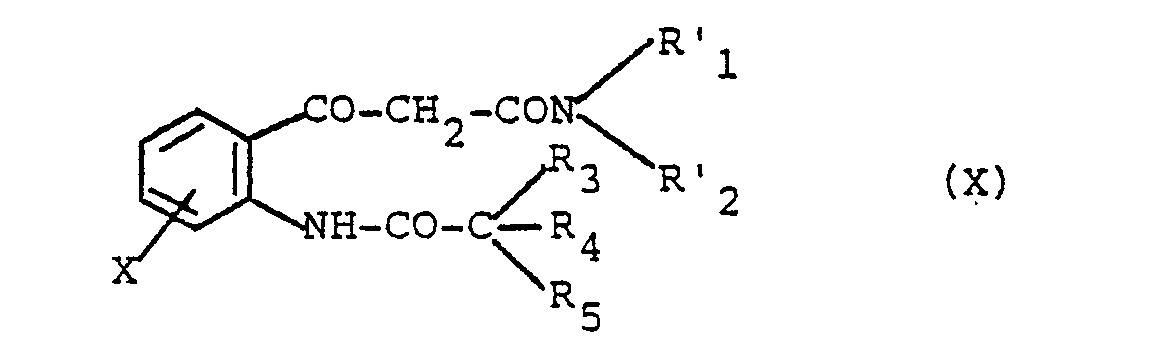
- L'invention a également pour objet un procédé de préparation des composés de formule (I'), telle que définie précédemment, caractérisé en ce que l'on soumet un composé de formule (VI) :


- Dans un mode de réalisation préférée du procédé de l'invention :
- - le dérivé fonctionnel de l'acide de formule (VII) est un halogénure ou un anhydride;
- - la réaction entre le composé de formule (VIII) et le composé de formule (IX) a lieu en présence d'un organolithien ou d'un amidure de lithium, par exemple en présence de butyllithium ou de diisopropylamidure de lithium;
- - la cyclisation du composé de formule (X) est effectuée en présence d'un agent alcalin, tel qu'un hydrure ou un carbonate alcalin, ou une amine, par exemple en présence d'hydrure de sodium, de carbonate de sodium ou de potassium, de pipéridine, de 4-aminopyridine, de triéthylamine, de 1,5-diazabicyclo /4,30/ non-5-ène, de 1,4-diazabicyclo /2,2,2/ octane ou de 1,5-diazabicyclo /5,4,0/ undéc-5-ène.
- Les composés de formule (II) et (VI) utilisés comme produits de départ du procédé de l'invention sont des produits connus d'une façon générale, qui peuvent être préparés selon les procédés indiqués dans la demande de brevet français n° 2 340 735 ou dans le brevet français n° 2 157 874.
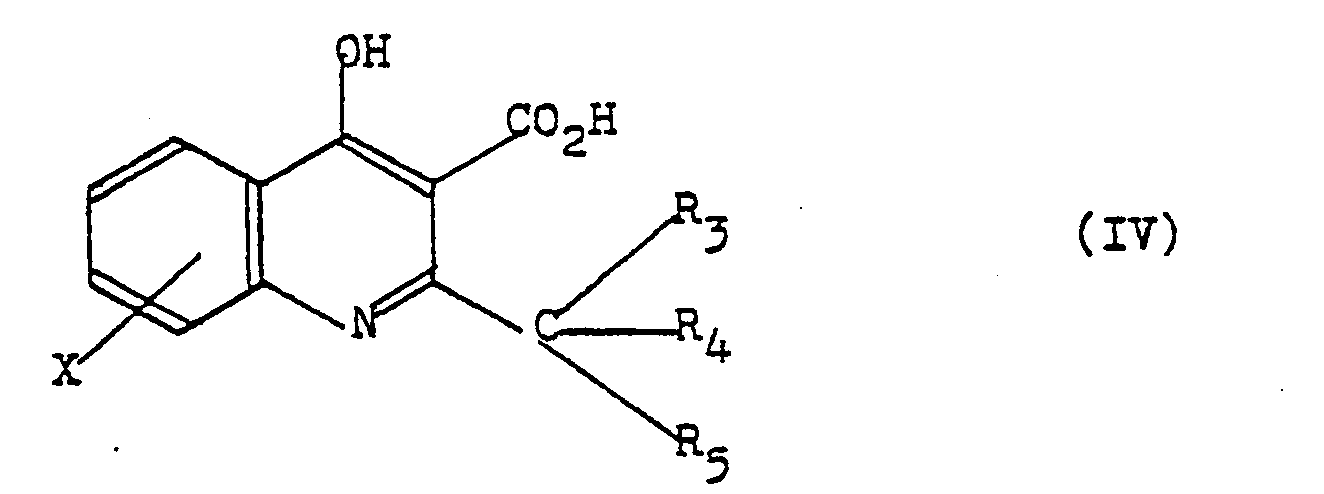
- Les composés de formule (IIIA), (IIIB), (IV) et notamment les composés de formule (III ) et (IVa), de même que les compo- a a sés de formule (VIII) et (X) sont des produits chimiques nouveaux, l'invention a donc pour objet ces produits à titre de produits industriels nouveaux, notamment à titre de produits intermédiaires nécessaires à la mise en oeuvre du procédé de l'invention.
- Les exemples suivants illustrent l'invention sans toutefois la limiter.
- On porte au reflux pendant 24 heures un mélange de 11,92 g de 2-méthyl 4-hydroxy 8-trifluorométhyl 3-quinoléine carboxylate d'éthyle, 400 cm3 de tétrachlorure de carbone, 13,30 g de N-chloro succinimide et 600 mg de péroxyde de benzoyle. On refroidit le mélange réactionnel à la température ambiante, filtre l'insoluble et le lave au tétrachlorure de carbone. On concentre le filtrat sous pression réduite. On obtient 17 g d'une huile que l'on purifie par chromatographie sur silice en éluant au chlorure de méthylène. On obtient ainsi 13,6 g de produit fondant vers 80-85°C que l'on empâte dans l'éther de pétrole (eb = 60°C-80°C).
- On essore, lave et sèche. On obtient ainsi 8,8 g du produit recherché fondant à 88°C.
- On agite 36 heures à la température ambiante une solution renfermant 22 g du produit préparé au stade A, 220 cm3 d'éthanol et 110 cm3 de lessive de soude. On chasse l'éthanol sous pression réduite à moins de 40°C. On dilue la solution avec 200 cm3 d'eau, la glace et l'amène à pH = 1 par addition d'acide chlorhydrique concentré. On essore, lave le précipité obtenu à l'eau et le dissout dans l'éther éthylique. On filtre.
- sèche et concentre sous pression réduite. On obtient ainsi 18 g du produit recherché que l'on utilise tel quel dans le stade suivant..
- On porte au reflux une solution renfermant 15 g du produit préparé au stade précédent, 400 cm3 de benzène anhydre et 16 cm3 de chlorure de thionyle. On maintient le reflu pendant 1 h 30 minutes. On chasse le benzène et l'excès de chlorure de thionyle par distillation sous pression réduite On obtient un produit que l'on utilise tel quel dans le sta suivant.
- On ajoute sous agitation et atmosphère inerte une solution renfermant 4,41 g de 2-aminothiazole, 50 cm3 d'acétate d'éthyle anhydre et 18,5 cm3 de triéthylamine dans une solution renfermant le produit obtenu au stade précédent dans 120 cm3 d'acétate d'éthyle. On porte le mélange réactionnel au reflux pendant une heure, puis abandonne une nuit à la température ambiante. On élimine le chlorhydrate de triéthylamine formé par filtration, on lave le filtrat à l'eau contenant du Cl Na pour éviter les émulsions.
- On sèche, concentre à sec sous pression réduite. On concrétise dans 150 cm3 d'acide chlorhydrique à 20%. On essore, lave à l'eau jusqu'à neutralité, puis dissout le précipité encore humide dans 50 cm3 de soude normale. On filtre,aci-difie le filtrat à pH 4-5 avec l'acide chlorhydrique à 50%. On glace, essore, lave à l'eau, sèche sous pression réduite à 90°C, et obtient 8,5 g du produit attendu sous forme brute que l'on recristallise dans l'acétate d'éthyle. On obtient 5,7 g du produit recherché fondant à 204°C.
- On dissout 3,72 g d'aniline dans 100 cm3 de chlorure de méthylène puis ajoute à +15,+18°C, 17,5 cm3 d'une solution à 25% de triméthylaluminium dans l'hexane et maintient ensuite sous agitation pendant 15 minutes. On ajoute ensuite à la même température 7,56 g de produit obtenu au stade A de l'exemple 1, puis porte au reflux pendant 22 heures. On verse ensuite le mélange dans 100 cm3 d'une solution aqueuse glacée à 20% d'acide chlorhydrique, décante, extrait la phase aqueuse à l'acétate d'éthyle, lave les phases organiques réunies à l'eau, les sèche et évaporé le solvant. Les cristaux obtenus sont empâtés dans l'éther éthylique puis séchés et recristallisés dans l'acétate d'éthyle. On obtient 1,1 g de produit attendu que l'on peut purifier à nouveau dans l'éthanol. F = 200-202°C (Décomposition).
- Analyse : C18 H11 N2 02 Cl2 F3 = 415,217 Calculé : C% 52,07 H% 2,67 N% 6,75 Cl% 17,08 F% 13,73 Trouvé 52,0 2,6 6,7 17,4 13,6
- On opère de manière analogue à celle décrite à l'exemple 2, au départ de 3,76 g de 2-aminopyridine et de 7,36 g de produit obtenu au Stade A de l'exemple 1.
- On obtient après recristallisation du produit dans l'acétate d'éthyle 2,7 g de produit attendu.que l'on peut purifier à nouveau dans le méthanol. F = 212°C. (Décomposition).
- Analyse : C17 H 10 N3 Cl2 F3 02 = 416,199 Calculé : C% 49,06 H% 2,42 N% 10,10 Cl% 17,04 F% 13,69 Trouvé : 49,0 2,3 10,0 17,2 13,2
- On dissout 13,75 g de 2-aminothiazole dans 150 cm3 de toluène puis ajoute à +5°C, une solution renfermant 30 cm3 de triméthylaluminium à 25% dans l'hexane et 30 cm3 de toluène. On maintient sous agitation à +5,+10°C pendant une demi - heure puis ajoute en une fois 9,2 g de produit obtenu au stade A de l'exemple 1. Après la fin du dégagement gazeux, on porte la température à +80,+85°C rapidement et sous gaz inerte pendant 3 heures et demi. On concentre ensuite à sec puis le résidu est additionné de 500 cm3 d'acide chlorhydrique 1N et agité pendant 1 heure. On filtre, lave à l'eau puis avec un mélange d'eau et d'hydroxyde de sodium 2N et enfin à l'eau. On réunit les phases alcalines, filtre puis ajoute lentement au filtrat de l'acide chlorhydrique 2N jusqu'à pH 5. On essore le précipité obtenu, le lave à l'eau et le sèche. On obtient 7,48 g de produit attendu brut. F ≃ 200°C.
- On recristallise ce produit brut dans l'acétate d'éthyle en le traitant au charbon actif. On recueille 4,19 g de produit attendu. F = 204°C. Ce produit est identique au produit obtenu à l'exemple 1.
- On opère de manière analogue à celle décrite à l'exemple 4, au départ de 1,5 g d"aminothiàzole et de 1,041 g de 2-(1-chloroéthyl) 4-hydroxy 8-trifluorométhyl 3-quinoléine carboxylate d'éthyle. Après addition d'acide chlorhydrique 1N, on extrait à l'acétate d'éthyle, lave la phase organique à l'eau, sèche et concentre à sec. On purifie le produit par chromatographie sur silice en éluant à l'acétate d'éthyle et obtient le produit attendu que l'on purifie dans l'éther. F ≃ 190°C.(Décomposition).
- Le 2-(1-chloroéthyl) 4-hydroxy 8-trifluorométhyl 3-quinoléine carboxylate d'éthyle a été préparé comme suit :
- On mélange 9,3 g de 2-éthyl 4-hydroxy 8-trifluorométhyl 3-quinoléine carboxylate d'éthyle, 200 cm3 de tétrachlorure de carbone, 4,2 g de N-chloro succinimide et 0,45 g d'azobis iso- butyronitrile, maintient sous agitation pendant 5 heures en chauffant à 65°C maximum par l'intermédiaire d'une lampe, refroidit à 20°C, filtre et concentre le filtrat à sec. On re- prend le résidu au chlorure de méthylène, lave à l'eau, sèche et évapore le solvant. On empâte le résidu à l'éther de pétrole, le sèche et obtient 9 g de produit attendu. F = 104°C.
- En opérant selon le procédé décrit à l'exemple 1 (Procédé A) ou selon le procédé décrit à l'exemple 2 (Procédé B), on a préparé au départ de l'acide 2-(dichlorométhyl) 4-hydroxy 8-trifluorométhyl 3-quinoléine carboxylique et de son ester éthylique les produits indiqués ci-après.
- Exemple 6 : 2-dichlorométhyl.4-hydroxy N-(4-phényl 2-thiazolyl) 8-trifluorométhyl 3-quinoléine carboxamide (Procédé B). F = 210°C. (Décomposition).
- Exemple 7 : 2-dichlorométhyl 4-hydroxy N-(5-méthyl 2-thiazolyl) 8-trifluorométhyl 3-quinoléine carboxamide.(Procédé B).
- F = 240-245°C (Décomposition).
- Exemple 8 : 2-dichlorométhyl 4-hydroxy N-(4,5-dihydro 2-thiényl) 8-trifluorométhyl 3-quinoléine carboxamide (Procédé B). F ≃ 205°C. (Décomposition).
- Exemple 9 : 2-dichlorométhyl 4-hydroxy N-(2-benzothiazolyl) 8-trifluorométhyl 3-quinoléine carboxamide. (Procédé B). F ≃ 265°C. (Décomposition).
- Exemple 10 : 2-dichlorométhyl 4-hydroxy N-méthyl N-(2-thiazolyl) 8-trifluorométhyl 3-quinoléine carboxamide (Procédé A).
- F = 228-230°C.
- Exemple 11 : 2-dichlorométhyl 4-hydroxy N-(3-méthyl 2-thiazo- lylidène) 8-trifluorométhyl 3-quinoléine carboxamide (Procédé A). F = 270-280°C (Décomposition). Dans ce cas, le dérivé thiazoli- que de départ utilisé a été l'imine au lieu de l'amine.
- En plus des produits mentionnés précédemment, les produits suivants peuvent également être obtenus selon l'invention :
- -le2-dichlorométhyl 4-hydroxy N-(5-chloro 2-thiazolyl) 8-trifluorométhyl 3-quinoléine carboxamide. F = 245°C; (avec décomposition);
- - le 2-dichlorométhyl 4-hydroxy N-(2-oxazolyl) 8-trifluorométhyl 3-quinoléine carboxamide. F ≃ 220°C (avec décomposition);
- - le 2-dichlorométhyl 4-hydroxy N-(1-méthyl 2-imidazolyl) 8-trifluorométhyl 3-quinoléine carboxamide. F = 240°c(avec décomposition);
- - le 2-dichlorométhyl 4-hydroxy N-(4-diméthylamino 3-méthyl 2-thiazolyl) 8-trifluorométhyl 3-quinoléine carboxamide,
- - le 2-chlorométhyl 4-hydroxy N-(2-thiazolyl) 8-trifluorométhyl 3-quinoléine carboxamide. F = 218°C (Décompasition);
- - le 2-chlorométhyl 4-hydroxy 8-trifluorométhyl 3-quinoléine carboxylate d'éthyle utilisé au départ de la préparation du produit ci-dessus peut être préparé de la même manière que l'homologue 2-chloroéthyl, au départ du 2-méthyl 4-hydroxy 8-trifluorométhyl 3-quinoléine carboxylate d'éthyle;
- - le 2-(1-dichloroéthyl) 4-hydroxy N-(2-thiazolyl) 8-trifluorométhyl 3-quinoléine carboxamide. F = 220°C (Décomposition);
- le 2-(1-dichloroéthyl) 4-hydroxy 8-trifluorométhyl 3-quinoléine carboxylate d'éthyle utilisé au départ de la préparation du produit ci-dessus peut être préparé de la même manière que l'homologue 1-chloroéthyl en poursuivant la chloration.
- On chauffe progressivement sous agitation 17,44 g d'acide 2-amino 3-(trifluorométhyl) benzoïque préparé selon le procédé indiqué dans J. Med. Chem. 16 (2) 101, 6 (1973) et 34,63 g de chlorure de dichloroacétyle.Aux alentours de 50°C, on observe une prise en masse, ainsi qu'un dégagement rapide et régulier d'HCl qui se poursuit pendant 1 heure. On observe alors vers 100°C une fluidification du milieu réactionnel, une intensification du dégagement d'HCl et une élévation de la température jusqu'à 127°C. On poursuit le chauffage jusqu'à cessation.du dégagement d'HCl et l'on obtient une solution brune. On refroidit dans un bain d'eau glacée tout en agitant. On essore le précipité formé, empâte dans l'éther, puis dans le méthanol. On lave au méthanol. On obtient 23,82 g du produit recherché fondant à 179°C.
- On ajoute entre -3° et -1°C sous agitation et sous azote, 87,7 cm3 d'une solution de n-butyllithium dans l'hexane titrant 1,1 moles par litre, dans une solution renfermant 8,65 g de N-(2-thiazolyl) acétamide et 304 cm3 de tétrahydrofurané. On maintient encore 20 minutes sous agitation entre -3 et -1°C. On refroidit à -75°C, et l'on ajoute à cette température sous bonne agitation entre -73 et -75°C, 9,073 g de 2-dichlorométhyl 8-trifluorométhyl 4H-3,1-benzoxazin-4-one en solution dans 95,5 cc de tétrahydrofurane. On agite à -75°C pendant 2 heures 30 la solution brune obtenue. On verse sur un mélange d'eau, de glace et d'HC1. On décante et essore l'insoluble. On obtient 935 mg du produit recherché. F = 223°C. On extrait les phases aqueuses à l'acétate d'éthyle. On lave à l'eau, sèche et évapore à sec. On obtient ainsi 15,2 g du produit brut recherché. On y ajoute 100 cc de chlorure de méthylène, triture, essore l'insoluble, empâte dans 30 cc de chlorure de méthylène, essore, lave avec 10 cc de chlorure de méthylène. On obtient 7,47 g du produit recherché fondant à 223°C.
- a) On ajoute une sôlution renfermant 8,81 g de 2-(Dichloroacé- tylamino) fl-oxo N-(2-thiazolyl) 3-(trifluorométhyl) benzène propanamide et 100 cc de diméthylformamide dans une suspension renfermant 1,06 g d'hydrure de sodium et 50 cm3 de diméthylformamide. On maintient sous agitation pendant 4 heures à la température ambiante. On verse sur un mélange eau, glace, HC1. On essore le précipité formé, le lave à l'eau et le dissout. dans 300 cm3 de chlorure de méthylène. On lave les phases chlo- rométhyléniques à l'eau et les sèche sur sulfate de magnésium. On filtre et évapore à sec. On obtient 8,5 g du produit brut fondant à 175°C. On triture le produit dans l'éthanol, essore et obtient 6,95 g d'un produit que l'on recristallise dans 215 cm3 d'acétate d'éthyle en éliminant des traces d'insoluble. On obtient 5,015 g du produit recherché fondant à 204°C.
- b) On opère de manière analogue à celle décrite au Stade C a) ci-dessus, en utilisant un équivalent de carbonate de potassium au lieu de l'hydrure de sodium. On obtient le produit attendu. F = 204°C.
- En opérant comme au Stade A de l'exemple 12, à partir d'acide 2-amino 3-trifluorométhyl benzoïque et de chlorure de chloracétyle, on a obtenu le produit recherché fondant à 76≃ 78°C.
- En opérant comme.au Stade B de l'exemple 12, à partir du produit préparé au stade A du présent exemple et de N-(2-thiazolyl) acétamide, on obtient le produit recherché fondant à 192 ≃ 194°C.
- En opérant comme au Stade C de l'exemple 12, à partir du produit préparé au stade B du présent exemple en utilisant comme base la diméthylaminopyridine et comme solvant le tétra- hydrofuranne, on obtient le produit recherché. F = 218°C.
- En opérant comme au stade A de l'exemple 12, à partir du chlorure de 1-chloropropionyle et de l'acide 2-àmino 3-trifluorométhyl benzoïque, on a obtenu le produit recherché. F = 112°C.
- En opérant comme au stade B de l'exemple 12, à partir du du produit obtenu au stade A ci-dessus et de N-(2-thiazolyl) acétamide, on a obtenu le produit recherché. F = 215°C.
- On opère de manière analogue à celle décrite au stade C de l'exemple 13, au départ du produit obtenu au stade B-ci-dessus et obtient le produit attendu. F = 190-192°C.
- En opérant comme au stade A de l'exemple 12, à partir d'acide 2-amino 3-trifluorométhyl benzoïque et de chlorure de di- chloropropionyle, on a obtenu le produit recherché. F = 120°C.
- En opérant comme au stade B de l'exemple 12, à partir du produit obtenu au stade A ci-dessus et de N-(2-thiazolyl) acétamide, on a obtenu le produit recherché. F = 136-138°C.
- On opère de manière analogue à celle décrite au stade C de l'exemple 13, au départ du produit obtenu au stade B ci-dessus et obtient le produit attendu. F = 220°C.
- On opère comme au stade A de l'exemple 12, à partir d'acide 2-amino 3-trifluorométhyl benzoïque et d'anhydride de l'acide difluoroacétique et obtient le produit attendu. F = 82°C.
- On opère comme au stade B de l'exemple 12, à partir du produit obtenu au stade A ci-dessus et de N-(2-thiazolyl) acétamide, et obtient le produit attendu. F = 206°C.
- On opère de manière analogue à celle décrite au stade C de l'exemple 13, au départ du produit obtenu au stade B ci-dessus et obtient le produit attendu. F = 226°C.
- En opérant comme au stade B de l'exemple 12, à partir du produit préparé au stade A de l'exemple 12,et du N-(2-oxazolyl) acétamide, on obtient le produit recherché.
- On opère de manière analogue à celle décrite au stade C de l'exemple 13, au départ du produit obtenu au stade A ci-dessus et obtient le produit attendu. F = 220-225°C.
- En opérant comme au stade B de l'exemple 12, à partir du produit préparé au stade A de l'exemple 12 et du N-1-méthyl 2-imidazolyl) acétamide, on obtient le produit recherché.
- On opère de manière analogue à celle décrite au stade C de l'exemple 13, au départ du produit obtenu au stade A ci-dessus et obtient le produit attendu. F ≃ 240°C (Décomposition).
- On a préparé des comprimés répondant à la formule suivante: Produit de l'exemple 1 ............................... 50 mg Excipient q.s. pour un comprimé terminé à ............ 350 mg
- (Détail de l'excipient : lactose, talc, amidon, stéarate de magnésium).
- Le test employé est basé sur le fait signalé par R. KOSTER et Coll., (Fed, Proc., 1959, 1B, 412) selon lequel l'injection intrapéritonéale d'acide acétique provoque, chez la souris, des mouvements répétés d'étirement et de torsion pouvant persister pendant plus de six heures. Les analgésiques préviennent ou diminuent ce syndrome qui peut être considéré comme l'extériorisation d'une douleur abdominale diffuse. On utilise une solution d'acide acétique à 1% dans l'eau. La dose déclenchant le syndrome est dans ces conditions de 0,01 cm3/g, soit 100 mg/kg d'acide acétique.
- Le produit étudié est administré par voie buccale une demi-heure avant l'injection d'acide acétique, les souris étant à jeun depuis la veille de l'expérience.
- Les étirements sont observés et comptés pour chaque souris, pendant une période d'observation de quinze minutes commençant aussitôt après l'injection d'acide acétique.
- Les résultats sont exprimés au moyen de la DA50, c'est-à-dire la dose qui permet d'obtenir une diminution de 50% du nombre des étirements par rapport aux animaux témoins.
- La DA50 trouvée a été de 0,6 mg/kg.
- L'activité anti-inflammatoire a été déterminée sur le test de l'oédème plantaire provoqué par la carraghénine chez le rat..
- On administre, à des rats mâles pesant de 130 à 150 g, 0,05 cm3 d'une suspension stérile à 1% de carraghénine dans l'articulation tibio-tarsienne d'une pattes postérieure.
- Simultanément, on administre le produit à étudier dans une suspension de carboxyméthylcellulose à 0,25% et de Tween à 0,02% par voie orale.
- Le volume de la patte est mesuré avant l'administration, puis deux heures, quatre heures, six heures, huit heures et vingt-quatre heures après.
- L'intensité de l'inflammation est maxima quatre à six heures après l'injection de carraghénine. La différence du volume des pattes des animaux traités et des témoins met en évidence l'action anti-inflammatoire du médicament.
- Le produit a été trouvé inactif à la dose de 50 mg/kg.
Claims (10)


Priority Applications (1)
| Application Number | Priority Date | Filing Date | Title |
|---|---|---|---|
| AT83201252T ATE54913T1 (de) | 1980-05-19 | 1981-05-19 | Industrielle verbindungen anwendbar als zwischenprodukte in der herstellung von in stellung 2 substituierten 4-hydroxy 3quinolincarboxamid-derivaten und die herstellung von diesen zwischenprodukten. |
Applications Claiming Priority (2)
| Application Number | Priority Date | Filing Date | Title |
|---|---|---|---|
| FR8011100 | 1980-05-19 | ||
| FR8011100A FR2482596A1 (fr) | 1980-05-19 | 1980-05-19 | Nouveaux derives de l'acide 4-hydroxy 3-quinoleine carboxylique substitues en 2, leur procede de preparation et leur application comme medicament |
Related Parent Applications (1)
| Application Number | Title | Priority Date | Filing Date |
|---|---|---|---|
| EP81400783.7 Division | 1981-05-19 |
Publications (3)
| Publication Number | Publication Date |
|---|---|
| EP0143123A2 true EP0143123A2 (fr) | 1985-06-05 |
| EP0143123A3 EP0143123A3 (en) | 1986-09-03 |
| EP0143123B1 EP0143123B1 (fr) | 1990-07-25 |
Family
ID=9242091
Family Applications (2)
| Application Number | Title | Priority Date | Filing Date |
|---|---|---|---|
| EP81400783A Expired EP0040573B1 (fr) | 1980-05-19 | 1981-05-19 | Dérivés de l'acide 4-hydroxy 3-quinoléine carboxylique substitués en 2, leur préparation, leur application comme médicament, les compositions les renfermant et les intermédiaires nouveaux obtenus |
| EP83201252A Expired - Lifetime EP0143123B1 (fr) | 1980-05-19 | 1981-05-19 | Produits industriels nouveaux utilisés notamment comme intermédiaires dans la préparation de nouveaux dérivés du 4-hydroxy 3-quinoléine carboxamide substitués en 2 et la préparation desdits intermédiaires |
Family Applications Before (1)
| Application Number | Title | Priority Date | Filing Date |
|---|---|---|---|
| EP81400783A Expired EP0040573B1 (fr) | 1980-05-19 | 1981-05-19 | Dérivés de l'acide 4-hydroxy 3-quinoléine carboxylique substitués en 2, leur préparation, leur application comme médicament, les compositions les renfermant et les intermédiaires nouveaux obtenus |
Country Status (17)
| Country | Link |
|---|---|
| US (2) | US4397856A (fr) |
| EP (2) | EP0040573B1 (fr) |
| JP (1) | JPS5731665A (fr) |
| AT (2) | ATE8783T1 (fr) |
| AU (1) | AU543580B2 (fr) |
| CA (1) | CA1184558A (fr) |
| DE (2) | DE3177205D1 (fr) |
| DK (1) | DK152212C (fr) |
| ES (1) | ES502264A0 (fr) |
| FI (1) | FI77030C (fr) |
| FR (1) | FR2482596A1 (fr) |
| HU (1) | HU184853B (fr) |
| IE (1) | IE56506B1 (fr) |
| OA (1) | OA06814A (fr) |
| PH (2) | PH17403A (fr) |
| PT (1) | PT73050B (fr) |
| ZA (1) | ZA813293B (fr) |
Cited By (2)
| Publication number | Priority date | Publication date | Assignee | Title |
|---|---|---|---|---|
| DE3320102A1 (de) * | 1982-06-03 | 1983-12-08 | Roussel-Uclaf, 75007 Paris | Neue, in 2-stellung substituierte derivate der 4-hydroxy-3-chinolincarbonsaeure, deren herstellung, deren verwendung als arzneimittel, die sie enthaltenden zusammensetzungen und erhaltene zwischenprodukte |
| EP0211588A1 (fr) * | 1985-07-29 | 1987-02-25 | Ortho Pharmaceutical Corporation | Procédé de préparation d'acyl-2 dialkoxy-3,4 anilines |
Families Citing this family (14)
| Publication number | Priority date | Publication date | Assignee | Title |
|---|---|---|---|---|
| IE52670B1 (en) * | 1981-03-03 | 1988-01-20 | Leo Ab | Heterocyclic carboxamides,compositions containing such compounds,and processes for their preparation |
| HU190796B (en) * | 1981-06-12 | 1986-11-28 | Roussel Uclaf,Fr | Process for producing n-dihydrothiazolyl-3-quinoline-carboxamide derivatives |
| FR2532314B1 (fr) * | 1982-08-25 | 1985-07-19 | Roussel Uclaf | Nouveau procede de preparation de derives de l'acide 3-quinoleine carboxylique, nouveaux derives halogenes de l'acide 3-quinoleine carboxylique, leur application comme medicaments, les compositions pharmaceutiques les renfermant et les intermediaires nouveaux obtenus |
| FR2553769B1 (fr) * | 1983-10-20 | 1986-03-14 | Roussel Uclaf | Nouveau procede de preparation de derives de l'acide 4-hydroxy 3-quinoleine carboxylique substitues en 2 |
| US4844732A (en) * | 1985-10-24 | 1989-07-04 | Daicel Chemical Industries Ltd. | Pyridine-3-carboxamide derivatives |
| IE68593B1 (en) * | 1989-12-06 | 1996-06-26 | Sanofi Sa | Heterocyclic substituted acylaminothiazoles their preparation and pharmaceutical compositions containing them |
| DE4410539A1 (de) * | 1994-03-26 | 1995-09-28 | Sandoz Ag | Verwendung von 4 H-3,1-Benzoxazin-4-on-Verbindungen zur Verbesserung der Lichtechtheit von Textilmaterialien |
| RU2220960C2 (ru) * | 1997-12-22 | 2004-01-10 | Фармация Энд Апджон Компани | 4-гидрокси-3-хинолинкарбоксамиды и гидразиды, фармацевтическая композиция и способ лечения на их основе |
| WO2006051704A1 (fr) * | 2004-11-15 | 2006-05-18 | Taisho Pharmaceutical Co., Ltd. | Composé imine |
| TWI565465B (zh) | 2010-08-27 | 2017-01-11 | 歌林達股份有限公司 | 作為kcnq2/3調節劑之被取代之喹啉-3-甲醯胺 |
| TW201211007A (en) | 2010-08-27 | 2012-03-16 | Gruenenthal Gmbh | Substituted 2-amino-quinoline-3-carboxamides as KCNQ2/3 modulators |
| BR112013004690A2 (pt) | 2010-08-27 | 2016-05-10 | Gruenenthal Gmbh | 2-oxo-e 2-tioxo-di-hidroquinolina-3-carboxamidas substituídas como moduladores kcnq2/3 |
| KR20130100300A (ko) | 2010-08-27 | 2013-09-10 | 그뤼넨탈 게엠베하 | Kcnq2/3 조절제로서의 치환된 2-옥시-퀴놀린-3-카복스아미드 |
| AU2011297937B2 (en) | 2010-09-01 | 2015-10-01 | Grunenthal Gmbh | Substituted 1-oxo-dihydroisoquinoline-3-carboxamides as KCNQ2/3 modulators |
Citations (2)
| Publication number | Priority date | Publication date | Assignee | Title |
|---|---|---|---|---|
| FR2157874A2 (fr) | 1972-03-13 | 1973-06-08 | Pfizer | |
| FR2340735A1 (fr) | 1976-02-11 | 1977-09-09 | Roussel Uclaf | Nouveaux derives de l'acide 3-quinoleine carboxylique, leur procede de preparation et leur application comme medicament |
Family Cites Families (9)
| Publication number | Priority date | Publication date | Assignee | Title |
|---|---|---|---|---|
| GB874980A (en) * | 1958-12-17 | 1961-08-16 | Imp Cmemical Ind Ltd | Quinoline derivatives |
| US3357977A (en) * | 1964-01-06 | 1967-12-12 | Minnesota Mining & Mfg | Novel anthranyl intermediates |
| HU173974B (hu) * | 1971-08-30 | 1979-10-28 | Chinoin Gyogyszer Es Vegyeszet | Sposob poluchenija proizvodnykh 3,1-benzoksazin-4-ona |
| CA1034124A (fr) * | 1973-05-11 | 1978-07-04 | Ciba-Geigy Ag | Procede de fabrication de nouvelles quinoleines |
| FR2281761A1 (fr) * | 1974-08-13 | 1976-03-12 | Roussel Uclaf | Nouveaux derives de l'acide 3-quinoleine carboxylique, leur procede de preparation et leur application comme medicament |
| US3989698A (en) * | 1975-02-20 | 1976-11-02 | The Sherwin-Williams Company | Process for preparing benzoxazines |
| FR2377400A2 (fr) * | 1977-01-18 | 1978-08-11 | Roussel Uclaf | Nouveaux derives de l'acide 3-quinoleine carboxylique, leur procede de preparation et leur application comme medicament |
| FR2443467A1 (fr) * | 1978-12-08 | 1980-07-04 | Roussel Uclaf | Nouveaux derives de l'acide 3-quinoleine carboxylique, leur procede de preparation et leur application comme medicament |
| US4229831A (en) * | 1978-12-22 | 1980-10-21 | Burroughs Corporation | Drift compensated fiber optic-receiver |
-
1980
- 1980-05-19 FR FR8011100A patent/FR2482596A1/fr active Granted
-
1981
- 1981-05-12 US US06/262,952 patent/US4397856A/en not_active Expired - Lifetime
- 1981-05-13 PH PH25627A patent/PH17403A/en unknown
- 1981-05-15 CA CA000377751A patent/CA1184558A/fr not_active Expired
- 1981-05-18 HU HU811403A patent/HU184853B/hu not_active IP Right Cessation
- 1981-05-18 FI FI811529A patent/FI77030C/fi not_active IP Right Cessation
- 1981-05-18 PT PT73050A patent/PT73050B/fr not_active IP Right Cessation
- 1981-05-18 ES ES502264A patent/ES502264A0/es active Granted
- 1981-05-18 DK DK217281A patent/DK152212C/da not_active IP Right Cessation
- 1981-05-18 ZA ZA00813293A patent/ZA813293B/xx unknown
- 1981-05-18 IE IE1112/81A patent/IE56506B1/en not_active IP Right Cessation
- 1981-05-18 AU AU70689/81A patent/AU543580B2/en not_active Ceased
- 1981-05-19 OA OA57407A patent/OA06814A/fr unknown
- 1981-05-19 JP JP7434181A patent/JPS5731665A/ja active Granted
- 1981-05-19 DE DE8383201252T patent/DE3177205D1/de not_active Expired - Fee Related
- 1981-05-19 AT AT81400783T patent/ATE8783T1/de not_active IP Right Cessation
- 1981-05-19 EP EP81400783A patent/EP0040573B1/fr not_active Expired
- 1981-05-19 DE DE8181400783T patent/DE3165209D1/de not_active Expired
- 1981-05-19 EP EP83201252A patent/EP0143123B1/fr not_active Expired - Lifetime
- 1981-05-19 AT AT83201252T patent/ATE54913T1/de not_active IP Right Cessation
-
1983
- 1983-05-17 US US06/495,475 patent/US4518775A/en not_active Expired - Lifetime
- 1983-09-02 PH PH29488A patent/PH21164A/en unknown
Patent Citations (2)
| Publication number | Priority date | Publication date | Assignee | Title |
|---|---|---|---|---|
| FR2157874A2 (fr) | 1972-03-13 | 1973-06-08 | Pfizer | |
| FR2340735A1 (fr) | 1976-02-11 | 1977-09-09 | Roussel Uclaf | Nouveaux derives de l'acide 3-quinoleine carboxylique, leur procede de preparation et leur application comme medicament |
Non-Patent Citations (1)
| Title |
|---|
| R. KOSTER, FED, PROC., vol. 1B, 1959, pages 412 |
Cited By (2)
| Publication number | Priority date | Publication date | Assignee | Title |
|---|---|---|---|---|
| DE3320102A1 (de) * | 1982-06-03 | 1983-12-08 | Roussel-Uclaf, 75007 Paris | Neue, in 2-stellung substituierte derivate der 4-hydroxy-3-chinolincarbonsaeure, deren herstellung, deren verwendung als arzneimittel, die sie enthaltenden zusammensetzungen und erhaltene zwischenprodukte |
| EP0211588A1 (fr) * | 1985-07-29 | 1987-02-25 | Ortho Pharmaceutical Corporation | Procédé de préparation d'acyl-2 dialkoxy-3,4 anilines |
Also Published As
| Publication number | Publication date |
|---|---|
| EP0040573B1 (fr) | 1984-08-01 |
| US4397856A (en) | 1983-08-09 |
| EP0143123B1 (fr) | 1990-07-25 |
| PH21164A (en) | 1987-08-05 |
| EP0040573A3 (en) | 1982-01-13 |
| IE811112L (en) | 1981-11-19 |
| FI811529L (fi) | 1981-11-20 |
| JPS6340430B2 (fr) | 1988-08-11 |
| EP0143123A3 (en) | 1986-09-03 |
| ES8203889A1 (es) | 1982-04-01 |
| AU7068981A (en) | 1981-11-26 |
| FR2482596A1 (fr) | 1981-11-20 |
| PT73050A (fr) | 1981-06-01 |
| ZA813293B (en) | 1982-05-26 |
| ES502264A0 (es) | 1982-04-01 |
| OA06814A (fr) | 1982-12-31 |
| FR2482596B1 (fr) | 1983-04-29 |
| ATE54913T1 (de) | 1990-08-15 |
| EP0040573A2 (fr) | 1981-11-25 |
| DK217281A (da) | 1981-11-20 |
| US4518775A (en) | 1985-05-21 |
| PT73050B (fr) | 1983-02-08 |
| JPS5731665A (en) | 1982-02-20 |
| AU543580B2 (en) | 1985-04-26 |
| CA1184558A (fr) | 1985-03-26 |
| ATE8783T1 (de) | 1984-08-15 |
| HU184853B (en) | 1984-10-29 |
| FI77030B (fi) | 1988-09-30 |
| IE56506B1 (en) | 1991-08-28 |
| DE3165209D1 (en) | 1984-09-06 |
| DE3177205D1 (de) | 1990-08-30 |
| DK152212C (da) | 1988-08-08 |
| DK152212B (da) | 1988-02-08 |
| FI77030C (fi) | 1989-01-10 |
| PH17403A (en) | 1984-08-08 |
Similar Documents
| Publication | Publication Date | Title |
|---|---|---|
| CH620437A5 (fr) | ||
| EP0012639B1 (fr) | Nouveaux dérivés de l'acide 3-quinoléine carboxylique, leur procédé de préparation, leur application comme médicament et les compositions pharmaceutiques les renfermant | |
| EP0040573B1 (fr) | Dérivés de l'acide 4-hydroxy 3-quinoléine carboxylique substitués en 2, leur préparation, leur application comme médicament, les compositions les renfermant et les intermédiaires nouveaux obtenus | |
| CH639637A5 (fr) | Derives de la benzene propanamine et leurs sels, leurs procedes de preparation et les compositions pharmaceutiques les renfermant. | |
| CH628344A5 (fr) | Procede de preparation de nouveaux derives du piperidyl-indole et de leurs sels. | |
| EP0099766A1 (fr) | Nouveaux dérivés de la 1,3-dihydro 4-(1-hydroxy 2-aminoéthyl) 2H-indol-2-one, leurs sels, procédé de préparation, application à titre de médicaments et compositions les renfermant | |
| CA1097647A (fr) | Procede de preparation de nouvelles imidazoquinoleines et de leurs sels | |
| FR2532939A1 (fr) | Nouveaux derives de l'acide 4-hydroxy 3-quinoleine carboxylique substitues en 2, leur preparation, leur application comme medicament, les compositions les renfermant et les nouveaux intermediaires obtenus | |
| CH649994A5 (fr) | Derives du 4h-1,2,4-triazole, procedes de preparation et compositions les renfermant. | |
| CA1204116A (fr) | Procede de preparation de nouveaux derives de l'acide 4-hydroxy 3-quinoleine carboxylique substitues en 2 | |
| EP0573318A1 (fr) | Nouveaux dérivés de phényle carboxamide isoxazoles et leurs sels, leur procédé de préparation et les nouveaux intermédiaires de ce procédé, leur application comme médicaments et les compositions pharmaceutiques les renfermant | |
| CH675245A5 (fr) | ||
| EP0214004B1 (fr) | Dérivés de l'acide 4-OH quinoléine carboxylique substitué en 2 par un groupement dihydroxylé éventuellement éthérifié ou estérifié, procédé et inter-médiaires de préparation, leur application comme médicaments et les compositions les renfermant | |
| EP0169755B1 (fr) | Nouveaux dérivés de l'acide 4-hydroxy 3-quinoléine carboxylique subsititués en 2 par une fonction aminée, leur préparation, leur application comme médicaments, les compositions les renfermant et les intermédiaires nouveaux obtenus | |
| EP0176444B1 (fr) | Nouveau procédé de préparation de dérivés du 4 H-1,2-4-triazole, nouveaux triazoles ainsi obtenus, leur applicication comme médicaments et les compositions pharmaceutiques les renfermant | |
| CH624118A5 (en) | Processes for the preparation of new imidazobenzoxazines | |
| FR2636327A1 (fr) | Derives de quinoleine, leurs procedes de preparation et les medicaments les contenant | |
| EP0183584B1 (fr) | Nouveaux esters dérivés de l'acide 4-hydroxy 3-quinoléine carboxylique substitué en 2 par une chaîne alpha-hydroxylée, leur préparation, leur application comme médicaments et les compositions les renfermant | |
| CA1105022A (fr) | Procede de preparation de nouveaux derives de la benzophenone | |
| CA1064489A (fr) | Procede d'obtention de nouveaux benzene sulfonamides | |
| CH636350A5 (fr) | Derives de l'acide 2-/(4-quinoleinyl) amino/ 5-fluorobenzoique, leurs procedes de preparation et les compositions pharmaceutiques les renfermant. | |
| FR2551437A2 (fr) | Nouveaux derives de l'acide 4-oh 3-quinoleine carboxylique substitues en 2, nouveau procede de preparation, leur application comme medicament et les compositions les renfermant et produits necessaires a leur preparation | |
| FR2532314A1 (fr) | Nouveau procede de preparation de derives de l'acide 3-quinoleine carboxylique, nouveaux derives halogenes de l'acide 3-quinoleine carboxylique, leur application comme medicaments, les compositions pharmaceutiques les renfermant et les intermediaires nouveaux obtenus | |
| MC1331A1 (fr) | Derives de thiazine | |
| FR2600065A1 (fr) | Nouveaux derives de l'acide 5-((2-benzofuranyl) carbonyl) thiophene acetique, leurs sels, leurs procedes de preparation, leur application comme medicaments et les compositions pharmaceutiques les renfermant |
Legal Events
| Date | Code | Title | Description |
|---|---|---|---|
| PUAI | Public reference made under article 153(3) epc to a published international application that has entered the european phase |
Free format text: ORIGINAL CODE: 0009012 |
|
| AC | Divisional application: reference to earlier application |
Ref document number: 40573 Country of ref document: EP |
|
| AK | Designated contracting states |
Designated state(s): AT BE CH DE FR GB IT LI LU NL SE |
|
| RTI1 | Title (correction) | ||
| PUAL | Search report despatched |
Free format text: ORIGINAL CODE: 0009013 |
|
| AK | Designated contracting states |
Kind code of ref document: A3 Designated state(s): AT BE CH DE FR GB IT LI LU NL SE |
|
| 17P | Request for examination filed |
Effective date: 19870205 |
|
| 17Q | First examination report despatched |
Effective date: 19890228 |
|
| GRAA | (expected) grant |
Free format text: ORIGINAL CODE: 0009210 |
|
| AC | Divisional application: reference to earlier application |
Ref document number: 40573 Country of ref document: EP |
|
| AK | Designated contracting states |
Kind code of ref document: B1 Designated state(s): AT BE CH DE FR GB IT LI LU NL SE |
|
| REF | Corresponds to: |
Ref document number: 54913 Country of ref document: AT Date of ref document: 19900815 Kind code of ref document: T |
|
| ITF | It: translation for a ep patent filed | ||
| REF | Corresponds to: |
Ref document number: 3177205 Country of ref document: DE Date of ref document: 19900830 |
|
| GBT | Gb: translation of ep patent filed (gb section 77(6)(a)/1977) | ||
| PLBE | No opposition filed within time limit |
Free format text: ORIGINAL CODE: 0009261 |
|
| STAA | Information on the status of an ep patent application or granted ep patent |
Free format text: STATUS: NO OPPOSITION FILED WITHIN TIME LIMIT |
|
| 26N | No opposition filed | ||
| ITTA | It: last paid annual fee | ||
| EPTA | Lu: last paid annual fee | ||
| EAL | Se: european patent in force in sweden |
Ref document number: 83201252.0 |
|
| REG | Reference to a national code |
Ref country code: FR Ref legal event code: CD Ref country code: FR Ref legal event code: CA |
|
| REG | Reference to a national code |
Ref country code: FR Ref legal event code: TP |
|
| PGFP | Annual fee paid to national office [announced via postgrant information from national office to epo] |
Ref country code: SE Payment date: 19980427 Year of fee payment: 18 |
|
| PGFP | Annual fee paid to national office [announced via postgrant information from national office to epo] |
Ref country code: LU Payment date: 19980429 Year of fee payment: 18 |
|
| PGFP | Annual fee paid to national office [announced via postgrant information from national office to epo] |
Ref country code: FR Payment date: 19980506 Year of fee payment: 18 |
|
| PGFP | Annual fee paid to national office [announced via postgrant information from national office to epo] |
Ref country code: CH Payment date: 19980511 Year of fee payment: 18 |
|
| PGFP | Annual fee paid to national office [announced via postgrant information from national office to epo] |
Ref country code: GB Payment date: 19980513 Year of fee payment: 18 |
|
| PGFP | Annual fee paid to national office [announced via postgrant information from national office to epo] |
Ref country code: BE Payment date: 19980518 Year of fee payment: 18 |
|
| PGFP | Annual fee paid to national office [announced via postgrant information from national office to epo] |
Ref country code: AT Payment date: 19980529 Year of fee payment: 18 |
|
| PGFP | Annual fee paid to national office [announced via postgrant information from national office to epo] |
Ref country code: NL Payment date: 19980531 Year of fee payment: 18 |
|
| PGFP | Annual fee paid to national office [announced via postgrant information from national office to epo] |
Ref country code: DE Payment date: 19980706 Year of fee payment: 18 |
|
| PG25 | Lapsed in a contracting state [announced via postgrant information from national office to epo] |
Ref country code: LU Free format text: LAPSE BECAUSE OF NON-PAYMENT OF DUE FEES Effective date: 19990519 Ref country code: GB Free format text: LAPSE BECAUSE OF NON-PAYMENT OF DUE FEES Effective date: 19990519 Ref country code: AT Free format text: LAPSE BECAUSE OF NON-PAYMENT OF DUE FEES Effective date: 19990519 |
|
| PG25 | Lapsed in a contracting state [announced via postgrant information from national office to epo] |
Ref country code: SE Free format text: LAPSE BECAUSE OF NON-PAYMENT OF DUE FEES Effective date: 19990520 |
|
| PG25 | Lapsed in a contracting state [announced via postgrant information from national office to epo] |
Ref country code: LI Free format text: LAPSE BECAUSE OF NON-PAYMENT OF DUE FEES Effective date: 19990531 Ref country code: CH Free format text: LAPSE BECAUSE OF NON-PAYMENT OF DUE FEES Effective date: 19990531 Ref country code: BE Free format text: LAPSE BECAUSE OF NON-PAYMENT OF DUE FEES Effective date: 19990531 |
|
| BERE | Be: lapsed |
Owner name: ROUSSEL UCLAF Effective date: 19990531 |
|
| PG25 | Lapsed in a contracting state [announced via postgrant information from national office to epo] |
Ref country code: NL Free format text: LAPSE BECAUSE OF NON-PAYMENT OF DUE FEES Effective date: 19991201 |
|
| REG | Reference to a national code |
Ref country code: CH Ref legal event code: PL |
|
| GBPC | Gb: european patent ceased through non-payment of renewal fee |
Effective date: 19990519 |
|
| EUG | Se: european patent has lapsed |
Ref document number: 83201252.0 |
|
| PG25 | Lapsed in a contracting state [announced via postgrant information from national office to epo] |
Ref country code: FR Free format text: LAPSE BECAUSE OF NON-PAYMENT OF DUE FEES Effective date: 20000131 |
|
| NLV4 | Nl: lapsed or anulled due to non-payment of the annual fee |
Effective date: 19991201 |
|
| PG25 | Lapsed in a contracting state [announced via postgrant information from national office to epo] |
Ref country code: DE Free format text: LAPSE BECAUSE OF NON-PAYMENT OF DUE FEES Effective date: 20000301 |
|
| REG | Reference to a national code |
Ref country code: FR Ref legal event code: ST |