EP0219077A2 - Vorrichtung zur Herstellung von Brot - Google Patents
Vorrichtung zur Herstellung von Brot Download PDFInfo
- Publication number
- EP0219077A2 EP0219077A2 EP86114068A EP86114068A EP0219077A2 EP 0219077 A2 EP0219077 A2 EP 0219077A2 EP 86114068 A EP86114068 A EP 86114068A EP 86114068 A EP86114068 A EP 86114068A EP 0219077 A2 EP0219077 A2 EP 0219077A2
- Authority
- EP
- European Patent Office
- Prior art keywords
- kneading
- temperature
- dough
- bread
- yeast
- Prior art date
- Legal status (The legal status is an assumption and is not a legal conclusion. Google has not performed a legal analysis and makes no representation as to the accuracy of the status listed.)
- Granted
Links
Images





Classifications
-
- A—HUMAN NECESSITIES
- A21—BAKING; EDIBLE DOUGHS
- A21B—BAKERS' OVENS; MACHINES OR EQUIPMENT FOR BAKING
- A21B5/00—Baking apparatus for special goods; Other baking apparatus
-
- A—HUMAN NECESSITIES
- A21—BAKING; EDIBLE DOUGHS
- A21B—BAKERS' OVENS; MACHINES OR EQUIPMENT FOR BAKING
- A21B7/00—Baking plants
- A21B7/005—Baking plants in combination with mixing or kneading devices
-
- A—HUMAN NECESSITIES
- A21—BAKING; EDIBLE DOUGHS
- A21C—MACHINES OR EQUIPMENT FOR MAKING OR PROCESSING DOUGHS; HANDLING BAKED ARTICLES MADE FROM DOUGH
- A21C1/00—Mixing or kneading machines for the preparation of dough
- A21C1/02—Mixing or kneading machines for the preparation of dough with vertically-mounted tools; Machines for whipping or beating
-
- A—HUMAN NECESSITIES
- A21—BAKING; EDIBLE DOUGHS
- A21D—TREATMENT OF FLOUR OR DOUGH FOR BAKING, e.g. BY ADDITION OF MATERIALS; BAKING; BAKERY PRODUCTS
- A21D8/00—Methods for preparing or baking dough
- A21D8/02—Methods for preparing dough; Treating dough prior to baking
-
- B—PERFORMING OPERATIONS; TRANSPORTING
- B01—PHYSICAL OR CHEMICAL PROCESSES OR APPARATUS IN GENERAL
- B01F—MIXING, e.g. DISSOLVING, EMULSIFYING OR DISPERSING
- B01F35/00—Accessories for mixers; Auxiliary operations or auxiliary devices; Parts or details of general application
- B01F35/30—Driving arrangements; Transmissions; Couplings; Brakes
- B01F35/32—Driving arrangements
- B01F35/321—Disposition of the drive
- B01F35/3213—Disposition of the drive at the lower side of the axis, e.g. driving the stirrer from the bottom of a receptacle
-
- B—PERFORMING OPERATIONS; TRANSPORTING
- B01—PHYSICAL OR CHEMICAL PROCESSES OR APPARATUS IN GENERAL
- B01F—MIXING, e.g. DISSOLVING, EMULSIFYING OR DISPERSING
- B01F35/00—Accessories for mixers; Auxiliary operations or auxiliary devices; Parts or details of general application
- B01F35/90—Heating or cooling systems
- B01F2035/99—Heating
-
- B—PERFORMING OPERATIONS; TRANSPORTING
- B01—PHYSICAL OR CHEMICAL PROCESSES OR APPARATUS IN GENERAL
- B01F—MIXING, e.g. DISSOLVING, EMULSIFYING OR DISPERSING
- B01F27/00—Mixers with rotary stirring devices in fixed receptacles; Kneaders
- B01F27/80—Mixers with rotary stirring devices in fixed receptacles; Kneaders with stirrers rotating about a substantially vertical axis
Definitions
- This invention relates to a method of and an appratus for making bread at home and, in particular, to a method of and an apparatus for making bread by which any body can make flavorful bread through all seasons regardless of the knowledge of baking.
- the bread making process progresses in such steps that wheat flour, yeast, butter or shortening, sugar, salt, dry milk, and water as materials each in an appropriate quantity are prepared, kneaded in a vessel, subjected to the primary fermentation, degassed, subjected to the secondary fermentation to be optionally performed, degassed again, subjected to shaping-fermentation after the lapse of a waiting time (bench time), and baked into bread.
- the above process takes 3 to 4 hours and has hitherto solely depended on the manual operation, whereby home-baking has been followed by a problem that a housewife familiar with baking is obliged to be attentive thereto for 3 to 4 hours continuously and prevented from getting on with other housework.
- a temperature of dough when kneading is completed is preferably set to be approximate to a temperature at which gluten reaches the optimum level of glutinousness (will be called "optimum kneading temperature" hereinafter).
- optimum kneading temperature a temperature of mixed materials of English bread before kneading is preferably set slightly lower than 27°C in consideration of temperature rise caused in the material mixture by frictional heat during kneading.
- gluten is in the best glutinous condition at a temperature between 27 and 30°C, not above or below, and various ideas, such as pouring of cold water into the material mixture in summer of high atmospheric temperature or warm water in cold winter, have hitherto been employed for adapting the dough temperature at the end of kneading to be approximate to the optimum degree.
- Kneading is usually stopped at the supposed standard time when the rising temperature reaches a level between 27 and 30°C at which glutinousness of gluten becomes optimum.
- Another method of lowering the temperature of the material mixture at the start of kneading in place of the use of cold water has also been disclosed, wherein a blower to blow air to the material mixture is provided in a suitable position in the oven so as to deprive the material of evaporation heat and thereby lower the temperature thereof.
- a dough temperature at the time of completion of kneading can always be approximated to a degree between 27 and 30°C at which yield of gluten of the highest quality is expectable and loaves of bread are soft and rich in flavor.
- This invention was initiated for solving such problems as above.
- the primary object of this invention is to disclose a method of obtaining flavorful bread anytime at home through the four seasons.
- Another object of this invention is to provide a bread-making apparatus permitting fully automatic process progressing from kneading to baking except feeding of bread materials by hand and being capable of making flavorful bread of uniform quality regardless of the season.
- an apparatus according to this invention is provided with blowing means allowing appropriate changeover between warm air and cool air to be blown, wherein the kneading process is divided into two stages as an early one and later one so that the dough temperature may be controlled by suitable blowing of warm air or cool air onto the dough in each stage. That is to say, warm air or cool air selected according to the temperature of the bread material mixture before kneaded is blown thereonto in the early kneading stage and, immediately after the start of kneading, the dough is subjected to quick raising or lowering of temperature so as to have a temperature approximately equal to the optimum kneading temperature.
- a bread-making apparatus embodying the above method is characterized by being provided with a heater-equipped blower capable of suitable changeover between warm air and cool air to be blown, a temperature sensor 13 to sense information about temperature for controlling the aforesaid blower, and, further, a yeast pouring device to pour yeast into the material mixture automatically depending on instructions from the temperature sensor for providing the optimum timing of yeast pouring when required.
- bread material and “dough” are defined as follows:
- the former applies to wheat flour, yeast, shortening, sugar, salt, and dry milk including those which have been subjected to addition of water but not yet mixed and kneaded with each other.
- the latter applies to a mixture of the abovesaid materials mixed and kneaded together, even if slightly, in which component materials are inseparable from each other.
- Fig. 1 is a view showing a fundamental structure for making bread by a method according to this invention, in which the reference character a indicates a main body vessel of a bread-making apparatus; b, an oven, c, a material vessel for receiving bread materials; d, a rotary vane for kneading bread materials fixed to the bottom of the material vessel; e, a driving source for driving a motor to rotate the abovesaid rotary vane, the driving power of the motor e being transmitted to the rotary vane d through transmission means f.
- a indicates a main body vessel of a bread-making apparatus
- b an oven
- c a material vessel for receiving bread materials
- d a rotary vane for kneading bread materials fixed to the bottom of the material vessel
- e a driving source for driving a motor to rotate the abovesaid rotary vane, the driving power of the motor e being transmitted to the rotary vane d through transmission means f.
- g represents a heater for oven (oven heater) for baking the dough contained in the material vessel, which is disposed around the outer periphery of the material vessel c at a certain distance therefrom in the form of a ring, and h indicates a heater-equipped blower capable of suitable changeover between warm air and cool air to be blown.
- j denotes a first temperature-sensor fixed to the inner wall of the oven for monitoring the temperature therein
- k indicating a second temperature-sensor fixed to the tip of central shaft of the rotary vane d for monitoring the dough temperature, which not only monitors variations in the temperature of the dough under kneading but also the temperature of bread at the finish of baking.
- l stands for a control part for controlling performance of respective groups of the abovesaid devices.
- the process proceeds to kneading and a dough temperature immediately after the start of kneading ranges from 0 to 35°C according to the season.
- a dough temperature immediately after the start of kneading ranges from 0 to 35°C according to the season.
- Such temperature difference in the dough is comparatively trivial in summer but becomes a problem when the weather is cold as in winter.
- a fact that a temperature of the bread material mixture is significantly low at the start of kneading as compared with the optimum kneading temperature is indicative of uncertainty in the rate of temperature rise during kneading and is a cause of the problem that a fixed length of time of kneading leads to an uncertain degree of temperature at the finish of kneading whereas a fixed degree of temperature at the finish of kneading leads to an uncertain length of kneading time, thereby resulting in excessive or insufficient ripening of gluten.
- a heater-equipped blower h capable of suitable changeover between warm air and cool air to be blown is employed and the kneading process is divided into two stages as an early one and later one, in which a performance mode of the heater-equipped blower is adapted to be different from that in the later stage.
- the heater-equipped blower h is suitably actuated to blow warm air toward the dough in addition to heating by means of an oven heater g so as to quickly raise the dough temperature.
- the fan of heater-equipped blower is driven for blowing cool air to the dough and lowering the dough temperature close to the optimum kneading temperature.
- the dough is subjected to warm air and cool air blown after suitably changed over by the heater-equipped blower h intermittently driven so that the dough temperature may constantly be almost equal to the optimum kneading temperature until the completion of kneading.
- Changeover between warm air and cool air is performed through a control part l on the basis of a dough temperature sensed by the temperature sensor k.
- the process proceeds to baking of bread to be performed in the same vessel as used for kneading.
- Control over baking has hitherto depended on the time factor alone but, according to this invention, the 2nd temperature sensor k inserted into the dough senses an internal temperature of bread for finding a state of bread under baking. In this way, an internally well-baked loaf of bread in the optimum condition can be obtained irrespective of fluctuation in voltage of power source and difference in quantity between material mixtures.
- yeast is poured simultaneously with feeding of bread materials before the start of kneading, however, preferably at the time when a dough temperature reaches a certain specified degree, and therefore, it is desirable to provide a yeast pouring device which performs automatic pouring of yeast when a specified dough temperature is obtained.
- Figs. 2 and 3 are views of a bread-making apparatus according to this invention.
- this apparatus is composed of a roughly cylindrical bottomed main body vessel l and a cup-like lid 19 provided with a handle 20 for opening and closing the lid at the front and connected to the main body vessel l with a hinge 26.
- the main body vessel l is internally provided doubly with a roughly cylindrical oven 7 and a material vessel 2 whose inner wall is coated with fluoric resin excellent in mold-releasability such as tetrafluoroethylene, and a gap to be closed at the top is provided between the main body vessel l and the oven 7 as well as another gap between the oven 7 and the material vessel 2.
- a temperature sensor 15 for monitoring a temperature in the oven 7 is fixed to the side wall of the oven 7.
- a rotary vane 3 is detachably fitted on the revolving shaft 14 and a worm wheel 4 is fixed to the lower part of the revolving shaft 14 so as to mesh with a worm 5 secured to the shaft of a motor 6 for gearing down and transmitting the driving power of the motor 6 to the rotary vane 3.
- a temperature sensor 13 for constantly monitoring the dough temperature is disposed within the revolving shaft 14 at a point near the tip of the shaft and output of the sensor is introduced to the lower part of the revolving shaft 14 by a lead wire passing through the shaft 14 and then to the outside.
- a mechanism of output introduction as above, a structure for fixing the rotary vane 3, and the detail of a structure of the revolving shaft 14 will be described later.
- the reference numeral 8 indicates a heater for the oven (oven heater) shaped like a ring surrounding the material vessel 2 and serving as a heat source for heating the oven during or before kneading and also for baking.
- the calorific value of the heater must be as high as capable of baking bread and, in this embodiment, a heater of about 600 W is employed. Though only a single heater is disposed in the vertical midposition of the material vessel 2 in the embodiment shown in the drawing, two sets of heaters may be disposed separately high and low around the material vessel 2, of course.
- the numeral 9 denotes a heater-equipped blower which may be of optional type as far as endowed with a capability of performing changeover between warm air and cool air to be blown for quickly raising or lowering the dough temperature.
- a Silocco fan incorporating a heater 10 of about 200 W is employed.
- a duct 12 having a down-directed blow opening 11 at the upper end thereof is provided between the inner wall of the main body vessel l and the outer wall of the oven 7 for guiding warm air or cool air blown from the heater-equipped blower 9 toward the upper part of the main body vessel l and for blowing warm air or cool air toward the dough therefrom.
- the numerals 18 and 18 indicate discharge openings for discharging vapor filling the main body vessel 1 toward the outside by blowing. Vapor blown into these discharge openings 18 and 18 passes through a gap between the inner wall of the main body vessel l and the outer wall of the oven 7 and is discharged out through a discharge window 16.
- the heater-equipped blower 9 is of optional type as far as permitting changeover between warm air and cool air in blowing and may be set in any suitable position. Diversified arrangements will be described later by way of other embodiments.
- the numeral 17 stands for an operation panel for inputting data required for controlling the performance of this bread-making apparatus.
- the panel is composed of a key-arranged part and indication part , and data inputted from the operation panel 17 are transmitted to various devices through a control part 27. The detail of this operation panel 17 will be described later.
- a yeast pouring device 28 for pouring yeast into the dough under kneading is fixed to the upper part of the material vessel 2.
- This yeast pouring device 28 is fixed in consideration of a fact that delicate variation in raise, grain, and flavor occurs according to the timing of pouring of yeast. Such variation is due to the degree of activity of yeast fluctuating according to the thermal environment.
- timing of pouring yeast into bread materials is determined on the basis of the dough temperature in the yeast pouring device 28 of this invention. For example, if a temperature at the time of pouring yeast is set at 27°C, the yeast pouring device 28 is operates when the temperature of 27°C is sensed by the temperature sensor 13 and automatically pours yeast in a suitable quantity into the dough. In this way, a procedure to throw dry yeast wrapped in wafer into the material vessel 2 simultaneously with feeding of bread materials becomes needless and bread can be baked to be raised to a certain constant degree and to have the same flavor regardless of the season.
- the yeast pouring device 28 is of a structure in which a cup-like yeast reserving box 21 as large as capable of reserving, for example, yeast 22 (2-4 g ) corresponding to 1 lb (450g) of bread is provided on the upper part of the material vessel 2 and an electromagnetic valve 23 is connected to a pouring pipe 24 of the box 21, the box being fixed to the oven 7 by a support arm 25 having a rotatable part 30 disposed at a suitable midpoint thereof.
- the electromagnetic valve 23 is controlled by information from the temperature sensor 13 and, when the temperature sensor 13 senses the temperature of, for example, 27°C, opened to scatter yeast contained in the yeast reserving box 21 toward the inside of the material vessel 2.
- the rotatable part 30 provided in the midpoint of the support arm 25 is intended to prevent the yeast pouring device 28 from interfering with detachment of the material vessel 2 from the main body vessel 1.
- yeast pouring device 28 Other modes of yeast pouring device 28 are conceivable and will be described later with reference to other embodiments.
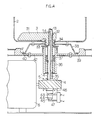
- Fig. 4 is a partial view showing a vertical section of a structure in which the material vessel 2 is fixed to the main body vessel 1 and a mechanism around the revolving shaft 14, and Fig. 5 is a plan view of the rotary vane 3 fitted onto the revolving shaft 14.
- the rotary vane 3 for kneading the material mixture is disposed on the center of the bottom of the material vessel 2, bevelled at faces 31 and 31 for easy kneading, and coated with a material excellently mold-releasable such as tetrafluoroethylene resin.
- a leg part 33 extends from the lower part of the rotary vane 3 and is inserted into an insertion hole 34 provided on the bottom center of the material vessel 2.
- a setting hole 32 in the shape of a partially cut-away circle when viewed from above is provided in a position corresponding to the rotation center of the vane 3 and, on the other hand, a certain length of an upper part of the revolving shaft 14 is shaped to agree with the external shape of the setting hole 32.
- the rotary vane 3 is fitted onto the revolving shaft 14 so that revolutions of the revolving shaft 14 may be transmitted to the rotary vane 3 without racing of the shaft 14.
- the upper part of the revolving shaft 14 onto which the rotary vane 3 is detachably fitted is made of heat-resistant resin.
- the tip of the revolving shaft 14 made of heat-resistant resin and to be brought into direct contact with the dough is reduced in thickness and internally provided with the temperature sensor 13 for enabling monitoring of the dough temperature.
- the numerals 36 and 37 represent a bearing and oil seal, respectively.
- the 38 indicates a supporting stand fixed to the lower part of the material vessel 2 and 39 represents a plate for partitioning a space into two, one for receiving the oven 7 and material vessel 2 and the other for receiving the motor 6 and driving mechanism for the heater-equipped blower 9, the plate 39 preventing moisture and and bread materials from entering the driving mechanism.
- the supporting stand 38 is provided, as shown in Fig. 6, with outwardly bent edge parts 40 for engagement purpose spaced from each other at equal intervals at the lower end thereof, and, on the other hand, a setting stand 42 having engaging parts 41 each shaped like a channel in cross-section to mesh with the abovesaid edge parts 40 is fixed to the plate 39, whereby the edge parts 40 and engaging parts 41 meshing therewith fix the supporting stand 38 onto the plate 39 for stably supporting the material vessel 2.
- the upper edge of the material vessel 2 is held by hand and turned by a certain degree of angle so that the edge parts 40 may deviate from the engaging parts 41, thereby the material vessel 2 being readily detached from the main body vessel 1.
- a worm wheel 4 large in diameter is fixed to a part slightly higher than the lower end of the revolving shaft 14 and meshes with the worm 5 fixed to the shaft of the motor 6 for gearing down and transmitting the driving power of the motor 6 to the revolving shaft 14.
- a metallic sliding ring 43 is fitted on the lower part of the revolving shaft 14 and, to the further lower part, an insulator 44 having a convex contact 45 protruding from the center thereof is fixed.
- a lead wire 35 introduced from the temperature sensor 13 internally disposed in the revolving shaft 14 close to the tip thereof is connected to the sliding ring 43 and the convex contact 45 while extending from the inside of the revolving shaft 14, and a slidable contact piece 46 is pressed to the side of the sliding ring 43 whereas another slidable contact piece 47 is pressed to the convex contact 45 from the underside, whereby output of the temperature sensor 13 is introduced to the outside by these slidable contact pieces 46 and 47.
- a worm wheel 4 and worm 5 are used in the embodiment shown in the drawing as driving power transmission means, however, a pulley and belt may be used instead.
- the operation panel 17 comprises an indication unit and a key-arranged unit.
- the indication unit is composed of a digital indication part 50 for indicating the time and of time-mode indication parts 51 disposed aside the former part 50.
- the digital indication part 50 is endowed with a function to indicate the time at present and the scheduled time of completion of kneading whereas the time-mode indication parts 51 with a function to indicate whether the time indicated by the digital indication part 50 is classified into the mode of the time-at-present or that of the scheduled time of completing kneading.
- the key-arranged unit is composed of an hour-key 53 for putting forward or backward the time indicated by the hour-indication part 52 of the digital indication part 50 when setting the time, a minute-key 55 for putting forward or backward the time indicated by the minute-indication part 54, a setting key for setting the indicated time and storing it in the memory of the control part 27, and performance-mode keys 57 for selecting the mode of performance of the apparatus.
- Performance-mode keys 57 are four in number and kind as, for example, A, B, C, and D, among which A corresponds to fully automatic performance for English bread; B to that for French bread; C to semiautomatic performance; and D to cancellation of performance; and, when the key A or B is depressed, except feeding of bread materials into the material vessel 2 by hand, other subsequent performances, such as kneading ⁇ primary fermentation ⁇ degassing ⁇ waiting time ⁇ rounding ⁇ shaping fermentation ⁇ baking, are all automatic while the length of time and temperature are controlled so as to be adaptable to English bread or French bread.
- Steps of time setting are as follows: In the normal state, the present time is displayed on the digital indication part 50. When the hour-key 53 and minute-key 55 are depressed in this state, indiated numerals on the digital indication part 50 change and, therefore, by manipulating the hour-key 53 and minute 55, the present time is set. Then, with the setting key 56 depressed, the time-mode is automatically changed over and the scheduled time is indicated on the digital indication part 50. Since the scheduled time, after indicated for a certain period of time, is automatically changed over and the present time is indicated, the scheduled time is set before changed over the same manner as in the case of setting the present time. The scheduled time equals the time at which bread is baked up; if bread is wanted for at 7.00 on the next morning, the scheduled time is set at the point of 7.00 on the indicator today.
- a microcomputer incorporated into the control part 27 performs backward calculation while taking the atmospheric temperature into account and fixes the time to start operating the apparatus.
- the time of start of operation is not always required to be set so exactly. The reason is that, if the actual time of completion of baking is earlier than scheduled, the quality of baked bread can be maintained at a certain level by suitably blowing cool air onto bread by means of the heater-equipped blower 9. The method in this case will be described later.
- the present time and the scheduled time are thus fixed, however, the present time is indicated while being varied by the clock all the time and, therefore, setting of the scheduled time only may fulfil the purpose in the usual case.
- all operations including kneading through baking are automatically performed only with a desired one of performance-mode keys 57 selectively depressed.
- wheat flour, butter, shortening, sugar, salt, and dry milk each in quantity corresponding to that of bread to be baked are put into the material vessel 2 and, with water added thereto, a lid 19 is put on the vessel 2.
- Yeast in quantity as much as required for one series of operations to bake bread materials in the material vessel 2 is reserved in the yeast reserving box 21. In this case, yeast is not required to be wrapped by wafer and is reserved as it is.
- the scheduled time of completion of baking is set by manipulating the operation panel 17 and information about performance is stored in the control part 27 with a desired performance-key depressed.
- the operation requiring the user's hand comes to an end at this stage and automatic operations follow afterward.
- the first automatic process starts from the control part 27 which backwardly calculates the time of start of kneading from the scheduled time of completion of baking while taking the quantity of the material mixture and the atmospheric temperature into account, and stores calculation results in the memory.
- the control part 27 keeps the apparatus in stoppage until the set time.
- the early stage of kneading begins and the rotary vane 3 starts rotating.
- the dough temperature is quickly raised or lowered so as to be close to the optimum kneading temperature, however, the manner of treating the temperature is various according to the season. For example, when the dough temperature is lower than the optimum kneading temperature in spring, autumn, and winter, not only the oven heater 8 but also a heater of the heater-equipped blower 9 is powered up when kneading starts so as to blow warm air.
- the dough temperature is immediately and quickly raised close to the optimum kneading temperature in a short period of time.
- the applicant of this invention observed variation in the degree of dough temperature with respect to time in the kneading process dependent on the above method and obtained such results as shown in Fig. 8.
- a material mixture in quantity corresponding to 1 lb (450 g) of baked bread was used for making a loaf of English bread. As shown in Fig.
- the dough temperature which was 0°C at the start of kneading, could be raised close to the range between 27 and 30°C as the optimum kneading temperature for English bread in a period of 15 minutes, and about 10 minutes for the temperature of 5 to 10°C.
- Cool air is comparable with the abovesaid warm air and various in temperature according to the season as ranging from 20 to 30°C in summer. Cool air blown onto the dough evaporates water content of dough and deprives the dough of evaporation heat to lower the dough temperature. Temperature fall in such case has empirically been found ranging roughly from 3 to 5°C.
- the lowered dough temperature ranges roughly from 28 to 30°C, in other words, can converge on the range of the optimum kneading temperature as from 27 to 30°C. Even when the atmospheric temperature is 35°C or so in the mid-summer, the dough temperature can be lowered to converge on about 30°C. Since no other than only a few days are as hot as exceeding 35°C in atmospheric temperature, it can be understood that lowering of the dough temperature close to the range between 27 and 30°C is possible in almost all cases in summer. Fall of the dough temperature requires a period of about 10 minutes only and no more even at the atmospheric temperature of 35°C as shown in Fig. 8.
- the dough temperature can apparently converge on the range between 27 and 30°C in the lapse of 10 minutes or so as far as the atmospheric temperature is within the range from 5 to 35°C. Because of an atmospheric temperature variation lying within the range from about 5 to 35°C throughout the season, as far as depending on a method according to this invention, it is possible to converge the dough temperature on the range between 27 and 30°C in the lapse of a short time after the start of kneading regardless of the season.
- both stages are termed for convenience upon reference to curves indicating the dough temperature variation as shown in Fig. 8 and cannot be distinguished from each other so clearly, whereby it is to be noted that both stages are not separated definitely and either term is used merely for describing one step of the same continuous process of kneading.
- kneading In the later stage, kneading must be conducted in a period of time necessary and sufficient for providing gluten of the optimum quality while monitoring a temperature ranging from 27 to 30°C obtained in the early kneading stage.
- An entire length of time of about 30 minutes is ideal for kneading a material mixture in quantity corresponding to 1 lb (450 g) of bread and, if longer or shorter, cannot provide dough of superior quality.
- the early stage of kneading requires only about 10 minutes, the later stage is assured of remaining time of about 20 minutes. This period of 20 minutes is as long as necessary and sufficient for yielding gluten of optimum quality.
- the dough temperature tends to rise during kneading due to frictional heat but is constantly monitored by the temperature sensor 13.
- the heater-equipped blower 9 blows cool air onto the dough whereas, when the temperature falls too low, warm air is blown so that the dough temperature may be converged constantly on the range between 27 and 30°C by alternate or intermittent blowing of warm air and cool air.
- the state of such temperature control is also shown in Fig. 8.
- the dough temperature is controlled to be close to the optimum kneading temperature in a short time after the start of kneading and kept at the same degree until completion of kneading, and, accordingly, bread materials are kneaded under the optimum condition without influence of the atmospheric temperature, whereby a time period of kneading is fixed on the basis of quantities of bread materials alone irrespective of a temperature variation in the seasons.
- an operation to raise the dough temperature is performed at the same time as that of starting kneading but, in winter, particularly, on an extremely cold day, pre-heating of the oven 7 before kneading is intended exceptionally.
- pre-heating of the oven 7 before kneading is intended exceptionally.
- considered as preferable measures are to adapt the temperature sensor 13 to automatically sense the lowered temperature and to energize the oven heater 8 for a while to raise the temperature of the material mixture to a certain degree as an exceptional procedure.
- Yeast is automatically poured into the material mixture by the yeast pouring device 28 during kneading and time setting for pouring is controlled by the temperature sensor 13 so that a temperature may be set at 27°C for ensuring optimum raise and grain of bread.
- the time of yeast pouring may be immediately before or after kneading but must be considered as important when the atmospheric temperature is below 27°C as in spring, autumn, and winter.
- the degree of activity of yeast is greatly influenced by the ambient temperature and, when yeast is poured into the material vessel 2 at the start of kneading or together with bread materials, yeast is mixed with materials not yet fully warmed, whereby the degree of activity of yeast is lowered to badly affect raise and grain of bread.
- yeast pouring device 28 in which the time of pouring is set according to the dough temperature enables pouring of yeast in the most suitable environment for proliferation of yeast fungi. Therefore, yeast fungi actively proliferate after poured and expedite raising and graining of dough, thereby contributing to making of bread of superior quality.
- a temperature for yeast pouring is set at a fixed degree regardless of the season and loaves of bread in the stable state of fermentation can be obtained all the year round.
- the dough With the completion of kneading and of ripening of dough, the dough is subjected to the primary fermentation, degassing, shaping-fermentation after the lapse of waiting time, and baking as the final step of bread making.
- the dough In the process of baking, the dough is heated by warm air blown by the oven heater 7 and the heater-equipped blower 9 which are in joint operation. At this time, hot air changed from warm air by increasing heat capacity of the heater 10 of the heater-equipped blower 9 may optionally be used.
- Temperature control in the inner part of bread during baking depends also on the temperature sensor 13 primarily used for temperature control in the kneading process.
- the temperature sensor 13 is internally disposed in the upper part of the revolving shaft 14 and a temperature of bread at a portion near the center thereof is exactly transmitted to the temperature sensor thanks to a reduced thickness of heat-resistant resin at the tip of the revolving shaft 14.
- an inner portion of bread is more impermeable to heat as it is nearer the core and a temperature at the core is the lowest even at the completion of baking, whereby control over the core temperature results in prevention of non-baked portion and ensures bread sufficiently baked throughout.
- the core temperature is fixed at 100°C.
- the user of the apparatus can take out baked bread from the material vessel 2 and use it as food without delay after the scheduled time.
- the completion time of baking is slightly earlier than the scheduled time occasionally due to the water content of the dough. In such a case, it is necessary to take out bread from the material vessel 2 at once and cool it at the room temperature until a mealtime so as to prevent degradation of bread quality.
- the oven heater 8 and the other heater 10 are not actuated after baking but the fan of the heater-equipped blower 9 only is actuated to continuously blow suitable cool air onto the bread surface for constantly expelling vapor emitting from sticking to the inner wall of the material vessel 2.
- the lid 19 is opened and the material vessel 2 is turned by a certain degree of angle for disengagement of the edge 40 of the supporting stand 38 from the engaging part 41 of the setting stand 42, raised straight, and detached from the main body vessel 1.
- the rotary vane 3 is left buried in bread contained in the material vessel 2.
- this operation is easy thanks to coating of fluoric resin excellent in mold-releasability spread over the inner wall of the material vessel 2.
- the rotary vane 3 is left buried in bread taken out, however, can be pulled out easily thanks to the position thereof near the bottom of the bread loaf and the leg part 33 thereof protruding from the bottom of the loaf so as to be pulled by hand, without spoiling the appearance of the bread loaf.
- shortening is fed into the material vessel 2 together with other materials at the same time, however, it has empirically been confirmed that the preferable way of providing gluten of superior quality is to feed shortening into the vessel during or after kneading.
- the reason for the above fact is that shortening as fat fed before or in the early stage of kneading envelops wheat flour and interferes with permeation of water into wheat flour. Accordingly, feeding of shortening in the stage or after completion of kneading is preferable.
- the additional provision of a shortening feeding mechanism (not shown) similar to the yeast pouring device 28 or provision of a device capable of feeding shortening and yeast at the same time and to be substituted for the yeast pouring device 28 shown in the drawing may be conceived.
- a bread-making apparatus of this invention is provided wth a heater-equipped blower capable of suitable changeover between warm air and cool water to be blown for selectively blowing warm air or cool air onto bread materials corresponding to the temperature of a bread material mixture at the time of starting kneading so as to obtain a dough temperature close to a temperature suitable for providing gluten of superior quality in a short period of time after starting kneading and, further, to maintain the dough temperature as it is until the completion of kneading by intermittent blowing of warm air or cool air, whereby the use of cold water in summer or warm water in winter is not required differently from the conventional practice and baking of bread free from influence of temperature variation through all seasons by the use of water of the normal temperature only is enabled without requiring human hands.
- the temperature distribution in the oven 7 is always kept uniform by warm air blown by the heater-equipped blower 9 and baked bread is free of burnt spot and unvenly baked portions. Further, temperature control during baking by means of the temperature sensor 13 inserted into the dough ensures bread well-baked even at the inner portion thereof and full of flavor.
- the yeast pouring device 28 is capable of pouring yeast at the dough temperature most suitable for proliferation of yeast fungi and complete elimination of uneveness in quality of bread which has conventionally been caused by indefinite temperature at the time of pouring yeast, thereby enabling constant provision of bread fully raised and grained.
- hot air of, for example, 60°C or above is blown onto the dough at the start of kneading once for raising the dough temperature to about 26 to 28°C and then the heater of the heater-equipped blower is turned off together with the motor simultaneously rotated in the reverse direction for outwardly exhausting hot air in the oven 7 and finally adjusting the temperature in the oven 7 to be approximate to 27 to 30°C. Since the dough temperature is governed by the temperature in the oven 7, the abovesaid method enables quick heating-up of dough to a degree ranging from 27 to 30°C.
- a structure as shown in Fig. 9 may be devised in such manner that a heater-equipped blower 61 composing a small capacity heater 58 for kneading and a large capacity one 59 for baking together fixed to the front part of the fan thereof is secured to the inner wall of the oven 7 above the material vessel 2.
- the small capacity heater 58 is disposed near the rotation center of the fan 60 whereas the large capacity one 59 on the periphery of rotation circle of the fan 60, and a guide plate 62 for regulating blowing direction is provided in advance of the fan 60 so that heaters are changed over when used for kneading, fermentation, and baking, respectively.
- the small capacity heater 58 is used for kneading, and warm air heated thereby is guided by the guide plate 62 to be blown principally to the dough.
- the large capacity heater 59 is used for fermentation and baking and hot air 64 heated thereby is blown into a gap between the inner wall of the oven 7 and the outer wall of the material vessel 2 to circulate within the oven 7 for even distribution of temperature therein so that the fermentation temperature may be, for example, 32°C for obtaining the optimum fermentation condition and the baking temperature be 200°C for baking bread without causing uneven baking. Since heating for baking depends on hot air only, an oven heater 8 to be fixed to the outer side of the material vessel is not required.
- shield plates 48 and 69 are provided between air current to flow into the heater-equipped blower 68 and hot air current blown out therefrom for definitely deviding the flow passage.
- heat capacity of the large capacity heater 66 is reduced to blow warm air onto bread materials whereas, during baking, output of the heater 66 is increased and the fan 65 is revolved in the reverse direction to suck air present in advance thereof so as to heat sucked air by the large capacity heater 66 and blow hot air 71 to the rear of the fan 65, whereby hot air 71 is guided to the lower part of the outer wall of the material vessel 2 to heat the vessel 2 from the side of the outer wall and the bottom thereof.
- the surface of the material mixture appearing on the upper part of the material vessel 2 is prevented from direct exposure to hot air 71 and released from a risk that the position subjected to blowing of hot air is excessively heated to be severely scorched.
- the fan 65 is driven in the ordinary direction again and heat capacity of the large capacity heater 66 is reduced to blow moderate hot air to the dough surface, when evaporation of water content of the dough at the inner portion thereof is expedited and, as a result, a phenomenon to damp the bread surface in contact with the inner wall of the material vessel 2 never occurs.
- yeast pouring device Another embodiment of the yeast pouring device is shown in the drawing explanatory of concept of the device.
- devisable is a structure in which one end of a feed pipe 74 is fixed to an appropriate midpoint of a duct 12 connected to the heater-equipped blower 9 and the other end is fixed to a yeast reserving box 76 through an electromagnetic valve 75.
- yeast is blown into the material vessel 2 together with air through a blow port 11 and scattered over a relatively wide surface area of the material mixture, thereby enabling an even mixture of yeast and bread materials.
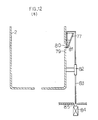
- This opening/closing mechanism is of a structure in which a lever 83 is provided in a position aside the material vessel 2 so as to be vertically slidably supported by a supporting pipe 82 and bent at the upper end side to have a valve 81 fixed thereto.
- a plunger pump 84 is disposed below the lever 83 so that yeast can be poured into the material vessel 2 through the pouring port 80 when the valve 81 is upwardly moved by the lever 83 pushed upward by uprise of the driving lever 85.
- the motor in use as a driving source of the heater-equipped blower is additionally used as a substitute for the motor 6 as a driving source of the rotary vane 3.
- Such a device enables the use of a single set of motor, reduction in size of the apparatus, and saving of production cost of the apparatus.
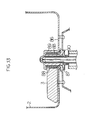
- a material vessel 2 and rotary vane may be constructed into a structure as shown in Fig. 13.
- a hole 87 diametrally larger than the outer diameter of the revolving shaft 14 is drilled on the center of the bottom 86 of the material vessel 2 and an upright part 88 projecting toward the interior of the material vessel 2 is provided on the periphery of the hole 87 whereas an outer cylindrical part 89 and inner one 90 are provided on the side of the rotary vane 3 for loosely fitting the upright part into a gap therebetween.
- Such structure of the material vessel 2 even if water is poured earlier than feeding of bread materials thereinto, prevents water flowing outside through the hole 87 and provides an advantage as handling of the apparatus.
Landscapes
- Life Sciences & Earth Sciences (AREA)
- Engineering & Computer Science (AREA)
- Food Science & Technology (AREA)
- Chemical & Material Sciences (AREA)
- Chemical Kinetics & Catalysis (AREA)
- Baking, Grill, Roasting (AREA)
- Manufacturing And Processing Devices For Dough (AREA)
Applications Claiming Priority (12)
| Application Number | Priority Date | Filing Date | Title |
|---|---|---|---|
| JP60227235A JP2531941B2 (ja) | 1985-10-12 | 1985-10-12 | 製パン器におけるパン生地製造方法 |
| JP227235/85 | 1985-10-12 | ||
| JP155972/85U | 1985-10-12 | ||
| JP1985155972U JPH0451731Y2 (de) | 1985-10-12 | 1985-10-12 | |
| JP1985177835U JPH0411622Y2 (de) | 1985-11-19 | 1985-11-19 | |
| JP177835/85U | 1985-11-19 | ||
| JP273629/85 | 1985-12-05 | ||
| JP60273629A JPH0787740B2 (ja) | 1985-12-05 | 1985-12-05 | 製パン器 |
| JP56477/86U | 1986-04-15 | ||
| JP1986056477U JPH0346691Y2 (de) | 1986-04-15 | 1986-04-15 | |
| JP19376186A JPH0636709B2 (ja) | 1986-08-19 | 1986-08-19 | 自動製パン器に於けるイ−スト菌注入方法及びその装置 |
| JP193761/86 | 1986-08-19 |
Publications (3)
| Publication Number | Publication Date |
|---|---|
| EP0219077A2 true EP0219077A2 (de) | 1987-04-22 |
| EP0219077A3 EP0219077A3 (en) | 1988-07-06 |
| EP0219077B1 EP0219077B1 (de) | 1995-07-19 |
Family
ID=27550639
Family Applications (1)
| Application Number | Title | Priority Date | Filing Date |
|---|---|---|---|
| EP86114068A Expired - Lifetime EP0219077B1 (de) | 1985-10-12 | 1986-10-10 | Vorrichtung zur Herstellung von Brot |
Country Status (6)
| Country | Link |
|---|---|
| US (1) | US4776265A (de) |
| EP (1) | EP0219077B1 (de) |
| KR (1) | KR890002625B1 (de) |
| AU (1) | AU575500B2 (de) |
| CA (1) | CA1277548C (de) |
| DE (1) | DE3650352T2 (de) |
Cited By (5)
| Publication number | Priority date | Publication date | Assignee | Title |
|---|---|---|---|---|
| EP0249993A3 (en) * | 1986-06-20 | 1988-08-31 | Matsushita Electric Industrial Co., Ltd. | Method of and apparatus for making bread |
| EP0333423A1 (de) * | 1988-03-14 | 1989-09-20 | Sharp Kabushiki Kaisha | Wärmeentwickelnder Behälter für Mikrowellenöfen |
| FR2655531A1 (fr) * | 1989-12-13 | 1991-06-14 | Moulinex Sa | Appareil de petrissage et de cuisson. |
| EP0659342A1 (de) * | 1993-12-02 | 1995-06-28 | Eloofa Industries Co., Ltd. | Mehrzweckvorrichtung zur Behandlung von Nahrungsmitteln |
| GB2386050A (en) * | 2002-02-05 | 2003-09-10 | Elec Tech Int Co Ltd | Bread making machines |
Families Citing this family (44)
| Publication number | Priority date | Publication date | Assignee | Title |
|---|---|---|---|---|
| US4903587A (en) * | 1987-04-02 | 1990-02-27 | Hitachi Heating Appliances Co., Ltd. | Automatic baking apparatus |
| JPS63296711A (ja) * | 1987-05-29 | 1988-12-02 | 松下電器産業株式会社 | パン製造機 |
| KR900007825B1 (ko) * | 1987-06-02 | 1990-10-20 | 산요덴끼 가부시끼가이샤 | 타이머부착 빵 제조기 |
| JPH01141623A (ja) * | 1987-11-27 | 1989-06-02 | Toshiba Corp | パン焼き器 |
| EP0322836B1 (de) * | 1987-12-28 | 1993-12-08 | Matsushita Electric Industrial Co., Ltd. | Verfahren zum Installieren eines Backtroges in einem Ofen und Vorrichtung zur Ausführung des Verfahrens |
| BE1001974A5 (fr) * | 1988-05-17 | 1990-05-02 | Itt Ind Belgium | Appareil de cuisson d'aliments. |
| US4903588A (en) * | 1988-09-05 | 1990-02-27 | Kabushiki Kaisha Toshiba | Bread baking apparatus |
| JPH0523180Y2 (de) * | 1989-01-13 | 1993-06-14 | ||
| US4984512A (en) * | 1989-10-11 | 1991-01-15 | Zojirushi Corporation | Automatic bread-making device |
| US5363746A (en) * | 1990-10-29 | 1994-11-15 | Gordon Ellis D | Automatic food preparation device |
| JPH05103578A (ja) * | 1991-10-16 | 1993-04-27 | Funai Electric Co Ltd | 製パン機のこね羽根の駆動機構 |
| IT1258073B (it) * | 1992-04-29 | 1996-02-20 | Zanussi Elettromecc | Dispositivo di misura dell'umidita' per forni, in particolare forni dicottura di alimenti |
| JP3131961B2 (ja) * | 1993-10-08 | 2001-02-05 | 船井電機株式会社 | 製パン器 |
| US5415081A (en) * | 1992-12-01 | 1995-05-16 | Funai Electric Co. Ltd. | Bread making apparatus |
| US5445061A (en) * | 1992-12-16 | 1995-08-29 | Barradas; George | Combination bread making machine and cooker |
| USD360104S (en) | 1993-11-05 | 1995-07-11 | Sunbeam Corporation | Bread making machine |
| JP3255205B2 (ja) * | 1993-12-06 | 2002-02-12 | 船井電機株式会社 | 製パン機 |
| US5433139A (en) * | 1993-12-06 | 1995-07-18 | Funai Electric Co., Ltd. | Bread making machine |
| US5410949A (en) * | 1993-12-20 | 1995-05-02 | Chiaphua Industries Limited | Automatic breadmaking machine |
| US5438915A (en) * | 1994-01-28 | 1995-08-08 | Chen; Shang-Hsien | Temperature sensor assembly for an automatic baking machine |
| USD367397S (en) | 1994-07-15 | 1996-02-27 | American Harvest, Inc. | Breadmaker |
| USD438756S1 (en) | 1994-08-29 | 2001-03-13 | American Harvest, Inc. | Bread pan |
| US5839356A (en) * | 1994-07-15 | 1998-11-24 | American Harvest, Inc. | Automatic bread making machine |
| EP0709024A1 (de) | 1994-10-25 | 1996-05-01 | The West Bend Company | Automatische Vorrichtung zur Herstellung von Brot mit breitem Backblech |
| US5493955A (en) * | 1994-10-25 | 1996-02-27 | The West Bend Company | Automatic breadmaker with laterally-opening wide door |
| US5463937A (en) | 1994-10-25 | 1995-11-07 | The West Bend Company | Automatic breadmaker with plural kneading members |
| US5510127A (en) * | 1995-01-13 | 1996-04-23 | Raymond Industrial Ltd. | Process for making bread in an automatic bread maker |
| JPH08322735A (ja) * | 1995-05-29 | 1996-12-10 | Funai Electric Co Ltd | 製パン器 |
| US5568764A (en) * | 1995-06-05 | 1996-10-29 | The West Bend Company | Automatic breadmaker with interior lamp |
| US5588353A (en) * | 1995-07-18 | 1996-12-31 | Appliance Development Corp. | Automatic bread-making apparatus |
| US5584233A (en) * | 1995-07-18 | 1996-12-17 | Appliance Development Corp. | Automatic bread-making apparatus |
| US5860355A (en) * | 1997-02-21 | 1999-01-19 | Mk Seiko Co., Ltd. | Automatic bread maker |
| US6113966A (en) * | 1998-04-16 | 2000-09-05 | The West Bend Company | Rapid cycle breadmaker |
| AU748060B2 (en) * | 1998-07-14 | 2002-05-30 | Matsushita Electric Industrial Co., Ltd. | Automatic bread maker |
| US6004600A (en) * | 1998-10-30 | 1999-12-21 | Van Over; Charles | Method of making bread |
| GB0230082D0 (en) * | 2002-12-24 | 2003-01-29 | Perry Ophneil H | Oven |
| KR100740693B1 (ko) * | 2004-05-19 | 2007-07-18 | 주식회사 오성사 | 건강발효 기능을 갖는 제빵기 및 그 구동 방법 |
| SE529587C2 (sv) * | 2005-10-21 | 2007-09-25 | Hans-Goeran Aahlander | En matlagningsanordning med sensorinrättning och ett matlagningskärl |
| KR100804613B1 (ko) * | 2007-02-09 | 2008-02-20 | 위니아만도 주식회사 | 발효기 및 이를 구비한 김치저장고 |
| DE102007027025A1 (de) | 2007-06-08 | 2008-12-11 | Heuser-Hellmann Creative Solutions GbR (vertretungsberechtiger Gesellschafter: Tatiana Heuser, 47829 Krefeld) | Vorrichtung zur Herstellung von Brot und anderen Backwaren |
| CN202843378U (zh) * | 2011-09-26 | 2013-04-03 | 德昌电机(深圳)有限公司 | 食物处理机、电机组件及面包机 |
| US20150201625A1 (en) | 2014-01-23 | 2015-07-23 | Conewich Enterprises Limited Partnership | Bake Form for Manufacturing a Food Product |
| CN109102629B (zh) * | 2018-08-20 | 2020-12-08 | 王从海 | 披萨无人贩卖机和系统 |
| CN111345702B (zh) * | 2020-03-25 | 2022-12-06 | 宁波方太厨具有限公司 | 一种温场均匀的烤箱 |
Family Cites Families (9)
| Publication number | Priority date | Publication date | Assignee | Title |
|---|---|---|---|---|
| US3884213A (en) * | 1973-03-30 | 1975-05-20 | Donald P Smith | Cooking apparatus |
| GB1448696A (en) * | 1973-05-29 | 1976-09-08 | Pfizer | 2-phqnyl-astriazine-3,4-2h,4h-diones |
| FR2435207A1 (fr) * | 1978-09-06 | 1980-04-04 | Grandi Rene | Sorbetiere portative a element generateur frigorifique ou thermique incorpore |
| FR2443206A1 (fr) * | 1978-12-07 | 1980-07-04 | Bouton Jacky | Procede pour le petrissage d'une pate de boulangerie et petrins pour la mise en oeuvre de ce procede |
| FR2498069A1 (fr) * | 1981-01-19 | 1982-07-23 | Filippi Danielle | Combine menager avec dispositif de cuisson automatique |
| IT1198359B (it) * | 1982-03-09 | 1988-12-21 | Alberto Cipelletti | Elettrodomestico multifunzionale |
| AU564200B2 (en) * | 1983-07-08 | 1987-08-06 | Hosiden Electronics Co. Ltd. | Automatic bread making machine |
| US4538509A (en) * | 1983-08-22 | 1985-09-03 | Hosiden Electronics Co., Ltd. | Automatic bread baking machine |
| DE3423972A1 (de) * | 1984-03-09 | 1985-09-26 | Ismar GmbH, 5000 Köln | Verfahren und vorrichtung zum herstellen eines vorteiges, insbesondere weizen-vorteiges |
-
1986
- 1986-09-25 CA CA000519083A patent/CA1277548C/en not_active Expired - Lifetime
- 1986-09-29 AU AU63281/86A patent/AU575500B2/en not_active Expired
- 1986-10-10 EP EP86114068A patent/EP0219077B1/de not_active Expired - Lifetime
- 1986-10-10 DE DE3650352T patent/DE3650352T2/de not_active Expired - Lifetime
- 1986-10-11 KR KR1019860008514A patent/KR890002625B1/ko not_active Expired
-
1987
- 1987-09-18 US US07/098,448 patent/US4776265A/en not_active Expired - Lifetime
Cited By (9)
| Publication number | Priority date | Publication date | Assignee | Title |
|---|---|---|---|---|
| EP0249993A3 (en) * | 1986-06-20 | 1988-08-31 | Matsushita Electric Industrial Co., Ltd. | Method of and apparatus for making bread |
| US4885176A (en) * | 1986-06-20 | 1989-12-05 | Matsushita Electric Industrial Co., Ltd. | Method of making bread |
| US4957040A (en) * | 1986-06-20 | 1990-09-18 | Matsushita Electric Industrial Co., Ltd. | Apparatus for making bread |
| EP0333423A1 (de) * | 1988-03-14 | 1989-09-20 | Sharp Kabushiki Kaisha | Wärmeentwickelnder Behälter für Mikrowellenöfen |
| US5280150A (en) * | 1988-03-14 | 1994-01-18 | Sharp Kabushiki Kaisha | Heat generating container for microwave oven |
| FR2655531A1 (fr) * | 1989-12-13 | 1991-06-14 | Moulinex Sa | Appareil de petrissage et de cuisson. |
| EP0432615A1 (de) * | 1989-12-13 | 1991-06-19 | Moulinex | Vorrichtung für Mischen und Kochen |
| EP0659342A1 (de) * | 1993-12-02 | 1995-06-28 | Eloofa Industries Co., Ltd. | Mehrzweckvorrichtung zur Behandlung von Nahrungsmitteln |
| GB2386050A (en) * | 2002-02-05 | 2003-09-10 | Elec Tech Int Co Ltd | Bread making machines |
Also Published As
| Publication number | Publication date |
|---|---|
| EP0219077B1 (de) | 1995-07-19 |
| CA1277548C (en) | 1990-12-11 |
| AU575500B2 (en) | 1988-07-28 |
| AU6328186A (en) | 1987-05-14 |
| KR890002625B1 (ko) | 1989-07-21 |
| EP0219077A3 (en) | 1988-07-06 |
| DE3650352T2 (de) | 1996-03-28 |
| DE3650352D1 (de) | 1995-08-24 |
| KR870003698A (ko) | 1987-05-04 |
| US4776265A (en) | 1988-10-11 |
Similar Documents
| Publication | Publication Date | Title |
|---|---|---|
| EP0219077B1 (de) | Vorrichtung zur Herstellung von Brot | |
| US4762057A (en) | Automatic bread producing machine | |
| US4885176A (en) | Method of making bread | |
| KR900004809B1 (ko) | 자동 제빵기 | |
| US5433139A (en) | Bread making machine | |
| JP2003265324A (ja) | 製パン機 | |
| US5622640A (en) | Control of warming time and/or power supplied to a heater in a bread warming system based on rate of temperature change during previous baking operation | |
| JPH0417642B2 (de) | ||
| JPH0439329B2 (de) | ||
| JP4383233B2 (ja) | 自動製パン器 | |
| JPS6349034A (ja) | 自動製パン器に於けるイ−スト菌注入方法及びその装置 | |
| JP2800215B2 (ja) | 自動製パン機 | |
| JPS63133934A (ja) | パン製造方法 | |
| JPS625313A (ja) | 全自動製パン機 | |
| JPH078263B2 (ja) | 全自動製パン機 | |
| JPS625312A (ja) | 全自動製パン機 | |
| JPH0713617Y2 (ja) | 自動製パン機 | |
| JPS645887B2 (de) | ||
| JP2624801B2 (ja) | 自動製パン器 | |
| JP2729380B2 (ja) | 自動製パン機 | |
| JPH07322958A (ja) | 製パン器 | |
| JPH0560362B2 (de) | ||
| JPH0984699A (ja) | 製パン器 | |
| JPH06261830A (ja) | 自動製パン機 | |
| JPH074326B2 (ja) | パンの製造方法 |
Legal Events
| Date | Code | Title | Description |
|---|---|---|---|
| PUAI | Public reference made under article 153(3) epc to a published international application that has entered the european phase |
Free format text: ORIGINAL CODE: 0009012 |
|
| AK | Designated contracting states |
Kind code of ref document: A2 Designated state(s): DE FR GB |
|
| PUAL | Search report despatched |
Free format text: ORIGINAL CODE: 0009013 |
|
| AK | Designated contracting states |
Kind code of ref document: A3 Designated state(s): DE FR GB |
|
| 17P | Request for examination filed |
Effective date: 19881208 |
|
| DIN1 | Information on inventor provided before grant (deleted) | ||
| RAP1 | Party data changed (applicant data changed or rights of an application transferred) |
Owner name: FUNAI ELECTRIC COMPANY LIMITED |
|
| 17Q | First examination report despatched |
Effective date: 19910605 |
|
| GRAA | (expected) grant |
Free format text: ORIGINAL CODE: 0009210 |
|
| AK | Designated contracting states |
Kind code of ref document: B1 Designated state(s): DE FR GB |
|
| REF | Corresponds to: |
Ref document number: 3650352 Country of ref document: DE Date of ref document: 19950824 |
|
| ET | Fr: translation filed | ||
| PLBE | No opposition filed within time limit |
Free format text: ORIGINAL CODE: 0009261 |
|
| STAA | Information on the status of an ep patent application or granted ep patent |
Free format text: STATUS: NO OPPOSITION FILED WITHIN TIME LIMIT |
|
| 26N | No opposition filed | ||
| REG | Reference to a national code |
Ref country code: GB Ref legal event code: IF02 |
|
| PGFP | Annual fee paid to national office [announced via postgrant information from national office to epo] |
Ref country code: GB Payment date: 20051005 Year of fee payment: 20 |
|
| PGFP | Annual fee paid to national office [announced via postgrant information from national office to epo] |
Ref country code: DE Payment date: 20051006 Year of fee payment: 20 |
|
| PGFP | Annual fee paid to national office [announced via postgrant information from national office to epo] |
Ref country code: FR Payment date: 20051010 Year of fee payment: 20 |
|
| PG25 | Lapsed in a contracting state [announced via postgrant information from national office to epo] |
Ref country code: GB Free format text: LAPSE BECAUSE OF EXPIRATION OF PROTECTION Effective date: 20061009 |
|
| REG | Reference to a national code |
Ref country code: GB Ref legal event code: PE20 |