EP0256494A2 - Liens conducteurs activables pour dispositifs semi-conducteurs - Google Patents
Liens conducteurs activables pour dispositifs semi-conducteurs Download PDFInfo
- Publication number
- EP0256494A2 EP0256494A2 EP87111603A EP87111603A EP0256494A2 EP 0256494 A2 EP0256494 A2 EP 0256494A2 EP 87111603 A EP87111603 A EP 87111603A EP 87111603 A EP87111603 A EP 87111603A EP 0256494 A2 EP0256494 A2 EP 0256494A2
- Authority
- EP
- European Patent Office
- Prior art keywords
- conductive
- insulating layer
- void
- aluminium
- layer
- Prior art date
- Legal status (The legal status is an assumption and is not a legal conclusion. Google has not performed a legal analysis and makes no representation as to the accuracy of the status listed.)
- Granted
Links
Images




Classifications
-
- H—ELECTRICITY
- H10—SEMICONDUCTOR DEVICES; ELECTRIC SOLID-STATE DEVICES NOT OTHERWISE PROVIDED FOR
- H10W—GENERIC PACKAGES, INTERCONNECTIONS, CONNECTORS OR OTHER CONSTRUCTIONAL DETAILS OF DEVICES COVERED BY CLASS H10
- H10W20/00—Interconnections in chips, wafers or substrates
- H10W20/40—Interconnections external to wafers or substrates, e.g. back-end-of-line [BEOL] metallisations or vias connecting to gate electrodes
- H10W20/49—Adaptable interconnections, e.g. fuses or antifuses
- H10W20/491—Antifuses, i.e. interconnections changeable from non-conductive to conductive
- H10W20/492—Antifuses, i.e. interconnections changeable from non-conductive to conductive changeable by the use of an external beam, e.g. laser beam or ion beam
-
- Y—GENERAL TAGGING OF NEW TECHNOLOGICAL DEVELOPMENTS; GENERAL TAGGING OF CROSS-SECTIONAL TECHNOLOGIES SPANNING OVER SEVERAL SECTIONS OF THE IPC; TECHNICAL SUBJECTS COVERED BY FORMER USPC CROSS-REFERENCE ART COLLECTIONS [XRACs] AND DIGESTS
- Y10—TECHNICAL SUBJECTS COVERED BY FORMER USPC
- Y10S—TECHNICAL SUBJECTS COVERED BY FORMER USPC CROSS-REFERENCE ART COLLECTIONS [XRACs] AND DIGESTS
- Y10S148/00—Metal treatment
- Y10S148/093—Laser beam treatment in general
Definitions
- This invention relates to activatable conductive links for integrated circuit (IC) semiconductor devices, more particularly to an activatable conductive link disposed between electrically insulated metallic conductive wirings formed in an IC and activatable to establish a conducting path between the wirings when necessary.
- IC integrated circuit
- An activatable conductive link is disposed between conductive wirings which are insulated from each other. Although called a conductive link, the link is initially electrically insulative but can be converted to a conductive condition, when required, by the application of an activating operation thereto.
- Activatable conductive links are frequently used in cooperation with fuses in IC devices such as programmable read only memories, gate arrays and the like, which are fabricated using a master slice system.
- circuit blocks previously formed therein are selectively connected to each other or disconnected from each other using the conductive links or fuses which are activated (put into operation) by irradiation with an energy beam, usually a laser beam.
- Redundancy is implemented by providing an IC, such as a memory chip, with spare circuitry such as spare rows or spare columns for memory cells which are tested after the final fabrication step thereof is finished. Thereafter, bad circuitry is selectively rejected by disconnecting the relevant wirings by blowing previously formed relevant fuses, and is replaced by spare circuitry by activating relevant previously formed conductive links.
- An example of such redundancy technology is reported by James B. Binton on pages 39 and 40 of Electronics, July 28, 1981, in which example conductive pathways (links) of metal-silicon alloy are selectively activated by the irradiation of an argon laser beam between metal layers.
- One activatable conductive link currently in use will be described in relation to master slice production of a semiconductor device, wherein basic circuits are formed on a semiconductor substrate in advance, and thereafter complete circuits of various types, combining basic circuits, are formed in accordance with customers' orders, by selectively changing interconnecting wirings between the basic circuits.
- Fig. 1 is a cross-sectional view, illustrating a conductive link for changing interconnecting wirings.
- 1 is silicon substrate
- 2 is a silicon dioxide (SiO2) layer formed on the silicon substrate 1
- 3 is a phospho-silicate-glass (PSG) layer formed as an insulating layer interposed between the associated layers
- 4 is an activatable conductive element made of polycrystalline silicon (polysilicon)
- 5 is an aluminium layer.
- Portions 4a of the polysilicon of the activatable conductive element 4 which contact the aluminium layer 5 are highly doped with phosphorous dopants, having a low electrical resistance, but a centre portion 4b of the element 4 is non-doped, having high electrical resistance.
- the polysilicon element 4 is required to be changed to a conductive condition.
- the element 4 is irradiated by a laser beam having continuous wave length.
- phosphorus dopants contained in the high doped portions 4a of the element 4 are diffused into the non-doped portion 4b, changing that portion 4b into a conductive portion, thus activating the element 4 as a conductive element.
- the areas taken up by conductive links or fuses on chips are required to be as small as possible.
- the above-described activatable conductive element 4 occupies a considerable area on the substrate 1, reducing integration density, and its formation involves complicated fabrication steps.
- An embodiment of the present invention can provide an activatable conductive link for connecting two aluminium or aluminium alloy wirings, initially insulated from each other, by activating the conductive link.
- An embodiment of the present invention can provide an activatable conductive link for connecting two wirings disposed in a two-layered structure.
- An embodiment of the present invention can provide an activatable conductive link for connecting two wirings of aluminium or aluminium alloy disposed in the same level on an insulating layer.
- the present invention further provides methods for creating and activating activatable conductive links.
- via hole disposed in an insulator layer formed on a semiconductor substrate, having a high aspect ratio (a ratio of inner diameter to depth).
- Two aluminium or aluminium alloy wirings are formed respectively on the top and at the bottom surfaces of the insulator layer, being electrically insulated from each other by the insulating layer.
- the via hole has an electrically insulating side wall, electrically insulating and physically connecting the two wirings. If the connection of the two stacked aluminium wirings is required, a portion of an aluminium wiring in the vicinity of the via hole is irradiated by a shot of high energy excimer laser beam pulse irradiated from the top side.
- the aluminium included in the irradiated portion of the aluminium wiring is melted, being introduced into the via hole, and filling up the via hole.
- the via hole is changed to be conductive.
- the via hole acts as an activatable conductive link between the stacked aluminium wirings.
- another embodiment of the invention provides a trench or slot having a high aspect ratio (ratio of depth to lateral width) disposed in an insulator layer formed on a substrate of a semiconductor device such as an IC, the trench or slot intercepting an aluminium wiring formed on the insulator layer.
- the aluminium wiring is cut into two, forming two wirings which are electrically insulated from each other by the step portions (side walls) of the trench where the insulating layer is exposed. If the connection of the two aluminium wirings is required, the trench is filed up with melted aluminium by a shot of an excimer laser pulse in a similar manner to that described above, thus making the trench conductive.
- the trench therefore, acts as an activatable conductive link for connecting two portions of conductive members placed in the same level.
- Conductive links in accordance with the present invention can be particularly effectively employed in relation to master slice semiconductor device processes.
- the conductive links are small, on the order of ⁇ m, occupying a small substrate area of a device, and thus facilitating achievement of high density integration.
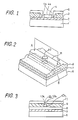
- Figs. 2 is a perspective view of a part of a semiconductor device, partially broken away to reveal a structure, in accordance with a first embodiment of the present invention, providing an activatable conductive link (a via hole) for linking two aluminium wirings arranged in a two-layered structure and separated by a phosphorous silicate glass (PSG) layer.
- Fig. 3 is a cross-sectional view of the structure of Fig. 2, taken along line A-A shown in Fig. 2.
- the semiconductor device shown in Fig. 2 and Fig. 3 has a two-layered structure; that is, in a portion of the device shown in Fig. 3, two aluminium wirings 8 and 11 are on two levels and have an insulator layer 9 of PSG interposed between them and are thereby electrically insulated from each other.
- the lower aluminium wiring 8 is formed on another insulator layer 7 of silicon dioxide (SiO2) formed over a silicon substrate 6.
- the side wall 10a of the via hole has a cylindrical PSG surface which is electrically insulative, having a high resistance sufficient to maintain the electrical insulation between the two aluminium wirings 8 and 11.
- the side wall 10a may be partially covered by aluminium deposited during an aluminium sputtering deposition process preceding the lithographic patterning of the aluminium wiring 11.
- the above-described electrical insulation is maintained thanks to the high aspect ratio of the via hole 10 and proper selection of an oblique sputtering angle for the aluminium vapour, which creates an effective shadowing effect for the sputtering.
- An isotropic reactive gas etching process is suitable for providing overhanging side walls, as described later.
- the via hole 10 is opened up after formation of the upper aluminium wiring 11, then the above-described problem relating to the electrical insulation power of the side wall 10a is easily solved, although the durability of a mask used for lithographic patterning of the upper aluminium wiring is not high.
- an opening having a form corresponding to the mouth of the via hole (or the trench - see below) may be opened in a predetermined portion of the wiring, and thereafter the via hole (or trench) may be formed with the aid of the above-described opening, as described below.
- Fig. 5 is a perspective view of a part of a semiconductor device, partially broken away to reveal a structure in accordance with a second embodiment of the present invention, illustrating an activatable conductive link (a trench or a slot) for linking two aluminium wirings arranged on the same level formed on a phosphorous silicate glass (PSG) layer.
- Fig. 6 is a cross-sectional view of the structure of Fig. 5, taken along line B-B shown in Fig. 5.
- the semiconductor device shown in Fig. 5 and Fig. 6 is a one-layered structure: that is, the aluminium wirings are formed on one level.
- a PSG layer 12 and a silicon dioxide (SiO2) layer 7 are formed on a silicon substrate 6.
- two aluminium wirings 14a and 14b have between them a trench 13 formed in PSG layer 12. Both aluminium wirings 14a and 14b are formed on the PSG layer 12.
- the trench 13 has a small lateral length (width) of 0.9 ⁇ m and a large depth of 1.2 ⁇ m, for example, having a high aspect ratio of 1.33.
- the trench 13 extends depthwise in a direction approximately normal to the principal plane of the substrate 6, physically between, and electrically disconnecting, the aluminium wirings 14a and 14b.
- the width of the trench separates the wirings.
- the length of the trench 13 is shown in Fig. 5 as greater than the width of the aluminium wirings 14a and 14b, so that the edges 13b of the mouth of the trench 13 extend, longitudinally of the trench, beyond the side edges of the aluminium wirings 14a and 14b, providing a greater tolerance for alignment of the wirings 14a and 14b with the trench 13, if necessary.
- the side wall 13a of the trench has a PSG surface which is electrically insulative, having a high resistance, sufficient to maintain electrical insulation between the two aluminium wirings 14a and 14b.
- the trench 13 is opened in the PSG layer 12 using an aluminium sputtering deposition, a problem may occur in that the side wall 13a is covered partially and undesirably with aluminium during the aluminium sputtering deposition.
- the problem is not so critical as with the first embodiment described above. This is because at least one of the side walls 13a of the trench 13, and the bottom surface thereof, are shaded from impinging aluminium vapour during the aluminium sputtering process due to the shadow effect of the aluminium sputtering deposition process.
- the trench 13 desirably has an overhanging side wall 13d as illustrated in the cross- sectional view of Fig. 7, which can be achieved by employing a reactive gas etching process for forming the trench, as described later.
- Fig. 8 is a cross-sectional view illustrating a structure in accordance with a third embodiment of the present invention, which is modified form of the first embodiment, in which the lower aluminium wiring of the first embodiment is replaced by a doped conductive region.
- a doped region 16 which is conductive, is formed in a silicon substrate 6 immediately beneath a via hole 17.
- An aluminium wiring 18 is insulated from the doped region 16 by a silicon dioxide (SiO2) layer 15.
- the via hole 17 has a high aspect ratio, being capable of acting as a conducting link to connect the aluminium wiring 18 to the doping region 16 if so required.
- aluminium wirings or aluminium layers in place of aluminium other aluminium alloys such as aluminium silicon alloys and aluminium copper alloys which are conventionally used in semiconductor devices, are also applicable.
- PSG layers 9 and 12 in the above-described embodiments can be replaced by other insulating, e.g. oxide layers, such as a silicon dioxide (SiO2) layer, if the use thereof is permitted in the context of the production technology employed for the semiconductor device as a whole.
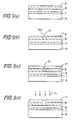
- Figs. 9(a) to (d) illustrate fabrication and activation of an activatable conductive link in accordance with the first embodiment of the present invention.
- Fig. 9(a) shows a stage reached after a silicon dioxide (SiO2) layer 7 is formed over a silicon (Si) substrate 6, a lower aluminium layer is formed over the silicon dioxide layer 7, and subsequently, the lower aluminium layer is patterned to form a lower aluminium wiring 8. Further, a PSG layer 9 is formed over the aluminium wiring 8 and the silicon dioxide (SiO2) layer.
- a laminated structure is formed as shown in Fig. 9(a). This structure can be formed by conventional technology used in this field. To the laminated structure of Fig. 9(a), the following steps are applied in sequence:
- the excimer laser employed may be, for example, a pulsed Ar F excimer laser (wavelength: 193 nm), having an energy density of 10 J/cm2 and a pulse width of 15 ns.
- one pulse shot is enough to activate the conductive link 10.
- a laser pulse shot of such high energy density and of such narrow pulse width serves to confine thermal diffusion to a small area in the vicinity of the irradiated target portion, preventing damage due to undesirable temperature increases, such as alloying of aluminium members with adjacent silicon members.
- a longer pulse (having a width of 1 ⁇ s, for example), or a continuous laser beam, may also cause damage, and not be suitable for practical use.
- excimer laser such as Kr F2 excimer lasers (wavelength: 248 nm), Xe excimer lasers (wavelength: 308 nm), are available for use in this field.
- a method for fabricating an activatable conductive link in accordance with the second embodiment of the present invention is similar to that for the first embodiment. This method will be described briefly.
- a laminated structure comprising a PSG layer 12, a silicon dioxide (SiO2) layer 7, and a substrate 6 is formed as illustrated in Fig. 10(a).
- a trench 13 is opened in a selected portion of the PSG layer 12, employing a conventional reactive ion etching method, as shown in Fig. 10(b).
- an aluminium layer is formed over the PSG layer 12.
- the aluminium layer is patterned to form aluminium wirings 14a and 14b which are traversed by the trench 13 as shown in Fig. 10(c).
- the subsequent activation of the conductive link is performed in the same manner as for the first embodiment, and further description thereof is omitted here.
- Fig. 10(d) illustrates the state of the conductive link of the second embodiment after activation.
- An effective method for securing the insulating capability of the via hole (or trench) is provided by the use of a conventional lift-off process using, for example, photoresist resin.
- the via hole 10 (or trench) is filled up with the resin in advance, before aluminium deposition over the via hole (or trench), preventing deposition of aluminium on the side wall. Thereafter, the resin is removed from the via hole (or trench).
- Another method, already described above, is to form the via hole (or trench) with overhanging side walls by employing a conventional reactive gas etching method for opening the via hole.
- the employed etchant gas is a mixture of tetrafluoride carbon (CF4) and trifluoromethane (CHF3), for example.
- CF4 tetrafluoride carbon
- CHF3 trifluoromethane
- the etching method is essentially isotropic and the adhesion between a mask (not shown) and the PSG layer 9 is very strong the resulting via hole is subject to so-called "under etching", which provides overhanging side walls (10d, 13d) as shown in Fig. 4 or Fig. 7, which is effective to provide the side wall with a strong shadow effect during aluminium deposition, with the result that an exposed PSG portion of the side wall is secured.
- a definitely effective method is to open a via hole after patterning the upper aluminium wiring 11.
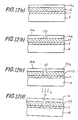
- This method is described with reference to Figs. 11.
- an upper aluminium layer 11a, a PSG layer 9, a lower aluminium wiring 8, a silicon dioxide (SiO2) layer 7 and a silicon substrate 6 are laminated as illustrated, formed by conventional semiconductor device fabricating methods.
- the upper aluminium layer 11a is then patterned to form an upper aluminium wiring 11, as shown in Fig. 11(b), including a via hole pattern 10v opened amid the pattern of the upper aluminium wiring 11, at a predetermined location, by employing a mask (not shown).
- the PSG layer 9 immediately beneath the via hole pattern 10v is etched by a conventional reactive ion etching method, or a conventional reactive gas etching method, until the formed hole reaches the underlying lower aluminium wiring 8.
- the thus opened via hole 10 has a side wall 10a having an entirely exposed PSG surface.
- the conductive link is completed as shown in Fig. 11(c).
- the activating method for this via hole 10 is as described above, and the resulting activated link is shown in Fig. 11(d).
- a method of fabricating an activatable conductive link in accordance with the second embodiment of the present invention is similar to that of the first embodiment. The fabricating method thereof, therefore, is described only briefly.
- a laminated structure comprising an aluminium layer 14c, a PSG layer 12, a silicon dioxide (SiO2) layer 7, and a substrate 6 laminated in the illustrated order is formed as shown in Fig. 12(a).
- the aluminium layer 14c is patterned to form an aluminium wiring 14 including a traversing slit pattern 13v disposed at a position where a trench 13 is to be disposed, as shown in Fig. 12(b).
- Fig. 12(c) illustrates the state of the conductive link after activation thereof.
- the trench 13 plays an important role in the achievement of a reliable connection between the associated aluminium wirings. Melted aluminium flows into the trench, filling up the trench 13 and planarizing the cut portion between the wirings. The resulting connection is strong and stable. Without the trench 13, aluminium at the connecting point would overflow in the vicinity of the laser pulse irradiated portion, resulting in an unreliable connection between the wirings to be connected.
- the method for fabricating a structure in accordance with the third embodiment of the present invention is the same as that of the first embodiment except for the formation in advance of a doped region 16 in the substrate 6.
- an activatable conductive link is formed between two aluminium wirings in a semiconductor device, which are insulated from each other by an insulating layer.
- the conductive link is formed using a via hole or a trench with a high aspect ratio, disposed in the insulating layer.
- the two aluminium wirings are easily connected using a simple method, namely irradiation with one shot of an excimer laser beam pulse.
- the contact area e.g. the via hole area
- the insulating capability of the link before activation thereof, and the conducting capability of the link after activation thereof, are both substantially stable and reliable. As a result, a semiconductor device with a high integration density can be produced in a master slice system with low cost and high reliability.
- the present invention provides and includes within its scope a conducting link, in an integrated semiconductor circuit of a semiconductor device, in combination with a plurality of conductive paths including a first conductive path and a second conducting path which are electrically insulated from each other by an insulating layer, disposed between said conductive paths in a specified portion of the circuit, being selectively activatable to provide a conductive link path between said conductive paths, comprising: a concaved portion having a high aspect ratio formed in said insulating layer, physically contacting with said first conductive path and said second conductive path, and electrically maintaining the insulation between said first and second conductive paths.
- the concaved portion may have a mouth edge which contacts to said first conductive path and said second conductive path at portions thereof separated from each other, and an inside surface which is insulative enough to maintain the electrical insulation between said first and second conductive paths.
- the first conductive path may be made of metal, for example aluminium or aluminium alloy.
- the insulating layer may be a phosphorous silicate glass (PSG) layer or a silicon dioxide (SiO2) layer.
- PSG phosphorous silicate glass
- SiO2 silicon dioxide
- the first conductive path and said second conductive path may be arranged in a two-layered arrangement interposed by said insulating layer, said concaved portion being a via hole which has a side wall with insulative surface, and an upper mouth edge and a lower mouth edge respectively physically contacting with said first conductive path and said second conductive path.
- the via hole may be a circular hole having an aspect ratio which is defined as a ratio of the depth to the inner diameter, higher than 1.0.
- the side wall of the via hole may be overhanging.
- the surface of said second conductive path may be exposed at the lower mouth of said via hole.
- the second conducting path may be disposed on an insulating layer over a semiconductor substrate of said semiconductor device.
- the second conductive path may be a conductive doped region formed in a semiconductor substrate of said semiconductor device.
- the first conductive path and said second conductive path may be formed on said first insulating layer in the same level, said concaved portion being a trench having an insulative side wall and a mouth edge of which is in contact with said first conductive path and said second conductive path at mutually facing portions of said mouth edge.
- the trench may have an aspect ratio defined as a ratio of the depth to the lateral width of said trench, higher than 1.0.
- the side wall of said trench may be overhanging.
- the present invention also provides and includes within its scope a method for creating and activating a conducting link, in an integrated semiconductor circuit of a semiconductor device, selectively activatable in combination with a plurality of conducting paths which are electrically insulated from each other by a first insulating layer, said method comprising the steps of:
- the first conducting path may be made of aluminium or aluminium alloy.
- the local heating may employ an energy beam pulse.
- the energy beam may be an excimer laser beam.
- the energy density of said excimer laser beam is preferably in the 5 J/cm2 to 12 J/cm2.
- the first conductive path and said second conductive path may be arranged in a two-layered arrangement interposed by said first insulating layer, said concaved portion being a via hole, and said second conductive path being made of aluminium or aluminium alloy formed over an insulating layer formed over a semiconductor substrate, or made of a doped conductive region formed in said semiconductor substrate.
- Process (a) above may comprise, forming said via hole in said first insulator at a specified portion such that said via hole reaches said underlying second conducting path, and process (b) above may comprise, forming an aluminium or aluminium alloy layer over said second insulating layer including said via hole, and patterning said layer to form said first conductive path in alignment with said via hole, thus creating a conducting link which is in an insulating state.
- the first conductive path and said second conductive path may be arranged on said first insulating layer in the same level, said concaved portion being a trench having an insulative side wall.
- process (a) above may comprise, forming said trench in said first insulator at said specified portion
- process (b) above may comprise, forming an aluminium or aluminium alloy layer over said first insulating layer, including said trench, and patterning said layer to form said first and second conductive paths in alignment with said trench such that both of said first and second conductive paths are insulated from each other and are respectively in contact with mutually facing portions of the mouth edge of said trench.
- the via hole or trench may be formed in said first insulating layer so as to have overhanging side wall in said via hole or said trench employing an isotropic reactive etching method.
- the present invention further provides and includes within its scope a method for creating and activating a conducting link, in an integrated semiconductor circuit of a semiconductor device, selectively activatable in combination with a plurality of conducting paths which are electrically insulated from each other by a first insulating layer, said method comprising the steps of:
- a conducting link disposed in an insulating layer of a semiconductor device in combination with a plurality of wirings of the device which are electrically separated from each other.
- the conductive link is selectively activated, providing the wirings with a conducting path, and is activatable by melting metal contained in the wirings by irradiating the portion in the vicinity of the link with a shot of a pulse of laser beam.
- the link comprises a via hole or a trench disposed in the insulating layer depending on the structural configuration of the device. The method of fabricating and activating the conductive link is provided.
Landscapes
- Internal Circuitry In Semiconductor Integrated Circuit Devices (AREA)
- Design And Manufacture Of Integrated Circuits (AREA)
Applications Claiming Priority (2)
| Application Number | Priority Date | Filing Date | Title |
|---|---|---|---|
| JP189094/86 | 1986-08-12 | ||
| JP61189094A JPS6344739A (ja) | 1986-08-12 | 1986-08-12 | 半導体装置の製造方法 |
Publications (3)
| Publication Number | Publication Date |
|---|---|
| EP0256494A2 true EP0256494A2 (fr) | 1988-02-24 |
| EP0256494A3 EP0256494A3 (en) | 1988-07-27 |
| EP0256494B1 EP0256494B1 (fr) | 1993-01-07 |
Family
ID=16235236
Family Applications (1)
| Application Number | Title | Priority Date | Filing Date |
|---|---|---|---|
| EP87111603A Expired - Lifetime EP0256494B1 (fr) | 1986-08-12 | 1987-08-11 | Liens conducteurs activables pour dispositifs semi-conducteurs |
Country Status (5)
| Country | Link |
|---|---|
| US (1) | US4968643A (fr) |
| EP (1) | EP0256494B1 (fr) |
| JP (1) | JPS6344739A (fr) |
| KR (1) | KR910004038B1 (fr) |
| DE (1) | DE3783404T2 (fr) |
Cited By (7)
| Publication number | Priority date | Publication date | Assignee | Title |
|---|---|---|---|---|
| WO1995024734A1 (fr) * | 1994-03-10 | 1995-09-14 | Massachusetts Institute Of Technology | Technique de production de liaisons d'interconnexion conductrices |
| US5585602A (en) * | 1995-01-09 | 1996-12-17 | Massachusetts Institute Of Technology | Structure for providing conductive paths |
| WO1998020527A1 (fr) * | 1996-11-08 | 1998-05-14 | W.L. Gore & Associates, Inc. | Traitement multifrequence visant a ameliorer la resistivite electrique des microtrous borgnes |
| US5861325A (en) * | 1994-03-10 | 1999-01-19 | Massachusetts Institute Of Technology | Technique for producing interconnecting conductive links |
| US5920789A (en) * | 1994-10-11 | 1999-07-06 | Massachusetts Institute Of Technology | Technique for producing interconnecting conductive links |
| US5940727A (en) * | 1994-10-11 | 1999-08-17 | Massachusetts Institute Of Technology | Technique for producing interconnecting conductive links |
| WO2001037340A1 (fr) * | 1999-11-15 | 2001-05-25 | Koninklijke Philips Electronics N.V. | Structures de composants a semi-conducteur programmables et procedes de fabrication de telles structures |
Families Citing this family (14)
| Publication number | Priority date | Publication date | Assignee | Title |
|---|---|---|---|---|
| US5070392A (en) * | 1988-03-18 | 1991-12-03 | Digital Equipment Corporation | Integrated circuit having laser-alterable metallization layer |
| US5250465A (en) * | 1991-01-28 | 1993-10-05 | Fujitsu Limited | Method of manufacturing semiconductor devices |
| US5451811A (en) * | 1991-10-08 | 1995-09-19 | Aptix Corporation | Electrically programmable interconnect element for integrated circuits |
| US5321322A (en) * | 1991-11-27 | 1994-06-14 | Aptix Corporation | Programmable interconnect architecture without active devices |
| WO1993012582A1 (fr) * | 1991-12-13 | 1993-06-24 | Knights Technology, Inc. | Dispositif logique programmable et procedes de fabrication |
| JPH0799791B2 (ja) * | 1992-04-15 | 1995-10-25 | インターナショナル・ビジネス・マシーンズ・コーポレイション | 透明基板上の回路ライン接続方法 |
| JPH06124913A (ja) * | 1992-06-26 | 1994-05-06 | Semiconductor Energy Lab Co Ltd | レーザー処理方法 |
| KR960009996B1 (ko) * | 1992-08-24 | 1996-07-25 | 금성일렉트론 주식회사 | 반도체 소자의 리페어장치 및 그 배치방법 |
| US5453402A (en) * | 1992-12-15 | 1995-09-26 | Advanced Micro Devices, Inc. | Selective metal via plug growth technology for deep sub-micrometer ULSI |
| JPH06260441A (ja) * | 1993-03-03 | 1994-09-16 | Nec Corp | 半導体装置の製造方法 |
| TW278229B (en) * | 1994-12-29 | 1996-06-11 | Siemens Ag | Fuse structure for an integrated circuit device and method for manufacturing a fuse structure |
| JP3160198B2 (ja) * | 1995-02-08 | 2001-04-23 | インターナショナル・ビジネス・マシーンズ・コーポレ−ション | デカップリング・コンデンサが形成された半導体基板及びこれの製造方法 |
| JPH10229125A (ja) * | 1997-02-14 | 1998-08-25 | Nec Corp | 半導体装置 |
| US6288437B1 (en) * | 1999-02-26 | 2001-09-11 | Micron Technology, Inc. | Antifuse structures methods and applications |
Family Cites Families (8)
| Publication number | Priority date | Publication date | Assignee | Title |
|---|---|---|---|---|
| JPS5780738A (en) * | 1980-11-07 | 1982-05-20 | Seiko Epson Corp | Semiconductor integrated device |
| US4585490A (en) * | 1981-12-07 | 1986-04-29 | Massachusetts Institute Of Technology | Method of making a conductive path in multi-layer metal structures by low power laser beam |
| JPS5996746A (ja) * | 1982-11-26 | 1984-06-04 | Hitachi Ltd | 半導体装置およびその製造方法 |
| ATE56310T1 (de) * | 1984-06-27 | 1990-09-15 | Contraves Ag | Verfahren zur herstellung eines basismaterials fuer eine hybridschaltung. |
| US4814578A (en) * | 1985-06-24 | 1989-03-21 | The United States Of America As Represented By The Department Of Energy | Planarization of metal films for multilevel interconnects |
| US4674176A (en) * | 1985-06-24 | 1987-06-23 | The United States Of America As Represented By The United States Department Of Energy | Planarization of metal films for multilevel interconnects by pulsed laser heating |
| US4681795A (en) * | 1985-06-24 | 1987-07-21 | The United States Of America As Represented By The Department Of Energy | Planarization of metal films for multilevel interconnects |
| JPS62293740A (ja) * | 1986-06-13 | 1987-12-21 | Fujitsu Ltd | 半導体装置の製造方法 |
-
1986
- 1986-08-12 JP JP61189094A patent/JPS6344739A/ja active Granted
-
1987
- 1987-08-11 EP EP87111603A patent/EP0256494B1/fr not_active Expired - Lifetime
- 1987-08-11 KR KR1019870008776A patent/KR910004038B1/ko not_active Expired
- 1987-08-11 DE DE8787111603T patent/DE3783404T2/de not_active Expired - Fee Related
-
1989
- 1989-04-26 US US07/344,525 patent/US4968643A/en not_active Expired - Fee Related
Cited By (10)
| Publication number | Priority date | Publication date | Assignee | Title |
|---|---|---|---|---|
| WO1995024734A1 (fr) * | 1994-03-10 | 1995-09-14 | Massachusetts Institute Of Technology | Technique de production de liaisons d'interconnexion conductrices |
| US5861325A (en) * | 1994-03-10 | 1999-01-19 | Massachusetts Institute Of Technology | Technique for producing interconnecting conductive links |
| US6191486B1 (en) | 1994-03-10 | 2001-02-20 | Massachusetts Institute Of Technology | Technique for producing interconnecting conductive links |
| US6541868B2 (en) | 1994-03-10 | 2003-04-01 | Massachusetts Institute Of Technology | Interconnecting conductive links |
| US5920789A (en) * | 1994-10-11 | 1999-07-06 | Massachusetts Institute Of Technology | Technique for producing interconnecting conductive links |
| US5940727A (en) * | 1994-10-11 | 1999-08-17 | Massachusetts Institute Of Technology | Technique for producing interconnecting conductive links |
| US5585602A (en) * | 1995-01-09 | 1996-12-17 | Massachusetts Institute Of Technology | Structure for providing conductive paths |
| WO1998020527A1 (fr) * | 1996-11-08 | 1998-05-14 | W.L. Gore & Associates, Inc. | Traitement multifrequence visant a ameliorer la resistivite electrique des microtrous borgnes |
| WO2001037340A1 (fr) * | 1999-11-15 | 2001-05-25 | Koninklijke Philips Electronics N.V. | Structures de composants a semi-conducteur programmables et procedes de fabrication de telles structures |
| US6472253B1 (en) | 1999-11-15 | 2002-10-29 | Vlsi Technology, Inc. | Programmable semiconductor device structures and methods for making the same |
Also Published As
| Publication number | Publication date |
|---|---|
| JPS6344739A (ja) | 1988-02-25 |
| KR910004038B1 (ko) | 1991-06-22 |
| US4968643A (en) | 1990-11-06 |
| KR880003407A (ko) | 1988-05-17 |
| EP0256494B1 (fr) | 1993-01-07 |
| DE3783404T2 (de) | 1993-05-06 |
| EP0256494A3 (en) | 1988-07-27 |
| DE3783404D1 (de) | 1993-02-18 |
| JPH058864B2 (fr) | 1993-02-03 |
Similar Documents
| Publication | Publication Date | Title |
|---|---|---|
| EP0256494B1 (fr) | Liens conducteurs activables pour dispositifs semi-conducteurs | |
| CA1286795C (fr) | Fabrication de trajets conducteurs intercouches dans les circuits integres | |
| US5663590A (en) | Product of process for formation of vias (or contact openings) and fuses in the same insulation layer with minimal additional steps | |
| US4916809A (en) | Method for programmable laser connection of two superimposed conductors of the interconnect system of an integrated circuit | |
| EP0112675B1 (fr) | Structure de pont activable sélectivement pour former une connexion conductrice dans un circuit intégré | |
| EP0128675B1 (fr) | Procédé de fabrication d'un circuit intégré à métallisation multicouche avec un fusible et une ouverture pour le fusible | |
| EP0083211B1 (fr) | Dispositif semi-conducteur comprenant un fusible | |
| US6335228B1 (en) | Method for making an anti-fuse | |
| US5235205A (en) | Laser trimmed integrated circuit | |
| WO2001093331A2 (fr) | Fusibles ameliores par degradation locale de l'element de fusible | |
| US5789794A (en) | Fuse structure for an integrated circuit element | |
| US5652169A (en) | Method for fabricating a programmable semiconductor element having an antifuse structure | |
| KR900002084B1 (ko) | 반도체장치 | |
| EP0581867A1 (fr) | Procede d'ajustage au laser et circuit integre resultant | |
| WO1995024734A1 (fr) | Technique de production de liaisons d'interconnexion conductrices | |
| US4673592A (en) | Metal planarization process | |
| JP3489088B2 (ja) | 冗長手段を有する半導体装置及びその製造方法 | |
| KR100299755B1 (ko) | 반도체 소자의 리페어용 퓨즈 및 그 형성방법 | |
| US5940727A (en) | Technique for producing interconnecting conductive links | |
| JPH079942B2 (ja) | 集積回路の基板のドーピングされた領域に導体をレーザによって接続する方法と、該方法を実施して得られる集積回路 | |
| US5528072A (en) | Integrated circuit having a laser connection of a conductor to a doped region of the integrated circuit | |
| EP0258962A2 (fr) | Dispositifs semi-conducteurs à liens sélectifs et un procédé pour leur fabrication | |
| JPS6143855B2 (fr) | ||
| HK1003959A (en) | Fuse structure for an integrated circuit device | |
| JPS63166246A (ja) | 半導体装置の層間接続方法 |
Legal Events
| Date | Code | Title | Description |
|---|---|---|---|
| PUAI | Public reference made under article 153(3) epc to a published international application that has entered the european phase |
Free format text: ORIGINAL CODE: 0009012 |
|
| AK | Designated contracting states |
Kind code of ref document: A2 Designated state(s): DE FR GB |
|
| PUAL | Search report despatched |
Free format text: ORIGINAL CODE: 0009013 |
|
| AK | Designated contracting states |
Kind code of ref document: A3 Designated state(s): DE FR GB |
|
| 17P | Request for examination filed |
Effective date: 19881121 |
|
| 17Q | First examination report despatched |
Effective date: 19900523 |
|
| GRAA | (expected) grant |
Free format text: ORIGINAL CODE: 0009210 |
|
| AK | Designated contracting states |
Kind code of ref document: B1 Designated state(s): DE FR GB |
|
| REF | Corresponds to: |
Ref document number: 3783404 Country of ref document: DE Date of ref document: 19930218 |
|
| ET | Fr: translation filed | ||
| PG25 | Lapsed in a contracting state [announced via postgrant information from national office to epo] |
Ref country code: GB Effective date: 19930811 |
|
| PLBE | No opposition filed within time limit |
Free format text: ORIGINAL CODE: 0009261 |
|
| 26N | No opposition filed | ||
| GBPC | Gb: european patent ceased through non-payment of renewal fee |
Effective date: 19930811 |
|
| PG25 | Lapsed in a contracting state [announced via postgrant information from national office to epo] |
Ref country code: FR Effective date: 19940429 |
|
| PG25 | Lapsed in a contracting state [announced via postgrant information from national office to epo] |
Ref country code: DE Effective date: 19940503 |
|
| REG | Reference to a national code |
Ref country code: FR Ref legal event code: ST |