EP0264083B1 - Matériau photographique à l'halogénure d'argent et procédé de formation d'une image colorée sur celui-ci - Google Patents
Matériau photographique à l'halogénure d'argent et procédé de formation d'une image colorée sur celui-ci Download PDFInfo
- Publication number
- EP0264083B1 EP0264083B1 EP87114810A EP87114810A EP0264083B1 EP 0264083 B1 EP0264083 B1 EP 0264083B1 EP 87114810 A EP87114810 A EP 87114810A EP 87114810 A EP87114810 A EP 87114810A EP 0264083 B1 EP0264083 B1 EP 0264083B1
- Authority
- EP
- European Patent Office
- Prior art keywords
- group
- silver halide
- photographic material
- cyan coupler
- halide photographic
- Prior art date
- Legal status (The legal status is an assumption and is not a legal conclusion. Google has not performed a legal analysis and makes no representation as to the accuracy of the status listed.)
- Expired
Links
- -1 Silver halide Chemical class 0.000 title claims description 73
- 229910052709 silver Inorganic materials 0.000 title claims description 66
- 239000004332 silver Substances 0.000 title claims description 66
- 239000000463 material Substances 0.000 title claims description 40
- 238000000034 method Methods 0.000 title claims description 12
- 150000001875 compounds Chemical class 0.000 claims description 41
- 125000000217 alkyl group Chemical group 0.000 claims description 33
- 239000000839 emulsion Substances 0.000 claims description 29
- 125000003118 aryl group Chemical group 0.000 claims description 24
- 125000000623 heterocyclic group Chemical group 0.000 claims description 18
- 238000010521 absorption reaction Methods 0.000 claims description 17
- 125000003545 alkoxy group Chemical group 0.000 claims description 15
- 125000004435 hydrogen atom Chemical group [H]* 0.000 claims description 15
- 125000005843 halogen group Chemical group 0.000 claims description 14
- 125000003342 alkenyl group Chemical group 0.000 claims description 13
- 125000000962 organic group Chemical group 0.000 claims description 12
- 125000004104 aryloxy group Chemical group 0.000 claims description 11
- 125000000753 cycloalkyl group Chemical group 0.000 claims description 11
- 238000001228 spectrum Methods 0.000 claims description 11
- 125000001997 phenyl group Chemical group [H]C1=C([H])C([H])=C(*)C([H])=C1[H] 0.000 claims description 9
- 125000000304 alkynyl group Chemical group 0.000 claims description 8
- 229910052757 nitrogen Inorganic materials 0.000 claims description 8
- 125000004433 nitrogen atom Chemical group N* 0.000 claims description 8
- 125000001424 substituent group Chemical group 0.000 claims description 8
- 239000003795 chemical substances by application Substances 0.000 claims description 7
- 125000000392 cycloalkenyl group Chemical group 0.000 claims description 7
- 238000011161 development Methods 0.000 claims description 7
- 238000006243 chemical reaction Methods 0.000 claims description 5
- 230000003647 oxidation Effects 0.000 claims description 5
- 238000007254 oxidation reaction Methods 0.000 claims description 5
- 239000003960 organic solvent Substances 0.000 claims description 4
- 229910021607 Silver chloride Inorganic materials 0.000 claims description 3
- 238000012545 processing Methods 0.000 claims description 3
- HKZLPVFGJNLROG-UHFFFAOYSA-M silver monochloride Chemical compound [Cl-].[Ag+] HKZLPVFGJNLROG-UHFFFAOYSA-M 0.000 claims description 3
- 239000000084 colloidal system Substances 0.000 claims description 2
- 239000000975 dye Substances 0.000 description 40
- WVDDGKGOMKODPV-UHFFFAOYSA-N Benzyl alcohol Chemical compound OCC1=CC=CC=C1 WVDDGKGOMKODPV-UHFFFAOYSA-N 0.000 description 21
- 239000000243 solution Substances 0.000 description 17
- 108010010803 Gelatin Proteins 0.000 description 11
- 125000004432 carbon atom Chemical group C* 0.000 description 11
- 229920000159 gelatin Polymers 0.000 description 11
- 239000008273 gelatin Substances 0.000 description 11
- 235000019322 gelatine Nutrition 0.000 description 11
- 235000011852 gelatine desserts Nutrition 0.000 description 11
- XLYOFNOQVPJJNP-UHFFFAOYSA-N water Substances O XLYOFNOQVPJJNP-UHFFFAOYSA-N 0.000 description 11
- 238000005562 fading Methods 0.000 description 10
- KWYUFKZDYYNOTN-UHFFFAOYSA-M Potassium hydroxide Chemical compound [OH-].[K+] KWYUFKZDYYNOTN-UHFFFAOYSA-M 0.000 description 9
- ISWSIDIOOBJBQZ-UHFFFAOYSA-N phenol group Chemical group C1(=CC=CC=C1)O ISWSIDIOOBJBQZ-UHFFFAOYSA-N 0.000 description 9
- BWHMMNNQKKPAPP-UHFFFAOYSA-L potassium carbonate Chemical compound [K+].[K+].[O-]C([O-])=O BWHMMNNQKKPAPP-UHFFFAOYSA-L 0.000 description 8
- QTBSBXVTEAMEQO-UHFFFAOYSA-N Acetic acid Chemical compound CC(O)=O QTBSBXVTEAMEQO-UHFFFAOYSA-N 0.000 description 7
- 235000019445 benzyl alcohol Nutrition 0.000 description 7
- WSFSSNUMVMOOMR-UHFFFAOYSA-N Formaldehyde Chemical compound O=C WSFSSNUMVMOOMR-UHFFFAOYSA-N 0.000 description 6
- MQIUGAXCHLFZKX-UHFFFAOYSA-N Di-n-octyl phthalate Natural products CCCCCCCCOC(=O)C1=CC=CC=C1C(=O)OCCCCCCCC MQIUGAXCHLFZKX-UHFFFAOYSA-N 0.000 description 5
- BJQHLKABXJIVAM-UHFFFAOYSA-N bis(2-ethylhexyl) phthalate Chemical compound CCCCC(CC)COC(=O)C1=CC=CC=C1C(=O)OCC(CC)CCCC BJQHLKABXJIVAM-UHFFFAOYSA-N 0.000 description 5
- 125000001820 oxy group Chemical group [*:1]O[*:2] 0.000 description 5
- 125000003282 alkyl amino group Chemical group 0.000 description 4
- 125000001769 aryl amino group Chemical group 0.000 description 4
- 229910000027 potassium carbonate Inorganic materials 0.000 description 4
- JHJLBTNAGRQEKS-UHFFFAOYSA-M sodium bromide Chemical compound [Na+].[Br-] JHJLBTNAGRQEKS-UHFFFAOYSA-M 0.000 description 4
- 239000003381 stabilizer Substances 0.000 description 4
- XEKOWRVHYACXOJ-UHFFFAOYSA-N Ethyl acetate Chemical compound CCOC(C)=O XEKOWRVHYACXOJ-UHFFFAOYSA-N 0.000 description 3
- BQCADISMDOOEFD-UHFFFAOYSA-N Silver Chemical compound [Ag] BQCADISMDOOEFD-UHFFFAOYSA-N 0.000 description 3
- HEMHJVSKTPXQMS-UHFFFAOYSA-M Sodium hydroxide Chemical compound [OH-].[Na+] HEMHJVSKTPXQMS-UHFFFAOYSA-M 0.000 description 3
- 229960000583 acetic acid Drugs 0.000 description 3
- XYXNTHIYBIDHGM-UHFFFAOYSA-N ammonium thiosulfate Chemical compound [NH4+].[NH4+].[O-]S([O-])(=O)=S XYXNTHIYBIDHGM-UHFFFAOYSA-N 0.000 description 3
- 229940101006 anhydrous sodium sulfite Drugs 0.000 description 3
- 239000003086 colorant Substances 0.000 description 3
- DROMNWUQASBTFM-UHFFFAOYSA-N dinonyl benzene-1,2-dicarboxylate Chemical compound CCCCCCCCCOC(=O)C1=CC=CC=C1C(=O)OCCCCCCCCC DROMNWUQASBTFM-UHFFFAOYSA-N 0.000 description 3
- 239000006185 dispersion Substances 0.000 description 3
- 239000000203 mixture Substances 0.000 description 3
- 230000003287 optical effect Effects 0.000 description 3
- GEHJYWRUCIMESM-UHFFFAOYSA-L sodium sulfite Chemical compound [Na+].[Na+].[O-]S([O-])=O GEHJYWRUCIMESM-UHFFFAOYSA-L 0.000 description 3
- VHUUQVKOLVNVRT-UHFFFAOYSA-N Ammonium hydroxide Chemical compound [NH4+].[OH-] VHUUQVKOLVNVRT-UHFFFAOYSA-N 0.000 description 2
- WCUXLLCKKVVCTQ-UHFFFAOYSA-M Potassium chloride Chemical compound [Cl-].[K+] WCUXLLCKKVVCTQ-UHFFFAOYSA-M 0.000 description 2
- 229910021612 Silver iodide Inorganic materials 0.000 description 2
- QAOWNCQODCNURD-UHFFFAOYSA-N Sulfuric acid Chemical compound OS(O)(=O)=O QAOWNCQODCNURD-UHFFFAOYSA-N 0.000 description 2
- SJOOOZPMQAWAOP-UHFFFAOYSA-N [Ag].BrCl Chemical compound [Ag].BrCl SJOOOZPMQAWAOP-UHFFFAOYSA-N 0.000 description 2
- 239000006096 absorbing agent Substances 0.000 description 2
- 125000004442 acylamino group Chemical group 0.000 description 2
- QGZKDVFQNNGYKY-UHFFFAOYSA-N ammonia Natural products N QGZKDVFQNNGYKY-UHFFFAOYSA-N 0.000 description 2
- 239000007864 aqueous solution Substances 0.000 description 2
- 230000015572 biosynthetic process Effects 0.000 description 2
- 238000004061 bleaching Methods 0.000 description 2
- 125000001951 carbamoylamino group Chemical group C(N)(=O)N* 0.000 description 2
- 239000011248 coating agent Substances 0.000 description 2
- 238000000576 coating method Methods 0.000 description 2
- DOIRQSBPFJWKBE-UHFFFAOYSA-N dibutyl phthalate Chemical compound CCCCOC(=O)C1=CC=CC=C1C(=O)OCCCC DOIRQSBPFJWKBE-UHFFFAOYSA-N 0.000 description 2
- 230000000694 effects Effects 0.000 description 2
- 239000012362 glacial acetic acid Substances 0.000 description 2
- 238000003384 imaging method Methods 0.000 description 2
- 239000004611 light stabiliser Substances 0.000 description 2
- 238000005259 measurement Methods 0.000 description 2
- CLJDCQWROXMJAZ-UHFFFAOYSA-N n-[2-(4-amino-n-ethyl-3-methylanilino)ethyl]methanesulfonamide;sulfuric acid Chemical compound OS(O)(=O)=O.CS(=O)(=O)NCCN(CC)C1=CC=C(N)C(C)=C1 CLJDCQWROXMJAZ-UHFFFAOYSA-N 0.000 description 2
- 238000002360 preparation method Methods 0.000 description 2
- 230000035945 sensitivity Effects 0.000 description 2
- ZUNKMNLKJXRCDM-UHFFFAOYSA-N silver bromoiodide Chemical compound [Ag].IBr ZUNKMNLKJXRCDM-UHFFFAOYSA-N 0.000 description 2
- 230000003595 spectral effect Effects 0.000 description 2
- 230000000087 stabilizing effect Effects 0.000 description 2
- 239000004094 surface-active agent Substances 0.000 description 2
- GVEYRUKUJCHJSR-UHFFFAOYSA-N (4-azaniumyl-3-methylphenyl)-ethyl-(2-hydroxyethyl)azanium;sulfate Chemical compound OS(O)(=O)=O.OCCN(CC)C1=CC=C(N)C(C)=C1 GVEYRUKUJCHJSR-UHFFFAOYSA-N 0.000 description 1
- ZKGIQGUWLGYKMA-UHFFFAOYSA-N 1,2-bis(ethenylsulfonyl)ethane Chemical compound C=CS(=O)(=O)CCS(=O)(=O)C=C ZKGIQGUWLGYKMA-UHFFFAOYSA-N 0.000 description 1
- ZRHUHDUEXWHZMA-UHFFFAOYSA-N 1,4-dihydropyrazol-5-one Chemical compound O=C1CC=NN1 ZRHUHDUEXWHZMA-UHFFFAOYSA-N 0.000 description 1
- QVLXDGDLLZYJAM-UHFFFAOYSA-N 2,5-dioctylbenzene-1,4-diol Chemical compound CCCCCCCCC1=CC(O)=C(CCCCCCCC)C=C1O QVLXDGDLLZYJAM-UHFFFAOYSA-N 0.000 description 1
- JKFYKCYQEWQPTM-UHFFFAOYSA-N 2-azaniumyl-2-(4-fluorophenyl)acetate Chemical compound OC(=O)C(N)C1=CC=C(F)C=C1 JKFYKCYQEWQPTM-UHFFFAOYSA-N 0.000 description 1
- ZJOJXRSMJNWWRN-UHFFFAOYSA-N 3-amino-6-[2-(4-aminophenyl)ethenyl]benzene-1,2-disulfonic acid Chemical class C1=CC(N)=CC=C1C=CC1=CC=C(N)C(S(O)(=O)=O)=C1S(O)(=O)=O ZJOJXRSMJNWWRN-UHFFFAOYSA-N 0.000 description 1
- XRZDIHADHZSFBB-UHFFFAOYSA-N 3-oxo-n,3-diphenylpropanamide Chemical compound C=1C=CC=CC=1NC(=O)CC(=O)C1=CC=CC=C1 XRZDIHADHZSFBB-UHFFFAOYSA-N 0.000 description 1
- ZNBNBTIDJSKEAM-UHFFFAOYSA-N 4-[7-hydroxy-2-[5-[5-[6-hydroxy-6-(hydroxymethyl)-3,5-dimethyloxan-2-yl]-3-methyloxolan-2-yl]-5-methyloxolan-2-yl]-2,8-dimethyl-1,10-dioxaspiro[4.5]decan-9-yl]-2-methyl-3-propanoyloxypentanoic acid Chemical compound C1C(O)C(C)C(C(C)C(OC(=O)CC)C(C)C(O)=O)OC11OC(C)(C2OC(C)(CC2)C2C(CC(O2)C2C(CC(C)C(O)(CO)O2)C)C)CC1 ZNBNBTIDJSKEAM-UHFFFAOYSA-N 0.000 description 1
- 229940100484 5-chloro-2-methyl-4-isothiazolin-3-one Drugs 0.000 description 1
- SGHZXLIDFTYFHQ-UHFFFAOYSA-L Brilliant Blue Chemical compound [Na+].[Na+].C=1C=C(C(=C2C=CC(C=C2)=[N+](CC)CC=2C=C(C=CC=2)S([O-])(=O)=O)C=2C(=CC=CC=2)S([O-])(=O)=O)C=CC=1N(CC)CC1=CC=CC(S([O-])(=O)=O)=C1 SGHZXLIDFTYFHQ-UHFFFAOYSA-L 0.000 description 1
- 229920002284 Cellulose triacetate Polymers 0.000 description 1
- PQUCIEFHOVEZAU-UHFFFAOYSA-N Diammonium sulfite Chemical compound [NH4+].[NH4+].[O-]S([O-])=O PQUCIEFHOVEZAU-UHFFFAOYSA-N 0.000 description 1
- KCXVZYZYPLLWCC-UHFFFAOYSA-N EDTA Chemical compound OC(=O)CN(CC(O)=O)CCN(CC(O)=O)CC(O)=O KCXVZYZYPLLWCC-UHFFFAOYSA-N 0.000 description 1
- DBVJJBKOTRCVKF-UHFFFAOYSA-N Etidronic acid Chemical compound OP(=O)(O)C(O)(C)P(O)(O)=O DBVJJBKOTRCVKF-UHFFFAOYSA-N 0.000 description 1
- AVXURJPOCDRRFD-UHFFFAOYSA-N Hydroxylamine Chemical compound ON AVXURJPOCDRRFD-UHFFFAOYSA-N 0.000 description 1
- DGAQECJNVWCQMB-PUAWFVPOSA-M Ilexoside XXIX Chemical compound C[C@@H]1CC[C@@]2(CC[C@@]3(C(=CC[C@H]4[C@]3(CC[C@@H]5[C@@]4(CC[C@@H](C5(C)C)OS(=O)(=O)[O-])C)C)[C@@H]2[C@]1(C)O)C)C(=O)O[C@H]6[C@@H]([C@H]([C@@H]([C@H](O6)CO)O)O)O.[Na+] DGAQECJNVWCQMB-PUAWFVPOSA-M 0.000 description 1
- 239000004698 Polyethylene Substances 0.000 description 1
- 239000002202 Polyethylene glycol Substances 0.000 description 1
- BUGBHKTXTAQXES-UHFFFAOYSA-N Selenium Chemical compound [Se] BUGBHKTXTAQXES-UHFFFAOYSA-N 0.000 description 1
- 206010070834 Sensitisation Diseases 0.000 description 1
- DWAQJAXMDSEUJJ-UHFFFAOYSA-M Sodium bisulfite Chemical compound [Na+].OS([O-])=O DWAQJAXMDSEUJJ-UHFFFAOYSA-M 0.000 description 1
- NINIDFKCEFEMDL-UHFFFAOYSA-N Sulfur Chemical compound [S] NINIDFKCEFEMDL-UHFFFAOYSA-N 0.000 description 1
- GSEJCLTVZPLZKY-UHFFFAOYSA-N Triethanolamine Chemical compound OCCN(CCO)CCO GSEJCLTVZPLZKY-UHFFFAOYSA-N 0.000 description 1
- NNLVGZFZQQXQNW-ADJNRHBOSA-N [(2r,3r,4s,5r,6s)-4,5-diacetyloxy-3-[(2s,3r,4s,5r,6r)-3,4,5-triacetyloxy-6-(acetyloxymethyl)oxan-2-yl]oxy-6-[(2r,3r,4s,5r,6s)-4,5,6-triacetyloxy-2-(acetyloxymethyl)oxan-3-yl]oxyoxan-2-yl]methyl acetate Chemical compound O([C@@H]1O[C@@H]([C@H]([C@H](OC(C)=O)[C@H]1OC(C)=O)O[C@H]1[C@@H]([C@@H](OC(C)=O)[C@H](OC(C)=O)[C@@H](COC(C)=O)O1)OC(C)=O)COC(=O)C)[C@@H]1[C@@H](COC(C)=O)O[C@@H](OC(C)=O)[C@H](OC(C)=O)[C@H]1OC(C)=O NNLVGZFZQQXQNW-ADJNRHBOSA-N 0.000 description 1
- XCFIVNQHHFZRNR-UHFFFAOYSA-N [Ag].Cl[IH]Br Chemical compound [Ag].Cl[IH]Br XCFIVNQHHFZRNR-UHFFFAOYSA-N 0.000 description 1
- HOLVRJRSWZOAJU-UHFFFAOYSA-N [Ag].ICl Chemical compound [Ag].ICl HOLVRJRSWZOAJU-UHFFFAOYSA-N 0.000 description 1
- AZSJCMMSZYKDRD-UHFFFAOYSA-N [Na].ClN1NC(=CC(=N1)Cl)O Chemical compound [Na].ClN1NC(=CC(=N1)Cl)O AZSJCMMSZYKDRD-UHFFFAOYSA-N 0.000 description 1
- ZYRABDXZSUJSGF-UHFFFAOYSA-L [O-]C(CN(CCN(CC([O-])=O)CC(O)=O)CC(O)=O)=O.N.O.O.[Fe+2] Chemical compound [O-]C(CN(CCN(CC([O-])=O)CC(O)=O)CC(O)=O)=O.N.O.O.[Fe+2] ZYRABDXZSUJSGF-UHFFFAOYSA-L 0.000 description 1
- 238000000862 absorption spectrum Methods 0.000 description 1
- 125000004423 acyloxy group Chemical group 0.000 description 1
- 239000000654 additive Substances 0.000 description 1
- 230000000996 additive effect Effects 0.000 description 1
- 125000005194 alkoxycarbonyloxy group Chemical group 0.000 description 1
- 125000005741 alkyl alkenyl group Chemical group 0.000 description 1
- SWLVFNYSXGMGBS-UHFFFAOYSA-N ammonium bromide Chemical compound [NH4+].[Br-] SWLVFNYSXGMGBS-UHFFFAOYSA-N 0.000 description 1
- 238000013459 approach Methods 0.000 description 1
- 125000005200 aryloxy carbonyloxy group Chemical group 0.000 description 1
- UMEAURNTRYCPNR-UHFFFAOYSA-N azane;iron(2+) Chemical compound N.[Fe+2] UMEAURNTRYCPNR-UHFFFAOYSA-N 0.000 description 1
- 229960001506 brilliant green Drugs 0.000 description 1
- HXCILVUBKWANLN-UHFFFAOYSA-N brilliant green cation Chemical compound C1=CC(N(CC)CC)=CC=C1C(C=1C=CC=CC=1)=C1C=CC(=[N+](CC)CC)C=C1 HXCILVUBKWANLN-UHFFFAOYSA-N 0.000 description 1
- 229910052799 carbon Inorganic materials 0.000 description 1
- 125000001309 chloro group Chemical group Cl* 0.000 description 1
- DHNRXBZYEKSXIM-UHFFFAOYSA-N chloromethylisothiazolinone Chemical compound CN1SC(Cl)=CC1=O DHNRXBZYEKSXIM-UHFFFAOYSA-N 0.000 description 1
- 230000000052 comparative effect Effects 0.000 description 1
- 238000007796 conventional method Methods 0.000 description 1
- KYQODXQIAJFKPH-UHFFFAOYSA-N diazanium;2-[2-[bis(carboxymethyl)amino]ethyl-(carboxylatomethyl)amino]acetate Chemical compound [NH4+].[NH4+].OC(=O)CN(CC([O-])=O)CCN(CC(O)=O)CC([O-])=O KYQODXQIAJFKPH-UHFFFAOYSA-N 0.000 description 1
- FVCOIAYSJZGECG-UHFFFAOYSA-N diethylhydroxylamine Chemical compound CCN(O)CC FVCOIAYSJZGECG-UHFFFAOYSA-N 0.000 description 1
- 239000000539 dimer Substances 0.000 description 1
- 238000003912 environmental pollution Methods 0.000 description 1
- 125000001495 ethyl group Chemical group [H]C([H])([H])C([H])([H])* 0.000 description 1
- OUDSFQBUEBFSPS-UHFFFAOYSA-N ethylenediaminetriacetic acid Chemical compound OC(=O)CNCCN(CC(O)=O)CC(O)=O OUDSFQBUEBFSPS-UHFFFAOYSA-N 0.000 description 1
- 238000009472 formulation Methods 0.000 description 1
- 125000002485 formyl group Chemical group [H]C(*)=O 0.000 description 1
- 125000005842 heteroatom Chemical group 0.000 description 1
- 229910052739 hydrogen Inorganic materials 0.000 description 1
- 239000001257 hydrogen Substances 0.000 description 1
- 229910000378 hydroxylammonium sulfate Inorganic materials 0.000 description 1
- 230000006698 induction Effects 0.000 description 1
- 239000004816 latex Substances 0.000 description 1
- 229920000126 latex Polymers 0.000 description 1
- 239000000314 lubricant Substances 0.000 description 1
- 239000006224 matting agent Substances 0.000 description 1
- AJDUTMFFZHIJEM-UHFFFAOYSA-N n-(9,10-dioxoanthracen-1-yl)-4-[4-[[4-[4-[(9,10-dioxoanthracen-1-yl)carbamoyl]phenyl]phenyl]diazenyl]phenyl]benzamide Chemical compound O=C1C2=CC=CC=C2C(=O)C2=C1C=CC=C2NC(=O)C(C=C1)=CC=C1C(C=C1)=CC=C1N=NC(C=C1)=CC=C1C(C=C1)=CC=C1C(=O)NC1=CC=CC2=C1C(=O)C1=CC=CC=C1C2=O AJDUTMFFZHIJEM-UHFFFAOYSA-N 0.000 description 1
- 230000007935 neutral effect Effects 0.000 description 1
- 229910000510 noble metal Inorganic materials 0.000 description 1
- 125000000951 phenoxy group Chemical group [H]C1=C([H])C([H])=C(O*)C([H])=C1[H] 0.000 description 1
- 239000004014 plasticizer Substances 0.000 description 1
- 229920000573 polyethylene Polymers 0.000 description 1
- 229920001223 polyethylene glycol Polymers 0.000 description 1
- 239000004848 polyfunctional curative Substances 0.000 description 1
- 229920000642 polymer Polymers 0.000 description 1
- 239000001103 potassium chloride Substances 0.000 description 1
- 235000011164 potassium chloride Nutrition 0.000 description 1
- BHZRJJOHZFYXTO-UHFFFAOYSA-L potassium sulfite Chemical compound [K+].[K+].[O-]S([O-])=O BHZRJJOHZFYXTO-UHFFFAOYSA-L 0.000 description 1
- 235000019252 potassium sulphite Nutrition 0.000 description 1
- MCSKRVKAXABJLX-UHFFFAOYSA-N pyrazolo[3,4-d]triazole Chemical compound N1=NN=C2N=NC=C21 MCSKRVKAXABJLX-UHFFFAOYSA-N 0.000 description 1
- GZTPJDLYPMPRDF-UHFFFAOYSA-N pyrrolo[3,2-c]pyrazole Chemical compound N1=NC2=CC=NC2=C1 GZTPJDLYPMPRDF-UHFFFAOYSA-N 0.000 description 1
- 239000002516 radical scavenger Substances 0.000 description 1
- 229910052711 selenium Inorganic materials 0.000 description 1
- 239000011669 selenium Substances 0.000 description 1
- 230000008313 sensitization Effects 0.000 description 1
- 230000001235 sensitizing effect Effects 0.000 description 1
- ADZWSOLPGZMUMY-UHFFFAOYSA-M silver bromide Chemical compound [Ag]Br ADZWSOLPGZMUMY-UHFFFAOYSA-M 0.000 description 1
- 229940045105 silver iodide Drugs 0.000 description 1
- 239000011734 sodium Substances 0.000 description 1
- 229910052708 sodium Inorganic materials 0.000 description 1
- HRZFUMHJMZEROT-UHFFFAOYSA-L sodium disulfite Chemical compound [Na+].[Na+].[O-]S(=O)S([O-])(=O)=O HRZFUMHJMZEROT-UHFFFAOYSA-L 0.000 description 1
- 235000010267 sodium hydrogen sulphite Nutrition 0.000 description 1
- 229940001584 sodium metabisulfite Drugs 0.000 description 1
- 235000010262 sodium metabisulphite Nutrition 0.000 description 1
- SRFKWQSWMOPVQK-UHFFFAOYSA-K sodium;2-[2-[bis(carboxylatomethyl)amino]ethyl-(carboxymethyl)amino]acetate;iron(2+) Chemical compound [Na+].[Fe+2].OC(=O)CN(CC([O-])=O)CCN(CC([O-])=O)CC([O-])=O SRFKWQSWMOPVQK-UHFFFAOYSA-K 0.000 description 1
- 239000000126 substance Substances 0.000 description 1
- 125000000547 substituted alkyl group Chemical group 0.000 description 1
- 125000005420 sulfonamido group Chemical group S(=O)(=O)(N*)* 0.000 description 1
- 125000006296 sulfonyl amino group Chemical group [H]N(*)S(*)(=O)=O 0.000 description 1
- 229910052717 sulfur Inorganic materials 0.000 description 1
- 239000011593 sulfur Substances 0.000 description 1
- HERBOKBJKVUALN-UHFFFAOYSA-K trisodium;2-[bis(carboxylatomethyl)amino]acetate;hydrate Chemical compound O.[Na+].[Na+].[Na+].[O-]C(=O)CN(CC([O-])=O)CC([O-])=O HERBOKBJKVUALN-UHFFFAOYSA-K 0.000 description 1
- 239000001043 yellow dye Substances 0.000 description 1
Classifications
-
- G—PHYSICS
- G03—PHOTOGRAPHY; CINEMATOGRAPHY; ANALOGOUS TECHNIQUES USING WAVES OTHER THAN OPTICAL WAVES; ELECTROGRAPHY; HOLOGRAPHY
- G03C—PHOTOSENSITIVE MATERIALS FOR PHOTOGRAPHIC PURPOSES; PHOTOGRAPHIC PROCESSES, e.g. CINE, X-RAY, COLOUR, STEREO-PHOTOGRAPHIC PROCESSES; AUXILIARY PROCESSES IN PHOTOGRAPHY
- G03C7/00—Multicolour photographic processes or agents therefor; Regeneration of such processing agents; Photosensitive materials for multicolour processes
- G03C7/30—Colour processes using colour-coupling substances; Materials therefor; Preparing or processing such materials
- G03C7/3003—Materials characterised by the use of combinations of photographic compounds known as such, or by a particular location in the photographic element
- G03C7/3005—Combinations of couplers and photographic additives
- G03C7/3006—Combinations of phenolic or naphtholic couplers and photographic additives
-
- G—PHYSICS
- G03—PHOTOGRAPHY; CINEMATOGRAPHY; ANALOGOUS TECHNIQUES USING WAVES OTHER THAN OPTICAL WAVES; ELECTROGRAPHY; HOLOGRAPHY
- G03C—PHOTOSENSITIVE MATERIALS FOR PHOTOGRAPHIC PURPOSES; PHOTOGRAPHIC PROCESSES, e.g. CINE, X-RAY, COLOUR, STEREO-PHOTOGRAPHIC PROCESSES; AUXILIARY PROCESSES IN PHOTOGRAPHY
- G03C7/00—Multicolour photographic processes or agents therefor; Regeneration of such processing agents; Photosensitive materials for multicolour processes
- G03C7/30—Colour processes using colour-coupling substances; Materials therefor; Preparing or processing such materials
- G03C7/392—Additives
- G03C7/39208—Organic compounds
- G03C7/39236—Organic compounds with a function having at least two elements among nitrogen, sulfur or oxygen
Definitions
- the present invention relates to a silver halide photographic material that produces a dye image affording improved color reproduction and image keeping quality, as well as high maximum density.
- cyan couplers that have high resistance to fading in the dark and which are used in photographic materials for direct viewing such as color papers are 2,5-diacylamino based cyan couplers and phenolic cyan couplers that have an alkyl group with 2 or more carbon atoms at the 5-position.
- the dyes formed from 2,5-diacylamino based cyan couplers have a maximum absorption peak in the shorter wavelength range than those obtained from commonly employed phenolic cyan couplers that do not have any acylamino group at the 5-position, and because of the large magenta color component that results from the absorption at the tail of the short-wavelength side of the absorption spectrum, it is difficult to achieve satisfactory reproduction of a brilliant green color.
- the phenolic cyan couplers that have an alkyl group with 2 or more carbon atoms at the 5-position also have the disadvantage that the dyes formed from such couplers have a large yellow component near 420 nm that prevents satisfactory reproduction of a brilliant blue color.
- Cyan couplers suitable for use in high-sensitivity imaging silver halide color photographic materials are known and they are the phenolic cyan couplers that have a ureido group at the 2-position of the phenolic nucleus as shown in Japanese Patent Application (OPI) Nos. 65134/1981, 204543/1982, 204544/1982, 204545/1982, 33249/1983, 33251/1983 and 33252/1983 (the term OPI as used herein means an unexamined published Japanese patent application).
- OPI Japanese Patent Application
- Such phenolic cyan couplers are superior to the conventional naphtholic cyan couplers in that the resulting cyan dyes will not experience fading by reduction in the bleaching or bleach-fixing step. Furthermore, the maximum absorption of the resulting dyes occurs in the shorter wavelength range of the spectrum than that of the dyes formed by the conventional naphtholic cyan couplers.
- a cyan coupler capable of forming a durable cyan dye image (i.e., a cyan dye image having improved resistance to fading either in the dark or by reduction) and which provides improved color reproduction due to improvement in the spectral absorption characteristics of the cyan dye and which has the additional advantage that a satisfactory color density can be attained by color development with a benzyl alcohol free color developing solution.
- An object, therefore, of the present invention is to provide a silver halide photographic material that produces good color reproduction of a cyan dye image since it has a maximum absorption peak at the desired longer-wavelength side of the red spectral region.
- a second object of the present invention is to provide a silver halide photographic material that produces a cyan dye image having improved keeping quality.
- a third object of the present invention is to provide a silver halide photographic material that is capable of producing a dye image having a sufficiently high color density to attain a desired maximum level.
- a fourth object of the present invention is to provide a method of forming a dye image,said dye having the maximum absorption in a longer wavelength range of the spectrum than in the case of the dye formed by the cyan coupler alone.
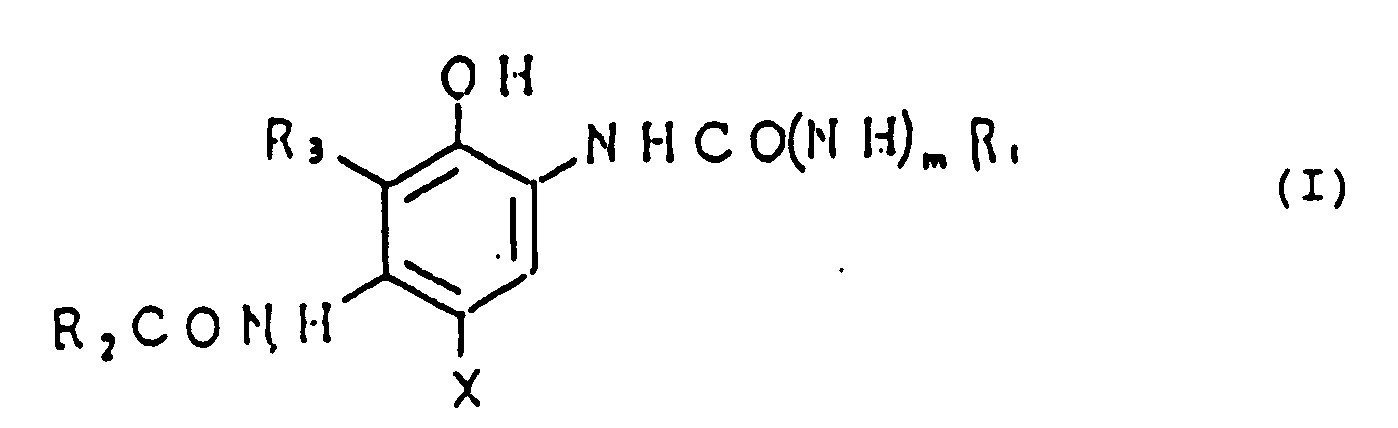
- a silver halide photographic material that has one or more silver halide emulsion layers on a support and which is characterized in that at least one of said silver halide emulsion layers contains at least one cyan coupler represented by the following general formula (I) and at least one non-color forming compound alone represented by the following general formula (II) and a method of forming a dye image by first performing imagewise exposure on a silver halide photographic material that has formed on a support one or more silver halide emulsion layers containing at least one cyan coupler represented by the following general formula (I) and then subjecting the exposed photographic material to color development and subsequent processing, wherein said silver halide emulsion layer containing the cyan coupler further contains a non-color forming compound represented by the following general formula (II) which is added to obtain an image forming dye having the maximum absorption in a longer wavelength range of the spectrum than in the case of the dye formed by said cyan coupler alone: (where
- examples of the alkyl group denoted by R1 or R2 include those having 1 - 32 carbon atoms; examples of the alkenyl group denoted by R1 or R2 include those having 2 - 32 carbon atoms; and examples of the cycloalkyl group denoted by R1 or R2 include those having 3 - 12 carbon atoms.
- the alkyl and alkenyl groups may be straight-chained or branched. These alkyl alkenyl and cycloalkyl groups may have suitable substituents.
- a preferred example of the aryl group denoted by R1 or R2 is a phenyl group, which may have a suitable substituent.
- heterocyclic group denoted by R1 or R2 are those which are 5- to 7-membered and may include substituted or condensed heterocyclic groups.
- R3 signifies a hydrogen atom, a halogen atom, an alkyl group or an alkoxy group, with a hydrogen atom being preferred.
- the ring that is formed by cooperation between R2 and R3 is preferably 5- or 6-membered and illustrative examples of the 5- or 6-membered ring formed include:
- X signifies a group that is capable of being eliminated upon reaction with the oxidation product of a color developing agent and illustrative examples include a halogen atom, an alkoxy group, an aryloxy group, an acyloxy group, a sulfonyloxy group, an acylamino group, a sulfonylamino group, an alkoxycarbonyloxy group, an aryloxycarbonyloxy group or an imido group, among which a halogen atom, an aryloxy group and an alkoxy group are preferred.
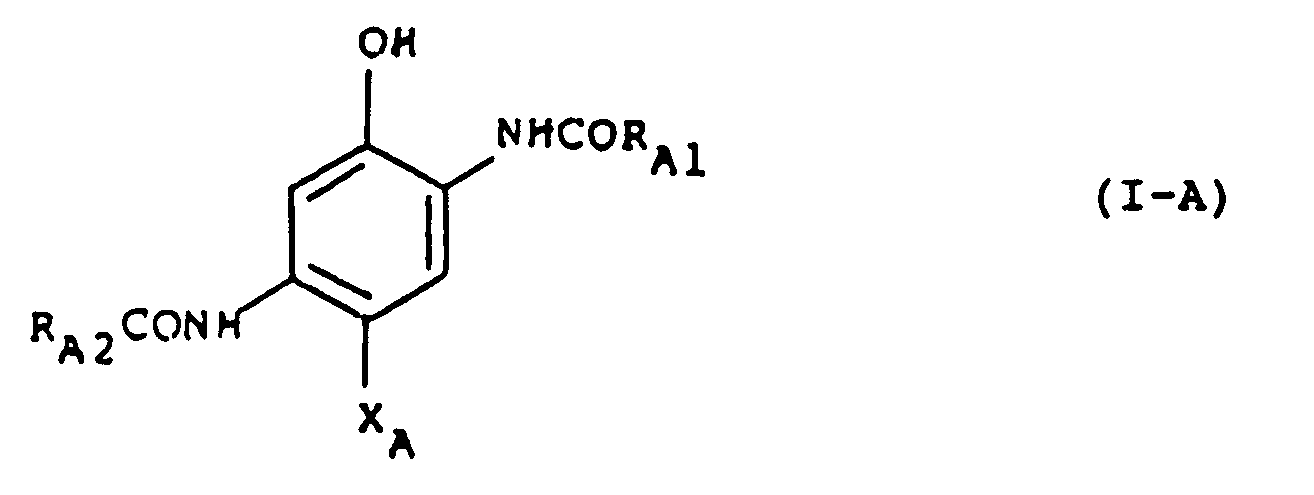
- cyan coupler of the present invention are represented by the following general formula (I-A): where R A1 is a phenyl group substituted by at least one halogen atom, said phenyl group optionally having a substituent other than a halogen atom; R A2 has the same meaning as R2 in formula (I); and X A is a halogen atom, an aryloxy group or an alkoxy group.
- R A1 is a phenyl group substituted by 2 - 5 halogen atoms.
- the cyan couplers of the present invention may include those which are described on pages 26 - 35 of the specification of Japanese Patent Application No. 21853/1986, on pages 25 - 38 of the specification of Japanese Patent Application (OPI) No. 225155/1985, on pages 19 - 30 of the specification of Japanese Patent Application (OPI) No. 222853/1985, on pages 21 - 30 of the specification of Japanese Patent Application (OPI) No. 185335/1984, and on pages 28 - 40 of the specification of Japanese Patent Application (OPI) No. 139031/1984.
- These couplers can be synthesized by the methods described in the specifications of the above-listed applications.
- the cyan coupler of the present invention is incorporated in a silver halide emulsion layer, in particular, a red-sensitive emulsion layer, in an amount of from 2 ⁇ 10 ⁇ 3 to 8 ⁇ 10 ⁇ 1 mole, preferably from 1 ⁇ 10 ⁇ 2 to 5 ⁇ 10 ⁇ 1 mole, per mole of the silver halide.
- non-color forming compound of the present invention is represented by the general formula (II) and which is to be used in combination with the cyan coupler of the present invention (this non-color forming compound is hereinafter referred to as the "non-color forming compound of the present invention").
- Examples of the monovalent organic group denoted by R4 or R5 in formula (II) include an alkyl group, a cycloalkyl group, an alkenyl group, a cycloalkenyl group, an alkynyl group, an aryl group, a heterocyclic group, an alkoxy group, an aryloxy group, a heterocyclic oxy group, an alkylamino group, an arylamino group, and a formyl group.
- Examples of the alkyl group as the monovalent organic group signified by R4 or R5 include those which have 1 - 32 carbon atoms; examples of the alkenyl and alkynyl groups as the monovalent group include those having 2 - 32 carbon atoms; and examples of the cycloalkyl and cycloalkenyl groups include those having 3 - 12 carbon atoms.
- These alkyl, alkenyl and alkynyl group may be straight-chained or branched; they may optionally have suitable substituents.
- aryl group as the monovalent organic group is a phenyl group, which may optionally have a suitable substituent.
- heterocyclic group as the monovalent organic group are those which are 5- to 7-membered and may include substituted or condensed heterocyclic groups.
- Alkoxy groups useful as the monovalent organic group include those which are substituted, such as 2-ethoxyethoxy, pentadecyloxy, 2-dodecyloxyethoxy, and phenethyloxyethoxy.
- a preferred example of the aryloxy group as the monovalent organic group is a phenoxy group, wherein the aryl nucleus may be substituented.
- Illustrative examples include phenoxy, p-t-butylphenoxy, and m-pentadecylphenoxy.
- heterocyclic oxy group as the monovalent organic group include those having 5- to 7-membered hetero rings, which may be further substituted.
- Illustrative examples are 3, 4, 5, 6-tetrahydropyranyl-2-oxy, and 1-phenyltetrazol-5-oxy.
- alkylamino and arylamino groups as the monovalent organic group may have substituents, and more specific examples include diethylamino, anilino, p-chloroanilino, dodecylamino, and 2-methyl-4-cyanoanilino.
- At least one of the groups denoted by R4 and R5 in formula (II) must be an electron attractive group.
- electron attractive group means an atomic group that withdraws electrons from a group of interest by the resonance or induction effect, and electron attractive groups generally assume positive Hammett ( ⁇ ⁇ ) values.
- the electron attractive group is selected from among -CN, -CSR6, -SO2R7 and -SOR8, wherein R6 to R8 are each a monovalent organic group such as an alkyl group, a cycloalkyl group, an alkenyl group, a cycloalkenyl group, an alkynyl group, an aryl group, a heterocyclic group, an alkoxy group, an aryloxy group, a heterocyclic oxy group, an alkylamino group, and an arylamino group, said monovalent group denoted by R7 not including the groups which contain a nitrogen atom and bond to -SO2- through the nitrogen atom. When one of said R4 and R5 is an aryl group, R7 does not include an alkyl group.
- R4 and R5 in formula (II) may be an electron attractive group.
- R9 - NHSO2 - R10 (III) where R9 and R10 are each a hydrogen atom, an alkyl group, a cycloalkyl group, an alkenyl group, a cycloalkenyl group, an alkynyl group, an aryl group, a heterocyclic group, an alkoxy group, an aryloxy group or a heterocyclicoxy group, provided that R9 and R10 may be the same or different.
- alkyl group, cycloakkyl group, alkenyl group, cycloalkenyl group, alkynyl group, aryl group, heterocyclic group, alkoxy group, aryloxy group and heterocyclic oxy group as signified by R9 or R10 may be the same as those listed for the alkyl group, cycloalkyl group, alkenyl group, cycloalkenyl group, alkynyl group, aryl group, heterocyclic group, alkoxy group, aryloxy group, heterocyclic oxy group, alkylamino group and arylamino group as denoted by R4, R5 and R6 - R8 in formula (II).
- R11 - NHSO2 - R12 (IV) where R11 and R12 are each an optionally substituted alkyl or aryl group.
- R11 and R12 are an aryl group
- both R11 and R12 are an alkyl group
- R11 is alkyl group and R12 is aryl group
- most preferably, both R11 and R12 are a phenyl group.
- R11 is a phenyl group
- the substituent on the position para to the sulfonamido group has a Hammett ( ⁇ ⁇ ) value of no smaller than -0.4.
- alkyl and aryl groups denoted by R11 or R12 have the same meanings as defined for the alkyl and aryl groups denoted by R9 or R10 in formula (III).
- the non-color forming compound of the present invention may form a dimer or a higher oligomer at R4 or R5; R4 and R5 may combine to form a 5- or 6-membered ring.
- the non-color forming compound of the present invention preferably contains at least 8, more preferably at least 12, carbon atoms in total.
- Typical examples of the non-color forming compound of the present invention are listed below.
- non-color forming compounds of the present invention can be synthesized by the method described in Japanese Patent Application No. 20589/1986 or by any known method.
- the non-color forming compound of the present invention is used in an amount that preferably ranges from 5 to 500 mol%, more preferably from 10 to 300 mol%, of the cyan coupler of the present invention.
- the present inventors found that the maximum absorption peak of the cyan dye produced from the cyan coupler of the present invention was shifted by the non-color forming compound of the present invention to the longer-wavelength side of the spectrum so as to attain a significant improvement in color reproduction. This effect was first obtained by the present invention. While the present inventors do not want to be limited by any theory, it is speculated that an electron attractive group adjacent to -NH- in the non-color forming compound of the present invention will provide increased proton donation and establish hydrogen bonding with the cyan dye formed from the cyan coupler of the present invention, thereby shifting the absorption peak of the dye to the longer-wavelength side of the spectrum.
- the cyan coupler of the present invention and the non-color forming compound of the present invention are incorporated in the same layer.
- the coupler and the non-color forming compound are dissolved in a high boiling-point ( ⁇ 150°C) organic solvent, optionally in combination with a low boiling-point and/or a water soluble organic solvent, and the resulting solution is emulsified in a hydrophilic colloid, such as an aqueous gelatin solution, in the presence of a surfactant so as to prepare a dispersion which is to be incorporated in a desired hydrophilic colloidal layer.
- a hydrophilic colloid such as an aqueous gelatin solution
- Acylacetanilide based couplers are preferably employed in the present invention as yellow dye forming couplers.
- Advantageous acylacetanilide based couplers are benzoylacetanilide and pivaloylacetanilide compounds.
- magenta couplers are preferably used in the present invention as magenta couplers.
- the cyan coupler of the present invention may be used in combination with known cyan dye forming couplers in amounts that will not impair the objects of the present invention. If the cyan coupler of the present invention is such that m in its formula (I) is zero, it is preferably combined with a cyan dye forming coupler represented by the following general formula (F): where R 1F is a ballast group; R 2F is a hydrogen atom, a halogen atom or an alkyl group; R 3F is an alkyl group having 1 - 6 carbon atoms; Z 1F is a hydrogen atom or a group that is capable of being eliminated upon reaction with the oxidation product of an aromatic primary amino based color developing agent.
- R 1F is a ballast group
- R 2F is a hydrogen atom, a halogen atom or an alkyl group
- R 3F is an alkyl group having 1 - 6 carbon atoms
- Z 1F is a hydrogen atom or a group that is capable of
- cyan dye forming couplers examples are shown in prior patents, e.g., Japanese Patent Application (OPI) Nos. 37425/1972, 10135/1975, 25228/1975, 112038/1975, 117422/1975, 130441/1975, U.S. Patent Nos. 2,369,929, 2,423,730, 2,434,272, 2,474,293, 2,698,794, 2,895,826, Japanese Patent Application (OPI) Nos. 112038/1975, 109630/1978, 163537/1980, and U.S. Patent Nos. 3,772,002 and 4,443,536.
- OPI Japanese Patent Application
- cyan coupler of the present invention is such that m in its formula (I) is one, it is preferably combined with a naphtholic cyan dye forming coupler.
- any of the silver halides such as silver chloride, silver bromide, silver iodide, silver chlorobromide, silver iodobromide, and silver chloroiodide may be employed in the silver halide emulsions in the photographic material of the present invention.
- the silver halides in silver halide photographic materials such as color papers that are required to feature a particularly high speed of development preferably contain chlorine atoms and it is particularly preferred to employ silver chlorobromide or silver chloroiodobromide each containing at least 1 mol% of silver chloride.
- These silver halides may be in the form of a polydispersed emulsion having a broad distribution of average grain sizes but a monodispersion emulsion is preferable.
- Emulsions prepared from these silver halides may be chemically sensitized with suitable materials such as activated gelatin, sulfur sensitizers, selenium sensitizers, reduction sensitizers and noble metal sensitizers.
- suitable materials such as activated gelatin, sulfur sensitizers, selenium sensitizers, reduction sensitizers and noble metal sensitizers.
- the silver halides described above may be optically sensitized by addition of suitable sensitizing dyes in order to impart sensitivity to desired wavelength ranges of sensitivity.
- the silver halide photographic material of the present invention may contain any suitable additive such as a color fog preventing agent, an image stabilizer, a hardening agent, a plasticizer, a polymer latex, a uv absorber, a formaldehyde scavenger, a mordant, a development accelerator, a developer retarder, a brightener, a matting agent, a lubricant, an antistat, and a surfactant.
- a color fog preventing agent such as a color fog preventing agent, an image stabilizer, a hardening agent, a plasticizer, a polymer latex, a uv absorber, a formaldehyde scavenger, a mordant, a development accelerator, a developer retarder, a brightener, a matting agent, a lubricant, an antistat, and a surfactant.
- the silver halide photographic material of the present invention may be processed by a variety of color developing processes. While various developing solutions may be employed, the advantages of the present invention are especially noticeable when development is conducted with a developing solution that contains no benzyl alcohol.
- the cyan coupler of the present invention is used in combination with the non-color forming compound of the present invention so as to provide a silver halide photographic material capable of producing a cyan dye image that not only exhibits better keeping quality but also ensures improved color reproduction because the maximum absorption peak of the cyan dye is shifted to the longer-wavelength side of the spectrum. It is also possible for the present invention to provide a silver halide photographic material that produces a dye image having a sufficient color density to attain a desired high maximum value.
- STB-1 having the structure shown below was added as an emulsion stabilizer in an amount of 5 ⁇ 10 ⁇ 3 moles per mole of silver halide.
- Em-1 to Em-3 samples of silver halide color photographic material (Nos. 1 - 62) were prepared by coating the following layers 1 to 7 in superposition on a paper support that had been coated with polyethylene on both sides.
- All amounts of addition are expressed in terms of deposit weights per square meter of sensitive material unless other wise indicated.
- the photographic samples thus prepared were exposed to light through an optical wedge using a sensitometer Model KS-7 of Konishiroku Photo Industry Co., Ltd., and subsequently processed in accordance with the scheme shown below. Thereafter, the maximum density (Dmax) of the red-sensitive emulsion layer in each of the processed samples was measured with an optical densitometer Model PDA-65 of Konishiroku Photo Industry Co., Ltd.
- sample Nos. 1 and 7 using a conventional cyan coupler had high values of Dmax and ⁇ max and low values of D G but they were not suitable for use in practical applications because their resistance to fading in the dark was very low. In addition, these samples had too large values of D B to ensure good reproduction of a blue color.
- Sample Nos. 2 and 8 that employed a phenolic cyan coupler having an ethyl group at the 5-position were appreciably improved in their resistance to fading in the dark but they also had too large values of D B to ensure good reproduction of a blue color. Sample No. 2 was also undesired because of its comparatively low Dmax. Sample Nos.
- Sample Nos. 44 - 62 of the present invention employed two cyan couplers, one being within the scope of the present invention and the other being outside the scope of the present invention, in combination with non-color forming compounds of the present invention.
- the Dmax values of these samples were even higher than those of sample Nos. 9 - 42. They had high ⁇ max values and yet offered sufficiently small D G and D B values to achieve good reproduction of green and blue colors. In addition, these samples proved to be more resistant to fading in the dark than sample No. 2.
- Sample Nos. 9 and 17 - 42 employed the same cyan coupler, C-2.
- sample Nos. 9, 17 - 20, 23 - 27, 37 and 40 - 42 which employed non-color forming compounds of formula (IV) were particularly good since they produced high maximum densities, had maximum absorption peaks of cyan dyes sufficiently shifted to the longer-wavelength side of the spectrum, and offered low D G values.
- sample Nos. 44 - 59 that employed C-2 in combination with CC-1 which was a cyan coupler outside the scope of the present invention.
- Those samples which employed non-color forming compounds of formula (IV) were particularly good since they had maximum absorption peaks of cyan dyes at the longer-wavelength side of the spectrum while offering small D G values.
- Sample Nos. 63 - 84 of silver halide color photographic material were prepared as in Example 1 except that Em-1, Em-2 and Em-3 in layers 1, 3 and 5 were replaced by Em-4, Em-5 and Em-6, respectively, and that the cyan coupler(s) and non-color forming compound shown in Table 3 were incorporated in layer 5.
- sample Nos.68 - 71 of the present invention achieved satisfactorily high levels of Dmax and high values of ⁇ max, as well as offering sufficiently small values of D G and D B to ensure good reproduction of green and blue colors. In addition, these samples offered very high levels of resistance to fading in the dark.
- the developing solution used in Example 2 was of a common type that contained benzyl alcohol as an accelerator of color formation.
- This dispersion was added to a silver iodobromide emulsion (containing 6 mol% AgI) in such an amount that the content of the cyan coupler would be 10 mol% of silver. Thereafter, 1,2-bis(vinylsulfonyl)ethane was added as a hardener in an amount of 12 mg per gram of gelatin. The so prepared coating solution was applied to a subbed transparent triacetyl cellulose film base so as to provide a silver deposit of 18 mg/100 cm2. The resulting silver halide photographic materials were wedge-exposed by a conventional method and subsequently processed by the following scheme.
- sample Nos. 85, 88, 90, 92 and 94 did not employ any of the non-color forming compounds of the present invention.
- sample Nos. 86, 87, 89, 91, 93 and 95 containing non-color forming compounds within the scope of the present invention attained high maximum densities (Dmax) and had the maximum absorption peaks of cyan dye ( ⁇ max) shifted sufficiently to the longer-wavelength side of the spectrum to be appropriate for use as imaging negative light-sensitive materials that would ensure improved color reproduction.
Landscapes
- Physics & Mathematics (AREA)
- General Physics & Mathematics (AREA)
- Spectroscopy & Molecular Physics (AREA)
- Silver Salt Photography Or Processing Solution Therefor (AREA)
Claims (13)
- Matériau photographique à base d'halogénure d'argent, comportant une ou plusieurs couches d'une émulsion d'halogénure d'argent disposées sur un support, au moins une de ces couches d'émulsion d'halogénure d'argent contenant au moins un coupleur cyan représenté par la formule générale (I) suivante et au moins un composé non chromogène représenté par la formule générale (II) suivante :

R₄ - NH - R₅ (II)
(dans laquelle R₄ et R₅ représentent chacun un atome d'hydrogène ou un groupe organique monovalent, à condition qu'au moins l'un des groupes R₄ et R₅ représente un groupe électroattracteur choisi parmi -CN, -CSR₆, -SO₂R₇ et -SOR₈ (dans lesquels R₆, R₇ et R₈ représentent chacun un groupe monovalent, ce groupe monovalent désigné R₇ ne comprenant pas les groupes qui contiennent un atome d'azote, liés par l'intermédiaire d'une liaison -SO₂- à cet atome d'azote), R₇ ne comprenant pas un groupe alkyle lorsque l'un des groupes R₄ et R₅ représente un groupe aryle, et R₄ et R₅ peuvent être identiques ou différents et former ensemble un cycle en combinaison avec un groupe -NH-). - Matériau photographique à base d'halogénure d'argent selon la revendication 1, dans lequel le coupleur cyan est un composé représenté par la formule générale (I-A) suivante :
- Matériau photographique à base d'halogénure d'argent selon la revendication 2, dans lequel le coupleur cyan est incorporé dans la ou chacune desdites couches d'émulsion d'halogénure d'argent, selon une quantité de 2 x 10⁻³ à 8 x 10⁻¹ mode par mode de l'halogénure d'argent.
- Matériau photographique à base d'halogénure d'argent selon la revendication 1, dans lequel le composé non chromogène est représenté par la formule générale (III) suivante :
R₉ - NHSO₂- R₁₀ (III)
dans laquelle R₉ et R₁₀ représentent chacun un atome d'hydrogène, un groupe alkyle, un groupe cycloalkyle, un groupe alkényle, un groupe cycloalkényle, un groupe alkynyle, un groupe aryle, un groupe hétérocyclique, un groupe alkoxy, un groupe aryloxy ou un groupe hétérocyclo-oxy, à condition que R₉ et R₁₀ puissent être identiques ou différents. - Matériau photographique à base d'halogénure d'argent selon la revendication 4, dans lequel le composé non chromogène est un composé représenté par la formule générale (IV) suivante :
R₁₁ - NHSO₂ - R₁₂ (IV)
dans laquelle R₁₁ et R₁₂ représentent chacun un groupe alkyle ou aryle. - Matériau photographique à base d'halogénure d'argent selon la revendication 5, dans lequel tant R₁₁ que R₁₂ représentent un groupe alkyle.
- Matériau photographique à base d'halogénure d'argent selon la revendication 5, dans lequel tant R₁₁ que R₁₂ représentent un groupe aryle.
- Matériau photographique à base d'halogénure d'argent selon la revendication 5, dans lequel R₁₁ représente un groupe alkyle, et R₁₂ représente un groupe aryle.
- Matériau photographique à base d'halogénure d'argent selon la revendication 5, dans lequel le composé non chromogène est incorporé dans la ou chacune desdites couches d'émulsion d'halogénure d'argent, selon une quantité de 5 à 500 moles % par rapport au coupleur cyan.
- Matériau photographique à base d'halogénure d'argent selon la revendication 1, dans lequel la ou chacune des couches d'émulsion d'halogénure d'argent, contient un halogénure d'argent contenant au moins 1 mole % de chlorure d'argent.
- Procédé de formation d'une image colorée, selon lequel on expose à une image, un matériau photographique à base d'halogénure d'argent comprenant, sur un support, une ou plusieurs couches d'émulsion d'halogénure d'argent contenant au moins un coupleur cyan représenté par la formule générale (I) suivante, et on soumet le matériau photographique exposé à un développement de couleur et à un traitement ultérieur, la couche d'émulsion d'halogénure d'argent qui contient le coupleur cyan, contenant en outre un composé non chromogène représenté par la formule générale (II) suivante qui est ajouté pour obtenir un colorant générateur d'image à absorption maximum dans une plage de longueurs d'ondes du spectre plus élevées que dans le cas du colorant formé par le coupleur cyan seul :
R₄ - NH - R₅ (II)
(dans laquelle R₄ et R₅ représentent chacun un atome d'hydrogène ou un groupe organique monovalent, à condition qu'au moins l'un des groupes R₄ et R₅ représente un groupe électroattracteur choisi parmi -CN, -CSR₆, -SO₂R₇ et -SOR₈ (dans lesquels R₆, R₇ et R₈ représentent chacun un groupe monovalent, ce groupe monovalent désigné R₇ ne comprenant pas les groupes qui contiennent un atome d'azote, liés par l'intermédiaire d'une liaison -SO₂- à cet atome d'azote), R₇ ne comprenant pas un groupe alkyle lorsqu'au moins l'un des groupes R₄ et R₅ représentent un groupe aryle, et R₄ et R₅ peuvent être identiques ou différents et former ensemble un cycle en combinaison avec un groupe -NH-). - Procédé selon la revendication 11, dans lequel le coupleur cyan et le composé non chromogène, sont dissous dans un solvant organique contenant au moins un solvant organique à point d'ébullition élevé, la solution résultant étant dispersée dans un colloïde hydrophile qui est ensuite incorporé dans une couche d'émulsion d'halogénure d'argent.
- Procédé selon la revendication 11, dans lequel le composé non chromogène est incorporé dans la couche d'émulsion d'halogénure d'argent, selon une quantité de 5 à 500 moles % par rapport à ce coupleur cyan.
Applications Claiming Priority (2)
| Application Number | Priority Date | Filing Date | Title |
|---|---|---|---|
| JP61242785A JPS6396656A (ja) | 1986-10-13 | 1986-10-13 | 色再現性にすぐれたハロゲン化銀写真感光材料 |
| JP242785/86 | 1986-10-13 |
Publications (3)
| Publication Number | Publication Date |
|---|---|
| EP0264083A2 EP0264083A2 (fr) | 1988-04-20 |
| EP0264083A3 EP0264083A3 (en) | 1989-07-05 |
| EP0264083B1 true EP0264083B1 (fr) | 1992-06-10 |
Family
ID=17094251
Family Applications (1)
| Application Number | Title | Priority Date | Filing Date |
|---|---|---|---|
| EP87114810A Expired EP0264083B1 (fr) | 1986-10-13 | 1987-10-10 | Matériau photographique à l'halogénure d'argent et procédé de formation d'une image colorée sur celui-ci |
Country Status (4)
| Country | Link |
|---|---|
| US (1) | US5019493A (fr) |
| EP (1) | EP0264083B1 (fr) |
| JP (1) | JPS6396656A (fr) |
| DE (1) | DE3779717T2 (fr) |
Families Citing this family (7)
| Publication number | Priority date | Publication date | Assignee | Title |
|---|---|---|---|---|
| EP0309159B1 (fr) * | 1987-09-21 | 1993-03-24 | EASTMAN KODAK COMPANY (a New Jersey corporation) | Matériau photographique d'enregistrement comprenant des composés copulants formant une image couleur |
| JP2916702B2 (ja) * | 1990-09-04 | 1999-07-05 | コニカ株式会社 | ハロゲン化銀カラー写真感光材料 |
| US5200309A (en) * | 1991-08-29 | 1993-04-06 | Eastman Kodak Company | Color photographic materials including magenta coupler, carbonamide compound and aniline or amine compound, and methods |
| US5422029A (en) * | 1993-06-18 | 1995-06-06 | Potini; Chimpiramma | Composition for cleaning contact lenses |
| DE4430948A1 (de) * | 1994-08-31 | 1996-03-07 | Agfa Gevaert Ag | Farbfotografisches Silberhalogenidmaterial |
| EP1209520A1 (fr) | 2000-11-28 | 2002-05-29 | Eastman Kodak Company | Compositions de précurseurs d'agents de blanchiment-fixage comprenant un complexe de ferreux et méthodes pour leur utilisation |
| US6680165B1 (en) | 2002-10-24 | 2004-01-20 | Eastman Kodak Company | Cyan coupler dispersion with increased activity |
Family Cites Families (24)
| Publication number | Priority date | Publication date | Assignee | Title |
|---|---|---|---|---|
| US2353262A (en) * | 1942-11-24 | 1944-07-11 | Eastman Kodak Co | Preventing crystallization of couplers |
| BE755248A (fr) * | 1969-08-27 | 1971-02-01 | Fuji Photo Film Co Ltd | Element photosensible de photographie en couleurs contenant un copulantmagenta |
| CA1156250A (fr) * | 1979-10-15 | 1983-11-01 | Eastman Kodak Company | Agents de copulation formant des colorants a groupe cyano |
| JPS5776543A (en) * | 1980-10-30 | 1982-05-13 | Konishiroku Photo Ind Co Ltd | Photographic sensitive silver halide material |
| JPS57179842A (en) * | 1981-04-28 | 1982-11-05 | Konishiroku Photo Ind Co Ltd | Photographic sensitive material |
| JPS57204545A (en) * | 1981-06-11 | 1982-12-15 | Konishiroku Photo Ind Co Ltd | Formation of color photographic image of silver halide |
| JPS5941181B2 (ja) * | 1981-06-11 | 1984-10-05 | コニカ株式会社 | フエノ−ル型シアンカプラ−を含むハロゲン化銀カラ−写真感光材料 |
| JPS5941182B2 (ja) * | 1981-06-11 | 1984-10-05 | コニカ株式会社 | シアン色素画像の形成方法 |
| JPS581139A (ja) * | 1981-06-25 | 1983-01-06 | Konishiroku Photo Ind Co Ltd | ハロゲン化銀感光材料 |
| JPS5833252A (ja) * | 1981-08-20 | 1983-02-26 | Konishiroku Photo Ind Co Ltd | ハロゲン化銀カラ−写真用シアンカプラ− |
| JPS5833249A (ja) * | 1981-08-20 | 1983-02-26 | Konishiroku Photo Ind Co Ltd | ハロゲン化銀カラ−写真画像の形成方法 |
| JPS5833251A (ja) * | 1981-08-20 | 1983-02-26 | Konishiroku Photo Ind Co Ltd | ハロゲン化銀カラ−写真用シアンカプラ− |
| JPS59139031A (ja) * | 1983-01-29 | 1984-08-09 | Konishiroku Photo Ind Co Ltd | ハロゲン化銀写真感光材料 |
| JPS59185335A (ja) * | 1983-04-06 | 1984-10-20 | Konishiroku Photo Ind Co Ltd | 色素画像の形成方法 |
| JPS59202465A (ja) * | 1983-05-04 | 1984-11-16 | Fuji Photo Film Co Ltd | カラ−写真感光材料 |
| JPS59204041A (ja) * | 1983-05-06 | 1984-11-19 | Fuji Photo Film Co Ltd | ハロゲン化銀カラ−写真感光材料 |
| JPS60222853A (ja) * | 1984-04-20 | 1985-11-07 | Konishiroku Photo Ind Co Ltd | ハロゲン化銀写真感光材料 |
| JPH0616167B2 (ja) * | 1984-04-20 | 1994-03-02 | コニカ株式会社 | ハロゲン化銀写真感光材料 |
| JPS60256142A (ja) * | 1984-06-01 | 1985-12-17 | Fuji Photo Film Co Ltd | カラ−写真感光材料 |
| JPS6120589A (ja) * | 1984-07-05 | 1986-01-29 | 細井ミシン株式会社 | ミシンの送り調節構造 |
| JPS6180256A (ja) * | 1984-09-28 | 1986-04-23 | Konishiroku Photo Ind Co Ltd | ハロゲン化銀カラ−写真感光材料 |
| JPS6198348A (ja) * | 1984-10-19 | 1986-05-16 | Konishiroku Photo Ind Co Ltd | ハロゲン化銀カラ−写真感光材料 |
| DD231664A1 (de) * | 1984-12-17 | 1986-01-02 | Wolfen Filmfab Veb | Lichtempfindliches fotografisches gelatinehaltiges silberhalogenidmaterial mit plastifikatoren |
| US4973535A (en) * | 1987-09-21 | 1990-11-27 | Eastman Kodak Company | Photographic recording material comprising a dye image-forming coupler compound |
-
1986
- 1986-10-13 JP JP61242785A patent/JPS6396656A/ja active Pending
-
1987
- 1987-10-10 DE DE8787114810T patent/DE3779717T2/de not_active Expired - Lifetime
- 1987-10-10 EP EP87114810A patent/EP0264083B1/fr not_active Expired
-
1990
- 1990-01-29 US US07/476,110 patent/US5019493A/en not_active Expired - Fee Related
Also Published As
| Publication number | Publication date |
|---|---|
| DE3779717D1 (de) | 1992-07-16 |
| US5019493A (en) | 1991-05-28 |
| DE3779717T2 (de) | 1992-12-24 |
| JPS6396656A (ja) | 1988-04-27 |
| EP0264083A3 (en) | 1989-07-05 |
| EP0264083A2 (fr) | 1988-04-20 |
Similar Documents
| Publication | Publication Date | Title |
|---|---|---|
| JPH0477895B2 (fr) | ||
| JPH0371700B2 (fr) | ||
| JP3283917B2 (ja) | マゼンタカプラー、抑制剤放出カプラー及びカルボンアミド化合物を含有するカラー写真材料 | |
| EP0192471B1 (fr) | Matériau photographique couleur à l'halogénure d'argent | |
| EP0264083B1 (fr) | Matériau photographique à l'halogénure d'argent et procédé de formation d'une image colorée sur celui-ci | |
| US4945034A (en) | Silver halide photographic light-sensitive material | |
| JPS6224250A (ja) | ハロゲン化銀カラ−写真感光材料 | |
| US5128237A (en) | Direct positive silver halide photographic material | |
| EP0545248B1 (fr) | Utilisation d'additifs hétérocycliques contenant un atome d'azote pour réduire le couplage continu de coupleurs formant des colorants magenta | |
| US5039597A (en) | Dye image forming method | |
| US5079133A (en) | Silver halide color photographic material | |
| EP0516065A1 (fr) | Matériau photographique couleur à l'halogénure d'argent sensible à la lumière | |
| EP0193397B1 (fr) | Matériau photographique couleur à l'halogénure d'argent sensible à la lumière | |
| JP3089579B2 (ja) | ハロゲン化銀カラー写真感光材料及びカラー画像形成方法 | |
| US6555305B1 (en) | Photographic element with spectrally sensitized tabular grain emulsion and retained dye stain reducing compound | |
| JPH071386B2 (ja) | ハロゲン化銀カラ−写真感材材料 | |
| JP2838549B2 (ja) | ハロゲン化銀写真感光材料及びカラー画像形成方法 | |
| EP0327274A2 (fr) | Matériau photographique à l'halogénure d'argent sensible à la lumière | |
| JPH0561168A (ja) | ハロゲン化銀カラー写真感光材料 | |
| JPH04238347A (ja) | ハロゲン化銀カラー写真感光材料 | |
| JP2539609B2 (ja) | ハロゲン化銀写真感光材料の処理方法 | |
| JP2517300B2 (ja) | 高感度かつ生保存性の改良されたハロゲン化銀写真感光材料 | |
| JPH05150429A (ja) | ハロゲン化銀カラー写真感光材料 | |
| JP2961717B2 (ja) | ハロゲン化銀写真感光材料 | |
| JPH05150421A (ja) | ハロゲン化銀カラー写真感光材料 |
Legal Events
| Date | Code | Title | Description |
|---|---|---|---|
| PUAI | Public reference made under article 153(3) epc to a published international application that has entered the european phase |
Free format text: ORIGINAL CODE: 0009012 |
|
| AK | Designated contracting states |
Kind code of ref document: A2 Designated state(s): DE FR GB IT NL |
|
| PUAL | Search report despatched |
Free format text: ORIGINAL CODE: 0009013 |
|
| AK | Designated contracting states |
Kind code of ref document: A3 Designated state(s): DE FR GB IT NL |
|
| 17P | Request for examination filed |
Effective date: 19891206 |
|
| RAP3 | Party data changed (applicant data changed or rights of an application transferred) |
Owner name: KONICA CORPORATION |
|
| 17Q | First examination report despatched |
Effective date: 19910802 |
|
| GRAA | (expected) grant |
Free format text: ORIGINAL CODE: 0009210 |
|
| AK | Designated contracting states |
Kind code of ref document: B1 Designated state(s): DE FR GB IT NL |
|
| PG25 | Lapsed in a contracting state [announced via postgrant information from national office to epo] |
Ref country code: IT Free format text: LAPSE BECAUSE OF FAILURE TO SUBMIT A TRANSLATION OF THE DESCRIPTION OR TO PAY THE FEE WITHIN THE PRE;WARNING: LAPSES OF ITALIAN PATENTS WITH EFFECTIVE DATE BEFORE 2007 MAY HAVE OCCURRED AT ANY TIME BEFORE 2007. THE CORRECT EFFECTIVE DATE MAY BE DIFFERENT FROM THE ONE RECORDED.SCRIBED TIME-LIMIT Effective date: 19920610 Ref country code: FR Effective date: 19920610 Ref country code: NL Effective date: 19920610 |
|
| REF | Corresponds to: |
Ref document number: 3779717 Country of ref document: DE Date of ref document: 19920716 |
|
| EN | Fr: translation not filed | ||
| NLV1 | Nl: lapsed or annulled due to failure to fulfill the requirements of art. 29p and 29m of the patents act | ||
| PLBE | No opposition filed within time limit |
Free format text: ORIGINAL CODE: 0009261 |
|
| STAA | Information on the status of an ep patent application or granted ep patent |
Free format text: STATUS: NO OPPOSITION FILED WITHIN TIME LIMIT |
|
| 26N | No opposition filed | ||
| PGFP | Annual fee paid to national office [announced via postgrant information from national office to epo] |
Ref country code: GB Payment date: 19961001 Year of fee payment: 10 |
|
| PGFP | Annual fee paid to national office [announced via postgrant information from national office to epo] |
Ref country code: DE Payment date: 19961018 Year of fee payment: 10 |
|
| PG25 | Lapsed in a contracting state [announced via postgrant information from national office to epo] |
Ref country code: GB Free format text: LAPSE BECAUSE OF NON-PAYMENT OF DUE FEES Effective date: 19971010 |
|
| GBPC | Gb: european patent ceased through non-payment of renewal fee |
Effective date: 19971010 |
|
| PG25 | Lapsed in a contracting state [announced via postgrant information from national office to epo] |
Ref country code: DE Free format text: LAPSE BECAUSE OF NON-PAYMENT OF DUE FEES Effective date: 19980701 |