EP0363934B1 - Procédé pour la préparation des acides hept-6-énoiques et heptanoiques substitués sur la position 7 et dérivés - Google Patents
Procédé pour la préparation des acides hept-6-énoiques et heptanoiques substitués sur la position 7 et dérivés Download PDFInfo
- Publication number
- EP0363934B1 EP0363934B1 EP89118906A EP89118906A EP0363934B1 EP 0363934 B1 EP0363934 B1 EP 0363934B1 EP 89118906 A EP89118906 A EP 89118906A EP 89118906 A EP89118906 A EP 89118906A EP 0363934 B1 EP0363934 B1 EP 0363934B1
- Authority
- EP
- European Patent Office
- Prior art keywords
- formula
- compound
- butyl
- hydrogen
- chloro
- Prior art date
- Legal status (The legal status is an assumption and is not a legal conclusion. Google has not performed a legal analysis and makes no representation as to the accuracy of the status listed.)
- Expired - Lifetime
Links
Classifications
-
- C—CHEMISTRY; METALLURGY
- C07—ORGANIC CHEMISTRY
- C07D—HETEROCYCLIC COMPOUNDS
- C07D233/00—Heterocyclic compounds containing 1,3-diazole or hydrogenated 1,3-diazole rings, not condensed with other rings
- C07D233/54—Heterocyclic compounds containing 1,3-diazole or hydrogenated 1,3-diazole rings, not condensed with other rings having two double bonds between ring members or between ring members and non-ring members
- C07D233/64—Heterocyclic compounds containing 1,3-diazole or hydrogenated 1,3-diazole rings, not condensed with other rings having two double bonds between ring members or between ring members and non-ring members with substituted hydrocarbon radicals attached to ring carbon atoms, e.g. histidine
-
- A—HUMAN NECESSITIES
- A61—MEDICAL OR VETERINARY SCIENCE; HYGIENE
- A61P—SPECIFIC THERAPEUTIC ACTIVITY OF CHEMICAL COMPOUNDS OR MEDICINAL PREPARATIONS
- A61P3/00—Drugs for disorders of the metabolism
- A61P3/06—Antihyperlipidemics
-
- C—CHEMISTRY; METALLURGY
- C07—ORGANIC CHEMISTRY
- C07C—ACYCLIC OR CARBOCYCLIC COMPOUNDS
- C07C223/00—Compounds containing amino and —CHO groups bound to the same carbon skeleton
- C07C223/02—Compounds containing amino and —CHO groups bound to the same carbon skeleton having amino groups bound to acyclic carbon atoms of the carbon skeleton
-
- C—CHEMISTRY; METALLURGY
- C07—ORGANIC CHEMISTRY
- C07C—ACYCLIC OR CARBOCYCLIC COMPOUNDS
- C07C51/00—Preparation of carboxylic acids or their salts, halides or anhydrides
- C07C51/347—Preparation of carboxylic acids or their salts, halides or anhydrides by reactions not involving formation of carboxyl groups
- C07C51/367—Preparation of carboxylic acids or their salts, halides or anhydrides by reactions not involving formation of carboxyl groups by introduction of functional groups containing oxygen only in singly bound form
-
- C—CHEMISTRY; METALLURGY
- C07—ORGANIC CHEMISTRY
- C07C—ACYCLIC OR CARBOCYCLIC COMPOUNDS
- C07C59/00—Compounds having carboxyl groups bound to acyclic carbon atoms and containing any of the groups OH, O—metal, —CHO, keto, ether, groups, groups, or groups
- C07C59/40—Unsaturated compounds
- C07C59/42—Unsaturated compounds containing hydroxy or O-metal groups
- C07C59/48—Unsaturated compounds containing hydroxy or O-metal groups containing six-membered aromatic rings
-
- C—CHEMISTRY; METALLURGY
- C07—ORGANIC CHEMISTRY
- C07D—HETEROCYCLIC COMPOUNDS
- C07D209/00—Heterocyclic compounds containing five-membered rings, condensed with other rings, with one nitrogen atom as the only ring hetero atom
- C07D209/02—Heterocyclic compounds containing five-membered rings, condensed with other rings, with one nitrogen atom as the only ring hetero atom condensed with one carbocyclic ring
- C07D209/04—Indoles; Hydrogenated indoles
- C07D209/10—Indoles; Hydrogenated indoles with substituted hydrocarbon radicals attached to carbon atoms of the hetero ring
- C07D209/12—Radicals substituted by oxygen atoms
-
- C—CHEMISTRY; METALLURGY
- C07—ORGANIC CHEMISTRY
- C07D—HETEROCYCLIC COMPOUNDS
- C07D209/00—Heterocyclic compounds containing five-membered rings, condensed with other rings, with one nitrogen atom as the only ring hetero atom
- C07D209/02—Heterocyclic compounds containing five-membered rings, condensed with other rings, with one nitrogen atom as the only ring hetero atom condensed with one carbocyclic ring
- C07D209/04—Indoles; Hydrogenated indoles
- C07D209/10—Indoles; Hydrogenated indoles with substituted hydrocarbon radicals attached to carbon atoms of the hetero ring
- C07D209/18—Radicals substituted by carbon atoms having three bonds to hetero atoms with at the most one bond to halogen, e.g. ester or nitrile radicals
- C07D209/24—Radicals substituted by carbon atoms having three bonds to hetero atoms with at the most one bond to halogen, e.g. ester or nitrile radicals with an alkyl or cycloalkyl radical attached to the ring nitrogen atom
Definitions
- the invention relates to the preparation of 7-substituted-hept-6-enoic and -heptanoic acids and derivatives and intermediates thereof.
- the invention concerns a process for the preparation of a compound of formula I wherein
- the process of the invention for the preparation of a compound of formula I comprises stereoselectively reducing a racemic or optically pure compound of formula II wherein R, R1 and X are as defined above and one of Z1 and Z2 is oxygen and the other is hydroxy and hydrogen, to produce a corresponding compound of formula I.
- the invention allows the preparation of a compound of formula I as defined above in a state of optical purity such that the proportion of erythro to threo isomer is 99.1:0.9 or higher, preferably 99.5:0.5 or higher; especially 99.7 : 0.3 or higher.
- the compounds of formula I which are esters, and the corresponding free acids, salts and cyclic esters ( ⁇ -lactones) are pharmaceuticals, in particular HMG-CoA reductase inhibitors, i.e. cholesterol biosynthesis inhibitors and, therefore, they are indicated for use for the treatment of hypercholesterolemia, hyperlipoproteinemia and atherosclerosis.
- An ester group R1 preferably is a physiologically acceptable and hydrolyzable ester group when the desired end product is an ester.
- physiologically acceptable and hydrolyzable ester group is meant a group which, together with the -COO- radical to which it is attached, forms an ester group which is physiologically acceptable and hydrolyzable under physiological conditions to yield the corresponding carboxylic acid of the compound of formula I (i.e. wherein R1 is replaced by hydrogen) and an alcohol which itself is physiologically acceptable, i.e. non-toxic at the desired dosage level, particularly a group which is free of centers of asymmetry.
- R1 is preferably R2 where R2 is C1 ⁇ 4alkyl or benzyl, especially R2' where R2' is C1 ⁇ 3alkyl, n-butyl, i-butyl, t-butyl or benzyl, e.g. ethyl, preferably isopropyl or t-butyl, especially t-butyl. It may also be allyl when R is triphenylmethyl and X is - OCH2-.
- R preferably is selected from a group A, B, C, D, Ea, Eb, Ec, F, G, H, J, K, L, M or N as follows:
- the compounds of formula I may be divided into thirteen groups, i.e., groups IA to IN, depending upon the significance of R, i.e.:
- one erythro and one threo isomer) of the compound of formula I are formed, e.g., the 3R,5S and 3S,5S diastereoisomers which result from the reduction of the 5S hydroxy compound.
- Diastereoisomers may be separated by conventional means, such as by fractional crystallization, column chromatography, preparative thin layer chromatography or HPLC.
- the proportion of erythro to threo isomer obtained by these methods is usually variable and can be e.g. up to about 98 : 1.
- stereoselective process of the present invention when a racemic compound of formula II is utilized, only two stereoisomers (comprising the erythro pair of enantiomers) of the resulting compound of formula I are formed almost exclusively.
- an optically pure compound of formula II when an optically pure compound of formula II is utilized, only one enantiomer of the compound of formula I is formed almost exclusively, and this enantiomer is the corresponding erythro enantiomer.
- the proportion of erythro to threo isomer obtained with the process of the present invention is about 99.1 : 0.9 or higher, particularly about 99.5 : 0.5 or higher, especially about 99.7 : 0.3 or higher.
- stereoselective as used herein thus means that the proportion of the erythro to the threo form is 99.1:0.9 or higher.
- stereoisomers of the compounds of formula I wherein X is -CH2CH2- according to the present invention are the 3R,5R and the 3S,5S isomer and the racemate consisting of both of them, of which the 3R,5R isomer and the racemate are preferred.
- a three-step, partly stereoselective reduction process has been used to obtain predominantly the erythro racemate from the racemic starting material.
- a compound of formula II is contacted either with a trialkylborane compound or a compound of formula III: R4O-B-(R3)2 (III) in which R4 is allyl or lower alkyl having from l to 4 carbon atoms, preferably not tertiary, and R3 is a primary or secondary alkyl having 2 to 4 carbon atoms, preferably not tertiary, in a reaction medium comprising an alcohol and tetrahydrofuran (THF).
- THF tetrahydrofuran
- reaction mixture containing the boron complex and/or cyclic boronate ester is azeotroped with methanol or ethanol, or alternatively, is treated in an organic solvent with aqueous peroxy compound, such as a peroxide, e.g. hydrogen peroxide, or a perborate, e.g. sodium perborate, to yield the resulting compounds of formula I.
- aqueous peroxy compound such as a peroxide, e.g. hydrogen peroxide, or a perborate, e.g. sodium perborate
- the aforementioned process is said to provide the erythro racemate with, e.g., about 98 % selectivity relative to the threo isomers (Chen et al., Tetrahedron Letters 28 , 155 [1987]).
- the process of the present invention comprises a method for stereoselectively reducing racemic and optically pure compounds of formula II to obtain almost exclusively the erythro isomers of formula I.
- the reduction of the keto group of the compound of formula II occurs virtually instantaneously.
- the compounds of formula I, i.e. the erythro isomers are, additionally, provided in increased chemical purity and may be further enriched to above 99 % chemical purity by simple recrystallization.
- step (a) a compound of formula III is mixed with sodium borohydride NABH4 in a reaction medium comprising an alcohol and tetrahydrofuran.
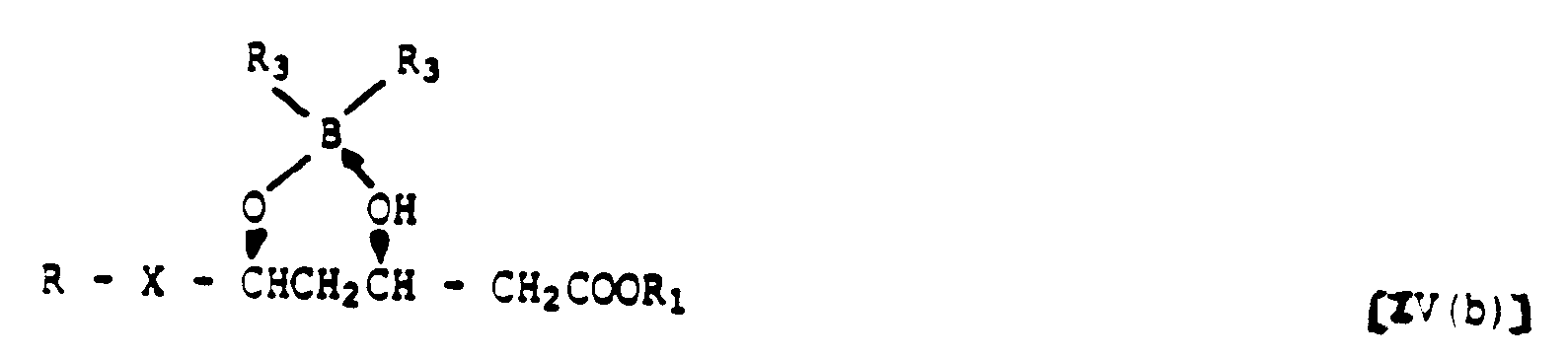
- step (b) a compound of formula II is treated with the mixture obtained in step (a) under conditions suitable to obtain a mixture containing a cyclic boronate compound of formula IV(a) and/or a boron complex of formula IV(b) wherein R, R1, R3 and X are as defined above.
- the latter predominates prior to quenching. However, quenching converts the boron complex into boronate ester.
- step (c) the product obtained in step (b) is cleaved to obtain a corresponding compound of formula I.
- Step (a) is preferably carried out under essentially anhydrous conditions, preferably in an inert atmosphere, at from about -100° to about +30°C, preferably at from about -80° to about -60 °C, especially at from about -78° to about -70°C.
- the reaction medium employed in step (a) comprises a mixture of alcohol and tetrahydrofuran wherein the alcohol is of formula AlkOH, in which Alk is alkyl of l to 4 carbon atoms, e.g. methyl or ethyl, preferably not tertiary.
- One of the products of step (a) may be R4OH, derived from the compound of formula III employed. However, it is not necessary that all or part of Alk be the same as R4.
- the sodium borohydride should generally be present in at least equimolar amount with the compound of formula II, and more preferably in slight excess, such as e.g. from about 1.1:1 to about 1.5 : 1 moles NaBH4 per mole of ketone.
- the molar ratio of the compound of formula III to the compound of formula II is at least about 0.5 : 1, and more preferably from about 0.7 : 1 to about 1.5 : 1 moles of borane compound per mole of ketone.
- Step (b) is also preferably carried out at reduced temperatures, the internal temperature being maintained at about -100° to about -40°C, especially from about -78° to about -70°C.
- the compound of formula II is preferably in a solvent such as alcohol/THF or THF.
- the reaction medium of step (a) and the solvent of the compound of formula II which is added in step (b) are selected to make up a combined medium wherein the ratio (v/v) of alcohol to tetrahydrofuran is from about l:3 to about l:6 of alcohol to THF, especially from about l:3 to about 1:4.
- Reduction of the keto group is exothermic and occurs rapidly, and therefore, addition of the keto compound is desirably staged in order to maintain an internal temperature in the range of from about -78° to about -70°C.
- the reduction is almost instantaneous and the reaction mixture is then quenched by adding, e.g., aqueous sodium bicarbonate, ammonium chloride or acetic acid, and a mixture of the desired cyclic boronate intermediate is obtained.
- step (c) the reaction product of step (b) may be azeotroped with methanol or ethanol, at, e.g., from about 60° to about 80°C, under essentially anhydrous conditions.
- the product having been neutralized by addition of sodium bicarbonate (NaHCO3) is dissolved in an organic solvent, e.g., ethyl acetate, and treated with aqueous (e.g. 30 %) hydrogen peroxide or aqueous sodium perborate (NaBO3.4H2O), initially at reduced temperature, e.g. about +10°C, and then allowed to warm to a moderate temperature, e.g. about 20° to about 30°C, to obtain the corresponding compound of formula I.
- the cyclic boronate ester from step (b) may be extracted with an organic solvent such as ethyl acetate and then treated directly with an aqueous solution of a peroxy compound such as 30 % aqueous hydrogen peroxide or aqueous sodium perborate solution to obtain the corresponding compound of formula I.
- an organic solvent such as ethyl acetate
- a peroxy compound such as 30 % aqueous hydrogen peroxide or aqueous sodium perborate solution
- any substituents or functions on the radical employed as R will be inert, i.e. that it will be free of substituents or functions which would be reactive or susceptible of alteration under such conditions, e.g. by known methods of masking or protecting such functions or introducing them at a later stage.
- the compounds of formula I may if desired be converted by conventional means into corresponding free acid or salt forms, i.e. wherein R1 is replaced by hydrogen or a cation, such as an alkali metal cation or ammonium, preferably sodium or potassium and especially sodium, into other ester forms, or into the corresponding ⁇ -lactones, i.e. internal esters.
- R1 is replaced by hydrogen or a cation, such as an alkali metal cation or ammonium, preferably sodium or potassium and especially sodium, into other ester forms, or into the corresponding ⁇ -lactones, i.e. internal esters.
- the compounds of formula I obtained according to the process of the invention are pharmaceuticals.
- the process of the invention may also be applied to the preparation of chiral intermediates, of e.g. formula Iu wherein
- the corresponding tri-(primary or secondary C2 ⁇ 4alkyl)boranes may be prepared in situ from the corresponding tri-(primary or secondary C2 ⁇ 4alkyl)boranes by reaction with a primary or secondary C1 ⁇ 4alkanol or allyl alcohol, the concentration of the former in the latter preferably being from about 0.2 M to about l.2 M, especially about 0.5 M.
- the present invention also comprises the preparation of the compounds of the invention via a novel process for the preparation of a subgroup of compounds of formula V, namely the compounds of formula Va wherein
- process A The process for the preparation of the compounds of formula VII is hereinafter designated as “ process A” and the process for the preparation of the compounds of formula Va is hereinafter designated as “ process B ".
- the compounds of formulae Va, VII and XVII are known from i.a. USP 4 739 073 which discloses the compounds of formula VII wherein R12 is C1 ⁇ 3alkyl and their use for the synthesis of the compounds of formula Va, the compounds of formula XVII, and the use of the compounds of formula Va for the synthesis of indole analogs of mevalonolactone and derivatives thereof which are indicated for use as HMG-CoA reductase inhibitors. Since they inhibit cholesterol synthesis, they lower the blood cholesterol level and are therefore indicated for use in the treatment of hypercholesterolemia, hyperlipoproteinemia and atherosclerosis.
- step (iii) may be dispensed with and a compound of formula XII used directly in, e.g., process B.
- Steps (i) and (ii) may be carried out simultaneously or step (ii) may follow step (i); step (iii) follows step (ii) and step (iv) (see hereafter), when employed, follows step (iii).
- R12 is R 12a , where R 12a is C1 ⁇ 3alkyl; or R 12b , where R 12b with the exception of C1 ⁇ 3alkyl has the significance indicated above for R12 (i.e. it is phenyl or phenyl substituted by 1 to 3 substituents each of which is independently C1 ⁇ 3alkyl, C1 ⁇ 3alkoxy, fluoro, chloro, bromo or nitro with a maximum of two nitro groups).
- R 12a is preferably C1 ⁇ 2alkyl and most preferably methyl.
- R 12b is preferably R 12b ' where R 12b ' is phenyl or phenyl substituted by 1 or 2 substituents each of which is independently C1 ⁇ 3alkyl, C1 ⁇ 2alkoxy or chloro, more preferably R 12b '' where R 12b '' is phenyl or phenyl substituted by 1 or 2 methyl groups, and most preferably phenyl.
- R13 is preferably C1 ⁇ 2alkyl and most preferably methyl.
- R14 is preferably C1 ⁇ 6alkyl, preferably primary or secondary C2 ⁇ 4alkyl, more preferably n-C2 ⁇ 4alkyl and most preferably ethyl or n-butyl.
- Each X a is preferably chloro or bromo, especially chloro.
- Each X a ⁇ is preferably chloride or bromide, especially chloride.
- the base utilized in the hydrolysis or neutralization of step (iii) is preferably an inorganic base such as sodium carbonate, potassium carbonate, sodium hydroxide or potassium hydroxide and more preferably is sodium carbonate or potassium carbonate.
- Preferred reaction conditions for process A are as follows:
- step (iii) with base.
- the reaction medium for steps (i) and (ii) may, alternatively and preferably, consist of the neat reagents, i.e. the reagents in the absence of any solvent, i.e. for step (i) the compounds of formulae VIII and IX and for step (ii) the compounds of formulae X and XI.
- This is very advantageous from e.g. an ecological point of view since the presence of solvents such as acetonitrile in waste water or the emission of vapours of e.g.methylene chloride into the atmosphere is avoided thereby.
- the compounds of formulae VIII and IX or, respectively, X and XI can be brought to react in the absence of solvent because they do not form a solid block when mixed together but, surprisingly, form a suspension.
- Process A may be divided into two subprocesses depending upon the significances of R12 and R13:
- Preferred reactants in subprocess Aa are those
- Preferred reaction conditions for subprocess Aa particularly when the reactants are those of subgroups (a), (d) and (g), more particularly when they are those of subgroups (b), (e) and (h) and especially when they are those of subgroups (c), (f) and (i), are:
- subprocess Aa comprises
- Preferred reactants in subprocess Ab are those
- Preferred reaction conditions for subprocess Ab particularly when the reactants are those of subgroups (a), (d) and (g), more particularly when they are those of subgroups (b), (e) and (h) and especially when they are those of subgroups (c), (f) and (i), are:
- variants Ab1, Ab2 and Ab3 There are three preferred variants of subprocess Ab , namely variants Ab1, Ab2 and Ab3 .
- variant Ab1 R14 is ethyl and the reaction medium for steps (i) and (ii) is methylene chloride or, preferably, the neat reagents
- variants Ab2 and Ab3 R14 is n-butyl and the reaction medium for steps (i) and (ii) is acetonitrile or, preferably, the neat reagents.
- step (ii) is carried out after step (i) and in variant Ab3 steps (i) and (ii) are carried out simultaneously; in each variant, step (iii) follows steps (i) and (ii).
- Variant Ab1 of subprocess Ab preferably comprises
- Variant Ab2 of subprocess Ab preferably comprises
- Variant Ab3 of subprocess Ab preferably comprises(i) and (ii) reacting N-methylformanilide with oxalyl chloride neat or in acetonitrile at -10° to +30°C in the presence of n-butyl vinyl ether to form the compound of formula Xb, which compound then reacts with the n-butyl vinyl ether in the reaction mixture to form the compound of formula XIIb2, and
- step (iii) of subprocess Ab may be subjected to a step (iv) analogous to step (iv) of subprocess Aa.
- step (iv) analogous to step (iv) of subprocess Aa.
- process B comprises
- step (i) a compound of formula XII obtained according to process A may be used directly in place of a compound of formula VIIc.
- R 12b and R13 are set forth above, and the preferences for R5, R6, R7 and R8 are those set forth for R0, R, R2 and R3, respectively, in USP 4 739 073.
- X b preferably is chloro.
- a compound of formula VIIc preferably is reacted with a compound of formula XV.
- Steps (i) and (ii) preferably are effected in an inert anhydrous organic medium.
- R5 and R6 are hydrogen
- R7 is 1-methylethyl
- R8 is para-fluorophenyl
- the compounds of formula VIIc used for step (i) may be in free base form or, preferably, in acid addition salt form, e.g. in hydrochloride acid addition salt form.
- step (iii) are inorganic hydroxides such as sodium hydroxide and potassium hydroxide, especially the former. However, as set forth infra , it is most preferred not to employ any base in step (iii).
- Preferred reaction conditions for process B are:
- reaction conditions for process B particularly when the reactants and final products are those of subgroups (a)-(v), especially of subgroups (i), (j), (m), (n), (q), (r) and (u), are:
- ratios are merely exemplary and may be varied, as is evident to one of ordinary skill in the art.
- Steps (i) and (ii) of process A including subprocesses Aa and Ab and the variants thereof), steps (i) and (ii) of process B and, preferably, step (iv) of subprocess Aa are preferably carried out under anhydrous conditions and an inert atmosphere, preferably dry helium, argon or nitrogen, or a mixture thereof, usually dry nitrogen.
- Step (iii) of process A (including subprocesses Aa and Ab and the variants thereof) and process B are often, but need not be, carried out under an inert atmosphere.
- reaction medium embraces mixtures of liquids and implies that the reaction medium is a liquid at the desired reaction temperature. It should, therefore, be understood that not all of the liquids listed for a particular step may be utilized for the entire recited temperature range. It should also be understood that the reaction medium must be at least substantially inert to the reactants employed, intermediates generated and end products under the reaction conditions utilized. It should be understood that the reaction temperature may exceed the boiling point of a reactant or the reaction medium if a condenser or a closed system (reaction bomb) is utilized.
- reaction times set forth above are also merely exemplary and may be varied.
- solvent as utilized herein, embraces mixtures of solvents and implies that the reaction medium is a liquid at the desired reaction temperature. Unless indicated otherwise all solvent mixtures are by volume.
- inert atmosphere means an atmosphere that does not react with any of the reactants, intermediates or end products or otherwise interfere with the reaction.
- the product of each process may, if desired, be purified by conventional techniques such as recrystallization, chromatography or fractional distillation.
- process variants disclosed with the present invention are improvements over known similar processes; they may be used to obtain the desired end products, i.e. 7-substituted-hept-6-enoic and -heptanoic acids and derivatives thereof, e.g. more easily, or in e.g. a greater state of chemical or optical purity than can be achieved with conventional methods.
- a specific illustration of the general inventive concept underlying the above process variants concerns the preparation of erythro-(E)-3,5-dihydroxy-7-[3'-(4''fluorophenyl)-1'-(1''-methylethyl)indol-2'-yl]-hept-6-enoic acid of formula Ia in racemic or optically pure form; in free acid, salt, ester or ⁇ -lactone, i.e. internal ester, form, in a multistep process using all the above process variants, namely processes A, B and the stereoselective reduction of a compound of formula II, and comprising:
- the compound of formula Ia may be in free acid, salt, ester or ⁇ -lactone, i.e. internal ester, form. It preferably is in free acid or salt, preferably alkaline salt, especially sodium salt form. It preferably is in racemic or, alternatively, optically pure (3R,5S) enantiomeric form it especially is in racemic form. As appears from formula Ia that form is the erythro form.
- a compound of formula IIa is used wherein R1 is isopropyl or, especially, t-butyl, which facilitates the isolation of a relatively more pure compound of formula I than with a group R1 such as methyl.
- R1 is isopropyl or, especially, t-butyl, which facilitates the isolation of a relatively more pure compound of formula I than with a group R1 such as methyl.
- the stereoselective reduction according to step h) above may be effected with a racemic or an optically pure compound of formula IIa.
- An optically pure compound of formula IIa is obtained e.g. by chromatographic resolution of a racemic compound of formula IIa obtained in step g) or, preferably, by an asymmetrical synthesis. Alternatively, resolution may be effected on a subsequent step, or on the racemic end product.
- a second crop is obtained from the mother liquors, to give a total yield of l49.5 g.
- the product has a chemical purity of 99.44% and is 99.67% pure erythro isomer. It may be resolved into two optically active enantiomers, the 3R, 5S and 3S,5R, of which the former is preferred.
- step (a) one half of the indicated amount of sodium borohydride may be used.
- aqueous sodium perborate solution may be used in place of 30 % hydrogen peroxide solution.
- reaction mixture is stirred at 28° to 30° for 30 minutes instead of at 30° to 35°, a 90.7 % yield of a 92.3 % pure product is obtained.
- isopropanol is used in place of 95 % ethanol.
- isopropanol is used in place of 95 % ethanol.
- the pad of silica gel i.e. the powdered cellulose-containing liquid is subjected to a simple filtration, and it is the residue therefrom that is washed three times with 200 ml portions of toluene.
- Example 10 a ( E)-3-[3'-(4''-Fluorophenyl)-1'-(1''-methylethyl)-1H-indol-2'-yl]prop-2-enal
Landscapes
- Chemical & Material Sciences (AREA)
- Organic Chemistry (AREA)
- Health & Medical Sciences (AREA)
- Chemical Kinetics & Catalysis (AREA)
- Engineering & Computer Science (AREA)
- Pharmacology & Pharmacy (AREA)
- Public Health (AREA)
- Obesity (AREA)
- Diabetes (AREA)
- General Chemical & Material Sciences (AREA)
- Medicinal Chemistry (AREA)
- Nuclear Medicine, Radiotherapy & Molecular Imaging (AREA)
- Bioinformatics & Cheminformatics (AREA)
- Life Sciences & Earth Sciences (AREA)
- Animal Behavior & Ethology (AREA)
- General Health & Medical Sciences (AREA)
- Hematology (AREA)
- Veterinary Medicine (AREA)
- Oil, Petroleum & Natural Gas (AREA)
- Organic Low-Molecular-Weight Compounds And Preparation Thereof (AREA)
- Pharmaceuticals Containing Other Organic And Inorganic Compounds (AREA)
- Indole Compounds (AREA)
- Pyrane Compounds (AREA)
- Acyclic And Carbocyclic Compounds In Medicinal Compositions (AREA)
- Steroid Compounds (AREA)
- Heterocyclic Carbon Compounds Containing A Hetero Ring Having Oxygen Or Sulfur (AREA)
Claims (14)
- Un procédé de préparation d'un composé de formule I
 X signifie -CH₂CH₂-ou-CH=CH-,R₁ signifie un groupe ester inerte sous les conditions de la réaction, etR signifie un radical organique ayant des groupes qui sont inertes sous des conditions de réduction,R₁ comprenant également un groupe a!lyle et X signifiant un groupe - OCH₂-lorsque R signifie un groupe triphénylméthyle,
par réduction stéréosélective d'un composé racémique ou optiquement pur de formule II
R, R₁ et X sont tels que définis ci-dessus, et
l'un des symboles Z₁ et Z₂ signifie l'oxygène et l'autre signifie l'hydrogène ou un groupe hydroxy,
lequel procédé comprend
selon une première étape [étape (a)], le mélange d'un composé de formule III
R₄O-B-(R₃)₂ (III)
dans laquelleR₄ signifie un groupe allyle ou alkyle inférieur ayant de l à 4 atomes de carbone, etR₃ signifie un groupe alkyle primaire ou secondaire ayant de 2 à 4 atomes de carbone,avec du borohydrure de sodium NaBH₄ dans un milieu de réaction comprenant un alcool et du tétrahydrofuranne,
selon une seconde étape [étape (b)], le traitement d'un composé de formule II par le mélange obtenu à l'étape (a) sous des conditions appropriées pour obtenir un mélange contenant un boronate cyclique de formule IV (a)
selon une troisième étape [étape (c)], le clivage du produit obtenu à l'étape (b) pour obtenir un composé correspondant de formule I,
et, si on le désire, la transformation selon des moyens classiques du composé obtenu de formule I en acide libre, en un sel, en un autre ester ou en δ-lactone, c'est-à-dire en ester interne. - Un procédé selon la revendication 1 pour la préparation d'un composé de formule Iu
 u signifie un groupe triphénylméthyle (trityle), etRu signifie un groupe allyle ou un radical formant un ester inerte sous les conditions de la réaction, de préférence un groupe allyle ou alkyle en C₁-C₃, n-butyle, iso-butyle, tert.-butyle ou benzyle, spécialement tert.-butyle,par réduction stéréosélective d'un composé racémique ou optiquement pur de formuel IIu

- Un procédé selon la revendication 1 pour la préparation du composé de formule Ia

d'ester ou de δ-lactone, c'est-à-dire sous forme d'ester interne,
et comprenant, si on le désire, la transformation selon des moyens classiques du composé obtenu de formule Ia sous forme d'ester en acide libre, en sel, en un autre ester ou en δ-lactone, c'est-à-dire en ester interne. - Un procédé selon la revendication 1, dans lequel, pour le produit de départ de formule II, un précurseur de formule Va
 R₅ signifie l'hydrogène ou un groupe alkyle en C₁-C₃, n-butyle, iso-butyle, tert.-butyle, cycloalkyle en C₃-C₆, alcoxy en C₁-C₃, n-butoxy, iso-butoxy, trifluorométhyle, fluoro, chloro, phénoxy ou benzyloxy,R₆ signifie l'hydrogène ou un groupe alkyle en C₁-C₃, alcoxy en C₁-C₃, trifluorométhyle, fluoro, chloro, phénoxy ou benzyloxy,un seul des symboles R₅ et R₆ pouvant signifier un groupe trifluorométhyle, un seul des symboles R₅ et R₆ pouvant signifier un groupe phénoxy et un seul des symboles R₅ et R₆ pouvant signifier un groupe benzyloxy,
un des symboles R₇ et R₈ signifie un groupe phényle trisubstitué par R₉, R₁₀ et R₁₁ et l'autre symbole signifie un groupe alkyle en C₁-C₆ primaire ou secondaire ne contenant pas d'atome de carbone asymétrique, un groupe cycloalkyle en C₃-C₆ ou un groupe phényl-(CH₂)m-,
oùR₉ signifie l'hydrogène ou un groupe alkyle en C₁-C₃, n-butyle, iso-butyle, tert.-butyle, alcoxy en C₁-C₃, n-butoxy, iso-butoxy, trifluorométhyle, fluoro, chloro, phénoxy ou benzyloxy,R₁₀ signifie l'hydrogène ou un groupe alkyle en C₁-C₃, alcoxy en C₁-C₃, trifluorométhyle, fluoro, chloro, phénoxy ou benzyloxy,R₁₁ signifie l'hydrogène ou un groupe alkyle en C₁-C₂, alcoxy en C₁-C₂, fluoro ou chloro, etm signifie 1, 2 ou 3,un seul des symboles R₉ et R₁₀ pouvant signifier un groupe trifluorométhyle, un seul des symboles R₉ et R₁₀ pouvant signifier un groupe phénoxy et un seul des symboles R₉ et R₁₀ pouvant signifier un groupe benzyloxy,
est préparé comme suit:(i) réaction d'un composé de formule VIIIa
OHC - N(212b)R₁₃ (VIIIa)
dans laquelleR12b signifie un groupe phényle ou un groupe phényle portant de 1 à 3 substituants choisis chacun indépendamment parmi les groupes alkyle en C₁-C₃, alcoxy en C₁-C₃, fluoro, chloro, bromo et nitro, avec un maximum de deux groupes nitro, etR₁₃ indépendamment a la signification indiquée ci-dessus pour R12b ou signifie un groupe alkyle en C₁-C₃,avec un composé de formule IX
Xa - CO-CO - Xa (IX)
où Xa signifie un groupe éliminable monovalent,
éventuellement dans un milieu organique inerte et anhydre, pour former le composé correspondant de formule Xc
Xa -CH=N⁺ (R12b)R₁₃ Xa⁻ (Xc)
où Xa, R12b et R₁₃ sont tels que définis dans la présente revendication,(ii) réaction de ce composé de formule Xc
avec un composé de formule XI
R₁₄ O - CH=CH₂ (XI)
où R₁₄ signifie un groupe monovalent qui ne désactive pas l'atome d'oxygène auquel il est fixé,
éventuellement dans un milieu organique inerte et anhydre,
pour former un composé correspondant de formule XIIc
(E) - R₁₄O - CH=CH - CH=N⁺(R12b)R₁₃ Xa⁻ (XIIc)
où R12b, R₁₃ ,R₁₄ et Xa sont tels que définis dans la présente revendication, et(iii) hydrolyse de ce composé de formule XIIc
pour obtenir un composé correspondant de formule VIIc
(E) - OHC - CH=CH- N(R12b)R₁₃ (VIIc)
où R12b et R₁₃ sont tels que définis dans la présente revendication, sous forme de base libre ou d'un sel d'addition d'acide et, lorsqu'il est sous forme d'un sel d'addition d'acide, neutralisation du sel d'addition d'acide avec une base,(iv) réaction de ce composé de formule VIIc
avec un composé de formule XV
PO(Xb)₃ (XV)
où Xb signifie le chlore ou le brome, ou
avec un composé choisi parmi le chlorure ou bromure d'oxalyle; le phosgène ou bromure de carbonyle; le trichlorure ou tribromure de phosphore; le pentachlorure ou pentabromure de phosphore, et un chlorure ou bromure d'alkylsulfonyle ou d'arylsulfonyle tel que le chlorure ou bromure de p-toluènesulfonyle ou le chlorure ou bromure de méthanesulfonyle,
pour former le composé correspondant de formule XVI
(E)- Xb - CH=CH-CH=N⁺(R12b)R₁₃ (XVI)
et l'anion correspondant, par exemple ⁻PO₂(Xb)₂,
où Xb, R12b et R₁₃ sont tels que définis dans la présente revendication,(v) réaction de ce composé de formule XVI
avec un composé de formule XVII

où R₅, R₆, R₇, R₈, R12b, R₁₃ et Xb sont tels que définis dans la présente revendication, et(vi) hydrolyse de ce composé de formule XVIII pour obtenir un composé correspondant de formule Va. - Un procédé selon la revendication 4, dans lequel l'étape (iii) est omise et le composé de formule XIIc est utilisé directement à la place du composé de formule VIIc pour le traitement subséquent.
- Un procédé selon la revendication 4, dans lequel les étapes (i) et (ii) sont effectuées simultanément.
- Un procédé selon la revendication 4, dans lequel dans les étapes (i) et/ou (ii), les produits de réaction sont utilisés purs, sans solvant.
- Un procédé selon la revendication 4, dans lequel le composé de formule XII est sous forme d'un sel d'addition d'acide.
- Un procédé selon la revendication 3, dans lequel le produit de départ de formule II répond à la formule IIa

et est préparé de la manière suivante:a) réaction d'un composé de formule VIIIa tel que défini à la revendication 4, avec un composé de formule IX tel que défini à la revendication 4, éventuellement dans un milieu organique inerte et anhydre, pour former un composé correspondant de formule Xc tel que défini à la revendication 4,b) réaction de ce composé de formule Xc avec un composé de formule XI tel que défini à la revendication 4, éventuellement dans un milieu organique inerte et anhydre,
pour former un composé correspondant de formule XIIc tel que défini à la revendication 4,c) hydrolyse de ce composé de formule XIIc pour obtenir un composé correspondant de formule VIIc tel que défini à la revendication 4, sous forme de base libre ou d'un sel d'addition d'acide et, lorsqu'il est sous forme d'un sel d'addition d'acide, neutralisation du sel d'addition d'acide avec une base,d) réaction de ce composé de formule VIIc
avec un composé de formule XV tel que défini à la revendication 4 ou avec un composé choisi parmi le chlorure ou bromure d'oxalyle; le phosgène ou bromure de carbonyle; le trichlorure ou tribromure de phosphore; le pentachlorure ou pentabromure de phosphore, et un chlorure ou bromure d'alkylsulfonyle ou d'arylsulfonyle, tel que le chlorure ou bromure de p-toluènesulfonyle ou le chlorure ou bromure de méthanesulfonyle,
pour former un composé correspondant de formule XVI tel que défini à la revendication 4 et l'anion correspondant, par exemple ⁻PO₂(Xb)₂,e) réaction de ce composé de formule XVI avec
le 3-(4'-fluorophényl)-1-(1 '-méthyléthyl)- 1H-indole (le composé de formule XVII où R₅ et R₆ signifient l'hydrogène, R₇ signifie un groupe 1-méthyléthyle et R₈ signifie un groupe p-fluorophényle) pour former un composé correspondant de formule XVIIIa f) hydrolyse de ce composé de formule XVIIIa pour obtenir le (E)-3-[3'-(4''-fluorophényl)- 1'-(1''-méthyléthyl)-1H-indole-2'-yl]-prop-2-énal (le composé de formule Va où R₅ et R₆ signifient l'hydrogène, R₇ signifie un groupe 1-méthyléthyle et R₈ signifie un groupe p-fluorophényle), etg) réaction de ce composé de formule Va avec le dianion d'un ester acétoacétique de formule CH₃COCH₂COOR₁ où R₁ est tel que défini à la revendication 1.
- Un procédé selon la revendication 3, dans lequel le composé de formule Ia est obtenu sous forme racémique.
- Un procédé selon la revendication 3, dans lequel le composé de formule Ia est obtenu sous forme énantiomère (3R,5S).
- Un procédé selon la revendication 3, dans lequel le composé de formule Ia est obtenu sous forme de sel de sodium.
- Un procédé selon la revendication 4, dans lequel R12b signifie un groupe phényle et R₁₃ signifie un groupe méthyle.
- Un procédé selon la revendication 3, dans lequel R₁ signifie un groupe tert.-butyle.
Priority Applications (2)
| Application Number | Priority Date | Filing Date | Title |
|---|---|---|---|
| SG1996003931A SG63583A1 (en) | 1988-10-13 | 1989-10-11 | 7-substituted-hept-6-enoic and - heptanoic acids and derivatives thereof |
| AT89118906T ATE99281T1 (de) | 1988-10-13 | 1989-10-11 | Verfahren zur herstellung von 7-substituierten hept-6-en- und heptansaeuren und derivaten davon. |
Applications Claiming Priority (4)
| Application Number | Priority Date | Filing Date | Title |
|---|---|---|---|
| US25747588A | 1988-10-13 | 1988-10-13 | |
| US257475 | 1988-10-13 | ||
| US35553189A | 1989-05-22 | 1989-05-22 | |
| US355531 | 1989-05-22 |
Related Child Applications (1)
| Application Number | Title | Priority Date | Filing Date |
|---|---|---|---|
| EP93106005.7 Division-Into | 1993-04-13 |
Publications (2)
| Publication Number | Publication Date |
|---|---|
| EP0363934A1 EP0363934A1 (fr) | 1990-04-18 |
| EP0363934B1 true EP0363934B1 (fr) | 1993-12-29 |
Family
ID=26945992
Family Applications (2)
| Application Number | Title | Priority Date | Filing Date |
|---|---|---|---|
| EP19930106005 Ceased EP0562643A3 (en) | 1988-10-13 | 1989-10-11 | 7-substituted-hept-6-enoic and -heptanoic acids and derivatives thereof |
| EP89118906A Expired - Lifetime EP0363934B1 (fr) | 1988-10-13 | 1989-10-11 | Procédé pour la préparation des acides hept-6-énoiques et heptanoiques substitués sur la position 7 et dérivés |
Family Applications Before (1)
| Application Number | Title | Priority Date | Filing Date |
|---|---|---|---|
| EP19930106005 Ceased EP0562643A3 (en) | 1988-10-13 | 1989-10-11 | 7-substituted-hept-6-enoic and -heptanoic acids and derivatives thereof |
Country Status (24)
| Country | Link |
|---|---|
| EP (2) | EP0562643A3 (fr) |
| JP (1) | JP2853227B2 (fr) |
| KR (1) | KR0162656B1 (fr) |
| AT (1) | ATE99281T1 (fr) |
| AU (1) | AU636122B2 (fr) |
| BG (1) | BG60555B1 (fr) |
| CA (1) | CA2000553C (fr) |
| CZ (1) | CZ283316B6 (fr) |
| DE (1) | DE68911834T2 (fr) |
| DK (1) | DK175073B1 (fr) |
| ES (1) | ES2060712T3 (fr) |
| FI (1) | FI98063C (fr) |
| HK (1) | HK49496A (fr) |
| HU (1) | HU207993B (fr) |
| IE (2) | IE63477B1 (fr) |
| IL (1) | IL91941A (fr) |
| MY (1) | MY105067A (fr) |
| NO (1) | NO174623C (fr) |
| NZ (1) | NZ230973A (fr) |
| RO (1) | RO109732B1 (fr) |
| SG (1) | SG139553A1 (fr) |
| SK (1) | SK579789A3 (fr) |
| WO (1) | WO1990003962A1 (fr) |
| YU (1) | YU48466B (fr) |
Cited By (1)
| Publication number | Priority date | Publication date | Assignee | Title |
|---|---|---|---|---|
| US7368469B2 (en) | 1999-08-30 | 2008-05-06 | Sanofi-Aventis Deutschland Gmbh | Use of inhibitors of the renin-angiotensin system in the prevention of cardiovascular events |
Families Citing this family (28)
| Publication number | Priority date | Publication date | Assignee | Title |
|---|---|---|---|---|
| US5118853A (en) * | 1988-10-13 | 1992-06-02 | Sandoz Ltd. | Processes for the synthesis of 3-disubstituted aminoacroleins |
| US5290946A (en) * | 1988-10-13 | 1994-03-01 | Sandoz Ltd. | Processes for the synthesis of 3-(substituted indolyl-2-yl)propenaldehydes |
| EP0422895A1 (fr) * | 1989-10-10 | 1991-04-17 | Glaxo Group Limited | Composés chimiques |
| DE4424525A1 (de) * | 1994-07-12 | 1995-01-26 | Elmar Meyer | Dauermagnet-Kolbenmotor |
| GT199800127A (es) | 1997-08-29 | 2000-02-01 | Combinaciones terapeuticas. | |
| CN1217930C (zh) | 2000-05-26 | 2005-09-07 | 西巴特殊化学品控股有限公司 | 吲哚衍生物的制备方法和该方法的中间体 |
| US7777006B2 (en) | 2002-12-31 | 2010-08-17 | Csl Behring L.L.C. | Method for purification of alpha-1-antitrypsin |
| WO2004094377A1 (fr) * | 2003-04-24 | 2004-11-04 | Daicel Chemical Industries Ltd. | Procede pour separer des esters d'acide dihydroxy-heptenoique optiquement actifs |
| EP1790634A3 (fr) | 2003-06-18 | 2007-06-13 | Teva Pharmaceutical Industries Ltd. | Forme cristalline de sodium de fluvastatine et ses procédés de préparation |
| US7368468B2 (en) | 2003-06-18 | 2008-05-06 | Teva Pharmaceutical Industries Ltd. | Fluvastatin sodium crystal forms XIV, LXXIII, LXXIX, LXXX and LXXXVII, processes for preparing them, compositions containing them and methods of using them |
| US7368581B2 (en) | 2003-06-18 | 2008-05-06 | Teva Pharmaceutical Industries Ltd. | Process for the preparation of fluvastatin sodium crystal from XIV |
| JP2007512347A (ja) | 2003-11-26 | 2007-05-17 | デューク・ユニバーシティー | 緑内障を予防するかまたは治療する方法 |
| US7851624B2 (en) | 2003-12-24 | 2010-12-14 | Teva Pharamaceutical Industries Ltd. | Triol form of rosuvastatin and synthesis of rosuvastatin |
| US20060211752A1 (en) | 2004-03-16 | 2006-09-21 | Kohn Leonard D | Use of phenylmethimazoles, methimazole derivatives, and tautomeric cyclic thiones for the treatment of autoimmune/inflammatory diseases associated with toll-like receptor overexpression |
| US7741317B2 (en) | 2005-10-21 | 2010-06-22 | Bristol-Myers Squibb Company | LXR modulators |
| US7888376B2 (en) | 2005-11-23 | 2011-02-15 | Bristol-Myers Squibb Company | Heterocyclic CETP inhibitors |
| ATE431818T1 (de) | 2006-04-20 | 2009-06-15 | Italiana Sint Spa | Verfahren zur herstellung von fluvastatin-natrium |
| EP2327682A1 (fr) | 2009-10-29 | 2011-06-01 | KRKA, D.D., Novo Mesto | Utilisation de composés amphiphiles pour la crystallisation controlée de statines et d'intermediaires de statines. |
| WO2010069593A1 (fr) | 2008-12-19 | 2010-06-24 | Krka, D. D., Novo Mesto | Utilisation de composés amphiphiles pour la cristallisation régulée de statines et d'intermédiaires de statines |
| WO2013113067A1 (fr) | 2012-02-02 | 2013-08-08 | The University Of Sydney | Améliorations dans la stabilité du film lacrymal |
| CN105143203A (zh) | 2013-04-17 | 2015-12-09 | 辉瑞大药厂 | 用于治疗心血管疾病的n-哌啶-3-基苯甲酰胺衍生物 |
| WO2016055901A1 (fr) | 2014-10-08 | 2016-04-14 | Pfizer Inc. | Composés d'amide substitué |
| WO2020150473A2 (fr) | 2019-01-18 | 2020-07-23 | Dogma Therapeutics, Inc. | Inhibiteurs de pcsk9 et leurs procédés d'utilisation |
| TW202545529A (zh) | 2024-02-05 | 2025-12-01 | 瑞典商阿斯特捷利康公司 | 組合療法 |
| TW202602886A (zh) | 2024-03-20 | 2026-01-16 | 瑞典商阿斯特捷利康公司 | Pcsk9抑制劑及其使用方法 |
| TW202602866A (zh) | 2024-03-20 | 2026-01-16 | 瑞典商阿斯特捷利康公司 | Pcsk9抑制劑及其使用方法 |
| TW202539678A (zh) | 2024-03-20 | 2025-10-16 | 瑞典商阿斯特捷利康公司 | Pcsk9抑制劑及其使用方法 |
| TW202612699A (zh) | 2024-05-16 | 2026-04-01 | 瑞典商阿斯特捷利康公司 | 組合療法 |
Family Cites Families (10)
| Publication number | Priority date | Publication date | Assignee | Title |
|---|---|---|---|---|
| GB945536A (en) * | 1961-09-08 | 1964-01-02 | Istituto Chemioterapico | Method of preparing ª -amino-acroleins |
| US4739073A (en) * | 1983-11-04 | 1988-04-19 | Sandoz Pharmaceuticals Corp. | Intermediates in the synthesis of indole analogs of mevalonolactone and derivatives thereof |
| HU204253B (en) * | 1982-11-22 | 1991-12-30 | Sandoz Ag | Process for producing mevalonolactone analogues and derivatives and pharmaceutical compositions containing them |
| US4571428A (en) * | 1983-07-08 | 1986-02-18 | Sandoz, Inc. | 6-Substituted-4-hydroxy-tetrahydropyran-2-ones |
| US4650890A (en) * | 1984-04-03 | 1987-03-17 | Sandoz Corp. | Preparation of olefinic compounds and intermediates thereof |
| HU198711B (en) * | 1984-06-22 | 1989-11-28 | Sandoz Ag | Process for producing mevalolacton, derivatives and pyrazol analogues and pharmaceutical composition containing them |
| HU198005B (en) * | 1984-12-04 | 1989-07-28 | Sandoz Ag | Process for producing mevqlolakton, derivatives, its indene-analogues and pharmaceutical compositions containing them |
| US4668794A (en) * | 1985-05-22 | 1987-05-26 | Sandoz Pharm. Corp. | Intermediate imidazole acrolein analogs |
| JPS6322056A (ja) * | 1986-04-30 | 1988-01-29 | サンド・アクチエンゲゼルシヤフト | オレフイン性化合物の製造法 |
| NZ221717A (en) * | 1986-09-10 | 1990-08-28 | Sandoz Ltd | Azaindole and indolizine derivatives and pharmaceutical compositions |
-
1989
- 1989-10-11 IL IL9194189A patent/IL91941A/en not_active IP Right Cessation
- 1989-10-11 RO RO145326A patent/RO109732B1/ro unknown
- 1989-10-11 KR KR1019900701243A patent/KR0162656B1/ko not_active Expired - Lifetime
- 1989-10-11 NZ NZ230973A patent/NZ230973A/xx unknown
- 1989-10-11 SG SG200602066-3A patent/SG139553A1/en unknown
- 1989-10-11 DE DE68911834T patent/DE68911834T2/de not_active Expired - Lifetime
- 1989-10-11 MY MYPI89001403A patent/MY105067A/en unknown
- 1989-10-11 YU YU197389A patent/YU48466B/sh unknown
- 1989-10-11 AU AU43448/89A patent/AU636122B2/en not_active Expired
- 1989-10-11 EP EP19930106005 patent/EP0562643A3/en not_active Ceased
- 1989-10-11 JP JP1510605A patent/JP2853227B2/ja not_active Expired - Lifetime
- 1989-10-11 WO PCT/EP1989/001201 patent/WO1990003962A1/fr not_active Ceased
- 1989-10-11 IE IE327789A patent/IE63477B1/en not_active IP Right Cessation
- 1989-10-11 ES ES89118906T patent/ES2060712T3/es not_active Expired - Lifetime
- 1989-10-11 IE IE940109A patent/IE940109L/xx unknown
- 1989-10-11 AT AT89118906T patent/ATE99281T1/de not_active IP Right Cessation
- 1989-10-11 EP EP89118906A patent/EP0363934B1/fr not_active Expired - Lifetime
- 1989-10-11 HU HU896048A patent/HU207993B/hu unknown
- 1989-10-12 CZ CS895797A patent/CZ283316B6/cs not_active IP Right Cessation
- 1989-10-12 SK SK5797-89A patent/SK579789A3/sk unknown
- 1989-10-12 CA CA002000553A patent/CA2000553C/fr not_active Expired - Lifetime
-
1990
- 1990-06-07 BG BG92179A patent/BG60555B1/bg unknown
- 1990-06-12 NO NO902598A patent/NO174623C/no unknown
- 1990-06-12 FI FI902935A patent/FI98063C/fi active IP Right Grant
- 1990-06-13 DK DK199001446A patent/DK175073B1/da not_active IP Right Cessation
-
1996
- 1996-03-21 HK HK49496A patent/HK49496A/en not_active IP Right Cessation
Non-Patent Citations (2)
| Title |
|---|
| CHEMISTRY LETTERS, 1987, pages 1923-1926, The Chemical Society of Japan; K.M. CHEN et al.: "A Novel Method for the In Situ Generation of Alkoxydialkylboranes and Their Use in the Selective Preparation of 1,3-Syn Diols" * |
| TETRAHEDRON LETTERS, vol. 28, no. 2, 1987, pages 155-158, Oxford, GB, K.-M. CHENG et al.: "1.3-Syn diastereoselective reduction of beta-hydroxyketones utilizing alkoxydialkylboranes" * |
Cited By (1)
| Publication number | Priority date | Publication date | Assignee | Title |
|---|---|---|---|---|
| US7368469B2 (en) | 1999-08-30 | 2008-05-06 | Sanofi-Aventis Deutschland Gmbh | Use of inhibitors of the renin-angiotensin system in the prevention of cardiovascular events |
Also Published As
Similar Documents
| Publication | Publication Date | Title |
|---|---|---|
| EP0363934A1 (fr) | Procédé pour la préparation des acides hept-6-énoiques et heptanoiques substitués sur la position 7 et dérivés | |
| US5189164A (en) | Processes for the synthesis of syn-(E)-3,5-dihydroxy-7-substituted hept-6-enoic and heptanoic acids and derivatives and intermediates thereof | |
| KR960009434B1 (ko) | 3-데메틸메발론산 유도체, 이의 제조방법 및 중간체 | |
| EP0235164B1 (fr) | Analogues d'imidazole de mevalonolactone et leurs derives | |
| KR900001212B1 (ko) | 메바로노락톤 및 그것의 유도체의 헤테로사이클릭 유사체 및 그것의 생산방법 및 약학적인 그것의 용도 | |
| KR890001651B1 (ko) | 메발로노락톤의 피라졸 동족체 및 이의 유도체의 제조방법 | |
| NZ332640A (en) | Optionally fused phenyl methyl substituted indole derivatives useful as endothelin receptor antagonists | |
| JPH04230381A (ja) | 置換されたピロロ−ピリジン類 | |
| KR20100091267A (ko) | 유기 화합물의 제조 방법 | |
| US5013749A (en) | Imidazole derivatives and their use as hypercholesterolemia and hyperlipoproteinemia agents | |
| JPH01272584A (ja) | 5―置換1H―ピラゾロ[3,4―b]ピリジン誘導体、その製法と薬学的組成物 | |
| EP0312269B1 (fr) | Acides 3,5-dihydroxy-6,8-nonadiénoiques et dérivés comme agents hypocholestérolémiques | |
| US4808607A (en) | Imidazole analogs of mevalonolactone and derivatives thereof for use in inhibiting cholesterol biosynthesis and lowering blood cholesterol level | |
| US4851427A (en) | Pyrrole analogs of mevalonolactone, derivatives thereof and pharmaceutical use | |
| KR20020015068A (ko) | 치환된 피페리딘-4-온의 제조 방법 | |
| US5545758A (en) | Process for the preparation of diisopinocampheylchloroborane | |
| US4755606A (en) | Imidazolyl-3,5-di-(diphenyl-butylsilyloxy) carboxylic acid ester intermediates | |
| RU2051907C1 (ru) | Способ получения 7-замещенной гептен-6-овой кислоты | |
| JPH01261375A (ja) | 置換イミダゾリノン類又はイミダゾリチオン類 | |
| SI8911973A (sl) | Postopek za pripravo 7-substituiranih-hept-6-enojskih in heptanojskih kislin ter njihovih derivatov in intermediatov | |
| US4973704A (en) | Pyrrolyl intermediates in the synthesis of pyrrole analogs of mevalonolactone and derivatives thereof | |
| US7193083B2 (en) | Preparation of triazoles by organometallic addition to ketones and intermediates therefor | |
| WO2001072704A1 (fr) | DERIVES AZETODINONE, PROCEDE DE PREPARATION DE CEUX-CI ET PROCEDE DE PRODUCTION DE 1-β-ALKYLE AZETODINONE AU MOYEN DESDITS DERIVES |
Legal Events
| Date | Code | Title | Description |
|---|---|---|---|
| PUAI | Public reference made under article 153(3) epc to a published international application that has entered the european phase |
Free format text: ORIGINAL CODE: 0009012 |
|
| 17P | Request for examination filed |
Effective date: 19891011 |
|
| AK | Designated contracting states |
Kind code of ref document: A1 Designated state(s): AT BE CH DE ES FR GB GR IT LI LU NL SE |
|
| 17Q | First examination report despatched |
Effective date: 19920313 |
|
| GRAA | (expected) grant |
Free format text: ORIGINAL CODE: 0009210 |
|
| AK | Designated contracting states |
Kind code of ref document: B1 Designated state(s): AT BE CH DE ES FR GB GR IT LI LU NL SE |
|
| REF | Corresponds to: |
Ref document number: 99281 Country of ref document: AT Date of ref document: 19940115 Kind code of ref document: T |
|
| XX | Miscellaneous (additional remarks) |
Free format text: TEILANMELDUNG 93106005.7 EINGEREICHT AM 11/10/89. |
|
| REF | Corresponds to: |
Ref document number: 68911834 Country of ref document: DE Date of ref document: 19940210 |
|
| ITF | It: translation for a ep patent filed | ||
| ET | Fr: translation filed | ||
| REG | Reference to a national code |
Ref country code: GR Ref legal event code: FG4A Free format text: 3010941 |
|
| ITTA | It: last paid annual fee | ||
| PLBE | No opposition filed within time limit |
Free format text: ORIGINAL CODE: 0009261 |
|
| STAA | Information on the status of an ep patent application or granted ep patent |
Free format text: STATUS: NO OPPOSITION FILED WITHIN TIME LIMIT |
|
| REG | Reference to a national code |
Ref country code: ES Ref legal event code: FG2A Ref document number: 2060712 Country of ref document: ES Kind code of ref document: T3 |
|
| 26N | No opposition filed | ||
| EAL | Se: european patent in force in sweden |
Ref document number: 89118906.0 |
|
| REG | Reference to a national code |
Ref country code: CH Ref legal event code: PFA Free format text: SANDOZ AG TRANSFER- NOVARTIS AG |
|
| REG | Reference to a national code |
Ref country code: GB Ref legal event code: 732E |
|
| NLS | Nl: assignments of ep-patents |
Owner name: NOVARTIS AG |
|
| REG | Reference to a national code |
Ref country code: FR Ref legal event code: TP |
|
| REG | Reference to a national code |
Ref country code: ES Ref legal event code: PC2A |
|
| REG | Reference to a national code |
Ref country code: GB Ref legal event code: IF02 |
|
| PGFP | Annual fee paid to national office [announced via postgrant information from national office to epo] |
Ref country code: NL Payment date: 20081005 Year of fee payment: 20 |
|
| PGFP | Annual fee paid to national office [announced via postgrant information from national office to epo] |
Ref country code: LU Payment date: 20081016 Year of fee payment: 20 Ref country code: CH Payment date: 20081016 Year of fee payment: 20 Ref country code: DE Payment date: 20081014 Year of fee payment: 20 |
|
| PGFP | Annual fee paid to national office [announced via postgrant information from national office to epo] |
Ref country code: ES Payment date: 20081121 Year of fee payment: 20 Ref country code: AT Payment date: 20081013 Year of fee payment: 20 |
|
| PGFP | Annual fee paid to national office [announced via postgrant information from national office to epo] |
Ref country code: BE Payment date: 20081009 Year of fee payment: 20 Ref country code: IT Payment date: 20081028 Year of fee payment: 20 Ref country code: SE Payment date: 20081022 Year of fee payment: 20 |
|
| PGFP | Annual fee paid to national office [announced via postgrant information from national office to epo] |
Ref country code: FR Payment date: 20081014 Year of fee payment: 20 |
|
| PGFP | Annual fee paid to national office [announced via postgrant information from national office to epo] |
Ref country code: GB Payment date: 20081008 Year of fee payment: 20 Ref country code: GR Payment date: 20080919 Year of fee payment: 20 |
|
| REG | Reference to a national code |
Ref country code: CH Ref legal event code: PL |
|
| BE20 | Be: patent expired |
Owner name: *NOVARTIS A.G. Effective date: 20091011 |
|
| REG | Reference to a national code |
Ref country code: GB Ref legal event code: PE20 Expiry date: 20091010 |
|
| NLV7 | Nl: ceased due to reaching the maximum lifetime of a patent | ||
| EUG | Se: european patent has lapsed | ||
| REG | Reference to a national code |
Ref country code: ES Ref legal event code: FD2A Effective date: 20091013 |
|
| PG25 | Lapsed in a contracting state [announced via postgrant information from national office to epo] |
Ref country code: ES Free format text: LAPSE BECAUSE OF EXPIRATION OF PROTECTION Effective date: 20091013 |
|
| PG25 | Lapsed in a contracting state [announced via postgrant information from national office to epo] |
Ref country code: NL Free format text: LAPSE BECAUSE OF EXPIRATION OF PROTECTION Effective date: 20091011 |
|
| PG25 | Lapsed in a contracting state [announced via postgrant information from national office to epo] |
Ref country code: GB Free format text: LAPSE BECAUSE OF EXPIRATION OF PROTECTION Effective date: 20091010 |