EP0365345B1 - Korona-Elektrodenreinigungsvorrichtung für eine Koronaeinheit - Google Patents
Korona-Elektrodenreinigungsvorrichtung für eine Koronaeinheit Download PDFInfo
- Publication number
- EP0365345B1 EP0365345B1 EP89310809A EP89310809A EP0365345B1 EP 0365345 B1 EP0365345 B1 EP 0365345B1 EP 89310809 A EP89310809 A EP 89310809A EP 89310809 A EP89310809 A EP 89310809A EP 0365345 B1 EP0365345 B1 EP 0365345B1
- Authority
- EP
- European Patent Office
- Prior art keywords
- wire
- cleaning
- corona
- driving
- movement
- Prior art date
- Legal status (The legal status is an assumption and is not a legal conclusion. Google has not performed a legal analysis and makes no representation as to the accuracy of the status listed.)
- Expired - Lifetime
Links
- 238000004140 cleaning Methods 0.000 title claims description 149
- 238000010276 construction Methods 0.000 description 5
- 238000007599 discharging Methods 0.000 description 3
- 239000000428 dust Substances 0.000 description 3
- BASFCYQUMIYNBI-UHFFFAOYSA-N platinum Chemical compound [Pt] BASFCYQUMIYNBI-UHFFFAOYSA-N 0.000 description 2
- 238000000926 separation method Methods 0.000 description 2
- 229910052814 silicon oxide Inorganic materials 0.000 description 2
- -1 silicon oxide compound Chemical class 0.000 description 2
- 230000015572 biosynthetic process Effects 0.000 description 1
- 230000000694 effects Effects 0.000 description 1
- 239000000463 material Substances 0.000 description 1
- 229910052697 platinum Inorganic materials 0.000 description 1
- 150000004756 silanes Chemical class 0.000 description 1
- 150000003377 silicon compounds Chemical class 0.000 description 1
- WFKWXMTUELFFGS-UHFFFAOYSA-N tungsten Chemical compound [W] WFKWXMTUELFFGS-UHFFFAOYSA-N 0.000 description 1
- 229910052721 tungsten Inorganic materials 0.000 description 1
- 239000010937 tungsten Substances 0.000 description 1
Images




Classifications
-
- G—PHYSICS
- G03—PHOTOGRAPHY; CINEMATOGRAPHY; ANALOGOUS TECHNIQUES USING WAVES OTHER THAN OPTICAL WAVES; ELECTROGRAPHY; HOLOGRAPHY
- G03G—ELECTROGRAPHY; ELECTROPHOTOGRAPHY; MAGNETOGRAPHY
- G03G15/00—Apparatus for electrographic processes using a charge pattern
- G03G15/02—Apparatus for electrographic processes using a charge pattern for laying down a uniform charge, e.g. for sensitising; Corona discharge devices
- G03G15/0258—Apparatus for electrographic processes using a charge pattern for laying down a uniform charge, e.g. for sensitising; Corona discharge devices provided with means for the maintenance of the charging apparatus, e.g. cleaning devices, ozone removing devices G03G15/0225, G03G15/0291 takes precedence
-
- G—PHYSICS
- G03—PHOTOGRAPHY; CINEMATOGRAPHY; ANALOGOUS TECHNIQUES USING WAVES OTHER THAN OPTICAL WAVES; ELECTROGRAPHY; HOLOGRAPHY
- G03G—ELECTROGRAPHY; ELECTROPHOTOGRAPHY; MAGNETOGRAPHY
- G03G15/00—Apparatus for electrographic processes using a charge pattern
- G03G15/02—Apparatus for electrographic processes using a charge pattern for laying down a uniform charge, e.g. for sensitising; Corona discharge devices
- G03G15/0291—Apparatus for electrographic processes using a charge pattern for laying down a uniform charge, e.g. for sensitising; Corona discharge devices corona discharge devices, e.g. wires, pointed electrodes, means for cleaning the corona discharge device
Definitions
- the present invention relates to a corona wire cleaning device for a corona unit used, for example, as a charge unit, a transfer/separation unit, or the like, in an electrophotographic copying machine.
- a corona unit is used as a charge unit for uniformly charging the photoconductor.
- the corona unit includes a corona wire formed of tungsten, platinum, etc., stretched in a box-like shield case.
- gaseous silicon compounds such as silanes that are contained in the air surrounding the corona wire are converted into a silicon oxide compound which adheres to the surface of the corona wire.
- Adherence of the silicon oxide compound substantially impairs the discharging performance of the corona wire. Furthermore, for the corona unit used as a charge unit in an electrophotographic copying machine, adherence of paper dust and toner to the corona wire is also a problem since it reduces the discharging performance of the corona wire. If the discharging performance of the corona wire of the corona unit used as a charge unit is reduced, the photoconductor may not be charged uniformly, resulting in an uneven surface potential of the photoconductor and therefore, hampering formation of a clear image.
- JP-62/86375 discloses an automatic cleaning device for a corona unit which is used as a charge unit.
- a cleaning tool which rubs the corona wire
- a driving motor via a driving wire, forward and reverse rotation of the driving motor driving the driving wire to move the cleaning tool respectively in the forwards and backwards directions along the corona wire.
- the driving wire is moved backwards and forwards, the cleaning tool rubs the corona wire to clean it.
- a sensor disposed in close proximity to the end is activated to stop the rotation of the driving motor.
- US-3 842 273 discloses a corona wire cleaning device in which a driving wire passed around two pulleys is caused to undergo reciprocating movement longitudinally so as to move a cleaning member forwards and backwards along a corona wire stretched in a shield case of a corona unit.
- the cleaning member has a support frame, which is slidable along the shield case, and a support lever which is pivotally attached to the support frame and carries a cleaning tool having opposite edges that rub against the corona wire respectively during the forwards and backwards movement therealong.
- the cleaning tools of these devices for corona units are in frictional contact with the corona wire in both directions of the cleaning operation, so that foreign material such as dust removed by the cleaning tool during the forwards movement will be carried back by the tool and re-applied to the corona wire during the backwards travel of the cleaning tool.
- a corona wire cleaning device for cleaning a corona wire stretched in a shield case of a corona unit, comprising: a cleaning member having a support frame, which is slidable along the shield case so as to be capable of movement along the corona wire, and having a support lever which is pivotally attached to the support frame and carries a cleaning tool that rubs against the corona wire during such movement; and means including a driving wire which passes around two pulleys and can be caused to undergo reciprocating movement longitudinally, for moving the cleaning member forwards and backwards along the length of the corona wire; characterised in that the said support lever is acted upon by the driving wire in the forwards direction of movement of the cleaning member so that the lever is held in an operative disposition causing the cleaning tool to rub against the corona wire during such movement, thereby cleaning that wire, whereas on backwards movement of the cleaning member the support lever pivots, relative to the support frame, to a non-operative disposition such that the cleaning
- An embodiment of the invention having the cleaning tool mounted at one end of the support lever, may have engaging means provided at the other end of the lever for engaging operating means provided on the driving wire to move the lever and the frame in accordance with movement of the operating means in either direction of movement of the driving wire, to pull the slide in the direction concerned.
- Such operating means may comprise two operating members attached to the driving wire and spaced apart so that in said one direction of movement one operating member acts on the frame and the other operating member acts on the lever engaging means, and in the other direction the other operating member acts on the frame and the said one operating member acts on the lever engaging means.
- the cleaning device may be provided with a pair of cleaning tools for simultaneously cleaning a pair of corona wires held taut in the shield case.
- Two slides may be provided for movement in opposite directions respectively for cleaning a pair of corona wires held taunt in the shield case.
- the cleaning device may then be such that, in one direction of movement of the driving wire, only the cleaning tool of one slide rubs and cleans the corona wire, the cleaning tool of the other slide being withdrawn from the corona wire.
- one of the said two pulleys is a driving pulley and the other an idler pulley
- means for limiting movement of the driving wire in at least one direction may be provided advantageously at a location near the idler pulley.
- the movement of the driving wire may be limited by abutment of a stop member, provided on the driving wire and moving in the same direction as the cleaning member, against a limiting member, and movement of the driving wire in the opposite direction may be limited by a stop member on the driving wire coming into abutment with another limiting member.
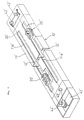
- Fig. 1 is a perspective view showing a corona unit having a corona wire cleaning device embodying the present invention.
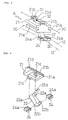
- Fig. 2 is a perspective view showing a cleaning member of the cleaning device shown in Fig. 1.
- Fig. 3 is an exploded perspective view of the cleaning member of Fig. 2.
- Figs. 4a and 4b are a plan view and a side view showing a main part of the corona wire cleaning device of Fig. 1 to explain the operation thereof.
- Fig. 5 is a diagrammatic plan view showing the whole construction of the cleaning device of Fig. 1.
- Figs. 6a and 6b are a plan view and a side view showing a main part of the corona wire cleaning device of Fig. 1 to explain the operation thereof.
- Fig. 7 is a perspective view showing a corona unit having another corona wire cleaning device embodying the present invention.
- Fig. 8 is a diagrammatic plan view showing the operation of the cleaning device of Fig. 7.
- Figs. 1 to 6a and 6b show a corona unit 10 in which the corona wire cleaning device embodying the present invention is installed.
- the corona unit 10 is used, for example, as a charge unit in an electrophotographic copying machine.
- the corona unit 10 includes a shield case 11 having the shape of a rectangular parallelepiped, and a pair of parallel corona wires 12 and 12 stretched in the shield case 11 along the longitudinal length thereof.
- the shield case 11 has an open side (bottom), and an end block (not shown) is fitted to each end thereof.
- the ends of each corona wire 12 are fixed within the respective end blocks.
- Provided in the side (top) of the shield case 11 opposite the open side is an elongated opening 11a extending parallel to the corona wires 12 and 12 stretched in the shield case 11 .
- the corona wire cleaning device of the present invention comprises a cleaning member 20 which moves along the elongated opening 11a in the shield case 11 of the corona unit 10 , and a driving wire 30 which moves the cleaning member 20 along the elongated opening 11a .
- the driving wire 30 passes around an idler pulley 42 mounted, with a support plate 41 interposed, on the upper surface of one end of the shield case 11 , and is wound on a driving pulley 44 disposed in a motor box 43 connected to the other end of the shield case 11 .
- the driving wire 30 has two sections stretched parallel to each other between the driving pulley 44 and the idler pulley 42 , one section thereof being stretched above the elongated opening 11a of the shield case 11 .
- the driving pulley 44 is mounted on a pinion gear 45 disposed in the motor box 43 , and rotates integrally with the pinion gear 45 .
- the pinion gear 45 is engaged with a worm gear 46 which is connected to the output shaft of a driving motor 47 disposed in the motor box 43 .
- the driving motor 47 is capable of rotating in both forward and reverse directions.
- the idler pulley 42 around which the driving wire 30 passes at the other end of the shield case 11 is rotatably installed on the support plate 41 mounted slidably on the upper surface of the end of the shield case 11 .
- There are also disposed a pair of tension springs 48 and 48 one end of each being fixed to the support plate 41 and the other end to the upper surface of the end of the shield case 11 so as to exert force to pull the support plate 41 in the direction away from the driving pulley 44 . Therefore, the idler pulley 42 is always pulled by the pair of tension springs 48 and 48 via the support plate 41 in the direction away from the driving pulley 44 , and any variation in the tensile force applied to the driving wire 30 is absorbed by the tension springs 48 and 48 .
- the cleaning member 20 installed on the driving wire 30 includes, as shown in Figs. 2 and 3, a support frame 21 having the shape of a rectangular parallelepiped, and a support lever 22 swingably mounted on the support frame 21 .
- a guide groove 21a is formed on each of the sides of the support frame 21 that extend along the longitudinal length of the elongated opening 11a .
- the guide grooves 21a and 21a slidably engage the respective longitudinal edges of the elongated opening 11a of the shield case 11 .
- the upper surface of the support frame 21 is positioned above the shield case 11, and on each of the ends of the upper surface facing the respective moving directions of the support frame 21 there are provided engaging portions 21b and 21b projecting upwardly thereof.
- Each engaging portion 21b has a U-shaped form with an open side, through which the driving wire 30 passes.
- the support lever 22 bent in a dogleg form is disposed through the support frame 21.
- An upper end portion of the support lever 22 projects above the upper surface of the support frame 21, while a lower end portion thereof projects below the underside of the support frame 21 positioned inside the shield case 11.
- At the bend of the support lever 22 are provided a pair of support pins 22a and 22a projecting sideward as shown in Fig. 3.
- the support lever 22 is pivotally supported via the pair of support pins 22a and 22a by a pair of bearings 21c provided on the underside of the support frame 21, so that when the upper arm thereof is positioned approximately perpendicular with respect to the support frame 21, the lower arm is positioned to point toward the idler pulley 42.
- a vertically elongate cutout 22d through which the driving wire 30 passes.
- a pair of sideways projecting tenons 22b and 22b onto each of which a cleaning tool 24 is fitted.
- the cleaning tools 24 and 24 are positioned respectively adjacent to the corona wires 12 and are provided each with a cleaning part 24a on the upper surface thereof facing the corresponding corona wire 12 .
- the support lever 22 is bent so that its lower arm points toward the direction opposite from the driving pulley 44 , and when the upper arm of the support lever 22 is tilted toward the driving pulley 44 , the cleaning parts 24a and 24a of the cleaning tools 24 and 24 provided on the lower arm are caused to swing upward into contact with the respective corona wires 12 and 12 . Conversely, when the upper arm of the support lever 22 is tilted toward the idle pulley 42 , the cleaning parts 24a and 24a of the cleaning tools 24 and 24 are caused to swing downward, coming away from the respective corona wires 12 and 12 so that the cleaning member 20 is rendered inoperative.
- the driving wire 30 passing through the engaging portions 21b and 21b provided on the upper surface of the support frame 21 also passes through the cutout 22d in the upper end of the support lever 22 between the two engaging portions 21b and 21b .
- a spherically-shaped operating member 31 is provided on a portion of the driving wire 30 positioned between the engaging portion 21b nearer to the driving pulley 44 and the cutout 22d in the support lever 22
- another spherically-shaped operating member 32 is provided on a portion of the driving wire 30 positioned between the engaging portion 21b nearer to the idle pulley 42 and the cutout 22d in the support lever 22 .
- Both the operating members 31 and 32 have a larger size than that of the cutout 22d in the upper end of the support lever 22 so that they do not pass therethrough but stop at the support lever 22. Both the operating members 31 and 32 also are too large to pass through the engaging portions 21b and 21b, so that they stop at the respective engaging portions 21b and 21b.
- the operating members 31 and 32 work in the following way.
- the driving wire 30 is moved toward the driving pulley 44 (in the direction indicated by arrow A in Fig. 1)
- the operating member 32 positioned farther from the driving pulley 44 acts against the upper end portion of the support lever 22, urging the upper arm of the support lever 22 towards the driving pulley 44.
- the operating member 31 positioned nearer to the driving pulley 44 abuts against the engaging portion 21b that is nearer the driving pulley 44.
- the cleaning parts 24a and 24a on the cleaning tools 24 and 24 mounted on the lower arm of the support lever 22 are held in contact with the respective corona wires 12 and 12.
- a U-shaped limiting member 50 On the upper surface of the end of the shield case 11 where the idler pulley 42 is mounted, there is provided a U-shaped limiting member 50 having its open end uppermost.
- the section of the driving wire 30 stretched between the driving pulley 44 and the idler pulley 42 and not above the elongated opening lla of the shield case 11 passes through the limiting member 50.
- the limiting member 50 is positioned nearer to the idler pulley 42 than to the elongated opening lla provided in the upper surface of the shield case 11 .
- On the section of the driving wire 30 that passes through the limiting member 50 there is provided a spherically-shaped stop member 33 which can abut against the limiting member 50 .
- the stop member 33 is provided on the wire 30 at a fixed position such that it abuts against the limiting member 50 just before the cleaning member 20 being pulled by the driving wire 30 along the elongated opening 11a of the shield case 11 toward the driving pulley 44 reaches the end of the elongated opening 11a nearer to the driving pulley 44 .
- the corona wire cleaning device of the above construction works in the following manner.
- the cleaning member 20 is positioned at the end of the elongated opening 11a of the shield case 11 nearer to the idler pulley 42 , and in this situation, the driving motor 47 is started for forward rotation.
- the driving motor 47 is started for forward rotation.
- the section of the driving wire 30 above the elongated opening 11a is moved toward the driving pulley 44 , as shown in Figs. 4a and 4b .
- the operating time of the driving motor 47 is a slightly longer than that needed for the cleaning member 20 to travel the entire length of the elongated opening 11a of the shield case 11 .
- the entire cleaning member 20 moves in the elongated opening 11a of the shield case 11 till reaching the vicinity of the end of the elongated opening 11a nearer to the driving pulley 44 .
- the stop member 33 provided on the section of the driving wire 30 moving away from the driving pulley 44 toward the idler pulley 42 stops at the limiting member 50 provided on the end of the shield case 11 where the idler pulley 42 is mounted, just before the cleaning member 20 reaches the end of the elongated opening 11a nearer to the driving pulley 44 .
- the driving wire 30 is prevented from moving further although the driving motor 47 is still being driven for forward rotation.
- the portion of the driving wire 30 stretched via the idler pulley 42 from where it is stopped at the limiting member 50 to where it is wound on the driving pulley 44 (the portion indicated by L1 in Fig. 5) is pulled by the driving pulley 44 , and the tensile force being exerted by the forward rotation of the driving motor 47 is therefore applied to that portion of the driving wire 30 .
- the portion of the driving wire 30 subjected to the tensile force at this time is relatively long, for example in comparison with the portion thereof (indicated by L2 in Fig.
- the driving motor 47 is started for reverse rotation so that the section of the driving wire 30 above the elongated opening lla starts to move toward the idler pulley 42, as shown in Figs 6a and 6b.
- This causes the operating member 31 provided on the driving wire 30 at a position nearer to the driving pulley 44 to push the upper arm of the supporting lever 22 toward the idler pulley 42, which in turn causes the lower arm of the support lever 22 to swing downward with the cleaning parts 24a and 24a on the cleaning tools 24 and 24 mounted on the lower arm coming out of contact with corona wires 12 and 12.
- the operating member 32 nearer to the idler pulley 42 abuts the engaging portion 21b, formed on the support frame 21 of the cleaning member 20 at the end thereof nearer the idler pulley 42, to move the entire cleaning member 20 backwards along the elongated opening lla of the shield case 11, toward the idler pulley 42.
- the cleaning tools 24 and 24 remain spaced from the corona wires 12 and 12, so that no cleaning of the corona wires 12 and 12 is performed.
- the cleaning member 20 reaches the position indicated by a two-dot chain line in Fig.5, at the end of the elongated opening lla nearer to the idler pulley 42, the cleaning member 20 is stopped by abutment against that end of the elongated opening 11a, which limits travel thereof in this backwards direction.
- the portion of the driving wire 30 which is subjected to tensile force by the driving pulley 44 is sufficiently long to prevent the driving motor 47 from locking, and thus the driving wire 30 from breaking.
- the driving motor 47 is stopped to complete the operating cycle for cleaning the corona wires 12 and 12.
- FIGs. 7 and 8 show another corona wire cleaning device embodying the present invention.
- a corona unit 10′ is, for example, a transfer/separation unit used in an electrophotographic copying machine, and includes two parallel corona wires 12′ and 12′ stretched in a shield case 11′.
- the shield case 11′ is provided with a pair of elongated openings 11a′ and 11a′ facing the respective corona wires 12′.
- a pair of cleaning members 20′ and 20′ are provided for cleaning the respective corona wires 12′ and 12′.
- the cleaning members 20′ and 20′ move respectively along the elongated openings 11a′ and 11a′ provided in the shield case 11′.
- the two cleaning members 20′ and 20′ are simultaneously moved by a driving wire 30′ which is wound on a driving pulley 44′ and which passes around a pair of idler pulleys 42′ and 42′ provided on the opposite end of the shield case 11′ from the driving pulley 44′ and a tension pulley 49′ disposed at the end nearer to the driving pulley 44′. Therefore, when one cleaning member 20′ moves towards the idler pulleys 42′, the other cleaning member 20′ moves towards the driving pulley 44′.
- the driving wire 30′ is driven by a driving motor 47.
- the cleaning members 20′ and 20′ have the same construction as the cleaning member 20 in the foregoing embodiment except that each has only one cleaning tool, which contacts the corresponding corona wire 12′, so further description thereof is omitted herein.
- each cleaning member 20′ travels in the direction away from the idler pulleys 42′ and 42′, towards the driving pulley 44, its cleaning tool contacts the corresponding corona wire 12′ for cleaning thereof, while the other cleaning member 20′ travels in the direction away from the driving pulley 44′, toward the idle pulleys 42 and 42′, without contacting its corresponding corona wire 12′.
- each cleaning member 20 ′ is so determined with respect to the driving pulley 44 ′ that either one of the cleaning members 20 ′ will reach the end of the elongated opening 11a ′ nearer to the idler pulleys 42 ′ and 42 ′ just before the other cleaning member 20 ′ moving along the other elongated opening 11a ′ toward the driving pulley 44 ′ reaches the end of the elongated opening 11a ′ nearer to the driving pulley 44 ′.
- the portion of the driving wire 30 ′ subjected to the tensile force is sufficiently long, the tensile force is absorbed in the elongation of the driving wire 30 ′ along the length of that portion, thereby preventing the driving motor 47 ′ from locking and also the driving wire 30 ′ from breaking.
- the arrangements described above make possible the objectives of (1) providing a corona wire cleaning device for a corona unit that is simple in construction and that is capable of stopping a cleaning tool without locking the motor that is the driving source for moving the cleaning tool; (2) providing a corona wire cleaning device for a corona unit in which the cleaning tool moving back and forth along the corona wire is brought into frictional contact with the corona wire during the travel in one direction only, so that foreign matter such as dust can be more surely removed from the corona wire, thereby accomplishing reliable cleaning of the corona wire: (3) providing a corona wire cleaning device for a corona unit by which a reliable cleaning of each corona wire using only one motor can be attained even when two corona wires are disposed in its shield case; and (4) providing a corona wire cleaning device for a corona unit constructed in such a manner that travelling motion of a driving wire, for driving a cleaning tool, is stopped by abutment means at a preset position but a high
Landscapes
- Physics & Mathematics (AREA)
- Engineering & Computer Science (AREA)
- Plasma & Fusion (AREA)
- General Physics & Mathematics (AREA)
- Electrostatic Charge, Transfer And Separation In Electrography (AREA)
Claims (9)
- Eine Korona-Elektrodenreinigungsvorrichtung zum Reinigen einer Korona-Elektrode (12), welche sich in einem Abschirmgehäuse (11) einer Koronaeinheit (10) erstreckt, mit:
einem Reinigungsglied (20) mit einem Stützrahmen (21), welcher entlang dem Abschirmgehäuse (11) so verschiebbar ist, daß eine Bewegung entlang der Korona-Elektrode möglich ist, und welches mit einem Stützhebel (22) versehen ist, der drehbar am Stützrahmen (21) angebracht ist und ein Reinigungswerkzeug (24a) trägt, welches während einer derartigen Bewegung an der Korona-Elektrode reibt; und
Mitteln einschließlich eines Antriebsdrahtes (30), welcher um zwei Blockrollen (42, 44) läuft und welcher zu longitudinaler Bewegung mit wechselnder Richtung veranlaßt werden kann um das Reinigungsglied vorwärts und rückwärts entlang der Länge der Korona-Elektrode zu bewegen;
dadurch gekennzeichnet, daß der genannte Stützhebel (22) vom Antriebsdraht (30) in der Vorwärtsrichtung der Bewegung des Reinigungsgliedes (20) so betätigt wird, daß der Hebel in Arbeitsstellung gehalten wird, was das Reinigungswerkzeug (24a) veranlaßt, während einer solchen Bewegung an der Korona-Elektrode zu reiben und somit diese Elektrode zu reinigen, wohingegen bei einer Rückwärtsbewegung des Reinigungsgliedes der Stützhebel relativ zum Stützrahmen in eine Nicht-Arbeitsstellung schwenkt, so daß das Reinigungswerkzeug zur Korona-Elektrode einen Abstand hat und kein Reinigen der Korona-Elektrode während einer solchen Rückwärtsbewegung stattfindet. - Eine Vorrichtung nach Anspruch 1, bei welcher der Antriebsdraht (30) mit zwei Arbeitsgliedern (31, 32) versehen ist, die entlang diesem Draht in Abstand zueinander stehen und mit dem Reinigungsglied (20) in Eingriff treten und dessen Bewegung mit dem Antriebsdraht bewirken, wobei eines (32) der genannten zwei Arbeitsglieder so angebracht ist, daß es auf ein Kopfteil des Stützhebels (22), das vom genannten Reinigungswerkzeug (24a) entfernt liegt, wirkt, um den Stützhebel während der Vorwärtsbewegung des Reinigungsgliedes in die genannte Arbeitsstellung zu zwingen.
- Eine Vorrichtung nach Anspruch 2, bei welcher das andere (31) der genannten zwei Arbeitsglieder so angebracht ist, daß es mit dem genannten Kopfteil des Stützhebels (22) so in Eingriff tritt, daß der Hebel nach einer Änderung der Bewegung des Reinigungsgliedes (20) von vorwärts nach rückwärts in die genannte Nicht-Arbeitsstellung gezwängt wird.
- Eine Vorrichtung nach Anspruch 1, 2 oder 3, die darüberhinaus eine zweite Korona-Elektrode umfaßt, die sich in dem genannten Abschirmgehäuse (11) erstreckt, und ein zweites Reinigungswerkzeug, wobei das zweite Werkzeug vom genannten Stützhebel so getragen wird, daß es während der Vorwärtsbewegung des Reinigungsgliedes an der genannten zweiten Korona-Elektrode reibt.
- Eine Vorrichtung nach Anspruch 1, 2 oder 3, bei welcher die genannte Korona-Elektrode eine von zwei parallelen Korona-Elektroden (12′) ist, die sich in dem Abschirmgehäuse (10′) erstrecken, und das genannte Reinigungsglied eines von einem Paar derartiger Reinigungsglieder (20′) ist, die so angeordnet sind, daß sie gleichzeitig vom genannten Antriebsdraht (30′) jeweils in entgegengesetzte Richtungen bewegt werden, um jeweils die zwei parallelen Korona-Elektroden zu reinigen.
- Eine Vorrichtung nach Anspruch 5, bei welcher das Reinigungswerkzeug eines der Reinigungsglieder (20′) für eine Bewegungsrichtung des Antriebsdrahtes (30′) in Arbeitskontakt mit seiner zugehörigen Korona-Elektrode (12′) gehalten wird, das Reinigungswerkzeug des anderen Reinigungsgliedes jedoch außer Kontakt mit der anderen Korona-Elektrode gehalten wird.
- Eine Vorrichtung nach einem der vorangegangenen Ansprüche, bei der eine der zwei genannten Blockrollen eine Antriebsrolle (44) ist und die andere eine Leerlaufrolle (42), wobei die genannte Bewegung des Antriebsdrahtes in mindestens einer Richtung durch Begrenzungsmittel an einer Stelle in der Nähe der Leerlaufrolle (42) beschränkt wird.
- Eine Vorrichtung nach Anspruch 7, bei welcher die Bewegung des Antriebsdrahtes, die das Reinigungsglied veranlaßt, sich von der Antriebsrolle wegzubewegen, durch Anschlag eines Gliedes begrenzt wird, welches vom Antriebsdraht bewegt wird in Richtung weg von der Antriebsrolle gegen eine Begrenzungsfläche, die in Bezug auf das genannte Abschirmgehäuse befestigt ist.
- Eine Vorrichtung nach Anspruch 7 oder 8, bei welcher die Bewegung des Antriebsdrahtes, die das Reinigungsglied veranlaßt, sich auf die Antriebsrolle zuzubewegen, durch Anschlag eines Haltegliedes begrenzt wird, welches an einem Teil des Antriebsdrahtes angebracht ist, welcher sich in Richtung weg von der Antriebsrolle bewegt gegen ein Begrenzungsglied, welches an der genannten Stelle befestigt ist.
Applications Claiming Priority (2)
| Application Number | Priority Date | Filing Date | Title |
|---|---|---|---|
| JP63266881A JPH07109528B2 (ja) | 1988-10-21 | 1988-10-21 | コロナ放電器の放電ワイヤ清掃装置 |
| JP266881/88 | 1988-10-21 |
Publications (3)
| Publication Number | Publication Date |
|---|---|
| EP0365345A2 EP0365345A2 (de) | 1990-04-25 |
| EP0365345A3 EP0365345A3 (de) | 1991-03-13 |
| EP0365345B1 true EP0365345B1 (de) | 1994-12-14 |
Family
ID=17436956
Family Applications (1)
| Application Number | Title | Priority Date | Filing Date |
|---|---|---|---|
| EP89310809A Expired - Lifetime EP0365345B1 (de) | 1988-10-21 | 1989-10-20 | Korona-Elektrodenreinigungsvorrichtung für eine Koronaeinheit |
Country Status (4)
| Country | Link |
|---|---|
| US (1) | US5023748A (de) |
| EP (1) | EP0365345B1 (de) |
| JP (1) | JPH07109528B2 (de) |
| DE (1) | DE68919994T2 (de) |
Families Citing this family (23)
| Publication number | Priority date | Publication date | Assignee | Title |
|---|---|---|---|---|
| JPH0816810B2 (ja) * | 1989-09-29 | 1996-02-21 | キヤノン株式会社 | コロナ放電装置 |
| US5392099A (en) * | 1992-09-25 | 1995-02-21 | Mita Industrial Co., Ltd. | Image forming apparatus having cleaning member for cleaning charging wire |
| US5337131A (en) * | 1992-11-12 | 1994-08-09 | Indigo N.V. | Charging apparatus operative to charge a surface |
| KR950011874B1 (ko) * | 1992-12-10 | 1995-10-11 | 현대전자산업주식회사 | 대전선 자동 크리닝 방법 및 그 장치 |
| US5481345A (en) * | 1993-08-09 | 1996-01-02 | Mita Industrial Co., Ltd. | Image forming apparatus provided with pre-transfer charger |
| US5485251A (en) * | 1993-09-06 | 1996-01-16 | Mita Industrial Co., Ltd. | Cleaning device for an electrostatic charger |
| KR0134699B1 (ko) * | 1994-12-27 | 1998-04-30 | 김광호 | 전자사진방식 화상형성장치에서의 대전기 청소장치 |
| US5594532A (en) * | 1995-03-15 | 1997-01-14 | Dataproducts Corporation | Cartridge, cartridge cleaning apparatus and method for cleaning a corona wire |
| US5761578A (en) * | 1996-04-08 | 1998-06-02 | Moore Business Forms, Inc. | Corona wire cleaning by mechanical vibration of the wire |
| US5862440A (en) * | 1997-04-11 | 1999-01-19 | Moore Business Forms, Inc. | Toner delivery device |
| US6108504A (en) * | 1999-03-26 | 2000-08-22 | Eastman Kodak Company | Corona wire replenishing mechanism |
| US6328250B1 (en) | 1999-03-26 | 2001-12-11 | Nexpress Solutions Llc | Method of mounting corona wire a corona charger housing of an electrophotographic apparatus and an apparatus for mounting corona wires |
| US6294782B1 (en) | 1999-03-26 | 2001-09-25 | Nexpress Solutions Llc | Corona charger with a serpentine strung corona wire |
| JPWO2002039191A1 (ja) * | 2000-11-08 | 2004-03-18 | 富士ゼロックス株式会社 | 画像形成装置 |
| JP3671949B2 (ja) * | 2002-09-27 | 2005-07-13 | ブラザー工業株式会社 | 画像形成装置 |
| JP4984884B2 (ja) * | 2006-12-27 | 2012-07-25 | 富士ゼロックス株式会社 | 帯電装置及び画像形成装置 |
| WO2008091942A2 (en) * | 2007-01-24 | 2008-07-31 | Ventiva, Inc. | Method and device to prevent dust agglomeration on corona electrodes |
| US7676172B2 (en) * | 2007-06-21 | 2010-03-09 | Xerox Corporation | Cleaning head pick-up system |
| US7738811B2 (en) * | 2007-10-03 | 2010-06-15 | Xerox Corporation | Corona charging device cleaner |
| JP4748260B2 (ja) * | 2009-07-02 | 2011-08-17 | コニカミノルタビジネステクノロジーズ株式会社 | 帯電装置及びこれを備えた画像形成装置 |
| AU2013200492A1 (en) * | 2013-01-31 | 2014-08-14 | Mineral Technologies Pty Ltd | Improved Electrostatic Separator System |
| JP6264222B2 (ja) * | 2014-07-29 | 2018-01-24 | 京セラドキュメントソリューションズ株式会社 | 光走査装置、及びこれを備えた画像形成装置 |
| JP6256241B2 (ja) * | 2014-07-29 | 2018-01-10 | 京セラドキュメントソリューションズ株式会社 | 光走査装置、及びこれを備えた画像形成装置 |
Family Cites Families (6)
| Publication number | Priority date | Publication date | Assignee | Title |
|---|---|---|---|---|
| US3842273A (en) * | 1973-07-18 | 1974-10-15 | Xerox Corp | Corona generator cleaning apparatus |
| JPS6045433B2 (ja) * | 1977-02-28 | 1985-10-09 | 富士ゼロックス株式会社 | 帯電器の清掃装置 |
| JPH0812503B2 (ja) * | 1985-10-13 | 1996-02-07 | 株式会社リコー | 帯電器の自動清掃装置 |
| US4908513A (en) * | 1987-09-25 | 1990-03-13 | Konica Corporation | Charging apparatus |
| JPS6482061A (en) * | 1987-09-25 | 1989-03-28 | Konishiroku Photo Ind | Electrifying device |
| US4885466A (en) * | 1987-09-25 | 1989-12-05 | Ricoh Company, Ltd. | Corona wire cleaning device utilizing a position detection system |
-
1988
- 1988-10-21 JP JP63266881A patent/JPH07109528B2/ja not_active Expired - Lifetime
-
1989
- 1989-10-20 US US07/424,474 patent/US5023748A/en not_active Expired - Fee Related
- 1989-10-20 EP EP89310809A patent/EP0365345B1/de not_active Expired - Lifetime
- 1989-10-20 DE DE68919994T patent/DE68919994T2/de not_active Expired - Fee Related
Also Published As
| Publication number | Publication date |
|---|---|
| JPH07109528B2 (ja) | 1995-11-22 |
| EP0365345A3 (de) | 1991-03-13 |
| US5023748A (en) | 1991-06-11 |
| JPH02113266A (ja) | 1990-04-25 |
| EP0365345A2 (de) | 1990-04-25 |
| DE68919994T2 (de) | 1995-05-04 |
| DE68919994D1 (de) | 1995-01-26 |
Similar Documents
| Publication | Publication Date | Title |
|---|---|---|
| US5023748A (en) | Corona wire cleaning device for a corona unit | |
| KR830008298A (ko) | 테이프 로프장치 | |
| US4864363A (en) | Cleaning device for a corona discharger | |
| EP0693688A3 (de) | Teststreifenauswertegerät mit einer Transporteinheit für Teststreifen | |
| US3847480A (en) | Continuous blade cleaner | |
| JPS5822730B2 (ja) | 原稿走査装置 | |
| US6590742B2 (en) | Head cleaner for tape drive apparatus | |
| JP3208616B2 (ja) | 画像形成装置の帯電装置 | |
| CN217971318U (zh) | 输送机构和传动带张紧装置 | |
| EP0365004B1 (de) | Abtastgerät zum Lesen eines originalen Bildes | |
| US5563692A (en) | Automatic apparatus and method for cleaning a charge line | |
| JP2578881Y2 (ja) | ウインドレギユレータ装置 | |
| JP3311015B2 (ja) | 画像形成装置の帯電装置 | |
| JP2567458B2 (ja) | ワイヤ清掃装置 | |
| US3526398A (en) | Cloth laying machine with seam detection means | |
| JPH0717075Y2 (ja) | 清掃装置 | |
| JP3057103B2 (ja) | 露光光学装置 | |
| JPH0733258Y2 (ja) | トナ−回収タンクの振動装置 | |
| KR0133902Y1 (ko) | 테이프 레코더 | |
| JPH0475505B2 (de) | ||
| JPH0812503B2 (ja) | 帯電器の自動清掃装置 | |
| JPH02293420A (ja) | 台車の運転方法 | |
| JPH0432663Y2 (de) | ||
| JPH0954482A (ja) | 画像形成装置とその帯電器などのワイヤ清掃装置 | |
| JP2004330665A (ja) | 画像形成装置 |
Legal Events
| Date | Code | Title | Description |
|---|---|---|---|
| PUAI | Public reference made under article 153(3) epc to a published international application that has entered the european phase |
Free format text: ORIGINAL CODE: 0009012 |
|
| AK | Designated contracting states |
Kind code of ref document: A2 Designated state(s): DE FR GB NL |
|
| PUAL | Search report despatched |
Free format text: ORIGINAL CODE: 0009013 |
|
| 17P | Request for examination filed |
Effective date: 19901218 |
|
| AK | Designated contracting states |
Kind code of ref document: A3 Designated state(s): DE FR GB NL |
|
| 17Q | First examination report despatched |
Effective date: 19921209 |
|
| GRAA | (expected) grant |
Free format text: ORIGINAL CODE: 0009210 |
|
| AK | Designated contracting states |
Kind code of ref document: B1 Designated state(s): DE FR GB NL |
|
| REF | Corresponds to: |
Ref document number: 68919994 Country of ref document: DE Date of ref document: 19950126 |
|
| ET | Fr: translation filed | ||
| PLBE | No opposition filed within time limit |
Free format text: ORIGINAL CODE: 0009261 |
|
| STAA | Information on the status of an ep patent application or granted ep patent |
Free format text: STATUS: NO OPPOSITION FILED WITHIN TIME LIMIT |
|
| 26N | No opposition filed | ||
| PGFP | Annual fee paid to national office [announced via postgrant information from national office to epo] |
Ref country code: NL Payment date: 19971029 Year of fee payment: 9 |
|
| PGFP | Annual fee paid to national office [announced via postgrant information from national office to epo] |
Ref country code: FR Payment date: 19981009 Year of fee payment: 10 |
|
| PGFP | Annual fee paid to national office [announced via postgrant information from national office to epo] |
Ref country code: GB Payment date: 19981023 Year of fee payment: 10 Ref country code: DE Payment date: 19981023 Year of fee payment: 10 |
|
| PG25 | Lapsed in a contracting state [announced via postgrant information from national office to epo] |
Ref country code: NL Free format text: LAPSE BECAUSE OF NON-PAYMENT OF DUE FEES Effective date: 19990501 |
|
| NLV4 | Nl: lapsed or anulled due to non-payment of the annual fee |
Effective date: 19990501 |
|
| PG25 | Lapsed in a contracting state [announced via postgrant information from national office to epo] |
Ref country code: GB Free format text: LAPSE BECAUSE OF NON-PAYMENT OF DUE FEES Effective date: 19991020 |
|
| GBPC | Gb: european patent ceased through non-payment of renewal fee |
Effective date: 19991020 |
|
| PG25 | Lapsed in a contracting state [announced via postgrant information from national office to epo] |
Ref country code: FR Free format text: LAPSE BECAUSE OF NON-PAYMENT OF DUE FEES Effective date: 20000630 |
|
| PG25 | Lapsed in a contracting state [announced via postgrant information from national office to epo] |
Ref country code: DE Free format text: LAPSE BECAUSE OF NON-PAYMENT OF DUE FEES Effective date: 20000801 |
|
| REG | Reference to a national code |
Ref country code: FR Ref legal event code: ST |