EP0370847B1 - Dispositif de traitement de données de vente - Google Patents
Dispositif de traitement de données de vente Download PDFInfo
- Publication number
- EP0370847B1 EP0370847B1 EP89402995A EP89402995A EP0370847B1 EP 0370847 B1 EP0370847 B1 EP 0370847B1 EP 89402995 A EP89402995 A EP 89402995A EP 89402995 A EP89402995 A EP 89402995A EP 0370847 B1 EP0370847 B1 EP 0370847B1
- Authority
- EP
- European Patent Office
- Prior art keywords
- rebate
- customer
- data
- price
- article
- Prior art date
- Legal status (The legal status is an assumption and is not a legal conclusion. Google has not performed a legal analysis and makes no representation as to the accuracy of the status listed.)
- Expired - Lifetime
Links
Images








Classifications
-
- G—PHYSICS
- G06—COMPUTING OR CALCULATING; COUNTING
- G06Q—INFORMATION AND COMMUNICATION TECHNOLOGY [ICT] SPECIALLY ADAPTED FOR ADMINISTRATIVE, COMMERCIAL, FINANCIAL, MANAGERIAL OR SUPERVISORY PURPOSES; SYSTEMS OR METHODS SPECIALLY ADAPTED FOR ADMINISTRATIVE, COMMERCIAL, FINANCIAL, MANAGERIAL OR SUPERVISORY PURPOSES, NOT OTHERWISE PROVIDED FOR
- G06Q30/00—Commerce
- G06Q30/02—Marketing; Price estimation or determination; Fundraising
-
- G—PHYSICS
- G06—COMPUTING OR CALCULATING; COUNTING
- G06Q—INFORMATION AND COMMUNICATION TECHNOLOGY [ICT] SPECIALLY ADAPTED FOR ADMINISTRATIVE, COMMERCIAL, FINANCIAL, MANAGERIAL OR SUPERVISORY PURPOSES; SYSTEMS OR METHODS SPECIALLY ADAPTED FOR ADMINISTRATIVE, COMMERCIAL, FINANCIAL, MANAGERIAL OR SUPERVISORY PURPOSES, NOT OTHERWISE PROVIDED FOR
- G06Q20/00—Payment architectures, schemes or protocols
- G06Q20/38—Payment protocols; Details thereof
- G06Q20/387—Payment using discounts or coupons
-
- G—PHYSICS
- G07—CHECKING-DEVICES
- G07G—REGISTERING THE RECEIPT OF CASH, VALUABLES, OR TOKENS
- G07G1/00—Cash registers
- G07G1/12—Cash registers electronically operated
- G07G1/14—Systems including one or more distant stations co-operating with a central processing unit
- G07G1/145—PLU-management
Definitions
- the present invention relates to a sales-data-processing apparatus with functions that can provide a rebate service in which a rebate amount is determined according to the wishes of the customers and the amounts purchased.
- regular rebate system Two types of rebate services ore carried out in customer-information-managing system at present: the regular rebate system and the immediate rebate system.
- regular rebate system as disclosed in documents EP-A-0313376 and EP-A-0253 240, service coupons are issued regularly depending on the amount purchased by a member customer, and a discount is made for the customer when the service coupons are brought in. Thus, the discount is carried out by means of service coupons.
- This system is inconvenient for both the customers and stores because the customers must keep and carry the service coupons and the stores must issue the service coupons.
- the rebate service is immediately carried out at the point of calculation according to the purchase amount of a customer.
- the stores need not issue the service coupons, and further the customers need not keep and carry the service coupons.
- These sales-data-processing apparatuses works as follows: first, a check is made at the point of calculation to determine if the sum total of the purchases of the customer exceeds the amount at which a rebate will occur; second, if the rebate occurs, the final price obtained by subtracting the rebate from the current total price is required at the time of calculation.
- a sales-data-processing apparatus comprising: computing means for computing a potential rebate for each customer on the basis of the total price of articles which are purchased by the customer and are eligible for rebate; storing means for storing the potential rebate or the total price from which the potential rebate is calculated for each customer; primary input means for entering customer-identification data for identifying each customer; primary display means for displaying the potential customer rebate according to the customer-identification data entered from the primary input means; secondary input means for entering the rebate desired by the customer at the time of calculation; subtraction means for subtracting the desired rebate from the total price of the current purchase so as to obtain the final price of the current purchase; secondary display means for displaying the final price; and updating means for updating the storing means on the basis of the desired rebate and the total price of the articles eligible for rebate of the current purchase.
- Fig. 1 is a block diagram showing the electric configuration of an electronic counter scale according to an embodiment of the present invention
- Fig. 2 is a front elevation showing the outer construction of the scale
- Fig. 3 is a front elevation showing the operating panel of the electronic scale.
- numeral 1 designates a scale base on which scale plate 1a is provided.
- load cell 1b in Fig. 1 produces a weight signal.
- This display device 2 has two screens which are provided back to back: primary display 2a facing the clerk and secondary display 2b facing the customer.
- Each of displays 2a and 2b has a plasma-dot-display area 2c of 256 X 256 dots, and displays article name, weight (g), unit price ( ⁇ ), price ( ⁇ ), and so forth, in a calculation situation.
- operating panel 3 At the front of scale base 1 is provided operating panel 3 which is sloped so that the clerk can easily operate it. As shown in Fig. 3, operating panel 3 has preset keys 4, numeric keypad 5, function keys 6, key switches 7 for changing modes, and so on.
- Preset keys 4 consist of 50 keys of 5 rows X 10 columns, and are used to retrieve article data by pressing one of the keys.
- the article data includes the name, unit price, weight, etc. of the article, and are stored according to article numbers (called PLU number hereafter).
- Numerical keypad 5 is provided to enter various kinds of digital data, and function keys 6 are provided to enter various commands such as moving the cursor and editing data on the screens of display device 2.
- Keyswitch 7 is provided to select the current mode from among the modes such as setting, checking, registering, and issuing journal. A clear key and a tare key are also added to numerical keypad 5.
- thermal printer 8 Inside the scale base 1, there is provided thermal printer 8 (see Fig. 1) which performs dot-printing on label paper or receipt paper by means of a thermal head so that desired characters and numerals are printed.
- Numeral 15 designates a bar-code reader for reading bar-code data
- numeral 16 denotes a guide groove for inserting bar-code card 17. Bar-code data is read when bar-code section 18 of bar-code card 17 shown in Fig. 4 is applied to the guide groove 16 and is slid therealong.
- This bar-code card 17 is used as a membership card on which a bar code corresponding to the membership number (customer number) is printed in bar-code section 18.
- Fig. 1 The electronic configuration in Fig. 1 will now be described: Each of the elements described above is connected to controller 19 in Fig. 1.
- load cell 1b for weighing the article on scale plate 1a is connected to CPU 21 via load-cell controller 20.
- primary display 2a is connected to CPU 21 via primary-display controller 22a
- secondary display 2b is connected to CPU 21 via second display controller 22b.
- Each of these display controllers 22a and 22b includes a display buffer memory so that the stored data in the buffer memory are displayed continually.
- operating panel 3 is connected to CPU 21 via operating-panel controller 23
- bar-code reader 15 is connected to CPU 21 via bar-code-reader controller 24, and thermal printer 8 is connected to CPU 21 via printer controller 25.
- Bar-code reader 15 is removably connected to the scale.
- ROM 26, RAM 27 and timer 28 are connected to CPU 21 which controls each part of the scale described above.
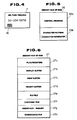
- Fig. 5 is a map of data locations in ROM 26.
- ROM 26 includes area 26a and area 26b.
- Area 26a stores the control program for controlling weighing process, print process, display process, etc.
- area 26b which is usually termed the "character generator”, stores character patterns including characters and numerals.
- Fig. 6 is a map of data locations in RAM 27.
- RAM 27 includes working area 27a in which flags and registers are located, display buffer 27b in which display data are temporarily stored, print buffer 27c in which print data are temporarily stored, receipt buffer 27d in which receipt data are temporarily stored, PLU (Price Look Up) file 27e in which article data are stored, customer file 27f in which customer data are stored, preset-key memory 27g in which PLU numbers each of which corresponds to each preset-keys 4 are stored, and screen-data file 27h in which data for several screen images are stored.
- PLU Price Look Up
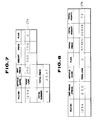
- Fig. 7 shows the configuration of receipt buffer 27d.
- Receipt buffer 27d temporarily stores receipt data when a clerk registers purchased articles.
- the receipt data includes such data as PLU numbers of purchased articles, article names, unit prices, weights, prices, flags, the total number of articles, and the total price.
- 30 items of receipt data can be stored for each of four customers "A", "B", “C”, and "D".
- Fig. 8 show the configuration of PLU (Price Look Up) file 27e.
- This file 27e stores article data (such as unit prices of articles, article names, flags, total prices, total weights of the articles purchased, and total number of the articles purchased) in accordance with PLU numbers (article numbers).
- unit prices, article names, and flags are set in advance as preset data.
- the flags represent the following: the articles corresponding to flags of "0" are not to be rebated; the articles corresponding to flags of "1" are to be normally rebated; and the articles corresponding to flags of "2" are to be rebated at twice the normal rebate.
- Fig. 9 shows the configuration of customer file 27f.
- Customer file 27f stores customer data (such as customer codes, addresses, names, birth-dates, amounts eligible for rebate, rebates A, and rebates B) according to customer numbers.
- the amount eligible for rebate is equal to the total price of articles to be rebated, except that in case of the article for the double rebate, twice the price thereof is added to the amount eligible for rebate.
- Rebate A is the rebate yielded by the total price eligible for rebate of the last purchase
- rebate B is the carry-over from the purchase before the last purchase.
- Fig. 10 shows the arrangement of preset-key memory 27g, which stores PLU numbers according to preset-key numbers.
- screen-data file 27h stores a guidance-screen image and a service-screen image to be displayed on the displays 2a and 2b.
- CPU 21 When CPU 21 receives PLU number data KD via operating-panel controller 23, CPU 21 reads out and displays the article data according to the process shown in Fig. 12, First, at step SP111 in Fig. 12, CPU 21 tests if one of the preset keys 4 is pressed or not, i.e., whether a PLU number is entered from preset keys 4 or not. If the test result is positive (YES), CPU 21 proceeds to step SP112. At step SP112, CPU 21 searches preset-key memory 27g in order to find the PLU number corresponding to the depressed key. After finding the PLU number, CPU 21 reads the PLU number, and proceeds to step SP113.
- step SP111 when a PLU number is directly entered by using function keys 6 and numerical keypad 5, the test result at step SP111 is negative (NO). In this case, CPU 21 directly proceeds to step SP113.
- CPU 21 searches PLU file 27e to find the PLU number, and at step SP114, CPU 21 tests if the PLU number entered is found in PLU file 27e. If the test result at step SP114 is positive (YES), CPU 21 proceeds to step SP115 to read the article data associated with "pork loin" from PLU file 27e, and displays the article data on primary display 2a and secondary display 2b.
- Fig. 13 shows an example of the article data of "pork loin" displayed. As shown, price per 100g in addition to the weight, and the total price, is displayed. If the test result at step SP114 is negative (NO), CPU 21 proceeds to step SP116 and displays an error message to indicate that the PLU number entered has not been found in PLU file 27e.
- the clerk decides whether the article which the customer desires to buy is an article to be weighed or not. If the article is to be weighed, CPU 21 proceeds to step SP13, whereas if the article does not need to be weighed, that is, if the article has a definite price, CPU 21 proceeds to step SP16.
- load cell 1b produces weight data WD and sends it to CPU 21 via load-cell controller 20.
- CPU 21 receiving weight data WD via load-cell controller 20, computes the price of the article and displays the weight and price according to the processes shown in Fig. 14.
- CPU 21 waits until weight data WD stabilizes. Once weight data WD stabilizes, CPU 21 proceeds to step SP142 so as to compute the price of "pork loin” on scale plate 1a by multiplying the unit price of the "pork loin” by weight data WD (300g, for example).
- CPU 21 proceeds to step SP143, thereby displaying the weight, unit price and total price of the "pork loin” on primary display 2a and secondary display 2b.
- Fig. 15 shows an example of the display at step SP143. As shown, the item name "pork loin", its weight (300g, for example), its price per 100g ( ⁇ 250, for example), and its price ( ⁇ 750, for example) are displayed.
- step SP16 When the weight of the article on scale plate 1a reaches the weight which the customer desires, the processing proceeds to step SP16. In contrast, when the weight of the article on scale plate 1a is not equal to that which the customer desires, the processing returns to step SP13. In this case, when the weight of the article on scale plate 1a is less than the desired weight, more of the article must be added, whereas if the weight of the article on scale plate 1a exceeds the desired weight, the excess must be removed.
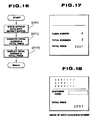
- CPU 21 When CPU 21 receives a signal from [+A] key, CPU 21 computes the total price and displays it according to the processes shown in Fig. 16. First, at step SP171 in Fig. 16, CPU 21 transmits the receipt data (that is, the current article data) shown in Fig. 7 to receipt buffer 27d. Second, at step SP172, CPU 21 computes the total price and the number of items of the current purchase of the customer. The number of items (for example, 3) represents the number of repetition of step SP16, that is, the number of depressions of the [+A] key. Finally, at step SP173, CPU 21 stores the computed total price to receipt buffer 27e, and controls the display of the total price on primary and secondary displays 2a and 2b.
- Fig. 17 shows an example of the display: the total price, " ⁇ 2537", for example, is displayed together with the clerk number A, and the total number of items (3, for example).
- step SP10 If there are other articles to be purchased by the customer, the processing returns to step SP10 to repeat the above processes in connection with the article to be purchased. In contrast, if there are no other articles, the clerk asks the customer if it is all right to execute the calculation, and proceeds to step SP19 if the customer gives a positive answer.
- step SP20 The clerk asks if the customer is a member of the store.
- step SP34 the processing proceeds to step SP34.
- the following steps SP20 to SP33 relates to the situation in which the customer is a member.
- step SP24 The clerk asks the customer if he has his membership card. If the customer brings his membership card, the processing proceeds to step SP24, whereas if the customer does not have his membership card, the processing proceeds to step SP21.
- CPU 21 receiving a signal from the "customer” key, retrieves input-guidance-screen image shown in Fig. 18 from screen-data file 27h, and displays the image on primary and secondary displays 2a and 2b.
- instructions indicating the input processes are displayed: for example, "Please enter the customer code from the numerical keypad and then press the "customer” key”. Otherwise, "Please enter the telephone number of the customer and then press the [ ⁇ ] key”.
- the clerk asks and enters the customer code or the telephone number of the customer according to the processes displayed on the input-guidance screen.
- the clerk When the customer brings a membership card, the clerk receives the membership card from the customer and has bar-code reader 15 read the customer number (bar-code data) on the card at step SP24. If the reading of the customer number is impossible because of deformity or breakage of the card, the clerk executes the processes of step SP21 to step SP23.
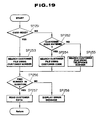
- CPU 21 reads out the customer data from customer file 27f according to the processes shown in Fig. 19, when CPU 21 receives the customer code read at step SP24, or the customer code entered at step SP23, or the telephone number of the customer entered at step SP23.
- step SP251 in Fig. 19 CPU 21 tests if the membership card is read. If the test result is positive (YES), CPU 21 proceeds to step SP253 at which CPU 21 searches customer file 27f by using the customer number so as to obtain the customer data. On the other hand, if the test result at step SP251 is negative (NO), CPU 21 proceeds to step SP252 at which CPU 21 tests if the customer code is entered. If the test result at step SP252 is positive (YES), CPU 21 proceeds to step SP254 at which CPU 21 searches customer file 27f so as to obtain the customer data including the customer code.
- step SP252 when the test result at step SP252 is negative (NO), that is, the telephone number of the customer is entered, CPU 21 proceeds to step SP255 at which CPU 21 searches customer file 27f so as to obtain the customer data including the telephone number. After the search above, CPU 21 tests, at step SP256, if the customer data in question is found or not. If the test result at step SP256 is positive (YES), CPU 21 proceeds to step SP257 at which the found customer data is read out. On the other hand, if the test result at step SP256 is negative (NO), CPU 21 proceeds to step SP258 and displays the error message.
- CPU 21 tests whether today is the birthday of the customer or not according to the processes shown in Fig. 20.
- CPU 21 reads the date of today from timer 28.
- CPU 21 compares the "month” of the data read from timer 28 with the "month of the date of birth” of the customer data. If the test result is negative (the months do not agree), CPU 21 proceeds to step SP29 in Fig. 11, whereas if the test result is positive (the months agree), CPU 21 proceeds to step SP263 at which CPU 21 compares the "day” of the data read from timer 28 with the "day of the date of birth” of the customer data. If the test result at step SP263 is negative, CPU 21 proceeds to step SP29 in Fig.
- step SP264 at which CPU 21 test if the customer has already made a purchase today. If the test result at step SP264 is positive (YES), CPU 21 proceeds to step SP29 in Fig. 11, whereas if the test result at step SP264 is negative, CPU 21 proceeds to step SP27 in Fig. 11. The decision whether the customer has already made a purchase and so accepted the birthday service today or not is carried out by storing his customer number in a predetermined location.
- CPU 21 reads birthday-service-message-screen image shown in Fig. 21 from screen-data file 27h, and displays the image on primary and secondary displays 2a and 2b for a predetermined period. In addition, CPU 21 sounds a buzzer or produces computer-synthesized voices.
- the clerk presents a gift (a birthday present) to the customer for whom the birthday service message is displayed.
- CPU 21 computes and displays the customer data according to the processes shown in Fig. 22.
- CPU 21 computes the final price of the purchased articles by subtracting the rebate of the customer from the total price (in this case ⁇ 2537), and stores the result into the final-price register.
- the rebate here is obtained by adding rebate A and rebate B of the customer data.
- steps SP292 and SP293 the amounts of rebate A and rebate B are tested whether they are zero or not. If the rebate A is not zero, for example, ⁇ 300, CPU 21 proceeds from step SP292 to step SP294 at which CPU 21 clears the amount-eligible-for-rebate memory and the rebate (A) memory in customer file 27f to zero.
- This clearing is performed for the preparation of writing a new rebate (A) based on the current purchase (see step SP369 in Fig. 29).
- rebate A is zero and rebate B is not zero
- CPU 21 proceeds to step SP295 through steps SP292 and SP293, and clears the rebate (B) memory in customer file 27f.
- This clearing is performed for the preparation of writing a new rebate (B) which is a carry-over to the next purchase (see step SP297 in Fig. 22). If both the rebate A and rebate B are zero, CPU 21 directly proceeds to step SP298 through steps SP292 and SP293, and displays the total price, rebate carry-over, and final price.
- step SP296 CPU 21 tests if the computed final price is negative or not. If the final price is negative, CPU 21 proceeds to step SP297 so as to store the absolute value of the final price (i.e., carry-over) into the carry-over register and clear the content of the final-price register. After that CPU 21 transfers the content of the carry-over register to the rebate (B) memory in customer file 27f, and proceeds to step SP298 at which CPU 21 displays the total price, rebate, carry-over, and final price on primary display 2a and secondary display 2b.
- step SP296 is negative (NO), that is, when the final price is positive, CPU 21 directly proceeds to step 298, and displays the data.
- Fig. 23 and Fig. 24 show examples of the display: Fig. 23 is an example when the final price is positive; while Fig. 24 is an example when the final price is negative.
- the total price is ⁇ 2537
- the rebate is ⁇ 300
- the carry-over is ⁇ 0
- the final price is ⁇ 2237.
- the total price is ⁇ 250
- the rebate is also ⁇ 250
- the carry-over is ⁇ 50
- the final price is ⁇ 0.
- the clerk decides if the rebate is zero or not by viewing the rebate of the displayed customer data. If the clerk determines that the rebate is not zero, the processing proceeds to step SP31, whereas if the rebate is zero, the processing proceeds to step SP34. In this case, since the rebate is ⁇ 300, the processing proceeds to step SP31.
- the clerk asks the customer if the customer desires the total rebate or a partial rebate. If the customer desires the total rebate, the processing proceeds to step SP34. In contrast, if the customer desires a partial rebate, the processing proceeds to step SP32.
- the clerk enters the desired amount of rebate by operating numerical keypad 5 and the "tendered" key of function key 6.
- the desired amount of rebate is stored into the entered-amount register.
- the desired amount of rebate of the customer is ⁇ 37, which is a fraction of the total price of ⁇ 2537.
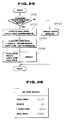
- CPU 21 displays the result of the rebate according to the processes shown in Fig. 25.
- CPU 21 determines if the desired amount of rebate is less than the calculated rebate. In this example, since the desired amount of rebate ( ⁇ 37) is less than the calculated rebate ( ⁇ 300), CPU 21 proceeds to step SP332, and subtracts the desired amount of ⁇ 37 from the total price of ⁇ 2,537. When the resultant amount (final price of ⁇ 2,500) is obtained, the content of the final-price register is updated to the final price of ⁇ 2,500.
- the desired amount of rebate ( ⁇ 37) is subtracted from the calculated rebate ( ⁇ 300).
- step SP335 CPU 21 displays the total price, rebate, carry-over, and final price in primary display 2a and secondary display 2b.
- Fig. 26 is an example of the display.
- the total price is ⁇ 2,537
- the rebate is ⁇ 37
- the carry-over is ⁇ 263
- the final price is ⁇ 2,500.
- the clerk informs the customer of the final price.
- the clerk receives the cash from the customer, he enters the amount of cash tendered, for example, ⁇ 3,000 and presses the "PRINT" key.
- CPU 21 computes and displays the change according to the processes shown in Fig. 27. First, at step SP351, CPU 21 subtracts the final price ( ⁇ 2,500) from the amount of cash tendered ( ⁇ 3,000), so that the amount of change ( ⁇ 500) is obtained. Then, at step SP352, CPU 21 displays the amount of change. Fig. 28 is an example of the display.
- CPU 21 updates the article data in PLU file 27e and the rebate (A) data in customer file 27f on the basis of each receipt item of the current purchase according to the processes shown in Fig. 29.
- CPU 21 initializes receipt-data-retrieval number N to "1".
- step SP362 CPU 21 reads the first receipt data in receipt buffer 27d, and then reads PLU data from PLU file 27e by using PLU number in the retrieved receipt data.
- the PLU data includes the unit price, the total price, the total weight, and the like, of the article.
- CPU 21 adds the price in receipt data to the total price in PLU file 27e, and also adds the total weight in receipt data to the total weight data in PLU file 27e, thereby updating the total price and the total weight in PLU file 27e.
- step 363 CPU 21 tests if the customer is a member of the store. If the test result is negative (NO), CPU 21 proceeds to step SP370, while if the test result is positive (YES), CPU 21 proceeds to step SP364.
- step SP364 CPU 21 tests if the article is eligible to double rebate or not on the basis of a flag included in receipt data. If the flag is "2", CPU 21 proceeds to step SP366 and multiplies the price of the article by "2". The resultant product is a new increase in the amount eligible for rebate (A). On the other hand, if the flag is "1", CPU 21 proceeds from step SP365 to step SP367. In this case, the price of the article is a new increase in the amount eligible for rebate (A). If the flag is "0", this means that the article is not eligible for rebate, and so CPU 21 directly proceeds from step SP365 to step SP370 without executing the processes for rebate.
- step SP366 After the new increase in the amount eligible for rebate is determined at step SP366 or step SP367, CPU 21 proceeds to step SP368 at which CPU 21 reads out the amount eligible for the rebate in customer file 27f, and adds the new increase in the amount eligible for rebate to the read out amount eligible for the rebate, thus obtaining the updated amount eligible for rebate, which is written into customer file 27f as the new amount eligible for the rebate.
- CPU 21 calculates a new rebate on the basis of the new amount eligible for rebate, and writes the new rebate (rebate A) into the rebate (A) memory in customer file 27f.
- the rebate A can be calculated by using a fixed amount method or a fixed ratio method. According to the fixed amount method, a rebate of a fixed amount is discounted: for example, a rebate of ⁇ 1,000 is discounted for every ⁇ 50,000 of the amount eligible for rebate.
- a rebate is determined as follows: for example, when the amount eligible for rebate is less than ⁇ 10,000, the rebate is 0% of the amount; when the amount eligible for rebate is more than ⁇ 10,000 and less than ⁇ 20,000, the rebate is 1% of the amount; and when the amount eligible for rebate is more than ⁇ 20,000, the rebate is 2% of the amount.
- CPU 21 tests if the number N is the last number or not. If the number N is the last number, CPU 21 terminates the update processes of step SP36. On the other hand, if the number N is not the last number, CPU 21 proceeds to step SP371 to increment the number N by "1", and returns to step SP262 so as to repeat the processes above on the next receipt data. The processes above is repeated until the last number is reached, thus completing the updating processes at step SP36.
- CPU 21 prints a receipt according to the processes shown in Fig. 30.
- CPU 21 initializes the retrieval number N of receipt data to "1".
- CPU 21 reads out the first receipt data in receipt buffer 27d, and transfers the article data such as "article name", "weight”, and "price” in the receipt data to print buffer 27c in order to print the article data on receipt paper by means of thermal printer 8.
- the article data in receipt buffer 27d is cleared.
- step 374 CPU 21 tests if the retrieval number N is the last number or not: if the retrieval number is the last number, CPU 21 terminates the printing process at step SP37; on the other hand, if the retrieval number N is not the last number, CPU 21 increments the retrieval number by "1" at step SP375, and returns to step SP373.
- the processes above are repeated with regard to the next receipt data until the last data is reached.
- step SP374 CPU 21 proceeds to step SP376 and transfers "total price", "rebate”, “cash tendered”, "change” and "customer name” to print buffer 27c, so that these data are printed out on a receipt paper by means of thermal printer 8.
- Fig. 31 shows a printed example at step SP376.
- a desired amount of rebate less the possible amount of the customer's rebate can be specified by the customer so that the desired amount is discounted from the total price of the current purchase.
- the customer can specify the amount of rebate equal to the fraction of the price.
- the clerk as well as the customer can be freed from the tedious handling of small change, thereby speeding up the sale.
- the total price can be rebated.
- a rebate is generally calculated by multiplying the total price of the articles eligible for rebate by a predetermined rate which varies according to the total price. For example, the rate is 0% when the total price eligible for rebate is less than ⁇ 10,000, the rate is 1% when the total price is more than ⁇ 10,000 and less than ⁇ 20,000, and the rate is 1.5% when the total price is more than ⁇ 20,000. If the total price eligible for rebate is ⁇ 15,000, the rebate of ⁇ 150 is given accordingly. If the customer uses ⁇ 100 out of this rebate of ⁇ 150, ⁇ 50 must be carried over. This carry-over must be stored by some means.
- the carry-over of ⁇ 50 may be stored in the form of the price eligible for rebate, after the rebate is converted into the price: the carry-over of ⁇ 50 is converted into the price of ⁇ 5,000, and the ⁇ 5,000 is stored.
- the embodiment above stores rebate A and rebate B in addition to the total price eligible for rebate. This makes it possible to display or print these three items without calculation, facilitating the display or printing.
Landscapes
- Business, Economics & Management (AREA)
- Accounting & Taxation (AREA)
- Engineering & Computer Science (AREA)
- Finance (AREA)
- Physics & Mathematics (AREA)
- Strategic Management (AREA)
- General Physics & Mathematics (AREA)
- Development Economics (AREA)
- Theoretical Computer Science (AREA)
- General Business, Economics & Management (AREA)
- Entrepreneurship & Innovation (AREA)
- Marketing (AREA)
- Economics (AREA)
- Game Theory and Decision Science (AREA)
- Computer Networks & Wireless Communication (AREA)
- Management, Administration, Business Operations System, And Electronic Commerce (AREA)
- Cash Registers Or Receiving Machines (AREA)
Claims (11)
- Appareil de traitement de données de vente comportant :
un moyen de calcul (21) pour calculer un rabais potentiel pour chaque client sur la base du prix total des articles achetés par le client et donnant droit à un rabais ;
un moyen de stockage (27) pour stocker ledit rabais potentiel ou ledit prix total à partir duquel ledit rabais potentiel est calculé pour chaque client ;
un moyen d'entrée comportant un moyen d'entrée primaire (15) pour saisir les données d'identification de client afin d'identifier chaque client et des moyens d'entrée secondaires (3) pour saisir le rabais désiré par le client au moment du calcul ;
un moyen de soustraction (21) pour soustraire ledit rabais désiré du prix total de l'achat courant de manière à obtenir le prix final de l'achat courant ;
un moyen d'affichage comportant un moyen d'affichage primaire (2a, 2b) pour l'affichage dudit rabais potentiel accordé au client en fonction desdites données d'identification de client saisies à partir dudit moyen d'entrée primaire et des moyens d'affichage secondaires (2a, 2b) pour afficher ledit prix final ; et
des moyens de mise à jour (21) pour mettre à jour ledit moyen de stockage sur la base dudit rabais désiré et dudit prix total des articles donnant droit à un rabais pour un achat courant. - Appareil de traitement de données de vente selon la revendication 1, dans lequel ledit moyen de stockage (27) comporte un emplacement primaire dans lequel est stocké un rabais primaire établi sur la base dudit prix total des articles donnant droit à un rabais pour les achats comportant l'achat courant et un emplacement secondaire dans lequel est stocké un rabais secondaire établi sur la base d'un report provenant d'un achat précédent.
- Appareil de traitement de données de vente selon la revendication 1, comportant en outre un moyen de consultation de prix (27e) dans lequel les données d'article sont stockées suivant des numéros de consultation de prix correspondants à chaque article, ledit moyen de consultation de prix contenant des indicateurs, chacun d'entre eux correspondant à un des articles et indiquant la qualité ou le rabais correspondant à l'article.
- Appareil de traitement de données de vente selon la revendication 3, dans lequel ledit indicateur informe que l'article ne donne pas droit à un rabais, donne droit à un rabais régulier, ou donne droit à un rabais double.
- Appareil de traitement de données de vente selon la revendication 3, comportant en outre un moyen de pesage (1b) pour peser le poids de l'article suivant lequel son prix est calculé en multipliant le poids de l'article par le prix unitaire de l'article, ledit prix unitaire étant inclus dans lesdites données d'article.
- Appareil de traitement de données de vente selon la revendication 1, dans lequel lesdits moyens d'affichage primaire et secondaire (2a, 2b) sont constitués par un affichage à double écran (2) comprenant deux écrans montés dos-à-dos, chacun des deux affichant le prix final d'un achat courant ainsi que le rabais.
- Appareil de traitement de données de vente selon la revendication 1, dans lequel ladite donnée d'identification de client est un numéro de client enregistré sur une carte de membre (17).
- Appareil de traitement de données de vente selon la revendication 7, dans lequel ledit moyen d'entrée primaire pour la saisie des données d'identification du client est un lecteur de code-barre (15) qui est détachable dudit appareil de traitement de données de vente.
- Appareil de traitement de données de vente selon la revendication 1, comportant en outre un moyen de fichier client (27f) comprenant les numéros de téléphone des clients et dans lequel ladite donnée d'identification du client est le numéro de téléphone du client saisi à partir dudit moyen d'entrée.
- Appareil de traitement de données de vente selon la revendication 1, comportant en outre un moyen de fichier client (27f) comprenant la date de naissance des clients, des moyens de registre d'horloge 28 fournissant des données de date et un moyen 21 pour comparer ladite date de naissance du client avec ladite donnée de date et pour déterminer si le jour de l'achat correspond à l'anniversaire du client et pour que le moyen d'affichage indique un message d'anniversaire si le jour de l'achat correspond à l'anniversaire du client.
- Appareil de traitement de données de vente selon la revendication 1, comportant en outre un moyen d'impression 8 qui imprime au moins le prix total de l'achat courant, le rabais et le prix final de l'achat courant.
Applications Claiming Priority (2)
| Application Number | Priority Date | Filing Date | Title |
|---|---|---|---|
| JP275724/88 | 1988-10-31 | ||
| JP63275724A JP2660174B2 (ja) | 1988-10-31 | 1988-10-31 | 販売データ処理装置 |
Publications (2)
| Publication Number | Publication Date |
|---|---|
| EP0370847A1 EP0370847A1 (fr) | 1990-05-30 |
| EP0370847B1 true EP0370847B1 (fr) | 1993-08-11 |
Family
ID=17559495
Family Applications (1)
| Application Number | Title | Priority Date | Filing Date |
|---|---|---|---|
| EP89402995A Expired - Lifetime EP0370847B1 (fr) | 1988-10-31 | 1989-10-30 | Dispositif de traitement de données de vente |
Country Status (3)
| Country | Link |
|---|---|
| EP (1) | EP0370847B1 (fr) |
| JP (1) | JP2660174B2 (fr) |
| DE (1) | DE68908355T2 (fr) |
Families Citing this family (6)
| Publication number | Priority date | Publication date | Assignee | Title |
|---|---|---|---|---|
| NZ242614A (en) * | 1991-05-06 | 1995-07-26 | Catalina Marketing Int | Printing discount coupons according to product bar codes at point of sale |
| AU4806193A (en) * | 1992-08-11 | 1994-03-15 | S.T.A.R.T., Inc. | Transaction processing system |
| JPH07210767A (ja) * | 1994-01-19 | 1995-08-11 | Chubu Kintetsu Hiyatsukaten:Kk | 買上割引管理装置 |
| US7392205B1 (en) * | 1999-08-26 | 2008-06-24 | Inest Realty, Inc. | System and method for directing and instructing customers to deal with specific merchants using incentives |
| US6578011B1 (en) | 1999-08-26 | 2003-06-10 | Newhomesamerica.Com, Inc. | System and method for directing and instructing customers to deal with specific merchants using incentives |
| JP2005056329A (ja) * | 2003-08-07 | 2005-03-03 | Fujitsu Ltd | Pos端末装置およびポイント処理プログラム |
Family Cites Families (7)
| Publication number | Priority date | Publication date | Assignee | Title |
|---|---|---|---|---|
| JPS5839654U (ja) * | 1981-09-08 | 1983-03-15 | シャープ株式会社 | 電子式キヤツシユレジスタ |
| US4882675A (en) * | 1984-11-26 | 1989-11-21 | Steven Nichtberger | Paperless system for distributing, redeeming and clearing merchandise coupons |
| JPS62184596A (ja) * | 1986-02-10 | 1987-08-12 | オムロン株式会社 | 電子式キヤツシユレジスタ |
| JPH0658705B2 (ja) * | 1986-05-02 | 1994-08-03 | 東京電気株式会社 | 電子式キヤツシユレジスタ |
| JPS6314297A (ja) * | 1986-07-03 | 1988-01-21 | オムロン株式会社 | Pos端末装置 |
| ES2031090T3 (es) * | 1986-07-03 | 1992-12-01 | Omron Tateisi Electronics Co. | Dispositivo terminal pdv (punto de venta). |
| JP2501115B2 (ja) * | 1987-10-23 | 1996-05-29 | オムロン株式会社 | 電子式キャッシュレジスタ |
-
1988
- 1988-10-31 JP JP63275724A patent/JP2660174B2/ja not_active Expired - Lifetime
-
1989
- 1989-10-30 DE DE89402995T patent/DE68908355T2/de not_active Expired - Fee Related
- 1989-10-30 EP EP89402995A patent/EP0370847B1/fr not_active Expired - Lifetime
Also Published As
| Publication number | Publication date |
|---|---|
| DE68908355T2 (de) | 1994-02-17 |
| JP2660174B2 (ja) | 1997-10-08 |
| JPH02121088A (ja) | 1990-05-08 |
| DE68908355D1 (de) | 1993-09-16 |
| EP0370847A1 (fr) | 1990-05-30 |
Similar Documents
| Publication | Publication Date | Title |
|---|---|---|
| US5200889A (en) | System for maintaining continuous total of refund amounts due a customer and for allowing customer designation of the amount of refund to be applied to a purchase | |
| EP0362075B1 (fr) | Balance électronique avec imprimante pour le commerce de détail | |
| KR900006668B1 (ko) | Pos 단말장치 | |
| US5398191A (en) | Point of sale apparatus with an automatic determination if weighing a product is necessary or prohibited | |
| EP0370847A1 (fr) | Dispositif de traitement de données de vente | |
| JP2644481B2 (ja) | Pos端末装置 | |
| JP3317249B2 (ja) | ラベルプリンタ | |
| JP2575847B2 (ja) | 販売データ処理装置 | |
| JPH0430295A (ja) | 電子式キャッシュレジスタ | |
| JP2937513B2 (ja) | ラベルプリンタ付き電子式秤 | |
| JPH0632133B2 (ja) | Posシステム | |
| JPH06119558A (ja) | 電子式キャッシュレジスタ | |
| JPH02244395A (ja) | 商品販売データ処理装置 | |
| JPH0276096A (ja) | レシート発行機能付き電子秤 | |
| JPH04164215A (ja) | 販売データ処理装置 | |
| JP2552378B2 (ja) | 商品販売データ処理装置 | |
| JPH0535973A (ja) | 電子料金秤 | |
| JPH05120571A (ja) | 電子式金銭登録機 | |
| JPH041893A (ja) | 商品データ処理装置 | |
| JPH02257396A (ja) | 商品販売データ処理装置 | |
| JPH10149489A (ja) | ラベルプリンタ | |
| JPH03160592A (ja) | 支払処理装置 | |
| JP2000076555A (ja) | Pos端末 | |
| JP2003006744A (ja) | ポイント管理システム | |
| JPH05166073A (ja) | 商品データ処理装置 |
Legal Events
| Date | Code | Title | Description |
|---|---|---|---|
| PUAI | Public reference made under article 153(3) epc to a published international application that has entered the european phase |
Free format text: ORIGINAL CODE: 0009012 |
|
| AK | Designated contracting states |
Kind code of ref document: A1 Designated state(s): BE DE FR GB NL |
|
| 17P | Request for examination filed |
Effective date: 19900719 |
|
| 17Q | First examination report despatched |
Effective date: 19920410 |
|
| GRAA | (expected) grant |
Free format text: ORIGINAL CODE: 0009210 |
|
| AK | Designated contracting states |
Kind code of ref document: B1 Designated state(s): BE DE FR GB NL |
|
| REF | Corresponds to: |
Ref document number: 68908355 Country of ref document: DE Date of ref document: 19930916 |
|
| ET | Fr: translation filed | ||
| PLBE | No opposition filed within time limit |
Free format text: ORIGINAL CODE: 0009261 |
|
| STAA | Information on the status of an ep patent application or granted ep patent |
Free format text: STATUS: NO OPPOSITION FILED WITHIN TIME LIMIT |
|
| 26N | No opposition filed | ||
| REG | Reference to a national code |
Ref country code: GB Ref legal event code: IF02 |
|
| PGFP | Annual fee paid to national office [announced via postgrant information from national office to epo] |
Ref country code: NL Payment date: 20031008 Year of fee payment: 15 |
|
| PGFP | Annual fee paid to national office [announced via postgrant information from national office to epo] |
Ref country code: DE Payment date: 20031024 Year of fee payment: 15 |
|
| PGFP | Annual fee paid to national office [announced via postgrant information from national office to epo] |
Ref country code: FR Payment date: 20031027 Year of fee payment: 15 |
|
| PGFP | Annual fee paid to national office [announced via postgrant information from national office to epo] |
Ref country code: GB Payment date: 20031029 Year of fee payment: 15 |
|
| PGFP | Annual fee paid to national office [announced via postgrant information from national office to epo] |
Ref country code: BE Payment date: 20031211 Year of fee payment: 15 |
|
| PG25 | Lapsed in a contracting state [announced via postgrant information from national office to epo] |
Ref country code: GB Free format text: LAPSE BECAUSE OF NON-PAYMENT OF DUE FEES Effective date: 20041030 |
|
| PG25 | Lapsed in a contracting state [announced via postgrant information from national office to epo] |
Ref country code: BE Free format text: LAPSE BECAUSE OF NON-PAYMENT OF DUE FEES Effective date: 20041031 |
|
| BERE | Be: lapsed |
Owner name: *TERAOKA SEIKO CO. LTD Effective date: 20041031 |
|
| PG25 | Lapsed in a contracting state [announced via postgrant information from national office to epo] |
Ref country code: NL Free format text: LAPSE BECAUSE OF NON-PAYMENT OF DUE FEES Effective date: 20050501 |
|
| PG25 | Lapsed in a contracting state [announced via postgrant information from national office to epo] |
Ref country code: DE Free format text: LAPSE BECAUSE OF NON-PAYMENT OF DUE FEES Effective date: 20050503 |
|
| GBPC | Gb: european patent ceased through non-payment of renewal fee |
Effective date: 20041030 |
|
| PG25 | Lapsed in a contracting state [announced via postgrant information from national office to epo] |
Ref country code: FR Free format text: LAPSE BECAUSE OF NON-PAYMENT OF DUE FEES Effective date: 20050630 |
|
| NLV4 | Nl: lapsed or anulled due to non-payment of the annual fee |
Effective date: 20050501 |
|
| REG | Reference to a national code |
Ref country code: FR Ref legal event code: ST |
|
| BERE | Be: lapsed |
Owner name: *TERAOKA SEIKO CO. LTD Effective date: 20041031 |