EP0384671A2 - Lichtempfindliches farbphotographisches Silberhalogenidmaterial - Google Patents
Lichtempfindliches farbphotographisches Silberhalogenidmaterial Download PDFInfo
- Publication number
- EP0384671A2 EP0384671A2 EP90301715A EP90301715A EP0384671A2 EP 0384671 A2 EP0384671 A2 EP 0384671A2 EP 90301715 A EP90301715 A EP 90301715A EP 90301715 A EP90301715 A EP 90301715A EP 0384671 A2 EP0384671 A2 EP 0384671A2
- Authority
- EP
- European Patent Office
- Prior art keywords
- group
- silver halide
- light
- sensitive
- photographic material
- Prior art date
- Legal status (The legal status is an assumption and is not a legal conclusion. Google has not performed a legal analysis and makes no representation as to the accuracy of the status listed.)
- Withdrawn
Links
- -1 silver halide Chemical class 0.000 title claims abstract description 123
- 229910052709 silver Inorganic materials 0.000 title claims abstract description 91
- 239000004332 silver Substances 0.000 title claims abstract description 91
- 239000000463 material Substances 0.000 title claims abstract description 52
- 239000010410 layer Substances 0.000 claims abstract description 73
- WSFSSNUMVMOOMR-UHFFFAOYSA-N Formaldehyde Chemical compound O=C WSFSSNUMVMOOMR-UHFFFAOYSA-N 0.000 claims abstract description 70
- 239000000839 emulsion Substances 0.000 claims abstract description 55
- 239000002516 radical scavenger Substances 0.000 claims abstract description 17
- 239000002356 single layer Substances 0.000 claims abstract description 17
- ZRHUHDUEXWHZMA-UHFFFAOYSA-N 1,4-dihydropyrazol-5-one Chemical compound O=C1CC=NN1 ZRHUHDUEXWHZMA-UHFFFAOYSA-N 0.000 claims abstract description 6
- 239000000758 substrate Substances 0.000 claims abstract description 3
- 125000000217 alkyl group Chemical group 0.000 claims description 32
- 125000001424 substituent group Chemical group 0.000 claims description 22
- 125000004435 hydrogen atom Chemical group [H]* 0.000 claims description 21
- 125000003118 aryl group Chemical group 0.000 claims description 16
- 125000000623 heterocyclic group Chemical group 0.000 claims description 16
- 230000035945 sensitivity Effects 0.000 claims description 16
- 239000003795 chemical substances by application Substances 0.000 claims description 14
- 150000001875 compounds Chemical class 0.000 claims description 14
- 239000000203 mixture Substances 0.000 claims description 13
- 125000003917 carbamoyl group Chemical group [H]N([H])C(*)=O 0.000 claims description 11
- 125000000753 cycloalkyl group Chemical group 0.000 claims description 10
- 125000005843 halogen group Chemical group 0.000 claims description 10
- 125000004430 oxygen atom Chemical group O* 0.000 claims description 10
- 238000005859 coupling reaction Methods 0.000 claims description 9
- 125000003342 alkenyl group Chemical group 0.000 claims description 8
- 125000003545 alkoxy group Chemical group 0.000 claims description 8
- 125000003277 amino group Chemical group 0.000 claims description 8
- 239000013078 crystal Substances 0.000 claims description 8
- 125000004442 acylamino group Chemical group 0.000 claims description 7
- 125000004414 alkyl thio group Chemical group 0.000 claims description 7
- 125000003710 aryl alkyl group Chemical group 0.000 claims description 7
- 125000004104 aryloxy group Chemical group 0.000 claims description 7
- 125000004429 atom Chemical group 0.000 claims description 7
- 125000004432 carbon atom Chemical group C* 0.000 claims description 7
- 229910052757 nitrogen Inorganic materials 0.000 claims description 7
- 125000004433 nitrogen atom Chemical group N* 0.000 claims description 7
- JEXVQSWXXUJEMA-UHFFFAOYSA-N pyrazol-3-one Chemical compound O=C1C=CN=N1 JEXVQSWXXUJEMA-UHFFFAOYSA-N 0.000 claims description 7
- 125000005110 aryl thio group Chemical group 0.000 claims description 6
- 230000008878 coupling Effects 0.000 claims description 6
- 238000010168 coupling process Methods 0.000 claims description 6
- 125000002252 acyl group Chemical group 0.000 claims description 5
- 125000004423 acyloxy group Chemical group 0.000 claims description 5
- 125000004453 alkoxycarbonyl group Chemical group 0.000 claims description 5
- 125000004093 cyano group Chemical group *C#N 0.000 claims description 5
- 229910052717 sulfur Inorganic materials 0.000 claims description 5
- 125000004434 sulfur atom Chemical group 0.000 claims description 5
- 125000002947 alkylene group Chemical group 0.000 claims description 4
- 230000015572 biosynthetic process Effects 0.000 claims description 4
- 125000000113 cyclohexyl group Chemical group [H]C1([H])C([H])([H])C([H])([H])C([H])(*)C([H])([H])C1([H])[H] 0.000 claims description 4
- 125000001997 phenyl group Chemical group [H]C1=C([H])C([H])=C(*)C([H])=C1[H] 0.000 claims description 4
- 229910052736 halogen Inorganic materials 0.000 claims description 3
- 150000002367 halogens Chemical class 0.000 claims description 3
- 125000003236 benzoyl group Chemical group [H]C1=C([H])C([H])=C(C([H])=C1[H])C(*)=O 0.000 claims description 2
- 229910052799 carbon Inorganic materials 0.000 claims description 2
- 125000002915 carbonyl group Chemical group [*:2]C([*:1])=O 0.000 claims description 2
- 125000004181 carboxyalkyl group Chemical group 0.000 claims description 2
- 239000000539 dimer Substances 0.000 claims description 2
- 125000004005 formimidoyl group Chemical group [H]\N=C(/[H])* 0.000 claims description 2
- 235000013339 cereals Nutrition 0.000 description 81
- 239000000975 dye Substances 0.000 description 29
- 238000012545 processing Methods 0.000 description 21
- 238000000034 method Methods 0.000 description 19
- 239000000243 solution Substances 0.000 description 15
- JKFYKCYQEWQPTM-UHFFFAOYSA-N 2-azaniumyl-2-(4-fluorophenyl)acetate Chemical compound OC(=O)C(N)C1=CC=C(F)C=C1 JKFYKCYQEWQPTM-UHFFFAOYSA-N 0.000 description 14
- 229910021612 Silver iodide Inorganic materials 0.000 description 14
- 229940045105 silver iodide Drugs 0.000 description 14
- 238000006243 chemical reaction Methods 0.000 description 12
- 239000003112 inhibitor Substances 0.000 description 12
- 239000007789 gas Substances 0.000 description 10
- 229910021645 metal ion Inorganic materials 0.000 description 10
- 230000001235 sensitizing effect Effects 0.000 description 10
- 229940090898 Desensitizer Drugs 0.000 description 9
- 230000000694 effects Effects 0.000 description 9
- 108010010803 Gelatin Proteins 0.000 description 8
- 239000008273 gelatin Substances 0.000 description 8
- 229920000159 gelatin Polymers 0.000 description 8
- 235000019322 gelatine Nutrition 0.000 description 8
- 235000011852 gelatine desserts Nutrition 0.000 description 8
- 238000009826 distribution Methods 0.000 description 7
- 239000012071 phase Substances 0.000 description 7
- 239000012298 atmosphere Substances 0.000 description 6
- IOLCXVTUBQKXJR-UHFFFAOYSA-M potassium bromide Chemical compound [K+].[Br-] IOLCXVTUBQKXJR-UHFFFAOYSA-M 0.000 description 6
- NLKNQRATVPKPDG-UHFFFAOYSA-M potassium iodide Chemical compound [K+].[I-] NLKNQRATVPKPDG-UHFFFAOYSA-M 0.000 description 6
- 238000002360 preparation method Methods 0.000 description 5
- ZUNKMNLKJXRCDM-UHFFFAOYSA-N silver bromoiodide Chemical compound [Ag].IBr ZUNKMNLKJXRCDM-UHFFFAOYSA-N 0.000 description 5
- PEDCQBHIVMGVHV-UHFFFAOYSA-N Glycerine Chemical compound OCC(O)CO PEDCQBHIVMGVHV-UHFFFAOYSA-N 0.000 description 4
- BQCADISMDOOEFD-UHFFFAOYSA-N Silver Chemical compound [Ag] BQCADISMDOOEFD-UHFFFAOYSA-N 0.000 description 4
- 239000011248 coating agent Substances 0.000 description 4
- 238000000576 coating method Methods 0.000 description 4
- 238000004519 manufacturing process Methods 0.000 description 4
- MCSKRVKAXABJLX-UHFFFAOYSA-N pyrazolo[3,4-d]triazole Chemical compound N1=NN=C2N=NC=C21 MCSKRVKAXABJLX-UHFFFAOYSA-N 0.000 description 4
- 239000003381 stabilizer Substances 0.000 description 4
- 239000000126 substance Substances 0.000 description 4
- ZCYVEMRRCGMTRW-UHFFFAOYSA-N 7553-56-2 Chemical compound [I] ZCYVEMRRCGMTRW-UHFFFAOYSA-N 0.000 description 3
- 206010034960 Photophobia Diseases 0.000 description 3
- 125000004390 alkyl sulfonyl group Chemical group 0.000 description 3
- 238000003776 cleavage reaction Methods 0.000 description 3
- 238000011156 evaluation Methods 0.000 description 3
- 125000002887 hydroxy group Chemical group [H]O* 0.000 description 3
- 229910052740 iodine Inorganic materials 0.000 description 3
- 239000011630 iodine Substances 0.000 description 3
- 208000013469 light sensitivity Diseases 0.000 description 3
- 230000007017 scission Effects 0.000 description 3
- ANRHNWWPFJCPAZ-UHFFFAOYSA-M thionine Chemical compound [Cl-].C1=CC(N)=CC2=[S+]C3=CC(N)=CC=C3N=C21 ANRHNWWPFJCPAZ-UHFFFAOYSA-M 0.000 description 3
- CDAWCLOXVUBKRW-UHFFFAOYSA-N 2-aminophenol Chemical class NC1=CC=CC=C1O CDAWCLOXVUBKRW-UHFFFAOYSA-N 0.000 description 2
- 206010070834 Sensitisation Diseases 0.000 description 2
- 150000008062 acetophenones Chemical class 0.000 description 2
- 230000032683 aging Effects 0.000 description 2
- 125000004466 alkoxycarbonylamino group Chemical group 0.000 description 2
- 125000004397 aminosulfonyl group Chemical group NS(=O)(=O)* 0.000 description 2
- 125000005162 aryl oxy carbonyl amino group Chemical group 0.000 description 2
- 125000005161 aryl oxy carbonyl group Chemical group 0.000 description 2
- 238000009835 boiling Methods 0.000 description 2
- 230000000052 comparative effect Effects 0.000 description 2
- 238000011033 desalting Methods 0.000 description 2
- 230000006866 deterioration Effects 0.000 description 2
- 239000006185 dispersion Substances 0.000 description 2
- 230000006870 function Effects 0.000 description 2
- 235000011187 glycerol Nutrition 0.000 description 2
- UYTPUPDQBNUYGX-UHFFFAOYSA-N guanine Chemical compound O=C1NC(N)=NC2=C1N=CN2 UYTPUPDQBNUYGX-UHFFFAOYSA-N 0.000 description 2
- 125000001183 hydrocarbyl group Chemical group 0.000 description 2
- 125000002883 imidazolyl group Chemical group 0.000 description 2
- 150000003949 imides Chemical class 0.000 description 2
- QNXSIUBBGPHDDE-UHFFFAOYSA-N indan-1-one Chemical class C1=CC=C2C(=O)CCC2=C1 QNXSIUBBGPHDDE-UHFFFAOYSA-N 0.000 description 2
- 239000007788 liquid Substances 0.000 description 2
- DZVCFNFOPIZQKX-LTHRDKTGSA-M merocyanine Chemical compound [Na+].O=C1N(CCCC)C(=O)N(CCCC)C(=O)C1=C\C=C\C=C/1N(CCCS([O-])(=O)=O)C2=CC=CC=C2O\1 DZVCFNFOPIZQKX-LTHRDKTGSA-M 0.000 description 2
- 238000002156 mixing Methods 0.000 description 2
- NXPPAOGUKPJVDI-UHFFFAOYSA-N naphthalene-1,2-diol Chemical class C1=CC=CC2=C(O)C(O)=CC=C21 NXPPAOGUKPJVDI-UHFFFAOYSA-N 0.000 description 2
- 150000004780 naphthols Chemical class 0.000 description 2
- 239000003960 organic solvent Substances 0.000 description 2
- 229910052762 osmium Inorganic materials 0.000 description 2
- 150000002989 phenols Chemical class 0.000 description 2
- 238000001556 precipitation Methods 0.000 description 2
- 229910052703 rhodium Inorganic materials 0.000 description 2
- 229910052707 ruthenium Inorganic materials 0.000 description 2
- 230000008313 sensitization Effects 0.000 description 2
- SQGYOTSLMSWVJD-UHFFFAOYSA-N silver(1+) nitrate Chemical compound [Ag+].[O-]N(=O)=O SQGYOTSLMSWVJD-UHFFFAOYSA-N 0.000 description 2
- 230000003595 spectral effect Effects 0.000 description 2
- 238000003860 storage Methods 0.000 description 2
- 239000002344 surface layer Substances 0.000 description 2
- 239000004094 surface-active agent Substances 0.000 description 2
- 125000001425 triazolyl group Chemical group 0.000 description 2
- 235000020985 whole grains Nutrition 0.000 description 2
- 150000005206 1,2-dihydroxybenzenes Chemical class 0.000 description 1
- YXIWHUQXZSMYRE-UHFFFAOYSA-N 1,3-benzothiazole-2-thiol Chemical class C1=CC=C2SC(S)=NC2=C1 YXIWHUQXZSMYRE-UHFFFAOYSA-N 0.000 description 1
- YHMYGUUIMTVXNW-UHFFFAOYSA-N 1,3-dihydrobenzimidazole-2-thione Chemical class C1=CC=C2NC(S)=NC2=C1 YHMYGUUIMTVXNW-UHFFFAOYSA-N 0.000 description 1
- 150000005208 1,4-dihydroxybenzenes Chemical class 0.000 description 1
- JAAIPIWKKXCNOC-UHFFFAOYSA-N 1h-tetrazol-1-ium-5-thiolate Chemical class SC1=NN=NN1 JAAIPIWKKXCNOC-UHFFFAOYSA-N 0.000 description 1
- QPKNFEVLZVJGBM-UHFFFAOYSA-N 2-aminonaphthalen-1-ol Chemical class C1=CC=CC2=C(O)C(N)=CC=C21 QPKNFEVLZVJGBM-UHFFFAOYSA-N 0.000 description 1
- BCHZICNRHXRCHY-UHFFFAOYSA-N 2h-oxazine Chemical group N1OC=CC=C1 BCHZICNRHXRCHY-UHFFFAOYSA-N 0.000 description 1
- CBHTTYDJRXOHHL-UHFFFAOYSA-N 2h-triazolo[4,5-c]pyridazine Chemical class N1=NC=CC2=C1N=NN2 CBHTTYDJRXOHHL-UHFFFAOYSA-N 0.000 description 1
- OCVLSHAVSIYKLI-UHFFFAOYSA-N 3h-1,3-thiazole-2-thione Chemical class SC1=NC=CS1 OCVLSHAVSIYKLI-UHFFFAOYSA-N 0.000 description 1
- PLIKAWJENQZMHA-UHFFFAOYSA-N 4-aminophenol Chemical class NC1=CC=C(O)C=C1 PLIKAWJENQZMHA-UHFFFAOYSA-N 0.000 description 1
- QGNQEODJYRGEJX-UHFFFAOYSA-N 4h-isoquinoline-1,3-dione Chemical class C1=CC=C2C(=O)NC(=O)CC2=C1 QGNQEODJYRGEJX-UHFFFAOYSA-N 0.000 description 1
- CNGYZEMWVAWWOB-VAWYXSNFSA-N 5-[[4-anilino-6-[bis(2-hydroxyethyl)amino]-1,3,5-triazin-2-yl]amino]-2-[(e)-2-[4-[[4-anilino-6-[bis(2-hydroxyethyl)amino]-1,3,5-triazin-2-yl]amino]-2-sulfophenyl]ethenyl]benzenesulfonic acid Chemical compound N=1C(NC=2C=C(C(\C=C\C=3C(=CC(NC=4N=C(N=C(NC=5C=CC=CC=5)N=4)N(CCO)CCO)=CC=3)S(O)(=O)=O)=CC=2)S(O)(=O)=O)=NC(N(CCO)CCO)=NC=1NC1=CC=CC=C1 CNGYZEMWVAWWOB-VAWYXSNFSA-N 0.000 description 1
- GFFGJBXGBJISGV-UHFFFAOYSA-N Adenine Chemical compound NC1=NC=NC2=C1N=CN2 GFFGJBXGBJISGV-UHFFFAOYSA-N 0.000 description 1
- 229930024421 Adenine Natural products 0.000 description 1
- WKBOTKDWSSQWDR-UHFFFAOYSA-N Bromine atom Chemical compound [Br] WKBOTKDWSSQWDR-UHFFFAOYSA-N 0.000 description 1
- 239000004215 Carbon black (E152) Substances 0.000 description 1
- 229920002284 Cellulose triacetate Polymers 0.000 description 1
- ZAMOUSCENKQFHK-UHFFFAOYSA-N Chlorine atom Chemical compound [Cl] ZAMOUSCENKQFHK-UHFFFAOYSA-N 0.000 description 1
- PXGOKWXKJXAPGV-UHFFFAOYSA-N Fluorine Chemical compound FF PXGOKWXKJXAPGV-UHFFFAOYSA-N 0.000 description 1
- 108010002352 Interleukin-1 Proteins 0.000 description 1
- 108010002350 Interleukin-2 Proteins 0.000 description 1
- 125000005118 N-alkylcarbamoyl group Chemical group 0.000 description 1
- 101150004094 PRO2 gene Proteins 0.000 description 1
- 239000004698 Polyethylene Substances 0.000 description 1
- 229910052777 Praseodymium Inorganic materials 0.000 description 1
- 229910019891 RuCl3 Inorganic materials 0.000 description 1
- 229910052772 Samarium Inorganic materials 0.000 description 1
- 241000557758 Tribeles Species 0.000 description 1
- 238000002441 X-ray diffraction Methods 0.000 description 1
- 229910052769 Ytterbium Inorganic materials 0.000 description 1
- NNLVGZFZQQXQNW-ADJNRHBOSA-N [(2r,3r,4s,5r,6s)-4,5-diacetyloxy-3-[(2s,3r,4s,5r,6r)-3,4,5-triacetyloxy-6-(acetyloxymethyl)oxan-2-yl]oxy-6-[(2r,3r,4s,5r,6s)-4,5,6-triacetyloxy-2-(acetyloxymethyl)oxan-3-yl]oxyoxan-2-yl]methyl acetate Chemical compound O([C@@H]1O[C@@H]([C@H]([C@H](OC(C)=O)[C@H]1OC(C)=O)O[C@H]1[C@@H]([C@@H](OC(C)=O)[C@H](OC(C)=O)[C@@H](COC(C)=O)O1)OC(C)=O)COC(=O)C)[C@@H]1[C@@H](COC(C)=O)O[C@@H](OC(C)=O)[C@H](OC(C)=O)[C@H]1OC(C)=O NNLVGZFZQQXQNW-ADJNRHBOSA-N 0.000 description 1
- HPCNGJIHSHCKAQ-UHFFFAOYSA-N [cyano(nitrosulfonyl)amino]urea Chemical compound N(C(=O)N)N(S(=O)(=O)[N+](=O)[O-])C#N HPCNGJIHSHCKAQ-UHFFFAOYSA-N 0.000 description 1
- 239000002253 acid Substances 0.000 description 1
- 239000000654 additive Substances 0.000 description 1
- 229960000643 adenine Drugs 0.000 description 1
- 150000001298 alcohols Chemical class 0.000 description 1
- 125000003282 alkyl amino group Chemical group 0.000 description 1
- 125000002490 anilino group Chemical group [H]N(*)C1=C([H])C([H])=C([H])C([H])=C1[H] 0.000 description 1
- 239000007864 aqueous solution Substances 0.000 description 1
- 125000004391 aryl sulfonyl group Chemical group 0.000 description 1
- 150000003851 azoles Chemical class 0.000 description 1
- QVQLCTNNEUAWMS-UHFFFAOYSA-N barium oxide Chemical compound [Ba]=O QVQLCTNNEUAWMS-UHFFFAOYSA-N 0.000 description 1
- 229910001864 baryta Inorganic materials 0.000 description 1
- 150000001556 benzimidazoles Chemical class 0.000 description 1
- IOJUPLGTWVMSFF-UHFFFAOYSA-N benzothiazole Chemical class C1=CC=C2SC=NC2=C1 IOJUPLGTWVMSFF-UHFFFAOYSA-N 0.000 description 1
- 125000001164 benzothiazolyl group Chemical group S1C(=NC2=C1C=CC=C2)* 0.000 description 1
- QRUDEWIWKLJBPS-UHFFFAOYSA-N benzotriazole Chemical class C1=CC=C2N[N][N]C2=C1 QRUDEWIWKLJBPS-UHFFFAOYSA-N 0.000 description 1
- 125000003354 benzotriazolyl group Chemical group N1N=NC2=C1C=CC=C2* 0.000 description 1
- KGNDCEVUMONOKF-UGPLYTSKSA-N benzyl n-[(2r)-1-[(2s,4r)-2-[[(2s)-6-amino-1-(1,3-benzoxazol-2-yl)-1,1-dihydroxyhexan-2-yl]carbamoyl]-4-[(4-methylphenyl)methoxy]pyrrolidin-1-yl]-1-oxo-4-phenylbutan-2-yl]carbamate Chemical compound C1=CC(C)=CC=C1CO[C@H]1CN(C(=O)[C@@H](CCC=2C=CC=CC=2)NC(=O)OCC=2C=CC=CC=2)[C@H](C(=O)N[C@@H](CCCCN)C(O)(O)C=2OC3=CC=CC=C3N=2)C1 KGNDCEVUMONOKF-UGPLYTSKSA-N 0.000 description 1
- 239000011230 binding agent Substances 0.000 description 1
- 230000005540 biological transmission Effects 0.000 description 1
- 229910052797 bismuth Inorganic materials 0.000 description 1
- 238000004061 bleaching Methods 0.000 description 1
- GDTBXPJZTBHREO-UHFFFAOYSA-N bromine Substances BrBr GDTBXPJZTBHREO-UHFFFAOYSA-N 0.000 description 1
- 229910052794 bromium Inorganic materials 0.000 description 1
- 229910052793 cadmium Inorganic materials 0.000 description 1
- 125000005708 carbonyloxy group Chemical group [*:2]OC([*:1])=O 0.000 description 1
- 229920002301 cellulose acetate Polymers 0.000 description 1
- 239000000460 chlorine Substances 0.000 description 1
- 229910052801 chlorine Inorganic materials 0.000 description 1
- 239000000084 colloidal system Substances 0.000 description 1
- 230000002860 competitive effect Effects 0.000 description 1
- 229940125833 compound 23 Drugs 0.000 description 1
- 239000011258 core-shell material Substances 0.000 description 1
- 238000012937 correction Methods 0.000 description 1
- 238000001035 drying Methods 0.000 description 1
- CTXKDHZPBPQKTD-UHFFFAOYSA-N ethyl n-(carbamoylamino)carbamate Chemical compound CCOC(=O)NNC(N)=O CTXKDHZPBPQKTD-UHFFFAOYSA-N 0.000 description 1
- 230000001747 exhibiting effect Effects 0.000 description 1
- 229910052731 fluorine Inorganic materials 0.000 description 1
- 239000011737 fluorine Substances 0.000 description 1
- 239000012634 fragment Substances 0.000 description 1
- 125000002541 furyl group Chemical group 0.000 description 1
- 229910052737 gold Inorganic materials 0.000 description 1
- 150000004820 halides Chemical class 0.000 description 1
- 125000005842 heteroatom Chemical group 0.000 description 1
- 229930195733 hydrocarbon Natural products 0.000 description 1
- AKCUHGBLDXXTOM-UHFFFAOYSA-N hydroxy-oxo-phenyl-sulfanylidene-$l^{6}-sulfane Chemical class SS(=O)(=O)C1=CC=CC=C1 AKCUHGBLDXXTOM-UHFFFAOYSA-N 0.000 description 1
- 150000002473 indoazoles Chemical class 0.000 description 1
- 150000002475 indoles Chemical class 0.000 description 1
- 239000008384 inner phase Substances 0.000 description 1
- 150000004694 iodide salts Chemical class 0.000 description 1
- 150000002500 ions Chemical class 0.000 description 1
- 229910052741 iridium Inorganic materials 0.000 description 1
- 229910052742 iron Inorganic materials 0.000 description 1
- HZVPJXOQDCOJRJ-UHFFFAOYSA-N isoxazolin-5-one Chemical class O=C1C=CNO1 HZVPJXOQDCOJRJ-UHFFFAOYSA-N 0.000 description 1
- 239000004816 latex Substances 0.000 description 1
- 229920000126 latex Polymers 0.000 description 1
- 239000000314 lubricant Substances 0.000 description 1
- 238000004020 luminiscence type Methods 0.000 description 1
- 238000005259 measurement Methods 0.000 description 1
- 125000002950 monocyclic group Chemical group 0.000 description 1
- LDEGHVGGILPJGN-UHFFFAOYSA-N n'-phenylpropanediamide Chemical class NC(=O)CC(=O)NC1=CC=CC=C1 LDEGHVGGILPJGN-UHFFFAOYSA-N 0.000 description 1
- PCILLCXFKWDRMK-UHFFFAOYSA-N naphthalene-1,4-diol Chemical class C1=CC=C2C(O)=CC=C(O)C2=C1 PCILLCXFKWDRMK-UHFFFAOYSA-N 0.000 description 1
- MNZMMCVIXORAQL-UHFFFAOYSA-N naphthalene-2,6-diol Chemical class C1=C(O)C=CC2=CC(O)=CC=C21 MNZMMCVIXORAQL-UHFFFAOYSA-N 0.000 description 1
- 125000000449 nitro group Chemical group [O-][N+](*)=O 0.000 description 1
- 150000007523 nucleic acids Chemical class 0.000 description 1
- 102000039446 nucleic acids Human genes 0.000 description 1
- 108020004707 nucleic acids Proteins 0.000 description 1
- 125000002971 oxazolyl group Chemical group 0.000 description 1
- 125000005740 oxycarbonyl group Chemical group [*:1]OC([*:2])=O 0.000 description 1
- 229910052763 palladium Inorganic materials 0.000 description 1
- 230000000737 periodic effect Effects 0.000 description 1
- 239000004014 plasticizer Substances 0.000 description 1
- 229920000573 polyethylene Polymers 0.000 description 1
- 229920000139 polyethylene terephthalate Polymers 0.000 description 1
- 239000005020 polyethylene terephthalate Substances 0.000 description 1
- 239000004848 polyfunctional curative Substances 0.000 description 1
- 239000011241 protective layer Substances 0.000 description 1
- 125000003226 pyrazolyl group Chemical group 0.000 description 1
- 125000004076 pyridyl group Chemical group 0.000 description 1
- HBCQSNAFLVXVAY-UHFFFAOYSA-N pyrimidine-2-thiol Chemical class SC1=NC=CC=N1 HBCQSNAFLVXVAY-UHFFFAOYSA-N 0.000 description 1
- 150000003232 pyrogallols Chemical class 0.000 description 1
- GZTPJDLYPMPRDF-UHFFFAOYSA-N pyrrolo[3,2-c]pyrazole Chemical class N1=NC2=CC=NC2=C1 GZTPJDLYPMPRDF-UHFFFAOYSA-N 0.000 description 1
- 125000005493 quinolyl group Chemical group 0.000 description 1
- 238000006479 redox reaction Methods 0.000 description 1
- 238000011160 research Methods 0.000 description 1
- YBCAZPLXEGKKFM-UHFFFAOYSA-K ruthenium(iii) chloride Chemical compound [Cl-].[Cl-].[Cl-].[Ru+3] YBCAZPLXEGKKFM-UHFFFAOYSA-K 0.000 description 1
- 229910052706 scandium Inorganic materials 0.000 description 1
- ADZWSOLPGZMUMY-UHFFFAOYSA-M silver bromide Chemical compound [Ag]Br ADZWSOLPGZMUMY-UHFFFAOYSA-M 0.000 description 1
- 229910001961 silver nitrate Inorganic materials 0.000 description 1
- AKHNMLFCWUSKQB-UHFFFAOYSA-L sodium thiosulfate Chemical compound [Na+].[Na+].[O-]S([O-])(=O)=S AKHNMLFCWUSKQB-UHFFFAOYSA-L 0.000 description 1
- 235000019345 sodium thiosulphate Nutrition 0.000 description 1
- GGCZERPQGJTIQP-UHFFFAOYSA-N sodium;9,10-dioxoanthracene-2-sulfonic acid Chemical compound [Na+].C1=CC=C2C(=O)C3=CC(S(=O)(=O)O)=CC=C3C(=O)C2=C1 GGCZERPQGJTIQP-UHFFFAOYSA-N 0.000 description 1
- 239000002904 solvent Substances 0.000 description 1
- 238000001179 sorption measurement Methods 0.000 description 1
- 125000005504 styryl group Chemical group 0.000 description 1
- 229940124530 sulfonamide Drugs 0.000 description 1
- 125000000565 sulfonamide group Chemical group 0.000 description 1
- 150000003456 sulfonamides Chemical class 0.000 description 1
- 229920001059 synthetic polymer Polymers 0.000 description 1
- 125000003831 tetrazolyl group Chemical group 0.000 description 1
- JJJPTTANZGDADF-UHFFFAOYSA-N thiadiazole-4-thiol Chemical class SC1=CSN=N1 JJJPTTANZGDADF-UHFFFAOYSA-N 0.000 description 1
- 125000000335 thiazolyl group Chemical group 0.000 description 1
- 125000004149 thio group Chemical group *S* 0.000 description 1
- 125000005323 thioketone group Chemical group 0.000 description 1
- 150000003852 triazoles Chemical class 0.000 description 1
- UAIHPMFLFVHDIN-UHFFFAOYSA-K trichloroosmium Chemical compound Cl[Os](Cl)Cl UAIHPMFLFVHDIN-UHFFFAOYSA-K 0.000 description 1
- XLYOFNOQVPJJNP-UHFFFAOYSA-N water Substances O XLYOFNOQVPJJNP-UHFFFAOYSA-N 0.000 description 1
- 229910052727 yttrium Inorganic materials 0.000 description 1
- 229910052725 zinc Inorganic materials 0.000 description 1
Images

Classifications
-
- G—PHYSICS
- G03—PHOTOGRAPHY; CINEMATOGRAPHY; ANALOGOUS TECHNIQUES USING WAVES OTHER THAN OPTICAL WAVES; ELECTROGRAPHY; HOLOGRAPHY
- G03C—PHOTOSENSITIVE MATERIALS FOR PHOTOGRAPHIC PURPOSES; PHOTOGRAPHIC PROCESSES, e.g. CINE, X-RAY, COLOUR, STEREO-PHOTOGRAPHIC PROCESSES; AUXILIARY PROCESSES IN PHOTOGRAPHY
- G03C7/00—Multicolour photographic processes or agents therefor; Regeneration of such processing agents; Photosensitive materials for multicolour processes
- G03C7/30—Colour processes using colour-coupling substances; Materials therefor; Preparing or processing such materials
- G03C7/392—Additives
- G03C7/39208—Organic compounds
-
- G—PHYSICS
- G03—PHOTOGRAPHY; CINEMATOGRAPHY; ANALOGOUS TECHNIQUES USING WAVES OTHER THAN OPTICAL WAVES; ELECTROGRAPHY; HOLOGRAPHY
- G03C—PHOTOSENSITIVE MATERIALS FOR PHOTOGRAPHIC PURPOSES; PHOTOGRAPHIC PROCESSES, e.g. CINE, X-RAY, COLOUR, STEREO-PHOTOGRAPHIC PROCESSES; AUXILIARY PROCESSES IN PHOTOGRAPHY
- G03C7/00—Multicolour photographic processes or agents therefor; Regeneration of such processing agents; Photosensitive materials for multicolour processes
- G03C7/30—Colour processes using colour-coupling substances; Materials therefor; Preparing or processing such materials
Definitions
- This invention relates to a negative-type light-sensitive color photographic material suitable for full color photographing.
- color photography widely spread is the so-called negative-positive system in which photographing is practiced with a color negative film and color print is effected by enlarging onto a color paper.
- Having broad exposure latitude refers to the fact that the gradation is good over wide exposure dose range from the shadow portion with little exposure dose to the highlight portion with much exposure dose in the so-called characteristic curve in which the exposure dose is taken on the axis of abscissa and the color formed density on the axis of or ordinate.
- Color negative film as diferent from color reversal film or color paper, is a light-sensitive material for which gradation is demanded to be strictly controlled over wider range of exposure dose. For that reason, color negative films for photography commercially available at the present time are made to have an overlaid constitution comprising a plurality of emulsion layers of higher sensitivity layer containing greater grain sizes of silver halide grains and lower sensitivity layer containing smaller grain sizes of silver halide grains for the respective color sensitive layers to the lights of blue color, green color and red color. Further, the so-called DIR compound for forming consequently a developing inhibitor through the reaction with the oxidized product of the developing agent is employed.
- Such technique is inherent in color negative film, and particularly the DIR compound improves not only gradation but also sharpness, graininess and color reproducibility of a dye image, and is essential in color negative film.
- color negative film comprises an overlaid layer constitution having a plurality of emulsion layers containing silver halide grains with different grain sizes as described above, and further controls strictly gradation by use of a DIR compound, it has such drawbacks as deterioration of color reproducibility and tone reproducibility due to deterioration of gradation for such reasons that storage stability of light-sensitive material is inferior under formalin gas atmosphere, and that stability to fluctuations in processing conditions is inferior.
- a color negative film is subjected to developing processing in various laboratories as compared with a color reversal film, developing processing will be performed under processing conditions with greater fluctuation width. Accordingly, a color negative film has been demanded to have high stability particularly to fluctuations in processing conditions.
- An object of the present invention is to provide a light-sensitive silver halide color photographic material, having excellent gradation stability even when placed under formalin gas atmosphere, and also to fluctuations under developing processing conditions.
- the object of the present invention has been accomplished by a light-sensitive silver halide color photographic material, comprising on a substrate material at least silver halide emulsion layers which are respectively blue-sensitive, green-sensitive and red-sensitive, wherein said material has a DIR compound, contains a formalin scavenger, and also at least said green-sensitive emulsion layer is constituted of a single layer and contains a 5-pyrazolone type magenta coupler.
- the DIR compound to be used in the light-sensitive material of the present invention is a compound which eliminates a developing inhibitor or a compound capable of releasing a developing inhibitor through the reaction with an oxidized product of a color developing agent.
- the above-mentioned compound capable of releasing a developing inhibitor may be one which releases the developing inhibitor either imagewise or non-imagewise.
- Those which release developing inhibitors imagewise may include, for example, those through the reaction with the oxidized product of color developing agents.
- Examples of those which release developing inhibitors non-imagewise may include those which utilize the TIME groups as described below.
- the DIR compounds to be used in the present invention are represented by the following formulae.
- A represents a coupler residue
- m represents 1 or 2
- Y represents a group bonded to the coupling position of the coupler residue A and eliminatable through the reaction with the oxidized product of the color developing agent, which is a developing inhibitor group or a group capable of releasing a developing inhibitor.
- Y may be typically represented by the formulae (D-2) to (D-20) set forth below.
- Rd 1 represents a hydrogen atom, a halogen atom or an alkyl, alkoxy, acylamino, alkoxycarbonyl, thiazolidinylideneamino, aryloxycarbonyl, acyloxy, carbamoyl, N-alkylcarbamoyl, N,N-dialkylcarbamoyl, nitro, amino, N-arylcarbamoyloxy, sulfamoyl, N-alkylcarbamoyloxy, hydroxy, alkoxycarbonylamino, alkylthio, arylthio, aryl, heterocyclic, cyano, alkylsulfonyl or aryloxycarbonylamino group.
- n 0, 1 or 2
- the respective Rd 1 's may be either the same or different.
- the total carbon atoms contained in n Rdi's may be 0 to 10.
- the carbon atoms contained in Rd 1 in the formula (D-6) may be 0 to 15.
- X represents an oxygen atom or a sulfur atom.
- Rd 2 represents an alkyl group, an aryl group or a heterocyclic group.
- Rd 3 represents a hydrogen atom, an alkyl, cycloalkyl, aryl or heterocyclic group
- Rd 4 represents a hydrogen atom, a halogen atom or an alkyl, cycloalkyl, aryl, acylamino, alkoxycarbonylamino, aryloxycarbonylamino, alkanesulfonamide, cyano, heterocyclic, alkylthio or amino group.
- Rdi, Rd 2 , Rd 3 or Rd 4 represents an alkyl group
- the alkyl group includes those having substituents, and may be either straight or branched.
- Rd 1 , Rd 2 , Rd 3 or Rd 4 represents an aryl group
- the aryl group includes those having substituents.
- Rd, Rd 2 , Rd 3 or Rd 4 . represents a heterocyclic group
- the heterocyclic group includes those having substituents, preferably 5- or 6-membered monocyclic or fused rings containing at least one selected from nitrogen atom, oxygen atom and sulfur atom as the hetero atom, and may be selected from the groups of, for example, pyridyl, quinolyl, furyl, benzothiazolyl, oxazolyl, imidazolyl, thiazolyl, triazolyl, benzotriazolyl, imide or oxazine group.
- the carbon atoms contained in Rd 2 in the formula (D-8) may be 0 to 15.
- the total carbon atoms contained in Rd 3 and Rd 4 may be 0 to 15.
- the TIME group is a group bound to the coupling position of A which cleavable through the reaction with the oxidized product of the color developing agent, which is a group cleaved successively after cleavage from the coupler, until finally can release the INHIBIT groups with adequate control; n is 1 to 3, and when it is 2 or 3, the respective TIME groups may be either the same or different.
- the INHIBIT group is a group which becomes a developing inhibitor by the above-mentioned release (e.g. the group represented by the above formulae (D-2) to (D-9)).
- the -TIME group may be typically represented by the formulae (D-11) to (D-19) set forth below.
- Rd 5 reprsents a hydrogen atom, a halogen atom or an alkyl, cycloalkyl, alkenyl, aralkyl, alkoxy, alkoxycarbonyl, anilino, acylamino, ureido, cyano, nitro, sulfonamide, sulfamoyl, carbamoyl, aryl, carboxy, sulfo, hydroxy or alkanesulfonyl group.
- Rds's may be mutually bonded together to form a fused ring.
- Rd s represents an aralkyl, alkenyl, alkyl, cycloalkyl, heterocyclic or aryl group.
- Rd 7 represents a hydrogen atom or an alkyl, alkenyl, aralkyl, cycloalkyl, heterocyclic or aryl group.
- Rd 8 and Rd s in the formulae (D-19) represents a hydrogen atom or an alkyl group (preferably an alkyl group having 1 to 4 carbon atoms), k in the formulae (D-11).
- (D-15) to (D-18) represents an integer of 0, 1 or 2
- (D-15) and (D-18) represents an integer of 1 to 4
- m in the formula (D-16) represents an integer of 1 or 2.
- t and m are 2 or more, the respective Rd 5 and Rd 7 may be either the same or different.
- n in the formula (D-19) represents an integer of 2 to 4, and Rd 8 and Rd s in number of n may be each the same or different.
- B in the formulae (D-16) to (D-18) represents an oxygen atom or
- T represents a component which cleaves SR(T2 NHIBIT
- SR represents a component which forms (T 2 ) m INHIBIT through the reaction with the oxidized product of the developing agent after formation of SR( ⁇ T 2 ) ⁇ INHIBIT
- T 2 represents a component which cleaves INHIBIT after formation of (T 2 ) ⁇ m INHIBIT
- INHIBIT represents a developing inhibitor and t and m each 0 or 1.
- the component represented by SR may be one which can form the component as mentioned above through the reaction with the oxidized product of the developing agent, and may include, for example, a coupling component which undergoes the coupling reaction with the oxidized product of the developing agent or a redox component which undergoes the redox reaction with the oxidized product of the developing agent.
- the coupler component there may be included yellow couplers, magenta couplers and cyan couplers such as acylacetanilides, 5-pyrazolones, pyrazoloazoles, phenols, naphthols, acetophenones, indanones, carbamoylacetanilides, 2(5H)-imidazolones, 5-isoxazolones, uracils, homophthalimides, ox- azolones, 2,5-thiadiazoline-1,1-dioxides, triazolothiadiazines and indoles, and otherwise those which form various dyes or form no dye.
- the (T i ) ⁇ SR( ⁇ T 2 ) ⁇ m INHIBIT should be preferably bonded to the active site of the component A of the formula (D-1).
- SR is a coupler component
- SR is bonded to ( ⁇ T 1 ) ⁇ and ( ⁇ T 2 ) ⁇ m INHIBIT so as to function for the first time as the coupler after cleavage from ( ⁇ T 1 ) ⁇ .
- the oxygen atom of hydroxyl group when the coupler component is phenols or naphthols are preferably bonded to ( ⁇ T 1 ) ⁇ , and ( ⁇ T 2 ) ⁇ INHIBIT to the active site of the coupler.
- SR is a redox component
- its examples may include hydroquinones, catechols, pyrogallols, aminophenols (e.g. p-aminophenols and o-aminophenols), naphthalenediols (e.g. 1,2-naphthalenediols, 1,4-naphthalenediols and 2,6-naphthalenediols) and aminonaphthols (e.g. 1,2-aminonaphthols, 1,4-aminonaphthols and 2,6-aminonaphthols),
- SR is a redox component
- SR is bonded to ( ⁇ T 1 ) ⁇ and ( ⁇ T 2 ) ⁇ m INHIBIT so as to function for the first time as the redox component after cleavage from ( ⁇ T 1 ) ⁇ .
- Examples of the group represented by T, and T 2 may include those represented by the formulae (D-11) to (D-19) as described above.
- DIR compounds preferred are those wherein Y is represented by the formula (D-2), (D-3), (D-8), (D-10) or (D-20), and among (D-10) and (D-20), those wherein INHIBIT is represented by the formula (D-2), (D-3), (D-6) (particularly when X of the formula (D-6) is an oxygen atom), or (D-8) are preferred.
- yellow color image forming coupler residues As the coupler component represented by A in the formula (D-1), yellow color image forming coupler residues, magenta color image forming coupler residues, cyan color image forming coupler residues and no color exhibiting coupler residues may be included.
- DIR compounds to be used in the present invention the compounds as shown below may be included, but these are not limitative of the invention.
- DIR compounds which can be used in the present invention, including these are described in U.S. Patents No. 4,234,678, No. 3,227,554, No. 3,617,291, No. 3,958,993, No. 4,149,886 and No. 3,933,500; Japanese Provisional Patent Publications No. 56837/1982 and No. 13239/1976; U.S. Patents No. 2,072,363 and No. 2,070,266; and Research Disclosure No. 21228, December, 1981.
- the DIR compound is preferably used in an amount of 0.0001 to 0.1 mole, particularly 0.001 to 0.05 mole, per mole of silver halide.
- the place in which the DIR compound to be used in the present invention is added may be any place which can affect developing of the silver halide in the emulsion layer which is single layer constitution as described below, preferably a silver halide emulsion layer, more preferably an emulsion layer which is single layer constitution.
- the formalin scavanger to be used in the present invention is a compound which reacts with formaldehyde gas, particlarly preferably one represented by the following formula [S].
- R 1 and R 2 represent a hydrogen atom, an alkyl group, an alkenyl group, an aryl group, an acyl group. a carbamoyl group, an iminomethyl group or an amino group, said respective groups including those having substituents, being also inclusive of those wherein R, and R 2 form rings, and when R 1 and R 2 form no ring, at least one of these R 1 and R 2 is an acyl group, a carbamoyl group or an amino group.
- A represents -
- R 3 represents a divalent alkyl group
- R 4 , R 5 and R 7 represent a hydrogen atom, an alkenyl gorup, an alkyl group or
- R6 represents a hydrogen atom, an alkyl group or an amino group
- Rs represents an alkyl group, the respective groups including those having substituents.
- R 4 and Rs, and R 7 and R 9 include those which form rings.
- amino groups, hydrocarbon residues or -OR groups R is a hydrocarbon residue
- R 10 represents a hydrogen atom, an alkyl group, a cyclohexyl group, a phenyl group, an aralkyl group, an alkoxyl group, an aryloxy group, a carbamoyl group, an alkoxycarbonyl group or a cyano group, and these respective groups are inclusive of those having substituents.
- R 11 represents a hydrogen atom, an alkyl group, a cyclohexyl group, a phenyl group, an aralkyl group, a heterocyclic residue, a benzoyl group, a sulfonalkyl group, a sulfonaryl group, a carboxyalkyl group, a carbamoyl group or a thiocarbamoyl group, and the respective groups are inclusive of those having substituents.
- (S-1), (S-2), (S-5), (S-6), (S-7) and (S-8) are commercially available compounds, and (S-7) to (S-16) can be synthesized according to the methods described in G.B. Patent No. 717,287, U.S. Patents No. 2,731,472 and No. 3,187,004, Japanese Provisional Patent Publication No.
- the formalin scavenger to be used in the present invention may be used as a combination of two or more kinds.
- the formalin scavenger to be used in the present invention can be used as contained in at least one layer of a protective layer, a silver halide emulsion layer, an intermediate layer, a filter layer, an antihalation layer and other layers of the light-sensitive silver halide color photographic material.
- a protective layer e.g., a silver halide emulsion layer, an intermediate layer, a filter layer, an antihalation layer and other layers of the light-sensitive silver halide color photographic material.
- it may be added in the silver halide emulsion layer containing a magenta coupler or in the layers farther than said layer from the support, and also more preferably in the layer forming no dye through developing than the layer forming a dye.
- the formalin scavenger to be used in the present invention can be added in these layers in the coating solution as such or dissolved in water or a low boiling point organic solvent which does not affect to the light-sensitive silver halide color photographic material such as alcohols. Also, the formalin scavenger of the present invention can be dissolved in a high boiling point organic solvent, and the solution emulsified in an aqueous solution can be added.
- the formalin scavenger to be used in the present invention may be added in an amount appropriately of 5 x 10- 5 mole to 1 mole, preferably 1 x 10- 4 mole to 5 x 10- 1 mole, more preferably 5 x 10- 3 mole to 1 x 10 -1 mole, per 1 m 2 of the light-sensitive silver halide color photographic material.
- the pyrazolone type magenta coupler to be used in the present invention is represented by the following formula.
- Cp represents a pyrazolone type coupler residue
- * represents the coupling position of the coupler
- X represents a hydrogen atom or a group which is eliminated when a dye is formed through the coupling with an oxidized product of an aromatic primary amine color developing agent.
- Examples of the eliminatable group represented by X may include monovalent groups such as halogen atoms, alkoxy groups, aryloxy groups, heterocyclicoxy groups, acyloxy groups, alkylthio groups, arylthio groups, heterocyclic thio groups, (X, in the formula represents mono valent groups such as a nitrogen atom or a group of atoms necessary for formation of a 5- to 6-membered ring together with at least one atom selected from a carbon atom, an oxygen atom, a nitrogen atom and a sulfur atom), acylamino gorups and sufonamide groups, and divalent groups such as alkylene groups. In the case of a divalent group, X forms a dimer.
- Halogen atom chlorine, bromine, fluorine
- Heterocyclicthio group a pyrazolyl group, an imidazolyl group, a triazolyl group, a tetrazolyl group,
- Alkylene group In the present invention, a particularly great effect can be recognized when X is a hydrogen atom.
- pyrazolone type magenta coupler those represented by the following formulae (M-1) and (M-2) are preferred.
- R 2 represents hydrogen atom or a substituent
- R 3 represents a substituent
- X has the same meaning as X in the formula (I)
- t represents 1 to 5
- the respective R 2 's may be either the same or different.
- Examples of the substituent represented by R 2 may include halogen atoms, the respective groups of alkyl, cycloalkyl, aryl or heterocyclic groups, bonded directly or through a divalent atom or group.
- Examples of the above-mentioned divalent atom or group may include an oxygen atom, a nitrogen atom, a sulfur atom, carbonylamino, aminocarbonyl, sulfonylamino, aminosulfonyl, amino, carbonyl, car- bonyloxy, oxycarbonyl, ureylene, thioureylene, thiocarbonylamino, sulfonyl or sulfonyloxy.
- alkyl, cycloalkyl, aryl and heterocyclic groups as examples of the substituent represented by R 2 include those having substituents.
- substituents there may be included, for example, halogen atoms, nitro, cyano, alkyl, alkenyl, cycloalkyl, aryl, alkoxy, aryloxy, alkoxycarbonyl, aryloxycarbonyl, carboxy, sulfo, sulfamoyl, carbamoyl, acylamino, ureido, urethane, sulfonamide, heterocyclic, arylsulfonyl, alkylsulfonyl, arylthio, alkylthio, alkylamino, anilino, hydroxy, imide and acyl groups.
- R 3 may include the respective groups of alkyl, cycloalkyl, aryl and heterocyclic groups, and these groups are inclusive of those having substituents.
- substituents may include those as exemplified for the substituents possessed by the respective groups mentioned as examples of R 2 .
- an alkylthio group, an arylthio group, an aryloxy group, an acyloxy group, (X I ) has the same meaning as X as described above) and an alkylene group are particularly preferred.
- the amount of the magenta coupler added may be preferably 2 x 10- 5 to 1 x 10- 3 mole/m 2 , more preferably 5 x 10- 5 to 1 x 10- 3 mole/m 2 .
- the constitution that the color Sensitive layer is a single layer is also inclusive of the case when a plurality of emulsion layers which are the same in color sensitivity, being the same in the kind of the couplers contained in the emulsion layers, grain sizes of the silver halide grains, the halogen compositions and crystal habits, and also the ratio of the coupler to the silver halide, are arranged as continuous layers.
- the same in color sensitivity or “the same color sensitivity” may be the same in the point of, for example, blue light-sensitivity, green light-sensitivity or red light-sensitivity, and is not required to be totally the same in spectral sensitivity characteristics.
- the green light-sensitive layer is a single layer, and further preferably, both the blue light-sensitive layer and the green light-sensitive layer are single layers. Particularly, all of the blue light-sensitive, green light-sensitive and red light-sensitive silver halide emulsion layers are preferably single layers, respectively.
- the film thickness is preferably 20 to 3 u.m, particularly 15 to 5 ⁇ m, after drying.
- the exposure latitude is the width of light received at which the exposure effect with a significant difference can be exhibited, particularly the exposure region from the highlight to the deep shadow in the characteristic curve, and is determined by the method defined in "Shashin no Kagaku” (Chemistry of Photography), p. 393 (published by Shashin Kogyo Shuppansha, Japan, 1982).
- the light-sensitive material of the present invention is preferably one having an exposure latitude measured according to the method as described above of 3.0 or more, particularly 3.0 to 8.0.
- the means for making the exposure latitude of the silver halide emulsion layer which is a single layer 3.0 or more, it is possible to use the method in which silver halide grains with different sensitivities are used as a mixture. Specifically, there may be included, for example, the method in which silver halide grains with different grain sizes are used as a mixture, and the method in which the desensitizer is contained in at least a part of the silver halide grains.
- a mean grain size of the grains having larger grain size is preferably 0.2 to 2.0 u.m and that of the grains having smaller grain size is preferably 0.05 to further one or more of silver halide grains having an intermediate mean grain size may be also combined.
- the mean grain size of the silver halide grains with the maximum mean grain size should be preferably 1.5 to 40 times as that of the silver halide grains with the minimum mean grain size.
- silver halide grains with different mean grain sizes can be also used as a mixture, but by using silver halide grains containing a desensitizer in place of the low sensitivity silver halide grains with small grain sizes, the mean grain size difference can be made smaller without changing the sensitivity of the silver halide grains, and further it becomes possible to use silver halide grains with equal mean grain size and different sensitivities as a mixture.
- the exposure latitude can be obtained even if the fluctuation coefficient of the grains as a whole may be made smaller.
- these silver halide grains with small fluctuation coefficient exposed to the same environment are preferably stabilized in photographic performances relative to changes with lapse of time and fluctuations in developing processing. Further, in aspect of production technique, it becomes also possible to chemically sensitize a mixed system of silver halide grains with different sensitivities in the same batch.
- the desensitizer in addition to metal ions, various ones such as antifoggants, stabilizers and densitizing dyes can be used.
- the metal ion doping method is preferred.
- the metal ion to be used for doping there may be included the metal ions of the groups Ib, Ilb, Ilia, lllb, IVb, Va and VIII in the periodic table of elements.
- Preferred metal ions may include Au, Zn, Cd, TI, Sc, Y, Bi, Fe, Ru, Os, Rh, lr, Pd, Pr, Sm and Yb. Particularly, Rh, Ru, Os and Ir are preferred.
- These metal ions can be used as, for example, halogeno complexes, and the pH of the AgX suspended system during doping is preferably 5 or lower.
- the amount of these metal ions doped will differ variously depending on the kind of the metal ion, the grain size of the silver halide grains, the doping position of the metal ion, the desired sensitivity, etc., but may be preferably 10- 17 to 10- 2 mole, further 10- 12 to 10- 3 mole, particularly 10- 9 to 10- 4 mole, per mole of AgX.
- the silver halide grains with different doping conditions are adjusted in conditions to be provided for practical application, these can be also made up in the same batch by mixing at a predetermined ratio and subjected to chemical sensitization.
- the respective silver halide gains receive the sensitizing effects based on their qualities, whereby an emulsion having a broad exposure latitude depending on the sensitivity difference and the mixing ratio can be obtained.
- azoles e.g. benzthiazolium salt, indazoles, triazoles, benztriazoles and benzimidazoles
- heterocyclic mercapto compounds e.g. mercaptotetrazoles, mercaptothiazoles, mercaptothiadiazoles, mercaptobenzthiazoles, mercaptobenzimidazoles and mercaptopyrimidines
- azaindenes e.g. tetraazaindenes and pentaazaindenes
- nucleic acid decomposed products e.g. adenine and guanine
- benzenethiosulfonates and thioketo compounds e.g. benzthiazolium salt, indazoles, triazoles, benztriazoles and benzimidazoles
- heterocyclic mercapto compounds e.g. mercaptotetrazoles, mercaptothiazoles, mercap
- cyanine dyes there may be included cyanine dyes, merocyanine dyes, complex cyanine dyes, complex merocyanine dyes, holopolar cyanine dyes, hemicyanine dyes, styryl dyes and hemioxonol dyes.
- the desensitizer exists, it is preferably mixed internally of the silver halide grains in the points of preservability of the light-sensitive material and standing stability of the coating solution, and its distribution may be either uniform, localized at the central portion of grain or the intermediate positions, or also gradually reduced from the central portion of grain toward outside.
- the desensitizer exists as localized at the central portion of the grain is preferred, and by use of the system in which seed grains with small fluctuation coefficient are used, the steps of grain growth et seq can be proceeded in the same batch.
- the light-sensitive material of the present invention desirably has at least one color sensitive layer (e.g. blue light-sensitive layer) containing AgX grains which contain a desensitizer.
- a color sensitive layer e.g. blue light-sensitive layer
- the green light-sensitive layer contains AgX grains which contain a desensitizer, more preferably when the blue light-sensitive layer and the green light-sensitive layer contain them, most preferably when all of the color light-sensitive layers contain them.
- the fluctuation coefficient defined by the ratio S/ r of the standard deviation of grain size (S) as the silver halide grains contained in the respective silver halide emulsion layers and the mean grain size ( r) is preferably 0.4 or less, more preferably 0.33 or less, further preferably 0.25 or less, particularly preferably 0.20 or less.
- the mean grain size ( F) is defined by the following formula when the number of grains with a grain size r ; (in the case of a cubic silver halide grain, its length of one side, or in the case of a grain with other shape than cubic, the length of one side of the cube calculated to have the same volume) is n i :
- the standard deviation (S) can be defined by the following formula:
- the relationship of grain size distribution can be determined according to the method described in the essay of Tribel and Smith in “Empirical Relationship between Sensitometry Distribution and Grain Size Distribution in Photography", The Photographic Journal, Vol. LXXIX (1949), pp. 330 - 338.
- any of conventional silver halide emulsions can be used, but a silver halide containing substantially iodine in the halogen composition (e.g. silver iodobromide, silver iodochlorobromide) may be preferred, particularly preferably silver iodobromide with respect to sensitivity.
- the amount of iodine may be preferably 1 mole % to 20 mole %, particularly 3.5 mole % to 12 mole %.
- a core/shell type silver halide emulsion to be used in the present invention preferably has a grain structure comprising two or more phases different in silver iodide content and comprises silver halide grains in which a phase containing a maximum silver iodide content (referred to as "core”) is other than the outermost surface layer (referred to as "shell").
- core a phase containing a maximum silver iodide content
- shell the outermost surface layer
- the content of silver iodide in an inner phase (core) having the maximum silver iodide content is preferably 6 to 40 mole %, more preferably 8 to 40 mole %, particularly preferably 10 to 40 mole %.
- the content of silver iodide in the outermost surface layer is preferably less than 6 mole %, more preferably 0 to 4.0 mole %.
- a ratio of the shell portion in the core/shell type silver halide grains is preferably 10 to 80 %, more preferably 15 to 70 %, particularly preferably 20 to 60 % in terms of volume.
- a ratio of the core portion is preferably, in terms of volume, 10 to 80 %, more preferably 20 to 50 % based on the whole grains.
- Difference of silver iodide content between the core portion having higher silver iodide content and the shell portion having less silver iodide content of the silver halide grains may be clear with sharp boundary or may be hazy where boundary is not clear and the content continuously changes. Also, those having an intermediate phase with silver iodide content between those of the core portion and the shell portion, between the core and the shell, may be preferably used.
- a volume of the intermediate phase is preferably 5 to 60 %, more preferably 20 to 55 % based on the whole grain.
- Differences of the silver iodide content between the shell and the intermediate phase, and between the intermediate phase and the core are each preferably 3 mole % or more and the difference of the silver iodide content between the shell and the core is preferably 6 mole % or more.
- the core/shell type silver halide emulsion can be prepared according to the known methods as disclosed in Japanese Provisional Patent Publications No. 177535/1984, No. 138538/1985. No. 52238/1984, No. 143331/1985, No. 35726/1985 and No. 258536/1985.
- soluble silver salt and soluble halide are generally used, but as clear from the following Examples, iodide salts are preferably used in the form of silver iodide fine crystals in the point of preservability and processing stability of the light-sensitive material.
- silver iodobromide fine crystals having high Agl content are similarly and preferably used as the silver iodide fine crystals.
- Distribution condition of the silver iodide in the above coreshell type silver halide grains can be determined by various physical measuring method and, for example, it can be examined by the measurement of luminescence at low temperature or X-ray diffraction method as described in Lecture Summary of Annual Meeting, Japanese Photographic Association, 1981.
- the core/shell type silver halide grain may be any shape of normal crystal such as cubic, tetradecahedral and octahedral, or twinned crystal, or mixtures thereof, but preferably normal crystal grains.
- Said emulsion can be chemically sensitized in the conventional manner, and optically sensitized to a desired wavelength region by use of a sensitizing dye.
- antifoggants and stabilizers can be added.
- gelatin can be advantageously used as the binder for said emulsion.
- the emulsion layer and other hydrophilic colloid layers can be hardened, and also a plasticizer, a dispersion (latex) of a water-insoluble or difficultly soluble synthetic polymer can be contained therein.
- couplers are used.
- colored couplers having the effect of color correction, competitive couplers and compounds releasing photographically useful fragments such as developer, silver halide solvent, toning agents, hardeners, antifoggants, chemical sensitizers, spectral sensitizers and desensitizers through the coupling reaction with the oxidized product of the developing agent.
- auxiliary layers such as filter layer, antihalation layer and anti-irradiation layer can be provided.
- a dye which flows out from the light-sensitive material or bleached during developing processing may be also contained.
- formalin scavenger fluorescent brightener, matte agent, lubricant, image stabilizer, surfactant, anti-color foggant, developing accelerator, developing retarder or bleaching accelerator can be added.
- papers laminated with polyethylene, etc., polyethylene terephthalate film, baryta film, cellulose triacetate, etc. can be used.
- the light-sensitive material of the present invention is particularly useful as the negative-type light-sensitive material.
- aqueous gelatin solution Into a reaction kettle in which an aqueous gelatin solution had been thrown, while controlling the pAg and the pH in the reaction kettle and also controlling the addition time, were added at the same time an aqueous silver nitrate solution, an aqueous potassium iodide solution and an aqueous potassium bromide solution, and then precipitation and desalting were practiced by use of a pH coagulatable gelatin, followed by addition of gelatin to prepare a seed emulsion.
- the emulsion obtained is called NE-1.
- a seed emulsion NE-2 was prepared in the same manner as described above except for adding K 3 RhCI 6 in the reaction kettle.
- the emulsions and their contents are shown in Table 1.
- the amounts coated are indicated in the amount represented in g/m 2 unit calculated on silver for silver halide and colloidal silver, the amount represented in g/m 2 unit for the additives and gelatin, and further in moles per mole of silver halide within the same layer for the sensitizing dye, coupler and DIR compound.
- the emulsion contained in each color sensitive emulsion layer was applied with optimum sensitization with sodium thiosulfate and chloroauric acid.
- Samples No. 106 to 110 were prepared in the same manner as Sample No. 101 except for omitting G-2, changing the emulsion contained in G-1 to a mixture of equal moles of EM-1 and EM-2, further increasing the amounts used of the emulsion, gelatin and TCP contained in G-1 by 30 %, and adding the formalin scavengers shown in Table 3 in G-1, YC, B-1, B-2 and Pro-1 (the amounts of the sensitizing dye, coupler and DIR compound per one mole of silver halide in G-1 are the same as in Sample No. 101).
- Samples No. 111 to 115 were prepared in the same as Sample No. 106 except for changing the emulsion contained in G-1 to the emulsions shown in Table 3, and adding the formalin scavengers shown in Table 3 in G-1, YC, B-1, B-2 and Pro-1.
- Sample No. 116 was prepared in the same manner as Sample No. 105 except for changing the couplers M-18 and CM-1 contained in G-1 and G-2 to the pyrazolotriazole type magenta coupler MC-1 shown below.
- Sample No. 117 was prepared in the same manner as Sample No. 110 except for changing the couplers M-18 and CM-1 contained in G-1 to the pyrazolotriazole type magenta coupler MC-1 shown below.
- the amount of the formalin scavenger added is the total of the amounts added in the respective layers.
- the emulsion in Samples No. 111 to No. 114 is an equimolar mixture of EM-2 and EM-3.
- Each sample was divided into two, and gradation stability under formalin gas atmosphere was evaluated.
- One of the samples divided into two was applied with the following treatment 1, and the other with the following treatment 2.
- the sample is maintained in a closed vessel, in which a liquid containing 300 cc of an aqueous 35 % glycerine solution was placed at the bottom and the air equilibrated therewith is filled, at 30 °C for 3 days.
- the sample is maintained in a closed vessel, in which a liquid containing 6 cc of an aqueous 40 % formaldehyde per 300 cc of an aqueous 35 % glycerine solution was placed at the bottom and the air equilibrated therewith is filled, at 30 °C for 3 days.
- compositions of the processing solutions used in the respective processing steps are shown below.
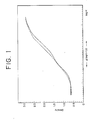
- Fig. 1 shows the chracteristic curve which is the standard (broken line) and the characteristic curve (solid line) to be evaluated.
- the absolute values ⁇ of the difference of the point gamma value at the respective exposure points of the characteristic curve which is the standard and the characteristic curve to be evaluated are determined.
- the gradation stability is represented by the mean value of ⁇ multiplied by 1000 ( ⁇ - ⁇ ) and value of E of the standard deviation a of ⁇ multiplied by 1000.
- the difference in point gamma between the both characteristics is greater as the value of ⁇ is greater, and the gradation change is not uniform indicating poor gradation stability as the value of ⁇ is greater.
- the samples containing emulsions doped with Rh ions internally of the grains were found to be preferred, because the grain size distribution of the silver halide grains in the green-sensitive layer is narrow to give a great improvement effect for processing fluctuations.
- the sample No. 115 is also preferable with respect to production efficiency, since physical aging and chemical aging can be effected at one time respectively.
- the effects of the present invention could be recognized in the respective samples in which the DIR compound D-42 in B-2 of Sample No. 106 was replaced with D-4 or D-29, the respective samples in which the DIR compound D-26 in G-1 of Sample No. 113 with D-2, D-6 or D-10, the respective samples in which the DIR compound 23 in R-1 of Sample No. 115 is replaced with D-17, D-19 or D-21.
- Each sample used in this Example had exposure latitude ( ⁇ log H) of 3.0 or more.
Landscapes
- Physics & Mathematics (AREA)
- General Physics & Mathematics (AREA)
- Spectroscopy & Molecular Physics (AREA)
- Silver Salt Photography Or Processing Solution Therefor (AREA)
Applications Claiming Priority (2)
| Application Number | Priority Date | Filing Date | Title |
|---|---|---|---|
| JP3955089A JPH02217847A (ja) | 1989-02-20 | 1989-02-20 | ハロゲン化銀カラー写真感光材料 |
| JP39550/89 | 1989-02-20 |
Publications (2)
| Publication Number | Publication Date |
|---|---|
| EP0384671A2 true EP0384671A2 (de) | 1990-08-29 |
| EP0384671A3 EP0384671A3 (de) | 1991-07-17 |
Family
ID=12556168
Family Applications (1)
| Application Number | Title | Priority Date | Filing Date |
|---|---|---|---|
| EP19900301715 Withdrawn EP0384671A3 (de) | 1989-02-20 | 1990-02-16 | Lichtempfindliches farbphotographisches Silberhalogenidmaterial |
Country Status (2)
| Country | Link |
|---|---|
| EP (1) | EP0384671A3 (de) |
| JP (1) | JPH02217847A (de) |
Cited By (1)
| Publication number | Priority date | Publication date | Assignee | Title |
|---|---|---|---|---|
| US5302500A (en) * | 1991-02-08 | 1994-04-12 | Konica Corporation | Silver halide color photographic light-sensitive material offering excellent hue reproduction |
Families Citing this family (1)
| Publication number | Priority date | Publication date | Assignee | Title |
|---|---|---|---|---|
| JP2675933B2 (ja) * | 1991-09-05 | 1997-11-12 | 富士写真フイルム株式会社 | ハロゲン化銀カラー写真感光材料 |
Family Cites Families (3)
| Publication number | Priority date | Publication date | Assignee | Title |
|---|---|---|---|---|
| JPS5810738A (ja) * | 1981-07-13 | 1983-01-21 | Fuji Photo Film Co Ltd | ハロゲン化銀カラ−感光材料 |
| JPS6254259A (ja) * | 1985-05-13 | 1987-03-09 | Fuji Photo Film Co Ltd | ハロゲン化銀カラ−写真感光材料とその処理方法 |
| JPS63259650A (ja) * | 1987-04-17 | 1988-10-26 | Konica Corp | 色素汚染等が改良されたハロゲン化銀写真感光材料 |
-
1989
- 1989-02-20 JP JP3955089A patent/JPH02217847A/ja active Pending
-
1990
- 1990-02-16 EP EP19900301715 patent/EP0384671A3/de not_active Withdrawn
Cited By (1)
| Publication number | Priority date | Publication date | Assignee | Title |
|---|---|---|---|---|
| US5302500A (en) * | 1991-02-08 | 1994-04-12 | Konica Corporation | Silver halide color photographic light-sensitive material offering excellent hue reproduction |
Also Published As
| Publication number | Publication date |
|---|---|
| EP0384671A3 (de) | 1991-07-17 |
| JPH02217847A (ja) | 1990-08-30 |
Similar Documents
| Publication | Publication Date | Title |
|---|---|---|
| US3976492A (en) | Silver halide photographic emulsions | |
| JPH0670709B2 (ja) | 増加した露出ラチチュードを有する写真プリント材料 | |
| EP0297804B1 (de) | Photographisches lichtempfindliches Silberhalogenidmaterial | |
| EP0599383B1 (de) | Photographische Silberhalogenidmaterialien enthaltend furan- oder pyrolsubstituierte Farbstoffverbindungen | |
| JPH0635147A (ja) | カラー写真材料 | |
| US4576909A (en) | Silver halide color photographic light-sensitive material | |
| EP0384671A2 (de) | Lichtempfindliches farbphotographisches Silberhalogenidmaterial | |
| US4889796A (en) | Silver halide photographic emulsion | |
| EP0383623A2 (de) | Lichtempfindliches farbphotographisches Silberhalogenidmaterial | |
| EP0605917A2 (de) | Rotsensibilisatoren für Silberchloridreiche Emulsionen | |
| USH583H (en) | Silver halide color photographic material | |
| EP0383637A2 (de) | Lichtempfindliches farbphotographisches Silberhalogenidmaterial | |
| US4010037A (en) | Spectrally sensitized silver halide photographic emulsion | |
| EP0440947B1 (de) | Infrarotempfindliche photographische Silberhalogenidelemente | |
| EP0237256A2 (de) | Verfahren zur Behandlung photographischer lichtempfindlicher Silberhalogenidmaterialien | |
| EP0384670A2 (de) | Verarbeitungsverfahren für ein lichtempfindliches farbfotografisches Silberhalogenidmaterial | |
| US3966477A (en) | Spectrally sensitized silver halide photographic emulsion | |
| JPH0119571B2 (de) | ||
| US5922525A (en) | Photographic material having a red sensitized silver halide emulsion layer with improved heat sensitivity | |
| JPH02219053A (ja) | ハロゲン化銀カラー写真感光材料 | |
| EP0384668A2 (de) | Lichtempfindliches farbphotographisches Silberhalogenidmaterial | |
| EP0384669A2 (de) | Lichtempfindliches farbphotographisches Silberhalogenidmaterial | |
| JPH02219048A (ja) | 撮影機能を賦与した写真感光材料包装ユニット | |
| JPH02219056A (ja) | ハロゲン化銀カラー写真感光材料 | |
| JPH02217846A (ja) | ハロゲン化銀カラー写真感光材料 |
Legal Events
| Date | Code | Title | Description |
|---|---|---|---|
| PUAI | Public reference made under article 153(3) epc to a published international application that has entered the european phase |
Free format text: ORIGINAL CODE: 0009012 |
|
| AK | Designated contracting states |
Kind code of ref document: A2 Designated state(s): DE GB |
|
| PUAL | Search report despatched |
Free format text: ORIGINAL CODE: 0009013 |
|
| AK | Designated contracting states |
Kind code of ref document: A3 Designated state(s): DE GB |
|
| STAA | Information on the status of an ep patent application or granted ep patent |
Free format text: STATUS: THE APPLICATION IS DEEMED TO BE WITHDRAWN |
|
| 18D | Application deemed to be withdrawn |
Effective date: 19920118 |