EP0414622A2 - Kopierverfahren und -gerät - Google Patents
Kopierverfahren und -gerät Download PDFInfo
- Publication number
- EP0414622A2 EP0414622A2 EP90480070A EP90480070A EP0414622A2 EP 0414622 A2 EP0414622 A2 EP 0414622A2 EP 90480070 A EP90480070 A EP 90480070A EP 90480070 A EP90480070 A EP 90480070A EP 0414622 A2 EP0414622 A2 EP 0414622A2
- Authority
- EP
- European Patent Office
- Prior art keywords
- copy
- document
- sheets
- handler
- bin
- Prior art date
- Legal status (The legal status is an assumption and is not a legal conclusion. Google has not performed a legal analysis and makes no representation as to the accuracy of the status listed.)
- Ceased
Links
Images



Classifications
-
- G—PHYSICS
- G03—PHOTOGRAPHY; CINEMATOGRAPHY; ANALOGOUS TECHNIQUES USING WAVES OTHER THAN OPTICAL WAVES; ELECTROGRAPHY; HOLOGRAPHY
- G03G—ELECTROGRAPHY; ELECTROPHOTOGRAPHY; MAGNETOGRAPHY
- G03G15/00—Apparatus for electrographic processes using a charge pattern
- G03G15/65—Apparatus which relate to the handling of copy material
- G03G15/6538—Devices for collating sheet copy material, e.g. sorters, control, copies in staples form
-
- G—PHYSICS
- G03—PHOTOGRAPHY; CINEMATOGRAPHY; ANALOGOUS TECHNIQUES USING WAVES OTHER THAN OPTICAL WAVES; ELECTROGRAPHY; HOLOGRAPHY
- G03G—ELECTROGRAPHY; ELECTROPHOTOGRAPHY; MAGNETOGRAPHY
- G03G15/00—Apparatus for electrographic processes using a charge pattern
- G03G15/50—Machine control of apparatus for electrographic processes using a charge pattern, e.g. regulating differents parts of the machine, multimode copiers, microprocessor control
-
- G—PHYSICS
- G03—PHOTOGRAPHY; CINEMATOGRAPHY; ANALOGOUS TECHNIQUES USING WAVES OTHER THAN OPTICAL WAVES; ELECTROGRAPHY; HOLOGRAPHY
- G03G—ELECTROGRAPHY; ELECTROPHOTOGRAPHY; MAGNETOGRAPHY
- G03G2215/00—Apparatus for electrophotographic processes
- G03G2215/00172—Apparatus for electrophotographic processes relative to the original handling
- G03G2215/00206—Original medium
- G03G2215/00303—Control sheet
-
- G—PHYSICS
- G03—PHOTOGRAPHY; CINEMATOGRAPHY; ANALOGOUS TECHNIQUES USING WAVES OTHER THAN OPTICAL WAVES; ELECTROGRAPHY; HOLOGRAPHY
- G03G—ELECTROGRAPHY; ELECTROPHOTOGRAPHY; MAGNETOGRAPHY
- G03G2215/00—Apparatus for electrophotographic processes
- G03G2215/00172—Apparatus for electrophotographic processes relative to the original handling
- G03G2215/00354—Specific document handling machines
- G03G2215/00358—Plural feed trays for document sets, e.g. multi-job
-
- G—PHYSICS
- G03—PHOTOGRAPHY; CINEMATOGRAPHY; ANALOGOUS TECHNIQUES USING WAVES OTHER THAN OPTICAL WAVES; ELECTROGRAPHY; HOLOGRAPHY
- G03G—ELECTROGRAPHY; ELECTROPHOTOGRAPHY; MAGNETOGRAPHY
- G03G2215/00—Apparatus for electrophotographic processes
- G03G2215/00362—Apparatus for electrophotographic processes relating to the copy medium handling
- G03G2215/00789—Adding properties or qualities to the copy medium
- G03G2215/00822—Binder, e.g. glueing device
- G03G2215/00827—Stapler
-
- G—PHYSICS
- G03—PHOTOGRAPHY; CINEMATOGRAPHY; ANALOGOUS TECHNIQUES USING WAVES OTHER THAN OPTICAL WAVES; ELECTROGRAPHY; HOLOGRAPHY
- G03G—ELECTROGRAPHY; ELECTROPHOTOGRAPHY; MAGNETOGRAPHY
- G03G2215/00—Apparatus for electrophotographic processes
- G03G2215/00362—Apparatus for electrophotographic processes relating to the copy medium handling
- G03G2215/00886—Sorting or discharging
- G03G2215/0089—Shifting jobs
-
- G—PHYSICS
- G03—PHOTOGRAPHY; CINEMATOGRAPHY; ANALOGOUS TECHNIQUES USING WAVES OTHER THAN OPTICAL WAVES; ELECTROGRAPHY; HOLOGRAPHY
- G03G—ELECTROGRAPHY; ELECTROPHOTOGRAPHY; MAGNETOGRAPHY
- G03G2215/00—Apparatus for electrophotographic processes
- G03G2215/00362—Apparatus for electrophotographic processes relating to the copy medium handling
- G03G2215/00886—Sorting or discharging
- G03G2215/00894—Placing job divider sheet
Definitions
- This invention relates to the field of photocopying, and more specifically to efficient original document sheet feeding and copy sheet handling in a copier apparatus.
- the visual image contained on an original document is viewed by a copier apparatus.
- This image is converted into a visual copy image that is then transferred to a sheet of substrate material, usually blank paper, as a copy is made of the original document.
- Two of the most desirable copier features comprises an original document feeder that feeds original document sheets to a viewing station for copying, and an exit or output module that handles the copy sheets produced by the copier apparatus. While many document feeders and copy handlers exist in the art, the need exists to improve their ease of operation and the range of functions provided by these devices.
- Document feeders can be generally classified in the following manner.
- SADF Semi automatic document feeders
- An automatic document feeder is primarily adapted to enhance the copying of a multi-sheet original document.
- An ADF is provided with an input tray in which the entire original document is placed or stacked. The ADF then operates to feed the multi-sheet document to the copier viewing station, one sheet at a time, for copying. After each sheet has been copied a requested number of times, the sheet is ejected to the original document output tray.
- This type of document feeder relieves the operator from the task of feeding each individual sheet of the original document.
- a multi-bin collator is usually provided to receive the output of the copier apparatus, one copy set per bin.
- a recirculating automatic document feeder provides a means of producing multiple copy sets of a multi-sheet original document without the need to provide a multi-bin collator.
- the RADF includes an input tray in which the entire original document is stacked. However, in this case the original document set is circulated to the viewing station for producing one copy of each sheet. After copying, the sheet is returned to the RADF input tray. In this way, the original document is circulated to the viewing station one time for each requested copy set.
- an RADF include an end-of-stack detector to enable the device to count the number of times that the original document has been recirculated for copying. When the last copy set has been produced, it is usual that the original document be feed to an original document output tray, for retrieval by the operator.
- the feeder is usually movably mounted relative the copier's viewing station. This enables the document feeder to be manually moved away from the viewing station, thus allowing the operator to manually place an original document sheet at the viewing station, one sheet at a time.
- the output module may comprise a large output bin in which the copy sets are accumulated, one on top of the other.
- the art provides various enhancement features in these single bin output modules. Examples are copy set separation by the way of positional offset of each copy set from its adjacent copy sets, and the binding of individual copy sets, for example by the use of a set accumulator tray in which each copy set is accumulated for binding or stapling prior to the bound copy set being ejected to the single bin output device.
- An additional desirable copier feature provides a means whereby a long copy job may be temporarily interrupted by an operator having a small copy job.
- the present invention provides (1) document feeding means that includes the four functions of manual copying, SADF copying, ADF copying and RADF copying, and (2) an exit module or output copy handler having (1) a multi-bin collator section, one bin of which comprises (2) a copy sheet exit tray, and (3) a large capacity bin capable of holding a stack of copy sets.
- the manner of use of the document feeding means, and the parameters of the requested copy job automatically determine the manner in which the output handler operates, this manner of operation being the most efficient mode of operation for the particular copy job.
- a feature of the present invention is that when more than one copy set is to be produced from a multi sheet original document, the ADF is used to make the first copy set and to then load the original document into the RADF, whereup on the RADF is thereafter used to make the remaining copy sets.
- a further feature of the invention provides copy job queuing.
- Document feeders of interest include United States Patents 4,579,325 and 4,579,326 having document feeder means comprising an SADF and a bottom-feed, top-restack RADF, wherein the SADF is provided with the ability to interrupt an RADF copy job; United States Patent 4,350,329 and German 0ffenlegungsschrift 3,027,146 are similar in that they show document feeding means having an SADF and an RADF function; United States Patent 4,433,836 having document feeder means comprising an SADF and a bottom-feed, top-restack RADF, wherein the SADF is used to load the RADF as the first of a number of copy sets is produced, the RADF then being used to produce the remaining copy sets, and the RADF having an end of stack detector to enable detection of a complete circulation of a document set by the RADF; and United States Patent 4,192,607 is generally similar in construction and arrangement to this later patent.
- Copy handler art of interest in that multi-function devices are described, include United States Patent 3,467,371 which discloses a number of collator bins or catch trays that receive successive sheets of a copy set until such time as each bin includes a complete copy set.
- United States Patent 4,145,037 which discloses a combined sorting and collating device. In the sorting mode of operation, successive copies of each document sheet are fed to a movable array of bins, until each bin contains a complete copy set.
- each of the bins receives a predetermined number of the same page of the document, and after all bins are thus loaded, a single sheet is ejected from each bin, to form a copy set, and the set is fed to an output tray;
- United States Patent 4,204,727 which discloses a multi-function copy handler having a first deflector positioned at the entry of the handler. When this first deflector is in a first position, all copy sheet are fed in uncollated fashion to a tray, from which they are then manually unloaded. When this first deflector is in its alternate position, the sheets are fed onward to a second deflector.
- this second deflector When this second deflector is in a first position, the sheets pass on to a vertical array of sorting trays or collator bins, and each bin then receives the sheets of a collated copy set, and the copy sets are are manually unloaded from the bins.
- the second deflector When the copier is making copies of oversize original documents, the second deflector is set to its alternate position, and these "special" copies are routed to an external tray, where they are manually unloaded; United States Patent 4,442,505 which describes a reproduction device in which the operator is able to define the "sorter output position" to be used for each reproduction job; United States Patent 4,522,486 which describes an intelligent copier/collator apparatus wherein the operator provides input data relative the number of copy sets to be produced in a copy job, and the number of sheets in each copy set.
- the device's logic then forms virtual collator bins from a number of adjacent actual bins (if this is needed by the copy job data requirements).
- excess sheets are sent to an overflow tray; and United States Patent 4,693,590 which describes a copier/collator apparatus wherein the operator can load a number of different original document sets, having different copying requirements, into the tray of a document handler. These different sets are separated by divisions papers, having data means such as holes that are sensed by a sensor as an indication that one copy job has been completed, and that the next job can begin without operator intervention.
- the collator of this apparatus has an exit tray as well as plural collator bins. Copy sheets can be sent to the exit tray, or can be sent to the collator bins in either a sort mode (one copy sheet of the original to each bin) or a stack mode (all copies to one bin), dependent upon the copy job requirements.
- This invention relates to document production, and more specifically to copier apparatus having a multi-function original document handler 20 and a multi-function output copy handler 30.
- the mode of operation of the output copy handler is dependent upon, and is determined by, (1) the mode of operation that the operator selects for the original document handler, and (2) the copy job parameters that are defined by the operator, i.e. the mode of operation of the output copy handler is automatically set to be the most efficient mode of operation for each copy job that is defined by the operator.
- the original document handler can be used to copy original document sheets in one of four modes.
- the modes in which the original document sheets or sets may be copied are, (1) original docu ment sheets are manually placed one at a time on a document glass or platen for the production of a requested number of copies of each sheet, i.e. manual copying, (2) the sheets are manually placed one at a time on an SADF entry tray for automatic feeding to the platen and for the production of a requested number of copies of each sheet, i.e. SADF copying, (3) the sheets are placed as a stack in an ADF entry tray for automatic feeding to the platen, one sheet at a time, for the production of a requested number of copies of each sheet, i.e.
- ADF copying, and (4) the sheets are placed as a stack in an RADF entry tray for automatic recirculation feeding to the platen, for the production of one copy of each sheet, and recirculation back to the stack for future feeding of the stack to the platen in order to produce the requested number of copy sets, i.e. RADF copying.
- the sheets are placed as a stack in an ADF entry tray for automatic feeding to the platen, one sheet at a time, for the production of the first of a requested number of copy sets.
- the sheets are then fed to the RADF entry tray for automatic recirculation feeding to the platen for the production of the remaining number of the requested copy sets.
- the copier apparatus includes a multi-function output copy handler that has three modes of operation. That is, the copy sheets (1) may be sequentially stacked in the top bin 32 (i.e. the exit tray) of a vertical-bin collator 31, (2) may be sequentially placed one sheet at a time in each bin of the collator, or (3) may be stacked as a copy set in a large size exit pocket 33 that is located under the lowermost one of the collator bins.
- the copier apparatus provides an exit paper path 12 through which copy sheets enter the copy handler, as the sheets move in a generally horizontal planar direction
- the output copy handler comprises a vertically movable stack of collator bins 31 having an open-top bin 32 and having a large exit pocket 33 disposed below the stack of bins.
- the stack of bins is positioned with its top bin located to receive all copy sheets, and (6) when the document handler is operating in the RADF mode of operation, and the copy job request is for more than one copy, the large exit pocket, disposed below the stack of bins, is positioned to receive all copy sets, and the bin stack moves downward as the stack of copy sets in this large exit pocket accumulates.
- the bottom one of the collator bins could be the home-position or number-one bin, whereupon collated copy sets are produced as the collator bins index upward one bin at a time.
- above defined modes of operation (1)-(4) are similar.
- the stack of original document sheets is initially placed in the ADF tray (FIGS. 7a-7c).
- operation proceeds as in (3) above, i.e. the stack of bins is positioned with its top bin located to receive all copy sheets.
- the first copy set is produced as these document sheets are fed from the ADF input tray, pass through the imaging station, and are then fed to the RADF input tray (FIG. 7a). Thereafter, all subsequent copy sets are made by recirculating the original document through the imaging station using the RADF function (FIG. 7b). All resulting copy sets are fed to the large exit pocket that is disposed below the stack of bins.
- a set binding means such as a stapler (FIG. 4) is provided at an accumulator tray that is located at the entry of the copy handler.
- a stapler FOG. 4
- all resulting copy sets are fed to the large exit pocket that is disposed below the stack of bins.
- a first copy set is produced as the document sheets are fed from the ADF input tray, pass through the imaging station, and are then fed to the RADF input tray. Thereafter, all subsequent copy sets are made by recirculating the original document through the imaging station using the RADF function (FIG. 7b).
- FIG. 10 copy job interrupt
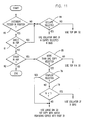
- FIG. 11 use of the output module's large exit tray based when a copy request exceeds the number of available collator bins, or use of the stapled is requested
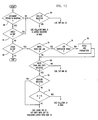
- FIG. 12 copy job set queuing in the ADF input tray
- the invention automatically provides the most efficient operation of the copier apparatus for each requested copy job, as allowing the operator to select the most reliable manner of operating the original document handler, and the operator is relieved from the task of selecting the most efficient use of the multi-function output copy handler.
- the present invention in its generic aspects, relates to a copier apparatus having a multi-function original document feeder and a multi-function output copy handler, wherein the mode of operation of the copy handler is determined in accordance with the mode of operation that is selected for the document feeder, and in accordance with other copy job parameters that are selected by the operator.
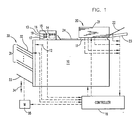
- FIG. 1 shows a copier engine 10 of any conventional construction and arrangement.
- Copier 10 is provided with an imaging station in the form of a glass platen 11.
- a stationary original document on platen 11 is viewed by a optical means (not shown), and as a result thereof copies of this document issue out of copy exit path 12.
- a control panel 13 is provided whereby the operator may input data as to the parameters of a requested copy job or jobs. Control panels of this type, and the large variety of manual buttons or touch screens provided thereon, are well known to those skilled in the art. A contemporary control panel will not be described herein for the purposes of simplifying the description.
- buttons 14 provide for the entry of the number of copies/sets that are requested by the operator
- button 15 allows the operator to select the use of an output collator (to be described)
- button 16 allows the operator to select the use of a set stapler (to be described)
- button 17 is an interrupt request button
- button 19 allows the operator to indicate the number of jobs that have been placed (i.e. queued) in a document tray and whose job parameters have been or will be entered by way of the control panel, relative she feature of the invention shown in FIG. 12.
- control panel 13 may include a number of other conventional buttons, such as a start button and a stop button (not shown).
- Control panel 13 is connected to controller 18, and provides information thereto, including the copy job parameters that have been selected by the operator.
- the multi-function document feeder of the invention is designated by number 20.
- Feeder 20 includes an RADF portion 21, an SADF portion 22, an ADF portion 23, and when feeder 20 is pivoted away from platen 11, an original document may be manually placed on platen 11 for manual copying.
- An original document exit tray 24 is provided by which the operator may retrieve original document sheets after an RADF, an ADF, or an SADF copy job has been completed.
- document feeder 20 includes a number of operational sensors that are connected to controller 18. For example, a sensor is provided to indicate that document feeder 20 has been moved away from platen 11. This sensor provides a signal to controller 18 indicating that a manual copy job may be following, this manual copy job being indicated by the subsequent actuation of a start button on control panel 13.
- document feeder 20 includes sensors to indicate that an original document, usually a stack of document sheets, has been placed in the ADF or in the RADF, or that a single document sheet is present in the SADF entry tray.
- a set-separator sensor located therein indicates each time that the original document has been circulated to platen 11.
- Reference numeral 30 identifies the multi-function copy handler of the invention.
- Copy handler 30 is shown in its first home position, for use of collator bins 31, or for use of the top bin 32 as a copy exit tray for all copies of the copy job, as will be explained.
- a second home position for copy handler 30 positions the lower large exit bin 33 to receive copy sheets from the copier's exit path 12.
- sensors are provided to sense passage of a copy sheet from path 12 to handler 30, and to provide an indication of the height of the paper in handler 30 relative the exit point of path 12. These sensors are likewise connected to controller 18.
- the vertical stack of paper trays that comprise copy handler 30 are bidirectionally vertically movable (see arrow 34) under the control of a motive means 35, as this motive means is controlled by controller 18.
- the copier apparatus of FIG. 1 includes many other sensors to monitor and control proper operation of the apparatus.
- An example is in the field of jam detection and correction.
- all of these well known features have not been shown.
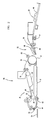
- FIG. 2 a preferred form of feeder 20 is shown in FIG. 2.
- document sheets are placed in the SADF and the ADF with the image side facing downward, whereas document sheets are placed in the RADF with the image side facing upward.
- ADF portion 23 is a bottom-feed document feeder, whereas RADF portion 21 is a bottom-feed/top-restack document feeder.
- feeder 20 When feeder 20 is operating in the SADF mode, the operator inserts each document sheet into entry tray 40, image side facing down. The sheet is then advanced to platen 11 by operation of roller 41 and belt 42. The document is stopped on platen 11 for copying, and is then ejected into exit tray 24 by operation of belt 42 and rollers 43. Sheet deflector 44 is at this time in an elevated position. Deflector 44 rotates about its pivot 45.
- feeder 20 When feeder 20 is operating in the ADF mode, the operator inserts the original document, usually comprising a stack of document sheets, into entry tray 46, image side facing down. This device is a bottom-feed device. The stack of sheets is then fed, one sheet at a time, to platen 11, under the influence of feed roller 47, feed rollers 48, feed roller 41 and belt 42. The document is stopped on platen 11 for copying. The document is thereafter ejected into exit tray 24 by operation of belt 42 and rollers 43. Sheet deflector 44 is at this time in its elevated position.
- feeder 20 When feeder 20 is operating in its RADF mode, the operator inserts the original document, usually comprising a stack of document sheets, into entry tray 49, image side facing up.
- This device is a bottom-feed/top-restack device.
- the stack of sheets is then fed, one sheet at a time, to platen 11, under the influence of belt 50, feed rollers 51, sheet guide 52, feed roller 41 and its idle roller 53 and belt 42.
- the document is stopped on platen 11 for copying.
- One copy of each document sheet is made.
- sheet deflector 44 is positioned as shown in FIG. 2. In this position of deflector 44, the document sheet is returned to the top of the stack of tray 49 after copying.
- Set separator 25 separates the lower sheets of a document set (i.e. the sheets awaiting feeding to platen 11) from the upper, already copied sheets that have been restacked on tray 49.
- Separator 25 may take many forms, known to those of skill in the art. This particular separator is biased for CW rotation about its pivot 26. When the underlying last sheet of the document set is fed to platen 11, and has been returned to the top of the stack on tray 49, separator 25 completes its CW rotation, and comes to rest upon the top of the stack. In this way, the original stack of sheets is circulated to platen 11, one circulation per requested copy set. Operation of set separator 25 enables controller 18 (FIG. 1) to count circulation of the original set, and to thus monitor completion of the copy job.
- the sheets of the original document set are fed to tray 49, where the set then resides in correct page order for retrieval by the operator.
- FIG. 3 is a simplified schematic showing of the document feeder of FIG. 2.
- document feeders may, within the teachings of the invention, provide for the copying of both simplex and duplex image original documents.
- the document feeder of FIG. 2 includes a feature of the invention whereby a number of different original document sets may be queued in ADF tray 46.
- a number of different original documents or sets, each set of which comprises a different copy job, and each set of which usually comprises a number of sheets, may be stacked in ADF tray 46.
- Each of these copy jobs may have different copy job parameters, for example the number of copy sets requested may be different for each copy job.
- Each of these original document sets is separated from the upper adjacent set by a separator sheet of a unique construction and arrangement.
- a light-source/optical-sensor 54 is provided to project a beam of light across the exit path of the ADF.
- Sensor 54 operates to detect a unique characteristic of a separator sheet, as the sheet is fed to platen 11 by the ADF. For example, document sets that are queued in tray 46 are separated by a job separator sheet having a hole, or a series of holes, therein that is detected by sensor 54, as an indication that a new copy job is beginning. As a part of the job queuing mode of operation, the operator uses control panel button 19 to indicate to controller 18 the number of sequential different copy job parameters that have been entered by way of the control panel.
- controller 18 When controller 18 receives an output from sensor 54, indication that a copy job boundary has arrived, controlled 18 fetches the job parameters for the new job from memory (not shown, and implements copying of this new set of original document sheets in accordance with these new job parameters, and in accordance with the invention.
- the above mentioned job separator sheet may include text information, in which case the set separator sheet is copied, and becomes part of the copy set(s), for later use. This feature of the invention is described in greater detail relative FIG. 12.
- the multi-function original document handler or feeder 20 of the invention selectively operates in one of four modes of operation, i.e. in RADF, ADF and SADF modes, and when feeder 20 is pivoted upward to expose platen 11, documents can be manually placed on platen 11 for copying.
- the multi-function output copy handler or module 30 of the invention has three copy sheet output areas which comprise, in the preferred device shown in FIGS. 4-6, a 150 sheet capacity exit tray 32, a ten bin collator 31, each bin having a capacity of 100 sheets, and a large 1000 sheet capacity stacker tray or bin 33.
- a hot roll fusing station (not shown) was provided in copier engine 10 to move copy sheets at the rate of about 45 inches per second. As a sheet leaves the fusing nip, it moves in the X direction (see arrow 59 of FIGS. 4 and 6), and in a horizontal X-Y plane.
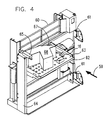
- the output copy handler of FIGS. 4-6 includes a four-sided, open, metallic frame member 60 in the shape of a rectangle whose major axis extends in the vertical Z direction.
- Frame member 60 is pivoted at 61 to the back left side of the copier frame (as viewed from the front of copier 10, FIGS. 4 and 6) on a vertically extending Z direction pivot axis that is located at the rear of copier 10.
- metal collator bins 31 are cantilevered off of frame member 60, and extend to the left thereof.
- the floor of the bins 31 are inclined upward, at an angle of about 30 degrees to the horizontal.
- the sheet entry path 12 (FIG. 1) that extends to output module 30 is formed by a pair of vertically spaced, flat, metal plates 62 and 63 (FIGS. 4 and 6) that extend horizontally, in the X-Y plane, to the right of output module frame 60.
- the front vertical portion 64 of module frame member 60 couples to the copier frame by way of a releasable catch 65.
- catch 65 When catch 65 is released, the operator can manually swing frame member 60 backward (CW as viewed from above). This movement opens output module 30 for jam clearance, maintenance and the like.
- the above mentioned sheet entry path 62,63 accepts sheets leaving the copier's hot roll fuser nip, as the sheets move at a speed of 45 inches per second.
- Module 30 operates to slow the sheets down to 1/2 this speed, i.e. 22 1/2 inches per second. This is done by the use of four drive rollers that are located in bottom plate 62 of the entry path, and by four mating idler rollers 66 that are located in the top plate 63 of the entry path. These drive rollers are controlled by a 2-speed AC motor and a microprocessor (not shown).
- the horizontal X distance between the copier's fusing nip and rollers 66 is such that a sheet's trailing edge has left the driving influence of the fusing nip before the sheet's leading edge moves into the influence of rollers 66 and under the control of the microprocessor.
- entry path 62,63 includes a movable exit gate 67 and a selectively usable stapler 68 that is located adjacent the front edge of a copy set that is resident in entry path 62,63.
- Stapler 68 may be of the type shown in United States Patent 4,557,410, incorporated herein by reference.
- Stapler 68 may be movable, front to back, in the Y direction, in order to allow the stapler to cooperate with either leading edge corner of the copy set.
- entry path 62,63 operates as a copy set accumulator when gate 67 is closed.
- Sheet driving rollers 66 (FIG. 6) are then operated, and gate 67 is opened, only after a copy set has been accumulated in entry path 62,63, and stapled by stapler 68, if use of the stapler has been selected by a button on control panel 13 (FIG. 1).
- the collator bins per se, and the bin moving mechanism, are of the type generally disclosed in United States Patent 4,478,406 incorporated herein by reference.
- the arrangement of FIGS. 4-6 differs from the arrangement of this patent in that the device of FIGS. 4-6 is essentially a twenty bin collator of the type shown in this patent, each bin being of 100 sheet capacity, wherein nine of the bottom bins of a twenty bin collator have been removed, to leave a large 1000 sheet capacity gap 69 of FIG. 5.
- Gap 69 is bounded on the bottom by the floor of the bottom-most bin 33.
- the floor of bin 33 comprises the 1000 sheet stacker bin contained within gap 69.
- the top of gap 69 is bounded by the floor 70 of the bottom-most bin of ten bin collator 31.
- the 1000 sheet gap 69 that exists above the bottom located stacker bin 33 includes the drive pins that were associated with the nine removed bins.
- the bin driving cam of above mentioned USP 4,478,406 cooperates with these pins to move stacker bin floor 33 down, in small steps, as the stack height of the sheets in stacker bin 33 increases.
- a reflective light sensor (not shown) may be provided to sense this stack height, or alternatively sheets may be counted as they enter stacker bin 33.
- the roof 32 of the top collator bin (i.e. the collator bin roof having no member above it) comprises a 150 sheet capacity exit pocket or tray.
- output module 30 comprises (1) a 150 sheet capacity exit tray 32, (2) ten 100 sheet capacity collator bins 31, numbered one through ten from top to bottom, and (3) the 1000 sheet stacker bin 33.
- the method of manufacturing the copier apparatus of the invention is such that copier engine 10, with an attached output module frame 60, is shipped to a customer. Accompanying the order is an attachable entry path member 62,63, which may be a simple path member, or an accumulator tray member, with or without stapler 68, and whatever configuration of collator/stacker bins the customer requires.
- the moving bin arrangement of FIGS. 4-6 has two home positions relative exit path members 62,63, i.e. (1) a lowered home position where exit tray 32 (i.e. the roof of the top collator bin) is positioned to receive sheets from exit path members 62,63, and (2) a raised home position where the floor of stacker bin 33 is positioned to receive sheets from exit path members 62,63.
- exit tray 32 i.e. the roof of the top collator bin
- a raised home position where the floor of stacker bin 33 is positioned to receive sheets from exit path members 62,63.
- motive means 34 positions the top exit tray 32 at exit members 62,63, but does not index up to the next bin, and the copy job is limited to 150 sheets.
- the top bin of bins 31 receives the first copy sheet, and motive means 35 indexes up one bin for the next sheet, etc.
- stacker bin floor 33 is positioned at exit members 62,63, and motive means 35 indexes down, a step at a time, as motive means 35 is controlled by controller 18 and a stack height sensor, and as the sheet stack builds up in stacker bin 33 (sheets may be counted, or the stack height may be sensed by reflection of a light beam or the like).
- exit path members 62,63 When exit path members 62,63 are to operate as an accumulator tray, with stapler 68 not selected for use, the top one of collator bins 31 is positioned at the exit of the accumulator tray, and motive means 35 is operated to thereafter raise collator bins 31, one bin at a time, as copy sets exit the accumulator tray.
- the drive rollers at the exit of the members 62,63 that is the two drive rollers directly under the two idler rollers 66 that are adjacent gate 67 (FIG. 6), are solenoid controlled to pivot about a vertical axis (the corresponding idler rollers 66 need not pivot) so as to send copy paper selectively toward the front or toward the rear of the copier, i.e. a component of movement in the Y direction.
- these drive rollers are not angled, and they send paper straight ahead, i.e. in the same X direction as the sheets moved as they exit the fuser nip.
- alternate copy sets on stacker bin 33 are positionally offset.
- FIGS. 7a-7b are simplified schematic showings of the document feeder of FIG. 2 which embodies a feature of the invention whereby ADF 23 may be used to load RADF 21 after a first copy set has been produced using the ADF. While this feature of the invention will be described as above mentioned, it is also within the spirit and scope of the invention to use SADF 22 to load RADF 21 after a first copy set has been produced using the SADF.
- ADF 23 is used to make the first copy set and to concurrently load the original document into the RADF document tray.
- the RADF is thereafter used to make all subsequent copy sets of a requested copy job.
- the original document set is loaded into the document tray of ADF 23 (FIG. 7a).
- the operator indicates to controller 18 that the requested copy job is to be a set-production copy job. This may be done by way of a button on control panel 13, or alternatively by a button or other means on document feeder 20 itself, for example by raising a cover (not shown) for RADF document tray 49.
- controller 18 controls copier engine 10 and document feeder 20 to feed the sheets of the original document to platen 11, where they are copied one time each. This operation produces the first copy set of the requested copy job.
- the original document sheets leave platen 11 after copying, and are fed to the document or entry tray 49 of RADF 21 (see FIG. 7a) due to the fact that sheet deflector 44 (see FIG. 2) is in its lowered position.
- RADF 21 is activated to circulate the original document to platen 11. One such circulation occurs for each of the remaining copy sets of the requested copy job (see FIG. 7b).
- FIGS. 8, 9, 10, 11 and 12 show controller means flow charts of embodiments of the present invention, i.e. the modes of operation of controller 18 relative embodiments of the invention.
- FIG. 8 provides control means for use with the document feeder 20 of FIGS. 2 and 3, that is a document feeder that allows the operator to selectively use SADF 22, ADF 23, RADF 21, or to manually pivot document feeder 20 away from platen 11 for manual copying.
- decision block 80 determines if document feeder 20 is in position over platen 11
- decision block 81 determines if an original document sheet has been inserted into SADF entry tray 40
- decision block 82 determines if an original document set has been inserted into ADF entry tray 46
- decision block 83 determines if an original document set has been inserted into RADF entry tray 49.
- decision block 84 determines if collator 31 has been selected for use by the operator.
- copy handler 30 is controlled by motive means 35 to locate the top bin 32 at copier exit path 12 (i.e. members 62,63 of FIGS. 4 and 6), and all copy sheets are supplied to bin 32.
- copy handler 30 is controlled by motive means 35 to locate the top collator bin at copier exit path 12, and all copy sheets are supplied to collator bins 31. In this situation, if the copy request is for N copies (N ⁇ 11), then the top N bins of collator 31 are used for the copy job.
- decision block 81 determines if a document sheet has been placed in the entry tray of SADF 22. If such a sheet exists (i.e. an indication of a request for an SADF copy job), decision block 84 again determines if collator 31 has been selected for use by the operator, and the SADF supported copy job proceeds as above described relative a manual copy job.
- decision block 82 determines if a stack of document sheets has been placed in the entry tray of ADF 23. If such a stack exists (i.e. an indication of a request for an ADF copy job), decision block 85 determines if more than one copy has been requested by the operator. If only one copy has been requested, copy handler 30 is controlled by motive means 35 to locate the top bin 32 at copier exit path 12, and all copy sheets (i.e. one copy sheet for each original document sheet) are supplied to bin 32. If more than one copy has been requested, copy handler 30 is controlled by motive means 35 to locate the top collator bin at copier exit path 12, and the copy sheets are supplied to collator bins 31.
- each original document sheet is copied N times and thereafter deposited in exit tray 24.
- the top N bins of collator 31 are used for the copy job, each of these bins receiving a copy set of the original document set, as the collator increments up N bins during the copying of each original document sheet, and then returns the top collator bin to exit path 12 in preparation for the copying of the next document sheet.
- decision block 83 determines if a stack of document sheets has been placed in the entry tray 49 of RADF 21. If such a stack exists (i.e. an indication of a request for an RADF copy job), decision block 86 determines if more than one copy has been requested by the operator. If only one copy has been requested, copy handler 30 is controlled by motive means 35 to locate the top bin 32 at copier exit path 12, the document is circulated to platen 11 one time and then returned to tray 49 in correct page order, and all copy sheets (i.e. one copy sheet for each original document sheet) are supplied to bin 32.
- copy handler 30 is controlled by motive means 35 to locate large bin 33 at copier exit path 12, and all copy sheets are supplied to this bin.
- the original document set is circulated to platen 11 M times and concurrent with the last circulation, the document set is deposited in tray 49 in correct page order.
- FIG. 9 provides control means for use with the document feeder 20 of FIGS. 7a-7b, i.e. with a document feeder that allows the operator to selectively use SADF 22, ADF 23, or to manually pivot document feeder 20 away from platen 11 for manual copying.
- a document feeder that allows the operator to selectively use SADF 22, ADF 23, or to manually pivot document feeder 20 away from platen 11 for manual copying.
- an original document stack that has been loaded into the ADF entry tray may be fed into the entry tray of the RADF for circulation to platen 11, as will be explained.
- FIG. 9 shows a control means embodiment wherein the operator may have also elected to use stapler 68 of FIG. 4.
- decision blocks 80, 81, 82, 84 and 85 result in the same means of control as above described when a stapler 68 is not provided (see broken line 88 of FIG. 9).
- decision block 87 copy handler 30 is controlled by motive means 35 to locate large bin 33 at copier exit path 12, and all copy sheets are supplied to this bin.
- the first copy set is produced as ADF 23 feeds the original document set to platen 11 for one-time copying, and as the original document is thereafter stacked in the entry tray 49 of RADF 21 (see FIG. 7a).
- the original document set is now circulated to platen 11 M-1 times for one-time copying during each of the M-1 circulations (see FIG. 7b). After copying of the document set for the Mth time, the document set is placed in exit tray 24 for retrieval by the operator (see FIG. 7c).
- a feature of the invention provides for copy job interrupt, for example the interruption of an RADF copy job by an ADF copy job.
- SADF 22 can also be used to facilitate the interrupt function, the following description will be limited to use of ADF 23 for purposes of simplicity.
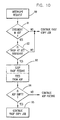
- FIG. 10 shows this interrupt control mode. In this figure it will be assumed that interrupt request event 90 occurs while an RADF copy job is in progress, and while large exit bin 33 of copy handler 30 is in use.
- decision block 91 determines if an original document has been placed in ADF entry tray 46. Until an original document is detected in tray 46, the RADF copy job continues.
- decision block 92 next determines if operation of the RADF has reached a set boundary, as is determined by set separator 25 of FIG. 2. Until a set boundary is reached, the RADF copy job continues.
- event 93 occurs, i.e. the RADF copy job is interrupted, and the ADF copy job begins.
- copy handler 30 is controlled by motive means 35 to locate top bin 32 at copy exit path 12, either for use as a single exit tray, or for the top one of the collator bins 31 may be located at copy exit path 12, for use in the interrupting ADF copy job.
- the ADF copy job continues until decision block 94 determines that ADF entry tray 46 is empty, whereupon event 95 occurs, and the interrupted RADF copy job restarts where it left off, again using large bin 33,
- FIG. 11 shows a controller means flow chart for use with the document feeder 20 of FIGS. 7a-7b, i.e. with a document feeder that allows the operator to selectively use SADF 22, ADF 23, or to manually pivot document feeder 20 away from platen 11 for manual copying.
- ADF 23 may be used to make the first copy set, and to then load RADF 21, as has been described relative FIGS. 7a-7b. Also, the operator may elect to use stapler 68 of FIG. 4. FIG. 11 also shows how a copy/set request greater than the number of collator bins is accommodated by the invention.
- SADF 22 may also be used to make the first copy set, and to then load RADF 21.
- decision block 80 determines if document feeder 20 is in position over platen 11
- decision block 81 determines if an original document sheet has been inserted into SADF entry tray 40
- decision block 82 determines if an original document set has been inserted into ADF entry tray 46.
- decision block 84 determines if collator 31 has been selected for use by the operator.
- copy handler 30 is controlled by motive means 35 to locate top bin 32 at copier exit path 12 (i.e. members 62,63 of FIGS. 4 and 6), and all copy sheets are supplied to bin 32.
- copy handler 30 is controlled by motive means 35 tb locate the top collator bin at copier exit path 12, and all copy sheets are supplied to collator bins 31. In this situation, if the copy request is for N copies (where N ⁇ 11), then the top N bins of collator 31 are used for the copy job.
- decision block 81 determines if a sheet has been placed in the entry tray of SADF 22. If such a sheet exists, decision block 84 again determines if collator 31 has been selected for use by the operator, and the SADF supported copy job proceeds as above described relative a manual copy job.
- decision block 82 determines if a stack of document sheets has been placed in the entry tray of ADF 23. If such a stack exists, decision block 85 determines if more than one copy has been requested by the operator. If only one copy has been requested, copy handler 30 is controlled by motive means 35 to locate the top bin 32 at copier exit path 12, and all copy sheets are supplied to bin 32.
- decision block 79 determines if use of stapler 68 has been requested by the operator.
- copy handler 30 is controlled by motive means 35 to locate large bin 33 at copier exit path 12, and all stapled copy sets are supplied to this bin.
- the first copy set is produced as ADF 23 feeds the original document set to platen 11 for one-time copying, and as the original document is thereafter fed to the entry tray 49 of RADF 21 (see FIG. 7a).
- the original document set is circulated to platen 11 N-1 times for one-time copying during each of the circulations (see FIG. 7b). After copying of the document set for the Nth time, the original document set is placed in exit tray 24 for retrieval by the operator (see FIG. 7c).
- decision block 79 determines if the requested number of copy sets N is greater than the number of available collator bins. In this case there are ten collator bins available.
- copy handler 30 is controlled by motive means 35 to locate the top collator bin at copier exit path 12, and the unstapled copy sheets are supplied to collator bins 31.
- each original document sheet is copied N times and thereafter deposited in exit tray 24.
- the top N bins of collator 31 are used for the copy job, each of these bins receiving a copy set of the original document set, as the collator increments up N bins during the copying of each original document sheet, and then returns the top collator bin to exit path 12 in preparation for the copying of the next document sheet.
- copy handler 30 is controlled by motive means 35 to locate large bin 33 at copier exit path 12, and the unstapled copy sets are supplied to this bin.
- the first copy set is produced while using ADF 23 to load the original document set into RADF 21, and the remaining of the copy sets are thereafter produced while using the RADF.
- FIG. 12 shows a controller means flow chart for use with the document feeder 20 of FIG. 2, i.e. with a document feeder that allows the operator to queue a number of original document sets in ADF tray 46.
- a number of original document sets may be queued in ADF tray 46.
- Each such set comprises a different copy job, and each of these copy jobs may have different copy job parameters.
- Each of these queued document sets is separated from the upper adjacent set by a separator sheet.
- Optical sensor 54 of FIG. 2 is provided in the exit path of the ADF. Sensor 54 detects a characteristic hole(s) in the separator sheet as the sheet is fed to platen 11 by the ADF. This identifies the sheet as a separator sheet.
- control panel button 19 (FIG. 1) to indicate to controller 18 the number of sequential different copy jobs that have been entered by way of the control panel.
- controller 18 receives an output from sensor 54 indicating that a copy job boundary has arrived, controlled 18 fetches the job parameters for the next job, and implements copying of this new set of original document sheets in accordance with the invention.
- the job separator sheet includes printed identifier information, and the set separator sheet is copied, and becomes part of the copy set(s), for later use.
- FIG. 12 is like FIG 11 in that it shows a controller means embodiment in which ADF 23 may be used to make the first copy set, and to then load RADF 21, as was described relative FIGS. 7a-7b, and wherein the operator may have also elect to use stapler 68 of FIG. 4.
- decision block 80 determines if document feeder 20 is in position over platen 11
- decision block 81 determines if an original document sheet has been inserted into SADF entry tray 40
- decision block 82 determines if an original document set(s) has been inserted into ADF entry tray 46.
- decision block 84 determines if collator 31 has been selected for use.
- copy handler 30 is controlled by motive means 35 to locate top bin 32 at copier exit path 12, and all copy sheets are supplied to this bin.
- copy handler 30 is controlled by motive means 35 to locate the top collator bin at copier exit path 12, and all copy sheets are supplied to collator bins 31.
- the copy request is for N copies (where N ⁇ 11)
- the top N bins of collator 31 are used for the copy job.
- decision block 81 determines if a stack of document sheets has been placed in the entry tray of SADF 22. If such a stack exists, decision block 84 again determines if collator 31 has been selected for use, and the SADF copy job proceeds as above described relative a manual copy job.
- decision block 82 determines if a stack of document sheets has been placed in the entry tray of ADF 23. If such a stack exists, decision block 75 determines if the operator has indicated the queuing of a number of document sets in the ADF tray.
- decision block 85 determines if more than one copy has been requested by the operator. If only one copy has been requested, copy handler 30 is controlled by motive means 35 to locate the top bin 32 at copier exit path 12, and all copy sheets are supplied to bin 32.
- decision block 79 determines if use of stapler 68 has been requested by the operator.
- copy handler 30 is controlled by motive means 35 to locate large bin 33 at copier exit path 12, and all stapled copy sets are supplied to this bin.
- the first copy set is produced as ADF 23 feeds the original document set to platen 11 for one-time copying, and as the original document is thereafter fed to the entry tray 49 of RADF 21 (see FIG. 7a).
- N copy sets have been requested, the original document set is now circulated to platen 11 N-1 times for one-time copying during each of the circulations (see FIG. 7b). After copying of the document set for the Nth time, the original document set is placed in exit tray 24 for retrieval by the operator (see FIG. 7c).
- decision block 79 determines if the requested number of copy sets N is greater than the available number of collator bins. In this case there are ten collator bins available.
- copy handler 30 is controlled by motive means 35 to locate the top collator bin at copier exit path 12, and the unstapled copy sheets are supplied to collator bins 31.
- each original document sheet is copied N times and the original document sheet is thereafter deposited in exit tray 24.
- the top N bins of collator 31 are used for the copy job, each of these bins receiving a copy set of the original document set, as the collator increments up N bins during the copying of each original document sheet, and then returns the top collator bin to exit path 12 in preparation for the copying of the next document sheet.
- copy handler 30 is controlled by motive means 35 to locate large bin 33 at copier exit path 12, and the unstapled copy sets are supplied to bin 33.
- the first copy set is produced while ADF 23 loads the original document set into RADF 21, and the remaining of the copy sets are produced while using the RADE to recirculate the document to the platen.
Landscapes
- Physics & Mathematics (AREA)
- General Physics & Mathematics (AREA)
- Engineering & Computer Science (AREA)
- Microelectronics & Electronic Packaging (AREA)
- Control Or Security For Electrophotography (AREA)
- Collation Of Sheets And Webs (AREA)
- Holders For Sensitive Materials And Originals (AREA)
- Paper Feeding For Electrophotography (AREA)
- Exposure Or Original Feeding In Electrophotography (AREA)
- Folding Of Thin Sheet-Like Materials, Special Discharging Devices, And Others (AREA)
Applications Claiming Priority (2)
| Application Number | Priority Date | Filing Date | Title |
|---|---|---|---|
| US07/396,205 US4990967A (en) | 1989-08-21 | 1989-08-21 | Copying method and apparatus |
| US396205 | 1989-08-21 |
Publications (2)
| Publication Number | Publication Date |
|---|---|
| EP0414622A2 true EP0414622A2 (de) | 1991-02-27 |
| EP0414622A3 EP0414622A3 (en) | 1992-07-29 |
Family
ID=23566288
Family Applications (1)
| Application Number | Title | Priority Date | Filing Date |
|---|---|---|---|
| EP19900480070 Ceased EP0414622A3 (en) | 1989-08-21 | 1990-05-15 | Copying method and apparatus |
Country Status (3)
| Country | Link |
|---|---|
| US (1) | US4990967A (de) |
| EP (1) | EP0414622A3 (de) |
| JP (1) | JPH0776069B2 (de) |
Cited By (2)
| Publication number | Priority date | Publication date | Assignee | Title |
|---|---|---|---|---|
| EP0872777A1 (de) * | 1997-04-18 | 1998-10-21 | Riso Kagaku Corporation | Blattsortiergerät und Verfahren zur Steuerung des Blattsortiergerätes |
| CN105883466A (zh) * | 2016-06-01 | 2016-08-24 | 严涛涛 | 一种打印机用的纸张托盘装置及其使用方法 |
Families Citing this family (7)
| Publication number | Priority date | Publication date | Assignee | Title |
|---|---|---|---|---|
| US5148286A (en) * | 1990-09-28 | 1992-09-15 | Xerox Corporation | Method and apparatus for operating an electronic reprographic printing system upon scan interruption |
| BR9305145A (pt) * | 1993-01-25 | 1994-08-16 | Xerox Corp | Aparelhagem de compilação e grampeamento e aparelhagem compiladora para uma copiadora |
| US5794099A (en) * | 1994-11-22 | 1998-08-11 | Eastman Kodak Company | Copier apparatus and method with flexible source document entry scanning with display of options for selection of source |
| US6572293B1 (en) | 2000-09-14 | 2003-06-03 | Electronics For Imaging, Inc. | Simple and inexpensive high-capacity output catch tray for document production machines |
| KR101409816B1 (ko) * | 2006-07-19 | 2014-06-25 | 삼성전자주식회사 | 용지이송장치 및 이를 포함하는 화상형성장치 |
| US7690641B2 (en) * | 2007-06-04 | 2010-04-06 | Xerox Corporation | Gateless diverter—'S' shaped paper path |
| CN112033531B (zh) * | 2020-09-05 | 2021-08-24 | 山西大学 | 一种基于单光子探测器的便携式试卷清点装置及方法 |
Family Cites Families (28)
| Publication number | Priority date | Publication date | Assignee | Title |
|---|---|---|---|---|
| US3467371A (en) * | 1966-08-25 | 1969-09-16 | Xerox Corp | Sheet distributor |
| US4145037A (en) * | 1977-04-25 | 1979-03-20 | Pitney Bowes, Inc. | Vertical collator-sorter |
| US4522486A (en) * | 1977-11-10 | 1985-06-11 | International Business Machines Corporation | Method and apparatus for adaptive collation |
| US4192607A (en) * | 1978-07-12 | 1980-03-11 | Eastman Kodak Company | Apparatus for selectively copying documents from two different document feeders |
| US4204727A (en) * | 1979-05-03 | 1980-05-27 | Xerox Corporation | Multimode reproducing apparatus |
| US4273439A (en) * | 1979-07-09 | 1981-06-16 | International Business Machines Corporation | Document feeder system having a suspending/commencing mode with a judgment decision capability |
| JPS5617360A (en) * | 1979-07-23 | 1981-02-19 | Konishiroku Photo Ind Co Ltd | Original inserting device of copier |
| JPS5720759A (en) * | 1980-07-14 | 1982-02-03 | Olympus Optical Co Ltd | Method for controlling collator for use in copying machine or the like |
| US4350329A (en) * | 1980-07-25 | 1982-09-21 | Eastman Kodak Company | Sheet feeding apparatus |
| JPS5790650A (en) * | 1980-11-28 | 1982-06-05 | Toshiba Corp | Control device for copying machine |
| US4421264A (en) * | 1981-06-26 | 1983-12-20 | International Business Machines Corporation | Variable thickness set compensation for stapler |
| US4433836A (en) * | 1981-10-09 | 1984-02-28 | Pitney Bowes Inc. | End of stack sensor |
| US4561765A (en) * | 1982-02-01 | 1985-12-31 | Canon Kabushiki Kaisha | Image forming apparatus |
| US4478406A (en) * | 1982-06-23 | 1984-10-23 | Gradco Systems, Inc. | Apparatus for sorting photocopies |
| JPS5981659A (ja) * | 1982-11-01 | 1984-05-11 | Canon Inc | 複写装置 |
| JPS59111171A (ja) * | 1982-12-15 | 1984-06-27 | Canon Inc | 画像形成装置 |
| US4811049A (en) * | 1983-07-22 | 1989-03-07 | Canon Kabushiki Kaisha | Original feeding apparatus |
| JPS6041053A (ja) * | 1983-08-16 | 1985-03-04 | Canon Inc | 両面複写機 |
| US4557410A (en) * | 1983-08-30 | 1985-12-10 | International Business Machines Corporation | Stapler mechanism powering means |
| US4693590A (en) * | 1984-08-20 | 1987-09-15 | Ricoh Company, Ltd. | Electronic copier with automatic document feeder and sorter |
| US4579326A (en) * | 1984-12-06 | 1986-04-01 | Xerox Corporation | Compact document handling system |
| US4579325A (en) * | 1984-12-06 | 1986-04-01 | Xerox Corporation | Compact document handling system |
| US4639125A (en) * | 1984-12-26 | 1987-01-27 | Sharp Kabushiki Kaisha | Automatic duplex copying type copying apparatus |
| JPS6279131A (ja) * | 1985-10-02 | 1987-04-11 | Canon Inc | シ−ト取扱い装置 |
| JP2505749B2 (ja) * | 1986-06-09 | 1996-06-12 | キヤノン株式会社 | 画像記録装置 |
| DE3726406A1 (de) * | 1986-08-07 | 1988-02-18 | Minolta Camera Kk | Kopiergeraet mit sortier- und hefteinrichtung |
| US4834360A (en) * | 1987-12-17 | 1989-05-30 | Xerox Corporation | Job batching system for high capacity copier with RDH |
| US4935771A (en) * | 1988-04-30 | 1990-06-19 | Minolta Camera Kabushiki Kaisha | Copying apparatus having automatic document feeder and sorter |
-
1989
- 1989-08-21 US US07/396,205 patent/US4990967A/en not_active Expired - Lifetime
-
1990
- 1990-05-15 EP EP19900480070 patent/EP0414622A3/en not_active Ceased
- 1990-07-20 JP JP2192864A patent/JPH0776069B2/ja not_active Expired - Lifetime
Cited By (4)
| Publication number | Priority date | Publication date | Assignee | Title |
|---|---|---|---|---|
| EP0872777A1 (de) * | 1997-04-18 | 1998-10-21 | Riso Kagaku Corporation | Blattsortiergerät und Verfahren zur Steuerung des Blattsortiergerätes |
| US6062555A (en) * | 1997-04-18 | 2000-05-16 | Riso Kagaku Corporation | Sheet sorter and method of controlling the sheet sorter |
| US6155563A (en) * | 1997-04-18 | 2000-12-05 | Riso Kagaku Corporation | Sheet sorter and method of controlling the sheet sorter |
| CN105883466A (zh) * | 2016-06-01 | 2016-08-24 | 严涛涛 | 一种打印机用的纸张托盘装置及其使用方法 |
Also Published As
| Publication number | Publication date |
|---|---|
| US4990967A (en) | 1991-02-05 |
| JPH0379554A (ja) | 1991-04-04 |
| JPH0776069B2 (ja) | 1995-08-16 |
| EP0414622A3 (en) | 1992-07-29 |
Similar Documents
| Publication | Publication Date | Title |
|---|---|---|
| EP0308047B1 (de) | Kopiersystem | |
| DE69618889T2 (de) | Einzelstapel-höhenfühler für ein System von mehreren Bogenstapelablagen | |
| DE69611649T2 (de) | System zur Korrektur einer Stapelhöhenschätzung | |
| EP0324245B1 (de) | Kopierer mit einer Umlauf-Dokumentenzuführvorrichtung | |
| JPH05319669A (ja) | 多機能書類統合装置 | |
| US5704609A (en) | Integrated inter-mailbox modules bypass transport and purge tray system | |
| US7738809B2 (en) | Image forming system including finisher applying punching processing and staple processing to printed papers, and image forming apparatus having mechanism for printing on both surfaces of paper | |
| EP0706096B1 (de) | Zwei-Wege Blattzuführvorrichtung | |
| EP0657377A1 (de) | Integriertes Postverteilungssystem und Stapelsystem für Blattsätze | |
| US5832358A (en) | Unscheduled set ejection method in a finisher | |
| US4990967A (en) | Copying method and apparatus | |
| US5236185A (en) | Sheet distributing system | |
| DE3853244T2 (de) | Kopieren mit automatischer Wahl zwischen Sortierung oder Aufstapelung. | |
| EP0666510B1 (de) | Blattnachbearbeitungsvorrichtung | |
| JPH0619604B2 (ja) | フィニッシャーを備えた複写機 | |
| JPH0619616B2 (ja) | フィニッシャーを備えた複写機 | |
| JP2895984B2 (ja) | 製本装置 | |
| EP0427277B1 (de) | Bilderzeugungsgerät mit einer Buchbindevorrichtung | |
| JPH06199468A (ja) | 複写装置 | |
| JP3526366B2 (ja) | 排紙トレイ装置 | |
| JPH04366695A (ja) | 画像形成システム | |
| JPH04368891A (ja) | 製本装置 | |
| JPH04366856A (ja) | シート処理システム | |
| JPH04358894A (ja) | 画像形成システム | |
| JPH04371893A (ja) | 製本装置 |
Legal Events
| Date | Code | Title | Description |
|---|---|---|---|
| PUAI | Public reference made under article 153(3) epc to a published international application that has entered the european phase |
Free format text: ORIGINAL CODE: 0009012 |
|
| 17P | Request for examination filed |
Effective date: 19901213 |
|
| AK | Designated contracting states |
Kind code of ref document: A2 Designated state(s): DE FR GB |
|
| PUAL | Search report despatched |
Free format text: ORIGINAL CODE: 0009013 |
|
| AK | Designated contracting states |
Kind code of ref document: A3 Designated state(s): DE FR GB |
|
| 17Q | First examination report despatched |
Effective date: 19940323 |
|
| STAA | Information on the status of an ep patent application or granted ep patent |
Free format text: STATUS: THE APPLICATION HAS BEEN REFUSED |
|
| 18R | Application refused |
Effective date: 19950406 |