EP0452701B1 - Elektrisch leitende Abdeckungen, elektrisch leitende Abdeckungen von elektronischen Apparaten und Verfahren zur Herstellung elektrisch leitender Abdeckungen - Google Patents
Elektrisch leitende Abdeckungen, elektrisch leitende Abdeckungen von elektronischen Apparaten und Verfahren zur Herstellung elektrisch leitender Abdeckungen Download PDFInfo
- Publication number
- EP0452701B1 EP0452701B1 EP91104547A EP91104547A EP0452701B1 EP 0452701 B1 EP0452701 B1 EP 0452701B1 EP 91104547 A EP91104547 A EP 91104547A EP 91104547 A EP91104547 A EP 91104547A EP 0452701 B1 EP0452701 B1 EP 0452701B1
- Authority
- EP
- European Patent Office
- Prior art keywords
- conductive
- layer
- electrodeposition
- cases
- powder
- Prior art date
- Legal status (The legal status is an assumption and is not a legal conclusion. Google has not performed a legal analysis and makes no representation as to the accuracy of the status listed.)
- Expired - Lifetime
Links
- 238000000034 method Methods 0.000 title claims description 26
- 238000004519 manufacturing process Methods 0.000 title claims description 7
- 238000004070 electrodeposition Methods 0.000 claims description 179
- 239000000463 material Substances 0.000 claims description 117
- 239000000843 powder Substances 0.000 claims description 87
- 239000002245 particle Substances 0.000 claims description 83
- 238000007747 plating Methods 0.000 claims description 54
- 229920005989 resin Polymers 0.000 claims description 46
- 239000011347 resin Substances 0.000 claims description 46
- 229910052751 metal Inorganic materials 0.000 claims description 35
- 239000002184 metal Substances 0.000 claims description 35
- QPLDLSVMHZLSFG-UHFFFAOYSA-N Copper oxide Chemical group [Cu]=O QPLDLSVMHZLSFG-UHFFFAOYSA-N 0.000 claims description 29
- 239000005751 Copper oxide Substances 0.000 claims description 29
- 229910000431 copper oxide Inorganic materials 0.000 claims description 29
- 238000000576 coating method Methods 0.000 claims description 28
- 239000010445 mica Substances 0.000 claims description 27
- 229910052618 mica group Inorganic materials 0.000 claims description 27
- 239000011248 coating agent Substances 0.000 claims description 26
- 239000000919 ceramic Substances 0.000 claims description 22
- 239000000203 mixture Substances 0.000 claims description 12
- 229910052755 nonmetal Inorganic materials 0.000 claims description 10
- 239000011882 ultra-fine particle Substances 0.000 claims description 9
- 238000004132 cross linking Methods 0.000 claims description 8
- 238000000151 deposition Methods 0.000 claims description 5
- 230000008021 deposition Effects 0.000 claims description 2
- 239000010410 layer Substances 0.000 description 168
- 239000002585 base Substances 0.000 description 88
- 239000010949 copper Substances 0.000 description 60
- 229910052802 copper Inorganic materials 0.000 description 59
- RYGMFSIKBFXOCR-UHFFFAOYSA-N Copper Chemical compound [Cu] RYGMFSIKBFXOCR-UHFFFAOYSA-N 0.000 description 58
- 239000011247 coating layer Substances 0.000 description 55
- 239000003973 paint Substances 0.000 description 53
- PXHVJJICTQNCMI-UHFFFAOYSA-N Nickel Chemical compound [Ni] PXHVJJICTQNCMI-UHFFFAOYSA-N 0.000 description 51
- 239000000243 solution Substances 0.000 description 42
- 238000005260 corrosion Methods 0.000 description 39
- 230000007797 corrosion Effects 0.000 description 39
- VZSRBBMJRBPUNF-UHFFFAOYSA-N 2-(2,3-dihydro-1H-inden-2-ylamino)-N-[3-oxo-3-(2,4,6,7-tetrahydrotriazolo[4,5-c]pyridin-5-yl)propyl]pyrimidine-5-carboxamide Chemical compound C1C(CC2=CC=CC=C12)NC1=NC=C(C=N1)C(=O)NCCC(N1CC2=C(CC1)NN=N2)=O VZSRBBMJRBPUNF-UHFFFAOYSA-N 0.000 description 28
- XLYOFNOQVPJJNP-UHFFFAOYSA-N water Substances O XLYOFNOQVPJJNP-UHFFFAOYSA-N 0.000 description 27
- 230000000694 effects Effects 0.000 description 26
- 238000005406 washing Methods 0.000 description 26
- 238000010438 heat treatment Methods 0.000 description 24
- 229910052759 nickel Inorganic materials 0.000 description 24
- 238000001723 curing Methods 0.000 description 23
- 238000012360 testing method Methods 0.000 description 22
- 229920000877 Melamine resin Polymers 0.000 description 21
- HEMHJVSKTPXQMS-UHFFFAOYSA-M Sodium hydroxide Chemical compound [OH-].[Na+] HEMHJVSKTPXQMS-UHFFFAOYSA-M 0.000 description 21
- 239000006229 carbon black Substances 0.000 description 21
- 239000004640 Melamine resin Substances 0.000 description 20
- NIXOWILDQLNWCW-UHFFFAOYSA-N acrylic acid group Chemical group C(C=C)(=O)O NIXOWILDQLNWCW-UHFFFAOYSA-N 0.000 description 20
- 238000004040 coloring Methods 0.000 description 20
- PNEYBMLMFCGWSK-UHFFFAOYSA-N Alumina Chemical compound [O-2].[O-2].[O-2].[Al+3].[Al+3] PNEYBMLMFCGWSK-UHFFFAOYSA-N 0.000 description 18
- VEXZGXHMUGYJMC-UHFFFAOYSA-N Hydrochloric acid Chemical compound Cl VEXZGXHMUGYJMC-UHFFFAOYSA-N 0.000 description 18
- 229920003023 plastic Polymers 0.000 description 17
- 239000004033 plastic Substances 0.000 description 17
- 229920000122 acrylonitrile butadiene styrene Polymers 0.000 description 15
- 230000008961 swelling Effects 0.000 description 14
- 239000011812 mixed powder Substances 0.000 description 12
- 239000011259 mixed solution Substances 0.000 description 12
- HMUNWXXNJPVALC-UHFFFAOYSA-N 1-[4-[2-(2,3-dihydro-1H-inden-2-ylamino)pyrimidin-5-yl]piperazin-1-yl]-2-(2,4,6,7-tetrahydrotriazolo[4,5-c]pyridin-5-yl)ethanone Chemical compound C1C(CC2=CC=CC=C12)NC1=NC=C(C=N1)N1CCN(CC1)C(CN1CC2=C(CC1)NN=N2)=O HMUNWXXNJPVALC-UHFFFAOYSA-N 0.000 description 7
- NLXLAEXVIDQMFP-UHFFFAOYSA-N Ammonia chloride Chemical compound [NH4+].[Cl-] NLXLAEXVIDQMFP-UHFFFAOYSA-N 0.000 description 6
- 230000015572 biosynthetic process Effects 0.000 description 6
- 238000011156 evaluation Methods 0.000 description 6
- WABPQHHGFIMREM-UHFFFAOYSA-N lead(0) Chemical compound [Pb] WABPQHHGFIMREM-UHFFFAOYSA-N 0.000 description 6
- 229920001955 polyphenylene ether Polymers 0.000 description 6
- USHAGKDGDHPEEY-UHFFFAOYSA-L potassium persulfate Chemical compound [K+].[K+].[O-]S(=O)(=O)OOS([O-])(=O)=O USHAGKDGDHPEEY-UHFFFAOYSA-L 0.000 description 6
- 239000000758 substrate Substances 0.000 description 6
- -1 5% or less Chemical compound 0.000 description 5
- 239000004721 Polyphenylene oxide Substances 0.000 description 5
- 238000005238 degreasing Methods 0.000 description 5
- 229910052709 silver Inorganic materials 0.000 description 5
- 238000005507 spraying Methods 0.000 description 5
- 238000013016 damping Methods 0.000 description 4
- 238000007772 electroless plating Methods 0.000 description 4
- 238000005530 etching Methods 0.000 description 4
- 125000000524 functional group Chemical group 0.000 description 4
- 229920013636 polyphenyl ether polymer Polymers 0.000 description 4
- 238000002791 soaking Methods 0.000 description 4
- TXUICONDJPYNPY-UHFFFAOYSA-N (1,10,13-trimethyl-3-oxo-4,5,6,7,8,9,11,12,14,15,16,17-dodecahydrocyclopenta[a]phenanthren-17-yl) heptanoate Chemical compound C1CC2CC(=O)C=C(C)C2(C)C2C1C1CCC(OC(=O)CCCCCC)C1(C)CC2 TXUICONDJPYNPY-UHFFFAOYSA-N 0.000 description 3
- QTBSBXVTEAMEQO-UHFFFAOYSA-N Acetic acid Chemical compound CC(O)=O QTBSBXVTEAMEQO-UHFFFAOYSA-N 0.000 description 3
- 229910001369 Brass Inorganic materials 0.000 description 3
- NIPNSKYNPDTRPC-UHFFFAOYSA-N N-[2-oxo-2-(2,4,6,7-tetrahydrotriazolo[4,5-c]pyridin-5-yl)ethyl]-2-[[3-(trifluoromethoxy)phenyl]methylamino]pyrimidine-5-carboxamide Chemical compound O=C(CNC(=O)C=1C=NC(=NC=1)NCC1=CC(=CC=C1)OC(F)(F)F)N1CC2=C(CC1)NN=N2 NIPNSKYNPDTRPC-UHFFFAOYSA-N 0.000 description 3
- BQCADISMDOOEFD-UHFFFAOYSA-N Silver Chemical compound [Ag] BQCADISMDOOEFD-UHFFFAOYSA-N 0.000 description 3
- 229910021626 Tin(II) chloride Inorganic materials 0.000 description 3
- NRTOMJZYCJJWKI-UHFFFAOYSA-N Titanium nitride Chemical compound [Ti]#N NRTOMJZYCJJWKI-UHFFFAOYSA-N 0.000 description 3
- 239000012190 activator Substances 0.000 description 3
- 229910045601 alloy Inorganic materials 0.000 description 3
- 239000000956 alloy Substances 0.000 description 3
- 235000019270 ammonium chloride Nutrition 0.000 description 3
- 125000000129 anionic group Chemical group 0.000 description 3
- 239000010951 brass Substances 0.000 description 3
- 125000002091 cationic group Chemical group 0.000 description 3
- 239000011231 conductive filler Substances 0.000 description 3
- 229910000365 copper sulfate Inorganic materials 0.000 description 3
- ARUVKPQLZAKDPS-UHFFFAOYSA-L copper(II) sulfate Chemical compound [Cu+2].[O-][S+2]([O-])([O-])[O-] ARUVKPQLZAKDPS-UHFFFAOYSA-L 0.000 description 3
- XEEYBQQBJWHFJM-UHFFFAOYSA-N iron Substances [Fe] XEEYBQQBJWHFJM-UHFFFAOYSA-N 0.000 description 3
- 230000000873 masking effect Effects 0.000 description 3
- KDLHZDBZIXYQEI-UHFFFAOYSA-N palladium Substances [Pd] KDLHZDBZIXYQEI-UHFFFAOYSA-N 0.000 description 3
- PIBWKRNGBLPSSY-UHFFFAOYSA-L palladium(II) chloride Chemical compound Cl[Pd]Cl PIBWKRNGBLPSSY-UHFFFAOYSA-L 0.000 description 3
- 239000000049 pigment Substances 0.000 description 3
- 239000001119 stannous chloride Substances 0.000 description 3
- 235000011150 stannous chloride Nutrition 0.000 description 3
- 238000004381 surface treatment Methods 0.000 description 3
- 229910052718 tin Inorganic materials 0.000 description 3
- 239000011135 tin Substances 0.000 description 3
- 239000010936 titanium Substances 0.000 description 3
- LDXJRKWFNNFDSA-UHFFFAOYSA-N 2-(2,4,6,7-tetrahydrotriazolo[4,5-c]pyridin-5-yl)-1-[4-[2-[[3-(trifluoromethoxy)phenyl]methylamino]pyrimidin-5-yl]piperazin-1-yl]ethanone Chemical compound C1CN(CC2=NNN=C21)CC(=O)N3CCN(CC3)C4=CN=C(N=C4)NCC5=CC(=CC=C5)OC(F)(F)F LDXJRKWFNNFDSA-UHFFFAOYSA-N 0.000 description 2
- 239000004925 Acrylic resin Substances 0.000 description 2
- 229920000178 Acrylic resin Polymers 0.000 description 2
- 229910001111 Fine metal Inorganic materials 0.000 description 2
- MKYBYDHXWVHEJW-UHFFFAOYSA-N N-[1-oxo-1-(2,4,6,7-tetrahydrotriazolo[4,5-c]pyridin-5-yl)propan-2-yl]-2-[[3-(trifluoromethoxy)phenyl]methylamino]pyrimidine-5-carboxamide Chemical compound O=C(C(C)NC(=O)C=1C=NC(=NC=1)NCC1=CC(=CC=C1)OC(F)(F)F)N1CC2=C(CC1)NN=N2 MKYBYDHXWVHEJW-UHFFFAOYSA-N 0.000 description 2
- 239000004677 Nylon Substances 0.000 description 2
- FAPWRFPIFSIZLT-UHFFFAOYSA-M Sodium chloride Chemical compound [Na+].[Cl-] FAPWRFPIFSIZLT-UHFFFAOYSA-M 0.000 description 2
- QAOWNCQODCNURD-UHFFFAOYSA-N Sulfuric acid Chemical compound OS(O)(=O)=O QAOWNCQODCNURD-UHFFFAOYSA-N 0.000 description 2
- 229910001069 Ti alloy Inorganic materials 0.000 description 2
- HCHKCACWOHOZIP-UHFFFAOYSA-N Zinc Chemical compound [Zn] HCHKCACWOHOZIP-UHFFFAOYSA-N 0.000 description 2
- 229920000180 alkyd Polymers 0.000 description 2
- OMZSGWSJDCOLKM-UHFFFAOYSA-N copper(II) sulfide Chemical compound [S-2].[Cu+2] OMZSGWSJDCOLKM-UHFFFAOYSA-N 0.000 description 2
- 239000003365 glass fiber Substances 0.000 description 2
- 229910052737 gold Inorganic materials 0.000 description 2
- 239000010931 gold Substances 0.000 description 2
- 229910052742 iron Inorganic materials 0.000 description 2
- 239000002923 metal particle Substances 0.000 description 2
- 229920001778 nylon Polymers 0.000 description 2
- 229910052763 palladium Inorganic materials 0.000 description 2
- 239000004417 polycarbonate Substances 0.000 description 2
- 229920000515 polycarbonate Polymers 0.000 description 2
- 229920005668 polycarbonate resin Polymers 0.000 description 2
- 239000004431 polycarbonate resin Substances 0.000 description 2
- 229920000642 polymer Polymers 0.000 description 2
- DPLVEEXVKBWGHE-UHFFFAOYSA-N potassium sulfide Chemical compound [S-2].[K+].[K+] DPLVEEXVKBWGHE-UHFFFAOYSA-N 0.000 description 2
- 238000004062 sedimentation Methods 0.000 description 2
- HBMJWWWQQXIZIP-UHFFFAOYSA-N silicon carbide Chemical compound [Si+]#[C-] HBMJWWWQQXIZIP-UHFFFAOYSA-N 0.000 description 2
- 229910010271 silicon carbide Inorganic materials 0.000 description 2
- 239000004332 silver Substances 0.000 description 2
- 239000010944 silver (metal) Substances 0.000 description 2
- 239000002904 solvent Substances 0.000 description 2
- 238000001179 sorption measurement Methods 0.000 description 2
- 229910052725 zinc Inorganic materials 0.000 description 2
- 239000011701 zinc Substances 0.000 description 2
- OHVLMTFVQDZYHP-UHFFFAOYSA-N 1-(2,4,6,7-tetrahydrotriazolo[4,5-c]pyridin-5-yl)-2-[4-[2-[[3-(trifluoromethoxy)phenyl]methylamino]pyrimidin-5-yl]piperazin-1-yl]ethanone Chemical compound N1N=NC=2CN(CCC=21)C(CN1CCN(CC1)C=1C=NC(=NC=1)NCC1=CC(=CC=C1)OC(F)(F)F)=O OHVLMTFVQDZYHP-UHFFFAOYSA-N 0.000 description 1
- WZFUQSJFWNHZHM-UHFFFAOYSA-N 2-[4-[2-(2,3-dihydro-1H-inden-2-ylamino)pyrimidin-5-yl]piperazin-1-yl]-1-(2,4,6,7-tetrahydrotriazolo[4,5-c]pyridin-5-yl)ethanone Chemical compound C1C(CC2=CC=CC=C12)NC1=NC=C(C=N1)N1CCN(CC1)CC(=O)N1CC2=C(CC1)NN=N2 WZFUQSJFWNHZHM-UHFFFAOYSA-N 0.000 description 1
- YLZOPXRUQYQQID-UHFFFAOYSA-N 3-(2,4,6,7-tetrahydrotriazolo[4,5-c]pyridin-5-yl)-1-[4-[2-[[3-(trifluoromethoxy)phenyl]methylamino]pyrimidin-5-yl]piperazin-1-yl]propan-1-one Chemical compound N1N=NC=2CN(CCC=21)CCC(=O)N1CCN(CC1)C=1C=NC(=NC=1)NCC1=CC(=CC=C1)OC(F)(F)F YLZOPXRUQYQQID-UHFFFAOYSA-N 0.000 description 1
- DEXFNLNNUZKHNO-UHFFFAOYSA-N 6-[3-[4-[2-(2,3-dihydro-1H-inden-2-ylamino)pyrimidin-5-yl]piperidin-1-yl]-3-oxopropyl]-3H-1,3-benzoxazol-2-one Chemical compound C1C(CC2=CC=CC=C12)NC1=NC=C(C=N1)C1CCN(CC1)C(CCC1=CC2=C(NC(O2)=O)C=C1)=O DEXFNLNNUZKHNO-UHFFFAOYSA-N 0.000 description 1
- 239000005995 Aluminium silicate Substances 0.000 description 1
- OKTJSMMVPCPJKN-UHFFFAOYSA-N Carbon Chemical compound [C] OKTJSMMVPCPJKN-UHFFFAOYSA-N 0.000 description 1
- VEXZGXHMUGYJMC-UHFFFAOYSA-M Chloride anion Chemical compound [Cl-] VEXZGXHMUGYJMC-UHFFFAOYSA-M 0.000 description 1
- JPVYNHNXODAKFH-UHFFFAOYSA-N Cu2+ Chemical compound [Cu+2] JPVYNHNXODAKFH-UHFFFAOYSA-N 0.000 description 1
- BWGNESOTFCXPMA-UHFFFAOYSA-N Dihydrogen disulfide Chemical compound SS BWGNESOTFCXPMA-UHFFFAOYSA-N 0.000 description 1
- YCKRFDGAMUMZLT-UHFFFAOYSA-N Fluorine atom Chemical compound [F] YCKRFDGAMUMZLT-UHFFFAOYSA-N 0.000 description 1
- AFCARXCZXQIEQB-UHFFFAOYSA-N N-[3-oxo-3-(2,4,6,7-tetrahydrotriazolo[4,5-c]pyridin-5-yl)propyl]-2-[[3-(trifluoromethoxy)phenyl]methylamino]pyrimidine-5-carboxamide Chemical compound O=C(CCNC(=O)C=1C=NC(=NC=1)NCC1=CC(=CC=C1)OC(F)(F)F)N1CC2=C(CC1)NN=N2 AFCARXCZXQIEQB-UHFFFAOYSA-N 0.000 description 1
- WYWJXYCHNSISPZ-UHFFFAOYSA-L N.[OH-].[OH-].[Cu++] Chemical compound N.[OH-].[OH-].[Cu++] WYWJXYCHNSISPZ-UHFFFAOYSA-L 0.000 description 1
- BPQQTUXANYXVAA-UHFFFAOYSA-N Orthosilicate Chemical compound [O-][Si]([O-])([O-])[O-] BPQQTUXANYXVAA-UHFFFAOYSA-N 0.000 description 1
- OAICVXFJPJFONN-UHFFFAOYSA-N Phosphorus Chemical compound [P] OAICVXFJPJFONN-UHFFFAOYSA-N 0.000 description 1
- 229930182556 Polyacetal Natural products 0.000 description 1
- 239000005062 Polybutadiene Substances 0.000 description 1
- 239000004697 Polyetherimide Substances 0.000 description 1
- 239000004698 Polyethylene Substances 0.000 description 1
- 239000004743 Polypropylene Substances 0.000 description 1
- UCKMPCXJQFINFW-UHFFFAOYSA-N Sulphide Chemical compound [S-2] UCKMPCXJQFINFW-UHFFFAOYSA-N 0.000 description 1
- ATJFFYVFTNAWJD-UHFFFAOYSA-N Tin Chemical compound [Sn] ATJFFYVFTNAWJD-UHFFFAOYSA-N 0.000 description 1
- GWEVSGVZZGPLCZ-UHFFFAOYSA-N Titan oxide Chemical compound O=[Ti]=O GWEVSGVZZGPLCZ-UHFFFAOYSA-N 0.000 description 1
- RTAQQCXQSZGOHL-UHFFFAOYSA-N Titanium Chemical compound [Ti] RTAQQCXQSZGOHL-UHFFFAOYSA-N 0.000 description 1
- 239000012790 adhesive layer Substances 0.000 description 1
- 239000002390 adhesive tape Substances 0.000 description 1
- 230000002411 adverse Effects 0.000 description 1
- 239000003513 alkali Substances 0.000 description 1
- 229940037003 alum Drugs 0.000 description 1
- 239000004411 aluminium Substances 0.000 description 1
- 229910052782 aluminium Inorganic materials 0.000 description 1
- XAGFODPZIPBFFR-UHFFFAOYSA-N aluminium Chemical compound [Al] XAGFODPZIPBFFR-UHFFFAOYSA-N 0.000 description 1
- PZZYQPZGQPZBDN-UHFFFAOYSA-N aluminium silicate Chemical compound O=[Al]O[Si](=O)O[Al]=O PZZYQPZGQPZBDN-UHFFFAOYSA-N 0.000 description 1
- 229910000323 aluminium silicate Inorganic materials 0.000 description 1
- 235000012211 aluminium silicate Nutrition 0.000 description 1
- 125000003277 amino group Chemical group 0.000 description 1
- 238000004458 analytical method Methods 0.000 description 1
- 150000008064 anhydrides Chemical class 0.000 description 1
- 239000007900 aqueous suspension Substances 0.000 description 1
- RRZKHZBOZDIQJG-UHFFFAOYSA-N azane;manganese Chemical compound N.[Mn] RRZKHZBOZDIQJG-UHFFFAOYSA-N 0.000 description 1
- QCLQZCOGUCNIOC-UHFFFAOYSA-N azanylidynelanthanum Chemical compound [La]#N QCLQZCOGUCNIOC-UHFFFAOYSA-N 0.000 description 1
- 239000011230 binding agent Substances 0.000 description 1
- 125000003178 carboxy group Chemical group [H]OC(*)=O 0.000 description 1
- 239000003054 catalyst Substances 0.000 description 1
- 239000003795 chemical substances by application Substances 0.000 description 1
- 230000015271 coagulation Effects 0.000 description 1
- 238000005345 coagulation Methods 0.000 description 1
- 150000001875 compounds Chemical class 0.000 description 1
- 229940116318 copper carbonate Drugs 0.000 description 1
- 229910001431 copper ion Inorganic materials 0.000 description 1
- ORTQZVOHEJQUHG-UHFFFAOYSA-L copper(II) chloride Chemical compound Cl[Cu]Cl ORTQZVOHEJQUHG-UHFFFAOYSA-L 0.000 description 1
- XTVVROIMIGLXTD-UHFFFAOYSA-N copper(II) nitrate Chemical compound [Cu+2].[O-][N+]([O-])=O.[O-][N+]([O-])=O XTVVROIMIGLXTD-UHFFFAOYSA-N 0.000 description 1
- OPQARKPSCNTWTJ-UHFFFAOYSA-L copper(ii) acetate Chemical compound [Cu+2].CC([O-])=O.CC([O-])=O OPQARKPSCNTWTJ-UHFFFAOYSA-L 0.000 description 1
- GEZOTWYUIKXWOA-UHFFFAOYSA-L copper;carbonate Chemical compound [Cu+2].[O-]C([O-])=O GEZOTWYUIKXWOA-UHFFFAOYSA-L 0.000 description 1
- LBJNMUFDOHXDFG-UHFFFAOYSA-N copper;hydrate Chemical compound O.[Cu].[Cu] LBJNMUFDOHXDFG-UHFFFAOYSA-N 0.000 description 1
- 238000010790 dilution Methods 0.000 description 1
- 239000012895 dilution Substances 0.000 description 1
- 238000004090 dissolution Methods 0.000 description 1
- 238000009826 distribution Methods 0.000 description 1
- 238000009713 electroplating Methods 0.000 description 1
- 238000010828 elution Methods 0.000 description 1
- 239000003822 epoxy resin Substances 0.000 description 1
- 150000002148 esters Chemical class 0.000 description 1
- 238000001704 evaporation Methods 0.000 description 1
- 239000010419 fine particle Substances 0.000 description 1
- 229910052731 fluorine Inorganic materials 0.000 description 1
- 239000011737 fluorine Substances 0.000 description 1
- PCHJSUWPFVWCPO-UHFFFAOYSA-N gold Chemical compound [Au] PCHJSUWPFVWCPO-UHFFFAOYSA-N 0.000 description 1
- 229910002804 graphite Inorganic materials 0.000 description 1
- 239000010439 graphite Substances 0.000 description 1
- QYFRTHZXAGSYGT-UHFFFAOYSA-L hexaaluminum dipotassium dioxosilane oxygen(2-) difluoride hydrate Chemical compound O.[O--].[O--].[O--].[O--].[O--].[O--].[O--].[O--].[O--].[F-].[F-].[Al+3].[Al+3].[Al+3].[Al+3].[Al+3].[Al+3].[K+].[K+].O=[Si]=O.O=[Si]=O.O=[Si]=O.O=[Si]=O.O=[Si]=O.O=[Si]=O QYFRTHZXAGSYGT-UHFFFAOYSA-L 0.000 description 1
- XLYOFNOQVPJJNP-UHFFFAOYSA-M hydroxide Chemical compound [OH-] XLYOFNOQVPJJNP-UHFFFAOYSA-M 0.000 description 1
- 229910003480 inorganic solid Inorganic materials 0.000 description 1
- 239000011810 insulating material Substances 0.000 description 1
- 230000003993 interaction Effects 0.000 description 1
- 210000001503 joint Anatomy 0.000 description 1
- 229940046892 lead acetate Drugs 0.000 description 1
- 238000013035 low temperature curing Methods 0.000 description 1
- 229910052748 manganese Inorganic materials 0.000 description 1
- 239000011572 manganese Substances 0.000 description 1
- 238000002156 mixing Methods 0.000 description 1
- 238000000465 moulding Methods 0.000 description 1
- 150000002815 nickel Chemical class 0.000 description 1
- 150000004767 nitrides Chemical class 0.000 description 1
- 230000003287 optical effect Effects 0.000 description 1
- 230000010355 oscillation Effects 0.000 description 1
- 230000003647 oxidation Effects 0.000 description 1
- 238000007254 oxidation reaction Methods 0.000 description 1
- JRKICGRDRMAZLK-UHFFFAOYSA-L peroxydisulfate Chemical compound [O-]S(=O)(=O)OOS([O-])(=O)=O JRKICGRDRMAZLK-UHFFFAOYSA-L 0.000 description 1
- 229910052628 phlogopite Inorganic materials 0.000 description 1
- 229910052698 phosphorus Inorganic materials 0.000 description 1
- 239000011574 phosphorus Substances 0.000 description 1
- 229920002857 polybutadiene Polymers 0.000 description 1
- 229920001707 polybutylene terephthalate Polymers 0.000 description 1
- 229920000647 polyepoxide Polymers 0.000 description 1
- 229920001225 polyester resin Polymers 0.000 description 1
- 239000004645 polyester resin Substances 0.000 description 1
- 229920000570 polyether Polymers 0.000 description 1
- 229920001601 polyetherimide Polymers 0.000 description 1
- 229920000573 polyethylene Polymers 0.000 description 1
- 229920013716 polyethylene resin Polymers 0.000 description 1
- 229920001228 polyisocyanate Polymers 0.000 description 1
- 239000005056 polyisocyanate Substances 0.000 description 1
- 229920006324 polyoxymethylene Polymers 0.000 description 1
- 229920001155 polypropylene Polymers 0.000 description 1
- 229920005990 polystyrene resin Polymers 0.000 description 1
- 239000011148 porous material Substances 0.000 description 1
- VKJKEPKFPUWCAS-UHFFFAOYSA-M potassium chlorate Chemical compound [K+].[O-]Cl(=O)=O VKJKEPKFPUWCAS-UHFFFAOYSA-M 0.000 description 1
- 238000012545 processing Methods 0.000 description 1
- 230000001105 regulatory effect Effects 0.000 description 1
- 150000003839 salts Chemical class 0.000 description 1
- 239000013049 sediment Substances 0.000 description 1
- 239000011780 sodium chloride Substances 0.000 description 1
- AKHNMLFCWUSKQB-UHFFFAOYSA-L sodium thiosulfate Chemical compound [Na+].[Na+].[O-]S([O-])(=O)=S AKHNMLFCWUSKQB-UHFFFAOYSA-L 0.000 description 1
- 235000019345 sodium thiosulphate Nutrition 0.000 description 1
- 239000007787 solid Substances 0.000 description 1
- 239000011343 solid material Substances 0.000 description 1
- 230000003595 spectral effect Effects 0.000 description 1
- 238000001228 spectrum Methods 0.000 description 1
- 239000007921 spray Substances 0.000 description 1
- 239000000126 substance Substances 0.000 description 1
- 229910052714 tellurium Inorganic materials 0.000 description 1
- 238000002076 thermal analysis method Methods 0.000 description 1
- 229920002803 thermoplastic polyurethane Polymers 0.000 description 1
- 229910052719 titanium Inorganic materials 0.000 description 1
- OGIDPMRJRNCKJF-UHFFFAOYSA-N titanium oxide Inorganic materials [Ti]=O OGIDPMRJRNCKJF-UHFFFAOYSA-N 0.000 description 1
- MTPVUVINMAGMJL-UHFFFAOYSA-N trimethyl(1,1,2,2,2-pentafluoroethyl)silane Chemical compound C[Si](C)(C)C(F)(F)C(F)(F)F MTPVUVINMAGMJL-UHFFFAOYSA-N 0.000 description 1
- 238000007740 vapor deposition Methods 0.000 description 1
Images
Classifications
-
- C—CHEMISTRY; METALLURGY
- C09—DYES; PAINTS; POLISHES; NATURAL RESINS; ADHESIVES; COMPOSITIONS NOT OTHERWISE PROVIDED FOR; APPLICATIONS OF MATERIALS NOT OTHERWISE PROVIDED FOR
- C09D—COATING COMPOSITIONS, e.g. PAINTS, VARNISHES OR LACQUERS; FILLING PASTES; CHEMICAL PAINT OR INK REMOVERS; INKS; CORRECTING FLUIDS; WOODSTAINS; PASTES OR SOLIDS FOR COLOURING OR PRINTING; USE OF MATERIALS THEREFOR
- C09D5/00—Coating compositions, e.g. paints, varnishes or lacquers, characterised by their physical nature or the effects produced; Filling pastes
- C09D5/44—Coating compositions, e.g. paints, varnishes or lacquers, characterised by their physical nature or the effects produced; Filling pastes for electrophoretic applications
- C09D5/448—Coating compositions, e.g. paints, varnishes or lacquers, characterised by their physical nature or the effects produced; Filling pastes for electrophoretic applications characterised by the additives used
-
- C—CHEMISTRY; METALLURGY
- C25—ELECTROLYTIC OR ELECTROPHORETIC PROCESSES; APPARATUS THEREFOR
- C25D—PROCESSES FOR THE ELECTROLYTIC OR ELECTROPHORETIC PRODUCTION OF COATINGS; ELECTROFORMING; APPARATUS THEREFOR
- C25D13/00—Electrophoretic coating characterised by the process
-
- H—ELECTRICITY
- H05—ELECTRIC TECHNIQUES NOT OTHERWISE PROVIDED FOR
- H05K—PRINTED CIRCUITS; CASINGS OR CONSTRUCTIONAL DETAILS OF ELECTRIC APPARATUS; MANUFACTURE OF ASSEMBLAGES OF ELECTRICAL COMPONENTS
- H05K9/00—Screening of apparatus or components against electric or magnetic fields
- H05K9/0007—Casings
- H05K9/0009—Casings with provisions to reduce EMI leakage through the joining parts
Definitions
- This invention relates to a conductive cover of the kind defined by the precharacterizing features of claim 1 and a method for producing this cover.
- optical equipment such as cameras, household electric applicances, electronic equipment such as computers and word processors or measuring equipment are required to have outer covers which have shielding properties against electromagnetic wave which is generated from the inside of electric equipment such as high frequency oscillation circuit, motors or Brown-tube so that the electronic wave will not leak outside the equipment.
- the outer covers are made of plastics, making it an important subject to take shielding measures against electronic wave.
- the electromagnetic shielding of plastic covers has been made by such measures as spray coating using electroconductive paints, zinc spraying, electroless copper plating. Al vacuum vapor deposition and the use of conductive plastics.
- the outer cover of such electronic equipment is usually formed by combining more than one case.
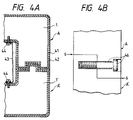
- the mere combining of the cases with plated surfaces coming into contact each other gives insufficient adhesion. Since electrical continuity cannot be taken in this event, electromagnetic wave leaks out of the connecting part. Therefore, using the lead wire 4.3 and the washer 4.4 as a conventional means to achieve electrical continuity through two or more cases in the cover, for example, the cases have been combined.
- the two cases were connected electrically by using lead wire and washer to strengthen the continuity which the mere butt joint of the two cases do not achieve sufficiently.
- this method is getting hard to apply since the securing of space for lead wire arrangement and for the fixation of washer is becoming difficult with the recent tendency to made products smaller.
- Another method to have electrical continuity through the cases is to improve the adhesion of the connecting part by applying silver paste and the like onto the connecting part of the cases without using the lead wire and washer. This method causes a cost problem since it requires the coating of silver paste to the connecting part in its entirety leading to a substantial increase of work steps.
- the plastic cases to which electroless copper plating is applied require decorative coating prior to the assembling of the cover.
- the masking with tapes and fixtures is necessary to prevent the adhesion of coating layer at the time of coating.
- the number of work steps increases substantially and costs become higher, lacking in mass-producibility.
- Plastic base materials electrolessly plated with copper have usually electroless nickel plating on the copper plating to prevent corrosion of the copper.
- the surface of this nickel plating does not adhere sufficiently to the decorative coating layer.
- special paints for example, ORIGI PLATE of Origin Electric K.K.
- Another method is to provide electromagnetic wave shielding along with decorative coating by giving spray coating of conductive paints to a plastic case.
- the layer thickness of at least 50 ⁇ m is necessary to secure the electromagnetic wave shielding, with the result that there remains a problem of poor accuracy at the connecting part of the cases. Further, the coating on the connecting part of the cases is liable to peel off, making the continuity between the cases insufficient.
- conductive plastic If conductive plastic is used, there is no conductivity at the connecting part since the conductive filler does not come out onto the surface.
- a known method is to connect by the use of a case damping screw as shown in Fig. 4B.
- the conductive plastic in which conductive filler is mixed into resin is used, along with the use of the damping screw, to connect the two cases and at the same time to provide electrical connection between the cases by improving the contacting properties of the conductive filler.
- This method requires the processing of the cases beforehand for the use of the damping screw, causing such problems as increase in the number of work steps, the weight increase of conductive covers and cost rises. Also, the cost of conductive plastic materials themselves is high and the mass-producibility is poor.
- the US-A-4 328 981 discloses to form, by spray coating on an enclosure, a conductive coating containing a pigment comprised of organic titanate and copper, and a binder.
- the PATENT ABSTRACTS OF JAPAN, vol. 10, no. 390, 26.12.86 is directed to a surface treatment method for a titanium alloy substrate, particularly, in which an oxide film or a colored film of titanium nitride is formed on the surface of the Ti or Ti alloy substrate, and then a polymer is electrodeposited on the film by using the Ti substrate as an electrode to protect the surface of the Ti substrate while the color of the surface is made uniform and deep.
- a two-layered structure is used, namely a lower metal layer and an upper layer of insulating material.
- the US-A-4 844 784 is directed to a method of bonding an electroconductive circuit on a first flexible circuit substrate to an electroconductive circuit on a second flexible circuit substrate.
- this document discloses a method of forming an electroconductive adhesive layer containing electroconductive particles including graphite, carbon black, various metallic fine particles and electroconductive ceramic particles (e.g. titanium nitride, titanium carbide).
- This invention has been made in light of the above problems and for the purpose of providing a conductive cover of the kind defined at the preamble and its manufacturing method, the conductive cover being capable of achieving good electrical continuity by connecting a plurality of cases at their surfaces, being excellent in electromagnetic wave shield and having a exterior coating layer with superior coating layer properties.
- the present invention also aims to provide an electronic equipment which has excellent electromagnetic wave shielding properties and exterior coating layer with excellent coating properties. This object is attained by the characterizing features of claim 1, concerning the conductive cover, and by the features of claim 15, concerning the method. An advantageous use for the conductive cover is defined in claim 14.
- the conductive electrodeposition layer is formed by depositing resins and conductive particles on the case surface at the same time. Unlike the spray coating, conductive particles are deposited very minutely so that even a thin layer has sufficient conductivity and become soft owing to the presence of resins. Consequently, the adhesion becomes good just by connecting the cases, and the connecting of two or more of conductive cases via conductive electrodeposition layers achieves electrical continuity between the cases thoroughly, resulting in the conductive cover with excellent electromagnetic wave shielding properties.
- the conductive cover of the present invention is a cover in which at least 2 cases are connected with each other at their respective surfaces. Since there is electrical continuity between the contact surfaces of the cases via conductive electrodeposition coating layer thereinafter "conductive ED layer"), the continuity between the cases improves and electromagentic wave shielding also improves owing to the presence of electrodeposition layer. Besides, the electrodeposition layer has superior properties such as adhesion and corrosion resistance, hence effective for use in exterior coating.
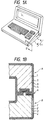
- Fig. 1 shows one example of the structure of a lap-top personal computer using the conductive cover of the present invention for the exterior cover of the body 11, and (A) is a perspective view and (B) is partially cross-sectional view at the D-D' line.
- Fig. 1 shows one example of the structure of a lap-top personal computer using the conductive cover of the present invention for the exterior cover of the body 11, and (A) is a perspective view and (B) is partially cross-sectional view at the D-D' line.
- the conductive cover of the invention is made in such a way that with the two cases A and A' being connected with each other at the surface contact point, one case A has a plating layer 2 such as a metal copper thin layer formed on the non-metal base material 1 and thereon is provided a chemically colored layer 3 on which a conductive ED layer 4 is provided, whereas the other case A has the same structure as the case A with the connecting surface 6 between the case A and the case A' having electrical conductivity via the conductive electrodeposition coating layer 4.
- a plating layer 2 such as a metal copper thin layer formed on the non-metal base material 1 and thereon is provided a chemically colored layer 3 on which a conductive ED layer 4 is provided
- the other case A has the same structure as the case A with the connecting surface 6 between the case A and the case A' having electrical conductivity via the conductive electrodeposition coating layer 4.
- the conductive ED layer 4 is obtained by electrically depositing a resin and conductive particles on a chemically colored layer.
- the conductive particles are highly dense and even a thin layer offers superior conductivity.
- the conductive ED layer has flexibility to some extent at the connecting surface of the cases so that the case can be closely adhered to each other, making it possible to give conductivity between the cases simply by their connection without spoiling the accuracy of the connecting part.
- the conductive ED layer is capable of not only providing electromagnetic wave shield to the cases but also giving satin finish to the case surface by appropriately selecting the size of conductive particles.
- the layer can be used also as a decorative coating layer, which makes it unnecessary to have a washing step of the connecting part of the case traditionally required in a decorative coating.
- Any conductive particles capable of providing the electrodeposition layer with conductivity can be used for the deposition with resin in the electrodeposition layer of the present invention.
- those particles may be used including ceramic powder coated with metal on the surface (metallized ceramic powder), natural mica powder coated with metal on the surface (metallized natural mica powder) or the mixture thereof, ultra fine metal powders having the average particle size of 0.01-5 micrometers, resin powder having metal coating on the surface or the mixture thereof or the mixture of one or two kinds of powder selected from metallized ceramic powder and metallized natural mica powder and one or two kinds of powder selected from ultra fine metal powder and metallized resin powder.
- the electrodeposition layer after the electrodeposition is over, for example, to perform complete cross-linking at such a low temperature as 90-100°C, instead of a normal temperature at 130-180°C, on the cross-linking of the electrodeposition layer under heat treatment.
- This method enable to manufacture a conductive ED layer with excellent coating layer properties and it is particularly preferable in the case where the conductive ED layer is used as a decorative coating layer. The reason why the electrodeposition layer containing these metallized ceramics powder or metallized natural mica powder or the mixture thereof hardens at a low energy is not clear.
- the metallized ceramic powder and metallized natural mica powder which are used in the present invention include ceramic powder or natural mica powder coated with Cu, Ni, Ag, Au, Sn, etc.
- the effective plating material for such powder particle surfaces is Cu, Ag and Ni from the standpoint of shielding and costs.
- a method of forming a metal film onto a powder particle surface is electroless plating.
- the plating thickness of powder surface is 0.05-3 micrometers, particularly 0.15-2 micrometers, excellent shielding properties and superior coating layer properties at the time of low temperature curing are obtained.
- the plating thickness is more than 3 micrometers, the surface properties become similar to those of metal particles. Then, as the surface becomes very active, it is oxidized in air to decrease cross-linking points, the curing of electrodeposition layer is liable to become insufficient at the time of low-temperature baking.
- Ni plating on powder for example, as disclosed in Japanese Patent Application Laid-open No. 61-276979 aqueous suspension of powder is prepared and electroless nickel plating used solution is added thereto to form nickel plating on powder particle surfaces with a low content of phosphorus, e.g. 5% or less, then the conductivity improves and the electrodeposition layer having shielding properties almost comparable to Cu plated powder can be formed.
- the average particle size of ceramic powder and natural mica powder is preferably 0.1-5 micrometers, particularly 0.15-3 ⁇ m and further 0.5-2 micrometers when consideration is given to the surface area which contributes to surface activity and dispersibility in electrodeposition coatings.
- the ceramic used in the present invention is a non-metallic inorganic solid material which includes aluminium oxide, titanium nitride, manganese nitride, tungusten nitride, tungusten carbide, lanthanum nitride, aluminium silicate, molybednum disulfide and titanium oxide and silicate.
- Natural mica includes phlogopite mica, sericite mica and muscovite mica.
- ultra fine particle metal powder having the average particle size of 0.01-5 ⁇ m and surface-metallized resin powder having the average particle size of 0.1-5 ⁇ m may be used.
- ultra-fine particle metal powder obtained by thermal plasma evaporation method includes powder of Ag, Co, Cu, Fe, Mn, Ni, Pd, Sn and Te.
- the average particle size is 0.01-5 micrometers, particularly 0.01-0.1 micrometer and further 0.03-0.07 micrometers. If the size is below 0.01 micrometers, secondary coagulation takes place.
- a particle size is larger than 5 micrometers, it sediments in electrodeposition paint and the coating material generates metallic sheen, causing hindrance to coating with desired color.
- metallized resin powder of the present invention is obtained, as in the case of ceramics, by forming a layer of Cu or Ni in the thickness of 0.05-3 micrometers on the resin powder surface of fluorine resin, polyethylene resin, acrylic resin, polystyrene resin, nylon, etc.
- the average particle size of the resin powder is preferably ca. 0.1-5 micrometers.
- electrodeposition coating materials having electromagnetic wave shielding and superior coating layer properties can be obtained by including each of them in a electrodeposition layer.
- ultra fine particle metal powder or metalized resin powder or a mixture thereof is added to metallized ceramic powder or metallized mica powder or a mixture thereof 1 in the weight ratio of 0.2-3, the gap between particles of metallized ceramic powder and/or metallized natural mica powder 61 is filled, as shown in Fig. 6, with particles of ultra fine particle metal powder and/or metallized resin powder 62, increasing a contact area between powders.
- the conductivity of the case connecting surface improves to further strengthen the shielding properties of the conductive cover.
- Resins capable of electrodepositing in the present invention are those conventionally used in the electrodeposition paints.
- resin having an anionic functional group like a carboxyl group which gives a negative charge and hydrophilic properties which are necessary for the electrodeposition of resin specifically acrylic melamine resin, acrylic resin, alkyd resin, maleic polybutadiene or its half ester and half-amide.
- a resin which may be used is those having a cationic functional group like an amino group which gives a positive charge and hydrophilic properties, specifically epoxy resin, urethane resin, polyester resin, polyether resin, etc.
- these resins those which are not self-crosslinkable are used in a mixture with, for example, melamine resins or block polyisocyanate compound for a curing agent.
- the content of conductive particles in the conductive ED layer of the present invention is 5-50 wt %, preferably 10-40 wt % and particularly 15-35 wt % in the electrodeposition layer after curing in consideration of the continuity of the cases A and A', electromagnetic wave shielding property of conductive cover (for example, the attenuation quantity more than 30-40 dB which is a VCCI regulation value) or, coating layer properties as a decorative coating layer such as corrosion resistance or the adhesion to base material.
- the content is larger than 50 wt %, the layer becomes unsuitable as exterior coating layer due to embrittlement. If the content is below 5 wt %, the electrical continuity between the cases is insufficient, and leave the electromagnetic wave shielding property of the conductive cover being unsatisfactory.
- the conductive particles in the electrodeposition layer can be determined by means of X-ray microanalyzer, and the content can be measured with the thermal weight analytical equipment.
- non-metallic base material 1 of the case A is plated and further a chemically colored layer is formed thereon.
- plastic materials which are generally used in plastic cases such as lap-top computers and cordless telephones, e.g. ABS resin, polycarbonate resin, ABS-polycarbonate alloy, polyacetal resin, polybutylene terephthalate, polyethylene telephthalate, polyether imide resin, glass fiber-filled ABS resin, glass fiber-filled polycarbonate resin, polyphenylene ether and polypropylene.
- non-metal base materials As conducted with the known plating method on plastics, they are etched, then treated with catalyst (e.g. palladium treatment) and made conductive, followed by the formation of a metal thin layers.
- catalyst e.g. palladium treatment
- a chemically colored layer 3 is formed on a metal copper thin layer.
- the chemically colored layer 3 the one obtained, for example, by surface treatment of the plating layer 2 formed on the base material 1 has good adhesion to the conductive ED layer, is preferred to improve the adhesion between the base material 1 and the conductive electrodeposition layer 4.
- the chemically-colored layer shows superior adhesion to the conductive ED layer.
- the surface of the chemically colored layer contains a large number of very fine pores, and since physical adsorption to the ED layer occurs and at the same time chemical adsorption takes place between the functional group of polymer in the ED layer and the active point on the surface of conductive particles and chemically-colored layer, which causes the outstanding adhesion.
- the chemically colored layer obtained from the surface treatment of copper in the present invention e.g. copper oxide, copper suboxide, copper carbonate, copper sulfide and ammonium copper hydroxide, is excellent in the adhesion of the ED layer.
- copper oxide is preferred in terms of adhesion between the ED layer and the base material, corrosion resistance of metal thin layers 2 and 2' and the uniformity of the ED layer. Accordingly, it is preferable to use copper for a metal thin layer in this invention. In case a material other than copper is to be used as metal base material, it is desirable to apply copper plating to periphery thereof.
- the metal thin layer 2 is used to form a chemically-colored layer on the electrode and surface for the formation of the ED layer, and the layer thickness should be not less than 0.01 ⁇ m and 0.2 ⁇ m, preferably 0.05-0.15 ⁇ m. If the layer thickness exceeds 0.2 ⁇ m, the formation of copper thin layer takes time and working efficiency lowers with the increasing weight of a material to be electrodeposition-coated, which is not preferable. If electrodeposition coating layer is formed directly on the metal copper thin layer, copper dissolves into the electrodeposition paint and accumulates there, causing adverse influence to the coating layer properties.
- a copper oxide layer can be formed by soaking the base material with the formed copper plating layer in the mixed solution such as copper sulfate + potassium chlorate, and copper chloride + copper acetate + alum.
- a method to form the sulfide layer of copper includes the soaking into the mixed solution such as potassium sulfide + anmonium chloride, sodium hyposulfite + lead acetate, etc.
- a method to form the hydroxide layer of copper includes the soaking into the mixed solution such as copper nitrate + ammonium chloride + acetic acid, etc. Further, a method to form the suboxide layer of copper, one of the oxide layers, includes the soaking into the mixed solution such as copper sulfate + sodium chloride, copper sulfate + ammonium chloride, etc.
- the base material with chemically colored layer is soaked in the electrodeposition paint to give electrodeposition and form an electrodeposition layer on the chemically-colored layer.
- This electrodeposition step should be in accordance with an ordinary method of electrodeposition coating.
- the electrodeposition resin is anionic
- the base material side is an anode
- the base material is a cathode.
- electrodeposition is performed under the conditions of a solution temperature being 20-25°C, the applied voltage being 50-200V, the current density being 0.5-3A/dm 2 and the treatment time being 1-5 minutes to deposit resin and conductive particles on the chemically colored layer. The reason for the elution of resin and conductive particles are deposited together is explained as follows.
- the resin capable of electrodeposition has its functional group ionized which is bonded to the resin in paint, by the application of direct voltage between a material to be coated and a counter electrode, resin particles are attracted to the material to deposit. Since this resin is adsorbed to the periphery of the conductive particles in the electrodeposition paint, the conductive particles move along with the movement of the resin toward the material to be coated to deposit the particles and resin on the material.
- the electrodeposition paint used in this step of the present invention is prepared, for example, in such a way that conductive particles and resin capable of electrodeposition are dispersed by the ball mill over 24-35 hours, followed by the dilution with desalted water to make the solid content at 7-15 wt %, preferably 10-15 wt %.
- the electrodeposition paint can be colored as necessary by adding pigments, etc., if necessary Pigments for coloring is preferably added in the amount of 1-3 wt %.
- a preferable mixing ratio of the conductive particles and the resins capable of electrodeposition is 1-15 parts by weight, preferably 10-20 parts by weight, particularly 7-15 parts, relative to 100 parts by weight of the resin. Within this range, it is possible to co-deposit the conductive particles sufficient to provide shielding properties, and also to provide the coating layer properties such as adhesion to the base material or flexibility of the electrodeposition layer without sedimentation of conductive particles in the electrodeposition paint.
- the conductive particles to be dispersed in the electrodeposition paint include powders to be co-deposited together with the resin onto electrodeposition layer, such as the above-mentioned metallized ceramic powder or metallized natural mica powder, and the mixture thereof and powders in which ultra fine particle metal powders having an average particle size of 0.01-5 ⁇ m or the surface metal coated resin powders having an average particle size of 0.1-5 ⁇ m or the mixture thereof is mixed with the metallized ceramic powders or metallized natural mica powder or the mixture of the same.
- the resulting electrodeposition layer is washed with water and subjected to heat treatment for curing.
- the thickness of electrodeposition coating layer in this invention should be preferably thin enough to secure the electrical continuity between the cases as well as shielding properties in view of the case connection accuracy, uniformity of coating layer, adhesiveness and easiness of decorative coating, specifically 5-40 ⁇ m and particularly 7-25 ⁇ m.
- the contact surface 6 is matched with the contact surface 6' to assemble the conductive cover 10.
- a and A' can be fixed by screws or can be inserted utilizing the toughness of the plastic case.
- electrical continuity can be sufficiently secured between the cases A and A' by contacting them through the conductive ED layer, so that a conductive cover having excellent electromagnetic shielding properties can be obtained easily.
- the adhesion of the conductive ED layer to the base material can be improved by applying a chemically colored layer for a undercoating layer.
- the case surface can be made to uniform satin-finish. Therefore, the conductive ED layer can be used as a decorative coating layer. It is unnecessary to give masking to the connecting part between the cases, which has been required on the application of a decorative coating to the cases subjected to electroless plating as electromagnetic wave shielding measures.
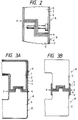
- Fig. 2 is an enlarged partial cross-sectional view of the connecting part showing other example of the structure of the conductive cover in the present invention.
- the conductive cover of the present invention consists of the cases A and A' being connected with each other at the surface contact points, in which on the metal base material 5 of the case A is provided a chemically-colored layer 3 and further a conductive electrodeposition layer 4 is provided thereon, whereas the other case A' has the same structure as the case A and the surface contact points of the two cases A and A' have electrical continuity via the conductive electrodeposition coating layer 4.
- the metal base material 5 is made of, for example, copper, zinc, nickel, tin, aluminium, iron and their alloys.
- the conductive cover of the present invention shown in Fig. 2 is made in such a way that following, for example, the same method as shown in Fig. 1, a chemically colored layer of copper oxide is formed in the presence of alkali on a metal base material such as copper and then an electrodeposition coating layer is formed thereon by the same electrodeposition coating method as shown in Fig. 1, followed by the cross-linking of said electrodeposition coating layer to obtain a case having improved adhesiveness of the ED layer.
- a chemically colored layer of copper oxide can be obtained by oxidation after copper plating is applied to the surface. This method is desirable in that the adhesion to the ED layer improves. Then, the case A and the case A' thus obtained are connected to obtain a conductive cover having excellent electromagnetic wave shield.
- Fig. 3A shows further another embodiment of the invention.
- the case A like the case A in Fig. 1, is made by applying plating to a non-metal base material to form a chemically colored layer, followed by the formation of a conductive electrodeposition layer.
- the case A' has the surface 31 electrolessly plated with nickel on the surface of a copper base material, and a conductive cover having superior electromagnetic shielding properties is also obtained by connecting the above cases A and A'.
- This conductive cover is used, for instance, in the case where no decorative coating is necessary in a lower part corresponding to the case A'.
- a conductive cover may be prepared by forming a conductive ED layer on the connecting surface of the case A and case A' made of a metallic base material and its surrounding, or the connecting surface of either of the cases A and A' and its surrounding.
- This mode is desired in case, for example, in the case where the conductive cover of the present invention is used not as an exterior cover for electronic equipment but as a shield case to be provided inside the exterior cover. Needless to say, the mode shown in Figs. 1-3A can be used as a shield case. In particular, if a conductive cover based on a resin base material is used as a shield case, it is possible to make the electronic equipment, etc. substantially lighter.
- the conductive cover of the present invention helps improves the earth connection between the cases and has the excellent electromagnetic wave shielding properties since the surface connecting point of the cases having at least 2 electrodeposition coating layers connecting to each other have electrical continuity via the conductive electrodeposition coating layer.
- the conductive cover of the present invention solves such problems that when two or more cases of prior art are connected, the continuity between the cases is insufficient, which causes insufficient electromagnetic wave shield by the conductive cover, and needs an electrical connecting means between the cases to bring above enlargement of the conductive cover.
- the conductive ED layer can be used as a decorative coating layer due to the improvement of coating layer properties such as adhesion to the base material and corrosion resistance.
- the conductive cover of the present invention can be used as an exterior cover for an electronic equipment. Furthermore, the step of masking the connecting part between the cases can be omitted which has been necessary when a decorative coating is applied to the case subjected to electroless copper plating as the measure of the prior art for electromagnetic wave shield.
- the present invention it is possible at the same time to provide electromagnetic wave shielding properties to plastic base materials, give electrical continuity between the connecting parts of the cases and conduct decorative coating of plastic base materials, thereby manufacturing a conductive cover at a low cost and with high productivity.
- the invention makes it possible to obtain at a low cost electronic equipment which is small in size, light in weight and excellent in electromagnetic wave shielding.
- the particle size of the powders has been measured with a centrifugal sedimentation type particle size distribution measuring apparatus (SACP-3; Shimadzu), and each powder has been deemed to be a dense sphere of the same particle size.
- SACP-3 centrifugal sedimentation type particle size distribution measuring apparatus
- the determination of conductive particles in the electrodeposition layer has been made with X-ray microanalyzer, and the content has been analyzed with a thermal weight analysis equipment (Tradename: Thermal Analysis System 7 Series: PERKIN-ELMER). With respect to the electromagnetic wave shielding effect, electromagnetic wave of 50Hz - 1000 MHz has been measured for attenuation characteristics using the spectral and spectrum analyzer of Takeda Riken (Tradename: TR4172; ADVANTEST K.K.).
- Base materials 1 and 1' for ABS resin-molded two cases A and A' used for the upper and lower covers of a lap-top personal computer body were soaked for one minute in the etching solution of CrO 3 -H 2 SO 4 -H 2 O. After water-washing, the materials were soaked for two minutes at room temperature using a mixed solution of 30 g/l stannous chloride and 20 ml/l hydrochloric acid, followed by water washing again. Subsequently, the materials were soaked for 2 minutes at room temperature using as activator solution a mixed solution of 0.3 g/l palladium chloride and 3 ml/l hydrochloric acid.
- plating was carried out for 5 minutes at the bath temperature of 70°C at pH 13.0 using a electroless copper plating solution (manufactured by Okuno Seiyaku Kogyo) to form a copper thin layer of 0.2 ⁇ m thickness.
- the material was further soaked for 30 seconds at 70°C in the mixed aq. solution of 5% sodium hydroxide and 1% potassium persulfate to form a copper oxide layer as a chemically colored layer.
- the electrodeposition was conducted for 3 minutes with the applied voltage of 150V at the both temperature of 25°C and pH of 8-9 using the above base materials 1 and 1' as an anode and a 0.5 t stainless plate as an counter electrode to form a 25 micrometers electrodeposition coating layer on the entire surface of the base material.
- water washing was performed, and heating was then conducted in the oven at 97°C ⁇ 1°C for 60 minutes for curing and the cases A and A' were obtained.
- the co-deposition amount of the electrodeposition coating layer formed on this case was 30 % by weight. Tests were made about adhesion and corrosion resistance of the electrodeposition coating layer. Table 1.1 shows the results.
- the adhesion was evaluated in such a way, according to the method of a grid test specified in JIS-K5400, that a test piece was provided with grid-like cuts so as to make 100 one mm squares per 1 cm 2 , and an adhesive tape was stuck to it and the number of squares remaining on the base material after the tape was peeled off was counted.
- the corrosion resistance was measured in accordance with the salt spray test of JIS-K5400 in terms of the width of swelling (one side) appearing on the cut part of the coating layer. Then, the cases A and A' were combined utilizing the concave and convex (or dent and projection) shapes of the connecting parts to make the exterior cover 11 of a lap-top personal computer body and the electromagnetic wave shielding effect of the exterior cover was measured.
- Base materials 1 and 1' for the ABS resin-moled two cases A and A' used for the upper and lower covers of a word processor were treated with CrO 3 -H 2 SO 4 -H 2 O etching solution for one minute.
- the material was, after water washing, soaked for 2 minutes at room temperature in the mixed solution of 30 g/l stannous chloride and 20 ml/l hydrochloric acid as sensitizer solution, followed by water washing again. Subsequently, the mixed solution of 0.3 g/l palladium chloride and 3 ml/l hydrochloric acid was used as an activator solution to treat the material for 2 minutes at room temperature.
- the material was thereafter treated with the mixed aq. solution of 5% sodium hydroxide and 1% potassium persulfate for one minute at 70°C to form an copper oxide layer as a chemically colored layer.
- acrylic melamine resin (Tradename: Honeybrite C-IL, manufactured by Honey Kasei) was dispersed for 30 hours with a ball mill 10 parts by weight of alumina having the average particle size of 1 micrometer on the surface of which electroless copper plating was given in the thickness of 0.2 ⁇ m, and then the resulting solution was diluted to 15 % by weight with desalted water and the above cases A and A' which was plated and had a chemically colored layer formed were soaked in the electrodeposition paints in which 2.0 % by weight of carbon black was added to give coloring.
- acrylic melamine resin (Tradename: Honeybrite C-IL, manufactured by Honey Kasei) was dispersed for 30 hours with a ball mill 10 parts by weight of alumina having the average particle size of 1 micrometer on the surface of which electroless copper plating was given in the thickness of 0.2 ⁇ m
- the electrodeposition was carried out for 3 minutes at 150 V using the base material as an anode and a 0.5 t stainless plate as a counter electrode to form a coating film having a thickness of 25 ⁇ m.
- water-washing was perform and heating was done in an oven for 60 minutes at the temperature of 97°C ⁇ 1°C for curing and the cases A and A' were obtained.
- the content of metallized alumina in the electrodeposition coating layer formed on the cases A and A' was 30 weight %. Test was done about the adhesiveness and corrosion resistance of the electrodeposition layer.
- the exterior cover was measured for its electromagnetic wave shielding effect in the same way as in the case of Example 1-1. The result was likewise excellent and cleared the regulation of FCC and VCCI.
- a base material 1 made by the molding of polyphenylene ether resin (PPE resin) for the case A, used for a lap-top personal computer body was soaked in the mixed solution of 300 ml/l of 98% sulfuric acid and 200 g/l of chromatic anhydride at 40°C for 5 minutes for pre-etching and then in the solution of 80 ml/l of 36% hydrochloric acid at room temperature for 2 minutes.
- PPE resin polyphenylene ether resin
- the material was then soaked in the mixed solution of 300 ml/l, of 36% hydrochloric acid and 200 ml/l of GX etchant at 40°C for 10 minutes and further in 80 ml/l of 36% hydrochloric acid at room temperature for 2 minutes. Lastly, the material was soaked in a conditioner solution (Tradename: TSP neutralizer, produced by Okuno Seiyaku Kogyo) at 30°C for 3 minutes to etch the surface of the PPE resin base material. As in the case of Example 1-1, a copper plating layer and copper oxide layer were formed.
- acrylic melamine resin (Tradename: Honeybrite C-IL, produced by Honey Kasei) was dispersed for 30 minutes with a ball mill 15 parts by weight of silicon carbide having the average particle size of 5 ⁇ m on the surface of which non-electrolytic gold plating was given in the thickness of 0.5 micrometers. Thereafter, the resulting solution was diluted to 15 % by weight with desalted water and 2.0 % by weight of carbon black was added for coloring to reprepare electrodeposition paints.
- acrylic melamine resin (Tradename: Honeybrite C-IL, produced by Honey Kasei) was dispersed for 30 minutes with a ball mill 15 parts by weight of silicon carbide having the average particle size of 5 ⁇ m on the surface of which non-electrolytic gold plating was given in the thickness of 0.5 micrometers. Thereafter, the resulting solution was diluted to 15 % by weight with desalted water and 2.0 % by weight of carbon black was added for coloring to reprepare electrodeposition paints.
- the above base material 1 was soaked in this electrodeposition paints. Then, the electrodeposition was conducted at 150V for 3 minutes under the conditions of the temperature being 25°C and pH being 8-9, using the base material as an anode and 0.5 t stainless plate as a counter electrode to form a coating layer of 26 micrometer thickness. Following the electrodeposition, water-washing was performed and heating conducted in an over at 97°C ⁇ 1°C for 60 minutes for curing and the case A was obtained. The content of metallized ceramic powder in the electrodeposition layer formed on the case A was 35 wt%.
- the base material 1' for the brass plate-made case A' used for lap-top personal computer body was subjected to solvent degreasing. Thereafter, the material was treated with the mixed aq. solution of 5% sodium hydroxide and 1% potassium persulfate at 70°C for 1 minute to form a copper oxide layer as a chemically colored layer.
- acrylic melamine resin (tradename: Honeybrite C-IL, manufactured by Honey Kasei) was dispersed for 30 hours with a ball mill 10 parts by weight of alumina having the average particle size of 1 micrometer on the surface of which non-electrolytic nickel plating was given in the thickness of 0.5 micrometers.
- the resulting solution was diluted to 15% by weight with desalted water.
- the electrodeposition paint prepared by adding 2.0 % by weight of carbon black the electrodeposition was conducted at 130V for 3 minutes under the conditions of the temperature being 25°C and pH being 8-9, using the base material as an anode and 0.5 t stainless plate as a counter electrode to form the coating layer of 20 micrometer thickness.
- Example 1-1 As in the case of Example 1-1, a test was conducted about the adhesion and corrosion resistance of electrodeposition layer which had been fomred on the cases A and A' thus obtained. The result was such that like the example 1-1, the adhesion was 100/100 and the corrosion resistance was 1 mm or less in terms of one-side swelling width, hence both of the cases A and A' were applicable for an exterior cover.
- Example 1-1 the case A and the case A' were connected to assemble the exterior cover 11 of a lap-top personal computer body.
- the exterior cover was measured for the electromagnetic wave shielding effect in the same way as in Example 1-1. The result was excellent and cleared the regulations of FCC and VCCI.
- Electrolytic degreasing was done for brass plate base materials 5 and 5' for the two cases A and A' used for the upper and lower covers of a lap-top personal computer body in Fig. 2. Then, using a mixed solution of 5% sodium hydroxide and 1% potassium persulfate, the material was treated at 70°C for one minute to form a copper oxide layer as a chemically-colored layer.
- acrylic melamine resin tradename: Honeybrite C-IL, manufactured by Honey Kasei
- the base material 5 and 5' having the chemically colored layers 3 and 3' were soaked in the above electrodeposition paints, and under the conditions of the bath temperature being 25°C and pH being 8-9 electrodeposition was done at 150 V for 3 minutes using the base material as an anode and 0.5 t stainless plate as a counter electrode to form a coating layer of 25 micrometers thickness.
- water-washing was performed and heating conducted at 97°C ⁇ 1°C in an oven for 60 minutes to curing to obtain the cases A and A'.
- the content of metallized ceramic powder in the electrodeposition layer of the cases A and A' was 30 wt %.
- Example 1-1 On a copper thin layer formed on an ABS base material as in Example 1-1, the same electrodeposition layer as in Example 1-1 was provided to obtain the cases A and A'.
- the results of the test on the adhesion and corrosion resistance of the electrodeposition layer for the cases A and A' are shown in Table 1-1.
- the conductive cover made by connecting the above cases A and A' was measured for electromagnetic wave shielding properties to obtain excellent values as in Example 1-1.
- Electroless copper plating was given to the ABS base material of Example 1-1 to form a nickelplated thin layer, on which the same electrodeposition layer as in Example 1 was provided to obtain the cases A and A'. Their adhesion and corrosion resistance were tested and the results were as shown in Table 1-1.
- Example 1-1 shows the evaluation results about the corrosion resistance and adhesiveness obtained in Examples 1-1 to 1-4 and Reference Examples 1 and 2.
- Electroless plating was given to ABS base material of Example 1-1 and further the nickel-plated cases A and A' were connected to prepare the conductive cover in which electrical continuity between the cases was given by washer and lead wire.
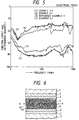
- the effect of the electromagnetic wave shielding is shown in Fig. 5.
- ASS resin base material 1 and 1' molded for the two cases A and A' used for the upper and lower covers of a lap-top personal computer body as shown in Fig. 1 electroless copper plating and copper oxide layers 3 and 3' were applied.
- acrylic melamine resin (tradename: Honeybrite C-IL, manufactured by Honey Kasai) was dispersed for 30 hours by a ball mill 5 weight parts by weight of alumina having the average particle size of 1 micrometer on the surface of which electroless copper plating was given in the thickness of 0.2 micrometers. Then, the resulting solution was diluted to 15% by weight with desalted water, and 1.0% by weight of carbon black was added for coloring to prepare electrodeposition paint. Thereafter, the above base materials 1 and 1' having copper oxide layers 3 and 3' were soaked in the electrodeposition paint.
- the electrodeposition was done at 150V for 3 minutes under the conditions of the bath temperature being 25°C and pH being 8 - 9, using the base material as an anode and 0.5 t stainless plate as a counter electrode to form the 25 ⁇ m thick coating layers 4 and 4' containing 30 wt % of the mixed powder.
- water-washing was performed and heating conducted at 97°C ⁇ 1°C in an oven for 60 minutes for curing to obtain the cases A and A'.
- a test was conducted, as in Example 1-1, for the adhesiveness and corrosion resistance of the electrodeposition layer formed on the cases A and A'. The result was excellent with the adhesiveness being 100/100 and the corrosion resistance 1 mm or less in terms of one-side swelling width.
- the exterior cover 11 was assembled using the cases A and A' to measure the electromagnetic wave shielding effect. The result is shown in Fig. 5.
- the electromagnetic wave shielding effect was very superior as shown in Fig. 5, clearing the regulation of FCC and VCCI.
- alkyd resin (Tradename: TF121, manufactured by Shinto Toryo) was dispersed for 30 hours with a ball mill 5 parts by weight of nickel powder having the average particle size of 0.03 ⁇ m and 10 parts by weight of alumina having the average particle size of 1 ⁇ m on the surface of which electroless nickel plating was given in the thickness of 0.5 micrometers. Then, the resulting solution was diluted to 15% by weight with desalted water and 1.0 weight % of carbon black was added for coloring to prepare electrodeposition paint.
- TF121 manufactured by Shinto Toryo
- the above base materials 1 and 1' were soaked in the electrodeposition paint.
- the electrodeposition was carried out at 150V for 3 minutes under the conditions of the bath temperature being 25°C and pH 8 - 9, using the base material as an anode and a 0.5 t stainless plate as a counter electrode to form a 25 ⁇ m-thick coating layer containing 30 wt% of the mixed powder.
- water-washing was performed and heating conducted at 97°C ⁇ 1°C in an oven for 60 minutes for curing to obtain the cases A and A'.
- a test was conducted about the adhesion and corrosion resistance of the electrodeposition layer formed on the case. The results was that as in Example 2-1, the adhesion was 100/100 and corrosion resistance was 1 mm or less in terms of one-side swelling width, thus the cases A and A' were sufficiently applicable to an exterior cover.
- the electromagnetic shield effect of the exterior cover for the L. T. parsonal computer body, assembled by using the cases A and A' was excellent as in the case of Example 2-1, clearing the regulations of FCC and VCCI.
- acrylic melamine resin (Tradename: Honeybrite C-IL, manufactured by Honey Kasei) was dispersed for 30 hours with a ball mill 12 parts by weight of nickel powder having the average particle size of 0.03 ⁇ m and 4 parts by weight of silicon carbide having the average particle size of 0.7 micrometers on the surface of which non-electrolytic nickel plating was given in the thickness of 0.2 ⁇ m. Then, the resulting solution was diluted to 15 % by weight with desalted water, and 2.0 % by weight of carbon black was added for coloring to prepare electrodeposition paint. The above base materials 1 and 1' were soaked in the electrodeposition paint.
- the electrodeposition was conducted at 120V for 3 minutes under the conditions of the bath temperature being 25°C and pH 8 - 9, using the base material as an anode and a 0.5 t stainless plate as a counter electrode, to form the 20 ⁇ m thick coating layer containing 20 wt % of mixed powder.
- water-washing was performed, and heating was conducted at 97°C ⁇ 1°C in an oven for 60 minutes for curing to obtain the cases A and A'.
- Example 2-1 a test was made for the adhesion and corrosion resistance of the electrodeposition layer formed on the cases A and A'. The result was that as in the Example 2-1, the adhesion was 100/100 and the corrosion resistance was not more than 1 mm in terms of one-side swelling width, thus the cases A and A' were applicable to an exterior cover.
- Example 2-1 copper thin layers and copper oxide layers were formed on the entire surface of polycarbonate ABS alloy base material molded for the case A which is used for the upper cover of a lap-top personal computer body as shown in Fig. 3A.
- acrylic melamine resin (tradname: Honeybrite, manufactured by Honey Kasei were dispersed for 30 hours with a ball mill 2 parts by weight of silver powder having the average particle size of 0.1 ⁇ m and 10 parts by weight of alumina having the average particle size of 1 ⁇ m on the surface of which electroless nickel plating was given in the thickness of 0.5 ⁇ m.
- the resulting solution was diluted to 15 % by weight with desalted water, and 1.0 % by weight of carbon black added for coloring to prepare electrodeposition paint.
- the above base material was soaked in the electrodeposition paint.
- electrodeposition was conducted at 150V for 3 minutes under the conditions of the bath temperature being 25°C and pH 8 - 9, using the base material as an anode and a 0.5 t stainless plate as a counter electrode to form the 25 ⁇ m thick layer of containing 30 wt % of the mixed powder.
- water-washing was performed, and heating was conducted at 97°C ⁇ 1°C in an oven for 60 minutes for curing to obtain the case A.
- the brass-made base materials 5' molded for the case A' which is used for the lower cover of a lap-top personal computer body was pretreated with electrolytic degreasing and then treated with the mixed aq. solution of 5% sodium hydroxide and 1% potossium persulfate at 70°C for one minute to form a copper oxide layer as a chemically colored layer.
- acrylic melamine resin (Tradename: Honeybrite C-IL, manufactured by Honey Kasei) was dispersed for 30 hours with a ball mill 5 parts by weight of nickel powder having the average particle size of 0.05 ⁇ m and 10 parts by weight of alumina having the average particle size of 0.05 ⁇ m on the surface of which electroless nickel plating was given in the thickness of 0.5 micrometers.
- the resulting solution was diluted to 15 % by weight with desalted water, and 1.5 % by weight of carbon black was added for coloring to prepare electrodeposition paint.
- the above base material 5' was soaked in the electrodeposition paint, and the electrodeposition was conducted at 150V for 3 minutes under the conditions of the bath temperature being 25°C and pH 8 - 9, using the base material as an anode and a 0.5 t stainless plate as a counter electrode to form the 25 ⁇ m thick layer containing 30 wt % of the mixed powder.
- water-washing was performed, and heating was conducted at 97°C ⁇ 1°C in an oven for 60 minutes to cure and obtain the case A'.
- the electromagnetic wave shielding effect of the exterior 11 of a lap-top personal computer body assembled using the cases A and A' was excellent as in the case of Example 2-1, clearing the regulations of FCC and VCCI.
- Electrolytic degreasing was carried out for the contacting surface and its surrounding of the brass-made base materials 5 and 5' of 0.5 mm thickness molded for the cases A and A' used for the shielding case of a desktop personal computer as shown in Fig. 3 (B). Then, the same parts were treated with a mixed aq. solution of 5% sodium hydroxide and 1% potassium persulfate at 70 °C for one minute to form a copper oxide layer as a chemically colored layer.
- acrylic melamine resin (Tradename: Honeybrite C-IL, manufactured by Honey Kasei) was dispersed for 30 hours with a ball mill 4 parts by weight of copper powder having the average particle size of 0.03 ⁇ m and 6 parts by weight of alumina having the average particle size of 1 ⁇ m on the surface of which electroless nickel plating was given in the thickness of 0.5 ⁇ m.
- the resulting solution was diluted to 20 wt % with desalted water, and 1.0 wt % of carbon black was added for coloring to prepare the electrodeposition paint.
- the surfaces of the above base materials 5 and 5' on which a copper oxide layer had been formed were soaked in the electrodeposition paint, and the electrodeposition was conducted at 150 V for 3 minutes under the conditions of the bath temperature being 25°C and pH 8 - 9, using the base material as an anode and a 0.5 t stainless plate as a counter electrodes to form the 25 ⁇ m thick layer containing 30 wt % of the mixed powder.
- water-washing was performed.
- the cases 5 and 5' were connected to each other with plastic screws, and were heated at 97°C ⁇ 1 °C in an oven for 60 minutes to cure the electrodeposition layer and prepare the shielding case of a desk-top personal computer body.
- the electromagnetic wave shielding effect of this shielding case was very excellent as in the case of Example 2-1, clearing the regulations of VCCI. Besides, it has been confirmed from this finding that there was good electrical continuity between the cases 5 and 5'.
- the entire surface of the ABS resin base materials 1 and 1' molded for the two cases A and A' used for the upper and lower covers of a lap-top personal computer body as shown in Fig. 1 was treated with the etching solution of CrO 3 -H 2 SO 4 -H 2 O for one minute. After water-washing, treatment was made with 30 g/l of stannous chloride and 20 ml/l of hydrochloric acid as sensitizer solution at room temperature for 2 minutes. Then, as activator solution, the mixed solution of 0.3 g/l palladium chloride and 3 ml/l hydrochloric acid was used at room temperature for 2 minutes.
- plating was done using a electroless copper plating solution (manufactured by Okuno Pharmaceutical) of pH 13.0 at the bath temperature of 70°C for 5 minutes to form copper thin layer of 0.2 micrometer thickness. Then, the mixed of solution of 5% ammonium chloride and 1% potassium sulfide was used to treatment at 70°C for one minute to form the copper sulfide layers 3 and 3', a chemically colored layer.
- a electroless copper plating solution manufactured by Okuno Pharmaceutical
- the mixed of solution of 5% ammonium chloride and 1% potassium sulfide was used to treatment at 70°C for one minute to form the copper sulfide layers 3 and 3', a chemically colored layer.
- acrylic melamine resin (Tradename: Honeybrite C-IL, manufactured by Honey Kasei) was dispersed for 30 hours with a ball mill 5 parts by weight of natural mica powder having the average particle size of 1 ⁇ m on the surface of which electroless copper plating was given in the thickness of 0.2 ⁇ m.
- the resultant solution was diluted to 15 wt % with desalted water, and 1.0 wt % of carbon black was added for coloring to prepare electrodeposition paint.
- the above base materials 1 and 1' were soaked in the electrodeposition paint.
- the electrodeposition was given at 150V for 3 minutes under the conditions of the bath temperature being 25°C and pH 8 - 9, using the base material as an anode and a 0.5 t stainless plate as a counter electrode to form the coating layer 25 ⁇ m thick containing 15 wt % of metalized natural mica powder.
- water-washing was made and heating was conducted at 97°C ⁇ 1°C in an oven for 60 minutes for curing to obtain the cases A and A'.
- Example 1-1 As in the case of Example 1-1, a test was conducted about the adhesiveness and corrosion resistance of the electrodeposition layer formed on the cases A and A'. The results were, as shown in Tables 3-1 and 3-2, excellent, thus the layer being applicable sufficiently in the exterior cover of the cases A and A'.
- the exterior cover of a lap-top personal computer was assembled, using the cases thus obtained. Thereafter, the electromagnetic shielding effect was measured. The results are shown in Fig. 5. As seen from Fig. 5, the electromagnetic shielding effect was excellent, being close to the regulated figures of VCCI.
- Example 1-1 a copper thin layer and a copper oxide layer were formed on the entire surface of the ABS resin base materials 1 and 1' molded for the 2 cases A and A' used for the upper and lower covers of a lap-top personal computer body as shown in Fig. 1.
- acrylic melamine resin (Tradename: Honeybrite C-IL, manufactured by Honey Kasei) was dispersed for 30 hours with a ball mill 7 parts by weight of alumina having the average particle size of 1 ⁇ m on the surface of which electroless copper plating was given in the thickness of 0.2 ⁇ m and 3 parts by weight of natural mica powder having the average particle size of 1 ⁇ m on the surface of which electroless copper plating was given in the thickness of 0.2 ⁇ m.
- the resulting solution was diluted to 15% by weight with desalted water, and 1.0 wt % of carbon black was added for coloring to prepare electrodeposition paint.
- the above base materials 1 and 1' were soaked in the electrodeposition paint.
- the electrodeposition was given at 150V for 3 minutes under the conditions of the bath temperature being 25°C and pH 8 - 9, using the base material as an anode and a 0.5 t stainless plate as a counter electrode to form the coating layer 25 ⁇ m thick containing 30 wt % of the mixed powder.
- water-washing was performed, and heating was conducted at 97 °C ⁇ 1°C in an oven for 60 minutes for curing to obtain the case A and A'.
- the resulting solution was diluted to 15 % by weight with desalted water, and 1.0 % weight of carbon black was added for coloring to prepare the electrodeposition paint.
- the above base materials 1 and 1' were soaked in the electrodeposition paint, and the electrodeposition was conducted at 150V for 3 minutes under the conditions of the bath temperature being 25°C and pH 8 - 9, using the base material as an anode and a 0.5 t stainless plate as a counter electrode to form the coating layers 4 and 4' 25 ⁇ m thick containing 28 wt % of the mixed powder.
- water-washing was performed and heating was conducted at 97°C ⁇ 1°C in an oven for 60 minutes for curing to obtain the cases A and A'.
- Example 1-1 Similarily as in Example 1-1, copper thin layers 2 and 2' and copper oxide layers 3 and 3' were formed on the entire surface of the ABS resin base materials 1 and 1' molded for the two cases A and A' used for the upper and lower covers 11 of a lap-top personal computer as shown in Fig. 1.
- acrylic melamine resin (Tradename: Honeybrite C-IL, manufactured by Honey Kasei) was dispersed for 30 hours with a ball mill 7 parts by weight of copper powder having the average particle size of 0.05 ⁇ m, 2 parts by weight of alumina having the average particle size of 1 ⁇ m on the surface of which electroless copper plating was given in the thickness of 0.2 ⁇ m and 3 parts by weight of natural mica powder having the average particle size of 1 ⁇ m on the surface of which electroless copper plating was given in the thickness of 0.2 micrometers. Then, the resulting solution was diluted to 15 % by weight with desalted water, and 1.0 % by weight of carbon black was added for coloring to prepare electrodeposition paint.
- acrylic melamine resin (Tradename: Honeybrite C-IL, manufactured by Honey Kasei) was dispersed for 30 hours with a ball mill 7 parts by weight of copper powder having the average particle size of 0.05 ⁇ m, 2 parts by weight of alumina having the average particle size of 1 ⁇ m on the
- the above base materials 1 and 1' were soaked in the electrodeposition paint.
- the electrodeposition was conducted at 150V for 3 minutes under the conditions of the bath temperature being 25°C and pH 8 - 9, using the base material as an anode and a 0.5 t stainless plate as a counter electrode to form the 25 ⁇ m thick coating layer 4 containing 29 wt % of the mixed powder.
- water-washing was given and heating was conducted at 97°C ⁇ 1°C in an oven for 60 minutes for curing to obtain the cases A and A'.
- a test was made about the adhesiveness and corrosion resistance of the electrodeposition and corrosion resistance of the electrodeposition layer formed on the cases A and A'. The result was excellent as shown in Table 3-1 and 3-2.
- Example 1-1 copper thin layers 2 and 2' and copper oxide layers 3 and 3' were formed on the entire surface of the ABS resin base materials 1 and 1' molded for the two cases A and A' used for the upper and lower covers of a lap-top personal computer body as shown in Fig. 1.
- acrylic melamine resin (Tradename: Honeybrite C-IL, manufactured by Honey Kasei) was dispersed for 30 hours with a ball mill 3 parts by weight of nickel powder having the average particle size of 0.03 ⁇ m, 3 parts by weight of mica powder having the average particle size of 2.0 ⁇ m on the surface of which non-electrolytic nickel plating was given in the thickness of 0.02 ⁇ m and 4 parts by weight of nylon powder having the average particle size of 1 ⁇ m on the surface of which non-electrolytic copper plating was given in the thickness of 0.2 ⁇ m. Then, the resulting solution was diluted to 15 % by weight with desalted water, and 2.0 % by weight of carbon black was added for coloring to prepare the electrodeposition paitns.
- acrylic melamine resin (Tradename: Honeybrite C-IL, manufactured by Honey Kasei) was dispersed for 30 hours with a ball mill 3 parts by weight of nickel powder having the average particle size of 0.03 ⁇ m, 3 parts by weight of mica powder having the
- the above base materials 1 and 1' were soaked in the electrodeposition paint.
- the electrodeposition was given at 120 V for 3 minutes under the conditions of the bath temperature being 25°C and pH 8 - 9, using the base material as an anode and a 0.5 t stainless plate as a counter electrode to obtain the 20 ⁇ m thick coating layer 4 containing 20 wt % of the mixed powder.
- water-washing was performed, and heating was conducted at 97°C ⁇ 1°C in an oven for 60 minutes for curing to obtain the cases A and A'.
- a test was conducted about the adhesiveness and corrosion resistance of the electrodeposition coating layer formed on the cases.
- Example 3-1 adhesiveness was 100/100 and corrosion resistance was 1.5 mm or less in terms of one-side swelling width, thus being excellent effect.
- the electromagnetic wave shielding effect of the exterior cover 11 of a lap-top computer assembled using the cases was, as in the case of Example 3-3, very excellent, clearing the FCC and VCCI regulation values.
- the resultant solution was diluted to 15 weight % by weight with desalted water, and 1.0 % by weight of carbon black was added for coloring to prepare the electrodeposition paint.
- the electrodeposition was conducted at 105 V for 3 minutes under the conditions of the bath temperature being 25°C and pH 8 - 9, using the above base material as an anode and a 0.5 t stainless plate as a counter electrode to form the 25 ⁇ m thick coating layer 4 containing 15 wt. % of the mixed powder.
- water-washing was performed, and heating was conducted at 97°C ⁇ 1°C in an oven for 60 minutes for curing to obtain the case A.
- acrylic melamine resin (Tradename: Honeybrite C-IL, manufactured by Honey Kasei) was dispersed for 30 hours with a ball mill 3 weight parts by weight of alumina having the average particle size of 1 ⁇ m on the surface of which electroless nickel plating was given in the thickness of 0.5 ⁇ m and 2 parts by weight of mica powder having the average particle size of 1 ⁇ m on the surface of which electroless nickel plating was given in the thickness of 0.1 micrometers. Then, the resulting solution was diluted to 15 weight % by weight with desalted water, and 1.5 weight % of carbon black was added for coloring to prepare the electrodeposition paint.
- acrylic melamine resin (Tradename: Honeybrite C-IL, manufactured by Honey Kasei) was dispersed for 30 hours with a ball mill 3 weight parts by weight of alumina having the average particle size of 1 ⁇ m on the surface of which electroless nickel plating was given in the thickness of 0.5 ⁇ m and 2 parts by weight of mica powder having the average particle size of 1 ⁇ m
- the electrodeposition was given at 150V for 3 minutes under the conditions of the bath temperature being 25 °C and pH 8 - 9, using the above base material 1' as an anode and a 0.5 t stainless plate as a counter electrode to form the 25 ⁇ m thick coating layer 4' containing 15 wt % of the mixed powder.
- water washing was performed and heating was conducted at 97°C ⁇ 1°C in an oven for 60 minutes for curing to obtain the case A'.
- Example 1-1 copper thin layer and copper oxide layer were formed on the entire surface of the ABS resin base materials 1 and 1' molded for the two cases A and A' used for the upper and lower covers of a lap-top personal computer body as shown in Fig. 1.
- acrylic melamine resin (Tradename: Honeybrite C-IL, manufactured by Honey Kasei) was dispersed for 30 hours with a ball mill 15 parts by weight of nickel powder having the average particle size of 0.03 ⁇ m. Then, the resulting solution was diluted with water, and 2.0 % by weight of carbon black was added for coloring to prepare the electrodeposition paint.
- the above base materials 1 and 1' were soaked in the electrodeposition paint, and the electrodeposition was given at 150 V for 3 minutes under the conditions of the bath temperature being 25°C and pH 8 - 9, using the base material as an anode and a 0.5 t stainless plate as a counter electrode to form the 25 ⁇ m thick coating layer 4 containing 30 wt % of nickel powder.
- water-washing was performed, and heating was conducted at 145°C ⁇ 1°C in an oven for 60 minutes for curing to obtain the cases A and A'.
- the electromagnetic wave shielding effect of the exterior cover of a lap-top computer assembled using the case was as superior as in Example 3-1, being close to VCCI regulation values.
- Example 1-4 Similarily was as in Example 1-4, copper oxide layers 3 and 3' were formed on the brass plate-made base materials 5 and 5' for the two cases A and A' used for the upper and lower covers of a lap-top personal computer body as shown in Fig. 2.
- acrylic melamine resin (Tradename: Honeybrite C-IL, manufactured by Honey Kasei) was dispersed for 30 hours with a ball mill 10 parts by weight of nickel powder having the average particle size of 0.05 ⁇ m. Then, the resulting solution was diluted to 15 % by weight with desalted water, and 2.0 % by weight of carbon black was added for coloring to prepare the electrodeposition paint. Then, the above base materials 5 and 5' containing copper oxide layers 3 and 3' were soaked in the above electrodeposition paint.
- acrylic melamine resin (Tradename: Honeybrite C-IL, manufactured by Honey Kasei) was dispersed for 30 hours with a ball mill 10 parts by weight of nickel powder having the average particle size of 0.05 ⁇ m. Then, the resulting solution was diluted to 15 % by weight with desalted water, and 2.0 % by weight of carbon black was added for coloring to prepare the electrodeposition paint. Then, the above base materials 5 and 5' containing copper oxide layers 3 and 3' were soaked in the above electrodeposition
- the electrodeposition was given at 150 V for 3 minutes under the conditions of the bath temperature being 25°C and pH 8 - 9, using the base material as an anode and a 0.5 t stainless plate as a counter electrode to form the 25 ⁇ m thick coating layer.
- water-washing was performed, and heating was conducted at 150°C ⁇ 1°C in an oven for 60 minutes for curing to obtain the cases A and A'.
- the electrodeposition layer of the cases A and a' contained 30 wt % of metallized ceramic powder.
Landscapes
- Chemical & Material Sciences (AREA)
- Engineering & Computer Science (AREA)
- Materials Engineering (AREA)
- Life Sciences & Earth Sciences (AREA)
- Organic Chemistry (AREA)
- Wood Science & Technology (AREA)
- Health & Medical Sciences (AREA)
- Molecular Biology (AREA)
- Chemical Kinetics & Catalysis (AREA)
- Electrochemistry (AREA)
- Metallurgy (AREA)
- Microelectronics & Electronic Packaging (AREA)
- Shielding Devices Or Components To Electric Or Magnetic Fields (AREA)
- Casings For Electric Apparatus (AREA)
Claims (17)
- Leitende Abdeckung, die zwei oder mehrere Gehäuse aufweist, welche miteinander an ihren aneinander anstoßenden Flächen über eine leitfähige Elektroabscheidungsbeschichtung elektrisch zusammenhängend miteinander verbunden sind,
dadurch gekennzeichnet, daß
die leitfähige Elektroabscheidungsbeschichtung ein leitfähiges Pulver oder metallisiertes Keramikpulver, metallisiertes Glimmerpulver, metallisiertes Harzpulver oder Mischungen aus diesen aufweist. - Abdeckung nach Anspruch 1, bei der
das Pulver eine mittlere Teilchengröße von 0,1 bis 5 µm hat. - Abdeckung nach Anspruch 1 oder 2, bei der
die leitfähige Elektroabscheidungsbeschichtung ein leitfähiges Pulver aus ultrafeinen Metallpulver-Teilchen aufweist. - Abdeckung nach Anspruch 3, bei der
das Metallpulver mit ultrafeinen Teilchen eine mittlere Teilchengröße von 0,01 bis 5 µm, bevorzugt von 0,01 bis 0,1 µm, hat. - Abdeckung nach Anspruch 4, bei der
das Metallpulver mit ultrafeinen Teilchen eine mittlere Teilchengröße von 0,03 bis 0,07 µm hat. - Abdeckung nach einem der vorangehenden Ansprüche, bei der
das Pulver in einem Anteil im Bereich von 5 bis 50 Gew.-%, bevorzugt im Bereich von 10 bis 40 Gew.-% enthalten ist. - Abdeckung nach einem der vorangehenden Ansprüche, bei der
die Dicke der leitfähigen Elektroabscheidungsbeschichtung 5 µm oder mehr beträgt. - Abdeckung nach einem der vorangehenden Ansprüche, bei der
das Gehäuse ein Grundmaterial aufweist. - Abdeckung nach Anspruch 8, bei der
das Grundmaterial mit einer chemisch gefärbten Schicht bedeckt ist. - Abdeckung nach Anspruch 8, bei der
das Grundmaterial mit einer Metallschicht und einer chemisch gefärbten Schicht bedeckt ist. - Abdeckung nach Anspruch 9 oder 10, bei der
die chemisch gefärbte Schicht eine Kupferoxidschicht ist. - Abdeckung nach einem der vorangehenden Ansprüche, bei der
die leitende Abscheidungsschicht vernetzt ist. - Leitfähige Abdeckung nach einem der vorangehenden Ansprüche, bei der
die zwei oder mehreren Gehäuse aus einer der folgenden Kombinationen bestehen:i) einem nichtmetallischen Gehäuse, dessen Oberfläche mit einer leitenden Elektroabscheidungsschicht bedeckt ist, und einem nichtmetallischen Gehäuse, dessen Oberfläche mit einer leitenden Elektroabscheidungsschicht bedeckt ist,ii) einem nichtmetallischen Gehäuse, dessen Oberfläche mit einer leitenden Elektroabscheidungsschicht bedeckt ist, und einem metallischen Gehäuse, dessen Oberfläche mit einer leitenden Elektroabscheidungsschicht bedeckt ist,iii) einem nichtmetallischen Gehäuse, dessen Oberfläche mit einer leitenden Elektroabscheidungsschicht bedeckt ist, und einem Metallgehäuse,iv) einem Metallgehäuse, dessen Oberfläche mit einer leitenden Elektroabscheidungsschicht bedeckt ist, und einem Metallgehäuse, oderv) einem Gehäuse, dessen Oberfläche mit einer leitenden Elektroabscheidungsschicht bedeckt ist, und einem nichtmetallischen Gehäuse, das mit einer Plattierung bedeckt ist. - Elektronisches Gerät mit einer elektromagnetisches Rauschen erzeugenden Quelle, das von einer leitenden Abdeckung nach einem der vorangehenden Ansprüche umgeben ist.
- Verfahren zur Herstellung einer Abdeckung nach einem der Ansprüche 1 bis 13,
dadurch gekennzeichnet, daß
die Gehäuse hergestellt werden durch- Bildung einer leitenden Elektroabscheidungsschicht auf einem Grundmaterial und- Vernetzung der leitenden Elektroabscheidungsschicht. - Verfahren nach Anspruch 15, bei dem
vor dem Vernetzungsschritt die Gehäuse an ihren jeweiligen verbindenden Flächen über die leitende Elektroabscheidungsschicht verbunden werden. - Verfahren nach Anspruch 16, bei dem
aus metallisiertem Keramikpulver und/oder metallisiertem Glimmerpulver bestehende leitende Teilchen verwendet werden.
Applications Claiming Priority (8)
| Application Number | Priority Date | Filing Date | Title |
|---|---|---|---|
| JP6982290 | 1990-03-22 | ||
| JP69822/90 | 1990-03-22 | ||
| JP69820/90 | 1990-03-22 | ||
| JP6982090 | 1990-03-22 | ||
| JP69821/90 | 1990-03-22 | ||
| JP6982190 | 1990-03-22 | ||
| JP11946390 | 1990-05-08 | ||
| JP119463/90 | 1990-05-08 |
Publications (2)
| Publication Number | Publication Date |
|---|---|
| EP0452701A1 EP0452701A1 (de) | 1991-10-23 |
| EP0452701B1 true EP0452701B1 (de) | 1996-06-05 |
Family
ID=27465178
Family Applications (1)
| Application Number | Title | Priority Date | Filing Date |
|---|---|---|---|
| EP91104547A Expired - Lifetime EP0452701B1 (de) | 1990-03-22 | 1991-03-22 | Elektrisch leitende Abdeckungen, elektrisch leitende Abdeckungen von elektronischen Apparaten und Verfahren zur Herstellung elektrisch leitender Abdeckungen |
Country Status (3)
| Country | Link |
|---|---|
| US (1) | US5170009A (de) |
| EP (1) | EP0452701B1 (de) |
| DE (1) | DE69119969T2 (de) |
Families Citing this family (51)
| Publication number | Priority date | Publication date | Assignee | Title |
|---|---|---|---|---|
| US5676812A (en) * | 1990-03-24 | 1997-10-14 | Canon Kabushiki Kaisha | Electronic equipment with an adhesive member to intercept electromagnetic waves |
| US5295046A (en) * | 1992-06-11 | 1994-03-15 | The Grass Valley Group, Inc. | Control panel with EMI screen |
| US5539148A (en) * | 1992-09-11 | 1996-07-23 | Uniden Corporation | Electronic apparatus case having an electro-magnetic wave shielding structure |
| US5383097A (en) * | 1993-10-27 | 1995-01-17 | Welch Allyn, Inc. | Conductive path ESD shield |
| US5477421A (en) * | 1993-11-18 | 1995-12-19 | Itt Corporation | Shielded IC card |
| US5477426A (en) * | 1993-12-15 | 1995-12-19 | Itt Corporation | IC card with board positioning means |
| US5563770A (en) * | 1994-02-25 | 1996-10-08 | Itt Corporation | IC card with board positioning means |
| US5436803A (en) | 1993-12-16 | 1995-07-25 | Schlegel Corporation | Emi shielding having flexible conductive envelope |
| US5557063A (en) * | 1994-01-03 | 1996-09-17 | Lucent Technologies Inc. | Electronic component enclosure for RF shielding |
| TW311267B (de) * | 1994-04-11 | 1997-07-21 | Raychem Ltd | |
| US5811050A (en) * | 1994-06-06 | 1998-09-22 | Gabower; John F. | Electromagnetic interference shield for electronic devices |
| US5565656A (en) * | 1994-11-30 | 1996-10-15 | Lucent Technologies Inc. | Self-fastening EMI shielding enclosures |
| US5639262A (en) * | 1995-03-27 | 1997-06-17 | Thomas & Betts Corporation | Shielded electrical connector component assembly |
| US5597979A (en) * | 1995-05-12 | 1997-01-28 | Schlegel Corporation | EMI shielding having flexible condustive sheet and I/O Gasket |
| JP3604066B2 (ja) * | 1998-12-28 | 2004-12-22 | 松下電器産業株式会社 | 起振機保持装置およびこれを備えた携帯用電子機器 |
| EP1230830A4 (de) | 1999-10-12 | 2006-04-26 | Wavezero Inc | Elektromagnetisch abgeschirmtes gerät |
| US6643918B2 (en) * | 2000-04-17 | 2003-11-11 | Shielding For Electronics, Inc. | Methods for shielding of cables and connectors |
| US20010033478A1 (en) * | 2000-04-21 | 2001-10-25 | Shielding For Electronics, Inc. | EMI and RFI shielding for printed circuit boards |
| JP2002094689A (ja) * | 2000-06-07 | 2002-03-29 | Sony Computer Entertainment Inc | プログラム実行システム、プログラム実行装置、中継装置、および記録媒体 |
| US6768654B2 (en) * | 2000-09-18 | 2004-07-27 | Wavezero, Inc. | Multi-layered structures and methods for manufacturing the multi-layered structures |
| JP4545956B2 (ja) * | 2001-01-12 | 2010-09-15 | ローム株式会社 | 半導体装置、およびその製造方法 |
| US6697248B1 (en) | 2001-02-06 | 2004-02-24 | Daniel Luch | Electromagnetic interference shields and methods of manufacture |
| US7012189B2 (en) * | 2001-03-28 | 2006-03-14 | Apple Computer, Inc. | Computer enclosure |
| WO2002093996A1 (en) | 2001-05-10 | 2002-11-21 | Parker Hannifin Corporation | Manufacture of electronics enclosure having a metallized shielding layer |
| US6627810B2 (en) * | 2001-06-19 | 2003-09-30 | Honeywell International Inc. | Magnetic shield for optical gyroscopes |
| AU2002368327A1 (en) * | 2001-12-14 | 2004-06-07 | Laird Technologies, Inc. | Emi shielding including a lossy medium |
| US7063767B1 (en) | 2002-02-08 | 2006-06-20 | Proteus Technical Solutions, Inc. | Process for creating a durable EMI/RFI shield between two or more structural surfaces and shield formed therefrom |
| US6653557B2 (en) * | 2002-02-27 | 2003-11-25 | Jds Uniphase Corporation | Faraday cage and ceramic walls for shielding EMI |
| AU2002315033A1 (en) * | 2002-06-05 | 2003-12-22 | Daniel Luch | Electromagnetic interference shields and methods of manufacture |
| US7326862B2 (en) * | 2003-02-13 | 2008-02-05 | Parker-Hannifin Corporation | Combination metal and plastic EMI shield |
| US7005573B2 (en) | 2003-02-13 | 2006-02-28 | Parker-Hannifin Corporation | Composite EMI shield |
| FI117741B (fi) * | 2004-09-10 | 2007-01-31 | Elekta Ab | Saumarakenne magneettisen suojahuoneen seinäelementtien välillä |
| US8039763B1 (en) * | 2005-03-15 | 2011-10-18 | Stealthdrive, Inc. | EMI-shielding solutions for computer enclosures using combinations of two and three-dimensional shapes formed in sheet metal |
| US9345183B2 (en) * | 2005-03-15 | 2016-05-17 | Stealthdrive Canada Corp. | EMI-shielding solutions for electronics enclosures using opposing three-dimensional shapes and channels formed in sheet metal |
| US8541696B2 (en) * | 2007-10-22 | 2013-09-24 | Stealthdrive, Inc. | EMI-shielding solutions for computer enclosures using combinations of two and three-dimensional shapes formed in sheet metal |
| US8687359B2 (en) | 2008-10-13 | 2014-04-01 | Apple Inc. | Portable computer unified top case |
| WO2010054402A2 (en) * | 2008-11-10 | 2010-05-14 | Finisar Corporation | Electromagnetic shielding configuration |
| US7928326B2 (en) * | 2009-02-27 | 2011-04-19 | Hewlett-Packard Development Company, L.P. | Thermoformed EMI shield |
| US8576561B2 (en) | 2010-02-02 | 2013-11-05 | Apple Inc. | Handheld device enclosure |
| CN102076189B (zh) | 2010-02-02 | 2015-09-09 | 苹果公司 | 电子设备部件、电子设备和相关方法 |
| US9578767B2 (en) * | 2015-03-18 | 2017-02-21 | Tyco Electronics Corporation | Cover for an electronic module |
| US10117365B2 (en) | 2015-12-30 | 2018-10-30 | Meps Real-Time, Inc. | Shielded enclosure having tortuous path seal |
| DE102017201616A1 (de) * | 2017-02-01 | 2018-08-02 | Te Connectivity Germany Gmbh | Elektrisches Bauteil mit einer elektromagnetischen Abschirmung, Verfahren zur Herstellung eines elektrischen Bauteils mit einer elektromagnetischen Abschirmung |
| US11665870B2 (en) * | 2017-07-11 | 2023-05-30 | Marc Cordes | Modular shielded enclosures with multi-layer panels and related methods |
| TWM556448U (zh) * | 2017-10-06 | 2018-03-01 | Signal Cable System Co Ltd | 防止訊號外洩的電訊分配器外殼 |
| US10206316B1 (en) * | 2018-01-18 | 2019-02-12 | Visteon Global Technologies, Inc. | Die cast enclosure with EMC shielding teeth |
| US11191197B2 (en) * | 2018-08-26 | 2021-11-30 | Mellanox Technologies. Ltd | Method, system and paint for EMI suppression |
| TWM587423U (zh) * | 2019-06-25 | 2019-12-01 | 宏碁股份有限公司 | 機殼 |
| KR102727436B1 (ko) * | 2019-07-29 | 2024-11-06 | 삼성전자주식회사 | 솔리드 스테이트 드라이브 장치 |
| WO2023077066A1 (en) * | 2021-10-28 | 2023-05-04 | Atieva, Inc. | Conductive joint between shielded composites and metal parts |
| US12207715B2 (en) * | 2021-12-22 | 2025-01-28 | Yondr, Inc. | Electronics storage system |
Family Cites Families (7)
| Publication number | Priority date | Publication date | Assignee | Title |
|---|---|---|---|---|
| GB433355A (en) * | 1933-12-12 | 1935-08-13 | Lorenz C Ag | Improvements in screening devices for high frequency electrical apparatus and parts thereof |
| FR1401301A (fr) * | 1964-04-20 | 1965-06-04 | Perfectionnements à l'obtention de dépôts de peintures, laques ou analogues par électrophorèse | |
| US3783174A (en) * | 1972-11-15 | 1974-01-01 | E Lindgren | Double isolated shielding enclosure |
| US4382981A (en) * | 1979-07-26 | 1983-05-10 | Acheson Industries, Inc. | Method for shielding electronic equipment by coating with copper containing composition |
| JPS60208498A (ja) * | 1984-03-30 | 1985-10-21 | Mitsubishi Motors Corp | 自動車車体の防錆方法 |
| JPS61177399A (ja) * | 1985-02-01 | 1986-08-09 | Nippon Denki Kagaku Kogyosho:Kk | チタンおよびチタン合金の表面処理方法 |
| JPS61276979A (ja) * | 1985-05-30 | 1986-12-06 | Nippon Chem Ind Co Ltd:The | ニッケルめっき材料の製造法 |
-
1991
- 1991-03-21 US US07/673,071 patent/US5170009A/en not_active Expired - Fee Related
- 1991-03-22 DE DE69119969T patent/DE69119969T2/de not_active Expired - Fee Related
- 1991-03-22 EP EP91104547A patent/EP0452701B1/de not_active Expired - Lifetime
Also Published As
| Publication number | Publication date |
|---|---|
| DE69119969D1 (de) | 1996-07-11 |
| US5170009A (en) | 1992-12-08 |
| DE69119969T2 (de) | 1996-12-12 |
| EP0452701A1 (de) | 1991-10-23 |
Similar Documents
| Publication | Publication Date | Title |
|---|---|---|
| US5170009A (en) | Electrically conductive covers and electrically conductive covers of electronic equipment | |
| US5676812A (en) | Electronic equipment with an adhesive member to intercept electromagnetic waves | |
| EP0200772B1 (de) | Verfahren zur herstellung vor hochfrequenzstörung abgeschirmte | |
| US5413694A (en) | Method for improving electromagnetic shielding performance of composite materials by electroplating | |
| EP0761842A1 (de) | Abschirmung gegen elektromagnetische Impulse und Verfahren zur Herstellung | |
| JPH06342653A (ja) | アルカリ乾電池正極缶用塗装金属板 | |
| JP2840471B2 (ja) | 導電性カバーの製造方法 | |
| JPH03119701A (ja) | 抵抗層付導電材料及び抵抗層付プリント回路基板 | |
| JPH08250865A (ja) | 電子ハウジングの製作に利用するシート上での金属ウイスカの形成を防止することにより電子ハウジングの信頼性をより高くする方法 | |
| US5145733A (en) | Electro-deposition coated member | |
| GB2169925A (en) | Process for providing a metal coating on a polymer surface | |
| JP2810554B2 (ja) | 回路基板の製造方法 | |
| US5158657A (en) | Circuit substrate and process for its production | |
| EP0451578B1 (de) | Galvanisiertes Teil und Verfahren zu seiner Herstellung | |
| JPH04212498A (ja) | 導電接着性部材、導電接着性部材の製造方法、導電接着性部材を用いた導電部材及び電子機器 | |
| US6159602A (en) | Electrodeposition coated material | |
| JP3236148B2 (ja) | 電着塗装部材及び電着塗装部材の製造方法 | |
| JP3082864B2 (ja) | 電着塗装部材及びその製造方法 | |
| JP2862366B2 (ja) | 電着塗装部材およびその製造方法 | |
| JPH04218696A (ja) | 電着塗装部材及びその製造方法 | |
| US5441818A (en) | Electro-deposition coated member, process for producing electro-deposition coated member, and electro-deposition coating use therefor | |
| JP2002363789A (ja) | 電磁波シールド特性に優れたNiめっき鋼板 | |
| KR20010073610A (ko) | 이엠아이(emi)차폐막 제조 방법 | |
| JPH04211193A (ja) | 導電回路部材、導電回路部材の製造方法、導電性ペースト及び電子機器 | |
| JP4047841B2 (ja) | 電磁波遮蔽用シールド材 |
Legal Events
| Date | Code | Title | Description |
|---|---|---|---|
| PUAI | Public reference made under article 153(3) epc to a published international application that has entered the european phase |
Free format text: ORIGINAL CODE: 0009012 |
|
| AK | Designated contracting states |
Kind code of ref document: A1 Designated state(s): DE FR GB NL |
|
| 17P | Request for examination filed |
Effective date: 19920306 |
|
| 17Q | First examination report despatched |
Effective date: 19931001 |
|
| GRAH | Despatch of communication of intention to grant a patent |
Free format text: ORIGINAL CODE: EPIDOS IGRA |
|
| GRAA | (expected) grant |
Free format text: ORIGINAL CODE: 0009210 |
|
| AK | Designated contracting states |
Kind code of ref document: B1 Designated state(s): DE FR GB NL |
|
| PG25 | Lapsed in a contracting state [announced via postgrant information from national office to epo] |
Ref country code: NL Free format text: LAPSE BECAUSE OF FAILURE TO SUBMIT A TRANSLATION OF THE DESCRIPTION OR TO PAY THE FEE WITHIN THE PRESCRIBED TIME-LIMIT Effective date: 19960605 |
|
| REF | Corresponds to: |
Ref document number: 69119969 Country of ref document: DE Date of ref document: 19960711 |
|
| ET | Fr: translation filed | ||
| NLV1 | Nl: lapsed or annulled due to failure to fulfill the requirements of art. 29p and 29m of the patents act | ||
| PLBE | No opposition filed within time limit |
Free format text: ORIGINAL CODE: 0009261 |
|
| STAA | Information on the status of an ep patent application or granted ep patent |
Free format text: STATUS: NO OPPOSITION FILED WITHIN TIME LIMIT |
|
| 26N | No opposition filed | ||
| REG | Reference to a national code |
Ref country code: GB Ref legal event code: IF02 |
|
| PGFP | Annual fee paid to national office [announced via postgrant information from national office to epo] |
Ref country code: FR Payment date: 20040309 Year of fee payment: 14 |
|
| PGFP | Annual fee paid to national office [announced via postgrant information from national office to epo] |
Ref country code: GB Payment date: 20040317 Year of fee payment: 14 |
|
| PGFP | Annual fee paid to national office [announced via postgrant information from national office to epo] |
Ref country code: DE Payment date: 20040401 Year of fee payment: 14 |
|
| PG25 | Lapsed in a contracting state [announced via postgrant information from national office to epo] |
Ref country code: GB Free format text: LAPSE BECAUSE OF NON-PAYMENT OF DUE FEES Effective date: 20050322 |
|
| PG25 | Lapsed in a contracting state [announced via postgrant information from national office to epo] |
Ref country code: DE Free format text: LAPSE BECAUSE OF NON-PAYMENT OF DUE FEES Effective date: 20051001 |
|
| GBPC | Gb: european patent ceased through non-payment of renewal fee |
Effective date: 20050322 |
|
| PG25 | Lapsed in a contracting state [announced via postgrant information from national office to epo] |
Ref country code: FR Free format text: LAPSE BECAUSE OF NON-PAYMENT OF DUE FEES Effective date: 20051130 |
|
| REG | Reference to a national code |
Ref country code: FR Ref legal event code: ST Effective date: 20051130 |