EP0464728B1 - Flüssigkristallcopolymerverbindung, sie enthaltende Zusammensetzung und sie verwendende Flüssigkristallpolymervorrichtung - Google Patents
Flüssigkristallcopolymerverbindung, sie enthaltende Zusammensetzung und sie verwendende Flüssigkristallpolymervorrichtung Download PDFInfo
- Publication number
- EP0464728B1 EP0464728B1 EP91110800A EP91110800A EP0464728B1 EP 0464728 B1 EP0464728 B1 EP 0464728B1 EP 91110800 A EP91110800 A EP 91110800A EP 91110800 A EP91110800 A EP 91110800A EP 0464728 B1 EP0464728 B1 EP 0464728B1
- Authority
- EP
- European Patent Office
- Prior art keywords
- liquid crystal
- group
- alkyl group
- polymeric liquid
- polymeric
- Prior art date
- Legal status (The legal status is an assumption and is not a legal conclusion. Google has not performed a legal analysis and makes no representation as to the accuracy of the status listed.)
- Expired - Lifetime
Links
- 239000004973 liquid crystal related substance Substances 0.000 title claims abstract description 224
- 150000001875 compounds Chemical class 0.000 title claims abstract description 125
- 229920001577 copolymer Polymers 0.000 title claims abstract description 91
- 239000000203 mixture Substances 0.000 title claims description 46
- 125000000217 alkyl group Chemical group 0.000 claims abstract description 69
- 125000001997 phenyl group Chemical group [H]C1=C([H])C([H])=C(*)C([H])=C1[H] 0.000 claims abstract description 14
- 229910052799 carbon Inorganic materials 0.000 claims abstract description 13
- 125000004469 siloxy group Chemical group [SiH3]O* 0.000 claims abstract description 5
- 229920000642 polymer Polymers 0.000 claims description 50
- 125000004435 hydrogen atom Chemical group [H]* 0.000 claims description 47
- 125000005843 halogen group Chemical group 0.000 claims description 18
- 125000004093 cyano group Chemical group *C#N 0.000 claims description 16
- 125000002723 alicyclic group Chemical group 0.000 claims description 12
- 125000003277 amino group Chemical group 0.000 claims description 12
- 125000002915 carbonyl group Chemical group [*:2]C([*:1])=O 0.000 claims description 12
- 125000000623 heterocyclic group Chemical group 0.000 claims description 12
- 125000004432 carbon atom Chemical group C* 0.000 claims description 8
- 125000003118 aryl group Chemical group 0.000 claims description 5
- 239000004215 Carbon black (E152) Substances 0.000 claims description 4
- 229930195733 hydrocarbon Natural products 0.000 claims description 4
- 150000002430 hydrocarbons Chemical class 0.000 claims description 4
- OKTJSMMVPCPJKN-UHFFFAOYSA-N Carbon Chemical compound [C] OKTJSMMVPCPJKN-UHFFFAOYSA-N 0.000 abstract description 2
- 239000000178 monomer Substances 0.000 description 33
- 230000004044 response Effects 0.000 description 32
- 239000010408 film Substances 0.000 description 19
- 238000000034 method Methods 0.000 description 16
- 230000007704 transition Effects 0.000 description 15
- 0 CC(C)(C)N(C)* Chemical compound CC(C)(C)N(C)* 0.000 description 14
- 239000004990 Smectic liquid crystal Substances 0.000 description 14
- KPUWHANPEXNPJT-UHFFFAOYSA-N disiloxane Chemical group [SiH3]O[SiH3] KPUWHANPEXNPJT-UHFFFAOYSA-N 0.000 description 10
- 239000000758 substrate Substances 0.000 description 10
- 239000004988 Nematic liquid crystal Substances 0.000 description 8
- HEDRZPFGACZZDS-MICDWDOJSA-N Trichloro(2H)methane Chemical compound [2H]C(Cl)(Cl)Cl HEDRZPFGACZZDS-MICDWDOJSA-N 0.000 description 8
- 150000001721 carbon Chemical group 0.000 description 7
- YXFVVABEGXRONW-UHFFFAOYSA-N Toluene Chemical compound CC1=CC=CC=C1 YXFVVABEGXRONW-UHFFFAOYSA-N 0.000 description 6
- 230000003287 optical effect Effects 0.000 description 6
- 125000005702 oxyalkylene group Chemical group 0.000 description 6
- 230000010287 polarization Effects 0.000 description 6
- 238000009877 rendering Methods 0.000 description 6
- -1 siloxane compounds Chemical class 0.000 description 6
- 238000005160 1H NMR spectroscopy Methods 0.000 description 5
- 239000000463 material Substances 0.000 description 5
- 229920000728 polyester Polymers 0.000 description 5
- 230000001603 reducing effect Effects 0.000 description 5
- 238000001771 vacuum deposition Methods 0.000 description 5
- 239000004986 Cholesteric liquid crystals (ChLC) Substances 0.000 description 4
- 230000015572 biosynthetic process Effects 0.000 description 4
- 239000011248 coating agent Substances 0.000 description 4
- 238000000576 coating method Methods 0.000 description 4
- 239000013078 crystal Substances 0.000 description 4
- 230000005684 electric field Effects 0.000 description 4
- 239000005262 ferroelectric liquid crystals (FLCs) Substances 0.000 description 4
- 238000005227 gel permeation chromatography Methods 0.000 description 4
- 238000004519 manufacturing process Methods 0.000 description 4
- LIVNPJMFVYWSIS-UHFFFAOYSA-N silicon monoxide Chemical compound [Si-]#[O+] LIVNPJMFVYWSIS-UHFFFAOYSA-N 0.000 description 4
- 238000004528 spin coating Methods 0.000 description 4
- 230000002269 spontaneous effect Effects 0.000 description 4
- OKKJLVBELUTLKV-UHFFFAOYSA-N Methanol Chemical compound OC OKKJLVBELUTLKV-UHFFFAOYSA-N 0.000 description 3
- 239000004642 Polyimide Substances 0.000 description 3
- 239000004793 Polystyrene Substances 0.000 description 3
- 239000004372 Polyvinyl alcohol Substances 0.000 description 3
- 230000003098 cholesteric effect Effects 0.000 description 3
- 210000002858 crystal cell Anatomy 0.000 description 3
- 239000011521 glass Substances 0.000 description 3
- 239000011810 insulating material Substances 0.000 description 3
- 230000015654 memory Effects 0.000 description 3
- 238000005191 phase separation Methods 0.000 description 3
- 229920001721 polyimide Polymers 0.000 description 3
- 229920002223 polystyrene Polymers 0.000 description 3
- 229920002451 polyvinyl alcohol Polymers 0.000 description 3
- 239000010409 thin film Substances 0.000 description 3
- OZAIFHULBGXAKX-UHFFFAOYSA-N 2-(2-cyanopropan-2-yldiazenyl)-2-methylpropanenitrile Chemical compound N#CC(C)(C)N=NC(C)(C)C#N OZAIFHULBGXAKX-UHFFFAOYSA-N 0.000 description 2
- BLRPTPMANUNPDV-UHFFFAOYSA-N Silane Chemical group [SiH4] BLRPTPMANUNPDV-UHFFFAOYSA-N 0.000 description 2
- VYPSYNLAJGMNEJ-UHFFFAOYSA-N Silicium dioxide Chemical compound O=[Si]=O VYPSYNLAJGMNEJ-UHFFFAOYSA-N 0.000 description 2
- 125000002947 alkylene group Chemical group 0.000 description 2
- 238000000137 annealing Methods 0.000 description 2
- 239000003638 chemical reducing agent Substances 0.000 description 2
- 230000000052 comparative effect Effects 0.000 description 2
- 230000006872 improvement Effects 0.000 description 2
- 230000007334 memory performance Effects 0.000 description 2
- 229910052751 metal Inorganic materials 0.000 description 2
- 239000002184 metal Substances 0.000 description 2
- 230000005693 optoelectronics Effects 0.000 description 2
- 238000006116 polymerization reaction Methods 0.000 description 2
- 230000000379 polymerizing effect Effects 0.000 description 2
- 229920001296 polysiloxane Polymers 0.000 description 2
- 239000004800 polyvinyl chloride Substances 0.000 description 2
- 229920000915 polyvinyl chloride Polymers 0.000 description 2
- 238000003825 pressing Methods 0.000 description 2
- 238000001226 reprecipitation Methods 0.000 description 2
- 125000003808 silyl group Chemical group [H][Si]([H])([H])[*] 0.000 description 2
- 125000006850 spacer group Chemical group 0.000 description 2
- 239000000126 substance Substances 0.000 description 2
- 229920002554 vinyl polymer Polymers 0.000 description 2
- IIZPXYDJLKNOIY-JXPKJXOSSA-N 1-palmitoyl-2-arachidonoyl-sn-glycero-3-phosphocholine Chemical compound CCCCCCCCCCCCCCCC(=O)OC[C@H](COP([O-])(=O)OCC[N+](C)(C)C)OC(=O)CCC\C=C/C\C=C/C\C=C/C\C=C/CCCCC IIZPXYDJLKNOIY-JXPKJXOSSA-N 0.000 description 1
- 125000004493 2-methylbut-1-yl group Chemical group CC(C*)CC 0.000 description 1
- GTXPSGDFCGXXBM-UHFFFAOYSA-N 3-[4-(2-methylbutyl)phenyl]-4-(4-octoxyphenyl)benzoic acid Chemical compound C1=CC(OCCCCCCCC)=CC=C1C1=CC=C(C(O)=O)C=C1C1=CC=C(CC(C)CC)C=C1 GTXPSGDFCGXXBM-UHFFFAOYSA-N 0.000 description 1
- NCLJSCBSWFQYGE-UHFFFAOYSA-N 4-[4-decoxy-2-[4-(2-propoxypropoxy)phenyl]phenyl]benzoic acid Chemical compound CCCCCCCCCCOC1=CC(=C(C=C1)C2=CC=C(C=C2)C(=O)O)C3=CC=C(C=C3)OCC(C)OCCC NCLJSCBSWFQYGE-UHFFFAOYSA-N 0.000 description 1
- 229920000178 Acrylic resin Polymers 0.000 description 1
- 239000004925 Acrylic resin Substances 0.000 description 1
- 229910052582 BN Inorganic materials 0.000 description 1
- PZNSFCLAULLKQX-UHFFFAOYSA-N Boron nitride Chemical compound N#B PZNSFCLAULLKQX-UHFFFAOYSA-N 0.000 description 1
- KBZQJAMUYAMVEK-UHFFFAOYSA-N CC(CC1)CCC1C1CCCCC1 Chemical compound CC(CC1)CCC1C1CCCCC1 KBZQJAMUYAMVEK-UHFFFAOYSA-N 0.000 description 1
- LZMXVSMNAQUODP-UHFFFAOYSA-N CCC(CC)(N)O Chemical compound CCC(CC)(N)O LZMXVSMNAQUODP-UHFFFAOYSA-N 0.000 description 1
- KRHYYFGTRYWZRS-UHFFFAOYSA-M Fluoride anion Chemical compound [F-] KRHYYFGTRYWZRS-UHFFFAOYSA-M 0.000 description 1
- 229910002621 H2PtCl6 Inorganic materials 0.000 description 1
- 229920000106 Liquid crystal polymer Polymers 0.000 description 1
- 239000004640 Melamine resin Substances 0.000 description 1
- 229920000877 Melamine resin Polymers 0.000 description 1
- URIWRXZISAVFND-UHFFFAOYSA-N OC(c(cc1)ccc1OO)=O Chemical compound OC(c(cc1)ccc1OO)=O URIWRXZISAVFND-UHFFFAOYSA-N 0.000 description 1
- 239000004952 Polyamide Substances 0.000 description 1
- 229910052581 Si3N4 Inorganic materials 0.000 description 1
- 229920001807 Urea-formaldehyde Polymers 0.000 description 1
- 239000006096 absorbing agent Substances 0.000 description 1
- DHKHKXVYLBGOIT-UHFFFAOYSA-N acetaldehyde Diethyl Acetal Natural products CCOC(C)OCC DHKHKXVYLBGOIT-UHFFFAOYSA-N 0.000 description 1
- 125000002777 acetyl group Chemical class [H]C([H])([H])C(*)=O 0.000 description 1
- NIXOWILDQLNWCW-UHFFFAOYSA-N acrylic acid group Chemical group C(C=C)(=O)O NIXOWILDQLNWCW-UHFFFAOYSA-N 0.000 description 1
- 150000007824 aliphatic compounds Chemical class 0.000 description 1
- 229910052782 aluminium Inorganic materials 0.000 description 1
- 238000010539 anionic addition polymerization reaction Methods 0.000 description 1
- 238000000149 argon plasma sintering Methods 0.000 description 1
- QVGXLLKOCUKJST-UHFFFAOYSA-N atomic oxygen Chemical compound [O] QVGXLLKOCUKJST-UHFFFAOYSA-N 0.000 description 1
- WPYMKLBDIGXBTP-UHFFFAOYSA-N benzoic acid Chemical compound OC(=O)C1=CC=CC=C1 WPYMKLBDIGXBTP-UHFFFAOYSA-N 0.000 description 1
- 230000008033 biological extinction Effects 0.000 description 1
- 239000003054 catalyst Substances 0.000 description 1
- 238000010538 cationic polymerization reaction Methods 0.000 description 1
- 239000012461 cellulose resin Substances 0.000 description 1
- 229910000420 cerium oxide Inorganic materials 0.000 description 1
- QCCDYNYSHILRDG-UHFFFAOYSA-K cerium(3+);trifluoride Chemical compound [F-].[F-].[F-].[Ce+3] QCCDYNYSHILRDG-UHFFFAOYSA-K 0.000 description 1
- 238000006243 chemical reaction Methods 0.000 description 1
- 239000003795 chemical substances by application Substances 0.000 description 1
- 229940114081 cinnamate Drugs 0.000 description 1
- 239000003086 colorant Substances 0.000 description 1
- 238000004040 coloring Methods 0.000 description 1
- 238000007334 copolymerization reaction Methods 0.000 description 1
- 230000003247 decreasing effect Effects 0.000 description 1
- 230000001419 dependent effect Effects 0.000 description 1
- 238000000151 deposition Methods 0.000 description 1
- 230000008021 deposition Effects 0.000 description 1
- 150000001991 dicarboxylic acids Chemical class 0.000 description 1
- 150000002009 diols Chemical class 0.000 description 1
- ZUOUZKKEUPVFJK-UHFFFAOYSA-N diphenyl Chemical class C1=CC=CC=C1C1=CC=CC=C1 ZUOUZKKEUPVFJK-UHFFFAOYSA-N 0.000 description 1
- 150000002148 esters Chemical class 0.000 description 1
- 238000005530 etching Methods 0.000 description 1
- MDKXBBPLEGPIRI-UHFFFAOYSA-N ethoxyethane;methanol Chemical compound OC.CCOCC MDKXBBPLEGPIRI-UHFFFAOYSA-N 0.000 description 1
- 239000004744 fabric Substances 0.000 description 1
- 229910052737 gold Inorganic materials 0.000 description 1
- 229910052736 halogen Inorganic materials 0.000 description 1
- 150000002367 halogens Chemical class 0.000 description 1
- 238000002347 injection Methods 0.000 description 1
- 239000007924 injection Substances 0.000 description 1
- 238000010884 ion-beam technique Methods 0.000 description 1
- 239000000787 lecithin Substances 0.000 description 1
- 229940067606 lecithin Drugs 0.000 description 1
- 235000010445 lecithin Nutrition 0.000 description 1
- 239000004611 light stabiliser Substances 0.000 description 1
- ORUIBWPALBXDOA-UHFFFAOYSA-L magnesium fluoride Chemical compound [F-].[F-].[Mg+2] ORUIBWPALBXDOA-UHFFFAOYSA-L 0.000 description 1
- 229910001635 magnesium fluoride Inorganic materials 0.000 description 1
- 239000011159 matrix material Substances 0.000 description 1
- 125000005395 methacrylic acid group Chemical group 0.000 description 1
- 239000012046 mixed solvent Substances 0.000 description 1
- TWNQGVIAIRXVLR-UHFFFAOYSA-N oxo(oxoalumanyloxy)alumane Chemical compound O=[Al]O[Al]=O TWNQGVIAIRXVLR-UHFFFAOYSA-N 0.000 description 1
- BMMGVYCKOGBVEV-UHFFFAOYSA-N oxo(oxoceriooxy)cerium Chemical compound [Ce]=O.O=[Ce]=O BMMGVYCKOGBVEV-UHFFFAOYSA-N 0.000 description 1
- 229910052760 oxygen Inorganic materials 0.000 description 1
- 239000001301 oxygen Substances 0.000 description 1
- RVTZCBVAJQQJTK-UHFFFAOYSA-N oxygen(2-);zirconium(4+) Chemical compound [O-2].[O-2].[Zr+4] RVTZCBVAJQQJTK-UHFFFAOYSA-N 0.000 description 1
- 238000000206 photolithography Methods 0.000 description 1
- 230000000704 physical effect Effects 0.000 description 1
- 229920003023 plastic Polymers 0.000 description 1
- 239000004033 plastic Substances 0.000 description 1
- 239000004014 plasticizer Substances 0.000 description 1
- 229920003055 poly(ester-imide) Polymers 0.000 description 1
- 229920002647 polyamide Polymers 0.000 description 1
- 229920000515 polycarbonate Polymers 0.000 description 1
- 239000004417 polycarbonate Substances 0.000 description 1
- 238000012643 polycondensation polymerization Methods 0.000 description 1
- 229920001343 polytetrafluoroethylene Polymers 0.000 description 1
- 239000004810 polytetrafluoroethylene Substances 0.000 description 1
- 229920002635 polyurethane Polymers 0.000 description 1
- 239000004814 polyurethane Substances 0.000 description 1
- 230000008569 process Effects 0.000 description 1
- 239000007870 radical polymerization initiator Substances 0.000 description 1
- 238000010526 radical polymerization reaction Methods 0.000 description 1
- 238000010008 shearing Methods 0.000 description 1
- 229910000077 silane Inorganic materials 0.000 description 1
- HBMJWWWQQXIZIP-UHFFFAOYSA-N silicon carbide Chemical compound [Si+]#[C-] HBMJWWWQQXIZIP-UHFFFAOYSA-N 0.000 description 1
- 229910010271 silicon carbide Inorganic materials 0.000 description 1
- 239000000377 silicon dioxide Substances 0.000 description 1
- 235000012239 silicon dioxide Nutrition 0.000 description 1
- HQVNEWCFYHHQES-UHFFFAOYSA-N silicon nitride Chemical compound N12[Si]34N5[Si]62N3[Si]51N64 HQVNEWCFYHHQES-UHFFFAOYSA-N 0.000 description 1
- 125000005373 siloxane group Chemical group [SiH2](O*)* 0.000 description 1
- 239000000243 solution Substances 0.000 description 1
- 238000004544 sputter deposition Methods 0.000 description 1
- 238000003860 storage Methods 0.000 description 1
- 125000000391 vinyl group Chemical group [H]C([*])=C([H])[H] 0.000 description 1
- 229910001928 zirconium oxide Inorganic materials 0.000 description 1
Images
Classifications
-
- C—CHEMISTRY; METALLURGY
- C09—DYES; PAINTS; POLISHES; NATURAL RESINS; ADHESIVES; COMPOSITIONS NOT OTHERWISE PROVIDED FOR; APPLICATIONS OF MATERIALS NOT OTHERWISE PROVIDED FOR
- C09K—MATERIALS FOR MISCELLANEOUS APPLICATIONS, NOT PROVIDED FOR ELSEWHERE
- C09K19/00—Liquid crystal materials
- C09K19/04—Liquid crystal materials characterised by the chemical structure of the liquid crystal components, e.g. by a specific unit
- C09K19/38—Polymers
- C09K19/3833—Polymers with mesogenic groups in the side chain
- C09K19/3842—Polyvinyl derivatives
- C09K19/3852—Poly(meth)acrylate derivatives
- C09K19/3857—Poly(meth)acrylate derivatives containing at least one asymmetric carbon atom
-
- C—CHEMISTRY; METALLURGY
- C08—ORGANIC MACROMOLECULAR COMPOUNDS; THEIR PREPARATION OR CHEMICAL WORKING-UP; COMPOSITIONS BASED THEREON
- C08G—MACROMOLECULAR COMPOUNDS OBTAINED OTHERWISE THAN BY REACTIONS ONLY INVOLVING UNSATURATED CARBON-TO-CARBON BONDS
- C08G65/00—Macromolecular compounds obtained by reactions forming an ether link in the main chain of the macromolecule
- C08G65/02—Macromolecular compounds obtained by reactions forming an ether link in the main chain of the macromolecule from cyclic ethers by opening of the heterocyclic ring
- C08G65/04—Macromolecular compounds obtained by reactions forming an ether link in the main chain of the macromolecule from cyclic ethers by opening of the heterocyclic ring from cyclic ethers only
- C08G65/22—Cyclic ethers having at least one atom other than carbon and hydrogen outside the ring
-
- C—CHEMISTRY; METALLURGY
- C08—ORGANIC MACROMOLECULAR COMPOUNDS; THEIR PREPARATION OR CHEMICAL WORKING-UP; COMPOSITIONS BASED THEREON
- C08G—MACROMOLECULAR COMPOUNDS OBTAINED OTHERWISE THAN BY REACTIONS ONLY INVOLVING UNSATURATED CARBON-TO-CARBON BONDS
- C08G77/00—Macromolecular compounds obtained by reactions forming a linkage containing silicon with or without sulfur, nitrogen, oxygen or carbon in the main chain of the macromolecule
- C08G77/42—Block-or graft-polymers containing polysiloxane sequences
- C08G77/46—Block-or graft-polymers containing polysiloxane sequences containing polyether sequences
-
- C—CHEMISTRY; METALLURGY
- C09—DYES; PAINTS; POLISHES; NATURAL RESINS; ADHESIVES; COMPOSITIONS NOT OTHERWISE PROVIDED FOR; APPLICATIONS OF MATERIALS NOT OTHERWISE PROVIDED FOR
- C09K—MATERIALS FOR MISCELLANEOUS APPLICATIONS, NOT PROVIDED FOR ELSEWHERE
- C09K19/00—Liquid crystal materials
- C09K19/04—Liquid crystal materials characterised by the chemical structure of the liquid crystal components, e.g. by a specific unit
- C09K19/38—Polymers
- C09K19/3833—Polymers with mesogenic groups in the side chain
-
- C—CHEMISTRY; METALLURGY
- C09—DYES; PAINTS; POLISHES; NATURAL RESINS; ADHESIVES; COMPOSITIONS NOT OTHERWISE PROVIDED FOR; APPLICATIONS OF MATERIALS NOT OTHERWISE PROVIDED FOR
- C09K—MATERIALS FOR MISCELLANEOUS APPLICATIONS, NOT PROVIDED FOR ELSEWHERE
- C09K19/00—Liquid crystal materials
- C09K19/04—Liquid crystal materials characterised by the chemical structure of the liquid crystal components, e.g. by a specific unit
- C09K19/40—Liquid crystal materials characterised by the chemical structure of the liquid crystal components, e.g. by a specific unit containing elements other than carbon, hydrogen, halogen, oxygen, nitrogen or sulfur, e.g. silicon, metals
- C09K19/406—Liquid crystal materials characterised by the chemical structure of the liquid crystal components, e.g. by a specific unit containing elements other than carbon, hydrogen, halogen, oxygen, nitrogen or sulfur, e.g. silicon, metals containing silicon
- C09K19/408—Polysiloxanes
Definitions
- the present invention relates to a novel polymeric liquid crystal copolymer compound having a siloxane or oxyalkylene unit in its side chain, a polymeric liquid crystal composition containing such a polymeric liquid crystal copolymer compound, and a liquid crystal device making use of any of these polymeric liquid crystal copolymer compound and polymeric liquid crystal composition.
- the present invention also relates to novel polymeric liquid crystal copolymer compound having a siloxane in its main chain, a polymeric liquid crystal composition containing such a polymeric liquid crystal copolymer compound, and a liquid crystal device making use of any of these polymeric liquid crystal copolymer compound and polymeric liquid crystal composition.
- the polymeric liquid crystal copolymer compound and the polymeric liquid crystal composition containing the polymeric liquid crystal copolymer compound, according to the present invention can be used as materials for optoelectronic devices, optical devices and so forth as typified by optical display devices and optical memories.
- Liquid crystal devices hitherto available are known to include those making use of a twisted nematic liquid crystal as disclosed in M. Schadt and W. Helfrich, "Voltage Dependent Optical Activity of a Twisted Nematic Liquid Crystal", Applied Physics Letters, Vol. 18, No. 4, published February 15, 1971, pp. 127-128.
- This twisted nematic crystal however, has the problem that crosstalk may occur in the time-sharing drive that makes use of a matrix electrode structure having an increased picture element density, and hence there has been a limitation on the number of picture elements.
- Clark and Lagerwall have proposed to use a liquid crystal device capable of assuming either one of two stable states (i.e. bistability), see Japanese Patent Application Laid-open No. 56-107216 or U.S. Patent No. 4,367,924.
- a ferroelectric liquid crystal comprised of a chiral smectic C phase (Sm*C) or H phase (Sm*H).
- This ferroelectric liquid crystal has spontaneous polarization and hence has a very high response speed and also can achieve the two stable states with memory performance.
- it has superior visual-field angle characteristics and hence can be considered suitable as a material for large-area display.
- it is difficult to achieve a single domain over a wide area, and there has been a technical problem in the fabrication of a large-screen display device.
- thermal write memory disclosed in V. Shibaev, S. Kostromin, N. Plate, S. Ivanov, V. Vestrov and I. Yakovlev, "Thermotropic Liquid Crystalline Polymers. 14", Polymer Communications, Vol. 24, pp.364-365.
- Japanese Patent Applications Laid-open No. 63-72784, No. 63-99204, No. 63-161005, etc. disclose polymeric liquid crystals having ferroelectric properties.
- FR-A-2-638 164 discloses a polymeric liquid crystal compound being an organopolysiloxane, said polymeric liquid crystal compound being curable and having heat resistance.
- FR-A-2-609 993 also provides siloxane compounds having liquid crystal properties, said polysiloxane compounds having side chains comprising carboxylic or thiocarboxylic groups.
- EP-A-0 260 687 is directed to liquid crystal copolymeric compounds which comprise colorant residues having high optical dichroism, high stability to light and high molar extinction. These compounds are useful for information storage.
- Objects of the present invention are to provide as a material for optoelectronic devices, optical devices and so forth a novel polymeric liquid crystal copolymer compound that can achieve large-area display, has a low viscosity and has good response characteristics, to provide a polymeric liquid crystal composition containing such a polymeric liquid crystal copolymer compound, and to provide a polymeric liquid crystal device making use of them.
- the present invention provides as a first embodiment thereof a polymeric liquid crystal copolymer compound as defined in claim 1.
- the present invention provides a polymeric liquid crystal copolymer compound as defined in claim 9.
- the present invention also provide a polymeric liquid crystal composition
- a polymeric liquid crystal composition comprising the polymeric liquid crystal copolymer compound and at least one of other polymeric compound, polymeric liquid crystal, low-molecular compound and low-molecular liquid crystal.
- the present invention provides further a polymeric liquid crystal device comprising the polymeric liquid crystal copolymer compound.
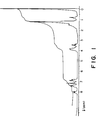
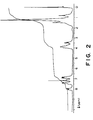
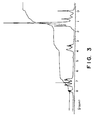
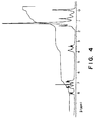
- Figs. 1 to 4 show results of 1H-NMR (in CDCL 3 ) of polymers (2a), (3a), (9a) and (10a) obtained in Examples.
- a polymeric liquid crystal copolymer compound the siloxane main chain of which has an alkyl group, an aryl group, a polyoxyalkylene group, a silane group or a siloxy group in its side chain
- a polymeric liquid crystal composition containing such a compound can also readily achieve large-area display of liquid crystal devices, making the most of a feature of polymer, and also, because of its low viscosity, can actually provide a polymeric liquid crystal device having very good response characteristics.
- a first embodiment of the present invention is characterized by a polymeric liquid crystal copolymer compound having a repeating unit represented by the formula (Ia) and [A] according to claim 1.
- the present invention is also characterized by a polymeric liquid crystal composition containing at least one polymeric liquid crystal copolymer compound having the repeating unit represented by the above formula (Ia) and [A], and at least one compound of other polymeric compound, polymeric liquid crystal, low-molecular compound and low-molecular liquid crystal; and a liquid crystal device comprising the polymeric liquid crystal copolymer compound having the repeating unit represented by the above formula (Ia) and [A], or the polymeric liquid crystal composition containing at least one polymeric liquid crystal copolymer compound having said repeating unit and at least one compound of other polymeric compound, polymeric liquid crystal, low-molecular compound and low-molecular liquid crystal.
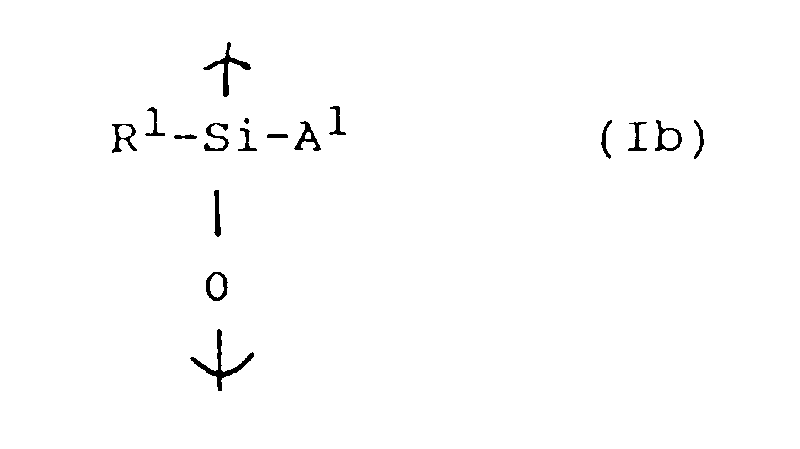
- a second embodiment of the present invention is characterized by a polymeric liquid crystal copolymer compound having a repeating unit represented by the formula (Ib) and [B] according to claim 9.
- the second embodiment of the present invention is also characterized by a polymeric liquid crystal composition containing at least one polymeric liquid crystal copolymer compound having the repeating unit represented by the above formula (Ib) and [B], and at least one compound of other polymeric compound, polymeric liquid crystal, low-molecular compound and low-molecular liquid crystal; and a liquid crystal device comprising the polymeric liquid crystal copolymer compound having the repeating unit represented by the above formula (Ib) and [B], or the polymeric liquid crystal composition containing at least one polymeric liquid crystal copolymer compound having said repeating unit and at least one compound of other polymeric compound, polymeric liquid crystal, low-molecular compound and low-molecular liquid crystal.
- A represents a polymeric main chain of a hydrocarbon type, which includes, for example, the following:
- the polyoxyalkylene group is represented by the formula: wherein R 7 '' and R 7 ' each represent a straight-chain or branched alkylene group having 1 to 10 carbon atoms; R 7 represents an alkylene group having 1 to 10 carbon atoms; and q and r are each an integer of 0 to 10, provided that both are not 0 at the same time.
- repeating unit represented by the formula (Ia) may include the following: (In the structure No. 8, "Ph” represents a phenyl group.)
- a copolymerizing repeating unit other than the repeating unit represented by the formula (Ia) may preferably have a structure wherein a mesogen is bonded to the polymeric main chain through a spacer, i.e., a structure having what is called a crystal-forming ability.
- the polymeric liquid crystal copolymer compound of the present invention may preferably have an optically active group and also have ferroelectric properties.
- the polymeric liquid crystal copolymer compound of the present invention may have any crystal phase such as a nematic phase, a cholesteric phase, a smectic phase or a chiral smectic phase.
- a nematic liquid crystal it can be applied in TN liquid crystal.
- a cholesteric liquid crystal it can be applied in the formation of a thin film having a selective reflection wavelength.
- a chiral smectic liquid crystal it can be applied as a bistable ferroelectric liquid crystal to give a liquid crystal device having an excellent response. In any instances, it is possible to readily obtain a large-area liquid crystal device.
- ferroelectric it can achieve a response on the order of millisecond or less, which is impossible in nematic liquid crystals, etc., and hence the liquid crystal device can have a superior performance.
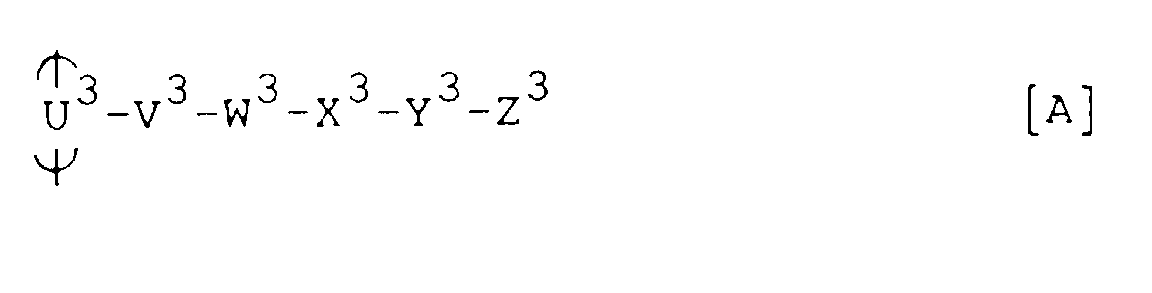
- the copolymerizing repeating unit other than the repeating unit represented by the formula (Ia) in the polymeric liquid crystal copolymer compound according to the first embodiment of the present invention has a structure represented by the following formula A.
- U 3 represents a hydrocarbon polymeric main chain
- V 3 represents (CH 2 , or a structure wherein at least one of hydrogen atoms of (CH 2 or may be substituted with an alkyl group, a halogen atom, a cyano group, an amino group or a carbonyl group, wherein m2 represents an integer of 0 to 30
- W 3 represents a single bond, -O-, -OCO-, -COO-, -CONR 8 , -CO- or -NR 8 , wherein R 8 represents a hydrogen atom or an alkyl group
- X 3 represents a mesogen, which represents a structure wherein at least two rings selected from substituted or unsubstituted homo-aromatic rings, heterocyclic rings and
- a structure capable of readily rendering a nematic liquid crystal includes, for example, the following:
- a structure capable of readily rendering a cholesteric liquid crystal includes, for example, the following:
- the asterisk * represents an asymmetric carbon atom.
- a structure capable of readily rendering a chiral smecticic liquid crystal includes, for example, the following:
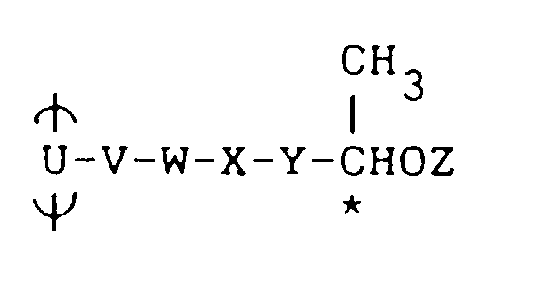
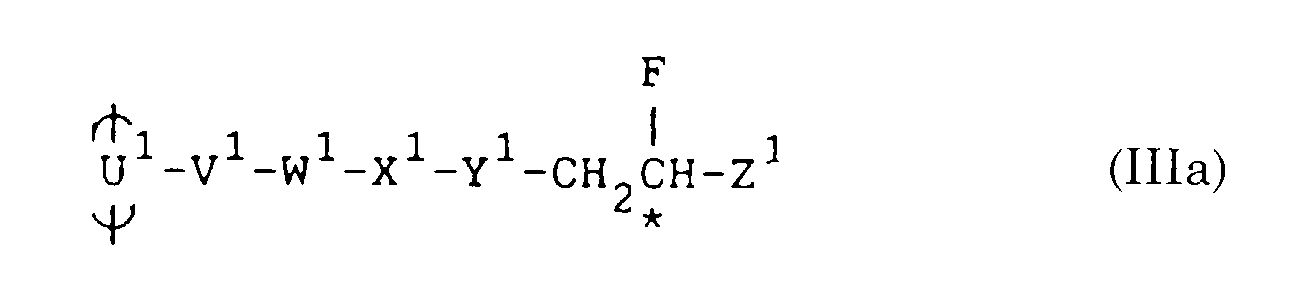
- the repeating unit other than the repeating unit represented by the formula (Ia) may preferably be a repeating unit represented by the following formula (IIa) or (IIIa).
- U represents a polymeric main chain
- V represents (CH 2 , or a structure wherein at least one of hydrogen atoms of (CH 2 or may be substituted with an alkyl group, a halogen atom, a cyano group, an amino group or a carbonyl group, wherein m represents an integer of 0 to 30
- W represents a single bond, -O-, -OCO-, -COO-, -CONR 3 , -CO- or -NR 3 , wherein R 3 represents a hydrogen atom or an alkyl group
- U 1 represents a polymeric main chain
- V 1 represents (CH 2 , or a structure wherein at least one of hydrogen atoms of (CH 2 or may be substituted with an alkyl group, a halogen atom, a cyano group, an amino group or a carbonyl group, wherein ml represents an integer of 0 to 30
- W 1 represents a single bond, -O-, -OCO-, -COO-, -CONR 3' , -CO- or -NR 3' , wherein R 3' represents a hydrogen atom or an alkyl group
- X 1 represents a mesogen, which represents a structure wherein at least two rings selected from substituted or unsubstituted homo-aromatic rings, heterocyclic rings and alicyclic rings are linked with a single bond, -O-, -OCO-, -COO-, (CH
- R 4 represents a hydrogen atom, an alkyl group or a halogen atom
- m represents an integer of 0 to 30.
- R 5 represents a hydrogen atom, an alkyl group or a halogen atom
- m1 represents an integer of 0 to 30.
- the polymeric liquid crystal copolymer compound according to the first embodiment of the present invention is comprised of at least one kind of the repeating unit represented by the formula (Ia) and the repeating unit other than the repeating unit represented by the formula (Ia), as exemplified in the above. Since this polymeric liquid crystal copolymer compound has the repeating unit represented by the formula (Ia), containing a siloxane or oxyalkylene unit, which has a viscosity reducing action, it has a remarkably lower viscosity than that of any conventional polymeric liquid crystal compounds, and has a very good response to an external field.
- the viscosity reducing component the siloxane or oxyalkylene unit
- the compound is introduced as a polymerizing component through a chemical bond, and hence the compound is also superior in that it is a homogeneous and uniform compound.
- the polymeric liquid crystal copolymer compound of the present invention is free from such a disadvantage, presenting a contrast with such instances.
- the repeating unit represented by the formula (Ia) in the polymeric liquid crystal copolymer compound of the present invention is contained in an amount ranging from 1 mol % to 95 mol %, and preferably from 5 mol % to 90 mol %. An amount less than 1 mol % may bring about no remarkable viscosity reducing action, and an amount more than 95 mol % may result in no formation of a liquid crystal.
- the polymeric liquid crystal copolymer compound of the present invention can be produced by, when, for example, it is a polymeric liquid crystal copolymer compound of a polyvinyl type or polyoxyalkylene type, subjecting the corresponding plural kinds of monomers to radical polymerization, anionic polymerization or cationic polymerization.
- it is a polymeric liquid crystal copolymer compound of a polyester type, it can be produced by subjecting the corresponding plural kinds of diols and dicarboxylic acids to condensation polymerization.
- This polymeric liquid crystal copolymer compound may preferably have a number average molecular weight of 2,000 to 1,000,000, and more preferably 4,000 to 500,000. A molecular weight less than 2,000 may result in poor film properties of the polymeric liquid crystal copolymer compound to cause a difficulty when a coating film is formed. A molecular weight more than 1,000,000 may make poor the response to an external field with an increase in viscosity.
- the method of producing the polymeric liquid crystal copolymer compound of the present invention is by no means limited to the methods described above.
- a copolymerizing repeating unit other than the repeating unit represented by the formula (Ib) may preferably have a structure wherein a mesogen is bonded to the polymeric main chain through a spacer, i.e., a structure having what is called a crystal-forming ability.
- the polymeric liquid crystal copolymer compound comprising a unit of formula (Ib) of the present invention has an optically active group and also has ferroelectric properties.
- the polymeric liquid crystal copolymer compound of the present invention may have any crystal phase such as a nematic phase, a cholesteric phase, a smectic phase or a chiral smectic phase.
- a nematic liquid crystal it can be applied in TN liquid crystals.
- a cholesteric liquid crystal it can be applied in the formation of a thin film having a selective reflection wavelength.
- a chiral smectic liquid crystal it can be applied as a bistable ferroelectric liquid crystal to give a liquid crystal device having an excellent response. In both instances, it is possible to readily obtain a large-area liquid crystal device. Thus, both the instances are particularly preferred.
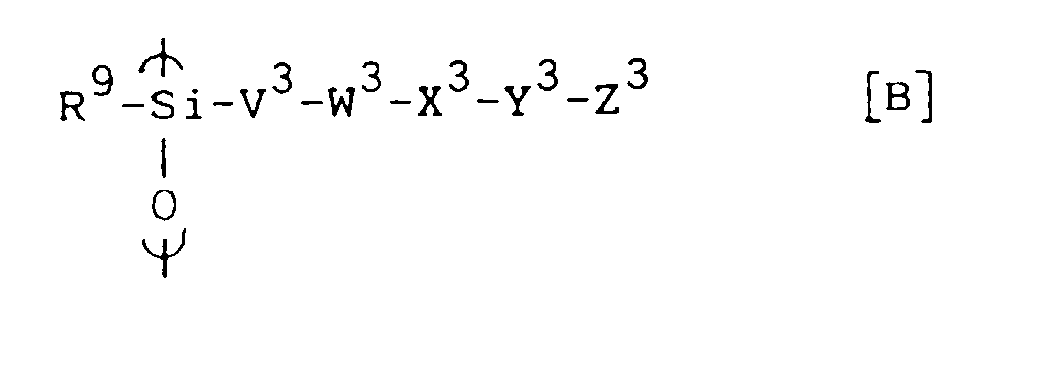
- the copolymerizing repeating unit other than the repeating unit represented by the formula (Ib) in the polymeric liquid crystal copolymer compound according to the second embodiment of the present invention has a structure represented by the following formula B.
- R 9 represents an alkyl group or a phenyl group
- V 3 represents (CH 2 , or a structure wherein at least one of hydrogen atoms of (CH 2 or may be substituted with an alkyl group, a halogen atom, a cyano group, an amino group or a carbonyl group, wherein m2 represents an integer of 0 to 30
- W 3 represents a single bond, -O-, -OCO-, -COO-, -CONR 8 , -CO- or -NR 8 , wherein R 8 represents a hydrogen atom or an alkyl group
- X 3 represents a mesogen, which represents a structure wherein at least two rings selected from substituted or unsubstituted homo-aromatic rings, hetero
- a structure capable of readily rendering a nematic liquid crystal includes, for example, the following:
- a structure capable of readily rendering a cholesteric liquid crystal includes, for example, the following:
- the asterisk * represents an asymmetric carbon atom.
- a structure capable of readily rendering a chiral smectic liquid crystal includes, for example, the following:
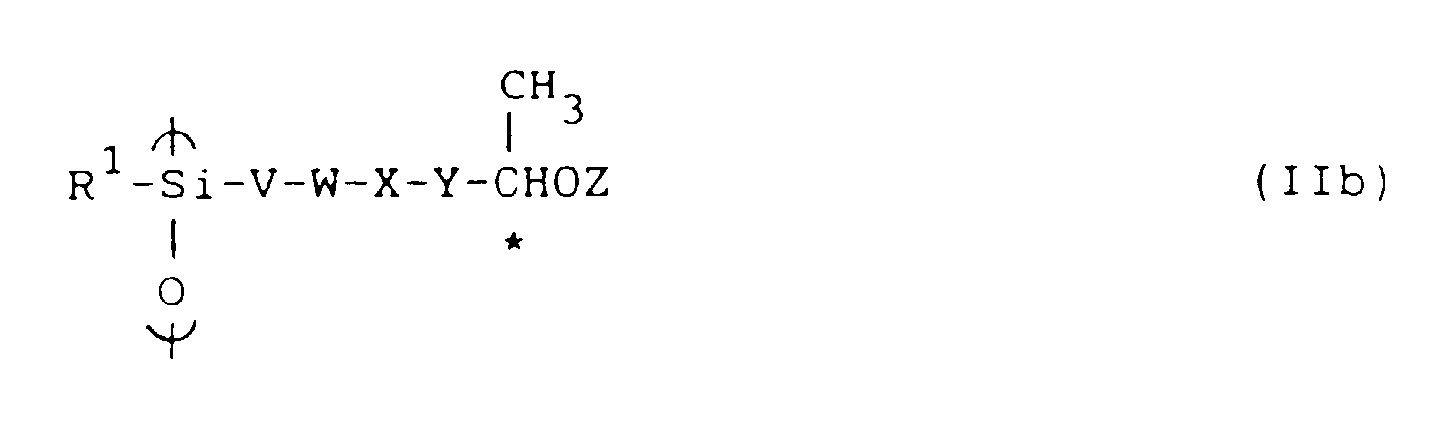
- the repeating unit other than the repeating unit represented by the formula (Ib) may preferably be a repeating unit represented by the following formula (IIb) or (IIIb).
- R 1 represents an alkyl group or a phenyl group
- V represents (CH 2 , (CH 2 ) 2 O , or a structure wherein at least one of hydrogen atoms of (CH 2 or may be substituted with an alkyl group, a halogen atom, a cyano group, an amino group or a carbonyl group, wherein m represents an integer of 0 to 30
- W represents a single bond, -O-, -OCO-, -COO-, -CONR 3 , -CO- or -NR 3 , wherein R 3 represents a hydrogen atom or an alkyl group
- X represents a mesogen, which represents a structure wherein at least two rings selected from substituted or unsubstituted homo-aromatic rings, heterocyclic rings and alicyclic rings are linked with a single bond, -O-, -OCO-, -COO-, (CH
- R 1 represents an alkyl group or a phenyl group
- V 1 represents (CH 2 , or a structure wherein at least one of hydrogen atoms of (CH 2 or may be substituted with an alkyl group, a halogen atom, a cyano group, an amino group or a carbonyl group, wherein ml represents an integer of 0 to 30
- W 1 represents a single bond, -O-, -OCO-, -COO-, -CONR 3' , -CO- or -NR 3' , wherein R 3' represents a hydrogen atom or an alkyl group
- X 1 represents a mesogen, which represents a structure wherein at least two rings selected from substituted or unsubstituted homo-aromatic rings, heterocyclic rings and alicyclic rings are linked with a single bond, -O-, -OCO-, -COO-, (CH 2 ,
- the above repeating unit can be exemplified by the following: (In the following, m1 represents an integer of 0 to 30.)
- the polymeric liquid crystal copolymer compound according to the second embodiment of the present invention is comprised of the repeating unit represented by the formula (Ib) and the repeating unit other than the repeating unit represented by the formula (Ib), as exemplified in the above. Since this polymeric liquid crystal copolymer compound is comprised of a siloxane main chain, it has originally a lower viscosity than those having a carbon type main-chain structure such as a methacrylic main chain or acrylic main chain.
- this main chain has as a component the repeating unit represented by the formula (Ib), i.e., an alkyl group, a polyoxyalkylene group, an aryl group, a silyl group or a siloxane group in its side chain, and hence its viscosity is further decreased. Thus, it can have a very good response to an external field.
- the repeating unit represented by the formula (Ib) i.e., an alkyl group, a polyoxyalkylene group, an aryl group, a silyl group or a siloxane group in its side chain, and hence its viscosity is further decreased.
- the repeating unit represented by the formula (Ib) i.e., an alkyl group, a polyoxyalkylene group, an aryl group, a silyl group or a siloxane group in its side chain, and hence its viscosity is further decreased.
- it can have a very good response to an external field.
- the viscosity reducing component the repeating unit represented by the formula (Ib)
- the compound is also superior in that it is a homogeneous and uniform compound.
- the viscosity reducing agent having the structure represented by the formula (Ib) and a polymeric liquid crystal are blended, there is no compatibility between them in almost all instances to cause phase separation.
- the polymeric liquid crystal copolymer compound of the present invention is free from such a disadvantage, presenting a contrast with such instances.
- the repeating unit represented by the formula (Ib) in the polymeric liquid crystal copolymer compound of the present invention is contained in an amount ranging from 1 mol % to 95 mol %, and more preferably from 5 mol % to 90 mol %. An amount less than 1 mol % may bring about no remarkable viscosity reducing action, and an amount more than 95 mol % may result in no formation of a liquid crystal.
- the polymeric liquid crystal copolymer compound of the present invention can be commonly produced by copolymerization of a monomer or oligomer component corresponding to the repeating unit represented by the formula (Ib) with a monomer or oligomer component capable of forming a liquid crystal. It can be more commonly produced by hydrosililation addition of a side-chain component of a vinyl group terminal to a polymethylhydrogensiloxane or polyarylhydrogensiloxane main chain, like the reaction of grafting.
- This polymeric liquid crystal copolymer compound may preferably have a number average molecular weight of 2,000 to 1,000,000, and more preferably 4,000 to 500,000. A molecular weight less than 2,000 may result in poor film properties of the polymeric liquid crystal copolymer compound to cause a difficulty when a coating film is formed. A molecular weight more than 1,000,000 may make poor the response to an external field with an increase in viscosity.
- the method of producing the polymeric liquid crystal copolymer compound of the present invention is by no means limited to the methods described above.
- the present invention also provides a polymeric liquid crystal composition containing as a blend component at least one polymeric liquid crystal copolymer compound having the repeating unit represented by the formula (Ia) and [A] or (Ib) and [B] described above.
- Other blend component may preferably be a polymeric compound, a polymeric liquid crystal, a low-molecular compound or a low-molecular liquid crystal.
- a polymeric liquid crystal or a low-molecular liquid crystal is preferred.
- Examples of the polymeric liquid crystal blended with the polymeric liquid crystal copolymer compound having the repeating unit represented by the formula (Ia) and [A] or (Ib) and [B] are shown below.
- R 6 represents a hydrogen atom, an alkyl group or a halogen and p represents an integer of 0 to 30.
- polymeric compound that may be blended in the polymeric liquid crystal copolymer compound having the repeating unit represented by the formula (Ia) and [A] or (Ib) and [B].
- Any of those commonly blended in polymeric liquid crystals can be used, including, for example, compounds such as polyvinyl chloride, polyesters and polyurethanes.
- low-molecular compound that may be blended. Any of those commonly blended in polymeric liquid crystals can be used, including, for example, long-chain or short-chain aliphatic compounds, siloxane compounds and biphenyl compounds.
- the polymeric liquid crystal copolymer compound of the present invention may be contained in the polymeric liquid crystal composition according to the present invention in an amount of usually not less than 5 % by weight, preferably not less than 10 % by weight, and more preferably 15 % by weight to 90 % by weight.
- An amount less than 5 % by weight may result in insufficient formability, strength and film-forming properties.
- the polymeric compound, polymeric liquid crystal, low-molecular compound or low-molecular liquid crystal may be contained in the polymeric liquid crystal composition according to the present invention in an amount of usually 10 % by weight to 95 % by weight, and preferably 15 % by weight to 90 % by weight.
- a coloring matter, a light stabilizer, a plasticizer, a light absorber, etc. can also be added to the polymeric liquid crystal copolymer compound according to the present invention and the polymeric liquid crystal composition containing it.
- the present invention further provides a polymeric liquid crystal device comprising the polymeric liquid crystal copolymer compound having the repeating unit represented by the formula (Ia) and [A] or (Ib) and [B], or the polymeric liquid crystal composition containing as a blend component at least one polymeric liquid crystal copolymer compound having said repeating unit.
- a film of the polymeric liquid crystal copolymer compound or polymeric liquid crystal composition of the present invention is formed by coating or the like on a substrate made of any desired material such as glass, plastic or metal. It is also possible to form on the substrate a transparent electrode comprising an ITO film or a patternized electrode.
- Alignment treatment can be exemplified by the following: (1) Horizontal alignment (Molecular axes of the polymeric liquid crystal copolymer compound or polymeric liquid crystal composition are oriented in parallel to the surface of a substrate):
- an inorganic insulating material such as silicon monoxide, silicon dioxide, aluminum oxide, zirconium oxide, magnesium fluoride, cerium oxide, cerium fluoride, silicon nitride, silicon carb
- An oxide such as SiO, a fluoride, or a metal such as Au or Al or an oxide thereof is vacuum-deposited on a substrate at an oblique angle.
- the organic or inorganic insulating material as shown in paragraph (i) is etched by irradiation with an ion beam or oxygen plasma to form an alignment control film.
- a polymeric film comprised of polyester, polyvinyl alcohol or the like is stretched.
- Grooves are formed by photolithography, by the use of a stamper or by injection.
- the polymeric liquid crystal copolymer compound or polymeric liquid crystal composition is aligned in the direction of the grooves.
- the polymeric liquid crystal copolymer compound or polymeric liquid crystal composition is aligned by applying a shear stress at a temperature higher than the temperature at which the state of a liquid crystal is kept.
- a film is aligned by monoaxial stretching or biaxial stretching. It may be stretched together with a substrate made of polyester, polyvinyl alcohol or the like.
- a substrate made of polyester, polyvinyl alcohol or the like.
- a layer with vertically aligning properties comprising an organic silane, lecithin, polytetrafluoroethylene or the like is formed on the surface of a substrate.
- vertically aligning properties can be imparted by appropriately selecting the deposition angle while rotating the substrate.
- the vertically aligning agent as shown in paragraph (i) may be coated.
- an upper substrate having an electrode may be provided to obtain a switching device.
- the polymeric liquid crystal device thus obtained can be used as a display device, a memory device or the like. Employment of the polymeric liquid crystal device making use of polymeric liquid crystal copolymer compound or polymeric liquid crystal composition having a chiral smectic phase with ferroelectric properties makes it possible to achieve high-speed switching. Because of its bistability, it is also possible to use the device as a large-area display device or memory device having a good memory performance. In order to achieve the bistability, there is a method in which the layer thickness is made small to eliminate spirals. Stated specifically, the layer thickness may preferably be 10 ⁇ m or less.
- the polymeric liquid crystal copolymer compound of the present invention has a siloxane or oxyalkylene unit as a copolymerizing component, it has a remarkably lower viscosity than any conventional polymeric liquid crystal compounds and has a very good response to an external field.
- Another polymeric liquid crystal copolymer compound comprised of a siloxane main chain and also having an alkyl group, polyoxyalkylene group, aryl group, silyl group or siloxy group in its side chain also has a remarkably lower viscosity than the conventional polymeric liquid crystal compounds and has a very good response to an external field.
- use of the polymeric liquid crystal copolymer compound of the present invention in a liquid crystal device makes it possible to actually provide a large-area polymeric liquid crystal device having a high-speed switching performance.
- the polymeric liquid crystal composition which enjoys the low-viscosity good properties attributable to the above polymeric liquid crystal copolymer compound and which is a blend with other polymeric compound, polymeric liquid crystal, low-molecular compound or low-molecular liquid crystal, enables control of physical properties such as liquid-crystal temperature range, spontaneous polarization and spiral sense.
- the polymeric liquid crystal composition is also very useful for the fabrication of a large-area polymeric liquid crystal device having a high-speed switching performance.
- Fig. 2 shows 1 H-NMR (in CDCl 3 ) of the polymer (3a).
- Phase transition temperature (°C) of polymer (3a): Mn 11,100
- polymeric liquid crystal copolymer compounds obtained in the above Examples, or polymeric liquid crystal compositions comprising any of these compounds and a low-molecular liquid crystal ⁇ 1 or polymeric liquid crystal ⁇ 1 were each applied to a glass plate provided with an ITO transparent electrode, on which a polyimide aligning film having been subjected to rubbing had been formed, by pressing, spin-coating or casting to form a film with a layer thickness of about 10 ⁇ m. Thereafter, annealing was carried out and then an upper electrode was attached. To the liquid crystal cell thus obtained, an electric field of 10 V/ ⁇ m was applied in the state of an Sc* phase. At this time, molecules were observed reversing in response to the electric field. Response speeds were as shown in Table 1.
- Phase transition temperature (°C) of polymer (9a): Number average molecular weight Mn by GPC (gel permeation chromatography), calculated as polystyrene: (hereinafter the number average molecular weight is meant by this): Mn 18,200
- Example 9 Using the monomer (7), monomer (8) and polymethylhydrogensiloxane (1b) of Example 9 in amounts of 0.876 g, 0.123 g and 0.191 g, respectively, the same procedure as in Example 9 was repeated to give 0.500 g of polymer (10a).
- polymeric liquid crystal copolymer compounds obtained in the above Examples, or polymeric liquid crystal compositions comprising any of these compounds and a low-molecular liquid crystal ⁇ 2 or polymeric liquid crystal ⁇ 2 were each applied to a glass plate provided with an ITO transparent electrode, on which a polyimide aligning film having been subjected to rubbing had been formed, by pressing, spin-coating or casting to form a film with a layer thickness of about 10 ⁇ m. Thereafter, annealing was carried out and then an upper electrode was attached. To the liquid crystal cell thus obtained, an electric field of 10 V/ ⁇ m was applied in the state of an Sc* phase. At this time, molecules were observed reversing in response to the electric field. Response speeds were as shown in Table 2.
Landscapes
- Chemical & Material Sciences (AREA)
- Organic Chemistry (AREA)
- Chemical Kinetics & Catalysis (AREA)
- Materials Engineering (AREA)
- Engineering & Computer Science (AREA)
- Health & Medical Sciences (AREA)
- Crystallography & Structural Chemistry (AREA)
- Medicinal Chemistry (AREA)
- Polymers & Plastics (AREA)
- Liquid Crystal Substances (AREA)
- Silicon Polymers (AREA)
- Addition Polymer Or Copolymer, Post-Treatments, Or Chemical Modifications (AREA)
- Macromonomer-Based Addition Polymer (AREA)
- Polyethers (AREA)
- Polyesters Or Polycarbonates (AREA)
Claims (15)
- Polymere Flüssigkristallcopolymerverbindung mit einer Wiederholungseinheit, die durch folgende Formel dargestellt ist:worin A eine polymere Hauptkette vom Kohlenwasserstofftyp darstellt und B eine Polyoxyalkylengruppe oder
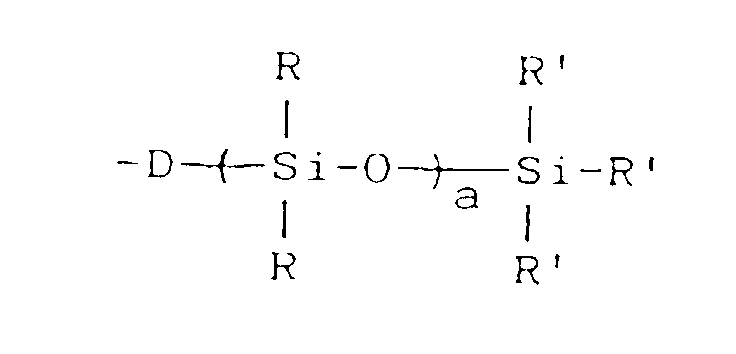
 darstellt, worin D -(CH2)b- oder -(CH2)b-O-(CH2)c- darstellt, worin b und c jeweils eine ganze Zahl von 0 bis 20 darstellen, R eine Alkylgruppe, eine Phenylgruppe, eine Siloxygruppe oder eine Polysiloxygruppe darstellt, R' eine Alkylgruppe oder Phenylgruppe darstellt und a eine ganze Zahl von 0 bis 50 darstellt, wobei die Wiederholungseinheit der Formel (Ia) in einer Menge im Bereich von 1 mol-% bis 95 mol-% enthalten ist, und worin die Copolymerisationswiederholungseinheit, die nicht die Wiederholungseinheit darstellt, die durch die Formel (Ia) dargestellt ist, in dieser polymeren Flüssigkristallcopolymerverbindung eine Struktur aufweist, die durch die folgende Formel A dargestellt ist:
 worin U3 eine polymere Kohlenwasserstoffhauptkette darstellt, V3 (CH2)m2-,
 CH2)2O)2m- oder eine Struktur darstellt, in der wenigstens eines der Wasserstoffatome der Strukturen (CH2)m2- oder

- Polymere Flüssigkristallcopolymerverbindung nach Anspruch 1, die eine optisch aktive Gruppe aufweist.
- Polymere Flüssigkristallcopolymerverbindung nach Anspruch 1, die ferroelektrisch ist.
- Polymere Flüssigkristallcopolymerverbindung nach Anspruch 1, die eine Wiederholungseinheit aufweist, die durch folgende Formel dargestellt ist:worin U eine polymere Hauptkette darstellt, V (CH2)m-,
- Polymere Flüssigkristallcopolymerverbindung nach Anspruch 1, die eine Wiederholungseinheit aufweist, die durch folgende Formel dargestellt ist:worin U1 eine polymere Hauptkette darstellt, V1 (CH2)m1-,
- Polymere Flüssigkristallzusammensetzung, umfassend die polymere Flüssigkristallcopolymerverbindung nach einem der Ansprüche 1 bis 5, und wenigstens ein Element, ausgewählt aus der Gruppe, bestehend aus einer anderen polymeren Verbindung, einem polymeren Flüssigkristall, einer Verbindung mit niedrigem Molekulargewicht und einem Flüssigkristall mit niedrigem Molekulargewicht.
- Polymere Flüssigkristallvorrichtung, umfassend die polymere Flüssigkristallcopolymerverbindung nach einem der Ansprüche 1 bis 5.
- Polymere Flüssigkristallvorrichtung, umfassend die polymere Flüssigkristallzusammensetzung nach Anspruch 6.
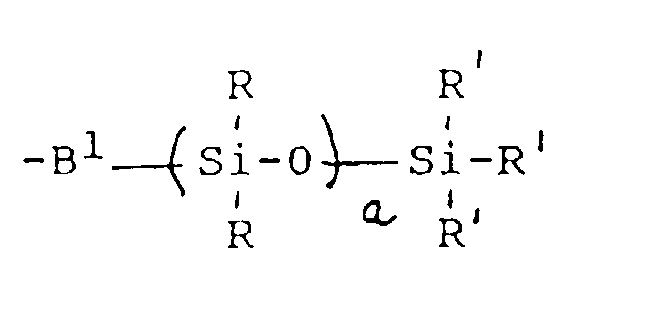
- Polymere Flüssigkristallcopolymerverbindung mit einer Wiederholungseinheit, die durch folgende Formel dargestellt ist:worin R1 eine Alkylgruppe oder eine Phenylgruppe darstellt und A1 eine substituierte oder unsubstituierte Alkylgruppe mit drei oder mehr Kohlenstoffatomen, eine Polyoxyalkylengruppe oder eine Arylgruppe oder
 darstellt, worin B1 (CH2)b- oder (CH2)b-O(CH2)c- darstellt, b und c jeweils eine ganze Zahl von 0 bis 10 bedeuten, R eine Alkylgruppe, eine Phenylgruppe, eine Siloxygruppe oder eine Polysiloxygruppe darstellt, R' eine Alkylgruppe oder eine Phenylgruppe darstellt und a eine ganze Zahl von 0 bis 50 darstellt, und einer optisch aktiven Gruppe, wobei die Wiederholungseinheit mit der Formel (Ib) in einer Menge im Bereich von 1 mol-% bis 95 mol-% enthalten ist und worin die Copolymerisationswiederholungseinheit, die nicht die Wiederholungseinheit darstellt, die durch die Formel (Ib) dargestellt ist, in dieser polymeren Flüssigkristallcopolymerverbindung eine Struktur aufweist, die durch die folgende Formel B dargestellt ist:
 worin R9 eine Alkylgruppe oder eine Phenylgruppe darstellt, V3 (CH2)m2-,
- Polymere Flüssigkristallcopolymerverbindung nach Anspruch 9, die ferroelektrisch ist.
- Polymere Flüssigkristallcopolymerverbindung nach Anspruch 9 mit einer Wiederholungseinheit, die durch folgende Formel dargestellt ist:worin R1 eine Alkylgruppe oder eine Phenylgruppe darstellt, V (CH2)m-,
- Polymere Flüssigkristallcopolymerverbindung nach Anspruch 9, die eine Wiederholungseinheit besitzt, die durch die folgende Formel dargestellt ist:worin R1 eine Alkylgruppe oder eine Phenylgruppe darstellt, V1 (CH2)m1-,

- Polymere Flüssigkristallzusammensetzung, umfassend die polymere Flüssigkristallcopolymerverbindung nach einem der Ansprüche 9 bis 12 und ein Element, ausgewählt aus der Gruppe, bestehend aus einer anderen polymeren Verbindung, einem polymeren Flüssigkristall, einer Verbindung mit niedrigem Molekulargewicht und einem Flüssigkristall mit niedrigem Molekulargewicht.
- Polymere Flüssigkristallvorrichtung, umfassend die polymere Flüssigkristallcopolymerverbindung nach einem der Ansprüche 9 bis 12.
- Polymere Flüssigkristallvorrichtung, umfassend die polymere Flüssigkristallzusammensetzung nach Anspruch 13.
Applications Claiming Priority (6)
| Application Number | Priority Date | Filing Date | Title |
|---|---|---|---|
| JP16975390 | 1990-06-29 | ||
| JP169753/90 | 1990-06-29 | ||
| JP171355/90 | 1990-06-30 | ||
| JP17135590 | 1990-06-30 | ||
| JP03166093A JP3134947B2 (ja) | 1990-06-29 | 1991-06-12 | 高分子共重合体液晶化合物、その組成物及びそれらを用いた高分子液晶素子 |
| JP166093/91 | 1991-06-12 |
Publications (3)
| Publication Number | Publication Date |
|---|---|
| EP0464728A2 EP0464728A2 (de) | 1992-01-08 |
| EP0464728A3 EP0464728A3 (en) | 1992-06-03 |
| EP0464728B1 true EP0464728B1 (de) | 1999-04-14 |
Family
ID=27322625
Family Applications (1)
| Application Number | Title | Priority Date | Filing Date |
|---|---|---|---|
| EP91110800A Expired - Lifetime EP0464728B1 (de) | 1990-06-29 | 1991-06-28 | Flüssigkristallcopolymerverbindung, sie enthaltende Zusammensetzung und sie verwendende Flüssigkristallpolymervorrichtung |
Country Status (5)
| Country | Link |
|---|---|
| US (1) | US5447655A (de) |
| EP (1) | EP0464728B1 (de) |
| JP (1) | JP3134947B2 (de) |
| AT (1) | ATE178932T1 (de) |
| DE (1) | DE69131113T2 (de) |
Families Citing this family (11)
| Publication number | Priority date | Publication date | Assignee | Title |
|---|---|---|---|---|
| AU6292594A (en) * | 1993-04-20 | 1994-11-08 | Sagami Chemical Research Center | Copolymer having liquid crystal group in the side chain |
| US5662828A (en) * | 1993-07-13 | 1997-09-02 | Sumitomo Chemical Company, Limited | Compound having unsaturated side chain, process for preparing the same, liquid crystalline polymer prepared from the same, liquid crystal mixture and display element |
| KR100323262B1 (ko) * | 1993-07-13 | 2002-06-20 | 고사이 아끼오 | 불포화측쇄화합물,그제조방법,그로부터제조한액정중합체,액정혼합물및디스플레이소자 |
| JPH0725805A (ja) * | 1993-07-13 | 1995-01-27 | Sumitomo Chem Co Ltd | 不飽和側鎖を有する化合物およびその製造法 |
| JPH08231647A (ja) * | 1994-12-28 | 1996-09-10 | Sharp Corp | 光重合性樹脂材料組成物 |
| US5656197A (en) * | 1995-02-06 | 1997-08-12 | National Science Council | Ferroelectric liquid crystal |
| US5731859A (en) * | 1995-12-29 | 1998-03-24 | Kaiser Electronics | Cholestric liquid crystal device and a method for its manufacture |
| US7283114B2 (en) * | 2003-03-26 | 2007-10-16 | Avago Technologies Ecbu Ip (Singapore) Pte. Ltd | Systems and method for displaying images with reduced power consumption |
| JP5397822B2 (ja) * | 2010-11-11 | 2014-01-22 | 独立行政法人科学技術振興機構 | ミセル及びその利用 |
| JP2013213157A (ja) * | 2012-04-03 | 2013-10-17 | Jnc Corp | 樹脂組成物および該樹脂組成物からなる樹脂膜 |
| JP6335144B2 (ja) * | 2015-07-02 | 2018-05-30 | 信越化学工業株式会社 | 重合性モノマー、およびその重合体 |
Family Cites Families (21)
| Publication number | Priority date | Publication date | Assignee | Title |
|---|---|---|---|---|
| US3859321A (en) * | 1971-03-17 | 1975-01-07 | Gen Electric | Polysiloxane composition useful as a brake fluid |
| US4367924A (en) * | 1980-01-08 | 1983-01-11 | Clark Noel A | Chiral smectic C or H liquid crystal electro-optical device |
| US4798680A (en) * | 1985-10-18 | 1989-01-17 | Canon Kabushiki Kaisha | Optically active compound, process for producing same and liquid crystal composition containing same |
| JPS6399204A (ja) * | 1985-12-26 | 1988-04-30 | Idemitsu Kosan Co Ltd | ポリマ− |
| JPS6372784A (ja) * | 1986-09-17 | 1988-04-02 | Idemitsu Kosan Co Ltd | 強誘電性高分子液晶 |
| US4844835A (en) * | 1985-12-26 | 1989-07-04 | Idenitsu Kosan Co., Ltd. | Ferroelectric liquid crystal polymer |
| CA1222845A (en) * | 1986-02-06 | 1987-06-09 | Progressive Chemical Research Ltd. | Silicone-sulfone and silicone-fluorocarbon-sulfone gas permeable contact lenses and compositions thereof |
| US4820026A (en) * | 1986-03-20 | 1989-04-11 | Canon Kabushiki Kaisha | Ferroelectric liquid crystal device with modified polyvinyl alcohol alignment film |
| US4661573A (en) * | 1986-04-14 | 1987-04-28 | Paragon Optical Inc. | Lens composition articles and method of manufacture |
| DE3631841A1 (de) * | 1986-09-19 | 1988-03-24 | Basf Ag | Fluessigkristallines copolymer |
| JPS63161055A (ja) * | 1986-12-25 | 1988-07-04 | Nippon Soda Co Ltd | 表面処理剤および樹脂磁石用組成物 |
| FR2609993B1 (fr) * | 1987-01-27 | 1989-05-19 | Ppg Industries Inc | Nouveaux polysiloxanes modifies, leur procede de preparation et leurs applications comme cristaux liquides et comme supports de medicaments |
| US5054888A (en) * | 1987-04-24 | 1991-10-08 | The University Of Rochester | Methods of making composite optical devices employing polymer liquid crystal |
| JP2637469B2 (ja) * | 1987-06-04 | 1997-08-06 | キヤノン株式会社 | 高分子液晶素子 |
| JPH0778218B2 (ja) * | 1987-06-29 | 1995-08-23 | 出光興産株式会社 | 液晶ポリマ−組成物 |
| JPH01271431A (ja) * | 1988-04-22 | 1989-10-30 | Toray Dow Corning Silicone Co Ltd | 液晶性オルガノポリシロキサン及びその製造方法 |
| DE68923444D1 (de) * | 1988-09-22 | 1995-08-17 | Univ Utah | Superoberflächenaktive polymermittel zur verleihung eines widerstandes gegen proteine und zur eliminierung von proteinen. |
| JPH0618882B2 (ja) * | 1988-10-24 | 1994-03-16 | 信越化学工業株式会社 | 液晶相を有するオルガノポリシロキサン化合物 |
| JP2761781B2 (ja) * | 1988-12-30 | 1998-06-04 | キヤノン株式会社 | 高分子液晶化合物、モノマー性の液晶化合物、それらの液晶組成物及びそれらの液晶素子 |
| US5200238A (en) * | 1990-06-22 | 1993-04-06 | Loctite (Ireland) Limited | Liquid crystal display devices and method of manufacture |
| US5138010A (en) * | 1990-06-25 | 1992-08-11 | University Of Colorado Foundation, Inc. | Fast switching polysiloxane ferroelectric liquid crystals |
-
1991
- 1991-06-12 JP JP03166093A patent/JP3134947B2/ja not_active Expired - Fee Related
- 1991-06-27 US US07/722,204 patent/US5447655A/en not_active Expired - Fee Related
- 1991-06-28 AT AT91110800T patent/ATE178932T1/de not_active IP Right Cessation
- 1991-06-28 DE DE69131113T patent/DE69131113T2/de not_active Expired - Fee Related
- 1991-06-28 EP EP91110800A patent/EP0464728B1/de not_active Expired - Lifetime
Also Published As
| Publication number | Publication date |
|---|---|
| EP0464728A2 (de) | 1992-01-08 |
| US5447655A (en) | 1995-09-05 |
| DE69131113T2 (de) | 1999-11-18 |
| JP3134947B2 (ja) | 2001-02-13 |
| ATE178932T1 (de) | 1999-04-15 |
| DE69131113D1 (de) | 1999-05-20 |
| EP0464728A3 (en) | 1992-06-03 |
| JPH0532736A (ja) | 1993-02-09 |
Similar Documents
| Publication | Publication Date | Title |
|---|---|---|
| EP0376310B1 (de) | Mesomorphisches Polymer, monomere mesomorphische Verbindung, Flüssigkristallzusammensetzung und Flüssigkristallvorrichtung | |
| EP0626438B1 (de) | Mesomorphische Verbindung, Flüssigkristallzusammensetzung und Flüssigkristallvorrichtung | |
| US6277451B1 (en) | Liquid crystal materials and devices | |
| JP3802084B2 (ja) | 液晶シロキサン化合物およびその製造方法 | |
| JP2741547B2 (ja) | 主鎖型カイラルスメクチック高分子液晶、高分子液晶組成物および高分子液晶素子 | |
| US4892675A (en) | Optically active polymer and liquid crystal composition containing same | |
| EP0464728A2 (de) | Flüssigkristallcopolymerverbindung, sie enthaltende Zusammensetzung und sie verwendende Flüssigkristallpolymervorrichtung | |
| EP0412485B1 (de) | Flüssigkristallpolymerzusammensetzung und Flüssigkristallpolymervorrichtung | |
| EP0599289B1 (de) | Flüssigkristallverbindung, Zusammensetzung und Vorrichtung | |
| US5773179A (en) | Liquid crystal polymers | |
| JPH11510264A (ja) | 液晶ポリマーデバイス及び材料 | |
| Scherowsky | Ferroelectric Liquid Crystal (FLC) | |
| JPH0299524A (ja) | 液晶材料 | |
| EP0435350B1 (de) | Polymerflüssigkristallverbindung, diese enthaltende Flüssigkristallzusammensetzung und Vorrichtung | |
| JP2001501229A (ja) | 液晶ポリマー | |
| EP0819154B1 (de) | Polysiloxane | |
| JP2892267B2 (ja) | 液晶性化合物、液晶組成物および液晶素子 | |
| JPH0725890B2 (ja) | 高分子液晶化合物、その組成物及びそれらを用いた高分子液晶素子 | |
| EP0509529B1 (de) | Hauptkette Flüssigkristall-Polymer, Copolymer, Zusammensetzungen die sie enthalten, Vorrichtung, Apparat und Methode, die sie verwendet | |
| JPH0463830A (ja) | 主鎖型高分子液晶化合物、及び該主鎖型高分子液晶化合物を含有する高分子液晶組成物、高分子液晶素子 | |
| JPH0463831A (ja) | 主鎖型高分子液晶共重合体化合物、及び該共重合体化合物を含有する高分子液晶組成物、高分子液晶素子 |
Legal Events
| Date | Code | Title | Description |
|---|---|---|---|
| PUAI | Public reference made under article 153(3) epc to a published international application that has entered the european phase |
Free format text: ORIGINAL CODE: 0009012 |
|
| AK | Designated contracting states |
Kind code of ref document: A2 Designated state(s): AT BE CH DE DK ES FR GB GR IT LI LU NL SE |
|
| PUAL | Search report despatched |
Free format text: ORIGINAL CODE: 0009013 |
|
| AK | Designated contracting states |
Kind code of ref document: A3 Designated state(s): AT BE CH DE DK ES FR GB GR IT LI LU NL SE |
|
| 17P | Request for examination filed |
Effective date: 19921020 |
|
| 17Q | First examination report despatched |
Effective date: 19940114 |
|
| GRAG | Despatch of communication of intention to grant |
Free format text: ORIGINAL CODE: EPIDOS AGRA |
|
| GRAG | Despatch of communication of intention to grant |
Free format text: ORIGINAL CODE: EPIDOS AGRA |
|
| GRAH | Despatch of communication of intention to grant a patent |
Free format text: ORIGINAL CODE: EPIDOS IGRA |
|
| GRAH | Despatch of communication of intention to grant a patent |
Free format text: ORIGINAL CODE: EPIDOS IGRA |
|
| GRAA | (expected) grant |
Free format text: ORIGINAL CODE: 0009210 |
|
| AK | Designated contracting states |
Kind code of ref document: B1 Designated state(s): AT BE CH DE DK ES FR GB GR IT LI LU NL SE |
|
| PG25 | Lapsed in a contracting state [announced via postgrant information from national office to epo] |
Ref country code: BE Free format text: LAPSE BECAUSE OF FAILURE TO SUBMIT A TRANSLATION OF THE DESCRIPTION OR TO PAY THE FEE WITHIN THE PRESCRIBED TIME-LIMIT Effective date: 19990414 Ref country code: IT Free format text: LAPSE BECAUSE OF FAILURE TO SUBMIT A TRANSLATION OF THE DESCRIPTION OR TO PAY THE FEE WITHIN THE PRE;WARNING: LAPSES OF ITALIAN PATENTS WITH EFFECTIVE DATE BEFORE 2007 MAY HAVE OCCURRED AT ANY TIME BEFORE 2007. THE CORRECT EFFECTIVE DATE MAY BE DIFFERENT FROM THE ONE RECORDED.SCRIBED TIME-LIMIT Effective date: 19990414 Ref country code: ES Free format text: THE PATENT HAS BEEN ANNULLED BY A DECISION OF A NATIONAL AUTHORITY Effective date: 19990414 Ref country code: GR Free format text: LAPSE BECAUSE OF NON-PAYMENT OF DUE FEES Effective date: 19990414 Ref country code: CH Free format text: LAPSE BECAUSE OF FAILURE TO SUBMIT A TRANSLATION OF THE DESCRIPTION OR TO PAY THE FEE WITHIN THE PRESCRIBED TIME-LIMIT Effective date: 19990414 Ref country code: SE Free format text: THE PATENT HAS BEEN ANNULLED BY A DECISION OF A NATIONAL AUTHORITY Effective date: 19990414 Ref country code: NL Free format text: LAPSE BECAUSE OF FAILURE TO SUBMIT A TRANSLATION OF THE DESCRIPTION OR TO PAY THE FEE WITHIN THE PRESCRIBED TIME-LIMIT Effective date: 19990414 Ref country code: LI Free format text: LAPSE BECAUSE OF FAILURE TO SUBMIT A TRANSLATION OF THE DESCRIPTION OR TO PAY THE FEE WITHIN THE PRESCRIBED TIME-LIMIT Effective date: 19990414 Ref country code: AT Free format text: LAPSE BECAUSE OF FAILURE TO SUBMIT A TRANSLATION OF THE DESCRIPTION OR TO PAY THE FEE WITHIN THE PRESCRIBED TIME-LIMIT Effective date: 19990414 |
|
| REF | Corresponds to: |
Ref document number: 178932 Country of ref document: AT Date of ref document: 19990415 Kind code of ref document: T |
|
| REG | Reference to a national code |
Ref country code: CH Ref legal event code: EP |
|
| REF | Corresponds to: |
Ref document number: 69131113 Country of ref document: DE Date of ref document: 19990520 |
|
| ET | Fr: translation filed | ||
| PG25 | Lapsed in a contracting state [announced via postgrant information from national office to epo] |
Ref country code: LU Free format text: LAPSE BECAUSE OF NON-PAYMENT OF DUE FEES Effective date: 19990628 |
|
| PG25 | Lapsed in a contracting state [announced via postgrant information from national office to epo] |
Ref country code: DK Free format text: LAPSE BECAUSE OF FAILURE TO SUBMIT A TRANSLATION OF THE DESCRIPTION OR TO PAY THE FEE WITHIN THE PRESCRIBED TIME-LIMIT Effective date: 19990714 |
|
| NLV1 | Nl: lapsed or annulled due to failure to fulfill the requirements of art. 29p and 29m of the patents act | ||
| REG | Reference to a national code |
Ref country code: CH Ref legal event code: PL |
|
| PLBE | No opposition filed within time limit |
Free format text: ORIGINAL CODE: 0009261 |
|
| STAA | Information on the status of an ep patent application or granted ep patent |
Free format text: STATUS: NO OPPOSITION FILED WITHIN TIME LIMIT |
|
| 26N | No opposition filed | ||
| REG | Reference to a national code |
Ref country code: GB Ref legal event code: IF02 |
|
| PGFP | Annual fee paid to national office [announced via postgrant information from national office to epo] |
Ref country code: FR Payment date: 20050608 Year of fee payment: 15 |
|
| PGFP | Annual fee paid to national office [announced via postgrant information from national office to epo] |
Ref country code: GB Payment date: 20050622 Year of fee payment: 15 |
|
| PGFP | Annual fee paid to national office [announced via postgrant information from national office to epo] |
Ref country code: DE Payment date: 20050623 Year of fee payment: 15 |
|
| PG25 | Lapsed in a contracting state [announced via postgrant information from national office to epo] |
Ref country code: GB Free format text: LAPSE BECAUSE OF NON-PAYMENT OF DUE FEES Effective date: 20060628 |
|
| PG25 | Lapsed in a contracting state [announced via postgrant information from national office to epo] |
Ref country code: DE Free format text: LAPSE BECAUSE OF NON-PAYMENT OF DUE FEES Effective date: 20070103 |
|
| GBPC | Gb: european patent ceased through non-payment of renewal fee |
Effective date: 20060628 |
|
| REG | Reference to a national code |
Ref country code: FR Ref legal event code: ST Effective date: 20070228 |
|
| PG25 | Lapsed in a contracting state [announced via postgrant information from national office to epo] |
Ref country code: FR Free format text: LAPSE BECAUSE OF NON-PAYMENT OF DUE FEES Effective date: 20060630 |