EP0499521B1 - Inhibitoren von N-Myristoyltransferase, deren Verfahren zur Herstellung und die sie enthaltenden pharmazeutischen Zusammensetzungen - Google Patents
Inhibitoren von N-Myristoyltransferase, deren Verfahren zur Herstellung und die sie enthaltenden pharmazeutischen Zusammensetzungen Download PDFInfo
- Publication number
- EP0499521B1 EP0499521B1 EP92400341A EP92400341A EP0499521B1 EP 0499521 B1 EP0499521 B1 EP 0499521B1 EP 92400341 A EP92400341 A EP 92400341A EP 92400341 A EP92400341 A EP 92400341A EP 0499521 B1 EP0499521 B1 EP 0499521B1
- Authority
- EP
- European Patent Office
- Prior art keywords
- group
- formula
- branched
- straight
- chain
- Prior art date
- Legal status (The legal status is an assumption and is not a legal conclusion. Google has not performed a legal analysis and makes no representation as to the accuracy of the status listed.)
- Expired - Lifetime
Links
- 0 *CC1C*CC1 Chemical compound *CC1C*CC1 0.000 description 8
Classifications
-
- C—CHEMISTRY; METALLURGY
- C07—ORGANIC CHEMISTRY
- C07D—HETEROCYCLIC COMPOUNDS
- C07D207/00—Heterocyclic compounds containing five-membered rings not condensed with other rings, with one nitrogen atom as the only ring hetero atom
- C07D207/02—Heterocyclic compounds containing five-membered rings not condensed with other rings, with one nitrogen atom as the only ring hetero atom with only hydrogen or carbon atoms directly attached to the ring nitrogen atom
- C07D207/18—Heterocyclic compounds containing five-membered rings not condensed with other rings, with one nitrogen atom as the only ring hetero atom with only hydrogen or carbon atoms directly attached to the ring nitrogen atom having one double bond between ring members or between a ring member and a non-ring member
- C07D207/22—Heterocyclic compounds containing five-membered rings not condensed with other rings, with one nitrogen atom as the only ring hetero atom with only hydrogen or carbon atoms directly attached to the ring nitrogen atom having one double bond between ring members or between a ring member and a non-ring member with hetero atoms or with carbon atoms having three bonds to hetero atoms with at the most one bond to halogen, e.g. ester or nitrile radicals, directly attached to ring carbon atoms
- C07D207/24—Oxygen or sulfur atoms
- C07D207/26—2-Pyrrolidones
- C07D207/273—2-Pyrrolidones with hetero atoms or with carbon atoms having three bonds to hetero atoms with at the most one bond to halogen, e.g. ester or nitrile radicals, directly attached to other ring carbon atoms
- C07D207/277—Carbon atoms having three bonds to hetero atoms with at the most one bond to halogen, e.g. ester or nitrile radicals
-
- A—HUMAN NECESSITIES
- A61—MEDICAL OR VETERINARY SCIENCE; HYGIENE
- A61P—SPECIFIC THERAPEUTIC ACTIVITY OF CHEMICAL COMPOUNDS OR MEDICINAL PREPARATIONS
- A61P31/00—Antiinfectives, i.e. antibiotics, antiseptics, chemotherapeutics
- A61P31/12—Antivirals
-
- A—HUMAN NECESSITIES
- A61—MEDICAL OR VETERINARY SCIENCE; HYGIENE
- A61P—SPECIFIC THERAPEUTIC ACTIVITY OF CHEMICAL COMPOUNDS OR MEDICINAL PREPARATIONS
- A61P31/00—Antiinfectives, i.e. antibiotics, antiseptics, chemotherapeutics
- A61P31/12—Antivirals
- A61P31/14—Antivirals for RNA viruses
- A61P31/16—Antivirals for RNA viruses for influenza or rhinoviruses
-
- A—HUMAN NECESSITIES
- A61—MEDICAL OR VETERINARY SCIENCE; HYGIENE
- A61P—SPECIFIC THERAPEUTIC ACTIVITY OF CHEMICAL COMPOUNDS OR MEDICINAL PREPARATIONS
- A61P31/00—Antiinfectives, i.e. antibiotics, antiseptics, chemotherapeutics
- A61P31/12—Antivirals
- A61P31/14—Antivirals for RNA viruses
- A61P31/18—Antivirals for RNA viruses for HIV
-
- A—HUMAN NECESSITIES
- A61—MEDICAL OR VETERINARY SCIENCE; HYGIENE
- A61P—SPECIFIC THERAPEUTIC ACTIVITY OF CHEMICAL COMPOUNDS OR MEDICINAL PREPARATIONS
- A61P31/00—Antiinfectives, i.e. antibiotics, antiseptics, chemotherapeutics
- A61P31/12—Antivirals
- A61P31/20—Antivirals for DNA viruses
- A61P31/22—Antivirals for DNA viruses for herpes viruses
-
- A—HUMAN NECESSITIES
- A61—MEDICAL OR VETERINARY SCIENCE; HYGIENE
- A61P—SPECIFIC THERAPEUTIC ACTIVITY OF CHEMICAL COMPOUNDS OR MEDICINAL PREPARATIONS
- A61P35/00—Antineoplastic agents
-
- A—HUMAN NECESSITIES
- A61—MEDICAL OR VETERINARY SCIENCE; HYGIENE
- A61P—SPECIFIC THERAPEUTIC ACTIVITY OF CHEMICAL COMPOUNDS OR MEDICINAL PREPARATIONS
- A61P35/00—Antineoplastic agents
- A61P35/02—Antineoplastic agents specific for leukemia
-
- A—HUMAN NECESSITIES
- A61—MEDICAL OR VETERINARY SCIENCE; HYGIENE
- A61P—SPECIFIC THERAPEUTIC ACTIVITY OF CHEMICAL COMPOUNDS OR MEDICINAL PREPARATIONS
- A61P37/00—Drugs for immunological or allergic disorders
- A61P37/02—Immunomodulators
- A61P37/04—Immunostimulants
-
- C—CHEMISTRY; METALLURGY
- C07—ORGANIC CHEMISTRY
- C07C—ACYCLIC OR CARBOCYCLIC COMPOUNDS
- C07C233/00—Carboxylic acid amides
- C07C233/01—Carboxylic acid amides having carbon atoms of carboxamide groups bound to hydrogen atoms or to acyclic carbon atoms
- C07C233/45—Carboxylic acid amides having carbon atoms of carboxamide groups bound to hydrogen atoms or to acyclic carbon atoms having the nitrogen atom of at least one of the carboxamide groups bound to a carbon atom of a hydrocarbon radical substituted by carboxyl groups
- C07C233/46—Carboxylic acid amides having carbon atoms of carboxamide groups bound to hydrogen atoms or to acyclic carbon atoms having the nitrogen atom of at least one of the carboxamide groups bound to a carbon atom of a hydrocarbon radical substituted by carboxyl groups with the substituted hydrocarbon radical bound to the nitrogen atom of the carboxamide group by an acyclic carbon atom
- C07C233/48—Carboxylic acid amides having carbon atoms of carboxamide groups bound to hydrogen atoms or to acyclic carbon atoms having the nitrogen atom of at least one of the carboxamide groups bound to a carbon atom of a hydrocarbon radical substituted by carboxyl groups with the substituted hydrocarbon radical bound to the nitrogen atom of the carboxamide group by an acyclic carbon atom having the carbon atom of the carboxamide group bound to an acyclic carbon atom of a saturated carbon skeleton containing rings
-
- C—CHEMISTRY; METALLURGY
- C07—ORGANIC CHEMISTRY
- C07C—ACYCLIC OR CARBOCYCLIC COMPOUNDS
- C07C233/00—Carboxylic acid amides
- C07C233/01—Carboxylic acid amides having carbon atoms of carboxamide groups bound to hydrogen atoms or to acyclic carbon atoms
- C07C233/45—Carboxylic acid amides having carbon atoms of carboxamide groups bound to hydrogen atoms or to acyclic carbon atoms having the nitrogen atom of at least one of the carboxamide groups bound to a carbon atom of a hydrocarbon radical substituted by carboxyl groups
- C07C233/46—Carboxylic acid amides having carbon atoms of carboxamide groups bound to hydrogen atoms or to acyclic carbon atoms having the nitrogen atom of at least one of the carboxamide groups bound to a carbon atom of a hydrocarbon radical substituted by carboxyl groups with the substituted hydrocarbon radical bound to the nitrogen atom of the carboxamide group by an acyclic carbon atom
- C07C233/51—Carboxylic acid amides having carbon atoms of carboxamide groups bound to hydrogen atoms or to acyclic carbon atoms having the nitrogen atom of at least one of the carboxamide groups bound to a carbon atom of a hydrocarbon radical substituted by carboxyl groups with the substituted hydrocarbon radical bound to the nitrogen atom of the carboxamide group by an acyclic carbon atom having the carbon atom of the carboxamide group bound to an acyclic carbon atom of a carbon skeleton containing six-membered aromatic rings
-
- C—CHEMISTRY; METALLURGY
- C07—ORGANIC CHEMISTRY
- C07C—ACYCLIC OR CARBOCYCLIC COMPOUNDS
- C07C233/00—Carboxylic acid amides
- C07C233/64—Carboxylic acid amides having carbon atoms of carboxamide groups bound to carbon atoms of six-membered aromatic rings
- C07C233/81—Carboxylic acid amides having carbon atoms of carboxamide groups bound to carbon atoms of six-membered aromatic rings having the nitrogen atom of at least one of the carboxamide groups bound to a carbon atom of a hydrocarbon radical substituted by carboxyl groups
- C07C233/82—Carboxylic acid amides having carbon atoms of carboxamide groups bound to carbon atoms of six-membered aromatic rings having the nitrogen atom of at least one of the carboxamide groups bound to a carbon atom of a hydrocarbon radical substituted by carboxyl groups with the substituted hydrocarbon radical bound to the nitrogen atom of the carboxamide group by an acyclic carbon atom
- C07C233/87—Carboxylic acid amides having carbon atoms of carboxamide groups bound to carbon atoms of six-membered aromatic rings having the nitrogen atom of at least one of the carboxamide groups bound to a carbon atom of a hydrocarbon radical substituted by carboxyl groups with the substituted hydrocarbon radical bound to the nitrogen atom of the carboxamide group by an acyclic carbon atom of a carbon skeleton containing six-membered aromatic rings
-
- C—CHEMISTRY; METALLURGY
- C07—ORGANIC CHEMISTRY
- C07C—ACYCLIC OR CARBOCYCLIC COMPOUNDS
- C07C235/00—Carboxylic acid amides, the carbon skeleton of the acid part being further substituted by oxygen atoms
- C07C235/02—Carboxylic acid amides, the carbon skeleton of the acid part being further substituted by oxygen atoms having carbon atoms of carboxamide groups bound to acyclic carbon atoms and singly-bound oxygen atoms bound to the same carbon skeleton
- C07C235/04—Carboxylic acid amides, the carbon skeleton of the acid part being further substituted by oxygen atoms having carbon atoms of carboxamide groups bound to acyclic carbon atoms and singly-bound oxygen atoms bound to the same carbon skeleton the carbon skeleton being acyclic and saturated
- C07C235/12—Carboxylic acid amides, the carbon skeleton of the acid part being further substituted by oxygen atoms having carbon atoms of carboxamide groups bound to acyclic carbon atoms and singly-bound oxygen atoms bound to the same carbon skeleton the carbon skeleton being acyclic and saturated having the nitrogen atom of at least one of the carboxamide groups bound to an acyclic carbon atom of a hydrocarbon radical substituted by carboxyl groups
-
- C—CHEMISTRY; METALLURGY
- C07—ORGANIC CHEMISTRY
- C07C—ACYCLIC OR CARBOCYCLIC COMPOUNDS
- C07C323/00—Thiols, sulfides, hydropolysulfides or polysulfides substituted by halogen, oxygen or nitrogen atoms, or by sulfur atoms not being part of thio groups
- C07C323/50—Thiols, sulfides, hydropolysulfides or polysulfides substituted by halogen, oxygen or nitrogen atoms, or by sulfur atoms not being part of thio groups containing thio groups and carboxyl groups bound to the same carbon skeleton
- C07C323/51—Thiols, sulfides, hydropolysulfides or polysulfides substituted by halogen, oxygen or nitrogen atoms, or by sulfur atoms not being part of thio groups containing thio groups and carboxyl groups bound to the same carbon skeleton having the sulfur atoms of the thio groups bound to acyclic carbon atoms of the carbon skeleton
- C07C323/60—Thiols, sulfides, hydropolysulfides or polysulfides substituted by halogen, oxygen or nitrogen atoms, or by sulfur atoms not being part of thio groups containing thio groups and carboxyl groups bound to the same carbon skeleton having the sulfur atoms of the thio groups bound to acyclic carbon atoms of the carbon skeleton with the carbon atom of at least one of the carboxyl groups bound to nitrogen atoms
-
- C—CHEMISTRY; METALLURGY
- C07—ORGANIC CHEMISTRY
- C07D—HETEROCYCLIC COMPOUNDS
- C07D209/00—Heterocyclic compounds containing five-membered rings, condensed with other rings, with one nitrogen atom as the only ring hetero atom
- C07D209/02—Heterocyclic compounds containing five-membered rings, condensed with other rings, with one nitrogen atom as the only ring hetero atom condensed with one carbocyclic ring
- C07D209/04—Indoles; Hydrogenated indoles
- C07D209/10—Indoles; Hydrogenated indoles with substituted hydrocarbon radicals attached to carbon atoms of the hetero ring
- C07D209/18—Radicals substituted by carbon atoms having three bonds to hetero atoms with at the most one bond to halogen, e.g. ester or nitrile radicals
- C07D209/26—Radicals substituted by carbon atoms having three bonds to hetero atoms with at the most one bond to halogen, e.g. ester or nitrile radicals with an acyl radical attached to the ring nitrogen atom
-
- C—CHEMISTRY; METALLURGY
- C07—ORGANIC CHEMISTRY
- C07D—HETEROCYCLIC COMPOUNDS
- C07D209/00—Heterocyclic compounds containing five-membered rings, condensed with other rings, with one nitrogen atom as the only ring hetero atom
- C07D209/02—Heterocyclic compounds containing five-membered rings, condensed with other rings, with one nitrogen atom as the only ring hetero atom condensed with one carbocyclic ring
- C07D209/44—Iso-indoles; Hydrogenated iso-indoles
-
- C—CHEMISTRY; METALLURGY
- C07—ORGANIC CHEMISTRY
- C07D—HETEROCYCLIC COMPOUNDS
- C07D211/00—Heterocyclic compounds containing hydrogenated pyridine rings, not condensed with other rings
- C07D211/04—Heterocyclic compounds containing hydrogenated pyridine rings, not condensed with other rings with only hydrogen or carbon atoms directly attached to the ring nitrogen atom
- C07D211/06—Heterocyclic compounds containing hydrogenated pyridine rings, not condensed with other rings with only hydrogen or carbon atoms directly attached to the ring nitrogen atom having no double bonds between ring members or between ring members and non-ring members
- C07D211/36—Heterocyclic compounds containing hydrogenated pyridine rings, not condensed with other rings with only hydrogen or carbon atoms directly attached to the ring nitrogen atom having no double bonds between ring members or between ring members and non-ring members with hetero atoms or with carbon atoms having three bonds to hetero atoms with at the most one bond to halogen, e.g. ester or nitrile radicals, directly attached to ring carbon atoms
- C07D211/60—Carbon atoms having three bonds to hetero atoms with at the most one bond to halogen, e.g. ester or nitrile radicals
-
- C—CHEMISTRY; METALLURGY
- C07—ORGANIC CHEMISTRY
- C07D—HETEROCYCLIC COMPOUNDS
- C07D217/00—Heterocyclic compounds containing isoquinoline or hydrogenated isoquinoline ring systems
- C07D217/22—Heterocyclic compounds containing isoquinoline or hydrogenated isoquinoline ring systems with hetero atoms or with carbon atoms having three bonds to hetero atoms with at the most one bond to halogen, e.g. ester or nitrile radicals, directly attached to carbon atoms of the nitrogen-containing ring
- C07D217/26—Carbon atoms having three bonds to hetero atoms with at the most one bond to halogen
-
- C—CHEMISTRY; METALLURGY
- C07—ORGANIC CHEMISTRY
- C07D—HETEROCYCLIC COMPOUNDS
- C07D233/00—Heterocyclic compounds containing 1,3-diazole or hydrogenated 1,3-diazole rings, not condensed with other rings
- C07D233/54—Heterocyclic compounds containing 1,3-diazole or hydrogenated 1,3-diazole rings, not condensed with other rings having two double bonds between ring members or between ring members and non-ring members
- C07D233/64—Heterocyclic compounds containing 1,3-diazole or hydrogenated 1,3-diazole rings, not condensed with other rings having two double bonds between ring members or between ring members and non-ring members with substituted hydrocarbon radicals attached to ring carbon atoms, e.g. histidine
-
- C—CHEMISTRY; METALLURGY
- C07—ORGANIC CHEMISTRY
- C07D—HETEROCYCLIC COMPOUNDS
- C07D317/00—Heterocyclic compounds containing five-membered rings having two oxygen atoms as the only ring hetero atoms
- C07D317/08—Heterocyclic compounds containing five-membered rings having two oxygen atoms as the only ring hetero atoms having the hetero atoms in positions 1 and 3
- C07D317/10—Heterocyclic compounds containing five-membered rings having two oxygen atoms as the only ring hetero atoms having the hetero atoms in positions 1 and 3 not condensed with other rings
- C07D317/14—Heterocyclic compounds containing five-membered rings having two oxygen atoms as the only ring hetero atoms having the hetero atoms in positions 1 and 3 not condensed with other rings with substituted hydrocarbon radicals attached to ring carbon atoms
- C07D317/18—Radicals substituted by singly bound oxygen or sulfur atoms
- C07D317/24—Radicals substituted by singly bound oxygen or sulfur atoms esterified
-
- C—CHEMISTRY; METALLURGY
- C07—ORGANIC CHEMISTRY
- C07D—HETEROCYCLIC COMPOUNDS
- C07D453/00—Heterocyclic compounds containing quinuclidine or iso-quinuclidine ring systems, e.g. quinine alkaloids
- C07D453/06—Heterocyclic compounds containing quinuclidine or iso-quinuclidine ring systems, e.g. quinine alkaloids containing isoquinuclidine ring systems
-
- C—CHEMISTRY; METALLURGY
- C07—ORGANIC CHEMISTRY
- C07D—HETEROCYCLIC COMPOUNDS
- C07D471/00—Heterocyclic compounds containing nitrogen atoms as the only ring hetero atoms in the condensed system, at least one ring being a six-membered ring with one nitrogen atom, not provided for by groups C07D451/00 - C07D463/00
- C07D471/02—Heterocyclic compounds containing nitrogen atoms as the only ring hetero atoms in the condensed system, at least one ring being a six-membered ring with one nitrogen atom, not provided for by groups C07D451/00 - C07D463/00 in which the condensed system contains two hetero rings
- C07D471/04—Ortho-condensed systems
-
- C—CHEMISTRY; METALLURGY
- C07—ORGANIC CHEMISTRY
- C07F—ACYCLIC, CARBOCYCLIC OR HETEROCYCLIC COMPOUNDS CONTAINING ELEMENTS OTHER THAN CARBON, HYDROGEN, HALOGEN, OXYGEN, NITROGEN, SULFUR, SELENIUM OR TELLURIUM
- C07F9/00—Compounds containing elements of Groups 5 or 15 of the Periodic Table
- C07F9/02—Phosphorus compounds
- C07F9/28—Phosphorus compounds with one or more P—C bonds
- C07F9/38—Phosphonic acids [RP(=O)(OH)2]; Thiophosphonic acids ; [RP(=X1)(X2H)2(X1, X2 are each independently O, S or Se)]
- C07F9/3804—Phosphonic acids [RP(=O)(OH)2]; Thiophosphonic acids ; [RP(=X1)(X2H)2(X1, X2 are each independently O, S or Se)] not used, see subgroups
- C07F9/3808—Acyclic saturated acids which can have further substituents on alkyl
-
- C—CHEMISTRY; METALLURGY
- C07—ORGANIC CHEMISTRY
- C07F—ACYCLIC, CARBOCYCLIC OR HETEROCYCLIC COMPOUNDS CONTAINING ELEMENTS OTHER THAN CARBON, HYDROGEN, HALOGEN, OXYGEN, NITROGEN, SULFUR, SELENIUM OR TELLURIUM
- C07F9/00—Compounds containing elements of Groups 5 or 15 of the Periodic Table
- C07F9/02—Phosphorus compounds
- C07F9/28—Phosphorus compounds with one or more P—C bonds
- C07F9/38—Phosphonic acids [RP(=O)(OH)2]; Thiophosphonic acids ; [RP(=X1)(X2H)2(X1, X2 are each independently O, S or Se)]
- C07F9/3804—Phosphonic acids [RP(=O)(OH)2]; Thiophosphonic acids ; [RP(=X1)(X2H)2(X1, X2 are each independently O, S or Se)] not used, see subgroups
- C07F9/3882—Arylalkanephosphonic acids
-
- C—CHEMISTRY; METALLURGY
- C07—ORGANIC CHEMISTRY
- C07F—ACYCLIC, CARBOCYCLIC OR HETEROCYCLIC COMPOUNDS CONTAINING ELEMENTS OTHER THAN CARBON, HYDROGEN, HALOGEN, OXYGEN, NITROGEN, SULFUR, SELENIUM OR TELLURIUM
- C07F9/00—Compounds containing elements of Groups 5 or 15 of the Periodic Table
- C07F9/02—Phosphorus compounds
- C07F9/28—Phosphorus compounds with one or more P—C bonds
- C07F9/38—Phosphonic acids [RP(=O)(OH)2]; Thiophosphonic acids ; [RP(=X1)(X2H)2(X1, X2 are each independently O, S or Se)]
- C07F9/40—Esters thereof
- C07F9/4003—Esters thereof the acid moiety containing a substituent or a structure which is considered as characteristic
- C07F9/4006—Esters of acyclic acids which can have further substituents on alkyl
-
- C—CHEMISTRY; METALLURGY
- C07—ORGANIC CHEMISTRY
- C07F—ACYCLIC, CARBOCYCLIC OR HETEROCYCLIC COMPOUNDS CONTAINING ELEMENTS OTHER THAN CARBON, HYDROGEN, HALOGEN, OXYGEN, NITROGEN, SULFUR, SELENIUM OR TELLURIUM
- C07F9/00—Compounds containing elements of Groups 5 or 15 of the Periodic Table
- C07F9/02—Phosphorus compounds
- C07F9/28—Phosphorus compounds with one or more P—C bonds
- C07F9/38—Phosphonic acids [RP(=O)(OH)2]; Thiophosphonic acids ; [RP(=X1)(X2H)2(X1, X2 are each independently O, S or Se)]
- C07F9/40—Esters thereof
- C07F9/4003—Esters thereof the acid moiety containing a substituent or a structure which is considered as characteristic
- C07F9/4021—Esters of aromatic acids (P-C aromatic linkage)
-
- C—CHEMISTRY; METALLURGY
- C07—ORGANIC CHEMISTRY
- C07F—ACYCLIC, CARBOCYCLIC OR HETEROCYCLIC COMPOUNDS CONTAINING ELEMENTS OTHER THAN CARBON, HYDROGEN, HALOGEN, OXYGEN, NITROGEN, SULFUR, SELENIUM OR TELLURIUM
- C07F9/00—Compounds containing elements of Groups 5 or 15 of the Periodic Table
- C07F9/02—Phosphorus compounds
- C07F9/28—Phosphorus compounds with one or more P—C bonds
- C07F9/38—Phosphonic acids [RP(=O)(OH)2]; Thiophosphonic acids ; [RP(=X1)(X2H)2(X1, X2 are each independently O, S or Se)]
- C07F9/40—Esters thereof
- C07F9/4003—Esters thereof the acid moiety containing a substituent or a structure which is considered as characteristic
- C07F9/4056—Esters of arylalkanephosphonic acids
-
- C—CHEMISTRY; METALLURGY
- C07—ORGANIC CHEMISTRY
- C07F—ACYCLIC, CARBOCYCLIC OR HETEROCYCLIC COMPOUNDS CONTAINING ELEMENTS OTHER THAN CARBON, HYDROGEN, HALOGEN, OXYGEN, NITROGEN, SULFUR, SELENIUM OR TELLURIUM
- C07F9/00—Compounds containing elements of Groups 5 or 15 of the Periodic Table
- C07F9/02—Phosphorus compounds
- C07F9/28—Phosphorus compounds with one or more P—C bonds
- C07F9/38—Phosphonic acids [RP(=O)(OH)2]; Thiophosphonic acids ; [RP(=X1)(X2H)2(X1, X2 are each independently O, S or Se)]
- C07F9/44—Amides thereof
- C07F9/4461—Amides thereof the amide moiety containing a substituent or a structure which is considered as characteristic
- C07F9/4465—Amides thereof the amide moiety containing a substituent or a structure which is considered as characteristic of aliphatic amines
-
- C—CHEMISTRY; METALLURGY
- C07—ORGANIC CHEMISTRY
- C07F—ACYCLIC, CARBOCYCLIC OR HETEROCYCLIC COMPOUNDS CONTAINING ELEMENTS OTHER THAN CARBON, HYDROGEN, HALOGEN, OXYGEN, NITROGEN, SULFUR, SELENIUM OR TELLURIUM
- C07F9/00—Compounds containing elements of Groups 5 or 15 of the Periodic Table
- C07F9/02—Phosphorus compounds
- C07F9/28—Phosphorus compounds with one or more P—C bonds
- C07F9/48—Phosphonous acids [RP(OH)2] including [RHP(=O)(OH)]; Thiophosphonous acids including [RP(SH)2], [RHP(=S)(SH)]; Derivatives thereof
- C07F9/4808—Phosphonous acids [RP(OH)2] including [RHP(=O)(OH)]; Thiophosphonous acids including [RP(SH)2], [RHP(=S)(SH)]; Derivatives thereof the acid moiety containing a substituent or structure which is considered as characteristic
- C07F9/4816—Acyclic saturated acids or derivatices which can have further substituents on alkyl
-
- C—CHEMISTRY; METALLURGY
- C07—ORGANIC CHEMISTRY
- C07C—ACYCLIC OR CARBOCYCLIC COMPOUNDS
- C07C2601/00—Systems containing only non-condensed rings
- C07C2601/12—Systems containing only non-condensed rings with a six-membered ring
- C07C2601/14—The ring being saturated
Definitions
- the subject of the present invention is new inhibitors of N-myristoyltransferase, their preparation process and the pharmaceutical compositions which contain them.
- NMT N-myristoyltransferase
- the NMT practically recognizes as cosubstrate only myristic acid on the one hand and on the other hand, as substrate, proteins comprising a glycine as last amino acid on the N-terminal side, with participation of the peptide sequence adjoining this glycine (participation of 7 amino acids).
- myristoylation of the N-terminal glycine residue of certain proteins plays a very important role in certain mechanisms involved in the transformation of cells and the control of their proliferation. It has also been shown by SHOJI et Coll. (Japanese patents JP 63-146851, JP 62-255810 and JP 62-126384) that myristoylglycine or oligopeptide derivatives had an inhibitory effect against cell transformation or proliferation or the multiplication of retroviruses.
- NMT N-myristoyltransferase
- NMT is found in many biological sources; it can be either of cytosolic origin or of microsomal origin as shown by J.A. BOUTIN et al. (BIOCHEMICAL Journal, 1990, submitted).
- the microsomal enzyme recognizes many endogenous proteins, products of oncogenes or structural proteins of viruses.
- the cytosolic enzyme on the other hand, more difficultly recognizes endogenous proteins.
- the compounds of the invention are not only recognized by the microsomal enzyme but also by the cytosolic enzyme. They inhibit both surprisingly microsomal and cytosolic activities.
- the compounds of the invention exhibit cytoxic activity on cancer cells in culture such as L1210 (of murine origin) or HL60 (of human origin). This cytotoxicity was found to be significantly higher than that due to N-myristoylglycine on these cells.
- the compounds of the invention protect, by means of this inhibition of NMT activity, human T lymphocyte cells (CEM) in culture from infection with the HIV-1 virus.
- CEM human T lymphocyte cells
- this inhibition of activity is all the more advantageous since this enzyme plays a preponderant role, in particular in the maturation either of transforming proteins involved in certain cancers, or of proteins themselves involved in the maturation of viruses.
- the compounds of the invention therefore potentially have applications in the treatment of cancer and / or viral diseases the maturation of which involves myristoylation such as AIDS, herpes, hepatitis B, influenza, polyomyelitis or leukemias .
- the present invention also relates to pharmaceutical compositions containing as active principle a compound of general formula (I) or one of its addition salts with a pharmaceutically base acceptable, alone or in combination with one or more inert excipients or non-toxic vehicles.
- compositions according to the invention mention may be made of those which are suitable for oral, parenteral, nasal administration, simple or coated tablets, sublingual tablets, sachets, packages, capsules, glossettes, tablets, suppositories, etc. . .
- the dosage varies depending on the age and weight of the patient, the nature and severity of the condition and the route of administration. This can be oral, nasal, rectal or parenteral. In general, the unit dosage ranges from 0.1 to 100 mg for a treatment in 1 to 3 doses per 24 hours.
- the expected product obtained in the form of the base, is hydrolyzed in the form of the hydrochloride by reflux for 6 hours in 6N hydrochloric acid, evaporation to dryness, recovery with water and fixation on resin. It is eluted with 10% ammonia which is then evaporated. Yield : 74%
- Examples 2 to 14, 17, 18, 20, 22, 28 to 34, 56 to 59 were synthesized from raw materials described in the literature according to the same procedure as that described in Example 1.
- the expected product is obtained by total saponification of 37 mmol of the compound described in Example 14 in the presence of 7.5 ml of acetic acid and 1.85 ml of 48% hydrobromic acid, evaporation and recrystallization from a mixture acetone / water (3/1). Efficiency : 76% Melting point : 108 ° C Infrared (nujol): v NH : 3600 cm ⁇ 1 v OH between 3400 and 2000 cm ⁇ 1
- Elementary microanalysis VS % H% NOT % calculated 64.21 9.31 3.40 find 63.99 9.84 3.36
- the expected product is obtained by partial saponification of 11 mmol of the compound described in Example 14 in the presence of 10 ml of ethanol and 1.1 ml of 1N potassium hydroxide, and after 72 hours of reflux.
- the ethanol is evaporated and 50 ml of water are added.
- the product is then extracted with ethyl acetate and purified by chromatography on a silica column (eluent: dichloromethane / methanol: 80/20). Yield : 21%
- Examples 37 to 48, 50, 52 to 55 and 60 were prepared according to the same procedure as that described for Example 36, starting from raw materials described in the literature.
- the expected product is obtained by saponification in potassium hydroxide N in methanolic medium of the compound described in Example 48.
- Efficiency 88%
- Example 51 1- (12-methoxylauroylamino) -2-phenylethanephosphonic acid
- the expected product is obtained by saponification of the compound described in Example 50 in potassium hydroxide in an ethanolic medium in the presence of tetrabutylammonium bromide, for 2 hours at 60 ° C. Yield : 20% Infrared (nujol): v NH : 3282 cm ⁇ 1 v CO amide: 1645 cm ⁇ 1
- L1210 cells (murine leukemia) in mass culture are used as a source of NMT.
- the cells are harvested and then washed in PBS by centrifugation at low speed.
- the final cell pellet is resuspended in 50 mM HEPES buffer, pH 7.4 2 mM EGTA, 1 mM DTT and 1 mM PMSF.
- the cells are exploded by sonication at 4 ° C. and homogenized by going back and forth in a glass / glass potter.
- the cell homogenate is then centrifuged at low speed (10,000 rpm, 10 minutes) to precipitate the cell debris and the supernatant subjected to ultra centrifugation at 105,000 x g for 1 hour.
- the supernatant is then used as a source of NMT.
- the activity is measured according to the method described by Towler and Glazer (PNAS, 1986, 83, 2812) using as peptide substrate either the peptide derived from NH2 terminal of the oncogene product pp60src: GSSKSKPKDP (DP), or the peptide derived from NH2 terminal of the product of gag, structural protein of the murine leukemic virus of Moloney: GQTVTTPL (T3) at the final concentration of 0.3 mM.
- the compound of Example 1 has an IC50 equal to 1.8.10 ⁇ 7 M, that of the compound of Example 5 is equal to 6.10 ⁇ 7 M, finally that of the compound of Example 16 is equal to 2.10 ⁇ 6 M.
- Example 64 Inhibition of Myristoylation of a Peptide Derived from HIV-1 Gag (Under BRU Type) by the Compounds of the Invention
- CEM Immortalized T lymphocytes
- This homogenate in which all the cells have been exploded (verification under a microscope), is subjected to centrifugation for 1 h 10) at 105,000 x g.
- the pellet (microsomes) and the supernatant (cytosol) are collected independently and then frozen.
- NMT activity is then measured by following the Towler and Glaser protocol but by stopping the reaction with 200 ⁇ l of acetonitrile to avoid precipitation of the myristoylated peptide.
- the compound of Example 1 has an IC50 equal to 10 ⁇ 4 M during incubation with the microsomal fraction, and an IC50 equal to 8.10 ⁇ 6 M during incubation in the cytosol of these cells EMC.
- the compound of Example 49 shows a protective activity (EC50) at the concentration of 10 ⁇ 5 M and a toxicity (IC50) at the concentration of 2.10 ⁇ 4 M, the therapeutic index is therefore equal to 20 .
- Example 66 Differentiation of HL60 Cells in Culture by the Compounds of the Invention
- HL60 cells in culture are treated for 6 days with the compounds dissolved in a minimum of methanol, at 9 different concentrations.
- the doses chosen frame the IC50 determined beforehand using the MTT test (Carmichael et al., Cancer Res., 1986, 47, 936).
- the cells are washed (450 "l), resuspended in the same volume of complete medium and incubated for 1 hour at 37 ° C. in the presence of 7" g / ml specific fluorochrome of DNA.
- the measurements made using a laser cytometer make it possible to estimate the percentage of cells accumulated in the G0 and G1 phase of the cell cycle, and therefore differentiated.
- the compounds exhibit a marked differentiating effect which can go up to doses of less than 50 g / ml, as is the case for the compounds of examples 1, 16 or 49.
Landscapes
- Chemical & Material Sciences (AREA)
- Organic Chemistry (AREA)
- Health & Medical Sciences (AREA)
- Life Sciences & Earth Sciences (AREA)
- General Health & Medical Sciences (AREA)
- Molecular Biology (AREA)
- Biochemistry (AREA)
- Virology (AREA)
- Animal Behavior & Ethology (AREA)
- Veterinary Medicine (AREA)
- Chemical Kinetics & Catalysis (AREA)
- General Chemical & Material Sciences (AREA)
- Medicinal Chemistry (AREA)
- Nuclear Medicine, Radiotherapy & Molecular Imaging (AREA)
- Pharmacology & Pharmacy (AREA)
- Public Health (AREA)
- Oncology (AREA)
- Communicable Diseases (AREA)
- Immunology (AREA)
- Engineering & Computer Science (AREA)
- AIDS & HIV (AREA)
- Tropical Medicine & Parasitology (AREA)
- Pulmonology (AREA)
- Bioinformatics & Cheminformatics (AREA)
- Hematology (AREA)
- Biotechnology (AREA)
- Pharmaceuticals Containing Other Organic And Inorganic Compounds (AREA)
- Nitrogen Condensed Heterocyclic Rings (AREA)
- Hydrogenated Pyridines (AREA)
- Pyrrole Compounds (AREA)
- Acyclic And Carbocyclic Compounds In Medicinal Compositions (AREA)
- Organic Low-Molecular-Weight Compounds And Preparation Thereof (AREA)
- Other In-Based Heterocyclic Compounds (AREA)
- Medicines That Contain Protein Lipid Enzymes And Other Medicines (AREA)
- Nitrogen And Oxygen Or Sulfur-Condensed Heterocyclic Ring Systems (AREA)
Claims (8)
- Verbindungen der allgemeinen Formel (I)
 R₁- ein Wasserstoffatom,- eine geradkettige oder verzweigte (C₁-C₆)-Alkylgruppe, die nichtsubstituiert oder durch eine oder mehrere Hydroxyl-, Amino-, Carboxy-, Carbamoyl-, Benzylthio-, Methylthio-, Mercapto- oder Phenyl-gruppen (welche nichtsubstituiert oder durch eines oder mehrere Halogenatome oder Hydroxylgruppen, geradkettige oder verzweigte (C₁-C₆)-Alkylgruppen, geradkettige oder verzweigte (C₁-C₆)-Alkoxygruppen oder (CH₃-CH₂-O)₂-PO-CH₂-) substituiert ist),- eine Phenylgruppe, die nichtsubstituiert oder durch eines oder mehrere Halogenatome oder Hydroxylgruppen oder geradkettige oder verzweigte (C₁-C₆)-Alkylgruppen substituiert ist,- eine (C₃-C₇)-Cycloalkyl-methylgruppe,- eine (Imidazol-2-yl)-methylgruppe oder eine (Indol-3-yl)-methylgruppe, die nichtsubstituiert oder am Heterocyclus durch eine Benzyl-, Benzhydryl-, Trityl-, Benzyloxymethyl-, Tosyl-, geradkettige oder verzweigte (C₁-C₆)-Alkylgruppe oder Phenylgruppe substituiert ist,- eine (1-Azaindolizin-2-yl)-methylgruppe der Formel:
 R₂ ein Wasserstoffatom oder eine geradkettige oder verzweigte (C₁-C₆)-Alkylgruppe,R₃ ein Wasserstoffatom oder eine geradkettige oder verzweigte (C₁-C₆)-Alkylgruppe,
oder
wenn R₁ ein Wasserstoffatom darstellt.
R₂ und R₃ gemeinsam mit den Kohlenstoff- und Stickstoffatomen, an die sie gebunden sind, einen der folgenden Heterocyclen bilden können: Rx und Rx', die gleichartig oder verschieden sein können, ein Wasserstoffatom, eine geradkettige oder verzweigte (C₁-C₆)-Alkylgruppe, eine Hydroxylgruppe, eine geradkettige oder verzweigte (C₁-C₆)-Alkoxygruppe oder ein Halogenatom,
oder Rx und Rx', wenn sie an zwei benachbarten Kohlenstoffatomen angeordnet sind, gemeinsam eine Methylendioxy- oder Ethylendioxy-gruppe bilden,Ry ein Wasserstoffatom, eine geradkettige oder verzweigte (C₁-C₆)-Alkylgruppe, eine Arylgruppe, eine Aralkylgruppe, eine Aroylgruppe oder eine Arylsulfonylgruppe,X eine der folgenden Gruppen: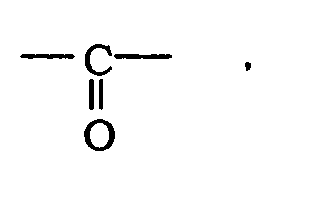
 Y eine Gruppe -CO-R₅ oder
 R₅ eine Hydroxylgruppe, eine geradkettige oder verzweigte (C₁-C₆)-Alkoxygruppe, H₂N-CO-CH₂-O-, HO-CH₂-CHOH-CH₂-O-,
 R₇ und R₈, die gleichartig oder verschieden sein können, ein Wasserstoffatom, eine geradkettige oder verzweigte (C₁-C₆)-Alkylgruppe oder gemeinsam mit dem Stickstoffatom, an das sie gebunden sind, einen Pyrrolidin-, Piperidin-, Morpholin- oder Piperazin-Ring bilden,R₆ und R6', die gleichartig oder verschieden sein können, ein Wasserstoffatom, eine Hydroxylgruppe oder eine geradkettige oder verzweigte (C₁-C₆)-Alkoxygruppe,R₄deren Isomere, Diastereoisomere und Epimere sowie deren Additionssalze mit einer pharmazeutisch annehmbaren Säure oder Base.1 eine geradkettige oder verzweigte Alkylgruppe mit 6 bis 21 Kohlenstoffatomen, die nicht substituiert oder an der endständigen Methylgruppe durch eine Hydroxyl-, Mercapto-, Phenyl- oder Ethinyl-gruppe substituiert ist und worin mindestens eine der Methylengruppen durch ein Sauerstoffatom, ein Schwefelatom oder einen p-Phenylenkern ersetzt ist,
dann, wenn:
R₁- ein Wasserstoffatom,- eine geradkettige oder verzweigte (C₁-C₆)-Alkylgruppe, die nicht substituiert oder durch eine oder mehrere Hydroxyl-, Amino-, Carboxy-, Carbamoyl-, Benzylthio-, Methylthio-, Mercapto- oder Phenylgruppen (die nichtsubstituiert oder durch eine Hydroxylgruppe oder eine geradkettige oder verzweigte (C₁-C₆)-Alkoxygruppe substituiert ist),- eine nichtsubstituierte Phenylgruppe,- eine (Imidazol-2-yl)-methylgruppe oder eine (Indol-3-yl)-methylgruppe, die nichtsubstituiert oder am Heterocyclus durch eine Methylgruppe substituiert ist, und
R₂=H, R ₃=H, 2 und in den anderen Fällen:bedeuten,
eine geradkettige oder verzweigte Alkylgruppe mit 6 bis 21 Kohlenstoffatomen, die nichtsubstituiert oder an der endständigen Methylgruppe durch eine Hydroxyl-, Mercapto-, Phenyl- oder Ethinyl-gruppe substituiert ist und worin eine oder mehrere Methylengruppen durch ein Sauerstoffatom, ein Schwefelatom oder eine p-Phenylengruppe ersetzt sein können (mit der Maßgabe, daß, wenn R₂ oder R₃ mit den Stickstoff- oder Kohlenstoffatomen, an die sie gebunden sind, einen 1,2,3,4-Tetrahydroisochinolin-, Indolin-oder Isoindolin-Ring bilden, R₄ von der Gruppe Alk-S-(CH₂)n- verschieden ist, worin n einen Wert von 1, 2, 3, 4 oder 5 und Alk eine geradkettige oder verzweigte (C₄-C₁₉)-Alkylgruppe darstellen), - Verbindung nach Anspruch 1, nämlich N-Myristoyl-3-carboxy-(1,2,3,4)-tetrahydroisochinolin, dessen Enantiomere sowie dessen Additionssalze mit einer pharmazeutisch annehmbaren Base.
- Verbindung nach Anspruch 1, nämlich N-Myristoyl-(N'τ-benzyl)-histidin, dessen Enantiomere sowie dessen Additionssalze mit einer pharmazeutisch annehmbaren Säure oder Base.
- Verbindung nach Anspruch 1, nämlich 1-Myristoylamino-2-phenylethanhydrogenphosphonsäureethylester, dessen Enantiomere sowie dessen Additionssalze mit einer pharmazeutisch annehmbaren Base.
- Verbindung nach Anspruch 1, nämlich N-(12-Methoxylauroyl)-phenylalanin, dessen Enantiomere sowie dessen Additionssalze mit einer pharmazeutisch annehmbaren Base.
- Verfahren zur Herstellung der Derivate der Formel (I) nach Anspruch 1, dadurch gekennzeichnet, daß man:1- dann, wenn die herzustellenden Derivate der Formel (I) eine Gruppe R₄ = R 4' aufweisen. worin keine Methylengruppe durch ein Schwefelatom oder ein Sauerstoffatom ersetzt ist.
man eine Verbindung der Formel (II):
R4' - X'- Z (II)
in der:X' eine Gruppe
 R4' eine geradkettige oder verzweigte Alkylgruppe mit 6 bis 21 Kohlenstoffatomen, die nichtsubstituiert oder an der endständigen Methylgruppe durch eine Hydroxyl-, Mercapto-, Phenyl- oder Ethinylgruppe substituiert ist, und worin eine oder mehrere Methylengruppen durch eine p-Phenylengruppe ersetzt sein können,Z ein Halogenatom, eine Hydroxylgruppe, eine geradkettige oder verzweigte (C₁-C₆)-Alkoxygruppe, eine Aralkoxygruppe oder eine Gruppemit einem gegebenenfalls geschützen (in Form des Racemats oder der Isomeren vorliegenden) Amin der Formel (III)


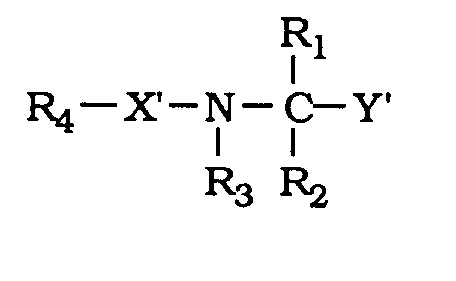
so daß man nach der eventuellen Abspaltung der Schutzgruppe eine Verbindung der Formel (I/a) erhält, einem Sonderfall der Verbindungen der Formel (I): 2- dann, wenn die herzustellenden Derivate der Formel (I) eine Gruppe R₄ = R 4'' = CH₃-(CH₂) n -, worin mindestens eine der Methylengruppen durch ein Schwefelatom oder ein Sauerstoffatom ersetzt ist, aufweisen,welche Derivate der Formeln (I/a) und (I/b) man auch vereinfacht wie folgt schreiben kann:
man:
eine Verbindung der Formel (IV)
A - (CH₂)m - X' - Z (IV)
in der:X' und Z die oben angegebenen Bedeutungen besitzen,A ein Halogenatom, eine Mesyloxygruppe oder eine Tosyloxygruppe undm kleiner oder gleich n - 1 ist, bedeuten,und eine der Methylengruppen durch ein Sauerstoffatom, ein Schwefelatom, eine p-Phenylengruppe, eine Gruppe -CH(CH₃)- oder eine Gruppe -C(CH₃)₂-ersetzt sein kann,
mit einem gegebenenfalls geschützten (in Form des Racemats oder der Isomeren vorliegenden) Amin der Formel (III), wie es oben definiert worden ist,
kondensiert zur Bildung einer Verbindung der Formel (V)
R₉ - B - M (VI)
in der:R₉ eine Gruppe der Formel CH₃-(CH₂)p-, die nichtsubstituiert oder an der endständigen Methylgruppe durch eine Hydroxyl-, Mercapto-, Phenyl- oder Ethinylgruppe substituiert ist und bei der eine der Methylengruppen durch ein Sauerstoffatom, ein Schwefelatom, eine p-Phenylengruppe, eine Gruppe -CH(CH₃)- oder eine Gruppe -C(CH₃)₂- ersetzt sein kann,B ein Sauerstoffatom oder ein Schwefelatom,M ein aus Natrium, Kalium oder Caesium ausgewähltes Metall undp einen solchen Wert besitzt, daß m + p kleiner oder gleich n - 1 ist,bedeuten, umsetzt, so daß man nach der eventuellen Abspaltung der Schutzgruppe eine Verbindung der Formel (I/b) erhält, einem Sonderfall der Verbindungen der Formel (I):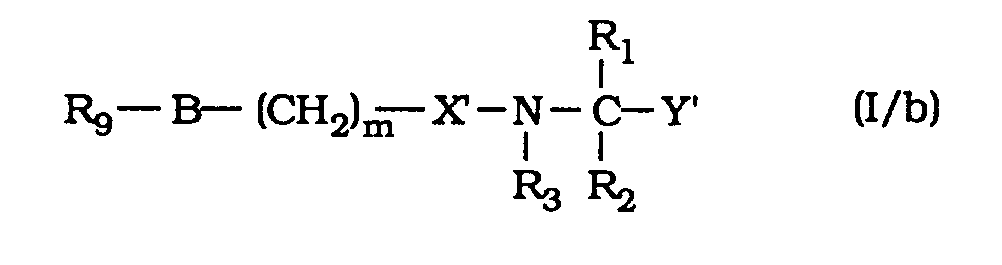
 a dann, wenn X' eine Gruppe der Formel

 b dann, wenn Y' eine Gruppe -CO(Alkoxy) oder -PO(Alkoxy)₂ darstellt, vollständig oder teilweise verseift werden können, so daß man die Verbindungen der Formeln (I/d), (I/e) bzw. (I/f) erhält, Sonderfälle der Verbindungen der Formel (I):

 c dann, wenn Y' eine Gruppe -CO₂H darstellt, in Gegenwart von Caesiumcarbonat mit Hilfe von Chloracetamid in die Verbindung der Formel (I/g) umgewandelt werden können, einem Sonderfall der Verbindungen der Formel (I):
 d dann, wenn Y' eine Gruppe -CO₂H darstellt,welche Verbindungen der Formeln (I/a) bis (I/i) gegebenenfalls mit Hilfe einer klassischen Reinigungsmethode gereinigt werden können, dessen Isomeren mit Hilfe einer klassischen Trennmethode getrennt werden können und welche man mit einer pharmazeutisch annehmbaren Säure oder Base in ihre Säureadditionssalze umwandeln kann.
mit Hilfe von Isopropylidenglycerol zu einer Verbindung der Formel (I/h) verestert werden können, einem Sonderfall der Verbindungen der Formel (I):

- Pharmazeutische Zubereitungen enthaltend als Wirkstoff mindestens eine Verbindung nach einem der Ansprüche 1 bis 5 allein oder in Kombination mit einem oder mehreren inerten, nichttoxischen, pharmazeutisch annehmbaren Trägermaterialien.
- Pharmazeutische Zubereitungen nach Anspruch 7 für die Behandlung von Krebs und/oder Virenerkrankungen, deren Ausbrechen eine Myristoylierung impliziert, wie AIDS, Herpes, Hepatitis B, Influenza, Poliomyelitis oder Leukämie.
Applications Claiming Priority (2)
| Application Number | Priority Date | Filing Date | Title |
|---|---|---|---|
| FR9101502 | 1991-02-11 | ||
| FR9101502A FR2672598A1 (fr) | 1991-02-11 | 1991-02-11 | Nouveaux inhibiteurs de n-myristoyltransferase, leur procede de preparation et les compositions pharmaceutiques qui les contiennent. |
Publications (2)
| Publication Number | Publication Date |
|---|---|
| EP0499521A1 EP0499521A1 (de) | 1992-08-19 |
| EP0499521B1 true EP0499521B1 (de) | 1995-06-14 |
Family
ID=9409536
Family Applications (1)
| Application Number | Title | Priority Date | Filing Date |
|---|---|---|---|
| EP92400341A Expired - Lifetime EP0499521B1 (de) | 1991-02-11 | 1992-02-11 | Inhibitoren von N-Myristoyltransferase, deren Verfahren zur Herstellung und die sie enthaltenden pharmazeutischen Zusammensetzungen |
Country Status (14)
| Country | Link |
|---|---|
| US (1) | US5266576A (de) |
| EP (1) | EP0499521B1 (de) |
| JP (1) | JPH0699379B2 (de) |
| AT (1) | ATE123769T1 (de) |
| AU (1) | AU660007B2 (de) |
| CA (1) | CA2060967A1 (de) |
| DE (1) | DE69202876T2 (de) |
| DK (1) | DK0499521T3 (de) |
| ES (1) | ES2076009T3 (de) |
| FR (1) | FR2672598A1 (de) |
| GR (1) | GR3017281T3 (de) |
| IE (1) | IE920444A1 (de) |
| NZ (1) | NZ241568A (de) |
| ZA (1) | ZA92986B (de) |
Families Citing this family (25)
| Publication number | Priority date | Publication date | Assignee | Title |
|---|---|---|---|---|
| US5162336A (en) * | 1990-06-21 | 1992-11-10 | Rhone-Poulenc Rorer Pharmaceuticals Inc. | Tetrahydro-pyrido-indoles as cholecystokinin and gastrin antagonists |
| AU654331B2 (en) * | 1991-03-30 | 1994-11-03 | Kissei Pharmaceutical Co. Ltd. | Succinic acid compounds |
| US5599947A (en) * | 1993-01-14 | 1997-02-04 | G. D. Searle & Co. | Fatty acid analogs and prodrugs |
| US5859052A (en) * | 1993-01-14 | 1999-01-12 | G. D. Searle & Co. | Fatty acid analogs and prodrugs |
| DE4308788A1 (de) * | 1993-03-18 | 1994-09-22 | Bayer Ag | Hetero-tricyclisch-substituierte Phenyl-cyclohexan-carbonsäurederivate |
| FR2703050B1 (fr) * | 1993-03-24 | 1995-04-28 | Adir | Nouveaux dérivés bicycliques azotés, leur procédé de préparation et les compositions pharmaceutiques qui les contiennent. |
| GB9607583D0 (en) * | 1996-04-12 | 1996-06-12 | Lovesgrove Biomedical Ltd | Organo phosphorous compounds |
| JPH10220909A (ja) | 1996-12-03 | 1998-08-21 | Komatsu Ltd | 流体温度制御装置 |
| WO2000037464A2 (en) | 1998-12-18 | 2000-06-29 | Basilea Pharmaceutica Ag | 4-(aminoalkoxy)benzofurans as n-myristoyltransferase inhibitors |
| US6908926B1 (en) | 1999-04-16 | 2005-06-21 | Novo Nordisk A/S | Substituted imidazoles, their preparation and use |
| DE50213241D1 (de) * | 2001-08-20 | 2009-03-12 | Max Planck Gesellschaft | Katalyse der cis-trans isomerisierung von sekundären-amid peptidverbindungen |
| JP2008105945A (ja) * | 2005-02-07 | 2008-05-08 | Ajinomoto Co Inc | アディポネクチンの分泌促進又は誘導作用を有するアシルアミド化合物 |
| EP2280934A2 (de) * | 2008-04-09 | 2011-02-09 | Yissum Research Development Company of the Hebrew University of Jerusalem, Ltd. | Fettsäureamide und anwendungen davon |
| GB0815947D0 (en) * | 2008-09-02 | 2008-10-08 | Univ Dundee | Compounds |
| FR2936152B1 (fr) * | 2008-09-24 | 2010-11-12 | Seppic Sa | Monoglyceride de n-undecylenoyl phenylalanine, procede pour sa preparation et utilisation d'esters glyceriques de n-undecylenoyl phenylalanine comme agent eclaircissant la peau. |
| GB201321749D0 (en) * | 2013-12-09 | 2014-01-22 | Ucb Pharma Sa | Therapeutic agents |
| FR3027515B1 (fr) * | 2014-10-27 | 2019-08-09 | Societe D'exploitation De Produits Pour Les Industries Chimiques Seppic | Utilisation d'esters de la phenylalanine et de polyols comme agent eclaircissant de la peau du corps humain |
| FR3027599A1 (fr) * | 2014-10-27 | 2016-04-29 | Soc D'exploitation De Produits Pour Les Ind Chimiques Seppic | Utilisation d'ester de derives n-acyles d'acide amines et de polyols comme agent antivieillissement de la peau humaine |
| WO2019108739A1 (en) * | 2017-11-30 | 2019-06-06 | Dana-Farber Cancer Institute, Inc. | Chemical uncouplers of respiration and methods of use thereof |
| IL275146B2 (en) | 2017-12-07 | 2025-01-01 | Adocia | Preparations in the form of an aqueous solution for injection comprising amylin, an amylin receptor agonist or an amylin analog and a copolyamino acid |
| CA3084689A1 (fr) | 2017-12-07 | 2019-06-13 | Adocia | Solution injectable a ph 7 comprenant au moins une insuline basale dont le pi est compris entre 5,8 et 8,5 et un co-polyaminoacide porteur de charges carboxylates et de radicaux hydrophobes |
| CN111683674A (zh) | 2017-12-07 | 2020-09-18 | 阿道恰公司 | 包含胰淀素、胰淀素激动剂受体或胰淀素类似物和共聚氨基酸的可注射水溶液形式的组合物 |
| EP3740195A1 (de) * | 2017-12-07 | 2020-11-25 | Adocia | Zusammensetzungen in form einer injizierbaren wässrigen lösung mit amylin, einem amylin-rezeptor-agonist oder einem amylin-analogon und einer copolyaminosäure |
| WO2024050108A2 (en) * | 2022-09-02 | 2024-03-07 | University Of Florida Research Foundation, Inc. | Compositions and methods of use |
| WO2026061848A1 (en) * | 2024-09-20 | 2026-03-26 | Basf Se | Pipecolic acid-based surfactants and their use |
Citations (2)
| Publication number | Priority date | Publication date | Assignee | Title |
|---|---|---|---|---|
| EP0039804A1 (de) * | 1980-05-12 | 1981-11-18 | Usv Pharmaceutical Corporation | Cyclische Amide |
| EP0351382A2 (de) * | 1988-07-12 | 1990-01-17 | Ministero Dell' Universita' E Della Ricerca Scientifica E Tecnologica | Verfahren zur Herstellung von optisch aktiver Aminosäure |
Family Cites Families (10)
| Publication number | Priority date | Publication date | Assignee | Title |
|---|---|---|---|---|
| CA1298033C (en) * | 1985-04-16 | 1992-03-24 | Takaharu Tanaka | Dipeptide derivative of fatty acid |
| JPH0623190B2 (ja) * | 1985-04-16 | 1994-03-30 | サントリー株式会社 | インヒビタ−活性を有するn−アシルピロリジン誘導体及びその製法並びに用途 |
| CA1261855A (en) * | 1986-04-11 | 1989-09-26 | Alenka Paquet | Derivatives of d-amino acids having anti-microbial properties |
| JPS63146851A (ja) * | 1986-10-27 | 1988-06-18 | Shozo Shoji | ミリスチルグリシンおよびそのオリゴペプチド誘導体の製造方法 |
| DE3644522A1 (de) * | 1986-12-24 | 1988-07-14 | Hoechst Ag | Verwendung von optisch aktiven 1-acylprolinestern als dotierstoffe in fluessigkristallmischungen und neue optisch aktive 1-acyl-prolinester |
| JPH01272697A (ja) * | 1988-04-26 | 1989-10-31 | Ajinomoto Co Inc | 液体洗浄剤組成物 |
| DE68903796T2 (de) * | 1988-06-29 | 1993-04-22 | Daiichi Seiyaku Co | Lipidmembranstrukturen. |
| FR2655989B1 (fr) * | 1989-12-20 | 1992-02-28 | Adir | Nouveaux derives d'amino-acides substitues, leur procede de preparation et les compositions pharmaceutiques qui les contiennent. |
| FR2657259A1 (fr) * | 1990-01-25 | 1991-07-26 | Adir | Utilisation de la n-myristoyl-(s)-phenylalanine pour l'obtention de medicaments destines au traitement des maladies faisant intervenir la myristoylation. |
| FR2681864B1 (fr) * | 1991-09-27 | 1995-03-31 | Adir | Nouveaux derives bicycliques azotes, leur procede de preparation et les compositions pharmaceutiques qui les contiennent. |
-
1991
- 1991-02-11 FR FR9101502A patent/FR2672598A1/fr active Granted
-
1992
- 1992-02-10 JP JP4069911A patent/JPH0699379B2/ja not_active Expired - Lifetime
- 1992-02-10 NZ NZ241568A patent/NZ241568A/xx unknown
- 1992-02-10 CA CA002060967A patent/CA2060967A1/fr not_active Abandoned
- 1992-02-10 US US07/833,301 patent/US5266576A/en not_active Expired - Fee Related
- 1992-02-10 AU AU10854/92A patent/AU660007B2/en not_active Ceased
- 1992-02-11 AT AT92400341T patent/ATE123769T1/de not_active IP Right Cessation
- 1992-02-11 ZA ZA92986A patent/ZA92986B/xx unknown
- 1992-02-11 DE DE69202876T patent/DE69202876T2/de not_active Expired - Fee Related
- 1992-02-11 EP EP92400341A patent/EP0499521B1/de not_active Expired - Lifetime
- 1992-02-11 IE IE044492A patent/IE920444A1/en not_active Application Discontinuation
- 1992-02-11 DK DK92400341.1T patent/DK0499521T3/da active
- 1992-02-11 ES ES92400341T patent/ES2076009T3/es not_active Expired - Lifetime
-
1995
- 1995-08-31 GR GR950402399T patent/GR3017281T3/el unknown
Patent Citations (2)
| Publication number | Priority date | Publication date | Assignee | Title |
|---|---|---|---|---|
| EP0039804A1 (de) * | 1980-05-12 | 1981-11-18 | Usv Pharmaceutical Corporation | Cyclische Amide |
| EP0351382A2 (de) * | 1988-07-12 | 1990-01-17 | Ministero Dell' Universita' E Della Ricerca Scientifica E Tecnologica | Verfahren zur Herstellung von optisch aktiver Aminosäure |
Also Published As
| Publication number | Publication date |
|---|---|
| NZ241568A (en) | 1994-04-27 |
| CA2060967A1 (fr) | 1992-08-12 |
| ES2076009T3 (es) | 1995-10-16 |
| DK0499521T3 (da) | 1995-10-30 |
| IE920444A1 (en) | 1992-08-12 |
| AU1085492A (en) | 1992-08-13 |
| FR2672598B1 (de) | 1995-01-20 |
| EP0499521A1 (de) | 1992-08-19 |
| AU660007B2 (en) | 1995-06-08 |
| ATE123769T1 (de) | 1995-06-15 |
| DE69202876D1 (de) | 1995-07-20 |
| JPH0699379B2 (ja) | 1994-12-07 |
| DE69202876T2 (de) | 1996-03-14 |
| ZA92986B (en) | 1992-11-25 |
| FR2672598A1 (fr) | 1992-08-14 |
| JPH05132454A (ja) | 1993-05-28 |
| GR3017281T3 (en) | 1995-11-30 |
| US5266576A (en) | 1993-11-30 |
Similar Documents
| Publication | Publication Date | Title |
|---|---|---|
| EP0499521A1 (de) | Inhibitoren von N-Myristoyltransferase, deren Verfahren zur Herstellung und die sie enthaltenden pharmazeutischen Zusammensetzungen | |
| US4654360A (en) | 1,2,3-trisubstituted indoles for treatment of inflammation | |
| EP0031741A1 (de) | Substituierte Iminosäuren, Verfahren zu ihrer Herstellung und ihre Verwendung als Enzym-Inhibitoren | |
| MC2195A1 (fr) | Derives d'acides amines | |
| EP0462884A1 (de) | TRH-Derivate, deren Herstellung und pharmazeutische Zusammensetzungen | |
| MC1881A1 (fr) | Derives de l'acide phosphinique | |
| EP0466585A1 (de) | Neue Derivate des Piperidins, Tetrahydropyridins und des Pyrrolidins, Verfahren zu ihrer Herstellung und diese enthaltende Arzneimittel | |
| EP0832886B1 (de) | Flavone-Derivate, Verfahren zu ihrer Herstellung und diese enthaltende pharmazeutische Zusammenstellungen | |
| WO1997003987A1 (fr) | Nouveaux derives de la galanthamine, leur procede de preparation, leur application comme medicaments et les compositions pharmaceutiques les renfermant | |
| EP0820990B1 (de) | Benzimidazol-, Benzoxazol- und Benzothiazolderivate, welche als Inhibitoren des Interleukin 1beta verwendbar sind | |
| FR2502149A1 (fr) | Nouveaux amido-aminoacides, compositions pharmaceutiques les contenant et procede de preparation de ces amido-aminoacides | |
| EP0639586B1 (de) | Derivate der Phosphonsäure, Verfahren zu ihrer Herstellung und pharmazeutische Zusammensetzungen die sie enthalten | |
| FR2610934A1 (fr) | Nouveaux derives peptidiques a structure polycyclique azotee, leur procede de preparation et les compositions pharmaceutiques qui les contiennent | |
| MC1192A1 (fr) | Derives de benzimidazole | |
| EP0262053A2 (de) | Aminosäure-Derivate, Herstellungsverfahren und pharmazeutisches Mittel | |
| FR2771412A1 (fr) | Nouveaux derives de pyrrole, leur procede de preparation et les compositions pharmaceutiques qui les contiennent | |
| EP0452204A1 (de) | 3-Aminochroman-Derivate, Verfahren zu deren Herstellung und diese enthaltende pharmazeutische Zusammensetzungen | |
| EP1101765B1 (de) | Camptothecin Analoge Verbindungen, Verfahren zu ihrer Herstellung und diese enthaltende pharmazeutische Zubereitungen | |
| EP0572308A2 (de) | Heterocyclische Derivate, Verfahren zu ihrer Herstellung und diese enthaltende pharmazeutische Zusammensetzungen | |
| EP0057998B1 (de) | Alicyclische Verbindungen, deren Herstellung und Verwendung | |
| FR2616663A1 (fr) | Nouveaux tripeptides a structure polycyclique azotee, leur procede de preparation et les compositions pharmaceutiques qui les contiennent | |
| EP1101756B1 (de) | Aminopyrrolidin-Derivate, Verfahren zur ihre Herstellung und diese enthaltende pharmazeutische Zusammensetzungen | |
| EP0658557A1 (de) | Eburnan-Derivate, Verfahren zur ihrer Herstellung und diese enthaltende pharmazeutische Zusammensetzungen | |
| EP0079411B1 (de) | Indoloquinolizinderivate, Verfahren zu ihrer Herstellung und ihre therapeutische Anwendung | |
| EP0699679A1 (de) | Tetrahydropyranylderivate, Verfahren zu ihrer Herstellung und diese enthaltende pharmazeutische Zusammensetzungen |
Legal Events
| Date | Code | Title | Description |
|---|---|---|---|
| PUAI | Public reference made under article 153(3) epc to a published international application that has entered the european phase |
Free format text: ORIGINAL CODE: 0009012 |
|
| 17P | Request for examination filed |
Effective date: 19920214 |
|
| AK | Designated contracting states |
Kind code of ref document: A1 Designated state(s): AT BE CH DE DK ES FR GB GR IT LI LU NL PT SE |
|
| 17Q | First examination report despatched |
Effective date: 19940223 |
|
| GRAA | (expected) grant |
Free format text: ORIGINAL CODE: 0009210 |
|
| AK | Designated contracting states |
Kind code of ref document: B1 Designated state(s): AT BE CH DE DK ES FR GB GR IT LI LU NL PT SE |
|
| REF | Corresponds to: |
Ref document number: 123769 Country of ref document: AT Date of ref document: 19950615 Kind code of ref document: T |
|
| ITF | It: translation for a ep patent filed | ||
| REF | Corresponds to: |
Ref document number: 69202876 Country of ref document: DE Date of ref document: 19950720 |
|
| REG | Reference to a national code |
Ref country code: ES Ref legal event code: FG2A Ref document number: 2076009 Country of ref document: ES Kind code of ref document: T3 |
|
| GBT | Gb: translation of ep patent filed (gb section 77(6)(a)/1977) |
Effective date: 19950914 |
|
| SC4A | Pt: translation is available |
Free format text: 950616 AVAILABILITY OF NATIONAL TRANSLATION |
|
| REG | Reference to a national code |
Ref country code: DK Ref legal event code: T3 |
|
| REG | Reference to a national code |
Ref country code: GR Ref legal event code: FG4A Free format text: 3017281 |
|
| PGFP | Annual fee paid to national office [announced via postgrant information from national office to epo] |
Ref country code: PT Payment date: 19951121 Year of fee payment: 5 |
|
| PGFP | Annual fee paid to national office [announced via postgrant information from national office to epo] |
Ref country code: AT Payment date: 19951207 Year of fee payment: 5 |
|
| PGFP | Annual fee paid to national office [announced via postgrant information from national office to epo] |
Ref country code: SE Payment date: 19951211 Year of fee payment: 5 |
|
| PGFP | Annual fee paid to national office [announced via postgrant information from national office to epo] |
Ref country code: GR Payment date: 19951220 Year of fee payment: 5 |
|
| PGFP | Annual fee paid to national office [announced via postgrant information from national office to epo] |
Ref country code: LU Payment date: 19960201 Year of fee payment: 5 |
|
| PGFP | Annual fee paid to national office [announced via postgrant information from national office to epo] |
Ref country code: GB Payment date: 19960202 Year of fee payment: 5 Ref country code: CH Payment date: 19960202 Year of fee payment: 5 |
|
| PGFP | Annual fee paid to national office [announced via postgrant information from national office to epo] |
Ref country code: ES Payment date: 19960213 Year of fee payment: 5 |
|
| PGFP | Annual fee paid to national office [announced via postgrant information from national office to epo] |
Ref country code: DK Payment date: 19960227 Year of fee payment: 5 Ref country code: DE Payment date: 19960227 Year of fee payment: 5 |
|
| PGFP | Annual fee paid to national office [announced via postgrant information from national office to epo] |
Ref country code: BE Payment date: 19960228 Year of fee payment: 5 |
|
| PLBE | No opposition filed within time limit |
Free format text: ORIGINAL CODE: 0009261 |
|
| STAA | Information on the status of an ep patent application or granted ep patent |
Free format text: STATUS: NO OPPOSITION FILED WITHIN TIME LIMIT |
|
| 26N | No opposition filed | ||
| PG25 | Lapsed in a contracting state [announced via postgrant information from national office to epo] |
Ref country code: NL Effective date: 19960901 |
|
| PG25 | Lapsed in a contracting state [announced via postgrant information from national office to epo] |
Ref country code: FR Effective date: 19961031 |
|
| NLV4 | Nl: lapsed or anulled due to non-payment of the annual fee |
Effective date: 19960901 |
|
| REG | Reference to a national code |
Ref country code: FR Ref legal event code: ST |
|
| PG25 | Lapsed in a contracting state [announced via postgrant information from national office to epo] |
Ref country code: LU Free format text: LAPSE BECAUSE OF NON-PAYMENT OF DUE FEES Effective date: 19970211 Ref country code: GB Effective date: 19970211 Ref country code: DK Effective date: 19970211 Ref country code: AT Effective date: 19970211 |
|
| REG | Reference to a national code |
Ref country code: DK Ref legal event code: EBP |
|
| PG25 | Lapsed in a contracting state [announced via postgrant information from national office to epo] |
Ref country code: SE Effective date: 19970212 Ref country code: ES Free format text: LAPSE BECAUSE OF NON-PAYMENT OF DUE FEES Effective date: 19970212 |
|
| PG25 | Lapsed in a contracting state [announced via postgrant information from national office to epo] |
Ref country code: LI Effective date: 19970228 Ref country code: CH Effective date: 19970228 Ref country code: BE Effective date: 19970228 |
|
| BERE | Be: lapsed |
Owner name: ADIR ET CIE Effective date: 19970228 |
|
| PG25 | Lapsed in a contracting state [announced via postgrant information from national office to epo] |
Ref country code: PT Effective date: 19970831 Ref country code: GR Free format text: THE PATENT HAS BEEN ANNULLED BY A DECISION OF A NATIONAL AUTHORITY Effective date: 19970831 |
|
| REG | Reference to a national code |
Ref country code: GR Ref legal event code: MM2A Free format text: 3017281 |
|
| GBPC | Gb: european patent ceased through non-payment of renewal fee |
Effective date: 19970211 |
|
| REG | Reference to a national code |
Ref country code: CH Ref legal event code: PL |
|
| PG25 | Lapsed in a contracting state [announced via postgrant information from national office to epo] |
Ref country code: DE Effective date: 19971101 |
|
| EUG | Se: european patent has lapsed |
Ref document number: 92400341.1 |
|
| REG | Reference to a national code |
Ref country code: PT Ref legal event code: MM4A Free format text: LAPSE DUE TO NON-PAYMENT OF FEES Effective date: 19970831 |
|
| REG | Reference to a national code |
Ref country code: ES Ref legal event code: FD2A Effective date: 19990201 |
|
| PG25 | Lapsed in a contracting state [announced via postgrant information from national office to epo] |
Ref country code: IT Free format text: LAPSE BECAUSE OF NON-PAYMENT OF DUE FEES;WARNING: LAPSES OF ITALIAN PATENTS WITH EFFECTIVE DATE BEFORE 2007 MAY HAVE OCCURRED AT ANY TIME BEFORE 2007. THE CORRECT EFFECTIVE DATE MAY BE DIFFERENT FROM THE ONE RECORDED. Effective date: 20050211 |