EP0600280A2 - Tête magnétique flottante - Google Patents
Tête magnétique flottante Download PDFInfo
- Publication number
- EP0600280A2 EP0600280A2 EP93118333A EP93118333A EP0600280A2 EP 0600280 A2 EP0600280 A2 EP 0600280A2 EP 93118333 A EP93118333 A EP 93118333A EP 93118333 A EP93118333 A EP 93118333A EP 0600280 A2 EP0600280 A2 EP 0600280A2
- Authority
- EP
- European Patent Office
- Prior art keywords
- magnetic head
- magnetic
- core
- slider
- floating
- Prior art date
- Legal status (The legal status is an assumption and is not a legal conclusion. Google has not performed a legal analysis and makes no representation as to the accuracy of the status listed.)
- Withdrawn
Links
Images



Classifications
-
- G—PHYSICS
- G11—INFORMATION STORAGE
- G11B—INFORMATION STORAGE BASED ON RELATIVE MOVEMENT BETWEEN RECORD CARRIER AND TRANSDUCER
- G11B5/00—Recording by magnetisation or demagnetisation of a record carrier; Reproducing by magnetic means; Record carriers therefor
- G11B5/10—Structure or manufacture of housings or shields for heads
- G11B5/105—Mounting of head within housing or assembling of head and housing
-
- G—PHYSICS
- G11—INFORMATION STORAGE
- G11B—INFORMATION STORAGE BASED ON RELATIVE MOVEMENT BETWEEN RECORD CARRIER AND TRANSDUCER
- G11B5/00—Recording by magnetisation or demagnetisation of a record carrier; Reproducing by magnetic means; Record carriers therefor
- G11B5/10—Structure or manufacture of housings or shields for heads
- G11B5/11—Shielding of head against electric or magnetic fields
Definitions
- the present invention relates to an improvement of a floating magnetic head used for an immovable magnetic disk unit which is a magnetic recording unit of a computer and the like.
- a track of a floating magnetic head used for an immovable magnetic disk unit is narrowed down in order to achieve high density recording, and those which narrowed a track down by fabricating a laminated core having a thickness equivalent to a track width by forming magnetic thin films composed of Fe-Al-Si alloy and amorphous magnet which allow to narrow a track down on a non-magnetic slider have been proposed.
- examples of such floating magnetic head are shown in Fig. 7 (Japanese Patent Laid-Open No. 3-19119), Fig. 8 (Japanese Patent Laid-Open No. 3-272004), Fig. 9 (Japanese Patent Laid-Open No. 3-49019), and Fig. 10 (Japanese Patent Laid-Open No. 3-125320).
- a floating magnetic head 1 shown in Fig. 7 has a nearly rectangular slider 2 made of a non-magnetic material.
- Slider side magnetic films 5 made of Fe-Al-Si alloy which structure a part of magnetic head cores 4 are provided in a manner pinched by rails (floating surface) 3 provided on the slider 2, for generating a floating force.
- C-shaped magnetic head cores 7 having head core side magnetic films 6 made of Fe-Al-Si alloy which structure the main core portion 4 together with the slider side magnetic films 5 are bonded to the slider 2.
- the magnetic head cores 7 are structured so that the head core side magnetic films 6 are pinched by non-magnetic substrates 8 and that the head core side magnetic films 6 are articulated to the slider side magnetic films 5.
- the reference numeral 9 in the figure indicate gaps.
- a slider side magnetic film 5 is formed in the middle part of a slider 2.
- laminated slider side magnetic films 5 are provided in a pinched state at the portion where one of rails 3 of a slider 2 is created and a magnetic head core 7 is bonded to one end of the slider 2.
- the magnetic head core 7 comprises laminated head core side magnetic films 6.
- the head core side magnetic films 6 are articulated to the slider side magnetic films 5 to compose a main core portion 4 together with the slider side magnetic films 5.
- a longitudinal main core portion 4 in which a head core side magnetic film 6 is pinched by substrates 8 made of a non-magnetic material is inserted to and bonded with a slit 10 formed on a slider 2.
- the laminated core (the main core portion 4) cannot but be thinned down so much if a track is to be narrowed down, causing a problem that magnetic resistance on the rear gap 11 side of the main core portion 4 is not fully reduced as compare to that on the gap 9 side and thereby the recording and reproducing efficiency is degraded.
- the floating magnetic head 1 shown respectively in Figs. 7, 8, 9 and 10 had a problem that a dislocation of tracks was brought about in a process of creating the gap 9, thereby differentiating an effective track width from its desired size.
- a floating magnetic head of the present invention comprises a nearly rectangular non-magnetic slider on one surface of which a floating surface for generating a floating force against a magnetic recording medium is created, and a magnetic head core comprising a flow-out end side core (hereinafter referred to as an I-shaped core) and a flow-in end side core (hereinafter referred to as a C-shaped core) which are thin films made of a magnetic material laminated into a thickness equivalent to a track width and are pinched by non-magnetic substrates.
- the magnetic head core is bonded to a side portion of the slider via glass so that a magnetic gap is created on the surface which slides against the magnetic recording medium.
- the magnetic head core is made shorter than the whole length of the side of slider.
- a notch may be created on the side portion of the slider to bond the floating magnetic head thereon.
- a notch or a channel is created on the substrate of at least one core on the opposite side from the slider side at the bonding section of the I-shaped core and C-shaped core to fill glass to reinforce the bonding strength of the both cores.
- a floating magnetic head comprises a nearly rectangular non-magnetic slider on one surface of which a floating surface for generating a floating force against a magnetic recording medium is created, and a magnetic head core having a laminated core which is obtained by laminating magnetic films and is provided between non-magnetic substrates, having a track portion for creating a gap for recording and reproducing on the front end thereof, and being shorter than the side portion of the slider.
- the magnetic head core is bonded to the side portion of the slider by positioning the track portion on the side of the floating surface of the slider.
- the side portion on the opposite side from the bonding section of the magnetic head core and the slider or both side portions are chamfered to create inclined faces so that a width of surface of the laminated core of the magnetic head core becomes equal to a desired track width to thicken the rear gap side as compare to the gap side of the laminated core.
- the magnetic head core is short as compare to the length of the side portion of the slider, an influence of external disturbing magnetic field may be minimized, a fully large bonding strength may be maintained and CSS resistance may be improved.
- the invention constructed as described above allows to narrow the track down and to improve the recording and reproducing efficiency because the thickness of the rear gap side of the laminated core is set to be thicker than that of the gap portion side of the laminated core obtained by laminating magnetic films and thereby magnetic resistance on the gap side becomes greater than that on the rear gap side.
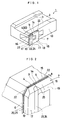
- FIG. 1 through 6 preferred embodiments of the present invention will be explained.
- a floating magnetic head 1 according to a first embodiment of the invention will be explained referring to Figs. 1 and 2.
- the floating magnetic head 1 has a nearly rectangular slider 2 made of a non-magnetic material.
- the upper surface of the slider 2 is adapted to face to a magnetic recording medium and rails (floating surfaces) 3 for generating a floating force are provided on the surface.
- a magnetic head core 7 having a track section 14 in which a gap for recording and reproducing 9 is created and which is shorter than the slider 2 is bonded on a side portion 13 on the side of one rail 3 of the slider 2 projecting therefrom using a low melting point glass 15 in a state that the track section 14 is disposed on the rail 3 side.
- the bonding by means of the low melting point glass 15 is carried out by forming the low melting point glass 15 on a bonding surface of the slider 2 (hereinafter referred to as a slider bonding surface) using a sputtering method.
- a sputtering method By the way, it is possible to form the low melting point glass 15 on the bonding surface of the slider 2 by printing.
- the low melting point glass 15 is used to bond the main core portion (laminated core) 4 on the slider 2, another bonding material such as a low melting point metal may be used.
- the magnetic head core 7 comprises an I-shaped core 17 and C-shaped core 18 which are bonded each other.
- the I-shaped core 17 and C-shaped core 18 are fabricated respectively by forming a magnetic film 20 made of Fe-Al-Si alloy on a non-magnetic first substrate 19 by a sputtering method, by forming a non-magnetic film 21 made of Si02 on the magnetic film 20 by a sputtering method, by obtaining the laminated core (main core portion) 4 by laminating the magnetic film 20 and non-magnetic film 21 alternately in the same manner and by bonding the laminated core 4 on a non-magnetic second substrate 22 by a sputtering method.
- a lamination width A of the laminated core 4 is set to be equal to a track width.
- the magnetic film 20 made of Fe-Al-Si alloy may be formed using another material such as Fe or Co amorphous.
- a channel 23 which extends in the vertical direction in Fig. 1 is formed at the bonding section of the I-shaped core 17 and the C-shaped core 18 on the first substrate 19.
- a reinforcing glass 24 is filled in the channel 23 to reinforce the bonding of the I-shaped core 17 and C-shaped core 18.
- An inclined surface 25 is created at the corner of the magnetic head core 7 on the rail 3 side on the opposite side from the slider bonding surface 16 by means of chamfering and grinding in a state where the magnetic head core 7 is bonded to the slider 2.
- the reinforcing glass is kept from exposing out to the rail 3 by grinding in such manner.
- the main core portion 4 is shorter than the side portion 13 of the slider 2, an influence of external disturbing magnetic field may be minimized, allowing to prevent from picking up external noise and to maintain S/N ratio in a good value.
- the reinforcing glass 24 is filled into the notch or the channel 23 formed on the first substrate 19 of the I-shaped core 17, the bonding strength of the I-shaped core 17 and C-shaped core 18 may be enhanced.
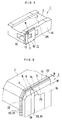
- FIG. 3 and 4 a floating magnetic head 1 according to a second embodiment of the invention will be explained.
- the same reference numerals are designated to the same components and parts with those shown in Figs. 1 and 2, and explanation thereof are omitted here.
- a lamination width of the laminated core 4 is set to be thicker than a track width B.
- inclined surfaces 25 and 25' are created on the slider bonding surface 16 side and at the corner section on the rail 3 side which is opposite from the bonding surface 16 of the main core portion 4 by means of chamfering and grinding.
- the inclined surfaces 25 and 25' may be created by means of etching such as ion milling instead of the chamfering and grinding.
- a gap created between the inclined surface 25' on the slider bonding surface 16 side of the magnetic head core 7 and the rail 3 side of the slider 2 may be filled by glass and the like after bonding the magnetic head core 7 to the slider 2.
- the grinding is carried out so that the width B of the upper surface located on the gap 9 side (rail 3 side) of the laminated core 4 becomes equal to a desired track width.
- the width on the gap 9 side of the laminated core 4 is reduced as compared to a width on the rear gap 11 side by creating the inclined surfaces 25 and 25', so that a magnetic resistance on the gap 9 side becomes greater than that on the rear gap 11 side. Due to that, the recording and reproducing efficiency may be improved.
- the width B of the upper surface located on the gap 9 side (rail 3 side) of the laminated core 4 is ground so that it becomes equal to a desired track width, the desired track width may be obtained even if a track dislocation is caused in a process for creating the gap 9.
- the floating magnetic head 1 of the second embodiment may be achieved by the floating magnetic head 1 of the second embodiment, as follows. That is, no such problem that the CSS resistance and reliability are deteriorated which might be otherwise caused by the reinforcing glass 24 exposing out to the rail 3 side, is caused. Because the magnetic head core 7 is shorter than the side portion 13 of the slider 2, an influence of external disturbing magnetic field is minimized, thereby allowing to prevent from picking up external noise and to maintain S/N ratio in a good value. Because the reinforcing glass 24 is filled into the channel 23 formed on the first substrate 19 of the I-shaped core 17, the bonding strength of the I-shaped core 17 and C-shaped core 18 may be enhanced.
- the width on the gap 9 side of the laminated core 4 is reduced as compared to the width on the rear gap 11 side, a magnetic resistance on the gap 9 side becomes greater than that on the rear gap 11 side, thereby improving the recording and reproducing efficiency.
- FIGs. 5 and 6 a floating magnetic head 1 according to a third embodiment of the invention will be explained.
- the same reference numerals are designated to the same components and parts with those in Figs. 3 and 4.
- the floating magnetic head 1 in the third embodiment differs from those described above in that a notch 26 is created on the side portion 13 of the slider 2 to bond the magnetic head core 7 thereon. Because the magnetic head core 7 is housed in the notch 26 in the floating magnetic head 1, the shape of the whole floating magnetic head 1 may be made compact and CSS may be carried out more smoothly.
- the magnetic head core is shorter than the side portion of the slider, an influence of external disturbing magnetic field is minimized, allowing to prevent from picking up external noise and to maintain a good S/N value. Because the length of the laminated core is short, the CSS resistance may be prevented from deteriorating which might be otherwise caused due to a partial abrasion between the magnetic films and the slider. Because the slider and the magnetic head core are fabricated in separate processes, one having a better compatibility with the magnetic films may be used for the non-magnetic substrate of the magnetic head core.
- two cores may be bonded via glass by filling glass into a channel created at the bonding section of at least one non-magnetic substrate of one core with another core and the glass may be prevented from exposing out to the floating surface, the bonding strength may be enhanced without deteriorating the CSS resistance and reliability.
- the inclined surfaces are created from the both sides of the magnetic head core so that the width of the laminated core on the gap side becomes equal to a desired track width, the desired track width may be obtained even if a track dislocation is caused in the process of creating the gap of the magnetic head core.
- the thickness of the laminated core on the rear gap side may be set to be larger than that on the gap side, a magnetic resistance on the gap side becomes fully greater than that on the rear gap side, thereby improving the recording and reproducing efficiency.
- a magnetic head core is inserted into a narrow slit in the slider and bonded via glass.
- it is necessary to melt it at a high temperature and to cause it flow into the slit.
- the high-temperature glass erodes the head core.
- those portions of the core which are located on the side of the entrance of the slit are exposed to a large amount of glass.
- the magnetic head core is bonded to the side portion of the slider using a low melting point glass by a sputtering method, no such problem as described above that the high-temperature glass erodes the head core is caused.
- track width can be machined in the final step, commercial products having different track widths can be manufactured as one lot until the step for machining the track widths is carried out.
- the material which bonds together the magnetic head core and the slider is very thin and hence is hardly exposed to the air bearing surface. Consequently, a step due to glass erosion on lapping is not produced. Also, the material is hardly exposed. Hence, the reliability is high. For the same reason, an aqueous detergent can be used.
- the magnetic head Since the amount of the glass used to mount the magnetic head core and the slider is very small, the magnetic head is hardly affected by the bond distortion. Therefore, the reading and writing efficiency does not deteriorate. In addition, since bonding can be carried out at lower temperature, a head core having low heat-durability can be used.
- the height of the throat is not measured via the sealing glass, unlike the prior art composite-type floating magnetic head.
- the height of the throat can be readily machined accurately. Also, the measurement can be performed accurately.
- the magnetic head core is mounted on the outside of the slider. This makes it possible to use the outermost portion of the magnetic disk. Also, a thin-film coil can be used easily instead of ordinary winding.
- the magnetic head core is not exposing out to ABS, a shape of the ABS may be freely changed.
Landscapes
- Engineering & Computer Science (AREA)
- Manufacturing & Machinery (AREA)
- Adjustment Of The Magnetic Head Position Track Following On Tapes (AREA)
- Magnetic Heads (AREA)
Applications Claiming Priority (4)
| Application Number | Priority Date | Filing Date | Title |
|---|---|---|---|
| JP343425/92 | 1992-11-30 | ||
| JP34342592A JP2879183B2 (ja) | 1992-11-30 | 1992-11-30 | 浮動磁気ヘッド |
| JP351663/92 | 1992-12-08 | ||
| JP35166392A JP2818993B2 (ja) | 1992-12-08 | 1992-12-08 | 浮動磁気ヘッド |
Publications (2)
| Publication Number | Publication Date |
|---|---|
| EP0600280A2 true EP0600280A2 (fr) | 1994-06-08 |
| EP0600280A3 EP0600280A3 (fr) | 1995-07-26 |
Family
ID=26577525
Family Applications (1)
| Application Number | Title | Priority Date | Filing Date |
|---|---|---|---|
| EP93118333A Withdrawn EP0600280A3 (fr) | 1992-11-30 | 1993-11-12 | Tête magnétique flottante. |
Country Status (2)
| Country | Link |
|---|---|
| US (1) | US5485332A (fr) |
| EP (1) | EP0600280A3 (fr) |
Cited By (1)
| Publication number | Priority date | Publication date | Assignee | Title |
|---|---|---|---|---|
| US5657185A (en) * | 1995-08-09 | 1997-08-12 | Minebea Co., Ltd | Floating magnetic head having a reinforced structure and a manufacturing method thereof |
Families Citing this family (5)
| Publication number | Priority date | Publication date | Assignee | Title |
|---|---|---|---|---|
| EP0602486B1 (fr) * | 1992-12-14 | 1999-02-10 | Minebea Co.,Ltd. | Tête magnétique flottante |
| JP3462023B2 (ja) * | 1996-11-18 | 2003-11-05 | ミネベア株式会社 | サイドコア型磁気ヘッドスライダーの製造方法 |
| JPH11167709A (ja) * | 1997-12-04 | 1999-06-22 | Alps Electric Co Ltd | 磁気ヘッド |
| EP1496750B1 (fr) * | 2002-04-19 | 2007-08-15 | Linco Food Systems A/S | Procede et appareil d'ebouillantage de volaille abattue |
| ES2339785T3 (es) * | 2004-09-03 | 2010-05-25 | Linco Food Systems A/S | Metodo y sistema para escaldar aves de corral muertas. |
Family Cites Families (19)
| Publication number | Priority date | Publication date | Assignee | Title |
|---|---|---|---|---|
| US3229268A (en) * | 1961-04-28 | 1966-01-11 | Burroughs Corp | Detachable electromagnetic air bearing transducer |
| JPS62248120A (ja) * | 1986-04-21 | 1987-10-29 | Hitachi Metals Ltd | 浮上型磁気ヘツド |
| JPS6275927A (ja) * | 1985-09-27 | 1987-04-07 | Alps Electric Co Ltd | 浮動式磁気ヘツドおよびその製造方法 |
| JPS62188206A (ja) * | 1985-10-07 | 1987-08-17 | Nippon Mining Co Ltd | Fe−Si−Al合金磁性膜及びその製造方法並びに薄膜積層磁気ヘツド |
| KR920005044B1 (en) * | 1987-07-23 | 1992-06-25 | Hitachi Ltd | Magnetic head |
| JPH01276421A (ja) * | 1988-04-27 | 1989-11-07 | Seiko Epson Corp | 磁気ヘッド |
| JPH02201714A (ja) * | 1989-01-31 | 1990-08-09 | Pioneer Electron Corp | 磁気ヘッド |
| JPH0319119A (ja) * | 1989-06-16 | 1991-01-28 | Nec Kansai Ltd | 浮動型磁気ヘッド |
| JP2972889B2 (ja) * | 1989-06-29 | 1999-11-08 | ティーディーケイ株式会社 | 浮上型磁気ヘッド |
| JPH0349019A (ja) * | 1989-07-18 | 1991-03-01 | Seiko Epson Corp | 複合浮動型磁気ヘッド |
| JPH03125320A (ja) * | 1989-10-11 | 1991-05-28 | Nec Kansai Ltd | 浮動型磁気ヘッド |
| JPH03130913A (ja) * | 1989-10-13 | 1991-06-04 | Seiko Epson Corp | 複合型浮動磁気ヘッド |
| JPH03130912A (ja) * | 1989-10-13 | 1991-06-04 | Seiko Epson Corp | 複合型浮動磁気ヘッドの製造方法 |
| JPH03272004A (ja) * | 1990-03-20 | 1991-12-03 | Nec Kansai Ltd | 磁気ヘッド |
| US5168407A (en) * | 1990-03-26 | 1992-12-01 | Nippon Mining Company, Ltd. | Flying magnetic head |
| JPH077491B2 (ja) * | 1990-03-26 | 1995-01-30 | 株式会社ジャパンエナジー | 浮上型磁気ヘッド |
| JPH05182137A (ja) * | 1991-12-09 | 1993-07-23 | Nikko Kyodo Co Ltd | 浮上型磁気ヘッドの製造方法 |
| JP2855390B2 (ja) * | 1992-08-28 | 1999-02-10 | ミネベア株式会社 | 浮動磁気ヘッド |
| JP2952455B2 (ja) * | 1992-10-30 | 1999-09-27 | ミネベア株式会社 | 浮動磁気ヘッド |
-
1993
- 1993-08-23 US US08/109,903 patent/US5485332A/en not_active Expired - Fee Related
- 1993-11-12 EP EP93118333A patent/EP0600280A3/fr not_active Withdrawn
Cited By (1)
| Publication number | Priority date | Publication date | Assignee | Title |
|---|---|---|---|---|
| US5657185A (en) * | 1995-08-09 | 1997-08-12 | Minebea Co., Ltd | Floating magnetic head having a reinforced structure and a manufacturing method thereof |
Also Published As
| Publication number | Publication date |
|---|---|
| US5485332A (en) | 1996-01-16 |
| EP0600280A3 (fr) | 1995-07-26 |
Similar Documents
| Publication | Publication Date | Title |
|---|---|---|
| US5920449A (en) | Recording head for single layer magnetic film perpendicular magnetization medium | |
| US5394285A (en) | Multi-track longitudinal, metal-in-gap head | |
| US5423116A (en) | Method of manufacturing a multi-track longitudinal, metal-in-gap head | |
| US6562487B1 (en) | Writer pole employing a high saturation moment, low permeability layer adjacent to writer gap | |
| EP0600280A2 (fr) | Tête magnétique flottante | |
| US5546251A (en) | Floating magnetic head having a magnetic head core with a balanced winding bonded to a slider side surface | |
| US20040141255A1 (en) | Magnetic head device and recording/reproducing apparatus using the same | |
| US5548459A (en) | Floating magnetic head | |
| US5267107A (en) | Laminated magnetic transducer | |
| JP2818993B2 (ja) | 浮動磁気ヘッド | |
| EP0508471B1 (fr) | Têtes magnétiques volantes | |
| EP0572098B1 (fr) | Structure de tête de transducteur magnétique | |
| JP2879183B2 (ja) | 浮動磁気ヘッド | |
| KR940004485B1 (ko) | 복합형 자기헤드와 그 제조방법 | |
| KR0156185B1 (ko) | 적층 자기헤드 | |
| JP2545304B2 (ja) | 浮上型磁気ヘッド | |
| JPH0548244Y2 (fr) | ||
| JP3028109B2 (ja) | 磁気ヘッド | |
| JPH0684128A (ja) | 磁気ヘッド | |
| JPS62132206A (ja) | 磁気消去ヘツド | |
| JPH0676230A (ja) | 浮動型磁気ヘッド | |
| JPH0612646A (ja) | 複合型浮上磁気ヘッドの製造方法 | |
| JPH0765314A (ja) | 磁気ヘッド | |
| JP2000195018A (ja) | 磁気再生ヘッドおよび磁気記録再生装置 | |
| JPH0283806A (ja) | 磁気ヘッドおよびその製造方法 |
Legal Events
| Date | Code | Title | Description |
|---|---|---|---|
| PUAI | Public reference made under article 153(3) epc to a published international application that has entered the european phase |
Free format text: ORIGINAL CODE: 0009012 |
|
| AK | Designated contracting states |
Kind code of ref document: A2 Designated state(s): DE FR GB |
|
| PUAL | Search report despatched |
Free format text: ORIGINAL CODE: 0009013 |
|
| AK | Designated contracting states |
Kind code of ref document: A3 Designated state(s): DE FR GB |
|
| STAA | Information on the status of an ep patent application or granted ep patent |
Free format text: STATUS: THE APPLICATION IS DEEMED TO BE WITHDRAWN |
|
| 18D | Application deemed to be withdrawn |
Effective date: 19960127 |