EP0630925B1 - Flexible magnetische Aufzeichnungstäger aus anorganinschen Füllstoffen enthaltenden Polymere-Zusammensetzungen - Google Patents
Flexible magnetische Aufzeichnungstäger aus anorganinschen Füllstoffen enthaltenden Polymere-Zusammensetzungen Download PDFInfo
- Publication number
- EP0630925B1 EP0630925B1 EP19940107972 EP94107972A EP0630925B1 EP 0630925 B1 EP0630925 B1 EP 0630925B1 EP 19940107972 EP19940107972 EP 19940107972 EP 94107972 A EP94107972 A EP 94107972A EP 0630925 B1 EP0630925 B1 EP 0630925B1
- Authority
- EP
- European Patent Office
- Prior art keywords
- polymer
- magnetic recording
- recording media
- glassy
- glassy polymer
- Prior art date
- Legal status (The legal status is an assumption and is not a legal conclusion. Google has not performed a legal analysis and makes no representation as to the accuracy of the status listed.)
- Expired - Lifetime
Links
- 239000000203 mixture Substances 0.000 title claims description 43
- 239000011256 inorganic filler Substances 0.000 title claims description 30
- 229910003475 inorganic filler Inorganic materials 0.000 title claims description 30
- 230000005291 magnetic effect Effects 0.000 title claims description 22
- 229920000642 polymer Polymers 0.000 claims description 87
- 229920001971 elastomer Polymers 0.000 claims description 44
- 239000000945 filler Substances 0.000 claims description 25
- 239000003085 diluting agent Substances 0.000 claims description 24
- 239000011230 binding agent Substances 0.000 claims description 20
- 238000009835 boiling Methods 0.000 claims description 15
- 230000009477 glass transition Effects 0.000 claims description 11
- 238000001179 sorption measurement Methods 0.000 claims description 11
- XEEYBQQBJWHFJM-UHFFFAOYSA-N Iron Chemical compound [Fe] XEEYBQQBJWHFJM-UHFFFAOYSA-N 0.000 claims description 10
- 229920002635 polyurethane Polymers 0.000 claims description 9
- 239000004814 polyurethane Substances 0.000 claims description 9
- 239000002904 solvent Substances 0.000 claims description 9
- UQSXHKLRYXJYBZ-UHFFFAOYSA-N Iron oxide Chemical compound [Fe]=O UQSXHKLRYXJYBZ-UHFFFAOYSA-N 0.000 claims description 6
- 238000004132 cross linking Methods 0.000 claims description 6
- 239000003495 polar organic solvent Substances 0.000 claims description 5
- 239000000758 substrate Substances 0.000 claims description 5
- ZAMOUSCENKQFHK-UHFFFAOYSA-N Chlorine atom Chemical compound [Cl] ZAMOUSCENKQFHK-UHFFFAOYSA-N 0.000 claims description 3
- 239000000460 chlorine Substances 0.000 claims description 3
- 229910052801 chlorine Inorganic materials 0.000 claims description 3
- 230000005294 ferromagnetic effect Effects 0.000 claims description 3
- 229910052742 iron Inorganic materials 0.000 claims description 3
- VBMVTYDPPZVILR-UHFFFAOYSA-N iron(2+);oxygen(2-) Chemical class [O-2].[Fe+2] VBMVTYDPPZVILR-UHFFFAOYSA-N 0.000 claims description 2
- 239000011159 matrix material Substances 0.000 claims description 2
- 239000000049 pigment Substances 0.000 claims description 2
- 229910000859 α-Fe Inorganic materials 0.000 claims description 2
- 239000002245 particle Substances 0.000 description 11
- -1 barium ferrite Chemical compound 0.000 description 10
- 229920005989 resin Polymers 0.000 description 8
- 239000011347 resin Substances 0.000 description 8
- YXFVVABEGXRONW-UHFFFAOYSA-N Toluene Chemical compound CC1=CC=CC=C1 YXFVVABEGXRONW-UHFFFAOYSA-N 0.000 description 6
- 238000000576 coating method Methods 0.000 description 6
- 229920000728 polyester Polymers 0.000 description 6
- 239000007795 chemical reaction product Substances 0.000 description 5
- 230000003993 interaction Effects 0.000 description 5
- VYPSYNLAJGMNEJ-UHFFFAOYSA-N Silicium dioxide Chemical compound O=[Si]=O VYPSYNLAJGMNEJ-UHFFFAOYSA-N 0.000 description 4
- WERYXYBDKMZEQL-UHFFFAOYSA-N butane-1,4-diol Chemical compound OCCCCO WERYXYBDKMZEQL-UHFFFAOYSA-N 0.000 description 4
- 239000011248 coating agent Substances 0.000 description 4
- 125000002887 hydroxy group Chemical group [H]O* 0.000 description 4
- 239000002798 polar solvent Substances 0.000 description 4
- 229920000515 polycarbonate Polymers 0.000 description 4
- 239000004417 polycarbonate Substances 0.000 description 4
- 229920000570 polyether Polymers 0.000 description 4
- 238000003860 storage Methods 0.000 description 4
- ZWEHNKRNPOVVGH-UHFFFAOYSA-N 2-Butanone Chemical compound CCC(C)=O ZWEHNKRNPOVVGH-UHFFFAOYSA-N 0.000 description 3
- XEKOWRVHYACXOJ-UHFFFAOYSA-N Ethyl acetate Chemical compound CCOC(C)=O XEKOWRVHYACXOJ-UHFFFAOYSA-N 0.000 description 3
- 239000004721 Polyphenylene oxide Substances 0.000 description 3
- PNEYBMLMFCGWSK-UHFFFAOYSA-N aluminium oxide Inorganic materials [O-2].[O-2].[O-2].[Al+3].[Al+3] PNEYBMLMFCGWSK-UHFFFAOYSA-N 0.000 description 3
- 125000004185 ester group Chemical group 0.000 description 3
- BDJRBEYXGGNYIS-UHFFFAOYSA-N nonanedioic acid Chemical compound OC(=O)CCCCCCCC(O)=O BDJRBEYXGGNYIS-UHFFFAOYSA-N 0.000 description 3
- PUPZLCDOIYMWBV-UHFFFAOYSA-N (+/-)-1,3-Butanediol Chemical compound CC(O)CCO PUPZLCDOIYMWBV-UHFFFAOYSA-N 0.000 description 2
- UPMLOUAZCHDJJD-UHFFFAOYSA-N 4,4'-Diphenylmethane Diisocyanate Chemical compound C1=CC(N=C=O)=CC=C1CC1=CC=C(N=C=O)C=C1 UPMLOUAZCHDJJD-UHFFFAOYSA-N 0.000 description 2
- CSCPPACGZOOCGX-UHFFFAOYSA-N Acetone Chemical compound CC(C)=O CSCPPACGZOOCGX-UHFFFAOYSA-N 0.000 description 2
- SOGAXMICEFXMKE-UHFFFAOYSA-N Butylmethacrylate Chemical compound CCCCOC(=O)C(C)=C SOGAXMICEFXMKE-UHFFFAOYSA-N 0.000 description 2
- OKTJSMMVPCPJKN-UHFFFAOYSA-N Carbon Chemical compound [C] OKTJSMMVPCPJKN-UHFFFAOYSA-N 0.000 description 2
- 239000004970 Chain extender Substances 0.000 description 2
- JOYRKODLDBILNP-UHFFFAOYSA-N Ethyl urethane Chemical compound CCOC(N)=O JOYRKODLDBILNP-UHFFFAOYSA-N 0.000 description 2
- BAPJBEWLBFYGME-UHFFFAOYSA-N Methyl acrylate Chemical compound COC(=O)C=C BAPJBEWLBFYGME-UHFFFAOYSA-N 0.000 description 2
- NTIZESTWPVYFNL-UHFFFAOYSA-N Methyl isobutyl ketone Chemical compound CC(C)CC(C)=O NTIZESTWPVYFNL-UHFFFAOYSA-N 0.000 description 2
- UIHCLUNTQKBZGK-UHFFFAOYSA-N Methyl isobutyl ketone Natural products CCC(C)C(C)=O UIHCLUNTQKBZGK-UHFFFAOYSA-N 0.000 description 2
- PPBRXRYQALVLMV-UHFFFAOYSA-N Styrene Chemical compound C=CC1=CC=CC=C1 PPBRXRYQALVLMV-UHFFFAOYSA-N 0.000 description 2
- WYURNTSHIVDZCO-UHFFFAOYSA-N Tetrahydrofuran Chemical compound C1CCOC1 WYURNTSHIVDZCO-UHFFFAOYSA-N 0.000 description 2
- BZHJMEDXRYGGRV-UHFFFAOYSA-N Vinyl chloride Chemical compound ClC=C BZHJMEDXRYGGRV-UHFFFAOYSA-N 0.000 description 2
- MCMNRKCIXSYSNV-UHFFFAOYSA-N Zirconium dioxide Chemical compound O=[Zr]=O MCMNRKCIXSYSNV-UHFFFAOYSA-N 0.000 description 2
- 239000002253 acid Substances 0.000 description 2
- WNLRTRBMVRJNCN-UHFFFAOYSA-N adipic acid Chemical compound OC(=O)CCCCC(O)=O WNLRTRBMVRJNCN-UHFFFAOYSA-N 0.000 description 2
- XXROGKLTLUQVRX-UHFFFAOYSA-N allyl alcohol Chemical compound OCC=C XXROGKLTLUQVRX-UHFFFAOYSA-N 0.000 description 2
- 229910052799 carbon Inorganic materials 0.000 description 2
- 150000007942 carboxylates Chemical group 0.000 description 2
- 229940090961 chromium dioxide Drugs 0.000 description 2
- IAQWMWUKBQPOIY-UHFFFAOYSA-N chromium(4+);oxygen(2-) Chemical compound [O-2].[O-2].[Cr+4] IAQWMWUKBQPOIY-UHFFFAOYSA-N 0.000 description 2
- AYTAKQFHWFYBMA-UHFFFAOYSA-N chromium(IV) oxide Inorganic materials O=[Cr]=O AYTAKQFHWFYBMA-UHFFFAOYSA-N 0.000 description 2
- 238000005260 corrosion Methods 0.000 description 2
- 230000007797 corrosion Effects 0.000 description 2
- DIOQZVSQGTUSAI-UHFFFAOYSA-N decane Chemical compound CCCCCCCCCC DIOQZVSQGTUSAI-UHFFFAOYSA-N 0.000 description 2
- XXMIOPMDWAUFGU-UHFFFAOYSA-N hexane-1,6-diol Chemical compound OCCCCCCO XXMIOPMDWAUFGU-UHFFFAOYSA-N 0.000 description 2
- 229930195733 hydrocarbon Natural products 0.000 description 2
- 150000002430 hydrocarbons Chemical class 0.000 description 2
- 239000004615 ingredient Substances 0.000 description 2
- 239000006249 magnetic particle Substances 0.000 description 2
- 238000004519 manufacturing process Methods 0.000 description 2
- 239000000463 material Substances 0.000 description 2
- 229940043265 methyl isobutyl ketone Drugs 0.000 description 2
- 239000000178 monomer Substances 0.000 description 2
- 125000002467 phosphate group Chemical group [H]OP(=O)(O[H])O[*] 0.000 description 2
- 239000000377 silicon dioxide Substances 0.000 description 2
- TYFQFVWCELRYAO-UHFFFAOYSA-N suberic acid Chemical compound OC(=O)CCCCCCC(O)=O TYFQFVWCELRYAO-UHFFFAOYSA-N 0.000 description 2
- 239000000126 substance Substances 0.000 description 2
- 229920001059 synthetic polymer Polymers 0.000 description 2
- 229920002818 (Hydroxyethyl)methacrylate Polymers 0.000 description 1
- SMZOUWXMTYCWNB-UHFFFAOYSA-N 2-(2-methoxy-5-methylphenyl)ethanamine Chemical compound COC1=CC=C(C)C=C1CCN SMZOUWXMTYCWNB-UHFFFAOYSA-N 0.000 description 1
- NIXOWILDQLNWCW-UHFFFAOYSA-N 2-Propenoic acid Natural products OC(=O)C=C NIXOWILDQLNWCW-UHFFFAOYSA-N 0.000 description 1
- OMIGHNLMNHATMP-UHFFFAOYSA-N 2-hydroxyethyl prop-2-enoate Chemical compound OCCOC(=O)C=C OMIGHNLMNHATMP-UHFFFAOYSA-N 0.000 description 1
- QZPSOSOOLFHYRR-UHFFFAOYSA-N 3-hydroxypropyl prop-2-enoate Chemical compound OCCCOC(=O)C=C QZPSOSOOLFHYRR-UHFFFAOYSA-N 0.000 description 1
- NLHHRLWOUZZQLW-UHFFFAOYSA-N Acrylonitrile Chemical compound C=CC#N NLHHRLWOUZZQLW-UHFFFAOYSA-N 0.000 description 1
- KXDHJXZQYSOELW-UHFFFAOYSA-M Carbamate Chemical compound NC([O-])=O KXDHJXZQYSOELW-UHFFFAOYSA-M 0.000 description 1
- KXDHJXZQYSOELW-UHFFFAOYSA-N Carbamic acid Chemical group NC(O)=O KXDHJXZQYSOELW-UHFFFAOYSA-N 0.000 description 1
- 239000004215 Carbon black (E152) Substances 0.000 description 1
- 239000004593 Epoxy Substances 0.000 description 1
- LFQSCWFLJHTTHZ-UHFFFAOYSA-N Ethanol Chemical compound CCO LFQSCWFLJHTTHZ-UHFFFAOYSA-N 0.000 description 1
- JIGUQPWFLRLWPJ-UHFFFAOYSA-N Ethyl acrylate Chemical compound CCOC(=O)C=C JIGUQPWFLRLWPJ-UHFFFAOYSA-N 0.000 description 1
- VEXZGXHMUGYJMC-UHFFFAOYSA-N Hydrochloric acid Chemical group Cl VEXZGXHMUGYJMC-UHFFFAOYSA-N 0.000 description 1
- WOBHKFSMXKNTIM-UHFFFAOYSA-N Hydroxyethyl methacrylate Chemical compound CC(=C)C(=O)OCCO WOBHKFSMXKNTIM-UHFFFAOYSA-N 0.000 description 1
- NHTMVDHEPJAVLT-UHFFFAOYSA-N Isooctane Chemical compound CC(C)CC(C)(C)C NHTMVDHEPJAVLT-UHFFFAOYSA-N 0.000 description 1
- OFOBLEOULBTSOW-UHFFFAOYSA-N Malonic acid Chemical compound OC(=O)CC(O)=O OFOBLEOULBTSOW-UHFFFAOYSA-N 0.000 description 1
- CERQOIWHTDAKMF-UHFFFAOYSA-M Methacrylate Chemical compound CC(=C)C([O-])=O CERQOIWHTDAKMF-UHFFFAOYSA-M 0.000 description 1
- CERQOIWHTDAKMF-UHFFFAOYSA-N Methacrylic acid Chemical compound CC(=C)C(O)=O CERQOIWHTDAKMF-UHFFFAOYSA-N 0.000 description 1
- VVQNEPGJFQJSBK-UHFFFAOYSA-N Methyl methacrylate Chemical compound COC(=O)C(C)=C VVQNEPGJFQJSBK-UHFFFAOYSA-N 0.000 description 1
- 239000000020 Nitrocellulose Substances 0.000 description 1
- CTQNGGLPUBDAKN-UHFFFAOYSA-N O-Xylene Chemical compound CC1=CC=CC=C1C CTQNGGLPUBDAKN-UHFFFAOYSA-N 0.000 description 1
- ALQSHHUCVQOPAS-UHFFFAOYSA-N Pentane-1,5-diol Chemical compound OCCCCCO ALQSHHUCVQOPAS-UHFFFAOYSA-N 0.000 description 1
- 239000004433 Thermoplastic polyurethane Substances 0.000 description 1
- XTXRWKRVRITETP-UHFFFAOYSA-N Vinyl acetate Chemical compound CC(=O)OC=C XTXRWKRVRITETP-UHFFFAOYSA-N 0.000 description 1
- FJWGYAHXMCUOOM-QHOUIDNNSA-N [(2s,3r,4s,5r,6r)-2-[(2r,3r,4s,5r,6s)-4,5-dinitrooxy-2-(nitrooxymethyl)-6-[(2r,3r,4s,5r,6s)-4,5,6-trinitrooxy-2-(nitrooxymethyl)oxan-3-yl]oxyoxan-3-yl]oxy-3,5-dinitrooxy-6-(nitrooxymethyl)oxan-4-yl] nitrate Chemical compound O([C@@H]1O[C@@H]([C@H]([C@H](O[N+]([O-])=O)[C@H]1O[N+]([O-])=O)O[C@H]1[C@@H]([C@@H](O[N+]([O-])=O)[C@H](O[N+]([O-])=O)[C@@H](CO[N+]([O-])=O)O1)O[N+]([O-])=O)CO[N+](=O)[O-])[C@@H]1[C@@H](CO[N+]([O-])=O)O[C@@H](O[N+]([O-])=O)[C@H](O[N+]([O-])=O)[C@H]1O[N+]([O-])=O FJWGYAHXMCUOOM-QHOUIDNNSA-N 0.000 description 1
- YIMQCDZDWXUDCA-UHFFFAOYSA-N [4-(hydroxymethyl)cyclohexyl]methanol Chemical compound OCC1CCC(CO)CC1 YIMQCDZDWXUDCA-UHFFFAOYSA-N 0.000 description 1
- 150000001242 acetic acid derivatives Chemical class 0.000 description 1
- 150000001252 acrylic acid derivatives Chemical class 0.000 description 1
- 239000000654 additive Substances 0.000 description 1
- 229960000250 adipic acid Drugs 0.000 description 1
- 235000011037 adipic acid Nutrition 0.000 description 1
- 150000001298 alcohols Chemical class 0.000 description 1
- 229910052783 alkali metal Inorganic materials 0.000 description 1
- 150000001340 alkali metals Chemical class 0.000 description 1
- 150000001336 alkenes Chemical class 0.000 description 1
- 125000005250 alkyl acrylate group Chemical group 0.000 description 1
- 125000003277 amino group Chemical group 0.000 description 1
- 229940072049 amyl acetate Drugs 0.000 description 1
- PGMYKACGEOXYJE-UHFFFAOYSA-N anhydrous amyl acetate Natural products CCCCCOC(C)=O PGMYKACGEOXYJE-UHFFFAOYSA-N 0.000 description 1
- 239000003849 aromatic solvent Substances 0.000 description 1
- 125000003118 aryl group Chemical group 0.000 description 1
- 229960002255 azelaic acid Drugs 0.000 description 1
- CQEYYJKEWSMYFG-UHFFFAOYSA-N butyl acrylate Chemical compound CCCCOC(=O)C=C CQEYYJKEWSMYFG-UHFFFAOYSA-N 0.000 description 1
- 125000005587 carbonate group Chemical group 0.000 description 1
- 150000001732 carboxylic acid derivatives Chemical class 0.000 description 1
- 229920002301 cellulose acetate Polymers 0.000 description 1
- 239000012459 cleaning agent Substances 0.000 description 1
- 230000000052 comparative effect Effects 0.000 description 1
- 239000002131 composite material Substances 0.000 description 1
- 239000000470 constituent Substances 0.000 description 1
- 238000011109 contamination Methods 0.000 description 1
- 229920001577 copolymer Polymers 0.000 description 1
- 230000006378 damage Effects 0.000 description 1
- 150000001991 dicarboxylic acids Chemical class 0.000 description 1
- JVSWJIKNEAIKJW-UHFFFAOYSA-N dimethyl-hexane Natural products CCCCCC(C)C JVSWJIKNEAIKJW-UHFFFAOYSA-N 0.000 description 1
- 150000002009 diols Chemical group 0.000 description 1
- 239000002270 dispersing agent Substances 0.000 description 1
- 238000001035 drying Methods 0.000 description 1
- 230000000694 effects Effects 0.000 description 1
- UHESRSKEBRADOO-UHFFFAOYSA-N ethyl carbamate;prop-2-enoic acid Chemical compound OC(=O)C=C.CCOC(N)=O UHESRSKEBRADOO-UHFFFAOYSA-N 0.000 description 1
- 125000001495 ethyl group Chemical group [H]C([H])([H])C([H])([H])* 0.000 description 1
- 238000001704 evaporation Methods 0.000 description 1
- 230000008020 evaporation Effects 0.000 description 1
- SLGWESQGEUXWJQ-UHFFFAOYSA-N formaldehyde;phenol Chemical compound O=C.OC1=CC=CC=C1 SLGWESQGEUXWJQ-UHFFFAOYSA-N 0.000 description 1
- 238000009472 formulation Methods 0.000 description 1
- VOZRXNHHFUQHIL-UHFFFAOYSA-N glycidyl methacrylate Chemical compound CC(=C)C(=O)OCC1CO1 VOZRXNHHFUQHIL-UHFFFAOYSA-N 0.000 description 1
- MNWFXJYAOYHMED-UHFFFAOYSA-M heptanoate Chemical compound CCCCCCC([O-])=O MNWFXJYAOYHMED-UHFFFAOYSA-M 0.000 description 1
- OHMBHFSEKCCCBW-UHFFFAOYSA-N hexane-2,5-diol Chemical compound CC(O)CCC(C)O OHMBHFSEKCCCBW-UHFFFAOYSA-N 0.000 description 1
- UACSZOWTRIJIFU-UHFFFAOYSA-N hydroxymethyl 2-methylprop-2-enoate Chemical compound CC(=C)C(=O)OCO UACSZOWTRIJIFU-UHFFFAOYSA-N 0.000 description 1
- 239000012948 isocyanate Substances 0.000 description 1
- 150000002513 isocyanates Chemical class 0.000 description 1
- 150000002576 ketones Chemical class 0.000 description 1
- 239000010410 layer Substances 0.000 description 1
- 239000000314 lubricant Substances 0.000 description 1
- 150000002734 metacrylic acid derivatives Chemical class 0.000 description 1
- 229910052751 metal Inorganic materials 0.000 description 1
- 239000002184 metal Substances 0.000 description 1
- 239000002923 metal particle Substances 0.000 description 1
- 150000002739 metals Chemical class 0.000 description 1
- 238000000034 method Methods 0.000 description 1
- 125000000896 monocarboxylic acid group Chemical group 0.000 description 1
- SLCVBVWXLSEKPL-UHFFFAOYSA-N neopentyl glycol Chemical compound OCC(C)(C)CO SLCVBVWXLSEKPL-UHFFFAOYSA-N 0.000 description 1
- 125000002560 nitrile group Chemical group 0.000 description 1
- 229920001220 nitrocellulos Polymers 0.000 description 1
- TVMXDCGIABBOFY-UHFFFAOYSA-N octane Chemical compound CCCCCCCC TVMXDCGIABBOFY-UHFFFAOYSA-N 0.000 description 1
- RPQRDASANLAFCM-UHFFFAOYSA-N oxiran-2-ylmethyl prop-2-enoate Chemical compound C=CC(=O)OCC1CO1 RPQRDASANLAFCM-UHFFFAOYSA-N 0.000 description 1
- TWNQGVIAIRXVLR-UHFFFAOYSA-N oxo(oxoalumanyloxy)alumane Chemical compound O=[Al]O[Al]=O TWNQGVIAIRXVLR-UHFFFAOYSA-N 0.000 description 1
- AJCDFVKYMIUXCR-UHFFFAOYSA-N oxobarium;oxo(oxoferriooxy)iron Chemical compound [Ba]=O.O=[Fe]O[Fe]=O.O=[Fe]O[Fe]=O.O=[Fe]O[Fe]=O.O=[Fe]O[Fe]=O.O=[Fe]O[Fe]=O.O=[Fe]O[Fe]=O AJCDFVKYMIUXCR-UHFFFAOYSA-N 0.000 description 1
- PNJWIWWMYCMZRO-UHFFFAOYSA-N pent‐4‐en‐2‐one Natural products CC(=O)CC=C PNJWIWWMYCMZRO-UHFFFAOYSA-N 0.000 description 1
- 238000005191 phase separation Methods 0.000 description 1
- 229920001568 phenolic resin Polymers 0.000 description 1
- 125000000951 phenoxy group Chemical group [H]C1=C([H])C([H])=C(O*)C([H])=C1[H] 0.000 description 1
- 229920002239 polyacrylonitrile Polymers 0.000 description 1
- 229920001692 polycarbonate urethane Polymers 0.000 description 1
- 229920000139 polyethylene terephthalate Polymers 0.000 description 1
- 239000005020 polyethylene terephthalate Substances 0.000 description 1
- 235000013824 polyphenols Nutrition 0.000 description 1
- 239000000843 powder Substances 0.000 description 1
- KCTAWXVAICEBSD-UHFFFAOYSA-N prop-2-enoyloxy prop-2-eneperoxoate Chemical compound C=CC(=O)OOOC(=O)C=C KCTAWXVAICEBSD-UHFFFAOYSA-N 0.000 description 1
- 239000011241 protective layer Substances 0.000 description 1
- 230000005855 radiation Effects 0.000 description 1
- 230000002787 reinforcement Effects 0.000 description 1
- 230000035945 sensitivity Effects 0.000 description 1
- BDHFUVZGWQCTTF-UHFFFAOYSA-M sulfonate Chemical compound [O-]S(=O)=O BDHFUVZGWQCTTF-UHFFFAOYSA-M 0.000 description 1
- 125000001273 sulfonato group Chemical group [O-]S(*)(=O)=O 0.000 description 1
- YLQBMQCUIZJEEH-UHFFFAOYSA-N tetrahydrofuran Natural products C=1C=COC=1 YLQBMQCUIZJEEH-UHFFFAOYSA-N 0.000 description 1
- 125000000383 tetramethylene group Chemical group [H]C([H])([*:1])C([H])([H])C([H])([H])C([H])([H])[*:2] 0.000 description 1
- 229920002803 thermoplastic polyurethane Polymers 0.000 description 1
- 229940117958 vinyl acetate Drugs 0.000 description 1
- 239000008096 xylene Substances 0.000 description 1
Images


Classifications
-
- G—PHYSICS
- G11—INFORMATION STORAGE
- G11B—INFORMATION STORAGE BASED ON RELATIVE MOVEMENT BETWEEN RECORD CARRIER AND TRANSDUCER
- G11B5/00—Recording by magnetisation or demagnetisation of a record carrier; Reproducing by magnetic means; Record carriers therefor
- G11B5/62—Record carriers characterised by the selection of the material
- G11B5/68—Record carriers characterised by the selection of the material comprising one or more layers of magnetisable material homogeneously mixed with a bonding agent
- G11B5/70—Record carriers characterised by the selection of the material comprising one or more layers of magnetisable material homogeneously mixed with a bonding agent on a base layer
- G11B5/702—Record carriers characterised by the selection of the material comprising one or more layers of magnetisable material homogeneously mixed with a bonding agent on a base layer characterised by the bonding agent
- G11B5/7023—Record carriers characterised by the selection of the material comprising one or more layers of magnetisable material homogeneously mixed with a bonding agent on a base layer characterised by the bonding agent containing polyesters, polyethers, silicones, polyvinyl resins, polyacrylresins or epoxy resins
-
- C—CHEMISTRY; METALLURGY
- C08—ORGANIC MACROMOLECULAR COMPOUNDS; THEIR PREPARATION OR CHEMICAL WORKING-UP; COMPOSITIONS BASED THEREON
- C08K—Use of inorganic or non-macromolecular organic substances as compounding ingredients
- C08K3/00—Use of inorganic substances as compounding ingredients
-
- C—CHEMISTRY; METALLURGY
- C04—CEMENTS; CONCRETE; ARTIFICIAL STONE; CERAMICS; REFRACTORIES
- C04B—LIME, MAGNESIA; SLAG; CEMENTS; COMPOSITIONS THEREOF, e.g. MORTARS, CONCRETE OR LIKE BUILDING MATERIALS; ARTIFICIAL STONE; CERAMICS; REFRACTORIES; TREATMENT OF NATURAL STONE
- C04B26/00—Compositions of mortars, concrete or artificial stone, containing only organic binders, e.g. polymer or resin concrete
- C04B26/02—Macromolecular compounds
- C04B26/10—Macromolecular compounds obtained otherwise than by reactions only involving carbon-to-carbon unsaturated bonds
- C04B26/18—Polyesters; Polycarbonates
-
- C—CHEMISTRY; METALLURGY
- C08—ORGANIC MACROMOLECULAR COMPOUNDS; THEIR PREPARATION OR CHEMICAL WORKING-UP; COMPOSITIONS BASED THEREON
- C08K—Use of inorganic or non-macromolecular organic substances as compounding ingredients
- C08K3/00—Use of inorganic substances as compounding ingredients
- C08K3/02—Elements
- C08K3/08—Metals
-
- C—CHEMISTRY; METALLURGY
- C08—ORGANIC MACROMOLECULAR COMPOUNDS; THEIR PREPARATION OR CHEMICAL WORKING-UP; COMPOSITIONS BASED THEREON
- C08K—Use of inorganic or non-macromolecular organic substances as compounding ingredients
- C08K3/00—Use of inorganic substances as compounding ingredients
- C08K3/18—Oxygen-containing compounds, e.g. metal carbonyls
- C08K3/20—Oxides; Hydroxides
- C08K3/22—Oxides; Hydroxides of metals
-
- C—CHEMISTRY; METALLURGY
- C08—ORGANIC MACROMOLECULAR COMPOUNDS; THEIR PREPARATION OR CHEMICAL WORKING-UP; COMPOSITIONS BASED THEREON
- C08L—COMPOSITIONS OF MACROMOLECULAR COMPOUNDS
- C08L75/00—Compositions of polyureas or polyurethanes; Compositions of derivatives of such polymers
- C08L75/04—Polyurethanes
-
- G—PHYSICS
- G11—INFORMATION STORAGE
- G11B—INFORMATION STORAGE BASED ON RELATIVE MOVEMENT BETWEEN RECORD CARRIER AND TRANSDUCER
- G11B5/00—Recording by magnetisation or demagnetisation of a record carrier; Reproducing by magnetic means; Record carriers therefor
- G11B5/62—Record carriers characterised by the selection of the material
- G11B5/68—Record carriers characterised by the selection of the material comprising one or more layers of magnetisable material homogeneously mixed with a bonding agent
- G11B5/70—Record carriers characterised by the selection of the material comprising one or more layers of magnetisable material homogeneously mixed with a bonding agent on a base layer
- G11B5/702—Record carriers characterised by the selection of the material comprising one or more layers of magnetisable material homogeneously mixed with a bonding agent on a base layer characterised by the bonding agent
- G11B5/7021—Record carriers characterised by the selection of the material comprising one or more layers of magnetisable material homogeneously mixed with a bonding agent on a base layer characterised by the bonding agent containing a polyurethane or a polyisocyanate
- G11B5/7022—Record carriers characterised by the selection of the material comprising one or more layers of magnetisable material homogeneously mixed with a bonding agent on a base layer characterised by the bonding agent containing a polyurethane or a polyisocyanate containing mixtures of polyurethanes or polyisocyanates with other polymers
-
- Y—GENERAL TAGGING OF NEW TECHNOLOGICAL DEVELOPMENTS; GENERAL TAGGING OF CROSS-SECTIONAL TECHNOLOGIES SPANNING OVER SEVERAL SECTIONS OF THE IPC; TECHNICAL SUBJECTS COVERED BY FORMER USPC CROSS-REFERENCE ART COLLECTIONS [XRACs] AND DIGESTS
- Y10—TECHNICAL SUBJECTS COVERED BY FORMER USPC
- Y10S—TECHNICAL SUBJECTS COVERED BY FORMER USPC CROSS-REFERENCE ART COLLECTIONS [XRACs] AND DIGESTS
- Y10S428/00—Stock material or miscellaneous articles
- Y10S428/90—Magnetic feature
-
- Y—GENERAL TAGGING OF NEW TECHNOLOGICAL DEVELOPMENTS; GENERAL TAGGING OF CROSS-SECTIONAL TECHNOLOGIES SPANNING OVER SEVERAL SECTIONS OF THE IPC; TECHNICAL SUBJECTS COVERED BY FORMER USPC CROSS-REFERENCE ART COLLECTIONS [XRACs] AND DIGESTS
- Y10—TECHNICAL SUBJECTS COVERED BY FORMER USPC
- Y10T—TECHNICAL SUBJECTS COVERED BY FORMER US CLASSIFICATION
- Y10T428/00—Stock material or miscellaneous articles
- Y10T428/25—Web or sheet containing structurally defined element or component and including a second component containing structurally defined particles
-
- Y—GENERAL TAGGING OF NEW TECHNOLOGICAL DEVELOPMENTS; GENERAL TAGGING OF CROSS-SECTIONAL TECHNOLOGIES SPANNING OVER SEVERAL SECTIONS OF THE IPC; TECHNICAL SUBJECTS COVERED BY FORMER USPC CROSS-REFERENCE ART COLLECTIONS [XRACs] AND DIGESTS
- Y10—TECHNICAL SUBJECTS COVERED BY FORMER USPC
- Y10T—TECHNICAL SUBJECTS COVERED BY FORMER US CLASSIFICATION
- Y10T428/00—Stock material or miscellaneous articles
- Y10T428/25—Web or sheet containing structurally defined element or component and including a second component containing structurally defined particles
- Y10T428/256—Heavy metal or aluminum or compound thereof
-
- Y—GENERAL TAGGING OF NEW TECHNOLOGICAL DEVELOPMENTS; GENERAL TAGGING OF CROSS-SECTIONAL TECHNOLOGIES SPANNING OVER SEVERAL SECTIONS OF THE IPC; TECHNICAL SUBJECTS COVERED BY FORMER USPC CROSS-REFERENCE ART COLLECTIONS [XRACs] AND DIGESTS
- Y10—TECHNICAL SUBJECTS COVERED BY FORMER USPC
- Y10T—TECHNICAL SUBJECTS COVERED BY FORMER US CLASSIFICATION
- Y10T428/00—Stock material or miscellaneous articles
- Y10T428/25—Web or sheet containing structurally defined element or component and including a second component containing structurally defined particles
- Y10T428/256—Heavy metal or aluminum or compound thereof
- Y10T428/257—Iron oxide or aluminum oxide
-
- Y—GENERAL TAGGING OF NEW TECHNOLOGICAL DEVELOPMENTS; GENERAL TAGGING OF CROSS-SECTIONAL TECHNOLOGIES SPANNING OVER SEVERAL SECTIONS OF THE IPC; TECHNICAL SUBJECTS COVERED BY FORMER USPC CROSS-REFERENCE ART COLLECTIONS [XRACs] AND DIGESTS
- Y10—TECHNICAL SUBJECTS COVERED BY FORMER USPC
- Y10T—TECHNICAL SUBJECTS COVERED BY FORMER US CLASSIFICATION
- Y10T428/00—Stock material or miscellaneous articles
- Y10T428/31504—Composite [nonstructural laminate]
- Y10T428/31551—Of polyamidoester [polyurethane, polyisocyanate, polycarbamate, etc.]
- Y10T428/31609—Particulate metal or metal compound-containing
Definitions
- the present invention is concerned with polymer compositions that are reinforced with inorganic filler and used in the fabrication of flexible magnetic recording media. More particularly, the compositions of the present invention provide tough, cohesive, high modulus coatings. According to the present invention, a polymer component containing a glassy resin and a rubbery polymer is employed wherein the glassy resin is in contact with and encapsulates the inorganic filler.
- EP-A-463601 discloses a magnetic recording medium having a magnetic recording layer comprising a glassy polymer, a rubbery polymer and an inorganic filler. However the composition does not achieve a reinforced rubber morphology.
- the present invention makes it possible to overcome problems associated with prior art formulations, and especially with respect to toughness, cohesive integrity and adhesion between the filler and polymer component.
- a flexible magnetic recording media which comprises a flexible substrate coated with a composition
- a composition comprising: an inorganic filler having adsorption sites selected from the group consisting of unhydrated oxide sites, hydrated oxide sites and mixture thereof; and a binder component wherein said binder component comprises a glassy polymer having a glass transition temperature of at least 60°C, a molecular weight (Mw) of less than 60,000, a Mn greater than 5000 and having polar groups capable of interacting with adsorption sites on the surface of said filler; and a rubbery polymer having polar groups and being compatible with said glassy polymer wherein the relative amounts of B)1) and B)2) are 50% to 80% by weight of B)1) and correspondingly 20% to 50% by weight of B)2) based upon the total of B)1) and B)2) in the composition; and wherein said glassy polymer and said rubbery polymer are chlorine free; and wherein the relative amounts of A) and B) are 35% to 60% of A) and correspondingly a
- premix having a boiling point less than 90C] polar organic solvent wherein said premix contains 2 to 20% by weight of said glassy polymer, and 20 to 50% by weight of said filler; and admixing said premix and the rubbery polymer; and providing in the composition a high boiling [i.e.
- the binder component employed pursuant to the present invention includes a glassy polymer and a rubbery polymer.
- the glassy polymer has a glass transition temperature of at least 60°C.
- the glassy polymer also has polar groups capable of interacting with adsorption sites on the surface of the inorganic filler.
- the rubbery polymer employed has polar groups and is compatible with the glassy polymer.
- the relative amounts of the glassy polymer and rubber polymer are about 50% to about 80% by weight of the glassy polymer and correspondingly, about 20% to about 50% of the rubbery polymer based upon the total of the glassy polymer and rubber polymer.
- the relative amounts of the inorganic filler and binder component are about 35% to about 60% by volume, and preferably, about 40% to about 50% by volume of filler and correspondingly, about 65% to about 40% by volume, and preferably, about 50% to about 40% by volume of the binder component.
- the glassy polymer is in contact with and encapsulates the inorganic filler.
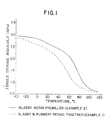
- Figure 1 illustrates the Tensile Storage Modulus v. Temperature for composition of the present invention, as compared to a composition outside the scope of the invention.
- Figure 2 illustrates the Tensile Loss Modulus v. Temperature for composition of the present invention, as compared to a composition outside the scope of the invention.
- Figure 3 illustrates Tensile Storage Modulus v. Temperature for compositions of the present invention, using different solvents.
- Figure 4 illustrates Tensile Loss Modulus v. Temperature for compositions of the present invention using different solvents.
- Figure 5 is a schematic illustration of the compositions of the present invention.
- compositions of the present invention comprise an inorganic filler and a binder component.
- the relative amounts of the inorganic filler and binder component are about 35 to about 60% by volume, and preferably, about 40% to about 50% by volume of inorganic filler, and correspondingly about 65 to about 40% by volume, and preferably, about 50% to about 40% by volume of the binder component. These amounts are based upon the total volume of the filler and binder component in the composition.
- Typical fillers employed when the compositions are to be used for fabricating magnetic recording media are ferromagnetic particles, including iron metal, iron oxide, cobalt-modified iron oxide, and magnetic ferrites, such as barium ferrite, and mixtures thereof.
- the filler can include minor amounts, such as up to about 10% by weight, and more typically, when present, about 2 to about 5% of non magnetic particles, such as alumina, zirconia, silica and carbon.
- the fillers are preferably high surface area particles, such as those having a surface area of at least about 40 m 2 /gm and preferably about 40 m 2 /gm to about 50 m 2 /gm. Certain of the fillers, such as carbon and silica, can have extremely large surface areas, such as up to about 1000 m 2 /gm.
- the inorganic fillers employed pursuant to the present invention contain adsorption sites, typically unhydrated oxide sites and/or hydrated oxide sites, with which the glassy polymer interacts.
- the binder component employed includes a glassy polymer and a rubbery polymer.
- the relative amounts of the glassy polymer and rubbery polymer are 50% to 80%, and preferably about 50% about 60% by weight of the glassy polymer, and correspondingly, to 20% to 50% by weight, and preferably about 40% to about 50% by weight of the rubbery polymer. These amounts are based upon the weight of glassy polymer and rubbery polymer in the binder component.
- the glassy polymer employed pursuant to the present invention must have a glass transition temperature of at least 60°C, and preferably at least about 80°C, and most preferably about 80°C to about 100°C.
- the glass transition temperature referred to herein refers to the primary or predominant glass transition temperature.
- the glassy polymer must contain polar groups that are capable of interacting with adsorption sites on the filler.
- the glassy polymers contain at least about 10 mole % of polar groups in the polymer backbone.
- the glassy polymers contain no more than about 60 mole % polar groups in the polymer backbone.
- the glassy polymers can also include pendant or side chain functionality of less than about 2 mole %.
- suitable polar groups are ester groups, nitrile groups, amino groups, carboxylate groups (e.g., COOH), sulfonate groups and phosphate groups.
- the sulfonate and phosphate groups include both the acid, as well as the alkali metal and C 1-4 hydrocarbon derivatives thereof.
- suitable glassy polymers are polymers of ethylenically unsaturated monomers or acetylenically unsaturated monomers, such as polymers from vinylacetate; vinylchloride; acrylic acid; methacrylic acid; acrylates including alkyl acrylates, such as ethyl acrylate, methyl acrylate, and butyl acrylate; glycidyl acrylate; and hydroxyalkyl acrylates, such as hydroxyethyl acrylate and hydroxypropyl acrylate; methacrylates including alkyl methacrylates, such as methyl methacrylate; ethyl methacylate and butyl methacrylate; glycidyl methacrylate; and hydroxyalkyl methacrylates such as hydroxyethyl methacrylate, and hydroxymethyl methacrylate; allyl alcohol, olefins such as ethylene, propylene and butylene; styrene; acrylonit
- epoxy acrylate or methacrylate reaction products e.g., reaction products of monoethylenically unsaturated carboxylic acid and bisphenol A-diglycidyl ether epoxide; urethane acrylate reaction products; polycarbonates; phenoxy polymers, phenolics such as phenol - formaldehyde polymers; and cellulosic polymers, such as cellulose acetate and cellulose nitrate.
- the glassy polymer can be a polyether polyurethane, a polyester polyurethane, or a polycarbonate polyurethane.
- the polar groups are predominantly carbonate groups and ester groups.
- Typical polyurethanes suitable as the glassy polymer are the same as those disclosed hereinbelow for the rubbery polymer. expect that the amount of hard segment is such that the glass transition temperature is at least 60°C, and typically, contains about 50% to about 65% of hard segment.
- the glassy polymers employed pursuant to the present invention have a molecular weight (Mw) of less than 60,000 and a Mn greater than 5000.
- Mw molecular weight
- the polymers employed are preferably free of chlorine or chloride groups that can possibly result in dehydrahalogenatum and subsequent corrosion. Therefore, in such case, it is preferred not to use vinyl chloride polymers.
- the glassy polymer can be curable, such as chemically, with an isocyanate, epoxy and/or with radiation (e.g., electron, beam or actinic light).
- the amount of crosslinking sites should be no more than 10% mole, preferably no more than 5% mole, and most preferably, up to about 2% mole of the glassy polymer. It has been found that larger amounts of crosslinking sites increase stress on the filler to an undesired extent and thereby tending to separate from the filler surface.
- the rubbery polymer employed pursuant to the present invention must also contain polar groups and be compatible with the glassy polymer.
- Typical polar groups on the rubber polymer are carbamate groups, ester groups, hydroxyl groups and carboxylate groups, and preferably carbamate.
- the rubbery polymer can be a polyether urethane, a polyester urethane, or polycarbonate urethane, and preferably, has a molecular weight (Mw) of less than about 50,000 and a Mn of greater than about 5000.
- Mw molecular weight
- the rubbery polymer typically has about 2 to about 20 mole % polar groups in the polymer backbone chain. Also, the rubbery polymer can have pendant or side chain functionality of less than 2 mole %.
- the rubbery polymer has a glass transition temperature of about 50°C or less, more typically, about -40°C to about 50°C, and preferably, about 0°C to about 50°C.
- the rubbery polymer can include crosslinking sites in an amount of up to about 10 mole %; preferably up to about 5 mole % and, and more preferably, up to about 2 mole %.
- the polyurethanes are hydrolytically stable and contain a hard segment a id soft segment, as described in U.S. Patents 4,525,424 and 4,568,611, disclosures of which are incorporated herein by reference. However, the polyurethane contains about 20 to 40% of the hard segment arid the molecular weight of the soft segment is about 800 to about 4000.
- Typical thermoplastic polyurethanes are reaction products of:
- Exemplary hydroxy-terminated polyesters are reaction products of a hydroxyticallly stable difunctional alcohol and a dicarboxylic acid.
- Typical difunctional alcohols are 1,4-cyclohexane-dimethanol, ⁇ -caprolactane,and 2,3 dimethyl 1,3 propane diol.
- Typical dicarboxylic acids are adipic, azelaic, 1,12-dodecanediodic acid, hexanedioic acid, nonanedioic acid and octanedioic acid.
- the composition can include auxiliary components such as lubricants, dispersants and other minor additives.
- the glassy polymer interact with adsorption sites on the surface of the inorganic filler, so that such is in contact with and encapsulates the inorganic filler.
- the glassy polymer defined above, the inorganic filler and an organic diluent that contains a volatile polar organic solvent is provided in a premix.
- the volatile polar solvent typically has a boiling point of less than 90°C, and is capable of dispersing the inorganic filler and glassy polymer.
- Typical volatile polar solvents include acetone, methyl ethyl ketone, and preferably tetrahydrofuran.
- the organic diluent can also contain a secondary higher boiling diluent that is a non solvent for the glassy polymer.
- the organic diluent should not contain more than 20% by weight of the higher boiling secondary diluent.
- Such higher boiling diluent has a boiling point greater than 90°C, and includes higher boiling ketones, such as methylisobutyl ketone, acetates such as amyl acetate and ethyl acetate, hydrocarbons, including octane, isooctane and decane, and aromatic solvents such as xylene and toluene.
- the secondary diluent is a non solvent for the glassy polymer, but can be a partial solvent for the rubbery polymer.
- the lower volatile polar solvent is a better solvent for the glassy polymer than is the secondary diluent.
- curable sites are present on the glassy polymer and/or rubbery polymer, such sites should preferentially phase separate onto the secondary diluent, such that subsequent cross-linking occurs between the glassy region and rubbery region.
- the premix typically contains about 20 to about 50% by weight of the inorganic filler, and about 2 to about 20% by weight of the glassy polymer in the premix, with the remainder being the organic diluent, and if desired, the auxiliary ingredients, if employed.
- the premix is agitated so as not to cause destruction of the inorganic filler therein.
- the rubbery polymer and premix are combined.
- the secondary diluent is included to provide a diluent blend that contains about 70 to about 90% by weight of the volatile polar solvent, and correspondingly about 10 to about 30% by weight of the secondary diluent.
- the glassy polymer Upon coating the composition onto a substrate, and upon evaporation of the more volatile solvent, the glassy polymer is caused to adsorb onto the inorganic filler and interact with adsorption sites on the inorganic filler to thereby encapsulate the filler.
- the rubbery polymer is soluble or at least swellable in the higher boiling secondary diluent, such can absorb stresses of the drying without disruption of the particle/glassy resin interface.
- a tough, cohesive, high modulus coating is provided.
- the glassy resin is fabricated into a cohesive, flexible coating, by linking the filler encapsulated hard phases with a rubbery phased component to form a reinforced-rubber type mechanical response.
- the rubbery polymer becomes intertwined with the glassy resin. Also, depending upon the chemical nature of the glassy resin and rubbery polymer, there may be some crosslinking between them.
- Figure 5 schematically illustrates the configuration of the filled compensation pursuant to the present invention.
- a typical substrate when providing a flexible magnetic recording media is a flexible substrate, such as polyethylene terephthalate to form magnetic recording tape.
- Fig. 1 and Fig. 2 show a comparison between two compositions (Example 1 comparative and Example 2) having the same ingredients and amounts of glassy polymers and rubbery polymers, but prepared in different ways.
- the composition of Example 2 has been prepared according to the procedure of forming a premix of the glassy polymer and inorganic filler described in the preferred embodiment of the present invention. Therefore the two examples have different final composition configurations.
- the glassy polymer employed in both examples 1 and 2 is VCAR VROH and the rubbery polymer is Estane 5706.
- the results of Tensile Storage Modulus v. Temperature are shown in Figures 1 and 2, respectively, and clearly illustrate the significantly improved results achieved by the present invention.
- the glass transition temperatures achieved by the present invention are significantly higher than those obtained outside the scope of this invention.
- the mechanical response achieved by the present invention is more representative of a rubber reinforced polymer composition.
- Example 3 relates to compositions according to the present invention employing either methyl isobutyl ketone or toluene with the results of Tensile Storage Modulus v. Temperature; and Tensile Loss Modulus v. Temperature shown in Figures 3 and 4, respectively.
- the glassy resin employed was VCAR VROH and the rubber polymer employed was Estane 5706.
- composition according to the present invention is obtained by using alumina as filler, VAGH as glassy resin and Estane 5706 as rubber polymer.
Landscapes
- Chemical & Material Sciences (AREA)
- Chemical Kinetics & Catalysis (AREA)
- Organic Chemistry (AREA)
- Health & Medical Sciences (AREA)
- Medicinal Chemistry (AREA)
- Polymers & Plastics (AREA)
- Engineering & Computer Science (AREA)
- Ceramic Engineering (AREA)
- Materials Engineering (AREA)
- Structural Engineering (AREA)
- Compositions Of Macromolecular Compounds (AREA)
- Paints Or Removers (AREA)
- Magnetic Record Carriers (AREA)
- Manufacturing Of Magnetic Record Carriers (AREA)
Claims (12)
- Ein flexibler magnetischer Aufzeichnungsträger, der ein flexibles Substrat enthält, das mit einer aus folgenden Komponenten bestehenden Mischung beschichtet ist:a) einem anorganischen Füllstoff mit Adsorptionsstellen, die aus der Gruppe, die aus unhydrierten Oxidstellen, hydrierten Oxidstellen und einer Mischung daraus besteht, ausgewählt sind; undb) einer Bindemittelkomponente, wobei diese folgende Bestandteile enthält:1) ein glasartiges Polymer mit einer Glasumwandlungstemperatur von mindestens 60°C, einem Molekulargewicht Mw von weniger als 60.000, einem Mn über 5000 und polaren Gruppen, die mit den Adsorptionsstellen auf der Oberfläche des Füllstoffes wechselwirken können; und2) ein gummiartiges Polymer mit polaren Gruppen, das sich mit dem glasartigen Polymer verträgt, und in dem die relativen Anteile von B)1) und B)2) zwischen 50 und 80 Gewichtsprozent von B)1) und entsprechend 20 bis 50 Gewichtsprozent von B)2) bezogen auf die Gesamtmenge von B)1) und B)2) in der Zusammensetzung ausmachen; und in dem das glasartige Polymer und das gummiartige Polymer chlorfrei sind;und wobei die relativen Anteile von A) und B) 35 bis 60 Volumenprozent von A) und entsprechend 65 bis 40 Volumenprozent von B) bezogen auf die Gesamtmenge von A) und B) in der Zusammensetzung betragen;und wobei der anorganische Füllstoff ferromagnetische Pigmente enthält;und gewonnen werden kann, indem eine Vormischung aus dem anorganischen Füllstoff, dem glasartigen Polymer und einem organischen Verdünner hergestellt wird, die ein flüchtiges polares organisches Lösungsmittel [d.h. ein Lösungsmittel mit einem Siedepunkt unter 90°C] enthält, und 2 bis 20 Gewichtsprozent des glasartigen Polymers und 20 bis 50 Gewichtsprozent des Füllstoffes enthält; und indem die Vormischung und das gummiartige Polymer zusammengemischt werden; und indem in die Mischung ein sekundäres Verdünnungsmittel mit hohem Siedepunkt [über 90°C] in einer solchen Menge gegeben wird, daß eine Verdünnungsmittelmischung aus 70 bis 90 Gewichtsprozent flüchtigem polarem organischem Lösungsmittel und dementsprechend 10 bis 30 Gewichtsprozent sekundärem Verdünnungsmittel vorhanden ist; und wobei das sekundäre Verdünnungsmittel mit hohem Siedepunkt kein Lösungsmittel für das glasartige Polymer ist; so daß das glasartige Polymer veranlaßt wird, auf den anorganischen Füllstoff zu adsorbieren und mit Adsorptionsstellen auf dem Füllstoff wechselzuwirken, um dadurch den Füllstoff einzukapseln und das gummiartige Polymer in der Matrix aus dem glasartigen Polymer zu verschlingen.
- Ein flexibler magnetischer Aufzeichnungsträger gemäß Anspruch 1, bei dem der anorganische Füllstoff eine Oberfläche von mindestens 40 m2/gm besitzt.
- Ein flexibler magnetischer Aufzeichnungsträger gemäß Anspruch 1 oder 2, bei dem der Füllstoff Eisen, Eisenoxid, magnetisches Ferrit, durch Kobalt modifiziertes Eisenoxid oder eine Mischung aus diesen Stoffen enthält.
- Ein flexibler magnetischer Aufzeichnungsträger gemäß Anspruch 1 bis 3, bei dem die relativen Anteile von A) und B) 40 bis 50 Volumenprozent von A) und dementsprechend 50 bis 40 Volumenprozent von B) bezogen auf das Gesamtvolumen von A) und B) in der Zusammensetzung betragen.
- Ein flexibler magnetischer Aufzeichnungsträger gemäß Anspruch 1 bis 4, bei dem die Glasumwandlungstemperatur des glasartigen Polymers mindestens 80°C beträgt.
- Ein flexibler magnetischer Aufzeichnungsträger gemäß Anspruch 1 bis 5, bei dem die Glasumwandlungstemperatur des glasartigen Polymers zwischen 80°C und 100°C liegt.
- Ein flexibler magnetischer Aufzeichnungsträger gemäß Anspruch 1 bis 6, bei dem das glasartige Polymer mindestens 10 Molekularprozent der polaren Gruppen in der Polymerhauptkette enthält.
- Ein flexibler magnetischer Aufzeichnungsträger gemäß Anspruch 1 bis 7, bei dem das glasartige Polymer bis zu 60% polare Gruppen in der Polymerhauptkette enthält.
- Ein flexibler magnetischer Aufzeichnungsträger gemäß Anspruch 7, bei dem das glasartige Polymer eine Pendant-Seitenkettenfunktionalität von weniger als 2 Molekularprozent enthält.
- Ein flexibler magnetischer Aufzeichnungsträger gemäß Anspruch 7, bei dem das glasartige Polymer bis zu 10 Gewichtsprozent Querverbindungsstellen besitzt.
- Ein flexibler magnetischer Aufzeichnungsträger gemäß Anspruch 1 bis 10, bei dem das gummiartige Polymer 2 bis 20 Molekularprozent polare Gruppen in der Polymerhauptkette, ein Molekulargewicht Mw von weniger als 50.000 und ein Mn über 5000 besitzt.
- Ein flexibler magnetischer Aufzeichnungsträger gemäß Anspruch 1 bis 11, bei dem das gummiartige Polymer aus Polyurethan besteht.
Applications Claiming Priority (2)
| Application Number | Priority Date | Filing Date | Title |
|---|---|---|---|
| US76896 | 1993-06-15 | ||
| US08/076,896 US5446085A (en) | 1993-06-15 | 1993-06-15 | Polymeric compositions containing inorganic fillers and use thereof |
Publications (3)
| Publication Number | Publication Date |
|---|---|
| EP0630925A2 EP0630925A2 (de) | 1994-12-28 |
| EP0630925A3 EP0630925A3 (de) | 1995-03-29 |
| EP0630925B1 true EP0630925B1 (de) | 1998-07-29 |
Family
ID=22134833
Family Applications (1)
| Application Number | Title | Priority Date | Filing Date |
|---|---|---|---|
| EP19940107972 Expired - Lifetime EP0630925B1 (de) | 1993-06-15 | 1994-05-25 | Flexible magnetische Aufzeichnungstäger aus anorganinschen Füllstoffen enthaltenden Polymere-Zusammensetzungen |
Country Status (6)
| Country | Link |
|---|---|
| US (4) | US5446085A (de) |
| EP (1) | EP0630925B1 (de) |
| JP (1) | JP2634142B2 (de) |
| KR (1) | KR0162261B1 (de) |
| CN (1) | CN1152072C (de) |
| DE (1) | DE69412005T2 (de) |
Families Citing this family (23)
| Publication number | Priority date | Publication date | Assignee | Title |
|---|---|---|---|---|
| US6005041A (en) * | 1995-11-09 | 1999-12-21 | Cook; Arnold J. | Reinforced thermoplastic elastomeric gel (RTEG) |
| DE19612769A1 (de) * | 1996-03-29 | 1997-10-02 | Basf Ag | Als Trägermaterial für Festelektrolyten oder Separatoren für elektrochemische Zellen geeignete Gemische |
| US6066189A (en) * | 1998-12-17 | 2000-05-23 | Norton Company | Abrasive article bonded using a hybrid bond |
| JP4959901B2 (ja) * | 2000-05-27 | 2012-06-27 | ローム アンド ハース エレクトロニック マテリアルズ シーエムピー ホウルディングス インコーポレイテッド | 化学機械平坦化用溝付き研磨パッド |
| US6749485B1 (en) | 2000-05-27 | 2004-06-15 | Rodel Holdings, Inc. | Hydrolytically stable grooved polishing pads for chemical mechanical planarization |
| US6860802B1 (en) | 2000-05-27 | 2005-03-01 | Rohm And Haas Electric Materials Cmp Holdings, Inc. | Polishing pads for chemical mechanical planarization |
| US6736709B1 (en) | 2000-05-27 | 2004-05-18 | Rodel Holdings, Inc. | Grooved polishing pads for chemical mechanical planarization |
| US20040094250A1 (en) * | 2002-11-14 | 2004-05-20 | Estes-Cox Corporation | Composite propellant compositions |
| US7394618B2 (en) * | 2004-09-10 | 2008-07-01 | International Business Machines Corporation | System and method for cleaning a tape drive |
| US7632364B1 (en) * | 2004-11-10 | 2009-12-15 | Richard Jason Jouet | Energetic composite materials containing inorganic particle network, and articles of manufacture and methods regarding the same |
| EP1832632A1 (de) * | 2006-03-07 | 2007-09-12 | DSM IP Assets B.V. | Leitfähiger Farbstoff |
| JP5274647B2 (ja) * | 2008-04-18 | 2013-08-28 | サンーゴバン アブレイシブズ,インコーポレイティド | 高空隙率研摩材物品およびその製造方法 |
| US8465855B2 (en) * | 2008-07-16 | 2013-06-18 | International Business Machines Corporation | Protective coating of magnetic nanoparticles |
| KR101614012B1 (ko) * | 2008-09-05 | 2016-04-20 | 토요잉크Sc홀딩스주식회사 | 잉크 조성물 |
| US20100229682A1 (en) | 2009-03-10 | 2010-09-16 | Richard Chung | Cold cast mass element |
| US20100279105A1 (en) * | 2009-04-15 | 2010-11-04 | Arizona Board Of Regents On Behalf Of The University Of Arizona | Coated Magnetic Particles, Composite Magnetic Materials and Magnetic Tapes Using Them |
| US11158339B2 (en) * | 2019-08-20 | 2021-10-26 | International Business Machines Corporation | Magnetic recording layer formulation for tape media |
| US11158340B2 (en) * | 2019-08-20 | 2021-10-26 | International Business Machines Corporation | Underlayer formulation for tape media |
| US12014760B2 (en) | 2019-08-20 | 2024-06-18 | International Business Machines Corporation | Process for forming tape media having synergistic magnetic recording layer and underlayer |
| US11158337B2 (en) * | 2019-08-20 | 2021-10-26 | International Business Machines Corporation | Tape cartridge having tape media having synergistic magnetic recording layer and underlayer |
| US11410697B2 (en) | 2019-08-20 | 2022-08-09 | International Business Machines Corporation | Process for forming underlayer for tape media |
| US11152027B2 (en) * | 2019-08-20 | 2021-10-19 | International Business Machines Corporation | Tape media having synergistic magnetic recording layer and underlayer |
| US11790942B2 (en) | 2019-08-20 | 2023-10-17 | International Business Machines Corporation | Process for forming magnetic recording layer for tape media |
Citations (2)
| Publication number | Priority date | Publication date | Assignee | Title |
|---|---|---|---|---|
| US4861655A (en) * | 1986-09-08 | 1989-08-29 | Memorex Corporation | Thermoplastic magnetic coating composition |
| US5069807A (en) * | 1989-03-01 | 1991-12-03 | Minnesota Mining And Manufacturing Co. | Binder composition for use in magnetic recording media |
Family Cites Families (37)
| Publication number | Priority date | Publication date | Assignee | Title |
|---|---|---|---|---|
| US2448985A (en) * | 1943-08-07 | 1948-09-07 | Raybestos Manhattan Inc | Manufacture of abrasive products |
| US2650158A (en) * | 1950-08-03 | 1953-08-25 | Carborundum Co | Scouring implement |
| US2825638A (en) * | 1955-07-27 | 1958-03-04 | Us Rubber Co | Grinding wheel manufacture |
| US3098730A (en) * | 1959-07-22 | 1963-07-23 | Norton Co | Grinding wheels having unsaturated organic polymeric bonds and the like |
| SU715310A1 (ru) * | 1977-06-09 | 1980-02-15 | Всесоюзный Научно-Исследовательский И Проектно-Изыскательский Институт По Проблемам Добычи,Транспорта И Переработки Минерального Сырья В Промышленности Строительных Материалов | Масса дл изготовлени полировального инструмента |
| SU730759A1 (ru) * | 1977-09-14 | 1980-04-30 | Всесоюзный Научно-Исследовательский Институт Технологии Насосного Машиностроения | Абразивна масса дл изготовлени шлифовального инструмента |
| SU821471A1 (ru) * | 1978-08-25 | 1981-04-15 | Ленинградский Ордена Трудового Красногознамени Технологический Институт Им.Ленсовета | Полимерна пресс-композици |
| SU901041A1 (ru) * | 1979-04-25 | 1982-01-30 | Опытное Конструкторско-Технологическое Бюро "Кристалл" Ленинградского Ордена Октябрьской Революции И Ордена Трудового Красного Знамени Технологического Института Им.Ленсовета | Абразивна масса дл изготовлени шлифовального инструмента |
| SU821741A1 (ru) * | 1979-05-03 | 1981-04-15 | Ворошиловградский Машиностроительныйинститут | Клапанный узел объемного насоса |
| JPS59186121A (ja) * | 1983-04-07 | 1984-10-22 | Fuji Photo Film Co Ltd | 磁気記録媒体 |
| JPS60119633A (ja) * | 1983-12-01 | 1985-06-27 | Ricoh Co Ltd | 磁気記録媒体 |
| JPS60119632A (ja) * | 1983-12-01 | 1985-06-27 | Ricoh Co Ltd | 磁気記録媒体 |
| US4525424A (en) * | 1983-12-30 | 1985-06-25 | International Business Machines Corporation | Flexible magnetic recording media having a polyester-polyurethane binder and chromium dioxide pigment |
| JPS6116016A (ja) * | 1984-07-02 | 1986-01-24 | Tdk Corp | 磁気記録媒体 |
| US4568611A (en) * | 1985-04-03 | 1986-02-04 | Morton Thiokol, Inc. | Polyester-polyurethane composition and use thereof |
| JPS62103845A (ja) * | 1985-07-12 | 1987-05-14 | Fuji Photo Film Co Ltd | 磁気記録媒体 |
| JPS62146432A (ja) * | 1985-12-20 | 1987-06-30 | Fuji Photo Film Co Ltd | 磁気記録媒体 |
| JPS62146433A (ja) * | 1985-12-20 | 1987-06-30 | Fuji Photo Film Co Ltd | 磁気記録媒体 |
| US5034271A (en) * | 1986-02-28 | 1991-07-23 | Fuji Photo Film Co., Ltd. | Magnetic recording medium |
| JPS62227745A (ja) * | 1986-03-31 | 1987-10-06 | ダイアホイルヘキスト株式会社 | 磁気記録媒体 |
| DE3626777A1 (de) * | 1986-08-07 | 1988-02-11 | Basf Ag | Verstaerkte thermoplastische formmassen mit heller einfaerbung |
| JPS645220A (en) * | 1987-06-29 | 1989-01-10 | Matsushita Electric Industrial Co Ltd | Surface acoustic wave device |
| US4970121A (en) * | 1987-08-06 | 1990-11-13 | Fuji Photo Film Co., Ltd. | Magnetic recording medium |
| EP0306903B1 (de) * | 1987-09-11 | 1994-12-07 | E.I. Du Pont De Nemours And Company | Schlagfeste, füllstoffhaltige Verbundstoffe aus Polymeren und elastomeren Fasern |
| JPH0298811A (ja) * | 1988-10-05 | 1990-04-11 | Fuji Photo Film Co Ltd | 磁気記録媒体 |
| JPH02105322A (ja) * | 1988-10-14 | 1990-04-17 | Fuji Photo Film Co Ltd | 磁気記録媒体 |
| US5035856A (en) * | 1989-02-08 | 1991-07-30 | Konica Corporation | Magnetic recording medium |
| US5085941A (en) * | 1989-03-01 | 1992-02-04 | Minnesota Mining And Manufacturing Company | Magnetic recording medium with hydroxy functional, sulfonated binder system |
| JPH02232814A (ja) * | 1989-03-07 | 1990-09-14 | Fuji Photo Film Co Ltd | 磁気記録媒体 |
| JP2654195B2 (ja) * | 1989-08-22 | 1997-09-17 | 富士写真フイルム株式会社 | 磁気記録媒体 |
| JP2850028B2 (ja) * | 1989-12-28 | 1999-01-27 | コニカ株式会社 | 磁気記録媒体 |
| JP2717586B2 (ja) * | 1989-12-28 | 1998-02-18 | コニカ株式会社 | 磁気記録媒体 |
| US5178953A (en) * | 1990-01-12 | 1993-01-12 | Ampex Media Corporation | Magnetic recording media having a binder comprising a low molecular weight high glass transition temperature vinyl polymer |
| JP2867636B2 (ja) * | 1990-06-27 | 1999-03-08 | ソニー株式会社 | 磁気記録媒体 |
| US5320914A (en) * | 1991-06-26 | 1994-06-14 | Nippon Zeon Co., Ltd. | Magnetic recording medium comprising a styrene copolymer or an acrylic copolymer |
| DE4222051C2 (de) * | 1992-02-20 | 1999-05-27 | Kiekert Ag | Kraftfahrzeugtürverschluß mit spannbarem Öffnungshebel |
| DE4222015A1 (de) * | 1992-07-04 | 1994-01-05 | Basf Magnetics Gmbh | Magnetischer Aufzeichnungsträger |
-
1993
- 1993-06-15 US US08/076,896 patent/US5446085A/en not_active Expired - Lifetime
-
1994
- 1994-04-20 JP JP8180494A patent/JP2634142B2/ja not_active Expired - Fee Related
- 1994-05-13 CN CNB941055035A patent/CN1152072C/zh not_active Expired - Fee Related
- 1994-05-13 KR KR1019940010629A patent/KR0162261B1/ko not_active Expired - Fee Related
- 1994-05-25 EP EP19940107972 patent/EP0630925B1/de not_active Expired - Lifetime
- 1994-05-25 DE DE69412005T patent/DE69412005T2/de not_active Expired - Lifetime
-
1995
- 1995-04-17 US US08/422,949 patent/US5534345A/en not_active Expired - Lifetime
- 1995-05-03 US US08/433,560 patent/US5594064A/en not_active Expired - Lifetime
- 1995-05-04 US US08/433,816 patent/US5622535A/en not_active Expired - Fee Related
Patent Citations (2)
| Publication number | Priority date | Publication date | Assignee | Title |
|---|---|---|---|---|
| US4861655A (en) * | 1986-09-08 | 1989-08-29 | Memorex Corporation | Thermoplastic magnetic coating composition |
| US5069807A (en) * | 1989-03-01 | 1991-12-03 | Minnesota Mining And Manufacturing Co. | Binder composition for use in magnetic recording media |
Also Published As
| Publication number | Publication date |
|---|---|
| US5534345A (en) | 1996-07-09 |
| US5446085A (en) | 1995-08-29 |
| CN1104655A (zh) | 1995-07-05 |
| DE69412005D1 (de) | 1998-09-03 |
| KR0162261B1 (ko) | 1999-01-15 |
| US5594064A (en) | 1997-01-14 |
| US5622535A (en) | 1997-04-22 |
| JPH0718116A (ja) | 1995-01-20 |
| EP0630925A2 (de) | 1994-12-28 |
| CN1152072C (zh) | 2004-06-02 |
| JP2634142B2 (ja) | 1997-07-23 |
| KR950000771A (ko) | 1995-01-03 |
| EP0630925A3 (de) | 1995-03-29 |
| DE69412005T2 (de) | 1999-03-25 |
Similar Documents
| Publication | Publication Date | Title |
|---|---|---|
| EP0630925B1 (de) | Flexible magnetische Aufzeichnungstäger aus anorganinschen Füllstoffen enthaltenden Polymere-Zusammensetzungen | |
| GB2164268A (en) | Improved magnetic recording media | |
| US4122234A (en) | Article employing a heat hardenable liquid film forming composition with particles dispersed therein and method for making same | |
| EP0385646B1 (de) | Zusammensetzung des Bindemittels bei magnetischen Aufzeichnungsträgern | |
| US4621027A (en) | Magnetic recording medium | |
| JPH03219417A (ja) | 磁気記録媒体 | |
| JPS61104325A (ja) | 磁気記録媒体 | |
| JPS61107533A (ja) | 磁気記録媒体 | |
| JPH0533455B2 (de) | ||
| JP2646206B2 (ja) | 磁気記録媒体 | |
| JPH0576095B2 (de) | ||
| JP2510904B2 (ja) | 磁気記録媒体 | |
| JPS62236134A (ja) | 磁気記録媒体 | |
| JPH063645B2 (ja) | 磁気記録媒体 | |
| JPS6346883B2 (de) | ||
| JPS619833A (ja) | 磁気記録媒体 | |
| JPH0576692B2 (de) | ||
| JPH0576700B2 (de) | ||
| JPS6314323A (ja) | 磁気記録媒体 | |
| JP2001056926A (ja) | 磁気記録媒体 | |
| JPH06111278A (ja) | 磁気記録媒体 | |
| JP2003123225A (ja) | 磁気記録媒体 | |
| JPH06111281A (ja) | 磁気記録媒体 | |
| JPS61156519A (ja) | 磁気記録媒体及びその製造方法 | |
| JPH0294021A (ja) | 磁気記録媒体 |
Legal Events
| Date | Code | Title | Description |
|---|---|---|---|
| PUAI | Public reference made under article 153(3) epc to a published international application that has entered the european phase |
Free format text: ORIGINAL CODE: 0009012 |
|
| AK | Designated contracting states |
Kind code of ref document: A2 Designated state(s): DE FR GB |
|
| PUAL | Search report despatched |
Free format text: ORIGINAL CODE: 0009013 |
|
| AK | Designated contracting states |
Kind code of ref document: A3 Designated state(s): DE FR GB |
|
| 17P | Request for examination filed |
Effective date: 19950425 |
|
| 17Q | First examination report despatched |
Effective date: 19960723 |
|
| GRAG | Despatch of communication of intention to grant |
Free format text: ORIGINAL CODE: EPIDOS AGRA |
|
| GRAG | Despatch of communication of intention to grant |
Free format text: ORIGINAL CODE: EPIDOS AGRA |
|
| GRAH | Despatch of communication of intention to grant a patent |
Free format text: ORIGINAL CODE: EPIDOS IGRA |
|
| GRAH | Despatch of communication of intention to grant a patent |
Free format text: ORIGINAL CODE: EPIDOS IGRA |
|
| GRAA | (expected) grant |
Free format text: ORIGINAL CODE: 0009210 |
|
| AK | Designated contracting states |
Kind code of ref document: B1 Designated state(s): DE FR GB |
|
| REF | Corresponds to: |
Ref document number: 69412005 Country of ref document: DE Date of ref document: 19980903 |
|
| ET | Fr: translation filed | ||
| PLBE | No opposition filed within time limit |
Free format text: ORIGINAL CODE: 0009261 |
|
| STAA | Information on the status of an ep patent application or granted ep patent |
Free format text: STATUS: NO OPPOSITION FILED WITHIN TIME LIMIT |
|
| 26N | No opposition filed | ||
| REG | Reference to a national code |
Ref country code: GB Ref legal event code: IF02 |
|
| REG | Reference to a national code |
Ref country code: GB Ref legal event code: 746 Effective date: 20090417 |
|
| PGFP | Annual fee paid to national office [announced via postgrant information from national office to epo] |
Ref country code: FR Payment date: 20110523 Year of fee payment: 18 |
|
| REG | Reference to a national code |
Ref country code: FR Ref legal event code: ST Effective date: 20130131 |
|
| PG25 | Lapsed in a contracting state [announced via postgrant information from national office to epo] |
Ref country code: FR Free format text: LAPSE BECAUSE OF NON-PAYMENT OF DUE FEES Effective date: 20120531 |
|
| PGFP | Annual fee paid to national office [announced via postgrant information from national office to epo] |
Ref country code: DE Payment date: 20130524 Year of fee payment: 20 Ref country code: GB Payment date: 20130510 Year of fee payment: 20 |
|
| REG | Reference to a national code |
Ref country code: DE Ref legal event code: R071 Ref document number: 69412005 Country of ref document: DE |
|
| REG | Reference to a national code |
Ref country code: GB Ref legal event code: PE20 Expiry date: 20140524 |
|
| PG25 | Lapsed in a contracting state [announced via postgrant information from national office to epo] |
Ref country code: GB Free format text: LAPSE BECAUSE OF EXPIRATION OF PROTECTION Effective date: 20140524 |
|
| PG25 | Lapsed in a contracting state [announced via postgrant information from national office to epo] |
Ref country code: DE Free format text: LAPSE BECAUSE OF EXPIRATION OF PROTECTION Effective date: 20140527 |