EP0704765B1 - Photoresistzusammensetzung enthaltend eine polyfunktionelle Vinyletherverbindung - Google Patents
Photoresistzusammensetzung enthaltend eine polyfunktionelle Vinyletherverbindung Download PDFInfo
- Publication number
- EP0704765B1 EP0704765B1 EP95114259A EP95114259A EP0704765B1 EP 0704765 B1 EP0704765 B1 EP 0704765B1 EP 95114259 A EP95114259 A EP 95114259A EP 95114259 A EP95114259 A EP 95114259A EP 0704765 B1 EP0704765 B1 EP 0704765B1
- Authority
- EP
- European Patent Office
- Prior art keywords
- group
- compound
- formula
- photoresist composition
- triazine
- Prior art date
- Legal status (The legal status is an assumption and is not a legal conclusion. Google has not performed a legal analysis and makes no representation as to the accuracy of the status listed.)
- Expired - Lifetime
Links
Classifications
-
- G—PHYSICS
- G03—PHOTOGRAPHY; CINEMATOGRAPHY; ANALOGOUS TECHNIQUES USING WAVES OTHER THAN OPTICAL WAVES; ELECTROGRAPHY; HOLOGRAPHY
- G03F—PHOTOMECHANICAL PRODUCTION OF TEXTURED OR PATTERNED SURFACES, e.g. FOR PRINTING, FOR PROCESSING OF SEMICONDUCTOR DEVICES; MATERIALS THEREFOR; ORIGINALS THEREFOR; APPARATUS SPECIALLY ADAPTED THEREFOR
- G03F1/00—Originals for photomechanical production of textured or patterned surfaces, e.g., masks, photo-masks, reticles; Mask blanks or pellicles therefor; Containers specially adapted therefor; Preparation thereof
- G03F1/68—Preparation processes not covered by groups G03F1/20 - G03F1/50
- G03F1/72—Repair or correction of mask defects
- G03F1/74—Repair or correction of mask defects by charged particle beam [CPB], e.g. focused ion beam
-
- G—PHYSICS
- G03—PHOTOGRAPHY; CINEMATOGRAPHY; ANALOGOUS TECHNIQUES USING WAVES OTHER THAN OPTICAL WAVES; ELECTROGRAPHY; HOLOGRAPHY
- G03F—PHOTOMECHANICAL PRODUCTION OF TEXTURED OR PATTERNED SURFACES, e.g. FOR PRINTING, FOR PROCESSING OF SEMICONDUCTOR DEVICES; MATERIALS THEREFOR; ORIGINALS THEREFOR; APPARATUS SPECIALLY ADAPTED THEREFOR
- G03F7/00—Photomechanical, e.g. photolithographic, production of textured or patterned surfaces, e.g. printing surfaces; Materials therefor, e.g. comprising photoresists; Apparatus specially adapted therefor
- G03F7/004—Photosensitive materials
- G03F7/027—Non-macromolecular photopolymerisable compounds having carbon-to-carbon double bonds, e.g. ethylenic compounds
-
- Y—GENERAL TAGGING OF NEW TECHNOLOGICAL DEVELOPMENTS; GENERAL TAGGING OF CROSS-SECTIONAL TECHNOLOGIES SPANNING OVER SEVERAL SECTIONS OF THE IPC; TECHNICAL SUBJECTS COVERED BY FORMER USPC CROSS-REFERENCE ART COLLECTIONS [XRACs] AND DIGESTS
- Y10—TECHNICAL SUBJECTS COVERED BY FORMER USPC
- Y10S—TECHNICAL SUBJECTS COVERED BY FORMER USPC CROSS-REFERENCE ART COLLECTIONS [XRACs] AND DIGESTS
- Y10S430/00—Radiation imagery chemistry: process, composition, or product thereof
- Y10S430/1053—Imaging affecting physical property or radiation sensitive material, or producing nonplanar or printing surface - process, composition, or product: radiation sensitive composition or product or process of making binder containing
- Y10S430/1055—Radiation sensitive composition or product or process of making
- Y10S430/114—Initiator containing
- Y10S430/12—Nitrogen compound containing
- Y10S430/121—Nitrogen in heterocyclic ring
-
- Y—GENERAL TAGGING OF NEW TECHNOLOGICAL DEVELOPMENTS; GENERAL TAGGING OF CROSS-SECTIONAL TECHNOLOGIES SPANNING OVER SEVERAL SECTIONS OF THE IPC; TECHNICAL SUBJECTS COVERED BY FORMER USPC CROSS-REFERENCE ART COLLECTIONS [XRACs] AND DIGESTS
- Y10—TECHNICAL SUBJECTS COVERED BY FORMER USPC
- Y10S—TECHNICAL SUBJECTS COVERED BY FORMER USPC CROSS-REFERENCE ART COLLECTIONS [XRACs] AND DIGESTS
- Y10S430/00—Radiation imagery chemistry: process, composition, or product thereof
- Y10S430/1053—Imaging affecting physical property or radiation sensitive material, or producing nonplanar or printing surface - process, composition, or product: radiation sensitive composition or product or process of making binder containing
- Y10S430/1055—Radiation sensitive composition or product or process of making
- Y10S430/114—Initiator containing
- Y10S430/122—Sulfur compound containing
Definitions
- the present invention relates to a photoresist composition usable e.g. for photolithography or a color filter comprising a dispersed pigment.
- acrylate resins such as a polyfunctional epoxy acrylate and a polyfunctional acrylate, and an epoxy resin are known.
- a resin composition used for a positive working photoresist for example, a composition comprising a novolac resin and a quinone diazide compound has been known and widely used.
- a negative working photoresist containing a photopolymerizable monomer having a vinyloxyalkyl group those described e.g. in JP-A-60-7165, JP-A-63-71840 or JP-A-64-88538 are known. All of the photopolymerizable monomers having a vinyloxyalkyl group described in those documents are vinyloxyalkylated novolacs produced by a condensation reaction of a monohydric phenol such as cresol with an aldehyde such as formalin, and are different from the photopolymerizable monomer used in the present invention described hereinafter.
- the conventional negative working photoresist comprising an acrylate resin as a photopolymerizable monomer has a problem in that the occurrence of polymerization inhibition in the presence of oxygen is inevitable, and, as a result, the hardenability of the surface of hardening film is very insufficient. Therefore, the hardening of photoresist needs to be carefully handled, for example the environment of the photoresist to be hardened needs to be purged with nitrogen gas or the surface of photoresist to be hardened needs to be overcoated with an oxygen intercepting layer.
- a negative working photoresist which utilizes a photo ring-opening polymerization of an epoxy resin as the hardening reaction does not suffer from polymerization inhibition in the presence of oxygen. However, its hardening rate is much slower than that of the negative working photoresist comprising an acrylate resin. Therefor, neither of the negative working photoresist mentioned above are sufficient in properties required as a photoresist.
- the resin compositions of the photoresists have been usually different. Accordingly, when the photoresist characteristic needs to be changed in one production line from a positive working to a negative working photoresist, or vice versa, because the resin composition used in the photoresists also needs to be changed, it is required to largely change the hardening conditions in the production line such as coating conditions of the photoresist to a substrate, prebake or post exposure bake conditions and conditions of post hardening after the development, and/or the developing conditions.
- Another object of the present invention is to provide a photoresist composition which can be used not only as a positive working photoresist but also as a negative working photoresist wherein the change of the characteristics can be attained only by changing the kind or amount of a triazine compound, an ingredient of the photoresist composition, or by changing the exposure amount; and which has sufficient sensitivity and resolution not only as a negative working photoresist but also as a positive working photoresist.
- N-1 a negative working photoresist composition which comprises;
- N-2 Another subject matter of the present invention is a negative working photoresist composition (N-2) which comprises;
- a further subject matter of the present invention is a photoresist composition(NP) which comprises;
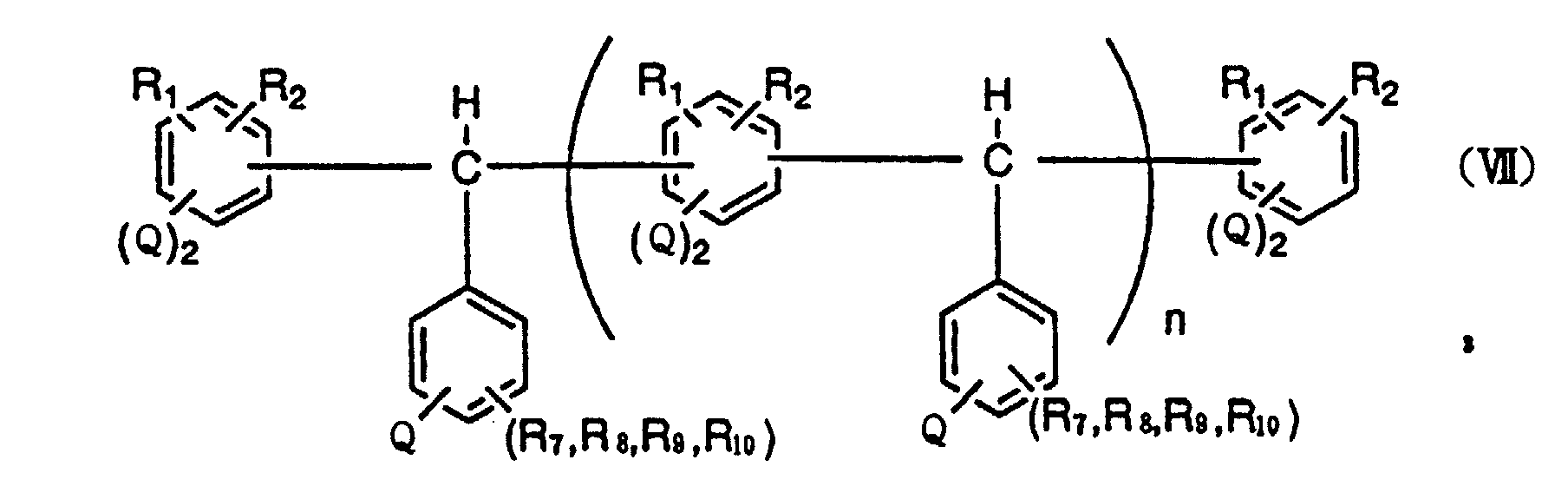
- Examples of the atoms or groups denoted by R 1 , R 2 or R 6 in formula (I), (V), (VI), etc., and examples of the atoms or groups denoted by R 7 , R 8 , R 9 or R 10 in formula (VII ) include a hydrogen atom; a halogen atom such as fluorine, chlorine and bromine; an alkyl group such as methyl, ethyl, propyl and butyl; an aryl group such as phenyl, tolyl and naphthyl; an aralkyl group such as benzyl, phenethyl and benzhydryl; an alkoxy group such as methoxy, ethoxy and propoxy; an aryloxy group such as phenoxy, naphthoxy and anthroxy and a cycloalkyl group such as cyclopentyl and cyclohexyl.
- a halogen atom such as fluorine, chlorine and bromine
- the groups denoted by Q may be different from each other even among those attached to same benzene ring in a molecule.
- Examples of the group denoted by A in formula (I) include alkylene groups having 1-30 carbon atoms such as methylene, ethylene, butylene, ethylmethylene and 2-ethylpentylmethylene; cycloalkylene such as cyclohexylene, cyclooctylene and cyclopentylene; arylene groups such as 1,3-benzene dimethylene, phenylmethylene, 1,4-benzene dimethylene, 2,2-bis-(4-phenylene)propane, 4-methoxyphenylmethylene, bis-(4-phenylene)methane and 4,4-diphenylene dimethylethane; and divalent hydrocarbon groups having 1-30 carbon atoms and having a cyclic terpene skeleton such as limonene, dipentene, terpinolene and pinene.
- alkylene groups having 1-30 carbon atoms such as methylene, ethylene, butylene, ethyl
- Number n in formula (I) and (VII) is from 0 to 20, preferably from 0 to 10. If n exceeds 20, the solubility of (1) the compound in (3) a solvent is undesirablly lowered.
- a compound (S 1 ) represented by the following general formula (VIII): wherein n, R 1 , R 2 and A are as defined above to contact and react with a haloalkyl vinyl ether compound (T) represented by formula of XROCH CH 2 wherein R is as defined above and X represents a halogen atom.
- a compound (S 2 ) which is represented by the formula (VIII) except that from 0.1 to 60 % by mole of each of groups represented by the following formulae (IX) or (X): wherein R 1 and R 2 are as defined above are replaced with each of groups represented by the following formulae (XI) or (XII
- the compound (S 1 ) is a known compound and can be produced through reaction of a dihydric phenol with an aldehyde, ketone or diene compound.
- the compound (S 2 ) is also a known compound and can be produced through reaction of a dihydric phenol and monohydric phenol with an aldehyde, ketone or diene compound.
- the compound (S 3 ) can be produced through reaction of a dihydric phenol with an hydroxy benzaldehyde compound.
- Examples of the dihydric phenol used for producing compound (S 1 ), (S 2 ) or (S 3 ) include resorcin, 2-methylresorcin, 5-methylresorcin, catechol, 3-methylcatechol, hydroquinone and methylhydroquinone.
- Examples of the monohydric phenol used for producing compound (S 2 ) include phenol, o-cresol, m-cresol, p-cresol, 2,6-xylenol and p-t-octylphenol.
- Examples of the aldehyde used for producing compound (S 1 ) or (S 2 ) include formaldehyde, acetoaldehyde, n-butylaldehyde and benzaldehyde.
- Examples of the ketone used for producing compound (S 1 ) or (S 2 ) include cyclohexanone and cyclooctanone.
- Examples of the diene used for producing compound (S 1 ) or (S 2 ) include dicyclopentadiene.
- Examples of the hydroxy benzaldehyde compound used for producing compound (S 3 ) include 2-hydroxy benzaldehyde, 3-hydroxy benzaldehyde, 4-hydroxy benzaldehyde and 4-hydroxy-3-methyl-benzaldehyde.
- haloalkyl vinylether compound (T) used for producing photopolymerizable compound (I), (I -2) or (VII) 2-chloroethyl vinylether is usually used.
- a proper condensing agent for example a base
- a base can be added in order to accelerate the reaction rate.
- the base include anhydrous sodium carbonate; sodium hydride; potassium carbonate; metallic sodium; an alkali metal alcoholate such as sodium methylate; a quaternary ammonium salt such as triethylbenzyl ammonium chloride, tetraethyl ammonium chloride and tributylbenzyl ammonium chloride; sodium hydroxyde; and potassium hydroxyde.
- the base needs to be added in an amount of from 0.1 to 10.0 moles, preferably from 0.3 to 2.0 moles per 1 equivalent of -OH group of the compound (S 1 ), (S 2 ) or (S 3 ), in order to obtain high reaction accelerating effect.
- reaction of the compound (S 1 ), (S 2 ) or (S 3 ) with the haloalkyl vinylether compound (T) can be conducted in an inert solvent such as ethyl cellosolve, dimethylsulfoxide, ethyleneglycol monomethylether and dimethyl acetoamide.
- reaction temperature is not limited, it is preferably in an range of from room temperature to 100°C.
- any known method can be employed. For example, after cooling the reaction mixture to room temperature, the organic layer is extracted with toluene or methyl isobutyl ketone, the extract is washed several times with water to remove the unreacted compound and inorganic salts, and after drying the organic layer with a drying agent such as anhydrous sodium sulfate, etc., the dried organic layer is concentrated under reduced pressure to provide the desired product.
- a drying agent such as anhydrous sodium sulfate, etc.
- the method is not limited to the above.
- Each of the photoresist resin compositions (N-1), (N-2) and (NP) of the present invention may further comprise a binder polymer having no photosensitive functional group, if necessary.
- a binder polymer a polymer having a good compatibility with the photopolymerizable monomer and a photopolymerization initiator, and having an appropriate solubility in an organic solvent, a high strength and a softening temperature may be suitably selected from various kinds of high molecular materials.
- binder polymer examples include a (meth)acrylic acid ester polymer, a copolymer of a (meth) acrylic acid ester and (meth)acrylic acid, a styrene maleic anhydride copolymer, and a reaction product of a styrenemaleic anhydride copolymer and an alcohol.
- (meth)acrylic used herein means "acrylic or methacrylic”.
- the amount of the binder polymer is generally in the range of from 0 to 80% by weight based on the total solid components of the photoresist resin composition.
- the photoresist resin composition (N-1), (N-2) and (NP) of the present invention may further comprise a reactive diluent, if necessary.
- a reactive diluent a low-viscous liquid compound having one or two vinyloxyalkyl groups in the molecule is generally used.
- reactive diluent examples include ethyl vinyl ether, propyl vinyl ether, isobutyl vinyl ether, octadecyl vinyl ether, vinyl cyclohexyl ether, vinyl-4-hydroxy butyl ether, butanediol vinyl ether and triethylene glycol divinyl ether.
- the amount of the reactive diluent is generally in the range of from 0 to 70% by weight, and preferably from 0 to 30 by weight, based on the amount of the photopolymerizable monomer.
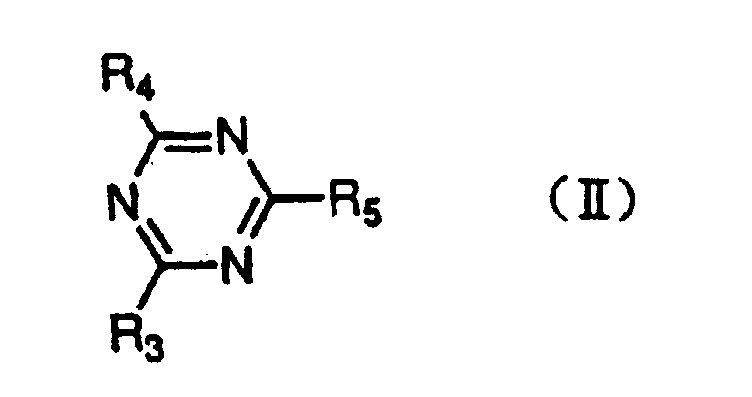
- Examples of the alkyl, aryl, alkenyl, alkoxy, aralkyl or alkylthio group denoted by R 3 , R 4 or R 5 in formula (II) include C 1 -C 4 alkyl, phenyl, naphthyl, C 1 -C 4 alkenyl, C 1 -C 4 alkoxy, C 1 -C 4 alkyl substituted by phenyl, C 1 -C 4 alkenyl substituted by phenyl and C 1 -C 4 alkylthio.
- the alkyl, aryl, alkenyl, alkoxy or aralkyl may be substituted by one or more of halogen atoms.
- phenyl and naphthyl may be substituted by C 1 -C 4 alkyl, C 1 -C 4 alkenyl or C 1 -C 4 alkoxy.
- Examples of the triazine compound of formula (II) include 2-phenyl-4,6-bis(trichloromethyl)-1,3,5-triazine, 2-(p-chlorophenyl-4,6-bis(trichloromethyl)-1,3,5-triazine, 2-(p-tolyl)-4,6-bis(trichloromethyl)-1,3,5-triazine, 2-(p-methoxyphenyl)-4,6-bis(trichloromethyl)-1,3,5-triazine, 2-(2,3-methylene-dioxyphenyl)-4,6- bis(trichloromethyl)-1,3,5-triazine, 2-methyl-4,6-bis(trichloromethyl)-1,3,5-triazine, 2-ethyl-4,6-bis(trichloromethyl)-1,3,5-triazine, 2,4,6-tris(trichloromethyl)-1,3,5-triazine, 2,4,6-tris(
- a triazine compound of formula (II) wherein two or more of R 3 , R 4 and R 5 are trichloromethyl or tribromomethyl is preferable.
- a triazine compound represented by the following formula is preferred.
- the amount of the triazine compound in the photoresist composition of the present invention is preferably in a range of from 1 to 20 % by weight, more preferably from 1 to 10 % by weight, based on total amount of the photopolymerizable monomer and the reactive diluent.
- Examples of the solvent used for the photoresist compositions (N-1), (N-2) and (NP) of the present invention include ethylene glycol monoalkyl ethers such as ethylene glycol monomethyl ether, ethylene glycol monoethyl ether, ethylene glycol monopropyl ether and ethylene glycol monobutyl ether; diethylene glycol dialkyl ethers such as diethylene glycol dimethyl ether, diethylene glycol diethyl ether, diethylene glycol dipropyl ether and diethylene glycol dibutyl ether; ethylene glycol alkyl acetates such as methyl cellosolve acetate and ethyl cellosolve acetate; propylene glycol alkylether acetates such as propylene glycol monomethyl ether acetate, propylene glycol monoethyl ether acetate and propylene glycol monopropyl ether acetate; aromatic hydrocarbons such as benzene, toluene and x
- solvents may be used singly or as a mixture of two of more thereof.
- the amount of the solvent is preferably from 20 to 2,000% by weight based on the amount of the total solid components.
- the photoresist composition (N-1), (N-2) and (NP) of the present invention can be used for the production of a color filter by a pigment dispersion method by compounding therewith pigments(s).
- pigments examples include inorganic pigments such as barium sulface, bismuth sulfide, zinc white, lead sulfate, titanium oxide, yellow lead, iron oxide red, ultramarine blue, Prussian blue, chromium oxide and carbon black; and organic pigments shown as the following color index numbers (C.I.):
- the amount of the pigment used for the photoresist composition (N-1), (N-2) and (NP) of the present invention in the case of producing the color filter is generally from 20 to 80% by weight based on the total solid contents of the composition.
- a basic stabilizer can be added to the photoresist composition (N-1), (N-2) and (NP) of the present invention, if desired.
- tertiary amine compounds such as triethylamine, tributylamine and DBU (diazabicycloundecene); sodium hydroxide; and potassium hydroxide.
- the addition amount is generally in the range of from 0.01 to 15% by weight, and preferably not more than 5% by weight, based on the total amount of the photopolymerizable monomer and the reactive diluent.
- a leveling agent may be added to the photoresist composition (N-1), (N-2) or (NP) present invention for imparting a uniformity on coating the photoresist composition.
- the photoresist composition (N-1), (N-2) and (NP) of the present invention can be obtained by mixing the components described above, with applying, if necessary, treatments such as a dispersing treatment to the mixture.
- the photoresist composition (N-1), (N-2) and (NP) of the present invention can be used for a photolithography.
- the photoresist composition When the photoresist composition is compounded with a proper pigment, it can be used for producing a color filter (one or both of the color portions and the black matrix portions) for a liquid crystal displaying apparatus utilizing the pattern formation by photolithography.
- the characteristic of the photoresist composition(NP) of the present invention can be changed from positive working type to negative working type, and vice versa.
- the characteristic of the photoresist composition(NP) is usually changed from negative working type to positive working type only when the amount of acid generated upon exposure to the radiation increases, and the amount of acid can be increased, for example, by increasing the amount of the triazine compound of formula (II) or by increasing the exposure amount.
- the photolithography using the photoresist composition of the present invention can be carried out, for example, as follows:
- the resist solution is spin-coated on a substrate followed by heat-drying (pre-baking) to form a smooth coated layer.
- the coated layer thus obtained is irradiated with ultraviolet rays through a negative mask or a positive mask for forming a desired image.
- an appropriate apparatus such as a mask alignment.
- the irradiated coated layer is then post hardened (post exposure baking) by heating the layer to a temperature of from 60 to 120°C for from 1 to 60 minutes.
- the post hardened coated layer is immersed in a dilute aqueous alkali solution to dissolve the unhardened portions, whereby the desired image is developed.
- the imaged layer may be further post hardened at a temperature of from about 100 to 250°C and for from about 5 to 20 minutes.
- the absorptions based on a vinyl group were observed at 1610 cm -1 and 975 cm -1 and the absorption based on an ether bond was observed at 1200 cm -1 .
- the vinyl ether substituted ratio was calculated from the result of measurement of the residual phenolic hydroxy group by a neutralization titration method. The vinyl ether substituted ratio thus calculated was 50%.
- the compound thus obtained is referred as "Compound 1".
- a novolac resin (Sumikanol 620 produced by Sumitomo Chemical Co., Ltd.; OH equivalent: 75) obtained by the condensation reaction of p-cresol, p-tert-octylphenol and resorcin with formalin, and 187.5g of dimethylsulfoxide were charged in a reaction vessel equipped with a reflux condenser, a thermometer, a stirrer and a nitrogen gas introducing mean; and the novolac resin was dissolved. Then, 12.0g of powdery sodium hydroxide was added to the resulting solution, followed by stirring for 30 minutes at 60°C .
- a novolac resin Sudikanol 620 produced by Sumitomo Chemical Co., Ltd.; OH equivalent: 75
- the absorptions based on a vinyl group were observed at 1610 cm -1 and 975 cm -1 and the absorption based on an ether bond was observed at 1200 cm -1 .
- the vinyl ether substituted ratio was calculated from the result of measurement of the residual phenolic hydroxy group by a neutralization titration method. The vinyl ether substituted ratio thus calculated was 60%.
- the compound thus obtained is referred as "Compound 2”.
- the absorptions based on a vinyl group were observed at 1610 cm -1 and 975 cm -1 and the absorption based on an ether bond was observed at 1200 cm -1 .
- the vinyl ether substituted ratio was calculated from the result of measurement of the residual phenolic hydroxy group by a neutralization titration method. The vinyl ether substituted ratio thus calculated was 55%.
- the compound thus obtained is referred as "Compound 3".
- a novolac resin (OH equivalent: 67.9) obtained by the condensation reaction of catechol with 4-hydroxy benzaldehyde and 50.0g of dimethylsulfoxide were charged in a reaction vessel equipped with a reflux condenser, a thermometer, a stirrer and a nitrogen gas introducing mean; and the novolac resin was dissolved. Then, 10.0g of powdery sodium hydroxide and 5.4g of tetrabutylammonium bromide were added to the resulting solution, followed by stirring for 30 minutes at 60°C.
- the absorptions based on a vinyl group were observed at 1610 cm -1 and 975 cm -1 and the absorption based on an ether bond was observed at 1200 cm -1 .
- the vinyl ether substituted ratio was calculated from the result of measurement of the residual phenolic hydroxy group by a neutralization titration method. The vinyl ether substituted ratio thus calculated was 60%.
- the compound thus obtained is referred as "Compound 4".
- Compositions shown in Table 1 , 2 and 3 were prepared and evaluated according to the method mentioned below. Numbers in Table 1, 2 and 3 indicate "part by weight”. Comparative Example 1 Comparative Example 2 Comparative Example 3 Compound 1 6.0 ⁇ ⁇ Compound 2 ⁇ 6.0 ⁇ Compound 3 ⁇ ⁇ 6.0 FX-512 0.3 0.3 0.3 Butyl acetate 14 14 14 FX-512 : trade name: Cationic photopolymerization initiator manufactured by 3M Company.
- Example 1 Example 2 Example 3 Compound 1 6.0 ⁇ ⁇ Compound 2 ⁇ 6.0 ⁇ Compound 3 ⁇ ⁇ 6.0 TRIAZINE A 0.3 0.3 0.3 Butyl acetate 14 14 14 TRIAZINE A : trade name: 2-(p-methoxyphenyl)-4,6-bis(trichloromethyl)-1,3,5-triazine : a cationic photopolymerization initiator manufactured by PANCHIM Company.
- Example 4 Example 5 Example 6 Comparative Example 4 Compound 4 6.0 6.0 6.0 6.0 TRIAZINE A 0.3 ⁇ 0.6 ⁇ TRIAZINE B ⁇ 0.3 ⁇ ⁇ IRUGACURE-261 ⁇ ⁇ ⁇ 0.3 Butyl acetate 14 14 14 14 TRIAZINE B : trade name : 2-(4-methoxy-1-naphthyl)-4,6-bis(trichloromethyl)-1,3,5-triazine : a cationic photopolymerization initiator manufactured by PANCHIM Company.
- IRUGACURE-261 trade name : a iron-allene complex type cationic photopolymerization initiator manufactured by Ciba-Geigy Company.
- composition shown in Table 1, 2 and 3 was filtered under pressure using a membrane filter (mesh: 1 ⁇ m) to prepare negative working photoresist resin compositions.
- a glass plate as a transparent substrate was washed with a neutral detergent, water, and then an alcohol, followed by drying.
- Each photoresist composition shown in Table 1, 2 or 3 was coated on the glass substrate by spin coating at 1,000 to 4,000 r.p.m. and pre-baked at 60°C for 5-10 minutes.
- the coated layer was then subjected to a patternwise exposure by a light exposure means, KASPER 2001 (trade name, manufactured by KASPER Co.).
- the exposed layer was subjected to post exposure baking for 10 minutes at 80 °C for Examples 1-3, and Comparative examples 1-3; for 15 minutes at 75 °C for Examples 4 and 5, and Comparative example 4; or for 15 minutes at 100°C for Example 6 and developed by treating the layer with a 3% aqueous solution for examples 1-3 and comparative examples 1-3; or a 2.3% aqueons solution for examples 4-5 and comparative example 4 of sodium hydroxide for 30 seconds at 25°C.
- the layer thickness was adjusted such that the thickness became from 1 to 1.5 ⁇ m after exposure and development.
- sensitivity means the lowest light exposure energy amount for forming residual layers on the substrate after development. A smaller value shows a higher sensitivity.
- the photoresist resin composition of the present invention can be hardened without intercepting oxgen e.g. by nitrogen gas flow. It can be seen from the comparison of Examples 1-3 in which triazine compounds as photopolymerization initiators are used with Comparative examples 1-3 in which photopolymerization initiators different to the triazine compounds are used but photopolymerizable monomer same to those in Examples 1-3, respectively, are used that the negative photoresist resin composition of the present invention exhibits improved sensitivity and resolution, compared to conventional negative photoresist resin compositions.
- the photoresist resin composition of the present invention handling of the photoresist resin composition on photopolymerization becomes remarkably easier because oxgen intercepting is not required. Since the sensitivity has been conspicuously improved, the photoresist resin composition of the present invention is suitably used as a pigment dispersing photoresist.
- the photoresist resin composition of the present invention can be used not only as a negative working photoresist but also as a positive working photoresist only by changing the amount of triazine compound and the exposure amount while keeping sufficient properties as a photoresist resin composition such as sensitivity, resolution and developability with a dilute aqueous alkali solution.
Landscapes
- Physics & Mathematics (AREA)
- General Physics & Mathematics (AREA)
- Spectroscopy & Molecular Physics (AREA)
- Materials For Photolithography (AREA)
- Optical Filters (AREA)
- Polymerisation Methods In General (AREA)
- Addition Polymer Or Copolymer, Post-Treatments, Or Chemical Modifications (AREA)
Claims (5)
- Negativ arbeitende Photoresistzusammensetzung (N-1), die umfaßt:(1) ein photopolymerisierbares Monomer der folgenden Formel (I):in der n, das eine durchschnittliche Wiederholungszahl ist, eine Zahl von 0 bis 20 darstellt; R1 und R2 jeweils unabhängig ein Wasserstoffatom, ein Halogenatom, einen Alkylrest, einen Arylrest, einen Aralkylrest, einen Alkoxyrest, einen Aryloxyrest oder einen Cycloalkylrest darstellen; jeder der Reste Q unabhängig -OH oder -OROCH=CH2 darstellt, wobei R einen Alkylenrest mit 1 - 12 Kohlenstoffatomen darstellt, mit der Maßgabe, daß das Molverhältnis von (-OH)/ (-OROCH=CH2) 10/90 bis 90/10 beträgt; und A einen zweiwertigen Kohlenwasserstoffrest mit 1 - 30 Kohlenstoffatomen darstellt;
 (2) eine Triazinverbindung der folgenden allgemeinen Formel (II):in der R3, R4 und R5 jeweils unabhängig einen Alkyl-, Aryl-, Alkenyl-, Alkoxy-, Aralkyl- oder Alkylthiorest darstellen, der gegebenenfalls substituiert sein kann, mit der Maßgabe, daß mindestens einer der Reste R3, R4 und R5 eine Methylgruppe ist, die mit einem, zwei oder drei Halogenatomen substituiert ist; und
 (3) ein Lösungsmittel.
 - Negativ arbeitende Photoresistzusammensetzung (N-2), die umfaßt:(1) ein photopolymerisierbares Monomer, das durch die Formel (I) wie in Anspruch 1 definiert wiedergegeben wird, außer daß 0.1 bis 60 mol-% jeder der Reste der folgenden Formeln (III) oder (IV):
 in denen R1, R2 und Q die in Anspruch 1 angegebene Bedeutung haben,
jeweils durch jeden der Reste der folgenden Formeln (V) oder (VI) ersetzt sind:in denen R1, R2 und Q die in Anspruch 1 angegebene Bedeutung haben, und R6 ein Wasserstoffatom, ein Halogenatom, ein Alkylrest, ein Arylrest, ein Aralkylrest, ein Alkoxyrest, ein Aryloxyrest oder ein Cycloalkylrest ist; (2) eine Triazinverbindung der Formel (II) wie in Anspruch 1 definiert; und(3) ein Lösungsmittel.
 - Photoresistzusammensetzung (NP), die umfaßt:(1) ein photopolymerisierbares Monomer der folgenden Formel (VII):in der n, R1, R2 und Q die in Anspruch 1 angegebene Bedeutung haben; und (R7,R8,R9,R10) bedeutet, daß R7, R8, R9 und R10 an einen Benzolring gebunden sind, und R7, R8, R9 und R10 jeweils unabhängig ein Wasserstoffatom, ein Halogenatom, einen Alkylrest, einen Arylrest, einen Aralkylrest, einen Alkoxyrest, einen Aryloxyrest oder einen Cycloalkylrest darstellen;
 (2) eine Triazinverbindung der Formel (II) wie in Anspruch 1 definiert; und(3) ein Lösungsmittel.
 - Photoresistzusammensetzung nach Anspruch 3, in der das photopolymerisierbare Monomer der Formel (VII) eine Verbindung der folgenden Formel ist:in der der Mittelwert der Wiederholungszahl n 0 bis 20 ist und jeder Rest Q unabhängig -OH oder -CH2CH2OCH=CH2 darstellt, mit der Maßgabe, daß das Molverhältnis von (-OH)/(-OCH2CH2OCH=CH2) 10/90 bis 90/10 beträgt.

- Photoresistzusammensetzung nach einem der Ansprüche 1 bis 4, in der die Triazinverbindung der Formel (II) eine Verbindung der folgenden Formel ist

Applications Claiming Priority (4)
| Application Number | Priority Date | Filing Date | Title |
|---|---|---|---|
| JP21766594A JPH0882929A (ja) | 1994-09-12 | 1994-09-12 | フォトレジスト樹脂組成物 |
| JP217665/94 | 1994-09-12 | ||
| JP217663/94 | 1994-09-12 | ||
| JP21766394A JPH0882927A (ja) | 1994-09-12 | 1994-09-12 | ネガティブ型フォトレジスト樹脂組成物 |
Publications (2)
| Publication Number | Publication Date |
|---|---|
| EP0704765A1 EP0704765A1 (de) | 1996-04-03 |
| EP0704765B1 true EP0704765B1 (de) | 1999-04-21 |
Family
ID=26522151
Family Applications (1)
| Application Number | Title | Priority Date | Filing Date |
|---|---|---|---|
| EP95114259A Expired - Lifetime EP0704765B1 (de) | 1994-09-12 | 1995-09-11 | Photoresistzusammensetzung enthaltend eine polyfunktionelle Vinyletherverbindung |
Country Status (6)
| Country | Link |
|---|---|
| US (1) | US5719008A (de) |
| EP (1) | EP0704765B1 (de) |
| KR (1) | KR960011553A (de) |
| DE (1) | DE69509183T2 (de) |
| SG (1) | SG38875A1 (de) |
| TW (1) | TW339421B (de) |
Families Citing this family (21)
| Publication number | Priority date | Publication date | Assignee | Title |
|---|---|---|---|---|
| US5910394A (en) * | 1997-06-18 | 1999-06-08 | Shipley Company, L.L.C. | I-line photoresist compositions |
| JP4156784B2 (ja) | 2000-07-25 | 2008-09-24 | 富士フイルム株式会社 | ネガ型画像記録材料及び画像形成方法 |
| JP2002082429A (ja) * | 2000-09-08 | 2002-03-22 | Fuji Photo Film Co Ltd | ネガ型画像記録材料 |
| US7148265B2 (en) * | 2002-09-30 | 2006-12-12 | Rohm And Haas Electronic Materials Llc | Functional polymer |
| US7323290B2 (en) * | 2002-09-30 | 2008-01-29 | Eternal Technology Corporation | Dry film photoresist |
| JP5535064B2 (ja) | 2007-05-11 | 2014-07-02 | ビーエーエスエフ ソシエタス・ヨーロピア | オキシムエステル光重合開始剤 |
| WO2008138724A1 (en) | 2007-05-11 | 2008-11-20 | Basf Se | Oxime ester photoinitiators |
| KR101712683B1 (ko) | 2009-03-23 | 2017-03-06 | 바스프 에스이 | 포토레지스트 조성물 |
| US9051397B2 (en) | 2010-10-05 | 2015-06-09 | Basf Se | Oxime ester |
| EP2625166B1 (de) | 2010-10-05 | 2014-09-24 | Basf Se | Oximester-derivate von benzocarbazol-verbindungen und deren verwendung als photoinitiatoren in photopolymerisierbare zusammensetzungen |
| JP5955339B2 (ja) | 2011-01-28 | 2016-07-20 | ビーエーエスエフ ソシエタス・ヨーロピアBasf Se | 熱硬化剤としてオキシムスルホネートを含む重合性組成物 |
| WO2013083505A1 (en) | 2011-12-07 | 2013-06-13 | Basf Se | Oxime ester photoinitiators |
| EP3354641B1 (de) | 2012-05-09 | 2019-07-17 | Basf Se | Oximester-fotoinitiatoren |
| JP6469669B2 (ja) | 2013-07-08 | 2019-02-13 | ビーエーエスエフ ソシエタス・ヨーロピアBasf Se | オキシムエステル光開始剤 |
| CN105531260B (zh) | 2013-09-10 | 2019-05-31 | 巴斯夫欧洲公司 | 肟酯光引发剂 |
| KR102378364B1 (ko) * | 2014-07-16 | 2022-03-25 | 삼성디스플레이 주식회사 | 포토레지스트 조성물 및 이를 이용한 표시장치용 기판의 제조방법 |
| US10487050B2 (en) | 2014-08-29 | 2019-11-26 | Basf Se | Oxime sulfonate derivatives |
| EP3253735B1 (de) | 2015-02-02 | 2021-03-31 | Basf Se | Latente säuren und ihre verwendung |
| US20220121113A1 (en) | 2019-01-23 | 2022-04-21 | Basf Se | Oxime ester photoinitiators having a special aroyl chromophore |
| EP4114825B1 (de) | 2020-03-04 | 2024-11-20 | Basf Se | Oximester-photoinitiatoren |
| WO2026057274A1 (en) | 2024-09-13 | 2026-03-19 | Basf Se | Oxime ester photoinitiators |
Family Cites Families (21)
| Publication number | Priority date | Publication date | Assignee | Title |
|---|---|---|---|---|
| US4705887A (en) * | 1981-03-13 | 1987-11-10 | General Electric Company | Aromatic polyvinyl ethers and heat curable molding compositions obtained therefrom |
| US4518788A (en) * | 1981-03-13 | 1985-05-21 | General Electric Company | Aromatic polyvinyl ethers and heat curable molding compositions obtained therefrom |
| US4388450A (en) * | 1981-03-13 | 1983-06-14 | General Electric Company | Aromatic polyvinyl ethers and heat curable molding compositions obtained therefrom |
| DE3135200A1 (de) * | 1981-09-05 | 1983-03-17 | L. & C. Steinmüller GmbH, 5270 Gummersbach | Verfahren zur behandlung von endprodukten aus der rauchgasentschwefelung |
| JPS5881402U (ja) * | 1981-11-26 | 1983-06-02 | シャープ株式会社 | 熱風循環式調理器 |
| JPS607165A (ja) | 1983-06-24 | 1985-01-14 | Sumitomo Electric Ind Ltd | ボンディングワイヤ |
| JPS6053517A (ja) * | 1983-09-05 | 1985-03-27 | Agency Of Ind Science & Technol | 反応性重合体 |
| JPS6071657A (ja) * | 1983-09-27 | 1985-04-23 | Agency Of Ind Science & Technol | 感光性樹脂組成物 |
| DE3766315D1 (de) * | 1986-08-06 | 1991-01-03 | Ciba Geigy Ag | Negativ-photoresist auf basis von polyphenolen und epoxidverbindungen oder vinylethern. |
| US4994346A (en) | 1987-07-28 | 1991-02-19 | Ciba-Geigy Corporation | Negative photoresist based on polyphenols and selected epoxy or vinyl ether compounds |
| DE3817012A1 (de) * | 1988-05-19 | 1989-11-30 | Basf Ag | Positiv und negativ arbeitende strahlungsempfindliche gemische sowie verfahren zur herstellung von reliefmustern |
| JP2505033B2 (ja) * | 1988-11-28 | 1996-06-05 | 東京応化工業株式会社 | 電子線レジスト組成物及びそれを用いた微細パタ―ンの形成方法 |
| JPH03260651A (ja) * | 1990-03-12 | 1991-11-20 | Konica Corp | 感光性組成物 |
| US5004842A (en) * | 1990-06-25 | 1991-04-02 | Loctite Corporation | Aromatic vinyl ether compounds and compositions, and method of making the same |
| US5070117A (en) * | 1990-06-25 | 1991-12-03 | Loctite Corporation | Aromatic vinyl ether compounds and compositions, and method of making the same |
| US5362822A (en) * | 1990-08-03 | 1994-11-08 | The Dow Chemical Company | Mesogenic adducts |
| JP2764480B2 (ja) * | 1991-05-17 | 1998-06-11 | 日本化薬株式会社 | カラーフィルター用光重合組成物 |
| WO1994003535A1 (fr) * | 1992-08-06 | 1994-02-17 | Asahi Kasei Kogyo Kabushiki Kaisha | Composition resineuse |
| JPH0667431A (ja) * | 1992-08-20 | 1994-03-11 | Sumitomo Chem Co Ltd | ネガ型フォトレジスト組成物 |
| CA2115333A1 (en) * | 1993-02-16 | 1994-08-17 | Shigeo Hozumi | Polyfunctional vinyl ether compounds and photoresist resin composition containing the same |
| JPH0728241A (ja) * | 1993-07-12 | 1995-01-31 | Sumitomo Chem Co Ltd | カラーフィルター用ネガティブ型フォトレジスト |
-
1995
- 1995-09-06 TW TW084109323A patent/TW339421B/zh active
- 1995-09-08 US US08/525,186 patent/US5719008A/en not_active Expired - Fee Related
- 1995-09-08 SG SG1995001307A patent/SG38875A1/en unknown
- 1995-09-11 EP EP95114259A patent/EP0704765B1/de not_active Expired - Lifetime
- 1995-09-11 DE DE69509183T patent/DE69509183T2/de not_active Expired - Fee Related
- 1995-09-12 KR KR1019950029616A patent/KR960011553A/ko not_active Withdrawn
Also Published As
| Publication number | Publication date |
|---|---|
| SG38875A1 (en) | 1997-04-17 |
| US5719008A (en) | 1998-02-17 |
| TW339421B (en) | 1998-09-01 |
| EP0704765A1 (de) | 1996-04-03 |
| DE69509183D1 (de) | 1999-05-27 |
| DE69509183T2 (de) | 1999-09-09 |
| KR960011553A (ko) | 1996-04-20 |
Similar Documents
| Publication | Publication Date | Title |
|---|---|---|
| US5719008A (en) | Photoresist composition comprising a polyfunctional vinyl ether compound | |
| JP3317576B2 (ja) | ポジ型感光性樹脂組成物 | |
| US6656659B1 (en) | Resist composition suitable for short wavelength exposure and resist pattern forming method | |
| EP0388343B1 (de) | Chemisch amplifizierter Photolack | |
| US4413052A (en) | Photopolymerization process employing compounds containing acryloyl group and anthryl group | |
| TWI272451B (en) | Chemically amplified photoresist composition, process for preparation of a photoresist, and use of said chemically amplified photoresist composition | |
| EP0541112B1 (de) | Positiv-arbeitende lichtempfindliche Zusammensetzung | |
| EP0611784B1 (de) | Polyfunktionelle Vinyletherverbindungen und diese enthaltende Harzzusammensetzungen für Photoresiste | |
| US6248500B1 (en) | Composition for anti-reflective coating material | |
| US5238781A (en) | Photosensitive compositions based on polyphenols and acetals | |
| US5342727A (en) | Copolymers of 4-hydroxystyrene and alkyl substituted-4-hydroxystyrene in admixture with a photosensitizer to form a photosensitive composition | |
| US5234791A (en) | Radiation-curable composition and radiation-sensitive recording material prepared therefrom for use with high-energy radiation | |
| GB2158450A (en) | Silicon-containing novolak resin and material and pattern forming method using same | |
| EP0621508B1 (de) | Strahlungsempfindliche Harzzusammensetzung | |
| US5876899A (en) | Photoresist compositions | |
| EP3803510A1 (de) | Novolak/dnq-basierter, chemisch verstärkter photolack | |
| EP0307752B1 (de) | Poly(3-mono oder 3,5-disubstituierte acetoxystyrole) und deren Verwendung | |
| CA2011728A1 (en) | Positive radiation-sensitive mixture, and radiation-sensitive recording material produced therefrom for high-energy radiation | |
| JP3315757B2 (ja) | 感光性多官能芳香族ジアゾ化合物およびそれを用いた感光性組成物 | |
| US5807947A (en) | Copolymers 4-hydroxystyrene and alkyl substituted-4-hydroxystyrene | |
| KR100973109B1 (ko) | 감광성 조성물 | |
| JPH07104469A (ja) | ネガティブ型フォトレジスト樹脂組成物 | |
| EP0365340B1 (de) | Copolymere aus 4-Hydroxystyren und alkylsubstituiertem 4-Hydroxystyren | |
| JPH0882927A (ja) | ネガティブ型フォトレジスト樹脂組成物 | |
| JPH0882929A (ja) | フォトレジスト樹脂組成物 |
Legal Events
| Date | Code | Title | Description |
|---|---|---|---|
| PUAI | Public reference made under article 153(3) epc to a published international application that has entered the european phase |
Free format text: ORIGINAL CODE: 0009012 |
|
| AK | Designated contracting states |
Kind code of ref document: A1 Designated state(s): CH DE FR GB IT LI |
|
| 17P | Request for examination filed |
Effective date: 19960927 |
|
| GRAG | Despatch of communication of intention to grant |
Free format text: ORIGINAL CODE: EPIDOS AGRA |
|
| GRAG | Despatch of communication of intention to grant |
Free format text: ORIGINAL CODE: EPIDOS AGRA |
|
| GRAH | Despatch of communication of intention to grant a patent |
Free format text: ORIGINAL CODE: EPIDOS IGRA |
|
| 17Q | First examination report despatched |
Effective date: 19980520 |
|
| GRAH | Despatch of communication of intention to grant a patent |
Free format text: ORIGINAL CODE: EPIDOS IGRA |
|
| GRAA | (expected) grant |
Free format text: ORIGINAL CODE: 0009210 |
|
| AK | Designated contracting states |
Kind code of ref document: B1 Designated state(s): CH DE FR GB IT LI |
|
| ITF | It: translation for a ep patent filed | ||
| REG | Reference to a national code |
Ref country code: CH Ref legal event code: NV Representative=s name: A. BRAUN, BRAUN, HERITIER, ESCHMANN AG, PATENTANWA Ref country code: CH Ref legal event code: EP |
|
| REF | Corresponds to: |
Ref document number: 69509183 Country of ref document: DE Date of ref document: 19990527 |
|
| PGFP | Annual fee paid to national office [announced via postgrant information from national office to epo] |
Ref country code: FR Payment date: 19990715 Year of fee payment: 5 |
|
| ET | Fr: translation filed | ||
| PGFP | Annual fee paid to national office [announced via postgrant information from national office to epo] |
Ref country code: GB Payment date: 19990908 Year of fee payment: 5 |
|
| PG25 | Lapsed in a contracting state [announced via postgrant information from national office to epo] |
Ref country code: LI Free format text: LAPSE BECAUSE OF NON-PAYMENT OF DUE FEES Effective date: 19990930 Ref country code: CH Free format text: LAPSE BECAUSE OF NON-PAYMENT OF DUE FEES Effective date: 19990930 |
|
| PLBE | No opposition filed within time limit |
Free format text: ORIGINAL CODE: 0009261 |
|
| STAA | Information on the status of an ep patent application or granted ep patent |
Free format text: STATUS: NO OPPOSITION FILED WITHIN TIME LIMIT |
|
| 26N | No opposition filed | ||
| REG | Reference to a national code |
Ref country code: CH Ref legal event code: PL |
|
| PG25 | Lapsed in a contracting state [announced via postgrant information from national office to epo] |
Ref country code: DE Free format text: LAPSE BECAUSE OF NON-PAYMENT OF DUE FEES Effective date: 20000701 |
|
| PG25 | Lapsed in a contracting state [announced via postgrant information from national office to epo] |
Ref country code: GB Free format text: LAPSE BECAUSE OF NON-PAYMENT OF DUE FEES Effective date: 20000911 |
|
| GBPC | Gb: european patent ceased through non-payment of renewal fee |
Effective date: 20000911 |
|
| PG25 | Lapsed in a contracting state [announced via postgrant information from national office to epo] |
Ref country code: FR Free format text: LAPSE BECAUSE OF NON-PAYMENT OF DUE FEES Effective date: 20010531 |
|
| REG | Reference to a national code |
Ref country code: FR Ref legal event code: ST |
|
| PG25 | Lapsed in a contracting state [announced via postgrant information from national office to epo] |
Ref country code: IT Free format text: LAPSE BECAUSE OF NON-PAYMENT OF DUE FEES;WARNING: LAPSES OF ITALIAN PATENTS WITH EFFECTIVE DATE BEFORE 2007 MAY HAVE OCCURRED AT ANY TIME BEFORE 2007. THE CORRECT EFFECTIVE DATE MAY BE DIFFERENT FROM THE ONE RECORDED. Effective date: 20050911 |