EP0857060B1 - Zubereitungen und verfahren zur stabilisierung biologischer materialien mittels trocknungsverfahren ohne einfrieren - Google Patents
Zubereitungen und verfahren zur stabilisierung biologischer materialien mittels trocknungsverfahren ohne einfrieren Download PDFInfo
- Publication number
- EP0857060B1 EP0857060B1 EP96934811A EP96934811A EP0857060B1 EP 0857060 B1 EP0857060 B1 EP 0857060B1 EP 96934811 A EP96934811 A EP 96934811A EP 96934811 A EP96934811 A EP 96934811A EP 0857060 B1 EP0857060 B1 EP 0857060B1
- Authority
- EP
- European Patent Office
- Prior art keywords
- drying
- substances
- derivatives
- substance mixtures
- process according
- Prior art date
- Legal status (The legal status is an assumption and is not a legal conclusion. Google has not performed a legal analysis and makes no representation as to the accuracy of the status listed.)
- Revoked
Links
Images



Classifications
-
- A—HUMAN NECESSITIES
- A61—MEDICAL OR VETERINARY SCIENCE; HYGIENE
- A61K—PREPARATIONS FOR MEDICAL, DENTAL OR TOILETRY PURPOSES
- A61K9/00—Medicinal preparations characterised by special physical form
- A61K9/14—Particulate form, e.g. powders, Processes for size reducing of pure drugs or the resulting products, Pure drug nanoparticles
-
- A—HUMAN NECESSITIES
- A61—MEDICAL OR VETERINARY SCIENCE; HYGIENE
- A61K—PREPARATIONS FOR MEDICAL, DENTAL OR TOILETRY PURPOSES
- A61K47/00—Medicinal preparations characterised by the non-active ingredients used, e.g. carriers or inert additives; Targeting or modifying agents chemically bound to the active ingredient
- A61K47/06—Organic compounds, e.g. natural or synthetic hydrocarbons, polyolefins, mineral oil, petrolatum or ozokerite
- A61K47/26—Carbohydrates, e.g. sugar alcohols, amino sugars, nucleic acids, mono-, di- or oligo-saccharides; Derivatives thereof, e.g. polysorbates, sorbitan fatty acid esters or glycyrrhizin
-
- A—HUMAN NECESSITIES
- A61—MEDICAL OR VETERINARY SCIENCE; HYGIENE
- A61K—PREPARATIONS FOR MEDICAL, DENTAL OR TOILETRY PURPOSES
- A61K38/00—Medicinal preparations containing peptides
- A61K38/16—Peptides having more than 20 amino acids; Gastrins; Somatostatins; Melanotropins; Derivatives thereof
- A61K38/17—Peptides having more than 20 amino acids; Gastrins; Somatostatins; Melanotropins; Derivatives thereof from animals; from humans
- A61K38/18—Growth factors; Growth regulators
- A61K38/1816—Erythropoietin [EPO]
-
- A—HUMAN NECESSITIES
- A61—MEDICAL OR VETERINARY SCIENCE; HYGIENE
- A61K—PREPARATIONS FOR MEDICAL, DENTAL OR TOILETRY PURPOSES
- A61K38/00—Medicinal preparations containing peptides
- A61K38/16—Peptides having more than 20 amino acids; Gastrins; Somatostatins; Melanotropins; Derivatives thereof
- A61K38/17—Peptides having more than 20 amino acids; Gastrins; Somatostatins; Melanotropins; Derivatives thereof from animals; from humans
- A61K38/19—Cytokines; Lymphokines; Interferons
- A61K38/193—Colony stimulating factors [CSF]
-
- A—HUMAN NECESSITIES
- A61—MEDICAL OR VETERINARY SCIENCE; HYGIENE
- A61K—PREPARATIONS FOR MEDICAL, DENTAL OR TOILETRY PURPOSES
- A61K38/00—Medicinal preparations containing peptides
- A61K38/16—Peptides having more than 20 amino acids; Gastrins; Somatostatins; Melanotropins; Derivatives thereof
- A61K38/43—Enzymes; Proenzymes; Derivatives thereof
- A61K38/44—Oxidoreductases (1)
- A61K38/443—Oxidoreductases (1) acting on CH-OH groups as donors, e.g. glucose oxidase, lactate dehydrogenase (1.1)
-
- A—HUMAN NECESSITIES
- A61—MEDICAL OR VETERINARY SCIENCE; HYGIENE
- A61K—PREPARATIONS FOR MEDICAL, DENTAL OR TOILETRY PURPOSES
- A61K47/00—Medicinal preparations characterised by the non-active ingredients used, e.g. carriers or inert additives; Targeting or modifying agents chemically bound to the active ingredient
- A61K47/06—Organic compounds, e.g. natural or synthetic hydrocarbons, polyolefins, mineral oil, petrolatum or ozokerite
- A61K47/16—Organic compounds, e.g. natural or synthetic hydrocarbons, polyolefins, mineral oil, petrolatum or ozokerite containing nitrogen, e.g. nitro-, nitroso-, azo-compounds, nitriles, cyanates
- A61K47/18—Amines; Amides; Ureas; Quaternary ammonium compounds; Amino acids; Oligopeptides having up to five amino acids
- A61K47/183—Amino acids, e.g. glycine, EDTA or aspartame
-
- A—HUMAN NECESSITIES
- A61—MEDICAL OR VETERINARY SCIENCE; HYGIENE
- A61K—PREPARATIONS FOR MEDICAL, DENTAL OR TOILETRY PURPOSES
- A61K47/00—Medicinal preparations characterised by the non-active ingredients used, e.g. carriers or inert additives; Targeting or modifying agents chemically bound to the active ingredient
- A61K47/06—Organic compounds, e.g. natural or synthetic hydrocarbons, polyolefins, mineral oil, petrolatum or ozokerite
- A61K47/20—Organic compounds, e.g. natural or synthetic hydrocarbons, polyolefins, mineral oil, petrolatum or ozokerite containing sulfur, e.g. dimethyl sulfoxide [DMSO], docusate, sodium lauryl sulfate or aminosulfonic acids
-
- A—HUMAN NECESSITIES
- A61—MEDICAL OR VETERINARY SCIENCE; HYGIENE
- A61K—PREPARATIONS FOR MEDICAL, DENTAL OR TOILETRY PURPOSES
- A61K9/00—Medicinal preparations characterised by special physical form
- A61K9/14—Particulate form, e.g. powders, Processes for size reducing of pure drugs or the resulting products, Pure drug nanoparticles
- A61K9/19—Particulate form, e.g. powders, Processes for size reducing of pure drugs or the resulting products, Pure drug nanoparticles lyophilised, i.e. freeze-dried, solutions or dispersions
-
- A—HUMAN NECESSITIES
- A61—MEDICAL OR VETERINARY SCIENCE; HYGIENE
- A61P—SPECIFIC THERAPEUTIC ACTIVITY OF CHEMICAL COMPOUNDS OR MEDICINAL PREPARATIONS
- A61P31/00—Antiinfectives, i.e. antibiotics, antiseptics, chemotherapeutics
-
- F—MECHANICAL ENGINEERING; LIGHTING; HEATING; WEAPONS; BLASTING
- F26—DRYING
- F26B—DRYING SOLID MATERIALS OR OBJECTS BY REMOVING LIQUID THEREFROM
- F26B5/00—Drying solid materials or objects by processes not involving the application of heat
- F26B5/04—Drying solid materials or objects by processes not involving the application of heat by evaporation or sublimation of moisture under reduced pressure, e.g. in a vacuum
Definitions
- the present invention relates to preparations and methods for stabilizing biological Materials using drying processes without freezing.
- targeted selected mixtures of sugars and amino acids and their derivatives as well as of Various amino acids and their derivatives are described with which after production dry, partially amorphous products by dry processes in which are not frozen is particularly advantageous stabilization of peptides, proteins, glycoproteins, Antibodies and the like Substances can be achieved.
- Dry material is understood to mean substances and mixtures of substances which have a residual moisture of at most 8% (g / g), preferably at most 4% (g / g), particularly preferably at most 2%.
- Freeze-drying processes are widespread [F. Franks, Cryo Lett. 11 , 93-110, (1990); MJ Pikal, Biopharm. 3 (9), 26-30 (1990); M. Hora, Pharm. Research 8 (3), 285-291 (1992); F. Franks, Jap. J. Freezing Drying 38 , 15-16, (1992)], but have disadvantages.
- Drying processes that are carried out using vacuum at a temperature that is slightly or slightly higher than room temperature are gentler. In many cases, however, the production of dry, storage-stable sugar preparations is hardly feasible. When sugar solutions dry, viscous, viscous masses are increasingly formed. The remaining amount of water or residual moisture in these masses cannot be removed in an economically sensible time, in many cases the drying comes to a standstill at a high level which is unsuitable for stabilization.
- the degradation manifests itself e.g. B. in a decrease in the activity of the stored material, in the formation of aggregation products or by the appearance of degradation products with a lower molecular weight.
- a suitable low residual water content for the stabilization of proteins etc. can be recognized on the basis of physical parameters.
- suitable preparations for stabilizing proteins etc. should have a glass-like, that is to say amorphous structure, the glass transition temperature of which is above the desired storage temperature.
- the glass transition temperature is the temperature at which an amorphous solid changes from the glass state to the viscous state and vice versa. This leads to drastic changes in viscosity and the associated diffusion coefficient and the kinetic mobility of proteins and other molecules. Physical parameters such as hardness and modulus change, as do the thermodynamic state variables of volume, enthalpy and entropy.
- the glass transition temperature of, for example, a sugar-containing mass and its residual water content are physically linked to one another in such a way that increasing amounts of residual water lead to falling glass transition temperatures and vice versa.
- DSC differential scanning calorimetry
- a preparation has a residual water content suitable for stabilization or, as stated above, a drying process is successful or not.
- DSC differential scanning calorimetry
- the presence of amorphous structures can also be proven by means of X-ray diffraction studies, optical and electron microscopic considerations.
- EP-A-0 547 422 relates to powdery, dry vitamin and / or carotenoid preparations and methods of making them.
- the method described includes a thermal one Hardening of the powder at temperatures from 60 to 180 ° C.
- EP-A-0 444 962 describes thrombin preparations which are prepared by freeze-drying become.
- EP-A-0 325 112 discloses the stabilization of cephalosporin derivatives. In this Document does not seem to influence the stabilization effect of the type of drying (Example V), Examples I-IV and VI using freeze drying exclusively.
- DE-A-4 242 863 and WO-A-9 012 029 relate to freeze-dried peptide or Protein formulations.
- EP-A-0 306 824 relates to solutions and lyophilisates of stabilizers and human proteins. Procedures "without freezing” or their products are not covered by this document mentioned.
- the present invention contemplates preparations and methods to stabilize biological materials using drying processes without freezing as in the claims.
- therapeutically active materials are one or more substances of the Group of proteins, peptides, glycoproteins, lipoproteins, enzymes, coenzymes, biological Membranes, antibodies, antibody fragments, cells, cell components, viruses, Virus components, vaccines, DNA, RNA, PNA, plasmids, vectors, pheromones, biological Therapeutics and diagnostics and their derivatives can be selected.
- Zwitterions are preferably aminocarboxylic acids and their derivatives, particularly preferred pharmaceutically acceptable amino acids.
- Zwitterions are low molecular weight Compounds understood, the molecular weight below 10 kDA, preferably below 5 kDA lies. Methods are described which allow the use of no elevated temperature, i.e. Drying preparations according to the invention at room temperature so that for Preparations for the stabilization of biologically active, in particular therapeutically active Substances that achieve suitable glass transition temperatures.
- Biotechnological processes such as B. fermentation can be used.
- such Substances that e.g. B. used in crop protection or as insecticides.
- Under biologically active substances are not understood as food.
- the invention is exemplified in 13 examples and 10 comparative examples, and is explained below.
- Formulations and processes were found which drastically improve the drying of sugary masses by means of vacuum drying and accelerate and stabilize relevant therapeutic and diagnostic biological materials are suitable. Furthermore, completely new compositions demonstrated the purpose of stabilization while maintaining the optimized Meet drying characteristics.
- compositions preferably contain either at least one zwitterion apolar residue (e.g. an amino acid such as phenylalanine) and sugar, the Glass transition temperature of the sugar significantly increased by this zwitterion additive becomes.
- apolar residue e.g. an amino acid such as phenylalanine
- sugar the Glass transition temperature of the sugar significantly increased by this zwitterion additive becomes.
- mixtures of various specially selected ones can also be used Amino acids or their derivatives can be used. These mixtures expose themselves a zwitterion with apolar and a zwitterion with a polar residue.
- To Sugar can also be added to these mixtures.
- Antibodies are particularly preferred biologically or therapeutically active materials (monoclonal or polyclonal), enzymes and human proteins or human peptides, such as.
- Example 1 shows that the addition of phenylalanine and arginine to maltose depends on their drying behavior improved from the added amount of these additives.
- the glass transition temperature can be the same by adding these auxiliary substances in a targeted manner Increase drying conditions by over 65 K, the corresponding one Residual water content can easily be reduced to below 1%.
- Example 1 shows that the process used within 48 hours without any heat leads to the desired result.
- auxiliaries have a residual water content of 7-8% Glass transition temperature (Tg) is below room temperature and therefore this is System not suitable for stabilizing proteins etc.
- sucrose has compared to others mentioned in the literature Sugar a relatively lower glass transition temperature with correspondingly standardized Water contents. It is therefore in the manufacture of sucrose-containing, dry preparations particularly difficult to achieve high Tgs, which is significantly above the target Storage temperature. Furthermore, sucrose is difficult to dry by evaporation to convert into an amorphous form at all, the sugar crystallizes easily and thus easily forms the unfavorable biological stabilizers crystalline structure.
- Amino acids that do not exist have also been found have drying-improving effects, e.g. B. histidine (Comparative Example B).
- example 5 shows that, in addition to amino acids, their structurally related derivatives may have drying-improving effects.
- the selection of certain Amino acids are described in detail, although not in a limiting or fully comprehensive manner Example 6 described. It should be noted that by far not every amino acid produces the desired effect, but only certain amino acids. The extent too the effects are different, so that particularly preferred combinations or Preparations can be named. These are mainly phenylalanine, tryptophan, Leucine and isoleucine. From Examples 1 and 6 it can also be deduced that the mixture of amino acids while maintaining the drying-improving effect is possible. Arginine alone does not show a positive effect, but it does when mixed with phenylalanine.
- Mixtures according to the invention can, as shown by way of example, can be found by biological or a solution of a stabilizer therapeutically active substances a zwitterion with apolar residue, e.g. B. Phenylalanine or its derivatives are mixed in different amounts.
- the at Mixtures dried at room temperature are then checked by DSC to determine whether they have a higher glass transition temperature due to the zwitterionic additive.
- the glass transition temperature has compared to preparations without additives according to the invention by 10K, preferably by 20K, particularly preferably by 40K elevated.
- the advantageous preparations according to the invention are partially amorphous a glass transition temperature above 4 ° C, preferably above 20 ° C, particularly preferred above 40 ° C and have corresponding residual moisture contents of less than 6%, preferred less than 4%.
- Their apparent density corresponding to the bulk density is at least 10%, preferably 50% higher than that of the corresponding lypophilisates.
- their drying time (i.e. the time at which the same residual moisture is reached)
- Mixtures containing only a carbohydrate or zwitterion with apolar residue preferably reduced by 25%, particularly preferably halved or even quartered.
- Therapeutic means are therapeutic Preparations containing one or more therapeutically active agents in addition to the usual auxiliary and additives. They can be in the form of tablets, capsules or Solids from which by adding liquid (e.g. sterile water or buffer) therapeutically effective solutions (e.g. infusion solutions) are produced, available. They are also particularly suitable to be used as different methods solid substance to be applied, e.g. B. as a nasal spray, inhalant or transdermal Powder etc.
- liquid e.g. sterile water or buffer
- therapeutically effective solutions e.g. infusion solutions
- a solution containing 50 mg of maltose monohydrate and 0.1 mg of polysorbate 80 per ml was prepared. Increasing amounts of L-arginine and L-phenylalanine were then added to this in equal proportions (g / g).
- the solutions prepared in this way were sterile filtered (0.22 ⁇ m cellulose nitrate filter) and then 1 ml of the solution was filled into 2 ml vials and freeze-drying stoppers were attached. The samples thus prepared were vacuum dried in the same way at 20 ° C. under reduced pressure for 48 hours.
- the measurement results show that the drying behavior of the maltose changes significantly by adding certain amounts of the amino acids. From 7.5 mg of each amino acid, the water content of the samples decreases significantly and the glass transition temperature rises accordingly. With 10 mg L-arginine and L-phenylalanine, values are reached that cannot be increased by further increasing the amino acid content in the dry product. Increasing amounts of amino acids were added to the sugar solution with 50 mg maltose monohydrate and 0.1 mg polysorbate 80 per ml. The products resulting after drying had the water contents and glass transition temperatures given here.
- a maltose monohydrate and a sucrose solution with a concentration of 50 mg / ml were prepared. These sugar solutions were then filtered, filled and analyzed as described in Example 1. It could be shown that even with 72 hours drying at 50 ° C under reduced pressure, it is not possible to dry 50 mg sugar in a 2 ml vial to a satisfactory residual moisture so that the glass transition is above 25 ° C.
- the maltose product had a tough consistency and a residual water content of 6.4%. The glass transition was 20 ° C. 6.0% residual water was still present in the sucrose, the glass transition was 14 ° C. For comparison, the pure sugar solutions were also dried for 48 hours at 20 ° C. under reduced pressure.
- Sucrose forms a crystalline product with small amounts of L-leucine. This crystal formation could already be observed in Example 2 with L-arginine and L-phenylalanine.
- sucrose forms crystalline products.
- the pure sugar and mixtures with larger proportions of L-leucine form systems with a glass transition. This means that there is a partially amorphous framework. It is clear that only concentrations above 15 mg / ml L-leucine improve the drying properties of pure sucrose and that the glass transition can be increased by adding this amino acid by approx. 18 ° C. L-leucine is therefore an amino acid with a drying-improving effect.
- Table 6 shows the amount of L-leucine in the sugar solution and the resulting residual water content and the glass transition temperature Tg of the end products.
- L-leucine [mg / ml] Residual water content [%] Glass transition temperature [° C] 0 9.34 - 1.8 5 6.23 crystalline 10 6.50 crystalline 15 5.81 16.4 20 5.02 16.1
- Example 4 The tests were carried out as indicated in Example 4.
- L-histidine was used instead of L-leucine.
- the sucrose - L-histidine mixture forms amorphous products during vacuum drying, for which no drying-improving effect can be observed.
- the frameworks dry poorly and the residual water contents and glass transitions of the mixtures are of the same order of magnitude as the results of the pure sugar.
- L-histidine has no drying-improving effect.
- Table 7 shows the amount of L-histidine in the sugar solution and the resulting residual water content and the glass transition temperature Tg of the end products.
- L-histidine [mg / ml] Residual water content [%] Glass transition temperature [° C] 0 9.34 - 1.8 5 11.23 -1.4 20 9.78 -2.6
- This solution also contained 0.1 mg polysorbate 80 and 0.35 mg rhG-CSF per ml.
- the pH of the recipe was adjusted to pH 7.4 with hydrochloric acid.
- the protein-containing solution was prepared under aseptic conditions and sterile filtered (0.22 ⁇ m polyvinylidene difluoride filter). Then 1 ml of the solution in each case Bottled 2ml vials.
- the filled vials with freeze-drying stoppers were then dried isothermally under reduced pressure at 20 ° C. for 48 h. It resulted a dry product with a residual water content of 1.16% and a glass transition temperature of 75 ° C.
- the samples thus prepared were at different temperatures stored and the protein stability became after different storage times assessed.
- rh-G-CSF With rh-G-CSF, the proportion of dimer formed in the product produced is a good one Criterion for the stability assessment of the product. Therefore they are by means of exclusion chromatography (4 single measurements per condition) determined mono and Dimer amounts a measure of the stabilizing effect of our drying produced Preparations. Exclusion chromatography uses protein molecules separated in the dissolved state due to their particle size, i.e. high molecular weight Components (dimers) are separated from the rh-G-CSF monomer. The investigation (HP-SEC) was performed on a Shimadzu HPLC system using a coolable autosamplers (Waters TM 717).
- SDS-containing polyacrylamide gels the separating gel of which contained 15% acrylamide and whose bulk gel contained 3% acrylamide and 1% sodium dodecyl sulfate (SDS).
- the samples were prepared in such a way that 1 mixed sample was produced from 3 injection bottles. This sample solution was then diluted with a sample buffer containing dithiothreite (DTT) and bromophenol blue, so that a rh-G-CSF concentration of 150 ⁇ g / ml was obtained.
- DTT dithiothreite
- bromophenol blue bromophenol blue
- rh-G-CSF samples were prepared and treated in the same way as the rh-G-CSF samples.
- a rh-G-CSF working standard was prepared, which was used as a comparison.
- the gel electrophoresis was carried out using a Midget gel electrophoresis unit (Pharmacia - LKB 2050) and an associated tensioning device. After the electrophoresis buffer was filled in, 20 ⁇ l sample (ie 3 ⁇ g rh-G-CSF) was placed in each gel bag. After closing the electrophoresis chamber and turning on the water cooling, a voltage of 80 V was applied, which was increased to 130 V after passing through the stacking gel. Electrophoresis was stopped shortly before the bromophenol blue band reached the end of the gel.
- Examples 8 and 9 show only monomers in this investigation.
- comparative examples D and F there are also dimers in addition to the monomer, in example E also to recognize additional trimers.
- example E also to recognize additional trimers.
- crystalline L-valine - L-glycine Preparation Comparative Example G you can also see 2 degradation products, their Molecular mass is less than that of the monomer and 2 weak bands of Degradation products whose molecular weight is between that of the monomer and the dimer lies.
- Example 1 A solution with 50 mg maltose monohydrate, 0.1 mg polysorbate 80 and 0.35 mg rhG-CSF per ml was prepared. The pH of the formulation was adjusted to 7.4 with sodium hydroxide solution. The starting solution and the end products were prepared, treated and analyzed as described in Example 8. As Example 1 shows, it is difficult to dry maltose without adding amino acids to low residual moisture within 48 hours. This results in products with a residual water content of 10.43% and a glass transition temperature of - 2C. At the storage temperatures, i.e. above the glass transition, there was no amorphous, brittle glass but a highly viscous, viscoplastic mass. Stability of rhG-CSF in a vacuum-dried maltose preparation without amino acids.
- Example 8 b For the results of SDS gel electrophoresis, see Example 8 b. The result shows that it is not beneficial to rhG-CSF in a sugar mass without amino acids store. The stability is significantly lower than with vacuum-dried bulk (Comparative Example D) and an optimized, vacuum-dried formulation (Example 8).
- a solution containing 20 mg L-arginine and 20 mg L-phenylalanine, 0.1 mg polysorbate 80 and 0.35 mg rh-G-CSF per ml was prepared. After the pH was adjusted to pH 7.4 with hydrochloric acid, the solution was treated, dried and analyzed as described in Example 8. After drying had ended, a homogeneous product with a glass transition temperature of 77.0 ° C. and a residual water content of 1.30% was present. Stability of rh-G-CSF in a vacuum-dried arginine-phenylalanine formulation.
- the experiment shows that it is possible to stabilize rh-CSF in a vacuum-dried, partially amorphous L-arginine-L-phenylalanine receptor below the glass transition temperature.
- a solution with 40 mg L-arginine, 0.1 mg polysorbate 80 and 0.35 mg rh-G-CSF per ml was prepared. After the pH was adjusted to pH 7.4 with phosphoric acid, the solution was treated, dried and analyzed as described in Example 8. The dried end product had a residual water content of 3.59% and a glass transition temperature of 8.6 ° C. After completion of drying at room temperature, this product was therefore not in the form of a brittle, amorphous glass, but rather as a highly viscous, viscous plastic mass. Stability of rh-G-CSF in a vacuum-dried L-arginine formulation.
- the monomer fractions are given in% as obtained in the HP-SEC Storage time [weeks] storage temperatures -20 ° C KS RT 30 ° C 40 ° C 60 ° C 80 ° C 0 - - 99.60% - - - - 4 99.57% 99.60% 99.37% 99.34% 99.20% 89.46% 31.81% 13 99.75% 98.17% 98.06% 97.31% 93.41% - - 33 99.28% 99.30% 99.21% 97.86% 93.02% - -
- Example 8 and 17 The stabilizing effect that can be achieved in a dry, partially amorphous glass is obtained (Examples 8 and 17). This shows the importance of skillful Mixing of auxiliaries to determine their drying behavior during vacuum drying to improve and thus have partially amorphous glasses in front of you at room temperature. In front this is particularly evident at higher temperatures (30 ° and 40 ° C). The stability is increased in this mass compared to the vacuum-dried active ingredient without auxiliary substances (Compare Comparative Example D). To assess the products additionally qualitatively SDS gel electrophoresis was also included in every content determination silver stain staining done. The results of this SDS gel electrophoresis are shown in Example 8 b shown.
- rh-G-CSF 0.35 mg rh-G-CSF per ml were added to a solution, each containing 20 mg L-valine and glycine and 0.1 mg polysorbate 80 per ml and the pH of which was adjusted to pH 7.4 with sodium hydroxide solution , The finished solution was treated, dried and analyzed as described in Example 8. The examination after the end of drying showed that the finished samples were a crystalline product with a residual water content of 0.82%. Stability of rh-G-CSF in a vacuum-dried, crystalline L-valine-glycine formulation.
- the eluent became a 0.41m sodium potassium phosphate buffer with sodium chloride pH 7.3 with which a flow rate of 0.6 ml / min was applied at room temperature.
- the samples to be examined were bidistilled with Aqua. so solved that the initial concentration was restored (addition of 1ml). These dissolved samples were then stored in the autosampler until examination.
- a "Bio-Rad Standard Low” was used as the calibration protein. This was prepared and treated in the same way as the EPO samples. In addition, a EPO working standard prepared, which was used as a comparison.
- the Gel electrophoresis was carried out using a Midget gel electrophoresis unit (Phannacia - LKB 2050) and an associated voltage device. After the electrophoresis buffer 20 ⁇ l sample (i.e. 400 ng EPO). After the staining was finished, the gels were examined visually and the gels were photographed. Using this sensitive method, we could very much good degradation and aggregation products of the monomer, which were present in quantities> 1%, be made visible.
- SDS gel electrophoresis with silver was also used for each content determination stain staining done.
- the preparation of the gels, preparation of the samples, the The electrophoresis and the staining of the gels were carried out as in Example 10 described. After staining the gels, everyone could sample Storage temperature next to the monomer band, corresponding to the band of the Labor standards, clearly recognize a dimer gang. This attempt does that Stabilizing effect of the combination of excipients used in Example 10 clearly.
- the stability of the pure active ingredient in this example is compared to the stability of the Active ingredient in the formulation Example 10 significantly reduced; it's dimerizing too observe. The higher the storage temperature, the clearer the protective Effect of the selected combination of excipients in experiment 10.
- a solution with 50 mg maltose monohydrate, 10 mg L-arginine and 10 mg L-phenylalanine per ml was prepared. Lactate dehydrogenase (LDH) was added to this solution, resulting in a protein activity of 165 U / ml. The pH of the solution was adjusted to pH 7.0 with phosphoric acid. The solution was prepared, treated and dried as described in Example 8. After drying there was a homogeneous product with a glass transition temperature of 96 ° C and a residual water content of 0.82%. The finished samples were stored at different temperatures and the protein activity was assessed after different storage times. At LDH, the enzymatic activity was determined as a measure of protein stability. This determination is made photometrically.
- pyruvate with NADH is reduced to lactate and NAD under the catalytic action of LDH.
- the protein activity of the LDH can then be calculated from the decrease per unit of time. Stability of LDH in a vacuum dried, arginine and phenylalanine containing maltose formulation. The activity of the starting solution corresponded to a value of 100%.
- a stock solution containing 20 mg L-arginine and 20 mg L-phenylalanine per ml was prepared. After adjusting the pH to pH 7.0, this was added with phosphoric acid lactate dehydrogenase (LDH), so that a starting solution with a protein activity of 168 U / ml resulted.
- the solution was prepared, treated and dried as described in Example 8. After drying there was a homogeneous product with a glass transition temperature of 103.9 ° C and a residual water content of 1.18%. The finished samples were stored at different temperatures and the protein activity was assessed after different storage times. The protein analysis was carried out as described in Example 11. Stability of LDH in a vacuum-dried, sugar-free L-arginine - L-phenylalanine preparation.
- the activity of the starting solution before drying corresponded to a value of 100%.
- the enzyme activity is given in% as obtained in the activity test Storage time [weeks] storage temperatures KS RT 30 ° C 40 ° C 60 ° C 0 - 80.36% - - - 4 79.70% 82.08% 79.34% 77.62% 70.54% 13 82.25% 76.11% 75.21% 73.06% -
- a stock solution containing 20 mg L-valine and 20 mg glycine per ml was prepared. After adjusting the pH to pH 7.0 with NaOH solution, lactate dehydrogenase (LDH) was added, so that a starting solution with a protein activity of 147 U / ml resulted.
- the solution was prepared, treated and dried as described in Example 8. After drying there was a homogeneous, completely crystalline product with a residual water content of 1.12%.
- the finished samples were stored at different temperatures and the protein activity was determined after certain storage times, as described in Example 11. Stability of LDH in a vacuum-dried, completely crystalline L-valine - glycine formulation. The activity of the starting solution before drying corresponded to a value of 100%.
- the enzyme activity is given in% as obtained in the activity test Storage time [weeks] storage temperatures KS RT 30 ° C 40 ° C 60 ° C 0 9.26% 5 3.69% 2.11% 1.09% 0.80% 0.0% 13 0.08% 0.01% 0% 0% 0%
- the remaining filling quantity, the water content according to Karl Fischer and the Tg were determined.
- a plate temperature of 20 ° C was maintained throughout the drying period.
- the chamber pressure was gradually reduced to approx. 10 -3 mbar.
- the filling weight of the vials decreases in both formulations from 7 h to about 6% of the initial value, ie the solutions are concentrated very quickly.
- a supersaturated solution is initially created, which then changes into a rubber-like state.
- about 5.5% of the original filling weight is still in the vials for the maltose samples, while about 4.9% of the filling amount is still present in the vials for the maltose / phenylalanine mixture.
- the solution consists of 95.08% water, i.e. there is approximately 965 mg per vial Contain water.
- the goal is a dry product with a residual moisture of 1 - 2%. at a solids amount of 50 mg corresponding to this 1 - 2% then 0.5 - 1 mg water per Vial. Accordingly, about 99.95% of the Sublimate any water present in the sample to obtain a dry product.
- the water content of the samples was checked Karl Fischer determines. In the samples containing phenylalanine, this was done by direct Introduce the samples into the methanol solution.
- the time the protein was in one concentrated solution or lingering in a 'rubber' is very short, what for the The stability of the active ingredient is of great advantage.
- the pure sugar lies on the other hand after completion of drying at room temperature before as 'rubber', and so has in In the case of a protein-containing product, there is no stabilizing effect on the active ingredient.
- the different protein-containing preparations differ in the physical residual sizes not from the active ingredient-free basic formulations.
Landscapes
- Health & Medical Sciences (AREA)
- Life Sciences & Earth Sciences (AREA)
- Chemical & Material Sciences (AREA)
- Engineering & Computer Science (AREA)
- Veterinary Medicine (AREA)
- Public Health (AREA)
- Medicinal Chemistry (AREA)
- General Health & Medical Sciences (AREA)
- Animal Behavior & Ethology (AREA)
- Pharmacology & Pharmacy (AREA)
- Epidemiology (AREA)
- Bioinformatics & Cheminformatics (AREA)
- Proteomics, Peptides & Aminoacids (AREA)
- General Chemical & Material Sciences (AREA)
- Chemical Kinetics & Catalysis (AREA)
- Oil, Petroleum & Natural Gas (AREA)
- Gastroenterology & Hepatology (AREA)
- Immunology (AREA)
- Zoology (AREA)
- Molecular Biology (AREA)
- Mechanical Engineering (AREA)
- General Engineering & Computer Science (AREA)
- Biochemistry (AREA)
- Oncology (AREA)
- Nuclear Medicine, Radiotherapy & Molecular Imaging (AREA)
- Communicable Diseases (AREA)
- Organic Chemistry (AREA)
- Medicinal Preparation (AREA)
- Medicines That Contain Protein Lipid Enzymes And Other Medicines (AREA)
- Medicines Containing Antibodies Or Antigens For Use As Internal Diagnostic Agents (AREA)
- Medicines Containing Material From Animals Or Micro-Organisms (AREA)
- Investigating Or Analysing Biological Materials (AREA)
- Drying Of Solid Materials (AREA)
- Micro-Organisms Or Cultivation Processes Thereof (AREA)
- Medical Preparation Storing Or Oral Administration Devices (AREA)
- Enzymes And Modification Thereof (AREA)
- Agricultural Chemicals And Associated Chemicals (AREA)
- Medicines Containing Plant Substances (AREA)
- Storage Of Fruits Or Vegetables (AREA)
- Materials For Medical Uses (AREA)
Description
Trocknungsverfahren, die mittels Vakuum bei niedriger oder geringfügig gegenüber Raumtemperatur erhöhter Temperatur ablaufen, sind schonender. Die Herstellung trockener, lagerstabiler Zuckerzubereitungen ist jedoch in vielen Fällen praktisch kaum durchführbar. Beim Eintrocknen von Zuckerlösungen entstehen zunehmend viskose, zähe Massen. Die in diesen Massen verbliebene Restwassermenge oder Restfeuchte läßt sich nicht in ökonomisch sinnvoller Zeit entfernen, in vielen Fällen kommt die Trocknung auf einem zur Stabilisierung nicht geeigneten, hohen Niveau zum Stillstand. Die Degradation manifestiert sich z. B. in einer Abnahme der Aktivität des gelagerten Materials, in der Bildung von Aggregationsprodukten oder durch das Auftreten von Abbauprodukten mit geringerem Molekulargewicht. Ein zur Stabilisierung von Proteinen etc. geeigneter, niedriger Restwassergehalt läßt sich anhand physikalischer Meßgrößen erkennen. Aus der oben zitierten Literatur geht hervor, daß zur Stabilisierung von Proteinen etc. geeignete Zubereitungen glasartige, das heißt amorphe Struktur aufweisen sollen, deren Glasübergangstemperatur oberhalb der angestrebten Lagertemperatur liegt. Die Glasübergangstemperatur ist diejenige Temperatur, bei der ein amorpher Festkörper aus dem Glaszustand in den zäh-viskosen Zustand übergeht und umgekehrt. Dabei treten drastische Änderungen der Viskosität auf und damit verbunden des Diffusionskoefflzienten und der kinetischen Mobilität der Proteine und anderer Moleküle. Physikalischen Kenngrößen, wie Härte und Modul ändern sich ebenso wie die thermodynamische Zustandsgrößen Volumen, Enthalpie und Entropie. Die Glasübergangstemperatur einer beispielsweise zuckerhaltigen Masse und ihr Restwassergehalt sind physikalisch derart miteinander verknüpft, daß steigende Restwassermengen zu sinkenden Glasübergangstemperaturen führen und umgekehrt. Somit läßt sich aus der Messung der Glasübergangstemperatur z.B. durch Differential Scanning Calorimetrie (DSC), ableiten, ob eine Zubereitung einen zur Stabilisierung geeigneten Restwassergehalt aufweist, bzw. wie oben ausgeführt, ein Trocknungsverfahren erfolgreich ist oder nicht. Neben der Bestimmung der Glasübergangstemperatur mittels DSC läßt sich das Vorhandensein amorpher Strukturen auch mittels Röntgenbeugungsuntersuchungen, optischer und elektronen-mikroskopischer Betrachtungen belegen.
- dass ein Einfrieren während der Trocknung vermieden wird,
- die Durchführung der Trocknung mittels in der chemisch-pharmazeutischen Industrie bereits vorhandenen Gefriertrocknungsanlagen ohne jegliche Umrüstung möglich ist,
- die zur aseptischen Herstellung besonders vorteilhafte Abfüllung in handelsübliche Gefässe, z. B. Glasfläschchen, unverändert beibehalten werden kann,
- Prozesszeiten in der Grössenordnung von Gefriertrocknungsverfahren und weit darunter liegen,
- toxikologisch unbedenkliche Hilfsstoffe eingesetzt werden können
- alle zum Einfrieren erforderlichen Energiemengen eingespart und der Gebrauch von umweltschädlichen Kältemitteln drastisch reduziert werden kann,
- die erhaltenen Produkte gut sichtbar, rasch sich wieder auflösende "Kuchen" darstellen,
- durch das rasche Erreichen des teilamorphen Zustandes, das biologische Material weniger degradiert als durch die im Stand der Technik beschriebenen Verfahren.
- Abb. 1 a:
- Glasübergangstemperaturen der einzelnen Maltose-L-Phenylalaninmischungen
- Abb. 1 b:
- Restwassergehalt der einzelnen Maltose-L-Phenylalaninmischungen
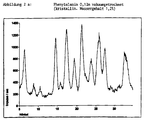
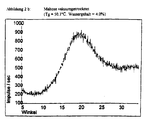
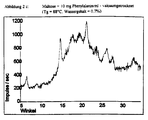
- Abb. 2:
- Pulverdiffraktogramme von vakuumgetrockneten
- (a) Phenylalanin (Wasergehalt 1.2%/kristallin),
- (b) Maltose (Wassergehalt 4.0%, Tg=50°C) und
- (c) Phenylalanin und Maltose in erfindungsgemäßer Weise zubereitet (Wassergehalt 0.7%, Tg=88°C).
- Abb. 3:
- Zeitlicher Verlauf des
- (a) Restwassergehalts und der
- (b) Glasübergangstemperatur einer erfindungsgemäßen Maltose/Phenylalaninzubereitung.
Zur Herstellung erfindungsgemäßer Mischungen mindestens zweier Aminosäuren zur Erzielung schnelltrocknender, glasartiger Zubereitungen sind jeweils mindestens eine Aminosäure und deren Derivate aus den nachfolgend genannten 2 Gruppen auszuwählen:
- Gruppe 1:
- Arginin, Asparaginsäure, Glutaminsäure, Histidin, Citrullin, Lysin, Ornithin
- Gruppe 2:
- Phenylalanin, Isoleucin, Leucin, Methionin, Valin, Alanin, Glycin, Tryptophan, Acetylphenylalaninethylester, Cystein, Sarcosin
| L-Arginin [mg/ml] | L-Phenylalanin [mg/ml] | Restwassergehalt [%] | Glasübergangstemperatur [°C] |
| 0 | 0 | 7,68 | 12,86 |
| 1 | 1 | 7,95 | 12,47 |
| 2,5 | 2,5 | 7,71 | 12,91 |
| 5 | 5 | 7,75 | 13,67 |
| 7,5 | 7,5 | 3,55 | 52,04 |
| 10 | 10 | 0,54 | 80,57 |
| 12,5 | 12,5 | 0,76 | 73,14 |
| L-Arginin [mg/ml] | L-Phenylalanin [mg/ml] | Restwassergehalt [%] | Glasübergangstemperatur [°C] |
| 0 | 0 | 2,97 | kristallin |
| 1 | 1 | 1,11 | kristallin |
| 2,5 | 2,5 | 3,46 | kristallin |
| 5 | 5 | 6,11 | kristallin |
| 10 | 10 | 3,43 | 18,56 |
| 15 | 15 | 1,53 | 53,70 |
| 20 | 20 | 1,60 | 58,78 |
| Maltose | Saccharose | |||
| Trocknung | Restwassergehalt | Glasübergangstemperatur | Restwassergehalt | Glasübergangstemperatur |
| 72 h bei 50°C | 6,4 % | 20,0°C | 6,0 % | 14,0°C |
| 48 h bei 20°C | 8,9 % | 6,1°C | 9,3 % | - 1,8°C |
| L-Phenylalanin [mg/ml] | Restwassergehalt [%] | Glasübergangstemperatur [°C] |
| 0 | 8,91 | 6,1 |
| 5 | 3,21 | 62,8 |
| 7,5 | 0,95 | 77,7 |
| 10 | 1,12 | 86,0 |
| 15 | 0,99 | 85,2 |
| 20 | 0,99 | 88,2 |
| Isoleucin [mg/ml] | Restwassergehalt [%] | Glasübergangstemperatur [°C] |
| 0 | 8,91 | 6,1 |
| 5 | 7,84 | 13,7 |
| 10 | 7,52 | 17,7 |
| 15 | 6,77 | 19,4 |
| 20 | 5,34 | 24,7 |
| L-Leucin [mg/ml] | Restwassergehalt [%] | Glasübergangstemperatur [°C] |
| 0 | 9,34 | - 1,8 |
| 5 | 6,23 | kristallin |
| 10 | 6,50 | kristallin |
| 15 | 5,81 | 16,4 |
| 20 | 5,02 | 16,1 |
| L-Histidin [mg/ml] | Restwassergehalt [%] | Glasübergangstemperatur [°C] |
| 0 | 9,34 | - 1,8 |
| 5 | 11,23 | -1,4 |
| 20 | 9,78 | -2,6 |
| Saccharose [mg/ml] | Restwassergehalt [%] | Glasübergangstemperatur [°C] |
| 20 | 3,09 | 37,30 |
| 40 | 4,19 | 22,51 |
| 60 | 5,37 | 14,44 |
| Saccharose [mg/ml] | Restwassergehalt [%] | Glasübergangstemperatur [°C] |
| 10 | 6,15 | 13,3 |
| 40 | 8,33 | 1,4 |
| eingesetzte Aminosäure | Menge an AS [mg/ml] | Zuckermenge [mg/ml] | Restwassergehalt [%] | Glasübergang [°C] |
| - | - | 50 | 8,91 | 6,1 |
| L-Arginin | 10 | 50 | 8,10 | 10,3 |
| L-Arginin | 20 | 50 | 8,63 | 7,1 |
| L-Leucin | 20 | 50 | 5,42 | 20,9 |
| L-Leucin | 20 | 20 | 1,87 | 56,05 |
| L-Histidin | 20 | 50 | 9,78 | 5,3 |
| L-Isoleucin | 20 | 20 | 3,12 | 37,9 |
| L-Methionin | 15 | 30 | 7,45 | 9,7 |
| L-Methionin | 20 | 20 | 2,70 | 34,4 |
| L-Valin | 20 | 20 | 4,93 | 18,8 |
| eingesetzte Aminosäure | Menge an AS [mg/ml] | Zuckermenge [mg/ml] | Restwassergehalt [%] | Glasübergang [°C] |
| - | - | 50 | 9,34 | - 1,8 |
| L-Alanin | 15 | 30 | 6,04 | 2,8 |
| L-Alanin | 20 | 20 | 4,46 | 11,7 |
| L-Glycin | 20 | 20 | 4,47 | 5,3 |
| L-Phenylalanin | 20 | 50 | 1,12 | 62,7 |
| L-Serin | 15 | 30 | 11,77 | -15,1 |
| L-Serin | 20 | 20 | 10,61 | - 14,4 |
| Aminosäure | Konzentration | Restwassergehalt [%] | DSC-Meßergebnis [°C] | |
| [mol/l] | [mg/ml] | |||
| L-Alanin | 0,24 | 21,38 | 0,81 | kristallin |
| L-Arginin | 0,24 | 41,80 | 0,52 | kristallin |
| L-Citrullin | 0,24 | 42,05 | 4,9 | kristallin |
| L-Cystein | 0,24 | 29,08 | 2,61 | kristallin |
| Glycin | 0,24 | 18,02 | 0,76 | kristallin |
| L-Histidin | 0,12 | 18,62 | 0,77 | kristallin |
| L-Isoleucin | 0,12 | 15,74 | 1,10 | kristallin |
| L-Leucin | 0,12 | 15,74 | 1,62 | kristallin |
| L-Lysin | 0,24 | 35,09 | 0,79 | kristallin |
| L-Methionin | 0,12 | 17,91 | 1,57 | kristallin |
| L-Phenylalanin | 0,12 | 19,82 | 1,53 | kristallin |
| L-Prolin | 0,24 | 27,63 | 19,93 | kristallin |
| L-Serin | 0,24 | 25,22 | 0,44 | kristallin |
| L-Threonin | 0,24 | 28,59 | 0,45 | kristallin |
| L-Valin | 0,24 | 28,12 | 0,57 | kristallin |
| Aminosäure | Konzentration | pH-Wert | Restwasser- gehalt | DSC-meßergebnis | |
| [mol/l] | [mg/ml] | [%] | [°C] | ||
| L-Arginin | 0,25 | 43,55 | 2,70 | 6,46 | 3,51 |
| HCl | 0,30 | 10,93 | |||
| L-Arginin | 0,25 | 43,55 | 6,81 | 3,3 | 5,17 |
| H3PO4 | 0,15 | 14,70 | |||
| L-Arginin | 0,25 | 43,55 | 2,89 | 3,24 | 6,67 |
| H2SO4 | 0,15 | 14,71 | |||
| L-Arginin | 0,25 | 43,55 | 2,58 | 2,66 | kristallin |
| HNO3 | 0,30 | 18,90 | |||
| L-Arginin | 0,25 | 43,55 | 5,24 | 11,04 | kristallin |
| Essigsäure | 0,30 | 18,0 | |||
| L-Asparagin- | 0,12 | 15,97 | 4,97 | 9,65 | 27,7 |
| säure NaOH | 0,12 | 4,8 | |||
| L-Glutamin- | 0,12 | 17,66 | 5,14 | 14,69 | 5,5 |
| säure NaOH | 0,12 | 4,8 | |||
| L-Ornithin HCl | 0,24 | 40,47 | 5,39 | 0,4 | kristallin |
| molares Mischungs | L-Arginin | L-Phenylalanin | Restwasser- gehalt | Glasübergangstemperatur | ||
| verhältnis | [mol/l] | [mg/ml] | [mol/l] | [mg/ml] | [%] | [°C ] |
| 1:1 | 0,12 | 20,90 | 0,12 | 19,82 | 2,27 | 59,5 |
| 2:1 | 0,16 | 27,87 | 0,08 | 13,21 | 9,32 | 1,7 |
| 3:1 | 0,18 | 31,35 | 0,06 | 9,91 | 9,40 | 2,8 |
| 4:1 | 0,192 | 33,44 | 0,048 | 7,928 | 9,96 | 1,3 |
| 5:1 | 0,20 | 34,83 | 0,04 | 6,61 | 10,73 | 0,0 |
| 6:1 | 0,206 | 35,88 | 0,034 | 5,61 | 10,03 | 1,3 |
| 7:1 | 0,21 | 36,58 | 0,03 | 4,96 | 11,38 | 1,0 |
| 1:2 | 0,06 | 10,45 | 0,12 | 19,82 | 2,85 | 47,2 |
| 1:3 | 0,04 | 6,97 | 0,12 | 19,82 | 3,43 | 46,2 |
| 1:4 | 0,03 | 5,23 | 0,12 | 19,82 | 3,66 | 43,45 |
| molares Mischungs | L-Arginin | L-Isoleucin | Restwassergehalt | Glasübergangstemperatur | ||
| verhältnis | [mol/l] | [mg/ml] | [mol/l] | [mg/ml] | [%] | [°C] |
| 1:1 | 0,15 | 26,13 | 0,15 | 19,68 | 1,05 | 53,27 |
| Angegeben sind die Monomergehalte in % wie in der HP-SEC erhalten | |||||
| Lagerzeit [Wochen] | Lagertemperatur | ||||
| KS | RT | 30°C | 40°C | 50°C | |
| 0 | - | 99,83 % | - | - | - |
| 5 | 99,94 % | 99,93 % | 99,86 % | 99,89 % | 99,87 % |
| 13 | 99,83 % | 99,86 % | 99,88 % | 99,83 % | 99,83 % |
| 26 | 99,76 % | 99,75 % | 99,55 % | 99,36 % | 99,21 % |
| 39 | 99,68 % | 96,73 % | 96,40 % | 93,81 % | 89,27 % |
| 52 | 98,34% | 94,81 % | 94,70 % | 91,27 % | 86,27 % |
| KS = Kühlschranktemperatur = 4 - 6°C RT = Raumtemperatur = 20 - 22°C |
| Ergebnis der Gelelektrophorese | ||
| Spur | Zubereitung | Sichtergebnis |
| 1 | Eichproteine | |
| 2 | Beispiel. 8: L-arginin- und L-phenylalaninhaltige Maltoserezeptur | nur Monomere |
| 3 | Vergleichsbeispiel D: Trocknung ohne Hilfsstoffe | Monomere und Dimere |
| 4 | Vergleichsbeispiel E: reine Maltoserezeptur | Monomere, Dimere und Trimere |
| 5 | Eichproteine | |
| 6 | Beispiel 9: L-arginin- und L-phenylalaninhaltige, zuckerfreie Rezeptur | nur Monomere |
| 7 | Vergleichsbeispiel F: L-Argininrezeptur mit Phosphorsäure | Monomere und Dimere |
| 8 | Vergleichsbeispiel G: kristalline L-Valin - L-Glycinrezeptur | Monomere, Dimere und Abbauprodukte |
| Angegeben sind die Monomeranteile in % wie in der HP-SEC erhalten | |||
| Lagerzeit [Wochen] | Lagertemperatur | ||
| KS | RT | 40°C | |
| 0 | - | 97,84 % | - |
| 5 | 94,90 % | 94,53 % | 93,96 % |
| 13 | 91,31 % | 89,66 % | 78,23 % |
| 26 | 80,06 % | 73,60 % | 52,22 % |
| KS = Kühlschranktemperatur = 4- 6°C RT = Raumtemperatur = 20 - 22°C |
| Angegeben sind die Monomergehalte in % wie in der HP-SEC erhalten. | |||||
| Lagerzeit [Wochen] | Lagertemperatur | ||||
| KS | RT | 30 C | 40 C | 50 C | |
| 0 | - | 97,99 % | - | - | - |
| 5 | 98,26 % | 96,82 % | 93,91 % | 67,45 % | 42,63 % |
| 13 | 97,15 % | 90,49 % | 73,70 % | 30,05 % | 18,52 % |
| 26 | 97,05 % | 88,23 % | 71,32 % | 22,30 % | 15,27 % |
| Angegeben sind die Monomeranteile wie in der HP-SEC erhalten | ||||||
| Lagerzeit | Lagertemperaturen | |||||
| [Wochen] | KS | RT | 30°C | 40°C | 60°C | 80°C |
| 0 | - | 99,57% - | - | - | - | |
| 4 | 99,36 % | 99,36 % | 99,50 % | 99,81 % | 96,56 % | 1,44% |
| 13 | 99,17% | 99,31% | 99,40% | 99,64% | - | - |
| 26 | 98,64 % | 98,62 % | 96,52 % | 91,06 % | - | - |
| 39 | 99,64 % | 94,18 % | 88,99 % | 79,05 % | - | - |
| KS = Kühlschranlemperatur= 4-6°C RT = Raumtemperatur = 20-22°C |
| Wassergehalt [%] | Tg [°C] | Monomergehalt G-CSF [%] | |
| Start | 0,77 | 82,1 | 99,82 |
| nach 52 Wochen: | |||
| KS | 1,20 | 79,52 | 98,34 |
| RT | 2,08 | 69,47 | 94,81 |
| 30° | 2,21 | 67,91 | 94,70 |
| 40° | 2,32 | 67,36 | 91,27 |
| 50° | 2,40 | 68,63 | 86,26 |
| KS = Kühlschranktemperatur = 4-6°C RT = Raumtemperatur = 20-22°C |
| Angegeben sind die Monomeranteile in % wie in der HP-SEC erhalten | |||||||
| Lagerzeit [Wochen] | Lagertemperaturen | ||||||
| -20°C | KS | RT | 30°C | 40°C | 60°C | 80°C | |
| 0 | - | - | 99,60% | - | - | - | - |
| 4 | 99,57% | 99,60% | 99,37% | 99,34% | 99,20% | 89,46% | 31,81% |
| 13 | 99,75 % | 98,17% | 98,06 % | 97,31 % | 93,41 % | - | - |
| 33 | 99,28 % | 99,30 % | 99,21 % | 97,86 % | 93,02 % | - | - |
| Angegeben sind die Monomeranteile in % wie in der HP-SEC erhalten | ||||||
| Lagerzeit [Wochen] | Lagertemperaturen | |||||
| KS | RT | 30°C | 40°C | 60°C | 80°C | |
| 0 | - | 94,36 % | - | - | - | - |
| 4 | 89,93 % | 89,66 % | 84,26 % | 72,47 % | 44,54 % | 27,44 % |
| 13 | 74,14% | 73,91 % | 64,90% | 46,82% | - | - |
| 33 | 73,75 % | 70,04 % | 54,93 % | 40,40 % | - | - |
| KS = Kühlschranktemperatur= 4-6°C RT = Raumtemperatur = 20-22°C |
| Angegeben sind die Monomergehalte in % wie in der HP-SEC erhalten | |||
| Lagerzeit [Wochen] | Lagertemperatur | ||
| KS | RT | 40°C | |
| 0 | - | 100% | - |
| 4 | 100% | 100% | 100% |
| 9 | 100% | 100% | 100% |
| 13 | 100 % | 100 % | 100 % |
| 26 | 100 % | 100 % | 99,9 % |
| KS = Kühlschranktemperatur= 4-6°C RT = Raumtemperatur = 20-22°C |
| Angegeben sind die Monomergehalte in % wie in der HP-SEC erhalten | |||
| Lagerzeit [Wochen] | Lagertemperatur | ||
| KS | RT | 40° C | |
| 0 | - | 99,5% | - |
| 4 | 98,6% | 94,4% | 88,0% |
| 9 | 96,0% | 89,0% | 75,0% |
| 13 | 95,7 % | 87,0 % | 76,3 % |
| 26 | 94,7 % | 88,2 % | 66,6 % |
| KS = Kühlschranktemperatur= 4-6° C RT = Raumtemperatur = 20-22° C |
| Angegeben ist die Aktivität in % wie in der Untersuchung erhalten | |||||
| Lagerzeit [Wochen] | Lagertemperatur | ||||
| KS | RT | 30° | 40° | 60° | |
| 0 | - | 85,3 % | - | - | - |
| 5 | 87,81 % | 87,45 % | 81,15 % | 80,42 % | 64,42 % |
| 13 | 83,28% | 79,41 % | 78,79% | 61,74% | - |
| KS = Kühlschranktemperatur = 4-6°C RT = Raumtemperatur = 20-22°C |
| Angegeben ist die Aktivität in % wie in der Untersuchung erhalten | |||
| Lagerzeit [Wochen] | Lagertemperatur | ||
| KS | RT | 40° C | |
| 0 | - | 64,52 % | - |
| 5 | 66,54 % | 23,03 % | 1,57 % |
| 13 | 50,63 % | 6,81 % | 0% |
| KS = Kühlschranktemperatur= 4-6° C,RT = Raumtemperatur = 20-22° C |
| Angegeben ist die Enzymaktivität in % wie im Aktivitätstest erhalten | |||||
| Lagerzeit [Wochen] | Lagertemperaturen | ||||
| KS | RT | 30°C | 40°C | 60°C | |
| 0 | - | 80,36 % | - | - | - |
| 4 | 79,70 % | 82,08 % | 79,34 % | 77,62 % | 70,54 % |
| 13 | 82,25% | 76,11 % | 75,21 % | 73,06 % | - |
| Angegeben ist die Enzymaktivität in % wie im Aktivitätstest erhalten | |||||
| Lagerzeit [Wochen] | Lagertemperaturen | ||||
| KS | RT | 30°C | 40°C | 60°C | |
| 0 | 9,26 % | ||||
| 5 | 3,69 % | 2,11 % | 1,09% | 0,80% | 0,0% |
| 13 | 0,08% | 0,01% | 0% | 0% | 0% |
Claims (27)
- Verfahren zur Herstellung von trockenen, teilamorphen Produkten. die neben einer oder mehreren Substanzen der Gruppen Proteine, Humanpeptide, Glycoproteine. Lipoproteine, Enzyme, Coenzyme, Antikörper. Antikörperfragmente, Viren. Virusbestandteile. Zellen und Zellbestandteile, Vaccine, DNA, RNA. PNA, und deren Derivate Substanzgemische enthalten, wobei die Substanzgemische ausgewählt sind aus je mindestens einer Substanz der Gruppedadurch gekennzeichnet, daß eine Lösung aus einer oder mehreren Substanzen der Gruppen Proteine, Humanpeptide. Glycoproteine, Lipoproteine, Enzyme, Coenzyme, Antikörper, Antikörperfragmente, Viren, Virusbestandteile, Zellen und Zelibestandteile, Vaccine, DNA, RNA, PNA, und deren Derivate und der Substanzen (i) und (ii) hergestellt wird und die Lösung ohne Einfrieren der Lösung getrocknet wird.(i) Kohlenhydrat oder Zwitterion mit polarem Rest und deren Derivate. und(ii) Zwitterion mit apolaren Rest und dessen Derivate,
- Verfahren nach Anspruch 1, wobei das Zwitterion mit apolarem Rest eine Aminocarbonsäure oder deren Derivat ist.
- Verfahren nach einem der Ansprüche 1 oder 2, wobei das Zwitterion mit polarem Rest eine Aminocarbonsäure oder deren Derivat ist.
- Verfahren nach Anspruch 1, dadurch gekennzeichnet, daß Substanzgemische aus einem oder mehreren Stoffen der jeweiligen Gruppe,
Mono-, Disacharide, Arginin, Asparaginsäure, Citrullin, Glutaminsäure, Ornithin, Histidin, Lysin und deren Derivate und
Acetylphenylalaninethylester, Alanin, Cystein, Glycin, Isoleucin, Leucin. Methionin, Phenylalanin, Tryptophan. Valin, Sarcosin und deren Derivate ausgewählt werden. - Verfahren nach einem der Ansprüche 1-5, dadurch gekennzeichnet, daß die Lösung zusätzlich übliche Hilfsstoffe aus den Gruppen Puffer, Tenside, Antioxidantien, Isotonisierungsmittel, Konservierungsmittel enthält.
- Verfahren nach einem der Ansprüche 1-5, dadurch gekennzeichnet, daß die Trocknung mittels Vakuumtrocknung erfolgt.
- Verfahren nach einem der Ansprüche 1-6, dadurch gekennzeichnet, daß die Vakuumtrocknung in kontinuierlicher Trocknungsweise erfolgt.
- Verfahren nach einem der Ansprüche 1-5, dadurch gekennzeichnet, daß die Trocknung mittels Sprühtrocknung erfolgt.
- Verfahren nach einem der Ansprüche 1-5, dadurch gekennzeichnet, daß die Trocknung mittels Walzentrocknung erfolgt.
- Verfahren nach einem der Ansprüche 1-5, dadurch gekennzeichnet, daß die Trocknung mittels Infrarotstrahlen, Mikrowellen oder anderen Verfahren der Strahlungstrocknung erfolgt.
- Verfahren nach einem der Ansprüche 1-10, dadurch gekennzeichnet, daß ein Zwitterion mit apolarem Rest derart ausgewählt wird, daß das getrocknete Substanzgemisch einen erhöhten Glaspunkt gegenüber einem Substanzgemisch ohne entsprechenden Zusatz aufweist.
- Verfahren nach einem der Ansprüche 1-7, dadurch gekennzeichnet, daß die Trocknung in einer Gefriertrockenanlage ohne vorheriges Einfrieren erfolgt.
- Verfahren nach einem der Ansprüche 1-7, 11 oder 12, dadurch gekennzeichnet, daß die Trocknung des Substanzgemisches in Einzeldosisbehältern durchgeführt wird.
- Verfahren nach einem der Ansprüche 1-12, dadurch gekennzeichnet, daß das erhaltene Stoffgemisch anschließend zu Pulver gemahlen wird.
- Substanzgemische enthaltend, neben einer oder mehreren Substanzen der Gruppen Proteine. Humanpeptide. Glycoproteine, Lipoproteine. Enzyme. Coenzyme, Antikörper. Antikörperfragmente. Viren, Virusbestandteile, Zellen und Zellbestandteile, Vaccine, DNA, RNA, PNA, und deren Derivate. Stoffe ausgewählt aus je einer oder mehreren Substanzen der folgenden Gruppendadurch gekennzeichnet, daß die Substanzgemische durch Zusatz einer oder mehrerer Substanzen der Gruppe (ii) eine erhöhte Glasübergangstemperatur gegenüber Substanzen der Gruppe (i) ohne entsprechenden Zusatz. aufweisen, wobei Lyophilisate ausgenommen sind.(i) einem Kohlenhydrat oder Zwitterion mit polaren Resten und deren Derivate(ii) Zwitterionen mit apolaren Resten und deren Derivate,
- Substanzgemische erhältlich nach einem Verfahren, nach einem der Ansprüche 1-14.
- Substanzgemische nach Anspruch 15 oder 16, dadurch gekennzeichnet, daß sie teilamorph sind.
- Substanzgemische nach einem der Ansprüche 15-17, dadurch gekennzeichnet, daß die Glasübergangstemperarur über 4°C liegt, bevorzugt über 20 °C, und die Restfeuchte weniger als 6% (g/g), vorzugsweise weniger als 4% (g/g) beträgt.
- Substanzgemische nach einem der Ansprüche 15-18. dadurch gekennzeichnet. daß sie eine mindestens 10% höhere scheinbare Dichte als Lyophilisate aufweisen.
- Substanzgemische nach einem der Ansprüche 15-19, dadurch gekennzeichnet. daß sie eine spröde, teilamorphe, glasartige, kompakte Struktur aufweisen.
- Substanzgemische nach einem der Ansprüche 15-20. dadurch gekennzeichnet. daß sie die teilamorphe Struktur über Lagerzeiten von mindestens 2 Wochen behalten.
- Substanzgemische nach einem der Ansprüche 15-21, dadurch gekennzeichnet. daß deren Trockungszeiten gegenüber Substanzen der Gruppe (i) mindestens halbiert sind.
- Diagnostische Mittel, dadurch gekennzeichnet, daß sie Substanzgemische nach einem der Ansprüche 15-22 enthalten.
- Venvendung von Substanzgemischen gemäß einem der Ansprüche 15-22 zur Herstellung von Diagnostika.
- Therapeutische Zubereitungen, dadurch gekennzeichnet, daß sie Stoffgemische nach einem der Ansprüche 15-22 enthalten.
- Verwendung von Substanzgemischen gemäß einem der Ansprüche 15-22 neben üblichen Hilfs- und Zusatzstoffen zur Herstellung von therapeutischen Mitteln.
- Verwendung von Substanzgewischen aus je mindestens einer Substanz ausgewählt aus(i) Kohlehydrat oder Zwitterion mit polarem Rest und deren Derivate und(ii) Zwitterion mit apolarem Rest und dessen Derivate
zur Stabilisierung von einer oder mehreren Substanzen der Gruppen Proteine. Humanpeptide, Glycoproteine. Lipoproteine. Enzyme. Coenzyme. Antikörper. Antikörperfraamente. Viren. Virusbestandteile, Zellen und Zellbestandteile. Vaccine, DNA. RNA. PNA, und deren Derivate
in einem Produkt entstanden durch Trocknen ohne Einfrieren.
Priority Applications (1)
| Application Number | Priority Date | Filing Date | Title |
|---|---|---|---|
| SI9630426T SI0857060T1 (en) | 1995-10-25 | 1996-10-24 | Method and preparations for stabilizing biological materials by drying methods without freezing |
Applications Claiming Priority (3)
| Application Number | Priority Date | Filing Date | Title |
|---|---|---|---|
| DE19539574 | 1995-10-25 | ||
| DE19539574A DE19539574A1 (de) | 1995-10-25 | 1995-10-25 | Zubereitungen und Verfahren zur Stabilisierung biologischer Materialien mittels Trocknungsverfahren ohne Einfrieren |
| PCT/EP1996/004627 WO1997015288A2 (de) | 1995-10-25 | 1996-10-24 | Zubereitungen und verfahren zur stabilisierung biologischer materialien mittels trocknungsverfahren ohne einfrieren |
Publications (2)
| Publication Number | Publication Date |
|---|---|
| EP0857060A2 EP0857060A2 (de) | 1998-08-12 |
| EP0857060B1 true EP0857060B1 (de) | 2002-01-30 |
Family
ID=7775640
Family Applications (1)
| Application Number | Title | Priority Date | Filing Date |
|---|---|---|---|
| EP96934811A Revoked EP0857060B1 (de) | 1995-10-25 | 1996-10-24 | Zubereitungen und verfahren zur stabilisierung biologischer materialien mittels trocknungsverfahren ohne einfrieren |
Country Status (25)
| Country | Link |
|---|---|
| US (3) | US7172999B2 (de) |
| EP (1) | EP0857060B1 (de) |
| JP (2) | JPH11513700A (de) |
| KR (1) | KR100466670B1 (de) |
| CN (1) | CN1130196C (de) |
| AT (1) | ATE212541T1 (de) |
| AU (1) | AU712489B2 (de) |
| BR (1) | BR9611265A (de) |
| CA (1) | CA2235243C (de) |
| CZ (1) | CZ293456B6 (de) |
| DE (2) | DE19539574A1 (de) |
| DK (1) | DK0857060T3 (de) |
| ES (1) | ES2170274T3 (de) |
| HU (1) | HU222601B1 (de) |
| IL (1) | IL124204A (de) |
| MX (1) | MX9803264A (de) |
| NO (1) | NO324728B1 (de) |
| NZ (1) | NZ320276A (de) |
| PL (1) | PL190657B1 (de) |
| PT (1) | PT857060E (de) |
| RU (1) | RU2191003C2 (de) |
| SK (1) | SK283664B6 (de) |
| TR (1) | TR199800715T2 (de) |
| WO (1) | WO1997015288A2 (de) |
| ZA (1) | ZA968930B (de) |
Families Citing this family (58)
| Publication number | Priority date | Publication date | Assignee | Title |
|---|---|---|---|---|
| US6582728B1 (en) | 1992-07-08 | 2003-06-24 | Inhale Therapeutic Systems, Inc. | Spray drying of macromolecules to produce inhaleable dry powders |
| DE19539574A1 (de) * | 1995-10-25 | 1997-04-30 | Boehringer Mannheim Gmbh | Zubereitungen und Verfahren zur Stabilisierung biologischer Materialien mittels Trocknungsverfahren ohne Einfrieren |
| EP0852951A1 (de) * | 1996-11-19 | 1998-07-15 | Roche Diagnostics GmbH | Stabile lyophilisierte pharmazeutische Zubereitungen von mono- oder polyklonalen Antikörpern |
| EP0913178A1 (de) * | 1997-11-03 | 1999-05-06 | Boehringer Mannheim Gmbh | Verfahren zur Herstellung trockener, amorpher Produkte enthaltend biologisch aktive Materialen mittels Konvektionstrocknung und die erhaltenen Produkte |
| EP0913177A1 (de) * | 1997-11-03 | 1999-05-06 | Roche Diagnostics GmbH | Verfahren zur Herstellung trockener, amorpher Produkte enthaltend biologisch aktive Materialien mittels Konvektionstrocknung, insbesondere Sprühtrocknung |
| BR9905867A (pt) * | 1998-11-06 | 2001-01-23 | Bio Sidus S A | Linhagem celular produtora de eritropoietina humana recombinante e a eritropoietina humana recombinante produzida por esta célula |
| ATE401908T1 (de) * | 1999-04-09 | 2008-08-15 | Ortho Mcneil Pharm Inc | Pharmazeutische zusammensetzungen von erythropoietin |
| DE10026698A1 (de) | 2000-05-30 | 2001-12-06 | Basf Ag | Selbstemulgierende Wirkstoffformulierung und Verwendung dieser Formulierung |
| AU2000264912A1 (en) * | 2000-06-07 | 2001-12-17 | Universal Preservation Technologies, Inc. | Industrial scale barrier technology for preservation of sensitive biological materials |
| GB0017999D0 (en) * | 2000-07-21 | 2000-09-13 | Smithkline Beecham Biolog | Novel device |
| HRP20040649B1 (en) * | 2002-01-16 | 2012-12-31 | Boehringer Ingelheim Pharma | Bilayer pharmaceutical tablet comprising telmisartan and a diuretic and preparation thereof |
| KR100556503B1 (ko) * | 2002-11-26 | 2006-03-03 | 엘지전자 주식회사 | 건조기의 건조 시간제어 방법 |
| US8377952B2 (en) * | 2003-08-28 | 2013-02-19 | Abbott Laboratories | Solid pharmaceutical dosage formulation |
| US8025899B2 (en) * | 2003-08-28 | 2011-09-27 | Abbott Laboratories | Solid pharmaceutical dosage form |
| US20080176209A1 (en) * | 2004-04-08 | 2008-07-24 | Biomatrica, Inc. | Integration of sample storage and sample management for life science |
| AU2005245338B2 (en) | 2004-04-08 | 2011-11-17 | Biomatrica, Inc. | Integration of sample storage and sample management for life science |
| US20060099567A1 (en) * | 2004-04-08 | 2006-05-11 | Biomatrica, Inc. | Integration of sample storage and sample management for life science |
| GB0517688D0 (en) * | 2005-08-31 | 2005-10-05 | Cambridge Biostability Ltd | Improvements in the stabilisation of biological materials |
| GB2430880A (en) * | 2005-10-04 | 2007-04-11 | Cambridge Biostability Ltd | Pharmaceutical compositions stabilized in glassy particles |
| GB0523638D0 (en) * | 2005-11-21 | 2005-12-28 | Cambridge Biostability Ltd | Pharmaceutical device for the administration of substances to patients |
| US8968721B2 (en) | 2005-12-28 | 2015-03-03 | Advanced Bionutrition Corporation | Delivery vehicle for probiotic bacteria comprising a dry matrix of polysaccharides, saccharides and polyols in a glass form and methods of making same |
| ES2470340T3 (es) | 2005-12-28 | 2014-06-23 | Advanced Bionutrition Corporation | Vehículo de administración para bacterias probi�ticas que comprende una matriz seca de polisac�ridos, sac�ridos y polioles en forma vítrea |
| WO2008076975A1 (en) | 2006-12-18 | 2008-06-26 | Advanced Bionutrition Corporation | A dry food product containing live probiotic |
| US8466187B2 (en) | 2007-09-18 | 2013-06-18 | Thermolife International, Llc | Amino acid compositions |
| EP3266448B1 (de) | 2009-03-27 | 2022-02-16 | Intervet International B.V. | Impfstoffe in mikropartikelform zur oralen oder nasalen impfung und stärkung von tieren einschliesslich fischen |
| EP2236520A1 (de) * | 2009-03-31 | 2010-10-06 | Leukocare Ag | Stabilisierungszusammensetzung für immobilisierte Biomoleküle |
| AU2010254235B2 (en) * | 2009-05-26 | 2015-04-02 | Advanced Bionutrition Corporation | Stable dry powder composition comprising biologically active microorganisms and/or bioactive materials and methods of making |
| AR080428A1 (es) | 2010-01-20 | 2012-04-11 | Chugai Pharmaceutical Co Ltd | Formulaciones liquidas estabilizadas contentivas de anticuerpos |
| BR112012018839B1 (pt) | 2010-01-28 | 2020-04-14 | Advanced Bionutrition Corp | composição vítrea seca compreendendo um material bioativo |
| US9504750B2 (en) | 2010-01-28 | 2016-11-29 | Advanced Bionutrition Corporation | Stabilizing composition for biological materials |
| WO2012018638A2 (en) | 2010-07-26 | 2012-02-09 | Biomatrica, Inc. | Compositions for stabilizing dna, rna and proteins in blood and other biological samples during shipping and storage at ambient temperatures |
| WO2012018639A2 (en) | 2010-07-26 | 2012-02-09 | Biomatrica, Inc. | Compositions for stabilizing dna, rna and proteins in saliva and other biological samples during shipping and storage at ambient temperatures |
| MX350047B (es) | 2010-08-13 | 2017-08-24 | Advanced Bionutrition Corp | Composicion de estabilizacion de almacenamiento en seco para materiales biologicos. |
| CN102408467B (zh) * | 2010-09-26 | 2014-03-05 | 海口维瑅瑷生物研究院 | 真空干燥蛋白的方法、制得的蛋白产品和试剂盒 |
| US12612370B2 (en) | 2011-03-02 | 2026-04-28 | Thermolife International, Llc | Amino acid compositions |
| HUE032165T2 (en) | 2011-04-13 | 2017-09-28 | Thermolife Int Llc | Methods of using N-actyl-beta-alanine |
| EP3249054A1 (de) | 2012-12-20 | 2017-11-29 | Biomatrica, INC. | Formulierungen und verfahren zur stabilisierung von pcr-reagenzien |
| RS67458B1 (sr) | 2014-03-28 | 2025-12-31 | Univ Duke | Lečenje kancera dojke pozitivnog na receptor estrogena upotrebom selektivnih modulatora receptora estrogena |
| WO2015191632A1 (en) | 2014-06-10 | 2015-12-17 | Biomatrica, Inc. | Stabilization of thrombocytes at ambient temperatures |
| US9868944B2 (en) * | 2014-12-19 | 2018-01-16 | Roche Molecular Systems, Inc. | Reaction mixtures |
| AR103173A1 (es) | 2014-12-22 | 2017-04-19 | Novarits Ag | Productos farmacéuticos y composiciones líquidas estables de anticuerpos il-17 |
| EP3256581B1 (de) * | 2015-02-11 | 2020-09-09 | Elanco Canada Limited | Verbesserte trockenmatrix zur einbettung lebensfähiger escherichia coli, verfahren zur herstellung davon und verwendung davon |
| KR102676629B1 (ko) | 2015-04-29 | 2024-06-18 | 래디어스 파마슈티컬스, 인코포레이티드 | 암을 치료하는 방법 |
| US12558395B2 (en) | 2015-07-29 | 2026-02-24 | Advanced Bionutrition Corp. | Stable dry probiotic compositions for special dietary uses |
| EP3328215B1 (de) | 2015-07-29 | 2021-07-07 | Advanced BioNutrition Corp. | Stabile trockene probiotische zusammensetzungen für spezielle diätverwendungen |
| KR102589056B1 (ko) | 2015-12-08 | 2023-10-12 | 바이오매트리카 인코포레이티드 | 적혈구 침강 속도의 감소 |
| CN106831466B (zh) * | 2016-12-28 | 2018-05-22 | 安徽省虹升生物股份有限公司 | 一种β-丙氨酸的常规储存方法 |
| KR102881465B1 (ko) | 2017-01-05 | 2025-11-04 | 래디어스 파마슈티컬스, 인코포레이티드 | Rad1901-2hcl의 다형 형태 |
| AU2019254473A1 (en) * | 2018-04-16 | 2020-12-03 | Merck Patent Gmbh | Additives for protein formulations to improve thermal stability |
| CN112423844B (zh) | 2018-07-04 | 2024-08-13 | 雷迪厄斯制药公司 | Rad1901-2hcl的多晶型形式 |
| JOP20210218A1 (ar) | 2019-02-12 | 2023-01-30 | Radius Pharmaceuticals Inc | عمليات ومركبات |
| TWI872251B (zh) | 2020-05-29 | 2025-02-11 | 日商中外製藥股份有限公司 | 含有抗體製劑 |
| IL299671A (en) * | 2020-07-13 | 2023-03-01 | Merck Patent Gmbh | Viscosity-reducing excipients and their combinations for high-concentration protein formulations |
| US11865139B2 (en) | 2020-11-12 | 2024-01-09 | Thermolife International, Llc | Method of treating migraines and headaches |
| AU2021377897A1 (en) | 2020-11-12 | 2024-09-12 | Thermolife International, Llc | Methods of increasing blood oxygen saturation |
| KR20230145103A (ko) | 2021-02-11 | 2023-10-17 | 써모라이프 인터내셔널, 엘엘씨 | 산화질소 기체의 투여 방법 |
| CN114480129A (zh) * | 2022-01-13 | 2022-05-13 | 力因精准医疗产品(上海)有限公司 | 一种人粪便保存液及使用方法 |
| KR102913374B1 (ko) * | 2022-12-28 | 2026-01-15 | 씨제이제일제당 주식회사 | 발효 제품 제조 방법 |
Family Cites Families (42)
| Publication number | Priority date | Publication date | Assignee | Title |
|---|---|---|---|---|
| US3714353A (en) * | 1959-08-11 | 1973-01-30 | Upjohn Co | THERAPEUTIC COMPOSITIONS COMPRISING A 6 alpha ; 9 alpha -DIFLUORO-11 beta ,17 alpha ,21-TRIHYDROXY-16 alpha -METHYL-1,4-PREGNADIENE-3,20-DIONE AND 21-ACYLATES |
| US3852461A (en) * | 1971-08-04 | 1974-12-03 | Upjohn Co | Benzodiapines used as minor tranquilizers |
| JPS5836954B2 (ja) * | 1980-03-31 | 1983-08-12 | 栄研化学株式会社 | 酵素の安定化剤 |
| JPS5967228A (ja) | 1982-10-07 | 1984-04-16 | Green Cross Corp:The | 寒冷不溶性グロブリンの凍結乾燥方法 |
| JPS6197229A (ja) * | 1984-10-18 | 1986-05-15 | Chugai Pharmaceut Co Ltd | 安定なエリトロポエチン製剤 |
| US4732889A (en) * | 1985-02-06 | 1988-03-22 | Chugai Seiyaku Kabushiki Kaisha | Pharmaceutical composition for the treatment of the anemia of rheumatoid arthritis |
| US4788072A (en) * | 1985-08-15 | 1988-11-29 | Toshimitsu Kawamura | Method of dehydrating foods |
| US4808617A (en) | 1985-12-18 | 1989-02-28 | Bristol-Myers Company | Lyophilized or precipitated cephalosporin zwitterion and salt combination |
| US5051406A (en) * | 1987-03-04 | 1991-09-24 | Nippon Hypox Laboratories Incorporated | Pharmaceutical composition using albumin as a carrier and process for producing the same |
| DE3729863A1 (de) | 1987-09-05 | 1989-03-16 | Boehringer Mannheim Gmbh | Stabilisierte erythropoietin-lyophilisate |
| US4886742A (en) * | 1987-06-15 | 1989-12-12 | Coulter Corporation | Enzyme immunoassay for detecting HIV antigens in human sera |
| DE3801179A1 (de) | 1988-01-18 | 1989-07-27 | Hoechst Ag | Stabilisierung von cephalosporinderivaten durch trocknung mit einem stabilisator sowie stabile zubereitungsformen mit cephalosporinderivaten |
| JPH0761955B2 (ja) | 1988-04-28 | 1995-07-05 | 国立予防衛生研究所長 | 凍結乾燥a型肝炎ワクチン |
| CA1339071C (en) | 1988-08-24 | 1997-07-29 | Koichiro Tsuji | Thrombus control agent |
| JPH0296536A (ja) | 1988-09-29 | 1990-04-09 | Green Cross Corp:The | プラスミノゲン乾燥製剤 |
| JP2739584B2 (ja) | 1989-01-06 | 1998-04-15 | 株式会社ミドリ十字 | ウロキナーゼ型プラスミノーゲンアクチベーター乾燥製剤 |
| US5186944A (en) * | 1989-02-15 | 1993-02-16 | Eimei Company Ltd. | Therapeutic medicament for thrombosis |
| JPH03505334A (ja) * | 1989-04-11 | 1991-11-21 | イミユノバイオロジー・リサーチ・インスチチユート・インコーポレーテツド | 凍結乾燥されたペプチド製剤 |
| JPH0775519B2 (ja) | 1989-10-06 | 1995-08-16 | 東洋製罐株式会社 | ドライパック包装食品の製造方法 |
| GB9001987D0 (en) * | 1990-01-29 | 1990-03-28 | Janssen Pharmaceutica Nv | Improved cyclodextrin based erythropietin formulation |
| JPH0813750B2 (ja) | 1990-03-01 | 1996-02-14 | 持田製薬株式会社 | 経口用トロンビン製剤 |
| US5200399A (en) * | 1990-09-14 | 1993-04-06 | Boyce Thompson Institute For Plant Research, Inc. | Method of protecting biological materials from destructive reactions in the dry state |
| US5217741A (en) | 1991-01-25 | 1993-06-08 | Snow Brand Milk Products Co., Ltd. | Solution containing whey protein, whey protein gel, whey protein powder and processed food product produced by using the same |
| AU659645B2 (en) | 1991-06-26 | 1995-05-25 | Inhale Therapeutic Systems | Storage of materials |
| JP2818834B2 (ja) * | 1991-08-12 | 1998-10-30 | 大塚製薬株式会社 | IL−1α安定化医薬製剤 |
| DE4141351A1 (de) | 1991-12-14 | 1993-06-17 | Basf Ag | Stabile pulverfoermige vitamin- und/oder carotinoid-praeparate und verfahren zu deren herstellung |
| SE9201073D0 (sv) | 1992-04-03 | 1992-04-03 | Kabi Pharmacia Ab | Protein formulation |
| IL105553A (en) | 1992-05-06 | 1998-01-04 | Janssen Pharmaceutica Inc | Solid dosage form comprising a porous network of matrix forming material which disperses rapidly in water |
| IT1254359B (it) | 1992-05-11 | 1995-09-14 | Serono Cesare Ist Ricerca | Composizioni farmaceutiche contenenti il-6 |
| US6582728B1 (en) | 1992-07-08 | 2003-06-24 | Inhale Therapeutic Systems, Inc. | Spray drying of macromolecules to produce inhaleable dry powders |
| JP3168550B2 (ja) * | 1992-12-02 | 2001-05-21 | 株式会社林原生物化学研究所 | 脱水剤およびそれを用いる含水物の脱水方法並びにその方法で得られる脱水物品 |
| DE4242863A1 (de) * | 1992-12-18 | 1994-06-23 | Boehringer Mannheim Gmbh | Stabile lyophilisierte pharmazeutische Zubereitungen von G-CSF |
| US5354934A (en) * | 1993-02-04 | 1994-10-11 | Amgen Inc. | Pulmonary administration of erythropoietin |
| ES2218543T3 (es) | 1994-03-07 | 2004-11-16 | Nektar Therapeutics | Procedimiento y preparacion para la administracion de insulina por via pulmonar. |
| US5955448A (en) * | 1994-08-19 | 1999-09-21 | Quadrant Holdings Cambridge Limited | Method for stabilization of biological substances during drying and subsequent storage and compositions thereof |
| FR2719479B1 (fr) * | 1994-05-04 | 1996-07-26 | Sanofi Elf | Formulation stable lyophilisée comprenant une protéine: kit de dosage. |
| NZ285664A (en) | 1994-05-18 | 1998-07-28 | Inhale Therapeutic Syst | Dry powder interferon composition adapted for pulmonary delivery |
| IL116085A (en) | 1994-12-16 | 1999-12-31 | Ortho Pharma Corp | Spray dried erythropoietin |
| KR19980703876A (ko) | 1995-04-14 | 1998-12-05 | 스티븐 엘. 허스트 | 분산성이 개선된 분말화된 약학적 조성물 |
| US5728678A (en) | 1995-06-06 | 1998-03-17 | Nestec Ltd. | Method and composition for providing nutrition to a renal failure patient |
| DE19538687A1 (de) | 1995-10-17 | 1997-04-24 | Boehringer Mannheim Gmbh | Stabile pharmazeutische Darreichungsformen enthaltend Parathormon |
| DE19539574A1 (de) * | 1995-10-25 | 1997-04-30 | Boehringer Mannheim Gmbh | Zubereitungen und Verfahren zur Stabilisierung biologischer Materialien mittels Trocknungsverfahren ohne Einfrieren |
-
1995
- 1995-10-25 DE DE19539574A patent/DE19539574A1/de not_active Withdrawn
-
1996
- 1996-10-24 NZ NZ320276A patent/NZ320276A/xx not_active IP Right Cessation
- 1996-10-24 TR TR1998/00715T patent/TR199800715T2/xx unknown
- 1996-10-24 SK SK509-98A patent/SK283664B6/sk not_active IP Right Cessation
- 1996-10-24 WO PCT/EP1996/004627 patent/WO1997015288A2/de not_active Ceased
- 1996-10-24 EP EP96934811A patent/EP0857060B1/de not_active Revoked
- 1996-10-24 US US09/051,918 patent/US7172999B2/en not_active Expired - Fee Related
- 1996-10-24 ZA ZA9608930A patent/ZA968930B/xx unknown
- 1996-10-24 IL IL12420496A patent/IL124204A/en not_active IP Right Cessation
- 1996-10-24 CN CN96199329A patent/CN1130196C/zh not_active Expired - Fee Related
- 1996-10-24 BR BR9611265A patent/BR9611265A/pt not_active IP Right Cessation
- 1996-10-24 DE DE59608684T patent/DE59608684D1/de not_active Revoked
- 1996-10-24 CA CA002235243A patent/CA2235243C/en not_active Expired - Fee Related
- 1996-10-24 JP JP9516286A patent/JPH11513700A/ja active Pending
- 1996-10-24 CZ CZ19981179A patent/CZ293456B6/cs not_active IP Right Cessation
- 1996-10-24 ES ES96934811T patent/ES2170274T3/es not_active Expired - Lifetime
- 1996-10-24 RU RU98109886/14A patent/RU2191003C2/ru not_active IP Right Cessation
- 1996-10-24 AT AT96934811T patent/ATE212541T1/de active
- 1996-10-24 DK DK96934811T patent/DK0857060T3/da active
- 1996-10-24 PL PL96326358A patent/PL190657B1/pl not_active IP Right Cessation
- 1996-10-24 HU HU9901314A patent/HU222601B1/hu not_active IP Right Cessation
- 1996-10-24 PT PT96934811T patent/PT857060E/pt unknown
- 1996-10-24 AU AU72984/96A patent/AU712489B2/en not_active Ceased
- 1996-10-24 KR KR10-1998-0703022A patent/KR100466670B1/ko not_active Expired - Fee Related
-
1998
- 1998-04-24 NO NO19981868A patent/NO324728B1/no not_active IP Right Cessation
- 1998-04-24 MX MX9803264A patent/MX9803264A/es not_active IP Right Cessation
-
2002
- 2002-05-10 US US10/141,960 patent/US20030059468A1/en not_active Abandoned
-
2006
- 2006-06-09 US US11/449,781 patent/US20070020289A1/en not_active Abandoned
-
2007
- 2007-05-28 JP JP2007141138A patent/JP2007236975A/ja active Pending
Also Published As
Similar Documents
| Publication | Publication Date | Title |
|---|---|---|
| WO1997015288A2 (de) | Zubereitungen und verfahren zur stabilisierung biologischer materialien mittels trocknungsverfahren ohne einfrieren | |
| EP0682944B1 (de) | Protein enthaltende stabilisierte Formulierung und Dosierungskit | |
| DE69431562T2 (de) | Pharmazeutische formulierungen enthaltend nervenwachstumsfaktor | |
| JP2007236975A6 (ja) | 凍結しない乾燥過程により生物材料を安定化するための調製物及び方法 | |
| SK92197A3 (en) | Stabilized preparation containing recombinant factor viii without albumin with a little sugar content | |
| EP0733702A1 (de) | Stabile Transglutaminasepräparate und Verfahren zu ihrer Herstellung | |
| JPH05331071A (ja) | カルシトニン遺伝子関連ペプチド類の凍結乾燥組成物および安定化法 | |
| AU744777B2 (en) | Stable pharmaceutical administration forms of peptides, proteins and nucleic acids | |
| DE69101784T2 (de) | Stabilisierte zusammensetzung enthaltend ein fibroblastwachstumsfaktor. | |
| US5714458A (en) | Stable pharmaceutical compositions containing a fibroblast growth factor | |
| DE602005002742T2 (de) | Verfahren zur stabilisierung von ungeordnetem cefovecin-natriumsalz | |
| TW202233225A (zh) | 穩定的酸性纖維母細胞生長因子組合物 | |
| US20020103126A1 (en) | Stable pharmaceutical form of administration for peptides, proteins and nucleic acids | |
| Lückel et al. | A strategy for optimizing the lyophilization of biotechnological products | |
| JP2005060377A (ja) | インターロイキン−11含有凍結乾燥製剤 | |
| MXPA99009550A (en) | Stable pharmaceutical administration forms of peptides, proteins and nucleic acids |
Legal Events
| Date | Code | Title | Description |
|---|---|---|---|
| PUAI | Public reference made under article 153(3) epc to a published international application that has entered the european phase |
Free format text: ORIGINAL CODE: 0009012 |
|
| 17P | Request for examination filed |
Effective date: 19980525 |
|
| AK | Designated contracting states |
Kind code of ref document: A2 Designated state(s): AT BE CH DE DK ES FI FR GB GR IE IT LI LU NL PT SE |
|
| AX | Request for extension of the european patent |
Free format text: SI PAYMENT 980525 |
|
| RAP3 | Party data changed (applicant data changed or rights of an application transferred) |
Owner name: ROCHE DIAGNOSTICS GMBH |
|
| 17Q | First examination report despatched |
Effective date: 20001010 |
|
| GRAG | Despatch of communication of intention to grant |
Free format text: ORIGINAL CODE: EPIDOS AGRA |
|
| GRAG | Despatch of communication of intention to grant |
Free format text: ORIGINAL CODE: EPIDOS AGRA |
|
| GRAH | Despatch of communication of intention to grant a patent |
Free format text: ORIGINAL CODE: EPIDOS IGRA |
|
| GRAH | Despatch of communication of intention to grant a patent |
Free format text: ORIGINAL CODE: EPIDOS IGRA |
|
| GRAA | (expected) grant |
Free format text: ORIGINAL CODE: 0009210 |
|
| REG | Reference to a national code |
Ref country code: GB Ref legal event code: IF02 |
|
| AK | Designated contracting states |
Kind code of ref document: B1 Designated state(s): AT BE CH DE DK ES FI FR GB GR IE IT LI LU NL PT SE |
|
| AX | Request for extension of the european patent |
Free format text: SI PAYMENT 19980525 |
|
| REF | Corresponds to: |
Ref document number: 212541 Country of ref document: AT Date of ref document: 20020215 Kind code of ref document: T |
|
| REG | Reference to a national code |
Ref country code: CH Ref legal event code: EP |
|
| REF | Corresponds to: |
Ref document number: 59608684 Country of ref document: DE Date of ref document: 20020314 |
|
| REG | Reference to a national code |
Ref country code: IE Ref legal event code: FG4D Free format text: GERMAN |
|
| GBT | Gb: translation of ep patent filed (gb section 77(6)(a)/1977) |
Effective date: 20020407 |
|
| ET | Fr: translation filed | ||
| REG | Reference to a national code |
Ref country code: PT Ref legal event code: SC4A Free format text: AVAILABILITY OF NATIONAL TRANSLATION Effective date: 20020415 |
|
| REG | Reference to a national code |
Ref country code: ES Ref legal event code: FG2A Ref document number: 2170274 Country of ref document: ES Kind code of ref document: T3 |
|
| REG | Reference to a national code |
Ref country code: GR Ref legal event code: EP Ref document number: 20020401805 Country of ref document: GR |
|
| PLBQ | Unpublished change to opponent data |
Free format text: ORIGINAL CODE: EPIDOS OPPO |
|
| PLBI | Opposition filed |
Free format text: ORIGINAL CODE: 0009260 |
|
| PLBF | Reply of patent proprietor to notice(s) of opposition |
Free format text: ORIGINAL CODE: EPIDOS OBSO |
|
| 26 | Opposition filed |
Opponent name: INHALE THERAPEUTIC SYSTEMS, INC. Effective date: 20021029 |
|
| NLR1 | Nl: opposition has been filed with the epo |
Opponent name: INHALE THERAPEUTIC SYSTEMS, INC. |
|
| PLAB | Opposition data, opponent's data or that of the opponent's representative modified |
Free format text: ORIGINAL CODE: 0009299OPPO |
|
| PLBI | Opposition filed |
Free format text: ORIGINAL CODE: 0009260 |
|
| PLBQ | Unpublished change to opponent data |
Free format text: ORIGINAL CODE: EPIDOS OPPO |
|
| PLBF | Reply of patent proprietor to notice(s) of opposition |
Free format text: ORIGINAL CODE: EPIDOS OBSO |
|
| 26 | Opposition filed |
Opponent name: NEKTAR THERAPEUTICS Effective date: 20021029 |
|
| PLBF | Reply of patent proprietor to notice(s) of opposition |
Free format text: ORIGINAL CODE: EPIDOS OBSO |
|
| NLR1 | Nl: opposition has been filed with the epo |
Opponent name: NEKTAR THERAPEUTICS |
|
| PLBB | Reply of patent proprietor to notice(s) of opposition received |
Free format text: ORIGINAL CODE: EPIDOSNOBS3 |
|
| APBP | Date of receipt of notice of appeal recorded |
Free format text: ORIGINAL CODE: EPIDOSNNOA2O |
|
| APBQ | Date of receipt of statement of grounds of appeal recorded |
Free format text: ORIGINAL CODE: EPIDOSNNOA3O |
|
| APAA | Appeal reference recorded |
Free format text: ORIGINAL CODE: EPIDOS REFN |
|
| REG | Reference to a national code |
Ref country code: SI Ref legal event code: IF |
|
| APAH | Appeal reference modified |
Free format text: ORIGINAL CODE: EPIDOSCREFNO |
|
| APBU | Appeal procedure closed |
Free format text: ORIGINAL CODE: EPIDOSNNOA9O |
|
| PLAY | Examination report in opposition despatched + time limit |
Free format text: ORIGINAL CODE: EPIDOSNORE2 |
|
| PLBC | Reply to examination report in opposition received |
Free format text: ORIGINAL CODE: EPIDOSNORE3 |
|
| PGFP | Annual fee paid to national office [announced via postgrant information from national office to epo] |
Ref country code: IE Payment date: 20100928 Year of fee payment: 15 |
|
| PGFP | Annual fee paid to national office [announced via postgrant information from national office to epo] |
Ref country code: SE Payment date: 20100923 Year of fee payment: 15 Ref country code: FR Payment date: 20101004 Year of fee payment: 15 |
|
| RDAF | Communication despatched that patent is revoked |
Free format text: ORIGINAL CODE: EPIDOSNREV1 |
|
| PGFP | Annual fee paid to national office [announced via postgrant information from national office to epo] |
Ref country code: GR Payment date: 20100928 Year of fee payment: 15 Ref country code: GB Payment date: 20100923 Year of fee payment: 15 |
|
| PGFP | Annual fee paid to national office [announced via postgrant information from national office to epo] |
Ref country code: PT Payment date: 20100927 Year of fee payment: 15 Ref country code: NL Payment date: 20100912 Year of fee payment: 15 Ref country code: DK Payment date: 20100923 Year of fee payment: 15 Ref country code: AT Payment date: 20100923 Year of fee payment: 15 |
|
| PGFP | Annual fee paid to national office [announced via postgrant information from national office to epo] |
Ref country code: LU Payment date: 20101012 Year of fee payment: 15 Ref country code: FI Payment date: 20101008 Year of fee payment: 15 Ref country code: DE Payment date: 20101029 Year of fee payment: 15 Ref country code: CH Payment date: 20101026 Year of fee payment: 15 |
|
| RDAG | Patent revoked |
Free format text: ORIGINAL CODE: 0009271 |
|
| STAA | Information on the status of an ep patent application or granted ep patent |
Free format text: STATUS: PATENT REVOKED |
|
| PGFP | Annual fee paid to national office [announced via postgrant information from national office to epo] |
Ref country code: BE Payment date: 20101013 Year of fee payment: 15 Ref country code: IT Payment date: 20101016 Year of fee payment: 15 |
|
| REG | Reference to a national code |
Ref country code: CH Ref legal event code: PL |
|
| 27W | Patent revoked |
Effective date: 20101219 |
|
| GBPR | Gb: patent revoked under art. 102 of the ep convention designating the uk as contracting state |
Effective date: 20101219 |
|
| REG | Reference to a national code |
Ref country code: PT Ref legal event code: MP4A Effective date: 20110427 |
|
| PGFP | Annual fee paid to national office [announced via postgrant information from national office to epo] |
Ref country code: ES Payment date: 20101007 Year of fee payment: 15 |
|
| PG25 | Lapsed in a contracting state [announced via postgrant information from national office to epo] |
Ref country code: CH Free format text: LAPSE BECAUSE OF THE APPLICANT RENOUNCES Effective date: 20020130 Ref country code: LI Free format text: LAPSE BECAUSE OF THE APPLICANT RENOUNCES Effective date: 20020130 |
|
| REG | Reference to a national code |
Ref country code: SE Ref legal event code: ECNC |
|
| REG | Reference to a national code |
Ref country code: SI Ref legal event code: KO00 Effective date: 20120530 |