EP1781473B1 - Bildübertragung auf ein substrat unter verwendung von wärme - Google Patents
Bildübertragung auf ein substrat unter verwendung von wärme Download PDFInfo
- Publication number
- EP1781473B1 EP1781473B1 EP05732738A EP05732738A EP1781473B1 EP 1781473 B1 EP1781473 B1 EP 1781473B1 EP 05732738 A EP05732738 A EP 05732738A EP 05732738 A EP05732738 A EP 05732738A EP 1781473 B1 EP1781473 B1 EP 1781473B1
- Authority
- EP
- European Patent Office
- Prior art keywords
- transfer
- release
- image
- sheet material
- layer
- Prior art date
- Legal status (The legal status is an assumption and is not a legal conclusion. Google has not performed a legal analysis and makes no representation as to the accuracy of the status listed.)
- Expired - Lifetime
Links
Images
Classifications
-
- B—PERFORMING OPERATIONS; TRANSPORTING
- B41—PRINTING; LINING MACHINES; TYPEWRITERS; STAMPS
- B41M—PRINTING, DUPLICATING, MARKING, OR COPYING PROCESSES; COLOUR PRINTING
- B41M5/00—Duplicating or marking methods; Sheet materials for use therein
- B41M5/025—Duplicating or marking methods; Sheet materials for use therein by transferring ink from the master sheet
- B41M5/0256—Duplicating or marking methods; Sheet materials for use therein by transferring ink from the master sheet the transferable ink pattern being obtained by means of a computer driven printer, e.g. an ink jet or laser printer, or by electrographic means
-
- B—PERFORMING OPERATIONS; TRANSPORTING
- B41—PRINTING; LINING MACHINES; TYPEWRITERS; STAMPS
- B41M—PRINTING, DUPLICATING, MARKING, OR COPYING PROCESSES; COLOUR PRINTING
- B41M5/00—Duplicating or marking methods; Sheet materials for use therein
- B41M5/025—Duplicating or marking methods; Sheet materials for use therein by transferring ink from the master sheet
- B41M5/035—Duplicating or marking methods; Sheet materials for use therein by transferring ink from the master sheet by sublimation or volatilisation of pre-printed design, e.g. sublistatic
-
- B—PERFORMING OPERATIONS; TRANSPORTING
- B44—DECORATIVE ARTS
- B44C—PRODUCING DECORATIVE EFFECTS; MOSAICS; TARSIA WORK; PAPERHANGING
- B44C1/00—Processes, not specifically provided for elsewhere, for producing decorative surface effects
- B44C1/16—Processes, not specifically provided for elsewhere, for producing decorative surface effects for applying transfer pictures or the like
- B44C1/165—Processes, not specifically provided for elsewhere, for producing decorative surface effects for applying transfer pictures or the like for decalcomanias; sheet material therefor
- B44C1/17—Dry transfer
- B44C1/1712—Decalcomanias applied under heat and pressure, e.g. provided with a heat activable adhesive
-
- B—PERFORMING OPERATIONS; TRANSPORTING
- B44—DECORATIVE ARTS
- B44C—PRODUCING DECORATIVE EFFECTS; MOSAICS; TARSIA WORK; PAPERHANGING
- B44C1/00—Processes, not specifically provided for elsewhere, for producing decorative surface effects
- B44C1/16—Processes, not specifically provided for elsewhere, for producing decorative surface effects for applying transfer pictures or the like
- B44C1/165—Processes, not specifically provided for elsewhere, for producing decorative surface effects for applying transfer pictures or the like for decalcomanias; sheet material therefor
- B44C1/17—Dry transfer
- B44C1/1712—Decalcomanias applied under heat and pressure, e.g. provided with a heat activable adhesive
- B44C1/1725—Decalcomanias applied under heat and pressure, e.g. provided with a heat activable adhesive using an intermediate support
Definitions
- images In recent years, a significant industry has developed which involves the application of customer-selected designs, messages and illustrations (referred to collectively hereinafter as "images") on articles of clothing, such as T-shirts, sweat shirts. These images may be commercially available products tailored for a specific end-use and printed on a release or transfer paper, or the customer may generate the images on a heat transfer paper. The images are transferred to the article of clothing by means of heat and pressure, after which the release or transfer paper is removed.
- Heat transfer papers having an enhanced receptivity for images made by wax- based crayons, thermal printer ribbons, ink-jet printers, laser-jet printers, and impact ribbon or dot-matrix printers are well known in the art.
- a heat transfer material includes a cellulosic base sheet and an image-receptive coating on a surface of the base sheet.
- the image-receptive coating usually contains one or more film-forming polymeric binders, as well as, other additives to improve the transferability and printability of the coating.
- Other heat transfer materials include a cellulosic base sheet and an image-receptive coating, wherein the image-receptive coating is formed by melt extrusion or by laminating a film to the base sheet. The surface of the coating or film may then be roughened by, for example, passing the coated base sheet through an embossing roll.
- WO 91 /14207 discloses a method for providing a non-electrostatically transferred toned image. From the surface of an element, the image is thermally transferred by contact to the face of a thermoplastic film that is strippably laminated to a paper or like backing. The film is then positioned against a receiver with the toner image therebetween, and the resulting composite is subjected to two successive stages of compressive heating. The process is particularly well suited for producing high resolution images from very small particle size toner powder on rough paper.
- US 6,177,187 describes a recording material for the inkjet method with aqueous inks, having at least one temporary substrate material and a porous ink absorption layer which is applied thereon, can be converted into a film and comprises thermoplastic particles. After conversion of the recording layer into a self-supporting cohesive film by the action of heat and, if required, pressure, said film can be removed from the temporary substrate material at room temperature. After film formation, the recording material according to the invention is particularly suitable for outdoor applications but also for transfer printing, for example on textiles.
- WO 03/006337 A2 is directed to an apparatus for digitally generating an image.
- the apparatus includes a photoconductor assembly, a corona assembly, and a light source assembly to generate a latent image on the photoconductor.
- This document relates to an apparatus and method for making signs and to an apparatus and method for making durable signs.
- the image is either formed on the final substrate or a carrier sheet with the image then being transferred from the carrier sheet onto the final substrate.
- plasticizers and coating additives have been added to coatings of heat transfer materials to improve the crack resistance and washability of image-bearing laminates on articles of clothing.
- Heat transfer papers generally are sold in standard printer paper sizes, for example, 8.5 inches by 11 inches. Graphic images are produced on the transferable surface or coating of the heat transfer paper by any of a variety of means, for example, by ink-jet printer, laser-jet printer, laser-color copier, other toner-based printers and copiers. The image and the transferable surface are then transferred to a substrate such as, for example, a cotton T-shirt. In some circumstances it is desirable that the transferable surface only transfer in those areas where there is a graphic image, thus reducing the overall area of the substrate that is coated with the transferable coating. Some papers have been developed that are "weedable", that is, portions of the transferable coating can be removed from the heat transfer paper prior to the transfer to the substrate.
- Weeding involves cutting around the printed areas and removing the coating from the extraneous non-printed areas.
- weeding processes can be difficult to perform, especially around intricate graphic designs. Therefore, there remains a need in the art for improved weedable heat transfer papers and methods of application. Desirably, the papers and methods provide good image appearance and durability.
- a method of applying an image to a substrate includes the steps of claim 1.
- the imaging step may be performed by any type of printing device, but desirably is performed by laser-color copier, laser-jet printer, or other toner-based printers or copiers.
- the transferring steps are performed through application of heat and pressure to the image transfer materials.
- the application of heat and pressure may be, for example, performed by hand ironing or by using a heat press.
- the first transferring steps are performed at a temperature below the melting point of the thermoplastic particles.
- the second transferring steps are desirably performed at a temperature above the melting point of the thermoplastic particles and/or the film-forming binder.
- an image transfer material kit includes a first image transfer material that includes a substantially non-porous printable surface, and a second image transfer material that includes an outer layer including a film forming binder and thermoplastic particles.
- the first and second image transfer materials may be labeled so as to allow a user to distinguish therebetween.
- the kit may contain substantially equal numbers of the first and second image transfer materials, or the kit may contain more of the second image transfer material than the first image transfer material.
- the first image transfer material may further include a base layer, and a release layer overlaying the base layer.
- the release layer may include, for example, a polymer having essentially no tack at transfer temperatures of about 177 degrees Celsius and/or a crosslinked polymer. Desirably, the release layer may include a polymer selected from the group consisting of acrylic polymers and polyvinyl acetate).
- the release layer may include an effective amount of a release- enhancing additive in the release layer.
- the release-enhancing additive may include, for example, a divalent metal ion salt of a fatty acid, a polyethylene glycol, a silicone surfactant, a mixture thereof. More specifically, the release-enhancing additive may include, for example, calcium stearate, a polyethylene glycol having a molecular weight of from about 2,000 to about 100,000, a siloxane-polyether surfactant, a mixture thereof.
- the second image transfer material may further include a base layer, and a release layer overlaying the base layer and underlying the outer layer.
- the release layer may include, for example, a polymer having essentially no tack at transfer temperatures of about 177 degrees Celsius and/or a crosslinked polymer.
- the release layer may include a polymer selected from the group consisting of acrylic polymers and polyvinyl acetate.
- the release layer and the outer layer are adapted to provide the second image transfer material with cold release properties. Such cold-release properties may be imparted by using an effective amount of a release-enhancing additive in the release layer as described above for the first heat transfer material.
- the term "printable” is meant to include enabling the placement of an image on a material by any means, such as by direct and offset gravure printers, silkscreening, typewriters, laser printers, laser copiers, other toner-based printers and copiers, dot-matrix printers, and ink jet printers, by way of illustration.
- the image composition may be any of the inks or other compositions typically used in printing processes.
- molecular weight generally refers to a weight-average molecular weight unless another meaning is clear from the context or the term does not refer to a polymer. It long has been understood and accepted that the unit for molecular weight is the atomic mass unit, sometimes referred to as the "dalton.” Consequently, units rarely are given in current literature. In keeping with that practice, therefore, no units are expressed herein for molecular weights.
- cellulosic nonwoven web is meant to include any web or sheet-like material which contains at least about 50 percent by weight of cellulosic fibers.
- the web may contain other natural fibers, synthetic fibers, or mixtures thereof.
- Cellulosic nonwoven webs may be prepared by air laying or wet laying relatively short fibers to form a web or sheet.
- the term includes nonwoven webs prepared from a papermaking furnish.
- Such furnish may include only cellulose fibers or a mixture of cellulose fibers with other natural fibers and/or synthetic fibers.
- the furnish also may contain additives and other materials, such as fillers, e.g., clay and titanium dioxide, surfactants and antifoaming agents, as is well known in the papermaking art.
- polymer generally includes, but is not limited to, homopolymers; copolymers, such as, for example, block, graft, random and alternating copolymers; and terpolymers; and blends and modifications thereof.
- polymer shall include all possible geometrical configurations of the material. These configurations include, but are not limited to isotactic, syndiotactic, and random symmetries.
- thermoplastic polymer is used herein to mean any polymer which softens and flows when heated; such a polymer may be heated and softened a number of times without suffering any basic alteration in characteristics, provided heating is below the decomposition temperature of the polymer.
- thermoplastic polymers include, by way of illustration only, end-capped polyacetals, such as poly(oxymethylene) or polyformaldehyde, poly(trichloroacetaldehyde), poly(n-valeraldehyde), poly(acetaldehyde), and poly(propionaldehyde); acrylic polymers, such as polyacrylamide, poly(acrylic acid), poly(methacrylic acid), poly(ethyl acrylate), and poly(methyl methacrylate); fluorocarbon polymers, such as poly(tetrafluoroethylene), perfluorinated ethylene-propylene copolymers, ethylene-tetrafluoroethylene copolymers, poly(chlorotrifluoroethylene), ethylene-chlorotrifluoroethylene copolymers, poly(vinylidene fluoride), and poly(vinyl fluoride); polyamides, such as poly(6-aminocaproic acid) or poly(e-caprolactam), poly(hexan
- hard acrylic polymer as used herein is intended to mean any acrylic polymer which typically has a glass transition temperature (T g ) of at least about 0 degrees Celsius.
- T g glass transition temperature
- the T g may be at least about 25 degrees Celsius.
- the T g may be in a range of from about 25 degrees Celsius to about 100 degrees Celsius.
- a hard acrylic polymer typically will be a polymer formed by the addition polymerization of a mixture of acrylate or methacrylate esters, or both.
- the ester portion of these monomers may be C 1 -C 6 alkyl groups, such as, for example, methyl, ethyl, and butyl groups.
- Methyl esters typically impart "hard” properties, while other esters typically impart "soft" properties.
- hard and soft are used qualitatively to refer to room- temperature hardness and low-temperature flexibility, respectively.
- Soft latex polymers generally have glass transition temperatures below about 0 degrees Celsius. These polymers flow too readily and tend to bond to the fabric when heat and pressure are used to effect transfer. Thus, the glass transition temperature correlates fairly well with polymer hardness.
- the term "cold release properties" means that once an image has been transferred to a substrate, such as cloth or another heat transfer paper, the backing or carrier sheet may be easily and cleanly removed from the substrate after the heat transfer material has cooled to ambient temperature. That is, after cooling, the backing or carrier sheet may be peeled away from the substrate to which an image has been transferred without resisting removal, leaving portions of the image on the carrier sheet, or causing imperfections in the transferred image coating.
- the present invention describes first and second matched heat transfer materials.
- the first heat transfer material is a release sheet material that includes a printable surface.
- the second heat transfer material is a transfer coat sheet material that includes an outer layer comprising a film forming binder and thermoplastic particles.
- the present invention relates to a method of transferring images to substrates using the release sheet material and the transfer coat sheet material.
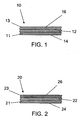
- FIG. 1 a fragmentary section of a release sheet material 10 is shown.
- the release sheet material 10 includes a backing, or base, layer 11 having a backing layer exterior surface 14, an optional conformable layer 12, and a release layer 13 overlaying the backing layer, and having a release layer exterior surface 16.
- An image to be transferred (not shown) is applied to the release layer exterior surface 16.
- the optional conformable layer 12 between the backing layer 11 and the release layer 13 facilitates the contact between the release sheet material 10 and a substrate to which the image is to be transferred.
- the use of conformable layers of this type is described in U.S. patent application 09/614,829, filed July 12, 2000 , and issued as U.S. Pat. No. 6,916,751 .
- the backing, or base, layer 11 of the release sheet material is flexible and has first and second surfaces.
- the backing layer typically will be a film or a cellulosic nonwoven web. In addition to flexibility, the backing layer also should have sufficient strength for handling, coating, sheeting, other operations associated with the manufacture of the release sheet material, and for transfer of the image to a substrate.
- the basis weight of the base layer generally may vary from about 30 to about 150 g/m 2 .
- the backing, or base, layer may be a paper such as is commonly used in the manufacture of heat transfer papers.
- the backing layer will be a latex- impregnated paper such as described, for example, in U.S. patent 5,798,179 .
- the backing layer is readily prepared by methods that are well known to those having ordinary skill in the art.
- the release layer, or coating 13 overlays the first surface of the backing layer or the optional conformable layer.
- the release coating can be fabricated from a wide variety of materials well known in the art of making peelable labels or masking tapes.
- silicone polymers are very useful and well known.
- many types of lattices such as acrylics, polyvinylacetates, polystyrenes, polyvinyl alcohols, polyurethanes, polyvinychlorides, as well as many copolymer lattices such as ethylene- vinylacetate copolymers, acrylic copolymers, vinyl chloride-acrylics, vinylacetate acrylics, other hard acrylic polymers, can be used.
- the release enhancing additive may include a divalent metal ion salt of a fatty acid, a polyethylene glycol, a polysiloxane surfactant, or a mixture thereof. More particularly, the release-enhancing additive may include calcium stearate, a polyethylene glycol having a molecular weight of from about 2,000 to about 100,000, a siloxane polymer polyether, or a mixture thereof.
- the thickness of the release coatings is not critical, and may vary considerably depending upon a number of factors including, but not limited to, the backing layer or conformable layer to be coated.
- the release coating layer has a thickness of less than about 2 mil (52 microns). More desirably, the release coating layer has a thickness of from about 0.1 mil to about 1.0 mil. Even more desirably, the release coating layer has a thickness of from about 0.2 mil to about 0.8 mil.
- the thickness of the release coating layer may also be described in terms of a basis weight. Desirably, the release coating layer has a basis weight of less than about 45 g/m 2 .
- the release coating layer has a basis weight of from about 2 g/m 2 to about 25 g/m 2 . Even more desirably, the release coating layer has a basis weight of from about 2 g/m 2 to about 20 g/m 2 , and even more desirably from about 4 g/m 2 to about 20 g/m 2 .
- the release coating layer is desirably printable with an image that is to be permanently transferred to a substrate.
- the release coating layer desirably substantially prevents penetration of the image, dyes, pigments and/or toners into the underlying layer.
- the release coating layer is desirably substantially non-porous.
- the release coating layer includes a crosslinked polymer.
- the cross-linked polymer may be formed from a crosslinkable polymeric binder and a crosslinking agent.
- the crosslinking agent reacts with the crosslinkable polymeric binder to form a 3-dimensional polymeric structure.
- any pair of polymeric binder and crosslinking agent that reacts to form the 3-dimensional polymeric structure may be utilized.
- Crosslinkable polymeric binders that may be used are any that may be cross-linked to form a 3-dimensional polymeric structure. Desirable crosslinking binders include those that contain reactive carboxyl groups. Exemplary crosslinking binders that include carboxyl groups include e.g.
- crosslinking binders include those that contain reactive hydroxyl groups.
- Cross-linking agents that can be used to crosslink binders having carboxyl groups include e.g. polyfunctional aziridines, epoxy resins, carbodiimide, oxazoline functional polymers.
- Cross-linking agents that can be used to crosslink binders having hydroxyl groups include e.g. melamine-formaldehyde, urea formaldehyde, amine-epichlorohydrin, multi-functional isocyanates.
- the release coating layer may include a polymeric film forming binder and a particulate material.
- the film forming binder is applied to the base layer so as to form a film on the surface of the release sheet material.
- the particulate material may be, for example, clay particles, powdered thermoplastic polymers, diatomaceous earth particles.
- the release coat material layers that are based on a film-forming binder may be formed on a given underlying layer by known coating techniques, such as by roll, blade, Meyer rod, and air-knife coating procedures.
- the resulting image transfer material then may be dried by means of, for example, steam-heated drums, air impingement, radiant heating, or some combination thereof.
- Melt-extruded release coat layers may be applied with an extrusion coater that extrudes molten polymer through a screw into a slot die. The film exits the slot die and flows by gravity onto the base layer or conformable layer.
- the resulting coated material is passed through a nip to chill the extruded film and bond it to the underlying layer.
- the molten polymer may not form a self-supporting film.
- the material to be coated may be directed into contact with the slot die or by using rolls to transfer the molten polymer from a bath to the image transfer material.
- the release coating layer may contain other additives, such as processing aids, release agents, pigments, deglossing agents, antifoam agents, surfactants, pH control agents such as ammonium hydroxide and rheology control agents.
- processing aids such as release agents, pigments, deglossing agents, antifoam agents, surfactants, pH control agents such as ammonium hydroxide and rheology control agents.
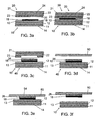
- the transfer coat sheet material 20 includes a backing, or base, layer 21 having a backing layer exterior surface 24, an optional release layer 22 overlaying the backing layer, and one or more transfer coatings 23 overlaying the release layer and having a transfer coating exterior surface 26.
- the transfer coat sheet material 20 may further include a conformable layer (not shown) between the backing layer 21 and the release layer 22 to facilitate the contact between the transfer coating 23 and the printable surface 16 of the release sheet material 10.
- the transfer coat sheet material may have cold-release properties.
- Heat transfer materials having cold-release properties have been previously disclosed, for example, in U.S. patent 6,200,668 , U.S. patent 5798,179 , and 6,428,878 .
- Other heat transfer materials having cold-release properties are disclosed in U.S. patent application number 10/750,387 , published as U.S. Publication No. 2005/0142307 on June 30, 2005 .
- the backing, or base, layer 21 of the transfer coat sheet material 20 may be substantially as described above for the backing layer of the release sheet material.
- the backing layer of the transfer coat sheet material is flexible and has first and second surfaces.
- the flexible backing layer typically will be a film or a cellulosic nonwove[pi] web.
- the backing layer also should have sufficient strength for handling, coating, sheeting, other operations associated with the manufacture of the transfer coat sheet material, and for removal after transfer.
- the backing layer may be a paper such as is commonly used in the manufacture of heat transfer papers.
- the backing layer is readily prepared by methods that are well known to those having ordinary skill in the art.
- the optional release layer 22 of the transfer coat sheet material may be substantially as described above for the release layer of the release sheet material.
- the release layer of the transfer coat sheet material overlays the first surface of the backing layer.
- the basis weight of the release layer generally may vary from about 2 to about 30 g/m 2 .
- the release layer has essentially no tack at transfer temperatures (e.g., 177 degrees Celsius).
- the phrase "having essentially no tack at transfer temperatures" means that the release layer does not stick to the overlying transfer coating to an extent sufficient to adversely affect the quality of the transferred image.
- the release layer may include a hard acrylic polymer or poly(vinyl acetate).
- the release layer may include a thermoplastic polymer having a T g of at least about 25 degrees Celsius.
- the T g may be in a range of from about 25 degrees Celsius to about 100 degrees Celsius.
- Suitable polymers include, for example, polyacrylates, styrenebutadiene copolymers, ethylene vinyl acetate copolymers, nitrile rubbers, poly(vinyl chloride), poly(vinyl acetate), ethylene-acrylate copolymers, which have suitable glass transition temperatures.
- the optional release layer of the transfer coat sheet material may include a crosslinked polymer.
- the cross-linked polymer may be formed from a crosslinkable polymeric binder and a crosslinking agent.
- the crosslinking agent reacts with the crosslinkable polymeric binder to form a 3-dimensional polymeric structure.
- any pair of the polymeric binders and crosslinking agents described above for the release layer of the release sheet material may be utilized in the release layer of the transfer coat sheet material.
- the optional release layer also may include an effective amount of a release-enhancing additive.
- the release enhancing additive may include a divalent metal ion salt of a fatty acid, a polyethylene glycol, a polysiloxane surfactant, or a mixture thereof.
- the release-enhancing additive may include calcium stearate, a polyethylene glycol having a molecular weight of from about 2,000 to about 100,000, a siloxane polymer polyether, or a mixture thereof.
- the transfer coating overlays the base layer or the optional release layer.
- the basis weight of the transfer coating generally may vary from about 2 to about 70 g/m 2 . Desirably, the basis weight of the transfer coating may vary from about 20 to about 50 g/m 2 , more desirably from about 25 to about 45 g/m 2 , and even more desirably from about 25 to about 45 g/m 2 .
- the transfer coating includes one or more coats or layers of a film-forming binder and a powered thermoplastic polymer over the base layer or optional release layer. The composition of the coats or layers may be the same or may different.
- the transfer coating will include greater than about 10 percent by weight of the film-forming binder and less than about 90 percent by weight of the powdered thermoplastic polymer.
- each of the film-forming binder and the powdered thermoplastic polymer will melt in a range of from about 65 degrees Celsius to about 180 degrees Celsius.
- each of the film-forming binder and powdered thermoplastic polymer may melt in a range of from about 80 degrees Celsius to about 120 degrees Celsius.
- any film-forming binder may be employed which meets the criteria specified herein.
- water-dispersible ethylene-acrylic acid copolymers have been found to be especially effective film-forming binders.
- the powdered thermoplastic polymer may be any thermoplastic polymer that meets the criteria set forth herein.
- the powdered thermoplastic polymer may be a polyamide, polyester, ethylene-vinyl acetate copolymer, polyolefin.
- the powdered thermoplastic polymer may consist of particles that are from about 2 to about 50 micrometers in diameter.
- melt behavior of film-forming binders or powdered thermoplastic polymers correlate with the melting requirements described herein. It should be noted, however, that either a true melting point or a softening point may be given, depending on the nature of the material. For example, materials such a polyolefins and waxes, being composed mainly of linear polymeric molecules, generally melt over a relatively narrow temperature range since they are somewhat crystalline below the melting point. Melting points, if not provided by the manufacturer, are readily determined by known methods such as differential scanning calorimetry. Many polymers, and especially copolymers, are amorphous because of branching in the polymer chains or the side-chain constituents. These materials begin to soften and flow more gradually as the temperature is increased.
- the ring and ball softening point of such materials is useful in predicting their behavior in the present invention.
- the melting points or softening points described are better indicators of performance in this invention than the chemical nature of the polymer.
- the layers applied to the transfer coat sheet material that are based on a film-forming binder may be formed on a given layer by known coating techniques, such as by roll, blade, Meyer rod, and air-knife coating procedures.
- the resulting image transfer material then may be dried by means of, for example, steam-heated drums, air impingement, radiant heating, or some combination thereof.
- the transfer coating may further include an opacifier.
- the opacifier is a particulate material that scatters light at its interfaces so that the transfer coating is relatively opaque.
- the opacifier is white and has a particle size and density well suited for light scattering.
- Such opacifiers are well known to those skilled in the graphic arts, and include particles of minerals such as aluminum oxide and titanium dioxide or of polymers such as polystyrene.
- the amount of opacifier needed in each case will depend on the desired opacity, the efficiency of the opacifier, and the thickness of the transfer coating. For example, titanium dioxide at a level of approximately 20 percent in a film of one mil thickness provides adequate opacity for decoration of black fabric materials. Titanium dioxide is a very efficient opacifier and other types generally require a higher loading to achieve the same results.
- the transfer coat sheet material may further include a conformable layer overlaying the base layer and underlying the optional release layer, thereby being located between the base layer and the release layer.
- the conformable layer may include an extrusion coated polymer that melts in a range of from about 65 degrees Celsius to about 180 degrees Celsius as described above for the release sheet material.
- the conformable layer may be an extrusion coating of ethylene vinyl acetate.
- the conformable layer may include a film- forming binder and/or a powdered thermoplastic polymer.
- the basis weight of the conformable layer generally may vary from about 5 to about 60 g/m 2 .
- any of the foregoing film layers of the transfer coat material may contain other materials, such as processing aids, release agents, pigments, particulates such as kaolin clay or diatomaceous earth, deglossing agents, antifoam agents, pH control agents such as ammonium hydroxide.
- processing aids such as release agents, pigments, particulates such as kaolin clay or diatomaceous earth, deglossing agents, antifoam agents, pH control agents such as ammonium hydroxide.
- the image transfer papers of the present invention may be used in several different methods of applying printed images to fabrics or other substrate materials.
- a method according to the invention of transferring an image to a substrate using the release sheet material 10 of Figure 1 and the transfer coat material 20 of Figure 2 is depicted.
- an image 18 is applied to the external surface 16 of the release sheet material 10 using a standard imaging device (not shown).
- Imaging devices compatible with the present invention include, by way of example only, ink jet printers, laser printers and copiers, other toner based printers and copiers, pencils, pens, markers, crayons.
- the release sheet material is imaged with toner from a toner based printer or copier.
- the image 18 may be applied to the transfer coat external surface 16.
- printing to the release sheet material 10 is desirable when using the toner based copiers and printers because the meltable layer or layers 23 on the surface of the transfer coating material 20 may stick to heated fuser rolls in toner based copiers and printers.
- the imaged release sheet material is placed adjacent the transfer coat material 20 with the transfer coating 23 facing the image 18.
- Heat and pressure are applied to the backing layer external surface 14, 24 of one or both sides of the two transfer materials 10, 20, causing the transfer coating 23 to fuse or adhere to the imaged surface and form a fused laminate 30.
- the application of heat and pressure may be effected in a variety of ways known to those skilled in the art.
- a heat press (not shown) may be used to fuse the layers together.
- a standard hand iron (not shown) may be used to apply heat and pressure to the two materials.
- the heat and pressure are applied for an effective period of time to provide good adhesion of the transfer coating 23 to the image 18.
- the temperature used to perform the transfer is less than the melting point of the thermoplastic polymer particles in the transfer coating 23. As such, the transfer coating 23 will desirably remain discontinuous.
- the imaged release sheet material 10 is peeled from the fused laminate 30 together with a portion 26 of the transfer coating 23 overlaying the image 18 to form an intermediary transfer material 40.
- the image is sandwiched between the release layer 13 and the portion 26 of the transfer coating 23.
- the release sheet material may be peeled while the transfer coating 23 is still hot, resulting in less than complete transfer of the full thickness of the portion 26 of the transfer coating 23.
- it is desirable that the detachment force required to separate the portion 26 of the transfer coating 23 is less than the detachment force required to separate the image 18 from the release layer 13 of the release sheet material 10.
- the release sheet material 10 may be peeled after the transfer coating has cooled so as to provide substantially complete transfer or clean separation of the full thickness of the portion 26 of the transfer coating 23 from the underlying layer.
- the detachment force required to separate the portion 26 of the transfer coating 23 from the underlying layer of the transfer coat material 20 is less than the detachment force required to separate the image 18 from the release layer 13 of the release sheet material 10.
- the intermediary transfer material 40 is then placed adjacent a substrate 50 with the portion 26 of the transfer coating 23 facing the substrate and the release sheet backing layer 11 facing away from the substrate.
- Desirable substrates include, for example, fabrics such as 100% cotton T-shirt material.
- heat and pressure are then applied to the release sheet external surface 14, a substrate external surface 54, or both to cause the portion 26 of the transfer coating 23 to fuse or adhere to the substrate 50.
- the amount of heat and pressure as well as duration of application thereof are determined according to the method of application, the type of substrate, and the type of transfer desired.
- the temperature used to perform the transfer is greater than the melting points of the film forming binder and the thermoplastic polymer in the transfer coating 23. As such, the transfer coating will form a durable transfer on the substrate.
- the release sheet material 10 is removed from the substrate 50, leaving the transfer coating 26 and the image attached to the substrate.
- a matched set of image transfer materials or papers such as described herein may be provided to enable the transfer of printed images to fabrics and other substrates.
- the matched transfer materials may be provided as a kit in which a supply of both the release sheet material and the transfer coat material may be present in the kit.
- the release sheet materials and/or the transfer coat materials may be labeled appropriately so as to allow a user to distinguish therebetween.
- the kit may contain an equal number of the transfer coat materials and the release sheet materials.
- the kit may contain more of the transfer coat materials than the release sheet materials because it is envisioned that it may be possible to reuse a single release sheet material for more than one image transfer.
- the base substrates are defined in Table 1.
- the release coating formulations are defined in Table 2.
- the powdered polymer coating formulations are defined in Table 3.
- B3 B1 base extrusion coated with a 1.0 mil film of low density polyethylene (available as Chevron 1019 from Chevron Phillips Chemical Company LP of Houston, Texas).
- B4 B1 base extrusion coated with a 1.8 mil film of ionomer resin (available as Surlyn 1702 from DuPont Corporation).
- B5 Saturated label paper having a basis weight of 68 g/m 2 saturated with 18% acrylic saturant by weight of the paper fibers. The saturant has 100 dry parts of acrylic latex (available as Rhoplex B 20 from Rohm & Haas of Philadelphia, Pennsylvania), 1 part of ammonia, 0.1 dry parts of dye (available as Ultramarine Blue 5017 dye from Mineral and Pigment Solutions, Inc.
- B6 Saturated paper having a basis weight of 71 g/m 2 saturated with 14% polyvinyl alcohol saturant by weight of the coating base. The saturant consisted of 100 dry parts polyvinyl alcohol (available as Airvol 107 from Air Products), 50 dry parts of Titanium Dioxide and 4 dry parts of water repellant (available as Sunsize 137 (from Sun Chemical).
- B7 A 95 micron thick polypropylene synthetic paper sheet (available as Kimdura® FPG 95 from Kimberly-Clark Corporation of Neenah, Wisconsin).
- Table 2 Release coatings R1: A mixture of 100 dry parts of hard acrylic latex (available as Rhoplex SP-100 from Rohm & Haas), 3.6 parts of 28% ammonium hydroxide solution (available from EM Industries of Gibbstown, New Jersey), and 5 dry parts of aziridine crosslinking agent (available as XAMA 7 from Sybron Chemicals, Inc. of Birmingham, New Jersey) coated on the base substrate as an aqueous dispersion and dried to a basis weight of 11 g/m 2 .
- hard acrylic latex available as Rhoplex SP-100 from Rohm & Haas
- ammonium hydroxide solution available from EM Industries of Gibbstown, New Jersey
- aziridine crosslinking agent available as XAMA 7 from Sybron Chemicals, Inc. of Birmingham, New Jersey
- R2 The mixture of R1 coated on the base substrate at a basis weight of 5.6 g/m 2 .
- R3 A mixture of 100 dry parts of hard acrylic latex (available as Rhoplex SP-100 from Rohm & Haas), 3.6 parts of 28% ammonium hydroxide solution (available from EM Industries), 5 dry parts of aziridine crosslinking agent (available as XAMA 7 from Sybron Chemicals, Inc.), 10 dry parts of 8000 molecular weight polyethylene oxide (available as Carbowax 8000 from The Dow Chemical Company of Midland, Michigan), 2 dry parts of silicone surfactant release agent (available as Dow Corning Silicone Surfactant 190 available from The Dow Chemical Company), and 0.1 dry part of silicone surfactant wetting agent (available as Dow Corning Silicone surfactant Q2-5211 from The Dow Chemical Company) coated on the base substrate as an aqueous dispersion and dried to a basis weight of 7.5 g/m 2 .
- hard acrylic latex available as Rhoplex SP-100 from Rohm & Ha
- R4 A mixture of 100 dry parts of hard acrylic latex (available as Rhoplex SP-100 from Rohm & Haas) and 30 dry parts of kaolin clay (available as Ultrawhite 90 clay, from Englehard) coated on the base substrate as an aqueous dispersion and dried to a basis weight of 11 g/m 2 .
- hard acrylic latex available as Rhoplex SP-100 from Rohm & Haas
- kaolin clay available as Ultrawhite 90 clay, from Englehard
- R5 A mixture of 100 dry parts of hard acrylic latex (available as Rhoplex SP-100 from Rohm & Haas), 3.6 parts of 28% ammonium hydroxide solution (available from EM Industries), 10 dry parts of aziridine crosslinking agent (available as XAMA 7 from Sybron Chemicals, Inc.), and 30 dry parts of kaolin clay (available as Ultrawhite 90 clay, from Englehard) coated on the base substrate as an aqueous dispersion and dried to a basis weight of 5.6 g/m 2 .
- hard acrylic latex available as Rhoplex SP-100 from Rohm & Haas
- 28% ammonium hydroxide solution available from EM Industries
- 10 dry parts of aziridine crosslinking agent available as XAMA 7 from Sybron Chemicals, Inc.
- 30 dry parts of kaolin clay available as Ultrawhite 90 clay, from Englehard coated on the base substrate as an aqueous dispersion and dried to a basis weight of 5.6 g/m 2 .
- R6 A mixture of 100 dry parts of hard acrylic latex (available as Rhoplex SP-100 from Rohm & Haas), 3.6 parts of 28% ammonium hydroxide solution (available from EM Industries), 5 dry parts of aziridine crosslinking agent (available as XAMA 7 from Sybron Chemicals, Inc.), and 20 dry parts of polyvinyl alcohol (available as Airvol 107 from Air Products and Chemicals, Inc. of Allentown, Pennsylvania) coated on the base substrate as an aqueous dispersion and dried to a basis weight of 5.6 g/m 2 .
- hard acrylic latex available as Rhoplex SP-100 from Rohm & Haas
- 28% ammonium hydroxide solution available from EM Industries
- 5 dry parts of aziridine crosslinking agent available as XAMA 7 from Sybron Chemicals, Inc.
- polyvinyl alcohol available as Airvol 107 from Air Products and Chemicals, Inc. of Allentown, Pennsylvania coated on the base substrate as an aqueous dispersion and dried to a basis weight
- R7 A mixture of 100 dry parts of hard acrylic latex (available as Rhoplex SP-100 from Rohm & Haas), 3.6 parts of 28% ammonium hydroxide solution (available from EM Industries), 5 dry parts of aziridine crosslinking agent (available as XAMA 7 from Sybron Chemicals, Inc.), and 20 dry parts of estrified styrene-maleic anhydride (SMA) resin (available as Scripset 540 from Hercules Inc.) coated on the base substrate as an aqueous dispersion and dried to a basis weight of 5.6 g/m 2 .
- hard acrylic latex available as Rhoplex SP-100 from Rohm & Haas
- 28% ammonium hydroxide solution available from EM Industries
- 5 dry parts of aziridine crosslinking agent available as XAMA 7 from Sybron Chemicals, Inc.
- SMA estrified styrene-maleic anhydride
- R8 A mixture of 100 dry parts of hard acrylic latex (available as Rhoplex SP-100 from Rohm & Haas), 3.6 parts of 28% ammonium hydroxide solution (available from EM Industries), 10 dry parts of aziridine crosslinking agent (available as XAMA 7 from Sybron Chemicals, Inc.), and 10 dry parts of calcium stearate dispersion (available as Nopcote C104 from Geo Specialty Chemicals, Inc. of Cleveland, Ohio) coated on the base substrate as an aqueous dispersion and dried to a basis weight of 5.6 g/m 2 .
- hard acrylic latex available as Rhoplex SP-100 from Rohm & Haas
- 28% ammonium hydroxide solution available from EM Industries
- 10 dry parts of aziridine crosslinking agent available as XAMA 7 from Sybron Chemicals, Inc.
- calcium stearate dispersion available as Nopcote C104 from Geo Specialty Chemicals, Inc. of Cleveland, Ohio
- R9 A mixture of 100 dry parts of hard acrylic latex (available as Rhoplex SP-100 from Rohm & Haas), 3.6 parts of 28% ammonium hydroxide solution (available from EM Industries), 10 dry parts of aziridine crosslinking agent (available as XAMA 7 from Sybron Chemicals, Inc.), and 20 dry parts of calcium stearate dispersion (available as Nopcote C104 from Geo Specialty Chemicals, Inc. of Cleveland, Ohio) coated on the base substrate as an aqueous dispersion and dried to a basis weight of 5.6 g/m 2 .
- hard acrylic latex available as Rhoplex SP-100 from Rohm & Haas
- 28% ammonium hydroxide solution available from EM Industries
- 10 dry parts of aziridine crosslinking agent available as XAMA 7 from Sybron Chemicals, Inc.
- calcium stearate dispersion available as Nopcote C104 from Geo Specialty Chemicals, Inc. of Cleveland, Ohio
- R10 A mixture of 100 dry parts of hard acrylic latex (available as Rhoplex SP-100 from Rohm & Haas), 3.6 parts of 28% ammonium hydroxide solution (available from EM Industries), 10 dry parts of aziridine crosslinking agent (available as XAMA 7 from Sybron Chemicals, Inc.), and 20 dry parts of 8000 molecular weight polyethylene oxide (available as Carbowax 8000 from The Dow Chemical Company) coated on the base substrate as an aqueous dispersion and dried to a basis weight of 5.6 g/m 2 .
- hard acrylic latex available as Rhoplex SP-100 from Rohm & Haas
- 28% ammonium hydroxide solution available from EM Industries
- 10 dry parts of aziridine crosslinking agent available as XAMA 7 from Sybron Chemicals, Inc.
- 20 dry parts of 8000 molecular weight polyethylene oxide available as Carbowax 8000 from The Dow Chemical Company coated on the base substrate as an aqueous dispersion and dried to a basis weight of
- R11 A mixture of 100 dry parts of hard acrylic latex (available as Rhoplex SP-100 from Rohm & Haas), 3.6 parts of 28% ammonium hydroxide solution (available from EM Industries), 10 dry parts of aziridine crosslinking agent (available as XAMA 7 from Sybron Chemicals, Inc.), and 20 dry parts of polyethylene oxide (available as Polyox N80 from The Dow Chemical Company) coated on the base substrate as an aqueous dispersion and dried to a basis weight of 7.5 g/m 2 .
- hard acrylic latex available as Rhoplex SP-100 from Rohm & Haas
- 28% ammonium hydroxide solution available from EM Industries
- 10 dry parts of aziridine crosslinking agent available as XAMA 7 from Sybron Chemicals, Inc.
- polyethylene oxide available as Polyox N80 from The Dow Chemical Company
- R12 A mixture of 100 dry parts of hard acrylic latex (available as Rhoplex SP-100 from Rohm & Haas), 3.6 parts of 28% ammonium hydroxide solution (available from EM Industries), 5 dry parts of aziridine crosslinking agent (available as XAMA 7 from Sybron Chemicals, Inc.), and 10 dry parts of polyethylene oxide (available as Polyox N80 from The Dow Chemical Company) coated on the base substrate as an aqueous dispersion and dried to a basis weight of 7.5 g/m 2 .
- R13 The mixture of R11 coated on the base substrate at a basis weight of 11 g/m 2 .
- R14 The mixture of R11 coated on the base substrate at a basis weight of 3.8 g/m 2 .
- R15 A mixture of 100 dry parts of hard acrylic latex (available as Rhoplex SP-100 from Rohm & Haas), 3.6 parts of 28% ammonium hydroxide solution (available from EM Industries), 5 dry parts of aziridine crosslinking agent (available as XAMA 7 from Sybron Chemicals, Inc.), and 20 dry parts of polyethylene oxide (available as Polyox N80 from The Dow Chemical Company) coated on the base substrate as an aqueous dispersion and dried to a basis weight of 7.5 g/m 2 .
- R16 The mixture of R12 coated on the base substrate at a basis weight of 13 g/m 2 .
- R17 A mixture of 100 dry parts of hard acrylic latex (available as Rhoplex SP-100 from Rohm & Haas), 3.6 parts of 28% ammonium hydroxide solution (available from EM Industries), 5 dry parts of aziridine crosslinking agent (available as XAMA 7 from Sybron Chemicals, Inc.), and 20 dry parts of 8000 molecular weight polyethylene oxide (available as Carbowax 8000 from The Dow Chemical Company) coated on the base substrate as an aqueous dispersion and dried to a basis weight of 13 g/m 2 .
- R18 A mixture of 100 dry parts of ethylene acrylic acid dispersion (available as Michem Prime 4983 from Michelman Inc.
- R20 A mixture of 100 dry parts of acrylic release coat (available as Degree 100A from Solv, Inc.), 3.6 parts of 28% ammonium hydroxide solution (available from EM Industries), 5 dry parts of aziridine crosslinking agent (available as XAMA 7 from Sybron Chemicals, Inc.
- R23 A mixture of 100 dry parts of acrylic release coat (available as Degree 100A from Solv, Inc.), 3.6 parts of 28% ammonium hydroxide solution (available from EM Industries), 5 dry parts of aziridine crosslinking agent (available as XAMA 7 from Sybron Chemicals, Inc. of Birmingham, New Jersey), 3 dry parts of nonionic surfactant (available as Triton X100 from The Dow Chemical Company), 20 dry parts of polyethylene oxide (available as Polyox N80 from The Dow Chemical Company), and 20 dry parts of powdered high density polyethylene wax (5 micron average particle size) (available as MPP 635G from Micropowders Inc.
- acrylic release coat available as Degree 100A from Solv, Inc.
- 28% ammonium hydroxide solution available from EM Industries
- 5 dry parts of aziridine crosslinking agent available as XAMA 7 from Sybron Chemicals, Inc. of Birmingham, New Jersey
- 3 dry parts of nonionic surfactant available as Triton X100 from The Dow Chemical Company
- R24 A mixture of 100 dry parts of kaolin clay (available as Ultrawhite 90 clay, from Englehard) and 25 dry parts of acrylic latex (available as Hycar 26084 from Noveon Inc. of Cleveland, Ohio) coated on the base substrate as an aqueous dispersion and dried to a basis weight of 20 g/m 2 .
- kaolin clay available as Ultrawhite 90 clay, from Englehard
- acrylic latex available as Hycar 26084 from Noveon Inc. of Cleveland, Ohio
- R25 A mixture of 100 dry parts of acrylic latex (available as Hycar 26706 from Noveon Inc.) and 20 dry parts of 20,000 molecular weight polyethylene oxide (available as PEG 20M from The Dow Chemical Company) coated on the base substrate as an aqueous dispersion and dried to a basis weight of 11 g/m 2 .
- R26 A mixture of 100 dry parts of acrylic latex (available as Hycar 26672 from Noveon Inc.), 25 dry parts of calcium stearate dispersion (available as Nopcote C104 from Geo Specialty Chemicals, Inc.), 20 dry parts of 20,000 molecular weight polyethylene oxide (available as PEG 20M from The Dow Chemical Company), 2 dry parts of nonionic surfactant (available as Triton X100 from The Dow Chemical Company), and 30 dry parts of diatomaceous earth (available as Dafil 530 from Celite Corporation of Santa Barbara, California) coated on the base substrate as an aqueous dispersion and dried to a basis weight of 11 g/m 2 .
- acrylic latex available as Hycar 26672 from Noveon Inc.
- 25 dry parts of calcium stearate dispersion available as Nopcote C104 from Geo Specialty Chemicals, Inc.
- 20 dry parts of 20,000 molecular weight polyethylene oxide available as PEG 20M from The Dow Chemical Company
- R27 A mixture of 100 dry parts of acrylic release coat (available as Degree 238 from Solv, Inc.), 3.6 parts of 28% ammonium hydroxide solution (available from EM Industries), and 5 dry parts of aziridine crosslinking agent (available as XAMA 7 from Sybron Chemicals, Inc. of Birmingham, New Jersey) coated on the base substrate as an aqueous dispersion and dried to a basis weight of 7.5 g/m 2 .
- R28 The mixture of R17 coated on the base substrate at a basis weight of 7.5 g/m 2 .
- Powdered polymer coatings P1 A mixture of 100 dry parts of powdered polyamide (10 micron average particle size) (available as Orgasol 3501 EXD NAT 1 from Atofina Chemicals Inc.), 1 part of cyclohexane dimethanol dibenzoate, ground to an average particle size of 8 microns (available as Benzoflex 352 from Velsicol Chemical Corporation of Rosemont, Illinois), 70 dry parts of ethylene acrylic acid dispersion (available as Michem Prime 4983 from Michelman Inc.), 6 dry parts of nonionic surfactant (available as Triton X100 from The Dow Chemical Company), and 5 dry parts of polyethylene oxide (available as Polyox N80 from The Dow Chemical Company) coated on the underlying layer as a 30% solids content aqueous dispersion and dried to a basis weight of 26 g/m 2 .
- powdered polyamide 10 micron average particle size
- cyclohexane dimethanol dibenzoate ground to an average particle size of 8 microns
- P2 The mixture of P1 coated on the underlying layer at a basis weight of 21 g/m 2 .
- P3 A mixture of 50 dry parts of powdered polyamide (10 micron average particle size) (available as Orgasol 3501 EXD NAT 1 from Atofina Chemicals Inc.), 51.5 parts of cyclohexane dimethanol dibenzoate, ground to an average particle size of 8 microns (available as Benzoflex 352 from Velsicol Chemical Corporation of Rosemont, Illinois), 100 dry parts of ethylene acrylic acid dispersion (available as Michem Prime 4983 from Michelman Inc.), 40 dry parts of powdered high density polyethylene wax (5 micron average particle size) (available as MPP 635G from Micropowders Inc.), and 4.5 dry parts of nonionic surfactant (available as Tergitol 15-S-40 from The Dow Chemical Company) coated on the underlying layer as a 30% solids content aqueous dispersion and dried to a basis weight of 15 g/m 2 .
- P4 The same as P1, but only 2 dry parts of polyethylene oxide.
- P5 A mixture of 100 dry parts of powdered polyamide (10 micron average particle size) (available as Orgasol 3501 EXD NAT 1 from Atofina Chemicals Inc.), 40 parts of cyclohexane dimethanol dibenzoate, ground to an average particle size of 8 microns (available as Benzoflex 352 from Velsicol Chemical Corporation), 70 dry parts of ethylene acrylic acid dispersion (available as Michem Prime 4983 from Michelman Inc.), 6 dry parts of nonionic surfactant (available as Triton X100 from The Dow Chemical Company), 2 dry parts of polyethylene oxide (available as Polyox N60k from The Dow Chemical Company), and 8 dry parts of 8000 molecular weight polyethylene oxide (available as Carbowax 8000 from The Dow Chemical Company) coated on the underlying layer as a 30% solids content aqueous dispersion and dried to a basis weight of 26 g/m 2 .
- P6 A mixture of 50 dry parts of ethylene acrylic acid dispersion (available as Michem Prime 4983 from Michelman Inc.), 100 dry parts of powdered polypropylene wax (10 micron average particle size) (available as Propylmatte 31 from Micropowders Inc.), 3 dry parts ot nonionic surfactant (available as Triton X100 from The Dow Chemical Company), and 5 dry parts of polyethylene oxide (available as Polyox N80 from The Dow Chemical Company) coated on the underlying layer as a 30% solids content aqueous dispersion and dried to a basis weight of 26 g/m 2 .
- ethylene acrylic acid dispersion available as Michem Prime 4983 from Michelman Inc.
- powdered polypropylene wax (10 micron average particle size) available as Propylmatte 31 from Micropowders Inc.
- 3 dry parts ot nonionic surfactant available as Triton X100 from The Dow Chemical Company
- polyethylene oxide available as Polyox N80 from The Dow Chemical Company
- P7 A mixture of 20 dry parts of ethylene acrylic acid dispersion (available as Michem Prime 4983 from Michelman Inc.), 100 dry parts of powdered high density polyethylene wax (5 micron average particle size) (available as MPP 635G from Micropowders Inc.), and 3 dry parts of nonionic surfactant (available as Triton X100 from The Dow Chemical Company) coated on the underlying layer as a 30% solids content aqueous dispersion and dried to a basis weight of 7.5 g/m 2 .
- ethylene acrylic acid dispersion available as Michem Prime 4983 from Michelman Inc.
- powdered high density polyethylene wax available as MPP 635G from Micropowders Inc.
- nonionic surfactant available as Triton X100 from The Dow Chemical Company
- P8 A mixture of 100 dry parts of powdered polyamide (10 micron average particle size) (available as Orgasol 3501 EXD NAT 1 from Atofina Chemicals Inc.), 70 dry parts of ethylene acrylic acid dispersion (available as Michem Prime 4983 from Michelman Inc.), 40 dry parts of powdered high density polyethylene wax (5 micron average particle size) (available as MPP 635G from Micropowders Inc.), 6 dry parts of nonionic surfactant (available as Triton X100 from The Dow Chemical Company), and 5 dry parts of polyethylene oxide (available as Polyox N80 from The Dow Chemical Company) coated on the underlying layer as a 30% solids content aqueous dispersion and dried to a basis weight of 24 g/m 2 .
- P9 A mixture of 100 dry parts of powdered polyamide (10 micron average particle size) (available as Orgasol 3501 EXD NAT 1 from Atofina Chemicals Inc.), 70 dry parts of ethylene acrylic acid dispersion (available as Michem Prime 4983 from Michelman Inc.), 40 dry parts of powdered polypropylene wax (10 micron average particle size) (available as Propylmatte 31 from Micropowders Inc.), 6 dry parts of nonionic surfactant (available as Triton X100 from The Dow Chemical Company), and 5 dry parts of polyethylene oxide (available as Polyox N80 from The Dow Chemical Company) coated on the underlying layer as a 30% solids content aqueous dispersion and dried to a basis weight of 24 g/m 2 .
- powdered polyamide 10 micron average particle size
- ethylene acrylic acid dispersion available as Michem Prime 4983 from Michelman Inc.
- 40 dry parts of powdered polypropylene wax (10 micron average particle size) available as Propylmatte 31
- P10 A mixture of 100 dry parts of powdered polyamide (10 micron average particle size) (available as Orgasol 3501 EXD NAT 1 from Atofina Chemicals Inc.), 70 dry parts of ethylene acrylic acid dispersion (available as Michem Prime 4983 from Michelman Inc.), 40 dry parts of powdered high density polyethylene wax (5 micron average particle size) (available as MPP 635G from Micropowders Inc.), 6 dry parts of nonionic surfactant (available as Triton X100 from The Dow Chemical Company), and 20 dry parts of polyethylene oxide (available as Polyox N80 from The Dow Chemical Company) coated on the underlying layer as a 30% solids content aqueous dispersion and dried to a basis weight of 26 g/m 2 .
- powdered polyamide 10 micron average particle size
- ethylene acrylic acid dispersion available as Michem Prime 4983 from Michelman Inc.
- MPP 635G from Micropowders Inc.
- nonionic surfactant available as Triton X
- P11 A mixture of 100 dry parts of ethylene acrylic acid wax dispersion (available as Michem Prime 58035 from Michelman Inc.), 100 dry parts of powdered high density polyethylene wax (5 micron average particle size) (available as MPP 635G from Micropowders Inc.), and 3.6 parts of 28% ammonium hydroxide solution (available from EM Industries) coated on the underlying layer as a 30% solids content aqueous dispersion and dried to a basis weight of 11 g/m 2 .
- ethylene acrylic acid wax dispersion available as Michem Prime 58035 from Michelman Inc.
- powdered high density polyethylene wax (5 micron average particle size) available as MPP 635G from Micropowders Inc.
- ammonium hydroxide solution available from EM Industries
- P12 A mixture of 40 dry parts of powdered polyamide (10 micron average particle size) (available as Orgasol 3501 EXD NAT 1 from Atofina Chemicals Inc.), 100 dry parts of ethylene acrylic acid dispersion (available as Michem Prime 4990R from Michelman Inc.), 2 dry parts of nonionic surfactant (available as Tergitol 15-S-40 from The Dow Chemical Company), and 0.2 dry parts of polyethylene oxide (available as Polyox N60k from The Dow Chemical Company) coated on the underlying layer as a 30% solids content aqueous dispersion and dried to a basis weight of 15 g/m 2 .
- P13 A mixture of 100 dry parts of powdered polyamide (10 micron average particle size) (available as Orgasol 3501 EXD NAT 1 from Atofina Chemicals Inc.), 25 dry parts of ethylene acrylic acid dispersion (available as Michem Prime 4990R from Michelman Inc.), 3 dry parts of nonionic surfactant (available as Tergitol 15-S-40 from The Dow Chemical Company), 2 dry parts of nonionic surfactant (available as Triton X100 from The Dow Chemical Company), 1 dry part sodium carbonate, and 2 dry parts of polyethylene oxide (available as Polyox N60k from The Dow Chemical Company) coated on the underlying layer as a 30% solids content aqueous dispersion and dried to a basis weight of 15 g/m 2 .
- powdered polyamide 10 micron average particle size
- 25 dry parts of ethylene acrylic acid dispersion available as Michem Prime 4990R from Michelman Inc.
- 3 dry parts of nonionic surfactant available as Tergitol 15-S-40 from The Dow
- P14 A mixture of 11 dry parts of ethylene acrylic acid wax dispersion (available as Michem Prime 58035 from Michelman Inc.), 100 dry parts of powdered high density polyethylene wax (5 micron average particle size) (available as MPP 635G from Micropowders Inc.), and 3 dry parts of nonionic surfactant (available as Triton X100 from The Dow Chemical Company) coated on the underlying layer as a 30% solids content aqueous dispersion and dried to a basis weight of 23 g/m 2 .
- ethylene acrylic acid wax dispersion available as Michem Prime 58035 from Michelman Inc.
- powdered high density polyethylene wax (5 micron average particle size) available as MPP 635G from Micropowders Inc.
- nonionic surfactant available as Triton X100 from The Dow Chemical Company
- P15 A mixture of 100 dry parts of ethylene acrylic acid dispersion (available as Michem Prime 4990R from Michelman Inc.), 100 dry parts of powdered high density polyethylene wax (5 micron average particle size) (available as MPP 635G from Micropowders Inc.), and 3 dry parts of nonionic surfactant (available as Triton X100 from The Dow Chemical Company) coated on the underlying layer as a 30% solids content aqueous dispersion and dried to a basis weight of 15 g/m 2 .
- ethylene acrylic acid dispersion available as Michem Prime 4990R from Michelman Inc.
- powdered high density polyethylene wax (5 micron average particle size) available as MPP 635G from Micropowders Inc.
- nonionic surfactant available as Triton X100 from The Dow Chemical Company
- P16 A mixture of 100 dry parts of powdered polyamide (10 micron average particle size) (available as Orgasol 3501 EXD NAT 1 from Atofina Chemicals Inc.), 25 dry parts of ethylene acrylic acid dispersion (available as Michem Prime 4983 from Michelman Inc.), 5 dry parts of nonionic surfactant (available as Triton X100 from The Dow Chemical Company), and 5 dry parts of polyacrylic acid dispersant (available as Tamol 731 from Rohm and Haas Company) coated on the underlying layer as a 30% solids content aqueous dispersion and dried to a basis weight of 13 g/m 2 .
- P17 A mixture of 100 dry parts of powdered polyamide (10 micron average particle size) (available as Orgasol 3501 EXD NAT 1 from Atofina Chemicals Inc.), 40 dry parts of powdered high density polyethylene wax (5 micron average particle size) (available as MPP 635G from Micropowders Inc.), 70 dry parts of ethylene acrylic acid dispersion (available as Michem Prime 4983 from Michelman Inc.), 6 dry parts of nonionic surfactant (available as Triton X100 from The Dow Chemical Company), and 10 dry parts of 8000 molecular weight polyethylene oxide (available as Carbowax 8000 from The Dow Chemical Company) coated on the underlying layer as a 30% solids content aqueous dispersion and dried to a basis weight of 26 g/m 2 .
- powdered polyamide 10 micron average particle size
- powdered high density polyethylene wax available as MPP 635G from Micropowders Inc.
- 70 dry parts of ethylene acrylic acid dispersion available as Michem Prime 49
- BC1 A mixture of 100 dry parts of ethylene acrylic acid wax dispersion (available as Michem Prime 58035 from Michelman Inc.) and 25 dry parts of ethylene acrylic acid dispersion (available as Michem Prime 4983 from Michelman Inc.) coated on the underlying layer as a 30% solids content aqueous dispersion and dried to a basis weight of 13 g/m 2 .
- Table 4 summarizes the constructions of the release sheet materials that were produced using the base substrates of Table 1 and the release coatings of Table 2 to demonstrate the present invention.
- Table 4 Release Sheet designs Sample ID Base Substrate Release Coat RS1 B1 none RS2 B1 R1 RS3 B2 R2 RS4 B2 R3 RS5 B2 R5 RS6 B2 R6 RS7 B2 R7 RS8 B2 R8 RS9 B2 R9 RS10 B2 R10 RS11 B2 R11 RS12 B3 R11 RS13 B3 R12 RS14 B3 R13 RS15 B3 R14 RS16 B3 R15 RS17 B3 R18 RS18 B3 R19 RS19 B1 R19 RS20 B4 R20 RS21 B4 R21 RS22 B4 R22 RS23 B4 R23 RS24 B5 R24 RS25 B1 R25 RS26 B6 R26 RS27 B4 R27 RS28 B3 R17 RS29 B3
- Table 5 summarizes the constructions of the transfer coat sheet materials that were produced using the base substrates of Table 1, the release coatings of Table 2, and the powdered polymer coatings of Table 3 to demonstrate the present invention.
- Image transfer experiments were performed using two transfer steps. Each experiment utilized a release sheet from Table 4 and a powdered polymer coated sheet from Table 5. The release sheet was imaged using a Canon 700 color Copier, unless noted otherwise.
- the first transfer step was carried out by heat pressing the imaged release sheet against the powdered polymer sheet in a heat press for the times and temperatures indicated. The powdered polymer coated sheet substrate was removed after cooling of the sheet materials.
- the second transfer step was done by heat pressing the release sheet (with the image and attached powdered polymer coating) against a 100% cotton Tee shirt material for 30 seconds at 177 °C (350 degrees F), then removing the release sheet base substrate while the release sheet was still hot.
- Table 6 summarizes the cold peel/hot peel experiments with the Canon 700 color copier images.
- the step of removing the powdered polymer transfer base substrate was done after cooling of the sheet materials, and the step of removing the release sheet base substrate was done while the sheet material was still hot.
- the release coating in the transfer coat sheet material with the powdered polymer coating functions as a true release coating.
- the release coating on the release sheet material acts more like a barrier layer, since the separation occurs within the melted toner. When this is the case, less than 100% of the toner may be transferred to the fabric.
- the actual amount which is transferred to the fabric depends on the structure of the release sheet. If the release sheet is plain paper, most of the toner stays on the paper. More of the toner transfers if there is a barrier layer on the release sheet, but still only about 50%. Results are much improved if the release sheet has a meltable conformable film layer under the release (barrier) coat since this allows the release sheet to conform to the fabric substrate. It has generally been seen that thinner or more conformable release coatings give better
- release coatings including polyethylene oxides tend to perform better than those with large amounts of crosslinker (XAMA 7) or clay.
- XAMA 7 crosslinker
- Some of the experiments resulted in small amounts of the powdered polymer coating transferring to the non-imaged areas of the release sheet in the first step.
- the background, or non-imaged areas of the fabric substrate did not appear significantly different than on those fabrics to which no polymer coating transferred in the non-printed areas.
- Table 6 Cold Peel/Hot Peel Experiments With Canon 700 Color Laser Copier Images Sheet1 (see Table 4) Sheet2 (see Table 5) Temp1 (°C) (deqF) Time (sec) Results Comments RS1 PS1 121 (250) 30 poor 1 RS2 PS1 121 (250) 30 poor 2 RS3 PS1 121 (250) 30 fair 3 RS4 PS1 121 (250) 30 fair 4 RS4 PS1 121 (250) 30 fair 4, 15 RS4 PS2 121 (250) 30 fair 4,5 RS5 PS1 121 (250) 30 poor 6 RS6 PS1 121 (250) 30 poor 7 RS7 PS1 121 (250) 30 poor 7 RS8 PS1 121(250) 30 poor 7 RS9 PS1 121 (250) 30 poor 7 RS10 PS1 121 (250) 30 fair 4 RS11 PS1 121 (250) 30 good 8,13 RS12 PS1 121 (250) 30 good 8 RS12 PS6 121 (250) 30 good 9 RS12 PS7
- the second step less than half of the toner transferred to the fabric. 2. In the second transfer step, only about half the toner transferred to the fabric 3. In the first transfer step, polymer transferred well to the imaged areas but considerable transfer also occurred in the non-imaged areas. 4. Polymer transferred well to the imaged areas in the first step but small spots of toner transferred in the polymer sheet. 5. The image was fuzzy. 6. The first transfer step worked well, but only about two thirds of the toner transferred to the fabric in the second step. 7. Considerable amounts of toner transferred to the polymer sheet in the first step. 8. The first transfer step worked well, but small amounts of polymer transferred to the non-imaged areas. 9. Both steps worked well. The transfers on the fabric were sometimes fuzzy. 10.
- a second set of experiments was performed, again using release sheets from Table 4 and powdered polymer coated sheets from Table 5.
- the release sheets were imaged using a Canon 700 color copier.
- the first transfer step was done by pressing the imaged release sheet against the powdered polymer sheet in a heat press for the indicated times and temperatures.
- the transfer coat sheet base substrate was removed while the sheet materials were still hot.
- the second transfer step was done by pressing the imaged release sheet with the attached powdered polymer coating to a 100% cotton Tee shirt material for 30 seconds at 177°C (350 degrees F).
- the release sheet base substrate was then removed while the sheet material was still hot.
- the transfer steps can be classified as "hot peel/hot peel".
- the transferred images were evaluated according to how well the image was transferred, including how well the polymer coating was limited to the printed areas.
- Table 7 summarizes the hot peel/hot peel experiments with the Canon 700 color copier images.
- the separation occurs within one of the powdered polymer coating layers because the coating still at least partially molten.
- the binders are probably molten when the sheets are separated. It is advantageous to utilize a powdered polymer coating having a low melting point and/or a low melt viscosity binder in the powdered polymer coating since this will make separation easier.
- a two-layered powdered polymer coating with the first powdered polymer coating (the one closest to the base substrate) having the low melting point and/or low melt viscosity binder is especially desirable.
- the second transfer step for the experiments summarized in Table 7 is substantially as described above for Table 6.
- Table 7 Hot Peel/Hot Peel Experiments With Canon 700 Color Copier Images Sheet1 (see Table 4) Sheet2 (see Table 5) Tempi (°C) (degF) Time(sec) Results Comments RS16 PS10 121 (250) 30 good 1,5 RS16 PS10 99 (210) 10 good 1 RS16 PS10 99 (210) 30 good 1 RS16 PS14 121 (250) 15 good 1,5 RS16 PS15 121 (250) 15 good 1,5 RS17 PS10 121 (250) 30 good 1,5 RS24 PS11 121 (250) 30 poor 2 RS25 PS13 121 (250) 30 poor 2 RS16 PS11 121 (250) 30 fair 3,6 RS16 PS13 121 (250) 30 good 1,5 RS16 PS12 121 (250) 30 good 4,6 RS17 PS12 121 (250) 30 good 4,6 RS28 PS10 116 (240) 15 good RS29 PS10 116 (240) 15 good RS29 PS 15 99 (210) 20 good Table 7 Comments
- the transfers worked well. The images were sometimes a little fuzzy. 2.
- the first step worked well but only about half of the toner transferred in the second step. 3.
- the transfers worked well but the image was dull. 4.
- a thin film of polymer transferred to the non-imaged areas of the release sheet in the first step.
- the second step worked well. 5. Samples were washed and dried 5 times. There was some color fading and fuzziness after 5 washes. 6. Samples were washed and dried 5 times. There was considerable color fading after 5 washes.
- a third set of experiments was performed, again using release sheets from Table 4 and powdered polymer coated sheets from Table 5.
- the release sheets were imaged using a Canon 700 color copier.
- the first transfer step was done by pressing the imaged release paper against the polymer coated sheet in a Tee shirt press for the indicated time and temperature, then removing the base substrate of the polymer coated sheet while the sheets were still hot.
- the second step was done by pressing the imaged release sheet with the attached powdered polymer against a 100% cotton Tee shirt material for 30 seconds at 177°C (350 degrees F).
- the sheets were allowed to cool prior to removing the base substrate from the release sheet material.
- the transfer steps can be classified as "hot peel/cold peel". Thereafter, the transferred images were evaluated according to how well the image was transferred, including how well the polymer coating was limited to the printed areas. Table 8 summarizes the hot peel/cold peel experiments with the Canon 700 color copier images.
- the release paper was allowed to cool before the release sheet backing was removed.
- the release coating acts as a true release coating and nearly 100% of the toner is transferred to the fabric.
- this method is capable of giving the most desirable results, but the combination of release sheet and polymer coated sheet must be such that, in the first transfer step, the powdered polymer coating transfers only to the imaged areas of the release sheet. Also, the toner must not transfer to the powdered polymer sheet in this step.
- Several of the combinations of release sheet and powdered polymer sheet formulations did satisfy these requirements. Interestingly, these same combinations failed when the sheets were allowed to cool after the first pressing (cold peel in the first step). When cold peeling in the first transfer step, the toner transferred to the powdered polymer sheet. This is apparently due to the toner adhesion being stronger at higher temperatures.
- Release sheets with a meltable conformable polymer layer under the release coat resulted in much better transfers than similar release sheets without the meltable conformable polymer layer under the release coat. This is because the meltable polymer layers allow conformability to the fabric surface. Generally, thinner, more conformable release coatings result in more durable transfers. For example, release sheet RS21 transfers washed better than release sheet RS23 transfers. Plain paper with a release coat did give nearly 100% transfer of the toner to the fabric in one experiment, but the image was glossy and not penetrated well into the fabric. The transfer could be improved somewhat by pressing it with a thin, silicone treated release paper.
- Table 8 Hot Peel/Cold Peel Experiments With Canon 700 Color Copier Images Sheet1 (see Table 4) Sheet2 (see Table 5) Temp1 (°C) (deg F) Time(sec) Results Comments RS18 PS10 121 (250) 30 good 1 RS18 PS12 121 (250) 15 good 4,5 RS19 PS10 121 (250) 30 fair 1,2 RS20 PS10 121 (250) 30 poor 1 RS21 PS19 121 (250) 30 good 3,4 RS21 PS20 121 (250) 30 good 3,4 RS21 PS21 121 (250) 30 good 3,4 RS21 PS16 121 (250) 30 poor 6 RS21 PS16 121 (250) 5 good 3,7 RS21 PS22 121 (250) 30 good 4 RS22 PS10 121 (250) 30 poor 8 RS23 PS10 121 (250) 15 good 7 RS23 PS15 121 (250) 15 good 7 RS23 PS17 121 (250) 15 good 7 RS23 PS16 121 (250) 15 good 7 RS27
- a fourth set of experiments was performed, again using release sheets from Table 4 and powdered polymer coated sheets from Table 5.
- the release sheets were imaged using a Hewlett Packard 4600 color printer.
- the first transfer step was done by pressing the imaged release sheet against the polymer coated transfer sheet in a heat press for the indicated time and temperature. Thereafter, the transfer sheet back was removed while the sheets were still hot.
- the second transfer step was done by pressing the imaged release sheet with the attached powdered polymer coating against a 100% cotton Tee shirt material in a heat press for 30 seconds at 177 °C (350 degrees F).
- the release sheet backing was removed after cooling of the release sheet material.
- the transfer steps can be classified as "hot peel/cold peel".
- the transferred images were evaluated according to how well the image was transferred, including how well the polymer coating was limited to the printed areas.
- Some of the hot peel/cold peel experiments resulted in successful transfers.
- the washability of the transferred images did not compare favorably with those imaged with the Canon 700 color copier.
- Using a hot peel transfer for the second transfer step resulted in insufficient transfer of the toner from the release sheet, even using designs which were successful with the Canon 700 color copier images.
- Table 9 summarizes the hot peel/cold peel experiments with Hewlett Packard 4600 color printer images.
- Table 9 Hot Peel/Cold Peel Experiments With Hewlett Packard 46 ⁇ 0 Laser Printer Images Sheet1 (see Table 4) Sheet2 (see Table 5) Tempi (°C) (deqF) Time(sec) Results Comments RS18 PS12 121 (250) 30 good 1,2,3 RS18 PS10 121 (250) 30 good 1,2,4 RS22 PS10 121 (250) 30 poor 5 RS23 PS10 121 (250) 30 good 1 Table 9 Comments: 1. Both transfer steps worked well. 2. In some samples, some toner transferred to the polymer coated sheet. 3. There was extreme color loss after 5 wash and dry cycles. 4. The color faded about 30% after 5 wash and dry cycles. 5. The first step worked OK, but only about half of the toner transferred in the second step.
Landscapes
- Engineering & Computer Science (AREA)
- General Engineering & Computer Science (AREA)
- Decoration By Transfer Pictures (AREA)
- Thermal Transfer Or Thermal Recording In General (AREA)
- Electronic Switches (AREA)
- Laminated Bodies (AREA)
Claims (31)
- Verfahren zum Aufbringen eines Bildes auf ein Substrat (50), wobei das Verfahren folgende Schritte umfasst:Vorsehen eines Abgabe-Bogenmaterials (10), auf dem ein Bild (18) ausgebildet ist;Vorsehen eines Übertragungsschicht-Bogenmaterials (20), das eine Übertragungsbeschichtung (23) enthält, die eine Grundschicht (21) überdeckt, wobei die Übertragungsbeschichtung (23) einen schichtbildenden Binder und thermoplastische Partikel umfasst;Positionieren des Abgabe-Bogenmaterials (10) angrenzend an die Übertragungsbeschichtung (23);Anwenden von Wärme und Druck, was bewirkt, dass die Übertragungsbeschichtung (23) an das Bild (18) fixiert wird, wodurch ein fixiertes Laminat (30) gebildet wird, das einen fixierten Teil (26) der Übertragungsbeschichtung (23) enthält;Trennen des Abgabe-Bogenmaterials (10) und des fixierten Teils (26) der Übertragungsbeschichtung (23) von dem Laminat (30), um ein Zwischen-Übertragungsmaterial (40) zu bilden, wobei der fixierte Teil (26) der Übertragungsbeschichtung (23) das Bild (18) auf dem Zwischen-Übertragungsmaterial (40) überdeckt;Positionieren des Zwischen-übertragungsmaterials (40) so, dass der verbleibende Teil (26) der Übertragungsbeschichtung (23) dem Substrat (50) benachbart ist und sich das Bild (18) zwischen dem fixierten Teil (26) der Übertragungsbeschichtung (23) und dem Abgabe-Bogenmaterial (10) befindet;Anwenden von Wärme und Druck auf das Zwischen-Übertragungsmaterial (40), um den fixierten Teil (26) der Übertragungsbeschichtung (23) und das Bild (18) auf das Substrat (50) zu übertragen; undEntfernen des Abgabe-Bogenmaterials (90) von dem Substrat (50), sodass das Bild (18) auf dem Substrat (50) frei liegt, wobei das Bild (18) den fixierten Teil (26) der Übertragungsbeschichtung (23) überdeckt und der fixierte Teil (26) der Übertragungsbeschichtung (23) das Substrat (50) überdeckt.
- Verfahren nach Anspruch 1, wobei das Substrat (50) ein Gewebe enthält.
- Verfahren nach Anspruch 1, wobei das Abgabe-Bogenmaterial (10) eine Abgabeschicht (13) und eine Grundschicht (11) umfasst, und wobei das Bild (18) auf einer Oberfläche (16) der Abgabeschicht (13) ausgebildet ist.
- Verfahren nach Anspruch 3, wobei das Abgabe-Bogenmaterial (10) weiter eine anpassbare Schicht (12) umfasst, die zwischen der Abgabeschicht (13) und der Grundschicht (11) des Abgabe-Bogenmaterials (10) positioniert ist.
- Verfahren nach Anspruch 3, wobei die Abgabeschicht (13) eine Beschichtung auf der Grundschicht (11) des Abgabe-Bogenmaterials (10) ist.
- Verfahren nach Anspruch 3, wobei die Abgabeschicht (13) ein Silikonpolymer umfasst.
- Verfahren nach Anspruch 3, wobei die Abgabeschicht (13) ein Acrylpolymer oder -Copolymer umfasst.
- Verfahren nach Anspruch 7, wobei die Abgabeschicht (13) ein AcrylCopolymer von Ethylen-Acrylsäure umfasst.
- Verfahren nach Anspruch 3, wobei die Abgabeschicht (13) ein vernetztes Polymer umfasst.
- Verfahren nach Anspruch 9, wobei das vernetzte Polymer aus einem vernetzbaren Polymer-Binder und einem Vernetzungsmittel gebildet ist
- Verfahren nach Anspruch 3, wobei die Abgabeschicht (13) ein Partikelmaterial enthält.
- Verfahren nach Anspruch 11, wobei das Partikelmaterial Tonpartikel umfasst.
- Verfahren nach Anspruch 3, wobei die Abgabeschicht (13) Polyethylenoxid enthält.
- Verfahren nach Anspruch 3, wobei die Abgabeschicht (13) ein pH-Wert-Regulierungsmittel enthält.
- Verfahren nach Anspruch 3, wobei die Abgabeschicht (13) im Wesentlichen nicht porös ist, um das Eindringen des Bildes (18) in eine darunter liegende Schicht zu hemmen.
- Verfahren nach Anspruch 1, wobei das Übertragungsschicht-Bogenmaterial (20) weiter eine Abgabeschicht (22) enthält, die zwischen der Obertragungsbeschichtung (23) und der Grundschicht (21) positioniert ist
- Verfahren nach Anspruch 1, wobei die Übertragungsbeschichtung (23) mehr als 10 Gew.-% an schichtbildendem Binder und weniger als 90 Gew.-% an thermoplastischen Partikeln enthält, wobei die thermoplastischen Partikel pulverisiert sind.
- Verfahren nach Anspruch 1, wobei der schichtbildende Binder im Bereich zwischen 65 °C und 180 °C schmilzt.
- Verfahren nach Anspruch 1, wobei der schichtbildende Binder im Bereich zwischen 80 °C und 120 °C schmilzt.
- Verfahren nach Anspruch 1, wobei die thermoplastischen Partikel, die in pulverisierter Form vorliegen, im Bereich zwischen 65 °C und 180 °C schmelzen.
- Verfahren nach Anspruch 1, wobei die thermoplastischen Partikel, die in pulverisierter Form vorliegen, im Bereich zwischen 80 °C und 120 °C schmelzen.
- Verfahren nach Anspruch 1, wobei der schichtbildende Binder ein Wasser-dispergierbares Ethylen-Acrylsäure-Copolymer umfasst.
- Verfahren nach Anspruch 1, wobei die thermoplastischen Partikel, die in pulverisierter Form vorliegen, aus einem Polyamid bestehen.
- Verfahren nach Anspruch 1, wobei die thermoplastischen Partikel, die in pulverisierter Form vorliegen, aus einem Polyester bestehen.
- Verfahren nach Anspruch 1, wobei die thermoplastischen Partikel, die in pulverisierter Form vorliegen, aus einem Ethylen-Vinylacetat-Copolymer bestehen.
- Verfahren nach Anspruch 1, wobei die thermoplastischen Partikel, die in pulverisierter Form vorliegen, einen Durchmesser zwischen 2 und 50 µm aufweisen.
- Verfahren nach Anspruch 1, wobei die Übertragungsbeschichtung (23) weiter ein Trübungsmittel enthält.
- Verfahren nach Anspruch 1, wobei das Bild (18) auf eine Oberfläche (16) des Abgabe-Bogenmaterials (10) gedruckt ist.
- Verfahren zum Aufbringen eines Bildes auf ein Gewebe gemäß Anspruch 1, wobei das Verfahren folgende Schritte umfasst:Vorsehen eines Abgabe-Bogenmaterials (10), das eine Abgabeschicht (13) und eine Grundschicht (11) umfasst, wobei ein Bild (18) auf eine Oberfläche (16) der Abgabeschicht (13) gedruckt ist;Vorsehen eines Übertragungsschicht-Bogenmaterials (20), das eine Übertragungsbeschichtung (23) und eine Grundschicht (21) umfasst,wobei die Übertragungsbeschichtung (23) einen schichtbildenden Binder und thermoplastische Partikel umfasst, und wobei die Übertragungsbeschichtung (23) die Grundschicht (21) überdeckt;Positionieren des Bildes (18) auf der Oberfläche (16) der Abgabeschicht (13) angrenzend an die Übertragungsbeschichtung (23) des Übertragungsschicht-Bogenmaterials (20), um ein Laminat (30) zu bilden;Anwenden von Wärme und Druck auf das Laminat (30), was bewirkt, dass die Übertragungsbeschichtung (23) an das Bild (18) fixiert wird, wodurch ein fixierter Teil (26) der Übertragungsbeschichtung (23) gebildet wird;Trennen des bebilderten Abgabe-Bogenmaterials (10) und des fixierten Teils (26) der Übertragungsbeschichtung (23), der das Bild (18) auf der Oberfläche (16) des Abgabe-Bogenmaterials (10) überdeckt, von dem Übertragungsschicht-Bogenmaterial (20), um ein Zwischen-Übertragungsmaterial (40) zu bilden;Positionieren des Zwischen-Übertragungsmaterials (40) angrenzend an das Gewebe (50), wobei die Übertragungsbeschichtung (23) angrenzend an das Gewebe (50) positioniert ist, und wobei das Bild (18) zwischen dem fixierten Teil der Übertragungsbeschichtung (23) und dem Abgabe-Bogenmaterial (10) positioniert ist;Anwenden von Wärme und Druck zum Übertragen des fixierten Teils (26) der Übertragungsbeschichtung (23) und des Bildes (18) auf das Gewebe (50); undEntfernen des Abgabe-Bogenmaterials (10) von dem Gewebe (50), sodass das Bild (18) auf dem Gewebe (50) frei liegt, wobei das Bild (18) den fixierten Teil (26) der Übertragungsbeschichtung (23) überdeckt und der fixierte Teil (26) der Übertragungsbeschichtung (23) das Gewebe (50) überdeckt.
- Verfahren nach Anspruch 29, wobei das Übertragungsschicht-Bogenmaterial (20) weiter eine Abgabeschicht (22) umfasst, die zwischen der Übertragungsbeschichtung (23) und der Grundschicht (21) positioniert ist.
- Verfahren nach Anspruch 29, wobei das Abgabe-Bogenmaterial (10) weiter eine anpassbare Schicht (12) umfasst, die zwischen der Abgabeschicht (13) und der Grundschicht (11) positioniert ist.
Applications Claiming Priority (2)
| Application Number | Priority Date | Filing Date | Title |
|---|---|---|---|
| US10/894,841 US8372232B2 (en) | 2004-07-20 | 2004-07-20 | Heat transfer materials and method of use thereof |
| PCT/US2005/010495 WO2006019421A2 (en) | 2004-07-20 | 2005-03-29 | Image transfer to a substrate by using heat |
Publications (2)
| Publication Number | Publication Date |
|---|---|
| EP1781473A2 EP1781473A2 (de) | 2007-05-09 |
| EP1781473B1 true EP1781473B1 (de) | 2011-06-29 |
Family
ID=35385391
Family Applications (1)
| Application Number | Title | Priority Date | Filing Date |
|---|---|---|---|
| EP05732738A Expired - Lifetime EP1781473B1 (de) | 2004-07-20 | 2005-03-29 | Bildübertragung auf ein substrat unter verwendung von wärme |
Country Status (6)
| Country | Link |
|---|---|
| US (2) | US8372232B2 (de) |
| EP (1) | EP1781473B1 (de) |
| AT (1) | ATE514565T1 (de) |
| CA (1) | CA2574441C (de) |
| TW (1) | TWI272194B (de) |
| WO (1) | WO2006019421A2 (de) |
Families Citing this family (37)
| Publication number | Priority date | Publication date | Assignee | Title |
|---|---|---|---|---|
| DE60123820T2 (de) * | 2000-10-31 | 2007-02-01 | Neenah Paper, Inc. | Wärmeübertragungspapier mit abziehbarer folie und diskontinuierlichen beschichtungen |
| US20070181253A1 (en) * | 2006-02-03 | 2007-08-09 | Ming Xu | Image receiver media and printing process |
| US7952261B2 (en) | 2007-06-29 | 2011-05-31 | Bayer Materialscience Ag | Electroactive polymer transducers for sensory feedback applications |
| CA2694221A1 (en) | 2007-07-23 | 2009-01-29 | Avery Dennison Corporation | Selective heat-transfer imaging system and method of using the same |
| US7828922B2 (en) | 2007-10-24 | 2010-11-09 | Neenah Paper, Inc. | Methods for making false watermarks in a fibrous substrate |
| US8172974B2 (en) * | 2007-10-25 | 2012-05-08 | Neenah Paper, Inc. | Heat transfer methods of applying a coated image on a substrate where the unimaged areas are uncoated |
| US8157944B2 (en) | 2007-11-26 | 2012-04-17 | Neenah Paper, Inc. | Methods of making stenciled screens |
| US8535805B2 (en) * | 2008-04-28 | 2013-09-17 | The United States Of America, As Represented By The Secretary Of The Navy | Hydrophobic nanostructured thin films |
| US7887667B2 (en) * | 2008-05-08 | 2011-02-15 | Neenah Paper, Inc. | Heat transfer materials and methods of making and using the same |
| US8771542B2 (en) | 2008-07-11 | 2014-07-08 | Prestone Products Corporation | Heat transfer fluid, additive package, system and method |
| US8236122B2 (en) * | 2008-10-14 | 2012-08-07 | Neenah Paper, Inc. | Heat transfer methods and sheets for applying an image to a colored substrate |
| US20100243151A1 (en) * | 2009-03-26 | 2010-09-30 | Neenah Paper, Inc. | Coated Label Substrates |
| US8123891B2 (en) | 2009-12-16 | 2012-02-28 | Neenah Paper, Inc. | Heat transfer materials and methods of making and using the same |
| EP2808172B1 (de) * | 2009-12-22 | 2016-09-28 | Neenah Paper, Inc. | Wärmeübertragungsverfahren zur Aufbringung eines Bildes auf ein Substrat |
| CN102823040B (zh) * | 2010-03-26 | 2015-03-11 | 凸版印刷株式会社 | 燃料电池膜电极组件的制造方法及燃料电池膜电极组件的制造装置 |
| US8663416B2 (en) * | 2010-06-09 | 2014-03-04 | Neenah Paper, Inc. | Heat transfer methods and sheets for applying an image to a substrate |
| ES2353293B1 (es) | 2010-11-09 | 2012-01-19 | Primus Rain, S. L. | Composición para el sector de las artes gráficas, procedimiento y utilización de la misma. |
| SG193003A1 (en) | 2011-03-01 | 2013-10-30 | Bayer Ip Gmbh | Automated manufacturing processes for producing deformable polymer devices and films |
| US20140041543A1 (en) * | 2011-05-18 | 2014-02-13 | Kaoru Yamamoto | Transfer printing method of electronic image and transfer sheet |
| WO2013142552A1 (en) | 2012-03-21 | 2013-09-26 | Bayer Materialscience Ag | Roll-to-roll manufacturing processes for producing self-healing electroactive polymer devices |
| TW201403899A (zh) | 2012-04-12 | 2014-01-16 | Bayer Materialscience Ag | 具有改良性能之eap傳感器 |
| DE102012008400A1 (de) * | 2012-04-27 | 2013-10-31 | Bülent Öz | System und Verfahren zum Übertragen von Abbildungen auf Substrate |
| KR20150031285A (ko) | 2012-06-18 | 2015-03-23 | 바이엘 인텔렉쳐 프로퍼티 게엠베하 | 연신 공정을 위한 연신 프레임 |
| US9590193B2 (en) | 2012-10-24 | 2017-03-07 | Parker-Hannifin Corporation | Polymer diode |
| US20150344729A1 (en) * | 2014-05-30 | 2015-12-03 | Michelman, Inc. | Heat seal coating for use on substrates |
| US20150346621A1 (en) * | 2014-05-30 | 2015-12-03 | Michelman, Inc. | Primer coatings for use on substrates |
| US9586313B2 (en) | 2014-06-20 | 2017-03-07 | GroupeSTAHL | Table for weeding heat transfers |
| DE102015006054B4 (de) * | 2015-05-15 | 2021-06-10 | Forever Gmbh | System und Verfahren zum Übertragen von ein- und mehrfarbigen Abbildungen auf Substrate |
| KR102640754B1 (ko) * | 2016-10-05 | 2024-02-27 | 삼성디스플레이 주식회사 | 유기 발광 소자의 제조 방법 |
| CN109982857A (zh) * | 2016-11-16 | 2019-07-05 | 艾利丹尼森零售信息服务公司 | 高功能热转印释放剂 |
| US10434817B2 (en) | 2016-11-16 | 2019-10-08 | Avery Dennison Retail Information Services, Llc | High-function heat transfer releases |
| KR102601068B1 (ko) * | 2017-03-02 | 2023-11-13 | 미쯔비시 케미컬 주식회사 | 적층 백색 필름 및 피기록재 |
| JP6454048B1 (ja) * | 2018-07-26 | 2019-01-16 | 株式会社アイエヌジー | 画像転写シート、画像転写シートの製造方法、画像転写方法 |
| US10953682B2 (en) | 2018-11-19 | 2021-03-23 | Kaspar Papir Pte Ltd | Light-stabilizing transfer medium |
| US12066776B2 (en) | 2020-06-15 | 2024-08-20 | Neenah, Inc. | Electrophotographic printing devices, systems, and methods |
| CO2023018005A1 (es) * | 2023-12-20 | 2024-03-07 | Sumiprint Quim Y Color S A S | Sistema de impresión digital por transferencia sobre sustratos textiles claros u oscuros y proceso de transferencia |
| CN119840332A (zh) * | 2025-01-24 | 2025-04-18 | 苏州大学 | 一种基于细胞背包的微接触转印方法 |
Citations (3)
| Publication number | Priority date | Publication date | Assignee | Title |
|---|---|---|---|---|
| US20050142307A1 (en) * | 2003-12-31 | 2005-06-30 | Kronzer Francis J. | Heat transfer material |
| US6916751B1 (en) * | 1999-07-12 | 2005-07-12 | Neenah Paper, Inc. | Heat transfer material having meltable layers separated by a release coating layer |
| US7364636B2 (en) * | 2000-10-31 | 2008-04-29 | Neenah Paper, Inc. | Heat transfer paper with peelable film and crosslinked coatings |
Family Cites Families (177)
| Publication number | Priority date | Publication date | Assignee | Title |
|---|---|---|---|---|
| US1858673A (en) | 1929-05-03 | 1932-05-17 | Kaumagraph Co | Transfer |
| GB928347A (en) | 1960-10-14 | 1963-06-12 | Polymark Int Ltd | Application of markings to textile products |
| US3616176A (en) | 1967-11-07 | 1971-10-26 | Gen Mills Inc | Polyamide decal |
| US3790439A (en) | 1971-04-28 | 1974-02-05 | Minnesota Mining & Mfg | Printable, heat-bondable sheet material |
| US3922435A (en) | 1971-10-15 | 1975-11-25 | Dennison Mfg Co | Heat transfer label |
| US3872040A (en) | 1972-10-02 | 1975-03-18 | Ppg Industries Inc | Wax-containing powder coatings |
| US4351871A (en) | 1974-02-15 | 1982-09-28 | Lewis Edward J | Decorating textile fabrics |
| US4021591A (en) | 1974-12-04 | 1977-05-03 | Roy F. DeVries | Sublimation transfer and method |
| US4107365A (en) | 1975-04-03 | 1978-08-15 | E. T. Marler Limited | Improvements in textile transfers |
| GB1487599A (en) | 1975-08-01 | 1977-10-05 | Bemrose Spondon Ltd | Transfer sheets for use in heat transfer processes |
| US4240807A (en) | 1976-01-02 | 1980-12-23 | Kimberly-Clark Corporation | Substrate having a thermoplastic binder coating for use in fabricating abrasive sheets and abrasive sheets manufactured therewith |
| DE2842139C2 (de) | 1977-10-04 | 1983-12-08 | Letraset Ltd., London | Verfahren zur Herstellung von Schildern |
| US4167414A (en) | 1978-09-28 | 1979-09-11 | E. I. Dupont De Nemours And Company | Reflective opaque polyester film base support for inverse transfer negative emulsions |
| US4224358A (en) | 1978-10-24 | 1980-09-23 | Hare Donald S | T-Shirt coloring kit |
| US4235657A (en) | 1979-02-12 | 1980-11-25 | Kimberly Clark Corporation | Melt transfer web |
| US4303717A (en) | 1979-08-23 | 1981-12-01 | Commercial Decal, Inc. | Heat release layer for decalcomanias |
| US4322467A (en) | 1979-09-13 | 1982-03-30 | Corning Glass Works | Decalcomania |
| US4383878A (en) | 1980-05-20 | 1983-05-17 | Minnesota Mining And Manufacturing Company | Transfer process |
| USRE32039E (en) | 1980-06-18 | 1985-11-26 | Thermal and mechanical barrier layers for optical recording elements | |
| GB2084931A (en) | 1980-10-10 | 1982-04-21 | Heliome Ltd | Heat transfer printing |
| US4399209A (en) | 1981-11-12 | 1983-08-16 | The Mead Corporation | Transfer imaging system |
| US4664735A (en) | 1982-09-30 | 1987-05-12 | Pernicano Vincent S | Heat transfer sheeting having release agent coat |
| US4517237A (en) | 1982-09-30 | 1985-05-14 | Pernicano Vincent S | Transfer including substrate with deformable thermoplastic coat |
| US4496618A (en) | 1982-09-30 | 1985-01-29 | Pernicano Vincent S | Heat transfer sheeting having release agent coat |
| US5232893A (en) | 1983-07-25 | 1993-08-03 | Dai Nippon Insatsu Kabushiki Kaisha | Heat transferable image-receiving sheet, heat transfer assembly and heat transfer process |
| US4548857A (en) | 1983-09-26 | 1985-10-22 | Dennison Manufacturing Co. | Heat transferable laminate |
| GB2147614A (en) | 1983-10-01 | 1985-05-15 | Kenneth Porter | Heat transfer printing |
| US4536434A (en) | 1983-10-20 | 1985-08-20 | Dennison Manufacturing Co. | Heat transfer laminate |
| US4773953A (en) | 1985-02-20 | 1988-09-27 | Hare Donald S | Method for applying a creative design to a fabric from a Singapore Dammar resin coated transfer sheet |
| JPS6237193A (ja) | 1985-08-12 | 1987-02-18 | Mitsubishi Paper Mills Ltd | 昇華型熱転写受像紙 |
| US4966815A (en) | 1986-01-17 | 1990-10-30 | Foto-Wear, Inc. | Transfer sheet for applying a creative design to a fabric |
| US4980224A (en) | 1986-01-17 | 1990-12-25 | Foto-Wear, Inc. | Transfer for applying a creative design to a fabric of a shirt or the like |
| US4759968A (en) | 1986-04-01 | 1988-07-26 | Minnesota Mining And Manufacturing Company | Transfer graphic article |
| US5707925A (en) | 1986-04-11 | 1998-01-13 | Dai Nippon Insatsu Kabushiki Kaisha | Image formation on objective bodies |
| US4786537A (en) | 1986-10-30 | 1988-11-22 | Minnesota Mining And Manufacturing Company | Self-weeding dry transfer article |
| US4758952A (en) | 1986-11-24 | 1988-07-19 | P & S Industries, Inc. | Process for heat transfer printing |
| US4863781A (en) | 1987-01-28 | 1989-09-05 | Kimberly-Clark Corporation | Melt transfer web |
| US4786349A (en) | 1987-04-23 | 1988-11-22 | Mahn Sr John E | Method of applying heat activated transfer |
| US4775657A (en) | 1987-06-16 | 1988-10-04 | Eastman Kodak Company | Overcoat for dye image-receiving layer used in thermal dye transfer |
| JPS6447584A (en) | 1987-08-18 | 1989-02-22 | Unitika Ltd | Thermal transfer medium |
| DE3855160T2 (de) | 1987-09-14 | 1996-11-14 | Dainippon Printing Co Ltd | Wärmeübertragungsblatt |
| JPS6482987A (en) | 1987-09-24 | 1989-03-28 | Ricoh Kk | Thermal transfer recording medium |
| JP3062758B2 (ja) | 1988-01-21 | 2000-07-12 | 株式会社リコー | 感熱転写記録媒体 |
| JP3048054B2 (ja) | 1988-04-08 | 2000-06-05 | 株式会社リコー | 熱転写記録媒体 |
| JPH01290495A (ja) | 1988-05-18 | 1989-11-22 | Konica Corp | 感熱転写記録媒体 |
| CA1340239C (en) | 1988-07-13 | 1998-12-15 | John E. Mahn, Sr. | Ornamental transfer specially adapted for adherence to nylon |
| DE68925419T3 (de) | 1988-09-12 | 2001-04-12 | Dai Nippon Insatsu K.K., Tokio/Tokyo | Bildempfangsmedium |
| JPH02106397A (ja) | 1988-10-14 | 1990-04-18 | Fuji Photo Film Co Ltd | 熱転写受像材料 |
| GB2224467B (en) | 1988-11-02 | 1992-09-23 | Esselte Letraset Ltd | Coloured images |
| CA2002286C (en) | 1988-11-07 | 2001-08-28 | Thomas L. Brandt | Container label and method for applying same |
| JP2513830B2 (ja) | 1989-03-20 | 1996-07-03 | 富士通株式会社 | 熱転写インクシ―ト |
| JPH0730420Y2 (ja) | 1989-04-28 | 1995-07-12 | アイシン精機株式会社 | 車両用シートスライド装置 |
| US5019475A (en) | 1989-04-28 | 1991-05-28 | Brother Kogyo Kabushiki Kaisha | Image recording medium comprising a color developer layer formed on a thermoplastic resin layer |
| WO1991001223A1 (fr) * | 1989-07-14 | 1991-02-07 | Dai Nippon Insatsu Kabushiki Kaisha | Film de couverture a transfert thermique |
| US5252533A (en) | 1989-07-18 | 1993-10-12 | Oji Paper Co., Ltd. | Thermal transfer dye image-receiving sheet |
| US5264279A (en) | 1989-09-19 | 1993-11-23 | Dai Nippon Insatsu Kabushiki Kaisha | Composite thermal transfer sheet |
| US5407724A (en) | 1989-11-14 | 1995-04-18 | Toray Industries, Inc. | Laminated polyester film for heat-sensitive image transfer material |
| US5248543A (en) | 1990-01-18 | 1993-09-28 | Ricoh Company, Ltd. | Thermal image transfer sheet and thermal image transfer recording medium for use with clothing |
| US5102768A (en) | 1990-03-12 | 1992-04-07 | Eastman Kodak Company | Transfer of high resolution toned images to rough papers |
| US5236801A (en) | 1990-04-05 | 1993-08-17 | Foto-Wear, Inc. | Imaging transfer system and process for transferring image and non-image areas thereof to a receptor element |
| US5139917A (en) | 1990-04-05 | 1992-08-18 | Foto-Wear, Inc. | Imaging transfer system and process for transferring image and non-image areas thereof to a receptor element |
| JPH03292187A (ja) | 1990-04-09 | 1991-12-24 | Brother Ind Ltd | プリント方法 |
| JPH03293197A (ja) | 1990-04-11 | 1991-12-24 | Oji Paper Co Ltd | サーマルプリンター用受像シート |
| US5132277A (en) | 1990-05-04 | 1992-07-21 | Eastman Kodak Company | Process for thermal dye transfer to arbitrarily shaped receiver |
| US5302223A (en) | 1990-07-09 | 1994-04-12 | Sawgrass Systems, Inc. | Permanent heat sensitive transfer printing process |
| EP0466503A1 (de) | 1990-07-13 | 1992-01-15 | Denny Damodar Kalro | Verfahren zum Übertragen von Abbildungen sowie das Trägermaterial dafür |
| US5260256A (en) | 1990-07-27 | 1993-11-09 | Dai Nippon Printing Co., Ltd. | Receptor layer transfer sheet, thermal transfer sheet, thermal transfer method and apparatus therefor |
| EP0798126B1 (de) | 1990-09-07 | 2003-10-22 | Dai Nippon Printing Co., Ltd. | Bildempfangsmaterial für thermische Farbstoffübertragung und Verfahren zur Herstellung desselben |
| JPH04223193A (ja) | 1990-12-26 | 1992-08-13 | Lintec Corp | 熱転写紙用原紙およびそれを用いた熱転写紙 |
| JPH04239653A (ja) | 1991-01-24 | 1992-08-27 | Matsushita Electric Ind Co Ltd | 熱転写記録方法および記録装置 |
| US5141915A (en) | 1991-02-25 | 1992-08-25 | Minnesota Mining And Manufacturing Company | Dye thermal transfer sheet with anti-stick coating |
| JP2890213B2 (ja) | 1991-02-25 | 1999-05-10 | チッソ株式会社 | 感光性重合体組成物及びパターンの形成方法 |
| US5362548A (en) | 1991-05-14 | 1994-11-08 | Ricoh Company, Ltd. | Thermal image transfer recording medium |
| US5318943A (en) | 1991-05-27 | 1994-06-07 | Dai Nippon Printing Co., Ltd. | Thermal transfer image receiving sheet |
| JP2985411B2 (ja) | 1991-09-02 | 1999-11-29 | ブラザー工業株式会社 | 乾式転写材製造用再転写シート |
| AU2585792A (en) | 1991-09-11 | 1993-04-05 | Mahn, John E. Sr. | Heat activated transfers with machine readable indicia |
| US5419944A (en) | 1991-10-21 | 1995-05-30 | Sammis; George L. | Transfer sheet with abrasive particles for personally colored designs |
| US5271990A (en) | 1991-10-23 | 1993-12-21 | Kimberly-Clark Corporation | Image-receptive heat transfer paper |
| US5242739A (en) | 1991-10-25 | 1993-09-07 | Kimberly-Clark Corporation | Image-receptive heat transfer paper |
| JPH05162262A (ja) | 1991-12-18 | 1993-06-29 | I C I Japan Kk | 熱転写用インキシート |
| JP2884868B2 (ja) | 1991-12-27 | 1999-04-19 | 松下電器産業株式会社 | 熱転写記録方法及びその記録方法に使用される中間シート |
| US5520763A (en) * | 1992-02-03 | 1996-05-28 | Moore Business Forms, Inc. | Intelligent foil transfer |
| US5372987A (en) | 1992-09-17 | 1994-12-13 | Minnesota Mining And Manufacturing Company | Thermal receptor sheet and process of use |
| US5654080A (en) | 1992-10-13 | 1997-08-05 | Dai Nippon Printing Co., Ltd. | Thermal transfer medium |
| JP2002079767A (ja) | 1992-10-13 | 2002-03-19 | Dainippon Printing Co Ltd | 熱転写媒体 |
| JPH06155995A (ja) | 1992-11-20 | 1994-06-03 | Dainippon Printing Co Ltd | 熱転写用印画物及びそれを用いた画像形成方法 |
| US5468532A (en) | 1992-12-10 | 1995-11-21 | Minnesota Mining And Manufacturing Company | Multilayer graphic article with color layer |
| WO1994019710A2 (en) | 1993-02-16 | 1994-09-01 | Minnesota Mining And Manufacturing Company | Thermal print receptive and frangible retroreflective polymeric sheetings |
| JPH0732797A (ja) | 1993-07-19 | 1995-02-03 | Sakura Color Prod Corp | 転写紙 |
| US5716477A (en) | 1993-08-17 | 1998-02-10 | Ricoh Company, Ltd. | Thermal image transfer recording medium and recording method using the same |
| US5601959A (en) | 1993-09-03 | 1997-02-11 | Rexam Graphics, Inc. | Direct transfer electrographic imaging element and process |
| CA2132679C (en) | 1993-09-24 | 2006-11-28 | Donald R. Dressler | Carrier for decorative graphics and lettering |
| JP3332591B2 (ja) | 1993-10-01 | 2002-10-07 | キヤノン株式会社 | 転写媒体、インク転写画像形成方法及び記録物 |
| DE69432443T2 (de) | 1993-10-08 | 2003-12-24 | Dai Nippon Printing Co., Ltd. | Bildempfangsschicht für thermischen Übertragungsdruck mit einer Zwischenschicht |
| US5486436A (en) | 1993-10-15 | 1996-01-23 | The Standard Register Company | Sealable web or sheet product |
| CA2116371C (en) | 1993-11-12 | 2003-10-14 | Francis Joseph Kronzer | Coated fabric suitable for preparing releasably attachable abrasive sheet material |
| US5332713A (en) | 1993-12-07 | 1994-07-26 | Eastman Kodak Company | Thermal dye transfer dye-donor element containing transferable protection overcoat |
| US5387574A (en) | 1994-05-10 | 1995-02-07 | Eastman Kodak Company | Receiving element for thermal dye transfer |
| DE4417520C1 (de) | 1994-05-19 | 1995-12-07 | Schoeller Felix Jun Foto | Papier für thermische Bildübertragung auf flächige poröse Oberflächen |
| JP3440344B2 (ja) | 1994-06-17 | 2003-08-25 | 大日本印刷株式会社 | 透過原稿作成用被記録シートおよびその製造方法 |
| US5501902A (en) | 1994-06-28 | 1996-03-26 | Kimberly Clark Corporation | Printable material |
| JP2907742B2 (ja) | 1994-12-14 | 1999-06-21 | 日本製紙株式会社 | インクジェット記録媒体の製造方法 |
| US5677049A (en) | 1994-12-27 | 1997-10-14 | Dai Nippon Printing Co., Ltd. | Heat transfer printing sheet for producting raised images |
| US6004419A (en) * | 1994-12-27 | 1999-12-21 | Dai Nippon Printing Co., Ltd. | Heat transfer printing process for producing raised images |
| US5576371A (en) | 1995-01-19 | 1996-11-19 | A. O. Smith Corporation | Corrosion-resistant coating composition having high solids content |
| US5798161A (en) | 1995-01-20 | 1998-08-25 | Dai Nippon Printing Co., Ltd. | Optical disk, method of forming image on optical disk, image forming apparatus and adhesive layer transfer sheet |
| US5879790A (en) | 1995-03-06 | 1999-03-09 | Fujicopian Co., Ltd. | Thermal transfer recording medium |
| EP0733473B1 (de) | 1995-03-20 | 2000-09-27 | Teijin Limited | Mehrschichtfolie |
| US6040268A (en) * | 1995-04-06 | 2000-03-21 | Dai Nippon Printing Co., Ltd. | Transfer sheet for adhesive layer and use thereof |
| US5716900A (en) | 1995-05-01 | 1998-02-10 | Kimberly-Clark Worldwide, Inc. | Heat transfer material for dye diffusion thermal transfer printing |
| US5660928A (en) | 1995-06-28 | 1997-08-26 | Kimberly-Clark Worldwide, Inc. | Substrate for ink jet printing having a dual layer ink-receptive coating |
| US6277229B1 (en) | 1995-08-25 | 2001-08-21 | Avery Dennison Corporation | Image transfer sheets and a method of manufacturing the same |
| JPH0999658A (ja) | 1995-10-06 | 1997-04-15 | Dainippon Printing Co Ltd | 一体型熱転写シートおよび熱転写用受像紙 |
| JP2000501127A (ja) | 1995-11-13 | 2000-02-02 | キンバリー クラーク ワールドワイド インコーポレイテッド | 像受容コーティング |
| DE19653548C2 (de) | 1995-12-25 | 2001-09-20 | Jujo Paper Co Ltd | Thermotransferdruckverfahren und Übertragungsmedium zur Verwendung hierfür |
| US5897735A (en) | 1996-01-16 | 1999-04-27 | Peskin; Dennis L. | Method for producing a decorative design laminate for application to a substrate utilizing an embossing resin |
| US6066387A (en) | 1996-02-26 | 2000-05-23 | Konica Corporation | Recording sheet for ink-jet recording |
| JP2000505513A (ja) | 1996-03-13 | 2000-05-09 | フォト、ウエア、インコーポレーテッド | 熱活性化トランスファーの布への適用 |
| EP1340626A1 (de) | 1996-03-13 | 2003-09-03 | Foto-Wear, Inc. | Verfahren zum Aufbringen eines Bildes auf ein Empfangselement |
| US6210794B1 (en) | 1996-04-03 | 2001-04-03 | Dai Nippon Printing Co., Ltd. | Thermal transfer sheet |
| US6017636A (en) | 1996-04-26 | 2000-01-25 | Shinzen Co., Ltd. | Transfer system and transfer method thereof |
| JP3649855B2 (ja) | 1996-05-29 | 2005-05-18 | 株式会社リコー | 転写シート及びそれを用いた画像形成方法 |
| JP3667448B2 (ja) | 1996-06-03 | 2005-07-06 | 大日本印刷株式会社 | 一体型熱転写シートおよび熱転写用受像紙 |
| JPH09315019A (ja) | 1996-06-03 | 1997-12-09 | Dainippon Printing Co Ltd | 一体型熱転写シートおよび熱転写用受像紙 |
| DE19628341C2 (de) | 1996-07-13 | 1998-09-17 | Sihl Gmbh | Aufzeichnungsmaterial für Tintenstrahlverfahren mit wäßriger Tinte und Verwendung zum Herstellen wasserfester und lichtbeständiger Aufzeichnungen auf diesem Material |
| US6114021A (en) | 1996-07-16 | 2000-09-05 | E. I. Du Pont De Nemours And Company | Primed polymer films having improved adhesion characteristics and processes for making the films |
| US5798179A (en) | 1996-07-23 | 1998-08-25 | Kimberly-Clark Worldwide, Inc. | Printable heat transfer material having cold release properties |
| GB9617285D0 (en) | 1996-08-16 | 1996-09-25 | Ici Plc | Protective overlays |
| CA2209470A1 (en) | 1996-08-16 | 1998-02-16 | Francis Joseph Kronzer | Fusible printable coating for durable images |
| JPH1086508A (ja) | 1996-09-19 | 1998-04-07 | Konica Corp | インクジェット記録用シート |
| US5861355A (en) | 1996-09-30 | 1999-01-19 | Olson; David K. | Multiple part recipe card assembly and method of construction and use of duplicate laminated recipe cards |
| US5895557A (en) | 1996-10-03 | 1999-04-20 | Kimberly-Clark Worldwide, Inc. | Latex-saturated paper |
| US6207268B1 (en) * | 1996-11-12 | 2001-03-27 | Dai Nippon Printing Co., Ltd. | Transfer sheet, and pattern-forming method |
| EP0842786A1 (de) | 1996-11-15 | 1998-05-20 | Kimberly-Clark Worldwide, Inc. | Beschichtung zur Abdruckverbesserung |
| US5891824A (en) | 1996-12-17 | 1999-04-06 | Eastman Kodak Company | Transparent protective sheet for thermal dye transfer print |
| JP2983945B2 (ja) | 1996-12-27 | 1999-11-29 | 日本製紙株式会社 | インクジェット記録材料、及びその製造方法 |
| CH690711A5 (de) | 1996-12-30 | 2000-12-29 | Christian Dr Huggenberger | Hotmelt-Transfermaterial. |
| US5942335A (en) | 1997-04-21 | 1999-08-24 | Polaroid Corporation | Ink jet recording sheet |
| US6071368A (en) | 1997-01-24 | 2000-06-06 | Hewlett-Packard Co. | Method and apparatus for applying a stable printed image onto a fabric substrate |
| ATE217841T1 (de) | 1997-02-17 | 2002-06-15 | Hunt Graphics Europ Ltd | Übertragungsfolie |
| JP2001513717A (ja) * | 1997-03-06 | 2001-09-04 | フォーカル デザイン ストゥーディオス リミテッド | 圧力および/または熱付与形画像転写シート |
| US5945375A (en) | 1997-03-31 | 1999-08-31 | Kimberly-Clark Worldwide, Inc. | Thermal dye diffusion coating and substrate |
| US6265053B1 (en) | 1998-03-13 | 2001-07-24 | Francis Joseph Kronzer | Printable material |
| US6139672A (en) | 1997-05-30 | 2000-10-31 | Canon Kabushiki Kaisha | Image-transfer medium for ink-jet recording and image-transfer printing process |
| JP3926915B2 (ja) | 1997-06-26 | 2007-06-06 | 日東電工株式会社 | 塗膜保護用シート |
| US6103364A (en) | 1997-06-30 | 2000-08-15 | Kimberly-Clark Worldwide, Inc. | Ink jet printable, washable saturated cellulosic substrate |
| JPH1120309A (ja) | 1997-07-03 | 1999-01-26 | Dainippon Printing Co Ltd | 一体型熱転写シートおよびその製造方法 |
| JPH1142864A (ja) | 1997-07-25 | 1999-02-16 | Dainippon Printing Co Ltd | 受容層転写シート用熱転写シート |
| EP0893269B1 (de) | 1997-07-26 | 2002-05-15 | Canon Kabushiki Kaisha | Bildübertragungsmaterial für Tintenstrahldruck sowie Bildübertragungsdruckverfahren unter Verwendung dieses Materials |
| US6020397A (en) | 1997-10-10 | 2000-02-01 | Westvaco Corporation | Two-component ink jet ink system |
| US6294307B1 (en) | 1997-11-14 | 2001-09-25 | Foto-Wear, Inc. | Imaging transfer system |
| AU1458799A (en) | 1997-11-14 | 1999-06-07 | Foto-Wear, Inc. | Imaging transfer system and process for transferring a thermal recording image to a receptor element |
| JP3766527B2 (ja) | 1997-11-20 | 2006-04-12 | 大日本印刷株式会社 | 保護層転写シートおよび印画物 |
| US6482285B2 (en) | 1998-01-20 | 2002-11-19 | Stahls' Inc. | Method of creating a transfer |
| US6652928B2 (en) | 1998-01-28 | 2003-11-25 | Canon Kabushiki Kaisha | Image-transfer medium for ink-jet printing, production process of transferred image, and cloth with transferred image formed thereon |
| US6281166B1 (en) | 1998-02-20 | 2001-08-28 | Kimberly-Clark Worldwide | Thermal dye diffusion coating and substrate |
| DE69926092T2 (de) * | 1998-03-17 | 2006-05-18 | Dai Nippon Printing Co., Ltd. | Methode zur Herstellung eines Druckerzeugnisses |
| US6335307B1 (en) | 1998-03-19 | 2002-01-01 | Matsushita Electric Industrial Co., Ltd. | Medium for thermal transfer recording, and method of thermal transfer recording |
| US6432549B1 (en) | 1998-08-27 | 2002-08-13 | Kimberly-Clark Worldwide, Inc. | Curl-resistant, antislip abrasive backing and paper |
| US6551692B1 (en) | 1998-09-10 | 2003-04-22 | Jodi A. Dalvey | Image transfer sheet |
| US6428878B1 (en) | 1999-03-18 | 2002-08-06 | Kimberly-Clark Worldwide, Inc. | Heat transfer material having a fusible coating containing cyclohexane dimethanol dibenzoate thereon |
| CA2368746A1 (en) | 1999-04-01 | 2000-10-12 | Foto-Wear, Inc. | Polymeric composition and printer/copier transfer sheet containing the composition |
| AU4339700A (en) | 1999-04-15 | 2000-11-02 | Foto-Wear, Inc. | Heat sealable coating for manual and electronic marking and process for heat sealing the image |
| DE60017117D1 (de) | 1999-04-23 | 2005-02-03 | Foto Wear Inc | Beschichtetes übertragungsblatt mit wärme- und/oder uv-härtbarem material |
| AU7838200A (en) | 1999-10-01 | 2001-05-10 | Foto-Wear, Inc. | Image transfer material with image receiving layer and heat transfer process using the same |
| JP2001105747A (ja) * | 1999-10-14 | 2001-04-17 | Dainippon Printing Co Ltd | 熱転写染料受像シート及び受容層転写シート |
| JP4746181B2 (ja) | 2000-05-22 | 2011-08-10 | 株式会社リコー | 感熱孔版印刷用原紙の製造方法及び感熱孔版印刷用原紙 |
| DE60123820T2 (de) | 2000-10-31 | 2007-02-01 | Neenah Paper, Inc. | Wärmeübertragungspapier mit abziehbarer folie und diskontinuierlichen beschichtungen |
| US6593406B2 (en) | 2000-12-08 | 2003-07-15 | Toray Plastics (America), Inc. | Polyester overlamination film with enhanced UV stabilization properties |
| JP2002240404A (ja) | 2001-02-19 | 2002-08-28 | Dainippon Printing Co Ltd | 保護層転写シート及び印画物 |
| US6951671B2 (en) | 2001-04-20 | 2005-10-04 | P. H. Glatfelter Company | Ink jet printable heat transfer paper |
| US6582803B2 (en) | 2001-07-09 | 2003-06-24 | Arkwright Incorporated | Ink-jet printable transfer media comprising a paper backing containing removable panels |
| WO2003066337A2 (en) | 2002-02-08 | 2003-08-14 | Gerber Scientific Products, Inc. | Method and apparatus for making signs having an adhesive |
| US6919405B2 (en) | 2002-12-31 | 2005-07-19 | 3M Innovative Properties Company | Release compositions and articles made therefrom |
| US7361247B2 (en) * | 2003-12-31 | 2008-04-22 | Neenah Paper Inc. | Matched heat transfer materials and method of use thereof |
| US8157944B2 (en) * | 2007-11-26 | 2012-04-17 | Neenah Paper, Inc. | Methods of making stenciled screens |
| US7887667B2 (en) * | 2008-05-08 | 2011-02-15 | Neenah Paper, Inc. | Heat transfer materials and methods of making and using the same |
-
2004
- 2004-07-20 US US10/894,841 patent/US8372232B2/en active Active
-
2005
- 2005-03-29 EP EP05732738A patent/EP1781473B1/de not_active Expired - Lifetime
- 2005-03-29 WO PCT/US2005/010495 patent/WO2006019421A2/en not_active Ceased
- 2005-03-29 CA CA2574441A patent/CA2574441C/en not_active Expired - Lifetime
- 2005-03-29 AT AT05732738T patent/ATE514565T1/de not_active IP Right Cessation
- 2005-05-31 TW TW094117773A patent/TWI272194B/zh not_active IP Right Cessation
-
2006
- 2006-01-18 US US11/334,812 patent/US8372233B2/en active Active
Patent Citations (3)
| Publication number | Priority date | Publication date | Assignee | Title |
|---|---|---|---|---|
| US6916751B1 (en) * | 1999-07-12 | 2005-07-12 | Neenah Paper, Inc. | Heat transfer material having meltable layers separated by a release coating layer |
| US7364636B2 (en) * | 2000-10-31 | 2008-04-29 | Neenah Paper, Inc. | Heat transfer paper with peelable film and crosslinked coatings |
| US20050142307A1 (en) * | 2003-12-31 | 2005-06-30 | Kronzer Francis J. | Heat transfer material |
Also Published As
| Publication number | Publication date |
|---|---|
| WO2006019421A2 (en) | 2006-02-23 |
| US8372232B2 (en) | 2013-02-12 |
| US8372233B2 (en) | 2013-02-12 |
| US20060169399A1 (en) | 2006-08-03 |
| WO2006019421A3 (en) | 2006-06-08 |
| TW200615168A (en) | 2006-05-16 |
| CA2574441C (en) | 2014-04-29 |
| TWI272194B (en) | 2007-02-01 |
| EP1781473A2 (de) | 2007-05-09 |
| US20060019043A1 (en) | 2006-01-26 |
| ATE514565T1 (de) | 2011-07-15 |
| CA2574441A1 (en) | 2006-02-23 |
Similar Documents
| Publication | Publication Date | Title |
|---|---|---|
| CA2574441C (en) | Heat transfer materials and method of use thereof | |
| US8535469B2 (en) | Heat transfer masking sheet materials and methods of use thereof | |
| CA2552437C (en) | Matched heat transfer materials and method of use thereof | |
| EP0987120B1 (de) | Bedruckbares Material für Übertragung durch Wärme | |
| JP5608661B2 (ja) | 画像を有色基材に形成するための熱転写法及びシート | |
| MXPA03003643A (es) | Papel de transferencia con calor con pelicula pelable y recubrimientos discontinuos. | |
| EP2516170B1 (de) | Wärmeübertragungsverfahren zur aufbringung eines bildes auf ein substrat | |
| US8172974B2 (en) | Heat transfer methods of applying a coated image on a substrate where the unimaged areas are uncoated | |
| JPH10166721A (ja) | プリント増進被覆 |
Legal Events
| Date | Code | Title | Description |
|---|---|---|---|
| PUAI | Public reference made under article 153(3) epc to a published international application that has entered the european phase |
Free format text: ORIGINAL CODE: 0009012 |
|
| 17P | Request for examination filed |
Effective date: 20061208 |
|
| AK | Designated contracting states |
Kind code of ref document: A2 Designated state(s): AT BE BG CH CY CZ DE DK EE ES FI FR GB GR HU IE IS IT LI LT LU MC NL PL PT RO SE SI SK TR |
|
| DAX | Request for extension of the european patent (deleted) | ||
| 17Q | First examination report despatched |
Effective date: 20090122 |
|
| GRAP | Despatch of communication of intention to grant a patent |
Free format text: ORIGINAL CODE: EPIDOSNIGR1 |
|
| GRAS | Grant fee paid |
Free format text: ORIGINAL CODE: EPIDOSNIGR3 |
|
| GRAA | (expected) grant |
Free format text: ORIGINAL CODE: 0009210 |
|
| AK | Designated contracting states |
Kind code of ref document: B1 Designated state(s): AT BE BG CH CY CZ DE DK EE ES FI FR GB GR HU IE IS IT LI LT LU MC NL PL PT RO SE SI SK TR |
|
| REG | Reference to a national code |
Ref country code: GB Ref legal event code: FG4D |
|
| REG | Reference to a national code |
Ref country code: CH Ref legal event code: EP |
|
| REG | Reference to a national code |
Ref country code: IE Ref legal event code: FG4D |
|
| REG | Reference to a national code |
Ref country code: DE Ref legal event code: R096 Ref document number: 602005028752 Country of ref document: DE Effective date: 20110818 |
|
| REG | Reference to a national code |
Ref country code: NL Ref legal event code: VDEP Effective date: 20110629 |
|
| PG25 | Lapsed in a contracting state [announced via postgrant information from national office to epo] |
Ref country code: LT Free format text: LAPSE BECAUSE OF FAILURE TO SUBMIT A TRANSLATION OF THE DESCRIPTION OR TO PAY THE FEE WITHIN THE PRESCRIBED TIME-LIMIT Effective date: 20110629 Ref country code: SE Free format text: LAPSE BECAUSE OF FAILURE TO SUBMIT A TRANSLATION OF THE DESCRIPTION OR TO PAY THE FEE WITHIN THE PRESCRIBED TIME-LIMIT Effective date: 20110629 |
|
| PG25 | Lapsed in a contracting state [announced via postgrant information from national office to epo] |
Ref country code: GR Free format text: LAPSE BECAUSE OF FAILURE TO SUBMIT A TRANSLATION OF THE DESCRIPTION OR TO PAY THE FEE WITHIN THE PRESCRIBED TIME-LIMIT Effective date: 20110930 Ref country code: FI Free format text: LAPSE BECAUSE OF FAILURE TO SUBMIT A TRANSLATION OF THE DESCRIPTION OR TO PAY THE FEE WITHIN THE PRESCRIBED TIME-LIMIT Effective date: 20110629 Ref country code: SI Free format text: LAPSE BECAUSE OF FAILURE TO SUBMIT A TRANSLATION OF THE DESCRIPTION OR TO PAY THE FEE WITHIN THE PRESCRIBED TIME-LIMIT Effective date: 20110629 Ref country code: AT Free format text: LAPSE BECAUSE OF FAILURE TO SUBMIT A TRANSLATION OF THE DESCRIPTION OR TO PAY THE FEE WITHIN THE PRESCRIBED TIME-LIMIT Effective date: 20110629 |
|
| PG25 | Lapsed in a contracting state [announced via postgrant information from national office to epo] |
Ref country code: BE Free format text: LAPSE BECAUSE OF FAILURE TO SUBMIT A TRANSLATION OF THE DESCRIPTION OR TO PAY THE FEE WITHIN THE PRESCRIBED TIME-LIMIT Effective date: 20110629 |
|
| PG25 | Lapsed in a contracting state [announced via postgrant information from national office to epo] |
Ref country code: IS Free format text: LAPSE BECAUSE OF FAILURE TO SUBMIT A TRANSLATION OF THE DESCRIPTION OR TO PAY THE FEE WITHIN THE PRESCRIBED TIME-LIMIT Effective date: 20111029 Ref country code: PT Free format text: LAPSE BECAUSE OF FAILURE TO SUBMIT A TRANSLATION OF THE DESCRIPTION OR TO PAY THE FEE WITHIN THE PRESCRIBED TIME-LIMIT Effective date: 20111031 Ref country code: NL Free format text: LAPSE BECAUSE OF FAILURE TO SUBMIT A TRANSLATION OF THE DESCRIPTION OR TO PAY THE FEE WITHIN THE PRESCRIBED TIME-LIMIT Effective date: 20110629 Ref country code: CZ Free format text: LAPSE BECAUSE OF FAILURE TO SUBMIT A TRANSLATION OF THE DESCRIPTION OR TO PAY THE FEE WITHIN THE PRESCRIBED TIME-LIMIT Effective date: 20110629 Ref country code: EE Free format text: LAPSE BECAUSE OF FAILURE TO SUBMIT A TRANSLATION OF THE DESCRIPTION OR TO PAY THE FEE WITHIN THE PRESCRIBED TIME-LIMIT Effective date: 20110629 |
|
| PG25 | Lapsed in a contracting state [announced via postgrant information from national office to epo] |
Ref country code: PL Free format text: LAPSE BECAUSE OF FAILURE TO SUBMIT A TRANSLATION OF THE DESCRIPTION OR TO PAY THE FEE WITHIN THE PRESCRIBED TIME-LIMIT Effective date: 20110629 Ref country code: RO Free format text: LAPSE BECAUSE OF FAILURE TO SUBMIT A TRANSLATION OF THE DESCRIPTION OR TO PAY THE FEE WITHIN THE PRESCRIBED TIME-LIMIT Effective date: 20110629 Ref country code: SK Free format text: LAPSE BECAUSE OF FAILURE TO SUBMIT A TRANSLATION OF THE DESCRIPTION OR TO PAY THE FEE WITHIN THE PRESCRIBED TIME-LIMIT Effective date: 20110629 Ref country code: CY Free format text: LAPSE BECAUSE OF FAILURE TO SUBMIT A TRANSLATION OF THE DESCRIPTION OR TO PAY THE FEE WITHIN THE PRESCRIBED TIME-LIMIT Effective date: 20110629 |
|
| PLBE | No opposition filed within time limit |
Free format text: ORIGINAL CODE: 0009261 |
|
| STAA | Information on the status of an ep patent application or granted ep patent |
Free format text: STATUS: NO OPPOSITION FILED WITHIN TIME LIMIT |
|
| 26N | No opposition filed |
Effective date: 20120330 |
|
| PG25 | Lapsed in a contracting state [announced via postgrant information from national office to epo] |
Ref country code: DK Free format text: LAPSE BECAUSE OF FAILURE TO SUBMIT A TRANSLATION OF THE DESCRIPTION OR TO PAY THE FEE WITHIN THE PRESCRIBED TIME-LIMIT Effective date: 20110629 |
|
| REG | Reference to a national code |
Ref country code: DE Ref legal event code: R097 Ref document number: 602005028752 Country of ref document: DE Effective date: 20120330 |
|
| PG25 | Lapsed in a contracting state [announced via postgrant information from national office to epo] |
Ref country code: MC Free format text: LAPSE BECAUSE OF NON-PAYMENT OF DUE FEES Effective date: 20120331 |
|
| REG | Reference to a national code |
Ref country code: CH Ref legal event code: PL |
|
| REG | Reference to a national code |
Ref country code: IE Ref legal event code: MM4A |
|
| PG25 | Lapsed in a contracting state [announced via postgrant information from national office to epo] |
Ref country code: CH Free format text: LAPSE BECAUSE OF NON-PAYMENT OF DUE FEES Effective date: 20120331 Ref country code: LI Free format text: LAPSE BECAUSE OF NON-PAYMENT OF DUE FEES Effective date: 20120331 Ref country code: IE Free format text: LAPSE BECAUSE OF NON-PAYMENT OF DUE FEES Effective date: 20120329 |
|
| PG25 | Lapsed in a contracting state [announced via postgrant information from national office to epo] |
Ref country code: ES Free format text: LAPSE BECAUSE OF FAILURE TO SUBMIT A TRANSLATION OF THE DESCRIPTION OR TO PAY THE FEE WITHIN THE PRESCRIBED TIME-LIMIT Effective date: 20111010 |
|
| PG25 | Lapsed in a contracting state [announced via postgrant information from national office to epo] |
Ref country code: BG Free format text: LAPSE BECAUSE OF FAILURE TO SUBMIT A TRANSLATION OF THE DESCRIPTION OR TO PAY THE FEE WITHIN THE PRESCRIBED TIME-LIMIT Effective date: 20110929 |
|
| PG25 | Lapsed in a contracting state [announced via postgrant information from national office to epo] |
Ref country code: TR Free format text: LAPSE BECAUSE OF FAILURE TO SUBMIT A TRANSLATION OF THE DESCRIPTION OR TO PAY THE FEE WITHIN THE PRESCRIBED TIME-LIMIT Effective date: 20110629 |
|
| PG25 | Lapsed in a contracting state [announced via postgrant information from national office to epo] |
Ref country code: LU Free format text: LAPSE BECAUSE OF NON-PAYMENT OF DUE FEES Effective date: 20120329 |
|
| PG25 | Lapsed in a contracting state [announced via postgrant information from national office to epo] |
Ref country code: HU Free format text: LAPSE BECAUSE OF FAILURE TO SUBMIT A TRANSLATION OF THE DESCRIPTION OR TO PAY THE FEE WITHIN THE PRESCRIBED TIME-LIMIT Effective date: 20050329 |
|
| REG | Reference to a national code |
Ref country code: FR Ref legal event code: PLFP Year of fee payment: 12 |
|
| REG | Reference to a national code |
Ref country code: FR Ref legal event code: PLFP Year of fee payment: 13 |
|
| REG | Reference to a national code |
Ref country code: FR Ref legal event code: PLFP Year of fee payment: 14 |
|
| P01 | Opt-out of the competence of the unified patent court (upc) registered |
Effective date: 20230530 |
|
| PGFP | Annual fee paid to national office [announced via postgrant information from national office to epo] |
Ref country code: DE Payment date: 20240130 Year of fee payment: 20 Ref country code: GB Payment date: 20240108 Year of fee payment: 20 |
|
| PGFP | Annual fee paid to national office [announced via postgrant information from national office to epo] |
Ref country code: IT Payment date: 20240212 Year of fee payment: 20 Ref country code: FR Payment date: 20240213 Year of fee payment: 20 |
|
| REG | Reference to a national code |
Ref country code: DE Ref legal event code: R071 Ref document number: 602005028752 Country of ref document: DE |
|
| REG | Reference to a national code |
Ref country code: GB Ref legal event code: PE20 Expiry date: 20250328 |
|
| PG25 | Lapsed in a contracting state [announced via postgrant information from national office to epo] |
Ref country code: GB Free format text: LAPSE BECAUSE OF EXPIRATION OF PROTECTION Effective date: 20250328 |