EP3102634B1 - Weiche und durchsichtige schlagfeste copolymere - Google Patents
Weiche und durchsichtige schlagfeste copolymere Download PDFInfo
- Publication number
- EP3102634B1 EP3102634B1 EP15702272.4A EP15702272A EP3102634B1 EP 3102634 B1 EP3102634 B1 EP 3102634B1 EP 15702272 A EP15702272 A EP 15702272A EP 3102634 B1 EP3102634 B1 EP 3102634B1
- Authority
- EP
- European Patent Office
- Prior art keywords
- propylene copolymer
- raheco
- heterophasic propylene
- range
- ethylene
- Prior art date
- Legal status (The legal status is an assumption and is not a legal conclusion. Google has not performed a legal analysis and makes no representation as to the accuracy of the status listed.)
- Active
Links
Images
Classifications
-
- C—CHEMISTRY; METALLURGY
- C08—ORGANIC MACROMOLECULAR COMPOUNDS; THEIR PREPARATION OR CHEMICAL WORKING-UP; COMPOSITIONS BASED THEREON
- C08L—COMPOSITIONS OF MACROMOLECULAR COMPOUNDS
- C08L23/00—Compositions of homopolymers or copolymers of unsaturated aliphatic hydrocarbons having only one carbon-to-carbon double bond; Compositions of derivatives of such polymers
- C08L23/02—Compositions of homopolymers or copolymers of unsaturated aliphatic hydrocarbons having only one carbon-to-carbon double bond; Compositions of derivatives of such polymers not modified by chemical after-treatment
- C08L23/10—Homopolymers or copolymers of propene
- C08L23/14—Copolymers of propene
- C08L23/142—Copolymers of propene at least partially crystalline copolymers of propene with other olefins
-
- C—CHEMISTRY; METALLURGY
- C08—ORGANIC MACROMOLECULAR COMPOUNDS; THEIR PREPARATION OR CHEMICAL WORKING-UP; COMPOSITIONS BASED THEREON
- C08F—MACROMOLECULAR COMPOUNDS OBTAINED BY REACTIONS ONLY INVOLVING CARBON-TO-CARBON UNSATURATED BONDS
- C08F210/00—Copolymers of unsaturated aliphatic hydrocarbons having only one carbon-to-carbon double bond
- C08F210/04—Monomers containing three or four carbon atoms
- C08F210/06—Propene
-
- C—CHEMISTRY; METALLURGY
- C08—ORGANIC MACROMOLECULAR COMPOUNDS; THEIR PREPARATION OR CHEMICAL WORKING-UP; COMPOSITIONS BASED THEREON
- C08J—WORKING-UP; GENERAL PROCESSES OF COMPOUNDING; AFTER-TREATMENT NOT COVERED BY SUBCLASSES C08B, C08C, C08F, C08G or C08H
- C08J5/00—Manufacture of articles or shaped materials containing macromolecular substances
- C08J5/18—Manufacture of films or sheets
-
- C—CHEMISTRY; METALLURGY
- C08—ORGANIC MACROMOLECULAR COMPOUNDS; THEIR PREPARATION OR CHEMICAL WORKING-UP; COMPOSITIONS BASED THEREON
- C08K—Use of inorganic or non-macromolecular organic substances as compounding ingredients
- C08K5/00—Use of organic ingredients
- C08K5/0008—Organic ingredients according to more than one of the "one dot" groups of C08K5/01 - C08K5/59
- C08K5/0083—Nucleating agents promoting the crystallisation of the polymer matrix
-
- C—CHEMISTRY; METALLURGY
- C08—ORGANIC MACROMOLECULAR COMPOUNDS; THEIR PREPARATION OR CHEMICAL WORKING-UP; COMPOSITIONS BASED THEREON
- C08L—COMPOSITIONS OF MACROMOLECULAR COMPOUNDS
- C08L23/00—Compositions of homopolymers or copolymers of unsaturated aliphatic hydrocarbons having only one carbon-to-carbon double bond; Compositions of derivatives of such polymers
- C08L23/02—Compositions of homopolymers or copolymers of unsaturated aliphatic hydrocarbons having only one carbon-to-carbon double bond; Compositions of derivatives of such polymers not modified by chemical after-treatment
- C08L23/16—Ethylene-propylene or ethylene-propylene-diene copolymers
-
- C—CHEMISTRY; METALLURGY
- C08—ORGANIC MACROMOLECULAR COMPOUNDS; THEIR PREPARATION OR CHEMICAL WORKING-UP; COMPOSITIONS BASED THEREON
- C08J—WORKING-UP; GENERAL PROCESSES OF COMPOUNDING; AFTER-TREATMENT NOT COVERED BY SUBCLASSES C08B, C08C, C08F, C08G or C08H
- C08J2323/00—Characterised by the use of homopolymers or copolymers of unsaturated aliphatic hydrocarbons having only one carbon-to-carbon double bond; Derivatives of such polymers
- C08J2323/02—Characterised by the use of homopolymers or copolymers of unsaturated aliphatic hydrocarbons having only one carbon-to-carbon double bond; Derivatives of such polymers not modified by chemical after treatment
- C08J2323/10—Homopolymers or copolymers of propene
- C08J2323/14—Copolymers of propene
-
- C—CHEMISTRY; METALLURGY
- C08—ORGANIC MACROMOLECULAR COMPOUNDS; THEIR PREPARATION OR CHEMICAL WORKING-UP; COMPOSITIONS BASED THEREON
- C08L—COMPOSITIONS OF MACROMOLECULAR COMPOUNDS
- C08L2201/00—Properties
- C08L2201/10—Transparent films; Clear coatings; Transparent materials
-
- C—CHEMISTRY; METALLURGY
- C08—ORGANIC MACROMOLECULAR COMPOUNDS; THEIR PREPARATION OR CHEMICAL WORKING-UP; COMPOSITIONS BASED THEREON
- C08L—COMPOSITIONS OF MACROMOLECULAR COMPOUNDS
- C08L2203/00—Applications
- C08L2203/16—Applications used for films
-
- C—CHEMISTRY; METALLURGY
- C08—ORGANIC MACROMOLECULAR COMPOUNDS; THEIR PREPARATION OR CHEMICAL WORKING-UP; COMPOSITIONS BASED THEREON
- C08L—COMPOSITIONS OF MACROMOLECULAR COMPOUNDS
- C08L2205/00—Polymer mixtures characterised by other features
- C08L2205/02—Polymer mixtures characterised by other features containing two or more polymers of the same C08L -group
- C08L2205/025—Polymer mixtures characterised by other features containing two or more polymers of the same C08L -group containing two or more polymers of the same hierarchy C08L, and differing only in parameters such as density, comonomer content, molecular weight, structure
-
- C—CHEMISTRY; METALLURGY
- C08—ORGANIC MACROMOLECULAR COMPOUNDS; THEIR PREPARATION OR CHEMICAL WORKING-UP; COMPOSITIONS BASED THEREON
- C08L—COMPOSITIONS OF MACROMOLECULAR COMPOUNDS
- C08L2207/00—Properties characterising the ingredient of the composition
- C08L2207/02—Heterophasic composition
-
- C—CHEMISTRY; METALLURGY
- C08—ORGANIC MACROMOLECULAR COMPOUNDS; THEIR PREPARATION OR CHEMICAL WORKING-UP; COMPOSITIONS BASED THEREON
- C08L—COMPOSITIONS OF MACROMOLECULAR COMPOUNDS
- C08L2308/00—Chemical blending or stepwise polymerisation process with the same catalyst
-
- C—CHEMISTRY; METALLURGY
- C08—ORGANIC MACROMOLECULAR COMPOUNDS; THEIR PREPARATION OR CHEMICAL WORKING-UP; COMPOSITIONS BASED THEREON
- C08L—COMPOSITIONS OF MACROMOLECULAR COMPOUNDS
- C08L2314/00—Polymer mixtures characterised by way of preparation
- C08L2314/02—Ziegler natta catalyst
Definitions
- the present invention is directed to a new heterophasic propylene copolymer (RAHECO) and an unoriented film comprising the heterophasic propylene copolymer (RAHECO) as well as a container comprising the unoriented film.
- the present invention is further directed to the use of the heterophasic propylene copolymer (RAHECO) for improving the balance between softness and haze of an unoriented film.
- Typical pouches have a multilayer structure with polyolefins such as polyethylene or polypropylene, adhesives, barrier and external layers. It is desired that the polyolefin material imparts stiffness as well as high impact strength to the final packaging material.
- heterophasic propylene polymers impact-modified propylene polymers
- a sterilization treatment is needed.
- the most common sterilization procedures are the use of heat (steam), radiation (beta radiation, electrons, or gamma radiation) or chemicals (usually ethylene oxide).
- Steam sterilisation is usually carried out in a temperature range of about 120 to 130°C.
- treatment of a polymer under the sterilization conditions outlined above can impair its final properties, especially the optical properties such as transparency.
- EP 2 546 298 A1 , WO 2013/092620 A1 and WO 2013/092615 A1 disclose heterophasic propylene copolymers prepared in the presence of a catalyst comprising a phthalate internal donor.
- the finding of the present invention is to provide a heterophasic propylene copolymer, wherein the elastomeric propylene copolymer (E) dispersed in the matrix (M) of the heterophasic propylene copolymer has a specific glass transition temperature. Furthermore, the finding of the present invention is that the heterophasic propylene copolymer must be produced in the presence of a Ziegler-Natta catalyst containing an internal donor (ID) not belonging to the class of phthalic acid ester. With such a glass transition temperature and catalyst a heterophasic propylene copolymer can be produced having an optimized or improved balance between mechanical and optical properties, such as softness, haze and resistance to steam sterilization.
- the present invention is directed to heterophasic propylene copolymer (RAHECO), said heterophasic propylene copolymer (RAHECO) comprises a matrix (M) being a random propylene copolymer (R-PP) and an elastomeric propylene copolymer (E) dispersed in said matrix (M), said heterophasic propylene copolymer (RAHECO) comprises apart from propylene ethylene and/or C4 to C8 ⁇ -olefins, wherein the heterophasic propylene copolymer (RAHECO) has
- the first glass transition temperature Tg(1) is above the second glass transition temperature Tg(2). Still more preferably the difference betwenn the first glass transition temperature Tg(1) and second glass transition temperature Tg(2) is at least 40 °C, more preferably at least 45 °C.
- the second glass transition temperature Tg(2) is below -20 °C, like below -35 °C, and fulfilling the in-equation (I) as defined in the present invention. Normally said glass transition temperature Tg(2) will be above -70°C.
- the first glass transition temperature Tg(1) is preferably in the range of -12 to +2 °C.
- RHECO heterophasic propylene copolymer
- the xylene cold soluble fraction (XCS) has
- the random propylene copolymer (R-PP) has
- the comonomers of the random propylene copolymer (R-PP) and/or the comonomers of the elastomeric propylene copolymer (E) are ethylene and/or C 4 to C 8 ⁇ -olefin.
- the heterophasic propylene copolymer comprises 60 to 95 wt.-%, like 60.0 to 87.0 wt.-%, based on the total weight of the heterophasic propylene copolymer (RAHECO), of the random propylene copolymer (R-PP) and 5 to 40 wt.-%, like 13.0 to 40.0 wt.-%, based on the total weight of the heterophasic propylene copolymer (RAHECO), of the elastomeric propylene copolymer (E).
- the heterophasic propylene copolymer comprises a nucleating agent, preferably a ⁇ -nucleating agent.
- the heterophasic propylene copolymer (RAHECO) is free of phthalic compounds as well as their respective decomposition products.
- heterophasic propylene copolymer (RAHECO) has been polymerized in the presence of
- the internal donor (ID) is selected from optionally substituted malonates, maleates, succinates, glutarates, cyclohexene-1,2-dicarboxylates, benzoates and derivatives and/or mixtures thereof, preferably the internal donor (ID) is a citraconate; and/or
- the heterophasic propylene copolymer (RAHECO) comprising a matrix (M) being a random propylene copolymer (R-PP) and an elastomeric propylene copolymer (E) dispersed in said matrix (M) is produced in a multistage process comprising at least two reactors connected in series.
- the heterophasic propylene copolymer (RAHECO) has the heterophasic propylene copolymer (RAHECO) has the heterophasic propylene copolymer (RAHECO) has the heterophasic propylene copolymer (RAHECO) has the heterophasic propylene copolymer (RAHECO) has the heterophasic propylene copolymer (RAHECO) has the heterophasic propylene copolymer (RAHECO) has
- the present invention is further directed to a container comprising the unoriented film.
- the present invention is even further directed to a use of the heterophasic propylene copolymer (RAHECO) for improving the softness and transparency balance of an unoriented film, wherein the improvement is accomplished when the heterophasic propylene copolymer (RAHECO) has
- the instant heterophasic propylene copolymer (RAHECO) is especially featured by its specific optical and mechanical properties.
- the heterophasic propylene copolymer has a flexural modulus measured according to ISO 178 in the range of 450 to 800 MPa.
- the heterophasic propylene copolymer (RAHECO) has a flexural modulus measured according to ISO 178 in the range of 480 to 750 MPa or in the range of 500 to 720 MPa.
- heterophasic propylene copolymer (RAHECO) has the heterophasic propylene copolymer (RAHECO) has the heterophasic propylene copolymer (RAHECO) has the heterophasic propylene copolymer (RAHECO) has the heterophasic propylene copolymer (RAHECO) has the heterophasic propylene copolymer (RAHECO) has the heterophasic propylene copolymer (RAHECO) has
- the heterophasic propylene copolymer (RAHECO) has the heterophasic propylene copolymer (RAHECO) has the heterophasic propylene copolymer (RAHECO) has the heterophasic propylene copolymer (RAHECO) has the heterophasic propylene copolymer (RAHECO) has the heterophasic propylene copolymer (RAHECO) has the heterophasic propylene copolymer (RAHECO) has
- heterophasic propylene copolymer (RAHECO) is featured by the specific values of flexural modulus, transparency, haze and clarity, but also the unoriented film comprising the heterophasic propylene copolymer (RAHECO) and container comprising the unoriented film when measured under the same conditions as indicated above. Accordingly the above indicated values of flexural modulus, transparency, haze and clarity are equally applicable for the unoriented film and container.
- the heterophasic propylene copolymer (RAHECO) comprises a matrix (M) being a random propylene copolymer (R-PP) and dispersed therein an elastomeric propylene copolymer (E).
- the matrix (M) contains (finely) dispersed inclusions being not part of the matrix (M) and said inclusions contain the elastomeric propylene copolymer (E).
- inclusion indicates that the matrix (M) and the inclusion form different phases within the heterophasic propylene copolymer (RAHECO).
- the presence of second phases or the so called inclusions are for instance visible by high resolution microscopy, like electron microscopy or atomic force microscopy, or by dynamic mechanical thermal analysis (DMTA). Specifically in DMTA the presence of a multiphase structure can be identified by the presence of at least two distinct glass transition temperatures.
- the heterophasic propylene copolymer (RAHECO) comprises as polymer components only the random propylene copolymer (R-PP) and the elastomeric propylene copolymer (E).
- the heterophasic propylene copolymer (RAHECO) may contain further additives but no other polymer in an amount exceeding 5.0 wt.-%, more preferably exceeding 3.0 wt.-%, like exceeding 1.0 wt.-%, based on the total heterophasic propylene copolymer (RAHECO).
- One additional polymer which may be present in such low amounts is a polyethylene which is a by-reaction product obtained by the preparation of the heterophasic propylene copolymer (RAHECO). Accordingly, it is in particular appreciated that the instant heterophasic propylene copolymer (RAHECO) contains only the random propylene copolymer (R-PP), the elastomeric propylene copolymer (E) and optionally polyethylene in amounts as mentioned in this paragraph.
- R-PP random propylene copolymer
- E elastomeric propylene copolymer
- the heterophasic propylene copolymer (RAHECO) according to this invention is featured by a moderate melt flow rate. Accordingly, the heterophasic propylene copolymer (RAHECO) has a melt flow rate MFR 2 (230 °C) in the range of 2.0 to 10.0 g/10min, preferably in the range of 2.5 to 8.0 g/10 min, more preferably in the range of 3.0 to 5.5 g/10min.
- the heterophasic propylene copolymer is thermo mechanically stable. Accordingly, it is appreciated that the heterophasic propylene copolymer (RAHECO) has a melting temperature of at least 135 °C, more preferably in the range of 135 to 160 °C, still more preferably in the range of 137 to 155 °C.
- the heterophasic propylene copolymer has a rather low crystallization temperature, i.e. of not more than 110 °C, more preferably in the range of 95 to 110 °C, still more preferably in the range of 100 to 108 °C.
- the heterophasic propylene copolymer (RAHECO) comprises a nucleating agent, such as a ⁇ -nucleating agent
- the heterophasic propylene copolymer (RAHECO) preferably has a crystallization temperature being above the crystallization temperature of the unnucleated heterophasic propylene copolymer (RAHECO), i.e. of more than 110 °C, more preferably in the range of 110 to 125 °C, still more preferably in the range of 110 to 122 °C.
- the heterophasic propylene copolymer comprises apart from propylene also comonomers.
- the heterophasic propylene copolymer comprises apart from propylene ethylene and/or C 4 to C 8 ⁇ -olefins.
- propylene copolymer according to this invention is understood as a polypropylene comprising, preferably consisting of, units derivable from
- the heterophasic propylene copolymer i.e. the random propylene copolymer (R-PP) such as the first propylene copolymer fraction (R-PP1) and the second propylene copolymer fraction (R-PP2), as well as the elastomeric propylene copolymer (E), comprises monomers copolymerizable with propylene, in particular ethylene and/or C 4 to C 8 ⁇ -olefins, e.g. 1-butene and/or 1-hexene.
- R-PP random propylene copolymer
- R-PP1 the first propylene copolymer fraction
- R-PP2 the second propylene copolymer fraction
- E elastomeric propylene copolymer
- monomers copolymerizable with propylene in particular ethylene and/or C 4 to C 8 ⁇ -olefins, e.g. 1-butene and/or 1-hexene.
- the heterophasic propylene copolymer (RAHECO) comprises, especially consists of, monomers copolymerizable with propylene from the group consisting of ethylene, 1-butene and 1-hexene. More specifically, the heterophasic propylene copolymer (RAHECO) of this invention comprises - apart from propylene - units derivable from ethylene and/or 1-butene. In a preferred embodiment, the heterophasic propylene copolymer (RAHECO) according to this invention comprises units derivable from ethylene and propylene only. Still more preferably the random propylene copolymer (R-PP), i.e.
- the first propylene copolymer fraction (R-PP1) and the second propylene copolymer fraction (R-PP2), as well as the elastomeric propylene copolymer (E) of the heterophasic propylene copolymer (RAHECO) contain the same comonomers, like ethylene.
- the elastomeric propylene copolymer (E) is preferably an ethylene propylene rubber (EPR), whereas the random propylene copolymer (R-PP) is a random ethylene propylene copolymer (R-PP).
- the heterophasic propylene copolymer (RAHECO) preferably has a moderate total comonomer content which contributes to the softness of the material.
- the comonomer content of the heterophasic propylene copolymer (RAHECO) is in the range from 8.5 to 21.0 mol-%, preferably in the range from 9.0 to 18.0 mol-%, more preferably in the range from 10.0 to 15.0 mol-%.
- the xylene cold soluble (XCS) fraction measured according to according ISO 16152 (25 °C) of the heterophasic propylene copolymer (RAHECO) is in the range from 16.0 to 50.0 wt.-%, preferably in the range from 16.0 to 35.0 wt.-%, more preferably in the range from 16.0 to 30.0 wt.-%, still more preferably in the range from 16.0 to 25.0 wt.-% or 17.0 to 25.0 wt.-%.
- the xylene cold soluble (XCS) fraction of the heterophasic propylene copolymer (RAHECO) is specified by its intrinsic viscosity.
- a low intrinsic viscosity (IV) value reflects a low weight average molecular weight.
- the xylene cold soluble fraction (XCS) of the heterophasic propylene copolymer (RAHECO) has an intrinsic viscosity (IV) measured according to ISO 1628/1 (at 135 °C in decalin) in the range of 1.0 to below 1.8 dl/g, preferably in the range of 1.0 to 1.6 dl/g, more preferably in the range of 1.1 to below 1.6 dl/g.
- the comonomer content, i.e. ethylene content, of the xylene cold soluble (XCS) fraction of the heterophasic propylene copolymer (RAHECO) is not more than 45.0 mol-%, more preferably in the range of 33.0 to 45.0 mol-%, still more preferably in the range of 35.0 to 44.0 mol.-%, yet more preferably in the range of 37.0 to 43.0 mol.-%.
- the comonomers present in the xylene cold soluble (XCS) fraction are those defined above for the random propylene copolymer (R-PP) and the elastomeric propylene copolymer (E), respectively.
- the comonomer is ethylene only.
- the heterophasic propylene copolymer can be further defined by its individual components, i.e. the random propylene copolymer (R-PP) and the elastomeric propylene copolymer (E).
- the random propylene copolymer (R-PP) comprises monomers copolymerizable with propylene, for example comonomers such as ethylene and/or C 4 to C 8 ⁇ -olefins, in particular ethylene and/or C 4 to C 6 ⁇ -olefins, e.g. 1-butene and/or 1-hexene.
- the random propylene copolymer (R-PP) according to this invention comprises, especially consists of, monomers copolymerizable with propylene from the group consisting of ethylene, 1-butene and 1 -hexene.
- random propylene copolymer (R-PP) of this invention comprises - apart from propylene - units derivable from ethylene and/or 1-butene.
- the random propylene copolymer (R-PP) comprises units derivable from ethylene and propylene only.
- the heterophasic propylene copolymer (RAHECO) is featured by a moderate comonomer content. Accordingly, the comonomer content of the random propylene copolymer (R-PP) is in the range of 4.4 to 7.3 mol-%, yet more preferably in the range of 4.8 to 7.0 mol-%, still more preferably in the range of 5.0 to 6.5 mol-%.
- random indicates that the comonomers of the random propylene copolymer (R-PP), as well as of the first propylene copolymer fraction (R-PP1) and the second propylene copolymer fraction (R-PP2) are randomly distributed within the propylene copolymers.
- random is understood according to IUPAC (Glossary of basic terms in polymer science; IUPAC recommendations 1996).
- the random propylene copolymer (R-PP) preferably comprises at least two polymer fractions, like two or three polymer fractions, all of them are propylene copolymers. Even more preferred the random propylene copolymer (R-PP) comprises, preferably consists of, a first propylene copolymer fraction (R-PP1) and a second propylene copolymer fraction (R-PP2). It is preferred that the first propylene copolymer fraction (R-PP1) is the comonomer lean fraction whereas the second propylene copolymer fraction (R-PP2) is the comonomer rich fraction.
- first propylene copolymer fraction (R-PP1) and second propylene copolymer fraction (R-PP2) Concerning the comonomers used for the first propylene copolymer fraction (R-PP1) and second propylene copolymer fraction (R-PP2) reference is made to the comonomers of the random propylene copolymer (R-PP).
- the first propylene copolymer fraction (R-PP1) and the second propylene copolymer fraction (R-PP2) contain the same comonomers, like ethylene.
- the random propylene copolymer (R-PP) is featured by its relative content of isolated to block ethylene sequences (I(E)).
- the isolated to block ethylene sequences (I(E)) of the random propylene copolymer (R-PP) is measured on the xylene cold insoluble fraction (XCI) of the heterophasic propylene copolymer (RAHECO).
- the xylene cold insoluble fraction (XCI) of the heterophasic propylene copolymer (RAHECO) has an isolated to block ethylene sequences (I(E)) in the range of 50.0 to 65.0 %, more preferably in the range of 53.0 to 63.0 %, still more preferably in the range of 55.0 to 62.0 %.
- the random propylene copolymer (R-PP) according to this invention has a melt flow rate MFR 2 (230 °C/2.16 kg) measured according to ISO 1133 in the range of 3.0 to 8.0 g/10min, more preferably in the range of 3.2 to 7.0 g/10min, still more preferably in the range of 3.3 to 6.5 g/10min.
- the heterophasic propylene copolymer preferably comprises 60 to 95 wt.-% (like 65 to 95 wt.-%), more preferably 60 to 90 wt.-% (like 65 to 90 wt.-%), still more preferably 60.0 to 87.0 wt.-% (like 65 to 87 wt.-%) or 60.0 to 88.0 wt.-% (like 65 to 88 wt.-%) of the random propylene copolymer (R-PP), based on the total weight of the heterophasic propylene copolymer (RAHECO).
- the heterophasic propylene copolymer (RAHECO) preferably comprises 5 to 40 wt.-% (like 5 to 35 wt.-%), more preferably 10 to 40 wt.-% (like 10 to 35 wt.-%), still more preferably 12.0 to 40.0 wt.-% (like 12 to 35 wt.-%) or 13.0 to 40.0 wt.-% (like 13 to 35 wt.-%) of the elastomeric propylene copolymer (E), based on the total weight of the heterophasic propylene copolymer (RAHECO).
- the heterophasic propylene copolymer preferably comprises, more preferably consists of, 60 to 95 wt.-% (like 65 to 95 wt.-%), more preferably 60 to 90 wt.-% (like 65 to 90 wt.-%), still more preferably 60.0 to 87.0 wt.-% (like 65 to 87 wt.-%) or 60.0 to 88.0 wt.-% (like 65 to 88 wt.-%) of the random propylene copolymer (R-PP) and 5 to 40 wt.-% (like 5 to 35 wt.-%), more preferably 10 to 40 wt.-% (like 10 to 35 wt.-%), still more preferably 12.0 to 40.0 wt.-% (like 12 to 35 wt.-%) or 13.0 to 40.0 wt.-% (like 13 to 35 wt.-%) of the elastomeric propylene copolymer (R-PP) and 5 to 40 w
- a further component of the heterophasic propylene copolymer is the elastomeric propylene copolymer (E) dispersed in the matrix (M).
- the comonomers used in the elastomeric propylene copolymer (E) it is referred to the information provided for the heterophasic propylene copolymer (RAHECO).
- the elastomeric propylene copolymer (E) comprises monomers copolymerizable with propylene, for example comonomers such as ethylene and/or C 4 to C 8 ⁇ -olefins, in particular ethylene and/or C 4 to C 6 ⁇ -olefins, e.g.
- the elastomeric propylene copolymer (E) comprises, especially consists of, monomers copolymerizable with propylene from the group consisting of ethylene, 1-butene and 1-hexene. More specifically, the elastomeric propylene copolymer (E) comprises - apart from propylene - units derivable from ethylene and/or 1-butene. Thus, in an especially preferred embodiment the elastomeric propylene copolymer (E) comprises units derivable from ethylene and propylene only.
- the comonomer content of the elastomeric propylene copolymer (E) preferably is in the range of 35.0 to 55.0 mol%, more preferably in the range of 37.0 to 53.0 mol-%, still more preferably in the range of 38.0 to 51.0 mol-%.
- multiphase structures can be identified by the presence of at least two distinct glass transition temperatures.
- the higher first glass transition temperature (Tg(1)) represents the matrix whereas the lower second glass transition temperature (Tg(2)) reflects the elastomeric propylene copolymer (E) of the heterophasic propylene copolymer (RAHECO).
- the heterophasic propylene copolymer has a seond glass transition temperature Tg(2) fulfilling the in-equation (I), more preferably the in-equation (Ia), still more preferably in-equation (Ib), Tg 2 > 21.0 ⁇ 2.0 ⁇ C XCS Tg 2 > 21.5 ⁇ 2.0 ⁇ C XCS Tg 2 > 22.0 ⁇ 2.0 ⁇ C XCS wherein
- the second glass transition temperature Tg(2) is below -20 °C, like below -35 °C, more preferably is in the range of -65 to -45 °C, still more preferably in the range of -62 to -48 °C.
- the heterophasic propylene copolymer (RAHECO) has a second glass transition temperature Tg(2) as mentioned in this paragraph and fulfilling the in-equation (I) as defined in the present invention.
- the heterophasic propylene copolymer (RAHECO) has additionally a first glass transition temperature Tg(1) (representing the matrix (M) of the heterophasic propylene copolymer (RAHECO)) in the range of -12 to +2 °C, more preferably in the range of -10 to +2 °C.
- the first glass transition temperature Tg(1) is preferably above the second glass transition temperature Tg(2). Still more preferably the difference between the first glass transition temperature Tg(1) and second glass transition temperature Tg(2) is at least 40 °C, more preferably at least 45 °C, yet more preferably in the range of 40 to 55 °C, still more preferably in the range of 45 to 52 °C.
- the heterophasic propylene copolymer (RAHECO) as defined in the instant invention may contain up to 5.0 wt.-% additives, like nucleating agents and antioxidants, as well as slip agents and antiblocking agents.
- additive content is below 3.0 wt.-%, like below 1.0 wt.-%.
- the heterophasic propylene copolymer comprises a nucleating agent, more preferably a ⁇ -nucleating agent. Even more preferred the present invention is free of ⁇ -nucleating agents.
- the ⁇ -nucleating agent is preferably selected from the group consisting of
- the heterophasic propylene copolymer (RAHECO) contains up to 2.0 wt.-% of the ⁇ -nucleating agent.
- the heterophasic propylene copolymer (RAHECO) contains not more than 3000 ppm, more preferably of 1 to 3000 ppm, more preferably of 5 to 2000 ppm of a ⁇ -nucleating agent, in particular selected from the group consisting of dibenzylidenesorbitol (e.g. 1,3 : 2,4 dibenzylidene sorbitol), dibenzylidenesorbitol derivative, preferably dimethyldibenzylidenesorbitol (e.g.
- substituted nonitol-derivatives such as 1,2,3,-trideoxy-4,6:5,7-bis-O-[(4-propylphenyl)methylene]-nonitol, vinylcycloalkane polymer, vinylalkane polymer, and mixtures thereof.
- heterophasic propylene copolymer (RAHECO) according to this invention is preferably produced in the presence of
- the internal donor (ID) is selected from optionally substituted malonates, maleates, succinates, glutarates, cyclohexene-1,2-dicarboxylates, benzoates and derivatives and/or mixtures thereof, preferably the internal donor (ID) is a citraconate. Additionally or alternatively, the molar-ratio of co-catalyst (Co) to external donor (ED) [Co/ED] is 5 to 45.
- the heterophasic propylene copolymer is free of phthalic acid esters as well as their respective decomposition products, i.e. phthalic acid esters, typically used as internal donor of Ziegler-Natta (ZN) catalysts.
- the heterophasic propylene copolymer (RAHECO) is free of phthalic compounds as well as their respective decomposition products, i.e. phthalic compounds typically used as internal donor of Ziegler-Natta (ZN) catalysts.
- phthalic acid esters preferably phthalic compounds
- RHECO heterophasic propylene copolymer
- heterophasic propylene copolymer comprises the random propylene copolymer (R-PP) and the elastomeric propylene copolymer (E), the individual components are also free of phthalic acid esters as well as their respective decomposition products, preferably of phthalic compounds as well as their respective decomposition products.
- the heterophasic propylene copolymer comprises a matrix (M) being a random propylene copolymer (R-PP) and an elastomeric propylene copolymer (E) dispersed in said matrix (M).
- M being a random propylene copolymer
- E elastomeric propylene copolymer
- the random propylene copolymer (R-PP) comprises at least two polymer fractions, like two or three polymer fractions, all of them are propylene copolymers.
- the random propylene copolymer (R-PP) comprises, preferably consists of, a first propylene copolymer fraction (R-PP1) and a second propylene copolymer fraction (R-PP2).
- first propylene copolymer fraction (R-PP1) and the second propylene copolymer fraction (R-PP2) have nearby the same melt flow rate. Accordingly it is preferred that difference between the melt flow rate of the random propylene copolymer (R-PP) and the first propylene copolymer fraction (R-PP1) [MFR(Pre-R-PP) - MFR(Pre-R-PP1)] is below +/- 2.5 g/10min, more preferably +/- 2.0 g/10min, yet more preferably +/- 1.5 g/10min.
- the first propylene copolymer fraction (R-PP1) and the second propylene copolymer fraction (R-PP2) have a melt flow rate MFR 2 (230 °C) in the range of 3.0 to 8.5 g/10min.
- the comonomer content has also impactalso on the xylene soluble content. Consequently it is preferred that the first propylene copolymer fraction (R-PP1) has a xylene cold soluble content (XCS) in the range of 3.0 to 15.0 wt.-%, more preferably in the range of 3.5 to 12.0 wt.-% and/or the random propylene copolymer (R-PP) has a xylene cold soluble content (XCS) in the range of 4.0 to 15.0 wt.-%, more preferably in the range of 4.5 to 12.0 wt.-%.
- XCS xylene cold soluble content
- the present invention is not only directed to the instant heterophasic propylene copolymer (RAHECO) but also to unoriented films made therefrom. Accordingly in a further embodiment the present invention is directed to unoriented films, like cast films or blown films, e.g. air cooled blown films, comprising at least 70.0 wt.-%, preferably comprising at least 80.0 wt.-%, more preferably comprising at least 90.0 wt.-%, still more preferably comprising at least 95.0 wt.-%, yet more preferably comprising at least 99.0 wt.-%, of the instant heterophasic propylene copolymer (RAHECO).
- unoriented films like cast films or blown films, e.g. air cooled blown films, comprising at least 70.0 wt.-%, preferably comprising at least 80.0 wt.-%, more preferably comprising at least 90.0 wt.-%, still more preferably comprising at least 95.0 wt.
- unoriented films are typically monoaxially or biaxially oriented films, whereas unoriented films are cast or blown films. Accordingly an unoriented film is not drawn intensively in machine and/or transverse direction as done by oriented films.
- the unoriented film according to this invention is not a monoaxially or biaxially oriented film.
- the unoriented film according to the instant invention is a blown film or cast film.
- the unoriented film is a cast film or an air-cooled blown film.
- the unoriented film has a thickness of 10 to 1000 ⁇ m, more preferably of 20 to 700 ⁇ m, like of 40 to 500 ⁇ m.
- the present invention is also directed to the use of the heterophasic propylene copolymer (RAHECO) in the manufacture of unoriented films, like cast films or blown films, e.g. air cooled blown films.
- RHECO heterophasic propylene copolymer
- the present invention is directed to a sterilisable or sterilised film, like a sterilisable or sterilised unoriented film. More preferably the invention is directed to containers, i.e. pouches, especially to sterilisable or sterilised containers, i.e. pouches, comprising, preferably consisting of, the (unoriented) film as defined herein.
- the container is in particular a pouch. Further said container, i.e. pouch, has been preferably subjected to a sterilisation treatment.
- the present invention is directed to an use of the heterophasic propylene copolymer as defined herein for improving the balance between softness and haze of an unoriented film.
- the improvement is accomplished when the heterophasic propylene copolymer (RAHECO) has
- heterophasic propylene copolymer RHECO
- the improvement is accomplished when the heterophasic propylene copolymer (RAHECO) has the heterophasic propylene copolymer (RAHECO) has the heterophasic propylene copolymer (RAHECO) has the heterophasic propylene copolymer (RAHECO) has the heterophasic propylene copolymer (RAHECO) has the heterophasic propylene copolymer (RAHECO) has
- heterophasic propylene copolymer RHECO
- the instant heterophasic propylene copolymer is preferably produced in a multistage process comprising at least two reactors connected in series a heterophasic propylene copolymer (RAHECO) comprising a matrix (M) being a random propylene copolymer (PP) and an elastomeric propylene copolymer (E) dispersed in said matrix (M),
- the weight ratio between the first propylene copolymer fraction (R-PP1) and second propylene copolymer fraction (R-PP2) preferably is 20:80 to 80:20, more preferably 25:75 to 75:25, still more preferably 30:70 to 70:30.
- heterophasic propylene copolymer (RAHECO) is obtained by a sequential polymerization process comprising the steps of
- heterophasic propylene copolymer HECO
- random propylene copolymer R-PP
- first propylene copolymer fraction R-PP1
- second propylene copolymer fraction R-PP2
- elastomeric copolymer E
- the term “sequential polymerization process” indicates that the heterophasic propylene copolymer (HECO) is produced in at least two, like three, reactors connected in series. Accordingly the present process comprises at least a first reactor, a second reactor, and optionally a third reactor.
- the term “polymerization process” shall indicate that the main polymerization takes place. Thus in case the process consists of three polymerization reactors, this definition does not exclude the option that the overall process comprises for instance a pre-polymerization step in a pre-polymerization reactor.
- the term “consist of” is only a closing formulation in view of the main polymerization process.
- the first reactor is preferably a slurry reactor and can be any continuous or simple stirred batch tank reactor or loop reactor operating in bulk or slurry.
- Bulk means a polymerization in a reaction medium that comprises of at least 60 % (w/w) monomer.
- the slurry reactor is preferably a (bulk) loop reactor.
- the second reactor and the third reactor are preferably gas phase reactors.
- gas phase reactors can be any mechanically mixed or fluid bed reactors.
- the gas phase reactors comprise a mechanically agitated fluid bed reactor with gas velocities of at least 0.2 m/sec.
- the gas phase reactor is a fluidized bed type reactor preferably with a mechanical stirrer.
- the first reactor is a slurry reactor, like loop reactor
- the second reactor and the third reactor (R3) are gas phase reactors (GPR).
- GPR gas phase reactors
- a preferred multistage process is a "loop-gas phase"-process, such as developed by Borealis A/S, Denmark (known as BORSTAR® technology) described e.g. in patent literature, such as in EP 0 887 379 , WO 92/12182 WO 2004/000899 , WO 2004/111095 , WO 99/24478 , WO 99/24479 or in WO 00/68315 .
- a further suitable slurry-gas phase process is the Spheripol® process of Basell.
- the conditions for the first reactor i.e. the slurry reactor, like a loop reactor, may be as follows:
- reaction mixture of the first reactor is transferred to the second reactor, i.e. gas phase reactor, where the conditions are preferably as follows:
- the condition in the third reactor is similar to the second reactor.
- the residence time can vary in the three reactor zones.
- the residence time in bulk reactor e.g. loop is in the range 0.1 to 2.5 hours, e.g. 0.15 to 1.5 hours and the residence time in gas phase reactor will generally be 0.2 to 6.0 hours, like 0.5 to 4.0 hours.
- the polymerization may be effected in a known manner under supercritical conditions in the first reactor, i.e. in the slurry reactor, like in the loop reactor, and/or as a condensed mode in the gas phase reactors.
- the process comprises also a prepolymerization with the catalyst system, as described in detail below, comprising a Ziegler-Natta procatalyst, an external donor and optionally a cocatalyst.
- the catalyst system as described in detail below, comprising a Ziegler-Natta procatalyst, an external donor and optionally a cocatalyst.
- the prepolymerization is conducted as bulk slurry polymerization in liquid propylene, i.e. the liquid phase mainly comprises propylene, with minor amount of other reactants and optionally inert components dissolved therein.
- the prepolymerization reaction is typically conducted at a temperature of 10 to 60 °C, preferably from 15 to 50 °C, and more preferably from 20 to 45 °C.
- the pressure in the prepolymerization reactor is not critical but must be sufficiently high to maintain the reaction mixture in liquid phase.
- the pressure may be from 20 to 100 bar, for example 30 to 70 bar.
- the catalyst components are preferably all introduced to the prepolymerization step.
- the solid catalyst component (i) and the cocatalyst (ii) can be fed separately it is possible that only a part of the cocatalyst is introduced into the prepolymerization stage and the remaining part into subsequent polymerization stages. Also in such cases it is necessary to introduce so much cocatalyst into the prepolymerization stage that a sufficient polymerization reaction is obtained therein.
- hydrogen may be added into the prepolymerization stage to control the molecular weight of the prepolymer as is known in the art.
- antistatic additive may be used to prevent the particles from adhering to each other or to the walls of the reactor.
- heterophasic propylene copolymer (RAHECO) is obtained by a multistage polymerization process, as described above, in the presence of a catalyst system.
- the catalyst used in the present invention is a solid Ziegler-Natta catalyst (ZN-C), which comprises compounds (TC) of a transition metal of Group 4 to 6 of IUPAC, like titanium, a Group 2 metal compound (MC), like a magnesium, and an internal donor (ID) being a non-phthalic compound, preferably a non-phthalic acid ester, still more preferably being a diester of non-phthalic dicarboxylic acids as described in more detail below.
- ZN-C Ziegler-Natta catalyst
- TC transition metal of Group 4 to 6 of IUPAC
- MC Group 2 metal compound
- ID internal donor
- the catalyst is fully free of undesired phthalic compounds.
- the solid catalyst is free of any external support material, like silica or MgCl 2 , but the catalyst is selfsupported.
- the Ziegler-Natta catalyst (ZN-C) can be further defined by the way as obtained. Accordingly, the Ziegler-Natta catalyst (ZN-C) is preferably obtained by a process comprising the steps of
- the internal donor (ID) or precursor thereof is added preferably to the solution of step a).
- the Ziegler-Natta catalyst (ZN-C) can be obtained via precipitation method or via emulsion (liquid/liquid two-phase system) - solidification method depending on the physical conditions, especially temperature used in steps b) and c).
- step c In precipitation method combination of the solution of step a) with at least one transition metal compound (TC) in step b) is carried out and the whole reaction mixture is kept at least at 50 °C, more preferably in the temperature range of 55 to 110 °C, more preferably in the range of 70 to 100 °C, to secure full precipitation of the catalyst component in form of a solid particles (step c).
- step b) the solution of step a) is typically added to the at least one transition metal compound (TC) at a lower temperature, such as from -10 to below 50°C, preferably from -5 to 30°C. During agitation of the emulsion the temperature is typically kept at -10 to below 40°C, preferably from -5 to 30°C. Droplets of the dispersed phase of the emulsion form the active catalyst composition. Solidification (step c) of the droplets is suitably carried out by heating the emulsion to a temperature of 70 to 150°C, preferably to 80 to 110°C.
- the catalyst prepared by emulsion - solidification method is preferably used in the present invention.
- step a) the solution of a 2 ) or a 3 ) are used, i.e. a solution of (Ax') or a solution of a mixture of (Ax) and (Bx).
- the Group 2 metal (MC) is magnesium.
- the magnesium alkoxy compounds (Ax), (Ax') and (Bx) can be prepared in situ in the first step of the catalyst preparation process, step a), by reacting the magnesium compound with the alcohol(s) as described above, or said magnesium alkoxy compounds can be separately prepared magnesium alkoxy compounds or they can be even commercially available as ready magnesium alkoxy compounds and used as such in the catalyst preparation process of the invention.
- Illustrative monohydric alcohols (B) are of formula ROH, with R being straight-chain or branched C 6 -C 10 alkyl residue.
- the most preferred monohydric alcohol is 2-ethyl-1-hexanol or octanol.
- a mixture of Mg alkoxy compounds (Ax) and (Bx) or mixture of alcohols (A) and (B), respectively, are used and employed in a mole ratio of Bx:Ax or B:A from 8:1 to 2:1, more preferably 5:1 to 3:1.
- Magnesium alkoxy compound may be a reaction product of alcohol(s), as defined above, and a magnesium compound selected from dialkyl magnesiums, alkyl magnesium alkoxides, magnesium dialkoxides, alkoxy magnesium halides and alkyl magnesium halides.
- Alkyl groups can be a similar or different C 1 -C 20 alkyl, preferably C 2 -C 10 alkyl.
- Typical alkyl-alkoxy magnesium compounds, when used, are ethyl magnesium butoxide, butyl magnesium pentoxide, octyl magnesium butoxide and octyl magnesium octoxide.
- the dialkyl magnesiums are used. Most preferred dialkyl magnesiums are butyl octyl magnesium or butyl ethyl magnesium.
- magnesium compound can react in addition to the alcohol (A) and alcohol (B) also with a polyhydric alcohol (C) of formula R" (OH) m to obtain said magnesium alkoxide compounds.
- Preferred polyhydric alcohols are alcohols, wherein R" is a straight-chain, cyclic or branched C 2 to C 10 hydrocarbon residue, and m is an integer of 2 to 6.
- the magnesium alkoxy compounds of step a) are thus selected from the group consisting of magnesium dialkoxides, diaryloxy magnesiums, alkyloxy magnesium halides, aryloxy magnesium halides, alkyl magnesium alkoxides, aryl magnesium alkoxides and alkyl magnesium aryloxides.
- a mixture of magnesium dihalide and a magnesium dialkoxide can be used.
- the solvents to be employed for the preparation of the present catalyst may be selected among aromatic and aliphatic straight chain, branched and cyclic hydrocarbons with 5 to 20 carbon atoms, more preferably 5 to 12 carbon atoms, or mixtures thereof.
- Suitable solvents include benzene, toluene, cumene, xylol, pentane, hexane, heptane, octane and nonane. Hexanes and pentanes are particular preferred.
- Mg compound is typically provided as a 10 to 50 wt-% solution in a solvent as indicated above.
- Typical commercially available Mg compound, especially dialkyl magnesium solutions are 20 - 40 wt-% solutions in toluene or heptanes.
- the transition metal compound of Group 4 to 6 is preferably a titanium comound, most preferably a titanium halide, like TiCl 4 .
- the internal donor (ID) used in the preparation of the catalyst used in the present invention is preferably selected from (di)esters of non-phthalic carboxylic (di)acids, 1,3-diethers, derivatives and mixtures thereof.
- Especially preferred donors are diesters of mono-unsaturated dicarboxylic acids, in particular esters belonging to a group comprising malonates, maleates, succinates, citraconates, glutarates, cyclohexene-1,2-dicarboxylates and benzoates, and any derivatives and/or mixtures thereof.
- Preferred examples are e.g. substituted maleates and citraconates, most preferably citraconates.
- the two phase liquid-liquid system may be formed by simple stirring and optionally adding (further) solvent(s) and additives, such as the turbulence minimizing agent (TMA) and/or the emulsifying agents and/or emulsion stabilizers, like surfactants, which are used in a manner known in the art for facilitating the formation of and/or stabilize the emulsion.
- surfactants are acrylic or methacrylic polymers.
- Particular preferred are unbranched C 12 to C 20 (meth)acrylates such as poly(hexadecyl)-methacrylate and poly(octadecyl)-methacrylate and mixtures thereof.
- Turbulence minimizing agent if used, is preferably selected from ⁇ -olefin polymers of ⁇ -olefin monomers with 6 to 20 carbon atoms, like polyoctene, polynonene, polydecene, polyundecene or polydodecene or mixtures thereof. Most preferable it is polydecene.
- the solid particulate product obtained by precipitation or emulsion - solidification method may be washed at least once, preferably at least twice, most preferably at least three times with a aromatic and/or aliphatic hydrocarbons, preferably with toluene, heptane or pentane.
- the catalyst can further be dried, as by evaporation or flushing with nitrogen, or it can be slurried to an oily liquid without any drying step.
- the finally obtained Ziegler-Natta catalyst is desirably in the form of particles having generally an average particle size range of 5 to 200 ⁇ m, preferably 10 to 100. Particles are compact with low porosity and have surface area below 20 g/m 2 , more preferably below 10 g/m 2 . Typically the amount of Ti is 1 to 6 wt-%, Mg 10 to 20 wt-% and donor 10 to 40 wt-% of the catalyst composition.
- the Ziegler-Natta catalyst (ZN-C) is preferably used in association with an alkyl aluminum cocatalyst and optionally external donors.
- an external donor is preferably present.
- Suitable external donors (ED) include certain silanes, ethers, esters, amines, ketones, heterocyclic compounds and blends of these. It is especially preferred to use a silane. It is most preferred to use silanes of the general formula R a p R b q Si(OR c ) (4-p-q) wherein R a , R b and R c denote a hydrocarbon radical, in particular an alkyl or cycloalkyl group, and wherein p and q are numbers ranging from 0 to 3 with their sum p + q being equal to or less than 3.
- R a , R b and R c can be chosen independently from one another and can be the same or different.
- Specific examples of such silanes are (tert-butyl) 2 Si(OCH 3 ) 2 , (cyclohexyl)(methyl)Si(OCH 3 ) 2 , (phenyl) 2 Si(OCH 3 ) 2 and (cyclopentyl) 2 Si(OCH 3 ) 2 , or of general formula Si(OCH 2 CH 3 ) 3 (NR 3 R 4 ) wherein R 3 and R 4 can be the same or different a represent a hydrocarbon group having 1 to 12 carbon atoms.
- R 3 and R 4 are independently selected from the group consisting of linear aliphatic hydrocarbon group having 1 to 12 carbon atoms, branched aliphatic hydrocarbon group having 1 to 12 carbon atoms and cyclic aliphatic hydrocarbon group having 1 to 12 carbon atoms.
- R 3 and R 4 are independently selected from the group consisting of methyl, ethyl, n-propyl, n-butyl, octyl, decanyl, iso-propyl, iso-butyl, isopentyl, tert.-butyl, tert.-amyl, neopentyl, cyclopentyl, cyclohexyl, methylcyclopentyl and cycloheptyl.
- both R 1 and R 2 are the same, yet more preferably both R 3 and R 4 are an ethyl group.
- Especially preferred external donors are the pentyl dimethoxy silane donor (D-donor) or the cyclohexylmethyl dimethoxy silane donor (C-Donor), the latter especially preferred.
- co-catalyst is preferably a compound of group 13 of the periodic table (IUPAC), e.g. organo aluminum, such as an aluminum compound, like aluminum alkyl, aluminum halide or aluminum alkyl halide compound.
- IUPAC periodic table
- organo aluminum such as an aluminum compound, like aluminum alkyl, aluminum halide or aluminum alkyl halide compound.
- the co-catalyst (Co) is a trialkylaluminium, like triethylaluminium (TEAL), dialkyl aluminium chloride or alkyl aluminium dichloride or mixtures thereof.
- TEAL triethylaluminium
- the triethyl aluminium has a hydride content, expressed as AlH 3 , of less than 1.0 wt% with respect to the triethyl aluminium (TEAL). More preferably, the hydride content is less than 0.5 wt%, and most preferably the hydride content is less than 0.1 wt%.
- the ratio between the co-catalyst (Co) and the external donor (ED) [Co/ED] and/or the ratio between the co-catalyst (Co) and the transition metal (TM) [Co/TM] should be carefully chosen.
- MFR PP 2 10 log MFR PP ⁇ w PP 1 ⁇ log MFR PP 1 w PP 2
- MFR 2 (230 °C) is measured according to ISO 1133 (230 °C, 2.16 kg load).
- Quantitative nuclear-magnetic resonance (NMR) spectroscopy was used to quantify the comonomer content and comonomer sequence distribution of the polymers.
- Quantitative 13 C ⁇ 1 H ⁇ NMR spectra were recorded in the solution-state using a Bruker Advance III 400 NMR spectrometer operating at 400.15 and 100.62 MHz for 1 H and 13 C respectively. All spectra were recorded using a 13 C optimised 10 mm extended temperature probehead at 125°C using nitrogen gas for all pneumatics.
- the comonomer fraction was quantified using the method of Wang et. al. ( Wang, W-J., Zhu, S., Macromolecules 33 (2000), 1157 ) through integration of multiple signals across the whole spectral region in the 13 C ⁇ 1 H ⁇ spectra. This method was chosen for its robust nature and ability to account for the presence of regio-defects when needed. Integral regions were slightly adjusted to increase applicability across the whole range of encountered comonomer contents.
- the comonomer sequence distribution at the triad level was determined using the analysis method of Kakugo et al. ( Kakugo, M., Naito, Y., Mizunuma, K., Miyatake, T. Macromolecules 15 (1982) 1150 ). This method was chosen for its robust nature and integration regions slightly adjusted to increase applicability to a wider range of comonomer contents.
- the xylene solubles (XCS, wt.-%): Content of xylene cold solubles (XCS) is determined at 25 °C according ISO 16152; first edition; 2005-07-01. The part which remains insoluble is the xylene cold insoluble (XCI) fraction.
- the hexane extractable fraction is determined according to FDA method (federal registration, title 21, Chapter 1, part 177, section 1520, s. Annex B) on cast films of 100 ⁇ m thickness produced on a monolayer cast film line with a melt temperature of 220°C and a chill roll temperature of 20°C. The extraction was performed at a temperature of 50°C and an extraction time of 30 min.
- T m Melting temperature (T m ) and heat of fusion (H f ), crystallization temperature (T c ) and heat of crystallization (H c ): measured with Mettler TA820 differential scanning calorimetry (DSC) on 5 to 10 mg samples.
- DSC is run according to ISO 11357-3:1999 in a heat / cool / heat cycle with a scan rate of 10 °C/min in the temperature range of +23 to +210°C.
- Crystallization temperature and heat of crystallization (H c ) are determined from the cooling step, while melting temperature and heat of fusion (H f ) are determined from the second heating step.
- the glass transition temperature Tg is determined by dynamic mechanical analysis according to ISO 6721-7. The measurements are done in torsion mode on compression moulded samples (40x10x1 mm 3 ) between -100 °C and +150 °C with a heating rate of 2 °C/min and a frequency of 1 Hz.
- Tensile modulus in machine and transverse direction was determined according to ISO 527-3 at 23°C on cast films of 50 ⁇ m thickness produced on a monolayer cast film line with a melt temperature of 220°C and a chill roll temperature of 20°C. Testing was performed at a cross head speed of 1 mm/min.
- the impact strength of films is determined by the "Dynatest” method according to ISO 7725-2 on films as described for the tensile modulus.
- the value “Wbreak” [J/mm] represents the total penetration energy per mm thickness that a film can absorb before it breaks. The higher this value, the tougher the material is.
- Transparency, haze and clarity were determined according to ASTM D1003-00 on 60x60x1 mm 3 plaques injection molded in line with EN ISO 1873-2 using a melt temperature of 200°C and on cast films of 50 ⁇ m thickness produced on a monolayer cast film line with a melt temperature of 220°C and a chill roll temperature of 20°C.
- Flexural Modulus The flexural modulus was determined in 3-point-bending according to ISO 178 on 80x10x4 mm 3 test bars injection molded at 23°C in line with EN ISO 1873-2.
- Charpy notched impact strength is determined according to ISO 179 1eA at 23 °, and at - 20 °C by using an 80x10x4 mm 3 test bars injection molded in line with EN ISO 1873-2.
- the catalyst used in the polymerization processes for the heterophasic propylene copolymers (RAHECO) of the inventive examples (IE) was prepared as follows:
- Mg alkoxide solution was prepared by adding, with stirring (70 rpm), into 11 kg of a 20 wt-% solution in toluene of butyl ethyl magnesium (Mg(Bu)(Et)), a mixture of 4.7 kg of 2-ethylhexanol and 1.2 kg of butoxypropanol in a 20 1 stainless steel reactor. During the addition the reactor contents were maintained below 45 °C. After addition was completed, mixing (70 rpm) of the reaction mixture was continued at 60 °C for 30 minutes. After cooling to room temperature 2.3 kg g of the donor bis(2-ethylhexyl)citraconate was added to the Mg-alkoxide solution keeping temperature below 25 °C. Mixing was continued for 15 minutes under stirring (70 rpm).
- the catalyst particles were washed with 45 kg of toluene at 90°C for 20 minutes followed by two heptane washes (30 kg, 15 min). During the first heptane wash the temperature was decreased to 50 °C and during the second wash to room temperature.
- the thus obtained catalyst was used along with triethyl-aluminium (TEAL) as co-catalyst and cyclohexylmethyl dimethoxy silane (C-Donor) as donor.
- TEAL triethyl-aluminium
- C-Donor cyclohexylmethyl dimethoxy silane
- the aluminium to donor ratio, the aluminium to titanium ratio and the polymerization conditions are indicated in table 1.
- the catalyst used in the polymerization processes of the comparative example (CE1) was the catalyst of the example section of WO 2010009827 A1 (see pages 30 and 31) along with triethyl-aluminium (TEAL) as co-catalyst and dicyclo pentyl dimethoxy silane (D-donor) as donor.
- TEAL triethyl-aluminium
- D-donor dicyclo pentyl dimethoxy silane
- Irganox B225 (1:1-blend of Irganox 1010 (Pentaerythrityl-tetrakis(3-(3',5'-di-tert.butyl-4-hydroxytoluyl)-propionate and tris (2,4-di-t-butylphenyl) phosphate) phosphite) of BASF AG, Germany) and 0.1 wt.-% calcium stearate.
- Irganox B225 1:1-blend of Irganox 1010 (Pentaerythrityl-tetrakis(3-(3',5'-di-tert.butyl-4-hydroxytoluyl)-propionate and tris (2,4-di-t-butylphenyl) phosphate) phosphite) of BASF AG, Germany) and 0.1 wt.-% calcium stearate.
- IE4 and CE2 are nucleated versions of IE3 and CE1, respectively, with 0.2 wt.-% of DMDBS (1,3 : 2,4 di(methylbenzylidene) sorbitol) commercially available as Millad 3988 from Milliken Chemical, Gent/Belgium.
- the abbreviations "b.s.” and “a.s.” refer to states before and after sterilization.
- Table 3 Relative content of isolated to block ethylene sequences (I(E)) of the xylene cold insoluble fraction (XCI) IE 1 IE 2 IE 3 IE 4 CE 1 I(E) 1) [%] 57.2 n.d.
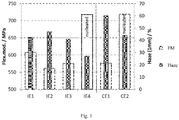
- the inventive examples show an optimized or improved balance of optical and mechanical properties, i.e. an improved optical performance at comparable stiffness (resp. softness) level.
- IE 4 ⁇ -nucleated
- Table 2 reveals that also the impact resistance of the inventive examples is comparable and further enhanced by nucleation.
- Fig. 1 i.e. the inventive examples exhibit an optimized or improved balance of optical and mechanical properties, i.e. an improved optical performance at comparable softness level.
Landscapes
- Chemical & Material Sciences (AREA)
- Organic Chemistry (AREA)
- Health & Medical Sciences (AREA)
- Chemical Kinetics & Catalysis (AREA)
- Medicinal Chemistry (AREA)
- Polymers & Plastics (AREA)
- Manufacturing & Machinery (AREA)
- Engineering & Computer Science (AREA)
- Crystallography & Structural Chemistry (AREA)
- Materials Engineering (AREA)
- Addition Polymer Or Copolymer, Post-Treatments, Or Chemical Modifications (AREA)
- Compositions Of Macromolecular Compounds (AREA)
- Transition And Organic Metals Composition Catalysts For Addition Polymerization (AREA)
- Manufacture Of Macromolecular Shaped Articles (AREA)
- Polymerisation Methods In General (AREA)
- Graft Or Block Polymers (AREA)
Claims (19)
- Heterophasisches Propylen-Copolymer (RAHECO), wobei das heterophasische Propylen-Copolymer (RAHECO) eine Matrix (M) umfasst, die ein statistisches Propylen-Copolymer (R-PP) und ein elastomeres Propylen-Copolymer (E) ist, das in der Matrix (M) dispergiert ist, wobei das heterophasische Propylen-Copolymer (RAHECO) neben Propylen Ethylen und/oder C4 bis C8 α-Olefine umfasst,
wobei das heterophasische Propylen-Copolymer (RAHECO) aufweista) eine Schmelze-Fließ-Rate MFR2 (230°C), gemessen gemäß ISO 1133, im Bereich von 2,0 bis 10,0 g/10 min,b) einen in kaltem Xylol löslichen Gehalt (XCS), bestimmt gemäß ISO 16152 (25°C), im Bereich von 16,0 bis 35,0 Gew.-%,c) einen Comonomer-Gehalt im Bereich von 8,5 bis 21,0 Mol-% undwobei das heterophasische Propylen-Copolymer (RAHECO) mindestens zwei Glasübergangs-Temperaturen Tg(1) und Tg(2) aufweist, die erste Glasübergangs-Temperatur Tg(1) sich auf die Matrix (M) bezieht, während die zweite Glasübergangs-Temperatur Tg(2) sich auf das dispergierte elastomere Propylen-Copolymer (E) bezieht, wobei weiterhin die zweite Glasübergangs-Temperatur Tg(2) die Ungleichung (I) erfüllt, Tg(2) die zweite Glasübergangs-Temperatur des heterophasischen Propylen-Copolymers (RAHECO) ist undC(XCS) der Comonomer-Gehalt [in Mol-%] der in kaltem Xylol löslichen Fraktion (XCS) des heterophasischen Propylen-Copolymers (RAHECO) ist,wobei das heterophasische Propylen-Copolymer (RAHECO) frei von Phthalsäureestern sowie deren jeweiligen Abbauprodukten ist.
 - Heterophasisches Propylen-Copolymer (RAHECO) nach Anspruch 1, wobei die erste Glasübergangs-Temperatur Tg(1) über der zweiten Glasübergangs-Temperatur Tg(2) liegt, vorzugsweise die Differenz zwischen der ersten Glasübergangs-Temperatur Tg(1) und der zweiten Glasübergangs-Temperatur Tg(2) mindestens 40°C beträgt.
- Heterophasisches Propylen-Copolymer (RAHECO) nach Anspruch 1 oder 2, wobei(a) die erste Glasübergangs-Temperatur Tg(1) im Bereich von -12 bis +2°C liegt;
und/oder(b) die zweite Glasübergangs-Temperatur Tg(2) im Bereich von über -70 bis unter -20°C liegt. - Heterophasisches Propylen-Copolymer (RAHECO) nach einem von dem vorangehenden Anspruch, wobei der in kaltem Xylol lösliche Gehalt (XCS) aufweisti) einen Comonomer-Gehalt im Bereich von 33,0 bis 45,0 Mol-% und/oderii) eine Grenz-Viskosität (IV), bestimmt gemäß DIN ISO 1628/1 (in Decalin bei 135°C), im Bereich von 1,0 bis 1,8 dl/g.
- Heterophasisches Propylen-Copolymer (RAHECO) nach einem der vorangehenden Ansprüche, wobei das statistische Propylen-Copolymer (R-PP) aufweisti) eine Schmelze-Fließ-Rate MFR2 (230°C), gemessen gemäß ISO 1133, im Bereich von 3,0 bis 8,0 g/10 min, und/oderii) einen Comonomer-Gehalt im Bereich von 4,4 bis 7,3 Mol-%.
- Heterophasisches Propylen-Copolymer (RAHECO) nach einem der vorangehenden Ansprüche, wobei die in kaltem Xylol unlösliche Fraktion (XCI) des heterophasischen Propylen-Copolymers (RAHECO) einen relativen Gehalt an isolierten zu Block-Ethylen-Sequenzen (I(E)) im Bereich von 50,0 bis 65,0 % aufweist, wobei der I(E)-Gehalt durch die Ungleichung (II) definiert ist
 I(E) der relative Gehalt an isolierten zu Block-Ethylen-Sequenzen [in %] ist;fPEP der Molenbruch von Propylen / Ethylen / Propylen-Sequenzen (PEP) in der in kaltem Xylol unlöslichen Fraktion (XCI) des heterophasischen Propylen-Copolymers (RAHECO) ist;fPEE der Molenbruch der Propylen / Ethylen / Ethylen-Sequenzen (PEE) und der Ethylen / Ethylen / Propylen-Sequenzen (EEP) in der in kaltem Xylol unlöslichen Fraktion (XCI) des heterophasischen Propylen-Copolymers (RAHECO) ist;fEEE der Molenbruch der Ethylen / Ethylen / Ethylen-Sequenzen (EEE) in der in kaltem Xylol unlöslichen Fraktion (XCI) des heterophasischen Propylen-Copolymers (RAHECO) ist,wobei alle Sequenz-Konzentrationen auf einer statistischen Triaden-Analyse von 13C-NMR-Daten basieren.
 - Heterophasisches Propylen-Copolymer (RAHECO) nach einem der vorangehenden Ansprüche, wobei die Comonomere des statistischen Propylen-Copolymers (R-PP) und/oder die Comonomere des elastomeren Propylen-Copolymers (E) Ethylen und/oder C4 bis C8 α-Olefin sind.
- Heterophasisches Propylen-Copolymer (RAHECO) nach einem der vorangehenden Ansprüche, wobei das heterophasische Propylen-Copolymer (RAHECO) 65,0 bis 88,0 Gew.-%, bezogen auf das Gesamtgewicht des heterophasischen Propylen-Copolymers (RAHECO), des statistischen Propylen-Copolymers (R-PP) und 12,0 bis 35,0 Gew.-%, bezogen auf das Gesamtgewicht des heterophasischen Propylen-Copolymers (RAHECO), des elastomeren Propylen-Copolymers (E) umfasst.
- Heterophasisches Propylen-Copolymer (RAHECO) nach einem der vorangehenden Ansprüche, wobei das heterophasische Propylen-Copolymer (RAHECO) ein Nukleierungsmittel, vorzugsweise ein α-Nukleierungsmittel, umfasst.
- Heterophasisches Propylen-Copolymer (RAHECO) nach einem der vorangehenden Ansprüche, wobei das heterophasische Propylen-Copolymer (RAHECO) frei von Phthalsäure-Verbindungen sowie deren jeweiligen Abbauprodukten ist.
- Heterophasisches Propylen-Copolymer (RAHECO) nach einem der vorangehenden Ansprüche, wobei das heterophasische Propylen-Copolymer (RAHECO) polymerisiert wurde in Gegenwart vona) einem Ziegler-Natta-Katalysator (ZN-C), umfassend Verbindungen (TC) eines Übergangsmetalls der Gruppe 4 bis 6 der IUPAC, eine Metall-Verbindung (MC) der Gruppe 2 und einen inneren Donor (ID), wobei der innere Donor (ID) eine Nicht-Phthalsäure-Verbindung ist, vorzugsweise ein Nicht-Phthalsäureester ist;b) gegebenenfalls einem Co-Katalysator (Co) undc) gegebenenfalls einem äußeren Donor (ED).
- Heterophasisches Propylen-Copolymer (RAHECO) nach Anspruch 11, wobeia) der innere Donor (ID) ausgewählt ist aus gegebenenfalls substituierten Malonaten, Maleaten, Succinaten, Glutaraten, Cyclohexen-1,2-dicarboxylaten, Benzoaten und Derivaten und/oder Gemischen davon, vorzugsweise ist der innere Donor (ID) ein Citraconat;b) das Molverhältnis von Co-Katalysator (Co) zu äußerem Donor (ED) [Co/ED] 5 bis 45 beträgt.
- Heterophasisches Propylen-Copolymer (RAHECO) nach einem der vorangehenden Ansprüche, wobei das heterophasische Propylen-Copolymer (RAHECO), das eine Matrix (M), die ein statistisches Propylen-Copolymer (R-PP) ist und ein in der Matrix (M) dispergiertes elastomeres Propylen-Copolymer (E) umfasst, in einem mehrstufigen Verfahren hergestellt wird, das mindestens zwei in Reihe geschaltete Reaktoren umfasst.
- Heterophasisches Propylen-Copolymer (RAHECO) nach Anspruch 13, wobei(a) in einem ersten Reaktor Propylen und Ethylen und/oder C4 bis C8 α-Olefin polymerisiert werden unter Gewinnen einer ersten Propylen-Copolymer-Fraktion (R-PP1),(b) Übertragen der ersten Propylen-Copolymer-Fraktion (R-PP1) in einen zweiten Reaktor,(c) Polymerisieren in dem zweiten Reaktor in Gegenwart der ersten Propylen-Copolymer-Fraktion (R-PP1) von Propylen und Ethylen und/oder einem C4 bis C8 α-Olefin unter Gewinnen einer zweiten Propylen-Copolymer-Fraktion (R-PP2), wobei die erste Propylen-Copolymer-Fraktion (R-PP1) und die zweite Propylen-Copolymer-Fraktion (R-PP2) die Matrix (R-PP) bilden,(d) Übertragen der Matrix (M) in einen dritten Reaktor,(e) Polymerisieren in dem dritten Reaktor in Gegenwart der Matrix (M) von Propylen und Ethylen und/oder C4 bis C8 α-Olefin unter Gewinnung eines elastomeren Propylen-Copolymers (E), wobei die Matrix (M) und das elastomere Propylen-Copolymer (E) das heterophasische Propylen-Copolymer (RAHECO) bilden.
- Heterophasisches Propylen-Copolymer (RAHECO) nach einem der vorangehenden Ansprüche, wobei das heterophasische Propylen-Copolymer (RAHECO) aufweista) einen Biegemodul, gemessen gemäß ISO 178, im Bereich von 480 bis 800 MPa und/oderb) eine Transparenz gemäß ASTM D1003-00, gemessen an einer 1 mm dicken Spritzgussprobe, von mindestens 75,0 % und/oderc) eine Trübung gemäß ASTM D 1003-00, gemessen an einer 1 mm dicken Spritzgussprobe, von ≤ 50,0 %, und/oderd) eine Klarheit gemäß ASTM D1003-00, gemessen an einer 1 mm dicken Spritzgussprobe, von mindestens 90,0 %.
- Nicht verstreckte Folie, umfassend ein heterophasisches Propylen-Copolymer (RAHECO) nach einem der vorangehenden Ansprüche 1 bis 15.
- Nicht verstreckte Folie nach Anspruch 16, wobei die Folie eine Gießfolie oder eine Blasfolie ist.
- Behälter, umfassend die nicht verstreckte Folie nach Anspruch 16 oder 17.
- Verwendung eines heterophasischen Propylen-Copolymers (RAHECO) nach einem der Ansprüche 1 bis 15 zur Verbesserung des Gleichgewichts zwischen Weichheit und Trübung einer nicht verstreckten Folie, wobei die Verbesserung erfolgt, wenn das heterophasische Propylen-Copolymer (RAHECO) aufweista) einen Biegemodul, gemessen gemäß ISO 178, im Bereich von 480 bis 800 MPa undb) eine Trübung gemäß ASTM D 1003-00, gemessen an einer 1 mm dicken Spritzgussprobe, von ≤ 50,0 %.
Priority Applications (1)
| Application Number | Priority Date | Filing Date | Title |
|---|---|---|---|
| PL15702272T PL3102634T3 (pl) | 2014-02-06 | 2015-02-03 | Miękkie i przezroczyste kopolimery odporne na uderzenia |
Applications Claiming Priority (2)
| Application Number | Priority Date | Filing Date | Title |
|---|---|---|---|
| EP14154116 | 2014-02-06 | ||
| PCT/EP2015/052178 WO2015117948A1 (en) | 2014-02-06 | 2015-02-03 | Soft and transparent impact copolymers |
Publications (2)
| Publication Number | Publication Date |
|---|---|
| EP3102634A1 EP3102634A1 (de) | 2016-12-14 |
| EP3102634B1 true EP3102634B1 (de) | 2019-12-04 |
Family
ID=50033426
Family Applications (1)
| Application Number | Title | Priority Date | Filing Date |
|---|---|---|---|
| EP15702272.4A Active EP3102634B1 (de) | 2014-02-06 | 2015-02-03 | Weiche und durchsichtige schlagfeste copolymere |
Country Status (8)
| Country | Link |
|---|---|
| US (1) | US10100186B2 (de) |
| EP (1) | EP3102634B1 (de) |
| JP (1) | JP6474417B2 (de) |
| CN (1) | CN105934476B (de) |
| BR (1) | BR112016017227B1 (de) |
| ES (1) | ES2767498T3 (de) |
| PL (1) | PL3102634T3 (de) |
| WO (1) | WO2015117948A1 (de) |
Families Citing this family (78)
| Publication number | Priority date | Publication date | Assignee | Title |
|---|---|---|---|---|
| JP6216887B2 (ja) | 2013-08-14 | 2017-10-18 | ボレアリス・アクチェンゲゼルシャフトBorealis Ag | 低温における耐衝撃性が改善されたプロピレン組成物 |
| MX2016001705A (es) | 2013-08-21 | 2016-05-18 | Borealis Ag | Composicion de poliolefina de alto flujo con alta rigidez y tenacidad. |
| WO2015024887A1 (en) | 2013-08-21 | 2015-02-26 | Borealis Ag | High flow polyolefin composition with high stiffness and toughness |
| EP2853563B1 (de) | 2013-09-27 | 2016-06-15 | Borealis AG | Filme zur BOPP-Verarbeitung aus Polymeren mit hohem XS und hoher Schmelztemperatur |
| ES2568615T3 (es) | 2013-10-11 | 2016-05-03 | Borealis Ag | Película para etiquetas orientada en la dirección de la máquina |
| US10519259B2 (en) | 2013-10-24 | 2019-12-31 | Borealis Ag | Low melting PP homopolymer with high content of regioerrors and high molecular weight |
| CA2927448C (en) | 2013-11-22 | 2017-01-17 | Borealis Ag | Low emission propylene homopolymer with high melt flow |
| EP3077426B1 (de) | 2013-12-04 | 2022-10-05 | Borealis AG | Phthalatfreie pp-homopolymere für schmelzgeblasene fasern |
| KR101873134B1 (ko) | 2013-12-18 | 2018-06-29 | 보레알리스 아게 | 향상된 강성/인성 균형을 가진 bopp 필름 |
| CN105829364B (zh) | 2014-01-17 | 2017-11-10 | 博里利斯股份公司 | 用于制备丙烯/1‑丁烯共聚物的方法 |
| JP2017508032A (ja) | 2014-02-06 | 2017-03-23 | ボレアリス エージー | 高衝撃強さを有する軟質コポリマー |
| BR112016017227B1 (pt) | 2014-02-06 | 2021-06-29 | Borealis Ag | Copolímero de propileno heterofásico, película não orientada, recipiente, e uso de um copolímero de propileno heterofásico |
| EP2907841A1 (de) | 2014-02-14 | 2015-08-19 | Borealis AG | Polypropylenverbundstoff |
| RU2654696C2 (ru) * | 2014-03-21 | 2018-05-22 | Бореалис Аг | Гетерофазный сополимер пропилена с высокой температурой плавления |
| EP2947118B1 (de) | 2014-05-20 | 2017-11-29 | Borealis AG | Polypropylenzusammensetzung für Anwendungen im Fahrzeuginnenraum |
| ES2778674T3 (es) * | 2015-07-08 | 2020-08-11 | Borealis Ag | Copolímero de propileno aleatorio heterofásico con claridad mejorada |
| EP3184587B1 (de) * | 2015-12-21 | 2020-03-18 | Borealis AG | Extrudierte gegenstände mit verbesserten optischen eigenschaften |
| US10113058B2 (en) | 2015-12-30 | 2018-10-30 | Braskem America, Inc. | Clear and impact resistant polymer composition and fabricated article |
| CN109153831B (zh) * | 2016-05-18 | 2021-03-30 | 北欧化工公司 | 软质聚丙烯组合物 |
| WO2018072049A1 (en) * | 2016-10-17 | 2018-04-26 | Borouge Compounding Shanghai Co., Ltd. | Polypropylene composition having low fogging |
| EP3339366A1 (de) | 2016-12-22 | 2018-06-27 | Borealis AG | Vernetzbare polyolefinzusammensetzung |
| WO2018185024A1 (en) | 2017-04-04 | 2018-10-11 | Borealis Ag | Soft polypropylene composition with improved properties |
| EP3395377A1 (de) * | 2017-04-28 | 2018-10-31 | Borealis AG | Weiche polypropylenzusammensetzung mit verbesserten eigenschaften |
| US11390700B2 (en) | 2017-05-18 | 2022-07-19 | Borealis Ag | Propylene-ethylene random copolymer with improved irradiation resistance |
| EP3409701A1 (de) | 2017-05-31 | 2018-12-05 | Borealis AG | Vernetzbare propylenpolymerzusammensetzung |
| EP3645580B1 (de) * | 2017-06-29 | 2022-12-14 | Borealis AG | Verfahren zur herstellung einer polypropylenzusammensetzung |
| US11370904B2 (en) | 2017-06-29 | 2022-06-28 | Borealis Ag | Process for preparing a polypropylene composition |
| EP3672997B1 (de) | 2017-08-24 | 2023-03-22 | Borealis AG | Polypropylencopolymere mit verbesserter steifigkeit und verbessertem schlagverhalten |
| CN111032709B (zh) * | 2017-09-14 | 2022-05-17 | 巴塞尔聚烯烃意大利有限公司 | 丙烯乙烯无规共聚物 |
| WO2019057571A1 (en) * | 2017-09-20 | 2019-03-28 | Borealis Ag | POLYPROPYLENE COMPOSITION |
| CN111148788B (zh) | 2017-10-13 | 2023-04-18 | 博里利斯股份公司 | 多峰无规多相聚丙烯组合物 |
| ES2890961T3 (es) | 2017-11-28 | 2022-01-25 | Borealis Ag | Composición de polímero con adherencia de la pintura mejorada |
| EP3489297B1 (de) | 2017-11-28 | 2021-08-04 | Borealis AG | Polymerzusammensetzung mit verbesserter lackhaftung |
| PL3495423T3 (pl) | 2017-12-05 | 2021-08-09 | Borealis Ag | Wyrób zawierający kompozycję polipropylenową wzmocnioną włóknami |
| ES2837424T3 (es) | 2017-12-05 | 2021-06-30 | Borealis Ag | Composición de polipropileno reforzada con fibra |
| ES2987105T3 (es) | 2017-12-14 | 2024-11-13 | Borealis Ag | Procedimiento para preparar una composición de polipropileno |
| CN111433279B (zh) * | 2017-12-20 | 2022-03-11 | 博里利斯股份公司 | 多相聚丙烯组合物 |
| PT3502177T (pt) | 2017-12-20 | 2020-03-17 | Borealis Ag | Composição de polipropileno |
| EP3505566A1 (de) * | 2017-12-28 | 2019-07-03 | Borealis AG | Kabelmantel |
| CN111630101B (zh) * | 2018-02-28 | 2021-01-26 | 巴塞尔聚烯烃意大利有限公司 | 渗透性聚合物膜 |
| WO2019201934A1 (en) | 2018-04-16 | 2019-10-24 | Borealis Ag | A multilayer element |
| CN110498973B (zh) | 2018-05-16 | 2023-09-01 | 北欧化工公司 | 发泡聚丙烯组合物 |
| EP3584089A1 (de) | 2018-06-19 | 2019-12-25 | Borealis AG | Polyolefinzusammensetzung mit verbessertem kontrast von lasermarkierungen |
| EP3830140A1 (de) | 2018-08-02 | 2021-06-09 | Borealis AG | Verfahren zur polymerisation von ethylen in einem mehrstufigen polymerisationsverfahren |
| US12404393B2 (en) | 2018-09-26 | 2025-09-02 | Borealis Ag | Propylene copolymer composition with excellent optical and mechanical properties |
| CN112638959B (zh) | 2018-09-26 | 2023-05-02 | 博里利斯股份公司 | 具有优异光学性能的丙烯共聚物 |
| WO2020064313A1 (en) | 2018-09-26 | 2020-04-02 | Borealis Ag | Propylene random copolymer for use in film applications |
| US11981781B2 (en) | 2018-10-02 | 2024-05-14 | Borealis Ag | High speed cross-linking of grafted plastomers |
| EP3861034B1 (de) | 2018-10-02 | 2024-08-21 | Borealis AG | Langsam vernetzender katalysator für silan-gepfropfte plastomere |
| CN113195605A (zh) | 2018-12-20 | 2021-07-30 | 博里利斯股份公司 | 具有改善的击穿强度的双轴取向聚丙烯膜 |
| WO2020175138A1 (ja) * | 2019-02-26 | 2020-09-03 | 株式会社プライムポリマー | プロピレン系樹脂組成物および成形体 |
| US11485845B2 (en) * | 2019-05-29 | 2022-11-01 | Borealis Ag | C2C3 random copolymer |
| WO2021001143A1 (en) | 2019-07-01 | 2021-01-07 | Borealis Ag | Pipe made of peroxide-crosslinked polyethylene of high uv stability |
| JP7364703B2 (ja) | 2019-07-04 | 2023-10-18 | ボレアリス エージー | 長鎖分岐プロピレンポリマー組成物 |
| EP3763777B1 (de) | 2019-07-08 | 2022-03-16 | Borealis AG | Aldehydgehaltreduzierungsverfahren und recyceltes polyolefin mit niedrigem aldehydgehalt |
| KR102723723B1 (ko) | 2019-08-19 | 2024-10-29 | 보레알리스 아게 | 개선된 특성을 갖는 폴리프로필렌 - 폴리에틸렌 배합물 |
| WO2021053154A1 (en) | 2019-09-20 | 2021-03-25 | Borealis Ag | Heterophasic propylene polymer composition with improved property profile |
| EP4069510A1 (de) | 2019-12-05 | 2022-10-12 | Borealis AG | Mehrschichtfolie mit verbesserten eigenschaften |
| WO2021144178A1 (en) | 2020-01-16 | 2021-07-22 | Borealis Ag | Process for avoiding phase separation during solution polymerization of ethylene-1-octene copolymers |
| EP3885375B1 (de) * | 2020-03-24 | 2022-08-31 | Borealis AG | Steife blasfolie |
| WO2021209326A1 (en) | 2020-04-17 | 2021-10-21 | Borealis Ag | Blown film |
| WO2022157231A1 (en) * | 2021-01-22 | 2022-07-28 | Borealis Ag | Fiber reinforced polypropylene composition |
| WO2024223777A1 (en) | 2023-04-26 | 2024-10-31 | Borealis Ag | Layer element suitable as integrated backsheet for a bifacial photovoltaic module |
| EP4701858A1 (de) | 2023-04-26 | 2026-03-04 | Borealis GmbH | Als integrierte rückseitenfolie für ein zweiseitiges fotovoltaisches modul geeignetes schichtelement |
| WO2025061931A1 (en) | 2023-09-21 | 2025-03-27 | Borealis Ag | Polypropylene-based layer element having balanced mechanical and stress-whitening properties |
| CN121909245A (zh) | 2023-09-28 | 2026-04-21 | 北欧化工有限责任公司 | 包含聚丙烯组合物的电缆 |
| CN121909244A (zh) | 2023-09-28 | 2026-04-21 | 博里利斯有限责任公司 | 用于电缆绝缘的聚烯烃组合物 |
| WO2025068333A1 (en) | 2023-09-28 | 2025-04-03 | Borealis Ag | Semiconductive polypropylene composition |
| WO2025067703A1 (en) | 2023-09-28 | 2025-04-03 | Borealis Ag | Polyolefin composition for cable insulation |
| EP4600277A1 (de) | 2024-02-07 | 2025-08-13 | Abu Dhabi Polymers Co. Ltd (Borouge) - Sole Proprietorship L.L.C. | Verbesserte polypropylenzusammensetzung für spritzgegossene oder blasgeformte gegenstände |
| WO2025202306A1 (en) | 2024-03-28 | 2025-10-02 | Borealis Gmbh | Polypropylene composition for cable insulation |
| WO2025202325A1 (en) | 2024-03-28 | 2025-10-02 | Borealis Gmbh | Polypropylene composition for cable insulation |
| WO2026008734A1 (en) | 2024-07-03 | 2026-01-08 | Borealis Gmbh | Polymer composition for cable insulation |
| WO2026008736A1 (en) | 2024-07-03 | 2026-01-08 | Borealis Gmbh | Propylene copolymer for cable insulation |
| WO2026008730A1 (en) | 2024-07-03 | 2026-01-08 | Borealis Gmbh | Polymer composition for cable insulation |
| WO2026008731A1 (en) | 2024-07-03 | 2026-01-08 | Borealis Gmbh | Polymer composition for cable insulation |
| WO2026008735A1 (en) | 2024-07-03 | 2026-01-08 | Borealis Gmbh | Polymer composition for cable insulation |
| WO2026027750A1 (en) | 2024-08-02 | 2026-02-05 | Borealis Gmbh | Polypropylene composition for fiber applications |
Family Cites Families (247)
| Publication number | Priority date | Publication date | Assignee | Title |
|---|---|---|---|---|
| US4226963A (en) | 1971-06-25 | 1980-10-07 | Montedison S.P.A. | Process for the stereoregular polymerization of alpha-olephins |
| US4107414A (en) | 1971-06-25 | 1978-08-15 | Montecatini Edison S.P.A. | Process for the stereoregular polymerization of alpha olefins |
| US4186107A (en) | 1978-04-14 | 1980-01-29 | Hercules Incorporated | Solid catalyst component for olefin polymerization |
| US4347160A (en) | 1980-06-27 | 1982-08-31 | Stauffer Chemical Company | Titanium halide catalyst system |
| IT1209255B (it) | 1980-08-13 | 1989-07-16 | Montedison Spa | Catalizzatori per la polimerizzazione di olefine. |
| JPS57153005A (en) | 1981-03-19 | 1982-09-21 | Ube Ind Ltd | Polymerization of alpha-olefin |
| US4530912A (en) | 1981-06-04 | 1985-07-23 | Chemplex Company | Polymerization catalyst and method |
| EP0072129B2 (de) | 1981-08-07 | 1990-02-28 | Imperial Chemical Industries Plc | Übergangsmetallzusammensetzung auf einem Träger aufgebracht |
| US4382019A (en) | 1981-09-10 | 1983-05-03 | Stauffer Chemical Company | Purified catalyst support |
| IT1190681B (it) | 1982-02-12 | 1988-02-24 | Montedison Spa | Componenti e catalizzatori per la polimerizzazione di olefine |
| IT1190682B (it) | 1982-02-12 | 1988-02-24 | Montedison Spa | Catalizzatori per la polimerizzazione di olefine |
| IT1190683B (it) | 1982-02-12 | 1988-02-24 | Montedison Spa | Componenti e catalizzatori per la polimerizzazione di olefine |
| US4532313A (en) | 1982-10-13 | 1985-07-30 | Himont Incorporated | Method for preparing an improved catalyst support, Ziegler-Natta catalyst utilizing said support and polymerization of 1-olefins utilizing said catalyst |
| US4560671A (en) | 1983-07-01 | 1985-12-24 | Union Carbide Corporation | Olefin polymerization catalysts adapted for gas phase processes |
| US4657882A (en) | 1984-11-26 | 1987-04-14 | Amoco Corporation | Supported olefin polymerization catalyst produced from a magnesium alkyl/organophosphoryl complex |
| US4581342A (en) | 1984-11-26 | 1986-04-08 | Standard Oil Company (Indiana) | Supported olefin polymerization catalyst |
| US4665208A (en) | 1985-07-11 | 1987-05-12 | Exxon Chemical Patents Inc. | Process for the preparation of alumoxanes |
| FI80055C (fi) | 1986-06-09 | 1990-04-10 | Neste Oy | Foerfarande foer framstaellning av katalytkomponenter foer polymerisation av olefiner. |
| US5077255A (en) | 1986-09-09 | 1991-12-31 | Exxon Chemical Patents Inc. | New supported polymerization catalyst |
| EP0812862B1 (de) | 1986-09-24 | 2002-11-13 | Mitsui Chemicals, Inc. | Olefinpolymerisationsverfahren |
| JPH0780933B2 (ja) | 1986-11-20 | 1995-08-30 | 三井石油化学工業株式会社 | オレフインの重合方法 |
| JPH0742301B2 (ja) | 1987-02-14 | 1995-05-10 | 三井石油化学工業株式会社 | 微粒子状アルミノオキサン、その製法およびその用途 |
| JP2538588B2 (ja) | 1987-04-03 | 1996-09-25 | 三井石油化学工業株式会社 | オレフイン重合用固体触媒の製法 |
| US5206199A (en) | 1987-04-20 | 1993-04-27 | Mitsui Petrochemical Industries, Ltd. | Catalyst for polymerizing an olefin and process for polymerizing an olefin |
| US5091352A (en) | 1988-09-14 | 1992-02-25 | Mitsui Petrochemical Industries, Ltd. | Olefin polymerization catalyst component, olefin polymerization catalyst and process for the polymerization of olefins |
| IT1227260B (it) | 1988-09-30 | 1991-03-28 | Himont Inc | Dieteri utilizzabili nella preparazione di catalizzatori ziegler-natta |
| US4908463A (en) | 1988-12-05 | 1990-03-13 | Ethyl Corporation | Aluminoxane process |
| US5103031A (en) | 1989-02-21 | 1992-04-07 | Ethyl Corporation | Falling film aluminoxane process |
| US4968827A (en) | 1989-06-06 | 1990-11-06 | Ethyl Corporation | Alkylaluminoxane process |
| US4924018A (en) | 1989-06-26 | 1990-05-08 | Ethyl Corporation | Alkylaluminoxane process |
| US5504169A (en) | 1989-09-13 | 1996-04-02 | Exxon Chemical Patents Inc. | Process for producing amorphous poly-α-olefins with a monocyclopentadienyl transition metal catalyst system |
| US5036034A (en) | 1989-10-10 | 1991-07-30 | Fina Technology, Inc. | Catalyst for producing hemiisotactic polypropylene |
| JPH0813826B2 (ja) | 1990-11-29 | 1996-02-14 | 信越化学工業株式会社 | テキシルトリアルコキシシラン |
| FI86866C (fi) | 1990-12-19 | 1992-10-26 | Neste Oy | Foerfarande foer modifiering av katalysatorer avsedda foer polymerisation av olefiner |
| FI86867C (fi) | 1990-12-28 | 1992-10-26 | Neste Oy | Flerstegsprocess foer framstaellning av polyeten |
| SE467825B (sv) | 1991-01-22 | 1992-09-21 | Neste Oy | Saett att vid plastmaterial eliminera luktande/smakande aemnen |
| FI88049C (fi) | 1991-05-09 | 1993-03-25 | Neste Oy | Polyolefin med stora porer, foerfarande foer dess framstaellning och en i foerfarandet anvaend katalysator |
| FI88047C (fi) | 1991-05-09 | 1993-03-25 | Neste Oy | Pao tvenne elektrondonorer baserad katalysator foer polymerisation av olefiner |
| FI88048C (fi) | 1991-05-09 | 1993-03-25 | Neste Oy | Grovkornig polyolefin, dess framstaellningsmetod och en i metoden anvaend katalysator |
| FI90247C (fi) | 1991-05-31 | 1994-01-10 | Borealis As | Menetelmä polymerointikatalyytin aktiivisten ja tasakokoisten kantajahiukkasten valmistamiseksi |
| US5308815A (en) | 1991-07-26 | 1994-05-03 | Ethyl Corporation | Heterogeneous methylaluminoxane catalyst system |
| US5157137A (en) | 1991-07-26 | 1992-10-20 | Ethyl Corporation | Method of making gel free alkylaluminoxane solutions |
| US5235081A (en) | 1992-03-18 | 1993-08-10 | Ethyl Corporation | Method of removing gel forming materials from methylaluminoxanes |
| US5416228A (en) | 1991-10-07 | 1995-05-16 | Fina Technology, Inc. | Process and catalyst for producing isotactic polyolefins |
| FI91967C (fi) | 1991-11-29 | 1994-09-12 | Borealis Polymers Oy | Menetelmä olefiinipolymerointikatalyyttien valmistamiseksi |
| FI90248C (fi) | 1991-11-29 | 1994-01-10 | Borealis As | Menetelmä hiukkasmaisen kantajan valmistamiseksi olefiinipolymerointikatalyyttiä varten |
| US5329032A (en) | 1992-03-18 | 1994-07-12 | Akzo Chemicals Inc. | Polymethylaluminoxane of enhanced solution stability |
| FI95715C (fi) | 1992-03-24 | 1996-03-11 | Neste Oy | Suihkukiteyttämällä valmistetun polymerointikatalyyttikantajan valmistus |
| US5248801A (en) | 1992-08-27 | 1993-09-28 | Ethyl Corporation | Preparation of methylaluminoxanes |
| US5939346A (en) | 1992-11-02 | 1999-08-17 | Akzo Nobel N.V. | Catalyst system comprising an aryloxyaluminoxane containing an electron withdrawing group |
| US5391793A (en) | 1992-11-02 | 1995-02-21 | Akzo Nobel N.V. | Aryloxyaluminoxanes |
| US5332706A (en) | 1992-12-28 | 1994-07-26 | Mobil Oil Corporation | Process and a catalyst for preventing reactor fouling |
| US5391529A (en) | 1993-02-01 | 1995-02-21 | Albemarle Corporation | Siloxy-aluminoxane compositions, and catalysts which include such compositions with a metallocene |
| CA2121721C (en) | 1993-04-29 | 2004-11-23 | Giampiero Morini | Crystalline propylene polymers having high melt flow rate values and a narrow molecular weight distribution |
| EP0629631B1 (de) | 1993-06-07 | 2002-08-28 | Mitsui Chemicals, Inc. | Übergangsmetallverbindung, und diese enthaltender Polymerisationkatalysator |
| DE4337251A1 (de) | 1993-09-27 | 1995-03-30 | Hoechst Ag | Biaxial orientierte Polypropylenfolie mit verbesserten Eigenschaften hinsichtlich Mechanik und Barriere |
| FI96866C (fi) | 1993-11-05 | 1996-09-10 | Borealis As | Tuettu olefiinipolymerointikatalyytti, sen valmistus ja käyttö |
| FI96214C (fi) | 1994-05-31 | 1996-05-27 | Borealis As | Olefiinien polymerointiin tarkoitettu stereospesifinen katalyyttisysteemi |
| US5529850A (en) | 1994-07-05 | 1996-06-25 | Montell North America Inc. | Fibers produced from crystalline propylene polymers having high melt flow rate values and a narrow molecular weight distribution |
| US5691043A (en) | 1994-07-15 | 1997-11-25 | Mobil Oil Corporation | Uniaxially shrinkable biaxially oriented polypropylene film and its method of preparation |
| US6322883B1 (en) | 1994-07-15 | 2001-11-27 | Exxonmobil Oil Corporation | Uniaxially shrinkable biaxially oriented polypropylene film with HDPE skin |
| IL117114A (en) | 1995-02-21 | 2000-02-17 | Montell North America Inc | Components and catalysts for the polymerization ofolefins |
| US5731253A (en) | 1995-07-27 | 1998-03-24 | Albemarle Corporation | Hydrocarbylsilloxy - aluminoxane compositions |
| US6403772B1 (en) | 1995-09-11 | 2002-06-11 | Montell Technology Company, Bv | Open-pentadienyl metallocenes, precursors thereof and polymerization catalysts therefrom |
| US5922631A (en) | 1995-10-19 | 1999-07-13 | Albemarle Corporation | Liquid clathrate aluminoxane compositions as co-catalysts with transition metal catalyst compounds |
| US5670682A (en) | 1995-10-19 | 1997-09-23 | Albemarle Corporation | Liquid clathrate aluminoxane compositions |
| US5693838A (en) | 1995-11-13 | 1997-12-02 | Albemarle Corporation | Aluminoxane process and product |
| FI104826B (fi) | 1996-01-30 | 2000-04-14 | Borealis As | Heteroatomilla substituoituja metalloseeniyhdisteitä olefiinipolymerointikatalyytti-systeemejä varten ja menetelmä niiden valmistamiseksi |
| FI102070B (fi) | 1996-03-29 | 1998-10-15 | Borealis As | Uusi kompleksiyhdiste, sen valmistus ja käyttö |
| US5731451A (en) | 1996-07-12 | 1998-03-24 | Akzo Nobel Nv | Modified polyalkylauminoxane composition formed using reagent containing aluminum trialkyl siloxide |
| FI963707A0 (fi) | 1996-09-19 | 1996-09-19 | Borealis Polymers Oy | Foerfarande foer polymerisering av alfa-olefiner, vid polymerisering anvaendbar katalysator och foerfarande foer framstaellning av densamma |
| WO1998016359A1 (en) | 1996-10-14 | 1998-04-23 | Dsm N.V. | Rod-shaped pellets |
| US5744656A (en) | 1996-10-25 | 1998-04-28 | Boulder Scientific Company | Conversion of hexafluorobenzene to bromopentafluorobenzene |
| FI971565A7 (fi) | 1997-04-14 | 1998-10-15 | Borealis As | Olefiinien polymerointiin tarkoitettujen katalysaattorisysteemien substituoituja metalloseeniyhdisteitä, niiden välituotteet ja valmistusmenetelmä |
| KR100624632B1 (ko) | 1997-03-07 | 2006-09-15 | 타고르 게엠베하 | 메탈로센 및 그의 제조 방법 |
| GB9708487D0 (en) | 1997-04-25 | 1997-06-18 | Bp Chem Int Ltd | Novel catalysts for olefin polymerisation |
| CA2293490A1 (en) | 1997-06-10 | 1998-12-17 | Peroxid-Chemie Gmbh & Co. Kg | New catalyst systems for (co-)polymerization reactions, metallocene amide halogenides, the production and use thereof |
| FI111847B (fi) | 1997-06-24 | 2003-09-30 | Borealis Tech Oy | Menetelmä propeenin kopolymeerien valmistamiseksi |
| FI111845B (fi) | 1997-06-24 | 2003-09-30 | Borealis Tech Oy | Menetelmä propeenin homopolymeerien ja iskulujuudeltaan modifioitujen polymeerien valmistamiseksi |
| WO1998058976A1 (en) | 1997-06-24 | 1998-12-30 | Borealis A/S | Process for preparing propylene polymers |
| FI111848B (fi) | 1997-06-24 | 2003-09-30 | Borealis Tech Oy | Menetelmä ja laitteisto propeenin homo- ja kopolymeerien valmistamiseksi |
| FI104824B (fi) | 1997-06-24 | 2000-04-14 | Borealis As | Menetelmä propeenin terpolymeerien aikaansaamiseksi |
| FI111846B (fi) | 1997-06-24 | 2003-09-30 | Borealis Tech Oy | Menetelmä ja laitteisto polypropeeniseosten valmistamiseksi |
| FI973451A0 (fi) | 1997-08-22 | 1997-08-22 | Borealis As | Ny organometalfoerening och metod foer polymerisation av olefiner med hjaelp av en katalytkomposition som innehaoller denna organometalfoerening |
| DE69805638T2 (de) | 1997-09-05 | 2002-11-21 | Bp Chemicals Ltd., London | Polymerisationskatalysatoren |
| GB9721559D0 (en) | 1997-10-11 | 1997-12-10 | Bp Chem Int Ltd | Novel polymerisation catalysts |
| FI974175L (fi) | 1997-11-07 | 1999-05-08 | Borealis As | Menetelmä polypropeenin valmistamiseksi |
| FI980342A0 (fi) | 1997-11-07 | 1998-02-13 | Borealis As | Polymerroer och -roerkopplingar |
| AU748975B2 (en) | 1997-12-23 | 2002-06-13 | Borealis Technology Oy | Catalyst component comprising magnesium, titanium, a halogen and an electron donor, its preparation and use |
| EA200000835A1 (ru) | 1998-02-12 | 2001-04-23 | Юниверсити Оф Делавэр | Соединения-катализаторы с бета-дииминатными анионными лигандами и способы полимеризации олефинов |
| GB9826874D0 (en) | 1998-12-07 | 1999-01-27 | Borealis As | Process |
| FI991057A0 (fi) | 1999-05-07 | 1999-05-07 | Borealis As | Korkean jäykkyyden propeenipolymeerit ja menetelmä niiden valmistamiseksi |
| BRPI0016723B1 (pt) | 1999-12-23 | 2018-02-27 | Basell Polyolefine Gmbh. | Metaloceno, sistema catalisador, e, processo para a copolimerização de propileno com etileno |
| US6384142B1 (en) | 2000-02-08 | 2002-05-07 | Exxonmobil Chemical Patents Inc. | Propylene impact copolymers |
| GB0007002D0 (en) | 2000-03-22 | 2000-05-10 | Borealis Polymers Oy | Catalysts |
| JP2004502699A (ja) | 2000-06-30 | 2004-01-29 | エクソンモービル・ケミカル・パテンツ・インク | 架橋ビス(インデニル)メタロセン化合物 |
| US6586528B1 (en) | 2000-11-15 | 2003-07-01 | Polypropylene Belgium (Naamlose Vennootshap) | Composition based on propylene polymers and process for obtaining same |
| US6642317B1 (en) | 2000-11-15 | 2003-11-04 | Polypropylene Belgium Naamlose Vennootschap | Composition based on propylene polymers and process for obtaining same |
| RU2278130C2 (ru) | 2000-12-22 | 2006-06-20 | Базелль Полиолефин Италия С.П.А. | Полиолефиновый лист для термоформования |
| TWI238169B (en) | 2000-12-22 | 2005-08-21 | Basell Technology Co Bv | Bioriented polypropylene films |
| EP1270610B8 (de) | 2001-06-20 | 2006-09-27 | Borealis Technology Oy | Herstellung eines Katalysatorbestandteils zur Olefinpolymerisation |
| PT1273595E (pt) | 2001-06-20 | 2006-10-31 | Borealis Tech Oy | Preparacao de um componente catalisador para polimerizacao de olefina |
| ES2248679T3 (es) | 2001-06-27 | 2006-03-16 | Borealis Technology Oy | Resina polimerica de propileno con propiedades mejoradas. |
| DE60211012T2 (de) | 2001-11-27 | 2007-05-03 | Basell Poliolefine Italia S.R.L. | Durchsichtige und flexible Polypropylenzusammensetzungen |
| MY136330A (en) | 2001-12-12 | 2008-09-30 | Basell Poliolefine Spa | Process for the polymerization of olefins |
| EP1323747A1 (de) | 2001-12-19 | 2003-07-02 | Borealis Technology Oy | Herstellung von Katalysatoren für die Olefinpolymerisation |
| DE60202660T3 (de) | 2002-02-04 | 2011-11-17 | Borealis Technology Oy | Film mit hoher Schlagfestigkeit |
| WO2003082879A1 (en) | 2002-03-28 | 2003-10-09 | Albemarle Corporation | Ionic aluminoxanate compositions and their use in catalysis |
| US20060052541A1 (en) | 2002-06-25 | 2006-03-09 | Erling Hagen | Polyolefin with improved scratch resistance and process for producing the same |
| AU2003247735B2 (en) | 2002-06-26 | 2010-03-11 | Avery Dennison Corporation | Oriented films comprising polypropylene / olefin elastomer blends |
| RU2325404C2 (ru) | 2002-08-01 | 2008-05-27 | Базелль Полиолефин Италия С.П.А. | Высокостереорегулярный полипропилен с улучшенными свойствами |
| US7807769B2 (en) | 2002-09-20 | 2010-10-05 | Exxonmobil Chemical Patents Inc. | Isotactic polypropylene produced from supercritical polymerization process |
| US7319125B2 (en) | 2002-09-20 | 2008-01-15 | Exxonmobil Chemical Patents Inc. | Supercritical polymerization process and polymers produced therefrom |
| EP1403292B1 (de) | 2002-09-30 | 2016-04-13 | Borealis Polymers Oy | Verfahren zur herstellung eines olefinpolymerisationskatalysatorbestandteils mit verbesserter aktivität bei hoher temperatur |
| AU2003288146A1 (en) | 2002-11-22 | 2004-06-18 | Basell Polyolefine Gmbh | Safe removal of volatile, oxidizable compounds from particles, in particular polymer particles |
| EP1452630A1 (de) | 2003-02-26 | 2004-09-01 | Borealis Technology OY | Polypropylenfasern |
| EP1484343A1 (de) | 2003-06-06 | 2004-12-08 | Universiteit Twente | Verfahren zur katalytischen Polymerisation von Olefinen, ein Reaktorsystem und seine Verwendung in diesem Verfahren |
| GB0317012D0 (en) | 2003-07-21 | 2003-08-27 | Borealis Tech Oy | Injection moulding polymer |
| DE10359366A1 (de) | 2003-12-18 | 2005-07-21 | Nordenia Deutschland Gronau Gmbh | Etikettenfolien-Laminat |
| JP2007517122A (ja) | 2003-12-24 | 2007-06-28 | ペトロキミカ クーヨ エスエイアイシー | シール層樹脂組成物 |
| US20050187367A1 (en) | 2004-02-19 | 2005-08-25 | Sumitomo Chemical Company, Limited | Biaxially oriented polypropylene film |
| US20050200046A1 (en) | 2004-03-10 | 2005-09-15 | Breese D. R. | Machine-direction oriented multilayer films |
| US7285608B2 (en) | 2004-04-21 | 2007-10-23 | Novolen Technology Holdings C.V. | Metallocene ligands, metallocene compounds and metallocene catalysts, their synthesis and their use for the polymerization of olefins |
| PL1632529T3 (pl) | 2004-09-02 | 2013-04-30 | Borealis Tech Oy | Polimerowa rura bezciśnieniowa, kompozycja polimeru i sposób jej wytwarzania |
| KR101286307B1 (ko) | 2004-12-31 | 2013-07-15 | 보레알리스 테크놀로지 오와이. | 공정 |
| CN100363417C (zh) | 2005-01-28 | 2008-01-23 | 中国石油化工股份有限公司 | 丙烯聚合物组合物和由其制备的双向拉伸薄膜 |
| US20060177641A1 (en) | 2005-02-09 | 2006-08-10 | Breese D R | Multilayer polyethylene thin films |
| US20060211801A1 (en) | 2005-03-16 | 2006-09-21 | Fina Technology, Inc. | Polyolefin film and production thereof |
| RU2410388C2 (ru) | 2005-03-18 | 2011-01-27 | Базелль Полиолефине Гмбх | Металлоценовые соединения |
| EP1726602A1 (de) | 2005-05-27 | 2006-11-29 | Borealis Technology Oy | Hochkristallines Polypropylen |
| EP1741725B1 (de) | 2005-07-08 | 2014-04-09 | Borealis Technology Oy | Polypropylen Zusammensetzung |
| EP1788023A1 (de) | 2005-11-21 | 2007-05-23 | Borealis Technology Oy | Multimodale Polypropylenzusammensetzung |
| EP1803743B1 (de) | 2005-12-30 | 2016-08-10 | Borealis Technology Oy | Katalysatorpartikel |
| WO2007107448A1 (en) | 2006-03-17 | 2007-09-27 | Basell Polyolefine Gmbh | Metallocene compounds |
| US20070235896A1 (en) | 2006-04-06 | 2007-10-11 | Fina Technology, Inc. | High shrink high modulus biaxially oriented films |
| US7834205B2 (en) | 2006-04-12 | 2010-11-16 | Basell Polyolifine GmbH | Metallocene compounds |
| JP5394231B2 (ja) | 2006-04-24 | 2014-01-22 | トタル リサーチ アンド テクノロジー フエリユイ | 高い溶融流動性を有するプロピレンの単独重合体またはランダム共重合体の製造でのチーグラー‐ナッタ触媒の使用 |
| EP1862481B1 (de) | 2006-05-31 | 2016-08-31 | Borealis Technology Oy | Katalysator mit al-alkoxy-bestandteil |
| DE602006004987D1 (de) | 2006-07-10 | 2009-03-12 | Borealis Tech Oy | Elektrischer Isolierfilm |
| US7977435B2 (en) | 2006-07-12 | 2011-07-12 | Lin Chon-Yie | Propylene polymer compositions and processes for making the same |
| EP1967547A1 (de) | 2006-08-25 | 2008-09-10 | Borealis Technology OY | Extrusionsbeschichtetes Substrat |
| EP1902837A1 (de) | 2006-09-22 | 2008-03-26 | Borealis Technology OY | Mehrschichtfolie |
| EP1923200A1 (de) | 2006-11-20 | 2008-05-21 | Borealis Technology Oy | artikel |
| EP1941997B1 (de) | 2006-12-18 | 2009-05-27 | Borealis Technology Oy | Terpolymer mit hohem Schmelzpunkt |
| WO2008074713A1 (en) | 2006-12-20 | 2008-06-26 | Basell Poliolefine Italia S.R.L. | Filled polyolefin compositions |
| ATE443611T1 (de) | 2006-12-21 | 2009-10-15 | Borealis Tech Oy | Film |
| EP1947143A1 (de) | 2007-01-19 | 2008-07-23 | Borealis Technology Oy | Polypropylen-Harzzusammensetzung und daraus hergestellter Formkörper |
| EP1950233A1 (de) | 2007-01-25 | 2008-07-30 | Borealis Technology Oy | Polymer |
| EP1950241A1 (de) | 2007-01-25 | 2008-07-30 | Borealis Technology Oy | Multimodale Polyethylenzusammensetzung |
| JP5377474B2 (ja) | 2007-04-27 | 2013-12-25 | バーゼル・ポリオレフィン・イタリア・ソチエタ・ア・レスポンサビリタ・リミタータ | ブテン−1ターポリマー及びその製造方法 |
| EP1990353B1 (de) | 2007-05-08 | 2009-08-05 | Borealis Technology Oy | Folie zur elektrischen Isolierung |
| EP2014714A1 (de) | 2007-07-11 | 2009-01-14 | Borealis Technology Oy | Heterophasische Polyolefin-Zusammensetzung |
| JP5624466B2 (ja) | 2007-08-03 | 2014-11-12 | バーゼル・ポリオレフィン・イタリア・ソチエタ・ア・レスポンサビリタ・リミタータ | プロピレンターポリマーの製造方法 |
| CN101815727B (zh) | 2007-08-27 | 2013-05-15 | 保瑞利斯科技公司 | 催化剂 |
| BRPI0722162A2 (pt) | 2007-10-25 | 2014-03-18 | Lummus Novolen Technology Gmbh | Compostos de metaloceno, catalisadores compreendendo os mesmos, processo para produzir um polímero de olefina pelo uso de catalisadores, e homo-e copolímeros de olefina. |
| KR20100085157A (ko) | 2007-11-13 | 2010-07-28 | 가부시키가이샤 프라임 폴리머 | 연신 시트용 프로필렌계 수지 조성물, 및 이 조성물을 포함하는 연신 시트 및 열성형체 |
| EP2062936A1 (de) | 2007-11-20 | 2009-05-27 | Borealis Technology OY | Verbessertes glasfaserverstärktes Polypropylen |
| ATE539815T1 (de) | 2007-11-30 | 2012-01-15 | Borealis Tech Oy | Verfahren zur herstellung von random- propylencopolymeren |
| EP2075284B1 (de) | 2007-12-17 | 2013-05-29 | Borealis Technology OY | Heterophasisches Polypropylen mit hoher Flussfähigkeit und herausragenden Niedrigtemperatur-Einschlagseigenschaften |
| BRPI0820737B1 (pt) | 2007-12-18 | 2018-06-19 | Basell Poliolefine Italia S.R.L. | Copolímeros de propileno com hexeno-1 e películas tubulares obtidas a partir destes, bem como processo de polimerização para a preparração do polímero e processo da película tubular |
| US8721946B2 (en) | 2008-01-25 | 2014-05-13 | Borealis Ag | Low-sticky additive package for automotive interior applications |
| EP2141200A1 (de) | 2008-07-03 | 2010-01-06 | Total Petrochemicals Research Feluy | Heterophasisches Propylen-Copolymer mit verbesserten Eigenschaften für Injektionsformungsanwendungen |
| EP2147939A1 (de) | 2008-07-22 | 2010-01-27 | Borealis AG | Polypropylenzusammensetzung mit verbesserter Optik für Folie und Formanwendungen |
| RU2487897C2 (ru) | 2008-08-21 | 2013-07-20 | ДАУ ГЛОБАЛ ТЕКНОЛОДЖИЗ ЭлЭлСи | Ударопрочный пропиленовый сополимер с высокой скоростью течения расплава и способ его получения |
| US20100081760A1 (en) | 2008-10-01 | 2010-04-01 | Sunoco, Inc. (R&M) | Film comprising a random copolymer with enhanced ethylene content |
| BRPI0919554B1 (pt) | 2008-10-01 | 2019-09-24 | Braskem America, Inc. | Composição de resina, método para preparar um polímero, e, película de polipropileno biaxialmente orientada |
| ES2546114T5 (es) * | 2008-10-07 | 2019-01-10 | Borealis Ag | Polipropileno heterofásico altamente fluido |
| CN102245648B (zh) | 2008-11-04 | 2013-12-04 | 埃克森美孚化学专利公司 | 超溶液均相丙烯聚合和由其制得的聚丙烯 |
| EP2361267B1 (de) | 2008-11-07 | 2015-03-04 | Borealis AG | Prozess zur herstellung einer festen katalysatorzusammensetzung |
| ES2619729T3 (es) | 2008-11-07 | 2017-06-26 | Borealis Ag | Composición de catalizador sólida |
| CN102365325B (zh) | 2009-04-09 | 2015-04-22 | 北欧化工公司 | 热塑性聚烯烃组合物 |
| EP2251361B1 (de) | 2009-05-04 | 2013-10-02 | Borealis AG | Herstellung präzipitierter ZN-PP-Katalysatoren mit Innenporenstruktur unter Verwendung von Nanoteilchen |
| EP2275476A1 (de) | 2009-06-09 | 2011-01-19 | Borealis AG | Automobilmaterial mit ausgezeichneter Strömung, hoher Steifheit, ausgezeichneter Leitfähigkeit und geringem CLTE |
| US8389660B1 (en) | 2009-06-10 | 2013-03-05 | The Florida State University Research Foundation | Polyolefins having reduced crystallinity |
| US20110031645A1 (en) | 2009-08-07 | 2011-02-10 | Dow Global Technologies Inc. | Polypropylene for use in bopp applications |
| EP2530116B1 (de) | 2009-08-28 | 2017-10-11 | Borealis AG | Polypropylen-Talkum-Verbundstoff mit verringertem schlechten Geruch |
| EP2305723A1 (de) | 2009-10-01 | 2011-04-06 | Total Petrochemicals Research Feluy | Propylenpolymer mit verbesserter Verarbeitbarkeit bei der Thermoformung |
| PL2308923T3 (pl) | 2009-10-09 | 2012-11-30 | Borealis Ag | Kompozyt włókna szklanego o ulepszonej przetwarzalności |
| EP2319885B1 (de) | 2009-10-29 | 2011-12-21 | Borealis AG | Heterophasisches Polypropylenharz mit langkettiger Verzweigung |
| JP5291608B2 (ja) | 2009-12-11 | 2013-09-18 | オムロン株式会社 | ゴム組成物およびその利用 |
| EP2553016B1 (de) | 2010-03-26 | 2019-05-29 | Basell Poliolefine Italia S.r.l. | Heterophasische polyolefin-zusammensetzung |
| ES2392240T3 (es) | 2010-04-20 | 2012-12-07 | Borealis Ag | Compuesto para interior de automóvil |
| EP2386604B1 (de) | 2010-04-20 | 2018-11-28 | Borealis AG | Polyproylenflaschen |
| EP2561016B1 (de) | 2010-04-21 | 2015-06-03 | Borealis AG | Propylen-/1-hexen-copolymerzusammensetzung mit weit gefasster abdichttemperatur |
| ATE552303T1 (de) | 2010-04-21 | 2012-04-15 | Borealis Ag | Propylen-/1-hexen copolymerzusammensetzung mit breitem verarbeitungsfenster für abdichtungen |
| US8729206B2 (en) | 2010-04-28 | 2014-05-20 | Borealis Ag | Solid particulate catalysts comprising bridged metallocenes |
| KR101626069B1 (ko) | 2010-04-28 | 2016-05-31 | 보레알리스 아게 | 브릿지된 메탈로센을 포함하는 고체 미립자 촉매 |
| EP2386583A1 (de) | 2010-05-07 | 2011-11-16 | Borealis AG | Herstellung eines Feststoffkatalysatorsystems |
| ES2564189T3 (es) | 2010-05-07 | 2016-03-18 | Borealis Ag | Preparación de un sistema de catalizador sólido |
| JP5767697B2 (ja) | 2010-05-12 | 2015-08-19 | ボレアリス アーゲーBorealis Ag | 特定量のステアリン酸カルシウムを含有する特殊キャパシタ用ポリプロピレン |
| BR112012029566A2 (pt) | 2010-05-21 | 2016-12-13 | Borealis Ag | composição. |
| CN102958953B (zh) | 2010-06-24 | 2015-08-05 | 巴塞尔聚烯烃意大利有限责任公司 | 用于烯烃聚合的催化剂体系 |
| EP2402353B1 (de) | 2010-07-01 | 2018-04-25 | Borealis AG | Gruppe-4-Metallocene als Katalysatoren zur Olefinpolymerisation |
| EP2415790B1 (de) | 2010-07-13 | 2014-09-24 | Borealis AG | Katalysatorkomponente |
| EP2410007B1 (de) | 2010-07-22 | 2014-06-11 | Borealis AG | Polypropylen- bzw. Talkzusammensetzung mit verbesserten Stoßeigenschaften |
| EP2415831A1 (de) | 2010-08-06 | 2012-02-08 | Borealis AG | Heterophasisches Propylencopolymer mit ausgezeichneten Verhältnis von Stoßfestigkeit und Steifheit |
| EP2415598B1 (de) | 2010-08-06 | 2014-02-26 | Borealis AG | Mehrschichtige Folie |
| ES2397547T3 (es) | 2010-08-27 | 2013-03-07 | Borealis Ag | Composición de polipropileno rígido con excelente alargamiento de rotura |
| US9062232B2 (en) | 2011-01-03 | 2015-06-23 | Borealis Ag | Sealing material of polypropylene with improved optical performance |
| EP2479025B1 (de) | 2011-01-25 | 2019-03-06 | Mondi Gronau GmbH | Etikettenfolie |
| ES2527333T5 (es) | 2011-02-14 | 2021-08-02 | Borealis Ag | Copolímero de propileno sellador |
| EP2532687A3 (de) | 2011-06-10 | 2013-04-10 | Borealis AG | Verbrückte Metallocen-Katalysatoren |
| US9969820B2 (en) | 2011-07-01 | 2018-05-15 | Basell Poliolefine Italia S.R.L. | Polypropylene films and sheets |
| CN103649101A (zh) | 2011-07-08 | 2014-03-19 | 博瑞立斯有限公司 | 催化剂 |
| EP2546298B1 (de) * | 2011-07-15 | 2017-04-12 | Borealis AG | Nicht ausgerichteter Film |
| BR112014000551B1 (pt) | 2011-07-15 | 2020-03-03 | Borealis Ag | Composição de alto fluxo de poliolefina com baixo encolhimento e CLTE, artigo automotivo compreendendo a referida composição e método para preparar a referida composição |
| EP2551299B2 (de) | 2011-07-27 | 2020-05-06 | Borealis AG | Leichter Polypropylen-Harz mit sehr guten Oberflächenmerkmalen zur Verwendung in automobilen Innenanwendungen |
| EP2565221B2 (de) | 2011-08-30 | 2018-08-08 | Borealis AG | Verfahren zur herstellung eines kondensatorfilms |
| EP2573134B1 (de) | 2011-09-21 | 2017-04-05 | Borealis AG | Formungszusammensetzung |
| EP2578395A1 (de) | 2011-10-04 | 2013-04-10 | Rkw Se | Mehrschichtige Etikettenfolienkonstruktion für druckempfindliche Etiketten |
| EP2592112A1 (de) | 2011-11-11 | 2013-05-15 | Basell Poliolefine Italia S.r.l. | Polymerzusammensetzung für Stoßstangen und Innenräume und polyethylenbasierte Harzvorläufer |
| WO2013092615A1 (en) * | 2011-12-23 | 2013-06-27 | Borealis Ag | Process for the preparation of a heterophasic propylene copolymer |
| WO2013092624A1 (en) | 2011-12-23 | 2013-06-27 | Borealis Ag | Propylene copolymer for blow molded articles |
| WO2013092620A1 (en) | 2011-12-23 | 2013-06-27 | Borealis Ag | Propylene copolymer for injection molded articles or films |
| ES2727405T3 (es) | 2011-12-30 | 2019-10-16 | Borealis Ag | Preparación de catalizadores de ZN PP libres de ftalato |
| EP2610272B1 (de) | 2011-12-30 | 2017-05-10 | Borealis AG | Katalysatorkomponente |
| ES2665889T3 (es) | 2011-12-30 | 2018-04-30 | Borealis Ag | Componente catalítico |
| EP2610270B1 (de) | 2011-12-30 | 2015-10-07 | Borealis AG | Katalysatorkomponente |
| KR101763090B1 (ko) | 2012-02-27 | 2017-07-28 | 보레알리스 아게 | 저 회분 함량을 갖는 폴리프로필렌의 제조 방법 |
| ES2608963T3 (es) | 2012-05-21 | 2017-04-17 | Borealis Ag | Polipropileno de alto flujo con excelentes propiedades mecánicas |
| US9353203B2 (en) | 2012-08-07 | 2016-05-31 | Borealis Ag | Process for the preparation of polypropylene with improved productivity |
| CA2927731C (en) | 2012-08-07 | 2017-04-04 | Borealis Ag | Process for the preparation of polypropylene with improved productivity |
| JP6216887B2 (ja) | 2013-08-14 | 2017-10-18 | ボレアリス・アクチェンゲゼルシャフトBorealis Ag | 低温における耐衝撃性が改善されたプロピレン組成物 |
| WO2015024887A1 (en) | 2013-08-21 | 2015-02-26 | Borealis Ag | High flow polyolefin composition with high stiffness and toughness |
| MX2016001705A (es) | 2013-08-21 | 2016-05-18 | Borealis Ag | Composicion de poliolefina de alto flujo con alta rigidez y tenacidad. |
| EP2853563B1 (de) | 2013-09-27 | 2016-06-15 | Borealis AG | Filme zur BOPP-Verarbeitung aus Polymeren mit hohem XS und hoher Schmelztemperatur |
| ES2568615T3 (es) | 2013-10-11 | 2016-05-03 | Borealis Ag | Película para etiquetas orientada en la dirección de la máquina |
| ES2574428T3 (es) | 2013-10-24 | 2016-06-17 | Borealis Ag | Artículo moldeado por soplado basado en copolímero al azar bimodal |
| US10519259B2 (en) | 2013-10-24 | 2019-12-31 | Borealis Ag | Low melting PP homopolymer with high content of regioerrors and high molecular weight |
| EP3063185B9 (de) | 2013-10-29 | 2017-11-15 | Borealis AG | Feste single-site-katalysatoren mit hoher polymerisationsaktivität |
| CA2927448C (en) | 2013-11-22 | 2017-01-17 | Borealis Ag | Low emission propylene homopolymer with high melt flow |
| EP3077426B1 (de) | 2013-12-04 | 2022-10-05 | Borealis AG | Phthalatfreie pp-homopolymere für schmelzgeblasene fasern |
| US9745431B2 (en) | 2013-12-18 | 2017-08-29 | Borealis Ag | BOPP film having low shrinkage |
| KR101873134B1 (ko) | 2013-12-18 | 2018-06-29 | 보레알리스 아게 | 향상된 강성/인성 균형을 가진 bopp 필름 |
| EP2886600B1 (de) | 2013-12-19 | 2018-05-30 | Abu Dhabi Polymers Co. Ltd (Borouge) LLC. | Multimodales Polypropylen gegenüber dem Co-Monomergehalt |
| EP3090021B1 (de) | 2013-12-31 | 2018-06-06 | Borealis AG | Verfahren zur herstellung von propylenterpolymer |
| CN105829364B (zh) | 2014-01-17 | 2017-11-10 | 博里利斯股份公司 | 用于制备丙烯/1‑丁烯共聚物的方法 |
| EP2902438B1 (de) | 2014-01-29 | 2016-03-30 | Borealis AG | Polyolefinzusammensetzung mit hohem Durchfluss mit hoher Steifigkeit und Durchstechfestigkeit |
| JP2017508032A (ja) | 2014-02-06 | 2017-03-23 | ボレアリス エージー | 高衝撃強さを有する軟質コポリマー |
| BR112016017227B1 (pt) | 2014-02-06 | 2021-06-29 | Borealis Ag | Copolímero de propileno heterofásico, película não orientada, recipiente, e uso de um copolímero de propileno heterofásico |
| EP2907841A1 (de) | 2014-02-14 | 2015-08-19 | Borealis AG | Polypropylenverbundstoff |
| RU2654696C2 (ru) * | 2014-03-21 | 2018-05-22 | Бореалис Аг | Гетерофазный сополимер пропилена с высокой температурой плавления |
| EP3126411B1 (de) * | 2014-04-04 | 2017-11-29 | Borealis AG | Heterophasisches propylencopolymer mit wenigen extrahierbaren stoffen |
| EP2947118B1 (de) | 2014-05-20 | 2017-11-29 | Borealis AG | Polypropylenzusammensetzung für Anwendungen im Fahrzeuginnenraum |
| EP3006472A1 (de) | 2014-10-07 | 2016-04-13 | Borealis AG | Verfahren zur Herstellung von alpha-nukleiertem Polypropylen |
| JP6284685B2 (ja) | 2014-11-24 | 2018-02-28 | ボレアリス エージー | ポリマー組成物および押出被覆された物品 |
| EP3234008B1 (de) | 2014-12-19 | 2019-02-20 | Abu Dhabi Polymers Co. Ltd (Borouge) LLC. | Verbesserte weissbruchleistung für batteriegehäuse |
-
2015
- 2015-02-03 BR BR112016017227-2A patent/BR112016017227B1/pt not_active IP Right Cessation
- 2015-02-03 EP EP15702272.4A patent/EP3102634B1/de active Active
- 2015-02-03 ES ES15702272T patent/ES2767498T3/es active Active
- 2015-02-03 JP JP2016547562A patent/JP6474417B2/ja not_active Expired - Fee Related
- 2015-02-03 US US15/113,922 patent/US10100186B2/en active Active
- 2015-02-03 PL PL15702272T patent/PL3102634T3/pl unknown
- 2015-02-03 CN CN201580005790.5A patent/CN105934476B/zh active Active
- 2015-02-03 WO PCT/EP2015/052178 patent/WO2015117948A1/en not_active Ceased
Non-Patent Citations (1)
| Title |
|---|
| None * |
Also Published As
| Publication number | Publication date |
|---|---|
| BR112016017227A2 (pt) | 2017-08-08 |
| US20160347944A1 (en) | 2016-12-01 |
| JP2017508035A (ja) | 2017-03-23 |
| CN105934476A (zh) | 2016-09-07 |
| BR112016017227B1 (pt) | 2021-06-29 |
| JP6474417B2 (ja) | 2019-02-27 |
| US10100186B2 (en) | 2018-10-16 |
| PL3102634T3 (pl) | 2020-11-16 |
| CN105934476B (zh) | 2019-03-29 |
| EP3102634A1 (de) | 2016-12-14 |
| ES2767498T3 (es) | 2020-06-17 |
| WO2015117948A1 (en) | 2015-08-13 |
Similar Documents
| Publication | Publication Date | Title |
|---|---|---|
| EP3102634B1 (de) | Weiche und durchsichtige schlagfeste copolymere | |
| EP3458514B1 (de) | Weiche polypropylenzusammensetzung | |
| EP3102635B1 (de) | Weiche copolymere mit hoher schlagfestigkeit | |
| EP2999721B1 (de) | Propylencopolymer für dünnwandige verpackung | |
| EP3166789B1 (de) | Propylen-zufallscopolymer für folienanwendungen | |
| EP3458513B2 (de) | Weiche und transparente propylencopolymere | |
| EP3071607B1 (de) | Emissionsarmes propylenhomopolymer | |
| EP3115412B1 (de) | Weiches heterophasisches random-propylencopolymer mit verbesserter klarheit | |
| US11084919B2 (en) | Soft and transparent polypropylene composition | |
| EP3606968B1 (de) | Weiche polypropylenzusammensetzung mit verbesserten eigenschaften |
Legal Events
| Date | Code | Title | Description |
|---|---|---|---|
| PUAI | Public reference made under article 153(3) epc to a published international application that has entered the european phase |
Free format text: ORIGINAL CODE: 0009012 |
|
| STAA | Information on the status of an ep patent application or granted ep patent |
Free format text: STATUS: REQUEST FOR EXAMINATION WAS MADE |
|
| 17P | Request for examination filed |
Effective date: 20160601 |
|
| AK | Designated contracting states |
Kind code of ref document: A1 Designated state(s): AL AT BE BG CH CY CZ DE DK EE ES FI FR GB GR HR HU IE IS IT LI LT LU LV MC MK MT NL NO PL PT RO RS SE SI SK SM TR |
|
| AX | Request for extension of the european patent |
Extension state: BA ME |
|
| DAX | Request for extension of the european patent (deleted) | ||
| RIN1 | Information on inventor provided before grant (corrected) |
Inventor name: LILJA, JOHANNA Inventor name: GAHLEITNER, MARKUS Inventor name: WANG, JINGBO Inventor name: SHUTOV, PAVEL |
|
| STAA | Information on the status of an ep patent application or granted ep patent |
Free format text: STATUS: EXAMINATION IS IN PROGRESS |
|
| 17Q | First examination report despatched |
Effective date: 20181218 |
|
| GRAP | Despatch of communication of intention to grant a patent |
Free format text: ORIGINAL CODE: EPIDOSNIGR1 |
|
| STAA | Information on the status of an ep patent application or granted ep patent |
Free format text: STATUS: GRANT OF PATENT IS INTENDED |
|
| RIC1 | Information provided on ipc code assigned before grant |
Ipc: C08J 5/18 20060101ALI20190719BHEP Ipc: C08K 5/00 20060101ALI20190719BHEP Ipc: C08F 2/00 20060101ALI20190719BHEP Ipc: C08L 23/16 20060101ALI20190719BHEP Ipc: C08L 23/14 20060101AFI20190719BHEP Ipc: C08F 210/06 20060101ALI20190719BHEP |
|
| INTG | Intention to grant announced |
Effective date: 20190808 |
|
| GRAS | Grant fee paid |
Free format text: ORIGINAL CODE: EPIDOSNIGR3 |
|
| GRAA | (expected) grant |
Free format text: ORIGINAL CODE: 0009210 |
|
| STAA | Information on the status of an ep patent application or granted ep patent |
Free format text: STATUS: THE PATENT HAS BEEN GRANTED |
|
| AK | Designated contracting states |
Kind code of ref document: B1 Designated state(s): AL AT BE BG CH CY CZ DE DK EE ES FI FR GB GR HR HU IE IS IT LI LT LU LV MC MK MT NL NO PL PT RO RS SE SI SK SM TR |
|
| REG | Reference to a national code |
Ref country code: GB Ref legal event code: FG4D |
|
| REG | Reference to a national code |
Ref country code: CH Ref legal event code: EP |
|
| REG | Reference to a national code |
Ref country code: AT Ref legal event code: REF Ref document number: 1209361 Country of ref document: AT Kind code of ref document: T Effective date: 20191215 |
|
| REG | Reference to a national code |
Ref country code: DE Ref legal event code: R096 Ref document number: 602015042903 Country of ref document: DE |
|
| REG | Reference to a national code |
Ref country code: IE Ref legal event code: FG4D |
|
| REG | Reference to a national code |
Ref country code: NL Ref legal event code: FP |
|
| REG | Reference to a national code |
Ref country code: LT Ref legal event code: MG4D |
|
| PG25 | Lapsed in a contracting state [announced via postgrant information from national office to epo] |
Ref country code: LV Free format text: LAPSE BECAUSE OF FAILURE TO SUBMIT A TRANSLATION OF THE DESCRIPTION OR TO PAY THE FEE WITHIN THE PRESCRIBED TIME-LIMIT Effective date: 20191204 Ref country code: SE Free format text: LAPSE BECAUSE OF FAILURE TO SUBMIT A TRANSLATION OF THE DESCRIPTION OR TO PAY THE FEE WITHIN THE PRESCRIBED TIME-LIMIT Effective date: 20191204 Ref country code: LT Free format text: LAPSE BECAUSE OF FAILURE TO SUBMIT A TRANSLATION OF THE DESCRIPTION OR TO PAY THE FEE WITHIN THE PRESCRIBED TIME-LIMIT Effective date: 20191204 Ref country code: FI Free format text: LAPSE BECAUSE OF FAILURE TO SUBMIT A TRANSLATION OF THE DESCRIPTION OR TO PAY THE FEE WITHIN THE PRESCRIBED TIME-LIMIT Effective date: 20191204 Ref country code: BG Free format text: LAPSE BECAUSE OF FAILURE TO SUBMIT A TRANSLATION OF THE DESCRIPTION OR TO PAY THE FEE WITHIN THE PRESCRIBED TIME-LIMIT Effective date: 20200304 Ref country code: GR Free format text: LAPSE BECAUSE OF FAILURE TO SUBMIT A TRANSLATION OF THE DESCRIPTION OR TO PAY THE FEE WITHIN THE PRESCRIBED TIME-LIMIT Effective date: 20200305 Ref country code: NO Free format text: LAPSE BECAUSE OF FAILURE TO SUBMIT A TRANSLATION OF THE DESCRIPTION OR TO PAY THE FEE WITHIN THE PRESCRIBED TIME-LIMIT Effective date: 20200304 |
|
| PG25 | Lapsed in a contracting state [announced via postgrant information from national office to epo] |
Ref country code: RS Free format text: LAPSE BECAUSE OF FAILURE TO SUBMIT A TRANSLATION OF THE DESCRIPTION OR TO PAY THE FEE WITHIN THE PRESCRIBED TIME-LIMIT Effective date: 20191204 Ref country code: HR Free format text: LAPSE BECAUSE OF FAILURE TO SUBMIT A TRANSLATION OF THE DESCRIPTION OR TO PAY THE FEE WITHIN THE PRESCRIBED TIME-LIMIT Effective date: 20191204 |
|
| REG | Reference to a national code |
Ref country code: ES Ref legal event code: FG2A Ref document number: 2767498 Country of ref document: ES Kind code of ref document: T3 Effective date: 20200617 |
|
| PG25 | Lapsed in a contracting state [announced via postgrant information from national office to epo] |
Ref country code: AL Free format text: LAPSE BECAUSE OF FAILURE TO SUBMIT A TRANSLATION OF THE DESCRIPTION OR TO PAY THE FEE WITHIN THE PRESCRIBED TIME-LIMIT Effective date: 20191204 |
|
| PG25 | Lapsed in a contracting state [announced via postgrant information from national office to epo] |
Ref country code: CZ Free format text: LAPSE BECAUSE OF FAILURE TO SUBMIT A TRANSLATION OF THE DESCRIPTION OR TO PAY THE FEE WITHIN THE PRESCRIBED TIME-LIMIT Effective date: 20191204 Ref country code: RO Free format text: LAPSE BECAUSE OF FAILURE TO SUBMIT A TRANSLATION OF THE DESCRIPTION OR TO PAY THE FEE WITHIN THE PRESCRIBED TIME-LIMIT Effective date: 20191204 Ref country code: EE Free format text: LAPSE BECAUSE OF FAILURE TO SUBMIT A TRANSLATION OF THE DESCRIPTION OR TO PAY THE FEE WITHIN THE PRESCRIBED TIME-LIMIT Effective date: 20191204 Ref country code: PT Free format text: LAPSE BECAUSE OF FAILURE TO SUBMIT A TRANSLATION OF THE DESCRIPTION OR TO PAY THE FEE WITHIN THE PRESCRIBED TIME-LIMIT Effective date: 20200429 |
|
| PG25 | Lapsed in a contracting state [announced via postgrant information from national office to epo] |
Ref country code: IS Free format text: LAPSE BECAUSE OF FAILURE TO SUBMIT A TRANSLATION OF THE DESCRIPTION OR TO PAY THE FEE WITHIN THE PRESCRIBED TIME-LIMIT Effective date: 20200404 Ref country code: SK Free format text: LAPSE BECAUSE OF FAILURE TO SUBMIT A TRANSLATION OF THE DESCRIPTION OR TO PAY THE FEE WITHIN THE PRESCRIBED TIME-LIMIT Effective date: 20191204 Ref country code: SM Free format text: LAPSE BECAUSE OF FAILURE TO SUBMIT A TRANSLATION OF THE DESCRIPTION OR TO PAY THE FEE WITHIN THE PRESCRIBED TIME-LIMIT Effective date: 20191204 |
|
| REG | Reference to a national code |
Ref country code: DE Ref legal event code: R097 Ref document number: 602015042903 Country of ref document: DE |
|
| REG | Reference to a national code |
Ref country code: AT Ref legal event code: MK05 Ref document number: 1209361 Country of ref document: AT Kind code of ref document: T Effective date: 20191204 |
|
| REG | Reference to a national code |
Ref country code: CH Ref legal event code: PL |
|
| PLBE | No opposition filed within time limit |
Free format text: ORIGINAL CODE: 0009261 |
|
| STAA | Information on the status of an ep patent application or granted ep patent |
Free format text: STATUS: NO OPPOSITION FILED WITHIN TIME LIMIT |
|
| PG25 | Lapsed in a contracting state [announced via postgrant information from national office to epo] |
Ref country code: MC Free format text: LAPSE BECAUSE OF FAILURE TO SUBMIT A TRANSLATION OF THE DESCRIPTION OR TO PAY THE FEE WITHIN THE PRESCRIBED TIME-LIMIT Effective date: 20191204 Ref country code: DK Free format text: LAPSE BECAUSE OF FAILURE TO SUBMIT A TRANSLATION OF THE DESCRIPTION OR TO PAY THE FEE WITHIN THE PRESCRIBED TIME-LIMIT Effective date: 20191204 Ref country code: LU Free format text: LAPSE BECAUSE OF NON-PAYMENT OF DUE FEES Effective date: 20200203 |
|
| 26N | No opposition filed |
Effective date: 20200907 |
|
| PG25 | Lapsed in a contracting state [announced via postgrant information from national office to epo] |
Ref country code: CH Free format text: LAPSE BECAUSE OF NON-PAYMENT OF DUE FEES Effective date: 20200229 Ref country code: AT Free format text: LAPSE BECAUSE OF FAILURE TO SUBMIT A TRANSLATION OF THE DESCRIPTION OR TO PAY THE FEE WITHIN THE PRESCRIBED TIME-LIMIT Effective date: 20191204 Ref country code: SI Free format text: LAPSE BECAUSE OF FAILURE TO SUBMIT A TRANSLATION OF THE DESCRIPTION OR TO PAY THE FEE WITHIN THE PRESCRIBED TIME-LIMIT Effective date: 20191204 Ref country code: LI Free format text: LAPSE BECAUSE OF NON-PAYMENT OF DUE FEES Effective date: 20200229 |
|
| PG25 | Lapsed in a contracting state [announced via postgrant information from national office to epo] |
Ref country code: IE Free format text: LAPSE BECAUSE OF NON-PAYMENT OF DUE FEES Effective date: 20200203 |
|
| PG25 | Lapsed in a contracting state [announced via postgrant information from national office to epo] |
Ref country code: TR Free format text: LAPSE BECAUSE OF FAILURE TO SUBMIT A TRANSLATION OF THE DESCRIPTION OR TO PAY THE FEE WITHIN THE PRESCRIBED TIME-LIMIT Effective date: 20191204 Ref country code: MT Free format text: LAPSE BECAUSE OF FAILURE TO SUBMIT A TRANSLATION OF THE DESCRIPTION OR TO PAY THE FEE WITHIN THE PRESCRIBED TIME-LIMIT Effective date: 20191204 Ref country code: CY Free format text: LAPSE BECAUSE OF FAILURE TO SUBMIT A TRANSLATION OF THE DESCRIPTION OR TO PAY THE FEE WITHIN THE PRESCRIBED TIME-LIMIT Effective date: 20191204 |
|
| PGFP | Annual fee paid to national office [announced via postgrant information from national office to epo] |
Ref country code: PL Payment date: 20220120 Year of fee payment: 8 |
|
| PG25 | Lapsed in a contracting state [announced via postgrant information from national office to epo] |
Ref country code: MK Free format text: LAPSE BECAUSE OF FAILURE TO SUBMIT A TRANSLATION OF THE DESCRIPTION OR TO PAY THE FEE WITHIN THE PRESCRIBED TIME-LIMIT Effective date: 20191204 |
|
| P01 | Opt-out of the competence of the unified patent court (upc) registered |
Effective date: 20230602 |
|
| PG25 | Lapsed in a contracting state [announced via postgrant information from national office to epo] |
Ref country code: PL Free format text: LAPSE BECAUSE OF NON-PAYMENT OF DUE FEES Effective date: 20230203 |
|
| PG25 | Lapsed in a contracting state [announced via postgrant information from national office to epo] |
Ref country code: PL Free format text: LAPSE BECAUSE OF NON-PAYMENT OF DUE FEES Effective date: 20230203 |
|
| PGFP | Annual fee paid to national office [announced via postgrant information from national office to epo] |
Ref country code: ES Payment date: 20250331 Year of fee payment: 11 |
|
| PGFP | Annual fee paid to national office [announced via postgrant information from national office to epo] |
Ref country code: NL Payment date: 20260218 Year of fee payment: 12 |
|
| PGFP | Annual fee paid to national office [announced via postgrant information from national office to epo] |
Ref country code: GB Payment date: 20260219 Year of fee payment: 12 |
|
| PGFP | Annual fee paid to national office [announced via postgrant information from national office to epo] |
Ref country code: DE Payment date: 20260218 Year of fee payment: 12 |
|
| PGFP | Annual fee paid to national office [announced via postgrant information from national office to epo] |
Ref country code: BE Payment date: 20260218 Year of fee payment: 12 Ref country code: IT Payment date: 20260224 Year of fee payment: 12 |
|
| PGFP | Annual fee paid to national office [announced via postgrant information from national office to epo] |
Ref country code: FR Payment date: 20260218 Year of fee payment: 12 |