EP3530672B1 - Anticorps humains anti-pd-1, pd-l1 et pd-l2 et leurs utilisations - Google Patents
Anticorps humains anti-pd-1, pd-l1 et pd-l2 et leurs utilisations Download PDFInfo
- Publication number
- EP3530672B1 EP3530672B1 EP18175924.2A EP18175924A EP3530672B1 EP 3530672 B1 EP3530672 B1 EP 3530672B1 EP 18175924 A EP18175924 A EP 18175924A EP 3530672 B1 EP3530672 B1 EP 3530672B1
- Authority
- EP
- European Patent Office
- Prior art keywords
- antibody
- antigen
- seq
- antibodies
- human
- Prior art date
- Legal status (The legal status is an assumption and is not a legal conclusion. Google has not performed a legal analysis and makes no representation as to the accuracy of the status listed.)
- Active
Links
Images













Classifications
-
- C—CHEMISTRY; METALLURGY
- C07—ORGANIC CHEMISTRY
- C07K—PEPTIDES
- C07K16/00—Immunoglobulins [IG], e.g. monoclonal or polyclonal antibodies
- C07K16/18—Immunoglobulins [IG], e.g. monoclonal or polyclonal antibodies against material from animals or humans
-
- C—CHEMISTRY; METALLURGY
- C07—ORGANIC CHEMISTRY
- C07K—PEPTIDES
- C07K16/00—Immunoglobulins [IG], e.g. monoclonal or polyclonal antibodies
- C07K16/18—Immunoglobulins [IG], e.g. monoclonal or polyclonal antibodies against material from animals or humans
- C07K16/28—Immunoglobulins [IG], e.g. monoclonal or polyclonal antibodies against material from animals or humans against receptors, cell surface antigens or cell surface determinants
- C07K16/2803—Immunoglobulins [IG], e.g. monoclonal or polyclonal antibodies against material from animals or humans against receptors, cell surface antigens or cell surface determinants against the immunoglobulin superfamily
-
- A—HUMAN NECESSITIES
- A61—MEDICAL OR VETERINARY SCIENCE; HYGIENE
- A61K—PREPARATIONS FOR MEDICAL, DENTAL OR TOILETRY PURPOSES
- A61K39/00—Medicinal preparations containing antigens or antibodies
- A61K39/395—Antibodies; Immunoglobulins; Immune serum, e.g. antilymphocytic serum
-
- A—HUMAN NECESSITIES
- A61—MEDICAL OR VETERINARY SCIENCE; HYGIENE
- A61P—SPECIFIC THERAPEUTIC ACTIVITY OF CHEMICAL COMPOUNDS OR MEDICINAL PREPARATIONS
- A61P1/00—Drugs for disorders of the alimentary tract or the digestive system
- A61P1/04—Drugs for disorders of the alimentary tract or the digestive system for ulcers, gastritis or reflux esophagitis, e.g. antacids, inhibitors of acid secretion, mucosal protectants
-
- A—HUMAN NECESSITIES
- A61—MEDICAL OR VETERINARY SCIENCE; HYGIENE
- A61P—SPECIFIC THERAPEUTIC ACTIVITY OF CHEMICAL COMPOUNDS OR MEDICINAL PREPARATIONS
- A61P1/00—Drugs for disorders of the alimentary tract or the digestive system
- A61P1/16—Drugs for disorders of the alimentary tract or the digestive system for liver or gallbladder disorders, e.g. hepatoprotective agents, cholagogues, litholytics
-
- A—HUMAN NECESSITIES
- A61—MEDICAL OR VETERINARY SCIENCE; HYGIENE
- A61P—SPECIFIC THERAPEUTIC ACTIVITY OF CHEMICAL COMPOUNDS OR MEDICINAL PREPARATIONS
- A61P11/00—Drugs for disorders of the respiratory system
- A61P11/06—Antiasthmatics
-
- A—HUMAN NECESSITIES
- A61—MEDICAL OR VETERINARY SCIENCE; HYGIENE
- A61P—SPECIFIC THERAPEUTIC ACTIVITY OF CHEMICAL COMPOUNDS OR MEDICINAL PREPARATIONS
- A61P17/00—Drugs for dermatological disorders
-
- A—HUMAN NECESSITIES
- A61—MEDICAL OR VETERINARY SCIENCE; HYGIENE
- A61P—SPECIFIC THERAPEUTIC ACTIVITY OF CHEMICAL COMPOUNDS OR MEDICINAL PREPARATIONS
- A61P17/00—Drugs for dermatological disorders
- A61P17/06—Antipsoriatics
-
- A—HUMAN NECESSITIES
- A61—MEDICAL OR VETERINARY SCIENCE; HYGIENE
- A61P—SPECIFIC THERAPEUTIC ACTIVITY OF CHEMICAL COMPOUNDS OR MEDICINAL PREPARATIONS
- A61P19/00—Drugs for skeletal disorders
- A61P19/02—Drugs for skeletal disorders for joint disorders, e.g. arthritis, arthrosis
-
- A—HUMAN NECESSITIES
- A61—MEDICAL OR VETERINARY SCIENCE; HYGIENE
- A61P—SPECIFIC THERAPEUTIC ACTIVITY OF CHEMICAL COMPOUNDS OR MEDICINAL PREPARATIONS
- A61P21/00—Drugs for disorders of the muscular or neuromuscular system
-
- A—HUMAN NECESSITIES
- A61—MEDICAL OR VETERINARY SCIENCE; HYGIENE
- A61P—SPECIFIC THERAPEUTIC ACTIVITY OF CHEMICAL COMPOUNDS OR MEDICINAL PREPARATIONS
- A61P21/00—Drugs for disorders of the muscular or neuromuscular system
- A61P21/04—Drugs for disorders of the muscular or neuromuscular system for myasthenia gravis
-
- A—HUMAN NECESSITIES
- A61—MEDICAL OR VETERINARY SCIENCE; HYGIENE
- A61P—SPECIFIC THERAPEUTIC ACTIVITY OF CHEMICAL COMPOUNDS OR MEDICINAL PREPARATIONS
- A61P25/00—Drugs for disorders of the nervous system
-
- A—HUMAN NECESSITIES
- A61—MEDICAL OR VETERINARY SCIENCE; HYGIENE
- A61P—SPECIFIC THERAPEUTIC ACTIVITY OF CHEMICAL COMPOUNDS OR MEDICINAL PREPARATIONS
- A61P29/00—Non-central analgesic, antipyretic or antiinflammatory agents, e.g. antirheumatic agents; Non-steroidal antiinflammatory drugs [NSAID]
-
- A—HUMAN NECESSITIES
- A61—MEDICAL OR VETERINARY SCIENCE; HYGIENE
- A61P—SPECIFIC THERAPEUTIC ACTIVITY OF CHEMICAL COMPOUNDS OR MEDICINAL PREPARATIONS
- A61P3/00—Drugs for disorders of the metabolism
-
- A—HUMAN NECESSITIES
- A61—MEDICAL OR VETERINARY SCIENCE; HYGIENE
- A61P—SPECIFIC THERAPEUTIC ACTIVITY OF CHEMICAL COMPOUNDS OR MEDICINAL PREPARATIONS
- A61P3/00—Drugs for disorders of the metabolism
- A61P3/08—Drugs for disorders of the metabolism for glucose homeostasis
- A61P3/10—Drugs for disorders of the metabolism for glucose homeostasis for hyperglycaemia, e.g. antidiabetics
-
- A—HUMAN NECESSITIES
- A61—MEDICAL OR VETERINARY SCIENCE; HYGIENE
- A61P—SPECIFIC THERAPEUTIC ACTIVITY OF CHEMICAL COMPOUNDS OR MEDICINAL PREPARATIONS
- A61P31/00—Antiinfectives, i.e. antibiotics, antiseptics, chemotherapeutics
-
- A—HUMAN NECESSITIES
- A61—MEDICAL OR VETERINARY SCIENCE; HYGIENE
- A61P—SPECIFIC THERAPEUTIC ACTIVITY OF CHEMICAL COMPOUNDS OR MEDICINAL PREPARATIONS
- A61P31/00—Antiinfectives, i.e. antibiotics, antiseptics, chemotherapeutics
- A61P31/04—Antibacterial agents
-
- A—HUMAN NECESSITIES
- A61—MEDICAL OR VETERINARY SCIENCE; HYGIENE
- A61P—SPECIFIC THERAPEUTIC ACTIVITY OF CHEMICAL COMPOUNDS OR MEDICINAL PREPARATIONS
- A61P31/00—Antiinfectives, i.e. antibiotics, antiseptics, chemotherapeutics
- A61P31/12—Antivirals
-
- A—HUMAN NECESSITIES
- A61—MEDICAL OR VETERINARY SCIENCE; HYGIENE
- A61P—SPECIFIC THERAPEUTIC ACTIVITY OF CHEMICAL COMPOUNDS OR MEDICINAL PREPARATIONS
- A61P31/00—Antiinfectives, i.e. antibiotics, antiseptics, chemotherapeutics
- A61P31/12—Antivirals
- A61P31/14—Antivirals for RNA viruses
-
- A—HUMAN NECESSITIES
- A61—MEDICAL OR VETERINARY SCIENCE; HYGIENE
- A61P—SPECIFIC THERAPEUTIC ACTIVITY OF CHEMICAL COMPOUNDS OR MEDICINAL PREPARATIONS
- A61P31/00—Antiinfectives, i.e. antibiotics, antiseptics, chemotherapeutics
- A61P31/12—Antivirals
- A61P31/14—Antivirals for RNA viruses
- A61P31/16—Antivirals for RNA viruses for influenza or rhinoviruses
-
- A—HUMAN NECESSITIES
- A61—MEDICAL OR VETERINARY SCIENCE; HYGIENE
- A61P—SPECIFIC THERAPEUTIC ACTIVITY OF CHEMICAL COMPOUNDS OR MEDICINAL PREPARATIONS
- A61P31/00—Antiinfectives, i.e. antibiotics, antiseptics, chemotherapeutics
- A61P31/12—Antivirals
- A61P31/14—Antivirals for RNA viruses
- A61P31/18—Antivirals for RNA viruses for HIV
-
- A—HUMAN NECESSITIES
- A61—MEDICAL OR VETERINARY SCIENCE; HYGIENE
- A61P—SPECIFIC THERAPEUTIC ACTIVITY OF CHEMICAL COMPOUNDS OR MEDICINAL PREPARATIONS
- A61P31/00—Antiinfectives, i.e. antibiotics, antiseptics, chemotherapeutics
- A61P31/12—Antivirals
- A61P31/20—Antivirals for DNA viruses
-
- A—HUMAN NECESSITIES
- A61—MEDICAL OR VETERINARY SCIENCE; HYGIENE
- A61P—SPECIFIC THERAPEUTIC ACTIVITY OF CHEMICAL COMPOUNDS OR MEDICINAL PREPARATIONS
- A61P31/00—Antiinfectives, i.e. antibiotics, antiseptics, chemotherapeutics
- A61P31/12—Antivirals
- A61P31/20—Antivirals for DNA viruses
- A61P31/22—Antivirals for DNA viruses for herpes viruses
-
- A—HUMAN NECESSITIES
- A61—MEDICAL OR VETERINARY SCIENCE; HYGIENE
- A61P—SPECIFIC THERAPEUTIC ACTIVITY OF CHEMICAL COMPOUNDS OR MEDICINAL PREPARATIONS
- A61P33/00—Antiparasitic agents
-
- A—HUMAN NECESSITIES
- A61—MEDICAL OR VETERINARY SCIENCE; HYGIENE
- A61P—SPECIFIC THERAPEUTIC ACTIVITY OF CHEMICAL COMPOUNDS OR MEDICINAL PREPARATIONS
- A61P33/00—Antiparasitic agents
- A61P33/02—Antiprotozoals, e.g. for leishmaniasis, trichomoniasis, toxoplasmosis
-
- A—HUMAN NECESSITIES
- A61—MEDICAL OR VETERINARY SCIENCE; HYGIENE
- A61P—SPECIFIC THERAPEUTIC ACTIVITY OF CHEMICAL COMPOUNDS OR MEDICINAL PREPARATIONS
- A61P33/00—Antiparasitic agents
- A61P33/02—Antiprotozoals, e.g. for leishmaniasis, trichomoniasis, toxoplasmosis
- A61P33/06—Antimalarials
-
- A—HUMAN NECESSITIES
- A61—MEDICAL OR VETERINARY SCIENCE; HYGIENE
- A61P—SPECIFIC THERAPEUTIC ACTIVITY OF CHEMICAL COMPOUNDS OR MEDICINAL PREPARATIONS
- A61P33/00—Antiparasitic agents
- A61P33/10—Anthelmintics
-
- A—HUMAN NECESSITIES
- A61—MEDICAL OR VETERINARY SCIENCE; HYGIENE
- A61P—SPECIFIC THERAPEUTIC ACTIVITY OF CHEMICAL COMPOUNDS OR MEDICINAL PREPARATIONS
- A61P33/00—Antiparasitic agents
- A61P33/10—Anthelmintics
- A61P33/12—Schistosomicides
-
- A—HUMAN NECESSITIES
- A61—MEDICAL OR VETERINARY SCIENCE; HYGIENE
- A61P—SPECIFIC THERAPEUTIC ACTIVITY OF CHEMICAL COMPOUNDS OR MEDICINAL PREPARATIONS
- A61P35/00—Antineoplastic agents
-
- A—HUMAN NECESSITIES
- A61—MEDICAL OR VETERINARY SCIENCE; HYGIENE
- A61P—SPECIFIC THERAPEUTIC ACTIVITY OF CHEMICAL COMPOUNDS OR MEDICINAL PREPARATIONS
- A61P35/00—Antineoplastic agents
- A61P35/02—Antineoplastic agents specific for leukemia
-
- A—HUMAN NECESSITIES
- A61—MEDICAL OR VETERINARY SCIENCE; HYGIENE
- A61P—SPECIFIC THERAPEUTIC ACTIVITY OF CHEMICAL COMPOUNDS OR MEDICINAL PREPARATIONS
- A61P37/00—Drugs for immunological or allergic disorders
- A61P37/02—Immunomodulators
-
- A—HUMAN NECESSITIES
- A61—MEDICAL OR VETERINARY SCIENCE; HYGIENE
- A61P—SPECIFIC THERAPEUTIC ACTIVITY OF CHEMICAL COMPOUNDS OR MEDICINAL PREPARATIONS
- A61P37/00—Drugs for immunological or allergic disorders
- A61P37/02—Immunomodulators
- A61P37/06—Immunosuppressants, e.g. drugs for graft rejection
-
- A—HUMAN NECESSITIES
- A61—MEDICAL OR VETERINARY SCIENCE; HYGIENE
- A61P—SPECIFIC THERAPEUTIC ACTIVITY OF CHEMICAL COMPOUNDS OR MEDICINAL PREPARATIONS
- A61P43/00—Drugs for specific purposes, not provided for in groups A61P1/00-A61P41/00
-
- A—HUMAN NECESSITIES
- A61—MEDICAL OR VETERINARY SCIENCE; HYGIENE
- A61P—SPECIFIC THERAPEUTIC ACTIVITY OF CHEMICAL COMPOUNDS OR MEDICINAL PREPARATIONS
- A61P7/00—Drugs for disorders of the blood or the extracellular fluid
- A61P7/06—Antianaemics
-
- A—HUMAN NECESSITIES
- A61—MEDICAL OR VETERINARY SCIENCE; HYGIENE
- A61P—SPECIFIC THERAPEUTIC ACTIVITY OF CHEMICAL COMPOUNDS OR MEDICINAL PREPARATIONS
- A61P9/00—Drugs for disorders of the cardiovascular system
-
- C—CHEMISTRY; METALLURGY
- C07—ORGANIC CHEMISTRY
- C07K—PEPTIDES
- C07K16/00—Immunoglobulins [IG], e.g. monoclonal or polyclonal antibodies
- C07K16/18—Immunoglobulins [IG], e.g. monoclonal or polyclonal antibodies against material from animals or humans
- C07K16/28—Immunoglobulins [IG], e.g. monoclonal or polyclonal antibodies against material from animals or humans against receptors, cell surface antigens or cell surface determinants
- C07K16/2803—Immunoglobulins [IG], e.g. monoclonal or polyclonal antibodies against material from animals or humans against receptors, cell surface antigens or cell surface determinants against the immunoglobulin superfamily
- C07K16/2818—Immunoglobulins [IG], e.g. monoclonal or polyclonal antibodies against material from animals or humans against receptors, cell surface antigens or cell surface determinants against the immunoglobulin superfamily against CD28 or CD152
-
- C—CHEMISTRY; METALLURGY
- C07—ORGANIC CHEMISTRY
- C07K—PEPTIDES
- C07K16/00—Immunoglobulins [IG], e.g. monoclonal or polyclonal antibodies
- C07K16/18—Immunoglobulins [IG], e.g. monoclonal or polyclonal antibodies against material from animals or humans
- C07K16/28—Immunoglobulins [IG], e.g. monoclonal or polyclonal antibodies against material from animals or humans against receptors, cell surface antigens or cell surface determinants
- C07K16/2803—Immunoglobulins [IG], e.g. monoclonal or polyclonal antibodies against material from animals or humans against receptors, cell surface antigens or cell surface determinants against the immunoglobulin superfamily
- C07K16/2827—Immunoglobulins [IG], e.g. monoclonal or polyclonal antibodies against material from animals or humans against receptors, cell surface antigens or cell surface determinants against the immunoglobulin superfamily against B7 molecules, e.g. CD80, CD86
-
- A—HUMAN NECESSITIES
- A61—MEDICAL OR VETERINARY SCIENCE; HYGIENE
- A61K—PREPARATIONS FOR MEDICAL, DENTAL OR TOILETRY PURPOSES
- A61K39/00—Medicinal preparations containing antigens or antibodies
- A61K2039/505—Medicinal preparations containing antigens or antibodies comprising antibodies
-
- C—CHEMISTRY; METALLURGY
- C07—ORGANIC CHEMISTRY
- C07K—PEPTIDES
- C07K2317/00—Immunoglobulins specific features
- C07K2317/20—Immunoglobulins specific features characterized by taxonomic origin
- C07K2317/21—Immunoglobulins specific features characterized by taxonomic origin from primates, e.g. man
-
- C—CHEMISTRY; METALLURGY
- C07—ORGANIC CHEMISTRY
- C07K—PEPTIDES
- C07K2317/00—Immunoglobulins specific features
- C07K2317/20—Immunoglobulins specific features characterized by taxonomic origin
- C07K2317/24—Immunoglobulins specific features characterized by taxonomic origin containing regions, domains or residues from different species, e.g. chimeric, humanized or veneered
-
- C—CHEMISTRY; METALLURGY
- C07—ORGANIC CHEMISTRY
- C07K—PEPTIDES
- C07K2317/00—Immunoglobulins specific features
- C07K2317/30—Immunoglobulins specific features characterized by aspects of specificity or valency
- C07K2317/34—Identification of a linear epitope shorter than 20 amino acid residues or of a conformational epitope defined by amino acid residues
-
- C—CHEMISTRY; METALLURGY
- C07—ORGANIC CHEMISTRY
- C07K—PEPTIDES
- C07K2317/00—Immunoglobulins specific features
- C07K2317/50—Immunoglobulins specific features characterized by immunoglobulin fragments
- C07K2317/52—Constant or Fc region; Isotype
-
- C—CHEMISTRY; METALLURGY
- C07—ORGANIC CHEMISTRY
- C07K—PEPTIDES
- C07K2317/00—Immunoglobulins specific features
- C07K2317/70—Immunoglobulins specific features characterized by effect upon binding to a cell or to an antigen
- C07K2317/72—Increased effector function due to an Fc-modification
-
- C—CHEMISTRY; METALLURGY
- C07—ORGANIC CHEMISTRY
- C07K—PEPTIDES
- C07K2317/00—Immunoglobulins specific features
- C07K2317/70—Immunoglobulins specific features characterized by effect upon binding to a cell or to an antigen
- C07K2317/74—Inducing cell proliferation
-
- C—CHEMISTRY; METALLURGY
- C07—ORGANIC CHEMISTRY
- C07K—PEPTIDES
- C07K2317/00—Immunoglobulins specific features
- C07K2317/70—Immunoglobulins specific features characterized by effect upon binding to a cell or to an antigen
- C07K2317/76—Antagonist effect on antigen, e.g. neutralization or inhibition of binding
-
- C—CHEMISTRY; METALLURGY
- C07—ORGANIC CHEMISTRY
- C07K—PEPTIDES
- C07K2317/00—Immunoglobulins specific features
- C07K2317/90—Immunoglobulins specific features characterized by (pharmaco)kinetic aspects or by stability of the immunoglobulin
- C07K2317/92—Affinity (KD), association rate (Ka), dissociation rate (Kd) or EC50 value
-
- Y—GENERAL TAGGING OF NEW TECHNOLOGICAL DEVELOPMENTS; GENERAL TAGGING OF CROSS-SECTIONAL TECHNOLOGIES SPANNING OVER SEVERAL SECTIONS OF THE IPC; TECHNICAL SUBJECTS COVERED BY FORMER USPC CROSS-REFERENCE ART COLLECTIONS [XRACs] AND DIGESTS
- Y02—TECHNOLOGIES OR APPLICATIONS FOR MITIGATION OR ADAPTATION AGAINST CLIMATE CHANGE
- Y02A—TECHNOLOGIES FOR ADAPTATION TO CLIMATE CHANGE
- Y02A50/00—TECHNOLOGIES FOR ADAPTATION TO CLIMATE CHANGE in human health protection, e.g. against extreme weather
- Y02A50/30—Against vector-borne diseases, e.g. mosquito-borne, fly-borne, tick-borne or waterborne diseases whose impact is exacerbated by climate change
Definitions
- T cells For T cells to respond to foreign polypeptides, at least two signals must be provided by antigen-presenting cells (APCs) to resting T lymphocytes ( Jenkins, M. and Schwartz, R. (1987) J. Exp. Med. 165:302-319 ; Mueller, D. L. et al. (1990) J. Immunol. 144:3701-3709 ).
- the first signal which confers specificity to the immune response, is transduced via the T cell receptor (TCR) following recognition of foreign antigenic peptide presented in the context of the major histocompatibility complex (MHC).
- TCR T cell receptor
- MHC major histocompatibility complex
- the second signal termed costimulation, induces T cells to proliferate and become functional ( Lenschow et al. (1996) Annu. Rev. Immunol.
- Costimulation is neither antigen-specific, nor MHC-restricted, and is provided by distinct cell surface molecules expressed by APCs ( Jenkins, M. K. et al. (1988) J. Immunol. 140:3324-3330 ; Linsley, P. S. et al. (1991) J. Exp. Med 173:721-730 ; Gimmi, C. D. et al. (1991) Proc. Natl. Acad Sci. USA 88:6575-6579 ; Young, J. W. et al. (1992) J. Clin. Invest. 90:229-237 ; Koulova, L. et al. (1991) J. Exp. Med.
- B7-1 (CD80) and B7-2 (CD86) are critical costimulatory molecules ( Freeman et al. (1991) J. Exp. Med. 174:625 ; Freeman et al. (1989) J. Immunol. 143:2714 ; Azuma et al. (1993) Nature 366:76 ; Freeman et al. (1993) Science 262:909 ).
- B7-2 plays a predominant role during primary immune responses, while B7-1, which is upregulated later during an immune response, may be important for prolonging primary T cell responses or costimulating secondary T cell responses ( Bluestone (1995) Immunity 2:555 ).
- CD28 is a ligand for both B7-1 and B7-2 that is constitutively expressed by resting T cells and increases in expression following T cell activation. Ligation of CD28 in conjunction with a TCR signal results in transduction of a costimulatory signal that induces T cells to proliferate and secrete IL-2 ( Linsley, P. S. et al. (1991) J. Exp. Med. 173:721-730 ; Gimmi, C. D. et al. (1991) Proc. Natl. Acad. Sci. USA 88:6575-6579 ; June, C. H. et al. (1990) Immunol. Today 11:211-6 ; Harding, F. A. et al.
- CTLA-4 A second B7-1 and B7-2 ligand, CTLA-4 (CD152), is homologous to CD28 but not expressed by resting T cells. CTLA-4 expression occurs following T cell activation ( Brunet, J. F. et al. (1987) Nature 328:267-270 ). Ligation of CTLA-4 results in transduction of an inhibitory signal that prevents T cell proliferation and cytokine secretion. Thus, CTLA-4 is a critical negative regulator of T cell responses ( Waterhouse et al. (1995) Science 270:985 ) ( Allison and Krummel (1995) Science 270:932 ). The third member of the CD28 family to be discovered is ICOS ( Hutloff et al.
- PD-1 programmed death 1
- B7-H1 CD274
- PD-L2 B7-DC; CD273
- PD-1 is a member of the CD28/CTLA-4 family that is expressed on activated, but not resting T cells ( Nishimura et al. (1996) Int. Immunol. 8:773 ).
- PD-L1 is a B7 family member that is expressed on many cell types, including APCs and activated T cells ( Yamazaki et al. (2002) J. Immunol. 169:5538 ). PD-L1 binds to both PD-1 and B7-1. Both binding of T-cell-expressed B7-1 by PD-L1 and binding of T-cell-expressed PD-L1 by B7-1 result in T cell inhibition ( Butte et al. (2007) Immunity 27:111 ). There is also evidence that, like other B7 family members, PD-L1 can also provide costimulatory signals to T cells ( Subudhi et al. (2004) J. Clin. Invest. 113:694 ; Tamura et al. (2001) Blood 97:1809 ).
- PD-L2 is a B7 family member expressed on various APCs, including dendritic cells, macrophages and bone-marrow derived mast cells ( Zhong et al. (2007) Eur. J. Immunol. 37:2405 ).
- APC-expressed PD-L2 is able to both inhibit T cell activation through ligation of PD-1 and costimulate T cell activation, through a PD-1 independent mechanism ( Shin et al. (2005) J. Exp. Med. 201:1531 ).
- ligation of dendritic cell-expressed PD-L2 results in enhanced dendritic cell cytokine expression and survival ( Radhakrishnan et al. (2003) J. Immunol.
- PD-1, PD-L1, and PD-L2 as well as signaling characteristics and functions of these molecules in the context of regulating T cell activation and tolerance (e.g., therapeutic effects) are reviewed in greater detail in Kier et al. (2008) Ann. Rev. Immunol. 26:677 . Manipulation of this and other costimulatory pathways offers great potential to stimulate or suppress immune responses in humans and a need exists for compositions and methods useful for effecting such manipulations.
- WO2008/083174 describes inducing an immune response in a subject by administering a PD-1 antagonist in combination with activated T cells, an antigenic molecule from a pathogen or a tumor antigen.
- the present invention is based on the generation and isolation of novel composite, human monoclonal antibodies for use as defined in the claims which specifically bind to human PD-L1 as well as the characterization of such novel antibodies and the demonstration of their therapeutic value in treating a variety of conditions mediated by PD-L1.
- Common techniques used to humanize murine antibodies frequently produce humanized antibodies that have reduced antigen binding affinities compared to the original murine antibodies ( Almagro and Fransson (2008) Frontiers in Bioscience 13:1619-1633 ; Foote and Winter (1992) J. Mol. Biol. 224:487-499 ; Hwang et al. (2005) Methods 36: 35-42 ).
- the composite, human antibodies of the present invention have been shown to bind to PD-L1 with affinities closely approximating those of the murine antibodies. Furthermore, conventional humanization techniques produce humanized antibodies that retain some murine sequence. As a result, such antibodies can retain immunogenicity when administered to humans. For example, the humanized antibody CAMPATH ® elicits immunogenicity in about 50% of patients.
- the composite, human antibodies of the present invention are completely derived from sequences of human origin. Therefore, they are likely to be significantly less immunogenic and more therapeutically effective and useful when administered to human patients than other anti-human PD-L1 antibodies.
- the composite, human antibodies of the present invention provide an improved means for treating and preventing disorders mediated by PD-L1, attributable in part to their unique specificity, affinity, structure, functional activity and the fact that they are derived from human antibody sequences.
- the present invention is based on the discovery of new therapeutic applications, including treatment of persistent infectious diseases and cancers, by administering the composite, human antibodies described herein.
- an isolated antibody, or an antigen-binding fragment thereof that binds to a PD-1 protein, a PD-L1 protein, or a PD-L2 protein (such as human PD-1, PD-L1, or PD-L2 protein), wherein the isolated antibody, or antigen-binding fragment thereof, is chimeric, humanized, composite, human or human, and comprising one, two, three, four, five, or six CDR sequences selected from the group consisting of SEQ ID NO: 7-24.
- an isolated antibody, or an antigen-binding fragment thereof, that binds to a PD-1 protein such as a PD-1 protein comprising the amino acid sequence of SEQ ID NO:2
- a PD-1 protein such as a PD-1 protein comprising the amino acid sequence of SEQ ID NO:2
- the isolated antibody, or antigen-binding fragment thereof is chimeric, humanized, composite, human or human, and comprising a heavy chain variable region sequence comprising SEQ ID NOs:7-9 (CDR1 sequence of SEQ ID NO:7, CDR2 sequence of SEQ ID NO:8, and CDR3 sequence of SEQ ID NO:9) and/or a light chain variable region sequence comprising SEQ ID NO:10-12 (CDR1 sequence of SEQ ID NO:10, CDR2 sequence of SEQ ID NO:11, and CDR3 sequence of SEQ ID NO:12).
- an isolated antibody, or an antigen-binding fragment thereof, that binds to a PD-L1 protein such as a PD-L1 protein comprising the amino acid sequence of SEQ ID NO:4
- the isolated antibody, or antigen-binding fragment thereof is chimeric, humanized, composite, human or human, and comprising a heavy chain variable region sequence comprising SEQ ID NOs:13-15 (CDR1 sequence of SEQ ID NO:13, CDR2 sequence of SEQ ID NO:14, and CDR3 sequence of SEQ ID NO:15), and/or a light chain variable region sequence comprising SEQ ID NO:16-18 (CDR1 sequence of SEQ ID NO:16, CDR2 sequence of SEQ ID NO:17, and CDR3 sequence of SEQ ID NO: 18).
- an isolated antibody, or an antigen-binding fragment thereof, that binds to a PD-L2 protein such as a PD-L2 protein comprising the amino acid sequence of SEQ ID NO:6
- the isolated antibody, or antigen-binding fragment thereof is chimeric, humanized, composite, human or human, and comprising a heavy chain variable region sequence comprising SEQ ID NOs:19-21 (CDR1 sequence of SEQ ID NO:19, CDR2 sequence of SEQ ID NO:20, and CDR3 sequence of SEQ ID NO:21), and/or a light chain variable region sequence comprising SEQ ID NO:22-24 (CDR1 sequence of SEQ ID NO:22, CDR2 sequence of SEQ ID NO:23, and CDR3 sequence of SEQ ID NO:24).
- an isolated antibody, or an antigen-binding fragment thereof that binds to a PD-1 protein, a PD-L1 protein, or a PD-L2 protein (such as human PD-1, PD-L1, or PD-L2 protein) wherein the isolated antibody, or antigen-binding fragment thereof, is chimeric, humanized, composite, and/or human, and comprising a heavy chain sequence selected from the group consisting of SEQ ID NO: 25-29, 34-38, or 43-47 or a sequence with at least about 95%, 96%, 97%, 98%, 99%, 99.5%, 99.9% or more identical homology to SEQ ID NO: 25-29, 34-38, or 43-47, and/or a light chain sequence selected from the group consisting of SEQ ID NO: 30-33, 39-42, or 48-51, or a sequence with at least about 95%, 96%, 97%, 98%, 99%, 99.5%, 99.9%
- an isolated antibody, or an antigen-binding fragment thereof that binds to a PD-1 protein comprising the amino acid sequence of SEQ ID NO:2, wherein the isolated antibody, or antigen-binding fragment thereof, is chimeric, humanized, composite, or human, and comprising a heavy chain sequence selected from the group consisting of SEQ ID NO: 25-29, or a sequence with at least about 95%, 96%, 97%, 98%, 99%, 99.5%, 99.9% or more identical or homology to SEQ ID NO: 25-29, and/or a light chain sequence selected from the group consisting of SEQ ID NO: 30-33, or a sequence with at least about 95%, 96%, 97%, 98%, 99%, 99.5%, 99.9% or more identical or homology to SEQ ID NO: 30-33.
- the antibody or antigen binding fragment thereof comprises a heavy chain variable region sequence of SEQ ID NO: 27 or 28, and a light chain variable region sequence of SEQ ID NOs: 32 or 33.
- the antibody or antigen binding fragment thereof comprises a heavy chain variable region sequence of SEQ ID NO: 28, and a light chain variable region sequence of SEQ ID NOs: 32.
- the invention provides an isolated antibody, or an antigen-binding fragment thereof, for use as defined in the claims, that binds to a PD-L1 protein comprising the amino acid sequence of SEQ ID NO:4, wherein the isolated antibody, or antigen-binding fragment thereof, is a composite, human antibody or antigen-binding fragment thereof, and comprising a heavy chain sequence selected from the group consisting of SEQ ID NO: 34-38 and a light chain sequence selected from the group consisting of SEQ ID NO: 39-42.
- the antibody or antigen binding fragment thereof comprises a heavy chain variable region sequence of SEQ ID NO: 35 or 37, and a light chain variable region sequence of SEQ ID NO: 39, 40 or 42.
- the antibody or antigen binding fragment thereof comprises a heavy chain variable region sequence of SEQ ID NO: 35, and a light chain variable region sequence of SEQ ID NO: 42.
- the antibody or antigen binding fragment thereof comprises a heavy chain variable region sequence of SEQ ID NO: 44 or 46, and a light chain variable region sequence of SEQ ID NO: 49, 50 or 51.
- the antibody or antigen binding fragment thereof comprises a heavy chain variable region sequence of SEQ ID NO: 46, and a light chain variable region sequence of SEQ ID NO: 51.
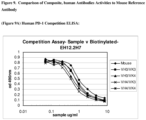
- Another aspect of the disclosure which is not claimed is an isolated antibody described herein, or an antigen-binding fragment thereof, that binds to a PD-1 protein, wherein the isolated antibody inhibits the binding of biotinylated EH12.2H7 antibody to Fc-PD-1 in a competition ELISA assay.
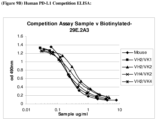
- One embodiment of the invention is an isolated antibody described herein for use as defined in the claims, or an antigen-binding fragment thereof, that binds to a PD-L1 protein, wherein the isolated antibody inhibits the binding of biotinylated 29E2A3 antibody to Fc-PD-L1 in a competition ELISA assay.
- an isolated antibody described herein, or an antigen-binding fragment thereof that binds to a PD-1 protein, wherein the isolated antibody inhibits a PD-1-mediated signal.
- One embodiment of the invention is an isolated antibody described herein, or an antigen-binding fragment thereof, for use as defined in the claims, that binds to a PD-L1 protein wherein the isolated antibody inhibits a PD-L1-mediated signal.
- nucleic acid encoding a polypeptide, wherein the polypeptide comprises a sequence selected from the group consisting of SEQ ID NO: 25-51, or a sequence with at least about 80%, 85%, 90%, 91%, 92%, 93%, 94%, 95%, 96%, 97%, 98%, 99% or more identical or homology to SEQ ID NO: 25-51.
- a vector, host cell or animal comprising one or more of these nucleic acids.
- nucleic acid that hybridizes, under stringent conditions, with the complement of a nucleic acid encoding a polypeptide selected from the group consisting of SEQ ID NO: 25-51, or a sequence with at least about at least about 80%, 85%, 90%, 91%, 92%, 93%, 94%, 95%, 96%, 97%, 98%, 99% or more identical homology to SEQ ID NO: 25-51.
- the present disclosure also provides an isolated nucleic acid encoding a heavy chain variable region and/or a light chain variable region of any of the antibodies or antigen binding-fragments thereof described herein.
- the nucleic acid is in a vector, such as an expression vector.
- the present disclosure also provides a host cell comprising one or more nucleic acids encoding the heavy and/or light chain of the antibodies or antigen-binding fragments described herein.
- the host cell produces the antibodies or antigen-binding fragments.
- the present disclosure also provides methods of producing the antibody or antigen-binding fragment described herein, comprising culturing a cell that produces the antibody or antigen-binding fragment, and recovering the antibody or antigen-binding fragment from the cell culture.
- the present disclosure further includes a pharmaceutical composition, comprising an isolated antibody described herein, or an antigen-binding fragment thereof, and a pharmaceutically acceptable carrier.
- the present disclosure encompasses a method of reactivating an exhausted T cell, comprising contacting a population of T cells wherein at least some cells express PD-1, PD-L1 and/or PD-L2 using an antibody described herein or an antigen-binding fragment thereof either in vitro, ex vivo, or in vivo.
- the antibody or antigen-binding fragment for use of the invention may be for use in a method of treating a subject suffering from a persistent infection, including a viral infection, a bacterial infection, a helminth infection, or a protozoan infection, comprising administering to the subject a composition comprising an effective amount of an isolated antibody described herein, or an antigen-binding fragment thereof.
- the antibody or antigen-binding fragment for use of the invention may be for use in a method of treating cancer, comprising administering to the subject a composition comprising an effective amount of an isolated antibody described herein, or an antigen-binding fragment thereof, including wherein the isolated antibody induces antibody-mediated cytotoxicity or is modified to induce antibody-mediated cytotoxicity or conjugated to an agent selected from the group consisting of a toxin and an imaging agent.
- the antibody or the antigen-binding fragment that binds to a PD-L1 may be administered to the subject having a cancer over-expressing PD-L1.
- the antibody or the antigen-binding fragment that binds to a PD-L2 is administered to the subject having a cancer over-expressing PD-L2.
- compositions comprising an effective amount of an isolated antibody that binds to a PD-L2 protein described herein, or an antigen-binding fragment thereof.
- the disclosure also encompasses the use of an antibody, an antigen-binding fragment or a polypeptide described herein for the manufacture of a medicament, such as a medicament for treating any of the diseases described herein in a subject.
- the present invention provides novel antibody-based therapeutics for use as defined in the claims in treating a variety of disorders mediated by PD-L1 (e.g., treatment of persistent infectious diseases and cancers).
- the terms “PD-1”, “PD-L1”, and “PD-L2” include any variants or isoforms which are naturally expressed by cells, and/or fragments thereof having at least one biological activity of the full-length polypeptide, unless otherwise expressly defined.
- the term “PD-1 ligand” includes either or both PD-L1 ( Freeman et al. (2000) J. Exp. Med. 192:1027 ) and PD-L2 ( Latchman et al. (2001) Nat. Immunol. 2:261 ) and any variants or isoforms which are naturally expressed by cells, and/or fragments thereof having at least one biological activity of the full-length polypeptides.
- PD-1, PD-L1, and PD-L2 sequences from different species, including humans are well known in the art (see, for example, Honjo et al., U.S. Pat. No. 5,629,204 , which discloses human and mouse PD-1 sequences; Wood et al., U.S. Patent 7,105,328 , which discloses human PD-1 sequences; Chen et al., U.S. Patent 6,803,192 , which discloses human and mouse PD-L1 sequences; Wood et al., U.S. Patent 7,105,328 , which discloses human PD-L1 sequences; Freeman et al., US Pat. Pub. 20020164600 , which discloses human and mouse PD-L2 sequences).
- the term “antibody” includes whole antibodies and any antigen binding fragment (i.e., "antigen-binding portion") or single chain thereof.
- An “antibody” refers to a glycoprotein comprising at least two heavy (H) chains and two light (L) chains inter-connected by disulfide bonds, or an antigen binding portion thereof.
- Each heavy chain is comprised of a heavy chain variable region (abbreviated herein as V H ) and a heavy chain constant region.
- the heavy chain constant region is comprised of three domains, CH1, CH2 and CH3.
- Each light chain is comprised of a light chain variable region (abbreviated herein as V L ) and a light chain constant region.
- the light chain constant region is comprised of one domain, CL.
- V H and V L regions can be further subdivided into regions of hypervariability, termed complementarity determining regions (CDR), interspersed with regions that are more conserved, termed framework regions (FR).
- CDR complementarity determining regions
- FR framework regions
- Each V H and V L is composed of three CDRs and four FRs, arranged from amino-terminus to carboxy-terminus in the following order: FR1, CDR1, FR2, CDR2, FR3, CDR3, FR4.
- the variable regions of the heavy and light chains contain a binding domain that interacts with an antigen.
- “Inactivating antibodies” refers to antibodies that do not induce the complement system.
- hypervariable region refers to the regions of an antibody-variable domain that are hypervariable in sequence and/or form structurally defined loops.
- antibodies comprise six HVRs; three in the VH (H1, H2, H3), and three in the VL (L1, L2, L3).
- H3 and L3 display the most diversity of the six HVRs, and H3 in particular is believed to play a unique role in conferring fine specificity to antibodies. See, e.g., Xu et al.
- CDRs Kabat Complementarity Determining Regions
- Chothia refers instead to the location of the structural loops ( Chothia and Lesk J. Mol. Biol. 196:901-917 (1987 )).
- the end of the Chothia CDR-H1 loop when numbered using the Kabat numbering convention varies between H32 and H34 (see below) depending on the length of the loop (this is because the Kabat numbering scheme places the insertions at H35A and H35B; if neither 35A nor 35B is present, the loop ends at 32; if only 35A is present, the loop ends at 33; if both 35A and 35B are present, the loop ends at 34).
- the AbM hypervariable regions represent a compromise between the Kabat CDRs and Chothia structural loops, and are used by Oxford Molecular's AbM antibody modeling software.
- the "contact" hypervariable regions are based on an analysis of the available complex crystal structures. The residues from each of these hypervariable regions are noted below.
- Hypervariable regions may comprise "extended hypervariable regions” as follows: 24-36 or 24-34 (L1), 46-56 or 50-56 (L2) and 89-97 (L3) in the VL and 26-35B (H1), 50-65, 47-65 or 49-65 (H2) and 93-102, 94-102 or 95-102 (H3) in the VH.
- extended hypervariable regions are typically combinations of the Kabat and Chothia definitions, which may optionally further include residues identified using the Contact definition.
- the variable domain residues are numbered according to Kabat et al., supra for each of these definitions.
- Framework or "FR” residues are those variable-domain residues other than the HVR residues as herein defined.
- variable-domain residue-numbering as in Kabat or "amino-acid-position numbering as in Kabat,” and variations thereof, refers to the numbering system used for heavy-chain variable domains or light-chain variable domains of the compilation of antibodies in Kabat et al., supra. Using this numbering system, the actual linear amino acid sequence may contain fewer or additional amino acids corresponding to a shortening of, or insertion into, a FR or HVR of the variable domain.
- a heavy-chain variable domain may include a single amino acid insert (residue 52a according to Kabat) after residue 52 of H2 and inserted residues ( e.g. , residues 82a, 82b, and 82c, etc. according to Kabat) after heavy-chain FR residue 82.
- the Kabat numbering of residues may be determined for a given antibody by alignment at regions of homology of the sequence of the antibody with a "standard" Kabat numbered sequence.
- Fc region herein is used to define a C-terminal region of an immunoglobulin heavy chain, including native-sequence Fc regions and variant Fc regions.
- the human IgG heavy-chain Fc region is usually defined to stretch from an amino acid residue at position Cys226, or from Pro230, to the carboxyl-terminus thereof.
- the C-terminal lysine (residue 447 according to the EU numbering system) of the Fc region may be removed, for example, during production or purification of the antibody, or by recombinantly engineering the nucleic acid encoding a heavy chain of the antibody.
- composition of intact antibodies may comprise antibody populations with all K447 residues removed, antibody populations with no K447 residues removed, and antibody populations having a mixture of antibodies with and without the K447 residue.
- Suitable native-sequence Fc regions for use in the antibodies of the invention include human IgG1, IgG2 (IgG2A, IgG2B), IgG3 and IgG4.
- Fc receptor or “FcR” describes a receptor that binds to the Fc region of an antibody.
- the preferred FcR is a native sequence human FcR.
- a preferred FcR is one which binds an IgG antibody (a gamma receptor) and includes receptors of the FcyRI, FcyRII, and FcyRIII subclasses, including allelic variants and alternatively spliced forms of these receptors, FcyRII receptors include FcyRIIA (an “activating receptor”) and FcyRIIB (an “inhibiting receptor”), which have similar amino acid sequences that differ primarily in the cytoplasmic domains thereof.
- Activating receptor FcyRIIA contains an immunoreceptor tyrosine-based activation motif (ITAM) in its cytoplasmic domain.
- Inhibiting receptor FcyRIIB contains an immunoreceptor tyrosine-based inhibition motif (ITIM) in its cytoplasmic domain.
- ITAM immunoreceptor tyrosine-based activation motif
- ITIM immunoreceptor tyrosine-based inhibition motif
- CDR refers to a complementarity determining region (CDR) of which three make up the binding character of a light chain variable region (CDRL1, CDRL2 and CDRL3) and three make up the binding character of a heavy chain variable region (CDRH1, CDRH2 and CDRH3).
- CDRs contribute to the functional activity of an antibody molecule and are separated by amino acid sequences that comprise scaffolding or framework regions.
- the exact definitional CDR boundaries and lengths are subject to different classification and numbering systems. CDRs may therefore be referred to by Kabat, Chothia, contact or any other boundary definitions, including the numbering system described herein.
- CDR definitions according to these systems may therefore differ in length and boundary areas with respect to the adjacent framework region. See for example Kabat, Chothia, and/or MacCallum et al., ( Kabat et al., in "Sequences of Proteins of Immunological Interest," 5th Edition, U.S. Department of Health and Human Services, 1992 ; Chothia et al., J. Mol. Biol., 1987, 196: 901 ; and MacCallum et al., J. Mol. Biol., 1996, 262: 732 ).
- an antibody refers to one or more fragments of an antibody that retain the ability to specifically bind to an antigen (e.g ., PD-1, PD-L1, and/or PD-L2). It has been shown that the antigen-binding function of an antibody can be performed by fragments of a full-length antibody.
- binding fragments encompassed within the term "antigen-binding portion" of an antibody include (i) a Fab fragment, a monovalent fragment consisting of the V H , V L , CL and CH1 domains; (ii) a F(ab') 2 fragment, a bivalent fragment comprising two Fab fragments linked by a disulfide bridge at the hinge region; (iii) a Fd fragment consisting of the V H and CH1 domains; (iv) a Fv fragment consisting of the V H and V L domains of a single arm of an antibody, (v) a dAb fragment ( Ward et al., (1989) Nature 341:544 546 ), which consists of a V H domain; and (vi) an isolated complementarity determining region (CDR) or (vii) a combination of two or more isolated CDRs which may optionally be joined by a synthetic linker.
- a Fab fragment a monovalent fragment consisting of the V H , V L ,
- the two domains of the Fv fragment, V H and V L are coded for by separate genes, they can be joined, using recombinant methods, by a synthetic linker that enables them to be made as a single protein chain in which the V H and V L regions pair to form monovalent molecules (known as single chain Fv (scFv); see e.g., Bird et al. (1988) Science 242:423 426 ; and Huston et al. (1988) Proc. Natl. Acad. Sci. USA 85:5879 5883 ).
- single chain Fv single chain Fv
- Such single chain antibodies are also intended to be encompassed within the term "antigen-binding portion" of an antibody.
- Antibodies may be polyclonal or monoclonal; xenogeneic, allogeneic, or syngeneic; or modified forms thereof ( e.g. , humanized, chimeric, etc.). Antibodies may also be fully human. Preferably, antibodies of the invention bind specifically or substantially specifically to PD-1, PD-L1, or PD-L2 polypeptides.
- human monoclonal antibodies are produced by a hybridoma which includes a B cell obtained from a transgenic non-human animal, e.g., a transgenic mouse, having a genome comprising a human heavy chain transgene and a light chain transgene fused to an immortalized cell.
- an "isolated antibody” is intended to refer to an antibody which is substantially free of other antibodies having different antigenic specificities (e.g., an isolated antibody that specifically binds to PD-1, PD-L1, or PD-L2 is substantially free of antibodies that do not bind to PD-1, PD-L1, or PD-L2, respectively).
- An isolated antibody that specifically binds to an epitope of PD-1, PD-L1, and/or PD-L2 may, however, have cross-reactivity to other PD-1, PD-L1, and/or PD-L2 proteins, respectively, from different species.
- the antibody preferably always binds to human PD-1, PD-L1, and/or PD-L2.
- an isolated antibody is typically substantially free of other cellular material and/or chemicals.
- a combination of "isolated" monoclonal antibodies having different specificities to PD-1, PD-L1, and/or PD-L2 are combined in a well-defined composition.
- humanized antibody refers to an antibody that consists of the CDR of antibodies derived from mammals other than human, and the FR region and the constant region of a human antibody.
- a humanized antibody is useful as an effective component in a therapeutic agent according to the present disclosure since antigenicity of the humanized antibody in human body is lowered.
- composite antibody refers to an antibody which has variable regions comprising germline or non-germline immunoglobulin sequences from two or more unrelated variable regions.
- composite, human antibody refers to an antibody which has constant regions derived from human germline or non-germline immunoglobulin sequences and variable regions comprising human germline or non-germline sequences from two or more unrelated human variable regions.
- a composite, human antibody is useful as an effective component in a therapeutic agent according to the present invention since the antigenicity of the composite, human antibody in human body is lowered.
- the term "recombinant human antibody” includes all human antibodies that are prepared, expressed, created or isolated by recombinant means, such as (a) antibodies isolated from an animal (e.g., a mouse) that is transgenic or transchromosomal for human immunoglobulin genes or a hybridoma prepared therefrom (described further in Section I, below), (b) antibodies isolated from a host cell transformed to express the antibody, e.g., from a transfectoma, (c) antibodies isolated from a recombinant, combinatorial human antibody library, and (d) antibodies prepared, expressed, created or isolated by any other means that involve splicing of human immunoglobulin gene sequences to other DNA sequences.
- Such recombinant human antibodies have variable and constant regions derived from human germline and/or non-germline immunoglobulin sequences.
- such recombinant human antibodies can be subjected to in vitro mutagenesis (or, when an animal transgenic for human Ig sequences is used, in vivo somatic mutagenesis) and thus the amino acid sequences of the V H and V L regions of the recombinant antibodies are sequences that, while derived from and related to human germline V H and V L sequences, may not naturally exist within the human antibody germline repertoire in vivo.
- heterologous antibody is defined in relation to the transgenic non-human organism producing such an antibody. This term refers to an antibody having an amino acid sequence or an encoding nucleic acid sequence corresponding to that found in an organism not consisting of the transgenic non-human animal, and generally from a species other than that of the transgenic non-human animal.
- K D is intended to refer to the dissociation equilibrium constant of a particular antibody-antigen interaction.
- the term "specific binding” refers to antibody binding to a predetermined antigen.
- the antibody binds with an affinity (K D ) of approximately less than 10 -7 M, such as approximately less than 10 -8 M, 10 -9 M or 10 -10 M or even lower when determined by surface plasmon resonance (SPR) technology in a BIACORE 3000 instrument using recombinant human PD-1, PD-L1, or PD-L2 as the analyte and the antibody as the ligand, and binds to the predetermined antigen with an affinity that is at least 1.1-, 1.2-, 1.3-, 1.4-, 1.5-, 1.6-, 1.7-, 1.8-, 1.9-, 2.0-, 2.5-, 3.0-, 3.5-, 4.0-, 4.5-, 5.0-, 6.0-, 7.0-, 8.0-, 9.0-, or 10.0-fold or greater than its affinity for binding to a non-specific antigen (e.g., BSA, casein
- isotype refers to the antibody class (e.g., IgM or IgG1) that is encoded by heavy chain constant region genes.
- glycosylation pattern is defined as the pattern of carbohydrate units that are covalently attached to a protein, more specifically to an immunoglobulin protein.
- a glycosylation pattern of a heterologous antibody can be characterized as being substantially similar to glycosylation patterns which occur naturally on antibodies produced by the species of the nonhuman transgenic animal, when one of ordinary skill in the art would recognize the glycosylation pattern of the heterologous antibody as being more similar to said pattern of glycosylation in the species of the nonhuman transgenic animal than to the species from which the CH genes of the transgene were derived.
- naturally-occurring refers to the fact that an object can be found in nature.
- a polypeptide or polynucleotide sequence that is present in an organism (including viruses) that can be isolated from a source in nature and which has not been intentionally modified by man in the laboratory is naturally-occurring.
- rearranged refers to a configuration of a heavy chain or light chain immunoglobulin locus wherein a V segment is positioned immediately adjacent to a D-J or J segment in a conformation encoding essentially a complete V H and V L domain, respectively.
- a rearranged immunoglobulin gene locus can be identified by comparison to germline DNA; a rearranged locus will have at least one recombined heptamer/nonamer homology element.
- V segment configuration in reference to a V segment refers to the configuration wherein the V segment is not recombined so as to be immediately adjacent to a D or J segment.
- nucleic acid molecule is intended to include DNA molecules and RNA molecules.
- a nucleic acid molecule may be single-stranded or double-stranded, but preferably is double-stranded DNA.
- isolated nucleic acid molecule in reference to nucleic acids encoding antibodies or antibody portions (e.g. , V H , V L , CDR3) that bind to PD-1, PD-L1, or PD-L2, is intended to refer to a nucleic acid molecule in which the nucleotide sequences encoding the antibody or antibody portion are free of other nucleotide sequences encoding antibodies or antibody portions that bind antigens other than PD-1, PD-L1, or PD-L2, respectively, which other sequences may naturally flank the nucleic acid in human genomic DNA.
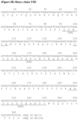
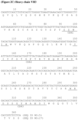
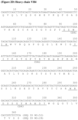
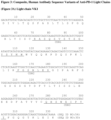
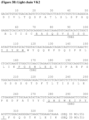
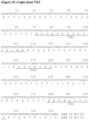
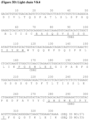
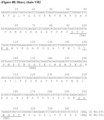
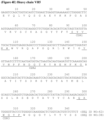
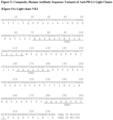
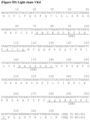
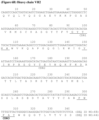
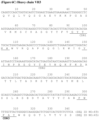
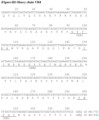
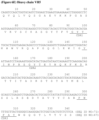
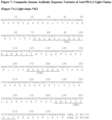
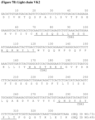
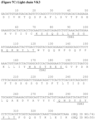
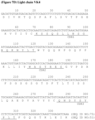
- Figures 2-7 correspond to the nucleotide and amino acid sequences comprising the heavy chain (V H ) and light chain (V L ) variable regions of the human anti-PD-1, PD-L1, or PD-L2 antibodies of the present invention, respectively.
- conservative sequence modifications include nucleotide and amino acid substitutions, additions and deletions. Modifications can be introduced into the sequence set forth in the figures ( e.g., Figures 2-7 ) by standard techniques known in the art, such as site-directed mutagenesis and PCR-mediated mutagenesis. Conservative amino acid substitutions include ones in which the amino acid residue is replaced with an amino acid residue having a similar side chain.
- Families of amino acid residues having similar side chains have been defined in the art. These families include amino acids with basic side chains (e.g., lysine, arginine, histidine), acidic side chains (e .g., aspartic acid, glutamic acid), uncharged polar side chains (e.g., glycine, asparagine, glutamine, serine, threonine, tyrosine, cysteine, tryptophan), nonpolar side chains (e.g ., alanine, valine, leucine, isoleucine, proline, phenylalanine, methionine), beta-branched side chains (e.g., threonine, valine, isoleucine) and aromatic side chains (e.g., tyrosine, phenylalanine, tryptophan, histidine).
- basic side chains e.g., lysine, arginine, histidine
- acidic side chains e.
- mutations can be introduced randomly along all or part of a human anti-PD-1, PD-L1, or PD-L2 antibody coding sequence, such as by saturation mutagenesis, and the resulting modified human anti-PD-1, anti-PD-L1, or anti-PD-L2 antibodies can be screened for binding activity.
- antibodies encoded by the heavy and light chain variable region nucleotide sequences disclosed herein and/or containing the heavy and light chain variable region amino acid sequences disclosed herein include substantially similar, but not explicitly claimed, antibodies encoded by or containing similar sequences which have been conservatively modified. Further discussion as to how such substantially similar antibodies can be generated based on the sequences (i.e., heavy and light chain variable regions) disclosed herein ( e.g., Figures 2-7 ) is provided below.
- nucleotide triplet An important and well-known feature of the genetic code is its redundancy, whereby, for most of the amino acids used to make proteins, more than one coding nucleotide triplet may be employed (illustrated above). Therefore, a number of different nucleotide sequences may code for a given amino acid sequence. Such nucleotide sequences are considered functionally equivalent since they result in the production of the same amino acid sequence in all organisms (although certain organisms may translate some sequences more efficiently than they do others). Moreover, occasionally, a methylated variant of a purine or pyrimidine may be found in a given nucleotide sequence. Such methylations do not affect the coding relationship between the trinucleotide codon and the corresponding amino acid.
- nucleic acids For nucleic acids, the term "substantial homology" indicates that two nucleic acids, or designated sequences thereof, when optimally aligned and compared, are identical, with appropriate nucleotide insertions or deletions, in at least about 80% of the nucleotides, usually at least about 90%, 91%, 92%, 93%, 94%, 95%, 96%, or more of the nucleotides, and more preferably at least about 97%, 98%, 99% or more of the nucleotides.
- substantial homology exists when the segments will hybridize under selective hybridization conditions, to the complement of the strand.
- the comparison of sequences and determination of percent identity between two sequences can be accomplished using a mathematical algorithm, as described in the non-limiting examples below.
- the percent identity between two nucleotide sequences can be determined using the GAP program in the GCG software package (available on the world wide web at the GCG company website), using a NWSgapdna.CMP matrix and a gap weight of 40, 50, 60, 70, or 80 and a length weight of 1, 2, 3, 4, 5, or 6.
- the percent identity between two nucleotide or amino acid sequences can also be determined using the algorithm of E. Meyers and W. Miller (CABIOS, 4:11 17 (1989)) which has been incorporated into the ALIGN program (version 2.0), using a PAM120 weight residue table, a gap length penalty of 12 and a gap penalty of 4.
- the percent identity between two amino acid sequences can be determined using the Needleman and Wunsch (J.
- the nucleic acid and protein sequences of the present invention can further be used as a "query sequence" to perform a search against public databases to, for example, identify related sequences.
- Such searches can be performed using the NBLAST and XBLAST programs (version 2.0) of Altschul, et al. (1990) J. Mol. Biol. 215:403 10.
- Gapped BLAST can be utilized as described in Altschul et al., (1997) Nucleic Acids Res. 25(17):3389 3402 .
- the default parameters of the respective programs e.g., XBLAST and NBLAST
- the default parameters of the respective programs e.g., XBLAST and NBLAST
- the nucleic acids may be present in whole cells, in a cell lysate, or in a partially purified or substantially pure form.
- a nucleic acid is "isolated” or “rendered substantially pure” when purified away from other cellular components or other contaminants, e.g., other cellular nucleic acids or proteins, by standard techniques, including alkaline/SDS treatment, CsCl banding, column chromatography, agarose gel electrophoresis and others well known in the art. See, F. Ausubel, et al., ed. Current Protocols in Molecular Biology, Greene Publishing and Wiley Interscience, New York (1987 ).
- nucleic acid compositions of the present invention while often in a native sequence (except for modified restriction sites and the like), from either cDNA, genomic or mixtures thereof may be mutated, in accordance with standard techniques to provide gene sequences. For coding sequences, these mutations, may affect amino acid sequence as desired.
- DNA sequences substantially homologous to or derived from native V, D, J, constant, switches and other such sequences described herein are contemplated (where "derived" indicates that a sequence is identical or modified from another sequence).
- a nucleic acid is "operably linked" when it is placed into a functional relationship with another nucleic acid sequence.
- a promoter or enhancer is operably linked to a coding sequence if it affects the transcription of the sequence.
- operably linked means that the DNA sequences being linked are contiguous and, where necessary to join two protein coding regions, contiguous and in reading frame.
- operably linked indicates that the sequences are capable of effecting switch recombination.
- vector is intended to refer to a nucleic acid molecule capable of transporting another nucleic acid to which it has been linked.
- plasmid refers to a circular double stranded DNA loop into which additional DNA segments may be ligated.
- viral vector Another type of vector is a viral vector, wherein additional DNA segments may be ligated into the viral genome.
- Certain vectors are capable of autonomous replication in a host cell into which they are introduced (e.g., bacterial vectors having a bacterial origin of replication and episomal mammalian vectors).
- vectors e.g., non-episomal mammalian vectors
- vectors can be integrated into the genome of a host cell upon introduction into the host cell, and thereby are replicated along with the host genome.
- certain vectors are capable of directing the expression of genes to which they are operatively linked.
- Such vectors are referred to herein as "recombinant expression vectors" (or simply, "expression vectors”).
- expression vectors of utility in recombinant DNA techniques are often in the form of plasmids.
- plasmid and vector may be used interchangeably as the plasmid is the most commonly used form of vector.
- the present disclosure is intended to include such other forms of expression vectors, such as viral vectors (e.g., replication defective retroviruses, adenoviruses and adeno-associated viruses), which serve equivalent functions.
- recombinant host cell (or simply “host cell”), is intended to refer to a cell into which a recombinant expression vector has been introduced. It should be understood that such terms are intended to refer not only to the particular subject cell but to the progeny of such a cell. Because certain modifications may occur in succeeding generations due to either mutation or environmental influences, such progeny may not, in fact, be identical to the parent cell, but are still included within the scope of the term "host cell” as used herein.
- the term “subject” includes any human or non-human animal.
- non-human animal includes all vertebrates, e.g., mammals and non-mammals, such as non-human primates, sheep, dog, cow, chickens, amphibians, reptiles, etc.
- modulate includes up-regulation and down-regulation, e.g., enhancing or inhibiting a response.
- the term “inhibit” includes the decrease, limitation, or blockage, of, for example a particular action, function, or interaction.
- Immune cell refers to cells that play a role in the immune response. Immune cells are of hematopoietic origin, and include lymphocytes, such as B cells and T cells; natural killer cells; myeloid cells, such as monocytes, macrophages, eosinophils, mast cells, basophils, and granulocytes.
- lymphocytes such as B cells and T cells
- natural killer cells such as myeloid cells, such as monocytes, macrophages, eosinophils, mast cells, basophils, and granulocytes.
- T cell includes CD4+ T cells and CD8+ T cells.
- the term T cell also includes T helper 1 type T cells, T helper 2 type T cells, T helper 17 type T cells and inhibitory T cells.
- antigen presenting cell includes professional antigen presenting cells (e.g., B lymphocytes, monocytes, dendritic cells, Langerhans cells) as well as other antigen presenting cells (e.g., keratinocytes, endothelial cells, astrocytes, fibroblasts, oligodendrocytes).
- immune response includes T cell mediated and/or B cell mediated immune responses that are influenced by modulation of T cell costimulation.
- exemplary immune responses include T cell responses, e.g., cytokine production, and cellular cytotoxicity.
- immune response includes immune responses that are indirectly affected by T cell activation, e.g., antibody production (humoral responses) and activation of cytokine responsive cells, e.g., macrophages.
- costimulate includes the ability of a costimulatory polypeptide to provide a second, non-activating receptor mediated signal (a "costimulatory signal") that induces proliferation and/or effector function.
- a costimulatory signal can result in cytokine secretion, e.g., in a T cell that has received a T cell-receptor-mediated signal.
- Immune cells that have received a cell-receptor mediated signal, e.g., via an activating receptor are referred to herein as "activated immune cells.”
- the term "inhibitory signal” refers to a signal transmitted via an inhibitory receptor (e.g., CTLA-4 or PD-1) for a polypeptide on an immune cell.
- an inhibitory receptor e.g., CTLA-4 or PD-1
- Such a signal antagonizes a signal via an activating receptor (e.g., via a TCR or CD3 polypeptide) and can result in, e.g., inhibition of second messenger generation; an inhibition of proliferation; an inhibition of effector function in the immune cell, e.g., reduced phagocytosis, reduced antibody production, reduced cellular cytotoxicity, the failure of the immune cell to produce mediators, (such as cytokines ( e.g., IL-2) and/or mediators of allergic responses); or the development of anergy.
- mediators such as cytokines (e.g., IL-2) and/or mediators of allergic responses
- the term "unresponsiveness” includes refractivity of immune cells to stimulation, e.g., stimulation via an activating receptor or a cytokine. Unresponsiveness can occur, e.g., because of exposure to immunosuppressants or exposure to high doses of antigen.
- the term “anergy” or “tolerance” includes refractivity to activating receptor-mediated stimulation. Such refractivity is generally antigen-specific and persists after exposure to the tolerizing antigen has ceased. For example, anergy in T cells (as opposed to unresponsiveness) is characterized by lack of cytokine production, e.g., IL-2.
- T cell anergy occurs when T cells are exposed to antigen and receive a first signal (a T cell receptor or CD-3 mediated signal) in the absence of a second signal (a costimulatory signal). Under these conditions, reexposure of the cells to the same antigen (even if reexposure occurs in the presence of a costimulatory polypeptide) results in failure to produce cytokines and, thus, failure to proliferate.
- Anergic T cells can, however, proliferate if cultured with cytokines (e.g., IL-2).
- cytokines e.g., IL-2
- T cell anergy can also be observed by the lack of IL-2 production by T lymphocytes as measured by ELISA or by a proliferation assay using an indicator cell line.
- a reporter gene construct can be used.
- anergic T cells fail to initiate IL-2 gene transcription induced by a heterologous promoter under the control of the 5' IL-2 gene enhancer or by a multimer of the AP1 sequence that can be found within the enhancer ( Kang et al. (1992) Science 257:1134 ).
- the term "activity,” when used with respect to a polypeptide, e.g., PD-1, PD-L1, or PD-L2 polypeptide, includes activities which are inherent in the structure of the protein.
- the term “activity” includes the ability to modulate immune cell costimulation (e.g., by modulating a costimulatory signal in an activated immune cell) or to modulate inhibition by modulating an inhibitory signal in an immune cell (e.g., by engaging a natural receptor on an immune cell).
- a costimulatory signal can be generated in the immune cell.
- a costimulatory signal can be generated in the immune cell.
- an inhibitory signal is generated in the immune cell.
- a PD-1 ligand binds to a B7-1 polypeptide an inhibitory signal can be generated ( Butte et al. (2007) Immunity 27:111 ).
- the term "activity" includes the ability of a PD-1 polypeptide to modulate an inhibitory signal in an immune cell, e.g., by engaging a natural PD-1 ligand on an antigen presenting cell.
- PD-1 transmits an inhibitory signal to an immune cell in a manner similar to CTLA-4. Modulation of an inhibitory signal in an immune cell results in modulation of proliferation of, and/or cytokine secretion by, an immune cell.
- the term "PD-1 activity” includes the ability of a PD-1 polypeptide to bind its natural ligand(s), the ability to modulate immune cell costimulatory or inhibitory signals, and the ability to modulate the immune response.
- interaction when referring to an interaction between two molecules, refers to the physical contact (e.g., binding) of the molecules with one another. Generally, such an interaction results in an activity (which produces a biological effect) of one or both of said molecules.
- the activity may be a direct activity of one or both of the molecules, (e.g., signal transduction).
- one or both molecules in the interaction may be prevented from binding a ligand, and thus be held inactive with respect to ligand binding activity (e.g., binding its ligand and triggering or inhibiting costimulation). Inhibition of such an interaction results in the disruption of the activity of one or more molecules involved in the interaction. To enhance such an interaction is to prolong or increase the likelihood of said physical contact, and prolong or increase the likelihood of said activity.
- nucleic acid molecules that encode polypeptides of the present invention (e.g., those in Figures 2-7 ) or biologically active portions thereof, as well as nucleic acid fragments sufficient for use as hybridization probes to identify nucleic acid molecules encoding these polypeptides and fragments for use as PCR primers for the amplification or mutation of the nucleic acid molecules.
- nucleic acid molecule is intended to include DNA molecules (e.g., cDNA or genomic DNA) and RNA molecules (e.g ., mRNA) and analogs of the DNA or RNA generated using nucleotide analogs.
- the nucleic acid molecule can be single-stranded or double-stranded, but preferably is double-stranded DNA.
- isolated nucleic acid molecule includes nucleic acid molecules which are separated from other nucleic acid molecules which are present in the natural source of the nucleic acid.
- isolated includes nucleic acid molecules which are separated from the chromosome with which the genomic DNA is naturally associated.
- an "isolated" nucleic acid molecule is free of sequences which naturally flank the nucleic acid (i.e., sequences located at the 5' and 3' ends of the nucleic acid molecule) in the genomic DNA of the organism from which the nucleic acid is derived.
- an "isolated" nucleic acid molecule such as a cDNA molecule
- a cDNA molecule can be substantially free of other cellular material, or culture medium, when produced by recombinant techniques, or substantially free of chemical precursors or other chemicals when chemically synthesized.
- a nucleic acid molecule of the present disclosure (e.g., those in Figures 2-7 ), or a portion thereof, can be isolated using standard molecular biology techniques and the sequence information provided herein.
- a nucleic acid molecule encompassing all or a portion of sequences shown in Figures 2-7 can be isolated by the polymerase chain reaction (PCR) using synthetic oligonucleotide primers designed based upon the sequences shown in Figures 2-7 .
- a nucleic acid molecule of the present disclosure can be amplified using cDNA, mRNA or, alternatively, genomic DNA as a template and appropriate oligonucleotide primers according to standard PCR amplification techniques.
- the nucleic acid molecule so amplified can be cloned into an appropriate vector and characterized by DNA sequence analysis.
- oligonucleotides corresponding to nucleic acid sequences of the invention can be prepared by standard synthetic techniques, e.g., using an automated DNA synthesizer.
- an isolated nucleic acid molecule of the disclosure comprises a nucleic acid molecule which is a complement of a nucleic acid molecule of the present disclosure ( e.g., those in Figures 2-7 ), or a portion thereof.
- a nucleic acid molecule which is complementary to a nucleic acid molecule of the present disclosure ( e.g., those in Figures 2-7 ), or a portion thereof, is one which is sufficiently complementary to the nucleotide sequence shown in Figures 2-7 , such that it can hybridize to the respective nucleotide sequence shown in Figures 2-7 , thereby forming a stable duplex.
- an isolated nucleic acid molecule of the present disclosure comprises a nucleotide sequence which is at least about 70%, 75%, 80%, 85%, 90%, 91%, 92%, 93%, 94%, 95%, 96%, 97%, 98%, 99% or more identical to the entire length of the nucleotide sequence shown in Figures 2-7 , or a portion of any of these nucleotide sequences.
- nucleic acid molecule of the present disclosure can comprise only a portion of a nucleic acid molecule of the present disclosure ( e.g., those in Figures 2-7 ), or a portion thereof, for example, a fragment which can be used as a probe or primer or a fragment which encodes a portion of a polypeptide of the invention, e.g., those in Figures 2-7 .
- the probe/primer typically comprises substantially purified oligonucleotide.
- the oligonucleotide typically comprises a region of nucleotide sequence that hybridizes under stringent conditions to at least about 12 or 15, preferably about 20 or 25, more preferably about 30, 35, 40, 45, 50, 55, 60, 65, or 75 consecutive nucleotides of a nucleic acid molecule of the present disclosure ( e.g., those in Figures 2-7 ); of an anti-sense sequence of a nucleic acid molecule of the present disclosure ( e.g., those in Figures 2-7 ); or of a mutant of a nucleic acid molecule of the present disclosure ( e.g., those in Figures 2-7 ).
- Probes based on a nucleic acid molecule of the present disclosure can be used to detect transcripts or genomic sequences encoding the same or homologous polypeptides.
- the probe further comprises a label group attached thereto, e .g., the label group can be a radioisotope, a fluorescent compound, an enzyme, or an enzyme co-factor.
- a nucleic acid fragment encoding a "biologically active portion of a polypeptide of the invention” can be prepared by isolating a portion of the nucleotide sequence of a nucleic acid molecule of the present disclosure ( e.g., those in Figures 2-7 ) which encodes a polypeptide having a biological activity of a polypeptide of the invention ( e.g., the ability to bind to its antigenic target), expressing the encoded portion of the polypeptide of the invention ( e.g., by recombinant expression in vitro) and assessing the activity of the encoded portion of the polypeptide of the invention.
- nucleic acid molecules that differ from nucleotide sequence(s) shown in Figures 2-7 due to degeneracy of the genetic code and thus encode the same polypeptides as those encoded by the respective nucleotide sequence shown in Figures 2-7 . Also disclosed is an isolated nucleic acid molecule of the present disclosure which has a nucleotide sequence encoding a polypeptide of the present invention ( e.g., those in Figures 2-7 ).
- Nucleic acid molecules corresponding to homologues of a nucleic acid molecule of the present disclosure can be isolated based on their homology to the nucleic acids disclosed herein using the cDNAs disclosed herein, or a portion thereof, as a hybridization probe according to standard hybridization techniques under stringent hybridization conditions.
- an isolated nucleic acid molecule of the present disclosure is at least 15, 20, 25, 30 or more nucleotides in length and hybridizes under stringent conditions to the nucleic acid molecule comprising a nucleic acid molecule of the present disclosure ( e.g., those in Figures 2-7 ).
- hybridizes under stringent conditions is intended to describe conditions for hybridization and washing under which nucleotide sequences that are significantly identical or homologous to each other remain hybridized to each other.
- the conditions are such that sequences at least about 70%, more preferably at least about 80%, even more preferably at least about 85% or 90% identical to each other remain hybridized to each other.
- stringent conditions are known to those skilled in the art and can be found in Current Protocols in Molecular Biology, Ausubel et al., eds., John Wiley & Sons, Inc. (1995 ), sections 2, 4 and 6.
- stringent hybridization conditions includes hybridization in 4 ⁇ or 6 ⁇ sodium chloride/sodium citrate (SSC), at about 65-70°C (or hybridization in 4 ⁇ SSC plus 50% formamide at about 42-50°C) followed by one or more washes in 1 ⁇ SSC, at about 65-70°C.
- SSC sodium chloride/sodium citrate
- a further non-limiting example of stringent hybridization conditions includes hybridization at 6 ⁇ SSC at 45°C, followed by one or more washes in 0.2 ⁇ SSC, 0.1% SDS at 65°C.
- a non-limiting example of highly stringent hybridization conditions includes hybridization in 1 ⁇ SSC, at about 65-70°C (or hybridization in 1 ⁇ SSC plus 50% formamide at about 42-50°C) followed by one or more washes in 0.3 ⁇ SSC, at about 65-70°C.
- a non-limiting example of reduced stringency hybridization conditions includes hybridization in 4 ⁇ or 6 ⁇ SSC, at about 50-60°C (or alternatively hybridization in 6 ⁇ SSC plus 50% formamide at about 40-45°C) followed by one or more washes in 2 ⁇ , at about 50-60°C. Ranges intermediate to the above-recited values, e.g., at 65-70°C or at 42-50°C are also intended to be encompassed by the present invention.
- SSPE (1 ⁇ SSPE is 0.15M NaCl, 10mM NaH 2 PO 4 , and 1.25 mM EDTA, pH 7.4) can be substituted for SSC (1 ⁇ SSC is 0.15M NaCl and 15mM sodium citrate) in the hybridization and wash buffers; washes are performed for 15 minutes each after hybridization is complete.
- additional reagents may be added to hybridization and/or wash buffers to decrease non-specific hybridization of nucleic acid molecules to membranes, for example, nitrocellulose or nylon membranes, including but not limited to blocking agents (e.g., BSA or salmon or herring sperm carrier DNA), detergents (e.g., SDS), chelating agents (e.g., EDTA), Ficoll, PVP and the like.
- blocking agents e.g., BSA or salmon or herring sperm carrier DNA
- detergents e.g., SDS
- chelating agents e.g., EDTA
- Ficoll e.g., Ficoll, PVP and the like.
- an additional non-limiting example of stringent hybridization conditions is hybridization in 0.25M-0.5M NaH 2 PO 4 , 7% SDS at about 65°C, followed by one or more washes at 0.02M NaH 2 PO 4 , 1% SDS at 65°C, see e.g., Church and Gilbert (1984) Proc. Natl. Acad. Sci. USA 81:1991-1995 (or alternatively 0.2x SSC, 1% SDS).
- nucleic acid molecule of the present disclosure e.g., those in Figures 2-7
- changes can be introduced by mutation into a nucleic acid molecule of the present disclosure (e.g., those in Figures 2-7 ), thereby leading to changes in the amino acid sequence of the encoded polypeptides of the present invention, without altering the functional ability of the polypeptides.
- nucleotide substitutions leading to amino acid substitutions at "non-essential" amino acid residues can be made in a nucleic acid molecule of the present disclosure ( e.g., those in Figures 2-7 ).
- non-essential amino acid residue is a residue that can be altered from a nucleic acid molecule of the present invention ( e.g., those in Figures 2-7 ) without altering the biological activity, whereas an "essential" amino acid residue is required for biological activity.
- amino acid residues that are conserved among the polypeptides of the present invention, e.g., those required for binding of the polypeptides to its target antigen are predicted to be particularly unamenable to alteration.
- nucleic acid molecules encoding polypeptides of the present invention (e.g., those in Figures 2-7 ) that contain changes in amino acid residues that are not essential for activity. Such polypeptides differ in amino acid sequence from those in Figures 2-7 , yet retain biological activity.
- the isolated nucleic acid molecule comprises a nucleotide sequence encoding a polypeptide, wherein the polypeptide comprises an amino acid sequence at least about 71%, 75%, 80%, 85%, 90%, 91%, 92%, 93%, 94%, 95%, 96%, 97%, 98%, 99% or more identical to those in Figures 2-7 .
- An isolated nucleic acid molecule encoding a polypeptide identical to the polypeptides of those in Figures 2-7 can be created by introducing one or more nucleotide substitutions, additions or deletions into the nucleotide sequence of those in Figures 2-7 such that one or more amino acid substitutions, additions or deletions are introduced into the encoded polypeptide. Mutations can be introduced into nucleic acid molecules of the present invention ( e.g., those in Figures 2-7 ) by standard techniques, such as site-directed mutagenesis and PCR-mediated mutagenesis. In one aspect of the present disclosure, conservative amino acid substitutions are made at one or more predicted non-essential amino acid residues.
- a “conservative amino acid substitution” is one in which the amino acid residue is replaced with an amino acid residue having a similar side chain.
- Families of amino acid residues having similar side chains have been defined in the art. These families include amino acids with basic side chains (e.g., lysine, arginine, histidine), acidic side chains (e.g., aspartic acid, glutamic acid), uncharged polar side chains ( e.g., asparagine, glutamine, serine, threonine, tyrosine, cysteine), nonpolar side chains ( e.g., glycine, alanine, valine, leucine, isoleucine, proline, phenylalanine, methionine, tryptophan), beta-branched side chains ( e.g., threonine, valine, isoleucine) and aromatic side chains ( e.g., tyrosine, phenylalanine, tryptophan, hist
- a predicted nonessential amino acid residue in a polypeptide of the invention can be replaced with another amino acid residue from the same side chain family.
- mutations can be introduced randomly along all or part of a nucleic acid molecule(s) of the present disclosure ( e.g., those in Figures 2-7 ), such as by saturation mutagenesis, and the resultant mutants can be screened for biological activity to identify mutants that retain activity.
- the encoded polypeptide can be expressed recombinantly and the activity of the polypeptide can be determined.
- a mutant polypeptide of the invention can be assayed for the ability to bind to and/or modulate the activity of a natural PD-1 (e.g., PD-1 ligands) or PD-1 ligand partner (e.g., PD-1 and B7-1), modulate intra- or intercellular signaling, modulate activation of T lymphocytes, and/or modulate the immune response of an organism.
- a natural PD-1 e.g., PD-1 ligands
- PD-1 ligand partner e.g., PD-1 and B7-1
- nucleic acid molecules encoding fusion proteins.
- Such nucleic acid molecules comprising at least a first nucleotide sequence encoding a polypeptide of the invention ( e.g., those in Figures 2-7 ) operatively linked to a second nucleotide sequence encoding a polypeptide of the invention ( e.g., those in Figures 2-7 ) can be prepared by standard recombinant DNA techniques.
- nucleic acid molecules of the present disclosure within a cell line or microorganism may be modified by inserting a heterologous DNA regulatory element into the genome of a stable cell line or cloned microorganism such that the inserted regulatory element is operatively linked with the nucleic acid molecules of the present disclosure ( e.g., those in Figures 2-7 ).
- a heterologous regulatory element may be inserted into a stable cell line or cloned microorganism, such that it is operatively linked with a nucleic acid molecules of the present disclosure ( e.g., those in Figures 2-7 ), using techniques, such as targeted homologous recombination, which are well known to those of skill in the art, and described, e.g., in Chappel, U.S. Pat. No. 5,272,071 ; PCT publication No. WO 91/06667, published May 16, 1991 .
- polypeptides of the present disclosure including the antibodies and antigen-binding fragments for use of the invention, as defined in the claims, and those in Figures 2-7 ), and biologically active portions thereof may be isolated.
- polypeptides of the present disclosure e.g., those in Figures 2-7
- biologically active portions thereof can be isolated from cells or tissue sources by an appropriate purification scheme using standard protein purification techniques.
- Polypeptides of the present disclosure e.g., those in Figures 2-7
- biologically active portions thereof can be produced by recombinant DNA techniques.
- polypeptides of the present disclosure e.g., those in Figures 2-7
- biologically active portions thereof can be chemically synthesized using standard peptide synthesis techniques.
- an “isolated” or “purified” polypeptide or biologically active portion thereof is substantially free of cellular material or other contaminating proteins from the cell or tissue source from which the polypeptides of the present disclosure ( e.g., those in Figures 2-7 ) is derived, or substantially free from chemical precursors or other chemicals when chemically synthesized.
- the language “substantially free of cellular material” includes preparations of polypeptide(s) of the present disclosure ( e.g., those in Figures 2-7 ), and biologically active portions thereof, in which the polypeptide is separated from cellular components of the cells from which it is isolated or recombinantly produced.
- the language "substantially free of cellular material” includes preparations of polypeptide(s) of the present disclosure (e.g., those in Figures 2-7 ), and biologically active portions thereof having less than about 30% (by dry weight) of proteins not of the present disclosure (also referred to herein as a "contaminating protein"), more preferably less than about 20% of proteins not of the present disclosure, still more preferably less than about 10% of proteins not of the present disclosure, and most preferably less than about 5% of proteins not of the present disclosure.
- polypeptides of the present disclosure e.g., those in Figures 2-7
- biologically active portion thereof when recombinantly produced, it is also preferably substantially free of culture medium, i.e., culture medium represents less than about 20%, more preferably less than about 10%, and most preferably less than about 5% of the volume of the protein preparation.
- substantially free of chemical precursors or other chemicals includes preparations of polypeptide(s) of the present disclosure ( e.g., those in Figures 2-7 ) or biologically active portion thereof in which the polypeptide is separated from chemical precursors or other chemicals which are involved in the synthesis of the polypeptide.
- the language "substantially free of chemical precursors or other chemicals” includes preparations of polypeptide(s) of the present disclosure (e.g., those in Figures 2-7 ) or biologically active portion thereof having less than about 30% (by dry weight) of chemical precursors or of proteins not of the present disclosure, more preferably less than about 20% chemical precursors or of proteins not of the present disclosure, still more preferably less than about 10% chemical precursors or of proteins not of the present disclosure, and most preferably less than about 5% chemical precursors or of proteins not of the present disclosure.
- a "biologically active portion" of polypeptide(s) of the present disclosure include polypeptides which participates in an interaction between PD-1 and a non-PD-1 molecule, PD-L1 and a non-PD-L1 molecule, or PD-L2 and a non-PD-L2 molecule, e.g., a natural ligand of PD-1, e.g., PD-1 ligands, or a natural ligand of PD-1 ligands, e.g., PD-1 or B7-1, respectively.
- Biologically active portions of a polypeptide(s) of the present disclosure include peptides comprising amino acid sequences sufficiently identical to or derived from the amino acid sequence of polypeptide(s) of the present disclosure ( e.g., those in Figures 2-7 ), which include fewer amino acids than the respective, full length polypeptide(s) of the present disclosure ( e.g., those in Figures 2-7 ), and exhibit at least one activity of the respective polypeptide(s) of the present disclosure ( e.g., those in Figures 2-7 ).
- biologically active portions comprise a domain or motif with the ability to specifically bind PD-1 or a PD-L1 ligand according to the antigen, respectively, to which it was raised or designed to bind.
- Biologically active portions of polypeptide(s) of the present disclosure e.g., those in Figures 2-7
- the polypeptide is substantially identical to polypeptide(s) shown in Figures 2-7 , and retains the functional activity of the respective polypeptide(s) shown in Figures 2-7 , yet differs in amino acid sequence due to mutagenesis, as described in detail in subsection I above. Accordingly, also described herein is a polypeptide which comprises an amino acid sequence at least about 71%, 75%, 80%, 85%, 90%, 91%, 92%, 93%, 94%, 95%, 96% 97%, 98%, 99%, 99.5%, or 99.9% or more identical to a polypeptide(s) shown in Figures 2-7 .
- the sequences are aligned for optimal comparison purposes (e.g., gaps can be introduced in one or both of a first and a second amino acid or nucleic acid sequence for optimal alignment and non-identical sequences can be disregarded for comparison purposes).
- the length of a reference sequence aligned for comparison purposes is at least 30%, preferably at least 40%, more preferably at least 50%, even more preferably at least 60%, and even more preferably at least 70%, 80%, 90%, 95%, 96%, 97%, 98%, 99%, 99.5%, or 99.9% of the length of the reference sequence.
- amino acid residues or nucleotides at corresponding amino acid positions or nucleotide positions are then compared.
- a position in the first sequence is occupied by the same amino acid residue or nucleotide as the corresponding position in the second sequence, then the molecules are identical at that position (as used herein amino acid or nucleic acid "identity” is equivalent to amino acid or nucleic acid "homology”).
- the percent identity between the two sequences is a function of the number of identical positions shared by the sequences, taking into account the number of gaps, and the length of each gap, which need to be introduced for optimal alignment of the two sequences.
- a "chimeric protein” or “fusion protein” comprises a polypeptide(s) of the present invention as defined in the claims operatively linked to a polypeptide not of the present invention.
- a "polypeptide(s) of the present invention” refers to a polypeptide having an amino acid sequence corresponding to a polypeptide shown in Figures 4-5 (SEQ ID Nos: 34-42), whereas a “polypeptide not of the present invention " refers to a polypeptide not having an amino acid sequence corresponding to a polypeptide which is not substantially homologous to a polypeptide shown in Figures 2-7 , e.g., a polypeptide which is different from a polypeptide shown in Figures 2-7 and which is derived from the same or a different organism.
- the term "operatively linked" is intended to indicate that the polypeptide(s) of the present invention and the polypeptide(s) not of the present invention are fused in-frame to each other.
- the polypeptide(s) not of the present invention can be fused to the N-terminus or C-terminus of the polypeptide(s) of the present invention and corresponds to a moiety that alters the solubility, binding affinity, stability, or valency of the polypeptide(s) of the present invention.
- the fusion protein is a GST fusion protein with a polypeptide(s) of the present invention.
- Such fusion proteins can facilitate the purification of recombinant polypeptides of the invention.
- the fusion protein contains a heterologous signal sequence at its N-terminus. In certain host cells (e.g., mammalian host cells), expression and/or secretion of polypeptide(s) of the present invention can be increased through use of a heterologous signal sequence.
- a chimeric or fusion polypeptide(s) of the present invention can be produced by standard recombinant DNA techniques. For example, DNA fragments coding for the different polypeptide sequences are ligated together in-frame in accordance with conventional techniques, for example by employing blunt-ended or stagger-ended termini for ligation, restriction enzyme digestion to provide for appropriate termini, filling-in of cohesive ends as appropriate, alkaline phosphatase treatment to avoid undesirable joining, and enzymatic ligation.
- the fusion gene can be synthesized by conventional techniques including automated DNA synthesizers.
- PCR amplification of gene fragments can be carried out using anchor primers which give rise to complementary overhangs between two consecutive gene fragments which can subsequently be annealed and reamplified to generate a chimeric gene sequence (see, for example, Current Protocols in Molecular Biology, Ausubel et al., eds., John Wiley & Sons: 1992 ).
- anchor primers which give rise to complementary overhangs between two consecutive gene fragments which can subsequently be annealed and reamplified to generate a chimeric gene sequence
- many expression vectors are commercially available that already encode a fusion moiety (e.g., a GST polypeptide).
- polypeptide(s) of the present invention as defined in the claims (i.e., those in Figures 4-5 ) identified herein will enable those of skill in the art to produce polypeptides corresponding to polypeptide(s) of the present invention (i.e., those in Figures 4-5 ).
- polypeptides can be produced in prokaryotic or eukaryotic host cells by expression of polynucleotides encoding a polypeptide(s) of the present invention (i.e., those in Figures 4-5 ).
- such peptides can be synthesized by chemical methods.
- Antibodies to PD-1, PD-L1, or PD-L2 described herein may be produced using any methods described herein or known in the art.
- Monoclonal antibodies (e.g., human antibodies) of the invention can be produced using a variety of known techniques, such as the standard somatic cell hybridization technique described by Kohler and Milstein, Nature 256: 495 (1975 ). Although somatic cell hybridization procedures are preferred, in principle, other techniques for producing monoclonal antibodies also can be employed, e.g., viral or oncogenic transformation of B lymphocytes, phage display technique using libraries of human antibody genes.
- Hybridoma production in the mouse is well known in the art, including immunization protocols and techniques for isolating and fusing immunized splenocytes.
- Polyclonal antibodies can be prepared as described above by immunizing a suitable subject with a polypeptide immunogen.
- the polypeptide antibody titer in the immunized subject can be monitored over time by standard techniques, such as with an enzyme linked immunosorbent assay (ELISA) using immobilized polypeptide.
- ELISA enzyme linked immunosorbent assay
- the antibody directed against the antigen can be isolated from the mammal (e.g., from the blood) and further purified by well-known techniques, such as protein A chromatography to obtain the IgG fraction.
- antibody-producing cells can be obtained from the subject and used to prepare monoclonal antibodies by standard techniques, such as the hybridoma technique originally described by Kohler and Milstein (1975) Nature 256:495-497 ) (see also Brown et al. (1981) J. Immunol. 127:539-46 ; Brown et al. (1980) J. Biol. Chem. 255:4980-83 ; Yeh et al. (1976) Proc. Natl. Acad. Sci. 76:2927-31 ; and Yeh et al. (1982) Int. J.
- an immortal cell line typically a myeloma
- lymphocytes typically splenocytes
- the culture supernatants of the resulting hybridoma cells are screened to identify a hybridoma producing a monoclonal antibody that binds to the polypeptide antigen, preferably specifically.
- any of the many well-known protocols used for fusing lymphocytes and immortalized cell lines can be applied for the purpose of generating an anti-PD-1, PD-L1, or PD-L2 monoclonal antibody (see, e.g., Galfre, G. et al. (1977) Nature 266:55052 ; Gefter et al. (1977) supra; Lerner (1981) supra; Kenneth (1980) supra ) .
- the immortal cell line e.g., a myeloma cell line
- the immortal cell line is derived from the same mammalian species as the lymphocytes.
- murine hybridomas can be made by fusing lymphocytes from a mouse immunized with an immunogenic preparation of the present invention with an immortalized mouse cell line.
- Preferred immortal cell lines are mouse myeloma cell lines that are sensitive to culture medium containing hypoxanthine, aminopterin and thymidine ("HAT medium").
- HAT medium culture medium containing hypoxanthine, aminopterin and thymidine
- Any of a number of myeloma cell lines can be used as a fusion partner according to standard techniques, e.g ., the P3-NS1/1-Ag4-1, P3-x63-Ag8.653 or Sp2/O-Ag14 myeloma lines. These myeloma lines are available from the American Type Culture Collection (ATCC), Rockville, Md.
- ATCC American Type Culture Collection
- HAT-sensitive mouse myeloma cells are fused to mouse splenocytes using polyethylene glycol ("PEG").
- PEG polyethylene glycol
- Hybridoma cells resulting from the fusion are then selected using HAT medium, which kills unfused and unproductively fused myeloma cells (unfused splenocytes die after several days because they are not transformed).
- Hybridoma cells producing a monoclonal antibody of the invention are detected by screening the hybridoma culture supernatants for antibodies that bind a given polypeptide, e.g., using a standard ELISA assay.
- a monoclonal specific for one of the above-described polypeptides can be identified and isolated by screening a recombinant combinatorial immunoglobulin library (e.g., an antibody phage display library) with the appropriate polypeptide to thereby isolate immunoglobulin library members that bind the polypeptide.
- Kits for generating and screening phage display libraries are commercially available (e.g., the Pharmacia Recombinant Phage Antibody System, Catalog No. 27-9400-01; and the Stratagene SurfZAP TM Phage Display Kit, Catalog No. 240612).
- examples of methods and reagents particularly amenable for use in generating and screening an antibody display library can be found in, for example, Ladner et al. U.S. Patent No. 5,223,409 ; Kang et al. International Publication No. WO 92/18619 ; Dower et al. International Publication No. WO 91/17271 ; Winter et al. International Publication WO 92/20791 ; Markland et al. International Publication No. WO 92/15679 ; Breitling et al. International Publication WO 93/01288 ; McCafferty et al. International Publication No. WO 92/01047 ; Garrard et al.
- recombinant anti-PD-1, PD-L1, or PD-L2_antibodies such as chimeric, composite, and humanized monoclonal antibodies, which can be made using standard recombinant DNA techniques, can be generated.
- Such chimeric, composite, and humanized monoclonal antibodies can be produced by recombinant DNA techniques known in the art, for example using methods described in Robinson et al. International Patent Publication WO 87/002671 ; Akira et al. European Patent Application 184,187 ; Taniguchi, M. European Patent Application 171,496 ; Morrison et al. European Patent Application 173,494 ; Neuberger et al.
- humanized antibodies can be made according to standard protocols such as those disclosed in US patent 5,565,332 .
- antibody chains or specific binding pair members can be produced by recombination between vectors comprising nucleic acid molecules encoding a fusion of a polypeptide chain of a specific binding pair member and a component of a replicable generic display package and vectors containing nucleic acid molecules encoding a second polypeptide chain of a single binding pair member using techniques known in the art, e.g., as described in US patents 5,565,332 , 5,871,907 , or 5,733,743 .
- the use of intracellular antibodies to inhibit protein function in a cell is also known in the art (see e.g., Carlson, J.
- human monoclonal antibodies directed against PD-1, PD-L1, or PD-L2 can be generated using transgenic or transchromosomal mice carrying parts of the human immune system rather than the mouse system.
- transgenic mice referred to herein as "HuMAb mice” which contain a human immunoglobulin gene miniloci that encodes unrearranged human heavy ( ⁇ and y) and ⁇ light chain immunoglobulin sequences, together with targeted mutations that inactivate the endogenous ⁇ and ⁇ chain loci ( Lonberg, N. et al. (1994) Nature 368(6474): 856 859 ).
- mice exhibit reduced expression of mouse IgM or ⁇ , and in response to immunization, the introduced human heavy and light chain transgenes undergo class switching and somatic mutation to generate high affinity human IgG ⁇ monoclonal antibodies (Lonberg, N. et al. (1994), supra; reviewed in Lonberg, N. (1994) Handbook of Experimental Pharmacology 113:49 101 ; Lonberg, N. and Huszar, D. (1995) Intern. Rev. Immunol. Vol. 13: 65 93 , and Harding, F. and Lonberg, N. (1995) Ann. N. Y Acad. Sci 764:536 546 ).
- the preparation of HuMAb mice is described in Taylor, L. et al.
- an antibody for use in the invention is a bispecific antibody.
- a bispecific antibody has binding sites for two different antigens within a single antibody polypeptide. Antigen binding may be simultaneous or sequential.
- Triomas and hybrid hybridomas are two examples of cell lines that can secrete bispecific antibodies. Examples of bispecific antibodies produced by a hybrid hybridoma or a trioma are disclosed in U.S. Pat. 4,474,893 . Bispecific antibodies have been constructed by chemical means ( Staerz et al. (1985) Nature 314:628 , and Perez et al. (1985) Nature 316:354 ) and hybridoma technology ( Staerz and Bevan (1986) Proc. Natl. Acad. Sci.
- Bispecific antibodies are also described in U.S. patent 5,959,084 . Fragments of bispecific antibodies are described in US patent 5,798,229 . Bispecific agents can also be generated by making heterohybridomas by fusing hybridomas or other cells making different antibodies, followed by identification of clones producing and co-assembling both antibodies. They can also be generated by chemical or genetic conjugation of complete immunoglobulin chains or portions thereof such as Fab and Fv sequences. The antibody component can bind to PD-L1. In one embodiment, the bispecific antibody could specifically bind to both a PD-1 ligand and a PD-1 polypeptide.
- Yet another aspect of the disclosure pertains to anti-PD-1, PD-L1, or PD-L2 polypeptide antibodies that are obtainable by a process comprising, immunizing an animal with an immunogenic PD-1, PD-L1, or PD-L2 polypeptide, respectively, or an immunogenic portion thereof; and then isolating from the animal antibodies that specifically bind to the polypeptide.
- partial or known antibody sequences can be used to generate and/or express new antibodies.
- Antibodies interact with target antigens predominantly through amino acid residues that are located in the six heavy and light chain complementarity determining regions (CDRs). For this reason, the amino acid sequences within CDRs are more diverse between individual antibodies than sequences outside of CDRs. Because CDR sequences are responsible for most antibody-antigen interactions, it is possible to express recombinant antibodies that mimic the properties of specific naturally occurring antibodies by constructing expression vectors that include CDR sequences from the specific naturally occurring antibody grafted onto framework sequences from a different antibody with different properties (see, e.g., Riechmann, L.
- Such framework sequences can be obtained from public DNA databases that include germline or non-germline antibody gene sequences. These germline sequences will differ from mature antibody gene sequences because they will not include completely assembled variable genes, which are formed by V(D)J joining during B cell maturation. Germline gene sequences will also differ from the sequences of a high affinity secondary repertoire antibody at individual evenly across the variable region.
- somatic mutations are relatively infrequent in the amino-terminal portion of framework region.
- somatic mutations are relatively infrequent in the amino terminal portion of framework region 1 and in the carboxy-terminal portion of framework region 4.
- many somatic mutations do not significantly alter the binding properties of the antibody. For this reason, it is not necessary to obtain the entire DNA sequence of a particular antibody in order to recreate an intact recombinant antibody having binding properties similar to those of the original antibody (see WO 99/045962 published on Sept. 16, 1999 ). Partial heavy and light chain sequence spanning the CDR regions is typically sufficient for this purpose. The partial sequence is used to determine which germline and/or non-germline variable and joining gene segments contributed to the recombined antibody variable genes.
- variable regions Heavy and light chain leader sequences are cleaved during protein maturation and do not contribute to the properties of the final antibody.
- cloned cDNA sequences can be combined with synthetic oligonucleotides by ligation or PCR amplification.
- the entire variable region can be synthesized as a set of short, overlapping, oligonucleotides and combined by PCR amplification to create an entirely synthetic variable region clone. This process has certain advantages such as elimination or inclusion or particular restriction sites, or optimization of particular codons.
- the process can also be used to screen libraries of particular immunoglobulin encoding sequences in one species (e.g., human) to design cognate immunoglobulin encoding sequences from known antibody sequence in another species (e.g., mouse) (see, for example, the Examples section below).
- the nucleotide sequences of heavy and light chain transcripts from a hybridoma are used to design an overlapping set of synthetic oligonucleotides to create synthetic V sequences with identical amino acid coding capacities as the natural sequences.
- the synthetic heavy and kappa chain sequences can differ from the natural sequences in three ways: strings of repeated nucleotide bases are interrupted to facilitate oligonucleotide synthesis and PCR amplification; optimal translation initiation sites are incorporated according to Kozak's rules ( Kozak, 1991, J. Biol. Chem. 266L19867019870 ); and, HindIII sites are engineered upstream of the translation initiation sites.
- the optimized coding, and corresponding non-coding, strand sequences are broken down into 30-50 nucleotide approximately the midpoint of the corresponding non-coding oligonucleotide.
- the oligonucleotides can be assembled into overlapping double stranded sets that span segments of 150-400 nucleotides. The pools are then used as templates to produce PCR amplification products of 150-400 nucleotides.
- a single variable region oligonucleotide set will be broken down into two pools which are separately amplified to generate two overlapping PCR products. These overlapping products are then combined by PCR amplification to form the complete variable region. It may also be desirable to include an overlapping fragment of the heavy or light chain constant region in the PCR amplification to generate fragments that can easily be cloned into the expression vector constructs.
- the reconstructed heavy and light chain variable regions are then combined with cloned promoter, leader sequence, translation initiation, leader sequence, constant region, 3' untranslated, polyadenylation, and transcription termination, sequences to form expression vector constructs.
- the heavy and light chain expression constructs can be combined into a single vector, co-transfected, serially transfected, or separately transfected into host cells which are then fused to form a host cell expressing both chains.
- Plasmids for this use are known in the art and include the plasmids provided in the Examples section below.
- Fully human and chimeric antibodies of the present invention also include IgG2, IgG3, IgE, IgA, IgM, and IgD antibodies. Similar plasmids can be constructed for expression of other heavy chain isotypes, or for expression of antibodies comprising lambda light chains.
- the structural features of known, non-human or human antibodies are used to create structurally related human anti-human PD-1, PD-L1, or PD-L2 antibodies that retain at least one functional property of the antibodies of the invention, such as binding to PD-1, PD-L1, or PD-L2.
- Another functional property includes inhibiting binding of EH12.2H7 to PD-1, 29E.2A3 to PD-L1, or 24F.10C12 to PD-L2 in a competition ELISA assay.
- the structurally related anti-human PD-1, PD-L1, or PD-L2 antibodies have a lower binding affinity to the antigen as compared to antibody EH12.2H7, 29E.2A3, or 24F.10C12 as measured by the IC50 value as described in Example 2 (e.g., the affinity of the murine reference antibody is no greater than any of 3.0, 2.0, 1.9, 1.8, 1.7, 1.6, 1.5, 1.4, 1.3, 1.2 or 1.1 fold of the structurally related antibody).
- the structurally related anti-human PD-1, PD-L1, or PD-L2 antibodies have a higher affinity to the antigen as compared to antibody EH12.2H7, 29E.2A3, or 24F.10C12 as measured by the IC50 value as described in Example 2 (such as the affinity of the structurally related antibody is at least 1.1, 1.2, 1.3, 1.4, 1.5, 1.6, 1.7, 1.8, 1.9, or 2.0 fold of the reference antibody).
- one or more CDR or variable regions of the present invention can be combined recombinantly with known human framework regions and CDRs to create additional, recombinantly engineered, human anti-PD-1, PD-L1, or PD-L2 antibodies of the invention.
- the recombinant antibodies of the invention prepared as set forth above preferably comprise the heavy and light chain CDR3s of variable regions of the present invention (e.g., Figures 2-7 ).
- the antibodies further can comprise the CDR2s of variable regions of the present invention ( e.g., Figures 2-7 ).
- the antibodies further can comprise the CDR1s of variable regions of the present invention ( e.g., Figures 2-7 ).
- the antibodies can further comprise any combinations of the CDRs.
- the CDR1, 2, and/or 3 regions of the engineered antibodies described above can comprise the exact amino acid sequence(s) as those of variable regions of the present invention ( e.g., Figures 2-7 ) disclosed herein. However, the ordinarily skilled artisan will appreciate that some deviation from the exact CDR sequences may be possible while still retaining the ability of the antibody to bind PD-1, PD-L1, or PD-L2 effectively ( e.g., conservative sequence modifications).
- the engineered antibody may be composed of one or more CDRs that are, for example, 50%, 60%, 70%, 80%, 85%, 90%, 91%, 92%, 93%, 94%, 95%, 96%, 97%, 98%, 99%, or 99.5% identical to one or more CDRs of the present invention ( e.g., Figures 2-7 ).
- engineered antibodies such as those described above may be selected for their retention of other functional properties of antibodies of the invention, such as:
- Heavy and light chain variable region amino acid sequences for antibody EH12.2H7, 29E.2A3 and 24F.10C12 are shown below.
- Antibodies' activity in inhibiting binding of PD-1, PD-L1, or PD-L2 to its ligand(s) can be determined by testing the ability of the antibody from blocking the binding between PD-1, PD-L1, or PD-L2 and its ligand.
- a competition ELISA assay in the presence of a labeled ligand and the antibody may be used.
- a competitive binding experiment is performed. Cells expressing PD-L1 is preincubated with the anti-PD-L1 antibody followed by the addition of biotinylated PD-1-Ig fusion protein.
- the anti-PD-L1 antibody blocks the binding of PD-1-Ig in a dose-dependent manner and with high avidity, the antib-PD-L1 antibody is considered as being effective in inhibiting the interaction between PD-1 and PD-L1. Similar tests may be carried out to test antibodies that are effective in inhibiting the interaction of PD-1 and PD-L2.
- vectors preferably expression vectors, containing one, two, or more nucleic acid molecules encoding one or more polypeptides of the present invention (e.g., Figures 2-7 ) (or a portion thereof).
- vector refers to a nucleic acid molecule capable of transporting another nucleic acid to which it has been linked.
- plasmid refers to a circular double stranded DNA loop into which additional DNA segments can be ligated.
- viral vector wherein additional DNA segments can be ligated into the viral genome.
- vectors are capable of autonomous replication in a host cell into which they are introduced (e.g., bacterial vectors having a bacterial origin of replication and episomal mammalian vectors).
- Other vectors e.g., non-episomal mammalian vectors
- certain vectors are capable of directing the expression of genes to which they are operatively linked. Such vectors are referred to herein as "expression vectors”.
- expression vectors of utility in recombinant DNA techniques are often in the form of plasmids.
- plasmid and “vector” can be used interchangeably as the plasmid is the most commonly used form of vector.
- the disclosure is intended to include such other forms of expression vectors, such as viral vectors (e.g., replication defective retroviruses, adenoviruses and adeno-associated viruses), which serve equivalent functions.
- viral vectors e.g., replication defective retroviruses, adenoviruses and adeno-associated viruses
- the recombinant expression vectors of the present disclosure comprise a nucleic acid of the disclosure in a form suitable for expression of the nucleic acid in a host cell, which means that the recombinant expression vectors include one or more regulatory sequences, selected on the basis of the host cells to be used for expression, which is operatively linked to the nucleic acid sequence to be expressed.
- "operably linked" is intended to mean that the nucleotide sequence of interest is linked to the regulatory sequence(s) in a manner which allows for expression of the nucleotide sequence (e.g., in an in vitro transcription/translation system or in a host cell when the vector is introduced into the host cell).
- regulatory sequence is intended to include promoters, enhancers and other expression control elements (e.g., polyadenylation signals). Such regulatory sequences are described, for example, in Goeddel (1990) Methods Enzymol. 185:3-7 . Regulatory sequences include those which direct constitutive expression of a nucleotide sequence in many types of host cells and those which direct expression of the nucleotide sequence only in certain host cells ( e.g., tissue-specific regulatory sequences). It will be appreciated by those skilled in the art that the design of the expression vector can depend on such factors as the choice of the host cell to be transformed, the level of expression of protein desired, and the like.
- the expression vectors of the present disclosure can be introduced into host cells to thereby produce proteins or peptides, including fusion proteins or peptides, encoded by nucleic acids as described herein.
- the recombinant expression vectors of the present disclosure can be designed for expression of polypeptides of the present invention (e.g., Figures 2-7 ) in prokaryotic or eukaryotic cells.
- the polypeptides can be expressed in bacterial cells such as E. coli, insect cells (using baculovirus expression vectors), yeast cells, or mammalian cells. Suitable host cells are discussed further in Goeddel (1990) supra.
- the recombinant expression vector can be transcribed and translated in vitro, for example using T7 promoter regulatory sequences and T7 polymerase.
- Fusion vectors add a number of amino acids to a polypeptide encoded therein, usually to the amino terminus of the recombinant polypeptide.
- Such fusion vectors typically serve three purposes: 1) to increase expression of recombinant polypeptide; 2) to increase the solubility of the recombinant polypeptide; and 3) to aid in the purification of the recombinant polypeptide by acting as a ligand in affinity purification.
- a proteolytic cleavage site is introduced at the junction of the fusion moiety and the recombinant polypeptide to enable separation of the recombinant polypeptide from the fusion moiety subsequent to purification of the fusion protein.
- enzymes, and their cognate recognition sequences include Factor Xa, thrombin and enterokinase.
- Typical fusion expression vectors include pGEX ( Pharmacia Biotech Inc; Smith, D. B. and Johnson, K. S.
- GST glutathione S-transferase
- Suitable inducible non-fusion E. coli expression vectors include pTrc ( Amann et al. (1988) Gene 69:301-315 ) and pET 1 Id ( Studier et al. (1990) Methods Enzymol. 185:60-89 ).
- Target gene expression from the pTrc vector relies on host RNA polymerase transcription from a hybrid trp-lac fusion promoter.
- Target gene expression from the pET 11 d vector relies on transcription from a T7 gn10-lac fusion promoter mediated by a coexpressed viral RNA polymerase (T7 gn1). This viral polymerase is supplied by host strains BL21(DE3) or HMS174(DE3) from a resident prophage harboring a T7 gn1 gene under the transcriptional control of the lacUV 5 promoter.
- One strategy to maximize recombinant polypeptide expression in E. coli is to express the polypeptide in host bacteria with impaired capacity to proteolytically cleave the recombinant polypeptide ( Gottesman, S. (1990) Methods Enzymol. 185:119-128 ).
- Another strategy is to alter the nucleic acid sequence of the nucleic acid to be inserted into an expression vector so that the individual codons for each amino acid are those preferentially utilized in E. coli ( Wada et al. (1992) Nucleic Acids Res. 20:2111-2118 ).
- Such alteration of nucleic acid sequences of the present disclosure can be carried out by standard DNA synthesis techniques.
- the expression vector is a yeast expression vector.
- yeast expression vectors for expression in yeast S. cerevisiae include pYepSec1 ( Baldari et al. (1987) EMBO J. 6:229-234 ), pMFa ( Kurjan and Herskowitz (1982) Cell 30:933-943 ), pJRY88 ( Schultz et al. (1987) Gene 54:113-123 ), pYES2 (Invitrogen Corporation, San Diego, Calif.), and picZ (Invitrogen Corp, San Diego, Calif.).
- polypeptides of the present invention can be expressed in insect cells using baculovirus expression vectors.
- Baculovirus vectors available for expression of polypeptides in cultured insect cells include the pAc 'series ( Smith et al. (1983) Mol. Cell Biol. 3:2156-2165 ) and the pVL series ( Lucklow and Summers (1989) Virology 170:31-39 ).
- a nucleic acid of the present disclosure is expressed in mammalian cells using a mammalian expression vector.
- mammalian expression vectors include pCDM8 ( Seed, B. (1987) Nature 329:840 ) and pMT2PC ( Kaufman et al. (1987) EMBO J. 6:187-195 ).
- the expression vector's control functions are often provided by viral regulatory elements.
- commonly used promoters are derived from polyoma, Adenovirus 2, cytomegalovirus and Simian Virus 40.
- the recombinant mammalian expression vector is capable of directing expression of the nucleic acid preferentially in a particular cell type (e.g., tissue-specific regulatory elements are used to express the nucleic acid).
- tissue-specific regulatory elements are known in the art.
- suitable tissue-specific promoters include the albumin promoter (liver-specific; Pinkert et al. (1987) Genes Dev. 1:268-277 ), lymphoid-specific promoters ( Calame and Eaton (1988) Adv. Immunol. 43:235-275 ), particular promoters of T cell receptors ( Winoto and Baltimore (1989) EMBO J.
- promoters are also encompassed, for example by the murine hox promoters ( Kessel and Gruss (1990) Science 249:374-379 ) and the alpha. -fetoprotein promoter ( Campes and Tilghman (1989) Genes Dev. 3:537-546 ).
- FIG. 1 Another aspect of the disclosure pertains to host cells into which a nucleic acid molecule of the present disclosure (e.g., Figures 2-7 ) is introduced within a recombinant expression vector or a nucleic acid molecule containing sequences which allow it to homologously recombine into a specific site of the host cell's genome.
- the terms "host cell” and “recombinant host cell” are used interchangeably herein. It is understood that such terms refer not only to the particular subject cell but to the progeny or potential progeny of such a cell. Because certain modifications may occur in succeeding generations due to either mutation or environmental influences, such progeny may not, in fact, be identical to the parent cell, but are still included within the scope of the term as used herein.
- a host cell can be any prokaryotic or eukaryotic cell.
- a polypeptide of the present invention e.g., Figures 2-7
- bacterial cells such as E. coli, insect cells, yeast or mammalian cells (such as Chinese hamster ovary cells (CHO) or COS cells).
- mammalian cells such as Chinese hamster ovary cells (CHO) or COS cells.
- Other suitable host cells are known to those skilled in the art.
- Vector DNA can be introduced into prokaryotic or eukaryotic cells via conventional transformation or transfection techniques.
- transformation and “transfection” are intended to refer to a variety of art-recognized techniques for introducing foreign nucleic acid (e.g., DNA) into a host cell, including calcium phosphate or calcium chloride co-precipitation, DEAE-dextran-mediated transfection, lipofection, or electroporation. Suitable methods for transforming or transfecting host cells can be found in Sambrook et al. (Molecular Cloning: A Laboratory Manual. 2nd, ed., Cold Spring Harbor Laboratory, Cold Spring Harbor Laboratory Press, Cold Spring Harbor, N.Y., 1989 ), and other laboratory manuals.
- a gene that encodes a selectable marker e.g., resistance to antibiotics
- Preferred selectable markers include those which confer resistance to drugs, such as G418, hygromycin and methotrexate.
- Nucleic acid encoding a selectable marker can be introduced into a host cell on the same vector as that encoding a PD-L2 polypeptide or can be introduced on a separate vector. Cells stably transfected with the introduced nucleic acid can be identified by drug selection (e.g., cells that have incorporated the selectable marker gene will survive, while the other cells die).
- a host cell of the disclosure such as a prokaryotic or eukaryotic host cell in culture, can be used to produce (i.e., express) a polypeptide of the present invention (e.g., Figures 2-7 ). Accordingly, the disclosure further provides methods for producing a polypeptide of the present invention ( e.g., Figures 2-7 ) using the host cells of the present disclosure.
- the method comprises culturing the host cell of the disclosure (into which a recombinant expression vector encoding a polypeptide of the present invention ( e.g., Figures 2-7 ) has been introduced) in a suitable medium such that a polypeptide of the present invention ( e.g., Figures 2-7 ) is produced.
- the method further comprises isolating a polypeptide of the present invention ( e.g., Figures 2-7 ) from the medium or the host cell.
- the host cells disclosed herein can also be used to produce non-human transgenic animals, as described below.
- the disclosure provides transgenic and transchromosomal non-human animals, such as transgenic or transchromosomal mice, which are capable of expressing human monoclonal antibodies that specifically bind to PD-1, PD-L1, or PD-L2.
- the disclosure provides a transgenic or transchromosomal mouse having a genome comprising a human heavy chain transgene, such that the mouse produces human anti- PD-1, PD-L1, or PD-L2 antibodies when immunized with PD-1, PD-L1, or PD-L2 antigen and/or cells expressing PD-1, PD-L1, or PD-L2.
- the human heavy chain transgene can be integrated into the chromosomal DNA of the mouse, as is the case for transgenic, e.g., HuMAb, mice accordingly to methods well known in the art.
- the human heavy chain transgene can be maintained extrachromosomally, as is the case for transchromosomal (e.g., KM) mice as described in WO 02/43478 .
- transgenic and transchromosomal mice are capable of producing multiple isotypes of human monoclonal antibodies to PD-1, PD-L1, or PD-L2 (e.g., IgG, IgA and/or IgE) by undergoing V-D-J recombination and isotype switching. Isotype switching may occur by, e.g., classical or non-classical isotype switching.
- transgenes are constructed so as to produce isotype switching and one or more of the following of antibodies: (1) high level and cell-type specific expression, (2) functional gene rearrangement, (3) activation of and response to allelic exclusion, (4) expression of a sufficient primary repertoire, (5) signal transduction, (6) somatic hypermutation, and (7) domination of the transgene antibody locus during the immune response.
- the transgene need not activate allelic exclusion.
- the transgene comprises a functionally rearranged heavy and/or light chain immunoglobulin gene, the second criteria of functional gene rearrangement is unnecessary, at least for that transgene which is already rearranged.
- the transgenic or transchromosomal non-human animals used to generate the human monoclonal antibodies of the invention contain rearranged, unrearranged or a combination of rearranged and unrearranged heterologous immunoglobulin heavy and light chain transgenes in the germline of the transgenic animal.
- Each of the heavy chain transgenes comprises at least one CH gene.
- the heavy chain transgene may contain functional isotype switch sequences, which are capable of supporting isotype switching of a heterologous transgene encoding multiple CH genes in the B-cells of the transgenic animal.
- Such switch sequences may be those which occur naturally in the germline immunoglobulin locus from the species that serves as the source of the transgene CH genes, or such switch sequences may be derived from those which occur in the species that is to receive the transgene construct (the transgenic animal).
- a human transgene construct that is used to produce a transgenic mouse may produce a higher frequency of isotype switching events if it incorporates switch sequences similar to those that occur naturally in the mouse heavy chain locus, as presumably the mouse switch sequences are optimized to function with the mouse switch recombinase enzyme system, whereas the human switch sequences are not.
- Switch sequences may be isolated and cloned by conventional cloning methods, or may be synthesized de novo from overlapping synthetic oligonucleotides designed on the basis of published sequence information relating to immunoglobulin switch region sequences ( Mills et al., Nucl. Acids Res. 15:7305 7316 (1991 ); Sideras et al., Intl. Immunol. 1:631 642 (1989 )).
- functionally rearranged heterologous heavy and light chain immunoglobulin transgenes are found in a significant fraction of the B-cells of the transgenic animal (at least 10 percent).
- the transgenes used to generate the transgenic animals of the present disclosure include a heavy chain transgene comprising DNA encoding at least one variable gene segment, one diversity gene segment, one joining gene segment and at least one constant region gene segment.
- the immunoglobulin light chain transgene comprises DNA encoding at least one variable gene segment, one joining gene segment and at least one constant region gene segment.
- the gene segments encoding the light and heavy chain gene segments are heterologous to the transgenic non-human animal in that they are derived from, or correspond to, DNA encoding immunoglobulin heavy and light chain gene segments from a species not consisting of the transgenic non-human animal.
- the transgene is constructed such that the individual gene segments are unrearranged, i.e., not rearranged so as to encode a functional immunoglobulin light or heavy chain.
- Such unrearranged transgenes support recombination of the V, D, and J gene segments (functional rearrangement) and preferably support incorporation of all or a portion of a D region gene segment in the resultant rearranged immunoglobulin heavy chain within the transgenic non-human animal when exposed to the PD-1, PD-L1, or PD-L2 antigen.
- the transgenes comprise an unrearranged "mini-locus".
- Such transgenes typically comprise a substantial portion of the C, D, and J segments as well as a subset of the V gene segments.
- the various regulatory sequences e.g., promoters, enhancers, class switch regions, splice-donor and splice-acceptor sequences for RNA processing, recombination signals and the like, comprise corresponding sequences derived from the heterologous DNA.
- Such regulatory sequences may be incorporated into the transgene from the same or a related species of the non-human animal disclosed herein.
- human immunoglobulin gene segments may be combined in a transgene with a rodent immunoglobulin enhancer sequence for use in a transgenic mouse.
- synthetic regulatory sequences may be incorporated into the transgene, wherein such synthetic regulatory sequences are not homologous to a functional DNA sequence that is known to occur naturally in the genomes of mammals. Synthetic regulatory sequences are designed according to consensus rules, such as, for example, those specifying the permissible sequences of a splice-acceptor site or a promoter/enhancer motif.
- a minilocus comprises a portion of the genomic immunoglobulin locus having at least one internal (i.e., not at a terminus of the portion) deletion of a non-essential DNA portion (e.g., intervening sequence; intron or portion thereof) as compared to the naturally occurring germline Ig locus.
- a non-essential DNA portion e.g., intervening sequence; intron or portion thereof
- Transgenic and transchromsomal mice employed in the present disclosure can exhibit immunoglobulin production with a significant repertoire, ideally substantially similar to that of a native mouse.
- the total immunoglobulin levels can range from about 0.1 to 10 mg/ml of serum, or from about 0.5 to 5 mg/ml, or at least about 1.0 mg/ml.
- the adult mouse ratio of serum IgG to IgM can be about 10:1.
- the IgG to IgM ratio will be much lower in the immature mouse. In general, greater than about 10%, preferably 40% to 80% of the spleen and lymph node B cells express exclusively human IgG protein.
- the repertoire will ideally approximate that shown in a native mouse, usually at least about 10% as high, or 25% to 50% or more.
- immunoglobulins ideally IgG
- 10 4 to 10 6 or more will be produced, depending primarily on the number of different V, J and D regions introduced into the mouse genome.
- These immunoglobulins will typically recognize about one-half or more of highly antigenic proteins, e.g ., staphylococcus protein A.
- the immunoglobulins will exhibit an affinity (K D ) for preselected antigens of below 10 -7 M, such as of below 10 -8 M, 10 -9 M or 10 -10 M or even lower.
- a heavy chain transgene having a predetermined repertoire may comprise, for example, human V H genes which are preferentially used in antibody responses to the predetermined antigen type in humans.
- some V H genes may be excluded from a defined repertoire for various reasons (e.g., have a low likelihood of encoding high affinity V regions for the predetermined antigen; have a low propensity to undergo somatic mutation and affinity sharpening; or are immunogenic to certain humans).
- a transgene containing various heavy or light chain gene segments such gene segments may be readily identified, e.g., by hybridization or DNA sequencing, as being from a species of organism other than the transgenic animal.
- Transgenic and transchromosomal mice as described above can be immunized with, for example, a purified or enriched preparation of PD-1, PD-L1, or PD-L2 antigen and/or cells expressing PD-1, PD-L1, or PD-L2.
- the transgenic mice can be immunized with DNA encoding human PD-1, PD-L1, or PD-L2. The mice will then produce B cells which undergo class-switching via intratransgene switch recombination (cis-switching) and express immunoglobulins reactive with PD-1, PD-L1, or PD-L2.
- the immunoglobulins can be human antibodies (also referred to as "human sequence antibodies”), wherein the heavy and light chain polypeptides are encoded by human transgene sequences, which may include sequences derived by somatic mutation and V region recombinatorial joints, as well as germline-encoded sequences; these human antibodies can be referred to as being substantially identical to a polypeptide sequence encoded by a human V L or V H gene segment and a human J L or D H and J H segment, even though other non-germline sequences may be present as a result of somatic mutation and differential V-J and V-D-J recombination joints.
- variable regions of each antibody chain are typically at least 80 percent encoded by human germline V, J, and, in the case of heavy chains, D, gene segments; frequently at least 85 percent of the variable regions are encoded by human germline sequences present on the transgene; often 90 or 95 percent or more of the variable region sequences are encoded by human germline sequences present on the transgene.
- non-germline sequences are introduced by somatic mutation and VJ and VDJ joining, the human sequence antibodies will frequently have some variable region sequences (and less frequently constant region sequences) which are not encoded by human V, D, or J gene segments as found in the human transgene(s) in the germline of the mice.
- non-germline sequences or individual nucleotide positions
- Human antibodies which bind to the predetermined antigen can result from isotype switching, such that human antibodies comprising a human sequence ⁇ chain (such as ⁇ 1, ⁇ 2a, ⁇ 2B, or ⁇ 3) and a human sequence light chain (such as kappa) are produced.
- Such isotypeswitched human antibodies often contain one or more somatic mutation(s), typically in the variable region and often in or within about 10 residues of a CDR) as a result of affinity maturation and selection of B cells by antigen, particularly subsequent to secondary (or subsequent) antigen challenge.
- These high affinity human antibodies may have binding affinities (K D ) of below 10 -7 M, such as of below 10 -8 M, 10 -9 M, 10 -10 M, 10 -10 M or even lower.
- Another aspect of the present disclosure includes B cells derived from transgenic or transchromosomal mice as described herein.
- the B cells can be used to generate hybridomas expressing human monoclonal antibodies which bind with high affinity (e.g ., lower than 10 -7 M) to human PD-1, PD-L1, or PD-L2.
- V gene transgene is a yeast artificial chromosome comprising a portion of a human V H or V L (V K ) gene segment array, as may naturally occur in a human genome or as may be spliced together separately by recombinant methods, which may include out-of-order or omitted V gene segments.
- V gene segments are contained on the YAC.
- the V repertoire expansion method wherein the mouse expresses an immunoglobulin chain comprising a variable region sequence encoded by a V region gene segment present on the V region transgene and a C region encoded on the human Ig transgene.
- V repertoire expansion method transgenic mice having at least 5 distinct V genes can be generated; as can mice containing at least about 24 V genes or more.
- Some V gene segments may be non-functional (e.g., pseudogenes and the like); these segments may be retained or may be selectively deleted by recombinant methods available to the skilled artisan, if desired.
- the trait can be propagated and bred into other genetic backgrounds, including backgrounds where the functional YAC having an expanded V segment repertoire is bred into a mouse germline having a different human Ig transgene.
- Multiple functional YACs having an expanded V segment repertoire may be bred into a germline to work with a human Ig transgene (or multiple human Ig transgenes).
- YAC transgenes when integrated into the genome may substantially lack yeast sequences, such as sequences required for autonomous replication in yeast; such sequences may optionally be removed by genetic engineering (e.g ., restriction digestion and pulsed-field gel electrophoresis or other suitable method) after replication in yeast is no longer necessary ( i.e., prior to introduction into a mouse ES cell or mouse prozygote).
- Methods of propagating the trait of human sequence immunoglobulin expression include breeding a transgenic mouse having the human Ig transgene(s), and optionally also having a functional YAC having an expanded V segment repertoire. Both V H and V L gene segments may be present on the YAC.
- the transgenic mouse may be bred into any background desired by the practitioner, including backgrounds harboring other human transgenes, including human Ig transgenes and/or transgenes encoding other human lymphocyte proteins.
- the disclosure also provides a high affinity human sequence immunoglobulin produced by a transgenic mouse having an expanded V region repertoire YAC transgene.
- the present invention features human PD-L1 antibodies conjugated to a therapeutic moiety, such as a cytotoxin, a drug (e.g ., an immunosuppressant) or a radioisotope.
- a therapeutic moiety such as a cytotoxin, a drug (e.g ., an immunosuppressant) or a radioisotope.
- cytotoxins When conjugated to a cytotoxin, these antibody conjugates are referred to as "immunotoxins.”
- a cytotoxin or cytotoxic agent includes any agent that is detrimental to ( e.g., kills) cells.
- Examples include taxol, cytochalasin B, gramicidin D, ethidium bromide, emetine, mitomycin, etoposide, tenoposide, vincristine, vinblastine, colchicin, doxorubicin, daunorubicin, dihydroxy anthracin dione, mitoxantrone, mithramycin, actinomycin D, 1-dehydrotestosterone, glucocorticoids, procaine, tetracaine, lidocaine, propranolol, and puromycin and analogs or homologs thereof.
- Therapeutic agents include, but are not limited to, antimetabolites (e.g ., methotrexate, 6-mercaptopurine, 6-thioguanine, cytarabine, 5-fluorouracil decarbazine), alkylating agents (e.g ., mechlorethamine, thioepa chlorambucil, melphalan, carmustine (BSNU) and lomustine (CCNU), cyclothosphamide, busulfan, dibromomannitol, streptozotocin, mitomycin C, and cis-dichlorodiamine platinum (II) (DDP) cisplatin), anthracyclines (e.g ., daunorubicin (formerly daunomycin) and doxorubicin), antibiotics ( e.g ., dactinomycin (formerly actinomycin), bleomycin, mithramycin, and anthramycin (AMC)), and anti-mitomit
- Conjugated human PD-1, PD-L1, or PD-L2 antibodies can be used diagnostically or prognostically to monitor polypeptide levels in tissue as part of a clinical testing procedure, e.g., to, for example, determine the efficacy of a given treatment regimen (not claimed).
- Detection can be facilitated by coupling (i e., physically linking) the antibody to a detectable substance.
- detectable substances include various enzymes, prosthetic groups, fluorescent materials, luminescent materials, bioluminescent materials, and radioactive materials.
- suitable enzymes include horseradish peroxidase, alkaline phosphatase, P-galactosidase, or acetylcholinesterase;
- suitable prosthetic group complexes include streptavidin/biotin and avidin/biotin;
- suitable fluorescent materials include umbelliferone, fluorescein, fluorescein isothiocyanate, rhodamine, dichlorotriazinylamine fluorescein, dansyl chloride or phycoerythrin;
- an example of a luminescent material includes luminol;
- examples of bioluminescent materials include luciferase, luciferin, and aequorin, and examples of suitable radioactive material include 125 I, 131 I, . 35 S or 3 H.
- the antibody conjugates of the invention can be used to modify a given biological response.
- the therapeutic moiety is not to be construed as limited to classical chemical therapeutic agents.
- the drug moiety may be a protein or polypeptide possessing a desired biological activity.
- proteins may include, for example, an enzymatically active toxin, or active fragment thereof, such as abrin, ricin A, pseudomonas exotoxin, or diphtheria toxin; a protein such as tumor necrosis factor or interferon-.gamma.; or, biological response modifiers such as, for example, lymphokines, interleukin-1 ("IL-1"), interleukin-2 (“IL-2”), interleukin-6 (“IL-6”), granulocyte macrophage colony stimulating factor (“GM-CSF”), granulocyte colony stimulating factor (“G-CSF”), or other cytokines or growth factors.
- IL-1 interleukin-1
- IL-2 interleukin-2
- IL-6 inter
- the present disclosure provides a composition, e.g., a pharmaceutical composition, containing one or a combination of the monoclonal antibodies, or antigen-binding portion(s) thereof (such as antigen-binding fragments), of the present disclosure, formulated together with a pharmaceutically acceptable carrier.
- the compositions include a combination of multiple ( e.g., two or more) isolated human antibodies described herein.
- each of the antibodies of the composition binds to a distinct, preselected epitope of PD-1, PD-L1, and/or PD-L2.
- compositions of the invention also can be administered in combination therapy, i.e., combined with other agents.
- the combination therapy can include a composition of the present invention with at least one or more additional therapeutic agents, such as anti-inflammatory agents, DMARDs (disease-modifying anti-rheumatic drugs), immunosuppressive agents, chemotherapeutics, and psoriasis agents.
- additional therapeutic agents such as anti-inflammatory agents, DMARDs (disease-modifying anti-rheumatic drugs), immunosuppressive agents, chemotherapeutics, and psoriasis agents.
- the pharmaceutical compositions of the invention can also be administered in conjunction with radiation therapy.
- Co-administration with other antibodies, such as CD4 specific antibodies and IL-2 specific antibodies are also encompassed by the invention.
- pharmaceutically acceptable carrier includes any and all solvents, dispersion media, coatings, antibacterial and antifungal agents, isotonic and absorption delaying agents, and the like that are physiologically compatible.
- the carrier is suitable for intravenous, intramuscular, subcutaneous, parenteral, spinal or epidermal administration ( e.g., by injection or infusion).
- the active compound i.e., antibody, bispecific and multispecific molecule, may be coated in a material to protect the compound from the action of acids and other natural conditions that may inactivate the compound.
- a “pharmaceutically acceptable salt” refers to a salt that retains the desired biological activity of the parent compound and does not impart any undesired toxicological effects (see e.g., Berge, S. M., et al. (1977) J. Pharm. Sci. 66:1 19 ). Examples of such salts include acid addition salts and base addition salts.
- Acid addition salts include those derived from nontoxic inorganic acids, such as hydrochloric, nitric, phosphoric, sulfuric, hydrobromic, hydroiodic, phosphorous and the like, as well as from nontoxic organic acids such as aliphatic mono- and dicarboxylic acids, phenyl-substituted alkanoic acids, hydroxy alkanoic acids, aromatic acids, aliphatic and aromatic sulfonic acids and the like.
- nontoxic inorganic acids such as hydrochloric, nitric, phosphoric, sulfuric, hydrobromic, hydroiodic, phosphorous and the like
- nontoxic organic acids such as aliphatic mono- and dicarboxylic acids, phenyl-substituted alkanoic acids, hydroxy alkanoic acids, aromatic acids, aliphatic and aromatic sulfonic acids and the like.
- Base addition salts include those derived from alkaline earth metals, such as sodium, potassium, magnesium, calcium and the like, as well as from nontoxic organic amines, such as N,N'-dibenzylethylenediamine, N-methylglucamine, chloroprocaine, choline, diethanolamine, ethylenediamine, procaine and the like.
- a composition of the present invention can be administered by a variety of methods known in the art. As will be appreciated by the skilled artisan, the route and/or mode of administration will vary depending upon the desired results.
- the active compounds can be prepared with carriers that will protect the compound against rapid release, such as a controlled release formulation, including implants, transdermal patches, and microencapsulated delivery systems.
- Biodegradable, biocompatible polymers can be used, such as ethylene vinyl acetate, polyanhydrides, polyglycolic acid, collagen, polyorthoesters, and polylactic acid. Many methods for the preparation of such formulations are patented or generally known to those skilled in the art. See, e.g., Sustained and Controlled Release Drug Delivery Systems, J. R. Robinson, ed., Marcel Dekker, Inc., New York, 1978 .
- the compound may be administered to a subject in an appropriate carrier, for example, liposomes, or a diluent.
- suitable diluents include saline and aqueous buffer solutions.
- Liposomes include water-in-oil-in-water CGF emulsions as well as conventional liposomes ( Strejan et al. (1984) J. Neuroimmunol. 7:27 ).
- Pharmaceutically acceptable carriers include sterile aqueous solutions or dispersions and sterile powders for the extemporaneous preparation of sterile injectable solutions or dispersion.
- sterile aqueous solutions or dispersions and sterile powders for the extemporaneous preparation of sterile injectable solutions or dispersion.
- the use of such media and agents for pharmaceutically active substances is known in the art. Except insofar as any conventional media or agent is incompatible with the active compound, use thereof in the pharmaceutical compositions of the invention is contemplated. Supplementary active compounds can also be incorporated into the compositions.
- compositions typically must be sterile and stable under the conditions of manufacture and storage.
- the composition can be formulated as a solution, microemulsion, liposome, or other ordered structure suitable to high drug concentration.
- the carrier can be a solvent or dispersion medium containing, for example, water, ethanol, polyol (for example, glycerol, propylene glycol, and liquid polyethylene glycol, and the like), and suitable mixtures thereof.
- the proper fluidity can be maintained, for example, by the use of a coating such as lecithin, by the maintenance of the required particle size in the case of dispersion and by the use of surfactants.
- isotonic agents for example, sugars, polyalcohols such as mannitol, sorbitol, or sodium chloride in the composition.
- Prolonged absorption of the injectable compositions can be brought about by including in the composition an agent that delays absorption, for example, monostearate salts and gelatin.
- Sterile injectable solutions can be prepared by incorporating the active compound in the required amount in an appropriate solvent with one or a combination of ingredients enumerated above, as required, followed by sterilization microfiltration.
- dispersions are prepared by incorporating the active compound into a sterile vehicle that contains a basic dispersion medium and the required other ingredients from those enumerated above.
- the preferred methods of preparation are vacuum drying and freeze-drying (lyophilization) that yield a powder of the active ingredient plus any additional desired ingredient from a previously sterile-filtered solution thereof.
- Dosage regimens are adjusted to provide the optimum desired response (e.g., a therapeutic response). For example, a single bolus may be administered, several divided doses may be administered over time or the dose may be proportionally reduced or increased as indicated by the exigencies of the therapeutic situation.
- the human antibodies of the invention may be administered once or twice weekly by subcutaneous injection or once or twice monthly by subcutaneous injection. It is especially advantageous to formulate parenteral compositions in dosage unit form for ease of administration and uniformity of dosage.
- Dosage unit form as used herein refers to physically discrete units suited as unitary dosages for the subjects to be treated; each unit contains a predetermined quantity of active compound calculated to produce the desired therapeutic effect in association with the required pharmaceutical carrier.
- the specification for the dosage unit forms of the invention is dictated by and directly dependent on (a) the unique characteristics of the active compound and the particular therapeutic effect to be achieved, and (b) the limitations inherent in the art of compounding such an active compound for the treatment of sensitivity in individuals.
- an agent of the invention is an antibody.
- a therapeutically effective amount of antibody i.e., an effective dosage ranges from about 0.001 to 30 mg/kg body weight, or about 0.01 to 25 mg/kg body weight, or about 0.1 to 20 mg/kg body weight, or about 1 to 10 mg/kg, 2 to 9 mg/kg, 3 to 8 mg/kg, 4 to 7 mg/kg, or 5 to 6 mg/kg body weight.
- an effective dosage ranges from about 0.001 to 30 mg/kg body weight, or about 0.01 to 25 mg/kg body weight, or about 0.1 to 20 mg/kg body weight, or about 1 to 10 mg/kg, 2 to 9 mg/kg, 3 to 8 mg/kg, 4 to 7 mg/kg, or 5 to 6 mg/kg body weight.
- certain factors may influence the dosage required to effectively treat a subject, including but not limited to the severity of the disease or disorder, previous treatments, the general health and/or age of the subject, and other diseases present.
- treatment of a subject with a therapeutically effective amount of an antibody can include a single treatment or, preferably, can include a series of treatments. It will also be appreciated that the effective dosage of antibody used for treatment may increase or decrease over the course of a particular treatment. Changes in dosage may result from the results of diagnostic assays.
- antioxidants examples include: (1) water soluble antioxidants, such as ascorbic acid, cysteine hydrochloride, sodium bisulfate, sodium metabisulfite, sodium sulfite and the like; (2) oil-soluble antioxidants, such as ascorbyl palmitate, butylated hydroxyanisole (BHA), butylated hydroxytoluene (BHT), lecithin, propyl gallate, alpha-tocopherol, and the like; and (3) metal chelating agents, such as citric acid, ethylenediamine tetraacetic acid (EDTA), sorbitol, tartaric acid, phosphoric acid, and the like.
- water soluble antioxidants such as ascorbic acid, cysteine hydrochloride, sodium bisulfate, sodium metabisulfite, sodium sulfite and the like
- oil-soluble antioxidants such as ascorbyl palmitate, butylated hydroxyanisole (BHA), butylated hydroxytoluene (BHT), le
- formulations of the present invention include those suitable for oral, nasal, topical (including buccal and sublingual), rectal, vaginal and/or parenteral administration.
- the formulations may conveniently be presented in unit dosage form and may be prepared by any methods known in the art of pharmacy.
- the amount of active ingredient which can be combined with a carrier material to produce a single dosage form will vary depending upon the subject being treated, and the particular mode of administration.
- the amount of active ingredient which can be combined with a carrier material to produce a single dosage form will generally be that amount of the composition which produces a therapeutic effect. Generally, out of one hundred percent, this amount will range from about 0.001 percent to about ninety percent of active ingredient, alternatively from about 0.005 percent to about 70 percent, or alternatively from about 0.01 percent to about 30 percent.
- Formulations of the present invention which are suitable for vaginal administration also include pessaries, tampons, creams, gels, pastes, foams or spray formulations containing such carriers as are known in the art to be appropriate.
- Dosage forms for the topical or transdermal administration of compositions of this invention include powders, sprays, ointments, pastes, creams, lotions, gels, solutions, patches and inhalants.
- the active compound may be mixed under sterile conditions with a pharmaceutically acceptable carrier, and with any preservatives, buffers, or propellants which may be required.
- parenteral administration and “administered parenterally” as used herein means modes of administration other than enteral and topical administration, usually by injection, and includes, without limitation, intravenous, intramuscular, intraarterial, intrathecal, intracapsular, intraorbital, intracardiac, intradermal, intraperitoneal, transtracheal, subcutaneous, subcuticular, intraarticular, subcapsular, subarachnoid, intraspinal, epidural and intrastemal injection and infusion.
- aqueous and nonaqueous carriers examples include water, ethanol, polyols (such as glycerol, propylene glycol, polyethylene glycol, and the like), and suitable mixtures thereof, vegetable oils, such as olive oil, and injectable organic esters, such as ethyl oleate.
- polyols such as glycerol, propylene glycol, polyethylene glycol, and the like
- vegetable oils such as olive oil
- injectable organic esters such as ethyl oleate.
- Proper fluidity can be maintained, for example, by the use of coating materials, such as lecithin, by the maintenance of the required particle size in the case of dispersions, and by the use of surfactants.
- compositions may also contain adjuvants such as preservatives, wetting agents, emulsifying agents and dispersing agents. Prevention of presence of microorganisms may be ensured both by sterilization procedures, supra, and by the inclusion of various antibacterial and antifungal agents, for example, paraben, chlorobutanol, phenol sorbic acid, and the like. It may also be desirable to include isotonic agents, such as sugars, sodium chloride, and the like into the compositions. In addition, prolonged absorption of the injectable pharmaceutical form may be brought about by the inclusion of agents which delay absorption such as aluminum monostearate and gelatin.
- the compounds of the present invention are administered as pharmaceuticals, to humans and animals, they can be given alone or as a pharmaceutical composition containing, for example, 0.001% to 90% (e.g., 0.005% to 70%, such as 0.01% to 30%) of active ingredient in combination with a pharmaceutically acceptable carrier.
- the compounds of the present invention which may be used in a suitable hydrated form, and/or the pharmaceutical compositions of the present invention, are formulated into pharmaceutically acceptable dosage forms by conventional methods known to those of skill in the art.
- Actual dosage levels of the active ingredients in the pharmaceutical compositions of the present invention may be varied so as to obtain an amount of the active ingredient which is effective to achieve the desired therapeutic response for a particular patient, composition, and mode of administration, without being toxic to the patient.
- the selected dosage level will depend upon a variety of pharmacokinetic factors including the activity of the particular compositions of the present invention employed, or the ester, salt or amide thereof, the route of administration, the time of administration, the rate of excretion of the particular compound being employed, the duration of the treatment, other drugs, compounds and/or materials used in combination with the particular compositions employed, the age, sex, weight, condition, general health and prior medical history of the patient being treated, and like factors well known in the medical arts.
- a physician or veterinarian having ordinary skill in the art can readily determine and prescribe the effective amount of the pharmaceutical composition required.
- the physician or veterinarian could start doses of the compounds of the invention employed in the pharmaceutical composition at levels lower than that required in order to achieve the desired therapeutic effect and gradually increase the dosage until the desired effect is achieved.
- a suitable daily dose of a compositions of the invention will be that amount of the compound which is the lowest dose effective to produce a therapeutic effect.
- Such an effective dose will generally depend upon the factors described above. It is preferred that administration be intravenous, intramuscular, intraperitoneal, or subcutaneous, preferably administered proximal to the site of the target.
- the effective daily dose of a therapeutic composition may be administered as two, three, four, five, six or more sub-doses administered separately at appropriate intervals throughout the day, optionally, in unit dosage forms. While it is possible for a compound of the present invention to be administered alone, it is preferable to administer the compound as a pharmaceutical formulation (composition).
- compositions can be administered with medical devices known in the art.
- a therapeutic composition of the invention can be administered with a needleless hypodermic injection device, such as the devices disclosed in U.S. Pat. Nos. 5,399,163 , 5,383,851 , 5,312,335 , 5,064,413, 4,941,880 , 4,790,824 , or 4,596,556 .
- a needleless hypodermic injection device such as the devices disclosed in U.S. Pat. Nos. 5,399,163 , 5,383,851 , 5,312,335 , 5,064,413, 4,941,880 , 4,790,824 , or 4,596,556 .
- Examples of well-known implants and modules useful in the present invention include: U.S. Pat. No. 4,487,603 , which discloses an implantable micro-infusion pump for dispensing medication at a controlled rate; U.S. Pat. No.
- the human monoclonal antibodies of the invention can be formulated to ensure proper distribution in vivo.
- the blood-brain barrier excludes many highly hydrophilic compounds.
- the therapeutic compounds of the invention cross the BBB (if desired)
- they can be formulated, for example, in liposomes.
- liposomes For methods of manufacturing liposomes, see, e.g., U.S. Pat. Nos. 4,522,811 ; 5,374,548 ; and 5,399,331 .
- the liposomes may comprise one or more moieties which are selectively transported into specific cells or organs, thus enhance targeted drug delivery (see, e.g., V. V. Ranade (1989) J. Clin. Pharmacol.
- targeting moieties include folate or biotin (see, e.g., U.S. Pat. No. 5,416,016 to Low et al .); mannosides ( Umezawa et al., (1988) Biochem. Biophys. Res. Commun. 153:1038 ); antibodies ( P. G. Bloeman et al. (1995) FEBS Lett. 357:140 ; M. Owais et al. (1995) Antimicrob. Agents Chemother. 39:180 ); surfactant protein A receptor ( Briscoe et al. (1995) Am. J. Physiol.
- the therapeutic compounds of the invention are formulated in liposomes; in another embodiment, the liposomes include a targeting moiety. In yet another embodiment, the therapeutic compounds in the liposomes are delivered by bolus injection to a site proximal to the tumor or infection.
- the composition must be fluid to the extent that easy syringability exists. It must be stable under the conditions of manufacture and storage and must be preserved against the contaminating action of microorganisms such as bacteria and fungi.
- the composition must be sterile and fluid to the extent that the composition is deliverable by syringe.
- the carrier can be an isotonic buffered saline solution, ethanol, polyol (for example, glycerol, propylene glycol, and liquid polyetheylene glycol, and the like), and suitable mixtures thereof. Proper fluidity can be maintained, for example, by use of coating such as lecithin, by maintenance of required particle size in the case of dispersion and by use of surfactants.
- isotonic agents for example, sugars, polyalcohols such as mannitol or sorbitol, and sodium chloride in the composition. Long-term absorption of the injectable compositions can be brought about by including in the composition an agent which delays absorption, for example, aluminum monostearate or gelatin.
- the compound When the active compound is suitably protected, as described above, the compound may be orally administered, for example, with an inert diluent or an assimilable edible carrier.
- the antibodies described herein can be used in a variety of in vitro and in vivo diagnostic and therapeutic applications (e.g., by up- or down-modulating the immune response).
- PD-1 ligand binding to PD-1 or B7-1 transmits an inhibitory signal.
- modulation of the interaction between PD-1 and a PD-1 ligand, or between a PD-1 ligand and a B7 polypeptide results in modulation of the immune response.
- PD-1 ligands can also costimulate T cells.
- antibodies which block the interaction between a PD-1 ligand and PD-1 or B7 can prevent inhibitory signaling.
- antibodies that block costimulatory signal of the PD-1 ligand block a costimulatory signal to an immune cell.
- ligation of PD-L2 can induce cytokine secretion and survival of dendritic cells.
- antibodies that block PD-L2 ligation can inhibit dendritic cell survival and reduce cytokine expression by dendritic cells, and through these mechanisms inhibit an immune response.
- antibodies described herein are useful for diagnostic, prognostic, prevention, and therapeutic applications related to particular conditions mediated by PD-1, PD-L1, and/or PD-L2, as discussed, for example, in Keir et al. (2008) Annu. Rev. Immunol. 26:677 ; Sharpe et al., (2007) Nat. Immunol. 8:239 ; Freeman et al. (2007) J. Exp. Med. 10:2223 .
- the antibodies and the antigen-binding fragments of the present disclosure are useful for diagnostic, prognostic, prevention, and therapeutic applications regarding neurodegenerative diseases (geriopsychosis, Alzheimer disease, Down syndrome, Parkinson's disease, Creutzfeldt-jakob disease, diabetic neuropathy, Parkinson syndrome, Huntington's disease, Machado-Joseph disease, amyotrophic lateral sclerosis, diabetic neuropathy, and Creutzfeldt Creutzfeldt-Jakob disease).
- neurodegenerative diseases geriopsychosis, Alzheimer disease, Down syndrome, Parkinson's disease, Creutzfeldt-jakob disease, diabetic neuropathy, Parkinson syndrome, Huntington's disease, Machado-Joseph disease, amyotrophic lateral sclerosis, diabetic neuropathy, and Creutzfeldt Creutzfeldt-Jakob disease.
- the antibodies and the antigen-binding fragments described herein are useful diagnostic, prognostic, prevention, and therapeutic applications (such as treating, and delaying the onset or progression of the diseases) for diseases that accelerate the immune reaction, for example, asthma, autoimmune diseases (glomerular nephritis, arthritis, dilated cardiomyopathy-like disease, ulceous colitis, Sjogren syndrome, Crohn disease, systemic erythematodes, chronic rheumatoid arthritis, multiple sclerosis, psoriasis, allergic contact dermatitis, polymyosiis, pachyderma, periarteritis nodosa, rheumatic fever, vitiligo vulgaris, insulin dependent diabetes mellitus, Behcet disease, Hashimoto disease, Addison disease, dermatomyositis, myasthenia gravis, Reiter syndrome, Graves' disease, anaemia perniciosa, Goodpasture syndrome, sterility disease
- autoimmune diseases
- the antibodies and the antigen-binding fragments for use of the present invention as defined in the claims have useful prevention, and therapeutic applications (such as treating, and delaying the onset or progression of the diseases) and hence are for use for therapy and/or prevention for persistent infectious disease (e.g., viral infectious diseases including HPV, HBV, hepatitis C Virus (HCV), retroviruses such as human immunodeficiency virus (HIV-1 and HIV-2), herpes viruses such as Epstein Barr Virus (EBV), cytomegalovirus (CMV), HSV-1 and HSV-2, and influenza virus.
- viral infectious diseases including HPV, HBV, hepatitis C Virus (HCV), retroviruses such as human immunodeficiency virus (HIV-1 and HIV-2), herpes viruses such as Epstein Barr Virus (EBV), cytomegalovirus (CMV), HSV-1 and HSV-2, and influenza virus.
- antigens associated with pathogens that can be utilized as described herein are antigens of various parasites, includes malaria, preferably malaria peptide based on repeats of NANP.
- bacterial, fungal and other pathogenic diseases are included, such as Aspergillus, Brugia, Candida, Chlamydia, Coccidia, Cryptococcus, Dirofilaria, Gonococcus, Histoplasma, Leishmania, Mycobacterium, Mycoplasma, Paramecium, Pertussis, Plasmodium, Pneumococcus, Pneumocystis, Rickettsia, Salmonella, Shigella, Staphylococcus, Streptococcus, Toxoplasma and Vibriocholerae.
- Exemplary species include Neisseria gonorrhea, Mycobacterium tuberculosis, Candida albicans, Candida tropicalis, Trichomonas vaginalis, Haemophilus vaginalis, Group B Streptococcus sp., Microplasma hominis, Hemophilus ducreyi, Granuloma inguinale, Lymphopathia venereum, Treponema pallidum, Brucella abortus.
- NIAID National Institute of Allergy and Infectious Diseases
- Category A agents such as variola major (smallpox), Bacillus anthracis (anthrax), Yersinia pestis (plague), Clostridium botulinum toxin (botulism), Francisella tularensis (tularaemia), filoviruses (Ebola hemorrhagic fever, Marburg hemorrhagic fever), arenaviruses (Lassa (Lassa fever), Junin (Argentine hemorrhagic fever) and related viruses);
- Category B agents such as Coxiella burnetti (Q fever), Brucella species (brucellosis), Burkholderia mallei (glanders), alphaviruses (Venezuelan encephalomyelitis, eastern & western equine encephalomyelitis), ricin toxin from Ricinus communis (castor beans), epsilon
- the antibodies or the antigen-binding fragments of the present disclosure are useful for diagnostic, prognostic, prevention, and therapeutic applications for organ graft rejection, graft-versus-host disease (GVHD) and allergic disease.
- the antibodies or the antigen-binding fragments of the invention are for use in prevention and therapeutic applications for diseases caused by attenuation of immune reaction, which PD-1, PD-L1, and/or PD-L2 participates, for example, cancer and infectious disease.
- the antibodies or antigen-binding fragments described herein are administered to a subject in accord with known methods, such as by intravenous (e.g., as a bolus or by continuous infusion over a period of time), subcutaneous, intramuscular, intraperitoneal, intracerobrospinal, intra-articular, intrasynovial, intrathecal, or inhalation routes administration.
- intravenous e.g., as a bolus or by continuous infusion over a period of time
- subcutaneous intramuscular, intraperitoneal, intracerobrospinal, intra-articular, intrasynovial, intrathecal, or inhalation routes administration.
- beneficial or desired clinical results include, but are not limited to, one or more of the following: decreasing one or more symptoms resulting from the disease, increasing the quality of life of those suffering from the disease, decreasing the dose of other medications required to treat the disease, delaying the progression of the disease, and/or prolonging survival of individuals.
- the antibodies for use of the present invention may modulate an immune response by modulating costimulation (such as antibodies that modulate the function of PD-1 or PD-L1).
- Screening assays including cell based and non-cell based assays, provide a method for identifying antibodies which modulate the interaction of a PD-1 ligand and PD-1, or for identifying antibodies which modulate the interaction between a PD-1 ligand and a B7 polypeptide.
- the disclosure relates to assays for screening candidate or test antibodies which bind to, or modulate the activity of, PD-1, PD-L1, or PD-L2, e.g., modulate the ability of the polypeptide to interact with ( e.g., bind to) its cognate binding partner.
- a method for identifying an antibody to modulate an immune response entails determining the ability of the antibody to modulate, e.g. enhance or inhibit, the interaction between PD-1 and a PD-1 ligand, and further determining the ability of the antibody to modulate the interaction between a PD-1 ligand and a B7 polypeptide.
- an antibody that modulates the interaction between the PD-1 ligand and PD-1 e.g., without modulating the interaction between the PD-1 ligand and the B7 polypeptide is selected).
- an antibody that modulates the interaction between a PD-1 ligand and a B7 polypeptide e.g., without modulating the interaction between the PD-1 ligand and PD-1) is selected.
- a method for identifying an antibody to decrease an immune response entails determining the ability of a candidate antibody to enhance the interaction between a PD-1 ligand and a B7 polypeptide and selecting an antibody that inhibits the interaction between the PD-1 ligand and the B7 polypeptide.
- a method for identifying an antibody to decrease an immune response entails determining the ability of the candidate antibody to enhance the interaction between a PD-1 ligand and PD-1 and selecting an antibody that enhances the interaction between the PD-1 ligand and PD-1
- an assay is a cell-based assay, comprising contacting a cell expressing PD-1, PD-L1, or PD-L2, with a test antibody and determining the ability of the test antibody to modulate (e.g. stimulate or inhibit) the binding of PD-1 or the PD-1 ligand target to its binding partner. Determining the ability of the PD-1, PD-1 ligand or B7 polypeptide to bind to, or interact with, its binding partner can be accomplished, e.g., by measuring direct binding or by measuring a parameter of immune cell activation.
- the PD-1 or PD-1 ligand protein in a direct binding assay, can be coupled with a radioisotope or enzymatic label such that binding of PD-1 ligand to PD-1 or to the B7 polypeptide can be determined by detecting the labeled protein in a complex.
- PD-1 or PD-1 can be labeled with 125 I, 35 S, 14 C, or 3 H, either directly or indirectly, and the radioisotope detected by direct counting of radioemmission or by scintillation counting.
- PD-1 or PD-1 ligand can be enzymatically labeled with, for example, horseradish peroxidase, alkaline phosphatase, or luciferase, and the enzymatic label detected by determination of conversion of an appropriate substrate to product.
- a microphysiometer can be used to detect the interaction of PD-1 and a PD-1 ligand, or between a PD-1 ligand and a B7 polypeptide, with its target polypeptide, without the labeling of either PD-1, PD-1 ligand, B7 polypeptide, or the target polypeptide ( McConnell, H. M. et al. (1992) Science 257:1906-1912 ).
- a "microphysiometer” e.g., Cytosensor
- LAPS light-addressable potentiometric sensor
- determining the ability of the antibody to antagonize the interaction between a given set of polypeptides can be accomplished by determining the activity of one or more members of the set of polypeptides.
- the activity of PD-1 or a PD-1 ligand can be determined by detecting induction of a cellular second messenger (e.g., tyrosine kinase activity), detecting catalytic/enzymatic activity of an appropriate substrate, detecting the induction of a reporter gene (comprising a target-responsive regulatory element operatively linked to a nucleic acid encoding a detectable marker, e.g., chloramphenicol acetyl transferase), or detecting a cellular response regulated by PD-1 or the PD-1 ligand.
- a cellular second messenger e.g., tyrosine kinase activity
- detecting catalytic/enzymatic activity of an appropriate substrate detecting the induction of a reporter gene (comprising
- Determining the ability of the antibody to bind to or interact with said polypeptide can be accomplished, for example, by measuring the ability of a compound to modulate immune cell costimulation or inhibition in a proliferation assay, or by interfering with the ability of said polypeptide to bind to antibodies that recognize a portion thereof.
- Antibodies that block or inhibit interaction of a PD-1 ligand with a costimulatory receptor as well as antibodies that promote a PD-1 ligand-mediated inhibitory signal can be identified by their ability to inhibit immune cell proliferation, and/or effector function, or to induce anergy when added to an in vitro assay.
- cells can be cultured in the presence of an agent that stimulates signal transduction via an activating receptor.
- a number of recognized readouts of cell activation can be employed to measure, cell proliferation or effector function (e.g., antibody production, cytokine production, phagocytosis) in the presence of the activating agent.
- the ability of a test antibody to block this activation can be readily determined by measuring the ability of the antibody to affect a decrease in proliferation or effector function being measured, using techniques known in the art.
- antibodies can be tested for the ability to inhibit or enhance costimulation in a T cell assay, as described in Freeman et al. (2000) J. Exp. Med. 192:1027 and Latchman et al. (2001) Nat. Immunol. 2:261 .
- CD4+ T cells can be isolated from human PBMCs and stimulated with activating anti-CD3 antibody. Proliferation of T cells can be measured by 3 H thymidine incorporation.
- An assay can be performed with or without CD28 costimulation in the assay. Similar assays can be performed with Jurkat T cells and PHA-blasts from PBMCs.
- an assay of the present disclosure is a cell-free assay in which PD-1 or a PD-1 ligand or a biologically active portion thereof, is contacted with a test antibody, and the ability of the test antibody to bind to the polypeptide, or biologically active portion thereof, is determined. Binding of the test antibody to the PD-1 or PD-1 ligand polypeptide can be determined either directly or indirectly as described above.
- the assay includes contacting the polypeptide, or biologically active portion thereof, with its binding partner to form an assay mixture, contacting the assay mixture with a test antibody, and determining the ability of the test antibody to interact with the polypeptide in the assay mixture, wherein determining the ability of the test antibody to interact with the polypeptide comprises determining the ability of the test antibody to preferentially bind to the polypeptide or biologically active portion thereof, as compared to the binding partner.
- a PD-1 ligand and a PD-1 polypeptide can be used to form an assay mixture and the ability of a test antibody to block this interaction can be tested by determining the ability of PD-1 to bind the PD-1 ligand and determining the ability of the PD-1 ligand to bind the PD-1 polypeptide, by one of the methods described above for determining binding. Determining the ability of a PD-1 polypeptide to bind a PD-1 ligand and determining the ability of a PD-1 ligand to bind a B7 polypeptide can also be accomplished using a technology such as real-time Biomolecular Interaction Analysis (BIA) ( Sjolander, S. and Urbaniczky, C.
- BIOS Biomolecular Interaction Analysis
- BIOA is a technology for studying biospecific interactions in real time, without labeling any of the interactants (e.g., BIAcore). Changes in the optical phenomenon of surface plasmon resonance (SPR) can be used as an indication of real-time reactions between biological polypeptides.
- SPR surface plasmon resonance
- PD-1, PD-1 ligand, and B7 polypeptide can be immobilized on a BIAcore chip and antibodies can be tested for binding to PD-1, PD-1 ligand, and B7 polypeptide.
- Fitz et al. (1997) Oncogene 15:613 .
- the cell-free assays of the present disclosure are amenable to use of both soluble and/or membrane-bound forms of proteins (e.g., a PD-1 ligand or PD-1 proteins or biologically active portions thereof, or binding partners to which a PD-1 ligand or PD-1 binds).
- a membrane-bound form protein e.g., a cell surface PD-1 ligand or PD-1 receptor
- non-ionic detergents such as n-octyl
- a PD-1 ligand In one or more aspects of the above-described assay methods, it may be desirable to immobilize either PD-1, a PD-1 ligand, and a B7 polypeptide, or an appropriate target polypeptide, to facilitate separation of complexed from uncomplexed forms of one or both of the proteins, as well as to accommodate automation of the assay.
- Binding of a test antibody to PD-1 or a PD-1 ligand can be accomplished in any vessel suitable for containing the reactants. Examples of such vessels include microtiter plates, test tubes, and micro-centrifuge tubes.
- a fusion protein can be provided which adds a domain that allows one or both of the proteins to be bound to a matrix.
- glutathione-S-transferase/ PD-1, PD-1 ligand, or B7 polypeptide fusion proteins, or glutathione-S-transferase/target fusion proteins can be adsorbed onto glutathione sepharose beads (Sigma Chemical, St. Louis, MO) or glutathione derivatized microtiter plates, which are then combined with the test compound, and the mixture incubated under conditions conducive to complex formation (e.g., at physiological conditions for salt and pH). Following incubation, the beads or microtiter plate wells are washed to remove any unbound components, the matrix immobilized in the case of beads, complex determined either directly or indirectly, for example, as described above. Alternatively, the complexes can be dissociated from the matrix, and the level of PD-1, PD-1 ligand, or B7 polypeptide binding or activity determined using standard techniques.
- determining the ability of the test compound to modulate the activity of PD-1 or a PD-1 ligand can be accomplished by determining the ability of the test antibody to modulate the activity of a polypeptide that functions downstream of PD-1 or the PD-1 ligand, e.g., a polypeptide that interacts with the PD-1 ligand, or a polypeptide that functions downstream of PD-1, e.g., by interacting with the cytoplasmic domain of PD-1.
- levels of second messengers can be determined, the activity of the interactor polypeptide on an appropriate target can be determined, or the binding of the interactor to an appropriate target can be determined as previously described.
- an antibody identified as described herein can be further used in an appropriate animal model.
- an antibody identified as described herein can be used in an animal model to determine the efficacy, toxicity, or side effects of treatment with such an antibody.
- an antibody identified as described herein can be used in an animal model to determine the mechanism of action of such an antibody.
- this disclosure pertains to uses of novel antibodies identified by the above-described screening assays for treatments as described herein.
- the disclosure relates to a method for preventing in a subject, a disease or condition associated with an unwanted or less than desirable immune response.
- Subjects at risk for a disease that would benefit from treatment with the paragraphed antibodies or methods can be identified, for example, by any or a combination of diagnostic or prognostic assays known in the art.
- Administration of a prophylactic antibody can occur prior to the manifestation of symptoms associated with an unwanted or less than desirable immune response.
- the appropriate antibody used for treatment can be determined based on clinical indications and can be identified, e.g., using screening assays described herein.
- Another aspect of the disclosure pertains to therapeutic methods of modulating an immune response, e.g., by modulating the interaction between PD-1 and a PD-1 ligand and/or a PD-1 ligand and a B7 polypeptide.
- modulation of the interaction between PD-1 and a PD-1 ligand, or between a PD-1 ligand and a B7 polypeptide results in modulation of the immune response.
- antibodies which block the interaction between PD-1 and the PD-1 ligand can prevent inhibitory signaling.
- PD-1 ligands can also enhance costimulatory signals in T cells.
- antibodies that prevent PD-1 ligand from providing a costimulatory signal can inhibit T cell costimulation.
- modulatory antibodies can be administered in vitro ( e.g., by contacting the cell with an antibody) or, alternatively, in vivo ( e.g., by administering the agent to a subject).
- the present disclosure relates to methods of treating an individual afflicted with a disease or disorder that would benefit from modulation of an immune response, e.g., by modulation of the interaction between a PD-1 ligand and PD-1, or a B7 polypeptide.
- Downregulation can be in the form of inhibiting or blocking an immune response already in progress, or may involve preventing the induction of an immune response.
- the functions of activated immune cells can be inhibited by down-regulating immune cell responses, or by inducing specific anergy in immune cells, or both.
- the immune response can be downmodulated using: anti-PD-1 ligand antibodies that blocks costimulation by PD-1 ligand ( e.g., while not affecting or increasing the interaction between PD-L1 and PD-1) or which promote the binding of a PD-1 ligand with PD-1, ( e.g., while not affecting or while inhibiting costimulation by PD-1 ligand).
- anti-PD-1 ligand antibodies that blocks costimulation by PD-1 ligand (e.g., while not affecting or increasing the interaction between PD-L1 and PD-1) or which promote the binding of a PD-1 ligand with PD-1, ( e.g., while not affecting or while inhibiting costimulation by PD-1 ligand).
- tolerance is induced against specific antigens by coadministering an antigen with an antibody which blocks PD-1 ligand costimulation.
- tolerance can be induced to specific proteins.
- immune responses to allergens, or to foreign proteins to which an immune response is undesirable can be inhibited.
- patients that receive Factor VIII frequently generate antibodies against this clotting factor.
- Co-administration of an antibody that blocks a PD-1 ligand-mediated costimulatory signal or an antibody that stimulates a PD-1 mediated inhibitory signal in combination with recombinant factor VIII (or by physically linked to Factor VIII, e.g., by cross-linking) can result in downmodulation.
- two separate agents that downmodulate immune responses can be combined as a single composition or administered separately (simultaneously or sequentially) to more effectively downregulate immune cell mediated immune responses in a subject.
- a therapeutically active amount of one or more of the subject antibodies can be used in conjunction with other downmodulating reagents to influence immune responses.
- immunomodulating reagents include, without limitation, antibodies that block a costimulatory signal, (e.g., against CD28 or ICOS), antibodies that act as agonists of CTLA-4, and/or antibodies against other immune cell markers (e.g., against CD40, against CD40 ligand, or against cytokines), fusion proteins (e.g., CTLA-4-Fc), and immunosuppressive drugs, (e.g., rapamycin, cyclosporine A or FK506).
- a costimulatory signal e.g., against CD28 or ICOS
- antibodies that act as agonists of CTLA-4 e.g., against CD40, against CD40 ligand, or against cytokines
- fusion proteins e.g., CTLA-4-Fc
- immunosuppressive drugs e.g., rapamycin, cyclosporine A or FK506
- Downregulating or preventing a PD-1 ligand costimulation, or promoting an interaction between a PD-1 ligand and PD-1 is useful to downmodulate the immune response, e.g., in situations of tissue, skin and organ transplantation, in graft-versus-host disease (GVHD), or in inflammatory diseases such as systemic lupus erythematosus, and multiple sclerosis.
- GVHD graft-versus-host disease
- blockage of immune cell function results in reduced tissue destruction in tissue transplantation.
- rejection of the transplant is initiated through its recognition as foreign by immune cells, followed by an immune reaction that destroys the transplant.
- an antibody which inhibits PD-1 ligand costimulation alone or in conjunction with another downmodulatory agent, prior to or at the time of transplantation can promote the generation of an inhibitory signal.
- inhibition of PD-1 ligand costimulatory signals, or promotion of a PD-1 ligand or PD-1 inhibitory signals may also be sufficient to anergize the immune cells, thereby inducing tolerance in a subject. Induction of long-term tolerance by blocking a PD-1 ligand mediated costimulatory signal may avoid the necessity of repeated administration of these blocking reagents.
- B7-1, B7-2, or B7-1 and B7-2 may also be desirable to block the costimulatory function of other polypeptides.
- autoimmune disorders are the result of inappropriate activation of immune cells that are reactive against self-tissue and which promote the production of cytokines and autoantibodies involved in the pathology of the diseases. Preventing the activation of autoreactive immune cells may reduce or eliminate disease symptoms.
- Administration of reagents which block costimulation of immune cells by disrupting interactions between PD-1 ligand and B7 polypeptides, or by promoting the interaction between PD-1 ligand and PD-1, without modulating or while downmodulating the interaction between PD-1 ligand and a B7 polypeptide are useful for inhibiting immune cell activation and preventing production of autoantibodies or cytokines which may be involved in the disease process.
- agents that promote an inhibitory function of a PD-1 ligand or PD-1 may induce antigen-specific tolerance of autoreactive immune cells, which could lead to long-term relief from the disease.
- the efficacy of reagents in preventing or alleviating autoimmune disorders can be determined using a number of well-characterized animal models of human autoimmune diseases.
- Examples include murine experimental autoimmune encephalitis, systemic lupus erythematosus in MRL/ lpr / lpr mice or NZB hybrid mice, murine autoimmune collagen arthritis, diabetes mellitus in NOD mice and BB rats, and murine experimental myasthenia gravis (see, e.g., Paul ed., Fundamental Immunology, Raven Press, New York, Third Edition 1993, chapter 30 ).
- Inhibition of immune cell activation is useful therapeutically in the treatment of allergy and allergic reactions, e.g., by inhibiting IgE production.
- An antibody that promotes a PD-1 ligand or PD-1 inhibitory function can be administered to an allergic subject to inhibit immune cell mediated allergic responses in the subject.
- Inhibition of PD-1 ligand costimulation of immune cells or stimulation of a PD-1 ligand or PD-1 inhibitory pathway can be accompanied by exposure to allergen in conjunction with appropriate MHC polypeptides.
- Allergic reactions can be systemic or local in nature, depending on the route of entry of the allergen and the pattern of deposition of IgE on mast cells or basophils.
- inhibition of immune cell mediated allergic responses locally or systemically by administration of an inhibitory form of an agent that inhibits the interaction of a PD-1 ligand with a costimulatory receptor, or an antibody that promotes an inhibitory function of a PD-1 ligand or PD-1.
- Inhibition of immune cell activation through blockage of PD-1 ligand costimulation, or through promotion of the interaction between a PD-1 ligand and PD-1 may also be important therapeutically in viral infections of immune cells.
- viral replication is stimulated by immune cell activation. Modulation of these interactions may result in inhibition of viral replication and thereby ameliorate the course of AIDS. Modulation of these interactions may also be useful in promoting the maintenance of pregnancy.
- PD-1 ligand is normally highly expressed in placental trophoblasts, the layer of cells that forms the interface between mother and fetus and may play a role in preventing maternal rejection of the fetus.
- Females at risk for spontaneous abortion e.g., those who have previously had a spontaneous abortion or those who have had difficulty conceiving
- immunologic rejection of the embryo or fetus can be treated with agents that modulate these interactions.
- Downregulation of an immune response by modulation of PD-1 ligand costimulation or by modulation of PD-1 ligand / PD-1 binding may also be useful in treating an autoimmune attack of autologous tissues.
- PD-1 ligand is normally highly expressed in the heart and may protect the heart from autoimmune attack. This is evidenced by the fact that the Balb/c PD-1 knockout mouse exhibits massive autoimmune attack on the heart with thrombosis.
- autoimmune attack e.g., in this example, heart disease, myocardial infarction or atherosclerosis
- Also useful therapeutically is the blockage of the interaction of a PD-1 ligand with PD-1 or B7-1 as a means of upregulating an immune response.
- Antibodies for therapeutic use to upregulate an immune response are provided by the invention. Upregulation of immune responses can be in the form of enhancing an existing immune response or eliciting an initial immune response. For instance, enhancing an immune response using the subject compositions and methods is useful in cases of infections with microbes (e.g., bacteria, viruses, or parasites).
- an antibody that blocks the interaction of a PD-1 ligand with PD-1 is used to enhance the immune response.
- Such an antibody e.g., a non-activating antibody that blocks PD-L1 binding to PD-1 is therapeutically useful in situations where upregulation of antibody and cell-mediated responses would be beneficial.
- exemplary disorders include viral skin diseases, such as Herpes or shingles, in which case such an agent can be delivered topically to the skin.
- systemic viral diseases such as influenza, the common cold, and encephalitis might be alleviated by systemic administration of such agents.
- immune responses can be enhanced in an infected patient through an ex vivo approach, for instance, by removing immune cells from the patient, contacting immune cells in vitro with an antibody that blocks the interaction of a PD-1 ligand with PD-1 and reintroducing the in vitro stimulated immune cells into the patient.
- agents that upregulate immune responses for example, forms of other B7 family members that transduce signals via costimulatory receptors, in order to further augment the immune response.
- An antibody that blocks the interaction of a PD-1 ligand with PD-1 or B7-1 can be used prophylactically in vaccines against various polypeptides (e.g., polypeptides derived from pathogens). Immunity against a pathogen (e.g., a virus) can be induced by vaccinating with a viral protein along with an antibody that blocks the interaction of a PD-1 ligand with PD-1 or B7-1 in an appropriate adjuvant.
- a pathogen e.g., a virus
- upregulation or enhancement of an immune response function is useful in the induction of tumor immunity.
- the immune response can be stimulated by the methods described herein, such that preexisting tolerance is overcome.
- immune responses against antigens to which a subject cannot mount a significant immune response e.g., to an autologous antigen, such as a tumor specific antigen can be induced by administering an antibody that blocks the interaction of a PD-1 ligand with PD-1.
- an autologous antigen such as a tumor-specific antigen can be coadministered.
- an immune response can be stimulated against an antigen (e.g., an autologous antigen) to treat a neurological disorder.
- the subject agents can be used as adjuvants to boost responses to foreign antigens in the process of active immunization.
- immune cells are obtained from a subject and cultured ex vivo in the presence of an antibody as described herein, to expand the population of immune cells and/or to enhance immune cell activation.
- the immune cells are then administered to a subject.
- Immune cells can be stimulated in vitro by, for example, providing to the immune cells a primary activation signal and a costimulatory signal, as is known in the art.
- Various agents can also be used to costimulate proliferation of immune cells.
- immune cells are cultured ex vivo according to the method described in PCT Publication No. WO 94/29436 .
- the costimulatory polypeptide can be soluble, attached to a cell membrane, or attached to a solid surface, such as a bead.
- human anti-human PD-1, PD-L1 and PD-L2 antibodies were generated from mouse anti-human EH12.2H7, 29E.2A3 and 24F.10C12 antibodies, respectively.
- Segments of human V region sequence were sourced from unrelated human antibody (germline and non-germline) sequence databases. Each selected sequence segment (as well as the junctions between segments) was tested for the potential to bind to MHC class II using binding prediction algorithms. All final composite, human antibody sequence variants were designed to avoid T cell epitopes.
- VH4 Sequence (b) ABI50688 EVQLVQSGAEVKKPGASVK (SEQ ID NO:107) AAG00910 MSCKASGY (SEQ ID NO:108) ABI50688 SCKASGYTFTSY (SEQ ID NO:109) AAC50839 SYVMHWV (SEQ ID NO:110) AAA18267 WVRQAPGQRLEWIG (SEQ ID NO:121) ABF20472 GY AAD30737 VNPF (SEQ ID NO:113) CAL06274 NDGT (SEQ ID NO:114) CAC43212 KYN CAC87219 YNE CAD31770 EM AAR32413 FKGR (SEQ ID NO:115) AAG30515 GRAT (SEQ ID NO:116) ABA62048 TLT ABI50549 TSD AAR32572 DKSTSTAYMELSSLRSEDTAVYYCA (SEQ ID NO:117) AAC18225 AVYYCARQA (SEQ ID
- VH4 Sequence (b) ABF83419 QVQLVQSGAEVKKPGASVKVSCKASGYTFTGY (SEQ ID NO:147) AAL17955 TMHWVRQAPG (SEQ ID NO:148) AAF40162 GQGLEWIG (SEQ ID NO:141) AAR02558 GYINP (SEQ ID NO:142) AAR32283 INPRSG (SEQ ID NO:143) AAR02553 GYT CAC87219 TEYN (SEQ ID NO:89) AAT96419 QKF AAA17939 KDR AAB06403 RTT AAA17939 TLT AAG30529 TADKSTSTAYMELSSLRSEDTAVYYCAR (SEQ ID NO:91) ABE66740 DTAVYYCARPW (SEQ ID NO:144) ABK81281 WFAYWGQGT (SEQ ID NO:145) IGHJ4 YWGQGTLVTVSS (SEQ ID NO:146) Genbank Accession
- AAD16249 DIVMTQSP (SEQ ID NO:149) CAA31193 PASL (SEQ ID NO:150) AAA58913 LSVTPGEKVTITC (SEQ ID NO:151) AAQ99244 CKSSQSLL (SEQ ID NO:152) ABA71421 LNS AAD19451 GN AAS86065 QK AAD 14073 KNYLTWYQQKPGQPPKLLIYWASTRESGVPDRF (SEQ ID NO:153) AAZ09126 RFTGSGSGTDFTLTISSLQAEDVAVYYCQ (SEQ ID NO:154) CAA31484 NDY CAC87582 YSYPL (SEQ ID NO:155) human J1 TFGQGTKLEIK (SEQ ID NO:156) Genbank Accession No.
- AAD16249 DIVMTQSP (SEQ ID NO:149) AAA58913 VMTQSPAFLSVTPGEKVTITC (SEQ ID NO:157) AAQ99244 CKSSQSLL (SEQ ID NO:152) ABA71421 LNS AAD19451 GN AAS86065 QK AAD14073 KNYLTWYQQKPGQPPKLLIYWASTRESGVPDRF (SEQ ID NO:153) AAZ09126 RFTGSGSGTDFTLTISSLQAEDVAVYYCQ (SEQ ID NO:154) CAA31484 NDY CAC87582 YSYPL (SEQ ID NO:155) human J1 TFGQGTKT FTK (SEQ ID NO:156) Genbank Accession No.
- Duplicate titrations of mouse reference antibody and composite, human antibody samples were generated (in the range 0.0078 ⁇ g/ml to 8 ⁇ g/ml) and mixed with a constant concentration (40 ng/ml) of biotinylated mouse reference antibody in PBS pH 7.4/2% BSA.
- the titrations 100 ⁇ l/well, were added to washed (4 ⁇ with PBS pH 7.4/0.05% Tween 20) assay plates and incubated at room temperature for 1 hour. Plates were washed as above and 100 ⁇ l/well of a 1/1000 dilution of streptavidin HRP (Sigma) in PBS pH 7.4/2% BSA was added and incubated for a further 1 hour at room temperature.
- biotinylated reference antibody was detected with 100 ⁇ l/well OPD substrate. Absorbance was measured at 490nm, and the binding curves of the test antibodies were compared to the mouse reference standard. Absorbance was plotted against sample concentration and straight lines were fitted through each of the data sets. The equations of the lines were used to calculate the concentration required to inhibit Biotin-EH12.2H7 binding to PD-1, Biotin-29E.2A3 binding to PD-L1 and Biotin-24F.10C12 binding to human PD-L2 by 50% (IC 50 ).
- the antibodies with the best IC 50 were selected and cell lines for all these variants of EH12.2H7, 29E.2A3 and 24F.10C12 antibodies were bulked up to 100 ml and grown to saturation. Antibodies were purified from each culture via protein A affinity chromatography. Briefly, supernatants were pH adjusted with 0.1 volume of 10 ⁇ PBS pH 7.4 and passed over 1 ml Mab Select Sure protein A columns (GE Healthcare). The columns were washed with 10 volumes of PBS pH 7.4 before elution with 50 mM citrate buffer pH 3.0. 1 ml fractions were collected and immediately neutralized with 0.1 ml of 1m Tris-HCl pH 9.0.
- Protein containing fractions (as judged by absorbance at 280nm) were pooled, buffer exchanged into PBS pH 7.4 and the purified antibodies stored at +4°C.
- the purified antibodies were tested for binding to human Fc-PD-1, Fc-PD-L1 or Fc-PD-L2 via competition ELISA as described above. Titrations of the test antibodies were done from 0.0625 ⁇ g/ml to 8.0 ⁇ g/ml in duplicate. Absorbance at 490nm was measured and this was plotted against test antibody concentration ( Figures 9A-9C , 10A-10C ).
- Table 4 summarizes the results for the combinations of the composite VH and VK variant sequences for the anti-PD-1, PD-L1 and PD-L2 antibodies.
- EH12.2H7 all the humanized antibodies have an IC50 that is improved compared to the mouse reference, particularly VH4/VK3 that has a two-fold increase in binding.
- variants VH2/VK1 and VH2/VK4 have equivalent binding to the mouse reference whereas variants VH2/VK2 and VH4/VK2 have reduced binding by 1.75- and 1.36-fold respectively.
- all selected variants have similar, but slightly reduced, binding compared to the mouse reference (1.13-fold).
- Table 4 IC50 Values for PD-1, PD-L1 and PD-L2 Composite, human Antibody Sequence Variants EH12.2H7 29E.2A3 24F.10C12 Antibody IC50 ⁇ g/ml Antibody IC50 ⁇ g/ml Antibody IC50 ⁇ g/ml Antibody IC50 ⁇ g/ml mouse 1.23 mouse 0.28 mouse 0.52 VH3/VK3 0.93 VH2/VK1 0.27 VH2/VK2 0.58 VH3/VK4 0.74 VH2/VK2 0.49 VH2/VK3 0.59 VH4/VK3 0.57 VH4/VK2 0.38 VH4/VK2 0.60 VH4/VK4 0.91 VH2/VK4 0.29 VH4/VK4 0.58
- composite, human antibodies specific for human PD-1, PD-L1 and PD-L2 have been constructed from amino acid sequence segments derived entirely from unrelated human antibody variable regions. All CDR and framework regions in the composite, human antibody variants comprised more than one unrelated human sequence segment (sourced from the human sequence database), and all composite, human antibodies were designed specifically to avoid T cell epitopes.
- Four lead candidates were initially selected for binding to human PD-1, PD-L1 or PD-L2 and, upon subsequent analysis, were demonstrated to have binding within two-fold of the murine antibody.
- Example 5 Enhanced stimulation of T cell activation by inhibition of PD-1: PD-ligand interaction
- the PD-1 signaling pathway inhibits moderate TCR/CD28 costimulatory signals, with cytokine production being reduced first without a decrease in T cell proliferation.
- the TCR/CD28 costimulatory signals weaken, the PD-1 pathway dominates, with a great reduction in cytokine production accompanied by a reduction in proliferation.
- human antibodies of the invention enhance T cell activation, mixed lymphocyte reactions (MLRs) are performed.
- Immature myeloid dendritic cells are isolated by culturing human peripheral blood monocytes in IL-4 and GM-CSF. Exposure of immature dendritic cells to an inflammatory cocktail of IL-1 ⁇ , TNF- ⁇ , IL-6, and PGE 2 elicits the development of mature dendritic cells that function as APCs. However, the addition of IL-10 to the inflammatory cytokines given during the maturation phase results in APCs that function only 1/6 to 1/3 as well.
- T cell activation assays are performed, using IL-10 treated dendritic cells as APCs, in the presence of composite, human antibodies to PD-1, PD-L1 and/or PD-L2, or control antibodies.
- the addition of anti-PD-1, anti-PD-L1 and/or PD-L2 mAb to cultures of IL-1 0 treated dendritic cells plus allogeneic T cells is predicted to result in an increase in T cell proliferation and cytokine expression, as compared to control IgG treated cultures.
- a combination of anti-PD-1 antibodies with anti-PD-L1 antibodies, anti-PD-L2 antibodies may also result in an increase in stimulation greater than that seen with either antibody alone.
- LCMV lymphocytic choriomeningitis virus
- the PD-1 signalling is disrupted during chronic LCMV infection using composite, human anti-PD-1 antibodies, anti-PD-L1 antibodies and/or anti-PD-L2 antibodies of the invention.
- the antibodies are administered every third day to mice infected with LCMV Cl-13 from day 23 to day 37 post-infection. It is expected that at day 37 there will be several-fold more LCMV specific CD8 T cells in treated mice relative to the untreated controls. It is also expected that the induction of proliferation will be specific to CD8 T cells since and the number of CD4 T cells in the spleen will probably be approximately the same in both treated mice and untreated mice.
- CD8 T cell proliferation In addition to an increase in CD8 T cell proliferation, it is expected that the inhibition of PD-1 signaling will also result in an increased production of anti-viral cytokines in virus-specific CD8 T cells.
- the production of IFN-gamma and TNF-alpha by CD8 T cells will likely be several-fold higher in treated mice as compared to untreated mice. Viral clearance should also be accelerated, and reduced viral titers should be observed in the lung and kidney by day 37 post-infection in treated mice, while untreated mice likely will display significant levels of virus in all these tissues.
- CD4 T cells play a key role in the generation and maintenance of CD8 T cell responses.
- CD8 T cells primed in the absence of CD4 T cells are incapable of mounting normal immune responses, and are thus often referred to as "helpless T cells.”
- chronic LCMV infection is more severe in the absence of CD4 T cells.
- helpless T cells generated during LCMV-Cl-13 infection display an even more profound functional impairment than T cells generated in the presence of CD4 T cells.
- CD4 T cells are depleted at the time of LCMV-Cl-13 infection and mice are treated with composite, human anti-PD-1 antibodies, anti-PD-L1 antibodies and/or anti-PD-L1 antibodies of the present invention from day 46 to day 60 post-infection. It is expected that following treatment, treated mice likely will have several-fold more LCMV-specific CD8T cells in their spleen than untreated control mice. This increase in virus-specific CD8 T cells in treated mice likely will be the result to an increase in proliferation, as detected by BrdU incorporation. BrdU analysis is performed by introducing 1 mg/ml BrdU in the drinking water during treatment and staining is performed according to the manufacturer's protocol (BD Biosciences, San Diego, Calif.).
- ex vivo lytic activity of virus-specific CD8 T cells is detected following treatment using a 51 Cr release assay ( Wherry et al., 2003. J. Virol. 77:4911-27 ). Viral titers are expected to be reduced by several-fold in the spleen, liver, lung, and serum after 2 weeks of treatment relative to untreated mice.
- Example 7 Administration of a Vaccine with an inhibitor of PD-1 Signaling
- mice are administered a recombinant vaccinia virus expressing the LCMV GP33 epitope as a therapeutic vaccine (WGP33), which results in a modest enhancement of CD8 T cell responses in some chronically infected mice.
- WGP33 therapeutic vaccine
- This therapeutic vaccination is combined with composite, human anti-PD-1 antibodies, anti-PD-L1 antibodies and/or anti-PD-L2 antibodies of the invention. It is expected that LCMV specific T cell responses will be boosted to a greater level than compared to either treatment alone and the effect of combined treatment will likely be more than additive.
- Example 8 Chimpanzees as a Model for Immunotherapy of Persistent HCV Infection.
- Chimpanzees provide a model of HCV persistence in humans. Defects in T cell immunity leading to life-long virus persistence both include a deficit in HCV-specific CD4 helper T cells and impaired or altered CD8 effector T cell activity. Persistently infected chimpanzees are treated with composite, human anti-PD-1 antibodies, anti-PD-L1 antibodies and/or anti-PD-L2 antibodies of the invention. The efficacy of blockade of the inhibitory pathways, combined with vaccination using recombinant structural and non-structural HCV proteins, and whether such strategies can enhance the frequency and longevity of virus-specific memory T cells are determined. The defect in T cell immunity is exclusively HCV-specific in persistently infected humans and chimpanzees. Antiviral activity may then be restored by delivering to chimpanzees humanized monoclonal antibodies that block signaling through these molecules.
- Persistently infected chimpanzees are treated with composite, human anti-PD-1 antibodies, anti-PD-L1 antibodies and/or anti-PD-L2 antibodies of the invention. After treatment with antibodies, the humoral and cellular immune responses as well as the HCV RNA load are determined. Samples are collected at weeks 1, 2, 3, 5, and 8, and then at monthly intervals.
- Samples include: 1) serum for analysis of transaminases, autoantibodies, neutralizing antibodies to HCV, and cytokine responses, 2) plasma for viral load and genome evolution, 3) PBMC for in vitro measures of immunity, costimulatory/inhibitory receptor expression and function, 4) fresh (unfixed) liver for isolation of intrahepatic lymphocytes and RNA, and 5) fixed (formalin/paraffin embedded) liver for histology and immunohistochemical analysis.
- Regional lymph nodes are also collected at 2 or 3 time points to assess expression of co-inhibitory molecules and splice variants by immunohistochemistry and molecular techniques.
- chimpanzees are treated as follows: 1) intramuscular immunization with recombinant envelope glycoproteins E1 and E2 (in MF59 adjuvant) and other proteins (core plus NS 3, 4, and 5 formulated with ISCOMS) at weeks 0, 4, and 24; 2) intramuscular immunization with the vaccine used in, but co-administered with composite, human anti-PD-1 antibodies, anti-PD-L1 antibodies and/or anti-PD-L2 antibodies of the invention antibodies.
- HCV-specific T and B cell responses are monitored at monthly intervals after immunization for a period of 1 year.
- Markers examined on HCV-tetramer positive and total T cells in this analysis include markers of differentiation (e.g. CD45RA/RO, CD62L, CCR7, and CD27), activation (e.g. CD25, CD69, CD38, and HLA-DR), survival/proliferation (e.g. bcl-2 and Ki67), cytotoxic potential (e.g. granzymes and perforin), and cytokine receptors (CD122 and CD127).
- markers of differentiation e.g. CD45RA/RO, CD62L, CCR7, and CD27
- activation e.g. CD25, CD69, CD38, and HLA-DR
- survival/proliferation e.g. bcl-2 and Ki67
- cytotoxic potential e.g. granzymes and perforin
- CD122 and CD127 cytokine receptors
- Example 9 Enhancing SIV-specific immunity in vivo by PD-1 blockade
- Immune restoration potential of blockade of PD-1 during chronic simian immunodeficiency virus (SIV) infection was tested in macaques.
- Fourteen Indian rhesus macaques (Macaca mulatta) infected with SIV were studied. Eight macaques were used for the early chronic phase and were infected intravenously with 200 50% tissue culture infectious dose (TCID 50 ) of SIV251.
- Macaques were infused with either partially humanized mouse anti-human PD-1 antibody (clone EH12-1540) ( Dorfman et al., Am. J. Surg. Pathol. 30:802-810, 2006 ) or a control antibody (SYNAGIS).
- the anti-PD-1 antibody has mouse variable heavy chain domain linked to human IgG1 (mutated to reduce FcR and complement binding) and mouse variable light chain domain linked to human ⁇ .
- the clone EH12 binds to macaque PD-1 and blocks interactions between PD-1 and its ligands in vitro.
- SYNAGIS is a humanized mouse monoclonal antibody (IgG1 ⁇ ) specific to F protein of respiratory syncytial virus. Antibodies were administered intravenously at 3 mg kg -1 of body weight on days 0, 3, 7 and 10.
- PD-1 blockade was performed during the early (10 weeks) as well as late (about 90 weeks) phases of chronic SIV infection.
- Nine macaques five during the early phase and four during the late phase) received the anti-PD-1 antibody and five macaques (three during the early phase and two during the late phase) received an isotype control antibody (Synagis, anti-respiratory syncytial virus (RSV)-specific).
- SSV anti-respiratory syncytial virus
- CD8 T-cell responses to two immunodominant epitopes Gag CM9 ( Allen et al., J. Immunol. 160:6062-6071, 1998 ) and Tat SL8/TL8 ( Allen et al., Nature 407:386-390, 2000 ), were studied using major histocompatibility complex (MHC) I tetrameric complexes in seven of the anti-PD-1-antibody-treated and three of the control-antibody-treated macaques that expressed the Mamu A*01 histocompatibility molecule.
- MHC major histocompatibility complex
- a 3-4-fold increase in the frequency of Gag-specific interferon (IFN)-y-positive CD8 T cells was also observed by day 14 after blockade in the two Mamu A*01-negative animals (RTd11 and RDb11), demonstrating that PD-1 blockade can enhance the frequency of virus-specific CD8 T cells that are restricted by non-Mamu A*01 alleles. Expansion of SIV-specific CD8 T cells was not observed in the control-antibody treated macaques.
- IFN Gag-specific interferon
- Tat-TL8-specific CD8 T cells after blockade No expansion was observed for Tat-TL8-specific CD8 T cells after blockade. This could be due to viral escape from recognition by Tat-TL8-specific CD8 T cells, as PD-1 blockade is known to result in expansion of T cells only when they simultaneously receive signals through T-cell receptor.
- the viral genomes present in the plasma just before the initiation of blockade from all three Mamu A*01- positive macaques that were infected with SIV251 and received the blocking antibody during the early phase of infection were sequenced. Indeed, mutations in the viral genome corresponding to the Tat TL8 epitope region were found.
- PD-1 blockade also enhanced the functional quality of anti-viral CD8 T cells and resulted in the generation of polyfunctional cells capable of co-producing the cytokines IFN-y, tumour-necrosis factor (TNF)- ⁇ and interleukin (IL)-2.
- TNF tumour-necrosis factor
- IL interleukin
- the frequency of Gag-specific IFN- ⁇ -positive cells was low and they failed to co-express TNF- ⁇ and IL-2.
- IFN- ⁇ positive cells peaked by 14-21 days and the peak levels were 2-10-fold higher than the respective day 0 levels.
- Neutralization assays revealed a two-fold increase in titers against the easily neutralizable laboratory-adapted SIV251 and no increase in titers against hard-to-neutralize wild-type SIV251 or SIV239.
- two of the nine animals treated with anti-PD-1 antibody only a minimal ( ⁇ 2-fold) expansion of SIV-specific antibody after blockade.
- the frequency of total memory B cells in these two animals was lower (-40% of total B cells) compared with the remaining seven animals (60-90% of total B cells) before blockade, indicating that the level of SIV-specific memory B cells before blockade may determine the level of expansion of SIV-specific antibody after blockade.
- P 0.03
- in two of the five macaques treated with anti-PD-1 antibody during the early chronic phase viral load declined by day 10 and persisted at or below this level until day 90.
- all four macaques treated with the anti-PD-1 antibody during the late chronic phase showed a transient increase in viraemia by day 7, but rapidly reduced the virus load by day 21 to levels that were below their respective day 0 levels.
- the viral RNA levels returned to pre-blockade levels by day 43. As expected, no significant reductions in the plasma viral loads were observed in any of the five macaques treated with the control antibody.
- P 0.03
- the set point viral load in plasma and total CD4 T cells in blood and gut were similar between the anti-PD-1-antibody-treated and control-antibody treated groups.
- the frequencies of Gag CM9+ cells and Gag CM9+ cells co-expressing perforin, granzyme B or CD28 were not similar between the two treatment groups before in vivo blockade. This raises the possibility that these differences could have contributed to the expansion of Gag CM9+ cells after PD-1 blockade.
- the anti-PD-1-antibody-treated group into was divided into two subgroups based on the frequency of Gag CM9+ cells before initiation of blockade such that one group has similar levels and the other group has higher levels of Gag CM9+ cells compared with the control-antibody-treated group. These subgroups were then analyzed for expansion of Gag CM9+ cells after blockade. Expansion of Gag CM9+ cells was evident in both subgroups of animals after blockade of PD-1, irrespective of whether they were at low or high levels before blockade.
- Example 10 Enhanced proliferation of SIV-specific CD8 T cells following in vitro blockade of the PD-1: PDL pathway by a humanized PD-1 antibody and a humanized PD-L1 antibody
- the humanized anti-PD-1 antibody has the heavy chain variable region sequence of SEQ ID NO:28, and the light chain variable region sequence of SEQ ID NO:32.
- the humanized anti-PD-L1 antibody has the heavy chain variable region sequence of SEQ ID NO:35, and the light chain variable region sequence of SEQ ID NO:42.
- the heavy chain constant region of the humanized antibodies is from human IgG4 with Ser 228 to Pro mutation (from CPSCP to CPPCP) so that the antibody forms dimers, and the light chain constant region is human kappa light chain constant region.
- the amino acid numbering for Ser 228 is according to the EU numbering system. See Aalberse et al., Immunology 105:9-19, 2002 .
- PBMC obtained from SIV-infected macaques were stained with carboxyfluorescein diacetate succinimidyl ester (CFSE) and stimulated either with SIV Gag peptide pool or culture medium for 6 days in the presence or absence of a blocking antibody.
- CFSE carboxyfluorescein diacetate succinimidyl ester
- in vitro blockade of PD-1 PD-1 ligand pathway using the anti-PD-1 Ab results in a significant increase in proliferation of SIV-specific CD8 T cells responses.
- in vitro blockade using the anti-PD-L1 Ab results in a modest increase in proliferation of SIV-specific CD8 T cells responses ( Figure 14B ).
- Example 11 Restoration of HCV-specific T cell proliferation by intrahepatic mononuclear cells from a persistently infected chimpanzee
- CFSE-labeled intrahepatic lymphocytes (2 ⁇ 10 6 ) were isolated from chimpanzee 1564 that had been chronically infected with the genotype 1a H77 strain of HCV for more than 10 years.
- the intrahepatic lymphocytes were co-cultured for 6 days with 4 ⁇ 10 6 irradiated autologous CD8-depleted PBMC that were either unmanipulated or pulsed with overlapping peptides spanning the entire HCV polyprotein (genotype 1a H77 strain).
- Cells were cultured in RPMI media supplemented with L-glutamine and 10% FCS, with and without an anti-PD-L1 blocking antibody (10 ⁇ g/ml, added at day 0 and day 2).
- the humanized anti-PD-L1 antibody has the heavy chain variable region sequence of SEQ ID NO:35, and the light chain variable region sequence of SEQ ID NO:42.
- the heavy chain constant region of the humanized antibodies is from human IgG4 with Ser 228 to Pro mutation (from CPSCP to CPPCP) so that the antibody forms dimers, and the light chain constant region is human kappa light chain constant region.
- the amino acid numbering for Ser 228 is according to the EU numbering system. See Aalberse et al., Immunology 105:9-19, 2002 .
- the anti-PD-L1 antibody treatment restored HCV-specific T cell proliferation by intrahepatic mononuclear cells from a persistently infected chimpanzee.
Landscapes
- Health & Medical Sciences (AREA)
- Chemical & Material Sciences (AREA)
- Life Sciences & Earth Sciences (AREA)
- Organic Chemistry (AREA)
- Medicinal Chemistry (AREA)
- General Health & Medical Sciences (AREA)
- Veterinary Medicine (AREA)
- Pharmacology & Pharmacy (AREA)
- Animal Behavior & Ethology (AREA)
- Public Health (AREA)
- General Chemical & Material Sciences (AREA)
- Nuclear Medicine, Radiotherapy & Molecular Imaging (AREA)
- Chemical Kinetics & Catalysis (AREA)
- Immunology (AREA)
- Engineering & Computer Science (AREA)
- Bioinformatics & Cheminformatics (AREA)
- Virology (AREA)
- Molecular Biology (AREA)
- Oncology (AREA)
- Communicable Diseases (AREA)
- Proteomics, Peptides & Aminoacids (AREA)
- Genetics & Genomics (AREA)
- Biophysics (AREA)
- Biochemistry (AREA)
- Tropical Medicine & Parasitology (AREA)
- Diabetes (AREA)
- Hematology (AREA)
- Pulmonology (AREA)
- Neurology (AREA)
- Orthopedic Medicine & Surgery (AREA)
- Physical Education & Sports Medicine (AREA)
- Rheumatology (AREA)
- Obesity (AREA)
- Biotechnology (AREA)
- Dermatology (AREA)
- Heart & Thoracic Surgery (AREA)
- Emergency Medicine (AREA)
- Cardiology (AREA)
- Biomedical Technology (AREA)
- Pain & Pain Management (AREA)
Claims (18)
- Anticorps humain composite ou fragment de liaison à un antigène de celui-ci à usage thérapeutique pour réguler à la hausse une réponse immunitaire chez un sujet, l'anticorps ou le fragment de liaison à un antigène de celui-ci :comprend : a) une séquence de régions variables de chaîne lourde choisie dans le groupe constitué des SEQ ID NO : 34 à 38 et b) une séquence de régions variables de chaîne légère choisie dans le groupe constitué des SEQ ID NO : 39 à 42 ;se lie à une protéine PD-L1 comprenant la séquence d'acides aminés de SEQ ID NO : 4.
- Anticorps ou fragment de liaison à un antigène de celui-ci à utiliser selon la revendication 1, l'anticorps ou le fragment de liaison à un antigène de celui-ci comprenant :a) une séquence de régions variables de chaîne lourde comprenant SEQ ID NO : 35 ou 37 ; etb) une séquence de régions variables de chaîne légère comprenant SEQ ID NO : 39, 40 ou 42.
- Anticorps ou fragment de liaison à un antigène de celui-ci à utiliser selon la revendication 1 ou 2, dans lequel l'anticorps ou le fragment de liaison à un antigène de celui-ci inhibe la liaison de l'anticorps 29E2A3 à Fc-PD-L1,
dans lequel l'anticorps 29E2A3 comprend une séquence de régions variables de chaîne lourde comprenant SEQ ID NO : 78, et une séquence de régions variables de chaîne légère comprenant SEQ ID NO : 79. - Anticorps ou fragment de liaison à un antigène de celui-ci à utiliser selon l'une quelconque des revendications 1 à 3, dans lequel l'anticorps ou le fragment de liaison à un antigène de celui-ci inhibe un signal médié par PD-L1.
- Anticorps ou fragment de liaison à un antigène de celui-ci à utiliser selon l'une quelconque des revendications 1 à 4, dans lequel la régulation à la hausse de la réponse immunitaire comprend une amélioration d'une réponse immunitaire existante.
- Anticorps ou fragment de liaison à un antigène de celui-ci à utiliser selon l'une quelconque des revendications 1 à 4, dans lequel la régulation à la hausse de la réponse immunitaire comprend le déclenchement d'une réponse immunitaire initiale.
- Anticorps ou fragment de liaison à un antigène de celui-ci à utiliser selon l'une quelconque des revendications 1 à 6, dans lequel le sujet est un patient infecté.
- Anticorps ou fragment de liaison à un antigène à utiliser selon l'une quelconque des revendications 1 à 7, dans lequel le sujet souffre d'une infection microbienne.
- Anticorps ou fragment de liaison à un antigène de celui-ci à utiliser selon la revendication 8, dans lequel l'infection microbienne est choisie dans le groupe constitué d'une infection bactérienne, d'une infection virale et d'une infection parasitaire.
- Anticorps ou fragment de liaison à un antigène à utiliser selon l'une quelconque des revendications 1 à 7, dans lequel le sujet souffre d'une maladie cutanée virale.
- Anticorps ou fragment de liaison à un antigène de celui-ci à utiliser selon la revendication 10, dans lequel la maladie cutanée virale est l'herpès ou le zona.
- Anticorps ou fragment de liaison à un antigène à utiliser selon l'une quelconque des revendications 1 à 7, dans lequel le sujet souffre d'une maladie virale systémique.
- Anticorps ou fragment de liaison à un antigène de celui-ci à utiliser selon la revendication 12, dans lequel la maladie virale systémique est choisie dans le groupe constitué de la grippe, du rhume et de l'encéphalite.
- Anticorps ou fragment de liaison à un antigène à utiliser selon l'une quelconque des revendications 1 à 13, dans lequel la régulation à la hausse de la réponse immunitaire comprend l'étape consistant à induire une immunité à un agent pathogène.
- Anticorps ou fragment de liaison à un antigène de celui-ci à utiliser selon l'une quelconque des revendications 1 à 6, dans lequel la régulation à la hausse de la réponse immunitaire comprend l'étape consistant à surmonter une tolérance préexistante à un antigène autologue, de préférence un antigène spécifique à une tumeur.
- Anticorps ou fragment de liaison à un antigène de celui-ci à utiliser selon l'une quelconque des revendications 1 à 15, qui est destiné à être utilisé en éliminant des cellules immunitaires à partir du sujet, en mettant en contact les cellules immunitaires in vitro avec l'anticorps ou un fragment de liaison à un antigène de celui-ci, et en réintroduisant les cellules immunitaires stimulées in vitro dans le sujet.
- Anticorps humain composite ou fragment de liaison à un antigène de celui-ci à usage thérapeutique pour réguler à la hausse une réponse immunitaire chez un sujet par l'intermédiaire des étapes consistant à :retirer des cellules immunitaires à partir du sujet,mettre en contact les cellules immunitaires in vitro avec un anticorps ou un fragment de liaison à un antigène de celui-ci, etréintroduire les cellules immunitaires stimulées in vitro dans le sujet,dans lequel l'anticorps ou un fragment de liaison à un antigène de celui-ci :comprend a) une séquence de régions variables de chaîne lourde choisie dans le groupe constitué des SEQ ID NO : 34 à 38 et b) une séquence de régions variables de chaîne légère choisie dans le groupe constitué des SEQ ID NO : 39 à 42 ;se lie à une protéine PD-L1 comprenant la séquence d'acides aminés de SEQ ID NO : 4.
- Anticorps ou fragment de liaison à un antigène de celui-ci à utiliser selon la revendication 17, le sujet étant un patient infecté.
Applications Claiming Priority (4)
| Application Number | Priority Date | Filing Date | Title |
|---|---|---|---|
| US10053408P | 2008-09-26 | 2008-09-26 | |
| EP09816950.1A EP2342226B1 (fr) | 2008-09-26 | 2009-09-25 | Anticorps anti-pd-1, pd-l1, et pd-l2 humains et leurs utilisations |
| PCT/US2009/058475 WO2010036959A2 (fr) | 2008-09-26 | 2009-09-25 | Anticorps anti-pd-1, pd-l1, et pd-l2 humains et leurs utilisations |
| EP16173372.0A EP3133086B1 (fr) | 2008-09-26 | 2009-09-25 | Anticorps humains anti-pd-1, pd-l1 et pd-l2 et leurs utilisations |
Related Parent Applications (3)
| Application Number | Title | Priority Date | Filing Date |
|---|---|---|---|
| EP16173372.0A Division-Into EP3133086B1 (fr) | 2008-09-26 | 2009-09-25 | Anticorps humains anti-pd-1, pd-l1 et pd-l2 et leurs utilisations |
| EP16173372.0A Division EP3133086B1 (fr) | 2008-09-26 | 2009-09-25 | Anticorps humains anti-pd-1, pd-l1 et pd-l2 et leurs utilisations |
| EP09816950.1A Division EP2342226B1 (fr) | 2008-09-26 | 2009-09-25 | Anticorps anti-pd-1, pd-l1, et pd-l2 humains et leurs utilisations |
Publications (2)
| Publication Number | Publication Date |
|---|---|
| EP3530672A1 EP3530672A1 (fr) | 2019-08-28 |
| EP3530672B1 true EP3530672B1 (fr) | 2024-05-01 |
Family
ID=42060416
Family Applications (3)
| Application Number | Title | Priority Date | Filing Date |
|---|---|---|---|
| EP09816950.1A Active EP2342226B1 (fr) | 2008-09-26 | 2009-09-25 | Anticorps anti-pd-1, pd-l1, et pd-l2 humains et leurs utilisations |
| EP18175924.2A Active EP3530672B1 (fr) | 2008-09-26 | 2009-09-25 | Anticorps humains anti-pd-1, pd-l1 et pd-l2 et leurs utilisations |
| EP16173372.0A Active EP3133086B1 (fr) | 2008-09-26 | 2009-09-25 | Anticorps humains anti-pd-1, pd-l1 et pd-l2 et leurs utilisations |
Family Applications Before (1)
| Application Number | Title | Priority Date | Filing Date |
|---|---|---|---|
| EP09816950.1A Active EP2342226B1 (fr) | 2008-09-26 | 2009-09-25 | Anticorps anti-pd-1, pd-l1, et pd-l2 humains et leurs utilisations |
Family Applications After (1)
| Application Number | Title | Priority Date | Filing Date |
|---|---|---|---|
| EP16173372.0A Active EP3133086B1 (fr) | 2008-09-26 | 2009-09-25 | Anticorps humains anti-pd-1, pd-l1 et pd-l2 et leurs utilisations |
Country Status (16)
| Country | Link |
|---|---|
| US (5) | US8552154B2 (fr) |
| EP (3) | EP2342226B1 (fr) |
| JP (4) | JP6087503B2 (fr) |
| KR (4) | KR102197527B1 (fr) |
| CN (2) | CN102264762B (fr) |
| AU (4) | AU2009296392B2 (fr) |
| BR (1) | BRPI0919377A2 (fr) |
| CA (2) | CA2998281C (fr) |
| DK (1) | DK2342226T3 (fr) |
| ES (2) | ES2592216T3 (fr) |
| HU (1) | HUE030807T2 (fr) |
| IL (3) | IL211830A (fr) |
| MX (2) | MX349463B (fr) |
| PL (1) | PL2342226T3 (fr) |
| SI (1) | SI2342226T1 (fr) |
| WO (1) | WO2010036959A2 (fr) |
Families Citing this family (896)
| Publication number | Priority date | Publication date | Assignee | Title |
|---|---|---|---|---|
| PT2170959E (pt) | 2007-06-18 | 2014-01-07 | Merck Sharp & Dohme | Anticorpos para o receptor humano de morte programada pd-1 |
| US8168757B2 (en) * | 2008-03-12 | 2012-05-01 | Merck Sharp & Dohme Corp. | PD-1 binding proteins |
| US8258111B2 (en) | 2008-05-08 | 2012-09-04 | The Johns Hopkins University | Compositions and methods related to miRNA modulation of neovascularization or angiogenesis |
| JP5757863B2 (ja) | 2008-05-19 | 2015-08-05 | アドバクシス インコーポレイテッド | 異種抗原のための二重送達システム |
| US9650639B2 (en) | 2008-05-19 | 2017-05-16 | Advaxis, Inc. | Dual delivery system for heterologous antigens |
| US9017660B2 (en) | 2009-11-11 | 2015-04-28 | Advaxis, Inc. | Compositions and methods for prevention of escape mutation in the treatment of Her2/neu over-expressing tumors |
| WO2010036959A2 (fr) | 2008-09-26 | 2010-04-01 | Dana-Farber Cancer Institute | Anticorps anti-pd-1, pd-l1, et pd-l2 humains et leurs utilisations |
| PE20120923A1 (es) | 2009-03-30 | 2012-08-27 | Eisai Randd Man Co Ltd | Composiciones farmaceuticas comprendiendo liposomas que contiene eribulina o una sal del mismo |
| JP5836940B2 (ja) | 2009-06-26 | 2015-12-24 | ソリシメド・バイオファーマ・インコーポレーテッド | ソリシジン由来ペプチドならびにtrpv−6がんの検出および薬剤送達のための方法 |
| US10016617B2 (en) | 2009-11-11 | 2018-07-10 | The Trustees Of The University Of Pennsylvania | Combination immuno therapy and radiotherapy for the treatment of Her-2-positive cancers |
| TW201134488A (en) * | 2010-03-11 | 2011-10-16 | Ucb Pharma Sa | PD-1 antibodies |
| CN102892786B (zh) | 2010-03-11 | 2016-03-16 | Ucb医药有限公司 | Pd-1抗体 |
| CN107412756A (zh) | 2010-10-01 | 2017-12-01 | 宾夕法尼亚大学理事会 | 李斯特菌疫苗载体用于在寄生虫感染的个体中扭转免疫无应答的用途 |
| WO2012048113A2 (fr) | 2010-10-07 | 2012-04-12 | The General Hospital Corporation | Biomarqueurs de cancer |
| CA2829960A1 (fr) | 2011-03-11 | 2012-09-20 | John Rothman | Adjuvants a base de listeria |
| CA2833636A1 (fr) * | 2011-04-20 | 2012-10-26 | Amplimmune, Inc. | Anticorps et autres molecules qui se lient a b7-h1 et a pd-1 |
| WO2012149540A1 (fr) | 2011-04-28 | 2012-11-01 | The Broad Institute Inc | Inhibiteurs de l'histone désacétylase |
| CN102298053B (zh) * | 2011-05-20 | 2014-01-29 | 中山大学肿瘤防治中心 | 原发性肝细胞肝癌术后复发风险评估的组合抗体试剂盒 |
| US11492383B2 (en) | 2011-06-24 | 2022-11-08 | Stephen D. Gillies | Light chain immunoglobulin fusion proteins and methods of use thereof |
| DK2734205T3 (en) | 2011-07-21 | 2018-06-14 | Tolero Pharmaceuticals Inc | Heterocyclic Protein Kinase Inhibitors |
| WO2013022091A1 (fr) | 2011-08-11 | 2013-02-14 | 小野薬品工業株式会社 | Agent thérapeutique destiné à des maladies auto-immunes comprenant un agoniste de pd-1 |
| BR112014012819B1 (pt) | 2011-11-28 | 2022-08-16 | Merck Patent Gmbh | Anticorpo anti-pd-l1 ou fragmento de ligação ao antígeno do mesmo e composição |
| BR112014022662A2 (pt) | 2012-03-12 | 2017-10-03 | Advaxis Inc | Inibição da função de célula supressora seguindo tratamento de vacina de listeria |
| US9863935B2 (en) | 2012-05-08 | 2018-01-09 | H. Lee Moffitt Cancer And Research Institute, Inc. | Predictive biomarkers for CTLA-4 blockade therapy and for PD-1 blockade therapy |
| US9856320B2 (en) * | 2012-05-15 | 2018-01-02 | Bristol-Myers Squibb Company | Cancer immunotherapy by disrupting PD-1/PD-L1 signaling |
| ES2742379T3 (es) * | 2012-05-31 | 2020-02-14 | Hoffmann La Roche | Procedimientos de tratamiento del cáncer usando antagonistas de unión al eje de PD-1 y antagonistas de VEGF |
| CA2876689C (fr) | 2012-06-13 | 2022-04-26 | Incyte Corporation | Composes tricycliques substitues utilises comme inhibiteurs de fgfr |
| CN112587671A (zh) | 2012-07-18 | 2021-04-02 | 博笛生物科技有限公司 | 癌症的靶向免疫治疗 |
| EP2877444B1 (fr) | 2012-07-27 | 2020-09-02 | The Broad Institute, Inc. | Inhibiteurs d'histone-désacétylases |
| CN111499755A (zh) * | 2012-08-03 | 2020-08-07 | 丹娜法伯癌症研究院 | 抗-pd-l1和pd-l2双结合抗体单一试剂及其使用方法 |
| EP3613765B1 (fr) | 2012-08-03 | 2024-10-02 | Dana-Farber Cancer Institute, Inc. | Anticorps contre la molécule de guidage répulsive b (rgmb) |
| WO2014028461A2 (fr) * | 2012-08-13 | 2014-02-20 | The Rockefeller University | Traitement et diagnostic du mélanome |
| EA201590451A1 (ru) | 2012-08-30 | 2016-05-31 | Эмджен Инк. | Способ лечения меланомы с применением вируса простого герпеса и ингибитора иммунной контрольной точки |
| BR112015007672A2 (pt) | 2012-10-04 | 2017-08-08 | Dana Farber Cancer Inst Inc | anticorpos anti-pd-l1 monoclonais humanos e métodos de uso |
| EP2928474B1 (fr) | 2012-12-07 | 2018-11-14 | ChemoCentryx, Inc. | Lactames de diazole |
| AR093984A1 (es) | 2012-12-21 | 2015-07-01 | Merck Sharp & Dohme | Anticuerpos que se unen a ligando 1 de muerte programada (pd-l1) humano |
| SG11201506052PA (en) | 2013-02-22 | 2015-09-29 | Curevac Gmbh | Combination of vaccination and inhibition of the pd-1 pathway |
| EP3578200A1 (fr) | 2013-02-22 | 2019-12-11 | CureVac AG | Combinaison de vaccination et d'inhibition de la voie pd-1 |
| KR20150131269A (ko) | 2013-03-15 | 2015-11-24 | 제넨테크, 인크. | Pd-1 및 pd-l1 관련 상태를 치료하기 위한 바이오마커 및 방법 |
| PH12015502383B1 (en) | 2013-04-19 | 2023-02-03 | Incyte Holdings Corp | Bicyclic heterocycles as fgfr inhibitors |
| RS61400B1 (sr) | 2013-05-02 | 2021-02-26 | Anaptysbio Inc | Antitela usmerena protiv programirane smrti-1 (pd-1) |
| US10260038B2 (en) | 2013-05-10 | 2019-04-16 | Whitehead Institute For Biomedical Research | Protein modification of living cells using sortase |
| CN103242448B (zh) * | 2013-05-27 | 2015-01-14 | 郑州大学 | 一种全人源化抗pd-1单克隆抗体及其制备方法和应用 |
| CA3175360C (fr) * | 2013-05-31 | 2024-05-28 | Sorrento Therapeutics, Inc. | Proteines de liaison a l'antigene qui se lient a pd-1 |
| AU2014276440A1 (en) | 2013-06-03 | 2015-11-05 | Novartis Ag | Combinations of an anti-PD-L1 antibody and a MEK inhibitor and/or a BRaf inhibitor |
| AU2014275166B2 (en) * | 2013-06-06 | 2020-09-10 | Dana-Farber Cancer Institute, Inc. | Compositions and methods for identification, assessment prevention, and treatment of cancer using PD-L1 isoforms |
| CN104250302B (zh) * | 2013-06-26 | 2017-11-14 | 上海君实生物医药科技股份有限公司 | 抗pd‑1抗体及其应用 |
| SI3030575T1 (sl) | 2013-08-08 | 2018-11-30 | Cytune Pharma | Modulokini na osnovi IL-15 in IL-15R-alfa sushi domene |
| CA2920539C (fr) | 2013-08-08 | 2024-01-02 | Cytune Pharma | Composition pharmaceutique combinee |
| SMT202300039T1 (it) * | 2013-09-13 | 2023-03-17 | Beigene Switzerland Gmbh | Anticorpi anti-pd1 e loro uso come terapia e per diagnostica |
| EP3049442A4 (fr) | 2013-09-26 | 2017-06-28 | Costim Pharmaceuticals Inc. | Méthodes de traitement de cancers hématologiques |
| US10202454B2 (en) | 2013-10-25 | 2019-02-12 | Dana-Farber Cancer Institute, Inc. | Anti-PD-L1 monoclonal antibodies and fragments thereof |
| JP6535337B2 (ja) * | 2013-11-05 | 2019-06-26 | バヴァリアン・ノルディック・アクティーゼルスカブ | 腫瘍抗原を発現するポックスウイルスならびに免疫チェックポイント阻害剤のアンタゴニスト及び/またはアゴニストにより癌を治療するための組み合わせ療法 |
| ES2980417T3 (es) | 2013-11-25 | 2024-10-01 | Famewave Ltd | Composiciones que comprenden anticuerpos anti-CEACAM1 y anti-PD para la terapia del cáncer |
| CR20160319A (es) | 2013-12-12 | 2016-11-08 | Jiangsu Hengrui Medicine Co | Anticuerpo pd-1, fragmento de union al antigeno de este y uso médico de este |
| DE202014010499U1 (de) | 2013-12-17 | 2015-10-20 | Kymab Limited | Targeting von humaner PCSK9 zur Cholesterinbehandlung |
| WO2015103645A2 (fr) * | 2014-01-06 | 2015-07-09 | Expression Pathology, Inc. | Dosage srm pour pd-l1 |
| EP3092256B1 (fr) | 2014-01-10 | 2022-05-18 | Birdie Biopharmaceuticals Inc. | Composés et compositions pour l'immunothérapie |
| WO2015108907A2 (fr) | 2014-01-14 | 2015-07-23 | Dana-Farber Cancer Institute, Inc. | Compositions et méthodes pour l'identification, l'évaluation, la prévention, et le traitement d'un mélanome à l'aide d'isoformes de pd-l1 |
| TWI681969B (zh) | 2014-01-23 | 2020-01-11 | 美商再生元醫藥公司 | 針對pd-1的人類抗體 |
| TWI680138B (zh) * | 2014-01-23 | 2019-12-21 | 美商再生元醫藥公司 | 抗pd-l1之人類抗體 |
| UA122479C2 (uk) * | 2014-01-24 | 2020-11-25 | Дана-Фарбер Кенсер Інстітьют, Інк. | Виділена молекула антитіла, яка зв’язується з людським білком програмованої смерті-1 (pd-1) |
| PL3099717T3 (pl) | 2014-01-31 | 2019-10-31 | Novartis Ag | Cząsteczki przeciwciała dla TIM-3 i ich zastosowanie |
| US10899840B2 (en) | 2014-02-04 | 2021-01-26 | Pfizer Inc. | Combination of a PD-1 antagonist and a 4-1BB agonist for treating cancer |
| US10570202B2 (en) | 2014-02-04 | 2020-02-25 | Pfizer Inc. | Combination of a PD-1 antagonist and a VEGFR inhibitor for treating cancer |
| PH12020550847A1 (en) | 2014-02-04 | 2022-05-11 | Incyte Corp | Combination of a pd-1 antagonist and an ido1 inhibitor for treating cancer |
| GB201403775D0 (en) | 2014-03-04 | 2014-04-16 | Kymab Ltd | Antibodies, uses & methods |
| US10618963B2 (en) | 2014-03-12 | 2020-04-14 | Yeda Research And Development Co. Ltd | Reducing systemic regulatory T cell levels or activity for treatment of disease and injury of the CNS |
| KR20200029627A (ko) | 2014-03-12 | 2020-03-18 | 예다 리서치 앤드 디벨럽먼트 캄파니 리미티드 | Cns의 질환 및 손상을 치료하기 위한 전신적 조절 t 세포 수준 또는 활성의 감소 |
| US9394365B1 (en) | 2014-03-12 | 2016-07-19 | Yeda Research And Development Co., Ltd | Reducing systemic regulatory T cell levels or activity for treatment of alzheimer's disease |
| US10519237B2 (en) | 2014-03-12 | 2019-12-31 | Yeda Research And Development Co. Ltd | Reducing systemic regulatory T cell levels or activity for treatment of disease and injury of the CNS |
| CN108025068A (zh) * | 2014-03-12 | 2018-05-11 | 耶达研究与开发有限公司 | 降低系统性调节性t细胞水平或活性来治疗cns的疾病和损伤 |
| EA201691765A1 (ru) | 2014-03-14 | 2016-12-30 | Новартис Аг | Молекулы антител против lag-3 и их применения |
| WO2015157162A1 (fr) | 2014-04-06 | 2015-10-15 | H. Lee Moffitt Cancer Center And Research Institute, Inc. | Histone désacétylase comme modulateur de l'expression et de l'activité de pdl1 |
| SG11201609770TA (en) | 2014-05-23 | 2016-12-29 | Eisai R&D Man Co Ltd | Combination therapies for the treatment of cancer |
| AU2015265607A1 (en) | 2014-05-28 | 2016-11-17 | Idenix Pharmaceuticals Llc | Nucleoside derivatives for the treatment of cancer |
| US9885721B2 (en) | 2014-05-29 | 2018-02-06 | Spring Bioscience Corporation | PD-L1 antibodies and uses thereof |
| EP3161159B1 (fr) | 2014-06-25 | 2020-08-05 | The General Hospital Corporation | Ciblage de hsatii (human satellite ii) |
| TWI693232B (zh) | 2014-06-26 | 2020-05-11 | 美商宏觀基因股份有限公司 | 與pd-1和lag-3具有免疫反應性的共價結合的雙抗體和其使用方法 |
| TWI734975B (zh) * | 2014-06-27 | 2021-08-01 | 美商C2N醫療診斷有限責任公司 | 人類化抗-tau抗體 |
| TWI726608B (zh) | 2014-07-03 | 2021-05-01 | 英屬開曼群島商百濟神州有限公司 | 抗pd-l1抗體及其作為治療及診斷之用途 |
| DK4001311T3 (da) | 2014-07-09 | 2026-02-02 | Birdie Biopharmaceuticals Inc | Anti-pd-l1/pd-1-kombinationer til behandling af tumorer |
| CN106604933B (zh) | 2014-07-11 | 2021-08-10 | 文塔纳医疗系统公司 | 抗pd-l1抗体及其诊断用途 |
| WO2016011357A1 (fr) | 2014-07-18 | 2016-01-21 | Advaxis, Inc. | Combinaison d'un antagoniste de pd-1 et d'un vaccin à base de listeria pour le traitement du cancer |
| KR102524920B1 (ko) | 2014-07-22 | 2023-04-25 | 아폴로믹스 인코포레이티드 | 항-pd-1 항체 |
| SG10201901057UA (en) * | 2014-08-05 | 2019-03-28 | Cb Therapeutics Inc | Anti-pd-l1 antibodies |
| PT3177644T (pt) | 2014-08-05 | 2021-01-13 | MabQuest SA | Reagentes imunológicos que se ligam a pd-1 |
| US9982052B2 (en) | 2014-08-05 | 2018-05-29 | MabQuest, SA | Immunological reagents |
| US10695426B2 (en) | 2014-08-25 | 2020-06-30 | Pfizer Inc. | Combination of a PD-1 antagonist and an ALK inhibitor for treating cancer |
| CN112546238A (zh) | 2014-09-01 | 2021-03-26 | 博笛生物科技有限公司 | 用于治疗肿瘤的抗-pd-l1结合物 |
| EA201790543A1 (ru) * | 2014-09-08 | 2017-07-31 | Селджин Корпорейшн | Способы лечения заболевания или расстройства с использованием составов для перорального применения, содержащих аналоги цитидина, в комбинации с моноклональным антителом к pd1 или pdl1 |
| EP3191126B1 (fr) | 2014-09-13 | 2020-05-13 | Novartis AG | Thérapies combinées d'inhibiteurs d'alk |
| KR20250007689A (ko) * | 2014-09-16 | 2025-01-14 | 이나뜨 파르마 에스.에이. | 림프구에서의 억제 경로의 중화 |
| ES2853823T3 (es) | 2014-09-30 | 2021-09-17 | Intervet Int Bv | Anticuerpos de PD-L1 que se unen a PD-L1 canino |
| CA2964155A1 (fr) | 2014-10-10 | 2016-04-14 | Idera Pharmaceuticals, Inc. | Traitement du cancer par agoniste(s) du tlr9 avec des inhibiteurs du point de controle |
| SG11201702401RA (en) * | 2014-10-14 | 2017-04-27 | Novartis Ag | Antibody molecules to pd-l1 and uses thereof |
| CN107148279B (zh) | 2014-10-21 | 2021-09-03 | 赛生药品股份国际有限公司 | 用免疫刺激剂治疗癌症 |
| DK3209778T3 (da) | 2014-10-24 | 2019-05-27 | Astrazeneca | Kombination |
| US11236139B2 (en) | 2014-11-05 | 2022-02-01 | The Regents Of The University Of California | Combination immunotherapy |
| EP3218409A2 (fr) | 2014-11-11 | 2017-09-20 | Sutro Biopharma, Inc. | Anticorps anti-pd-1, compositions comprenant des anticorps anti-pd-1 et procédés d'utilisation d'anticorps anti-pd-1 |
| KR20170080697A (ko) | 2014-11-13 | 2017-07-10 | 더 존스 홉킨스 유니버시티 | 관문 차단 및 미소부수체 불안정성 |
| CN107106608B (zh) | 2014-11-20 | 2022-01-21 | 普洛麦格公司 | 用于评估免疫检查点调节剂的系统和方法 |
| US10442819B2 (en) | 2014-12-05 | 2019-10-15 | Merck Sharp & Dohme Corp. | Tricyclic compounds as inhibitors of mutant IDH enzymes |
| US10086000B2 (en) | 2014-12-05 | 2018-10-02 | Merck Sharp & Dohme Corp. | Tricyclic compounds as inhibitors of mutant IDH enzymes |
| WO2016089830A1 (fr) | 2014-12-05 | 2016-06-09 | Merck Sharp & Dohme Corp. | Nouveaux composés tricycliques utilisés en tant qu'inhibiteurs d'enzymes idh mutantes |
| US20170058043A1 (en) | 2014-12-06 | 2017-03-02 | H. Lee Moffitt Cancer Center And Research Institute, Inc. | Bispecific antibody for cancer immunotherapy |
| ES2841353T3 (es) | 2014-12-09 | 2021-07-08 | Regeneron Pharma | Animales no humanos que tienen un gen del grupo de diferenciación 274 humanizado |
| TWI595006B (zh) * | 2014-12-09 | 2017-08-11 | 禮納特神經系統科學公司 | 抗pd-1抗體類和使用彼等之方法 |
| WO2016100561A2 (fr) * | 2014-12-16 | 2016-06-23 | Bristol-Myers Squibb Company | Utilisation d'inhibiteurs de points de contrôle immunitaires dans des néoplasmes du système nerveux central |
| US20170360857A1 (en) | 2014-12-18 | 2017-12-21 | Amgen Inc. | Stable Frozen Virus Formulation |
| CA2971734C (fr) * | 2014-12-22 | 2025-11-18 | Pd-1 Acquisition Group, Llc | Anticorps anti-pd-1 |
| US11639385B2 (en) | 2014-12-22 | 2023-05-02 | Pd-1 Acquisition Group, Llc | Anti-PD-1 antibodies |
| EP3250588A1 (fr) | 2015-01-29 | 2017-12-06 | Board of Trustees of Michigan State University | Polypeptides cryptiques et leurs utilisations |
| WO2016123573A1 (fr) | 2015-01-30 | 2016-08-04 | President And Fellows Of Harvard College | Matériaux péritumoraux et intratumoraux pour traitement anticancéreux |
| EP3254110B1 (fr) | 2015-02-03 | 2020-03-18 | Ventana Medical Systems, Inc. | Analyse histochimique pour évaluer l'expression du ligand de mort programmée 1 (pd-l1) |
| US10913744B2 (en) * | 2015-02-13 | 2021-02-09 | Dana-Farber Cancer Institute, Inc. | LRRK2 inhibitors and methods of making and using the same |
| CA2976790C (fr) | 2015-02-20 | 2024-02-27 | Incyte Corporation | Heterocycles bicycliques utilises en tant qu'inhibiteurs de fgfr |
| MA41551A (fr) | 2015-02-20 | 2017-12-26 | Incyte Corp | Hétérocycles bicycliques utilisés en tant qu'inhibiteurs de fgfr4 |
| KR20170132171A (ko) | 2015-02-26 | 2017-12-01 | 메르크 파텐트 게엠베하 | 암 치료를 위한 pd1 / pdl1 저해제 |
| US9139653B1 (en) | 2015-04-30 | 2015-09-22 | Kymab Limited | Anti-human OX40L antibodies and methods of treatment |
| MX386547B (es) | 2015-03-04 | 2025-03-19 | Merck Sharp & Dohme | Combinación de un antagonista con muerte programada 1 (pd-1) y eribulina para el tratamiento de cáncer. |
| KR20240064733A (ko) | 2015-03-04 | 2024-05-13 | 머크 샤프 앤드 돔 코포레이션 | 암을 치료하기 위한 pd-1 길항제 및 vegfr/fgfr/ret 티로신 키나제 억제제의 조합 |
| GB201503776D0 (en) * | 2015-03-05 | 2015-04-22 | Pci Biotech As | Compound and method |
| MA42971A (fr) | 2015-03-13 | 2018-08-15 | Cytomx Therapeutics Inc | Anticorps anti-pdl1, anticorps anti-pld1 activables, et leurs procédés d'utilisation |
| US11933786B2 (en) | 2015-03-30 | 2024-03-19 | Stcube, Inc. | Antibodies specific to glycosylated PD-L1 and methods of use thereof |
| EP3277320A4 (fr) | 2015-03-30 | 2018-08-01 | Stcube, Inc. | Anticorps spécifiques de la protéine pd-l1 glycosylée et leurs procédés d'utilisation |
| ES2820768T3 (es) | 2015-04-03 | 2021-04-22 | Xoma Technology Ltd | Tratamiento del cáncer usando inhibidores de TGF-beta y PD-1 |
| US11071775B2 (en) | 2015-04-03 | 2021-07-27 | H. Lee Moffitt Cancer Center And Research Institute, Inc. | Combination immunotherapy for treating cancer |
| WO2016161196A1 (fr) * | 2015-04-03 | 2016-10-06 | Mirna Therapeutics, Inc. | Immunothérapie faisant intervenir le microarn-34 |
| WO2016183183A1 (fr) | 2015-05-11 | 2016-11-17 | The Johns Hopkins University | Anticorps auto-immuns destinés à être utilisés pour inhiber la croissance de cellules cancéreuses |
| HUE045585T2 (hu) | 2015-05-18 | 2020-01-28 | Tolero Pharmaceuticals Inc | Megnövelt biológiai hozzáférhetõséggel rendelkezõ Alvocidib gyógyszer-elõanyagok |
| RU2726206C2 (ru) | 2015-05-21 | 2020-07-09 | Кемосентрикс, Инк. | Модуляторы ccr2 |
| EP3303361A1 (fr) | 2015-05-27 | 2018-04-11 | Idenix Pharmaceuticals LLC | Nucléotides pour le traitement du cancer |
| EP3302501B1 (fr) | 2015-05-29 | 2021-09-22 | Merck Sharp & Dohme Corp. | Association d'un antagoniste du pd-1 et d'un oligonucléotide cpg du type c pour le traitement du cancer |
| DK3303394T3 (da) | 2015-05-29 | 2020-07-06 | Agenus Inc | Anti-ctla-4-antistoffer og fremgangsmåder til anvendelse deraf |
| CN114656573B (zh) | 2015-05-30 | 2024-09-27 | 分子模板公司 | 去免疫化的志贺毒素a亚基支架和包含它们的细胞靶向分子 |
| US20180153884A1 (en) | 2015-05-31 | 2018-06-07 | Curegenix Corporation | Combination compositions for immunotherapy |
| US10995140B2 (en) | 2015-06-05 | 2021-05-04 | H. Lee Moffitt Cancer Center And Research Institute, Inc. | GM-CSF/CD40L vaccine and checkpoint inhibitor combination therapy |
| TWI773646B (zh) | 2015-06-08 | 2022-08-11 | 美商宏觀基因股份有限公司 | 結合lag-3的分子和其使用方法 |
| CN106243225B (zh) * | 2015-06-11 | 2021-01-19 | 智翔(上海)医药科技有限公司 | 新型抗-pd-l1抗体 |
| TWI870335B (zh) | 2015-06-12 | 2025-01-21 | 美商宏觀基因股份有限公司 | 變異的嵌合4d5抗體及其與抗pd-1抗體聯合用於治療癌症的應用 |
| RU2766890C2 (ru) | 2015-06-16 | 2022-03-16 | Мерк Патент Гмбх | Комбинированные способы лечения антагонистами pd-l1 |
| EP3313441B1 (fr) | 2015-06-24 | 2024-02-21 | Janssen Biotech, Inc. | Modulation immunitaire et traitement de tumeurs solides avec des anticorps se liant spécifiquement à cd38 |
| KR20180023968A (ko) | 2015-07-02 | 2018-03-07 | 셀진 코포레이션 | 혈액암 및 충실성 종양의 치료를 위한 병용 요법 |
| GB201511790D0 (en) | 2015-07-06 | 2015-08-19 | Iomet Pharma Ltd | Pharmaceutical compound |
| MX383464B (es) | 2015-07-13 | 2025-03-14 | Cytomx Therapeutics Inc | Anticuerpos anti-pd-1, anticuerpos anti-pd-1 activables, y métodos de uso de los mismos. |
| CN112710723B (zh) | 2015-07-13 | 2024-11-12 | 佰欧迪塞克斯公司 | 受益于pd-1抗体药物的肺癌患者的预测性测试和分类器开发方法 |
| MX2017016844A (es) | 2015-07-16 | 2018-08-15 | Biokine Therapeutics Ltd | Composiciones y procedimientos para tratar cancer. |
| CA2991628C (fr) | 2015-07-16 | 2020-04-07 | Bioxcel Therapeutics, Inc. | Nouvelle approche pour le traitement du cancer par immunomodulation |
| CN106699888B (zh) * | 2015-07-28 | 2020-11-06 | 上海昀怡健康科技发展有限公司 | 一种pd-1抗体及其制备方法和应用 |
| US20180340025A1 (en) | 2015-07-29 | 2018-11-29 | Novartis Ag | Combination therapies comprising antibody molecules to lag-3 |
| PE20231958A1 (es) | 2015-07-30 | 2023-12-06 | Macrogenics Inc | Moleculas de union a pd-1 y metodos de uso de las mismas |
| CN106397592A (zh) * | 2015-07-31 | 2017-02-15 | 苏州康宁杰瑞生物科技有限公司 | 针对程序性死亡配体(pd-l1)的单域抗体及其衍生蛋白 |
| WO2017023753A1 (fr) | 2015-07-31 | 2017-02-09 | University Of Florida Research Foundation, Inc. | Cellules souches hématopoïétiques en thérapie combinatoire comprenant des inhibiteurs de points de contrôle immunitaires contre le cancer |
| AU2016303550B2 (en) | 2015-08-04 | 2019-06-13 | Glaxosmithkline Intellectual Property Development Limited | Combination treatments and uses and methods thereof |
| WO2017021911A1 (fr) | 2015-08-04 | 2017-02-09 | Glaxosmithkline Intellectual Property Development Limited | Polythérapies, leurs utilisations et méthodes associées |
| CN106432501B (zh) * | 2015-08-06 | 2021-07-30 | 基石药业 | 新型抗pd-l1抗体 |
| WO2017020291A1 (fr) | 2015-08-06 | 2017-02-09 | Wuxi Biologics (Shanghai) Co. Ltd. | Nouveaux anticorps anti-pd-l1 |
| EP3331919A1 (fr) | 2015-08-07 | 2018-06-13 | GlaxoSmithKline Intellectual Property Development Limited | Polythérapie comprenant des anticorps anti-ctla-4 |
| WO2017024465A1 (fr) * | 2015-08-10 | 2017-02-16 | Innovent Biologics (Suzhou) Co., Ltd. | Anticorps anti-pd-1 |
| WO2017025918A1 (fr) * | 2015-08-11 | 2017-02-16 | Novartis Ag | 5-bromo -2,6-di- (1h-pyrazol-1-yl)pyrimidin-4-amine pour utilisation dans le traitement du cancer |
| US11453697B1 (en) | 2015-08-13 | 2022-09-27 | Merck Sharp & Dohme Llc | Cyclic di-nucleotide compounds as sting agonists |
| CN108137641B (zh) | 2015-08-13 | 2022-04-01 | 默沙东公司 | 作为sting激动剂的环状双核苷酸化合物 |
| AR105654A1 (es) | 2015-08-24 | 2017-10-25 | Lilly Co Eli | Anticuerpos pd-l1 (ligando 1 de muerte celular programada) |
| US11385231B2 (en) | 2015-08-27 | 2022-07-12 | Inserm (Institut National De La Sante Et De La Recherche Scientifique) | Methods for predicting the survival time of patients suffering from a lung cancer |
| JP6869987B2 (ja) | 2015-09-01 | 2021-05-12 | アジェナス インコーポレイテッド | 抗pd−1抗体及びその使用方法 |
| CA2995502A1 (fr) | 2015-09-21 | 2017-03-30 | Merck Sharp & Dohme Corp. | Anticorps qui se lie a la forme humaine du ligand-2 de la proteine 1 de mort cellulaire programmee (pd-l2), et utilisation de ce dernier |
| WO2017055319A1 (fr) | 2015-09-29 | 2017-04-06 | INSERM (Institut National de la Santé et de la Recherche Médicale) | Procédés de quantification de la population de cellules b dans un prélèvement de tissu |
| WO2017055322A1 (fr) | 2015-09-29 | 2017-04-06 | INSERM (Institut National de la Santé et de la Recherche Médicale) | Procédés de quantification de la population de neutrophiles dans un prélèvement de tissu |
| WO2017055327A1 (fr) | 2015-09-29 | 2017-04-06 | INSERM (Institut National de la Santé et de la Recherche Médicale) | Procédés de quantification de la population de cellules endothéliales dans un échantillon de tissu |
| WO2017055324A1 (fr) | 2015-09-29 | 2017-04-06 | INSERM (Institut National de la Santé et de la Recherche Médicale) | Procédés de quantification de la population de cellules d'origine monocytaire dans un prélèvement de tissu |
| WO2017055326A1 (fr) | 2015-09-29 | 2017-04-06 | INSERM (Institut National de la Santé et de la Recherche Médicale) | Procédés de quantification de la population de cellules dendritiques myéloïdes dans un prélèvement de tissu |
| WO2017055320A1 (fr) | 2015-09-29 | 2017-04-06 | INSERM (Institut National de la Santé et de la Recherche Médicale) | Procédé de quantification de la population de lymphocytes cytotoxiques dans un prélèvement de tissu |
| WO2017055321A1 (fr) | 2015-09-29 | 2017-04-06 | INSERM (Institut National de la Santé et de la Recherche Médicale) | Procédés de quantification de la population de fibroblastes dans un prélèvement de tissu |
| BR112018006237A2 (pt) | 2015-09-29 | 2018-10-09 | Celgene Corp | proteínas de ligação a pd-1 e métodos de uso das mesmas |
| ES2839212T3 (es) | 2015-09-29 | 2021-07-05 | Inst Nat Sante Rech Med | Métodos para determinar el estado metabólico de linfomas B |
| WO2017055325A1 (fr) | 2015-09-29 | 2017-04-06 | INSERM (Institut National de la Santé et de la Recherche Médicale) | Procédés de quantification de la population de cellules nk dans un prélèvement de tissu |
| ES2900482T3 (es) | 2015-10-01 | 2022-03-17 | Gilead Sciences Inc | Combinación de un inhibidor de Btk y un inhibidor de punto de control para el tratamiento del cáncer |
| US12048753B2 (en) | 2015-10-01 | 2024-07-30 | Whitehead Institute For Biomedical Research | Labeling of antibodies |
| SI3356404T1 (sl) * | 2015-10-02 | 2021-11-30 | F. Hoffmann-La Roche Ag | Protitelesa proti PD1 in postopki uporabe |
| MA43028B1 (fr) | 2015-10-02 | 2021-09-30 | Hoffmann La Roche | Anticorps bispécifiques pour pd1 et tim3 |
| UA128469C2 (uk) * | 2015-10-08 | 2024-07-24 | Макродженікс, Інк. | Спосіб лікування в7-н3-експресуючого раку |
| WO2017060397A1 (fr) | 2015-10-09 | 2017-04-13 | INSERM (Institut National de la Santé et de la Recherche Médicale) | Procédés de prédiction du temps de survie de sujets souffrant de métastases d'un mélanome |
| JP6954648B2 (ja) | 2015-10-19 | 2021-10-27 | シージー オンコロジー, インコーポレイテッド | 併用療法による固形腫瘍又はリンパ系腫瘍の治療方法 |
| PT3370768T (pt) | 2015-11-03 | 2022-04-21 | Janssen Biotech Inc | Anticorpos que se ligam especificamente ao pd-1 e seus usos |
| EP3371311B1 (fr) | 2015-11-06 | 2021-07-21 | Orionis Biosciences BV | Protéines chimères bifonctionnelles et leurs utilisations |
| CN106699889A (zh) * | 2015-11-18 | 2017-05-24 | 礼进生物医药科技(上海)有限公司 | 抗pd-1抗体及其治疗用途 |
| CN109152798B (zh) * | 2015-12-02 | 2022-10-21 | 斯特库比股份有限公司 | 特异于糖基化的pd-1的抗体及其使用方法 |
| JP6411676B2 (ja) | 2015-12-03 | 2018-10-24 | グラクソスミスクライン、インテレクチュアル、プロパティー、ディベロップメント、リミテッドGlaxosmithkline Intellectual Property Development Limited | Stingの調節因子としての環状プリンジヌクレオチド |
| WO2017098421A1 (fr) | 2015-12-08 | 2017-06-15 | Glaxosmithkline Intellectual Property Development Limited | Composés benzothiadiazine |
| CN108367069B (zh) | 2015-12-14 | 2022-08-23 | 宏观基因有限公司 | 对于pd-1和ctla-4具有免疫反应性的双特异性分子及其使用方法 |
| EP3389783B1 (fr) | 2015-12-15 | 2024-07-03 | Merck Sharp & Dohme LLC | Nouveaux composés utilisés comme inhibiteurs de l'indoléamine 2,3-dioxygénase |
| CN108495651A (zh) | 2015-12-17 | 2018-09-04 | 诺华股份有限公司 | 抗pd-1的抗体分子及其用途 |
| GB201522311D0 (en) * | 2015-12-17 | 2016-02-03 | Photocure Asa | Use |
| ES2916874T3 (es) | 2015-12-17 | 2022-07-06 | Incyte Corp | Derivados de N-fenil-piridina-2-carboxamida y su uso como moduladores de la interacción proteína/proteína PD-1/PD-L1 |
| PT3393504T (pt) | 2015-12-22 | 2025-12-30 | Novartis Ag | Recetor de antigénio quimérico (car) de mesotelina e anticorpo contra o inibidor de pd-l1 para utilização combinada em terapia anticancerígena |
| CA3009474A1 (fr) | 2015-12-22 | 2017-06-29 | Incyte Corporation | Composes heterocycliques utilises comme immunomodulateurs |
| ES2954153T3 (es) | 2015-12-22 | 2023-11-20 | Regeneron Pharma | Combinación de anticuerpos anti-PD-1 y anticuerpos biespecíficos anti-CD20/anti-CD3 para tratar el cáncer |
| WO2017118634A1 (fr) | 2016-01-04 | 2017-07-13 | INSERM (Institut National de la Santé et de la Recherche Médicale) | Utilisation de pd-1 et de tim-3 comme mesure de lymphocytes cd8+ dans la prédiction et le traitement de l'hypernéphrome |
| CN106943598A (zh) | 2016-01-07 | 2017-07-14 | 博笛生物科技(北京)有限公司 | 用于治疗肿瘤的抗-her2组合 |
| CN106943597A (zh) | 2016-01-07 | 2017-07-14 | 博笛生物科技(北京)有限公司 | 用于治疗肿瘤的抗-egfr组合 |
| CN106943596A (zh) | 2016-01-07 | 2017-07-14 | 博笛生物科技(北京)有限公司 | 用于治疗肿瘤的抗-cd20组合 |
| CA3010794A1 (fr) | 2016-01-08 | 2017-07-13 | Celgene Corporation | Formes solides de 2-(4-chlorophenyl)-n-((2-2,6-dioxopiperidine-3-yl)-1-oxoisoindoline-5-yl)methyl)-2,2-difluoroacetamide, compositions pharmaceutiques et utilisations de celles-c |
| BR112018011029A2 (pt) | 2016-01-08 | 2018-11-21 | Hoffmann La Roche | métodos para tratar ou atrasar a progressão do câncer e para melhorar a função imune em um indivíduo com câncer, usos de um antagonista de ligação e de um anticorpo biespecífico, composições e kits |
| US10052315B2 (en) | 2016-01-08 | 2018-08-21 | Celgene Corporation | Formulations of 2-(4-chlorophenyl)-N-((2-(2,6-dioxopiperidin-3-yl)-1-oxoisoindolin-5-yl)methyl)-2,2-difluoroacetamide |
| TWI782395B (zh) | 2016-01-08 | 2022-11-01 | 美商西建公司 | 抗增生化合物,及其醫藥組合物及用途 |
| SMT202100280T1 (it) * | 2016-01-21 | 2021-07-12 | Innate Pharma | Neutralizzazione delle vie inibitorie nei linfociti |
| PL3964529T3 (pl) | 2016-01-22 | 2025-10-27 | MabQuest SA | Nieblokujące przeciwciała specyficzne względem pd1 |
| US11214617B2 (en) | 2016-01-22 | 2022-01-04 | MabQuest SA | Immunological reagents |
| WO2017129763A1 (fr) | 2016-01-28 | 2017-08-03 | INSERM (Institut National de la Santé et de la Recherche Médicale) | Méthodes et compositions pharmaceutiques pour le traitement du cancer de l'estomac à cellules en bague à chaton |
| JP6902040B2 (ja) | 2016-01-28 | 2021-07-14 | アンスティチュ ナショナル ドゥ ラ サンテ エ ドゥ ラ ルシェルシュ メディカル | 免疫チェックポイント阻害剤の効力を増強する方法 |
| JP6970099B2 (ja) | 2016-01-28 | 2021-11-24 | アンスティチュ ナショナル ドゥ ラ サンテ エ ドゥ ラ ルシェルシュ メディカル | ガンの処置のための方法及び医薬組成物 |
| WO2017136139A1 (fr) | 2016-02-01 | 2017-08-10 | Biodesix, Inc. | Test prédictif pour patient atteint de mélanome indiquant les avantages d'une thérapie à l'interleukine-2 (il-2) |
| CN109071632B (zh) | 2016-02-05 | 2022-12-30 | 奥里尼斯生物科学私人有限公司 | 靶向性治疗剂及其用途 |
| RU2018131123A (ru) | 2016-02-17 | 2020-03-17 | Новартис Аг | Антитела к tgf-бета2 |
| CA3013333A1 (fr) | 2016-02-26 | 2017-08-31 | Inserm (Institut National De La Sante Et De La Recherche Medicale) | Anticorps presentant une specificite pour btla et leurs utilisations |
| RU2693661C2 (ru) * | 2016-03-04 | 2019-07-03 | Сычуань Келунь-Байотек Байофармасьютикал Ко., Лтд. | Антитело против pdl-1, его фармацевтическая композиция и применение |
| WO2017153952A1 (fr) | 2016-03-10 | 2017-09-14 | Glaxosmithkline Intellectual Property Development Limited | Dérivés de 5-sulfamoyl-2-hydroxybenzamide |
| US11497781B2 (en) | 2016-03-10 | 2022-11-15 | Cg Oncology, Inc. | Methods of treating bladder cancer by combination therapy comprising the oncolytic adenovirus CG0070 and an immune checkpoint inhibitor |
| WO2017160599A1 (fr) | 2016-03-14 | 2017-09-21 | The United States Of America, As Represented By The Secretary, Department Of Health And Human Services | Utilisation d'antagonistes de cd300b pour traiter un sepsis et un choc septique |
| BR112018068461A2 (pt) | 2016-03-15 | 2019-01-22 | Mersana Therapeutics Inc | conjugado, composição farmacêutica, métodos para preparação de um conjugado e para alívio de um sintoma de um câncer. |
| TW201735949A (zh) | 2016-03-24 | 2017-10-16 | 千禧製藥公司 | 治療抗ctla4及抗pd-1組合治療中的胃腸道免疫相關不良事件之方法 |
| MA44483A (fr) | 2016-03-24 | 2019-01-30 | Millennium Pharm Inc | Procédés pour traiter des événements indésirables gastro-intestinaux d'origine immunitaire dans des traitements oncologiques immunitaires |
| EP3436475A1 (fr) | 2016-03-29 | 2019-02-06 | STCube & Co., Inc. | Procédés de sélection d'anticorps qui se lient spécifiquement à des protéines de point de contrôle immunitaire glycosylées |
| CN109195991B (zh) | 2016-03-29 | 2023-10-31 | 斯特库比股份有限公司 | 对糖基化pd-l1特异的双重功能抗体及其使用方法 |
| SG10201900628RA (en) | 2016-04-07 | 2019-02-27 | Glaxosmithkline Ip Dev Ltd | Heterocyclic amides useful as protein modulators |
| WO2017175156A1 (fr) | 2016-04-07 | 2017-10-12 | Glaxosmithkline Intellectual Property Development Limited | Amides hétérocycliques utiles en tant que modulateurs de protéine |
| IL261998B2 (en) | 2016-04-07 | 2023-03-01 | Chemocentryx Inc | Reducing your burden by giving ccr1 antagonists in combination with pd-1 inhibitors or pd-l1 inhibitors |
| EP3443013B1 (fr) * | 2016-04-14 | 2025-01-22 | Creatv Microtech, Inc. | Procédés d'utilisation de l'expression de pd-l1 dans des décisions de traitement pour la thérapie anticancéreuse |
| WO2017188350A1 (fr) | 2016-04-28 | 2017-11-02 | エーザイ・アール・アンド・ディー・マネジメント株式会社 | Procédé d'inhibition de croissance tumorale |
| WO2017190145A1 (fr) | 2016-04-29 | 2017-11-02 | Icahn School Of Medicine At Mount Sinai | Ciblage du système immunitaire inné pour induire une tolérance à long terme et pour résoudre l'accumulation de macrophages dans l'athérosclérose |
| SG10202011027QA (en) * | 2016-05-05 | 2020-12-30 | Univ Pennsylvania | Dna monoclonal antibodies targeting checkpoint molecules |
| WO2017191545A1 (fr) | 2016-05-05 | 2017-11-09 | Glaxosmithkline Intellectual Property (No.2) Limited | Activateur d'inhibiteurs de l'homologue 2 de zeste |
| WO2017194783A1 (fr) | 2016-05-13 | 2017-11-16 | Orionis Biosciences Nv | Interféron bêta mutant ciblé, et utilisations associées |
| TWI822521B (zh) | 2016-05-13 | 2023-11-11 | 美商再生元醫藥公司 | 藉由投予pd-1抑制劑治療皮膚癌之方法 |
| EP3455245A2 (fr) | 2016-05-13 | 2019-03-20 | Orionis Biosciences NV | Ciblage thérapeutique de structures non cellulaires |
| EP3243832A1 (fr) | 2016-05-13 | 2017-11-15 | F. Hoffmann-La Roche AG | Molécules de liaison d'antigène comprenant un trimère de ligand de la famille tnf et un fragment de liaison pd1 |
| US12202856B2 (en) | 2016-05-19 | 2025-01-21 | The General Hospital Corporation | Tethered interleukin-2 to its receptor IL-2RBETA, a platform to enhance natural killer and regulatory T cell activity |
| CN105968200B (zh) * | 2016-05-20 | 2019-03-15 | 瑞阳(苏州)生物科技有限公司 | 抗人pd-l1人源化单克隆抗体及其应用 |
| WO2017202962A1 (fr) | 2016-05-24 | 2017-11-30 | INSERM (Institut National de la Santé et de la Recherche Médicale) | Procédés et compositions pharmaceutiques pour le traitement du cancer du poumon non à petites cellules (cbnpc) qui coexiste avec la bronchopneumopathie chronique obstructive (bpco) |
| RU2741786C2 (ru) | 2016-05-25 | 2021-01-28 | Энсэрм (Энститю Насьональ Де Ла Санте Э Де Ла Решерш Медикаль) | Способы и композиции для лечения опухолей |
| KR102543118B1 (ko) | 2016-05-27 | 2023-06-14 | 아게누스 인코포레이티드 | 항-tim-3 항체 및 이의 사용 방법 |
| RU2018145734A (ru) | 2016-06-08 | 2020-07-14 | Глэксосмитклайн Интеллекчуал Проперти Дивелопмент Лимитед | Химические соединения в качестве ингибиторов atf4 пути |
| CA3026983A1 (fr) | 2016-06-08 | 2017-12-14 | Glaxosmithkline Intellectual Property Development Limited | Composes chimiques |
| CN109715196A (zh) | 2016-06-13 | 2019-05-03 | 转矩医疗股份有限公司 | 用于促进免疫细胞功能的组合物和方法 |
| WO2018029474A2 (fr) | 2016-08-09 | 2018-02-15 | Kymab Limited | Anticorps anti-icos |
| US9567399B1 (en) | 2016-06-20 | 2017-02-14 | Kymab Limited | Antibodies and immunocytokines |
| KR102379464B1 (ko) | 2016-06-20 | 2022-03-29 | 키맵 리미티드 | 항-pd-l1 항체 |
| SG11201811414TA (en) | 2016-06-20 | 2019-01-30 | Incyte Corp | Heterocyclic compounds as immunomodulators |
| EP3474856B1 (fr) | 2016-06-24 | 2022-09-14 | Infinity Pharmaceuticals, Inc. | Therapies combinées |
| EP3478321A4 (fr) | 2016-06-30 | 2020-04-22 | Oncorus, Inc. | Administration par un virus oncolytique pseudotypé de polypeptides thérapeutiques |
| WO2018007885A1 (fr) | 2016-07-05 | 2018-01-11 | Beigene, Ltd. | Association d'un antagoniste de pd-1 et d'un inhibiteur du raf pour le traitement du cancer. |
| US11141434B2 (en) * | 2016-07-07 | 2021-10-12 | Iovance Biotherapeutics, Inc. | Programmed death 1 ligand 1 (PD-L1) binding proteins and methods of use thereof |
| WO2018011166A2 (fr) | 2016-07-12 | 2018-01-18 | INSERM (Institut National de la Santé et de la Recherche Médicale) | Procédés de quantification de la population de cellules dendritiques myéloïdes dans un échantillon de tissu |
| US20190233534A1 (en) | 2016-07-14 | 2019-08-01 | Fred Hutchinson Cancer Research Center | Multiple bi-specific binding domain constructs with different epitope binding to treat cancer |
| US11746152B2 (en) | 2016-07-20 | 2023-09-05 | Stcube, Inc. | Methods of cancer treatment and therapy using a combination of antibodies that bind glycosylated PD-L1 |
| CN109789135A (zh) | 2016-07-20 | 2019-05-21 | 葛兰素史密斯克莱知识产权发展有限公司 | 作为perk抑制剂的异喹啉衍生物 |
| EP3494140A1 (fr) | 2016-08-04 | 2019-06-12 | GlaxoSmithKline Intellectual Property Development Ltd | Polythérapie à base d'anticorps anti-icos et anti-pd-1 |
| RU2764548C2 (ru) | 2016-08-09 | 2022-01-18 | Кимаб Лимитед | Анти-icos антитела |
| WO2018029336A1 (fr) | 2016-08-12 | 2018-02-15 | INSERM (Institut National de la Santé et de la Recherche Médicale) | Méthodes visant à déterminer si un patient a reçu un activateur de la voie de ppar bêta/delta |
| CN110087680B (zh) | 2016-08-19 | 2024-03-19 | 百济神州有限公司 | 使用包含btk抑制剂的组合产品治疗癌症 |
| CN106967172B (zh) | 2016-08-23 | 2019-01-08 | 康方药业有限公司 | 抗ctla4-抗pd-1 双功能抗体、其药物组合物及其用途 |
| CN106977602B (zh) | 2016-08-23 | 2018-09-25 | 中山康方生物医药有限公司 | 一种抗pd1单克隆抗体、其药物组合物及其用途 |
| WO2018035710A1 (fr) | 2016-08-23 | 2018-03-01 | Akeso Biopharma, Inc. | Anticorps anti-ctla4 |
| CN110121352B (zh) | 2016-09-01 | 2020-12-11 | 嵌合体生物工程公司 | Gold优化的car t-细胞 |
| WO2018046736A1 (fr) | 2016-09-12 | 2018-03-15 | INSERM (Institut National de la Santé et de la Recherche Médicale) | Procédés de prédiction du temps de survie de patients souffrant d'un cancer |
| WO2018046738A1 (fr) | 2016-09-12 | 2018-03-15 | INSERM (Institut National de la Santé et de la Recherche Médicale) | Procédés de prédiction du temps de survie de patients souffrant d'un cancer |
| MX2019002946A (es) | 2016-09-14 | 2019-09-26 | Abbvie Biotherapeutics Inc | Anticuerpos anti-pd-1 y sus usos. |
| EP3515944A4 (fr) | 2016-09-19 | 2020-05-06 | Celgene Corporation | Procédés de traitement de troubles immunitaires à l'aide de protéines de liaison à pd-1 |
| EP3515943A4 (fr) | 2016-09-19 | 2020-05-06 | Celgene Corporation | Méthodes de traitement du vitiligo au moyen de protéines de liaison à pd-1 |
| WO2018053463A1 (fr) | 2016-09-19 | 2018-03-22 | H. Lee Moffitt Cancer Center And Research Institute, Inc. | Cellules présentatrices d'antigène artificiel pour l'ingénierie génétique de cellules immunitaires |
| EP3515453A1 (fr) | 2016-09-22 | 2019-07-31 | INSERM (Institut National de la Santé et de la Recherche Médicale) | Méthodes et compositions pharmaceutiques permettant la reprogrammation de l'environnement immunitaire chez un sujet en ayant besoin |
| JP6636673B2 (ja) | 2016-10-04 | 2020-01-29 | メルク・シャープ・アンド・ドーム・コーポレーションMerck Sharp & Dohme Corp. | STINGアゴニストとしてのベンゾ[b]チオフェン化合物 |
| BR112019006504A2 (pt) | 2016-10-06 | 2019-06-25 | Pfizer Inc. | regime de dosagem de avelumabe para o tratamento de câncer |
| CN110049780A (zh) | 2016-10-10 | 2019-07-23 | 塞勒兰特治疗公司 | 异喹啉并苯并二氮杂卓(iqb)-1(氯甲基)-2,3-二氢-1h-苯并[e]吲哚(cbi)二聚体 |
| KR20230133934A (ko) | 2016-10-11 | 2023-09-19 | 아게누스 인코포레이티드 | 항-lag-3 항체 및 이의 사용 방법 |
| SG11201902974PA (en) | 2016-10-14 | 2019-05-30 | Merck Sharp & Dohme | Combination of a pd-1 antagonist and eribulin for treating urothelial cancer |
| WO2018071910A2 (fr) * | 2016-10-16 | 2018-04-19 | Cellerant Therapeutics, Inc. | Anticorps anti-il1-rap |
| CA3084459A1 (fr) | 2016-10-16 | 2018-04-19 | Cellerant Therapeutics, Inc. | Anticorps anti-il1-rap |
| WO2018075447A1 (fr) | 2016-10-19 | 2018-04-26 | The Trustees Of Columbia University In The City Of New York | Combinaison d'inhibiteur de braf, de talimogène laherparepvec, et d'inhibiteur de point de contrôle immunitaire destiné à être utilisé dans le traitement du cancer (mélanome) |
| CN110114368B (zh) | 2016-10-24 | 2024-08-02 | 奥睿尼斯生物科学私人有限公司 | 靶向突变干扰素-γ及其用途 |
| CN110049777A (zh) | 2016-11-01 | 2019-07-23 | 安奈普泰斯生物有限公司 | 针对程序性死亡-1(pd-1)的抗体 |
| WO2018083087A2 (fr) | 2016-11-02 | 2018-05-11 | Glaxosmithkline Intellectual Property (No.2) Limited | Protéines de liaison |
| WO2018083248A1 (fr) | 2016-11-03 | 2018-05-11 | Kymab Limited | Anticorps, combinaisons comprenant des anticorps, biomarqueurs, utilisations et procédés |
| US10342785B2 (en) | 2016-11-04 | 2019-07-09 | Askat Inc. | Use of EP4 receptor antagonists for the treatment of NASH-associated liver cancer |
| WO2018089688A1 (fr) | 2016-11-09 | 2018-05-17 | Jinjun Shi | Restauration de la fonction de suppression tumorale au moyen d'un système d'administration à base d'arnm |
| EP3538140A1 (fr) | 2016-11-14 | 2019-09-18 | Institut National de la Sante et de la Recherche Medicale (INSERM) | Procédés et compositions pharmaceutiques pour moduler la prolifération ou la différenciation de cellules souches |
| WO2018094275A1 (fr) | 2016-11-18 | 2018-05-24 | Tolero Pharmaceuticals, Inc. | Promédicaments de l'alvocidib et leur utilisation en tant qu'inhibiteurs de protéines kinases |
| US20190365788A1 (en) | 2016-11-21 | 2019-12-05 | Idenix Pharmaceuticals Llc | Cyclic phosphate substituted nucleoside derivatives for the treatment of liver diseases |
| WO2018098352A2 (fr) | 2016-11-22 | 2018-05-31 | Jun Oishi | Ciblage d'expression du point de contrôle immunitaire induit par kras |
| US11135307B2 (en) | 2016-11-23 | 2021-10-05 | Mersana Therapeutics, Inc. | Peptide-containing linkers for antibody-drug conjugates |
| EP3548069A1 (fr) | 2016-12-01 | 2019-10-09 | GlaxoSmithKline Intellectual Property Development Limited | Polythérapie |
| WO2018100535A1 (fr) | 2016-12-01 | 2018-06-07 | Glaxosmithkline Intellectual Property Development Limited | Polythérapie |
| IL307242B1 (en) | 2016-12-07 | 2026-07-01 | Agenus Inc | Anti-CTLA-4 antibodies and methods of using them |
| CN110300599B (zh) | 2016-12-07 | 2024-07-02 | 艾吉纳斯公司 | 抗体和其使用方法 |
| WO2018111978A1 (fr) | 2016-12-14 | 2018-06-21 | Janssen Biotech, Inc. | Domaines de fibronectine de type iii à liaison au cd137 |
| KR102568559B1 (ko) | 2016-12-14 | 2023-08-18 | 얀센 바이오테크 인코포레이티드 | Cd8a-결합 섬유결합소 iii형 도메인 |
| WO2018111976A1 (fr) | 2016-12-14 | 2018-06-21 | Janssen Biotech, Inc. | Domaines de fibronectine de type iii se liant à pd-l1 |
| WO2018119286A1 (fr) | 2016-12-22 | 2018-06-28 | Incyte Corporation | Composés hétéroaromatiques bicycliques utilisés en tant qu'immunomodulateurs |
| US10308644B2 (en) | 2016-12-22 | 2019-06-04 | Incyte Corporation | Heterocyclic compounds as immunomodulators |
| JP2020501589A (ja) | 2016-12-23 | 2020-01-23 | ウイルツ・バイオロジクス・リミテッド | がんの治療 |
| CN106957823A (zh) * | 2016-12-28 | 2017-07-18 | 无锡傲锐东源生物科技有限公司 | 抗pd‑l2蛋白单克隆抗体及其用途 |
| WO2018122245A1 (fr) | 2016-12-28 | 2018-07-05 | INSERM (Institut National de la Santé et de la Recherche Médicale) | Procédés de prédiction de la durée de survie de patients souffrant d'un cancer colorectal cms3 |
| WO2018122249A1 (fr) | 2016-12-28 | 2018-07-05 | INSERM (Institut National de la Santé et de la Recherche Médicale) | Méthodes permettant de prédire le temps de survie de patients souffrant d'un cancer colorectal stable microsatellitaire |
| WO2018129301A1 (fr) | 2017-01-05 | 2018-07-12 | Biodesix, Inc. | Procédé d'identification de patients cancéreux susceptibles de tirer durablement profit d'une immunothérapie dans des sous-groupes de patients présentant, de façon générale, un mauvais pronostic |
| EP3565842A1 (fr) | 2017-01-06 | 2019-11-13 | Crescendo Biologics Limited | Anticorps à domaine unique dirigés contre la mort cellulaire programmée (pd-1) |
| PT3565844T (pt) | 2017-01-09 | 2023-05-02 | Tesaro Inc | Métodos de tratamento de cancro com anticorpos anti-pd-1 |
| WO2018132427A1 (fr) | 2017-01-10 | 2018-07-19 | The General Hospital Corporation | Lymphocytes t ciblés présentant une cytotoxicité vis-à-vis de cellules immunosuppressives |
| AU2018207172B2 (en) | 2017-01-13 | 2023-10-12 | Mink Therapeutics, Inc. | T cell receptors that bind to NY-ESO-1 and methods of use thereof |
| JP7275030B2 (ja) * | 2017-01-20 | 2023-05-17 | タユー ファシャ バイオテック メディカル グループ カンパニー, リミテッド | 抗pd-1抗体およびその使用 |
| US20200237874A1 (en) | 2017-01-20 | 2020-07-30 | Novartis Ag | Combination therapy for the treatment of cancer |
| EP3573989A4 (fr) | 2017-01-25 | 2020-11-18 | Beigene, Ltd. | Formes cristallines de (s) -7- (1- (but-2-ynoyl) pipéridin-4-yl) -2- (4-phénoxyphényl) -4, 5, 6, 7-tétrahy dropyrazolo [1, 5-a]pyrimidine-3-carboxamide, préparation et utilisations associées |
| JP7062010B2 (ja) | 2017-01-27 | 2022-05-02 | セルジーン コーポレイション | 3-(1-オキソ-4-((4-((3-オキソモルホリノ)メチル)ベンジル)オキシ)イソインドリン-2-イル)ピペリジン-2,6-ジオン及びそのアイソトポログ |
| KR102642385B1 (ko) | 2017-02-06 | 2024-03-04 | 오리오니스 바이오사이언시스 엔브이 | 표적화된 키메라 단백질 및 이의 용도 |
| EP3576765B1 (fr) | 2017-02-06 | 2025-07-16 | Orionis Biosciences, Inc. | Interféron d'ingénierie ciblé et utilisations de ce dernier |
| WO2018146128A1 (fr) | 2017-02-07 | 2018-08-16 | INSERM (Institut National de la Santé et de la Recherche Médicale) | Détection du polymorphisme d'un kit pour prédire la réponse d'une immunothérapie anticancéreuse avec blocage de point de contrôle |
| WO2018146148A1 (fr) | 2017-02-07 | 2018-08-16 | INSERM (Institut National de la Santé et de la Recherche Médicale) | Procédé de prédiction de la réponse à une immunothérapie anticancéreuse par inhibition de points de contrôle |
| CN110290808B (zh) | 2017-02-10 | 2023-07-11 | 诺华股份有限公司 | 1-(4-氨基-5-溴-6-(1h-吡唑-1-基)嘧啶-2-基)-1h-吡唑-4-醇及其在治疗癌症中的用途 |
| EP3582855A1 (fr) | 2017-02-15 | 2019-12-25 | GlaxoSmithKline Intellectual Property Development Limited | Polythérapie pour le traitement du cancer |
| EP3585403A4 (fr) | 2017-02-22 | 2020-12-09 | H. Lee Moffitt Cancer Center And Research Institute, Inc. | Récepteurs antigéniques chimériques se liant à tim3 |
| US12077590B2 (en) | 2017-02-22 | 2024-09-03 | H. Lee Moffitt Cancer Center And Research Institute, Inc. | Bispecific antibody for cancer immunotherapy |
| BR112019017628A2 (pt) | 2017-02-24 | 2020-07-07 | Macrogenics, Inc. | molécula de ligação a cd137 x ta, composições farmacêuticas, uso da molécula de ligação a cd137 x ta, molécula de ligação a cd137, uso da molécula de ligação a cd137, molécula de ligação a her2/neu, uso da molécula de ligação a her2/neu, e uso de uma composição |
| EP3585782A1 (fr) | 2017-02-27 | 2020-01-01 | GlaxoSmithKline Intellectual Property Development Limited | Amides hétérocycliques en tant qu'inhibiteurs de kinase |
| TW201834697A (zh) | 2017-02-28 | 2018-10-01 | 美商梅爾莎納醫療公司 | Her2標靶抗體-藥物結合物之組合療法 |
| LT3592769T (lt) | 2017-03-09 | 2024-08-26 | Genmab A/S | Antikūnai, atpažįstantys pd-l1 |
| WO2018167778A1 (fr) | 2017-03-12 | 2018-09-20 | Yeda Research And Development Co. Ltd. | Procédés de diagnostic et de pronostic du cancer |
| WO2018167780A1 (fr) | 2017-03-12 | 2018-09-20 | Yeda Research And Development Co. Ltd. | Méthodes de diagnostic et de traitement du cancer |
| WO2018170133A1 (fr) | 2017-03-15 | 2018-09-20 | Amgen Inc. | Utilisation de virus oncolytiques, seuls ou en combinaison avec un inhibiteur de point de contrôle immunitaire, pour le traitement du cancer |
| WO2018172508A1 (fr) | 2017-03-24 | 2018-09-27 | INSERM (Institut National de la Santé et de la Recherche Médicale) | Procédés et compositions pour le traitement du mélanome |
| SG11201909064RA (en) | 2017-03-30 | 2019-10-30 | Merck Patent Gmbh | Combination of an anti-pd-l1 antibody and a dna-pk inhibitor for the treatment of cancer |
| KR102461885B1 (ko) | 2017-04-03 | 2022-11-03 | 에프. 호프만-라 로슈 아게 | 항-pd-1 항체와 돌연변이 il-2 또는 il-15의 면역접합체 |
| CA3052532A1 (fr) | 2017-04-05 | 2018-10-11 | F. Hoffmann-La Roche Ag | Anticorps bispecifiques se liant particulierement a pd1 et lag3 |
| US11603407B2 (en) | 2017-04-06 | 2023-03-14 | Regeneron Pharmaceuticals, Inc. | Stable antibody formulation |
| BR112019017241A2 (pt) | 2017-04-13 | 2020-04-14 | Agenus Inc. | anticorpos anti-cd137 e métodos de uso dos mesmos |
| RU2665790C1 (ru) | 2017-04-17 | 2018-09-04 | Закрытое Акционерное Общество "Биокад" | Моноклональное антитело к pd-l1 |
| WO2018195123A1 (fr) | 2017-04-18 | 2018-10-25 | Tempest Therapeutics, Inc. | Composés bicycliques et leur utilisation dans le traitement du cancer |
| US12460208B2 (en) | 2017-04-18 | 2025-11-04 | Parr Biotechnology Co., Ltd. | Immunomodulatory polynucleotides and uses thereof |
| CN108728444A (zh) | 2017-04-18 | 2018-11-02 | 长春华普生物技术股份有限公司 | 免疫调节性多核苷酸及其应用 |
| CN107090042B (zh) * | 2017-04-25 | 2019-03-12 | 福州大学 | 一种人源程序性死亡因子配体hPD-L2单克隆抗体 |
| CN108794467A (zh) | 2017-04-27 | 2018-11-13 | 博笛生物科技有限公司 | 2-氨基-喹啉衍生物 |
| MX2019012741A (es) | 2017-04-28 | 2020-01-21 | Merck Sharp & Dohme | Biomarcadores para agentes terapeuticos contra el cancer. |
| AR111651A1 (es) | 2017-04-28 | 2019-08-07 | Novartis Ag | Conjugados de anticuerpos que comprenden agonistas del receptor de tipo toll y terapias de combinación |
| LT3618863T (lt) | 2017-05-01 | 2023-10-10 | Agenus Inc. | Anti-tigit antikūnai ir jų panaudojimo būdai |
| US11466047B2 (en) | 2017-05-12 | 2022-10-11 | Merck Sharp & Dohme Llc | Cyclic di-nucleotide compounds as sting agonists |
| AR111760A1 (es) | 2017-05-19 | 2019-08-14 | Novartis Ag | Compuestos y composiciones para el tratamiento de tumores sólidos mediante administración intratumoral |
| AR111960A1 (es) | 2017-05-26 | 2019-09-04 | Incyte Corp | Formas cristalinas de un inhibidor de fgfr y procesos para su preparación |
| US10933064B2 (en) | 2017-05-31 | 2021-03-02 | Novartis Ag | Crystalline forms of 5-bromo-2,6-di(1H-pyrazol-1-yl)pyrimidin-4-amine and new salts |
| CN110914302A (zh) | 2017-06-01 | 2020-03-24 | 赛托姆克斯治疗学股份有限公司 | 可活化抗pdl1抗体及其使用方法 |
| US11559504B2 (en) | 2017-06-02 | 2023-01-24 | The Penn State Research Foundation | Ceramide nanoliposomes, compositions and methods of using for immunotherapy |
| CN110730777A (zh) | 2017-06-07 | 2020-01-24 | 葛兰素史密斯克莱知识产权发展有限公司 | 作为atf4通路抑制剂的化学化合物 |
| JP2020522555A (ja) | 2017-06-09 | 2020-07-30 | グラクソスミスクライン、インテレクチュアル、プロパティー、ディベロップメント、リミテッドGlaxosmithkline Intellectual Property Development Limited | 組み合わせ療法 |
| ES3000510T3 (en) | 2017-06-09 | 2025-02-28 | Providence Health & Services Oregon | Tumor-infiltrating t-cells for use in the treatment of cancer |
| WO2018229715A1 (fr) | 2017-06-16 | 2018-12-20 | Novartis Ag | Compositions comprenant des anticorps anti-cd32b et procédés d'utilisation correspondants |
| CN107083398A (zh) * | 2017-06-16 | 2017-08-22 | 深圳惠升生物科技有限公司 | 植物作为宿主在表达pd‑1抗体和/或pd‑l1抗体中的应用 |
| GB201709808D0 (en) | 2017-06-20 | 2017-08-02 | Kymab Ltd | Antibodies |
| EP3641739A1 (fr) | 2017-06-20 | 2020-04-29 | Institut Curie | Inhibiteur de l'histone méthyltransférase suv39h1 destiné à être utilisé dans une polythérapie anticancéreuse |
| MX2019015885A (es) | 2017-06-22 | 2020-09-10 | Novartis Ag | Moleculas de anticuerpo que se unen a cd73 y usos de las mismas. |
| US20200172628A1 (en) | 2017-06-22 | 2020-06-04 | Novartis Ag | Antibody molecules to cd73 and uses thereof |
| WO2018234879A1 (fr) | 2017-06-22 | 2018-12-27 | Novartis Ag | UTILISATION D'ANTICORPS DE LIAISON IL-1β DANS LE TRAITEMENT DU CANCER |
| IL271491B2 (en) | 2017-06-22 | 2023-09-01 | Celgene Corp | Treatment of carcinoma of the liver characterized by hepatitis b virus infection |
| FI3641771T3 (fi) | 2017-06-23 | 2026-08-11 | Birdie Biopharmaceuticals Inc | Farmaseuttisia koostumuksia |
| EP3645569A4 (fr) | 2017-06-26 | 2021-03-24 | BeiGene, Ltd. | Immunothérapie pour carcinome hépatocellulaire |
| CN111050791A (zh) | 2017-06-27 | 2020-04-21 | 诺华股份有限公司 | 用于抗tim-3抗体的给药方案及其用途 |
| EP4201399A3 (fr) | 2017-06-30 | 2023-08-09 | Celgene Corporation | Compositions et methodes d'utilisation de 2-(4-chlorophényl)-n-((2-(2,6-dioxopipéridin-3-yl)-1-oxoisoindolin-5-yl)méthyl)-2,2-difluoroacétamide |
| EP3649108A1 (fr) | 2017-07-03 | 2020-05-13 | GlaxoSmithKline Intellectual Property Development Limited | Dérivés de 2-(4-chlorophénoxy)-n-((1-(2-(4-chlorophénoxy)éthynazétidine-3-yl)méthyl)acétamide et composés apparentés servant d'inhibiteurs d'atf4 pour le traitement du cancer et d'autres maladies |
| WO2019008506A1 (fr) | 2017-07-03 | 2019-01-10 | Glaxosmithkline Intellectual Property Development Limited | Dérivés de n-(3-(2-(4-chlorophénoxy)acétamido)bicyclo[1.1.1]pentan-1-yl)-2-cyclobutane-1-carboxamide et composés apparentés en tant qu'inhibiteurs atf4 pour le traitement du cancer et d'autres maladies |
| CN111212663A (zh) | 2017-07-07 | 2020-05-29 | H·李·莫菲特癌症中心研究所公司 | 具有突变的cd28共刺激性结构域的嵌合抗原受体 |
| JP7258009B2 (ja) | 2017-07-10 | 2023-04-14 | セルジーン コーポレイション | 抗増殖化合物及びその使用方法 |
| WO2019018730A1 (fr) | 2017-07-20 | 2019-01-24 | Novartis Ag | Régimes posologiques pour des anticorps anti-lag3 et leurs utilisations |
| US20200131270A1 (en) * | 2017-07-20 | 2020-04-30 | National University Corporation Hokkaido University | Combination use of inhibitor targeting pd-1/pd-l1 and cox-2 inhibitor |
| US11926664B2 (en) | 2017-07-25 | 2024-03-12 | INSERM (Institut National de la Santé et de la Recherche Médicale) | Methods and pharmaceutical compositions for modulating monocytopoiesis |
| WO2019021208A1 (fr) | 2017-07-27 | 2019-01-31 | Glaxosmithkline Intellectual Property Development Limited | Dérivés d'indazole utiles en tant qu'inhibiteurs de perk |
| AU2018311965A1 (en) | 2017-08-04 | 2020-02-13 | Merck Sharp & Dohme Llc | Combinations of PD-1 antagonists and benzo[b]thiophene sting antagonists for cancer treatment |
| KR20250020679A (ko) | 2017-08-04 | 2025-02-11 | 젠맵 에이/에스 | Pd-l1 및 cd137에 결합하는 결합제 및 그의 용도 |
| MA49772A (fr) | 2017-08-04 | 2021-04-21 | Merck Sharp & Dohme | Agonistes benzo[b]thiophène de sting pour le traitement du cancer |
| WO2019046856A1 (fr) | 2017-09-04 | 2019-03-07 | Agenus Inc. | Récepteurs de lymphocytes t qui se lient à des phosphopeptides spécifiques de la leucémie de lignée mixte (mll) et méthodes d'utilisation de ces derniers |
| UY37866A (es) | 2017-09-07 | 2019-03-29 | Glaxosmithkline Ip Dev Ltd | Nuevos compuestos derivados de benzoimidazol sustituidos que reducen la proteína myc (c-myc) en las células e inhiben la histona acetiltransferasa de p300/cbp. |
| JP7795860B2 (ja) | 2017-09-07 | 2026-01-08 | オーガスタ ユニバーシティ リサーチ インスティテュート,インコーポレーテッド | プログラム細胞死タンパク質1に対する抗体 |
| WO2019053617A1 (fr) | 2017-09-12 | 2019-03-21 | Glaxosmithkline Intellectual Property Development Limited | Composés chimiques |
| JP7196160B2 (ja) | 2017-09-12 | 2022-12-26 | スミトモ ファーマ オンコロジー, インコーポレイテッド | Mcl-1阻害剤アルボシジブを用いた、bcl-2阻害剤に対して非感受性である癌の治療レジメン |
| WO2019057744A1 (fr) | 2017-09-19 | 2019-03-28 | Institut Curie | Agoniste des récepteurs aux hydrocarbures aromatiques destiné à être utilisé dans un traitement d'association contre le cancer |
| EP3687525B1 (fr) | 2017-09-25 | 2025-10-29 | ChemoCentryx, Inc. | Polythérapie utilisant un antagoniste du récepteur 2 de la chimiokine (ccr2) et un inhibiteur pd-1/pd-l1 |
| EA039662B1 (ru) | 2017-10-03 | 2022-02-24 | Закрытое Акционерное Общество "Биокад" | Антитела, специфичные к cd47 и pd-l1 |
| US11377440B2 (en) | 2017-10-05 | 2022-07-05 | Glaxosmithkline Intellectual Property Development Limited | Modulators of stimulator of interferon genes (STING) |
| AU2018344902B2 (en) | 2017-10-05 | 2021-06-03 | Glaxosmithkline Intellectual Property Development Limited | Modulators of stimulator of interferon genes (STING) useful in treating HIV |
| EP3694545A4 (fr) | 2017-10-11 | 2021-12-01 | Board Of Regents, The University Of Texas System | Anticorps pd-l1 humains et leurs procédés d'utilisation |
| KR20200072507A (ko) | 2017-10-19 | 2020-06-22 | 데비오팜 인터네셔날 에스 에이 | 암 치료를 위한 조합 제품 |
| US11685782B2 (en) | 2017-10-23 | 2023-06-27 | Children's Medical Center Corporation | Methods of treating cancer using LSD1 inhibitors in combination with immunotherapy |
| WO2019081983A1 (fr) | 2017-10-25 | 2019-05-02 | Novartis Ag | Anticorps ciblant cd32b et leurs procédés d'utilisation |
| US12275729B2 (en) | 2017-11-01 | 2025-04-15 | Merck Sharp & Dohme Llc | Substituted tetrahydroquinolin compounds as indoleamine 2,3-dioxygenase (IDO) inhibitors |
| CA3082297A1 (fr) | 2017-11-13 | 2019-05-16 | Crescendo Biologics Limited | Molecules se liant a cd137 et psma |
| WO2019099294A1 (fr) | 2017-11-14 | 2019-05-23 | Merck Sharp & Dohme Corp. | Nouveaux composés biaryles substitués utilisés en tant qu'inhibiteurs de l'indoléamine 2,3-dioxygénase (ido) |
| AU2018368332B2 (en) | 2017-11-14 | 2022-05-12 | Merck Sharp & Dohme Llc | Novel substituted biaryl compounds as indoleamine 2,3-dioxygenase (IDO) inhibitors |
| MX2020004756A (es) | 2017-11-16 | 2020-08-20 | Novartis Ag | Terapias de combinacion. |
| IL314506A (en) | 2017-11-24 | 2024-09-01 | Inst Nat Sante Rech Med | Methods and preparations for the treatment of cancer |
| US11638760B2 (en) | 2017-11-27 | 2023-05-02 | Mersana Therapeutics, Inc. | Pyrrolobenzodiazepine antibody conjugates |
| US11786529B2 (en) | 2017-11-29 | 2023-10-17 | Beigene Switzerland Gmbh | Treatment of indolent or aggressive B-cell lymphomas using a combination comprising BTK inhibitors |
| MX2020005651A (es) | 2017-11-30 | 2020-10-28 | Novartis Ag | Receptor de antigeno quimerico dirigido a bcma y usos del mismo. |
| WO2019122882A1 (fr) | 2017-12-19 | 2019-06-27 | Kymab Limited | Anticorps bispécifique pour icos et pd-l1 |
| GB201721338D0 (en) | 2017-12-19 | 2018-01-31 | Kymab Ltd | Anti-icos Antibodies |
| WO2019125974A1 (fr) | 2017-12-20 | 2019-06-27 | Merck Sharp & Dohme Corp. | Composés dinucléotidiques cycliques utilisés comme agonistes sting |
| CN111757757A (zh) | 2017-12-21 | 2020-10-09 | 梅尔莎纳医疗公司 | 吡咯并苯并二氮呯抗体共轭物 |
| KR102845020B1 (ko) * | 2017-12-28 | 2025-08-12 | 난징 레전드 바이오테크 씨오., 엘티디. | Pd-l1에 대한 항체 및 변이체 |
| KR20200105678A (ko) | 2017-12-28 | 2020-09-08 | 더 제너럴 하스피탈 코포레이션 | Cbm 시그날로좀 복합체 표적화는 조절 t 세포의 종양 미세환경에 대한 염증유발을 유도함 |
| WO2019133847A1 (fr) | 2017-12-29 | 2019-07-04 | Oncorus, Inc. | Administration par un virus oncolytique de polypeptides thérapeutiques |
| WO2019134946A1 (fr) | 2018-01-04 | 2019-07-11 | INSERM (Institut National de la Santé et de la Recherche Médicale) | Procédés et compositions pour le traitement d'un mélanome résistant |
| US20190269664A1 (en) | 2018-01-08 | 2019-09-05 | Chemocentryx, Inc. | Methods of treating solid tumors with ccr2 antagonists |
| WO2019136432A1 (fr) | 2018-01-08 | 2019-07-11 | Novartis Ag | Arns renforçant le système immunitaire pour une combinaison avec une thérapie par récepteur d'antigène chimérique |
| US12036273B2 (en) | 2018-01-08 | 2024-07-16 | H. Lee Moffitt Cancer Center And Research Institute, Inc. | Compositions and methods for targeting CD99-expressing cancers |
| CN112105353B (zh) | 2018-01-08 | 2024-04-19 | 凯莫森特里克斯股份有限公司 | Ccr2拮抗剂治疗实体瘤的方法 |
| EP3737743A1 (fr) | 2018-01-08 | 2020-11-18 | Iovance Biotherapeutics, Inc. | Procédés de génération de produits de til enrichis pour des lymphocytes t spécifiques d'un antigène tumoral |
| US11713446B2 (en) | 2018-01-08 | 2023-08-01 | Iovance Biotherapeutics, Inc. | Processes for generating TIL products enriched for tumor antigen-specific T-cells |
| US11951129B2 (en) | 2018-01-09 | 2024-04-09 | H. Lee Moffitt Cancer Center And Research Institute, Inc. | Compositions and methods for targeting CLEC12A-expressing cancers |
| MX2020007406A (es) * | 2018-01-10 | 2020-09-14 | Jiangsu Hengrui Medicine Co | Anticuerpo pd-l1, fragmento de union al antigeno del mismo y uso farmaceutico del mismo. |
| CA3125731A1 (fr) | 2018-01-12 | 2019-07-18 | KDAc Therapeutics, Inc. | Combinaison d'un inhibiteur selectif de desacetylase d'histone 3 (hdac3) et d'un agent d'immunotherapie pour le traitement du cancer |
| US12398209B2 (en) | 2018-01-22 | 2025-08-26 | Janssen Biotech, Inc. | Methods of treating cancers with antagonistic anti-PD-1 antibodies |
| US12655186B2 (en) | 2018-01-26 | 2026-06-16 | Orionis Biosciences, Inc. | Chimeric protein comprising anti-XCR1 antibody and modified interferon alpha 2 |
| JP2021511793A (ja) | 2018-01-31 | 2021-05-13 | エフ・ホフマン−ラ・ロシュ・アクチェンゲゼルシャフト | Lag3に結合する抗原結合部位を含む二重特異性抗体 |
| AU2019215031C1 (en) | 2018-01-31 | 2026-02-26 | Novartis Ag | Combination therapy using a chimeric antigen receptor |
| CN111971059A (zh) | 2018-01-31 | 2020-11-20 | 细胞基因公司 | 使用过继细胞疗法和检查点抑制剂的组合疗法 |
| CA3090406A1 (fr) | 2018-02-05 | 2019-08-08 | Orionis Biosciences, Inc. | Agents de liaison aux fibroblastes et utilisations associees |
| US20200352906A1 (en) | 2018-02-05 | 2020-11-12 | Shenzhen Ionova Life Science Co., Ltd. | Heterobicyclic Carboxylic Acids for Treating Cancer or Inflammatory Diseases |
| EP4317972A3 (fr) | 2018-02-06 | 2024-03-13 | The General Hospital Corporation | Arn à motifs répétés utilisés comme biomarqueurs de réponse immunitaire tumorale |
| WO2019160956A1 (fr) | 2018-02-13 | 2019-08-22 | Novartis Ag | Thérapie par récepteur antigénique chimérique en combinaison avec il-15 r et il15 |
| CA3091646A1 (fr) * | 2018-02-14 | 2019-08-22 | Abba Therapeutics Ag | Anticorps anti-pd-l2 humains |
| GB201802573D0 (en) | 2018-02-16 | 2018-04-04 | Crescendo Biologics Ltd | Therapeutic molecules that bind to LAG3 |
| WO2019162325A1 (fr) | 2018-02-21 | 2019-08-29 | INSERM (Institut National de la Santé et de la Recherche Médicale) | Utilisation de sk1 en tant que biomarqueur pour prédire la réponse à des inhibiteurs de point de contrôle immunitaire |
| AU2019227607C1 (en) | 2018-02-27 | 2023-07-20 | Incyte Corporation | Imidazopyrimidines and triazolopyrimidines as A2A / A2B inhibitors |
| WO2019170727A1 (fr) | 2018-03-06 | 2019-09-12 | Institut Curie | Inhibiteur de l'histone méthyltransférase setdb1 destiné à être utilisé dans une polythérapie anticancéreuse |
| US12215116B2 (en) | 2018-03-13 | 2025-02-04 | Merck Sharp & Dohme Llc | Arginase inhibitors and methods of use |
| KR102043468B1 (ko) * | 2018-03-14 | 2019-11-11 | 경북대학교 산학협력단 | 엡스타인 바 바이러스 연관 위암의 재발 가능성 예측을 위한 정보제공 방법 |
| EP3765019A1 (fr) | 2018-03-14 | 2021-01-20 | Merck Patent GmbH | Composés et leurs utilisations pour traiter des tumeurs chez un sujet |
| US11976128B2 (en) | 2018-03-23 | 2024-05-07 | Board Of Regents, The University Of Texas System | Human PD-L2 antibodies and methods of use therefor |
| CN108530537B (zh) * | 2018-03-29 | 2019-07-02 | 中国人民解放军军事科学院军事医学研究院 | Pd-1/pd-l1信号通路抑制剂 |
| EP3773691A4 (fr) | 2018-03-29 | 2022-06-15 | Biodesix, Inc. | Appareil et procédé d'identification de résistance immune primaire chez des patients atteints d'un cancer |
| WO2019185792A1 (fr) | 2018-03-29 | 2019-10-03 | Philogen S.P.A | Traitement du cancer à l'aide d'immunoconjugués et d'inhibiteurs du point de contrôle immunitaire |
| SMT202300065T1 (it) | 2018-03-30 | 2023-05-12 | Incyte Corp | Composti eterociclici come immunomodulatori |
| US11702430B2 (en) | 2018-04-03 | 2023-07-18 | Merck Sharp & Dohme Llc | Aza-benzothiophene compounds as STING agonists |
| US10793557B2 (en) | 2018-04-03 | 2020-10-06 | Merck Sharp & Dohme Corp. | Sting agonist compounds |
| WO2019195658A1 (fr) | 2018-04-05 | 2019-10-10 | Dana-Farber Cancer Institute, Inc. | Niveaux sting comme biomarqueur pour l'immunothérapie du cancer |
| WO2019195770A1 (fr) | 2018-04-06 | 2019-10-10 | Atyr Pharma, Inc. | Compositions et procédés comprenant des anticorps anti-nrp2 |
| WO2019193540A1 (fr) | 2018-04-06 | 2019-10-10 | Glaxosmithkline Intellectual Property Development Limited | Dérivés hétéroaryles de formule (i) utilisés en tant qu'inhibiteurs d'atf4 |
| WO2019193541A1 (fr) | 2018-04-06 | 2019-10-10 | Glaxosmithkline Intellectual Property Development Limited | Dérivés de cycle aromatiques bicycliques de formule (i) utilisés en tant qu'inhibiteurs d'atf4 |
| US20210147547A1 (en) | 2018-04-13 | 2021-05-20 | Novartis Ag | Dosage Regimens For Anti-Pd-L1 Antibodies And Uses Thereof |
| CN112313208B (zh) | 2018-04-17 | 2024-04-19 | 泰普斯特医疗公司 | 双环羧酰胺及其使用方法 |
| KR20210011919A (ko) | 2018-04-17 | 2021-02-02 | 셀덱스 쎄라퓨틱스, 인크. | 항-cd27 항체 및 항-pd-l1 항체 및 이중특이적 작제물 |
| US11542505B1 (en) | 2018-04-20 | 2023-01-03 | Merck Sharp & Dohme Llc | Substituted RIG-I agonists: compositions and methods thereof |
| EP3784688A2 (fr) | 2018-04-26 | 2021-03-03 | Agenus Inc. | Compositions peptidiques de liaison à une protéine de choc thermique (hsp) et leurs méthodes d'utilisation |
| WO2019207030A1 (fr) | 2018-04-26 | 2019-10-31 | INSERM (Institut National de la Santé et de la Recherche Médicale) | Procédés de prédiction d'une réponse à un inhibiteur de point de contrôle immunitaire chez un patient souffrant d'un cancer du poumon |
| KR102956194B1 (ko) | 2018-05-04 | 2026-04-23 | 인사이트 코포레이션 | Fgfr 억제제의 염 |
| RS66310B1 (sr) | 2018-05-04 | 2025-01-31 | Incyte Corp | Čvrsti oblici inhibitora fgfr i procesi za njegovu pripremu |
| BR112020022145A2 (pt) | 2018-05-04 | 2021-01-26 | Merck Patent Gmbh | inibição combinada de pd-1/pd-l1, tgfbeta e dna-pk para o tratamento de câncer |
| CN112752756B (zh) | 2018-05-11 | 2024-06-25 | 因赛特公司 | 作为PD-L1免疫调节剂的四氢-咪唑并[4,5-c]吡啶衍生物 |
| GB201807924D0 (en) | 2018-05-16 | 2018-06-27 | Ctxt Pty Ltd | Compounds |
| EP3810610A1 (fr) | 2018-05-18 | 2021-04-28 | Incyte Corporation | Dérivés de pyrimidine fusionnés utilisés en tant qu'inhibiteurs de a2a/a2b |
| PL3796912T3 (pl) | 2018-05-23 | 2023-09-11 | Celgene Corporation | Związki przeciwproliferacyjne i przeciwciało bispecyficzne przeciwko bcma i cd3 do zastosowania kombinowanego |
| IL278854B2 (en) | 2018-05-23 | 2026-01-01 | Celgene Corp | Multiple myeloma treatment and biomarker use for 4-(4-(4-(((2-(6,2-dioxopyridin-3-yl)-1-oxoisoindolin-4-yl)oxy)methyl)benzyl)piperazin-1-yl-3-fluorobenzonitrile |
| TWI806870B (zh) * | 2018-05-23 | 2023-07-01 | 中國大陸商大有華夏生物醫藥集團有限公司 | 抗pd-1抗體及其用途 |
| UY38247A (es) | 2018-05-30 | 2019-12-31 | Novartis Ag | Anticuerpos frente a entpd2, terapias de combinación y métodos de uso de los anticuerpos y las terapias de combinación |
| WO2019231870A1 (fr) | 2018-05-31 | 2019-12-05 | Merck Sharp & Dohme Corp. | Nouveaux composés [1,1,1]bicyclo substitués en tant qu'inhibiteurs de l'indoléamine 2,3-dioxygénase |
| WO2019232244A2 (fr) | 2018-05-31 | 2019-12-05 | Novartis Ag | Molécules d'anticorps anti-cd73 et leurs utilisations |
| TW202017569A (zh) | 2018-05-31 | 2020-05-16 | 美商佩樂敦治療公司 | 用於抑制cd73之組合物及方法 |
| PE20210320A1 (es) | 2018-06-01 | 2021-02-16 | Novartis Ag | Moleculas de union contra bcma y usos de las mismas |
| WO2019231871A1 (fr) | 2018-06-01 | 2019-12-05 | Merck Sharp & Dohme Corp. | Nouveaux composés [3.3.1]bicyclo en tant qu'inhibiteurs de l'indoléamine 2,3-dioxygénase |
| WO2019241730A2 (fr) | 2018-06-15 | 2019-12-19 | Flagship Pioneering Innovations V, Inc. | Augmentation de l'activité immunitaire par modulation de facteurs de signalisation post-cellulaires |
| KR20210030366A (ko) | 2018-06-20 | 2021-03-17 | 인사이트 코포레이션 | 항-pd-1 항체 및 이의 용도 |
| EP3810615B1 (fr) | 2018-06-20 | 2026-01-28 | Merck Sharp & Dohme LLC | Inhibiteurs d'arginase et procédés d'utilisation |
| CN117304191A (zh) | 2018-07-05 | 2023-12-29 | 因赛特公司 | 作为a2a/a2b抑制剂的稠合吡嗪衍生物 |
| JP2021529814A (ja) | 2018-07-09 | 2021-11-04 | グラクソスミスクライン、インテレクチュアル、プロパティー、ディベロップメント、リミテッドGlaxosmithkline Intellectual Property Development Limited | 化学化合物 |
| AR116109A1 (es) | 2018-07-10 | 2021-03-31 | Novartis Ag | Derivados de 3-(5-amino-1-oxoisoindolin-2-il)piperidina-2,6-diona y usos de los mismos |
| BR122022012697B1 (pt) | 2018-07-10 | 2023-04-04 | Novartis Ag | Usos de derivados de 3-(5-hidróxi-1-oxoisoindolin-2-il)piperidina-2,6- diona, e kit |
| JP2021530218A (ja) | 2018-07-11 | 2021-11-11 | ザ ブリガム アンド ウィメンズ ホスピタル インコーポレイテッドThe Brigham and Women’s Hospital, Inc. | 血液脳関門を超える薬剤の送達のための方法および組成物 |
| EP3823991A4 (fr) | 2018-07-19 | 2022-08-03 | Tayu Huaxia Biotech Medical Group Co., Ltd. | Anticorps anti-pd-1, dosages et utilisations de ceux-ci |
| WO2020023361A1 (fr) | 2018-07-23 | 2020-01-30 | H. Lee Moffitt Cancer Center And Research Institute Inc. | Renforcement de la réponse anti-tumorale dans des cellules de mélanome présentant une signalisation sting défectueuse |
| WO2020023268A1 (fr) | 2018-07-24 | 2020-01-30 | Amgen Inc. | Association d'inhibiteurs de la voie lilrb1/2 et d'inhibiteurs de la voie pd-1 |
| JP2021531306A (ja) | 2018-07-25 | 2021-11-18 | アドバンスド アクセラレーター アプリケーションズ エスエー | 神経内分泌腫瘍の処置の方法 |
| AU2019312366B2 (en) | 2018-07-26 | 2025-08-14 | Atyr Pharma, Inc. | Compositions and methods for treating NRP2-associated diseases |
| US12599662B2 (en) | 2018-08-06 | 2026-04-14 | INSERM (Institut National de la Santé et de la Recherche Médicale) | Methods and compositions for treating cancers |
| WO2020030571A1 (fr) | 2018-08-06 | 2020-02-13 | Glaxosmithkline Intellectual Property Development Limited | Combinaisons d'un anticorps pd-1 et d'un modulateur de tlr4 et leurs utilisations |
| WO2020031107A1 (fr) | 2018-08-08 | 2020-02-13 | Glaxosmithkline Intellectual Property Development Limited | Composés chimiques |
| WO2020033791A1 (fr) | 2018-08-09 | 2020-02-13 | Verseau Therapeutics, Inc. | Compositions oligonucléotidiques pour cibler ccr2 et csf1r et leurs utilisations |
| WO2020038379A1 (fr) * | 2018-08-20 | 2020-02-27 | 1Globe Biomedical Co., Ltd. | Nouvelles compositions d'anticorps d'immunothérapie anticancéreuse |
| WO2020044206A1 (fr) | 2018-08-29 | 2020-03-05 | Glaxosmithkline Intellectual Property Development Limited | Amides hétérocycliques utiles en tant qu'inhibiteurs de kinases destinés à être utilisés dans le traitement du cancer |
| WO2020044252A1 (fr) | 2018-08-31 | 2020-03-05 | Novartis Ag | Régimes posologiques pour anticorps anti-m-csf et utilisations associées |
| WO2020049534A1 (fr) | 2018-09-07 | 2020-03-12 | Novartis Ag | Agoniste de sting et polythérapie correspondante pour le traitement du cancer |
| AU2019337547A1 (en) | 2018-09-13 | 2021-03-18 | Merck Sharp & Dohme Llc | Combination of PD-1 antagonist and LAG3 antagonist for treating non-microsatellite instablity-high/proficient mismatch repair colorectal cancer |
| CA3114024A1 (fr) | 2018-09-26 | 2020-04-02 | Merck Patent Gmbh | Combinaison d'un antagoniste de pd-1, d'un inhibiteur d'atr et d'un agent de platination pour le traitement du cancer |
| US11066404B2 (en) | 2018-10-11 | 2021-07-20 | Incyte Corporation | Dihydropyrido[2,3-d]pyrimidinone compounds as CDK2 inhibitors |
| WO2020081493A1 (fr) | 2018-10-16 | 2020-04-23 | Molecular Templates, Inc. | Protéines de liaison pd-l1 |
| CN112867803A (zh) | 2018-10-16 | 2021-05-28 | 诺华股份有限公司 | 单独的或与免疫标志物组合的肿瘤突变负荷作为生物标志物用于预测对靶向疗法的应答 |
| WO2020079692A1 (fr) | 2018-10-17 | 2020-04-23 | Biolinerx Ltd. | Traitement d'un adénocarcinome pancréatique métastatique |
| EP3867232B1 (fr) | 2018-10-17 | 2024-12-18 | Merck Sharp & Dohme LLC | Nouveaux composés arylalkyle pyrazole utiles en tant qu'inhibiteurs de l'indoléamine 2,3-dioxygénase |
| CN112955462B (zh) | 2018-10-18 | 2024-05-07 | 国家医疗保健研究所 | 用于治疗实体瘤的βIG-H3拮抗剂和免疫检查点抑制剂的组合 |
| BR112021007517A2 (pt) | 2018-10-22 | 2021-10-26 | Glaxosmithkline Intellectual Property Development Limited | Dosagem |
| CN111088231A (zh) * | 2018-10-24 | 2020-05-01 | 艾生命序公司 | Pd-l1抗体分泌的抗间皮素car-t细胞肿瘤免疫治疗 |
| CA3117050A1 (fr) | 2018-10-29 | 2020-05-07 | Mersana Therapeutics, Inc. | Conjugues anticorps-medicament modifies par une cysteine avec des lieurs contenant des peptides |
| EP3873532A1 (fr) | 2018-10-31 | 2021-09-08 | Novartis AG | Conjugué médicament-anticorps anti-dc-sign |
| US12091405B2 (en) | 2018-11-01 | 2024-09-17 | Merck Sharp & Dohme Llc | Substituted pyrazole compounds as indoleamine 2,3-dioxygenase inhibitors |
| WO2020096871A1 (fr) | 2018-11-06 | 2020-05-14 | Merck Sharp & Dohme Corp. | Nouveaux composés tricycliques substitués utilisés en tant qu'inhibiteurs de l'indoléamine 2,3-dioxygénase |
| CN113454111A (zh) | 2018-11-06 | 2021-09-28 | 健玛保 | 抗体配制剂 |
| EP3890773A4 (fr) | 2018-11-08 | 2022-11-09 | Orionis Biosciences, Inc. | Modulation de lignées de cellules dendritiques |
| CN113330310A (zh) | 2018-11-09 | 2021-08-31 | 皮埃里亚生物科学有限责任公司 | 用于测定肿瘤微环境组成的方法和组合物 |
| JP7497351B2 (ja) * | 2018-11-13 | 2024-06-10 | コンパス セラピューティクス リミテッド ライアビリティ カンパニー | チェックポイント分子に対する多重特異性結合性構築物およびその使用 |
| DK3880186T3 (da) | 2018-11-14 | 2024-06-03 | Regeneron Pharma | Intralæsional administration af pd-1-hæmmere til behandling af hudcancer |
| TW202028222A (zh) | 2018-11-14 | 2020-08-01 | 美商Ionis製藥公司 | Foxp3表現之調節劑 |
| EP3880202A2 (fr) | 2018-11-16 | 2021-09-22 | ArQule, Inc. | Combinaison pharmaceutique pour le traitement du cancer |
| US20230183379A1 (en) | 2018-11-20 | 2023-06-15 | INSERM (Institut National de la Santé et de la Recherche Médicale) | Bispecific antibody targeting transferrin receptor 1 and soluble antigen |
| WO2020104479A1 (fr) | 2018-11-20 | 2020-05-28 | INSERM (Institut National de la Santé et de la Recherche Médicale) | Procédés et compositions pour traiter des cancers et des cancers résistants avec des anticorps anti-récepteur 1 de la transferrine |
| JP2022507734A (ja) | 2018-11-20 | 2022-01-18 | メルク・シャープ・アンド・ドーム・コーポレーション | 置換アミノトリアゾロピリミジン及びアミノトリアゾロピラジンアデノシン受容体アンタゴニスト、医薬組成物及びそれらの使用 |
| US12414952B2 (en) | 2018-11-20 | 2025-09-16 | Merck Sharp & Dohme Llc | Substituted amino triazolopyrimidine and amino triazolopyrazine adenosine receptor antagonists, pharmaceutical compositions and their use |
| JP2022511437A (ja) | 2018-11-26 | 2022-01-31 | デバイオファーム インターナショナル エス.エー. | Hiv感染の組み合わせ治療 |
| EP3886845B1 (fr) | 2018-11-28 | 2024-09-04 | Merck Sharp & Dohme LLC | Nouveaux composés de piperazine amide substitués utilisés en tant qu'inhibiteurs de l'indoléamine 2,3-dioxygénase (ido) |
| CN113613724B (zh) | 2018-11-30 | 2024-11-08 | 葛兰素史克知识产权开发有限公司 | 可用于hiv疗法的化合物 |
| AR117164A1 (es) | 2018-11-30 | 2021-07-14 | Merck Sharp & Dohme | Derivados de amino-triazoloquinazolina 9-sustituidos como antagonistas del receptor de adenosina, composiciones farmacéuticas y su uso para el tratamiento de diversos tipos de cáncer |
| EA202191201A1 (ru) | 2018-12-03 | 2022-01-26 | Эдженсис, Инк. | Фармацевтические композиции, включающие конъюгаты анти-191p4d12 антитело-лекарственное средство, и способы их применения |
| US11034710B2 (en) | 2018-12-04 | 2021-06-15 | Sumitomo Dainippon Pharma Oncology, Inc. | CDK9 inhibitors and polymorphs thereof for use as agents for treatment of cancer |
| WO2020115261A1 (fr) | 2018-12-07 | 2020-06-11 | INSERM (Institut National de la Santé et de la Recherche Médicale) | Méthodes et compositions pour le traitement du mélanome |
| CA3117710A1 (fr) | 2018-12-11 | 2020-06-18 | Theravance Biopharma R&D Ip, Llc | Inhibiteurs d'alk5 |
| WO2020120592A1 (fr) | 2018-12-12 | 2020-06-18 | INSERM (Institut National de la Santé et de la Recherche Médicale) | Procédés et compositions permettant de prédire et traiter le mélanome |
| EP3897622B1 (fr) | 2018-12-18 | 2026-01-14 | Merck Sharp & Dohme LLC | Inhibiteurs d'arginase et procédés d'utilisation |
| WO2020127411A1 (fr) | 2018-12-19 | 2020-06-25 | INSERM (Institut National de la Santé et de la Recherche Médicale) | Procédés et compositions pour le traitement de cancers par immuno-modulation à l'aide d'anticorps dirigés contre la cathespine-d |
| AU2019402189B2 (en) | 2018-12-20 | 2023-04-13 | Novartis Ag | Dosing regimen and pharmaceutical combination comprising 3-(1-oxoisoindolin-2-yl)piperidine-2,6-dione derivatives |
| WO2020128893A1 (fr) | 2018-12-21 | 2020-06-25 | Pfizer Inc. | Traitements combinés de cancer comprenant un agoniste de tlr |
| US20220056123A1 (en) | 2018-12-21 | 2022-02-24 | Novartis Ag | Use of il-1beta binding antibodies |
| US20220025036A1 (en) | 2018-12-21 | 2022-01-27 | Novartis Ag | Use of il-1beta binding antibodies |
| WO2020128637A1 (fr) | 2018-12-21 | 2020-06-25 | Novartis Ag | UTILISATION D'ANTICORPS DE LIAISON À IL-1β DANS LE TRAITEMENT D'UN CANCER MSI-H |
| BR112021012066A2 (pt) | 2018-12-21 | 2021-11-03 | Onxeo | Novas moléculas de ácido nucleico conjugadas e seus usos |
| JP2022516850A (ja) | 2018-12-21 | 2022-03-03 | ノバルティス アーゲー | 骨髄異形成症候群の治療又は予防におけるIL-1β抗体の使用 |
| WO2020127885A1 (fr) | 2018-12-21 | 2020-06-25 | INSERM (Institut National de la Santé et de la Recherche Médicale) | Compositions pour le traitement de cancers et de cancers résistants |
| MX2021007639A (es) | 2018-12-27 | 2021-08-11 | Amgen Inc | Formulaciones de virus liofilizadas. |
| MX2021008121A (es) | 2019-01-03 | 2021-12-10 | Inst Nat Sante Rech Med | Metodos y composiciones farmaceuticas para mejorar las respuestas inmunitarias dependientes de celulas t cd8+ en sujetos que sufren de cancer. |
| EP3908582B1 (fr) | 2019-01-09 | 2025-11-12 | Celgene Corporation | Formes solides comprenant du (s)-4-(4-(4-(((2-(2,6-dioxopipéridin-3-yl)-1-oxoisoindolin-4-yl)oxy)méthyl) benzyl)pipérazin-1-yl)-3-fluorobenzonitrile et des sels de ceux-ci, compositions les comprenant et procédés d'utilisation associés |
| DK3908281T3 (da) | 2019-01-09 | 2024-10-21 | Celgene Corp | Antiproliferative forbindelser og sekundære aktive midler til anvendelse til behandling af multipelt myelom |
| AU2020206692B2 (en) | 2019-01-09 | 2025-03-27 | Celgene Corporation | Pharmaceutical compositions comprising (S)-4-(4-(4-(((2-(2,6-dioxopiperidin-3-yl)-1-oxoisoindolin-4-yl)oxy)methyl) benzyl)piperazin-1-yl)-3-fluorobenzonitrile and methods of using the same |
| TWI829857B (zh) | 2019-01-29 | 2024-01-21 | 美商英塞特公司 | 作為a2a / a2b抑制劑之吡唑并吡啶及三唑并吡啶 |
| EP3918332B1 (fr) | 2019-01-30 | 2025-03-19 | INSERM (Institut National de la Santé et de la Recherche Médicale) | Procédés et compositions permettant d'identifier si un sujet souffrant d'un cancer va être réactif à un inhibiteur de point de contrôle immunitaire |
| MX2021009041A (es) | 2019-02-03 | 2021-08-19 | Jiangsu Hengrui Medicine Co | Anticuerpo anti-pd-1, fragmento de union a antigeno del mismo y uso farmaceutico del mismo. |
| US20220117911A1 (en) | 2019-02-04 | 2022-04-21 | INSERM (Institut National de la Santé et de la Recherche Médicale) | Methods and compositions for modulating blood-brain barrier |
| EP3923940B1 (fr) | 2019-02-12 | 2025-12-03 | Novartis AG | Combinaison pharmaceutique comprenant du tno155 et un inhibiteur de pd-1 |
| HUE072069T2 (hu) | 2019-02-12 | 2025-10-28 | Sumitomo Pharma America Inc | 2-((1R,4R)-4-((3-(3-(trifluormetil)fenil)imidazo[1,2- b]piridazin-6-il)amino)ciklohexil)propán-2-ol sósavas sójának kristályos formája |
| EP3924520A1 (fr) | 2019-02-13 | 2021-12-22 | INSERM (Institut National de la Santé et de la Recherche Médicale) | Procédés et compositions pour sélectionner un traitement du cancer chez un sujet souffrant d'un cancer |
| CA3123519A1 (fr) | 2019-02-15 | 2020-08-20 | Novartis Ag | Derives de 3-(1-oxoisoindoline-2-yl)piperidine-2,6-dione substitues et leurs utilisations |
| US20220107320A1 (en) | 2019-02-15 | 2022-04-07 | Incelldx, Inc. | Assaying Bladder-Associated Samples, Identifying and Treating Bladder-Associated Neoplasia, and Kits for Use Therein |
| EP3924054B1 (fr) | 2019-02-15 | 2025-04-02 | Novartis AG | Dérivés de 3-(1-oxo-5-(pipéridin-4-yl)isoindolin-2-yl)pipéridine-2,6-dione et leurs utilisations |
| EA202192260A1 (ru) | 2019-02-15 | 2021-12-17 | Инсайт Корпорейшн | Биомаркеры циклин-зависимой киназы 2 и их применение |
| WO2020168197A1 (fr) | 2019-02-15 | 2020-08-20 | Incyte Corporation | Composés de pyrrolo[2,3-d]pyrimidinone en tant qu'inhibiteurs de cdk2 |
| CN109777824A (zh) * | 2019-02-21 | 2019-05-21 | 王跃驹 | 植物作为宿主在表达hiv中和抗体中的应用 |
| WO2020176771A1 (fr) | 2019-02-27 | 2020-09-03 | Ionis Pharmaceuticals, Inc. | Modulateurs de l'expression de malat1 |
| SG11202108089SA (en) | 2019-02-28 | 2021-08-30 | Regeneron Pharma | Administration of pd-1 inhibitors for treating skin cancer |
| WO2020180864A1 (fr) | 2019-03-05 | 2020-09-10 | Amgen Inc. | Utilisation de virus oncolytiques pour le traitement du cancer |
| TW202100520A (zh) | 2019-03-05 | 2021-01-01 | 美商英塞特公司 | 作為cdk2 抑制劑之吡唑基嘧啶基胺化合物 |
| MA55204A (fr) | 2019-03-06 | 2022-01-12 | Regeneron Pharma | Inhibiteurs de la voie il-4/il-13 pour une efficacité améliorée dans le traitement du cancer |
| WO2020185532A1 (fr) | 2019-03-08 | 2020-09-17 | Incyte Corporation | Méthodes de traitement du cancer au moyen d'un inhibiteur de fgfr |
| CA3132199A1 (fr) * | 2019-03-12 | 2020-09-17 | President And Fellows Of Harvard College | Procedes et compositions pour le traitement du cancer |
| JP2022525149A (ja) | 2019-03-20 | 2022-05-11 | スミトモ ダイニッポン ファーマ オンコロジー, インコーポレイテッド | ベネトクラクスが失敗した急性骨髄性白血病(aml)の処置 |
| AU2020245437A1 (en) | 2019-03-22 | 2021-09-30 | Sumitomo Pharma Oncology, Inc. | Compositions comprising PKM2 modulators and methods of treatment using the same |
| WO2020198665A1 (fr) | 2019-03-28 | 2020-10-01 | Orionis Biosciences, Inc. | Agents de liaison à la protéine d'activation de fibroblastes et utilisation de ceux-ci |
| TW202102543A (zh) | 2019-03-29 | 2021-01-16 | 美商安進公司 | 溶瘤病毒在癌症新輔助療法中之用途 |
| US11919904B2 (en) | 2019-03-29 | 2024-03-05 | Incyte Corporation | Sulfonylamide compounds as CDK2 inhibitors |
| US20200318200A1 (en) | 2019-04-02 | 2020-10-08 | The Brigham And Women's Hospital, Inc. | Methods for Identifying Progression of a Primary Melanoma |
| US12281109B2 (en) | 2019-04-04 | 2025-04-22 | Merck Sharp & Dohme Llc | Inhibitors of histone deacetylase-3 useful for the treatment of cancer, inflammation, neurodegeneration diseases and diabetes |
| CN111826395A (zh) * | 2019-04-18 | 2020-10-27 | 艾生命序公司 | 重组溶瘤病毒表达抗免疫检查点融合抗体及免疫刺激分子 |
| EP3725370A1 (fr) | 2019-04-19 | 2020-10-21 | ImmunoBrain Checkpoint, Inc. | Anticorps anti-pd-l1 modifiés et procédés et utilisations pour le traitement d'une maladie neurodégénérative |
| US20220220565A1 (en) | 2019-04-30 | 2022-07-14 | INSERM (Institut National de la Santé et de la Recherche Médicale) | Methods and compositions for treating melanoma |
| WO2020223469A1 (fr) | 2019-05-01 | 2020-11-05 | Incyte Corporation | Dérivés de n-(1-(méthylsulfonyl)pipéridin-4-yl)-4,5-di hydro-1h-imidazo[4,5-h]quinazolin-8-amine et composés apparentés utilisés en tant qu'inhibiteurs de kinase 2 dépendante des cyclines (cdk2) pour le traitement du cancer |
| WO2020223558A1 (fr) | 2019-05-01 | 2020-11-05 | Incyte Corporation | Composés aminés tricycliques en tant qu'inhibiteurs de cdk2 |
| MA55805A (fr) | 2019-05-03 | 2022-03-09 | Flagship Pioneering Innovations V Inc | Métodes de modulation de l'activité immunitaire |
| IL287801A (en) | 2019-05-07 | 2022-07-01 | Immunicom Inc | Increasing responses to checkpoint inhibitors by extracorporeal apheresis |
| CN110577599A (zh) * | 2019-05-13 | 2019-12-17 | 深圳市润科生物科技有限公司 | 人源抗程序性死亡-1(pd-1)抗体及其应用 |
| US20220251079A1 (en) | 2019-05-16 | 2022-08-11 | Stingthera, Inc. | Benzo[b][1,8]naphthyridine acetic acid derivatives and methods of use |
| JP2022533390A (ja) | 2019-05-16 | 2022-07-22 | スティングセラ インコーポレイテッド | オキソアクリジニル酢酸誘導体および使用方法 |
| EP3972982A1 (fr) | 2019-05-20 | 2022-03-30 | Massachusetts Institute of Technology | Promédicaments d'ester boronique et leurs utilisations |
| US20220241412A1 (en) | 2019-05-24 | 2022-08-04 | Pfizer Inc. | Combination therapies using cdk inhibitors |
| US11246906B2 (en) | 2019-06-11 | 2022-02-15 | Alkermes Pharma Ireland Limited | Compositions and methods for subcutaneous administration of cancer immunotherapy |
| WO2020248156A1 (fr) * | 2019-06-12 | 2020-12-17 | 苏州工业园区唯可达生物科技有限公司 | Agent de liaison ciblant pd-l1 et son utilisation |
| CA3143634A1 (fr) | 2019-06-18 | 2020-12-24 | Janssen Sciences Ireland Unlimited Company | Combinaison de vaccins contre le virus de l'hepatite b (vhb) et d'anticorps anti-pd-1 |
| CN114630675A (zh) | 2019-06-18 | 2022-06-14 | 爱尔兰詹森科学公司 | 乙型肝炎病毒(hbv)疫苗和抗pd-1或抗pd-l1抗体的组合 |
| WO2020260547A1 (fr) | 2019-06-27 | 2020-12-30 | Rigontec Gmbh | Procédé de conception pour ligands rig-i optimisés |
| BR112021026832A2 (pt) | 2019-07-02 | 2022-05-10 | Hutchinson Fred Cancer Res | Vetores ad35 recombinantes e aprimoramentos da terapia gênica relacionada |
| AU2020300619A1 (en) | 2019-07-03 | 2022-01-27 | Sumitomo Pharma Oncology, Inc. | Tyrosine kinase non-receptor 1 (TNK1) inhibitors and uses thereof |
| JP6881658B2 (ja) | 2019-07-05 | 2021-06-02 | 小野薬品工業株式会社 | Pd−1/cd3二重特異性タンパク質による血液がん治療 |
| WO2021007269A1 (fr) | 2019-07-09 | 2021-01-14 | Incyte Corporation | Hétérocycles bicycliques en tant qu'inhibiteurs de fgfr |
| GB201910305D0 (en) | 2019-07-18 | 2019-09-04 | Ctxt Pty Ltd | Compounds |
| GB201910304D0 (en) | 2019-07-18 | 2019-09-04 | Ctxt Pty Ltd | Compounds |
| US11083705B2 (en) | 2019-07-26 | 2021-08-10 | Eisai R&D Management Co., Ltd. | Pharmaceutical composition for treating tumor |
| ES3075649T3 (en) | 2019-07-26 | 2026-08-06 | Eisai R&D Man Co Ltd | Pharmaceutical composition for treating tumor |
| KR20220056176A (ko) | 2019-08-02 | 2022-05-04 | 메르사나 테라퓨틱스, 인코포레이티드 | 암 치료를 위한 sting(인터페론 유전자의 자극인자) 작용제로서의 비스-[n-((5-카바모일)-1h-벤조[d]이미다졸-2-일)-피라졸-5-카복사미드] 유도체 및 관련 화합물 |
| WO2021024020A1 (fr) | 2019-08-06 | 2021-02-11 | Astellas Pharma Inc. | Polythérapie impliquant des anticorps dirigés contre la claudine 18.2 et inhibiteurs de point de contrôle immunitaire pour le traitement du cancer |
| WO2021025140A1 (fr) | 2019-08-08 | 2021-02-11 | 小野薬品工業株式会社 | Protéine bi-spécifique |
| WO2021030537A1 (fr) | 2019-08-14 | 2021-02-18 | Incyte Corporation | Composés imidazolyl-pyrimidinylamines utilisés comme inhibiteurs de la cdk2 |
| CN110687281B (zh) * | 2019-08-26 | 2023-05-23 | 中国医学科学院肿瘤医院 | Pd-l1自身抗体在肿瘤预后评估中的应用 |
| WO2021041532A1 (fr) | 2019-08-26 | 2021-03-04 | Dana-Farber Cancer Institute, Inc. | Utilisation d'héparine pour favoriser la signalisation de l'interféron de type 1 |
| CN114585644A (zh) | 2019-08-30 | 2022-06-03 | 艾吉纳斯公司 | 抗cd96抗体及其使用方法 |
| WO2021048292A1 (fr) | 2019-09-11 | 2021-03-18 | INSERM (Institut National de la Santé et de la Recherche Médicale) | Méthodes et compositions pour le traitement d'un mélanome |
| CA3150700A1 (fr) | 2019-09-17 | 2021-03-25 | Renato T. Skerlj | Imidazole carboxamides substitues et leur utilisation dans le traitement de troubles medicaux |
| CA3151022A1 (fr) | 2019-09-17 | 2021-03-25 | Bial - R&D Investments, S.A. | Carboxamides n-heterocycliques substitues utilises en tant qu'inhibiteurs de la ceramidase acide et leur utilisation en tant que medicaments |
| CN114901652A (zh) | 2019-09-17 | 2022-08-12 | 比亚尔R&D投资股份公司 | 用于治疗医学病症的经取代的饱和和不饱和n-杂环甲酰胺及相关化合物 |
| TW202124446A (zh) | 2019-09-18 | 2021-07-01 | 瑞士商諾華公司 | 與entpd2抗體之組合療法 |
| WO2021055816A1 (fr) | 2019-09-18 | 2021-03-25 | Molecular Templates, Inc. | Molécules de liaison pd-l1 comprenant des échafaudages de la sous-unité a de la shiga-toxine |
| JP2022548881A (ja) | 2019-09-18 | 2022-11-22 | ノバルティス アーゲー | Entpd2抗体、組合せ療法並びに抗体及び組合せ療法を使用する方法 |
| CA3155090A1 (fr) | 2019-09-20 | 2021-03-25 | Transgene | Combinaison d'un poxvirus codant pour des polypeptides hpv et il-2 avec un anticorps anti-pd-l1 |
| AU2020355614B2 (en) | 2019-09-27 | 2024-12-05 | Glaxosmithkline Intellectual Property Development Limited | Antigen binding proteins |
| JP7559059B2 (ja) | 2019-09-30 | 2024-10-01 | インサイト・コーポレイション | 免疫調節剤としてのピリド[3,2-d]ピリミジン化合物 |
| US12122767B2 (en) | 2019-10-01 | 2024-10-22 | Incyte Corporation | Bicyclic heterocycles as FGFR inhibitors |
| EP4037714A1 (fr) | 2019-10-03 | 2022-08-10 | INSERM (Institut National de la Santé et de la Recherche Médicale) | Procédés et compositions pour moduler la polarisation de macrophages |
| AU2020358854B2 (en) | 2019-10-03 | 2026-08-13 | Atyr Pharma, Inc. | Compositions and methods comprising anti-NRP2 antibodies |
| CR20220170A (es) | 2019-10-11 | 2022-10-10 | Incyte Corp | Aminas bicíclicas como inhibidoras de la cdk2 |
| GEP20247679B (en) | 2019-10-14 | 2024-10-10 | Incyte Corp | Bicyclic heterocycles as fgfr inhibitors |
| CN114786682B (zh) | 2019-10-14 | 2024-07-16 | Aro生物疗法公司 | 结合cd71的纤维粘连蛋白iii型结构域 |
| US11781138B2 (en) | 2019-10-14 | 2023-10-10 | Aro Biotherapeutics Company | FN3 domain-siRNA conjugates and uses thereof |
| WO2021076543A1 (fr) | 2019-10-14 | 2021-04-22 | Aro Biotherapeutics Company | Domaines de type iii de fibronectine de liaison à cd137 |
| US11566028B2 (en) | 2019-10-16 | 2023-01-31 | Incyte Corporation | Bicyclic heterocycles as FGFR inhibitors |
| EP4045686A1 (fr) | 2019-10-17 | 2022-08-24 | Institut National de la Santé et de la Recherche Médicale (INSERM) | Procédés de diagnostic d'adénocarcinomes du type intestinal nasal |
| WO2021079195A1 (fr) | 2019-10-21 | 2021-04-29 | Novartis Ag | Inhibiteurs de tim-3 et leurs utilisations |
| CN114786679A (zh) | 2019-10-21 | 2022-07-22 | 诺华股份有限公司 | 具有维奈托克和tim-3抑制剂的组合疗法 |
| WO2021086909A1 (fr) | 2019-10-29 | 2021-05-06 | Eisai R&D Managment Co., Ltd. | Combinaison d'un antagoniste de pd-1, d'un inhibiteur de tyrosine kinase de vegfr/fgfr/ret et d'un inhibiteur de cbp/bêta-caténine pour traiter le cancer |
| EP4051286A1 (fr) | 2019-10-29 | 2022-09-07 | Institut National de la Santé et de la Recherche Médicale (INSERM) | Procédés et compositions pour le traitement d'un mélanome uvéal |
| WO2021090146A1 (fr) | 2019-11-04 | 2021-05-14 | Astrazeneca Ab | Polythérapie pour le traitement du cancer |
| CA3157196A1 (fr) | 2019-11-05 | 2021-05-14 | Celgene Corporation | Polytherapie avec le 2-(4-chlorophenyl)-n-((2-(2,6-dioxopiperidin-3-yl)-1-oxoisoindolin-5-yl)methyl)-2,2-difluoroacetamide |
| EP4058461A1 (fr) | 2019-11-11 | 2022-09-21 | Incyte Corporation | Formes salines et cristallines d'un inhibiteur de pd-1/pd-l1 |
| KR20220104208A (ko) | 2019-11-22 | 2022-07-26 | 세라밴스 바이오파마 알앤디 아이피, 엘엘씨 | Alk5 억제제로서 치환된 1,5-나프티리딘 또는 퀴놀린 |
| WO2021102343A1 (fr) | 2019-11-22 | 2021-05-27 | Sumitomo Dainippon Pharma Oncology, Inc. | Composition pharmaceutique de dose solide |
| WO2021113479A1 (fr) | 2019-12-04 | 2021-06-10 | Incyte Corporation | Hétérocycles tricycliques en tant qu'inhibiteurs de fgfr |
| WO2021113710A1 (fr) | 2019-12-04 | 2021-06-10 | Progenity, Inc. | Évaluation de la prééclampsie à l'aide de dosages du facteur de croissance placentaire libre et dissocié |
| MX2022006691A (es) | 2019-12-04 | 2022-09-19 | Incyte Corp | Derivados de un inhibidor de receptores del factor de crecimiento de fibroblastos (fgfr). |
| US20230074558A1 (en) | 2019-12-06 | 2023-03-09 | Mersana Therapeutics, Inc. | Dimeric compounds as sting agonists |
| CN115916818A (zh) | 2019-12-11 | 2023-04-04 | 库利南肿瘤股份有限公司 | 抗cd19抗体和多特异性结合蛋白 |
| JP7689964B2 (ja) | 2019-12-13 | 2025-06-09 | インスピルナ,インコーポレーテッド | 金属塩及びその使用 |
| JP2023509359A (ja) | 2019-12-17 | 2023-03-08 | フラグシップ パイオニアリング イノベーションズ ブイ,インコーポレーテッド | 鉄依存性細胞分解の誘導物質との併用抗癌療法 |
| EP4076443B1 (fr) | 2019-12-17 | 2025-09-10 | Merck Sharp & Dohme LLC | Composé de 1,3,8-triazaspiro[4,5] décane-2,4-dione substitué en tant qu'inhibiteurs de l'indoléamine 2,3-dioxygénase (ido) et/ou du tryptophane 2,3-dioxygénase (tdo) |
| WO2021119753A1 (fr) | 2019-12-18 | 2021-06-24 | Ctxt Pty Limited | Composés |
| US20230346901A1 (en) | 2019-12-19 | 2023-11-02 | INSERM (Institut National de la Santé et de la Recherche Médicale) | Methods and vaccine compositions to treat cancers |
| US20230057071A1 (en) | 2019-12-20 | 2023-02-23 | Novartis Ag | Combination of anti tim-3 antibody mbg453 and anti tgf-beta antibody nis793, with or without decitabine or the anti pd-1 antibody spartalizumab, for treating myelofibrosis and myelodysplastic syndrome |
| CN115279766B (zh) | 2020-01-03 | 2025-05-02 | 因赛特公司 | 包含a2a/a2b和pd-1/pd-l1抑制剂的组合疗法 |
| US20230140132A1 (en) | 2020-01-07 | 2023-05-04 | Merck Sharp & Dohme Llc | Arginase inhibitors and methods of use |
| CA3167290A1 (fr) | 2020-01-10 | 2021-07-15 | The Brigham And Women's Hospital, Inc. | Procedes et compositions pour l'administration d'agents d'immunotherapie a travers la barriere hemato-encephalique pour traiter le cancer du cerveau |
| US12012409B2 (en) | 2020-01-15 | 2024-06-18 | Incyte Corporation | Bicyclic heterocycles as FGFR inhibitors |
| EP4090335A1 (fr) | 2020-01-17 | 2022-11-23 | Novartis AG | Polythérapies comprenant un inhibiteur tim-3 et un agent d'hypométhylation à utiliser dans le traitement du syndrome myélodysplasique ou de la leucémie myélomonocytaire chronique |
| EP4090770A1 (fr) | 2020-01-17 | 2022-11-23 | INSERM (Institut National de la Santé et de la Recherche Médicale) | Méthodes et compositions pour le traitement du mélanome |
| US20230090446A1 (en) | 2020-01-28 | 2023-03-23 | Universite De Strasbourg | Antisense oligonucleotide targeting linc00518 for treating melanoma |
| EP4100126A1 (fr) | 2020-02-05 | 2022-12-14 | Institut National de la Santé et de la Recherche Médicale (INSERM) | Procédés d'interruption d'un traitement avec un inhibiteur de tyrosine kinase (tki) |
| CA3170133A1 (fr) * | 2020-02-07 | 2021-08-12 | AI Therapeutics, Inc. | Compositions antivirales et procedes d'utilisation |
| EP4110319B1 (fr) | 2020-02-27 | 2026-01-07 | H. Lee Moffitt Cancer Center & Research Institute, Inc. | Lymphocytes infiltrant les tumeurs à réactivité tumorale améliorée |
| IL295626A (en) | 2020-02-28 | 2022-10-01 | Novartis Ag | A triple pharmaceutical combination comprising dabrafenib, an erk inhibitor and a raf inhibitor |
| WO2021170777A1 (fr) | 2020-02-28 | 2021-09-02 | INSERM (Institut National de la Santé et de la Recherche Médicale) | Procédés de diagnostic, de pronostic et de gestion du traitement du cancer du sein |
| JP2023517011A (ja) | 2020-03-05 | 2023-04-21 | ネオティーエックス セラピューティクス リミテッド | 免疫細胞を用いて癌を治療するための方法および組成物 |
| PH12022552347A1 (en) | 2020-03-06 | 2024-01-29 | Incyte Corp | Combination therapy comprising axl/mer and pd-1/pd-l1 inhibitors |
| US20230093147A1 (en) | 2020-03-09 | 2023-03-23 | President And Fellows Of Harvard College | Methods and compositions relating to improved combination therapies |
| TW202204339A (zh) | 2020-03-31 | 2022-02-01 | 美商施萬生物製藥研發 Ip有限責任公司 | 經取代的嘧啶及使用方法 |
| JP7512413B2 (ja) * | 2020-03-31 | 2024-07-08 | ビオテウス・インコーポレイテッド | 抗pd-l1およびpd-l2抗体ならびにその誘導体および用途 |
| CN116196435B (zh) | 2020-04-02 | 2025-12-02 | 梅尔莎纳医疗公司 | 包含sting激动剂的抗体药物缀合物 |
| JP2023521228A (ja) | 2020-04-14 | 2023-05-23 | グラクソスミスクライン、インテレクチュアル、プロパティー、ディベロップメント、リミテッド | 癌の併用療法 |
| WO2021209356A1 (fr) | 2020-04-14 | 2021-10-21 | Glaxosmithkline Intellectual Property Development Limited | Traitement combiné pour le cancer |
| AU2021256925A1 (en) | 2020-04-14 | 2022-11-03 | Ares Trading S.A. | Combination treatment for cancer based upon an ICOS antibody and a PD-L1 antibody TGF-beta-receptor fusion protein |
| CN121270550A (zh) | 2020-04-16 | 2026-01-06 | 因赛特公司 | 稠合三环kras抑制剂 |
| MX2022013031A (es) | 2020-04-21 | 2023-01-04 | Novartis Ag | Regimen de dosificacion para el tratamiento de una enfermedad modulada por csf-1r. |
| TW202206100A (zh) | 2020-04-27 | 2022-02-16 | 美商西健公司 | 癌症之治療 |
| EP4143219A2 (fr) | 2020-04-27 | 2023-03-08 | Vanderbilt University | Lymphocytes dépourvus de fonction perforine |
| WO2021226063A1 (fr) | 2020-05-05 | 2021-11-11 | Regeneron Pharmaceuticals, Inc. | Car comprenant cd28 zêta et cd3 zêta |
| KR20230041654A (ko) | 2020-05-05 | 2023-03-24 | 테온 테라퓨틱스, 인크. | 칸나비노이드 수용체 유형 2 (cb2) 조정제 및 그의 용도 |
| CR20220565A (es) | 2020-05-06 | 2023-01-13 | Merck Sharp & Dohme Llc | Inhibidores de il4i1 y métodos de uso |
| WO2021231526A1 (fr) | 2020-05-13 | 2021-11-18 | Incyte Corporation | Composés de pyrimidine fusionnés utilisés comme inhibiteurs de kras |
| WO2021242728A1 (fr) | 2020-05-26 | 2021-12-02 | Regeneron Pharmaceuticals, Inc. | Méthodes de traitement du cancer du col de l'utérus par administration d'un anticorps cemiplimab d'inhibiteur de pd-1 |
| CA3181776A1 (fr) | 2020-05-26 | 2021-12-02 | Boehringer Ingelheim International Gmbh | Anticorps anti-pd-1 |
| CA3180060A1 (fr) | 2020-05-29 | 2021-12-02 | Zongmin ZHAO | Cellules vivantes modifiees avec des nanocomplexes biologiquement actifs fonctionnalises par des polyphenols |
| CN116323607A (zh) | 2020-06-10 | 2023-06-23 | 施万生物制药研发Ip有限责任公司 | 用作alk5抑制剂的萘啶衍生物 |
| WO2021249969A1 (fr) | 2020-06-10 | 2021-12-16 | Merck Patent Gmbh | Produit de combinaison pour le traitement de maladies cancéreuses |
| AR122644A1 (es) | 2020-06-19 | 2022-09-28 | Onxeo | Nuevas moléculas de ácido nucleico conjugado y sus usos |
| EP4168007A1 (fr) | 2020-06-23 | 2023-04-26 | Novartis AG | Schéma posologique comprenant des dérivés de 3-(1-oxoisoindoline-2-yl) pipéridine-2,6-dione |
| US20230235077A1 (en) | 2020-06-24 | 2023-07-27 | The General Hospital Corporation | Materials and methods of treating cancer |
| US20230293530A1 (en) | 2020-06-24 | 2023-09-21 | Yeda Research And Development Co. Ltd. | Agents for sensitizing solid tumors to treatment |
| CN115916191B (zh) | 2020-06-25 | 2026-06-23 | 新基公司 | 用组合疗法治疗癌症的方法 |
| IL330191A (en) | 2020-06-26 | 2026-08-01 | Amgen Inc | IL-10 mutants and their fusion proteins |
| CN116096906A (zh) | 2020-06-29 | 2023-05-09 | 旗舰创业创新五公司 | 工程化以促进萨诺传递的病毒及其在治疗癌症中的用途 |
| EP4172621A1 (fr) | 2020-06-30 | 2023-05-03 | INSERM (Institut National de la Santé et de la Recherche Médicale) | Procédés pour prédire le risque de récidive et/ou de mort de patients souffrant d'un cancer solide après des traitements adjuvants pré-opératoires |
| JP7741831B2 (ja) | 2020-06-30 | 2025-09-18 | アンスティチュ ナショナル ドゥ ラ サンテ エ ドゥ ラ ルシェルシュ メディカル | 術前補助療法及び根治手術後の固形がんを患っている患者の再発及び/又は死亡のリスクを予測するための方法 |
| US20230250173A1 (en) | 2020-07-01 | 2023-08-10 | Pfizer Inc. | Biomarkers for pd-1 axis binding antagonist therapy |
| ES2988714T3 (es) | 2020-07-07 | 2024-11-21 | Celgene Corp | Composiciones farmacéuticas que comprenden (S)-4-(4-(4-((2-(2,6-dioxopiperidin-3-il)-1-oxoisoindolin-4-il)oxi)metil)bencilo)piperazin-1-il)-3-fluorobenzonitrilo y métodos de uso de las mismas |
| CN116234568A (zh) | 2020-07-07 | 2023-06-06 | 生物技术公司 | 用于hpv阳性癌症的治疗性rna |
| WO2022009157A1 (fr) | 2020-07-10 | 2022-01-13 | Novartis Ag | Combinaisons de lhc165 et de spartalizumab pour le traitement de tumeurs solides |
| EP4189395A1 (fr) | 2020-07-28 | 2023-06-07 | Institut National de la Santé et de la Recherche Médicale (INSERM) | Méthodes et compositions pour la prévention et le traitement d'un cancer |
| EP4188549A1 (fr) | 2020-08-03 | 2023-06-07 | Novartis AG | Dérivés de 3-(1-oxoisoindolin-2-yl)pipéridine-2,6-dione substitués par hétéroaryle et leurs utilisations |
| EP4199947A4 (fr) | 2020-08-18 | 2024-10-16 | Onchilles Pharma, Inc. | Protéines d'élastase pancréatique porcine modifiées |
| CN116134155A (zh) | 2020-08-26 | 2023-05-16 | 瑞泽恩制药公司 | 通过施用pd-1抑制剂治疗癌症的方法 |
| WO2022047093A1 (fr) | 2020-08-28 | 2022-03-03 | Incyte Corporation | Composés d'imidazole vinylique en tant qu'inhibiteurs de kras |
| CN111808196B (zh) * | 2020-08-31 | 2020-12-29 | 北京百奥赛图基因生物技术有限公司 | 抗pd-1抗体及其用途 |
| US20230321285A1 (en) | 2020-08-31 | 2023-10-12 | Advanced Accelerator Applications International Sa | Method of treating psma-expressing cancers |
| WO2022043558A1 (fr) | 2020-08-31 | 2022-03-03 | Advanced Accelerator Applications International Sa | Méthode de traitement de cancers exprimant le psma |
| KR20230087451A (ko) | 2020-09-02 | 2023-06-16 | 주식회사 파멥신 | 암 환자를 치료하기 위한 pd-1 길항제 및 vegfr-2에 대한 길항제의 조합 요법 |
| KR20230061499A (ko) | 2020-09-03 | 2023-05-08 | 리제너론 파마슈티칼스 인코포레이티드 | Pd-1 저해제 투여에 의한 암 통증 치료 방법 |
| IL301306A (en) | 2020-09-16 | 2023-05-01 | Harvard College | Methods of treating an individual that has failed an anti-pd-1/anti-pd-l1 therapy |
| CN111956799A (zh) * | 2020-09-18 | 2020-11-20 | 生物抗素公司 | 抗pd-1抗体和/或pd-l1抗体在制备治疗帕金森病药物中的应用 |
| WO2022072783A1 (fr) | 2020-10-02 | 2022-04-07 | Incyte Corporation | Composés diones bicycliques en tant qu'inhibiteurs de kras |
| WO2022084531A1 (fr) | 2020-10-23 | 2022-04-28 | INSERM (Institut National de la Santé et de la Recherche Médicale) | Procédés et compositions de traitement du gliome |
| WO2022092085A1 (fr) | 2020-10-28 | 2022-05-05 | エーザイ・アール・アンド・ディー・マネジメント株式会社 | Composition pharmaceutique pour le traitement de tumeurs |
| IL302590A (en) | 2020-11-06 | 2023-07-01 | Incyte Corp | Process for preparing PD-1/PD-L1 inhibitor and salts and crystalline forms thereof |
| US11780836B2 (en) | 2020-11-06 | 2023-10-10 | Incyte Corporation | Process of preparing a PD-1/PD-L1 inhibitor |
| AU2021373366A1 (en) | 2020-11-06 | 2023-06-01 | Novartis Ag | Cd19 binding molecules and uses thereof |
| US11760756B2 (en) | 2020-11-06 | 2023-09-19 | Incyte Corporation | Crystalline form of a PD-1/PD-L1 inhibitor |
| TW202233248A (zh) | 2020-11-08 | 2022-09-01 | 美商西健公司 | 組合療法 |
| EP4244392A1 (fr) | 2020-11-16 | 2023-09-20 | Inserm (Institut National De La Sante Et De La Recherche Medicale) | Procédés et compositions pour prédire et traiter un mélanome uvéal |
| EP4244391A1 (fr) | 2020-11-16 | 2023-09-20 | INSERM (Institut National de la Santé et de la Recherche Médicale) | Procédés et compositions permettant de prédire et traiter le mélanome uvéal |
| US20220168293A1 (en) | 2020-12-02 | 2022-06-02 | Pfizer Inc. | Time to resolution of axitinib-related adverse events |
| PH12023500013A1 (en) | 2020-12-04 | 2024-03-11 | Tidal Therapeutics Inc | Ionizable cationic lipids and lipi nanoparticles, and methods of synthesis and use thereof |
| TW202237119A (zh) | 2020-12-10 | 2022-10-01 | 美商住友製藥腫瘤公司 | Alk﹘5抑制劑和彼之用途 |
| EP4262858A1 (fr) | 2020-12-16 | 2023-10-25 | Molecular Templates, Inc. | Méthodes cliniques pour l'utilisation d'une molécule de liaison pd-l1 comprenant un effecteur de toxine de shiga |
| WO2022130206A1 (fr) | 2020-12-16 | 2022-06-23 | Pfizer Inc. | POLYTHÉRAPIES À INHIBITEURS DE TGFβR1 |
| TW202241935A (zh) | 2020-12-18 | 2022-11-01 | 美商世紀治療股份有限公司 | 具有可調適受體專一性之嵌合抗原受體系統 |
| TW202245808A (zh) | 2020-12-21 | 2022-12-01 | 德商拜恩迪克公司 | 用於治療癌症之治療性rna |
| WO2022135666A1 (fr) | 2020-12-21 | 2022-06-30 | BioNTech SE | Programme de traitement faisant intervenir des protéines cytokines |
| WO2022135667A1 (fr) | 2020-12-21 | 2022-06-30 | BioNTech SE | Arn thérapeutique pour le traitement du cancer |
| JP2024502005A (ja) | 2020-12-29 | 2024-01-17 | インサイト・コーポレイション | A2a/a2b阻害剤、pd-1/pd-l1阻害剤、及び抗cd73抗体を含む併用療法 |
| EP4284510A1 (fr) | 2021-01-29 | 2023-12-06 | Novartis AG | Régimes posologiques d'anticorps anti-cd73 et anti-entpd2 et leurs utilisations |
| CA3206549A1 (fr) | 2021-01-29 | 2022-08-04 | Frederick G. Vogt | Procedes de fabrication de lymphocytes infiltrant les tumeurs modifies et leur utilisation dans la therapie cellulaire adoptive |
| CN117222413A (zh) | 2021-02-10 | 2023-12-12 | 同润生物医药(上海)有限公司 | 治疗肿瘤的方法和组合 |
| CA3212345A1 (fr) | 2021-03-02 | 2022-09-09 | Glaxosmithkline Intellectual Property Development Limited | Pyridines substituees utiles en tant qu'inhibiteurs de la dnmt1 |
| US20240165094A1 (en) | 2021-03-17 | 2024-05-23 | Institut National de la Santé et de la Recherche Médicale | Methods and compositions for treating melanoma |
| EP4308935A1 (fr) | 2021-03-18 | 2024-01-24 | Novartis AG | Biomarqueurs pour le cancer et leurs méthodes d'utilisation |
| CN118459539B (zh) | 2021-03-19 | 2026-01-06 | 生物治疗探索股份有限公司 | 用于调节训练免疫的化合物及其使用方法 |
| JP2024511106A (ja) | 2021-03-23 | 2024-03-12 | リジェネロン・ファーマシューティカルズ・インコーポレイテッド | Pd-1阻害剤を投与することにより免疫抑制または免疫不全患者におけるがんを処置する方法 |
| TW202304506A (zh) | 2021-03-25 | 2023-02-01 | 日商安斯泰來製藥公司 | 涉及抗claudin 18.2抗體的組合治療以治療癌症 |
| EP4313109A1 (fr) | 2021-03-31 | 2024-02-07 | Flagship Pioneering Innovations V, Inc. | Polypeptides de thanotransmission et leur utilisation dans le traitement du cancer |
| EP4314060A1 (fr) | 2021-03-31 | 2024-02-07 | GlaxoSmithKline Intellectual Property Development Limited | Protéines de liaison à l'antigène et leurs combinaisons |
| TW202304979A (zh) | 2021-04-07 | 2023-02-01 | 瑞士商諾華公司 | 抗TGFβ抗體及其他治療劑用於治療增殖性疾病之用途 |
| US12016860B2 (en) | 2021-04-08 | 2024-06-25 | Nurix Therapeutics, Inc. | Combination therapies with Cbl-b inhibitor compounds |
| MX2023011964A (es) | 2021-04-09 | 2024-01-08 | Ose Immunotherapeutics | Nuevo andamio para moléculas bifuncionales con propiedades mejoradas. |
| EP4320156A1 (fr) | 2021-04-09 | 2024-02-14 | Ose Immunotherapeutics | Échafaudage pour molécules bifonctionnelles comprenant des domaines de liaison pd-1 ou cd28 et sirp |
| JP2024514816A (ja) | 2021-04-09 | 2024-04-03 | シージェン インコーポレイテッド | 抗tigit抗体を用いるがんの治療方法 |
| EP4323405A1 (fr) | 2021-04-12 | 2024-02-21 | Incyte Corporation | Polythérapie comprenant un inhibiteur de fgfr et un agent de ciblage de nectine-4 |
| TW202309022A (zh) | 2021-04-13 | 2023-03-01 | 美商努法倫特公司 | 用於治療具egfr突變之癌症之胺基取代雜環 |
| JP2024517610A (ja) | 2021-04-14 | 2024-04-23 | アロ・バイオセラピューティクス・カンパニー | Cd71に結合するフィブロネクチンiii型ドメイン |
| KR20240031947A (ko) | 2021-04-14 | 2024-03-08 | 에이알오 바이오테라퓨틱스 컴패니 | Fn3 도메인-시르나 접합체 및 이의 용도 |
| CA3212610A1 (fr) | 2021-04-20 | 2022-10-27 | Philip MOQUIST | Modulation de la cytotoxicite cellulaire dependante des anticorps |
| EP4326903A1 (fr) | 2021-04-23 | 2024-02-28 | Inserm (Institut National De La Sante Et De La Recherche Medicale) | Procédés et compositions pour le traitement des maladies liées à l'accumulation de sénescence cellulaire |
| WO2022227015A1 (fr) | 2021-04-30 | 2022-11-03 | Merck Sharp & Dohme Corp. | Inhibiteurs d'il4i1 et méthodes d'utilisation |
| CA3219336A1 (fr) | 2021-05-18 | 2022-11-24 | Kymab Limited | Utilisations d'anticorps anti-icos |
| AR125874A1 (es) | 2021-05-18 | 2023-08-23 | Novartis Ag | Terapias de combinación |
| WO2022251359A1 (fr) | 2021-05-26 | 2022-12-01 | Theravance Biopharma R&D Ip, Llc | Inhibiteurs bicycliques de l'alk5 et procédés d'utilisation |
| WO2022256534A1 (fr) | 2021-06-03 | 2022-12-08 | Synthorx, Inc. | Polythérapie contre le cancer de la tête et du cou comprenant un conjugué d'il-2 et du pembrolizumab |
| GB202107994D0 (en) | 2021-06-04 | 2021-07-21 | Kymab Ltd | Treatment of cancer |
| US20240277842A1 (en) | 2021-06-07 | 2024-08-22 | Providence Health & Services - Oregon | Cxcr5, pd-1, and icos expressing tumor reactive cd4 t cells and their use |
| TW202313610A (zh) | 2021-06-09 | 2023-04-01 | 美商英塞特公司 | 作為fgfr抑制劑之三環雜環 |
| CA3220274A1 (fr) | 2021-06-09 | 2022-12-15 | Incyte Corporation | Heterocycles tricycliques en tant qu'inhibiteurs de fgfr |
| US11981671B2 (en) | 2021-06-21 | 2024-05-14 | Incyte Corporation | Bicyclic pyrazolyl amines as CDK2 inhibitors |
| US20240316104A1 (en) | 2021-06-29 | 2024-09-26 | Flagship Pioneering Innovations V, Inc. | Immune cells engineered to promote thanotransmission and uses thereof |
| WO2023283213A1 (fr) | 2021-07-07 | 2023-01-12 | Incyte Corporation | Composés tricycliques en tant qu'inhibiteurs de kras |
| WO2023285552A1 (fr) | 2021-07-13 | 2023-01-19 | BioNTech SE | Agents de liaison multispécifiques contre cd40 et cd137 en polythérapie du cancer |
| CA3224841A1 (fr) | 2021-07-14 | 2023-01-19 | Zhenwu Li | Composes tricycliques utiles en tant qu'inhibiteurs de kras |
| EP4373505A1 (fr) | 2021-07-19 | 2024-05-29 | Regeneron Pharmaceuticals, Inc. | Combinaison d'inhibiteurs de point de contrôle et d'un virus oncolytique pour le traitement du cancer |
| CN115521378B (zh) * | 2021-07-23 | 2023-12-22 | 南京吉盛澳玛生物医药有限公司 | Pd-l1抗体及其用途 |
| WO2023010080A1 (fr) | 2021-07-30 | 2023-02-02 | Seagen Inc. | Traitement contre le cancer |
| JP2024528217A (ja) | 2021-08-03 | 2024-07-26 | エフ・ホフマン-ラ・ロシュ・アクチェンゲゼルシャフト | 二重特異性抗体および使用方法 |
| MX2024001877A (es) | 2021-08-10 | 2024-02-28 | Kymab Ltd | Tratamiento de dermatitis atopica. |
| EP4387974A1 (fr) * | 2021-08-17 | 2024-06-26 | Ascletics Bioscience Co., Ltd. | Composés à utiliser en tant qu'immunomodulateurs d'interactions pd-l1 |
| JP2024534265A (ja) | 2021-08-23 | 2024-09-18 | イミュニタス セラピューティクス,インコーポレーテッド | 抗cd161抗体及びその使用 |
| CA3229855A1 (fr) | 2021-08-31 | 2023-03-09 | Incyte Corporation | Composes de naphtyridine en tant qu'inhibiteurs de kras |
| WO2023034530A1 (fr) | 2021-09-02 | 2023-03-09 | Teon Therapeutics, Inc. | Méthodes d'amélioration de la croissance et de la fonction de cellules immunitaires |
| US12030883B2 (en) | 2021-09-21 | 2024-07-09 | Incyte Corporation | Hetero-tricyclic compounds as inhibitors of KRAS |
| WO2023051926A1 (fr) | 2021-09-30 | 2023-04-06 | BioNTech SE | Traitement impliquant un arn non immunogène pour vaccination antigénique et antagonistes liant l'axe pd-1 |
| US12030884B2 (en) | 2021-10-01 | 2024-07-09 | Incyte Corporation | Pyrazoloquinoline KRAS inhibitors |
| TW202327595A (zh) | 2021-10-05 | 2023-07-16 | 美商輝瑞大藥廠 | 用於治療癌症之氮雜內醯胺化合物的組合 |
| WO2023057534A1 (fr) | 2021-10-06 | 2023-04-13 | Genmab A/S | Agents de liaison multispécifiques dirigés contre pd-l1 et cd137 en combinaison |
| TW202333802A (zh) | 2021-10-11 | 2023-09-01 | 德商拜恩迪克公司 | 用於肺癌之治療性rna(二) |
| KR20240101561A (ko) | 2021-10-14 | 2024-07-02 | 인사이트 코포레이션 | Kras의 저해제로서의 퀴놀린 화합물 |
| WO2023079428A1 (fr) | 2021-11-03 | 2023-05-11 | Pfizer Inc. | Polythérapies utilisant un agoniste de tlr7/8 |
| WO2023081730A1 (fr) | 2021-11-03 | 2023-05-11 | Teon Therapeutics, Inc. | Dérivés de 4-hydroxy-2-oxo-1,2-dihydro-1,8-naphtyridine-3-carboxamide utilisés en tant que modulateurs du récepteur cb2 cannabinoïde pour le traitement du cancer |
| EP4427044A1 (fr) | 2021-11-03 | 2024-09-11 | Institut National de la Santé et de la Recherche Médicale (INSERM) | Méthodes et compositions pour traiter le cancer du sein triple négatif (tnbc) |
| WO2023083439A1 (fr) | 2021-11-09 | 2023-05-19 | BioNTech SE | Agoniste de tlr7 et combinaisons pour le traitement du cancer |
| CA3240096A1 (fr) | 2021-11-12 | 2023-05-19 | Novartis Ag | Polytherapie pour le traitement du cancer du poumon |
| MX2024006113A (es) | 2021-11-22 | 2024-07-29 | Incyte Corp | Terapia de combinación que comprende un inhibidor del receptor del factor de crecimiento de fibroblastos (fgfr) y un inhibidor del sarcoma de rata de kirsten (kras). |
| WO2023097211A1 (fr) | 2021-11-24 | 2023-06-01 | The University Of Southern California | Méthodes pour améliorer une thérapie par inhibiteur de point de contrôle immunitaire |
| TW202329937A (zh) | 2021-12-03 | 2023-08-01 | 美商英塞特公司 | 雙環胺ck12抑制劑 |
| US11976073B2 (en) | 2021-12-10 | 2024-05-07 | Incyte Corporation | Bicyclic amines as CDK2 inhibitors |
| US12084453B2 (en) | 2021-12-10 | 2024-09-10 | Incyte Corporation | Bicyclic amines as CDK12 inhibitors |
| CA3240558A1 (fr) | 2021-12-16 | 2023-06-22 | Valerio Therapeutics | Nouvelles molecules d'acide nucleique conjuguees et leurs utilisations |
| EP4452327A1 (fr) | 2021-12-20 | 2024-10-30 | Synthorx, Inc. | Polythérapie contre le cancer de la tête et du cou comprenant un conjugué d'il-2 et du pembrolizumab |
| WO2023118165A1 (fr) | 2021-12-21 | 2023-06-29 | INSERM (Institut National de la Santé et de la Recherche Médicale) | Méthodes et compositions de traitement d'un mélanome |
| CR20240297A (es) | 2021-12-22 | 2024-09-18 | Incyte Corp | Sales y formas sólidas de un inhibidor de fgfr y procesos para su preparación |
| WO2023147470A2 (fr) | 2022-01-28 | 2023-08-03 | Georgiamune Inc. | Anticorps dirigés contre la protéine 1 de mort cellulaire programmée agonistes de pd-1 |
| EP4469065A1 (fr) | 2022-01-28 | 2024-12-04 | Iovance Biotherapeutics, Inc. | Compositions et procédés de lymphocytes infiltrant les tumeurs associés à la cytokine |
| US20250152643A1 (en) | 2022-02-17 | 2025-05-15 | Regeneron Pharmaceuticals, Inc. | Combinations of checkpoint inhibitors and oncolytic virus for treating cancer |
| IL315262A (en) | 2022-03-03 | 2024-10-01 | Pfizer | Multiple specific antibodies related to IL-4, IL-13 and/or TSLP and their uses |
| JP2025512710A (ja) | 2022-03-07 | 2025-04-22 | インサイト・コーポレイション | Cdk2阻害剤の固体形態、塩、ならびに調製プロセス |
| US20250177352A1 (en) | 2022-03-14 | 2025-06-05 | Laekna Limited | Combination treatment for cancer |
| CA3259975A1 (fr) | 2022-03-15 | 2023-09-21 | Compugen Ltd. | Anticorps antagonistes de l'il-18bp et leur utilisation en monothérapie et polythérapie dans le traitement du cancer |
| CA3251059A1 (fr) | 2022-05-02 | 2023-11-09 | The Board Of Trustees Of The Leland Stanford Junior University | Compositions, systèmes et procédés de modulation d’un gène cible |
| WO2023215560A1 (fr) | 2022-05-05 | 2023-11-09 | Atoosa Corporation | Dispositif de mise en prise de récepteur multivalent de cellule tumorale/cellule immunitaire-bio-nanoparticule (timre-bnp) |
| WO2023214325A1 (fr) | 2022-05-05 | 2023-11-09 | Novartis Ag | Dérivés de pyrazolopyrimidine et leurs utilisations en tant qu'inhibiteurs de tet2 |
| CA3253038A1 (fr) | 2022-05-12 | 2023-11-16 | Genmab A/S | Agents de liaison capables de se lier à cd27 en polythérapie |
| EP4525991A1 (fr) | 2022-05-18 | 2025-03-26 | Kymab Limited | Utilisations d'anticorps anti-icos |
| WO2023230554A1 (fr) | 2022-05-25 | 2023-11-30 | Pfizer Inc. | Combinaison d'un inhibiteur de braf, d'un inhibiteur d'egfr et d'un antagoniste de pd-1 pour le traitement du cancer colorectal msi-h/dmmr, avec mutation v600e de braf |
| IL317203A (en) | 2022-05-27 | 2025-01-01 | Takeda Pharmaceuticals Co | CD38-binding fusion protein dosage |
| AR129423A1 (es) | 2022-05-27 | 2024-08-21 | Viiv Healthcare Co | Compuestos útiles en la terapia contra el hiv |
| CN119998295A (zh) | 2022-06-08 | 2025-05-13 | 因赛特公司 | 作为dgk抑制剂的三环三唑并化合物 |
| AR129560A1 (es) | 2022-06-08 | 2024-09-04 | Tidal Therapeutics Inc | Lípidos catiónicos ionizables y nanopartículas lipídicas, y métodos de síntesis y uso de los mismos |
| TW202413359A (zh) | 2022-06-22 | 2024-04-01 | 美商英塞特公司 | 雙環胺cdk12抑制劑 |
| JP2025524620A (ja) | 2022-07-11 | 2025-07-30 | オートノマス セラピューティクス,インコーポレイティド | 暗号化rna及びその使用方法 |
| US20240101557A1 (en) | 2022-07-11 | 2024-03-28 | Incyte Corporation | Fused tricyclic compounds as inhibitors of kras g12v mutants |
| EP4554943A1 (fr) | 2022-07-14 | 2025-05-21 | Teon Therapeutics, Inc. | Antagonistes des récepteurs de l'adénosine et leurs utilisations |
| US12600722B2 (en) | 2022-07-18 | 2026-04-14 | Incyte Corporation | Tetracyclic compounds as DGK inhibitors |
| US12600723B2 (en) | 2022-07-18 | 2026-04-14 | Incyte Corporation | Tetracyclic compounds as DGK inhibitors |
| WO2024033400A1 (fr) | 2022-08-10 | 2024-02-15 | Institut National de la Santé et de la Recherche Médicale | Inhibiteur de sk2 pour le traitement du cancer du pancréas |
| US20260083725A1 (en) | 2022-08-10 | 2026-03-26 | Institut National de la Santé et de la Recherche Médicale | Sigmari ligand for the treatment of pancreatic cancer |
| TW202416953A (zh) | 2022-08-26 | 2024-05-01 | 日商衛材R&D企管股份有限公司 | 抗體藥物複合物 |
| US20260061031A1 (en) | 2022-09-14 | 2026-03-05 | Institut National de la Santé et de la Recherche Médicale | Methods and pharmaceutical compositions for the treatment of dilated cardiomyopathy |
| WO2024077191A1 (fr) | 2022-10-05 | 2024-04-11 | Flagship Pioneering Innovations V, Inc. | Molécules d'acide nucléique codant pour des trif et des polypeptides supplémentaires et leur utilisation dans le traitement du cancer |
| US20260234258A1 (en) | 2022-10-20 | 2026-08-13 | Repertoire Immune Medicines, Inc. | Cd8 t cell targeted il2 |
| US20260151376A1 (en) | 2022-10-20 | 2026-06-04 | Institut National de la Santé et de la Recherche Médicale | Combination therapy for the treatment of cancer |
| EP4605000A1 (fr) | 2022-10-21 | 2025-08-27 | Institut National de la Santé et de la Recherche Médicale | Méthodes et compositions pharmaceutiques pour le traitement de l'arthrose |
| KR20250090347A (ko) * | 2022-10-24 | 2025-06-19 | 나피고 프로타인스 게엠베하 | 프로그램화 사멸 리간드 1 (pd-l1)에 대한 높은 결합 친화도를 갖는 신규한 단백질 |
| WO2024089417A1 (fr) | 2022-10-24 | 2024-05-02 | Memorial Sloan-Kettering Cancer Center | Stratification de tumeurs pour déterminer la sensibilité à un inhibiteur de point de contrôle immunitaire |
| JP2025535474A (ja) | 2022-10-24 | 2025-10-24 | キャンサー・リサーチ・テクノロジー・リミテッド | 酸化還元状態改変剤によるチェックポイント阻害剤に対する腫瘍の感応化 |
| US20240217989A1 (en) | 2022-11-18 | 2024-07-04 | Incyte Corporation | Heteroaryl Fluoroalkenes As DGK Inhibitors |
| CN120302979A (zh) | 2022-12-01 | 2025-07-11 | 生物技术公司 | 针对CD40和CD137的多特异性抗体与抗PD1 Ab和化学治疗的组合治疗 |
| JP2026501506A (ja) | 2022-12-14 | 2026-01-16 | アステラス・ファーマ・ヨーロッパ・ベスローデン・フェンノートシャップ | Cldn18.2及びcd3に結合する二重特異性結合剤並びに免疫チェックポイント阻害剤を含む併用療法 |
| TW202430560A (zh) | 2023-01-06 | 2024-08-01 | 美商拉森醫療公司 | 抗il-18bp抗體 |
| EP4646433A1 (fr) | 2023-01-06 | 2025-11-12 | Lassen Therapeutics, Inc. | Anticorps anti-il-18bp |
| WO2024151687A1 (fr) | 2023-01-09 | 2024-07-18 | Flagship Pioneering Innovations V, Inc. | Commutateurs génétiques et leur utilisation dans le traitement du cancer |
| TW202428575A (zh) | 2023-01-12 | 2024-07-16 | 美商英塞特公司 | 作為dgk抑制劑之雜芳基氟代烯烴 |
| WO2024150017A1 (fr) | 2023-01-13 | 2024-07-18 | Akrivia Biomedics Limited | Procédé de profilage de maladies |
| US20240294651A1 (en) | 2023-01-30 | 2024-09-05 | Kymab Limited | Antibodies |
| WO2024161015A1 (fr) | 2023-02-03 | 2024-08-08 | Institut National de la Santé et de la Recherche Médicale | Méthode de traitement de maladies liées à l'âge |
| JP2026502744A (ja) | 2023-02-04 | 2026-01-26 | マブツリー バイオロジクス エージー | ヒト抗pd-l2抗体およびその用途 |
| WO2024206155A1 (fr) | 2023-03-24 | 2024-10-03 | Cornell University | Utilisation de lymphocytes t dérivés de ganglions lymphatiques drainant une tumeur pour une thérapie par lymphocytes t à récepteur antigénique chimérique (car) pour le traitement du cancer |
| WO2024200571A1 (fr) | 2023-03-28 | 2024-10-03 | Institut National de la Santé et de la Recherche Médicale | Procédé de discrimination d'une mono-immunothérapie à partir d'une poly-immunothérapie dans des cancers |
| AR132248A1 (es) | 2023-03-29 | 2025-06-11 | Merck Sharp & Dohme Llc | Inhibidores de il4i1 y métodos para su uso |
| EP4688160A1 (fr) | 2023-04-06 | 2026-02-11 | Genmab A/S | Agents de liaison multispécifiques dirigés contre pd-l1 et cd137 pour le traitement du cancer |
| EP4694894A1 (fr) | 2023-04-12 | 2026-02-18 | Agenus Inc. | Méthodes de traitement du cancer faisant appel à un anticorps anti-ctla4 et à un inhibiteur d'enpp1 |
| KR20260011682A (ko) | 2023-04-18 | 2026-01-23 | 인사이트 코포레이션 | 2-아자비사이클로[2.2.1]헵탄 kras 억제제 |
| US20240390340A1 (en) | 2023-04-18 | 2024-11-28 | Incyte Corporation | Pyrrolidine kras inhibitors |
| EP4701650A2 (fr) | 2023-04-26 | 2026-03-04 | Isabella Pharma B.V. | Procédés de traitement du cancer par administration de compositions immunogènes et d'un inhibiteur de pd-1 |
| JP2026517843A (ja) | 2023-05-03 | 2026-06-02 | アイオーエックス セラピューティクス リミテッド | Inkt細胞調節剤リポソーム組成物及び使用方法 |
| WO2024231384A1 (fr) | 2023-05-10 | 2024-11-14 | Institut National de la Santé et de la Recherche Médicale | Compositions pour traiter une maladie liée à la sénescence |
| IL324457A (en) | 2023-05-12 | 2026-01-01 | Genmab As | Antibodies capable of binding to ox40, their variants and uses thereof |
| WO2024236156A1 (fr) | 2023-05-17 | 2024-11-21 | Institut National de la Santé et de la Recherche Médicale | Anticorps anti-cathepsine d |
| WO2024245951A1 (fr) | 2023-05-26 | 2024-12-05 | Institut National de la Santé et de la Recherche Médicale | Combinaison d'un inhibiteur de slc8a1 et d'un antioxydant ciblant les mitochondries pour le traitement du mélanome |
| EP4470542A1 (fr) | 2023-05-31 | 2024-12-04 | Fundación Miguel Servet | Oleuropéine dans la gestion du cancer |
| WO2024254245A1 (fr) | 2023-06-09 | 2024-12-12 | Incyte Corporation | Amines bicycliques utilisées en tant qu'inhibiteurs de cdk2 |
| WO2024256635A1 (fr) | 2023-06-15 | 2024-12-19 | Institut National de la Santé et de la Recherche Médicale | Inhibiteur de dpm1 pour le traitement du cancer |
| CN121729432A (zh) | 2023-06-23 | 2026-03-24 | 派克西斯肿瘤学公司 | 抗klrg1抗体及其用途 |
| TW202515608A (zh) | 2023-06-26 | 2025-04-16 | 以色列商坎布根有限公司 | Il—18bp拮抗抗體及其於癌症治療之單一療法及組合療法的用途 |
| US20250066363A1 (en) | 2023-08-24 | 2025-02-27 | Incyte Corporation | Bicyclic DGK Inhibitors |
| WO2025049858A1 (fr) | 2023-09-01 | 2025-03-06 | Amgen Inc. | Molécules pour le traitement du cancer |
| WO2025056180A1 (fr) | 2023-09-15 | 2025-03-20 | BioNTech SE | Procédés de traitement faisant appel à des agents se liant à epcam et cd137 en combinaison avec des antagonistes de liaison à l'axe pd-1 |
| WO2025068180A1 (fr) | 2023-09-25 | 2025-04-03 | Institut National de la Santé et de la Recherche Médicale | Méthodes de traitement du cancer par ciblage des fibroblastes associés au cancer |
| EP4788839A1 (fr) | 2023-10-03 | 2026-08-12 | Institut National de la Santé et de la Recherche Médicale | Méthodes de pronostic et de traitement de patients souffrant de mélanome |
| US20250114346A1 (en) | 2023-10-09 | 2025-04-10 | Incyte Corporation | Combination therapy using a kras g12d inhibitor and pd-1 inhibitor or pd-l1 inhibitor |
| EP4791504A1 (fr) | 2023-10-09 | 2026-08-19 | Regeneron Pharmaceuticals, Inc. | Méthodes de traitement du cancer avec une combinaison d'un inhibiteur de pd1 et d'une immunocytokine ciblée |
| TW202515903A (zh) | 2023-10-12 | 2025-04-16 | 瑞士商百濟神州瑞士有限責任公司 | 手術前後基於抗pd-1之治療 |
| WO2025078632A1 (fr) | 2023-10-12 | 2025-04-17 | Institut National de la Santé et de la Recherche Médicale | Méthodes de pronostic et de traitement de patients souffrant de cancer |
| US20250163079A1 (en) | 2023-11-01 | 2025-05-22 | Incyte Corporation | Kras inhibitors |
| WO2025096843A1 (fr) | 2023-11-03 | 2025-05-08 | Amgen Inc. | Molécules bispécifiques |
| CN122249464A (zh) | 2023-11-30 | 2026-06-19 | 金麦安博股份有限公司 | 在组合疗法中的能够结合ox40的抗体 |
| TW202523667A (zh) | 2023-12-05 | 2025-06-16 | 美商英塞特公司 | 作為dgk抑制劑之三環三唑并化合物 |
| US20250186450A1 (en) | 2023-12-06 | 2025-06-12 | Incyte Corporation | COMBINATION THERAPY COMPRISING DGK INHIBITORS and PD-1/PD-L1 INHIBITORS |
| AR134560A1 (es) | 2023-12-08 | 2026-01-28 | Astellas Pharma Inc | Terapia de combinación que implica agentes de unión biespecíficos que se unen a cldn18.2 y cd3 y agentes que estabilizan o aumentan la expresión de cldn18.2 |
| WO2025120867A1 (fr) | 2023-12-08 | 2025-06-12 | Astellas Pharma Inc. | Polythérapie impliquant des agents de liaison bispécifiques se liant à cldn18.2 et cd3 et anticorps anti-vegfr2 |
| WO2025120866A1 (fr) | 2023-12-08 | 2025-06-12 | Astellas Pharma Inc. | Polythérapie impliquant des agents de liaison bispécifiques se liant à cldn18.2 et cd3 et agents stabilisant ou augmentant l'expression de cldn18.2 |
| WO2026033885A1 (fr) | 2024-08-08 | 2026-02-12 | Astellas Pharma Inc. | Polythérapie faisant intervenir des agents de liaison bispécifiques se liant à cldn18.2 et cd3 et agents stabilisant ou augmentant l'expression de cldn18.2 |
| WO2025129002A1 (fr) | 2023-12-13 | 2025-06-19 | Incyte Corporation | Inhibiteurs de kras bicyclooctanes |
| WO2025132479A1 (fr) | 2023-12-18 | 2025-06-26 | Institut National de la Santé et de la Recherche Médicale | Inhibiteur de flt3 pour moduler la polarisation de macrophages |
| WO2025132770A1 (fr) | 2023-12-22 | 2025-06-26 | Institut National de la Santé et de la Recherche Médicale | Affitins pour le traitement du cancer |
| WO2025151800A1 (fr) | 2024-01-10 | 2025-07-17 | Autonomous Therapeutics, Inc. | Amplificateurs de dose d'acide nucléique programmables, contrôlés par éditeur d'arn et leurs procédés d'utilisation |
| WO2025151803A1 (fr) | 2024-01-10 | 2025-07-17 | Autonomous Therapeutics, Inc. | Arn chiffrés alphaviraux et leurs méthodes d'utilisation |
| WO2025153834A1 (fr) | 2024-01-19 | 2025-07-24 | Institut National de la Santé et de la Recherche Médicale | Procédés de prédiction du risque de récidive et/ou de mort de patients souffrant d'un carcinome hépatocellulaire (chc) |
| TW202545567A (zh) | 2024-01-30 | 2025-12-01 | 美商思進公司 | 抗pd-l1抗體和抗體-藥物共軛體及彼等在治療癌症的用途 |
| TW202543581A (zh) | 2024-02-12 | 2025-11-16 | 美商艾伊拉醫療公司 | 遞送組成物 |
| WO2025207705A1 (fr) | 2024-03-26 | 2025-10-02 | Amgen Inc. | Traitements du cancer à l'aide d'inhibiteurs de prmt5 à coopération mta |
| WO2025202213A1 (fr) | 2024-03-26 | 2025-10-02 | Institut National de la Santé et de la Recherche Médicale | Nanoparticule lipidique chargée d'agent antitumoral et fonctionnalisée pour cibler des cellules immosuppressives |
| WO2025210123A1 (fr) | 2024-04-03 | 2025-10-09 | Institut National de la Santé et de la Recherche Médicale | Procédés et composition pharmaceutique pour le traitement de cancers |
| TW202606706A (zh) | 2024-04-05 | 2026-02-16 | 美商安進公司 | 使用mta協作的prmt5抑制劑的胃腸癌治療 |
| WO2025219330A1 (fr) | 2024-04-15 | 2025-10-23 | Institut National de la Santé et de la Recherche Médicale | Détection de ppix pour utilisation dans des méthodes de prédiction de la sensibilité à la ferroptose du mélanome et de la résistance aux thérapies ciblées |
| WO2025219595A1 (fr) | 2024-04-19 | 2025-10-23 | Biper Therapeutics | Méthode de traitement combinée utilisant des alcynylbenzènesulfonamides pour une cancérothérapie |
| WO2025228998A1 (fr) | 2024-04-30 | 2025-11-06 | Institut National de la Santé et de la Recherche Médicale | Utilisation d'inhibiteurs de hdac4 pour le traitement de mélanome |
| WO2025247829A1 (fr) | 2024-05-27 | 2025-12-04 | Institut National de la Santé et de la Recherche Médicale | Méthodes et composition pharmaceutique pour le traitement du cancer de la prostate |
| NL2037811B1 (en) | 2024-05-29 | 2025-12-12 | Univ Oslo | Treatment for Cancer |
| WO2025252857A1 (fr) | 2024-06-05 | 2025-12-11 | Institut National de la Santé et de la Recherche Médicale | Mutéines de l'il-15 avec liaison dépendante du ph pour l'il-15ralpha |
| WO2025252855A1 (fr) | 2024-06-05 | 2025-12-11 | Institut National de la Santé et de la Recherche Médicale | Mutéines d'il-15 avec liaison dépendante du ph pour il-15rbêta |
| GB202408360D0 (en) | 2024-06-11 | 2024-07-24 | Cancer Research Tech Ltd | Tumour sensitisation |
| WO2025259515A2 (fr) | 2024-06-11 | 2025-12-18 | Amgen Inc. | Polythérapie |
| CN118599004B (zh) * | 2024-06-11 | 2024-11-26 | 中国农业科学院上海兽医研究所(中国动物卫生与流行病学中心上海分中心) | 一种抗猫IgG单克隆抗体或其抗原结合片段及其应用 |
| WO2026003224A2 (fr) | 2024-06-26 | 2026-01-02 | Iomx Therapeutics Ag | Protéines bispécifiques de liaison à l'antigène (abp) ciblant des molécules de point de contrôle immunitaire et à la fois la sous-famille b1 des récepteurs de type immunoglobuline leucocytaire (lilrb1) et lilrb2; combinaisons et utilisations associées |
| WO2026013071A1 (fr) | 2024-07-09 | 2026-01-15 | Institut National de la Santé et de la Recherche Médicale | Inhibiteur de setdb1 destiné à être utilisé dans le traitement du mélanome uvéal |
| WO2026035860A1 (fr) | 2024-08-07 | 2026-02-12 | Teon Therapeutics, Inc. | Formulations d'antagoniste du récepteur de l'adénosine |
| WO2026060143A1 (fr) | 2024-09-11 | 2026-03-19 | Incyte Corporation | Inhibiteurs de kras |
| WO2026072557A2 (fr) | 2024-09-24 | 2026-04-02 | Genzyme Corporation | Nanoparticules lipidiques et lipides cationiques ionisables, leurs procédés de synthèse et méthodes d'utilisation |
| WO2026076207A1 (fr) | 2024-10-04 | 2026-04-09 | Incyte Corporation | Composés hétéroaryle tricycliques utilisés comme inhibiteurs de tyk2 et/ou de jak1 |
| US20260125391A1 (en) | 2024-11-04 | 2026-05-07 | Incyte Corporation | Pyrimidine indoles as cdk4 inhibitors |
| WO2026107031A1 (fr) | 2024-11-13 | 2026-05-21 | Incyte Corporation | Inhibiteurs de kras |
| WO2026112559A1 (fr) | 2024-11-25 | 2026-05-28 | Genzyme Corporation | Lipides cationiques ionisables et nanoparticules lipidiques, et leurs procédés de synthèse et d'utilisation |
| GB202417285D0 (en) | 2024-11-25 | 2025-01-08 | Univ Oxford Innovation Ltd | Expanded t cell population |
| GB202418460D0 (en) | 2024-12-16 | 2025-01-29 | Univ Oxford Innovation Ltd | Multivalent binding proteins |
| EP4763209A1 (fr) | 2024-12-17 | 2026-06-24 | Institut National de la Santé et de la Recherche Médicale | Utilisation d'un agoniste de (alpha)s-setmar pour la prévention ou le traitement du glioblastome |
| WO2026133192A1 (fr) | 2024-12-20 | 2026-06-25 | Pfizer Inc. | Polythérapies utilisant des inhibiteurs de cdk4 avec des antagonistes de liaison à l'axe pd-1 |
| WO2026136792A1 (fr) | 2024-12-20 | 2026-06-25 | Nuvalent, Inc. | Composés hétéroaryles en tant que modulateurs de l'activité akt |
| US20260209246A1 (en) | 2025-01-23 | 2026-07-23 | Incyte Corporation | Furanyl or thienyl pyrimidines as cdk4 inhibitors |
Family Cites Families (92)
| Publication number | Priority date | Publication date | Assignee | Title |
|---|---|---|---|---|
| US4475196A (en) | 1981-03-06 | 1984-10-02 | Zor Clair G | Instrument for locating faults in aircraft passenger reading light and attendant call control system |
| US4447233A (en) | 1981-04-10 | 1984-05-08 | Parker-Hannifin Corporation | Medication infusion pump |
| US4474893A (en) | 1981-07-01 | 1984-10-02 | The University of Texas System Cancer Center | Recombinant monoclonal antibodies |
| US4439196A (en) | 1982-03-18 | 1984-03-27 | Merck & Co., Inc. | Osmotic drug delivery system |
| US4522811A (en) | 1982-07-08 | 1985-06-11 | Syntex (U.S.A.) Inc. | Serial injection of muramyldipeptides and liposomes enhances the anti-infective activity of muramyldipeptides |
| US4447224A (en) | 1982-09-20 | 1984-05-08 | Infusaid Corporation | Variable flow implantable infusion apparatus |
| US4487603A (en) | 1982-11-26 | 1984-12-11 | Cordis Corporation | Implantable microinfusion pump system |
| US4816567A (en) | 1983-04-08 | 1989-03-28 | Genentech, Inc. | Recombinant immunoglobin preparations |
| US4486194A (en) | 1983-06-08 | 1984-12-04 | James Ferrara | Therapeutic device for administering medicaments through the skin |
| JPS6147500A (ja) | 1984-08-15 | 1986-03-07 | Res Dev Corp Of Japan | キメラモノクロ−ナル抗体及びその製造法 |
| EP0173494A3 (fr) | 1984-08-27 | 1987-11-25 | The Board Of Trustees Of The Leland Stanford Junior University | Récepteurs chimériques par liaison et expression de l'ADN |
| GB8422238D0 (en) | 1984-09-03 | 1984-10-10 | Neuberger M S | Chimeric proteins |
| JPS61134325A (ja) | 1984-12-04 | 1986-06-21 | Teijin Ltd | ハイブリツド抗体遺伝子の発現方法 |
| US4596556A (en) | 1985-03-25 | 1986-06-24 | Bioject, Inc. | Hypodermic injection apparatus |
| US5374548A (en) | 1986-05-02 | 1994-12-20 | Genentech, Inc. | Methods and compositions for the attachment of proteins to liposomes using a glycophospholipid anchor |
| MX9203291A (es) | 1985-06-26 | 1992-08-01 | Liposome Co Inc | Metodo para acoplamiento de liposomas. |
| DE3689123T2 (de) | 1985-11-01 | 1994-03-03 | Xoma Corp | Modulare einheit von antikörpergenen, daraus hergestellte antikörper und verwendung. |
| US5225539A (en) | 1986-03-27 | 1993-07-06 | Medical Research Council | Recombinant altered antibodies and methods of making altered antibodies |
| DE3751873T2 (de) | 1986-04-09 | 1997-02-13 | Genzyme Corp | Genetisch transformierte Tiere, die ein gewünschtes Protein in Milch absondern |
| US4941880A (en) | 1987-06-19 | 1990-07-17 | Bioject, Inc. | Pre-filled ampule and non-invasive hypodermic injection device assembly |
| US4790824A (en) | 1987-06-19 | 1988-12-13 | Bioject, Inc. | Non-invasive hypodermic injection device |
| US4873316A (en) | 1987-06-23 | 1989-10-10 | Biogen, Inc. | Isolation of exogenous recombinant proteins from the milk of transgenic mammals |
| US5223409A (en) | 1988-09-02 | 1993-06-29 | Protein Engineering Corp. | Directed evolution of novel binding proteins |
| DE68927933T2 (de) | 1988-09-02 | 1997-08-14 | Dyax Corp | Herstellung und auswahl von rekombinantproteinen mit verschiedenen bindestellen |
| GB8823869D0 (en) | 1988-10-12 | 1988-11-16 | Medical Res Council | Production of antibodies |
| US5108921A (en) | 1989-04-03 | 1992-04-28 | Purdue Research Foundation | Method for enhanced transmembrane transport of exogenous molecules |
| SG88714A1 (en) | 1989-11-06 | 2002-05-21 | Cell Genesys Inc | Production of proteins using homologous recombination |
| US5064413A (en) | 1989-11-09 | 1991-11-12 | Bioject, Inc. | Needleless hypodermic injection device |
| US5312335A (en) | 1989-11-09 | 1994-05-17 | Bioject Inc. | Needleless hypodermic injection device |
| US5859205A (en) * | 1989-12-21 | 1999-01-12 | Celltech Limited | Humanised antibodies |
| US5272071A (en) | 1989-12-22 | 1993-12-21 | Applied Research Systems Ars Holding N.V. | Method for the modification of the expression characteristics of an endogenous gene of a given cell line |
| US6495137B1 (en) | 1990-04-19 | 2002-12-17 | The Dow Chemical Company | Humanized anti-tag-72 monoclonal antibodies using human subgroup 4 kappa light chains |
| US5427908A (en) | 1990-05-01 | 1995-06-27 | Affymax Technologies N.V. | Recombinant library screening methods |
| GB9015198D0 (en) | 1990-07-10 | 1990-08-29 | Brien Caroline J O | Binding substance |
| ES2139598T3 (es) | 1990-07-10 | 2000-02-16 | Medical Res Council | Procedimientos para la produccion de miembros de parejas de union especifica. |
| ES2246502T3 (es) | 1990-08-29 | 2006-02-16 | Genpharm International, Inc. | Animales no humanos transgenicos capaces de producir anticuerpos heterologos. |
| US5874299A (en) | 1990-08-29 | 1999-02-23 | Genpharm International, Inc. | Transgenic non-human animals capable of producing heterologous antibodies |
| US5814318A (en) | 1990-08-29 | 1998-09-29 | Genpharm International Inc. | Transgenic non-human animals for producing heterologous antibodies |
| US5877397A (en) | 1990-08-29 | 1999-03-02 | Genpharm International Inc. | Transgenic non-human animals capable of producing heterologous antibodies of various isotypes |
| US5789650A (en) | 1990-08-29 | 1998-08-04 | Genpharm International, Inc. | Transgenic non-human animals for producing heterologous antibodies |
| US5661016A (en) | 1990-08-29 | 1997-08-26 | Genpharm International Inc. | Transgenic non-human animals capable of producing heterologous antibodies of various isotypes |
| US6255458B1 (en) | 1990-08-29 | 2001-07-03 | Genpharm International | High affinity human antibodies and human antibodies against digoxin |
| US5633425A (en) | 1990-08-29 | 1997-05-27 | Genpharm International, Inc. | Transgenic non-human animals capable of producing heterologous antibodies |
| US5625126A (en) | 1990-08-29 | 1997-04-29 | Genpharm International, Inc. | Transgenic non-human animals for producing heterologous antibodies |
| US6300129B1 (en) | 1990-08-29 | 2001-10-09 | Genpharm International | Transgenic non-human animals for producing heterologous antibodies |
| US5770429A (en) | 1990-08-29 | 1998-06-23 | Genpharm International, Inc. | Transgenic non-human animals capable of producing heterologous antibodies |
| US5545806A (en) | 1990-08-29 | 1996-08-13 | Genpharm International, Inc. | Ransgenic non-human animals for producing heterologous antibodies |
| AU8727291A (en) | 1990-10-29 | 1992-06-11 | Cetus Oncology Corporation | Bispecific antibodies, method of production, and uses thereof |
| DE69129154T2 (de) | 1990-12-03 | 1998-08-20 | Genentech, Inc., South San Francisco, Calif. | Verfahren zur anreicherung von proteinvarianten mit geänderten bindungseigenschaften |
| DE69233697T2 (de) | 1991-03-01 | 2008-01-24 | Dyax Corp., Cambridge | Verfahren zur Entwicklung von bindenden Mikroproteinen |
| PT100379B (pt) | 1991-04-10 | 1999-01-29 | Scripps Research Inst | Bibliotecas de receptores heterodimericos usando fagomideos |
| US5871907A (en) | 1991-05-15 | 1999-02-16 | Medical Research Council | Methods for producing members of specific binding pairs |
| AU2235992A (en) | 1991-06-14 | 1993-01-12 | Genpharm International, Inc. | Transgenic immunodeficient non-human animals |
| DE4122599C2 (de) | 1991-07-08 | 1993-11-11 | Deutsches Krebsforsch | Phagemid zum Screenen von Antikörpern |
| ES2136092T3 (es) | 1991-09-23 | 1999-11-16 | Medical Res Council | Procedimientos para la produccion de anticuerpos humanizados. |
| US5209836A (en) | 1991-12-19 | 1993-05-11 | Olin Corporation | Baseplate for electrolytic cell with a liquid metal cathode |
| US5733743A (en) | 1992-03-24 | 1998-03-31 | Cambridge Antibody Technology Limited | Methods for producing members of specific binding pairs |
| WO1994002610A1 (fr) | 1992-07-17 | 1994-02-03 | Dana-Farber Cancer Institute | Procede de liaison intracellulaire de molecules cibles |
| US5383851A (en) | 1992-07-24 | 1995-01-24 | Bioject Inc. | Needleless hypodermic injection device |
| AU6819494A (en) | 1993-04-26 | 1994-11-21 | Genpharm International, Inc. | Transgenic non-human animals capable of producing heterologous antibodies |
| FR2705970B1 (fr) | 1993-06-04 | 1995-08-04 | Pasteur Institut | Identification du gène de l'adhésine de M. Pirum. |
| CA2164226C (fr) | 1993-06-04 | 2011-02-08 | Carl H. June | Methodes pour stimuler de facon selective la proliferation de cellules t |
| WO1995003832A1 (fr) | 1993-07-30 | 1995-02-09 | Thomas Jefferson University | Immunisation intracellulaire |
| UA40577C2 (uk) | 1993-08-02 | 2001-08-15 | Мерк Патент Гмбх | Біспецифічна молекула, що використовується для лізису пухлинних клітин, спосіб її одержання, моноклональне антитіло (варіанти), фармацевтичний препарат, фармацевтичний набір (варіанти), спосіб видалення пухлинних клітин |
| CA2143491C (fr) | 1994-03-01 | 2011-02-22 | Yasumasa Ishida | Nouveau peptide lie a l'apoptose humaine et adn codant ledit peptide |
| JP3521382B2 (ja) | 1997-02-27 | 2004-04-19 | 日本たばこ産業株式会社 | 細胞間接着及びシグナル伝達を媒介する細胞表面分子 |
| US6914128B1 (en) * | 1999-03-25 | 2005-07-05 | Abbott Gmbh & Co. Kg | Human antibodies that bind human IL-12 and methods for producing |
| US6803192B1 (en) | 1999-11-30 | 2004-10-12 | Mayo Foundation For Medical Education And Research | B7-H1, a novel immunoregulatory molecule |
| WO2002000692A2 (fr) | 2000-06-28 | 2002-01-03 | Genetics Institute, Llc. | Molecules pd-l2: nouveaux ligands pour pd-1 et leurs utilisations |
| DE60131456T2 (de) | 2000-11-30 | 2008-07-10 | Medarex, Inc., Milpitas | Transchromosomale transgen-nagetiere zur herstellung von humanen antikörpern |
| US7408041B2 (en) | 2000-12-08 | 2008-08-05 | Alexion Pharmaceuticals, Inc. | Polypeptides and antibodies derived from chronic lymphocytic leukemia cells and uses thereof |
| EP2388590A1 (fr) | 2001-04-02 | 2011-11-23 | Dana Farber Cancer Institute | PD-1, récepteur pour B7-4 et utilisations associées |
| AR036993A1 (es) * | 2001-04-02 | 2004-10-20 | Wyeth Corp | Uso de agentes que modulan la interaccion entre pd-1 y sus ligandos en la submodulacion de respuestas inmunologicas |
| MY147019A (en) * | 2002-03-13 | 2012-10-15 | Biogen Idec Inc | Anti-alpha v beta 6 antibodies |
| ES2367430T3 (es) * | 2002-12-23 | 2011-11-03 | Wyeth Llc | Anticuerpos contra pd-1 y sus usos. |
| US7563869B2 (en) * | 2003-01-23 | 2009-07-21 | Ono Pharmaceutical Co., Ltd. | Substance specific to human PD-1 |
| JP4944608B2 (ja) | 2003-07-26 | 2012-06-06 | バイオジェン・アイデック・エムエイ・インコーポレイテッド | 改良された抗原結合親和性を有する、変更された抗体 |
| US20050226867A1 (en) | 2003-10-08 | 2005-10-13 | Kyowa Hakko Kogyo Co., Ltd. | IL-5R-specific antibody composition |
| KR100620554B1 (ko) | 2004-06-05 | 2006-09-06 | 한국생명공학연구원 | Tag-72에 대한 인간화 항체 |
| JPWO2006067847A1 (ja) | 2004-12-22 | 2008-06-12 | 中外製薬株式会社 | フコーストランスポーターの機能が阻害された細胞を用いた抗体の作製方法 |
| CA2596833C (fr) * | 2005-02-03 | 2016-04-12 | Antitope Limited | Proteines et anticorps humains |
| EP3530736A3 (fr) * | 2005-05-09 | 2019-11-06 | ONO Pharmaceutical Co., Ltd. | Anticorps monoclonaux humains pour mort programmée 1 (pd-1) et procédés de traitement du cancer à l'aide d'anticorps anti-pd-1 seuls ou combinés à d'autres formulations immunothérapeutiques |
| DK1907000T4 (da) * | 2005-06-08 | 2020-03-30 | The President And Fellows Of Harvard College | Fremgangsmåder og sammensætninger til behandling af persisterende HIV-infektioner ved hæmning af reaktionsvejen for programmeret celledød 1 (PD-1). |
| KR101704734B1 (ko) | 2005-07-01 | 2017-02-09 | 이. 알. 스퀴부 앤드 선즈, 엘.엘.씨. | 예정 사멸 리간드 1 (피디-엘1)에 대한 인간 모노클로날 항체 |
| US7482423B2 (en) | 2006-06-30 | 2009-01-27 | Sabic Innovative Plastics Ip B.V. | Polycarbonates and method of preparing same |
| EP2548576B1 (fr) | 2006-08-14 | 2016-11-30 | Chugai Seiyaku Kabushiki Kaisha | Diagnostic du cancer à l'aide d'anticorps anti-démogléine-3 |
| KR101485202B1 (ko) | 2006-10-11 | 2015-01-22 | 안티토페 리미티드 | T 세포 에피토프 데이터베이스들 |
| CA2673870A1 (fr) * | 2006-12-27 | 2008-07-10 | Emory University | Compositions et procedes pour le traitement d'infections et de tumeurs |
| WO2010036959A2 (fr) | 2008-09-26 | 2010-04-01 | Dana-Farber Cancer Institute | Anticorps anti-pd-1, pd-l1, et pd-l2 humains et leurs utilisations |
| IT1395574B1 (it) | 2009-09-14 | 2012-10-16 | Guala Dispensing Spa | Dispositivo di erogazione |
| KR102264548B1 (ko) | 2014-11-21 | 2021-06-16 | 삼성전자주식회사 | 반도체 패키지 및 그 제조 방법 |
| MA42971A (fr) * | 2015-03-13 | 2018-08-15 | Cytomx Therapeutics Inc | Anticorps anti-pdl1, anticorps anti-pld1 activables, et leurs procédés d'utilisation |
-
2009
- 2009-09-25 WO PCT/US2009/058475 patent/WO2010036959A2/fr not_active Ceased
- 2009-09-25 KR KR1020197026614A patent/KR102197527B1/ko active Active
- 2009-09-25 JP JP2011529280A patent/JP6087503B2/ja not_active Expired - Fee Related
- 2009-09-25 KR KR1020177037176A patent/KR101924874B1/ko active Active
- 2009-09-25 KR KR1020117009345A patent/KR101814408B1/ko active Active
- 2009-09-25 EP EP09816950.1A patent/EP2342226B1/fr active Active
- 2009-09-25 CA CA2998281A patent/CA2998281C/fr active Active
- 2009-09-25 MX MX2013007065A patent/MX349463B/es unknown
- 2009-09-25 MX MX2011003195A patent/MX2011003195A/es active IP Right Grant
- 2009-09-25 HU HUE09816950A patent/HUE030807T2/en unknown
- 2009-09-25 PL PL09816950T patent/PL2342226T3/pl unknown
- 2009-09-25 DK DK09816950.1T patent/DK2342226T3/en active
- 2009-09-25 AU AU2009296392A patent/AU2009296392B2/en active Active
- 2009-09-25 EP EP18175924.2A patent/EP3530672B1/fr active Active
- 2009-09-25 ES ES09816950.1T patent/ES2592216T3/es active Active
- 2009-09-25 BR BRPI0919377A patent/BRPI0919377A2/pt not_active Application Discontinuation
- 2009-09-25 CN CN200980147059.0A patent/CN102264762B/zh active Active
- 2009-09-25 US US13/120,406 patent/US8552154B2/en active Active
- 2009-09-25 KR KR1020187034308A patent/KR102097887B1/ko active Active
- 2009-09-25 SI SI200931522A patent/SI2342226T1/sl unknown
- 2009-09-25 CA CA2738252A patent/CA2738252C/fr active Active
- 2009-09-25 ES ES18175924T patent/ES2982109T3/es active Active
- 2009-09-25 EP EP16173372.0A patent/EP3133086B1/fr active Active
- 2009-09-25 CN CN201810144990.4A patent/CN108484767B/zh active Active
-
2011
- 2011-03-21 IL IL211830A patent/IL211830A/en not_active IP Right Cessation
-
2013
- 2013-03-13 US US13/802,172 patent/US9102727B2/en active Active
-
2015
- 2015-05-27 JP JP2015107525A patent/JP6663653B2/ja active Active
- 2015-08-10 US US14/822,651 patent/US10011656B2/en not_active Expired - Fee Related
-
2016
- 2016-09-01 AU AU2016222431A patent/AU2016222431A1/en not_active Abandoned
- 2016-12-25 IL IL249829A patent/IL249829A0/en active IP Right Grant
-
2018
- 2018-02-26 JP JP2018031722A patent/JP6723273B2/ja active Active
- 2018-04-23 AU AU2018202800A patent/AU2018202800B2/en active Active
- 2018-06-01 US US15/995,584 patent/US10370448B2/en active Active
-
2019
- 2019-03-17 IL IL265397A patent/IL265397B/en unknown
- 2019-07-09 US US16/506,840 patent/US11261251B2/en active Active
- 2019-10-08 AU AU2019246763A patent/AU2019246763B2/en active Active
-
2020
- 2020-02-12 JP JP2020021417A patent/JP2020108376A/ja active Pending
Also Published As
Similar Documents
| Publication | Publication Date | Title |
|---|---|---|
| US11261251B2 (en) | Human anti-PD-1, PD-L1, and PD-L2 antibodies and uses therefor | |
| AU2013204861B2 (en) | Human anti-PD-1, PD-L1, and PD-L2 antibodies and uses therefor | |
| HK40013185B (en) | Human anti-pd-1, pd-l1, and pd-l2 antibodies and uses thereof | |
| HK40013185A (en) | Human anti-pd-1, pd-l1, and pd-l2 antibodies and uses thereof | |
| HK1234754B (en) | Human anti-pd-1, pd-l1, and pd-l2 antibodies and uses thereof | |
| HK1234754A1 (en) | Human anti-pd-1, pd-l1, and pd-l2 antibodies and uses thereof | |
| HK1234754A (en) | Human anti-pd-1, pd-l1, and pd-l2 antibodies and uses thereof |
Legal Events
| Date | Code | Title | Description |
|---|---|---|---|
| PUAI | Public reference made under article 153(3) epc to a published international application that has entered the european phase |
Free format text: ORIGINAL CODE: 0009012 |
|
| STAA | Information on the status of an ep patent application or granted ep patent |
Free format text: STATUS: THE APPLICATION HAS BEEN PUBLISHED |
|
| AC | Divisional application: reference to earlier application |
Ref document number: 3133086 Country of ref document: EP Kind code of ref document: P Ref document number: 2342226 Country of ref document: EP Kind code of ref document: P |
|
| AK | Designated contracting states |
Kind code of ref document: A1 Designated state(s): AT BE BG CH CY CZ DE DK EE ES FI FR GB GR HR HU IE IS IT LI LT LU LV MC MK MT NL NO PL PT RO SE SI SK SM TR |
|
| STAA | Information on the status of an ep patent application or granted ep patent |
Free format text: STATUS: REQUEST FOR EXAMINATION WAS MADE |
|
| 17P | Request for examination filed |
Effective date: 20200226 |
|
| RBV | Designated contracting states (corrected) |
Designated state(s): AT BE BG CH CY CZ DE DK EE ES FI FR GB GR HR HU IE IS IT LI LT LU LV MC MK MT NL NO PL PT RO SE SI SK SM TR |
|
| STAA | Information on the status of an ep patent application or granted ep patent |
Free format text: STATUS: EXAMINATION IS IN PROGRESS |
|
| 17Q | First examination report despatched |
Effective date: 20200617 |
|
| REG | Reference to a national code |
Ref country code: HK Ref legal event code: DE Ref document number: 40013185 Country of ref document: HK |
|
| GRAP | Despatch of communication of intention to grant a patent |
Free format text: ORIGINAL CODE: EPIDOSNIGR1 |
|
| STAA | Information on the status of an ep patent application or granted ep patent |
Free format text: STATUS: GRANT OF PATENT IS INTENDED |
|
| INTG | Intention to grant announced |
Effective date: 20230221 |
|
| GRAJ | Information related to disapproval of communication of intention to grant by the applicant or resumption of examination proceedings by the epo deleted |
Free format text: ORIGINAL CODE: EPIDOSDIGR1 |
|
| STAA | Information on the status of an ep patent application or granted ep patent |
Free format text: STATUS: EXAMINATION IS IN PROGRESS |
|
| INTC | Intention to grant announced (deleted) | ||
| GRAP | Despatch of communication of intention to grant a patent |
Free format text: ORIGINAL CODE: EPIDOSNIGR1 |
|
| STAA | Information on the status of an ep patent application or granted ep patent |
Free format text: STATUS: GRANT OF PATENT IS INTENDED |
|
| INTG | Intention to grant announced |
Effective date: 20231122 |
|
| RAP3 | Party data changed (applicant data changed or rights of an application transferred) |
Owner name: EMORY UNIVERSITY Owner name: DANA-FARBER CANCER INSTITUTE, INC. |
|
| GRAS | Grant fee paid |
Free format text: ORIGINAL CODE: EPIDOSNIGR3 |
|
| GRAA | (expected) grant |
Free format text: ORIGINAL CODE: 0009210 |
|
| STAA | Information on the status of an ep patent application or granted ep patent |
Free format text: STATUS: THE PATENT HAS BEEN GRANTED |
|
| AC | Divisional application: reference to earlier application |
Ref document number: 2342226 Country of ref document: EP Kind code of ref document: P Ref document number: 3133086 Country of ref document: EP Kind code of ref document: P |
|
| AK | Designated contracting states |
Kind code of ref document: B1 Designated state(s): AT BE BG CH CY CZ DE DK EE ES FI FR GB GR HR HU IE IS IT LI LT LU LV MC MK MT NL NO PL PT RO SE SI SK SM TR |
|
| REG | Reference to a national code |
Ref country code: GB Ref legal event code: FG4D |
|
| REG | Reference to a national code |
Ref country code: CH Ref legal event code: EP |
|
| REG | Reference to a national code |
Ref country code: IE Ref legal event code: FG4D |
|
| REG | Reference to a national code |
Ref country code: DE Ref legal event code: R096 Ref document number: 602009065249 Country of ref document: DE |
|
| P01 | Opt-out of the competence of the unified patent court (upc) registered |
Effective date: 20240501 |
|
| REG | Reference to a national code |
Ref country code: LT Ref legal event code: MG9D |
|
| REG | Reference to a national code |
Ref country code: NL Ref legal event code: MP Effective date: 20240501 |
|
| PG25 | Lapsed in a contracting state [announced via postgrant information from national office to epo] |
Ref country code: IS Free format text: LAPSE BECAUSE OF FAILURE TO SUBMIT A TRANSLATION OF THE DESCRIPTION OR TO PAY THE FEE WITHIN THE PRESCRIBED TIME-LIMIT Effective date: 20240901 |
|
| PG25 | Lapsed in a contracting state [announced via postgrant information from national office to epo] |
Ref country code: BG Free format text: LAPSE BECAUSE OF FAILURE TO SUBMIT A TRANSLATION OF THE DESCRIPTION OR TO PAY THE FEE WITHIN THE PRESCRIBED TIME-LIMIT Effective date: 20240501 |
|
| PG25 | Lapsed in a contracting state [announced via postgrant information from national office to epo] |
Ref country code: FI Free format text: LAPSE BECAUSE OF FAILURE TO SUBMIT A TRANSLATION OF THE DESCRIPTION OR TO PAY THE FEE WITHIN THE PRESCRIBED TIME-LIMIT Effective date: 20240501 Ref country code: HR Free format text: LAPSE BECAUSE OF FAILURE TO SUBMIT A TRANSLATION OF THE DESCRIPTION OR TO PAY THE FEE WITHIN THE PRESCRIBED TIME-LIMIT Effective date: 20240501 |
|
| PG25 | Lapsed in a contracting state [announced via postgrant information from national office to epo] |
Ref country code: GR Free format text: LAPSE BECAUSE OF FAILURE TO SUBMIT A TRANSLATION OF THE DESCRIPTION OR TO PAY THE FEE WITHIN THE PRESCRIBED TIME-LIMIT Effective date: 20240802 |
|
| PG25 | Lapsed in a contracting state [announced via postgrant information from national office to epo] |
Ref country code: PT Free format text: LAPSE BECAUSE OF FAILURE TO SUBMIT A TRANSLATION OF THE DESCRIPTION OR TO PAY THE FEE WITHIN THE PRESCRIBED TIME-LIMIT Effective date: 20240902 |
|
| REG | Reference to a national code |
Ref country code: ES Ref legal event code: FG2A Ref document number: 2982109 Country of ref document: ES Kind code of ref document: T3 Effective date: 20241014 |
|
| REG | Reference to a national code |
Ref country code: AT Ref legal event code: MK05 Ref document number: 1682264 Country of ref document: AT Kind code of ref document: T Effective date: 20240501 |
|
| PG25 | Lapsed in a contracting state [announced via postgrant information from national office to epo] |
Ref country code: NL Free format text: LAPSE BECAUSE OF FAILURE TO SUBMIT A TRANSLATION OF THE DESCRIPTION OR TO PAY THE FEE WITHIN THE PRESCRIBED TIME-LIMIT Effective date: 20240501 |
|
| PG25 | Lapsed in a contracting state [announced via postgrant information from national office to epo] |
Ref country code: AT Free format text: LAPSE BECAUSE OF FAILURE TO SUBMIT A TRANSLATION OF THE DESCRIPTION OR TO PAY THE FEE WITHIN THE PRESCRIBED TIME-LIMIT Effective date: 20240501 |
|
| PG25 | Lapsed in a contracting state [announced via postgrant information from national office to epo] |
Ref country code: PL Free format text: LAPSE BECAUSE OF FAILURE TO SUBMIT A TRANSLATION OF THE DESCRIPTION OR TO PAY THE FEE WITHIN THE PRESCRIBED TIME-LIMIT Effective date: 20240501 |
|
| PG25 | Lapsed in a contracting state [announced via postgrant information from national office to epo] |
Ref country code: LV Free format text: LAPSE BECAUSE OF FAILURE TO SUBMIT A TRANSLATION OF THE DESCRIPTION OR TO PAY THE FEE WITHIN THE PRESCRIBED TIME-LIMIT Effective date: 20240501 |
|
| PG25 | Lapsed in a contracting state [announced via postgrant information from national office to epo] |
Ref country code: PT Free format text: LAPSE BECAUSE OF FAILURE TO SUBMIT A TRANSLATION OF THE DESCRIPTION OR TO PAY THE FEE WITHIN THE PRESCRIBED TIME-LIMIT Effective date: 20240902 Ref country code: PL Free format text: LAPSE BECAUSE OF FAILURE TO SUBMIT A TRANSLATION OF THE DESCRIPTION OR TO PAY THE FEE WITHIN THE PRESCRIBED TIME-LIMIT Effective date: 20240501 Ref country code: NO Free format text: LAPSE BECAUSE OF FAILURE TO SUBMIT A TRANSLATION OF THE DESCRIPTION OR TO PAY THE FEE WITHIN THE PRESCRIBED TIME-LIMIT Effective date: 20240801 Ref country code: NL Free format text: LAPSE BECAUSE OF FAILURE TO SUBMIT A TRANSLATION OF THE DESCRIPTION OR TO PAY THE FEE WITHIN THE PRESCRIBED TIME-LIMIT Effective date: 20240501 Ref country code: LV Free format text: LAPSE BECAUSE OF FAILURE TO SUBMIT A TRANSLATION OF THE DESCRIPTION OR TO PAY THE FEE WITHIN THE PRESCRIBED TIME-LIMIT Effective date: 20240501 Ref country code: IS Free format text: LAPSE BECAUSE OF FAILURE TO SUBMIT A TRANSLATION OF THE DESCRIPTION OR TO PAY THE FEE WITHIN THE PRESCRIBED TIME-LIMIT Effective date: 20240901 Ref country code: HR Free format text: LAPSE BECAUSE OF FAILURE TO SUBMIT A TRANSLATION OF THE DESCRIPTION OR TO PAY THE FEE WITHIN THE PRESCRIBED TIME-LIMIT Effective date: 20240501 Ref country code: GR Free format text: LAPSE BECAUSE OF FAILURE TO SUBMIT A TRANSLATION OF THE DESCRIPTION OR TO PAY THE FEE WITHIN THE PRESCRIBED TIME-LIMIT Effective date: 20240802 Ref country code: FI Free format text: LAPSE BECAUSE OF FAILURE TO SUBMIT A TRANSLATION OF THE DESCRIPTION OR TO PAY THE FEE WITHIN THE PRESCRIBED TIME-LIMIT Effective date: 20240501 Ref country code: BG Free format text: LAPSE BECAUSE OF FAILURE TO SUBMIT A TRANSLATION OF THE DESCRIPTION OR TO PAY THE FEE WITHIN THE PRESCRIBED TIME-LIMIT Effective date: 20240501 Ref country code: AT Free format text: LAPSE BECAUSE OF FAILURE TO SUBMIT A TRANSLATION OF THE DESCRIPTION OR TO PAY THE FEE WITHIN THE PRESCRIBED TIME-LIMIT Effective date: 20240501 |
|
| PG25 | Lapsed in a contracting state [announced via postgrant information from national office to epo] |
Ref country code: DK Free format text: LAPSE BECAUSE OF FAILURE TO SUBMIT A TRANSLATION OF THE DESCRIPTION OR TO PAY THE FEE WITHIN THE PRESCRIBED TIME-LIMIT Effective date: 20240501 |
|
| PG25 | Lapsed in a contracting state [announced via postgrant information from national office to epo] |
Ref country code: EE Free format text: LAPSE BECAUSE OF FAILURE TO SUBMIT A TRANSLATION OF THE DESCRIPTION OR TO PAY THE FEE WITHIN THE PRESCRIBED TIME-LIMIT Effective date: 20240501 |
|
| PG25 | Lapsed in a contracting state [announced via postgrant information from national office to epo] |
Ref country code: CZ Free format text: LAPSE BECAUSE OF FAILURE TO SUBMIT A TRANSLATION OF THE DESCRIPTION OR TO PAY THE FEE WITHIN THE PRESCRIBED TIME-LIMIT Effective date: 20240501 |
|
| PG25 | Lapsed in a contracting state [announced via postgrant information from national office to epo] |
Ref country code: SK Free format text: LAPSE BECAUSE OF FAILURE TO SUBMIT A TRANSLATION OF THE DESCRIPTION OR TO PAY THE FEE WITHIN THE PRESCRIBED TIME-LIMIT Effective date: 20240501 Ref country code: RO Free format text: LAPSE BECAUSE OF FAILURE TO SUBMIT A TRANSLATION OF THE DESCRIPTION OR TO PAY THE FEE WITHIN THE PRESCRIBED TIME-LIMIT Effective date: 20240501 |
|
| PG25 | Lapsed in a contracting state [announced via postgrant information from national office to epo] |
Ref country code: SM Free format text: LAPSE BECAUSE OF FAILURE TO SUBMIT A TRANSLATION OF THE DESCRIPTION OR TO PAY THE FEE WITHIN THE PRESCRIBED TIME-LIMIT Effective date: 20240501 |
|
| PG25 | Lapsed in a contracting state [announced via postgrant information from national office to epo] |
Ref country code: SM Free format text: LAPSE BECAUSE OF FAILURE TO SUBMIT A TRANSLATION OF THE DESCRIPTION OR TO PAY THE FEE WITHIN THE PRESCRIBED TIME-LIMIT Effective date: 20240501 Ref country code: SK Free format text: LAPSE BECAUSE OF FAILURE TO SUBMIT A TRANSLATION OF THE DESCRIPTION OR TO PAY THE FEE WITHIN THE PRESCRIBED TIME-LIMIT Effective date: 20240501 Ref country code: RO Free format text: LAPSE BECAUSE OF FAILURE TO SUBMIT A TRANSLATION OF THE DESCRIPTION OR TO PAY THE FEE WITHIN THE PRESCRIBED TIME-LIMIT Effective date: 20240501 Ref country code: EE Free format text: LAPSE BECAUSE OF FAILURE TO SUBMIT A TRANSLATION OF THE DESCRIPTION OR TO PAY THE FEE WITHIN THE PRESCRIBED TIME-LIMIT Effective date: 20240501 Ref country code: DK Free format text: LAPSE BECAUSE OF FAILURE TO SUBMIT A TRANSLATION OF THE DESCRIPTION OR TO PAY THE FEE WITHIN THE PRESCRIBED TIME-LIMIT Effective date: 20240501 Ref country code: CZ Free format text: LAPSE BECAUSE OF FAILURE TO SUBMIT A TRANSLATION OF THE DESCRIPTION OR TO PAY THE FEE WITHIN THE PRESCRIBED TIME-LIMIT Effective date: 20240501 |
|
| REG | Reference to a national code |
Ref country code: DE Ref legal event code: R097 Ref document number: 602009065249 Country of ref document: DE |
|
| PLBE | No opposition filed within time limit |
Free format text: ORIGINAL CODE: 0009261 |
|
| STAA | Information on the status of an ep patent application or granted ep patent |
Free format text: STATUS: NO OPPOSITION FILED WITHIN TIME LIMIT |
|
| 26N | No opposition filed |
Effective date: 20250204 |
|
| PG25 | Lapsed in a contracting state [announced via postgrant information from national office to epo] |
Ref country code: SI Free format text: LAPSE BECAUSE OF FAILURE TO SUBMIT A TRANSLATION OF THE DESCRIPTION OR TO PAY THE FEE WITHIN THE PRESCRIBED TIME-LIMIT Effective date: 20240501 Ref country code: MC Free format text: LAPSE BECAUSE OF FAILURE TO SUBMIT A TRANSLATION OF THE DESCRIPTION OR TO PAY THE FEE WITHIN THE PRESCRIBED TIME-LIMIT Effective date: 20240501 |
|
| PG25 | Lapsed in a contracting state [announced via postgrant information from national office to epo] |
Ref country code: LU Free format text: LAPSE BECAUSE OF NON-PAYMENT OF DUE FEES Effective date: 20240925 |
|
| REG | Reference to a national code |
Ref country code: BE Ref legal event code: MM Effective date: 20240930 |
|
| PG25 | Lapsed in a contracting state [announced via postgrant information from national office to epo] |
Ref country code: BE Free format text: LAPSE BECAUSE OF NON-PAYMENT OF DUE FEES Effective date: 20240930 |
|
| PG25 | Lapsed in a contracting state [announced via postgrant information from national office to epo] |
Ref country code: IE Free format text: LAPSE BECAUSE OF NON-PAYMENT OF DUE FEES Effective date: 20240925 |
|
| PG25 | Lapsed in a contracting state [announced via postgrant information from national office to epo] |
Ref country code: SE Free format text: LAPSE BECAUSE OF FAILURE TO SUBMIT A TRANSLATION OF THE DESCRIPTION OR TO PAY THE FEE WITHIN THE PRESCRIBED TIME-LIMIT Effective date: 20240501 |
|
| REG | Reference to a national code |
Ref country code: CH Ref legal event code: U11 Free format text: ST27 STATUS EVENT CODE: U-0-0-U10-U11 (AS PROVIDED BY THE NATIONAL OFFICE) Effective date: 20251001 |
|
| PGFP | Annual fee paid to national office [announced via postgrant information from national office to epo] |
Ref country code: DE Payment date: 20250820 Year of fee payment: 17 |
|
| PGFP | Annual fee paid to national office [announced via postgrant information from national office to epo] |
Ref country code: IT Payment date: 20250820 Year of fee payment: 17 |
|
| PGFP | Annual fee paid to national office [announced via postgrant information from national office to epo] |
Ref country code: GB Payment date: 20250827 Year of fee payment: 17 |
|
| PGFP | Annual fee paid to national office [announced via postgrant information from national office to epo] |
Ref country code: FR Payment date: 20250820 Year of fee payment: 17 |
|
| PGFP | Annual fee paid to national office [announced via postgrant information from national office to epo] |
Ref country code: CH Payment date: 20251001 Year of fee payment: 17 |
|
| PG25 | Lapsed in a contracting state [announced via postgrant information from national office to epo] |
Ref country code: CY Free format text: LAPSE BECAUSE OF FAILURE TO SUBMIT A TRANSLATION OF THE DESCRIPTION OR TO PAY THE FEE WITHIN THE PRESCRIBED TIME-LIMIT; INVALID AB INITIO Effective date: 20090925 |
|
| PGFP | Annual fee paid to national office [announced via postgrant information from national office to epo] |
Ref country code: ES Payment date: 20251001 Year of fee payment: 17 |
|
| PG25 | Lapsed in a contracting state [announced via postgrant information from national office to epo] |
Ref country code: HU Free format text: LAPSE BECAUSE OF FAILURE TO SUBMIT A TRANSLATION OF THE DESCRIPTION OR TO PAY THE FEE WITHIN THE PRESCRIBED TIME-LIMIT; INVALID AB INITIO Effective date: 20090925 |
|
| PG25 | Lapsed in a contracting state [announced via postgrant information from national office to epo] |
Ref country code: TR Free format text: LAPSE BECAUSE OF FAILURE TO SUBMIT A TRANSLATION OF THE DESCRIPTION OR TO PAY THE FEE WITHIN THE PRESCRIBED TIME-LIMIT Effective date: 20240501 |
|
| PG25 | Lapsed in a contracting state [announced via postgrant information from national office to epo] |
Ref country code: LT Free format text: LAPSE BECAUSE OF FAILURE TO SUBMIT A TRANSLATION OF THE DESCRIPTION OR TO PAY THE FEE WITHIN THE PRESCRIBED TIME-LIMIT Effective date: 20240501 |