EP3578541B1 - Compositions comprenant des molécules ayant une fonction pesticide et procédés associés - Google Patents
Compositions comprenant des molécules ayant une fonction pesticide et procédés associés Download PDFInfo
- Publication number
- EP3578541B1 EP3578541B1 EP19174918.3A EP19174918A EP3578541B1 EP 3578541 B1 EP3578541 B1 EP 3578541B1 EP 19174918 A EP19174918 A EP 19174918A EP 3578541 B1 EP3578541 B1 EP 3578541B1
- Authority
- EP
- European Patent Office
- Prior art keywords
- alkyl
- haloalkyl
- group
- spp
- dichloro
- Prior art date
- Legal status (The legal status is an assumption and is not a legal conclusion. Google has not performed a legal analysis and makes no representation as to the accuracy of the status listed.)
- Active
Links
Classifications
-
- A—HUMAN NECESSITIES
- A01—AGRICULTURE; FORESTRY; ANIMAL HUSBANDRY; HUNTING; TRAPPING; FISHING
- A01N—PRESERVATION OF BODIES OF HUMANS OR ANIMALS OR PLANTS OR PARTS THEREOF; BIOCIDES, e.g. AS DISINFECTANTS, AS PESTICIDES OR AS HERBICIDES; PEST REPELLANTS OR ATTRACTANTS; PLANT GROWTH REGULATORS
- A01N37/00—Biocides, pest repellants or attractants, or plant growth regulators containing organic compounds containing a carbon atom having three bonds to hetero atoms with at the most two bonds to halogen, e.g. carboxylic acids
- A01N37/18—Biocides, pest repellants or attractants, or plant growth regulators containing organic compounds containing a carbon atom having three bonds to hetero atoms with at the most two bonds to halogen, e.g. carboxylic acids containing the group —CO—N<, e.g. carboxylic acid amides or imides; Thio analogues thereof
-
- A—HUMAN NECESSITIES
- A01—AGRICULTURE; FORESTRY; ANIMAL HUSBANDRY; HUNTING; TRAPPING; FISHING
- A01N—PRESERVATION OF BODIES OF HUMANS OR ANIMALS OR PLANTS OR PARTS THEREOF; BIOCIDES, e.g. AS DISINFECTANTS, AS PESTICIDES OR AS HERBICIDES; PEST REPELLANTS OR ATTRACTANTS; PLANT GROWTH REGULATORS
- A01N37/00—Biocides, pest repellants or attractants, or plant growth regulators containing organic compounds containing a carbon atom having three bonds to hetero atoms with at the most two bonds to halogen, e.g. carboxylic acids
- A01N37/18—Biocides, pest repellants or attractants, or plant growth regulators containing organic compounds containing a carbon atom having three bonds to hetero atoms with at the most two bonds to halogen, e.g. carboxylic acids containing the group —CO—N<, e.g. carboxylic acid amides or imides; Thio analogues thereof
- A01N37/22—Biocides, pest repellants or attractants, or plant growth regulators containing organic compounds containing a carbon atom having three bonds to hetero atoms with at the most two bonds to halogen, e.g. carboxylic acids containing the group —CO—N<, e.g. carboxylic acid amides or imides; Thio analogues thereof the nitrogen atom being directly attached to an aromatic ring system, e.g. anilides
-
- A—HUMAN NECESSITIES
- A01—AGRICULTURE; FORESTRY; ANIMAL HUSBANDRY; HUNTING; TRAPPING; FISHING
- A01N—PRESERVATION OF BODIES OF HUMANS OR ANIMALS OR PLANTS OR PARTS THEREOF; BIOCIDES, e.g. AS DISINFECTANTS, AS PESTICIDES OR AS HERBICIDES; PEST REPELLANTS OR ATTRACTANTS; PLANT GROWTH REGULATORS
- A01N37/00—Biocides, pest repellants or attractants, or plant growth regulators containing organic compounds containing a carbon atom having three bonds to hetero atoms with at the most two bonds to halogen, e.g. carboxylic acids
- A01N37/34—Nitriles
-
- A—HUMAN NECESSITIES
- A01—AGRICULTURE; FORESTRY; ANIMAL HUSBANDRY; HUNTING; TRAPPING; FISHING
- A01N—PRESERVATION OF BODIES OF HUMANS OR ANIMALS OR PLANTS OR PARTS THEREOF; BIOCIDES, e.g. AS DISINFECTANTS, AS PESTICIDES OR AS HERBICIDES; PEST REPELLANTS OR ATTRACTANTS; PLANT GROWTH REGULATORS
- A01N37/00—Biocides, pest repellants or attractants, or plant growth regulators containing organic compounds containing a carbon atom having three bonds to hetero atoms with at the most two bonds to halogen, e.g. carboxylic acids
- A01N37/44—Biocides, pest repellants or attractants, or plant growth regulators containing organic compounds containing a carbon atom having three bonds to hetero atoms with at the most two bonds to halogen, e.g. carboxylic acids containing at least one carboxylic group or a thio analogue, or a derivative thereof, and a nitrogen atom attached to the same carbon skeleton by a single or double bond, this nitrogen atom not being a member of a derivative or of a thio analogue of a carboxylic group, e.g. amino-carboxylic acids
- A01N37/46—N-acyl derivatives
-
- A—HUMAN NECESSITIES
- A01—AGRICULTURE; FORESTRY; ANIMAL HUSBANDRY; HUNTING; TRAPPING; FISHING
- A01N—PRESERVATION OF BODIES OF HUMANS OR ANIMALS OR PLANTS OR PARTS THEREOF; BIOCIDES, e.g. AS DISINFECTANTS, AS PESTICIDES OR AS HERBICIDES; PEST REPELLANTS OR ATTRACTANTS; PLANT GROWTH REGULATORS
- A01N41/00—Biocides, pest repellants or attractants, or plant growth regulators containing organic compounds containing a sulfur atom bound to a hetero atom
- A01N41/02—Biocides, pest repellants or attractants, or plant growth regulators containing organic compounds containing a sulfur atom bound to a hetero atom containing a sulfur-to-oxygen double bond
- A01N41/10—Sulfones; Sulfoxides
-
- A—HUMAN NECESSITIES
- A01—AGRICULTURE; FORESTRY; ANIMAL HUSBANDRY; HUNTING; TRAPPING; FISHING
- A01N—PRESERVATION OF BODIES OF HUMANS OR ANIMALS OR PLANTS OR PARTS THEREOF; BIOCIDES, e.g. AS DISINFECTANTS, AS PESTICIDES OR AS HERBICIDES; PEST REPELLANTS OR ATTRACTANTS; PLANT GROWTH REGULATORS
- A01N43/00—Biocides, pest repellants or attractants, or plant growth regulators containing heterocyclic compounds
- A01N43/02—Biocides, pest repellants or attractants, or plant growth regulators containing heterocyclic compounds having rings with one or more oxygen or sulfur atoms as the only ring hetero atoms
- A01N43/04—Biocides, pest repellants or attractants, or plant growth regulators containing heterocyclic compounds having rings with one or more oxygen or sulfur atoms as the only ring hetero atoms with one hetero atom
- A01N43/06—Biocides, pest repellants or attractants, or plant growth regulators containing heterocyclic compounds having rings with one or more oxygen or sulfur atoms as the only ring hetero atoms with one hetero atom five-membered rings
- A01N43/12—Biocides, pest repellants or attractants, or plant growth regulators containing heterocyclic compounds having rings with one or more oxygen or sulfur atoms as the only ring hetero atoms with one hetero atom five-membered rings condensed with a carbocyclic ring
-
- A—HUMAN NECESSITIES
- A01—AGRICULTURE; FORESTRY; ANIMAL HUSBANDRY; HUNTING; TRAPPING; FISHING
- A01N—PRESERVATION OF BODIES OF HUMANS OR ANIMALS OR PLANTS OR PARTS THEREOF; BIOCIDES, e.g. AS DISINFECTANTS, AS PESTICIDES OR AS HERBICIDES; PEST REPELLANTS OR ATTRACTANTS; PLANT GROWTH REGULATORS
- A01N43/00—Biocides, pest repellants or attractants, or plant growth regulators containing heterocyclic compounds
- A01N43/34—Biocides, pest repellants or attractants, or plant growth regulators containing heterocyclic compounds having rings with one nitrogen atom as the only ring hetero atom
- A01N43/36—Biocides, pest repellants or attractants, or plant growth regulators containing heterocyclic compounds having rings with one nitrogen atom as the only ring hetero atom five-membered rings
- A01N43/38—Biocides, pest repellants or attractants, or plant growth regulators containing heterocyclic compounds having rings with one nitrogen atom as the only ring hetero atom five-membered rings condensed with carbocyclic rings
-
- A—HUMAN NECESSITIES
- A01—AGRICULTURE; FORESTRY; ANIMAL HUSBANDRY; HUNTING; TRAPPING; FISHING
- A01N—PRESERVATION OF BODIES OF HUMANS OR ANIMALS OR PLANTS OR PARTS THEREOF; BIOCIDES, e.g. AS DISINFECTANTS, AS PESTICIDES OR AS HERBICIDES; PEST REPELLANTS OR ATTRACTANTS; PLANT GROWTH REGULATORS
- A01N43/00—Biocides, pest repellants or attractants, or plant growth regulators containing heterocyclic compounds
- A01N43/34—Biocides, pest repellants or attractants, or plant growth regulators containing heterocyclic compounds having rings with one nitrogen atom as the only ring hetero atom
- A01N43/40—Biocides, pest repellants or attractants, or plant growth regulators containing heterocyclic compounds having rings with one nitrogen atom as the only ring hetero atom six-membered rings
-
- A—HUMAN NECESSITIES
- A01—AGRICULTURE; FORESTRY; ANIMAL HUSBANDRY; HUNTING; TRAPPING; FISHING
- A01N—PRESERVATION OF BODIES OF HUMANS OR ANIMALS OR PLANTS OR PARTS THEREOF; BIOCIDES, e.g. AS DISINFECTANTS, AS PESTICIDES OR AS HERBICIDES; PEST REPELLANTS OR ATTRACTANTS; PLANT GROWTH REGULATORS
- A01N43/00—Biocides, pest repellants or attractants, or plant growth regulators containing heterocyclic compounds
- A01N43/48—Biocides, pest repellants or attractants, or plant growth regulators containing heterocyclic compounds having rings with two nitrogen atoms as the only ring hetero atoms
- A01N43/60—1,4-Diazines; Hydrogenated 1,4-diazines
-
- A—HUMAN NECESSITIES
- A01—AGRICULTURE; FORESTRY; ANIMAL HUSBANDRY; HUNTING; TRAPPING; FISHING
- A01N—PRESERVATION OF BODIES OF HUMANS OR ANIMALS OR PLANTS OR PARTS THEREOF; BIOCIDES, e.g. AS DISINFECTANTS, AS PESTICIDES OR AS HERBICIDES; PEST REPELLANTS OR ATTRACTANTS; PLANT GROWTH REGULATORS
- A01N43/00—Biocides, pest repellants or attractants, or plant growth regulators containing heterocyclic compounds
- A01N43/64—Biocides, pest repellants or attractants, or plant growth regulators containing heterocyclic compounds having rings with three nitrogen atoms as the only ring hetero atoms
- A01N43/647—Triazoles; Hydrogenated triazoles
- A01N43/653—1,2,4-Triazoles; Hydrogenated 1,2,4-triazoles
-
- A—HUMAN NECESSITIES
- A01—AGRICULTURE; FORESTRY; ANIMAL HUSBANDRY; HUNTING; TRAPPING; FISHING
- A01N—PRESERVATION OF BODIES OF HUMANS OR ANIMALS OR PLANTS OR PARTS THEREOF; BIOCIDES, e.g. AS DISINFECTANTS, AS PESTICIDES OR AS HERBICIDES; PEST REPELLANTS OR ATTRACTANTS; PLANT GROWTH REGULATORS
- A01N43/00—Biocides, pest repellants or attractants, or plant growth regulators containing heterocyclic compounds
- A01N43/64—Biocides, pest repellants or attractants, or plant growth regulators containing heterocyclic compounds having rings with three nitrogen atoms as the only ring hetero atoms
- A01N43/707—1,2,3- or 1,2,4-triazines; Hydrogenated 1,2,3- or 1,2,4-triazines
-
- A—HUMAN NECESSITIES
- A01—AGRICULTURE; FORESTRY; ANIMAL HUSBANDRY; HUNTING; TRAPPING; FISHING
- A01N—PRESERVATION OF BODIES OF HUMANS OR ANIMALS OR PLANTS OR PARTS THEREOF; BIOCIDES, e.g. AS DISINFECTANTS, AS PESTICIDES OR AS HERBICIDES; PEST REPELLANTS OR ATTRACTANTS; PLANT GROWTH REGULATORS
- A01N43/00—Biocides, pest repellants or attractants, or plant growth regulators containing heterocyclic compounds
- A01N43/72—Biocides, pest repellants or attractants, or plant growth regulators containing heterocyclic compounds having rings with nitrogen atoms and oxygen or sulfur atoms as ring hetero atoms
- A01N43/74—Biocides, pest repellants or attractants, or plant growth regulators containing heterocyclic compounds having rings with nitrogen atoms and oxygen or sulfur atoms as ring hetero atoms five-membered rings with one nitrogen atom and either one oxygen atom or one sulfur atom in positions 1,3
- A01N43/76—1,3-Oxazoles; Hydrogenated 1,3-oxazoles
-
- A—HUMAN NECESSITIES
- A01—AGRICULTURE; FORESTRY; ANIMAL HUSBANDRY; HUNTING; TRAPPING; FISHING
- A01N—PRESERVATION OF BODIES OF HUMANS OR ANIMALS OR PLANTS OR PARTS THEREOF; BIOCIDES, e.g. AS DISINFECTANTS, AS PESTICIDES OR AS HERBICIDES; PEST REPELLANTS OR ATTRACTANTS; PLANT GROWTH REGULATORS
- A01N43/00—Biocides, pest repellants or attractants, or plant growth regulators containing heterocyclic compounds
- A01N43/72—Biocides, pest repellants or attractants, or plant growth regulators containing heterocyclic compounds having rings with nitrogen atoms and oxygen or sulfur atoms as ring hetero atoms
- A01N43/74—Biocides, pest repellants or attractants, or plant growth regulators containing heterocyclic compounds having rings with nitrogen atoms and oxygen or sulfur atoms as ring hetero atoms five-membered rings with one nitrogen atom and either one oxygen atom or one sulfur atom in positions 1,3
- A01N43/78—1,3-Thiazoles; Hydrogenated 1,3-thiazoles
-
- A—HUMAN NECESSITIES
- A01—AGRICULTURE; FORESTRY; ANIMAL HUSBANDRY; HUNTING; TRAPPING; FISHING
- A01N—PRESERVATION OF BODIES OF HUMANS OR ANIMALS OR PLANTS OR PARTS THEREOF; BIOCIDES, e.g. AS DISINFECTANTS, AS PESTICIDES OR AS HERBICIDES; PEST REPELLANTS OR ATTRACTANTS; PLANT GROWTH REGULATORS
- A01N43/00—Biocides, pest repellants or attractants, or plant growth regulators containing heterocyclic compounds
- A01N43/72—Biocides, pest repellants or attractants, or plant growth regulators containing heterocyclic compounds having rings with nitrogen atoms and oxygen or sulfur atoms as ring hetero atoms
- A01N43/82—Biocides, pest repellants or attractants, or plant growth regulators containing heterocyclic compounds having rings with nitrogen atoms and oxygen or sulfur atoms as ring hetero atoms five-membered rings with three ring hetero atoms
-
- A—HUMAN NECESSITIES
- A01—AGRICULTURE; FORESTRY; ANIMAL HUSBANDRY; HUNTING; TRAPPING; FISHING
- A01N—PRESERVATION OF BODIES OF HUMANS OR ANIMALS OR PLANTS OR PARTS THEREOF; BIOCIDES, e.g. AS DISINFECTANTS, AS PESTICIDES OR AS HERBICIDES; PEST REPELLANTS OR ATTRACTANTS; PLANT GROWTH REGULATORS
- A01N43/00—Biocides, pest repellants or attractants, or plant growth regulators containing heterocyclic compounds
- A01N43/90—Biocides, pest repellants or attractants, or plant growth regulators containing heterocyclic compounds having two or more relevant hetero rings, condensed among themselves or with a common carbocyclic ring system
-
- A—HUMAN NECESSITIES
- A01—AGRICULTURE; FORESTRY; ANIMAL HUSBANDRY; HUNTING; TRAPPING; FISHING
- A01N—PRESERVATION OF BODIES OF HUMANS OR ANIMALS OR PLANTS OR PARTS THEREOF; BIOCIDES, e.g. AS DISINFECTANTS, AS PESTICIDES OR AS HERBICIDES; PEST REPELLANTS OR ATTRACTANTS; PLANT GROWTH REGULATORS
- A01N47/00—Biocides, pest repellants or attractants, or plant growth regulators containing organic compounds containing a carbon atom not being member of a ring and having no bond to a carbon or hydrogen atom, e.g. derivatives of carbonic acid
- A01N47/08—Biocides, pest repellants or attractants, or plant growth regulators containing organic compounds containing a carbon atom not being member of a ring and having no bond to a carbon or hydrogen atom, e.g. derivatives of carbonic acid the carbon atom having one or more single bonds to nitrogen atoms
- A01N47/10—Carbamic acid derivatives, i.e. containing the group —O—CO—N<; Thio analogues thereof
- A01N47/20—N-Aryl derivatives thereof
-
- A—HUMAN NECESSITIES
- A01—AGRICULTURE; FORESTRY; ANIMAL HUSBANDRY; HUNTING; TRAPPING; FISHING
- A01N—PRESERVATION OF BODIES OF HUMANS OR ANIMALS OR PLANTS OR PARTS THEREOF; BIOCIDES, e.g. AS DISINFECTANTS, AS PESTICIDES OR AS HERBICIDES; PEST REPELLANTS OR ATTRACTANTS; PLANT GROWTH REGULATORS
- A01N53/00—Biocides, pest repellants or attractants, or plant growth regulators containing cyclopropane carboxylic acids or derivatives thereof
-
- C—CHEMISTRY; METALLURGY
- C07—ORGANIC CHEMISTRY
- C07C—ACYCLIC OR CARBOCYCLIC COMPOUNDS
- C07C233/00—Carboxylic acid amides
- C07C233/57—Carboxylic acid amides having carbon atoms of carboxamide groups bound to carbon atoms of rings other than six-membered aromatic rings
- C07C233/63—Carboxylic acid amides having carbon atoms of carboxamide groups bound to carbon atoms of rings other than six-membered aromatic rings having the nitrogen atom of at least one of the carboxamide groups bound to a carbon atom of a hydrocarbon radical substituted by carboxyl groups
-
- C—CHEMISTRY; METALLURGY
- C07—ORGANIC CHEMISTRY
- C07C—ACYCLIC OR CARBOCYCLIC COMPOUNDS
- C07C233/00—Carboxylic acid amides
- C07C233/64—Carboxylic acid amides having carbon atoms of carboxamide groups bound to carbon atoms of six-membered aromatic rings
- C07C233/65—Carboxylic acid amides having carbon atoms of carboxamide groups bound to carbon atoms of six-membered aromatic rings having the nitrogen atoms of the carboxamide groups bound to hydrogen atoms or to carbon atoms of unsubstituted hydrocarbon radicals
-
- C—CHEMISTRY; METALLURGY
- C07—ORGANIC CHEMISTRY
- C07C—ACYCLIC OR CARBOCYCLIC COMPOUNDS
- C07C233/00—Carboxylic acid amides
- C07C233/64—Carboxylic acid amides having carbon atoms of carboxamide groups bound to carbon atoms of six-membered aromatic rings
- C07C233/66—Carboxylic acid amides having carbon atoms of carboxamide groups bound to carbon atoms of six-membered aromatic rings having the nitrogen atom of at least one of the carboxamide groups bound to a carbon atom of a hydrocarbon radical substituted by halogen atoms or by nitro or nitroso groups
-
- C—CHEMISTRY; METALLURGY
- C07—ORGANIC CHEMISTRY
- C07C—ACYCLIC OR CARBOCYCLIC COMPOUNDS
- C07C237/00—Carboxylic acid amides, the carbon skeleton of the acid part being further substituted by amino groups
- C07C237/02—Carboxylic acid amides, the carbon skeleton of the acid part being further substituted by amino groups having the carbon atoms of the carboxamide groups bound to acyclic carbon atoms of the carbon skeleton
- C07C237/22—Carboxylic acid amides, the carbon skeleton of the acid part being further substituted by amino groups having the carbon atoms of the carboxamide groups bound to acyclic carbon atoms of the carbon skeleton having nitrogen atoms of amino groups bound to the carbon skeleton of the acid part, further acylated
-
- C—CHEMISTRY; METALLURGY
- C07—ORGANIC CHEMISTRY
- C07C—ACYCLIC OR CARBOCYCLIC COMPOUNDS
- C07C237/00—Carboxylic acid amides, the carbon skeleton of the acid part being further substituted by amino groups
- C07C237/28—Carboxylic acid amides, the carbon skeleton of the acid part being further substituted by amino groups having the carbon atom of at least one of the carboxamide groups bound to a carbon atom of a non-condensed six-membered aromatic ring of the carbon skeleton
- C07C237/42—Carboxylic acid amides, the carbon skeleton of the acid part being further substituted by amino groups having the carbon atom of at least one of the carboxamide groups bound to a carbon atom of a non-condensed six-membered aromatic ring of the carbon skeleton having nitrogen atoms of amino groups bound to the carbon skeleton of the acid part, further acylated
-
- C—CHEMISTRY; METALLURGY
- C07—ORGANIC CHEMISTRY
- C07C—ACYCLIC OR CARBOCYCLIC COMPOUNDS
- C07C255/00—Carboxylic acid nitriles
- C07C255/01—Carboxylic acid nitriles having cyano groups bound to acyclic carbon atoms
- C07C255/24—Carboxylic acid nitriles having cyano groups bound to acyclic carbon atoms containing cyano groups and singly-bound nitrogen atoms, not being further bound to other hetero atoms, bound to the same saturated acyclic carbon skeleton
- C07C255/29—Carboxylic acid nitriles having cyano groups bound to acyclic carbon atoms containing cyano groups and singly-bound nitrogen atoms, not being further bound to other hetero atoms, bound to the same saturated acyclic carbon skeleton containing cyano groups and acylated amino groups bound to the carbon skeleton
-
- C—CHEMISTRY; METALLURGY
- C07—ORGANIC CHEMISTRY
- C07C—ACYCLIC OR CARBOCYCLIC COMPOUNDS
- C07C255/00—Carboxylic acid nitriles
- C07C255/45—Carboxylic acid nitriles having cyano groups bound to carbon atoms of rings other than six-membered aromatic rings
- C07C255/46—Carboxylic acid nitriles having cyano groups bound to carbon atoms of rings other than six-membered aromatic rings to carbon atoms of non-condensed rings
-
- C—CHEMISTRY; METALLURGY
- C07—ORGANIC CHEMISTRY
- C07C—ACYCLIC OR CARBOCYCLIC COMPOUNDS
- C07C255/00—Carboxylic acid nitriles
- C07C255/49—Carboxylic acid nitriles having cyano groups bound to carbon atoms of six-membered aromatic rings of a carbon skeleton
- C07C255/57—Carboxylic acid nitriles having cyano groups bound to carbon atoms of six-membered aromatic rings of a carbon skeleton containing cyano groups and carboxyl groups, other than cyano groups, bound to the carbon skeleton
-
- C—CHEMISTRY; METALLURGY
- C07—ORGANIC CHEMISTRY
- C07C—ACYCLIC OR CARBOCYCLIC COMPOUNDS
- C07C255/00—Carboxylic acid nitriles
- C07C255/49—Carboxylic acid nitriles having cyano groups bound to carbon atoms of six-membered aromatic rings of a carbon skeleton
- C07C255/58—Carboxylic acid nitriles having cyano groups bound to carbon atoms of six-membered aromatic rings of a carbon skeleton containing cyano groups and singly-bound nitrogen atoms, not being further bound to other hetero atoms, bound to the carbon skeleton
- C07C255/60—Carboxylic acid nitriles having cyano groups bound to carbon atoms of six-membered aromatic rings of a carbon skeleton containing cyano groups and singly-bound nitrogen atoms, not being further bound to other hetero atoms, bound to the carbon skeleton at least one of the singly-bound nitrogen atoms being acylated
-
- C—CHEMISTRY; METALLURGY
- C07—ORGANIC CHEMISTRY
- C07C—ACYCLIC OR CARBOCYCLIC COMPOUNDS
- C07C259/00—Compounds containing carboxyl groups, an oxygen atom of a carboxyl group being replaced by a nitrogen atom, this nitrogen atom being further bound to an oxygen atom and not being part of nitro or nitroso groups
- C07C259/04—Compounds containing carboxyl groups, an oxygen atom of a carboxyl group being replaced by a nitrogen atom, this nitrogen atom being further bound to an oxygen atom and not being part of nitro or nitroso groups without replacement of the other oxygen atom of the carboxyl group, e.g. hydroxamic acids
- C07C259/10—Compounds containing carboxyl groups, an oxygen atom of a carboxyl group being replaced by a nitrogen atom, this nitrogen atom being further bound to an oxygen atom and not being part of nitro or nitroso groups without replacement of the other oxygen atom of the carboxyl group, e.g. hydroxamic acids having carbon atoms of hydroxamic groups bound to carbon atoms of six-membered aromatic rings
-
- C—CHEMISTRY; METALLURGY
- C07—ORGANIC CHEMISTRY
- C07C—ACYCLIC OR CARBOCYCLIC COMPOUNDS
- C07C271/00—Derivatives of carbamic acids, i.e. compounds containing any of the groups, the nitrogen atom not being part of nitro or nitroso groups
- C07C271/06—Esters of carbamic acids
- C07C271/08—Esters of carbamic acids having oxygen atoms of carbamate groups bound to acyclic carbon atoms
- C07C271/26—Esters of carbamic acids having oxygen atoms of carbamate groups bound to acyclic carbon atoms with the nitrogen atom of at least one of the carbamate groups bound to a carbon atom of a six-membered aromatic ring
- C07C271/28—Esters of carbamic acids having oxygen atoms of carbamate groups bound to acyclic carbon atoms with the nitrogen atom of at least one of the carbamate groups bound to a carbon atom of a six-membered aromatic ring to a carbon atom of a non-condensed six-membered aromatic ring
-
- C—CHEMISTRY; METALLURGY
- C07—ORGANIC CHEMISTRY
- C07C—ACYCLIC OR CARBOCYCLIC COMPOUNDS
- C07C271/00—Derivatives of carbamic acids, i.e. compounds containing any of the groups, the nitrogen atom not being part of nitro or nitroso groups
- C07C271/62—Compounds containing any of the groups, X being a hetero atom, Y being any atom, e.g. N-acylcarbamates
- C07C271/66—Y being a hetero atom
-
- C—CHEMISTRY; METALLURGY
- C07—ORGANIC CHEMISTRY
- C07C—ACYCLIC OR CARBOCYCLIC COMPOUNDS
- C07C311/00—Amides of sulfonic acids, i.e. compounds having singly-bound oxygen atoms of sulfo groups replaced by nitrogen atoms, not being part of nitro or nitroso groups
- C07C311/01—Sulfonamides having sulfur atoms of sulfonamide groups bound to acyclic carbon atoms
- C07C311/02—Sulfonamides having sulfur atoms of sulfonamide groups bound to acyclic carbon atoms of an acyclic saturated carbon skeleton
- C07C311/08—Sulfonamides having sulfur atoms of sulfonamide groups bound to acyclic carbon atoms of an acyclic saturated carbon skeleton having the nitrogen atom of at least one of the sulfonamide groups bound to a carbon atom of a six-membered aromatic ring
-
- C—CHEMISTRY; METALLURGY
- C07—ORGANIC CHEMISTRY
- C07C—ACYCLIC OR CARBOCYCLIC COMPOUNDS
- C07C311/00—Amides of sulfonic acids, i.e. compounds having singly-bound oxygen atoms of sulfo groups replaced by nitrogen atoms, not being part of nitro or nitroso groups
- C07C311/30—Sulfonamides, the carbon skeleton of the acid part being further substituted by singly-bound nitrogen atoms, not being part of nitro or nitroso groups
- C07C311/45—Sulfonamides, the carbon skeleton of the acid part being further substituted by singly-bound nitrogen atoms, not being part of nitro or nitroso groups at least one of the singly-bound nitrogen atoms being part of any of the groups, X being a hetero atom, Y being any atom, e.g. N-acylaminosulfonamides
- C07C311/46—Y being a hydrogen or a carbon atom
-
- C—CHEMISTRY; METALLURGY
- C07—ORGANIC CHEMISTRY
- C07C—ACYCLIC OR CARBOCYCLIC COMPOUNDS
- C07C317/00—Sulfones; Sulfoxides
- C07C317/14—Sulfones; Sulfoxides having sulfone or sulfoxide groups bound to carbon atoms of six-membered aromatic rings
-
- C—CHEMISTRY; METALLURGY
- C07—ORGANIC CHEMISTRY
- C07C—ACYCLIC OR CARBOCYCLIC COMPOUNDS
- C07C317/00—Sulfones; Sulfoxides
- C07C317/26—Sulfones; Sulfoxides having sulfone or sulfoxide groups and nitrogen atoms, not being part of nitro or nitroso groups, bound to the same carbon skeleton
- C07C317/28—Sulfones; Sulfoxides having sulfone or sulfoxide groups and nitrogen atoms, not being part of nitro or nitroso groups, bound to the same carbon skeleton with sulfone or sulfoxide groups bound to acyclic carbon atoms of the carbon skeleton
-
- C—CHEMISTRY; METALLURGY
- C07—ORGANIC CHEMISTRY
- C07C—ACYCLIC OR CARBOCYCLIC COMPOUNDS
- C07C317/00—Sulfones; Sulfoxides
- C07C317/26—Sulfones; Sulfoxides having sulfone or sulfoxide groups and nitrogen atoms, not being part of nitro or nitroso groups, bound to the same carbon skeleton
- C07C317/32—Sulfones; Sulfoxides having sulfone or sulfoxide groups and nitrogen atoms, not being part of nitro or nitroso groups, bound to the same carbon skeleton with sulfone or sulfoxide groups bound to carbon atoms of six-membered aromatic rings of the carbon skeleton
- C07C317/34—Sulfones; Sulfoxides having sulfone or sulfoxide groups and nitrogen atoms, not being part of nitro or nitroso groups, bound to the same carbon skeleton with sulfone or sulfoxide groups bound to carbon atoms of six-membered aromatic rings of the carbon skeleton having sulfone or sulfoxide groups and amino groups bound to carbon atoms of six-membered aromatic rings being part of the same non-condensed ring or of a condensed ring system containing that ring
- C07C317/38—Sulfones; Sulfoxides having sulfone or sulfoxide groups and nitrogen atoms, not being part of nitro or nitroso groups, bound to the same carbon skeleton with sulfone or sulfoxide groups bound to carbon atoms of six-membered aromatic rings of the carbon skeleton having sulfone or sulfoxide groups and amino groups bound to carbon atoms of six-membered aromatic rings being part of the same non-condensed ring or of a condensed ring system containing that ring with the nitrogen atom of at least one amino group being part of any of the groups, X being a hetero atom, Y being any atom, e.g. N-acylaminosulfones
- C07C317/40—Y being a hydrogen or a carbon atom
-
- C—CHEMISTRY; METALLURGY
- C07—ORGANIC CHEMISTRY
- C07C—ACYCLIC OR CARBOCYCLIC COMPOUNDS
- C07C317/00—Sulfones; Sulfoxides
- C07C317/44—Sulfones; Sulfoxides having sulfone or sulfoxide groups and carboxyl groups bound to the same carbon skeleton
- C07C317/48—Sulfones; Sulfoxides having sulfone or sulfoxide groups and carboxyl groups bound to the same carbon skeleton the carbon skeleton being further substituted by singly-bound nitrogen atoms, not being part of nitro or nitroso groups
- C07C317/50—Sulfones; Sulfoxides having sulfone or sulfoxide groups and carboxyl groups bound to the same carbon skeleton the carbon skeleton being further substituted by singly-bound nitrogen atoms, not being part of nitro or nitroso groups at least one of the nitrogen atoms being part of any of the groups, X being a hetero atom, Y being any atom
-
- C—CHEMISTRY; METALLURGY
- C07—ORGANIC CHEMISTRY
- C07C—ACYCLIC OR CARBOCYCLIC COMPOUNDS
- C07C323/00—Thiols, sulfides, hydropolysulfides or polysulfides substituted by halogen, oxygen or nitrogen atoms, or by sulfur atoms not being part of thio groups
- C07C323/23—Thiols, sulfides, hydropolysulfides or polysulfides substituted by halogen, oxygen or nitrogen atoms, or by sulfur atoms not being part of thio groups containing thio groups and nitrogen atoms, not being part of nitro or nitroso groups, bound to the same carbon skeleton
- C07C323/39—Thiols, sulfides, hydropolysulfides or polysulfides substituted by halogen, oxygen or nitrogen atoms, or by sulfur atoms not being part of thio groups containing thio groups and nitrogen atoms, not being part of nitro or nitroso groups, bound to the same carbon skeleton at least one of the nitrogen atoms being part of any of the groups, X being a hetero atom, Y being any atom
- C07C323/40—Y being a hydrogen or a carbon atom
- C07C323/41—Y being a hydrogen or an acyclic carbon atom
-
- C—CHEMISTRY; METALLURGY
- C07—ORGANIC CHEMISTRY
- C07C—ACYCLIC OR CARBOCYCLIC COMPOUNDS
- C07C323/00—Thiols, sulfides, hydropolysulfides or polysulfides substituted by halogen, oxygen or nitrogen atoms, or by sulfur atoms not being part of thio groups
- C07C323/23—Thiols, sulfides, hydropolysulfides or polysulfides substituted by halogen, oxygen or nitrogen atoms, or by sulfur atoms not being part of thio groups containing thio groups and nitrogen atoms, not being part of nitro or nitroso groups, bound to the same carbon skeleton
- C07C323/39—Thiols, sulfides, hydropolysulfides or polysulfides substituted by halogen, oxygen or nitrogen atoms, or by sulfur atoms not being part of thio groups containing thio groups and nitrogen atoms, not being part of nitro or nitroso groups, bound to the same carbon skeleton at least one of the nitrogen atoms being part of any of the groups, X being a hetero atom, Y being any atom
- C07C323/40—Y being a hydrogen or a carbon atom
- C07C323/42—Y being a carbon atom of a six-membered aromatic ring
-
- C—CHEMISTRY; METALLURGY
- C07—ORGANIC CHEMISTRY
- C07C—ACYCLIC OR CARBOCYCLIC COMPOUNDS
- C07C323/00—Thiols, sulfides, hydropolysulfides or polysulfides substituted by halogen, oxygen or nitrogen atoms, or by sulfur atoms not being part of thio groups
- C07C323/50—Thiols, sulfides, hydropolysulfides or polysulfides substituted by halogen, oxygen or nitrogen atoms, or by sulfur atoms not being part of thio groups containing thio groups and carboxyl groups bound to the same carbon skeleton
- C07C323/51—Thiols, sulfides, hydropolysulfides or polysulfides substituted by halogen, oxygen or nitrogen atoms, or by sulfur atoms not being part of thio groups containing thio groups and carboxyl groups bound to the same carbon skeleton having the sulfur atoms of the thio groups bound to acyclic carbon atoms of the carbon skeleton
- C07C323/57—Thiols, sulfides, hydropolysulfides or polysulfides substituted by halogen, oxygen or nitrogen atoms, or by sulfur atoms not being part of thio groups containing thio groups and carboxyl groups bound to the same carbon skeleton having the sulfur atoms of the thio groups bound to acyclic carbon atoms of the carbon skeleton the carbon skeleton being further substituted by nitrogen atoms, not being part of nitro or nitroso groups
- C07C323/58—Thiols, sulfides, hydropolysulfides or polysulfides substituted by halogen, oxygen or nitrogen atoms, or by sulfur atoms not being part of thio groups containing thio groups and carboxyl groups bound to the same carbon skeleton having the sulfur atoms of the thio groups bound to acyclic carbon atoms of the carbon skeleton the carbon skeleton being further substituted by nitrogen atoms, not being part of nitro or nitroso groups with amino groups bound to the carbon skeleton
- C07C323/59—Thiols, sulfides, hydropolysulfides or polysulfides substituted by halogen, oxygen or nitrogen atoms, or by sulfur atoms not being part of thio groups containing thio groups and carboxyl groups bound to the same carbon skeleton having the sulfur atoms of the thio groups bound to acyclic carbon atoms of the carbon skeleton the carbon skeleton being further substituted by nitrogen atoms, not being part of nitro or nitroso groups with amino groups bound to the carbon skeleton with acylated amino groups bound to the carbon skeleton
-
- C—CHEMISTRY; METALLURGY
- C07—ORGANIC CHEMISTRY
- C07C—ACYCLIC OR CARBOCYCLIC COMPOUNDS
- C07C323/00—Thiols, sulfides, hydropolysulfides or polysulfides substituted by halogen, oxygen or nitrogen atoms, or by sulfur atoms not being part of thio groups
- C07C323/50—Thiols, sulfides, hydropolysulfides or polysulfides substituted by halogen, oxygen or nitrogen atoms, or by sulfur atoms not being part of thio groups containing thio groups and carboxyl groups bound to the same carbon skeleton
- C07C323/62—Thiols, sulfides, hydropolysulfides or polysulfides substituted by halogen, oxygen or nitrogen atoms, or by sulfur atoms not being part of thio groups containing thio groups and carboxyl groups bound to the same carbon skeleton having the sulfur atom of at least one of the thio groups bound to a carbon atom of a six-membered aromatic ring of the carbon skeleton
- C07C323/63—Thiols, sulfides, hydropolysulfides or polysulfides substituted by halogen, oxygen or nitrogen atoms, or by sulfur atoms not being part of thio groups containing thio groups and carboxyl groups bound to the same carbon skeleton having the sulfur atom of at least one of the thio groups bound to a carbon atom of a six-membered aromatic ring of the carbon skeleton the carbon skeleton being further substituted by nitrogen atoms, not being part of nitro or nitroso groups
-
- C—CHEMISTRY; METALLURGY
- C07—ORGANIC CHEMISTRY
- C07C—ACYCLIC OR CARBOCYCLIC COMPOUNDS
- C07C327/00—Thiocarboxylic acids
- C07C327/38—Amides of thiocarboxylic acids
- C07C327/48—Amides of thiocarboxylic acids having carbon atoms of thiocarboxamide groups bound to carbon atoms of six-membered aromatic rings
-
- C—CHEMISTRY; METALLURGY
- C07—ORGANIC CHEMISTRY
- C07C—ACYCLIC OR CARBOCYCLIC COMPOUNDS
- C07C331/00—Derivatives of thiocyanic acid or of isothiocyanic acid
- C07C331/02—Thiocyanates
- C07C331/12—Thiocyanates having sulfur atoms of thiocyanate groups bound to carbon atoms of hydrocarbon radicals substituted by nitrogen atoms, not being part of nitro or nitroso groups
-
- C—CHEMISTRY; METALLURGY
- C07—ORGANIC CHEMISTRY
- C07C—ACYCLIC OR CARBOCYCLIC COMPOUNDS
- C07C381/00—Compounds containing carbon and sulfur and having functional groups not covered by groups C07C301/00 - C07C337/00
- C07C381/10—Compounds containing sulfur atoms doubly-bound to nitrogen atoms
-
- C—CHEMISTRY; METALLURGY
- C07—ORGANIC CHEMISTRY
- C07D—HETEROCYCLIC COMPOUNDS
- C07D205/00—Heterocyclic compounds containing four-membered rings with one nitrogen atom as the only ring hetero atom
- C07D205/02—Heterocyclic compounds containing four-membered rings with one nitrogen atom as the only ring hetero atom not condensed with other rings
- C07D205/04—Heterocyclic compounds containing four-membered rings with one nitrogen atom as the only ring hetero atom not condensed with other rings having no double bonds between ring members or between ring members and non-ring members
-
- C—CHEMISTRY; METALLURGY
- C07—ORGANIC CHEMISTRY
- C07D—HETEROCYCLIC COMPOUNDS
- C07D207/00—Heterocyclic compounds containing five-membered rings not condensed with other rings, with one nitrogen atom as the only ring hetero atom
- C07D207/02—Heterocyclic compounds containing five-membered rings not condensed with other rings, with one nitrogen atom as the only ring hetero atom with only hydrogen or carbon atoms directly attached to the ring nitrogen atom
- C07D207/04—Heterocyclic compounds containing five-membered rings not condensed with other rings, with one nitrogen atom as the only ring hetero atom with only hydrogen or carbon atoms directly attached to the ring nitrogen atom having no double bonds between ring members or between ring members and non-ring members
- C07D207/10—Heterocyclic compounds containing five-membered rings not condensed with other rings, with one nitrogen atom as the only ring hetero atom with only hydrogen or carbon atoms directly attached to the ring nitrogen atom having no double bonds between ring members or between ring members and non-ring members with hetero atoms or with carbon atoms having three bonds to hetero atoms with at the most one bond to halogen, e.g. ester or nitrile radicals, directly attached to ring carbon atoms
-
- C—CHEMISTRY; METALLURGY
- C07—ORGANIC CHEMISTRY
- C07D—HETEROCYCLIC COMPOUNDS
- C07D207/00—Heterocyclic compounds containing five-membered rings not condensed with other rings, with one nitrogen atom as the only ring hetero atom
- C07D207/02—Heterocyclic compounds containing five-membered rings not condensed with other rings, with one nitrogen atom as the only ring hetero atom with only hydrogen or carbon atoms directly attached to the ring nitrogen atom
- C07D207/18—Heterocyclic compounds containing five-membered rings not condensed with other rings, with one nitrogen atom as the only ring hetero atom with only hydrogen or carbon atoms directly attached to the ring nitrogen atom having one double bond between ring members or between a ring member and a non-ring member
- C07D207/22—Heterocyclic compounds containing five-membered rings not condensed with other rings, with one nitrogen atom as the only ring hetero atom with only hydrogen or carbon atoms directly attached to the ring nitrogen atom having one double bond between ring members or between a ring member and a non-ring member with hetero atoms or with carbon atoms having three bonds to hetero atoms with at the most one bond to halogen, e.g. ester or nitrile radicals, directly attached to ring carbon atoms
- C07D207/24—Oxygen or sulfur atoms
- C07D207/26—2-Pyrrolidones
- C07D207/273—2-Pyrrolidones with hetero atoms or with carbon atoms having three bonds to hetero atoms with at the most one bond to halogen, e.g. ester or nitrile radicals, directly attached to other ring carbon atoms
-
- C—CHEMISTRY; METALLURGY
- C07—ORGANIC CHEMISTRY
- C07D—HETEROCYCLIC COMPOUNDS
- C07D207/00—Heterocyclic compounds containing five-membered rings not condensed with other rings, with one nitrogen atom as the only ring hetero atom
- C07D207/02—Heterocyclic compounds containing five-membered rings not condensed with other rings, with one nitrogen atom as the only ring hetero atom with only hydrogen or carbon atoms directly attached to the ring nitrogen atom
- C07D207/44—Heterocyclic compounds containing five-membered rings not condensed with other rings, with one nitrogen atom as the only ring hetero atom with only hydrogen or carbon atoms directly attached to the ring nitrogen atom having three double bonds between ring members or between ring members and non-ring members
- C07D207/444—Heterocyclic compounds containing five-membered rings not condensed with other rings, with one nitrogen atom as the only ring hetero atom with only hydrogen or carbon atoms directly attached to the ring nitrogen atom having three double bonds between ring members or between ring members and non-ring members having two doubly-bound oxygen atoms directly attached in positions 2 and 5
- C07D207/448—Heterocyclic compounds containing five-membered rings not condensed with other rings, with one nitrogen atom as the only ring hetero atom with only hydrogen or carbon atoms directly attached to the ring nitrogen atom having three double bonds between ring members or between ring members and non-ring members having two doubly-bound oxygen atoms directly attached in positions 2 and 5 with only hydrogen atoms or radicals containing only hydrogen and carbon atoms directly attached to other ring carbon atoms, e.g. maleimide
- C07D207/452—Heterocyclic compounds containing five-membered rings not condensed with other rings, with one nitrogen atom as the only ring hetero atom with only hydrogen or carbon atoms directly attached to the ring nitrogen atom having three double bonds between ring members or between ring members and non-ring members having two doubly-bound oxygen atoms directly attached in positions 2 and 5 with only hydrogen atoms or radicals containing only hydrogen and carbon atoms directly attached to other ring carbon atoms, e.g. maleimide with hydrocarbon radicals, substituted by hetero atoms, directly attached to the ring nitrogen atom
-
- C—CHEMISTRY; METALLURGY
- C07—ORGANIC CHEMISTRY
- C07D—HETEROCYCLIC COMPOUNDS
- C07D209/00—Heterocyclic compounds containing five-membered rings, condensed with other rings, with one nitrogen atom as the only ring hetero atom
- C07D209/02—Heterocyclic compounds containing five-membered rings, condensed with other rings, with one nitrogen atom as the only ring hetero atom condensed with one carbocyclic ring
- C07D209/04—Indoles; Hydrogenated indoles
- C07D209/08—Indoles; Hydrogenated indoles with only hydrogen atoms or radicals containing only hydrogen and carbon atoms, directly attached to carbon atoms of the hetero ring
-
- C—CHEMISTRY; METALLURGY
- C07—ORGANIC CHEMISTRY
- C07D—HETEROCYCLIC COMPOUNDS
- C07D209/00—Heterocyclic compounds containing five-membered rings, condensed with other rings, with one nitrogen atom as the only ring hetero atom
- C07D209/02—Heterocyclic compounds containing five-membered rings, condensed with other rings, with one nitrogen atom as the only ring hetero atom condensed with one carbocyclic ring
- C07D209/44—Iso-indoles; Hydrogenated iso-indoles
-
- C—CHEMISTRY; METALLURGY
- C07—ORGANIC CHEMISTRY
- C07D—HETEROCYCLIC COMPOUNDS
- C07D209/00—Heterocyclic compounds containing five-membered rings, condensed with other rings, with one nitrogen atom as the only ring hetero atom
- C07D209/02—Heterocyclic compounds containing five-membered rings, condensed with other rings, with one nitrogen atom as the only ring hetero atom condensed with one carbocyclic ring
- C07D209/44—Iso-indoles; Hydrogenated iso-indoles
- C07D209/48—Iso-indoles; Hydrogenated iso-indoles with oxygen atoms in positions 1 and 3, e.g. phthalimide
- C07D209/49—Iso-indoles; Hydrogenated iso-indoles with oxygen atoms in positions 1 and 3, e.g. phthalimide and having in the molecule an acyl radical containing a saturated three-membered ring, e.g. chrysanthemumic acid esters
-
- C—CHEMISTRY; METALLURGY
- C07—ORGANIC CHEMISTRY
- C07D—HETEROCYCLIC COMPOUNDS
- C07D213/00—Heterocyclic compounds containing six-membered rings, not condensed with other rings, with one nitrogen atom as the only ring hetero atom and three or more double bonds between ring members or between ring members and non-ring members
- C07D213/02—Heterocyclic compounds containing six-membered rings, not condensed with other rings, with one nitrogen atom as the only ring hetero atom and three or more double bonds between ring members or between ring members and non-ring members having three double bonds between ring members or between ring members and non-ring members
- C07D213/04—Heterocyclic compounds containing six-membered rings, not condensed with other rings, with one nitrogen atom as the only ring hetero atom and three or more double bonds between ring members or between ring members and non-ring members having three double bonds between ring members or between ring members and non-ring members having no bond between the ring nitrogen atom and a non-ring member or having only hydrogen or carbon atoms directly attached to the ring nitrogen atom
- C07D213/24—Heterocyclic compounds containing six-membered rings, not condensed with other rings, with one nitrogen atom as the only ring hetero atom and three or more double bonds between ring members or between ring members and non-ring members having three double bonds between ring members or between ring members and non-ring members having no bond between the ring nitrogen atom and a non-ring member or having only hydrogen or carbon atoms directly attached to the ring nitrogen atom with substituted hydrocarbon radicals attached to ring carbon atoms
- C07D213/54—Radicals substituted by carbon atoms having three bonds to hetero atoms with at the most one bond to halogen, e.g. ester or nitrile radicals
- C07D213/56—Amides
-
- C—CHEMISTRY; METALLURGY
- C07—ORGANIC CHEMISTRY
- C07D—HETEROCYCLIC COMPOUNDS
- C07D213/00—Heterocyclic compounds containing six-membered rings, not condensed with other rings, with one nitrogen atom as the only ring hetero atom and three or more double bonds between ring members or between ring members and non-ring members
- C07D213/02—Heterocyclic compounds containing six-membered rings, not condensed with other rings, with one nitrogen atom as the only ring hetero atom and three or more double bonds between ring members or between ring members and non-ring members having three double bonds between ring members or between ring members and non-ring members
- C07D213/04—Heterocyclic compounds containing six-membered rings, not condensed with other rings, with one nitrogen atom as the only ring hetero atom and three or more double bonds between ring members or between ring members and non-ring members having three double bonds between ring members or between ring members and non-ring members having no bond between the ring nitrogen atom and a non-ring member or having only hydrogen or carbon atoms directly attached to the ring nitrogen atom
- C07D213/60—Heterocyclic compounds containing six-membered rings, not condensed with other rings, with one nitrogen atom as the only ring hetero atom and three or more double bonds between ring members or between ring members and non-ring members having three double bonds between ring members or between ring members and non-ring members having no bond between the ring nitrogen atom and a non-ring member or having only hydrogen or carbon atoms directly attached to the ring nitrogen atom with hetero atoms or with carbon atoms having three bonds to hetero atoms with at the most one bond to halogen, e.g. ester or nitrile radicals, directly attached to ring carbon atoms
- C07D213/72—Nitrogen atoms
- C07D213/75—Amino or imino radicals, acylated by carboxylic or carbonic acids, or by sulfur or nitrogen analogues thereof, e.g. carbamates
-
- C—CHEMISTRY; METALLURGY
- C07—ORGANIC CHEMISTRY
- C07D—HETEROCYCLIC COMPOUNDS
- C07D213/00—Heterocyclic compounds containing six-membered rings, not condensed with other rings, with one nitrogen atom as the only ring hetero atom and three or more double bonds between ring members or between ring members and non-ring members
- C07D213/02—Heterocyclic compounds containing six-membered rings, not condensed with other rings, with one nitrogen atom as the only ring hetero atom and three or more double bonds between ring members or between ring members and non-ring members having three double bonds between ring members or between ring members and non-ring members
- C07D213/04—Heterocyclic compounds containing six-membered rings, not condensed with other rings, with one nitrogen atom as the only ring hetero atom and three or more double bonds between ring members or between ring members and non-ring members having three double bonds between ring members or between ring members and non-ring members having no bond between the ring nitrogen atom and a non-ring member or having only hydrogen or carbon atoms directly attached to the ring nitrogen atom
- C07D213/60—Heterocyclic compounds containing six-membered rings, not condensed with other rings, with one nitrogen atom as the only ring hetero atom and three or more double bonds between ring members or between ring members and non-ring members having three double bonds between ring members or between ring members and non-ring members having no bond between the ring nitrogen atom and a non-ring member or having only hydrogen or carbon atoms directly attached to the ring nitrogen atom with hetero atoms or with carbon atoms having three bonds to hetero atoms with at the most one bond to halogen, e.g. ester or nitrile radicals, directly attached to ring carbon atoms
- C07D213/78—Carbon atoms having three bonds to hetero atoms, with at the most one bond to halogen, e.g. ester or nitrile radicals
- C07D213/81—Amides; Imides
-
- C—CHEMISTRY; METALLURGY
- C07—ORGANIC CHEMISTRY
- C07D—HETEROCYCLIC COMPOUNDS
- C07D213/00—Heterocyclic compounds containing six-membered rings, not condensed with other rings, with one nitrogen atom as the only ring hetero atom and three or more double bonds between ring members or between ring members and non-ring members
- C07D213/02—Heterocyclic compounds containing six-membered rings, not condensed with other rings, with one nitrogen atom as the only ring hetero atom and three or more double bonds between ring members or between ring members and non-ring members having three double bonds between ring members or between ring members and non-ring members
- C07D213/04—Heterocyclic compounds containing six-membered rings, not condensed with other rings, with one nitrogen atom as the only ring hetero atom and three or more double bonds between ring members or between ring members and non-ring members having three double bonds between ring members or between ring members and non-ring members having no bond between the ring nitrogen atom and a non-ring member or having only hydrogen or carbon atoms directly attached to the ring nitrogen atom
- C07D213/60—Heterocyclic compounds containing six-membered rings, not condensed with other rings, with one nitrogen atom as the only ring hetero atom and three or more double bonds between ring members or between ring members and non-ring members having three double bonds between ring members or between ring members and non-ring members having no bond between the ring nitrogen atom and a non-ring member or having only hydrogen or carbon atoms directly attached to the ring nitrogen atom with hetero atoms or with carbon atoms having three bonds to hetero atoms with at the most one bond to halogen, e.g. ester or nitrile radicals, directly attached to ring carbon atoms
- C07D213/78—Carbon atoms having three bonds to hetero atoms, with at the most one bond to halogen, e.g. ester or nitrile radicals
- C07D213/84—Nitriles
-
- C—CHEMISTRY; METALLURGY
- C07—ORGANIC CHEMISTRY
- C07D—HETEROCYCLIC COMPOUNDS
- C07D213/00—Heterocyclic compounds containing six-membered rings, not condensed with other rings, with one nitrogen atom as the only ring hetero atom and three or more double bonds between ring members or between ring members and non-ring members
- C07D213/02—Heterocyclic compounds containing six-membered rings, not condensed with other rings, with one nitrogen atom as the only ring hetero atom and three or more double bonds between ring members or between ring members and non-ring members having three double bonds between ring members or between ring members and non-ring members
- C07D213/89—Heterocyclic compounds containing six-membered rings, not condensed with other rings, with one nitrogen atom as the only ring hetero atom and three or more double bonds between ring members or between ring members and non-ring members having three double bonds between ring members or between ring members and non-ring members with hetero atoms directly attached to the ring nitrogen atom
-
- C—CHEMISTRY; METALLURGY
- C07—ORGANIC CHEMISTRY
- C07D—HETEROCYCLIC COMPOUNDS
- C07D215/00—Heterocyclic compounds containing quinoline or hydrogenated quinoline ring systems
- C07D215/02—Heterocyclic compounds containing quinoline or hydrogenated quinoline ring systems having no bond between the ring nitrogen atom and a non-ring member or having only hydrogen atoms or carbon atoms directly attached to the ring nitrogen atom
- C07D215/16—Heterocyclic compounds containing quinoline or hydrogenated quinoline ring systems having no bond between the ring nitrogen atom and a non-ring member or having only hydrogen atoms or carbon atoms directly attached to the ring nitrogen atom with hetero atoms or with carbon atoms having three bonds to hetero atoms with at the most one bond to halogen, e.g. ester or nitrile radicals, directly attached to ring carbon atoms
- C07D215/20—Oxygen atoms
- C07D215/22—Oxygen atoms attached in position 2 or 4
- C07D215/227—Oxygen atoms attached in position 2 or 4 only one oxygen atom which is attached in position 2
-
- C—CHEMISTRY; METALLURGY
- C07—ORGANIC CHEMISTRY
- C07D—HETEROCYCLIC COMPOUNDS
- C07D215/00—Heterocyclic compounds containing quinoline or hydrogenated quinoline ring systems
- C07D215/02—Heterocyclic compounds containing quinoline or hydrogenated quinoline ring systems having no bond between the ring nitrogen atom and a non-ring member or having only hydrogen atoms or carbon atoms directly attached to the ring nitrogen atom
- C07D215/16—Heterocyclic compounds containing quinoline or hydrogenated quinoline ring systems having no bond between the ring nitrogen atom and a non-ring member or having only hydrogen atoms or carbon atoms directly attached to the ring nitrogen atom with hetero atoms or with carbon atoms having three bonds to hetero atoms with at the most one bond to halogen, e.g. ester or nitrile radicals, directly attached to ring carbon atoms
- C07D215/38—Nitrogen atoms
-
- C—CHEMISTRY; METALLURGY
- C07—ORGANIC CHEMISTRY
- C07D—HETEROCYCLIC COMPOUNDS
- C07D231/00—Heterocyclic compounds containing 1,2-diazole or hydrogenated 1,2-diazole rings
- C07D231/02—Heterocyclic compounds containing 1,2-diazole or hydrogenated 1,2-diazole rings not condensed with other rings
- C07D231/10—Heterocyclic compounds containing 1,2-diazole or hydrogenated 1,2-diazole rings not condensed with other rings having two or three double bonds between ring members or between ring members and non-ring members
- C07D231/12—Heterocyclic compounds containing 1,2-diazole or hydrogenated 1,2-diazole rings not condensed with other rings having two or three double bonds between ring members or between ring members and non-ring members with only hydrogen atoms, hydrocarbon or substituted hydrocarbon radicals, directly attached to ring carbon atoms
-
- C—CHEMISTRY; METALLURGY
- C07—ORGANIC CHEMISTRY
- C07D—HETEROCYCLIC COMPOUNDS
- C07D231/00—Heterocyclic compounds containing 1,2-diazole or hydrogenated 1,2-diazole rings
- C07D231/54—Heterocyclic compounds containing 1,2-diazole or hydrogenated 1,2-diazole rings condensed with carbocyclic rings or ring systems
- C07D231/56—Benzopyrazoles; Hydrogenated benzopyrazoles
-
- C—CHEMISTRY; METALLURGY
- C07—ORGANIC CHEMISTRY
- C07D—HETEROCYCLIC COMPOUNDS
- C07D233/00—Heterocyclic compounds containing 1,3-diazole or hydrogenated 1,3-diazole rings, not condensed with other rings
- C07D233/04—Heterocyclic compounds containing 1,3-diazole or hydrogenated 1,3-diazole rings, not condensed with other rings having one double bond between ring members or between a ring member and a non-ring member
- C07D233/28—Heterocyclic compounds containing 1,3-diazole or hydrogenated 1,3-diazole rings, not condensed with other rings having one double bond between ring members or between a ring member and a non-ring member with hetero atoms or with carbon atoms having three bonds to hetero atoms with at the most one bond to halogen, e.g. ester or nitrile radicals, directly attached to ring carbon atoms
- C07D233/30—Oxygen or sulfur atoms
- C07D233/32—One oxygen atom
- C07D233/36—One oxygen atom with hydrocarbon radicals, substituted by nitrogen atoms, attached to ring nitrogen atoms
-
- C—CHEMISTRY; METALLURGY
- C07—ORGANIC CHEMISTRY
- C07D—HETEROCYCLIC COMPOUNDS
- C07D233/00—Heterocyclic compounds containing 1,3-diazole or hydrogenated 1,3-diazole rings, not condensed with other rings
- C07D233/54—Heterocyclic compounds containing 1,3-diazole or hydrogenated 1,3-diazole rings, not condensed with other rings having two double bonds between ring members or between ring members and non-ring members
- C07D233/66—Heterocyclic compounds containing 1,3-diazole or hydrogenated 1,3-diazole rings, not condensed with other rings having two double bonds between ring members or between ring members and non-ring members with hetero atoms or with carbon atoms having three bonds to hetero atoms with at the most one bond to halogen, e.g. ester or nitrile radicals, directly attached to ring carbon atoms
- C07D233/72—Two oxygen atoms, e.g. hydantoin
- C07D233/80—Two oxygen atoms, e.g. hydantoin with hetero atoms or acyl radicals directly attached to ring nitrogen atoms
-
- C—CHEMISTRY; METALLURGY
- C07—ORGANIC CHEMISTRY
- C07D—HETEROCYCLIC COMPOUNDS
- C07D235/00—Heterocyclic compounds containing 1,3-diazole or hydrogenated 1,3-diazole rings, condensed with other rings
- C07D235/02—Heterocyclic compounds containing 1,3-diazole or hydrogenated 1,3-diazole rings, condensed with other rings condensed with carbocyclic rings or ring systems
- C07D235/04—Benzimidazoles; Hydrogenated benzimidazoles
- C07D235/24—Benzimidazoles; Hydrogenated benzimidazoles with hetero atoms or with carbon atoms having three bonds to hetero atoms with at the most one bond to halogen, e.g. ester or nitrile radicals, directly attached in position 2
- C07D235/30—Nitrogen atoms not forming part of a nitro radical
-
- C—CHEMISTRY; METALLURGY
- C07—ORGANIC CHEMISTRY
- C07D—HETEROCYCLIC COMPOUNDS
- C07D241/00—Heterocyclic compounds containing 1,4-diazine or hydrogenated 1,4-diazine rings
- C07D241/02—Heterocyclic compounds containing 1,4-diazine or hydrogenated 1,4-diazine rings not condensed with other rings
- C07D241/10—Heterocyclic compounds containing 1,4-diazine or hydrogenated 1,4-diazine rings not condensed with other rings having three double bonds between ring members or between ring members and non-ring members
- C07D241/14—Heterocyclic compounds containing 1,4-diazine or hydrogenated 1,4-diazine rings not condensed with other rings having three double bonds between ring members or between ring members and non-ring members with hetero atoms or with carbon atoms having three bonds to hetero atoms with at the most one bond to halogen, e.g. ester or nitrile radicals, directly attached to ring carbon atoms
- C07D241/20—Nitrogen atoms
-
- C—CHEMISTRY; METALLURGY
- C07—ORGANIC CHEMISTRY
- C07D—HETEROCYCLIC COMPOUNDS
- C07D249/00—Heterocyclic compounds containing five-membered rings having three nitrogen atoms as the only ring hetero atoms
- C07D249/02—Heterocyclic compounds containing five-membered rings having three nitrogen atoms as the only ring hetero atoms not condensed with other rings
- C07D249/08—1,2,4-Triazoles; Hydrogenated 1,2,4-triazoles
-
- C—CHEMISTRY; METALLURGY
- C07—ORGANIC CHEMISTRY
- C07D—HETEROCYCLIC COMPOUNDS
- C07D249/00—Heterocyclic compounds containing five-membered rings having three nitrogen atoms as the only ring hetero atoms
- C07D249/02—Heterocyclic compounds containing five-membered rings having three nitrogen atoms as the only ring hetero atoms not condensed with other rings
- C07D249/08—1,2,4-Triazoles; Hydrogenated 1,2,4-triazoles
- C07D249/10—1,2,4-Triazoles; Hydrogenated 1,2,4-triazoles with hetero atoms or with carbon atoms having three bonds to hetero atoms with at the most one bond to halogen, e.g. ester or nitrile radicals, directly attached to ring carbon atoms
- C07D249/14—Nitrogen atoms
-
- C—CHEMISTRY; METALLURGY
- C07—ORGANIC CHEMISTRY
- C07D—HETEROCYCLIC COMPOUNDS
- C07D253/00—Heterocyclic compounds containing six-membered rings having three nitrogen atoms as the only ring hetero atoms, not provided for by group C07D251/00
- C07D253/02—Heterocyclic compounds containing six-membered rings having three nitrogen atoms as the only ring hetero atoms, not provided for by group C07D251/00 not condensed with other rings
- C07D253/06—1,2,4-Triazines
- C07D253/065—1,2,4-Triazines having three double bonds between ring members or between ring members and non-ring members
- C07D253/07—1,2,4-Triazines having three double bonds between ring members or between ring members and non-ring members with hetero atoms, or with carbon atoms having three bonds to hetero atoms with at the most one bond to halogen, e.g. ester or nitrile radicals, directly attached to ring carbon atoms
-
- C—CHEMISTRY; METALLURGY
- C07—ORGANIC CHEMISTRY
- C07D—HETEROCYCLIC COMPOUNDS
- C07D261/00—Heterocyclic compounds containing 1,2-oxazole or hydrogenated 1,2-oxazole rings
- C07D261/02—Heterocyclic compounds containing 1,2-oxazole or hydrogenated 1,2-oxazole rings not condensed with other rings
- C07D261/06—Heterocyclic compounds containing 1,2-oxazole or hydrogenated 1,2-oxazole rings not condensed with other rings having two or more double bonds between ring members or between ring members and non-ring members
- C07D261/10—Heterocyclic compounds containing 1,2-oxazole or hydrogenated 1,2-oxazole rings not condensed with other rings having two or more double bonds between ring members or between ring members and non-ring members with hetero atoms or with carbon atoms having three bonds to hetero atoms with at the most one bond to halogen, e.g. ester or nitrile radicals, directly attached to ring carbon atoms
- C07D261/12—Oxygen atoms
-
- C—CHEMISTRY; METALLURGY
- C07—ORGANIC CHEMISTRY
- C07D—HETEROCYCLIC COMPOUNDS
- C07D263/00—Heterocyclic compounds containing 1,3-oxazole or hydrogenated 1,3-oxazole rings
- C07D263/02—Heterocyclic compounds containing 1,3-oxazole or hydrogenated 1,3-oxazole rings not condensed with other rings
- C07D263/08—Heterocyclic compounds containing 1,3-oxazole or hydrogenated 1,3-oxazole rings not condensed with other rings having one double bond between ring members or between a ring member and a non-ring member
- C07D263/16—Heterocyclic compounds containing 1,3-oxazole or hydrogenated 1,3-oxazole rings not condensed with other rings having one double bond between ring members or between a ring member and a non-ring member with hetero atoms or with carbon atoms having three bonds to hetero atoms with at the most one bond to halogen, e.g. ester or nitrile radicals, directly attached to ring carbon atoms
- C07D263/18—Oxygen atoms
- C07D263/20—Oxygen atoms attached in position 2
- C07D263/26—Oxygen atoms attached in position 2 with hetero atoms or acyl radicals directly attached to the ring nitrogen atom
-
- C—CHEMISTRY; METALLURGY
- C07—ORGANIC CHEMISTRY
- C07D—HETEROCYCLIC COMPOUNDS
- C07D277/00—Heterocyclic compounds containing 1,3-thiazole or hydrogenated 1,3-thiazole rings
- C07D277/02—Heterocyclic compounds containing 1,3-thiazole or hydrogenated 1,3-thiazole rings not condensed with other rings
- C07D277/20—Heterocyclic compounds containing 1,3-thiazole or hydrogenated 1,3-thiazole rings not condensed with other rings having two or three double bonds between ring members or between ring members and non-ring members
- C07D277/22—Heterocyclic compounds containing 1,3-thiazole or hydrogenated 1,3-thiazole rings not condensed with other rings having two or three double bonds between ring members or between ring members and non-ring members with only hydrogen atoms, hydrocarbon or substituted hydrocarbon radicals, directly attached to ring carbon atoms
- C07D277/28—Radicals substituted by nitrogen atoms
-
- C—CHEMISTRY; METALLURGY
- C07—ORGANIC CHEMISTRY
- C07D—HETEROCYCLIC COMPOUNDS
- C07D277/00—Heterocyclic compounds containing 1,3-thiazole or hydrogenated 1,3-thiazole rings
- C07D277/02—Heterocyclic compounds containing 1,3-thiazole or hydrogenated 1,3-thiazole rings not condensed with other rings
- C07D277/20—Heterocyclic compounds containing 1,3-thiazole or hydrogenated 1,3-thiazole rings not condensed with other rings having two or three double bonds between ring members or between ring members and non-ring members
- C07D277/22—Heterocyclic compounds containing 1,3-thiazole or hydrogenated 1,3-thiazole rings not condensed with other rings having two or three double bonds between ring members or between ring members and non-ring members with only hydrogen atoms, hydrocarbon or substituted hydrocarbon radicals, directly attached to ring carbon atoms
- C07D277/30—Radicals substituted by carbon atoms having three bonds to hetero atoms with at the most one bond to halogen, e.g. ester or nitrile radicals
-
- C—CHEMISTRY; METALLURGY
- C07—ORGANIC CHEMISTRY
- C07D—HETEROCYCLIC COMPOUNDS
- C07D277/00—Heterocyclic compounds containing 1,3-thiazole or hydrogenated 1,3-thiazole rings
- C07D277/02—Heterocyclic compounds containing 1,3-thiazole or hydrogenated 1,3-thiazole rings not condensed with other rings
- C07D277/20—Heterocyclic compounds containing 1,3-thiazole or hydrogenated 1,3-thiazole rings not condensed with other rings having two or three double bonds between ring members or between ring members and non-ring members
- C07D277/32—Heterocyclic compounds containing 1,3-thiazole or hydrogenated 1,3-thiazole rings not condensed with other rings having two or three double bonds between ring members or between ring members and non-ring members with hetero atoms or with carbon atoms having three bonds to hetero atoms with at the most one bond to halogen, e.g. ester or nitrile radicals, directly attached to ring carbon atoms
- C07D277/36—Sulfur atoms
-
- C—CHEMISTRY; METALLURGY
- C07—ORGANIC CHEMISTRY
- C07D—HETEROCYCLIC COMPOUNDS
- C07D277/00—Heterocyclic compounds containing 1,3-thiazole or hydrogenated 1,3-thiazole rings
- C07D277/60—Heterocyclic compounds containing 1,3-thiazole or hydrogenated 1,3-thiazole rings condensed with carbocyclic rings or ring systems
- C07D277/62—Benzothiazoles
-
- C—CHEMISTRY; METALLURGY
- C07—ORGANIC CHEMISTRY
- C07D—HETEROCYCLIC COMPOUNDS
- C07D285/00—Heterocyclic compounds containing rings having nitrogen and sulfur atoms as the only ring hetero atoms, not provided for by groups C07D275/00 - C07D283/00
- C07D285/01—Five-membered rings
- C07D285/02—Thiadiazoles; Hydrogenated thiadiazoles
- C07D285/04—Thiadiazoles; Hydrogenated thiadiazoles not condensed with other rings
- C07D285/06—1,2,3-Thiadiazoles; Hydrogenated 1,2,3-thiadiazoles
-
- C—CHEMISTRY; METALLURGY
- C07—ORGANIC CHEMISTRY
- C07D—HETEROCYCLIC COMPOUNDS
- C07D295/00—Heterocyclic compounds containing polymethylene-imine rings with at least five ring members, 3-azabicyclo [3.2.2] nonane, piperazine, morpholine or thiomorpholine rings, having only hydrogen atoms directly attached to the ring carbon atoms
- C07D295/22—Heterocyclic compounds containing polymethylene-imine rings with at least five ring members, 3-azabicyclo [3.2.2] nonane, piperazine, morpholine or thiomorpholine rings, having only hydrogen atoms directly attached to the ring carbon atoms with hetero atoms directly attached to ring nitrogen atoms
- C07D295/28—Nitrogen atoms
- C07D295/32—Nitrogen atoms acylated with carboxylic or carbonic acids, or their nitrogen or sulfur analogues
-
- C—CHEMISTRY; METALLURGY
- C07—ORGANIC CHEMISTRY
- C07D—HETEROCYCLIC COMPOUNDS
- C07D305/00—Heterocyclic compounds containing four-membered rings having one oxygen atom as the only ring hetero atoms
- C07D305/02—Heterocyclic compounds containing four-membered rings having one oxygen atom as the only ring hetero atoms not condensed with other rings
- C07D305/04—Heterocyclic compounds containing four-membered rings having one oxygen atom as the only ring hetero atoms not condensed with other rings having no double bonds between ring members or between ring members and non-ring members
- C07D305/08—Heterocyclic compounds containing four-membered rings having one oxygen atom as the only ring hetero atoms not condensed with other rings having no double bonds between ring members or between ring members and non-ring members with hetero atoms or with carbon atoms having three bonds to hetero atoms with at the most one bond to halogen, e.g. ester or nitrile radicals, directly attached to ring atoms
-
- C—CHEMISTRY; METALLURGY
- C07—ORGANIC CHEMISTRY
- C07D—HETEROCYCLIC COMPOUNDS
- C07D307/00—Heterocyclic compounds containing five-membered rings having one oxygen atom as the only ring hetero atom
- C07D307/02—Heterocyclic compounds containing five-membered rings having one oxygen atom as the only ring hetero atom not condensed with other rings
- C07D307/26—Heterocyclic compounds containing five-membered rings having one oxygen atom as the only ring hetero atom not condensed with other rings having one double bond between ring members or between a ring member and a non-ring member
- C07D307/30—Heterocyclic compounds containing five-membered rings having one oxygen atom as the only ring hetero atom not condensed with other rings having one double bond between ring members or between a ring member and a non-ring member with hetero atoms or with carbon atoms having three bonds to hetero atoms with at the most one bond to halogen, e.g. ester or nitrile radicals, directly attached to ring carbon atoms
- C07D307/32—Oxygen atoms
- C07D307/33—Oxygen atoms in position 2, the oxygen atom being in its keto or unsubstituted enol form
-
- C—CHEMISTRY; METALLURGY
- C07—ORGANIC CHEMISTRY
- C07D—HETEROCYCLIC COMPOUNDS
- C07D307/00—Heterocyclic compounds containing five-membered rings having one oxygen atom as the only ring hetero atom
- C07D307/02—Heterocyclic compounds containing five-membered rings having one oxygen atom as the only ring hetero atom not condensed with other rings
- C07D307/34—Heterocyclic compounds containing five-membered rings having one oxygen atom as the only ring hetero atom not condensed with other rings having two or three double bonds between ring members or between ring members and non-ring members
- C07D307/38—Heterocyclic compounds containing five-membered rings having one oxygen atom as the only ring hetero atom not condensed with other rings having two or three double bonds between ring members or between ring members and non-ring members with substituted hydrocarbon radicals attached to ring carbon atoms
-
- C—CHEMISTRY; METALLURGY
- C07—ORGANIC CHEMISTRY
- C07D—HETEROCYCLIC COMPOUNDS
- C07D307/00—Heterocyclic compounds containing five-membered rings having one oxygen atom as the only ring hetero atom
- C07D307/02—Heterocyclic compounds containing five-membered rings having one oxygen atom as the only ring hetero atom not condensed with other rings
- C07D307/34—Heterocyclic compounds containing five-membered rings having one oxygen atom as the only ring hetero atom not condensed with other rings having two or three double bonds between ring members or between ring members and non-ring members
- C07D307/38—Heterocyclic compounds containing five-membered rings having one oxygen atom as the only ring hetero atom not condensed with other rings having two or three double bonds between ring members or between ring members and non-ring members with substituted hydrocarbon radicals attached to ring carbon atoms
- C07D307/52—Radicals substituted by nitrogen atoms not forming part of a nitro radical
-
- C—CHEMISTRY; METALLURGY
- C07—ORGANIC CHEMISTRY
- C07D—HETEROCYCLIC COMPOUNDS
- C07D309/00—Heterocyclic compounds containing six-membered rings having one oxygen atom as the only ring hetero atom, not condensed with other rings
- C07D309/02—Heterocyclic compounds containing six-membered rings having one oxygen atom as the only ring hetero atom, not condensed with other rings having no double bonds between ring members or between ring members and non-ring members
- C07D309/08—Heterocyclic compounds containing six-membered rings having one oxygen atom as the only ring hetero atom, not condensed with other rings having no double bonds between ring members or between ring members and non-ring members with hetero atoms or with carbon atoms having three bonds to hetero atoms with at the most one bond to halogen, e.g. ester or nitrile radicals, directly attached to ring carbon atoms
- C07D309/14—Nitrogen atoms not forming part of a nitro radical
-
- C—CHEMISTRY; METALLURGY
- C07—ORGANIC CHEMISTRY
- C07D—HETEROCYCLIC COMPOUNDS
- C07D331/00—Heterocyclic compounds containing rings of less than five members, having one sulfur atom as the only ring hetero atom
- C07D331/04—Four-membered rings
-
- C—CHEMISTRY; METALLURGY
- C07—ORGANIC CHEMISTRY
- C07D—HETEROCYCLIC COMPOUNDS
- C07D333/00—Heterocyclic compounds containing five-membered rings having one sulfur atom as the only ring hetero atom
- C07D333/02—Heterocyclic compounds containing five-membered rings having one sulfur atom as the only ring hetero atom not condensed with other rings
- C07D333/04—Heterocyclic compounds containing five-membered rings having one sulfur atom as the only ring hetero atom not condensed with other rings not substituted on the ring sulphur atom
- C07D333/26—Heterocyclic compounds containing five-membered rings having one sulfur atom as the only ring hetero atom not condensed with other rings not substituted on the ring sulphur atom with hetero atoms or with carbon atoms having three bonds to hetero atoms with at the most one bond to halogen, e.g. ester or nitrile radicals, directly attached to ring carbon atoms
- C07D333/30—Hetero atoms other than halogen
- C07D333/36—Nitrogen atoms
-
- C—CHEMISTRY; METALLURGY
- C07—ORGANIC CHEMISTRY
- C07D—HETEROCYCLIC COMPOUNDS
- C07D333/00—Heterocyclic compounds containing five-membered rings having one sulfur atom as the only ring hetero atom
- C07D333/02—Heterocyclic compounds containing five-membered rings having one sulfur atom as the only ring hetero atom not condensed with other rings
- C07D333/46—Heterocyclic compounds containing five-membered rings having one sulfur atom as the only ring hetero atom not condensed with other rings substituted on the ring sulfur atom
- C07D333/48—Heterocyclic compounds containing five-membered rings having one sulfur atom as the only ring hetero atom not condensed with other rings substituted on the ring sulfur atom by oxygen atoms
-
- C—CHEMISTRY; METALLURGY
- C07—ORGANIC CHEMISTRY
- C07D—HETEROCYCLIC COMPOUNDS
- C07D333/00—Heterocyclic compounds containing five-membered rings having one sulfur atom as the only ring hetero atom
- C07D333/50—Heterocyclic compounds containing five-membered rings having one sulfur atom as the only ring hetero atom condensed with carbocyclic rings or ring systems
- C07D333/52—Benzo[b]thiophenes; Hydrogenated benzo[b]thiophenes
- C07D333/54—Benzo[b]thiophenes; Hydrogenated benzo[b]thiophenes with only hydrogen atoms, hydrocarbon or substituted hydrocarbon radicals, directly attached to carbon atoms of the hetero ring
-
- C—CHEMISTRY; METALLURGY
- C07—ORGANIC CHEMISTRY
- C07D—HETEROCYCLIC COMPOUNDS
- C07D333/00—Heterocyclic compounds containing five-membered rings having one sulfur atom as the only ring hetero atom
- C07D333/50—Heterocyclic compounds containing five-membered rings having one sulfur atom as the only ring hetero atom condensed with carbocyclic rings or ring systems
- C07D333/52—Benzo[b]thiophenes; Hydrogenated benzo[b]thiophenes
- C07D333/54—Benzo[b]thiophenes; Hydrogenated benzo[b]thiophenes with only hydrogen atoms, hydrocarbon or substituted hydrocarbon radicals, directly attached to carbon atoms of the hetero ring
- C07D333/60—Radicals substituted by carbon atoms having three bonds to hetero atoms with at the most one bond to halogen, e.g. ester or nitrile radicals
-
- C—CHEMISTRY; METALLURGY
- C07—ORGANIC CHEMISTRY
- C07D—HETEROCYCLIC COMPOUNDS
- C07D471/00—Heterocyclic compounds containing nitrogen atoms as the only ring hetero atoms in the condensed system, at least one ring being a six-membered ring with one nitrogen atom, not provided for by groups C07D451/00 - C07D463/00
- C07D471/02—Heterocyclic compounds containing nitrogen atoms as the only ring hetero atoms in the condensed system, at least one ring being a six-membered ring with one nitrogen atom, not provided for by groups C07D451/00 - C07D463/00 in which the condensed system contains two hetero rings
- C07D471/04—Ortho-condensed systems
-
- C—CHEMISTRY; METALLURGY
- C07—ORGANIC CHEMISTRY
- C07D—HETEROCYCLIC COMPOUNDS
- C07D487/00—Heterocyclic compounds containing nitrogen atoms as the only ring hetero atoms in the condensed system, not provided for by groups C07D451/00 - C07D477/00
- C07D487/02—Heterocyclic compounds containing nitrogen atoms as the only ring hetero atoms in the condensed system, not provided for by groups C07D451/00 - C07D477/00 in which the condensed system contains two hetero rings
- C07D487/04—Ortho-condensed systems
-
- C—CHEMISTRY; METALLURGY
- C07—ORGANIC CHEMISTRY
- C07C—ACYCLIC OR CARBOCYCLIC COMPOUNDS
- C07C2601/00—Systems containing only non-condensed rings
- C07C2601/02—Systems containing only non-condensed rings with a three-membered ring
-
- C—CHEMISTRY; METALLURGY
- C07—ORGANIC CHEMISTRY
- C07C—ACYCLIC OR CARBOCYCLIC COMPOUNDS
- C07C2601/00—Systems containing only non-condensed rings
- C07C2601/04—Systems containing only non-condensed rings with a four-membered ring
-
- C—CHEMISTRY; METALLURGY
- C07—ORGANIC CHEMISTRY
- C07C—ACYCLIC OR CARBOCYCLIC COMPOUNDS
- C07C2601/00—Systems containing only non-condensed rings
- C07C2601/06—Systems containing only non-condensed rings with a five-membered ring
- C07C2601/08—Systems containing only non-condensed rings with a five-membered ring the ring being saturated
-
- C—CHEMISTRY; METALLURGY
- C07—ORGANIC CHEMISTRY
- C07C—ACYCLIC OR CARBOCYCLIC COMPOUNDS
- C07C2601/00—Systems containing only non-condensed rings
- C07C2601/12—Systems containing only non-condensed rings with a six-membered ring
- C07C2601/14—The ring being saturated
-
- Y—GENERAL TAGGING OF NEW TECHNOLOGICAL DEVELOPMENTS; GENERAL TAGGING OF CROSS-SECTIONAL TECHNOLOGIES SPANNING OVER SEVERAL SECTIONS OF THE IPC; TECHNICAL SUBJECTS COVERED BY FORMER USPC CROSS-REFERENCE ART COLLECTIONS [XRACs] AND DIGESTS
- Y02—TECHNOLOGIES OR APPLICATIONS FOR MITIGATION OR ADAPTATION AGAINST CLIMATE CHANGE
- Y02A—TECHNOLOGIES FOR ADAPTATION TO CLIMATE CHANGE
- Y02A50/00—TECHNOLOGIES FOR ADAPTATION TO CLIMATE CHANGE in human health protection, e.g. against extreme weather
- Y02A50/30—Against vector-borne diseases, e.g. mosquito-borne, fly-borne, tick-borne or waterborne diseases whose impact is exacerbated by climate change
Definitions
- This disclosure relates to the field of pesticidal compositions as defined in claim 1 comprising molecules having pesticidal utility against pests in Phyla Arthropoda, Mollusca, and Nematoda, and processes of using such pesticidal compositions against such pests.
- pesticidal compositions may be used, for example, as acaricides, insecticides, miticides, molluscicides, and nematicides.
- Benzamide derivatives having pesticidal utility are described e.g. in US 2014/0171308 A1 and US 2002/0068838 A1 .
- Vector control plays a critical role in the prevention and control of infectious diseases.
- insecticide resistance including resistance to multiple insecticides, has arisen in all insect species that are major vectors of human diseases (Rivero et al.).
- arthropod species have developed resistance to at least one pesticide (Whalon et al.).
- the cases of insect resistance continue to exceed by far the number of cases of herbicide and fungicide resistance (Sparks et al.).
- Plant parasitic nematodes are among the most widespread pests, and are frequently one of the most insidious and costly. It has been estimated that losses attributable to nematodes are from about 9% in developed countries to about 15% in undeveloped countries. However, in the United States of America a survey of 35 States on various crops indicated nematode-derived losses of up to 25% (Nicol et al.).
- gastropods are pests of less economic importance than other arthropods or nematodes, but in certain places, they may reduce yields substantially, severely affecting the quality of harvested products, as well as, transmitting human, animal, and plant diseases. While only a few dozen species of gastropods are serious regional pests, a handful of species are important pests on a worldwide scale. In particular, gastropods affect a wide variety of agricultural and horticultural crops, such as, arable, scenic, and fiber crops; vegetables; bush and tree fruits; herbs; and ornamentals (Speiser).
- active ingredient means a material having activity useful in controlling pests, and/or that is useful in helping other materials have better activity in controlling pests
- examples of such materials include, but are not limited to, acaricides, algicides, antifeedants, avicides, bactericides, bird repellents, chemosterilants, fungicides, herbicide safeners, herbicides, insect attractants, insect repellents, insecticides, mammal repellents, mating disrupters, molluscicides, nematicides, plant activators, plant growth regulators, rodenticides, synergists, and virucides (see alanwood.net).
- Specific examples of such materials include, but are not limited to, the materials listed in active ingredient group alpha.
- active ingredient group alpha means collectively the following materials: (1) (3-ethoxypropyl)mercury bromide, 1,2-dibromoethane, 1,2-dichloroethane, 1,2-dichloropropane, 1,3-dichloropropene, 1-MCP, 1-methylcyclopropene, 1-naphthol, 2-(octylthio)ethanol, 2,3,3-TPA, 2,3,5-tri-iodobenzoic acid, 2,3,6-TBA, 2,4,5-T, 2,4,5-TB, 2,4,5-TP, 2,4-D, 2,4-DB, 2,4-DEB, 2,4-DEP, 2,4-DES, 2,4-DP, 2,4-MCPA, 2,4-MCPB, 2iP, 2-methoxyethylmercury chloride, 2-phenylphenol, 3,4-DA, 3,4-DB, 3,4-DP, 3,6-dichloropicolinic acid, 4-
- a particularly preferred selection of active ingredients are 1,3 dichloropropene, chlorpyrifos, hexaflumuron, methoxyfenozide, noviflumuron, spinetoram, spinosad, and sulfoxaflor (hereafter " AIGA-2 ").
- active ingredients are acequinocyl, acetamiprid, acetoprole, avermectin, azinphos-methyl, bifenazate, bifenthrin, carbaryl, carbofuran, chlorfenapyr, chlorfluazuron, chromafenozide, clothianidin, cyfluthrin, cypermethrin, deltamethrin, diafenthiuron, emamectin benzoate, endosulfan, esfenvalerate, ethiprole, etoxazole, fipronil, flonicamid, fluacrypyrim, gamma-cyhalothrin, halofenozide, indoxacarb, lambda-cyhalothrin, lufenuron, malathion, methomyl, novaluron, permethrin, pyr
- alkenyl means an acyclic, unsaturated (at least one carbon-carbon double bond), branched or unbranched, substituent consisting of carbon and hydrogen, for example, vinyl, allyl, butenyl, pentenyl, and hexenyl.
- alkenyloxy means an alkenyl further consisting of a carbon-oxygen single bond, for example, allyloxy, butenyloxy, pentenyloxy, hexenyloxy.
- alkoxy means an alkyl further consisting of a carbon-oxygen single bond, for example, methoxy, ethoxy, propoxy, isopropoxy, butoxy, isobutoxy, and tertbutoxy.
- alkyl means an acyclic, saturated, branched or unbranched, substituent consisting of carbon and hydrogen, for example, methyl, ethyl, propyl, isopropyl, butyl, and tertbutyl.
- alkynyl means an acyclic, unsaturated (at least one carbon-carbon triple bond), branched or unbranched, substituent consisting of carbon and hydrogen, for example, ethynyl, propargyl, butynyl, and pentynyl.
- alkynyloxy means an alkynyl further consisting of a carbon-oxygen single bond, for example, pentynyloxy, hexynyloxy, heptynyloxy, and octynyloxy.
- aryl means a cyclic, aromatic substituent consisting of hydrogen and carbon, for example, phenyl, naphthyl, and biphenyl.
- biopesticide means a microbial biological pest control agent that, in general, is applied in a similar manner to chemical pesticides. Commonly they are bacterial, but there are also examples of fungal control agents, including Trichoderma spp. and Ampelomyces quisqualis.
- biopesticide example is Bacillus species, a bacterial disease of Lepidoptera, Coleoptera, and Diptera.
- Biopesticides include products based on entomopathogenic fungi ( e.g. Metarhizium anisopliae ), entomopathogenic nematodes ( e.g. Steinernema feltiae ), and entomopathogenic viruses (e.g.
- Cydia pomonella granulovirus Cydia pomonella granulovirus
- Other examples of entomopathogenic organisms include, but are not limited to, baculoviruses, protozoa, and Microsporidia.
- biopesticides are active ingredients.
- cycloalkenyl means a monocyclic or polycyclic, unsaturated (at least one carbon-carbon double bond) substituent consisting of carbon and hydrogen, for example, cyclobutenyl, cyclopentenyl, cyclohexenyl, norbornenyl, bicyclo[2.2.2]octenyl, tetrahydronaphthyl, hexahydronaphthyl, and octahydronaphthyl.
- cycloalkenyloxy means a cycloalkenyl further consisting of a carbon-oxygen single bond, for example, cyclobutenyloxy, cyclopentenyloxy, norbornenyloxy, and bicyclo[2.2.2]octenyloxy.
- cycloalkyl means a monocyclic or polycyclic, saturated substituent consisting of carbon and hydrogen, for example, cyclopropyl, cyclobutyl, cyclopentyl, norbornyl, bicyclo[2.2.2]octyl, and decahydronaphthyl.
- cycloalkoxy means a cycloalkyl further consisting of a carbon-oxygen single bond, for example, cyclopropyloxy, cyclobutyloxy, cyclopentyloxy, norbornyloxy, and bicyclo[2.2.2]octyloxy.
- halo means fluoro, chloro, bromo, and iodo.
- haloalkoxy means an alkoxy further consisting of, from one to the maximum possible number of identical or different, halos, for example, fluoromethoxy, trifluoromethoxy, 2,2-difluoropropoxy, chloromethoxy, trichloromethoxy, 1,1,2,2-tetrafluoroethoxy, and pentafluoroethoxy.
- haloalkyl means an alkyl further consisting of, from one to the maximum possible number of, identical or different, halos, for example, fluoromethyl, trifluoromethyl, 2,2-difluoropropyl, chloromethyl, trichloromethyl, and 1,1,2,2-tetrafluoroethyl.
- heterocyclyl means a cyclic substituent that may be aromatic, fully saturated, or partially or fully unsaturated, where the cyclic structure contains at least one carbon and at least one heteroatom, where said heteroatom is nitrogen, sulfur, or oxygen. Examples are:
- locus means a habitat, breeding ground, plant, seed, soil, material, or environment, in which a pest is growing, may grow, or may traverse.
- a locus may be: where crops, trees, fruits, cereals, fodder species, vines, turf, and/or ornamental plants, are growing; where domesticated animals are residing; the interior or exterior surfaces of buildings (such as places where grains are stored); the materials of construction used in buildings (such as impregnated wood); and the soil around buildings.
- MoA Material means an active ingredient having a mode of action (“MoA”) as indicated in IRAC MoA Classification v. 7.3, located at irac-online.org., which describes the following groups.
- Groups 26 and 27 are unassigned in this version of the classification scheme. Additionally, there is a Group UN that contains active ingredients of unknown or uncertain mode of action. This group includes the following active ingredients, azadirachtin, benzoximate, bifenazate, bromopropylate, chinomethionat, cryolite, dicofol, pyridalyl, and pyrifluquinazon.
- the term "pest” means an organism that is detrimental to humans, or human concerns (such as, crops, food, livestock, etc.), where said organism is from Phyla Arthropoda, Mollusca, or Nematoda.
- Particular examples are ants, aphids, bed bugs, beetles, bristletails, caterpillars, cockroaches, crickets, earwigs, fleas, flies, grasshoppers, grubs, hornets, killer bees, leafhoppers, lice, locusts, maggots, mites, moths, nematodes, planthoppers, psyllids, sawflies, scales, silverfish, slugs, snails, spiders, springtails, stink bugs, symphylans, termites, thrips, ticks, wasps, whiteflies, and wireworms.
- a particularly preferred pest group to control is sap-feeding pests.
- Sap-feeding pests in general, have piercing and/or sucking mouthparts and feed on the sap and inner plant tissues of plants.
- sap-feeding pests of particular concern to agriculture include, but are not limited to, aphids, leafhoppers, moths, scales, thrips, psyllids, mealybugs, stinkbugs, and whiteflies.
- Specific examples of Orders that have sap-feeding pests of concern in agriculture include but are not limited to, Anoplura and Hemiptera.
- Hemiptera that are of concern in agriculture include, but are not limited to, Aulacaspis spp., Aphrophora spp., Aphis spp., Bemisia spp., Coccus spp., Euschistus spp., Lygus spp., Macrosiphum spp., Nezara spp., and Rhopalosiphum spp.
- Chewing pests in general, have mouthparts that allow them to chew on the plant tissue including roots, stems, leaves, buds, and reproductive tissues (including, but not limited to flowers, fruit, and seeds).
- Examples of chewing pests of particular concern to agricultural include, but are not limited to, caterpillars, beetles, grasshoppers, and locusts.
- Specific examples of Orders that have chewing pests of concern in agriculture include but are not limited to, Coleoptera and Lepidoptera.
- Coleoptera that are of concern in agriculture include, but are not limited to, Anthonomus spp., Cerotoma spp., Chaetocnema spp., Colaspis spp., Cyclocephala spp., Diabrotica spp., Hypera spp., Phyllophaga spp., Phyllotreta spp., Sphenophorus spp., Sitophilus spp.
- pestesticidally effective amount means the amount of a pesticide needed to achieve an observable effect on a pest, for example, the effects of necrosis, death, retardation, prevention, removal, destruction, or otherwise diminishing the occurrence and/or activity of a pest in a locus. This effect may come about when pest populations are repulsed from a locus, pests are incapacitated in, or around, a locus, and/or pests are exterminated in, or around, a locus. Of course, a combination of these effects can occur. Generally, pest populations, activity, or both are desirably reduced more than fifty percent, preferably more than 90 percent, and most preferably more than 99 percent.
- a pesticidally effective amount for agricultural purposes, is from about 0.0001 grams per hectare to about 5000 grams per hectare, preferably from about 0.0001 grams per hectare to about 500 grams per hectare, and it is even more preferably from about 0.0001 grams per hectare to about 50 grams per hectare.
- compositions comprising a molecule of Formula One wherein:
- the molecules of Formula One may exist in different geometric or optical isomeric or different tautomeric forms.
- One or more centers of chirality may be present in which case molecules of Formula One may be present as pure enantiomers, mixtures of enantiomers, pure diastereomers or mixtures of diastereomers. It will be appreciated by those skilled in the art that one stereoisomer may be more active than the other stereoisomers.
- Individual stereoisomers may be obtained by known selective synthetic procedures, by conventional synthetic procedures using resolved starting materials, or by conventional resolution procedures.
- the molecules of Formula One, the carboxamido, and the phenyl, which are bonded to the cyclopropane are in the R,R configuration.
- This embodiment may be used in combination with the other embodiments of R 1 , R 2 , R 3 , R 4 , R 5 , R 6 , R 7 , R 8 , R 9 , R 10 , R 11 , R 12 , R 13 , R 14 , R 15 , R 16 , Q 1 , and Q 2 .
- R 1 is selected from the group consisting of H, F, and Cl. This embodiment may be used in combination with the other embodiments of R 2 , R 3 , R 4 , R 5 , R 6 , R 7 , R 8 , R 9 , R 10 , R 11 , R 12 , R 13 , R 14 , R 15 , R 16 , Q 1 , and Q 2 .
- R 2 is selected from the group consisting of H, F, Cl, Br, (C 1 -C 4 )alkyl, and (C 1 -C 4 )haloalkyl.
- This embodiment may be used in combination with the other embodiments of R 1 , R 3 , R 4 , R 5 , R 6 , R 7 , R 8 , R 9 , R 10 , R 11 , R 12 , R 13 , R 14 , R 15 , R 16 , Q 1 , and Q 2 .
- R 2 is selected from the group consisting of H, F, Cl, Br, CH 3 , and CF 3 .
- This embodiment may be used in combination with the other embodiments of R 1 , R 3 , R 4 , R 5 , R 6 , R 7 , R 8 , R 9 , R 10 , R 11 , R 12 , R 13 , R 14 , R 15 , R 16 , Q 1 , and Q 2 .
- R 3 is selected from the group consisting of H, F, Cl, (C 1 -C 4 )alkyl, (C 1 -C 4 )haloalkyl, and (C 1 -C 4 )haloalkoxy.
- This embodiment may be used in combination with the other embodiments of R 1 , R 2 , R 4 , R 5 , R 6 , R 7 , R 8 , R 9 , R 10 , R 11 , R 12 , R 13 , R 14 , R 15 , R 16 , Q 1 , and Q 2 .
- R 3 is selected from the group consisting of H, F, Cl, CH 3 , CF 3 , and OCF 3 .
- This embodiment may be used in combination with the other embodiments of R 1 , R 2 , R 4 , R 5 , R 6 , R 7 , R 8 , R 9 , R 10 , R 11 , R 12 , R 13 , R 14 , R 15 , R 16 , Q 1 , and Q 2 .
- R 4 is selected from the group consisting of H, F, Cl, Br, (C 1 -C 4 )alkyl, and (C 1 -C 4 )haloalkyl.
- This embodiment may be used in combination with the other embodiments of R 1 , R 2 , R 3 , R 5 , R 6 , R 7 , R 8 , R 9 , R 10 , R 11 , R 12 , R 13 , R 14 , R 15 , R 16 , Q 1 , and Q 2 .
- R 4 is selected from the group consisting of H, F, Cl, Br, CH 3 , and CF 3 .
- This embodiment may be used in combination with the other embodiments of R 1 , R 2 , R 3 , R 5 , R 6 , R 7 , R 8 , R 9 , R 10 , R 11 , R 12 , R 13 , R 14 , R 15 , R 16 , Q 1 , and Q 2 .
- R 5 is selected from the group consisting of H, F, and Cl. This embodiment may be used in combination with the other embodiments of R 1 , R 2 , R 3 , R 4 , R 6 , R 7 , R 8 , R 9 , R 10 , R 11 , R 12 , R 13 , R 14 , R 15 , R 16 , Q 1 , and Q 2 .
- R 6 is H. This embodiment may be used in combination with the other embodiments of R 1 , R 2 , R 3 , R 4 , R 5 , R 7 , R 8 , R 9 , R 10 , R 11 , R 12 , R 13 , R 14 , R 15 , R 16 , Q 1 , and Q 2 .
- R 7 is Cl. This embodiment may be used in combination with the other embodiments of R 1 , R 2 , R 3 , R 4 , R 5 , R 6 , R 8 , R 9 , R 10 , R 11 , R 12 , R 13 , R 14 , R 15 , R 16 , Q 1 , and Q 2 .
- R 8 is Cl. This embodiment may be used in combination with the other embodiments of R 1 , R 2 , R 3 , R 4 , R 5 , R 6 , R 7 , R 9 , R 10 , R 11 , R 12 , R 13 , R 14 , R 15 , R 16 , Q 1 , and Q 2 .
- R 9 is H. This embodiment may be used in combination with the other embodiments of R 1 , R 2 , R 3 , R 4 , R 5 , R 6 , R 7 , R 8 , R 10 , R 11 , R 12 , R 13 , R 14 , R 15 , R 16 , Q 1 , and Q 2 .
- R 10 is H. This embodiment may be used in combination with the other embodiments of R 1 , R 2 , R 3 , R 4 , R 5 , R 6 , R 7 , R 8 , R 9 , R 11 , R 12 , R 13 , R 14 , R 15 , R 16 , Q 1 , and Q 2 .
- R 11 is H. This embodiment may be used in combination with the other embodiments of R 1 , R 2 , R 3 , R 4 , R 5 , R 6 , R 7 , R 8 , R 9 , R 10 , R 12 , R 13 , R 14 , R 15 , R 16 , Q 1 , and Q 2 .
- R 12 is H. This embodiment may be used in combination with the other embodiments of R 1 , R 2 , R 3 , R 4 , R 5 , R 6 , R 7 , R 8 , R 9 , R 10 , R 11 , R 13 , R 14 , R 15 , R 16 , Q 1 , and Q 2 .
- R 13 is selected from the group consisting of H, Cl, and (C 1 -C 4 )haloalkyl. This embodiment may be used in combination with the other embodiments of R 1 , R 2 , R 3 , R 4 , R 5 , R 6 , R 7 , R 8 , R 9 , R 10 , R 11 , R 12 , R 14 , R 15 , R 16 , Q 1 , and Q 2 .
- R 13 is selected from the group consisting of H, F, Cl, and CF 3 .
- This embodiment may be used in combination with the other embodiments of R 1 , R 2 , R 3 , R 4 , R 9 , R 6 , R 7 , R 8 , R 9 , R 10 , R 11 , R 12 , R 14 , R 15 , R 16 , Q 1 , and Q 2 .
- R 14 is H. This embodiment may be used in combination with the other embodiments of R 1 , R 2 , R 3 , R 4 , R 5 , R 6 , R 7 , R 8 , R 9 , R 10 , R 11 , R 12 , R 13 , R 15 , R 16 , Q 1 , and Q 2 .
- R 15 is selected from the group consisting of H and (C 1 -C 4 )alkyl. This embodiment may be used in combination with the other embodiments of R 1 , R 2 , R 3 , R 4 , R 9 , R 6 , R 7 , R 8 , R 9 , R 10 , R 11 , R 12 , R 13 , R 14 , R 16 , Q 1 , and Q 2 .
- R 15 is selected from the group consisting of H and CH 3 .
- This embodiment may be used in combination with the other embodiments of R 1 , R 2 , R 3 , R 4 , R 5 , R 6 , R 7 , R 8 , R 9 , R 10 , R 11 , R 12 , R 13 , R 14 , R 16 , Q 1 , and Q 2 .
- This embodiment may be used in combination with the other embodiments of R 1 , R 2 , R 3 , R 4 , R 5 , R 6 , R 7 , R 8 , R 9 , R 10 , R 11 , R 12 , R 13 , R 14 , R 15 , Q 1 , and Q 2 .
- Q 1 is O. This embodiment may be used in combination with the other embodiments of R 1 , R 2 , R 3 , R 4 , R 5 , R 6 , R 7 , R 8 , R 9 , R 10 , R 11 , R 12 , R 13 , R 14 , R 15 , R 16 , and Q 2 .
- Q 2 is O. This embodiment may be used in combination with the other embodiments of R 1 , R 2 , R 3 , R 4 , R 5 , R 6 , R 7 , R 8 , R 9 , R 10 , R 11 , R 12 , R 13 , R 14 , R 15 , R 16 , and Q 1 .
- Stilbenes 1-1 wherein R 1 , R 2 , R 3 , R 4 , R 5 , R 6 , and R 9 are as previously disclosed, may be treated with a base such as sodium hydroxide in the presence of a carbene source such as chloroform or bromoform and a phase transfer catalyst such as N -benzyl- N , N -diethylethanaminium chloride in a polar protic solvent such as water at temperatures from about 0 °C to about 40 °C to provide diaryl cyclopropanes 1-2, wherein R 1 , R 2 , R 3 , R 4 , R 5 , R 6 , R 7 , R 8 , and R 9 are as previously disclosed (Scheme 1, step a).
- a base such as sodium hydroxide
- a carbene source such as chloroform or bromoform
- a phase transfer catalyst such as N -benzyl- N , N -diethylethanaminium chloride in a
- diaryl cyclopropanes 1-2 Treatment of diaryl cyclopropanes 1-2 with a transition metal such as ruthenium(III) chloride in the presence of a stoichiometric oxidant such as sodium periodate in a solvent mixture preferably water, ethyl acetate, and acetonitrile at temperatures from about 0 °C to about 40 °C may provide cyclopropyl carboxylic acids 1-3, wherein R 1 , R 2 , R 3 , R 4 , R 5 , R 6 , R 7 , R 8 , and R 9 are as previously disclosed (Scheme 1, step b ).
- a transition metal such as ruthenium(III) chloride
- a stoichiometric oxidant such as sodium periodate
- a solvent mixture preferably water, ethyl acetate, and acetonitrile
- 1-3 may be prepared from the aryl ketone 1.5-1, wherein R 1 , R 2 , R 3 , R 4 , and R 5 are as previously disclosed, and R 6 is methyl.
- the acetophenone 1.5-1 may be reacted in a first step with a stabilized phosphonate carbanion, generated by treating a phosphonate, such as ethyl 2-(diethoxyphosphoryl)-acetate with a strong base like sodium hydride or potassium tert -butoxide in a polar aprotic solvent, such as tetrahydrofuran at a temperature from about 0 °C to about 5 °C (Scheme 1.5, step a ).
- a phosphonate such as ethyl 2-(diethoxyphosphoryl)-acetate
- a strong base like sodium hydride or potassium tert -butoxide
- a polar aprotic solvent such as tetrahydrofuran at a temperature from about
- the ⁇ , ⁇ -unsaturated ester 1.5-2 may be treated with a reducing agent, for example a metal hydride like diisobutylaluminum hydride, in an aromatic hydrocarbon solvent like toluene at a temperature from about -78 °C to about 22 °C to give the intermediate primary alcohol 1.5-3 (Scheme 1.5, step b ), wherein R 1 , R 2 , R 3 , R 4 , R 5 , and R 6 are as defined above and R 9 is as previously disclosed.
- a reducing agent for example a metal hydride like diisobutylaluminum hydride
- Protection of the primary alcohol 1.5-3 is required for the successful completion of subsequent chemical transformations, and a wide variety of protecting group strategies could be utilized.
- treating the alcohol 1.5-3 with 3,4-dihydro-2- H -pyran in the presence of a catalytic amount of an organic acid, such as para -toluenesulfonic acid monohydrate, in an aprotic solvent like diethyl ether from a temperature of about 0 °C to about ambient temperature affords the tetrahydro-2- H -pyran (THP) protected alcohol 1.5-4 (Scheme 1.5, step c ), wherein R 1 , R 2 , R 3 , R 4 , R 5 , R 6 and R 9 are as defined above.
- the THP-protected styryl intermediate may be converted to the THP-protected cyclopropane intermediate 1.5-5, wherein R 1 , R 2 , R 3 , R 4 , R 5 , R 6 and R 9 are as defined above and R 7 and R 8 are as previously disclosed, by treatment with carbene source such as chloroform in the presence of a base, such as sodium or potassium hydroxide, and a catalyst such as tetrabutylammonium hexafluorophosphate at a temperature from about 25 to about 45 °C (Scheme 1.5, step d ).
- carbene source such as chloroform
- a base such as sodium or potassium hydroxide
- a catalyst such as tetrabutylammonium hexafluorophosphate
- Deprotection of the THP-protected cyclopropane intermediate 1.5-5 can be achieved by treatment with a catalytic amount of an organic acid, such as para toluenesulfonic acid monohydrate, in polar, protic solvent, such as methanol, at a temperature of about 22 °C to give the cyclopropyl methanol intermediate 1.5-6 (Scheme 1.5, step e ).
- an organic acid such as para toluenesulfonic acid monohydrate
- polar, protic solvent such as methanol
- Oxidation of the primary alcohol intermediate 1.5-6 wherein R 1 , R 2 , R 3 , R 4 , R 5 , R 6 , R 7 , R 8 , and R 9 are as defined above, can be achieved using a wide range of reagents and conditions known in the art ( Figadere, B. and Franck, X., "Carboxylic Acids: Synthesis from Alcohols" Science of Synthesis 2006, (20a) pp 173 - 204 ), many of which offer differential functional group compatibility and selectivity.
- Stilbenes 1-1 may be prepared by several different methods as outlined in Scheme 2. Phenyl carbonyls 2-1, wherein R 1 , R 2 , R 3 , R 4 , R 5 , and R 6 are as previously disclosed, may be treated with alkoxy benzyl phosphonates 2-2 in the presence of a base such as sodium methoxide in a polar aprotic solvent such as N,N- dimethylformamide at temperatures from about -10 °C to about 30 °C and subsequently heated to 40 °C to about 80 °C to provide stilbenes 1-1 (Scheme 2, step a ).
- a base such as sodium methoxide
- a polar aprotic solvent such as N,N- dimethylformamide
- Aryl halides 2-3 wherein R 1 , R 2 , R 3 , R 4 , and R 5 are as previously disclosed, may be treated with vinylbenzenes 2-4, wherein R 6 and R 9 are as previously disclosed, in the presence of a transition metal catalyst such as palladium(II) acetate and a bisphosphine ligand such as 1,1'-bis(diphenylphosphino)ferrocene in a basic solvent such as triethylamine at temperatures from about 60 °C to about 100 °C to provide stilbenes 1-1 (Scheme 2, step b ).
- a transition metal catalyst such as palladium(II) acetate and a bisphosphine ligand such as 1,1'-bis(diphenylphosphino)ferrocene
- a basic solvent such as triethylamine
- aryl halides 2-3 may be treated with vinylboronates 2-5, wherein R 6 and R 9 are as previously disclosed, in the presence of a transition metal catalyst such as tetrakis(triphenylphosphine)palladium(0) and a base such as potassium carbonate in a solvent mixture such as 1,2-dimethoxyethane and water at temperatures from about 60 °C to about 100 °C to provide stilbenes 1-1 (Scheme 2, step c).
- a transition metal catalyst such as tetrakis(triphenylphosphine)palladium(0)
- a base such as potassium carbonate
- stilbenes 1-1 may also be prepared by the Wittig olefination method ( Chalal, M.; Vervandier-Fasseur, D.; Meunier, P.; Cattey, H.; Hierso, J.-C. Tetrahedron 2012, 68, 3899-3907 ) as outlined in Scheme 2.5.
- Phenyl carbonyls 2-1 wherein R 1 , R 2 , R 3 , R 4 , and R 5 are as previously disclosed and R 6 is H, may be treated with alkoxy benzyl triphenylphosphonium chlorides 2.5-2 in the presence of a base such as n-butyl lithium in a polar aprotic solvent such as tetrahydrofuran at temperatures from about -78 °C to ambient temperature to provide stilbenes 1-1 (Scheme 2.5, step a ).
- a base such as n-butyl lithium
- a polar aprotic solvent such as tetrahydrofuran
- Cyclopropyl amides 3-3 wherein R 1 , R 2 , R 3 , R 4 , R 5 , R 6 , R 7 , R 8 , R 9 , R 10 , R 11 , R 12 , R 13 , R 14 , Q 2 , R 15 , and R 16 are as previously disclosed, may be prepared by treatment with amines or amine salts 3-2, wherein R 10 , R 11 , R 12 , R 13 , R 14 , Q 2 , and R 15 , and R 16 are as previously disclosed, and activated carboxylic acids 3-1, wherein A is an activating group, and R 1 , R 2 , R 3 , R 4 , R 5 , R 6 , R 7 , R 8 , and R 9 are as previously disclosed, with a base, such as triethylamine, diisopropylethylamine, 4-methylmorpholine, or 4-dimethylaminopyridine in an anhydrous aprotic solvent such as dich
- Activated carboxylic acids 3-1 may be an acid halide, such as an acid chloride, an acid bromide, or an acid fluoride; a carboxylic ester, such as a para-nitrophenyl ester, a pentafluorophenyl ester, an ethyl (hydroxyiminio)cyanoacetate ester, a methyl ester, an ethyl ester, a benzyl ester, an N -hydroxysuccinimidyl ester, a hydroxybenzotriazol-1-yl ester, or a hydroxypyridyltriazol-1-yl ester; an O-acylisourea; an acid anhydride; or a thioester.
- an acid halide such as an acid chloride, an acid bromide, or an acid fluoride
- a carboxylic ester such as a para-nitrophenyl ester, a pentafluorophenyl ester,
- Acid chlorides may be prepared from the corresponding carboxylic acids by treatment with a dehydrating chlorinating reagent, such as oxalyl chloride or thionyl chloride.
- Activated carboxylic esters 3-1 may be prepared from carboxylic acids in situ with a uronium salt, such as 1-[bis(dimethylamino)methylene]-1 H -1,2,3-triazolo[4,5-b]pyridinium 3-oxid hexafluorophosphate (HATU), O -(benzotriazol-1-yl)- N , N , N ', N '-tetramethyluronium hexafluorophosphate (HBTU), or (1-cyano-2-ethoxy-2-oxoethylidenaminooxy)dimethylamino-morpholino-carbenium hexafluorophosphate (COMU).
- a dehydrating chlorinating reagent such as oxalyl chlor
- Activated carboxylic esters 3-1 may also be prepared from carboxylic acids in situ with a phosphonium salt such as benzotriazol-1-yl-oxytripyrrolidinophosphonium hexafluorophosphate (PyBop).
- Activated carboxylic esters 3-1 may also be prepared from carboxylic acids in situ with a coupling reagent such as 1-(3-dimethylamino propyl)-3-ethylcarbodiimide, or dicyclohexylcarbodiimide in the presence of a triazole such as hydroxybenzotriazole ⁇ monohydrate (HOBt) or 1-hydroxy-7-azabenzotriazole (HOAt).
- a coupling reagent such as 1-(3-dimethylamino propyl)-3-ethylcarbodiimide, or dicyclohexylcarbodiimide in the presence of a triazole such as hydroxybenzotriazole ⁇ monohydrate
- O-Acylisoureas may be prepared with a dehydrating carbodimide such as 1-(3-dimethylamino propyl)-3-ethylcarbodiimide or dicyclohexylcarbodiimide.
- Activated carboxylic esters 3-1 may also be prepared from carboxylic acids in situ with a coupling reagent such as 2-chloro-1,3-dimethylimidazolidinium hexafluorophosphate (CIP) in the presence of a triazole such as 1-hydroxy-7-azabenzotriazole (HOAt).
- Activated carboxylic esters 3-1 may also be prepared from carboxylic acids in situ with a coupling reagent such as 2,4,6-tripropyl-1,3,5,2,4,6-trioxatriphosphinane 2,4,6-trioxide (T3P ® ) in the presence of a base such as pyridine.
- a coupling reagent such as 2,4,6-tripropyl-1,3,5,2,4,6-trioxatriphosphinane 2,4,6-trioxide (T3P ® ) in the presence of a base such as pyridine.
- Cyclopropyl amides 3-3 wherein R 16 is thietanyl or tetrahydrothiophenyl and R 15 is as previously disclosed, may be oxidized to the corresponding sulfoxide or sulfone by treatment with about one equivalent of meta-chloroperoxybenzoic acid in a polar aprotic solvent such as dichloromethane (sulfoxide) or about two equivalents of meta- chloroperoxybenzoic acid (sulfone) at temperatures between about 0 °C to about 40 °C.
- a polar aprotic solvent such as dichloromethane (sulfoxide) or about two equivalents of meta- chloroperoxybenzoic acid (sulfone)
- cyclopropyl amides 3-3 wherein R 16 is thietanyl or tetrahydrothiophenyl and R 15 is as previously disclosed, may be oxidized to the corresponding sulfoxide or sulfone by treatment with one equivalent of sodium perborate in a protic solvent such as acetic acid (sulfoxide) or two equivalents of sodium perborate (sulfone).
- the oxidation may be performed at temperatures between about 40 °C to about 100 °C using about 1.5 equivalents of sodium perborate to provide chromatographically separable mixtures of sulfoxide and sulfone cyclopropyl amides 3-3.
- Cyclopropyl amides 3-3, wherein R 3 is NO 2 may be reduced to the corresponding NH 2 by treatment with an acid source, such as ammonium chloride, and iron in a protic solvent, such as methanol, water, or any combination thereof, at temperatures from about 20 °C to about 60 °C.
- an acid source such as ammonium chloride, and iron in a protic solvent, such as methanol, water, or any combination thereof
- Cyclopropyl amides 4-3 wherein R 1 , R 2 , R 3 , R 4 , R 5 , R 6 , R 7 , R 8 , R 9 , Q 1 , R 10 , R 11 , R 12 , R 13 , R 14 , R 15 , and R 16 are as previously disclosed, may be prepared by treatment with amines or amine salts 4-2, wherein R 15 and R 16 are as previously disclosed, and activated carboxylic acids 4-1, wherein A is an activating group, and R 1 , R 2 , R 3 , R 4 , R 5 , R 6 , R 7 , R 8 , R 9 , Q 1 , R 10 , R 11 , R 12 , R 13 , and R 14 are as previously disclosed, are as previously disclosed, with a base, such as triethylamine, diisopropylethylamine, 4-methylmorpholine, or 4-dimethylaminopyridine in an anhydrous aprotic solvent such as
- Activated carboxylic acids 4-1 may be an acid halide, such as an acid chloride, an acid bromide, or an acid fluoride; a carboxylic ester, such as a para-nitrophenyl ester, a pentafluorophenyl ester, an ethyl (hydroxyiminio)cyanoacetate ester, a methyl ester, an ethyl ester, a benzyl ester, an N -hydroxysuccinimidyl ester, a hydroxybenzotriazol-1-yl ester, or a hydroxypyridyltriazol-1-yl ester; an O-acylisourea; an acid anhydride; or a thioester.
- an acid halide such as an acid chloride, an acid bromide, or an acid fluoride
- a carboxylic ester such as a para-nitrophenyl ester, a pentafluorophenyl ester,
- Acid chlorides may be prepared from the corresponding carboxylic acids by treatment with a dehydrating chlorinating reagent, such as oxalyl chloride or thionyl chloride.
- Activated carboxylic esters 4-1 may be prepared from carboxylic acids in situ with a uronium salt, such as 1- [bis(dimethylamino)methylene]-1 H -1,2,3-triazolo[4,5-b]pyridinium 3-oxid hexafluorophosphate (HATU), O -(benzotriazol-1-yl)- N , N , N ', N '-tetramethyluronium hexafluorophosphate (HBTU), or (1-cyano-2-ethoxy-2-oxoethylidenaminooxy)dimethylamino-morpholino-carbenium hexafluorophosphate (COMU).
- a dehydrating chlorinating reagent such as oxalyl chlor
- Activated carboxylic esters 4-1 may also be prepared from carboxylic acids in situ with a phosphonium salt such as benzotriazol-1-yl-oxytripyrrolidinophosphonium hexafluorophosphate (PyBop).
- Activated carboxylic esters 4-1 may also be prepared from carboxylic acids in situ with a coupling reagent such as 1-(3-dimethylamino propyl)-3-ethylcarbodiimide, or dicyclohexylcarbodiimide in the presence of a triazole such as hydroxybenzotriazole ⁇ monohydrate (HOBt) or 1-hydroxy-7-azabenzotriazole (HOAt).
- a coupling reagent such as 1-(3-dimethylamino propyl)-3-ethylcarbodiimide, or dicyclohexylcarbodiimide in the presence of a triazole such as hydroxybenzotriazole ⁇ monohydrate
- O-Acylisoureas may be prepared with a dehydrating carbodimide such as 1-(3-dimethylamino propyl)-3-ethylcarbodiimide or dicyclohexylcarbodiimide.
- Activated carboxylic esters 4-1 may also be prepared from carboxylic acids in situ with a coupling reagent such as 2-chloro-1,3-dimethylimidazolidinium hexafluorophosphate (CIP) in the presence of a triazole such as 1-hydroxy-7-azabenzotriazole (HOAt).
- Activated carboxylic esters 4-1 may also be prepared from carboxylic acids in situ with a coupling reagent such as 2,4,6-tripropyl-1,3,5,2,4,6-trioxatriphosphinane 2,4,6-trioxide (T3P ® ) in the presence of a base such as pyridine.
- a coupling reagent such as 2,4,6-tripropyl-1,3,5,2,4,6-trioxatriphosphinane 2,4,6-trioxide (T3P ® ) in the presence of a base such as pyridine.
- Cyclopropyl amides 5-3 wherein R 1 , R 2 , R 3 , R 4 , R 5 , R 6 , R 7 , R 8 , R 9 , Q 1 , R 10 , R 11 , R 12 , R 13 , R 14 , and Q 2 are as previously disclosed, and X is (C 1 -C 4 )haloalkyl or (C 1 -C 4 )alkyl(C 1 -C 4 )alkoxy, may be prepared by treatment of amines 5-1, wherein R 1 , R 2 , R 3 , R 4 , R 5 , R 6 , R 7 , R 8 , R 9 , Q 1 , R 10 , R 11 , R 12 , R 13 , R 14 , and Q 2 are as previously disclosed, and activated carboxylic acids 5-2, wherein A is an activating group, and X is (C 1 -C 4 )alkyl, (C 1 -C 4 )haloal
- Activated carboxylic acids 5-2 may be an acid halide, such as an acid chloride, an acid bromide, or an acid fluoride; a carboxylic ester, such as a para -nitrophenyl ester, a pentafluorophenyl ester, an ethyl (hydroxyiminio)cyanoacetate ester, a methyl ester, an ethyl ester, a benzyl ester, an N -hydroxysuccinimidyl ester, a hydroxybenzotriazol-1-yl ester, or a hydroxypyridyltriazol-1-yl ester; an O-acylisourea; an acid anhydride; or a thioester.
- an acid halide such as an acid chloride, an acid bromide, or an acid fluoride
- a carboxylic ester such as a para -nitrophenyl ester, a pentafluorophenyl este
- Acid chlorides may be prepared from the corresponding carboxylic acids by treatment with a dehydrating chlorinating reagent, such as oxalyl chloride or thionyl chloride.
- Activated carboxylic esters 5-2 may be prepared from carboxylic acids in situ with a uronium salt, such as 1- [bis(dimethylamino)methylene]-1 H -1,2,3-triazolo[4,5-b]pyridinium 3-oxid hexafluorophosphate (HATU), O -(benzotriazol-1-yl)- N , N , N ', N '-tetramethyluronium hexafluorophosphate (HBTU), or (1-cyano-2-ethoxy-2-oxoethylidenaminooxy)dimethylamino-morpholino-carbenium hexafluorophosphate (COMU).
- a dehydrating chlorinating reagent such as oxalyl chlor
- Activated carboxylic esters 5-2 may also be prepared from carboxylic acids in situ with a phosphonium salt such as benzotriazol-1-yl-oxytripyrrolidinophosphonium hexafluorophosphate (PyBop).
- Activated carboxylic esters 5-2 may also be prepared from carboxylic acids in situ with a coupling reagent such as 1-(3-dimethylamino propyl)-3-ethylcarbodiimide, or dicyclohexylcarbodiimide in the presence of a triazole such as hydroxybenzotriazole ⁇ monohydrate (HOBt) or 1-hydroxy-7-azabenzotriazole (HOAt).
- a coupling reagent such as 1-(3-dimethylamino propyl)-3-ethylcarbodiimide, or dicyclohexylcarbodiimide in the presence of a triazole such as hydroxybenzotriazole ⁇ monohydrate
- O-Acylisoureas may be prepared with a dehydrating carbodimide such as 1-(3-dimethylamino propyl)-3-ethylcarbodiimide or dicyclohexylcarbodiimide.
- Activated carboxylic esters 5-2 may also be prepared from carboxylic acids in situ with a coupling reagent such as 2-chloro-1,3-dimethylimidazolidinium hexafluorophosphate (CIP) in the presence of a triazole such as 1-hydroxy-7-azabenzotriazole (HOAt).
- CIP 2-chloro-1,3-dimethylimidazolidinium hexafluorophosphate
- HOAt 1-hydroxy-7-azabenzotriazole
- Activated carboxylic esters 5-2 may also be prepared from carboxylic acids in situ with a coupling reagent such as 2,4,6-tripropyl-1,3,5,2,4,6-trioxatriphosphinane 2,4,6-trioxide (T3P ® ) in the presence of a base such as pyridine.
- a coupling reagent such as 2,4,6-tripropyl-1,3,5,2,4,6-trioxatriphosphinane 2,4,6-trioxide (T3P ® ) in the presence of a base such as pyridine.
- Cyclopropyl amides 6-3 wherein R 1 , R 2 , R 4 , R 5 , R 6 , R 7 , R 8 , R 9 , Q 1 , R 10 , R 11 , R 12 , R 13 , R 14 , R 15 , R 16 , and Q 2 are as previously disclosed, may be prepared by treatment of aryl bromide 6-1, wherein R 1 , R 2 , R 4 , R 5 , R 6 , R 7 , R 8 , R 9 , Q 1 , R 10 , R 11 , R 12 , R 13 , R 14 , R 15 , R 16 , and Q 2 are as previously disclosed, and (C 1 -C 6 )alkenyl stannane 6-2 wherein each alkenyl may be optionally substituted with one or more F, with a palladium source, such as bis(triphenylphosphine)palladium(II) dichloride in an aprotic solvent such as 1,
- 1-3 may be prepared from the ⁇ , ⁇ -unsaturated aldehyde 7-1, wherein R 1 , R 2 , R 3 , R 4 , R 5 , R 6 , and R 9 are as previously. It will be understood by one skilled in the art that compound 7-1 may be synthesized via Aldol condensation (see Yoshikawa, M.; Kamei, T. PCT Int. Appl. 2010123006, 2010 ) of an appropriately substituted, commercially available aldehyde and acetaldehyde.
- the acetal 7-2 may be converted to the cyclopropyl acetal 7-3, wherein R 1 , R 2 , R 3 , R 4 , R 5 , R 6 , R 7 , R 8 , R 9 , and R a are as previously disclosed, by treatment with a carbene source such as a haloform, for example, bromoform or chloroform, in the presence of an inorganic base, such as sodium or potassium hydroxide or sodium or potassium carbonate, and a phase-transfer catalyst such as benzyl triethylammonium chloride, (-)-N-dodecyl-N-methylephedrinium bromide, tetramethylammonium bromide, tetrapropylammonium bromide, tetrabutylammonium tetrafluoroborate, tetramethylammonium chloride or tetrabutylammonium hexafluorophosphate at a temperature from
- Step B is an exothermic reaction and careful control of the exotherm should be exercised when conducting this reaction.
- the cyclopropyl acetal 7-3 may be transformed into the aldehyde 7-4, wherein R 1 , R 2 , R 3 , R 4 , R 5 , R 6 , R 7 , R 8 , and R 9 are as previously disclosed, in a polar solvent selected from the group consisting of acetone, acetonitrile, methanol, ethanol, nitromethane, N,N-dimethylformamide, dimethyl sulfoxide, ethyl acetate, tetrahydrofuran and 1,4-dioxane, in the presence of an aqueous mineral acid selected from the group consisting of nitric acid, hydrochloric acid, hydrobromic acid, and sulfuric acid (Scheme 7, step c) at ambient temperature.
- a polar solvent selected from the group consisting of acetone, acetonitrile,
- the cyclopropyl acid 1-3 may be obtained by oxidation of the aldehyde 7-4 with oxidants such sodium permanganate or potassium permanganate, or under Pinnick oxidation conditions in a polar aprotic solvent selected from the group consisting of acetone, acetonitrile, N,N-dimethylformamide, dimethyl sulfoxide, ethyl acetate, tetrahydrofuran and 1,4-dioxane at a temperature from about 0 °C to about ambient temperature (Scheme 7, step d ). Standard safety precautions should be exercised because an exotherm may occur when conducting this reaction.
- the cyclopropyl acid 1-3 may be resolved into its (R,R) and (S,S) enantiomers via a known method such as that in Kovalenko V. N., Kulinkovich O. G. Tetrahedron: Asymmetry 2011, 22, 26 (Scheme 8, step a ).
- 1 H NMR spectral data are in ppm ( ⁇ ) and were recorded at 300, 400, 500, or 600 MHz; 13 C NMR spectral data are in ppm ( ⁇ ) and were recorded at 75, 100, or 150 MHz, and 19 F NMR spectral data are in ppm ( ⁇ ) and were recorded at 376 MHz, unless otherwise stated.
- the semi-solid was dissolved in dichloromethane (3.5 mL), and the solution was added slowly to a cooled solution of 5-amino-2-chlorobenzoic acid (0.206 g, 1.20 mmol) and triethylamine (0.209 mL, 1.50 mmol) in dichloromethane (7 mL). The ice bath was removed and the reaction was allowed to warm to room temperature over 90 minutes. The reaction was diluted with dichloromethane (10 mL) and washed with hydrochloric acid (0.1 N). The resulting slurry was filtered and the solid washed with water.
- Trifluoroacetic acid (0.082 mL, 1.1 mmol) was added to a stirred mixture of trans-tert -butyl 3-(2-chloro-5-(2,2-dichloro-3-(3,5-dichlorophenyl)cyclopropanecarboxamido)benzamido)azetidine-1-carboxylate (F54) (0.065 g, 0.11 mmol) in dichloromethane (1.4 mL) at 23 °C. The resulting homogeneous colorless solution was stirred at 23 °C for 3 hours. The reaction mixture was diluted with saturated aqueous sodium bicarbonate solution (50 mL) and extracted with dichloromethane (9 x 15 mL). The combined organic layers were dried over magnesium sulfate, filtered, and concentrated to afford the desired product as a white powder (0.047 g, 87%).
- Trifluoroacetic acid (0.13 mL, 1.7 mmol) was added to a stirred mixture of trans-tert -butyl 3-(2-chloro-5-(2,2-dichloro-3-(3,5-dichlorophenyl)cyclopropanecarboxamido)benzamido)azetidine-1-carboxylate (F54) (0.10 g, 0.17 mmol) in dichloromethane (1.6 mL) at 23 °C. The resulting homogeneous colorless solution was stirred at 23 °C for 4 hours. The reaction mixture was concentrated and the residue was reconstituted in dichloromethane (1.6 mL).
- Triethylamine (0.034 mL, 0.25 mmol) and 2-methoxyacetic acid (0.020 mL, 0.25 mmol) were added followed by 1-ethyl-3-(3-dimethylaminopropyl)-carbodiimide hydrochloride (0.063 g, 0.33 mmol), 4-dimethylaminopyridine (0.030 g, 0.25 mmol).
- the resulting homogeneous bright yellow solution was stirred at 23 °C for 72 hours.
- the reaction mixture was concentrated and the residue was purified by reverse phase flash column chromatography using 5-100% acetonitrile/water as eluent to provide the title product as white powder (0.042 g, 42%).
- 1-Ethyl-3-(3-dimethylaminopropyl)-carbodiimide hydrochloride (0.840 g, 4.40 mmol) and 4-dimethylaminopyridine (0.460 g, 3.80 mmol) were sequentially added to a stirred mixture of 5-amino-2-chlorobenzoic acid (0.500 g, 2.90 mmol), 3,3-difluorocyclobutylamine hydrochloride (0.500 g, 3.50 mmol), and triethylamine (0.490 mL, 3.50 mmol) in dichloromethane (15 mL) at 23 °C. The resulting heterogeneous gray mixture was stirred at 23 °C for 96 hours.
- 1-Ethyl-3-(3-dimethylaminopropyl)-carbodiimide hydrochloride (1.15 g, 6.00 mmol) and 4-dimethylaminopyridine (0.590 g, 4.80 mmol) were sequentially added to a stirred mixture of 5-amino-2-chlorobenzoic acid (0.690 g, 4.00 mmol) and tetrahydrothiophen-3-amine (0.450 g, 4.40 mmol) in dichloromethane (16 mL) at 23 °C. The resulting homogeneous gray solution was stirred at 23 °C for 16 hours.
- 2-Chloro-5-nitrobenzoic acid (0.500 g, 2.48 mmol) and 4-dimethylaminopyridine (0.394 g, 3.22 mmol) were added to a solution of 1-aminocyclopropanecarbonitrile hydrochloride (0.353 g, 2.98 mmol), diethylisopropylethylamine (0.520 mL, 2.98 mmol) and 1-ethyl-3-(3-dimethylaminopropyl)-carbodiimide (0.713 g, 3.72 mmol) in 1,2-dichloroethane (9.92 mL) at room temperature. The reaction was stirred at room temperature overnight.
- Table P1 Structure and preparation method for prophetic molecules No. Structure Prep* P1 13, 15 P2 13, 15 P3 13, 15 P4 13, 15 P5 13, 15 P6 13, 15 P7 13, 15 P8 13, 15 P9 Scheme 5 P10 Scheme 5 P11 Scheme 5 P12 Scheme 5 P13 Scheme 5 P14 Scheme 5 P15 Scheme 5 P16 Scheme 5 P17 Scheme 5 P18 16 P19 17 P20 13, 15 P21 13, 15 P22 13, 15 P23 13, 15 P24 13, 15 P25 13, 15 P26 13, 15 P27 13, 15 P28 13, 15 P29 13, 15 P30 13, 15 P31 13, 15 P32 13, 15 P33 13, 15 P34 13, 15 P35 13, 15 P36 13, 15 P37 13, 15 P38 13, 15 P39 13, 15 P40 13, 15 P41 13, 15 P42 13, 15 P43 13, 15 P44 13, 15 P45 13, 15 P46 13, 15 P47 13, 15 P48 13, 15 P49 13, 15 Prep* means prepare according to Example or Scheme
- the reaction was diluted with ethyl acetate, then filtered through 15g of 10: 1 silica gel:potassium carbonate, rinsing with ethyl acetate.
- the solution was concentrated, and the resulting crude material was loaded onto a preload cartridge containing 5g of 5:1 silica gel:potassium fluoride. Purification by flash column chromatography using 0-35% ethyl acetate in hexanes as the eluent afforded the title compound as a pale yellow foam (0.091 g, 61%).
- the solution was concentrated under a stream of nitrogen, and purified by silica gel flash column chromatography with a mobile phase of hexanes/ethyl acetate. The pure fractions were combined and concentrated under vacuum on a rotary evaporator to provide the title compound as a white foam (0.080 g, 59%).
- reaction mixture was heated to 50 °C and stirred for 18 hours.
- the reaction mixture was concentrated, and the residue was purified by reverse phase flash column chromatography using 5-100% acetonitrile/water as eluent to provide the title product as white powder (0.031 g, 18%).
- Trifluoroacetic acid (0.13 mL, 1.7 mmol) was added to a stirred mixture of trans-tert -butyl 3-(2-chloro-5-(2,2-dichloro-3-(3,5-dichlorophenyl)cyclopropanecarboxamido)-benzamido)azetidine-1-carboxylate (F54) (0.10 g, 0.17 mmol) in dichloromethane (1.6 mL) at 23 °C. The resulting homogeneous colorless solution was stirred at 23 °C for 4 hours. The reaction mixture was concentrated, and the residue was reconstituted in dichloromethane (1.6 mL).
- Triethylamine (0.050 mL, 0.25 mmol), cyclopropanecarbonyl chloride (0.018 mL, 0.20 mmol), and 4-dimethylaminopyridine (0.024 g, 0.20 mmol) were added sequentially.
- the resulting homogeneous colorless solution was stirred at 23 °C for 72 hours.
- the reaction mixture was concentrated, and the residue was purified by reverse phase flash column chromatography using 5-100% acetonitrile/water as eluent to provide the title product as a white foam (0.070 g, 74%).
- reaction mixture was cooled to 0 °C, and N-methylmorpholine (0.073 mL, 0.661 mmol) and 1-methylcyclopropanamine hydrochloride (0.047 g, 0.441 mmol) were added sequentially.
- the reaction mixture was stirred at room temperature for 3 days.
- the reaction mixture was loaded onto Celite ® and was purified by chromatography (0-100% ethyl acetate in hexanes) to give trans -2-chloro-5-(2,2-dichloro-3-(3,5-dichlorophenyl)cyclopropanecarboxamido)- N -(1-methylcyclopropyl)benzamide (0.088 g, 75%) as a clear oil.
- the resulting mixture was diluted with ethyl acetate (500 mL) and filtered through Celite ® . The filtrate was washed with brine (200 mL). The organic layer was dried over sodium sulfate, filtered and concentrated. The resulting slurry was diluted with heptane ( ⁇ 200 mL) and allowed to solidify at 20 °C.
- Aqueous hydrochloric acid (2 N, 237 mL) was added to a stirred solution of 1,3-dichloro-5-(( trans -2,2-dichloro-3-(diethoxymethyl)cyclopropyl)benzene (C121) (85.7 g, 227 mmol) in acetonitrile (1184 mL). The mixture was stirred at 20 °C for 16 hours. The resulting mixture was diluted with water (200 mL) and concentrated to remove the acetonitrile. The resulting aqueous mixture was extracted with hexanes (600 mL). The organic layer was washed water (300 mL), dried over anhydrous sodium sulfate, filtered and concentrated.
- Step 1a Acetaldehyde (120 g, 2688 mmol) was added to a stirred mixture of 3,5-dichlorobenzaldehyde (96 g, 538 mmol) in toluene (400 mL) at 0 °C. A solution of potassium hydroxide (3.35 g, 53.8 mmol) in methyl alcohol (10 mL) was added dropwise via addition funnel. The resulting mixture was stirred at 0 °C for 4 hours until all of the 3,5-dichlorobenzaldehyde was consumed by thin layer chromatography.
- Step 1b Ethyl acetate (500 mL) and concentrated hydrochloric acid (37% aqueous, 44.1 mL, 538 mmol) were added to the reaction mixture. The resulting mixture was heated at 80 °C, and a colorless liquid was allowed to distill (200 mL). The reaction mixture was diluted with water (500 mL) and extracted with ethyl acetate.
- Step 2 Triethoxymethane (31.4 g, 208 mmol) and pyridin-1-ium 4-methylbenzenesulfonate (0.528 g, 2.079 mmol) were added to a stirred solution of ( E )-3-(3,5-dichlorophenyl) acrylaldehyde (44 g, 208 mmol) in ethanol (416 mL). The resulting mixture was stirred at 20 °C for 20 hours. A solution of saturated aqueous sodium carbonate (50 mL) was added to the reaction mixture. The resulting mixture was concentrated at 45 °C to remove the ethanol. The concentrate was diluted with water and extracted with hexane.
- Ethyl 2-(diethoxyphosphoryl)acetate (7.41 g, 33.1 mmol) was added dropwise to a stirred mixture of sodium hydride (60% oil dispersion) (1.32 g, 33.1 mmol) in anhydrous tetrahydrofuran (50 mL) at 5 °C. Upon completion of the addition, the resulting solution was stirred for another 30 minutes at 0 °C, followed by the addition of 3,5-dichloroacetophenone (5.0 g, 26.5 mmol) dissolved in tetrahydrofuran (10 mL). The resulting pale yellow oil suspension was stirred at room temperature for 12 hours. The reaction was quenched with saturated aqueous ammonium chloride (100 mL).
- the aqueous mixture was extracted with ethyl ether (3 x 50 mL).
- the combined organic extracts were washed with water and brine, dried over anhydrous magnesium sulfate, filtered, and concentrated under reduced pressure on a rotary evaporator.
- the crude product was purified by silica gel flash chromatography (hexanes/ethyl acetate mobile phase) to give ethyl-3-(3,5-dichlorophenyl)but-2-enoate (5.69 g, 79%) as a mixture of E - (85%) and Z - (15%) isomers.
- Diisobutylaluminum hydride (1.5 M solution in toluene, 33 mL, 48.3 mmol) was added dropwise to a stirred solution of ethyl-3-(3,5-dichlorophenyl)but-2-enoate (C131) (5.69 g, 21.95 mmol) in anhydrous toluene (50 mL) at -78 °C.
- the yellowish solution was stirred at -78 °C for another 2 hours and then allowed to warm to room temperature. After 11 hours, the reaction mixture was carefully quenched with aqueous hydrochloric acid (1 N, 50 mL) and extracted with toluene (3 x 50 mL).
- Powdered sodium hydroxide (2.92 g, 73 mmol) was added portionwise to a stirring solution of ( E )-2-((3-(3,5-dichlorophenyl)but-2-en-1-yl)oxy)tetrahydro-2H-pyran (C133) (2.17 g, 7.3 mmol) and tetrabutylammonium hexafluorophosphate(V) (0.283 g, 0.730 mmol) in chloroform (20 mL). The resulting yellow suspension of solids was heated to 55 °C for a total of 7 hours and stirred at room temperature for an additional 12 hours.
- reaction mixture was quenched with water (100 mL) and extracted ether (with 3 x 50 mL). The combined organic extracts were washed with water and brine, dried over anhydrous magnesium sulfate, filtered, and concentrated under reduced pressure on a rotary evaporator.
- the crude product was purified by silica gel flash chromatography (hexanes/ethyl acetate mobile phase) to give trans -2-((2,2-dichloro-3-(3,5-dichlorophenyl)-3-methylcyclopropyl)methoxy)tetrahydro-2 H -pyran (2.03 g, 69%) as a clear colorless oil.
Landscapes
- Chemical & Material Sciences (AREA)
- Organic Chemistry (AREA)
- Life Sciences & Earth Sciences (AREA)
- Agronomy & Crop Science (AREA)
- Pest Control & Pesticides (AREA)
- Plant Pathology (AREA)
- Health & Medical Sciences (AREA)
- Engineering & Computer Science (AREA)
- Dentistry (AREA)
- General Health & Medical Sciences (AREA)
- Wood Science & Technology (AREA)
- Zoology (AREA)
- Environmental Sciences (AREA)
- Agricultural Chemicals And Associated Chemicals (AREA)
- Plural Heterocyclic Compounds (AREA)
- Organic Low-Molecular-Weight Compounds And Preparation Thereof (AREA)
- Pyrrole Compounds (AREA)
- Pyridine Compounds (AREA)
- Nitrogen Condensed Heterocyclic Rings (AREA)
- Pharmaceuticals Containing Other Organic And Inorganic Compounds (AREA)
- Thiazole And Isothizaole Compounds (AREA)
- Heterocyclic Carbon Compounds Containing A Hetero Ring Having Nitrogen And Oxygen As The Only Ring Hetero Atoms (AREA)
- Nitrogen- Or Sulfur-Containing Heterocyclic Ring Compounds With Rings Of Six Or More Members (AREA)
- Indole Compounds (AREA)
- Quinoline Compounds (AREA)
- Heterocyclic Compounds Containing Sulfur Atoms (AREA)
- Furan Compounds (AREA)
- Pyrane Compounds (AREA)
- Epoxy Compounds (AREA)
- Low-Molecular Organic Synthesis Reactions Using Catalysts (AREA)
- Micro-Organisms Or Cultivation Processes Thereof (AREA)
Claims (13)
- Composition comprenant une molécule ayant la formule suivante
 (A) R1 étant choisi dans le groupe constitué par H, F, Cl, Br, I, CN, NH2, NO2, (C1-C4)alkyle, (C3-C6)cycloalkyle, (C2-C4)alcényle, (C3-C6)cycloalcényle, (C2-C4)alcynyle, (C1-C4)alcoxy, (C1-C4)halogénoalkyle, (C3-C6)halogénocycloalkyle, (C2-C4)halogénoalcényle, (C3-C6)halogénocycloalcényle, (C1-C4)halogénoalcoxy, S(C1-C4)alkyle, S (O) (C1-C4)alkyle, S(O)2(C1-C4)alkyle, S(C1-C4)halogénoalkyle, S(O)(C1-C4)halogénoalkyle, S(O)2(C1-C4)halogénoalkyle, (C1-C4)alkyl-S(O)2NH2, et (C1-C4)halogénoalkyl-S(O)2NH2 ;(B) R2 étant choisi dans le groupe constitué par H, F, Cl, Br, I, CN, NH2, NO2, (C1-C4)alkyle, (C3-C6)cycloalkyle, (C2-C4)alcényle, (C3-C6)cycloalcényle, (C2-C4)alcynyle, (C1-C4)alcoxy, (C1-C4)halogénoalkyle, (C3-C6)halogénocycloalkyle, (C2-C4)halogénoalcényle, (C3-C6)halogénocycloalcényle, (C1-C4)halogénoalcoxy, S(C1-C4)alkyle, S(O)(C1-C4)alkyle, S(O)2(C1-C4)alkyle, S(C1-C4)halogénoalkyle, S(O)(C1-C4)halogénoalkyle, S(O)2(C1-C4)halogénoalkyle, (C1-C4)alkyl-S(O)2NH2, et (C1-C4)halogénoalkyl-S(O)2NH2 ;(C) R3 étant choisi dans le groupe constitué par H, F, Cl, Br, I, CN, NH2, NO2, (C1-C4)alkyle, (C3-C6)cycloalkyle, (C2-C4)alcényle, (C3-C6)cycloalcényle, (C2-C4)alcynyle, (C1-C4)alcoxy, (C1-C4)halogénoalkyle, (C3-C6)halogénocycloalkyle, (C2-C4)halogénoalcényle, (C3-C6)halogénocycloalcényle, (C1-C4)halogénoalcoxy, S(C1-C4)alkyle, S(O)(C1-C4)alkyle, S(O)2(C1-C4)alkyle, S(C1-C4)halogénoalkyle, S(O)(C1-C4)halogénoalkyle, S(O)2(C1-C4)halogénoalkyle, (C1-C4)alkyl-S(O)2NH2, et (C1-C4)halogénoalkyl-S(O)2NH2 ;(D) R4 étant choisi dans le groupe constitué par H, F, Cl, Br, I, CN, NH2, NO2, (C1-C4)alkyle, (C3-C6)cycloalkyle, (C2-C4)alcényle, (C3-C6)cycloalcényle, (C2-C4)alcynyle, (C1-C4)alcoxy, (C1-C4)halogénoalkyle, (C3-C6)halogénocycloalkyle, (C2-C4)halogénoalcényle, (C3-C6)halogénocycloalcényle, (C1-C4)halogénoalcoxy, S(C1-C4)alkyle, S(O)(C1-C4)alkyle, S(O)2(C1-C4)alkyle, S(C1-C4)halogénoalkyle, S(O)(C1-C4)halogénoalkyle, S(O)2(C1-C4)halogénoalkyle, (C1-C4)alkyl-S(O)2NH2, et (C1-C4)halogénoalkyl-S(O)2NH2 ;(E) R5 étant choisi dans le groupe constitué par H, F, Cl, Br, I, CN, NH2, NO2, (C1-C4)alkyle, (C3-C6)cycloalkyle, (C2-C4)alcényle, (C3-C6)cycloalcényle, (C2-C4)alcynyle, (C1-C4)alcoxy, (C1-C4)halogénoalkyle, (C3-C6)halogénocycloalkyle, (C2-C4)halogénoalcényle, (C3-C6)halogénocycloalcényle, (C1-C4)halogénoalcoxy, S(C1-C4)alkyle, S(O)(C1-C4)alkyle, S(O)2(C1-C4)alkyle, S(C1-C4)halogénoalkyle, S(O)(C1-C4)halogénoalkyle, S(O)2(C1-C4)halogénoalkyle, (C1-C4)alkyl-S(O)2NH2, et (C1-C4)halogénoalkyl-S(O)2NH2 ;(F) R6 étant choisi dans le groupe constitué par H et (C1-C4)alkyle ;(G) R7 étant choisi dans le groupe constitué par H, F, Cl, Br, et I ;(H) R8 étant choisi dans le groupe constitué par F, Cl, Br, et I ;(I) R9 étant choisi dans le groupe constitué par H et (C1-C4)alkyle ;(J) R10 étant choisi dans le groupe constitué par H, (C1-C4)alkyle, (C2-C4)alcényle, (C1-C4)halogénoalkyle, (C1-C4)alkyl(C1-C4)alcoxy, C(=O)(C1-C4)alkyle, et (C1-C4)alcoxyC(=O)(C1-C4)alkyle ;(K) R11 étant choisi dans le groupe constitué par H, F, Cl, Br, I, CN, NH2, NO2, (C1-C4)alkyle, (C3-C6)cycloalkyle, (C2-C4)alcényle, (C3-C6)cycloalcényle, (C2-C4)alcynyle, (C1-C4)alcoxy, (C1-C4)halogénoalkyle, (C3-C6)halogénocycloalkyle, (C2-C4)halogénoalcényle, (C3-C6)halogénocycloalcényle, (C1-C4)halogénoalcoxy, S(C1-C4)alkyle, S (O) (C1-C4)alkyle, S(O)2(C1-C4)alkyle, S(C1-C4)halogénoalkyle, S(O)(C1-C4)halogénoalkyle, S(O)2(C1-C4)halogénoalkyle, (C1-C4)alkyl-S(O)2NH2, et (C1-C4)halogénoalkyl-S(O)2NH2 ;(L) R12 étant choisi dans le groupe constitué par H, F, Cl, Br, I, CN, NH2, NO2, (C1-C4)alkyle, (C3-C6)cycloalkyle, (C2-C4)alcényle, (C3-C6)cycloalcényle, (C2-C4)alcynyle, (C1-C4)alcoxy, (C1-C4)halogénoalkyle, (C3-C6)halogénocycloalkyle, (C2-C4)halogénoalcényle, (C1-C6)halogénocycloalcényle, (C1-C4)halogénoalcoxy, S(C1-C4)alkyle, S (O) (C1-C4)alkyle, S(O)2(C1-C4)alkyle, S(C1-C4)halogénoalkyle, S(O)(C1-C4)halogénoalkyle, S(O)2(C1-C4)halogénoalkyle, (C1-C4)alkyl-S(O)2NH2, et (C1-C4)halogénoalkyl-S(O)2NH2 ;(M) R13 étant choisi dans le groupe constitué par H, F, Cl, Br, I, CN, NH2, NO2, (C1-C4)alkyle, (C3-C6)cycloalkyle, (C2-C4)alcényle, (C3-C6)cycloalcényle, (C2-C4)alcynyle, (C1-C4)alcoxy, (C1-C4)halogénoalkyle, (C3-C6)halogénocycloalkyle, (C2-C4)halogénoalcényle, (C3-C6)halogénocycloalcényle, (C1-C4)halogénoalcoxy, S(C1-C4)alkyle, S (O) (C1-C4)alkyle, S(O)2(C1-C4)alkyle, S(C1-C4)halogénoalkyle, S(O)(C1-C4)halogénoalkyle, S(O)2(C1-C4)halogénoalkyle, (C1-C4)alkyl-S(O)2NH2, et (C1-C4)halogénoalkyl-S(O)2NH2 ;(N) R14 étant choisi dans le groupe constitué par H, F, Cl, Br, I, CN, NH2, NO2, (C1-C4)alkyle, (C3-C6)cycloalkyle, (C2-C4)alcényle, (C3-C6)cycloalcényle, (C2-C4)alcynyle, (C1-C4)alcoxy, (C1-C4)halogénoalkyle, (C3-C6)halogénocycloalkyle, (C2-C4)halogénoalcényle, (C3-C6)halogénocycloalcényle, (C1-C4)halogénoalcoxy, S(C1-C4)alkyle, S (O) (C1-C4)alkyle, S(O)2(C1-C4)alkyle, S(C1-C4)halogénoalkyle, S(O)(C1-C4)halogénoalkyle, S(O)2(C1-C4)halogénoalkyle, (C1-C4)alkyl-S(O)2NH2, et (C1-C4)halogénoalkyl-S(O)2NH2 ;(O) R15 étant choisi dans le groupe constitué par H, (C1-C4)alkyle, (C2-C4)alcényle, (C1-C4)halogénoalkyle, (C1-C4)alkyl(C1-C4)alcoxy, C(=O)(C1-C4)alkyle, et (C1-C4)alcoxyC(=O)(C1-C4)alkyle ;(P) R16 étant choisi dans le groupe constitué par (C3-C8)cycloalkyle, azétidinyle, 2,5-dioxoimidazolidinyle, 2,4-dioxo-1,3-diazaspiro[4.4]nonanylisoxazolidinonyle, imidazolidinonyle, isoxazolidinonyle, morpholinyle, oxazolidinonyle, oxétanyle, pipérazinyle, pipéridinyle, pyranyle, pyrrolidinyle, pyrrolidinonyle, tétrahydrofuranyle, tétrahydropyranyle, tétrahydrothiophényle, tétrahydrothiophényl-oxide, tétrahydrothiophényl-dioxyde, thiétanyle, thiétanyl-oxide, thiétanyl-dioxyde, et thioxothiazolidinonyle, chaque cycloalkyle, azétidinyle, 2,5-dioxoimidazolidinyle, 2,4-dioxo-1,3-diazaspiro[4.4]nonanylisoxazolidinonyle, imidazolidinonyle, isoxazolidinonyle, morpholinyle, oxazolidinonyle, oxétanyle, pipérazinyle, pipéridinyle, pyranyle, pyrrolidinyle, pyrrolidinonyle, tétrahydrofuranyle, tétrahydropyranyle, tétrahydrothiophényle, tétrahydrothiophényl-oxide, tétrahydrothiophényl-dioxyde, thiétanyle, thiétanyl-oxide, thiétanyl-dioxyde, et thioxothiazolidinonyle pouvant éventuellement être substitué par un ou plusieurs substituants choisis parmi H, F, Cl, Br, I, CN, NH2, NO2, oxo, (C1-C4)alkyle, (C1-C4)halogénoalkyle, C(=O)O(C1-C4)alkyle, (C=O)NH(C1-C4)alkyle, (C=O)NH(C1-C4)halogénoalkyle, C(=O)(C3-C6)cyclopropyle, C(=O)(C1-C4)halogénoalkyle, C(=O)(C1-C4)alkyl(C1-C4)alcoxy, et (C1-C4)alkyl-morpholinyle ;(Q) Q1 et Q2 étant chacun indépendamment choisis dans le groupe constitué par O et S ;et N-oxydes, sels d'addition acceptables sur le plan agricole, dérivés de sels, solvates, dérivés d'ester, polymorphes cristallins, isotopes, stéréoisomères résolus et formes tautomères, des molécules de formule un,ladite composition comprenant en outre un ingrédient actif choisi parmi les acaricides, les algicides, les antiappétants, les avicides, les bactéricides, les répulsifs pour oiseaux, les chimiostérilisants, les fongicides, les phytoprotecteurs herbicides, les herbicides, les agents attractifs pour insectes, les insectifuges, les insecticides, les répulsifs pour mammifères, les perturbateurs de l'accouplement, les molluscicides, les nématicides, les activateurs de végétaux, les régulateurs de croissance des végétaux, les rodenticides, les synergistes et les virucides.
 - Composition selon la revendication 1, le carboxamido, et le phényle, qui sont liés au cyclopropane, étant dans la configuration R,R dans la molécule de formule un.
- Composition selon l'une quelconque des revendications précédentes,R1 étant choisi dans le groupe constitué par H, F, et Cl ; et/ouR2 étant choisi dans le groupe constitué par H, F, Cl, Br, (C1-C4) alkyle, et (C1-C4) halogénoalkyle, ou dans le groupe constitué par H, F, Cl, Br, CH3, et CF3 ; et/ou R3 étant choisi dans le groupe constitué par H, F, Cl, (C1-C4) alkyle, (C1-C4) halogénoalkyle, et (C1-C4)halogénoalcoxy, ou dans le groupe constitué par H, F, Cl, CH3, CF3, et OCF3 ; et/ouR4 étant choisi dans le groupe constitué par H, F, Cl, Br, (C1-C4) alkyle, et (C1-C4) halogénoalkyle, ou dans le groupe constitué par H, F, Cl, Br, CH3, et CF3 ; et/ou R5 étant choisi dans le groupe constitué par H, F, et Cl ; et/ouR6 étant H ; et/ouR7 étant Cl ; et/ouR8 étant Cl ; et/ouR9 étant H ; et/ouR10 étant H ; et/ouR11 étant H ; et/ouR12 étant H ; et/ouR13 étant choisi dans le groupe constitué par H, Cl, et (C1-C4)halogénoalkyle, ou dans le groupe constitué par H, F, Cl, et CF3, ou dans le groupe constitué par H, Cl, et CF3 ; et/ouR14 étant H ; et/ouR15 étant choisi dans le groupe constitué par H et (C1-C4)alkyle, ou dans le groupe constitué par H et CH3 ; et/ouR16 étant choisi dans le groupe constitué par cyclopropyle, cyclobutyle, cyclopentyle, cyclohexyle, azétidinyle, morpholinyle, oxétanyle, pyranyle, tétrahydrothiophényle, thiétanyle, thiétanyl-oxide, et thiétanyl-dioxyde, chaque cyclopropyle, cyclobutyle, cyclopentyle, cyclohexyle, azétidinyle, morpholinyle, oxétanyle, pyranyle, tétrahydrothiophényle, thiétanyle, thiétanyl-oxide, et thiétanyl-dioxyde, pouvant être éventuellement substitué par un ou plusieurs substituants choisis dans le groupe constitué par H, F, CN, C(=O)OC(CH3)3, et C(=O)CF3 ; et/ouQ1 étant O ; et/ouQ2 étant Odans la molécule de formule un.
- Composition selon l'une quelconque des revendications précédentes,(A) R1 étant choisi dans le groupe constitué par H, F, et Cl ;(B) R2 étant choisi dans le groupe constitué par H, F, Cl, Br, CH3, et CF3 ;(C) R3 étant choisi dans le groupe constitué par H, F, Cl, CH3, CF3, et OCF3 ;(D) R4 étant choisi dans le groupe constitué par H, F, Cl, Br, CH3, et CF3 ;(E) R5 étant H ;(F) R6 étant H ;(G) R7 étant choisi dans le groupe constitué par Cl et Br ;(H) R8 étant choisi dans le groupe constitué par Cl et Br ;(I) R9, R10, R11, et R12 étant H ;(J) R13 étant choisi dans le groupe constitué par H, F, Cl, et CF3 ;(K) R14 étant H ;(L) R15 étant choisi dans le groupe constitué par H et CH3 ;(M) R16 étant choisi dans le groupe constitué par (C3-C8)cycloalkyle, azétidinyle, morpholinyle, oxétanyle, pyranyle, tétrahydrothiophényle, thiétanyle, thiétanyl-oxide, et thiétanyl-dioxyde, chaque cycloalkyle, azétidinyle, morpholinyle, oxétanyle, pyranyle, tétrahydrothiophényle, thiétanyle, thiétanyl-oxide, et thiétanyl-dioxyde, pouvant être éventuellement substitué par un ou plusieurs substituants choisis dans le groupe constitué par H, F, CN, C(=O)O(C1-C4)alkyle, C(=O) (C3-C6) cyclopropyle, C(=O) (C1-C4)halogénoalkyle, et C(=O) (C1-C4) alkyl (C1-C4) alcoxy ; et(N) Q1 et Q2 étant Odans la molécule de formule un.
- Composition selon l'une quelconque des revendications précédentes, la molécule de formule un étant choisie parmi les molécules suivantes,
n° Structure F1 
F2 
F3 
F4 
F5 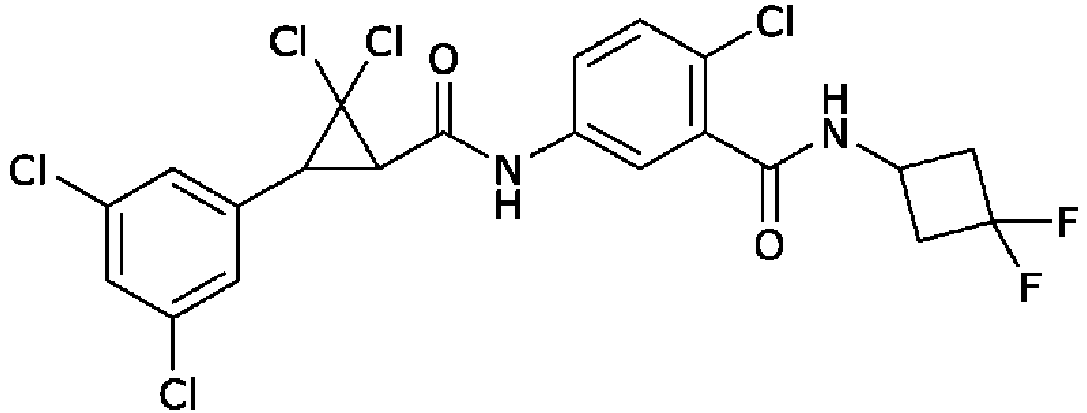
F6 
F7 
F8 
F9 
F10 
F11 
F12 
F13 
F14 
F15 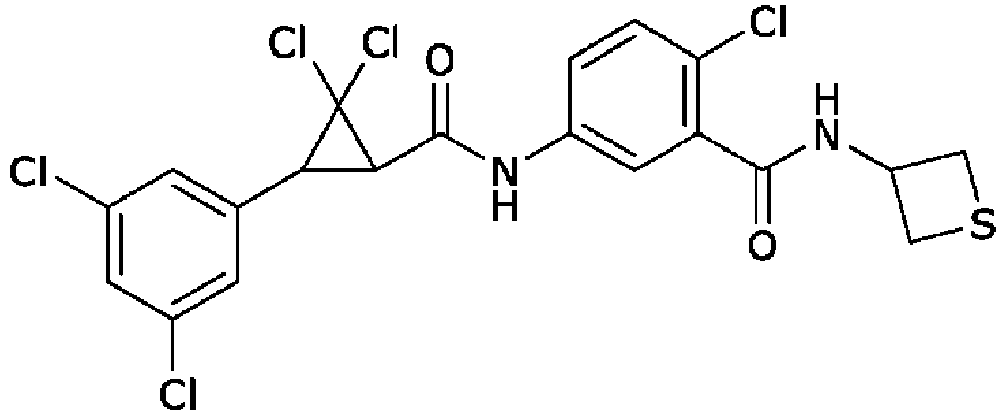
F16 
F17 
F18 
F19 
F20 
F21 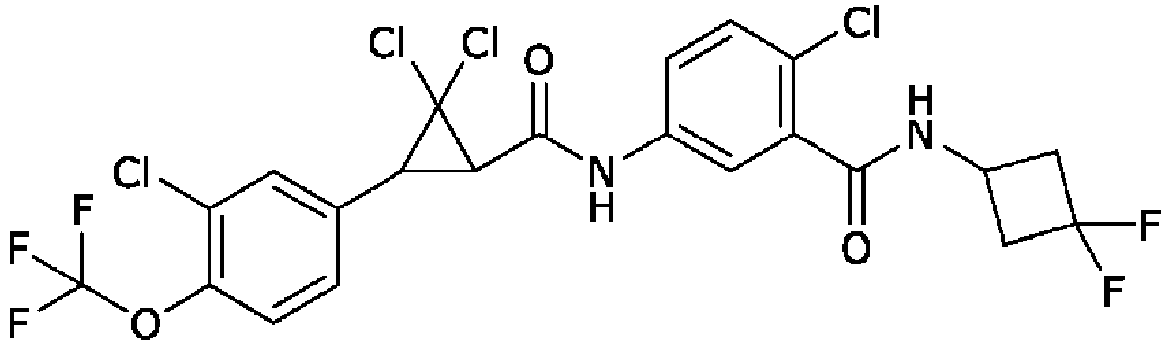
F22 
F23 
F24 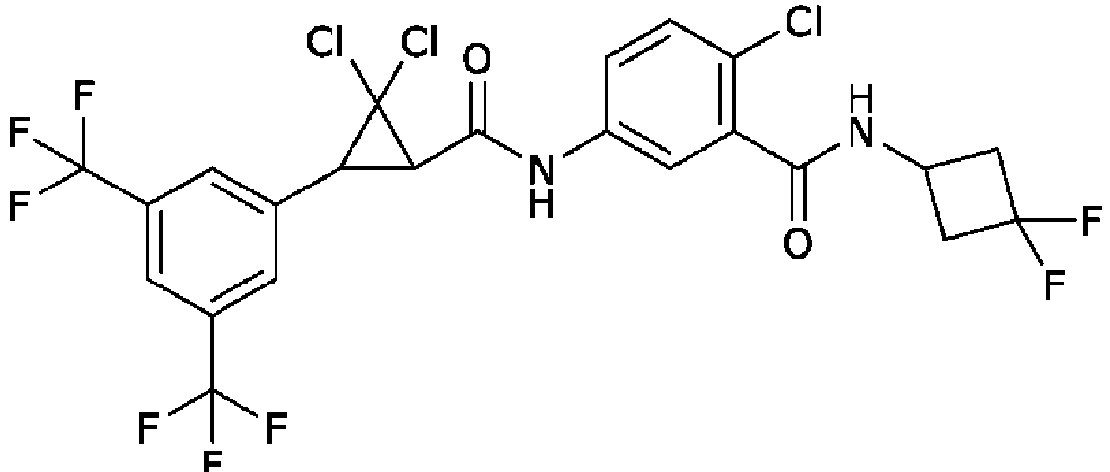
F25 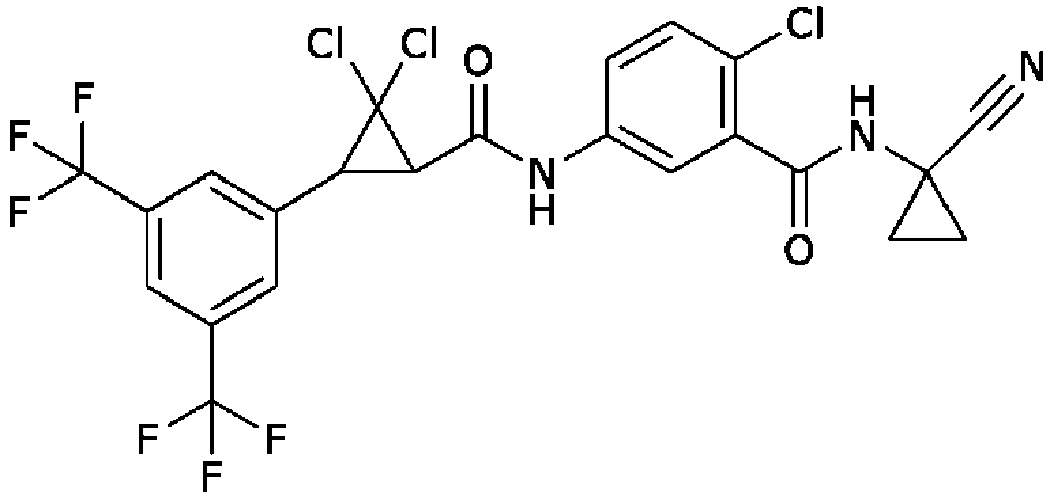
F26 
F27 
F28 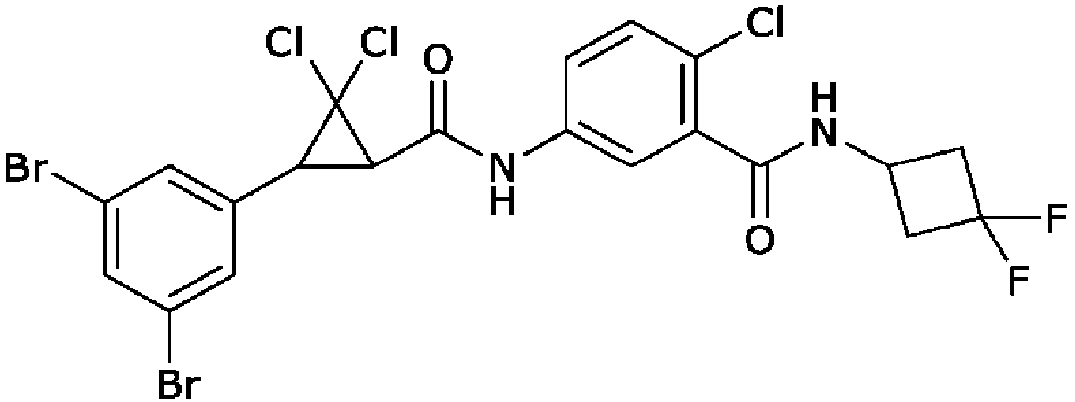
F29 
F30 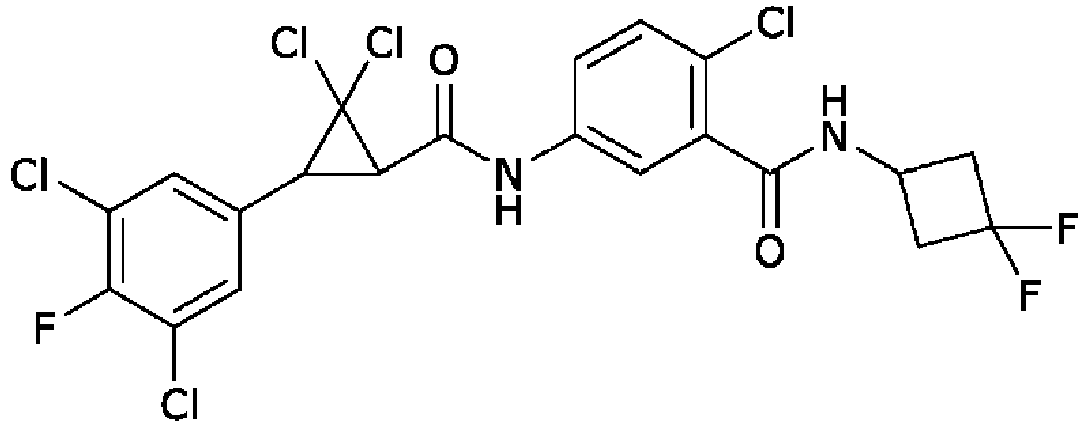
F31 
F32 
F33 
F34 
F35 
F36 
F37 
F38 
F39 
F40 
F41 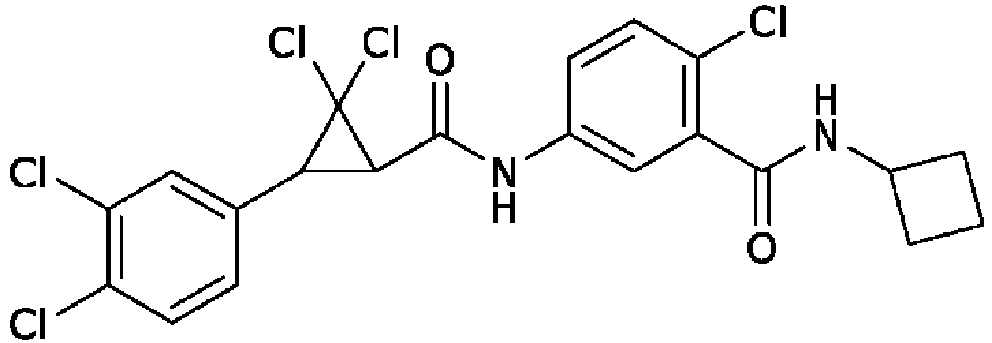
F42 
F43 
F44 
F45 
F46 
F47 
F48 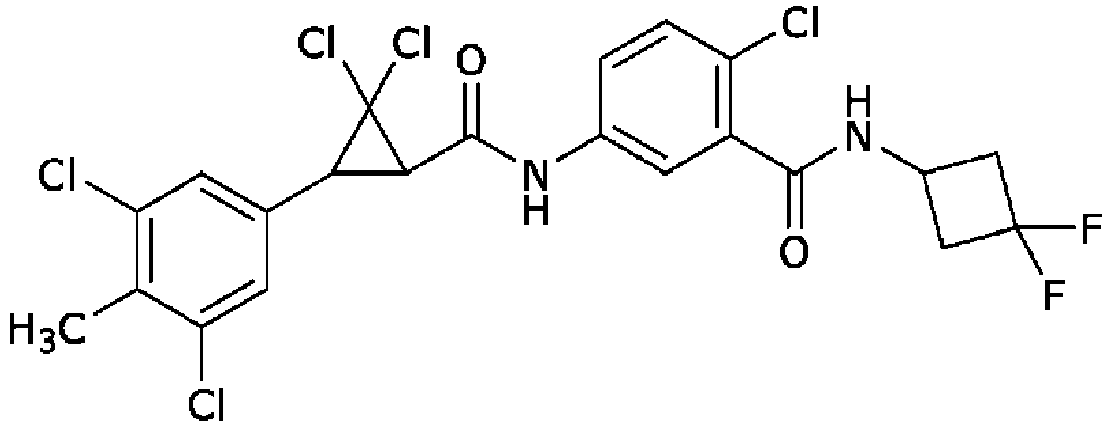
F49 
F50 
F51 
F52 
F53 
F54 
F55 
F56 
F57 
F58 
F59 
F60 
F61 
F62 
F63 
F64 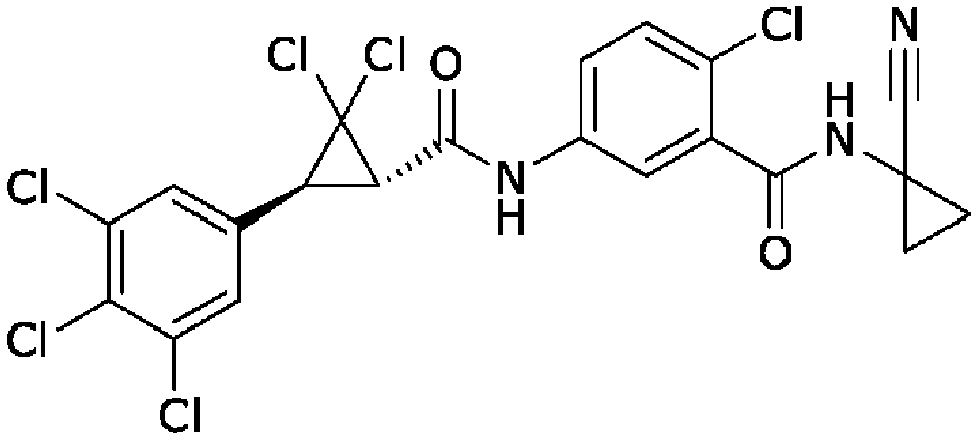
F65 
F66 
F67 
F68 
F69 
F70 
F71 
F72 
F73 
F74 
F75 
F76 
F77 
F78 
F79 
F80 
F81 
F82 
F83 
F84 
F85 
F86 
F87 
F88 
F89 
F90 
F91 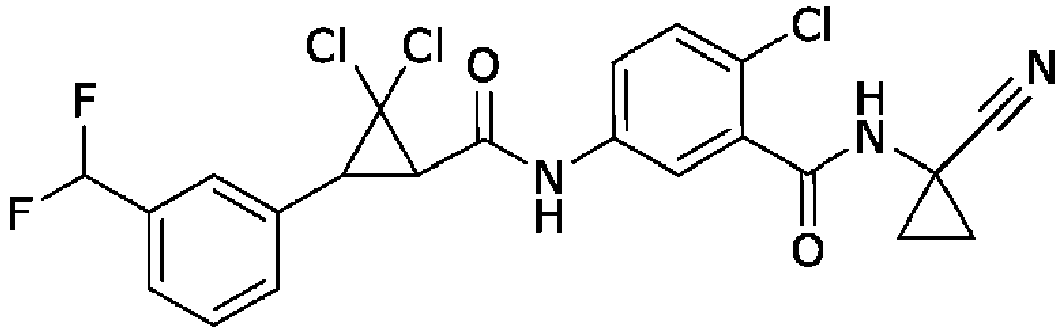
F92 
PF1 
PF2 
PF3 
PF4 
PF5 
PF6 
PF7 
PF8 
PF9 
PF12 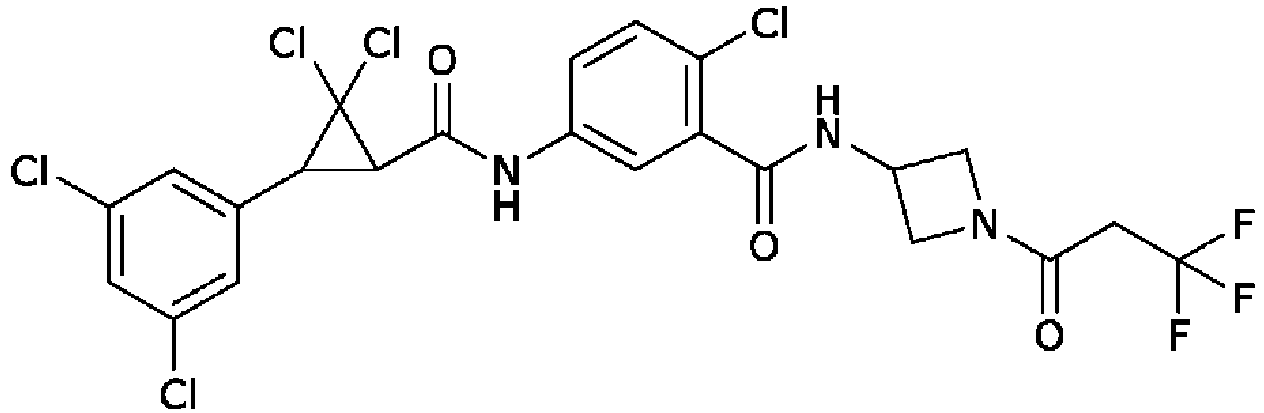
PF14 
PF18 
PF19 
PF20 
PF21 
PF22 
PF23 
PF28 
PF29 
PF30 
PF31 
PF32 
PF33 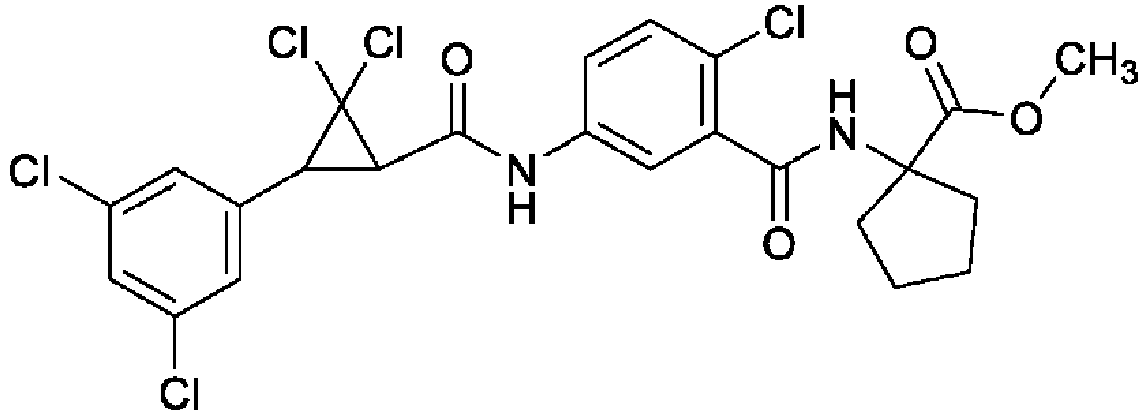
PF34 
PF36 
PF37 
PF41 
PF42 
PF43 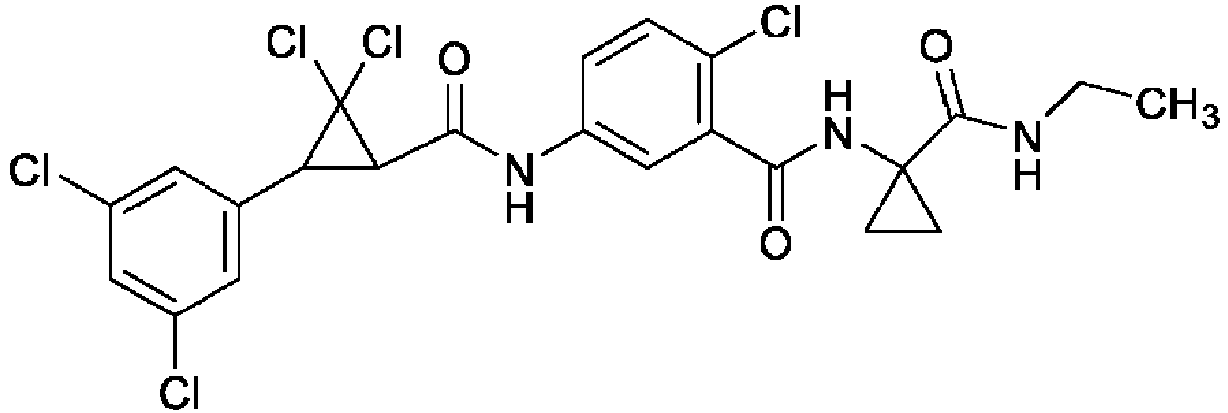
PF44 
PF45 
P1 
P2 
P3 
P4 
P5 
P6 
P7 
P8 
P9 
P10 
P11 
P12 
P13 
P14 
P15 
P16 
P17 
P18 
P19 
P20 
P21 
P22 
P23 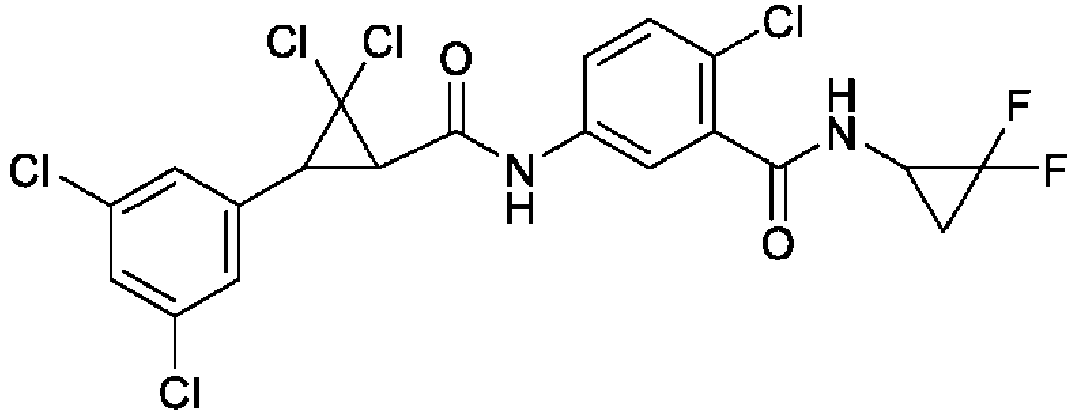
P24 
P25 
P26 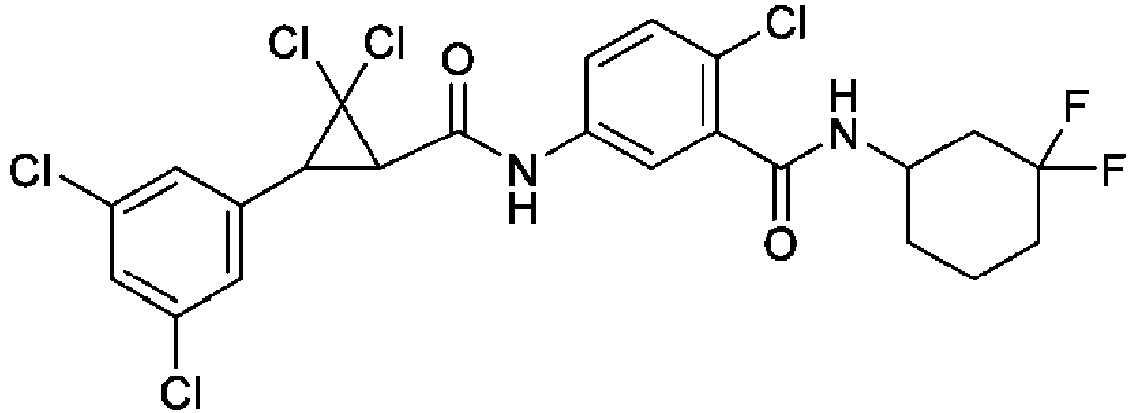
P27 
P28 
P29 
P30 
P31 
P32 
P33 
P34 
P35 
P36 
P37 
P38 
P39 
P40 
P41 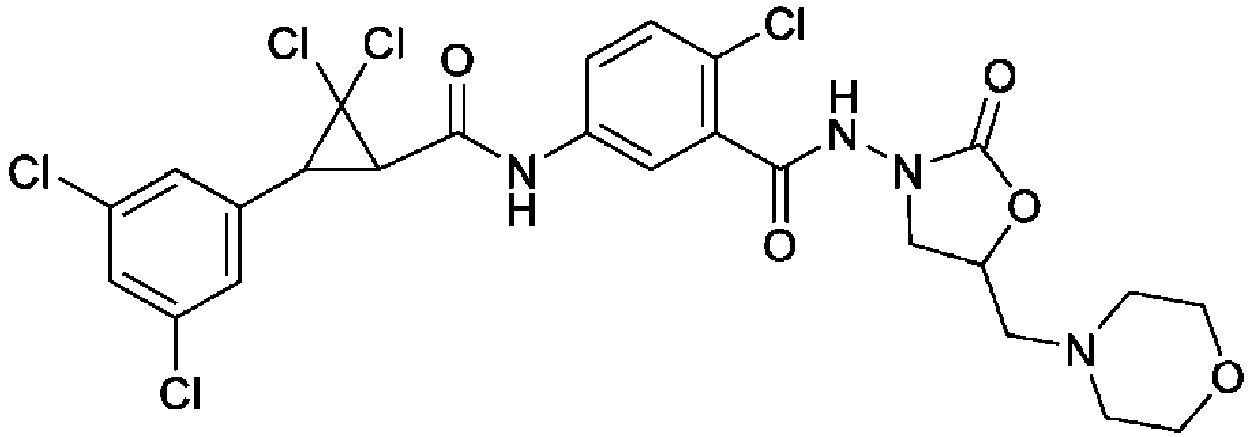
P42 
P43 
P44 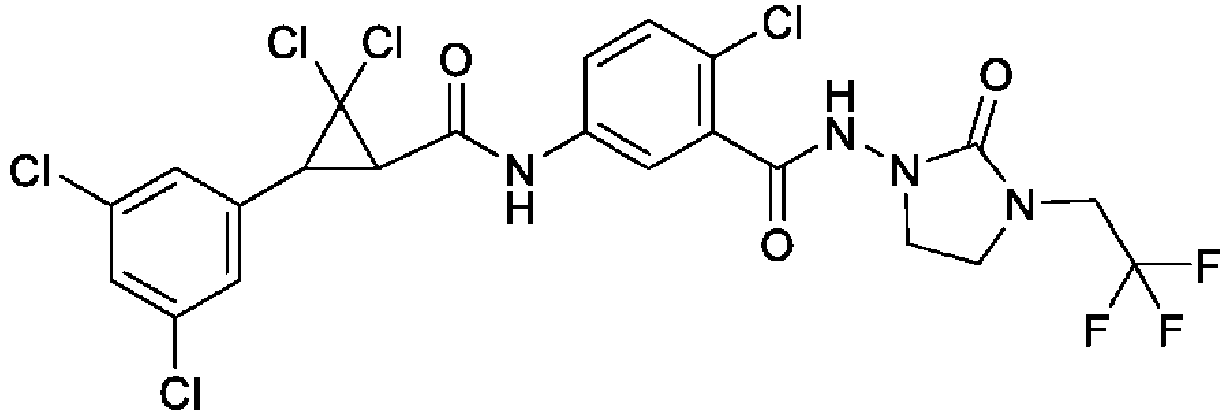
P45 
P46 
P47 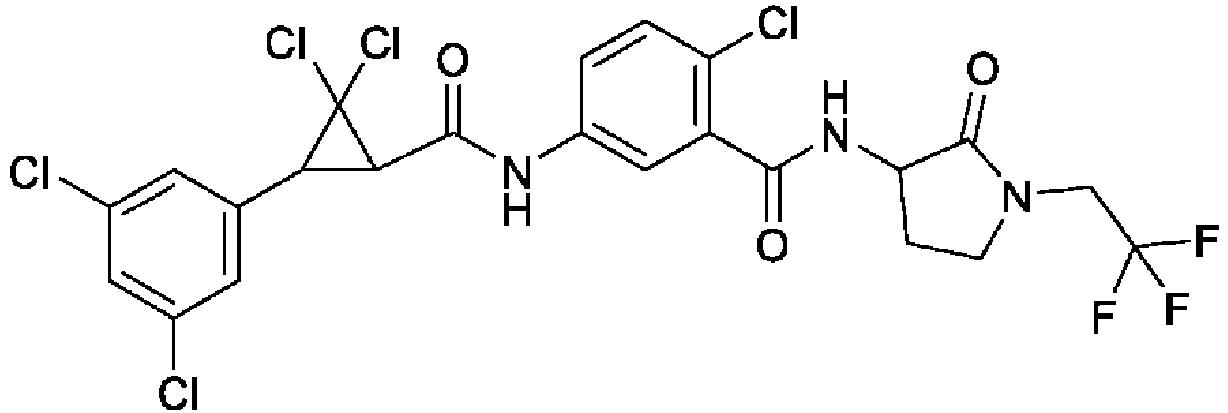
P48 
P49 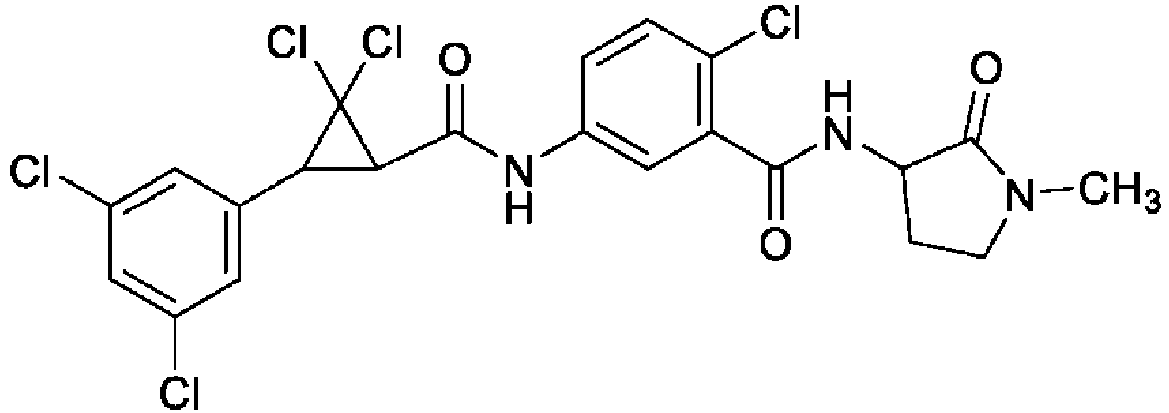
- Composition selon l'une quelconque des revendications précédentes, l'ingrédient actif étant choisi dans le « groupe d'ingrédient actif alpha » (ci-après « AIGA ») qui signifie collectivement les matières suivantes :(1) bromure de (3-éthoxypropyl)mercure, 1,2-dibromoéthane, 1,2-dichloroéthane, 1,2-dichloropropane, 1,3-dichloropropène, 1-MCP, 1-méthylcyclopropène, 1-naphtol, 2-(octylthio)éthanol, 2,3,3-TPA, acide 2,3,5-tri-iodobenzoïque, 2,3,6-TBA, 2,4,5-T, 2,4,5-TB, 2,4,5-TP, 2,4-D, 2,4-DB, 2,4-DEB, 2,4-DEP, 2,4-DES, 2,4-DP, 2,4-MCPA, 2,4-MCPB, 2iP, chlorure de 2-méthoxyéthylmercure, 2-phénylphénol, 3,4-DA, 3,4-DB, 3,4-DP, acide 3,6-dichloropicolinique, 4-aminopyridine, 4-CPA, 4-CPB, 4-CPP, alcool 4-hydroxyphénéthylique, sulfate de 8-hydroxyquinoléine, 8-phénylmercurioxyquinoléine, abamectine, abamectine-aminométhyle, acide abscissique, ACC, acéphate, acéquinocyle, acétamipride, acéthion, acétochlore, acétofénate, acétophos, acétoprole, acibenzolar, acifluorfène, aclonifen, ACN, acrep, acrinathrine, acroléine, acrylonitrile, acypetacs, afidopyropène, afoxolaner, alachlore, alanap, alanycarbe, albendazole, aldicarbe, aldicarbe sulfone, aldimorphe, aldoxycarbe, aldrine, alléthrine, allicine, allidochlore, allosamidine, alloxydime, alcool allylique, allyxycarbe, alorac, alpha-cyperméthrine, alpha-endosulfan, alphaméthrine, altrétamine, phosphure d'aluminium, phosphure d'aluminium, amétoctradine, amétridione, amétryne, amétryne, amibuzine, amicarbazone, amicarthiazole, amidithion, amidoflumet, amidosulfuron, aminocarbe, aminocyclopyrachlore, aminopyralide, aminotriazole, amiprofos-méthyl, amiprophos, amiprophos-méthyl, amisulbrom, amiton, amitraz, amitrole, sulfamate d'ammonium, amobam, gel de silice amorphe, dioxyde de silicium amorphe, ampropylfos, AMS, anabasine, ancymidol, anilazine, anilofos, anisuron, anthraquinone, antu, apholate, aramite, arprocarbe, oxyde d'arsenic, asomate, aspirine, asulam, athidathion, atraton, atrazine, auréofungine, avermectine B1, AVG, aviglycine, azaconazole, azadirachtine, azafénidine, azaméthiphos, azidithion, azimsulfuron, azinphoséthyl, azinphos-éthyl, azinphosméthyl, azinphos-méthyl, aziprotryne, aziprotryne, azithirame, azobenzène, azocyclotine, azothoate, azoxystrobine, bachmedesh, barbane, barbanate, hexafluorosilicate de baryum, polysulfure de baryum, silicofluorure de baryum, barthrine, carbonate de cuivre basique, chlorure de cuivre basique, sulfate de cuivre basique, BCPC, béflubutamide, bénalaxyl, bénalaxyl-M, bénazoline, bencarbazone, benclothiaz, bendaqingbingzhi, bendiocarbe, bendioxyde, bénéfine, benfluraline, benfuracarbe, benfurésate, benmihuangcaoan, benodanil, bénomyl, benoxacor, benoxafos, benquinox, bensulfuron, bensulide, bensultap, bentaluron, bentazon, bentazone, benthiavalicarb, benthiazole, benthiocarbe, bentranil, benzadox, chlorure de benzalkonium, benzamacril, benzamizole, benzamorf, hexachlorure de benzène, benzfendizone, benzimine, benzipram, benzobicyclon, benzoépine, benzofénap, benzofluor, acide benzohydroxamique, benzomate, benzophosphate, benzothiadiazole, benzovindiflupyr, benzoximate, benzoylprop, benzthiazuron, benzuocaotong, benzoate de benzyle, benzyladénine, berbérine, bêta-cyfluthrine, bêta-cyperméthrine, béthoxazine, BHC, bialaphos, bicyclopyrone, bifénazate, bifénox, bifenthrine, bifujunzhi, bilanafos, binapacryl, bingqingxiao, bioalléthrine, bioéthanométhrine, bioperméthrine, bioresméthrine, biphényle, bisazir, bismerthiazole, bismerthiazole-cuivre, bisphénylmercure méthylènedi(x-naphtalène-y-sulfonate), bispyribac, bistrifluron, bisultap, bitertanol, bithionol, bixafène, blasticidine-S, borax, bouillie bordelaise, acide borique, boscalide, BPPS, brassinolide, brassinolide-éthyle, brévicomine, brodifacoum, brofenprox, brofenvalérate, broflanilide, brofluthrinate, bromacil, bromadiolone, bromchlorure de choline, brométhrine, bromfenvinfos, bromoacétamide, bromobonil, bromobutide, bromociclen, bromocyclen, bromo-DDT, bromofénoxime, bromofos, bromométhane, bromophos, bromophos-éthyl, bromopropylate, bromothalonil, bromoxynil, brompyrazone, bromuconazole, bronopol, BRP, BTH, bucarpolate, bufencarbe, buminafos, bupirimate, buprofézine, bouillie bourguignonne, busulfan, busulfan, butacarbe, butachlore, butafénacile, butam, butamifos, butane-fipronil, butathiofos, buténachlore, butène-fipronil, butéthrine, buthidazole, buthiobate, buthiuron, butifos, butocarboxime, butonate, butopyronoxyle, butoxycarboxime, butraline, butrizol, butroxydime, buturon, butylamine, butylate, butylchlorophos, butylène-fipronil, acide cacodylique, cadusafos, cafénstrole, calciférol, arséniate de calcium, chlorate de calcium, cyanamide calcique, cyanure de calcium, polysulfure de calcium, calvinphos, cambendichlore, camphéchlore, camphre, captafol, captane, carbame, carbamorphe, carbanolate, carbaril, carbaryl, carbasulame, carbathion, carbendazime, carbendazole, carbétamide, carbofenotion, carbofurane, disulfure de carbone, carbone tétrachlorure, sulfure de carbonyle, carbophénothion, carbophos, carbosulfan, carboxazole, carboxyde, carboxine, carfentrazone, carpropamide, cartap, carvacrol, carvone, CAVP, CDAA, CDEA, CDEC, cellocidine, CEPC, céralure, cérénox, cevadilla, mélange Cheshunt, chinalphos, chinalphos-méthyl, chinométhionate, chinométhionate, chiralaxyl, chitosane, chlobenthiazone, chlométhoxyfène, chloralose, chloramben, phosphore de chloramine, chloramphénicol, chloraniforméthane, chloranile, chloranocryl, chlorantraniliprole, chlorazifop, chlorazine, chlorbenside, chlorbenzuron, chlorbicyclène, chlorbromuron, chlorbufam, chlordane, chlordécone, chlordiméforme, chlorempinthrine, chlorétazate, chloréthéphon, chloréthoxyfos, chloréturon, chlorfénac, chlorfénapyr, chlorfénazole, chlorfénéthol, chlorfénidime, chlorfenprop, chlorfenson, chlorfensulfure, chlorfenvinphos, chlorfenvinphos-méthyl, chlorfluazuron, chlorflurazole, chlorflurécol, chlorflurène, chlorflurénol, chloridazon, chlorimuron, chlorinate, chlor-IPC, chlorméphos, chlorméquat, chlormésulone, chlorméthoxynil, chlornidine, chlornitrofène, acide chloroacétique, chlorobenzilate, chlorodinitronaphtalènes, chlorofénizon, chloroforme, chloromébuforme, chlorométhiuron, chloronèbe, chlorophacinone, chlorophos, chloropicrine, chloropon, chloropropylate, chlorothalonil, chlorotoluron, chloroxifénidime, chloroxuron, chloroxynil, chlorphonium, chlorphoxime, chlorprazophos, chlorprocarbe, chlorprophame, chlorpyrifos, chlorpyrifos-méthyle, chlorquinoxe, chlorsulfuron, chlorthal, chlorthiamide, chlorthiophos, chlortoluron, chlozolinate, chltosan, cholécalciférol, chlorure de choline, chromafénozide, cicloheximide, cimectacarbe, cimétacarbe, cinérine I, cinérine II, cinérines, cinidon-éthyle, cinméthyline, cinosulfuron, cintofène, ciobutide, cisanilide, cisméthrine, clacyfos, cléoxydime, clenpirine, clenpyrine, cléthodime, climbazole, cliodinate, clodinafop, cloéthocarbe, clofencet, clofénotane, clofentézine, clofenvinfos, acide clofibrique, clofop, clomazone, cloméprop, clonitralide, cloprop, cloproxydime, clopyralide, cloquintocet, cloransulam, closantel, clothianidine, clotrimazole, cloxyfonac, cloxylacon, clozylacon, CMA, CMMP, CMP, CMU, codlélure, cholécalciférol, colophonate, 8-quinolinolate de cuivre, acétate de cuivre, acétoarsénite de cuivre, arséniate de cuivre, carbonate de cuivre basique, hydroxyde de cuivre, naphténate de cuivre, oléate de cuivre, oxychlorure de cuivre, silicate de cuivre, sulfate de cuivre, sulfate de cuivre basique, chromate de cuivre et de zinc, coumachlore, coumafène, coumafos, coumafuryl, coumaphos, coumatétralyl, couméthoxystrobine, coumithoate, coumoxystrobine, CPMC, CPMF, CPPC, crédazine, crésol, acide crésylique, crimidine, crotamiton, crotoxyfos, crotoxyphos, crufomate, cryolite, cue-lure, cufranèbe, cumylérone, cumyluron, cuprobame, oxyde cuivreux, curcuménol, CVMP, cyanamide, cyanatryne, cyanazine, cyanofenphos, cyanogène, cyanophos, cyanthoate, cyantraniliprole, acide cyanurique, cyazofamide, cybutryne, cyclafuramide, cyclanilide, cyclaniliprole, cycléthrine, cycloate, cycloheximide, cycloprate, cycloprothrine, cyclopyrimorate, cyclosulfamuron, cycloxydime, cycluron, cyénopyrafène, cyflufénamide, cyflumétofène, cyfluthrine, cyhalofop, cyhalothrine, cyhexatine, cymiazole, cymoxanil, cyométrinil, cypendazole, cyperméthrine, cyperquat, cyphénothrine, cyprazine, cyprazole, cyproconazole, cyprodinil, cyprofurame, cypromide, cyprosulfamide, cyromazine, cythioate, cytrex, daimuron, dalapon, daminozide, dayoutong, dazomet, DBCP, d-camphre, DCB, DCIP, DCPA, DCPTA, DCU, DDD, DDPP, DDT, DDVP, débacarbe, décafentine, décaméthrine, décarbofurane, DEET, acide déhydroacétique, déiquat, délachlore, delnav, deltaméthrine, déméphion, déméphion-O, déméphion-S, déméton, déméton-méthyle, déméton-O, déméton-O-méthyle, déméton-S, déméton-S-méthyl, déméton-S-méthylsulfone, déméton-S-méthylsulfone, DEP, dépalléthrine, derris, desmédiphame, desmétryne, desmétryne, d-fanshiluquebingjuzhi, diafenthiuron, dialifor, dialifos, diallate, diamidafos, dianat, terre de diatomées, diatomite, diazinon, dibrome, phtalate de dibutyle, succinate de dibutyle, dicamba, dicapthon, dichlobénil, dichlofenthion, dichlofluanide, dichlone, dichloralurée, dichlorbenzuron, dichlorfénidime, dichlorflurécol, dichlorflurénol, dichlormate, dichlormid, dichlorométhane, dicloromézotiaz, dichlorophène, dichlorprop, dichlorprop-P, dichlorvos, dichlozoline, dichlozoline, diclobutrazol, diclocymet, diclofop, diclomézine, dicloran, diclosulam, dicofol, dicophane, dicoumarol, dicrésyl, dicrotophos, dicryl, dicumarol, dicyclanil, dicyclonone, dieldrine, diénochlore, diéthamquat, diéthatyl, diéthion, diéthion, diéthofencarb, diétholate, diéthon, pyrocarbonate de diéthyle, diéthyltoluamide, difénacoum, difénoconazole, difénopentène, difénoxuron, difenzoquat, diféthialone, diflovidazine, diflubenzuron, diflufénican, diflufénicanil, diflufenzopyr, diflumétorim, dikégulac, dilor, dimatif, diméfluthrine, dimefox, dimefuron, dimehypo, dimepipérate, diméthachlone, dimétane, diméthacarbe, diméthachlone, diméthachlore, diméthamétryne, diméthénamide, diméthénamide-P, diméthipine, diméthirimol, diméthoate, diméthomorphe, diméthrine, carbate de diméthyle, disulfure de diméthyle, phtalate de diméthyle, diméthylvinphos, dimétilane, dimexano, dimidazone, dimoxystrobine, dimpylate, dimuron, dinex, dingjunezuo, diniconazole, diniconazole-M, dinitramine, dinitrophénols, dinobutone, dinocap, dinocap-4, dinocap-6, dinoctone, dinofénate, dinopentone, dinoprop, dinosam, dinosèbe, dinosulfone, dinotéfurane, dinoterbe, dinoterbone, diofénolane, dioxabenzofos, dioxacarbe, dioxathion, dioxation, diphacine, diphacinone, diphénadione, diphénamide, diphénamide, diphénylsulfone, diphénylamine, diphénylsulfure, acide diprogulique, dipropaline, dipropétryne, dipterex, dipymétitrone, dipyrithione, diquat, tétraborate de disodium, disosultap, disparlure, disugran, disul, disulfirame, disulfoton, ditalimfos, dithianon, dithicrofos, dithioéther, dithiométon, dithiopyr, diuron, dixanthogène, d-limonène, DMDS, DMPA, DNOC, dodémorphe, dodicine, dodine, dofénapyne, doguadine, dominicalure, doramectine, DPC, drazoxolon, DSMA, d-trans-alléthrine, d-trans-resméthrine, dufulin, dymron, EBEP, EBP, ébufos, ecdystérone, échlomézol, EDB, EDC, EDDP, édifenphos, églinazine, émamectine, EMPC, empenthrine, énadénine, endosulfan, endothal, endothall, endothion, endrine, énestroburine, énilconazole, énoxastrobine, éphirsulfonate, EPN, épocholéone, épofénone, époxiconazole, éprinomectine, épronaze, EPTC, erbon, ergocalciférol, erlujixiancaoan, esdépalléthrine, esfenvalérate, ESP, esprocarbe, étacélasil, étaconazole, étaphos, étem, éthaboxame, éthachlore, éthalfluraline, éthametsulfuron, éthaprochlore, éthéphon, éthidimuron, éthiofencarbe, éthiolate, éthion, éthiozine, éthiprole, éthirimol, éthoate-méthyle, éthobenzanide, éthofumesate, éthohexadiol, éthoprop, éthoprophos, éthoxyfène, éthoxyquine, éthoxysulfuron, éthychlozate, éthyle formiate, pyrophosphate d'éthyle, éthylane, éthyl-DDD, éthylène, dibromure d'éthylène, dichlorure d'éthylène, oxyde d'éthylène, éthylicine, éthylmercure 2,3-dihydroxypropyl mercaptide, acétate d'éthylmercure, bromure d'éthylmercure, chlorure d'éthylmercure, phosphate d'éthylmercure, étinofène, ETM, étnipromide, étobenzanide, étofenprox, étoxazole, étridiazole, étrimfos, étrimphos, eugénol, EXD, famoxadone, famphur, fénac, fénamidone, fénaminosulf, fénaminstrobine, fénamiphos, fénapanil, fénarimol, fénasulam, fénazaflor, fénazaquine, fenbuconazole, oxyde de fenbutatine, fenchlorazole, fenchlorphos, fenclofos, fenclorim, fenéthacarb, fenfluthrine, fenfuram, fenhexamide, fénidine, fénitropan, fénitrothion, fénizon, fenjuntong, fénobucarbe, fenolovo, fénoprop, fénothiocarbe, fénoxacrim, fénoxanil, fénoxaprop, fénoxaprop-P, fénoxasulfone, fénoxycarbe, fenpiclonil, fenpirithrine, fenpropathrine, fenpropidine, fenpropimorphe, fenpyrazamine, fenpyroximate, fenquinotrione, fenridazon, fenson, fensulfothion, fenteracol, fenthiaprop, fenthion, fenthion-éthyl, fentiaprop, fentine, fentrazamide, fentrifanil, fénuron, fénuron-TCA, fenvalérate, ferbame, ferimzone, phosphate ferrique, sulfate ferreux, fipronil, flamprop, flamprop-M, flazasulfuron, flocoumafène, flometoquine, flonicamide, florasulam, fluacrypyrim, fluazifop, fluazifop-P, fluazinam, fluazolate, fluazuron, flubendiamide, flubenzimine, flubrocythrinate, flucarbazone, flucétosulfuron, fluchloraline, flucofuron, flucycloxuron, flucythrinate, fludioxonil, fluénéthyl, fluénétil, fluensulfone, flufénacet, flufénérim, flufénican, flufénoxuron, flufénoxystrobine, flufenprox, flufenpyr, flufenzine, flufiprole, fluhexafon, fluméthrine, flumétover, flumétraline, flumetsulam, flumézine, flumiclorac, flumioxazine, flumipropyne, flumorphe, fluométuron, fluopicolide, fluopyram, fluorbenside, fluoridamide, fluoroacétamide, acide fluoroacétique, fluorochloridone, fluorodifène, fluoroglycofène, fluoroimide, fluoromide, fluoromidine, fluoronitrofène, fluoroxypyr, fluothiuron, fluotrimazole, fluoxastrobine, flupoxame, flupropacile, flupropadine, flupropanate, flupyradifurone, flupyrsulfuron, fluquinconazole, fluralaner, flurazole, flurécol, flurénol, fluridone, flurochloridone, fluromidine, fluroxypyr, flurprimidol, fluursulamide, flurtamone, flusilazole, flusulfamide, flutenzine, fluthiacet, fluthiamide, flutianil, flutolanil, flutriafol, fluvalinate, fluxapyroxad, fluxofénim, folpel, folpet, fomésafène, fonofos, foramsulfuron, forchlorfénuron, formaldéhyde, formétanate, formothion, formparanate, fosamine, fosétyl, fosméthilane, fospirate, fosthiazate, fosthiétan, frontaline, fthalide, fubéridazole, fucaojing, fucaomi, fujunmanzhi, fulumi, fumarine, funaihecaoling, fuphenthiourée, furalane, furalaxyl, furaméthrine, furamétpyr, furane tébufénozide, furathiocarbe, furcarbanil, furconazole, furconazole-cis, furéthrine, furfural, furilazole, furmécyclox, furophanate, furyloxyfène, gamma-BHC, gamma-cyhalothrine, gamma-HCH, génit, acide gibbérellique, gibbérelline A3, gibbérellines, gliftor, glitor, glucochloralose, glufosinate, glufosinate-P, glyodine, glyoxime, glyphosate, glyphosine, gossyplure, grandlure, griséofulvine, guanoctine, guazatine, halacrinate, halauxifène, halfenprox, halofénozide, halosafen, halosulfuron, haloxydine, haloxyfop, haloxyfop-P, haloxyfop-R, HCA, HCB, HCH, hemel, hempa, HEOD, heptachlore, heptafluthrine, hepténophos, heptopargil, herbimycine, herbimycine A, hétérophos, hexachlore, hexachlorane, hexachloroacétone, hexachlorobenzène, hexachlorobutadiène, hexachlorophène, hexaconazole, hexaflumuron, hexafluoramine, hexaflurate, hexalure, hexamide, hexazinone, hexylthiofos, hexythiazox, HHDN, holosulf, homobrassinolide, huancaiwo, huanchongjing, huangcaoling, huanjunzuo, hydraméthylnone, hydrargaphène, chaux hydratée, cyanamide d'hydrogène, cyanure d'hydrogène, hydroprène, hydroxyisoxazole, hymexazol, hyquincarbe, IAA, IBA, IBP, icaridine, imazalil, imazaméthabenz, imazamox, imazapic, imazapyr, imazaquine, imazéthapyr, imazosulfuron, imibenconazole, imicyafos, imidaclopride, imidaclothiz, iminoctadine, imiprothrine, inabenfide, indanofan, indaziflame, indoxacarbe, inézine, terre d'infusoires, iodobonil, iodocarbe, iodofenphos, iodométhane, iodosulfuron, iofensulfuron, ioxynil, ipazine, IPC, ipconazole, ipfencarbazone, iprobenfos, iprodione, iprovalicarbe, iprymidam, ipsdiénol, ipsénol, IPSP, IPX, isamidofos, isazofos, isobenzane, isocarbamide, isocarbamide, isocarbophos, isocil, isodrine, isofenphos, isofenphos-méthyl, isofétamide, isolan, isométhiozine, isonoruron, isopamphos, isopolinate, isoprocarbe, isoprocil, isopropaline, isopropazole, isoprothiolane, isoproturon, isopyrazam, isopyrimol, isothioate, isotianil, isouron, isovalédione, isoxabène, isoxachlortole, isoxadifène, isoxaflutole, isoxapyrifop, isoxathion, isuron, ivermectine, ixoxaben, izopamfos, izopamphos, japonilure, japothrins, jasmolin I, jasmolin II, acide jasmonique, jiahuangchongzong, jiajizengxiaolin, jiaxiangjunzhi, jiecaowan, jiecaoxi, jinganmycine A, jodfenphos, hormone juvénile I, hormone juvénile II, hormone juvénile III, kadéthrine, kappa-bifenthrine, kappa-téfluthrine, karbutilate, karetazan, kasugamycine, kéjunline, kelevan, kétospiradox, kieselguhr, kinétine, kinoprène, kiralaxyl, krésoxim-méthyl, kuicaoxi, lactofène, lambda-cyhalothrine, latilure, arséniate de plomb, lénacile, lépimectine, leptophos, lianbenjingzhi, soufre de chaux, lindane, linéatine, linuron, lirimfos, litlure, looplure, lufénuron, lüxiancaolin, Ivdingjunzhi, Ivfumijvzhi, Ivxiancaolin, lythidathion, M-74, M-81, MAA, phosphure de magnésium, malathion, maldison, hydrazide maléique, malonoben, maltodextrine, MAMA, mancopper, mancozèbe, mandestrobine, mandipropamide, manèbe, matrine, mazidox, MCC, MCP, MCPA, MCPA-thioéthyle, MCPB, MCPP, mébénil, mécarbame, mécarbinzide, mécarphon, mécoprop, mécoprop-P, médiméforme, médinoterb, médlure, méfénacet, méfénoxame, méfenpyr, méfluidide, acide mégatomoïque, alcool mélissylique, mélitoxine, MEMC, ménazone, MEP, mépanipyrim, méperfluthrine, méphénate, méphosfolan, mépiquat, mépronil, meptyldinocap, mercaptodiméthrine, mercaptophos, mercaptophos thiol, mercaptothion, chlorure mercurique, oxyde mercurique, chlorure mercureux, merphos, oxyde de merphos, mésoprazine, mésosulfuron, mésotrione, mésulfène, mésulfenfos, mésulfène, métacrésol, métaflumizone, métalaxyl, métalaxyl-M, métaldéhyde, métam, métamifop, métamitrone, métaphos, métaxon, métazachlore, métazosulfuron, métazoxolon, metconazole, métépa, métflurazon, méthabenzthiazuron, méthacrifos, méthalpropaline, métham, méthamidophos, méthasulfocarbe, méthazole, méthfuroxame, méthibenzuron, méthidathion, méthiobencarbe, méthiocarbe, méthiopyrisulfuron, méthiotépa, méthiozoline, méthiuron, méthocrotophos, méthocarbe, méthomèton, méthomyl, méthoprène, méthoprotryne, méthoprotryne, méthoquin-butyle, méthothrine, méthoxychlore, méthoxyfénozide, méthoxyphénone, apholate de méthyle, bromure de méthyle, méthyleugénol, iodure de méthyle, isothiocyanate de méthyle, méthylparathion, méthylacétophos, méthylchloroforme, acide méthyldithiocarbamique, méthyldymron, chlorure de méthylène, méthyl-isofenphos, méthylmercaptophos, oxyde de méthylmercaptophos, méthylmercaptophos thiol, benzoate de méthylmercure, méthylmercure dicyandiamide, méthylmercure pentachlorophénoxyde, méthylnéodécanamide, méthylnitrophos, méthyltriazothion, métiozoline, métirame, métirame-zinc, métobenzuron, métobromuron, métofluthrine, métolachlore, métolcarbe, métométuron, métominostrobine, métosulam, métoxadiazone, métoxuron, métrafénone, métriam, métribuzine, métrifonate, métriphonate, metsulfovax, metsulfuron, mévinphos, mexacarbate, miechuwei, mieshuan, miewenjuzhi, milbémectine, milbémycine oxime, milneb, mima2nan, mipafox, MIPC, mirex, MNAF, moguchun, molinate, molosultap, momfluorothrine, monalide, monisuron, monoamitraz, acide monochloroacétique, monocrotophos, monolinuron, monoméhypo, monosulfiram, monosulfuron, monosultap, monuron, monuron-TCA, morfamquat, moroxydine, morphothion, morzid, moxidectine, MPMC, MSMA, MTMC, muscalure, myclobutanil, myclozoline, alcool myricylique, N-(éthylmercure)-p-toluènesulfonanilide, NAA, NAAm, nabam, naftalofos, naled, naphtalène, naphtalèneacétamide, anhydride naphtalique, naphtalophos, acides naphtoxyacétiques, acides naphtylacétiques, naphtylindane-1,3-diones, acides naphtyloxyacétiques, naproanilide, napropamide, napropamide-M, naptalam, natamycine, NBPOS, néburea, néburon, nendrine, néonicotine, nichlorfos, niclofène, niclosamide, nicobifène, nicosulfuron, nicotine, sulfate de nicotine, nifluridide, nikkomycines, NIP, nipyraclofène, nipyralofène, nitenpyram, nithiazine, nitraline, nitrapyrine, nitrilacarbe, nitrofène, nitrofluorfène, nitrostyrène, nitrothal-isopropyl, nobormide, nonanol, norbormide, norea, norflurazon, nornicotine, noruron, novaluron, noviflumuron, NPA, nuarimol, nuranone, OCH, octachlorodipropyl éther, octhilinone, o-dichlorobenzène, ofurace, ométhoate, o-phénylphénol, orbencarb, orfralure, orthobencarb, ortho-dichlorobenzène, orthosulfamuron, oryctalure, orysastrobine, oryzaline, osthol, osthole, ostramone, ovatron, ovex, oxabétrinil, oxadiargyl, oxadiazone, oxadixyl, oxamate, oxamyl, oxapyrazone, oxapyrazone, oxasulfuron, oxathiapiproline, oxazicloméfone, oxine-cuivre, oxine-Cu, acide oxolinique, oxpoconazole, oxycarboxine, oxydéméton-méthyl, oxydéprofos, oxydisulfoton, oxyénadénine, oxyfluorfène, oxymatrine, oxytétracycline, oxythioquinox, PAC, paclobutrazol, paichongding, palléthrine, PAP, para-dichlorobenzène, parafluron, paraquat, parathion, parathion-méthyle, parinol, vert de Paris, PCNB, PCP, PCP-Na, p-dichlorobenzène, PDJ, pébulate, pédinex, péfurazoate, acide pélargonique, penconazole, pencycuron, pendiméthaline, penfénate, penflufène, penfluron, pénoxaline, pénoxsulame, pentachlorophénol, laurate de pentachlorophényle, pentanochlore, penthiopyrade, pentméthrine, pentoxazone, perchlordécone, perfluidone, perméthrine, péthoxamide, PHC, phénamacril, phénamacril-éthyle, phénaminosulf, oxyde de phénazine, phénétacarbe, phénisophame, phenkapton, phenmédiphame, phenmédiphame-éthyle, phénobenzuron, phénothiol, phénothrine, phenproxyde, phenthoate, phénylmercuriurée, acétate de phénylmercure, chlorure de phénylmercure, dérivé phénylmercure du pyrocatéchol, nitrate de phénylmercure, salicylate de phénylmercure, phorate, phosacétim, phosalone, phosamétine, phosazétim, phosazétine, phoscyclotine, phosdiphène, phoséthyle, phosfolan, phosfolan-méthyle, phosglycine, phosmet, phosnichlore, phosphamide, phosphamidon, phosphine, phosphinothricine, phosphocarbe, phosphore, phostine, phoxime, phoxime-méthyle, phtalide, phtalophos, phtalthrine, picarbutrazox, picaridine, piclorame, picolinafène, picoxystrobine, pimaricine, pindone, pinoxadène, pipéraline, pipérazine, butoxyde de pipéronyle, pipéronyl cyclonène, pipérophos, piproctanyle, piproctanyle, piprotal, pirimétaphos, pirimicarbe, piriminil, pirimioxyphos, pirimiphos-éthyl, pirimiphos-méthyl, pival, pivaldione, plifenate, PMA, PMP, polybutènes, polycarbamate, polychlorcamphène, polyéthoxyquinoléine, polyoxine D, polyoxines, polyoxorime, polythialane, arsénite de potassium, azoture de potassium, cyanate de potassium, éthylxanthate de potassium, naphténate de potassium, polysulfure de potassium, thiocyanate de potassium, pp'-DDT, pralléthrine, précocène I, précocène II, précocène III, prétilachlore, primidophos, primisulfuron, probénazole, prochloraze, proclonol, procyazine, procymidone, prodiamine, profenofos, profluazole, profluraline, profluthrine, profoxydime, profurite-aminium, proglinazine, prohexadione, prohydrojasmone, promacyl, promécarbe, prométon, prométryne, prométryne, promurit, pronamide, propachlore, propafos, propamidine, propamocarbe, propanil, propaphos, propaquizafop, propargite, proparthrine, propazine, propétamphos, prophame, propiconazole, propidine, propinèbe, propisochlore, propoxur, propoxycarbazone, isome propyle, propyrisulfuron, propyzamide, proquinazide, prosuler, prosulfaline, prosulfocarbe, prosulfuron, prothidathion, prothiocarbe, prothioconazole, prothiofos, prothoate, protrifenbute, proxane, prymidophos, prynachlore, psoralène, psoralène, pydanon, pyflubumide, pymétrozine, pyracarbolide, pyraclofos, pyraclonil, pyraclostrobine, pyraflufène, pyrafluprole, pyramat, pyramétostrobine, pyraoxystrobine, pyrasulfotole, pyraziflumide, pyrazolate, pyrazolynate, pyrazone, pyrazophos, pyrazosulfuron, pyrazothion, pyrazoxyfène, pyresméthrine, pyréthrine I, pyréthrine II, pyréthrines, pyribambenz-isopropyl, pyribambenz-propyl, pyribencarb, pyribenzoxime, pyributicarbe, pyriclor, pyridabène, pyridafol, pyridalyl, pyridaphenthion, pyridaphenthione, pyridate, pyridinitril, pyrifénox, pyrifluquinazone, pyriftalide, pyrimétaphos, pyriméthanil, pyrimicarbe, pyrimidifène, pyriminobac, pyriminostrobine, pyrimiphos-éthyl, pyrimiphos-méthyl, pyrimisulfan, pyrimitate, pyrinuron, pyriofenone, pyriprole, pyripropanol, pyriproxyfène, pyrisoxazole, pyrithiobac, pyrolane, pyroquilon, pyroxasulfone, pyroxsulam, pyroxychlore, pyroxyfur, qincaosuan, qingkuling, quassia, quinacétol, quinalphos, quinalphos-méthyl, quinazamide, quinclorac, quinconazole, quinmérac, quinoclamine, quinométhionate, quinonamide, quinothion, quinoxyfène, quintiofos, quintozène, quizalofop, quizalofop-P, quwenzhi, quyingding, rabenzazole, rafoxanide, R-diniconazole, rébémide, réglone, renriduron, rescalure, resméthrine, rhodéthanil, rhodojaponine-III, ribavirine, rimsulfuron, rizazole, R-métalaxyl, rodéthanil, ronnel, roténone, ryania, sabadilla, saflufénacile, saijunmao, saisentong, salicylanilide, salifluofène, sanguinarine, santonine, S-bioalléthrine, schradan, scilliroside, sébuthylazine, secbuméton, sédaxane, sélamectine, semiamitraz, sésamex, sésamoline, sésone, séthoxydime, sévin, shuangjianancaolin, shuangjianancaolin, S-hydroprène, siduron, sifumijvzhi, siglure, silafluofène, silatrane, aérogel de silice, gel de silice, silthiofam, silthiopham, silthiophan, silvex, simazine, siméconazole, siméton, simétryne, simétryne, sintofen, S-kinoprène, chaux éteinte, SMA, S-méthoprène, S-métolachlore, sodium arsénite, azoture de sodium, chlorate de sodium, cyanure de sodium, fluorure de sodium, fluoroacétate de sodium, hexafluorosilicate de sodium, naphténate de sodium, o-phénylphénoxyde de sodium, orthophénylphénoxyde de sodium, pentachlorophénate de sodium, pentachlorophénoxyde de sodium, polysulfure de sodium, silicofluorure de sodium, tétrathiocarbonate de sodium, thiocyanate de sodium, solan, sophamide, spinétorame, spinosad, spirodiclofène, spiromésifène, spirotétramate, spiroxamine, stirofos, streptomycine, strychnine, sulcatol, sulcofuron, sulcotrione, sulfallate, sulfentrazone, sulfiram, sulfluramide, sulfodiazole, sulfométuron, sulfosate, sulfosulfuron, sulfotep, sulfotepp, sulfoxaflor, sulfoxyde, sulfoxime, soufre, acide sulfurique, fluorure de sulfuryle, sulglycapine, sulfosate, sulprofos, sultropène, swep, tau-fluvalinate, tavron, tazimcarb, TBTO, TBZ, TCA, TCBA, TCMTB, TCNB, TDE, tébuconazole, tébufénozide, tébufenpyrade, tébufloquine, tébupirimfos, tébutam, tébuthiuron, técloftalam, tecnazène, técorame, tédion, téflubenzuron, téfluthrine, téfuryltrione, tembotrione, téméfos, téméphos, tépa, TEPP, tépraloxydime, téproloxydime, téralléthrine, terbacile, terbucarbe, terbuchlore, terbufos, terbuméton, terbuthylazine, terbutol, terbutryne, terbutryne, terraclor, terramicine, terramycine, tetcyclacis, tétrachloroéthane, tétrachlorvinphos, tétraconazole, tétradifon, tétradisul, tétrafluron, tétraméthrine, tétraméthylfluthrine, tétramine, tétranactine, tétraniliprole, tétrapion, tétrasul, sulfate de thallium, sulfate de thallium, thénylchlore, thêta-cyperméthrine, thiabendazole, thiaclopride, thiadiazine, thiadifluor, thiaméthoxame, thiaméturon, thiapronil, thiazafluron, thiazfluron, thiazone, thiazopyr, thicrofos, thicyofène, thidiazimine, thidiazuron, thiencarbazone, thifensulfuron, thifluzamide, thimérosal, thimet, thiobencarbe, thiocarboxime, thiochlorfenphime, thiochlorphenphime, thiocyanatodinitrobenzènes, thiocyclame, thiodan, thiodiazole-cuivre, thiodicarbe, thiofanocarbe, thiofanox, thiofluoximate, thiohempa, thiomersal, thiométon, thionazine, thiophanate, thiophanate-éthyle, thiophanate-méthyle, thiophos, thioquinoxe, thiosemicarbazide, thiosultap, thiotépa, thioxamyle, thirame, thiurame, thuringiensine, tiabendazole, tiadinil, tiafénacile, tiaojiéan, TIBA, tifatol, tiocarbazil, tioclorim, tioxazafène, tioxymide, tirpate, TMTD, tolclofos-méthyle, tolfenpyrade, tolprocarbe, tolpyralate, tolyfluanide, tolylfluanide, acétate de tolylmercure, tomarine, topramezone, toxaphène, TPN, tralkoxydime, tralocythrine, tralométhrine, tralopyril, transfluthrine, transperméthrine, trétamine, triacontanol, triadiméfon, triadiménol, triafamone, triallate, triallate, triamiphos, triapenthénol, triarathène, triarimol, triasulfuron, triazamate, triazbutil, triaziflam, triazophos, triazothion, triazoxide, chlorure de cuivre tribasique, sulfate de cuivre tribasique, tribenuron, tributs, oxyde de tributylétain, tricamba, trichlamide, trichlopyr, trichlorfon, trichlormétaphos-3, trichloronat, trichloronate, trichlorotrinitrobenzènes, trichlorphon, triclopyr, triclopyricarbe, tricrésol, tricyclazole, hydroxyde de tricyclohexylétain, tridémorphe, tridiphane, triétazine, trifenmorphe, trifénofos, trifloxystrobine, trifloxysulfuron, trifludimoxazine, triflumézopyrime, triflumizole, triflumuron, trifluraline, triflusulfuron, trifop, trifopsime, triforine, trihydroxytriazine, trimedlure, triméthacarbe, triméturon, trinexapac, triphénylétain, triprène, tripropindan, triptolide, tritac, trithialan, triticonazole, tritosulfuron, trunc-call, tuoyéline, uniconazole, uniconazole-P, urbacide, urédepa, valérate, validamycine, validamycine A, valifenalate, valone, vamidothion, vangard, vaniliprole, vernolate, vinclozoline, vitamine D3, warfarine, xiaochongliuline, xinjunan, xiwojunan, xiwojunzhi, XMC, xylachlore, xylénols, xylylcarbe, xymiazole, yishijing, zarilamid, zéatine, zengxiaoan, zengxiaolin, zêta-cyperméthrine, naphténate de zinc, phosphure de zinc, thiazole de zinc, thiozole de zinc, trichlorophénate de zinc, trichlorophénoxyde de zinc, zinèbe, zirame, zolaprofos, zoocoumarine, zoxamide, zuoanjunzhi, zuocaoan, zuojunzhi, zuomihuanglong, α-chlorhydrine, α-ecdysone, α-multistriatine, acides α-naphtalèneacétiques et β-ecdysone ;(2) les molécules suivantes(a) N-(3-chloro-1-(pyridin-3-yl)-1H-pyrazol-4-yl)-N-éthyl-3-((3,3,3-trifluoropropyl)thio)propanamide (ci-après « AI-1 »)
 (b) isobutyrate de (3S, 6S, 7R, 8R)-8-benzyl-3-(3-((isobutyryloxy)méthoxy)-4-méthoxypicolinamido)-6-méthyl-4,9-dioxo-1,5-dioxonan-7-yle (ci-après « AI-2 »)
 (3) une molécule connue sous le nom de Lotilaner qui a la structure suivante
 (4) les molécules suivantes dans le tableau A
tableau A ou AIGA-2, c'est-à-dire 1,3-dichloropropène, chlorpyrifos, hexaflumuron, méthoxyfénozide, noviflumuron, spinétoram, spinosad, et sulfoxaflor.M# Structure M1 
M2 
M3 
M4 
M5 
M6 
- Composition selon l'une quelconque des revendications précédentes, comprenant AI-1, AI-2, Lotilaner, ou une molécule choisie dans le tableau A.
- Composition selon l'une quelconque des revendications précédentes 1, comprenant un biopesticide.
- Composition selon l'une quelconque des revendications précédentes, l'ingrédient actif étant choisi parmi les inhibiteurs de l'acétylcholinestérase (AChE) ; antagonistes des canaux chlorés GABA-dépendants ; modulateurs des canaux sodiques ; agonistes des récepteurs nicotiniques de l'acétylcholine (nAChR) ; activateurs allostériques des récepteurs nicotiniques de l'acétylcholine (nAChR) ; activateurs des canaux du chlorure ; mimétiques des hormones juvéniles ; divers inhibiteurs non spécifiques (multi-sites) ; modulateurs des organes chordotonaux ; inhibiteurs de croissance des acariens ; perturbateurs microbiens des membranes intestinales des insectes ; inhibiteurs de l'ATP synthase mitochondriale ; découpleurs de la phosphorylation oxydative par perturbation du gradient proton ; bloqueurs des canaux des récepteurs nicotiniques de l'acétylcholine (nAChR) ; inhibiteurs de la biosynthèse de la chitine, type 0 ; inhibiteurs de la biosynthèse de la chitine, type 1 ; perturbateur de la mue, diptéran ; agonistes des récepteurs de l'ecdysone ; agonistes des récepteurs de l'octopamine ; inhibiteurs du transport d'électrons par le complexe mitochondrial III ; inhibiteurs du transport d'électrons par le complexe mitochondrial I ; bloqueurs des canaux de sodium dépendant de la tension ; inhibiteurs de l'acétyl-CoA carboxylase ; inhibiteurs du transport d'électrons par le complexe mitochondrial IV ; inhibiteurs du transport d'électrons par le complexe mitochondrial II ; modulateurs des récepteurs de la ryanodine ; ou groupe UN qui contient des ingrédients actifs dont le mode d'action est inconnu ou incertain.
- Procédé de lutte contre un organisme nuisible, ledit procédé comprenant l'application sur un site d'une quantité efficace sur le plan pesticide d'une composition selon l'une quelconque des revendications précédentes.
- Procédé selon la revendication 10, ledit organisme nuisible étant choisi dans le groupe constitué par les fourmis, les pucerons, les punaises de lit, les coléoptères, les chenilles, les cafards, les grillons, les perce-oreilles, les puces, les mouches, les sauterelles, les larves, les cicadelles, les poux, les criquets, les asticots, les acariens, les nématodes, les fulgores, les psylles, les tenthrèdes, les cochenilles, les lépismes argentés, les limaces, les escargots, les araignées, les collemboles, les punaises puantes, les symphyles, les termites, les thrips, les tiques, les guêpes, les aleurodes et les vers fil-de-fer.
- Procédé selon la revendication 10, dans lequel ledit organisme nuisible est un organisme nuisible se nourrissant de sève ou un organisme nuisible qui mâche.
- Procédé selon la revendication 10, dans lequel ledit organisme nuisible est choisi dans le groupe constitué par les pucerons, les cicadelles, les papillons de nuit, les écailles, les thrips, les psyllides, les cochenilles, les punaises puantes, et les mouches blanches, ou dans le groupe constitué par les chenilles, les coléoptères, les sauterelles et les criquets ; oudans lequel ledit organisme nuisible est choisi dans le groupe constitué par les ordres des anoplures et des hémiptères, ou dans le groupe constitué par les coléoptères et les lépidoptères ; oudans lequel ledit organisme nuisible est choisi dans le groupe constitué par Aulacaspis spp., Aphrophora spp., Aphis spp., Bemisia spp., Coccus spp., Euschistus spp., Lygus spp., Macrosiphum spp., Nezara spp., et Rhopalosiphum spp, ou dans le groupe constitué par Anthonomus spp., Cerotoma spp., Chaetocnema spp., Colaspis spp., Cyclocephala spp., Diabrotica spp., Hypera spp., Phyllophaga spp., Phyllotreta spp., Sphenophorus spp., Sitophilus spp.
Applications Claiming Priority (8)
| Application Number | Priority Date | Filing Date | Title |
|---|---|---|---|
| US201562148830P | 2015-04-17 | 2015-04-17 | |
| US201562148814P | 2015-04-17 | 2015-04-17 | |
| US201562148837P | 2015-04-17 | 2015-04-17 | |
| US201562148824P | 2015-04-17 | 2015-04-17 | |
| US201562148818P | 2015-04-17 | 2015-04-17 | |
| US201562148809P | 2015-04-17 | 2015-04-17 | |
| PCT/US2016/026409 WO2016168056A1 (fr) | 2015-04-17 | 2016-04-07 | Molécules présentant une utilité en tant que pesticides, ainsi qu'intermédiaires, composition et procédés associés |
| EP16718785.5A EP3283460B1 (fr) | 2015-04-17 | 2016-04-07 | Molécules présentant une utilité en tant que pesticides, ainsi qu'intermédiaires, composition et procédés associés |
Related Parent Applications (1)
| Application Number | Title | Priority Date | Filing Date |
|---|---|---|---|
| EP16718785.5A Division EP3283460B1 (fr) | 2015-04-17 | 2016-04-07 | Molécules présentant une utilité en tant que pesticides, ainsi qu'intermédiaires, composition et procédés associés |
Publications (2)
| Publication Number | Publication Date |
|---|---|
| EP3578541A1 EP3578541A1 (fr) | 2019-12-11 |
| EP3578541B1 true EP3578541B1 (fr) | 2025-05-28 |
Family
ID=55806802
Family Applications (7)
| Application Number | Title | Priority Date | Filing Date |
|---|---|---|---|
| EP19174918.3A Active EP3578541B1 (fr) | 2015-04-17 | 2016-04-07 | Compositions comprenant des molécules ayant une fonction pesticide et procédés associés |
| EP19174959.7A Active EP3578542B1 (fr) | 2015-04-17 | 2016-04-07 | Compositions présentant une utilité en tant que pesticide et procédés associés |
| EP16718098.3A Active EP3283459B1 (fr) | 2015-04-17 | 2016-04-07 | Molécules présentant une utilité en tant que pesticides, ainsi qu'intermédiaires, compositions, et procédés associés |
| EP25196594.3A Pending EP4666856A3 (fr) | 2015-04-17 | 2016-04-07 | Molécules présentant une utilité pesticide, et intermédiaires, compositions et procédés associés |
| EP16718785.5A Active EP3283460B1 (fr) | 2015-04-17 | 2016-04-07 | Molécules présentant une utilité en tant que pesticides, ainsi qu'intermédiaires, composition et procédés associés |
| EP16718097.5A Active EP3283458B1 (fr) | 2015-04-17 | 2016-04-07 | Molécules présentant une utilité en tant que pesticides, ainsi qu'intermédiaires, compositions, et procédés associés |
| EP19175296.3A Active EP3578543B1 (fr) | 2015-04-17 | 2016-04-07 | Compositions comprenant des molécules ayant une fonction pesticide et procédés associés |
Family Applications After (6)
| Application Number | Title | Priority Date | Filing Date |
|---|---|---|---|
| EP19174959.7A Active EP3578542B1 (fr) | 2015-04-17 | 2016-04-07 | Compositions présentant une utilité en tant que pesticide et procédés associés |
| EP16718098.3A Active EP3283459B1 (fr) | 2015-04-17 | 2016-04-07 | Molécules présentant une utilité en tant que pesticides, ainsi qu'intermédiaires, compositions, et procédés associés |
| EP25196594.3A Pending EP4666856A3 (fr) | 2015-04-17 | 2016-04-07 | Molécules présentant une utilité pesticide, et intermédiaires, compositions et procédés associés |
| EP16718785.5A Active EP3283460B1 (fr) | 2015-04-17 | 2016-04-07 | Molécules présentant une utilité en tant que pesticides, ainsi qu'intermédiaires, composition et procédés associés |
| EP16718097.5A Active EP3283458B1 (fr) | 2015-04-17 | 2016-04-07 | Molécules présentant une utilité en tant que pesticides, ainsi qu'intermédiaires, compositions, et procédés associés |
| EP19175296.3A Active EP3578543B1 (fr) | 2015-04-17 | 2016-04-07 | Compositions comprenant des molécules ayant une fonction pesticide et procédés associés |
Country Status (19)
| Country | Link |
|---|---|
| US (12) | US9781935B2 (fr) |
| EP (7) | EP3578541B1 (fr) |
| JP (6) | JP6998213B2 (fr) |
| KR (3) | KR102657257B1 (fr) |
| CN (4) | CN107529748B (fr) |
| AU (6) | AU2016247768B2 (fr) |
| BR (3) | BR112017020015B8 (fr) |
| CA (3) | CA2980351A1 (fr) |
| CO (3) | CO2017009940A2 (fr) |
| ES (6) | ES2735924T3 (fr) |
| IL (6) | IL290720B2 (fr) |
| MX (3) | MX2017013040A (fr) |
| NZ (3) | NZ734919A (fr) |
| RU (3) | RU2735602C2 (fr) |
| TR (3) | TR201910940T4 (fr) |
| TW (3) | TWI704129B (fr) |
| UY (3) | UY36631A (fr) |
| WO (3) | WO2016168058A1 (fr) |
| ZA (3) | ZA201706383B (fr) |
Families Citing this family (56)
| Publication number | Priority date | Publication date | Assignee | Title |
|---|---|---|---|---|
| EP3578541B1 (fr) * | 2015-04-17 | 2025-05-28 | Corteva Agriscience LLC | Compositions comprenant des molécules ayant une fonction pesticide et procédés associés |
| JP6923535B2 (ja) | 2016-01-25 | 2021-08-18 | コルテバ アグリサイエンス エルエルシー | 農薬の効用を有する分子、ならびにこれに関連する中間体、組成物、及びプロセス |
| KR102893495B1 (ko) * | 2016-01-25 | 2025-12-02 | 코르테바 애그리사이언스 엘엘씨 | 살충 유용성을 갖는 분자, 및 그와 관련된 중간체, 조성물 및 방법 |
| EP3964495A1 (fr) * | 2016-10-12 | 2022-03-09 | Dow AgroSciences LLC | Molécules ayant une fonction pesticide et compositions et procédés associés |
| TWI758313B (zh) | 2016-10-12 | 2022-03-21 | 美商陶氏農業科學公司 | 一種用於製備(1r,3r)-及(1s,3s)-2,2-二鹵基-3-(經取代之苯基)環丙烷甲酸的方法 |
| TWI780112B (zh) * | 2017-03-31 | 2022-10-11 | 美商科迪華農業科技有限責任公司 | 具有殺蟲效用之分子,及其相關之中間物、組成物暨方法 |
| WO2018224455A1 (fr) | 2017-06-07 | 2018-12-13 | Basf Se | Dérivés de cyclopropyle substitués |
| WO2018234488A1 (fr) | 2017-06-23 | 2018-12-27 | Basf Se | Dérivés de cyclopropyle substitués |
| WO2019121143A1 (fr) | 2017-12-20 | 2019-06-27 | Basf Se | Dérivés de cyclopropyle substitués |
| WO2019178129A1 (fr) | 2018-03-13 | 2019-09-19 | Shire Human Genetic Therapies, Inc. | Imidazopyridines substituées en tant qu'inhibiteurs de la kallicréine plasmatique et leurs utilisations |
| WO2019185413A1 (fr) | 2018-03-27 | 2019-10-03 | Basf Se | Dérivés de cyclopropyle substitués pesticides |
| EA202092336A1 (ru) * | 2018-04-03 | 2020-12-09 | ДАУ АГРОСАЙЕНСИЗ ЭлЭлСи | Соединения, обладающие пестицидным действием, композиции и способ борьбы с вредителями, связанные с ними |
| CN108530389B (zh) * | 2018-05-22 | 2020-06-09 | 东北师范大学 | 一种2-芳基环丙基胺化合物的制备方法 |
| CN109541059A (zh) * | 2018-11-19 | 2019-03-29 | 山西北化关铝化工有限公司 | 一种测定tctnb纯度的方法 |
| TW202408984A (zh) * | 2018-11-26 | 2024-03-01 | 美商富曼西公司 | 用於防治無脊椎害蟲的間二醯胺化合物 |
| JP7535532B2 (ja) * | 2019-02-26 | 2024-08-16 | バイエル・アクチエンゲゼルシヤフト | 有害生物防除剤としての縮合二環式複素環式誘導体 |
| KR20210135521A (ko) | 2019-03-06 | 2021-11-15 | 다이이찌 산쿄 가부시키가이샤 | 피롤로피라졸 유도체 |
| GB201910608D0 (en) * | 2019-07-24 | 2019-09-04 | Enterprise Therapeutics Ltd | Compounds |
| CN112521375A (zh) * | 2019-09-17 | 2021-03-19 | 鲁南制药集团股份有限公司 | 一种瑞舒伐他汀钙中间体的制备方法 |
| US11370803B2 (en) | 2019-09-18 | 2022-06-28 | Takeda Pharmaceutical Company Limited | Heteroaryl plasma kallikrein inhibitors |
| PT4031547T (pt) | 2019-09-18 | 2024-08-27 | Takeda Pharmaceuticals Co | Inibidores de calicreína plasmática e utilizações dos mesmos |
| TW202126617A (zh) | 2019-09-20 | 2021-07-16 | 美商富曼西公司 | 間二醯胺類殺蟲劑 |
| CN111109313A (zh) * | 2020-01-09 | 2020-05-08 | 郭伟 | 一种复合材料的中草药除螨剂 |
| CN111208230B (zh) * | 2020-01-19 | 2022-02-25 | 天津中医药大学 | 一种美洲大蠊肠道菌群代谢产物的检测方法 |
| CN111187227B (zh) * | 2020-01-20 | 2020-10-23 | 河南农业大学 | 一种用于小麦全蚀病病菌抑制的2-(1,2,4-三氮唑)苯甲酰芳胺类活性化合物 |
| EP4139272A1 (fr) * | 2020-04-24 | 2023-03-01 | Corteva Agriscience LLC | Procédés liés à la formation d'acides arylcyclopropyl-carboxyliques |
| CN115551848A (zh) | 2020-05-13 | 2022-12-30 | 巴斯夫欧洲公司 | 用于防治无脊椎动物害虫的杂环化合物 |
| EP3909950A1 (fr) | 2020-05-13 | 2021-11-17 | Basf Se | Composés hétérocycliques destinés à la lutte contre les organismes nuisibles invertébrés |
| US10994999B1 (en) | 2020-06-30 | 2021-05-04 | Donald Richard Wilshe | Agricultural composition for facilitating treatment of a plant |
| CN112159702B (zh) * | 2020-10-21 | 2022-10-14 | 安徽中天石化股份有限公司 | 一种用于汽车烤漆房的传动链润滑油及其制备方法 |
| CN112730660B (zh) * | 2020-12-21 | 2021-09-21 | 上海博悦生物科技有限公司 | 一种uplc-ms/ms检测对氨基苯酚类物质的方法 |
| US20240116854A1 (en) * | 2021-01-27 | 2024-04-11 | Intervet Inc. | Cyclopropylamide compounds against parasites in fish |
| CN117241669A (zh) * | 2021-01-27 | 2023-12-15 | 英特威国际有限公司荷兰疫苗厂 | 对抗鱼类中寄生虫的环丙基酰胺化合物 |
| CN117986154A (zh) * | 2021-01-27 | 2024-05-07 | 英特维特国际股份有限公司 | 抗寄生虫化合物 |
| CA3209562A1 (fr) * | 2021-01-27 | 2022-08-04 | Intervet International B.V. | Composes de cyclopropylamide contre des parasites chez les poissons |
| EP4613096A3 (fr) * | 2021-01-27 | 2025-12-03 | Intervet International B.V. | Composés antiparasitaires |
| EP4043444A1 (fr) | 2021-02-11 | 2022-08-17 | Basf Se | Dérivés substitués d'isoxazoline |
| BR112023016031A2 (pt) | 2021-02-11 | 2023-12-05 | Basf Se | Compostos de fórmula i, composições agrícolas, métodos para combater ou controlar pragas invertebradas, para proteger plantas em crescimento e para tratar ou proteger um animal e semente |
| CN117396469A (zh) * | 2021-03-17 | 2024-01-12 | 武田药品工业株式会社 | 血浆激肽释放酶的抑制剂 |
| CN113200897B (zh) * | 2021-03-22 | 2024-02-23 | 江西欧氏化工有限公司 | 一种新型合成杀螟丹的氰化工艺 |
| US20240343681A1 (en) | 2021-03-23 | 2024-10-17 | Corteva Agriscience Llc | Molecules having pesticidal utility and intermediates and processes related thereto |
| BR112023020034A2 (pt) * | 2021-05-07 | 2023-11-14 | Corteva Agriscience Llc | Processos de halociclopropanação |
| CN113372352B (zh) * | 2021-06-10 | 2022-08-26 | 青岛农业大学 | 吲哚3,4位并九元中环化合物及其制备方法 |
| EP4238971A1 (fr) | 2022-03-02 | 2023-09-06 | Basf Se | Dérivés substitués d'isoxazoline |
| EP4486740A1 (fr) | 2022-03-02 | 2025-01-08 | Basf Se | Dérivés d'isoxazoline substitués |
| EP4342885A1 (fr) | 2022-09-20 | 2024-03-27 | Basf Se | Dérivés de n-(3-(aminométhyl)-phényl)-5-(4-phényl)-5-(trifluorométhyl)-4,5-dihydroisoxazol-3-amine et composés similaires en tant que pesticides |
| WO2024061665A1 (fr) | 2022-09-20 | 2024-03-28 | Basf Se | Dérivés de n-(3-(aminométhyl)-phényl)-5-(4-phényl)-5-(trifluorométhyl)-4,5-dihydroisoxazol-3-amine et composés similaires utilisés comme pesticides |
| CN115745766B (zh) * | 2022-10-27 | 2024-05-14 | 兰州康鹏威耳化工有限公司 | 一种三氟苯甲醛及三氟苄溴的制备方法 |
| CN121666378A (zh) | 2023-08-10 | 2026-03-13 | 英特维特国际股份有限公司 | 反式-2,2-二氯-3-(3,5-二氯苯基)环丙烷-1-羧酸的手性拆分方法 |
| WO2025099144A1 (fr) * | 2023-11-08 | 2025-05-15 | Intervet International B.V. | Procédé de résolution chirale d'acide trans-2,2-dichloro-3-(3-chloro-4-fluorophényl)cyclopropane-1-carboxylique |
| AR134723A1 (es) | 2023-12-19 | 2026-03-04 | Intervet Int Bv | Productos veterinarios tópicos y métodos relacionados |
| US11998014B1 (en) | 2024-01-03 | 2024-06-04 | King Faisal University | O-{1-[(3,5-dinitrobenzoyl)amino]propan-2-yl} (4-chlorophenyl)carbamothioate as an eco-friendly insecticidal agent against Spodoptera littoralis (boisd.) |
| WO2025168523A1 (fr) | 2024-02-05 | 2025-08-14 | Intervet International B.V. | Procédé de résolution chirale d'acide trans-2,2-dichloro-3-(3,5-dichlorophényl)-cyclopropane-1-carboxylique par chromatographie chirale |
| WO2025168524A1 (fr) | 2024-02-05 | 2025-08-14 | Intervet International B.V. | Procédé de résolution chirale d'acide trans-2,2-dichloro-3-(3-chloro-4-fluorophényl)-cyclopropane-1-carboxylique par chromatographie chirale |
| CN118985614B (zh) * | 2024-07-05 | 2025-10-10 | 云南大学 | N-(1-乙酰-2,3-二氢-1h-吲哚-6-基)-2,6-二氟苯甲酰胺在防治植物根结线虫中的应用 |
| CN119371378B (zh) * | 2024-07-31 | 2026-04-21 | 青岛农业大学 | 一种硫代二氟酯衍生物及其制备方法和在抑菌方面的应用 |
Family Cites Families (28)
| Publication number | Priority date | Publication date | Assignee | Title |
|---|---|---|---|---|
| HU205594B (en) | 1989-01-16 | 1992-05-28 | Chinoin Gyogyszer Es Vegyeszet | Process for producing optical isomeres of cyclopropane-carboxylic acids5 |
| IL103678A (en) * | 1991-11-13 | 1996-09-12 | Schering Ag | History of pyrazolylpyrazole, processes for their preparation and herbicidal preparations containing them |
| US5254584A (en) * | 1992-12-18 | 1993-10-19 | Rohm And Haas Company | N-acetonylbenzamides and their use as fungicides |
| IL120970A (en) * | 1996-06-28 | 2001-05-20 | Rohm & Haas | Acetonylbenzamides, or nicotinamides, their preparations and fungicides containing them |
| JPH1171336A (ja) * | 1997-06-25 | 1999-03-16 | Mitsubishi Chem Corp | アミド誘導体 |
| FR2765577A1 (fr) * | 1997-07-02 | 1999-01-08 | Hoechst Schering Agrevo Sa | Nouveaux amides aromatiques, leur procede de preparation et leur application comme pesticides |
| US20050256161A1 (en) | 2003-08-13 | 2005-11-17 | Tempest Paul A | Melanin concentrating hormone receptor antagonists |
| US7754717B2 (en) * | 2005-08-15 | 2010-07-13 | Amgen Inc. | Bis-aryl amide compounds and methods of use |
| MX348513B (es) | 2005-09-16 | 2017-06-16 | Devgen Nv | Metodos para controlar plagas utilizando arni. |
| US8067599B2 (en) * | 2006-09-06 | 2011-11-29 | Hoffman-La Roche Inc. | Imidazo [4,5-B] pyridine and pyrrolo [2,3-B] pyridine protein kinase inhibitors |
| GB0704468D0 (en) | 2007-03-07 | 2007-04-18 | Syngenta Participations Ag | Insecticidal compounds |
| JP5262352B2 (ja) | 2008-06-30 | 2013-08-14 | 住友化学株式会社 | ピレスロイド化合物含有の水性製剤 |
| PL3081552T3 (pl) * | 2008-08-13 | 2021-12-20 | Mitsui Chemicals Agro, Inc. | Środek do zwalczania szkodników zawierający pochodną amidową i zastosowanie środka do zwalczania szkodników |
| WO2010123006A1 (fr) | 2009-04-21 | 2010-10-28 | 武田薬品工業株式会社 | Composé de pyrrolidine |
| CN106749129A (zh) | 2009-05-06 | 2017-05-31 | 先正达参股股份有限公司 | 杀虫化合物 |
| WO2010144959A1 (fr) | 2009-06-18 | 2010-12-23 | Fibrotech Therapeutics Pty Ltd | Analogues d'agents antifibrotiques |
| WO2011002951A1 (fr) | 2009-07-01 | 2011-01-06 | Trustees Of Dartmouth College | Compositions pour traiter des infections bactériennes |
| US8247597B2 (en) | 2010-01-21 | 2012-08-21 | Nalco Company | Continuous production of DMAEA quaternary salts |
| EP3567589B1 (fr) | 2011-02-18 | 2022-04-06 | Ntt Docomo, Inc. | Codeur de la parole et procédé de codage de la parole |
| EP2934142B1 (fr) * | 2012-12-19 | 2018-01-31 | Dow AgroSciences LLC | Compositions de pesticide et leurs procédés associés |
| EP3578541B1 (fr) * | 2015-04-17 | 2025-05-28 | Corteva Agriscience LLC | Compositions comprenant des molécules ayant une fonction pesticide et procédés associés |
| GEAP202014908A (en) | 2016-03-22 | 2020-03-10 | Merck Sharp & Dohme | Allosteric modulators of nicotinic acetylcholine receptors |
| EP3964495A1 (fr) | 2016-10-12 | 2022-03-09 | Dow AgroSciences LLC | Molécules ayant une fonction pesticide et compositions et procédés associés |
| TWI758313B (zh) | 2016-10-12 | 2022-03-21 | 美商陶氏農業科學公司 | 一種用於製備(1r,3r)-及(1s,3s)-2,2-二鹵基-3-(經取代之苯基)環丙烷甲酸的方法 |
| WO2018224455A1 (fr) | 2017-06-07 | 2018-12-13 | Basf Se | Dérivés de cyclopropyle substitués |
| WO2019121143A1 (fr) | 2017-12-20 | 2019-06-27 | Basf Se | Dérivés de cyclopropyle substitués |
| WO2019185413A1 (fr) | 2018-03-27 | 2019-10-03 | Basf Se | Dérivés de cyclopropyle substitués pesticides |
| EA202092336A1 (ru) | 2018-04-03 | 2020-12-09 | ДАУ АГРОСАЙЕНСИЗ ЭлЭлСи | Соединения, обладающие пестицидным действием, композиции и способ борьбы с вредителями, связанные с ними |
-
2016
- 2016-04-07 EP EP19174918.3A patent/EP3578541B1/fr active Active
- 2016-04-07 AU AU2016247768A patent/AU2016247768B2/en active Active
- 2016-04-07 ES ES16718097T patent/ES2735924T3/es active Active
- 2016-04-07 JP JP2017553379A patent/JP6998213B2/ja active Active
- 2016-04-07 NZ NZ734919A patent/NZ734919A/en unknown
- 2016-04-07 KR KR1020177031749A patent/KR102657257B1/ko active Active
- 2016-04-07 RU RU2017135874A patent/RU2735602C2/ru active
- 2016-04-07 WO PCT/US2016/026413 patent/WO2016168058A1/fr not_active Ceased
- 2016-04-07 BR BR112017020015A patent/BR112017020015B8/pt active IP Right Grant
- 2016-04-07 BR BR112017020140A patent/BR112017020140B8/pt active IP Right Grant
- 2016-04-07 EP EP19174959.7A patent/EP3578542B1/fr active Active
- 2016-04-07 RU RU2017138090A patent/RU2742119C2/ru active
- 2016-04-07 ES ES19174918T patent/ES3037121T3/es active Active
- 2016-04-07 ES ES16718785T patent/ES2736849T3/es active Active
- 2016-04-07 CA CA2980351A patent/CA2980351A1/fr active Pending
- 2016-04-07 ES ES16718098T patent/ES2743327T3/es active Active
- 2016-04-07 MX MX2017013040A patent/MX2017013040A/es unknown
- 2016-04-07 TR TR2019/10940T patent/TR201910940T4/tr unknown
- 2016-04-07 US US15/092,650 patent/US9781935B2/en active Active
- 2016-04-07 AU AU2016249814A patent/AU2016249814B2/en active Active
- 2016-04-07 MX MX2017012646A patent/MX2017012646A/es unknown
- 2016-04-07 TR TR2019/09746T patent/TR201909746T4/tr unknown
- 2016-04-07 US US15/092,641 patent/US9795139B2/en active Active
- 2016-04-07 RU RU2017139079A patent/RU2727811C2/ru active
- 2016-04-07 JP JP2017553380A patent/JP6889663B2/ja active Active
- 2016-04-07 KR KR1020177031723A patent/KR102657925B1/ko active Active
- 2016-04-07 CN CN201680025438.2A patent/CN107529748B/zh active Active
- 2016-04-07 US US15/092,646 patent/US9795140B2/en active Active
- 2016-04-07 EP EP16718098.3A patent/EP3283459B1/fr active Active
- 2016-04-07 NZ NZ735019A patent/NZ735019A/en unknown
- 2016-04-07 ES ES19175296T patent/ES3053953T3/es active Active
- 2016-04-07 NZ NZ734931A patent/NZ734931A/en unknown
- 2016-04-07 BR BR112017021585A patent/BR112017021585B8/pt active IP Right Grant
- 2016-04-07 KR KR1020177028681A patent/KR102657259B1/ko active Active
- 2016-04-07 CA CA2980345A patent/CA2980345C/fr active Active
- 2016-04-07 TR TR2019/09218T patent/TR201909218T4/tr unknown
- 2016-04-07 MX MX2017012512A patent/MX2017012512A/es unknown
- 2016-04-07 AU AU2016247769A patent/AU2016247769B2/en active Active
- 2016-04-07 EP EP25196594.3A patent/EP4666856A3/fr active Pending
- 2016-04-07 JP JP2017553985A patent/JP6741685B2/ja active Active
- 2016-04-07 CN CN202110537454.2A patent/CN113444016A/zh active Pending
- 2016-04-07 CA CA2980356A patent/CA2980356C/fr active Active
- 2016-04-07 EP EP16718785.5A patent/EP3283460B1/fr active Active
- 2016-04-07 ES ES19174959T patent/ES3060786T3/es active Active
- 2016-04-07 EP EP16718097.5A patent/EP3283458B1/fr active Active
- 2016-04-07 WO PCT/US2016/026409 patent/WO2016168056A1/fr not_active Ceased
- 2016-04-07 CN CN201680033089.9A patent/CN107734969B/zh active Active
- 2016-04-07 EP EP19175296.3A patent/EP3578543B1/fr active Active
- 2016-04-07 CN CN201680021864.9A patent/CN107466291B/zh active Active
- 2016-04-07 IL IL290720A patent/IL290720B2/en unknown
- 2016-04-07 WO PCT/US2016/026417 patent/WO2016168059A1/fr not_active Ceased
- 2016-04-14 TW TW105111655A patent/TWI704129B/zh active
- 2016-04-14 TW TW105111652A patent/TWI701232B/zh active
- 2016-04-14 TW TW105111651A patent/TWI718141B/zh active
- 2016-04-15 UY UY0001036631A patent/UY36631A/es active IP Right Grant
- 2016-04-15 UY UY0001036632A patent/UY36632A/es active IP Right Grant
- 2016-04-15 UY UY0001036633A patent/UY36633A/es unknown
-
2017
- 2017-08-17 US US15/679,415 patent/US10219516B2/en active Active
- 2017-09-15 US US15/705,310 patent/US20180000087A1/en not_active Abandoned
- 2017-09-15 US US15/705,318 patent/US20180007911A1/en not_active Abandoned
- 2017-09-18 IL IL254549A patent/IL254549B/en active IP Right Grant
- 2017-09-18 IL IL254557A patent/IL254557B/en active IP Right Grant
- 2017-09-18 IL IL254554A patent/IL254554B/en active IP Right Grant
- 2017-09-21 ZA ZA2017/06383A patent/ZA201706383B/en unknown
- 2017-09-21 ZA ZA2017/06382A patent/ZA201706382B/en unknown
- 2017-09-21 ZA ZA2017/06381A patent/ZA201706381B/en unknown
- 2017-09-28 CO CONC2017/0009940A patent/CO2017009940A2/es unknown
- 2017-10-11 CO CONC2017/0010383A patent/CO2017010383A2/es unknown
- 2017-11-14 CO CONC2017/0011578A patent/CO2017011578A2/es unknown
-
2018
- 2018-11-29 US US16/203,690 patent/US20190090488A1/en not_active Abandoned
-
2019
- 2019-03-20 AU AU2019201951A patent/AU2019201951B2/en active Active
- 2019-03-20 AU AU2019201950A patent/AU2019201950B2/en active Active
-
2020
- 2020-02-02 IL IL272407A patent/IL272407B/en unknown
- 2020-02-19 US US16/794,955 patent/US11632957B2/en active Active
- 2020-03-19 AU AU2020201970A patent/AU2020201970C1/en active Active
- 2020-07-16 JP JP2020121908A patent/JP7101728B2/ja active Active
-
2021
- 2021-07-11 IL IL284775A patent/IL284775B/en unknown
-
2022
- 2022-07-04 JP JP2022107591A patent/JP7329108B2/ja active Active
-
2023
- 2023-02-09 US US18/166,601 patent/US12256738B2/en active Active
- 2023-08-03 JP JP2023127320A patent/JP7744387B2/ja active Active
-
2024
- 2024-08-13 US US18/802,256 patent/US20250008960A1/en not_active Abandoned
- 2024-12-19 US US18/986,968 patent/US12490741B2/en active Active
-
2025
- 2025-07-31 US US19/287,528 patent/US20250359552A1/en active Pending
Also Published As
Similar Documents
| Publication | Publication Date | Title |
|---|---|---|
| AU2019201950B2 (en) | Molecules having pesticidal utility, and intermediates, compositions, and processes, related thereto | |
| EP3964067B1 (fr) | Composition comprenant une molécule ayant une fonction pesticide | |
| US10681908B2 (en) | Molecules having pesticidal utility, and intermediates, compositions, and processes, related thereto | |
| EP3772962B1 (fr) | Molécules ayant une utilité pesticide, et intermédiaires, compositions et procédé associé de lutte contre les phytoravageurs | |
| EP3408263B1 (fr) | Molécules présentant une utilité pesticide et produits intermédiaires, compositions et procédés associés | |
| AU2017211774A1 (en) | Molecules having pesticidal utility, and intermediates, compositions, and processes, related thereto | |
| US10251394B2 (en) | Molecules having pesticidal utility, and intermediates, compositions, and processes, related thereto | |
| US10638756B2 (en) | Molecules having pesticidal utility, and intermediates, compositions, and processes, related thereto | |
| US20170208805A1 (en) | Molecules having pesticidal utility, and intermediates, compositions, and processes, related thereto |
Legal Events
| Date | Code | Title | Description |
|---|---|---|---|
| PUAI | Public reference made under article 153(3) epc to a published international application that has entered the european phase |
Free format text: ORIGINAL CODE: 0009012 |
|
| STAA | Information on the status of an ep patent application or granted ep patent |
Free format text: STATUS: THE APPLICATION HAS BEEN PUBLISHED |
|
| AC | Divisional application: reference to earlier application |
Ref document number: 3283460 Country of ref document: EP Kind code of ref document: P |
|
| AK | Designated contracting states |
Kind code of ref document: A1 Designated state(s): AL AT BE BG CH CY CZ DE DK EE ES FI FR GB GR HR HU IE IS IT LI LT LU LV MC MK MT NL NO PL PT RO RS SE SI SK SM TR |
|
| STAA | Information on the status of an ep patent application or granted ep patent |
Free format text: STATUS: REQUEST FOR EXAMINATION WAS MADE |
|
| 17P | Request for examination filed |
Effective date: 20200608 |
|
| RBV | Designated contracting states (corrected) |
Designated state(s): AL AT BE BG CH CY CZ DE DK EE ES FI FR GB GR HR HU IE IS IT LI LT LU LV MC MK MT NL NO PL PT RO RS SE SI SK SM TR |
|
| STAA | Information on the status of an ep patent application or granted ep patent |
Free format text: STATUS: EXAMINATION IS IN PROGRESS |
|
| 17Q | First examination report despatched |
Effective date: 20210929 |
|
| RAP3 | Party data changed (applicant data changed or rights of an application transferred) |
Owner name: CORTEVA AGRISCIENCE LLC |
|
| P01 | Opt-out of the competence of the unified patent court (upc) registered |
Effective date: 20230530 |
|
| REG | Reference to a national code |
Ref legal event code: R079 Free format text: PREVIOUS MAIN CLASS: C07C0237420000 Ipc: A01N0053000000 Ref country code: DE Ref legal event code: R079 Ref document number: 602016092412 Country of ref document: DE Free format text: PREVIOUS MAIN CLASS: C07C0237420000 Ipc: A01N0053000000 |
|
| GRAP | Despatch of communication of intention to grant a patent |
Free format text: ORIGINAL CODE: EPIDOSNIGR1 |
|
| STAA | Information on the status of an ep patent application or granted ep patent |
Free format text: STATUS: GRANT OF PATENT IS INTENDED |
|
| RIC1 | Information provided on ipc code assigned before grant |
Ipc: A01N 53/00 20060101AFI20250124BHEP |
|
| INTG | Intention to grant announced |
Effective date: 20250211 |
|
| GRAS | Grant fee paid |
Free format text: ORIGINAL CODE: EPIDOSNIGR3 |
|
| GRAA | (expected) grant |
Free format text: ORIGINAL CODE: 0009210 |
|
| STAA | Information on the status of an ep patent application or granted ep patent |
Free format text: STATUS: THE PATENT HAS BEEN GRANTED |
|
| AC | Divisional application: reference to earlier application |
Ref document number: 3283460 Country of ref document: EP Kind code of ref document: P |
|
| AK | Designated contracting states |
Kind code of ref document: B1 Designated state(s): AL AT BE BG CH CY CZ DE DK EE ES FI FR GB GR HR HU IE IS IT LI LT LU LV MC MK MT NL NO PL PT RO RS SE SI SK SM TR |
|
| REG | Reference to a national code |
Ref country code: GB Ref legal event code: FG4D |
|
| REG | Reference to a national code |
Ref country code: CH Ref legal event code: EP |
|
| REG | Reference to a national code |
Ref country code: DE Ref legal event code: R096 Ref document number: 602016092412 Country of ref document: DE |
|
| REG | Reference to a national code |
Ref country code: IE Ref legal event code: FG4D |
|
| REG | Reference to a national code |
Ref country code: NL Ref legal event code: FP |
|
| PG25 | Lapsed in a contracting state [announced via postgrant information from national office to epo] |
Ref country code: FI Free format text: LAPSE BECAUSE OF FAILURE TO SUBMIT A TRANSLATION OF THE DESCRIPTION OR TO PAY THE FEE WITHIN THE PRESCRIBED TIME-LIMIT Effective date: 20250528 |
|
| REG | Reference to a national code |
Ref country code: LT Ref legal event code: MG9D |
|
| PG25 | Lapsed in a contracting state [announced via postgrant information from national office to epo] |
Ref country code: NO Free format text: LAPSE BECAUSE OF FAILURE TO SUBMIT A TRANSLATION OF THE DESCRIPTION OR TO PAY THE FEE WITHIN THE PRESCRIBED TIME-LIMIT Effective date: 20250828 |
|
| PG25 | Lapsed in a contracting state [announced via postgrant information from national office to epo] |
Ref country code: PL Free format text: LAPSE BECAUSE OF FAILURE TO SUBMIT A TRANSLATION OF THE DESCRIPTION OR TO PAY THE FEE WITHIN THE PRESCRIBED TIME-LIMIT Effective date: 20250528 |
|
| PG25 | Lapsed in a contracting state [announced via postgrant information from national office to epo] |
Ref country code: BG Free format text: LAPSE BECAUSE OF FAILURE TO SUBMIT A TRANSLATION OF THE DESCRIPTION OR TO PAY THE FEE WITHIN THE PRESCRIBED TIME-LIMIT Effective date: 20250528 |
|
| PG25 | Lapsed in a contracting state [announced via postgrant information from national office to epo] |
Ref country code: HR Free format text: LAPSE BECAUSE OF FAILURE TO SUBMIT A TRANSLATION OF THE DESCRIPTION OR TO PAY THE FEE WITHIN THE PRESCRIBED TIME-LIMIT Effective date: 20250528 |
|
| PG25 | Lapsed in a contracting state [announced via postgrant information from national office to epo] |
Ref country code: RS Free format text: LAPSE BECAUSE OF FAILURE TO SUBMIT A TRANSLATION OF THE DESCRIPTION OR TO PAY THE FEE WITHIN THE PRESCRIBED TIME-LIMIT Effective date: 20250828 |
|
| PG25 | Lapsed in a contracting state [announced via postgrant information from national office to epo] |
Ref country code: IS Free format text: LAPSE BECAUSE OF FAILURE TO SUBMIT A TRANSLATION OF THE DESCRIPTION OR TO PAY THE FEE WITHIN THE PRESCRIBED TIME-LIMIT Effective date: 20250928 |
|
| PG25 | Lapsed in a contracting state [announced via postgrant information from national office to epo] |
Ref country code: LV Free format text: LAPSE BECAUSE OF FAILURE TO SUBMIT A TRANSLATION OF THE DESCRIPTION OR TO PAY THE FEE WITHIN THE PRESCRIBED TIME-LIMIT Effective date: 20250528 |
|
| REG | Reference to a national code |
Ref country code: GR Ref legal event code: EP Ref document number: 20250401543 Country of ref document: GR Effective date: 20251009 |
|
| REG | Reference to a national code |
Ref country code: AT Ref legal event code: MK05 Ref document number: 1798091 Country of ref document: AT Kind code of ref document: T Effective date: 20250528 |
|
| PG25 | Lapsed in a contracting state [announced via postgrant information from national office to epo] |
Ref country code: DK Free format text: LAPSE BECAUSE OF FAILURE TO SUBMIT A TRANSLATION OF THE DESCRIPTION OR TO PAY THE FEE WITHIN THE PRESCRIBED TIME-LIMIT Effective date: 20250528 Ref country code: SM Free format text: LAPSE BECAUSE OF FAILURE TO SUBMIT A TRANSLATION OF THE DESCRIPTION OR TO PAY THE FEE WITHIN THE PRESCRIBED TIME-LIMIT Effective date: 20250528 Ref country code: AT Free format text: LAPSE BECAUSE OF FAILURE TO SUBMIT A TRANSLATION OF THE DESCRIPTION OR TO PAY THE FEE WITHIN THE PRESCRIBED TIME-LIMIT Effective date: 20250528 |
|
| PG25 | Lapsed in a contracting state [announced via postgrant information from national office to epo] |
Ref country code: CZ Free format text: LAPSE BECAUSE OF FAILURE TO SUBMIT A TRANSLATION OF THE DESCRIPTION OR TO PAY THE FEE WITHIN THE PRESCRIBED TIME-LIMIT Effective date: 20250528 |
|
| PG25 | Lapsed in a contracting state [announced via postgrant information from national office to epo] |
Ref country code: EE Free format text: LAPSE BECAUSE OF FAILURE TO SUBMIT A TRANSLATION OF THE DESCRIPTION OR TO PAY THE FEE WITHIN THE PRESCRIBED TIME-LIMIT Effective date: 20250528 |
|
| PG25 | Lapsed in a contracting state [announced via postgrant information from national office to epo] |
Ref country code: RO Free format text: LAPSE BECAUSE OF FAILURE TO SUBMIT A TRANSLATION OF THE DESCRIPTION OR TO PAY THE FEE WITHIN THE PRESCRIBED TIME-LIMIT Effective date: 20250528 Ref country code: SK Free format text: LAPSE BECAUSE OF FAILURE TO SUBMIT A TRANSLATION OF THE DESCRIPTION OR TO PAY THE FEE WITHIN THE PRESCRIBED TIME-LIMIT Effective date: 20250528 |
|
| REG | Reference to a national code |
Ref country code: DE Ref legal event code: R097 Ref document number: 602016092412 Country of ref document: DE |
|
| PLBE | No opposition filed within time limit |
Free format text: ORIGINAL CODE: 0009261 |
|
| STAA | Information on the status of an ep patent application or granted ep patent |
Free format text: STATUS: NO OPPOSITION FILED WITHIN TIME LIMIT |
|
| REG | Reference to a national code |
Ref country code: CH Ref legal event code: L10 Free format text: ST27 STATUS EVENT CODE: U-0-0-L10-L00 (AS PROVIDED BY THE NATIONAL OFFICE) Effective date: 20260409 |
|
| PGFP | Annual fee paid to national office [announced via postgrant information from national office to epo] |
Ref country code: NL Payment date: 20260318 Year of fee payment: 11 |
|
| PGFP | Annual fee paid to national office [announced via postgrant information from national office to epo] |
Ref country code: TR Payment date: 20260327 Year of fee payment: 11 |
|
| PGFP | Annual fee paid to national office [announced via postgrant information from national office to epo] |
Ref country code: GR Payment date: 20260318 Year of fee payment: 11 |
|
| REG | Reference to a national code |
Ref country code: CH Ref legal event code: U11 Free format text: ST27 STATUS EVENT CODE: U-0-0-U10-U11 (AS PROVIDED BY THE NATIONAL OFFICE) Effective date: 20260501 |
|
| 26N | No opposition filed |
Effective date: 20260303 |