EP3835531A1 - Entrainement de porte doté d'une unité moteur d'encombrement réduit haute performance - Google Patents
Entrainement de porte doté d'une unité moteur d'encombrement réduit haute performance Download PDFInfo
- Publication number
- EP3835531A1 EP3835531A1 EP19214435.0A EP19214435A EP3835531A1 EP 3835531 A1 EP3835531 A1 EP 3835531A1 EP 19214435 A EP19214435 A EP 19214435A EP 3835531 A1 EP3835531 A1 EP 3835531A1
- Authority
- EP
- European Patent Office
- Prior art keywords
- door drive
- permanent magnets
- rotor
- output shaft
- carrier body
- Prior art date
- Legal status (The legal status is an assumption and is not a legal conclusion. Google has not performed a legal analysis and makes no representation as to the accuracy of the status listed.)
- Granted
Links
Images


Classifications
-
- H—ELECTRICITY
- H02—GENERATION; CONVERSION OR DISTRIBUTION OF ELECTRIC POWER
- H02K—DYNAMO-ELECTRIC MACHINES
- H02K1/00—Details of the magnetic circuit
- H02K1/06—Details of the magnetic circuit characterised by the shape, form or construction
- H02K1/22—Rotating parts of the magnetic circuit
- H02K1/27—Rotor cores with permanent magnets
- H02K1/2706—Inner rotors
- H02K1/272—Inner rotors the magnetisation axis of the magnets being perpendicular to the rotor axis
- H02K1/274—Inner rotors the magnetisation axis of the magnets being perpendicular to the rotor axis the rotor consisting of two or more circumferentially positioned magnets
- H02K1/2753—Inner rotors the magnetisation axis of the magnets being perpendicular to the rotor axis the rotor consisting of two or more circumferentially positioned magnets the rotor consisting of magnets or groups of magnets arranged with alternating polarity
- H02K1/278—Surface mounted magnets; Inset magnets
-
- E—FIXED CONSTRUCTIONS
- E05—LOCKS; KEYS; WINDOW OR DOOR FITTINGS; SAFES
- E05F—DEVICES FOR MOVING WINGS INTO OPEN OR CLOSED POSITION; CHECKS FOR WINGS; WING FITTINGS NOT OTHERWISE PROVIDED FOR, CONCERNED WITH THE FUNCTIONING OF THE WING
- E05F15/00—Power-operated mechanisms for wings
- E05F15/60—Power-operated mechanisms for wings using electrical actuators
- E05F15/603—Power-operated mechanisms for wings using electrical actuators using rotary electromotors
-
- E—FIXED CONSTRUCTIONS
- E05—LOCKS; KEYS; WINDOW OR DOOR FITTINGS; SAFES
- E05F—DEVICES FOR MOVING WINGS INTO OPEN OR CLOSED POSITION; CHECKS FOR WINGS; WING FITTINGS NOT OTHERWISE PROVIDED FOR, CONCERNED WITH THE FUNCTIONING OF THE WING
- E05F15/00—Power-operated mechanisms for wings
- E05F15/60—Power-operated mechanisms for wings using electrical actuators
- E05F15/603—Power-operated mechanisms for wings using electrical actuators using rotary electromotors
- E05F15/632—Power-operated mechanisms for wings using electrical actuators using rotary electromotors for horizontally-sliding wings
- E05F15/643—Power-operated mechanisms for wings using electrical actuators using rotary electromotors for horizontally-sliding wings operated by flexible elongated pulling elements, e.g. belts, chains or cables
-
- H—ELECTRICITY
- H02—GENERATION; CONVERSION OR DISTRIBUTION OF ELECTRIC POWER
- H02K—DYNAMO-ELECTRIC MACHINES
- H02K15/00—Processes or apparatus specially adapted for manufacturing, assembling, maintaining or repairing of dynamo-electric machines
- H02K15/02—Processes or apparatus specially adapted for manufacturing, assembling, maintaining or repairing of dynamo-electric machines of stator or rotor bodies
- H02K15/03—Processes or apparatus specially adapted for manufacturing, assembling, maintaining or repairing of dynamo-electric machines of stator or rotor bodies having permanent magnets
-
- E—FIXED CONSTRUCTIONS
- E05—LOCKS; KEYS; WINDOW OR DOOR FITTINGS; SAFES
- E05F—DEVICES FOR MOVING WINGS INTO OPEN OR CLOSED POSITION; CHECKS FOR WINGS; WING FITTINGS NOT OTHERWISE PROVIDED FOR, CONCERNED WITH THE FUNCTIONING OF THE WING
- E05F15/00—Power-operated mechanisms for wings
- E05F15/60—Power-operated mechanisms for wings using electrical actuators
- E05F15/603—Power-operated mechanisms for wings using electrical actuators using rotary electromotors
- E05F15/632—Power-operated mechanisms for wings using electrical actuators using rotary electromotors for horizontally-sliding wings
-
- E—FIXED CONSTRUCTIONS
- E05—LOCKS; KEYS; WINDOW OR DOOR FITTINGS; SAFES
- E05Y—INDEXING SCHEME ASSOCIATED WITH SUBCLASSES E05D AND E05F, RELATING TO CONSTRUCTION ELEMENTS, ELECTRIC CONTROL, POWER SUPPLY, POWER SIGNAL OR TRANSMISSION, USER INTERFACES, MOUNTING OR COUPLING, DETAILS, ACCESSORIES, AUXILIARY OPERATIONS NOT OTHERWISE PROVIDED FOR, APPLICATION THEREOF
- E05Y2201/00—Constructional elements; Accessories therefor
- E05Y2201/40—Motors; Magnets; Springs; Weights; Accessories therefor
- E05Y2201/43—Motors
- E05Y2201/434—Electromotors; Details thereof
-
- E—FIXED CONSTRUCTIONS
- E05—LOCKS; KEYS; WINDOW OR DOOR FITTINGS; SAFES
- E05Y—INDEXING SCHEME ASSOCIATED WITH SUBCLASSES E05D AND E05F, RELATING TO CONSTRUCTION ELEMENTS, ELECTRIC CONTROL, POWER SUPPLY, POWER SIGNAL OR TRANSMISSION, USER INTERFACES, MOUNTING OR COUPLING, DETAILS, ACCESSORIES, AUXILIARY OPERATIONS NOT OTHERWISE PROVIDED FOR, APPLICATION THEREOF
- E05Y2201/00—Constructional elements; Accessories therefor
- E05Y2201/40—Motors; Magnets; Springs; Weights; Accessories therefor
- E05Y2201/43—Motors
- E05Y2201/434—Electromotors; Details thereof
- E05Y2201/438—Rotors
-
- E—FIXED CONSTRUCTIONS
- E05—LOCKS; KEYS; WINDOW OR DOOR FITTINGS; SAFES
- E05Y—INDEXING SCHEME ASSOCIATED WITH SUBCLASSES E05D AND E05F, RELATING TO CONSTRUCTION ELEMENTS, ELECTRIC CONTROL, POWER SUPPLY, POWER SIGNAL OR TRANSMISSION, USER INTERFACES, MOUNTING OR COUPLING, DETAILS, ACCESSORIES, AUXILIARY OPERATIONS NOT OTHERWISE PROVIDED FOR, APPLICATION THEREOF
- E05Y2201/00—Constructional elements; Accessories therefor
- E05Y2201/40—Motors; Magnets; Springs; Weights; Accessories therefor
- E05Y2201/46—Magnets
-
- E—FIXED CONSTRUCTIONS
- E05—LOCKS; KEYS; WINDOW OR DOOR FITTINGS; SAFES
- E05Y—INDEXING SCHEME ASSOCIATED WITH SUBCLASSES E05D AND E05F, RELATING TO CONSTRUCTION ELEMENTS, ELECTRIC CONTROL, POWER SUPPLY, POWER SIGNAL OR TRANSMISSION, USER INTERFACES, MOUNTING OR COUPLING, DETAILS, ACCESSORIES, AUXILIARY OPERATIONS NOT OTHERWISE PROVIDED FOR, APPLICATION THEREOF
- E05Y2600/00—Mounting or coupling arrangements for elements provided for in this subclass
- E05Y2600/50—Mounting methods; Positioning
- E05Y2600/52—Toolless
- E05Y2600/526—Gluing or cementing
-
- E—FIXED CONSTRUCTIONS
- E05—LOCKS; KEYS; WINDOW OR DOOR FITTINGS; SAFES
- E05Y—INDEXING SCHEME ASSOCIATED WITH SUBCLASSES E05D AND E05F, RELATING TO CONSTRUCTION ELEMENTS, ELECTRIC CONTROL, POWER SUPPLY, POWER SIGNAL OR TRANSMISSION, USER INTERFACES, MOUNTING OR COUPLING, DETAILS, ACCESSORIES, AUXILIARY OPERATIONS NOT OTHERWISE PROVIDED FOR, APPLICATION THEREOF
- E05Y2900/00—Application of doors, windows, wings or fittings thereof
- E05Y2900/10—Application of doors, windows, wings or fittings thereof for buildings or parts thereof
- E05Y2900/13—Type of wing
- E05Y2900/132—Doors
Definitions
- the invention relates to a door drive for arrangement on or in connection with a door system, with which at least one wing element of the door system can be moved, having a motor unit with a housing in which a stator is accommodated and a rotor is rotatably arranged in the housing, the having an output shaft, wherein the output shaft can be brought into operative connection in a driving manner with the wing element. Furthermore, the invention relates to a door system with such a door drive, having at least one wing element, with which the door drive is operatively connected in a driving manner.
- a door drive for arrangement on a door system is known, and the drive is used to move wing elements of the door system, which is designed as an automatic sliding door.
- the door drive has a motor unit with a housing, and a gear unit, which is designed as a worm gear, is attached to the housing of the motor unit.
- the motor unit is thus designed as a high-speed motor, and with the gear unit the higher speed of the rotor of the motor unit is reduced to a lower speed for driving a belt pulley which is placed on an output shaft of the gear unit.
- a toothed belt is guided over the pulley and is connected to the wing elements of the automatic sliding door. Since the motor unit is designed to rotate quickly and the speed has to be reduced to the pulley, the gear unit is in connection with the motor necessary, which requires additional installation space, and which makes the construction of the door drive more complex.
- the spatial dimensioning of the door drive must be adapted to the necessity of the gear unit, and since the motor has a cylindrical basic shape, it takes up an installation space that does not allow optimal use of space in relation to its installation environment. The same applies to a worm gear, which runs transversely, especially in connection with the motor, and is therefore very space-intensive.
- the motor design must be short, especially in the direction in which the output shaft extends, otherwise installation space problems will arise when installing the motor unit.
- the runner in the carrier profile which is driven by a toothed belt via the pulley and which is used to accommodate a wing element, for example an automatic sliding door, must still be able to run past the pulley within the carrier profile.
- the motor unit should therefore be as short as possible in the direction in which the rotor axis extends.
- the cuboid body thus forms a housing as a carrier for the individual components of the door drive and is designed in one piece and, so to speak, monolithically over the entire dimension of the drive.
- the rotor is mounted by means of a standing axis enclosed in the cuboid body of the door drive, This results in an unfavorable load case due to the axis enclosed on one side, especially if high forces are introduced into the rotor via the gear stage in large, heavy all-glass wing elements, which must be absorbed via the opposite, vertical axis.
- Door drives are usually arranged above the linearly movable wing elements of an automatic sliding door system and have a carrier profile that forms a base body of the door system and the door drive is installed integrated in the carrier profile and the wing elements are likewise linearly guided.
- a toothed belt is generally used as the connecting means between the door drive and the wing elements, although other traction means such as chain connections and the like are also possible.
- the door drive forms its own structural unit with at least the motor, a power supply unit and a controller, which is integrated into the door system with the arrangement on the support profile.
- the door drive In order to make the carrier profile as small as possible with a corresponding panel, a housing or other structural parts, it is advantageous to make the door drive itself as compact as possible and with small dimensions.
- the door drive since wing elements made of glass can achieve large masses, the door drive must have a high power density in order to accelerate and decelerate such wing elements correspondingly strongly despite their small dimensions so that the door system still achieves the required dynamics even with large leaf elements.
- motor units in connection with a toothed belt are suitable as direct drives, in which the belt pulley is attached directly to the output shaft of the motor unit, over which the toothed belt is placed, which in turn is directly connected to the wing elements .
- the door drive can be operated with a minimum of noise, since no high motor speeds can be achieved, and with an appropriate design of the motor unit, power densities can be provided that are sufficient to accelerate leaf elements of, for example, 200kg to 250kg sufficiently for the operation of an automatic sliding door and also again to delay.
- the stator has a number of coils which, in the case of an internal rotor, are applied to teeth of the stator pointing radially inward.
- the rotor is rotatably mounted within the teeth pointing radially inwards and it comprises a number of permanent magnets. If the coils are electrically controlled and energized in a radial direction, the rotor is replaced with the permanent magnets in rotation.
- the connection of the permanent magnets to a support body of the rotor is often problematic. As a rule, the permanent magnets are attached to the clamp elements Carrier body fixed or cast with a potting compound together with the carrier body.
- the object of the invention is to create a door drive with a motor unit which has a high integration density and a high power density, and wherein the motor in connection with the at least one wing element is to be designed, in particular, as a direct drive.
- a compact design of the motor unit is to be achieved, which has a high packing density, in particular within the housing.
- the invention includes the technical teaching that the rotor has a carrier body on which receiving fields are formed, on which permanent magnets are glued.
- the core idea of the invention is a simple embodiment of the rotor with the output shaft, having a carrier body with permanent magnets arranged on it.
- the invention proposes creating receiving fields on the outer circumference of the carrier body, onto which the permanent magnets are glued. By creating receiving fields, the positions of the permanent magnets in relation to one another in the arrangement on the carrier body are defined, and the receiving fields can advantageously be designed in this way that the adhesive connection can be sufficient for the holding arrangement of the permanent magnets on the carrier body.
- the receiving fields do not have to form planar fields, and they can advantageously have at least one rectangular shape to which the rectangular shape of the permanent magnets is adapted, so that the function of precise positioning of the permanent magnets on the carrier body is fulfilled hereby.
- the rectangular shape has a longer and a shorter edge, the longer edge running parallel to the output shaft and thus to the axis of rotation of the rotor.
- the carrier body with a number of receiving fields on its outer circumference and the permanent magnets themselves can be dimensioned so that a very small gap is created between the outside of the permanent magnets and the inside of the teeth of the stator. This increases the torque of the motor unit with otherwise unchanged external dimensions, and if a potting compound is used, the dimensions of the surface of the permanent magnets can be brought very close to the inner surface of the teeth of the stator, on which the coils with the winding wire are attached.
- the rotor advantageously has a circumferential area which, together with the receiving fields, forms a polygonal shape.
- Separating webs are advantageously formed between the receiving fields, which form part of the circumferential area and extend parallel to an axis of rotation of the output shaft and thus of the rotor.
- the separators separate two adjacent receiving fields and serve at the same time to align and position the glued permanent magnets.
- the dividers serve to ensure a defined distance between two adjacent permanent magnets. It is particularly advantageous for the receiving fields to have an elongated extension running parallel to the axis of rotation between the separating webs, and it is provided that over the longitudinal edge of the receiving fields adjacent to the dividing webs, narrow support strips are formed.
- the permanent magnets can be placed in a defined manner on this support strip, the side of the permanent magnets facing the carrier body being, for example, planar.
- the radially outwardly pointing, front surface of the permanent magnets can have a curvature that corresponds to the radius of the rotor, while the inwardly pointing, rear surface of the permanent magnets is, for example, planar, but does not have to be. This results in an even further improvement in the gap between the permanent magnets and the inwardly facing end surfaces of the teeth of the stator.
- the receiving fields include a trough area between the support strips, so that when the permanent magnets are arranged on the receiving fields, an adhesive gap of defined width for receiving adhesive is formed. Accordingly, it is particularly advantageous that the receiving fields are not designed to be planar, but trough areas are created by a slight indentation in the receiving fields, which are used to receive adhesives, in particular when the side of the permanent magnets facing the receiving fields is designed to be planar.
- the depth of the trough area and thus the design of the adhesive gap is adapted to the adhesive used.
- an acrylate adhesive and / or an anaerobic adhesive can be used, for example a LOC TITE-3342 (TM).
- the permanent magnets on the side facing away from the output shaft can protrude beyond the carrier body and thus possibly also beyond the stator.
- Hall sensors can be attached in or on the housing, which can interact with the permanent magnets, in particular in order to provide a control for the electronic commutation of the slow-running electric motor by means of the controller.
- the carrier body has a T-shape in relation to its circumferential cross-section, which can be described synonymously with an H-shape in half-section, which in any case forms internal recesses that are radially circumferential and in which bearing elements for mounting the output shaft in the housing the motor unit. If the motor unit is installed, the free areas within the carrier body are filled with the bearing elements which are introduced into bearing receiving sections, which in turn can be molded onto the housing halves.
- the H-shape in the cross-section of the support body does not negatively affect the function of accommodating the permanent magnets, but the bearing elements for mounting the rotor in the motor unit can still be accommodated at the level of the radial inner sides of the rotary cylinder of the permanent magnets, at least for the most part .
- the output shaft is designed with a rotor revolving section on which the carrier body equipped with the permanent magnets is applied, the output shaft in particular having a first bearing section and a second bearing section, in each of which a bearing element is accommodated, with the Rotor receiving portion is formed.
- the carrier body is formed from a metallic sintered material.
- the carrier body is formed from a metallic cast material, in particular investment cast material.
- a film-like holding body is applied to the carrier body equipped with the permanent magnets.
- the film-like holding body can be formed by an insulating tube made of polyester film, which is shrunk onto the carrier body equipped with the permanent magnet.
- the polyester film is so thin that it also fits into the gap between the outside of the permanent magnets and the inside of the teeth of the stator.
- the polyester film has a thickness of 0.1 mm.
- the film-like holding body is formed from a wound body made from a glass fiber film or a glass fiber fabric.
- the output shaft can extend out of an end face of the housing, so that a belt pulley is mounted on this section of the output shaft.
- a toothed belt is placed over the pulley and can be directly connected to the wing elements of the door system. This means that the door drive with the motor unit is designed as a direct drive, and there is no need for a gear unit.
- the invention further relates to a door system with a door drive with the features described above.
- the door system can have a connecting element for connecting to a wing element. Additionally or alternatively, the door system can have at least one wing element with which the door drive is operatively connected.
- the door system can be designed as a sliding door system.
- the sliding door system can comprise a belt, in particular a toothed belt.
- the connecting element can be connected at least indirectly to the belt.
- the connecting element can be designed as a runner, in particular as a trolley.
- the connecting element can run in a rail, in particular in a rail of the carrier profile.
- the belt can be stretched between belt pulleys of the door system.
- One of the belt pulleys can be designed as the belt pulley of the door drive according to the invention.
- Fig. 1 shows an overall view of the door drive 100, how it can be installed in connection with a door system in a building, which should also include installation on ships and in aircraft, and a door drive 100 of this type is used, for example, as a drive for an automatic sliding door system.
- the basic structure of the door drive 100 forms a carrier profile 29, which is shown abbreviated for the sake of simplicity, and the essential upper part of the L-shaped carrier profile 29 is shown cut open in order to make the other essential components of the door drive 100 visible.
- the door drive 100 has a motor unit 1 which has the basic shape of a cuboid that forms the housing 10 of the motor unit 1.
- a pulley 27 is arranged on the motor unit 1, over which a toothed belt can be placed, with which the connection to the wing element or elements, for example the sliding glass elements , will be produced.
- the door drive 100 Adjacent to the motor unit 1, the door drive 100 has a power supply unit 30 and a controller 31, and the power supply unit 30 and the controller 31 are arranged on opposite sides of the motor unit 1.
- the motor unit 1 is fastened to the support profile 29 with a first flange element 32, the first flange element 32 at the same time holding the power supply unit 30 takes on. Furthermore, the motor unit 1 is connected to the carrier profile 29 by a second flange element 33, the second flange element 33 at the same time receiving the control 31.
- a single flange to accommodate at least the motor unit 1, the power supply unit 30 and the controller 31; there is also the possibility that the motor unit 1, the power supply unit 30 and / or the controller 31 can each be arranged with separate flange elements have in or on the support profile 29.
- FIG. 11 shows a perspective view of the motor unit 1 with the housing 10, only a lower housing half being shown, and the upper housing half being removed to show further components of the motor unit 1.
- a stator 11 is mounted on the inside of the housing 10, in particular with regard to the lower housing half according to the illustration, and a rotor 12 is rotatably received in an output shaft 13 within the stator 11.
- a pulley 27 is mounted on the output shaft 13 so that the motor unit 1 is designed as a direct drive, and only a toothed belt extends between the motor unit 1 and the wing elements of the door system, for example an automatic sliding door.
- Fig. 3 shows, in a cross-sectional view, the motor unit 1 with the rotor 12, which has the output shaft 13 and a carrier body 14 as essential components, and permanent magnets 16 are attached to the outside of the carrier body 14 at regular intervals.
- the belt pulley 27 is mounted on the output shaft 13 on a part protruding from the housing 10.
- the output shaft 13 is designed with a rotor receiving section 24 on which the carrier body 14 equipped with the permanent magnets 16 is applied. Furthermore, the output shaft 13 has a first bearing section 25 and a second bearing section 26, on each of which a bearing element 23 is received. The rotor receiving section 24 is located between the bearing sections 25 and 26 with respect to the longitudinal axis of the output shaft 13.
- the carrier body 14 has a T-shape with regard to its circumferential cross-section, wherein the shape of the carrier body 14 can also be described with an H-shape with regard to its entire cross-section. As a result, recesses 22 on the inside are formed in which the bearing elements 23 are introduced.
- Fig. 4 shows a perspective view of the rotor 12 with the output shaft 13 and with the carrier body 14, wherein a lower recess 22 can be seen.
- a bearing element 23 is shown as an example inserted within the single visible recess 22 within the carrier body 14, which bearing element serves to accommodate the output shaft 13 in a rotatable manner.
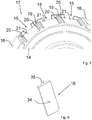
- the carrier body 14 On the outer circumference, the carrier body 14 has receiving fields 15 on which the permanent magnets 16 are applied, with no permanent magnet 16 being shown for three receiving fields 15 by way of example.
- FIG. 11 shows an enlarged view of the part of the carrier body 14 in the peripheral area of the removed permanent magnets 16 according to FIG Figure 4
- the thus freely visible receiving fields 15 are separated from one another by separating webs 19 which form part of the circumferential region 17 of the rotor 12, and the separating webs 19 extend parallel to the axis of rotation of the rotor, that is, in its height direction.
- On the side of the Separating webs 19 are support strips 20 on which the permanent magnets 16 rest and thus achieve a defined support.
- Well areas 21 extend between the support strips 20, and if the permanent magnets 16 are arranged on the receiving fields 15, they rest laterally on the support strips 20 and are held by an adhesive that is located in the gap thus formed between the permanent magnets 16 and the well area 21 of the Receiving fields 15 is located.
- a defined adhesive gap is achieved via the trough area 21 with a slightly concave curvature, so that an acrylate adhesive, in particular an anaerobic adhesive, can achieve a correspondingly high adhesive performance.
- FIG. 3 shows a single view of a permanent magnet 16, and a front surface 34 forms a curved outer side which, in the glued-on state, points in the direction of the stator, and a rear surface 35 preferably forms a flat surface which points in the direction of the receiving field 15 and with the recess area 21 forms a cavity for the adhesive.
Landscapes
- Engineering & Computer Science (AREA)
- Power Engineering (AREA)
- Manufacturing & Machinery (AREA)
- Power-Operated Mechanisms For Wings (AREA)
- Connection Of Motors, Electrical Generators, Mechanical Devices, And The Like (AREA)
Priority Applications (6)
| Application Number | Priority Date | Filing Date | Title |
|---|---|---|---|
| ES19214435T ES2985214T3 (es) | 2019-12-09 | 2019-12-09 | Accionamiento de puerta con una unidad de motor de gran potencia, de pequeño tamaño |
| EP19214435.0A EP3835531B1 (fr) | 2019-12-09 | 2019-12-09 | Entrainement de porte doté d'une unité moteur d'encombrement réduit haute performance |
| US17/782,862 US12113399B2 (en) | 2019-12-09 | 2020-12-03 | Door drive with a small high-performance motor unit |
| PCT/EP2020/084535 WO2021115930A1 (fr) | 2019-12-09 | 2020-12-03 | Entraînement de porte doté d'une petite unité moteur haute performance |
| CN202080084428.2A CN114787472B (zh) | 2019-12-09 | 2020-12-03 | 具有功率大的、小构造的马达单元的门驱动器 |
| AU2020403070A AU2020403070B2 (en) | 2019-12-09 | 2020-12-03 | Door drive with a small high-performance motor unit |
Applications Claiming Priority (1)
| Application Number | Priority Date | Filing Date | Title |
|---|---|---|---|
| EP19214435.0A EP3835531B1 (fr) | 2019-12-09 | 2019-12-09 | Entrainement de porte doté d'une unité moteur d'encombrement réduit haute performance |
Publications (3)
| Publication Number | Publication Date |
|---|---|
| EP3835531A1 true EP3835531A1 (fr) | 2021-06-16 |
| EP3835531C0 EP3835531C0 (fr) | 2024-03-27 |
| EP3835531B1 EP3835531B1 (fr) | 2024-03-27 |
Family
ID=68840909
Family Applications (1)
| Application Number | Title | Priority Date | Filing Date |
|---|---|---|---|
| EP19214435.0A Active EP3835531B1 (fr) | 2019-12-09 | 2019-12-09 | Entrainement de porte doté d'une unité moteur d'encombrement réduit haute performance |
Country Status (6)
| Country | Link |
|---|---|
| US (1) | US12113399B2 (fr) |
| EP (1) | EP3835531B1 (fr) |
| CN (1) | CN114787472B (fr) |
| AU (1) | AU2020403070B2 (fr) |
| ES (1) | ES2985214T3 (fr) |
| WO (1) | WO2021115930A1 (fr) |
Families Citing this family (1)
| Publication number | Priority date | Publication date | Assignee | Title |
|---|---|---|---|---|
| EP4485754A1 (fr) * | 2023-06-27 | 2025-01-01 | dormakaba Deutschland GmbH | Dispositif à aimant permanent, machine à flux axial et entraînement électromécanique |
Citations (5)
| Publication number | Priority date | Publication date | Assignee | Title |
|---|---|---|---|---|
| DE102008046062A1 (de) | 2008-09-08 | 2010-03-11 | Dorma Gmbh + Co. Kg | Nachrüstsatz mit einer Antriebseinheit, insbesondere für eine automatische Schiebetür |
| DE102008047310A1 (de) * | 2008-09-16 | 2010-04-15 | Elau Gmbh | Elektromotor mit sichelförmigen Magnetprofilen |
| US20100244607A1 (en) * | 2009-03-31 | 2010-09-30 | Mitsubishi Electric Corporation | Rotor of rotary electric machine and method of manufacturing the same |
| DE102014115931A1 (de) * | 2014-10-31 | 2016-05-04 | Dorma Deutschland Gmbh | Türantrieb |
| DE102014115932A1 (de) | 2014-10-31 | 2016-05-04 | Dorma Deutschland Gmbh | Türantrieb |
Family Cites Families (10)
| Publication number | Priority date | Publication date | Assignee | Title |
|---|---|---|---|---|
| US4594525A (en) * | 1983-06-27 | 1986-06-10 | General Electric Company | Rotatable assembly for a dynamoelectric machine |
| US5397951A (en) * | 1991-11-29 | 1995-03-14 | Fanuc Ltd. | Rotor for a synchronous rotary machine |
| EP1748533B1 (fr) * | 2005-07-29 | 2010-09-01 | Siemens Aktiengesellschaft | Rotor à aimants permanents pour machine électrique sans balais |
| DE202006007139U1 (de) * | 2006-02-10 | 2006-10-26 | Gretsch-Unitas GmbH Baubeschläge | Betätigungsvorrichtung für Türen |
| EP2348612A1 (fr) * | 2010-01-20 | 2011-07-27 | Siemens Aktiengesellschaft | Pièce de composant magnétique pour ensemble de rotor |
| EP2555384B1 (fr) * | 2011-08-01 | 2016-06-29 | Siemens Aktiengesellschaft | Structure de champ d'une machine électrique |
| JP5958502B2 (ja) * | 2013-12-06 | 2016-08-02 | 株式会社デンソー | 回転子およびそれを用いた回転電機 |
| DE102014115924A1 (de) * | 2014-10-31 | 2016-05-04 | Dorma Deutschland Gmbh | Türantrieb |
| JP6464114B2 (ja) * | 2016-05-20 | 2019-02-06 | ファナック株式会社 | 回転電機の回転子構造および回転電機 |
| CN110212663B (zh) * | 2019-06-19 | 2025-03-28 | 宁波富佳实业股份有限公司 | 外转子无刷电机 |
-
2019
- 2019-12-09 EP EP19214435.0A patent/EP3835531B1/fr active Active
- 2019-12-09 ES ES19214435T patent/ES2985214T3/es active Active
-
2020
- 2020-12-03 WO PCT/EP2020/084535 patent/WO2021115930A1/fr not_active Ceased
- 2020-12-03 CN CN202080084428.2A patent/CN114787472B/zh active Active
- 2020-12-03 US US17/782,862 patent/US12113399B2/en active Active
- 2020-12-03 AU AU2020403070A patent/AU2020403070B2/en active Active
Patent Citations (5)
| Publication number | Priority date | Publication date | Assignee | Title |
|---|---|---|---|---|
| DE102008046062A1 (de) | 2008-09-08 | 2010-03-11 | Dorma Gmbh + Co. Kg | Nachrüstsatz mit einer Antriebseinheit, insbesondere für eine automatische Schiebetür |
| DE102008047310A1 (de) * | 2008-09-16 | 2010-04-15 | Elau Gmbh | Elektromotor mit sichelförmigen Magnetprofilen |
| US20100244607A1 (en) * | 2009-03-31 | 2010-09-30 | Mitsubishi Electric Corporation | Rotor of rotary electric machine and method of manufacturing the same |
| DE102014115931A1 (de) * | 2014-10-31 | 2016-05-04 | Dorma Deutschland Gmbh | Türantrieb |
| DE102014115932A1 (de) | 2014-10-31 | 2016-05-04 | Dorma Deutschland Gmbh | Türantrieb |
Also Published As
| Publication number | Publication date |
|---|---|
| AU2020403070A1 (en) | 2022-06-09 |
| CN114787472A (zh) | 2022-07-22 |
| ES2985214T3 (es) | 2024-11-04 |
| EP3835531C0 (fr) | 2024-03-27 |
| EP3835531B1 (fr) | 2024-03-27 |
| AU2020403070B2 (en) | 2026-03-05 |
| CN114787472B (zh) | 2025-08-19 |
| US12113399B2 (en) | 2024-10-08 |
| US20230017823A1 (en) | 2023-01-19 |
| WO2021115930A1 (fr) | 2021-06-17 |
Similar Documents
| Publication | Publication Date | Title |
|---|---|---|
| EP1657800B1 (fr) | Rotor à aimants permanents | |
| EP3593441B1 (fr) | Moteur électrique | |
| DE102016216888A1 (de) | Antriebsvorrichtung für einen Fensterheber, mit einem Lagerelement zum Fixieren eines Stators in einem Gehäuse | |
| DE102016216890A1 (de) | Antriebsvorrichtung für einen Fensterheber, mit einem Außenläufermotor | |
| WO2004042891A1 (fr) | Machine a aimant permanent a entrefer axial | |
| DE102012200882A1 (de) | Elektrische Maschine mit einer Klemmnase zur Magnetbefestigung | |
| EP3835531A1 (fr) | Entrainement de porte doté d'une unité moteur d'encombrement réduit haute performance | |
| EP3817195A1 (fr) | Rotor pour une machine électrique, procédé de fabrication associé et machine électrique permettant d'entrainer un véhicule | |
| EP1826359A1 (fr) | Barrière d'accès | |
| EP1563587B1 (fr) | Dispositif d'entrainement pour dispositifs de reglage de vehicules automobiles | |
| EP3835528B1 (fr) | Ensemble de porte doté d'une unité moteur, présentant une forme basique avantageuse | |
| EP3835534B1 (fr) | Entrainement de porte doté d'une unité moteur | |
| EP3035497B1 (fr) | Porte à tambour | |
| EP4445477A1 (fr) | Stator pour machine à flux axial | |
| EP3835529A1 (fr) | Entraînement de porte doté d'une unité moteur, comportant un agencement palier avantageux permettant de loger un arbre de sortie | |
| EP3835532B1 (fr) | Entrainement de porte doté d'une unité moteur d'une construction simple à densité d'intégration élevée | |
| DE202015100189U1 (de) | Antriebsvorrichtung für den dreh- und kippbar an einem Blendrahmen angeordneten Flügel eines Fensters oder einer Tür | |
| EP3835530B1 (fr) | Entrainement de porte doté d'une unité de moteur, comportant une connection électrique avantageux | |
| EP3835533B1 (fr) | Entrainement de porte doté d'une unité moteur à faible encombrement | |
| DE102018131847A1 (de) | Käfig zur relativen Positionierung von Magnetkörpern an einem Blechpaket einer elektrischen Maschine | |
| DE19508384C2 (de) | Magnet-Anordnung in einer Magnetleiste für einen elektrischen Linearmotor | |
| DE102006004608B4 (de) | Elektrische Maschine | |
| EP0702447A2 (fr) | Moteur électrique sans boîtier avec flasques-palier | |
| DE102020114323A1 (de) | Rotor einer elektrischen Rotationsmaschine, Verfahren zur Herstellung eines Rotors einer elektrischen Rotationsmaschine sowie elektrische Rotationsmaschine | |
| DE2846280B2 (de) | Käfigläufer für einen Induktionsmotor mit axialem Luftspalt |
Legal Events
| Date | Code | Title | Description |
|---|---|---|---|
| PUAI | Public reference made under article 153(3) epc to a published international application that has entered the european phase |
Free format text: ORIGINAL CODE: 0009012 |
|
| STAA | Information on the status of an ep patent application or granted ep patent |
Free format text: STATUS: THE APPLICATION HAS BEEN PUBLISHED |
|
| AK | Designated contracting states |
Kind code of ref document: A1 Designated state(s): AL AT BE BG CH CY CZ DE DK EE ES FI FR GB GR HR HU IE IS IT LI LT LU LV MC MK MT NL NO PL PT RO RS SE SI SK SM TR |
|
| STAA | Information on the status of an ep patent application or granted ep patent |
Free format text: STATUS: REQUEST FOR EXAMINATION WAS MADE |
|
| 17P | Request for examination filed |
Effective date: 20211216 |
|
| RBV | Designated contracting states (corrected) |
Designated state(s): AL AT BE BG CH CY CZ DE DK EE ES FI FR GB GR HR HU IE IS IT LI LT LU LV MC MK MT NL NO PL PT RO RS SE SI SK SM TR |
|
| RIC1 | Information provided on ipc code assigned before grant |
Ipc: E05F 15/643 20150101ALN20230831BHEP Ipc: E05F 15/632 20150101ALN20230831BHEP Ipc: H02K 15/03 20060101ALI20230831BHEP Ipc: H02K 1/278 20220101ALI20230831BHEP Ipc: E05F 15/603 20150101AFI20230831BHEP |
|
| RIC1 | Information provided on ipc code assigned before grant |
Ipc: E05F 15/643 20150101ALN20230925BHEP Ipc: E05F 15/632 20150101ALN20230925BHEP Ipc: H02K 15/03 20060101ALI20230925BHEP Ipc: H02K 1/278 20220101ALI20230925BHEP Ipc: E05F 15/603 20150101AFI20230925BHEP |
|
| GRAP | Despatch of communication of intention to grant a patent |
Free format text: ORIGINAL CODE: EPIDOSNIGR1 |
|
| STAA | Information on the status of an ep patent application or granted ep patent |
Free format text: STATUS: GRANT OF PATENT IS INTENDED |
|
| INTG | Intention to grant announced |
Effective date: 20231110 |
|
| GRAS | Grant fee paid |
Free format text: ORIGINAL CODE: EPIDOSNIGR3 |
|
| GRAA | (expected) grant |
Free format text: ORIGINAL CODE: 0009210 |
|
| STAA | Information on the status of an ep patent application or granted ep patent |
Free format text: STATUS: THE PATENT HAS BEEN GRANTED |
|
| AK | Designated contracting states |
Kind code of ref document: B1 Designated state(s): AL AT BE BG CH CY CZ DE DK EE ES FI FR GB GR HR HU IE IS IT LI LT LU LV MC MK MT NL NO PL PT RO RS SE SI SK SM TR |
|
| REG | Reference to a national code |
Ref country code: GB Ref legal event code: FG4D Free format text: NOT ENGLISH |
|
| REG | Reference to a national code |
Ref country code: CH Ref legal event code: EP |
|
| REG | Reference to a national code |
Ref country code: DE Ref legal event code: R096 Ref document number: 502019010885 Country of ref document: DE |
|
| REG | Reference to a national code |
Ref country code: IE Ref legal event code: FG4D Free format text: LANGUAGE OF EP DOCUMENT: GERMAN |
|
| U01 | Request for unitary effect filed |
Effective date: 20240417 |
|
| U07 | Unitary effect registered |
Designated state(s): AT BE BG DE DK EE FI FR IT LT LU LV MT NL PT SE SI Effective date: 20240424 |
|
| PG25 | Lapsed in a contracting state [announced via postgrant information from national office to epo] |
Ref country code: GR Free format text: LAPSE BECAUSE OF FAILURE TO SUBMIT A TRANSLATION OF THE DESCRIPTION OR TO PAY THE FEE WITHIN THE PRESCRIBED TIME-LIMIT Effective date: 20240628 |
|
| PG25 | Lapsed in a contracting state [announced via postgrant information from national office to epo] |
Ref country code: RS Free format text: LAPSE BECAUSE OF FAILURE TO SUBMIT A TRANSLATION OF THE DESCRIPTION OR TO PAY THE FEE WITHIN THE PRESCRIBED TIME-LIMIT Effective date: 20240627 Ref country code: HR Free format text: LAPSE BECAUSE OF FAILURE TO SUBMIT A TRANSLATION OF THE DESCRIPTION OR TO PAY THE FEE WITHIN THE PRESCRIBED TIME-LIMIT Effective date: 20240327 |
|
| PG25 | Lapsed in a contracting state [announced via postgrant information from national office to epo] |
Ref country code: RS Free format text: LAPSE BECAUSE OF FAILURE TO SUBMIT A TRANSLATION OF THE DESCRIPTION OR TO PAY THE FEE WITHIN THE PRESCRIBED TIME-LIMIT Effective date: 20240627 Ref country code: NO Free format text: LAPSE BECAUSE OF FAILURE TO SUBMIT A TRANSLATION OF THE DESCRIPTION OR TO PAY THE FEE WITHIN THE PRESCRIBED TIME-LIMIT Effective date: 20240627 Ref country code: HR Free format text: LAPSE BECAUSE OF FAILURE TO SUBMIT A TRANSLATION OF THE DESCRIPTION OR TO PAY THE FEE WITHIN THE PRESCRIBED TIME-LIMIT Effective date: 20240327 Ref country code: GR Free format text: LAPSE BECAUSE OF FAILURE TO SUBMIT A TRANSLATION OF THE DESCRIPTION OR TO PAY THE FEE WITHIN THE PRESCRIBED TIME-LIMIT Effective date: 20240628 |
|
| PG25 | Lapsed in a contracting state [announced via postgrant information from national office to epo] |
Ref country code: IS Free format text: LAPSE BECAUSE OF FAILURE TO SUBMIT A TRANSLATION OF THE DESCRIPTION OR TO PAY THE FEE WITHIN THE PRESCRIBED TIME-LIMIT Effective date: 20240727 |
|
| PG25 | Lapsed in a contracting state [announced via postgrant information from national office to epo] |
Ref country code: SM Free format text: LAPSE BECAUSE OF FAILURE TO SUBMIT A TRANSLATION OF THE DESCRIPTION OR TO PAY THE FEE WITHIN THE PRESCRIBED TIME-LIMIT Effective date: 20240327 |
|
| PG25 | Lapsed in a contracting state [announced via postgrant information from national office to epo] |
Ref country code: CZ Free format text: LAPSE BECAUSE OF FAILURE TO SUBMIT A TRANSLATION OF THE DESCRIPTION OR TO PAY THE FEE WITHIN THE PRESCRIBED TIME-LIMIT Effective date: 20240327 |
|
| PG25 | Lapsed in a contracting state [announced via postgrant information from national office to epo] |
Ref country code: PL Free format text: LAPSE BECAUSE OF FAILURE TO SUBMIT A TRANSLATION OF THE DESCRIPTION OR TO PAY THE FEE WITHIN THE PRESCRIBED TIME-LIMIT Effective date: 20240327 |
|
| PG25 | Lapsed in a contracting state [announced via postgrant information from national office to epo] |
Ref country code: SK Free format text: LAPSE BECAUSE OF FAILURE TO SUBMIT A TRANSLATION OF THE DESCRIPTION OR TO PAY THE FEE WITHIN THE PRESCRIBED TIME-LIMIT Effective date: 20240327 |
|
| PG25 | Lapsed in a contracting state [announced via postgrant information from national office to epo] |
Ref country code: SM Free format text: LAPSE BECAUSE OF FAILURE TO SUBMIT A TRANSLATION OF THE DESCRIPTION OR TO PAY THE FEE WITHIN THE PRESCRIBED TIME-LIMIT Effective date: 20240327 Ref country code: SK Free format text: LAPSE BECAUSE OF FAILURE TO SUBMIT A TRANSLATION OF THE DESCRIPTION OR TO PAY THE FEE WITHIN THE PRESCRIBED TIME-LIMIT Effective date: 20240327 Ref country code: RO Free format text: LAPSE BECAUSE OF FAILURE TO SUBMIT A TRANSLATION OF THE DESCRIPTION OR TO PAY THE FEE WITHIN THE PRESCRIBED TIME-LIMIT Effective date: 20240327 Ref country code: PL Free format text: LAPSE BECAUSE OF FAILURE TO SUBMIT A TRANSLATION OF THE DESCRIPTION OR TO PAY THE FEE WITHIN THE PRESCRIBED TIME-LIMIT Effective date: 20240327 Ref country code: IS Free format text: LAPSE BECAUSE OF FAILURE TO SUBMIT A TRANSLATION OF THE DESCRIPTION OR TO PAY THE FEE WITHIN THE PRESCRIBED TIME-LIMIT Effective date: 20240727 Ref country code: CZ Free format text: LAPSE BECAUSE OF FAILURE TO SUBMIT A TRANSLATION OF THE DESCRIPTION OR TO PAY THE FEE WITHIN THE PRESCRIBED TIME-LIMIT Effective date: 20240327 |
|
| REG | Reference to a national code |
Ref country code: ES Ref legal event code: FG2A Ref document number: 2985214 Country of ref document: ES Kind code of ref document: T3 Effective date: 20241104 |
|
| REG | Reference to a national code |
Ref country code: DE Ref legal event code: R097 Ref document number: 502019010885 Country of ref document: DE |
|
| U20 | Renewal fee for the european patent with unitary effect paid |
Year of fee payment: 6 Effective date: 20241227 |
|
| PLBE | No opposition filed within time limit |
Free format text: ORIGINAL CODE: 0009261 |
|
| STAA | Information on the status of an ep patent application or granted ep patent |
Free format text: STATUS: NO OPPOSITION FILED WITHIN TIME LIMIT |
|
| 26N | No opposition filed |
Effective date: 20250103 |
|
| PG25 | Lapsed in a contracting state [announced via postgrant information from national office to epo] |
Ref country code: MC Free format text: LAPSE BECAUSE OF FAILURE TO SUBMIT A TRANSLATION OF THE DESCRIPTION OR TO PAY THE FEE WITHIN THE PRESCRIBED TIME-LIMIT Effective date: 20240327 |
|
| PG25 | Lapsed in a contracting state [announced via postgrant information from national office to epo] |
Ref country code: IE Free format text: LAPSE BECAUSE OF NON-PAYMENT OF DUE FEES Effective date: 20241209 |
|
| REG | Reference to a national code |
Ref country code: CH Ref legal event code: U11 Free format text: ST27 STATUS EVENT CODE: U-0-0-U10-U11 (AS PROVIDED BY THE NATIONAL OFFICE) Effective date: 20260101 |
|
| PGFP | Annual fee paid to national office [announced via postgrant information from national office to epo] |
Ref country code: GB Payment date: 20251219 Year of fee payment: 7 |
|
| U20 | Renewal fee for the european patent with unitary effect paid |
Year of fee payment: 7 Effective date: 20251230 |
|
| PGFP | Annual fee paid to national office [announced via postgrant information from national office to epo] |
Ref country code: ES Payment date: 20260130 Year of fee payment: 7 |
|
| PGFP | Annual fee paid to national office [announced via postgrant information from national office to epo] |
Ref country code: CH Payment date: 20260101 Year of fee payment: 7 |