EP4169871A1 - Dispositif d'alimentation de bouchons à un dispositif de fermeture dans une installation de remplissage de boissons - Google Patents
Dispositif d'alimentation de bouchons à un dispositif de fermeture dans une installation de remplissage de boissons Download PDFInfo
- Publication number
- EP4169871A1 EP4169871A1 EP22203085.0A EP22203085A EP4169871A1 EP 4169871 A1 EP4169871 A1 EP 4169871A1 EP 22203085 A EP22203085 A EP 22203085A EP 4169871 A1 EP4169871 A1 EP 4169871A1
- Authority
- EP
- European Patent Office
- Prior art keywords
- closure
- closures
- capper
- stopper
- caps
- Prior art date
- Legal status (The legal status is an assumption and is not a legal conclusion. Google has not performed a legal analysis and makes no representation as to the accuracy of the status listed.)
- Granted
Links
Images


Classifications
-
- B—PERFORMING OPERATIONS; TRANSPORTING
- B67—OPENING, CLOSING OR CLEANING BOTTLES, JARS OR SIMILAR CONTAINERS; LIQUID HANDLING
- B67B—APPLYING CLOSURE MEMBERS TO BOTTLES JARS, OR SIMILAR CONTAINERS; OPENING CLOSED CONTAINERS
- B67B3/00—Closing bottles, jars or similar containers by applying caps
- B67B3/02—Closing bottles, jars or similar containers by applying caps by applying flanged caps, e.g. crown caps, and securing by deformation of flanges
- B67B3/06—Feeding caps to capping heads
-
- B—PERFORMING OPERATIONS; TRANSPORTING
- B67—OPENING, CLOSING OR CLEANING BOTTLES, JARS OR SIMILAR CONTAINERS; LIQUID HANDLING
- B67B—APPLYING CLOSURE MEMBERS TO BOTTLES JARS, OR SIMILAR CONTAINERS; OPENING CLOSED CONTAINERS
- B67B3/00—Closing bottles, jars or similar containers by applying caps
- B67B3/02—Closing bottles, jars or similar containers by applying caps by applying flanged caps, e.g. crown caps, and securing by deformation of flanges
- B67B3/06—Feeding caps to capping heads
- B67B3/064—Feeding caps to capping heads from a hopper
- B67B3/0645—Feeding caps to capping heads from a hopper with means for orientating the caps to a position ready to be applied to the container
Definitions
- the present invention relates to a device for supplying closures to a closure for closing containers with the closures, preferably in a beverage bottling plant.
- Cappers are known for applying caps to filled containers, for example for applying crown caps or screw caps to bottles in beverage bottling plants.
- a capper in a rotary design has a rotating carousel on the circumference of which a number of capping elements and associated container holders are mounted. The container to be closed is transferred to a container holder of the carousel via a container feed, for example via a transfer star wheel, and is closed with a closure by means of an associated closing element during transport along a pitch circle of the carousel.
- a capper is for example in DE 10 2012 103 518 A1 described.
- the caps are usually fed to the capper via a capping chute, through which the caps are either transferred directly to the capper or to a so-called pick wheel, which is arranged in front of the actual capper and the caps provided by the capping chute in a continuous stream to the required pitch / clock brings.
- the closures are provided in advance by means of a provision device, including, for example, a sorting and/or alignment of the closures.
- the supply device is usually arranged above the capper and is connected to the capper via the capping chute, in which the sorted and correctly aligned caps are guided.
- the closures then slip due to their own weight or otherwise driven by the Delivery device to the capper.
- a system of capper, delivery device and capping chute is, for example, from DE 10 2018 129 548 A1 out.
- a gap occurs in the sequence of containers to be sealed.
- the cap chute should not transfer a cap to the capper, otherwise the excess cap may cause malfunctions in the capper.
- the stopper includes an actuatable finger which, when required, engages the closure channel and stops closure feeding.
- a shutter feeder with a stopper is shown, for example, in DE 10 2012 110 102 A1 described.
- Such a stopper causes an abrupt stop, as a result of which, due to the mass inertia of the following closures, a high dynamic pressure builds up on the front closures, which can damage or deform the closures. Such damage or deformation of the closures can lead to closures jamming in the closure channel, thus preventing the closure feed from being restarted, or causing malfunctions in the closure unit. Manual intervention by an operator is required, which reduces plant productivity.
- An object of the present invention is to provide an improved device for feeding caps to a capper, preferably in a beverage bottling plant, in particular to reduce any damage/deformation of the caps and/or to optimize the plant productivity.
- the device according to the invention serves to supply closures to a capper for capping containers with the closures.
- the device is particularly preferably used in a beverage bottling plant, for example for bottling water (still or carbonated), soft drinks, beer, wine, juice, smoothies, dairy products, mixed drinks and the like.
- the device comprises a capping chute for feeding the caps to the capper, the capping chute being arranged and set up in such a way that the caps are guided and transported along a transport path predetermined by the capping chute.
- the closure chute thus has a shape and dimensions corresponding to the closures, viewed in cross section perpendicular to the transport path, so that the closures in the closure chute can move along the defined transport path in the direction of the capper.
- the device also has a stopping device with a stopper which, according to the invention, is set up to decelerate and stop the supply of the closures to the closure device in the closure channel along a braking distance.
- a stopping device with a stopper which, according to the invention, is set up to decelerate and stop the supply of the closures to the closure device in the closure channel along a braking distance.
- the shutters are not stopped abruptly when the shutter feeding is stopped, but the stopper is a cushioning stopper by decelerating the shutters along a certain distance, thus stopping the shutter feeding smoothly.
- the braking distance naturally defines a distance greater than zero.
- the stopper is designed to slow down along the braking distance, i.e. it does not include minimal and unintentional deformations, vibrations and the like, caused by material or design, as well as any design-related play between components.
- the cap supply is not stopped abruptly in the event of an interruption, but the caps are slowed down along a braking distance, the dynamic pressure and thus the force on caps in the area of the stopping device, caused by subsequent caps, is slowly and gently reduced.
- the gentle force reduction prevents damage and/or deformation of the closures when stopping the closure supply. Mechanical interventions after machine stops are not necessary or can at least be reduced, which optimizes the system efficiency.
- the stopper preferably comprises a stop element designed in the manner of a pin, pen or finger, in which case the stopper is set up to move the stop element into the closure channel in such a way that the supply of the closures to the closure can be blocked. If the supply of caps to the capper is to be interrupted, the stopping device moves the stop element into the capping channel, for example by means of a corresponding triggering device, so that the flow of caps to the capper is blocked.
- the triggering device can actuate the stop element electrically, magnetically, hydraulically, pneumatically or purely mechanically, for example.
- the stop element is particularly preferably mounted so that it can be displaced along the closing channel. In this way, a mechanically simple and reliable stopper is realized.
- the stopper can have a rotatably mounted stop wheel with a plurality of circumferentially arranged engagement sections which can each be brought into engagement with a closure in the closure channel in order to stop the supply of closures to the closure.
- the stop wheel is preferably a gear wheel with a pitch matching the locks in the lock channel, the engagement portions being formed by the teeth of the gear wheel.
- the stopping device preferably has a braking device which is connected to the stopping wheel and is set up to stop rotation of the stopping wheel, i.e. to block it or to brake it to a standstill.
- the stop wheel is rotatably mounted on the braking device, with the gentle braking of the closure feed preferably being achieved in that the braking device brakes the stop wheel in a controlled manner over a certain angle of rotation, which corresponds to the braking distance.
- the braking device includes a variable-speed electric motor, for example a synchronous motor, and a corresponding controller.
- the stopper is preferably mounted so that it can be displaced along the braking distance.
- the stopper for example specifically a bearing of the stop wheel or stop element, can be slidably installed by means of a guide.
- the guide is preferably attached to a support which is stationary relative to the closure channel.
- the braking distance can be adjusted flexibly and well-defined by mechanically simple means by mounting the stopper so that it can be displaced along the braking distance.
- the stopping device preferably has a damping device which is set up to damp a displacement of the stopper along the braking path, as a result of which the closure supply is braked particularly gently.
- the damping device can be formed by an elongate, elastic part, for example a spring, which is fastened on one side to the holder and on the other side to the stopper. In this way, the damping device can be mechanically simple and implement in a reliable manner.
- the damping device can work pneumatically or magnetically.
- a pneumatic cylinder can be installed between the holder and the stopper, which can also dampen or gently brake the movement of the closures.
- the closure channel is preferably arranged and set up in such a way that the closures can be transported along the transport path due to the force of gravity, with the closure channel running at least in sections inclined (relative to the horizontal) and/or vertically for this purpose.
- the caps can be transported in the cap channel without a dedicated drive.
- the braking distance preferably has a vertical (vector) component, as a result of which the construction is mechanically particularly simple and reliable.
- the braking distance can essentially run entirely in the direction of gravity.
- the propulsion of the closures in the closure channel towards the capper can be generated or supported in some other way, for example by a magnet unit in the case of metal closures such as crown caps.
- the closure channel is preferably set up in such a way that there is always a maximum of exactly one closure at a given position on the transport path.
- the closures move in the closure chute one behind the other along the transport path, which simplifies the controlled supply to the capper and the separation.
- the above-mentioned object is also achieved by a system or a device with a closure for closing containers, a device connected thereto for feeding closures to the closure according to one of the embodiment variants presented above, and a delivery device which is set up to supply closures for closing the Provide containers and transfer them to the device for feeding closures.
- the capper can have a pick wheel onto which the caps are placed via the capping chute.
- the pick wheel is a star-wheel-shaped feed device which brings the closures provided by the closure chute in a continuous stream to the spacing or timing specified in the closure unit. If necessary, a pick wheel can be dispensed with in that the closures are transferred from the closure chute to a transfer platform, for example.
- the transfer platform is set up in such a way that the closures placed on it can be picked up and further processed by closure members of the closure unit.
- the supply device is preferably set up to sort and/or align the closures.
- the provision device can have a closure reservoir, preferably of a cylindrical design, which is set up to accommodate a large number of closures.
- the closure reservoir can have an agitator for mixing and/or conveying and/or aligning the closures. Crown caps, screw caps or corks, for example, can be used as closures.
- the stopping device is preferably set up to decelerate the supply of the caps to the capper in the capping channel during the transition from an operating state in which the caps are to be fed to the capper to a stop state in which the cap supply to the capper is to be interrupted, along the braking distance.
- the transition from the operating state to the stop state and vice versa takes place as required, for example in the event of a technical fault in the capper. In this way it can be effectively prevented that, in the event of a gap in the sequence of containers to be sealed, the sealing chute transfers superfluous seals to the sealer, where the seals could otherwise cause problems.
- the figure 1 shows a device 1 with a closure device 10 for closing containers (not shown in the figures) with corresponding closures 2 (cf. Figures 2a, 2b , 3 and 4 ) and a device 20 for feeding caps 2 to the capper 10.
- the device 1 is preferably a plant part of a filling plant for filling containers with a filling product.
- the device 1 is used in a beverage bottling plant, for example for bottling water (still or carbonated), soft drinks, beer, wine, juice, smoothies, milk products, mixed drinks and the like.
- closures 2 that have been sorted and aligned with respect to their spatial position are fed to this from a supply device 30 arranged above the closing device 10 .
- the supply device 30 for example, closures 2 that arrive unsorted are sorted.
- the supply device 30 can have a closure reservoir 31, preferably of a cylindrical shape, which is set up to accommodate a large number of closures 2.
- the closure reservoir 31 can have an agitator for mixing, conveying and optionally aligning the closures 2 .
- Crown caps, screw caps or corks, for example, can be considered as closures 2 .
- the device 20 for supplying caps 2 with a cap chute 21 is arranged between the supply device 30 and the capper 10 .
- the closure channel 21 is connected to the lower area of the closure reservoir 31 in such a way that the closures 2 can be placed from the closure reservoir 31 into the closure channel 21 .
- the closure chute 21 is set up in such a way that the closures 2 are guided along a transport path defined by the closure chute 21, whereby they are particularly preferably conveyed along the transport path by their own weight, i.e. due to the force of gravity.
- the closure channel 21 is largely inclined with respect to the horizontal and runs vertically in sections.
- the closure channel 21 has a shape and dimensions corresponding to the closures 2, viewed in cross section perpendicular to the transport path, so that there is always a maximum of exactly one closure 2 at a given position of the transport path.
- the caps 2 move one behind the other in the capping channel 21 along the transport path, with the capping channel 21 being designed like a slide so that the caps 2 slide down the capping channel 21 in the direction of the capper 10 after leaving the cap reservoir 31 .
- a transfer segment 22 adjoins the closure chute 21 in the area of the capper 10 , through which the closures 2 are brought into a horizontal alignment and are transferred from the closure chute 21 to the capper 10 .
- the closures 2 are transferred by the transfer segment 22 to a pick wheel 11 which is conceptually regarded here as a component of the closure device 10 .
- the pick wheel 11 is a star-wheel-shaped feed device, which brings the closures 2 provided by the transfer segment 22 in a continuous stream to the pitch or timing specified in the closure unit 2 .
- the pick wheel 11 transfers the closures 2 accordingly to closure members 12 which are arranged on the periphery of a carousel and set up to close the containers with a closure 2 each.
- a pick wheel 11 can be dispensed with in that the closures 2 are transferred from the transfer segment 22 to a transfer platform, for example.
- the transfer platform is set up in such a way that the closures 2 placed on it can be picked up by the closure elements 12 of the closure unit 10 and processed further.
- the device 20 for feeding caps 2 also has a stop device 23 which is set up to interrupt the flow of caps 2 from the capping chute 21 to the capper 10 if necessary, for example if there is a technical fault in the capper 2 .
- the stopper 23 is preferably arranged at a vertical portion of the shutter chute 21, tending towards the lower portion of the shutter chute 21.
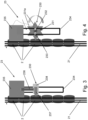
- FIG. 2a shows a state of the stop device 23 during regular operation, herein also referred to as "operational state” during which Figure 2b shows a state of the stopper 23 during an interruption of the shutter supply, also referred to herein as a "stop state”.
- the stopping device 23 has a dampening stopper 230 which is set up to brake the closure feed in the closure channel 21 along a braking distance B greater than zero during the transition from the operating state to the stop state.
- the shutters 2 are not stopped abruptly, but the stopper 230 rides or rotates a certain distance, thus smoothly stopping the shutter supply.
- the stopper 23 includes a stopper wheel 231 having engaging portions 231a each engageable with a shutter 2 to stop shutter feeding.
- the stop wheel 231 is in the simplest case, a toothed wheel with a pitch matching the closures 2, the engagement sections 231a being formed by the teeth of the toothed wheel.
- the stop wheel 231 is rotatably mounted on a bearing 232 and is preferably freely rotating in the operating state. Alternatively, the stop wheel 231 may function as a regulator to regulate the speed of the inflow of the shutters 2 .
- the stopping device 23 also has a braking device 233 which is set up to stop the stop wheel 231 .
- This is preferably done electrically, ie the braking device 233 can be implemented by an electric motor or by an electrically actuatable lock.
- the actuation of the braking device 233 can be wireless or as in the Figures 2a and 2b indicated wired.
- pneumatic, hydraulic, magnetic or purely mechanical means for implementing the braking device 233 can also be considered.
- the stop wheel 231 is slidably mounted along the braking distance B.
- the bearing 232 can be slidably installed by a guide 234 .
- the guide 234 is attached to a bracket 235 which is stationary relative to the closure channel 21 .
- the stopping device 23 also has a damping device 236, which damps a displacement of the bearing 232 along the guide 234 in the event of a transition from the operating state to the stopping state.
- the damping device 236 can be formed by an elongate, elastic part, for example a spring, which is fastened to the holder 235 on one side and to the bearing 232 on the other side.
- the damping device can work pneumatically or magnetically.
- FIG. 12 shows an alternative embodiment of the stop device 23 in which the stop wheel 231 is replaced by a stop element 237.
- the stop element 237 is designed in the manner of a pin, pen or finger. If the supply of caps 2 to the capper 10 is to be interrupted, the stopping device 23 moves the stop element 237 into the capping channel 21 by means of a corresponding triggering device 238, so that the flow of caps 2 to the capper 10 is blocked.
- the triggering device 238 can actuate the stop element 237 electrically, magnetically, hydraulically, pneumatically or purely mechanically.
- a damper device 236 is also installed which does not stop the shutter supply abruptly but stops smoothly along the braking distance B in the case of the transition from the operating state to the stopping state.
- the damping device 236 can as above with respect to the Figures 2a, 2b set out to be constructed.
- the figure 4 shows another exemplary embodiment of the stopping device 23, in which a dedicated damping device 236 is dispensed with.
- the gentle braking of the closure feed is achieved by a stop wheel 231 with the associated braking device 233 (cf. Figures 2a and 2b ) is installed and the braking device 233 is set up in such a way that during the transition from the operating state to the stop state, the closure supply in the closure channel 21 is braked along a braking distance greater than zero.
- the braking device 233 includes a variable-speed electric motor, for example a synchronous motor, which is set up to brake the stop wheel 231 in a controlled manner over a certain angle of rotation, which corresponds to the intended braking distance.
- the stop wheel 231 is mounted stationarily to the locking channel 21, the position being adjustable by the guide 234, for example. In this case, however, a guide 234 can also be dispensed with.
- the closure supply is not stopped abruptly during the transition from the operating state to the stop state, but instead the closures 2 are decelerated along a braking distance B greater than zero, the dynamic pressure and thus the force on the closures 2 located below, in the area of the stopping device 23, is caused by the overlying fasteners 2, slowly and gently dismantled.
- the gentle reduction in force prevents damage and/or deformation of the closures 2 when the closure supply is stopped. Mechanical interventions after machine stops are not necessary or can at least be reduced, which optimizes the system efficiency.
Landscapes
- Engineering & Computer Science (AREA)
- Mechanical Engineering (AREA)
- Sealing Of Jars (AREA)
Applications Claiming Priority (1)
| Application Number | Priority Date | Filing Date | Title |
|---|---|---|---|
| DE102021127329.3A DE102021127329A1 (de) | 2021-10-21 | 2021-10-21 | Vorrichtung zur Zufuhr von Verschlüssen an einen Verschließer in einer Getränkeabfüllanlage |
Publications (3)
| Publication Number | Publication Date |
|---|---|
| EP4169871A1 true EP4169871A1 (fr) | 2023-04-26 |
| EP4169871C0 EP4169871C0 (fr) | 2024-08-28 |
| EP4169871B1 EP4169871B1 (fr) | 2024-08-28 |
Family
ID=83995108
Family Applications (1)
| Application Number | Title | Priority Date | Filing Date |
|---|---|---|---|
| EP22203085.0A Active EP4169871B1 (fr) | 2021-10-21 | 2022-10-21 | Dispositif d'alimentation de bouchons à un dispositif de fermeture dans une installation de remplissage de boissons |
Country Status (3)
| Country | Link |
|---|---|
| EP (1) | EP4169871B1 (fr) |
| CN (1) | CN116002599B (fr) |
| DE (1) | DE102021127329A1 (fr) |
Citations (5)
| Publication number | Priority date | Publication date | Assignee | Title |
|---|---|---|---|---|
| JP2010070248A (ja) * | 2008-09-22 | 2010-04-02 | Shibuya Kogyo Co Ltd | キャッパ |
| DE102012103518A1 (de) | 2012-04-20 | 2013-10-24 | Krones Ag | Vorrichtung zum Verschließen von Behältern |
| DE102012110102A1 (de) | 2012-10-23 | 2014-04-24 | Krones Ag | Vorrichtung und Verfahren zum Zuführen von Verschlüssen |
| CN103130158B (zh) * | 2013-03-06 | 2015-04-01 | 长沙经济技术开发区博雅机械有限公司 | 塑料瓶盖压盖机 |
| DE102018129548A1 (de) | 2018-11-23 | 2020-05-28 | Krones Ag | Vorrichtung und Verfahren zum Zuführen von Verschlüssen zu einem Verschließer zum Verschließen von Behältern |
Family Cites Families (12)
| Publication number | Priority date | Publication date | Assignee | Title |
|---|---|---|---|---|
| IT1277135B1 (it) * | 1995-01-05 | 1997-11-04 | Mauro Lenzi | Dispositivo per l espulsione automatica da un condotto di alimentazione di capsule, tappi o elementi generalmente concavi, di |
| CN2749856Y (zh) * | 2004-12-07 | 2006-01-04 | 中国国际海运集装箱(集团)股份有限公司 | 一种输送机挡板机构 |
| DE102006039091A1 (de) * | 2006-08-19 | 2008-02-21 | Khs Ag | Vorrichtung zum Zuführen von Verschlüssen an eine Verschließmaschine |
| DE602007012772D1 (de) * | 2007-04-11 | 2011-04-07 | Sidel Participations | Kapselzuführeinheit mit versetztem sternrad |
| JP2011520713A (ja) * | 2008-05-16 | 2011-07-21 | ジエア プロコマク エッセ.ピ.ア. | 容器の蓋を供給するためのデバイス |
| JP5267309B2 (ja) * | 2009-04-28 | 2013-08-21 | 澁谷工業株式会社 | キャッピング装置 |
| CN203529381U (zh) * | 2013-08-30 | 2014-04-09 | 机科发展科技股份有限公司 | 带缓冲机构的输送机阻挡器 |
| CN204173889U (zh) * | 2014-09-18 | 2015-02-25 | 杭州中亚机械股份有限公司 | 一种塑盖供应装置 |
| DE102016105586B3 (de) * | 2016-03-24 | 2017-03-23 | Wörner Automatisierungstechnik GmbH | Anschlagmodul zum positionsgenauen Anhalten eines Gegenstands |
| CN108640062B (zh) * | 2018-05-11 | 2020-07-17 | 合肥中辰轻工机械有限公司 | 一种塑料盖输盖滑道用反盖退盖器 |
| CN214086564U (zh) * | 2020-12-18 | 2021-08-31 | 上海明略人工智能(集团)有限公司 | 用于输送设备的挡停装置、输送设备 |
| CN113086537A (zh) * | 2021-05-10 | 2021-07-09 | 广州漂移方块智能科技有限公司 | 一种柔性生产线用挡停机构及柔性生产线 |
-
2021
- 2021-10-21 DE DE102021127329.3A patent/DE102021127329A1/de active Pending
-
2022
- 2022-10-19 CN CN202211282010.XA patent/CN116002599B/zh active Active
- 2022-10-21 EP EP22203085.0A patent/EP4169871B1/fr active Active
Patent Citations (5)
| Publication number | Priority date | Publication date | Assignee | Title |
|---|---|---|---|---|
| JP2010070248A (ja) * | 2008-09-22 | 2010-04-02 | Shibuya Kogyo Co Ltd | キャッパ |
| DE102012103518A1 (de) | 2012-04-20 | 2013-10-24 | Krones Ag | Vorrichtung zum Verschließen von Behältern |
| DE102012110102A1 (de) | 2012-10-23 | 2014-04-24 | Krones Ag | Vorrichtung und Verfahren zum Zuführen von Verschlüssen |
| CN103130158B (zh) * | 2013-03-06 | 2015-04-01 | 长沙经济技术开发区博雅机械有限公司 | 塑料瓶盖压盖机 |
| DE102018129548A1 (de) | 2018-11-23 | 2020-05-28 | Krones Ag | Vorrichtung und Verfahren zum Zuführen von Verschlüssen zu einem Verschließer zum Verschließen von Behältern |
Also Published As
| Publication number | Publication date |
|---|---|
| CN116002599A (zh) | 2023-04-25 |
| DE102021127329A1 (de) | 2023-04-27 |
| EP4169871C0 (fr) | 2024-08-28 |
| EP4169871B1 (fr) | 2024-08-28 |
| CN116002599B (zh) | 2026-01-23 |
Similar Documents
| Publication | Publication Date | Title |
|---|---|---|
| EP2217523B1 (fr) | Dispositif de fermeture de contenants | |
| EP2444363B1 (fr) | Dispositif et procédé destinés à la fermeture de récipients avec bouchons | |
| EP0561299B1 (fr) | Procédé et dispositif de fermeture de bouteilles | |
| EP2939972B1 (fr) | Dispositif et procédé de fermeture de récipients remplis avec un bouchon à fermeture à vis | |
| DE102020131105A1 (de) | Vorrichtung zum linearen Transportieren von Behältern | |
| DE102013110161A1 (de) | Rotierendes Behandlungskarussell | |
| EP2653435B1 (fr) | Dispositif destiné à fermer des récipients | |
| EP3090969A1 (fr) | Dispositif d'amortissement de fermetures de recipients | |
| EP3140240B1 (fr) | Procédé d'operation d'une station de bouchage et station de bouchage | |
| EP4169871B1 (fr) | Dispositif d'alimentation de bouchons à un dispositif de fermeture dans une installation de remplissage de boissons | |
| EP3901084A1 (fr) | Dispositif de transport linéaire des récipients | |
| DE1602476A1 (de) | Einrichtung zum Handhaben von Behaeltern | |
| DE10122752B4 (de) | Antrieb für höhenverstellbare Behälterträger an Abfüllmaschinen | |
| EP2724975B1 (fr) | Système et procédé d'alimentation de bouchons à un carrousel de bouchage | |
| DE3843374C2 (de) | Vorrichtung zum Verschließen von Gefäßen | |
| DE4129452A1 (de) | Verschliessmaschine | |
| EP4008683A1 (fr) | Dispositif de manutention d'au moins un récipient | |
| EP3741722B1 (fr) | Agencement de fermeture permettant de fermer un récipient à l'aide d'une fermeture pour récipient | |
| EP4232384A1 (fr) | Roue en étoile de transport pour transporter des contenants | |
| EP4011819B1 (fr) | Dispositif et procédé de fermeture d'un récipient au moyen d'une fermeture de récipient | |
| AT526279B1 (de) | Verfahren zum Fördern und Orientieren von Ausgießelementen mit Verschluss und Fördervorrichtung | |
| EP3670432B1 (fr) | Support de récipient pour dispositif de remplissage à jet libre | |
| WO2009149790A1 (fr) | Dispositif pour fermer des récipients avec un bouchon à visser | |
| EP4091983A1 (fr) | Installation de remplissage permettant de remplir un produit de remplissage | |
| DE102015110765A1 (de) | Vorrichtung zum Transport eines Behälters |
Legal Events
| Date | Code | Title | Description |
|---|---|---|---|
| PUAI | Public reference made under article 153(3) epc to a published international application that has entered the european phase |
Free format text: ORIGINAL CODE: 0009012 |
|
| STAA | Information on the status of an ep patent application or granted ep patent |
Free format text: STATUS: THE APPLICATION HAS BEEN PUBLISHED |
|
| AK | Designated contracting states |
Kind code of ref document: A1 Designated state(s): AL AT BE BG CH CY CZ DE DK EE ES FI FR GB GR HR HU IE IS IT LI LT LU LV MC ME MK MT NL NO PL PT RO RS SE SI SK SM TR |
|
| STAA | Information on the status of an ep patent application or granted ep patent |
Free format text: STATUS: REQUEST FOR EXAMINATION WAS MADE |
|
| 17P | Request for examination filed |
Effective date: 20230921 |
|
| RBV | Designated contracting states (corrected) |
Designated state(s): AL AT BE BG CH CY CZ DE DK EE ES FI FR GB GR HR HU IE IS IT LI LT LU LV MC ME MK MT NL NO PL PT RO RS SE SI SK SM TR |
|
| GRAP | Despatch of communication of intention to grant a patent |
Free format text: ORIGINAL CODE: EPIDOSNIGR1 |
|
| STAA | Information on the status of an ep patent application or granted ep patent |
Free format text: STATUS: GRANT OF PATENT IS INTENDED |
|
| RIC1 | Information provided on ipc code assigned before grant |
Ipc: B67B 3/064 20060101ALI20240215BHEP Ipc: B67B 3/06 20060101AFI20240215BHEP |
|
| INTG | Intention to grant announced |
Effective date: 20240319 |
|
| GRAS | Grant fee paid |
Free format text: ORIGINAL CODE: EPIDOSNIGR3 |
|
| GRAA | (expected) grant |
Free format text: ORIGINAL CODE: 0009210 |
|
| STAA | Information on the status of an ep patent application or granted ep patent |
Free format text: STATUS: THE PATENT HAS BEEN GRANTED |
|
| AK | Designated contracting states |
Kind code of ref document: B1 Designated state(s): AL AT BE BG CH CY CZ DE DK EE ES FI FR GB GR HR HU IE IS IT LI LT LU LV MC ME MK MT NL NO PL PT RO RS SE SI SK SM TR |
|
| REG | Reference to a national code |
Ref country code: CH Ref legal event code: EP |
|
| REG | Reference to a national code |
Ref country code: DE Ref legal event code: R096 Ref document number: 502022001569 Country of ref document: DE |
|
| REG | Reference to a national code |
Ref country code: IE Ref legal event code: FG4D Free format text: LANGUAGE OF EP DOCUMENT: GERMAN |
|
| U01 | Request for unitary effect filed |
Effective date: 20240904 |
|
| U07 | Unitary effect registered |
Designated state(s): AT BE BG DE DK EE FI FR IT LT LU LV MT NL PT RO SE SI Effective date: 20240923 |
|
| U20 | Renewal fee for the european patent with unitary effect paid |
Year of fee payment: 3 Effective date: 20240925 |
|
| PG25 | Lapsed in a contracting state [announced via postgrant information from national office to epo] |
Ref country code: NO Free format text: LAPSE BECAUSE OF FAILURE TO SUBMIT A TRANSLATION OF THE DESCRIPTION OR TO PAY THE FEE WITHIN THE PRESCRIBED TIME-LIMIT Effective date: 20241128 |
|
| PG25 | Lapsed in a contracting state [announced via postgrant information from national office to epo] |
Ref country code: GR Free format text: LAPSE BECAUSE OF FAILURE TO SUBMIT A TRANSLATION OF THE DESCRIPTION OR TO PAY THE FEE WITHIN THE PRESCRIBED TIME-LIMIT Effective date: 20241129 Ref country code: PL Free format text: LAPSE BECAUSE OF FAILURE TO SUBMIT A TRANSLATION OF THE DESCRIPTION OR TO PAY THE FEE WITHIN THE PRESCRIBED TIME-LIMIT Effective date: 20240828 |
|
| PG25 | Lapsed in a contracting state [announced via postgrant information from national office to epo] |
Ref country code: IS Free format text: LAPSE BECAUSE OF FAILURE TO SUBMIT A TRANSLATION OF THE DESCRIPTION OR TO PAY THE FEE WITHIN THE PRESCRIBED TIME-LIMIT Effective date: 20241228 |
|
| PG25 | Lapsed in a contracting state [announced via postgrant information from national office to epo] |
Ref country code: HR Free format text: LAPSE BECAUSE OF FAILURE TO SUBMIT A TRANSLATION OF THE DESCRIPTION OR TO PAY THE FEE WITHIN THE PRESCRIBED TIME-LIMIT Effective date: 20240828 |
|
| PG25 | Lapsed in a contracting state [announced via postgrant information from national office to epo] |
Ref country code: RS Free format text: LAPSE BECAUSE OF FAILURE TO SUBMIT A TRANSLATION OF THE DESCRIPTION OR TO PAY THE FEE WITHIN THE PRESCRIBED TIME-LIMIT Effective date: 20241128 Ref country code: ES Free format text: LAPSE BECAUSE OF FAILURE TO SUBMIT A TRANSLATION OF THE DESCRIPTION OR TO PAY THE FEE WITHIN THE PRESCRIBED TIME-LIMIT Effective date: 20240828 |
|
| PG25 | Lapsed in a contracting state [announced via postgrant information from national office to epo] |
Ref country code: RS Free format text: LAPSE BECAUSE OF FAILURE TO SUBMIT A TRANSLATION OF THE DESCRIPTION OR TO PAY THE FEE WITHIN THE PRESCRIBED TIME-LIMIT Effective date: 20241128 Ref country code: PL Free format text: LAPSE BECAUSE OF FAILURE TO SUBMIT A TRANSLATION OF THE DESCRIPTION OR TO PAY THE FEE WITHIN THE PRESCRIBED TIME-LIMIT Effective date: 20240828 Ref country code: NO Free format text: LAPSE BECAUSE OF FAILURE TO SUBMIT A TRANSLATION OF THE DESCRIPTION OR TO PAY THE FEE WITHIN THE PRESCRIBED TIME-LIMIT Effective date: 20241128 Ref country code: IS Free format text: LAPSE BECAUSE OF FAILURE TO SUBMIT A TRANSLATION OF THE DESCRIPTION OR TO PAY THE FEE WITHIN THE PRESCRIBED TIME-LIMIT Effective date: 20241228 Ref country code: HR Free format text: LAPSE BECAUSE OF FAILURE TO SUBMIT A TRANSLATION OF THE DESCRIPTION OR TO PAY THE FEE WITHIN THE PRESCRIBED TIME-LIMIT Effective date: 20240828 Ref country code: GR Free format text: LAPSE BECAUSE OF FAILURE TO SUBMIT A TRANSLATION OF THE DESCRIPTION OR TO PAY THE FEE WITHIN THE PRESCRIBED TIME-LIMIT Effective date: 20241129 Ref country code: ES Free format text: LAPSE BECAUSE OF FAILURE TO SUBMIT A TRANSLATION OF THE DESCRIPTION OR TO PAY THE FEE WITHIN THE PRESCRIBED TIME-LIMIT Effective date: 20240828 |
|
| U1N | Appointed representative for the unitary patent procedure changed after the registration of the unitary effect |
Representative=s name: NORDMEYER, PHILIPP WERNER; DE |
|
| PG25 | Lapsed in a contracting state [announced via postgrant information from national office to epo] |
Ref country code: SM Free format text: LAPSE BECAUSE OF FAILURE TO SUBMIT A TRANSLATION OF THE DESCRIPTION OR TO PAY THE FEE WITHIN THE PRESCRIBED TIME-LIMIT Effective date: 20240828 |
|
| PG25 | Lapsed in a contracting state [announced via postgrant information from national office to epo] |
Ref country code: CZ Free format text: LAPSE BECAUSE OF FAILURE TO SUBMIT A TRANSLATION OF THE DESCRIPTION OR TO PAY THE FEE WITHIN THE PRESCRIBED TIME-LIMIT Effective date: 20240828 |
|
| PG25 | Lapsed in a contracting state [announced via postgrant information from national office to epo] |
Ref country code: SK Free format text: LAPSE BECAUSE OF FAILURE TO SUBMIT A TRANSLATION OF THE DESCRIPTION OR TO PAY THE FEE WITHIN THE PRESCRIBED TIME-LIMIT Effective date: 20240828 |
|
| PLBE | No opposition filed within time limit |
Free format text: ORIGINAL CODE: 0009261 |
|
| STAA | Information on the status of an ep patent application or granted ep patent |
Free format text: STATUS: NO OPPOSITION FILED WITHIN TIME LIMIT |
|
| PG25 | Lapsed in a contracting state [announced via postgrant information from national office to epo] |
Ref country code: MC Free format text: LAPSE BECAUSE OF FAILURE TO SUBMIT A TRANSLATION OF THE DESCRIPTION OR TO PAY THE FEE WITHIN THE PRESCRIBED TIME-LIMIT Effective date: 20240828 |
|
| 26N | No opposition filed |
Effective date: 20250530 |
|
| U20 | Renewal fee for the european patent with unitary effect paid |
Year of fee payment: 4 Effective date: 20250909 |
|
| PG25 | Lapsed in a contracting state [announced via postgrant information from national office to epo] |
Ref country code: IE Free format text: LAPSE BECAUSE OF NON-PAYMENT OF DUE FEES Effective date: 20241021 |
|
| PG25 | Lapsed in a contracting state [announced via postgrant information from national office to epo] |
Ref country code: CY Free format text: LAPSE BECAUSE OF FAILURE TO SUBMIT A TRANSLATION OF THE DESCRIPTION OR TO PAY THE FEE WITHIN THE PRESCRIBED TIME-LIMIT; INVALID AB INITIO Effective date: 20221021 |
|
| PG25 | Lapsed in a contracting state [announced via postgrant information from national office to epo] |
Ref country code: HU Free format text: LAPSE BECAUSE OF FAILURE TO SUBMIT A TRANSLATION OF THE DESCRIPTION OR TO PAY THE FEE WITHIN THE PRESCRIBED TIME-LIMIT; INVALID AB INITIO Effective date: 20221021 |