EP4257611A2 - Anticorps anti-muc1 - Google Patents
Anticorps anti-muc1 Download PDFInfo
- Publication number
- EP4257611A2 EP4257611A2 EP23180419.6A EP23180419A EP4257611A2 EP 4257611 A2 EP4257611 A2 EP 4257611A2 EP 23180419 A EP23180419 A EP 23180419A EP 4257611 A2 EP4257611 A2 EP 4257611A2
- Authority
- EP
- European Patent Office
- Prior art keywords
- antibody
- amino acid
- acid sequence
- seq
- cancer
- Prior art date
- Legal status (The legal status is an assumption and is not a legal conclusion. Google has not performed a legal analysis and makes no representation as to the accuracy of the status listed.)
- Pending
Links
Images




Classifications
-
- C—CHEMISTRY; METALLURGY
- C07—ORGANIC CHEMISTRY
- C07K—PEPTIDES
- C07K16/00—Immunoglobulins [IG], e.g. monoclonal or polyclonal antibodies
- C07K16/18—Immunoglobulins [IG], e.g. monoclonal or polyclonal antibodies against material from animals or humans
- C07K16/28—Immunoglobulins [IG], e.g. monoclonal or polyclonal antibodies against material from animals or humans against receptors, cell surface antigens or cell surface determinants
- C07K16/30—Immunoglobulins [IG], e.g. monoclonal or polyclonal antibodies against material from animals or humans against receptors, cell surface antigens or cell surface determinants from tumour cells
- C07K16/3076—Immunoglobulins [IG], e.g. monoclonal or polyclonal antibodies against material from animals or humans against receptors, cell surface antigens or cell surface determinants from tumour cells against structure-related tumour-associated moieties
- C07K16/3092—Immunoglobulins [IG], e.g. monoclonal or polyclonal antibodies against material from animals or humans against receptors, cell surface antigens or cell surface determinants from tumour cells against structure-related tumour-associated moieties against tumour-associated mucins
-
- A—HUMAN NECESSITIES
- A61—MEDICAL OR VETERINARY SCIENCE; HYGIENE
- A61K—PREPARATIONS FOR MEDICAL, DENTAL OR TOILETRY PURPOSES
- A61K31/00—Medicinal preparations containing organic active ingredients
- A61K31/33—Heterocyclic compounds
- A61K31/395—Heterocyclic compounds having nitrogen as a ring hetero atom, e.g. guanethidine or rifamycins
- A61K31/435—Heterocyclic compounds having nitrogen as a ring hetero atom, e.g. guanethidine or rifamycins having six-membered rings with one nitrogen as the only ring hetero atom
- A61K31/47—Quinolines; Isoquinolines
- A61K31/4738—Quinolines; Isoquinolines ortho- or peri-condensed with heterocyclic ring systems
- A61K31/4745—Quinolines; Isoquinolines ortho- or peri-condensed with heterocyclic ring systems condensed with ring systems having nitrogen as a ring hetero atom, e.g. phenantrolines
-
- A—HUMAN NECESSITIES
- A61—MEDICAL OR VETERINARY SCIENCE; HYGIENE
- A61K—PREPARATIONS FOR MEDICAL, DENTAL OR TOILETRY PURPOSES
- A61K39/00—Medicinal preparations containing antigens or antibodies
- A61K39/395—Antibodies; Immunoglobulins; Immune serum, e.g. antilymphocytic serum
- A61K39/39533—Antibodies; Immunoglobulins; Immune serum, e.g. antilymphocytic serum against materials from animals
- A61K39/39558—Antibodies; Immunoglobulins; Immune serum, e.g. antilymphocytic serum against materials from animals against tumor tissues, cells, antigens
-
- A—HUMAN NECESSITIES
- A61—MEDICAL OR VETERINARY SCIENCE; HYGIENE
- A61K—PREPARATIONS FOR MEDICAL, DENTAL OR TOILETRY PURPOSES
- A61K45/00—Medicinal preparations containing active ingredients not provided for in groups A61K31/00 - A61K41/00
-
- A—HUMAN NECESSITIES
- A61—MEDICAL OR VETERINARY SCIENCE; HYGIENE
- A61K—PREPARATIONS FOR MEDICAL, DENTAL OR TOILETRY PURPOSES
- A61K45/00—Medicinal preparations containing active ingredients not provided for in groups A61K31/00 - A61K41/00
- A61K45/06—Mixtures of active ingredients without chemical characterisation, e.g. antiphlogistics and cardiaca
-
- A—HUMAN NECESSITIES
- A61—MEDICAL OR VETERINARY SCIENCE; HYGIENE
- A61K—PREPARATIONS FOR MEDICAL, DENTAL OR TOILETRY PURPOSES
- A61K47/00—Medicinal preparations characterised by the non-active ingredients used, e.g. carriers or inert additives; Targeting or modifying agents chemically bound to the active ingredient
- A61K47/06—Organic compounds, e.g. natural or synthetic hydrocarbons, polyolefins, mineral oil, petrolatum or ozokerite
- A61K47/22—Heterocyclic compounds, e.g. ascorbic acid, tocopherol or pyrrolidones
-
- A—HUMAN NECESSITIES
- A61—MEDICAL OR VETERINARY SCIENCE; HYGIENE
- A61K—PREPARATIONS FOR MEDICAL, DENTAL OR TOILETRY PURPOSES
- A61K47/00—Medicinal preparations characterised by the non-active ingredients used, e.g. carriers or inert additives; Targeting or modifying agents chemically bound to the active ingredient
- A61K47/50—Medicinal preparations characterised by the non-active ingredients used, e.g. carriers or inert additives; Targeting or modifying agents chemically bound to the active ingredient the non-active ingredient being chemically bound to the active ingredient, e.g. polymer-drug conjugates
- A61K47/51—Medicinal preparations characterised by the non-active ingredients used, e.g. carriers or inert additives; Targeting or modifying agents chemically bound to the active ingredient the non-active ingredient being chemically bound to the active ingredient, e.g. polymer-drug conjugates the non-active ingredient being a modifying agent
- A61K47/54—Medicinal preparations characterised by the non-active ingredients used, e.g. carriers or inert additives; Targeting or modifying agents chemically bound to the active ingredient the non-active ingredient being chemically bound to the active ingredient, e.g. polymer-drug conjugates the non-active ingredient being a modifying agent the modifying agent being an organic compound
- A61K47/545—Heterocyclic compounds
-
- A—HUMAN NECESSITIES
- A61—MEDICAL OR VETERINARY SCIENCE; HYGIENE
- A61K—PREPARATIONS FOR MEDICAL, DENTAL OR TOILETRY PURPOSES
- A61K47/00—Medicinal preparations characterised by the non-active ingredients used, e.g. carriers or inert additives; Targeting or modifying agents chemically bound to the active ingredient
- A61K47/50—Medicinal preparations characterised by the non-active ingredients used, e.g. carriers or inert additives; Targeting or modifying agents chemically bound to the active ingredient the non-active ingredient being chemically bound to the active ingredient, e.g. polymer-drug conjugates
- A61K47/51—Medicinal preparations characterised by the non-active ingredients used, e.g. carriers or inert additives; Targeting or modifying agents chemically bound to the active ingredient the non-active ingredient being chemically bound to the active ingredient, e.g. polymer-drug conjugates the non-active ingredient being a modifying agent
- A61K47/62—Medicinal preparations characterised by the non-active ingredients used, e.g. carriers or inert additives; Targeting or modifying agents chemically bound to the active ingredient the non-active ingredient being chemically bound to the active ingredient, e.g. polymer-drug conjugates the non-active ingredient being a modifying agent the modifying agent being a protein, peptide or polyamino acid
- A61K47/65—Peptidic linkers, binders or spacers, e.g. peptidic enzyme-labile linkers
-
- A—HUMAN NECESSITIES
- A61—MEDICAL OR VETERINARY SCIENCE; HYGIENE
- A61K—PREPARATIONS FOR MEDICAL, DENTAL OR TOILETRY PURPOSES
- A61K47/00—Medicinal preparations characterised by the non-active ingredients used, e.g. carriers or inert additives; Targeting or modifying agents chemically bound to the active ingredient
- A61K47/50—Medicinal preparations characterised by the non-active ingredients used, e.g. carriers or inert additives; Targeting or modifying agents chemically bound to the active ingredient the non-active ingredient being chemically bound to the active ingredient, e.g. polymer-drug conjugates
- A61K47/51—Medicinal preparations characterised by the non-active ingredients used, e.g. carriers or inert additives; Targeting or modifying agents chemically bound to the active ingredient the non-active ingredient being chemically bound to the active ingredient, e.g. polymer-drug conjugates the non-active ingredient being a modifying agent
- A61K47/68—Medicinal preparations characterised by the non-active ingredients used, e.g. carriers or inert additives; Targeting or modifying agents chemically bound to the active ingredient the non-active ingredient being chemically bound to the active ingredient, e.g. polymer-drug conjugates the non-active ingredient being a modifying agent the modifying agent being an antibody, an immunoglobulin or a fragment thereof, e.g. an Fc-fragment
- A61K47/6801—Drug-antibody or immunoglobulin conjugates defined by the pharmacologically or therapeutically active agent
- A61K47/6803—Drugs conjugated to an antibody or immunoglobulin, e.g. cisplatin-antibody conjugates
-
- A—HUMAN NECESSITIES
- A61—MEDICAL OR VETERINARY SCIENCE; HYGIENE
- A61K—PREPARATIONS FOR MEDICAL, DENTAL OR TOILETRY PURPOSES
- A61K47/00—Medicinal preparations characterised by the non-active ingredients used, e.g. carriers or inert additives; Targeting or modifying agents chemically bound to the active ingredient
- A61K47/50—Medicinal preparations characterised by the non-active ingredients used, e.g. carriers or inert additives; Targeting or modifying agents chemically bound to the active ingredient the non-active ingredient being chemically bound to the active ingredient, e.g. polymer-drug conjugates
- A61K47/51—Medicinal preparations characterised by the non-active ingredients used, e.g. carriers or inert additives; Targeting or modifying agents chemically bound to the active ingredient the non-active ingredient being chemically bound to the active ingredient, e.g. polymer-drug conjugates the non-active ingredient being a modifying agent
- A61K47/68—Medicinal preparations characterised by the non-active ingredients used, e.g. carriers or inert additives; Targeting or modifying agents chemically bound to the active ingredient the non-active ingredient being chemically bound to the active ingredient, e.g. polymer-drug conjugates the non-active ingredient being a modifying agent the modifying agent being an antibody, an immunoglobulin or a fragment thereof, e.g. an Fc-fragment
- A61K47/6801—Drug-antibody or immunoglobulin conjugates defined by the pharmacologically or therapeutically active agent
- A61K47/6803—Drugs conjugated to an antibody or immunoglobulin, e.g. cisplatin-antibody conjugates
- A61K47/68037—Drugs conjugated to an antibody or immunoglobulin, e.g. cisplatin-antibody conjugates the drug being a camptothecin [CPT] or derivatives
-
- A—HUMAN NECESSITIES
- A61—MEDICAL OR VETERINARY SCIENCE; HYGIENE
- A61K—PREPARATIONS FOR MEDICAL, DENTAL OR TOILETRY PURPOSES
- A61K47/00—Medicinal preparations characterised by the non-active ingredients used, e.g. carriers or inert additives; Targeting or modifying agents chemically bound to the active ingredient
- A61K47/50—Medicinal preparations characterised by the non-active ingredients used, e.g. carriers or inert additives; Targeting or modifying agents chemically bound to the active ingredient the non-active ingredient being chemically bound to the active ingredient, e.g. polymer-drug conjugates
- A61K47/51—Medicinal preparations characterised by the non-active ingredients used, e.g. carriers or inert additives; Targeting or modifying agents chemically bound to the active ingredient the non-active ingredient being chemically bound to the active ingredient, e.g. polymer-drug conjugates the non-active ingredient being a modifying agent
- A61K47/68—Medicinal preparations characterised by the non-active ingredients used, e.g. carriers or inert additives; Targeting or modifying agents chemically bound to the active ingredient the non-active ingredient being chemically bound to the active ingredient, e.g. polymer-drug conjugates the non-active ingredient being a modifying agent the modifying agent being an antibody, an immunoglobulin or a fragment thereof, e.g. an Fc-fragment
- A61K47/6835—Medicinal preparations characterised by the non-active ingredients used, e.g. carriers or inert additives; Targeting or modifying agents chemically bound to the active ingredient the non-active ingredient being chemically bound to the active ingredient, e.g. polymer-drug conjugates the non-active ingredient being a modifying agent the modifying agent being an antibody, an immunoglobulin or a fragment thereof, e.g. an Fc-fragment the modifying agent being an antibody or an immunoglobulin bearing at least one antigen-binding site
- A61K47/6851—Medicinal preparations characterised by the non-active ingredients used, e.g. carriers or inert additives; Targeting or modifying agents chemically bound to the active ingredient the non-active ingredient being chemically bound to the active ingredient, e.g. polymer-drug conjugates the non-active ingredient being a modifying agent the modifying agent being an antibody, an immunoglobulin or a fragment thereof, e.g. an Fc-fragment the modifying agent being an antibody or an immunoglobulin bearing at least one antigen-binding site the antibody targeting a determinant of a tumour cell
-
- A—HUMAN NECESSITIES
- A61—MEDICAL OR VETERINARY SCIENCE; HYGIENE
- A61P—SPECIFIC THERAPEUTIC ACTIVITY OF CHEMICAL COMPOUNDS OR MEDICINAL PREPARATIONS
- A61P35/00—Antineoplastic agents
-
- A—HUMAN NECESSITIES
- A61—MEDICAL OR VETERINARY SCIENCE; HYGIENE
- A61P—SPECIFIC THERAPEUTIC ACTIVITY OF CHEMICAL COMPOUNDS OR MEDICINAL PREPARATIONS
- A61P35/00—Antineoplastic agents
- A61P35/02—Antineoplastic agents specific for leukemia
-
- A—HUMAN NECESSITIES
- A61—MEDICAL OR VETERINARY SCIENCE; HYGIENE
- A61P—SPECIFIC THERAPEUTIC ACTIVITY OF CHEMICAL COMPOUNDS OR MEDICINAL PREPARATIONS
- A61P35/00—Antineoplastic agents
- A61P35/04—Antineoplastic agents specific for metastasis
-
- B—PERFORMING OPERATIONS; TRANSPORTING
- B66—HOISTING; LIFTING; HAULING
- B66B—ELEVATORS; ESCALATORS OR MOVING WALKWAYS
- B66B5/00—Applications of checking, fault-correcting, or safety devices in elevators
- B66B5/02—Applications of checking, fault-correcting, or safety devices in elevators responsive to abnormal operating conditions
- B66B5/16—Braking or catch devices operating between cars, cages, or skips and fixed guide elements or surfaces in hoistway or well
- B66B5/18—Braking or catch devices operating between cars, cages, or skips and fixed guide elements or surfaces in hoistway or well and applying frictional retarding forces
- B66B5/22—Braking or catch devices operating between cars, cages, or skips and fixed guide elements or surfaces in hoistway or well and applying frictional retarding forces by means of linearly-movable wedges
-
- C—CHEMISTRY; METALLURGY
- C07—ORGANIC CHEMISTRY
- C07K—PEPTIDES
- C07K16/00—Immunoglobulins [IG], e.g. monoclonal or polyclonal antibodies
- C07K16/18—Immunoglobulins [IG], e.g. monoclonal or polyclonal antibodies against material from animals or humans
- C07K16/28—Immunoglobulins [IG], e.g. monoclonal or polyclonal antibodies against material from animals or humans against receptors, cell surface antigens or cell surface determinants
- C07K16/30—Immunoglobulins [IG], e.g. monoclonal or polyclonal antibodies against material from animals or humans against receptors, cell surface antigens or cell surface determinants from tumour cells
-
- G—PHYSICS
- G01—MEASURING; TESTING
- G01N—INVESTIGATING OR ANALYSING MATERIALS BY DETERMINING THEIR CHEMICAL OR PHYSICAL PROPERTIES
- G01N33/00—Investigating or analysing materials by specific methods not covered by groups G01N1/00 - G01N31/00
- G01N33/48—Biological material, e.g. blood, urine; Haemocytometers
- G01N33/50—Chemical analysis of biological material, e.g. blood, urine; Testing involving biospecific ligand binding methods; Immunological testing
- G01N33/53—Immunoassay; Biospecific binding assay; Materials therefor
- G01N33/575—Immunoassay; Biospecific binding assay; Materials therefor for cancer
-
- A—HUMAN NECESSITIES
- A61—MEDICAL OR VETERINARY SCIENCE; HYGIENE
- A61K—PREPARATIONS FOR MEDICAL, DENTAL OR TOILETRY PURPOSES
- A61K39/00—Medicinal preparations containing antigens or antibodies
- A61K2039/505—Medicinal preparations containing antigens or antibodies comprising antibodies
-
- C—CHEMISTRY; METALLURGY
- C07—ORGANIC CHEMISTRY
- C07K—PEPTIDES
- C07K2317/00—Immunoglobulins specific features
- C07K2317/10—Immunoglobulins specific features characterized by their source of isolation or production
- C07K2317/14—Specific host cells or culture conditions, e.g. components, pH or temperature
-
- C—CHEMISTRY; METALLURGY
- C07—ORGANIC CHEMISTRY
- C07K—PEPTIDES
- C07K2317/00—Immunoglobulins specific features
- C07K2317/20—Immunoglobulins specific features characterized by taxonomic origin
- C07K2317/24—Immunoglobulins specific features characterized by taxonomic origin containing regions, domains or residues from different species, e.g. chimeric, humanized or veneered
-
- C—CHEMISTRY; METALLURGY
- C07—ORGANIC CHEMISTRY
- C07K—PEPTIDES
- C07K2317/00—Immunoglobulins specific features
- C07K2317/40—Immunoglobulins specific features characterized by post-translational modification
- C07K2317/41—Glycosylation, sialylation, or fucosylation
-
- C—CHEMISTRY; METALLURGY
- C07—ORGANIC CHEMISTRY
- C07K—PEPTIDES
- C07K2317/00—Immunoglobulins specific features
- C07K2317/50—Immunoglobulins specific features characterized by immunoglobulin fragments
- C07K2317/55—Fab or Fab'
-
- C—CHEMISTRY; METALLURGY
- C07—ORGANIC CHEMISTRY
- C07K—PEPTIDES
- C07K2317/00—Immunoglobulins specific features
- C07K2317/50—Immunoglobulins specific features characterized by immunoglobulin fragments
- C07K2317/56—Immunoglobulins specific features characterized by immunoglobulin fragments variable (Fv) region, i.e. VH and/or VL
- C07K2317/565—Complementarity determining region [CDR]
-
- C—CHEMISTRY; METALLURGY
- C07—ORGANIC CHEMISTRY
- C07K—PEPTIDES
- C07K2317/00—Immunoglobulins specific features
- C07K2317/70—Immunoglobulins specific features characterized by effect upon binding to a cell or to an antigen
- C07K2317/73—Inducing cell death, e.g. apoptosis, necrosis or inhibition of cell proliferation
-
- C—CHEMISTRY; METALLURGY
- C07—ORGANIC CHEMISTRY
- C07K—PEPTIDES
- C07K2317/00—Immunoglobulins specific features
- C07K2317/70—Immunoglobulins specific features characterized by effect upon binding to a cell or to an antigen
- C07K2317/76—Antagonist effect on antigen, e.g. neutralization or inhibition of binding
-
- C—CHEMISTRY; METALLURGY
- C07—ORGANIC CHEMISTRY
- C07K—PEPTIDES
- C07K2317/00—Immunoglobulins specific features
- C07K2317/90—Immunoglobulins specific features characterized by (pharmaco)kinetic aspects or by stability of the immunoglobulin
- C07K2317/92—Affinity (KD), association rate (Ka), dissociation rate (Kd) or EC50 value
Definitions
- the present invention pertains to the field of antibodies.
- a mutated anti-MUC1 antibody with increased antigen binding affinity is provided.
- a mutated version of the humanized antibody PankoMab is provided wherein asparagine 57 of the heavy chain variable region is substituted by another amino acid. Thereby, the glycosylation site in the CDR2 region is deleted and the antigen binding affinity is increased.
- the present invention is directed to the therapeutic and diagnostic use of this antibody and to methods of producing such antibodies.
- Antibodies against tumor-associated antigens are widely used therapeutics against cancers.
- Today, many anti-cancer antibodies are approved for human therapy. Some of these antibodies act by blocking certain signaling pathways which are critical for survival or proliferation of specific cancer cells.
- Other anti-cancer antibodies activate the patient's immune response against the targeted cancer cells, for example by initiating antibody-dependent cellular cytotoxicity (ADCC) via natural killer cells. This mechanism is induced by binding of the antibody's Fc part to Fc receptors on the immune cells.
- ADCC antibody-dependent cellular cytotoxicity
- the present invention provides a conjugate comprising the antibody according to the invention conjugated to a further agent.
- the invention provides the antibody, the nucleic acid, the expression cassette or vector, the host cell, the composition or the conjugate according to the invention for use in medicine, in particular in the treatment, prevention or diagnosis of cancer.
- kits or devices comprising the antibody according to the invention, and associated methods that are useful in the diagnosis, detecting or monitoring of MUC1 associated disorders such as cancer.
- antibody in particular refers to a protein comprising at least two heavy chains and two light chains connected by disulfide bonds.
- Each heavy chain is comprised of a heavy chain variable region (V H ) and a heavy chain constant region (C H ).
- Each light chain is comprised of a light chain variable region (V L ) and a light chain constant region (C L ).
- the heavy chain-constant region comprises three or - in the case of antibodies of the IgM- or IgE-type - four heavy chain-constant domains (C H1 , C H2 , C H3 and C H4 ) wherein the first constant domain C H1 is adjacent to the variable region and may be connected to the second constant domain C H2 by a hinge region.
- the amino acid sequence of the constant domain of a ⁇ -type light chain is in particular at least 95%, especially at least 98%, identical to the amino acid sequence of the constant domain of the human ⁇ antibody light chain.
- the constant regions of the antibodies may mediate the binding of the immunoglobulin to host tissues or factors, including various cells of the immune system (e.g., effector cells) and the first component (C1q) of the classical complement system.
- the antibody can be e.g. a humanized, human or chimeric antibody.
- the antigen-binding portion of an antibody usually refers to full length or one or more fragments of an antibody that retains the ability to specifically bind to an antigen. It has been shown that the antigen-binding function of an antibody can be performed by fragments of a full-length antibody.
- Derivatives of an antibody in particular include antibodies which bind to or compete with the same antigen as the parent antibody, but which have a different amino acid sequence than the parent antibody from which it is derived. These antibody fragments and derivatives are obtained using conventional techniques known to those with skill in the art.
- Specific binding preferably means that an agent such as an antibody binds stronger to a target such as an epitope for which it is specific compared to the binding to another target.
- An agent binds stronger to a first target compared to a second target if it binds to the first target with a dissociation constant (K d ) which is lower than the dissociation constant for the second target.
- K d dissociation constant
- the dissociation constant for the target to which the agent binds specifically is more than 100-fold, 200-fold, 500-fold or more than 1000-fold lower than the dissociation constant for the target to which the agent does not bind specifically.
- anti-MUC1 antibody in particular refers to an antibody specifically binding MUC1 and preferably is capable of binding to MUC1 with an affinity having a K a of at least 10 6 M -1 , preferably at least 10 7 M -1 , more preferably at least 10 8 M -1 .
- TA-MUC1 is present apolarly over the whole cell surface in cancer cells, while in non-cancer cells MUC1 has a strictly apical expression and hence, is not accessible for systemically administered antibodies. Furthermore, TA-MUC1 has an aberrant O-glycosylation which exposes new peptide epitopes on the MUC1 protein backbone and new carbohydrate tumor antigens such as the Thomsen-Friedenreich antigen alpha (TF ⁇ ).
- TF ⁇ Thomsen-Friedenreich antigen alpha
- TF ⁇ also called Thomsen-Friedenreich antigen alpha or Core-1, refers to the disaccharide Gal- ⁇ 1,3-GalNAc which is O-glycosidically linked in an alpha-anomeric configuration to the hydroxy amino acids serine or threonine of proteins in carcinoma cells.
- sialic acid in particular refers to any N- or O-substituted derivatives of neuraminic acid. It may refer to both 5-N-acetylneuraminic acid and 5-N-glycolylneuraminic acid, but preferably only refers to 5-N-acetylneuraminic acid.
- the sialic acid, in particular the 5-N-acetylneuraminic acid preferably is attached to a carbohydrate chain via a 2,3- or 2,6-linkage.
- both 2,3- as well as 2,6-coupled sialic acids are present.
- a “relative amount of glycans” according to the invention refers to a specific percentage or percentage range of the glycans attached to the antibodies of an antibody preparation or in a composition comprising antibodies, respectively.
- the relative amount of glycans refers to a specific percentage or percentage range of all glycans comprised in the antibodies and thus, attached to the polypeptide chains of the antibodies in an antibody preparation or in a composition comprising antibodies.
- 100% of the glycans refers to all glycans attached to the antibodies of the antibody preparation or in a composition comprising antibodies, respectively.
- a relative amount of glycans carrying bisecting GlcNAc of 10% refers to a composition comprising antibodies wherein 10% of all glycans comprised in the antibodies and thus, attached to the antibody polypeptide chains in said composition comprise a bisecting GlcNAc residue while 90% of all glycans comprised in the antibodies and thus, attached to the antibody polypeptide chains in said composition do not comprise a bisecting GlcNAc residue.
- the corresponding reference amount of glycans representing 100% may either be all glycan structures attached to the antibodies in the composition, or all N-glycans, i.e. all glycan structures attached to an asparagine residue of the antibodies in the composition, or all complex-type glycans.
- the reference group of glycan structures generally is explicitly indicated or directly derivable from the circumstances by the skilled person.
- N-glycosylation refers to all glycans attached to asparagine residues of the polypeptide chain of a protein. These asparagine residues generally are part of N-glycosylation sites having the amino acid sequence Asn - Xaa - Ser/Thr, wherein Xaa may be any amino acid except for proline.
- N-glycans are glycans attached to asparagine residues of a polypeptide chain.
- the terms "glycan”, “glycan structure”, “carbohydrate”, “carbohydrate chain” and “carbohydrate structure” are generally used synonymously herein.
- N-glycans generally have a common core structure consisting of two N-acetylglucosamine (GlcNAc) residues and three mannose residues, having the structure Man ⁇ 1,6-(Man ⁇ 1,3-)Man ⁇ 1,4-GlcNAc ⁇ 1,4-GlcNAc ⁇ 1-Asn with Asn being the asparagine residue of the polypeptide chain.
- N-glycans are subdivided into three different types, namely complex-type glycans, hybrid-type glycans and high mannose-type glycans.
- conjugate two or more compounds are linked together. In certain embodiments, at least some of the properties from each compound are retained in the conjugate. Linking may be achieved by a covalent or non-covalent bond. Preferably, the compounds of the conjugate are linked via a covalent bond.
- the different compounds of a conjugate may be directly bound to each other via one or more covalent bonds between atoms of the compounds. Alternatively, the compounds may be bound to each other via a chemical moiety such as a linker molecule wherein the linker is covalently attached to atoms of the compounds. If the conjugate is composed of more than two compounds, then these compounds may, for example, be linked in a chain conformation, one compound attached to the next compound, or several compounds each may be attached to one central compound.
- nucleic acid includes single-stranded and double-stranded nucleic acids and ribonucleic acids as well as deoxyribonucleic acids. It may comprise naturally occurring as well as synthetic nucleotides and can be naturally or synthetically modified, for example by methylation, 5'- and/or 3'-capping.
- metastasis is meant the spread of cancer cells from its original site to another part of the body.
- the formation of metastasis is a very complex process and normally involves detachment of cancer cells from a primary tumor, entering the body circulation and settling down to grow within normal tissues elsewhere in the body.
- the new tumor is called a secondary or metastatic tumor, and its cells normally resemble those in the original tumor.
- the secondary tumor is made up of abnormal breast cells, not of abnormal lung cells.
- the tumor in the lung is then called metastatic breast cancer, not lung cancer.
- the antibody comprises a deletion or lack of 1 or 2 amino acid(s) in the carboxyl terminus of the heavy chain, and has an amidated residue (e.g., an amidated proline residue at the carboxyl-terminal site of the heavy chain).
- an amidated residue e.g., an amidated proline residue at the carboxyl-terminal site of the heavy chain.
- the antibody according to the present invention is not limited to the types described above as long as the deletion mutant maintains the ability to bind to the antigen.
- the antibody has the following properties: (a) specifically binding to MUC1, and/or (b) having the activity of being internalized into MUC1-expressing cells through binding to MUC1.
- the antibody does not comprise an Fc region.
- the antibody in particular is a single chain variable region fragment (scFv) or another antibody fragment not comprising an Fc region.
- the antibody has a human glycosylation pattern. Due to these glycosylation properties, foreign immunogenic non-human structures which induce side effects are absent which means that unwanted side effects or disadvantages known to be caused by certain foreign sugar structures such as the immunogenic non-human sialic acids (NeuGc) or the Galili epitope (Gal-Gal structures), both known for rodent production systems, or other structures like immunogenic high-mannose structures as known from e.g. yeast systems are avoided.
- the immunogenic non-human sialic acids NeGc
- Gal-Gal structures Galili epitope
- the antibody comprises a glycosylation pattern having a detectable amount of glycans carrying a bisecting GlcNAc residue.
- the relative amount of glycans carrying a bisecting GlcNAc residue is at least 0.5%, especially at least 1% of the total amount of glycans attached to the glycosylation sites of the antibody in a composition.
- the glycosylation pattern comprises a relative amount of glycans carrying at least one galactose residue of at least 25% of the total amount of glycans attached to the antibody in a composition.
- NM-H9D8 cells provide a glycosylation pattern with a high degree of sialylation, a high degree of bisecting GlycNAc, a high degree of galactosylation and a high degree of fucosylation.
- NM-H9D8-E6 and NM-H9D8-E6Q12 cells provide a glycosylation pattern similar to that of NM-H9D8 cells, except that the degree of fucosylation is very low.
- Other suitable cell lines include K562, a human myeloid leukemia cell line present in the American Type Culture Collection (ATCC CCL-243), as well as cell lines derived from the aforementioned.
- the chemotherapeutic agent may in particular be selected from a group consisting of a V-ATPase inhibitor, a pro-apoptotic agent, a Bcl2 inhibitor, an MCL1 inhibitor, a HSP90 inhibitor, an IAP inhibitor, an mTor inhibitor, a microtubule stabilizer, a microtubule destabilizer, an auristatin, a dolastatin, a maytansin, a maytansinoid, amatoxin, a methionine aminopeptidase, an inhibitor of nuclear export of proteins CRM1, a DPPIV inhibitor, proteasome inhibitors, inhibitors of phosphoryl transfer reactions in mitochondria, a protein synthesis inhibitor, a kinase inhibitor, a CDK2 inhibitor, a CDK9 inhibitor, a kinesin inhibitor, an HDAC inhibitor, a DNA damaging agent, a DNA alkylating agent, a DNA intercalator, a DNA minor groove binder, a DHFR inhibitor, an inhibitor of
- the further agents may be identical or different and in particular have the same amino acid sequence.
- Suitable examples of such further agents being a polypeptide or protein may be selected from the group consisting of cytokines, chemokines, antibodies, antigen binding fragments, enzymes, and interaction domains.
- the nucleic acid may, for example, be a single nucleic acid molecule containing several coding regions each coding for one of the amino acid chains of the antibody, preferably separated by regulatory elements such as IRES elements in order to generate separate amino acid chains, or the nucleic acid may be composed of several nucleic acid molecules wherein each nucleic acid molecule comprises one or more coding regions each coding for one of the amino acid chains of the antibody.
- the nucleic acid may also comprise further nucleic acid sequences or other modifications which, for example, may code for other proteins, may influence the transcription and/or translation of the coding region(s), may influence the stability or other physical or chemical properties of the nucleic acid, or may have no function at all.
- the invention provides the antibody, the nucleic acid, the expression cassette or vector, the host cell, or the composition for use in medicine.
- the use in medicine is a use in the treatment, prognosis, diagnosis, detecting and/or monitoring of a disease such as, for example, diseases associated with abnormal cell growth such as cancer, infections such as bacterial, viral, fungal or parasitic infections, inflammatory diseases such as autoimmune diseases and inflammatory bowel diseases, and diseases associated with a reduce immune activity such as immunodeficiencies.
- a disease such as, for example, diseases associated with abnormal cell growth such as cancer, infections such as bacterial, viral, fungal or parasitic infections, inflammatory diseases such as autoimmune diseases and inflammatory bowel diseases, and diseases associated with a reduce immune activity such as immunodeficiencies.
- the disease is cancer.
- the antibody is used for treatment in combination with another therapeutic agent, especially for treatment of cancer in combination with another anti-cancer agent.
- Said further therapeutic agent may be any known anti-cancer agent.
- Suitable anti-cancer therapeutic agents which may be combined with the antibody according to the invention may be chemotherapeutic agents, other antibodies, immunostimulatory agents, cytokines, chemokines, and vaccines.
- therapy with the antibody may be combined with radiation therapy, surgery and/or traditional Chinese medicine.
- the anti-MUC1 antibody preferably is used for treatment of a primary tumor, a recurrent tumor and/or metastases of such tumors, and in particular is used for treatment before, during or after surgery and for the prevention or treatment of metastases.
- the anti-M UC1 antibody in particular is for the treatment of a patient as adjuvant therapy.
- the anti-MUC1 antibody is for the treatment of a patient as neoadjuvant therapy or in a combined neoadjuvant-adjuvant therapy.
- the anti-MUC1 antibody is for the treatment of a patient as palliative therapy.
- the invention provides a method for treating cancer in a subject in need thereof comprising, administering to the subject with cancer a therapeutically effective amount of the antibody according to the invention.
- the cancer is characterized by expressing TA-MUC1.
- the cancer may be selected from the group consisting of ovarian cancer, breast cancer, pancreatic cancer, lung cancer, colon cancer, stomach cancer, liver cancer, kidney cancer, blood cancer, endometrial cancer, thyroid cancer, leukemia, seminomas, melanomas, carcinomas, teratomas, lymphomas, sarcomas, mesotheliomas, neuroblastomas, gliomas, rectal cancer, adrenal cancer, skin cancer, cancer of the brain, cervical cancer, intestinal cancer, intestine cancer, head and neck cancer, gastrointestinal cancer, lymph node cancer, esophagus cancer, colorectal cancer, ear, nose and throat (ENT) cancer, prostate cancer, bladder cancer, cancer of the uterus and the metastases thereof.
- the heavy chain variable region of the antibody which MUC1 binding affinity is to be increased comprises an amino acid sequence which is at least 90% identical to the amino acid sequence of SEQ ID NO: 11.
- the heavy chain variable region comprises an amino acid sequence which is at least 95%, in particular at least 98% identical to the amino acid sequence of SEQ ID NO: 11.
- the heavy chain variable region still comprises CDRs having the amino acid sequences of SEQ ID NOs: 1, 8 and 3. Hence, any sequence deviations to SEQ ID NO: 11 are located in the framework regions, but not in the CDRs.
- the heavy chain variable region comprises the amino acid sequence of SEQ ID NO: 11.
- the antibody which MUC1 binding affinity is to be increased is an anti-MUC1 antibody as disclosed in WO 2004/065423 A2 or WO 2011/012309 A1 .
- the antibody which MUC1 binding affinity is to be increased is gatipotuzumab or PankoMab.
- the method of producing an antibody with increased MUC1 binding affinity further comprises a step (d) of processing the antibody with increased MUC1 binding affinity.
- step (d) additionally comprises the step of providing a pharmaceutical formulation comprising the antibody.
- Providing a pharmaceutical formulation comprising the antibody or formulating the antibody as a pharmaceutical composition in particular comprises exchanging the buffer solution or buffer solution components of the composition comprising the antibody.
- this step may include lyophilization of the antibody.
- the antibody is transferred into a composition only comprising pharmaceutically acceptable ingredients.
- Embodiment 1 An antibody capable of binding to MUC1, which comprises
- Embodiment 4 The antibody according to Embodiments 1 to 3, wherein the CDR-H2 has the amino acid sequence of SEQ ID NO: 7.
- Embodiment 7 An antibody capable of binding to MUC1, which comprises
- Embodiment 8 The antibody according to Embodiment 6 or 7, wherein the amino acid at position 8 of the CDR-H2 is selected from the group consisting of glutamine, alanine, valine, histidine, tryptophan, tyrosine, lysine and arginine, especially glutamine, histidine, tryptophan, tyrosine, lysine and arginine, in particular glutamine.
- Embodiment 11 An antibody capable of binding to MUC1, which comprises
- Embodiment 14 The antibody according to Embodiment 12, wherein the amino acid at position 57 of SEQ ID NO: 9 is glutamine, histidine, arginine, tryptophan, or lysine.
- Embodiment 19 An antibody capable of binding to MUC1, which comprises
- Embodiment 20 An antibody capable of binding to MUC1, which comprises
- Embodiment 21 An antibody capable of binding to MUC1, which comprises
- Embodiment 24 The antibody according to Embodiment 22 or 23, wherein the antibody is an IgG-type antibody, in particular an IgG1, IgG2 or IgG4-type antibody.
- Embodiment 31 The antibody according to Embodiment 29, wherein the antibody has a glycosylation pattern having one or more of the following characteristics
- Embodiment 32 The antibody according to any one of Embodiments 1 to 31, comprising a further agent conjugated thereto.
- Embodiment 34 The antibody according to Embodiment 33, wherein the chemotherapeutic agent is selected from the group consisting of a maytansinoid, a DNA damaging agent, a DNA alkylating agent and a DNA minor groove binder.
- the chemotherapeutic agent is selected from the group consisting of a maytansinoid, a DNA damaging agent, a DNA alkylating agent and a DNA minor groove binder.
- Embodiment 36 The antibody according to Embodiment 33, wherein the chemotherapeutic agent is selected from the group consisting of monomethyl auristatin F (MMAF), monomethyl auristatin E (MMAE) and auristatin T.
- MMAF monomethyl auristatin F
- MMAE monomethyl auristatin E
- T auristatin T
- Embodiment 41 The antibody according to Embodiment 40, wherein the antibody comprises two antibody heavy chains and two antibody light chains and a further agent being a polypeptide or protein is fused to each of the C termini of said antibody heavy chains or to each of the C termini of said antibody light chains.
- Embodiment 42 The antibody according to Embodiment 40 or 41, wherein the further agent is selected from the group consisting of cytokines, chemokines, other antibodies, antigen binding fragments, enzymes and binding domains.
- Embodiment 44 The antibody according to Embodiment 41, wherein the further agent is a scFv fragment specifically binding to PDL1, and one of said further agent is fused to the C terminus of each antibody light chain.
- Embodiment 45 A nucleic acid encoding the antibody according to any one of Embodiments 1 to 44.
- Embodiment 48 A pharmaceutical composition comprising the antibody or conjugate according to any one of Embodiments 1 to 44 and one or more further components selected from the group consisting of solvents, diluents, and excipients.
- Embodiment 49 The antibody according to any one of Embodiments 1 to 44 or the pharmaceutical composition according to Embodiment 48 for use in medicine.
- Embodiment 54 A method of increasing the MUC1 binding affinity of an antibody comprising
- Embodiment 56 The method according to embodiment 54 or 55, wherein substituting the amino acid residue at position 8 of CDR-H2 is achieved by introducing a mutation into the nucleic acid coding for the antibody, wherein the mutation is introduced in the codon coding for said amino acid residue.
- Embodiment 57 The method according to any one of Embodiments 54 to 56, comprising the steps of
- Embodiment 58 A method of producing an antibody with increased MUC1 binding affinity, comprising
- Embodiment 59 A method of producing an antibody with increased MUC1 binding affinity, comprising
- Embodiment 60 The method according to any one of Embodiments 54 to 59, wherein the antibody comprises two heavy chains, each comprising the heavy chain variable region, a CH1 domain, a hinge region, a CH2 domain and a CH3 domain.
- Embodiment 62 The method according to any one of Embodiments 54 to 60, wherein the antibody comprises two light chains, each comprising the light chain variable region and a CL domain.
- Embodiment 63 The method according to Embodiment 62, wherein the light chain is a ⁇ -type light chain.
- Embodiment 65 A method for treating cancer in a subject in need thereof comprising, administering to the subject with cancer, in particular cancer expressing TA-MUC1, a therapeutically effective amount of the antibody according to any one of Embodiments 1 to 44 or the composition according to Embodiment 48.
- Embodiment 67 An antibody capable of binding to MUC1, which comprises
- Embodiment 70 The antibody according to any one of embodiments 67 to 69, wherein the heavy chain variable region has the amino acid sequence of SEQ ID NO: 10 or an amino acid sequence which is at least 90% identical to the amino acid sequence of SEQ ID NO: 10.
- Embodiment 72 The antibody according to any one of embodiments 67 to 71, wherein the heavy chain variable region of the antibody has the amino acid sequence of SEQ ID NO: 10 and the light chain variable region of the antibody has the amino acid sequence of SEQ ID NO: 12.
- Embodiment 74 The antibody according to any one of embodiments 67 to 73, wherein the antibody comprises a heavy chain having the amino acid sequence of SEQ ID NO: 15, in particular SEQ ID NO: 22, and a light chain having the amino acid sequence of SEQ ID NO: 16.
- Embodiment 76 The antibody according to any one of embodiments 67 to 75, wherein the antibody is obtainable by production in a mammalian cell.
- Embodiment 77 The antibody according to any one of embodiments 67 to 76, obtainable by production in a human cell line selected from the group consisting of NM-H9D8 (DSM ACC 2806), NM-H9D8-E6 (DSM ACC 2807), NM-H9D8-E6Q12 (DSM ACC 2856) and cell lines derived therefrom.
- a human cell line selected from the group consisting of NM-H9D8 (DSM ACC 2806), NM-H9D8-E6 (DSM ACC 2807), NM-H9D8-E6Q12 (DSM ACC 2856) and cell lines derived therefrom.
- Embodiment 78 The antibody according to any one of embodiments 67 to 76, wherein the antibody is obtainable by production in a CHO cell line or a cell line derived therefrom.
- Embodiment 79 The antibody according to any one of embodiments 67 to 78, wherein the antibody competes for the binding to TA-MUC1 with an antibody comprising a heavy chain variable region having the amino acid sequence of SEQ ID NO: 10 and a light chain variable region having the amino acid sequence of SEQ ID NO: 12.
- Embodiment 80 A nucleic acid encoding the antibody according to any one of embodiments 67 to 79.
- Embodiment 83 A conjugate comprising the antibody according to any one of embodiments 67 to 79 conjugated to a further agent, wherein the further agent is a polypeptide or protein.
- Embodiment 85 A composition comprising the antibody according to any one of embodiments 67 to 79, the nucleic acid according to embodiment 80, the expression cassette or vector according to embodiment 81, the host cell according to embodiment 82, or the conjugate according to embodiment 83 or 84.
- Embodiment 87 The antibody, the conjugate, or the composition according to embodiment 86 for use in the treatment of cancer, an infection, an autoimmune disease or an immunodeficiency disorder.
- Embodiment 88 The antibody, the conjugate or the composition according to embodiment 86 for use in diagnosis, detecting and/or monitoring of cancer, an infection, an autoimmune disease or an immunodeficiency disorder.
- Embodiment 89 The antibody, the conjugate or the composition according to embodiment 87 or 88, wherein the cancer is characterized by expressing TA-MUC1.
- Embodiment 92 A method of increasing the MUC1 binding affinity of an antibody comprising
- Embodiment 93 The method according to embodiment 92, wherein substituting the amino acid residue at position 8 of CDR-H2 is achieved by introducing a mutation into the nucleic acid coding for the antibody, wherein the mutation is introduced in the codon coding for said amino acid residue.
- Embodiment 94 A method of producing an antibody with increased MUC1 binding affinity, comprising
- Embodiment 95 The method according to embodiment 94, wherein the antibody with increased MUC1 binding affinity comprises
- the nucleic acid sequence of the heavy chain of humanized PankoMab antibody was modified by mutating the codon for Asn54 according to the Kabat/EU numbering system (amino acid position 57 in SEQ ID NO: 11) into the codon for any amino acid except Asn, especially for Gln.
- Vectors comprising the coding sequences of the ⁇ 1-type heavy chain and the ⁇ -type light chain of the mutated antibodies were transfected into the human myeloid leukemia derived cell line NM-H9D8 (DSM ACC2806).
- the different ⁇ MUC1-antibodies comprising the N54X mutation (PankoMab N54X / PM-N54X whereby X is any amino acid except N/Asn) or amino acid mutations in the framework sequences of the VH and VL were expressed in the obtained clones, producing the constructs with a human glycosylation pattern.
- the concentration of the ⁇ MUC1-antibodies in the supernatant was determined by Octet measurement using Protein A coated pins or were quantified by UV280 absorbance after purification by protein A chromatography.
- the binding characteristics of the different ⁇ MUC1-antibodies were determined by Antigen-ELISA (see example 2), and selected purified antibodies were also analyzed by Scatchard analysis (see example 3), by Biacore (see example 4a), by DRX 2 switchSENSE ® technology (see example 4b), or by flow cytometry (example 7).
- PM-N54Q and non-mutated PankoMab with Fab-glycosylation were also expressed in the human myeloid leukemia derived cell line NM-H9D8-E6Q12 (DSM ACC2856) expressing antibody with reduced fucose. Together with the same antibodies expressed in NM-H9D8, these antibodies were purified and analyzed in example 6 for their binding behavior to Fc gamma receptor III A.
- PM-N54Q encoding sequences (nucleotide sequence of heavy chain of PM-N54Q represented by SEQ ID NO: 17 and nucleotide sequence of light chain of PM-N54Q represented by SEQ ID NO: 18) which was synthesized by GeneArt TM of ThermoFisher scientific were cloned into expression vectors and resulting plasmids were electro-transfected into CHO cells. Pooled cells grown under selection pressure were applied to manufacture PM-N54Q mutant antibody with general procedures.
- PankoMab N54X wherein the N-glycosylation site in the Fab part is knocked out, was compared to PankoMab having an N-glycosylation site in its Fab part.
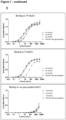
- both antibodies show the same gradation by means of binding to glycosylated PDTR peptides (APPAHGVTSAPD-T(X)-RPAPGSTAPPAHGVTSA) with different glycosylations at T: Strongest binding was observed to the PDTR peptide carrying a Gal ⁇ 1-3GalNAc alpha (TF) followed by sialylated TF and GalNAc alpha (Tn) O-glycosylation. Binding to sialylated GalNAc alpha (sTn) O-glycosylation was significantly lower. As PankoMab-GEX ® , PM-N54Q showed only little binding activity to non-glycosylated MUC1 PDTR peptide indicating adequate tumor specificity ( Figure 1C ).
- the framework variant mf-a carries nine amino acid mutations in the VH and three in the VL framework; the variant mf-b carries also nine amino acid mutations in the VH and four in the VL framework. Both mutated variants show similar binding compared to the PM-N54Q antibody.
- Example 3 Saturation binding analyses of anti-MUC1 antibodies to MCF-7 and ZR-75-1 cells
- Binding of the Fab-deglycosylated version of the MUC1-specific antibody PankoMab (PM-N54Q) on TA-MUC-1 positive human tumor cell lines was evaluated using radiolabeled antibodies by saturated binding analysis on the human mamma carcinoma cell lines ZR-75-1 and MCF-7 in comparison to Fab-glycosylated PankoMab-GEX ® .
- the antibodies were chelated with a 12-fold molar excess of p-SCN-Benzyl-DTPA in 50 mM sodium carbonate, 150 mM NaCl, pH 8.7, for 2 h at 37 °C, followed by over-night incubation at 2-8 °C.
- PankoMab (PM-N54Q) on TA-MUC-1 derived glycosylated peptide was evaluated by surface plasmon resonance analysis (Biacore).
- a streptavidin sensor chip was coated with biotinylated TA-MUC1 peptide (Tn glycosylated or not glycosylated).
- PankoMab and PM-N54Q were diluted sequentially 1:3 from 3,600 to 4.9 nM in HPS-EP. The dilutions were injected at 50 ⁇ L/min.
- Example 4b Fluorescence Proximity Sensing (by DRX 2 , Dynamic Biosensors)
- a new method to determine binding constants and affinity is the fluorescence proximity sensing using single stranded DNA (96mer) spotted on a chip and complementary DNA coupled to a ligand.
- streptavidin was used as a ligand to capture biotinylated TA-MUC1 peptides.
- Binding of PankoMab to the peptides resulted in a fluorescence change.
- On- and off-rates can be calculated during association and dissociation. Due to a higher sensitivity faster interactions can be monitored compared to surface plasmon resonance. This results in binding kinetics different from SPR but more comparable to the "gold standard" method KinExA, measured in a liquid system.
- PankoMab and PM-N54Q were diluted from 300 nM in 1:9 steps to 3.67 nM in PE140 buffer and applied to the chip-bound peptides. Binding curves were evaluated by mono-exponential global fit (instrument software). Binding curves of PM and PM-N54Q are exemplarily shown in Figure 3A and B . Calculated affinities of PankoMab variants are shown in Table 2: Table 2: Dissociation constants of PankoMab variants to antigen peptide PankoMab variant K D PM with Fab glycosylation 4.1 nM PM-N54D 1.9 nM PM-N54Q 1.6 nM PM-N54H 0.6 nM
- Non-reducing and reducing SDS-PAGE is used to analyze purity and identity of an antibody.
- the band pattern in non-reducing gels shows the major band at about 160 kDa and methodical artefacts of heavy and light chains and combinations thereof ( ⁇ 25, 50-55, 75, 110, 135 kDa).
- Reducing gels show distinct light and heavy chain bands at 25 and 50-55 kDa. Due to lack of the Fab glycosylation PM-N54Q has a smaller heavy chain, as expected (see Figure 4 , right).
- Fc ⁇ RIIIa His-tagged Fc ⁇ RIIIa (Glycotope GmbH) is captured by Ni-chelate donor beads.
- Anti-MUC1 antibodies and rabbit-anti-mouse coupled acceptor beads compete for binding to Fc ⁇ R.
- donor and acceptor beads come into close proximity which leads, upon laser excitation at 680 nm, to light emission.
- a maximum signal is achieved (signal max ) without a competitor.
- the signal max is reduced in a concentration-dependent manner.
- the analyzed constructs PM, PM-N54Q and PM-N54D show strong and specific binding to the TA-MUC1 expressing HSC-4 and CaOV-3 cells compared to a human IgG1 control ( Figure 7 ).
- the binding of PM-N54D to the TA-MUC1 high CaOV-3 cells was comparable to PM with Fab glycosylation while PM-N54Q showed a slightly better binding ( Figure 7A ).
- HSC-4 carcinoma cells that express TA-MUC1 at an intermediate level the variant PM-N54Q was clearly superior in binding to cellular TA-MUC1 compared to PM while PM-N54D showed an inferior binding compared to PM with Fab glycosylation ( Figure 7B ).
- the cell lines DSM ACC 2806, DSM ACC 2807 and DSM ACC 2856 were deposited at the DSMZ - Deutsche Sammlung von Mikroorganismen und Zellkulturen GmbH, Inhoffen No 7B, 38124 Braunschweig (DE) by Glycotope GmbH, Robert-Rössle-Str. 10, 13125 Berlin (DE) on the dates indicated in the following table. Name of the Cell Line Accession Number Depositor Date of Deposition NM-H9D8 DSM ACC 2806 Glycotope GmbH September 15, 2006 NM-H9D8-E6 DSM ACC 2807 Glycotope GmbH October 5, 2006 NM-H9D8-E6Q12 DSM ACC 2856 Glycotope GmbH August 8, 2007
Landscapes
- Health & Medical Sciences (AREA)
- Life Sciences & Earth Sciences (AREA)
- Chemical & Material Sciences (AREA)
- Medicinal Chemistry (AREA)
- General Health & Medical Sciences (AREA)
- Engineering & Computer Science (AREA)
- Animal Behavior & Ethology (AREA)
- Public Health (AREA)
- Pharmacology & Pharmacy (AREA)
- Veterinary Medicine (AREA)
- Bioinformatics & Cheminformatics (AREA)
- Immunology (AREA)
- Epidemiology (AREA)
- Organic Chemistry (AREA)
- Cell Biology (AREA)
- Chemical Kinetics & Catalysis (AREA)
- General Chemical & Material Sciences (AREA)
- Proteomics, Peptides & Aminoacids (AREA)
- Nuclear Medicine, Radiotherapy & Molecular Imaging (AREA)
- Oncology (AREA)
- Molecular Biology (AREA)
- Biochemistry (AREA)
- Biophysics (AREA)
- Genetics & Genomics (AREA)
- Hematology (AREA)
- Biomedical Technology (AREA)
- Microbiology (AREA)
- Mycology (AREA)
- Urology & Nephrology (AREA)
- Oil, Petroleum & Natural Gas (AREA)
- Mechanical Engineering (AREA)
- General Physics & Mathematics (AREA)
- Food Science & Technology (AREA)
- Physics & Mathematics (AREA)
- Analytical Chemistry (AREA)
- Biotechnology (AREA)
- Pathology (AREA)
- Peptides Or Proteins (AREA)
- Medicines Containing Antibodies Or Antigens For Use As Internal Diagnostic Agents (AREA)
- Medicinal Preparation (AREA)
Applications Claiming Priority (3)
| Application Number | Priority Date | Filing Date | Title |
|---|---|---|---|
| EP18173253 | 2018-05-18 | ||
| PCT/EP2019/062756 WO2019219889A1 (fr) | 2018-05-18 | 2019-05-17 | Anticorps anti-muc1 |
| EP19724502.0A EP3794041B1 (fr) | 2018-05-18 | 2019-05-17 | Anticorps anti-muc1 |
Related Parent Applications (1)
| Application Number | Title | Priority Date | Filing Date |
|---|---|---|---|
| EP19724502.0A Division EP3794041B1 (fr) | 2018-05-18 | 2019-05-17 | Anticorps anti-muc1 |
Publications (2)
| Publication Number | Publication Date |
|---|---|
| EP4257611A2 true EP4257611A2 (fr) | 2023-10-11 |
| EP4257611A3 EP4257611A3 (fr) | 2024-03-06 |
Family
ID=62217845
Family Applications (4)
| Application Number | Title | Priority Date | Filing Date |
|---|---|---|---|
| EP19724502.0A Active EP3794041B1 (fr) | 2018-05-18 | 2019-05-17 | Anticorps anti-muc1 |
| EP23180419.6A Pending EP4257611A3 (fr) | 2018-05-18 | 2019-05-17 | Anticorps anti-muc1 |
| EP23174276.8A Pending EP4249002A3 (fr) | 2018-05-18 | 2019-05-17 | Konjugierter zytotoxischer mittel und antikörper anti-muc1-exatecan |
| EP19724824.8A Active EP3794042B1 (fr) | 2018-05-18 | 2019-05-17 | Konjugierter zytotoxischer mittel und antikörper anti-muc1-exatecan |
Family Applications Before (1)
| Application Number | Title | Priority Date | Filing Date |
|---|---|---|---|
| EP19724502.0A Active EP3794041B1 (fr) | 2018-05-18 | 2019-05-17 | Anticorps anti-muc1 |
Family Applications After (2)
| Application Number | Title | Priority Date | Filing Date |
|---|---|---|---|
| EP23174276.8A Pending EP4249002A3 (fr) | 2018-05-18 | 2019-05-17 | Konjugierter zytotoxischer mittel und antikörper anti-muc1-exatecan |
| EP19724824.8A Active EP3794042B1 (fr) | 2018-05-18 | 2019-05-17 | Konjugierter zytotoxischer mittel und antikörper anti-muc1-exatecan |
Country Status (28)
| Country | Link |
|---|---|
| US (6) | US12297289B2 (fr) |
| EP (4) | EP3794041B1 (fr) |
| JP (4) | JP7257422B2 (fr) |
| KR (3) | KR102933368B1 (fr) |
| CN (3) | CN112351999A (fr) |
| AU (3) | AU2019270459C1 (fr) |
| BR (2) | BR112020023373A2 (fr) |
| CA (2) | CA3100745A1 (fr) |
| CO (2) | CO2020013664A2 (fr) |
| DK (1) | DK3794042T5 (fr) |
| ES (2) | ES2980468T3 (fr) |
| FI (1) | FI3794042T3 (fr) |
| HR (2) | HRP20230787T1 (fr) |
| HU (2) | HUE067382T2 (fr) |
| IL (3) | IL278718B2 (fr) |
| LT (1) | LT3794042T (fr) |
| MX (4) | MX421206B (fr) |
| MY (2) | MY205343A (fr) |
| PH (2) | PH12020551970A1 (fr) |
| PL (2) | PL3794042T3 (fr) |
| PT (1) | PT3794042T (fr) |
| RS (2) | RS65580B1 (fr) |
| SG (2) | SG11202010496WA (fr) |
| SI (1) | SI3794042T1 (fr) |
| SM (2) | SMT202400202T1 (fr) |
| TW (3) | TWI825098B (fr) |
| WO (2) | WO2019219889A1 (fr) |
| ZA (1) | ZA202006684B (fr) |
Families Citing this family (30)
| Publication number | Priority date | Publication date | Assignee | Title |
|---|---|---|---|---|
| SG11202010496WA (en) | 2018-05-18 | 2020-12-30 | Daiichi Sankyo Co Ltd | Anti-muc1 antibody-drug conjugate |
| CA3108044A1 (fr) * | 2018-07-31 | 2020-02-06 | Daiichi Sankyo Company, Limited | Traitement d'une tumeur cerebrale metastatique par administration d'un conjugue anticorps-medicament |
| US11555019B2 (en) | 2019-07-10 | 2023-01-17 | Cybrexa 3, Inc. | Peptide conjugates of microtubule-targeting agents as therapeutics |
| MX2022000449A (es) | 2019-07-10 | 2022-04-25 | Cybrexa 2 Inc | Conjugados peptídicos de citotoxinas como terapéuticos. |
| US20230054458A1 (en) * | 2019-12-12 | 2023-02-23 | Jiangsu Hengrui Medicine Co., Ltd. | Anti-claudin antibody-drug conjugate and pharmaceutical use thereof |
| EP4093439A1 (fr) * | 2020-01-22 | 2022-11-30 | MedImmune Limited | Composés et conjugués correspondants |
| CN116390771A (zh) * | 2020-07-13 | 2023-07-04 | 瑞泽恩制药公司 | 与蛋白中的谷氨酰胺残基缀合的喜树碱类似物及其用途 |
| CN113941007B (zh) * | 2020-07-16 | 2024-06-07 | 成都科岭源医药技术有限公司 | 一种串联的双药物链接组装单元及其应用 |
| AU2021378152A1 (en) * | 2020-11-11 | 2023-06-22 | Daiichi Sankyo Company, Limited | COMBINATION OF AN ANTIBODY-DRUG CONJUGATE WITH ANTI-SIRPα ANTIBODY |
| TW202320858A (zh) | 2021-07-19 | 2023-06-01 | 美商薩諾管理公司 | 免疫接合物及方法 |
| US11806405B1 (en) | 2021-07-19 | 2023-11-07 | Zeno Management, Inc. | Immunoconjugates and methods |
| JP2024534148A (ja) * | 2021-08-27 | 2024-09-18 | ペプトロン インコーポレイテッド | 新規抗muc1抗体およびその用途 |
| CN116059339B (zh) * | 2021-11-04 | 2023-09-22 | 元本(珠海横琴)生物科技有限公司 | 一种治疗和预防癌症的药物和应用 |
| CA3241734A1 (fr) * | 2022-01-12 | 2023-07-20 | Amy Han | Conjugues proteine-medicament comprenant des analogues de camptothecine et procedes d'utilisation associes |
| CN119317447A (zh) * | 2022-04-12 | 2025-01-14 | 米纳瓦生物技术公司 | 抗可变muc1*抗体及其用途 |
| EP4514391A1 (fr) | 2022-04-27 | 2025-03-05 | Daiichi Sankyo Company, Limited | Combinaison d'un conjugué anticorps-médicament avec un inhibiteur de l'ezh1 et/ou de l'ezh2 |
| JP2025529210A (ja) | 2022-09-01 | 2025-09-04 | ユニバーシティ・オブ・ジョージア・リサーチ・ファウンデイション・インコーポレイテッド | アポリポタンパク質l1を導いて哺乳動物の細胞死を誘導するための組成物及び方法 |
| CN119630672B (zh) * | 2023-02-23 | 2026-01-30 | 一线医药(杭州)有限公司 | 喜树碱衍生物及其偶联物以及其制备方法和医药用途 |
| TW202506190A (zh) | 2023-04-05 | 2025-02-16 | 日商第一三共股份有限公司 | 利用抗muc1抗體-藥物結合物投予的藥劑低敏感性癌之治療方法 |
| EP4737483A1 (fr) | 2023-06-30 | 2026-05-06 | Daiichi Sankyo Company, Limited | Procédé de production de conjugué anticorps-médicament comprenant une étape de purification à l'aide d'un matériau de carbone actif |
| WO2025054996A1 (fr) * | 2023-09-15 | 2025-03-20 | Duality Biologics (Suzhou) Co., Ltd. | Conjugué anticorps-médicament |
| WO2025149667A1 (fr) | 2024-01-12 | 2025-07-17 | Pheon Therapeutics Ltd | Conjugués anticorps-médicament et leurs utilisations |
| WO2025153001A1 (fr) * | 2024-01-17 | 2025-07-24 | 北京泰德制药股份有限公司 | Conjugué anticorps-médicament contenant une structure thiazolo[5,4-b]pyridine et son utilisation |
| WO2025161939A1 (fr) * | 2024-01-31 | 2025-08-07 | Biocytogen Pharmaceuticals (Beijing) Co., Ltd. | Anticorps et leurs utilisations |
| WO2025180383A1 (fr) * | 2024-02-26 | 2025-09-04 | Biocytogen Pharmaceuticals (Beijing) Co., Ltd. | Anticorps anti-tpbg/muc1 et utilisations associées |
| WO2025252189A1 (fr) * | 2024-06-06 | 2025-12-11 | 海思科医药集团股份有限公司 | Dérivé de camptothécine et son utilisation |
| WO2025260285A1 (fr) * | 2024-06-19 | 2025-12-26 | Duality Biologics (Suzhou) Co., Ltd. | Conjugué anticorps-médicament |
| WO2025262130A1 (fr) * | 2024-06-19 | 2025-12-26 | BioNTech SE | Conjugué anticorps-médicament |
| WO2026035986A1 (fr) | 2024-08-07 | 2026-02-12 | Bighat Biosciences, Inc. | Anticorps anti-cdh17 humanisés et leur utilisation |
| WO2026082031A1 (fr) * | 2024-10-14 | 2026-04-23 | 先声再明医药股份有限公司 | Composition pharmaceutique comprenant un anticorps anti-cdh6 ou un adc de celui-ci |
Citations (4)
| Publication number | Priority date | Publication date | Assignee | Title |
|---|---|---|---|---|
| WO2004065423A2 (fr) | 2003-01-23 | 2004-08-05 | Nemod Biotherapeutics Gmbh & Co. Kg | Molecules de reconnaissance pour le traitement et la detection de tumeurs |
| WO2008028686A2 (fr) | 2006-09-10 | 2008-03-13 | Glycotope Gmbh | Système de production à haut rendement, entièrement humain, pour anticorps et protéines améliorés |
| WO2011012309A1 (fr) | 2009-07-31 | 2011-02-03 | Glycotope Gmbh | Anticorps muc1 |
| LU92659B1 (en) | 2015-02-23 | 2016-08-24 | Glycotope Gmbh | Glycooptimized antibody drug conjugates |
Family Cites Families (189)
| Publication number | Priority date | Publication date | Assignee | Title |
|---|---|---|---|---|
| US4966843A (en) | 1982-11-01 | 1990-10-30 | Cetus Corporation | Expression of interferon genes in Chinese hamster ovary cells |
| AU2353384A (en) | 1983-01-19 | 1984-07-26 | Genentech Inc. | Amplification in eukaryotic host cells |
| KR850004274A (ko) | 1983-12-13 | 1985-07-11 | 원본미기재 | 에리트로포이에틴의 제조방법 |
| US4943533A (en) | 1984-03-01 | 1990-07-24 | The Regents Of The University Of California | Hybrid cell lines that produce monoclonal antibodies to epidermal growth factor receptor |
| US4931275A (en) | 1985-12-02 | 1990-06-05 | Yeda Research & Development Co., Ltd. | Anti-tumor vaccines and their preparation |
| US5683674A (en) | 1987-01-07 | 1997-11-04 | Imperial Cancer Research Technology Ltd. | Antibody against human mucin core protein and method of preparing and using same |
| JP3040121B2 (ja) | 1988-01-12 | 2000-05-08 | ジェネンテク,インコーポレイテッド | 増殖因子レセプターの機能を阻害することにより腫瘍細胞を処置する方法 |
| US5183884A (en) | 1989-12-01 | 1993-02-02 | United States Of America | Dna segment encoding a gene for a receptor related to the epidermal growth factor receptor |
| JP3008226B2 (ja) | 1991-01-16 | 2000-02-14 | 第一製薬株式会社 | 六環性化合物 |
| US5658920A (en) | 1991-01-16 | 1997-08-19 | Daiichi Pharmaceutical Co., Ltd. | Substituted 1H,12H-benz-[DE]pyrano[3',4':6,7] indolizino[1,2-B]quinoline-10,13(9H,15H)-dione compound |
| CA2100671C (fr) | 1991-02-27 | 1999-02-02 | James S. Huston | Molecules peptidiques de liaison riches en serine |
| EP1400536A1 (fr) | 1991-06-14 | 2004-03-24 | Genentech Inc. | Procédé pour fabriquer des anticorps humanisés |
| GB9200415D0 (en) | 1992-01-09 | 1992-02-26 | Bagshawe Kenneth D | Inactivation of cytotoxic drugs |
| JP3698370B2 (ja) | 1992-04-13 | 2005-09-21 | ダナ−ファーバー キャンサー インスティチュート インク | 癌腫抗原用抗体 |
| JP3359955B2 (ja) | 1992-07-16 | 2002-12-24 | 第一製薬株式会社 | 抗腫瘍剤 |
| US5804187A (en) | 1992-11-16 | 1998-09-08 | Cancer Research Fund Of Contra Costa | Modified antibodies with human milk fat globule specificity |
| US6214345B1 (en) | 1993-05-14 | 2001-04-10 | Bristol-Myers Squibb Co. | Lysosomal enzyme-cleavable antitumor drug conjugates |
| JP3626187B2 (ja) | 1993-06-07 | 2005-03-02 | バイカル インコーポレイテッド | 遺伝子治療に適するプラスミド |
| DE4329004A1 (de) | 1993-08-28 | 1995-03-09 | Max Delbrueck Centrum | Monoklonale Antikörper gegen das Thomsen-Friedenreich-Antigen, ihre Herstellung und ihre Verwendung zum Tumornachweis |
| AU7965694A (en) | 1993-10-15 | 1995-05-04 | Curators Of The University Of Missouri, The | Dna encoding the human p2u receptor and null cells expressing p2u receptors |
| US5443953A (en) | 1993-12-08 | 1995-08-22 | Immunomedics, Inc. | Preparation and use of immunoconjugates |
| US5997873A (en) | 1994-01-13 | 1999-12-07 | Mount Sinai School Of Medicine Of The City University Of New York | Method of preparation of heat shock protein 70-peptide complexes |
| US5961979A (en) | 1994-03-16 | 1999-10-05 | Mount Sinai School Of Medicine Of The City University Of New York | Stress protein-peptide complexes as prophylactic and therapeutic vaccines against intracellular pathogens |
| US5888773A (en) | 1994-08-17 | 1999-03-30 | The United States Of America As Represented By The Department Of Health And Human Services | Method of producing single-chain Fv molecules |
| US6504029B1 (en) | 1995-04-10 | 2003-01-07 | Daiichi Pharmaceutical Co., Ltd. | Condensed-hexacyclic compounds and a process therefor |
| JPH08337584A (ja) | 1995-04-10 | 1996-12-24 | Dai Ichi Seiyaku Co Ltd | 縮合六環式アミノ化合物、これを含有する医薬及びその製法 |
| US5739277A (en) | 1995-04-14 | 1998-04-14 | Genentech Inc. | Altered polypeptides with increased half-life |
| JPH11507535A (ja) | 1995-06-07 | 1999-07-06 | イムクローン システムズ インコーポレイテッド | 腫瘍の成長を抑制する抗体および抗体フラグメント類 |
| CA2225460A1 (fr) | 1995-06-23 | 1997-01-09 | Winston Campbell Patterson | Regulation de la transcription de genes codant des recepteurs du facteur de croissance endotheliale vasculaire |
| SG50747A1 (en) | 1995-08-02 | 1998-07-20 | Tanabe Seiyaku Co | Comptothecin derivatives |
| JPH1095802A (ja) | 1995-12-28 | 1998-04-14 | Tanabe Seiyaku Co Ltd | カンプトテシン誘導体 |
| CA2192725C (fr) | 1995-12-28 | 2004-04-20 | Kenji Tsujihara | Derives de la camptothecine |
| GB9603256D0 (en) | 1996-02-16 | 1996-04-17 | Wellcome Found | Antibodies |
| US5968511A (en) | 1996-03-27 | 1999-10-19 | Genentech, Inc. | ErbB3 antibodies |
| EP0906444A1 (fr) | 1996-04-19 | 1999-04-07 | Gabriele Pecher | Cellules dendritiques humaines genetiquement transfectees, leur production et leur utilisation, de preference comme vaccins |
| TW409058B (en) | 1996-06-06 | 2000-10-21 | Daiichi Seiyaku Co | Method for preparation of a drug complex |
| TW527183B (en) | 1996-06-06 | 2003-04-11 | Daiichi Seiyaku Co | Drug complex |
| JPH1171280A (ja) | 1997-06-26 | 1999-03-16 | Tanabe Seiyaku Co Ltd | 医薬組成物 |
| US6172213B1 (en) | 1997-07-02 | 2001-01-09 | Genentech, Inc. | Anti-IgE antibodies and method of improving polypeptides |
| JPH1192405A (ja) | 1997-09-19 | 1999-04-06 | Dai Ichi Seiyaku Co Ltd | 薬物複合体 |
| ATE550042T1 (de) | 1997-11-20 | 2012-04-15 | Vical Inc | Behandlung von krebs mithilfe cytokin- exprimierender polynukleotide und zusammensetzungen dafür |
| US5948646A (en) | 1997-12-11 | 1999-09-07 | Fordham University | Methods for preparation of vaccines against cancer comprising heat shock protein-peptide complexes |
| DK1071700T3 (da) | 1998-04-20 | 2010-06-07 | Glycart Biotechnology Ag | Glykosylerings-modifikation af antistoffer til forbedring af antistofafhængig cellulær cytotoksicitet |
| EA003398B1 (ru) | 1998-05-22 | 2003-04-24 | Дайити Фармасьютикал Ко., Лтд. | Лекарственный комплекс c полимерным носителем |
| CN1191093C (zh) | 1998-10-30 | 2005-03-02 | 第一制药株式会社 | Dds化合物及其测定方法 |
| US6465220B1 (en) | 1998-12-21 | 2002-10-15 | Glycozym Aps | Glycosylation using GalNac-T4 transferase |
| AUPP816899A0 (en) | 1999-01-14 | 1999-02-11 | Food Technology Innovations Pty Limited | Improved microbial products |
| EP1399538A4 (fr) | 1999-03-02 | 2004-03-24 | Human Genome Sciences Inc | Mise au point de voies de sialylation intracellulaires |
| CA2368734C (fr) | 1999-03-30 | 2005-08-23 | Japan Tobacco Inc. | Procede pour la production d'anticorps monoclonal |
| CA2704600C (fr) | 1999-04-09 | 2016-10-25 | Kyowa Kirin Co., Ltd. | Methode de production d'anticorps avec activite adcc accrue |
| BR0012196A (pt) | 1999-06-25 | 2002-03-19 | Genentech Inc | Método de tratamento de um tumor em mamìferos através do uso de conjugados de maitansinóide e anticorpo receptor anti-erbb e artigo industrializado |
| US7147850B2 (en) | 1999-08-18 | 2006-12-12 | Altarex Medical Corp. | Therapeutic binding agents against MUC-1 antigen and methods for their use |
| ATE290879T1 (de) | 1999-08-18 | 2005-04-15 | Altarex Medical Corp | Therapeutische antikörper gegen das muc-1 antigen und verfahren zu deren verwendung |
| AU7743100A (en) | 1999-09-30 | 2001-04-30 | Corixa Corporation | Stress protein compositions and methods for prevention and treatment of cancer and infectious disease |
| JP2002060351A (ja) | 2000-03-22 | 2002-02-26 | Dai Ichi Seiyaku Co Ltd | 水酸基を有する薬物を含むdds化合物 |
| WO2001075110A2 (fr) | 2000-03-30 | 2001-10-11 | Dyax Corp. | Elements de liaison specifiques de la mucine-1 et techniques d'utilisation |
| GB2362531A (en) | 2000-05-15 | 2001-11-21 | Nokia Mobile Phones Ltd | Indicating the temporal order of reference frames in a video sequence |
| FR2809312B1 (fr) | 2000-05-25 | 2002-07-12 | Gervais Danone Sa | Utilisation de l. casei dans des compositions immunostimulantes |
| US20030166513A1 (en) | 2000-06-29 | 2003-09-04 | Akihiro Imura | Dds compound and process for the preparation thereof |
| AU2001271037A1 (en) | 2000-07-13 | 2002-01-30 | Daiichi Pharmaceutical Co., Ltd. | Pharmaceutical compositions containing dds compounds |
| FR2814096B1 (fr) | 2000-09-15 | 2002-12-27 | Montupet Sa | Procede de fabrication de pieces de fonderie munies d'inserts avec cohesion mecanique piece/insert amelioree, et insert utilisable dans un tel procede |
| US6946292B2 (en) | 2000-10-06 | 2005-09-20 | Kyowa Hakko Kogyo Co., Ltd. | Cells producing antibody compositions with increased antibody dependent cytotoxic activity |
| CA2424977C (fr) | 2000-10-06 | 2008-03-18 | Kyowa Hakko Kogyo Co., Ltd. | Procede de purification d'un anticorps |
| GB0029360D0 (en) | 2000-12-01 | 2001-01-17 | Univ Nottingham | Humanised antibodies and uses thereof |
| JPWO2002061118A1 (ja) | 2001-02-01 | 2004-06-03 | 株式会社ヤクルト本社 | 発酵乳飲食品中のビフィドバクテリウム属細菌の腸内到達度評価方法 |
| US7183388B2 (en) | 2001-03-30 | 2007-02-27 | The Regents Of The University Of California | Anti-MUC-1 single chain antibodies for tumor targeting |
| EP1283053A1 (fr) | 2001-08-09 | 2003-02-12 | Max-Planck-Gesellschaft zur Förderung der Wissenschaften e.V. | Inhibiteurs de l'activité de HER3 |
| AU2002336981A1 (en) | 2001-08-17 | 2003-03-03 | Charite | Glycoconjugates of sialic acid derivates, methods for their production and use thereof |
| DE10139428A1 (de) | 2001-08-17 | 2003-03-27 | Nemod Immuntherapie Ag | Herstellung und Verwendung von humanen CD124 und CD116 positiven Tumorzelllinien zur Herstellung von allogenen oder semi-allogenen Immuntherapeutika |
| CA2451998A1 (fr) | 2001-08-17 | 2003-02-27 | Eli Lilly And Company | Anticorps anti-$g(a)$g(b) |
| TWI313609B (en) | 2001-08-21 | 2009-08-21 | Mitsubishi Tanabe Pharma Corp | Pharmaceutical composition for inhibiting the metastasis or preventing the recurrence of malignant tumor |
| MEP38608A (en) | 2001-10-22 | 2011-02-10 | Merck Serono Sa | Gonadotrophins for folliculogenesis |
| GB0125473D0 (en) | 2001-10-24 | 2001-12-12 | Syngenta Ltd | Chemical process |
| CA2463879C (fr) | 2001-10-25 | 2012-12-04 | Genentech, Inc. | Compositions de glycoproteine |
| CA2467242A1 (fr) | 2001-11-20 | 2003-05-30 | Seattle Genetics, Inc. | Traitement des troubles immunologiques au moyen des anticorps anti-cd30 |
| EP1451217A4 (fr) | 2001-11-20 | 2005-10-12 | Atgen Co Ltd | Nouveaux peptides conferant une resistance au stress environnemental et proteines de fusion contenant lesdits peptides |
| US8877901B2 (en) | 2002-12-13 | 2014-11-04 | Immunomedics, Inc. | Camptothecin-binding moiety conjugates |
| CA2478047C (fr) | 2002-03-01 | 2014-01-21 | Immunomedics, Inc. | Anticorps rs7 |
| US9745380B2 (en) | 2002-03-01 | 2017-08-29 | Immunomedics, Inc. | RS7 antibodies |
| AU2003217912A1 (en) | 2002-03-01 | 2003-09-16 | Xencor | Antibody optimization |
| GB0212046D0 (en) | 2002-05-24 | 2002-07-03 | Glaxo Group Ltd | Vaccines |
| ES2524442T3 (es) | 2002-07-22 | 2014-12-09 | Glycotope Gmbh | Procedimiento para la producción de una mucina (MUC1) inmunoestimulante |
| DK1530628T3 (da) | 2002-08-16 | 2011-01-10 | Glycotope Gmbh | Fremgangsmåde til fremstilling af temperaturinducerede tumorcellelysater til anvendelse som immunogene forbindelser |
| DE10256900A1 (de) | 2002-11-29 | 2004-06-24 | Nemod Immuntherapie Ag | Tumorspezifische Erkennungsmoleküle |
| CA2508831C (fr) | 2002-12-13 | 2012-05-01 | Immunomedics, Inc. | Immunoconjugues comprenant une liaison intracellulaire clivable |
| US20040202666A1 (en) | 2003-01-24 | 2004-10-14 | Immunomedics, Inc. | Anti-cancer anthracycline drug-antibody conjugates |
| US7709610B2 (en) | 2003-05-08 | 2010-05-04 | Facet Biotech Corporation | Therapeutic use of anti-CS1 antibodies |
| WO2005019258A2 (fr) | 2003-08-11 | 2005-03-03 | Genentech, Inc. | Compositions et methodes de traitement de maladies relatives au systeme immunitaire |
| CA2535489C (fr) | 2003-08-14 | 2014-09-30 | D. Collen Research Foundation Vzw | Anticorps permettant de lutter contre le facteur viii avec glycosylationmodifiee dans la region variable |
| SI1654353T1 (sl) | 2003-08-18 | 2013-09-30 | Glycotope Gmbh | Tumorski celični liniji NM-F9 (DSM ACC2606) in NM-D4 (DSM ACC2605), njihove uporabe |
| FR2861080B1 (fr) | 2003-10-20 | 2006-02-17 | Lab Francais Du Fractionnement | Anticorps presentant un taux de fucose et de galactose optimise |
| US20050203010A1 (en) | 2003-11-14 | 2005-09-15 | Atgen Co., Ltd. | Novel peptides conferring environmental stress resistance and fusion proteins including said peptides |
| CN103627670B (zh) | 2004-02-13 | 2016-12-21 | 格莱克托普有限公司 | 高活性糖蛋白加工条件及其有效生产方法 |
| US20050228007A1 (en) | 2004-02-26 | 2005-10-13 | Prakash Jagtap | Isoquinoline derivatives and methods of use thereof |
| JP4942643B2 (ja) | 2004-03-02 | 2012-05-30 | シアトル ジェネティックス, インコーポレイテッド | 部分的に付加された抗体およびそれらの結合体化方法 |
| JP4758984B2 (ja) | 2004-03-29 | 2011-08-31 | アボット バイオセラピューティクス コーポレイション | 抗cs1抗体の治療的使用 |
| US20060051353A1 (en) | 2004-05-14 | 2006-03-09 | Jean-Frederic Colombel | Methods and compositions to evaluate antibody treatment response |
| JP4806680B2 (ja) | 2004-05-19 | 2011-11-02 | メダレックス インコーポレイテッド | 自己犠牲リンカー及び薬剤複合体 |
| NZ579482A (en) | 2004-06-01 | 2011-02-25 | Genentech Inc | Antibody drug conjugates and methods |
| DK1771482T3 (da) | 2004-07-22 | 2014-10-20 | Genentech Inc | HER2-antistofsammensætning |
| JP4904266B2 (ja) | 2004-07-26 | 2012-03-28 | ザ リサーチ ファウンデイション オブ ステイト ユニバーシティー オブ ニューヨーク | 抗−tf−抗原抗体の治療的使用 |
| US8802820B2 (en) | 2004-11-12 | 2014-08-12 | Xencor, Inc. | Fc variants with altered binding to FcRn |
| JP2008521828A (ja) | 2004-11-29 | 2008-06-26 | シアトル ジェネティックス, インコーポレイテッド | 操作された抗体およびイムノコンジュゲート |
| CN102580084B (zh) | 2005-01-21 | 2016-11-23 | 健泰科生物技术公司 | Her抗体的固定剂量给药 |
| WO2006081553A2 (fr) * | 2005-01-28 | 2006-08-03 | Ramot At Tel Aviv University, Ltd. | ANTICORPS ANTI-MUC1 ?/ß |
| DE102005009099A1 (de) | 2005-02-28 | 2006-08-31 | Ktb Tumorforschungsgesellschaft Mbh | Proteinbindende Camptothecin-Peptid-Derivate und diese enthaltende Arzneimittel |
| DE102005009084A1 (de) | 2005-02-28 | 2006-08-31 | Ktb Tumorforschungsgesellschaft Mbh | Proteinbindende Anthrazyklin-Peptid-Derivate und diese enthaltende Arzneimittel |
| US7833979B2 (en) | 2005-04-22 | 2010-11-16 | Amgen Inc. | Toxin peptide therapeutic agents |
| EP1888637A2 (fr) | 2005-05-19 | 2008-02-20 | Amgen Inc. | Compositions et procedes permettant d'accroitre la stabilite d'un anticorps |
| PT1896071E (pt) | 2005-06-30 | 2015-07-09 | Janssen Biotech Inc | Métodos e composições com melhorias na atividade terapêutica |
| GB0519398D0 (en) | 2005-09-23 | 2005-11-02 | Antisoma Plc | Biological materials and uses thereof |
| JP4919146B2 (ja) * | 2005-09-27 | 2012-04-18 | 独立行政法人産業技術総合研究所 | スイッチング素子 |
| US20090181016A1 (en) | 2005-11-30 | 2009-07-16 | University Of Southern California | FCgamma POLYMORPHISMS FOR PREDICTING DISEASE AND TREATMENT OUTCOME |
| AR056857A1 (es) | 2005-12-30 | 2007-10-24 | U3 Pharma Ag | Anticuerpos dirigidos hacia her-3 (receptor del factor de crecimiento epidérmico humano-3) y sus usos |
| KR20080104143A (ko) | 2006-02-14 | 2008-12-01 | 코닌클리케 필립스 일렉트로닉스 엔.브이. | 광 디스크 판독용 비트 검출 |
| US20080131428A1 (en) | 2006-02-24 | 2008-06-05 | Arius Research, Inc. | Cytotoxicity mediation of cells evidencing surface expression of TROP-2 |
| PT1999154E (pt) | 2006-03-24 | 2013-01-24 | Merck Patent Gmbh | Domínios proteicos heterodiméricos modificados |
| WO2007124992A1 (fr) | 2006-04-28 | 2007-11-08 | Unilever N.V. | Procédé de fabrication d'un produit comestible cultivé contenant des oméga-3 sous forme d'acides gras polyinsaturés |
| CN101490087B (zh) | 2006-05-30 | 2013-11-06 | 健泰科生物技术公司 | 抗体和免疫偶联物及其用途 |
| EP2032606B1 (fr) | 2006-05-30 | 2013-11-27 | Genentech, Inc. | Anticorps et immuno-conjugués, et leurs utilisations |
| ITMI20061473A1 (it) | 2006-07-26 | 2008-01-27 | Indena Spa | Derivati della camptotecina ad attivita antitumorale |
| EP1911766A1 (fr) | 2006-10-13 | 2008-04-16 | Glycotope Gmbh | Utilisation des cellules humaines provenant d'une leucémie myéloide pour l'expression d'anticorps |
| EP1900750A1 (fr) | 2006-09-18 | 2008-03-19 | Glycotope Gmbh | Système de production à haut rendement, entièrement humain, pour anticorps améliorés |
| PL1920781T3 (pl) | 2006-11-10 | 2015-06-30 | Glycotope Gmbh | Kompozycje zawierające core-1-dodatnie mikroorganizmy i ich zastosowanie w leczeniu lub profilaktyce nowotworów |
| CA2673410A1 (fr) | 2006-12-21 | 2008-07-03 | Schering Corporation | Derive de pyrrolo [3, 2-a] pyridine pour inhiber l'activite de la kinesine ksp |
| KR101598229B1 (ko) | 2007-02-16 | 2016-02-26 | 메리맥 파마슈티컬즈, 인크. | Erbb3에 대한 항체 및 이의 용도 |
| WO2008101177A2 (fr) | 2007-02-16 | 2008-08-21 | University Of Virginia Patent Foundation | Anticorps ige contre des anticorps monoclonaux thérapeutiques igg chimériques ou humanisés en tant que test de criblage pour l'anaphylaxie |
| WO2008112707A1 (fr) | 2007-03-13 | 2008-09-18 | Peros Systems Technologies, Inc. | Compositions immunoactives pour une administration par voie orale améliorée de vaccins et d'agents thérapeutiques |
| US20100143245A1 (en) | 2007-03-22 | 2010-06-10 | Sloan-Kettering Institute For Cancer Research | Uses of monoclonal antibody 8h9 |
| RS53008B2 (sr) | 2007-04-03 | 2022-12-30 | Amgen Res Munich Gmbh | Interspecijski specifičan cd3-epsilon vezujući domen |
| NZ610239A (en) | 2008-04-30 | 2014-11-28 | Immunogen Inc | Cross-linkers and their uses |
| WO2009140242A1 (fr) | 2008-05-13 | 2009-11-19 | Genentech, Inc. | Analyse de conjugués anticorps-médicament par capture d'affinité à base de bille et spectrométrie de masse |
| JP2011520435A (ja) | 2008-05-13 | 2011-07-21 | グリコトープ ゲーエムベーハー | 発酵プロセス |
| TW201006485A (en) | 2008-06-03 | 2010-02-16 | Abbott Lab | Dual variable domain immunoglobulins and uses thereof |
| CN102264765B (zh) | 2008-10-28 | 2016-01-20 | 盐野义制药株式会社 | 抗muc1抗体 |
| WO2010059315A1 (fr) | 2008-11-18 | 2010-05-27 | Merrimack Pharmaceuticals, Inc. | Lieurs de sérum-albumine humaine et conjugués de ceux-ci |
| ES3000111T3 (en) | 2009-02-13 | 2025-02-27 | Immunomedics Inc | Intermediates for preparing conjugates with an intracellularly-cleavable linkage |
| US9079957B2 (en) | 2009-04-16 | 2015-07-14 | The University Of Tokyo | Diagnosis and treatment of cancer using anti-TMPRSS11E antibody |
| US20120171201A1 (en) | 2009-07-22 | 2012-07-05 | Enzon Pharmaceuticals, Inc. | Methods of treating her2 positive cancer with her2 receptor antagonist in combination with multi-arm polymeric conjugates of 7-ethyl-10-hydroxycamptothecin |
| JP5829520B2 (ja) | 2009-08-20 | 2015-12-09 | 国立大学法人 千葉大学 | コルヒチン誘導体 |
| JP2013505944A (ja) | 2009-09-24 | 2013-02-21 | シアトル ジェネティックス, インコーポレイテッド | Dr5リガンド薬物結合体 |
| EP2896632B1 (fr) | 2009-11-13 | 2017-10-25 | Daiichi Sankyo Europe GmbH | Matériau et procédés de traitement ou de prévention de maladies associées à des HER-3 |
| ES2978177T3 (es) | 2009-12-02 | 2024-09-06 | Immunomedics Inc | Combinación de radio inmunoterapia y conjugados anticuerpo-fármaco para mejorar la terapia contra el cáncer |
| US9017669B2 (en) | 2009-12-28 | 2015-04-28 | Oncotherapy Science, Inc. | Anti-CDH3 antibodies and uses thereof |
| EP2347769A1 (fr) | 2010-01-20 | 2011-07-27 | Glycotope GmbH | Marqueurs de cellules souches de cancer et utilisations associées |
| MX2012013001A (es) | 2010-05-13 | 2013-02-26 | Univ Indiana Res & Tech Corp | Peptidos de la superfamilia de glucagon que presentan actividad del receptor nuclear de hormonas. |
| EA201500220A1 (ru) | 2010-05-17 | 2015-10-30 | Ливтех, Инк. | Антитело против trop-2 человека, обладающее противоопухолевой активностью in vivo |
| US20110300150A1 (en) | 2010-05-18 | 2011-12-08 | Scott Eliasof | Compositions and methods for treatment of autoimmune and other disease |
| WO2011155579A1 (fr) | 2010-06-10 | 2011-12-15 | 北海道公立大学法人札幌医科大学 | ANTICORPS ANTI-Trop-2 |
| RU2012157167A (ru) | 2010-07-12 | 2014-08-20 | КовЭкс Текнолоджиз Айэлэнд Лимитед | Полифункциональные антительные конъюгаты |
| WO2012019024A2 (fr) | 2010-08-04 | 2012-02-09 | Immunogen, Inc. | Molécules se liant à her3 et leurs immunoconjugués |
| WO2012018404A2 (fr) | 2010-08-06 | 2012-02-09 | U3 Pharma Gmbh | Utilisation d'agents de liaison her3 dans le traitement de la prostate |
| PT2603528T (pt) | 2010-08-10 | 2016-12-01 | Glycotope Gmbh | Anticorpos glicosilados em fab |
| US9051370B2 (en) | 2010-08-10 | 2015-06-09 | Glycotope Gmbh | Humanized EGFR antibodies |
| WO2012064733A2 (fr) | 2010-11-09 | 2012-05-18 | Medimmune, Llc | Échafaudage d'anticorps pour conjugaison homogène |
| US20120121615A1 (en) | 2010-11-17 | 2012-05-17 | Flygare John A | Alaninyl maytansinol antibody conjugates |
| US9175092B2 (en) | 2011-06-28 | 2015-11-03 | Oxford Biotherapeutics Ltd | Antibodies to bone marrow stromal antigen 1 |
| TWI495644B (zh) | 2011-11-11 | 2015-08-11 | Rinat Neuroscience Corp | 營養層細胞表面抗原(Trop-2)之專一性抗體類及彼等之用途 |
| US9427464B2 (en) | 2011-11-22 | 2016-08-30 | Chiome Bioscience Inc. | Anti-human TROP-2 antibody having an antitumor activity in vivo |
| SG11201403085PA (en) | 2011-12-14 | 2014-10-30 | Seattle Genetics Inc | Fgfr antibody drug conjugates (adcs) and the use thereof |
| ES2728278T3 (es) | 2011-12-21 | 2019-10-23 | Novartis Ag | Composiciones que comprenden anticuerpos dirigidos al factor P y C5 |
| US20130280282A1 (en) | 2012-04-24 | 2013-10-24 | Daiichi Sankyo Co., Ltd. | Dr5 ligand drug conjugates |
| CN104619350A (zh) | 2012-06-14 | 2015-05-13 | Ambrx公司 | 结合到核受体配体多肽的抗psma抗体 |
| ES2773710T3 (es) | 2012-10-11 | 2020-07-14 | Daiichi Sankyo Co Ltd | Enlazadores para conjugados de anticuerpo - fármaco |
| WO2014061277A1 (fr) | 2012-10-19 | 2014-04-24 | 第一三共株式会社 | Conjugué anticorps-médicament produit par liaison par l'intermédiaire d'un lieur ayant une structure hydrophile |
| JP6499079B2 (ja) | 2012-11-13 | 2019-04-10 | バイオエヌテック アーゲーBioNTech AG | クローディンを発現するガン疾患を処置するための剤 |
| EP2927227A4 (fr) | 2013-01-03 | 2015-12-30 | Celltrion Inc | Conjugué anticorps-lieur-médicament, son procédé de préparation, et composition médicamenteuse anticancéreuse le contenant |
| CA2897505A1 (fr) | 2013-01-18 | 2014-07-24 | Glycotope Gmbh | Peptides permettant d'augmenter l'expression proteique |
| AU2014298514A1 (en) * | 2013-08-02 | 2016-03-10 | Sanofi | Use of anti-MUC1 maytansinoid immunoconjugate antibody for the treatment of solid tumors |
| JP2017507900A (ja) | 2013-12-17 | 2017-03-23 | ジェネンテック, インコーポレイテッド | Pd−1軸結合アンタゴニスト及び抗her2抗体を使用してher2陽性がんを治療する方法 |
| AU2014371934B2 (en) | 2013-12-25 | 2020-01-23 | Daiichi Sankyo Company, Limited | Anti-TROP2 antibody-drug conjugate |
| JP2015138634A (ja) | 2014-01-22 | 2015-07-30 | 株式会社オートネットワーク技術研究所 | 端子金具付き電線及びその製造方法 |
| WO2015116753A1 (fr) | 2014-01-29 | 2015-08-06 | Dana-Farber Cancer Institute, Inc. | Anticorps contre le domaine extracellulaire de muc1-c (muc1-c/ecd) |
| IL310627B2 (en) | 2014-01-31 | 2026-04-01 | Daiichi Sankyo Co Ltd | Anti-HER2 antibody-drug conjugates, compositions containing them and uses thereof |
| KR102445502B1 (ko) | 2014-04-10 | 2022-09-21 | 다이이찌 산쿄 가부시키가이샤 | 항her3 항체-약물 콘주게이트 |
| GB201406767D0 (en) | 2014-04-15 | 2014-05-28 | Cancer Rec Tech Ltd | Humanized anti-Tn-MUC1 antibodies anf their conjugates |
| US10239950B2 (en) | 2014-04-28 | 2019-03-26 | Medicinal Chemistry Pharmaceuticals, Co., Ltd. | Anti-MUC1 antibody or antigen-binding fragment thereof and uses thereof |
| KR102762243B1 (ko) | 2014-06-30 | 2025-02-05 | 알토 바이오사이언스 엘엘씨 | Il-15-베이즈드 분자 및 이의 사용 방법 |
| AU2016232009B2 (en) | 2015-03-17 | 2021-07-15 | Tilt Biotherapeutics Oy | Oncolytic adenoviruses coding for bi-specific antibodies and methods and uses related thereto |
| US10524738B2 (en) | 2015-05-04 | 2020-01-07 | Cercacor Laboratories, Inc. | Noninvasive sensor system with visual infographic display |
| CN105118845B (zh) | 2015-07-23 | 2018-01-26 | 京东方科技集团股份有限公司 | 有机电致发光显示基板及制备方法、显示面板、显示装置 |
| US20190343953A1 (en) | 2017-01-27 | 2019-11-14 | Glycotope Gmbh | Anti-cancer treatments with an anti-muc1 antibody and an erbb inhibitor |
| WO2018178123A1 (fr) | 2017-03-29 | 2018-10-04 | Glycotope Gmbh | Anticorps bispécifiques muc-1 x pd-l1 |
| WO2018178046A1 (fr) | 2017-03-29 | 2018-10-04 | Glycotope Gmbh | Anticorps anti-cd40 humanisés |
| WO2018178047A1 (fr) | 2017-03-29 | 2018-10-04 | Glycotope Gmbh | Constructions d'anticorps multispécifiques se liant à muc1 et cd3 |
| US20200148785A1 (en) | 2017-03-29 | 2020-05-14 | Glycotope (GmbH) | Pd-l1 and ta-muc1 antibodies |
| US10561686B2 (en) | 2018-01-12 | 2020-02-18 | Innovative Cellular Therapeutics CO., LTD. | Modified cell expansion and uses thereof |
| CA3090407A1 (fr) | 2018-03-01 | 2019-09-06 | Glycotope Gmbh | Constructions de proteines de fusion comprenant un anticorps anti-muc1 et de l'il -15 |
| SG11202010496WA (en) | 2018-05-18 | 2020-12-30 | Daiichi Sankyo Co Ltd | Anti-muc1 antibody-drug conjugate |
-
2019
- 2019-05-17 SG SG11202010496WA patent/SG11202010496WA/en unknown
- 2019-05-17 WO PCT/EP2019/062756 patent/WO2019219889A1/fr not_active Ceased
- 2019-05-17 WO PCT/EP2019/062758 patent/WO2019219891A1/fr not_active Ceased
- 2019-05-17 US US17/055,303 patent/US12297289B2/en active Active
- 2019-05-17 ES ES19724824T patent/ES2980468T3/es active Active
- 2019-05-17 FI FIEP19724824.8T patent/FI3794042T3/fi active
- 2019-05-17 HU HUE19724824A patent/HUE067382T2/hu unknown
- 2019-05-17 US US17/055,323 patent/US12479926B2/en active Active
- 2019-05-17 BR BR112020023373-0A patent/BR112020023373A2/pt unknown
- 2019-05-17 TW TW108117151A patent/TWI825098B/zh active
- 2019-05-17 RS RS20240625A patent/RS65580B1/sr unknown
- 2019-05-17 HR HRP20230787TT patent/HRP20230787T1/hr unknown
- 2019-05-17 AU AU2019270459A patent/AU2019270459C1/en active Active
- 2019-05-17 BR BR112020023346-3A patent/BR112020023346A2/pt unknown
- 2019-05-17 MX MX2020011996A patent/MX421206B/es unknown
- 2019-05-17 PL PL19724824.8T patent/PL3794042T3/pl unknown
- 2019-05-17 IL IL278718A patent/IL278718B2/en unknown
- 2019-05-17 CN CN201980033159.4A patent/CN112351999A/zh active Pending
- 2019-05-17 PT PT197248248T patent/PT3794042T/pt unknown
- 2019-05-17 EP EP19724502.0A patent/EP3794041B1/fr active Active
- 2019-05-17 MY MYPI2020005800A patent/MY205343A/en unknown
- 2019-05-17 ES ES19724502T patent/ES2951674T3/es active Active
- 2019-05-17 CN CN201980033037.5A patent/CN112449641A/zh active Pending
- 2019-05-17 TW TW108117152A patent/TWI839357B/zh active
- 2019-05-17 KR KR1020207036382A patent/KR102933368B1/ko active Active
- 2019-05-17 SI SI201930749T patent/SI3794042T1/sl unknown
- 2019-05-17 EP EP23180419.6A patent/EP4257611A3/fr active Pending
- 2019-05-17 TW TW112137234A patent/TW202402806A/zh unknown
- 2019-05-17 DK DK19724824.8T patent/DK3794042T5/da active
- 2019-05-17 KR KR1020267005648A patent/KR20260036595A/ko active Pending
- 2019-05-17 SG SG11202010493XA patent/SG11202010493XA/en unknown
- 2019-05-17 IL IL324866A patent/IL324866A/en unknown
- 2019-05-17 MX MX2020011997A patent/MX2020011997A/es unknown
- 2019-05-17 CA CA3100745A patent/CA3100745A1/fr active Pending
- 2019-05-17 EP EP23174276.8A patent/EP4249002A3/fr active Pending
- 2019-05-17 SM SM20240202T patent/SMT202400202T1/it unknown
- 2019-05-17 CN CN202311750783.0A patent/CN117815404A/zh active Pending
- 2019-05-17 HR HRP20240756TT patent/HRP20240756T1/hr unknown
- 2019-05-17 JP JP2020564569A patent/JP7257422B2/ja active Active
- 2019-05-17 RS RS20230586A patent/RS64379B1/sr unknown
- 2019-05-17 PL PL19724502.0T patent/PL3794041T3/pl unknown
- 2019-05-17 EP EP19724824.8A patent/EP3794042B1/fr active Active
- 2019-05-17 HU HUE19724502A patent/HUE063066T2/hu unknown
- 2019-05-17 MY MYPI2020005910A patent/MY206244A/en unknown
- 2019-05-17 JP JP2020564656A patent/JP7519910B2/ja active Active
- 2019-05-17 AU AU2019270457A patent/AU2019270457B2/en active Active
- 2019-05-17 KR KR1020207036343A patent/KR102945875B1/ko active Active
- 2019-05-17 CA CA3100608A patent/CA3100608A1/fr active Pending
- 2019-05-17 LT LTEPPCT/EP2019/062758T patent/LT3794042T/lt unknown
- 2019-05-17 SM SM20230227T patent/SMT202300227T1/it unknown
-
2020
- 2020-10-27 ZA ZA2020/06684A patent/ZA202006684B/en unknown
- 2020-10-30 CO CONC2020/0013664A patent/CO2020013664A2/es unknown
- 2020-11-10 MX MX2025000067A patent/MX2025000067A/es unknown
- 2020-11-10 MX MX2024010489A patent/MX2024010489A/es unknown
- 2020-11-16 IL IL278734A patent/IL278734B1/en unknown
- 2020-11-18 PH PH12020551970A patent/PH12020551970A1/en unknown
- 2020-11-18 PH PH12020551969A patent/PH12020551969A1/en unknown
- 2020-11-20 CO CONC2020/0014435A patent/CO2020014435A2/es unknown
-
2022
- 2022-08-01 US US17/878,611 patent/US11872289B2/en active Active
- 2022-12-13 JP JP2022198556A patent/JP7502402B2/ja active Active
-
2023
- 2023-07-10 US US18/349,438 patent/US12291577B2/en active Active
-
2024
- 2024-06-06 JP JP2024092110A patent/JP7823114B2/ja active Active
-
2025
- 2025-02-13 US US19/053,293 patent/US20250257149A1/en active Pending
- 2025-03-26 US US19/090,392 patent/US20250223375A1/en active Pending
- 2025-11-24 AU AU2025271211A patent/AU2025271211A1/en active Pending
Patent Citations (4)
| Publication number | Priority date | Publication date | Assignee | Title |
|---|---|---|---|---|
| WO2004065423A2 (fr) | 2003-01-23 | 2004-08-05 | Nemod Biotherapeutics Gmbh & Co. Kg | Molecules de reconnaissance pour le traitement et la detection de tumeurs |
| WO2008028686A2 (fr) | 2006-09-10 | 2008-03-13 | Glycotope Gmbh | Système de production à haut rendement, entièrement humain, pour anticorps et protéines améliorés |
| WO2011012309A1 (fr) | 2009-07-31 | 2011-02-03 | Glycotope Gmbh | Anticorps muc1 |
| LU92659B1 (en) | 2015-02-23 | 2016-08-24 | Glycotope Gmbh | Glycooptimized antibody drug conjugates |
Non-Patent Citations (4)
| Title |
|---|
| ANALYTICAL BIOCHEMISTRY, vol. 360, 2007, pages 75 - 83 |
| CLIN. CANCER RES., vol. 17, no. 21, 1 November 2011 (2011-11-01), pages 6822 - 30 |
| JOURNAL OF CHROMATOGRAPHY A, vol. 705, 1995, pages 129 - 134 |
| PLOS ONE, vol. 6, no. 1, 14 January 2011 (2011-01-14), pages e15921 |
Also Published As
Similar Documents
| Publication | Publication Date | Title |
|---|---|---|
| US20250257149A1 (en) | Anti-muc1 antibody | |
| RU2792347C2 (ru) | Антитело против muc1 | |
| RU2804703C2 (ru) | Конъюгат антитело против muc1-лекарственное средство | |
| HK40041660A (en) | Anti-muc1 antibody | |
| HK40038925A (en) | Anti-muc1- exatecan antibody-drug conjugate | |
| HK40038925B (en) | Anti-muc1- exatecan antibody-drug conjugate |
Legal Events
| Date | Code | Title | Description |
|---|---|---|---|
| PUAI | Public reference made under article 153(3) epc to a published international application that has entered the european phase |
Free format text: ORIGINAL CODE: 0009012 |
|
| STAA | Information on the status of an ep patent application or granted ep patent |
Free format text: STATUS: THE APPLICATION HAS BEEN PUBLISHED |
|
| AC | Divisional application: reference to earlier application |
Ref document number: 3794041 Country of ref document: EP Kind code of ref document: P |
|
| AK | Designated contracting states |
Kind code of ref document: A2 Designated state(s): AL AT BE BG CH CY CZ DE DK EE ES FI FR GB GR HR HU IE IS IT LI LT LU LV MC MK MT NL NO PL PT RO RS SE SI SK SM TR |
|
| PUAL | Search report despatched |
Free format text: ORIGINAL CODE: 0009013 |
|
| AK | Designated contracting states |
Kind code of ref document: A3 Designated state(s): AL AT BE BG CH CY CZ DE DK EE ES FI FR GB GR HR HU IE IS IT LI LT LU LV MC MK MT NL NO PL PT RO RS SE SI SK SM TR |
|
| RIC1 | Information provided on ipc code assigned before grant |
Ipc: A61K 47/68 20170101ALI20240129BHEP Ipc: A61K 31/4745 20060101ALI20240129BHEP Ipc: C07K 16/30 20060101AFI20240129BHEP |
|
| STAA | Information on the status of an ep patent application or granted ep patent |
Free format text: STATUS: REQUEST FOR EXAMINATION WAS MADE |
|
| 17P | Request for examination filed |
Effective date: 20240902 |
|
| RBV | Designated contracting states (corrected) |
Designated state(s): AL AT BE BG CH CY CZ DE DK EE ES FI FR GB GR HR HU IE IS IT LI LT LU LV MC MK MT NL NO PL PT RO RS SE SI SK SM TR |
|
| RAP1 | Party data changed (applicant data changed or rights of an application transferred) |
Owner name: DAIICHI SANKYO CO., LTD. |
|
| STAA | Information on the status of an ep patent application or granted ep patent |
Free format text: STATUS: EXAMINATION IS IN PROGRESS |
|
| 17Q | First examination report despatched |
Effective date: 20251209 |