EP0133533A2 - Matière résineuse à faible dilatation thermique pour film isolant. - Google Patents
Matière résineuse à faible dilatation thermique pour film isolant. Download PDFInfo
- Publication number
- EP0133533A2 EP0133533A2 EP84109054A EP84109054A EP0133533A2 EP 0133533 A2 EP0133533 A2 EP 0133533A2 EP 84109054 A EP84109054 A EP 84109054A EP 84109054 A EP84109054 A EP 84109054A EP 0133533 A2 EP0133533 A2 EP 0133533A2
- Authority
- EP
- European Patent Office
- Prior art keywords
- thermal expansion
- resin material
- polyimide
- low thermal
- integer
- Prior art date
- Legal status (The legal status is an assumption and is not a legal conclusion. Google has not performed a legal analysis and makes no representation as to the accuracy of the status listed.)
- Granted
Links
- 0 CC1C[C@@](C)(C2CCCC2)C(*N(C)*2)C2C1 Chemical compound CC1C[C@@](C)(C2CCCC2)C(*N(C)*2)C2C1 0.000 description 2
Images


Classifications
-
- C—CHEMISTRY; METALLURGY
- C08—ORGANIC MACROMOLECULAR COMPOUNDS; THEIR PREPARATION OR CHEMICAL WORKING-UP; COMPOSITIONS BASED THEREON
- C08G—MACROMOLECULAR COMPOUNDS OBTAINED OTHERWISE THAN BY REACTIONS ONLY INVOLVING UNSATURATED CARBON-TO-CARBON BONDS
- C08G73/00—Macromolecular compounds obtained by reactions forming a linkage containing nitrogen with or without oxygen or carbon in the main chain of the macromolecule, not provided for in groups C08G12/00 - C08G71/00
- C08G73/06—Polycondensates having nitrogen-containing heterocyclic rings in the main chain of the macromolecule
- C08G73/10—Polyimides; Polyester-imides; Polyamide-imides; Polyamide acids or similar polyimide precursors
-
- C—CHEMISTRY; METALLURGY
- C08—ORGANIC MACROMOLECULAR COMPOUNDS; THEIR PREPARATION OR CHEMICAL WORKING-UP; COMPOSITIONS BASED THEREON
- C08G—MACROMOLECULAR COMPOUNDS OBTAINED OTHERWISE THAN BY REACTIONS ONLY INVOLVING UNSATURATED CARBON-TO-CARBON BONDS
- C08G73/00—Macromolecular compounds obtained by reactions forming a linkage containing nitrogen with or without oxygen or carbon in the main chain of the macromolecule, not provided for in groups C08G12/00 - C08G71/00
- C08G73/06—Polycondensates having nitrogen-containing heterocyclic rings in the main chain of the macromolecule
- C08G73/10—Polyimides; Polyester-imides; Polyamide-imides; Polyamide acids or similar polyimide precursors
- C08G73/1039—Polyimides; Polyester-imides; Polyamide-imides; Polyamide acids or similar polyimide precursors comprising halogen-containing substituents
-
- C—CHEMISTRY; METALLURGY
- C08—ORGANIC MACROMOLECULAR COMPOUNDS; THEIR PREPARATION OR CHEMICAL WORKING-UP; COMPOSITIONS BASED THEREON
- C08G—MACROMOLECULAR COMPOUNDS OBTAINED OTHERWISE THAN BY REACTIONS ONLY INVOLVING UNSATURATED CARBON-TO-CARBON BONDS
- C08G73/00—Macromolecular compounds obtained by reactions forming a linkage containing nitrogen with or without oxygen or carbon in the main chain of the macromolecule, not provided for in groups C08G12/00 - C08G71/00
- C08G73/06—Polycondensates having nitrogen-containing heterocyclic rings in the main chain of the macromolecule
- C08G73/10—Polyimides; Polyester-imides; Polyamide-imides; Polyamide acids or similar polyimide precursors
- C08G73/1067—Wholly aromatic polyimides, i.e. having both tetracarboxylic and diamino moieties aromatically bound
-
- C—CHEMISTRY; METALLURGY
- C08—ORGANIC MACROMOLECULAR COMPOUNDS; THEIR PREPARATION OR CHEMICAL WORKING-UP; COMPOSITIONS BASED THEREON
- C08G—MACROMOLECULAR COMPOUNDS OBTAINED OTHERWISE THAN BY REACTIONS ONLY INVOLVING UNSATURATED CARBON-TO-CARBON BONDS
- C08G73/00—Macromolecular compounds obtained by reactions forming a linkage containing nitrogen with or without oxygen or carbon in the main chain of the macromolecule, not provided for in groups C08G12/00 - C08G71/00
- C08G73/06—Polycondensates having nitrogen-containing heterocyclic rings in the main chain of the macromolecule
- C08G73/10—Polyimides; Polyester-imides; Polyamide-imides; Polyamide acids or similar polyimide precursors
- C08G73/1075—Partially aromatic polyimides
- C08G73/1082—Partially aromatic polyimides wholly aromatic in the tetracarboxylic moiety
-
- C—CHEMISTRY; METALLURGY
- C08—ORGANIC MACROMOLECULAR COMPOUNDS; THEIR PREPARATION OR CHEMICAL WORKING-UP; COMPOSITIONS BASED THEREON
- C08L—COMPOSITIONS OF MACROMOLECULAR COMPOUNDS
- C08L79/00—Compositions of macromolecular compounds obtained by reactions forming in the main chain of the macromolecule a linkage containing nitrogen with or without oxygen or carbon only, not provided for in groups C08L61/00 - C08L77/00
- C08L79/04—Polycondensates having nitrogen-containing heterocyclic rings in the main chain; Polyhydrazides; Polyamide acids or similar polyimide precursors
- C08L79/08—Polyimides; Polyester-imides; Polyamide-imides; Polyamide acids or similar polyimide precursors
-
- H—ELECTRICITY
- H10—SEMICONDUCTOR DEVICES; ELECTRIC SOLID-STATE DEVICES NOT OTHERWISE PROVIDED FOR
- H10W—GENERIC PACKAGES, INTERCONNECTIONS, CONNECTORS OR OTHER CONSTRUCTIONAL DETAILS OF DEVICES COVERED BY CLASS H10
- H10W20/00—Interconnections in chips, wafers or substrates
- H10W20/40—Interconnections external to wafers or substrates, e.g. back-end-of-line [BEOL] metallisations or vias connecting to gate electrodes
- H10W20/45—Interconnections external to wafers or substrates, e.g. back-end-of-line [BEOL] metallisations or vias connecting to gate electrodes characterised by their insulating parts
- H10W20/48—Insulating materials thereof
-
- H—ELECTRICITY
- H10—SEMICONDUCTOR DEVICES; ELECTRIC SOLID-STATE DEVICES NOT OTHERWISE PROVIDED FOR
- H10W—GENERIC PACKAGES, INTERCONNECTIONS, CONNECTORS OR OTHER CONSTRUCTIONAL DETAILS OF DEVICES COVERED BY CLASS H10
- H10W74/00—Encapsulations, e.g. protective coatings
- H10W74/10—Encapsulations, e.g. protective coatings characterised by their shape or disposition
- H10W74/131—Encapsulations, e.g. protective coatings characterised by their shape or disposition the semiconductor body being only partially enclosed
- H10W74/137—Encapsulations, e.g. protective coatings characterised by their shape or disposition the semiconductor body being only partially enclosed the encapsulations being directly on the semiconductor body
-
- H—ELECTRICITY
- H10—SEMICONDUCTOR DEVICES; ELECTRIC SOLID-STATE DEVICES NOT OTHERWISE PROVIDED FOR
- H10W—GENERIC PACKAGES, INTERCONNECTIONS, CONNECTORS OR OTHER CONSTRUCTIONAL DETAILS OF DEVICES COVERED BY CLASS H10
- H10W74/00—Encapsulations, e.g. protective coatings
- H10W74/40—Encapsulations, e.g. protective coatings characterised by their materials
- H10W74/47—Encapsulations, e.g. protective coatings characterised by their materials comprising organic materials, e.g. plastics or resins
-
- H—ELECTRICITY
- H05—ELECTRIC TECHNIQUES NOT OTHERWISE PROVIDED FOR
- H05K—PRINTED CIRCUITS; CASINGS OR CONSTRUCTIONAL DETAILS OF ELECTRIC APPARATUS; MANUFACTURE OF ASSEMBLAGES OF ELECTRICAL COMPONENTS
- H05K1/00—Printed circuits
- H05K1/02—Details
- H05K1/03—Use of materials for the substrate
- H05K1/0313—Organic insulating material
- H05K1/032—Organic insulating material consisting of one material
- H05K1/0346—Organic insulating material consisting of one material containing N
-
- H—ELECTRICITY
- H05—ELECTRIC TECHNIQUES NOT OTHERWISE PROVIDED FOR
- H05K—PRINTED CIRCUITS; CASINGS OR CONSTRUCTIONAL DETAILS OF ELECTRIC APPARATUS; MANUFACTURE OF ASSEMBLAGES OF ELECTRICAL COMPONENTS
- H05K2201/00—Indexing scheme relating to printed circuits covered by H05K1/00
- H05K2201/01—Dielectrics
- H05K2201/0137—Materials
- H05K2201/0154—Polyimide
-
- H—ELECTRICITY
- H05—ELECTRIC TECHNIQUES NOT OTHERWISE PROVIDED FOR
- H05K—PRINTED CIRCUITS; CASINGS OR CONSTRUCTIONAL DETAILS OF ELECTRIC APPARATUS; MANUFACTURE OF ASSEMBLAGES OF ELECTRICAL COMPONENTS
- H05K3/00—Apparatus or processes for manufacturing printed circuits
- H05K3/46—Manufacturing multilayer circuits
- H05K3/4644—Manufacturing multilayer circuits by building the multilayer layer by layer, i.e. build-up multilayer circuits
- H05K3/4673—Application methods or materials of intermediate insulating layers not specially adapted to any one of the previous methods of adding a circuit layer
- H05K3/4676—Single layer compositions
-
- H—ELECTRICITY
- H10—SEMICONDUCTOR DEVICES; ELECTRIC SOLID-STATE DEVICES NOT OTHERWISE PROVIDED FOR
- H10P—GENERIC PROCESSES OR APPARATUS FOR THE MANUFACTURE OR TREATMENT OF DEVICES COVERED BY CLASS H10
- H10P14/00—Formation of materials, e.g. in the shape of layers or pillars
- H10P14/60—Formation of materials, e.g. in the shape of layers or pillars of insulating materials
- H10P14/63—Formation of materials, e.g. in the shape of layers or pillars of insulating materials characterised by the formation processes
- H10P14/6326—Deposition processes
- H10P14/6342—Liquid deposition, e.g. spin-coating, sol-gel techniques or spray coating
-
- H—ELECTRICITY
- H10—SEMICONDUCTOR DEVICES; ELECTRIC SOLID-STATE DEVICES NOT OTHERWISE PROVIDED FOR
- H10P—GENERIC PROCESSES OR APPARATUS FOR THE MANUFACTURE OR TREATMENT OF DEVICES COVERED BY CLASS H10
- H10P14/00—Formation of materials, e.g. in the shape of layers or pillars
- H10P14/60—Formation of materials, e.g. in the shape of layers or pillars of insulating materials
- H10P14/68—Organic materials, e.g. photoresists
- H10P14/683—Organic materials, e.g. photoresists carbon-based polymeric organic materials, e.g. polyimides, poly cyclobutene or PVC
-
- H—ELECTRICITY
- H10—SEMICONDUCTOR DEVICES; ELECTRIC SOLID-STATE DEVICES NOT OTHERWISE PROVIDED FOR
- H10W—GENERIC PACKAGES, INTERCONNECTIONS, CONNECTORS OR OTHER CONSTRUCTIONAL DETAILS OF DEVICES COVERED BY CLASS H10
- H10W70/00—Package substrates; Interposers; Redistribution layers [RDL]
- H10W70/60—Insulating or insulated package substrates; Interposers; Redistribution layers
- H10W70/67—Insulating or insulated package substrates; Interposers; Redistribution layers characterised by their insulating layers or insulating parts
- H10W70/68—Shapes or dispositions thereof
- H10W70/682—Shapes or dispositions thereof comprising holes having chips therein
-
- H—ELECTRICITY
- H10—SEMICONDUCTOR DEVICES; ELECTRIC SOLID-STATE DEVICES NOT OTHERWISE PROVIDED FOR
- H10W—GENERIC PACKAGES, INTERCONNECTIONS, CONNECTORS OR OTHER CONSTRUCTIONAL DETAILS OF DEVICES COVERED BY CLASS H10
- H10W72/00—Interconnections or connectors in packages
- H10W72/50—Bond wires
- H10W72/531—Shapes of wire connectors
- H10W72/536—Shapes of wire connectors the connected ends being ball-shaped
-
- H—ELECTRICITY
- H10—SEMICONDUCTOR DEVICES; ELECTRIC SOLID-STATE DEVICES NOT OTHERWISE PROVIDED FOR
- H10W—GENERIC PACKAGES, INTERCONNECTIONS, CONNECTORS OR OTHER CONSTRUCTIONAL DETAILS OF DEVICES COVERED BY CLASS H10
- H10W90/00—Package configurations
-
- H—ELECTRICITY
- H10—SEMICONDUCTOR DEVICES; ELECTRIC SOLID-STATE DEVICES NOT OTHERWISE PROVIDED FOR
- H10W—GENERIC PACKAGES, INTERCONNECTIONS, CONNECTORS OR OTHER CONSTRUCTIONAL DETAILS OF DEVICES COVERED BY CLASS H10
- H10W90/00—Package configurations
- H10W90/701—Package configurations characterised by the relative positions of pads or connectors relative to package parts
- H10W90/751—Package configurations characterised by the relative positions of pads or connectors relative to package parts of bond wires
- H10W90/754—Package configurations characterised by the relative positions of pads or connectors relative to package parts of bond wires between a chip and a stacked insulating package substrate, interposer or RDL
-
- Y—GENERAL TAGGING OF NEW TECHNOLOGICAL DEVELOPMENTS; GENERAL TAGGING OF CROSS-SECTIONAL TECHNOLOGIES SPANNING OVER SEVERAL SECTIONS OF THE IPC; TECHNICAL SUBJECTS COVERED BY FORMER USPC CROSS-REFERENCE ART COLLECTIONS [XRACs] AND DIGESTS
- Y10—TECHNICAL SUBJECTS COVERED BY FORMER USPC
- Y10S—TECHNICAL SUBJECTS COVERED BY FORMER USPC CROSS-REFERENCE ART COLLECTIONS [XRACs] AND DIGESTS
- Y10S428/00—Stock material or miscellaneous articles
- Y10S428/901—Printed circuit
-
- Y—GENERAL TAGGING OF NEW TECHNOLOGICAL DEVELOPMENTS; GENERAL TAGGING OF CROSS-SECTIONAL TECHNOLOGIES SPANNING OVER SEVERAL SECTIONS OF THE IPC; TECHNICAL SUBJECTS COVERED BY FORMER USPC CROSS-REFERENCE ART COLLECTIONS [XRACs] AND DIGESTS
- Y10—TECHNICAL SUBJECTS COVERED BY FORMER USPC
- Y10T—TECHNICAL SUBJECTS COVERED BY FORMER US CLASSIFICATION
- Y10T428/00—Stock material or miscellaneous articles
- Y10T428/24—Structurally defined web or sheet [e.g., overall dimension, etc.]
- Y10T428/24802—Discontinuous or differential coating, impregnation or bond [e.g., artwork, printing, retouched photograph, etc.]
- Y10T428/24917—Discontinuous or differential coating, impregnation or bond [e.g., artwork, printing, retouched photograph, etc.] including metal layer
-
- Y—GENERAL TAGGING OF NEW TECHNOLOGICAL DEVELOPMENTS; GENERAL TAGGING OF CROSS-SECTIONAL TECHNOLOGIES SPANNING OVER SEVERAL SECTIONS OF THE IPC; TECHNICAL SUBJECTS COVERED BY FORMER USPC CROSS-REFERENCE ART COLLECTIONS [XRACs] AND DIGESTS
- Y10—TECHNICAL SUBJECTS COVERED BY FORMER USPC
- Y10T—TECHNICAL SUBJECTS COVERED BY FORMER US CLASSIFICATION
- Y10T428/00—Stock material or miscellaneous articles
- Y10T428/29—Coated or structually defined flake, particle, cell, strand, strand portion, rod, filament, macroscopic fiber or mass thereof
- Y10T428/2913—Rod, strand, filament or fiber
-
- Y—GENERAL TAGGING OF NEW TECHNOLOGICAL DEVELOPMENTS; GENERAL TAGGING OF CROSS-SECTIONAL TECHNOLOGIES SPANNING OVER SEVERAL SECTIONS OF THE IPC; TECHNICAL SUBJECTS COVERED BY FORMER USPC CROSS-REFERENCE ART COLLECTIONS [XRACs] AND DIGESTS
- Y10—TECHNICAL SUBJECTS COVERED BY FORMER USPC
- Y10T—TECHNICAL SUBJECTS COVERED BY FORMER US CLASSIFICATION
- Y10T428/00—Stock material or miscellaneous articles
- Y10T428/31504—Composite [nonstructural laminate]
- Y10T428/31551—Of polyamidoester [polyurethane, polyisocyanate, polycarbamate, etc.]
- Y10T428/31623—Next to polyamide or polyimide
-
- Y—GENERAL TAGGING OF NEW TECHNOLOGICAL DEVELOPMENTS; GENERAL TAGGING OF CROSS-SECTIONAL TECHNOLOGIES SPANNING OVER SEVERAL SECTIONS OF THE IPC; TECHNICAL SUBJECTS COVERED BY FORMER USPC CROSS-REFERENCE ART COLLECTIONS [XRACs] AND DIGESTS
- Y10—TECHNICAL SUBJECTS COVERED BY FORMER USPC
- Y10T—TECHNICAL SUBJECTS COVERED BY FORMER US CLASSIFICATION
- Y10T428/00—Stock material or miscellaneous articles
- Y10T428/31504—Composite [nonstructural laminate]
- Y10T428/31678—Of metal
- Y10T428/31681—Next to polyester, polyamide or polyimide [e.g., alkyd, glue, or nylon, etc.]
-
- Y—GENERAL TAGGING OF NEW TECHNOLOGICAL DEVELOPMENTS; GENERAL TAGGING OF CROSS-SECTIONAL TECHNOLOGIES SPANNING OVER SEVERAL SECTIONS OF THE IPC; TECHNICAL SUBJECTS COVERED BY FORMER USPC CROSS-REFERENCE ART COLLECTIONS [XRACs] AND DIGESTS
- Y10—TECHNICAL SUBJECTS COVERED BY FORMER USPC
- Y10T—TECHNICAL SUBJECTS COVERED BY FORMER US CLASSIFICATION
- Y10T428/00—Stock material or miscellaneous articles
- Y10T428/31504—Composite [nonstructural laminate]
- Y10T428/31721—Of polyimide
Definitions
- This invention relates to a low thermal expansion resin material comprising a polyimide having a special chemical structure and being oriented and a composite shaped article using the same.
- Organic polymers have by far larger coefficients of thermal expansion (coefficient of linear expansion), for example 4 x 10 -5 K 1 or larger in most cases, even at a temperature range below the glass transition temperature compared with metals and inorganic materials. Problems caused by such large coefficients of linear expansion of organic materials are remarkably numerous. It may be said therefore that all the reasons for not progressing as desired in applications and development of organic polymers are based on these problems.
- a flexible printed circuit comprising a film and a conductor
- a film obtained by coating or hot pressing a flexible film material on a metal foil there is desired a film obtained by coating or hot pressing a flexible film material on a metal foil.
- the film and the conductor are laminated by using an adhesive which can be cured at low temperatures. Since the adhesive curable at low temperatures is generally poor in heat resistance, in the case of FPC which is required to have heat resistance, the necessary heat resistance inherently having cannot be exhibited even if a heat resistant film such as a polyimide film is used as substrate.
- the present inventors have studied in detail the relationship between chemical structure and the thermal expansion coefficient by using many heat resistant resin materials, particularly by using various polyimides synthesized. There have been provided various kinds of polyimides, but practically synthesized or used ones are very small.
- polyimides are those obtained by using as raw materials an aromatic diamine such as diaminodiphenyl ether, diaminodiphenylmethane, para-phenylenediamine or diaminodiphenyl sulfide, and a tetracarboxylic dianhydride such as pyromellitic dianhydride, benzophenonetetracarboxylic dianhydride, tetracarboxydiphenyl ether dianhydride, or butanetetracarboxylic dianhydride.
- aromatic diamine such as diaminodiphenyl ether, diaminodiphenylmethane, para-phenylenediamine or diaminodiphenyl sulfide
- a tetracarboxylic dianhydride such as pyromellitic dianhydride, benzophenonetetracarboxylic dianhydride, tetracarboxydiphenyl ether dianhydride
- This invention provides a low thermal expansion resin material comprising a polyimide having as chemical structural unit at least one aromatic ring which can rotate around its molecular axis but has no flexibility at another direction, said polyimide being oriented at least at a uniaxial direction.
- This invention also provides a composite shaped article comprising an inorganic material and a low thermal expansion resin material shaped into one body, said resin material comprising a polyimide having as chemical structural unit at least one aromatic ring which can rotate around its molecular axis but has no flexibility at another direction, said polyimide being oriented at least at a uniaxial direction.
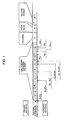
- Fig. 1 is a graph showing coefficients of thermal expansion of various materials.
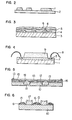
- Fig. 2 is a cross-sectional view of a flexible printed circuit obtained by direct coating.
- Fig. 3 is a cross-sectional view of LSI having a multi-layer wiring structure.
- Fig. 4 is a cross-sectional view of a memory element having an a-rays shielding layer.
- Fig. 5 is a cross-sectional view of a metal core wiring board mounting a film-carrier type LSI.
- Fig. 6 is a cross-sectional view of a metal-plate-based printed circuit mounting a LSI bonded by lead wire.
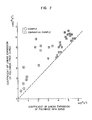
- Fig. 7 is a graph showing properties of the polyimides of this invention.
- Fig. 1 is a graph showing coefficients of thermal expansion of various materials.
- Fig. 2 is a cross-sectional view of a flexible printed circuit obtained by direct coating.
- Fig. 3 is a cross-sectional view of LSI having
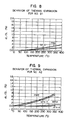
- Fig. 8 is a graph showing the behavior of thermal expansion for No. Dl.
- Fig. 9 is a graph showing the behavior of thermal expansion for No. A2.
- Fig. 10 is a graph showing the behavior of thermal expansion for No. A3.
- Fig. 11 is a graph showing the behavior of thermal expansion for No. F3.
- Fig. 12 is graphs showing coefficients of thermal expansion for polyimides.
- Fig. 13 is diffractograms for bifix-cured polyimides.
- Fig. 14 is diffractograms for A3 films.
- Fig. 15 is drawings showing conformations of polyimides.
- the chemical structure as main chain of the low thermal expansion polyimide of this invention includes, for example, the following units : and/or wherein R is an alkyl group, a fluorinated alkyl group, an alkoxy group, a fluorinated alkoxy group, an acyl group or a halogen; £ is zero or an integer of 1 to 4; m is zero or an integer of 1 to 2; and n is zero or an integer of 1 to 3.
- the low thermal expansion resin material of this invention has lower thermal expansion, higher strength, higher elasticity and higher heat resistance than other polymers, even if the molecular arrangement of the resin material is random. When the resin material of this invention is subjected to a molecular orientation treatment, these properties are by far improved.
- aromatic polymers are rigid but disadvantageously brittle.
- a flexible bond such as -O-, -S-, -(CH2)p (p is an integer of 1 or more), or the like thereinto.
- p is an integer of 1 or more
- the bonding position of aromatic rings takes at an O- or m-position, the whole polymer becomes flexible.
- Polyimides now industrially produced have bondings selected from the above-mentioned ones. Therefore, polyimides having low thermal expansion as claimed in this invention have not been known.
- the low thermal expansion polyimides of this invention include the following repeating units: wherein R, t, m and n are as mentioned above; and k is zero or an integer of 1 to 3.
- Fig. 1 is a graph showing thermal expansion coefficients of various materials.
- general organic polymers have larger thermal expansion coefficients than metals and ceramics, but the oriented polyimide of this invention has a clearly smaller thermal expansion coefficient compared with the general organic polymers. That the thermal expansion coefficient is as small as those of inorganic materials such as metals and ceramics means that when the resin material is used in combination with these inorganic materials, there take place no thermal stress nor warfage due to the same dimensional change upon temperature changes: this is very important from an industrial point of view. It is not too much to say that the most important defect of conventional organic materials is that the thermal expansion coefficient of the organic materials are by far larger than that of the inorganic materials.
- the low thermal expansion polyimide of this invention can be produced by polymerization of an aromatic aminodicarboxylic acid derivative, or by reaction of an aromatic diamine or an aromatic diisocyanate with an aromatic tetracarboxylic acid derivative.
- the derivative of tetracarboxylic acid means an ester, an acid anhydride, an acid chloride, or the like. Considering the synthesis process, the use of an acid anhydride is preferred.
- the polymerization can generally be carried out at 0 to 200°C in a solvent such as N-methylpyrrolidone (NMP), dimethyl formamide (DMF), dimethyl acetamide (DMAC), dimethyl sulfoxide (DMSO), dimethyl sulfate, sulfolane, butyrolactone, cresol, phenol, halogenated phenol, cyclohexane, dioxane, etc., alone or as a mixture thereof.
- NMP N-methylpyrrolidone
- DMF dimethyl formamide
- DMAC dimethyl acetamide
- DMSO dimethyl sulfoxide
- cresol cresol
- phenol halogenated phenol
- cyclohexane dioxane
- dioxane dioxane
- aromatic aminodicarboxylic acid derivative examples include 4-aminophthalic acid, 4-amino-5-methyl- phthalic acid, 4-(p-anilino)-phthalic acid, 4-(3,5-dimethyl-4-anilino)-phthalic acid, esters thereof, acid anhydrides thereof, acid chlorides thereof, etc. These aminodicarboxylic acid derivatives can be used alone or as a mixture thereof.
- aromatic diamine examples include p-phenylenediamine, 2,5-diaminotoluene, 2,5-diaminoxylene, diamino- durene, 2,3,5,6-tetramethyl-p-phenylenediamine, 2,5-diaminobenzotrifluoride, 2,5-diaminoanisole, 2,5-diamino- acetophenone, 2,5-diaminobenzophenone, 2,5-diaminodiphenyl, 2,5-diaminofluorobenzene, benzidine, o-tolidine, m-tolidine, 3,3',5,5'-tetramethylbenzidine, 3,3'-dimethoxybenzidine, 3,3'-di(trifluoromethyl)benzidine, 3,3'-di- acetylbenzidine, 3,3'-difluorobenzidine, octafluoro- benzidine, 4,4"-di
- aromatic tetracarboxylic acid derivatives examples include pyromellitic acid, methylpyromellitic acid, dimethylpyromellitic acid, di(trifluoromethyl)-pyromellitic acid, 3,3',4,4'-biphenyltetracarboxylic acid, 5,5'-dimethyl-3,3',4,4'-biphenyltetracarboxylic acid, p-(3,4-dicarboxyphenyl)benzene, esters thereof, acid anhydrides thereof, acid chlorides thereof, etc.
- These tetracarboxylic acid derivatives can be used alone or as a mixture thereof.
- the polyimide of this invention is, even if not oriented, lower in thermal expansion, higher in strength, and higher in elasticity, than other polymers, but when the molecular chain is oriented, these properties are by far highly enhanced.
- the molecular chain can be oriented by stretching a film-like article uniaxially or biaxially. It is known that an aromatic polyimide generally becomes lower in thermal expansion, higher in elasticity and higher in strength by an orientation treatment, but such effects are by far small compared with the effects in this invention.
- the orientation of polymer chain can be effected by not only stretching of a film using a stretcher but also applying shrinkage caused by a curing reaction of polyimide or during a procedure from a precursor varnish to polyimide shape article or shrinkage caused by evaporation of the solvent. For example, by preventing the shrinkage at the time of curing of a varnish coated, the orientation of molecular chain becomes possible.
- the stretching amount by curing shrinkage is very small compared with a conventional stretching method, but even such an orientation treatment is sufficiently effective in the polyimide of this invention.
- the stretching should be conducted at a very high temperature because of extremely high glass transition temperature of polyimide, and even if stretched at such a high temperature, the orientation is very difficult due to very strong intermolecular cohesive force.
- the polyimide of this invention is very low in thermal expansion but in some cases slightly brittle. In such a case, the brittleness of the polyimide of this invention can be improved by blending or copolymerization with other one or more polymers without remarkably increasing the thermal expansion coefficient. It is also possible to adjust the thermal expansion coefficient of the polyimide of this invention by blending or copolymerization with other one or more polymers considering the thermal expansion coefficient of inorganic material in the case of forming a composite shaped article. From the viewpoint of heat resistance, the use of polyimide as other polymers is preferred. Such a polyimide can be obtained from a diamine and a tetracarboxylic acid or a derivative thereof mentioned below.
- Examples of such a diamine are m-phenylenediamine, 4,4'-diaminodiphenyl methane, 1,2-bis(anilino)-ethane, 4,4'-diaminodiphenyl ether, diaminodiphenyl sulfone, 2,2-bis(p-aminophenyl)propane, 2,2-bis(p-aminophenyl)hexafluoropropane, 3,3'-dimethyl-4,4'-diaminodiphenyl ether, 3,3'-dimethyl-4,4'-diaminodiphenylmethane, diaminotoluene, diaminobenzotrifluoride, 1,4- bis(p-aminophenoxy)benzene, 4,4'-bis(p-aminophenoxy)-biphenyl, 2,2-bis ⁇ 4-(p-aminophenoxy)phenyl ⁇ propane, diaminoan
- aromatic diisocyanates obtained by reacting these diamines with phosgene such as tolylene diisocyanate, diphenylmethane diisocyanate, naphthalene diisocyanate, diphenyl ether diisocyanate, phenylene-l,3-diisocyanate, etc.
- phosgene such as tolylene diisocyanate, diphenylmethane diisocyanate, naphthalene diisocyanate, diphenyl ether diisocyanate, phenylene-l,3-diisocyanate, etc.
- Examples of such a tetracarboxylic acid or a derivative thereof are 2,3,3',4'-tetracarboxydiphenyl, 3,3',4,4'-tetracarbaxydiphenyl ether, 2,3,3',4'-tetracarboxydiphenyl ether, 3,3',4,4'-tetracarboxybenzophenone, 2,3,3',4'-tetracarboxybenzophenone, 2,3,6,7-tetracarboxynaphthalene, 1,4,5,7-tetracarboxynaphthalene, 1,2,5,6-tetracarboxynaphthalene, 3,3',4,4'-tetracarboxydiphenyl- methane, 2,2-bis(3,4-dicarboxyphenyl)propane, 2,2-bis-(3,4-dicarboxyphenyl)hexafluoropropane, 3,3',4,4'-tetracarboxydiphen
- the polyimide of this invention can be modified with a compound having one or more reactive functional groups or by introducing a crosslinked structure or ladder structure thereinto, as mentioned below.
- the inorganic material there can be used metals such as Cu, Cr, Au, Ag, Ni, Al, Fe, Co, Zn, Pb, Sn, Ti, Mo, Pd, etc., alloys thereof, Si, SiC, Si0 2 , Si 3 N 4 , A1 2 0 3 , BN and the like ceramics, Fe203, semiconductors such as Ga ⁇ As, glass, etc. in the form of film, plate, powder, fiber, etc.
- inorganic material it is preferable to roughen the surface of inorganic material, or to subject the inorganic material to a surface treatment with a silane coupling agent, a titanate coupling agent, aluminum alcholate, aluminum chelate, zirconium chelate, aluminum acetylacetone, etc.
- a silane coupling agent e.g., silane coupling agent, a titanate coupling agent, aluminum alcholate, aluminum chelate, zirconium chelate, aluminum acetylacetone, etc.
- surface treating agents can be added to the low thermal expansion polyimide.
- the adhesivenss of the polyimide to inorganic materials can be improved by modifying the polyimide with a siloxane containing diamine, or a tetracarboxylic acid or a derivative thereof.
- the low thermal expansion resin material of this invention may include one or more inorganic powders, organic powders, metal powders, fibers, chopped strands in order to further lower the thermal expansion coefficient, to enhance elasticity or to control fluidity.
- the composite shaped article obtained by shaping the low thermal expansion resin material and the inorganic material into one body can be used as follows:
- the low thermal expansion resin material of this invention can be used as follows.
- Fig. 2 is a cross-sectional view of a flexible printed circuit obtained by coating a varnish of precursor of the low thermal expansion polyimide 2 directly on a copper foil 1, curing the resin while preventing the shrinkage by curing, followed by patterning of the copper foil. Since the polyimide has low thermal expansion, there does not take place curling due to differences in thermal expansion coefficients even cooled to room temperature after cured. As a result, there can be obtained a flat flexible printed circuit. In the case of conventional FPC, since an adhesive is used, heat resistance is largely lowered. In contrast, in this invention, there is no such lowering in heat resistance and the adhesive strength is very strong.
- Fig. 3 is a cross-sectional view of LSI having a multi-layer wiring structure.
- Numeral 3 denotes a silicon wafer, 4 a Si0 2 film, 5 Al (aluminum) wiring, and 6 an insulating thin film of the low thermal expansion polyimide.
- the insulating thin film is formed by a spin coating method, level differences of aluminum wiring can remarkably be lessened to give a flat and highly reliable wiring structure.
- the thermal expansion is very low, stress to the element is very small. when the thermal stress is large, there arise cracks in the element. Further, the low thermal expansion resin material of this invention can easily be processed.
- the etching speed is about 2 times as fast as that of a conventional polyimide.
- the surface layer 6 when the surface layer 6 is made of an inorganic film such as Si0 2 film produced by a chemical vapor deposition (CVD ) method, moisture resistance can be improved.
- CVD chemical vapor deposition
- the underlying insulating film when the underlying insulating film is made from a conventional polyimide, there take place cracks on the surface inorganic film. Therefore, the underlying insulating film should be made from the polyimide of this invention.
- Fig. 4 is a cross-sectional view of a memory element having an a-rays shielding layer.
- Numeral 7 denotes a wiring layer and 8 a lead wire.
- the polyimide of this invention is remarkably excellent in heat resistance compared with conventional polyimides, it is suitable for use in glass encapsulated semiconductior element.
- the pyrolysis rate of the polyimide of this invention is about 1/10 of that of conventional ones.
- the shrinkage at the time of curing is prevented by the silicon wafer to show low thermal expansion.
- Fig. 5 shows a cross-sectional view of a metal core wiring board (a metal-plate-base printed wiring board) mounting a film-carrier type LSI.
- Numeral 10 denotes a metal substrate, 11 a LSI chip produced by a film-carrier method, 12 a carrier film using the low thermal expansion polyimide, and 13 a terminal. Since the carrier film 12 is made from the low thermal expansion polyimide, there can be obtained LSI 11 with high accuracy and high density. Further, since the stress applied to a solder ball 14 for bonding is reduced remarkably, breaking as a result of fatigue is also reduced. Further, by applying the low thermal expansion polyimide to an insulating film 16 at a wiring portion 15 formed on the metal substrate 10, there can be obtain a printed wiring board without crook, which results in making high accuracy high density assembly possible.
- Fig. 6 is a cross-sectional view of a metal-plate-based printed circuit mounting a LSI bonded by lead wire.
- Numeral 17 denotes a LSI chip obtained by a lead- wire bonding method.
- Other numerals are the same as those in Fig. 5, etc.
- the low thermal expansion polyimide of this invention can effectively be used in the following application, although not particularly shown in a drawing.
- a metal foil such as stainless steel foil coated with a thin film of the low thermal expansion polyimide is used as a substrate in a solar cell using amorphous silicon
- the generation of cracks on the amorphous silicon thin film is reduced remarkably compared with the case of using conventional polyimides.
- the low thermal expansion polyimide When the low thermal expansion polyimide is used as matrix resin for fiber reinforced laminates, not cnly the thermal expansion coefficient at the direction along the layers by the fiber reinforcement but also that at the flatwise direction, that is, perpendicular to the direction along the layers, can be reduced. Further, since the difference in thermal expansion coefficients between the fiber material and the polyimide is small, there arises no local thermal stress nor interfacial peeling due to heat shock, and the like.
- the low thermal expansion polyimide of this invention is used as a molding material, even if an insert made of a metal or ceramic is molded together, there takes place no problem of generation of cracks, cracks and deformation of the insert per se.
- the low thermal expansion polyimide is used in the form of fiber, for example, as reinforcing fibers for FRP, the weight-saving is more remarkable than the use of glass fiber. Further, when it is used as multi-layer wiring board for computors, the dielectric constant becomes smaller compared with the case of using glass fiber.
- the composite shaped article of this invention can be shaped into one body directly or by using an adhesive or binder.
- a diamine was placed in an amount as shown in Table 1 and dissolved with 850 g of N-methyl-2-pyrrolidone (NMP). Then, the flask was dipped in a water bath at 0 to 50°C and a tetracarboxylic acid dianhydride as shown in Table 1 was added thereto while controlling the exothermic heat. After dissolving the tetracarboxylic dianhydride, the water bath was removed and the reaction was continued for about 5 hours at near room temperature to give a polyamide-acid varnish. When the viscosity of varnish became too high, stirring with heating (cooking) at 80 to 85°C was continued until the viscosity became 50 poises at 25°C.
- NMP N-methyl-2-pyrrolidone
- the thermal expansion coefficient of polyimide obtained by heating a polyamide-acid was measured as follows. A varnish was coated uniformly on a glass plate by using an applicator and dried at 80 to 100°C for 30 to 60 minutes to make a film-like form. Then, the film was stripped off from the glass plate and fixed on an iron frame (bifix cure) or hung by using a spring to allow free shrinkage (free cure), and held at 200°C, 300°C or 400°C for 60 minutes to give a polyimide film of 20 to 200 ⁇ m thick. A film of 3 mm x 80 mm was cut off and placed between two glass plates, and heated at 400°C again, followed by gradual cooling to remove residual strain.
- thermal expansion coefficient was obtained from the dimensional change amount below the glass transition temperature.
- accurate thermal expansion coefficient cannot be meadured, unless absorbed moisture or solvent in film or residual strain by imidization is removed sufficiently and the imidization reaction is substantially completed. If an absorbed moisture is present, the thermal expansion coefficient of the film is apparently measured with a lower value at a temperature range of room temperature to 150°C due to removal of moisture. Further, if the residual strain is retained or the imidization reaction is is not completed, the linear expansion coefficient is sometimes apparently measured with a lower value due to the removal of residual strain near the glass transition temperature (Tg) or shrinkage by dehydration by imidization reaction. Further, when the film is fixed on the iron frame and cured and broken during the curing, the thermal expansion coefficient is measured with a rather higher value due to insufficient orientation treatment. These should be taken into consideration.
- Table 1 shows thermal expansion coefficients of polyimide films after bifix cured and free cured. Further, the data on Table 1 are plotted in Fig. 7 taking the linear expansion coefficients by free cure of polyimide along the abscissa axis and the linear expansion coefficients by bifix cure of polyimide along the ordinate axis. As is clear from Fig. 7, the polyimides of this invention clearly have very low thermal expansion coefficients compared with conventional polyimides.
- the low thermal expansion can be obtained when P-PDA, DATP, o-TOLID, and p-DATOL are used as diamine, and P M DA and BPD A are used as tetracarboxylic dianhydride.
- P-PDA, DATP, o-TOLID, and p-DATOL are used as diamine
- P M DA and BPD A are used as tetracarboxylic dianhydride.
- the low thermal expansion polyimides of this invention can be blended or copolymerized with conventional polyimides having larger thermal expansion coefficients or with conventional polyamide-acid to control the thermal expansion coefficients properly.
- a polyamide-acid varnish was prepared by reacting an aromatic diamine as listed in Table 3 with an aromatic tetracarboxylic dianhydride as listed in Table 3 in N-methyl-2-pyrrolidone at room temperature.
- the varnish was coated on a glass plate and dried at 100°C for 1 hour. Then, the resulting film was stripped off and cured at 200°C for 1 hour and at 400°C for 1 hour in a nitrogen gas to give a polyimide film. It was also found that behavior for thermal expansion changed when curing shrinkage was conducted freely (free cure) or shrinkage was prevented by fixing on an iron frame at one direction (unifix cure) or at two directions (bifix cure).
- a film of 5 mm wide, 65 mm long (between chucks) and 20 to 100 ⁇ m thick was used as sample.
- the sample was applied to a thermal mechanical analyzer (TMA 1500, mfd. by Shinku Riko K.K.) and measured under the conditions of 5° C/min. Since the thermal expansion coefficient had temperature-dependency, an average value between 50 to 250°C was used as a representative value.
- a sample of 30 mm wide, 40 mm long and about 40 ⁇ m thick was measured by using a Geiger-Flex RAD (mfd. by Rigaku Denki Co., Ltd.)
- Fig. 8 shows behavior of thermal expansion for polyimide No. Dl obtained from DATP and PMDA.
- the thermal expansion coefficient of conventional polyimide is usually 4 to 6 x 10 -4 K -1 and there is a dimensional change of 0.8 to 1.2% with the temperature change of from 50 to 250°C.
- the polyimide of No. Dl shows dimensional change of about 0.2% (free cure) or about 0.1% (bifix cure) in the temperature range of 50 to 250°C.
- Fig. 9 also shows behavior of thermal expansion for polyimide No. A2.
- the dimensional change by the bifix cure is 0.1% or less, while that by free cure becomes as large as about 0.4% in the range of 50 to 250°C with a relative increase of thermal expansion coefficient.
- prevention of curing shrinkage at only one axis was also studied.
- Fig. 12 shows a relationship between the chemical structures and thermal expansion coefficients.
- the kinds of polyimides can roughly be divided into the following 4 groups.
- the polyimides belonging to the group1 can only take conformation wherein both the diamine and tetracarboxylic acid components lie linearly on almost the same plane as shown in Fig. 15 (I). Therefore, they are rod-like at the direction of molecular axis and rigid, as well as liable to be crystallized.
- the polyimides belonging to the group 2 have considerably linear conformation, although take a somewhat zigzag structure due to the biphenyl of BPDA as shown in Fig. 15 (II).
- the polyimides belonging to the group3 can further be divided into two groups; one of which is formed from p-PDA, o-TOLID or DATP and BTDA and lies on almost the same plane as shown in Fig. 15 (III) but is hardly arranged on a straight line depending on benzophenone skeltons, and another of which turns at the ether bonds as shown in Fig. 15 (IV) and does not lie on the same plane but the skelton between two ether bonds lies linearly.
- the polyimides obtained from a combination of PMDA and DDM or DDS also belong to the same type. Almost all the other polyimides lose regularity by ether, thioether, methylene, ketone, or the like as shown in Fig. 15 (V).
Landscapes
- Chemical & Material Sciences (AREA)
- Health & Medical Sciences (AREA)
- Chemical Kinetics & Catalysis (AREA)
- Medicinal Chemistry (AREA)
- Polymers & Plastics (AREA)
- Organic Chemistry (AREA)
- Macromolecular Compounds Obtained By Forming Nitrogen-Containing Linkages In General (AREA)
- Polymers With Sulfur, Phosphorus Or Metals In The Main Chain (AREA)
Applications Claiming Priority (4)
| Application Number | Priority Date | Filing Date | Title |
|---|---|---|---|
| JP13943883A JPS6032827A (ja) | 1983-08-01 | 1983-08-01 | 低熱膨張樹脂材料 |
| JP139438/83 | 1983-08-01 | ||
| JP15235183A JPS6044338A (ja) | 1983-08-19 | 1983-08-19 | 複合成形品 |
| JP152351/83 | 1983-08-19 |
Publications (3)
| Publication Number | Publication Date |
|---|---|
| EP0133533A2 true EP0133533A2 (fr) | 1985-02-27 |
| EP0133533A3 EP0133533A3 (en) | 1988-08-31 |
| EP0133533B1 EP0133533B1 (fr) | 1993-04-21 |
Family
ID=26472257
Family Applications (1)
| Application Number | Title | Priority Date | Filing Date |
|---|---|---|---|
| EP19840109054 Expired - Lifetime EP0133533B1 (fr) | 1983-08-01 | 1984-07-31 | Matière résineuse à faible dilatation thermique pour film isolant. |
Country Status (3)
| Country | Link |
|---|---|
| US (2) | US4690999A (fr) |
| EP (1) | EP0133533B1 (fr) |
| DE (1) | DE3486131T2 (fr) |
Cited By (15)
| Publication number | Priority date | Publication date | Assignee | Title |
|---|---|---|---|---|
| US4731435A (en) * | 1986-11-10 | 1988-03-15 | E. I. Du Pont De Nemours And Company | Elastomers |
| EP0271736A1 (fr) * | 1986-11-20 | 1988-06-22 | Nippon Steel Chemical Co., Ltd. | Résines ayant une faible expansibilité thermique |
| US4810770A (en) * | 1986-11-10 | 1989-03-07 | E. I. Du Pont De Nemours And Company | Elastomers |
| EP0255037A3 (en) * | 1986-07-30 | 1989-03-15 | Hitachi, Ltd. | A method for forming polyimide film by chemical vapor deposition |
| EP0299785A3 (en) * | 1987-07-17 | 1989-04-26 | Ethyl Corporation | Wear resistant solid film lubricants, their preparation and use |
| EP0261400A3 (en) * | 1986-08-27 | 1989-05-24 | Hitachi, Ltd. | Lift-off process for forming wiring on a substrate |
| EP0209670A3 (en) * | 1985-07-25 | 1989-10-25 | International Business Machines Corporation | A process for planarizing a substrate |
| EP0230615A3 (fr) * | 1986-01-31 | 1989-11-08 | International Business Machines Corporation | Polyimides contenant du silicium utilisé comme arrêt pour l'attaque à l'oxygène et comme couche diélectrique composite |
| EP0304913A3 (fr) * | 1987-08-25 | 1990-08-29 | Ube Industries, Ltd. | Imide oligomère modifié aux groupes terminaux et composition liquide le contenant |
| EP0349269A3 (fr) * | 1988-06-30 | 1991-05-15 | Chisso Corporation | Substrat flexible vêtu de cuivre |
| EP0491306A1 (fr) * | 1990-12-17 | 1992-06-24 | E.I. Du Pont De Nemours And Company | Polyimides aromatiques dérivés de dianhydrides aromatiques et diamines aromatiques chlorés |
| US5192619A (en) * | 1988-06-30 | 1993-03-09 | Chisso Corporation | Flexible copper-applied substrates |
| WO1993009167A1 (fr) * | 1991-10-29 | 1993-05-13 | E.I. Du Pont De Nemours And Company | Procede de preparation d'un film de polyimide ayant une valeur preselectionnee de coefficient de dilatation thermique |
| EP0530929A3 (en) * | 1987-01-31 | 1993-08-04 | Kabushiki Kaisha Toshiba | Thermal head with heat-resistant insulating coating material |
| US10665545B2 (en) * | 2018-09-19 | 2020-05-26 | Taiwan Semiconductor Manufacturing Co., Ltd. | Semiconductor devices, semiconductor packages and methods of forming the same |
Families Citing this family (50)
| Publication number | Priority date | Publication date | Assignee | Title |
|---|---|---|---|---|
| WO1987002620A1 (fr) * | 1985-10-31 | 1987-05-07 | Mitsui Toatsu Chemicals, Incorporated | Carte de circuit imprime flexible et procede de production |
| JPH0632351B2 (ja) * | 1986-05-30 | 1994-04-27 | 日東電工株式会社 | フレキシブルプリント基板 |
| US4913759A (en) * | 1987-04-13 | 1990-04-03 | Ethyl Corporation | Polyimide precursor and pseudo hot-melt prepregging process employing same |
| JPS6486589A (en) * | 1987-06-04 | 1989-03-31 | Shin Kobe Electric Machinery | Metal-foiled laminated plate |
| US4859530A (en) * | 1987-07-09 | 1989-08-22 | Ethyl Corporation | High temperature adhesive for polymide films |
| JPH01245586A (ja) * | 1988-03-28 | 1989-09-29 | Nippon Steel Chem Co Ltd | フレキシブルプリント基板 |
| US4876329A (en) * | 1988-06-28 | 1989-10-24 | Amoco Corporation | Polyimide polymers and copolymers using 3,5-diaminobenzotrifluoride |
| US4877653A (en) * | 1988-07-12 | 1989-10-31 | Hoechst Celanese Corporation | Process for insolublizing solvent soluble polyimide compositions |
| JPH07102646B2 (ja) * | 1988-09-30 | 1995-11-08 | 株式会社日立製作所 | 金属とポリイミドの複合成形体 |
| US5068131A (en) * | 1988-10-11 | 1991-11-26 | Ethyl Corporation | Method for production of electronic coatings |
| US4997869A (en) * | 1988-10-11 | 1991-03-05 | Ethyl Corporation | Production of electronic coatings by spin coating a partially fluorinated polyimide composition |
| US4996254A (en) * | 1988-10-11 | 1991-02-26 | Ethyl Corporation | Production of electronic coatings by spin coating a partially fluorinated polyamic acid composition |
| US5037673A (en) * | 1988-10-11 | 1991-08-06 | Ethyl Corporation | Method of spin coating a solution of partially fluorinated polyamic acid polymer and cycloaliphatic ketone solvent |
| US4973660A (en) * | 1988-11-30 | 1990-11-27 | Amoco Corporation | Polyamide of diamino-t-butyltoluene |
| US5231162A (en) * | 1989-09-21 | 1993-07-27 | Toho Rayon Co. Ltd. | Polyamic acid having three-dimensional network molecular structure, polyimide obtained therefrom and process for the preparation thereof |
| DE59105367D1 (de) * | 1990-08-17 | 1995-06-08 | Ciba Geigy Ag | Copolyimide, Verfahren zu deren Herstellung und deren Verwendung. |
| US5198316A (en) * | 1990-08-17 | 1993-03-30 | Ciba-Geigy Corporation | Copolyimides, their preparation and the use thereof |
| US5061781A (en) * | 1990-09-18 | 1991-10-29 | American Cyanamid Company | Polyimides from diaminobenzotrifluorides |
| US5021540A (en) * | 1990-09-18 | 1991-06-04 | American Cyanamid | Polyimides from diaminobenzotrifluorides |
| JPH06105836B2 (ja) * | 1990-10-05 | 1994-12-21 | 富士通株式会社 | 薄膜多層基板の製造方法 |
| AU1885692A (en) * | 1991-04-01 | 1992-11-02 | Foster-Miller Inc. | Extruded blends of thermoplastic and liquid crystalline polymers |
| US5427848A (en) * | 1991-05-06 | 1995-06-27 | International Business Machines Corporation | Stress balanced composite laminate material |
| JP2868167B2 (ja) * | 1991-08-05 | 1999-03-10 | インターナショナル・ビジネス・マシーンズ・コーポレイション | 多重レベル高密度相互接続構造体及び高密度相互接続構造体 |
| US5374469A (en) * | 1991-09-19 | 1994-12-20 | Nitto Denko Corporation | Flexible printed substrate |
| US5264534A (en) * | 1991-10-31 | 1993-11-23 | Foster-Miller, Inc. | Oriented semicrystalline polymer films |
| US5470693A (en) * | 1992-02-18 | 1995-11-28 | International Business Machines Corporation | Method of forming patterned polyimide films |
| US5981007A (en) * | 1992-03-31 | 1999-11-09 | Foster-Miller, Inc. | Extruded thermoplastic, liquid crystalline polymers and blends thereof having a planar morphology |
| US5310863A (en) * | 1993-01-08 | 1994-05-10 | International Business Machines Corporation | Polyimide materials with improved physico-chemical properties |
| US5849397A (en) * | 1995-10-03 | 1998-12-15 | Ube Industries, Ltd. | Aromatic polyimide film and polyimide/copper foil composite sheet |
| US6040205A (en) * | 1997-08-05 | 2000-03-21 | Micron Technology, Inc. | Apparatus and method for controlling the depth of immersion of a semiconductor element in an exposed surface of a viscous fluid |
| US6336973B1 (en) * | 1997-08-05 | 2002-01-08 | Micron Technology, Inc. | Apparatus and method for modifying the configuration of an exposed surface of a viscous fluid |
| US6013535A (en) * | 1997-08-05 | 2000-01-11 | Micron Technology, Inc. | Method for applying adhesives to a lead frame |
| US6326685B1 (en) * | 1998-05-04 | 2001-12-04 | Agere Systems Guardian Corp. | Low thermal expansion composite comprising bodies of negative CTE material disposed within a positive CTE matrix |
| US6346750B1 (en) * | 2000-04-28 | 2002-02-12 | Micron Technology, Inc. | Resistance-reducing conductive adhesives for attachment of electronic components |
| KR100917101B1 (ko) * | 2000-08-04 | 2009-09-15 | 도요 보세키 가부시키가이샤 | 플렉시블 금속적층체 및 그 제조방법 |
| KR100796034B1 (ko) * | 2000-11-06 | 2008-01-21 | 한학수 | 미세전자소자 패키지용 저응력 폴리이미드 공중합체의 제조방법 |
| EP1407879A4 (fr) * | 2001-05-24 | 2006-04-12 | Toray Industries | Film en en resine thermoresistant a couche metallique, et panneau de cablage, et procede de fabrication du film et du panneau |
| US7026436B2 (en) * | 2002-11-26 | 2006-04-11 | E.I. Du Pont De Nemours And Company | Low temperature polyimide adhesive compositions and methods relating thereto |
| JP2006080013A (ja) * | 2004-09-10 | 2006-03-23 | Mitsui Mining & Smelting Co Ltd | 導電性ペースト及びその導電性ペーストを用いて得られるフレキシブルプリント配線板 |
| JPWO2006082887A1 (ja) * | 2005-02-04 | 2008-06-26 | 日本ゼオン株式会社 | 多層フィルムおよびこれを用いた積層体並びに積層体の製造方法 |
| JP2007141977A (ja) * | 2005-11-16 | 2007-06-07 | Matsushita Electric Ind Co Ltd | 半導体装置 |
| TWI387812B (zh) * | 2006-11-13 | 2013-03-01 | Ind Tech Res Inst | 具有光學補償功能之透明基板及其液晶顯示器 |
| US20080118730A1 (en) * | 2006-11-22 | 2008-05-22 | Ta-Hua Yu | Biaxially oriented film, laminates made therefrom, and method |
| KR101227317B1 (ko) * | 2007-07-31 | 2013-01-28 | 코오롱인더스트리 주식회사 | 열안정성이 개선된 폴리이미드 필름 |
| US8999764B2 (en) * | 2007-08-10 | 2015-04-07 | International Business Machines Corporation | Ionizing radiation blocking in IC chip to reduce soft errors |
| KR101444694B1 (ko) * | 2009-05-25 | 2014-10-01 | 에스케이이노베이션 주식회사 | 연성금속박적층체 및 이의 제조방법 |
| EP2501741A1 (fr) * | 2009-11-20 | 2012-09-26 | E. I. du Pont de Nemours and Company | Compositions de couche de fermeture et procédés associés |
| KR101004429B1 (ko) * | 2009-12-30 | 2010-12-28 | 주식회사 대림코퍼레이션 | 내열성과 고온영역의 인장특성이 향상된 전방향족 폴리이미드 수지의 제조방법 |
| US9216390B2 (en) | 2010-07-15 | 2015-12-22 | Ohio State Innovation Foundation | Systems, compositions, and methods for fluid purification |
| KR101898455B1 (ko) * | 2016-03-31 | 2018-09-13 | 가부시키가이샤 아이.에스.티 | 폴리이미드 섬유 및 폴리이미드 섬유의 제조 방법 |
Family Cites Families (9)
| Publication number | Priority date | Publication date | Assignee | Title |
|---|---|---|---|---|
| US3179633A (en) * | 1962-01-26 | 1965-04-20 | Du Pont | Aromatic polyimides from meta-phenylene diamine and para-phenylene diamine |
| US3179630A (en) * | 1962-01-26 | 1965-04-20 | Du Pont | Process for preparing polyimides by treating polyamide-acids with lower fatty monocarboxylic acid anhydrides |
| NL288197A (fr) * | 1962-01-26 | 1900-01-01 | ||
| US3708458A (en) * | 1971-03-16 | 1973-01-02 | Upjohn Co | Copolyimides of benzophenone tetracarboxylic acid dianhydride and mixture of diisocyanates |
| NL7405552A (nl) * | 1974-04-25 | 1975-10-28 | Philips Nv | Kathodestraalbuis. |
| US3979633A (en) * | 1974-09-25 | 1976-09-07 | Gte Sylvania Incorporated | Directional getter attached to multi-apertured member |
| JPS6042817B2 (ja) * | 1978-06-30 | 1985-09-25 | 宇部興産株式会社 | ポリイミド成形物の製造方法 |
| US4405550A (en) * | 1981-04-17 | 1983-09-20 | Mobil Oil Corporation | Manufacture of polyimide film by solvent casting |
| US4708958A (en) * | 1986-09-24 | 1987-11-24 | G. D. Searle & Co. | 6-(imidazolyphenyl)-4-iminopyrimidinones useful as hypotensive agents |
-
1984
- 1984-07-31 DE DE84109054T patent/DE3486131T2/de not_active Expired - Fee Related
- 1984-07-31 EP EP19840109054 patent/EP0133533B1/fr not_active Expired - Lifetime
- 1984-08-01 US US06/636,736 patent/US4690999A/en not_active Expired - Lifetime
-
1987
- 1987-07-24 US US07/077,390 patent/US4792476A/en not_active Expired - Lifetime
Cited By (19)
| Publication number | Priority date | Publication date | Assignee | Title |
|---|---|---|---|---|
| EP0209670A3 (en) * | 1985-07-25 | 1989-10-25 | International Business Machines Corporation | A process for planarizing a substrate |
| EP0230615A3 (fr) * | 1986-01-31 | 1989-11-08 | International Business Machines Corporation | Polyimides contenant du silicium utilisé comme arrêt pour l'attaque à l'oxygène et comme couche diélectrique composite |
| EP0255037A3 (en) * | 1986-07-30 | 1989-03-15 | Hitachi, Ltd. | A method for forming polyimide film by chemical vapor deposition |
| EP0261400A3 (en) * | 1986-08-27 | 1989-05-24 | Hitachi, Ltd. | Lift-off process for forming wiring on a substrate |
| US4886573A (en) * | 1986-08-27 | 1989-12-12 | Hitachi, Ltd. | Process for forming wiring on substrate |
| US4810770A (en) * | 1986-11-10 | 1989-03-07 | E. I. Du Pont De Nemours And Company | Elastomers |
| US4731435A (en) * | 1986-11-10 | 1988-03-15 | E. I. Du Pont De Nemours And Company | Elastomers |
| EP0271736A1 (fr) * | 1986-11-20 | 1988-06-22 | Nippon Steel Chemical Co., Ltd. | Résines ayant une faible expansibilité thermique |
| EP0530929A3 (en) * | 1987-01-31 | 1993-08-04 | Kabushiki Kaisha Toshiba | Thermal head with heat-resistant insulating coating material |
| EP0299785A3 (en) * | 1987-07-17 | 1989-04-26 | Ethyl Corporation | Wear resistant solid film lubricants, their preparation and use |
| EP0304913A3 (fr) * | 1987-08-25 | 1990-08-29 | Ube Industries, Ltd. | Imide oligomère modifié aux groupes terminaux et composition liquide le contenant |
| EP0349269A3 (fr) * | 1988-06-30 | 1991-05-15 | Chisso Corporation | Substrat flexible vêtu de cuivre |
| US5192619A (en) * | 1988-06-30 | 1993-03-09 | Chisso Corporation | Flexible copper-applied substrates |
| EP0491306A1 (fr) * | 1990-12-17 | 1992-06-24 | E.I. Du Pont De Nemours And Company | Polyimides aromatiques dérivés de dianhydrides aromatiques et diamines aromatiques chlorés |
| US5175240A (en) * | 1990-12-17 | 1992-12-29 | E.I. Du Pont De Nemours And Company | Aromatic homopolyimide or copolyimide films having low water absorption and high thermal durability |
| EP0722969A1 (fr) * | 1990-12-17 | 1996-07-24 | E.I. Du Pont De Nemours And Company | Polyimides aromatiques dérivés de dianhydrides aromatiques et de diamines aromatiques chlorées |
| WO1993009167A1 (fr) * | 1991-10-29 | 1993-05-13 | E.I. Du Pont De Nemours And Company | Procede de preparation d'un film de polyimide ayant une valeur preselectionnee de coefficient de dilatation thermique |
| US10665545B2 (en) * | 2018-09-19 | 2020-05-26 | Taiwan Semiconductor Manufacturing Co., Ltd. | Semiconductor devices, semiconductor packages and methods of forming the same |
| US11049812B2 (en) * | 2018-09-19 | 2021-06-29 | Taiwan Semiconductor Manufacturing Company, Ltd. | Semiconductor devices and methods of forming the same |
Also Published As
| Publication number | Publication date |
|---|---|
| EP0133533A3 (en) | 1988-08-31 |
| DE3486131T2 (de) | 1993-10-28 |
| EP0133533B1 (fr) | 1993-04-21 |
| US4690999A (en) | 1987-09-01 |
| US4792476A (en) | 1988-12-20 |
| DE3486131D1 (de) | 1993-05-27 |
Similar Documents
| Publication | Publication Date | Title |
|---|---|---|
| EP0133533B1 (fr) | Matière résineuse à faible dilatation thermique pour film isolant. | |
| JPS6160725A (ja) | 電子装置用多層配線基板の製法 | |
| EP0271736B1 (fr) | Résines ayant une faible expansibilité thermique | |
| US5570506A (en) | Method for forming multilayer wiring construction | |
| JPS60250031A (ja) | 低熱膨張性樹脂材料 | |
| US5133989A (en) | Process for producing metal-polyimide composite article | |
| JPS60157286A (ja) | フレキシブルプリント基板の製造方法 | |
| JPS6032827A (ja) | 低熱膨張樹脂材料 | |
| JPS61176803A (ja) | ストレインゲージ | |
| US5120573A (en) | Process for producing metal/polyimide composite article | |
| JPH02115265A (ja) | 耐熱性フイルムおよびその積層物 | |
| JPS61181829A (ja) | 低熱膨張性樹脂材料 | |
| JPH0796618B2 (ja) | 低熱膨張性樹脂 | |
| JPH0245998A (ja) | 薄膜多層配線基板 | |
| JPS6044338A (ja) | 複合成形品 | |
| JPH02251584A (ja) | ヘテロ環含有ポリイミド複合体 | |
| JPH05331445A (ja) | フィルム接着剤の製造方法 | |
| JPH024631B2 (fr) | ||
| JPH10120785A (ja) | ポリイミド樹脂組成物およびフィルム接着剤とその製造方法 | |
| JPS63245988A (ja) | フレキシブルプリント基板及びその製造法 | |
| JPS61181828A (ja) | 低熱膨張性樹脂材料 | |
| JPH0563322A (ja) | フレキシブルプリント基板の製造方法 | |
| JPS63234589A (ja) | 多層配線板 | |
| JPH02167741A (ja) | 金属/ポリイミド複合体の製造方法 | |
| JPS60208358A (ja) | 複合体 |
Legal Events
| Date | Code | Title | Description |
|---|---|---|---|
| PUAI | Public reference made under article 153(3) epc to a published international application that has entered the european phase |
Free format text: ORIGINAL CODE: 0009012 |
|
| AK | Designated contracting states |
Kind code of ref document: A2 Designated state(s): DE FR GB NL Designated state(s): DE FR GB NL |
|
| 17P | Request for examination filed |
Effective date: 19841220 |
|
| PUAL | Search report despatched |
Free format text: ORIGINAL CODE: 0009013 |
|
| AK | Designated contracting states |
Kind code of ref document: A3 Designated state(s): DE FR GB NL |
|
| 17Q | First examination report despatched |
Effective date: 19900129 |
|
| RTI1 | Title (correction) | ||
| GRAA | (expected) grant |
Free format text: ORIGINAL CODE: 0009210 |
|
| AK | Designated contracting states |
Kind code of ref document: B1 Designated state(s): DE FR GB NL |
|
| REF | Corresponds to: |
Ref document number: 3486131 Country of ref document: DE Date of ref document: 19930527 |
|
| ET | Fr: translation filed | ||
| PLBE | No opposition filed within time limit |
Free format text: ORIGINAL CODE: 0009261 |
|
| STAA | Information on the status of an ep patent application or granted ep patent |
Free format text: STATUS: NO OPPOSITION FILED WITHIN TIME LIMIT |
|
| 26N | No opposition filed | ||
| REG | Reference to a national code |
Ref country code: GB Ref legal event code: IF02 |
|
| PGFP | Annual fee paid to national office [announced via postgrant information from national office to epo] |
Ref country code: FR Payment date: 20020516 Year of fee payment: 19 |
|
| PGFP | Annual fee paid to national office [announced via postgrant information from national office to epo] |
Ref country code: GB Payment date: 20020719 Year of fee payment: 19 |
|
| PGFP | Annual fee paid to national office [announced via postgrant information from national office to epo] |
Ref country code: NL Payment date: 20020731 Year of fee payment: 19 |
|
| PGFP | Annual fee paid to national office [announced via postgrant information from national office to epo] |
Ref country code: DE Payment date: 20020926 Year of fee payment: 19 |
|
| PG25 | Lapsed in a contracting state [announced via postgrant information from national office to epo] |
Ref country code: GB Free format text: LAPSE BECAUSE OF NON-PAYMENT OF DUE FEES Effective date: 20030731 |
|
| PG25 | Lapsed in a contracting state [announced via postgrant information from national office to epo] |
Ref country code: NL Free format text: LAPSE BECAUSE OF NON-PAYMENT OF DUE FEES Effective date: 20040201 |
|
| PG25 | Lapsed in a contracting state [announced via postgrant information from national office to epo] |
Ref country code: DE Free format text: LAPSE BECAUSE OF NON-PAYMENT OF DUE FEES Effective date: 20040203 |
|
| GBPC | Gb: european patent ceased through non-payment of renewal fee |
Effective date: 20030731 |
|
| PG25 | Lapsed in a contracting state [announced via postgrant information from national office to epo] |
Ref country code: FR Free format text: LAPSE BECAUSE OF NON-PAYMENT OF DUE FEES Effective date: 20040331 |
|
| NLV4 | Nl: lapsed or anulled due to non-payment of the annual fee |
Effective date: 20040201 |
|
| REG | Reference to a national code |
Ref country code: FR Ref legal event code: ST |