EP0286431B1 - Lichtempfindliches farbphotographisches Silberhalogenidmaterial - Google Patents
Lichtempfindliches farbphotographisches Silberhalogenidmaterial Download PDFInfo
- Publication number
- EP0286431B1 EP0286431B1 EP88303169A EP88303169A EP0286431B1 EP 0286431 B1 EP0286431 B1 EP 0286431B1 EP 88303169 A EP88303169 A EP 88303169A EP 88303169 A EP88303169 A EP 88303169A EP 0286431 B1 EP0286431 B1 EP 0286431B1
- Authority
- EP
- European Patent Office
- Prior art keywords
- group
- silver halide
- light
- formula
- sensitive silver
- Prior art date
- Legal status (The legal status is an assumption and is not a legal conclusion. Google has not performed a legal analysis and makes no representation as to the accuracy of the status listed.)
- Expired
Links
- -1 silver halide Chemical class 0.000 title claims description 79
- 229910052709 silver Inorganic materials 0.000 title claims description 61
- 239000004332 silver Substances 0.000 title claims description 61
- 239000000463 material Substances 0.000 title claims description 36
- 150000001875 compounds Chemical class 0.000 claims description 38
- 125000001424 substituent group Chemical group 0.000 claims description 23
- 239000000839 emulsion Substances 0.000 claims description 22
- 125000000623 heterocyclic group Chemical group 0.000 claims description 19
- 125000004435 hydrogen atom Chemical group [H]* 0.000 claims description 19
- 125000000217 alkyl group Chemical group 0.000 claims description 18
- 125000003118 aryl group Chemical group 0.000 claims description 18
- 239000003795 chemical substances by application Substances 0.000 claims description 13
- 125000003545 alkoxy group Chemical group 0.000 claims description 11
- 125000004432 carbon atom Chemical group C* 0.000 claims description 10
- 125000005843 halogen group Chemical group 0.000 claims description 9
- 230000003647 oxidation Effects 0.000 claims description 9
- 238000007254 oxidation reaction Methods 0.000 claims description 9
- 238000006243 chemical reaction Methods 0.000 claims description 8
- 125000001931 aliphatic group Chemical group 0.000 claims description 6
- 125000004429 atom Chemical group 0.000 claims description 6
- QJGQUHMNIGDVPM-UHFFFAOYSA-N nitrogen group Chemical group [N] QJGQUHMNIGDVPM-UHFFFAOYSA-N 0.000 claims description 6
- 229910052755 nonmetal Inorganic materials 0.000 claims description 5
- IDCLTMRSSAXUNY-UHFFFAOYSA-N 5-hydroxylansoprazole Chemical compound CC1=C(OCC(F)(F)F)C=CN=C1CS(=O)C1=NC2=CC(O)=CC=C2N1 IDCLTMRSSAXUNY-UHFFFAOYSA-N 0.000 claims description 3
- 125000000962 organic group Chemical group 0.000 claims 1
- 239000000975 dye Substances 0.000 description 18
- 238000010521 absorption reaction Methods 0.000 description 16
- GZTPJDLYPMPRDF-UHFFFAOYSA-N pyrrolo[3,2-c]pyrazole Chemical compound N1=NC2=CC=NC2=C1 GZTPJDLYPMPRDF-UHFFFAOYSA-N 0.000 description 11
- 125000000753 cycloalkyl group Chemical group 0.000 description 9
- 238000011161 development Methods 0.000 description 9
- 238000000034 method Methods 0.000 description 9
- 238000000926 separation method Methods 0.000 description 9
- 108010010803 Gelatin Proteins 0.000 description 8
- 125000002947 alkylene group Chemical group 0.000 description 8
- 229920000159 gelatin Polymers 0.000 description 8
- 239000008273 gelatin Substances 0.000 description 8
- 235000019322 gelatine Nutrition 0.000 description 8
- 235000011852 gelatine desserts Nutrition 0.000 description 8
- 125000004442 acylamino group Chemical group 0.000 description 7
- 125000004423 acyloxy group Chemical group 0.000 description 7
- 125000003342 alkenyl group Chemical group 0.000 description 7
- 125000000732 arylene group Chemical group 0.000 description 6
- 125000004104 aryloxy group Chemical group 0.000 description 6
- 230000000052 comparative effect Effects 0.000 description 6
- 238000012545 processing Methods 0.000 description 6
- ZRHUHDUEXWHZMA-UHFFFAOYSA-N 1,4-dihydropyrazol-5-one Chemical compound O=C1CC=NN1 ZRHUHDUEXWHZMA-UHFFFAOYSA-N 0.000 description 5
- 206010070834 Sensitisation Diseases 0.000 description 5
- 125000005161 aryl oxy carbonyl group Chemical group 0.000 description 5
- 125000001997 phenyl group Chemical group [H]C1=C([H])C([H])=C(*)C([H])=C1[H] 0.000 description 5
- 230000035945 sensitivity Effects 0.000 description 5
- 230000008313 sensitization Effects 0.000 description 5
- MQIUGAXCHLFZKX-UHFFFAOYSA-N Di-n-octyl phthalate Natural products CCCCCCCCOC(=O)C1=CC=CC=C1C(=O)OCCCCCCCC MQIUGAXCHLFZKX-UHFFFAOYSA-N 0.000 description 4
- 125000002252 acyl group Chemical group 0.000 description 4
- 125000004453 alkoxycarbonyl group Chemical group 0.000 description 4
- 125000004397 aminosulfonyl group Chemical group NS(=O)(=O)* 0.000 description 4
- BJQHLKABXJIVAM-UHFFFAOYSA-N bis(2-ethylhexyl) phthalate Chemical compound CCCCC(CC)COC(=O)C1=CC=CC=C1C(=O)OCC(CC)CCCC BJQHLKABXJIVAM-UHFFFAOYSA-N 0.000 description 4
- 125000003917 carbamoyl group Chemical group [H]N([H])C(*)=O 0.000 description 4
- 239000003086 colorant Substances 0.000 description 4
- 125000000392 cycloalkenyl group Chemical group 0.000 description 4
- DROMNWUQASBTFM-UHFFFAOYSA-N dinonyl benzene-1,2-dicarboxylate Chemical compound CCCCCCCCCOC(=O)C1=CC=CC=C1C(=O)OCCCCCCCCC DROMNWUQASBTFM-UHFFFAOYSA-N 0.000 description 4
- 230000000694 effects Effects 0.000 description 4
- WVDDGKGOMKODPV-UHFFFAOYSA-N Benzyl alcohol Chemical compound OCC1=CC=CC=C1 WVDDGKGOMKODPV-UHFFFAOYSA-N 0.000 description 3
- KWYUFKZDYYNOTN-UHFFFAOYSA-M Potassium hydroxide Chemical compound [OH-].[K+] KWYUFKZDYYNOTN-UHFFFAOYSA-M 0.000 description 3
- HEMHJVSKTPXQMS-UHFFFAOYSA-M Sodium hydroxide Chemical compound [OH-].[Na+] HEMHJVSKTPXQMS-UHFFFAOYSA-M 0.000 description 3
- 125000004414 alkyl thio group Chemical group 0.000 description 3
- 125000000304 alkynyl group Chemical group 0.000 description 3
- 125000005110 aryl thio group Chemical group 0.000 description 3
- 238000009835 boiling Methods 0.000 description 3
- 229910052801 chlorine Inorganic materials 0.000 description 3
- 125000001309 chloro group Chemical group Cl* 0.000 description 3
- 238000004945 emulsification Methods 0.000 description 3
- 150000002430 hydrocarbons Chemical class 0.000 description 3
- 125000004149 thio group Chemical group *S* 0.000 description 3
- XLYOFNOQVPJJNP-UHFFFAOYSA-N water Substances O XLYOFNOQVPJJNP-UHFFFAOYSA-N 0.000 description 3
- QVLXDGDLLZYJAM-UHFFFAOYSA-N 2,5-dioctylbenzene-1,4-diol Chemical compound CCCCCCCCC1=CC(O)=C(CCCCCCCC)C=C1O QVLXDGDLLZYJAM-UHFFFAOYSA-N 0.000 description 2
- QTBSBXVTEAMEQO-UHFFFAOYSA-N Acetic acid Chemical compound CC(O)=O QTBSBXVTEAMEQO-UHFFFAOYSA-N 0.000 description 2
- WSFSSNUMVMOOMR-UHFFFAOYSA-N Formaldehyde Chemical compound O=C WSFSSNUMVMOOMR-UHFFFAOYSA-N 0.000 description 2
- QAOWNCQODCNURD-UHFFFAOYSA-N Sulfuric acid Chemical compound OS(O)(=O)=O QAOWNCQODCNURD-UHFFFAOYSA-N 0.000 description 2
- 239000002250 absorbent Substances 0.000 description 2
- 230000002745 absorbent Effects 0.000 description 2
- 125000004466 alkoxycarbonylamino group Chemical group 0.000 description 2
- 125000005115 alkyl carbamoyl group Chemical group 0.000 description 2
- 125000005153 alkyl sulfamoyl group Chemical group 0.000 description 2
- 125000004390 alkyl sulfonyl group Chemical group 0.000 description 2
- 125000004422 alkyl sulphonamide group Chemical group 0.000 description 2
- 125000005281 alkyl ureido group Chemical group 0.000 description 2
- 125000005116 aryl carbamoyl group Chemical group 0.000 description 2
- 125000005162 aryl oxy carbonyl amino group Chemical group 0.000 description 2
- 125000004421 aryl sulphonamide group Chemical group 0.000 description 2
- 239000011248 coating agent Substances 0.000 description 2
- 238000000576 coating method Methods 0.000 description 2
- 239000006185 dispersion Substances 0.000 description 2
- 238000009472 formulation Methods 0.000 description 2
- 230000002209 hydrophobic effect Effects 0.000 description 2
- 125000005462 imide group Chemical group 0.000 description 2
- 239000004816 latex Substances 0.000 description 2
- 229920000126 latex Polymers 0.000 description 2
- 239000004611 light stabiliser Substances 0.000 description 2
- 125000001434 methanylylidene group Chemical group [H]C#[*] 0.000 description 2
- 239000000203 mixture Substances 0.000 description 2
- 125000004433 nitrogen atom Chemical group N* 0.000 description 2
- 239000007764 o/w emulsion Substances 0.000 description 2
- 239000003960 organic solvent Substances 0.000 description 2
- 125000001820 oxy group Chemical group [*:1]O[*:2] 0.000 description 2
- 125000005499 phosphonyl group Chemical group 0.000 description 2
- BWHMMNNQKKPAPP-UHFFFAOYSA-L potassium carbonate Chemical compound [K+].[K+].[O-]C([O-])=O BWHMMNNQKKPAPP-UHFFFAOYSA-L 0.000 description 2
- 238000002360 preparation method Methods 0.000 description 2
- 125000004469 siloxy group Chemical group [SiH3]O* 0.000 description 2
- 230000003595 spectral effect Effects 0.000 description 2
- 150000003413 spiro compounds Chemical class 0.000 description 2
- 239000000126 substance Substances 0.000 description 2
- 125000000475 sulfinyl group Chemical group [*:2]S([*:1])=O 0.000 description 2
- 125000000565 sulfonamide group Chemical group 0.000 description 2
- 125000000472 sulfonyl group Chemical group *S(*)(=O)=O 0.000 description 2
- 125000002941 2-furyl group Chemical group O1C([*])=C([H])C([H])=C1[H] 0.000 description 1
- 125000000175 2-thienyl group Chemical group S1C([*])=C([H])C([H])=C1[H] 0.000 description 1
- XFZGWACRWMVTJM-UHFFFAOYSA-N 3-heptadecylpyrrolidine-2,5-dione Chemical group CCCCCCCCCCCCCCCCCC1CC(=O)NC1=O XFZGWACRWMVTJM-UHFFFAOYSA-N 0.000 description 1
- XRZDIHADHZSFBB-UHFFFAOYSA-N 3-oxo-n,3-diphenylpropanamide Chemical class C=1C=CC=CC=1NC(=O)CC(=O)C1=CC=CC=C1 XRZDIHADHZSFBB-UHFFFAOYSA-N 0.000 description 1
- KXJVWNBVRRZEHH-UHFFFAOYSA-N 7,7-dimethylbicyclo[2.2.1]heptane-2,3-dione Chemical group C1CC2C(=O)C(=O)C1C2(C)C KXJVWNBVRRZEHH-UHFFFAOYSA-N 0.000 description 1
- WKBOTKDWSSQWDR-UHFFFAOYSA-N Bromine atom Chemical group [Br] WKBOTKDWSSQWDR-UHFFFAOYSA-N 0.000 description 1
- 239000004698 Polyethylene Substances 0.000 description 1
- BUGBHKTXTAQXES-UHFFFAOYSA-N Selenium Chemical compound [Se] BUGBHKTXTAQXES-UHFFFAOYSA-N 0.000 description 1
- BQCADISMDOOEFD-UHFFFAOYSA-N Silver Chemical compound [Ag] BQCADISMDOOEFD-UHFFFAOYSA-N 0.000 description 1
- 229910021607 Silver chloride Inorganic materials 0.000 description 1
- NINIDFKCEFEMDL-UHFFFAOYSA-N Sulfur Chemical compound [S] NINIDFKCEFEMDL-UHFFFAOYSA-N 0.000 description 1
- SJOOOZPMQAWAOP-UHFFFAOYSA-N [Ag].BrCl Chemical compound [Ag].BrCl SJOOOZPMQAWAOP-UHFFFAOYSA-N 0.000 description 1
- HOLVRJRSWZOAJU-UHFFFAOYSA-N [Ag].ICl Chemical compound [Ag].ICl HOLVRJRSWZOAJU-UHFFFAOYSA-N 0.000 description 1
- AZSJCMMSZYKDRD-UHFFFAOYSA-N [Na].ClN1NC(=CC(=N1)Cl)O Chemical compound [Na].ClN1NC(=CC(=N1)Cl)O AZSJCMMSZYKDRD-UHFFFAOYSA-N 0.000 description 1
- 229960000583 acetic acid Drugs 0.000 description 1
- 239000000654 additive Substances 0.000 description 1
- 125000005194 alkoxycarbonyloxy group Chemical group 0.000 description 1
- 125000003282 alkyl amino group Chemical group 0.000 description 1
- 125000003806 alkyl carbonyl amino group Chemical group 0.000 description 1
- 125000004448 alkyl carbonyl group Chemical group 0.000 description 1
- 125000005196 alkyl carbonyloxy group Chemical group 0.000 description 1
- 125000004644 alkyl sulfinyl group Chemical group 0.000 description 1
- 125000004656 alkyl sulfonylamino group Chemical group 0.000 description 1
- 125000003277 amino group Chemical group 0.000 description 1
- 125000002490 anilino group Chemical group [H]N(*)C1=C([H])C([H])=C([H])C([H])=C1[H] 0.000 description 1
- 239000002216 antistatic agent Substances 0.000 description 1
- 125000006615 aromatic heterocyclic group Chemical group 0.000 description 1
- 125000004658 aryl carbonyl amino group Chemical group 0.000 description 1
- 125000005129 aryl carbonyl group Chemical group 0.000 description 1
- 125000005199 aryl carbonyloxy group Chemical group 0.000 description 1
- 125000005135 aryl sulfinyl group Chemical group 0.000 description 1
- 125000004657 aryl sulfonyl amino group Chemical group 0.000 description 1
- 125000004391 aryl sulfonyl group Chemical group 0.000 description 1
- 235000019445 benzyl alcohol Nutrition 0.000 description 1
- 239000011230 binding agent Substances 0.000 description 1
- 230000015572 biosynthetic process Effects 0.000 description 1
- 238000005282 brightening Methods 0.000 description 1
- 125000001951 carbamoylamino group Chemical group C(N)(=O)N* 0.000 description 1
- 229910052799 carbon Inorganic materials 0.000 description 1
- 125000003178 carboxy group Chemical group [H]OC(*)=O 0.000 description 1
- 239000000084 colloidal system Substances 0.000 description 1
- 125000004093 cyano group Chemical group *C#N 0.000 description 1
- 150000001924 cycloalkanes Chemical class 0.000 description 1
- 150000001925 cycloalkenes Chemical class 0.000 description 1
- 238000010586 diagram Methods 0.000 description 1
- 238000011156 evaluation Methods 0.000 description 1
- 238000005562 fading Methods 0.000 description 1
- 229910052731 fluorine Inorganic materials 0.000 description 1
- 125000001153 fluoro group Chemical group F* 0.000 description 1
- 125000002541 furyl group Chemical group 0.000 description 1
- 239000012362 glacial acetic acid Substances 0.000 description 1
- 125000002887 hydroxy group Chemical group [H]O* 0.000 description 1
- 125000002883 imidazolyl group Chemical group 0.000 description 1
- 150000003949 imides Chemical class 0.000 description 1
- 239000000314 lubricant Substances 0.000 description 1
- 230000014759 maintenance of location Effects 0.000 description 1
- 239000006224 matting agent Substances 0.000 description 1
- 238000005259 measurement Methods 0.000 description 1
- 125000000325 methylidene group Chemical group [H]C([H])=* 0.000 description 1
- 238000002156 mixing Methods 0.000 description 1
- 150000004780 naphthols Chemical class 0.000 description 1
- 230000007935 neutral effect Effects 0.000 description 1
- 229910052757 nitrogen Inorganic materials 0.000 description 1
- 229910000510 noble metal Inorganic materials 0.000 description 1
- 230000003287 optical effect Effects 0.000 description 1
- 150000002989 phenols Chemical class 0.000 description 1
- 125000004437 phosphorous atom Chemical group 0.000 description 1
- 229910052698 phosphorus Inorganic materials 0.000 description 1
- 125000005543 phthalimide group Chemical group 0.000 description 1
- 239000004014 plasticizer Substances 0.000 description 1
- 229920000573 polyethylene Polymers 0.000 description 1
- 229920000642 polymer Polymers 0.000 description 1
- 229910000027 potassium carbonate Inorganic materials 0.000 description 1
- 230000003449 preventive effect Effects 0.000 description 1
- 125000003226 pyrazolyl group Chemical group 0.000 description 1
- 125000004076 pyridyl group Chemical group 0.000 description 1
- 125000000246 pyrimidin-2-yl group Chemical group [H]C1=NC(*)=NC([H])=C1[H] 0.000 description 1
- 238000011160 research Methods 0.000 description 1
- 239000000837 restrainer Substances 0.000 description 1
- 229920006395 saturated elastomer Polymers 0.000 description 1
- 229910052711 selenium Inorganic materials 0.000 description 1
- 239000011669 selenium Substances 0.000 description 1
- 230000001235 sensitizing effect Effects 0.000 description 1
- ADZWSOLPGZMUMY-UHFFFAOYSA-M silver bromide Chemical compound [Ag]Br ADZWSOLPGZMUMY-UHFFFAOYSA-M 0.000 description 1
- ZUNKMNLKJXRCDM-UHFFFAOYSA-N silver bromoiodide Chemical compound [Ag].IBr ZUNKMNLKJXRCDM-UHFFFAOYSA-N 0.000 description 1
- HKZLPVFGJNLROG-UHFFFAOYSA-M silver monochloride Chemical compound [Cl-].[Ag+] HKZLPVFGJNLROG-UHFFFAOYSA-M 0.000 description 1
- 239000007962 solid dispersion Substances 0.000 description 1
- 239000003381 stabilizer Substances 0.000 description 1
- 239000000758 substrate Substances 0.000 description 1
- KZNICNPSHKQLFF-UHFFFAOYSA-N succinimide Chemical group O=C1CCC(=O)N1 KZNICNPSHKQLFF-UHFFFAOYSA-N 0.000 description 1
- 229940124530 sulfonamide Drugs 0.000 description 1
- 150000003456 sulfonamides Chemical class 0.000 description 1
- 229910052717 sulfur Inorganic materials 0.000 description 1
- 239000011593 sulfur Substances 0.000 description 1
- 239000004094 surface-active agent Substances 0.000 description 1
- 238000003786 synthesis reaction Methods 0.000 description 1
- 238000012360 testing method Methods 0.000 description 1
- 150000003536 tetrazoles Chemical group 0.000 description 1
- 150000003852 triazoles Chemical group 0.000 description 1
- 230000000007 visual effect Effects 0.000 description 1
Images

Classifications
-
- G—PHYSICS
- G03—PHOTOGRAPHY; CINEMATOGRAPHY; ANALOGOUS TECHNIQUES USING WAVES OTHER THAN OPTICAL WAVES; ELECTROGRAPHY; HOLOGRAPHY
- G03C—PHOTOSENSITIVE MATERIALS FOR PHOTOGRAPHIC PURPOSES; PHOTOGRAPHIC PROCESSES, e.g. CINE, X-RAY, COLOUR, STEREO-PHOTOGRAPHIC PROCESSES; AUXILIARY PROCESSES IN PHOTOGRAPHY
- G03C7/00—Multicolour photographic processes or agents therefor; Regeneration of such processing agents; Photosensitive materials for multicolour processes
- G03C7/30—Colour processes using colour-coupling substances; Materials therefor; Preparing or processing such materials
- G03C7/3003—Materials characterised by the use of combinations of photographic compounds known as such, or by a particular location in the photographic element
- G03C7/3005—Combinations of couplers and photographic additives
- G03C7/3008—Combinations of couplers having the coupling site in rings of cyclic compounds and photographic additives
- G03C7/301—Combinations of couplers having the coupling site in pyrazoloazole rings and photographic additives
-
- G—PHYSICS
- G03—PHOTOGRAPHY; CINEMATOGRAPHY; ANALOGOUS TECHNIQUES USING WAVES OTHER THAN OPTICAL WAVES; ELECTROGRAPHY; HOLOGRAPHY
- G03C—PHOTOSENSITIVE MATERIALS FOR PHOTOGRAPHIC PURPOSES; PHOTOGRAPHIC PROCESSES, e.g. CINE, X-RAY, COLOUR, STEREO-PHOTOGRAPHIC PROCESSES; AUXILIARY PROCESSES IN PHOTOGRAPHY
- G03C7/00—Multicolour photographic processes or agents therefor; Regeneration of such processing agents; Photosensitive materials for multicolour processes
- G03C7/30—Colour processes using colour-coupling substances; Materials therefor; Preparing or processing such materials
- G03C7/392—Additives
- G03C7/39208—Organic compounds
- G03C7/39288—Organic compounds containing phosphorus or silicon
Definitions
- the present invention relates to a light-sensitive silver halide photographic material having good spectral absorption characteristics and superior color reproducibility of the dye formed, and moreover having superior image storage stability and capable of attaining higher maximum density.
- magenta coupler In color photographic paper used for direct viewing, a combination of a yellow coupler, a magenta coupler and a cyan coupler is normally used. Among these, recently developed as the magenta coupler are pyrazoloazole type couplers.
- the pyrazoloazole type couplers being different from 5-pyrazolone type magneta couplers conventionally used, are advantageous for color reproducibility because the dye formed therefrom has no side absorption around 430 nm. They, however, generally have a longer absorption wavelength as compared with the 5-pyrazolone type magenta couplers, and are therefore disexcellentous in that the absorption at the longer side (600 nm or more) is not rapidly reduced to zero.
- magenta couplers obtained from the pyrazoloazole type magenta couplers are also known to have image storage stability, in particular light-resistance, that is inferior to the magenta coupler obtained from the 5-pyrazolone type magenta couplers, raising a great problem when they are put into practical use.
- the pyrazoloazole type magenta couplers have color-forming properties inferior to those of the 5 - pyrazolone type magenta couplers, resulting in a lower maximum density of the magneta dye images obtained, which is a disadvantage.
- An object of the present invention is to provide a light-sensitive silver halide photographic material that can form, using the pyrazoloazole type magneta coupler, a magenta dye image having an excellent hue such that the absorption at the long wavelength side is sharply reduced to zero, with improved color reproducibility, along with superior storage stability of the magenta dye image while the light-sensitive silver halide photographic material can have a high color-forming density with a sufficient maximum density.
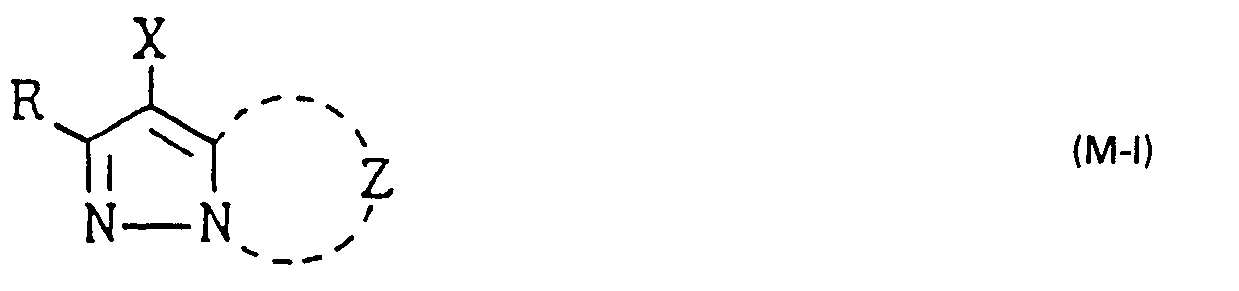
- the present invention provides a light-sensitive silver halide photographic material comprising a support and provided thereon a silver halide emulsion layer containing a magenta-forming coupler represented by Formula (M-I) and a compound represented by formula (I): wherein Z represents a group of non-metal atoms necessary to complete a nitrogen-containing heterocyclic ring which may have a substituent; X represents a hydrogen atom or a substituent capable of being split off upon reaction with the oxidation product of a color developing agent; and R represents a hydrogen atom or a substituent: wherein R 1 , R and R 3 independently represent an aliphatic group or an aromatic group; and I, m and n independently represent 0 or 1 provided that I, m and n each are not 1 at the same time.
- M-I magenta-forming coupler represented by Formula (M-I) and a compound represented by formula (I): wherein Z represents a group of non-metal atoms necessary to complete a
- Z represents a group of non-metal atoms necessary for the formation of a nitrogen-containing heterocyclic ring, and the ring formed by said Z may have a substituent.
- X represents a hydrogen atom or a group capable of being split off through reaction with an oxidation product of a color developing agent.
- R represents a hydrogen atom or a substituent.
- R there is no particular limitation on the substituent represented by R, but it may typically include alkyl, aryl, anilino, acylamino, sulfonamide, alkylthio, arylthio, alkenyl or cycloalkyl groups.
- halogen atoms and cycloalkenyl, alkynyl, heterocyclic ring, sulfonyl, sulfinyl, phosphonyl, acyl, carbamoyl, sulfamoyl, cyano, alkoxy, aryloxy, heterocyclic oxy, siloxy, acyloxy, carbamoyloxy, amino, alkylamino, imide, ureido, sulfamoylamino, alkoxycarbonylamino, aryloxycarbonylamino, alkoxycarbonyl, aryloxycarbonyl and heterocyclic thio groups, as well as spiro compound residual groups and bridged hydrocarbon compound residual groups.
- the alkyl groups represented by R is preferably an alkyl group having 1 to 32 carbon atoms, which may be of straight-chain or branched-chain type.
- the aryl group represented by R is preferably a phenyl group.
- the acylamino group represented by R includes an alkylcarbonylamino group or an arylcarbonylamino group.
- the sulfonamide group represented by R includes an alkylsulfonylamino group or an arylsulfonylamino group.
- the alkyl component or aryl component in the alkylthio group or arylthio group represented by'R includes the above alkyl group or aryl group represented by R, respectively.
- the alkenyl group represented by R is preferably an alkenyl group having 2 to 32 carbon atoms; and the cycloalkyl group, a cycloalkyl group having 3 to 12, particularly 5 to 7, carbon atoms.
- the alkenyl group may be of straight-chain or branched-chain type.
- the cycloalkenyl group represented by R is preferably a cycloalkenyl group having 2 to 12, particularly 5 to 7, carbon atoms.
- the group represented by X and capable of being split off through the reaction with an oxidation product of a color developing agent includes, for example, a halogen atom (such as a chlorine atom, a bromine atom and a fluorine atom) or an alkoxy, aryloxy, heterocyclic oxy, acyloxy, sulfonyloxy, alkoxy- carbonyloxy, aryloxycarbonyl, alkyloxazyloxy, alkoxyoxazyloxy, alkylthio, arylthio, heterocyclic thio, alkyloxythiocarbonylthio, acylamino or sulfonamide group or a nitrogen-containing heterocyclic ring linked with an N atom, alkyloxycarbonylamino, aryloxycarbonylamino, carboxyl or (R 1 ' has the same definition as in the above R; Z' has the same definition as the above Z; and R 2 ' and R 3 ' each represents
- the nitrogen-containing hetereocyclic ring formed by Z or Z' includes a pyrazole ring, an imidazole ring, a triazole ring or tetrazole ring, and the substituent of the above ring may be those described for the above R.
- magenta coupler represented by Formula (M-I) is more specifically represented by, for example, Formulas (M-II) to (M-VII) shown below, respectively.
- R 1 to R 8 and X have the same definition as the above R and X, respectively.
- R 1 , X and Z 1 have the same definition as R, X and Z in Formula (M-I), respectively.
- magenta couplers represented by Formulas (M-II) to (M-VII) particularly preferred is the magenta coupler represented by Formula (M-II).
- Rg, R 10 and R 11 each have the same definition as the above R.
- R 9 , R 10 and R 11 may be combined to complete a saturated or unsaturated ring (for example, cycloalkane, cycloalkene or a heterocyclic ring), or R 11 may further be combined to said ring to constitute a bridged hydrocarbon compound residual group.
- R 9 , R 10 and R 11 may be combined to complete a saturated or unsaturated ring (for example, cycloalkane, cycloalkene or a heterocyclic ring), or R 11 may further be combined to said ring to constitute a bridged hydrocarbon compound residual group.
- the substituent of the ring formed by Z in Formula (M-I) or the ring formed by Z 1 in Formula (M-VIII) and R 2 to R s in Formulas (M-II) to (M-VI) may preferably be a group represented by Formula (X) shown below.
- R 12 represents an alkylene group
- R 13 represents an alkyl group, a cycloalkyl group or an aryl group.
- the alkylene group represented by R 12 preferably has 2 or more, more preferably 3 to 6, carbon atoms which are straight-chain, and may be either straight-chain or branched-chain type.
- the cycloalkyl group represented by R 13 is preferably a cycloalkyl group of 5 to 6 members.
- examples of the compounds also include the compounds shown as Nos. 1 to 4,6, 8 to 17, 19 to 24, 26 to 43, 45 to 59, 61 to 104,106 to 121, 123 to 162 and 164 to 223 among the compounds described at pages 66 to 122 of Japanese Patent O.P.I. Publication No. 66339/1987.
- magenta couplers represented by the above Formula (M-I) can be synthesized by making reference to Journal of the Chemical Society, Perkin I (1977), 2047-2052, U.S. Patent No. 3,725,067, Japanese Patent O.P.I. Publications No. 99437/1984, No. 42045/1983, No. 162548/1984, No. 171956/1984, No. 33552/1985, No. 43659/1985, No. 172982/1985 and No. 190779/1985, for example.
- the couplers are usually used in the range of 1 x 10- 3 mol to 1 mol, preferably 1 x 10- 2 mol to 8 x 10 -1 mol, per mol of silver halide.
- Couplers Two or more of the couplers can be simultaneously, or one or more in combination with magenta couplers of different types.
- Examples of the aliphatic groups represented by R 1 , R 2 and R 3 include an alkyl group having 1 to 32 carbon atoms, an alkenyl group, an alkynyl group, a cycloalkyl group or a cycloalkenyl group.
- the alkyl group, the alkenyl group and the alkynyl group may be straight-chain or branched-chain type. These aliphatic groups can also be substituted.
- Examples of the aromatic grops represented by R 1 , R 2 and R 3 include aryl groups (as exemplified by a phenyl group) and aromatic heterocyclic groups (as exemplified by a pyridyl group or a furyl group). These aromatic groups may be substituted.
- R 1 , R 2 and R 3 are each preferably an alkyl group or an aryl group, and R 1 and R 2 and R 3 may each be the same or different, provided that the total sum of the carbon atoms of R 1 , R 2 and R 3 is preferably 6 to 50.
- substituent for the aliphatic groups or aromatic groups represented by R 1 , R 2 and R 3 preferably includes an alkoxy group, an aryloxy group, an acyl group, an acyloxy group, an alkoxycarbonyl group, an aryloxycarbonyl group, a carbamoyl group, a sulfamoyl group, an acylamino group or an amino group.
- I, m and n each represent 0 or 1, but I, m and n are not each 1 at the same time. In other words, this indicates that at least one of the aliphatic groups or aromatic groups represented by R 1 , R 2 and R 3 is directly bonded to the phosphorus atom.
- the compounds include the compounds described at pages 4 to 5 of the specification of Japanese Patent O.P.I. Publication No. 19049/1981.
- the compounds are preferably used in an amount of from 5 to 500 mol %, more preferably from 10 to 300 mol %, based on the magenta coupler.
- the present inventors discovered that such compounds can shift the maximum absorption wavelength of the magenta dye obtained from the pyrazoloazole type magenta coupler, to the short wavelength side and reduce the absorption at the long wavelength side of 600 nm or more, so that the color reproducibility can be greatly improved, the image storage stability of the above magenta dye can be improved, and further the color-forming properties of the light-sensitive silver halide photographic material employing the above magenta coupler can be improved to attain a sufficiently high maximum density. It is believed that this is the first time such a combination of effects has been obtained.
- magenta couplers and the compounds used in the present invention are contained in at least one of the silver halide emulsion layers, but particularly preferably are contained in a green-sensitive silver halide emulsion layer.
- Hydrophobic compounds such as the magenta couplers and the compounds used in the present invention can be added to the light-sensitive silver halide photographic material by using various methods such as a solid dispersion method, a latex dispersion method and an oil-in-water emulsion method.
- the hydrophobic additives such as magenta couplers are usually dissolved in a high-boiling organic solvent having a boiling point of about 150°C or more with optional use of a low-boiling and/or water-soluble organic solvent as well, subjected to emulsification dispersion in a hydrophilic binder such as an aqueous gelatin solution with use of a surface active agent, and added to the intended hydrophilic colloid layers.
- the light-sensitive silver halide photographic material of the present invention can be used, for example, for color negative films and color positive films and also for color photographic paper; in particular, the effect of the present can be effectively exhibited when applied to color photographic paper used for direct viewing.
- the light-sensitive silver halide photographic materials of the present invention may be those for use in monochrome or for use in multi-color.
- the silver halide emulsion layers When used in multi-color, in which the color reproduction is effected by subtractive color process, the silver halide emulsion layers usually contain magenta, yellow and cyan couplers as photographic couplers, which with non- sensitive layers are laminated on a substrate in appropriate layer number and layer order.
- the layer number and layer order may be appropriately varied depending on what the particular performance characteristics desired are and what the light-sensitive materials are used for.
- the yellow coupler there can be used, for example, benzoylacetanilide type compounds and pyvaloylacetanilide type compounds.
- benzoylacetanilide type compounds examples thereof include those described in U.S. Patents No. 2,875,057, No. 3,265,506, No. 3,408,194, No. 3,551,155, No. 3,582,322, No. 3,725,072 and No. 3,891,445, West German Patent No. 15 47 868, West German Patent Publications No. 22 19 917 and No. 24 14 006, British Patent No. 1,425,020, Japanese Patent Publication No. 10783/1976, Japanese Patent O.P.I. Publications No. 26133/1972, No. 73147/1973, No. 102636/1976, No. 6341/1975, No. 123342/1975, No. 130442/1975, No. 21827/1976, No. 87650/1975, No. 82424/1977 and No. 115219/1977.
- cyan coupler there can be used, for example, phenol type compounds and naphthol type compounds.
- examples thereof include those described in U.S. Patents No. 2,369,929, No. 2434,272, No. 2,474,293, No. 2,521,908, No. 2,895,826, No. 3,034,892, No. 3,311,476, No. 3,458,315, No. 3,476,563, No. 3,583,971 No. 3,591,383, No. 3,767,411 and No. 4,004,929, West German Patent Applications (OLS) No. 24 14 830 and No. 24 54 329, Japanese Patent O.P.I. Publications No. 59838/1973, No. 26034/1976, No. 5055/ 1973, No. 14628/1976, No. 69624/1977 and No. 90932/1977.
- a silver halide emulsion layer containing a yellow coupler represented by Formula (Y-I) shown below and the compound represented by Formula (I) shown above is provided in addition to the silver halide emulsion layer containing the compounds represented respectively by the above Formulas (M-II) and (I), whereby the color-reproducing effect is enhanced.
- R 1 represents a halogen atom or an alkoxy group
- R 2 represents a hydrogen atom or a group capable of being substituted on the benzene ring
- R 3 represents a monovalent organic residual group
- Z 1 is a group capable of being split off upon reaction with the oxidation product of a color developing agent.
- R 1 represents a halogen atom or an alkoxy group.
- the alkoxy group represented by R 1 includes those having a substituent, for example a halogen atom, an aryl group, an alkoxy group, an aryloxy group, an alkylsulfonyl group, an acylamino group, an alkoxycarbonyl group, an aryloxycarbonyl group, an acyloxy group, an acryl group or a hydroxyl group.
- R 1 is a chlorine atom or an alkoxy group.
- R 2 represents a hydrogen atom or a group capable of being substituted on the benzene ring.
- the group capable of being substituted on the benzene ring includes a halogen atom, an alkyl group, an aryl group, an alkoxy group, an aryloxy group, an acyloxy group, an acylamino group, a carbamoyl group, an alkylsulfonamide group, an arylsulfonamide group, a sulfamoyl group or an imide group.
- R 2 is a hydrogen atom.
- the monovalent organic residual group represented by R 3 includes ballast groups well known in yellow couplers, as exemplified by an acylamino group, an alkoxycarbonyl group, an aryloxycarbonyl group, an alkylsulfamoyl group, an arylsulfamoyl group, an alkylsulfonamide group, an arylsulfonamide group, an alkylureido group, an arylureido group, a succinimido group, an alkoxy group, an aryloxy group, an alkylcarbamoyl group, an arylcarbamoyl group, an alkylsulfamoylamino group, an arylsulfamoylamino group, an alkyl group, an alkenyl group, an acyl group or an acyloxy group.
- an acylamino group an alkoxycarbonyl group, an aryloxycarbonyl group, an
- Z 1 represents a group capable of being split off upon reaction with the oxidation product of a color developing agent, which is exemplified by the group represented by Formula (Y-II) or (Y ⁇ III).
- R 4 represents an aryl group or heterocyclic group, which may be substituted.
- Z 2 represents a group of non-metal atoms necessary to complete a 5- or 6- membered ring together with a nitrogen atom.
- the yellow coupler represented by Formula (Y-I) may be linked via R i , R 2 , R 3 or Z, to another (Y-1 ) moiety to form a bis or higher compound.
- yellow coupler Preferred as the yellow coupler are those represented respectively by Formulas (Y-IV) and (Y-V) shown below.
- X represents an alkylene group, an arylene group, an alkylene arylene group, an arylene alkylene group or ⁇ A ⁇ V 1 ⁇ B ⁇ (A and B each represents an alkylene group, an arylene group, an alkylene arylene group or an arylene alkylene group, and V, represents a divalent connecting group); and Y represents an alkyl group, a cycloalkyl group, an aryl group or a heterocyclic group.
- Z 3 represents a group capable of being split off when coupled with the oxidation product of a developing agent.
- Typical examples of the yellow coupler represented by Formula (Y-I) are shown below, but the present invention is by no means limited by these.
- These yellow couplers may also be the compounds described at pages 4 to 8 of Japanese Patent O.P.I. Publication No. 70841/1980 and pages 20 to 26 of Japanese Patent Application No. 269216/1986.
- These yellow couplers may be used alone or in combination.
- yellow couplers are typically used in the range of from 0.02 to 1 mol, preferably from 0.05 to 0.75 mol, per mol of silver halide.
- any silver halide can be used, including silver bromide, silver iodobromide, silver iodochloride, silver chlorobromide and silver chloride that are used in ordinary silver halide emulsions.
- the silver halide emulsion can be chemically sensitized by sulfur sensitization, selenium sensitization, reduction sensitization or noble metal sensitization, for example.
- the silver halide emulsion can be optically sensitized to a desired wavelength region by using dyes known as sensitizing dyes in the photographic industrial field.
- color-fogging preventive agents hardening agents, plasticizers, polymer latex, ultraviolet absorbents, formalin scavengers, mordants, development accelerators, development restrainers, brightening agents, matting agents, lubricants, antistatic agents and surface activer agents, for example, if desired.
- the light-sensitive silver halide photographic material of the present invention can form images by carrying out various color development processings.
- the light-sensitive silver halide photographic material of the present invention which contains the specified magenta coupler and compound, has improved spectral absorption characteristics of the magenta dye image formed by the pyrazoloazole type magenta coupler, and, as a result, provides greatly improved color reproducibility.
- the image storage stability of the magenta dye image, and the color-forming properties can also be enhanced, thus obtaining sufficient maximum density.
- the layers 1 to 7 shown below were provided by coating in succession (simultaneous coating) on paper supports both sides of which were covered with polyethylene to prepare light-sensitive silver halide color photographic materials (In the following examples, the amounts for addition are each expressed in terms of the amount per 1 m 2 of a light-sensitive material).
- Layer 1 A layer containing gelatin (1.2 g), 0.29 g (calculated as silver; the same hereinafter) of blue-sensitive silver halide emulsion (Em-1), and 0.3 g of dinonyl phthalate (DNP) in which 0.75 g of yellow coupler (Y-1 ), 0.3 g of light stabilizer ST-1 and 0.015 g of 2,5-dioctylhydroquinone (HQ-1) were dissolved.
- Em-1 blue-sensitive silver halide emulsion
- DNP dinonyl phthalate
- Y-1 yellow coupler
- ST-1 light stabilizer ST-1
- HQ-1 2,5-dioctylhydroquinone
- Layer 2 layer containing gelatin (0.9 g) and 0.2 g of DOP (dioctyl phthalate) in which 0.04 g of HQ-1 was dissolved.
- DOP dioctyl phthalate
- Layer 3 A layer containing gelatin (1.4 g), 0.2 g of green-sensitive silver halide emulsion (Em-2), 0.5 g of the compound used in the present invention or comparative compound, shown in Table 2, in which 0.9 mmol of the magenta coupler shown in Table 2, 0.25 g of light stabilizer ST-2 and 0.01 g of HQ-1 were dissolved, and 6 mg of filter dye AI-1 shown below.
- Layer 4 A layer containing gelatin (1.2 g) and 0.3 g of DNP in which 0.6 g of ultraviolet absorbent UV-1 and 0.05 g of HQ-1 were dissolved.
- Layer 5 A layer containing gelatin (1.4 g), 0.20 g of red-sensitive silver halide emulsion (Em-3), and 0.3 g of DOP in which 0.54 g of cyan coupler (C-1), 0.01 g of HQ-1 and 0.3 g of ST-1 were dissolved.
- Layer 6 A layer containing gelatin (1.1 g), 0.2 g of DOP in which 0.2 g of UV-1 was dissolved, and 5 mg of filter dye AI-2 shown below.
- Layer 7 A layer containing gelatin (1.0 g) and 0.05 g of sodium 2,4-dichloro-6-hydroxytriazine.
- KS-7 Type manufactured by Konishiroku Photo Industry Co., Ltd.
- Dmax maximum density
- the samples obtained were also subjected to color-fading tests using a fadometer, and retention (%) of the dye image at initial density 1.0 was determined to evaluate the light resistance.
- the relative sensitivity is shown as a relative value assuming the sensitivity of Sample No. 1 to be 100.
- the pyrazoloazole type magenta couplers used in the present invention show a very small secondary absorption (D B ) at the shorter wavelength side of the dye image obtained by the color development, as compared with the conventionally used 5-pyrazolone type comparative coupler (MM-1), but have the disadvantages such that the maximum absorption wavelength is a little longer wavelength and the absorption (D R ) at the longer wavelength side is a little large. Also, the color-forming properties and the light resistance represented by the relative sensitivity and the maximum density, respectively, cannot be said to be satisfactory (see Samples No. 2 to No. 8).
- Samples No. 10 to No. 43 in which the pyrazoloazole type magenta coupler used in the present invention and the specified compound are used in combination retain the characteristic feature inherent in pyrazoloazole type magenta couplers; all of them show a small D B , and at the same time there can be obtained sufficiently high maximum densities and sensitivities.
- the maximum absorption wavelengths are ideal 544 nm to 547 nm and also D R is small. Thus, they have superior color reproducibility and also have superior light resistance.
- Example 2 was repeated to prepare light-sensitive silver halide color photographic materials Nos. 44 to 77, except that the blue-sensitive silver halide emulsion in Layer 1 of the light-sensitive silver halide color photographic materials prepared in Example 1 was replaced with Em-4 shown in Table 1, the green-sensitive silver halide emulsion in Layer 3 with Em-5 shown in Table 1, and the red-sensitive silver halide emulsion in Layer 5 with Em-6 shown in Table 1, respectively, and also that the magenta coupler and the compound used in the present invention or comparative compound as shown in Table 3 was used in Layer 3.
- the samples of the present invention show appropriate maximum absorption wavelength, both small D B and D R , and superior color reproducibility, there can be obtained sufficiently high maximum densities and sensitivities, and also the light resistance has been improved.
- Samples No. 79 and No. 79 were prepared in the same manner as Samples Nos. 10 and 12 except that the DNP in each first layer of Samples Nos. 10 and 12 in Example 1 was replaced by compound 1-69. Further Samples Nos. 1, 2, 4, 9, 10 and 12 prepared in Example 1 were used.
- a sample light-sensitive paper material was set on the paper tray 6 of the exposure apparatus.
- a yellow color separation negative film was set on the exposure table 5 at register pins, which were provided on the exposure table 5 in order to ensure accurate positioning of the respective four color separation negative films, and printing on the light-sensitive paper was carried out through a blue filter. Then, the yellow color separation negative film was replaced by a magenta color separation negative film and printing on the light-sensitive paper was effective through a green filter. In a similar manner printing operations were carried out from a cyan color separation negative film through a red filter and from a black color separation negative film through the blue, green and red filters, respectively, at the proper exposure ratio which was applied in the printing operations with the yellow, magenta and cyan color separation negative films.
- Example 2 the thus exposed sample light-sensitive paper was processed in the same manner as in Example 1, to obtain a sample color proof image.
- the proper amount of exposure for the black color separation negative films was determined by exposing the light-sensitive paper using an original with 0% halftone dot through respective filters and developed so that the reflection densities of the thus obtained yellow, magenta and cyan dye images became 1.7 to 1.8, respectively.
- Fig. 1 shows a schematic structure of the exposure apparatus for preparing proof images in Example 4, wherein numerical symbol represents as follows:
Landscapes
- Physics & Mathematics (AREA)
- General Physics & Mathematics (AREA)
- Spectroscopy & Molecular Physics (AREA)
- Silver Salt Photography Or Processing Solution Therefor (AREA)
Claims (14)


Applications Claiming Priority (2)
| Application Number | Priority Date | Filing Date | Title |
|---|---|---|---|
| JP62088105A JPH0833632B2 (ja) | 1987-04-10 | 1987-04-10 | 形成される色素の分光吸収特性が良好なハロゲン化銀写真感光材料 |
| JP88105/87 | 1987-04-10 |
Publications (2)
| Publication Number | Publication Date |
|---|---|
| EP0286431A1 EP0286431A1 (de) | 1988-10-12 |
| EP0286431B1 true EP0286431B1 (de) | 1991-01-23 |
Family
ID=13933591
Family Applications (1)
| Application Number | Title | Priority Date | Filing Date |
|---|---|---|---|
| EP88303169A Expired EP0286431B1 (de) | 1987-04-10 | 1988-04-08 | Lichtempfindliches farbphotographisches Silberhalogenidmaterial |
Country Status (4)
| Country | Link |
|---|---|
| US (1) | US4910126A (de) |
| EP (1) | EP0286431B1 (de) |
| JP (1) | JPH0833632B2 (de) |
| DE (1) | DE3861611D1 (de) |
Families Citing this family (14)
| Publication number | Priority date | Publication date | Assignee | Title |
|---|---|---|---|---|
| JPH0271263A (ja) * | 1988-06-13 | 1990-03-09 | Konica Corp | ハロゲン化銀カラー写真感光材料 |
| US5013633A (en) * | 1988-07-04 | 1991-05-07 | Konica Corporation | Method for developing a silver halide color photographic light-sensitive material for color proof using a specified color developing agent |
| DE3933899A1 (de) * | 1989-10-11 | 1991-04-18 | Agfa Gevaert Ag | Farbfotografisches aufzeichnungsmaterial mit farbkupplern, die thermostabile farbstoffe liefern |
| JPH03160438A (ja) * | 1989-11-20 | 1991-07-10 | Konica Corp | ハロゲン化銀カラー写真感光材料 |
| JP2799623B2 (ja) * | 1990-05-28 | 1998-09-21 | コニカ株式会社 | 色再現性に優れたハロゲン化銀写真感光材料 |
| CA2093121A1 (en) * | 1990-10-01 | 1992-04-02 | Leonard T. Chapman | Camera dolly |
| EP0515128A1 (de) * | 1991-05-23 | 1992-11-25 | Konica Corporation | Farbphotographisches Silberhalogenidmaterial |
| US5258278A (en) * | 1991-07-15 | 1993-11-02 | Eastman Kodak Company | Color photographic material containing a coupler composition comprising a pyrazoldtriazole magenta coupler and a carbonamide compound |
| JPH0527389A (ja) * | 1991-07-19 | 1993-02-05 | Fuji Photo Film Co Ltd | ハロゲン化銀カラー写真感光材料 |
| JP2879495B2 (ja) * | 1992-05-14 | 1999-04-05 | 富士写真フイルム株式会社 | ハロゲン化銀カラー写真感光材料 |
| JP3081404B2 (ja) * | 1993-03-02 | 2000-08-28 | 富士写真フイルム株式会社 | ハロゲン化銀感光材料 |
| DE69503404T2 (de) * | 1994-02-23 | 1998-11-19 | Fuji Photo Film Co Ltd | Photographisches Silberhalogenidmaterial und Verfahren zur Herstellung von photographischen Bildern mit diesem Material |
| US5736303A (en) * | 1996-06-07 | 1998-04-07 | Eastman Kodak Company | Color photographic paper with reduced interlayer effects |
| CN110606826B (zh) * | 2019-05-23 | 2021-06-01 | 上海勋和医药科技有限公司 | 托拉塞米钠一水合物、其晶型及组合物 |
Family Cites Families (13)
| Publication number | Priority date | Publication date | Assignee | Title |
|---|---|---|---|---|
| JPS5220023A (en) * | 1975-08-08 | 1977-02-15 | Fuji Photo Film Co Ltd | Photographic color coupler |
| JPS56833A (en) * | 1979-05-18 | 1981-01-07 | Chisso Corp | Production of polyvinyl chloride resin foam |
| JPS5619049A (en) * | 1979-07-25 | 1981-02-23 | Konishiroku Photo Ind Co Ltd | Silver halide photographic material |
| JPS6147957A (ja) * | 1984-08-14 | 1986-03-08 | Fuji Photo Film Co Ltd | ハロゲン化銀カラ−写真感光材料 |
| JPS6153644A (ja) * | 1984-08-24 | 1986-03-17 | Fuji Photo Film Co Ltd | ハロゲン化銀カラ−写真感光材料 |
| JPH0715571B2 (ja) * | 1985-07-19 | 1995-02-22 | 富士写真フイルム株式会社 | ハロゲン化銀カラ−写真感光材料 |
| JPH0621948B2 (ja) * | 1985-10-07 | 1994-03-23 | 富士写真フイルム株式会社 | ハロゲン化銀カラ−写真感光材料 |
| JPH0625861B2 (ja) * | 1985-12-17 | 1994-04-06 | 富士写真フイルム株式会社 | ハロゲン化銀カラ−写真感光材料 |
| JP2518303B2 (ja) * | 1987-09-16 | 1996-07-24 | 日本電装株式会社 | ディ―ゼル機関用噴射率制御装置 |
| JPH0279452A (ja) * | 1988-09-14 | 1990-03-20 | Hitachi Ltd | 半導体装置の冷却方法及び半導体装置 |
| JPH02172357A (ja) * | 1988-12-26 | 1990-07-03 | Hitachi Ltd | 個人別電話番号方式 |
| JP2766493B2 (ja) * | 1988-12-29 | 1998-06-18 | アイシン・エィ・ダブリュ株式会社 | 車両用自動変速機の制御装置 |
| JPH02180367A (ja) * | 1988-12-29 | 1990-07-13 | Aisin Aw Co Ltd | 車両用自動変速機の制御装置 |
-
1987
- 1987-04-10 JP JP62088105A patent/JPH0833632B2/ja not_active Expired - Lifetime
-
1988
- 1988-04-07 US US07/178,969 patent/US4910126A/en not_active Expired - Fee Related
- 1988-04-08 DE DE8888303169T patent/DE3861611D1/de not_active Expired - Fee Related
- 1988-04-08 EP EP88303169A patent/EP0286431B1/de not_active Expired
Also Published As
| Publication number | Publication date |
|---|---|
| EP0286431A1 (de) | 1988-10-12 |
| DE3861611D1 (de) | 1991-02-28 |
| JPS63253943A (ja) | 1988-10-20 |
| US4910126A (en) | 1990-03-20 |
| JPH0833632B2 (ja) | 1996-03-29 |
Similar Documents
| Publication | Publication Date | Title |
|---|---|---|
| EP0264730A2 (de) | Photographisches lichtempfindliches Silberhalogenidmaterial, das ein Farbstoffbild mit einer verbesserten Lichtechtheit liefert | |
| JPH0830876B2 (ja) | 色素画像の堅牢性が改良されたハロゲン化銀写真感光材料 | |
| EP0283324B1 (de) | Lichtempfindliches farbphotographisches Silberhalogenidmaterial | |
| JP2890059B2 (ja) | 色素画像の堅牢なハロゲン化銀写真感光材料 | |
| EP0273712B1 (de) | Lichtempfindliches photographisches Silberhalogenidmaterial | |
| EP0286431A1 (de) | Lichtempfindliches farbphotographisches Silberhalogenidmaterial | |
| EP0515128A1 (de) | Farbphotographisches Silberhalogenidmaterial | |
| EP0422595A1 (de) | Farbphotographisches, lichtempfindliches Silberhalogenidmaterial | |
| US5342746A (en) | Method for the formation of color photographic materials with high coupling reactivity and reduced color developer PH sensitivity | |
| US4916050A (en) | Silver halide light-sensitive photographic material | |
| JPH0820716B2 (ja) | ハロゲン化銀カラ−写真感光材料 | |
| JPH06230534A (ja) | ハロゲン化銀カラー写真感光材料 | |
| JP3273280B2 (ja) | ハロゲン化銀カラー写真感光材料 | |
| US5273869A (en) | Light-sensitive silver halide color photographic material | |
| JP2561833B2 (ja) | 形成される色素の分光吸収特性が良好なハロゲン化銀写真感光材料 | |
| JPH04346338A (ja) | ハロゲン化銀カラー写真感光材料 | |
| JPH08171185A (ja) | 写真用シアンカプラー | |
| JPH043155A (ja) | 色再現性に優れたハロゲン化銀写真感光材料 | |
| EP0306246A2 (de) | Photographisches Silberhalogenidmaterial | |
| JPS63167358A (ja) | 形成される色素の分光吸収特性が良好なハロゲン化銀写真感光材料 | |
| JPH0690474B2 (ja) | 色素画像の堅牢性が改良されたハロゲン化銀写真感光材料 | |
| JPH0740128B2 (ja) | 色素画像の光堅牢性が改良されたハロゲン化銀写真感光材料 | |
| EP0302700A2 (de) | Photographisches lichtempfindliches Silberhalogenidmaterial | |
| JPH0827508B2 (ja) | 色素画像の保存性および色再現性が改良されたハロゲン化銀写真感光材料 | |
| JPH04346342A (ja) | ハロゲン化銀カラー写真感光材料 |
Legal Events
| Date | Code | Title | Description |
|---|---|---|---|
| PUAI | Public reference made under article 153(3) epc to a published international application that has entered the european phase |
Free format text: ORIGINAL CODE: 0009012 |
|
| AK | Designated contracting states |
Kind code of ref document: A1 Designated state(s): DE FR GB IT NL |
|
| 17P | Request for examination filed |
Effective date: 19890302 |
|
| 17Q | First examination report despatched |
Effective date: 19890727 |
|
| GRAA | (expected) grant |
Free format text: ORIGINAL CODE: 0009210 |
|
| AK | Designated contracting states |
Kind code of ref document: B1 Designated state(s): DE FR GB IT NL |
|
| ITF | It: translation for a ep patent filed | ||
| REF | Corresponds to: |
Ref document number: 3861611 Country of ref document: DE Date of ref document: 19910228 |
|
| PGFP | Annual fee paid to national office [announced via postgrant information from national office to epo] |
Ref country code: NL Payment date: 19910430 Year of fee payment: 4 |
|
| ET | Fr: translation filed | ||
| PLBE | No opposition filed within time limit |
Free format text: ORIGINAL CODE: 0009261 |
|
| STAA | Information on the status of an ep patent application or granted ep patent |
Free format text: STATUS: NO OPPOSITION FILED WITHIN TIME LIMIT |
|
| 26N | No opposition filed | ||
| PG25 | Lapsed in a contracting state [announced via postgrant information from national office to epo] |
Ref country code: NL Effective date: 19921101 |
|
| NLV4 | Nl: lapsed or anulled due to non-payment of the annual fee | ||
| PGFP | Annual fee paid to national office [announced via postgrant information from national office to epo] |
Ref country code: GB Payment date: 19990408 Year of fee payment: 12 |
|
| PGFP | Annual fee paid to national office [announced via postgrant information from national office to epo] |
Ref country code: FR Payment date: 19990409 Year of fee payment: 12 |
|
| PGFP | Annual fee paid to national office [announced via postgrant information from national office to epo] |
Ref country code: DE Payment date: 19990419 Year of fee payment: 12 |
|
| PG25 | Lapsed in a contracting state [announced via postgrant information from national office to epo] |
Ref country code: GB Free format text: LAPSE BECAUSE OF NON-PAYMENT OF DUE FEES Effective date: 20000408 |
|
| GBPC | Gb: european patent ceased through non-payment of renewal fee |
Effective date: 20000408 |
|
| PG25 | Lapsed in a contracting state [announced via postgrant information from national office to epo] |
Ref country code: FR Free format text: LAPSE BECAUSE OF NON-PAYMENT OF DUE FEES Effective date: 20001229 |
|
| PG25 | Lapsed in a contracting state [announced via postgrant information from national office to epo] |
Ref country code: DE Free format text: LAPSE BECAUSE OF NON-PAYMENT OF DUE FEES Effective date: 20010201 |
|
| REG | Reference to a national code |
Ref country code: FR Ref legal event code: ST |
|
| PG25 | Lapsed in a contracting state [announced via postgrant information from national office to epo] |
Ref country code: IT Free format text: LAPSE BECAUSE OF NON-PAYMENT OF DUE FEES;WARNING: LAPSES OF ITALIAN PATENTS WITH EFFECTIVE DATE BEFORE 2007 MAY HAVE OCCURRED AT ANY TIME BEFORE 2007. THE CORRECT EFFECTIVE DATE MAY BE DIFFERENT FROM THE ONE RECORDED. Effective date: 20050408 |