EP0317890A2 - TTL-Schaltung mit erhöhter Umschaltleistung - Google Patents
TTL-Schaltung mit erhöhter Umschaltleistung Download PDFInfo
- Publication number
- EP0317890A2 EP0317890A2 EP88119081A EP88119081A EP0317890A2 EP 0317890 A2 EP0317890 A2 EP 0317890A2 EP 88119081 A EP88119081 A EP 88119081A EP 88119081 A EP88119081 A EP 88119081A EP 0317890 A2 EP0317890 A2 EP 0317890A2
- Authority
- EP
- European Patent Office
- Prior art keywords
- circuit
- transistor
- state
- drive
- output signal
- Prior art date
- Legal status (The legal status is an assumption and is not a legal conclusion. Google has not performed a legal analysis and makes no representation as to the accuracy of the status listed.)
- Granted
Links
Images

Classifications
-
- H—ELECTRICITY
- H03—ELECTRONIC CIRCUITRY
- H03K—PULSE TECHNIQUE
- H03K19/00—Logic circuits, i.e. having at least two inputs acting on one output; Inverting circuits
- H03K19/0008—Arrangements for reducing power consumption
- H03K19/001—Arrangements for reducing power consumption in bipolar transistor circuits
-
- H—ELECTRICITY
- H03—ELECTRONIC CIRCUITRY
- H03K—PULSE TECHNIQUE
- H03K19/00—Logic circuits, i.e. having at least two inputs acting on one output; Inverting circuits
- H03K19/01—Modifications for accelerating switching
- H03K19/013—Modifications for accelerating switching in bipolar transistor circuits
- H03K19/0136—Modifications for accelerating switching in bipolar transistor circuits by means of a pull-up or down element
Definitions
- This invention deals with TTL circuitry, and in particular to a TTL circuit having increased transient drive for rapid switching between two logical states.
- Transistor-Transistor-Logic has been used for construction of digital circuits.
- Digital circuits operate by switching signals between two discrete levels, a logical one or "high” and a logical zero or “low". In order to qualify as a logical zero, a voltage level must not be greater than a predetermined voltage level.
- VOL output low voltage
- VH output high voltage
- these VOL and VOH voltages may be designed to have different predetermined values.
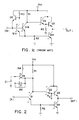
- FIG. 1a is a schematic diagram of a typical TTL output stage.
- a digital input signal is applied to input terminal IN1 which controls the operation of phase splitter transistor Q1.
- Transistor Q1 is termed a "phase splitter” transistor because the digital value on its emitter becomes equivalent to the digital value applied to terminal IN1, and the digital value on the collector of transistor Q1 has the inverse logical value of the input signal applied to input terminal IN1.
- transistor Q1 With a logical one input signal applied to input terminal IN1, transistor Q1 turns on providing current to the emitter of transistor Q1. This current causes output pulldown transistor Q4 to turn on, thereby pulling output terminal OUT1 to ground through the emitter-collector path of conducting pulldown transistor Q4.
- the relatively low voltage on the collector of transistor Q1 is insufficient to forward bias the Darlington pair formed by transistors Q2 and Q3, and thus transistors Q2 and Q3 do not source current to output terminal OUT1 when the input signal received on input lead IN1 is a logical one.
- transistor Q1 when the input signal applied to input lead IN1 is a logical zero, transistor Q1 is off, thereby not providing base drive to pulldown transistor Q4. This causes transistor Q4 to be turned off and not sink current from output terminal OUT1 to ground. Simultaneously, the voltage at the collector of transistor Q1 is high since transistor Q1 is not conducting, and causes the Darlington pair formed by transistors Q2 and Q3 to turn on, thereby sourcing current from positive voltage supply VCC to output terminl OUT1.
- FIG. 1b Another prior art circuit is shown in Fig. 1b, which includes all of the elements of the circuit of Fig 1a, identified with similar numerals.
- feedback diode D1 is provided having its cathode connected to output lead OUT1 and its anode connected to the base of transistor Q10.
- feedback diode D1 becomes forward biased, thereby reducing the signal applied to the base of transistor Q10, which in turn reduces the drive available to pull-down transistor Q4.
- This voltage feedback provided by the addition of feedback diode D1 and transistor Q10 reduces the drive to pull-down transistor Q4 when the output signal on terminal OUT1 reaches the logical zero level, thereby keeping transistor Q10 operating in the linear mode, allowing transistor Q10 to provide additional drive in response to increasing loads on output terminal OUT1.
- this circuit unfortunately has some instability in the form of transient ringing of the output signal on output terminal OUT1 due to the phase lag of signals propagated through the feedback loop provided by feedback diode DI. Transient ringing causes the output signal to vary in amplitude, making it difficult to determine its intended state (i.e., logical one or logical zero).
- FIG. 1c Another prior art circuit is shown in Fig. 1c, which includes all of the elements of the circuit of Fig. 1a, identified with similar numerals.
- the circuit of Fig. 1c includes two phase splitter transistors Q1a, Q1b and also includes transistor Q5 having its collector connected to voltage supply VCC through resistor R10, its base connected to the collector of phase splitter transistor Q1, and its emitter connected to input terminal IN1.
- transistor Q5 provides additional drive current to input lead IN1 in response to a high to low transition of the output signal on output lead OUT1.
- a circuit which provides additional drive current during the transition of an output signal from a logical one to a logical zero state, providing increased switching speed between the logical one and logical zero output states for a given power consumption.
- power consumption is reduced as compared to prior art circuits.
- a circuit which comprises an input terminal for receiving an input signal, an output terminal for providing an output signal in response to said input signal, first means connected to said output terminal for providing a first voltage to said output terminal in response to a first state of said input signal, second means connected to said output terminal for providing a second voltage to said output terminal in response to a second state of said input signal, control means responsive to said input signal for controlling the operation of said first means and said second means, and transient drive means for providing additional drive to said control means during substantially the entire transition of said output signal in response to a transition of said input signal.
- resistors R4 and R5, together with diode D1 and transistor Q6, form one embodiment of a transient drive circuit constructed in accordance with the teachings of this invention. As shown in Fig. 2, this transient drive circuit is suitivelyable for use with the prior art TTL output stage as previously described with reference to Fig. 1a.
- the operation of the transient drive circuit is as follows.
- diode D1 With the input signal on input lead IN1 low, diode D1 is forward biased and causes capacitance C1 connected to the base of Shottky transistor Q6 to be charged to a voltage equal to VCC minus VSBD, where VCC is the supply voltage, and VSBD is the forward biased voltage of Shottky barrier diode D1.
- the transient drive circuit is ready for operation in response to a low to high transition of the input signal applied to input lead IN1.
- the transient drive circuit operates such that capacitance C1 is substantially charged by the time the output signal has completed making its transition from a high to a low state.
- Diode D1 may comprise of any type of rectifier which provides a low impedance during charging of capacitor C1 and a high impedance preventing discharge of capacitor C1 through diode D1.
- phase splitter transistor Q1 When the input signal applied to input lead IN1 goes high, phase splitter transistor Q1 turns on, decreasing the voltage on the collector of transistor Q1 and thus the emitter of transistor Q6. Thus, transistor Q6 turns on, with the current flowing through the base-emitter junction of transistor Q6 being "beta multiplied" by the beta of transistor Q6, resulting in transistor Q6 providing a collector current which is significantly greater than its base current. In this manner, additional transient drive is applied by the transient drive circuit to the collector of phase splitter transistor Q1 in order to cause pulldown tran sistor Q4 to turn on more rapidly. Current from capacitance C1 does not flow from the base of transistor Q6 through reverse biased Shottky barrier diode D1. Only a small amount of discharge current flows from capacitance C1 through resistor R5, which typically has a value on the order of 10K ohms. Discharge current also flows through transistor Q6 when transient drive is being provided.
- Resistor R4 serves to limit the transient drive provided by transistor Q6 to a desired amount determined by the configuration and size of the components in the TTL output circuit.
- the transient drive circuit provides additional, and transient, drive to cause transistor Q4 to rapidly turn on and in turn provide a rapid transition of the output signal from a high to a low.
- the cycling time of the transient drive circuit is very short, since it takes very little time to charge capacitance C1 connected to the base of transistor Q6 to a value of VCC minus VSBD.
- resistors such as resistor R5 is formed in a well region or "tub" of opposite conductivity type as the substrate.
- the value of capacitance C1 is the sum of the capacitance of diode D1, the tub capacitance of the resistor tub in which resistor R5 is formed, and the base to collector capacitance of transistor Q6.
- diode D1 and resistor R5 are formed in the same tub in the semiconductor device, in order to increase the size of the tub and therefore increase the tub capacitance which is one component of capacitance C1.
- a capacitor can be used as an alternative to, or an addition to, the parasitic capacitance associated with the base of transistor Q6.
- the resistance of resistor R5 is selected in order to time the duration of the transient drive current.
- the value of resistor R5 is, in one embodiment, selected to cause the transient drive circuit to provide transient drive for a time equal to the fall time of the output signal when switching from a high to low signal (e.g., typically 2 nanoseconds).
- the choice of the resistance of resistor R5 is preferably based on the required duration of the transient drive current.
- the time constant associated with the discharge of capacitor C1 is selected to be about one-third of the maximum time during which transient drive current is provided from transistor Q6, providing that approximately 3 RC time constants is required to guarantee that the output signal reaches less than 5% of the logical one drive signal.
- RC time constant of approximately 0.6 nanoseconds is selected when it is desired to provide transient drive current from transistor Q6 for approximately the duration of the 2.0 ⁇ sec fall time.
- a "base capacitance" C1 of, for example, approximately 0.05 pf
- the resistance of resistor R5 is determined to be approximately 11.5K ohms.
- Limit resistor R4 serves to set the maximum transient current which is supplied by the transient drive circuit.
- the components shown in Fig. 2 are as follows: R1 2.5K R2 0.6K R3 10K R4 2K R5 10K C1 0.05 pf Q1-Q4, Q6 15 ⁇ wide x 1.5 ⁇ length emitter D1 8 ⁇ x 8 ⁇
- the selection of component values is iterative, since the choice of component values affects the value of parasitic capacitance C1, which in turn affects the choice of component values.
- the resistance value of resistor R1 is chosen to set the steady state drive current, which has a major effect on the power consumption of the buffer circuit.
- the resistance value of resistor R4 sets the limit of transient drive current applied during the transition of the output signal from a logical one to a logical zero state.
- the resistance value of resistor R5, the capacitance value of capacitance C1, and the discharge current through transistor Q6 determine the amount of time during which the transient drive current is supplied.
- resistor R1 provides approximately 1.5 milliamps of steady state drive current when the output signal is low.
- this embodiment when operating at 20 Megahertz with a 50 nanosecond clock period, approximately 250 microamps additional power is consumed as a result of the use of the transient drive circuit of Fig. 2.
- this embodiment provides an equivalent high to low output signal transition as if resistor R1 was providing 3 milliamps steady state drive current when the output signal is low.
- a circuit which, for a very modest increase in integrated circuit surface area due to the presence of the transient drive circuit of this invention, has improved the transition time by a factor of two or more, compared to the prior art circuit of Fig. 1 which does not include the transient drive circuit of this invention, depending in part on the capacitive load on the output terminal.
- the inclusion of a transient drive circuitry resulted in approximately 10% increase in the surface area of the integrated circuit required for the buffer circuit shown in Fig. 2. While a number of such output buffer circuits were used in the programmable logic array circuit, output buffers accounted for only approximately 15 to 20% of the total circuit surface area. Thus, the additional surface area required to include transient drive circuits in accordance with the teachings of this invention is relatively minimal compared to the decrease in power consumption for a given switching speed. Furthermore, the component values can be selected such that the amount of steady state drive current required to hold the output signal in the low state is minimized, thereby minimizing steady state drive current, while providing adequate transient drive current to insure rapid switching.
- diode D1 of Fig. 2 can be replaced by any suitable switching device, for example, a transistor having its base and collector connected in common, and the base serving as the anode and the emitter serving as the cathode.
- a transfer gate can be used to replace diode D1, where the transfer gate is formed from a transistor having a collector serving as the anode, a gate serving as the cathode, and its base connected through a relatively high value (for example, 10K ohms) resistor to a bias voltage.
- the amount of capacitance made available at the base of transistor Q6 can be provided as desired, and can be increased by merely adding additional capacitance to the base of transistor Q6.
- additional capacitance can be provided by any convenient means, including semiconductor capacitors, semiconductor junctions having inherent capacitance, etc.
Landscapes
- Physics & Mathematics (AREA)
- Engineering & Computer Science (AREA)
- Computer Hardware Design (AREA)
- Computing Systems (AREA)
- General Engineering & Computer Science (AREA)
- Mathematical Physics (AREA)
- Logic Circuits (AREA)
- Electronic Switches (AREA)
- Steering Control In Accordance With Driving Conditions (AREA)
- Control Of High-Frequency Heating Circuits (AREA)
Priority Applications (1)
| Application Number | Priority Date | Filing Date | Title |
|---|---|---|---|
| AT88119081T ATE62363T1 (de) | 1987-11-24 | 1988-11-17 | Ttl-schaltung mit erhoehter umschaltleistung. |
Applications Claiming Priority (2)
| Application Number | Priority Date | Filing Date | Title |
|---|---|---|---|
| US124971 | 1980-02-27 | ||
| US07/124,971 US4868424A (en) | 1987-11-24 | 1987-11-24 | TTL circuit with increased transient drive |
Publications (3)
| Publication Number | Publication Date |
|---|---|
| EP0317890A2 true EP0317890A2 (de) | 1989-05-31 |
| EP0317890A3 EP0317890A3 (en) | 1989-09-20 |
| EP0317890B1 EP0317890B1 (de) | 1991-04-03 |
Family
ID=22417658
Family Applications (1)
| Application Number | Title | Priority Date | Filing Date |
|---|---|---|---|
| EP88119081A Expired - Lifetime EP0317890B1 (de) | 1987-11-24 | 1988-11-17 | TTL-Schaltung mit erhöhter Umschaltleistung |
Country Status (6)
| Country | Link |
|---|---|
| US (1) | US4868424A (de) |
| EP (1) | EP0317890B1 (de) |
| JP (1) | JPH022210A (de) |
| AT (1) | ATE62363T1 (de) |
| CA (1) | CA1292524C (de) |
| DE (1) | DE3862289D1 (de) |
Cited By (2)
| Publication number | Priority date | Publication date | Assignee | Title |
|---|---|---|---|---|
| JPH0358619A (ja) * | 1989-07-27 | 1991-03-13 | Nec Corp | エミッタフォロワ回路 |
| EP0614280A1 (de) * | 1993-03-02 | 1994-09-07 | Nec Corporation | Integrierte Halbleiterschaltung |
Families Citing this family (5)
| Publication number | Priority date | Publication date | Assignee | Title |
|---|---|---|---|---|
| US4944283A (en) * | 1989-08-29 | 1990-07-31 | Paloma Kogyo Kabushiki Kaisha | Gas burner |
| DE4133764C1 (de) * | 1991-10-11 | 1993-02-18 | Texas Instruments Deutschland Gmbh, 8050 Freising, De | |
| US5376833A (en) * | 1992-12-11 | 1994-12-27 | Texas Instruments Incorporated | Current driver circuit |
| US6396331B1 (en) * | 2000-10-11 | 2002-05-28 | Intersil Americas Inc. | Mechanism for minimizing undesirable effects of parasitic components in integrated circuits |
| US8681518B2 (en) * | 2009-07-21 | 2014-03-25 | Cree, Inc. | High speed rectifier circuit |
Family Cites Families (9)
| Publication number | Priority date | Publication date | Assignee | Title |
|---|---|---|---|---|
| US3510685A (en) * | 1966-02-16 | 1970-05-05 | Nippon Telegraph & Telephone | High speed semiconductor switching circuitry |
| US3999080A (en) * | 1974-12-23 | 1976-12-21 | Texas Instruments Inc. | Transistor coupled logic circuit |
| JPS5696531A (en) * | 1979-12-27 | 1981-08-04 | Fujitsu Ltd | Ttl circuit of open collector |
| JPS583323A (ja) * | 1981-06-30 | 1983-01-10 | Fujitsu Ltd | Ttl回路 |
| US4521699A (en) * | 1982-09-10 | 1985-06-04 | Advanced Micro Devices, Inc. | High-speed schottky TTL gate apparatus |
| US4683383A (en) * | 1984-07-19 | 1987-07-28 | Tandem Computers Incorporated | Driver circuit for a three-state gate array using low driving current |
| JPH0666680B2 (ja) * | 1984-08-29 | 1994-08-24 | 富士通株式会社 | Ttl回路 |
| US4737665A (en) * | 1985-01-15 | 1988-04-12 | Texas Instruments Incorporated | Adjustable speed up circuit for TTL-type gates |
| DE3580267D1 (de) * | 1985-01-15 | 1990-11-29 | Texas Instruments Inc | Einstellbare beschleunigungsschaltung fuer gatter des ttl-typs. |
-
1987
- 1987-11-24 US US07/124,971 patent/US4868424A/en not_active Expired - Lifetime
-
1988
- 1988-11-17 AT AT88119081T patent/ATE62363T1/de not_active IP Right Cessation
- 1988-11-17 EP EP88119081A patent/EP0317890B1/de not_active Expired - Lifetime
- 1988-11-17 DE DE8888119081T patent/DE3862289D1/de not_active Expired - Lifetime
- 1988-11-23 CA CA000583860A patent/CA1292524C/en not_active Expired - Fee Related
- 1988-11-24 JP JP63294813A patent/JPH022210A/ja active Pending
Cited By (4)
| Publication number | Priority date | Publication date | Assignee | Title |
|---|---|---|---|---|
| JPH0358619A (ja) * | 1989-07-27 | 1991-03-13 | Nec Corp | エミッタフォロワ回路 |
| EP0410479A3 (en) * | 1989-07-27 | 1991-04-03 | Nec Corporation | Emitter-follower circuit |
| EP0614280A1 (de) * | 1993-03-02 | 1994-09-07 | Nec Corporation | Integrierte Halbleiterschaltung |
| US5495099A (en) * | 1993-03-02 | 1996-02-27 | Nec Corporation | High speed super push-pull logic (SPL) circuit using bipolar technology |
Also Published As
| Publication number | Publication date |
|---|---|
| CA1292524C (en) | 1991-11-26 |
| US4868424A (en) | 1989-09-19 |
| DE3862289D1 (de) | 1991-05-08 |
| EP0317890A3 (en) | 1989-09-20 |
| JPH022210A (ja) | 1990-01-08 |
| ATE62363T1 (de) | 1991-04-15 |
| EP0317890B1 (de) | 1991-04-03 |
Similar Documents
| Publication | Publication Date | Title |
|---|---|---|
| US5293081A (en) | Driver circuit for output buffers | |
| EP0678983B1 (de) | Integrierte Schaltung zur Steuerung der Stromanstiegsgeschwindigkeit eines Ausgangspuffers | |
| US4902914A (en) | Logic circuit used in standard IC or CMOS logic level | |
| EP0344604A2 (de) | Ausgangsschaltung für Halbleiter IC | |
| EP0410479B1 (de) | Emitterfolgerschaltung | |
| US4698525A (en) | Buffered Miller current compensating circuit | |
| US4605870A (en) | High speed low power current controlled gate circuit | |
| JP2941579B2 (ja) | 2乗則クランプ回路 | |
| US4868424A (en) | TTL circuit with increased transient drive | |
| KR0142271B1 (ko) | 반도체 집적회로장치 | |
| US4912344A (en) | TTL output stage having auxiliary drive to pull-down transistor | |
| US5124570A (en) | Output control circuit | |
| EP0285157A2 (de) | Tri-state-Ausgangsschaltung | |
| EP0380095A2 (de) | Logische Schaltung | |
| US6175598B1 (en) | Output noise control scheme for multiple I/O's | |
| US6362678B1 (en) | Circuit for reducing rise/fall times for high speed transistor logic | |
| US6031408A (en) | Square-law clamping circuit | |
| US5408136A (en) | Circuit for providing fast logic transitions | |
| US5126593A (en) | Method and circuitry for reducing output transients resulting from internal ground instabilities | |
| CA1296074C (en) | Fet capacitance driver logic circuit | |
| JP2861300B2 (ja) | Mntl型半導体集積回路装置 | |
| JP2998334B2 (ja) | Ecl型半導体集積回路装置 | |
| JPH0720059B2 (ja) | トランジスタ回路 | |
| EP0082851A4 (de) | Validierungsschaltung für logische schaltungen. | |
| EP0226722B1 (de) | Schaltkreis mit hohem Geschwindigkeits/Leistungsverhältnis |
Legal Events
| Date | Code | Title | Description |
|---|---|---|---|
| PUAI | Public reference made under article 153(3) epc to a published international application that has entered the european phase |
Free format text: ORIGINAL CODE: 0009012 |
|
| AK | Designated contracting states |
Kind code of ref document: A2 Designated state(s): AT BE CH DE ES FR GB GR IT LI LU NL SE |
|
| PUAL | Search report despatched |
Free format text: ORIGINAL CODE: 0009013 |
|
| AK | Designated contracting states |
Kind code of ref document: A3 Designated state(s): AT BE CH DE ES FR GB GR IT LI LU NL SE |
|
| 17P | Request for examination filed |
Effective date: 19891130 |
|
| 17Q | First examination report despatched |
Effective date: 19900207 |
|
| GRAA | (expected) grant |
Free format text: ORIGINAL CODE: 0009210 |
|
| AK | Designated contracting states |
Kind code of ref document: B1 Designated state(s): AT BE CH DE ES FR GB GR IT LI LU NL SE |
|
| PG25 | Lapsed in a contracting state [announced via postgrant information from national office to epo] |
Ref country code: SE Effective date: 19910403 Ref country code: NL Effective date: 19910403 Ref country code: LI Effective date: 19910403 Ref country code: GR Free format text: LAPSE BECAUSE OF FAILURE TO SUBMIT A TRANSLATION OF THE DESCRIPTION OR TO PAY THE FEE WITHIN THE PRESCRIBED TIME-LIMIT Effective date: 19910403 Ref country code: ES Free format text: THE PATENT HAS BEEN ANNULLED BY A DECISION OF A NATIONAL AUTHORITY Effective date: 19910403 Ref country code: CH Effective date: 19910403 Ref country code: BE Effective date: 19910403 Ref country code: AT Effective date: 19910403 |
|
| REF | Corresponds to: |
Ref document number: 62363 Country of ref document: AT Date of ref document: 19910415 Kind code of ref document: T |
|
| REF | Corresponds to: |
Ref document number: 3862289 Country of ref document: DE Date of ref document: 19910508 |
|
| ET | Fr: translation filed | ||
| ITF | It: translation for a ep patent filed | ||
| REG | Reference to a national code |
Ref country code: CH Ref legal event code: PL |
|
| NLV1 | Nl: lapsed or annulled due to failure to fulfill the requirements of art. 29p and 29m of the patents act | ||
| PLBE | No opposition filed within time limit |
Free format text: ORIGINAL CODE: 0009261 |
|
| STAA | Information on the status of an ep patent application or granted ep patent |
Free format text: STATUS: NO OPPOSITION FILED WITHIN TIME LIMIT |
|
| 26N | No opposition filed | ||
| EPTA | Lu: last paid annual fee | ||
| PGFP | Annual fee paid to national office [announced via postgrant information from national office to epo] |
Ref country code: LU Payment date: 19941001 Year of fee payment: 7 |
|
| PGFP | Annual fee paid to national office [announced via postgrant information from national office to epo] |
Ref country code: GB Payment date: 19941017 Year of fee payment: 7 |
|
| PGFP | Annual fee paid to national office [announced via postgrant information from national office to epo] |
Ref country code: FR Payment date: 19941114 Year of fee payment: 7 |
|
| PG25 | Lapsed in a contracting state [announced via postgrant information from national office to epo] |
Ref country code: LU Free format text: LAPSE BECAUSE OF NON-PAYMENT OF DUE FEES Effective date: 19951117 Ref country code: GB Effective date: 19951117 |
|
| GBPC | Gb: european patent ceased through non-payment of renewal fee |
Effective date: 19951117 |
|
| PG25 | Lapsed in a contracting state [announced via postgrant information from national office to epo] |
Ref country code: FR Effective date: 19960731 |
|
| REG | Reference to a national code |
Ref country code: FR Ref legal event code: ST |
|
| PGFP | Annual fee paid to national office [announced via postgrant information from national office to epo] |
Ref country code: DE Payment date: 19961128 Year of fee payment: 9 |
|
| PG25 | Lapsed in a contracting state [announced via postgrant information from national office to epo] |
Ref country code: DE Free format text: LAPSE BECAUSE OF NON-PAYMENT OF DUE FEES Effective date: 19980801 |
|
| PG25 | Lapsed in a contracting state [announced via postgrant information from national office to epo] |
Ref country code: IT Free format text: LAPSE BECAUSE OF NON-PAYMENT OF DUE FEES;WARNING: LAPSES OF ITALIAN PATENTS WITH EFFECTIVE DATE BEFORE 2007 MAY HAVE OCCURRED AT ANY TIME BEFORE 2007. THE CORRECT EFFECTIVE DATE MAY BE DIFFERENT FROM THE ONE RECORDED. Effective date: 20051117 |