EP0410606B1 - Polysiloxanes et compositions photoréserves positives - Google Patents
Polysiloxanes et compositions photoréserves positives Download PDFInfo
- Publication number
- EP0410606B1 EP0410606B1 EP90307611A EP90307611A EP0410606B1 EP 0410606 B1 EP0410606 B1 EP 0410606B1 EP 90307611 A EP90307611 A EP 90307611A EP 90307611 A EP90307611 A EP 90307611A EP 0410606 B1 EP0410606 B1 EP 0410606B1
- Authority
- EP
- European Patent Office
- Prior art keywords
- group
- alkyl
- siloxane polymer
- aryl
- compound
- Prior art date
- Legal status (The legal status is an assumption and is not a legal conclusion. Google has not performed a legal analysis and makes no representation as to the accuracy of the status listed.)
- Expired - Lifetime
Links
- KPUWHANPEXNPJT-UHFFFAOYSA-N disiloxane Chemical class [SiH3]O[SiH3] KPUWHANPEXNPJT-UHFFFAOYSA-N 0.000 title claims description 234
- 229920000642 polymer Polymers 0.000 title claims description 225
- 239000000203 mixture Substances 0.000 title claims description 104
- 150000001875 compounds Chemical class 0.000 claims description 179
- -1 diene compound Chemical class 0.000 claims description 134
- 125000003118 aryl group Chemical group 0.000 claims description 98
- 125000000217 alkyl group Chemical group 0.000 claims description 93
- 238000000034 method Methods 0.000 claims description 61
- 125000003545 alkoxy group Chemical group 0.000 claims description 52
- 125000005843 halogen group Chemical group 0.000 claims description 38
- 125000004435 hydrogen atom Chemical group [H]* 0.000 claims description 35
- 239000000047 product Substances 0.000 claims description 29
- 239000002253 acid Substances 0.000 claims description 23
- 239000003513 alkali Substances 0.000 claims description 23
- 125000004122 cyclic group Chemical group 0.000 claims description 22
- JRZJOMJEPLMPRA-UHFFFAOYSA-N olefin Natural products CCCCCCCC=C JRZJOMJEPLMPRA-UHFFFAOYSA-N 0.000 claims description 22
- 150000001336 alkenes Chemical class 0.000 claims description 21
- HSFWRNGVRCDJHI-UHFFFAOYSA-N alpha-acetylene Natural products C#C HSFWRNGVRCDJHI-UHFFFAOYSA-N 0.000 claims description 21
- 125000001181 organosilyl group Chemical group [SiH3]* 0.000 claims description 21
- 125000002947 alkylene group Chemical group 0.000 claims description 18
- 125000000732 arylene group Chemical group 0.000 claims description 18
- UFHFLCQGNIYNRP-UHFFFAOYSA-N Hydrogen Chemical compound [H][H] UFHFLCQGNIYNRP-UHFFFAOYSA-N 0.000 claims description 17
- 125000004104 aryloxy group Chemical group 0.000 claims description 17
- 239000001257 hydrogen Substances 0.000 claims description 17
- 229910052739 hydrogen Inorganic materials 0.000 claims description 17
- 125000004093 cyano group Chemical group *C#N 0.000 claims description 16
- ISWSIDIOOBJBQZ-UHFFFAOYSA-N phenol group Chemical group C1(=CC=CC=C1)O ISWSIDIOOBJBQZ-UHFFFAOYSA-N 0.000 claims description 16
- 238000007259 addition reaction Methods 0.000 claims description 13
- 125000000449 nitro group Chemical group [O-][N+](*)=O 0.000 claims description 12
- 125000004469 siloxy group Chemical group [SiH3]O* 0.000 claims description 12
- 238000006482 condensation reaction Methods 0.000 claims description 10
- 238000009833 condensation Methods 0.000 claims description 9
- 230000005494 condensation Effects 0.000 claims description 9
- 125000002496 methyl group Chemical group [H]C([H])([H])* 0.000 claims description 9
- 125000003342 alkenyl group Chemical group 0.000 claims description 8
- 150000001408 amides Chemical class 0.000 claims description 8
- 239000007795 chemical reaction product Substances 0.000 claims description 8
- 125000003710 aryl alkyl group Chemical group 0.000 claims description 7
- ZXKINMCYCKHYFR-UHFFFAOYSA-N aminooxidanide Chemical compound [O-]N ZXKINMCYCKHYFR-UHFFFAOYSA-N 0.000 claims description 6
- 150000002923 oximes Chemical class 0.000 claims description 6
- 125000001931 aliphatic group Chemical group 0.000 claims description 5
- 125000002490 anilino group Chemical group [H]N(*)C1=C([H])C([H])=C([H])C([H])=C1[H] 0.000 claims description 5
- 125000004663 dialkyl amino group Chemical group 0.000 claims description 5
- 125000000524 functional group Chemical group 0.000 claims description 5
- 125000005017 substituted alkenyl group Chemical group 0.000 claims description 5
- 125000000547 substituted alkyl group Chemical group 0.000 claims description 5
- 125000005156 substituted alkylene group Chemical group 0.000 claims description 4
- 125000003107 substituted aryl group Chemical group 0.000 claims description 4
- 125000005649 substituted arylene group Chemical group 0.000 claims description 4
- 125000003903 2-propenyl group Chemical group [H]C([*])([H])C([H])=C([H])[H] 0.000 claims description 3
- 125000000596 cyclohexenyl group Chemical group C1(=CCCCC1)* 0.000 claims description 3
- 230000003301 hydrolyzing effect Effects 0.000 claims description 3
- 230000007062 hydrolysis Effects 0.000 claims description 2
- 238000006460 hydrolysis reaction Methods 0.000 claims description 2
- 150000002825 nitriles Chemical class 0.000 claims description 2
- 239000000243 solution Substances 0.000 description 179
- 239000004793 Polystyrene Substances 0.000 description 106
- 125000004432 carbon atom Chemical group C* 0.000 description 90
- 238000002360 preparation method Methods 0.000 description 83
- 0 ***(C(C(*)=C1*)=O)C1=O Chemical compound ***(C(C(*)=C1*)=O)C1=O 0.000 description 64
- 229920005989 resin Polymers 0.000 description 60
- 239000011347 resin Substances 0.000 description 60
- XLYOFNOQVPJJNP-UHFFFAOYSA-N water Substances O XLYOFNOQVPJJNP-UHFFFAOYSA-N 0.000 description 50
- XEKOWRVHYACXOJ-UHFFFAOYSA-N Ethyl acetate Chemical compound CCOC(C)=O XEKOWRVHYACXOJ-UHFFFAOYSA-N 0.000 description 45
- 238000005227 gel permeation chromatography Methods 0.000 description 37
- 238000003756 stirring Methods 0.000 description 34
- 229920002223 polystyrene Polymers 0.000 description 32
- 229910052782 aluminium Inorganic materials 0.000 description 31
- XAGFODPZIPBFFR-UHFFFAOYSA-N aluminium Chemical compound [Al] XAGFODPZIPBFFR-UHFFFAOYSA-N 0.000 description 31
- WYURNTSHIVDZCO-UHFFFAOYSA-N Tetrahydrofuran Chemical compound C1CCOC1 WYURNTSHIVDZCO-UHFFFAOYSA-N 0.000 description 30
- VEXZGXHMUGYJMC-UHFFFAOYSA-N Hydrochloric acid Chemical compound Cl VEXZGXHMUGYJMC-UHFFFAOYSA-N 0.000 description 28
- 238000006243 chemical reaction Methods 0.000 description 28
- CSCPPACGZOOCGX-UHFFFAOYSA-N Acetone Chemical compound CC(C)=O CSCPPACGZOOCGX-UHFFFAOYSA-N 0.000 description 27
- ZMANZCXQSJIPKH-UHFFFAOYSA-N Triethylamine Chemical compound CCN(CC)CC ZMANZCXQSJIPKH-UHFFFAOYSA-N 0.000 description 27
- IWDCLRJOBJJRNH-UHFFFAOYSA-N p-cresol Chemical compound CC1=CC=C(O)C=C1 IWDCLRJOBJJRNH-UHFFFAOYSA-N 0.000 description 26
- 229920003986 novolac Polymers 0.000 description 25
- ZWEHNKRNPOVVGH-UHFFFAOYSA-N 2-Butanone Chemical compound CCC(C)=O ZWEHNKRNPOVVGH-UHFFFAOYSA-N 0.000 description 24
- LFQSCWFLJHTTHZ-UHFFFAOYSA-N Ethanol Chemical compound CCO LFQSCWFLJHTTHZ-UHFFFAOYSA-N 0.000 description 22
- 239000003921 oil Substances 0.000 description 22
- RYHBNJHYFVUHQT-UHFFFAOYSA-N 1,4-Dioxane Chemical compound C1COCCO1 RYHBNJHYFVUHQT-UHFFFAOYSA-N 0.000 description 20
- 125000002950 monocyclic group Chemical group 0.000 description 20
- 239000007787 solid Substances 0.000 description 20
- 230000035945 sensitivity Effects 0.000 description 19
- 238000011282 treatment Methods 0.000 description 19
- HEMHJVSKTPXQMS-UHFFFAOYSA-M Sodium hydroxide Chemical compound [OH-].[Na+] HEMHJVSKTPXQMS-UHFFFAOYSA-M 0.000 description 18
- UHOVQNZJYSORNB-UHFFFAOYSA-N Benzene Chemical compound C1=CC=CC=C1 UHOVQNZJYSORNB-UHFFFAOYSA-N 0.000 description 17
- 229940118056 cresol / formaldehyde Drugs 0.000 description 17
- 239000007864 aqueous solution Substances 0.000 description 16
- 239000012141 concentrate Substances 0.000 description 16
- 125000003367 polycyclic group Polymers 0.000 description 16
- 239000002904 solvent Substances 0.000 description 16
- WGTYBPLFGIVFAS-UHFFFAOYSA-M tetramethylammonium hydroxide Chemical compound [OH-].C[N+](C)(C)C WGTYBPLFGIVFAS-UHFFFAOYSA-M 0.000 description 16
- 238000005481 NMR spectroscopy Methods 0.000 description 15
- VLKZOEOYAKHREP-UHFFFAOYSA-N n-Hexane Chemical compound CCCCCC VLKZOEOYAKHREP-UHFFFAOYSA-N 0.000 description 15
- YLQBMQCUIZJEEH-UHFFFAOYSA-N tetrahydrofuran Natural products C=1C=COC=1 YLQBMQCUIZJEEH-UHFFFAOYSA-N 0.000 description 15
- XUIMIQQOPSSXEZ-UHFFFAOYSA-N Silicon Chemical compound [Si] XUIMIQQOPSSXEZ-UHFFFAOYSA-N 0.000 description 14
- 125000006165 cyclic alkyl group Chemical group 0.000 description 14
- 229910052710 silicon Inorganic materials 0.000 description 14
- 239000010703 silicon Substances 0.000 description 14
- 239000000758 substrate Substances 0.000 description 14
- VVBLNCFGVYUYGU-UHFFFAOYSA-N 4,4'-Bis(dimethylamino)benzophenone Chemical compound C1=CC(N(C)C)=CC=C1C(=O)C1=CC=C(N(C)C)C=C1 VVBLNCFGVYUYGU-UHFFFAOYSA-N 0.000 description 13
- 238000001035 drying Methods 0.000 description 13
- QAOWNCQODCNURD-UHFFFAOYSA-N Sulfuric acid Chemical compound OS(O)(=O)=O QAOWNCQODCNURD-UHFFFAOYSA-N 0.000 description 12
- 229910052801 chlorine Inorganic materials 0.000 description 12
- 125000001309 chloro group Chemical group Cl* 0.000 description 12
- 229910052751 metal Inorganic materials 0.000 description 11
- 239000002184 metal Substances 0.000 description 11
- 239000002244 precipitate Substances 0.000 description 11
- 239000000126 substance Substances 0.000 description 11
- QVGXLLKOCUKJST-UHFFFAOYSA-N atomic oxygen Chemical compound [O] QVGXLLKOCUKJST-UHFFFAOYSA-N 0.000 description 10
- 239000003054 catalyst Substances 0.000 description 10
- 239000000975 dye Substances 0.000 description 10
- 230000000694 effects Effects 0.000 description 10
- 239000000463 material Substances 0.000 description 10
- 239000001301 oxygen Substances 0.000 description 10
- 229910052760 oxygen Inorganic materials 0.000 description 10
- 238000001020 plasma etching Methods 0.000 description 10
- 150000003839 salts Chemical class 0.000 description 10
- OKKJLVBELUTLKV-UHFFFAOYSA-N Methanol Chemical compound OC OKKJLVBELUTLKV-UHFFFAOYSA-N 0.000 description 9
- HWCCZVRBWGLIGI-UHFFFAOYSA-N buta-1,3-dien-2-yl(trimethoxy)silane Chemical compound CO[Si](OC)(OC)C(=C)C=C HWCCZVRBWGLIGI-UHFFFAOYSA-N 0.000 description 9
- 239000007789 gas Substances 0.000 description 9
- XNWFRZJHXBZDAG-UHFFFAOYSA-N 2-METHOXYETHANOL Chemical compound COCCO XNWFRZJHXBZDAG-UHFFFAOYSA-N 0.000 description 8
- SVONRAPFKPVNKG-UHFFFAOYSA-N 2-ethoxyethyl acetate Chemical compound CCOCCOC(C)=O SVONRAPFKPVNKG-UHFFFAOYSA-N 0.000 description 8
- 235000010724 Wisteria floribunda Nutrition 0.000 description 8
- MWPLVEDNUUSJAV-UHFFFAOYSA-N anthracene Chemical compound C1=CC=CC2=CC3=CC=CC=C3C=C21 MWPLVEDNUUSJAV-UHFFFAOYSA-N 0.000 description 8
- 230000015572 biosynthetic process Effects 0.000 description 8
- 125000003178 carboxy group Chemical group [H]OC(*)=O 0.000 description 8
- 239000011248 coating agent Substances 0.000 description 8
- 238000000576 coating method Methods 0.000 description 8
- 230000000052 comparative effect Effects 0.000 description 8
- 239000012153 distilled water Substances 0.000 description 8
- 125000001997 phenyl group Chemical group [H]C1=C([H])C([H])=C(*)C([H])=C1[H] 0.000 description 8
- 229920002120 photoresistant polymer Polymers 0.000 description 8
- 238000005698 Diels-Alder reaction Methods 0.000 description 7
- DGAQECJNVWCQMB-PUAWFVPOSA-M Ilexoside XXIX Chemical compound C[C@@H]1CC[C@@]2(CC[C@@]3(C(=CC[C@H]4[C@]3(CC[C@@H]5[C@@]4(CC[C@@H](C5(C)C)OS(=O)(=O)[O-])C)C)[C@@H]2[C@]1(C)O)C)C(=O)O[C@H]6[C@@H]([C@H]([C@@H]([C@H](O6)CO)O)O)O.[Na+] DGAQECJNVWCQMB-PUAWFVPOSA-M 0.000 description 7
- ZLMJMSJWJFRBEC-UHFFFAOYSA-N Potassium Chemical compound [K] ZLMJMSJWJFRBEC-UHFFFAOYSA-N 0.000 description 7
- 229910052799 carbon Inorganic materials 0.000 description 7
- WSFSSNUMVMOOMR-UHFFFAOYSA-N formaldehyde Substances O=C WSFSSNUMVMOOMR-UHFFFAOYSA-N 0.000 description 7
- 238000010438 heat treatment Methods 0.000 description 7
- 125000002887 hydroxy group Chemical group [H]O* 0.000 description 7
- 150000002681 magnesium compounds Chemical class 0.000 description 7
- QSHDDOUJBYECFT-UHFFFAOYSA-N mercury Chemical compound [Hg] QSHDDOUJBYECFT-UHFFFAOYSA-N 0.000 description 7
- 229910052753 mercury Inorganic materials 0.000 description 7
- 229910052700 potassium Inorganic materials 0.000 description 7
- 239000011591 potassium Substances 0.000 description 7
- 239000004065 semiconductor Substances 0.000 description 7
- 239000011734 sodium Substances 0.000 description 7
- 229910052708 sodium Inorganic materials 0.000 description 7
- 125000001273 sulfonato group Chemical group [O-]S(*)(=O)=O 0.000 description 7
- 238000003786 synthesis reaction Methods 0.000 description 7
- ZNOCGWVLWPVKAO-UHFFFAOYSA-N trimethoxy(phenyl)silane Chemical compound CO[Si](OC)(OC)C1=CC=CC=C1 ZNOCGWVLWPVKAO-UHFFFAOYSA-N 0.000 description 7
- BUXKULRFRATXSI-UHFFFAOYSA-N 1-hydroxypyrrole-2,5-dione Chemical compound ON1C(=O)C=CC1=O BUXKULRFRATXSI-UHFFFAOYSA-N 0.000 description 6
- YEJRWHAVMIAJKC-UHFFFAOYSA-N 4-Butyrolactone Chemical compound O=C1CCCO1 YEJRWHAVMIAJKC-UHFFFAOYSA-N 0.000 description 6
- WEVYAHXRMPXWCK-UHFFFAOYSA-N Acetonitrile Chemical compound CC#N WEVYAHXRMPXWCK-UHFFFAOYSA-N 0.000 description 6
- ZMXDDKWLCZADIW-UHFFFAOYSA-N N,N-Dimethylformamide Chemical compound CN(C)C=O ZMXDDKWLCZADIW-UHFFFAOYSA-N 0.000 description 6
- 206010034960 Photophobia Diseases 0.000 description 6
- KWYUFKZDYYNOTN-UHFFFAOYSA-M Potassium hydroxide Chemical compound [OH-].[K+] KWYUFKZDYYNOTN-UHFFFAOYSA-M 0.000 description 6
- 239000000460 chlorine Substances 0.000 description 6
- 238000001816 cooling Methods 0.000 description 6
- 125000004185 ester group Chemical group 0.000 description 6
- 125000001495 ethyl group Chemical group [H]C([H])([H])C([H])([H])* 0.000 description 6
- 238000001914 filtration Methods 0.000 description 6
- 239000000543 intermediate Substances 0.000 description 6
- 208000013469 light sensitivity Diseases 0.000 description 6
- 239000012046 mixed solvent Substances 0.000 description 6
- IZJVVXCHJIQVOL-UHFFFAOYSA-N nitro(phenyl)methanesulfonic acid Chemical group OS(=O)(=O)C([N+]([O-])=O)C1=CC=CC=C1 IZJVVXCHJIQVOL-UHFFFAOYSA-N 0.000 description 6
- 239000011541 reaction mixture Substances 0.000 description 6
- 239000004677 Nylon Substances 0.000 description 5
- VYPSYNLAJGMNEJ-UHFFFAOYSA-N Silicium dioxide Chemical compound O=[Si]=O VYPSYNLAJGMNEJ-UHFFFAOYSA-N 0.000 description 5
- 150000007513 acids Chemical class 0.000 description 5
- 239000003795 chemical substances by application Substances 0.000 description 5
- 238000004440 column chromatography Methods 0.000 description 5
- 238000011161 development Methods 0.000 description 5
- 239000003480 eluent Substances 0.000 description 5
- 125000000956 methoxy group Chemical group [H]C([H])([H])O* 0.000 description 5
- 229920001778 nylon Polymers 0.000 description 5
- 238000007639 printing Methods 0.000 description 5
- 239000000741 silica gel Substances 0.000 description 5
- 229910002027 silica gel Inorganic materials 0.000 description 5
- BRHCESOODXPUKU-UHFFFAOYSA-N tert-butyl 2,5-dioxopyrrole-1-carboxylate Chemical compound CC(C)(C)OC(=O)N1C(=O)C=CC1=O BRHCESOODXPUKU-UHFFFAOYSA-N 0.000 description 5
- RYFMWSXOAZQYPI-UHFFFAOYSA-K trisodium phosphate Chemical compound [Na+].[Na+].[Na+].[O-]P([O-])([O-])=O RYFMWSXOAZQYPI-UHFFFAOYSA-K 0.000 description 5
- WKBOTKDWSSQWDR-UHFFFAOYSA-N Bromine atom Chemical group [Br] WKBOTKDWSSQWDR-UHFFFAOYSA-N 0.000 description 4
- KZBUYRJDOAKODT-UHFFFAOYSA-N Chlorine Chemical compound ClCl KZBUYRJDOAKODT-UHFFFAOYSA-N 0.000 description 4
- RTZKZFJDLAIYFH-UHFFFAOYSA-N Diethyl ether Chemical compound CCOCC RTZKZFJDLAIYFH-UHFFFAOYSA-N 0.000 description 4
- WTDHULULXKLSOZ-UHFFFAOYSA-N Hydroxylamine hydrochloride Chemical compound Cl.ON WTDHULULXKLSOZ-UHFFFAOYSA-N 0.000 description 4
- JUJWROOIHBZHMG-UHFFFAOYSA-N Pyridine Chemical compound C1=CC=NC=C1 JUJWROOIHBZHMG-UHFFFAOYSA-N 0.000 description 4
- YXFVVABEGXRONW-UHFFFAOYSA-N Toluene Chemical compound CC1=CC=CC=C1 YXFVVABEGXRONW-UHFFFAOYSA-N 0.000 description 4
- 238000010306 acid treatment Methods 0.000 description 4
- 125000006307 alkoxy benzyl group Chemical group 0.000 description 4
- ANBBXQWFNXMHLD-UHFFFAOYSA-N aluminum;sodium;oxygen(2-) Chemical compound [O-2].[O-2].[Na+].[Al+3] ANBBXQWFNXMHLD-UHFFFAOYSA-N 0.000 description 4
- ISAOCJYIOMOJEB-UHFFFAOYSA-N benzoin Chemical compound C=1C=CC=CC=1C(O)C(=O)C1=CC=CC=C1 ISAOCJYIOMOJEB-UHFFFAOYSA-N 0.000 description 4
- 150000004651 carbonic acid esters Chemical group 0.000 description 4
- 150000001732 carboxylic acid derivatives Chemical class 0.000 description 4
- 239000013078 crystal Substances 0.000 description 4
- JHIVVAPYMSGYDF-UHFFFAOYSA-N cyclohexanone Chemical compound O=C1CCCCC1 JHIVVAPYMSGYDF-UHFFFAOYSA-N 0.000 description 4
- 238000001312 dry etching Methods 0.000 description 4
- 150000002148 esters Chemical class 0.000 description 4
- KFOZNPPBKHYHQD-UHFFFAOYSA-N ethenesulfonyl chloride Chemical compound ClS(=O)(=O)C=C KFOZNPPBKHYHQD-UHFFFAOYSA-N 0.000 description 4
- 239000007788 liquid Substances 0.000 description 4
- RLSSMJSEOOYNOY-UHFFFAOYSA-N m-cresol Chemical compound CC1=CC=CC(O)=C1 RLSSMJSEOOYNOY-UHFFFAOYSA-N 0.000 description 4
- 239000000178 monomer Substances 0.000 description 4
- 229920001296 polysiloxane Polymers 0.000 description 4
- 229920005573 silicon-containing polymer Polymers 0.000 description 4
- 229910001388 sodium aluminate Inorganic materials 0.000 description 4
- WBHQBSYUUJJSRZ-UHFFFAOYSA-M sodium bisulfate Chemical compound [Na+].OS([O-])(=O)=O WBHQBSYUUJJSRZ-UHFFFAOYSA-M 0.000 description 4
- 229910000342 sodium bisulfate Inorganic materials 0.000 description 4
- 125000001424 substituent group Chemical group 0.000 description 4
- 125000000542 sulfonic acid group Chemical group 0.000 description 4
- 125000000391 vinyl group Chemical group [H]C([*])=C([H])[H] 0.000 description 4
- JNELGWHKGNBSMD-UHFFFAOYSA-N xanthone Chemical compound C1=CC=C2C(=O)C3=CC=CC=C3OC2=C1 JNELGWHKGNBSMD-UHFFFAOYSA-N 0.000 description 4
- CVTDDZYPSGYVNN-UHFFFAOYSA-N (2-nitrophenyl)methyl prop-2-enoate Chemical compound [O-][N+](=O)C1=CC=CC=C1COC(=O)C=C CVTDDZYPSGYVNN-UHFFFAOYSA-N 0.000 description 3
- AUDBREYGQOXIFT-UHFFFAOYSA-N (3,5-dimethoxyphenyl)methanol Chemical compound COC1=CC(CO)=CC(OC)=C1 AUDBREYGQOXIFT-UHFFFAOYSA-N 0.000 description 3
- SIKNYZBVPSVPFW-UHFFFAOYSA-N (3,5-dimethoxyphenyl)methyl prop-2-enoate Chemical compound COC1=CC(COC(=O)C=C)=CC(OC)=C1 SIKNYZBVPSVPFW-UHFFFAOYSA-N 0.000 description 3
- CGHHYSINZHYFBS-UHFFFAOYSA-N 1-ethenylsulfonylsulfonylnaphthalene Chemical compound C1=CC=C2C(S(=O)(=O)S(=O)(=O)C=C)=CC=CC2=C1 CGHHYSINZHYFBS-UHFFFAOYSA-N 0.000 description 3
- CFMZSMGAMPBRBE-UHFFFAOYSA-N 2-hydroxyisoindole-1,3-dione Chemical compound C1=CC=C2C(=O)N(O)C(=O)C2=C1 CFMZSMGAMPBRBE-UHFFFAOYSA-N 0.000 description 3
- DZQQBMOSBPOYFX-UHFFFAOYSA-N 5-chlorosulfonyl-2-diazonionaphthalen-1-olate Chemical compound C1=CC=C2C([O-])=C([N+]#N)C=CC2=C1S(Cl)(=O)=O DZQQBMOSBPOYFX-UHFFFAOYSA-N 0.000 description 3
- 229910017048 AsF6 Inorganic materials 0.000 description 3
- OKTJSMMVPCPJKN-UHFFFAOYSA-N Carbon Chemical group [C] OKTJSMMVPCPJKN-UHFFFAOYSA-N 0.000 description 3
- WMFOQBRAJBCJND-UHFFFAOYSA-M Lithium hydroxide Chemical compound [Li+].[OH-] WMFOQBRAJBCJND-UHFFFAOYSA-M 0.000 description 3
- MUBZPKHOEPUJKR-UHFFFAOYSA-N Oxalic acid Chemical compound OC(=O)C(O)=O MUBZPKHOEPUJKR-UHFFFAOYSA-N 0.000 description 3
- LGRFSURHDFAFJT-UHFFFAOYSA-N Phthalic anhydride Natural products C1=CC=C2C(=O)OC(=O)C2=C1 LGRFSURHDFAFJT-UHFFFAOYSA-N 0.000 description 3
- 239000004115 Sodium Silicate Substances 0.000 description 3
- RSWGJHLUYNHPMX-ONCXSQPRSA-N abietic acid Chemical compound C([C@@H]12)CC(C(C)C)=CC1=CC[C@@H]1[C@]2(C)CCC[C@@]1(C)C(O)=O RSWGJHLUYNHPMX-ONCXSQPRSA-N 0.000 description 3
- DHKHKXVYLBGOIT-UHFFFAOYSA-N acetaldehyde Diethyl Acetal Natural products CCOC(C)OCC DHKHKXVYLBGOIT-UHFFFAOYSA-N 0.000 description 3
- 150000001241 acetals Chemical class 0.000 description 3
- IOJUPLGTWVMSFF-UHFFFAOYSA-N benzothiazole Chemical class C1=CC=C2SC=NC2=C1 IOJUPLGTWVMSFF-UHFFFAOYSA-N 0.000 description 3
- JHIWVOJDXOSYLW-UHFFFAOYSA-N butyl 2,2-difluorocyclopropane-1-carboxylate Chemical compound CCCCOC(=O)C1CC1(F)F JHIWVOJDXOSYLW-UHFFFAOYSA-N 0.000 description 3
- 238000007334 copolymerization reaction Methods 0.000 description 3
- 238000005859 coupling reaction Methods 0.000 description 3
- 230000002708 enhancing effect Effects 0.000 description 3
- 125000001301 ethoxy group Chemical group [H]C([H])([H])C([H])([H])O* 0.000 description 3
- RAXXELZNTBOGNW-UHFFFAOYSA-N imidazole Natural products C1=CNC=N1 RAXXELZNTBOGNW-UHFFFAOYSA-N 0.000 description 3
- DDSSLJHUWRMSSP-UHFFFAOYSA-N n-hydroxy-n-methylbenzamide Chemical compound CN(O)C(=O)C1=CC=CC=C1 DDSSLJHUWRMSSP-UHFFFAOYSA-N 0.000 description 3
- 125000000951 phenoxy group Chemical group [H]C1=C([H])C([H])=C(O*)C([H])=C1[H] 0.000 description 3
- 239000002985 plastic film Substances 0.000 description 3
- 229920006255 plastic film Polymers 0.000 description 3
- 239000012429 reaction media Substances 0.000 description 3
- NTHWMYGWWRZVTN-UHFFFAOYSA-N sodium silicate Chemical compound [Na+].[Na+].[O-][Si]([O-])=O NTHWMYGWWRZVTN-UHFFFAOYSA-N 0.000 description 3
- 229910052911 sodium silicate Inorganic materials 0.000 description 3
- BDHFUVZGWQCTTF-UHFFFAOYSA-M sulfonate Chemical compound [O-]S(=O)=O BDHFUVZGWQCTTF-UHFFFAOYSA-M 0.000 description 3
- RFTPSQSOQUBOMA-UHFFFAOYSA-N tert-butyl [4-(2,5-dioxopyrrol-1-yl)phenyl] carbonate Chemical compound C1=CC(OC(=O)OC(C)(C)C)=CC=C1N1C(=O)C=CC1=O RFTPSQSOQUBOMA-UHFFFAOYSA-N 0.000 description 3
- 229920002554 vinyl polymer Polymers 0.000 description 3
- DXBHBZVCASKNBY-UHFFFAOYSA-N 1,2-Benz(a)anthracene Chemical compound C1=CC=C2C3=CC4=CC=CC=C4C=C3C=CC2=C1 DXBHBZVCASKNBY-UHFFFAOYSA-N 0.000 description 2
- AIGNCQCMONAWOL-UHFFFAOYSA-N 1,3-benzoselenazole Chemical class C1=CC=C2[se]C=NC2=C1 AIGNCQCMONAWOL-UHFFFAOYSA-N 0.000 description 2
- BLLFPKZTBLMEFG-UHFFFAOYSA-N 1-(4-hydroxyphenyl)pyrrole-2,5-dione Chemical compound C1=CC(O)=CC=C1N1C(=O)C=CC1=O BLLFPKZTBLMEFG-UHFFFAOYSA-N 0.000 description 2
- ARXJGSRGQADJSQ-UHFFFAOYSA-N 1-methoxypropan-2-ol Chemical compound COCC(C)O ARXJGSRGQADJSQ-UHFFFAOYSA-N 0.000 description 2
- QRHHZFRCJDAUNA-UHFFFAOYSA-N 2-(4-methoxyphenyl)-4,6-bis(trichloromethyl)-1,3,5-triazine Chemical compound C1=CC(OC)=CC=C1C1=NC(C(Cl)(Cl)Cl)=NC(C(Cl)(Cl)Cl)=N1 QRHHZFRCJDAUNA-UHFFFAOYSA-N 0.000 description 2
- DVZCOQQFPCMIPO-UHFFFAOYSA-N 2-Methoxyxanthone Chemical compound C1=CC=C2C(=O)C3=CC(OC)=CC=C3OC2=C1 DVZCOQQFPCMIPO-UHFFFAOYSA-N 0.000 description 2
- JESXATFQYMPTNL-UHFFFAOYSA-N 2-ethenylphenol Chemical compound OC1=CC=CC=C1C=C JESXATFQYMPTNL-UHFFFAOYSA-N 0.000 description 2
- JYIPFEBQRFDZOA-UHFFFAOYSA-N 2-ethenylsulfonyl-n-hydroxy-n-methylbenzamide Chemical compound CN(O)C(=O)C1=CC=CC=C1S(=O)(=O)C=C JYIPFEBQRFDZOA-UHFFFAOYSA-N 0.000 description 2
- DILXLMRYFWFBGR-UHFFFAOYSA-N 2-formylbenzene-1,4-disulfonic acid Chemical compound OS(=O)(=O)C1=CC=C(S(O)(=O)=O)C(C=O)=C1 DILXLMRYFWFBGR-UHFFFAOYSA-N 0.000 description 2
- XLLIQLLCWZCATF-UHFFFAOYSA-N 2-methoxyethyl acetate Chemical compound COCCOC(C)=O XLLIQLLCWZCATF-UHFFFAOYSA-N 0.000 description 2
- 125000004200 2-methoxyethyl group Chemical group [H]C([H])([H])OC([H])([H])C([H])([H])* 0.000 description 2
- VHYFNPMBLIVWCW-UHFFFAOYSA-N 4-Dimethylaminopyridine Chemical compound CN(C)C1=CC=NC=C1 VHYFNPMBLIVWCW-UHFFFAOYSA-N 0.000 description 2
- NPFYZDNDJHZQKY-UHFFFAOYSA-N 4-Hydroxybenzophenone Chemical compound C1=CC(O)=CC=C1C(=O)C1=CC=CC=C1 NPFYZDNDJHZQKY-UHFFFAOYSA-N 0.000 description 2
- VHEKFTULOYIMSU-UHFFFAOYSA-N 4-ethenylbenzenesulfonyl chloride Chemical compound ClS(=O)(=O)C1=CC=C(C=C)C=C1 VHEKFTULOYIMSU-UHFFFAOYSA-N 0.000 description 2
- YYROPELSRYBVMQ-UHFFFAOYSA-N 4-toluenesulfonyl chloride Chemical compound CC1=CC=C(S(Cl)(=O)=O)C=C1 YYROPELSRYBVMQ-UHFFFAOYSA-N 0.000 description 2
- QGZKDVFQNNGYKY-UHFFFAOYSA-N Ammonia Chemical compound N QGZKDVFQNNGYKY-UHFFFAOYSA-N 0.000 description 2
- IJGRMHOSHXDMSA-UHFFFAOYSA-N Atomic nitrogen Chemical compound N#N IJGRMHOSHXDMSA-UHFFFAOYSA-N 0.000 description 2
- BVKZGUZCCUSVTD-UHFFFAOYSA-L Carbonate Chemical compound [O-]C([O-])=O BVKZGUZCCUSVTD-UHFFFAOYSA-L 0.000 description 2
- IAZDPXIOMUYVGZ-UHFFFAOYSA-N Dimethylsulphoxide Chemical compound CS(C)=O IAZDPXIOMUYVGZ-UHFFFAOYSA-N 0.000 description 2
- 229910010199 LiAl Inorganic materials 0.000 description 2
- CSNNHWWHGAXBCP-UHFFFAOYSA-L Magnesium sulfate Chemical compound [Mg+2].[O-][S+2]([O-])([O-])[O-] CSNNHWWHGAXBCP-UHFFFAOYSA-L 0.000 description 2
- PEEHTFAAVSWFBL-UHFFFAOYSA-N Maleimide Chemical compound O=C1NC(=O)C=C1 PEEHTFAAVSWFBL-UHFFFAOYSA-N 0.000 description 2
- UYQKZKVNYKOXHG-UHFFFAOYSA-N Methyl n-acetylanthranilate Chemical compound COC(=O)C1=CC=CC=C1NC(C)=O UYQKZKVNYKOXHG-UHFFFAOYSA-N 0.000 description 2
- FXHOOIRPVKKKFG-UHFFFAOYSA-N N,N-Dimethylacetamide Chemical compound CN(C)C(C)=O FXHOOIRPVKKKFG-UHFFFAOYSA-N 0.000 description 2
- SECXISVLQFMRJM-UHFFFAOYSA-N N-Methylpyrrolidone Chemical compound CN1CCCC1=O SECXISVLQFMRJM-UHFFFAOYSA-N 0.000 description 2
- BPQQTUXANYXVAA-UHFFFAOYSA-N Orthosilicate Chemical compound [O-][Si]([O-])([O-])[O-] BPQQTUXANYXVAA-UHFFFAOYSA-N 0.000 description 2
- NBIIXXVUZAFLBC-UHFFFAOYSA-N Phosphoric acid Chemical compound OP(O)(O)=O NBIIXXVUZAFLBC-UHFFFAOYSA-N 0.000 description 2
- ABLZXFCXXLZCGV-UHFFFAOYSA-N Phosphorous acid Chemical compound OP(O)=O ABLZXFCXXLZCGV-UHFFFAOYSA-N 0.000 description 2
- 239000004698 Polyethylene Substances 0.000 description 2
- 239000004743 Polypropylene Substances 0.000 description 2
- 239000004111 Potassium silicate Substances 0.000 description 2
- YZCKVEUIGOORGS-IGMARMGPSA-N Protium Chemical compound [1H] YZCKVEUIGOORGS-IGMARMGPSA-N 0.000 description 2
- CDBYLPFSWZWCQE-UHFFFAOYSA-L Sodium Carbonate Chemical compound [Na+].[Na+].[O-]C([O-])=O CDBYLPFSWZWCQE-UHFFFAOYSA-L 0.000 description 2
- UIIMBOGNXHQVGW-UHFFFAOYSA-M Sodium bicarbonate Chemical compound [Na+].OC([O-])=O UIIMBOGNXHQVGW-UHFFFAOYSA-M 0.000 description 2
- 235000000126 Styrax benzoin Nutrition 0.000 description 2
- 244000028419 Styrax benzoin Species 0.000 description 2
- 235000008411 Sumatra benzointree Nutrition 0.000 description 2
- XDWFDZKNUBWRDD-UHFFFAOYSA-N [tert-butyl(dimethyl)silyl] prop-2-enoate Chemical compound CC(C)(C)[Si](C)(C)OC(=O)C=C XDWFDZKNUBWRDD-UHFFFAOYSA-N 0.000 description 2
- HFBMWMNUJJDEQZ-UHFFFAOYSA-N acryloyl chloride Chemical compound ClC(=O)C=C HFBMWMNUJJDEQZ-UHFFFAOYSA-N 0.000 description 2
- 239000000654 additive Substances 0.000 description 2
- 125000004453 alkoxycarbonyl group Chemical group 0.000 description 2
- VSCWAEJMTAWNJL-UHFFFAOYSA-K aluminium trichloride Chemical compound Cl[Al](Cl)Cl VSCWAEJMTAWNJL-UHFFFAOYSA-K 0.000 description 2
- 125000003368 amide group Chemical group 0.000 description 2
- RJGDLRCDCYRQOQ-UHFFFAOYSA-N anthrone Chemical compound C1=CC=C2C(=O)C3=CC=CC=C3CC2=C1 RJGDLRCDCYRQOQ-UHFFFAOYSA-N 0.000 description 2
- 229960002130 benzoin Drugs 0.000 description 2
- RWCCWEUUXYIKHB-UHFFFAOYSA-N benzophenone Chemical compound C=1C=CC=CC=1C(=O)C1=CC=CC=C1 RWCCWEUUXYIKHB-UHFFFAOYSA-N 0.000 description 2
- 239000012965 benzophenone Substances 0.000 description 2
- 125000001797 benzyl group Chemical group [H]C1=C([H])C([H])=C(C([H])=C1[H])C([H])([H])* 0.000 description 2
- 125000002619 bicyclic group Chemical group 0.000 description 2
- 125000001951 carbamoylamino group Chemical group C(N)(=O)N* 0.000 description 2
- IJOOHPMOJXWVHK-UHFFFAOYSA-N chlorotrimethylsilane Chemical compound C[Si](C)(C)Cl IJOOHPMOJXWVHK-UHFFFAOYSA-N 0.000 description 2
- WDECIBYCCFPHNR-UHFFFAOYSA-N chrysene Chemical compound C1=CC=CC2=CC=C3C4=CC=CC=C4C=CC3=C21 WDECIBYCCFPHNR-UHFFFAOYSA-N 0.000 description 2
- VPUGDVKSAQVFFS-UHFFFAOYSA-N coronene Chemical compound C1=C(C2=C34)C=CC3=CC=C(C=C3)C4=C4C3=CC=C(C=C3)C4=C2C3=C1 VPUGDVKSAQVFFS-UHFFFAOYSA-N 0.000 description 2
- 239000012043 crude product Substances 0.000 description 2
- ZXJXZNDDNMQXFV-UHFFFAOYSA-M crystal violet Chemical compound [Cl-].C1=CC(N(C)C)=CC=C1[C+](C=1C=CC(=CC=1)N(C)C)C1=CC=C(N(C)C)C=C1 ZXJXZNDDNMQXFV-UHFFFAOYSA-M 0.000 description 2
- BGTOWKSIORTVQH-UHFFFAOYSA-N cyclopentanone Chemical compound O=C1CCCC1 BGTOWKSIORTVQH-UHFFFAOYSA-N 0.000 description 2
- 239000012954 diazonium Substances 0.000 description 2
- OZLBDYMWFAHSOQ-UHFFFAOYSA-N diphenyliodanium Chemical compound C=1C=CC=CC=1[I+]C1=CC=CC=C1 OZLBDYMWFAHSOQ-UHFFFAOYSA-N 0.000 description 2
- 239000003792 electrolyte Substances 0.000 description 2
- LZCLXQDLBQLTDK-UHFFFAOYSA-N ethyl 2-hydroxypropanoate Chemical compound CCOC(=O)C(C)O LZCLXQDLBQLTDK-UHFFFAOYSA-N 0.000 description 2
- 239000000284 extract Substances 0.000 description 2
- 239000000706 filtrate Substances 0.000 description 2
- YLQWCDOCJODRMT-UHFFFAOYSA-N fluoren-9-one Chemical compound C1=CC=C2C(=O)C3=CC=CC=C3C2=C1 YLQWCDOCJODRMT-UHFFFAOYSA-N 0.000 description 2
- 235000019382 gum benzoic Nutrition 0.000 description 2
- XMBWDFGMSWQBCA-UHFFFAOYSA-N hydrogen iodide Chemical class I XMBWDFGMSWQBCA-UHFFFAOYSA-N 0.000 description 2
- 230000010354 integration Effects 0.000 description 2
- 238000011835 investigation Methods 0.000 description 2
- 230000001678 irradiating effect Effects 0.000 description 2
- 150000002576 ketones Chemical class 0.000 description 2
- FDZZZRQASAIRJF-UHFFFAOYSA-M malachite green Chemical compound [Cl-].C1=CC(N(C)C)=CC=C1C(C=1C=CC=CC=1)=C1C=CC(=[N+](C)C)C=C1 FDZZZRQASAIRJF-UHFFFAOYSA-M 0.000 description 2
- FPYJFEHAWHCUMM-UHFFFAOYSA-N maleic anhydride Chemical compound O=C1OC(=O)C=C1 FPYJFEHAWHCUMM-UHFFFAOYSA-N 0.000 description 2
- CXKWCBBOMKCUKX-UHFFFAOYSA-M methylene blue Chemical compound [Cl-].C1=CC(N(C)C)=CC2=[S+]C3=CC(N(C)C)=CC=C3N=C21 CXKWCBBOMKCUKX-UHFFFAOYSA-M 0.000 description 2
- 125000001570 methylene group Chemical group [H]C([H])([*:1])[*:2] 0.000 description 2
- ICYDASAGOZFWIC-UHFFFAOYSA-N naphthalene-1-sulfinic acid Chemical compound C1=CC=C2C(S(=O)O)=CC=CC2=C1 ICYDASAGOZFWIC-UHFFFAOYSA-N 0.000 description 2
- DASJFYAPNPUBGG-UHFFFAOYSA-N naphthalene-1-sulfonyl chloride Chemical compound C1=CC=C2C(S(=O)(=O)Cl)=CC=CC2=C1 DASJFYAPNPUBGG-UHFFFAOYSA-N 0.000 description 2
- 125000001624 naphthyl group Chemical group 0.000 description 2
- 150000002896 organic halogen compounds Chemical class 0.000 description 2
- 238000004806 packaging method and process Methods 0.000 description 2
- 238000002161 passivation Methods 0.000 description 2
- 238000000059 patterning Methods 0.000 description 2
- YNPNZTXNASCQKK-UHFFFAOYSA-N phenanthrene Chemical compound C1=CC=C2C3=CC=CC=C3C=CC2=C1 YNPNZTXNASCQKK-UHFFFAOYSA-N 0.000 description 2
- 239000005011 phenolic resin Substances 0.000 description 2
- 238000006303 photolysis reaction Methods 0.000 description 2
- 230000015843 photosynthesis, light reaction Effects 0.000 description 2
- 230000000704 physical effect Effects 0.000 description 2
- 229920000573 polyethylene Polymers 0.000 description 2
- 229920000139 polyethylene terephthalate Polymers 0.000 description 2
- 239000005020 polyethylene terephthalate Substances 0.000 description 2
- 229920001155 polypropylene Polymers 0.000 description 2
- NNHHDJVEYQHLHG-UHFFFAOYSA-N potassium silicate Chemical compound [K+].[K+].[O-][Si]([O-])=O NNHHDJVEYQHLHG-UHFFFAOYSA-N 0.000 description 2
- 229910052913 potassium silicate Inorganic materials 0.000 description 2
- 235000019353 potassium silicate Nutrition 0.000 description 2
- LPNYRYFBWFDTMA-UHFFFAOYSA-N potassium tert-butoxide Chemical compound [K+].CC(C)(C)[O-] LPNYRYFBWFDTMA-UHFFFAOYSA-N 0.000 description 2
- 125000001436 propyl group Chemical group [H]C([*])([H])C([H])([H])C([H])([H])[H] 0.000 description 2
- BBEAQIROQSPTKN-UHFFFAOYSA-N pyrene Chemical compound C1=CC=C2C=CC3=CC=CC4=CC=C1C2=C43 BBEAQIROQSPTKN-UHFFFAOYSA-N 0.000 description 2
- UMJSCPRVCHMLSP-UHFFFAOYSA-N pyridine Natural products COC1=CC=CN=C1 UMJSCPRVCHMLSP-UHFFFAOYSA-N 0.000 description 2
- CYIDZMCFTVVTJO-UHFFFAOYSA-N pyromellitic acid Chemical compound OC(=O)C1=CC(C(O)=O)=C(C(O)=O)C=C1C(O)=O CYIDZMCFTVVTJO-UHFFFAOYSA-N 0.000 description 2
- 238000006862 quantum yield reaction Methods 0.000 description 2
- PYWVYCXTNDRMGF-UHFFFAOYSA-N rhodamine B Chemical compound [Cl-].C=12C=CC(=[N+](CC)CC)C=C2OC2=CC(N(CC)CC)=CC=C2C=1C1=CC=CC=C1C(O)=O PYWVYCXTNDRMGF-UHFFFAOYSA-N 0.000 description 2
- 238000007789 sealing Methods 0.000 description 2
- 125000005372 silanol group Chemical group 0.000 description 2
- 125000003808 silyl group Chemical group [H][Si]([H])([H])[*] 0.000 description 2
- LPXPTNMVRIOKMN-UHFFFAOYSA-M sodium nitrite Chemical compound [Na+].[O-]N=O LPXPTNMVRIOKMN-UHFFFAOYSA-M 0.000 description 2
- GEHJYWRUCIMESM-UHFFFAOYSA-L sodium sulfite Chemical compound [Na+].[Na+].[O-]S([O-])=O GEHJYWRUCIMESM-UHFFFAOYSA-L 0.000 description 2
- 238000003860 storage Methods 0.000 description 2
- 239000000725 suspension Substances 0.000 description 2
- DYHSDKLCOJIUFX-UHFFFAOYSA-N tert-butoxycarbonyl anhydride Chemical compound CC(C)(C)OC(=O)OC(=O)OC(C)(C)C DYHSDKLCOJIUFX-UHFFFAOYSA-N 0.000 description 2
- 125000000999 tert-butyl group Chemical group [H]C([H])([H])C(*)(C([H])([H])[H])C([H])([H])[H] 0.000 description 2
- YRHRIQCWCFGUEQ-UHFFFAOYSA-N thioxanthen-9-one Chemical compound C1=CC=C2C(=O)C3=CC=CC=C3SC2=C1 YRHRIQCWCFGUEQ-UHFFFAOYSA-N 0.000 description 2
- JCVQKRGIASEUKR-UHFFFAOYSA-N triethoxy(phenyl)silane Chemical compound CCO[Si](OCC)(OCC)C1=CC=CC=C1 JCVQKRGIASEUKR-UHFFFAOYSA-N 0.000 description 2
- GETQZCLCWQTVFV-UHFFFAOYSA-N trimethylamine Chemical compound CN(C)C GETQZCLCWQTVFV-UHFFFAOYSA-N 0.000 description 2
- OSCAPWNNCUELPH-UHFFFAOYSA-N (2-methyl-4-oxoquinazolin-3-yl) ethenesulfonate Chemical compound C1=CC=C2C(=O)N(OS(=O)(=O)C=C)C(C)=NC2=C1 OSCAPWNNCUELPH-UHFFFAOYSA-N 0.000 description 1
- BWRBVBFLFQKBPT-UHFFFAOYSA-N (2-nitrophenyl)methanol Chemical compound OCC1=CC=CC=C1[N+]([O-])=O BWRBVBFLFQKBPT-UHFFFAOYSA-N 0.000 description 1
- MUTGBJKUEZFXGO-OLQVQODUSA-N (3as,7ar)-3a,4,5,6,7,7a-hexahydro-2-benzofuran-1,3-dione Chemical compound C1CCC[C@@H]2C(=O)OC(=O)[C@@H]21 MUTGBJKUEZFXGO-OLQVQODUSA-N 0.000 description 1
- KMOUUZVZFBCRAM-OLQVQODUSA-N (3as,7ar)-3a,4,7,7a-tetrahydro-2-benzofuran-1,3-dione Chemical compound C1C=CC[C@@H]2C(=O)OC(=O)[C@@H]21 KMOUUZVZFBCRAM-OLQVQODUSA-N 0.000 description 1
- QGKMIGUHVLGJBR-UHFFFAOYSA-M (4z)-1-(3-methylbutyl)-4-[[1-(3-methylbutyl)quinolin-1-ium-4-yl]methylidene]quinoline;iodide Chemical compound [I-].C12=CC=CC=C2N(CCC(C)C)C=CC1=CC1=CC=[N+](CCC(C)C)C2=CC=CC=C12 QGKMIGUHVLGJBR-UHFFFAOYSA-M 0.000 description 1
- AVQQQNCBBIEMEU-UHFFFAOYSA-N 1,1,3,3-tetramethylurea Chemical compound CN(C)C(=O)N(C)C AVQQQNCBBIEMEU-UHFFFAOYSA-N 0.000 description 1
- SCYULBFZEHDVBN-UHFFFAOYSA-N 1,1-Dichloroethane Chemical compound CC(Cl)Cl SCYULBFZEHDVBN-UHFFFAOYSA-N 0.000 description 1
- WSLDOOZREJYCGB-UHFFFAOYSA-N 1,2-Dichloroethane Chemical compound ClCCCl WSLDOOZREJYCGB-UHFFFAOYSA-N 0.000 description 1
- JIHQDMXYYFUGFV-UHFFFAOYSA-N 1,3,5-triazine Chemical class C1=NC=NC=N1 JIHQDMXYYFUGFV-UHFFFAOYSA-N 0.000 description 1
- BCMCBBGGLRIHSE-UHFFFAOYSA-N 1,3-benzoxazole Chemical compound C1=CC=C2OC=NC2=C1 BCMCBBGGLRIHSE-UHFFFAOYSA-N 0.000 description 1
- 150000000183 1,3-benzoxazoles Chemical class 0.000 description 1
- YPRMYUIMNKSMNC-UHFFFAOYSA-N 1,3-bis(furan-2-yl)-2-(3-methyl-1,3-benzothiazol-2-ylidene)propane-1,3-dione Chemical compound S1C2=CC=CC=C2N(C)C1=C(C(=O)C=1OC=CC=1)C(=O)C1=CC=CO1 YPRMYUIMNKSMNC-UHFFFAOYSA-N 0.000 description 1
- ZKSVYBRJSMBDMV-UHFFFAOYSA-N 1,3-diphenyl-2-benzofuran Chemical compound C1=CC=CC=C1C1=C2C=CC=CC2=C(C=2C=CC=CC=2)O1 ZKSVYBRJSMBDMV-UHFFFAOYSA-N 0.000 description 1
- KLCLIOISYBHYDZ-UHFFFAOYSA-N 1,4,4-triphenylbuta-1,3-dienylbenzene Chemical compound C=1C=CC=CC=1C(C=1C=CC=CC=1)=CC=C(C=1C=CC=CC=1)C1=CC=CC=C1 KLCLIOISYBHYDZ-UHFFFAOYSA-N 0.000 description 1
- BOBLSBAZCVBABY-WPWUJOAOSA-N 1,6-diphenylhexatriene Chemical compound C=1C=CC=CC=1\C=C\C=C\C=C\C1=CC=CC=C1 BOBLSBAZCVBABY-WPWUJOAOSA-N 0.000 description 1
- CRGSUAQLKYRWDA-UHFFFAOYSA-N 1-[4-(dimethylamino)phenyl]-3-(4-methylphenyl)prop-2-en-1-one Chemical compound C1=CC(N(C)C)=CC=C1C(=O)C=CC1=CC=C(C)C=C1 CRGSUAQLKYRWDA-UHFFFAOYSA-N 0.000 description 1
- KWKAKUADMBZCLK-UHFFFAOYSA-N 1-octene Chemical group CCCCCCC=C KWKAKUADMBZCLK-UHFFFAOYSA-N 0.000 description 1
- XHLHPRDBBAGVEG-UHFFFAOYSA-N 1-tetralone Chemical compound C1=CC=C2C(=O)CCCC2=C1 XHLHPRDBBAGVEG-UHFFFAOYSA-N 0.000 description 1
- WJFKNYWRSNBZNX-UHFFFAOYSA-N 10H-phenothiazine Chemical compound C1=CC=C2NC3=CC=CC=C3SC2=C1 WJFKNYWRSNBZNX-UHFFFAOYSA-N 0.000 description 1
- JDIIGWSSTNUWGK-UHFFFAOYSA-N 1h-imidazol-3-ium;chloride Chemical compound [Cl-].[NH2+]1C=CN=C1 JDIIGWSSTNUWGK-UHFFFAOYSA-N 0.000 description 1
- FWLFKBDHSBFSMW-UHFFFAOYSA-N 2,3,4,5-tetraphenylfuran Chemical compound C1=CC=CC=C1C1=C(C=2C=CC=CC=2)C(C=2C=CC=CC=2)=C(C=2C=CC=CC=2)O1 FWLFKBDHSBFSMW-UHFFFAOYSA-N 0.000 description 1
- VHQGURIJMFPBKS-UHFFFAOYSA-N 2,4,7-trinitrofluoren-9-one Chemical compound [O-][N+](=O)C1=CC([N+]([O-])=O)=C2C3=CC=C([N+](=O)[O-])C=C3C(=O)C2=C1 VHQGURIJMFPBKS-UHFFFAOYSA-N 0.000 description 1
- GFJSEPREQTXWHA-UHFFFAOYSA-N 2,5-diphenyl-1,3-dihydropyrazole Chemical compound C1C=C(C=2C=CC=CC=2)NN1C1=CC=CC=C1 GFJSEPREQTXWHA-UHFFFAOYSA-N 0.000 description 1
- HWKZNRABKQDKTC-UHFFFAOYSA-N 2,5-diphenylthiophene Chemical compound C=1C=C(C=2C=CC=CC=2)SC=1C1=CC=CC=C1 HWKZNRABKQDKTC-UHFFFAOYSA-N 0.000 description 1
- KJGPMAHVCDFRBN-UHFFFAOYSA-N 2,6-dichloroanthracene-9,10-dione Chemical compound ClC1=CC=C2C(=O)C3=CC(Cl)=CC=C3C(=O)C2=C1 KJGPMAHVCDFRBN-UHFFFAOYSA-N 0.000 description 1
- SMZOUWXMTYCWNB-UHFFFAOYSA-N 2-(2-methoxy-5-methylphenyl)ethanamine Chemical compound COC1=CC=C(C)C=C1CCN SMZOUWXMTYCWNB-UHFFFAOYSA-N 0.000 description 1
- IEALNOXDEZIWOQ-UHFFFAOYSA-N 2-(3-methyl-1,3-benzothiazol-2-ylidene)-1,3-dithiophen-2-ylpropane-1,3-dione Chemical compound S1C2=CC=CC=C2N(C)C1=C(C(=O)C=1SC=CC=1)C(=O)C1=CC=CS1 IEALNOXDEZIWOQ-UHFFFAOYSA-N 0.000 description 1
- FALRKNHUBBKYCC-UHFFFAOYSA-N 2-(chloromethyl)pyridine-3-carbonitrile Chemical compound ClCC1=NC=CC=C1C#N FALRKNHUBBKYCC-UHFFFAOYSA-N 0.000 description 1
- PTTPXKJBFFKCEK-UHFFFAOYSA-N 2-Methyl-4-heptanone Chemical compound CC(C)CC(=O)CC(C)C PTTPXKJBFFKCEK-UHFFFAOYSA-N 0.000 description 1
- NIXOWILDQLNWCW-UHFFFAOYSA-N 2-Propenoic acid Natural products OC(=O)C=C NIXOWILDQLNWCW-UHFFFAOYSA-N 0.000 description 1
- VMKPDXOZTSISIW-UHFFFAOYSA-N 2-aminobenzenecarbohydroxamic acid Chemical compound NC1=CC=CC=C1C(=O)NO VMKPDXOZTSISIW-UHFFFAOYSA-N 0.000 description 1
- ZLAZORXOAYEBRT-UHFFFAOYSA-N 2-benzyl-1-(2-benzyl-3-nitrophenoxy)-3-nitrobenzene Chemical group C=1C=CC=CC=1CC=1C([N+](=O)[O-])=CC=CC=1OC1=CC=CC([N+]([O-])=O)=C1CC1=CC=CC=C1 ZLAZORXOAYEBRT-UHFFFAOYSA-N 0.000 description 1
- PTVAPTQIJMLNKJ-UHFFFAOYSA-N 2-bromo-10h-anthracen-9-one Chemical compound C1=CC=C2C(=O)C3=CC(Br)=CC=C3CC2=C1 PTVAPTQIJMLNKJ-UHFFFAOYSA-N 0.000 description 1
- 125000005999 2-bromoethyl group Chemical group 0.000 description 1
- MAKLMMYWGTWPQM-UHFFFAOYSA-N 2-butylanthracene-9,10-dione Chemical compound C1=CC=C2C(=O)C3=CC(CCCC)=CC=C3C(=O)C2=C1 MAKLMMYWGTWPQM-UHFFFAOYSA-N 0.000 description 1
- 125000000143 2-carboxyethyl group Chemical group [H]OC(=O)C([H])([H])C([H])([H])* 0.000 description 1
- 125000001340 2-chloroethyl group Chemical group [H]C([H])(Cl)C([H])([H])* 0.000 description 1
- RBPGISZOPGTNMV-UHFFFAOYSA-N 2-chlorofluoren-9-one Chemical compound C1=CC=C2C(=O)C3=CC(Cl)=CC=C3C2=C1 RBPGISZOPGTNMV-UHFFFAOYSA-N 0.000 description 1
- 125000004182 2-chlorophenyl group Chemical group [H]C1=C([H])C(Cl)=C(*)C([H])=C1[H] 0.000 description 1
- ZCDADJXRUCOCJE-UHFFFAOYSA-N 2-chlorothioxanthen-9-one Chemical compound C1=CC=C2C(=O)C3=CC(Cl)=CC=C3SC2=C1 ZCDADJXRUCOCJE-UHFFFAOYSA-N 0.000 description 1
- ZNQVEEAIQZEUHB-UHFFFAOYSA-N 2-ethoxyethanol Chemical compound CCOCCO ZNQVEEAIQZEUHB-UHFFFAOYSA-N 0.000 description 1
- JHTIRPSWNPNDDC-UHFFFAOYSA-N 2-ethyl-10h-anthracen-9-one Chemical compound C1=CC=C2C(=O)C3=CC(CC)=CC=C3CC2=C1 JHTIRPSWNPNDDC-UHFFFAOYSA-N 0.000 description 1
- SJEBAWHUJDUKQK-UHFFFAOYSA-N 2-ethylanthraquinone Chemical compound C1=CC=C2C(=O)C3=CC(CC)=CC=C3C(=O)C2=C1 SJEBAWHUJDUKQK-UHFFFAOYSA-N 0.000 description 1
- ZRUOTKQBVMWMDK-UHFFFAOYSA-N 2-hydroxy-6-methylbenzaldehyde Chemical compound CC1=CC=CC(O)=C1C=O ZRUOTKQBVMWMDK-UHFFFAOYSA-N 0.000 description 1
- 125000000954 2-hydroxyethyl group Chemical group [H]C([*])([H])C([H])([H])O[H] 0.000 description 1
- KXGFMDJXCMQABM-UHFFFAOYSA-N 2-methoxy-6-methylphenol Chemical compound [CH]OC1=CC=CC([CH])=C1O KXGFMDJXCMQABM-UHFFFAOYSA-N 0.000 description 1
- 125000004204 2-methoxyphenyl group Chemical group [H]C1=C([H])C(*)=C(OC([H])([H])[H])C([H])=C1[H] 0.000 description 1
- NQRAOOGLFRBSHM-UHFFFAOYSA-N 2-methyl-n-(4-sulfamoylphenyl)prop-2-enamide Chemical compound CC(=C)C(=O)NC1=CC=C(S(N)(=O)=O)C=C1 NQRAOOGLFRBSHM-UHFFFAOYSA-N 0.000 description 1
- KXXOMIPLRDTZCC-UHFFFAOYSA-N 2-methylfluoren-9-one Chemical compound C1=CC=C2C(=O)C3=CC(C)=CC=C3C2=C1 KXXOMIPLRDTZCC-UHFFFAOYSA-N 0.000 description 1
- WJQOZHYUIDYNHM-UHFFFAOYSA-N 2-tert-Butylphenol Chemical compound CC(C)(C)C1=CC=CC=C1O WJQOZHYUIDYNHM-UHFFFAOYSA-N 0.000 description 1
- IWPZKOJSYQZABD-UHFFFAOYSA-M 3,5-dimethoxybenzoate Chemical compound COC1=CC(OC)=CC(C([O-])=O)=C1 IWPZKOJSYQZABD-UHFFFAOYSA-M 0.000 description 1
- CXJAFLQWMOMYOW-UHFFFAOYSA-N 3-chlorofuran-2,5-dione Chemical compound ClC1=CC(=O)OC1=O CXJAFLQWMOMYOW-UHFFFAOYSA-N 0.000 description 1
- ZRYCRPNCXLQHPN-UHFFFAOYSA-N 3-hydroxy-2-methylbenzaldehyde Chemical compound CC1=C(O)C=CC=C1C=O ZRYCRPNCXLQHPN-UHFFFAOYSA-N 0.000 description 1
- QZYCWJVSPFQUQC-UHFFFAOYSA-N 3-phenylfuran-2,5-dione Chemical compound O=C1OC(=O)C(C=2C=CC=CC=2)=C1 QZYCWJVSPFQUQC-UHFFFAOYSA-N 0.000 description 1
- REWLXMVGEZMKSG-UHFFFAOYSA-N 3-prop-1-en-2-ylphenol Chemical compound CC(=C)C1=CC=CC(O)=C1 REWLXMVGEZMKSG-UHFFFAOYSA-N 0.000 description 1
- 125000004800 4-bromophenyl group Chemical group [H]C1=C([H])C(*)=C([H])C([H])=C1Br 0.000 description 1
- 125000004801 4-cyanophenyl group Chemical group [H]C1=C([H])C(C#N)=C([H])C([H])=C1* 0.000 description 1
- 125000004860 4-ethylphenyl group Chemical group [H]C1=C([H])C(=C([H])C([H])=C1*)C([H])([H])C([H])([H])[H] 0.000 description 1
- 125000004203 4-hydroxyphenyl group Chemical group [H]OC1=C([H])C([H])=C(*)C([H])=C1[H] 0.000 description 1
- FUGYGGDSWSUORM-UHFFFAOYSA-N 4-hydroxystyrene Chemical compound OC1=CC=C(C=C)C=C1 FUGYGGDSWSUORM-UHFFFAOYSA-N 0.000 description 1
- 125000004172 4-methoxyphenyl group Chemical group [H]C1=C([H])C(OC([H])([H])[H])=C([H])C([H])=C1* 0.000 description 1
- JAGRUUPXPPLSRX-UHFFFAOYSA-N 4-prop-1-en-2-ylphenol Chemical compound CC(=C)C1=CC=C(O)C=C1 JAGRUUPXPPLSRX-UHFFFAOYSA-N 0.000 description 1
- DUMYZVKQCMCQHJ-UHFFFAOYSA-N 5-chloro-1,3-benzoselenazole Chemical compound ClC1=CC=C2[se]C=NC2=C1 DUMYZVKQCMCQHJ-UHFFFAOYSA-N 0.000 description 1
- YTSFYTDPSSFCLU-UHFFFAOYSA-N 5-chloro-1,3-benzothiazole Chemical compound ClC1=CC=C2SC=NC2=C1 YTSFYTDPSSFCLU-UHFFFAOYSA-N 0.000 description 1
- UBIAVBGIRDRQLD-UHFFFAOYSA-N 5-methyl-1,3-benzoxazole Chemical compound CC1=CC=C2OC=NC2=C1 UBIAVBGIRDRQLD-UHFFFAOYSA-N 0.000 description 1
- NIFNXGHHDAXUGO-UHFFFAOYSA-N 5-phenyl-1,3-benzoxazole Chemical compound C=1C=C2OC=NC2=CC=1C1=CC=CC=C1 NIFNXGHHDAXUGO-UHFFFAOYSA-N 0.000 description 1
- AIBQGOMAISTKSR-UHFFFAOYSA-N 6-chloro-1,3-benzothiazole Chemical compound ClC1=CC=C2N=CSC2=C1 AIBQGOMAISTKSR-UHFFFAOYSA-N 0.000 description 1
- DYLDFHFXBPRKRE-UHFFFAOYSA-N 6-methoxy-1,3-benzoselenazole Chemical compound COC1=CC=C2N=C[se]C2=C1 DYLDFHFXBPRKRE-UHFFFAOYSA-N 0.000 description 1
- HUKPVYBUJRAUAG-UHFFFAOYSA-N 7-benzo[a]phenalenone Chemical compound C1=CC(C(=O)C=2C3=CC=CC=2)=C2C3=CC=CC2=C1 HUKPVYBUJRAUAG-UHFFFAOYSA-N 0.000 description 1
- LPEKGGXMPWTOCB-UHFFFAOYSA-N 8beta-(2,3-epoxy-2-methylbutyryloxy)-14-acetoxytithifolin Natural products COC(=O)C(C)O LPEKGGXMPWTOCB-UHFFFAOYSA-N 0.000 description 1
- RZVHIXYEVGDQDX-UHFFFAOYSA-N 9,10-anthraquinone Chemical compound C1=CC=C2C(=O)C3=CC=CC=C3C(=O)C2=C1 RZVHIXYEVGDQDX-UHFFFAOYSA-N 0.000 description 1
- 229940076442 9,10-anthraquinone Drugs 0.000 description 1
- YYVYAPXYZVYDHN-UHFFFAOYSA-N 9,10-phenanthroquinone Chemical compound C1=CC=C2C(=O)C(=O)C3=CC=CC=C3C2=C1 YYVYAPXYZVYDHN-UHFFFAOYSA-N 0.000 description 1
- 241001270131 Agaricus moelleri Species 0.000 description 1
- 229910000838 Al alloy Inorganic materials 0.000 description 1
- 239000004254 Ammonium phosphate Substances 0.000 description 1
- JCNZMCOJQUJYEL-UHFFFAOYSA-N CC(C(CC([Si](C(CCC1)CC1C1CCCCCC1)(O[IH]C)I)=CC1)C1C1OC1NOS(=O)=O)=O Chemical compound CC(C(CC([Si](C(CCC1)CC1C1CCCCCC1)(O[IH]C)I)=CC1)C1C1OC1NOS(=O)=O)=O JCNZMCOJQUJYEL-UHFFFAOYSA-N 0.000 description 1
- YPIIEZMQPHFIHN-UHFFFAOYSA-N CC(C(CC([Si](OI)(I)=C1C=CC=CC1)=CC1)C1C(Nc(cc1)ccc1O[Si](C)(C)C=[IH])=O)=O Chemical compound CC(C(CC([Si](OI)(I)=C1C=CC=CC1)=CC1)C1C(Nc(cc1)ccc1O[Si](C)(C)C=[IH])=O)=O YPIIEZMQPHFIHN-UHFFFAOYSA-N 0.000 description 1
- NVIQXOQXMLALMF-KHPPLWFESA-N CC(C)(C)/C(/C)=C\O[SiH+]C1=CC=CCC1 Chemical compound CC(C)(C)/C(/C)=C\O[SiH+]C1=CC=CCC1 NVIQXOQXMLALMF-KHPPLWFESA-N 0.000 description 1
- UHZAQXOKUGWYDB-UHFFFAOYSA-N CC(C)O[SiH](C)C1CC=CCC1 Chemical compound CC(C)O[SiH](C)C1CC=CCC1 UHZAQXOKUGWYDB-UHFFFAOYSA-N 0.000 description 1
- VVCPCMADLIWPNR-UHFFFAOYSA-N CC(C=CC=C1C)C=C1N Chemical compound CC(C=CC=C1C)C=C1N VVCPCMADLIWPNR-UHFFFAOYSA-N 0.000 description 1
- MVETYSHPTLEFBG-UHFFFAOYSA-N CC(CC1)CC=C1[N](C(C)(C)CC1(C)C)(O)O[N]1(C(CC1)=CCC1O)O Chemical compound CC(CC1)CC=C1[N](C(C)(C)CC1(C)C)(O)O[N]1(C(CC1)=CCC1O)O MVETYSHPTLEFBG-UHFFFAOYSA-N 0.000 description 1
- NIEHQUVWNGLKLW-UHFFFAOYSA-N CC1(C(C2)C2O)C=CC=CC1 Chemical compound CC1(C(C2)C2O)C=CC=CC1 NIEHQUVWNGLKLW-UHFFFAOYSA-N 0.000 description 1
- VMGLCUUCEJAQOB-UHFFFAOYSA-O C[S+](C(C=CC1=C2C=CC=C1)=C2N1)C1=C(C(C1=CC=CO1)=O)C(C1=CC=CO1)=O Chemical compound C[S+](C(C=CC1=C2C=CC=C1)=C2N1)C1=C(C(C1=CC=CO1)=O)C(C1=CC=CO1)=O VMGLCUUCEJAQOB-UHFFFAOYSA-O 0.000 description 1
- OIQSEEUACJQRHR-UHFFFAOYSA-N Cc(cc1)ccc1[U] Chemical compound Cc(cc1)ccc1[U] OIQSEEUACJQRHR-UHFFFAOYSA-N 0.000 description 1
- FYGHSUNMUKGBRK-UHFFFAOYSA-N Cc1c(C)c(C)ccc1 Chemical compound Cc1c(C)c(C)ccc1 FYGHSUNMUKGBRK-UHFFFAOYSA-N 0.000 description 1
- GORYUMRVNQIMTI-UHFFFAOYSA-N Cc1ccccc1C(N(N=N)OS(C)(=O)=O)=O Chemical compound Cc1ccccc1C(N(N=N)OS(C)(=O)=O)=O GORYUMRVNQIMTI-UHFFFAOYSA-N 0.000 description 1
- 229920001747 Cellulose diacetate Polymers 0.000 description 1
- DQEFEBPAPFSJLV-UHFFFAOYSA-N Cellulose propionate Chemical compound CCC(=O)OCC1OC(OC(=O)CC)C(OC(=O)CC)C(OC(=O)CC)C1OC1C(OC(=O)CC)C(OC(=O)CC)C(OC(=O)CC)C(COC(=O)CC)O1 DQEFEBPAPFSJLV-UHFFFAOYSA-N 0.000 description 1
- 229920002284 Cellulose triacetate Polymers 0.000 description 1
- ZAMOUSCENKQFHK-UHFFFAOYSA-N Chlorine atom Chemical compound [Cl] ZAMOUSCENKQFHK-UHFFFAOYSA-N 0.000 description 1
- RYGMFSIKBFXOCR-UHFFFAOYSA-N Copper Chemical compound [Cu] RYGMFSIKBFXOCR-UHFFFAOYSA-N 0.000 description 1
- RWSOTUBLDIXVET-UHFFFAOYSA-N Dihydrogen sulfide Chemical class S RWSOTUBLDIXVET-UHFFFAOYSA-N 0.000 description 1
- XTHFKEDIFFGKHM-UHFFFAOYSA-N Dimethoxyethane Chemical compound COCCOC XTHFKEDIFFGKHM-UHFFFAOYSA-N 0.000 description 1
- JOYRKODLDBILNP-UHFFFAOYSA-N Ethyl urethane Chemical compound CCOC(N)=O JOYRKODLDBILNP-UHFFFAOYSA-N 0.000 description 1
- KMTRUDSVKNLOMY-UHFFFAOYSA-N Ethylene carbonate Chemical compound O=C1OCCO1 KMTRUDSVKNLOMY-UHFFFAOYSA-N 0.000 description 1
- IMQLKJBTEOYOSI-GPIVLXJGSA-N Inositol-hexakisphosphate Chemical compound OP(O)(=O)O[C@H]1[C@H](OP(O)(O)=O)[C@@H](OP(O)(O)=O)[C@H](OP(O)(O)=O)[C@H](OP(O)(O)=O)[C@@H]1OP(O)(O)=O IMQLKJBTEOYOSI-GPIVLXJGSA-N 0.000 description 1
- CERQOIWHTDAKMF-UHFFFAOYSA-N Methacrylic acid Chemical compound CC(=C)C(O)=O CERQOIWHTDAKMF-UHFFFAOYSA-N 0.000 description 1
- KDKBZHJLLIJWTK-UHFFFAOYSA-N NCO[NH+](c1ccccc1)[O-] Chemical compound NCO[NH+](c1ccccc1)[O-] KDKBZHJLLIJWTK-UHFFFAOYSA-N 0.000 description 1
- 239000007832 Na2SO4 Substances 0.000 description 1
- GRYLNZFGIOXLOG-UHFFFAOYSA-N Nitric acid Chemical compound O[N+]([O-])=O GRYLNZFGIOXLOG-UHFFFAOYSA-N 0.000 description 1
- 239000000020 Nitrocellulose Substances 0.000 description 1
- KKVBTYOBNUMOTE-UXBLZVDNSA-N O=C/C=C(\C=O)/c1ccccc1 Chemical compound O=C/C=C(\C=O)/c1ccccc1 KKVBTYOBNUMOTE-UXBLZVDNSA-N 0.000 description 1
- FZIAZSNHKKXHGH-UHFFFAOYSA-N ON(C1=CC=CCC1)ON(C1=CC=CCC1)O Chemical compound ON(C1=CC=CCC1)ON(C1=CC=CCC1)O FZIAZSNHKKXHGH-UHFFFAOYSA-N 0.000 description 1
- ZHEFHMFHDLIUSE-UHFFFAOYSA-N O[SiH2]C1=CC=CCC1 Chemical compound O[SiH2]C1=CC=CCC1 ZHEFHMFHDLIUSE-UHFFFAOYSA-N 0.000 description 1
- IMQLKJBTEOYOSI-UHFFFAOYSA-N Phytic acid Natural products OP(O)(=O)OC1C(OP(O)(O)=O)C(OP(O)(O)=O)C(OP(O)(O)=O)C(OP(O)(O)=O)C1OP(O)(O)=O IMQLKJBTEOYOSI-UHFFFAOYSA-N 0.000 description 1
- 229910008051 Si-OH Inorganic materials 0.000 description 1
- 229910004074 SiF6 Inorganic materials 0.000 description 1
- 229910006358 Si—OH Inorganic materials 0.000 description 1
- PMZURENOXWZQFD-UHFFFAOYSA-L Sodium Sulfate Chemical compound [Na+].[Na+].[O-]S([O-])(=O)=O PMZURENOXWZQFD-UHFFFAOYSA-L 0.000 description 1
- 229920002125 Sokalan® Polymers 0.000 description 1
- HCHKCACWOHOZIP-UHFFFAOYSA-N Zinc Chemical compound [Zn] HCHKCACWOHOZIP-UHFFFAOYSA-N 0.000 description 1
- NNLVGZFZQQXQNW-ADJNRHBOSA-N [(2r,3r,4s,5r,6s)-4,5-diacetyloxy-3-[(2s,3r,4s,5r,6r)-3,4,5-triacetyloxy-6-(acetyloxymethyl)oxan-2-yl]oxy-6-[(2r,3r,4s,5r,6s)-4,5,6-triacetyloxy-2-(acetyloxymethyl)oxan-3-yl]oxyoxan-2-yl]methyl acetate Chemical compound O([C@@H]1O[C@@H]([C@H]([C@H](OC(C)=O)[C@H]1OC(C)=O)O[C@H]1[C@@H]([C@@H](OC(C)=O)[C@H](OC(C)=O)[C@@H](COC(C)=O)O1)OC(C)=O)COC(=O)C)[C@@H]1[C@@H](COC(C)=O)O[C@@H](OC(C)=O)[C@H](OC(C)=O)[C@H]1OC(C)=O NNLVGZFZQQXQNW-ADJNRHBOSA-N 0.000 description 1
- FJWGYAHXMCUOOM-QHOUIDNNSA-N [(2s,3r,4s,5r,6r)-2-[(2r,3r,4s,5r,6s)-4,5-dinitrooxy-2-(nitrooxymethyl)-6-[(2r,3r,4s,5r,6s)-4,5,6-trinitrooxy-2-(nitrooxymethyl)oxan-3-yl]oxyoxan-3-yl]oxy-3,5-dinitrooxy-6-(nitrooxymethyl)oxan-4-yl] nitrate Chemical compound O([C@@H]1O[C@@H]([C@H]([C@H](O[N+]([O-])=O)[C@H]1O[N+]([O-])=O)O[C@H]1[C@@H]([C@@H](O[N+]([O-])=O)[C@H](O[N+]([O-])=O)[C@@H](CO[N+]([O-])=O)O1)O[N+]([O-])=O)CO[N+](=O)[O-])[C@@H]1[C@@H](CO[N+]([O-])=O)O[C@@H](O[N+]([O-])=O)[C@H](O[N+]([O-])=O)[C@H]1O[N+]([O-])=O FJWGYAHXMCUOOM-QHOUIDNNSA-N 0.000 description 1
- IDLJKTNBZKSHIY-UHFFFAOYSA-N [4-(diethylamino)phenyl]-phenylmethanone Chemical compound C1=CC(N(CC)CC)=CC=C1C(=O)C1=CC=CC=C1 IDLJKTNBZKSHIY-UHFFFAOYSA-N 0.000 description 1
- BEUGBYXJXMVRFO-UHFFFAOYSA-N [4-(dimethylamino)phenyl]-phenylmethanone Chemical compound C1=CC(N(C)C)=CC=C1C(=O)C1=CC=CC=C1 BEUGBYXJXMVRFO-UHFFFAOYSA-N 0.000 description 1
- RMDADNKKIUQOSI-UHFFFAOYSA-N [tert-butyl(dimethyl)silyl] 4-(2,5-dioxopyrrol-1-yl)benzoate Chemical compound C1=CC(C(=O)O[Si](C)(C)C(C)(C)C)=CC=C1N1C(=O)C=CC1=O RMDADNKKIUQOSI-UHFFFAOYSA-N 0.000 description 1
- 239000011354 acetal resin Substances 0.000 description 1
- 125000003668 acetyloxy group Chemical group [H]C([H])([H])C(=O)O[*] 0.000 description 1
- 230000002378 acidificating effect Effects 0.000 description 1
- 125000004450 alkenylene group Chemical group 0.000 description 1
- 229910000147 aluminium phosphate Inorganic materials 0.000 description 1
- 150000001412 amines Chemical group 0.000 description 1
- 125000003277 amino group Chemical group 0.000 description 1
- 229910021529 ammonia Inorganic materials 0.000 description 1
- 229910000148 ammonium phosphate Inorganic materials 0.000 description 1
- 235000019289 ammonium phosphates Nutrition 0.000 description 1
- 238000002048 anodisation reaction Methods 0.000 description 1
- PYKYMHQGRFAEBM-UHFFFAOYSA-N anthraquinone Natural products CCC(=O)c1c(O)c2C(=O)C3C(C=CC=C3O)C(=O)c2cc1CC(=O)OC PYKYMHQGRFAEBM-UHFFFAOYSA-N 0.000 description 1
- 125000004429 atom Chemical group 0.000 description 1
- 239000000981 basic dye Substances 0.000 description 1
- AMTXUWGBSGZXCJ-UHFFFAOYSA-N benzo[e][1,3]benzoselenazole Chemical class C1=CC=C2C(N=C[se]3)=C3C=CC2=C1 AMTXUWGBSGZXCJ-UHFFFAOYSA-N 0.000 description 1
- WMUIZUWOEIQJEH-UHFFFAOYSA-N benzo[e][1,3]benzoxazole Chemical class C1=CC=C2C(N=CO3)=C3C=CC2=C1 WMUIZUWOEIQJEH-UHFFFAOYSA-N 0.000 description 1
- JTRPLRMCBJSBJV-UHFFFAOYSA-N benzonaphthacene Natural products C1=CC=C2C3=CC4=CC5=CC=CC=C5C=C4C=C3C=CC2=C1 JTRPLRMCBJSBJV-UHFFFAOYSA-N 0.000 description 1
- PASDCCFISLVPSO-UHFFFAOYSA-N benzoyl chloride Chemical compound ClC(=O)C1=CC=CC=C1 PASDCCFISLVPSO-UHFFFAOYSA-N 0.000 description 1
- VYHBFRJRBHMIQZ-UHFFFAOYSA-N bis[4-(diethylamino)phenyl]methanone Chemical compound C1=CC(N(CC)CC)=CC=C1C(=O)C1=CC=C(N(CC)CC)C=C1 VYHBFRJRBHMIQZ-UHFFFAOYSA-N 0.000 description 1
- 229920001400 block copolymer Polymers 0.000 description 1
- KGBXLFKZBHKPEV-UHFFFAOYSA-N boric acid Chemical compound OB(O)O KGBXLFKZBHKPEV-UHFFFAOYSA-N 0.000 description 1
- 239000004327 boric acid Substances 0.000 description 1
- 125000001246 bromo group Chemical group Br* 0.000 description 1
- 125000005997 bromomethyl group Chemical group 0.000 description 1
- 244000309464 bull Species 0.000 description 1
- 125000000484 butyl group Chemical group [H]C([*])([H])C([H])([H])C([H])([H])C([H])([H])[H] 0.000 description 1
- 125000002915 carbonyl group Chemical group [*:2]C([*:1])=O 0.000 description 1
- 150000007942 carboxylates Chemical group 0.000 description 1
- 150000001735 carboxylic acids Chemical class 0.000 description 1
- 125000002057 carboxymethyl group Chemical group [H]OC(=O)C([H])([H])[*] 0.000 description 1
- 229920006217 cellulose acetate butyrate Polymers 0.000 description 1
- 229920001727 cellulose butyrate Polymers 0.000 description 1
- 229920006218 cellulose propionate Polymers 0.000 description 1
- 229910001914 chlorine tetroxide Inorganic materials 0.000 description 1
- KRVSOGSZCMJSLX-UHFFFAOYSA-L chromic acid Substances O[Cr](O)(=O)=O KRVSOGSZCMJSLX-UHFFFAOYSA-L 0.000 description 1
- 239000003086 colorant Substances 0.000 description 1
- 239000002131 composite material Substances 0.000 description 1
- 229920001577 copolymer Polymers 0.000 description 1
- 229910052802 copper Inorganic materials 0.000 description 1
- 239000010949 copper Substances 0.000 description 1
- 230000008878 coupling Effects 0.000 description 1
- 238000010168 coupling process Methods 0.000 description 1
- 229930003836 cresol Chemical group 0.000 description 1
- 150000001896 cresols Chemical group 0.000 description 1
- 150000004292 cyclic ethers Chemical class 0.000 description 1
- 150000003997 cyclic ketones Chemical class 0.000 description 1
- 125000000753 cycloalkyl group Chemical group 0.000 description 1
- 125000000113 cyclohexyl group Chemical group [H]C1([H])C([H])([H])C([H])([H])C([H])(*)C([H])([H])C1([H])[H] 0.000 description 1
- 230000007423 decrease Effects 0.000 description 1
- 125000002704 decyl group Chemical group [H]C([H])([H])C([H])([H])C([H])([H])C([H])([H])C([H])([H])C([H])([H])C([H])([H])C([H])([H])C([H])([H])C([H])([H])* 0.000 description 1
- MNNHAPBLZZVQHP-UHFFFAOYSA-N diammonium hydrogen phosphate Chemical group [NH4+].[NH4+].OP([O-])([O-])=O MNNHAPBLZZVQHP-UHFFFAOYSA-N 0.000 description 1
- 150000001989 diazonium salts Chemical class 0.000 description 1
- IJGRMHOSHXDMSA-UHFFFAOYSA-O diazynium Chemical compound [NH+]#N IJGRMHOSHXDMSA-UHFFFAOYSA-O 0.000 description 1
- WMKGGPCROCCUDY-PHEQNACWSA-N dibenzylideneacetone Chemical compound C=1C=CC=CC=1\C=C\C(=O)\C=C\C1=CC=CC=C1 WMKGGPCROCCUDY-PHEQNACWSA-N 0.000 description 1
- 125000004772 dichloromethyl group Chemical group [H]C(Cl)(Cl)* 0.000 description 1
- BJZIJOLEWHWTJO-UHFFFAOYSA-H dipotassium;hexafluorozirconium(2-) Chemical compound [F-].[F-].[F-].[F-].[F-].[F-].[K+].[K+].[Zr+4] BJZIJOLEWHWTJO-UHFFFAOYSA-H 0.000 description 1
- BNIILDVGGAEEIG-UHFFFAOYSA-L disodium hydrogen phosphate Chemical compound [Na+].[Na+].OP([O-])([O-])=O BNIILDVGGAEEIG-UHFFFAOYSA-L 0.000 description 1
- 239000006185 dispersion Substances 0.000 description 1
- ODQWQRRAPPTVAG-GZTJUZNOSA-N doxepin Chemical compound C1OC2=CC=CC=C2C(=C/CCN(C)C)/C2=CC=CC=C21 ODQWQRRAPPTVAG-GZTJUZNOSA-N 0.000 description 1
- 238000004070 electrodeposition Methods 0.000 description 1
- 238000010894 electron beam technology Methods 0.000 description 1
- 238000005516 engineering process Methods 0.000 description 1
- 238000005530 etching Methods 0.000 description 1
- 229940116333 ethyl lactate Drugs 0.000 description 1
- AOCYHPQXGJBAQQ-UHFFFAOYSA-N ethyl n-sulfonylcarbamate Chemical group CCOC(=O)N=S(=O)=O AOCYHPQXGJBAQQ-UHFFFAOYSA-N 0.000 description 1
- 230000001747 exhibiting effect Effects 0.000 description 1
- 238000007687 exposure technique Methods 0.000 description 1
- 239000000945 filler Substances 0.000 description 1
- GVEPBJHOBDJJJI-UHFFFAOYSA-N fluoranthrene Natural products C1=CC(C2=CC=CC=C22)=C3C2=CC=CC3=C1 GVEPBJHOBDJJJI-UHFFFAOYSA-N 0.000 description 1
- 239000011888 foil Substances 0.000 description 1
- USEUJPGSYMRJHM-UHFFFAOYSA-N formaldehyde;4-methylphenol Chemical compound O=C.CC1=CC=C(O)C=C1 USEUJPGSYMRJHM-UHFFFAOYSA-N 0.000 description 1
- AWJWCTOOIBYHON-UHFFFAOYSA-N furo[3,4-b]pyrazine-5,7-dione Chemical compound C1=CN=C2C(=O)OC(=O)C2=N1 AWJWCTOOIBYHON-UHFFFAOYSA-N 0.000 description 1
- 125000001188 haloalkyl group Chemical group 0.000 description 1
- 125000005842 heteroatom Chemical group 0.000 description 1
- 125000004051 hexyl group Chemical group [H]C([H])([H])C([H])([H])C([H])([H])C([H])([H])C([H])([H])C([H])([H])* 0.000 description 1
- RGZRSLKIOCHTSI-UHFFFAOYSA-N hydron;n-methylhydroxylamine;chloride Chemical compound Cl.CNO RGZRSLKIOCHTSI-UHFFFAOYSA-N 0.000 description 1
- 125000004356 hydroxy functional group Chemical group O* 0.000 description 1
- 239000005457 ice water Substances 0.000 description 1
- 125000005462 imide group Chemical group 0.000 description 1
- 230000001771 impaired effect Effects 0.000 description 1
- QNXSIUBBGPHDDE-UHFFFAOYSA-N indan-1-one Chemical compound C1=CC=C2C(=O)CCC2=C1 QNXSIUBBGPHDDE-UHFFFAOYSA-N 0.000 description 1
- 238000010884 ion-beam technique Methods 0.000 description 1
- 150000002500 ions Chemical class 0.000 description 1
- 125000000959 isobutyl group Chemical group [H]C([H])([H])C([H])(C([H])([H])[H])C([H])([H])* 0.000 description 1
- 125000001449 isopropyl group Chemical group [H]C([H])([H])C([H])(*)C([H])([H])[H] 0.000 description 1
- 230000031700 light absorption Effects 0.000 description 1
- 239000012280 lithium aluminium hydride Substances 0.000 description 1
- 229920002521 macromolecule Polymers 0.000 description 1
- 229940107698 malachite green Drugs 0.000 description 1
- 238000004519 manufacturing process Methods 0.000 description 1
- 238000010297 mechanical methods and process Methods 0.000 description 1
- 238000002844 melting Methods 0.000 description 1
- 230000008018 melting Effects 0.000 description 1
- 230000015654 memory Effects 0.000 description 1
- 229910001507 metal halide Inorganic materials 0.000 description 1
- 150000005309 metal halides Chemical class 0.000 description 1
- 229940057867 methyl lactate Drugs 0.000 description 1
- 229960000907 methylthioninium chloride Drugs 0.000 description 1
- 238000004377 microelectronic Methods 0.000 description 1
- LNOPIUAQISRISI-UHFFFAOYSA-N n'-hydroxy-2-propan-2-ylsulfonylethanimidamide Chemical compound CC(C)S(=O)(=O)CC(N)=NO LNOPIUAQISRISI-UHFFFAOYSA-N 0.000 description 1
- XZSZONUJSGDIFI-UHFFFAOYSA-N n-(4-hydroxyphenyl)-2-methylprop-2-enamide Chemical compound CC(=C)C(=O)NC1=CC=C(O)C=C1 XZSZONUJSGDIFI-UHFFFAOYSA-N 0.000 description 1
- POVITWJTUUJBNK-UHFFFAOYSA-N n-(4-hydroxyphenyl)prop-2-enamide Chemical compound OC1=CC=C(NC(=O)C=C)C=C1 POVITWJTUUJBNK-UHFFFAOYSA-N 0.000 description 1
- NQAWGTOHYUGFGZ-UHFFFAOYSA-N n-(benzenesulfonyl)-2-methylprop-2-enamide Chemical compound CC(=C)C(=O)NS(=O)(=O)C1=CC=CC=C1 NQAWGTOHYUGFGZ-UHFFFAOYSA-N 0.000 description 1
- WMJIEXXHUGKGQQ-UHFFFAOYSA-N n-hydroxy-n-methylprop-2-enamide Chemical compound CN(O)C(=O)C=C WMJIEXXHUGKGQQ-UHFFFAOYSA-N 0.000 description 1
- 125000004957 naphthylene group Chemical group 0.000 description 1
- 125000004923 naphthylmethyl group Chemical group C1(=CC=CC2=CC=CC=C12)C* 0.000 description 1
- FEMOMIGRRWSMCU-UHFFFAOYSA-N ninhydrin Chemical compound C1=CC=C2C(=O)C(O)(O)C(=O)C2=C1 FEMOMIGRRWSMCU-UHFFFAOYSA-N 0.000 description 1
- 229910017604 nitric acid Inorganic materials 0.000 description 1
- 125000002560 nitrile group Chemical group 0.000 description 1
- 229920001220 nitrocellulos Polymers 0.000 description 1
- 229910052757 nitrogen Inorganic materials 0.000 description 1
- 125000003261 o-tolyl group Chemical group [H]C1=C([H])C(*)=C(C([H])=C1[H])C([H])([H])[H] 0.000 description 1
- 125000002347 octyl group Chemical group [H]C([*])([H])C([H])([H])C([H])([H])C([H])([H])C([H])([H])C([H])([H])C([H])([H])C([H])([H])[H] 0.000 description 1
- 229920000620 organic polymer Polymers 0.000 description 1
- 239000003960 organic solvent Substances 0.000 description 1
- 150000004028 organic sulfates Chemical class 0.000 description 1
- 125000002092 orthoester group Chemical group 0.000 description 1
- 150000002905 orthoesters Chemical class 0.000 description 1
- 150000004866 oxadiazoles Chemical class 0.000 description 1
- 235000006408 oxalic acid Nutrition 0.000 description 1
- 125000003544 oxime group Chemical group 0.000 description 1
- 125000001820 oxy group Chemical group [*:1]O[*:2] 0.000 description 1
- 125000003854 p-chlorophenyl group Chemical group [H]C1=C([H])C(*)=C([H])C([H])=C1Cl 0.000 description 1
- 125000000636 p-nitrophenyl group Chemical group [H]C1=C([H])C(=C([H])C([H])=C1*)[N+]([O-])=O 0.000 description 1
- 125000001037 p-tolyl group Chemical group [H]C1=C([H])C(=C([H])C([H])=C1*)C([H])([H])[H] 0.000 description 1
- 239000002245 particle Substances 0.000 description 1
- VLTRZXGMWDSKGL-UHFFFAOYSA-M perchlorate Chemical compound [O-]Cl(=O)(=O)=O VLTRZXGMWDSKGL-UHFFFAOYSA-M 0.000 description 1
- 125000002080 perylenyl group Chemical group C1(=CC=C2C=CC=C3C4=CC=CC5=CC=CC(C1=C23)=C45)* 0.000 description 1
- CSHWQDPOILHKBI-UHFFFAOYSA-N peryrene Natural products C1=CC(C2=CC=CC=3C2=C2C=CC=3)=C3C2=CC=CC3=C1 CSHWQDPOILHKBI-UHFFFAOYSA-N 0.000 description 1
- 229920001568 phenolic resin Polymers 0.000 description 1
- 229950000688 phenothiazine Drugs 0.000 description 1
- 125000000843 phenylene group Chemical group C1(=C(C=CC=C1)*)* 0.000 description 1
- XYFCBTPGUUZFHI-UHFFFAOYSA-O phosphonium Chemical compound [PH4+] XYFCBTPGUUZFHI-UHFFFAOYSA-O 0.000 description 1
- 238000000206 photolithography Methods 0.000 description 1
- 235000002949 phytic acid Nutrition 0.000 description 1
- 239000000467 phytic acid Substances 0.000 description 1
- 229940068041 phytic acid Drugs 0.000 description 1
- 239000000049 pigment Substances 0.000 description 1
- 239000004014 plasticizer Substances 0.000 description 1
- 239000004584 polyacrylic acid Substances 0.000 description 1
- 229920000515 polycarbonate Polymers 0.000 description 1
- 239000004417 polycarbonate Substances 0.000 description 1
- 229920006324 polyoxymethylene Polymers 0.000 description 1
- 229920005749 polyurethane resin Polymers 0.000 description 1
- 238000012545 processing Methods 0.000 description 1
- BDERNNFJNOPAEC-UHFFFAOYSA-N propan-1-ol Chemical compound CCCO BDERNNFJNOPAEC-UHFFFAOYSA-N 0.000 description 1
- 125000002572 propoxy group Chemical group [*]OC([H])([H])C(C([H])([H])[H])([H])[H] 0.000 description 1
- RUOJZAUFBMNUDX-UHFFFAOYSA-N propylene carbonate Chemical compound CC1COC(=O)O1 RUOJZAUFBMNUDX-UHFFFAOYSA-N 0.000 description 1
- LLHKCFNBLRBOGN-UHFFFAOYSA-N propylene glycol methyl ether acetate Chemical compound COCC(C)OC(C)=O LLHKCFNBLRBOGN-UHFFFAOYSA-N 0.000 description 1
- HNJBEVLQSNELDL-UHFFFAOYSA-N pyrrolidin-2-one Chemical compound O=C1CCCN1 HNJBEVLQSNELDL-UHFFFAOYSA-N 0.000 description 1
- 229940043267 rhodamine b Drugs 0.000 description 1
- 239000002002 slurry Substances 0.000 description 1
- 229910000030 sodium bicarbonate Inorganic materials 0.000 description 1
- 235000017557 sodium bicarbonate Nutrition 0.000 description 1
- 229910000029 sodium carbonate Inorganic materials 0.000 description 1
- 235000019795 sodium metasilicate Nutrition 0.000 description 1
- 235000010288 sodium nitrite Nutrition 0.000 description 1
- 229910052938 sodium sulfate Inorganic materials 0.000 description 1
- 235000010265 sodium sulphite Nutrition 0.000 description 1
- 229940014800 succinic anhydride Drugs 0.000 description 1
- BUUPQKDIAURBJP-UHFFFAOYSA-N sulfinic acid Chemical compound OS=O BUUPQKDIAURBJP-UHFFFAOYSA-N 0.000 description 1
- 125000005420 sulfonamido group Chemical group S(=O)(=O)(N*)* 0.000 description 1
- RWSOTUBLDIXVET-UHFFFAOYSA-O sulfonium Chemical compound [SH3+] RWSOTUBLDIXVET-UHFFFAOYSA-O 0.000 description 1
- YBBRCQOCSYXUOC-UHFFFAOYSA-N sulfuryl dichloride Chemical compound ClS(Cl)(=O)=O YBBRCQOCSYXUOC-UHFFFAOYSA-N 0.000 description 1
- 239000004094 surface-active agent Substances 0.000 description 1
- ISXSCDLOGDJUNJ-UHFFFAOYSA-N tert-butyl prop-2-enoate Chemical compound CC(C)(C)OC(=O)C=C ISXSCDLOGDJUNJ-UHFFFAOYSA-N 0.000 description 1
- 150000005622 tetraalkylammonium hydroxides Chemical class 0.000 description 1
- AUHHYELHRWCWEZ-UHFFFAOYSA-N tetrachlorophthalic anhydride Chemical compound ClC1=C(Cl)C(Cl)=C2C(=O)OC(=O)C2=C1Cl AUHHYELHRWCWEZ-UHFFFAOYSA-N 0.000 description 1
- 125000001544 thienyl group Chemical group 0.000 description 1
- 125000003396 thiol group Chemical group [H]S* 0.000 description 1
- 125000004665 trialkylsilyl group Chemical group 0.000 description 1
- 125000005106 triarylsilyl group Chemical group 0.000 description 1
- 125000003866 trichloromethyl group Chemical group ClC(Cl)(Cl)* 0.000 description 1
- 125000004953 trihalomethyl group Chemical group 0.000 description 1
- 239000005051 trimethylchlorosilane Substances 0.000 description 1
- WLOQLWBIJZDHET-UHFFFAOYSA-N triphenylsulfonium Chemical compound C1=CC=CC=C1[S+](C=1C=CC=CC=1)C1=CC=CC=C1 WLOQLWBIJZDHET-UHFFFAOYSA-N 0.000 description 1
- 239000012953 triphenylsulfonium Substances 0.000 description 1
- YFTHZRPMJXBUME-UHFFFAOYSA-N tripropylamine Chemical compound CCCN(CCC)CCC YFTHZRPMJXBUME-UHFFFAOYSA-N 0.000 description 1
- 229920003169 water-soluble polymer Polymers 0.000 description 1
- 238000001039 wet etching Methods 0.000 description 1
- 229910052724 xenon Inorganic materials 0.000 description 1
- FHNFHKCVQCLJFQ-UHFFFAOYSA-N xenon atom Chemical compound [Xe] FHNFHKCVQCLJFQ-UHFFFAOYSA-N 0.000 description 1
- 229910052725 zinc Inorganic materials 0.000 description 1
- 239000011701 zinc Substances 0.000 description 1
Classifications
-
- C—CHEMISTRY; METALLURGY
- C08—ORGANIC MACROMOLECULAR COMPOUNDS; THEIR PREPARATION OR CHEMICAL WORKING-UP; COMPOSITIONS BASED THEREON
- C08G—MACROMOLECULAR COMPOUNDS OBTAINED OTHERWISE THAN BY REACTIONS ONLY INVOLVING UNSATURATED CARBON-TO-CARBON BONDS
- C08G77/00—Macromolecular compounds obtained by reactions forming a linkage containing silicon with or without sulfur, nitrogen, oxygen or carbon in the main chain of the macromolecule
- C08G77/04—Polysiloxanes
- C08G77/22—Polysiloxanes containing silicon bound to organic groups containing atoms other than carbon, hydrogen and oxygen
-
- C—CHEMISTRY; METALLURGY
- C08—ORGANIC MACROMOLECULAR COMPOUNDS; THEIR PREPARATION OR CHEMICAL WORKING-UP; COMPOSITIONS BASED THEREON
- C08G—MACROMOLECULAR COMPOUNDS OBTAINED OTHERWISE THAN BY REACTIONS ONLY INVOLVING UNSATURATED CARBON-TO-CARBON BONDS
- C08G77/00—Macromolecular compounds obtained by reactions forming a linkage containing silicon with or without sulfur, nitrogen, oxygen or carbon in the main chain of the macromolecule
- C08G77/04—Polysiloxanes
- C08G77/38—Polysiloxanes modified by chemical after-treatment
- C08G77/382—Polysiloxanes modified by chemical after-treatment containing atoms other than carbon, hydrogen, oxygen or silicon
-
- G—PHYSICS
- G03—PHOTOGRAPHY; CINEMATOGRAPHY; ANALOGOUS TECHNIQUES USING WAVES OTHER THAN OPTICAL WAVES; ELECTROGRAPHY; HOLOGRAPHY
- G03F—PHOTOMECHANICAL PRODUCTION OF TEXTURED OR PATTERNED SURFACES, e.g. FOR PRINTING, FOR PROCESSING OF SEMICONDUCTOR DEVICES; MATERIALS THEREFOR; ORIGINALS THEREFOR; APPARATUS SPECIALLY ADAPTED THEREFOR
- G03F7/00—Photomechanical, e.g. photolithographic, production of textured or patterned surfaces, e.g. printing surfaces; Materials therefor, e.g. comprising photoresists; Apparatus specially adapted therefor
- G03F7/004—Photosensitive materials
- G03F7/075—Silicon-containing compounds
- G03F7/0757—Macromolecular compounds containing Si-O, Si-C or Si-N bonds
-
- Y—GENERAL TAGGING OF NEW TECHNOLOGICAL DEVELOPMENTS; GENERAL TAGGING OF CROSS-SECTIONAL TECHNOLOGIES SPANNING OVER SEVERAL SECTIONS OF THE IPC; TECHNICAL SUBJECTS COVERED BY FORMER USPC CROSS-REFERENCE ART COLLECTIONS [XRACs] AND DIGESTS
- Y10—TECHNICAL SUBJECTS COVERED BY FORMER USPC
- Y10S—TECHNICAL SUBJECTS COVERED BY FORMER USPC CROSS-REFERENCE ART COLLECTIONS [XRACs] AND DIGESTS
- Y10S430/00—Radiation imagery chemistry: process, composition, or product thereof
- Y10S430/1053—Imaging affecting physical property or radiation sensitive material, or producing nonplanar or printing surface - process, composition, or product: radiation sensitive composition or product or process of making binder containing
- Y10S430/1055—Radiation sensitive composition or product or process of making
- Y10S430/114—Initiator containing
- Y10S430/122—Sulfur compound containing
-
- Y—GENERAL TAGGING OF NEW TECHNOLOGICAL DEVELOPMENTS; GENERAL TAGGING OF CROSS-SECTIONAL TECHNOLOGIES SPANNING OVER SEVERAL SECTIONS OF THE IPC; TECHNICAL SUBJECTS COVERED BY FORMER USPC CROSS-REFERENCE ART COLLECTIONS [XRACs] AND DIGESTS
- Y10—TECHNICAL SUBJECTS COVERED BY FORMER USPC
- Y10S—TECHNICAL SUBJECTS COVERED BY FORMER USPC CROSS-REFERENCE ART COLLECTIONS [XRACs] AND DIGESTS
- Y10S430/00—Radiation imagery chemistry: process, composition, or product thereof
- Y10S430/1053—Imaging affecting physical property or radiation sensitive material, or producing nonplanar or printing surface - process, composition, or product: radiation sensitive composition or product or process of making binder containing
- Y10S430/1055—Radiation sensitive composition or product or process of making
- Y10S430/114—Initiator containing
- Y10S430/126—Halogen compound containing
Definitions
- the present invention relates to a positive working light-sensitive compcsition which makes it possible to form a presensitized plate for use in making a lithographic printing plate (hereunder referred to as "PS plate"), proof sheets for process printing, figures for overhead projectors or fine resist patterns required for making integrated circuits (IC) of semiconductor elements; components or intermediates useful for the preparation of the positive-working light-sensitive composition; and a process for the preparation of the components or intermediates.
- PS plate lithographic printing plate
- IC integrated circuits
- o-quinonediazide compounds are decomposed by irradiation with actinic rays to form 5-membered carboxylic acids and they are thus made alkali-soluble.
- actinic rays such properties of the compounds are utilised.
- their light-sensitivity is insufficient. This problem arises because it is difficult to optically sensitize the o-quinonediazide compounds and their quantum yield essentially never exceeds 1.
- the wave length used for exposing the same is limited to a specific one and, therefore, tolerance with respect to light sources is narrow. In other words, it is difficult to impart resistance to incadescent rays to the composition.
- the absorption of light in the deep-UV region ranging from about 200 to 300 nm is great and thus it is not suitable for applications in which light of short wave length is used to enhance the resolution of a photoresist.
- compositions free of o-quinonediazide compounds comprising a polymeric compound having o-nitrocarbinol ester groups as disclosed in J.P. KOKOKU No. Sho 56-2696.
- a composition does not provide high sensitivity for the same reasons as those discussed above in connection with o-quinonediazide compounds.
- a photoresist sensitive to ultraviolet and visible rays there have been widely employed methods in which a photoresist sensitive to ultraviolet and visible rays.
- the photoresists are classified into two groups, one of which is negative working type ones whose exposed portions are made insoluble in a developer by irradiating with light, and the other of which is positive working ones whose exposed portions are, on the contrary, made soluble in a developer.
- the negative working type ones are superior in sensitivity to the positive working ones and adhesion to a substrate and resistance to chemicals required in wet etching are also excellent. Therefore, the use of negative working resists is one of the mainstreams of photolithography.
- the line width and the distance between lines of patterns become smaller as the degree of integration of semiconductor elements and the packaging density thereof are increased.
- dry etching techniques have been adopted as a means for etching substrates.
- the photoresists should have high resolution and high resistance to dry etching.
- positive working photoresists are mainly utilized recently.
- alkali developable positive working photoresists mainly composed of alkali-soluble novolak resins as disclosed in J.C. strieter, Kodak Microelectronics Seminar Proceedings, 1976, p. 116, since they are excellent in sensitivity, resolution and resistance to dry etching.
- the size of integrated circuits in their transversal direction is greatly reduced, but the size thereof in the longitudinal direction cannot be reduced so much. Therefore, the ratio of the height of the resist patterns to the width thereof is correspondingly increased. For this reason, it becomes very difficult to restrict the change in size of the resist patterns on a semiconductor wafer having a complicated stepped structure as the scale down of patterns proceeds.
- various methods for exposure suffer from problems as the scale down in the minimum size of patterns. For instance, the exposure by means of light causes interference effect due to light reflected by the stepped portions of the substrate which greatly affects dimensional accuracy.
- the ratio of the height to the width of fine resist patterns cannot be increased because of the proximity effect caused due to backscattering of electrons.
- the multilayered resist system is summarized in Solid State Technology, 74 (1981) and a variety of investigations on the multilayered resist system have been reported. In general, the multilayered resist methods are classified into triple layer resist method and double layer resist method.
- the triple layer resist method comprises applying an organic film for leveling onto the surface of a stepped substrate, and then applying thereto an inorganic intermediate layer and a resist layer in this order; patterning the resist layer, dry etching the inorganic layer using the patterned resist layer as a mask, and finally patterning the organic leveling layer by O 2 RIE (reactive ion etching) technique using the inorganic layer as a mask to form a desired pattern on the stepped substrate.
- O 2 RIE reactive ion etching
- the investigation of this method has been started from earlier stage since it can essentially utilize techniques conventionally known, but it requires the use of very complicated processes, or since these layers, i.e., an organic film, an inorganic film and an organic film which differ in physical properties from each other are superposed, the intermediate layer is liable to cause cracks or to form pinholes.
- the double layer resist method utilizes a resist having properties of both resist and inorganic intermediate layers in the triple layer resist method, more specifically a resist resistant to oxygen plasma etching and thus the formation of cracks and pinholes can be suppressed. Further, since the number of layers are reduced from 3 to 2, the process can be simplified.
- a conventional resist can be used as the upper resist in the triple layer resist method while, in the double layer resist method, it is required to newly develop a resist excellent in resistance to oxygen plasma.
- silicone polymers are made alkali soluble by introduction of phenolic OH group or silanol group ( ⁇ Si-OH).
- phenolic OH group or silanol group ⁇ Si-OH.
- the introduction of phenolic groups are very difficult and silicone polymers having silanol groups are not always stable over time.
- Examples of resists not having orthoquinonediazide compound include a light-sensitive composition comprising a combination of a polysiloxane/carbonate block copolymer and an effective amount of an onium salt disclosed in J.P.KOKAI No. Sho 62-136638, silicone polymer having nitrobenzylphenylether groups disclosed in J.P.KOKAI No. Sho 63-146038.
- a light-sensitive composition comprising a combination of a polysiloxane/carbonate block copolymer and an effective amount of an onium salt disclosed in J.P.KOKAI No. Sho 62-136638, silicone polymer having nitrobenzylphenylether groups disclosed in J.P.KOKAI No. Sho 63-146038.
- alkali solubility of the polymers exposed to light is not sufficient.
- an object of the present invention is to provide novel positive working light-sensitive compositions which make it possible to solve the foregoing problems, more specifically to provide novel positive working light-sensitive compositions having high sensitivity and high tolerance with respect to light sources.
- Some embodiments of the present invention is to provide an alkali-developable positive working light-sensitive composition exhibiting excellent resistance to oxygen plasma.
- Some embodiments of the present invention to provide a novel positive working light-sensitive composition which can easily be produced and can hence be easily available.
- Some embodiments of the present invention provide novel positive working light-sensitive compositions which do not produce gas upon exposure to light and do not cause coupling reaction upon development.
- Some embodiments of the present invention provide a novel siloxane polymer which can be used as a component or an intermediate of the positive working light-sensitive composition mentioned above.
- a further object of the present invention is to provide a process for the preparation of the novel siloxane polymer.
- the inventors of this invention have conducted various studies to achieve the foregoing objects and have completed the present invention.
- the present invention provides a siloxane polymer having at least 1 mole % of a structural unit which contains a pendant cyclohexenyl group with one or two double bonds in the ring and is derived from a cyclic heat addition product between a diene compound of formula (I) or (II) and an olefin or acetylene compound of formula (III), (IV), or (V):
- Examples of a photoreactive or photoresponsible group are as follows.
- Examples of acid decomposable groups represented by A are as Examples of acid decomposable groups represented by A are as follows. (e) -CO-O-R 113 or -O-CO-O-R 113 wherein R 11 3 represents preferably
- A may represent the following group (g). or
- the siloxane polymer of the present invention having a functional group may be prepared by a process high comprises the step of preparing the siloxane polymer of Claim 7, which comprises the steps of:
- the functional group include a group having pKa of not more than 12, an acid decomposable group and a photoreactive or photoresponsible group.
- At least one compound of formula (XII), (XIII), (XIV), (XV) or (XVI) described later in detail may coexist and cocondense in the steps of hydrolysis and condensation.
- R 16 to R 22 , R 24 to R 26 , and R 28 to R 29 may be same or different and each represents a hydrogen atom or an alkyl, substituted alkyl, aryl, substituted aryl, alkenyl, substituted alkenyl, allyl, silyl, substituted silyl, siloxy or substituted siloxy group,
- At least one olefin or acetylene compound of formula (III′), (IV′) or (V′) may coexist in the step of cyclic heat addition reaction to be introduced into the structure of the siloxane polymer:
- the cyclic heat addition reaction is carried out at a temperature ranging preferably from 50°C to 200°C, more preferably from 70°C to 140°C.
- Siloxane polymers of the present invention will be explained in detail.
- Siloxane polymer (a) of the present invention contains N-oxyamidesulfonate group or N-oxyimidesulfonate group
- the siloxane polymer per se does not show good alkali solubility but when irradiated with actinic rays or radiant rays, the N-oxyamidesulfonate or N-oxyimidesulfonate group decomposes to form N-hydroxyamide, N-hydroxyimide or sulfonic acid group which makes the siloxane polymer alkali soluble.
- Siloxane polymer (a) of the present invention may be produced by the two steps: a heat addition reaction between a compound represented by formula (I) or (II) and a compound represented by formula (III), (IV) or (V) and a condensation reaction to form a siloxane skeleton.
- a metal catalyst e.g., sodium, potassium or magnesium compounds
- Siloxane polymer (a) of the present invention is a siloxane polymer having a structure derived from cyclic heat addition products between a silyl substituted diene compound represented by formula (I) or (11) and an olefin or acetylene compound having N-oxyamidesulfonate or N-oxyimidesulfonate group represented by formula (III), (IV) or (V'), that is, so-called Diels-Alder reaction products (VI), (VII), (VIII), (IX), (X') or (XI').
- R 1 to R 9 , R 210 to R 212 , X 1 to X 3 , Y and A are same as defined above.
- the siloxane polymer of the present invention may be prepared by a method wherein one or more of the compound of formula (I) or (II) is hydrolyzed or alkoxylated and then condensed, to which the compound of formula (III), (IV) or (V) is heat-added, or a method wherein heat addition between the compound of formula (I) or (II) and the compound of formula (III), (IV) or (V) is carried out to form the compound of formula (VI), (VII), (VIII), (IX), (X′) or (XI′), one or more of which product is hydrolyzed or alkoxylated and then condensed.
- An olefin or acetylene compound not having N-oxyamidesulfonate or N-oxyimidesulfonate group may coexist with the compound of formula (III), (IV) or (V) so that it is incorporated into the structure of the siloxane polymer of the present invention.
- One or more of compound of formula (XII), (XIII), (XIV), (XV) and/or (XVI) may be present in the reaction system and co-condensed to improve the properties of the siloxane polymer.
- the siloxane polymer contains at least one mol%, preferably 5 to 95 mol%, more preferably 10 to 80 mol% of the structural unit derived from the compound of formula (VI), (VII), (VIII), (IX), (X′) or (XI′).
- R 16 to R 22 , R 24 to R 26 , and R 28 to R 29 may be same or different and each represents a hydrogen atom or an alkyl, substituted alkyl, aryl, substituted aryl, alkenyl, substituted alkenyl, allyl, silyl, substituted silyl, siloxy or substituted siloxy group.
- the alkyl group may be a linear, branched or cyclic one preferably having about 1 to about 10 carbon atoms and specific examples thereof include methyl, ethyl, propyl, butyl, hexyl, octyl, decyl, iso-propyl, iso-butyl, tert-butyl, 2-ethylhexyl and cyclohexyl groups.
- the substituted alkyl group may be those listed above which are substituted with a halogen atom such as chlorine atom, an alkoxy group having 1 to 6 carbon atoms such as methoxy group, an aryl group such as phenyl group and/or an aryloxy group such as phenoxy group and specific examples thereof are monochloromethyl, dichloromethyl, trichloromethyl, bromomethyl, 2-chloroethyl, 2-bromoethyl, 2-methoxyethyl, 2-ethoxyethyl, phenylmethyl, naphthylmethyl and phenoxymethyl groups.
- a halogen atom such as chlorine atom
- an alkoxy group having 1 to 6 carbon atoms such as methoxy group
- an aryl group such as phenyl group and/or an aryloxy group such as phenoxy group and specific examples thereof are monochloromethyl, dichloromethyl, trichloromethyl, bromomethyl, 2-ch
- the aryl group may preferably be monocyclic or bicyclic ones such as phenyl, ⁇ -naphthyl and ⁇ - naphthyl groups.
- the substituted aryl groups may be those listed above which are substituted with alkyl groups having 1 to 6 carbon atoms such as methyl and ethyl groups; alkoxy groups having 1 to 6 carbon atoms such as methoxy and ethoxy groups; halogen atoms such as chlorine atom; and/or nitro, phenyl, carboxy, hydroxy, amido, imido and/or cyano groups.
- the alkenyl group is, for instance, a vinyl group and the substituted alkenyl group may be a vinyl group which is substituted with alkyl groups such as methyl group and/or aryl groups such as phenyl group.
- the substituted alkenyl groups are 1-methylvinyl, 2-methylvinyl, 1,2-dimethylvinyl, 2-phenylvinyl, 2-(p-methylphenyl)vinyl, 2-(p-methoxylphenyl)vinyl, 2-(p-chlorophenyl) vinyl and 2-(o-chlorophenyl)vinyl.
- silyl, substituted silyl groups are alkyl and/or aryl-substituted silyl groups such as trialkylsilyl and triarylsilyl groups.
- alkyl and aryl groups may be those listed above.
- these substituents each represents a siloxy or substituted siloxy group
- these groups may be those bonded with siloxy or substituted siloxy groups of the adjacent structural units or those having a two-dimensional or three-dimensional structure such as those formed by bonding the siloxy or substituted siloxy group to that of other molecule as will be described below:
- R 23 , R 27 and R 30 may be same or different and each represents a single bond, a bivalent alkylene group, a substituted alkylene group, an arylene group or a substituted arylene group.
- the alkylene group may be linear, branched or cyclic ones, particularly a linear alkylene group and preferably those having 1 to 10 carbon atoms such as methylene, ethylene, butylene and octylene groups.
- Examples of the substituted alkylene group are the foregoing alkylene groups which are substituted with halogen atoms such as chlorine atom, alkoxy groups having 1 to 6 carbon atoms and/or aryloxy groups having 6 to 10 carbon atoms.
- the arylene group may preferably be monocyclic and bicyclic ones such as phenylene and naphthylene groups.
- examples of the substituted arylene group are arylene groups which are substituted with alkyl groups having 1 to 6 carbon atoms such as methyl and ethyl groups, alkoxy groups having 1 to 6 carbon atoms such as methoxy and ethoxy groups and/or halogen atoms such as chlorine atom.
- chlorophenylene bromophenylene, nitrophenylene, phenylphenylene, methylphenylene, ethylphenylene, methoxyphenylene, ethoxyphenylene, cyanophenylene, methylnaphthylene, chloronaphthylene, bromonaphthylene and nitronaphthylene groups.
- X represents a hydrolyzable group and specific examples thereof include halogen atoms such as chlorine and bromine atoms; alkoxy groups having 1 to 10 carbon atoms such as methoxy, ethoxy and propoxy groups; aryloxy groups having 6 to 10 carbon atoms such as phenoxy group; acy!oxy groups having 1 to 10 carbon atoms such as acetoxy group; oxime groups having 1 to 6 carbon atoms such as methylaldoxime; amido, ureido and amino groups.
- halogen atoms such as chlorine and bromine atoms
- alkoxy groups having 1 to 10 carbon atoms such as methoxy, ethoxy and propoxy groups
- aryloxy groups having 6 to 10 carbon atoms such as phenoxy group
- acy!oxy groups having 1 to 10 carbon atoms such as acetoxy group
- oxime groups having 1 to 6 carbon atoms such as methylaldoxime
- amido, ureido and amino groups
- siloxane polymer (a) of the present invention Specific examples of siloxane polymer (a) of the present invention are illustrated below.
- n is an integer of not less than 1 and x, y and z each is an integer of not less than 0.
- the molecular weight of the siloxane polymer (a) of the invention can freely be controlled by changing the condensation conditions, but preferred value thereof is not less than 500, more preferably 1,000 to 500,000 expressed in the weight averaged molecular weight.
- An amount of the siloxane polymer to be contained in the positive working light-sensitive composition is generally 5 to 100% by weight, preferably 20 to 95%, more preferably 30 to 90 % by weight based on the solid content of the light-sensitive composition.
- Siloxane polymer (b) of the present invention contains nitrobenzyl ester or nitrobenzyl sulfonate group.
- the siloxane polymer per se does not show good alkali solubility but when irradiated with actinic rays or radiant rays, the nitrobenzyl ester or nitrobenzyl sulfonate group decomposes according to known mechanism to form carboxylic acid or sulfonic acid group which makes the siloxane polymer alkali soluble.
- Siloxane polymer (b) of the present invention may be produced by the two steps: a heat addition reaction between a compound represented by formula (I) or (II) and a compound represented by formula (III), (IV) or (V) and a condensation reaction to form a siloxane skeleton.
- a metal catalyst e.g., sodium, Potassium or magnesium compounds
- Siloxane polymer (b) of the present invention is a siloxane polymer having a structure derived from cyclic heat addition products between a silyl substituted diene compound represented by formula (I) or (II) and an olefin or acetylene compound having nitrobenzyl ester or nitrobenzyl sulfonate group represented by formula (III), (IV) or (V), that is, so-called Diels-Alder reaction Products (VI), (VII), (VIII), (IX), (X) or (XI).
- R 1 to R 11 , X 1 to X 3 , Y and A are same as defined above.
- the siloxane polymer of the present invention may be prepared by a method wherein one or more of the compound of formula (I) or (II) is hydrolyzed or alkoxylated and then condensed, to which the compound of formula (III), (IV) or (V) is heat-added, or a method wherein heat addition between the compound of formula (I) or (II) and the compound of formula (III), (IV) or (V) is carried out to form the compound of formula (VI), (VII), (VIII), (IX), (X) or (XI), one or more of which product is hydrolyzed or alkoxylated and then condensed.
- An olefin or acetylene compound not having nitrobenzyl ester or nitrobenzyl sulfonate group may coexist with the compound of formula (III), (IV) or (V) so that it is incorporated into the structure of the siloxane polymer of the present invention.
- One or more of the compound of formula (XII), (XIII), (XIV), (XV) and/or (XVI) explained earlier may be present in the reaction system and co-condensed to improve the properties of the siloxane polymer.
- the siloxane polymer contains at least one mol%, preferably 5 to 95 mol%, more preferably 10 to 80 mol% of the structural unit derived from the compound of formula (VI), (VII), (VIII), (IX), (X) or (XI).
- siloxane polymer (b) of the present invention Specific examples of siloxane polymer (b) of the present invention are illustrated below.
- n is an integer of not less than 1 and x, y and z each is an integer of not less than 0.
- the molecular weight of the siloxane polymer (b) of the invention can freely be controlled by changing the condensation conditions, but preferred value thereof is not less than 500, more preferably 1,000 to 500,000 expressed in the weight averaged molecular weight.
- An amount of the siloxane polymer to be contained in the positive working light-sensitive composition is generally 5 to 100% by weight, preferably 20 to 95%, more preferably 30 to 90 % by weight based on the solid content of the light-sensitive composition.
- Siloxane polymer (c) of the present invention contains alkoxybenzyl ester or alkoxybenzyl sulfonate group.
- the siloxane polymer per se does not show good alkali solubility but when irradiated with actinic rays or radiant rays, the alkoxybenzyl ester or alkoxybenzyl sulfonate group decomposes to form carboxylic acid or sulfonic acid group which makes the siloxane polymer alkali soluble.
- Siloxane polymer (c) of the present invention may be produced by the two steps: a heat addition reaction between a compound represented by formula (I) or (II) and a compound represented by formula (III), (IV) or (V) and a condensation reaction to form a siloxane skeleton.
- a metal catalyst e.g., sodium, potassium or magnesium compounds
- Siloxane polymer (c) of the present invention is a siloxane polymer having a structure derived from cyclic heat addition products between a silyl substituted diene compound represented by formula (I) or (III) and an olefin or acetylene compound having alkoxybenzyl ester or alkoxybenzyl sulfonate group represented by formula (III), (IV) or (V), that is, so-called Diels-Alder reaction products (VI), (VII), (VIII), (IX), (X) or (XI) explained above.
- the siloxane polymer of the present invention may be prepared by a method wherein one or more of the compound of formula (I) or (II) is hydrolyzed or alkoxylated and then condensed, to which the compound of formula (III), (IV) or (V) is heat-added, or a method wherein heat addition between the compound of formula (I) or (II) and the compound of formula (III), (IV) or (V) is carried out to form the compound of formula (VI), (VII), (VIII), (IX), (X) or (XI), one or more of which product is hydrolyzed or alkoxylated and then condensed.
- An olefin or acetylene compound not having alkoxybenzyl ester or alkoxybenzyl sulfonate group may coexist with the compound of formula (III), (IV) or (V) so that it is incorporated into the structure of the siloxane polymer of the present invention.
- One or more of the compound of formula (XII), (XIII), (XIV), (XV) and/or (XVI) explained earlier may be present in the reaction system and co-condensed to improve the properties of the siloxane polymer.
- the siloxane polymer contains at least one mol%, preferably 5 to 95 mol%, more preferably 10 to 80 mol% of the structural unit derived from the compound of formula (VI), (VII), (VIII), (IX), (X) or (XI).
- siloxane polymer (c) of the present invention Specific examples of siloxane polymer (c) of the present invention are illustrated below.
- n is an integer of not less than 1 and x, y and z each is an integer of not less than 0.
- the molecular weight of the siloxane polymer (c) of the invention can freely be controlled by changing the condensation conditions, but preferred value thereof is not less than 500, more preferably 1,000 to 500,000 expressed in the weight averaged molecular weight.
- An amount of the siloxane polymer to be contained in the positive working light-sensitive composition is generally 5 to 100% by weight, preferably 20 to 95%, more preferably 30 to 90 % by weight based on the solid content of the light-sensitive composition.
- Siloxane polymer (d) of the present invention contains a group represented by -SO 2 -SO 2 -Ar-, or
- the siloxane polymer per se does not show good alkali solubility but when irradiated with actinic rays or radiant rays, the group mentioned above decomposes to form sulfinic acid or sulfonic acid group which makes the siloxane polymer alkali soluble.
- Siloxane polymer (d) of the present invention may be produced by the two steps: a heat addition reaction between a compound represented by formula (I) or (II) and a compound represented by formula (III), (IV) or (V) and a condensation reaction to form a siloxane skeleton.
- a metal catalyst e.g., sodium, potassium or magnesium compounds
- Siloxane polymer (d) of the present invention is a siloxane polymer having a structure derived from cyclic heat addition products between a silyl substituted diene compound represented by formula (I) or (II) and an olefin or acetylene compound having a group of -SO 2 -SO 2 -Ar-, or represented by formula (III), (IV) or (V), that is, so-called Diels-Alder reaction products (VI), (VII), (VIII), (IX), (X) or (XI) explained above.
- the siloxane polymer of the present invention may be prepared by a method wherein one or more of the compound of formula (I) or (II) is hydrolyzed or alkoxylated and then condensed, to which the compound of formula (III), (IV) or (V) is heat-added, or a method wherein heat addition between the compound of formula (I) or (II) and the compound of formula (III), (IV) or (V) is carried out to form the compound of formula (VI), (VII), (VIII), (IX), (X) or (XI), one or more of which product is hydrblyzed or alkoxylated and then condensed.
- One or more of the compound of formula (XII), (XIII), (XIV), (XV) and/or (XVI) explained earlier may be present in the reaction system and co-condensed to improve the properties of the siloxane polymer.
- the siloxane polymer contains at least one mol%, preferably 5 to 95 mol%, more preferably 10 to 80 mol% of the structural unit derived from the compound of formula (VI), (VII), (VIII), (IX), (X) or (XI).
- siloxane polymer (d) of the present invention Specific examples of siloxane polymer (d) of the present invention are illustrated below.
- n is an integer of not less than 1 and x, y and z each is an integer of not less than 0.
- the molecular weight of the siloxane polymer (d) of the invention can freely be controlled by changing the condensation conditions, but preferred value thereof is not less than 500, more preferably 1,000 to 500,000 expressed in the weight averaged molecular weight.
- An amount of the siloxane polymer to be contained in the positive working light-sensitive composition is generally 5 to 100% by weight, preferably 20 to 95%, more preferably 30 to 90 % by weight based on the solid content of the light-sensitive composition.
- Siloxane polymer (e) of the present invention contains tertiary or secondary carbon ester or carbonic acid ester group.
- the siloxane polymer per se does not show good alkali solubility but when it is combined with a compound capable of generating an acid through irradiation of actinic rays or radiant rays, the tertiary or secondary carbon ester or carbonic acid ester group decomposes to form carboxylic acid, phenol or imide group which makes the siloxane polymer alkali soluble.
- Siloxane polymer (e) of the present invention may be produced by the two steps: a heat addition reaction between a compound represented by formula (I) or (II) and a compound represented by formula (III), (IV) or (V) and a condensation reaction to form a siloxane skeleton.
- a metal catalyst e.g., sodium, potassium or magnesium compounds
- Siloxane polymer (e) of the present invention is a siloxane polymer having a structure derived from cyclic heat addition products between a silyl substituted diene compound represented by formula (I) or (II) and an olefin or acetylene compound having tertiary or secondary carbon ester or carbonic acid ester group represented by formula (III), (IV) or (V), that is, so-called Diels-Alder reaction products (VI), (VII), (VIII), (IX), (X) or (XI) explained above.
- the siloxane polymer of the present invention may be prepared by a method wherein one or more of the compound of formula (I) or (II) is hydrolyzed or alkoxylated and then condensed, to which the compound of formula (III), (IV) or (V) is heat-added, or a method wherein heat addition between the compound of formula (I) or (II) and the compound of formula (III), (IV) or (V) is carried out to form the compound of formula (VI), (VII), (VIII), (IX), (X) or (XI), one or more of which product is hydrolyzed or alkoxylated and then condensed.
- An olefin or acetylene compound not having tertiary or secondary carbon ester or carbonic acid ester group may coexist with the compound of formula (III), (IV) or (V) so that it is incorporated into the structure of the siloxane polymer of the present invention.
- One or more of the compound of formula (XII), (XIII), (XIV), (XV) and/or (XVI) explained earlier may be present in the reaction system and co-condensed to improve the properties of the siloxane polymer.
- the siloxane polymer contains at least one mol%, preferably 5 to 95 mol%, more preferably 10 to 80 mol% of the structural unit derived from the compound of formula (VI), (VII), (VIII), (IX), (X) or (XI).
- siloxane polymer (e) of the present invention Specific examples of siloxane polymer (e) of the present invention are illustrated below.
- n is an integer of tnot less than 1 and x, y and z each is an integer of not less than 0.
- the molecular weight of the siloxane polymer (e) of the invention can freely be controlled by changing the condensation conditions, but preferred value thereof is not less than 500, more preferably 1,000 to 500,000 expressed in the weight averaged molecular weight.
- An amount of the siloxane polymer to be contained in the positive working light-sensitive composition is generally 5 to 99% by weight, preferably 20 to 95%, more preferably 30 to 90% by weight based on the solid content of the light-sensitive composition.
- Siloxane polymer (f) of the present invention contains silyl ether or silyl ester group.
- the siloxane polymer per se does not show good alkali solubility but when it is combined with a compound capable of generating an acid through irradiation of actinic rays or radiant rays, the silyl ether or silyl ester group decomposes to form carboxylic acid or phenol group which makes the siloxane polymer alkali soluble.
- Siloxane polymer (f) of the present invention may be produced by the two steps: a heat addition reaction between a compound represented by formula (I) or (II) and a compound represented by formula (III), (IV) or (V) and a condensation reaction to form a siloxane skeleton.
- a metal catalyst e.g., sodium, potassium or magnesium compounds
- Siloxane polymer (f) of the present invention is a siloxane polymer having a structure derived from cyclic heat addition products between a silyl substituted diene compound represented by formula (I) or (II) and an olefin or acetylene compound having silyl ether or silyl ester group represented by formula (III), (IV) or (V), that is, so-called Diels-Alder reaction products (VI), (VII), (VIII), (IX), (X) or (XI) explained above.
- the siloxane polymer of the present invention may be prepared by a method wherein one or more of the compound of formula (I) or (II) is hydrolyzed or alkoxylated and then condensed, to which the compound of formula (III), (IV) or (V) is heat-added, or a method wherein heat addition between the compound of formula (I) or (II) and the compound of formula (III), (IV) or (V) is carried out to form the compound of formula (VI), (VII), (VIII), (IX), (X) or (XI), one or more of which product is hydrolyzed or alkoxylated and then condensed.
- An olefin or acetylene compound not having silyl ether or silyl ester group may coexist with the compound of formula (III), (IV) or (V) so that it is incorporated into the structure of the siloxane polymer of the present invention.
- One or more of the compound of formula (XII), (XIII), (XIV), (XV) and/or (XVI) explained earlier may be present in the reaction system and co-condensed to improve the properties of the siloxane polymer.
- the siloxane polymer contains at least one mol%, preferably 5 to 95 mol%, more preferably 10 to 80 mol% of the structural unit derived from the compound of formula (VI), (VII), (VIII), (IX), (X) or (XI).
- siloxane polymer (f) of the present invention Specific examples of siloxane polymer (f) of the present invention are illustrated below.
- n is an integer of not less than 1 and x, y and z each is an integer of not less than 0.
- the molecular weight of the siloxane polymer (f) of the invention can freely be controlled by changing the condensation conditions, but preferred value thereof is not less than 500, more preferably 1,000 to 500,000 expressed in the weight averaged molecular weight.
- An amount of the siloxane polymer to be contained in the positive working light-sensitive composition is generally 5 to 99% by weight, preferably 20 to 95%, more preferably 30 to 90% by weight based on the solid content of the light-sensitive composition.
- Siloxane polymer (g) of the present invention contains orthoquinonediazide group.
- the siloxane polymer when irradiated with actinic rays or radiant rays, the orthoquinonediazide group decomposes to form carboxyl group which makes the siloxane polymer alkali soluble.
- Siloxane polymer (g) of the present invention may be produced by the three steps: (i) a heat addition reaction between a compound represented by formula (I) or (II) and a compound represented by formula (III), (IV) or (V), (ii) a condensation reaction to form a siloxane skeleton and (iii) a reaction for introduction of orthoquinonediazide group.
- a metal catalyst e.g., sodium, potassium or magnesium compounds
- Siloxane polymer (g) of the present invention is a siloxane polymer having a structure derived from cyclic heat addition products between a silyl substituted diene compound represented by formula (1) or (II) and an olefin or acetylene compound having phenolic OH, N-hydroxyamide, N-hydroxyimide or anilino group represented by formula (II), (IV) or (V), that is, so-called Diels-Alder reaction products (VI), (VII), (VIII), (IX), (X) or (XI) explained above, to which structure orthoquninonediazide groups have been introduced.
- the siloxane polymer of the present invention may be prepared by a method wherein one or more of the compound of formula (I) or (II) is hydrolyzed or alkoxylated and then condensed, to which the compound of formula (III), (IV) or (V) is heat-added and then 1, 2-naphthoquinone-2-diazide-4- or 5-sulfonylhalide is reacted, or a method wherein heat addition between the compound of formula (I) or (II) and the compound of formula (III), (IV) or (V) is carried out to form the compound of formula (VI), (VII), (VIII), (IX), (X) or (XI) one or more of which product is hydrolyzed or alkoxylated and then condensed, after which 1, 2-naphthoquinone-2-diazide-4- or 5-sulfonylhalide is reacted.
- An olefin or acetylene compound not having phenolic OH, N-hydroxyamide, N-hydroxyimide or anilino group may coexist with the compound of formula (III), (IV) or (V) so that it is incorporated into the structure of the siloxane polymer of the present invention.
- One or more of the compound of formula (XII), (XIII), (XIV), (XV) and/or (XVI) explained earlier may be present in the reaction system and co-condensed to improve the properties of the siloxane polymer.
- the siloxane polymer contains at least one mol%, preferably 5 to 95 mol%, more preferably 10 to 80 mol% of the structural unit derived from the compound of formula (VI), (VII), (VIII), (IX), (X) or (XI).
- Siloxane polymer (g) of the present invention may be prepared by reacting a siloxane polymer having at least one mol% of a structural unit derived from cyclic heat addition products between a silyl substituted diene compound represented by formula (I) or (II) and an olefin or acetylene compound represented by formula (III), (IV) or (V), with 1, 2-naphthoquinone-2-diazide-4- or 5-sulfonylhalide in a reaction medium in the presence of a basic catalyst.
- An amount of 1, 2-naphthoquinone-2-diazide-4- or 5-sulfonylhalide varies depending on the number of phenolic OH, N-hydroxyamide, N-hydroxyimide or anilino group but usually is 0.1 to 1 mol per one equivalent of the group.
- the basic catalyst is an amine such as trimethylamine, triethylamine, tripropylamine, pyridine or tetramethylammonium hydroxide, or inorganic alkali such as sodium hydroxide, potassium hydroxide or sodium carbonate.
- An amount of the catalyst used is usually 0.8 to 2.0 mol, preferably 1.0 to 2.0 mol per one mol of 1, 2-naphthoquinone-2-diazide-4- or 5-sulfonylhalide.
- the reaction medium used in the above reaction is a ketone such as acetone, methyl ethyl ketone or metyl isobutyl ketone, a cyclic ether such as dioxane or tetrahydrofuran, a cyclic ketone such as cyclopentanone or cyclohexanone, an amide such as N,N-dimethylformamide or N,N-dimethylacetamide, an ester such as ⁇ -butyrolactone, ethylene carbonate or propylene carbonate, pyrrolidone, N-methylpyrrolidone or water.
- An amount of the reaction medium used is usually 100 to 1000 parts by weight per 100 parts by weight of the siloxane polymer.
- a reaction temperature is usually -30°C to 60°C, preferably 0°C to 40°C.
- siloxane polymer (g) of the present invention Specific examples of siloxane polymer (g) of the present invention are illustrated below.
- D is hydrogen atom or 1, 2-naphthoquinone-2-diazide-4- or 5-sulfonyl group.
- Siloxane polymer (g) of the present invention may contain both hydrogen atom and 1, 2-naphthoquinone-2-diazide-4- or 5-sulfonyl group as D but at least 5 mol% of D-containing structural units contains 1, 2-naphthoquinone-2-diazide-4- or 5-sulfonyl group.
- n is an integer of not less than 1 and x, y and z each is an integer of not less than 0.
- the molecular weight of the siloxane polymer (g) of the invention can freely be controlled by changing the condensation conditions, but preferred value thereof is not less than 500, more preferably 1,000 to 500,000 expressed in the weight averaged molecular weight.
- An amount of the siloxane polymer to be contained in the positive working light-sensitive composition is generally 5 to 100% by weight, preferably 20 to 95%, more preferably 30 to 90% by weight based on the solid content of the light-sensitive composition.
- the positive working light-sensitive composition of the present invention may comprise simply the siloxane polymer (a), (b), (c), (d) or (f), but it may further comprise an alkali-soluble polymer.
- the alkali-soluble polymers used in the composition are polymers carrying acidic hydrogen atom having a pKa value of not more than 11 such as phenolic hydroxyl group, carboxyl group, sulfonate residue, imido group, sulfonamido group, N-sulfonylamido group, N-sulfonylurethane group and/or active methylene group.
- Preferred alkali-soluble polymers are novolak type phenol resins such as phenol-formaldehyde resin, o-cresol-formaldehyde resin, m-cresol-formaldehyde resin, p-cresol-formaldehyde resin, xylenol-formaldehyde resin and co-condensates thereof. It is also possible to simultaneously use the aforesaid phenol resin and a condensate of phenol or cresol substituted with an alkyl group having 3 to 8 carbon atoms with formaldehyde such as t-butylphenol/formaldehyde resin as disclosed in J.P. KOKAI NO. Sho 50-125806.
- polymers usable in the invention are polymers comprising phenolic hydroxyl group-containing monomer such as N-(4-hydroxyphenyl) methacrylamide as a copolymerization component; homo- or copolymers of monomer(s) such as p-hydroxystyrene, o-hydroxystyrene, m-isopropenylphenol and/or p-isopropenylphenol and partially etherified or esterified products thereof.
- phenolic hydroxyl group-containing monomer such as N-(4-hydroxyphenyl) methacrylamide
- homo- or copolymers of monomer(s) such as p-hydroxystyrene, o-hydroxystyrene, m-isopropenylphenol and/or p-isopropenylphenol and partially etherified or esterified products thereof.
- polymers comprising a carboxyl group-containing monomer such as acrylic acid and methacrylic acid as a copolymerization component; carboxyl group-containing polyvinyl acetal resins as disclosed in J.P. KOKAI No. Sho 61-267042; and carboxyl group-containing polyurethane resins as disclosed in J.P. KOKAI No. Sho 63-124047 can suitably be used.
- Polymers comprising repeating units derived from monomers such as N-(4-sulfamoylphenyl) methacrylamide, N-phenylsulfonyl methacrylamide and/or maleimide as copolymerization components; and active methylene group-containing polymers as disclosed in J.P. KOKAI No. Sho 63-127237 are also used in the composition of the invention.
- alkali-soluble polymers may be used alone or in combination.
- An amount of these alkali-soluble polymers to be incorporated into the light-sensitive composition preferably ranges from 10 to 90% by weight, more preferably 30 to 80% by weight on the basis of the total weight of the solid contents of the composition.
- Examples of suitable compounds which are capable of generating acids through irradiation with actinic rays and which can be used in the positive working light-sensitive composition of the present invention in combination with siloxane polymer (e) or (f) are various known compounds and mixtures such as diazonium, phosphonium, sulfonium and iodonium salts of BF 4 - ,AsF 6 - ,PF 6 - , SbF 6 - , SiF 6 - and C lO 4 - ; organic halogen compounds; and combinations of organometals and organic halogen compounds. It is also suitably used, in the composition of the present invention, compounds capable of generating acids through photolysis as disclosed in U.S. Patent No.
- German patent No. 2,610,842 and European Patent No. 126,712 German patent No. 2,610,842 and European Patent No. 126,712.
- compounds which are combined with a suitable dye to give a visible contrast between exposed and unexposed areas when they are exposed to light can also be used in the composition of the invention. Examples of such compounds are disclosed in, for instance, J.P. KOKAI Nos. Sho 55-77742 and Sho 57-163234.
- R 36 represents a substituted or unsubstituted aryl or alkenyl group
- R 37 represents R 36 , -CZ 3 or a substituted or unsubstituted alkyl group
- Z represents a halogen atom, in particular a chlorine or bromine atom.
- Iodonium salts or sulfonium salts represented by the following general formula (XIX) or (XX) respectively:
- Ar 1 and Ar 2 may be same or different and each represents a substituted or unsubstituted aromatic group.
- aromatic groups are alkyl, haloalkyl, cycloalkyl, aryl, alkoxy, nitro, carbonyl, alkoxycarbonyl, hydroxy and mercapto groups and halogen atoms, more preferably alkyl groups having 1 to 8 carbon atoms, alkoxy groups having 1 to 8 carbon atoms, nitro group and chlorine atom.
- R 38 , R 39 and R 40 may be same or different and each represents a substituted or unsubstituted alkyl or aromatic group, preferably an aryl group having 6 to 14 carbon atoms, an alkyl group having 1 to 8 carbon atoms or a substituted derivative thereof.
- aryl groups are alkoxy groups having 1 to 8 carbon atoms, alkyl groups having 1 to 8 carbon atoms, nitro, carbonyl and hydroxyl groups and halogen atoms and those for alkyl groups are alkoxy groups having 1 to 8 carbon atoms, carbonyl group and alkoxycarbonyl groups.
- Z 1- represents BF 4 - , PF 6 - , AsF 6 - , SbF 6 - , ClO 4 - , CF 3 SO 3 - .
- two of the groups R 38 , R 39 and R 40 , and Ar 1 and Ar 2 each may be bonded through a single bond or a substituent.
- Examples of the compounds represented by formula (XIX) are those disclosed in J.P. KOKAI Nos. Sho 50-158680 and Sho 51 100716 and J.P. KOKOKU No. Sho 52-14277. Specific examples thereof are as follows:
- Ar 3 and Ar 4 may be same or different and each represents a substituted or unsubstituted aryl group;
- R 41 represents a substituted or unsubstituted alkyl or aryl group and
- B represents a substituted or unsubstituted alkylene, alkenylene or arylene group.
- An amount of these compounds capable of generating acids to be added to the composition ranges from 0.001 to 40% by weight, preferably 0.1 to 20% by weight, more preferably 1 to 15% by weight based on the total weight of the solid contents of the composition.
- the positive working light-sensitive composition of the present invention may optionally comprise other additives such as dyes, pigments, plasticizers and compounds for enhancing photoreactivity or photoresponsibility and acid-generating efficiency of the foregoing compounds (so-called sensitizers).
- additives such as dyes, pigments, plasticizers and compounds for enhancing photoreactivity or photoresponsibility and acid-generating efficiency of the foregoing compounds (so-called sensitizers).
- Such sensitizers for enhancing photoreactivity or photoresponsibility are, for example, benzoin, benzoin metyl ether, 9-fluorenone, 2-chloro-9-fluorenone, 2-metyl-9-fluorenone, 9-anthrone, 2-bromo-9-anthrone, 2-ethyl-9-anthrone, 9,10-anthraquinone, 2-ethyl-9, 10-anthraquinone, 2-butyl-9,10-anthraquinone, 2,6-dichloro-9,10-anthraquinone, xanthone, 2-methyl xanthone, 2-methoxy xanthone, thioxanthone, benzyl, dibenzalacetone, p-(dimethylamino)phenyl styryl ketone, p-(dimethylamino)phenyl p-methylstyryl ketone, benzophenone,
- sensitizers include the compounds of formula (XXIV) disclosed in J.P.KOKOKU No. Sho 51-48516.
- R 42 represents an alkyl group (e.g. methyl, ethyl, propyl) or a substituted alkyl group (e.g. 2-hydroxyethyl, 2-methoxyethyl, carboxymethyl, 2-carboxyethyl)
- R 43 represents an alkyl group (e.g. methyl, ethyl) or an aryl group (e.g.
- phenyl, p-hydroxyphenyl, naphtyl, thienyl), and D represents a nonmetallic atom group necessary for forming a hetero nucleus containing nitrogen generally used in a cyanine dye, for instance, benzothiazoles (e.g. benzothiazole, 5-chlorobenzothiazole, 6-chlorobenzothiazole), napthothiazoles (e.g. ⁇ -naphthothiazole, ⁇ -naphthothiazole), benzoselenazoles (e.g.
- benzoselenazole 5-chlorobenzoselenazole, 6-methoxybenzoselenazole
- naphthoselenazoles e.g. ⁇ -naphthoselenazole, ⁇ -naphthoselenazole
- benzoxazoles e.g. benzoxazole, 5-methylbenzoxazole, 5-phenylbenzoxazole
- naphthoxazoles e.g. ⁇ -naphthoxazole, ⁇ -naphthoxazole.
- sensitizers include those disclosed in U.S.Patent No.4,062,686, for example, 2-[bis(2-furoyl)methylene]-3-methylbenzothiazoline, 2-[bis(2-thienoyl)methylene]-3-methylbenzothiazoline and 2-[bis(2-furoyl)methylene]-3-methylnaphtho[1,2-d]thiazoline.
- Molar ratio of the sensitizer to the structural unit derived from the compound of formula (VI), (VII), (VIII), (IX), (X), (XI), (X′) or (XI′) is 0.01/1 to 5/1, preferably 0. 1/1 to 2/1.
- sensitizers for the acid generator represented by formulas (XIX) and (XX) are, for instance, compounds disclosed in U.S. Patent Nos. 4,250,053 and 4,442,197. Specific examples thereof are anthracene, phenanthrene, perylene, pyrene, chrysene, 1,2-benzanthracene, coronene, 1,6-diphenyl-1,3,5-hexatriene, 1,1,4,4-tetraphenyl-1,3-butadiene, 2,3,4,5-tetraphenyl furan, 2,5-diphenylthiophene, thioxanthone, 2-chlorothioxanthone, phenothiazine, 1,3-diphenyl pyrazoline, 1,3-diphenyl isobenzofuran, xanthone, benzophenone, 4-hydroxybenzophenone, anthrone, ninhydrin, 9-fluorenone, 2,4,7-trinitroflu
- Molar ratio of these sensitizers to the compound capable of generating an acid by photolysis ranges from 0.01/1 to 20/1 and preferably 0.1/1 to 5/1.
- dyes may be used as a coloring agent and preferred dyes include, for instance, oil-soluble dyes and basic dyes. Specific examples thereof are Oil Yellow #101, Oil Yellow #130, Oil Pink #312, Oil Green BG, Oil Blue BOS, Oil Blue #603, Oil Black BY, Oil Black BS, Oil Black T-505 (these dyes being available from ORIENT CHEMICAL INDUSTRIES, LTD.), Crystal violet (CI 42555), Methyl violet (CI 42535), Rhodamine B (CI 45170 B), Malachite Green (CI 42000) and Methylene Blue (CI 52015).
- oil-soluble dyes and basic dyes include, for instance, oil-soluble dyes and basic dyes. Specific examples thereof are Oil Yellow #101, Oil Yellow #130, Oil Pink #312, Oil Green BG, Oil Blue BOS, Oil Blue #603, Oil Black BY, Oil Black BS, Oil Black T-505 (these dyes being available from ORIENT CHEMICAL INDUSTRIES, LTD.), Crystal violet (CI 42555), Me
- the light-sensitive composition of the present invention may further comprise cyclic acid anhydrides, printing out agents for obtaining a visible image immediately after imagewise exposure and other fillers for further enhancing the sensitivity thereof.
- cyclic acid anhydrides are, as disclosed in U.S. Patent No. 4,115,128, phthalic anhydride, tetrahydrophthalic anhydride, hexahydrophthalic anhydride, 3,6-endoxy- ⁇ ′-tetrahydrophthalic anhydride, tetrachlorophthalic anhydride, maleic anhydride, chloromaleic anhydride, ⁇ -phenylmaleic anhydride, succinic anhydride and pyromellitic acid.
- the sensitivity can be increased as high as about 3 times at maximum by incorporating these cyclic acid anhydride into the composition in an amount of 1 to 15% by weight based on the total weight of the composition.
- Examples of printing out agents for obtaining a visible image immediately after imagewise exposure include a combination of a light-sensitive compound releasing an acid upon exposure to light and a salt forming organic dye. Specific examples are a combination of o-naphthoquinonediazide-4-sulfonyl halide and a salt forming organic dye disclosed in J.P.KOKAI Nos. Sho 50-36209 and 53-8128 and a combination of a trihalomethyl compound and a salt forming organic dye disclosed in J.P.KOKAI Nos. Sho 53-36223 and 54-74728.
- the positive working light-sensitive composition of the present invention is dissolved in a solvent capable of dissolving the components of the composition and then applied onto the surface of a substrate if it is used as a material for PS plates.
- a solvent capable of dissolving the components of the composition
- it is dissolved in a solvent and the solution is used as such.
- solvents herein used are ethylene dichloride, cyclohexanone, methyl ethyl ketone, methanol, ethanol, propanol, ethylene glycol monomethyl ether, 1-methoxy-2-propanol, ethylene glycol monoethyl ether, 2-methoxyethyl acetate, 2-ethoxyethyl acetate, 1-methoxy-2-propyl acetate, dimethoxyethane, methyl lactate, ethyl lactate, N,N-dimethylacetamide, N,N-dimethylformamide, tetramethyl urea, N-methylpyrrolidone, dimethylsulfoxide, sulforane, ⁇ -butyrolactone, toluene and ethyl acetate and these solvents can be used alone or in combination.
- the concentration of the foregoing components ranges from 2 to 50% by weight.
- the amount thereof coated varies depending on the applications and, for instance, as a rule it preferably ranges from 0.5 to 3.0 g/m 2 based on the solid contents for PS plates. As the amount thereof coated decreases, the light-sensitivity correspondingly increases, but, on the contrary, physical properties of the resultant film are impaired.
- a substrate is in general used and examples thereof include paper, paper laminated with a plastic film such as polyethylene, polypropylene or polystyrene film; a metal plate such as an aluminum (inclusive of aluminum alloys), zinc or copper plate; a plastic film such as a cellulose diacetate, cellulose triacetate, cellulose propionate, cellulose butyrate, cellulose acetate butyrate, cellulose nitrate, polyethylene terephthalate, polyethylene, polystyrene, polypropylene, polycarbonate or polyvinyl acetal film; and paper or a plastic film listed above which is laminated with a metal foil or on which a layer or on which a layer of the foregoing metal is deposited.
- a plastic film such as polyethylene, polypropylene or polystyrene film
- a metal plate such as an aluminum (inclusive of aluminum alloys), zinc or copper plate
- a plastic film such as a cellulose diacetate, cellulose triacetate, cellulose prop
- an aluminum plate because of its high dimensional stability and low cost. Further, it is also preferred to use a composite sheet comprising a polyethylene terephthalate film on which an aluminum sheet is bonded as disclosed in J.P. KOKOKU No. Sho 48-18327.
- the surface of the aluminum plate is preferably grained by, for instance, mechanical methods such as wire brush graining, brush graining which comprises graining with a nylon brush with pouring a slurry of abrasive particles, ball graining, graining through liquid honing and buff graining; chemical graining methods such as those in which HF, AlCl 3 or HCl is used as an etchant; electrolytic graining in which nitric acid or hydrochloric acid is used as an electrolyte; or combined graining comprising combinations thereof, then optionally etched with an acid or alkali and anodized in an electrolyte such as sulfuric acid, phosphoric acid, oxalic acid, boric acid, chromic acid, sulfamic acid or a mixture thereof using a DC or AC current to form a strong passivation film on the surface of the aluminum plate.
- mechanical methods such as wire brush graining, brush graining which comprises graining with a nylon brush with pouring a slurry of a
- Such a passivation film per se makes the aluminum plate surface hydrophilic, but it is particularly preferred that the aluminum plate is optionally hydrophilized by subjecting it to a silicate (sodium silicate, potassium silicate) treatment as disclosed in U.S. Patent Nos. 2,714,066 and 3,181,461; a potassium fluorozirconate treatment as disclosed in U.S. Patent No. 2,946,638; a phosphomolybdate treatment as disclosed in U.S. Patent No. 3,201,247; an alkyl titanate treatment as disclosed in U.K. Patent No. 1, 108,559; a polyacrylic acid treatment as disclosed in German Patent No. 1,091,433; a polyvinyl phosphonic acid treatment as disclosed in German Patent No.
- silicate sodium silicate, potassium silicate
- an aluminum plate which is subjected to a sealing treatment after graining and anodization treatments.
- a sealing treatment can be performed by immersing the aluminum plate in hot water or a hot aqueous solution containing an inorganic or organic salt or by means of a steam bath.
- Light sources for actinic rays or radiant rays used in the present invention are, for instance, a mercury lamp, a metal halide lamp, a xenon lamp, a chemical lamp and a carbon arc lamp for actinic rays and electron rays, X-rays, ion beam and far ultraviolet rays for radiant rays.
- Preferred examples of light sources are g-rays, i-rays and Deep-UV rays for photoresists.
- a scanning exposure technique with a high energy density beam such as laser beam or electron rays can be employed in the invention. Examples of such laser beam sources are a He ⁇ Ne laser, an Ar laser, a Kr ion laser, a He ⁇ Cd laser and KrF excimer laser.
- Examples of developers for the positive working light-sensitive composition of the present invention preferably include an aqueous solution of an inorganic alkali agent such as sodium silicate, potassium silicate, sodium hydroxide, potassium hydroxide, lithium hydroxide, tertiary sodium phosphate, secondary sodium phosphate, tertiary ammonium phosphate, secondary ammonium phosphate, sodium metasilicate, sodium bicarbonate or ammonia or an organic alkali agent such as tetraalkyl ammonium hydroxide.
- an inorganic alkali agent such as sodium silicate, potassium silicate, sodium hydroxide, potassium hydroxide, lithium hydroxide, tertiary sodium phosphate, secondary sodium phosphate, tertiary ammonium phosphate, secondary ammonium phosphate, sodium metasilicate, sodium bicarbonate or ammonia or an organic alkali agent such as tetraalkyl ammonium hydroxide.
- alkaline agents may be used alone or in combination.
- aqueous alkali solutions may optionally comprise a surfactant or an organic solvent such as an alcohol.
- the crude product obtained was purified by column chromatography (packed material: silica gel; eluent: ethyl acetate/hexane) to give 8.5 g of N-benzoyl-N-methylhydroxylamine as an oil having a melting point of not more than 20° C.
- a 2S aluminum plate having a thickness of 0.24 mm was immersed in 10% aqueous solution of tertiary sodium phosphate maintained at 80 ° C for 3 minutes to degrease the same, grained with a nylon brush, etched with a sodium aluminate solution for about 10 minutes and then desmutted with a 3% aqueous solution of sodium hydrogen sulfate.
- the aluminum plate was then anodized at a current density of 2 A/dm 2 for 2 minutes in a 20% sulfuric acid solution to thus obtain an aluminum substrate.
- light-sensitive solutions Six kinds of solutions, (A)-1 to (A)-6, of light-sensitive composition (hereunder referred to as "light-sensitive solutions") were prepared by changing the kinds of siloxane polymers of the present invention used in a light-sensitive solution (A) having the following composition. Each of these light-sensitive solutions was applied onto the aluminum plate, which had been anodized, and dried at 100 ° C for 2 minutes to obtain the corresponding PS plates (A)-1 to (A)-6. The coated amount of the light-sensitive solution was 1.5 g/m 2 (weighed after drying) in all the PS plates.
- siloxane polymers used in the light-sensitive solutions (A)-1 to (A)-6 are listed in Table I given below.
- a gray scale having a density difference of 0.15 was brought in close contact with the light-sensitive layer of each PS plate (A)-1 to (A)-6 and the layer was exposed to light from a 2 KW high pressure mercury lamp at a distance of 50 cm for 2 minutes.
- the exposed PS plates (A)-1 to (A)-6 were immersed in and developed with DP-4 (trade name; available from Fuji Photo Film Co., Ltd.) diluted 8 times with water for 60 seconds at 25 ° C to thus obtain positive images dyed clear blue.
- Each of the organopolysiloxane compounds of the present invention used had a weight average molecular weight (GPC; polystyrene standard) ranging from 2,000 to 8,000.
- PS plate siloxane polymer of the invention used 1 (A)-1 Exemplified Compund (a)-(16) 2 (A)-2 Exemplified Compund (a)-(20) 3 (A)-3 Exemplified Compund (a)-(30) 4 (A)-4 Exemplified Compund (a)-(35) 5 (A)-5 Exemplified Compund (a)-(38) 6 (A)-6 Exemplified Compund (a)-(43)
- PS plate siloxane polymer of the invention used Relative Sensitivity ratio (B)/(A) 7 (A)-1 Exemplified Compund (a)-(16) 3.0 (B)-1 8 (A)-2 Exemplified Compund (a)-(20) 1.5 (B)-2 9 (A)-3 Exemplified Compund (a)-(30) 2.5 (B)-3 10 (A)-4 Exemplified Compund (a)-(35) 3.5 (B)-4 11 (A)-5 Exemplified Compund (a)-(38) 3.0 (B)-5 12 (A)-6 Exemplified Compund (a)-(43) 2.0 (B)-6
- a comparative PS plate (C) was prepared in the same manner used in Examples 1 to 6 except that a light-sensitive solution (C) was used.
- the light-sensitive solution (C) was prepared by using 0.40 g of 1,2-naphthoquinonediazido-5-sulfonate of m-cresol/formaldehyde/novolak resin in place of the siloxane polymer of the invention employed in the light-sensitive solution (A).
- the coated amount of the light-sensitive solution was 1.5 g/m 2 (weighed after drying).
- the PS plates (A)-1 to (A)-6 and the PS plate (C) were allowed to stand under irradiation with light rays from a white fluorescent tube for 10 minutes. These PS plates were exposed to light and developed in the same manner used in Examples 1 to 6 and the change in the sensitivity thereof observed before and after irradiation with the light rays from the white fluorescent tube was determined. As a result, the sensitivity change was observed on the PS plate (C), but the PS plates (A)-1 to (A)-6 of the present invention did not show any change in the sensitivity. In other words, it is confirmed that the PS plates of the present invention are substantially improved in the white light rays-stability.
- Each of light-sensitive solutions which had the same compositions as those of the light-sensitive solutions (B)-1 to (B)-6 used in Examples 7 to 12 except that Oil Blue #603 was removed was applied onto a silicon wafer with a spinner and dried on a hot plate maintained at 90 ° C for 2 minutes. The thickness of the layer was 1.0 ⁇ m.
- the resultant light-sensitive layer was exposed to light with a scale down projection aligner (stepper) using monochromatic light of 365 nm and subjected to post-heating at 90° C for one minute. Then it was developed with a 2.4% aqueous solution of tetramethyl ammonium hydroxide for 60 seconds to form a resist pattern. As a result, a good pattern having a line & space of 0.7 ⁇ m was obtained.
- stepper scale down projection aligner
- a commercially available novolak type resist HPR-204 (available from Fuji Hunt Chemical Co., Ltd.) was applied onto a silicon wafer with a spinner and dried at 220 ° C for one hour to obtain an underlying coating.
- the thickness thereof was 2.0 ⁇ m.
- the following light-sensitive solution (E) was applied onto the underlying layer with a spinner and dried on a hot plate maintained at 90 ° C for 2 minutes to form a coated film having a thickness of 0.5 ⁇ m.
- siloxane polymers of the invention used in these Examples were siloxane polymers corresponding to exemplified compounds (a)-(30) and (a)-(37) whose weight average molecular weights (GPC; polystyrene standard) were 3,500 and 5,000 respectively.
- GPC weight average molecular weights
- the content of the N-oxyamidosulfonate group- or N-oxyimidosulfonate group-containing siloxane unit was 50 mole% in both cases.
- the resulting light-sensitive layer was exposed to light and developed in the same manner as used in Examples 19 to 24 and as a result, a good pattern having a line & space of 0.7 ⁇ m was obtained. Then the layer was etched for 20 minutes with a diode parallel plates reactive ion etching apparatus under the conditions of 20 mTorr of O 2 gas pressure and 200 mW/cm 2 of RF power. Thus, the pattern of the upper layer was completely transferred to the lower HPR-204 layer. The resulting resist pattern was composed of the upper and lower two layers having a high aspect ratio.
- the resist of the invention could be used as an upper resist in the two layer resist technique.
- the light-sensitive composition of the present invention is excellent in both white light rays-stability and resistance to oxygen plasma, the sensitivity thereof can be enhanced by use of a sensitizer, it can be developed with an alkaline developer and the production thereof is very easy.
- An aluminum substrate was prepared in the same manner used in Examples 1 to 6.
- Six kinds of light-sensitive solutions (F)-1 to (F)-6 were prepared by changing the kinds of siloxane polymers of the present invention used in a light-sensitive solution (F) having the following composition. Each of these light-sensitive solutions was applied onto the aluminum plate, which had been anodized, and dried at 100 ° C for 2 minutes to obtain the corresponding PS plates (F)-1 to (F)-6. The coated amount of the light-sensitive solution was 1.5 g/m 2 (weighed after drying) in all the PS plates.
- siloxane polymers used in the light-sensitive solutions (F)-1 to (F)-6 are listerd in Table III given below.
- a gray scale having a density difference of 0.15 was brought in close contact with the light-sensitive layer of each PS plate (F)-1 to (F)-6 and the layer was exposed to light from a 2 KW high pressure mercury lamp at a distance of 50 cm for 2 minutes.
- the exposed PS plates (F)-1 to (F)-6 were immersed in and developed with DP-4 (trade name; available from Fuji Photo Film Co., Ltd.) diluted 8 times with water for 60 seconds at 25 ° C to thus obtain positive images dyed blue which was clear and free of indistinctness without forming a coupling product dyed brown.
- Each of the organopolysiloxane compounds of the present invention used had a weight average molecular weight (GPC; polystyrene standard) ranging from 2,000 to 10,000.
- GPC weight average molecular weight
- PS plate siloxane polymer of the invention used 27 (F)-1 Exemplified Compund (b)-(17) 28 (F)-2 Exemplified Compund (b)-(26) 29 (F)-3 Exemplified Compund (b)-(32) 30 (F)-4 Exemplified Compund (b)-(40) 31 (F)-5 Exemplified Compund (b)-(41) 32 (F)-6 Exemplified Compund (b)-(45)
- Each of light-sensitive solutions (G)-1 to (G)-6 which had the same compositions as those of the light-sensitive solutions (F)-1 to (F)-6 used in Examples 27 to 32 except that Oil Blue #603 was removed was applied onto a silicon wafer with a spinner and dried on a hot plate maintained at 90 ° C for 2 minutes. The thickness of the layer was 1.0 ⁇ m.
- the resultant light-sensitive layer was exposed to light with a scale down projection aligner (stepper) using monochromatic light of 365 nm and was developed with a 2.4% aqueous solution of tetramethyl ammonium hydroxide for 60 seconds to form a resist pattern.
- stepper scale down projection aligner
- a commercially available novolak type resist HPR-204 (available from Fuji Hunt Chemical Co., Ltd.) was applied onto a silicon wafer with a spinner and dried at 220 ° C for one hour to obtain an underlying coating.
- the thickness thereof was 2.0 ⁇ m.
- the following light-sensitive solution (H) was applied onto the underlying layer with a spinner and dried on a hot plate maintained at 90 ° C for 2 minutes to form a coated film having a thickness of 0.5 ⁇ m.
- siloxane polymers of the invention used in these Examples were siloxane polymers corresponding to exemplified compounds (b)-(32) and (b)-(45) whose weight average molecular weights (GPC; polystyrene standard) were 4,500 and 6,000 respectively.
- GPC weight average molecular weights
- the content of the nitrobenzyl ester group- or nitrobenzylsulfonate group-containing siloxane unit was 50 mole% in both cases.
- the resulting light-sensitive layer was exposed to light and developed in the same manner as used in Examples 33 to 38 and as a result, a good pattern having a line & space of 0.7 ⁇ m was obtained. Then the layer was etched for 20 minutes with a diode parallel plates reactive ion etching apparatus under the conditions of 20 mTorr of O 2 gas pressure and 200 mW/cm 2 of RF power. Thus, the pattern of the upper layer was completely transferred to the lower HPR-204 layer. The resulting resist pattern was composed of the upper and lower two layers having a high aspect ratio.
- the resist of the invention could be used as an upper resist in the two layer resist technique.
- the light-sensitive compositions of the present invention do not generate gases during exposure to light and do not undergo any coupling reaction during development. Moreover, they are excellent in resistance to oxygen plasma and can easily be produced.
- LiAl H 4 lithium aluminum hydride
- THF tetrahydrofuran
- Light-sensitive solutions (I)-1 to (I)-6 were prepared by changing the kinds of siloxane polymers of the present invention used in a light-sensitive solution (I) having the following composition. Each of these light-sensitive solutions was applied onto a silicon wafer with a spinner and dried on a hot plate maintained at 90° C for 2 minutes. The thickness of the resulting film was 1.0 ⁇ .
- Light-sensitive Solution (I)
- siloxane polymers used in the light-sensitive solutions (I)-1 to (I)-6 are listerd in Table IV given below.
- the resulting resist layer was exposed to pulsed light from a KrF excimer laser of 249 nm through a mask and developed with a 2.4% aqueous solution of tetramethyl ammonium hydroxide for 60 seconds to thus form a resist pattern. As a result, a good pattern having a line & space of 0.4 ⁇ m.
- PS plate siloxane polymer of the invention used 41 (I)-1 Exemplified Compund (c)-(16) 42 (I)-2 Exemplified Compund (c)-(25) 43 (I)-3 Exemplified Compund (c)-(32) 44 (I)-4 Exemplified Compund (c)-(36) 45 (I)-5 Exemplified Compund (c)-(46) 46 (I)-6 Exemplified Compund (c)-(51)
- Each of the siloxane polymers of the present invention used had a weight average molecular weight (GPC; polystyrene standard) ranging from 2,800 to 4,500. Moreover, among the siloxane polymers used, exemplified compounds (c)-(32), (c)-(36), (c)-(46) and (c)-(51), the content of the alkoxybenzyl ester group- or alkoxybenzylsulfonate group-containing siloxane unit was 50 mole% in each compounds listed above.
- a commercially available novolak type resist HPR-204 (available from Fuji Hunt Chemical Co., Ltd.) was applied onto a silicon wafer with a spinner and dried at 220 ° C for one hour to obtain an underlying coating.
- the thickness thereof was 2.0 ⁇ m.
- the following light-sensitive solution (J) was applied onto the underlying layer with a spinner and dried on a hot plate maintained at 90 ° C for 2 minutes to form a coated film having a thickness of 0.5 ⁇ m.
- siloxane polymers of the invention used in these Examples were siloxane polymers corresponding to exemplified compounds (c)-(34) and (c)-(45) whose weight average molecular weights (GPC; polystyrene standard) were 3,500 and 3,200 respectively.
- GPC weight average molecular weights
- the content of the alkoxybenzyl ester group- or alkoxybenzylsulfonate group-containing siloxane unit was 25 mole% in both cases.
- the resulting light-sensitive layer was exposed to light and developed in the same manner as used in Examples 41 to 46 and as a result, a good pattern having a line & space of 0.4 ⁇ m was obtained. Then the layer was etched for 20 minutes with a diode parallel plates reactive ion etching apparatus under the conditions of 20 mTorr of O 2 gas pressure and 200 mW/cm 2 of RF power. Thus, the pattern of the upper layer was completely transferred to the lower HPR-204 layer. The resulting resist pattern was composed of the upper and lower two layers having a high aspect ratio.
- the resist of the invention could be used as an upper resist in the two layer resist technique.
- the product was dissolved in 150 ml of tetrahydrofuran (THF) and 12.2 g of triethylamine was added to the solution. To the solution, there was dropwise added, at 10 ° C, 24.3 g of p-styrenesulfonyl chloride and the mixture was stirred at room temperature for additional one hour. Thereafter, 500 ml of ethyl acetate was added, the mixture was washed with water and the ethyl acetate solution was dried over Na 2 SO 4 .
- THF tetrahydrofuran
- An aluminum substrate was prepared in the same manner as in Examples 1 to 6.
- siloxane polymers used in the light-sensitive solutions (K)-1 to (K)-4 are listed in Table V given below.
- a gray scale having a density difference of 0.15 was brought in close contact with the light-sensitive layer of each PS plate (K)-1 to (K)-4 and the layer was exposed to light from a 2 KW high pressure mercury lamp at a distance of 50 cm for 2 minutes.
- the exposed PS plates (K)-1 to (K)-4 were immersed in and developed with DP-4 (trade name; available from Fuji Photo Film Co., Ltd.) diluted 8 times with water for 60 seconds at 25 ° C to thus obtain positive images dyed clear blue.
- Each of the siloxane polymers of the present invention used had a weight average molecular weight (GPC; polystyrene standard) ranging from 2,500 to 4,000.
- GPC weight average molecular weight
- a comparative PS plate (L) was prepared in the same manner used in Examples 49 to 52 except that a light-sensitive solution (L) was used.
- the light-sensitive solution (L) was prepared by using 0.40 g of 1,2-naphthoquinonediazido-5-sulfonate of m-cresol/formaldehyde/novola k resin in place of the siloxane polymer of the invention and ethyl Michler's ketone in the light-sensitive solution (K).
- the coated amount of the light-sensitive solution was 1.5 g/m 2 (weighed after drying).
- the PS plates (K)-1 to (K)-4 prepared in Examples 49 to 52 and the PS plate (L) were allowed to stand under irradiation with light rays from a white fluorescent tube for 20 minutes. These PS plates were exposed to light and developed in the same manner used in Examples 49 to 52 and the change in sensitivity thereof observed before and after the irradiation with the light rays from the white fluorescent tube was determined. As a result, the sensitivity change was observed on the PS plate (L), but the PS plates (K)-1 to (K)-4 of the present invention did not show any change in the sensitivity. In other words, it is confirmed that the PS plates of the present invention are substantially improved in the white light rays-stability.
- siloxane polymers used in the light-sensitive solutions (I)-1 to (I)-6 are listed in Table VI given below.
- the resulting resist layer was exposed to pulsed light from a KrF excimer laser of 249 nm through a mask and developed with a 2.4% aqueous solution of tetramethyl ammonium hydroxide for 60 seconds to thus form a resist pattern.
- a good pattern having a line & space of 0.4 ⁇ m.
- Each of the siloxane polymers of the present invention used had a weight average molecular weight (GPC; polystyrene standard) ranging from 3,000 to 5,000. Moreover, among the siloxane polymers used, exemplified compounds (d)-(31) and (d)-(37), the content of the disulfone group- or 3-sulfonyloxy-4-quinazoline group-containing siloxane unit was 50 mole% in each compound listed above. Table VI Ex. No.
- PS plate siloxane polymer of the invention used 57 (M)-1 Exemplified Compund (d)-(16) 58 (M)-2 Exemplified Compund (d)-(20) 59 (M)-3 Exemplified Compund (d)-(31) 60 (M)-4 Exemplified Compund (d)-(37)
- a commercially available novolak type resist HPR-204 (available from Fuji Hunt Chemical Co., Ltd.) was applied onto a silicon wafer with a spinner and dried at 220 ° C for one hour to obtain an underlying coating.
- the thickness thereof was 2.0 ⁇ m.
- the following light-sensitive solution (N) was applied onto the underlying layer with a spinner and dried on a hot plate maintained at 90 ° C for 2 minutes to form a coated film having a thickness of 0.5 ⁇ m.
- siloxane polymers of the invention used in these Examples were siloxane polymers corresponding to exemplified compounds (d)-(36) and (d)-(38) whose weight average molecular weights (GPC; polystyrene standard) were 3,200 and 3,800 respectively.
- GPC weight average molecular weights
- the content of the disulfone group- or 3-sulfonyloxy-4-quinazoline group-containing siloxane unit was 25 mole% in both cases.
- the resulting light-sensitive layer was exposed to light with a scale down projection aligner (stepper) using monochromatic light of 365 nm and developed in the same manner as used in Examples 57 to 60 and as a result, a good pattern having a line & space of 0.7 ⁇ m was obtained. Then the layer was etched for 20 minutes with a diode parallel plates reactive ion etching apparatus under the conditions of 20 mTorr of O 2 gas pressure and 200 mW/cm 2 of RF power. Thus, the pattern of the upper layer was completely transferred to the lower HPR-204 layer. The resulting resist pattern was composed of the upper and lower two layers having a high aspect ratio.
- the resist of the invention could be used as an upper resist in the two layer resist technique.
- a 2S aluminum plate having a thickness of 0.24 mm was immersed in a 10% solution of tertiary sodium phosphate maintained at 80° C for 3 minutes to degrease the same, grained with a nylon brush, etched with a sodium aluminate solution for about 10 minutes and then desmutted with a 3% aqueous solution of sodium hydrogen sulfate.
- the aluminum plate was then anodized at a current density of 2 A/dm 2 for 2 minutes in a 20% sulfuric acid solution to thus obtain an aluminum substrate.
- Six kinds of light-sensitive solutions (O)-1 to (O)-6 were prepared by changing the kinds of siloxane polymers of the present invention used in a light-sensitive solution (O) having the following composition. Each of these light-sensitive solutions was applied onto the aluminum plate, which had been anodized, and dried at 100 ° C for 2 minutes to obtain the corresponding PS plates (O)-1 to (O)-6. The coated amount of the light-sensitive solution was 1.5 g/m 2 (weighed after drying) in all the PS plates.
- siloxane polymers used in the light-sensitive solution (O)-1 to (O)-6 are listed in the following Table VII.
- a PS plate P was prepared by applying the following light-sensitive solution (P) onto the aluminum plate in the same manner as that described above in connection with the light-sensitive solution (O).
- the coated amount of the light-sensitive solution was 1.5 g/m 2 (weghed after drying).
- a gray scale having a density difference of 0.15 was brought in close contact with the light-sensitive layer of each PS plate (O)-1 to (O)-6 or (P) and the layer was exposed to light from a 2 KW high pressure mercury lamp at a distance of 50 cm. After the exposure to light, the PS plates (O)-1 to (O)-6 were heated to 90 ° C for one minute.
- the weight average molecular weight (GPC; polystyrene standard) of all the siloxane polymers listed in Table VII range from 3,000 to 8, 500.
- the content of the tertiary carbon-ester group- or carboxylate group-containing siloxane unit was 50 mole% in all the cases.
- the PS plates (O)-1 to (O)-6 prepared in Examples 63 to 68 and newly prepared PS plates (Q)-1 and (Q)-2 were kept to stand at a temperature of 45° C and a humidity of 75% for 3 days.
- the PS plates (Q)-1 and (Q)-2 were prepared in the same manner as in Examples 63 to 68 except that the following light-sensitive solutiuon (Q) was used (the coated amount of the solution was 1.5 g/m 2 weighed after drying).
- a gray scale having a density difference of 0.15 was brought in close contact with the light-sensitive layer of each PS plate (O)-1 to (O)-6, (P) or (Q)-1 to (Q)-2 prior to or after allowing to stand under the foregoing conditions and these assembly were exposed to light from a 30 A carbon arc lamp at a distance of 70 cm for 30 seconds. Then these PS plates (O)-1 to (O)-6, (P) and (Q)-1 to (Q)-2 were developed in the same manner as used in Examples 63 to 68 and the difference between the number of steps of the gray scale observed on each PS plate before and after allowing to stand for 3 days under the foregoing conditions (45 ° C ; 75% humidity) was determined. The results observed are summarized in the following Table VIII.
- Each of light-sensitive solutions (R)-1 to (R)-6 which had the same compositions as those of the light-sensitive solutions ((O)-1 to (O)-6 used in Examples 63 to 68 except that Oil Blue #603 was removed was applied onto a silicon wafer with a spinner and dried on a hot plate maintained at 90° C for 2 minutes. The thickness of the resulting layer was 1.0 ⁇ m.
- the resulting light-sensitive layer was exposed to light with a scale down projection aligner (stepper) using monochromatic light of 365 nm and subjected to post-heating at 90° C for one minute. Then it was developed with a 2.4% aqueous solution of tetramethyl ammonium hydroxide for 60 seconds to form a resist pattern. As a result, a good pattern having a line & space of 0.7 ⁇ m was obtained.
- stepper scale down projection aligner
- a commercially available novolak type resist HPR-204 (available from Fuji Hunt Chemical Co., Ltd.) was applied onto a silicon wafer with a spinner and dried at 220 ° C for one hour to obtain an underlying coating.
- the thickness thereof was 2.0 ⁇ m.
- the following light-sensitive solution (S) was applied onto the underlying layer with a spinner and dried on a hot plate maintained at 90 ° C for 2 minutes to form a coated film having a thickness of 0.5 ⁇ m.
- siloxane polymers of the invention used in these Examples were siloxane polymers corresponding to exemplified compounds (e)-(32) and (e)-(34) whose weight average molecular weights (GPC; polystyrene standard) were 4,000 and 6,500 respectively.
- GPC weight average molecular weights
- the content of the tertiary carbon-ester group- or carbonate ester group-containing siloxane unit was 50% in both cases.
- the resulting light-sensitive layer was exposed to light and developed in the same manner as used in Examples 75 to 80 and as a result, a good pattern having a line & space of 0.7 ⁇ m was obtained. Then the layer was etched for 20 minutes with a diode parallel plates reactive ion etching apparatus under the conditions of 20 mTorr of O 2 gas pressure and 200 mW/cm 2 of RF power. Thus the pattern of the upper layer was completely or faithfully transferred to the lower HPR-204 layer. The resulting resist pattern was composed of the upper and lower two layers having a high aspect ratio.
- the resist of the present invention could be used as an upper resist in the two layer resist technique.
- the light-sensitive composition of the present invention is highly sensitive, is excellent in stability with time and resistance to oxygen plasma, can be developed with an alkaline developer and can easily be prepared.
- the resin was redissolved in 100 ml of dioxane, then 3.4 g (0.050 mole) of imidazole was added to the solution and a solution of 5.5 g (0.050 mole) of trimethyl chlorosilane in 20 ml of dioxane was dropwise added to the solution over 30 minutes. Then the solution was continuously stirred at room temperature for 24 hours. The resulting imidazole hydrochloride was filtered off and the reaction solution was added to 2l of water with stirring. The precipitates formed were filtered off and dried in vacuo to give 24.5 g of a white resin.
- the resin was exemplified compound (f)-(34) by means of NMR spectroscopy.
- the molecular weight of the resin was also determined by gel permeation chromatography (GPC) and the weight average molecular weight (polystyrene standard) thereof was found to be 5,300.
- the resin was redissolved in 100 ml of dioxane, then 9.3 g (0.050 mole) of t-butyldimethylsilyl acrylate was added to the solution and it was heated to 100° C for one hour with stirring. The reaction solution was concentrated and the resulting concentrate was added to 2 l of water with stirring. The precipitates formed were filtered off and dried in vacuo to give 22.0 g of a white resin. It was confirmed that the resin was exemplified compound (f)-(36) by means of NMR spectroscopy. In addition, the molecular weight of the resin was also determined by GPC and the weight average molecular weight (polystyrene standard) thereof was found to be 4,500.
- a 2S aluminum plate having a thickness of 0.24 mm was immersed in a 10% solution of tertiary sodium phosphate maintained at 80° C for 3 minutes to degrease the same, grained with a nylon brush, etched with a sodium aluminate solution for about 10 minutes and then desmutted with a 3% aqueous solution of sodium hydrogen sulfate.
- the aluminum plate was then anodized at a current density of 2 A/dm 2 for 2 minutes in a 20% sulfuric acid solution to thus obtain an aluminum substrate.
- T light-sensitive solutions
- T-6 Six kinds of light-sensitive solutions (T)-1 to (T)-6 were prepared by changing the kinds of siloxane polymers of the present invention used in a light-sensitive solution (T) having the following composition. Each of these light-sensitive solutions was applied onto the aluminum plate, which had been anodized, and dried at 100 ° C for 2 minutes to obtain the corresponding PS plates (T)-1 to (T)-6. The coated amount of the light-sensitive solution was 1.5 g/m 2 (weighed after drying) in all the PS plates.
- siloxane polymers used in the light-sensitive solution (T)-1 to (T)-6 are listed in the following Table IX.
- a PS plate U was prepared by applying the following light-sensitive solution (U) onto the aluminum plate in the same manner as that described above in connection with the light-sensitive solution (T).
- the coated amount of the light-sensitive solution was 1.5 g/m 2 (weighed after drying).
- a gray scale having a density difference of 0.15 was brought in close contact with the light-sensitive layer of each PS plate (T)-1 to (T)-6 or (U) and the layer was exposed to light from a 2 KW high pressure mercury lamp at a distance of 50 cm. Thereafter, the exposed PS plates (T)-1 to (T)-6 and (U) were immersed in and developed with DP-4 (trade name; available from Fuji Photo Film Co., Ltd.) diluted 8 times with water for 60 seconds at 25° C and the exposure time required for making the 5th step of the gray scale having a density difference of 0.15 completely clear was determined. The results thus obtained are listed in the following Table IX.
- the weight average molecular weight (GPC; polystyrene standard) of all the siloxane polymers listed in Table IX range from 4,000 to 7,500.
- siloxane polymers corresponding to exemplified compounds (f)-(34), (f)-(35), (f)-(37) and (f)-(40) the content of the silyl ether group- or silyl ester group-containing siloxane unit was 50 mole% in all the cases.
- Each of light-sensitive solutions which had the same compositions as those of the light-sensitive solutions (T)-1 to (T)-6 used in Examples 83 to 88 except that Oil Blue #603 was removed was applied onto a silicon wafer with a spinner and dried on a hot plate maintained at 90° C for 2 minutes. The thickness of the resulting layer was 1.0 ⁇ m.
- the resulting light-sensitive layer was exposed to light with a scale down projection aligner (stepper) using monochromatic light of 365 nm and then it was developed with a 2.4% aqueous solution of tetramethyl ammonium hydroxide for 60 seconds to form a resist pattern.
- stepper scale down projection aligner
- a commercially available novolak type resist HPR-204 (available from Fuji Hunt Chemical Co., Ltd.) was applied onto a silicon wafer with a spinner and dried at 220 ° C for one hour to obtain an underlying coating.
- the thickness thereof was 2.0 ⁇ m.
- the following light-sensitive solution (X) was applied onto the underlying layer with a spinner and dried on a hot plate maintained at 90 ° C for 2 minutes to form a coated film having a thickness of 0.5 ⁇ m.
- siloxane polymers of the invention used in these Examples were siloxane polymers corresponding to exemplified compounds (f)-(34) and (f)-(37) whose weight average molecular weights (GPC; polystyrene standard) were 5,300 and 4,500 respectively.
- GPC weight average molecular weights
- the content of the silyl ether group- or silyl ester group-containing siloxane unit was 50% in both cases.
- the resulting light-sensitive layer was exposed to light and developed in the same manner as used in Examples 89 to 94 and as a result, a good pattern having a line & space of 0.7 ⁇ m was obtained. Then the layer was etched for 20 minutes with a diode parallel plates reactive ion etching apparatus under the conditions of 20 mTorr of O 2 gas pressure and 200 mW/cm 2 of RF power. Thus the pattern of the upper layer was completely or faithfully transferred to the lower HPR-204 layer. The resulting resist pattern was composed of the upper and lower two layers having a high aspect ratio.
- the resist of the present invention could be used as an upper resist in the two layer resist technique.
- the light-sensitive composition of the present invention is highly sensitive, is excellent in resistance to oxygen plasma, can be developed with an alkaline developer and can easily be prepared.
- the resin was redissolved in 100 ml of ⁇ -butyrolactone and 13.4 g (0.050 mole) of 1,2-naphthoquinone-2-diazido-5-sulfonyl chloride was added to the resulting solution. To the solution, there was dropwise added 5.1 g (0.050 mole) of triethylamine over 20 minutes. Then 15 ml of water was added and the pH value of the solution was adjusted to about 6.5 by dropwise addition of additional triethylamine. The reaction mixture was added to 3 l of water with stirring.
- the molecular weight of the resin was determined by gel permeation chromatography (GPC) and the weight average molecular weight (polystyrene standard) thereof was found to be 4,800.
- a 2S aluminum plate having a thickness of 0.24 mm was immersed in a 10% aqueous solution of tertiary sodium phosphate maintained at 80° C for 3 minutes to degrease the same, grained with a nylon brush, etched with a sodium aluminate solution for about 10 minutes and then desmutted with a 3% aqueous solution of sodium hydrogen sulfate.
- the aluminum plate was then anodized at a current density of 2 A/dm 2 for 2 minutes in a 20% sulfuric acid solution to thus obtain an aluminum substrate.
- Y-1 to (Y)-6 Six kinds of light-sensitive solutions (Y)-1 to (Y)-6 were prepared by changing the kinds of siloxane polymers of the present invention used in a light-sensitive solution (Y) having the following composition. Each of these light-sensitive solutions was applied onto the aluminum plate, which had been anodized, and dried at 100 ° C for 2 minutes to obtain the corresponding PS plates (Y)-1 to (Y)-6. The coated amount of the light-sensitive solution was 1.5 g/m 2 (weighed after drying) in all the PS plates.
- siloxane polymers used in the light-sensitive solution (Y)-1 to (Y)-6 are listed in the following Table X.
- a gray scale having a density difference of 0.15 was brought in close contact with the light-sensitive layer of each PS plate (Y)-1 to (Y)-6 and the layer was exposed to light from a 2 KW high pressure mercury lamp for one minute at a distance of 50 cm. Thereafter, the exposed PS plates (Y)-1 to (Y)-6 were immersed in and developed with DP-4 (trade name; available from Fuji Photo Film Co., Ltd.) diluted 8 times with water for 60 seconds at 25° C. Thus, there was obtained an image dyed clear blue.
- DP-4 trade name; available from Fuji Photo Film Co., Ltd.
- the weight average molecular weight (GPC; polystyrene standard) of all the siloxane polymers used in these Examples range from 3,000 to 7,000.
- the content of the structural unit derived from phenolic OH group-, N-hydroxylamido group- or N-hydroxylimino group-containing siloxane was 50 mole% on the basis of the total amount of the charge stock in all the cases.
- Each of light-sensitive solutions (Y')-1 to (Y')-6 which had the same compositions as those of the light-sensitive solutions (Y)-1 to (Y)-6 used in Examples 97 to 102 except that Oil Blue #603 was removed was applied onto a silicon wafer with a spinner and dried on a hot plate maintained at 90° C for 2 minutes. The thickness of the resulting layer was 1.0 ⁇ m.
- the resulting light-sensitive layer was exposed to light with a scale down projection aligner (stepper) using monochromatic light of 436 nm and then it was developed with a 2.4% aqueous solution of tetramethyl ammonium hydroxide for 60 seconds to form a resist pattern.
- stepper scale down projection aligner
- a commercially available novolak type resist HPR-204 (available from Fuji Hunt Chemical Co., Ltd.) was applied onto a silicon wafer with a spinner and dried at 220 ° C for one hour to obtain an underlying coating.
- the thickness thereof was 2.0 ⁇ m.
- the following light-sensitive solution (C') was applied onto the underlying layer with a spinner and dried on a hot plate maintained at 90° C for 2 minutes to form a coated film having a thickness of 0.5 ⁇ m.
- siloxane polymers of the invention used in these Examples were siloxane polymers corresponding to exemplified compounds (g)-(30) and (g)-(34) whose weight average molecular weights (GPC; polystyrene standard) were 4,800 and 5,500 respectively.
- GPC weight average molecular weights
- the content of the structural unit derived from the N-hydroxylimido group- or phenolic OH group-containing siloxane unit was 50% in both cases.
- the resulting light-sensitive layer was exposed to light and developed in the same manner as used in Examples 103 to 108 and as a result, a good pattern having a line & space of 0.8 ⁇ m was obtained. Then the layer was etched for 20 minutes with a diode parallel plates reactive ion etching apparatus under the conditions of 20 mTorr of O 2 gas pressure and 200 mW/cm 2 of RF power. Thus, the pattern of the upper layer was completely or faithfully transferred to the lower HPR-204 layer. The resulting resist pattern was composed of the upper and lower two layers having a high aspect ratio.
- the resist of the present invention could be used as an upper resist in the two layer resist technique.
- the light-sensitive composition of the present invention is excellent in film-forming ability, solubility in solvents and resistance to oxygen plasma, can be developed with an alkaline developer and can easily be prepared.
Landscapes
- Chemical & Material Sciences (AREA)
- Health & Medical Sciences (AREA)
- Chemical Kinetics & Catalysis (AREA)
- Medicinal Chemistry (AREA)
- Polymers & Plastics (AREA)
- Organic Chemistry (AREA)
- Physics & Mathematics (AREA)
- General Chemical & Material Sciences (AREA)
- Spectroscopy & Molecular Physics (AREA)
- General Physics & Mathematics (AREA)
- Materials For Photolithography (AREA)
- Silicon Polymers (AREA)
Claims (18)
- Polymère de siloxane présentant au moins 1 % en mole d'une unité de structure qui contient un groupe cyclohexényle suspendu avec une ou deux doubles liaisons dans le noyau et est dérivée d'un produit d'addition de chaleur cyclique entre un composé de diène de formule (I) ou (II) et un composé d'oléfine ou d'acétylène de formule (III), (IV) ou (V) :


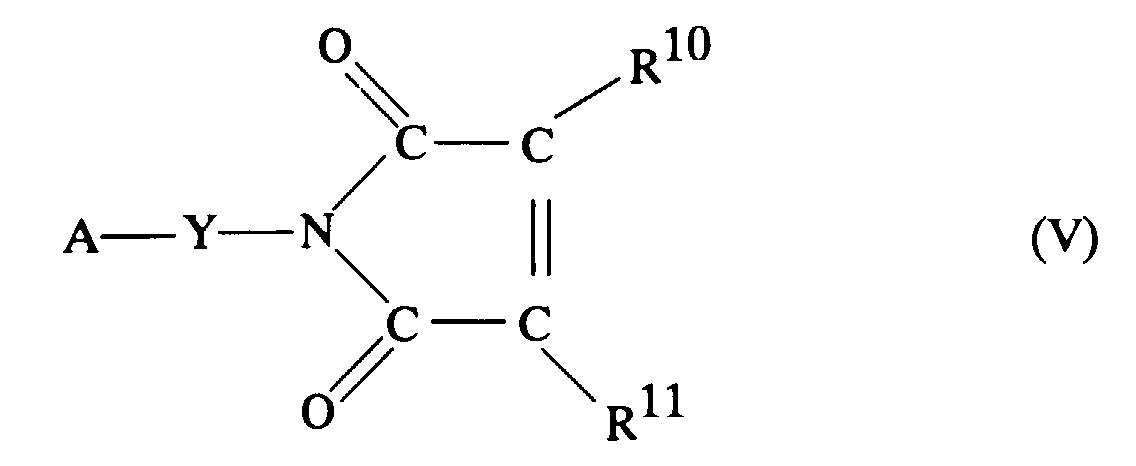 dans lesquelles R1 à R5 peuvent être identiques ou différents et représentent des atomes d'hydrogène, des groupes alkyle, aryle ou alcoxy ;R6 à R9 peuvent être identiques ou différents et représentent des atomes d'hydrogène ou d'halogène, des groupes cyano, alkyle, aryle, alcoxy, -SO2-R12, -SO3-R12, -CO-R12, -CO-NH-R12, -COO-R12 ou -Y-A, dans lesquels R12 représente un groupe alkyle ou aryle ;R10 et R11 représentent des atomes d'hydrogène, des groupes alkyle ou aryle ; Y représente une liaison simple, un groupe hydrocarboné aliphatique ou aromatique bivalent ;A représente un groupe photoréactif ou capable de photoréponse ou un groupe décomposable à l'acide ;X1, X2 et X3 peuvent être identiques ou différents et représentent des atomes d'halogène, un groupe hydroxy, carboxy, oxime, amide, uréido, amino, alkyle, aryle, aralkyle, alcoxy, aryloxy, -Y-A,
- Polymère de siloxane selon la revendication 1, dans lequel A est


- Polymère de siloxane selon la revendication 1, dans lequel A est

- Polymère de siloxane selon la revendication 1, dans lequel A est

- Polymère de siloxane selon la revendication 1, dans lequel A est
-SO2-SO2-Ar,


- Polymère de siloxane selon la revendication 1, dans lequel A est
-CO-O-R113 ou O-CO-O-R113
où R113 représente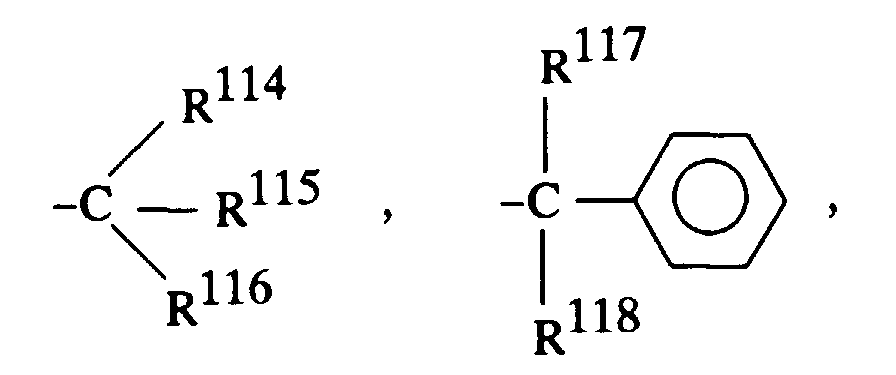

- Polymère de siloxane selon la revendication 1, dans lequel A est

- Composition photosensible fonctionnant de manière positive comprenant :a) un polymère soluble dans un alcali ; etb) un polymère de siloxane selon l'une quelconque des revendications précédentes.
- Composition sensible à la lumière fonctionnant de manière positive comprenant :a) un composé capable de produire un acide par irradiation de rayons actiniques ou de rayons radiants, etb) un polymère de siloxane selon l'une quelconque des revendications 1 à 7.
- Polymère de siloxane présentant au moins 1 % en mole d'une unité de structure qui contient un groupe cyclohexényle suspendu avec une ou deux doubles liaisons dans le noyau et est dérivée d'un produit d'addition de chaleur cyclique entre un composé de diène de formule (I) ou (II) de la revendication 1 et un composé d'oléfine de formule
 où R210 représente un groupe alkyle ou aryle ;R211 et R212 représentent des atomes d'hydrogène, des groupes alkyle ou aryle ;A représente
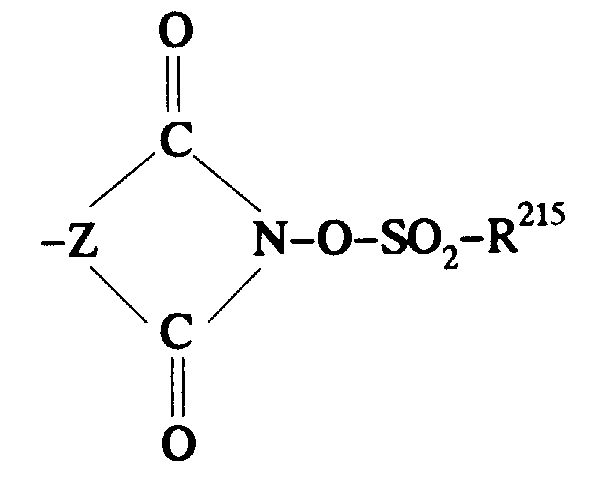 où R213 à R215 peuvent être identiques ou différents et représentent des groupes alkyle ou aryle, B représente un groupe alkylène ou arylène divalent, et Z représente un groupe alkylène ou arylène trivalent.
 - Composition sensible à la lumière fonctionnant de manière positive comprenant :a) un polymère soluble dans un alcali, etb) un polymère de siloxane selon la revendication 10.
- Polymère de siloxane selon la revendication 1, dans lequel le composé d'oléfine ou d'acétylène présente un groupe phénolique OH, N-hydroxyamide, N-hydroxyimide ou anilino,
A représente -OH,
- Composition sensible à la lumière fonctionnant de manière positive comprenant un condensat obtenu en faisant réagir le polymère de siloxane de la revendication 12 présentant au moins 1 % en mole d'une unité de structure dérivée d'un produit d'addition de chaleur cyclique entre un composé de diène de formule (I) ou (II) et un composé d'oléfine ou d'acétylène présentant un groupe phénolique OH , N-hydroxyamide, N-hydroxyimide ou anilino de formule (III), (IV) ou (V) avec un halogénure de 1,2-naphtoquinone-2-diazide-4- ou 5-sulfonyle.
- Procédé de préparation du polymère de siloxane selon la revendication 1, qui comprend les étapes consistant :(i) à soumettre au moins un composé de formule (I) ou (II) et au moins un composé de formule (III), (IV) ou (V) à une réaction d'addition de chaleur cyclique ;(ii) à hydrolyser le produit de réaction de l'étape (i) ; et(iii) à soumettre le produit hydrolysé de l'étape (ii) à une réaction de condensation, par laquelle un polymère de siloxane est produit.
- Procédé de préparation du polymère de siloxane selon la revendication 7, qui comprend les étapes consistant :(i) à hydrolyser au moins un composé de formule (I) ou (II) ;(ii) à soumettre le produit hydrolysé de l'étape (i) à une réaction de condensation et(iii) à soumettre le condensat de l'étape (ii) à une réaction d'addition de chaleur cyclique avec au moins un composé de formule (III), (IV) ou (V), par laquelle un polymère de siloxane est produit.
- Procédé selon la revendication 14 ou la revendication 15, dans lequel le groupe fonctionnel est choisi parmi un groupe présentant un pKa qui n'est pas supérieur à 12, un groupe décomposable à l'acide et un groupe photoréactif ou capable de photoréponse.
- Procédé selon la revendication 14 ou 15, dans lequel au moins un composé des formules (XII), (XIII), (XIV), (XV) ou (XVI) coexiste et se cocondense dans les étapes d'hydrolyse et de condensation :
R16-Si(̵X)3 (XII)
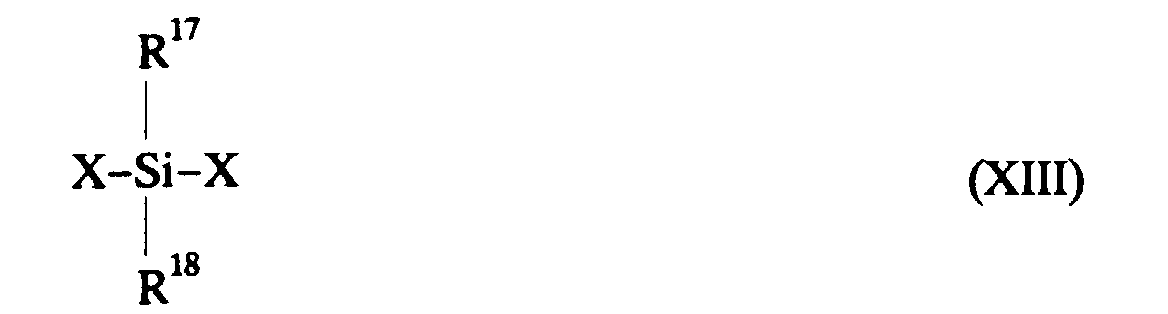


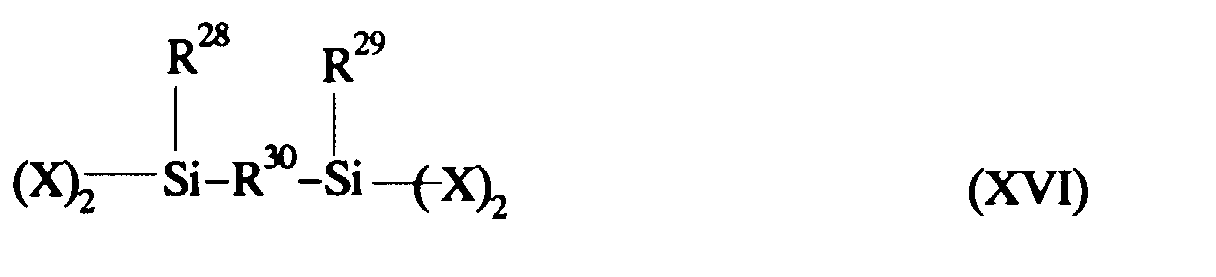 dans lesquelles R16 à R22, R24 à R26 et R23 à R29 peuvent être identiques ou différents et représentent chacun un atome d'hydrogène ou un groupe alkyle, alkyle substitué, aryle, aryle substitué, alcényle, alcényle substitué, allyle, silyle, silyle subtitué, siloxy ou siloxy substitué,R23, R27 et R30 peuvent être identiques ou différents et représentent chacun une liaison simple, un groupe alkylène bivalent, un groupe alkylène substitué, un groupe arylène ou un groupe arylène substitué, etX représente un groupe hydrolysable.
 - Procédé selon la revendication 14 ou la revendication 15, dans lequel au moins un composé d'oléfine ou d'acétylène des formules (III'), (IV') ou (V') à introduire dans la structure du polymère de siloxane coexiste dans l'étape de réaction d'addition de chaleur cyclique :

 dans lesquelles R6 à R9 peuvent être identiques ou différents et représentent des atomes d'hydrogène ou d'halogène, un groupe cyano, alkyle, aryle, alcoxy, -SO2-R12, -SO3-R12, -CO-R12, -CO-NH-R12, -COO-R12 ou -Y-A, dans lesquels R12 représente un groupe alkyle ou aryle ;R10 et R11 représentent des atomes d'hydrogène, des groupes alkyle ou aryle ;Y représente une liaison simple, un groupe hydrocarboné aliphatique ou aromatique divalent ;A représente un groupe fonctionnel ;B représente un atome d'hydrogène, un groupe alkyle ou aryle,à condition que deux groupes parmi R6 et R8 et Y ou R10 et R11 puissent se combiner pour former un noyau.
Applications Claiming Priority (14)
| Application Number | Priority Date | Filing Date | Title |
|---|---|---|---|
| JP1179784A JP2598998B2 (ja) | 1989-07-12 | 1989-07-12 | 感光性組成物 |
| JP179784/89 | 1989-07-12 | ||
| JP1180738A JPH0344644A (ja) | 1989-07-13 | 1989-07-13 | 感光性組成物 |
| JP180738/89 | 1989-07-13 | ||
| JP181880/89 | 1989-07-14 | ||
| JP18187889A JPH0346661A (ja) | 1989-07-14 | 1989-07-14 | 感光性組成物 |
| JP18187989A JPH0346662A (ja) | 1989-07-14 | 1989-07-14 | 感光性組成物 |
| JP181879/89 | 1989-07-14 | ||
| JP18188089A JPH0346663A (ja) | 1989-07-14 | 1989-07-14 | 感光性組成物 |
| JP181878/89 | 1989-07-14 | ||
| JP1796/90 | 1990-01-09 | ||
| JP179590A JPH03206460A (ja) | 1990-01-09 | 1990-01-09 | 感光性組成物 |
| JP179690A JPH03206461A (ja) | 1990-01-09 | 1990-01-09 | 感光性組成物 |
| JP1795/90 | 1990-01-09 |
Publications (3)
| Publication Number | Publication Date |
|---|---|
| EP0410606A2 EP0410606A2 (fr) | 1991-01-30 |
| EP0410606A3 EP0410606A3 (en) | 1991-12-11 |
| EP0410606B1 true EP0410606B1 (fr) | 1996-11-13 |
Family
ID=27563155
Family Applications (1)
| Application Number | Title | Priority Date | Filing Date |
|---|---|---|---|
| EP90307611A Expired - Lifetime EP0410606B1 (fr) | 1989-07-12 | 1990-07-11 | Polysiloxanes et compositions photoréserves positives |
Country Status (3)
| Country | Link |
|---|---|
| US (2) | US5216105A (fr) |
| EP (1) | EP0410606B1 (fr) |
| DE (1) | DE69029104T2 (fr) |
Cited By (1)
| Publication number | Priority date | Publication date | Assignee | Title |
|---|---|---|---|---|
| US6485890B2 (en) | 1996-04-23 | 2002-11-26 | Kodak Polychrome Graphics, Llc | Lithographic printing forms |
Families Citing this family (12)
| Publication number | Priority date | Publication date | Assignee | Title |
|---|---|---|---|---|
| ES2129398T3 (es) * | 1990-12-20 | 1999-06-16 | Siemens Ag | Procedimiento para la obtencion de n-terc-butoxi-carbonilmaleinimida. |
| DE4124028A1 (de) * | 1991-07-19 | 1993-01-21 | Hoechst Ag | Verfahren zur herstellung von n-tert.-butoxycarbonyl-maleimid |
| US6117610A (en) * | 1997-08-08 | 2000-09-12 | Kodak Polychrome Graphics Llc | Infrared-sensitive diazonaphthoquinone imaging composition and element containing non-basic IR absorbing material and methods of use |
| US6063544A (en) * | 1997-03-21 | 2000-05-16 | Kodak Polychrome Graphics Llc | Positive-working printing plate and method of providing a positive image therefrom using laser imaging |
| US6090532A (en) * | 1997-03-21 | 2000-07-18 | Kodak Polychrome Graphics Llc | Positive-working infrared radiation sensitive composition and printing plate and imaging method |
| EP0996869A1 (fr) | 1997-07-05 | 2000-05-03 | Kodak Polychrome Graphics LLC | Procedes de formation de motifs et des matieres sensibles aux rayonnements |
| CN1061365C (zh) * | 1997-07-18 | 2001-01-31 | 中国科学院化学研究所 | 一种梯形聚硅氧烷为基体的液晶定向膜及其制备方法和用途 |
| US6060217A (en) * | 1997-09-02 | 2000-05-09 | Kodak Polychrome Graphics Llc | Thermal lithographic printing plates |
| US6531260B2 (en) | 2000-04-07 | 2003-03-11 | Jsr Corporation | Polysiloxane, method of manufacturing same, silicon-containing alicyclic compound, and radiation-sensitive resin composition |
| WO2006137261A1 (fr) * | 2005-06-21 | 2006-12-28 | Konica Minolta Medical & Graphic, Inc. | Composition photosensible, matériau pour plaque d’impression lithographique photosensible, et procédé pour la formation d'image du matériau pour plaque d'impression lithographique photosensible |
| DE102013003329B4 (de) | 2013-02-25 | 2025-08-14 | Fraunhofer-Gesellschaft zur Förderung der angewandten Forschung e.V. | Photolack, Verfahren zur Herstellung eines Kieselsäure(hetero)poly(co)kondensaten mit Positiv-Resist Verhalten sowie Kieselsäure(hetero)poly(co)kondensat |
| CN116970964A (zh) * | 2023-03-20 | 2023-10-31 | 南京林业大学 | 一种硫氰代烯基砜类化合物的电化学合成方法 |
Family Cites Families (96)
| Publication number | Priority date | Publication date | Assignee | Title |
|---|---|---|---|---|
| NL80628C (fr) | 1949-07-23 | |||
| US3046121A (en) | 1949-07-23 | 1962-07-24 | Azoplate Corp | Process for the manufacture of printing plates and light-sensitive material suttablefor use therein |
| US3046119A (en) | 1950-08-01 | 1962-07-24 | Azoplate Corp | Light sensitive material for printing and process for making printing plates |
| BE506677A (fr) | 1950-10-31 | |||
| BE540601A (fr) | 1950-12-06 | |||
| NL78025C (fr) | 1951-02-02 | |||
| US2767092A (en) | 1951-12-06 | 1956-10-16 | Azoplate Corp | Light sensitive material for lithographic printing |
| GB742557A (en) | 1952-10-01 | 1955-12-30 | Kalle & Co Ag | Light-sensitive material for photomechanical reproduction and process for the production of images |
| DE938233C (de) | 1953-03-11 | 1956-01-26 | Kalle & Co Ag | Lichtempfindliches Material fuer die photomechanische Herstellung von Druckformen |
| GB772517A (en) | 1954-02-06 | 1957-04-17 | Kalle & Co Ag | Improvements in or relating to photo-mechanical reproduction |
| BE540225A (fr) | 1954-08-20 | |||
| US2807648A (en) | 1955-09-16 | 1957-09-24 | Stauffer Chemical Co | Process for making sulfonium compounds |
| US2907665A (en) | 1956-12-17 | 1959-10-06 | Cons Electrodynamics Corp | Vitreous enamel |
| NL129161C (fr) | 1959-01-14 | |||
| US2946638A (en) | 1959-03-31 | 1960-07-26 | Acme Visible Records Inc | Slidable shelf arrangement |
| BE593836A (fr) | 1959-08-05 | |||
| NL267931A (fr) | 1960-08-05 | 1900-01-01 | ||
| US3247791A (en) | 1960-05-06 | 1966-04-26 | Litho Chemical And Supply Co I | Surface treated lithographic plates and production thereof |
| US3307951A (en) | 1963-02-01 | 1967-03-07 | Lithoplate Inc | Lithographic plate |
| US3181461A (en) | 1963-05-23 | 1965-05-04 | Howard A Fromson | Photographic plate |
| DE1299661B (de) | 1964-02-27 | 1969-07-24 | Eastman Kodak Co | Verfahren zur Verbesserung der hydrophilen Eigenschaften der Traeger von fuer Flachdruckverfahren geeigneten Druckplatten |
| US3635709A (en) | 1966-12-15 | 1972-01-18 | Polychrome Corp | Light-sensitive lithographic plate |
| ZA6807938B (fr) | 1967-12-04 | |||
| US3658662A (en) | 1969-01-21 | 1972-04-25 | Durolith Corp | Corrosion resistant metallic plates particularly useful as support members for photo-lithographic plates and the like |
| CA933791A (en) | 1969-06-13 | 1973-09-18 | Broyde Barret | Additives to positive photoresists which increase the sensitivity thereof |
| US3647443A (en) | 1969-09-12 | 1972-03-07 | Eastman Kodak Co | Light-sensitive quinone diazide polymers and polymer compositions |
| BE757124A (fr) | 1969-10-09 | 1971-04-06 | Kalle Ag | Plaques d'impression a plat composee de feuilles |
| DE2150691C2 (de) | 1971-10-12 | 1982-09-09 | Basf Ag, 6700 Ludwigshafen | Lichtempfindliches Gemisch und Verwendung eines lichtempfindlichen Gemisches zur Herstellung einer Flachdruckplatte |
| US3779778A (en) | 1972-02-09 | 1973-12-18 | Minnesota Mining & Mfg | Photosolubilizable compositions and elements |
| JPS5148516B2 (fr) | 1973-02-07 | 1976-12-21 | ||
| DE2331377C2 (de) | 1973-06-20 | 1982-10-14 | Hoechst Ag, 6000 Frankfurt | Lichtempfindliches Kopiermaterial |
| JPS5723253B2 (fr) | 1974-03-25 | 1982-05-18 | ||
| AU497960B2 (en) | 1974-04-11 | 1979-01-25 | Minnesota Mining And Manufacturing Company | Photopolymerizable compositions |
| GB1516511A (en) | 1974-05-02 | 1978-07-05 | Gen Electric | Curable epoxide compositions |
| GB1516351A (en) | 1974-05-02 | 1978-07-05 | Gen Electric | Curable epoxide compositions |
| IE42085B1 (en) | 1974-09-18 | 1980-06-04 | Ici Ltd | Photopolymerisable compositions |
| GB1539192A (en) | 1975-01-27 | 1979-01-31 | Ici Ltd | Photopolymerisable compositions |
| CH621416A5 (fr) | 1975-03-27 | 1981-01-30 | Hoechst Ag | |
| US4009033A (en) | 1975-09-22 | 1977-02-22 | International Business Machines Corporation | High speed positive photoresist composition |
| JPS5280022A (en) | 1975-12-26 | 1977-07-05 | Fuji Photo Film Co Ltd | Light solubilizable composition |
| US4062686A (en) | 1976-04-21 | 1977-12-13 | Eastman Kodak Company | Sensitizers for photocrosslinkable polymers |
| JPS538128A (en) | 1976-07-09 | 1978-01-25 | Fuji Photo Film Co Ltd | Photosolubilizable composition |
| DE2641100C2 (de) | 1976-09-13 | 1987-02-26 | Hoechst Ag, 6230 Frankfurt | Lichtempfindliches Gemisch |
| US4151175A (en) | 1976-12-09 | 1979-04-24 | General Electric Company | Method for making diarylhalonium salts |
| DE2718254C3 (de) | 1977-04-25 | 1980-04-10 | Hoechst Ag, 6000 Frankfurt | Strahlungsempfindliche Kopiermasse |
| JPS5474728A (en) | 1977-11-28 | 1979-06-15 | Fuji Photo Film Co Ltd | Photosensitive composition |
| US4173476A (en) | 1978-02-08 | 1979-11-06 | Minnesota Mining And Manufacturing Company | Complex salt photoinitiator |
| DE2829511A1 (de) | 1978-07-05 | 1980-01-24 | Hoechst Ag | Strahlungsempfindliches gemisch und verfahren zur herstellung von reliefbildern |
| DE2829512A1 (de) | 1978-07-05 | 1980-01-17 | Hoechst Ag | Strahlungsempfindliches gemisch und verfahren zur herstellung von reliefbildern |
| JPS5577742A (en) | 1978-12-08 | 1980-06-11 | Fuji Photo Film Co Ltd | Photosensitive composition |
| US4250053A (en) | 1979-05-21 | 1981-02-10 | Minnesota Mining And Manufacturing Company | Sensitized aromatic iodonium or aromatic sulfonium salt photoinitiator systems |
| DE2928636A1 (de) | 1979-07-16 | 1981-02-12 | Hoechst Ag | Strahlungsempfindliches gemisch und verfahren zur herstellung von reliefbildern |
| US4247473A (en) | 1979-07-19 | 1981-01-27 | American Can Company | Method for producing bis-[4-(diphenylsulfonio)pheny] sulfide bis-M.X6 photoinitiator |
| US4307173A (en) | 1980-06-23 | 1981-12-22 | American Hoechst Corporation | Light-sensitive composition comprising phthalic anhydride |
| JPS57163234A (en) | 1981-04-01 | 1982-10-07 | Fuji Photo Film Co Ltd | Photosensitive composition |
| US4551416A (en) * | 1981-05-22 | 1985-11-05 | At&T Bell Laboratories | Process for preparing semiconductors using photosensitive bodies |
| DE3126626A1 (de) | 1981-07-06 | 1983-01-20 | Hoechst Ag, 6000 Frankfurt | Hydrophilierte traegermaterialien fuer offsetdruckplatten, ein verfahren zu ihrer herstellung und ihre verwendung |
| DE3126636A1 (de) | 1981-07-06 | 1983-01-27 | Hoechst Ag, 6000 Frankfurt | Hydrophilierte traegermaterialien fuer offsetdruckplatten, ein verfahren zu ihrer herstellung und ihre verwendung |
| US4442197A (en) | 1982-01-11 | 1984-04-10 | General Electric Company | Photocurable compositions |
| US4491628A (en) | 1982-08-23 | 1985-01-01 | International Business Machines Corporation | Positive- and negative-working resist compositions with acid generating photoinitiator and polymer with acid labile groups pendant from polymer backbone |
| JPS59101651A (ja) | 1982-12-02 | 1984-06-12 | Fuji Photo Film Co Ltd | 感光性平版印刷版 |
| US5073476A (en) | 1983-05-18 | 1991-12-17 | Ciba-Geigy Corporation | Curable composition and the use thereof |
| JPH0617991B2 (ja) | 1983-06-22 | 1994-03-09 | 富士写真フイルム株式会社 | 光可溶化組成物 |
| DE3473359D1 (de) * | 1983-06-29 | 1988-09-15 | Fuji Photo Film Co Ltd | Photosolubilizable composition |
| JPS6037549A (ja) | 1983-08-10 | 1985-02-26 | Fuji Photo Film Co Ltd | 光可溶化組成物 |
| JPS6010247A (ja) | 1983-06-29 | 1985-01-19 | Fuji Photo Film Co Ltd | 光可溶化組成物 |
| JPS60121446A (ja) | 1983-12-06 | 1985-06-28 | Fuji Photo Film Co Ltd | 光可溶化組成物 |
| US4603195A (en) * | 1983-12-30 | 1986-07-29 | International Business Machines Corporation | Organosilicon compound and use thereof in photolithography |
| FR2570844B1 (fr) * | 1984-09-21 | 1986-11-14 | Commissariat Energie Atomique | Film photosensible a base de polymere silicie et son utilisation comme resine de masquage dans un procede de lithographie |
| JPS61144639A (ja) | 1984-12-19 | 1986-07-02 | Hitachi Ltd | 放射線感応性組成物及びそれを用いたパタ−ン形成法 |
| JPH07120044B2 (ja) | 1986-03-31 | 1995-12-20 | 株式会社東芝 | 感光性組成物およびそれを用いるパターン形成方法 |
| JPS61256347A (ja) | 1985-05-10 | 1986-11-13 | Hitachi Ltd | アルカリ可溶性シロキサン重合体 |
| JPS61267042A (ja) | 1985-05-21 | 1986-11-26 | Fuji Photo Film Co Ltd | 感光性組成物 |
| JPH067263B2 (ja) * | 1985-08-19 | 1994-01-26 | 富士写真フイルム株式会社 | 光可溶化組成物 |
| US4665006A (en) | 1985-12-09 | 1987-05-12 | International Business Machines Corporation | Positive resist system having high resistance to oxygen reactive ion etching |
| US4822716A (en) * | 1985-12-27 | 1989-04-18 | Kabushiki Kaisha Toshiba | Polysilanes, Polysiloxanes and silicone resist materials containing these compounds |
| JP2619358B2 (ja) | 1986-01-08 | 1997-06-11 | 株式会社日立製作所 | 感光性樹脂組成物 |
| JPH083637B2 (ja) | 1986-03-24 | 1996-01-17 | 日本電信電話株式会社 | 感光性樹脂組成物 |
| JPH061381B2 (ja) | 1986-02-18 | 1994-01-05 | 株式会社日立製作所 | 放射線感応性樹脂組成物 |
| US4837124A (en) | 1986-02-24 | 1989-06-06 | Hoechst Celanese Corporation | High resolution photoresist of imide containing polymers |
| US4689289A (en) * | 1986-04-30 | 1987-08-25 | General Electric Company | Block polymer compositions |
| JPS6336240A (ja) | 1986-07-28 | 1988-02-16 | インターナシヨナル・ビジネス・マシーンズ・コーポレーシヨン | レジスト構造の作成方法 |
| JPS6390534A (ja) | 1986-10-06 | 1988-04-21 | Hitachi Ltd | アルカリ可溶性ラダ−シリコ−ン重合体 |
| JPH0769608B2 (ja) | 1986-10-06 | 1995-07-31 | 株式会社日立製作所 | 感光性樹脂組成物 |
| JPH07120039B2 (ja) | 1986-11-14 | 1995-12-20 | 富士写真フイルム株式会社 | 感光性組成物 |
| JPH0654382B2 (ja) | 1986-11-18 | 1994-07-20 | 富士写真フイルム株式会社 | 感光性組成物 |
| JPS63146038A (ja) | 1986-12-10 | 1988-06-18 | Toshiba Corp | 感光性組成物 |
| DE3735086C1 (de) * | 1987-10-16 | 1989-02-02 | Goldschmidt Ag Th | Organopolysiloxane mit Buntesalzgruppen |
| KR910005771B1 (ko) * | 1988-03-22 | 1991-08-03 | 주식회사 럭키 | 아미드기를 함유하는 폴리실록산 및 그의 제조방법 |
| DE3817011A1 (de) * | 1988-05-19 | 1989-11-30 | Basf Ag | Strahlungsempfindliches gemisch und verfahren zur herstellung von reliefmustern |
| JP2547626B2 (ja) * | 1988-10-07 | 1996-10-23 | 富士写真フイルム株式会社 | モノマーの製造方法 |
| DE3907954A1 (de) * | 1989-03-11 | 1990-09-13 | Hoechst Ag | Positiv arbeitendes strahlungsempfindliches gemisch und daraus hergestelltes strahlungsempfindliches aufzeichnungsmaterial fuer hochenergetische strahlung |
| JP2648969B2 (ja) * | 1989-07-28 | 1997-09-03 | 富士写真フイルム株式会社 | 感光性組成物 |
| JP2607162B2 (ja) * | 1990-02-02 | 1997-05-07 | 富士写真フイルム株式会社 | 感光性組成物 |
| JP2632066B2 (ja) * | 1990-04-06 | 1997-07-16 | 富士写真フイルム株式会社 | ポジ画像の形成方法 |
| US5225316A (en) * | 1990-11-26 | 1993-07-06 | Minnesota Mining And Manufacturing Company | An imagable article comprising a photosensitive composition comprising a polymer having acid labile pendant groups |
-
1990
- 1990-07-11 EP EP90307611A patent/EP0410606B1/fr not_active Expired - Lifetime
- 1990-07-11 DE DE69029104T patent/DE69029104T2/de not_active Expired - Fee Related
-
1992
- 1992-07-10 US US07/550,446 patent/US5216105A/en not_active Expired - Lifetime
- 1992-08-28 US US07/936,788 patent/US5338640A/en not_active Expired - Fee Related
Cited By (1)
| Publication number | Priority date | Publication date | Assignee | Title |
|---|---|---|---|---|
| US6485890B2 (en) | 1996-04-23 | 2002-11-26 | Kodak Polychrome Graphics, Llc | Lithographic printing forms |
Also Published As
| Publication number | Publication date |
|---|---|
| US5338640A (en) | 1994-08-16 |
| US5216105A (en) | 1993-06-01 |
| DE69029104T2 (de) | 1997-03-20 |
| EP0410606A3 (en) | 1991-12-11 |
| DE69029104D1 (de) | 1996-12-19 |
| EP0410606A2 (fr) | 1991-01-30 |
Similar Documents
| Publication | Publication Date | Title |
|---|---|---|
| US5320931A (en) | Light-sensitive composition | |
| EP0410606B1 (fr) | Polysiloxanes et compositions photoréserves positives | |
| US5143816A (en) | Light-sensitive composition comprising a polysiloxane and a naphthoquinone | |
| KR100313319B1 (ko) | 양성감광성조성물 | |
| JP2964733B2 (ja) | パターン形成材料 | |
| EP0360618B1 (fr) | Composition photosensible | |
| JP2547627B2 (ja) | ポジ型感光性組成物 | |
| US5141840A (en) | Light-sensitive composition containing onium salt and polysiloxane reaction product | |
| US5252686A (en) | Siloxane polymers and positive working light-sensitive compositions comprising the same | |
| US5276124A (en) | Siloxane polymers and positive working light-sensitive compositions comprising the same | |
| KR100913732B1 (ko) | 포지티브 포토레지스트 조성물 및 이 조성물을 이용한 패턴형성방법 | |
| JP2598998B2 (ja) | 感光性組成物 | |
| US6358675B1 (en) | Silicon-containing alcohols and polymers having silicon-containing tertiary ester groups made therefrom | |
| JP2736939B2 (ja) | 機能性基含有ポリシロキサンの合成法 | |
| JPH03206461A (ja) | 感光性組成物 | |
| JP2684246B2 (ja) | 感光性組成物 | |
| JPH0962006A (ja) | ポジ型フォトレジスト組成物 | |
| JPH0344644A (ja) | 感光性組成物 | |
| JPH02105156A (ja) | 感光性組成物 | |
| JPH0611837A (ja) | 感光性組成物 | |
| JPH0297948A (ja) | 感光性組成物 | |
| EP0396254A2 (fr) | Composition photosensible et méthode de fabrication de motifs utilisant ladite composition | |
| JPH0346663A (ja) | 感光性組成物 | |
| JPH0862844A (ja) | ポジ型感光性組成物 | |
| JPH0659458A (ja) | 感光性組成物 |
Legal Events
| Date | Code | Title | Description |
|---|---|---|---|
| PUAI | Public reference made under article 153(3) epc to a published international application that has entered the european phase |
Free format text: ORIGINAL CODE: 0009012 |
|
| AK | Designated contracting states |
Kind code of ref document: A2 Designated state(s): DE GB |
|
| PUAL | Search report despatched |
Free format text: ORIGINAL CODE: 0009013 |
|
| AK | Designated contracting states |
Kind code of ref document: A3 Designated state(s): DE GB |
|
| 17P | Request for examination filed |
Effective date: 19920120 |
|
| 17Q | First examination report despatched |
Effective date: 19940629 |
|
| GRAG | Despatch of communication of intention to grant |
Free format text: ORIGINAL CODE: EPIDOS AGRA |
|
| GRAH | Despatch of communication of intention to grant a patent |
Free format text: ORIGINAL CODE: EPIDOS IGRA |
|
| GRAH | Despatch of communication of intention to grant a patent |
Free format text: ORIGINAL CODE: EPIDOS IGRA |
|
| GRAA | (expected) grant |
Free format text: ORIGINAL CODE: 0009210 |
|
| AK | Designated contracting states |
Kind code of ref document: B1 Designated state(s): DE GB |
|
| REF | Corresponds to: |
Ref document number: 69029104 Country of ref document: DE Date of ref document: 19961219 |
|
| PLBE | No opposition filed within time limit |
Free format text: ORIGINAL CODE: 0009261 |
|
| STAA | Information on the status of an ep patent application or granted ep patent |
Free format text: STATUS: NO OPPOSITION FILED WITHIN TIME LIMIT |
|
| 26N | No opposition filed | ||
| REG | Reference to a national code |
Ref country code: GB Ref legal event code: IF02 |
|
| PGFP | Annual fee paid to national office [announced via postgrant information from national office to epo] |
Ref country code: GB Payment date: 20040702 Year of fee payment: 15 |
|
| PGFP | Annual fee paid to national office [announced via postgrant information from national office to epo] |
Ref country code: DE Payment date: 20040830 Year of fee payment: 15 |
|
| PG25 | Lapsed in a contracting state [announced via postgrant information from national office to epo] |
Ref country code: GB Free format text: LAPSE BECAUSE OF NON-PAYMENT OF DUE FEES Effective date: 20050711 |
|
| PG25 | Lapsed in a contracting state [announced via postgrant information from national office to epo] |
Ref country code: DE Free format text: LAPSE BECAUSE OF NON-PAYMENT OF DUE FEES Effective date: 20060201 |
|
| GBPC | Gb: european patent ceased through non-payment of renewal fee |
Effective date: 20050711 |