EP0419252B1 - Thrombolytische Zusammensetzung enthaltender Gewebetyp, Plasminogenaktivatoren oder Derivate davon - Google Patents
Thrombolytische Zusammensetzung enthaltender Gewebetyp, Plasminogenaktivatoren oder Derivate davon Download PDFInfo
- Publication number
- EP0419252B1 EP0419252B1 EP90310288A EP90310288A EP0419252B1 EP 0419252 B1 EP0419252 B1 EP 0419252B1 EP 90310288 A EP90310288 A EP 90310288A EP 90310288 A EP90310288 A EP 90310288A EP 0419252 B1 EP0419252 B1 EP 0419252B1
- Authority
- EP
- European Patent Office
- Prior art keywords
- salt
- acid
- solution
- set forth
- thrombolytic composition
- Prior art date
- Legal status (The legal status is an assumption and is not a legal conclusion. Google has not performed a legal analysis and makes no representation as to the accuracy of the status listed.)
- Expired - Lifetime
Links
Images


Classifications
-
- A—HUMAN NECESSITIES
- A61—MEDICAL OR VETERINARY SCIENCE; HYGIENE
- A61K—PREPARATIONS FOR MEDICAL, DENTAL OR TOILETRY PURPOSES
- A61K38/00—Medicinal preparations containing peptides
-
- A—HUMAN NECESSITIES
- A61—MEDICAL OR VETERINARY SCIENCE; HYGIENE
- A61K—PREPARATIONS FOR MEDICAL, DENTAL OR TOILETRY PURPOSES
- A61K38/00—Medicinal preparations containing peptides
- A61K38/16—Peptides having more than 20 amino acids; Gastrins; Somatostatins; Melanotropins; Derivatives thereof
- A61K38/43—Enzymes; Proenzymes; Derivatives thereof
- A61K38/46—Hydrolases (3)
- A61K38/48—Hydrolases (3) acting on peptide bonds (3.4)
- A61K38/49—Urokinase; Tissue plasminogen activator
-
- A—HUMAN NECESSITIES
- A61—MEDICAL OR VETERINARY SCIENCE; HYGIENE
- A61K—PREPARATIONS FOR MEDICAL, DENTAL OR TOILETRY PURPOSES
- A61K47/00—Medicinal preparations characterised by the non-active ingredients used, e.g. carriers or inert additives; Targeting or modifying agents chemically bound to the active ingredient
- A61K47/06—Organic compounds, e.g. natural or synthetic hydrocarbons, polyolefins, mineral oil, petrolatum or ozokerite
- A61K47/16—Organic compounds, e.g. natural or synthetic hydrocarbons, polyolefins, mineral oil, petrolatum or ozokerite containing nitrogen, e.g. nitro-, nitroso-, azo-compounds, nitriles, cyanates
- A61K47/18—Amines; Amides; Ureas; Quaternary ammonium compounds; Amino acids; Oligopeptides having up to five amino acids
- A61K47/183—Amino acids, e.g. glycine, EDTA or aspartame
-
- A—HUMAN NECESSITIES
- A61—MEDICAL OR VETERINARY SCIENCE; HYGIENE
- A61K—PREPARATIONS FOR MEDICAL, DENTAL OR TOILETRY PURPOSES
- A61K47/00—Medicinal preparations characterised by the non-active ingredients used, e.g. carriers or inert additives; Targeting or modifying agents chemically bound to the active ingredient
- A61K47/30—Macromolecular organic or inorganic compounds, e.g. inorganic polyphosphates
- A61K47/36—Polysaccharides; Derivatives thereof, e.g. gums, starch, alginate, dextrin, hyaluronic acid, chitosan, inulin, agar or pectin
-
- A—HUMAN NECESSITIES
- A61—MEDICAL OR VETERINARY SCIENCE; HYGIENE
- A61K—PREPARATIONS FOR MEDICAL, DENTAL OR TOILETRY PURPOSES
- A61K9/00—Medicinal preparations characterised by special physical form
- A61K9/0012—Galenical forms characterised by the site of application
- A61K9/0019—Injectable compositions; Intramuscular, intravenous, arterial, subcutaneous administration; Compositions to be administered through the skin in an invasive manner
-
- A—HUMAN NECESSITIES
- A61—MEDICAL OR VETERINARY SCIENCE; HYGIENE
- A61P—SPECIFIC THERAPEUTIC ACTIVITY OF CHEMICAL COMPOUNDS OR MEDICINAL PREPARATIONS
- A61P7/00—Drugs for disorders of the blood or the extracellular fluid
- A61P7/02—Antithrombotic agents; Anticoagulants; Platelet aggregation inhibitors
Definitions
- the present invention relates to a thrombolytic composition containing tissue type plasminogen activator (t-PA) or a derivative thereof as a major active component.
- tissue type plasminogen activator t-PA
- t-PA has become the object of much attention as a novel plasminogen activator for pharmaceutical use, because, unlike conventionally known urokinase, t-PA has strong affinity to fibrin and high thrombolytic activity and, in particular, single-chain t-PA causes fewer side effects. Recently, it has become possible to use t-PA as a thrombolytic agent practically in medicine due to the development of procedures for producing t-PA in large quantities using cell culture techniques as well as gene recombination techniques.
- t-PA a protein having an isoelectric point in the range of 6 - 8
- t-PA is extremely insoluble at pHs near the isoelectric point so that it became necessary to solve the problem with regard to the solubility of t-PA in order to formulate t-PA as a medicament.
- various investigations regarding the t-PA preparation have been conducted to improve the solubility of t-PA, and thus a good deal of information has been provided.
- known methods for improving the solubility of proteins include (1) dissolving the protein at an acidic or alkaline pH apart from the isoelectric point of the protein, (2) dissolving the protein at a pH near the isoelectric point of the protein in a solution with an increased salt concentration or ionic strength, and (3) dissolving the protein with the aid of a dissolution auxiliary agent specific to the protein.
- a preparation at a pH near neutral is more preferable than a preparation at an acidic pH.
- a solution with a high salt concentration is not preferable for injection because of its high osmotic pressure.
- the osmotic pressure is increased greatly when the lyophilised preparation is subsequently diluted in physiological saline, a typical diluent.
- t-PA as a medicament, it is not desirable to administer sodium in large doses.
- t-PA in a salt concentration as used in this specification means mainly chloride.
- salts such as amino acids or other compounds in the form of salts which are clinically acceptable.
- the present invention enables one to obtain a pharmaceutical solution containing t-PA at high concentrations that cannot be attained by conventional techniques; ie solutions in which a t-PA preparation is well dissolved at a pH near neutral (the isoelectric point of t-PA) in a diluent (such as distilled water for injection, a 5% glucose solution, physiological saline or an infusion for injection) at both low and high salt concentrations suited for parenteral administration.
- a diluent such as distilled water for injection, a 5% glucose solution, physiological saline or an infusion for injection
- the present invention is preferably applicable to pharmaceutical preparations of t-PA, particularly at pHs near neutral.
- Fig. 1 is a graph showing the turbidity (diffusion light intensity) of t-PA solutions diluted at different t-PA concentrations, in which sodium heparin, arginine and sulfuric acid are added to t-PA and the pH of the resultant solution is adjusted to 7.5 (see Example 7).
- Fig. 2 is a graph showing the turbidity of t-PA solutions diluted at different concentrations, in which sodium chondroitin sulfate and ethanolamine chloride are added to t-PA and the pH of the resultant solution is adjusted to 7.5 (see Example 8).
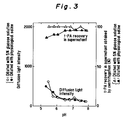
- Fig. 3 is a graph demonstrating the effect of pH on the solubility of t-PA in a solution also containing sodium chondroitin sulfate and monoethanolamine (see Example 9).
- the pH values given in this Figure are practical measurements when t-PA is diluted at a concentration of 0.2 mg/ml with physiological saline or a 5% glucose solution.
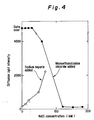
- Fig. 4 is a graph demonstrating the effect of salt concentrations on the solubility of t-PA in a solution to which sodium heparin or monoethanolamine chloride is added respectively (see Example 1). NaCl concentrations shown in this Figure are those determined when diffusion light intensities are measured.
- the t-PA or a derivative used in accordance with the invention is not restricted and includes proteins having t-PA activity regardless of the manner of production.
- the t-PA and its derivatives include t-PA obtained by extraction and purification from human or animal cells; t-PA obtained by cultivating cells derived from human or animal tissues and by extracting the cells or cell culture, thereby purifying t-PA; t-PA or a derivative thereof obtained using recombinant DNA techniques by cultivating cells which carry the incorporated nucleotide sequence of t-PA gene or a modified nucleotide sequence of t-PA gene using known recombinant DNA techniques so as to exert t-PA activity when expressed, by extracting the cells or the cell culture, thereby purifying t-PA; and a t-PA derivative in which purified t-PA or a derivative thereof is chemically modified.
- Examples of modifications of the nucleotide sequence coding for t-PA or a derivative thereof include mutation in which portions of amino acids or polypeptides are deleted or replaced and hybridization with other proteins (e.g., L. Hansen et al. J.Biol. Chem. 263, 15713-15719 (1988)).
- Examples of the cells, which incorporate the nucleotide sequence of the t-PA gene or a modified nucleotide sequence of the t-PA gene using known recombinant DNA techniques so as to exert t-PA activity when expressed include microorganisms such as strains of Escherichia coli , Bacillus subtilis and yeasts, or cells of animals such as Chinese hamsters, mice and humans.
- the t-PA used in the present invention may be single-chain t-PA, double-chain t-PA or a mixture of the two.
- t-PA used in the present invention implies single- or double-chain t-PA and derivatives thereof or a mixture thereof.
- the pH of the solution is weakly acid, neutral, weakly alkaline, or alkaline, and is preferably in the range of pH 5 - 9, more preferably in the range of pH 6- 8.
- the pH range of the solution depends upon the individual anionic polymers, amine compounds and salts thereof used, and thus the scope of the present invention is not restricted by the pH of the solution.
- anion residues of anionic polymers used in the present invention include carboxyl, carboxymethyl, sulfuric and phosphoric groups.
- polymer backbones of anionic polymers include sugars such as sugar alcohols, cellulose, amylose, amino acids and nucleic acid bases, preferably having a molecular weight of approximately 1,000 -1,000,000.
- anionic polymers containing these anion residues and polymer backbones in combination are carboxymethyl ion-exchangers such as carboxymethylamylose and carboxymethylcellulose, acidic polysaccharides such as arginic acid, mucosaccharide sulfates such as dextran sulfate, chondroitin sulfate, chondroitin sulfate A, chondroitin sulfate B, chondroitin sulfate C, chondroitin sulfate D, chondroitin sulfate E, heparin, kerato sulfate, keratane sulfate and heparitin sulfate, polyamino-acids such as poly-L-glutamic acid and nucleic acids.
- salts of these anionic polymers include salts of sodium, potassium or calcium.
- anionic polymers or the salts thereof are used by themselves or in combinations of two or more of them.
- An amount of an anionic polymer or a salt thereof is preferably 25 micrograms or more, more preferably 100 micrograms or more per 1 mg of t-PA to be dissolved, while the preferable upper limit of the amount of an anionic polymer is 100 mg per 1 mg of t-PA to be dissolved. If the amount is too small, t-PA may not be dissolved satisfactorily; on the contrary, if the amount is too large, there may be difficulties in the solubiilty of the anionic polymer itself.
- the amine compound salts can be preferred in view of their availability on the market unless there are difficulties in handling them.
- salts such as basic amino acid phosphate or sulfate, salts of polyethyleneimine or trishydroxymethylaminomethane, which are not readily available on the market or involve difficulties in handling due to their absorption of moisture, it is preferred to have the acids or their salts described below present along with amine compounds in the form of non-salts.
- An amount of an amine compound or a salt thereof is typically in the range of 20 micromoles - 10 mmoles, preferably 50 micromoles - 500 micromoles, per 1mg of t-PA to be dissolved. If the amount is too small, t-PA may not be dissolved satisfactorily; on the other hand, if the amount is too large, the amount of amine compounds may cause adverse physiological effects such as toxicity and cannot be used for medicinal preparations.
- acids which are particularly effective when used with a non-salt amine compound include oxalic acid, hydrochloric acid, sulfuric acid, phosphoric acid, pyrophosphoric acid, citric acid, tartaric acid, malic acid, maleic acid, glucuronic acid, glutaric acid, lactic acid, adipic acid and ascorbic acid.
- the salts of these acids suitable for use are sodium salts, potassium salts and calcium salts.
- a polyvalent acid or a salt thereof is preferable, in particular sulfuric acid, phosphoric acid, pyrophosphoric acid and citric acid and salts thereof are preferable.
- Salts themselves such as NaCl or the like, additives in salt form such as amino acid or EDTA described below in the form of salts, or salts of acids or alkalines which are used for adjusting pH as described below, may also be present.
- the amount of salt to be used in the present invention excluding the anionic polymers and salts thereof, amino compounds and salts thereof, acid and salts thereof, for example, is preferably 200 micromoles or less, more preferably 10 micromoles or less, per 1 mg of t-PA, considering the salt concentration and osmotic pressure ratio when t-PA is administered.
- the amount is not particularly restricted.
- the anionic polymer or a salt thereof and the amine compound or a salt thereof both in solid form together with an acid or a salt thereof are dissolved in the above-mentioned t-PA solution and the pH of the resultant solution is readjusted to prepare the t-PA aqueous solution by adding acids such as hydrochloric acid or sodium hydroxide, as necessary.
- an aqueous t-PA solution can be obtained by dissolving ingredients other than the t-PA, adjusting the pH of the resultant solution, and then adding t-PA to the solution in a desired concentration.
- a concentration of t-PA in an aqueous t-PA solution is not particularly limited and the t-PA is stably dissolved in the range of from 0.001 to 10 mg/ml (or from 600 to 6,000,000 IU/ml).
- a preferred concentration in general is from 0.01 to 5 mg/ml (or from 6,000 to 3,000,000 IU/ml).
- the solubility can preferably be maintained at various t-PA concentrations for clinical use in a solution with a high salt concentration, such as physiological saline, or in a solution with a low salt concentration, such as a 5 % glucose solution.
- a pharmaceutical solution having the appropriate osmotic pressure can be easily prepared at a desired t-PA concentration regardless of its salt concentration.
- t-PA in the form of a lyophilized preparation for example, an aqueous t-PA solution prepared by any of the above-mentioned methods is filtered to remove cells and the resultant filtrate is dispensed into sealable containers such as vials and ampoules to be lyophilized.
- the amount of t-PA in the lyophilized preparation may be 0.1 - 10 wt%.
- the lyophilized preparation can be used in the same manner as the above-mentioned aqueous solution and reconstituted at use with the appropriate parenteral carrier or diluent.
- a surfactant such as Tween 80, a chelating agent such as EDTA (to eliminate the effect of metal ions to the protein), proteins such as albumin and gelatin and sugars such as dextran as a stabilizer, and furthermore a excipient such as mannitol and lactose (effective when used in a lyophilized preparation) may be added alone or in combination.
- a t-PA pharmaceutical solution in either the form of an aqueous solution or in the form of a lyophilized preparation according to the present invention, can be stably formulated at a pH of from 5 to 9, regardless of salt concentrations, and is thus applicable for clinical use.
- the t-PA used in the Examples was t-PA, a single-chain or double-chain t-PA or an admixture of the two, which was obtained by expressing the structural gene of t-PA in a cell culture using recombinant DNA techniques and by purifying t-PA from the culture fluid.
- the single-chain t-PA and the double-chain t-PA were respectively obtained by specifically purifying the culture fluid; the admixture was obtained by purifying the culture fluid without separating a single-chain t-PA from a double-chain t-PA.
- Turbidity of the solution was observed mainly by the naked eye; diffusion light intensity of the solution was measured to estimate the turbidity quantitatively. Generally, the solution was judged to be clear when the diffusion light intensity was 500 or less under the conditions of the measurement, used.
- t-PA dissolved in a solution Activity of t-PA dissolved in a solution was determined by the clot-lysis-time method in which a sample to be measured was centrifuged and the resultant supernatant was measured according to the method described by Gaffney and Curtis (P.J. Gaffney and A.D. Curtis, 1985, Thromb. Haemastas, 53 , 134, 1985) using an internal t-PA standard which is prepared referring to WHO t-PA as a standard.
- t-PA containing compositions which can dissolve both in a diluent or an infusion for injection with a low salt concentration such as a 5% glucose solution and in a diluent or an infusion for injection with a high salt concentration such as physiological saline, in the case where an anionic polymer or a salt thereof or an amine compound or a salt thereof was added alone in an attempt to dissolve t-PA at a pH near neutral (the isoelectric point of t-PA).
- a salt of anionic polymer sodium heparin or sodium dextran sulfate and a salt of amine compound, lysine chloride or monoethanolamine chloride, individually, or the above-mentioned salt of anionic polymer and a salt of an amine compound in combination, and then the pH of the resultant solution was adjusted near neutral (pH 6.5 to 7.5) and the t-PA concentration was adjusted to 4 mg/ml. Subsequently, the solution was diluted with physiological saline or a 5% glucose solution to make the t-PA concentration 0.2 mg/ml.
- a t-PA preparation which is soluble both in physiological saline with a high salt concentration and in a glucose solution without salt in the form of a t-PA aqueous solution, can be prepared by adding in combination a salt of an anionic polymer, which effectively helps dissolving t-PA at a low salt concentration, and a salt of amine compound, which effectively helps dissolving t-PA at a high salt concentration.
- t-PA concentration of the resultant solution was adjusted to 4 mg/ml after adjusting the pH to 6.0, 7.5 or 9.0. Then the solution was diluted with physiological saline or a 5% glucose solution to make the t-PA concentration 0.2 mg/ml.
- t-PA prepared in the form of an aqueous solution by adding a salt of anionic polymer together with a salt of amine compound or a salt of anionic polymer and an amine compound together with an acid to dissolve t-PA was effective (1) in a t-PA solution with a relatively high salt concentration and (2) in a range of weakly acidic to weakly alkaline pHs.
- a t-PA composition can be obtained by adding a salt of anionic polymer and a salt of amino compound or by adding a salt of anionic polymer, a salt of amine compound and an acid, which resulted in sufficient dissolution of t-PA not only in the form of a solution but also in the case where a lyophilized preparation is reconstituted.
- the composition obtained by mixing t-PA with a salt of an anionic polymer and an amine compound and an acid or with a salt of anionic polymer and a salt of amine compound has excellent solubility in such a wide range of the t-PA concentrations, eg from at least 4 mg/ml to 5 micrograms/ml in both a 5 % glucose solution and physiological saline.
- the composition dissolves sufficiently well that it can be diluted to the t-PA concentrations typically used in clinical medicine.
- t-PA t-PA dissolved in distilled water for injection and the pH of the solution was adjusted to 7.4 by adding sodium hydroxide. To the solution, t-PA was added and then distilled water for injection was added to make the total volume 25 ml. After aseptic filtration, the resulting solution was dispensed into vials, 2.5 ml each, and then lyophilized to prepare a thrombolytic composition.
- t-PA was diluted stepwise at concentrations from 300,000 IU/ml, 100,000 IU/ml, 20,000 IU/ml to 2,500 IU/ml. At all the t-PA concentrations, the dissolution was satisfactory and the solution was stable showing no change in solubility, activity and the apparent molecular weight of t-PA on standing at room temperature for at least 6 hours. Even after the storage at 40°C for 3 months, these lyophilized preparations were stable showing no change in appearance, solubility on reconstitution, activity and the apparent molecular weight of t-PA.
Landscapes
- Health & Medical Sciences (AREA)
- Life Sciences & Earth Sciences (AREA)
- Chemical & Material Sciences (AREA)
- Veterinary Medicine (AREA)
- Animal Behavior & Ethology (AREA)
- Public Health (AREA)
- Medicinal Chemistry (AREA)
- General Health & Medical Sciences (AREA)
- Pharmacology & Pharmacy (AREA)
- Epidemiology (AREA)
- Engineering & Computer Science (AREA)
- Proteomics, Peptides & Aminoacids (AREA)
- General Chemical & Material Sciences (AREA)
- Chemical Kinetics & Catalysis (AREA)
- Bioinformatics & Cheminformatics (AREA)
- Oil, Petroleum & Natural Gas (AREA)
- Immunology (AREA)
- Biomedical Technology (AREA)
- Inorganic Chemistry (AREA)
- Dermatology (AREA)
- Gastroenterology & Hepatology (AREA)
- Diabetes (AREA)
- Nuclear Medicine, Radiotherapy & Molecular Imaging (AREA)
- Organic Chemistry (AREA)
- Hematology (AREA)
- Medicines That Contain Protein Lipid Enzymes And Other Medicines (AREA)
- Medicinal Preparation (AREA)
- Medicines Containing Material From Animals Or Micro-Organisms (AREA)
- Pharmaceuticals Containing Other Organic And Inorganic Compounds (AREA)
- Preliminary Treatment Of Fibers (AREA)
- Micro-Organisms Or Cultivation Processes Thereof (AREA)
- Fats And Perfumes (AREA)
Claims (18)
- Thrombolytische Zusammensetzung, die einen Gewebetyp-Plasminogenaktivator oder ein Derivat davon, ein anionisches Polymer oder ein Salz davon und eine Aminverbindung oder ein Salz davon enthält.
- Thrombolytische Zusammensetzung, die einen Gewebetyp-Plasminogenaktivator oder ein Derivat davon, ein anionisches Polymer oder ein Salz davon, eine Aminverbindung und eine Säure oder ein Salz davon enthält.
- Thrombolytische Zusammensetzung gemäß Anspruch 1, bei der das anionische Polymer ein Salz und die Aminverbindung ein Salz ist.
- Thrombolytische Zusammensetzung gemäß Anspruch 2, bei der das anionische Polymer ein Salz ist.
- Thrombolytische Zusammensetzung gemäß Anspruch 1 oder 2, bei der das anionische Polymer oder dessen Salz in einer Konzentration von 25 oder mehr Mikrogramm pro 1 mg des Gewebetyp-Plasminogenaktivators oder dessen Derivats anwesend ist.
- Thrombolytische Zusammensetzung gemäß Anspruch 1 oder 2, bei der die Aminverbindung oder deren Salz in einer Konzentration von 20 Mikromol - 10 mmol pro 1 mg des Gewebetyp-Plasminogenaktivators oder dessen Derivats anwesend ist.
- Thrombolytische Zusammensetzung gemäß Anspruch 2, bei der die Säure oder deren Salz in einer Konzentration von 20 Mikromol - 10 mmol pro 1 mg des Gewebetyp-Plasminogenaktivators oder dessen Derivats anwesend ist.
- Thrombolytische Zusammensetzung gemäß Anspruch 1 oder 2, bei der die Anionenreste des anionischen Polymers eine oder mehrere Arten ausgewählt aus der Gruppe, die aus Carboxyl-, Carboxymethyl-, Schwefel- und Phosphorgruppen besteht, sind.
- Thrombolytische Zusammensetzung gemäß Anspruch 1 oder 2, bei der die Aminverbindung oder deren Salz eine oder mehrere Arten ausgewählt aus der Gruppe, die aus Monoethanolamin, Diethanolamin, Triethanolamin, Polyethylenimin, Arginin, Lysin, Histidin und deren Salzen besteht, ist.
- Thrombolytische Zusammensetzung gemäß Anspruch 2, bei der die Säure oder deren Salz mindestens eine bzw. eins ausgewählt aus der Gruppe ist, die aus Oxalsäure, Salzsäure, Schwefelsäure, Phosphorsäure, Pyrophosphorsäure, Zitronensäure, Weinsäure, Äpfelsäure, Maleinsäure, Glucuronsäure, Glutarsäure, Milchsäure, Adipinsäure und Ascorbinsäure und deren Salzen besteht.
- Thrombolytische Zusammensetzung gemäß einem der Ansprüche 1 bis 4, bei der die thrombolytische Zusammensetzung eine wässrige Lösung ist.
- Thrombolytische Zusammensetzung gemäß einem der Ansprüche 1 bis 4, bei der die thrombolytische Zusammensetzung ein lyophilisiertes Präparat ist.
- Thrombolytische Zusammensetzung gemäß Anspruch 11, bei der die Konzentration des Gewebetyp-Plasminogenaktivators in der wässrigen Lösung 0,001 - 10 mg/ml ist.
- Thrombolytische Zusammensetzung gemäß Anspruch 13, bei der der pH-Wert der wässrigen Lösung 5 - 9 ist.
- Thrombolytische Zusammensetzung gemäß Anspruch 12, bei der die Menge des Gewebetyp-Plasminogenaktivators in dem lyophilisierten Präparat 0,1 - 10 Gew.-% ist.
- Infusion zur Injektion, bei der die thrombolytische Zusammensetzung gemäß Anspruch 11 oder 12 in physiologischer Kochsalzlösung gelöst ist.
- Infusion zur Injektion, bei der die thrombolytische Zusammensetzung gemäß Anspruch 11 oder 12 in einer 5%igen Glucoselösung oder destilliertem Wasser für die Injektion gelöst ist.
- Verfahren zur Herstellung einer thrombolytischen Zusammensetzung gemäß einem der Ansprüche 1 bis 15, wobei das Verfahren umfaßt: "in gegenseitige Verbindung-Bringen" des Gewebetyp-Plasminogenaktivators oder dessen Derivats, des anionischen Polymers oder dessen Salzes und einer Aminverbindung oder deren Salzes; oder "in gegenseitige Verbindung-Bringen" des Gewebetyp-Plasminogenaktivators oder dessen Derivats, des anionischen Polymers oder dessen Salzes, der Aminverbindung und der Säure oder deren Salzes, wobei der Schritt des "in gegenseitige Verbindung-Bringens" der Substanzen zum Beispiel das Auflösen der Komponenten umfaßt, um eine Lösung zu bilden und danach wahlweise Lyophilisieren der Zusammensetzung.
Priority Applications (1)
| Application Number | Priority Date | Filing Date | Title |
|---|---|---|---|
| AT90310288T ATE86867T1 (de) | 1989-09-21 | 1990-09-20 | Thrombolytische zusammensetzung enthaltender gewebetyp, plasminogenaktivatoren oder derivate davon. |
Applications Claiming Priority (2)
| Application Number | Priority Date | Filing Date | Title |
|---|---|---|---|
| JP243310/89 | 1989-09-21 | ||
| JP24331089 | 1989-09-21 |
Publications (2)
| Publication Number | Publication Date |
|---|---|
| EP0419252A1 EP0419252A1 (de) | 1991-03-27 |
| EP0419252B1 true EP0419252B1 (de) | 1993-03-17 |
Family
ID=17101932
Family Applications (1)
| Application Number | Title | Priority Date | Filing Date |
|---|---|---|---|
| EP90310288A Expired - Lifetime EP0419252B1 (de) | 1989-09-21 | 1990-09-20 | Thrombolytische Zusammensetzung enthaltender Gewebetyp, Plasminogenaktivatoren oder Derivate davon |
Country Status (15)
| Country | Link |
|---|---|
| US (1) | US6051223A (de) |
| EP (1) | EP0419252B1 (de) |
| JP (1) | JP2520975B2 (de) |
| KR (1) | KR930008908B1 (de) |
| CN (1) | CN1041799C (de) |
| AT (1) | ATE86867T1 (de) |
| BR (1) | BR9004692A (de) |
| CA (1) | CA2025317C (de) |
| DE (1) | DE69001110T2 (de) |
| DK (1) | DK0419252T3 (de) |
| ES (1) | ES2054263T3 (de) |
| FI (1) | FI104953B (de) |
| GR (1) | GR3007396T3 (de) |
| NO (1) | NO904119L (de) |
| NZ (1) | NZ235298A (de) |
Families Citing this family (7)
| Publication number | Priority date | Publication date | Assignee | Title |
|---|---|---|---|---|
| US6207151B1 (en) * | 1989-09-21 | 2001-03-27 | Mitsui Chemicals Inc. | Aqueous solution of t-PA |
| US5272076A (en) * | 1991-06-13 | 1993-12-21 | Eli Lilly And Company | Compounds and methods for treatment of thromboembolic disorders using an adduct of t-PA |
| US6527979B2 (en) * | 1999-08-27 | 2003-03-04 | Corazon Technologies, Inc. | Catheter systems and methods for their use in the treatment of calcified vascular occlusions |
| US6533767B2 (en) * | 2000-03-20 | 2003-03-18 | Corazon Technologies, Inc. | Methods for enhancing fluid flow through an obstructed vascular site, and systems and kits for use in practicing the same |
| KR20080112184A (ko) * | 2006-03-27 | 2008-12-24 | 노우코우다이 티엘오 가부시키가이샤 | 트리프레닐페놀화합물과 트리프레닐페놀화합물의 제조방법,및 혈전용해촉진제 |
| MX2014015197A (es) * | 2012-06-11 | 2015-11-16 | Cleveland Clinic Foundation | Tratamiento y prevencion de la enfermedad cardiovascular y trombosis. |
| CN103191054B (zh) * | 2013-04-19 | 2015-05-27 | 范克 | 一种肝素钠封管注射液及其制备方法 |
Family Cites Families (29)
| Publication number | Priority date | Publication date | Assignee | Title |
|---|---|---|---|---|
| FR2310133A2 (fr) * | 1975-05-05 | 1976-12-03 | Fabre Sa Pierre | Nouveau medicament comportant un activateur du plasminogene perfectionne |
| JPS52145591A (en) * | 1976-05-28 | 1977-12-03 | Kanebo Ltd | Stabilization of urokinase |
| JPS5467089A (en) * | 1977-11-07 | 1979-05-30 | Dainippon Pharmaceut Co Ltd | Urokinase composition |
| JPS5568290A (en) * | 1978-11-16 | 1980-05-22 | Kanebo Ltd | Stabilization of urokinase |
| JPS59196824A (ja) * | 1983-04-21 | 1984-11-08 | Kowa Co | 吸着防止剤 |
| JPS60158116A (ja) * | 1984-01-30 | 1985-08-19 | Asahi Chem Ind Co Ltd | 新規なプラスミノ−ゲン・アクチベ−タ−およびその製法ならびにこれを含有する薬剤 |
| JPS60158117A (ja) * | 1984-01-30 | 1985-08-19 | Asahi Chem Ind Co Ltd | 新規なプラスミノ−ゲン・アクチベ−タ−およびその製法ならびにこれを含有する薬剤 |
| JPS60181028A (ja) * | 1984-02-29 | 1985-09-14 | Asahi Chem Ind Co Ltd | 組織プラスミノ−ゲン・アクチベ−タ−の溶解補助法 |
| JPS60184026A (ja) * | 1984-03-01 | 1985-09-19 | Asahi Chem Ind Co Ltd | 組織プラスミノ−ゲン・アクチベ−タ−の溶解補助方法 |
| ZA861695B (en) * | 1985-03-06 | 1986-10-29 | Survival Technology | T-pa composition and method of getting into blood stream |
| DE3512910A1 (de) * | 1985-04-11 | 1986-10-16 | Behringwerke Ag, 3550 Marburg | Verfahren zur reinigung von plasminogenaktivatoren |
| DE3512908A1 (de) * | 1985-04-11 | 1986-10-23 | Behringwerke Ag, 3550 Marburg | Gewebe-plasminogenaktivator (t-pa) enthaltendes mittel |
| DE3512909A1 (de) * | 1985-04-11 | 1986-10-23 | Behringwerke Ag, 3550 Marburg | Verfahren zur bestimmung von plasminogenaktivatoren (pa) |
| JPH0669960B2 (ja) * | 1985-11-22 | 1994-09-07 | エーザイ株式会社 | 水溶性を増加したtPA含有医薬組成物 |
| ATE83153T1 (de) * | 1985-09-10 | 1992-12-15 | Eisai Co Ltd | Einen gewebe-plasminogen-aktivator enthaltende zusammensetzung. |
| JPH0672105B2 (ja) * | 1985-10-02 | 1994-09-14 | 持田製薬株式会社 | 血栓溶解剤及びその製法 |
| JPS62120321A (ja) * | 1985-11-20 | 1987-06-01 | Eisai Co Ltd | tPA含有医薬組成物 |
| US4777043A (en) * | 1985-12-17 | 1988-10-11 | Genentech, Inc. | Stabilized human tissue plasminogen activator compositions |
| JPH0678241B2 (ja) * | 1986-04-02 | 1994-10-05 | エーザイ株式会社 | tPA医薬組成物 |
| JPS62292729A (ja) * | 1986-06-12 | 1987-12-19 | Toyobo Co Ltd | ヒト子宮組織由来プラスミノ−ゲン活性化因子製剤 |
| US4857320A (en) * | 1987-02-19 | 1989-08-15 | Monsanto Company | Method of enhancing the solubility of tissue plasminogen activator |
| DE3718889A1 (de) * | 1987-06-05 | 1988-12-22 | Behringwerke Ag | Verfahren zur herstellung einer loesung hoher spezifischer volumenaktivitaet von einem protein mit gewebe-plasminogenaktivator (t-pa)-aktivitaet, loesung, enthaltend protein mit t-pa-aktivitaet und verwendung der loesung in der human- und veterinaermedizin |
| JP2708749B2 (ja) * | 1987-08-10 | 1998-02-04 | エーザイ株式会社 | 修飾型tPA含有注射用組成物 |
| US4898826A (en) * | 1987-12-10 | 1990-02-06 | Invitron Corporation | Method to solubilize tissue plasminogen activator |
| US4980165A (en) * | 1989-01-27 | 1990-12-25 | Genetics Institute, Inc. | Pharmaceutical formulations of plasminogen activator proteins |
| JPH06226234A (ja) * | 1993-02-01 | 1994-08-16 | Shojiro Takeuchi | 産業廃棄物の炭化処理方法 |
| JPH06236332A (ja) * | 1993-02-09 | 1994-08-23 | Oki Electric Ind Co Ltd | プログラムローディング装置 |
| JPH06259221A (ja) * | 1993-03-05 | 1994-09-16 | Tokyo Electric Co Ltd | 画面表示器を備えた情報処理装置 |
| JPH06281326A (ja) * | 1993-03-30 | 1994-10-07 | Shibaura Eng Works Co Ltd | 洗浄物の乾燥方法 |
-
1990
- 1990-08-31 JP JP2227936A patent/JP2520975B2/ja not_active Expired - Lifetime
- 1990-09-13 CA CA002025317A patent/CA2025317C/en not_active Expired - Fee Related
- 1990-09-13 NZ NZ235298A patent/NZ235298A/xx unknown
- 1990-09-19 FI FI904617A patent/FI104953B/fi not_active IP Right Cessation
- 1990-09-20 AT AT90310288T patent/ATE86867T1/de not_active IP Right Cessation
- 1990-09-20 DK DK90310288.7T patent/DK0419252T3/da active
- 1990-09-20 NO NO90904119A patent/NO904119L/no unknown
- 1990-09-20 EP EP90310288A patent/EP0419252B1/de not_active Expired - Lifetime
- 1990-09-20 BR BR909004692A patent/BR9004692A/pt not_active Application Discontinuation
- 1990-09-20 ES ES90310288T patent/ES2054263T3/es not_active Expired - Lifetime
- 1990-09-20 DE DE9090310288T patent/DE69001110T2/de not_active Expired - Fee Related
- 1990-09-21 CN CN90107989A patent/CN1041799C/zh not_active Expired - Fee Related
- 1990-09-21 KR KR1019900015031A patent/KR930008908B1/ko not_active Expired - Fee Related
-
1993
- 1993-02-22 US US08/021,652 patent/US6051223A/en not_active Expired - Fee Related
- 1993-03-18 GR GR920403219T patent/GR3007396T3/el unknown
Also Published As
| Publication number | Publication date |
|---|---|
| FI104953B (fi) | 2000-05-15 |
| CN1041799C (zh) | 1999-01-27 |
| CA2025317C (en) | 1996-05-07 |
| ES2054263T3 (es) | 1994-08-01 |
| JP2520975B2 (ja) | 1996-07-31 |
| ATE86867T1 (de) | 1993-04-15 |
| AU619697B2 (en) | 1992-01-30 |
| NO904119D0 (no) | 1990-09-20 |
| FI904617A0 (fi) | 1990-09-19 |
| US6051223A (en) | 2000-04-18 |
| KR930008908B1 (ko) | 1993-09-17 |
| BR9004692A (pt) | 1991-09-10 |
| DE69001110T2 (de) | 1993-06-24 |
| CN1050321A (zh) | 1991-04-03 |
| CA2025317A1 (en) | 1991-03-22 |
| NZ235298A (en) | 1992-12-23 |
| AU6246790A (en) | 1991-03-28 |
| DK0419252T3 (da) | 1993-04-19 |
| DE69001110D1 (de) | 1993-04-22 |
| KR910005883A (ko) | 1991-04-27 |
| JPH0418032A (ja) | 1992-01-22 |
| NO904119L (no) | 1991-03-22 |
| GR3007396T3 (de) | 1993-07-30 |
| EP0419252A1 (de) | 1991-03-27 |
Similar Documents
| Publication | Publication Date | Title |
|---|---|---|
| RU2043118C1 (ru) | Способ получения инъекционной формы эритропоэтина | |
| EP0689843B1 (de) | Lösliches thrombomodulin enthaltende zubereitung | |
| FI85334C (fi) | Foerfarande foer framstaellning av en vattenbaserad, vaevnadsplasminogenaktivator (t-pa) innehaollande, koncentrerad parenterad loesning. | |
| JP3143470B2 (ja) | ポリペプチド含有の皮下または筋肉内投与用医薬組成物 | |
| CA1340270C (en) | Thrombolytic composition and a process for production thereof | |
| JP2950775B2 (ja) | 尿酸オキシダーゼ含有の安定した液体組成物およびその調製用凍結乾燥組成物 | |
| JPS6236332A (ja) | 医薬投与単位 | |
| JPH01193229A (ja) | 抗血液凝固剤 | |
| GB2176702A (en) | Tissue plasminogen activator | |
| US6051223A (en) | Method of improving solubility of tissue plasminogen activator | |
| EP0124018B1 (de) | Pharmazeutische Zubereitung mit Gehalt an gereinigtem Fibrinonectin | |
| JPH11236336A (ja) | コンドロイチナーゼ組成物 | |
| HU216793B (hu) | Eljárás nem glikozilezett K2P pro t-PA-származékot tartalmazó gyógyszerkészítmény előállítására | |
| US5366730A (en) | Stabilized compositions having human tissue type plasminogen activator enzymatic activity | |
| EP0419251B1 (de) | Protein enthaltende wässerige Lösungen | |
| CA2046598C (en) | T-pa solubilisation | |
| JP2971680B2 (ja) | 組織プラスミノーゲン活性化因子含有組成物 | |
| US6207151B1 (en) | Aqueous solution of t-PA | |
| JP2660484B2 (ja) | ヒト尿性トリプシンインヒビター含有液状製剤 | |
| JPS6226234A (ja) | 非経口溶液製剤 | |
| KR100331381B1 (ko) | 우레이트옥시디아제를함유하는안정한액체조성물및그의제조를위한동결건조조성물 | |
| JPH04128238A (ja) | フィブロネクチン組成物 | |
| WO1994015631A1 (fr) | Preparation seche de plasminogene | |
| MXPA96001756A (en) | Urate-oxidase-containing stable liquid composition, and lyophilized composition for the preparationm thereof |
Legal Events
| Date | Code | Title | Description |
|---|---|---|---|
| PUAI | Public reference made under article 153(3) epc to a published international application that has entered the european phase |
Free format text: ORIGINAL CODE: 0009012 |
|
| 17P | Request for examination filed |
Effective date: 19901215 |
|
| AK | Designated contracting states |
Kind code of ref document: A1 Designated state(s): AT BE CH DE DK ES FR GB GR IT LI LU NL SE |
|
| 17Q | First examination report despatched |
Effective date: 19920522 |
|
| GRAA | (expected) grant |
Free format text: ORIGINAL CODE: 0009210 |
|
| AK | Designated contracting states |
Kind code of ref document: B1 Designated state(s): AT BE CH DE DK ES FR GB GR IT LI LU NL SE |
|
| REF | Corresponds to: |
Ref document number: 86867 Country of ref document: AT Date of ref document: 19930415 Kind code of ref document: T |
|
| RIN1 | Information on inventor provided before grant (corrected) |
Inventor name: ISHIWARI, HISAHIRO Inventor name: SAKAI, KIYOSHI Inventor name: TANAKA, RYO Inventor name: ISHIBASHI, MASAHIKO Inventor name: KAWASHIMA, MIYUKI Inventor name: SHIMAZAKI, YOKIO |
|
| ITF | It: translation for a ep patent filed | ||
| REG | Reference to a national code |
Ref country code: DK Ref legal event code: T3 |
|
| REF | Corresponds to: |
Ref document number: 69001110 Country of ref document: DE Date of ref document: 19930422 |
|
| ET | Fr: translation filed | ||
| REG | Reference to a national code |
Ref country code: GR Ref legal event code: FG4A Free format text: 3007396 |
|
| EPTA | Lu: last paid annual fee | ||
| PLBE | No opposition filed within time limit |
Free format text: ORIGINAL CODE: 0009261 |
|
| STAA | Information on the status of an ep patent application or granted ep patent |
Free format text: STATUS: NO OPPOSITION FILED WITHIN TIME LIMIT |
|
| 26N | No opposition filed | ||
| REG | Reference to a national code |
Ref country code: ES Ref legal event code: FG2A Ref document number: 2054263 Country of ref document: ES Kind code of ref document: T3 |
|
| EAL | Se: european patent in force in sweden |
Ref document number: 90310288.7 |
|
| REG | Reference to a national code |
Ref country code: CH Ref legal event code: PFA Free format text: MITSUI TOATSU CHEMICALS, INCORPORATED;MOCHIDA PHARMACEUTICAL CO., LTD TRANSFER- MOCHIDA PHARMACEUTICAL CO., LTD;MITSUI CHEMICALS, INC. |
|
| REG | Reference to a national code |
Ref country code: GB Ref legal event code: 732E |
|
| REG | Reference to a national code |
Ref country code: FR Ref legal event code: TQ |
|
| REG | Reference to a national code |
Ref country code: ES Ref legal event code: PC2A |
|
| NLS | Nl: assignments of ep-patents |
Owner name: MITSUI CHEMICALS, INC.;MOCHIDA PHARMACEUTICAL CO., |
|
| PGFP | Annual fee paid to national office [announced via postgrant information from national office to epo] |
Ref country code: DE Payment date: 20000911 Year of fee payment: 11 |
|
| REG | Reference to a national code |
Ref country code: CH Ref legal event code: PUEA Free format text: MOCHIDA PHARMACEUTICAL CO., LTD;MITSUI CHEMICALS, INC. TRANSFER- MITSUI CHEMICALS, INC. Ref country code: CH Ref legal event code: PUE Owner name: MITSUI CHEMICALS, INC. TRANSFER- SCHERING AKTIENGE |
|
| REG | Reference to a national code |
Ref country code: GB Ref legal event code: 732E |
|
| BECA | Be: change of holder's address |
Free format text: 20001012 *SCHERING A.G.:MUELLERSTRASSE 178, 13353 BERLIN |
|
| BECH | Be: change of holder |
Free format text: 20001012 *SCHERING A.G. |
|
| NLS | Nl: assignments of ep-patents |
Owner name: SCHERING AKTIENGESELLSCHAFT;MITSUI CHEMICALS, INC. |
|
| REG | Reference to a national code |
Ref country code: FR Ref legal event code: TP |
|
| REG | Reference to a national code |
Ref country code: ES Ref legal event code: PC2A |
|
| PGFP | Annual fee paid to national office [announced via postgrant information from national office to epo] |
Ref country code: SE Payment date: 20010906 Year of fee payment: 12 |
|
| PGFP | Annual fee paid to national office [announced via postgrant information from national office to epo] |
Ref country code: FR Payment date: 20010911 Year of fee payment: 12 |
|
| PGFP | Annual fee paid to national office [announced via postgrant information from national office to epo] |
Ref country code: AT Payment date: 20010912 Year of fee payment: 12 |
|
| PGFP | Annual fee paid to national office [announced via postgrant information from national office to epo] |
Ref country code: DK Payment date: 20010913 Year of fee payment: 12 |
|
| PGFP | Annual fee paid to national office [announced via postgrant information from national office to epo] |
Ref country code: CH Payment date: 20010914 Year of fee payment: 12 |
|
| PGFP | Annual fee paid to national office [announced via postgrant information from national office to epo] |
Ref country code: GB Payment date: 20010919 Year of fee payment: 12 |
|
| PGFP | Annual fee paid to national office [announced via postgrant information from national office to epo] |
Ref country code: ES Payment date: 20010920 Year of fee payment: 12 |
|
| PGFP | Annual fee paid to national office [announced via postgrant information from national office to epo] |
Ref country code: LU Payment date: 20010925 Year of fee payment: 12 |
|
| PGFP | Annual fee paid to national office [announced via postgrant information from national office to epo] |
Ref country code: NL Payment date: 20010927 Year of fee payment: 12 Ref country code: GR Payment date: 20010927 Year of fee payment: 12 |
|
| PGFP | Annual fee paid to national office [announced via postgrant information from national office to epo] |
Ref country code: BE Payment date: 20011116 Year of fee payment: 12 |
|
| REG | Reference to a national code |
Ref country code: GB Ref legal event code: IF02 |
|
| PG25 | Lapsed in a contracting state [announced via postgrant information from national office to epo] |
Ref country code: DE Free format text: LAPSE BECAUSE OF NON-PAYMENT OF DUE FEES Effective date: 20020501 |
|
| PG25 | Lapsed in a contracting state [announced via postgrant information from national office to epo] |
Ref country code: LU Free format text: LAPSE BECAUSE OF NON-PAYMENT OF DUE FEES Effective date: 20020920 Ref country code: GB Free format text: LAPSE BECAUSE OF NON-PAYMENT OF DUE FEES Effective date: 20020920 Ref country code: AT Free format text: LAPSE BECAUSE OF NON-PAYMENT OF DUE FEES Effective date: 20020920 |
|
| PG25 | Lapsed in a contracting state [announced via postgrant information from national office to epo] |
Ref country code: SE Free format text: LAPSE BECAUSE OF NON-PAYMENT OF DUE FEES Effective date: 20020921 Ref country code: ES Free format text: LAPSE BECAUSE OF NON-PAYMENT OF DUE FEES Effective date: 20020921 |
|
| PG25 | Lapsed in a contracting state [announced via postgrant information from national office to epo] |
Ref country code: LI Free format text: LAPSE BECAUSE OF NON-PAYMENT OF DUE FEES Effective date: 20020930 Ref country code: DK Free format text: LAPSE BECAUSE OF NON-PAYMENT OF DUE FEES Effective date: 20020930 Ref country code: CH Free format text: LAPSE BECAUSE OF NON-PAYMENT OF DUE FEES Effective date: 20020930 Ref country code: BE Free format text: LAPSE BECAUSE OF NON-PAYMENT OF DUE FEES Effective date: 20020930 |
|
| BERE | Be: lapsed |
Owner name: *SCHERING A.G. Effective date: 20020930 |
|
| PG25 | Lapsed in a contracting state [announced via postgrant information from national office to epo] |
Ref country code: NL Free format text: LAPSE BECAUSE OF NON-PAYMENT OF DUE FEES Effective date: 20030401 |
|
| PG25 | Lapsed in a contracting state [announced via postgrant information from national office to epo] |
Ref country code: GR Free format text: LAPSE BECAUSE OF NON-PAYMENT OF DUE FEES Effective date: 20030404 |
|
| REG | Reference to a national code |
Ref country code: DK Ref legal event code: EBP |
|
| EUG | Se: european patent has lapsed | ||
| GBPC | Gb: european patent ceased through non-payment of renewal fee |
Effective date: 20020920 |
|
| REG | Reference to a national code |
Ref country code: CH Ref legal event code: PL |
|
| PG25 | Lapsed in a contracting state [announced via postgrant information from national office to epo] |
Ref country code: FR Free format text: LAPSE BECAUSE OF NON-PAYMENT OF DUE FEES Effective date: 20030603 |
|
| REG | Reference to a national code |
Ref country code: FR Ref legal event code: ST |
|
| REG | Reference to a national code |
Ref country code: ES Ref legal event code: FD2A Effective date: 20031011 |
|
| PG25 | Lapsed in a contracting state [announced via postgrant information from national office to epo] |
Ref country code: IT Free format text: LAPSE BECAUSE OF NON-PAYMENT OF DUE FEES;WARNING: LAPSES OF ITALIAN PATENTS WITH EFFECTIVE DATE BEFORE 2007 MAY HAVE OCCURRED AT ANY TIME BEFORE 2007. THE CORRECT EFFECTIVE DATE MAY BE DIFFERENT FROM THE ONE RECORDED. Effective date: 20050920 |